AB 1596: Sales and Use Tax Law: exemptions: infant car seats.
- Session Year: 2025-2026
- House: Assembly
- Latest Version Date: 2026-01-16
Current Status:
In Progress
(2026-04-27: In committee: Set, second hearing. Held under submission.)
Introduced
In Committee
Awaiting First Chamber Vote
Passed First Chamber
In Committee
Awaiting Second Chamber Vote
Passed Second Chamber
Enacted
Existing state sales and use tax laws impose a tax on retailers measured by the gross receipts from the sale of tangible personal property sold at retail in this state or on the storage, use, or other consumption in this state of tangible personal property purchased from a retailer for storage, use, or other consumption in this state. The Sales and Use Tax Law provides various exemptions from those taxes.
This bill would, on and after January 1, 2027, and before January 1, 2032, exempt from those taxes the gross receipts from the sale of, and the storage, use, or other consumption of, infant car seats, as defined.
Existing law requires a bill authorizing a new tax expenditure to contain, among other things, specific goals the tax expenditure will achieve, detailed performance indicators, and data collection requirements.
This bill would include additional information required for any bill authorizing a new tax expenditure.
The Bradley-Burns Uniform Local Sales and Use Tax Law authorizes counties and cities to impose local sales and use taxes in conformity with the Sales and Use Tax Law, and existing laws authorize districts, as specified, to impose transactions and use taxes in accordance with the Transactions and Use Tax Law, which generally conforms to the Sales and Use Tax Law. Amendments to the Sales and Use Tax Law are automatically incorporated into the local tax laws.
This bill would provide that the exemption created by the bill does not apply to local sales and use taxes or transactions and use taxes.
Existing law imposes or dedicates certain state sales and use tax rates for local funding, including through the Local Revenue Fund 2011. Existing law requires the state to reimburse counties and cities for revenue losses caused by the enactment of sales and use tax exemptions.
This bill would provide that, notwithstanding Section 2230 of the Revenue and Taxation Code, no appropriation is made and the state shall not reimburse any local agencies for sales and use tax revenues lost by them pursuant to this bill.
This bill would take effect immediately as a tax levy.
(a)On and after January 1, 2027, and before January 1, 2032, there are exempted from the taxes imposed by this part, the gross receipts from the sale in this state of, and the storage, use, or other consumption in this state of, infant car seats.
(b)For purposes of this section, infant car seats means a child restraint device or booster seat that meets the national highway traffic safety administration standard for child restraint systems under Section 571.213 of Title 49 of the Code of Federal Regulations.
(c)Notwithstanding any provision of the Bradley-Burns Uniform Local Sales and Use Tax Law (Part 1.5 (commencing with Section 7200)) or the Transactions and Use Tax Law (Part 1.6 (commencing with Section 7251)), the exemption established by this section does not apply with respect to any tax levied by a county, city, or district pursuant to, or in accordance with, either of those laws.
(d)For the purposes of complying with Section 41, the Legislature finds and declares all of the following:
(1)The specific goal, purpose, and objective that the exemption will achieve is to ease the high cost of living endured by California families and enhance the affordability of child safety products.
(2)Detailed performance indicators measuring whether the exemption meets the goal, purpose, and objective described in paragraph (1) are the following:
(A)The number of taxpayers utilizing the exemption of the gross receipts from the sale in this state of, and the storage, use, or other consumption in this state of, infant car seats.
(B)The total dollar amount exempted from gross receipts under this section.
(3)On or before March 1, 2027, and annually thereafter, the California Department of Tax and Fee Administration shall analyze the performance indicators in paragraph (2) to the extent information is available, and shall report its findings, in compliance with Section 9795 of the Government Code, to the Legislature.
(e)This section shall remain operative only until January 1, 2032, and as of that date is repealed.
SEC. 2.Notwithstanding Section 2230 of the Revenue and Taxation Code, no appropriation is made by this act and the state shall not reimburse any local agency for any sales and use tax revenues lost by it under this act.
SEC. 3.This act provides for a tax levy within the meaning of Article IV of the California Constitution and shall go into immediate effect.
|
Date
|
Status
|
|---|---|
| Apr 27, 2026 | In committee: Set, second hearing. Held under submission. |
| Mar 16, 2026 | In committee: Set, first hearing. Referred to REV. & TAX. suspense file. |
| Mar 16, 2026 | In committee: Set, first hearing. Referred to suspense file. |
| Feb 2, 2026 | Referred to Com. on REV. & TAX. |
| Jan 17, 2026 | From printer. May be heard in committee February 16. |
| Jan 16, 2026 | Read first time. To print. |
This list shows positions taken on this bill by organizations on the date displayed, which is linked to the original source.
Positions by individuals are not included.
|
Organization
|
Position
|
Date
|
|---|---|---|
| Baby Safety Alliance | ** Support | |
| California Tax Reform Association | ** Against | |
| California Teachers Association | ** Against | |
| Los Angeles County Moms for Liberty | ** Support | |
| SFV Alliance | ** Support |
Date of Hearing: April 27, 2026
ASSEMBLY COMMITTEE ON REVENUE AND TAXATION
Mike Gipson, Chair
ABPCA Bill Id:AB 1596 (
Author:Davies) – As Introduced Ver:January 16, 2026
SUSPENSE
Majority vote. Tax levy. Fiscal committee.
SUBJECT: Sales and Use Tax Law: exemptions: infant car seats
SUMMARY: Provides a partial exemption, under the Sales and Use Tax (SUT) Law, for infant car seats. Specifically, this bill:
- Provides, on and after January 1, 2027, and before January 1, 2032, a SUT exemption for "infant car seats".
- Defines "infant car seats" as child restraint devices or booster seats that meet the national highway traffic safety administration standard for child restraint systems under Section 571.213 of Title 49 of the Code of Federal Regulations.
- Provides that, notwithstanding any provision of the Bradley-Burns Uniform Local SUT Law or the Transactions and Use Tax Law, this bill's exemption shall not apply with respect to any tax levied by a county, city, or district pursuant to, or in accordance with, either of those laws.
- Provides that for purposes of complying with Revenue and Taxation Code (R&TC) Section 41, the Legislature finds and declares:
- The specific goal, purpose, and objective that the exemption will achieve is to ease the high cost of living endured by California families and enhance the affordability of child safety products;
- Detailed performance indicators measuring whether the exemption meets the goal, purpose, and objective described above are:
- The number of taxpayers utilizing the exemption; and,
- The total dollar amount exempted from gross receipts under this bill.
- Provides that on or before March 1, 2027, and annually thereafter, the California Department of Tax and Fee Administration (CDTFA) shall analyze the performance indicators set forth above to the extent information is available, and shall report its findings to the Legislature, as specified.
- Provides that notwithstanding R&TC Section 2230, no appropriation is made by this bill and the state shall not reimburse any local agency for any SUT revenues lost by it as a result of the exemption.
- Takes immediate effect as a tax levy.
- Sunsets the exemption's statutory provisions on January 1, 2032.
EXISTING LAW:
- Imposes a sales tax on retailers for the privilege of selling tangible personal property (TPP), absent a specific exemption. The tax is based upon the retailer's gross receipts from TPP sales in this state. (R&TC Section 6001 et seq.)
- Imposes a complimentary use tax on the storage, use, or other consumption of TPP generally purchased out-of-state and brought into California. The use tax is imposed on the purchaser; and unless the purchaser pays the use tax to an entity registered to collect California's use tax, the purchaser remains liable for the tax. The use tax is set at the same rate as the state's sales tax and must generally be remitted to the CDTFA. (R&TC Section 6001 et seq.)
- Provides a SUT exemption for food products for human consumption, as specified (including baby formula). (R&TC Section 6359.)
- Provides, on and after January 1, 2020, a SUT exemption for diapers designed, manufactured, processed, fabricated, or packaged for use by infants, toddlers, and children. (R&TC Section 6363.9.)
- Requires any bill introduced on or after January 1, 2020, that authorizes a SUT exemption, to contain all of the following:
- Specific goals, purposes, and objectives that the tax expenditure will achieve;
- Detailed performance indicators for the Legislature to use when measuring whether the tax expenditure meets the goals, purposes, and objectives stated in the bill; and,
- Specified data collection requirements to enable the Legislature to determine whether the tax expenditure is meeting, failing to meet, or exceeding those specific goals, purposes, and objectives. (R&TC Section 41(a).)
- Specific goals, purposes, and objectives that the tax expenditure will achieve;
- Requires, with certain exceptions, any parent, legal guardian, or driver who transports a child under 8 years of age on a highway in a motor vehicle to properly secure that child in a rear seat in an appropriate child passenger restraint system meeting applicable federal motor vehicle safety standards. (Vehicle Code Section 27360.)
FISCAL EFFECT: The CDTFA estimates that this bill's exemption would reduce SUT revenues by $7.39 million in fiscal year (FY) 2026-27 and by $14.92 million in FY 2027-28.
COMMENTS:
- The author has provided the following statement in support of this bill:
As a state, we mandate the use of child safety seats to protect our youngest residents, yet the high cost of these essential items remains a heavy burden for many California families. AB 1596 creates a sales tax holiday for car seats, providing direct financial relief and ensuring that safety is never a luxury reserved only for those who can afford it. By reducing the price of new, regulated equipment, we discourage the use of expired or damaged second-hand seats and prioritize the well-being of our children. As Legislators, we owe making child passenger safety more accessible and affordable for every parent in our state.
- This bill is supported by the Baby Safety Alliance (BSA), which notes:
BSA is happy to support AB 1596, helping make infant car seats more affordable by exempting them from state sales tax, and we would also like to take this opportunity to suggest that the Committee expand the bill to include other categories of essential products related to [children's] health and safety. Many products, both those included in the current bill and those we suggest below, are essential for parents and their infants, and their [accessibility] and affordability is important.
In addition to infant car seats, we highly encourage the addition of the following safety and care categories:
- Toddler Beds
- Bassinets/Cradles
- Bedside sleepers
- Bed Rails
- Crib Mattresses
- Baby Monitors
- Infant Bath Tubs; Infant Bath Seats; and Infant Bathers
- High Chairs
- Soft Infant Carriers; Frame Carriers; Hand Held Carriers; and Sling Carriers
- This bill is opposed by the California Tax Reform Association, which notes:
We appreciate the intent of this bill, but a tax exemption for infant car seats is far more costly and less efficient than targeted benefits. California has multiple programs in all counties that are mandated by the state and financed by traffic safety funds, court fines, and public health budgets. These programs include education and installation of car seats, which are provided by county health departments and numerous non-profit organizations to make sure that no family is without a car seat. A sales tax exemption will generate costly revenue losses, and is far less effective and efficient than current programs. If California's current programs are found to be insufficient, they can be enhanced far more efficiently than with this tax exemption.
- Committee Staff Comments:
- What is a "tax expenditure"? Existing law provides various credits, deductions, exclusions, and exemptions for particular taxpayer groups. In the late 1960s, U.S. Treasury officials began arguing that these features of the tax law should be referred to as "expenditures" since they are generally enacted to accomplish some governmental purpose and there is a determinable cost associated with each (in the form of foregone revenues).
- What is a "tax expenditure"? Existing law provides various credits, deductions, exclusions, and exemptions for particular taxpayer groups. In the late 1960s, U.S. Treasury officials began arguing that these features of the tax law should be referred to as "expenditures" since they are generally enacted to accomplish some governmental purpose and there is a determinable cost associated with each (in the form of foregone revenues).
As the Department of Finance notes in its annual Tax Expenditure Report, there are several key differences between tax expenditures and direct expenditures. First, tax expenditures are reviewed less frequently than direct expenditures. Second, there is generally no control over the amount of revenue losses associated with any given tax expenditure. Finally, it should also be noted that, once enacted, it takes a two-thirds vote to rescind an existing tax expenditure absent a sunset date. This effectively results in a "one-way ratchet" whereby tax expenditures can be conferred by majority vote, but cannot be rescinded, irrespective of their efficacy or cost, without a supermajority vote.
- An overview of the SUT Law: The SUT represents the state's third largest source of General Fund (GF) revenues. Nevertheless, the past several decades have seen a dramatic reduction in the state's reliance on the SUT and a corresponding increase in its reliance on personal income tax revenues. In FY 2026-27, SUT revenues are estimated to comprise only 15.2% of the state's GF revenues, down from nearly 60% in FY 1950-51.
- What accounts for the state's reduced reliance on SUT revenues? The SUT Law was enacted in a very different era. In the 1930s, California's economy was largely dominated by manufacturing, and residents mostly bought and sold tangible goods. Thus, in establishing the base for a new consumption tax, it made sense to impose the tax on sales of TPP, defined as personal property that may be "seen, weighed, measured, felt, or touched." Over the past 90 years, however, California's economy has seen dramatic growth in the service and information sectors, resulting in a significant erosion of the SUT base. For example, the Commission on the 21st Century Economy noted that spending on taxable goods represented 34.6% of personal income in 2008, down from 55.4% in 1980. As a result, tax experts and economists from across the political spectrum argue that California should expand its SUT base.
It could be argued that, while well-intentioned, additional SUT exemptions further erode an already shrinking SUT base. This, in turn, increases fiscal pressures to maintain or even increase California's relatively high SUT rate. High rates arguably promote non-compliance and encourage out-of-state purchases, placing California retailers at a competitive disadvantage. High rates also risk impacting consumer decision-making, which runs counter to widely accepted principles of sound tax policy.
- What would this bill do? This bill provides a partial SUT exemption for infant car seats. The exemption would apply for a five-year period, from January 1, 2027 through the end of 2031. In support of this proposal, the author's office notes:
According to Consumer Reports, the average cost of an infant car seat ranges from $50-550. For a family struggling to pay bills, a car seat that costs even $200 or $550 […] can be a real strain on the monthly budget. No family should ever have to choose between [the] safety of their child and having enough money in the bank.
- An inherently regressive tax: The SUT has been widely criticized as a regressive exaction that most heavily impacts those least able to pay. For example, a survey by the Nevada Legislative Counsel Bureau long ago concluded that in the case of a retail sales tax with food exempt, "the lowest income group would experience the highest ratio of tax to income . . . ." (Survey of Sales Taxes Applicable to Nevada 59 (Bull. No. 3, May 1948).) Others, however, contend that a degree of progressivity is provided via the various exemptions built into most state SUT laws (i.e., for certain necessities of life such as food, housing, and medical care).
Proponents of this bill might argue that an exemption for infant car seats would further promote a degree of progressivity in an already regressive tax regime. Critics, however, might contend that SUT exemptions are a blunt instrument for affecting social policy. While this bill provides financial relief to low-income parents struggling to make ends meet, this bill also provides relief indiscriminately to wealthy consumers who might not even notice the partial exemption.
- Subsidizing compliance with existing law: As noted above, existing law generally requires any parent, legal guardian, or driver transporting a child under eight in a motor vehicle to properly secure that child in an appropriate child passenger restraint system. (Vehicle Code Section 27360.) This bill, in turn, would provide a partial SUT exemption designed to benefit parents purchasing a car seat in compliance with this law.
Tax expenditures, be they credits, deductions, or exemptions, are generally enacted for one of two reasons. First, they may be enacted to encourage taxpayers to engage in socially beneficial activity the taxpayer may not undertake absent a financial incentive. An example of this would be the state's film tax credit, which subsidizes the cost of filming in California to encourage in-state production. Second, tax expenditures may be designed to defray the cost of certain voluntary but beneficial activities. For example, the state provides a tax credit of up to $2,500 for costs associated with certain adoptions. (See R&TC Section 17052.25.) No one would argue that a $2,500 credit is going to impact a parent's decision to welcome a new child into their home. Rather, the credit is designed to offset certain costs associated with a well-intentioned and socially beneficial act.
The tax expenditure proposed by this bill, however, falls into a third category by essentially subsidizing compliance with existing law. While the desire to reduce cost pressures faced by parents is entirely understandable, this does raise certain policy implications that the Committee may wish to consider. Namely, when the Legislature enacts a law designed to promote a social good, there are often associated costs – be they for employers, consumers, or society at large. The Legislature is almost always made aware of these costs by interested parties but may choose to enact a law because the social benefits outweigh the attendant costs. If the Legislature begins subsidizing compliance with these laws via the tax code, some may contend it undermines the purpose of having a mandatory law. It may also set a precedent with no real limiting principle. For example, if the state imposes a higher minimum wage, should it establish a credit for employers faced with higher labor costs? If the state prohibits the use of a potentially dangerous chemical in manufacturing, should it subsidize the costs borne by businesses to purchase safer alternatives?
- A note on partial exemptions: This bill would only exempt the "state" portion (6.00%) of the SUT rate. While the state does provide partial exemptions for certain TPP (e.g, farm equipment and machinery,[1] teleproduction equipment,[2] racehorse breeding stock,[3] etc.), partial exemptions complicate return preparation and processing, and result in more errors. Reporting errors may occur because partial exemptions are more challenging to calculate, retailer systems may not be set up for them, and documentation is harder to track.
- Providing additional lead time: This bill provides a SUT exemption on and after January 1, 2027. However, CDTFA generally requires at least six months to draft a regulation, notify taxpayers, and update publications on its website. As such, the author may wish to consider amendments delaying the exemption's operative date until April 1, 2027.
- Putting the cart before the horse: This bill requires the CDTFA to review certain data and submit a report to the Legislature on the exemption by March 1, 2027, and annually thereafter. Specifically, the CDTFA is charged with reporting on the number of taxpayers claiming the exemption and the total dollar amount exempt from gross receipts under the partial exemption. However, no data will be available by this date as the SUT return for the first quarter of 2027 is not due until April 30, 2027. The author may wish to commence reporting after a reasonable amount of time has passed following the first returns claiming the exemption.
- Policy on tax expenditures: Both R&TC Section 41 and Committee policy require any tax expenditure bill to outline specific goals, purposes, and objectives that the tax expenditure will achieve, along with detailed performance indicators for the Legislature to use when measuring whether the tax expenditure meets those stated goals, purposes, and objectives. A tax expenditure bill will not be eligible for a Committee vote unless it has complied with these requirements. This bill, in its current form, complies with R&TC Section 41.
In addition to the R&TC Section 41 requirements, this Committee's policy also requires that all tax expenditure proposals contain an appropriate sunset provision to be eligible for a vote. According to this policy, an "appropriate sunset provision" means five years, except in the case of a tax expenditure measure providing relief to California veterans, in which case "appropriate sunset provision" means 10 years. This bill includes a 5-year sunset date in compliance with Committee policy. - Prior legislation:
- AB 1203 (Bains), Chapter 833, Statutes of 2023, provides a SUT exemption for breast pumps, breast pump collection and storage supplies, breast pump kits, and breast pads. The exemption applies on or after April 1, 2024, and before April 1, 2029.
- AB 150 (Committee on Budget), Chapter 82, Statutes of 2021, indefinitely extended the SUT exemptions for diapers for infants, toddlers, and children, and for menstrual hygiene products.
- AB 85 (Committee on Budget), Chapter 8, Statutes of 2020, extended the SUT exemption for diapers for infants, toddlers, and children and menstrual hygiene products until July 1, 2023.
- SB 92 (Committee on Budget and Fiscal Review), Chapter 34, Statutes of 2019, provided a SUT exemption on and after January 1, 2020, and until January 1, 2022, for diapers for infants, toddlers, and children, and menstrual hygiene products, as defined.
REGISTERED SUPPORT / OPPOSITION:
Support
Baby Safety Alliance
Los Angeles County Moms for Liberty
SFV Alliance
Opposition
California Tax Reform Association
California Teachers Association
Analysis Prepared by: M. David Ruff / REV. & TAX. / (916) 319-2098
Date of Hearing: March 16, 2026
ASSEMBLY COMMITTEE ON REVENUE AND TAXATION
Mike Gipson, Chair
ABPCA Bill Id:AB 1596 (
Author:Davies) – As Introduced Ver:January 16, 2026
Majority vote. Tax levy. Fiscal committee.
SUBJECT: Sales and Use Tax Law: exemptions: infant car seats
SUMMARY: Provides a partial exemption, under the Sales and Use Tax (SUT) Law, for infant car seats. Specifically, this bill:
- Provides, on and after January 1, 2027, and before January 1, 2032, a SUT exemption for "infant car seats".
- Defines "infant car seats" as child restraint devices or booster seats that meet the national highway traffic safety administration standard for child restraint systems under Section 571.213 of Title 49 of the Code of Federal Regulations.
- Provides that, notwithstanding any provision of the Bradley-Burns Uniform Local SUT Law or the Transactions and Use Tax Law, this bill's exemption shall not apply with respect to any tax levied by a county, city, or district pursuant to, or in accordance with, either of those laws.
- Provides that for purposes of complying with Revenue and Taxation Code (R&TC) Section 41, the Legislature finds and declares:
- The specific goal, purpose, and objective that the exemption will achieve is to ease the high cost of living endured by California families and enhance the affordability of child safety products;
- Detailed performance indicators measuring whether the exemption meets the goal, purpose, and objective described above are:
- The number of taxpayers utilizing the exemption; and,
- The total dollar amount exempted from gross receipts under this bill.
- Provides that on or before March 1, 2027, and annually thereafter, the California Department of Tax and Fee Administration (CDTFA) shall analyze the performance indicators set forth above to the extent information is available, and shall report its findings to the Legislature, as specified.
- Provides that notwithstanding R&TC Section 2230, no appropriation is made by this bill and the state shall not reimburse any local agency for any SUT revenues lost by it as a result of the exemption.
- Takes immediate effect as a tax levy.
- Sunsets the exemption's statutory provisions on January 1, 2032.
EXISTING LAW:
- Imposes a sales tax on retailers for the privilege of selling tangible personal property (TPP), absent a specific exemption. The tax is based upon the retailer's gross receipts from TPP sales in this state. (R&TC Section 6001 et seq.)
- Imposes a complimentary use tax on the storage, use, or other consumption of TPP generally purchased out-of-state and brought into California. The use tax is imposed on the purchaser; and unless the purchaser pays the use tax to an entity registered to collect California's use tax, the purchaser remains liable for the tax. The use tax is set at the same rate as the state's sales tax and must generally be remitted to the CDTFA. (R&TC Section 6001 et seq.)
- Provides a SUT exemption for food products for human consumption, as specified (including baby formula). (R&TC Section 6359.)
- Provides, on and after January 1, 2020, a SUT exemption for diapers designed, manufactured, processed, fabricated, or packaged for use by infants, toddlers, and children. (R&TC Section 6363.9.)
- Requires any bill introduced on or after January 1, 2020, that authorizes a SUT exemption, to contain all of the following:
- Specific goals, purposes, and objectives that the tax expenditure will achieve;
- Detailed performance indicators for the Legislature to use when measuring whether the tax expenditure meets the goals, purposes, and objectives stated in the bill; and,
- Specified data collection requirements to enable the Legislature to determine whether the tax expenditure is meeting, failing to meet, or exceeding those specific goals, purposes, and objectives. (R&TC Section 41(a).)
- Specific goals, purposes, and objectives that the tax expenditure will achieve;
- Requires, with certain exceptions, any parent, legal guardian, or driver who transports a child under 8 years of age on a highway in a motor vehicle to properly secure that child in a rear seat in an appropriate child passenger restraint system meeting applicable federal motor vehicle safety standards. (Vehicle Code Section 27360.)
FISCAL EFFECT: The CDTFA estimates that this bill's exemption would reduce SUT revenues by $7.39 million in fiscal year (FY) 2026-27 and by $14.92 million in FY 2027-28.
COMMENTS:
- The author has provided the following statement in support of this bill:
As a state, we mandate the use of child safety seats to protect our youngest residents, yet the high cost of these essential items remains a heavy burden for many California families. AB 1596 creates a sales tax holiday for car seats, providing direct financial relief and ensuring that safety is never a luxury reserved only for those who can afford it. By reducing the price of new, regulated equipment, we discourage the use of expired or damaged second-hand seats and prioritize the well-being of our children. As Legislators, we owe making child passenger safety more accessible and affordable for every parent in our state.
- This bill is supported by the Baby Safety Alliance (BSA), which notes:
BSA is happy to support AB 1596, helping make infant car seats more affordable by exempting them from state sales tax, and we would also like to take this opportunity to suggest that the Committee expand the bill to include other categories of essential products related to [children's] health and safety. Many products, both those included in the current bill and those we suggest below, are essential for parents and their infants, and their [accessibility] and affordability is important.
In addition to infant car seats, we highly encourage the addition of the following safety and care categories:
- Toddler Beds
- Bassinets/Cradles
- Bedside sleepers
- Bed Rails
- Crib Mattresses
- Baby Monitors
- Infant Bath Tubs; Infant Bath Seats; and Infant Bathers
- High Chairs
- Soft Infant Carriers; Frame Carriers; Hand Held Carriers; and Sling Carriers
- This bill is opposed by the California Tax Reform Association, which notes:
We appreciate the intent of this bill, but a tax exemption for infant car seats is far more costly and less efficient than targeted benefits. California has multiple programs in all counties that are mandated by the state and financed by traffic safety funds, court fines, and public health budgets. These programs include education and installation of car seats, which are provided by county health departments and numerous non-profit organizations to make sure that no family is without a car seat. A sales tax exemption will generate costly revenue losses, and is far less effective and efficient than current programs. If California's current programs are found to be insufficient, they can be enhanced far more efficiently than with this tax exemption.
- Committee Staff Comments:
- What is a "tax expenditure"? Existing law provides various credits, deductions, exclusions, and exemptions for particular taxpayer groups. In the late 1960s, U.S. Treasury officials began arguing that these features of the tax law should be referred to as "expenditures" since they are generally enacted to accomplish some governmental purpose and there is a determinable cost associated with each (in the form of foregone revenues).
- What is a "tax expenditure"? Existing law provides various credits, deductions, exclusions, and exemptions for particular taxpayer groups. In the late 1960s, U.S. Treasury officials began arguing that these features of the tax law should be referred to as "expenditures" since they are generally enacted to accomplish some governmental purpose and there is a determinable cost associated with each (in the form of foregone revenues).
As the Department of Finance notes in its annual Tax Expenditure Report, there are several key differences between tax expenditures and direct expenditures. First, tax expenditures are reviewed less frequently than direct expenditures. Second, there is generally no control over the amount of revenue losses associated with any given tax expenditure. Finally, it should also be noted that, once enacted, it takes a two-thirds vote to rescind an existing tax expenditure absent a sunset date. This effectively results in a "one-way ratchet" whereby tax expenditures can be conferred by majority vote, but cannot be rescinded, irrespective of their efficacy or cost, without a supermajority vote.
- An overview of the SUT Law: The SUT represents the state's third largest source of General Fund (GF) revenues. Nevertheless, the past several decades have seen a dramatic reduction in the state's reliance on the SUT and a corresponding increase in its reliance on personal income tax revenues. In FY 2026-27, SUT revenues are estimated to comprise only 15.2% of the state's GF revenues, down from nearly 60% in FY 1950-51.
- What accounts for the state's reduced reliance on SUT revenues? The SUT Law was enacted in a very different era. In the 1930s, California's economy was largely dominated by manufacturing, and residents mostly bought and sold tangible goods. Thus, in establishing the base for a new consumption tax, it made sense to impose the tax on sales of TPP, defined as personal property that may be "seen, weighed, measured, felt, or touched." Over the past 90 years, however, California's economy has seen dramatic growth in the service and information sectors, resulting in a significant erosion of the SUT base. For example, the Commission on the 21st Century Economy noted that spending on taxable goods represented 34.6% of personal income in 2008, down from 55.4% in 1980. As a result, tax experts and economists from across the political spectrum argue that California should expand its SUT base.
It could be argued that, while well-intentioned, additional SUT exemptions further erode an already shrinking SUT base. This, in turn, increases fiscal pressures to maintain or even increase California's relatively high SUT rate. High rates arguably promote non-compliance and encourage out-of-state purchases, placing California retailers at a competitive disadvantage. High rates also risk impacting consumer decision-making, which runs counter to widely accepted principles of sound tax policy.
- What would this bill do? This bill provides a partial SUT exemption for infant car seats. The exemption would apply for a five-year period, from January 1, 2027 through the end of 2031. In support of this proposal, the author's office notes:
According to Consumer Reports, the average cost of an infant car seat ranges from $50-550. For a family struggling to pay bills, a car seat that costs even $200 or $550 […] can be a real strain on the monthly budget. No family should ever have to choose between [the] safety of their child and having enough money in the bank.
- An inherently regressive tax: The SUT has been widely criticized as a regressive exaction that most heavily impacts those least able to pay. For example, a survey by the Nevada Legislative Counsel Bureau long ago concluded that in the case of a retail sales tax with food exempt, "the lowest income group would experience the highest ratio of tax to income . . . ." (Survey of Sales Taxes Applicable to Nevada 59 (Bull. No. 3, May 1948).) Others, however, contend that a degree of progressivity is provided via the various exemptions built into most state SUT laws (i.e., for certain necessities of life such as food, housing, and medical care).
Proponents of this bill might argue that an exemption for infant car seats would further promote a degree of progressivity in an already regressive tax regime. Critics, however, might contend that SUT exemptions are a blunt instrument for affecting social policy. While this bill provides financial relief to low-income parents struggling to make ends meet, this bill also provides relief indiscriminately to wealthy consumers who might not even notice the partial exemption.
- Subsidizing compliance with existing law: As noted above, existing law generally requires any parent, legal guardian, or driver transporting a child under eight in a motor vehicle to properly secure that child in an appropriate child passenger restraint system. (Vehicle Code Section 27360.) This bill, in turn, would provide a partial SUT exemption designed to benefit parents purchasing a car seat in compliance with this law.
Tax expenditures, be they credits, deductions, or exemptions, are generally enacted for one of two reasons. First, they may be enacted to encourage taxpayers to engage in socially beneficial activity the taxpayer may not undertake absent a financial incentive. An example of this would be the state's film tax credit, which subsidizes the cost of filming in California to encourage in-state production. Second, tax expenditures may be designed to defray the cost of certain voluntary but beneficial activities. For example, the state provides a tax credit of up to $2,500 for costs associated with certain adoptions. (See R&TC Section 17052.25.) No one would argue that a $2,500 credit is going to impact a parent's decision to welcome a new child into their home. Rather, the credit is designed to offset certain costs associated with a well-intentioned and socially beneficial act.
The tax expenditure proposed by this bill, however, falls into a third category by essentially subsidizing compliance with existing law. While the desire to reduce cost pressures faced by parents is entirely understandable, this does raise certain policy implications that the Committee may wish to consider. Namely, when the Legislature enacts a law designed to promote a social good, there are often associated costs – be they for employers, consumers, or society at large. The Legislature is almost always made aware of these costs by interested parties but may choose to enact a law because the social benefits outweigh the attendant costs. If the Legislature begins subsidizing compliance with these laws via the tax code, some may contend it undermines the purpose of having a mandatory law. It may also set a precedent with no real limiting principle. For example, if the state imposes a higher minimum wage, should it establish a credit for employers faced with higher labor costs? If the state prohibits the use of a potentially dangerous chemical in manufacturing, should it subsidize the costs borne by businesses to purchase safer alternatives?
- A note on partial exemptions: This bill would only exempt the "state" portion (6.00%) of the SUT rate. While the state does provide partial exemptions for certain TPP (e.g, farm equipment and machinery,[1] teleproduction equipment,[2] racehorse breeding stock,[3] etc.), partial exemptions complicate return preparation and processing, and result in more errors. Reporting errors may occur because partial exemptions are more challenging to calculate, retailer systems may not be set up for them, and documentation is harder to track.
- Providing additional lead time: This bill provides a SUT exemption on and after January 1, 2027. However, CDTFA generally requires at least six months to draft a regulation, notify taxpayers, and update publications on its website. As such, the author may wish to consider amendments delaying the exemption's operative date until April 1, 2027.
- Putting the cart before the horse: This bill requires the CDTFA to review certain data and submit a report to the Legislature on the exemption by March 1, 2027, and annually thereafter. Specifically, the CDTFA is charged with reporting on the number of taxpayers claiming the exemption and the total dollar amount exempt from gross receipts under the partial exemption. However, no data will be available by this date as the SUT return for the first quarter of 2027 is not due until April 30, 2027. The author may wish to commence reporting after a reasonable amount of time has passed following the first returns claiming the exemption.
- Policy on tax expenditures: Both R&TC Section 41 and Committee policy require any tax expenditure bill to outline specific goals, purposes, and objectives that the tax expenditure will achieve, along with detailed performance indicators for the Legislature to use when measuring whether the tax expenditure meets those stated goals, purposes, and objectives. A tax expenditure bill will not be eligible for a Committee vote unless it has complied with these requirements. This bill, in its current form, complies with R&TC Section 41.
In addition to the R&TC Section 41 requirements, this Committee's policy also requires that all tax expenditure proposals contain an appropriate sunset provision to be eligible for a vote. According to this policy, an "appropriate sunset provision" means five years, except in the case of a tax expenditure measure providing relief to California veterans, in which case "appropriate sunset provision" means 10 years. This bill includes a 5-year sunset date in compliance with Committee policy. - Prior legislation:
- AB 1203 (Bains), Chapter 833, Statutes of 2023, provides a SUT exemption for breast pumps, breast pump collection and storage supplies, breast pump kits, and breast pads. The exemption applies on or after April 1, 2024, and before April 1, 2029.
- AB 150 (Committee on Budget), Chapter 82, Statutes of 2021, indefinitely extended the SUT exemptions for diapers for infants, toddlers, and children, and for menstrual hygiene products.
- AB 85 (Committee on Budget), Chapter 8, Statutes of 2020, extended the SUT exemption for diapers for infants, toddlers, and children and menstrual hygiene products until July 1, 2023.
- SB 92 (Committee on Budget and Fiscal Review), Chapter 34, Statutes of 2019, provided a SUT exemption on and after January 1, 2020, and until January 1, 2022, for diapers for infants, toddlers, and children, and menstrual hygiene products, as defined.
REGISTERED SUPPORT / OPPOSITION:
Support
Baby Safety Alliance
SFV Alliance
Opposition
California Tax Reform Association
Analysis Prepared by: M. David Ruff / REV. & TAX. / (916) 319-2098
Discussed in Hearing
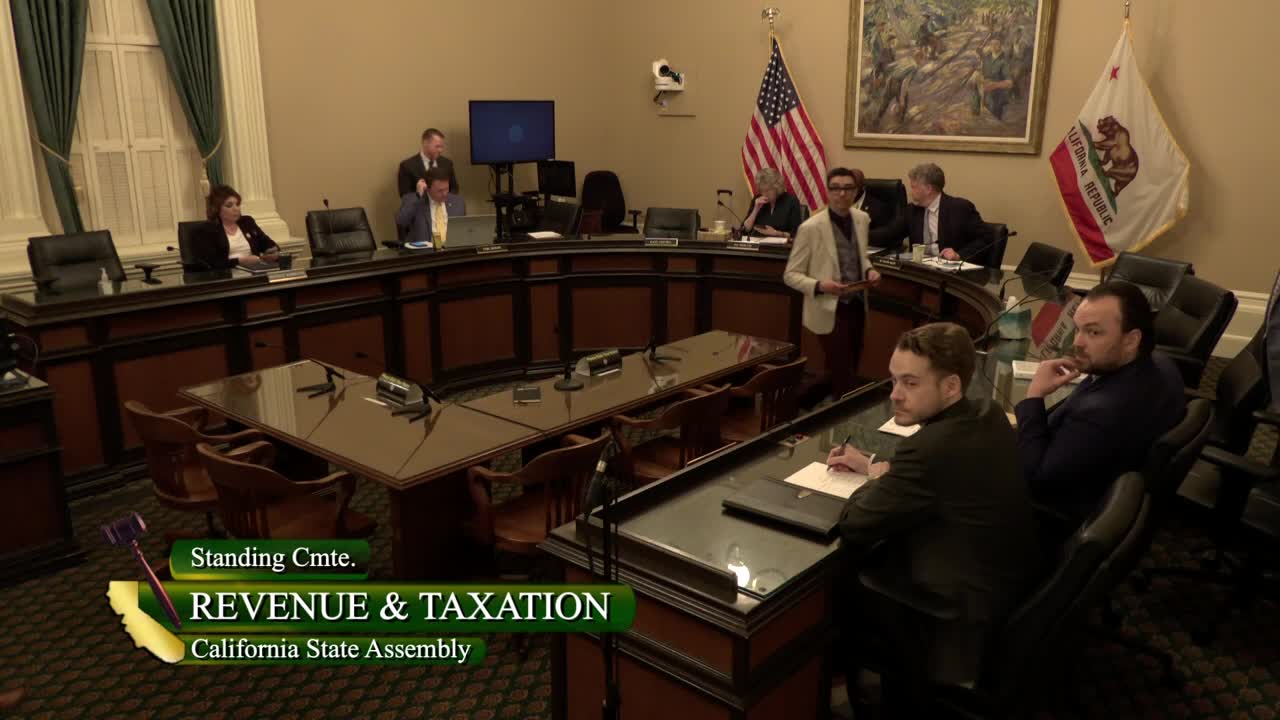 5MIN
Assembly Standing Committee on Revenue and Taxation
Bill Author