AB 1598: Behavioral sciences.
- Session Year: 2025-2026
- House: Assembly
- Latest Version Date: 2026-09-27
Current Status:
Passed
(2026-09-27: Chaptered by Secretary of State - Chapter 528, Statutes of 2026.)
Introduced
In Committee
Awaiting First Chamber Vote
Passed First Chamber
In Committee
Awaiting Second Chamber Vote
Passed Second Chamber
Enacted
Existing law establishes the Board of Behavioral Sciences within the Department of Consumer Affairs and requires the board to regulate licensees and registrants under the Licensed Marriage and Family Therapist Act (LMFTA), the Educational Psychologist Practice Act (EPPA), the Clinical Social Worker Practice Act (CSWPA), and the Licensed Professional Clinical Counselor Act (LPCCA). Existing law makes a violation of those acts a crime.
The LMFTA, the CSWPA, and the LPCCA each contain varying provisions limiting their application to the practice of certain medical and other behavioral science professionals, attorneys, and certain religious personnel, including priests, rabbis, and ministers of the gospel of any religious denomination.
This bill would revise and recast those provisions to, among other things, exempt a religious official of any denomination, including those specified above and imams, when providing faith-based counseling services as part of their regular professional duties for an established and legally recognizable faith-based entity if certain criteria are met. The bill would also exempt attorneys and physicians who provide counseling services as part of their professional practice from the LMFTA and the LPCCA.
Existing law establishes examination and experiential requirements under the LMFTA, the EPPA, the CSWPA, and the LPCCA to qualify for licensure or registration under those acts and requires an applicant for licensure or registration to have passed certain examinations or obtain specified experience within a certain timeline for it to be accepted by the board. In this regard, existing law generally requires the applicant to gain the required experience no more than 6 years before the board receives the application. For licensed educational psychologists, the EPPA authorizes the board to accept a passing score on a written examination administered by the board for a period of 7 years from the date the examination was taken. Under the LMFTA, the CSWPA, and the LPCCA, registrants and applicants for licensure, registration, or a subsequent registration number are required to pass a California law and ethics examination. The LMFTA, the CSWPA, and the LPCCA require an applicant for licensure to pass a clinical examination within 7 years from the initial attempt, unless the applicant obtains a passing score on the current version of the California law and ethics examination.
This bill, instead, would require applicants for licensure under the LMFTA, the EPPA, the CSWPA, and the LPCCA, to obtain the relevant experience and to pass the relevant examination within 7 years preceding the date on which the board receives the application. The bill would require those applicants and registrants under the LMFTA, the CSWPA, and the LPCCA who submit applications to the board on and after January 1, 2030, to have passed the California law and ethics examination no more than 7 years before the board receives the application, as specified.
Existing law authorizes an associate marriage and family therapist registration, an associate clinical social worker registration, or an associate professional clinical counselor registration to be renewed a maximum of 5 times and prohibits a registration from being renewed beyond 6 years from the last day of the month of issuance. Existing law authorizes an applicant to apply for a subsequent registration number when no renewals are possible if certain requirements are met. Existing law prohibits an applicant who is issued a subsequent associate registration number from being employed or volunteering in a private practice.
This bill would increase the maximum number of renewals for those registrations to 6 and would extend the renewal deadline to 7 years from the last day of the month of issuance. The bill would authorize an applicant applying for or holding a subsequent associate registration number to request a 2-year hardship extension of the subsequent associate registration number to allow them to be employed or volunteer at one private practice or professional corporation employer, subject to specified conditions and requirements, including signing an application under penalty of perjury. By expanding the crime of perjury, the bill would impose a state-mandated local program.
Existing law requires an associate marriage and family therapist or a marriage and family therapist trainee to disclose to a client or patient that they are unlicensed and to provide specified information to the client or patient. Existing law requires a social work applicant or registrant and a clinical counselor trainee, applicant, or associate to inform each client or patient that they are unlicensed and under supervision, as specified.
This bill would instead require a marriage and family therapist applicant or registrant, a social work applicant, registrant, intern, or trainee, or a clinical counselor applicant, associate, or trainee, in addition to disclosing to a client or patient that they are unlicensed and under supervision, to provide the name of their employer or the entity for which they volunteer.
Existing law establishes a $20 fee for rescoring a written examination under the LMFTA, the EPPA, the CSWPA, and the LPCCA.
This bill would delete that fee.
This bill would delete obsolete provisions and make other technical and nonsubstantive changes.
This bill would incorporate additional changes to Section 4980.41 of the Business and Professions Code proposed by SB 1445 to be operative only if this bill and SB 1445 are enacted and this bill is enacted last.
The California Constitution requires the state to reimburse local agencies and school districts for certain costs mandated by the state. Statutory provisions establish procedures for making that reimbursement.
This bill would provide that no reimbursement is required by this act for a specified reason.
Existing law establishes the Board of Behavioral Sciences within the Department of Consumer Affairs and requires the board to regulate licensees and registrants under the Licensed Marriage and Family Therapist Act (LMFTA), the Educational Psychologist Practice Act (EPPA), the Clinical Social Worker Practice Act (CSWPA), and the Licensed Professional Clinical Counselor Act (LPCCA). Existing law makes a violation of those acts a crime.
The LMFTA, the CSWPA, and the LPCCA each contain varying provisions limiting their application to the practice of certain medical and other behavioral science professionals, attorneys, and certain religious personnel, including priests, rabbis, and ministers of the gospel of any religious denomination.
This bill would revise and recast those provisions to, among other things, exempt a religious official of any denomination, including those specified above and imams, when providing faith-based counseling services as part of their regular professional duties for an established and legally recognizable faith-based entity if certain criteria are met. The bill would also exempt attorneys and physicians who provide counseling services as part of their professional practice from the LMFTA and the LPCCA.
Existing law establishes examination and experiential requirements under the LMFTA, the EPPA, the CSWPA, and the LPCCA to qualify for licensure or registration under those acts and requires an applicant for licensure or registration to have passed certain examinations or obtain specified experience within a certain timeline for it to be accepted by the board. In this regard, existing law generally requires the applicant to gain the required experience no more than 6 years before the board receives the application. For licensed educational psychologists, the EPPA authorizes the board to accept a passing score on a written examination administered by the board for a period of 7 years from the date the examination was taken. Under the LMFTA, the CSWPA, and the LPCCA, registrants and applicants for licensure, registration, or a subsequent registration number are required to pass a California law and ethics examination. The LMFTA, the CSWPA, and the LPCCA require an applicant for licensure to pass a clinical examination within 7 years from the initial attempt, unless the applicant obtains a passing score on the current version of the California law and ethics examination.
This bill, instead, would require applicants for licensure under the LMFTA, the EPPA, the CSWPA, and the LPCCA, to obtain the relevant experience and to pass the relevant examination within 7 years preceding the date on which the board receives the application. The bill would require those applicants and registrants under the LMFTA, the CSWPA, and the LPCCA who submit applications to the board on and after January 1, 2030, to have passed the California law and ethics examination no more than 7 years before the board receives the application, as specified.
Existing law authorizes an associate marriage and family therapist registration, an associate clinical social worker registration, or an associate professional clinical counselor registration to be renewed a maximum of 5 times and prohibits a registration from being renewed beyond 6 years from the last day of the month of issuance. Existing law authorizes an applicant to apply for a subsequent registration number when no renewals are possible if certain requirements are met. Existing law prohibits an applicant who is issued a subsequent associate registration number from being employed or volunteering in a private practice.
This bill would increase the maximum number of renewals for those registrations to 6 and would extend the renewal deadline to 7 years from the last day of the month of issuance. The bill would authorize an applicant applying for or holding a subsequent associate registration number to request a 2-year hardship extension of the subsequent associate registration number to allow them to be employed or volunteer at one private practice or professional corporation employer, subject to specified conditions and requirements, including signing an application under penalty of perjury. By expanding the crime of perjury, the bill would impose a state-mandated local program.
Existing law requires an associate marriage and family therapist or a marriage and family therapist trainee to disclose to a client or patient that they are unlicensed and to provide specified information to the client or patient. Existing law requires a social work applicant or registrant and a clinical counselor trainee, applicant, or associate to inform each client or patient that they are unlicensed and under supervision, as specified.
This bill would instead require a marriage and family therapist applicant or registrant, a social work applicant, registrant, intern, or trainee, or a clinical counselor applicant, associate, or trainee, in addition to disclosing to a client or patient that they are unlicensed and under supervision, to provide the name of their employer or the entity for which they volunteer.
Existing law establishes a $20 fee for rescoring a written examination under the LMFTA, the EPPA, the CSWPA, and the LPCCA.
This bill would delete that fee.
This bill would delete obsolete provisions and make other technical and nonsubstantive changes.
The California Constitution requires the state to reimburse local agencies and school districts for certain costs mandated by the state. Statutory provisions establish procedures for making that reimbursement.
This bill would provide that no reimbursement is required by this act for a specified reason.
Existing law establishes the Board of Behavioral Sciences within the Department of Consumer Affairs and requires the board to regulate licensees and registrants under the Licensed Marriage and Family Therapist Act (LMFTA), the Educational Psychologist Practice Act (EPPA), the Clinical Social Worker Practice Act (CSWPA), and the Licensed Professional Clinical Counselor Act (LPCCA). Existing law makes a violation of those acts a crime.
The LMFTA, the CSWPA, and the LPCCA each contain varying provisions limiting their application to the practice of certain medical and other behavioral science professionals, attorneys, and certain religious personnel, including priests, rabbis, and ministers of the gospel of any religious denomination.
This bill would revise and recast those provisions to make them consistent across those 3 acts. Specifically, the bill would provide that LMFTA, the CSWPA, and the LPCCA do not prevent qualified members of other professional groups, including those referenced above, from doing work of a psychosocial nature consistent with the standards, ethics, and scope of practice of their respective professions. The bill would prohibit those other professionals from stating or implying that they are licensed or registered under the LMFTA, the CSWPA, or the LPCCA, as specified. The bill would to, among other things, exempt a religious official of any denomination, including those specified above and imams, when providing faith-based counseling services as part of their regular professional duties for an established and legally recognizable faith-based entity if certain criteria are met. The bill would also exempt attorneys and physicians who provide counseling services as part of their professional practice from the LMFTA and the LPCCA.
Existing law establishes examination and experiential requirements under the LMFTA, the EPPA, the CSWPA, and the LPCCA to qualify for licensure or registration under those acts, acts and requires an applicant for licensure or registration to have passed certain examinations or obtain specified experience within a certain timeline for it to be accepted by the board. In this regard, existing law generally requires the applicant to gain the required experience no more than 6 years before the board receives the application. For licensed educational psychologists, the EPPA authorizes the board to accept a passing score on a written examination administered by the board for a period of 6 7 years from the date the examination was taken. Under the LMFTA, the CSWPA, and the LPCCA, registrants and applicants for licensure, registration, or a subsequent registration number are required to pass a California law and ethics examination. The LMFTA, the CSWPA, and the LPCCA require an applicant for licensure to pass a clinical examination within 7 years from the initial attempt, unless the applicant obtains a passing score on the current version of the California law and ethics examination.
This bill, instead, would require applicants for licensure under the LMFTA, the EPPA, the CSWPA, and the LPCCA, to obtain the relevant experience and to pass the relevant examination within 7 years preceding the date on which the board receives the application. The bill would require those applicants and registrants under the LMFTA, the CSWPA, and the LPCCA who submit applications to the board on and after January 1, 2030, to have passed the California law and ethics examination no more than 7 years before the board receives the application, as specified.
Existing law authorizes an associate marriage and family therapist registration, an associate clinical social worker registration, or an associate professional clinical counselor registration to be renewed a maximum of 5 times and prohibits a registration from being renewed beyond 6 years from the last day of the month of issuance. Existing law authorizes an applicant to apply for a subsequent registration number when no renewals are possible if certain requirements are met. Existing law prohibits an applicant who is issued a subsequent associate registration number from being employed or volunteering in a private practice.
This bill would increase the maximum number of renewals for those registrations to 6 and would extend the renewal deadline to 7 years from the last day of the month of issuance. The bill would authorize an applicant applying for or holding a subsequent associate registration number to request a 2-year hardship extension of the subsequent associate registration number to allow them to be employed or volunteer at one private practice or professional corporation employer, subject to specified conditions and requirements, including signing an application under penalty of perjury. By expanding the crime of perjury, the bill would impose a state-mandated local program.
Existing law establishes a $20 fee for rescoring a written examination under the LMFTA, the EPPA, the CSWPA, and the LPCCA.
This bill would delete that fee.
This bill would delete obsolete provisions and make other technical and nonsubstantive changes.
The California Constitution requires the state to reimburse local agencies and school districts for certain costs mandated by the state. Statutory provisions establish procedures for making that reimbursement.
This bill would provide that no reimbursement is required by this act for a specified reason.
Existing law establishes the Board of Behavioral Sciences within the Department of Consumer Affairs and requires the board to regulate licensees and registrants under the Licensed Marriage and Family Therapist Act (LMFTA), the Educational Psychologist Practice Act (EPPA), the Clinical Social Worker Practice Act (CSWPA), and the Licensed Professional Clinical Counselor Act (LPCCA). Existing law makes a violation of those acts a crime.
The LMFTA, the CSWPA, and the LPCCA each contain varying provisions limiting their application to the practice of certain medical and other behavioral science professionals, attorneys, and certain religious personnel, including priests, rabbis, and ministers of the gospel of any religious denomination.
This bill would revise and recast those provisions to make them consistent across those 3 acts. Specifically, the bill would provide that LMFTA, the CSWPA, and the LPCCA do not prevent qualified members of other professional groups, including those referenced above, from doing work of a psychosocial nature consistent with the standards, ethics, and scope of practice of their respective professions. The bill would prohibit those other professionals from stating or implying that they are licensed or registered under the LMFTA, the CSWPA, or the LPCCA, as specified. The bill would exempt a religious official of any denomination, including those specified above and imams, when providing faith-based counseling services as part of their regular professional duties for an established and legally recognizable faith-based entity if certain criteria are met.
Existing law establishes examination and experiential requirements under the LMFTA, the EPPA, the CSWPA, and the LPCCA to qualify for licensure or registration under those acts, and requires an applicant for licensure or registration to have passed certain examinations or obtain specified experience within a certain timeline for it to be accepted by the board. In this regard, existing law generally requires the applicant to gain the required experience no more than 6 years before the board receives the application. For licensed educational psychologists, the EPPA authorizes the board to accept a passing score on a written examination administered by the board for a period of 6 years from the date the examination was taken. Under the LMFTA, the CSWPA, and the LPCCA, registrants and applicants for licensure, registration, or a subsequent registration number are required to pass a California law and ethics examination. The LMFTA, the CSWPA, and the LPCCA require an applicant for licensure to pass a clinical examination within 7 years from the initial attempt, unless the applicant obtains a passing score on the current version of the California law and ethics examination.
This bill, instead, would require applicants for licensure under the LMFTA, the EPPA, the CSWPA, and the LPCCA, to obtain the relevant experience and to pass the relevant examination within 7 years preceding the date on which the board receives the application. The bill would require those applicants and registrants under the LMFTA, the CSWPA, and the LPCCA who submit applications to the board on and after January 1, 2030, to have passed the California law and ethics examination no more than 7 years before the board receives the application, as specified.
Existing law authorizes an associate marriage and family therapist registration, an associate clinical social worker registration, or an associate professional clinical counselor registration to be renewed a maximum of 5 times and prohibits a registration from being renewed beyond 6 years from the last day of the month of issuance. Existing law authorizes an applicant to apply for a subsequent registration number when no renewals are possible if certain requirements are met. Existing law prohibits an applicant who is issued a subsequent associate registration number from being employed or volunteering in a private practice.
This bill would increase the maximum number of renewals for those registrations to 6 and would extend the renewal deadline to 7 years from the last day of the month of issuance. The bill would authorize an applicant applying for or holding a subsequent associate registration number to request a 2-year hardship extension of the subsequent associate registration number to allow them to be employed or volunteer at one private practice or professional employer, subject to specified conditions and requirements, including signing an application under penalty of perjury. By expanding the crime of perjury, the bill would impose a state-mandated local program.
Existing law establishes a $20 fee for rescoring a written examination under the LMFTA, the EPPA, the CSWPA, and the LPCCA.
This bill would delete that fee.
This bill would delete obsolete provisions and make other technical and nonsubstantive changes.
The California Constitution requires the state to reimburse local agencies and school districts for certain costs mandated by the state. Statutory provisions establish procedures for making that reimbursement.
This bill would provide that no reimbursement is required by this act for a specified reason.
(a)This chapter shall not be construed to constrict, limit, or withdraw the Medical Practice Act (Chapter 5 (commencing with Section 2000)), the Clinical Social Worker Practice Act (Chapter 14 (commencing with Section 4991)), the Nursing Practice Act (Chapter 6 (commencing with Section 2700)), the Licensed Professional Clinical Counselor Act (Chapter 16 (commencing with Section 4999.10)), or the Psychology Licensing Law (Chapter 6.6 (commencing with Section 2900)).
(b)This chapter shall not apply to any person who is admitted to practice law in the state, or a physician and surgeon who provides counseling services as part of their professional practice.
(c)This chapter shall not apply to any priest, rabbi, imam, or minister of the gospel, or other religious official of any denomination when providing faith-based counseling services as part of their regular professional duties for an established and legally recognizable faith-based entity, such as a church, synagogue, mosque, or other recognized religious organization, provided that all of the following criteria are met:
(1)The services are performed solely under the direct auspices of that faith-based entity.
(2)A separate fee, beyond their customary compensation from that faith-based entity, is not charged or received.
(3)They do not hold themselves out to the public by any title or description of services incorporating the words psychosocial, psychotherapy, or marriage and family therapist, and shall not state or imply that they are licensed or registered to practice marriage and family therapy.
(4)The services provided are limited to counseling services provided in a religious or spiritual context and do not involve the diagnosis or treatment of mental health disorders.
(d)This chapter shall not apply to an unlicensed or unregistered employee or volunteer working in a governmental entity, a school, a college, a university, or an institution that is both nonprofit and charitable if both of the following apply:
(1)The work of the employee or volunteer is performed under the oversight and direction of the entity.
(2)(A)On and after July 1, 2020, the employee or volunteer provides a client, prior to initiating psychotherapy services or as soon as practicably possible thereafter, a notice written in at least 12-point type that is in substantially the following form:
NOTICE TO CLIENTS
The (name of office or unit) of the (name of agency) receives and responds to complaints regarding the practice of psychotherapy by any unlicensed or unregistered practitioner providing services at (name of agency). To file a complaint, contact (telephone number, email address, internet website, or mailing address of agency).
The Board of Behavioral Sciences receives and responds to complaints regarding services provided by individuals licensed and registered by the board. If you have a complaint and are unsure if your practitioner is licensed or registered, please contact the Board of Behavioral Sciences at 916-574-7830 for assistance or utilize the boards online license verification feature by visiting www.bbs.ca.gov.
(B)The delivery of the notice described in subparagraph (A) to the client shall be documented.
(e)A marriage and family therapist licensed under this chapter is a licentiate for purposes of paragraph (2) of subdivision (a) of Section 805, and thus is a health care provider subject to the provisions of Section 2290.5 pursuant to subdivision (b) of that section.
(f)Notwithstanding subdivisions (c) and (d), all persons registered as associates or licensed under this chapter shall not be exempt from this chapter or the jurisdiction of the board.
SEC. 2.Section 4980.397 of the Business and Professions Code is amended to read:4980.397.(a)A registrant or an applicant for licensure as a marriage and family therapist shall pass the following two examinations as prescribed by the board:
(1)A California law and ethics examination.
(2)A clinical examination administered by the board or by a public or private organization, as specified by the board in regulations.
(b)The board shall grant eligibility to take the California law and ethics examination upon approval of an application for registration or an application for licensure, and submission of the required application and fee.
(c)The board may grant an applicant for licensure eligibility to take the clinical examination only upon meeting all of the following requirements:
(1)Completion of all required supervised work experience.
(2)Completion of all education requirements.
(3)Passage of the California law and ethics examination.
SEC. 3.Section 4980.398 of the Business and Professions Code is repealed.SEC. 4.Section 4980.399 of the Business and Professions Code is amended to read:4980.399.(a)Each applicant and registrant shall obtain a passing score on a board-administered California law and ethics examination in order to qualify for licensure. The California law and ethics examination shall be passed no more than seven years prior to the boards receipt of the application for initial license issuance.
(b)If an applicant fails the California law and ethics examination, they may retake the examination after any waiting period specified in regulation, upon payment of the required fees and submission of a reexamination application.
(c)The board shall not issue a subsequent associate registration number unless the applicant has passed the California law and ethics examination no more than seven years prior to the boards receipt of the application for the subsequent associate registration number.
(d)Notwithstanding any other provision of law, the seven-year age limit on the California law and ethics examination shall not apply to any application for initial license issuance or subsequent associate registration number received by the board on or before January 1, 2030.
(e)A registrant shall complete a minimum of three hours of continuing education on the subject of California law and ethics during each renewal period to be eligible to renew their registration. The coursework shall be obtained from a board-accepted provider of continuing education, as specified in Section 4980.54.
SEC. 5.Section 4980.40 of the Business and Professions Code is amended to read:4980.40.An applicant for licensure shall satisfy all of the following qualifications:
(a)Meet the educational requirements of Section 4980.36 or both Sections 4980.37 and 4980.41, as applicable.
(b)Be at least 18 years of age.
(c)Have at least two years of supervised experience as specified in this chapter and its corresponding regulations.
(d)Successfully pass a California law and ethics examination and a clinical examination, as specified in Section 4980.397. Each examination shall be passed no more than seven years prior to the boards receipt of the application for initial license issuance.
(e)Not be subject to denial of licensure under Section 480. The board shall not issue a registration or license to any person who has been convicted of a crime in this or another state or in a territory of the United States that involves sexual abuse of children or who is required to register pursuant to Section 290 of the Penal Code or the equivalent in another state or territory, in accordance with Section 480.
SEC. 6.Section 4980.41 of the Business and Professions Code is amended to read:4980.41.(a)An applicant for licensure whose education qualifies them under Section 4980.37 shall complete the following coursework or training in order to be eligible to sit for the clinical examination as specified in Section 4980.397:
(1)A two semester or three quarter unit course in California law and professional ethics for marriage and family therapists, which shall include, but not be limited to, the following areas of study:
(A)Contemporary professional ethics and statutory, regulatory, and decisional laws that delineate the professions scope of practice.
(B)The therapeutic, clinical, and practical considerations involved in the legal and ethical practice of marriage and family therapy, including family law.
(C)The current legal patterns and trends in the mental health profession.
(D)The psychotherapist-patient privilege, confidentiality, the patient dangerous to self or others, and the treatment of minors with and without parental consent.
(E)A recognition and exploration of the relationship between a practitioners sense of self and human values and their professional behavior and ethics.
This course may be considered as part of the 48 semester or 72 quarter unit requirements contained in Section 4980.37.
(2)A minimum of seven contact hours of training or coursework in child abuse assessment and reporting as specified in Section 28 and any regulations promulgated thereunder.
(3)A minimum of 10 contact hours of training or coursework in human sexuality as specified in Section 25, and any regulations promulgated thereunder. When coursework in a masters or doctors degree program is acquired to satisfy this requirement, it shall be considered as part of the 48 semester or 72 quarter unit requirement contained in Section 4980.37.
(4)For persons who began graduate study on or after January 1, 1986, a masters or doctors degree qualifying for licensure shall include specific instruction in alcoholism and other chemical substance dependency as specified by regulation. When coursework in a masters or doctors degree program is acquired to satisfy this requirement, it shall be considered as part of the 48 semester or 72 quarter unit requirement contained in Section 4980.37. Coursework required under this paragraph may be satisfactory if taken either in fulfillment of other educational requirements for licensure or in a separate course. The applicant may satisfy this requirement by successfully completing this coursework from a masters or doctoral degree program at an accredited or approved institution, as described in subdivision (b) of Section 4980.37, or from a board-accepted provider of continuing education, as described in Section 4980.54.
(5)For persons who began graduate study during the period commencing on January 1, 1995, and ending on December 31, 2003, a masters or doctors degree qualifying for licensure shall include coursework in spousal or partner abuse assessment, detection, and intervention. For persons who began graduate study on or after January 1, 2004, a masters or doctors degree qualifying for licensure shall include a minimum of 15 contact hours of coursework in spousal or partner abuse assessment, detection, and intervention strategies, including knowledge of community resources, cultural factors, and same gender abuse dynamics. Coursework required under this paragraph may be satisfactory if taken either in fulfillment of other educational requirements for licensure or in a separate course. The applicant may satisfy this requirement by successfully completing this coursework from a masters or doctoral degree program at an accredited or approved institution, as described in subdivision (b) of Section 4980.37, or from a board-accepted provider of continuing education, as described in Section 4980.54.
(6)For persons who began graduate study on or after January 1, 2001, an applicant shall complete a minimum of a two semester or three quarter unit survey course in psychological testing. When coursework in a masters or doctors degree program is acquired to satisfy this requirement, it may be considered as part of the 48 semester or 72 quarter unit requirement of Section 4980.37.
(7)For persons who began graduate study on or after January 1, 2001, an applicant shall complete a minimum of a two semester or three quarter unit survey course in psychopharmacology. When coursework in a masters or doctors degree program is acquired to satisfy this requirement, it may be considered as part of the 48 semester or 72 quarter unit requirement of Section 4980.37.
(b)The requirements added by paragraphs (6) and (7) of subdivision (a) are intended to improve the educational qualifications for licensure in order to better prepare future licentiates for practice and are not intended in any way to expand or restrict the scope of practice for licensed marriage and family therapists.
SEC. 6.5.Section 4980.41 of the Business and Professions Code is amended to read:4980.41.(a)An applicant for licensure whose education qualifies them under Section 4980.37 shall complete the following coursework or training in order to be eligible to sit for the clinical examination as specified in Section 4980.397:
(1)A two semester or three quarter unit course in California law and professional ethics for marriage and family therapists, which shall include, but not be limited to, the following areas of study:
(A)Contemporary professional ethics and statutory, regulatory, and decisional laws that delineate the professions scope of practice.
(B)The therapeutic, clinical, and practical considerations involved in the legal and ethical practice of marriage and family therapy, including family law.
(C)The current legal patterns and trends in the mental health profession.
(D)The psychotherapist-patient privilege, confidentiality, the patient dangerous to self or others, and the treatment of minors with and without parental consent.
(E)A recognition and exploration of the relationship between a practitioners sense of self and human values and their professional behavior and ethics.
This course may be considered as part of the 48 semester or 72 quarter unit requirements contained in Section 4980.37.
(2)A minimum of seven contact hours of training or coursework in child abuse assessment and reporting as specified in Section 4990.26.2 and any regulations promulgated thereunder.
(3)A minimum of 10 contact hours of training or coursework in human sexuality as specified in Section 4990.26.1, and any regulations promulgated thereunder. When coursework in a masters or doctors degree program is acquired to satisfy this requirement, it shall be considered as part of the 48 semester or 72 quarter unit requirement contained in Section 4980.37.
(4)For persons who began graduate study on or after January 1, 1986, a masters or doctors degree qualifying for licensure shall include specific instruction in alcoholism and other chemical substance dependency as specified by regulation. When coursework in a masters or doctors degree program is acquired to satisfy this requirement, it shall be considered as part of the 48 semester or 72 quarter unit requirement contained in Section 4980.37. Coursework required under this paragraph may be satisfactory if taken either in fulfillment of other educational requirements for licensure or in a separate course. The applicant may satisfy this requirement by successfully completing this coursework from a masters or doctoral degree program at an accredited or approved institution, as described in subdivision (b) of Section 4980.37, or from a board-accepted provider of continuing education, as described in Section 4980.54.
(5)For persons who began graduate study during the period commencing on January 1, 1995, and ending on December 31, 2003, a masters or doctors degree qualifying for licensure shall include coursework in spousal or partner abuse assessment, detection, and intervention. For persons who began graduate study on or after January 1, 2004, a masters or doctors degree qualifying for licensure shall include a minimum of 15 contact hours of coursework in spousal or partner abuse assessment, detection, and intervention strategies, including knowledge of community resources, cultural factors, and same gender abuse dynamics. Coursework required under this paragraph may be satisfactory if taken either in fulfillment of other educational requirements for licensure or in a separate course. The applicant may satisfy this requirement by successfully completing this coursework from a masters or doctoral degree program at an accredited or approved institution, as described in subdivision (b) of Section 4980.37, or from a board-accepted provider of continuing education, as described in Section 4980.54.
(6)For persons who began graduate study on or after January 1, 2001, an applicant shall complete a minimum of a two semester or three quarter unit survey course in psychological testing. When coursework in a masters or doctors degree program is acquired to satisfy this requirement, it may be considered as part of the 48 semester or 72 quarter unit requirement of Section 4980.37.
(7)For persons who began graduate study on or after January 1, 2001, an applicant shall complete a minimum of a two semester or three quarter unit survey course in psychopharmacology. When coursework in a masters or doctors degree program is acquired to satisfy this requirement, it may be considered as part of the 48 semester or 72 quarter unit requirement of Section 4980.37.
(b)The requirements added by paragraphs (6) and (7) of subdivision (a) are intended to improve the educational qualifications for licensure in order to better prepare future licentiates for practice and are not intended in any way to expand or restrict the scope of practice for licensed marriage and family therapists.
SEC. 7.Section 4980.43 of the Business and Professions Code is amended to read:4980.43.(a)Except as provided in subdivision (b), all applicants shall have an active associate registration with the board in order to gain postdegree hours of supervised experience.
(b)(1)Postdegree hours of experience gained before the issuance of an associate registration shall be credited toward licensure if all of the following apply:
(A)The registration applicant applies for the associate registration and the board receives the application within 90 days of the granting of the qualifying masters degree or doctoral degree.
(B)For applicants completing graduate study on or after January 1, 2020, the experience is obtained at a workplace that, prior to the registration applicant gaining supervised experience hours, requires completed Live Scan fingerprinting. The applicant shall provide the board with a copy of that completed State of California Request for Live Scan Service form with the application for licensure.
(C)The board subsequently grants the associate registration.
(2)The applicant shall not be employed or volunteer in a private practice or a professional corporation until the applicant has been issued an associate registration by the board.
(c)Supervised experience that is obtained for purposes of qualifying for licensure shall be related to the practice of marriage and family therapy and comply with the following:
(1)A minimum of 3,000 hours completed during a period of at least 104 weeks.
(2)A maximum of 40 hours in any seven consecutive days.
(3)A minimum of 1,700 hours obtained after the qualifying masters or doctoral degree was awarded.
(4)A maximum of 1,300 hours obtained prior to the award date of the qualifying masters or doctoral degree.
(5)A maximum of 750 hours of counseling and direct supervisor contact prior to the award date of the qualifying masters or doctoral degree.
(6)Hours of experience shall not be gained prior to completing either 12 semester units or 18 quarter units of graduate instruction.
(7)Hours of experience shall not have been gained more than seven years prior to the date the application for licensure was received by the board, except that up to 500 hours of clinical experience gained in the supervised practicum required by subdivision (c) of Section 4980.37 and subparagraph (B) of paragraph (1) of subdivision (d) of Section 4980.36 shall be exempt from this seven-year requirement.
(8)A minimum of 1,750 hours of direct clinical counseling with individuals, groups, couples, or families, that includes not less than 500 total hours of experience in diagnosing and treating couples, families, and children.
(9)A maximum of 1,200 hours gained under the supervision of a licensed educational psychologist providing educationally related mental health services that are consistent with the scope of practice of an educational psychologist, as specified in Section 4989.14.
(10)A maximum of 1,250 hours of nonclinical practice, consisting of direct supervisor contact, administering and evaluating psychological tests, writing clinical reports, writing progress or process notes, client-centered advocacy, and workshops, seminars, training sessions, or conferences directly related to marriage and family therapy that have been approved by the applicants supervisor.
(11)It is anticipated and encouraged that hours of experience will include working with elders and dependent adults who have physical or mental limitations that restrict their ability to carry out normal activities or protect their rights.
This subdivision shall only apply to hours gained on and after January 1, 2010.
SEC. 8.Section 4980.44 of the Business and Professions Code is repealed.SEC. 9.Section 4980.44 is added to the Business and Professions Code, to read:4980.44.An applicant or registrant shall inform each client or patient before initiating any mental health and related services that the person is unlicensed and that they are under the supervision of a licensed professional and provide the name of their employer or, if not employed, the name of the entity for which they volunteer.
SEC. 10.Section 4980.48 of the Business and Professions Code is amended to read:4980.48.(a)A trainee shall, before initiating any professional services, inform each client or patient that the trainee is unlicensed and that they are under the supervision of a licensed professional and provide the name of their employer or, if not employed, the name of the entity for which they volunteer.
(b)Any advertisement by or on behalf of a marriage and family therapist trainee shall include, at a minimum, all of the following information:
(1)The trainees name.
(2)That the trainee is a marriage and family therapist trainee.
(3)The name of the trainees employer or, if not employed, the name of the entity for which they volunteer.
(4)That the trainee is supervised by a licensed person.
SEC. 11.Section 4980.50 of the Business and Professions Code is amended to read:4980.50.(a)Every applicant who meets the educational and experience requirements and applies for a license as a marriage and family therapist shall be examined by the board. The examinations shall be as set forth in Section 4980.397 and as specified in regulation. The examinations shall be given at least twice a year at a time and place and under supervision as the board may determine. The board shall examine the candidate with regard to the candidates knowledge and professional skills and judgment in the utilization of appropriate techniques and methods.
(b)The board shall not deny any applicant who has submitted a complete application for examination admission to the licensure examinations required by this section if the applicant meets the educational and experience requirements of this chapter and has not committed any acts or engaged in any conduct that would constitute grounds to deny licensure.
(c)The board shall not deny any applicant, whose application for licensure is complete, admission to the clinical examination, nor shall the board postpone or delay any applicants clinical examination, solely upon the receipt by the board of a complaint alleging acts or conduct that would constitute grounds to deny licensure.
(d)If an applicant for examination who has passed the California law and ethics examination is the subject of a complaint or is under board investigation for acts or conduct that, if proven to be true, would constitute grounds for the board to deny licensure, the board shall permit the applicant to take the clinical examination for licensure, but may notify the applicant that licensure will not be granted pending completion of the investigation.
(e)Notwithstanding Section 135, the board may deny any applicant who has previously failed either the California law and ethics examination or the clinical examination permission to retake either examination pending completion of the investigation of any complaints against the applicant. Nothing in this section shall prohibit the board from denying an applicant admission to any examination or refusing to issue a license to any applicant when an accusation or statement of issues has been filed against the applicant pursuant to Sections 11503 and 11504 of the Government Code, respectively, or the applicant has been denied in accordance with subdivision (b) of Section 485.
(f)Notwithstanding any other provision of law, the board may destroy all examination materials two years following the date of an examination.
(g)The clinical examination shall be passed no more than seven years prior to the boards receipt of the application for initial license issuance.
(h)An applicant for licensure who has qualified pursuant to this chapter shall be issued a license as a marriage and family therapist in the form that the board deems appropriate.
SEC. 12.Section 4984.01 of the Business and Professions Code is amended to read:4984.01.(a)The associate marriage and family therapist registration shall expire one year from the last day of the month in which it was issued.
(b)To renew the registration, subject to the additional limitations imposed by subdivision (d), the registrant shall, on or before the expiration date of the registration, complete all of the following actions:
(1)Apply for renewal on a form prescribed by the board.
(2)Pay a renewal fee prescribed by the board.
(3)Notify the board whether they have been convicted, as defined in Section 490, of a misdemeanor or felony, and whether any disciplinary action has been taken against them by a regulatory or licensing board in this or any other state subsequent to the last renewal of the registration.
(4)Certify under penalty of perjury their compliance with the continuing education requirements set forth in Section 4980.54.
(c)An expired registration may be renewed by completing all of the actions described in paragraphs (1) to (4), inclusive, of subdivision (b).
(d)The registration may be renewed a maximum of six times. No registration shall be renewed or reinstated beyond seven years from the last day of the month during which it was issued, regardless of whether it has been revoked. When no further renewals are possible, an applicant may apply for and obtain a subsequent associate registration number if the applicant meets the educational requirements for a subsequent associate registration number and has passed the California law and ethics examination no more than seven years prior to the boards receipt of the application for the subsequent associate registration number.
(e)An applicant who is issued a subsequent associate registration number pursuant to subdivision (d) shall not be employed or volunteer in a private practice.
(f)Notwithstanding subdivision (e), an applicant applying for or who currently holds a subsequent associate registration number may request that the board grant them a one-time, two-consecutive-year hardship extension to allow them to be employed or volunteer at one private practice or professional corporation employer with their subsequent associate registration number in accordance with the following:
(1)An associate shall not be issued more than one extension.
(2)The extension is only valid for the one private practice or professional corporation employer for which it is requested.
(3)Work for the employer shall not commence or continue until the extension is approved by the board.
(4)The application shall be jointly signed under penalty of perjury and dated by the associate, the supervisor, and, if the supervisor is not employed by the supervisees employer or is a volunteer, a representative of the employer.
(5)The board shall grant the extension provided that the application is signed, all information required is provided, and good cause is demonstrated. The application shall contain all of the following:
(A)The date the extension is needed to commence or continue work for the employer.
(B)The name of the employer where the associate will be gaining hours.
(C)An attestation that the employer is a private practice or a professional corporation.
(D)The name, license type, and license number of the current supervisor.
(E)A showing of good cause for the applicant being unable to complete the licensure process within seven years. Good cause may include, but is not limited to, extended medical leave, family caregiving responsibilities, difficulties finding employment, or circumstances beyond the applicants control.
(F)A description of the plan for the associate to gain the needed hours toward licensure during the two-year extension period.
SEC. 13.Section 4984.7 of the Business and Professions Code is amended to read:4984.7.The board shall assess the following fees relating to the licensure of marriage and family therapists:
(a)The application fee for an associate registration shall be one hundred fifty dollars ($150). The board may adopt regulations to set the fee at a higher amount, up to a maximum of three hundred dollars ($300).
(b)The annual renewal fee for an associate registration shall be one hundred fifty dollars ($150). The board may adopt regulations to set the fee at a higher amount, up to a maximum of three hundred dollars ($300).
(c)The fee for the application for licensure shall be two hundred fifty dollars ($250). The board may adopt regulations to set the fee at a higher amount, up to a maximum of five hundred dollars ($500).
(d)(1)(A)The fee for the board-administered clinical examination, if the board chooses to adopt this examination in regulations, shall be two hundred fifty dollars ($250). The board may adopt regulations to set the fee at a higher amount, up to a maximum of five hundred dollars ($500). If the board chooses to adopt an examination administered by a public or private organization, as specified by the board in regulations, then the examination fee shall be determined by, and paid directly to, that organization.
(B)The fee for the California law and ethics examination shall be one hundred fifty dollars ($150). The board may adopt regulations to set the fee at a higher amount, up to a maximum of three hundred dollars ($300).
(2)An applicant who fails to appear for an examination, after having been scheduled to take the examination, shall forfeit the examination fee.
(3)The amount of the examination fees shall be based on the actual cost to the board of developing, purchasing, and grading each examination and the actual cost to the board of administering each examination. The examination fees shall be adjusted periodically by regulation to reflect the actual costs incurred by the board.
(e)The fee for the issuance of an initial license shall be two hundred dollars ($200). The board may adopt regulations to set the fee at a higher amount, up to a maximum of four hundred dollars ($400).
(f)The fee for the two-year license renewal shall be two hundred dollars ($200). The board may adopt regulations to set the fee at a higher amount, up to a maximum of four hundred dollars ($400).
(g)The renewal delinquency fee shall be one-half of the fee for license renewal. A person who permits their license to expire is subject to the delinquency fee.
(h)The fee for issuance of a replacement registration, license, or certificate shall be twenty dollars ($20).
(i)The fee for issuance of a certificate or letter of good standing shall be twenty-five dollars ($25).
(j)The fee for issuance of a retired license shall be forty dollars ($40).
SEC. 14.Section 4984.72 of the Business and Professions Code is amended to read:4984.72.An applicant who fails the clinical examination may, within one year from the notification date of that failure, retake the examination as regularly scheduled without further application upon payment of the fee for the examination. Thereafter, the applicant shall not be eligible for further examination until they file a new application, meet all requirements in effect on the date of application, and pay all required fees.
SEC. 15.Section 4989.20 of the Business and Professions Code is amended to read:4989.20.(a)The board may issue a license as an educational psychologist if the applicant satisfies, with proof satisfactory to the board, the following requirements:
(1)Possession of, at minimum, a masters degree in psychology, educational psychology, school psychology, counseling and guidance, or a degree deemed equivalent by the board. This degree shall be obtained from an educational institution approved by the board according to the regulations adopted under this chapter.
(2)Attainment of 18 years of age.
(3)Is not subject to denial of licensure pursuant to Section 480.
(4)Successful completion of 60 semester units or 90 quarter units of postgraduate study in pupil personnel services.
(5)Two school terms of full-time, or the equivalent to full-time, experience as a licensed or credentialed school psychologist in the public schools or in another school setting as specified in regulations. The experience shall be gained over a period of at least two school terms. The applicant shall not be credited with experience obtained more than seven years immediately preceding the date on which the application for licensure was received by the board.
(6)If the experience required by paragraph (5) was completed while holding a California credential in a school located in California, completion of one of the following:
(A)A minimum of 1,200 hours of supervised professional experience in an accredited school psychology program.
(B)One school term of full-time, or the equivalent to full-time, experience as a California credentialed school psychologist in the California public schools, or in another school setting as specified in regulations, obtained under the direction of a California-licensed educational psychologist. The experience shall be gained over a period of at least one school term. The applicant shall not be credited with experience obtained more than seven years immediately preceding the date on which the application for licensure was received by the board.
(7)If the experience required by paragraph (5) was not completed while holding a California credential in a school located in California, completion of one of the following:
(A)A minimum of 1,200 hours of supervised professional experience gained in California in an accredited school psychology program, gained no more than seven years immediately preceding the date on which the application for licensure was received by the board.
(B)One school term of full-time, or the equivalent to full-time, experience as a California credentialed school psychologist in the California public schools, or in another school setting as specified in regulations, obtained under the direction of a California licensed educational psychologist. The experience shall be gained over a period of at least one school term. The applicant shall not be credited with experience obtained more than seven years immediately preceding the date on which the application for licensure was received by the board.
(8)Passage of the licensed educational psychologist written examination administered by the board. This examination shall be passed no more than seven years prior to the boards receipt of the application for initial license issuance.
(b)For purposes of this section, the following definitions apply:
(1)Full time means the days or hours of creditable service the employer requires to be performed by the employee in a school term under their collective bargaining agreement or employment agreement. It shall consist of a minimum of 175 days, or 1,050 hours, per school term.
(2)Equivalent to full time means the days or hours of creditable service that a person who is employed on a part-time basis would be required to perform in a school term if they were employed full time in that part-time position.
(3)School term means a minimum period of 35 weeks beginning the first day and ending the last day creditable service is required to be performed by a member employed on a full-time basis, excluding any period that has been excluded pursuant to a publicly available written contractual agreement. The school term shall also be the same for an individual who is not employed on a full-time basis who is performing the same duties as a member employed on a full-time basis.
SEC. 16.Section 4989.68 of the Business and Professions Code is amended to read:4989.68.The board shall assess the following fees relating to the licensure of educational psychologists:
(a)The application fee for licensure shall be two hundred fifty dollars ($250). The board may adopt regulations to set the fee at a higher amount, up to a maximum of five hundred dollars ($500).
(b)The fee for issuance of the initial license shall be two hundred dollars ($200). The board may adopt regulations to set the fee at a higher amount, up to a maximum of four hundred dollars ($400).
(c)The fee for the two-year license renewal shall be two hundred dollars ($200). The board may adopt regulations to set the fee at a higher amount, up to a maximum of four hundred dollars ($400).
(d)The delinquency fee shall be one-half of the fee for license renewal. A person who permits their license to expire shall be subject to the delinquency fee.
(e)The written examination fee shall be two hundred fifty dollars ($250). The board may adopt regulations to set the fee at a higher amount, up to a maximum of five hundred dollars ($500). An applicant who fails to appear for an examination, once having been scheduled, shall forfeit any examination fees they paid.
(f)The fee for issuance of a replacement registration, license, or certificate shall be twenty dollars ($20).
(g)The fee for issuance of a certificate or letter of good standing shall be twenty-five dollars ($25).
(h)The fee for issuance of a retired license shall be forty dollars ($40).
SEC. 17.Section 4992.05 of the Business and Professions Code is amended to read:4992.05.(a)A registrant or an applicant for licensure as a clinical social worker shall pass the following two examinations as prescribed by the board:
(1)A California law and ethics examination.
(2)A clinical examination.
(b)The board shall grant eligibility to take the California law and ethics examination upon approval of an application for registration or an application for licensure, and submission of the required application and fee.
(c)The board may grant an applicant for licensure eligibility to take the clinical examination only upon meeting all of the following requirements:
(1)Completion of all education requirements.
(2)Passage of the California law and ethics examination.
(3)Completion of all required supervised work experience.
SEC. 18.Section 4992.07 of the Business and Professions Code is repealed.SEC. 19.Section 4992.09 of the Business and Professions Code is amended to read:4992.09.(a)Each applicant and registrant shall obtain a passing score on a board-administered California law and ethics examination in order to qualify for licensure. The California law and ethics examination shall be passed no more than seven years prior to the boards receipt of the application for initial license issuance.
(b)If an applicant fails the California law and ethics examination, they may retake the examination after any waiting period as specified in regulation, upon payment of the required fees and submission of a reexamination application.
(c)The board shall not issue a subsequent associate registration number unless the applicant has passed the California law and ethics examination no more than seven years prior to the boards receipt of the application for the subsequent associate registration number.
(d)Notwithstanding any other provision of law, the seven-year age limit on the California law and ethics examination shall not apply to any application for initial license issuance or subsequent associate registration number received by the board on or before January 1, 2030.
(e)A registrant shall complete a minimum of three hours of continuing education on the subject of California law and ethics during each renewal period to be eligible to renew their registration. The coursework shall be obtained from a board-accepted provider of continuing education, as specified in Section 4996.22.
SEC. 20.Section 4992.1 of the Business and Professions Code is amended to read:4992.1.(a)Only individuals who have the qualifications prescribed by the board under this chapter are eligible to take an examination under this chapter.
(b)Every applicant who is issued a clinical social worker license shall be examined by the board.
(c)Notwithstanding any other provision of law, the board may destroy all examination materials two years following the date of an examination.
(d)The board shall not deny any applicant, whose application for licensure is complete, admission to the clinical examination, nor shall the board postpone or delay any applicants clinical examination, solely upon the receipt by the board of a complaint alleging acts or conduct that would constitute grounds to deny licensure.
(e)If an applicant for examination who has passed the California law and ethics examination is the subject of a complaint or is under board investigation for acts or conduct that, if proven to be true, would constitute grounds for the board to deny licensure, the board shall permit the applicant to take the clinical examination for licensure, but may notify the applicant that licensure will not be granted pending completion of the investigation.
(f)Notwithstanding Section 135, the board may deny any applicant who has previously failed either the California law and ethics examination or the clinical examination permission to retake either examination pending completion of the investigation of any complaint against the applicant. Nothing in this section shall prohibit the board from denying an applicant admission to any examination or refusing to issue a license to any applicant when an accusation or statement of issues has been filed against the applicant pursuant to Section 11503 or 11504 of the Government Code, or the applicant has been denied in accordance with subdivision (b) of Section 485.
(g)The clinical examination shall be passed no more than seven years prior to the boards receipt of the application for initial license issuance.
SEC. 21.Section 4996.1 of the Business and Professions Code is amended to read:4996.1.The board shall issue a clinical social worker license to each applicant who qualifies pursuant to this article and who successfully passes a California law and ethics examination and a clinical examination. Each examination shall be passed no more than seven years prior to the boards receipt of the application for initial license issuance.
SEC. 22.Section 4996.3 of the Business and Professions Code is amended to read:4996.3.The board shall assess the following fees relating to the licensure of clinical social workers:
(a)The application fee for registration as an associate clinical social worker shall be one hundred fifty dollars ($150). The board may adopt regulations to set the fee at a higher amount, up to a maximum of three hundred dollars ($300).
(b)The fee for annual renewal of an associate clinical social worker registration shall be one hundred fifty dollars ($150). The board may adopt regulations to set the fee at a higher amount, up to a maximum of three hundred dollars ($300).
(c)The fee for application for licensure shall be two hundred fifty dollars ($250). The board may adopt regulations to set the fee at a higher amount, up to a maximum of five hundred dollars ($500).
(d)(1)(A)The fee for the board-administered clinical examination, if the board chooses to adopt this examination in regulations, shall be two hundred fifty dollars ($250). The board may adopt regulations to set the fee at a higher amount, up to a maximum of five hundred dollars ($500).
(B)The fee for the California law and ethics examination shall be one hundred fifty dollars ($150). The board may adopt regulations to set the fee at a higher amount, up to a maximum of three hundred dollars ($300).
(2)An applicant who fails to appear for an examination, after having been scheduled to take the examination, shall forfeit the examination fees.
(3)The amount of the examination fees shall be based on the actual cost to the board of developing, purchasing, and grading each examination and the actual cost to the board of administering each examination. The written examination fees shall be adjusted periodically by regulation to reflect the actual costs incurred by the board.
(e)The fee for issuance of an initial license shall be two hundred dollars ($200). The board may adopt regulations to set the fee at a higher amount, up to a maximum of four hundred dollars ($400).
(f)The fee for the two-year license renewal shall be two hundred dollars ($200). The board may adopt regulations to set the fee at a higher amount, up to a maximum of four hundred dollars ($400).
(g)The renewal delinquency fee shall be one-half of the fee for license renewal. A person who permits their license to expire shall be subject to the delinquency fee.
(h)The fee for issuance of a replacement registration, license, or certificate shall be twenty dollars ($20).
(i)The fee for issuance of a certificate or letter of good standing shall be twenty-five dollars ($25).
(j)The fee for issuance of a retired license shall be forty dollars ($40).
SEC. 23.Section 4996.4 of the Business and Professions Code is amended to read:4996.4.An applicant who fails the clinical examination may, within one year from the notification date of failure, retake that examination as regularly scheduled, without further application, upon payment of the required examination fees. Thereafter, the applicant shall not be eligible for further examination until they file a new application, meet all current requirements, and pay all required fees.
SEC. 24.Section 4996.13 of the Business and Professions Code is amended to read:4996.13.(a)Nothing in this chapter shall prevent qualified members of other professional groups from doing work of a psychosocial nature consistent with the standards, ethics, and scope of practice of their respective professions. However, these qualified members shall not hold themselves out to the public by any title or description of services incorporating the words clinical social worker, and shall not state or imply that they are licensed or registered to practice clinical social work. These qualified members of other professional groups include, but are not limited to, the following:
(1)A physician and surgeon certified pursuant to Chapter 5 (commencing with Section 2000).
(2)A registered nurse licensed pursuant to Chapter 6 (commencing with Section 2700).
(3)A psychologist licensed pursuant to Chapter 6.6 (commencing with Section 2900).
(4)Members of the State Bar.
(5)Marriage and family therapists licensed pursuant to Chapter 13 (commencing with Section 4980).
(6)Educational psychologists licensed pursuant to Chapter 13.5 (commencing with Section 4989.10).
(7)Licensed professional clinical counselors pursuant to Chapter 16 (commencing with Section 4999.10).
(b)This article shall not apply to any priest, rabbi, imam, minister of the gospel, or other religious official of any denomination when providing faith-based counseling services as part of their regular professional duties for an established and legally recognizable faith-based entity, such as a church, synagogue, mosque, or other recognized religious organization, provided that all of the following criteria are met:
(1)The services are performed solely under the direct auspices of that faith-based entity.
(2)A separate fee, beyond their customary compensation from that faith-based entity, is not charged or received.
(3)They do not hold themselves out to the public by any title or description of services incorporating the words psychosocial, psychotherapy, or clinical social worker, and shall not state or imply that they are licensed or registered to practice clinical social work.
(4)The services provided are limited to counseling services provided in a religious or spiritual context and do not involve the diagnosis or treatment of mental health disorders.
SEC. 25.Section 4996.15 of the Business and Professions Code is amended to read:4996.15.(a)Nothing in this article shall restrict or prevent psychosocial activities by employees of accredited academic institutions, public schools, government agencies, or nonprofit institutions who train graduate students pursuing a masters degree in social work in an accredited college or university. Any psychosocial activities by the employee shall be part of a supervised course of study and the graduate students shall be designated by titles such as social work interns, social work trainees, or other titles clearly indicating the training status appropriate to their level of training. The term social work intern, however, shall be reserved for persons enrolled in a masters or doctoral training program in social work in an accredited school or department of social work.
(b)A person practicing pursuant to subdivision (a) shall, before initiating any professional services, inform each client or patient that they are unlicensed and that they are under supervision and provide the name of their employer or, if not employed, the name of the entity for which they volunteer.
(c)Notwithstanding subdivision (a), a graduate student shall not perform clinical social work in a private practice or a professional corporation.
SEC. 26.Section 4996.18 of the Business and Professions Code is amended to read:4996.18.(a)Except as provided in subdivision (b) of Section 4996.23, an applicant shall have an active registration with the board as an associate clinical social worker in order to gain hours of supervised experience. The application shall be made on a form prescribed by the board.
(b)An applicant for registration shall satisfy the following requirements:
(1)Possess a masters degree from an accredited school or department of social work.
(2)Not be subject to denial of licensure pursuant to Section 480.
(3)Have completed training or coursework, which may be embedded within more than one course, in California law and professional ethics for clinical social workers. The coursework shall be taken from an accredited school or department of social work, a school, college, or university accredited by a regional or national institutional accrediting agency that is recognized by the United States Department of Education, a school, college, or university that is approved by the Bureau for Private Postsecondary Education, or from a continuing education provider that is acceptable to the board, as defined in Section 4996.22. Undergraduate coursework shall not satisfy this requirement. The coursework shall include instruction in all of the following areas of study:
(A)Contemporary professional ethics and statutes, regulations, and court decisions that delineate the scope of practice of clinical social work.
(B)The therapeutic, clinical, and practical considerations involved in the legal and ethical practice of clinical social work, including, but not limited to, family law.
(C)The current legal patterns and trends in the mental health professions.
(D)The psychotherapist-patient privilege, confidentiality, dangerous patients, and the treatment of minors with and without parental consent.
(E)A recognition and exploration of the relationship between a practitioners sense of self and human values, and the practitioners professional behavior and ethics.
(F)The application of legal and ethical standards in different types of work settings.
(G)Licensing law and process.
(c)An applicant who possesses a masters degree from a school or department of social work that is a candidate for accreditation by the Commission on Accreditation of the Council on Social Work Education shall be eligible, and, except as provided in subdivision (b) of Section 4996.23, shall be required to register as an associate clinical social worker in order to gain experience toward licensure if the applicant is not subject to denial of licensure pursuant to Section 480. That applicant shall not, however, be eligible to take the clinical examination until the school or department of social work has received accreditation by the Commission on Accreditation of the Council on Social Work Education.
(d)An applicant who possesses a masters degree from an accredited school or department of social work shall be able to apply experience the applicant obtained during the time the accredited school or department was in candidacy status by the Commission on Accreditation of the Council on Social Work Education toward the licensure requirements, if the experience meets the requirements of Section 4996.23. This subdivision shall apply retroactively to persons who possess a masters degree from an accredited school or department of social work and who obtained experience during the time the accredited school or department was in candidacy status by the Commission on Accreditation of the Council on Social Work Education.
(e)An applicant for registration or licensure trained in an educational institution outside the United States shall demonstrate to the satisfaction of the board that the applicant possesses a masters of social work degree that is equivalent to a masters degree issued from a school or department of social work that is accredited by the Commission on Accreditation of the Council on Social Work Education. These applicants shall provide the board with a comprehensive evaluation of the degree and shall provide any other documentation the board deems necessary. The board has the authority to make the final determination as to whether a degree meets all requirements, including, but not limited to, course requirements regardless of evaluation or accreditation.
(f)All applicants for licensure and registrants shall be at all times under the supervision of a supervisor who shall be responsible for ensuring that the extent, kind, and quality of counseling performed is consistent with the training and experience of the person being supervised and who shall be responsible to the board for compliance with all laws governing the practice of clinical social work.
(g)An applicant or registrant shall inform each client or patient before initiating any professional services that the applicant or registrant is unlicensed and is under the supervision of a licensed professional and provide the name of their employer or, if not employed, the name of the entity for which they volunteer.
SEC. 27.Section 4996.23 of the Business and Professions Code is amended to read:4996.23.(a)To qualify for licensure, each applicant shall complete 3,000 hours of post-masters degree supervised experience related to the practice of clinical social work. Except as provided in subdivision (b), experience shall not be gained until the applicant is registered as an associate clinical social worker.
(b)Postdegree hours of experience gained before the issuance of an associate registration shall be credited toward licensure if all of the following apply:
(1)The registration applicant applies for the associate registration and the board receives the application within 90 days of the granting of the qualifying masters or doctoral degree.
(2)For applicants completing graduate study on or after January 1, 2020, the experience is obtained at a workplace that, prior to the registration applicant gaining supervised experience hours, requires completed Live Scan fingerprinting. The applicant shall provide the board with a copy of that completed State of California Request for Live Scan Service form with the application for licensure.
(3)The board subsequently grants the associate registration.
(c)The applicant shall not be employed or volunteer in a private practice or a professional corporation until the applicant has been issued an associate registration by the board.
(d)The experience shall be as follows:
(1)(A)At least 1,700 hours shall be gained under the supervision of a licensed clinical social worker. The remaining required supervised experience may be gained under the supervision of a physician and surgeon who is certified in psychiatry by the American Board of Psychiatry and Neurology, licensed professional clinical counselor, licensed marriage and family therapist, psychologist licensed pursuant to Chapter 6.6 (commencing with Section 2900), licensed educational psychologist, or licensed clinical social worker.
(B)A maximum of 1,200 hours gained under the supervision of a licensed educational psychologist providing educationally related mental health services that are consistent with the scope of practice of an educational psychologist, as specified in Section 4989.14.
(2)A minimum of 2,000 hours in clinical psychosocial diagnosis, assessment, and treatment, including psychotherapy or counseling; however, at least 750 hours shall be face-to-face individual or group psychotherapy provided in the context of clinical social work services.
(3)A maximum of 1,000 hours in client-centered advocacy, consultation, evaluation, research, direct supervisor contact, and workshops, seminars, training sessions, or conferences directly related to clinical social work that have been approved by the applicants supervisor.
(4)A minimum of two years of supervised experience is required to be obtained over a period of not less than 104 weeks and shall have been gained within the seven years immediately preceding the date on which the application for licensure was received by the board.
(5)No more than 40 hours of experience may be credited in any seven consecutive days.
(6)For hours gained on or after January 1, 2010, no more than six hours of supervision, whether individual, triadic, or group supervision, shall be credited during any single week.
SEC. 28.Section 4996.28 of the Business and Professions Code is amended to read:4996.28.(a)Registration as an associate clinical social worker shall expire one year from the last day of the month during which it was issued. To renew a registration, subject to the additional limitations imposed by subdivision (c), the registrant shall, on or before the expiration date of the registration, complete all of the following actions:
(1)Apply for renewal on a form prescribed by the board.
(2)Pay a renewal fee prescribed by the board.
(3)Notify the board whether they have been convicted, as defined in Section 490, of a misdemeanor or felony, and whether any disciplinary action has been taken by a regulatory or licensing board in this or any other state, subsequent to the last renewal of the registration.
(4)Certify under penalty of perjury their compliance with the continuing education requirements set forth in Section 4996.22.
(b)An expired registration may be renewed by completing all of the actions described in paragraphs (1) to (4), inclusive, of subdivision (a).
(c)A registration as an associate clinical social worker may be renewed a maximum of six times. No registration shall be renewed or reinstated beyond seven years from the last day of the month during which the registration was issued, regardless of whether the registration has been revoked. When no further renewals are possible, an applicant may apply for and obtain a subsequent associate clinical social worker registration number if the applicant meets all requirements for registration in effect at the time of their application for a subsequent associate clinical social worker registration number and has passed the California law and ethics examination pursuant to Section 4992.09 no more than seven years prior to the boards receipt of the application for the subsequent associate registration number.
(d)An applicant issued a subsequent associate registration number pursuant to subdivision (c) shall not be employed or volunteer in a private practice.
(e)Notwithstanding subdivision (d), an applicant applying for or who currently holds a subsequent associate registration number may request that the board grant them a one-time, two-consecutive-year hardship extension to allow them to be employed or volunteer at one private practice or professional corporation employer with their subsequent associate registration number in accordance with the following:
(1)An associate shall not be issued more than one extension.
(2)The extension is only valid for the one private practice or professional corporation employer for which it is requested.
(3)Work for the employer shall not commence or continue until the extension is approved by the board.
(4)The application shall be jointly signed under penalty of perjury and dated by the associate, the supervisor, and, if the supervisor is not employed by the supervisees employer or is a volunteer, a representative of the employer.
(5)The board shall grant the extension provided that the application is signed, all information required is provided, and good cause is demonstrated. The application shall contain all of the following:
(A)The date the extension is needed to commence or continue work for the employer.
(B)The name of the employer where the associate will be gaining hours.
(C)An attestation that the employer is a private practice or a professional corporation.
(D)The name, license type, and license number of the current supervisor.
(E)A showing of good cause for the applicant being unable to complete the licensure process within seven years. Good cause may include, but is not limited to, extended medical leave, family caregiving responsibilities, difficulties finding employment, or circumstances beyond the applicants control.
(F)A description of the plan for the associate to gain the needed hours toward licensure during the two-year extension period.
SEC. 29.Section 4999.22 of the Business and Professions Code is amended to read:4999.22.(a)Nothing in this chapter shall prevent qualified members of the other professional groups from doing work of a psychosocial nature consistent with the standards, ethics, and scope of practice of their respective professions. However, these qualified members shall not hold themselves out to the public by any title or description of services incorporating the words professional clinical counselor and shall not state that they are licensed or registered to practice professional clinical counseling. These qualified members of other professional groups include, but are not limited to, the following:
(1)A physician and surgeon certified pursuant to Chapter 5 (commencing with Section 2000).
(2)A registered nurse licensed pursuant to Chapter 6 (commencing with Section 2700).
(3)A psychologist licensed pursuant to Chapter 6.6 (commencing with Section 2900).
(4)Members of the State Bar.
(5)Marriage and family therapists licensed pursuant to Chapter 13 (commencing with Section 4980).
(6)Educational psychologists licensed pursuant to Chapter 13.5 (commencing with Section 4989.10).
(7)Clinical social workers licensed pursuant to Chapter 14 (commencing with Section 4991).
(b)This chapter shall not be construed to constrict, limit, or withdraw the Medical Practice Act (Chapter 5 (commencing with Section 2000)), the Clinical Social Worker Practice Act (Chapter 14 (commencing with Section 4991)), the Nursing Practice Act (Chapter 6 (commencing with Section 2700)), the Psychology Licensing Law (Chapter 6.6 (commencing with Section 2900)), or the Licensed Marriage and Family Therapist Act (Chapter 13 (commencing with Section 4980)).
(c)This chapter shall not apply to any person who is admitted to practice law in this state, or who is licensed to practice medicine, who provides counseling services as part of their professional practice.
(d)This chapter shall not apply to any priest, rabbi, imam, minister of the gospel, or other religious official of any denomination when providing faith-based counseling services as part of their regular professional duties for an established and legally recognizable faith-based entity, such as a church, synagogue, mosque, or other recognized religious organization, provided that all of the following criteria are met:
(1)The services are performed solely under the direct auspices of that faith-based entity.
(2)A separate fee, beyond their customary compensation from that faith-based entity, is not charged or received.
(3)They do not hold themselves out to the public by any title or description of services incorporating the words psychosocial, psychotherapy, or professional clinical counselor, and shall not state or imply that they are licensed or registered to practice professional clinical counseling.
(4)The services provided are limited to counseling services provided in a religious or spiritual context and do not involve the diagnosis or treatment of mental health disorders.
(e)This chapter shall not apply to an unlicensed or unregistered employee or volunteer working in a governmental entity, a school, a college, a university, or an institution that is both nonprofit and charitable, if both of the following apply:
(1)The work of the employee or volunteer is performed under the oversight and direction of the entity.
(2)(A)On and after July 1, 2020, the employee or volunteer provides a client, prior to initiating psychotherapy services or as soon as practicably possible thereafter, a notice written in at least 12-point type that is in substantially the following form:
NOTICE TO CLIENTS
The (Name of office or unit) of the (Name of agency) receives and responds to complaints regarding the practice of psychotherapy by any unlicensed or unregistered practitioner providing services at (Name of agency). To file a complaint, contact (Telephone number, email address, internet website, or mailing address of agency).
The Board of Behavioral Sciences receives and responds to complaints regarding services provided by individuals licensed and registered by the board. If you have a complaint and are unsure if your practitioner is licensed or registered, please contact the Board of Behavioral Sciences at 916-574-7830 for assistance or utilize the boards online license verification feature by visiting www.bbs.ca.gov.
(B)The delivery of the notice described in subparagraph (A) to the client shall be documented.
(f)Notwithstanding subdivisions (d) and (e), all persons registered as associates or licensed under this chapter shall not be exempt from this chapter or the jurisdiction of the board.
SEC. 30.Section 4999.36 of the Business and Professions Code is amended to read:4999.36.(a)A clinical counselor trainee may perform activities and services provided that the activities and services constitute part of the clinical counselor trainees supervised course of study and that the person is designated by the title clinical counselor trainee.
(b)All practicum and field study hours gained as a clinical counselor trainee shall be coordinated between the school and the site where hours are being accrued. The school shall approve each site and shall have a written agreement with each site that details each partys responsibilities, including the methods by which supervision shall be provided. The agreement shall provide for regular progress reports and evaluations of the students performance at the site.
(c)If an applicant has gained practicum and field study hours while enrolled in an institution other than the one that confers the qualifying degree, it shall be the applicants responsibility to provide to the board satisfactory evidence that those practicum and field study hours were gained in compliance with this section.
(d)A clinical counselor trainee shall inform each client or patient, prior to initiating any professional services, that they are unlicensed and under supervision and provide the name of their employer or, if not employed, the name of the entity for which they volunteer.
(e)No hours earned while a clinical counselor trainee may count toward the 3,000 hours of required postdegree supervised experience.
SEC. 31.Section 4999.46 of the Business and Professions Code is amended to read:4999.46.(a)Except as provided in subdivision (b), all applicants shall have an active associate registration with the board in order to gain postdegree hours of supervised experience. An associate or applicant for licensure shall be under the supervision of a supervisor at all times.
(b)(1)Postdegree hours of experience gained before the issuance of an associate registration shall be credited toward licensure if all of the following apply:
(A)The registration applicant applies for the associate registration and the board receives the application within 90 days of the granting of the qualifying masters degree or doctoral degree.
(B)For applicants completing graduate study on or after January 1, 2020, the experience is obtained at a workplace that, prior to the registration applicant gaining supervised experience hours, requires completed Live Scan fingerprinting. The applicant shall provide the board with a copy of that completed State of California Request for Live Scan Service form with their application for licensure.
(C)The board subsequently grants the associate registration.
(2)The applicant shall not be employed or volunteer in a private practice or a professional corporation until they have been issued an associate registration by the board.
(c)Supervised experience that is obtained for the purposes of qualifying for licensure shall be related to the practice of professional clinical counseling and comply with the following:
(1)A minimum of 3,000 postdegree hours performed over a period of not less than two years (104 weeks).
(2)Not more than 40 hours in any seven consecutive days.
(3)Not less than 1,750 hours of direct clinical counseling with individuals, groups, couples, or families using a variety of psychotherapeutic techniques and recognized counseling interventions.
(4)A maximum of 1,250 hours of nonclinical practice, consisting of direct supervisor contact, administering and evaluating psychological tests, writing clinical reports, writing progress or process notes, client-centered advocacy, and workshops, seminars, training sessions, or conferences directly related to professional clinical counseling that have been approved by the applicants supervisor.
(5)A maximum of 1,200 hours gained under the supervision of a licensed educational psychologist providing educationally related mental health services that are consistent with the scope of practice of an educational psychologist, as specified in Section 4989.14.
(d)Experience hours shall not have been gained more than seven years prior to the date the application for licensure was received by the board.
SEC. 32.Section 4999.46.1 of the Business and Professions Code is repealed.SEC. 33.Section 4999.46.1 is added to the Business and Professions Code, to read:4999.46.1.An applicant or registrant shall inform each client or patient before initiating any professional services that the applicant or registrant is unlicensed and that they are under the supervision of a licensed professional and provide the name of their employer or, if not employed, the name of the entity for which they volunteer.
SEC. 34.Section 4999.50 of the Business and Professions Code is amended to read:4999.50.(a)The board may issue a professional clinical counselor license to any person who meets all of the following requirements:
(1)They have received a masters or doctoral degree described in Section 4999.32 or 4999.33, as applicable.
(2)They have completed at least 3,000 hours of supervised experience in the practice of professional clinical counseling.
(3)They provide evidence of a passing score, as determined by the board, on the examinations designated in Section 4999.53. Each examination shall be passed no more than seven years prior to the boards receipt of the application for initial license issuance.
(b)An applicant for licensure who has satisfied the requirements of this chapter shall be issued a license as a professional clinical counselor.
SEC. 35.Section 4999.52 of the Business and Professions Code is amended to read:4999.52.(a)Every applicant for a license as a professional clinical counselor shall take one or more examinations, as determined by the board, to ascertain their knowledge, professional skills, and judgment in the utilization of appropriate techniques and methods of professional clinical counseling.
(b)The examinations shall be given at least twice a year at a time and place and under supervision as the board may determine.
(c)The board shall not deny any applicant admission to an examination who has submitted a complete application for examination admission if the applicant meets the educational and experience requirements of this chapter and has not committed any acts or engaged in any conduct that would constitute grounds to deny licensure.
(d)The board shall not deny any applicant, whose application for licensure is complete, admission to the clinical examination, nor shall the board postpone or delay any applicants clinical examination, solely upon the receipt by the board of a complaint alleging acts or conduct that would constitute grounds to deny licensure.
(e)If an applicant for the examination specified by paragraph (2) of subdivision (a) of Section 4999.53, who has passed the California law and ethics examination, is the subject of a complaint or is under board investigation for acts or conduct that, if proven to be true, would constitute grounds for the board to deny licensure, the board shall permit the applicant to take this examination, but may notify the applicant that licensure will not be granted pending completion of the investigation.
(f)Notwithstanding Section 135, the board may deny any applicant who has previously failed either the California law and ethics examination, or the examination specified by paragraph (2) of subdivision (a) of Section 4999.53, permission to retake either examination pending completion of the investigation of any complaints against the applicant.
(g)Nothing in this section shall prohibit the board from denying an applicant admission to any examination or refusing to issue a license to any applicant when an accusation or statement of issues has been filed against the applicant pursuant to Section 11503 or 11504 of the Government Code, respectively, or the application has been denied in accordance with subdivision (b) of Section 485.
(h)Notwithstanding any other provision of law, the board may destroy all examination materials two years following the date of an examination.
(i)The clinical examination shall be passed no more than seven years prior to the boards receipt of the application for initial license issuance.
SEC. 36.Section 4999.53 of the Business and Professions Code is amended to read:4999.53.(a)A registrant or an applicant for licensure as a professional clinical counselor shall pass the following examinations as prescribed by the board:
(1)A California law and ethics examination.
(2)A clinical examination administered by the board, or the National Clinical Mental Health Counselor Examination if the board finds that this examination meets the prevailing standards for validation and use of the licensing and certification tests in California.
(b)The board shall grant eligibility to take the California law and ethics examination upon approval of an application for registration or an application for licensure and submission of the required application and fee.
(c)The board may grant an applicant for licensure eligibility to take the clinical examination or the National Clinical Mental Health Counselor Examination, as established by the board through regulation, only upon meeting all of the following requirements:
(1)Completion of all required supervised work experience.
(2)Completion of all education requirements.
(3)Passage of the California law and ethics examination.
SEC. 37.Section 4999.55 of the Business and Professions Code is amended to read:4999.55.(a)Each applicant and registrant shall obtain a passing score on a board-administered California law and ethics examination in order to qualify for licensure. The California law and ethics examination shall be passed no more than seven years prior to the boards receipt of the application for initial license issuance.
(b)If an applicant fails the California law and ethics examination, they may retake the examination after any waiting period as specified in regulation upon payment of the required fees and submission of a reexamination application.
(c)The board shall not issue a subsequent associate registration number unless the applicant has passed the California law and ethics examination no more than seven years prior to the boards receipt of the application for the subsequent associate registration number.
(d)Notwithstanding any other provision of law, the seven-year age limit on the California law and ethics examination shall not apply to any application for initial license issuance or subsequent associate registration number received by the board on or before January 1, 2030.
(e)A registrant shall complete a minimum of three hours of continuing education on the subject of California law and ethics during each renewal period in order to be eligible to renew their registration. The coursework shall be obtained from a board-accepted provider of continuing education, as specified in Section 4999.76.
SEC. 38.Section 4999.64 of the Business and Professions Code is amended to read:4999.64.An applicant who fails the examination specified in paragraph (2) of subdivision (a) of Section 4999.53 may, within one year from the notification date of that failure, retake the examination as regularly scheduled without further application upon payment of the fee for the examination. Thereafter, the applicant shall not be eligible for further examination until they file a new application, meet all requirements in effect on the date of application, and pay all required fees.
SEC. 39.Section 4999.100 of the Business and Professions Code is amended to read:4999.100.(a)An associate registration shall expire one year from the last day of the month in which it was issued.
(b)To renew a registration subject to the additional limitations imposed by subdivision (d), the registrant, on or before the expiration date of the registration, shall do the following:
(1)Apply for a renewal on a form prescribed by the board.
(2)Pay a renewal fee prescribed by the board.
(3)Notify the board whether they have been convicted, as defined in Section 490, of a misdemeanor or felony, or whether any disciplinary action has been taken by any regulatory or licensing board in this or any other state, subsequent to the registrants last renewal.
(4)Certify under penalty of perjury their compliance with the continuing education requirements set forth in Section 4999.76.
(c)An expired registration may be renewed by completing all of the actions described in paragraphs (1) to (4), inclusive, of subdivision (b).
(d)The associate registration may be renewed a maximum of six times. Registration shall not be renewed or reinstated beyond seven years from the last day of the month during which it was issued, regardless of whether it has been revoked. When no further renewals are possible, an applicant may apply for and obtain a subsequent associate registration number if the applicant meets the educational requirements for a subsequent associate registration number and has passed the California law and ethics examination described in Section 4999.53 no more than seven years prior to the boards receipt of the application for the subsequent registration number.
(e)An applicant who is issued a subsequent associate registration number pursuant to subdivision (d) shall not be employed or volunteer in a private practice.
(f)Notwithstanding subdivision (e), an applicant applying for or who currently holds a subsequent associate registration number may request that the board grant them a one-time, two-consecutive-year hardship extension to allow them to be employed or volunteer at one private practice or professional corporation employer with their subsequent associate registration number in accordance with the following:
(1)An associate shall not be issued more than one extension.
(2)The extension is only valid for the one private practice or professional corporation employer for which it is requested.
(3)Work for the employer shall not commence or continue until the extension is approved by the board.
(4)The application shall be jointly signed under penalty of perjury and dated by the associate, the supervisor, and, if the supervisor is not employed by the supervisees employer or is a volunteer, a representative of the employer.
(5)The board shall grant the extension provided that the application is signed, all information required is provided, and good cause is demonstrated. The application shall contain all of the following:
(A)The date the extension is needed to commence or continue work for the employer.
(B)The name of the employer where the associate will be gaining hours.
(C)An attestation that the employer is a private practice or a professional corporation.
(D)The name, license type, and license number of the current supervisor.
(E)A showing of good cause for the applicant being unable to complete the licensure process within seven years. Good cause may include, but is not limited to, extended medical leave, family caregiving responsibilities, difficulties finding employment, or circumstances beyond the applicants control.
(F)A description of the plan for the associate to gain the needed hours toward licensure during the two-year extension period.
SEC. 40.Section 4999.120 of the Business and Professions Code is amended to read:4999.120.The board shall assess the following fees relating to the licensure of professional clinical counselors:
(a)The fee for the application for licensure shall be two hundred fifty dollars ($250). The board may adopt regulations to set the fee at a higher amount, up to a maximum of five hundred dollars ($500).
(b)The fee for the application for associate registration shall be one hundred fifty dollars ($150). The board may adopt regulations to set the fee at a higher amount, up to a maximum of three hundred dollars ($300).
(c)(1)(A)The fee for the board-administered clinical examination, if the board chooses to adopt this examination in regulations, shall be two hundred fifty dollars ($250). The board may adopt regulations to set the fee at a higher amount, up to a maximum of five hundred dollars ($500).
(B)The fee for the California law and ethics examination shall be one hundred fifty dollars ($150). The board may adopt regulations to set the fee at a higher amount, up to a maximum of three hundred dollars ($300).
(2)An applicant who fails to appear for an examination, after having been scheduled to take the examination, shall forfeit the examination fees.
(3)The amount of the examination fees shall be based on the actual cost to the board of developing, purchasing, and grading each examination and the actual cost to the board of administering each examination. The written examination fees shall be adjusted periodically by regulation to reflect the actual costs incurred by the board.
(d)The fee for the issuance of a license shall be two hundred dollars ($200). The board may adopt regulations to set the fee at a higher amount, up to a maximum of four hundred dollars ($400).
(e)The fee for the annual renewal of an associate registration shall be one hundred fifty dollars ($150). The board may adopt regulations to set the fee at a higher amount, up to a maximum of three hundred dollars ($300).
(f)The fee for the two-year license renewal shall be two hundred dollars ($200). The board may adopt regulations to set the fee at a higher amount, up to a maximum of four hundred dollars ($400).
(g)The renewal delinquency fee shall be one-half of the fee for license renewal. A person who permits their license to expire shall be subject to the delinquency fee.
(h)The fee for issuance of a retired license shall be forty dollars ($40).
(i)The fee for issuance of a replacement license or registration shall be twenty dollars ($20).
(j)The fee for issuance of a certificate or letter of good standing shall be twenty-five dollars ($25).
SEC. 41.Section 6.5 of this bill incorporates amendments to Section 4980.41 of the Business and Professions Code proposed by both this bill and Senate Bill 1445. That section of this bill shall only become operative if (1) both bills are enacted and become effective on or before January 1, 2027, (2) each bill amends Section 4980.41 of the Business and Professions Code, and (3) this bill is enacted after Senate Bill 1445, in which case Section 6 of this bill shall not become operative.
SEC. 42.No reimbursement is required by this act pursuant to Section 6 of Article XIIIB of the California Constitution because the only costs that may be incurred by a local agency or school district will be incurred because this act creates a new crime or infraction, eliminates a crime or infraction, or changes the penalty for a crime or infraction, within the meaning of Section 17556 of the Government Code, or changes the definition of a crime within the meaning of Section 6 of Article XIIIB of the California Constitution.
(a)This chapter shall not be construed to constrict, limit, or withdraw the Medical Practice Act (Chapter 5 (commencing with Section 2000)), the Clinical Social Worker Practice Act (Chapter 14 (commencing with Section 4991)), the Nursing Practice Act (Chapter 6 (commencing with Section 2700)), the Licensed Professional Clinical Counselor Act (Chapter 16 (commencing with Section 4999.10)), or the Psychology Licensing Law (Chapter 6.6 (commencing with Section 2900)).
(b)This chapter shall not apply to any person who is admitted to practice law in the state, or a physician and surgeon who provides counseling services as part of their professional practice.
(c)This chapter shall not apply to any priest, rabbi, imam, or minister of the gospel, or other religious official of any denomination when providing faith-based counseling services as part of their regular professional duties for an established and legally recognizable faith-based entity, such as a church, synagogue, mosque, or other recognized religious organization, provided that all of the following criteria are met:
(1)The services are performed solely under the direct auspices of that faith-based entity.
(2)A separate fee, beyond their customary compensation from that faith-based entity, is not charged or received.
(3)They do not hold themselves out to the public by any title or description of services incorporating the words psychosocial, psychotherapy, or marriage and family therapist, and shall not state or imply that they are licensed or registered to practice marriage and family therapy.
(4)The services provided are limited to counseling services provided in a religious or spiritual context and do not involve the diagnosis or treatment of mental health disorders.
(d)This chapter shall not apply to an unlicensed or unregistered employee or volunteer working in a governmental entity, a school, a college, a university, or an institution that is both nonprofit and charitable if both of the following apply:
(1)The work of the employee or volunteer is performed under the oversight and direction of the entity.
(2)(A)On and after July 1, 2020, the employee or volunteer provides a client, prior to initiating psychotherapy services or as soon as practicably possible thereafter, a notice written in at least 12-point type that is in substantially the following form:
NOTICE TO CLIENTS
The (name of office or unit) of the (name of agency) receives and responds to complaints regarding the practice of psychotherapy by any unlicensed or unregistered practitioner providing services at (name of agency). To file a complaint, contact (telephone number, email address, internet website, or mailing address of agency).
The Board of Behavioral Sciences receives and responds to complaints regarding services provided by individuals licensed and registered by the board. If you have a complaint and are unsure if your practitioner is licensed or registered, please contact the Board of Behavioral Sciences at 916-574-7830 for assistance or utilize the boards online license verification feature by visiting www.bbs.ca.gov.
(B)The delivery of the notice described in subparagraph (A) to the client shall be documented.
(e)A marriage and family therapist licensed under this chapter is a licentiate for purposes of paragraph (2) of subdivision (a) of Section 805, and thus is a health care provider subject to the provisions of Section 2290.5 pursuant to subdivision (b) of that section.
(f)Notwithstanding subdivisions (c) and (d), all persons registered as associates or licensed under this chapter shall not be exempt from this chapter or the jurisdiction of the board.
SEC. 2.Section 4980.397 of the Business and Professions Code is amended to read:4980.397.(a)A registrant or an applicant for licensure as a marriage and family therapist shall pass the following two examinations as prescribed by the board:
(1)A California law and ethics examination.
(2)A clinical examination administered by the board or by a public or private organization, as specified by the board in regulations.
(b)The board shall grant eligibility to take the California law and ethics examination upon approval of an application for registration or an application for licensure, and submission of the required application and fee.
(c)The board may grant an applicant for licensure eligibility to take the clinical examination only upon meeting all of the following requirements:
(1)Completion of all required supervised work experience.
(2)Completion of all education requirements.
(3)Passage of the California law and ethics examination.
SEC. 3.Section 4980.398 of the Business and Professions Code is repealed.SEC. 4.Section 4980.399 of the Business and Professions Code is amended to read:4980.399.(a)Each applicant and registrant shall obtain a passing score on a board-administered California law and ethics examination in order to qualify for licensure. The California law and ethics examination shall be passed no more than seven years prior to the boards receipt of the application for initial license issuance.
(b)If an applicant fails the California law and ethics examination, they may retake the examination after any waiting period specified in regulation, upon payment of the required fees and submission of a reexamination application.
(c)The board shall not issue a subsequent associate registration number unless the applicant has passed the California law and ethics examination no more than seven years prior to the boards receipt of the application for the subsequent associate registration number.
(d)Notwithstanding any other provision of law, the seven-year age limit on the California law and ethics examination shall not apply to any application for initial license issuance or subsequent associate registration number received by the board on or before January 1, 2030.
(e)A registrant shall complete a minimum of three hours of continuing education on the subject of California law and ethics during each renewal period to be eligible to renew their registration. The coursework shall be obtained from a board-accepted provider of continuing education, as specified in Section 4980.54.
SEC. 5.Section 4980.40 of the Business and Professions Code is amended to read:4980.40.An applicant for licensure shall satisfy all of the following qualifications:
(a)Meet the educational requirements of Section 4980.36 or both Sections 4980.37 and 4980.41, as applicable.
(b)Be at least 18 years of age.
(c)Have at least two years of supervised experience as specified in this chapter and its corresponding regulations.
(d)Successfully pass a California law and ethics examination and a clinical examination, as specified in Section 4980.397. Each examination shall be passed no more than seven years prior to the boards receipt of the application for initial license issuance.
(e)Not be subject to denial of licensure under Section 480. The board shall not issue a registration or license to any person who has been convicted of a crime in this or another state or in a territory of the United States that involves sexual abuse of children or who is required to register pursuant to Section 290 of the Penal Code or the equivalent in another state or territory, in accordance with Section 480.
SEC. 6.Section 4980.41 of the Business and Professions Code is amended to read:4980.41.(a)An applicant for licensure whose education qualifies them under Section 4980.37 shall complete the following coursework or training in order to be eligible to sit for the clinical examination as specified in Section 4980.397:
(1)A two semester or three quarter unit course in California law and professional ethics for marriage and family therapists, which shall include, but not be limited to, the following areas of study:
(A)Contemporary professional ethics and statutory, regulatory, and decisional laws that delineate the professions scope of practice.
(B)The therapeutic, clinical, and practical considerations involved in the legal and ethical practice of marriage and family therapy, including family law.
(C)The current legal patterns and trends in the mental health profession.
(D)The psychotherapist-patient privilege, confidentiality, the patient dangerous to self or others, and the treatment of minors with and without parental consent.
(E)A recognition and exploration of the relationship between a practitioners sense of self and human values and their professional behavior and ethics.
This course may be considered as part of the 48 semester or 72 quarter unit requirements contained in Section 4980.37.
(2)A minimum of seven contact hours of training or coursework in child abuse assessment and reporting as specified in Section 28 and any regulations promulgated thereunder.
(3)A minimum of 10 contact hours of training or coursework in human sexuality as specified in Section 25, and any regulations promulgated thereunder. When coursework in a masters or doctors degree program is acquired to satisfy this requirement, it shall be considered as part of the 48 semester or 72 quarter unit requirement contained in Section 4980.37.
(4)For persons who began graduate study on or after January 1, 1986, a masters or doctors degree qualifying for licensure shall include specific instruction in alcoholism and other chemical substance dependency as specified by regulation. When coursework in a masters or doctors degree program is acquired to satisfy this requirement, it shall be considered as part of the 48 semester or 72 quarter unit requirement contained in Section 4980.37. Coursework required under this paragraph may be satisfactory if taken either in fulfillment of other educational requirements for licensure or in a separate course. The applicant may satisfy this requirement by successfully completing this coursework from a masters or doctoral degree program at an accredited or approved institution, as described in subdivision (b) of Section 4980.37, or from a board-accepted provider of continuing education, as described in Section 4980.54.
(5)For persons who began graduate study during the period commencing on January 1, 1995, and ending on December 31, 2003, a masters or doctors degree qualifying for licensure shall include coursework in spousal or partner abuse assessment, detection, and intervention. For persons who began graduate study on or after January 1, 2004, a masters or doctors degree qualifying for licensure shall include a minimum of 15 contact hours of coursework in spousal or partner abuse assessment, detection, and intervention strategies, including knowledge of community resources, cultural factors, and same gender abuse dynamics. Coursework required under this paragraph may be satisfactory if taken either in fulfillment of other educational requirements for licensure or in a separate course. The applicant may satisfy this requirement by successfully completing this coursework from a masters or doctoral degree program at an accredited or approved institution, as described in subdivision (b) of Section 4980.37, or from a board-accepted provider of continuing education, as described in Section 4980.54.
(6)For persons who began graduate study on or after January 1, 2001, an applicant shall complete a minimum of a two semester or three quarter unit survey course in psychological testing. When coursework in a masters or doctors degree program is acquired to satisfy this requirement, it may be considered as part of the 48 semester or 72 quarter unit requirement of Section 4980.37.
(7)For persons who began graduate study on or after January 1, 2001, an applicant shall complete a minimum of a two semester or three quarter unit survey course in psychopharmacology. When coursework in a masters or doctors degree program is acquired to satisfy this requirement, it may be considered as part of the 48 semester or 72 quarter unit requirement of Section 4980.37.
(b)The requirements added by paragraphs (6) and (7) of subdivision (a) are intended to improve the educational qualifications for licensure in order to better prepare future licentiates for practice and are not intended in any way to expand or restrict the scope of practice for licensed marriage and family therapists.
SEC. 6.5.Section 4980.41 of the Business and Professions Code is amended to read:4980.41.(a)An applicant for licensure whose education qualifies them under Section 4980.37 shall complete the following coursework or training in order to be eligible to sit for the licensing examinations clinical examination as specified in Section 4980.397:
(1)A two semester or three quarter unit course in California law and professional ethics for marriage and family therapists, which shall include, but not be limited to, the following areas of study:
(A)Contemporary professional ethics and statutory, regulatory, and decisional laws that delineate the professions scope of practice.
(B)The therapeutic, clinical, and practical considerations involved in the legal and ethical practice of marriage and family therapy, including family law.
(C)The current legal patterns and trends in the mental health profession.
(D)The psychotherapist-patient privilege, confidentiality, the patient dangerous to self or others, and the treatment of minors with and without parental consent.
(E)A recognition and exploration of the relationship between a practitioners sense of self and human values and their professional behavior and ethics.
This course may be considered as part of the 48 semester or 72 quarter unit requirements contained in Section 4980.37.
(2)A minimum of seven contact hours of training or coursework in child abuse assessment and reporting as specified in Section 28 4990.26.2 and any regulations promulgated thereunder.
(3)A minimum of 10 contact hours of training or coursework in human sexuality as specified in Section 25, 4990.26.1, and any regulations promulgated thereunder. When coursework in a masters or doctors degree program is acquired to satisfy this requirement, it shall be considered as part of the 48 semester or 72 quarter unit requirement contained in Section 4980.37.
(4)For persons who began graduate study on or after January 1, 1986, a masters or doctors degree qualifying for licensure shall include specific instruction in alcoholism and other chemical substance dependency as specified by regulation. When coursework in a masters or doctors degree program is acquired to satisfy this requirement, it shall be considered as part of the 48 semester or 72 quarter unit requirement contained in Section 4980.37. Coursework required under this paragraph may be satisfactory if taken either in fulfillment of other educational requirements for licensure or in a separate course. The applicant may satisfy this requirement by successfully completing this coursework from a masters or doctoral degree program at an accredited or approved institution, as described in subdivision (b) of Section 4980.37, or from a board-accepted provider of continuing education, as described in Section 4980.54.
(5)For persons who began graduate study during the period commencing on January 1, 1995, and ending on December 31, 2003, a masters or doctors degree qualifying for licensure shall include coursework in spousal or partner abuse assessment, detection, and intervention. For persons who began graduate study on or after January 1, 2004, a masters or doctors degree qualifying for licensure shall include a minimum of 15 contact hours of coursework in spousal or partner abuse assessment, detection, and intervention strategies, including knowledge of community resources, cultural factors, and same gender abuse dynamics. Coursework required under this paragraph may be satisfactory if taken either in fulfillment of other educational requirements for licensure or in a separate course. The applicant may satisfy this requirement by successfully completing this coursework from a masters or doctoral degree program at an accredited or approved institution, as described in subdivision (b) of Section 4980.37, or from a board-accepted provider of continuing education, as described in Section 4980.54.
(6)For persons who began graduate study on or after January 1, 2001, an applicant shall complete a minimum of a two semester or three quarter unit survey course in psychological testing. When coursework in a masters or doctors degree program is acquired to satisfy this requirement, it may be considered as part of the 48 semester or 72 quarter unit requirement of Section 4980.37.
(7)For persons who began graduate study on or after January 1, 2001, an applicant shall complete a minimum of a two semester or three quarter unit survey course in psychopharmacology. When coursework in a masters or doctors degree program is acquired to satisfy this requirement, it may be considered as part of the 48 semester or 72 quarter unit requirement of Section 4980.37.
(b)The requirements added by paragraphs (6) and (7) of subdivision (a) are intended to improve the educational qualifications for licensure in order to better prepare future licentiates for practice and are not intended in any way to expand or restrict the scope of practice for licensed marriage and family therapists.
SEC. 7.Section 4980.43 of the Business and Professions Code is amended to read:4980.43.(a)Except as provided in subdivision (b), all applicants shall have an active associate registration with the board in order to gain postdegree hours of supervised experience.
(b)(1)Postdegree hours of experience gained before the issuance of an associate registration shall be credited toward licensure if all of the following apply:
(A)The registration applicant applies for the associate registration and the board receives the application within 90 days of the granting of the qualifying masters degree or doctoral degree.
(B)For applicants completing graduate study on or after January 1, 2020, the experience is obtained at a workplace that, prior to the registration applicant gaining supervised experience hours, requires completed Live Scan fingerprinting. The applicant shall provide the board with a copy of that completed State of California Request for Live Scan Service form with the application for licensure.
(C)The board subsequently grants the associate registration.
(2)The applicant shall not be employed or volunteer in a private practice or a professional corporation until the applicant has been issued an associate registration by the board.
(c)Supervised experience that is obtained for purposes of qualifying for licensure shall be related to the practice of marriage and family therapy and comply with the following:
(1)A minimum of 3,000 hours completed during a period of at least 104 weeks.
(2)A maximum of 40 hours in any seven consecutive days.
(3)A minimum of 1,700 hours obtained after the qualifying masters or doctoral degree was awarded.
(4)A maximum of 1,300 hours obtained prior to the award date of the qualifying masters or doctoral degree.
(5)A maximum of 750 hours of counseling and direct supervisor contact prior to the award date of the qualifying masters or doctoral degree.
(6)Hours of experience shall not be gained prior to completing either 12 semester units or 18 quarter units of graduate instruction.
(7)Hours of experience shall not have been gained more than seven years prior to the date the application for licensure was received by the board, except that up to 500 hours of clinical experience gained in the supervised practicum required by subdivision (c) of Section 4980.37 and subparagraph (B) of paragraph (1) of subdivision (d) of Section 4980.36 shall be exempt from this seven-year requirement.
(8)A minimum of 1,750 hours of direct clinical counseling with individuals, groups, couples, or families, that includes not less than 500 total hours of experience in diagnosing and treating couples, families, and children.
(9)A maximum of 1,200 hours gained under the supervision of a licensed educational psychologist providing educationally related mental health services that are consistent with the scope of practice of an educational psychologist, as specified in Section 4989.14.
(10)A maximum of 1,250 hours of nonclinical practice, consisting of direct supervisor contact, administering and evaluating psychological tests, writing clinical reports, writing progress or process notes, client-centered advocacy, and workshops, seminars, training sessions, or conferences directly related to marriage and family therapy that have been approved by the applicants supervisor.
(11)It is anticipated and encouraged that hours of experience will include working with elders and dependent adults who have physical or mental limitations that restrict their ability to carry out normal activities or protect their rights.
This subdivision shall only apply to hours gained on and after January 1, 2010.
SEC. 8.Section 4980.44 of the Business and Professions Code is repealed.SEC. 9.Section 4980.44 is added to the Business and Professions Code, to read:4980.44.An applicant or registrant shall inform each client or patient before initiating any mental health and related services that the person is unlicensed and that they are under the supervision of a licensed professional and provide the name of their employer or, if not employed, the name of the entity for which they volunteer.
SEC. 10.Section 4980.48 of the Business and Professions Code is amended to read:4980.48.(a)A trainee shall, before initiating any professional services, inform each client or patient that the trainee is unlicensed and that they are under the supervision of a licensed professional and provide the name of their employer or, if not employed, the name of the entity for which they volunteer.
(b)Any advertisement by or on behalf of a marriage and family therapist trainee shall include, at a minimum, all of the following information:
(1)The trainees name.
(2)That the trainee is a marriage and family therapist trainee.
(3)The name of the trainees employer or, if not employed, the name of the entity for which they volunteer.
(4)That the trainee is supervised by a licensed person.
SEC. 11.Section 4980.50 of the Business and Professions Code is amended to read:4980.50.(a)Every applicant who meets the educational and experience requirements and applies for a license as a marriage and family therapist shall be examined by the board. The examinations shall be as set forth in Section 4980.397 and as specified in regulation. The examinations shall be given at least twice a year at a time and place and under supervision as the board may determine. The board shall examine the candidate with regard to the candidates knowledge and professional skills and judgment in the utilization of appropriate techniques and methods.
(b)The board shall not deny any applicant who has submitted a complete application for examination admission to the licensure examinations required by this section if the applicant meets the educational and experience requirements of this chapter and has not committed any acts or engaged in any conduct that would constitute grounds to deny licensure.
(c)The board shall not deny any applicant, whose application for licensure is complete, admission to the clinical examination, nor shall the board postpone or delay any applicants clinical examination, solely upon the receipt by the board of a complaint alleging acts or conduct that would constitute grounds to deny licensure.
(d)If an applicant for examination who has passed the California law and ethics examination is the subject of a complaint or is under board investigation for acts or conduct that, if proven to be true, would constitute grounds for the board to deny licensure, the board shall permit the applicant to take the clinical examination for licensure, but may notify the applicant that licensure will not be granted pending completion of the investigation.
(e)Notwithstanding Section 135, the board may deny any applicant who has previously failed either the California law and ethics examination or the clinical examination permission to retake either examination pending completion of the investigation of any complaints against the applicant. Nothing in this section shall prohibit the board from denying an applicant admission to any examination or refusing to issue a license to any applicant when an accusation or statement of issues has been filed against the applicant pursuant to Sections 11503 and 11504 of the Government Code, respectively, or the applicant has been denied in accordance with subdivision (b) of Section 485.
(f)Notwithstanding any other provision of law, the board may destroy all examination materials two years following the date of an examination.
(g)The clinical examination shall be passed no more than seven years prior to the boards receipt of the application for initial license issuance.
(h)An applicant for licensure who has qualified pursuant to this chapter shall be issued a license as a marriage and family therapist in the form that the board deems appropriate.
SEC. 12.Section 4984.01 of the Business and Professions Code is amended to read:4984.01.(a)The associate marriage and family therapist registration shall expire one year from the last day of the month in which it was issued.
(b)To renew the registration, subject to the additional limitations imposed by subdivision (d), the registrant shall, on or before the expiration date of the registration, complete all of the following actions:
(1)Apply for renewal on a form prescribed by the board.
(2)Pay a renewal fee prescribed by the board.
(3)Notify the board whether they have been convicted, as defined in Section 490, of a misdemeanor or felony, and whether any disciplinary action has been taken against them by a regulatory or licensing board in this or any other state subsequent to the last renewal of the registration.
(4)Certify under penalty of perjury their compliance with the continuing education requirements set forth in Section 4980.54.
(c)An expired registration may be renewed by completing all of the actions described in paragraphs (1) to (4), inclusive, of subdivision (b).
(d)The registration may be renewed a maximum of six times. No registration shall be renewed or reinstated beyond seven years from the last day of the month during which it was issued, regardless of whether it has been revoked. When no further renewals are possible, an applicant may apply for and obtain a subsequent associate registration number if the applicant meets the educational requirements for a subsequent associate registration number and has passed the California law and ethics examination no more than seven years prior to the boards receipt of the application for the subsequent associate registration number.
(e)An applicant who is issued a subsequent associate registration number pursuant to subdivision (d) shall not be employed or volunteer in a private practice.
(f)Notwithstanding subdivision (e), an applicant applying for or who currently holds a subsequent associate registration number may request that the board grant them a one-time, two-consecutive-year hardship extension to allow them to be employed or volunteer at one private practice or professional corporation employer with their subsequent associate registration number in accordance with the following:
(1)An associate shall not be issued more than one extension.
(2)The extension is only valid for the one private practice or professional corporation employer for which it is requested.
(3)Work for the employer shall not commence or continue until the extension is approved by the board.
(4)The application shall be jointly signed under penalty of perjury and dated by the associate, the supervisor, and, if the supervisor is not employed by the supervisees employer or is a volunteer, a representative of the employer.
(5)The board shall grant the extension provided that the application is signed, all information required is provided, and good cause is demonstrated. The application shall contain all of the following:
(A)The date the extension is needed to commence or continue work for the employer.
(B)The name of the employer where the associate will be gaining hours.
(C)An attestation that the employer is a private practice or a professional corporation.
(D)The name, license type, and license number of the current supervisor.
(E)A showing of good cause for the applicant being unable to complete the licensure process within seven years. Good cause may include, but is not limited to, extended medical leave, family caregiving responsibilities, difficulties finding employment, or circumstances beyond the applicants control.
(F)A description of the plan for the associate to gain the needed hours toward licensure during the two-year extension period.
SEC. 13.Section 4984.7 of the Business and Professions Code is amended to read:4984.7.The board shall assess the following fees relating to the licensure of marriage and family therapists:
(a)The application fee for an associate registration shall be one hundred fifty dollars ($150). The board may adopt regulations to set the fee at a higher amount, up to a maximum of three hundred dollars ($300).
(b)The annual renewal fee for an associate registration shall be one hundred fifty dollars ($150). The board may adopt regulations to set the fee at a higher amount, up to a maximum of three hundred dollars ($300).
(c)The fee for the application for licensure shall be two hundred fifty dollars ($250). The board may adopt regulations to set the fee at a higher amount, up to a maximum of five hundred dollars ($500).
(d)(1)(A)The fee for the board-administered clinical examination, if the board chooses to adopt this examination in regulations, shall be two hundred fifty dollars ($250). The board may adopt regulations to set the fee at a higher amount, up to a maximum of five hundred dollars ($500). If the board chooses to adopt an examination administered by a public or private organization, as specified by the board in regulations, then the examination fee shall be determined by, and paid directly to, that organization.
(B)The fee for the California law and ethics examination shall be one hundred fifty dollars ($150). The board may adopt regulations to set the fee at a higher amount, up to a maximum of three hundred dollars ($300).
(2)An applicant who fails to appear for an examination, after having been scheduled to take the examination, shall forfeit the examination fee.
(3)The amount of the examination fees shall be based on the actual cost to the board of developing, purchasing, and grading each examination and the actual cost to the board of administering each examination. The examination fees shall be adjusted periodically by regulation to reflect the actual costs incurred by the board.
(e)The fee for the issuance of an initial license shall be two hundred dollars ($200). The board may adopt regulations to set the fee at a higher amount, up to a maximum of four hundred dollars ($400).
(f)The fee for the two-year license renewal shall be two hundred dollars ($200). The board may adopt regulations to set the fee at a higher amount, up to a maximum of four hundred dollars ($400).
(g)The renewal delinquency fee shall be one-half of the fee for license renewal. A person who permits their license to expire is subject to the delinquency fee.
(h)The fee for issuance of a replacement registration, license, or certificate shall be twenty dollars ($20).
(i)The fee for issuance of a certificate or letter of good standing shall be twenty-five dollars ($25).
(j)The fee for issuance of a retired license shall be forty dollars ($40).
SEC. 14.Section 4984.72 of the Business and Professions Code is amended to read:4984.72.An applicant who fails the clinical examination may, within one year from the notification date of that failure, retake the examination as regularly scheduled without further application upon payment of the fee for the examination. Thereafter, the applicant shall not be eligible for further examination until they file a new application, meet all requirements in effect on the date of application, and pay all required fees.
SEC. 15.Section 4989.20 of the Business and Professions Code is amended to read:4989.20.(a)The board may issue a license as an educational psychologist if the applicant satisfies, with proof satisfactory to the board, the following requirements:
(1)Possession of, at minimum, a masters degree in psychology, educational psychology, school psychology, counseling and guidance, or a degree deemed equivalent by the board. This degree shall be obtained from an educational institution approved by the board according to the regulations adopted under this chapter.
(2)Attainment of 18 years of age.
(3)Is not subject to denial of licensure pursuant to Section 480.
(4)Successful completion of 60 semester units or 90 quarter units of postgraduate study in pupil personnel services.
(5)Two school terms of full-time, or the equivalent to full-time, experience as a licensed or credentialed school psychologist in the public schools or in another school setting as specified in regulations. The experience shall be gained over a period of at least two school terms. The applicant shall not be credited with experience obtained more than seven years immediately preceding the date on which the application for licensure was received by the board.
(6)If the experience required by paragraph (5) was completed while holding a California credential in a school located in California, completion of one of the following:
(A)A minimum of 1,200 hours of supervised professional experience in an accredited school psychology program.
(B)One school term of full-time, or the equivalent to full-time, experience as a California credentialed school psychologist in the California public schools, or in another school setting as specified in regulations, obtained under the direction of a California-licensed educational psychologist. The experience shall be gained over a period of at least one school term. The applicant shall not be credited with experience obtained more than seven years immediately preceding the date on which the application for licensure was received by the board.
(7)If the experience required by paragraph (5) was not completed while holding a California credential in a school located in California, completion of one of the following:
(A)A minimum of 1,200 hours of supervised professional experience gained in California in an accredited school psychology program, gained no more than seven years immediately preceding the date on which the application for licensure was received by the board.
(B)One school term of full-time, or the equivalent to full-time, experience as a California credentialed school psychologist in the California public schools, or in another school setting as specified in regulations, obtained under the direction of a California licensed educational psychologist. The experience shall be gained over a period of at least one school term. The applicant shall not be credited with experience obtained more than seven years immediately preceding the date on which the application for licensure was received by the board.
(8)Passage of the licensed educational psychologist written examination administered by the board. This examination shall be passed no more than seven years prior to the boards receipt of the application for initial license issuance.
(b)For purposes of this section, the following definitions apply:
(1)Full time means the days or hours of creditable service the employer requires to be performed by the employee in a school term under their collective bargaining agreement or employment agreement. It shall consist of a minimum of 175 days, or 1,050 hours, per school term.
(2)Equivalent to full time means the days or hours of creditable service that a person who is employed on a part-time basis would be required to perform in a school term if they were employed full time in that part-time position.
(3)School term means a minimum period of 35 weeks beginning the first day and ending the last day creditable service is required to be performed by a member employed on a full-time basis, excluding any period that has been excluded pursuant to a publicly available written contractual agreement. The school term shall also be the same for an individual who is not employed on a full-time basis who is performing the same duties as a member employed on a full-time basis.
SEC. 16.Section 4989.68 of the Business and Professions Code is amended to read:4989.68.The board shall assess the following fees relating to the licensure of educational psychologists:
(a)The application fee for licensure shall be two hundred fifty dollars ($250). The board may adopt regulations to set the fee at a higher amount, up to a maximum of five hundred dollars ($500).
(b)The fee for issuance of the initial license shall be two hundred dollars ($200). The board may adopt regulations to set the fee at a higher amount, up to a maximum of four hundred dollars ($400).
(c)The fee for the two-year license renewal shall be two hundred dollars ($200). The board may adopt regulations to set the fee at a higher amount, up to a maximum of four hundred dollars ($400).
(d)The delinquency fee shall be one-half of the fee for license renewal. A person who permits their license to expire shall be subject to the delinquency fee.
(e)The written examination fee shall be two hundred fifty dollars ($250). The board may adopt regulations to set the fee at a higher amount, up to a maximum of five hundred dollars ($500). An applicant who fails to appear for an examination, once having been scheduled, shall forfeit any examination fees they paid.
(f)The fee for issuance of a replacement registration, license, or certificate shall be twenty dollars ($20).
(g)The fee for issuance of a certificate or letter of good standing shall be twenty-five dollars ($25).
(h)The fee for issuance of a retired license shall be forty dollars ($40).
SEC. 17.Section 4992.05 of the Business and Professions Code is amended to read:4992.05.(a)A registrant or an applicant for licensure as a clinical social worker shall pass the following two examinations as prescribed by the board:
(1)A California law and ethics examination.
(2)A clinical examination.
(b)The board shall grant eligibility to take the California law and ethics examination upon approval of an application for registration or an application for licensure, and submission of the required application and fee.
(c)The board may grant an applicant for licensure eligibility to take the clinical examination only upon meeting all of the following requirements:
(1)Completion of all education requirements.
(2)Passage of the California law and ethics examination.
(3)Completion of all required supervised work experience.
SEC. 18.Section 4992.07 of the Business and Professions Code is repealed.SEC. 19.Section 4992.09 of the Business and Professions Code is amended to read:4992.09.(a)Each applicant and registrant shall obtain a passing score on a board-administered California law and ethics examination in order to qualify for licensure. The California law and ethics examination shall be passed no more than seven years prior to the boards receipt of the application for initial license issuance.
(b)If an applicant fails the California law and ethics examination, they may retake the examination after any waiting period as specified in regulation, upon payment of the required fees and submission of a reexamination application.
(c)The board shall not issue a subsequent associate registration number unless the applicant has passed the California law and ethics examination no more than seven years prior to the boards receipt of the application for the subsequent associate registration number.
(d)Notwithstanding any other provision of law, the seven-year age limit on the California law and ethics examination shall not apply to any application for initial license issuance or subsequent associate registration number received by the board on or before January 1, 2030.
(e)A registrant shall complete a minimum of three hours of continuing education on the subject of California law and ethics during each renewal period to be eligible to renew their registration. The coursework shall be obtained from a board-accepted provider of continuing education, as specified in Section 4996.22.
SEC. 20.Section 4992.1 of the Business and Professions Code is amended to read:4992.1.(a)Only individuals who have the qualifications prescribed by the board under this chapter are eligible to take an examination under this chapter.
(b)Every applicant who is issued a clinical social worker license shall be examined by the board.
(c)Notwithstanding any other provision of law, the board may destroy all examination materials two years following the date of an examination.
(d)The board shall not deny any applicant, whose application for licensure is complete, admission to the clinical examination, nor shall the board postpone or delay any applicants clinical examination, solely upon the receipt by the board of a complaint alleging acts or conduct that would constitute grounds to deny licensure.
(e)If an applicant for examination who has passed the California law and ethics examination is the subject of a complaint or is under board investigation for acts or conduct that, if proven to be true, would constitute grounds for the board to deny licensure, the board shall permit the applicant to take the clinical examination for licensure, but may notify the applicant that licensure will not be granted pending completion of the investigation.
(f)Notwithstanding Section 135, the board may deny any applicant who has previously failed either the California law and ethics examination or the clinical examination permission to retake either examination pending completion of the investigation of any complaint against the applicant. Nothing in this section shall prohibit the board from denying an applicant admission to any examination or refusing to issue a license to any applicant when an accusation or statement of issues has been filed against the applicant pursuant to Section 11503 or 11504 of the Government Code, or the applicant has been denied in accordance with subdivision (b) of Section 485.
(g)The clinical examination shall be passed no more than seven years prior to the boards receipt of the application for initial license issuance.
SEC. 21.Section 4996.1 of the Business and Professions Code is amended to read:4996.1.The board shall issue a clinical social worker license to each applicant who qualifies pursuant to this article and who successfully passes a California law and ethics examination and a clinical examination. Each examination shall be passed no more than seven years prior to the boards receipt of the application for initial license issuance.
SEC. 22.Section 4996.3 of the Business and Professions Code is amended to read:4996.3.The board shall assess the following fees relating to the licensure of clinical social workers:
(a)The application fee for registration as an associate clinical social worker shall be one hundred fifty dollars ($150). The board may adopt regulations to set the fee at a higher amount, up to a maximum of three hundred dollars ($300).
(b)The fee for annual renewal of an associate clinical social worker registration shall be one hundred fifty dollars ($150). The board may adopt regulations to set the fee at a higher amount, up to a maximum of three hundred dollars ($300).
(c)The fee for application for licensure shall be two hundred fifty dollars ($250). The board may adopt regulations to set the fee at a higher amount, up to a maximum of five hundred dollars ($500).
(d)(1)(A)The fee for the board-administered clinical examination, if the board chooses to adopt this examination in regulations, shall be two hundred fifty dollars ($250). The board may adopt regulations to set the fee at a higher amount, up to a maximum of five hundred dollars ($500).
(B)The fee for the California law and ethics examination shall be one hundred fifty dollars ($150). The board may adopt regulations to set the fee at a higher amount, up to a maximum of three hundred dollars ($300).
(2)An applicant who fails to appear for an examination, after having been scheduled to take the examination, shall forfeit the examination fees.
(3)The amount of the examination fees shall be based on the actual cost to the board of developing, purchasing, and grading each examination and the actual cost to the board of administering each examination. The written examination fees shall be adjusted periodically by regulation to reflect the actual costs incurred by the board.
(e)The fee for issuance of an initial license shall be two hundred dollars ($200). The board may adopt regulations to set the fee at a higher amount, up to a maximum of four hundred dollars ($400).
(f)The fee for the two-year license renewal shall be two hundred dollars ($200). The board may adopt regulations to set the fee at a higher amount, up to a maximum of four hundred dollars ($400).
(g)The renewal delinquency fee shall be one-half of the fee for license renewal. A person who permits their license to expire shall be subject to the delinquency fee.
(h)The fee for issuance of a replacement registration, license, or certificate shall be twenty dollars ($20).
(i)The fee for issuance of a certificate or letter of good standing shall be twenty-five dollars ($25).
(j)The fee for issuance of a retired license shall be forty dollars ($40).
SEC. 23.Section 4996.4 of the Business and Professions Code is amended to read:4996.4.An applicant who fails the clinical examination may, within one year from the notification date of failure, retake that examination as regularly scheduled, without further application, upon payment of the required examination fees. Thereafter, the applicant shall not be eligible for further examination until they file a new application, meet all current requirements, and pay all required fees.
SEC. 24.Section 4996.13 of the Business and Professions Code is amended to read:4996.13.(a)Nothing in this chapter shall prevent qualified members of other professional groups from doing work of a psychosocial nature consistent with the standards, ethics, and scope of practice of their respective professions. However, these qualified members shall not hold themselves out to the public by any title or description of services incorporating the words clinical social worker, and shall not state or imply that they are licensed or registered to practice clinical social work. These qualified members of other professional groups include, but are not limited to, the following:
(1)A physician and surgeon certified pursuant to Chapter 5 (commencing with Section 2000).
(2)A registered nurse licensed pursuant to Chapter 6 (commencing with Section 2700).
(3)A psychologist licensed pursuant to Chapter 6.6 (commencing with Section 2900).
(4)Members of the State Bar.
(5)Marriage and family therapists licensed pursuant to Chapter 13 (commencing with Section 4980).
(6)Educational psychologists licensed pursuant to Chapter 13.5 (commencing with Section 4989.10).
(7)Licensed professional clinical counselors pursuant to Chapter 16 (commencing with Section 4999.10).
(b)This article shall not apply to any priest, rabbi, imam, minister of the gospel, or other religious official of any denomination when providing faith-based counseling services as part of their regular professional duties for an established and legally recognizable faith-based entity, such as a church, synagogue, mosque, or other recognized religious organization, provided that all of the following criteria are met:
(1)The services are performed solely under the direct auspices of that faith-based entity.
(2)A separate fee, beyond their customary compensation from that faith-based entity, is not charged or received.
(3)They do not hold themselves out to the public by any title or description of services incorporating the words psychosocial, psychotherapy, or clinical social worker, and shall not state or imply that they are licensed or registered to practice clinical social work.
(4)The services provided are limited to counseling services provided in a religious or spiritual context and do not involve the diagnosis or treatment of mental health disorders.
SEC. 25.Section 4996.15 of the Business and Professions Code is amended to read:4996.15.(a)Nothing in this article shall restrict or prevent psychosocial activities by employees of accredited academic institutions, public schools, government agencies, or nonprofit institutions who train graduate students pursuing a masters degree in social work in an accredited college or university. Any psychosocial activities by the employee shall be part of a supervised course of study and the graduate students shall be designated by titles such as social work interns, social work trainees, or other titles clearly indicating the training status appropriate to their level of training. The term social work intern, however, shall be reserved for persons enrolled in a masters or doctoral training program in social work in an accredited school or department of social work.
(b)A person practicing pursuant to subdivision (a) shall, before initiating any professional services, inform each client or patient that they are unlicensed and that they are under supervision and provide the name of their employer or, if not employed, the name of the entity for which they volunteer.
(c)Notwithstanding subdivision (a), a graduate student shall not perform clinical social work in a private practice or a professional corporation.
SEC. 26.Section 4996.18 of the Business and Professions Code is amended to read:4996.18.(a)Except as provided in subdivision (b) of Section 4996.23, an applicant shall have an active registration with the board as an associate clinical social worker in order to gain hours of supervised experience. The application shall be made on a form prescribed by the board.
(b)An applicant for registration shall satisfy the following requirements:
(1)Possess a masters degree from an accredited school or department of social work.
(2)Not be subject to denial of licensure pursuant to Section 480.
(3)Have completed training or coursework, which may be embedded within more than one course, in California law and professional ethics for clinical social workers. The coursework shall be taken from an accredited school or department of social work, a school, college, or university accredited by a regional or national institutional accrediting agency that is recognized by the United States Department of Education, a school, college, or university that is approved by the Bureau for Private Postsecondary Education, or from a continuing education provider that is acceptable to the board, as defined in Section 4996.22. Undergraduate coursework shall not satisfy this requirement. The coursework shall include instruction in all of the following areas of study:
(A)Contemporary professional ethics and statutes, regulations, and court decisions that delineate the scope of practice of clinical social work.
(B)The therapeutic, clinical, and practical considerations involved in the legal and ethical practice of clinical social work, including, but not limited to, family law.
(C)The current legal patterns and trends in the mental health professions.
(D)The psychotherapist-patient privilege, confidentiality, dangerous patients, and the treatment of minors with and without parental consent.
(E)A recognition and exploration of the relationship between a practitioners sense of self and human values, and the practitioners professional behavior and ethics.
(F)The application of legal and ethical standards in different types of work settings.
(G)Licensing law and process.
(c)An applicant who possesses a masters degree from a school or department of social work that is a candidate for accreditation by the Commission on Accreditation of the Council on Social Work Education shall be eligible, and, except as provided in subdivision (b) of Section 4996.23, shall be required to register as an associate clinical social worker in order to gain experience toward licensure if the applicant is not subject to denial of licensure pursuant to Section 480. That applicant shall not, however, be eligible to take the clinical examination until the school or department of social work has received accreditation by the Commission on Accreditation of the Council on Social Work Education.
(d)An applicant who possesses a masters degree from an accredited school or department of social work shall be able to apply experience the applicant obtained during the time the accredited school or department was in candidacy status by the Commission on Accreditation of the Council on Social Work Education toward the licensure requirements, if the experience meets the requirements of Section 4996.23. This subdivision shall apply retroactively to persons who possess a masters degree from an accredited school or department of social work and who obtained experience during the time the accredited school or department was in candidacy status by the Commission on Accreditation of the Council on Social Work Education.
(e)An applicant for registration or licensure trained in an educational institution outside the United States shall demonstrate to the satisfaction of the board that the applicant possesses a masters of social work degree that is equivalent to a masters degree issued from a school or department of social work that is accredited by the Commission on Accreditation of the Council on Social Work Education. These applicants shall provide the board with a comprehensive evaluation of the degree and shall provide any other documentation the board deems necessary. The board has the authority to make the final determination as to whether a degree meets all requirements, including, but not limited to, course requirements regardless of evaluation or accreditation.
(f)All applicants for licensure and registrants shall be at all times under the supervision of a supervisor who shall be responsible for ensuring that the extent, kind, and quality of counseling performed is consistent with the training and experience of the person being supervised and who shall be responsible to the board for compliance with all laws governing the practice of clinical social work.
(g)An applicant or registrant shall inform each client or patient before initiating any professional services that the applicant or registrant is unlicensed and is under the supervision of a licensed professional and provide the name of their employer or, if not employed, the name of the entity for which they volunteer.
SEC. 27.Section 4996.23 of the Business and Professions Code is amended to read:4996.23.(a)To qualify for licensure, each applicant shall complete 3,000 hours of post-masters degree supervised experience related to the practice of clinical social work. Except as provided in subdivision (b), experience shall not be gained until the applicant is registered as an associate clinical social worker.
(b)Postdegree hours of experience gained before the issuance of an associate registration shall be credited toward licensure if all of the following apply:
(1)The registration applicant applies for the associate registration and the board receives the application within 90 days of the granting of the qualifying masters or doctoral degree.
(2)For applicants completing graduate study on or after January 1, 2020, the experience is obtained at a workplace that, prior to the registration applicant gaining supervised experience hours, requires completed Live Scan fingerprinting. The applicant shall provide the board with a copy of that completed State of California Request for Live Scan Service form with the application for licensure.
(3)The board subsequently grants the associate registration.
(c)The applicant shall not be employed or volunteer in a private practice or a professional corporation until the applicant has been issued an associate registration by the board.
(d)The experience shall be as follows:
(1)(A)At least 1,700 hours shall be gained under the supervision of a licensed clinical social worker. The remaining required supervised experience may be gained under the supervision of a physician and surgeon who is certified in psychiatry by the American Board of Psychiatry and Neurology, licensed professional clinical counselor, licensed marriage and family therapist, psychologist licensed pursuant to Chapter 6.6 (commencing with Section 2900), licensed educational psychologist, or licensed clinical social worker.
(B)A maximum of 1,200 hours gained under the supervision of a licensed educational psychologist providing educationally related mental health services that are consistent with the scope of practice of an educational psychologist, as specified in Section 4989.14.
(2)A minimum of 2,000 hours in clinical psychosocial diagnosis, assessment, and treatment, including psychotherapy or counseling; however, at least 750 hours shall be face-to-face individual or group psychotherapy provided in the context of clinical social work services.
(3)A maximum of 1,000 hours in client-centered advocacy, consultation, evaluation, research, direct supervisor contact, and workshops, seminars, training sessions, or conferences directly related to clinical social work that have been approved by the applicants supervisor.
(4)A minimum of two years of supervised experience is required to be obtained over a period of not less than 104 weeks and shall have been gained within the seven years immediately preceding the date on which the application for licensure was received by the board.
(5)No more than 40 hours of experience may be credited in any seven consecutive days.
(6)For hours gained on or after January 1, 2010, no more than six hours of supervision, whether individual, triadic, or group supervision, shall be credited during any single week.
SEC. 28.Section 4996.28 of the Business and Professions Code is amended to read:4996.28.(a)Registration as an associate clinical social worker shall expire one year from the last day of the month during which it was issued. To renew a registration, subject to the additional limitations imposed by subdivision (c), the registrant shall, on or before the expiration date of the registration, complete all of the following actions:
(1)Apply for renewal on a form prescribed by the board.
(2)Pay a renewal fee prescribed by the board.
(3)Notify the board whether they have been convicted, as defined in Section 490, of a misdemeanor or felony, and whether any disciplinary action has been taken by a regulatory or licensing board in this or any other state, subsequent to the last renewal of the registration.
(4)Certify under penalty of perjury their compliance with the continuing education requirements set forth in Section 4996.22.
(b)An expired registration may be renewed by completing all of the actions described in paragraphs (1) to (4), inclusive, of subdivision (a).
(c)A registration as an associate clinical social worker may be renewed a maximum of six times. No registration shall be renewed or reinstated beyond seven years from the last day of the month during which the registration was issued, regardless of whether the registration has been revoked. When no further renewals are possible, an applicant may apply for and obtain a subsequent associate clinical social worker registration number if the applicant meets all requirements for registration in effect at the time of their application for a subsequent associate clinical social worker registration number and has passed the California law and ethics examination pursuant to Section 4992.09 no more than seven years prior to the boards receipt of the application for the subsequent associate registration number.
(d)An applicant issued a subsequent associate registration number pursuant to subdivision (c) shall not be employed or volunteer in a private practice.
(e)Notwithstanding subdivision (d), an applicant applying for or who currently holds a subsequent associate registration number may request that the board grant them a one-time, two-consecutive-year hardship extension to allow them to be employed or volunteer at one private practice or professional corporation employer with their subsequent associate registration number in accordance with the following:
(1)An associate shall not be issued more than one extension.
(2)The extension is only valid for the one private practice or professional corporation employer for which it is requested.
(3)Work for the employer shall not commence or continue until the extension is approved by the board.
(4)The application shall be jointly signed under penalty of perjury and dated by the associate, the supervisor, and, if the supervisor is not employed by the supervisees employer or is a volunteer, a representative of the employer.
(5)The board shall grant the extension provided that the application is signed, all information required is provided, and good cause is demonstrated. The application shall contain all of the following:
(A)The date the extension is needed to commence or continue work for the employer.
(B)The name of the employer where the associate will be gaining hours.
(C)An attestation that the employer is a private practice or a professional corporation.
(D)The name, license type, and license number of the current supervisor.
(E)A showing of good cause for the applicant being unable to complete the licensure process within seven years. Good cause may include, but is not limited to, extended medical leave, family caregiving responsibilities, difficulties finding employment, or circumstances beyond the applicants control.
(F)A description of the plan for the associate to gain the needed hours toward licensure during the two-year extension period.
SEC. 29.Section 4999.22 of the Business and Professions Code is amended to read:4999.22.(a)Nothing in this chapter shall prevent qualified members of the other professional groups from doing work of a psychosocial nature consistent with the standards, ethics, and scope of practice of their respective professions. However, these qualified members shall not hold themselves out to the public by any title or description of services incorporating the words professional clinical counselor and shall not state that they are licensed or registered to practice professional clinical counseling. These qualified members of other professional groups include, but are not limited to, the following:
(1)A physician and surgeon certified pursuant to Chapter 5 (commencing with Section 2000).
(2)A registered nurse licensed pursuant to Chapter 6 (commencing with Section 2700).
(3)A psychologist licensed pursuant to Chapter 6.6 (commencing with Section 2900).
(4)Members of the State Bar.
(5)Marriage and family therapists licensed pursuant to Chapter 13 (commencing with Section 4980).
(6)Educational psychologists licensed pursuant to Chapter 13.5 (commencing with Section 4989.10).
(7)Clinical social workers licensed pursuant to Chapter 14 (commencing with Section 4991).
(b)This chapter shall not be construed to constrict, limit, or withdraw the Medical Practice Act (Chapter 5 (commencing with Section 2000)), the Clinical Social Worker Practice Act (Chapter 14 (commencing with Section 4991)), the Nursing Practice Act (Chapter 6 (commencing with Section 2700)), the Psychology Licensing Law (Chapter 6.6 (commencing with Section 2900)), or the Licensed Marriage and Family Therapist Act (Chapter 13 (commencing with Section 4980)).
(c)This chapter shall not apply to any person who is admitted to practice law in this state, or who is licensed to practice medicine, who provides counseling services as part of their professional practice.
(d)This chapter shall not apply to any priest, rabbi, imam, minister of the gospel, or other religious official of any denomination when providing faith-based counseling services as part of their regular professional duties for an established and legally recognizable faith-based entity, such as a church, synagogue, mosque, or other recognized religious organization, provided that all of the following criteria are met:
(1)The services are performed solely under the direct auspices of that faith-based entity.
(2)A separate fee, beyond their customary compensation from that faith-based entity, is not charged or received.
(3)They do not hold themselves out to the public by any title or description of services incorporating the words psychosocial, psychotherapy, or professional clinical counselor, and shall not state or imply that they are licensed or registered to practice professional clinical counseling.
(4)The services provided are limited to counseling services provided in a religious or spiritual context and do not involve the diagnosis or treatment of mental health disorders.
(e)This chapter shall not apply to an unlicensed or unregistered employee or volunteer working in a governmental entity, a school, a college, a university, or an institution that is both nonprofit and charitable, if both of the following apply:
(1)The work of the employee or volunteer is performed under the oversight and direction of the entity.
(2)(A)On and after July 1, 2020, the employee or volunteer provides a client, prior to initiating psychotherapy services or as soon as practicably possible thereafter, a notice written in at least 12-point type that is in substantially the following form:
NOTICE TO CLIENTS
The (Name of office or unit) of the (Name of agency) receives and responds to complaints regarding the practice of psychotherapy by any unlicensed or unregistered practitioner providing services at (Name of agency). To file a complaint, contact (Telephone number, email address, internet website, or mailing address of agency).
The Board of Behavioral Sciences receives and responds to complaints regarding services provided by individuals licensed and registered by the board. If you have a complaint and are unsure if your practitioner is licensed or registered, please contact the Board of Behavioral Sciences at 916-574-7830 for assistance or utilize the boards online license verification feature by visiting www.bbs.ca.gov.
(B)The delivery of the notice described in subparagraph (A) to the client shall be documented.
(f)Notwithstanding subdivisions (d) and (e), all persons registered as associates or licensed under this chapter shall not be exempt from this chapter or the jurisdiction of the board.
SEC. 30.Section 4999.36 of the Business and Professions Code is amended to read:4999.36.(a)A clinical counselor trainee may perform activities and services provided that the activities and services constitute part of the clinical counselor trainees supervised course of study and that the person is designated by the title clinical counselor trainee.
(b)All practicum and field study hours gained as a clinical counselor trainee shall be coordinated between the school and the site where hours are being accrued. The school shall approve each site and shall have a written agreement with each site that details each partys responsibilities, including the methods by which supervision shall be provided. The agreement shall provide for regular progress reports and evaluations of the students performance at the site.
(c)If an applicant has gained practicum and field study hours while enrolled in an institution other than the one that confers the qualifying degree, it shall be the applicants responsibility to provide to the board satisfactory evidence that those practicum and field study hours were gained in compliance with this section.
(d)A clinical counselor trainee shall inform each client or patient, prior to initiating any professional services, that they are unlicensed and under supervision and provide the name of their employer or, if not employed, the name of the entity for which they volunteer.
(e)No hours earned while a clinical counselor trainee may count toward the 3,000 hours of required postdegree supervised experience.
SEC. 31.Section 4999.46 of the Business and Professions Code is amended to read:4999.46.(a)Except as provided in subdivision (b), all applicants shall have an active associate registration with the board in order to gain postdegree hours of supervised experience. An associate or applicant for licensure shall be under the supervision of a supervisor at all times.
(b)(1)Postdegree hours of experience gained before the issuance of an associate registration shall be credited toward licensure if all of the following apply:
(A)The registration applicant applies for the associate registration and the board receives the application within 90 days of the granting of the qualifying masters degree or doctoral degree.
(B)For applicants completing graduate study on or after January 1, 2020, the experience is obtained at a workplace that, prior to the registration applicant gaining supervised experience hours, requires completed Live Scan fingerprinting. The applicant shall provide the board with a copy of that completed State of California Request for Live Scan Service form with their application for licensure.
(C)The board subsequently grants the associate registration.
(2)The applicant shall not be employed or volunteer in a private practice or a professional corporation until they have been issued an associate registration by the board.
(c)Supervised experience that is obtained for the purposes of qualifying for licensure shall be related to the practice of professional clinical counseling and comply with the following:
(1)A minimum of 3,000 postdegree hours performed over a period of not less than two years (104 weeks).
(2)Not more than 40 hours in any seven consecutive days.
(3)Not less than 1,750 hours of direct clinical counseling with individuals, groups, couples, or families using a variety of psychotherapeutic techniques and recognized counseling interventions.
(4)A maximum of 1,250 hours of nonclinical practice, consisting of direct supervisor contact, administering and evaluating psychological tests, writing clinical reports, writing progress or process notes, client-centered advocacy, and workshops, seminars, training sessions, or conferences directly related to professional clinical counseling that have been approved by the applicants supervisor.
(5)A maximum of 1,200 hours gained under the supervision of a licensed educational psychologist providing educationally related mental health services that are consistent with the scope of practice of an educational psychologist, as specified in Section 4989.14.
(d)Experience hours shall not have been gained more than seven years prior to the date the application for licensure was received by the board.
SEC. 32.Section 4999.46.1 of the Business and Professions Code is repealed.SEC. 33.Section 4999.46.1 is added to the Business and Professions Code, to read:4999.46.1.An applicant or registrant shall inform each client or patient before initiating any professional services that the applicant or registrant is unlicensed and that they are under the supervision of a licensed professional and provide the name of their employer or, if not employed, the name of the entity for which they volunteer.
SEC. 34.Section 4999.50 of the Business and Professions Code is amended to read:4999.50.(a)The board may issue a professional clinical counselor license to any person who meets all of the following requirements:
(1)They have received a masters or doctoral degree described in Section 4999.32 or 4999.33, as applicable.
(2)They have completed at least 3,000 hours of supervised experience in the practice of professional clinical counseling.
(3)They provide evidence of a passing score, as determined by the board, on the examinations designated in Section 4999.53. Each examination shall be passed no more than seven years prior to the boards receipt of the application for initial license issuance.
(b)An applicant for licensure who has satisfied the requirements of this chapter shall be issued a license as a professional clinical counselor.
SEC. 35.Section 4999.52 of the Business and Professions Code is amended to read:4999.52.(a)Every applicant for a license as a professional clinical counselor shall take one or more examinations, as determined by the board, to ascertain their knowledge, professional skills, and judgment in the utilization of appropriate techniques and methods of professional clinical counseling.
(b)The examinations shall be given at least twice a year at a time and place and under supervision as the board may determine.
(c)The board shall not deny any applicant admission to an examination who has submitted a complete application for examination admission if the applicant meets the educational and experience requirements of this chapter and has not committed any acts or engaged in any conduct that would constitute grounds to deny licensure.
(d)The board shall not deny any applicant, whose application for licensure is complete, admission to the clinical examination, nor shall the board postpone or delay any applicants clinical examination, solely upon the receipt by the board of a complaint alleging acts or conduct that would constitute grounds to deny licensure.
(e)If an applicant for the examination specified by paragraph (2) of subdivision (a) of Section 4999.53, who has passed the California law and ethics examination, is the subject of a complaint or is under board investigation for acts or conduct that, if proven to be true, would constitute grounds for the board to deny licensure, the board shall permit the applicant to take this examination, but may notify the applicant that licensure will not be granted pending completion of the investigation.
(f)Notwithstanding Section 135, the board may deny any applicant who has previously failed either the California law and ethics examination, or the examination specified by paragraph (2) of subdivision (a) of Section 4999.53, permission to retake either examination pending completion of the investigation of any complaints against the applicant.
(g)Nothing in this section shall prohibit the board from denying an applicant admission to any examination or refusing to issue a license to any applicant when an accusation or statement of issues has been filed against the applicant pursuant to Section 11503 or 11504 of the Government Code, respectively, or the application has been denied in accordance with subdivision (b) of Section 485.
(h)Notwithstanding any other provision of law, the board may destroy all examination materials two years following the date of an examination.
(i)The clinical examination shall be passed no more than seven years prior to the boards receipt of the application for initial license issuance.
SEC. 36.Section 4999.53 of the Business and Professions Code is amended to read:4999.53.(a)A registrant or an applicant for licensure as a professional clinical counselor shall pass the following examinations as prescribed by the board:
(1)A California law and ethics examination.
(2)A clinical examination administered by the board, or the National Clinical Mental Health Counselor Examination if the board finds that this examination meets the prevailing standards for validation and use of the licensing and certification tests in California.
(b)The board shall grant eligibility to take the California law and ethics examination upon approval of an application for registration or an application for licensure and submission of the required application and fee.
(c)The board may grant an applicant for licensure eligibility to take the clinical examination or the National Clinical Mental Health Counselor Examination, as established by the board through regulation, only upon meeting all of the following requirements:
(1)Completion of all required supervised work experience.
(2)Completion of all education requirements.
(3)Passage of the California law and ethics examination.
SEC. 37.Section 4999.55 of the Business and Professions Code is amended to read:4999.55.(a)Each applicant and registrant shall obtain a passing score on a board-administered California law and ethics examination in order to qualify for licensure. The California law and ethics examination shall be passed no more than seven years prior to the boards receipt of the application for initial license issuance.
(b)If an applicant fails the California law and ethics examination, they may retake the examination after any waiting period as specified in regulation upon payment of the required fees and submission of a reexamination application.
(c)The board shall not issue a subsequent associate registration number unless the applicant has passed the California law and ethics examination no more than seven years prior to the boards receipt of the application for the subsequent associate registration number.
(d)Notwithstanding any other provision of law, the seven-year age limit on the California law and ethics examination shall not apply to any application for initial license issuance or subsequent associate registration number received by the board on or before January 1, 2030.
(e)A registrant shall complete a minimum of three hours of continuing education on the subject of California law and ethics during each renewal period in order to be eligible to renew their registration. The coursework shall be obtained from a board-accepted provider of continuing education, as specified in Section 4999.76.
SEC. 38.Section 4999.64 of the Business and Professions Code is amended to read:4999.64.An applicant who fails the examination specified in paragraph (2) of subdivision (a) of Section 4999.53 may, within one year from the notification date of that failure, retake the examination as regularly scheduled without further application upon payment of the fee for the examination. Thereafter, the applicant shall not be eligible for further examination until they file a new application, meet all requirements in effect on the date of application, and pay all required fees.
SEC. 39.Section 4999.100 of the Business and Professions Code is amended to read:4999.100.(a)An associate registration shall expire one year from the last day of the month in which it was issued.
(b)To renew a registration subject to the additional limitations imposed by subdivision (d), the registrant, on or before the expiration date of the registration, shall do the following:
(1)Apply for a renewal on a form prescribed by the board.
(2)Pay a renewal fee prescribed by the board.
(3)Notify the board whether they have been convicted, as defined in Section 490, of a misdemeanor or felony, or whether any disciplinary action has been taken by any regulatory or licensing board in this or any other state, subsequent to the registrants last renewal.
(4)Certify under penalty of perjury their compliance with the continuing education requirements set forth in Section 4999.76.
(c)An expired registration may be renewed by completing all of the actions described in paragraphs (1) to (4), inclusive, of subdivision (b).
(d)The associate registration may be renewed a maximum of six times. Registration shall not be renewed or reinstated beyond seven years from the last day of the month during which it was issued, regardless of whether it has been revoked. When no further renewals are possible, an applicant may apply for and obtain a subsequent associate registration number if the applicant meets the educational requirements for a subsequent associate registration number and has passed the California law and ethics examination described in Section 4999.53 no more than seven years prior to the boards receipt of the application for the subsequent registration number.
(e)An applicant who is issued a subsequent associate registration number pursuant to subdivision (d) shall not be employed or volunteer in a private practice.
(f)Notwithstanding subdivision (e), an applicant applying for or who currently holds a subsequent associate registration number may request that the board grant them a one-time, two-consecutive-year hardship extension to allow them to be employed or volunteer at one private practice or professional corporation employer with their subsequent associate registration number in accordance with the following:
(1)An associate shall not be issued more than one extension.
(2)The extension is only valid for the one private practice or professional corporation employer for which it is requested.
(3)Work for the employer shall not commence or continue until the extension is approved by the board.
(4)The application shall be jointly signed under penalty of perjury and dated by the associate, the supervisor, and, if the supervisor is not employed by the supervisees employer or is a volunteer, a representative of the employer.
(5)The board shall grant the extension provided that the application is signed, all information required is provided, and good cause is demonstrated. The application shall contain all of the following:
(A)The date the extension is needed to commence or continue work for the employer.
(B)The name of the employer where the associate will be gaining hours.
(C)An attestation that the employer is a private practice or a professional corporation.
(D)The name, license type, and license number of the current supervisor.
(E)A showing of good cause for the applicant being unable to complete the licensure process within seven years. Good cause may include, but is not limited to, extended medical leave, family caregiving responsibilities, difficulties finding employment, or circumstances beyond the applicants control.
(F)A description of the plan for the associate to gain the needed hours toward licensure during the two-year extension period.
SEC. 40.Section 4999.120 of the Business and Professions Code is amended to read:4999.120.The board shall assess the following fees relating to the licensure of professional clinical counselors:
(a)The fee for the application for licensure shall be two hundred fifty dollars ($250). The board may adopt regulations to set the fee at a higher amount, up to a maximum of five hundred dollars ($500).
(b)The fee for the application for associate registration shall be one hundred fifty dollars ($150). The board may adopt regulations to set the fee at a higher amount, up to a maximum of three hundred dollars ($300).
(c)(1)(A)The fee for the board-administered clinical examination, if the board chooses to adopt this examination in regulations, shall be two hundred fifty dollars ($250). The board may adopt regulations to set the fee at a higher amount, up to a maximum of five hundred dollars ($500).
(B)The fee for the California law and ethics examination shall be one hundred fifty dollars ($150). The board may adopt regulations to set the fee at a higher amount, up to a maximum of three hundred dollars ($300).
(2)An applicant who fails to appear for an examination, after having been scheduled to take the examination, shall forfeit the examination fees.
(3)The amount of the examination fees shall be based on the actual cost to the board of developing, purchasing, and grading each examination and the actual cost to the board of administering each examination. The written examination fees shall be adjusted periodically by regulation to reflect the actual costs incurred by the board.
(d)The fee for the issuance of a license shall be two hundred dollars ($200). The board may adopt regulations to set the fee at a higher amount, up to a maximum of four hundred dollars ($400).
(e)The fee for the annual renewal of an associate registration shall be one hundred fifty dollars ($150). The board may adopt regulations to set the fee at a higher amount, up to a maximum of three hundred dollars ($300).
(f)The fee for the two-year license renewal shall be two hundred dollars ($200). The board may adopt regulations to set the fee at a higher amount, up to a maximum of four hundred dollars ($400).
(g)The renewal delinquency fee shall be one-half of the fee for license renewal. A person who permits their license to expire shall be subject to the delinquency fee.
(h)The fee for issuance of a retired license shall be forty dollars ($40).
(i)The fee for issuance of a replacement license or registration shall be twenty dollars ($20).
(j)The fee for issuance of a certificate or letter of good standing shall be twenty-five dollars ($25).
SEC. 41.Section 6.5 of this bill incorporates amendments to Section 4980.41 of the Business and Professions Code proposed by both this bill and Senate Bill 1445. That section of this bill shall only become operative if (1) both bills are enacted and become effective on or before January 1, 2027, (2) each bill amends Section 4980.41 of the Business and Professions Code, and (3) this bill is enacted after Senate Bill 1445, in which case Section 6 of this bill shall not become operative.
SEC. 41.SEC. 42.No reimbursement is required by this act pursuant to Section 6 of Article XIIIB of the California Constitution because the only costs that may be incurred by a local agency or school district will be incurred because this act creates a new crime or infraction, eliminates a crime or infraction, or changes the penalty for a crime or infraction, within the meaning of Section 17556 of the Government Code, or changes the definition of a crime within the meaning of Section 6 of Article XIIIB of the California Constitution.
(a)This chapter shall not be construed to constrict, limit, or withdraw the Medical Practice Act (Chapter 5 (commencing with Section 2000)), the Clinical Social Worker Practice Act (Chapter 14 (commencing with Section 4991)), the Nursing Practice Act (Chapter 6 (commencing with Section 2700)), the Licensed Professional Clinical Counselor Act (Chapter 16 (commencing with Section 4999.10)), or the Psychology Licensing Law (Chapter 6.6 (commencing with Section 2900)).
(b)This chapter shall not apply to any person who is admitted to practice law in the state, or a physician and surgeon who provides counseling services as part of their professional practice.
(c)This chapter shall not apply to any priest, rabbi, imam, or minister of the gospel, or other religious official of any denomination when providing faith-based counseling services as part of their regular professional duties for an established and legally recognizable faith-based entity, such as a church, synagogue, mosque, or other recognized religious organization, provided that all of the following criteria are met:
(1)The services are performed solely under the direct auspices of that faith-based entity.
(2)A separate fee, beyond their customary compensation from that faith-based entity, is not charged or received.
(3)They do not hold themselves out to the public by any title or description of services incorporating the words psychosocial, psychotherapy, or marriage and family therapist, and shall not state or imply that they are licensed or registered to practice marriage and family therapy.
(4)The services provided are limited to counseling services provided in a religious or spiritual context and do not involve the diagnosis or treatment of mental health disorders.
(d)This chapter shall not apply to an unlicensed or unregistered employee or volunteer working in a governmental entity, a school, a college, a university, or an institution that is both nonprofit and charitable if both of the following apply:
(1)The work of the employee or volunteer is performed under the oversight and direction of the entity.
(2)(A)On and after July 1, 2020, the employee or volunteer provides a client, prior to initiating psychotherapy services or as soon as practicably possible thereafter, a notice written in at least 12-point type that is in substantially the following form:
NOTICE TO CLIENTS
The (name of office or unit) of the (name of agency) receives and responds to complaints regarding the practice of psychotherapy by any unlicensed or unregistered practitioner providing services at (name of agency). To file a complaint, contact (telephone number, email address, internet website, or mailing address of agency).
The Board of Behavioral Sciences receives and responds to complaints regarding services provided by individuals licensed and registered by the board. If you have a complaint and are unsure if your practitioner is licensed or registered, please contact the Board of Behavioral Sciences at 916-574-7830 for assistance or utilize the boards online license verification feature by visiting www.bbs.ca.gov.
(B)The delivery of the notice described in subparagraph (A) to the client shall be documented.
(e)A marriage and family therapist licensed under this chapter is a licentiate for purposes of paragraph (2) of subdivision (a) of Section 805, and thus is a health care provider subject to the provisions of Section 2290.5 pursuant to subdivision (b) of that section.
(f)Notwithstanding subdivisions (c) and (d), all persons registered as associates or licensed under this chapter shall not be exempt from this chapter or the jurisdiction of the board.
SEC. 2.Section 4980.397 of the Business and Professions Code is amended to read:4980.397.(a)A registrant or an applicant for licensure as a marriage and family therapist shall pass the following two examinations as prescribed by the board:
(1)A California law and ethics examination.
(2)A clinical examination administered by the board or by a public or private organization, as specified by the board in regulations.
(b)The board shall grant eligibility to take the California law and ethics examination upon approval of an application for registration or an application for licensure, and submission of the required application and fee.
(c)The board may grant an applicant for licensure eligibility to take the clinical examination only upon meeting all of the following requirements:
(1)Completion of all required supervised work experience.
(2)Completion of all education requirements.
(3)Passage of the California law and ethics examination.
SEC. 3.Section 4980.398 of the Business and Professions Code is repealed.SEC. 4.Section 4980.399 of the Business and Professions Code is amended to read:4980.399.(a)Each applicant and registrant shall obtain a passing score on a board-administered California law and ethics examination in order to qualify for licensure. The California law and ethics examination shall be passed no more than seven years prior to the boards receipt of the application for initial license issuance.
(b)If an applicant fails the California law and ethics examination, they may retake the examination after any waiting period specified in regulation, upon payment of the required fees and submission of a reexamination application.
(c)The board shall not issue a subsequent associate registration number unless the applicant has passed the California law and ethics examination no more than seven years prior to the boards receipt of the application for the subsequent associate registration number.
(d)Notwithstanding any other provision of law, the seven-year age limit on the California law and ethics examination shall not apply to any application for initial license issuance or subsequent associate registration number received by the board on or before January 1, 2030.
(e)A registrant shall complete a minimum of three hours of continuing education on the subject of California law and ethics during each renewal period to be eligible to renew their registration. The coursework shall be obtained from a board-accepted provider of continuing education, as specified in Section 4980.54.
SEC. 5.Section 4980.40 of the Business and Professions Code is amended to read:4980.40.An applicant for licensure shall satisfy all of the following qualifications:
(a)Meet the educational requirements of Section 4980.36 or both Sections 4980.37 and 4980.41, as applicable.
(b)Be at least 18 years of age.
(c)Have at least two years of supervised experience as specified in this chapter and its corresponding regulations.
(d)Successfully pass a California law and ethics examination and a clinical examination, as specified in Section 4980.397. Each examination shall be passed no more than seven years prior to the boards receipt of the application for initial license issuance.
(e)Not be subject to denial of licensure under Section 480. The board shall not issue a registration or license to any person who has been convicted of a crime in this or another state or in a territory of the United States that involves sexual abuse of children or who is required to register pursuant to Section 290 of the Penal Code or the equivalent in another state or territory, in accordance with Section 480.
SEC. 6.Section 4980.41 of the Business and Professions Code is amended to read:4980.41.(a)An applicant for licensure whose education qualifies them under Section 4980.37 shall complete the following coursework or training in order to be eligible to sit for the clinical examination as specified in Section 4980.397:
(1)A two semester or three quarter unit course in California law and professional ethics for marriage and family therapists, which shall include, but not be limited to, the following areas of study:
(A)Contemporary professional ethics and statutory, regulatory, and decisional laws that delineate the professions scope of practice.
(B)The therapeutic, clinical, and practical considerations involved in the legal and ethical practice of marriage and family therapy, including family law.
(C)The current legal patterns and trends in the mental health profession.
(D)The psychotherapist-patient privilege, confidentiality, the patient dangerous to self or others, and the treatment of minors with and without parental consent.
(E)A recognition and exploration of the relationship between a practitioners sense of self and human values and their professional behavior and ethics.
This course may be considered as part of the 48 semester or 72 quarter unit requirements contained in Section 4980.37.
(2)A minimum of seven contact hours of training or coursework in child abuse assessment and reporting as specified in Section 28 and any regulations promulgated thereunder.
(3)A minimum of 10 contact hours of training or coursework in human sexuality as specified in Section 25, and any regulations promulgated thereunder. When coursework in a masters or doctors degree program is acquired to satisfy this requirement, it shall be considered as part of the 48 semester or 72 quarter unit requirement contained in Section 4980.37.
(4)For persons who began graduate study on or after January 1, 1986, a masters or doctors degree qualifying for licensure shall include specific instruction in alcoholism and other chemical substance dependency as specified by regulation. When coursework in a masters or doctors degree program is acquired to satisfy this requirement, it shall be considered as part of the 48 semester or 72 quarter unit requirement contained in Section 4980.37. Coursework required under this paragraph may be satisfactory if taken either in fulfillment of other educational requirements for licensure or in a separate course. The applicant may satisfy this requirement by successfully completing this coursework from a masters or doctoral degree program at an accredited or approved institution, as described in subdivision (b) of Section 4980.37, or from a board-accepted provider of continuing education, as described in Section 4980.54.
(5)For persons who began graduate study during the period commencing on January 1, 1995, and ending on December 31, 2003, a masters or doctors degree qualifying for licensure shall include coursework in spousal or partner abuse assessment, detection, and intervention. For persons who began graduate study on or after January 1, 2004, a masters or doctors degree qualifying for licensure shall include a minimum of 15 contact hours of coursework in spousal or partner abuse assessment, detection, and intervention strategies, including knowledge of community resources, cultural factors, and same gender abuse dynamics. Coursework required under this paragraph may be satisfactory if taken either in fulfillment of other educational requirements for licensure or in a separate course. The applicant may satisfy this requirement by successfully completing this coursework from a masters or doctoral degree program at an accredited or approved institution, as described in subdivision (b) of Section 4980.37, or from a board-accepted provider of continuing education, as described in Section 4980.54.
(6)For persons who began graduate study on or after January 1, 2001, an applicant shall complete a minimum of a two semester or three quarter unit survey course in psychological testing. When coursework in a masters or doctors degree program is acquired to satisfy this requirement, it may be considered as part of the 48 semester or 72 quarter unit requirement of Section 4980.37.
(7)For persons who began graduate study on or after January 1, 2001, an applicant shall complete a minimum of a two semester or three quarter unit survey course in psychopharmacology. When coursework in a masters or doctors degree program is acquired to satisfy this requirement, it may be considered as part of the 48 semester or 72 quarter unit requirement of Section 4980.37.
(b)The requirements added by paragraphs (6) and (7) of subdivision (a) are intended to improve the educational qualifications for licensure in order to better prepare future licentiates for practice and are not intended in any way to expand or restrict the scope of practice for licensed marriage and family therapists.
SEC. 7.Section 4980.43 of the Business and Professions Code is amended to read:4980.43.(a)Except as provided in subdivision (b), all applicants shall have an active associate registration with the board in order to gain postdegree hours of supervised experience.
(b)(1)Postdegree hours of experience gained before the issuance of an associate registration shall be credited toward licensure if all of the following apply:
(A)The registration applicant applies for the associate registration and the board receives the application within 90 days of the granting of the qualifying masters degree or doctoral degree.
(B)For applicants completing graduate study on or after January 1, 2020, the experience is obtained at a workplace that, prior to the registration applicant gaining supervised experience hours, requires completed Live Scan fingerprinting. The applicant shall provide the board with a copy of that completed State of California Request for Live Scan Service form with the application for licensure.
(C)The board subsequently grants the associate registration.
(2)The applicant shall not be employed or volunteer in a private practice or a professional corporation until the applicant has been issued an associate registration by the board.
(c)Supervised experience that is obtained for purposes of qualifying for licensure shall be related to the practice of marriage and family therapy and comply with the following:
(1)A minimum of 3,000 hours completed during a period of at least 104 weeks.
(2)A maximum of 40 hours in any seven consecutive days.
(3)A minimum of 1,700 hours obtained after the qualifying masters or doctoral degree was awarded.
(4)A maximum of 1,300 hours obtained prior to the award date of the qualifying masters or doctoral degree.
(5)A maximum of 750 hours of counseling and direct supervisor contact prior to the award date of the qualifying masters or doctoral degree.
(6)Hours of experience shall not be gained prior to completing either 12 semester units or 18 quarter units of graduate instruction.
(7)Hours of experience shall not have been gained more than seven years prior to the date the application for licensure was received by the board, except that up to 500 hours of clinical experience gained in the supervised practicum required by subdivision (c) of Section 4980.37 and subparagraph (B) of paragraph (1) of subdivision (d) of Section 4980.36 shall be exempt from this seven-year requirement.
(8)A minimum of 1,750 hours of direct clinical counseling with individuals, groups, couples, or families, that includes not less than 500 total hours of experience in diagnosing and treating couples, families, and children.
(9)A maximum of 1,200 hours gained under the supervision of a licensed educational psychologist providing educationally related mental health services that are consistent with the scope of practice of an educational psychologist, as specified in Section 4989.14.
(10)A maximum of 1,250 hours of nonclinical practice, consisting of direct supervisor contact, administering and evaluating psychological tests, writing clinical reports, writing progress or process notes, client-centered advocacy, and workshops, seminars, training sessions, or conferences directly related to marriage and family therapy that have been approved by the applicants supervisor.
(11)It is anticipated and encouraged that hours of experience will include working with elders and dependent adults who have physical or mental limitations that restrict their ability to carry out normal activities or protect their rights.
This subdivision shall only apply to hours gained on and after January 1, 2010.
SEC. 8.Section 4980.44 of the Business and Professions Code is repealed.4980.44.An associate marriage and family therapist employed under this chapter shall comply with the following requirements:(a)Inform each client or patient prior to performing any mental health and related services that the person is an unlicensed registered associate marriage and family therapist, provide the persons registration number and the name of the persons employer, and indicate whether the person is under the supervision of a licensed marriage and family therapist, licensed clinical social worker, licensed professional clinical counselor, psychologist licensed pursuant to Chapter 6.6 (commencing with Section 2900), licensed educational psychologist, or a licensed physician and surgeon certified in psychiatry by the American Board of Psychiatry and Neurology.(b)(1)Any advertisement by or on behalf of a registered associate marriage and family therapist shall include, at a minimum, all of the following information:(A)That the person is a registered associate marriage and family therapist.(B)The associates registration number.(C)The name of the persons employer.(D)That the person is supervised by a licensed person.(2)The abbreviation AMFT shall not be used in an advertisement unless the title registered associate marriage and family therapist appears in the advertisement.SEC. 9.Section 4980.44 is added to the Business and Professions Code, to read:4980.44.An applicant or registrant shall inform each client or patient before initiating any mental health and related services that the person is unlicensed and that they are under the supervision of a licensed professional and provide the name of their employer or, if not employed, the name of the entity for which they volunteer.
SEC. 10.Section 4980.48 of the Business and Professions Code is amended to read:4980.48.(a)A trainee shall, prior to performing before initiating any professional services, inform each client or patient that the trainee is an unlicensed marriage and family therapist trainee, provide the name of the trainees employer, and indicate whether the trainee is under the supervision of a licensed marriage and family therapist, a licensed clinical social worker, a licensed professional clinical counselor, a licensed psychologist, a licensed physician certified in psychiatry by the American Board of Psychiatry and Neurology, or a licensed educational psychologist. unlicensed and that they are under the supervision of a licensed professional and provide the name of their employer or, if not employed, the name of the entity for which they volunteer.
(b)Any person that advertises services performed by a trainee shall include the trainees name, the supervisors license designation or abbreviation, and the supervisors license number. (c)(b)Any advertisement by or on behalf of a marriage and family therapist trainee shall include, at a minimum, all of the following information:
(1)The trainees name.
(1)(2)That the trainee is a marriage and family therapist trainee.
(2)(3)The name of the trainees employer. employer or, if not employed, the name of the entity for which they volunteer.
(3)(4)That the trainee is supervised by a licensed person.
SEC. 8.SEC. 11.Section 4980.50 of the Business and Professions Code is amended to read:4980.50.(a)Every applicant who meets the educational and experience requirements and applies for a license as a marriage and family therapist shall be examined by the board. The examinations shall be as set forth in Section 4980.397 and as specified in regulation. The examinations shall be given at least twice a year at a time and place and under supervision as the board may determine. The board shall examine the candidate with regard to the candidates knowledge and professional skills and judgment in the utilization of appropriate techniques and methods.
(b)The board shall not deny any applicant who has submitted a complete application for examination admission to the licensure examinations required by this section if the applicant meets the educational and experience requirements of this chapter and has not committed any acts or engaged in any conduct that would constitute grounds to deny licensure.
(c)The board shall not deny any applicant, whose application for licensure is complete, admission to the clinical examination, nor shall the board postpone or delay any applicants clinical examination, solely upon the receipt by the board of a complaint alleging acts or conduct that would constitute grounds to deny licensure.
(d)If an applicant for examination who has passed the California law and ethics examination is the subject of a complaint or is under board investigation for acts or conduct that, if proven to be true, would constitute grounds for the board to deny licensure, the board shall permit the applicant to take the clinical examination for licensure, but may notify the applicant that licensure will not be granted pending completion of the investigation.
(e)Notwithstanding Section 135, the board may deny any applicant who has previously failed either the California law and ethics examination or the clinical examination permission to retake either examination pending completion of the investigation of any complaints against the applicant. Nothing in this section shall prohibit the board from denying an applicant admission to any examination or refusing to issue a license to any applicant when an accusation or statement of issues has been filed against the applicant pursuant to Sections 11503 and 11504 of the Government Code, respectively, or the applicant has been denied in accordance with subdivision (b) of Section 485.
(f)Notwithstanding any other provision of law, the board may destroy all examination materials two years following the date of an examination.
(g)The clinical examination shall be passed no more than seven years prior to the boards receipt of the application for initial license issuance.
(h)An applicant for licensure who has qualified pursuant to this chapter shall be issued a license as a marriage and family therapist in the form that the board deems appropriate.
SEC. 9.SEC. 12.Section 4984.01 of the Business and Professions Code is amended to read:4984.01.(a)The associate marriage and family therapist registration shall expire one year from the last day of the month in which it was issued.
(b)To renew the registration, subject to the additional limitations imposed by subdivision (d), the registrant shall, on or before the expiration date of the registration, complete all of the following actions:
(1)Apply for renewal on a form prescribed by the board.
(2)Pay a renewal fee prescribed by the board.
(3)Notify the board whether they have been convicted, as defined in Section 490, of a misdemeanor or felony, and whether any disciplinary action has been taken against them by a regulatory or licensing board in this or any other state subsequent to the last renewal of the registration.
(4)Certify under penalty of perjury their compliance with the continuing education requirements set forth in Section 4980.54.
(c)An expired registration may be renewed by completing all of the actions described in paragraphs (1) to (4), inclusive, of subdivision (b).
(d)The registration may be renewed a maximum of six times. No registration shall be renewed or reinstated beyond seven years from the last day of the month during which it was issued, regardless of whether it has been revoked. When no further renewals are possible, an applicant may apply for and obtain a subsequent associate registration number if the applicant meets the educational requirements for a subsequent associate registration number and has passed the California law and ethics examination no more than seven years prior to the boards receipt of the application for the subsequent associate registration number.
(e)An applicant who is issued a subsequent associate registration number pursuant to subdivision (d) shall not be employed or volunteer in a private practice.
(f)Notwithstanding subdivision (e), an applicant applying for or who currently holds a subsequent associate registration number may request that the board grant them a one-time, two-consecutive-year hardship extension to allow them to be employed or volunteer at one private practice or professional corporation employer with their subsequent associate registration number in accordance with the following:
(1)An associate shall not be issued more than one extension.
(2)The extension is only valid for the one private practice or professional corporation employer for which it is requested.
(3)Work for the employer shall not commence or continue until the extension is approved by the board.
(4)The application shall be jointly signed under penalty of perjury and dated by the associate, the supervisor, and, if the supervisor is not employed by the supervisees employer or is a volunteer, a representative of the employer.
(5)The board shall grant the extension provided that the application is signed, all information required is provided, and good cause is demonstrated. The application shall contain all of the following:
(A)The date the extension is needed to commence or continue work for the employer.
(B)The name of the employer where the associate will be gaining hours.
(C)An attestation that the employer is a private practice or a professional corporation.
(D)The name, license type, and license number of the current supervisor.
(E)A showing of good cause for the applicant being unable to complete the licensure process within seven years. Good cause may include, but is not limited to, extended medical leave, family caregiving responsibilities, difficulties finding employment, or circumstances beyond the applicants control.
(F)A description of the plan for the associate to gain the needed hours toward licensure during the two-year extension period.
SEC. 10.SEC. 13.Section 4984.7 of the Business and Professions Code is amended to read:4984.7.The board shall assess the following fees relating to the licensure of marriage and family therapists:
(a)The application fee for an associate registration shall be one hundred fifty dollars ($150). The board may adopt regulations to set the fee at a higher amount, up to a maximum of three hundred dollars ($300).
(b)The annual renewal fee for an associate registration shall be one hundred fifty dollars ($150). The board may adopt regulations to set the fee at a higher amount, up to a maximum of three hundred dollars ($300).
(c)The fee for the application for licensure shall be two hundred fifty dollars ($250). The board may adopt regulations to set the fee at a higher amount, up to a maximum of five hundred dollars ($500).
(d)(1)(A)The fee for the board-administered clinical examination, if the board chooses to adopt this examination in regulations, shall be two hundred fifty dollars ($250). The board may adopt regulations to set the fee at a higher amount, up to a maximum of five hundred dollars ($500). If the board chooses to adopt an examination administered by a public or private organization, as specified by the board in regulations, then the examination fee shall be determined by, and paid directly to, that organization.
(B)The fee for the California law and ethics examination shall be one hundred fifty dollars ($150). The board may adopt regulations to set the fee at a higher amount, up to a maximum of three hundred dollars ($300).
(2)An applicant who fails to appear for an examination, after having been scheduled to take the examination, shall forfeit the examination fee.
(3)The amount of the examination fees shall be based on the actual cost to the board of developing, purchasing, and grading each examination and the actual cost to the board of administering each examination. The examination fees shall be adjusted periodically by regulation to reflect the actual costs incurred by the board.
(e)The fee for the issuance of an initial license shall be two hundred dollars ($200). The board may adopt regulations to set the fee at a higher amount, up to a maximum of four hundred dollars ($400).
(f)The fee for the two-year license renewal shall be two hundred dollars ($200). The board may adopt regulations to set the fee at a higher amount, up to a maximum of four hundred dollars ($400).
(g)The renewal delinquency fee shall be one-half of the fee for license renewal. A person who permits their license to expire is subject to the delinquency fee.
(h)The fee for issuance of a replacement registration, license, or certificate shall be twenty dollars ($20).
(i)The fee for issuance of a certificate or letter of good standing shall be twenty-five dollars ($25).
(j)The fee for issuance of a retired license shall be forty dollars ($40).
SEC. 11.SEC. 14.Section 4984.72 of the Business and Professions Code is amended to read:4984.72.An applicant who fails the clinical examination may, within one year from the notification date of that failure, retake the examination as regularly scheduled without further application upon payment of the fee for the examination. Thereafter, the applicant shall not be eligible for further examination until they file a new application, meet all requirements in effect on the date of application, and pay all required fees.
SEC. 12.SEC. 15.Section 4989.20 of the Business and Professions Code is amended to read:4989.20.(a)The board may issue a license as an educational psychologist if the applicant satisfies, with proof satisfactory to the board, the following requirements:
(1)Possession of, at minimum, a masters degree in psychology, educational psychology, school psychology, counseling and guidance, or a degree deemed equivalent by the board. This degree shall be obtained from an educational institution approved by the board according to the regulations adopted under this chapter.
(2)Attainment of 18 years of age.
(3)Is not subject to denial of licensure pursuant to Section 480.
(4)Successful completion of 60 semester units or 90 quarter units of postgraduate study in pupil personnel services.
(5)Two school terms of full-time, or the equivalent to full-time, experience as a licensed or credentialed school psychologist in the public schools or in another school setting as specified in regulations. The experience shall be gained over a period of at least two school terms. The applicant shall not be credited with experience obtained more than seven years immediately preceding the date on which the application for licensure was received by the board.
(6)If the experience required by paragraph (5) was completed while holding a California credential in a school located in California, completion of one of the following:
(A)A minimum of 1,200 hours of supervised professional experience in an accredited school psychology program.
(B)One school term of full-time, or the equivalent to full-time, experience as a California credentialed school psychologist in the California public schools, or in another school setting as specified in regulations, obtained under the direction of a California-licensed educational psychologist. The experience shall be gained over a period of at least one school term. The applicant shall not be credited with experience obtained more than seven years immediately preceding the date on which the application for licensure was received by the board.
(7)If the experience required by paragraph (5) was not completed while holding a California credential in a school located in California, completion of one of the following:
(A)A minimum of 1,200 hours of supervised professional experience gained in California in an accredited school psychology program, gained no more than seven years immediately preceding the date on which the application for licensure was received by the board.
(B)One school term of full-time, or the equivalent to full-time, experience as a California credentialed school psychologist in the California public schools, or in another school setting as specified in regulations, obtained under the direction of a California licensed educational psychologist. The experience shall be gained over a period of at least one school term. The applicant shall not be credited with experience obtained more than seven years immediately preceding the date on which the application for licensure was received by the board.
(8)Passage of the licensed educational psychologist written examination administered by the board. This examination shall be passed no more than seven years prior to the boards receipt of the application for initial license issuance.
(b)For purposes of this section, the following definitions apply:
(1)Full time means the days or hours of creditable service the employer requires to be performed by the employee in a school term under their collective bargaining agreement or employment agreement. It shall consist of a minimum of 175 days, or 1,050 hours, per school term.
(2)Equivalent to full time means the days or hours of creditable service that a person who is employed on a part-time basis would be required to perform in a school term if they were employed full time in that part-time position.
(3)School term means a minimum period of 35 weeks beginning the first day and ending the last day creditable service is required to be performed by a member employed on a full-time basis, excluding any period that has been excluded pursuant to a publicly available written contractual agreement. The school term shall also be the same for an individual who is not employed on a full-time basis who is performing the same duties as a member employed on a full-time basis.
SEC. 13.SEC. 16.Section 4989.68 of the Business and Professions Code is amended to read:4989.68.The board shall assess the following fees relating to the licensure of educational psychologists:
(a)The application fee for licensure shall be two hundred fifty dollars ($250). The board may adopt regulations to set the fee at a higher amount, up to a maximum of five hundred dollars ($500).
(b)The fee for issuance of the initial license shall be two hundred dollars ($200). The board may adopt regulations to set the fee at a higher amount, up to a maximum of four hundred dollars ($400).
(c)The fee for the two-year license renewal shall be two hundred dollars ($200). The board may adopt regulations to set the fee at a higher amount, up to a maximum of four hundred dollars ($400).
(d)The delinquency fee shall be one-half of the fee for license renewal. A person who permits their license to expire shall be subject to the delinquency fee.
(e)The written examination fee shall be two hundred fifty dollars ($250). The board may adopt regulations to set the fee at a higher amount, up to a maximum of five hundred dollars ($500). An applicant who fails to appear for an examination, once having been scheduled, shall forfeit any examination fees they paid.
(f)The fee for issuance of a replacement registration, license, or certificate shall be twenty dollars ($20).
(g)The fee for issuance of a certificate or letter of good standing shall be twenty-five dollars ($25).
(h)The fee for issuance of a retired license shall be forty dollars ($40).
SEC. 14.SEC. 17.Section 4992.05 of the Business and Professions Code is amended to read:4992.05.(a)A registrant or an applicant for licensure as a clinical social worker shall pass the following two examinations as prescribed by the board:
(1)A California law and ethics examination.
(2)A clinical examination.
(b)The board shall grant eligibility to take the California law and ethics examination upon approval of an application for registration or an application for licensure, and submission of the required application and fee.
(c)The board may grant an applicant for licensure eligibility to take the clinical examination only upon meeting all of the following requirements:
(1)Completion of all education requirements.
(2)Passage of the California law and ethics examination.
(3)Completion of all required supervised work experience.
SEC. 15.SEC. 18.Section 4992.07 of the Business and Professions Code is repealed.SEC. 16.SEC. 19.Section 4992.09 of the Business and Professions Code is amended to read:4992.09.(a)Each applicant and registrant shall obtain a passing score on a board-administered California law and ethics examination in order to qualify for licensure. The California law and ethics examination shall be passed no more than seven years prior to the boards receipt of the application for initial license issuance.
(b)If an applicant fails the California law and ethics examination, they may retake the examination after any waiting period as specified in regulation, upon payment of the required fees and submission of a reexamination application.
(c)The board shall not issue a subsequent associate registration number unless the applicant has passed the California law and ethics examination no more than seven years prior to the boards receipt of the application for the subsequent associate registration number.
(d)Notwithstanding any other provision of law, the seven-year age limit on the California law and ethics examination shall not apply to any application for initial license issuance or subsequent associate registration number received by the board on or before January 1, 2030.
(e)A registrant shall complete a minimum of three hours of continuing education on the subject of California law and ethics during each renewal period to be eligible to renew their registration. The coursework shall be obtained from a board-accepted provider of continuing education, as specified in Section 4996.22.
SEC. 17.SEC. 20.Section 4992.1 of the Business and Professions Code is amended to read:4992.1.(a)Only individuals who have the qualifications prescribed by the board under this chapter are eligible to take an examination under this chapter.
(b)Every applicant who is issued a clinical social worker license shall be examined by the board.
(c)Notwithstanding any other provision of law, the board may destroy all examination materials two years following the date of an examination.
(d)The board shall not deny any applicant, whose application for licensure is complete, admission to the clinical examination, nor shall the board postpone or delay any applicants clinical examination, solely upon the receipt by the board of a complaint alleging acts or conduct that would constitute grounds to deny licensure.
(e)If an applicant for examination who has passed the California law and ethics examination is the subject of a complaint or is under board investigation for acts or conduct that, if proven to be true, would constitute grounds for the board to deny licensure, the board shall permit the applicant to take the clinical examination for licensure, but may notify the applicant that licensure will not be granted pending completion of the investigation.
(f)Notwithstanding Section 135, the board may deny any applicant who has previously failed either the California law and ethics examination or the clinical examination permission to retake either examination pending completion of the investigation of any complaint against the applicant. Nothing in this section shall prohibit the board from denying an applicant admission to any examination or refusing to issue a license to any applicant when an accusation or statement of issues has been filed against the applicant pursuant to Section 11503 or 11504 of the Government Code, or the applicant has been denied in accordance with subdivision (b) of Section 485.
(g)The clinical examination shall be passed no more than seven years prior to the boards receipt of the application for initial license issuance.
SEC. 18.SEC. 21.Section 4996.1 of the Business and Professions Code is amended to read:4996.1.The board shall issue a clinical social worker license to each applicant who qualifies pursuant to this article and who successfully passes a California law and ethics examination and a clinical examination. Each examination shall be passed no more than seven years prior to the boards receipt of the application for initial license issuance.
SEC. 19.SEC. 22.Section 4996.3 of the Business and Professions Code is amended to read:4996.3.The board shall assess the following fees relating to the licensure of clinical social workers:
(a)The application fee for registration as an associate clinical social worker shall be one hundred fifty dollars ($150). The board may adopt regulations to set the fee at a higher amount, up to a maximum of three hundred dollars ($300).
(b)The fee for annual renewal of an associate clinical social worker registration shall be one hundred fifty dollars ($150). The board may adopt regulations to set the fee at a higher amount, up to a maximum of three hundred dollars ($300).
(c)The fee for application for licensure shall be two hundred fifty dollars ($250). The board may adopt regulations to set the fee at a higher amount, up to a maximum of five hundred dollars ($500).
(d)(1)(A)The fee for the board-administered clinical examination, if the board chooses to adopt this examination in regulations, shall be two hundred fifty dollars ($250). The board may adopt regulations to set the fee at a higher amount, up to a maximum of five hundred dollars ($500).
(B)The fee for the California law and ethics examination shall be one hundred fifty dollars ($150). The board may adopt regulations to set the fee at a higher amount, up to a maximum of three hundred dollars ($300).
(2)An applicant who fails to appear for an examination, after having been scheduled to take the examination, shall forfeit the examination fees.
(3)The amount of the examination fees shall be based on the actual cost to the board of developing, purchasing, and grading each examination and the actual cost to the board of administering each examination. The written examination fees shall be adjusted periodically by regulation to reflect the actual costs incurred by the board.
(e)The fee for issuance of an initial license shall be two hundred dollars ($200). The board may adopt regulations to set the fee at a higher amount, up to a maximum of four hundred dollars ($400).
(f)The fee for the two-year license renewal shall be two hundred dollars ($200). The board may adopt regulations to set the fee at a higher amount, up to a maximum of four hundred dollars ($400).
(g)The renewal delinquency fee shall be one-half of the fee for license renewal. A person who permits their license to expire shall be subject to the delinquency fee.
(h)The fee for issuance of a replacement registration, license, or certificate shall be twenty dollars ($20).
(i)The fee for issuance of a certificate or letter of good standing shall be twenty-five dollars ($25).
(j)The fee for issuance of a retired license shall be forty dollars ($40).
SEC. 20.SEC. 23.Section 4996.4 of the Business and Professions Code is amended to read:4996.4.An applicant who fails the clinical examination may, within one year from the notification date of failure, retake that examination as regularly scheduled, without further application, upon payment of the required examination fees. Thereafter, the applicant shall not be eligible for further examination until they file a new application, meet all current requirements, and pay all required fees.
SEC. 21.SEC. 24.Section 4996.13 of the Business and Professions Code is amended to read:4996.13.(a)Nothing in this article chapter shall prevent qualified members of other professional groups from doing work of a psychosocial nature consistent with the standards, ethics, and scope of practice of their respective professions. However, these qualified members shall not hold themselves out to the public by any title or description of services incorporating the words clinical social worker, and shall not state or imply that they are licensed or registered to practice clinical social work. These qualified members of other professional groups include, but are not limited to, the following:
(1)A physician and surgeon certified pursuant to Chapter 5 (commencing with Section 2000).
(2)A registered nurse licensed pursuant to Chapter 6 (commencing with Section 2700).
(3)A psychologist licensed pursuant to Chapter 6.6 (commencing with Section 2900).
(4)Members of the State Bar.
(5)Marriage and family therapists licensed pursuant to Chapter 13 (commencing with Section 4980).
(6)Educational psychologists licensed pursuant to Chapter 13.5 (commencing with Section 4989.10).
(7)Licensed professional clinical counselors pursuant to Chapter 16 (commencing with Section 4999.10).
(b)This article shall not apply to any priest, rabbi, imam, minister of the gospel, or other religious official of any denomination when providing faith-based counseling services as part of their regular professional duties for an established and legally recognizable faith-based entity, such as a church, synagogue, mosque, or other recognized religious organization, provided that all of the following criteria are met:
(1)The services are performed solely under the direct auspices of that faith-based entity.
(2)A separate fee, beyond their customary compensation from that faith-based entity, is not charged or received.
(3)They do not hold themselves out to the public by any title or description of services incorporating the words psychosocial, psychotherapy, or clinical social worker, and shall not state or imply that they are licensed or registered to practice clinical social work.
(4)The services provided are limited to counseling services provided in a religious or spiritual context and do not involve the diagnosis or treatment of mental health disorders.
SEC. 25.Section 4996.15 of the Business and Professions Code is amended to read:4996.15.(a)Nothing in this article shall restrict or prevent psychosocial activities by employees of accredited academic institutions, public schools, government agencies, or nonprofit institutions who train graduate students pursuing a masters degree in social work in an accredited college or university. Any psychosocial activities by the employee shall be part of a supervised course of study and the graduate students shall be designated by titles such as social work interns, social work trainees, or other titles clearly indicating the training status appropriate to their level of training. The term social work intern, however, shall be reserved for persons enrolled in a masters or doctoral training program in social work in an accredited school or department of social work.
(b)A person practicing pursuant to subdivision (a) shall, before initiating any professional services, inform each client or patient that they are unlicensed and that they are under supervision and provide the name of their employer or, if not employed, the name of the entity for which they volunteer.
(b)(c)Notwithstanding subdivision (a), a graduate student shall not perform clinical social work in a private practice or a professional corporation.
SEC. 26.Section 4996.18 of the Business and Professions Code is amended to read:4996.18.(a)Except as provided in subdivision (b) of Section 4996.23, an applicant shall have an active registration with the board as an associate clinical social worker in order to gain hours of supervised experience. The application shall be made on a form prescribed by the board.
(b)An applicant for registration shall satisfy the following requirements:
(1)Possess a masters degree from an accredited school or department of social work.
(2)Not be subject to denial of licensure pursuant to Section 480.
(3)Have completed training or coursework, which may be embedded within more than one course, in California law and professional ethics for clinical social workers. The coursework shall be taken from an accredited school or department of social work, a school, college, or university accredited by a regional or national institutional accrediting agency that is recognized by the United States Department of Education, a school, college, or university that is approved by the Bureau for Private Postsecondary Education, or from a continuing education provider that is acceptable to the board, as defined in Section 4996.22. Undergraduate coursework shall not satisfy this requirement. The coursework shall include instruction in all of the following areas of study:
(A)Contemporary professional ethics and statutes, regulations, and court decisions that delineate the scope of practice of clinical social work.
(B)The therapeutic, clinical, and practical considerations involved in the legal and ethical practice of clinical social work, including, but not limited to, family law.
(C)The current legal patterns and trends in the mental health professions.
(D)The psychotherapist-patient privilege, confidentiality, dangerous patients, and the treatment of minors with and without parental consent.
(E)A recognition and exploration of the relationship between a practitioners sense of self and human values, and the practitioners professional behavior and ethics.
(F)The application of legal and ethical standards in different types of work settings.
(G)Licensing law and process.
(c)An applicant who possesses a masters degree from a school or department of social work that is a candidate for accreditation by the Commission on Accreditation of the Council on Social Work Education shall be eligible, and, except as provided in subdivision (b) of Section 4996.23, shall be required to register as an associate clinical social worker in order to gain experience toward licensure if the applicant is not subject to denial of licensure pursuant to Section 480. That applicant shall not, however, be eligible to take the clinical examination until the school or department of social work has received accreditation by the Commission on Accreditation of the Council on Social Work Education.
(d)An applicant who possesses a masters degree from an accredited school or department of social work shall be able to apply experience the applicant obtained during the time the accredited school or department was in candidacy status by the Commission on Accreditation of the Council on Social Work Education toward the licensure requirements, if the experience meets the requirements of Section 4996.23. This subdivision shall apply retroactively to persons who possess a masters degree from an accredited school or department of social work and who obtained experience during the time the accredited school or department was in candidacy status by the Commission on Accreditation of the Council on Social Work Education.
(e)An applicant for registration or licensure trained in an educational institution outside the United States shall demonstrate to the satisfaction of the board that the applicant possesses a masters of social work degree that is equivalent to a masters degree issued from a school or department of social work that is accredited by the Commission on Accreditation of the Council on Social Work Education. These applicants shall provide the board with a comprehensive evaluation of the degree and shall provide any other documentation the board deems necessary. The board has the authority to make the final determination as to whether a degree meets all requirements, including, but not limited to, course requirements regardless of evaluation or accreditation.
(f)All applicants for licensure and registrants shall be at all times under the supervision of a supervisor who shall be responsible for ensuring that the extent, kind, and quality of counseling performed is consistent with the training and experience of the person being supervised and who shall be responsible to the board for compliance with all laws governing the practice of clinical social work.
(g)All applicants and registrants An applicant or registrant shall inform each client or patient before performing initiating any professional services that the applicant or registrant is unlicensed and is under the supervision of a licensed professional. professional and provide the name of their employer or, if not employed, the name of the entity for which they volunteer.
SEC. 22.SEC. 27.Section 4996.23 of the Business and Professions Code is amended to read:4996.23.(a)To qualify for licensure, each applicant shall complete 3,000 hours of post-masters degree supervised experience related to the practice of clinical social work. Except as provided in subdivision (b), experience shall not be gained until the applicant is registered as an associate clinical social worker.
(b)Postdegree hours of experience gained before the issuance of an associate registration shall be credited toward licensure if all of the following apply:
(1)The registration applicant applies for the associate registration and the board receives the application within 90 days of the granting of the qualifying masters or doctoral degree.
(2)For applicants completing graduate study on or after January 1, 2020, the experience is obtained at a workplace that, prior to the registration applicant gaining supervised experience hours, requires completed Live Scan fingerprinting. The applicant shall provide the board with a copy of that completed State of California Request for Live Scan Service form with the application for licensure.
(3)The board subsequently grants the associate registration.
(c)The applicant shall not be employed or volunteer in a private practice or a professional corporation until the applicant has been issued an associate registration by the board.
(d)The experience shall be as follows:
(1)(A)At least 1,700 hours shall be gained under the supervision of a licensed clinical social worker. The remaining required supervised experience may be gained under the supervision of a physician and surgeon who is certified in psychiatry by the American Board of Psychiatry and Neurology, licensed professional clinical counselor, licensed marriage and family therapist, psychologist licensed pursuant to Chapter 6.6 (commencing with Section 2900), licensed educational psychologist, or licensed clinical social worker.
(B)A maximum of 1,200 hours gained under the supervision of a licensed educational psychologist providing educationally related mental health services that are consistent with the scope of practice of an educational psychologist, as specified in Section 4989.14.
(2)A minimum of 2,000 hours in clinical psychosocial diagnosis, assessment, and treatment, including psychotherapy or counseling; however, at least 750 hours shall be face-to-face individual or group psychotherapy provided in the context of clinical social work services.
(3)A maximum of 1,000 hours in client-centered advocacy, consultation, evaluation, research, direct supervisor contact, and workshops, seminars, training sessions, or conferences directly related to clinical social work that have been approved by the applicants supervisor.
(4)A minimum of two years of supervised experience is required to be obtained over a period of not less than 104 weeks and shall have been gained within the seven years immediately preceding the date on which the application for licensure was received by the board.
(5)No more than 40 hours of experience may be credited in any seven consecutive days.
(6)For hours gained on or after January 1, 2010, no more than six hours of supervision, whether individual, triadic, or group supervision, shall be credited during any single week.
SEC. 23.SEC. 28.Section 4996.28 of the Business and Professions Code is amended to read:4996.28.(a)Registration as an associate clinical social worker shall expire one year from the last day of the month during which it was issued. To renew a registration, subject to the additional limitations imposed by subdivision (c), the registrant shall, on or before the expiration date of the registration, complete all of the following actions:
(1)Apply for renewal on a form prescribed by the board.
(2)Pay a renewal fee prescribed by the board.
(3)Notify the board whether they have been convicted, as defined in Section 490, of a misdemeanor or felony, and whether any disciplinary action has been taken by a regulatory or licensing board in this or any other state, subsequent to the last renewal of the registration.
(4)Certify under penalty of perjury their compliance with the continuing education requirements set forth in Section 4996.22.
(b)An expired registration may be renewed by completing all of the actions described in paragraphs (1) to (4), inclusive, of subdivision (a).
(c)A registration as an associate clinical social worker may be renewed a maximum of six times. No registration shall be renewed or reinstated beyond seven years from the last day of the month during which the registration was issued, regardless of whether the registration has been revoked. When no further renewals are possible, an applicant may apply for and obtain a subsequent associate clinical social worker registration number if the applicant meets all requirements for registration in effect at the time of their application for a subsequent associate clinical social worker registration number and has passed the California law and ethics examination pursuant to Section 4992.09 no more than seven years prior to the boards receipt of the application for the subsequent associate registration number.
(d)An applicant issued a subsequent associate registration number pursuant to subdivision (c) shall not be employed or volunteer in a private practice.
(e)Notwithstanding subdivision (d), an applicant applying for or who currently holds a subsequent associate registration number may request that the board grant them a one-time, two-consecutive-year hardship extension to allow them to be employed or volunteer at one private practice or professional corporation employer with their subsequent associate registration number in accordance with the following:
(1)An associate shall not be issued more than one extension.
(2)The extension is only valid for the one private practice or professional corporation employer for which it is requested.
(3)Work for the employer shall not commence or continue until the extension is approved by the board.
(4)The application shall be jointly signed under penalty of perjury and dated by the associate, the supervisor, and, if the supervisor is not employed by the supervisees employer or is a volunteer, a representative of the employer.
(5)The board shall grant the extension provided that the application is signed, all information required is provided, and good cause is demonstrated. The application shall contain all of the following:
(A)The date the extension is needed to commence or continue work for the employer.
(B)The name of the employer where the associate will be gaining hours.
(C)An attestation that the employer is a private practice or a professional corporation.
(D)The name, license type, and license number of the current supervisor.
(E)A showing of good cause for the applicant being unable to complete the licensure process within seven years. Good cause may include, but is not limited to, extended medical leave, family caregiving responsibilities, difficulties finding employment, or circumstances beyond the applicants control.
(F)A description of the plan for the associate to gain the needed hours toward licensure during the two-year extension period.
SEC. 24.SEC. 29.Section 4999.22 of the Business and Professions Code is amended to read:4999.22.(a)Nothing in this chapter shall prevent qualified members of the other professional groups from doing work of a psychosocial nature consistent with the standards, ethics, and scope of practice of their respective professions. However, these qualified members shall not hold themselves out to the public by any title or description of services incorporating the words professional clinical counselor and shall not state that they are licensed or registered to practice professional clinical counseling. These qualified members of other professional groups include, but are not limited to, the following:
(1)A physician and surgeon certified pursuant to Chapter 5 (commencing with Section 2000).
(2)A registered nurse licensed pursuant to Chapter 6 (commencing with Section 2700).
(3)A psychologist licensed pursuant to Chapter 6.6 (commencing with Section 2900).
(4)Members of the State Bar.
(5)Marriage and family therapists licensed pursuant to Chapter 13 (commencing with Section 4980).
(6)Educational psychologists licensed pursuant to Chapter 13.5 (commencing with Section 4989.10).
(7)Clinical social workers licensed pursuant to Chapter 14 (commencing with Section 4991).
(b)This chapter shall not be construed to constrict, limit, or withdraw the Medical Practice Act (Chapter 5 (commencing with Section 2000)), the Clinical Social Worker Practice Act (Chapter 14 (commencing with Section 4991)), the Nursing Practice Act (Chapter 6 (commencing with Section 2700)), the Psychology Licensing Law (Chapter 6.6 (commencing with Section 2900)), or the Licensed Marriage and Family Therapist Act (Chapter 13 (commencing with Section 4980)).
(c)This chapter shall not apply to any person who is admitted to practice law in this state, or who is licensed to practice medicine, who provides counseling services as part of their professional practice.
(d)This chapter shall not apply to any priest, rabbi, imam, minister of the gospel, or other religious official of any denomination when providing faith-based counseling services as part of their regular professional duties for an established and legally recognizable faith-based entity, such as a church, synagogue, mosque, or other recognized religious organization, provided that all of the following criteria are met:
(1)The services are performed solely under the direct auspices of that faith-based entity.
(2)A separate fee, beyond their customary compensation from that faith-based entity, is not charged or received.
(3)They do not hold themselves out to the public by any title or description of services incorporating the words psychosocial, psychotherapy, or professional clinical counselor, and shall not state or imply that they are licensed or registered to practice professional clinical counseling.
(4)The services provided are limited to counseling services provided in a religious or spiritual context and do not involve the diagnosis or treatment of mental health disorders.
(e)This chapter shall not apply to an unlicensed or unregistered employee or volunteer working in a governmental entity, a school, a college, a university, or an institution that is both nonprofit and charitable, if both of the following apply:
(1)The work of the employee or volunteer is performed under the oversight and direction of the entity.
(2)(A)On and after July 1, 2020, the employee or volunteer provides a client, prior to initiating psychotherapy services or as soon as practicably possible thereafter, a notice written in at least 12-point type that is in substantially the following form:
NOTICE TO CLIENTS
The (Name of office or unit) of the (Name of agency) receives and responds to complaints regarding the practice of psychotherapy by any unlicensed or unregistered practitioner providing services at (Name of agency). To file a complaint, contact (Telephone number, email address, internet website, or mailing address of agency).
The Board of Behavioral Sciences receives and responds to complaints regarding services provided by individuals licensed and registered by the board. If you have a complaint and are unsure if your practitioner is licensed or registered, please contact the Board of Behavioral Sciences at 916-574-7830 for assistance or utilize the boards online license verification feature by visiting www.bbs.ca.gov.
(B)The delivery of the notice described in subparagraph (A) to the client shall be documented.
(f)Notwithstanding subdivisions (d) and (e), all persons registered as associates or licensed under this chapter shall not be exempt from this chapter or the jurisdiction of the board.
SEC. 30.Section 4999.36 of the Business and Professions Code is amended to read:4999.36.(a)A clinical counselor trainee may perform activities and services provided that the activities and services constitute part of the clinical counselor trainees supervised course of study and that the person is designated by the title clinical counselor trainee.
(b)All practicum and field study hours gained as a clinical counselor trainee shall be coordinated between the school and the site where hours are being accrued. The school shall approve each site and shall have a written agreement with each site that details each partys responsibilities, including the methods by which supervision shall be provided. The agreement shall provide for regular progress reports and evaluations of the students performance at the site.
(c)If an applicant has gained practicum and field study hours while enrolled in an institution other than the one that confers the qualifying degree, it shall be the applicants responsibility to provide to the board satisfactory evidence that those practicum and field study hours were gained in compliance with this section.
(d)A clinical counselor trainee shall inform each client or patient, prior to performing initiating any professional services, that he or she is they are unlicensed and under supervision. supervision and provide the name of their employer or, if not employed, the name of the entity for which they volunteer.
(e)No hours earned while a clinical counselor trainee may count toward the 3,000 hours of required postdegree supervised experience.
SEC. 25.SEC. 31.Section 4999.46 of the Business and Professions Code is amended to read:4999.46.(a)Except as provided in subdivision (b), all applicants shall have an active associate registration with the board in order to gain postdegree hours of supervised experience. An associate or applicant for licensure shall be under the supervision of a supervisor at all times. An associate shall inform each client, before performing any professional services, that the associate is unlicensed and under supervision.
(b)(1)Postdegree hours of experience gained before the issuance of an associate registration shall be credited toward licensure if all of the following apply:
(A)The registration applicant applies for the associate registration and the board receives the application within 90 days of the granting of the qualifying masters degree or doctoral degree.
(B)For applicants completing graduate study on or after January 1, 2020, the experience is obtained at a workplace that, prior to the registration applicant gaining supervised experience hours, requires completed Live Scan fingerprinting. The applicant shall provide the board with a copy of that completed State of California Request for Live Scan Service form with their application for licensure.
(C)The board subsequently grants the associate registration.
(2)The applicant shall not be employed or volunteer in a private practice or a professional corporation until they have been issued an associate registration by the board.
(c)Supervised experience that is obtained for the purposes of qualifying for licensure shall be related to the practice of professional clinical counseling and comply with the following:
(1)A minimum of 3,000 postdegree hours performed over a period of not less than two years (104 weeks).
(2)Not more than 40 hours in any seven consecutive days.
(3)Not less than 1,750 hours of direct clinical counseling with individuals, groups, couples, or families using a variety of psychotherapeutic techniques and recognized counseling interventions.
(4)A maximum of 1,250 hours of nonclinical practice, consisting of direct supervisor contact, administering and evaluating psychological tests, writing clinical reports, writing progress or process notes, client-centered advocacy, and workshops, seminars, training sessions, or conferences directly related to professional clinical counseling that have been approved by the applicants supervisor.
(5)A maximum of 1,200 hours gained under the supervision of a licensed educational psychologist providing educationally related mental health services that are consistent with the scope of practice of an educational psychologist, as specified in Section 4989.14.
(d)Experience hours shall not have been gained more than seven years prior to the date the application for licensure was received by the board.
SEC. 26.SEC. 32.Section 4999.46.1 of the Business and Professions Code is repealed.SEC. 33.Section 4999.46.1 is added to the Business and Professions Code, to read:4999.46.1.An applicant or registrant shall inform each client or patient before initiating any professional services that the applicant or registrant is unlicensed and that they are under the supervision of a licensed professional and provide the name of their employer or, if not employed, the name of the entity for which they volunteer.
SEC. 27.SEC. 34.Section 4999.50 of the Business and Professions Code is amended to read:4999.50.(a)The board may issue a professional clinical counselor license to any person who meets all of the following requirements:
(1)They have received a masters or doctoral degree described in Section 4999.32 or 4999.33, as applicable.
(2)They have completed at least 3,000 hours of supervised experience in the practice of professional clinical counseling.
(3)They provide evidence of a passing score, as determined by the board, on the examinations designated in Section 4999.53. Each examination shall be passed no more than seven years prior to the boards receipt of the application for initial license issuance.
(b)An applicant for licensure who has satisfied the requirements of this chapter shall be issued a license as a professional clinical counselor.
SEC. 28.SEC. 35.Section 4999.52 of the Business and Professions Code is amended to read:4999.52.(a)Every applicant for a license as a professional clinical counselor shall take one or more examinations, as determined by the board, to ascertain their knowledge, professional skills, and judgment in the utilization of appropriate techniques and methods of professional clinical counseling.
(b)The examinations shall be given at least twice a year at a time and place and under supervision as the board may determine.
(c)The board shall not deny any applicant admission to an examination who has submitted a complete application for examination admission if the applicant meets the educational and experience requirements of this chapter and has not committed any acts or engaged in any conduct that would constitute grounds to deny licensure.
(d)The board shall not deny any applicant, whose application for licensure is complete, admission to the clinical examination, nor shall the board postpone or delay any applicants clinical examination, solely upon the receipt by the board of a complaint alleging acts or conduct that would constitute grounds to deny licensure.
(e)If an applicant for the examination specified by paragraph (2) of subdivision (a) of Section 4999.53, who has passed the California law and ethics examination, is the subject of a complaint or is under board investigation for acts or conduct that, if proven to be true, would constitute grounds for the board to deny licensure, the board shall permit the applicant to take this examination, but may notify the applicant that licensure will not be granted pending completion of the investigation.
(f)Notwithstanding Section 135, the board may deny any applicant who has previously failed either the California law and ethics examination, or the examination specified by paragraph (2) of subdivision (a) of Section 4999.53, permission to retake either examination pending completion of the investigation of any complaints against the applicant.
(g)Nothing in this section shall prohibit the board from denying an applicant admission to any examination or refusing to issue a license to any applicant when an accusation or statement of issues has been filed against the applicant pursuant to Section 11503 or 11504 of the Government Code, respectively, or the application has been denied in accordance with subdivision (b) of Section 485.
(h)Notwithstanding any other provision of law, the board may destroy all examination materials two years following the date of an examination.
(i)The clinical examination shall be passed no more than seven years prior to the boards receipt of the application for initial license issuance.
SEC. 29.SEC. 36.Section 4999.53 of the Business and Professions Code is amended to read:4999.53.(a)A registrant or an applicant for licensure as a professional clinical counselor shall pass the following examinations as prescribed by the board:
(1)A California law and ethics examination.
(2)A clinical examination administered by the board, or the National Clinical Mental Health Counselor Examination if the board finds that this examination meets the prevailing standards for validation and use of the licensing and certification tests in California.
(b)The board shall grant eligibility to take the California law and ethics examination upon approval of an application for registration or an application for licensure and submission of the required application and fee.
(c)The board may grant an applicant for licensure eligibility to take the clinical examination or the National Clinical Mental Health Counselor Examination, as established by the board through regulation, only upon meeting all of the following requirements:
(1)Completion of all required supervised work experience.
(2)Completion of all education requirements.
(3)Passage of the California law and ethics examination.
SEC. 30.SEC. 37.Section 4999.55 of the Business and Professions Code is amended to read:4999.55.(a)Each applicant and registrant shall obtain a passing score on a board-administered California law and ethics examination in order to qualify for licensure. The California law and ethics examination shall be passed no more than seven years prior to the boards receipt of the application for initial license issuance.
(b)If an applicant fails the California law and ethics examination, they may retake the examination after any waiting period as specified in regulation upon payment of the required fees and submission of a reexamination application.
(c)The board shall not issue a subsequent associate registration number unless the applicant has passed the California law and ethics examination no more than seven years prior to the boards receipt of the application for the subsequent associate registration number.
(d)Notwithstanding any other provision of law, the seven-year age limit on the California law and ethics examination shall not apply to any application for initial license issuance or subsequent associate registration number received by the board on or before January 1, 2030.
(e)A registrant shall complete a minimum of three hours of continuing education on the subject of California law and ethics during each renewal period in order to be eligible to renew their registration. The coursework shall be obtained from a board-accepted provider of continuing education, as specified in Section 4999.76.
SEC. 31.SEC. 38.Section 4999.64 of the Business and Professions Code is amended to read:4999.64.An applicant who fails the examination specified in paragraph (2) of subdivision (a) of Section 4999.53 may, within one year from the notification date of that failure, retake the examination as regularly scheduled without further application upon payment of the fee for the examination. Thereafter, the applicant shall not be eligible for further examination until they file a new application, meet all requirements in effect on the date of application, and pay all required fees.
SEC. 32.SEC. 39.Section 4999.100 of the Business and Professions Code is amended to read:4999.100.(a)An associate registration shall expire one year from the last day of the month in which it was issued.
(b)To renew a registration subject to the additional limitations imposed by subdivision (d), the registrant, on or before the expiration date of the registration, shall do the following:
(1)Apply for a renewal on a form prescribed by the board.
(2)Pay a renewal fee prescribed by the board.
(3)Notify the board whether they have been convicted, as defined in Section 490, of a misdemeanor or felony, or whether any disciplinary action has been taken by any regulatory or licensing board in this or any other state, subsequent to the registrants last renewal.
(4)Certify under penalty of perjury their compliance with the continuing education requirements set forth in Section 4999.76.
(c)An expired registration may be renewed by completing all of the actions described in paragraphs (1) to (4), inclusive, of subdivision (b).
(d)The associate registration may be renewed a maximum of six times. Registration shall not be renewed or reinstated beyond seven years from the last day of the month during which it was issued, regardless of whether it has been revoked. When no further renewals are possible, an applicant may apply for and obtain a subsequent associate registration number if the applicant meets the educational requirements for a subsequent associate registration number and has passed the California law and ethics examination described in Section 4999.53 no more than seven years prior to the boards receipt of the application for the subsequent registration number.
(e)An applicant who is issued a subsequent associate registration number pursuant to subdivision (d) shall not be employed or volunteer in a private practice.
(f)Notwithstanding subdivision (e), an applicant applying for or who currently holds a subsequent associate registration number may request that the board grant them a one-time, two-consecutive-year hardship extension to allow them to be employed or volunteer at one private practice or professional corporation employer with their subsequent associate registration number in accordance with the following:
(1)An associate shall not be issued more than one extension.
(2)The extension is only valid for the one private practice or professional corporation employer for which it is requested.
(3)Work for the employer shall not commence or continue until the extension is approved by the board.
(4)The application shall be jointly signed under penalty of perjury and dated by the associate, the supervisor, and, if the supervisor is not employed by the supervisees employer or is a volunteer, a representative of the employer.
(5)The board shall grant the extension provided that the application is signed, all information required is provided, and good cause is demonstrated. The application shall contain all of the following:
(A)The date the extension is needed to commence or continue work for the employer.
(B)The name of the employer where the associate will be gaining hours.
(C)An attestation that the employer is a private practice or a professional corporation.
(D)The name, license type, and license number of the current supervisor.
(E)A showing of good cause for the applicant being unable to complete the licensure process within seven years. Good cause may include, but is not limited to, extended medical leave, family caregiving responsibilities, difficulties finding employment, or circumstances beyond the applicants control.
(F)A description of the plan for the associate to gain the needed hours toward licensure during the two-year extension period.
SEC. 33.SEC. 40.Section 4999.120 of the Business and Professions Code is amended to read:4999.120.The board shall assess the following fees relating to the licensure of professional clinical counselors:
(a)The fee for the application for licensure shall be two hundred fifty dollars ($250). The board may adopt regulations to set the fee at a higher amount, up to a maximum of five hundred dollars ($500).
(b)The fee for the application for associate registration shall be one hundred fifty dollars ($150). The board may adopt regulations to set the fee at a higher amount, up to a maximum of three hundred dollars ($300).
(c)(1)(A)The fee for the board-administered clinical examination, if the board chooses to adopt this examination in regulations, shall be two hundred fifty dollars ($250). The board may adopt regulations to set the fee at a higher amount, up to a maximum of five hundred dollars ($500).
(B)The fee for the California law and ethics examination shall be one hundred fifty dollars ($150). The board may adopt regulations to set the fee at a higher amount, up to a maximum of three hundred dollars ($300).
(2)An applicant who fails to appear for an examination, after having been scheduled to take the examination, shall forfeit the examination fees.
(3)The amount of the examination fees shall be based on the actual cost to the board of developing, purchasing, and grading each examination and the actual cost to the board of administering each examination. The written examination fees shall be adjusted periodically by regulation to reflect the actual costs incurred by the board.
(d)The fee for the issuance of a license shall be two hundred dollars ($200). The board may adopt regulations to set the fee at a higher amount, up to a maximum of four hundred dollars ($400).
(e)The fee for the annual renewal of an associate registration shall be one hundred fifty dollars ($150). The board may adopt regulations to set the fee at a higher amount, up to a maximum of three hundred dollars ($300).
(f)The fee for the two-year license renewal shall be two hundred dollars ($200). The board may adopt regulations to set the fee at a higher amount, up to a maximum of four hundred dollars ($400).
(g)The renewal delinquency fee shall be one-half of the fee for license renewal. A person who permits their license to expire shall be subject to the delinquency fee.
(h)The fee for issuance of a retired license shall be forty dollars ($40).
(i)The fee for issuance of a replacement license or registration shall be twenty dollars ($20).
(j)The fee for issuance of a certificate or letter of good standing shall be twenty-five dollars ($25).
SEC. 34.SEC. 41.No reimbursement is required by this act pursuant to Section 6 of Article XIIIB of the California Constitution because the only costs that may be incurred by a local agency or school district will be incurred because this act creates a new crime or infraction, eliminates a crime or infraction, or changes the penalty for a crime or infraction, within the meaning of Section 17556 of the Government Code, or changes the definition of a crime within the meaning of Section 6 of Article XIIIB of the California Constitution.
(a)This chapter shall not be construed to constrict, limit, or withdraw the Medical Practice Act (Chapter 5 (commencing with Section 2000)), the Clinical Social Worker Practice Act (Chapter 14 (commencing with Section 4991)), the Nursing Practice Act (Chapter 6 (commencing with Section 2700)), the Licensed Professional Clinical Counselor Act (Chapter 16 (commencing with Section 4999.10)), or the Psychology Licensing Law (Chapter 6.6 (commencing with Section 2900)).
(b)This chapter shall not apply to any person who is admitted to practice law in the state, or a physician and surgeon who provides counseling services as part of their professional practice.
(c)This chapter shall not apply to any priest, rabbi, imam, or minister of the gospel, or other religious official of any denomination when providing faith-based counseling services as part of their regular professional duties for an established and legally recognizable faith-based entity, such as a church, synagogue, mosque, or other recognized religious organization, provided that all of the following criteria are met. met:
(1)The services are performed solely under the direct auspices of that faith-based entity.
(2)A separate fee, beyond their customary compensation from that faith-based entity, is not charged or received.
(3)They do not hold themselves out to the public by any title or description of services incorporating the words psychosocial, psychotherapy, or marriage and family therapist, and shall not state or imply that they are licensed or registered to practice marriage and family therapy.
(4)The services provided are limited to counseling services provided in a religious or spiritual context and do not involve the diagnosis or treatment of mental health disorders.
(d)This chapter shall not apply to an unlicensed or unregistered employee or volunteer working in a governmental entity, a school, a college, a university, or an institution that is both nonprofit and charitable if both of the following apply:
(1)The work of the employee or volunteer is performed under the oversight and direction of the entity.
(2)(A)On and after July 1, 2020, the employee or volunteer provides a client, prior to initiating psychotherapy services or as soon as practicably possible thereafter, a notice written in at least 12-point type that is in substantially the following form:
NOTICE TO CLIENTS
The (name of office or unit) of the (name of agency) receives and responds to complaints regarding the practice of psychotherapy by any unlicensed or unregistered practitioner providing services at (name of agency). To file a complaint, contact (telephone number, email address, internet website, or mailing address of agency).
The Board of Behavioral Sciences receives and responds to complaints regarding services provided by individuals licensed and registered by the board. If you have a complaint and are unsure if your practitioner is licensed or registered, please contact the Board of Behavioral Sciences at 916-574-7830 for assistance or utilize the boards online license verification feature by visiting www.bbs.ca.gov.
(B)The delivery of the notice described in subparagraph (A) to the client shall be documented.
(e)A marriage and family therapist licensed under this chapter is a licentiate for purposes of paragraph (2) of subdivision (a) of Section 805, and thus is a health care provider subject to the provisions of Section 2290.5 pursuant to subdivision (b) of that section.
(f)Notwithstanding subdivisions (c) and (d), all persons registered as associates or licensed under this chapter shall not be exempt from this chapter or the jurisdiction of the board.
SEC. 2.Section 4980.397 of the Business and Professions Code is amended to read:4980.397.(a)A registrant or an applicant for licensure as a marriage and family therapist shall pass the following two examinations as prescribed by the board:
(1)A California law and ethics examination.
(2)A clinical examination administered by the board or by a public or private organization, as specified by the board in regulations.
(b)The board shall grant eligibility to take the California law and ethics examination upon approval of an application for registration or an application for licensure, and submission of the required application and fee.
(c)The board may grant an applicant for licensure eligibility to take the clinical examination only upon meeting all of the following requirements:
(1)Completion of all required supervised work experience.
(2)Completion of all education requirements.
(3)Passage of the California law and ethics examination.
SEC. 3.Section 4980.398 of the Business and Professions Code is repealed.SEC. 4.Section 4980.399 of the Business and Professions Code is amended to read:4980.399.(a)Each applicant and registrant shall obtain a passing score on a board-administered California law and ethics examination in order to qualify for licensure. The California law and ethics examination shall be passed no more than seven years prior to the boards receipt of the application for initial license issuance.
(b)If an applicant fails the California law and ethics examination, they may retake the examination after any waiting period specified in regulation, upon payment of the required fees and submission of a reexamination application.
(c)The board shall not issue a subsequent associate registration number unless the applicant has passed the California law and ethics examination no more than seven years prior to the boards receipt of the application for the subsequent associate registration number.
(d)Notwithstanding any other provision of law, the seven-year age limit on the California law and ethics examination shall not apply to any application for initial license issuance or subsequent associate registration number received by the board on or before January 1, 2030.
(e)A registrant shall complete a minimum of three hours of continuing education on the subject of California law and ethics during each renewal period to be eligible to renew their registration. The coursework shall be obtained from a board-accepted provider of continuing education, as specified in Section 4980.54.
SEC. 5.Section 4980.40 of the Business and Professions Code is amended to read:4980.40.An applicant for licensure shall satisfy all of the following qualifications:
(a)Meet the educational requirements of Section 4980.36 or both Sections 4980.37 and 4980.41, as applicable.
(b)Be at least 18 years of age.
(c)Have at least two years of supervised experience as specified in this chapter and its corresponding regulations.
(d)Successfully pass a California law and ethics examination and a clinical examination, as specified in Section 4980.397. Each examination shall be passed no more than seven years prior to the boards receipt of the application for initial license issuance.
(e)Not be subject to denial of licensure under Section 480. The board shall not issue a registration or license to any person who has been convicted of a crime in this or another state or in a territory of the United States that involves sexual abuse of children or who is required to register pursuant to Section 290 of the Penal Code or the equivalent in another state or territory, in accordance with Section 480.
SEC. 6.Section 4980.41 of the Business and Professions Code is amended to read:4980.41.(a)An applicant for licensure whose education qualifies them under Section 4980.37 shall complete the following coursework or training in order to be eligible to sit for the clinical examination as specified in Section 4980.397:
(1)A two semester or three quarter unit course in California law and professional ethics for marriage and family therapists, which shall include, but not be limited to, the following areas of study:
(A)Contemporary professional ethics and statutory, regulatory, and decisional laws that delineate the professions scope of practice.
(B)The therapeutic, clinical, and practical considerations involved in the legal and ethical practice of marriage and family therapy, including family law.
(C)The current legal patterns and trends in the mental health profession.
(D)The psychotherapist-patient privilege, confidentiality, the patient dangerous to self or others, and the treatment of minors with and without parental consent.
(E)A recognition and exploration of the relationship between a practitioners sense of self and human values and their professional behavior and ethics.
This course may be considered as part of the 48 semester or 72 quarter unit requirements contained in Section 4980.37.
(2)A minimum of seven contact hours of training or coursework in child abuse assessment and reporting as specified in Section 28 and any regulations promulgated thereunder.
(3)A minimum of 10 contact hours of training or coursework in human sexuality as specified in Section 25, and any regulations promulgated thereunder. When coursework in a masters or doctors degree program is acquired to satisfy this requirement, it shall be considered as part of the 48 semester or 72 quarter unit requirement contained in Section 4980.37.
(4)For persons who began graduate study on or after January 1, 1986, a masters or doctors degree qualifying for licensure shall include specific instruction in alcoholism and other chemical substance dependency as specified by regulation. When coursework in a masters or doctors degree program is acquired to satisfy this requirement, it shall be considered as part of the 48 semester or 72 quarter unit requirement contained in Section 4980.37. Coursework required under this paragraph may be satisfactory if taken either in fulfillment of other educational requirements for licensure or in a separate course. The applicant may satisfy this requirement by successfully completing this coursework from a masters or doctoral degree program at an accredited or approved institution, as described in subdivision (b) of Section 4980.37, or from a board-accepted provider of continuing education, as described in Section 4980.54.
(5)For persons who began graduate study during the period commencing on January 1, 1995, and ending on December 31, 2003, a masters or doctors degree qualifying for licensure shall include coursework in spousal or partner abuse assessment, detection, and intervention. For persons who began graduate study on or after January 1, 2004, a masters or doctors degree qualifying for licensure shall include a minimum of 15 contact hours of coursework in spousal or partner abuse assessment, detection, and intervention strategies, including knowledge of community resources, cultural factors, and same gender abuse dynamics. Coursework required under this paragraph may be satisfactory if taken either in fulfillment of other educational requirements for licensure or in a separate course. The applicant may satisfy this requirement by successfully completing this coursework from a masters or doctoral degree program at an accredited or approved institution, as described in subdivision (b) of Section 4980.37, or from a board-accepted provider of continuing education, as described in Section 4980.54.
(6)For persons who began graduate study on or after January 1, 2001, an applicant shall complete a minimum of a two semester or three quarter unit survey course in psychological testing. When coursework in a masters or doctors degree program is acquired to satisfy this requirement, it may be considered as part of the 48 semester or 72 quarter unit requirement of Section 4980.37.
(7)For persons who began graduate study on or after January 1, 2001, an applicant shall complete a minimum of a two semester or three quarter unit survey course in psychopharmacology. When coursework in a masters or doctors degree program is acquired to satisfy this requirement, it may be considered as part of the 48 semester or 72 quarter unit requirement of Section 4980.37.
(b)The requirements added by paragraphs (6) and (7) of subdivision (a) are intended to improve the educational qualifications for licensure in order to better prepare future licentiates for practice and are not intended in any way to expand or restrict the scope of practice for licensed marriage and family therapists.
SEC. 7.Section 4980.43 of the Business and Professions Code is amended to read:4980.43.(a)Except as provided in subdivision (b), all applicants shall have an active associate registration with the board in order to gain postdegree hours of supervised experience.
(b)(1)Postdegree hours of experience gained before the issuance of an associate registration shall be credited toward licensure if all of the following apply:
(A)The registration applicant applies for the associate registration and the board receives the application within 90 days of the granting of the qualifying masters degree or doctoral degree.
(B)For applicants completing graduate study on or after January 1, 2020, the experience is obtained at a workplace that, prior to the registration applicant gaining supervised experience hours, requires completed Live Scan fingerprinting. The applicant shall provide the board with a copy of that completed State of California Request for Live Scan Service form with the application for licensure.
(C)The board subsequently grants the associate registration.
(2)The applicant shall not be employed or volunteer in a private practice or a professional corporation until the applicant has been issued an associate registration by the board.
(c)Supervised experience that is obtained for purposes of qualifying for licensure shall be related to the practice of marriage and family therapy and comply with the following:
(1)A minimum of 3,000 hours completed during a period of at least 104 weeks.
(2)A maximum of 40 hours in any seven consecutive days.
(3)A minimum of 1,700 hours obtained after the qualifying masters or doctoral degree was awarded.
(4)A maximum of 1,300 hours obtained prior to the award date of the qualifying masters or doctoral degree.
(5)A maximum of 750 hours of counseling and direct supervisor contact prior to the award date of the qualifying masters or doctoral degree.
(6)Hours of experience shall not be gained prior to completing either 12 semester units or 18 quarter units of graduate instruction.
(7)Hours of experience shall not have been gained more than seven years prior to the date the application for licensure was received by the board, except that up to 500 hours of clinical experience gained in the supervised practicum required by subdivision (c) of Section 4980.37 and subparagraph (B) of paragraph (1) of subdivision (d) of Section 4980.36 shall be exempt from this seven-year requirement.
(8)A minimum of 1,750 hours of direct clinical counseling with individuals, groups, couples, or families, that includes not less than 500 total hours of experience in diagnosing and treating couples, families, and children.
(9)A maximum of 1,200 hours gained under the supervision of a licensed educational psychologist providing educationally related mental health services that are consistent with the scope of practice of an educational psychologist, as specified in Section 4989.14.
(10)A maximum of 1,250 hours of nonclinical practice, consisting of direct supervisor contact, administering and evaluating psychological tests, writing clinical reports, writing progress or process notes, client-centered advocacy, and workshops, seminars, training sessions, or conferences directly related to marriage and family therapy that have been approved by the applicants supervisor.
(11)It is anticipated and encouraged that hours of experience will include working with elders and dependent adults who have physical or mental limitations that restrict their ability to carry out normal activities or protect their rights.
This subdivision shall only apply to hours gained on and after January 1, 2010.
SEC. 8.Section 4980.50 of the Business and Professions Code is amended to read:4980.50.(a)Every applicant who meets the educational and experience requirements and applies for a license as a marriage and family therapist shall be examined by the board. The examinations shall be as set forth in Section 4980.397 and as specified in regulation. The examinations shall be given at least twice a year at a time and place and under supervision as the board may determine. The board shall examine the candidate with regard to the candidates knowledge and professional skills and judgment in the utilization of appropriate techniques and methods.
(b)The board shall not deny any applicant who has submitted a complete application for examination, examination admission to the licensure examinations required by this section if the applicant meets the educational and experience requirements of this chapter, chapter and has not committed any acts or engaged in any conduct that would constitute grounds to deny licensure.
(c)The board shall not deny any applicant, whose application for licensure is complete, admission to the clinical examination, nor shall the board postpone or delay any applicants clinical examination, solely upon the receipt by the board of a complaint alleging acts or conduct that would constitute grounds to deny licensure.
(d)If an applicant for examination who has passed the California law and ethics examination is the subject of a complaint or is under board investigation for acts or conduct that, if proven to be true, would constitute grounds for the board to deny licensure, the board shall permit the applicant to take the clinical examination for licensure, but may notify the applicant that licensure will not be granted pending completion of the investigation.
(e)Notwithstanding Section 135, the board may deny any applicant who has previously failed either the California law and ethics examination or the clinical examination permission to retake either examination pending completion of the investigation of any complaints against the applicant. Nothing in this section shall prohibit the board from denying an applicant admission to any examination or refusing to issue a license to any applicant when an accusation or statement of issues has been filed against the applicant pursuant to Sections 11503 and 11504 of the Government Code, respectively, or the applicant has been denied in accordance with subdivision (b) of Section 485.
(f)Notwithstanding any other provision of law, the board may destroy all examination materials two years following the date of an examination.
(g)The clinical examination shall be passed no more than seven years prior to the boards receipt of the application for initial license issuance.
(h)An applicant for licensure who has qualified pursuant to this chapter shall be issued a license as a marriage and family therapist in the form that the board deems appropriate.
SEC. 9.Section 4984.01 of the Business and Professions Code is amended to read:4984.01.(a)The associate marriage and family therapist registration shall expire one year from the last day of the month in which it was issued.
(b)To renew the registration, subject to the additional limitations imposed by subdivision (d), the registrant shall, on or before the expiration date of the registration, complete all of the following actions:
(1)Apply for renewal on a form prescribed by the board.
(2)Pay a renewal fee prescribed by the board.
(3)Notify the board whether they have been convicted, as defined in Section 490, of a misdemeanor or felony, and whether any disciplinary action has been taken against them by a regulatory or licensing board in this or any other state subsequent to the last renewal of the registration.
(4)Certify under penalty of perjury their compliance with the continuing education requirements set forth in Section 4980.54.
(c)An expired registration may be renewed by completing all of the actions described in paragraphs (1) to (4), inclusive, of subdivision (b).
(d)The registration may be renewed a maximum of six times. No registration shall be renewed or reinstated beyond seven years from the last day of the month during which it was issued, regardless of whether it has been revoked. When no further renewals are possible, an applicant may apply for and obtain a subsequent associate registration number if the applicant meets the educational requirements for a subsequent associate registration number and has passed the California law and ethics examination no more than seven years prior to the boards receipt of the application for the subsequent associate registration number.
(e)An applicant who is issued a subsequent associate registration number pursuant to subdivision (d) shall not be employed or volunteer in a private practice.
(f)Notwithstanding subdivision (e), an applicant applying for or who currently holds a subsequent associate registration number may request that the board grant them a one-time, two-consecutive-year hardship extension to allow them to be employed or volunteer at one private practice or professional corporation employer with their subsequent associate registration number in accordance with the following:
(1)An associate shall not be issued more than one extension.
(2)The extension is only valid for the one private practice or professional corporation employer for which it is requested.
(3)Work for the employer shall not commence or continue until the extension is approved by the board.
(4)The application shall be jointly signed under penalty of perjury and dated by the associate, the supervisor, and, if the supervisor is not employed by the supervisees employer or is a volunteer, a representative of the employer.
(5)The board shall grant the extension provided that the application is signed, all information required is provided, and good cause is demonstrated. The application shall contain all of the following:
(A)The date the extension is needed to commence or continue work for the employer.
(B)The name of the employer where the associate will be gaining hours.
(C)An attestation that the employer is a private practice or a professional corporation.
(D)The name, license type, and license number of the current supervisor.
(E)A showing of good cause for the applicant being unable to complete the licensure process within seven years. Good cause may include, but is not limited to, extended medical leave, family caregiving responsibilities, difficulties finding employment, or circumstances beyond the applicants control.
(F)A description of the plan for the associate to gain the needed hours toward licensure during the two-year extension period.
SEC. 10.Section 4984.7 of the Business and Professions Code is amended to read:4984.7.The board shall assess the following fees relating to the licensure of marriage and family therapists:
(a)The application fee for an associate registration shall be one hundred fifty dollars ($150). The board may adopt regulations to set the fee at a higher amount, up to a maximum of three hundred dollars ($300).
(b)The annual renewal fee for an associate registration shall be one hundred fifty dollars ($150). The board may adopt regulations to set the fee at a higher amount, up to a maximum of three hundred dollars ($300).
(c)The fee for the application for licensure shall be two hundred fifty dollars ($250). The board may adopt regulations to set the fee at a higher amount, up to a maximum of five hundred dollars ($500).
(d)(1)(A)The fee for the board-administered clinical examination, if the board chooses to adopt this examination in regulations, shall be two hundred fifty dollars ($250). The board may adopt regulations to set the fee at a higher amount, up to a maximum of five hundred dollars ($500). If the board chooses to adopt an examination administered by a public or private organization, as specified by the board in regulations, then the examination fee shall be determined by, and paid directly to, that organization.
(B)The fee for the California law and ethics examination shall be one hundred fifty dollars ($150). The board may adopt regulations to set the fee at a higher amount, up to a maximum of three hundred dollars ($300).
(2)An applicant who fails to appear for an examination, after having been scheduled to take the examination, shall forfeit the examination fee.
(3)The amount of the examination fees shall be based on the actual cost to the board of developing, purchasing, and grading each examination and the actual cost to the board of administering each examination. The examination fees shall be adjusted periodically by regulation to reflect the actual costs incurred by the board.
(e)The fee for the issuance of an initial license shall be two hundred dollars ($200). The board may adopt regulations to set the fee at a higher amount, up to a maximum of four hundred dollars ($400).
(f)The fee for the two-year license renewal shall be two hundred dollars ($200). The board may adopt regulations to set the fee at a higher amount, up to a maximum of four hundred dollars ($400).
(g)The renewal delinquency fee shall be one-half of the fee for license renewal. A person who permits their license to expire is subject to the delinquency fee.
(h)The fee for issuance of a replacement registration, license, or certificate shall be twenty dollars ($20).
(i)The fee for issuance of a certificate or letter of good standing shall be twenty-five dollars ($25).
(j)The fee for issuance of a retired license shall be forty dollars ($40).
SEC. 11.Section 4984.72 of the Business and Professions Code is amended to read:4984.72.An applicant who fails the clinical examination may, within one year from the notification date of that failure, retake the examination as regularly scheduled without further application upon payment of the fee for the examination. Thereafter, the applicant shall not be eligible for further examination until they file a new application, meet all requirements in effect on the date of application, and pay all required fees.
SEC. 12.Section 4989.20 of the Business and Professions Code is amended to read:4989.20.(a)The board may issue a license as an educational psychologist if the applicant satisfies, with proof satisfactory to the board, the following requirements:
(1)Possession of, at minimum, a masters degree in psychology, educational psychology, school psychology, counseling and guidance, or a degree deemed equivalent by the board. This degree shall be obtained from an educational institution approved by the board according to the regulations adopted under this chapter.
(2)Attainment of 18 years of age.
(3)Is not subject to denial of licensure pursuant to Section 480.
(4)Successful completion of 60 semester units or 90 quarter units of postgraduate study in pupil personnel services.
(5)Two school terms of full-time, or the equivalent to full-time, experience as a licensed or credentialed school psychologist in the public schools or in another school setting as specified in regulations. The experience shall be gained over a period of at least two school terms. The applicant shall not be credited with experience obtained more than seven years immediately preceding the date on which the application for licensure was received by the board.
(6)If the experience required by paragraph (5) was completed while holding a California credential in a school located in California, completion of one of the following:
(A)A minimum of 1,200 hours of supervised professional experience in an accredited school psychology program.
(B)One school term of full-time, or the equivalent to full-time, experience as a California credentialed school psychologist in the California public schools, or in another school setting as specified in regulations, obtained under the direction of a California-licensed educational psychologist. The experience shall be gained over a period of at least one school term. The applicant shall not be credited with experience obtained more than seven years immediately preceding the date on which the application for licensure was received by the board.
(7)If the experience required by paragraph (5) was not completed while holding a California credential in a school located in California, completion of one of the following:
(A)A minimum of 1,200 hours of supervised professional experience gained in California in an accredited school psychology program, gained no more than seven years immediately preceding the date on which the application for licensure was received by the board.
(B)One school term of full-time, or the equivalent to full-time, experience as a California credentialed school psychologist in the California public schools, or in another school setting as specified in regulations, obtained under the direction of a California licensed educational psychologist. The experience shall be gained over a period of at least one school term. The applicant shall not be credited with experience obtained more than seven years immediately preceding the date on which the application for licensure was received by the board.
(8)Passage of the licensed educational psychologist written examination administered by the board. This examination shall be passed no more than seven years prior to the boards receipt of the application for initial license issuance.
(b)For purposes of this section, the following definitions apply:
(1)Full time means the days or hours of creditable service the employer requires to be performed by the employee in a school term under their collective bargaining agreement or employment agreement. It shall consist of a minimum of 175 days, or 1,050 hours, per school term.
(2)Equivalent to full time means the days or hours of creditable service that a person who is employed on a part-time basis would be required to perform in a school term if they were employed full time in that part-time position.
(3)School term means a minimum period of 35 weeks beginning the first day and ending the last day creditable service is required to be performed by a member employed on a full-time basis, excluding any period that has been excluded pursuant to a publicly available written contractual agreement. The school term shall also be the same for an individual who is not employed on a full-time basis who is performing the same duties as a member employed on a full-time basis.
SEC. 13.Section 4989.68 of the Business and Professions Code is amended to read:4989.68.The board shall assess the following fees relating to the licensure of educational psychologists:
(a)The application fee for licensure shall be two hundred fifty dollars ($250). The board may adopt regulations to set the fee at a higher amount, up to a maximum of five hundred dollars ($500).
(b)The fee for issuance of the initial license shall be two hundred dollars ($200). The board may adopt regulations to set the fee at a higher amount, up to a maximum of four hundred dollars ($400).
(c)The fee for the two-year license renewal shall be two hundred dollars ($200). The board may adopt regulations to set the fee at a higher amount, up to a maximum of four hundred dollars ($400).
(d)The delinquency fee shall be one-half of the fee for license renewal. A person who permits their license to expire shall be subject to the delinquency fee.
(e)The written examination fee shall be two hundred fifty dollars ($250). The board may adopt regulations to set the fee at a higher amount, up to a maximum of five hundred dollars ($500). An applicant who fails to appear for an examination, once having been scheduled, shall forfeit any examination fees they paid.
(f)The fee for issuance of a replacement registration, license, or certificate shall be twenty dollars ($20).
(g)The fee for issuance of a certificate or letter of good standing shall be twenty-five dollars ($25).
(h)The fee for issuance of a retired license shall be forty dollars ($40).
SEC. 14.Section 4992.05 of the Business and Professions Code is amended to read:4992.05.(a)A registrant or an applicant for licensure as a clinical social worker shall pass the following two examinations as prescribed by the board:
(1)A California law and ethics examination.
(2)A clinical examination.
(b)The board shall grant eligibility to take the California law and ethics examination upon approval of an application for registration or an application for licensure, and submission of the required application and fee.
(c)The board may grant an applicant for licensure eligibility to take the clinical examination only upon meeting all of the following requirements:
(1)Completion of all education requirements.
(2)Passage of the California law and ethics examination.
(3)Completion of all required supervised work experience.
SEC. 15.Section 4992.07 of the Business and Professions Code is repealed.SEC. 16.Section 4992.09 of the Business and Professions Code is amended to read:4992.09.(a)Each applicant and registrant shall obtain a passing score on a board-administered California law and ethics examination in order to qualify for licensure. The California law and ethics examination shall be passed no more than seven years prior to the boards receipt of the application for initial license issuance.
(b)If an applicant fails the California law and ethics examination, they may retake the examination after any waiting period as specified in regulation, upon payment of the required fees and submission of a reexamination application.
(c)The board shall not issue a subsequent associate registration number unless the applicant has passed the California law and ethics examination no more than seven years prior to the boards receipt of the application for the subsequent associate registration number.
(d)Notwithstanding any other provision of law, the seven-year age limit on the California law and ethics examination shall not apply to any application for initial license issuance or subsequent associate registration number received by the board on or before January 1, 2030.
(e)A registrant shall complete a minimum of three hours of continuing education on the subject of California law and ethics during each renewal period to be eligible to renew their registration. The coursework shall be obtained from a board-accepted provider of continuing education, as specified in Section 4996.22.
SEC. 17.Section 4992.1 of the Business and Professions Code is amended to read:4992.1.(a)Only individuals who have the qualifications prescribed by the board under this chapter are eligible to take an examination under this chapter.
(b)Every applicant who is issued a clinical social worker license shall be examined by the board.
(c)Notwithstanding any other provision of law, the board may destroy all examination materials two years following the date of an examination.
(d)The board shall not deny any applicant, whose application for licensure is complete, admission to the clinical examination, nor shall the board postpone or delay any applicants clinical examination, solely upon the receipt by the board of a complaint alleging acts or conduct that would constitute grounds to deny licensure.
(e)If an applicant for examination who has passed the California law and ethics examination is the subject of a complaint or is under board investigation for acts or conduct that, if proven to be true, would constitute grounds for the board to deny licensure, the board shall permit the applicant to take the clinical examination for licensure, but may notify the applicant that licensure will not be granted pending completion of the investigation.
(f)Notwithstanding Section 135, the board may deny any applicant who has previously failed either the California law and ethics examination or the clinical examination permission to retake either examination pending completion of the investigation of any complaint against the applicant. Nothing in this section shall prohibit the board from denying an applicant admission to any examination, examination or refusing to issue a license to any applicant when an accusation or statement of issues has been filed against the applicant pursuant to Section 11503 or 11504 of the Government Code, or the applicant has been denied in accordance with subdivision (b) of Section 485.
(g)The clinical examination shall be passed no more than seven years prior to the boards receipt of the application for initial license issuance.
SEC. 18.Section 4996.1 of the Business and Professions Code is amended to read:4996.1.The board shall issue a clinical social worker license to each applicant who qualifies pursuant to this article and who successfully passes a California law and ethics examination and a clinical examination. Each examination shall be passed no more than seven years prior to the boards receipt of the application for initial license issuance.
SEC. 19.Section 4996.3 of the Business and Professions Code is amended to read:4996.3.The board shall assess the following fees relating to the licensure of clinical social workers:
(a)The application fee for registration as an associate clinical social worker shall be one hundred fifty dollars ($150). The board may adopt regulations to set the fee at a higher amount, up to a maximum of three hundred dollars ($300).
(b)The fee for annual renewal of an associate clinical social worker registration shall be one hundred fifty dollars ($150). The board may adopt regulations to set the fee at a higher amount, up to a maximum of three hundred dollars ($300).
(c)The fee for application for licensure shall be two hundred fifty dollars ($250). The board may adopt regulations to set the fee at a higher amount, up to a maximum of five hundred dollars ($500).
(d)(1)(A)The fee for the board-administered clinical examination, if the board chooses to adopt this examination in regulations, shall be two hundred fifty dollars ($250). The board may adopt regulations to set the fee at a higher amount, up to a maximum of five hundred dollars ($500).
(B)The fee for the California law and ethics examination shall be one hundred fifty dollars ($150). The board may adopt regulations to set the fee at a higher amount, up to a maximum of three hundred dollars ($300).
(2)An applicant who fails to appear for an examination, after having been scheduled to take the examination, shall forfeit the examination fees.
(3)The amount of the examination fees shall be based on the actual cost to the board of developing, purchasing, and grading each examination and the actual cost to the board of administering each examination. The written examination fees shall be adjusted periodically by regulation to reflect the actual costs incurred by the board.
(e)The fee for issuance of an initial license shall be two hundred dollars ($200). The board may adopt regulations to set the fee at a higher amount, up to a maximum of four hundred dollars ($400).
(f)The fee for the two-year license renewal shall be two hundred dollars ($200). The board may adopt regulations to set the fee at a higher amount, up to a maximum of four hundred dollars ($400).
(g)The renewal delinquency fee shall be one-half of the fee for license renewal. A person who permits their license to expire shall be subject to the delinquency fee.
(h)The fee for issuance of a replacement registration, license, or certificate shall be twenty dollars ($20).
(i)The fee for issuance of a certificate or letter of good standing shall be twenty-five dollars ($25).
(j)The fee for issuance of a retired license shall be forty dollars ($40).
SEC. 20.Section 4996.4 of the Business and Professions Code is amended to read:4996.4.An applicant who fails the clinical examination may, within one year from the notification date of failure, retake that examination as regularly scheduled, without further application, upon payment of the required examination fees. Thereafter, the applicant shall not be eligible for further examination until they file a new application, meet all current requirements, and pay all required fees.
SEC. 21.Section 4996.13 of the Business and Professions Code is amended to read:4996.13.(a)Nothing in this article shall prevent qualified members of other professional groups from doing work of a psychosocial nature consistent with the standards, ethics, and scope of practice of their respective professions. However, these qualified members shall not hold themselves out to the public by any title or description of services incorporating the words psychosocial, psychotherapy, or clinical social worker, and shall not state or imply that they are licensed or registered to practice clinical social work. These qualified members of other professional groups include, but are not limited to, the following:
(1)A physician and surgeon certified pursuant to Chapter 5 (commencing with Section 2000).
(2)A registered nurse licensed pursuant to Chapter 6 (commencing with Section 2700).
(3)A psychologist licensed pursuant to Chapter 6.6 (commencing with Section 2900).
(4)Members of the State Bar.
(5)Marriage and family therapists licensed pursuant to Chapter 13 (commencing with Section 4980).
(6)Educational psychologists licensed pursuant to Chapter 13.5 (commencing with Section 4989.10).
(7)Licensed professional clinical counselors pursuant to Chapter 16 (commencing with Section 4999.10).
(b)This article shall not apply to any priest, rabbi, imam, minister of the gospel, or other religious official of any denomination when providing faith-based counseling services as part of their regular professional duties for an established and legally recognizable faith-based entity, such as a church, synagogue, mosque, or other recognized religious organization, provided that all of the following criteria are met:
(1)The services are performed solely under the direct auspices of that faith-based entity.
(2)A separate fee, beyond their customary compensation from that faith-based entity, is not charged or received.
(3)They do not hold themselves out to the public by any title or description of services incorporating the words psychosocial, psychotherapy, or clinical social worker, and shall not state or imply that they are licensed or registered to practice clinical social work.
(4)The services provided are limited to counseling services provided in a religious or spiritual context and do not involve the diagnosis or treatment of mental health disorders.
SEC. 22.Section 4996.23 of the Business and Professions Code is amended to read:4996.23.(a)To qualify for licensure, each applicant shall complete 3,000 hours of post-masters degree supervised experience related to the practice of clinical social work. Except as provided in subdivision (b), experience shall not be gained until the applicant is registered as an associate clinical social worker.
(b)Postdegree hours of experience gained before the issuance of an associate registration shall be credited toward licensure if all of the following apply:
(1)The registration applicant applies for the associate registration and the board receives the application within 90 days of the granting of the qualifying masters or doctoral degree.
(2)For applicants completing graduate study on or after January 1, 2020, the experience is obtained at a workplace that, prior to the registration applicant gaining supervised experience hours, requires completed Live Scan fingerprinting. The applicant shall provide the board with a copy of that completed State of California Request for Live Scan Service form with the application for licensure.
(3)The board subsequently grants the associate registration.
(c)The applicant shall not be employed or volunteer in a private practice or a professional corporation until the applicant has been issued an associate registration by the board.
(d)The experience shall be as follows:
(1)(A)At least 1,700 hours shall be gained under the supervision of a licensed clinical social worker. The remaining required supervised experience may be gained under the supervision of a physician and surgeon who is certified in psychiatry by the American Board of Psychiatry and Neurology, licensed professional clinical counselor, licensed marriage and family therapist, psychologist licensed pursuant to Chapter 6.6 (commencing with Section 2900), licensed educational psychologist, or licensed clinical social worker.
(B)A maximum of 1,200 hours gained under the supervision of a licensed educational psychologist providing educationally related mental health services that are consistent with the scope of practice of an educational psychologist, as specified in Section 4989.14.
(2)A minimum of 2,000 hours in clinical psychosocial diagnosis, assessment, and treatment, including psychotherapy or counseling; however, at least 750 hours shall be face-to-face individual or group psychotherapy provided in the context of clinical social work services.
(3)A maximum of 1,000 hours in client-centered advocacy, consultation, evaluation, research, direct supervisor contact, and workshops, seminars, training sessions, or conferences directly related to clinical social work that have been approved by the applicants supervisor.
(4)A minimum of two years of supervised experience is required to be obtained over a period of not less than 104 weeks and shall have been gained within the seven years immediately preceding the date on which the application for licensure was received by the board.
(5)No more than 40 hours of experience may be credited in any seven consecutive days.
(6)For hours gained on or after January 1, 2010, no more than six hours of supervision, whether individual, triadic, or group supervision, shall be credited during any single week.
SEC. 23.Section 4996.28 of the Business and Professions Code is amended to read:4996.28.(a)Registration as an associate clinical social worker shall expire one year from the last day of the month during which it was issued. To renew a registration, subject to the additional limitations imposed by subdivision (c), the registrant shall, on or before the expiration date of the registration, complete all of the following actions:
(1)Apply for renewal on a form prescribed by the board.
(2)Pay a renewal fee prescribed by the board.
(3)Notify the board whether they have been convicted, as defined in Section 490, of a misdemeanor or felony, and whether any disciplinary action has been taken by a regulatory or licensing board in this or any other state, subsequent to the last renewal of the registration.
(4)Certify under penalty of perjury their compliance with the continuing education requirements set forth in Section 4996.22.
(b)An expired registration may be renewed by completing all of the actions described in paragraphs (1) to (4), inclusive, of subdivision (a).
(c)A registration as an associate clinical social worker may be renewed a maximum of six times. No registration shall be renewed or reinstated beyond seven years from the last day of the month during which the registration was issued, regardless of whether the registration has been revoked. When no further renewals are possible, an applicant may apply for and obtain a subsequent associate clinical social worker registration number if the applicant meets all requirements for registration in effect at the time of their application for a subsequent associate clinical social worker registration number and has passed the California law and ethics examination pursuant to Section 4992.09 no more than seven years prior to the boards receipt of the application for the subsequent associate registration number.
(d)An applicant issued a subsequent associate registration number pursuant to subdivision (c) shall not be employed or volunteer in a private practice.
(e)Notwithstanding subdivision (d), an applicant applying for or who currently holds a subsequent associate registration number may request that the board grant them a one-time, two-consecutive-year hardship extension to allow them to be employed or volunteer at one private practice or professional corporation employer with their subsequent associate registration number in accordance with the following:
(1)An associate shall not be issued more than one extension.
(2)The extension is only valid for the one private practice or professional corporation employer for which it is requested.
(3)Work for the employer shall not commence or continue until the extension is approved by the board.
(4)The application shall be jointly signed under penalty of perjury and dated by the associate, the supervisor, and, if the supervisor is not employed by the supervisees employer or is a volunteer, a representative of the employer.
(5)The board shall grant the extension provided that the application is signed, all information required is provided, and good cause is demonstrated. The application shall contain all of the following:
(A)The date the extension is needed to commence or continue work for the employer.
(B)The name of the employer where the associate will be gaining hours.
(C)An attestation that the employer is a private practice or a professional corporation.
(D)The name, license type, and license number of the current supervisor.
(E)A showing of good cause for the applicant being unable to complete the licensure process within seven years. Good cause may include, but is not limited to, extended medical leave, family caregiving responsibilities, difficulties finding employment, or circumstances beyond the applicants control.
(F)A description of the plan for the associate to gain the needed hours toward licensure during the two-year extension period.
SEC. 24.Section 4999.22 of the Business and Professions Code is amended to read:4999.22.(a)Nothing in this chapter shall prevent qualified members of the other professional groups from doing work of a psychosocial nature consistent with the standards, ethics, and scope of practice of their respective professions. However, these qualified members shall not hold themselves out to the public by any title or description of services incorporating the words psychosocial, psychotherapy, or professional clinical counselor and shall not state that they are licensed or registered to practice professional clinical counseling. These qualified members of other professional groups include, but are not limited to, the following:
(1)A physician and surgeon certified pursuant to Chapter 5 (commencing with Section 2000).
(2)A registered nurse licensed pursuant to Chapter 6 (commencing with Section 2700).
(3)A psychologist licensed pursuant to Chapter 6.6 (commencing with Section 2900).
(4)Members of the State Bar.
(5)Marriage and family therapists licensed pursuant to Chapter 13 (commencing with Section 4980).
(6)Educational psychologists licensed pursuant to Chapter 13.5 (commencing with Section 4989.10).
(7)Clinical social workers licensed pursuant to Chapter 14 (commencing with Section 4991).
(b)This chapter shall not be construed to constrict, limit, or withdraw the Medical Practice Act (Chapter 5 (commencing with Section 2000)), the Clinical Social Worker Practice Act (Chapter 14 (commencing with Section 4991)), the Nursing Practice Act (Chapter 6 (commencing with Section 2700)), the Psychology Licensing Law (Chapter 6.6 (commencing with Section 2900)), or the Licensed Marriage and Family Therapist Act (Chapter 13 (commencing with Section 4980)).
(c)This chapter shall not apply to any person who is admitted to practice law in this state, or who is licensed to practice medicine, who provides counseling services as part of their professional practice.
(c)(d)This chapter shall not apply to any priest, rabbi, imam, minister of the gospel, or other religious official of any denomination when providing faith-based counseling services as part of their regular professional duties for an established and legally recognizable faith-based entity, such as a church, synagogue, mosque, or other recognized religious organization, provided that all of the following criteria are met:
(1)The services are performed solely under the direct auspices of that faith-based entity.
(2)A separate fee, beyond their customary compensation from that faith-based entity, is not charged or received.
(3)They do not hold themselves out to the public by any title or description of services incorporating the words psychosocial, psychotherapy, or professional clinical counselor, and shall not state or imply that they are licensed or registered to practice professional clinical counseling.
(4)The services provided are limited to counseling services provided in a religious or spiritual context and do not involve the diagnosis or treatment of mental health disorders.
(d)(e)This chapter shall not apply to an unlicensed or unregistered employee or volunteer working in a governmental entity, a school, a college, a university, or an institution that is both nonprofit and charitable, if both of the following apply:
(1)The work of the employee or volunteer is performed under the oversight and direction of the entity.
(2)(A)On and after July 1, 2020, the employee or volunteer provides a client, prior to initiating psychotherapy services or as soon as practicably possible thereafter, a notice written in at least 12-point type that is in substantially the following form:
NOTICE TO CLIENTS
The (Name of office or unit) of the (Name of agency) receives and responds to complaints regarding the practice of psychotherapy by any unlicensed or unregistered practitioner providing services at (Name of agency). To file a complaint, contact (Telephone number, email address, internet website, or mailing address of agency).
The Board of Behavioral Sciences receives and responds to complaints regarding services provided by individuals licensed and registered by the board. If you have a complaint and are unsure if your practitioner is licensed or registered, please contact the Board of Behavioral Sciences at 916-574-7830 for assistance or utilize the boards online license verification feature by visiting www.bbs.ca.gov.
(B)The delivery of the notice described in subparagraph (A) to the client shall be documented.
(e)(f)Notwithstanding subdivisions (c) and (d), (d) and (e), all persons registered as associates or licensed under this chapter shall not be exempt from this chapter or the jurisdiction of the board.
SEC. 25.Section 4999.46 of the Business and Professions Code is amended to read:4999.46.(a)Except as provided in subdivision (b), all applicants shall have an active associate registration with the board in order to gain postdegree hours of supervised experience. An associate or applicant for licensure shall be under the supervision of a supervisor at all times. An associate shall inform each client, before performing any professional services, that the associate is unlicensed and under supervision.
(b)(1)Postdegree hours of experience gained before the issuance of an associate registration shall be credited toward licensure if all of the following apply:
(A)The registration applicant applies for the associate registration and the board receives the application within 90 days of the granting of the qualifying masters degree or doctoral degree.
(B)For applicants completing graduate study on or after January 1, 2020, the experience is obtained at a workplace that, prior to the registration applicant gaining supervised experience hours, requires completed Live Scan fingerprinting. The applicant shall provide the board with a copy of that completed State of California Request for Live Scan Service form with their application for licensure.
(C)The board subsequently grants the associate registration.
(2)The applicant shall not be employed or volunteer in a private practice or a professional corporation until they have been issued an associate registration by the board.
(c)Supervised experience that is obtained for the purposes of qualifying for licensure shall be related to the practice of professional clinical counseling and comply with the following:
(1)A minimum of 3,000 postdegree hours performed over a period of not less than two years (104 weeks).
(2)Not more than 40 hours in any seven consecutive days.
(3)Not less than 1,750 hours of direct clinical counseling with individuals, groups, couples, or families using a variety of psychotherapeutic techniques and recognized counseling interventions.
(4)A maximum of 1,250 hours of nonclinical practice, consisting of direct supervisor contact, administering and evaluating psychological tests, writing clinical reports, writing progress or process notes, client-centered advocacy, and workshops, seminars, training sessions, or conferences directly related to professional clinical counseling that have been approved by the applicants supervisor.
(5)A maximum of 1,200 hours gained under the supervision of a licensed educational psychologist providing educationally related mental health services that are consistent with the scope of practice of an educational psychologist, as specified in Section 4989.14.
(d)Experience hours shall not have been gained more than seven years prior to the date the application for licensure was received by the board.
SEC. 26.Section 4999.46.1 of the Business and Professions Code is repealed.SEC. 27.Section 4999.50 of the Business and Professions Code is amended to read:4999.50.(a)The board may issue a professional clinical counselor license to any person who meets all of the following requirements:
(1)They have received a masters or doctoral degree described in Section 4999.32 or 4999.33, as applicable.
(2)They have completed at least 3,000 hours of supervised experience in the practice of professional clinical counseling.
(3)They provide evidence of a passing score, as determined by the board, on the examinations designated in Section 4999.53. Each examination shall be passed no more than seven years prior to the boards receipt of the application for initial license issuance.
(b)An applicant for licensure who has satisfied the requirements of this chapter shall be issued a license as a professional clinical counselor.
SEC. 28.Section 4999.52 of the Business and Professions Code is amended to read:4999.52.(a)Every applicant for a license as a professional clinical counselor shall take one or more examinations, as determined by the board, to ascertain their knowledge, professional skills, and judgment in the utilization of appropriate techniques and methods of professional clinical counseling.
(b)The examinations shall be given at least twice a year at a time and place and under supervision as the board may determine.
(c)The board shall not deny any applicant admission to an examination who has submitted a complete application for examination admission if the applicant meets the educational and experience requirements of this chapter and has not committed any acts or engaged in any conduct that would constitute grounds to deny licensure.
(d)The board shall not deny any applicant, whose application for licensure is complete, admission to the clinical examination, nor shall the board postpone or delay any applicants clinical examination, solely upon the receipt by the board of a complaint alleging acts or conduct that would constitute grounds to deny licensure.
(e)If an applicant for the examination specified by paragraph (2) of subdivision (a) of Section 4999.53, who has passed the California law and ethics examination, is the subject of a complaint or is under board investigation for acts or conduct that, if proven to be true, would constitute grounds for the board to deny licensure, the board shall permit the applicant to take this examination, but may notify the applicant that licensure will not be granted pending completion of the investigation.
(f)Notwithstanding Section 135, the board may deny any applicant who has previously failed either the California law and ethics examination, or the examination specified by paragraph (2) of subdivision (a) of Section 4999.53, permission to retake either examination pending completion of the investigation of any complaints against the applicant.
(g)Nothing in this section shall prohibit the board from denying an applicant admission to any examination or refusing to issue a license to any applicant when an accusation or statement of issues has been filed against the applicant pursuant to Section 11503 or 11504 of the Government Code, respectively, or the application has been denied in accordance with subdivision (b) of Section 485.
(h)Notwithstanding any other provision of law, the board may destroy all examination materials two years following the date of an examination.
(i)The clinical examination shall be passed no more than seven years prior to the boards receipt of the application for initial license issuance.
SEC. 29.Section 4999.53 of the Business and Professions Code is amended to read:4999.53.(a)A registrant or an applicant for licensure as a professional clinical counselor shall pass the following examinations as prescribed by the board:
(1)A California law and ethics examination.
(2)A clinical examination administered by the board, or the National Clinical Mental Health Counselor Examination if the board finds that this examination meets the prevailing standards for validation and use of the licensing and certification tests in California.
(b)The board shall grant eligibility to take the California law and ethics examination upon approval of an application for registration or an application for licensure and submission of the required application and fee.
(c)The board may grant an applicant for licensure eligibility to take the clinical examination or the National Clinical Mental Health Counselor Examination, as established by the board through regulation, only upon meeting all of the following requirements:
(1)Completion of all required supervised work experience.
(2)Completion of all education requirements.
(3)Passage of the California law and ethics examination.
SEC. 30.Section 4999.55 of the Business and Professions Code is amended to read:4999.55.(a)Each applicant and registrant shall obtain a passing score on a board-administered California law and ethics examination in order to qualify for licensure. The California law and ethics examination shall be passed no more than seven years prior to the boards receipt of the application for initial license issuance.
(b)If an applicant fails the California law and ethics examination, they may retake the examination after any waiting period as specified in regulation upon payment of the required fees and submission of a reexamination application.
(c)The board shall not issue a subsequent associate registration number unless the applicant has passed the California law and ethics examination no more than seven years prior to the boards receipt of the application for the subsequent associate registration number.
(d)Notwithstanding any other provision of law, the seven-year age limit on the California law and ethics examination shall not apply to any application for initial license issuance or subsequent associate registration number received by the board on or before January 1, 2030.
(e)A registrant shall complete a minimum of three hours of continuing education on the subject of California law and ethics during each renewal period in order to be eligible to renew their registration. The coursework shall be obtained from a board-accepted provider of continuing education, as specified in Section 4999.76.
SEC. 31.Section 4999.64 of the Business and Professions Code is amended to read:4999.64.An applicant who fails the examination specified in paragraph (2) of subdivision (a) of Section 4999.53 may, within one year from the notification date of that failure, retake the examination as regularly scheduled without further application upon payment of the fee for the examination. Thereafter, the applicant shall not be eligible for further examination until they file a new application, meet all requirements in effect on the date of application, and pay all required fees.
SEC. 32.Section 4999.100 of the Business and Professions Code is amended to read:4999.100.(a)An associate registration shall expire one year from the last day of the month in which it was issued.
(b)To renew a registration subject to the additional limitations imposed by subdivision (d), the registrant, on or before the expiration date of the registration, shall do the following:
(1)Apply for a renewal on a form prescribed by the board.
(2)Pay a renewal fee prescribed by the board.
(3)Notify the board whether they have been convicted, as defined in Section 490, of a misdemeanor or felony, or whether any disciplinary action has been taken by any regulatory or licensing board in this or any other state, subsequent to the registrants last renewal.
(4)Certify under penalty of perjury their compliance with the continuing education requirements set forth in Section 4999.76.
(c)An expired registration may be renewed by completing all of the actions described in paragraphs (1) to (4), inclusive, of subdivision (b).
(d)The associate registration may be renewed a maximum of six times. Registration shall not be renewed or reinstated beyond seven years from the last day of the month during which it was issued, regardless of whether it has been revoked. When no further renewals are possible, an applicant may apply for and obtain a subsequent associate registration number if the applicant meets the educational requirements for a subsequent associate registration number and has passed the California law and ethics examination described in Section 4999.53 no more than seven years prior to the boards receipt of the application for the subsequent registration number.
(e)An applicant who is issued a subsequent associate registration number pursuant to subdivision (d) shall not be employed or volunteer in a private practice.
(f)Notwithstanding subdivision (e), an applicant applying for or who currently holds a subsequent associate registration number may request that the board grant them a one-time, two-consecutive-year hardship extension to allow them to be employed or volunteer at one private practice or professional corporation employer with their subsequent associate registration number in accordance with the following:
(1)An associate shall not be issued more than one extension.
(2)The extension is only valid for the one private practice or professional corporation employer for which it is requested.
(3)Work for the employer shall not commence or continue until the extension is approved by the board.
(4)The application shall be jointly signed under penalty of perjury and dated by the associate, the supervisor, and, if the supervisor is not employed by the supervisees employer or is a volunteer, a representative of the employer.
(5)The board shall grant the extension provided that the application is signed, all information required is provided, and good cause is demonstrated. The application shall contain all of the following:
(A)The date the extension is needed to commence or continue work for the employer.
(B)The name of the employer where the associate will be gaining hours.
(C)An attestation that the employer is a private practice or a professional corporation.
(D)The name, license type, and license number of the current supervisor.
(E)A showing of good cause for the applicant being unable to complete the licensure process within seven years. Good cause may include, but is not limited to, extended medical leave, family caregiving responsibilities, difficulties finding employment, or circumstances beyond the applicants control.
(F)A description of the plan for the associate to gain the needed hours toward licensure during the two-year extension period.
SEC. 33.Section 4999.120 of the Business and Professions Code is amended to read:4999.120.The board shall assess the following fees relating to the licensure of professional clinical counselors:
(a)The fee for the application for licensure shall be two hundred fifty dollars ($250). The board may adopt regulations to set the fee at a higher amount, up to a maximum of five hundred dollars ($500).
(b)The fee for the application for associate registration shall be one hundred fifty dollars ($150). The board may adopt regulations to set the fee at a higher amount, up to a maximum of three hundred dollars ($300).
(c)(1)(A)The fee for the board-administered clinical examination, if the board chooses to adopt this examination in regulations, shall be two hundred fifty dollars ($250). The board may adopt regulations to set the fee at a higher amount, up to a maximum of five hundred dollars ($500).
(B)The fee for the California law and ethics examination shall be one hundred fifty dollars ($150). The board may adopt regulations to set the fee at a higher amount, up to a maximum of three hundred dollars ($300).
(2)An applicant who fails to appear for an examination, after having been scheduled to take the examination, shall forfeit the examination fees.
(3)The amount of the examination fees shall be based on the actual cost to the board of developing, purchasing, and grading each examination and the actual cost to the board of administering each examination. The written examination fees shall be adjusted periodically by regulation to reflect the actual costs incurred by the board.
(d)The fee for the issuance of a license shall be two hundred dollars ($200). The board may adopt regulations to set the fee at a higher amount, up to a maximum of four hundred dollars ($400).
(e)The fee for the annual renewal of an associate registration shall be one hundred fifty dollars ($150). The board may adopt regulations to set the fee at a higher amount, up to a maximum of three hundred dollars ($300).
(f)The fee for the two-year license renewal shall be two hundred dollars ($200). The board may adopt regulations to set the fee at a higher amount, up to a maximum of four hundred dollars ($400).
(g)The renewal delinquency fee shall be one-half of the fee for license renewal. A person who permits their license to expire shall be subject to the delinquency fee.
(h)The fee for issuance of a retired license shall be forty dollars ($40).
(i)The fee for issuance of a replacement license or registration shall be twenty dollars ($20).
(j)The fee for issuance of a certificate or letter of good standing shall be twenty-five dollars ($25).
SEC. 34.No reimbursement is required by this act pursuant to Section 6 of Article XIIIB of the California Constitution because the only costs that may be incurred by a local agency or school district will be incurred because this act creates a new crime or infraction, eliminates a crime or infraction, or changes the penalty for a crime or infraction, within the meaning of Section 17556 of the Government Code, or changes the definition of a crime within the meaning of Section 6 of Article XIIIB of the California Constitution.
(a)Nothing in this chapter shall prevent qualified members of other professional groups from doing work of a psychosocial nature consistent with the standards, ethics, and scope of practice of their respective professions. However, they these qualified members shall not hold themselves out to the public by any title or description of services incorporating the words psychosocial, psychotherapy, or marriage and family therapist, psychosocial, psychotherapy, or marriage and family therapist, and shall not state or imply that they are licensed or registered to practice marriage and family therapy. These qualified members of other professional groups include, but are not limited to, the following:
(1)A physician and surgeon certified pursuant to Chapter 5 (commencing with Section 2000).
(2)A registered nurse licensed pursuant to Chapter 6 (commencing with Section 2700).
(3)A psychologist licensed pursuant to Chapter 6.6 (commencing with Section 2900).
(4)Members of the State Bar.
(5)Educational psychologists licensed pursuant to Chapter 13.5 (commencing with Section 4989.10).
(6)Clinical social workers licensed pursuant to Chapter 14 (commencing with Section 4991).
(7)Licensed professional clinical counselors pursuant to Chapter 16 (commencing with Section 4999.10).
(b)This chapter shall not be construed to constrict, limit, or withdraw the Medical Practice Act (Chapter 5 (commencing with Section 2000)), the Clinical Social Worker Practice Act (Chapter 14 (commencing with Section 4991)), the Nursing Practice Act (Chapter 6 (commencing with Section 2700)), the Licensed Professional Clinical Counselor Act (Chapter 16 (commencing with Section 4999.10)), or the Psychology Licensing Law (Chapter 6.6 (commencing with Section 2900)).
(c)This chapter shall not apply to any priest, rabbi, imam, or minister of the gospel, or other religious official of any denomination when providing faith-based counseling services as part of their regular professional duties for an established and legally recognizable faith-based entity, such as a church, synagogue, mosque, or other recognized religious organization, provided that all of the following criteria are met.
(1)The services are performed solely under the direct auspices of that faith-based entity.
(2)A separate fee, beyond their customary compensation from that faith-based entity, is not charged or received.
(3)They do not hold themselves out to the public by any title or description of services incorporating the words psychosocial, psychotherapy, or marriage and family therapist, psychosocial, psychotherapy, or marriage and family therapist, and shall not state or imply that they are licensed or registered to practice marriage and family therapy.
(4)The services provided are limited to counseling services provided in a religious or spiritual context and do not involve the diagnosis or treatment of mental health disorders.
(d)This chapter shall not apply to an unlicensed or unregistered employee or volunteer working in a governmental entity, a school, a college, a university, or an institution that is both nonprofit and charitable if both of the following apply:
(1)The work of the employee or volunteer is performed under the oversight and direction of the entity.
(2)(A)On and after July 1, 2020, the employee or volunteer provides a client, prior to initiating psychotherapy services or as soon as practicably possible thereafter, a notice written in at least 12-point type that is in substantially the following form:
NOTICE TO CLIENTS
The (name of office or unit) of the (name of agency) receives and responds to complaints regarding the practice of psychotherapy by any unlicensed or unregistered practitioner providing services at (name of agency). To file a complaint, contact (telephone number, email address, internet website, or mailing address of agency).
The Board of Behavioral Sciences receives and responds to complaints regarding services provided by individuals licensed and registered by the board. If you have a complaint and are unsure if your practitioner is licensed or registered, please contact the Board of Behavioral Sciences at 916-574-7830 for assistance or utilize the boards online license verification feature by visiting www.bbs.ca.gov.
(B)The delivery of the notice described in subparagraph (A) to the client shall be documented.
(e)A marriage and family therapist licensed under this chapter is a licentiate for purposes of paragraph (2) of subdivision (a) of Section 805, and thus is a health care provider subject to the provisions of Section 2290.5 pursuant to subdivision (b) of that section.
(f)Notwithstanding subdivisions (c) and (d), all persons registered as associates or licensed under this chapter shall not be exempt from this chapter or the jurisdiction of the board.
SEC. 2.Section 4980.397 of the Business and Professions Code is amended to read:4980.397.(a)A registrant or an applicant for licensure as a marriage and family therapist shall pass the following two examinations as prescribed by the board:
(1)A California law and ethics examination.
(2)A clinical examination administered by the board or by a public or private organization, as specified by the board in regulations.
(b)The board shall grant eligibility to take the California law and ethics examination upon approval of an application for registration or an application for licensure, and submission of the required application and fee.
(c)The board may grant an applicant for licensure eligibility to take the clinical examination only upon meeting all of the following requirements:
(1)Completion of all required supervised work experience.
(2)Completion of all education requirements.
(3)Passage of the California law and ethics examination.
SEC. 3.Section 4980.398 of the Business and Professions Code is repealed.SEC. 4.Section 4980.399 of the Business and Professions Code is amended to read:4980.399.(a)Each applicant and registrant shall obtain a passing score on a board-administered California law and ethics examination in order to qualify for licensure. The California law and ethics examination shall be passed no more than seven years prior to the boards receipt of the application for initial license issuance.
(b)If an applicant fails the California law and ethics examination, they may retake the examination after any waiting period specified in regulation, upon payment of the required fees and submission of a reexamination application.
(c)The board shall not issue a subsequent associate registration number unless the applicant has passed the California law and ethics examination no more than seven years prior to the boards receipt of the application for the subsequent associate registration number.
(d)Notwithstanding any other provision of law, the seven-year age limit on the California law and ethics examination shall not apply to any application for initial license issuance or subsequent associate registration number received by the board on or before January 1, 2030.
(e)A registrant shall complete a minimum of three hours of continuing education on the subject of California law and ethics during each renewal period to be eligible to renew their registration. The coursework shall be obtained from a board-accepted provider of continuing education, as specified in Section 4980.54.
SEC. 5.Section 4980.40 of the Business and Professions Code is amended to read:4980.40.An applicant for licensure shall satisfy all of the following qualifications:
(a)Meet the educational requirements of Section 4980.36 or both Sections 4980.37 and 4980.41, as applicable.
(b)Be at least 18 years of age.
(c)Have at least two years of supervised experience as specified in this chapter and its corresponding regulations.
(d)Successfully pass a California law and ethics examination and a clinical examination, as specified in Section 4980.397. Each examination shall be passed no more than seven years prior to the boards receipt of the application for initial license issuance.
(e)Not be subject to denial of licensure under Section 480. The board shall not issue a registration or license to any person who has been convicted of a crime in this or another state or in a territory of the United States that involves sexual abuse of children or who is required to register pursuant to Section 290 of the Penal Code or the equivalent in another state or territory, in accordance with Section 480.
SEC. 6.Section 4980.41 of the Business and Professions Code is amended to read:4980.41.(a)An applicant for licensure whose education qualifies them under Section 4980.37 shall complete the following coursework or training in order to be eligible to sit for the clinical examination as specified in Section 4980.397:
(1)A two semester or three quarter unit course in California law and professional ethics for marriage and family therapists, which shall include, but not be limited to, the following areas of study:
(A)Contemporary professional ethics and statutory, regulatory, and decisional laws that delineate the professions scope of practice.
(B)The therapeutic, clinical, and practical considerations involved in the legal and ethical practice of marriage and family therapy, including family law.
(C)The current legal patterns and trends in the mental health profession.
(D)The psychotherapist-patient privilege, confidentiality, the patient dangerous to self or others, and the treatment of minors with and without parental consent.
(E)A recognition and exploration of the relationship between a practitioners sense of self and human values and their professional behavior and ethics.
This course may be considered as part of the 48 semester or 72 quarter unit requirements contained in Section 4980.37.
(2)A minimum of seven contact hours of training or coursework in child abuse assessment and reporting as specified in Section 28 and any regulations promulgated thereunder.
(3)A minimum of 10 contact hours of training or coursework in human sexuality as specified in Section 25, and any regulations promulgated thereunder. When coursework in a masters or doctors degree program is acquired to satisfy this requirement, it shall be considered as part of the 48 semester or 72 quarter unit requirement contained in Section 4980.37.
(4)For persons who began graduate study on or after January 1, 1986, a masters or doctors degree qualifying for licensure shall include specific instruction in alcoholism and other chemical substance dependency as specified by regulation. When coursework in a masters or doctors degree program is acquired to satisfy this requirement, it shall be considered as part of the 48 semester or 72 quarter unit requirement contained in Section 4980.37. Coursework required under this paragraph may be satisfactory if taken either in fulfillment of other educational requirements for licensure or in a separate course. The applicant may satisfy this requirement by successfully completing this coursework from a masters or doctoral degree program at an accredited or approved institution, as described in subdivision (b) of Section 4980.37, or from a board-accepted provider of continuing education, as described in Section 4980.54.
(5)For persons who began graduate study during the period commencing on January 1, 1995, and ending on December 31, 2003, a masters or doctors degree qualifying for licensure shall include coursework in spousal or partner abuse assessment, detection, and intervention. For persons who began graduate study on or after January 1, 2004, a masters or doctors degree qualifying for licensure shall include a minimum of 15 contact hours of coursework in spousal or partner abuse assessment, detection, and intervention strategies, including knowledge of community resources, cultural factors, and same gender abuse dynamics. Coursework required under this paragraph may be satisfactory if taken either in fulfillment of other educational requirements for licensure or in a separate course. The applicant may satisfy this requirement by successfully completing this coursework from a masters or doctoral degree program at an accredited or approved institution, as described in subdivision (b) of Section 4980.37, or from a board-accepted provider of continuing education, as described in Section 4980.54.
(6)For persons who began graduate study on or after January 1, 2001, an applicant shall complete a minimum of a two semester or three quarter unit survey course in psychological testing. When coursework in a masters or doctors degree program is acquired to satisfy this requirement, it may be considered as part of the 48 semester or 72 quarter unit requirement of Section 4980.37.
(7)For persons who began graduate study on or after January 1, 2001, an applicant shall complete a minimum of a two semester or three quarter unit survey course in psychopharmacology. When coursework in a masters or doctors degree program is acquired to satisfy this requirement, it may be considered as part of the 48 semester or 72 quarter unit requirement of Section 4980.37.
(b)The requirements added by paragraphs (6) and (7) of subdivision (a) are intended to improve the educational qualifications for licensure in order to better prepare future licentiates for practice and are not intended in any way to expand or restrict the scope of practice for licensed marriage and family therapists.
SEC. 7.Section 4980.43 of the Business and Professions Code is amended to read:4980.43.(a)Except as provided in subdivision (b), all applicants shall have an active associate registration with the board in order to gain postdegree hours of supervised experience.
(b)(1)Postdegree hours of experience gained before the issuance of an associate registration shall be credited toward licensure if all of the following apply:
(A)The registration applicant applies for the associate registration and the board receives the application within 90 days of the granting of the qualifying masters degree or doctoral degree.
(B)For applicants completing graduate study on or after January 1, 2020, the experience is obtained at a workplace that, prior to the registration applicant gaining supervised experience hours, requires completed Live Scan fingerprinting. The applicant shall provide the board with a copy of that completed State of California Request for Live Scan Service form with the application for licensure.
(C)The board subsequently grants the associate registration.
(2)The applicant shall not be employed or volunteer in a private practice or a professional corporation until the applicant has been issued an associate registration by the board.
(c)Supervised experience that is obtained for purposes of qualifying for licensure shall be related to the practice of marriage and family therapy and comply with the following:
(1)A minimum of 3,000 hours completed during a period of at least 104 weeks.
(2)A maximum of 40 hours in any seven consecutive days.
(3)A minimum of 1,700 hours obtained after the qualifying masters or doctoral degree was awarded.
(4)A maximum of 1,300 hours obtained prior to the award date of the qualifying masters or doctoral degree.
(5)A maximum of 750 hours of counseling and direct supervisor contact prior to the award date of the qualifying masters or doctoral degree.
(6)Hours of experience shall not be gained prior to completing either 12 semester units or 18 quarter units of graduate instruction.
(7)Hours of experience shall not have been gained more than seven years prior to the date the application for licensure was received by the board, except that up to 500 hours of clinical experience gained in the supervised practicum required by subdivision (c) of Section 4980.37 and subparagraph (B) of paragraph (1) of subdivision (d) of Section 4980.36 shall be exempt from this seven-year requirement.
(8)A minimum of 1,750 hours of direct clinical counseling with individuals, groups, couples, or families, that includes not less than 500 total hours of experience in diagnosing and treating couples, families, and children.
(9)A maximum of 1,200 hours gained under the supervision of a licensed educational psychologist providing educationally related mental health services that are consistent with the scope of practice of an educational psychologist, as specified in Section 4989.14.
(10)A maximum of 1,250 hours of nonclinical practice, consisting of direct supervisor contact, administering and evaluating psychological tests, writing clinical reports, writing progress or process notes, client-centered advocacy, and workshops, seminars, training sessions, or conferences directly related to marriage and family therapy that have been approved by the applicants supervisor.
(11)It is anticipated and encouraged that hours of experience will include working with elders and dependent adults who have physical or mental limitations that restrict their ability to carry out normal activities or protect their rights.
This subdivision shall only apply to hours gained on and after January 1, 2010.
SEC. 8.Section 4980.50 of the Business and Professions Code is amended to read:4980.50.(a)Every applicant who meets the educational and experience requirements and applies for a license as a marriage and family therapist shall be examined by the board. The examinations shall be as set forth in Section 4980.397 and as specified in regulation. The examinations shall be given at least twice a year at a time and place and under supervision as the board may determine. The board shall examine the candidate with regard to the candidates knowledge and professional skills and judgment in the utilization of appropriate techniques and methods.
(b)The board shall not deny any applicant who has submitted a complete application for examination, admission to the licensure examinations required by this section if the applicant meets the educational and experience requirements of this chapter, and has not committed any acts or engaged in any conduct that would constitute grounds to deny licensure.
(c)The board shall not deny any applicant, whose application for licensure is complete, admission to the clinical examination, nor shall the board postpone or delay any applicants clinical examination, solely upon the receipt by the board of a complaint alleging acts or conduct that would constitute grounds to deny licensure.
(d)If an applicant for examination who has passed the California law and ethics examination is the subject of a complaint or is under board investigation for acts or conduct that, if proven to be true, would constitute grounds for the board to deny licensure, the board shall permit the applicant to take the clinical examination for licensure, but may notify the applicant that licensure will not be granted pending completion of the investigation.
(e)Notwithstanding Section 135, the board may deny any applicant who has previously failed either the California law and ethics examination or the clinical examination permission to retake either examination pending completion of the investigation of any complaints against the applicant. Nothing in this section shall prohibit the board from denying an applicant admission to any examination or refusing to issue a license to any applicant when an accusation or statement of issues has been filed against the applicant pursuant to Sections 11503 and 11504 of the Government Code, respectively, or the applicant has been denied in accordance with subdivision (b) of Section 485.
(f)Notwithstanding any other provision of law, the board may destroy all examination materials two years following the date of an examination.
(g)The clinical examination shall be passed no more than seven years prior to the boards receipt of the application for initial license issuance.
(h)An applicant for licensure who has qualified pursuant to this chapter shall be issued a license as a marriage and family therapist in the form that the board deems appropriate.
SEC. 9.Section 4984.01 of the Business and Professions Code is amended to read:4984.01.(a)The associate marriage and family therapist registration shall expire one year from the last day of the month in which it was issued.
(b)To renew the registration, subject to the additional limitations imposed by subdivision (d), the registrant shall, on or before the expiration date of the registration, complete all of the following actions:
(1)Apply for renewal on a form prescribed by the board.
(2)Pay a renewal fee prescribed by the board.
(3)Notify the board whether they have been convicted, as defined in Section 490, of a misdemeanor or felony, and whether any disciplinary action has been taken against them by a regulatory or licensing board in this or any other state subsequent to the last renewal of the registration.
(4)Certify under penalty of perjury their compliance with the continuing education requirements set forth in Section 4980.54.
(c)An expired registration may be renewed by completing all of the actions described in paragraphs (1) to (4), inclusive, of subdivision (b).
(d)The registration may be renewed a maximum of six times. No registration shall be renewed or reinstated beyond seven years from the last day of the month during which it was issued, regardless of whether it has been revoked. When no further renewals are possible, an applicant may apply for and obtain a subsequent associate registration number if the applicant meets the educational requirements for a subsequent associate registration number and has passed the California law and ethics examination no more than seven years prior to the boards receipt of the application for the subsequent associate registration number.
(e)An applicant who is issued a subsequent associate registration number pursuant to subdivision (d) shall not be employed or volunteer in a private practice.
(f)Notwithstanding subdivision (e), an applicant applying for or who currently holds a subsequent associate registration number may request that the board grant them a one-time, two-consecutive-year hardship extension to allow them to be employed or volunteer at one private practice or professional corporation employer with their subsequent associate registration number. number in accordance with the following:
(1)An associate shall not be issued more than one extension.
(2)The extension is only valid for the one private practice or professional corporation employer for which it is requested.
(3)Work for the employer shall not commence or continue until the extension is approved by the board.
(4)The application shall be jointly signed under penalty of perjury and dated by the associate, the supervisor, and, if the supervisor is not employed by the supervisees employer or is a volunteer, a representative of the employer.
(5)The board shall grant the extension provided that the application is signed, all information required is provided, and good cause is demonstrated. The application shall contain all of the following:
(A)The date the extension is needed to commence or continue work for the employer.
(B)The name of the employer where the associate will be gaining hours.
(C)An attestation that the employer is a private practice or a professional corporation.
(D)The name, license type, and license number of the current supervisor.
(E)A showing of good cause for the applicant being unable to complete the licensure process within seven years. Good cause may include, but is not limited to, extended medical leave, family caregiving responsibilities, difficulties finding employment, or circumstances beyond the applicants control.
(F)A description of the plan for the associate to gain the needed hours toward licensure during the two-year extension period.
SEC. 10.Section 4984.7 of the Business and Professions Code is amended to read:4984.7.The board shall assess the following fees relating to the licensure of marriage and family therapists:
(a)The application fee for an associate registration shall be one hundred fifty dollars ($150). The board may adopt regulations to set the fee at a higher amount, up to a maximum of three hundred dollars ($300).
(b)The annual renewal fee for an associate registration shall be one hundred fifty dollars ($150). The board may adopt regulations to set the fee at a higher amount, up to a maximum of three hundred dollars ($300).
(c)The fee for the application for licensure shall be two hundred fifty dollars ($250). The board may adopt regulations to set the fee at a higher amount, up to a maximum of five hundred dollars ($500).
(d)(1)(A)The fee for the board-administered clinical examination, if the board chooses to adopt this examination in regulations, shall be two hundred fifty dollars ($250). The board may adopt regulations to set the fee at a higher amount, up to a maximum of five hundred dollars ($500). If the board chooses to adopt an examination administered by a public or private organization, as specified by the board in regulations, then the examination fee shall be determined by, and paid directly to, that organization.
(B)The fee for the California law and ethics examination shall be one hundred fifty dollars ($150). The board may adopt regulations to set the fee at a higher amount, up to a maximum of three hundred dollars ($300).
(2)An applicant who fails to appear for an examination, after having been scheduled to take the examination, shall forfeit the examination fee.
(3)The amount of the examination fees shall be based on the actual cost to the board of developing, purchasing, and grading each examination and the actual cost to the board of administering each examination. The examination fees shall be adjusted periodically by regulation to reflect the actual costs incurred by the board.
(e)The fee for the issuance of an initial license shall be two hundred dollars ($200). The board may adopt regulations to set the fee at a higher amount, up to a maximum of four hundred dollars ($400).
(f)The fee for the two-year license renewal shall be two hundred dollars ($200). The board may adopt regulations to set the fee at a higher amount, up to a maximum of four hundred dollars ($400).
(g)The renewal delinquency fee shall be one-half of the fee for license renewal. A person who permits their license to expire is subject to the delinquency fee.
(h)The fee for issuance of a replacement registration, license, or certificate shall be twenty dollars ($20).
(i)The fee for issuance of a certificate or letter of good standing shall be twenty-five dollars ($25).
(j)The fee for issuance of a retired license shall be forty dollars ($40).
SEC. 11.Section 4984.72 of the Business and Professions Code is amended to read:4984.72.An applicant who fails the clinical examination may, within one year from the notification date of that failure, retake the examination as regularly scheduled without further application upon payment of the fee for the examination. Thereafter, the applicant shall not be eligible for further examination until they file a new application, meet all requirements in effect on the date of application, and pay all required fees.
SEC. 12.Section 4989.20 of the Business and Professions Code is amended to read:4989.20.(a)The board may issue a license as an educational psychologist if the applicant satisfies, with proof satisfactory to the board, the following requirements:
(1)Possession of, at minimum, a masters degree in psychology, educational psychology, school psychology, counseling and guidance, or a degree deemed equivalent by the board. This degree shall be obtained from an educational institution approved by the board according to the regulations adopted under this chapter.
(2)Attainment of 18 years of age.
(3)Is not subject to denial of licensure pursuant to Section 480.
(4)Successful completion of 60 semester units or 90 quarter units of postgraduate study in pupil personnel services.
(5)Two school terms of full-time, or the equivalent to full-time, experience as a licensed or credentialed school psychologist in the public schools or in another school setting as specified in regulations. The experience shall be gained over a period of at least two school terms. The applicant shall not be credited with experience obtained more than seven years immediately preceding the date on which the application for licensure was received by the board.
(6)If the experience required by paragraph (5) was completed while holding a California credential in a school located in California, completion of one of the following:
(A)A minimum of 1,200 hours of supervised professional experience in an accredited school psychology program.
(B)One school term of full-time, or the equivalent to full-time, experience as a California credentialed school psychologist in the California public schools, or in another school setting as specified in regulations, obtained under the direction of a California-licensed educational psychologist. The experience shall be gained over a period of at least one school term. The applicant shall not be credited with experience obtained more than seven years immediately preceding the date on which the application for licensure was received by the board.
(7)If the experience required by paragraph (5) was not completed while holding a California credential in a school located in California, completion of one of the following:
(A)A minimum of 1,200 hours of supervised professional experience gained in California in an accredited school psychology program, gained no more than seven years immediately preceding the date on which the application for licensure was received by the board.
(B)One school term of full-time, or the equivalent to full-time, experience as a California credentialed school psychologist in the California public schools, or in another school setting as specified in regulations, obtained under the direction of a California licensed educational psychologist. The experience shall be gained over a period of at least one school term. The applicant shall not be credited with experience obtained more than seven years immediately preceding the date on which the application for licensure was received by the board.
(8)Passage of the licensed educational psychologist written examination administered by the board. This examination shall be passed no more than seven years prior to the boards receipt of the application for initial license issuance.
(b)For purposes of this section, the following definitions apply:
(1)Full time means the days or hours of creditable service the employer requires to be performed by the employee in a school term under their collective bargaining agreement or employment agreement. It shall consist of a minimum of 175 days, or 1,050 hours, per school term.
(2)Equivalent to full time means the days or hours of creditable service that a person who is employed on a part-time basis would be required to perform in a school term if they were employed full time in that part-time position.
(3)School term means a minimum period of 35 weeks beginning the first day and ending the last day creditable service is required to be performed by a member employed on a full-time basis, excluding any period that has been excluded pursuant to a publicly available written contractual agreement. The school term shall also be the same for an individual who is not employed on a full-time basis who is performing the same duties as a member employed on a full-time basis.
SEC. 13.Section 4989.68 of the Business and Professions Code is amended to read:4989.68.The board shall assess the following fees relating to the licensure of educational psychologists:
(a)The application fee for licensure shall be two hundred fifty dollars ($250). The board may adopt regulations to set the fee at a higher amount, up to a maximum of five hundred dollars ($500).
(b)The fee for issuance of the initial license shall be two hundred dollars ($200). The board may adopt regulations to set the fee at a higher amount, up to a maximum of four hundred dollars ($400).
(c)The fee for the two-year license renewal shall be two hundred dollars ($200). The board may adopt regulations to set the fee at a higher amount, up to a maximum of four hundred dollars ($400).
(d)The delinquency fee shall be one-half of the fee for license renewal. A person who permits their license to expire shall be subject to the delinquency fee.
(e)The written examination fee shall be two hundred fifty dollars ($250). The board may adopt regulations to set the fee at a higher amount, up to a maximum of five hundred dollars ($500). An applicant who fails to appear for an examination, once having been scheduled, shall forfeit any examination fees they paid.
(f)The fee for issuance of a replacement registration, license, or certificate shall be twenty dollars ($20).
(g)The fee for issuance of a certificate or letter of good standing shall be twenty-five dollars ($25).
(h)The fee for issuance of a retired license shall be forty dollars ($40).
SEC. 14.Section 4992.05 of the Business and Professions Code is amended to read:4992.05.(a)A registrant or an applicant for licensure as a clinical social worker shall pass the following two examinations as prescribed by the board:
(1)A California law and ethics examination.
(2)A clinical examination.
(b)The board shall grant eligibility to take the California law and ethics examination upon approval of an application for registration or an application for licensure, and submission of the required application and fee.
(c)The board may grant an applicant for licensure eligibility to take the clinical examination only upon meeting all of the following requirements:
(1)Completion of all education requirements.
(2)Passage of the California law and ethics examination.
(3)Completion of all required supervised work experience.
SEC. 15.Section 4992.07 of the Business and Professions Code is repealed.SEC. 16.Section 4992.09 of the Business and Professions Code is amended to read:4992.09.(a)Each applicant and registrant shall obtain a passing score on a board-administered California law and ethics examination in order to qualify for licensure. The California law and ethics examination shall be passed no more than seven years prior to the boards receipt of the application for initial license issuance.
(b)If an applicant fails the California law and ethics examination, they may retake the examination after any waiting period as specified in regulation, upon payment of the required fees and submission of a reexamination application.
(c)The board shall not issue a subsequent associate registration number unless the applicant has passed the California law and ethics examination no more than seven years prior to the boards receipt of the application for the subsequent associate registration number.
(d)Notwithstanding any other provision of law, the seven-year age limit on the California law and ethics examination shall not apply to any application for initial license issuance or subsequent associate registration number received by the board on or before January 1, 2030.
(e)A registrant shall complete a minimum of three hours of continuing education on the subject of California law and ethics during each renewal period to be eligible to renew their registration. The coursework shall be obtained from a board-accepted provider of continuing education, as specified in Section 4996.22.
SEC. 17.Section 4992.1 of the Business and Professions Code is amended to read:4992.1.(a)Only individuals who have the qualifications prescribed by the board under this chapter are eligible to take an examination under this chapter.
(b)Every applicant who is issued a clinical social worker license shall be examined by the board.
(c)Notwithstanding any other provision of law, the board may destroy all examination materials two years following the date of an examination.
(d)The board shall not deny any applicant, whose application for licensure is complete, admission to the clinical examination, nor shall the board postpone or delay any applicants clinical examination, solely upon the receipt by the board of a complaint alleging acts or conduct that would constitute grounds to deny licensure.
(e)If an applicant for examination who has passed the California law and ethics examination is the subject of a complaint or is under board investigation for acts or conduct that, if proven to be true, would constitute grounds for the board to deny licensure, the board shall permit the applicant to take the clinical examination for licensure, but may notify the applicant that licensure will not be granted pending completion of the investigation.
(f)Notwithstanding Section 135, the board may deny any applicant who has previously failed either the California law and ethics examination or the clinical examination permission to retake either examination pending completion of the investigation of any complaint against the applicant. Nothing in this section shall prohibit the board from denying an applicant admission to any examination, or refusing to issue a license to any applicant when an accusation or statement of issues has been filed against the applicant pursuant to Section 11503 or 11504 of the Government Code, or the applicant has been denied in accordance with subdivision (b) of Section 485.
(g)The clinical examination shall be passed no more than seven years prior to the boards receipt of the application for initial license issuance.
SEC. 18.Section 4996.1 of the Business and Professions Code is amended to read:4996.1.The board shall issue a clinical social worker license to each applicant who qualifies pursuant to this article and who successfully passes a California law and ethics examination and a clinical examination. Each examination shall be passed no more than seven years prior to the boards receipt of the application for initial license issuance.
SEC. 19.Section 4996.3 of the Business and Professions Code is amended to read:4996.3.The board shall assess the following fees relating to the licensure of clinical social workers:
(a)The application fee for registration as an associate clinical social worker shall be one hundred fifty dollars ($150). The board may adopt regulations to set the fee at a higher amount, up to a maximum of three hundred dollars ($300).
(b)The fee for annual renewal of an associate clinical social worker registration shall be one hundred fifty dollars ($150). The board may adopt regulations to set the fee at a higher amount, up to a maximum of three hundred dollars ($300).
(c)The fee for application for licensure shall be two hundred fifty dollars ($250). The board may adopt regulations to set the fee at a higher amount, up to a maximum of five hundred dollars ($500).
(d)(1)(A)The fee for the board-administered clinical examination, if the board chooses to adopt this examination in regulations, shall be two hundred fifty dollars ($250). The board may adopt regulations to set the fee at a higher amount, up to a maximum of five hundred dollars ($500).
(B)The fee for the California law and ethics examination shall be one hundred fifty dollars ($150). The board may adopt regulations to set the fee at a higher amount, up to a maximum of three hundred dollars ($300).
(2)An applicant who fails to appear for an examination, after having been scheduled to take the examination, shall forfeit the examination fees.
(3)The amount of the examination fees shall be based on the actual cost to the board of developing, purchasing, and grading each examination and the actual cost to the board of administering each examination. The written examination fees shall be adjusted periodically by regulation to reflect the actual costs incurred by the board.
(e)The fee for issuance of an initial license shall be two hundred dollars ($200). The board may adopt regulations to set the fee at a higher amount, up to a maximum of four hundred dollars ($400).
(f)The fee for the two-year license renewal shall be two hundred dollars ($200). The board may adopt regulations to set the fee at a higher amount, up to a maximum of four hundred dollars ($400).
(g)The renewal delinquency fee shall be one-half of the fee for license renewal. A person who permits their license to expire shall be subject to the delinquency fee.
(h)The fee for issuance of a replacement registration, license, or certificate shall be twenty dollars ($20).
(i)The fee for issuance of a certificate or letter of good standing shall be twenty-five dollars ($25).
(j)The fee for issuance of a retired license shall be forty dollars ($40).
SEC. 20.Section 4996.4 of the Business and Professions Code is amended to read:4996.4.An applicant who fails the clinical examination may, within one year from the notification date of failure, retake that examination as regularly scheduled, without further application, upon payment of the required examination fees. Thereafter, the applicant shall not be eligible for further examination until they file a new application, meet all current requirements, and pay all required fees.
SEC. 21.Section 4996.13 of the Business and Professions Code is amended to read:4996.13.(a)Nothing in this article shall prevent qualified members of other professional groups from doing work of a psychosocial nature consistent with the standards, ethics, and scope of practice of their respective professions. However, they these qualified members shall not hold themselves out to the public by any title or description of services incorporating the words psychosocial, psychotherapy, or clinical social worker, psychosocial, psychotherapy, or clinical social worker, and shall not state or imply that they are licensed or registered to practice clinical social work. These qualified members of other professional groups include, but are not limited to, the following:
(1)A physician and surgeon certified pursuant to Chapter 5 (commencing with Section 2000).
(2)A registered nurse licensed pursuant to Chapter 6 (commencing with Section 2700).
(3)A psychologist licensed pursuant to Chapter 6.6 (commencing with Section 2900).
(4)Members of the State Bar.
(5)Marriage and family therapists licensed pursuant to Chapter 13 (commencing with Section 4980).
(6)Educational psychologists licensed pursuant to Chapter 13.5 (commencing with Section 4989.10).
(7)Licensed professional clinical counselors pursuant to Chapter 16 (commencing with Section 4999.10).
(b)This article shall not apply to any priest, rabbi, imam, minister of the gospel, or other religious official of any denomination when providing faith-based counseling services as part of their regular professional duties for an established and legally recognizable faith-based entity, such as a church, synagogue, mosque, or other recognized religious organization, provided that all of the following criteria are met:
(1)The services are performed solely under the direct auspices of that faith-based entity.
(2)A separate fee, beyond their customary compensation from that faith-based entity, is not charged or received.
(3)They do not hold themselves out to the public by any title or description of services incorporating the words psychosocial, psychotherapy, or clinical social worker, psychosocial, psychotherapy, or clinical social worker, and shall not state or imply that they are licensed or registered to practice clinical social work.
(4)The services provided are limited to counseling services provided in a religious or spiritual context and do not involve the diagnosis or treatment of mental health disorders.
SEC. 22.Section 4996.23 of the Business and Professions Code is amended to read:4996.23.(a)To qualify for licensure, each applicant shall complete 3,000 hours of post-masters degree supervised experience related to the practice of clinical social work. Except as provided in subdivision (b), experience shall not be gained until the applicant is registered as an associate clinical social worker.
(b)Postdegree hours of experience gained before the issuance of an associate registration shall be credited toward licensure if all of the following apply:
(1)The registration applicant applies for the associate registration and the board receives the application within 90 days of the granting of the qualifying masters or doctoral degree.
(2)For applicants completing graduate study on or after January 1, 2020, the experience is obtained at a workplace that, prior to the registration applicant gaining supervised experience hours, requires completed Live Scan fingerprinting. The applicant shall provide the board with a copy of that completed State of California Request for Live Scan Service form with the application for licensure.
(3)The board subsequently grants the associate registration.
(c)The applicant shall not be employed or volunteer in a private practice or a professional corporation until the applicant has been issued an associate registration by the board.
(d)The experience shall be as follows:
(1)(A)At least 1,700 hours shall be gained under the supervision of a licensed clinical social worker. The remaining required supervised experience may be gained under the supervision of a physician and surgeon who is certified in psychiatry by the American Board of Psychiatry and Neurology, licensed professional clinical counselor, licensed marriage and family therapist, psychologist licensed pursuant to Chapter 6.6 (commencing with Section 2900), licensed educational psychologist, or licensed clinical social worker.
(B)A maximum of 1,200 hours gained under the supervision of a licensed educational psychologist providing educationally related mental health services that are consistent with the scope of practice of an educational psychologist, as specified in Section 4989.14.
(2)A minimum of 2,000 hours in clinical psychosocial diagnosis, assessment, and treatment, including psychotherapy or counseling; however, at least 750 hours shall be face-to-face individual or group psychotherapy provided in the context of clinical social work services.
(3)A maximum of 1,000 hours in client-centered advocacy, consultation, evaluation, research, direct supervisor contact, and workshops, seminars, training sessions, or conferences directly related to clinical social work that have been approved by the applicants supervisor.
(4)A minimum of two years of supervised experience is required to be obtained over a period of not less than 104 weeks and shall have been gained within the seven years immediately preceding the date on which the application for licensure was received by the board.
(5)No more than 40 hours of experience may be credited in any seven consecutive days.
(6)For hours gained on or after January 1, 2010, no more than six hours of supervision, whether individual, triadic, or group supervision, shall be credited during any single week.
SEC. 23.Section 4996.28 of the Business and Professions Code is amended to read:4996.28.(a)Registration as an associate clinical social worker shall expire one year from the last day of the month during which it was issued. To renew a registration, subject to the additional limitations imposed by subdivision (c), the registrant shall, on or before the expiration date of the registration, complete all of the following actions:
(1)Apply for renewal on a form prescribed by the board.
(2)Pay a renewal fee prescribed by the board.
(3)Notify the board whether they have been convicted, as defined in Section 490, of a misdemeanor or felony, and whether any disciplinary action has been taken by a regulatory or licensing board in this or any other state, subsequent to the last renewal of the registration.
(4)Certify under penalty of perjury their compliance with the continuing education requirements set forth in Section 4996.22.
(b)An expired registration may be renewed by completing all of the actions described in paragraphs (1) to (4), inclusive, of subdivision (a).
(c)A registration as an associate clinical social worker may be renewed a maximum of six times. No registration shall be renewed or reinstated beyond seven years from the last day of the month during which the registration was issued, regardless of whether the registration has been revoked. When no further renewals are possible, an applicant may apply for and obtain a subsequent associate clinical social worker registration number if the applicant meets all requirements for registration in effect at the time of their application for a subsequent associate clinical social worker registration number and has passed the California law and ethics examination pursuant to Section 4992.09 no more than seven years prior to the boards receipt of the application for the subsequent associate registration number.
(d)An applicant issued a subsequent associate registration number pursuant to subdivision (d) (c) shall not be employed or volunteer in a private practice.
(e)Notwithstanding subdivision (d), an applicant applying for or who currently holds a subsequent associate registration number may request that the board grant them a one-time, two-consecutive-year hardship extension to allow them to be employed or volunteer at one private practice or professional corporation employer with their subsequent associate registration number. number in accordance with the following:
(1)An associate shall not be issued more than one extension.
(2)The extension is only valid for the one private practice or professional corporation employer for which it is requested.
(3)Work for the employer shall not commence or continue until the extension is approved by the board.
(4)The application shall be jointly signed under penalty of perjury and dated by the associate, the supervisor, and, if the supervisor is not employed by the supervisees employer or is a volunteer, a representative of the employer.
(5)The board shall grant the extension provided that the application is signed, all information required is provided, and good cause is demonstrated. The application shall contain all of the following:
(A)The date the extension is needed to commence or continue work for the employer.
(B)The name of the employer where the associate will be gaining hours.
(C)An attestation that the employer is a private practice or a professional corporation.
(D)The name, license type, and license number of the current supervisor.
(E)A showing of good cause for the applicant being unable to complete the licensure process within seven years. Good cause may include, but is not limited to, extended medical leave, family caregiving responsibilities, difficulties finding employment, or circumstances beyond the applicants control.
(F)A description of the plan for the associate to gain the needed hours toward licensure during the two-year extension period.
SEC. 24.Section 4999.22 of the Business and Professions Code is amended to read:4999.22.(a)Nothing in this chapter shall prevent qualified members of the other professional groups from doing work of a psychosocial nature consistent with the standards, ethics, and scope of practice of their respective professions. However, these qualified persons members shall not hold themselves out to the public by any title or description of services incorporating the words psychosocial, psychotherapy, or professional clinical counselor and shall not state that they are licensed or registered to practice professional clinical counseling. Qualified These qualified members of other professional groups include, but are not limited to, the following:
(1)A physician and surgeon certified pursuant to Chapter 5 (commencing with Section 2000).
(2)A registered nurse licensed pursuant to Chapter 6 (commencing with Section 2700).
(3)A psychologist licensed pursuant to Chapter 6.6 (commencing with Section 2900).
(4)Members of the State Bar.
(5)Marriage and family therapists licensed pursuant to Chapter 13 (commencing with Section 4980).
(6)Educational psychologists licensed pursuant to Chapter 13.5 (commencing with Section 4989.10).
(7)Clinical social workers licensed pursuant to Chapter 14 (commencing with Section 4991).
(b)This chapter shall not be construed to constrict, limit, or withdraw provisions of the Medical Practice Act (Chapter 5 (commencing with Section 2000)), the Clinical Social Worker Practice Act (Chapter 14 (commencing with Section 4991)), the Nursing Practice Act (Chapter 6 (commencing with Section 2700)), the Psychology Licensing Law (Chapter 6.6 (commencing with Section 2900)), or the Licensed Marriage and Family Therapist Act (Chapter 13 (commencing with Section 4980)).
(c)This chapter shall not apply to any priest, rabbi, imam, minister of the gospel, or other religious official of any denomination when providing faith-based counseling services as part of their regular professional duties for an established and legally recognizable faith-based entity, such as a church, synagogue, mosque, or other recognized religious organization, provided that all of the following criteria are met:
(1)The services are performed solely under the direct auspices of that faith-based entity.
(2)A separate fee, beyond their customary compensation from that faith-based entity, is not charged or received.
(3)They do not hold themselves out to the public by any title or description of services incorporating the words psychosocial, psychotherapy, or professional clinical counselor, psychosocial, psychotherapy, or professional clinical counselor, and shall not state or imply that they are licensed or registered to practice professional clinical counseling.
(4)The services provided are limited to counseling services provided in a religious or spiritual context and do not involve the diagnosis or treatment of mental health disorders.
(d)This chapter shall not apply to an unlicensed or unregistered employee or volunteer working in a governmental entity, a school, a college, a university, or an institution that is both nonprofit and charitable, if both of the following apply:
(1)The work of the employee or volunteer is performed under the oversight and direction of the entity.
(2)(A)On and after July 1, 2020, the employee or volunteer provides a client, prior to initiating psychotherapy services or as soon as practicably possible thereafter, a notice written in at least 12-point type that is in substantially the following form:
NOTICE TO CLIENTS
The (Name of office or unit) of the (Name of agency) receives and responds to complaints regarding the practice of psychotherapy by any unlicensed or unregistered practitioner providing services at (Name of agency). To file a complaint, contact (Telephone number, email address, internet website, or mailing address of agency).
The Board of Behavioral Sciences receives and responds to complaints regarding services provided by individuals licensed and registered by the board. If you have a complaint and are unsure if your practitioner is licensed or registered, please contact the Board of Behavioral Sciences at 916-574-7830 for assistance or utilize the boards online license verification feature by visiting www.bbs.ca.gov.
(B)The delivery of the notice described in subparagraph (A) to the client shall be documented.
(e)Notwithstanding subdivisions (c) and (d), all persons registered as associates or licensed under this chapter shall not be exempt from this chapter or the jurisdiction of the board.
SEC. 25.Section 4999.46 of the Business and Professions Code is amended to read:4999.46.(a)Except as provided in subdivision (b), all applicants shall have an active associate registration with the board in order to gain postdegree hours of supervised experience. An associate or applicant for licensure shall be under the supervision of a supervisor at all times. An associate shall inform each client, before performing any professional services, that the associate is unlicensed and under supervision.
(b)(1)Postdegree hours of experience gained before the issuance of an associate registration shall be credited toward licensure if all of the following apply:
(A)The registration applicant applies for the associate registration and the board receives the application within 90 days of the granting of the qualifying masters degree or doctoral degree.
(B)For applicants completing graduate study on or after January 1, 2020, the experience is obtained at a workplace that, prior to the registration applicant gaining supervised experience hours, requires completed Live Scan fingerprinting. The applicant shall provide the board with a copy of that completed State of California Request for Live Scan Service form with their application for licensure.
(C)The board subsequently grants the associate registration.
(2)The applicant shall not be employed or volunteer in a private practice or a professional corporation until they have been issued an associate registration by the board.
(c)Supervised experience that is obtained for the purposes of qualifying for licensure shall be related to the practice of professional clinical counseling and comply with the following:
(1)A minimum of 3,000 postdegree hours performed over a period of not less than two years (104 weeks).
(2)Not more than 40 hours in any seven consecutive days.
(3)Not less than 1,750 hours of direct clinical counseling with individuals, groups, couples, or families using a variety of psychotherapeutic techniques and recognized counseling interventions.
(4)A maximum of 1,250 hours of nonclinical practice, consisting of direct supervisor contact, administering and evaluating psychological tests, writing clinical reports, writing progress or process notes, client-centered advocacy, and workshops, seminars, training sessions, or conferences directly related to professional clinical counseling that have been approved by the applicants supervisor.
(5)A maximum of 1,200 hours gained under the supervision of a licensed educational psychologist providing educationally related mental health services that are consistent with the scope of practice of an educational psychologist, as specified in Section 4989.14.
(d)Experience hours shall not have been gained more than seven years prior to the date the application for licensure was received by the board.
SEC. 26.Section 4999.46.1 of the Business and Professions Code is repealed.SEC. 27.Section 4999.50 of the Business and Professions Code is amended to read:4999.50.(a)The board may issue a professional clinical counselor license to any person who meets all of the following requirements:
(1)They have received a masters or doctoral degree described in Section 4999.32 or 4999.33, as applicable.
(2)They have completed at least 3,000 hours of supervised experience in the practice of professional clinical counseling.
(3)They provide evidence of a passing score, as determined by the board, on the examinations designated in Section 4999.53. Each examination shall be passed no more than seven years prior to the boards receipt of the application for initial license issuance.
(b)An applicant for licensure who has satisfied the requirements of this chapter shall be issued a license as a professional clinical counselor.
SEC. 28.Section 4999.52 of the Business and Professions Code is amended to read:4999.52.(a)Every applicant for a license as a professional clinical counselor shall take one or more examinations, as determined by the board, to ascertain their knowledge, professional skills, and judgment in the utilization of appropriate techniques and methods of professional clinical counseling.
(b)The examinations shall be given at least twice a year at a time and place and under supervision as the board may determine.
(c)The board shall not deny any applicant admission to an examination who has submitted a complete application for examination admission if the applicant meets the educational and experience requirements of this chapter and has not committed any acts or engaged in any conduct that would constitute grounds to deny licensure.
(d)The board shall not deny any applicant, whose application for licensure is complete, admission to the clinical examination, nor shall the board postpone or delay any applicants clinical examination, solely upon the receipt by the board of a complaint alleging acts or conduct that would constitute grounds to deny licensure.
(e)If an applicant for the examination specified by paragraph (2) of subdivision (a) of Section 4999.53, who has passed the California law and ethics examination, is the subject of a complaint or is under board investigation for acts or conduct that, if proven to be true, would constitute grounds for the board to deny licensure, the board shall permit the applicant to take this examination, but may notify the applicant that licensure will not be granted pending completion of the investigation.
(f)Notwithstanding Section 135, the board may deny any applicant who has previously failed either the California law and ethics examination, or the examination specified by paragraph (2) of subdivision (a) of Section 4999.53, permission to retake either examination pending completion of the investigation of any complaints against the applicant.
(g)Nothing in this section shall prohibit the board from denying an applicant admission to any examination or refusing to issue a license to any applicant when an accusation or statement of issues has been filed against the applicant pursuant to Section 11503 or 11504 of the Government Code, respectively, or the application has been denied in accordance with subdivision (b) of Section 485.
(h)Notwithstanding any other provision of law, the board may destroy all examination materials two years following the date of an examination.
(i)The clinical examination shall be passed no more than seven years prior to the boards receipt of the application for initial license issuance.
SEC. 29.Section 4999.53 of the Business and Professions Code is amended to read:4999.53.(a)A registrant or an applicant for licensure as a professional clinical counselor shall pass the following examinations as prescribed by the board:
(1)A California law and ethics examination.
(2)A clinical examination administered by the board, or the National Clinical Mental Health Counselor Examination if the board finds that this examination meets the prevailing standards for validation and use of the licensing and certification tests in California.
(3)(b)The board shall grant eligibility to take the California law and ethics examination upon approval of an application for registration or an application for licensure and submission of the required application and fee.
(b)(c)The board may grant an applicant for licensure eligibility to take the clinical examination or the National Clinical Mental Health Counselor Examination, as established by the board through regulation, only upon meeting all of the following requirements:
(1)Completion of all required supervised work experience.
(2)Completion of all education requirements.
(3)Passage of the California law and ethics examination.
SEC. 30.Section 4999.55 of the Business and Professions Code is amended to read:4999.55.(a)Each applicant and registrant shall obtain a passing score on a board-administered California law and ethics examination in order to qualify for licensure. The California law and ethics examination shall be passed no more than seven years prior to the boards receipt of the application for initial license issuance.
(b)If an applicant fails the California law and ethics examination, they may retake the examination after any waiting period as specified in regulation upon payment of the required fees and submission of a reexamination application.
(c)The board shall not issue a subsequent associate registration number unless the applicant has passed the California law and ethics examination no more than seven years prior to the boards receipt of the application for the subsequent associate registration number.
(d)Notwithstanding any other provision of law, the seven-year age limit on the California law and ethics examination shall not apply to any application for initial license issuance or subsequent associate registration number received by the board on or before January 1, 2030.
(e)A registrant shall complete a minimum of three hours of continuing education in on the subject of California law and ethics during each renewal period in order to be eligible to renew their registration. The coursework shall be obtained from a board-accepted provider of continuing education, as specified in Section 4999.76.
SEC. 31.Section 4999.64 of the Business and Professions Code is amended to read:4999.64.An applicant who fails the examination specified in paragraph (2) of subdivision (a) of Section 4999.53 may, within one year from the notification date of that failure, retake the examination as regularly scheduled without further application upon payment of the fee for the examination. Thereafter, the applicant shall not be eligible for further examination until they file a new application, meet all requirements in effect on the date of application, and pay all required fees.
SEC. 32.Section 4999.100 of the Business and Professions Code is amended to read:4999.100.(a)An associate registration shall expire one year from the last day of the month in which it was issued.
(b)To renew a registration subject to the additional limitations imposed by subdivision (d), the registrant, on or before the expiration date of the registration, shall do the following:
(1)Apply for a renewal on a form prescribed by the board.
(2)Pay a renewal fee prescribed by the board.
(3)Notify the board whether they have been convicted, as defined in Section 490, of a misdemeanor or felony, or whether any disciplinary action has been taken by any regulatory or licensing board in this or any other state, subsequent to the registrants last renewal.
(4)Certify under penalty of perjury their compliance with the continuing education requirements set forth in Section 4999.76.
(c)An expired registration may be renewed by completing all of the actions described in paragraphs (1) to (4), inclusive, of subdivision (b).
(d)The associate registration may be renewed a maximum of six times. Registration shall not be renewed or reinstated beyond seven years from the last day of the month during which it was issued, regardless of whether it has been revoked. When no further renewals are possible, an applicant may apply for and obtain a subsequent associate registration number if the applicant meets the educational requirements for a subsequent associate registration number and has passed the California law and ethics examination described in Section 4999.53 no more than seven years prior to the boards receipt of the application for the subsequent registration number.
(e)An applicant who is issued a subsequent associate registration number pursuant to subdivision (d) shall not be employed or volunteer in a private practice.
(f)Notwithstanding subdivision (e), an applicant applying for or who currently holds a subsequent associate registration number may request that the board grant them a one-time, two-consecutive-year hardship extension to allow them to be employed or volunteer at one private practice or professional corporation employer with their subsequent associate registration number in accordance with the following:
(1)An associate shall not be issued more than one extension.
(2)The extension is only valid for the one private practice or professional corporation employer for which it is requested.
(3)Work for the employer shall not commence or continue until the extension is approved by the board.
(4)The application shall be jointly signed under penalty of perjury and dated by the associate, the supervisor, and, if the supervisor is not employed by the supervisees employer or is a volunteer, a representative of the employer.
(5)The board shall grant the extension provided that the application is signed, all information required is provided, and good cause is demonstrated. The application shall contain all of the following:
(A)The date the extension is needed to commence or continue work for the employer.
(B)The name of the employer where the associate will be gaining hours.
(C)An attestation that the employer is a private practice or a professional corporation.
(D)The name, license type, and license number of the current supervisor.
(E)A showing of good cause for the applicant being unable to complete the licensure process within seven years. Good cause may include, but is not limited to, extended medical leave, family caregiving responsibilities, difficulties finding employment, or circumstances beyond the applicants control.
(F)A description of the plan for the associate to gain the needed hours toward licensure during the two-year extension period.
SEC. 33.Section 4999.120 of the Business and Professions Code is amended to read:4999.120.The board shall assess the following fees relating to the licensure of professional clinical counselors:
(a)The fee for the application for licensure shall be two hundred fifty dollars ($250). The board may adopt regulations to set the fee at a higher amount, up to a maximum of five hundred dollars ($500).
(b)The fee for the application for associate registration shall be one hundred fifty dollars ($150). The board may adopt regulations to set the fee at a higher amount, up to a maximum of three hundred dollars ($300).
(c)(1)(A)The fee for the board-administered clinical examination, if the board chooses to adopt this examination in regulations, shall be two hundred fifty dollars ($250). The board may adopt regulations to set the fee at a higher amount, up to a maximum of five hundred dollars ($500).
(B)The fee for the California law and ethics examination shall be one hundred fifty dollars ($150). The board may adopt regulations to set the fee at a higher amount, up to a maximum of three hundred dollars ($300).
(2)An applicant who fails to appear for an examination, after having been scheduled to take the examination, shall forfeit the examination fees.
(3)The amount of the examination fees shall be based on the actual cost to the board of developing, purchasing, and grading each examination and the actual cost to the board of administering each examination. The written examination fees shall be adjusted periodically by regulation to reflect the actual costs incurred by the board.
(d)The fee for the issuance of a license shall be two hundred dollars ($200). The board may adopt regulations to set the fee at a higher amount, up to a maximum of four hundred dollars ($400).
(e)The fee for the annual renewal of an associate registration shall be one hundred fifty dollars ($150). The board may adopt regulations to set the fee at a higher amount, up to a maximum of three hundred dollars ($300).
(f)The fee for the two-year license renewal shall be two hundred dollars ($200). The board may adopt regulations to set the fee at a higher amount, up to a maximum of four hundred dollars ($400).
(g)The renewal delinquency fee shall be one-half of the fee for license renewal. A person who permits their license to expire shall be subject to the delinquency fee.
(h)The fee for issuance of a retired license shall be forty dollars ($40).
(i)The fee for issuance of a replacement license or registration shall be twenty dollars ($20).
(j)The fee for issuance of a certificate or letter of good standing shall be twenty-five dollars ($25).
SEC. 34.No reimbursement is required by this act pursuant to Section 6 of Article XIIIB of the California Constitution because the only costs that may be incurred by a local agency or school district will be incurred because this act creates a new crime or infraction, eliminates a crime or infraction, or changes the penalty for a crime or infraction, within the meaning of Section 17556 of the Government Code, or changes the definition of a crime within the meaning of Section 6 of Article XIIIB of the California Constitution.
(a)Nothing in this chapter shall prevent qualified members of other professional groups from doing work of a psychosocial nature consistent with the standards, ethics, and scope of practice of their respective professions. However, they shall not hold themselves out to the public by any title or description of services incorporating the words psychosocial, psychotherapy, or marriage and family therapist, and shall not state or imply that they are licensed or registered to practice marriage and family therapy. These qualified members of other professional groups include, but are not limited to, the following:
(1)A physician and surgeon certified pursuant to Chapter 5 (commencing with Section 2000).
(2)A registered nurse licensed pursuant to Chapter 6 (commencing with Section 2700).
(3)A psychologist licensed pursuant to Chapter 6.6 (commencing with Section 2900).
(4)Members of the State Bar.
(5)Educational psychologists licensed pursuant to Chapter 13.5 (commencing with Section 4989.10).
(6)Clinical social workers licensed pursuant to Chapter 14 (commencing with Section 4991).
(7)Licensed professional clinical counselors pursuant to Chapter 16 (commencing with Section 4999.10).
(a)(b)This chapter shall not be construed to constrict, limit, or withdraw the Medical Practice Act, Act (Chapter 5 (commencing with Section 2000)), the Clinical Social Worker Practice Act, Act (Chapter 14 (commencing with Section 4991)), the Nursing Practice Act, Act (Chapter 6 (commencing with Section 2700)), the Licensed Professional Clinical Counselor Act, Act (Chapter 16 (commencing with Section 4999.10)), or the Psychology Licensing Law. Law (Chapter 6.6 (commencing with Section 2900)).
(b)(c)This chapter shall not apply to any priest, rabbi, or imam, or minister of the gospel of any religious denomination when performing counseling services as part of their pastoral or professional duties, or to any person who is admitted to practice law in the state, or a physician and surgeon who provides counseling services as part of their professional practice. gospel, or other religious official of any denomination when providing faith-based counseling services as part of their regular professional duties for an established and legally recognizable faith-based entity, such as a church, synagogue, mosque, or other recognized religious organization, provided that all of the following criteria are met.
(1)The services are performed solely under the direct auspices of that faith-based entity.
(2)A separate fee, beyond their customary compensation from that faith-based entity, is not charged or received.
(3)They do not hold themselves out to the public by any title or description of services incorporating the words psychosocial, psychotherapy, or marriage and family therapist, and shall not state or imply that they are licensed or registered to practice marriage and family therapy.
(4)The services provided are limited to counseling services provided in a religious or spiritual context and do not involve the diagnosis or treatment of mental health disorders.
(c)(d)This chapter shall not apply to an unlicensed or unregistered employee or volunteer working in a governmental entity, a school, a college, a university, or an institution that is both nonprofit and charitable if both of the following apply:
(1)The work of the employee or volunteer is performed under the oversight and direction of the entity.
(2)(A)On and after July 1, 2020, the employee or volunteer provides a client, prior to initiating psychotherapy services or as soon as practicably possible thereafter, a notice written in at least 12-point type that is in substantially the following form:
NOTICE TO CLIENTS
The (name of office or unit) of the (name of agency) receives and responds to complaints regarding the practice of psychotherapy by any unlicensed or unregistered practitioner providing services at (name of agency). To file a complaint, contact (telephone number, email address, internet website, or mailing address of agency).
The Board of Behavioral Sciences receives and responds to complaints regarding services provided by individuals licensed and registered by the board. If you have a complaint and are unsure if your practitioner is licensed or registered, please contact the Board of Behavioral Sciences at 916-574-7830 for assistance or utilize the boards online license verification feature by visiting www.bbs.ca.gov.
(B)The delivery of the notice described in subparagraph (A) to the client shall be documented.
(d)(e)A marriage and family therapist licensed under this chapter is a licentiate for purposes of paragraph (2) of subdivision (a) of Section 805, and thus is a health care provider subject to the provisions of Section 2290.5 pursuant to subdivision (b) of that section.
(e)(f)Notwithstanding subdivisions (b) and (c), (c) and (d), all persons registered as associates or licensed under this chapter shall not be exempt from this chapter or the jurisdiction of the board.
SEC. 2.Section 4980.397 of the Business and Professions Code is amended to read:4980.397.(a)A registrant or an applicant for licensure as a marriage and family therapist shall pass the following two examinations as prescribed by the board:
(1)A California law and ethics examination.
(2)A clinical examination administered by the board or by a public or private organization, as specified by the board in regulations.
(b)Upon registration with the board, an associate marriage and family therapist shall, within the first year of registration, take an examination on California law and ethics.(b)The board shall grant eligibility to take the California law and ethics examination upon approval of an application for registration or an application for licensure, and submission of the required application and fee.
(c)A registrant or The board may grant an applicant for licensure may eligibility to take the clinical examination only upon meeting all of the following requirements:
(1)Completion of all required supervised work experience.
(2)Completion of all education requirements.
(3)Passage of the California law and ethics examination.
SEC. 3.Section 4980.398 of the Business and Professions Code is repealed.4980.398.(a)Each applicant who had previously taken and passed the standard written examination but had not passed the clinical vignette examination shall also obtain a passing score on the clinical examination in order to be eligible for licensure.(b)An applicant who had previously failed to obtain a passing score on the standard written examination shall obtain a passing score on the California law and ethics examination and the clinical examination.(c)An applicant who had obtained eligibility for the standard written examination shall take the California law and ethics examination and the clinical examination.(d)This section shall become operative on January 1, 2016.SEC. 4.Section 4980.399 of the Business and Professions Code is amended to read:4980.399.(a)Except as provided in subdivision (a) of Section 4980.398, each Each applicant and registrant shall obtain a passing score on a board-administered California law and ethics examination in order to qualify for licensure. The California law and ethics examination shall be passed no more than seven years prior to the boards receipt of the application for initial license issuance.
(b)A registrant shall participate in a board-administered California law and ethics examination before their registration renewal.(c)(b)If an applicant fails the California law and ethics examination, they may retake the examination, examination after any waiting period specified in regulation, upon payment of the required fees, without further application. fees and submission of a reexamination application.
(d)(c)The board shall not issue a subsequent associate registration number unless the applicant has passed the California law and ethics examination. examination no more than seven years prior to the boards receipt of the application for the subsequent associate registration number.
(d)Notwithstanding any other provision of law, the seven-year age limit on the California law and ethics examination shall not apply to any application for initial license issuance or subsequent associate registration number received by the board on or before January 1, 2030.
(e)A registrant shall complete a minimum of three hours of continuing education on the subject of California law and ethics during each renewal period to be eligible to renew their registration, regardless of whether they have passed the California law and ethics examination. registration. The coursework shall be obtained from a board-accepted provider of continuing education, as specified in Section 4980.54.
SEC. 5.Section 4980.40 of the Business and Professions Code is amended to read:4980.40.An applicant for licensure shall satisfy all of the following qualifications:
(a)Meet the educational requirements of Section 4980.36 or both Sections 4980.37 and 4980.41, as applicable.
(b)Be at least 18 years of age.
(c)Have at least two years of supervised experience as specified in this chapter and its corresponding regulations.
(d)Successfully pass a California law and ethics examination and a clinical examination, as specified in Section 4980.397. An applicant who has successfully passed a previously administered written examination may be subsequently required to take and pass another written examination. Each examination shall be passed no more than seven years prior to the boards receipt of the application for initial license issuance.
(e)Not be subject to denial of licensure under Section 480. The board shall not issue a registration or license to any person who has been convicted of a crime in this or another state or in a territory of the United States that involves sexual abuse of children or who is required to register pursuant to Section 290 of the Penal Code or the equivalent in another state or territory, in accordance with Section 480.
SEC. 6.Section 4980.41 of the Business and Professions Code is amended to read:4980.41.(a)An applicant for licensure whose education qualifies them under Section 4980.37 shall complete the following coursework or training in order to be eligible to sit for the licensing examinations clinical examination as specified in Section 4980.397:
(1)A two semester or three quarter unit course in California law and professional ethics for marriage and family therapists, which shall include, but not be limited to, the following areas of study:
(A)Contemporary professional ethics and statutory, regulatory, and decisional laws that delineate the professions scope of practice.
(B)The therapeutic, clinical, and practical considerations involved in the legal and ethical practice of marriage and family therapy, including family law.
(C)The current legal patterns and trends in the mental health profession.
(D)The psychotherapist-patient privilege, confidentiality, the patient dangerous to self or others, and the treatment of minors with and without parental consent.
(E)A recognition and exploration of the relationship between a practitioners sense of self and human values and their professional behavior and ethics.
This course may be considered as part of the 48 semester or 72 quarter unit requirements contained in Section 4980.37.
(2)A minimum of seven contact hours of training or coursework in child abuse assessment and reporting as specified in Section 28 and any regulations promulgated thereunder.
(3)A minimum of 10 contact hours of training or coursework in human sexuality as specified in Section 25, and any regulations promulgated thereunder. When coursework in a masters or doctors degree program is acquired to satisfy this requirement, it shall be considered as part of the 48 semester or 72 quarter unit requirement contained in Section 4980.37.
(4)For persons who began graduate study on or after January 1, 1986, a masters or doctors degree qualifying for licensure shall include specific instruction in alcoholism and other chemical substance dependency as specified by regulation. When coursework in a masters or doctors degree program is acquired to satisfy this requirement, it shall be considered as part of the 48 semester or 72 quarter unit requirement contained in Section 4980.37. Coursework required under this paragraph may be satisfactory if taken either in fulfillment of other educational requirements for licensure or in a separate course. The applicant may satisfy this requirement by successfully completing this coursework from a masters or doctoral degree program at an accredited or approved institution, as described in subdivision (b) of Section 4980.37, or from a board-accepted provider of continuing education, as described in Section 4980.54.
(5)For persons who began graduate study during the period commencing on January 1, 1995, and ending on December 31, 2003, a masters or doctors degree qualifying for licensure shall include coursework in spousal or partner abuse assessment, detection, and intervention. For persons who began graduate study on or after January 1, 2004, a masters or doctors degree qualifying for licensure shall include a minimum of 15 contact hours of coursework in spousal or partner abuse assessment, detection, and intervention strategies, including knowledge of community resources, cultural factors, and same gender abuse dynamics. Coursework required under this paragraph may be satisfactory if taken either in fulfillment of other educational requirements for licensure or in a separate course. The applicant may satisfy this requirement by successfully completing this coursework from a masters or doctoral degree program at an accredited or approved institution, as described in subdivision (b) of Section 4980.37, or from a board-accepted provider of continuing education, as described in Section 4980.54.
(6)For persons who began graduate study on or after January 1, 2001, an applicant shall complete a minimum of a two semester or three quarter unit survey course in psychological testing. When coursework in a masters or doctors degree program is acquired to satisfy this requirement, it may be considered as part of the 48 semester or 72 quarter unit requirement of Section 4980.37.
(7)For persons who began graduate study on or after January 1, 2001, an applicant shall complete a minimum of a two semester or three quarter unit survey course in psychopharmacology. When coursework in a masters or doctors degree program is acquired to satisfy this requirement, it may be considered as part of the 48 semester or 72 quarter unit requirement of Section 4980.37.
(b)The requirements added by paragraphs (6) and (7) of subdivision (a) are intended to improve the educational qualifications for licensure in order to better prepare future licentiates for practice and are not intended in any way to expand or restrict the scope of practice for licensed marriage and family therapists.
SEC. 7.Section 4980.43 of the Business and Professions Code is amended to read:4980.43.(a)Except as provided in subdivision (b), all applicants shall have an active associate registration with the board in order to gain postdegree hours of supervised experience.
(b)(1)Postdegree hours of experience gained before the issuance of an associate registration shall be credited toward licensure if all of the following apply:
(A)The registration applicant applies for the associate registration and the board receives the application within 90 days of the granting of the qualifying masters degree or doctoral degree.
(B)For applicants completing graduate study on or after January 1, 2020, the experience is obtained at a workplace that, prior to the registration applicant gaining supervised experience hours, requires completed Live Scan fingerprinting. The applicant shall provide the board with a copy of that completed State of California Request for Live Scan Service form with the application for licensure.
(C)The board subsequently grants the associate registration.
(2)The applicant shall not be employed or volunteer in a private practice or a professional corporation until the applicant has been issued an associate registration by the board.
(c)Supervised experience that is obtained for purposes of qualifying for licensure shall be related to the practice of marriage and family therapy and comply with the following:
(1)A minimum of 3,000 hours completed during a period of at least 104 weeks.
(2)A maximum of 40 hours in any seven consecutive days.
(3)A minimum of 1,700 hours obtained after the qualifying masters or doctoral degree was awarded.
(4)A maximum of 1,300 hours obtained prior to the award date of the qualifying masters or doctoral degree.
(5)A maximum of 750 hours of counseling and direct supervisor contact prior to the award date of the qualifying masters or doctoral degree.
(6)Hours of experience shall not be gained prior to completing either 12 semester units or 18 quarter units of graduate instruction.
(7)Hours of experience shall not have been gained more than six seven years prior to the date the application for licensure was received by the board, except that up to 500 hours of clinical experience gained in the supervised practicum required by subdivision (c) of Section 4980.37 and subparagraph (B) of paragraph (1) of subdivision (d) of Section 4980.36 shall be exempt from this six-year seven-year requirement.
(8)A minimum of 1,750 hours of direct clinical counseling with individuals, groups, couples, or families, that includes not less than 500 total hours of experience in diagnosing and treating couples, families, and children.
(9)A maximum of 1,200 hours gained under the supervision of a licensed educational psychologist providing educationally related mental health services that are consistent with the scope of practice of an educational psychologist, as specified in Section 4989.14.
(10)A maximum of 1,250 hours of nonclinical practice, consisting of direct supervisor contact, administering and evaluating psychological tests, writing clinical reports, writing progress or process notes, client-centered advocacy, and workshops, seminars, training sessions, or conferences directly related to marriage and family therapy that have been approved by the applicants supervisor.
(11)It is anticipated and encouraged that hours of experience will include working with elders and dependent adults who have physical or mental limitations that restrict their ability to carry out normal activities or protect their rights.
This subdivision shall only apply to hours gained on and after January 1, 2010.
(d)An individual who submits an application for licensure between January 1, 2016, and December 31, 2020, may alternatively qualify under the experience requirements of this section that were in place on January 1, 2015.SEC. 8.Section 4980.50 of the Business and Professions Code is amended to read:4980.50.(a)Every applicant who meets the educational and experience requirements and applies for a license as a marriage and family therapist shall be examined by the board. The examinations shall be as set forth in Section 4980.397. 4980.397 and as specified in regulation. The examinations shall be given at least twice a year at a time and place and under supervision as the board may determine. The board shall examine the candidate with regard to the candidates knowledge and professional skills and judgment in the utilization of appropriate techniques and methods.
(b)The board shall not deny any applicant who has submitted a complete application for examination, admission to the licensure examinations required by this section if the applicant meets the educational and experience requirements of this chapter, and has not committed any acts or engaged in any conduct that would constitute grounds to deny licensure.
(c)The board shall not deny any applicant, whose application for licensure is complete, admission to the clinical examination, nor shall the board postpone or delay any applicants clinical examination, solely upon the receipt by the board of a complaint alleging acts or conduct that would constitute grounds to deny licensure.
(d)If an applicant for examination who has passed the California law and ethics examination is the subject of a complaint or is under board investigation for acts or conduct that, if proven to be true, would constitute grounds for the board to deny licensure, the board shall permit the applicant to take the clinical examination for licensure, but may notify the applicant that licensure will not be granted pending completion of the investigation.
(e)Notwithstanding Section 135, the board may deny any applicant who has previously failed either the California law and ethics examination or the clinical examination permission to retake either examination pending completion of the investigation of any complaints against the applicant. Nothing in this section shall prohibit the board from denying an applicant admission to any examination or refusing to issue a license to any applicant when an accusation or statement of issues has been filed against the applicant pursuant to Sections 11503 and 11504 of the Government Code, respectively, or the applicant has been denied in accordance with subdivision (b) of Section 485.
(f)Notwithstanding any other provision of law, the board may destroy all examination materials two years following the date of an examination.
(g)An applicant for licensure shall not be eligible to participate in the clinical examination if the applicant fails to obtain a passing score on the clinical examination within seven years from their initial attempt, unless the applicant takes and obtains a passing score on the current version of the California law and ethics examination.(h)A passing score on the clinical examination shall be accepted by the board for a period of seven years from the date the examination was taken.(g)The clinical examination shall be passed no more than seven years prior to the boards receipt of the application for initial license issuance.
(i)(h)An applicant for licensure who has qualified pursuant to this chapter shall be issued a license as a marriage and family therapist in the form that the board deems appropriate.
SEC. 9.Section 4984.01 of the Business and Professions Code is amended to read:4984.01.(a)The associate marriage and family therapist registration shall expire one year from the last day of the month in which it was issued.
(b)To renew the registration, subject to the additional limitations imposed by subdivision (d), the registrant shall, on or before the expiration date of the registration, complete all of the following actions:
(1)Apply for renewal on a form prescribed by the board.
(2)Pay a renewal fee prescribed by the board.
(3)Participate in the California law and ethics examination pursuant to Section 4980.399 each year until successful completion of this examination.(4)(3)Notify the board whether they have been convicted, as defined in Section 490, of a misdemeanor or felony, and whether any disciplinary action has been taken against them by a regulatory or licensing board in this or any other state subsequent to the last renewal of the registration.
(5)(4)Certify under penalty of perjury their compliance with the continuing education requirements set forth in Section 4980.54.
(c)An expired registration may be renewed by completing all of the actions described in paragraphs (1) to (5), (4), inclusive, of subdivision (b).
(d)The registration may be renewed a maximum of five six times. No registration shall be renewed or reinstated beyond six seven years from the last day of the month during which it was issued, regardless of whether it has been revoked. When no further renewals are possible, an applicant may apply for and obtain a subsequent associate registration number if the applicant meets the educational requirements for a subsequent associate registration number and has passed the California law and ethics examination. An examination no more than seven years prior to the boards receipt of the application for the subsequent associate registration number.
(e)An applicant who is issued a subsequent associate registration number pursuant to this subdivision (d) shall not be employed or volunteer in a private practice.
(f)Notwithstanding subdivision (e), an applicant applying for or who currently holds a subsequent associate registration number may request that the board grant them a one-time, two-consecutive-year hardship extension to allow them to be employed or volunteer at one private practice or professional corporation employer with their subsequent associate registration number.
(1)An associate shall not be issued more than one extension.
(2)The extension is only valid for the one private practice or professional corporation employer for which it is requested.
(3)Work for the employer shall not commence or continue until the extension is approved by the board.
(4)The application shall be jointly signed under penalty of perjury and dated by the associate, the supervisor, and, if the supervisor is not employed by the supervisees employer or is a volunteer, a representative of the employer.
(5)The board shall grant the extension provided that the application is signed, all information required is provided, and good cause is demonstrated. The application shall contain all of the following:
(A)The date the extension is needed to commence or continue work for the employer.
(B)The name of the employer where the associate will be gaining hours.
(C)An attestation that the employer is a private practice or a professional corporation.
(D)The name, license type, and license number of the current supervisor.
(E)A showing of good cause for the applicant being unable to complete the licensure process within seven years. Good cause may include, but is not limited to, extended medical leave, family caregiving responsibilities, difficulties finding employment, or circumstances beyond the applicants control.
(F)A description of the plan for the associate to gain the needed hours toward licensure during the two-year extension period.
SEC. 10.Section 4984.7 of the Business and Professions Code is amended to read:4984.7.(a)The board shall assess the following fees relating to the licensure of marriage and family therapists:
(1)(a)The application fee for an associate registration shall be one hundred fifty dollars ($150). The board may adopt regulations to set the fee at a higher amount, up to a maximum of three hundred dollars ($300).
(2)(b)The annual renewal fee for an associate registration shall be one hundred fifty dollars ($150). The board may adopt regulations to set the fee at a higher amount, up to a maximum of three hundred dollars ($300).
(3)(c)The fee for the application for licensure shall be two hundred fifty dollars ($250). The board may adopt regulations to set the fee at a higher amount, up to a maximum of five hundred dollars ($500).
(4)(A)(i)(d)(1)(A)The fee for the board-administered clinical examination, if the board chooses to adopt this examination in regulations, shall be two hundred fifty dollars ($250). The board may adopt regulations to set the fee at a higher amount, up to a maximum of five hundred dollars ($500). If the board chooses to adopt an examination administered by a public or private organization, as specified by the board in regulations, then the examination fee shall be determined by, and paid directly to, that organization.
(ii)(B)The fee for the California law and ethics examination shall be one hundred fifty dollars ($150). The board may adopt regulations to set the fee at a higher amount, up to a maximum of three hundred dollars ($300).
(B)(2)An applicant who fails to appear for an examination, after having been scheduled to take the examination, shall forfeit the examination fee.
(C)(3)The amount of the examination fees shall be based on the actual cost to the board of developing, purchasing, and grading each examination and the actual cost to the board of administering each examination. The examination fees shall be adjusted periodically by regulation to reflect the actual costs incurred by the board.
(5)The fee for rescoring an examination shall be twenty dollars ($20).(6)(e)The fee for the issuance of an initial license shall be two hundred dollars ($200). The board may adopt regulations to set the fee at a higher amount, up to a maximum of four hundred dollars ($400).
(7)(f)The fee for the two-year license renewal shall be two hundred dollars ($200). The board may adopt regulations to set the fee at a higher amount, up to a maximum of four hundred dollars ($400).
(8)(g)The renewal delinquency fee shall be one-half of the fee for license renewal. A person who permits their license to expire is subject to the delinquency fee.
(9)(h)The fee for issuance of a replacement registration, license, or certificate shall be twenty dollars ($20).
(10)(i)The fee for issuance of a certificate or letter of good standing shall be twenty-five dollars ($25).
(11)(j)The fee for issuance of a retired license shall be forty dollars ($40).
(b)This section shall become operative on January 1, 2021.SEC. 11.Section 4984.72 of the Business and Professions Code is amended to read:4984.72.(a)Effective January 1, 2016, an An applicant who fails the clinical examination may, within one year from the notification date of that failure, retake the examination as regularly scheduled without further application upon payment of the fee for the examination. Thereafter, the applicant shall not be eligible for further examination until he or she files they file a new application, meets meet all requirements in effect on the date of application, and pays pay all required fees.
(b)This section shall become operative on January 1, 2016.SEC. 12.Section 4989.20 of the Business and Professions Code is amended to read:4989.20.(a)The board may issue a license as an educational psychologist if the applicant satisfies, with proof satisfactory to the board, the following requirements:
(1)Possession of, at minimum, a masters degree in psychology, educational psychology, school psychology, counseling and guidance, or a degree deemed equivalent by the board. This degree shall be obtained from an educational institution approved by the board according to the regulations adopted under this chapter.
(2)Attainment of 18 years of age.
(3)Is not subject to denial of licensure pursuant to Section 480.
(4)Successful completion of 60 semester units or 90 quarter units of postgraduate study in pupil personnel services.
(5)Two school terms of full-time, or the equivalent to full-time, experience as a licensed or credentialed school psychologist in the public schools or in another school setting as specified in regulations. The experience shall be gained over a period of at least two school terms. The applicant shall not be credited with experience obtained more than six seven years immediately preceding the date on which the application for licensure was received by the board.
(6)If the experience required by paragraph (5) was completed while holding a California credential in a school located in California, completion of one of the following:
(A)A minimum of 1,200 hours of supervised professional experience in an accredited school psychology program.
(B)One school term of full-time, or the equivalent to full-time, experience as a California credentialed school psychologist in the California public schools, or in another school setting as specified in regulations, obtained under the direction of a California-licensed educational psychologist. The experience shall be gained over a period of at least one school term. The applicant shall not be credited with experience obtained more than six seven years immediately preceding the date on which the application for licensure was received by the board.
(7)If the experience required by paragraph (5) was not completed while holding a California credential in a school located in California, completion of one of the following:
(A)A minimum of 1,200 hours of supervised professional experience gained in California in an accredited school psychology program, gained no more than six seven years immediately preceding the date on which the application for licensure was received by the board.
(B)One school term of full-time, or the equivalent to full-time, experience as a California credentialed school psychologist in the California public schools, or in another school setting as specified in regulations, obtained under the direction of a California licensed educational psychologist. The experience shall be gained over a period of at least one school term. The applicant shall not be credited with experience obtained more than six seven years immediately preceding the date on which the application for licensure was received by the board.
(8)Passage of the licensed educational psychologist written examination administered by the board. A passing score on this examination shall be accepted by the board for a period of seven years from the date the examination was taken. This examination shall be passed no more than seven years prior to the boards receipt of the application for initial license issuance.
(b)For purposes of this section, the following definitions apply:
(1)Full time means the days or hours of creditable service the employer requires to be performed by the employee in a school term under their collective bargaining agreement or employment agreement. It shall consist of a minimum of 175 days, or 1,050 hours, per school term.
(2)Equivalent to full time means the days or hours of creditable service that a person who is employed on a part-time basis would be required to perform in a school term if they were employed full time in that part-time position.
(3)School term means a minimum period of 35 weeks beginning the first day and ending the last day creditable service is required to be performed by a member employed on a full-time basis, excluding any period that has been excluded pursuant to a publicly available written contractual agreement. The school term shall also be the same for an individual who is not employed on a full-time basis who is performing the same duties as a member employed on a full-time basis.
SEC. 13.Section 4989.68 of the Business and Professions Code is amended to read:4989.68.(a)The board shall assess the following fees relating to the licensure of educational psychologists:
(1)(a)The application fee for licensure shall be two hundred fifty dollars ($250). The board may adopt regulations to set the fee at a higher amount, up to a maximum of five hundred dollars ($500).
(2)(b)The fee for issuance of the initial license shall be two hundred dollars ($200). The board may adopt regulations to set the fee at a higher amount, up to a maximum of four hundred dollars ($400).
(3)(c)The fee for the two-year license renewal shall be two hundred dollars ($200). The board may adopt regulations to set the fee at a higher amount, up to a maximum of four hundred dollars ($400).
(4)(d)The delinquency fee shall be one-half of the fee for license renewal. A person who permits their license to expire shall be subject to the delinquency fee.
(5)(e)The written examination fee shall be two hundred fifty dollars ($250). The board may adopt regulations to set the fee at a higher amount, up to a maximum of five hundred dollars ($500). An applicant who fails to appear for an examination, once having been scheduled, shall forfeit any examination fees they paid.
(6)The fee for rescoring a written examination shall be twenty dollars ($20).(7)(f)The fee for issuance of a replacement registration, license, or certificate shall be twenty dollars ($20).
(8)(g)The fee for issuance of a certificate or letter of good standing shall be twenty-five dollars ($25).
(9)(h)The fee for issuance of a retired license shall be forty dollars ($40).
(b)This section shall become operative on January 1, 2021.SEC. 14.Section 4992.05 of the Business and Professions Code is amended to read:4992.05.(a)A registrant or an applicant for licensure as a clinical social worker shall pass the following two examinations as prescribed by the board:
(1)A California law and ethics examination.
(2)A clinical examination.
(b)Upon registration with the board, an associate clinical social worker registrant, within the first year of registration, shall take an examination on California law and ethics.(b)The board shall grant eligibility to take the California law and ethics examination upon approval of an application for registration or an application for licensure, and submission of the required application and fee.
(c)A registrant or The board may grant an applicant for licensure may take eligibility to take the clinical examination only upon meeting all of the following requirements:
(1)Completion of all education requirements.
(2)Passage of the California law and ethics examination.
(3)Completion of all required supervised work experience.
SEC. 15.Section 4992.07 of the Business and Professions Code is repealed.4992.07.(a)An applicant who had previously taken and passed the standard written examination but had not passed the clinical vignette examination shall also obtain a passing score on the clinical examination in order to be eligible for licensure.(b)An applicant who had previously failed to obtain a passing score on the standard written examination shall obtain a passing score on the California law and ethics examination and the clinical examination.(c)An applicant who had obtained eligibility for the standard written examination shall take the California law and ethics examination and the clinical examination.(d)This section shall become operative on January 1, 2016.SEC. 16.Section 4992.09 of the Business and Professions Code is amended to read:4992.09.(a)Except as provided in subdivision (a) of Section 4992.07, an Each applicant and registrant shall obtain a passing score on a board-administered California law and ethics examination in order to qualify for licensure. The California law and ethics examination shall be passed no more than seven years prior to the boards receipt of the application for initial license issuance.
(b)A registrant shall participate in a board-administered California law and ethics examination before their registration renewal.(c)(b)If an applicant fails the California law and ethics examination, they may retake the examination, examination after any waiting period as specified in regulation, upon payment of the required fees, without further application. fees and submission of a reexamination application.
(d)(c)The board shall not issue a subsequent associate registration number unless the applicant has passed the California law and ethics examination. examination no more than seven years prior to the boards receipt of the application for the subsequent associate registration number.
(d)Notwithstanding any other provision of law, the seven-year age limit on the California law and ethics examination shall not apply to any application for initial license issuance or subsequent associate registration number received by the board on or before January 1, 2030.
(e)A registrant shall complete a minimum of three hours of continuing education in on the subject of California law and ethics during each renewal period to be eligible to renew their registration, regardless of whether they have passed the California law and ethics examination. registration. The coursework shall be obtained from a board-accepted provider of continuing education, as specified in Section 4996.22.
SEC. 17.Section 4992.1 of the Business and Professions Code is amended to read:4992.1.(a)Only individuals who have the qualifications prescribed by the board under this chapter are eligible to take an examination under this chapter.
(b)Every applicant who is issued a clinical social worker license shall be examined by the board.
(c)Notwithstanding any other provision of law, the board may destroy all examination materials two years following the date of an examination.
(d)The board shall not deny any applicant, whose application for licensure is complete, admission to the clinical examination, nor shall the board postpone or delay any applicants clinical examination, solely upon the receipt by the board of a complaint alleging acts or conduct that would constitute grounds to deny licensure.
(e)If an applicant for examination who has passed the California law and ethics examination is the subject of a complaint or is under board investigation for acts or conduct that, if proven to be true, would constitute grounds for the board to deny licensure, the board shall permit the applicant to take the clinical examination for licensure, but may notify the applicant that licensure will not be granted pending completion of the investigation.
(f)Notwithstanding Section 135, the board may deny any applicant who has previously failed either the California law and ethics examination or the clinical examination permission to retake either examination pending completion of the investigation of any complaint against the applicant. Nothing in this section shall prohibit the board from denying an applicant admission to any examination, or refusing to issue a license to any applicant when an accusation or statement of issues has been filed against the applicant pursuant to Section 11503 or 11504 of the Government Code, or the applicant has been denied in accordance with subdivision (b) of Section 485.
(g)An applicant shall not be eligible to participate in the clinical examination if the applicant fails to obtain a passing score on the clinical examination within seven years from their initial attempt, unless the applicant takes and obtains a passing score on the current version of the California law and ethics examination.(h)A passing score on the clinical examination shall be accepted by the board for a period of seven years from the date the examination was taken.(g)The clinical examination shall be passed no more than seven years prior to the boards receipt of the application for initial license issuance.
SEC. 18.Section 4996.1 of the Business and Professions Code is amended to read:4996.1.(a)Effective January 1, 2016, the The board shall issue a clinical social worker license to each applicant who qualifies pursuant to this article and who successfully passes a California law and ethics examination and a clinical examination. An applicant who has successfully passed a previously administered written examination may be subsequently required to take and pass another written examination. Each examination shall be passed no more than seven years prior to the boards receipt of the application for initial license issuance.
(b)This section shall become operative on January 1, 2016.SEC. 19.Section 4996.3 of the Business and Professions Code is amended to read:4996.3.(a)The board shall assess the following fees relating to the licensure of clinical social workers:
(1)(a)The application fee for registration as an associate clinical social worker shall be one hundred fifty dollars ($150). The board may adopt regulations to set the fee at a higher amount, up to a maximum of three hundred dollars ($300).
(2)(b)The fee for annual renewal of an associate clinical social worker registration shall be one hundred fifty dollars ($150). The board may adopt regulations to set the fee at a higher amount, up to a maximum of three hundred dollars ($300).
(3)(c)The fee for application for licensure shall be two hundred fifty dollars ($250). The board may adopt regulations to set the fee at a higher amount, up to a maximum of five hundred dollars ($500).
(4)(A)(i)(d)(1)(A)The fee for the board-administered clinical examination, if the board chooses to adopt this examination in regulations, shall be two hundred fifty dollars ($250). The board may adopt regulations to set the fee at a higher amount, up to a maximum of five hundred dollars ($500).
(ii)(B)The fee for the California law and ethics examination shall be one hundred fifty dollars ($150). The board may adopt regulations to set the fee at a higher amount, up to a maximum of three hundred dollars ($300).
(B)(2)An applicant who fails to appear for an examination, after having been scheduled to take the examination, shall forfeit the examination fees.
(C)(3)The amount of the examination fees shall be based on the actual cost to the board of developing, purchasing, and grading each examination and the actual cost to the board of administering each examination. The written examination fees shall be adjusted periodically by regulation to reflect the actual costs incurred by the board.
(5)The fee for rescoring an examination shall be twenty dollars ($20).(6)(e)The fee for issuance of an initial license shall be two hundred dollars ($200). The board may adopt regulations to set the fee at a higher amount, up to a maximum of four hundred dollars ($400).
(7)(f)The fee for the two-year license renewal shall be two hundred dollars ($200). The board may adopt regulations to set the fee at a higher amount, up to a maximum of four hundred dollars ($400).
(8)(g)The renewal delinquency fee shall be one-half of the fee for license renewal. A person who permits their license to expire shall be subject to the delinquency fee.
(9)(h)The fee for issuance of a replacement registration, license, or certificate shall be twenty dollars ($20).
(10)(i)The fee for issuance of a certificate or letter of good standing shall be twenty-five dollars ($25).
(11)(j)The fee for issuance of a retired license shall be forty dollars ($40).
(b)This section shall become operative on January 1, 2021.SEC. 20.Section 4996.4 of the Business and Professions Code is amended to read:4996.4.(a)Effective January 1, 2016, an An applicant who fails the clinical examination may, within one year from the notification date of failure, retake that examination as regularly scheduled, without further application, upon payment of the required examination fees. Thereafter, the applicant shall not be eligible for further examination until he or she files they file a new application, meets meet all current requirements, and pays pay all required fees.
(b)This section shall become operative on January 1, 2016.SEC. 21.Section 4996.13 of the Business and Professions Code is amended to read:4996.13.(a)Nothing in this article shall prevent qualified members of other professional groups from doing work of a psychosocial nature consistent with the standards and ethics standards, ethics, and scope of practice of their respective professions. However, they shall not hold themselves out to the public by any title or description of services incorporating the words psychosocial, psychotherapy, or clinical social worker, or that they and shall not state or imply that they are licensed or registered to practice clinical social work. These qualified members of other professional groups include, but are not limited to, the following:
(a)(1)A physician and surgeon certified pursuant to Chapter 5 (commencing with Section 2000).
(2)A registered nurse licensed pursuant to Chapter 6 (commencing with Section 2700).
(b)(3)A psychologist licensed pursuant to Chapter 6.6 (commencing with Section 2900).
(c)(4)Members of the State Bar of California. Bar.
(d)(5)Marriage and family therapists licensed pursuant to Chapter 13 (commencing with Section 4980).
(6)Educational psychologists licensed pursuant to Chapter 13.5 (commencing with Section 4989.10).
(e)(7)Licensed professional clinical counselors pursuant to Chapter 16 (commencing with Section 4999.10).
(f)A priest, rabbi, or minister of the gospel of any religious denomination.(b)This article shall not apply to any priest, rabbi, imam, minister of the gospel, or other religious official of any denomination when providing faith-based counseling services as part of their regular professional duties for an established and legally recognizable faith-based entity, such as a church, synagogue, mosque, or other recognized religious organization, provided that all of the following criteria are met:
(1)The services are performed solely under the direct auspices of that faith-based entity.
(2)A separate fee, beyond their customary compensation from that faith-based entity, is not charged or received.
(3)They do not hold themselves out to the public by any title or description of services incorporating the words psychosocial, psychotherapy, or clinical social worker, and shall not state or imply that they are licensed or registered to practice clinical social work.
(4)The services provided are limited to counseling services provided in a religious or spiritual context and do not involve the diagnosis or treatment of mental health disorders.
SEC. 22.Section 4996.23 of the Business and Professions Code is amended to read:4996.23.(a)To qualify for licensure, each applicant shall complete 3,000 hours of post-masters degree supervised experience related to the practice of clinical social work. Except as provided in subdivision (b), experience shall not be gained until the applicant is registered as an associate clinical social worker.
(b)Postdegree hours of experience gained before the issuance of an associate registration shall be credited toward licensure if all of the following apply:
(1)The registration applicant applies for the associate registration and the board receives the application within 90 days of the granting of the qualifying masters or doctoral degree.
(2)For applicants completing graduate study on or after January 1, 2020, the experience is obtained at a workplace that, prior to the registration applicant gaining supervised experience hours, requires completed Live Scan fingerprinting. The applicant shall provide the board with a copy of that completed State of California Request for Live Scan Service form with the application for licensure.
(3)The board subsequently grants the associate registration.
(c)The applicant shall not be employed or volunteer in a private practice or a professional corporation until the applicant has been issued an associate registration by the board.
(d)The experience shall be as follows:
(1)(A)At least 1,700 hours shall be gained under the supervision of a licensed clinical social worker. The remaining required supervised experience may be gained under the supervision of a physician and surgeon who is certified in psychiatry by the American Board of Psychiatry and Neurology, licensed professional clinical counselor, licensed marriage and family therapist, psychologist licensed pursuant to Chapter 6.6 (commencing with Section 2900), licensed educational psychologist, or licensed clinical social worker.
(B)A maximum of 1,200 hours gained under the supervision of a licensed educational psychologist providing educationally related mental health services that are consistent with the scope of practice of an educational psychologist, as specified in Section 4989.14.
(2)A minimum of 2,000 hours in clinical psychosocial diagnosis, assessment, and treatment, including psychotherapy or counseling; however, at least 750 hours shall be face-to-face individual or group psychotherapy provided in the context of clinical social work services.
(3)A maximum of 1,000 hours in client-centered advocacy, consultation, evaluation, research, direct supervisor contact, and workshops, seminars, training sessions, or conferences directly related to clinical social work that have been approved by the applicants supervisor.
(4)A minimum of two years of supervised experience is required to be obtained over a period of not less than 104 weeks and shall have been gained within the six seven years immediately preceding the date on which the application for licensure was received by the board.
(5)No more than 40 hours of experience may be credited in any seven consecutive days.
(6)For hours gained on or after January 1, 2010, no more than six hours of supervision, whether individual, triadic, or group supervision, shall be credited during any single week.
(e)An individual who submits an application for licensure between January 1, 2016, and December 31, 2020, may alternatively qualify under the experience requirements of this section that were in place on January 1, 2015.SEC. 23.Section 4996.28 of the Business and Professions Code is amended to read:4996.28.(a)Registration as an associate clinical social worker shall expire one year from the last day of the month during which it was issued. To renew a registration, subject to the additional limitations imposed by subdivision (c), the registrant shall, on or before the expiration date of the registration, complete all of the following actions:
(1)Apply for renewal on a form prescribed by the board.
(2)Pay a renewal fee prescribed by the board.
(3)Notify the board whether they have been convicted, as defined in Section 490, of a misdemeanor or felony, and whether any disciplinary action has been taken by a regulatory or licensing board in this or any other state, subsequent to the last renewal of the registration.
(4)Participate in the California law and ethics examination pursuant to Section 4992.09 each year until successful completion of this examination. (5)(4)Certify under penalty of perjury their compliance with the continuing education requirements set forth in Section 4996.22.
(b)An expired registration may be renewed by completing all of the actions described in paragraphs (1) to (5), (4), inclusive, of subdivision (a).
(c)A registration as an associate clinical social worker may be renewed a maximum of five six times. No registration shall be renewed or reinstated beyond six seven years from the last day of the month during which the registration was issued, regardless of whether the registration has been revoked. When no further renewals are possible, an applicant may apply for and obtain a subsequent associate clinical social worker registration number if the applicant meets all requirements for registration in effect at the time of their application for a subsequent associate clinical social worker registration number and has passed the California law and ethics examination pursuant to Section 4992.09. An 4992.09 no more than seven years prior to the boards receipt of the application for the subsequent associate registration number.
(d)An applicant issued a subsequent associate registration number pursuant to this subdivision (d) shall not be employed or volunteer in a private practice.
(e)Notwithstanding subdivision (d), an applicant applying for or who currently holds a subsequent associate registration number may request that the board grant them a one-time, two-consecutive-year hardship extension to allow them to be employed or volunteer at one private practice or professional corporation employer with their subsequent associate registration number.
(1)An associate shall not be issued more than one extension.
(2)The extension is only valid for the one private practice or professional corporation employer for which it is requested.
(3)Work for the employer shall not commence or continue until the extension is approved by the board.
(4)The application shall be jointly signed under penalty of perjury and dated by the associate, the supervisor, and, if the supervisor is not employed by the supervisees employer or is a volunteer, a representative of the employer.
(5)The board shall grant the extension provided that the application is signed, all information required is provided, and good cause is demonstrated. The application shall contain all of the following:
(A)The date the extension is needed to commence or continue work for the employer.
(B)The name of the employer where the associate will be gaining hours.
(C)An attestation that the employer is a private practice or a professional corporation.
(D)The name, license type, and license number of the current supervisor.
(E)A showing of good cause for the applicant being unable to complete the licensure process within seven years. Good cause may include, but is not limited to, extended medical leave, family caregiving responsibilities, difficulties finding employment, or circumstances beyond the applicants control.
(F)A description of the plan for the associate to gain the needed hours toward licensure during the two-year extension period.
SEC. 24.Section 4999.22 of the Business and Professions Code is amended to read:4999.22.(a)Nothing in this chapter shall prevent qualified persons members of the other professional groups from doing work of a psychosocial nature consistent with the standards and ethics standards, ethics, and scope of practice of their respective professions. However, these qualified persons shall not hold themselves out to the public by any title or description of services incorporating the words licensed professional psychosocial, psychotherapy, or professional clinical counselor and shall not state that they are licensed or registered to practice professional clinical counseling, unless they are otherwise licensed to provide professional clinical counseling services. counseling. Qualified members of other professional groups include, but are not limited to, the following:
(1)A physician and surgeon certified pursuant to Chapter 5 (commencing with Section 2000).
(2)A registered nurse licensed pursuant to Chapter 6 (commencing with Section 2700).
(3)A psychologist licensed pursuant to Chapter 6.6 (commencing with Section 2900).
(4)Members of the State Bar.
(5)Marriage and family therapists licensed pursuant to Chapter 13 (commencing with Section 4980).
(6)Educational psychologists licensed pursuant to Chapter 13.5 (commencing with Section 4989.10).
(7)Clinical social workers licensed pursuant to Chapter 14 (commencing with Section 4991).
(b)Nothing in this This chapter shall not be construed to constrict, limit, or withdraw provisions of the Medical Practice Act, Act (Chapter 5 (commencing with Section 2000)), the Clinical Social Worker Practice Act, Act (Chapter 14 (commencing with Section 4991)), the Nursing Practice Act, Act (Chapter 6 (commencing with Section 2700)), the Psychology Licensing Law, Law (Chapter 6.6 (commencing with Section 2900)), or the Licensed Marriage and Family Therapist Act. Act (Chapter 13 (commencing with Section 4980)).
(c)This chapter shall not apply to any priest, rabbi, or imam, minister of the gospel of any religious denomination who performs counseling services as part of their pastoral or professional duties, or to any person who is admitted to practice law in this state, or who is licensed to practice medicine, who provides counseling services as part of their professional practice. gospel, or other religious official of any denomination when providing faith-based counseling services as part of their regular professional duties for an established and legally recognizable faith-based entity, such as a church, synagogue, mosque, or other recognized religious organization, provided that all of the following criteria are met:
(1)The services are performed solely under the direct auspices of that faith-based entity.
(2)A separate fee, beyond their customary compensation from that faith-based entity, is not charged or received.
(3)They do not hold themselves out to the public by any title or description of services incorporating the words psychosocial, psychotherapy, or professional clinical counselor, and shall not state or imply that they are licensed or registered to practice professional clinical counseling.
(4)The services provided are limited to counseling services provided in a religious or spiritual context and do not involve the diagnosis or treatment of mental health disorders.
(d)This chapter shall not apply to an unlicensed or unregistered employee or volunteer working in a governmental entity, a school, a college, a university, or an institution that is both nonprofit and charitable, if both of the following apply:
(1)The work of the employee or volunteer is performed under the oversight and direction of the entity.
(2)(A)On and after July 1, 2020, the
employee or volunteer provides a client, prior to initiating psychotherapy services or as soon as practicably possible thereafter, a notice written in at least 12-point type that is in substantially the following form:
NOTICE TO CLIENTS
The (Name of office or unit) of the (Name of agency) receives and responds to complaints regarding the practice of psychotherapy by any unlicensed or unregistered practitioner providing services at (Name of agency). To file a complaint, contact (Telephone number, email address, internet website, or mailing address of agency).
The Board of Behavioral Sciences receives and responds to complaints regarding services provided by individuals licensed and registered by the board. If you have a complaint and are unsure if your practitioner is licensed or registered, please contact the Board of Behavioral Sciences at 916-574-7830 for assistance or utilize the boards online license verification feature by visiting www.bbs.ca.gov.
(B)The delivery of the notice described in subparagraph (A) to the client shall be documented.
(e)Notwithstanding subdivisions (c) and (d), all persons registered as associates or licensed under this chapter shall not be exempt from this chapter or the jurisdiction of the board.
SEC. 25.Section 4999.46 of the Business and Professions Code is amended to read:4999.46.(a)Except as provided in subdivision (b), all applicants shall have an active associate registration with the board in order to gain postdegree hours of supervised experience. An associate or applicant for licensure shall be under the supervision of a supervisor at all times. An associate shall inform each client, before performing any professional services, that the associate is unlicensed and under supervision.
(b)(1)Postdegree hours of experience gained before the issuance of an associate registration shall be credited toward licensure if all of the following apply:
(A)The registration applicant applies for the associate registration and the board receives the application within 90 days of the granting of the qualifying masters degree or doctoral degree.
(B)For applicants completing graduate study on or after January 1, 2020, the experience is obtained at a workplace that, prior to the registration applicant gaining supervised experience hours, requires completed Live Scan fingerprinting. The applicant shall provide the board with a copy of that completed State of California Request for Live Scan Service form with their application for licensure.
(C)The board subsequently grants the associate registration.
(2)The applicant shall not be employed or volunteer in a private practice or a professional corporation until they have been issued an associate registration by the board.
(c)Supervised experience that is obtained for the purposes of qualifying for licensure shall be related to the practice of professional clinical counseling and comply with the following:
(1)A minimum of 3,000 postdegree hours performed over a period of not less than two years (104 weeks).
(2)Not more than 40 hours in any seven consecutive days.
(3)Not less than 1,750 hours of direct clinical counseling with individuals, groups, couples, or families using a variety of psychotherapeutic techniques and recognized counseling interventions.
(4)A maximum of 1,250 hours of nonclinical practice, consisting of direct supervisor contact, administering and evaluating psychological tests, writing clinical reports, writing progress or process notes, client-centered advocacy, and workshops, seminars, training sessions, or conferences directly related to professional clinical counseling that have been approved by the applicants supervisor.
(5)A maximum of 1,200 hours gained under the supervision of a licensed educational psychologist providing educationally related mental health services that are consistent with the scope of practice of an educational psychologist, as specified in Section 4989.14.
(d)An individual who submits an application for licensure between January 1, 2016, and December 31, 2020, may alternatively qualify under the experience requirements of this section that were in place on January 1, 2015.(e)(d)Experience hours shall not have been gained more than six seven years prior to the date the application for licensure was received by the board.
SEC. 26.Section 4999.46.1 of the Business and Professions Code is repealed.4999.46.1.(a)An associate or applicant for licensure shall be under the supervision of a supervisor at all times.(b)An associate shall do both of the following:(1)Inform each client, before performing any professional services, that the associate is unlicensed and under supervision.(2)Renew the registration a maximum of five times. A registration shall not be renewed or reinstated beyond six years from the last day of the month during which it was issued, regardless of whether it has been revoked.(c)When no further renewals are possible, an applicant may apply for and obtain a subsequent associate registration number if the applicant meets the educational requirements for a subsequent associate registration number and has passed the California law and ethics examination. An applicant issued a subsequent associate registration number shall not be employed or volunteer in a private practice.SEC. 27.Section 4999.50 of the Business and Professions Code is amended to read:4999.50.(a)The board may issue a professional clinical counselor license to any person who meets all of the following requirements:
(1)He or she has They have received a masters or doctoral degree described in Section 4999.32 or 4999.33, as applicable.
(2)He or she has They have completed at least 3,000 hours of supervised experience in the practice of professional clinical counseling.
(3)He or she provides They provide evidence of a passing score, as determined by the board, on the examinations designated in Section 4999.53. Each examination shall be passed no more than seven years prior to the boards receipt of the application for initial license issuance.
(b)An applicant for licensure who has satisfied the requirements of this chapter shall be issued a license as a professional clinical counselor.
SEC. 28.Section 4999.52 of the Business and Professions Code is amended to read:4999.52.(a)Every applicant for a license as a professional clinical counselor shall take one or more examinations, as determined by the board, to ascertain their knowledge, professional skills, and judgment in the utilization of appropriate techniques and methods of professional clinical counseling.
(b)The examinations shall be given at least twice a year at a time and place and under supervision as the board may determine.
(c)The board shall not deny any applicant admission to an examination who has submitted a complete application for examination admission if the applicant meets the educational and experience requirements of this chapter and has not committed any acts or engaged in any conduct that would constitute grounds to deny licensure.
(d)The board shall not deny any applicant, whose application for licensure is complete, admission to the clinical examination, nor shall the board postpone or delay any applicants clinical examination, solely upon the receipt by the board of a complaint alleging acts or conduct that would constitute grounds to deny licensure.
(e)If an applicant for the examination specified by paragraph (2) of subdivision (a) of Section 4999.53, who has passed the California law and ethics examination, is the subject of a complaint or is under board investigation for acts or conduct that, if proven to be true, would constitute grounds for the board to deny licensure, the board shall permit the applicant to take this examination, but may notify the applicant that licensure will not be granted pending completion of the investigation.
(f)Notwithstanding Section 135, the board may deny any applicant who has previously failed either the California law and ethics examination, or the examination specified by paragraph (2) of subdivision (a) of Section 4999.53, permission to retake either examination pending completion of the investigation of any complaints against the applicant.
(g)Nothing in this section shall prohibit the board from denying an applicant admission to any examination or refusing to issue a license to any applicant when an accusation or statement of issues has been filed against the applicant pursuant to Section 11503 or 11504 of the Government Code, respectively, or the application has been denied in accordance with subdivision (b) of Section 485.
(h)Notwithstanding any other provision of law, the board may destroy all examination materials two years following the date of an examination.
(i)If the examination specified by paragraph (2) of subdivision (a) of Section 4999.53 is not passed within seven years of an applicant for licensures initial attempt, the applicant shall obtain a passing score on the current version of the California law and ethics examination in order to be eligible to retake this examination.(j)A passing score on the clinical examination shall be accepted by the board for a period of seven years from the date the examination was taken.(i)The clinical examination shall be passed no more than seven years prior to the boards receipt of the application for initial license issuance.
SEC. 29.Section 4999.53 of the Business and Professions Code is amended to read:4999.53.(a)Effective January 1, 2016, a A registrant or an applicant for licensure as a professional clinical counselor shall pass the following examinations as prescribed by the board:
(1)A California law and ethics examination.
(2)A clinical examination administered by the board, or the National Clinical Mental Health Counselor Examination if the board finds that this examination meets the prevailing standards for validation and use of the licensing and certification tests in California.
(b)Upon registration with the board, an associate professional clinical counselor shall, within the first year of registration, take an examination on California law and ethics.(3)The board shall grant eligibility to take the California law and ethics examination upon approval of an application for registration or an application for licensure and submission of the required application and fee.
(c)A registrant or an applicant for licensure may(b)The board may grant an applicant for licensure eligibility to take the clinical examination or the National Clinical Mental Health Counselor Examination, as established by the board through regulation, only upon meeting all of the following requirements:
(1)Completion of all required supervised work experience.
(2)Completion of all education requirements.
(3)Passage of the California law and ethics examination.
(d)This section shall become operative on January 1, 2016.SEC. 30.Section 4999.55 of the Business and Professions Code is amended to read:4999.55.(a)Each applicant and registrant shall obtain a passing score on a board-administered California law and ethics examination in order to qualify for licensure. The California law and ethics examination shall be passed no more than seven years prior to the boards receipt of the application for initial license issuance.
(b)A registrant shall take a board-administered California law and ethics examination before their registration renewal. (c)(b)If an applicant fails the California law and ethics examination, they may retake the examination, examination after any waiting period as specified in regulation upon payment of the required fees, without further application. fees and submission of a reexamination application.
(d)(c)The board shall not issue a subsequent associate registration number unless the applicant has passed the California law and ethics examination. examination no more than seven years prior to the boards receipt of the application for the subsequent associate registration number.
(d)Notwithstanding any other provision of law, the seven-year age limit on the California law and ethics examination shall not apply to any application for initial license issuance or subsequent associate registration number received by the board on or before January 1, 2030.
(e)A registrant shall complete a minimum of three hours of continuing education in the subject of California law and ethics during each renewal period in order to be eligible to renew their registration, regardless of whether or not they have passed the California law and ethics examination. registration. The coursework shall be obtained from a board-accepted provider of continuing education, as specified in Section 4999.76.
SEC. 31.Section 4999.64 of the Business and Professions Code is amended to read:4999.64.(a)Effective January 1, 2016, an An applicant who fails the examination specified in paragraph (2) of subdivision (a) of Section 4999.53 may, within one year from the notification date of that failure, retake the examination as regularly scheduled without further application upon payment of the fee for the examination. Thereafter, the applicant shall not be eligible for further examination until he or she files they file a new application, meets meet all requirements in effect on the date of application, and pays pay all required fees.
(b)This section shall become operative on January 1, 2016.SEC. 32.Section 4999.100 of the Business and Professions Code is amended to read:4999.100.(a)An associate registration shall expire one year from the last day of the month in which it was issued.
(b)To renew a registration, registration subject to the additional limitations imposed by subdivision (d), the registrant, on or before the expiration date of the registration, shall do the following:
(1)Apply for a renewal on a form prescribed by the board.
(2)Pay a renewal fee prescribed by the board.
(3)Notify the board whether they have been convicted, as defined in Section 490, of a misdemeanor or felony, or whether any disciplinary action has been taken by any regulatory or licensing board in this or any other state, subsequent to the registrants last renewal.
(4)Participate in the California law and ethics examination pursuant to Section 4999.53 each year until successful completion of this examination. (5)(4)Certify under penalty of perjury their compliance with the continuing education requirements set forth in Section 4999.76.
(c)An expired registration may be renewed by completing all of the actions described in paragraphs (1) to (5), (4), inclusive, of subdivision (b).
(d)The associate registration may be renewed a maximum of five six times. Registration shall not be renewed or reinstated beyond six seven years from the last day of the month during which it was issued, regardless of whether it has been revoked. When no further renewals are possible, an applicant may apply for and obtain a subsequent associate registration number if the applicant meets the educational requirements for registration in effect at the time of the application for a subsequent associate registration number and has passed the California law and ethics examination described in Section 4999.53. An 4999.53 no more than seven years prior to the boards receipt of the application for the subsequent registration number.
(e)An applicant who is issued a subsequent associate registration number pursuant to this subdivision (d) shall not be employed or volunteer in a private practice.
(f)Notwithstanding subdivision (e), an applicant applying for or who currently holds a subsequent associate registration number may request that the board grant them a one-time, two-consecutive-year hardship extension to allow them to be employed or volunteer at one private practice or professional corporation employer with their subsequent associate registration number in accordance with the following:
(1)An associate shall not be issued more than one extension.
(2)The extension is only valid for the one private practice or professional corporation employer for which it is requested.
(3)Work for the employer shall not commence or continue until the extension is approved by the board.
(4)The application shall be jointly signed under penalty of perjury and dated by the associate, the supervisor, and, if the supervisor is not employed by the supervisees employer or is a volunteer, a representative of the employer.
(5)The board shall grant the extension provided that the application is signed, all information required is provided, and good cause is demonstrated. The application shall contain all of the following:
(A)The date the extension is needed to commence or continue work for the employer.
(B)The name of the employer where the associate will be gaining hours.
(C)An attestation that the employer is a private practice or a professional corporation.
(D)The name, license type, and license number of the current supervisor.
(E)A showing of good cause for the applicant being unable to complete the licensure process within seven years. Good cause may include, but is not limited to, extended medical leave, family caregiving responsibilities, difficulties finding employment, or circumstances beyond the applicants control.
(F)A description of the plan for the associate to gain the needed hours toward licensure during the two-year extension period.
SEC. 33.Section 4999.120 of the Business and Professions Code is amended to read:4999.120.(a)The board shall assess the following fees relating to the licensure of professional clinical counselors:
(1)(a)The fee for the application for licensure shall be two hundred fifty dollars ($250). The board may adopt regulations to set the fee at a higher amount, up to a maximum of five hundred dollars ($500).
(2)(b)The fee for the application for associate registration shall be one hundred fifty dollars ($150). The board may adopt regulations to set the fee at a higher amount, up to a maximum of three hundred dollars ($300).
(3)(A)(i)(c)(1)(A)The fee for the board-administered clinical examination, if the board chooses to adopt this examination in regulations, shall be two hundred fifty dollars ($250). The board may adopt regulations to set the fee at a higher amount, up to a maximum of five hundred dollars ($500).
(ii)(B)The fee for the California law and ethics examination shall be one hundred fifty dollars ($150). The board may adopt regulations to set the fee at a higher amount, up to a maximum of three hundred dollars ($300).
(B)(2)An applicant who fails to appear for an examination, after having been scheduled to take the examination, shall forfeit the examination fees.
(C)(3)The amount of the examination fees shall be based on the actual cost to the board of developing, purchasing, and grading each examination and the actual cost to the board of administering each examination. The written examination fees shall be adjusted periodically by regulation to reflect the actual costs incurred by the board.
(4)(d)The fee for the issuance of a license shall be two hundred dollars ($200). The board may adopt regulations to set the fee at a higher amount, up to a maximum of four hundred dollars ($400).
(5)(e)The fee for the annual renewal of an associate registration shall be one hundred fifty dollars ($150). The board may adopt regulations to set the fee at a higher amount, up to a maximum of three hundred dollars ($300).
(6)(f)The fee for the two-year license renewal shall be two hundred dollars ($200). The board may adopt regulations to set the fee at a higher amount, up to a maximum of four hundred dollars ($400).
(7)(g)The renewal delinquency fee shall be one-half of the fee for license renewal. A person who permits their license to expire shall be subject to the delinquency fee.
(8)(h)The fee for issuance of a retired license shall be forty dollars ($40).
(9)The fee for rescoring an examination shall be twenty dollars ($20). (10)(i)The fee for issuance of a replacement license or registration shall be twenty dollars ($20).
(11)(j)The fee for issuance of a certificate or letter of good standing shall be twenty-five dollars ($25).
(b)This section shall become operative on January 1, 2021.SEC. 34.No reimbursement is required by this act pursuant to Section 6 of Article XIIIB of the California Constitution because the only costs that may be incurred by a local agency or school district will be incurred because this act creates a new crime or infraction, eliminates a crime or infraction, or changes the penalty for a crime or infraction, within the meaning of Section 17556 of the Government Code, or changes the definition of a crime within the meaning of Section 6 of Article XIIIB of the California Constitution.
|
Date
|
Status
|
|---|---|
| Sep 27, 2026 | Chaptered by Secretary of State - Chapter 528, Statutes of 2026. |
| Sep 27, 2026 | Approved by the Governor. |
| Aug 31, 2026 | Enrolled and presented to the Governor at 4 p.m. |
| Aug 25, 2026 | Senate amendments concurred in. To Engrossing and Enrolling. (Ayes 78. Noes 0. Page 6452.). |
| Aug 25, 2026 | Senate amendments concurred in. To Engrossing and Enrolling. (Ayes 78. Noes 0.). |
| Aug 24, 2026 | In Assembly. Concurrence in Senate amendments pending. |
| Aug 24, 2026 | Read third time. Passed. Ordered to the Assembly. (Ayes 40. Noes 0. Page 5717.). |
| Aug 24, 2026 | Read third time. Passed. Ordered to the Assembly. (Ayes 40. Noes 0.). |
| Aug 20, 2026 | Read second time. Ordered to third reading. |
| Aug 19, 2026 | Read third time and amended. Ordered to second reading. |
| Aug 13, 2026 | Read second time. Ordered to third reading. |
| Aug 13, 2026 | From committee: Do pass. (Ayes 7. Noes 0.) (August 13). |
| Jun 29, 2026 | In committee: Referred to APPR. suspense file. |
| Jun 15, 2026 | From committee: Do pass and re-refer to Com. on APPR. with recommendation: To Consent Calendar. (Ayes 11. Noes 0.) (June 15). Re-referred to Com. on APPR. |
| Jun 10, 2026 | From committee chair, with author's amendments: Amend, and re-refer to committee. Read second time, amended, and re-referred to Com. on B. P. & E.D. |
| Jun 3, 2026 | Referred to Com. on B. P. & E.D. |
| May 21, 2026 | In Senate. Read first time. To Com. on RLS. for assignment. |
| May 21, 2026 | Read third time. Passed. Ordered to the Senate. (Ayes 74. Noes 0. Page 5187.) |
| May 21, 2026 | Read third time. Passed. Ordered to the Senate. (Ayes 74. Noes 0.) |
| May 18, 2026 | Read second time. Ordered to third reading. |
| May 14, 2026 | From committee: Do pass. (Ayes 15. Noes 0.) (May 14). |
| Apr 29, 2026 | In committee: Set, first hearing. Referred to APPR. suspense file. |
| Apr 16, 2026 | Re-referred to Com. on APPR. |
| Apr 15, 2026 | Read second time and amended. |
| Apr 14, 2026 | From committee: Amend, and do pass as amended and re-refer to Com. on APPR. (Ayes 19. Noes 0.) (April 14). |
| Mar 27, 2026 | In committee: Set, first hearing. Hearing canceled at the request of author. |
| Mar 19, 2026 | Re-referred to Com. on B. & P. |
| Mar 18, 2026 | From committee chair, with author's amendments: Amend, and re-refer to Com. on B. & P. Read second time and amended. |
| Feb 17, 2026 | Referred to Com. on B. & P. |
| Jan 17, 2026 | From printer. May be heard in committee February 16. |
| Jan 16, 2026 | Read first time. To print. |
|
Date
|
Description
|
Location
|
Votes
|
|
|---|---|---|---|---|
| Aug 25, 2026 | AB 1598 Quirk-Silva Concurrence in Senate Amendments | Assembly Floor |
Passed |
|
| Aug 24, 2026 | Assembly 3rd Reading AB1598 Quirk-Silva By Wahab | Senate Floor |
Passed |
|
| Aug 13, 2026 | Do pass | Senate Standing Committee on Appropriations |
Passed |
|
| Jun 29, 2026 | Placed on suspense file | Senate Standing Committee on Appropriations |
Passed |
|
| Jun 15, 2026 | Do pass, but first be re-referred to the Committee on [Appropriations] with the recommendation: To Consent Calendar | Senate Standing Committee on Business, Professions and Economic Development |
Passed |
|
| May 21, 2026 | AB 1598 Quirk-Silva Assembly Third Reading | Assembly Floor |
Passed |
|
| May 14, 2026 | Do pass. | Assembly Standing Committee on Appropriations |
Passed |
|
| Apr 14, 2026 | Do pass as amended and be re-referred to the Committee on [Appropriations] | Assembly Standing Committee on Business and Professions |
Passed |
This list shows positions taken on this bill by organizations on the date displayed, which is linked to the original source.
Positions by individuals are not included.
|
Organization
|
Position
|
Date
|
|---|---|---|
| California Association Of Marriage And Family Therapists | ** Support | |
| california board of behavioral sciences | ** Support |
CONCURRENCE IN SENATE AMENDMENTS
CSA1 Bill Id:AB 1598
Author:(Quirk-Silva)
As Amended Ver:August 19, 2026
Majority vote
SUMMARY
Repeals a requirement for associates registered with the Board of Behavioral Sciences (BBS or board) to attempt the California law and ethics examination each year as a condition of registration renewal; establishes a seven-year age limit on scores for the California law and ethics examination; extends the validity of supervised experience hours from six years to seven years, increases the maximum number of times associates may renew their registration from five to six, establishes a limited exception for associates to continue working in private practice with a subsequent registration number; and clarifies the pastoral counseling exemption in the Marriage and Family Therapist Act, Clinical Social Worker Practice Act, and the Professional Clinical Counselor Act.
Senate Amendments
- Require marriage and family therapist trainees, associate marriage and family therapist applicants and registrants, social work interns, associate clinical social worker applicants and registrants, professional clinical counselor trainees, and associate professional clinical counselor applicants and registrants to provide each client or patient with the name of their employer, or if not employed, the name of the entity for which they volunteer prior to initiating any professional services, as specified.
- Address chaptering conflicts and make other technical changes.
COMMENTS
Registration and licensure. Prior to licensure as a marriage and family therapist, clinical social worker, or professional clinical counselor, applicants must have completed all education, supervised experience, and examination requirements. After obtaining a qualifying master′s degree, individuals may apply for registration as an associate. Registration allows associates to work under supervision while accumulating the required 3,000 supervised experience hours for licensure. During their registration period, associates must take the California law and ethics examination each renewal period until they pass. Associates must also pass a practice-specific clinical examination. Associate registrations are valid for five renewal periods and expire six years from the original issuance date. If an individual has not completed the necessary supervised experience hours or met licensure requirements within this timeframe, they may apply for a subsequent registration. This additional registration permits them to continue working under supervision and collecting hours, but prohibits them from working or volunteering in a private practice or a professional corporation.
Current law requires trainees and associates to disclose to a client or patient that they are unlicensed and working under supervision prior to initiating professional services. This bill would require them to also provide the name of their employer or the entity for which they volunteer. This bill repeals the requirement that associates take the California law and ethics exam within the first year of registration and every year thereafter until they pass. Instead, this bill would allow associates to choose when to take the exam and authorize the board to establish a waiting period before an associate who fails the California law and ethics examination can retake it. Additionally, this bill establishes a seven-year age limit on the California law and ethics examination and prohibits the board from issuing a subsequent registration number unless the applicant has passed the California law and ethics examination within seven years of the board′s receipt of their application. This bill also requires applicants for licensure to have passed their respective clinical examination within seven years of the board′s receipt of their licensure application. Clinical examination scores are currently valid for seven years from the examination date. This bill also increases the maximum number of times associates may renew their registration from five to six and allows a registration to be renewed or reinstated within seven years (currently six) from the last day of the month during which it was issued. Additionally, this bill would create a narrow exemption for an applicant applying for or who currently holds a subsequent registration number to request a one-time, two-consecutive-year hardship extension to continue working or volunteering in private practice if among other things the applicant shows good cause for being unable to complete the licensure process within seven years and provides a plan to gain the needed hours toward licensure during the extension period.
Applicants for an educational psychologist license must obtain a qualifying master′s degree and complete 60 semester or 90 quarter units of postgraduate coursework. Applicants are not required to register with the board while gaining experience, but they must have at least two years of full-time experience as a credentialed school psychologist in public schools or equivalent experience in private or parochial schools. Additionally, applicants must complete either one year of supervised experience in a school psychology program or an additional year of full-time experience as a credentialed school psychologist in public schools under the direction of a licensed educational psychologist or licensed psychologist. Applicants are required to take only one examination, the LEP Written Examination, developed and administered by the board. This bill would establish a seven-year age limit for experience gained to count to licensure (currently six years) and require the licensure examination to be passed within seven years of the board′s receipt of the application for an initial license (currently seven years from the date the examination was taken).
Pastoral counseling exemption. The Marriage and Family Therapist Practice Act, the Licensed Professional Clinical Counselor Act, and the Clinical Social Worker Practice Act exempt counseling services provided by a priest, rabbi, or minister. According to the author′s office, ″the Board′s exemption for pastoral counseling is vague, and not specific enough to take disciplinary actions in cases where an individual was claiming a pastoral counseling exemption, but the Board believes the services they were providing were not of a pastoral nature.″ As such, this bill clarifies that the exemption applies to faith-based counseling services provided by a priest, rabbi, minister, imam, or other religious official of any denomination as part of their regular professional duties for an established and legally recognized faith-based entity, such as a church, synagogue, or mosque. This bill also establishes criteria to claim the exemption.
Exemptions for qualified members of other professional groups. The Marriage and Family Therapist Act, Clinical Social Worker Practice Act, and Professional Clinical Counselor Act specify that they are not to be construed to constrict, limit, or withdraw the Medical Practice Act, the Nursing Practice Act, or the Psychology Licensing Law. Moreover, each practice act exempts various members of other professional groups, such as physicians, registered nurses, psychologists, attorneys, and other behavioral health professionals, though the exemptions are inconsistent across the practice acts. This bill attempts to standardize the exemptions across all three practice acts such that qualified members of other professional groups, including but not limited to physicians, registered nurses, psychologists, attorneys, and other licensees of the board, may do work of a psychosocial nature consistent with the standards, ethics, and scope of practice of their respective profession (emphasis added to distinguish from existing law).
According to the Author
According to the author, ″California continues to face a shortage of behavioral health professionals while the need for services continues to grow. Unfortunately, current licensing timelines can unintentionally delay qualified applicants who experience life events such as medical leave, caregiving responsibilities, or financial hardship. [This bill] modernizes the Board′s licensing process to better address real-world challenges faced by applicants, without compromising the standards required for safe and competent practice.″
Arguments in Support
As the sponsor of this bill, the California Board of Behavioral Sciences writes in support:
Becoming licensed requires completing a graduate degree, passing multiple exams, and accumulating thousands of hours of supervised experience—often while earning low wages. The process is time-consuming and costly, and many individuals experience life events such as medical issues, caregiving responsibilities, or financial hardship that may delay or interrupt their progress. These challenges can disproportionately affect individuals from underrepresented communities and contribute to workforce shortages in behavioral health. This bill aims to make the path to licensure more accessible and responsive to real-world challenges faced by applicants without compromising the standards required for safe and competent practice…Additionally, this bill modernizes the exemption language for faith-based counseling by clarifying the criteria for when faith-based counseling is exempt from licensure. These changes will help ensure the licensure process is fair, practical, and aligned with the needs of today′s behavioral health workforce.
Arguments in Opposition
There is no opposition on file.
FISCAL COMMENTS
According to the Senate Appropriations Committee, the BBS reports:
- One-time cost of approximately $133,000 for a limited-term staff to address an anticipated workload backlog resulting from the two-year hardship extension proposed in the bill. This estimate is based on an expected 2,700 extension requests and 1,350 inquiries, and is not absorbable.
- Ongoing annual costs of up to $12,500 to evaluate an additional year of supervised experience hours for applications, which are anticipated to be absorbable.
- Annual revenue reduction of approximately $50,000 due to an estimated 20% fewer associates attempting the California Law and Ethics exam in their first year of registration, which is anticipated to be absorbable.
- Minor costs to update forms, frequently asked questions (FAQs), and website content, and to conduct outreach to inform associates of changes to registration and licensure requirements.
- The Office of Information Services within the Department of Consumer Affairs estimates costs of approximately $45,000 to make BreEZe system updates, which is considered absorbable within existing maintenance resources.
VOTES:
ASM BUSINESS AND PROFESSIONS: 19-0-0
YES: Berman, Johnson, Addis, Ahrens, Alanis, Bains, Bauer-Kahan, Caloza, Chen, Elhawary, Hadwick, Haney, Hart, Irwin, Jackson, Lowenthal, Macedo, Nguyen, Pellerin
ASM APPROPRIATIONS: 15-0-0
YES: Wicks, Hoover, Aguiar-Curry, Calderon, Caloza, Dixon, Fong, Mark González, Krell, Pacheco, Pellerin, Sharp-Collins, Solache, Ta, Tangipa
ASSEMBLY FLOOR: 74-0-6
YES: Addis, Aguiar-Curry, Ahrens, Alanis, Alvarez, Ávila Farías, Bains, Bauer-Kahan, Bennett, Berman, Boerner, Bonta, Bryan, Calderon, Caloza, Carrillo, Castillo, Connolly, Davies, DeMaio, Dixon, Elhawary, Ellis, Flora, Fong, Gabriel, Gallagher, Gipson, Jeff Gonzalez, Mark González, Hadwick, Haney, Harabedian, Hart, Hoover, Irwin, Jackson, Johnson, Kalra, Krell, Lee, Lowenthal, Macedo, McKinnor, Muratsuchi, Nguyen, Ortega, Pacheco, Papan, Patel, Patterson, Pellerin, Petrie-Norris, Quirk-Silva, Ransom, Michelle Rodriguez, Rogers, Blanca Rubio, Sanchez, Schiavo, Schultz, Sharp-Collins, Solache, Soria, Stefani, Ta, Tangipa, Valencia, Wallis, Ward, Wicks, Wilson, Zbur, Rivas
ABS, ABST OR NV: Arambula, Chen, Garcia, Lackey, Ramos, Celeste Rodriguez
SENATE FLOOR: 40-0-0
YES: Allen, Alvarado-Gil, Archuleta, Arreguín, Ashby, Becker, Blakespear, Cabaldon, Caballero, Cervantes, Choi, Cortese, Dahle, Durazo, Gonzalez, Grayson, Grove, Hurtado, Jones, Laird, Limón, McGuire, McNerney, Menjivar, Niello, Ochoa Bogh, Padilla, Pérez, Reyes, Richardson, Rubio, Seyarto, Smallwood-Cuevas, Stern, Strickland, Umberg, Valladares, Wahab, Weber Pierson, Wiener
UPDATED
VERSION: August 19, 2026
CONSULTANT: Kaitlin Curry / B. & P. / (916) 319-3301 FN: 0004090
CONCURRENCE IN SENATE AMENDMENTS
CSA1 Bill Id:AB 1598
Author:(Quirk-Silva)
As Amended Ver:August 19, 2026
Majority vote
SUMMARY
Repeals a requirement for associates registered with the Board of Behavioral Sciences (BBS or board) to attempt the California law and ethics examination each year as a condition of registration renewal; establishes a seven-year age limit on scores for the California law and ethics examination; extends the validity of supervised experience hours from six years to seven years, increases the maximum number of times associates may renew their registration from five to six, establishes a limited exception for associates to continue working in private practice with a subsequent registration number; and clarifies the pastoral counseling exemption in the Marriage and Family Therapist Act, Clinical Social Worker Practice Act, and the Professional Clinical Counselor Act.
Senate Amendments
- Require marriage and family therapist trainees, associate marriage and family therapist applicants and registrants, social work interns, associate clinical social worker applicants and registrants, professional clinical counselor trainees, and associate professional clinical counselor applicants and registrants to provide each client or patient with the name of their employer, or if not employed, the name of the entity for which they volunteer prior to initiating any professional services, as specified.
- Address chaptering conflicts and make other technical changes.
COMMENTS
Registration and licensure. Prior to licensure as a marriage and family therapist, clinical social worker, or professional clinical counselor, applicants must have completed all education, supervised experience, and examination requirements. After obtaining a qualifying master′s degree, individuals may apply for registration as an associate. Registration allows associates to work under supervision while accumulating the required 3,000 supervised experience hours for licensure. During their registration period, associates must take the California law and ethics examination each renewal period until they pass. Associates must also pass a practice-specific clinical examination. Associate registrations are valid for five renewal periods and expire six years from the original issuance date. If an individual has not completed the necessary supervised experience hours or met licensure requirements within this timeframe, they may apply for a subsequent registration. This additional registration permits them to continue working under supervision and collecting hours, but prohibits them from working or volunteering in a private practice or a professional corporation.
Current law requires trainees and associates to disclose to a client or patient that they are unlicensed and working under supervision prior to initiating professional services. This bill would require them to also provide the name of their employer or the entity for which they volunteer. This bill repeals the requirement that associates take the California law and ethics exam within the first year of registration and every year thereafter until they pass. Instead, this bill would allow associates to choose when to take the exam and authorize the board to establish a waiting period before an associate who fails the California law and ethics examination can retake it. Additionally, this bill establishes a seven-year age limit on the California law and ethics examination and prohibits the board from issuing a subsequent registration number unless the applicant has passed the California law and ethics examination within seven years of the board′s receipt of their application. This bill also requires applicants for licensure to have passed their respective clinical examination within seven years of the board′s receipt of their licensure application. Clinical examination scores are currently valid for seven years from the examination date. This bill also increases the maximum number of times associates may renew their registration from five to six and allows a registration to be renewed or reinstated within seven years (currently six) from the last day of the month during which it was issued. Additionally, this bill would create a narrow exemption for an applicant applying for or who currently holds a subsequent registration number to request a one-time, two-consecutive-year hardship extension to continue working or volunteering in private practice if among other things the applicant shows good cause for being unable to complete the licensure process within seven years and provides a plan to gain the needed hours toward licensure during the extension period.
Applicants for an educational psychologist license must obtain a qualifying master′s degree and complete 60 semester or 90 quarter units of postgraduate coursework. Applicants are not required to register with the board while gaining experience, but they must have at least two years of full-time experience as a credentialed school psychologist in public schools or equivalent experience in private or parochial schools. Additionally, applicants must complete either one year of supervised experience in a school psychology program or an additional year of full-time experience as a credentialed school psychologist in public schools under the direction of a licensed educational psychologist or licensed psychologist. Applicants are required to take only one examination, the LEP Written Examination, developed and administered by the board. This bill would establish a seven-year age limit for experience gained to count to licensure (currently six years) and require the licensure examination to be passed within seven years of the board′s receipt of the application for an initial license (currently seven years from the date the examination was taken).
Pastoral counseling exemption. The Marriage and Family Therapist Practice Act, the Licensed Professional Clinical Counselor Act, and the Clinical Social Worker Practice Act exempt counseling services provided by a priest, rabbi, or minister. According to the author′s office, ″the Board′s exemption for pastoral counseling is vague, and not specific enough to take disciplinary actions in cases where an individual was claiming a pastoral counseling exemption, but the Board believes the services they were providing were not of a pastoral nature.″ As such, this bill clarifies that the exemption applies to faith-based counseling services provided by a priest, rabbi, minister, imam, or other religious official of any denomination as part of their regular professional duties for an established and legally recognized faith-based entity, such as a church, synagogue, or mosque. This bill also establishes criteria to claim the exemption.
Exemptions for qualified members of other professional groups. The Marriage and Family Therapist Act, Clinical Social Worker Practice Act, and Professional Clinical Counselor Act specify that they are not to be construed to constrict, limit, or withdraw the Medical Practice Act, the Nursing Practice Act, or the Psychology Licensing Law. Moreover, each practice act exempts various members of other professional groups, such as physicians, registered nurses, psychologists, attorneys, and other behavioral health professionals, though the exemptions are inconsistent across the practice acts. This bill attempts to standardize the exemptions across all three practice acts such that qualified members of other professional groups, including but not limited to physicians, registered nurses, psychologists, attorneys, and other licensees of the board, may do work of a psychosocial nature consistent with the standards, ethics, and scope of practice of their respective profession (emphasis added to distinguish from existing law).
According to the Author
According to the author, ″California continues to face a shortage of behavioral health professionals while the need for services continues to grow. Unfortunately, current licensing timelines can unintentionally delay qualified applicants who experience life events such as medical leave, caregiving responsibilities, or financial hardship. [This bill] modernizes the Board′s licensing process to better address real-world challenges faced by applicants, without compromising the standards required for safe and competent practice.″
Arguments in Support
As the sponsor of this bill, the California Board of Behavioral Sciences writes in support:
Becoming licensed requires completing a graduate degree, passing multiple exams, and accumulating thousands of hours of supervised experience—often while earning low wages. The process is time-consuming and costly, and many individuals experience life events such as medical issues, caregiving responsibilities, or financial hardship that may delay or interrupt their progress. These challenges can disproportionately affect individuals from underrepresented communities and contribute to workforce shortages in behavioral health. This bill aims to make the path to licensure more accessible and responsive to real-world challenges faced by applicants without compromising the standards required for safe and competent practice…Additionally, this bill modernizes the exemption language for faith-based counseling by clarifying the criteria for when faith-based counseling is exempt from licensure. These changes will help ensure the licensure process is fair, practical, and aligned with the needs of today′s behavioral health workforce.
Arguments in Opposition
There is no opposition on file.
FISCAL COMMENTS
According to the Senate Appropriations Committee, the BBS reports:
- One-time cost of approximately $133,000 for a limited-term staff to address an anticipated workload backlog resulting from the two-year hardship extension proposed in the bill. This estimate is based on an expected 2,700 extension requests and 1,350 inquiries, and is not absorbable.
- Ongoing annual costs of up to $12,500 to evaluate an additional year of supervised experience hours for applications, which are anticipated to be absorbable.
- Annual revenue reduction of approximately $50,000 due to an estimated 20% fewer associates attempting the California Law and Ethics exam in their first year of registration, which is anticipated to be absorbable.
- Minor costs to update forms, frequently asked questions (FAQs), and website content, and to conduct outreach to inform associates of changes to registration and licensure requirements.
- The Office of Information Services within the Department of Consumer Affairs estimates costs of approximately $45,000 to make BreEZe system updates, which is considered absorbable within existing maintenance resources.
VOTES:
ASM BUSINESS AND PROFESSIONS: 19-0-0
YES: Berman, Johnson, Addis, Ahrens, Alanis, Bains, Bauer-Kahan, Caloza, Chen, Elhawary, Hadwick, Haney, Hart, Irwin, Jackson, Lowenthal, Macedo, Nguyen, Pellerin
ASM APPROPRIATIONS: 15-0-0
YES: Wicks, Hoover, Aguiar-Curry, Calderon, Caloza, Dixon, Fong, Mark González, Krell, Pacheco, Pellerin, Sharp-Collins, Solache, Ta, Tangipa
ASSEMBLY FLOOR: 74-0-6
YES: Addis, Aguiar-Curry, Ahrens, Alanis, Alvarez, Ávila Farías, Bains, Bauer-Kahan, Bennett, Berman, Boerner, Bonta, Bryan, Calderon, Caloza, Carrillo, Castillo, Connolly, Davies, DeMaio, Dixon, Elhawary, Ellis, Flora, Fong, Gabriel, Gallagher, Gipson, Jeff Gonzalez, Mark González, Hadwick, Haney, Harabedian, Hart, Hoover, Irwin, Jackson, Johnson, Kalra, Krell, Lee, Lowenthal, Macedo, McKinnor, Muratsuchi, Nguyen, Ortega, Pacheco, Papan, Patel, Patterson, Pellerin, Petrie-Norris, Quirk-Silva, Ransom, Michelle Rodriguez, Rogers, Blanca Rubio, Sanchez, Schiavo, Schultz, Sharp-Collins, Solache, Soria, Stefani, Ta, Tangipa, Valencia, Wallis, Ward, Wicks, Wilson, Zbur, Rivas
ABS, ABST OR NV: Arambula, Chen, Garcia, Lackey, Ramos, Celeste Rodriguez
UPDATED
VERSION: August 19, 2026
CONSULTANT: Kaitlin Curry / B. & P. / (916) 319-3301 FN: 0004090
SENATE RULES COMMITTEE Office of Senate Floor Analyses (916) 651-4171 | AB 1598 |
THIRD READING
Bill No: AB 1598
Author: Quirk-Silva (D)
Amended: 8/19/26 in Senate
Vote: 21
SENATE BUS., PROF. & ECON. DEV. COMMITTEE: 11-0, 6/15/26
AYES: Wahab, Choi, Archuleta, Arreguín, Caballero, Grayson, Menjivar, Niello, Smallwood-Cuevas, Strickland, Umberg
ASSEMBLY FLOOR: 74-0, 5/21/26 - See last page for vote
SUBJECT: Behavioral sciences
SOURCE: Board of Behavioral Sciences
DIGEST:
This bill removes the requirement for associates registered with the Board of Behavior Sciences (BBS or Board) to attempt the California Law and Ethics examination each year in order to renew their registration; requires the California Law and Ethics examination to be passed no more than seven years prior to application for an initial license; increases the amount of time supervised experience hours remain valid from six to seven years; increases the maximum number of associate registration renewals from five to six years, allowing a total of seven years of registration before a new number is required; allows associates with a subsequent registration number to request a one-time, two-year hardship extension to work in one private practice setting with their subsequent registration number; clarifies when faith-based counseling is exempt from licensure, as specified; clarifies advertising and client disclosure requirements for associates, trainees and interns, as specified
Senate Floor amendments of 8/19/26 add language to address chaptering issues with SB 1445.
ANALYSIS:
Existing law:
- Exempts any priest, rabbi, or minister of the gospel, or other religious denomination when performing counseling services as part of their pastoral or professionals’ duties, or to any person who is admitted to practice law in the state, or a physician and surgeon who provides counseling services as part of their professional practice. (Business & Professions Cope (BPC) § 4980.01 (b))
- Specifies that there is nothing in the Licensed Clinical Social Worker (LCSW) Practice Act or Licensed Professional Clinical Counselor (LPCC) Practice Act that prevents qualified members of other professional groups from doing work of a psychosocial nature consistent with the standards and ethics of their respective professions. However, these qualified persons must not hold themselves out to the public by any title or description of services incorporating the words “psychosocial”, “clinical social worker”, or “licensed professional”, and must not state that they are licensed to practice clinical social work or professional clinical counseling, unless they are otherwise licensed to provide professional clinical counseling services. (BPC §§ 4996.13 and 4999.22 (a))
- Requires a registrant or applicant for licensure as a marriage and family therapist, a clinical social worker, or a professional clinical counselor to do the following: passage of a California Law and Ethics examination within the first year of registration; complete all required supervised work experience and education experience; and passage of a clinical examination administered by the Board or by a public organization, as specified. (BPC § § 4980.397 (a-c), 4992.05 (a) and 4999.53 (a-c))
- Requires the Board, effective January 1, 2016, to issue a clinical social worker license and a professional clinical counselor license to each applicant who passes a California Law and Ethics examination. States that an applicant who has successfully passed a previously administered written examination may be subsequently required to take and pass another written examination. (BPC §§ 4996.1 (a) and 4999.50 (a))
- Requires a registrant or applicant to obtain a passing score on a board-administered California Law and Ethics examination to qualify for licensure as a marriage and family therapist, a clinical social worker, or a professional clinical counselor; allows an applicant to retake the examination, if they fail, upon payment of the required fees without further application; prohibits the Board from issuing a subsequent registration number unless the applicant has passed the California law and examination; requires a registrant to complete a minimum of three hours of continuing education on the subject of California Law and Ethics during each renewal period to be eligible to renew their registration regardless of whether they have passed the California Law and Ethics examination; and requires the coursework be obtained from a board-accepted provider of continuing education. (BPC §§ 4980.399 (a-e), 4992.09 (a-e) and 4999.55 (a-e))
- Requires a marriage and family therapist and a professional clinical counselor to have an active associate registration with the Board to gain post degree hours of supervised experience, except as specified, and requires experience hours to have not been gained more than six years prior to the date the application for licensure was received by the Board. (BPC §§ 4980.43 (a) and (c)(7) and 4999.46 (a)(e))
- Specifies that an applicant for licensure as a marriage and family therapist, a clinical social worker, or a professional clinical counselor is not eligible to participate in the clinical examination if the applicant fails to obtain a passing score on the clinical examination within seven years from their initial attempt, unless the applicant takes and obtains a passing score on the current version of the California Law and Ethics examination. (BPC §§ 4980.50 (g), 4999.12 (g) and 4999.52 (i))
- Specifies that a passing score on the clinical examination for a marriage and family therapist, a clinical social worker, or a professional clinical counselor must be accepted by the Board for a period of seven years from the date the examination was taken. (BPC §§ 4980.50 (h), 4992.1 (h), and 4999.52 (j))
- Specifies that an applicant for licensure as an educational psychologist shall not be credited with experience obtained more than six years immediately preceding the date on which the application for licensure was received by the Board; and specifies that a passing score on the licensed educational psychologist written examination must be accepted by the Board for a period of seven years from the date the examination was taken. (BPC §§ 4989.20 (a)(5)(6)(B)(7)(B) and (a)(8))
- Requires an associate marriage and family therapist prior to performing any mental health and related services to do the following: inform each client or patient that the person is an unlicensed registered associate marriage and family therapist; provide the person’s registration number; the name of person’s employer; and whether the person is under the supervision of a Licensed Marriage and Family Therapist (LMFT), LCSW, LPCC, Licensed Educational Psychologist (LEP), a licensed psychologist, or a licensed physician certified in psychiatry by the American Board of Psychiatry and Neurology (BPC § 4980.44 (a))
This bill:
- Specifies that nothing in the LMFT Practice Act, the LCSW Practice Act, and the LPPC Practice Act shall prevent qualified members of other professional groups from doing work of a psychosocial nature consistent with the standards, ethics and scope of practice of their respective professions, as specified.
- Expands the exemption of any priest, rabbi, imam, or minister of the gospel, to include any other religious official of any denomination when providing faith-based counseling as part of their regular professional duties for an established and legally recognizable faith-based entity, such as a church, synagogue, mosque, or other recognized religious organization and meets the required criteria, as specified.
- Removes the requirement that associates must attempt the California law and ethics examination within the first year of registration and every year thereafter until successful completion of the exam and instead requires the Board to grant eligibility authorizing associates to take the California law and ethics examination upon approval of an application for registration or licensure and submission of the application and fee; allows applicants to retake the examination, if they fail, after any waiting period specified in regulations, and upon payment of the required fees and submission of the reexamination application.
- Prohibits the Board from issuing a subsequent associate registration number unless the applicant has passed the California law and ethics examination no more than seven years prior to the receipt of the application for the subsequent associate registration number; authorizes the Board to grant an applicant for licensure eligibility to take the clinical examination with completion of all required supervised work experience, education requirements and passage of the California law and ethics examination.
- States that, after January 1, 2030, the California law and ethics examination must be passed within seven years prior to the application of an initial license issuance; authorizes an associate’s hours of experience to be gained within seven years prior to the date the application for licensure was received by the Board, except as specified; requires the clinical examination for LMFTs, LCSWs, and LPCC’s to be passed no more than seven years prior to the Board’s receipt of the application for initial license issuance; authorizes associate marriage and family therapist registration to be renewed a maximum of six times. Prohibits any registration from being renewed or reinstated beyond seven years from the last day of the month it was issued; Authorizes an applicant applying for or who currently holds a subsequent associate registration number may request that the Board grant them a one-time, two-consecutive year hardship extension to allow them to be employed or volunteer at one private practice or professional corporation employer with their subsequent associate registration number, as specified; and deletes the fee for rescoring an examination.
- Allows an applicant for an educational psychologist license to be credited with experience obtained within seven years immediately preceding the date on which the application for licensure was received by the Board; requires the licensed educational psychologist written examination administered by the Board to be passed no more than seven years prior to the Board’s receipt of the application for initial license issuance; requires applicants, registrants, trainees and interns to inform each client or patient prior to initiating any mental health and related services that the person is unlicensed, provide the name of their employer or if not employed, the name of the entity for which they volunteer, and that they are under the supervision of a licensed professional; requires any advertisement by a marriage and family therapist trainee include the following: the trainee’s name; disclosure that they are a trainee; the name of the trainee’s employer, or if not employed, the name of the entity for which they volunteer; and that the trainee is supervised by a licensed professional; and recasts provisions, makes technical, clarifying and conforming changes and deletes obsolete language.
FISCAL EFFECT: Appropriation: No Fiscal Com.: Yes Local: Yes
According to the Senate Committee on Appropriations, the BBS reports a one-time cost of approximately $133,000 for a limited-term staff to address an anticipated workload backlog resulting from the two-year hardship extension proposed in this bill. The bill will also result in: ongoing annual costs of up to $12,500 to evaluate an additional year of supervised experience hours for applications, which are anticipated to be absorbable; annual revenue reduction of approximately $50,000 due to an estimated 20 percent fewer associates attempting the California Law and Ethics exam in their first year of registration, which is anticipated to be absorbable; and minor costs to update forms, FAQs, and website content, and to conduct outreach to inform associates of changes to registration and licensure requirements.
SUPPORT: (Verified 8/19/26)
Board of Behavioral Sciences (source)
California Association of Marriage and Family Therapists
OPPOSITION: (Verified 8/19/26)
None received
ARGUMENTS IN SUPPORT: The Board of Behavioral Sciences writes, “Becoming licensed requires completing a graduate degree, passing multiple exams, and accumulating thousands of hours of supervised experience-often while earning low wages. The process is time-consuming and costly, and many individuals experience life events such as medical issues, caregiving responsibilities, or financial hardship that may delay or interrupt their progress. These challenges can disproportionately affect individuals from underrepresented communities and contribute to workforce shortages in behavioral health. This bill aims to make the path to licensure more accessible and responsive to real-world challenges faced by applicants without compromising the standards required for safe and competent practice.
ASSEMBLY FLOOR: 74-0, 5/21/26
AYES: Addis, Aguiar-Curry, Ahrens, Alanis, Alvarez, Ávila Farías, Bains, Bauer-Kahan, Bennett, Berman, Boerner, Bonta, Bryan, Calderon, Caloza, Carrillo, Castillo, Connolly, Davies, DeMaio, Dixon, Elhawary, Ellis, Flora, Fong, Gabriel, Gallagher, Gipson, Jeff Gonzalez, Mark González, Hadwick, Haney, Harabedian, Hart, Hoover, Irwin, Jackson, Johnson, Kalra, Krell, Lee, Lowenthal, Macedo, McKinnor, Muratsuchi, Nguyen, Ortega, Pacheco, Papan, Patel, Patterson, Pellerin, Petrie-Norris, Quirk-Silva, Ransom, Michelle Rodriguez, Rogers, Blanca Rubio, Sanchez, Schiavo, Schultz, Sharp-Collins, Solache, Soria, Stefani, Ta, Tangipa, Valencia, Wallis, Ward, Wicks, Wilson, Zbur, Rivas
NO VOTE RECORDED: Arambula, Chen, Garcia, Lackey, Ramos, Celeste Rodriguez
Prepared by: Anna Billy / B., P. & E.D. /
8/20/26 10:42:32
SENATE RULES COMMITTEE Office of Senate Floor Analyses (916) 651-4171 | AB 1598 |
THIRD READING
Bill No: AB 1598
Author: Quirk-Silva (D)
Amended: 6/10/26 in Senate
Vote: 21
SENATE BUS., PROF. & ECON. DEV. COMMITTEE: 11-0, 6/15/26
AYES: Wahab, Choi, Archuleta, Arreguín, Caballero, Grayson, Menjivar, Niello, Smallwood-Cuevas, Strickland, Umberg
SENATE APPROPRIATIONS COMMITTEE: 7-0, 8/13/26
AYES: Cervantes, Seyarto, Cabaldon, Dahle, Grayson, Richardson, Wahab
ASSEMBLY FLOOR: 74-0, 5/21/26 - See last page for vote
SUBJECT: Behavioral sciences
SOURCE: Board of Behavioral Sciences
DIGEST:
This bill removes the requirement for associates registered with the Board of Behavior Sciences (BBS or Board) to attempt the California Law and Ethics examination each year in order to renew their registration; requires the California Law and Ethics examination to be passed no more than seven years prior to application for an initial license; increases the amount of time supervised experience hours remain valid from six to seven years; increases the maximum number of associate registration renewals from five to six years, allowing a total of seven years of registration before a new number is required; allows associates with a subsequent registration number to request a one-time, two-year hardship extension to work in one private practice setting with their subsequent registration number; clarifies when faith-based counseling is exempt from licensure, as specified; clarifies advertising and client disclosure requirements for associates, trainees and interns, as specified
ANALYSIS:
Existing law:
- Exempts any priest, rabbi, or minister of the gospel, or other religious denomination when performing counseling services as part of their pastoral or professionals’ duties, or to any person who is admitted to practice law in the state, or a physician and surgeon who provides counseling services as part of their professional practice. (Business & Professions Code (BPC) § 4980.01 (b))
- Specifies that there is nothing in the Licensed Clinical Social Worker (LCSW) Practice Act or Licensed Professional Clinical Counselor (LPCC) Practice Act that prevents qualified members of other professional groups from doing work of a psychosocial nature consistent with the standards and ethics of their respective professions. However, these qualified persons must not hold themselves out to the public by any title or description of services incorporating the words “psychosocial”, “clinical social worker”, or “licensed professional”, and must not state that they are licensed to practice clinical social work or professional clinical counseling, unless they are otherwise licensed to provide professional clinical counseling services. (BPC §§ 4996.13 and 4999.22 (a))
- Requires a registrant or applicant for licensure as a marriage and family therapist, a clinical social worker, or a professional clinical counselor to do the following: passage of a California Law and Ethics examination within the first year of registration; complete all required supervised work experience and education experience; and passage of a clinical examination administered by the Board or by a public organization, as specified. (BPC § § 4980.397 (a-c), 4992.05 (a) and 4999.53 (a-c))
- Requires the Board, effective January 1, 2016, to issue a clinical social worker license and a professional clinical counselor license to each applicant who passes a California Law and Ethics examination. States that an applicant who has successfully passed a previously administered written examination may be subsequently required to take and pass another written examination. (BPC §§ 4996.1 (a) and 4999.50 (a))
- Requires a registrant or applicant to obtain a passing score on a board-administered California Law and Ethics examination to qualify for licensure as a marriage and family therapist, a clinical social worker, or a professional clinical counselor; allows an applicant to retake the examination, if they fail, upon payment of the required fees without further application; prohibits the Board from issuing a subsequent registration number unless the applicant has passed the California law and examination; requires a registrant to complete a minimum of three hours of continuing education on the subject of California Law and Ethics during each renewal period to be eligible to renew their registration regardless of whether they have passed the California Law and Ethics examination; and requires the coursework be obtained from a board-accepted provider of continuing education. (BPC §§ 4980.399 (a-e), 4992.09 (a-e) and 4999.55 (a-e))
- Requires a marriage and family therapist and a professional clinical counselor to have an active associate registration with the Board to gain post degree hours of supervised experience, except as specified, and requires experience hours to have not been gained more than six years prior to the date the application for licensure was received by the Board. (BPC §§ 4980.43 (a) and (c)(7) and 4999.46 (a)(e))
- Specifies that an applicant for licensure as a marriage and family therapist, a clinical social worker, or a professional clinical counselor is not eligible to participate in the clinical examination if the applicant fails to obtain a passing score on the clinical examination within seven years from their initial attempt, unless the applicant takes and obtains a passing score on the current version of the California Law and Ethics examination. (BPC §§ 4980.50 (g), 4999.12 (g) and 4999.52 (i))
- Specifies that a passing score on the clinical examination for a marriage and family therapist, a clinical social worker, or a professional clinical counselor must be accepted by the Board for a period of seven years from the date the examination was taken. (BPC §§ 4980.50 (h), 4992.1 (h), and 4999.52 (j))
- Specifies that an applicant for licensure as an educational psychologist shall not be credited with experience obtained more than six years immediately preceding the date on which the application for licensure was received by the Board; and specifies that a passing score on the licensed educational psychologist written examination must be accepted by the Board for a period of seven years from the date the examination was taken. (BPC §§ 4989.20 (a)(5)(6)(B)(7)(B) and (a)(8))
- Requires an associate marriage and family therapist prior to performing any mental health and related services to do the following: inform each client or patient that the person is an unlicensed registered associate marriage and family therapist; provide the person’s registration number; the name of person’s employer; and whether the person is under the supervision of a Licensed Marriage and Family Therapist (LMFT), LCSW, LPCC, Licensed Educational Psychologist (LEP), a licensed psychologist, or a licensed physician certified in psychiatry by the American Board of Psychiatry and Neurology (BPC § 4980.44 (a))
This bill:
- Specifies that nothing in the LMFT Practice Act, the LCSW Practice Act, and the LPPC Practice Act shall prevent qualified members of other professional groups from doing work of a psychosocial nature consistent with the standards, ethics and scope of practice of their respective professions, as specified.
- Expands the exemption of any priest, rabbi, imam, or minister of the gospel, to include any other religious official of any denomination when providing faith-based counseling as part of their regular professional duties for an established and legally recognizable faith-based entity, such as a church, synagogue, mosque, or other recognized religious organization and meets the required criteria, as specified.
- Removes the requirement that associates must attempt the California law and ethics examination within the first year of registration and every year thereafter until successful completion of the exam and instead requires the Board to grant eligibility authorizing associates to take the California law and ethics examination upon approval of an application for registration or licensure and submission of the application and fee; allows applicants to retake the examination, if they fail, after any waiting period specified in regulations, and upon payment of the required fees and submission of the reexamination application.
- Prohibits the Board from issuing a subsequent associate registration number unless the applicant has passed the California law and ethics examination no more than seven years prior to the receipt of the application for the subsequent associate registration number; authorizes the Board to grant an applicant for licensure eligibility to take the clinical examination with completion of all required supervised work experience, education requirements and passage of the California law and ethics examination.
- States that, after January 1, 2030, the California law and ethics examination must be passed within seven years prior to the application of an initial license issuance; authorizes an associate’s hours of experience to be gained within seven years prior to the date the application for licensure was received by the Board, except as specified; requires the clinical examination for LMFTs, LCSWs, and LPCC’s to be passed no more than seven years prior to the Board’s receipt of the application for initial license issuance; authorizes associate marriage and family therapist registration to be renewed a maximum of six times. Prohibits any registration from being renewed or reinstated beyond seven years from the last day of the month it was issued; Authorizes an applicant applying for or who currently holds a subsequent associate registration number may request that the Board grant them a one-time, two-consecutive year hardship extension to allow them to be employed or volunteer at one private practice or professional corporation employer with their subsequent associate registration number, as specified; and deletes the fee for rescoring an examination.
- Allows an applicant for an educational psychologist license to be credited with experience obtained within seven years immediately preceding the date on which the application for licensure was received by the Board; requires the licensed educational psychologist written examination administered by the Board to be passed no more than seven years prior to the Board’s receipt of the application for initial license issuance; requires applicants, registrants, trainees and interns to inform each client or patient prior to initiating any mental health and related services that the person is unlicensed, provide the name of their employer or if not employed, the name of the entity for which they volunteer, and that they are under the supervision of a licensed professional; requires any advertisement by a marriage and family therapist trainee include the following: the trainee’s name; disclosure that they are a trainee; the name of the trainee’s employer, or if not employed, the name of the entity for which they volunteer; and that the trainee is supervised by a licensed professional; and recasts provisions, makes technical, clarifying and conforming changes and deletes obsolete language.
FISCAL EFFECT: Appropriation: No Fiscal Com.: Yes Local: Yes
According to the Senate Committee on Appropriations, the BBS reports a one-time cost of approximately $133,000 for a limited-term staff to address an anticipated workload backlog resulting from the two-year hardship extension proposed in this bill. The bill will also result in: ongoing annual costs of up to $12,500 to evaluate an additional year of supervised experience hours for applications, which are anticipated to be absorbable; annual revenue reduction of approximately $50,000 due to an estimated 20 percent fewer associates attempting the California Law and Ethics exam in their first year of registration, which is anticipated to be absorbable; and minor costs to update forms, FAQs, and website content, and to conduct outreach to inform associates of changes to registration and licensure requirements.
SUPPORT: (Verified 8/14/26)
Board of Behavioral Sciences (source)
California Association of Marriage and Family Therapists
OPPOSITION: (Verified 8/14/26)
None received
ARGUMENTS IN SUPPORT:
The Board of Behavioral Sciences writes, “Becoming licensed requires completing a graduate degree, passing multiple exams, and accumulating thousands of hours of supervised experience-often while earning low wages. The process is time-consuming and costly, and many individuals experience life events such as medical issues, caregiving responsibilities, or financial hardship that may delay or interrupt their progress. These challenges can disproportionately affect individuals from underrepresented communities and contribute to workforce shortages in behavioral health. This bill aims to make the path to licensure more accessible and responsive to real-world challenges faced by applicants without compromising the standards required for safe and competent practice.”
ASSEMBLY FLOOR: 74-0, 5/21/26
AYES: Addis, Aguiar-Curry, Ahrens, Alanis, Alvarez, Ávila Farías, Bains, Bauer-Kahan, Bennett, Berman, Boerner, Bonta, Bryan, Calderon, Caloza, Carrillo, Castillo, Connolly, Davies, DeMaio, Dixon, Elhawary, Ellis, Flora, Fong, Gabriel, Gallagher, Gipson, Jeff Gonzalez, Mark González, Hadwick, Haney, Harabedian, Hart, Hoover, Irwin, Jackson, Johnson, Kalra, Krell, Lee, Lowenthal, Macedo, McKinnor, Muratsuchi, Nguyen, Ortega, Pacheco, Papan, Patel, Patterson, Pellerin, Petrie-Norris, Quirk-Silva, Ransom, Michelle Rodriguez, Rogers, Blanca Rubio, Sanchez, Schiavo, Schultz, Sharp-Collins, Solache, Soria, Stefani, Ta, Tangipa, Valencia, Wallis, Ward, Wicks, Wilson, Zbur, Rivas
NO VOTE RECORDED: Arambula, Chen, Garcia, Lackey, Ramos, Celeste Rodriguez
Prepared by: Anna Billy / B., P. & E.D. /
8/15/26 14:34:31
**** END ****
SENATE COMMITTEE ON
Senator Sabrina Cervantes, Chair
2025 - 2026 Regular Session
AB 1598 (Quirk-Silva) - Behavioral sciences
Version: | Policy Vote: |
Urgency: | Mandate: |
Hearing Date: | Consultant: |
Bill Summary:
AB 1598 streamlines licensing timelines for Board of Behavioral Sciences (BBS) associates by removing the annual Law and Ethics exam requirement, extending the validity of both supervised experience hours and exam scores to seven years, and increasing the maximum number of registration renewals. AB 1598 also establishes a two-year hardship extension for associates working in private practice, clarifies licensure exemptions for faith-based counseling, and updates client disclosure and advertising requirements for trainees and interns.
Fiscal Impact:
The BBS reports:
- One-time cost of approximately $133,000 for a limited-term staff to address an anticipated workload backlog resulting from the two-year hardship extension proposed in the bill. This estimate is based on an expected 2,700 extension requests and 1,350 inquiries, and is not absorbable.
- Ongoing annual costs of up to $12,500 to evaluate an additional year of supervised experience hours for applications, which are anticipated to be absorbable.
- Annual revenue reduction of approximately $50,000 due to an estimated 20 percent fewer associates attempting the California Law and Ethics exam in their first year of registration, which is anticipated to be absorbable.
- Minor costs to update forms, FAQs, and website content, and to conduct outreach to inform associates of changes to registration and licensure requirements.
The Office of Information Services within the Department of Consumer Affairs estimates costs of approximately $45,000 to make BreEZe system updates, which is considered absorbable within existing maintenance resources.
Background:
The BBS regulates over 148,000 mental health professionals, including Licensed Marriage and Family Therapists (LMFTs), Licensed Clinical Social Workers (LCSWs), Licensed Professional Clinical Counselors (LPCCs), Licensed Educational Psychologists (LEPs), and their registered Associate counterparts. To begin practicing, associates must hold a qualifying master’s degree and register with the BBS, which allows them to work under supervision to accrue the 3,000 experience hours necessary for full licensure. During this initial registration period, which is valid for up to six years across five renewal cycles, associates are required to pass a clinical examination and must attempt the California Law and Ethics exam during their first year and every subsequent renewal period until they pass.
If an associate fails to complete their required hours or exams within the initial six-year timeframe, they may apply for a subsequent registration number. While this subsequent registration allows them to continue accumulating supervised hours, it strictly prohibits them from providing services in a private practice or professional corporation setting. Once an individual successfully completes all of their educational, supervisory, and examination requirements, they achieve full licensure and are authorized to practice independently within their specific profession's scope.
Proposed Law:
- Specifies that nothing in the LMFT Practice Act, the LCSW Practice Act, and the LPCC Practice Act shall prevent qualified members of other professional groups from doing work of a psychosocial nature consistent with the standards, ethics and scope of practice of their respective professions; specifies that qualified members of other professional groups include physicians and surgeons, registered nurses, licensed psychologists, members of the State Bar, marriage and family therapists, educational psychologists, and clinical social workers.
- Expands the exemption of any priest, rabbi, imam, or minister of the gospel, to include any other religious official of any denomination when providing faith-based counseling as part of their regular professional duties for an established and legally recognizable faith-based entity, such as a church, synagogue, mosque, or other recognized religious organization, if all the following criteria are met: the services are performed solely under the direct auspices of that faith-based entity; a separate fee, beyond their customary compensation from that faith-based entity, is not charged or received; they do not hold themselves out to the public by any title or description of services incorporating the words “psychosocial,” “psychotherapy,” or “marriage and family therapist,” and may not imply that they are licensed or registered to practice marriage and family therapy; the services provided are limited to counseling services provided in a religious or spiritual context and do not involve the diagnosis or treatment of mental health diagnosis.
- Removes the requirement that associates must attempt the California law and ethics examination within the first year of registration and every year thereafter until successful completion of the exam and instead requires the Board to grant eligibility authorizing associates to take the California law and ethics examination upon approval of an application for registration or licensure and submission of the application and fee. Allows applicants to retake the examination, if they fail, after any waiting period specified in regulations, and upon payment of the required fees and submission of the reexamination application.
- Prohibits the Board from issuing a subsequent associate registration number unless the applicant has passed the California law and ethics examination no more than seven years prior to the receipt of the application for the subsequent associate registration number.
- Authorizes the Board to grant an applicant for licensure eligibility to take the clinical examination with completion of all required supervised work experience, education requirements and passage of the California law and ethics examination.
- States that, after January 1, 2030, the California law and ethics examination must be passed within seven years prior to the application for an initial license issuance.
- Authorizes an associate’s hours of experience to be gained within seven years prior to the date the application for licensure was received by the Board, except as specified.
- Requires the clinical examination for LMFTs, LCSWs, and LPCCs to be passed no more than seven years prior to the Board’s receipt of the application for initial license issuance.
- Authorizes associate marriage and family therapist registration to be renewed a maximum of six times. Prohibits any registration from being renewed or reinstated beyond seven years from the last day of the month it was issued.
- Authorizes an applicant applying for or who currently holds a subsequent associate registration number to request that the Board grant them a one-time, two-consecutive year hardship extension to allow them to be employed or volunteer at one private practice or professional corporation employer with their subsequent associate registration number, as specified.
- Deletes the fee for rescoring an examination.
- Allows an applicant for an educational psychologist license to be credited with experience obtained within seven years immediately preceding the date on which the application for licensure was received by the Board.
- Requires the licensed educational psychologist written examination administered by the Board to be passed no more than seven years prior to the Board’s receipt of the application for initial license issuance.
- Requires applicants, registrants, trainees and interns to inform each client or patient prior to initiating any mental health and related services that the person is unlicensed, to provide the name of their employer or if not employed, the name of the entity for which they volunteer, and to disclose that they are under the supervision of a licensed professional; requires any advertisement by a marriage and family therapist trainee to include the following: the trainee’s name; disclosure that they are a trainee; the name of the trainee’s employer, or if not employed, the name of the entity for which they volunteer; and that the trainee is supervised by a licensed professional.
- Recasts provisions, makes technical, clarifying and conforming changes and deletes obsolete language.
-- END --
SENATE COMMITTEE ON
BUSINESS, PROFESSIONS AND ECONOMIC DEVELOPMENT
Senator Dr. Aisha Wahab, Chair
2025 - 2026 Regular
Bill No: Hearing Date: June 15, 2026
Author: | |||
Version: |
| ||
Urgency: | Fiscal: | ||
Consultant: | |||
Subject:
SUMMARY:
This bill removes the requirement for associates registered with the Board of Behavior Sciences (BBS or Board) to attempt the California Law and Ethics examination each year in order to renew their registration; requires the California Law and Ethics examination to be passed no more than seven years prior to application for an initial license; increases the amount of time supervised experience hours remain valid from six to seven years; increases the maximum number of associate registration renewals from five to six years, allowing a total of seven years of registration before a new number is required; allows associates with a subsequent registration number to request a one-time, two-year hardship extension to work in one private practice setting with their subsequent registration number; clarifies when faith-based counseling is exempt from licensure, as specified; clarifies advertising and client disclosure requirements for associates, trainees and interns, as specified.
Existing law:
- Establishes, until January 1, 2030, the BBS, to administer and enforce the Licensed Marriage and Family Therapist (LMFT) Practice Act, the Licensed Clinical Social Worker (LCSW) Practice Act, the Licensed Educational Psychologist (LEP) Practice Act, and the Licensed Professional Clinical Counselor (LPCC) Practice Act. (Business & Professions Code (BPC) § 4990.12)
- Specifies that nothing in this chapter is meant to be construed to constrict, limit, or withdraw the Medical Practice Act, the LCSW Practice Act, the Nursing Practice Act, the LPCC Practice Act or the Psychology Practice Act. (BPC § 4980.1 (a))
- Exempts any priest, rabbi, or minister of the gospel, or other religious denomination when performing counseling services as part of their pastoral or professionals’ duties, or to any person who is admitted to practice law in the state, or a physician and surgeon who provides counseling services as part of their professional practice. (BPC § 4980.01 (b))
- Specifies that there is nothing in the LCSW Practice Act or LPCC Practice Act that prevents qualified members of other professional groups from doing work of a psychosocial nature consistent with the standards and ethics of their respective professions. However, these qualified persons must not hold themselves out to the public by any title or description of services incorporating the words “psychosocial”, “clinical social worker”, or “licensed professional”, and must not state that they are licensed to practice clinical social work or professional clinical counseling, unless they are otherwise licensed to provide professional clinical counseling services. (BPC §§ 4996.13 and 4999.22 (a))
- Requires a registrant or applicant for licensure as a marriage and family therapist, a clinical social worker, or a professional clinical counselor to do the following: passage of a California Law and Ethics examination within the first year of registration; complete all required supervised work experience and education experience; and passage of a clinical examination administered by the Board or by a public organization, as specified. (BPC § § 4980.397 (a-c), 4992.05 (a) and 4999.53 (a-c))
- Requires the Board, effective January 1, 2016, to issue a clinical social worker license and a professional clinical counselor license to each applicant who passes a California Law and Ethics examination. States that an applicant who has successfully passed a previously administered written examination may be subsequently required to take and pass another written examination. (BPC §§ 4996.1 (a) and 4999.50 (a))
- Requires a registrant or applicant to obtain a passing score on a board-administered California Law and Ethics examination to qualify for licensure as a marriage and family therapist, a clinical social worker, or a professional clinical counselor; allows an applicant to retake the examination, if they fail, upon payment of the required fees without further application; prohibits the Board from issuing a subsequent registration number unless the applicant has passed the California law and examination; requires a registrant to complete a minimum of three hours of continuing education on the subject of California Law and Ethics during each renewal period to be eligible to renew their registration regardless of whether they have passed the California Law and Ethics examination; and requires the coursework be obtained from a board-accepted provider of continuing education. (BPC §§ 4980.399 (a-e), 4992.09 (a-e) and 4999.55 (a-e))
- Requires a marriage and family therapist and a professional clinical counselor to have an active associate registration with the Board to gain post degree hours of supervised experience, except as specified, and requires experience hours to have not been gained more than six years prior to the date the application for licensure was received by the Board. (BPC §§ 4980.43 (a) and (c)(7) and 4999.46 (a)(e))
- Specifies that an applicant for licensure as a marriage and family therapist, a clinical social worker, or a professional clinical counselor is not eligible to participate in the clinical examination if the applicant fails to obtain a passing score on the clinical examination within seven years from their initial attempt, unless the applicant takes and obtains a passing score on the current version of the California Law and Ethics examination. (BPC §§ 4980.50 (g), 4999.12 (g) and 4999.52 (i))
- Specifies that a passing score on the clinical examination for a marriage and family therapist, a clinical social worker, or a professional clinical counselor must be accepted by the Board for a period of seven years from the date the examination was taken. (BPC §§ 4980.50 (h), 4992.1 (h), and 4999.52 (j))
- Specifies that an associate registration for a marriage and family therapist, a clinical social worker, and a professional clinical counselor will expire one year from the last day of the month in which it was issued. To renew a registration the registrant must do the following on or before the expiration date of the registration: apply for a renewal form and pay a renewal fee prescribed by the Board; notify the Board whether they have been convicted of a misdemeanor or felony, or whether any disciplinary action has been taken by any regulatory or licensing board in this or any other state, subsequent to the registrant’s last renewal; take the California Law and Ethics examination each year until successful passage; certify under penalty of perjury their compliance with the continuing education requirements, as specified. The association registration may be renewed a maximum of five times and may not be renewed or reinstated beyond six years from the last day of the month during which it was issued, regardless of whether it has been revoked; an applicant may apply for and obtain a subsequent associate registration number, if no further renewals are possible, if the applicant meets the educational requirements for registration and has passed the California Law and Ethics examination. An applicant who is issued a subsequent associate registration number must not be employed or volunteer in private practice. (BPC §§ 4984.01, 4996.28, and 4999.100)
- Establishes a $20 fee for rescoring an examination in the LMFT Practice Act, LEP Practice Act, LCSW Practice Act, and LPCC Practice Act. (BPC §§ 4984.7 (a)(5), 4989.68 (a)(6), 4996.3 (a)(5), and 49999.120 (a)(9))
- Specifies that an applicant for licensure as an educational psychologist shall not be credited with experience obtained more than six years immediately preceding the date on which the application for licensure was received by the Board; and specifies that a passing score on the licensed educational psychologist written examination must be accepted by the Board for a period of seven years from the date the examination was taken. (BPC §§ 4989.20 (a)(5)(6)(B)(7)(B) and (a)(8))
- Requires an associate marriage and family therapist prior to performing any mental health and related services to do the following: inform each client or patient that the person is an unlicensed registered associate marriage and family therapist; provide the person’s registration number; the name of person’s employer; and whether the person is under the supervision of an LMFT, LCSW, LPCC, LEP, a licensed psychologist, or a licensed physician certified in psychiatry by the American Board of Psychiatry and Neurology (BPC § 4980.44 (a))
- Specifies that a trainee, prior to performing any professional service, must do the following: inform each client or patient that the trainee is an unlicensed marriage and family therapist trainee; provide the name of the trainee’s employer; whether the trainee is under supervision of an LMFT, LCSW, LPCC, LEP, a licensed psychologist, or a licensed physician certified in psychiatry by the American Board of Psychiatry and Neurology; any person that advertises services performed by a trainee must include the trainee’s name, the supervisor’s license designation or abbreviation and the supervisor’s license number. Specifies that any advertisement by or on behalf of a marriage and family therapist trainee must include, at minimum, the following: disclosure that the trainee is a marriage and family therapist trainee; the name of the trainee’s employer; and that the trainee is supervised by a licensed person. (BPC § 4980.48 (a)(3))
This bill:
- Specifies that nothing in the LMFT Practice Act, the LCSW Practice Act, and the LPPC Practice Act shall prevent qualified members of other professional groups from doing work of a psychosocial nature consistent with the standards, ethics and scope of practice of their respective professions; specifies that qualified members of other professional groups include physicians and surgeons, registered nurses, licensed psychologists, members of the State Bar, marriage and family therapists, educational psychologists, and clinical social workers.
- Expands the exemption of any priest, rabbi, imam, or minister of the gospel, to include any other religious official of any denomination when providing faith-based counseling as part of their regular professional duties for an established and legally recognizable faith-based entity, such as a church, synagogue, mosque, or other recognized religious organization, if all the following criteria is met: the services are performed solely under the direct auspices of that faith-based entity; a separate fee, beyond their customary compensation from that faith-based entity, is not charged or received; they do not hold themselves out to the public by any title or description of services incorporating the words “psychosocial,” “psychotherapy,” or “marriage and family therapist,” and may not imply that they are licensed or registered to practice marriage and family therapy; the services provided are limited to counseling services provided in a religious or spiritual context and do not involve the diagnosis or treatment of mental health diagnosis.
- Removes the requirement that associates must attempt the California law and ethics examination within the first year of registration and every year thereafter until successful completion of the exam and instead requires the Board to grant eligibility authorizing associates to take the California law and ethics examination upon approval of an application for registration or licensure and submission of the application and fee. Allows applicants to retake the examination, if they fail, after any waiting period specified in regulations, and upon payment of the required fees and submission of the reexamination application.
- Prohibits the Board from issuing a subsequent associate registration number unless the applicant has passed the California law and ethics examination no more than seven years prior to the receipt of the application for the subsequent associate registration number.
- Authorizes the Board to grant an applicant for licensure eligibility to take the clinical examination with completion of all required supervised work experience, education requirements and passage of the California law and ethics examination.
- States that, after January 1, 2030, the California law and ethics examination must be passed within seven years prior to the application of an initial license issuance.
- Authorizes an associate’s hours of experience to be gained within seven years prior to the date the application for licensure was received by the Board, except as specified.
- Requires the clinical examination for LMFTs, LCSWs, and LPCC’s to be passed no more than seven years prior to the Board’s receipt of the application for initial license issuance.
- Authorizes associate marriage and family therapist registration to be renewed a maximum of six times. Prohibits any registration from being renewed or reinstated beyond seven years from the last day of the month it was issued.
- Authorizes an applicant applying for or who currently holds a subsequent associate registration number may request that the Board grant them a one-time, two-consecutive year hardship extension to allow them to be employed or volunteer at one private practice or professional corporation employer with their subsequent associate registration number, as specified.
- Deletes the fee for rescoring an examination.
- Allows an applicant for an educational psychologist license to be credited with experience obtained within seven years immediately preceding the date on which the application for licensure was received by the Board.
- Requires the licensed educational psychologist written examination administered by the Board to be passed no more than seven years prior to the Board’s receipt of the application for initial license issuance.
- Requires applicants, registrants, trainees and interns to inform each client or patient prior to initiating any mental health and related services that the person is unlicensed, provide the name of their employer or if not employed, the name of the entity for which they volunteer, and that they are under the supervision of a licensed professional; requires any advertisement by a marriage and family therapist trainee include the following: the trainee’s name; disclosure that they are a trainee; the name of the trainee’s employer, or if not employed, the name of the entity for which they volunteer; and that the trainee is supervised by a licensed professional.
- Recasts provisions, makes technical, clarifying and conforming changes and deletes obsolete language.
FISCAL EFFECT:
This bill is keyed fiscal by Legislative Counsel. According to the Assembly Committee on Appropriations, the Board estimates the two-year hardship extension for private practice under subsequent registration will result in a one-time backlog that will require additional staff to review and process approximately 2,700 extension requests from existing associates and respond to an estimated 1,350 inquiries before the workload normalizes. The Board will one analyst for one year to verify each request for legitimacy, ensure attestations are complete, and issue approval or denial letters. The Board will also need to update forms, FAQs, and website content, and conduct outreach to inform associates of changes to registration and licensure requirements. The Board estimates one-time costs of $133,000 for one analyst for one year.
The Board also anticipates ongoing workload to evaluate an additional year of supervised experience hours for applications annually, as well as a reduction in revenues due to fewer associates attempting the California Law and Ethics exam in their first year of registration. Annual costs would be approximately $73,000 per year, or less, and are absorbable.
Finally, the Department of Consumer Affairs’ Office of Information Services has determined this bill necessitates many changes to the licensing and enforcement system, at estimated costs of $44,625, which is absorbable within existing resources.
COMMENTS:
- Purpose. This bill is sponsored by the Board of Behavioral Sciences. According to the Author, California continues to face a shortage of behavioral health professionals while the need for services continues to grow. Unfortunately, current licensing timelines can unintentionally delay qualified applicants who experience life events such as medical leave, caregiving responsibilities, or financial hardship. [This bill] modernizes the board’s licensing process to better address real-world challenges faced by applicants, without compromising the standards required for safe and competent practice.
- Background. The BBS is responsible for the regulatory oversight of over 148,000 licensees and registrants, including the licensing of LMFTs, LCSWs, LPPCs, and LEP’s and the registering of Associate Clinical Social Workers, Associate Marriage and Family Therapists, and Associate Professional Clinical Counselors. Each profession has its own scope of practice, entry-level requirements and professional settings with some overlap in areas.
Registered associates must first demonstrate that they have obtained a qualifying master’s degree. Registration allows them to work under supervision while accumulating the required 3,000 supervised experience hours for full licensure. During this registration period, associates must take the California Law & Ethics examination within the first year of registration and each renewal period until they pass. Associates are also required to pass a clinical examination. Associate registrations are valid for five renewal periods and expire six years from the original issuance date. If an individual has not completed the necessary supervised experience hours or met licensure requirements within this timeframe, they may apply for subsequent registration. This additional registration permits them to continue working under supervision and collecting hours but prohibits them from providing services in a private practice or professional corporation.
Licensed individuals have completed all education, supervisory experience, examination requirements and are licensed to practice independently. They include LMFTs, LCSWs, LPPCs and LEPs.
This bill removes that requirement and instead allows registered associates to take the California Law & Ethics examination when they apply for registration or licensure and it allows applicants to retake the examination, within a waiting period defined by the Board, and with submission of an application and all required fees. This bill increases the maximum number of associate registrations renewals from five to six, allowing a total of seven years of registration. This bill also requires the California Law and Ethics examination and the clinical examination to be passed within seven years prior to application for an initial license and prohibits the Board from issuing a subsequent registration number unless the applicant has passed the California Law and Ethics. Further, this bill extends the validity of the supervised experience hours from six to seven years and allows for a one-time, two-year hardship extension for certain associates, with a subsequent associate registration number, to continue working or volunteering in private practice or at a professional corporation with Board approval.
LEP’s are required to obtain a master’s degree, as specified, complete 60 units of postgraduate coursework, complete two years of full-time experience as a credentialed school psychologist and either one year of supervised professional experience in a school psychology program or an additional year of full time experience as a credentialed school psychologist in a public school supervised by a LEP or a licensed psychologist. Additionally, passage of the Board administered LEP written exam (the California Law and Ethics exam is incorporated into the LEP written exam) is required for licensure. This bill expands the validity of the experience hours from six to seven years and requires the passage of the LEP written examination within seven years of the Board’s receipt of the application for an initial license instead of the current requirement of seven years from the date the examination was taken.
According to the author the existing timeline of six years to complete the supervised experience hours and the associate registration renewal limit of five renewals can create barriers for otherwise qualified applicants who encounter unexpected life events. These barriers can cause applicants to lose exam eligibility, previous completed experience hours, contribute to the existing behavioral workforce shortage, and impacts entry into the workforce. The Board of Behavioral Sciences reviewed these issues through its Workforce Development Committee, Policy and Advocacy Committee and through public Board meetings, identifying opportunities to reduce unnecessary administrative barriers while maintaining public protection. The findings of those discussions can be found in this bill.
The author further states that existing law contains inconsistent language regarding faith-based counseling exemptions across the various behavioral health practice acts. This bill modernizes the exemption for faith-based counseling by clarifying the criteria for when faith-based counseling is exempt from licensure. Specifically, this bill expands the exemption of any priest, rabbi, imam or minister of the gospel, to include any other religious official of any denomination if the faith-based counseling is part of their professional duties and is conducted in a legally recognized faith-based entity. This bill requires the faith-based services are performed solely under the direct auspices of that faith-based entity, prohibits a separate fee beyond customary compensation, and stipulates that any religious official must not use any defining titles or description such as “ psychosocial,” “psychotherapy,” or “marriage and family therapist,” or imply they are licensed or registered to practice as a marriage and family therapist. Lastly, this bill prohibits any counseling services provided to involve a diagnosis or treatment of a mental health diagnosis.
To improve consistency and simplify compliance this bill establishes consistent client disclosure requirements for all associates, marriage and family therapists and professional clinical counselor trainees and social work interns by requiring them to disclose to clients or patients that they are unlicensed, identify their employer or volunteer entity, and disclose that they are practicing under supervision. This bill also aligns advertising requirements across all licensing categories, removes duplicative provisions, and makes conforming and technical statutory changes necessary to implement the Board’s recently completed regulatory updates regarding advertising and consumer disclosures.
- Related Legislation. SB 775 (Ashby, Chapter 787, Statues of 2025) the sunset bill for the Board of Behavioral Sciences (BBS) and Board of Psychology (BOP) which makes various changes to the regulation of BBS and BOP licensees and registrants stemming from the join sunset review oversight of the programs.
- Arguments in Support. The Board of Behavioral Sciences is the sponsor of the bill and writes, “Becoming licensed requires completing a graduate degree, passing multiple exams, and accumulating thousands of hours of supervised experience-often while earning low wages. The process is time-consuming and costly, and many individuals experience life events such as medical issues, caregiving responsibilities, or financial hardship that may delay or interrupt their progress. These challenges can disproportionately affect individuals from underrepresented communities and contribute to workforce shortages in behavioral health. This bill aims to make the path to licensure more accessible and responsive to real-world challenges faced by applicants without compromising the standards required for safe and competent practice.”
The California Association of Marriage and Family Therapists note in support, “This bill improves consistency across the licensing laws and provides applicants and associates with additional flexibility by extending certain timelines related to experience, examinations, and registration renewals.”
SUPPORT AND OPPOSITION:
Support:
Board of Behavioral Sciences
California Association of Marriage and Family Therapists
Opposition:
None received
-- END --
ASSEMBLY THIRD READING
ATR Bill Id:AB 1598
Author:(Quirk-Silva)
As Amended Ver:April 15, 2026
Majority vote
SUMMARY
Repeals a requirement for associates registered with the Board of Behavioral Sciences (BBS or board) to attempt the California law and ethics examination each year as a condition of registration renewal; establishes a seven-year age limit on scores for the California law and ethics examination; extends the validity of supervised experience hours from six years to seven years, increases the maximum number of times associates may renew their registration from five to six, establishes a limited exception for associates to continue working in private practice with a subsequent registration number; and clarifies the pastoral counseling exemption in the Marriage and Family Therapist Act, Clinical Social Worker Practice Act, and the Professional Clinical Counselor Act.
Major Provisions
- Specifies that nothing in the Clinical Social Worker Practice Act shall prevent qualified members of other professional groups, including registered nurses and educational psychologists, from doing work of a psychosocial nature consistent with the standards, ethics, and scope of practice of their respective profession (emphasis added to distinguish from existing law) and prohibits qualified members from stating that they are registered to practice clinical social work.
- Specifies that nothing in the Professional Clinical Counselor Practice Act shall prevent qualified members of other professional groups from doing work of a psychosocial nature consistent with the standards, ethics, and scope of practice of their respective profession (emphasis added to distinguish from existing law); prohibits qualified members from stating that they are registered to practice professional clinical counseling; and specifies that qualified members of other professional groups, include but are not limited to, physicians and surgeons, registered nurses, psychologists, members of the State Bar, marriage and family therapists, educational psychologists, and clinical social workers.
- Expands an exemption for priests, rabbis, and ministers in the Marriage and Family Therapist Act, Clinical Social Worker Practice Act, and Professional Clinical Counselor Act to an imam or other religious official of any denomination; clarifies that the exemption is for faith-based counseling services rendered as part of their regular professional duties for an established and legally recognizable faith-based entity, such as a church, synagogue, mosque, or other recognized religious organization; and establishes criteria to claim the exemption.
- Repeals requirements for associates to take a California law and ethics examination within the first year of registration and every year thereafter until successful completion of the examination, and requires the board to grant eligibility to take the California law and ethics examination upon approval of an application for registration or an application for licensure and submission of the required application and fee.
- Repeals language allowing a registrant or applicant for licensure to take the clinical exam only upon completion of all supervised work experience and education requirements and passage of the California law and ethics examination, and instead authorizes the Board to grant an application for licensure eligibility to take the clinical exam if those requirements are met (emphasis added to distinguish from existing law).
- Authorizes the board to establish a waiting period to retake the California law and ethics examination and requires an applicant to submit a reexamination application.
- Establishes a seven-year age limit on all examinations and experience required for licensure by the BBS and makes several conforming changes.
- Allows associate registration to be renewed a maximum of six times (currently five) and prohibits a registration from being renewed or reinstated beyond seven years (currently six) from the last day of the month during which it was issued.
- Allows an applicant applying for or who currently holds a subsequent associate registration number to request that the board grant them a one-time, two-consecutive-year hardship extension to allow them to be employed or volunteer at one private practice or professional corporation employer with their subsequent associate registration number, as specified.
- Repeals and recasts various provisions, deletes obsolete language, and makes other technical, clarifying, and conforming changes.
COMMENTS
Registration and licensure. Prior to licensure as a marriage and family therapist, clinical social worker, or professional clinical counselor, applicants must have completed all education, supervised experience, and examination requirements. After obtaining a qualifying master's degree, individuals may apply for registration as an associate. Registration allows associates to work under supervision while accumulating the required 3,000 supervised experience hours for licensure. During their registration period, associates must take the California law and ethics examination each renewal period until they pass. Associates must also pass a practice-specific clinical examination. Associate registrations are valid for five renewal periods and expire six years from the original issuance date. If an individual has not completed the necessary supervised experience hours or met licensure requirements within this timeframe, they may apply for a subsequent registration. This additional registration permits them to continue working under supervision and collecting hours, but prohibits them from working or volunteering in a private practice or a professional corporation.
This bill repeals the requirement that associates take the California law and ethics exam within the first year of registration and every year thereafter until they pass. Instead, this bill would allow associates to choose when to take the exam and authorize the board to establish a waiting period before an associate who fails the California law and ethics examination can retake it. Additionally, this bill establishes a seven-year age limit on the California law and ethics examination and prohibits the board from issuing a subsequent registration number unless the applicant has passed the California law and ethics examination within seven years of the board's receipt of their application. This bill also requires applicants for licensure to have passed their respective clinical examination within seven years of the board's receipt of their licensure application. Clinical examination scores are currently valid for seven years from the examination date. This bill also increases the maximum number of times associates may renew their registration from five to six and allows a registration to be renewed or reinstated within seven years (currently six) from the last day of the month during which it was issued. Additionally, this bill would create a narrow exemption for an applicant applying for or who currently holds a subsequent registration number to request a one-time, two-consecutive-year hardship extension to continue working or volunteering in private practice if among other things the applicant shows good cause for being unable to complete the licensure process within seven years and provides a plan to gain the needed hours toward licensure during the extension period.
Applicants for an educational psychologist license must obtain a qualifying master's degree and complete 60 semester or 90 quarter units of postgraduate coursework. Applicants are not required to register with the board while gaining experience, but they must have at least two years of full-time experience as a credentialed school psychologist in public schools or equivalent experience in private or parochial schools. Additionally, applicants must complete either one year of supervised experience in a school psychology program or an additional year of full-time experience as a credentialed school psychologist in public schools under the direction of a licensed educational psychologist or licensed psychologist. Applicants are required to take only one examination, the LEP Written Examination, developed and administered by the board. This bill would establish a seven-year age limit for experience gained to count to licensure (currently six years) and require the licensure examination to be passed within seven years of the board’s receipt of the application for an initial license (currently seven years from the date the examination was taken).
Pastoral counseling exemption. The Marriage and Family Therapist Practice Act, the Licensed Professional Clinical Counselor Act, and the Clinical Social Worker Practice Act exempt counseling services provided by a priest, rabbi, or minister. According to the author's office, "the Board's exemption for pastoral counseling is vague, and not specific enough to take disciplinary actions in cases where an individual was claiming a pastoral counseling exemption, but the Board believes the services they were providing were not of a pastoral nature." As such, this bill clarifies that the exemption applies to faith-based counseling services provided by a priest, rabbi, minister, imam, or other religious official of any denomination as part of their regular professional duties for an established and legally recognized faith-based entity, such as a church, synagogue, or mosque. This bill also establishes criteria to claim the exemption.
Exemptions for qualified members of other professional groups. The Marriage and Family Therapist Act, Clinical Social Worker Practice Act, and Professional Clinical Counselor Act specify that they are not to be construed to constrict, limit, or withdraw the Medical Practice Act, the Nursing Practice Act, or the Psychology Licensing Law. Moreover, each practice act exempts various members of other professional groups, such as physicians, registered nurses, psychologists, attorneys, and other behavioral health professionals, though the exemptions are inconsistent across the practice acts. This bill attempts to standardize the exemptions across all three practice acts such that qualified members of other professional groups, including but not limited to physicians, registered nurses, psychologists, attorneys, and other licensees of the board, may do work of a psychosocial nature consistent with the standards, ethics, and scope of practice of their respective profession (emphasis added to distinguish from existing law).
According to the Author
According to the author, "California continues to face a shortage of behavioral health professionals while the need for services continues to grow. Unfortunately, current licensing timelines can unintentionally delay qualified applicants who experience life events such as medical leave, caregiving responsibilities, or financial hardship. [This bill] modernizes the Board's licensing process to better address real-world challenges faced by applicants, without compromising the standards required for safe and competent practice."
Arguments in Support
As the sponsor of this bill, the California Board of Behavioral Sciences writes in support:
Becoming licensed requires completing a graduate degree, passing multiple exams, and accumulating thousands of hours of supervised experience—often while earning low wages. The process is time-consuming and costly, and many individuals experience life events such as medical issues, caregiving responsibilities, or financial hardship that may delay or interrupt their progress. These challenges can disproportionately affect individuals from underrepresented communities and contribute to workforce shortages in behavioral health. This bill aims to make the path to licensure more accessible and responsive to real-world challenges faced by applicants without compromising the standards required for safe and competent practice…Additionally, this bill modernizes the exemption language for faith-based counseling by clarifying the criteria for when faith-based counseling is exempt from licensure. These changes will help ensure the licensure process is fair, practical, and aligned with the needs of today's behavioral health workforce.
Arguments in Opposition
There is no opposition on file.
FISCAL COMMENTS
According to the Assembly Appropriations Committee:
The Board estimates the two-year hardship extension for private practice under subsequent registration will result in a one-time backlog that will require additional staff to review and process approximately 2,700 extension requests from existing associates and respond to an estimated 1,350 inquiries before the workload normalizes. The Board will need one analyst for one year to verify each request for legitimacy, ensure attestations are complete, and issue approval or denial letters. The Board will also need to update forms, FAQs, and website content, and conduct outreach to inform associates of changes to registration and licensure requirements. The Board estimates one-time costs of $133,000 for one analyst for year.
The Board also anticipates ongoing workload to evaluate an additional year of supervised experience hours for applications annually, as well as a reduction in revenues due to fewer associates attempting the California Law and Ethics exam in their first year of registration. Annual costs would be approximately $73,000 per year, or less, and are absorbable.
Finally, the Department of Consumer Affairs' Office of Information Services has determined this bill necessitates many changes to the licensing and enforcement system, at estimated costs of $44,625, which is absorbable within existing resources.
The Behavioral Sciences Fund is the fund source for all costs cited above.
VOTES
ASM BUSINESS AND PROFESSIONS: 19-0-0
YES: Berman, Johnson, Addis, Ahrens, Alanis, Bains, Bauer-Kahan, Caloza, Chen, Elhawary, Hadwick, Haney, Hart, Irwin, Jackson, Lowenthal, Macedo, Nguyen, Pellerin
ASM APPROPRIATIONS: 15-0-0
YES: Wicks, Hoover, Aguiar-Curry, Calderon, Caloza, Dixon, Fong, Mark González, Krell, Pacheco, Pellerin, Sharp-Collins, Solache, Ta, Tangipa
UPDATED
VERSION: April 15, 2026
CONSULTANT: Kaitlin Curry / B. & P. / (916) 319-3301 FN: 0003039
Date of Hearing: April 29, 2026
ASSEMBLY COMMITTEE ON APPROPRIATIONS
Buffy Wicks, Chair
ABPCA Bill Id:AB 1598
Author:(Quirk-Silva) – As Amended Ver:April 15, 2026
Policy Committee: | Business and Professions | Vote: | 19 - 0 |
|
| ||
|
|
Urgency: No State Mandated Local Program: Yes Reimbursable: No
SUMMARY:
This bill revises and recasts provisions of the Licensed Marriage and Family Therapist Act (LMFTA), the Educational Psychologist Practice Act (EPPA), the Clinical Social Worker Practice Act (CSWPA), and the Licensed Professional Clinical Counselor Act (LPCCA) to extend timelines for supervised experience and exam validity, align associate registration limits with those timelines, modernize outdated statutory language, and clarify the scope of faith-based counseling and other professional exemptions.
Specifically, this bill:
- Specifies that the LMFTA, CSWPA, and LPCCPA do not prevent qualified members of other professional groups from doing work of a psychosocial nature consistent with the standards, ethics, and scope of practice of their respective professions.
- Expands an exemption for priests, rabbis, and ministers in the LMFTA, CSWPA, and LPCCPA to a religious official of any denomination, clarifies that the exemption is for faith-based counseling services as part of their regular professional duties for an established and legally recognizable faith-based entity, and establishes criteria for the exemption.
- Repeals requirements for associates to take a California law and ethics examination within the first year of registration and every year thereafter until successful completion of the examination. Requires the Board of Behavioral Sciences (Board) to grant eligibility to take the California law and ethics examination upon approval of an application for registration or licensure and submission of the required application and fee.
- Requires, beginning January 1, 2030, an applicant and registrant for initial licensure to pass an exam on California law and ethics and a clinical examination no more than seven years before the Board receives the licensure application, and allows the applicant to re-take the exam after any waiting period specified by the Board in regulation.
- Extends the time limit for an associate to gain their supervised experience hours prior to applying for licensure, from six years to seven years.
- Allows associate registration to be renewed six times (instead of five times) and prohibits a registration from being renewed or reinstated beyond seven years (instead of six years) from the month it was issued.
- Allows a person who holds, or is applying for, a subsequent associate registration number, to request a one-time, two-consecutive-year hardship extension to allow them to be employed or volunteer at one private practice or professional corporation employer with their subsequent associate registration number, as specified.
- Repeals and recasts various provisions, deletes obsolete language, and makes other technical, clarifying, and conforming changes.
FISCAL EFFECT:
The Board estimates the two-year hardship extension for private practice under subsequent registration will result in a one-time backlog that will require additional staff to review and process approximately 2,700 extension requests from existing associates and respond to an estimated 1,350 inquiries before the workload normalizes. The Board will need one analyst for one year to verify each request for legitimacy, ensure attestations are complete, and issue approval or denial letters. The Board will also need to update forms, FAQs, and website content, and conduct outreach to inform associates of changes to registration and licensure requirements
The Board estimates one-time costs of $133,000 for one analyst for year.
The Board also anticipates ongoing workload to evaluate an additional year of supervised experience hours for applications annually, as well as a reduction in revenues due to fewer associates attempting the California Law and Ethics exam in their first year of registration. Annual costs would be approximately $73,000 per year, or less, and are absorbable.
Finally, the Department of Consumer Affairs’ Office of Information Services has determined this bill necessitates many changes to the licensing and enforcement system, at estimated costs of $44,625, which is absorbable within existing resources.
The Behavioral Sciences Fund is the fund source for all costs cited above.
COMMENTS:
- Purpose. This bill is sponsored by the Board. According to the author:
California continues to face a shortage of behavioral health professionals while the need for services continues to grow. Unfortunately, current licensing timelines can unintentionally delay qualified applicants who experience life events such as medical leave, caregiving responsibilities, or financial hardship. [This bill] modernizes the Board’s licensing process to better address real-world challenges faced by applicants, without compromising the standards required for safe and competent practice.
- Background. The Board is responsible for the regulatory oversight of over 148,000 licensees and registrants, including licensed marriage and family therapists and associate marriage and family therapists, licensed clinical social workers and associate clinical social workers, licensed educational psychologists, and licensed professional clinical counselors and associate professional clinical counselors. Each profession has its own scope of practice, entry-level requirements, and professional settings, with some overlap in areas.
Prior to licensure as a marriage and family therapist, clinical social worker, or professional clinical counselor, applicants must have completed all education, supervised experience, and examination requirements. After obtaining a qualifying master’s degree, an individual may apply for registration as an associate. Registration allows associates to work under supervision while accumulating the required 3,000 supervised experience hours for licensure.
The author’s office contends this bill will reduce barriers to licensure that can disproportionately affect individuals from low-income communities and communities of color, as licensure requires thousands of supervised hours, often at low wages. The author’s office asserts this bill, by extending timelines and providing a hardship exemption for associates to continue earning hours in private practice under a subsequent registration number, affords applicants flexibility to complete licensure requirements while maintaining professional standards.
Analysis Prepared by: Allegra Kim / APPR. / (916) 319-2081
Date of Hearing: April 14, 2026
ASSEMBLY COMMITTEE ON BUSINESS AND PROFESSIONS
Marc Berman, Chair
ABPCA Bill Id:AB 1598
Author:(Quirk-Silva) – As Amended Ver:March 18, 2026
SUBJECT: Behavioral sciences.
SUMMARY: Repeals a requirement for associates registered with the Board of Behavioral Sciences (BBS or board) to attempt the California law and ethics examination each year as a condition of registration renewal; establishes a seven-year age limit on scores for the California law and ethics examination; extends the validity of supervised experience hours from six years to seven years, increases the maximum number of times associates may renew their registration from five to six, establishes a limited exception for associates to continue working in private practice with a subsequent registration number; and clarifies the pastoral counseling exemption in the Marriage and Family Therapist Act, Clinical Social Worker Practice Act, and the Professional Clinical Counselor Act.
EXISTING LAW:
- Establishes the BBS under the Department of Consumer Affairs for purposes of implementing and enforcing the Licensed Marriage and Family Therapist Act, Educational Psychologist Practice Act, Clinical Social Worker Practice Act, and Licensed Professional Clinical Counselor Act. (Business and Professions Code (BPC) § 4990)
- Specifies that the Marriage and Family Therapist Act, Clinical Social Worker Practice Act, and Professional Clinical Counselor Act are not to be construed to constrict, limit, or withdraw the Medical Practice Act, the Nursing Practice Act, or the Psychology Licensing Law. (BPC §§ 4980.01(a), 4996.14(a), and 4999.22(b))
- Exempts from the Marriage and Family Therapist Act and the Professional Clinical Counselor Act any priest, rabbi, or minister of the gospel of any religious denomination when performing counseling services as part of their pastoral or professional duties, or any person who is admitted to practice law in the state, or a physician and surgeon who provides counseling services as part of their professional practice. (BPC §§ 4980.01(b) and 4999.22(c))
- Exempts from the Clinical Social Worker Practice Act a priest, rabbi, or minister of the gospel of any religious denomination. (BPC § 4996.13(f))
- Prohibits a person from engaging in the practice of marriage and family therapy, advertising that they perform the services of a marriage, family, child, domestic, or martial consultant, or using titles, names, words, initials, or symbols to imply that they perform marriage and family therapy services, unless the person holds a valid license as a marriage and family therapist, except a licensed clinical social worker or psychologist. (BPC § 4980)
- Specifies that nothing in the Clinical Social Worker Practice Act shall prevent qualified members of other professional groups from doing work of a psychosocial nature consistent with the standards and ethics of their respective professions. However, they cannot hold themselves out to the public by any title or description of services incorporating the words psychosocial or clinical social work, nor state or imply that they are licensed to practice clinical social work. Qualified members of other professional groups include, but are not limited to, physicians and surgeons, psychologists, and members of the State Bar of California. (BPC § 4996.13)
- Specifies that nothing in the Licensed Professional Clinical Counselor Act shall prevent qualified persons from doing work of a psychosocial nature consistent with the standards and ethics of their respective professions. However, they cannot hold themselves out to the public by any title or description of services incorporating the words “licensed professional clinical counselor” and shall not state that they are licensed to practice licensed professional clinical counseling, unless they are otherwise licensed to provide professional clinical counseling services. (BPC § 4999.22)
- Requires a registrant or applicant for licensure as a marriage and family therapist to pass a California law and ethics examination and a clinical examination, as specified. (BPC § 4980.379(a))
- Authorizes the board to issue a clinical social worker or professional clinical counselor license to a qualified applicant who passes the California law and ethics examination and a clinical examination. (BPC §§ 4996.1 and 4999.50)
- Requires associates, upon registration with the board, to take an examination on California law and ethics within the first year of registration. (BPC §§ 4980.397(b), 4992.05(b), and 4999.53(b))
- Specifies that a registrant or an applicant for licensure as a marriage and family therapist, clinical social worker, or professional clinical counselor may take the clinical examination only upon meeting all of the following requirements:
- Completion of all required supervised work experience.
- Completion of all education requirements.
- Passage of the California law and ethics examination.
(BPC §§ 4980.397(c), 4992.05(c), and 4999.53(c))
- Requires each marriage and family therapist, clinical social worker, and professional clinical counselor applicant and registrant to obtain a passing score on a board-administered California law and ethics examination to qualify for licensure. A registrant must take the exam before their registration renewal. If an applicant fails the California law and ethics examination, they may retake it upon payment of the required fees without further application. The board cannot issue a subsequent registration number unless the applicant has passed the California law and ethics examination. (BPC § 4980.399(a)-(d), 4992.09(a)-(d), and 4999.55(a)-(d))
- Requires marriage and family therapist, clinical social worker, and professional clinical counselor registrants to complete a minimum of three hours of continuing education in the subject of California law and ethics during each renewal period to renew their registration, regardless of whether they have passed the California law and ethics examination. (BPC §§ 4980.399(e), 4992.09(e), and 4999.55(e))
- Requires all applicants for a marriage and family therapist or professional clinical counselor license to have an active associate registration with the board to gain post-degree hours of supervised experience, except as specified, and requires hours of experience to have been gained no more than six years prior to the date the application for licensure is received by the board, except as specified. (BPC §§ 4980.43(a) and (c)(7), and 4999.46(a) and (e))
- Specifies that an applicant for a marriage and family therapist license or clinical social work license shall not be eligible to participate in the clinical examination if the applicant fails to obtain a passing score on the clinical examination within seven years from their initial attempt, unless the applicant takes and obtains a passing score on the current version of the California law and ethics examination. (BPC §§ 4980.50(g) and 4992.1(g))
- Specifies that if the clinical examination is not passed within seven years of a professional clinical counselor license applicant’s initial attempt, the applicant must obtain a passing score on the current version of the California law and ethics exam to be eligible to retake the clinical examination. (BPC §4999.52(i))
- Specifies that a passing score on the clinical examination for a marriage and family therapist license, clinical social worker, or professional clinical counselor license must be accepted by the board for a period of seven years from the date the examination was taken. (BPC §§ 4980.50(h), 4992.1(h), and 4999.52(j))
- Specifies that the associate marriage and family therapist, associate clinical social worker, and associate professional clinical counselor registration expires one year from the last day of the month in which it was issued. To renew the registration, the registrant must, on or before the registration's expiration date, complete specified actions, including participating in the California law and ethics examination each year until successful completion. Registration may be renewed up to 5 times. No registration may be renewed or reinstated beyond six years from the last day of the month during which it was issued, regardless of whether it has been revoked. An applicant who is issued a subsequent associate registration number shall not be employed or volunteer in private practice. (BPC §§ 4984.01, 4996.28, and 4999.100)
- Establishes a $20 fee for rescoring an examination. (BPC §§ 4984.7(a)(5), 4989.68(a)(6), 4996.3(a)(5), and 4999.120(a)(9))
- Specifies that an applicant for an educational psychologist license shall not be credited with experience obtained more than six years immediately preceding the date on which the application was received by the board. (BPC § 4989.20(a)(5), (6)(B), and (7)(B))
- Specifies that a passing score on the licensed educational psychologist written examination administered by the board must be accepted by the board for a period of seven years from the date the examination was taken. (BPC § 4989.20(a)(8))
THIS BILL:
- Specifies that nothing in the Marriage and Family Therapist Act shall prevent qualified members of other professional groups from doing work of a psychosocial nature consistent with the standards, ethics, and scope of practice of their respective professions; prohibits qualified members from holding themselves out to the public by any title or description of services incorporating the words “psychosocial,” “psychotherapy,” or “marriage and family therapist,” and from stating or implying that they are licensed or registered to practice marriage and family therapy. Qualified members of other professional groups include, but are not limited to, physicians and surgeons, registered nurses, psychologists, members of the State Bar, educational psychologists, clinical social workers, and professional clinical counselors.
- Specifies that nothing in the Clinical Social Worker Practice Act shall prevent qualified members of other professional groups from doing work of a psychosocial nature consistent with the standards, ethics, and scope of practice of their respective profession (emphasis added to distinguish from existing law); prohibits qualified members from holding themselves out to the public using any title or description of services incorporating the word “psychotherapy” or stating that they are registered to practice clinical social work; and adds registered nurses and educational psychologists to the list of qualified members of other professional groups.
- Specifies that nothing in the Professional Clinical Counselor Practice Act shall prevent qualified members of other professional groups from doing work of a psychosocial nature consistent with the standards, ethics, and scope of practice of their respective profession (emphasis added to distinguish from existing law); prohibits qualified members from holding themselves out to the public using any title or description of services incorporating the words “psychosocial” or “psychotherapy” or stating that they are registered to practice professional clinical counseling; and specifies that qualified members of other professional groups, include but are not limited to, physicians and surgeons, registered nurses, psychologists, members of the State Bar, marriage and family therapists, educational psychologists, and clinical social workers.
- Expands an exemption for priests, rabbis, and ministers in the Marriage and Family Therapist Act, Clinical Social Worker Practice Act, and Professional Clinical Counselor Act to an imam or other religious official of any denomination; clarifies that the exemption is for faith-based counseling services as part of their regular professional duties for an established and legally recognizable faith-based entity, such as a church, synagogue, mosque, or other recognized religious organization; and establishes the following criteria to claim the exemption:
- The services are performed solely under the direct auspices of that faith-based entity.
- A separate fee, beyond their customary compensation from that faith-based entity, is not charged or received.
- They do not hold themselves out to the public by any title or description of services incorporating the words “psychosocial,” “psychotherapy,” “marriage and family therapist,” “clinical social worker,” or “professional clinical counselor,” and do not state or imply that they are licensed or registered to practice marriage and family therapy, clinical social work, or professional clinical counseling.
- The services provided are limited to counseling services provided in a religious or spiritual context and do not involve the diagnosis or treatment of mental health disorders.
- Repeals requirements for associates to take a California law and ethics examination within the first year of registration and every year thereafter until successful completion of the examination, and requires the board to grant eligibility to take the California law and ethics examination upon approval of an application for registration or an application for licensure and submission of the required application and fee.
- Repeals language allowing a registrant or applicant for licensure to take the clinical exam only upon completion of all supervised work experience and education requirements and passage of the California law and ethics examination, and instead authorizes the Board to grant an application for licensure eligibility to take the clinical exam if those requirements are met (emphasis added to distinguish from existing law).
- Specifies that, after January 1, 2030, the California law and ethics examination shall be passed no more than seven years prior to the board’s receipt of the application for initial license issuance.
- Authorizes the board to establish a waiting period to retake the California law and ethics examination and requires an applicant to submit a reexamination application.
- Prohibits the board from issuing a subsequent associate registration number unless the applicant has passed the California law and ethics examination no more than seven years prior to the board’s receipt of the application for the subsequent associate registration number (emphasis added to distinguish from existing law).
- Authorizes associates’ supervised experience hours to be gained within seven years (currently six years) prior to the date the application for licensure was received by the board, except as specified.
- Requires the clinical exam for marriage and family therapists, clinical social workers, and professional clinical counselors to be passed no more than seven years prior to the board’s receipt of the application for initial license issuance (currently seven years from the date the examination was taken).
- Allows associate registration to be renewed a maximum of six times (currently five) and prohibits a registration from being renewed or reinstated beyond seven years (currently six) from the last day of the month during which it was issued.
- Allows an applicant applying for or who currently holds a subsequent associate registration number to request that the board grant them a one-time, two-consecutive-year hardship extension to allow them to be employed or volunteer at one private practice or professional corporation employer with their subsequent associate registration number, as specified.
- Repeals the fee for rescoring an examination.
- Allows an applicant for an educational psychologist license to be credited with experience obtained within seven years (currently six years) immediately preceding the date on which the application for licensure was received by the board.
- Requires the licensed educational psychologist written examination administered by the board to be passed no more than seven years prior to the board’s receipt of the application for initial license issuance (currently seven years from the date the examination was taken).
- Repeals and recasts various provisions, deletes obsolete language, and makes other technical, clarifying, and conforming changes.
FISCAL EFFECT: Unknown. This bill is keyed fiscal by the Legislative Counsel.
COMMENTS:
Purpose. This bill is sponsored by the California Board of Behavioral Sciences. According to the author:
California continues to face a shortage of behavioral health professionals while the need for services continues to grow. Unfortunately, current licensing timelines can unintentionally delay qualified applicants who experience life events such as medical leave, caregiving responsibilities, or financial hardship. [This bill] modernizes the Board’s licensing process to better address real-world challenges faced by applicants, without compromising the standards required for safe and competent practice.
Background. The BBS is responsible for the regulatory oversight of over 148,000 licensees and registrants, including licensed marriage and family therapists and associate marriage and family therapists, licensed clinical social workers and associate clinical social workers, licensed educational psychologists, and licensed professional clinical counselors and associate professional clinical counselors. Each profession has its own scope of practice, entry-level requirements, and professional settings, with some overlap in areas.
Registration and licensure. Prior to licensure as a marriage and family therapist, clinical social worker, or professional clinical counselor, applicants must have completed all education, supervised experience, and examination requirements. After obtaining a qualifying master’s degree, individuals may apply for registration as an associate. Registration allows associates to work under supervision while accumulating the required 3,000 supervised experience hours for licensure. During their registration period, associates must take the California law and ethics examination each renewal period until they pass. Associates must also pass a practice-specific clinical examination. Associate registrations are valid for five renewal periods and expire six years from the original issuance date. If an individual has not completed the necessary supervised experience hours or met licensure requirements within this timeframe, they may apply for a subsequent registration. This additional registration permits them to continue working under supervision and collecting hours, but prohibits them from working or volunteering in a private practice or a professional corporation.
According to the author’s office, the board’s Workforce Development Committee reviewed the licensing framework for marriage and family therapists, clinical social workers, professional clinical counselors, and educational psychologists, and identified opportunities to reduce unnecessary administrative barriers while maintaining public protection. The board recommended statutory updates to extend timelines for supervised experience and exam validity and align associate registration limits with those timelines. This bill repeals requirements for associates to take the California law and ethics exam within the first year of registration and every year thereafter until they pass. Instead, this bill would allow associates to choose when to take the exam and authorize the board to establish a waiting period before an associate who fails the California law and ethics examination can retake it. Additionally, this bill establishes a seven-year age limit on the California law and ethics examination and prohibits the board from issuing a subsequent registration number unless the applicant has passed the California law and ethics examination within seven years of the board’s receipt of their application. This bill also requires applicants for licensure to have passed their respective clinical examination within seven years of the board’s receipt of their licensure application. Clinical examination scores are currently valid for seven years from the examination date. This bill also increases the maximum number of times associates may renew their registration from five to six and allows a registration to be renewed or reinstated within seven years (currently six) from the last day of the month during which it was issued. Additionally, this bill would create a narrow exemption for an applicant applying for or who currently holds a subsequent registration number to request a one-time, two-consecutive-year hardship extension to continue working or volunteering in private practice if among other things the applicant shows good cause for being unable to complete the licensure process within seven years and provides a plan to gain the needed hours toward licensure during the extension period.
Applicants for an educational psychologist license must obtain a qualifying master’s degree and complete 60 semester or 90 quarter units of postgraduate coursework. Applicants are not required to register with the board while gaining experience, but they must have at least two years of full-time experience as a credentialed school psychologist in public schools or equivalent experience in private or parochial schools. Additionally, applicants must complete either one year of supervised experience in a school psychology program or an additional year of full-time experience as a credentialed school psychologist in public schools under the direction of a licensed educational psychologist or licensed psychologist. Applicants are required to take only one examination, the LEP Written Examination, developed and administered by the board. This bill would establish a seven-year age limit for experience gained to count to licensure (currently six years) and require the licensure examination to be passed within seven years of the board’s receipt of the application for an initial license (currently seven years from the date the examination was taken).
The author’s office contends that this bill will reduce barriers to licensure that can disproportionately affect individuals from low-income communities and communities of color, as licensure requires thousands of supervised hours, often at low wages. By extending timelines and providing a hardship exemption for associates to continue earning hours in private practice under a subsequent registration number, the author’s office asserts that this bill affords applicants flexibility to complete licensure requirements while maintaining professional standards.
Pastoral counseling exemption. The Marriage and Family Therapist Practice Act, the Licensed Professional Clinical Counselor Act, and the Clinical Social Worker Practice Act exempt counseling services provided by a priest, rabbi, or minister. According to the author’s office, “the Board’s exemption for pastoral counseling is vague, and not specific enough to take disciplinary actions in cases where an individual was claiming a pastoral counseling exemption, but the Board believes the services they were providing were not of a pastoral nature.” As such, this bill clarifies that the exemption applies to faith-based counseling services provided by a priest, rabbi, minister, imam, or other religious official of any denomination as part of their regular professional duties for an established and legally recognized faith-based entity, such as a church, synagogue, or mosque. This bill also establishes criteria to claim the exemption. First, the services must be performed solely under the direct auspices of that faith-based entity. Second, the religious official may not charge a separate fee for their counseling services. Third, the religious official may not hold themselves out to the public by any title or description of services incorporating the words “psychosocial,” “psychotherapy,” “marriage and family therapist,” “clinical social worker,” or “professional clinical counselor,” or state or imply that they are licensed or registered to practice those professions. Lastly, the services must be limited to counseling services provided in a religious or spiritual context and cannot involve the diagnosis or treatment of mental health disorders.
Exemptions for qualified members of other professional groups. The Marriage and Family Therapist Act, Clinical Social Worker Practice Act, and Professional Clinical Counselor Act specify that they are not to be construed to constrict, limit, or withdraw the Medical Practice Act, the Nursing Practice Act, or the Psychology Licensing Law. Moreover, each practice act exempts various members of other professional groups, such as physicians, registered nurses, psychologists, attorneys, and other behavioral health professionals, though the exemptions are inconsistent across the practice acts. This bill attempts to standardize the exemptions across all three practice acts such that qualified members of other professional groups, including but not limited to physicians, registered nurses, psychologists, attorneys, and other licensees of the board, may do work of a psychosocial nature consistent with the standards, ethics, and scope of practice of their respective profession (emphasis added to distinguish from existing law). Moreover, the bill prohibits these qualified members from using any title or description of services that incorporates the words “psychosocial” or “psychotherapy,” or stating that they are registered to practice marriage and family therapy, educational psychology, clinical social work, or professional clinical counseling, as applicable.
This bill also repeals and recasts various provisions, deletes obsolete language, and makes other technical, clarifying, and conforming changes.
Prior Related Legislation. SB 775 (Ashby), Chapter 787, Statutes of 2025, extended the board’s sunset date until January 1, 2030, and made additional technical changes, statutory improvements, and policy reforms in response to issues raised during the board's sunset review oversight process.
AB 1759 (Aguiar-Curry), Chapter 520, Statutes of 2022, as it relates to this bill, required BBS associates to complete a three-hour continuing education course each renewal cycle in California law and ethics.
ARGUMENTS IN SUPPORT:
As the sponsor of this bill, the California Board of Behavioral Sciences writes in support:
Becoming licensed requires completing a graduate degree, passing multiple exams, and accumulating thousands of hours of supervised experience—often while earning low wages. The process is time-consuming and costly, and many individuals experience life events such as medical issues, caregiving responsibilities, or financial hardship that may delay or interrupt their progress. These challenges can disproportionately affect individuals from underrepresented communities and contribute to workforce shortages in behavioral health. This bill aims to make the path to licensure more accessible and responsive to real-world challenges faced by applicants without compromising the standards required for safe and competent practice…Additionally, this bill modernizes the exemption language for faith-based counseling by clarifying the criteria for when faith-based counseling is exempt from licensure. These changes will help ensure the licensure process is fair, practical, and aligned with the needs of today’s behavioral health workforce.
POLICY ISSUE(S) FOR CONSIDERATION:
“Psychosocial” and “psychotherapy” advertising prohibitions. The California Medical Association and the California Psychological Association are concerned about language in the bill that would restrict psychiatrists and psychologists from using titles or descriptions of services using the words “psychosocial” or “psychotherapy” despite the nature of their work.
IMPLEMENTATION ISSUES:
Misnomer. BPC § 4996.13 erroneously refers to “this article,” but should say “this chapter.” The author may wish to correct this misnomer as the bill moves forward.
AMENDMENTS:
- In response to the policy issue cited above, and to correct grammatical errors, this bill will be amended as follows at the author’s request:
- On page 3, strike out lines 3 to 8, inclusive, on page 4, strike out lines 2 to 19, inclusive, in line 20, strike out “(b)” and insert:
4980.01. (a)
- On page 4, between lines 27 and 28, insert:
(b) This chapter shall not apply to any person who is admitted to practice law in the state, or a physician and surgeon who provides counseling services as part of their professional practice.
- On page 4, in line 34, strike out “met.” and insert:
met:
- On page 11, in line 37, strike out “examination,” and insert:
examination
- On page 11, in line 39, strike out “chapter,” and insert:
chapter
- On page 20, in line 30, strike out “examination,” and insert:
examination
- On page 22, in line 34, strike out ““psychosocial,” “psychotherapy,” or”
- On page 27, in line 13, strike out ““psychosocial,” “psychotherapy,” or”
- On page 27, between lines 38 and 39, insert:
(c) This chapter shall not apply to any person who is admitted to practice law in this state, or who is licensed to practice medicine, who provides counseling services as part of their professional practice.
- On page 27, in line 39, strike out “(c)” and insert:
(d)
- On page 28, in line 19, strike out “(d)” and insert:
(e)
- On page 29, in line 7, strike out “(e)” and insert:
(f)
- On page 29, in line 7, strike out “(c) and (d),” and insert:
(d) and (e),
REGISTERED SUPPORT:
California Board of Behavioral Sciences (Sponsor)
REGISTERED OPPOSITION:
There is no opposition on file.
Analysis Prepared by: Kaitlin Curry / B. & P. / (916) 319-3301
Discussed in Hearing
 1MIN
Assembly Floor
 43SEC
Senate Floor
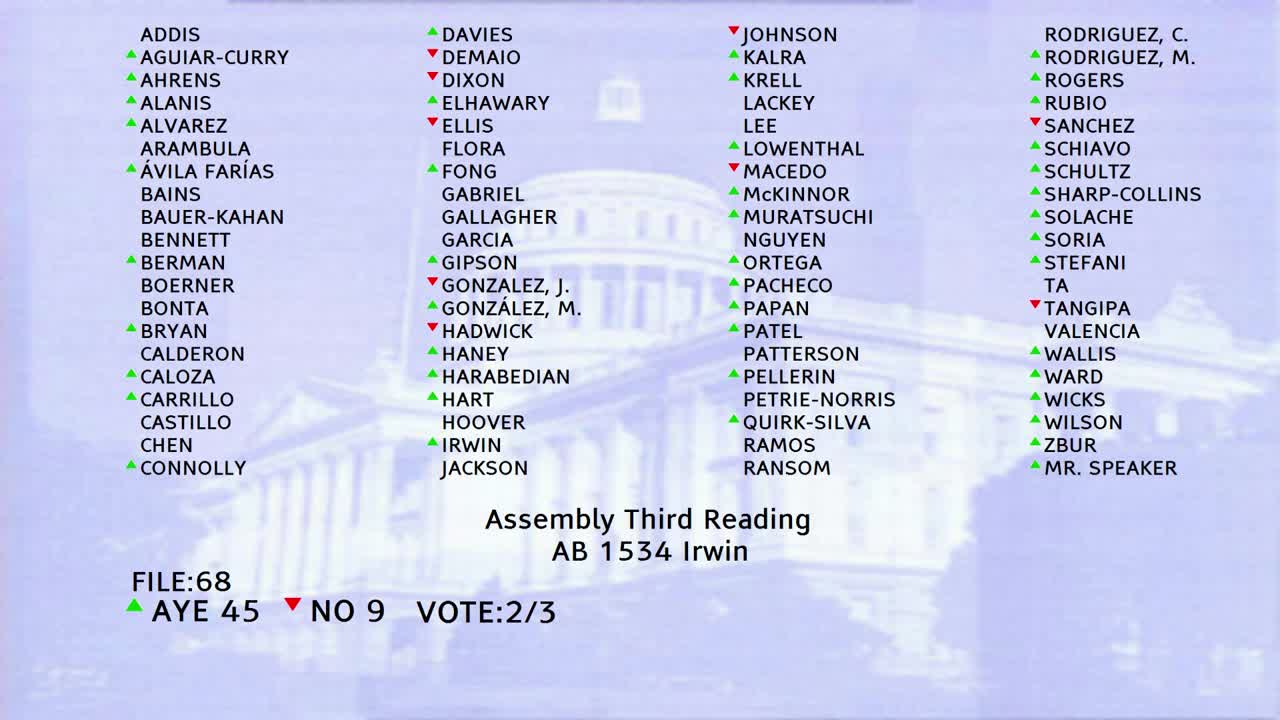 1MIN
Assembly Floor
 7MIN
Assembly Standing Committee on Business and Professions
Bill Author

Bill Co-Author(s):