AB 1606: Personal Income Tax Law: Corporation Tax Law: credits: cleanup costs.
- Session Year: 2025-2026
- House: Assembly
- Latest Version Date: 2026-04-29
Current Status:
In Progress
(2026-05-14: Joint Rule 62(a), file notice suspended. (Page 5030.))
Introduced
In Committee
Awaiting First Chamber Vote
Passed First Chamber
In Committee
Awaiting Second Chamber Vote
Passed Second Chamber
Enacted
The Personal Income Tax Law and the Corporation Tax Law allow various credits against the taxes imposed by those laws.
This bill, for taxable years beginning on or after January 1, 2027, and before January 1, 2032, would allow a credit against those taxes to a qualified taxpayer, as defined, for 30% of the qualified cleanup expenses. expenses paid or incurred during the taxable year, and would limit the credit to $20,000 per taxable year. The bill would define qualified cleanup expenses for this purpose to mean costs directly related to the one-time removal and disposal of unauthorized encampments, illegal dumping, and abandoned property, as provided. The bill would require a taxpayer to certify, under penalty of perjury, that the costs reflected in documentation are directly related to qualified cleanup expenses. The bill would make related findings. By expanding the crime of perjury, this bill would impose a state-mandated local program.
Existing law requires any bill authorizing a new tax expenditure to contain, among other things, specific goals, purposes, and objectives that the tax expenditure will achieve, detailed performance indicators, and data collection requirements.
This bill also would include additional information required for any bill authorizing a new tax expenditure.
The California Constitution requires the state to reimburse local agencies and school districts for certain costs mandated by the state. Statutory provisions establish procedures for making that reimbursement.
This bill would provide that no reimbursement is required by this act for a specified reason.
This bill would take effect immediately as a tax levy.
The Personal Income Tax Law and the Corporation Tax Law allow various credits against the taxes imposed by those laws.
This bill, for taxable years beginning on or after January 1, 2027, and before January 1, 2032, would allow a credit against those taxes to a qualified taxpayer, as defined, for qualified cleanup expenses. The bill would define qualified cleanup expenses for this purpose to mean costs directly related to the one-time removal and disposal of unauthorized encampments, illegal dumping, and abandoned property, as provided. The bill would require a taxpayer to certify, under penalty of perjury, that the costs reflected in documentation are directly related to qualified cleanup expenses. The bill would make related findings. By expanding the crime of perjury, this bill would impose a state-mandated local program.
Existing law requires any bill authorizing a new tax expenditure to contain, among other things, specific goals, purposes, and objectives that the tax expenditure will achieve, detailed performance indicators, and data collection requirements.
This bill also would include additional information required for any bill authorizing a new tax expenditure.
The California Constitution requires the state to reimburse local agencies and school districts for certain costs mandated by the state. Statutory provisions establish procedures for making that reimbursement.
This bill would provide that no reimbursement is required by this act for a specified reason.
This bill would take effect immediately as a tax levy.
The Legislature finds and declares as follows:
(a)The United States Supreme Court decision in City of Grants Pass, Oregon v. Johnson (2024) 603 U.S. 520 has enabled public entities to enforce no-camping ordinances on public property, resulting in the displacement of unhoused individuals.
(b)As a consequence, many individuals experiencing homelessness have moved from public property to private property, leading to an increase in unauthorized encampments on business premises across California.
(c)Unauthorized encampments and illegal dumping on private property have significantly increased, placing a financial burden on property owners and businesses statewide.
(d)Although businesses are currently able to deduct cleanup expenses as a business expense, the persistent costs associated with addressing unauthorized encampments continue to create financial challenges. Additional relief through a targeted tax credit would help mitigate these ongoing expenses and support businesses in maintaining safe and accessible properties.
(e)Providing a tax credit for cleanup expenses will directly support businesses, encourage timely action, and ensure properties remain safe and accessible, offering a more meaningful financial relief compared to standard deductions.
SEC. 2.Section 17053.76 is added to the Revenue and Taxation Code, to read:17053.76.(a)(1)For taxable years beginning on or after January 1, 2027, and before January 1, 2032, there shall be allowed as a credit against the net tax, as defined in Section 17039, to a qualified taxpayer an amount equal to 30 percent of the qualified cleanup expenses paid or incurred during the taxable year, not to exceed twenty thousand dollars ($20,000). year.
(2)The credit allowed to a taxpayer by this section shall not exceed twenty thousand dollars ($20,000) per taxable year.
(b)For purposes of this section, the following definitions shall apply:
(1)Abandoned property means personal property that has been left on private property without the consent of the property owner and without intent to return.
(2)Illegal dumping means the disposal of waste on private property in violation of state or local law.
(1)(3)(A)Qualified cleanup expenses means costs directly related to the one-time removal and disposal of unauthorized encampments, illegal dumping, and abandoned property in the state, provided those costs are paid or incurred within 60 days of discovery. Those costs shall be limited to the following:
(i)Waste removal and disposal services.
(ii)Sanitization and restoration of property as necessary to restore the property to its pre-encampment condition.
(iii)Security measures installed as a temporary and nonpermanent measure directly related to the immediate cleanup, such as temporary fencing or temporary security gates. Ongoing monitoring, surveillance equipment, or security service contracts shall not qualify.
(iv)Repairs to property caused by damage from encampments or illegal dumping, excluding property improvements or upgrades.
(v)Installation of passive deterrent measures to prevent reencampments, such as riprap or other material, excluding permanent construction or new structures.
(B)Qualified cleanup expenses shall not include either any of the following:
(i)Ongoing or unrelated maintenance, permanent security systems, construction of new structures, and other capital improvements.
(ii)Compensation paid to the taxpayers employees, independent contractors, or other personnel for services performed in the normal course of employment or lease obligations.
(iii)Costs that are reimbursed, in whole or in part, by insurance, grants, or other sources.
(iv)Costs that are recurring.
(2)(4)Qualified taxpayer means a business entity, including an individual operating as a sole proprietorship, owning or leasing with gross revenue of five million dollars ($5,000,000) or less during the taxable year that owns or leases real property used for commercial purposes in the state impacted by unauthorized encampments, illegal dumping, or abandoned property.
(5)Unauthorized encampment means a temporary shelter or campsite located on private property without the consent of the property owner.
(c)Upon request of the Franchise Tax Board, a qualified taxpayer shall provide documentation of both of the following:
(1)The condition of the real property prior to cleanup.
(2)Detailed invoices or receipts from contractors or service providers performing the cleanup.
(d)A qualified taxpayer shall certify, under penalty of perjury, that the expenses were paid or incurred as a direct result of unauthorized encampments, illegal dumping, or abandoned property on the taxpayers real property were not caused or contributed to by the taxpayer or related parties; the real property address associated with the claimed expenses; whether the taxpayer is the property owner or a lessee; and that such expenses meet all of the qualifications under this section. all of the following:
(1)That the expenses were paid or incurred as a direct result of unauthorized encampments, illegal dumping, or abandoned property on the taxpayers real property and were not caused or contributed to by the taxpayer or any related party.
(2)The real property address associated with the claimed expenses.
(3)Whether the taxpayer is the property owner or a lessee.
(4)That such expenses meet all of the qualifications under this section.
(e)The adoption of any regulations necessary to carry out the purposes of this section may be adopted as emergency regulations in accordance with the rulemaking provisions of the Administrative Procedure Act (Chapter 3.5 (commencing with Section 11340) of Part 1 of Division 3 of Title 2 of the Government Code) and shall be deemed an emergency and necessary for the immediate preservation of the public peace, health and safety, or general welfare. Notwithstanding Chapter 3.5 (commencing with Section 11340) of Part 1 of Division 3 of Title 2 of the Government Code, these emergency regulations shall not be subject to the review and approval of the Office of Administrative Law. The regulations shall become effective immediately upon filing with the Secretary of State, and shall remain in effect until revised or repealed by the Franchise Tax Board.
(f)In the case where the credit allowed by this section exceeds the net tax, the excess may be carried over to reduce the net tax in the following taxable year, and succeeding four years, if necessary, until the credit is exhausted.
(f)(g)Any deduction otherwise allowed under this part for any amount paid or incurred by the taxpayer upon which the credit is based shall be reduced by the amount of the credit allowed under this section.
(g)(h)A qualified taxpayer may not claim a credit under this section for any qualified cleanup expenses for which another taxpayer has also claimed a credit under this section. If two or more taxpayers are eligible for the same qualified cleanup expenses, the credit shall only be allowable to the taxpayer who directly incurred and paid for the expenses and retains documentary evidence demonstrating payment.
(h)(i)(1)For purposes of complying with Section 41, as it pertains to the credit allowed under this section and Section 23688, the Legislature finds and declares as follows:
(A)The specific goal of the credit is to support businesses, encourage timely action, and ensure properties remain safe and accessible.
(B)The performance indicators for the Legislature to use to determine if the credit is achieving its stated goal are the number of taxpayers allowed a credit and the total dollar amount of credits allowed.
(2)(A)The Franchise Tax Board, on or before July 1, 2029, and annually thereafter, shall submit to the Legislature, in compliance with Section 9795 of the Government Code, a report detailing the number of taxpayers allowed a credit pursuant to this section and Section 23688, and the total dollar value of credits allowed.
(B)The disclosure requirements of this paragraph shall be treated as an exception to Section 19542.
(i)(j)This section shall remain operative only until December 1, 2032, and as of that date is repealed.
SEC. 3.Section 23688 is added to the Revenue and Taxation Code, to read:23688.(a)(1)For taxable years beginning on or after January 1, 2027, and before January 1, 2032, there shall be allowed as a credit against the tax, as defined in Section 23036, to a qualified taxpayer an amount equal to 30 percent of the qualified cleanup expenses paid or incurred during the taxable year.
(2)The credit allowed to a taxpayer by this section shall not exceed twenty thousand dollars ($20,000) per taxable year.
(b)For purposes of this section, the following definitions shall apply:
(1)Abandoned property means personal property that has been left on private property without the consent of the property owner and without intent to return.
(2)Illegal dumping means the disposal of waste on private property in violation of state or local law.
(1)(3)(A)Qualified cleanup expenses means costs directly related to the one-time removal and disposal of unauthorized encampments, illegal dumping, and abandoned property in the state, provided those costs are paid or incurred within 60 days of discovery. Those costs shall be limited to the following:
(i)Waste removal and disposal services.
(ii)Sanitization and restoration of property as necessary to restore the property to its pre-encampment condition.
(iii)Security measures installed as a temporary and nonpermanent measure directly related to the immediate cleanup, such as temporary fencing or temporary security gates. Ongoing monitoring, surveillance equipment, or security service contracts shall not qualify.
(iv)Repairs to property caused by damage from encampments or illegal dumping, excluding property improvements or upgrades.
(v)Installation of measures to prevent reencampments, such as riprap or other material, excluding permanent construction or new structures.
(B)Qualified cleanup expenses shall not include either any of the following:
(i)Ongoing or unrelated maintenance, permanent security systems, construction of new structures, and other capital improvements.
(ii)Compensation paid to the taxpayers employees, independent contractors, or other personnel for services performed in the normal course of employment or lease obligations.
(iii)Costs that are reimbursed, in whole or in part, by insurance, grants, or other sources.
(iv)Costs that are recurring.
(2)(4)Qualified taxpayer means a taxpayer owning or leasing with gross revenue of five million dollars ($5,000,000) or less during the taxable year that owns or leases real property used for commercial purposes in the state impacted by unauthorized encampments, illegal dumping, or abandoned property.
(5)Unauthorized encampment means a temporary shelter or campsite located on private property without the consent of the property owner.
(c)Upon request of the Franchise Tax Board, a qualified taxpayer shall provide documentation of both of the following:
(1)The condition of the real property prior to cleanup.
(2)Detailed invoices or receipts from contractors or service providers performing the cleanup.
(d)A qualified taxpayer shall certify, under penalty of perjury, that the expenses were paid or incurred as a direct result of unauthorized encampments, illegal dumping, or abandoned property on the taxpayers real property not caused or contributed to by the taxpayer or related parties; the real property address associated with the claimed expenses; whether the taxpayer is the property owner or a lessee; and that such expenses meet all of the qualifications under this section. all of the following:
(1)That the expenses were paid or incurred as a direct result of unauthorized encampments, illegal dumping, or abandoned property on the taxpayers real property and were not caused or contributed to by the taxpayer or any related party.
(2)The real property address associated with the claimed expenses.
(3)Whether the taxpayer is the property owner or a lessee.
(4)That such expenses meet all of the qualifications under this section.
(e)The adoption of any regulations necessary to carry out the purposes of this section may be adopted as emergency regulations in accordance with the rulemaking provisions of the Administrative Procedure Act (Chapter 3.5 (commencing with Section 11340) of Part 1 of Division 3 of Title 2 of the Government Code) and shall be deemed an emergency and necessary for the immediate preservation of the public peace, health and safety, or general welfare. Notwithstanding Chapter 3.5 (commencing with Section 11340) of Part 1 of Division 3 of Title 2 of the Government Code, these emergency regulations shall not be subject to the review and approval of the Office of Administrative Law. The regulations shall become effective immediately upon filing with the Secretary of State, and shall remain in effect until revised or repealed by the Franchise Tax Board.
(f)In the case where the credit allowed by this section exceeds the net tax, the excess may be carried over to reduce the net tax in the following taxable year, and succeeding four years, if necessary, until the credit is exhausted.
(f)(g)Any deduction otherwise allowed under this part for any amount paid or incurred by the taxpayer upon which the credit is based shall be reduced by the amount of the credit allowed under this section.
(g)(h)A qualified taxpayer may not claim a credit under this section for any qualified cleanup expenses for which another taxpayer has also claimed a credit under this section. If two or more taxpayers are eligible for the same qualified cleanup expenses, the credit shall only be allowable to the taxpayer who directly incurred and paid for the expenses and retains documentary evidence demonstrating payment.
(h)(i)This section shall remain operative only until December 1, 2032, and as of that date is repealed.
SEC. 4.No reimbursement is required by this act pursuant to Section 6 of Article XIIIB of the California Constitution because the only costs that may be incurred by a local agency or school district will be incurred because this act creates a new crime or infraction, eliminates a crime or infraction, or changes the penalty for a crime or infraction, within the meaning of Section 17556 of the Government Code, or changes the definition of a crime within the meaning of Section 6 of Article XIIIB of the California Constitution.
SEC. 5.This act provides for a tax levy within the meaning of Article IV of the California Constitution and shall go into immediate effect.
The Legislature finds and declares as follows:
(a)The United States Supreme Court decision in City of Grants Pass, Oregon v. Johnson (2024) 603 U.S. 520 has enabled public entities to enforce no-camping ordinances on public property, resulting in the displacement of unhoused individuals.
(b)As a consequence, many individuals experiencing homelessness have moved from public property to private property, leading to an increase in unauthorized encampments on business premises across California.
(c)Unauthorized encampments and illegal dumping on private property have significantly increased, placing a financial burden on property owners and businesses statewide.
(d)Although businesses are currently able to deduct cleanup expenses as a business expense, the persistent costs associated with addressing unauthorized encampments continue to create financial challenges. Additional relief through a targeted tax credit would help mitigate these ongoing expenses and support businesses in maintaining safe and accessible properties.
(e)Providing a tax credit for cleanup expenses will directly support businesses, encourage timely action, and ensure properties remain safe and accessible, offering a more meaningful financial relief compared to standard deductions.
SEC. 2.Section 17053.76 is added to the Revenue and Taxation Code, to read:17053.76.(a)For taxable years beginning on or after January 1, 2027, and before January 1, 2032, there shall be allowed as a credit against the net tax, as defined in Section 17039, to a qualified taxpayer an amount equal to the qualified cleanup expenses paid or incurred during the taxable year, not to exceed twenty thousand dollars ($20,000).
(b)For purposes of this section, the following definitions shall apply:
(1)(A)Qualified cleanup expenses means costs directly related to the one-time removal and disposal of unauthorized encampments, illegal dumping, and abandoned property in the state, provided those costs are paid or incurred within 60 days of discovery. Those costs shall be limited to the following:
(i)Waste removal and disposal services.
(ii)Sanitization and restoration of property as necessary to restore the property to its pre-encampment condition.
(iii)Security measures installed as a temporary and nonpermanent measure directly related to the immediate cleanup, such as temporary fencing or temporary security gates. Ongoing monitoring, surveillance equipment, or security service contracts shall not qualify.
(iv)Repairs to property caused by damage from encampments or illegal dumping, excluding property improvements or upgrades.
(v)Installation of passive deterrent measures to prevent reencampments, such as riprap or other material, excluding permanent construction or new structures.
(B)Qualified cleanup expenses shall not include either of the following:
(i)Ongoing or unrelated maintenance, permanent security systems, construction of new structures, and other capital improvements.
(ii)Compensation paid to the taxpayers employees, independent contractors, or other personnel for services performed in the normal course of employment or lease obligations.
(2)Qualified taxpayer means a business entity, including an individual operating as a sole proprietorship, owning or leasing real property used for commercial purposes in the state impacted by unauthorized encampments, illegal dumping, or abandoned property.
(c)Upon request of the Franchise Tax Board, a qualified taxpayer shall provide documentation of both of the following:
(1)The condition of the real property prior to cleanup.
(2)Detailed invoices or receipts from contractors or service providers performing the cleanup.
(d)A qualified taxpayer shall certify, under penalty of perjury, that the expenses were paid or incurred as a direct result of unauthorized encampments, illegal dumping, or abandoned property on the taxpayers real property were not caused or contributed to by the taxpayer or related parties; the real property address associated with the claimed expenses; whether the taxpayer is the property owner or a lessee; and that such expenses meet all of the qualifications under this section.
(e)The adoption of any regulations necessary to carry out the purposes of this section may be adopted as emergency regulations in accordance with the rulemaking provisions of the Administrative Procedure Act (Chapter 3.5 (commencing with Section 11340) of Part 1 of Division 3 of Title 2 of the Government Code) and shall be deemed an emergency and necessary for the immediate preservation of the public peace, health and safety, or general welfare. Notwithstanding Chapter 3.5 (commencing with Section 11340) of Part 1 of Division 3 of Title 2 of the Government Code, these emergency regulations shall not be subject to the review and approval of the Office of Administrative Law. The regulations shall become effective immediately upon filing with the Secretary of State, and shall remain in effect until revised or repealed by the Franchise Tax Board.
(f)Any deduction otherwise allowed under this part for any amount paid or incurred by the taxpayer upon which the credit is based shall be reduced by the amount of the credit allowed under this section.
(g)A qualified taxpayer may not claim a credit under this section for any qualified cleanup expenses for which another taxpayer has also claimed a credit under this section. If two or more taxpayers are eligible for the same qualified cleanup expenses, the credit shall only be allowable to the taxpayer who directly incurred and paid for the expenses and retains documentary evidence demonstrating payment.
(h)(1)For purposes of complying with Section 41, as it pertains to the credit allowed under this section and Section 23688, the Legislature finds and declares as follows:
(A)The specific goal of the credit is to support businesses, encourage timely action, and ensure properties remain safe and accessible.
(B)The performance indicators for the Legislature to use to determine if the credit is achieving its stated goal are the number of taxpayers allowed a credit and the total dollar amount of credits allowed.
(2)(A)The Franchise Tax Board, on or before July 1, 2029, and annually thereafter, shall submit to the Legislature, in compliance with Section 9795 of the Government Code, a report detailing the number of taxpayers allowed a credit pursuant to this section and Section 23688, and the total dollar value of credits allowed.
(B)The disclosure requirements of this paragraph shall be treated as an exception to Section 19542.
(i)This section shall remain operative only until December 1, 2032, and as of that date is repealed.
SEC. 3.Section 23688 is added to the Revenue and Taxation Code, to read:23688.(a)For taxable years beginning on or after January 1, 2027, and before January 1, 2032, there shall be allowed as a credit against the tax, as defined in Section 23036, to a qualified taxpayer an amount equal to the qualified cleanup expenses paid or incurred during the taxable year.
(b)For purposes of this section, the following definitions shall apply:
(1)(A)Qualified cleanup expenses means costs directly related to the one-time removal and disposal of unauthorized encampments, illegal dumping, and abandoned property in the state, provided those costs are paid or incurred within 60 days of discovery. Those costs shall be limited to the following:
(i)Waste removal and disposal services.
(ii)Sanitization and restoration of property as necessary to restore the property to its pre-encampment condition.
(iii)Security measures installed as a temporary and nonpermanent measure directly related to the immediate cleanup, such as temporary fencing or temporary security gates. Ongoing monitoring, surveillance equipment, or security service contracts shall not qualify.
(iv)Repairs to property caused by damage from encampments or illegal dumping, excluding property improvements or upgrades.
(v)Installation of measures to prevent reencampments, such as riprap or other material, excluding permanent construction or new structures.
(B)Qualified cleanup expenses shall not include either of the following:
(i)Ongoing or unrelated maintenance, permanent security systems, construction of new structures, and other capital improvements.
(ii)Compensation paid to the taxpayers employees, independent contractors, or other personnel for services performed in the normal course of employment or lease obligations.
(2)Qualified taxpayer means a taxpayer owning or leasing real property used for commercial purposes in the state impacted by unauthorized encampments, illegal dumping, or abandoned property.
(c)Upon request of the Franchise Tax Board, a qualified taxpayer shall provide documentation of both of the following:
(1)The condition of the real property prior to cleanup.
(2)Detailed invoices or receipts from contractors or service providers performing the cleanup.
(d)A qualified taxpayer shall certify, under penalty of perjury, that the expenses were paid or incurred as a direct result of unauthorized encampments, illegal dumping, or abandoned property on the taxpayers real property not caused or contributed to by the taxpayer or related parties; the real property address associated with the claimed expenses; whether the taxpayer is the property owner or a lessee; and that such expenses meet all of the qualifications under this section.
(e)The adoption of any regulations necessary to carry out the purposes of this section may be adopted as emergency regulations in accordance with the rulemaking provisions of the Administrative Procedure Act (Chapter 3.5 (commencing with Section 11340) of Part 1 of Division 3 of Title 2 of the Government Code) and shall be deemed an emergency and necessary for the immediate preservation of the public peace, health and safety, or general welfare. Notwithstanding Chapter 3.5 (commencing with Section 11340) of Part 1 of Division 3 of Title 2 of the Government Code, these emergency regulations shall not be subject to the review and approval of the Office of Administrative Law. The regulations shall become effective immediately upon filing with the Secretary of State, and shall remain in effect until revised or repealed by the Franchise Tax Board.
(f)Any deduction otherwise allowed under this part for any amount paid or incurred by the taxpayer upon which the credit is based shall be reduced by the amount of the credit allowed under this section.
(g)A qualified taxpayer may not claim a credit under this section for any qualified cleanup expenses for which another taxpayer has also claimed a credit under this section. If two or more taxpayers are eligible for the same qualified cleanup expenses, the credit shall only be allowable to the taxpayer who directly incurred and paid for the expenses and retains documentary evidence demonstrating payment.
(h)This section shall remain operative only until December 1, 2032, and as of that date is repealed.
SEC. 4.No reimbursement is required by this act pursuant to Section 6 of Article XIIIB of the California Constitution because the only costs that may be incurred by a local agency or school district will be incurred because this act creates a new crime or infraction, eliminates a crime or infraction, or changes the penalty for a crime or infraction, within the meaning of Section 17556 of the Government Code, or changes the definition of a crime within the meaning of Section 6 of Article XIIIB of the California Constitution.
SEC. 5.This act provides for a tax levy within the meaning of Article IV of the California Constitution and shall go into immediate effect.
|
Date
|
Status
|
|---|---|
| May 14, 2026 | Joint Rule 62(a), file notice suspended. (Page 5030.) |
| May 14, 2026 | In committee: Held under submission. |
| May 14, 2026 | Joint Rule 62(a), file notice suspended. |
| May 13, 2026 | In committee: Set, first hearing. Referred to APPR. suspense file. |
| Apr 30, 2026 | Re-referred to Com. on APPR. |
| Apr 29, 2026 | Read second time and amended. |
| Apr 28, 2026 | From committee: Amend, and do pass as amended and re-refer to Com. on APPR. (Ayes 7. Noes 0.) (April 27). |
| Apr 6, 2026 | In committee: Set, second hearing. Referred to REV. & TAX. suspense file. |
| Mar 16, 2026 | In committee: Set, first hearing. Hearing canceled at the request of author. |
| Feb 2, 2026 | Referred to Com. on REV. & TAX. |
| Jan 21, 2026 | From printer. May be heard in committee February 20. |
| Jan 20, 2026 | Read first time. To print. |
|
Date
|
Description
|
Location
|
Votes
|
|
|---|---|---|---|---|
| Apr 27, 2026 | Do pass as amended and be re-referred to the Committee on [Appropriations] | Assembly Standing Committee on Revenue and Taxation |
Passed |
This list shows positions taken on this bill by organizations on the date displayed, which is linked to the original source.
Positions by individuals are not included.
|
Organization
|
Position
|
Date
|
|---|---|---|
| All of US or None (HQ) | ** Against | |
| Building Owners and Managers Association of California | ** Support | |
| California Apartment Association | ** Support | |
| California Business Properties Association | ** Support | |
| California Business Roundtable | ** Support | |
| California Chamber Of Commerce | ** Support | |
| California Coalition of Women Prisoners | ** Against | |
| California Federation Of Teachers | ** Against | |
| California Retailers Association | ** Support | |
| California Tax Reform Association | ** Against | |
| California Teachers Association | ** Against | |
| Coalition on Homelessness, San Francisco | ** Against | |
| Corporation For Supportive Housing | ** Against | |
| Disability Rights California | ** Against | |
| Florence Aliese Advancement Network, LLC | ** Against | |
| Inner City Law Center | ** Against | |
| Institute of Real Estate Management, The | ** Support | |
| Law Foundation of Silicon Valley, The | ** Against | |
| Legal Services for Prisoners with Children | ** Against | |
| Naiop California | ** Support | |
| National Alliance to End Homelessness | ** Against | |
| NFIB California | ** Support | |
| Orange County Business Council | ** Support | |
| United Chamber Advocacy Network | ** Support | |
| Western Center on Law and Poverty, Inc. | ** Against | |
| Western Regional Advocacy Project | ** Against |
Date of Hearing: May 13, 2026
ASSEMBLY COMMITTEE ON APPROPRIATIONS
Buffy Wicks, Chair
ABPCA Bill Id:AB 1606
Author:(Nguyen) – As Amended Ver:April 29, 2026
Policy Committee: | Revenue and Taxation | Vote: | 7 - 0 |
|
| ||
|
|
Urgency: No State Mandated Local Program: Yes Reimbursable: No
SUMMARY:
This bill allows a tax credit for “qualified cleanup expenses” directly related to a business’s one-time removal and disposal of unauthorized encampments and illegal dumping.
Specifically, this bill:
- Allows, under the Personal Income Tax and Corporation Tax Laws, for taxable years beginning on or after January 1, 2027, and before January 1, 2032, a credit to a qualified taxpayer for 30% of the qualified cleanup expenses paid or incurred during the taxable year, limited to $20,000 per taxable year.
- Defines a “qualified taxpayer” as a business entity with gross revenue of $5 million or less during the taxable year that owns or leases real property used for commercial purposes in the state impacted by unauthorized encampments, illegal dumping, or abandoned property.
- Requires a qualified taxpayer to provide the Franchise Tax Board (FTB), upon request, with certain documentation of the cleanup and certify eligibility for the credit under penalty of perjury.
- Authorizes the FTB to adopt emergency regulations to implement these provisions.
- Declares the goals and performance indicators for the new tax expenditure and requires the FTB to annually submit a report with related credit information to the Legislature.
FISCAL EFFECT:
- General Fund (GF) costs of approximately $1.5 million in fiscal year (FY) 2026-27, $3.6 million in FY 2027-28, and $4 million in FY 2028-29.
By reducing GF revenue, this bill also likely decreases Proposition 98 GF spending by approximately 40% of the revenue loss (the exact amount depends on the operative test of the annual Proposition 98 guarantee).
- Costs of an unknown amount to the FTB to administer and provide oversight of the credit, adopt emergency regulations if needed, and report credit information to the Legislature.
The Legislative Analyst’s Office recently warned of GF structural deficits of around $35 billion per year in FY 2027-28 and ongoing.
COMMENTS:
- Purpose. According to the author:
Lately, I’ve been hearing directly from small business owners and property owners in Little Saigon, along Stockton Boulevard, and across my district who are struggling to keep up with the growing costs of cleaning up unauthorized encampments, vandalism, and illegal dumping on their properties…I introduced AB 1606 to provide real relief. A tax credit that helps them recover these expenses and continue contributing to the vibrancy and economic stability of our communities.
- Homelessness Funding. In response to the growing population of people experiencing homelessness, the state has allocated funds directly to local governments to address the issue. For example, the Homeless Housing, Assistance and Prevention (HHAP) program has provided funds for temporary shelter, permanent housing, and other services, beginning with $650 million in the Budget Act of 2019, growing to $1 billion in the Budget Act of 2024. Most recently, the Budget Act of 2025 included $500 million for another round of HHAP funding. This bill provides a tax credit for cleanup expenses directly related to a small business’s one-time removal and disposal of unauthorized encampments and illegal dumping.
- Support and Opposition. This bill is supported by business groups, with the California Chamber of Commerce arguing this bill “supports businesses that take responsibility for restoring their properties after illegal dumping or unwanted encampments and would allow businesses to install preventative measures to ensure the property remains accessible and inviting to customers.”
This bill is opposed by labor organizations and social justice groups, with the National Alliance to End Homelessness arguing, “The measure would inevitably draw funds away from critical services in the state budget that fund proven solutions to homelessness, and could incur costs in the tens of millions with little in the way of guardrails.”
- Related Legislation. AB 1435 (Nguyen) is similar to this bill, but allows a 100% credit amount capped at $20,000 for a business of any size. AB 1435 was held on the Assembly Revenue and Taxation Committee’s suspense file.
Analysis Prepared by: Irene Ho / APPR. / (916) 319-2081
Date of Hearing: April 27, 2026
ASSEMBLY COMMITTEE ON REVENUE AND TAXATION
Mike Gipson, Chair
ABPCA Bill Id:AB 1606 (
Author:Nguyen) – As Introduced Ver:January 20, 2026
SUSPENSE
Majority vote. Tax levy. Fiscal committee.
SUBJECT: Personal Income Tax Law: Corporation Tax Law: credits: cleanup costs
SUMMARY: Authorizes a credit for five years under the Personal Income Tax (PIT) Law and the Corporation Tax (CT) Law to a "qualified taxpayer" equal to the "qualified cleanup expenses" paid or incurred during the taxable year, as restricted. Specifically, this bill:
- Authorizes a credit, under the PIT Law and the CT Law, for taxable years beginning on or after January 1, 2027, and before January 1, 2032, equal to the "qualified clean up expenses" paid or incurred by a "qualified taxpayer" during the taxable year.
- Limits the total amount of credit under the PIT Law to $20,000.
- Defines "qualified cleanup expenses" as costs directly related to the one-time removal and disposal of unauthorized encampments, illegal dumping, and abandoned property in the state, provided those costs are incurred within 60 days of discovery. Costs must be limited to the following:
- Waste removal and disposal services;
- Sanitization and restoration of property as necessary to restore the property to its pre-encampment condition;
- Security measures installed as a temporary and non-permanent measure directly related to the immediate cleanup, such as temporary fencing or temporary security gates. Ongoing monitoring, surveillance equipment, or security service contracts are ineligible; and,
- Repairs to property caused by damage from encampments or illegal dumping, excluding property improvements or upgrades.
- Provides that the definition of "qualified cleanup expenses," under the PIT Law, includes the installation of passive deterrent measures to prevent re-encampments, such as riprap or other material, excluding permanent construction or new structures.
- Provides that the definition of "qualified cleanup expenses," under the CT Law, includes the installation of measures to prevent re-encampments, such as riprap or other material, excluding permanent construction or new structures.
- Excludes from the definition of "qualified cleanup expenses" ongoing or unrelated maintenance, permanent security systems, construction of new structures, and other capital improvements, and compensation paid to the taxpayer's employees, independent contractors, or other personnel for services performed in the normal course of employment or lease obligations.
- Defines a "qualified taxpayer" as a business entity, including an individual operating as a sole proprietorship, owning or leasing real property used for commercial purposes in the state impacted by unauthorized encampments, illegal dumping, or abandoned property.
- Requires, upon request by the Franchise Tax Board (FTB), a qualified taxpayer to certify, under penalty of perjury:
- That the expenses were paid or incurred as a direct result of unauthorized encampments, illegal dumping, or abandoned property on the taxpayer's real property and not caused or contributed to by the taxpayer or related parties;
- The real property address associated with the claimed expenses;
- Whether the taxpayer is the property owner or a lessee; and,
- That such expenses meet all of the qualifications under this bill.
- Requires a taxpayer to reduce the amount of deduction otherwise allowed on amounts paid or incurred for qualified cleanup expenses by the amount of this bill's credit allowed to the taxpayer.
- Prohibits a taxpayer from claiming a credit on qualified cleanup expenses for which another taxpayer has also claimed a credit pursuant to this bill. If two or more taxpayers are eligible for the same qualified cleanup expenses, then only the taxpayer who directly incurred and paid for the expenses and retains documentary evidence demonstrating the payment may be allowed the credit.
- Provides that, for the purposes of complying with Revenue and Taxation Code (R&TC) Section 41, this bill's goal is to support businesses, encourage timely action, and ensure properties remain safe and accessible. The Legislature may determine whether this goal is achieved by the number of taxpayers allowed the credit, and the total dollar amount of allowed credits.
- Requires the FTB to report on or before July 1, 2029, and annually thereafter, the credit information listed above to the Legislature, in compliance with existing disclosure requirements.
- Takes immediate effect as a tax levy.
- Provides that this bill becomes inoperative and is repealed on December 1, 2032.
EXISTING LAW:
- Authorizes various credits to encourage certain desirable behavior, or to offset costs to certain taxpayers. (Internal Revenue Code (IRC) Section 21 et. seq. and R&TC Sections 17052 et. seq. and 23608 et. seq.)
- Allows a deduction on amounts paid or incurred as ordinary and necessary business expenses, with certain modifications under California tax law. (IRC Section 162 and R&TC Sections 17042.5(b) and 24343.)
- Requires that any proposed tax expenditure under the PIT Law or CT Law stipulate:
- Specific goals, purposes, and objectives that the tax expenditure must meet;
- Detailed performance indicators for the Legislature to determine whether the tax expenditure meets its stated goal, purpose, and objective; and,
- Data collection requirements to enable the Legislature to receive the detailed performance indicators in order to determine the efficacy of the tax expenditure. (R&TC Section 41.)
FISCAL EFFECT: The FTB estimates a revenue loss of $7.2 million in the 2026-27 fiscal year (FY), $16 million in FY 2027-28, and $17 million in FY 2028-29.
COMMENTS:
- The author has submitted the following statement in support of this bill:
As someone who grew up in South Sacramento and now represents Sacramento and Elk Grove, I've seen firsthand how vital our small businesses and local property owners are to the health of our communities. Many of these businesses and small property owners, particularly those who own and operate neighborhood shopping centers, are family-run, immigrant-owned, and minority-owned. They are the backbone of our local economy, working hard every day to serve their customers and provide for their families.
Lately, I've been hearing directly from small business owners and property owners in Little Saigon, along Stockton Boulevard, and across my district who are struggling to keep up with the growing costs of cleaning up unauthorized encampments, vandalism, and illegal dumping on their properties. Many of these shopping centers are neighborhood anchors, but they're now spending thousands of dollars, not once, but repeatedly on cleanups, repairs, and security just to stay open and safe.
These are costs that small businesses and small property owners shouldn't have to shoulder alone. I introduced AB 1606 to provide real relief. A tax credit that helps them recover these expenses and continue contributing to the vibrancy and economic stability of our communities. This bill is about supporting the small businesses and property owners who are too often overlooked, making sure they have the resources they need to keep their doors open, keep people safe, and keep our neighborhoods strong.
- The California Chamber of Commerce, writing in support of this bill, states, in part:
Unauthorized encampments and illegal dumping have created serious challenges for many property owners and small businesses across the state. In addition to creating health and safety concerns, these situations impose significant financial burdens on businesses that must quickly remediate waste, repair damage, and restore their properties. The proposed credit would help offset these costs and encourage prompt cleanup, which benefits surrounding neighborhoods, customers, and local communities.
AB 1606 supports businesses that take responsibility for restoring their properties after illegal dumping or unwanted encampments and would allow businesses to install preventative measures to ensure the property remains accessible and inviting to customers. Encouraging timely remediation can prevent environmental hazards, reduce public health risks, and improve the overall condition of commercial corridors throughout the state.
- The California Tax Reform Association, writing in opposition to this bill, states, in part:
We write in respectful opposition to AB 1606.
One hundred percent credits represent a direct payment from the state, rather than an incentive, and have virtually no precedent in tax policy. For businesses facing clean-up costs, they can deduct these costs as part of the cost of doing business, and such costs should be enhanced by the local government which has budgets for dealing with homelessness.
- Committee Staff Comments:
- Constitutionality of restrictions on the unhoused: In Martin v. City of Boise, 902 F.3d 1031 (9th Cir. 2018), the United States Court of Appeals for the Ninth Circuit held that the City of Boise had violated the Eighth Amendment's prohibition on cruel and unusual punishment by imposing criminal sanctions against homeless individuals for sleeping outdoors on public property when no alternative shelter was available. The suit was brought after the city had cited the plaintiffs with violating the city's Camping Ordinance, Disorderly Conduct Ordinance, or both. While the city did have three shelters available to unhoused individuals, these shelters were either over-subscribed or were owned by faith-based organizations requiring observance of certain religious practices and customs by those utilizing the shelter. Thus, the Ninth Circuit reasoned that "'so long as there is a greater number of homeless individuals in [a jurisdiction] than the number of available beds [in shelters],' the jurisdiction cannot prosecute homeless individuals for 'involuntarily sitting, lying, and sleeping in public.'''
Subsequently, unhoused individuals in violation of laws that restrict encampments on public property brought a suit against the City of Grant Pass in Oregon, relying on the precedent set in Martin v. City of Boise (2018). There, the district court held, and the Ninth Circuit Court of Appeals affirmed, that the laws restricting these encampments were a violation of the precedent established in Martin. The Ninth Circuit's ruling was appealed to the United States Supreme Court (Court), which was granted certiorari. The Court overturned the Ninth Circuit's holding and, thereby, the precedent in Martin. The Court opined in City of Grants Pass v. Johnson, 603 U.S. 520 (2024) that the Martin precedent deprived local jurisdictions and states of the capability to implement policies designed to address homelessness, noting that jurisdictions may not be able to determine who is "involuntarily" homeless. Additionally, the Court found that the precedent in Martin was overly broad, noting that determining what camping materials are considered "necessary to protect…from the elements" could vary based on the climate of the city, or the time of year, and may not be limited to a blanket and pillow, creating an unbound prohibition on local jurisdictions and states.
- Proposition 98: In 1988, California voters approved Proposition 98 (Prop. 98), which guarantees a certain level of educational funding for schools and community colleges based on certain calculations that vary with General Fund revenues and changes in per capita personal income. Three types of calculations, or tests, are stipulated in the law, and these tests impact the overall amount of revenue reserved for schools in any given year. In Test 1 years, the amount guaranteed under Prop. 98 is approximately 40% of General Fund revenues. Thus, any one dollar of General Fund revenue lost corresponds to a $0.40 decrease in the Prop. 98 guarantee[1]. According to the Legislative Analyst's Office (LAO), Test 1 remains operative for the 2026-27 FY[2].
- This bill: As currently drafted, this bill provides a 100% tax credit for qualified cleanup expenses paid or incurred by a qualified taxpayer.
While this bill does provide a maximum amount of available credit in a given taxable year under the PIT Law provisions, no corresponding cap is imposed under the CT Law provisions. Additionally, this bill provides different definitions for a qualified cleanup expense. Under the PIT Law provisions, this bill includes the installation of "passive deterrent measures" to prevent re-encampment. The CT Law provisions, however, define a qualified cleanup expense to include the installation of "measures" to prevent re-encampments. If this bill's incongruent treatment across PIT Law and CT Law provisions is contrary to the author's intent, this bill should be amended.
In its current form, this bill would authorize a 100% tax credit, meaning the taxpayer bears no cost burden for eligible expenses. Generally, enacted tax credits reimburse some fraction of the costs paid or incurred by a taxpayer, rather than the entire amount. Absent some incidence of the eligible costs falling on the taxpayer, a credit functions as a direct subsidy, like a grant. This "skin in the game" requirement ensures taxpayers act responsibly when paying or incurring expenses that will be reimbursed by public dollars. The Committee may wish to consider limiting this bill's credit to a certain percentage of qualified cleanup expenses.
This bill does not contemplate a carryover period for its proposed credit. Generally, tax credits include a carryover period, as taxpayers predominantly utilize their credit amounts within five to eight years of earning the credit. The Committee may wish to specify a carryover period.
Finally, while this bill does provide that the amount of deduction otherwise allowed for qualified cleanup expenses must be reduced by the amount of the credit received, this bill does not consider other sources of reimbursement on amounts qualifying for the credit. Some costs that qualify for this bill's credit likely qualify for reimbursement pursuant to an insurance claim. As such, the author and Committee may wish to consider amending this bill such that expenses are eligible to the extent they are unreimbursed.
- Aligning language with intent: The author notes, in background material provided to this Committee, that since the Court's "decision in City of Grants Pass v. Johnson, local governments have expanded enforcement of no-camping ordinances on public property. As enforcement has increased, encampments have shifted onto private commercial property, particularly in urban corridors and downtown business districts." The author's office has not, however, provided any evidence to substantiate the claim that unhoused individuals are encamping on private property at greater rates than prior to the decision. Additionally, the author and supporters note the impact of encampments to small businesses, and emphasize this bill's relief to those entities. This bill does not, however, limit the definition of a qualified taxpayer to small businesses or businesses with certain income amounts, thereby allowing any sized business to earn the proposed credit. If the author's intent is to benefit a certain type of business, then this bill should be amended to reflect that intent.
- FTB analysis: In its analysis of this bill, the FTB notes as an implementation consideration that "this bill uses undefined terms and phrases, e.g. "business entity," "unauthorized encampments," "illegal dumping," and "abandoned property." The absence of definitions could lead to taxpayer confusion. For clarity, the author may wish to amend this bill to define those terms."
Additionally, the FTB notes the following technical considerations:
- [On Page 6, lines 26 and 27] replace the phrase "taxpayer's real property not caused or contributed to" with "taxpayer's real property and were not caused or contributed to";
- Remove proposed R&TC Sections 17053.7(g) and 23688(g) as this language is unnecessary and could lead to taxpayer confusion. Generally, qualified expenses are claimed by a taxpayer that paid or incurred the expenses during the taxable year; and,
- This bill uses the terms "qualified taxpayer" and "taxpayer" interchangeably. For clarity, the author should amend the bill to exclusively use "qualified taxpayer".
- What is a "tax expenditure"? Existing law provides various credits, deductions, exclusions, and exemptions for particular taxpayer groups. In the late 1960s, United States Treasury officials began arguing that these features of the tax law should be referred to as "expenditures" since they are generally enacted to accomplish some governmental purpose and there is a determinable cost associated with each of them (in the form of forgone revenues). This bill would authorize a new tax credit under the PIT Law and CT Law, thereby constituting a tax expenditure.
- Committee's tax expenditure policy: SB 1335 (Leno), Chapter 845, Statutes of 2014, added R&TC Section 41, which recognized that the Legislature should apply the same level of review used for government spending programs to tax credits introduced on or after January 1, 2015. AB 263 (Burke), Chapter 743, Statutes of 2019, extended the requirements in R&TC Section 41 to all tax expenditure measures under the PIT Law, the CT Law, and the Sales and Use Tax Law introduced on or after January 1, 2020.
A tax expenditure proposal must outline specific goals, purposes, and objectives that the tax expenditure will achieve, along with detailed performance indicators for the Legislature to use when measuring whether the tax expenditure meets those stated goals, purposes, and objectives. In addition to the R&TC Section 41 requirements, this Committee's policy also requires that all tax expenditure proposals contain an appropriate sunset provision to be eligible for a vote[3]. Sunsets are required because eliminating a tax expenditure generally requires a 2/3rd vote. These requirements must be satisfied before a bill can receive a vote in this Committee. This bill contains an appropriate five-year sunset, and complies with the requirements of R&TC Section 41.
- Related legislation: AB 1435 (Nguyen) was substantively similar to this bill. AB 1435 was held on this Committee's Suspense File.
REGISTERED SUPPORT / OPPOSITION:
Support
Building Owners and Managers Association of California
California Apartment Association
California Business Properties Association
California Business Roundtable
California Chamber of Commerce
California Retailers Association
Institute of Real Estate Management, The
NAIOP California
NFIB California
Orange County Business Council
United Chamber Advocacy Network
Opposition
All of Us or None (HQ)
California Coalition of Women Prisoners
California Federation of Teachers
California Tax Reform Association
California Teachers Association
Coalition on Homlessness, San Francisco
Corporation for Supportive Housing
Disability Rights California
Florence Aliese Advancement Network, LLC
Inner City Law Center
Law Foundation of Silicon Valley, The
Legal Services for Prisoners with Children
National Alliance to End Homelessness
Western Center on Law and Poverty, Inc.
Western Regional Advocacy Project
Analysis Prepared by: Harrison Bowlby / REV. & TAX. / (916) 319-2098
Proposition 98 and K-12 Education, The 2026-27 Budget, Legislative Analyst’s Office (February 4, 2026). https://lao.ca.gov/Publications/Report/5110, accessed March 2026. ↑
Ibid. ↑
An "appropriate sunset provision" shall mean five years, except in the case of a tax expenditure measure providing relief to California veterans, in which case "appropriate sunset provision" shall mean 10 years. ↑
Date of Hearing: April 6, 2026
ASSEMBLY COMMITTEE ON REVENUE AND TAXATION
Mike Gipson, Chair
ABPCA Bill Id:AB 1606 (
Author:Nguyen) – As Introduced Ver:January 20, 2026
Majority vote. Tax levy. Fiscal committee.
SUBJECT: Personal Income Tax Law: Corporation Tax Law: credits: cleanup costs
SUMMARY: Authorizes a credit for five years under the Personal Income Tax (PIT) Law and the Corporation Tax (CT) Law to a "qualified taxpayer" equal to the "qualified cleanup expenses" paid or incurred during the taxable year, as restricted. Specifically, this bill:
- Authorizes a credit, under the PIT Law and the CT Law, for taxable years beginning on or after January 1, 2027, and before January 1, 2032, equal to the "qualified clean up expenses" paid or incurred by a "qualified taxpayer" during the taxable year.
- Limits the total amount of credit under the PIT Law to $20,000.
- Defines "qualified cleanup expenses" as costs directly related to the one-time removal and disposal of unauthorized encampments, illegal dumping, and abandoned property in the state, provided those costs are incurred within 60 days of discovery. Costs must be limited to the following:
- Waste removal and disposal services;
- Sanitization and restoration of property as necessary to restore the property to its pre-encampment condition;
- Security measures installed as a temporary and non-permanent measure directly related to the immediate cleanup, such as temporary fencing or temporary security gates. Ongoing monitoring, surveillance equipment, or security service contracts are ineligible; and,
- Repairs to property caused by damage from encampments or illegal dumping, excluding property improvements or upgrades.
- Provides that the definition of "qualified cleanup expenses," under the PIT Law, includes the installation of passive deterrent measures to prevent re-encampments, such as riprap or other material, excluding permanent construction or new structures.
- Provides that the definition of "qualified cleanup expenses," under the CT Law, includes the installation of measures to prevent re-encampments, such as riprap or other material, excluding permanent construction or new structures.
- Excludes from the definition of "qualified cleanup expenses" ongoing or unrelated maintenance, permanent security systems, construction of new structures, and other capital improvements, and compensation paid to the taxpayer's employees, independent contractors, or other personnel for services performed in the normal course of employment or lease obligations.
- Defines a "qualified taxpayer" as a business entity, including an individual operating as a sole proprietorship, owning or leasing real property used for commercial purposes in the state impacted by unauthorized encampments, illegal dumping, or abandoned property.
- Requires, upon request by the Franchise Tax Board (FTB), a qualified taxpayer to certify, under penalty of perjury:
- That the expenses were paid or incurred as a direct result of unauthorized encampments, illegal dumping, or abandoned property on the taxpayer's real property and not caused or contributed to by the taxpayer or related parties;
- The real property address associated with the claimed expenses;
- Whether the taxpayer is the property owner or a lessee; and,
- That such expenses meet all of the qualifications under this bill.
- Requires a taxpayer to reduce the amount of deduction otherwise allowed on amounts paid or incurred for qualified cleanup expenses by the amount of this bill's credit allowed to the taxpayer.
- Prohibits a taxpayer from claiming a credit on qualified cleanup expenses for which another taxpayer has also claimed a credit pursuant to this bill. If two or more taxpayers are eligible for the same qualified cleanup expenses, then only the taxpayer who directly incurred and paid for the expenses and retains documentary evidence demonstrating the payment may be allowed the credit.
- Provides that, for the purposes of complying with Revenue and Taxation Code (R&TC) Section 41, this bill's goal is to support businesses, encourage timely action, and ensure properties remain safe and accessible. The Legislature may determine whether this goal is achieved by the number of taxpayers allowed the credit, and the total dollar amount of allowed credits.
- Requires the FTB to report on or before July 1, 2029, and annually thereafter, the credit information listed above to the Legislature, in compliance with existing disclosure requirements.
- Takes immediate effect as a tax levy.
- Provides that this bill becomes inoperative and is repealed on December 1, 2032.
EXISTING LAW:
- Authorizes various credits to encourage certain desirable behavior, or to offset costs to certain taxpayers. (Internal Revenue Code (IRC) Section 21 et. seq. and R&TC Sections 17052 et. seq. and 23608 et. seq.)
- Allows a deduction on amounts paid or incurred as ordinary and necessary business expenses, with certain modifications under California tax law. (IRC Section 162 and R&TC Sections 17042.5(b) and 24343.)
- Requires that any proposed tax expenditure under the PIT Law or CT Law stipulate:
- Specific goals, purposes, and objectives that the tax expenditure must meet;
- Detailed performance indicators for the Legislature to determine whether the tax expenditure meets its stated goal, purpose, and objective; and,
- Data collection requirements to enable the Legislature to receive the detailed performance indicators in order to determine the efficacy of the tax expenditure. (R&TC Section 41.)
FISCAL EFFECT: The FTB estimates a revenue loss of $7.2 million in the 2026-27 fiscal year (FY), $16 million in FY 2027-28, and $17 million in FY 2028-29.
COMMENTS:
- The author has submitted the following statement in support of this bill:
As someone who grew up in South Sacramento and now represents Sacramento and Elk Grove, I've seen firsthand how vital our small businesses and local property owners are to the health of our communities. Many of these businesses and small property owners, particularly those who own and operate neighborhood shopping centers, are family-run, immigrant-owned, and minority-owned. They are the backbone of our local economy, working hard every day to serve their customers and provide for their families.
Lately, I've been hearing directly from small business owners and property owners in Little Saigon, along Stockton Boulevard, and across my district who are struggling to keep up with the growing costs of cleaning up unauthorized encampments, vandalism, and illegal dumping on their properties. Many of these shopping centers are neighborhood anchors, but they're now spending thousands of dollars, not once, but repeatedly on cleanups, repairs, and security just to stay open and safe.
These are costs that small businesses and small property owners shouldn't have to shoulder alone. I introduced AB 1606 to provide real relief. A tax credit that helps them recover these expenses and continue contributing to the vibrancy and economic stability of our communities. This bill is about supporting the small businesses and property owners who are too often overlooked, making sure they have the resources they need to keep their doors open, keep people safe, and keep our neighborhoods strong.
- The California Chamber of Commerce, writing in support of this bill, states, in part:
Unauthorized encampments and illegal dumping have created serious challenges for many property owners and small businesses across the state. In addition to creating health and safety concerns, these situations impose significant financial burdens on businesses that must quickly remediate waste, repair damage, and restore their properties. The proposed credit would help offset these costs and encourage prompt cleanup, which benefits surrounding neighborhoods, customers, and local communities.
AB 1606 supports businesses that take responsibility for restoring their properties after illegal dumping or unwanted encampments and would allow businesses to install preventative measures to ensure the property remains accessible and inviting to customers. Encouraging timely remediation can prevent environmental hazards, reduce public health risks, and improve the overall condition of commercial corridors throughout the state.
- The California Tax Reform Association, writing in opposition to this bill, states, in part:
We write in respectful opposition to AB 1606.
One hundred percent credits represent a direct payment from the state, rather than an incentive, and have virtually no precedent in tax policy. For businesses facing clean-up costs, they can deduct these costs as part of the cost of doing business, and such costs should be enhanced by the local government which has budgets for dealing with homelessness.
- Committee Staff Comments:
- Constitutionality of restrictions on the unhoused: In Martin v. City of Boise, 902 F.3d 1031 (9th Cir. 2018), the United States Court of Appeals for the Ninth Circuit held that the City of Boise had violated the Eighth Amendment's prohibition on cruel and unusual punishment by imposing criminal sanctions against homeless individuals for sleeping outdoors on public property when no alternative shelter was available. The suit was brought after the city had cited the plaintiffs with violating the city's Camping Ordinance, Disorderly Conduct Ordinance, or both. While the city did have three shelters available to unhoused individuals, these shelters were either over-subscribed or were owned by faith-based organizations requiring observance of certain religious practices and customs by those utilizing the shelter. Thus, the Ninth Circuit reasoned that "'so long as there is a greater number of homeless individuals in [a jurisdiction] than the number of available beds [in shelters],' the jurisdiction cannot prosecute homeless individuals for 'involuntarily sitting, lying, and sleeping in public.'''
Subsequently, unhoused individuals in violation of laws that restrict encampments on public property brought a suit against the City of Grant Pass in Oregon, relying on the precedent set in Martin v. City of Boise (2018). There, the district court held, and the Ninth Circuit Court of Appeals affirmed, that the laws restricting these encampments were a violation of the precedent established in Martin. The Ninth Circuit's ruling was appealed to the United States Supreme Court (Court), which was granted certiorari. The Court overturned the Ninth Circuit's holding and, thereby, the precedent in Martin. The Court opined in City of Grants Pass v. Johnson, 603 U.S. 520 (2024) that the Martin precedent deprived local jurisdictions and states of the capability to implement policies designed to address homelessness, noting that jurisdictions may not be able to determine who is "involuntarily" homeless. Additionally, the Court found that the precedent in Martin was overly broad, noting that determining what camping materials are considered "necessary to protect…from the elements" could vary based on the climate of the city, or the time of year, and may not be limited to a blanket and pillow, creating an unbound prohibition on local jurisdictions and states.
- Proposition 98: In 1988, California voters approved Proposition 98 (Prop. 98), which guarantees a certain level of educational funding for schools and community colleges based on certain calculations that vary with General Fund revenues and changes in per capita personal income. Three types of calculations, or tests, are stipulated in the law, and these tests impact the overall amount of revenue reserved for schools in any given year. In Test 1 years, the amount guaranteed under Prop. 98 is approximately 40% of General Fund revenues. Thus, any one dollar of General Fund revenue lost corresponds to a $0.40 decrease in the Prop. 98 guarantee[1]. According to the Legislative Analyst's Office (LAO), Test 1 remains operative for the 2026-27 FY[2].
- This bill: As currently drafted, this bill provides a 100% tax credit for qualified cleanup expenses paid or incurred by a qualified taxpayer.
While this bill does provide a maximum amount of available credit in a given taxable year under the PIT Law provisions, no corresponding cap is imposed under the CT Law provisions. Additionally, this bill provides different definitions for a qualified cleanup expense. Under the PIT Law provisions, this bill includes the installation of "passive deterrent measures" to prevent re-encampment. The CT Law provisions, however, define a qualified cleanup expense to include the installation of "measures" to prevent re-encampments. If this bill's incongruent treatment across PIT Law and CT Law provisions is contrary to the author's intent, this bill should be amended.
In its current form, this bill would authorize a 100% tax credit, meaning the taxpayer bears no cost burden for eligible expenses. Generally, enacted tax credits reimburse some fraction of the costs paid or incurred by a taxpayer, rather than the entire amount. Absent some incidence of the eligible costs falling on the taxpayer, a credit functions as a direct subsidy, like a grant. This "skin in the game" requirement ensures taxpayers act responsibly when paying or incurring expenses that will be reimbursed by public dollars. The Committee may wish to consider limiting this bill's credit to a certain percentage of qualified cleanup expenses.
This bill does not contemplate a carryover period for its proposed credit. Generally, tax credits include a carryover period, as taxpayers predominantly utilize their credit amounts within five to eight years of earning the credit. The Committee may wish to specify a carryover period.
Finally, while this bill does provide that the amount of deduction otherwise allowed for qualified cleanup expenses must be reduced by the amount of the credit received, this bill does not consider other sources of reimbursement on amounts qualifying for the credit. Some costs that qualify for this bill's credit likely qualify for reimbursement pursuant to an insurance claim. As such, the author and Committee may wish to consider amending this bill such that expenses are eligible to the extent they are unreimbursed.
- Aligning language with intent: The author notes, in background material provided to this Committee, that since the Court's "decision in City of Grants Pass v. Johnson, local governments have expanded enforcement of no-camping ordinances on public property. As enforcement has increased, encampments have shifted onto private commercial property, particularly in urban corridors and downtown business districts." The author's office has not, however, provided any evidence to substantiate the claim that unhoused individuals are encamping on private property at greater rates than prior to the decision. Additionally, the author and supporters note the impact of encampments to small businesses, and emphasize this bill's relief to those entities. This bill does not, however, limit the definition of a qualified taxpayer to small businesses or businesses with certain income amounts, thereby allowing any sized business to earn the proposed credit. If the author's intent is to benefit a certain type of business, then this bill should be amended to reflect that intent.
- FTB analysis: In its analysis of this bill, the FTB notes as an implementation consideration that "this bill uses undefined terms and phrases, e.g. "business entity," "unauthorized encampments," "illegal dumping," and "abandoned property." The absence of definitions could lead to taxpayer confusion. For clarity, the author may wish to amend this bill to define those terms."
Additionally, the FTB notes the following technical considerations:
- [On Page 6, lines 26 and 27] replace the phrase "taxpayer's real property not caused or contributed to" with "taxpayer's real property and were not caused or contributed to";
- Remove proposed R&TC Sections 17053.7(g) and 23688(g) as this language is unnecessary and could lead to taxpayer confusion. Generally, qualified expenses are claimed by a taxpayer that paid or incurred the expenses during the taxable year; and,
- This bill uses the terms "qualified taxpayer" and "taxpayer" interchangeably. For clarity, the author should amend the bill to exclusively use "qualified taxpayer".
- What is a "tax expenditure"? Existing law provides various credits, deductions, exclusions, and exemptions for particular taxpayer groups. In the late 1960s, United States Treasury officials began arguing that these features of the tax law should be referred to as "expenditures" since they are generally enacted to accomplish some governmental purpose and there is a determinable cost associated with each of them (in the form of forgone revenues). This bill would authorize a new tax credit under the PIT Law and CT Law, thereby constituting a tax expenditure.
- Committee's tax expenditure policy: SB 1335 (Leno), Chapter 845, Statutes of 2014, added R&TC Section 41, which recognized that the Legislature should apply the same level of review used for government spending programs to tax credits introduced on or after January 1, 2015. AB 263 (Burke), Chapter 743, Statutes of 2019, extended the requirements in R&TC Section 41 to all tax expenditure measures under the PIT Law, the CT Law, and the Sales and Use Tax Law introduced on or after January 1, 2020.
A tax expenditure proposal must outline specific goals, purposes, and objectives that the tax expenditure will achieve, along with detailed performance indicators for the Legislature to use when measuring whether the tax expenditure meets those stated goals, purposes, and objectives. In addition to the R&TC Section 41 requirements, this Committee's policy also requires that all tax expenditure proposals contain an appropriate sunset provision to be eligible for a vote[3]. Sunsets are required because eliminating a tax expenditure generally requires a 2/3rd vote. These requirements must be satisfied before a bill can receive a vote in this Committee. This bill contains an appropriate five-year sunset, and complies with the requirements of R&TC Section 41.
- Related legislation: AB 1435 (Nguyen) was substantively similar to this bill. AB 1435 was held on this Committee's Suspense File.
REGISTERED SUPPORT / OPPOSITION:
Support
Building Owners and Managers Association of California
California Apartment Association
California Business Properties Association
California Business Roundtable
California Chamber of Commerce
California Retailers Association
Institute of Real Estate Management, The
NAIOP California
NFIB California
Orange County Business Council
United Chamber Advocacy Network
Opposition
California Tax Reform Association
California Federation of Teachers
Analysis Prepared by: Harrison Bowlby / REV. & TAX. / (916) 319-2098
Proposition 98 and K-12 Education, The 2026-27 Budget, Legislative Analyst’s Office (February 4, 2026). https://lao.ca.gov/Publications/Report/5110, accessed March 2026. ↑
Ibid. ↑
An "appropriate sunset provision" shall mean five years, except in the case of a tax expenditure measure providing relief to California veterans, in which case "appropriate sunset provision" shall mean 10 years. ↑
Discussed in Hearing
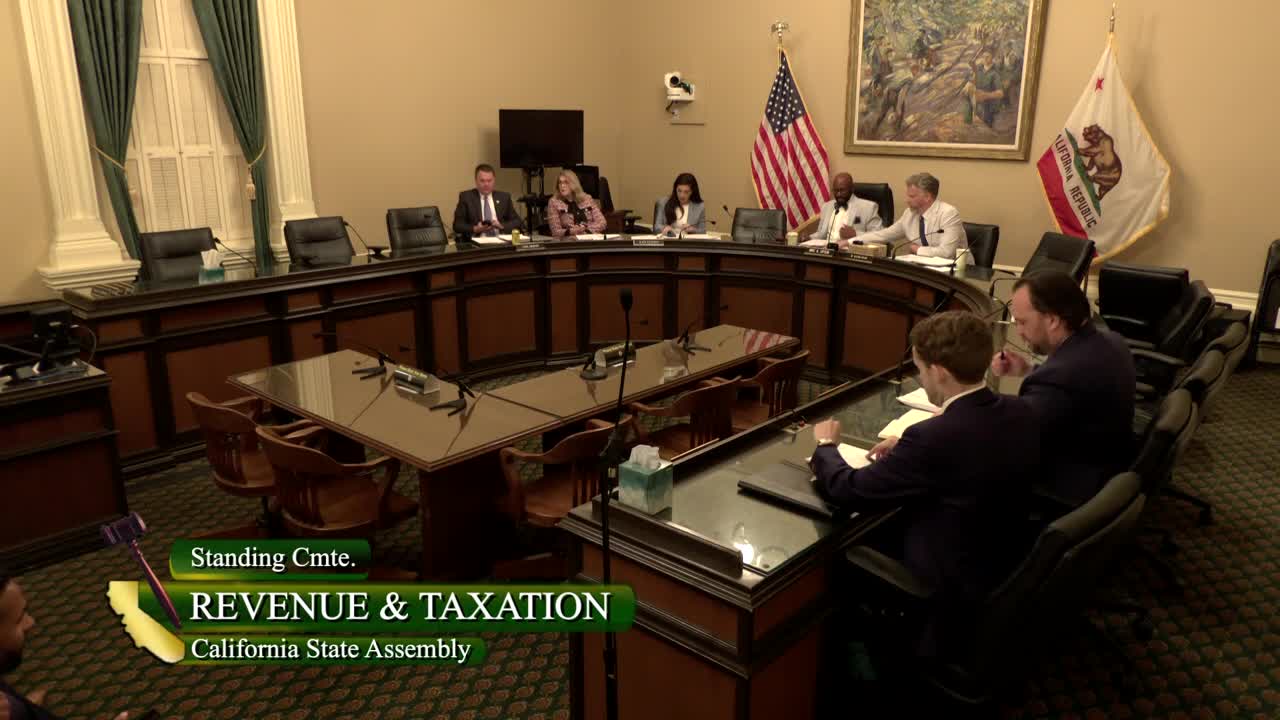 4MIN
Assembly Standing Committee on Revenue and Taxation
Bill Author

Bill Co-Author(s):