AB 1609: Customer service chatbots.
- Session Year: 2025-2026
- House: Assembly
- Latest Version Date: 2026-09-28
Current Status:
Passed
(2026-09-28: Chaptered by Secretary of State - Chapter 733, Statutes of 2026.)
Introduced
In Committee
Awaiting First Chamber Vote
Passed First Chamber
In Committee
Awaiting Second Chamber Vote
Passed Second Chamber
Enacted
Existing law prohibits a person from using a bot, as defined, to mislead another person about the bots artificial identity to incentivize the purchase or sale of goods or services, among other things. Existing law requires an operator of a companion chatbot, as defined, to provide a disclosure regarding the companion chatbots artificial identity if a reasonable person interacting with the companion chatbot would be misled to believe that the person is interacting with a human.
This bill would prohibit a large private business, as defined, from representing that a customer service chatbot is a human. The bill would also require the large private business to provide certain disclosures if a reasonable person interacting with the chatbot would be misled to believe they are interacting with a human.
This bill would require a large private business to provide a customer service feature allowing customers to contact a customer service agent during its regular business hours, as defined. This bill would require, except as specified, large private businesses to make a good faith effort to connect a customer to an agent within 15 minutes after a request for human customer service is made, or schedule an appointment with the customer, as specified. For online chatbot customer service platforms and telephonic customer service platforms, the bill would require a large private business to make a good faith effort to limit initial and cumulative telephonic hold times, and would require certain large private businesses to post prescribed contact information on their internet website.
The bill would authorize a public prosecutor to enforce these provisions, and would make a large private business that violates these provisions liable for a penalty of up to $5,000 for an initial violation, and $10,000 for each subsequent violation. The bill would waive its requirements due to unforeseen circumstances beyond the reasonable control of a large private business or extraordinary or emergency situations, and would exempt a large private business that provides services subject to, and is in compliance with, specified public utilities law. The bill would further exempt exclusive business lines and communications by a hospital, as specified, and a consumer reporting agency, as prescribed. The bill would define terms for these purposes.
Existing law prohibits a person from using a bot, as defined, to mislead another person about the bots artificial identity to incentivize the purchase or sale of goods or services, among other things. Existing law requires an operator of a companion chatbot, as defined, to provide a disclosure regarding the companion chatbots artificial identity if a reasonable person interacting with the companion chatbot would be misled to believe that the person is interacting with a human.
This bill would prohibit a large private business, as defined, from representing that a customer service chatbot is a human. The bill would also require the large private business to provide certain disclosures if a reasonable person interacting with the chatbot would be misled to believe they are interacting with a human.
This bill would require a large private business to provide a customer service feature allowing customers to contact a customer service agent during its regular business hours, as defined. This bill would require require, except as specified, large private businesses to make a good faith effort to connect a customer to an agent within 15 minutes after a request for human customer service is made, or schedule an appointment with the customer, as specified. For online chatbot customer service platforms and telephonic customer service platforms, the bill would require a large private business to make a good faith effort to limit initial and cumulative telephonic hold times, and would require certain large private businesses to post prescribed contact information on their internet website.
The bill would authorize a public prosecutor to enforce these provisions, and would make a large private business that violates these provisions liable for a penalty of up to $5,000 for an initial violation, and $10,000 for each subsequent violation. The bill would waive its requirements due to unforeseen circumstances beyond the reasonable control of a large private business or extraordinary or emergency situations, and would exempt a large private business that provides services subject to, and is in compliance with, specified public utilities law. The bill would further exempt exclusive business lines and communications by a hospital, as specified, and a consumer reporting agency, as prescribed. The bill would define terms for these purposes.
Existing law prohibits a person from using a bot, as defined, to mislead another person about the bots artificial identity to incentivize the purchase or sale of goods or services, among other things. Existing law requires an operator of a companion chatbot, as defined, to provide a disclosure regarding the companion chatbots artificial identity if a reasonable person interacting with the companion chatbot would be misled to believe that the person is interacting with a human.
This bill would prohibit a large private business, as defined, from representing that a customer service chatbot is a human. The bill would also require the large private business to provide certain disclosures if a reasonable person interacting with the chatbot would be misled to believe they are interacting with a human.
This bill would require a large private business to provide a customer service feature allowing customers to contact a customer service agent during its regular business hours, as defined. This bill would require large private businesses to make a good faith effort to connect a customer to an agent within 15 minutes after a request for human customer service is made, or schedule an appointment with the customer, as specified. For online chatbot customer service platforms and telephonic customer service platforms, the bill would require a large private business to make a good faith effort to limit initial and cumulative telephonic hold times, and would require certain large private businesses to post prescribed contact information on their internet website.
The bill would authorize a public prosecutor to enforce these provisions, and would make a large private business that violates these provisions liable for a penalty of up to $5,000 for an initial violation, and $10,000 for each subsequent violation. The bill would waive its requirements due to unforeseen circumstances beyond the reasonable control of a large private business, business or extraordinary or emergency situations, and would exempt a large private business that provides services subject to, and is in compliance with, a specified public utilities law. The bill would further exempt exclusive business lines and communications by a hospital, as specified, and a consumer reporting agency, as prescribed. The bill would define terms for these purposes.
Existing law prohibits a person from using a bot, as defined, to mislead another person about the bots artificial identity to incentivize the purchase or sale of goods or services, among other things. Existing law requires an operator of a companion chatbot, as defined, to provide a disclosure regarding the companion chatbots artificial identity if a reasonable person interacting with the companion chatbot would be misled to believe that the person is interacting with a human.
This bill would prohibit a large private business, as defined, from representing that a customer service chatbot is a human. The bill would also require the large private business to provide certain disclosures if a reasonable person interacting with the chatbot would be misled to believe they are interacting with a human.
This bill would require a large private business to provide a customer service feature allowing consumers customers to contact a customer service agent for at least 10 hours per day during its regular business hours and to hours, as defined. This bill would require large private businesses to make a good faith effort to connect a customer to an agent within 15 minutes after a request for human customer service is made, as specified. or schedule an appointment with the customer, as specified. For online chatbot customer service platforms and telephonic customer service platforms, the bill would require a large private business to make a good faith effort to ensure the customers who require customer service assistance and that the business comply with specified requirements including, among others, limiting limit initial and cumulative telephonic hold times, and would require certain large private businesses to post prescribed contact information on their internet website.
The bill would authorize a public prosecutor to enforce these provisions, and would make a large private business that violates these provisions liable for a penalty of up to $5,000 for an initial violation, and $10,000 for each subsequent violation. The bill would waive its requirements due to unforeseen circumstances beyond the reasonable control of a large private business, and would exempt a large private business that provides services subject to, and is in compliance with, a specified public utilities law. The bill would further exempt exclusive business lines and communications by a nonprofit general acute care hospital, as specified. specified, and a consumer reporting agency, as prescribed. The bill would define terms for these purposes.
Existing law prohibits a person from using a bot, as defined, to mislead another person about the bots artificial identity to incentivize the purchase or sale of goods or services, among other things. Existing law requires an operator of a companion chatbot, as defined, to provide a disclosure regarding the companion chatbots artificial identity if a reasonable person interacting with the companion chatbot would be misled to believe that the person is interacting with a human.
This bill would prohibit a large private business, as defined, from representing that a customer service chatbot is a human. The bill would also require the large private business to provide certain disclosures if a reasonable person interacting with the chatbot would be misled to believe they are interacting with a human.
The bill would require a large private business to provide customers with human customer service support and communications within 15 minutes of requesting human customer service. This bill would require a large private business to provide a customer service feature allowing consumers to contact a customer service agent for at least 10 hours per day during its regular business hours and to make a good faith effort to connect a customer to an agent within 15 minutes after a request for human customer service is made, as specified. The bill would impose certain specific requirements on large private businesses, For online chatbot customer service platforms and telephonic customer service platforms, the bill would require a large private business to make a good faith effort to ensure the customers who require customer service assistance and that the business comply with specified requirements including, among others, limiting initial and cumulative telephonic hold times, and would require certain large private businesses to post prescribed contact information on their internet website.
The bill would authorize a public prosecutor to enforce these provisions, and would make a large private business that violates these provisions liable for a penalty of up to $10,000. $5,000 for an initial violation, and $10,000 for each subsequent violation. The bill would authorize the Attorney General to adopt regulations for these purposes, as specified. The bill would waive its requirements due to unforeseen circumstances beyond the reasonable control of a large private business, and would exempt a large private business that provides services subject to, and is in compliance with, a specified public utilities law. The bill would further exempt exclusive business lines and communications by a nonprofit general acute care hospital, as specified. The bill would define terms for these purposes.
Existing law prohibits a person from using a bot, as defined, to mislead another person about the bots artificial identity to incentivize the purchase or sale of goods or services, among other things. Existing law requires an operator of a companion chatbot, as defined, to provide a disclosure regarding the companion chatbots artificial identity if a reasonable person interacting with the companion chatbot would be misled to believe that the person is interacting with a human.
This bill would prohibit an operator of a customer service chatbot available to a person in this state a large private business, as defined, from representing that a customer service chatbot is a human. The bill would also require the operator large private business to provide certain disclosures if a reasonable person interacting with the chatbot would be misled to believe they are interacting with a human.
The bill would require an operator of a large online business, as specified, a large private business to provide consumers customers with human customer service support and communications within 5 15 minutes of requesting human customer service. The bill would impose certain specific requirements on telephonic customer service platforms and online customer service platforms. The bill would require certain operators to offer a telephonic customer service platform and post large private businesses, and would require certain large private businesses to post prescribed contact information on their internet website.
The bill would require an operator to establish and maintain a process for complaints regarding the customers inability to obtain assistance from a customer service agent. The bill would authorize the Attorney General or a district attorney a public prosecutor to enforce these provisions, and would make an entity a large private business that engages in a pattern or practice of violating violates these provisions liable for a penalty of up to $10,000. The bill would authorize the Attorney General to adopt regulations for these purposes, as specified. The bill would waive its requirements during a state of emergency or extraordinary circumstances, as specified due to unforeseen circumstances beyond the reasonable control of a large private business, and would exempt a large private business that provides services subject to, and is in compliance with, a specified public utilities law. The bill would define terms for these purposes.
Existing law prohibits a person from using a bot, as defined, to mislead another person about the bots artificial identity to incentivize the purchase or sale of goods or services, among other things. Existing law requires an operator of a companion chatbot, as defined, to provide a disclosure regarding the companion chatbots artificial identity if a reasonable person interacting with the companion chatbot would be misled to believe that the person is interacting with a human.
This bill would prohibit an operator of a customer service chatbot available to a person in this state from representing that a customer service chatbot is a human. The bill would also require the operator to provide certain disclosures if a reasonable person interacting with the chatbot would be misled to believe they are interacting with a human.
The bill would require an operator of a large online business, as specified, to provide consumers with human customer service support and communications within 5 minutes of requesting human customer service. The bill would impose certain specific requirements on telephonic customer service platforms and online customer service platforms. The bill would require certain operators to offer a telephonic customer service platform and post prescribed contact information on their website.
The bill would require an operator to establish and maintain a process for complaints regarding the customers inability to obtain assistance from a customer service agent. The bill would authorize the Attorney General or a district attorney to enforce these provisions, and would make an entity that engages in a pattern or practice of violating these provisions liable for a penalty of up to $10,000. The bill would authorize the Attorney General to adopt regulations for these purposes, as specified. The bill would waive its requirements during a state of emergency or extraordinary circumstances, as specified. The bill would define terms for these purposes.
Existing law prohibits a person from using a bot, as defined, to mislead another person about the bots artificial identity to incentivize the purchase or sale of goods or services, among other things. Existing law requires an operator of a companion chatbot, as defined, to provide a disclosure regarding the companion chatbots artificial identity if a reasonable person interacting with the companion chatbot would be misled to believe that the person is interacting with a human.This bill would declare the Legislatures intent to enact legislation that would regulate telephonic and internet customer service support in specified ways.Existing law prohibits a person from using a bot, as defined, to mislead another person about the bots artificial identity to incentivize the purchase or sale of goods or services, among other things. Existing law requires an operator of a companion chatbot, as defined, to provide a disclosure regarding the companion chatbots artificial identity if a reasonable person interacting with the companion chatbot would be misled to believe that the person is interacting with a human.
This bill would declare the Legislatures intent to enact legislation that would regulate telephonic and internet customer service support in specified ways.
As used in this chapter:
(a)Artificial intelligence means an engineered or machine-based system that varies in its level of autonomy and that can, for explicit or implicit objectives, infer from the input it receives how to generate outputs that can influence physical or virtual environments.
(b)(1)Customer means a natural person residing in California.
(2)For purposes of paragraph (1), residence refers to the customers account address.
(c)Customer service agent means a natural person who, as an employee, contractor, or representative of the large private business provides either of the following:
(1)Direct customer service, including service to prospective and existing customers, relating to the sale and delivery of goods and services.
(2)Direct customer support, including technical assistance functions relating to the sale and delivery of goods and services.
(d)Customer service chatbot means an artificial intelligence system with a natural language interface that provides adaptive, human-like responses to user inputs and is used by an entity for any of the following purposes:
(1)Direct customer service, including service to prospective and existing customers, relating to the sale or delivery of goods or services.
(2)Direct customer support, including technical assistance functions relating to the sale or delivery of goods or services.
(e)Exclusive business lines means telephone lines, chat lines, or other communications channels that are not intended for general customer use and are intended solely for use by employees of the business or by other entities for business-to-business communications. For purposes of this subdivision, entities include other businesses, nonprofit entities, or government entities.
(f)Hospital means a health facility licensed pursuant to subdivision (a), (b), or (f) of Section 1250 of the Health and Safety Code.
(g)Large private business means a business with more than five hundred million dollars ($500,000,000) in gross annual revenue nationally that provides goods and services to customers.
(h)Online customer service platforms means large private businesses that primarily operate on public-facing internet websites, web applications, or digital applications, including a social network or publication and may not offer telephonic means of communication for customer service inquiries.
(i)Regular business hours means the hours during which the business customarily maintains customer-service functions, excluding on days that the business is ordinarily closed or state or federal holidays. Regular business hours includes a 10-hour period per day over a five-day week or 8 hours per day for a full seven-day week.
(j)Services means services for which a customer will provide or has provided monetary consideration, whether through a one-time payment, subscription, fee, or recurring charge. Services does not include services or parts of services that offer a free option to persons with an opportunity to pay, subscribe, or otherwise provide monetary consideration for the service or upgraded services at a future time.
(k)Telephonic customer service platforms means any large private business that provides customer service to customers in California through telephonic means.
22626.(a)A large private business shall not represent that a customer service chatbot is a human.
(b)A large private business shall provide a clear and conspicuous disclosure that the customer service chatbot is artificially generated and not human if a reasonable person interacting with the customer service chatbot is likely to be misled to believe that the person is interacting with a human.
(c)The disclosure required by subdivision (b) shall be clear and conspicuous, and provided in the medium in which the customer service chatbot interacts with the customer.
22627.(a)During at least a large private businesss regular business hours, a large private business shall provide customers who require customer assistance with goods or services offered by or provided from the large private business with a simple customer service feature on all platforms through which the large private business provides customer service, including online chatbot customer service and telephonic customer service platforms, that allows customers to request to connect to a customer service agent. A large private business satisfies this subdivision if its customer service platform enables a customer to request a customer service agent through commonly understood commands, prompts, menu selections, or verbal requests during the customer interaction.
(b)(1)A large private business shall make a good faith effort to provide a customer who requests to connect to a customer service agent through the feature described in subdivision (a) with one of the following:
(A)Connection to a customer service agent within 15 minutes of the request.
(B)A specific appointment time within one business day of the request at which a customer service agent will call or connect with the customer.
(2)A large private business subject to Section 1707.2 of Title 16 of the California Code of Regulations may satisfy the requirements in paragraph (1) by returning a phone call within one business hour.
(c)A large private business shall make a good faith effort to ensure a customer is not placed on hold or made to wait for more than 15 minutes at any time after connection with a customer service agent, and that cumulative hold or wait times or escalation queues do not exceed more than one hour total.
(d)Large private businesses who provide goods and services to customers in California through online platforms and who have a telephonic customer service platform shall post their telephonic customer service telephone number clearly and conspicuously on their internet website.
(e)This section does not require a large private business to do any of the following:
(1)To connect or respond within 15 minutes if the request or connection is made via electronic mail, web-based contact form, or voicemail message.
(2)To offer customer service through a communication platform that the business has not otherwise made available to customers as of January 1, 2027.
22628.(a)An action to enforce this chapter may be brought by a public prosecutor.
(b)A large private business that violates this chapter shall be liable for a civil penalty not exceeding five thousand dollars ($5,000) for an initial violation, and ten thousand dollars ($10,000) for each subsequent violation.
(c)For purposes of this chapter, the use of commercially reasonable and practicable standards that are designed and intended to achieve compliance shall satisfy the good faith effort requirements of Section 22627.
(d)This chapter does not establish a private right of action.
(e)This chapter does not require a large private business who, as of January 1, 2027, does not utilize any telephonic customer services to customers, to provide telephonic customer service provided that the large private business offers customer service methods by which the customer may promptly connect with a customer service agent consistent with this section.
(f)A large private businesss inability to comply with this chapter does not constitute a violation of this chapter if that inability is due to either of the following:
(1)Unforeseen circumstances beyond its reasonable control.
(2)Extraordinary or emergency situations, including, but not limited to, local or statewide emergencies, including grid emergencies or public safety power shutoff events, or information technology or telecommunications outages.
(g)This chapter does not apply to any of the following:
(1)Services a large private business provides subject to, and in compliance with, General Order 133, Rules Governing Telecommunications Services, or General Order 103-A, Rules Governing Water Service, of the Public Utilities Commission of the State of California and in compliance with a corrective action plan, if any.
(2)Exclusive business lines.
(3)A hospital, when its communications relate to the provision, coordination, management, administration, payment, or operation of health care services, including, but not limited to, patient care, clinical services, appointment scheduling, intake and registration, referrals, care coordination, patient navigation, emergency services, utilization management, prior authorization, discharge planning, followup care, billing, insurance, patient financial services, or other administrative or operational functions directly related to the delivery, payment, or coordination of health care services.
(4)A consumer reporting agency, as defined in the federal Fair Credit Reporting Act (15 U.S.C. Sec. 1681 et seq.).
22629.The duties, remedies, and obligations imposed by this chapter are cumulative to the duties, remedies, or obligations imposed under other law and shall not be construed to relieve a large private business from any duties, remedies, or obligations imposed under any other law.
As used in this chapter:
(a)Artificial intelligence means an engineered or machine-based system that varies in its level of autonomy and that can, for explicit or implicit objectives, infer from the input it receives how to generate outputs that can influence physical or virtual environments.
(b)(1)Customer means a natural person residing in California.
(2)For purposes of paragraph (1), residence refers to the customers account address.
(c)Customer service agent means a natural person who, as an employee, contractor, or representative of the large private business provides either of the following:
(1)Direct customer service, including service to prospective and existing customers, relating to the sale and delivery of goods and services.
(2)Direct customer support, including technical assistance functions relating to the sale and delivery of goods and services.
(d)Customer service chatbot means an artificial intelligence system with a natural language interface that provides adaptive, human-like responses to user inputs and is used by an entity for any of the following purposes:
(1)Direct customer service, including service to prospective and existing customers, relating to the sale or delivery of goods or services.
(2)Direct customer support, including technical assistance functions relating to the sale or delivery of goods or services.
(e)Exclusive business lines means telephone lines, chat lines, or other communications channels that are not intended for general customer use and are intended solely for use by employees of the business or by other entities for business-to-business communications. For purposes of this subdivision, entities include other businesses, nonprofit entities, or government entities.
(f)Hospital means a health facility licensed pursuant to subdivision (a), (b), or (f) of Section 1250 of the Health and Safety Code.
(g)Large private business means a business with more than five hundred million dollars ($500,000,000) in gross annual revenue nationally that provides goods and services to customers.
(h)Online customer service platforms means large private businesses that primarily operate on public-facing internet websites, web applications, or digital applications, including a social network or publication and may not offer telephonic means of communication for customer service inquiries.
(i)Regular business hours means the hours during which the business customarily maintains administrative, managerial, or customer-service functions, excluding on days that the business is ordinarily closed or state or federal holidays. Regular business hours includes a 10-hour period per day over a five-day week or 8 hours per day for a full seven-day week.
(j)Services means services for which a customer will provide or has provided monetary consideration, whether through a one-time payment, subscription, fee, or recurring charge. Services does not include services or parts of services that offer a free option to persons with an opportunity to pay, subscribe, or otherwise provide monetary consideration for the service or upgraded services at a future time.
(k)Telephonic customer service platforms means any large private business that provides customer service to customers in California through telephonic means.
22626.(a)A large private business shall not represent that a customer service chatbot is a human.
(b)A large private business shall provide a clear and conspicuous disclosure that the customer service chatbot is artificially generated and not human if a reasonable person interacting with the customer service chatbot is likely to be misled to believe that the person is interacting with a human.
(c)The disclosure required by subdivision (b) shall be clear and conspicuous, and provided in the medium in which the customer service chatbot interacts with the customer.
22627.(a)During at least a large private businesss regular business hours, a large private business shall provide customers who require customer assistance with goods or services offered by or provided from the large private business with a simple customer service feature on all platforms through which the large private business provides customer service, including online chatbot customer service and telephonic customer service platforms, that allows customers to request to connect to a customer service agent. A large private business satisfies this subdivision if its customer service platform enables a customer to request a customer service agent through commonly understood commands, prompts, menu selections, or verbal requests during the customer interaction.
(b)(1)A large private business shall make a good faith effort to provide a customer who requests to connect to a customer service agent through the feature described in subdivision (a) with one of the following:
(1)(A)Connection to a customer service agent within 15 minutes of the request.
(2)(B)A specific appointment time within one business day of the request at which a customer service agent will call or connect with the customer.
(2)A large private business subject to Section 1707.2 of Title 16 of the California Code of Regulations may satisfy the requirements in paragraph (1) by returning a phone call within one business hour.
(c)A large private business shall make a good faith effort to ensure a customer is not placed on hold or made to wait for more than 15 minutes at any time after connection with a customer service agent, and that cumulative hold or wait times or escalation queues do not exceed more than one hour total.
(d)Large private businesses who provide goods and services to customers in California through online platforms and who have a telephonic customer service platform shall post their telephonic customer service telephone number clearly and conspicuously on their internet website.
(e)This section does not require a large private business to do any of the following:
(1)To connect or respond within 15 minutes if the request or connection is made via electronic mail, web-based contact form, or voicemail message.
(2)To offer customer service through a communication platform that the business has not otherwise made available to customers as of January 1, 2027.
22628.(a)An action to enforce this chapter may be brought by a public prosecutor.
(b)A large private business that violates this chapter shall be liable for a civil penalty not exceeding five thousand dollars ($5,000) for an initial violation, and ten thousand dollars ($10,000) for each subsequent violation.
(c)For purposes of this chapter, the use of commercially reasonable and practicable standards that are designed and intended to achieve compliance shall satisfy the good faith effort requirements of Section 22627.
(d)This chapter does not establish a private right of action.
(e)This chapter does not require a large private business who, as of January 1, 2027, does not utilize any telephonic customer services to customers, to provide telephonic customer service provided that the large private business offers customer service methods by which the customer may promptly connect with a customer service agent consistent with this section.
(f)A large private businesss inability to comply with this chapter does not constitute a violation of this chapter if that inability is due to either of the following:
(1)Unforeseen circumstances beyond its reasonable control.
(2)Extraordinary or emergency situations, including, but not limited to, local or statewide emergencies, including grid emergencies or public safety power shutoff events, or information technology or telecommunications outages.
(g)This chapter does not apply to any of the following:
(1)Services a large private business provides subject to, and in compliance with, General Order 133, Rules Governing Telecommunications Services, or General Order 103-A, Rules Governing Water Service, of the Public Utilities Commission of the State of California and in compliance with a corrective action plan, if any.
(2)Exclusive business lines.
(3)A hospital, when its communications relate to the provision, coordination, management, administration, payment, or operation of health care services, including, but not limited to, patient care, clinical services, appointment scheduling, intake and registration, referrals, care coordination, patient navigation, emergency services, utilization management, prior authorization, discharge planning, followup care, billing, insurance, patient financial services, or other administrative or operational functions directly related to the delivery, payment, or coordination of health care services.
(4)A consumer reporting agency, as defined in the federal Fair Credit Reporting Act (15 U.S.C. Sec. 1681 et seq.).
22629.The duties, remedies, and obligations imposed by this chapter are cumulative to the duties, remedies, or obligations imposed under other law and shall not be construed to relieve a large private business from any duties, remedies, or obligations imposed under any other law.
As used in this chapter:
(a)Artificial intelligence means an engineered or machine-based system that varies in its level of autonomy and that can, for explicit or implicit objectives, infer from the input it receives how to generate outputs that can influence physical or virtual environments.
(b)(1)Customer means a natural person residing in California.
(2)For purposes of paragraph (1), residence refers to the customers account address.
(c)Customer service agent means a natural person who, as an employee, contractor, or representative of the large private business provides either of the following:
(1)Direct customer service, including service to prospective and existing customers, relating to the sale and delivery of goods and services.
(2)Direct customer support, including technical assistance functions relating to the sale and delivery of goods and services.
(d)Customer service chatbot means an artificial intelligence system with a natural language interface that provides adaptive, human-like responses to user inputs and is used by an entity for any of the following purposes:
(1)Direct customer service, including service to prospective and existing customers, relating to the sale or delivery of goods or services.
(2)Direct customer support, including technical assistance functions relating to the sale or delivery of goods or services.
(e)Exclusive business lines means telephone lines, chat lines, or other communications channels that are not intended for general customer use and are intended solely for use by employees of the business as it pertains to employee or employer issues and not for a customer line dedicated to employees, or for exclusive use by any vendors of the business, or any business-to-business lines that are used exclusively for matters pertaining to a contract and not in their capacity as a customer of the business. or by other entities for business-to-business communications. For purposes of this subdivision, entities include other businesses, nonprofit entities, or government entities.
(f)Hospital means a health facility licensed pursuant to subdivision (a), (b), or (f) of Section 1250 of the Health and Safety Code.
(g)Large private business means a business with more than five hundred million dollars ($500,000,000) in gross annual revenue nationally that provides goods and services to customers.
(h)Online customer service platforms means large private businesses that primarily operate on public-facing internet websites, web applications, or digital applications, including a social network or publication and may not offer telephonic means of communication for customer service inquiries.
(i)Regular business hours means the hours during which the business customarily maintains administrative, managerial, or customer-service functions, excluding on days that the business is ordinarily closed or state or federal holidays. Regular business hours includes a 10-hour period per day over a five-day week or 8 hours per day for a full seven-day week.
(j)Services means services for which a customer will provide or has provided monetary consideration, whether through a one-time payment, subscription, fee, or recurring charge. Services does not include services or parts of services that offer a free option to persons with an opportunity to pay, subscribe, or otherwise provide monetary consideration for the service or upgraded services at a future time.
(k)Telephonic customer service platforms means any large private business that provides customer service to customers in California through telephonic means.
22626.(a)A large private business shall not represent that a customer service chatbot is a human.
(b)A large private business shall provide a clear and conspicuous disclosure that the customer service chatbot is artificially generated and not human if a reasonable person interacting with the customer service chatbot would is likely to be misled to believe that the person is interacting with a human.
(c)The disclosure required by subdivision (b) shall be clear and conspicuous, and provided in the medium in which the customer service chatbot interacts with the customer.
22627.(a)During at least a large private businesss regular business hours, a large private business shall provide customers who require customer assistance with goods or services offered by or provided from the large private business with a simple, clear and conspicuous simple customer service feature on all platforms through which the large private business provides customer service, including online chatbot customer service and telephonic customer service platforms, that allows customers to request to connect to a customer service agent. A large private business satisfies this subdivision if its customer service platform enables a customer to request a customer service agent through commonly understood commands, prompts, menu selections, or verbal requests during the customer interaction.
(b)A large private business shall make a good faith effort to provide a customer who requests to connect to a customer service agent through the feature described in subdivision (a) with one of the following:
(1)Connection to a customer service agent within 15 minutes of the request.
(2)A specific appointment time within one business day of the request at which a customer service agent will call or connect with the customer.
(c)A large private business shall make a good faith effort to ensure a customer is not placed on hold or made to wait for more than 15 minutes at any time after connection with a customer service agent, and that cumulative hold or wait times or escalation queues do not exceed more than one hour total.
(d)Large private businesses who provide goods and services to customers in California through online platforms and who have a telephonic customer service platform shall post their telephonic customer service telephone number clearly and conspicuously on their internet website.
(e)This section does not require a large private business to do any of the following:
(1)To connect or respond within 15 minutes if the request or connection is made via electronic mail, web-based contact form, or voicemail message.
(2)To offer customer service through a communication platform that the business has not otherwise made available to customers as of January 1, 2027.
22628.(a)An action to enforce this chapter may be brought by a public prosecutor.
(b)A large private business that violates this chapter shall be liable for a civil penalty not exceeding five thousand dollars ($5,000) for an initial violation, and ten thousand dollars ($10,000) for each subsequent violation.
(c)For purposes of this chapter, the use of commercially reasonable and practicable standards that are designed and intended to achieve compliance shall satisfy the good faith effort requirements of Section 22627.(d)This chapter does not establish a private right of action.
(e)This chapter does not require a large private business who, as of January 1, 2026, 2027, does not utilize any telephonic customer services to customers, to provide telephonic customer service provided that the large private business offers customer service methods by which the customer may promptly connect with a customer service agent consistent with this section.
(f)A large private businesss inability to comply with this chapter because of unforeseen circumstances beyond its reasonable control does not constitute a violation of this chapter. chapter if that inability is due to either of the following:
(1)Unforeseen circumstances beyond its reasonable control.
(2)Extraordinary or emergency situations, including, but not limited to, local or statewide emergencies, including grid emergencies or public safety power shutoff events, or information technology or telecommunications outages.
(g)This chapter does not apply to any of the following:
(1)Services a large private business provides subject to, and in compliance with, General Order 133, and in compliance with a corrective action plan, if any, Rules Governing Telecommunications Services Services, or General Order 103-A, Rules Governing Water Service, of the Public Utilities Commission of the State of California. California and in compliance with a corrective action plan, if any.
(2)Exclusive business lines.
(3)A hospital, when its communications relate to the provision, coordination, management, administration, payment, or operation of health care services, including, but not limited to, patient care, clinical services, appointment scheduling, intake and registration, referrals, care coordination, patient navigation, emergency services, utilization management, prior authorization, discharge planning, followup care, billing, insurance, patient financial services, or other administrative or operational functions directly related to the delivery, payment, or coordination of health care services.
(4)A consumer reporting agency, as defined in the federal Fair Credit Reporting Act (15 U.S.C. Sec. 1681 et seq.).
22629.The duties, remedies, and obligations imposed by this chapter are cumulative to the duties, remedies, or obligations imposed under other law and shall not be construed to relieve a large private business from any duties, remedies, or obligations imposed under any other law.
As used in this chapter:
(a)Artificial intelligence means an engineered or machine-based system that varies in its level of autonomy and that can, for explicit or implicit objectives, infer from the input it receives how to generate outputs that can influence physical or virtual environments.
(b)(1)Customer means a natural person residing in California.
(2)For purposes of paragraph (1), residence refers to the customers account address.
(c)Customer service agent means a natural person who, as an employee, contractor, or representative of the large private business provides either of the following:
(1)Direct customer service, including service to prospective and existing customers, relating to the sale and delivery of goods and services.
(2)Direct customer support, including technical assistance functions relating to the sale and delivery of goods and services.
(d)Customer service chatbot means an artificial intelligence system with a natural language interface that provides adaptive, human-like responses to user inputs and is used by an entity for any of the following purposes:
(1)Direct customer service, including service to prospective and existing customers, relating to the sale or delivery of goods or services.
(2)Direct customer support, including technical assistance functions relating to the sale or delivery of goods or services.
(e)Exclusive business lines means telephone lines, chat lines, or other communications channels that are not intended for general consumer customer use and are intended solely for use by employees of the business as it pertains to employee or employer issues and not for a consumer customer line dedicated to employees, or for exclusive use by any vendors of the business, or any business to business business-to-business lines that are used exclusively for matters pertaining to a contract and not in their capacity as a consumer customer of the business.
(f)Hospital means a health facility licensed pursuant to subdivision (a), (b), or (f) of Section 1250 of the Health and Safety Code.
(f)(g)Large private business means a business with more than five hundred million dollars ($500,000,000) in gross annual revenue nationally that provides goods and services to consumers. customers.
(g)Nonprofit general acute care hospital means a health facility licensed pursuant to subdivision (a) of Section 1250 of the Health and Safety Code that is organized and operated as a nonprofit corporation exempt from federal income taxation under Section 501(c)(3) of the Internal Revenue Code.(h)Online customer service platforms means operators large private businesses that primarily operate on public-facing internet websites, web applications, or digital applications, including a social network or publication and may not offer telephonic means of communication for customer service inquiries.
(i)Regular business hours means the hours during which the business customarily maintains administrative, managerial, or customer-service functions, excluding on days that the business is ordinarily closed or state or federal holidays. Regular business hours includes a 10-hour period per day over a five-day week or 8 hours per day for a full seven-day week.
(j)Services means services for which a customer will provide or has provided monetary consideration, whether through a one-time payment, subscription, fee, or recurring charge. Services does not include services or parts of services that offer a free option to persons with an opportunity to pay, subscribe, or otherwise provide monetary consideration for the service or upgraded services at a future time.
(k)Telephonic customer service platforms means any operator large private business that provides customer service to customers in California through telephonic means.
22626.(a)A large private business shall not represent that a customer service chatbot is a human.
(b)A large private business shall provide a clear and conspicuous disclosure that the customer service chatbot is artificially generated and not human if a reasonable person interacting with the customer service chatbot would be misled to believe that the person is interacting with a human.
(c)The disclosure required by subdivision (b) shall be clear and conspicuous, and provided in the medium in which the customer service chatbot interacts with the customer.
22627.(a)During at least the normal 10-hour period per day a large private businesss regular business hours, a large private business shall provide consumers customers who require customer assistance with goods or services offered by or provided from the large private business with a simple, clear and conspicuous customer service feature on all platforms through which the large private business provides customer service, including online chatbot customer service and telephonic customer service platforms, that allows customers to contact request a customer service agent. During these times, a large private business shall make a good faith effort to connect a person interacting with a customer service chatbot, or a telephonic automated customer support system, to a customer service agent within 15 minutes after a request for human customer service is made.
(b)For online chatbot customer service platforms, the large private business shall make a good faith effort to ensure that customers who require customer service assistance with goods or services offered or provided from the large private business are provided with all of the following:(1)A simple method for customers to request human assistance through online platforms.(2)An estimate of the time it will take to connect with a customer service agent.(3)Allow the customer to connect with the customer service agent within 15 minutes, or, at the option of the business, given a customer the option to make an appointment to connect with a large private business customer service agent within:(A)One hour of the customer request.(B)One hour of the start of the next business day, if a full hour day not remain in the current business day, or at a later time.(C)On an alternative day preferred by the consumer, at the consumers election.(c)For telephonic customer service platforms, the large private business shall make a good faith effort to ensure that customers who require customer service assistance with goods or services offered or provided from the large private business are provided with all of the following:(1)The initial call is answered promptly and the customer is not placed on hold for more than 15 minutes at any point after the call is answered, and that cumulative hold times or escalation queues for a call not exceed more than one hour total.(2)If a call is answered by a customer service chatbot, the customer is given the option to request a customer service agent and, upon that request, is provided human assistance within 15 minutes after the request is made.(3)A large private business may, but is not required to, give a customer the option to connect with the customer service agent at a later time receive make an appointment to receive a call with the large private customer service agent within:(A)One hour of the customer request, or within one hour of the start of the next business day, if a full hour does not remain in the current business day.(B)On an alternative day preferred by the consumer, at the consumers election.(b)A large private business shall make a good faith effort to provide a customer who requests a customer service agent through the feature described in subdivision (a) with one of the following:
(1)Connection to a customer service agent within 15 minutes of the request.
(2)A specific appointment time within one business day of the request at which a customer service agent will call or connect with the customer.
(c)A large private business shall make a good faith effort to ensure a customer is not placed on hold or made to wait for more than 15 minutes at any time after connection with a customer service agent, and that cumulative hold or wait times or escalation queues do not exceed more than one hour total.
(d)Large private businesses who provide goods and services to customers in California through online platforms and who have a telephonic customer service platform shall post their telephonic customer service telephone number clearly and conspicuously on their internet website.
22628.(a)An action to enforce this chapter may be brought by a public prosecutor.
(b)(1)A large private business that violates this chapter shall be liable for a civil penalty not exceeding five thousand dollars ($5,000) for each an initial violation, and ten thousand dollars ($10,000) for each subsequent violation.
(c)For purposes of this chapter, the use of commercially reasonable and practicable standards that are designed and intended to achieve compliance shall satisfy the good faith effort requirements of Section 22627.
(d)This chapter does not establish a private right of action.
(e)This chapter does not require an operator a large private business who, as of January 1, 2026, does not utilize any telephonic customer services to customers, to provide telephonic customer service provided that the operator large private business offers customer service methods by which the customer may promptly connect with a customer service agent consistent with this section.
(f)A large private businesss inability to comply with this chapter because of unforeseen circumstances beyond its reasonable control does not constitute a violation of this chapter.
(g)This chapter does not apply to any of the following:
(1)Services a large private business provides subject to, and in compliance with, General Order 133, and in compliance with a corrective action plan, if any, Rules Governing Telecommunications Services of the Public Utilities Commission of the State of California.
(2)Exclusive business lines.
(3)Nonprofit general acute care hospital, A hospital, when those its communications relate to the provision, coordination, management, administration, payment, or operation of health care services, including, but not limited to, patient care, clinical services, appointment scheduling, intake and registration, referrals, care coordination, patient navigation, emergency services, utilization management, prior authorization, discharge planning, follow-up followup care, billing, insurance, patient financial services, or other administrative or operational functions directly related to the delivery, payment, or coordination of health care services.
(4)A consumer reporting agency, as defined in the federal Fair Credit Reporting Act (15 U.S.C. Sec. 1681 et seq.).
22629.The duties, remedies, and obligations imposed by this chapter are cumulative to the duties, remedies, or obligations imposed under other law and shall not be construed to relieve a large private business from any duties, remedies, or obligations imposed under any other law.
As used in this chapter:
(a)Artificial intelligence means an engineered or machine-based system that varies in its level of autonomy and that can, for explicit or implicit objectives, infer from the input it receives how to generate outputs that can influence physical or virtual environments.
(b)(1)Customer means a natural person residing in California. California.
(2)For purposes of paragraph (1), residence refers to the customers account address.
(c)Customer service agent means a natural person who, as an employee, contractor, or representative of the large private business provides either of the following:
(1)Direct customer service, including service to prospective and existing customers, relating to the sale and delivery of goods and services.
(2)Direct customer support, including technical assistance functions relating to the sale and delivery of goods and services.
(d)Customer service chatbot means an artificial intelligence system with a natural language interface that provides adaptive, human-like responses to user inputs and is used by an entity for any of the following purposes:
(1)Direct customer service, including service to prospective and existing customers, relating to the sale or delivery of goods or services.
(2)Direct customer support, including technical assistance functions relating to the sale or delivery of goods or services.
(e)Exclusive business lines means telephone lines, chat lines, or other communications channels that are not intended for general consumer use and are intended solely for use by employees of the business as it pertains to employee or employer issues and not for a consumer line dedicated to employees, or for exclusive use by any vendors of the business, or any business to business lines that are used exclusively for matters pertaining to a contract and not in their capacity as a consumer of the business.
(e)(f)Large private business means a business with more than five hundred million dollars ($500,000,000) in gross annual revenue nationally that provides goods and services to consumers.
(g)Nonprofit general acute care hospital means a health facility licensed pursuant to subdivision (a) of Section 1250 of the Health and Safety Code that is organized and operated as a nonprofit corporation exempt from federal income taxation under Section 501(c)(3) of the Internal Revenue Code.
(h)Online customer service platforms means operators that primarily operate on public-facing internet websites, web applications, or digital applications, including a social network or publication and may not offer telephonic means of communication for customer service inquiries.
(i)Regular business hours means the hours during which the business customarily maintains administrative, managerial, or customer-service functions, excluding on days that the business is ordinarily closed or state or federal holidays.
(f)(j)Services means services for which a customer will provide or has provided monetary consideration, whether through a one-time payment, subscription, fee, or recurring charge. Services does not include services or parts of services that offer a free option to persons with an opportunity to pay, subscribe, or otherwise provide monetary consideration for the service or upgraded services at a future time.
(k)Telephonic customer service platforms means any operator that provides customer service to customers in California through telephonic means.
22626.(a)A large private business shall not represent that a customer service chatbot is a human.
(b)A large private business shall provide a clear and conspicuous disclosure that the customer service chatbot is artificially generated and not human if a reasonable person interacting with the customer service chatbot would be misled to believe that the person is interacting with a human.
(c)The disclosure required by subdivision (b) shall be clear and conspicuous, and provided in the medium in which the customer service chatbot interacts with the customer.
22627.(a)(1)During at least the normal 10-hour period that comprises per day a large private businesss regular business hours, a large private business shall provide consumers who require customer assistance with goods or services offered or provided from the large private business with a clear and conspicuous customer service feature that allows customers to contact a customer service agent. During these times, a large private business shall make a good faith effort to connect a person interacting with a customer service chatbot, or a telephonic automated customer support system, to a customer service agent within fifteen 15 minutes after a request for human customer service is made.
(2)If the customer requests a customer service agent under paragraph (1), the large private business shall do all of the following:(b)For online chatbot customer service platforms, the large private business shall make a good faith effort to ensure that customers who require customer service assistance with goods or services offered or provided from the large private business are provided with all of the following:
(A)(1)Provide a A simple method for customers to request human assistance through online platforms.
(B)(2)Provide the customer with an An estimate of the time it will take to connect with a customer service agent.
(C)(3)Allow the customer to choose to connect with the customer service agent as soon as feasible or to make an appointment to connect with the customer service agent at a later time. within 15 minutes, or, at the option of the business, given a customer the option to make an appointment to connect with a large private business customer service agent within:
(D)Allow the customer to choose whether to communicate with the customer service agent by text, email, or telephone.(A)One hour of the customer request.
(B)One hour of the start of the next business day, if a full hour day not remain in the current business day, or at a later time.
(C)On an alternative day preferred by the consumer, at the consumers election.
(b)(c)For telephonic customer service platforms, the large private business shall make a good faith effort to ensure that customers who require customer service assistance with goods or services offered or provided from the large private business are provided with all of the following:
(1)(1)The The initial call is answered promptly and the customer is not placed on hold for more than 15 minutes at any point after the call is answered, and that cumulative hold times or escalation queues for a call not exceed more than one hour total.
(2)(2)If a call is answered by a customer service chatbot, the customer is given the option to request a customer service agent and, upon that request, is provided human assistance within fifteen 15 minutes after the request is made.
(c)For online customer service platforms, the business shall ensure that a customer who requires customer service assistance with goods or services offered or provided from the large private business is given an option to request a customer service agent and, upon that request, the large private business shall make a good faith effort to provide human assistance within fifteen minutes after the request is made.(3)A large private business may, but is not required to, give a customer the option to connect with the customer service agent at a later time receive make an appointment to receive a call with the large private customer service agent within:
(A)One hour of the customer request, or within one hour of the start of the next business day, if a full hour does not remain in the current business day.
(B)On an alternative day preferred by the consumer, at the consumers election.
(d)(d)Large private businesses who provide goods and services to customers in California through online platforms and who have a telephonic customer service platform shall post their telephonic customer service telephone number clearly and conspicuously on their internet website.
22628.(a)An action to enforce this chapter may be brought by a public prosecutor.
(b)(b)(1)A large private business that violates this chapter shall be liable for a civil penalty not exceeding ten thousand dollars ($10,000) five thousand dollars ($5,000) for each violation. violation, and ten thousand dollars ($10,000) for each subsequent violation.
(c)For purposes of this chapter, the use of commercially reasonable and practicable standards that are designed and intended to achieve compliance shall satisfy the good faith effort requirements of Section 22627.
(c)(d)This chapter does not establish a private right of action.
(d)The Attorney General may adopt regulations to further its purposes and may provide additional guidance regarding compliance.(e)(e)This chapter does not require an operator who, as of January 1, 2026, does not utilize any telephonic customer services to customers, to provide telephonic customer service provided that the operator offers customer service methods by which the customer may promptly connect with a customer service agent consistent with this section.
(f)A large private businesss inability to comply with this chapter because of unforeseen circumstances beyond its reasonable control does not constitute a violation of this chapter.
(g)This chapter does not apply to any of the following:
(f)(1)This chapter shall not apply to services Services a large private business provides subject to, and in compliance with, General Order 133, Order 133, and in compliance with a corrective action plan, if any, Rules Governing Telecommunications Services of the Public Utilities Commission of the State of California.
(2)Exclusive business lines.
(3)Nonprofit general acute care hospital, when those communications relate to the provision, coordination, management, administration, payment, or operation of health care services, including, but not limited to, patient care, clinical services, appointment scheduling, intake and registration, referrals, care coordination, patient navigation, emergency services, utilization management, prior authorization, discharge planning, follow-up care, billing, insurance, patient financial services, or other administrative or operational functions directly related to the delivery, payment, or coordination of health care services.
22629.The duties, remedies, and obligations imposed by this chapter are cumulative to the duties, remedies, or obligations imposed under other law and shall not be construed to relieve a large private business from any duties, remedies, or obligations imposed under any other law.
As used in this chapter:
(a)Artificial intelligence means an engineered or machine-based system that varies in its level of autonomy and that can, for explicit or implicit objectives, infer from the input it receives how to generate outputs that can influence physical or virtual environments.
(b)Complaint means any oral or written expression of dissatisfaction relating to an operators compliance with this chapter, including the inability to connect with a human representative when requested.(b)Customer means a natural person residing in California.
(c)Customer service agent means a natural person who, as an employee, contractor, or representative of the operator who large private business provides either of the following:
(1)Direct customer service, including service to prospective and existing customers, relating to the sale and delivery of goods and services.
(2)Direct customer support, including technical assistance functions relating to the sale and delivery of goods and services.
(d)Customer service chatbot means either of the following:
(1)An an artificial intelligence system with a natural language interface that provides adaptive, human-like responses to user inputs and is used by an entity solely for any of the following purposes:
(A)(1)Direct customer service, including service to prospective and existing customers, relating to the sale or delivery of goods or services.
(B)(2)Direct customer support, including technical assistance functions relating to the sale or delivery of goods or services.
(2)A stand-alone consumer electronic device that functions as a speaker and voice command interface, acts as a voice-activated virtual assistant, and sustains a relationship across multiple interactions or generate outputs to service customers relating to the sale or delivery of goods and services.(e)Extraordinary or emergency situations mean conditions posing an imminent threat to public safety, including severe weather, wildfire risk, statewide or local grid emergencies, widespread information technology or telecom outages, and any deenergization conducted pursuant to the California Public Utilities Commissions authority under Section 451 and subdivision (a) of Section 399.2 of the Public Utilities Code, such as Public Safety Power Shutoff events.(f)Operator(e)Large private business means an entity a business with more than five hundred million dollars ($500,000,000) in gross annual revenue nationally that makes a customer service chatbot available to a person in the state. provides goods and services to consumers.
(f)Services means services for which a customer will provide or has provided monetary consideration, whether through a one-time payment, subscription, fee, or recurring charge. Services does not include services or parts of services that offer a free option to persons with an opportunity to pay, subscribe, or otherwise provide monetary consideration for the service or upgraded services at a future time.
22626.(a)An operator of a A large private business shall not represent that any artificial intelligence, automated customer service system, or a customer service chatbot is a human.
(b)An operator that makes a customer service chatbot available to a person in this state A large private business shall provide a clear and conspicuous disclosure that the customer service chatbot is artificially generated and not human if a reasonable person interacting with the customer service chatbot would be misled to believe that the person is interacting with a human.
(c)The disclosure required by subdivision (b) shall do all the following: be clear and conspicuous, and provided in the medium in which the customer service chatbot interacts with the customer.
(1)Inform the person that they are interacting with a customer service chatbot, artificial intelligence system, or similar automated system, and that the system is not a human being.(2)For audio-only or voice-based interfaces, be provided in an audible form and repeated upon the persons request.(3)Be readily accessible throughout the customer interaction.(4)Be presented in plain language that is understandable to an ordinary consumer.22627.(a)(1)During the business hours of 8 a.m. to 6 p.m. daily, an operator of normal 10-hour period that comprises a large private businesss regular business hours, a large private business who provide goods and services to consumers in California shall provide consumers with human customer service support and communications who require customer assistance with goods or services offered or provided from the large private business with a clear and conspicuous customer service feature that allows customers to contact a customer service agent. During these times, an operator a large private business shall make a good faith effort to connect a person interacting with a customer service chatbot, or automated customer support system, to a customer service agent within five fifteen minutes after a request for human customer service is made.
(2)If the customer requests a customer service agent under paragraph (1), the large private business shall do all of the following:
(A)Provide a simple method for customers to request human assistance through online platforms.
(B)Provide the customer with an estimate of the time it will take to connect with a customer service agent.
(C)Allow the customer to choose to connect with the customer service agent as soon as feasible or to make an appointment to connect with the customer service agent at a later time.
(D)Allow the customer to choose whether to communicate with the customer service agent by text, email, or telephone.
(b)For telephonic customer service platforms, the large private business shall make a good faith effort to ensure that customers who require customer service assistance with goods or services offered or provided from the large private business are provided with all of the following:
(1)That a customer call be answered quickly and, after the call is answered, that a The customer is not placed on hold for more than 5 15 minutes at any point after the call is answered, and that cumulative hold times for a call not exceed more than 10 minutes one hour total.
(2)If a call is answered by a customer service chatbot, the operator of the telephonic platform shall provide customer is given the option to request a customer service agent and, upon that request, is provided human assistance within five fifteen minutes after the call request is made.
(c)For online customer service platforms, the business shall ensure that a customer who requires customer service assistance with goods or services offered or provided from the large private business is given an option to request a customer service assistance from a human being agent and, upon that request, the operator of the online platform large private business shall make a good faith effort to provide human assistance within five fifteen minutes after the request is made.
(d)Operators Large private businesses who provide goods and services to consumers customers in California through online platforms shall offer a telephonic customer service platform and post and who have a telephonic customer service platform shall post their telephonic customer service phone telephone number clearly and conspicuously on their internet website.
22628.(a)An action to enforce this chapter may be brought by a district attorney or the Attorney General. a public prosecutor.
(b)An entity that has engaged in a pattern or practice of violating A large private business that violates this chapter shall be liable for a civil penalty not exceeding ten thousand dollars ($10,000) for each violation.
(c)This chapter does not establish a private right of action.
(d)The Attorney General may adopt regulations, consistent with this chapter, regulations to further its purposes and to may provide additional guidance regarding compliance, including, but not limited to, guidance on the form and content of disclosures and reasonable mechanisms for requesting human assistance.compliance.
(e)This chapter shall not be actionable or enforceable during extraordinary or emergency situations.(e)A large private businesss inability to comply with this chapter because of unforeseen circumstances beyond its reasonable control does not constitute a violation of this chapter.
(f)This chapter shall not apply to services a large private business provides subject to, and in compliance with, General Order 133, Rules Governing Telecommunications Services of the Public Utilities Commission of the State of California.
22629.The duties, remedies, and obligations imposed by this chapter are cumulative to the duties, remedies, or obligations imposed under other law and shall not be construed to relieve an operator a large private business from any duties, remedies, or obligations imposed under any other law.
As used in this chapter:
(a)Artificial intelligence means an engineered or machine-based system that varies in its level of autonomy and that can, for explicit or implicit objectives, infer from the input it receives how to generate outputs that can influence physical or virtual environments.
(b)Complaint means any oral or written expression of dissatisfaction relating to an operators compliance with this chapter, including the inability to connect with a human representative when requested.
(c)Customer service agent means a natural person who, as an employee, contractor, or representative of the operator who provides either of the following:
(1)Direct customer service, including service to prospective and existing customers, relating to the sale and delivery of goods and services.
(2)Direct customer support, including technical assistance functions relating to the sale and delivery of goods and services.
(d)Customer service chatbot means either of the following:
(1)An artificial intelligence system with a natural language interface that provides adaptive, human-like responses to user inputs and is used by an entity solely for any of the following purposes:
(A)Direct customer service, including service to prospective and existing customers, relating to the sale or delivery of goods or services.
(B)Direct customer support, including technical assistance functions relating to the sale or delivery of goods or services.
(2)A stand-alone consumer electronic device that functions as a speaker and voice command interface, acts as a voice-activated virtual assistant, and sustains a relationship across multiple interactions or generate outputs to service customers relating to the sale or delivery of goods and services.
(e)Extraordinary or emergency situations mean conditions posing an imminent threat to public safety, including severe weather, wildfire risk, statewide or local grid emergencies, widespread information technology or telecom outages, and any deenergization conducted pursuant to the California Public Utilities Commissions authority under Section 451 and subdivision (a) of Section 399.2 of the Public Utilities Code, such as Public Safety Power Shutoff events.
(f)Operator means an entity with more than five hundred million dollars ($500,000,000) in gross annual revenue nationally that makes a customer service chatbot available to a person in the state.
22626.(a)An operator of a large private business shall not represent that any artificial intelligence, automated customer service system, or customer service chatbot is a human.
(b)An operator that makes a customer service chatbot available to a person in this state shall provide a clear and conspicuous disclosure that the customer service chatbot is artificially generated and not human if a reasonable person interacting with the customer service chatbot would be misled to believe that the person is interacting with a human.
(c)The disclosure required by subdivision (b) shall do all the following:
(1)Inform the person that they are interacting with a customer service chatbot, artificial intelligence system, or similar automated system, and that the system is not a human being.
(2)For audio-only or voice-based interfaces, be provided in an audible form and repeated upon the persons request.
(3)Be readily accessible throughout the customer interaction.
(4)Be presented in plain language that is understandable to an ordinary consumer.
22627.(a)During the business hours of 8 a.m. to 6 p.m. daily, an operator of a large private business who provide goods and services to consumers in California shall provide consumers with human customer service support and communications. During these times, an operator shall connect a person interacting with a customer service chatbot, or automated customer support system, to a customer service agent within five minutes after a request for human customer service is made.
(b)For telephonic customer service platforms, the business shall ensure all of the following:
(1)That a customer call be answered quickly and, after the call is answered, that a customer is not placed on hold for more than 5 minutes at any point after the call is answered, and that cumulative hold times for a call not exceed more than 10 minutes total.
(2)If a call is answered by a customer service chatbot, the operator of the telephonic platform shall provide human assistance within five minutes after the call is made.
(c)For online customer service platforms, the business shall ensure that a customer is given option to request customer service assistance from a human being and, upon that request, the operator of the online platform shall provide human assistance within five minutes after the request is made.
(d)Operators who provide goods and services to consumers in California through online platforms shall offer a telephonic customer service platform and post their telephonic customer service phone number conspicuously on their website.
22628.(a)An action to enforce this chapter may be brought by a district attorney or the Attorney General.
(b)An entity that has engaged in a pattern or practice of violating this chapter shall be liable for a civil penalty not exceeding ten thousand dollars ($10,000) for each violation.
(c)This chapter does not establish a private right of action.
(d)The Attorney General may adopt regulations, consistent with this chapter, to further its purposes and to provide additional guidance regarding compliance, including, but not limited to, guidance on the form and content of disclosures and reasonable mechanisms for requesting human assistance.
(e)This chapter shall not be actionable or enforceable during extraordinary or emergency situations.
22629.The duties, remedies, and obligations imposed by this chapter are cumulative to the duties, remedies, or obligations imposed under other law and shall not be construed to relieve an operator from any duties, remedies, or obligations imposed under any other law.
SECTION 1.It is the intent of the Legislature to enact legislation that would do all of the following: (a)Require large private businesses who provide goods and services to consumers in California to provide consumers with human customer service support and communications during the business hours of 8 a.m. to 6 p.m. daily.(b)For online customer service platforms, require giving customers the option to request customer service assistance from a human being, and upon that request, require the operator of the online platform to provide human assistance within five minutes after the request was made.(c)For telephonic customer service platforms, require both of the following:(1)That a customer call be answered quickly and, after the call is answered, prohibit a customer from being placed on hold for more than five minutes after the call is answered.(2)If a call is answered by an artificial intelligence bot, require the operator of the telephonic platform to provide human assistance within five minutes after the call is made.(d)Require large private businesses who provide goods and services to consumers in California through online platforms to offer a telephonic customer service platform and to post their telephonic customer service phone number conspicuously on their website.(e)Prohibit an operator of a large private business from representing that an artificial intelligence or automated customer service system or bot is a human.(f)Require an operator of a large private business to provide a clear and conspicuous disclosure when customer service is artificially generated and not human.(g)Require customer service platforms to implement tracking mechanisms to ensure compliance with this law.(h)Specify that operator does not include a small business, as defined in Section 11342.610 of the Government Code.It is the intent of the Legislature to enact legislation that would do all of the following:
(a)Require large private businesses who provide goods and services to consumers in California to provide consumers with human customer service support and communications during the business hours of 8 a.m. to 6 p.m. daily.
(b)For online customer service platforms, require giving customers the option to request customer service assistance from a human being, and upon that request, require the operator of the online platform to provide human assistance within five minutes after the request was made.
(c)For telephonic customer service platforms, require both of the following:
(1)That a customer call be answered quickly and, after the call is answered, prohibit a customer from being placed on hold for more than five minutes after the call is answered.
(2)If a call is answered by an artificial intelligence bot, require the operator of the telephonic platform to provide human assistance within five minutes after the call is made.
(d)Require large private businesses who provide goods and services to consumers in California through online platforms to offer a telephonic customer service platform and to post their telephonic customer service phone number conspicuously on their website.
(e)Prohibit an operator of a large private business from representing that an artificial intelligence or automated customer service system or bot is a human.
(f)Require an operator of a large private business to provide a clear and conspicuous disclosure when customer service is artificially generated and not human.
(g)Require customer service platforms to implement tracking mechanisms to ensure compliance with this law.
(h)Specify that operator does not include a small business, as defined in Section 11342.610 of the Government Code.
|
Date
|
Status
|
|---|---|
| Sep 28, 2026 | Chaptered by Secretary of State - Chapter 733, Statutes of 2026. |
| Sep 28, 2026 | Approved by the Governor. |
| Sep 14, 2026 | Enrolled and presented to the Governor at 1:30 p.m. |
| Aug 31, 2026 | Senate amendments concurred in. To Engrossing and Enrolling. (Ayes 58. Noes 18. Page 6964.). |
| Aug 31, 2026 | Senate amendments concurred in. To Engrossing and Enrolling. (Ayes 58. Noes 18.). |
| Aug 31, 2026 | Senate amendments concurred in. To Engrossing and Enrolling. |
| Aug 30, 2026 | In Assembly. Concurrence in Senate amendments pending. |
| Aug 30, 2026 | Read third time. Passed. Ordered to the Assembly. (Ayes 29. Noes 9.). |
| Aug 24, 2026 | Read second time. Ordered to third reading. |
| Aug 20, 2026 | Read third time and amended. Ordered to second reading. |
| Aug 17, 2026 | Read second time. Ordered to third reading. |
| Aug 13, 2026 | Read second time and amended. Ordered returned to second reading. |
| Aug 13, 2026 | From committee: Amend, and do pass as amended. (Ayes 5. Noes 2.) (August 13). |
| Aug 3, 2026 | In committee: Referred to APPR. suspense file. |
| Jul 1, 2026 | From committee: Do pass and re-refer to Com. on APPR. (Ayes 11. Noes 1.) (June 30). Re-referred to Com. on APPR. |
| Jun 25, 2026 | From committee chair, with author's amendments: Amend, and re-refer to committee. Read second time, amended, and re-referred to Com. on JUD. |
| Jun 23, 2026 | From committee: Do pass and re-refer to Com. on JUD. (Ayes 7. Noes 0.) (June 22). Re-referred to Com. on JUD. |
| Jun 10, 2026 | From committee chair, with author's amendments: Amend, and re-refer to committee. Read second time, amended, and re-referred to Com. on P., D.T., & C.P. |
| Jun 10, 2026 | Referred to Coms. on P., D.T., & C.P. and JUD. |
| May 28, 2026 | In Senate. Read first time. To Com. on RLS. for assignment. |
| May 27, 2026 | Read third time. Passed. Ordered to the Senate. (Ayes 56. Noes 16. Page 5457.) |
| May 27, 2026 | Read third time. Passed. Ordered to the Senate. (Ayes 56. Noes 16.) |
| May 27, 2026 | Read third time. Passed. Ordered to the Senate. |
| May 18, 2026 | Read second time. Ordered to third reading. |
| May 14, 2026 | From committee: Do pass. (Ayes 11. Noes 4.) (May 14). |
| May 6, 2026 | In committee: Set, first hearing. Referred to APPR. suspense file. |
| Apr 22, 2026 | From committee: Do pass and re-refer to Com. on APPR. (Ayes 9. Noes 3.) (April 21). Re-referred to Com. on APPR. |
| Apr 16, 2026 | From committee: Do pass and re-refer to Com. on JUD. (Ayes 9. Noes 4.) (April 16). Re-referred to Com. on JUD. |
| Apr 15, 2026 | Re-referred to Com. on P. & C.P. |
| Apr 14, 2026 | From committee chair, with author's amendments: Amend, and re-refer to Com. on P. & C.P. Read second time and amended. |
| Mar 31, 2026 | In committee: Hearing postponed by committee. |
| Mar 23, 2026 | Re-referred to Com. on P. & C.P. |
| Mar 19, 2026 | From committee chair, with author's amendments: Amend, and re-refer to Com. on P. & C.P. Read second time and amended. |
| Mar 19, 2026 | Referred to Coms. on P. & C.P. and JUD. |
| Jan 21, 2026 | From printer. May be heard in committee February 20. |
| Jan 20, 2026 | Read first time. To print. |
|
Date
|
Description
|
Location
|
Votes
|
|
|---|---|---|---|---|
| Aug 31, 2026 | AB 1609 Zbur Concurrence in Senate Amendments | Assembly Floor |
Passed |
|
| Aug 30, 2026 | Assembly 3rd Reading AB1609 Zbur By Umberg | Senate Floor |
Passed |
|
| Aug 13, 2026 | Do pass as amended | Senate Standing Committee on Appropriations |
Passed |
|
| Aug 3, 2026 | Placed on suspense file | Senate Standing Committee on Appropriations |
Passed |
|
| Jun 30, 2026 | Do pass, but first be re-referred to the Committee on [Appropriations] | Senate Standing Committee on Judiciary |
Passed |
|
| Jun 22, 2026 | Do pass, but first be re-referred to the Committee on [Judiciary] | Senate Standing Committee on Privacy, Digital Technologies, and Consumer Protection |
Passed |
|
| May 27, 2026 | AB 1609 Zbur Assembly Third Reading | Assembly Floor |
Passed |
|
| May 14, 2026 | Do pass. | Assembly Standing Committee on Appropriations |
Passed |
|
| Apr 21, 2026 | Do pass and be re-referred to the Committee on [Appropriations] | Assembly Standing Committee on Judiciary |
Passed |
|
| Apr 16, 2026 | Do pass and be re-referred to the Committee on [Judiciary] | Assembly Standing Committee on Privacy and Consumer Protection |
Passed |
This list shows positions taken on this bill by organizations on the date displayed, which is linked to the original source.
Positions by individuals are not included.
|
Organization
|
Position
|
Date
|
|---|---|---|
| American Car Rental Association | ** Against | |
| American Car Rental Association (ACRA) | ** Against | |
| American Council Of Life Insurers | ** Against | |
| American Property Casualty Insurance Association | ** Against | |
| Association Of California Life And Health Insurance Companies | ** Against | |
| CalBroadband | ** Against | |
| California Association Of Collectors | ** Against | |
| California Association Of Realtors | ** Against | |
| California Attractions And Parks Association | ** Against | |
| California Bankers Association | ** Against | |
| California Chamber Of Commerce | ** Against | |
| California Conference Board Of The Amalgamated Transit Union | ** Support | |
| California Conference of Amalgamated Transit Union | ** Support | |
| California Conference Of Machinists | ** Support | |
| California Credit Union League | ** Against | |
| California Federation of Labor Unions, Afl-cio | ** Support | |
| California Manufacturers & Technology Association (CMTA) | ** Against | |
| California's Credit Unions | ** Against | |
| California State Retirees | ** Support | |
| California Travel Association | ** Against | |
| CFT – a Union of Educators & Classified Professionals, AFT, AFL-CIO | ** Support | |
| CFT—A Union of Educators & Classified Professionals, AFT, AFL-CIO | ** Support | |
| Civil Justice Association of California (CJAC) | ** Against | |
| Communications Workers of America, District 9 | ** Support | |
| Communication Workers of America, District 9 (sponsor) | ** Support | |
| Computer And Communications Industry Association | ** Against | |
| Electronic Transactions Association | ** Against | |
| Engineers and Scientists of CA, IFPTE Local 20, AFL-CIO | ** Support | |
| Engineers and Scientists of California, IFPTE Local 20, AFL-CIO | ** Support | |
| Family Business Association of California | ** Against | |
| Insights Association | ** Against | |
| Internet.Works | ** Against | |
| National Association of Mutual Insurance Companies | ** Against | |
| Personal Insurance Federation Of California | ** Against | |
| Santa Monica Democratic Club | ** Support | |
| Silicon Valley Leadership Group | ** Against | |
| Teamsters California | ** Support | |
| Techequity Action | ** Support | |
| Technet | ** Against | |
| Travel Technology Association | ** Against | |
| UFCW - Western States Council | ** Support | |
| Unite Here International Union, Afl-Cio | ** Support | |
| Utility Workers Union of America | ** Support |
CONCURRENCE IN SENATE AMENDMENTS
CSA1 Bill Id:AB 1609
Author:(Zbur)
As Amended Ver:August 20, 2026
Majority vote
SUMMARY
Requires large private businesses – those that make more than $500 million in annual revenue and offer goods and services to Californians, except as specified – to provide customers with timely access to human customer service and support, as provided, and to disclose the use of customer service chatbots, as specified.
Senate Amendments
- Recast the bill's provisions to require a large private business to:
- Provide a customer service feature allowing customers to contact a customer service agent during its regular business hours, as defined.
- Make a good faith effort to connect a customer to an agent within 15 minutes after a request for human customer service is made, or schedule an appointment with the customer, as specified.
- If the platform offers online or telephonic customer services, make a good faith effort to limit initial and cumulative telephonic hold times.
- Require certain large private businesses to post prescribed contact information on their internet website.
- Reduce initial violations from $10,000 to $5,000.
- Clarify and expands the scope of exemptions from the bill's provisions.
COMMENTS
Chatbots. A chatbot is an online application or interface designed to interact with users through either textual or verbal conversation. The first documented chatbot was developed in 1966 by MIT scientist Joseph Weizenbaum, who named his program ELIZA. Dr. Weizenbaum designed ELIZA to simulate human conversation by using pattern matching to understand the context, generating pre-scripted responses accordingly.[1] ELIZA was most notably deployed as a tool for psychotherapy; however, the nascent chatbot was extremely limited in its ability to adapt and respond, often getting caught in recursive loops of dialogue.
Since this initial experiment, there has been an explosion of chatbot use cases in customer service, health care, education, and even recreation. Below are the main types of chatbots one may encounter:
Menu/Button-Based. The simplest form of chatbot, menu- or button-based bots, operate through scripted conversations. Users click on options that guide them through a decision tree or flowchart, narrowing down choices to reach a suitable response. These bots are typically used in industries with common, repetitive queries that can be answered through structured questioning. However, they lack the flexibility and nuance of more advanced chatbots.[2]
Rule-Based. Unlike menu-based bots, rule-based chatbots rely on predefined decision-making algorithms. These bots search user inputs by for specific keywords and generate responses based on a preprogrammed database of answers. Rather than functioning as a rigid flowchart, rule-based bots mimic human dialogue within a limited set of topics they have been trained on.[3]
AI Driven. GenAI has revolutionized chatbots, enabling them to simulate natural, human-like conversations. These chatbots are trained on massive datasets that include human dialogue, allowing them to recognize language patterns and understand context. AI-driven bots can generate responses that either directly address user inputs or ask clarifying questions to refine their understanding. They can operate through both text and voice interactions, making them highly versatile. Some AI-driven bots are trained on proprietary datasets tailored to specific use cases, while others, such as ChatGPT or Gemini, are powered by large language models capable of generating new content beyond their training data.[4]
Customer service chatbots. Customer service chatbots have become very popular among businesses in recent years; as of 2025, an estimated 80% of companies were using or planning to adopt chatbots for customer service.[5] These tools can manage a large volume of routine inquiries quickly at a low cost, and can be deployed around-the-clock, reducing average response times. On the other hand, a 2024 white paper from Ipsos found that consumers have a much lower opinion of customer service chatbots: 35% of respondents said chatbots solve their problems effectively, 85% said they usually need a human to solve their problem, 77% said the bots are frustrating, and 88% prefer to talk to a human.[6] The paper concludes: "It remains crucial that human interaction be available to customers when they request it. The AI experience must strike the right balance for customers in their moment of need."[7]
The inability to escalate a matter to a human – sometimes called "chatbot purgatory" – can be especially harmful when consumers are seeking help with sensitive or urgent matters, such as legal rights, disputed transactions and debts, and healthcare. Moreover, although model capabilities have been increasing rapidly, GenAI systems can go off-script, hallucinate – deliver confident-sounding, factually inaccurate outputs – and mishandle sensitive information. For instance, researchers showed that Lenovo's customer service chatbot, which was powered by ChatGPT, could be prompted in a manner that enabled attackers to access live chats and to potentially access past conversations and data.[8] Chatbots can also be less effective across different cultures and languages, with only 29% of businesses having successfully deployed multilingual bots.[9]
Meanwhile, customer service chatbots are rapidly replacing human customer service jobs. A 2025 paper from Microsoft found that customer service representatives were among the jobs most likely to be automated by AI.[10] Many of these positions offer substantial salaries and benefits and often do not require a college degree, providing upward mobility for individuals with disadvantaged backgrounds.
According to the Author
Across industries, consumers increasingly report being unable to resolve basic issues because customer service systems rely heavily on automated chatbots and long telephone hold times. These systems often fail to understand complex or sensitive problems, repeat scripted responses, or disconnect calls without resolution — wasting hours of consumers' time and leaving critical issues unresolved. For Californians seeking help with housing services and appointments, utility services, health care, travel or essential purchases, the inability to reach a human representative can have serious consequences.
Technology should make life easier — not lock people out of the help they need. When Californians reach out for customer support, they deserve timely, transparent access to a real human who can understand their situation and help solve the problem. AB 1609, the Right to Human Customer Service Act, applies to large businesses with over $500,000,000 in annual revenue and ensures Californians can reach a real person for customer service instead of being trapped in endless phone holds or frustrating AI chatbot loops.
Arguments in Support
The Communications Workers of America, District 9, the sponsor of this bill, writes:
The use of AI driven customer service tools has increased in recent years. However, there are stipulations with these tools understanding complex situations. Consumers are often left on repetitive loops, with scripted responses, ultimately leading to customer frustration and unsolved issues. Additionally, these AI customer service tools require individuals to wait on hold for extended periods of time, sometimes being disconnected from the call without help. These issues are leading to wasted time, unresolved issues, and consumer frustration across California.
These challenges are not just minor inconveniences, they can have serious consequences. If individuals cannot connect effectively with the services and support they need, their health, employment, and ability to meet basic needs can be put at risk.
Not only are consumers being impacted by the increased use of AI customer service tools, but workers are too. These customer service professionals provide essential labor that cannot be fully understood by an automated tool. The expanding use of this technology, without proper protections, risks displacing workers.
AB 1609 establishes clear and reasonable standards to address these customer services issues by requiring large business providing goods and services in California to ensure access to human customer service during business hours. This helps ensure that automated tools are not a barrier to consumers receiving assistance.
Arguments in Opposition
A coalition of industry organizations, including the California Association of Collectors, writes:
[R]igid time limits can pressure agents to prioritize speed over accuracy, increasing employee stress, the likelihood of errors, and potential data-security risks while diminishing service quality. The bill's timing requirements may also constrain businesses' ability to triage customer contacts based on urgency, safety concerns, fraud risks, and other operational priorities.
Even with the June 10 amendments, AB 1609 continues to impose timing requirements that may not reflect the realities of customer-service operations across industries. Wait times are affected by factors such as call volume, emergency events, fraud-prevention measures, staffing needs, and the complexity of individual inquiries. A one-size-fits-all timing framework risks reducing flexibility and undermining service quality without necessarily improving consumer outcomes.
While the extended timeframes and "good faith effort" standard represent meaningful improvements, questions remain regarding implementation and whether these changes adequately address operational and compliance concerns. Accordingly, the "commercially reasonable and practicable" safe-harbor language and related liability revisions discussed above remain critical.
More fundamentally, AB 1609 continues to apply a largely uniform customer-service framework across industries with very different operational realities and regulatory obligations. Some companies handle highly sensitive data subject to strict federal and state requirements, while others manage situations that require careful triage through technology and specially trained personnel. Although the bill has made progress in recognizing these differences, additional narrowing of its scope remains necessary.
FISCAL COMMENTS
According to the Senate Appropriations Committee:
Potential costs to the Department of Justice (DOJ) of an unknown amount. Actual costs will depend on whether the Attorney General pursues enforcement actions, and, if so, the level of additional staffing DOJ needs to handle the related workload. If DOJ hires staff to handle enforcement actions authorized by this bill, the department would incur significant costs, likely in the low hundreds of thousands of dollars annually at a minimum. If DOJ does not pursue enforcement as authorized by this bill, the department would likely not incur any costs. (General Fund).
Cost pressure of an unknown but potentially significant amount to the courts to adjudicate any additional filings. Actual costs will depend on the number of cases filed and the amount of court time needed to resolve each case. An eight-hour court day costs approximately $10,500 based on the hourly rate of court personnel including at minimum the judge, clerk, bailiff, court reporter, jury administrator, administrative staff, and jury per-diems. While the courts are not funded on a workload basis, an increase in workload could result in delayed court services and increase pressure to fund additional staff and resources. The fiscal year (FY) 2026-27 Budget appropriated $70 million General Fund for this purpose (Trial Court Trust Fund, General Fund).
VOTES:
ASM PRIVACY AND CONSUMER PROTECTION: 9-4-2
YES: Bauer-Kahan, Aguiar-Curry, Bryan, Irwin, Lowenthal, McKinnor, Ortega, Ward, Wicks
NO: Macedo, DeMaio, Hoover, Patterson
ABS, ABST OR NV: Petrie-Norris, Wilson
ASM JUDICIARY: 9-3-0
YES: Kalra, Bauer-Kahan, Bryan, Connolly, Harabedian, Pacheco, Papan, Stefani, Zbur
NO: Macedo, Dixon, Sanchez
ASM APPROPRIATIONS: 11-4-0
YES: Wicks, Aguiar-Curry, Calderon, Caloza, Fong, Mark González, Krell, Pacheco, Pellerin, Sharp-Collins, Solache
NO: Hoover, Dixon, Ta, Tangipa
ASSEMBLY FLOOR: 56-16-8
YES: Addis, Aguiar-Curry, Ahrens, Alvarez, Arambula, Ávila Farías, Bains, Bauer-Kahan, Bennett, Berman, Boerner, Bonta, Bryan, Calderon, Caloza, Carrillo, Connolly, Elhawary, Fong, Gabriel, Garcia, Gipson, Mark González, Haney, Harabedian, Hart, Irwin, Jackson, Kalra, Krell, Lee, Lowenthal, McKinnor, Muratsuchi, Nguyen, Ortega, Pacheco, Papan, Pellerin, Quirk-Silva, Ramos, Ransom, Michelle Rodriguez, Rogers, Blanca Rubio, Schiavo, Schultz, Sharp-Collins, Solache, Soria, Stefani, Valencia, Ward, Wicks, Zbur, Rivas
NO: Alanis, Davies, DeMaio, Dixon, Ellis, Flora, Jeff Gonzalez, Hadwick, Hoover, Johnson, Macedo, Patterson, Sanchez, Ta, Tangipa, Wallis
ABS, ABST OR NV: Castillo, Chen, Gallagher, Lackey, Patel, Petrie-Norris, Celeste Rodriguez, Wilson
UPDATED
VERSION: August 20, 2026
CONSULTANT: Josh Tosney / P. & C.P. / (916) 319-2200 FN: 0004542
Joseph Weizenbaum. "ELIZA—a computer program for the study of natural language communication between man and machine," Communications of the ACM, Volume 9, Issue 1 (Jan. 1, 1966), 36-45, accessed at https://dl.acm.org/doi/10.1145/365153.365168. ↑
Teaganne Finn, "6 types of chatbots and how to choose the right one for your business", IBM (7 March 2025), Accessed at https://www.ibm.com/think/topics/chatbot-types. ↑
Ibid. ↑
Ibid. ↑
ChatMaxima, "AI Customer Support Statistics: 30 Numbers You Need to Know" (Dec. 29, 2025), https://chatmaxima.com/blog/ai-customer-support-statistics/. ↑
Ipsos, "Going all in with AI? How to keep the customer at the center," (Apr. 2025), p. 3, https://www.ipsos.com/sites/default/files/ct/publication/documents/2023-09/N180-CEX-Going%20all%20in%20with%20AI%20-%20ENG.pdf. ↑
Ibid. ↑
CX Today, "Lenovo's Customer Service AI Chatbot Got Tricked Into Revealing Sensitive Information. Here's How." (Aug. 20, 2025), https://www.cxtoday.com/contact-center/lenovos-customer-service-ai-chatbot-got-tricked-into-revealing-sensitive-information-heres-how/. ↑
Sabrina McClune, "Customer Chatbots: The Good, The Bad, and the Ugly" (updated Feb. 17, 2026), https://www.beyondencryption.com/blog/customer-chatbots-good-bad-ugly. ↑
Tomlinson et al., "Working with AI: Measuring the Applicability of Generative AI to Occupations," Arxiv (2025), https://arxiv.org/pdf/2507.07935. ↑
SENATE RULES COMMITTEE Office of Senate Floor Analyses (916) 651-4171 | AB 1609 |
THIRD READING
Bill No: AB 1609
Author: Zbur (D)
Amended: 8/20/26 in Senate
Vote: 21
SENATE PRIV., DIGITAL TECH. & CONS. PROT. COMMITTEE: 7-0, 6/22/26
AYES: Cabaldon, Gonzalez, McNerney, Padilla, Reyes, Umberg, Wiener
NO VOTE RECORDED: Jones, Ochoa Bogh
SENATE JUDICIARY COMMITTEE: 11-1, 6/30/26
AYES: Umberg, Allen, Ashby, Caballero, Durazo, Laird, Reyes, Stern, Wahab, Weber Pierson, Wiener
NOES: Niello
NO VOTE RECORDED: Valladares
SENATE APPROPRIATIONS COMMITTEE: 5-2, 8/13/26
AYES: Cervantes, Cabaldon, Grayson, Richardson, Wahab
NOES: Seyarto, Dahle
ASSEMBLY FLOOR: 56-16, 5/27/26 - See last page for vote
SUBJECT: Customer service chatbots
SOURCE: Communication Workers of America, District 9
DIGEST:
This bill requires large private businesses, as defined, to provide customers with timely access to human customer service and support, as provided, and to disclose the use of customer service chatbots, as specified.
Senate Floor Amendments of 8/20/26 refine the definition of “regular business hours” and provide an alternative path to compliance.
ANALYSIS:
Existing law:
- Defines artificial intelligence or “AI” as an engineered or machine-based system that varies in its level of autonomy and that can, for explicit or implicit objectives, infer from the input it receives how to generate outputs that can influence physical or virtual environments. (Government (Gov.) Code § 11546.45.5.)
- Makes it unlawful for any person to use a bot to communicate or interact with another person in California online, with the intent to mislead the other person about its artificial identity for the purpose of knowingly deceiving the person about the content of the communication in order to incentivize a purchase or sale of goods or services in a commercial transaction or to influence a vote in an election. A person using a bot is not liable if the person discloses that it is a bot. This disclosure must be clear, conspicuous, and reasonably designed to inform persons with whom the bot communicates or interacts that it is a bot. (Business & Professions (Bus. & Prof.) Code § 17941.)
- Defines “companion chatbot” as an AI system with a natural language interface that provides adaptive, human-like responses to user inputs and is capable of meeting a user’s social needs, including by exhibiting anthropomorphic features and being able to sustain a relationship across multiple interactions. However, there are several exemptions included. (Bus. & Prof. Code § 22601.)
- Requires an operator making a companion chatbot available, if a reasonable person interacting with a companion chatbot would be misled to believe that the person is interacting with a human, to issue a clear and conspicuous notification indicating that the companion chatbot is artificially generated and not human. (Bus. & Prof. Code § 22602(a).)
This bill:
- Prohibits a large private business from representing that a customer service chatbot is a human. If a reasonable person interacting with the customer service chatbot is likely to be misled to believe that the person is interacting with a human, the business must provide a clear and conspicuous disclosure in the medium in which the customer service chatbot interacts with the customer that the customer service chatbot is artificially generated and not human.
- Requires such businesses, during regular business hours, to provide customers who require customer assistance with goods or services offered by or provided from the large private business with a simple customer service feature on all platforms through which the business provides customer service, including online chatbot customer service and telephonic customer service platforms, that allows customers to request to connect to a customer service agent. A large private business satisfies this subdivision if its customer service platform enables a customer to request a customer service agent through commonly understood commands, prompts, menu selections, or verbal requests during the customer interaction.
- Requires these businesses to make a good faith effort to provide a customer requesting a customer service agent with one of the following:
- Connection to a customer service agent within 15 minutes of the request.
- A specific appointment time within one business day of the request at which a customer service agent will call or connect with the customer.
- Provides that a large private business subject to Section 1707.2 of Title 16 of the California Code of Regulations, governing pharmacists, may satisfy the requirements in the preceding section by returning a phone call within one business hour.
- Provides that a large private business shall make a good faith effort to ensure a customer is not placed on hold or made to wait for more than 15 minutes at any time after connection with a customer service agent, and that cumulative hold or wait times or escalation queues do not exceed more than one hour total.
- Requires large private businesses who provide goods and services to customers in California through online platforms and who have a telephonic customer service platform to post their telephonic customer service telephone number clearly and conspicuously on their internet website.
- Authorizes a public prosecutor to bring an action against a business in violation, seeking a civil penalty not exceeding $5,000 for an initial violation, and $10,000 for each subsequent violation.
- Provides that the use of commercially reasonable and practicable standards that are designed and intended to achieve compliance shall satisfy the “good faith effort” requirements herein, and the inability to comply because of unforeseen circumstances beyond its reasonable control or other extraordinary situations, as provided, does not constitute a violation.
- Does not require an operator who, as of January 1, 2027, does not utilize any telephonic customer services to customers, to provide telephonic customer service, provided that the business offers customer service methods by which the customer may promptly connect with a customer service agent consistent herewith.
- Provides specified exemptions.
- Provides that the duties, remedies, and obligations imposed by this chapter are cumulative to the duties, remedies, or obligations imposed under other law and shall not be construed to relieve a large private business from any duties, remedies, or obligations imposed under any other law.
- Defines the relevant terms.
Background
Generative AI (GenAI) chatbots have become increasingly prevalent. They seek to offer consumers the benefits of convenience and personalized interaction. These chatbots are powered by large language models and are sophisticated enough for some to believe they are interacting with another human. These chatbots have been increasingly deployed in the customer service and support realm. This provides businesses with a cheaper alternative to human agents, however, many consumers have expressed frustration with seemingly endless or circular interactions with these customer service chatbots. Even when options to bypass such chatbots are provided, consumers are often left on hold for painfully long durations.
This bill seeks to address consumer frustrations with the provision of customer service and support. This bill targets large private businesses, those with over $500 million in gross revenue that provide goods and services to consumers. This bill first requires clear disclosures about the use of customer service chatbots. This bill then requires these businesses to provide easy access to human customer service within 15 minutes of a request, or a specific appointment time within one business day of the request at which a customer service agent will call or connect with the customer, except as provided. This bill is sponsored by the Communication Workers of America, District Council 9. It is supported by a number of labor groups, including the California Federation of Labor Unions. It is opposed by a number of industry associations, including Technet.
Comment
According to the author:
Across industries, consumers increasingly report being unable to resolve basic issues because customer service systems rely heavily on automated chatbots and long telephone hold times. These systems often fail to understand complex or sensitive problems, repeat scripted responses, or disconnect calls without resolution — wasting hours of consumers' time and leaving critical issues unresolved. For Californians seeking help with housing services and appointments, utility services, health care, travel or essential purchases, the inability to reach a human representative can have serious consequences.
Technology should make life easier — not lock people out of the help they need. When Californians reach out for customer support, they deserve timely, transparent access to a real human who can understand their situation and help solve the problem. AB 1609, the Right to Human Customer Service Act, applies to large businesses with over $500,000,000 in annual revenue and ensures Californians can reach a real person for customer service instead of being trapped in endless phone holds or frustrating AI chatbot loops.
FISCAL EFFECT: Appropriation: No Fiscal Com.: Yes Local: No
According to the Senate Appropriations Committee:
Potential costs to the Department of Justice (DOJ) of an unknown amount. Actual costs will depend on whether the Attorney General pursues enforcement actions, and, if so, the level of additional staffing DOJ needs to handle the related workload. If DOJ hires staff to handle enforcement actions authorized by this bill, the department would incur significant costs, likely in the low hundreds of thousands of dollars annually at a minimum. If DOJ does not pursue enforcement as authorized by this bill, the department would likely not incur any costs. (General Fund).
Cost pressure of an unknown but potentially significant amount to the courts to adjudicate any additional filings. Actual costs will depend on the number of cases filed and the amount of court time needed to resolve each case. An eight-hour court day costs approximately $10,500 based on the hourly rate of court personnel including at minimum the judge, clerk, bailiff, court reporter, jury administrator, administrative staff, and jury per-diems. While the courts are not funded on a workload basis, an increase in workload could result in delayed court services and increase pressure to fund additional staff and resources. The FY 2026-27 Budget appropriated $70 million General Fund for this purpose (Trial Court Trust Fund, General Fund).
SUPPORT: (Verified 8/20/26)
Communication Workers of America, District 9 (source)
California Conference Board of the Amalgamated Transit Union
California Conference of Machinists
California Federation of Labor Unions, AFL-CIO
California State Retirees
CFT—A Union of Educators & Classified Professionals, AFT, AFL-CIO
Engineers and Scientists of California, IFPTE Local 20, AFL-CIO
Santa Monica Democratic Club
Teamsters California
TechEquity Action
UFCW - Western States Council
Unite Here International Union, AFL-CIO
Utility Workers Union of America
OPPOSITION: (Verified 8/20/26)
American Car Rental Association (ACRA)
American Council of Life Insurers
American Property Casualty Insurance Association
Association of California Life and Health Insurance Companies
CalBroadband
California Association of Collectors, INC
California Attractions and Parks Association
California Bankers Association
California Chamber of Commerce
California Credit Union League
California Manufacturers & Technology Association (CMTA)
California Manufacturers and Technology Association
California Travel Association
California's Credit Unions
Civil Justice Association of California (CJAC)
Computer and Communications Industry Association
Electronic Transactions Association
Family Business Association of California
Insights Association
Internet.works
National Association of Mutual Insurance Companies
Personal Insurance Federation of California
Silicon Valley Leadership Group
Technet
Travel Technology Association
ARGUMENTS IN SUPPORT: The Communications Workers of America, District 9, the sponsor of this bill, writes:
“The use of AI driven customer service tools has increased in recent years. However, there are stipulations with these tools understanding complex situations. Consumers are often left on repetitive loops, with scripted responses, ultimately leading to customer frustration and unsolved issues. Additionally, these AI customer service tools require individuals to wait on hold for extended periods of time, sometimes being disconnected from the call without help. These issues are leading to wasted time, unresolved issues, and consumer frustration across California.
These challenges are not just minor inconveniences, they can have serious consequences. If individuals cannot connect effectively with the services and support they need, their health, employment, and ability to meet basic needs can be put at risk.
Not only are consumers being impacted by the increased use of AI customer service tools, but workers are too. These customer service professionals provide essential labor that cannot be fully understood by an automated tool. The expanding use of this technology, without proper protections, risks displacing workers.
AB 1609 establishes clear and reasonable standards to address these customer services issues by requiring large business providing goods and services in California to ensure access to human customer service during business hours. This helps ensure that automated tools are not a barrier to consumers receiving assistance.”
ARGUMENTS IN OPPOSITION: A coalition of industry organizations, including the California Association of Collectors, writes:
“[R]igid time limits can pressure agents to prioritize speed over accuracy, increasing employee stress, the likelihood of errors, and potential data-security risks while diminishing service quality. The bill's timing requirements may also constrain businesses' ability to triage customer contacts based on urgency, safety concerns, fraud risks, and other operational priorities.
Even with the June 10 amendments, AB 1609 continues to impose timing requirements that may not reflect the realities of customer-service operations across industries. Wait times are affected by factors such as call volume, emergency events, fraud-prevention measures, staffing needs, and the complexity of individual inquiries. A one-size-fits-all timing framework risks reducing flexibility and undermining service quality without necessarily improving consumer outcomes.
While the extended timeframes and “good faith effort” standard represent meaningful improvements, questions remain regarding implementation and whether these changes adequately address operational and compliance concerns. Accordingly, the “commercially reasonable and practicable” safe-harbor language and related liability revisions discussed above remain critical.
More fundamentally, AB 1609 continues to apply a largely uniform customer-service framework across industries with very different operational realities and regulatory obligations. Some companies handle highly sensitive data subject to strict federal and state requirements, while others manage situations that require careful triage through technology and specially trained personnel. Although the bill has made progress in recognizing these differences, additional narrowing of its scope remains necessary.”
ASSEMBLY FLOOR: 56-16, 5/27/26
AYES: Addis, Aguiar-Curry, Ahrens, Alvarez, Arambula, Ávila Farías, Bains, Bauer-Kahan, Bennett, Berman, Boerner, Bonta, Bryan, Calderon, Caloza, Carrillo, Connolly, Elhawary, Fong, Gabriel, Garcia, Gipson, Mark González, Haney, Harabedian, Hart, Irwin, Jackson, Kalra, Krell, Lee, Lowenthal, McKinnor, Muratsuchi, Nguyen, Ortega, Pacheco, Papan, Pellerin, Quirk-Silva, Ramos, Ransom, Michelle Rodriguez, Rogers, Blanca Rubio, Schiavo, Schultz, Sharp-Collins, Solache, Soria, Stefani, Valencia, Ward, Wicks, Zbur, Rivas
NOES: Alanis, Davies, DeMaio, Dixon, Ellis, Flora, Jeff Gonzalez, Hadwick, Hoover, Johnson, Macedo, Patterson, Sanchez, Ta, Tangipa, Wallis
NO VOTE RECORDED: Castillo, Chen, Gallagher, Lackey, Patel, Petrie-Norris, Celeste Rodriguez, Wilson
Prepared by: Christian Kurpiewski / P., D.T., & C.P. / (916) 651-1548
8/24/26 13:59:16
**** END ****
SENATE RULES COMMITTEE Office of Senate Floor Analyses (916) 651-4171 | AB 1609 |
THIRD READING
Bill No: AB 1609
Author: Zbur (D)
Amended: 8/13/26 in Senate
Vote: 21
SENATE PRIV., DIGITAL TECH. & CONS. PROT. COMMITTEE: 7-0, 6/22/26
AYES: Cabaldon, Gonzalez, McNerney, Padilla, Reyes, Umberg, Wiener
NO VOTE RECORDED: Jones, Ochoa Bogh
SENATE JUDICIARY COMMITTEE: 11-1, 6/30/26
AYES: Umberg, Allen, Ashby, Caballero, Durazo, Laird, Reyes, Stern, Wahab, Weber Pierson, Wiener
NOES: Niello
NO VOTE RECORDED: Valladares
SENATE APPROPRIATIONS COMMITTEE: 5-2, 8/13/26
AYES: Cervantes, Cabaldon, Grayson, Richardson, Wahab
NOES: Seyarto, Dahle
ASSEMBLY FLOOR: 56-16, 5/27/26 - See last page for vote
SUBJECT: Customer service chatbots
SOURCE: Communication Workers of America, District Council 9
DIGEST:
This bill requires large private businesses, as defined, to provide customers with timely access to human customer service and support, as provided, and to disclose the use of customer service chatbots, as specified.
ANALYSIS:
Existing law:
- Defines artificial intelligence or “AI” as an engineered or machine-based system that varies in its level of autonomy and that can, for explicit or implicit objectives, infer from the input it receives how to generate outputs that can influence physical or virtual environments. (Government (Gov.) Code § 11546.45.5.)
- Makes it unlawful for any person to use a bot to communicate or interact with another person in California online, with the intent to mislead the other person about its artificial identity for the purpose of knowingly deceiving the person about the content of the communication in order to incentivize a purchase or sale of goods or services in a commercial transaction or to influence a vote in an election. A person using a bot is not liable if the person discloses that it is a bot. This disclosure must be clear, conspicuous, and reasonably designed to inform persons with whom the bot communicates or interacts that it is a bot. (Business & Professions (Bus. & Prof.) Code § 17941.)
- Defines “companion chatbot” as an AI system with a natural language interface that provides adaptive, human-like responses to user inputs and is capable of meeting a user’s social needs, including by exhibiting anthropomorphic features and being able to sustain a relationship across multiple interactions. However, there are several exemptions included. (Bus. & Prof. Code § 22601.)
- Requires an operator making a companion chatbot available, if a reasonable person interacting with a companion chatbot would be misled to believe that the person is interacting with a human, to issue a clear and conspicuous notification indicating that the companion chatbot is artificially generated and not human. (Bus. & Prof. Code § 22602(a).)
This bill:
- Prohibits a large private business from representing that a customer service chatbot is a human. If a reasonable person interacting with the customer service chatbot is likely to be misled to believe that the person is interacting with a human, the business must provide a clear and conspicuous disclosure in the medium in which the customer service chatbot interacts with the customer that the customer service chatbot is artificially generated and not human.
- Requires such businesses, during regular business hours, to provide customers who require customer assistance with goods or services offered by or provided from the large private business with a simple customer service feature on all platforms through which the business provides customer service, including online chatbot customer service and telephonic customer service platforms, that allows customers to request to connect to a customer service agent. A large private business satisfies this subdivision if its customer service platform enables a customer to request a customer service agent through commonly understood commands, prompts, menu selections, or verbal requests during the customer interaction.
- Requires these businesses to make a good faith effort to provide a customer requesting a customer service agent with one of the following:
- Connection to a customer service agent within 15 minutes of the request.
- A specific appointment time within one business day of the request at which a customer service agent will call or connect with the customer.
- Provides that a large private business shall make a good faith effort to ensure a customer is not placed on hold or made to wait for more than 15 minutes at any time after connection with a customer service agent, and that cumulative hold or wait times or escalation queues do not exceed more than one hour total.
- Requires large private businesses who provide goods and services to customers in California through online platforms and who have a telephonic customer service platform to post their telephonic customer service telephone number clearly and conspicuously on their internet website.
- Authorizes a public prosecutor to bring an action against a business in violation, seeking a civil penalty not exceeding $5,000 for an initial violation, and $10,000 for each subsequent violation.
- Provides that the use of commercially reasonable and practicable standards that are designed and intended to achieve compliance shall satisfy the “good faith effort” requirements herein, and the inability to comply because of unforeseen circumstances beyond its reasonable control or other extraordinary situations, as provided, does not constitute a violation.
- Does not require an operator who, as of January 1, 2027, does not utilize any telephonic customer services to customers, to provide telephonic customer service, provided that the business offers customer service methods by which the customer may promptly connect with a customer service agent consistent herewith.
- Provides specified exemptions.
- Provides that the duties, remedies, and obligations imposed by this chapter are cumulative to the duties, remedies, or obligations imposed under other law and shall not be construed to relieve a large private business from any duties, remedies, or obligations imposed under any other law.
- Defines the relevant terms.
Background
Generative AI (GenAI) chatbots have become increasingly prevalent. They seek to offer consumers the benefits of convenience and personalized interaction. These chatbots are powered by large language models and are sophisticated enough for some to believe they are interacting with another human. These chatbots have been increasingly deployed in the customer service and support realm. This provides businesses with a cheaper alternative to human customer service agents, however, many consumers have expressed frustration with seemingly endless or circular interactions with these customer service chatbots. Even when options to bypass such chatbots are provided, consumers are often left on hold for painfully long durations.
This bill seeks to address consumer frustrations with the provision of customer service and support. This bill targets large private businesses, those with other $500 million in gross annual revenue that provide goods and services to consumers. This bill first requires clear disclosures about the use of customer service chatbots. This bill then requires these businesses to provide easy access to human customer service within 15 minutes of a request, or a specific appointment time within one business day of the request at which a customer service agent will call or connect with the customer. This bill is sponsored by the Communication Workers of America, District Council 9. It is supported by TechEquity and a number of labor groups, including the California Federation of Labor Unions. It is opposed by a number of industry associations, including the California Bankers Association and Technet.
Comment
According to the author:
Across industries, consumers increasingly report being unable to resolve basic issues because customer service systems rely heavily on automated chatbots and long telephone hold times. These systems often fail to understand complex or sensitive problems, repeat scripted responses, or disconnect calls without resolution — wasting hours of consumers' time and leaving critical issues unresolved. For Californians seeking help with housing services and appointments, utility services, health care, travel or essential purchases, the inability to reach a human representative can have serious consequences.
Technology should make life easier — not lock people out of the help they need. When Californians reach out for customer support, they deserve timely, transparent access to a real human who can understand their situation and help solve the problem. AB 1609, the Right to Human Customer Service Act, applies to large businesses with over $500,000,000 in annual revenue and ensures Californians can reach a real person for customer service instead of being trapped in endless phone holds or frustrating AI chatbot loops.
FISCAL EFFECT: Appropriation: No Fiscal Com.: Yes Local: No
According to the Senate Appropriations Committee:
Potential costs to the Department of Justice (DOJ) of an unknown amount. Actual costs will depend on whether the Attorney General pursues enforcement actions, and, if so, the level of additional staffing DOJ needs to handle the related workload. If DOJ hires staff to handle enforcement actions authorized by this bill, the department would incur significant costs, likely in the low hundreds of thousands of dollars annually at a minimum. If DOJ does not pursue enforcement as authorized by this bill, the department would likely not incur any costs. (General Fund).
Cost pressure of an unknown but potentially significant amount to the courts to adjudicate any additional filings. Actual costs will depend on the number of cases filed and the amount of court time needed to resolve each case. An eight-hour court day costs approximately $10,500 based on the hourly rate of court personnel including at minimum the judge, clerk, bailiff, court reporter, jury administrator, administrative staff, and jury per-diems. While the courts are not funded on a workload basis, an increase in workload could result in delayed court services and increase pressure to fund additional staff and resources. The FY 2026-27 Budget appropriated $70 million General Fund for this purpose (Trial Court Trust Fund, General Fund).
SUPPORT: (Verified 8/14/26)
Communication Workers of America, District 9 (sponsor)
California Conference Board of the Amalgamated Transit Union
California Conference of Machinists
California Federation of Labor Unions, AFL-CIO
Engineers and Scientists of California, IFPTE Local 20, AFL-CIO
Santa Monica Democratic Club
Teamsters California
TechEquity Action
UFCW - Western States Council
Unite Here International Union, AFL-CIO
Utility Workers Union of America
OPPOSITION: (Verified 8/14/26)
American Council of Life Insurers
American Property Casualty Insurance Association
Association of California Life and Health Insurance Companies
CalBroadband
California Association of Collectors, INC
California Bankers Association
California Chamber of Commerce
California Credit Union League
California Manufacturers & Technology Association
California Travel Association
California's Credit Unions
Civil Justice Association of California
Computer and Communications Industry Association
Electronic Transactions Association
Family Business Association of California
Insights Association
Internet.works
National Association of Mutual Insurance Companies
Personal Insurance Federation of California
Silicon Valley Leadership Group
Technet
Travel Technology Association
ARGUMENTS IN SUPPORT: The Communications Workers of America, District 9, the sponsor of this bill, writes:
“The use of AI driven customer service tools has increased in recent years. However, there are stipulations with these tools understanding complex situations. Consumers are often left on repetitive loops, with scripted responses, ultimately leading to customer frustration and unsolved issues. Additionally, these AI customer service tools require individuals to wait on hold for extended periods of time, sometimes being disconnected from the call without help. These issues are leading to wasted time, unresolved issues, and consumer frustration across California.
These challenges are not just minor inconveniences, they can have serious consequences. If individuals cannot connect effectively with the services and support they need, their health, employment, and ability to meet basic needs can be put at risk.
Not only are consumers being impacted by the increased use of AI customer service tools, but workers are too. These customer service professionals provide essential labor that cannot be fully understood by an automated tool. The expanding use of this technology, without proper protections, risks displacing workers.
AB 1609 establishes clear and reasonable standards to address these customer services issues by requiring large business providing goods and services in California to ensure access to human customer service during business hours. This helps ensure that automated tools are not a barrier to consumers receiving assistance.”
ARGUMENTS IN OPPOSITION: A coalition of industry organizations, including the California Association of Collectors, writes:
“[R]igid time limits can pressure agents to prioritize speed over accuracy, increasing employee stress, the likelihood of errors, and potential data-security risks while diminishing service quality. The bill's timing requirements may also constrain businesses' ability to triage customer contacts based on urgency, safety concerns, fraud risks, and other operational priorities.
Even with the June 10 amendments, AB 1609 continues to impose timing requirements that may not reflect the realities of customer-service operations across industries. Wait times are affected by factors such as call volume, emergency events, fraud-prevention measures, staffing needs, and the complexity of individual inquiries. A one-size-fits-all timing framework risks reducing flexibility and undermining service quality without necessarily improving consumer outcomes.
While the extended timeframes and “good faith effort” standard represent meaningful improvements, questions remain regarding implementation and whether these changes adequately address operational and compliance concerns. Accordingly, the “commercially reasonable and practicable” safe-harbor language and related liability revisions discussed above remain critical.
More fundamentally, AB 1609 continues to apply a largely uniform customer-service framework across industries with very different operational realities and regulatory obligations. Some companies handle highly sensitive data subject to strict federal and state requirements, while others manage situations that require careful triage through technology and specially trained personnel. Although the bill has made progress in recognizing these differences, additional narrowing of its scope remains necessary.”
ASSEMBLY FLOOR: 56-16, 5/27/26
AYES: Addis, Aguiar-Curry, Ahrens, Alvarez, Arambula, Ávila Farías, Bains, Bauer-Kahan, Bennett, Berman, Boerner, Bonta, Bryan, Calderon, Caloza, Carrillo, Connolly, Elhawary, Fong, Gabriel, Garcia, Gipson, Mark González, Haney, Harabedian, Hart, Irwin, Jackson, Kalra, Krell, Lee, Lowenthal, McKinnor, Muratsuchi, Nguyen, Ortega, Pacheco, Papan, Pellerin, Quirk-Silva, Ramos, Ransom, Michelle Rodriguez, Rogers, Blanca Rubio, Schiavo, Schultz, Sharp-Collins, Solache, Soria, Stefani, Valencia, Ward, Wicks, Zbur, Rivas
NOES: Alanis, Davies, DeMaio, Dixon, Ellis, Flora, Jeff Gonzalez, Hadwick, Hoover, Johnson, Macedo, Patterson, Sanchez, Ta, Tangipa, Wallis
NO VOTE RECORDED: Castillo, Chen, Gallagher, Lackey, Patel, Petrie-Norris, Celeste Rodriguez, Wilson
Prepared by: Christian Kurpiewski / P., D.T., & C.P. / (916) 651-1548
8/17/26 10:38:03
**** END ****
SENATE COMMITTEE ON
Senator Sabrina Cervantes, Chair
2025 - 2026 Regular Session
AB 1609 (Zbur) - Customer service chatbots
Version: | Policy Vote: |
Urgency: | Mandate: |
Hearing Date: | Consultant: |
Bill Summary:
AB 1609 would require businesses with more than $500 million in gross annual revenue nationally that provides goods and services to provide customers with timely access to human customer service and support, and to disclose the use of customer service chatbots.
*********** ANALYSIS ADDENDUM – SUSPENSE FILE ***********
The following information is revised to reflect amendments
adopted by the committee on August 13, 2026
Fiscal Impact:
Potential costs to the Department of Justice (DOJ) of an unknown
amount. Actual costs will depend on whether the Attorney General pursues enforcement actions, and, if so, the level of additional staffing DOJ needs to handle the related workload. If DOJ hires staff to handle enforcement actions authorized by this bill, the department would incur significant costs, likely in the low hundreds of thousands of dollars annually at a minimum. If DOJ does not pursue enforcement as authorized by this bill, the department would likely not incur any costs. (General Fund).
Cost pressure of an unknown but potentially significant amount to the courts to adjudicate any additional filings. Actual costs will depend on the number of cases filed and the amount of court time needed to resolve each case. An eight-hour court day costs approximately $10,500 based on the hourly rate of court personnel including at minimum the judge, clerk, bailiff, court reporter, jury administrator, administrative staff, and jury per-diems. While the courts are not funded on a workload basis, an increase in workload could result in delayed court services and increase pressure to fund additional staff and resources. The FY 2026-27 Budget appropriated $70 million General Fund for this purpose (Trial Court Trust Fund, General Fund).
Author Amendments:
- Define “Exclusive business lines” as telephone lines, chat lines, or other communications channels that are not intended for general customer use and are intended solely for use by employees of the business or by other entities for business-to-business communications. For purposes of this subdivision, “entities” include other businesses, nonprofit entities, or government entities.
- Provide that a large private business shall provide a clear and conspicuous disclosure that the customer service chatbot is artificially generated and not human if a reasonable person interacting with the customer service chatbot is likely to be misled to believe that the person is interacting with a human.
- Provide that a large business satisfies the requirement of allowing its customers to connect to a customer service agent if its customer service platform enables a customer to request a customer service agent through commonly understood commands, prompts, menu selections, or verbal requests during the customer interaction.
- Provide that a large private business is not required to do any of the following:
- (1) To connect or respond within 15 minutes if the request or connection is made via electronic mail, web-based contact form, or voicemail message.
- (2) To offer customer service through a communication platform that the business has not otherwise made available to customers as of January 1, 2027.
- Make other minor, technical changes.
-- END --
SENATE COMMITTEE ON
Senator Sabrina Cervantes, Chair
2025 - 2026 Regular Session
AB 1609 (Zbur) - Customer service chatbots
Version: | Policy Vote: |
Urgency: | Mandate: |
Hearing Date: | Consultant: |
Bill Summary:
AB 1609 would require businesses with more than $500 million in gross annual revenue nationally that provides goods and services to provide customers with timely access to human customer service and support, and to disclose the use of customer service chatbots.
Fiscal Impact:
- Potential costs to the Department of Justice (DOJ) of an unknown
amount. Actual costs will depend on whether the Attorney General pursues enforcement actions, and, if so, the level of additional staffing DOJ needs to handle the related workload. If DOJ hires staff to handle enforcement actions authorized by this bill, the department would incur significant costs, likely in the low hundreds of thousands of dollars annually at a minimum. If DOJ does not pursue enforcement as authorized by this bill, the department would likely not incur any costs. (General Fund).
Cost pressure of an unknown but potentially significant amount to the courts to adjudicate any additional filings. Actual costs will depend on the number of cases filed and the amount of court time needed to resolve each case. An eight-hour court day costs approximately $10,500 based on the hourly rate of court personnel including at minimum the judge, clerk, bailiff, court reporter, jury administrator, administrative staff, and jury per-diems. While the courts are not funded on a workload basis, an increase in workload could result in delayed court services and increase pressure to fund additional staff and resources. The FY 2026-27 Budget appropriated $70 million General Fund for this purpose (Trial Court Trust Fund, General Fund).
Proposed Law:
This bill would prohibit a large private business, as defined, from representing that a customer service chatbot is human. The bill would also require the large private business to provide certain disclosures if a reasonable person interacting with the chatbot would be misled to believe they are interacting with a human. This bill would require a large private business to provide a customer service feature allowing customers to contact a customer service agent during its regular business hours, as defined. This bill would require large private businesses to make a good faith effort to connect a customer to an agent within 15 minutes after a request for human customer service is made, or schedule an appointment with the customer, as specified. For online chatbot customer service platforms and telephonic customer service platforms, the bill would require a large private business to make a good faith effort to limit initial and cumulative telephonic hold times and would require certain large private businesses to post prescribed contact information on their internet website. The bill would authorize a public prosecutor to enforce these provisions and would make a large private business that violates these provisions liable for a penalty of up to $5,000 for an initial violation, and $10,000 for each subsequent violation. The bill would waive its requirements due to unforeseen circumstances beyond the reasonable control of a large private business and would exempt a large private business that provides services subject to, and is in compliance with, a specified public utilities law. The bill would further exempt exclusive business lines and communications by a hospital, as specified, and a consumer reporting agency, as prescribed. The bill would define terms for these purposes.
Staff Comments:
This bill is enforceable only by a public prosecutor and a violation is punishable by a civil penalty of up to $5,000 for the first violation and $10,000 for subsequent violations.
Senator Thomas Umberg, Chair
2025-2026 Regular Session
Bill No: AB 1609 (Author:Zbur)
Version: June 25, 2026
Hearing Date: June 30, 2026
Fiscal: Yes
Urgency: No
Consultant: AWM
SUBJECT
Customer service chatbots
DIGEST
This bill requires large private businesses, as defined, to provide customers with timely access to human customer service and support, as provided, and to disclose the use of customer service chatbots, as specified.
EXECUTIVE SUMMARY
Generative AI chatbots have become increasingly prevalent, and everybody hates them. These chatbots, powered by large language models, ostensibly offer consumers the benefits of convenience and personalized interaction. Deploying a chatbot instead of hiring a human being saves money for the company; but because these chatbots are far from perfect, chatbots also increase consumer costs in terms of wasted time and frustration dealing with a problem that could easily be resolved in five minutes by an actual person. Even when options to bypass such chatbots are provided, consumers are often left on hold for painfully long durations.
This bill seeks to address consumer frustrations with businesses who provide “customer service” in name only. Specifically, this bill requires large private businesses—those with other $500 million in gross annual revenue that provide goods and services to consumers—to clearly disclose their use of customer service chatbots and to provide easy access to human customer service within 15 minutes of a request, or within one hour by appointment, as provided. The bill is enforceable only by a public prosecutor, and a violation is punishable by a civil penalty of up to $5,000 for the first violation and $10,000 for subsequent violations.
This bill is sponsored by the Communications Workers of America, District 9, and is supported by TechEquity and a number of labor organizations. This bill is opposed by a number of industry associations, including the California Bankers Association and Technet. The Senate Privacy, Digital Technologies, and Consumer Protection Committee passed this bill with a vote of 7-0.
PROPOSED CHANGES TO THE LAW
Existing law:
- Defines “AI” as an engineered or machine-based system that varies in its level of autonomy and that can, for explicit or implicit objectives, infer from the input it receives how to generate outputs that can influence physical or virtual environments. (Gov. Code, § 11546.45.5.)
- Makes it unlawful for any person to use a bot to communicate or interact with another person in California online, with the intent to mislead the other person about its artificial identity for the purpose of knowingly deceiving the person about the content of the communication in order to incentivize a purchase or sale of goods or services in a commercial transaction or to influence a vote in an election. A person using a bot is not liable if the person discloses that it is a bot. This disclosure must be clear, conspicuous, and reasonably designed to inform persons with whom the bot communicates or interacts that it is a bot. (Bus. & Prof. Code, § 17941.
- Defines “bot” as an automated online account where all or substantially all of the actions or posts of that account are not the result of a person. (Bus. & Prof. Code, § 17940.)
- Defines “companion chatbot” as an AI system with a natural language interface that provides adaptive, human-like responses to user inputs and is capable of meeting a user’s social needs, including by exhibiting anthropomorphic features and being able to sustain a relationship across multiple interactions, subject to specified exemptions. (Bus. & Prof. Code § 22601.)
- Requires an operator making a companion chatbot available, if a reasonable person interacting with a companion chatbot would be misled to believe that the person is interacting with a human, to issue a clear and conspicuous notification indicating that the companion chatbot is artificially generated and not human. (Bus. & Prof. Code, § 22602(a).)
This bill:
- Defines the following terms:
- “Artificial intelligence” means an engineered or machine-based system that varies in its level of autonomy and that can, for explicit or implicit objectives, infer from the input it receives how to generate outputs that can influence physical or virtual environments.
- “Customer” means a natural person residing in California, as determined by their account address.
- “Customer service agent” means a natural person who, as an employee, contractor, or representative of the large private business, provides either of the following:
- Direct customer service, including service to prospective and existing customers, relating to the sale and delivery of goods and services.
- Direct customer support, including technical assistance functions relating to the sale and delivery of goods and services
- “Customer service chatbot” means an artificial intelligence system with a natural language interface that provides adaptive, human-like responses to user inputs and is used by an entity for any of the following purposes:
- Direct customer service, including to prospective and existing consumers, relating to the sale or delivery of goods or services.
- Direct customer support, including technical assistance functions relating to the sale or delivery of goods or services.
- “Exclusive business lines” means telephone lines, chat lines, or other communications channels that are not intended for general customer use and are intended solely for use by employees of the business as it pertains to employee or employer issues and not for a customer line dedicated to employees, or for exclusive use by any vendors of the business or any business-to-business lines that are used exclusively for matters pertaining to a contract and not in their capacity as a customer of the business.
- “Hospital” means a health facility licensed under specified state law.
- “Large private business” means a business with more than $500 million in gross annual revenue nationally that provides goods and services to customers.
- “Online customer service platforms” means large private businesses that primarily operate on public-facing internet websites, web applications, or digital applications, including a social network or publication, and may not offer telephonic means of communication for customer service inquiries.
- “Regular business hours” means the hours during which the business customarily maintains administrative, managerial, or customer-service functions, excluding on days that the business is ordinarily closed on state or federal holidays, and includes a 10-hour period per day over a 5-day week or 8 hours per day for a full 7-day week.
- “Services” means services for which a customer will provide or has provided monetary consideration, whether through a one-time payment, subscription, fee, or recurring charge; but does not include services or parts of services that offer a free option to persons with an opportunity to pay, subscribe, or otherwise provide monetary consideration for the service or upgraded services at a future time.
- “Telephonic customer service platforms” means any large private business that provides customer service to customers in California through telephonic means.
- Provides that a large private business shall:
- Not represent that a customer service chatbot is human.
- Provide a clear and conspicuous disclosure that the customer service chatbot is artificially generated and not human if a reasonable person interacting with the customer service chatbot would be misled to believe that the person is interacting with a human; this disclosure shall be clear and conspicuous, and provided in the medium in which the customer service chatbot interacts with the customer.
- Requires a large public business, during at least a private business’s regular business hours, to provide customers who require customer assistance with goods or services offered by or provided from the large private business with a simple, clear, and conspicuous customer service feature on all platforms through which the large private business provides customer service, including online chatbot customer service and telephonic customer service platforms, that allows customers to request a customer service agent.
- Requires a large private business to make a good faith effort to provide a customer who requests a customer service agent through the feature in 3) with one of the following:
- Connection to a customer service agent within 15 minutes of the request.
- A specific appointment time within one business day of the request at which a customer service agent will call or connect with the customer.
- Requires a large private business to make a good faith effort to ensure a customer is not placed on hold or made to wait for more than 15 minutes at any time after connection with a customer service agent, and that cumulative hold or wait times or escalation queues do not exceed more than one hour total.
- Requires a large private business that provides goods and services to customers in California through online platforms, and which has a telephonic customer service platform, to post its telephonic customer service telephone number clearly and conspicuously on its website.
- Provides that an action to enforce the requirements of this measure may be brought by a public prosecutor, as follows:
- A large private business that shall be liable for a civil penalty of not more than $5,000 for an initial violation and $10,000 for each subsequent violation.
- The “good faith effort” requirements are satisfied by the use of commercially reasonable and practicable standards that are designed and intended to achieve compliance.
- Provides that this measure does not establish a private right of action.
- Provides that this measure does not require a large private business who, as of January 1, 2026, does not utilize any telephonic customer services to customers, to provide telephonic customer services, provided that the large private business offers customers service methods by which the customer may promptly connect with a customer service agent with the measure.
- Provides that a large private business’s inability to comply with this measure because of unforeseen circumstances beyond its reasonable control does not constitute a violation of the measure.
- Provides that this measure does not apply to any of the following:
- Services a large private business provides to, and in compliance with, General Order 133, and compliance with a corrective action plan, if any, Rules Governing Telecommunications Services of the Public Utilities Commission of the State of California.
- Exclusive business lines.
- A hospital, when its communications relate to the provision, coordination, management, administration, payment, or operation of health care services, as specified.
- A consumer reporting agency, as defined in federal law.
- Provides that the duties, remedies, and obligations imposed by this measure are cumulative to the duties, remedies, or obligations imposed under other any law and shall not be construed to relieve a large private business from any duties, remedies, or obligations imposed under any other law.
COMMENTS
- Author’s comment
According to the author:
Across industries, consumers increasingly report being unable to resolve basic issues because customer service systems rely heavily on automated chatbots and long telephone hold times. These systems often fail to understand complex or sensitive problems, repeat scripted responses, or disconnect calls without resolution — wasting hours of consumers' time and leaving critical issues unresolved. For Californians seeking help with housing services and appointments, utility services, health care, travel or essential purchases, the inability to reach a human representative can have serious consequences.
Technology should make life easier — not lock people out of the help they need. When Californians reach out for customer support, they deserve timely, transparent access to a real human who can understand their situation and help solve the problem. AB 1609, the Right to Human Customer Service Act, applies to large businesses with over $500,000,000 in annual revenue and ensures Californians can reach a real person for customer service instead of being trapped in endless phone holds or frustrating AI chatbot loops.
2. Businesses love customer service chatbots, people don’t
As explained by the Senate Privacy, Digital Technologies, and Consumer Protection Committee’s analysis of this bill:
In 2018, SB 1001 (Hertzberg, Ch. 892, Stats. 2018) was introduced to address one of the fundamental concerns underlying the use of bots online, the deception of their human counterparts. SB 1001 prohibited a person from using a bot to communicate or interact with another person in California online with intent to mislead the other person about its artificial identity for the purpose of knowingly deceiving the person about the content of the communication in order to incentivize a purchase or sale of goods or services in a commercial transaction or to influence a vote in an election.
Since then, the ubiquity of bots has only increased with the introduction of advanced GenAI systems and tools. According to reports: “Bots now account for nearly half of all internet traffic globally, with so-called ‘bad bots’ responsible for a third.”[1] Estimates are that, by 2027, chatbots will become the primary customer service channel for roughly one fourth of organizations.[2]
While chatbots can be useful and provide great efficiencies, the concern is the deterioration in resolving consumer issues and the long delays in reaching a human agent. These concerns have spurred efforts at the federal level, albeit unsuccessfully thus far. Former President Joe Biden bemoaned the customer “doom loops” and declared that: “Consumers should be able to talk to real people instead of being sent through a maze of menu options and automated recordings.”[3] Recently, two U.S. Senators proposed legislation that would force “contact center agents to immediately disclose their location and/or whether they’re AI. The bill would then make the agent, human or AI, transfer the contact to a US-based call center if the customer requests it.”[4]
Concerns are focused not only on the quality but also on the impact on the labor market. OpenAI chief Sam Altman recently painted his vision of the future in this space:
“Some areas, again, I think just like totally, totally gone,” he said, singling out customer support roles. “That’s a category where I just say, you know what, when you call customer support, you’re on target and AI, and that’s fine.”
The OpenAI founder described the transformation of customer service as already complete, telling the Federal Reserve vice-chair for supervision, Michelle Bowman: “Now you call one of these things and AI answers. It’s like a super-smart, capable person. There’s no phone tree, there’s no transfers. It can do everything that any customer support agent at that company could do. It does not make mistakes. It’s very quick. You call once, the thing just happens, it’s done.”[5]
However, customers do not seem to be coming to that same conclusion. “Indeed, 70 percent of Americans now feel it’s ‘frustrating’ to interact with automated phone systems instead of live support reps, according to a Data for Progress study.”[6] Another study further emphasizes consumers’ negative outlook on customer service chatbot deployment:
In a survey of 594 consumers my company conducted earlier this year, 81% reported that they would rather wait a minute or more for support from a live person than interact immediately with an AI assistant. Of this 81%, 12% said they would wait more than five minutes, and 16% said they would wait 11 or more minutes if it meant connecting to an actual person.
Consumers also doubt that such assistants are being offered in order to benefit their fellow consumers. When asked to identify the top reason why companies are implementing AI assistants like chatbots, 57% said it was to save money/eliminate jobs.[7]
3. This bill imposes minimum customer service requirements for very large companies
This bill doesn’t prohibit customer service chatbots; it just asks companies to provide access to a human agent, including in circumstances where a chatbot isn’t getting it done within a reasonable time. To that end, the bill places a series of obligations on only very large private businesses, i.e., those with annual gross revenue over $500 million, and exempts a number of entities that are otherwise regulated, such as telecommunications entities.
First, the bill prohibits a large private business from representing that a chatbot is a human, and to expressly disclose that an agent is a chatbot if a reasonable person could think otherwise. The bill also requires businesses to provide timely and smooth access to human customer service agents: during normal business hours, the business must provide consumers with a clear and conspicuous feature allowing the consumer to request to connect with a human agent. The business must also make a good faith effort to provide a customer who requests to speak to a customer service agent with either: connection to an agent within 15 minutes; or a specific time, within one business day at which a customer service agent will connect with the customer. If a large private business has a telephonic customer service platform, they must post their customer service telephone number clearly and conspicuously on their website.
The bill is enforceable by public prosecutors only, and the bill expressly states that it does not create a private right of action. A business is deemed to have acted in good faith, and is therefore insulated from liability, if it uses “commercially reasonable and practicable standards that are designed and intended to achieve compliance” or if their inability to comply is due to unforeseen circumstances beyond their reasonable control. A violation is punishable by a civil penalty of up to $5,000 for a first violation and $10,000 for subsequent violations.
4. Arguments in support
According to a coalition of labor unions:
Customer service chatbots are often used to ineffectively replace qualified human customer service agents who can handle complex and new issues to line the pockets of CEOs and Venture Capitalists from Wall Street to the Silicon Valley. These chatbots often fail to understand complex needs, get stuck in loops, provide scripted, boilerplate answers, and make it difficult to resolve customer service needs and complaints. This leads to wasted time, consumer frustration, and unresolved issues, especially with nuanced and complicated problems. Customers experience similar frustration and difficulty in resolving consumer service complaints when companies require people to hold for long periods on telephonic customer service lines. This not only involves hours of waiting on hold, but also terminated calls without resolution.
The inability to resolve customer service needs and complaints is a serious issue for California consumers. The inability to reach a pharmacist or a health care professional could impact a person’s health. Customers lose hours of time away from their jobs trying to resolve simple issues related to a home or other appointment, a travel resolution, or a status check on medication.
5. Arguments in opposition
According to InternetWorks:
One set of rules doesn't fit every service. AB 1609 would require human support for nearly all users, set strict timelines to reach a person, require phone support, and cap hold times. But it treats every service the same — a free app, a paid subscription, a business-to-business tool, and an online marketplace would all face identical rules. That is not how modern digital services work. The level of support naturally varies with the type of service and customer. Forcing the same service level on everyone undercuts how these businesses operate and will lead to higher prices or fewer services.
The bill discourages helpful AI tools. Many IW members use AI to give customers fast, scalable, and often better support. Under AB 1609, offering an AI chatbot to even a small group of users could trigger costly human-support obligations for all users — including for free services. That discourages investment in useful AI and pushes companies toward lower-quality options like static help centers and forums, leaving customers with less support overall.
Phone service isn't always better, and the time limits backfire. The bill assumes phone support is always best. Often it isn't. For many digital services, secure online tools are safer and faster than a phone call — especially when a customer needs to verify their identity or share documents. Requiring phone support can create new security risks, such as storing sensitive information in recorded calls. The bill's time limits make this worse: a 15-minute cap on any single hold, a one-hour cap on total hold time, and a 15-minute deadline to reach a live agent. These pressures push agents to prioritize speed over actually solving the customer's problem.
SUPPORT
Communications Workers of America, District 9 (sponsor)
California Conference of Amalgamated Transit Union
California Conference of Machinists
California Federation of Labor Unions, AFL-CIO
Engineers and Scientists of CA, IFPTE Local 20, AFL-CIO
Teamsters California
TechEquity Action
UNITE HERE, AFL-CIO
United Food and Commercial Workers Western States Council
Utility Workers Union of America
OPPOSITION
American Car Rental Association
American Council of Life Insurers
American Property Casualty Insurance Association
Association of California Life and Health Insurance Companies
CalBroadband
California Association of Collectors, Inc.
California Bankers Association
California Chamber of Commerce
California Manufacturers and Technology Association
California Travel Association
California’s Credit Unions
Civil Justice Association of California
Computer and Communications Industry Association
Electronic Transactions Association
Family Business Association of California
Insights Association
Internet Works
National Association of Mutual Insurance Companies
Personal Insurance Federation of California
Silicon Valley Leadership Group
TechNet
Travel Technology Association
RELATED LEGISLATION
Pending legislation: None known.
Prior legislation:
SB 243 (Padilla, Ch. 677, Stats. 2025) imposed a number of obligations on operators of “companion chatbot platforms” in order to safeguard users, including requiring operators to maintain certain protocols aimed at preventing some of the worst outcomes and, when the user is known to the operator to be a minor, to make certain disclosures and to institute reasonable measures to prevent such things as sexually explicit material from being produced or from “directly stating that the minor should engage in sexually explicit conduct.”
AB 410 (Wilson, 2025) would have required that bots disclose their identity before interacting with another person, respond truthfully to any query about their identity, and otherwise refrain from misrepresenting themselves as human. AB 410 was held in the Senate Appropriations Committee.
SB 1001 (Hertzberg, Ch. 892, Stats. 2018) is discussed in Comment 2 of this analysis.
PRIOR VOTES
Senate Privacy, Digital Technologies, and Consumer Protection Committee (Ayes 7, Noes 0)
Assembly Floor (Ayes 56, Noes 16)
Assembly Appropriations Committee (Ayes 11, Noes 4)
Assembly Judiciary Committee (Ayes 9, Noes 3)
Assembly Privacy and Consumer Protection Committee (Ayes 9, Noes 4)
**************
Emma Woollacott, Yes, The Bots Really Are Taking Over The Internet (April 16, 2024) Forbes, https://www.forbes.com/sites/emmawoollacott/2024/04/16/yes-the-bots-really-are-taking-over-the-internet/. All internet citations are current as of June 13, 2026. ↑
Gartner Predicts Chatbots Will Become a Primary Customer Service Channel Within Five Years (July 27, 2022) Gartner, https://www.gartner.com/en/newsroom/press-releases/2022-07-27-gartner-predicts-chatbots-will-become-a-primary-customer-service-channel-within-five-years. ↑
Rhys Fisher, President Biden Announces New Customer Service Actions, Targets Subscriptions and ‘Doom Loops’ (August 14, 2024) CX Today, https://www.cxtoday.com/contact-center/president-biden-announces-new-customer-service-actions-targets-subscriptions-and-doom-loops/. ↑
Charlie Mitchell, US Senators Propose Bill to Mandate the Right to Human Customer Service (August 4, 2025) CX Today, https://www.cxtoday.com/contact-center/us-senators-propose-bill-to-mandate-the-right-to-human-customer-service/#:~:text=Two%20US%20senators%20have%20proposed,if%20the%20customer%20requests%20it. ↑
Joseph Gedeon, OpenAI CEO tells Federal Reserve confab that entire job categories will disappear due to AI (July 22, 2025) The Guardian, https://www.theguardian.com/technology/2025/jul/22/openai-sam-altman-congress-ai-jobs. ↑
See fn. 4. ↑
Ori Faran, What If Customers Don’t Want Your AI Chatbot? (August 1, 2024) Forbes, https://www.forbes.com/councils/forbesbusinesscouncil/2024/08/01/what-if-customers-dont-want-your-ai-chatbot/. ↑
SENATE PRIVACY, DIGITAL TECHNOLOGIES, AND CONSUMER PROTECTION COMMITTEE
Senator Christopher Cabaldon, Chair
2025-2026 Regular Session
Bill No: AB 1609 (Author:Zbur)
Version: June 10, 2026
Hearing Date: June 22, 2026
Fiscal: Yes
Urgency: No
Consultant: CK
SUBJECT
Customer service chatbots
DIGEST
This bill requires large private businesses, as defined, to provide customers with timely access to human customer service and support, as provided, and to disclose the use of customer service chatbots, as specified.
EXECUTIVE SUMMARY
Generative AI chatbots have become increasingly prevalent. They seek to offer consumers the benefits of convenience and personalized interaction. These chatbots are powered by large language models and are sophisticated enough for some to believe they are interacting with another human. These chatbots have been increasingly deployed in the customer service and support realm. This provides businesses with a cheaper alternative to human customer service agents, however, many consumers have expressed frustration with seemingly endless or circular interactions with these customer service chatbots. Even when options to bypass such chatbots are provided, consumers are often left on hold for painfully long durations.
This bill seeks to address consumer frustrations with the provision of customer service and support. The bill targets large private businesses, those with other $500 million in gross annual revenue that provide goods and services to consumers. The bill first requires clear disclosures about the use of customer service chatbots. The bill then requires these businesses to provide easy access to human customer service within 15 minutes of a request, or within one hour by appointment, as provided. The bill is sponsored by the Communication Workers of America, District Council 9. It is supported by TechEquity and a number of labor groups, including the California Federation of Labor Unions. It is opposed by a number of industry associations, including the California Bankers Association and Technet. Should the bill pass out of this Committee, it will next be heard by the Senate Judiciary Committee.
PROPOSED CHANGES TO THE LAW
Existing law:
- Defines “AI” as an engineered or machine-based system that varies in its level of autonomy and that can, for explicit or implicit objectives, infer from the input it receives how to generate outputs that can influence physical or virtual environments. (Gov. Code § 11546.45.5.)
- Makes it unlawful for any person to use a bot to communicate or interact with another person in California online, with the intent to mislead the other person about its artificial identity for the purpose of knowingly deceiving the person about the content of the communication in order to incentivize a purchase or sale of goods or services in a commercial transaction or to influence a vote in an election. A person using a bot is not liable if the person discloses that it is a bot. This disclosure must be clear, conspicuous, and reasonably designed to inform persons with whom the bot communicates or interacts that it is a bot. (Bus. & Prof. Code § 17941.)
- Defines “bot” as an automated online account where all or substantially all of the actions or posts of that account are not the result of a person. (Bus. & Prof. Code § 17940.)
- Defines “companion chatbot” as an AI system with a natural language interface that provides adaptive, human-like responses to user inputs and is capable of meeting a user’s social needs, including by exhibiting anthropomorphic features and being able to sustain a relationship across multiple interactions. However, there are several exemptions included. (Bus. & Prof. Code § 22601.)
- Requires an operator making a companion chatbot available, if a reasonable person interacting with a companion chatbot would be misled to believe that the person is interacting with a human, to issue a clear and conspicuous notification indicating that the companion chatbot is artificially generated and not human. (Bus. & Prof. Code § 22602(a).)
This bill:
- Prohibits a large private business from representing that a customer service chatbot is a human. If a reasonable person interacting with the customer service chatbot would be misled to believe that the person is interacting with a human, the business must provide a clear and conspicuous disclosure in the medium in which the customer service chatbot interacts with the customer that the customer service chatbot is artificially generated and not human.
- Requires such businesses, during at least the normal 10-hour period per day, to provide consumers who require customer assistance with a clear and conspicuous customer service feature that allows customers to contact a customer service agent. During these times, a large private business shall make a good faith effort to connect a person interacting with a customer service chatbot, or a telephonic automated customer support system, to a customer service agent within 15 minutes after a request for human customer service is made.
- Requires these businesses, for online chatbot customer service platforms, to make a good faith effort to ensure that customers who require customer service are provided with all of the following:
- A simple method for customers to request human assistance through online platforms.
- An estimate of the time it will take to connect with a customer service agent.
- Allow the customer to connect with the customer service agent within 15 minutes, or, at the option of the business, give a customer the option to make an appointment to connect with a customer service agent within:
- One hour of the customer request.
- One hour of the start of the next business day, if a full hour does not remain in the current business day, or at a later time.
- On an alternative day preferred by the consumer, at the consumer’s election.
- Requires these businesses, for telephonic customer service platforms, to make a good faith effort to ensure that customers who require customer service are provided with all of the following:
- The initial call is answered promptly and the customer is not placed on hold for more than 15 minutes at any point after the call is answered, and the cumulative hold times or escalation queues for a call not exceed more than one hour total.
- If a call is answered by a customer service chatbot, the customer is given the option to request a customer service agent and, upon that request, is provided human assistance within 15 minutes after the request is made.
- The business may, but is not required to, give a customer the option to connect with the customer service agent at a later time and make an appointment to receive a call with the customer service agent within:
- One hour of the customer request, or within one hour of the start of the next business day, if a full hour does not remain in the current business day.
- On an alternative day preferred by the consumer, at the consumer’s election.
- Requires large private businesses that provide goods and services to customers in California through online platforms and that have a telephonic customer service platform to post their telephonic customer service telephone number clearly and conspicuously on their website.
- Authorizes a public prosecutor to bring an action against a business in violation, seeking a civil penalty not exceeding $5,000 for each violation, and $10,000 for each subsequent violation.
- Provides that the use of commercially reasonable and practicable standards that are designed and intended to achieve compliance shall satisfy the “good faith effort” requirements herein, and the inability to comply because of unforeseen circumstances beyond its reasonable control does not constitute a violation.
- Does not require an operator who, as of January 1, 2026, does not utilize any telephonic customer services to customers, to provide telephonic customer service, provided that the operator offers customer service methods by which the customer may promptly connect with a customer service agent consistent herewith.
- Exempts the following:
- Services a large private business provides subject to, and in compliance with, General Order 133, and in compliance with a corrective action plan, if any, Rules Governing Telecommunications Services of the Public Utilities Commission of the State of California.
- Exclusive business lines.
- Nonprofit general acute care hospital, as specified.
- Provides that the duties, remedies, and obligations imposed by this chapter are cumulative to the duties, remedies, or obligations imposed under other law and shall not be construed to relieve a large private business from any duties, remedies, or obligations imposed under any other law.
- Defines the relevant terms, including:
- “Customer service agent” means a natural person who, as an employee, contractor, or representative of a large private business provides either of the following:
- Direct customer service, including service to prospective and existing customers, relating to the sale and delivery of goods and services.
- Direct customer support, including technical assistance functions relating to the sale and delivery of goods and services.
- “Customer service chatbot” means an AI system with a natural language interface that provides adaptive, human-like responses to user inputs and is used by an entity for any of the following purposes:
- Direct customer service, including service to prospective and existing customers, relating to the sale or delivery of goods or services.
- Direct customer support, including technical assistance functions relating to the sale or delivery of goods or services.
- “Large private business” means a business with more than $500,000,000 in gross annual revenue nationally that provides goods and services to consumers.
- “Regular business hours” means the hours during which the business customarily maintains administrative, managerial, or customer-service functions, excluding on days that the business is ordinarily closed or state or federal holidays.
- “Customer service agent” means a natural person who, as an employee, contractor, or representative of a large private business provides either of the following:
COMMENTS
- Increasing use of chatbots instead of humans for customer service needs
In 2018, SB 1001 (Hertzberg, Ch. 892, Stats. 2018) was introduced to address one of the fundamental concerns underlying the use of bots online, the deception of their human counterparts. SB 1001 prohibited a person from using a bot to communicate or interact with another person in California online with intent to mislead the other person about its artificial identity for the purpose of knowingly deceiving the person about the content of the communication in order to incentivize a purchase or sale of goods or services in a commercial transaction or to influence a vote in an election.
Since then, the ubiquity of bots has only increased with the introduction of advanced GenAI systems and tools. According to reports: “Bots now account for nearly half of all internet traffic globally, with so-called ‘bad bots’ responsible for a third.”[1] Estimates are that, by 2027, chatbots will become the primary customer service channel for roughly one fourth of organizations.[2]
While chatbots can be useful and provide great efficiencies, the concern is the deterioration in resolving consumer issues and the long delays in reaching a human agent. These concerns have spurred efforts at the federal level, albeit unsuccessfully thus far. Former President Joe Biden bemoaned the customer “doom loops” and declared that: “Consumers should be able to talk to real people instead of being sent through a maze of menu options and automated recordings.”[3] Recently, two U.S. Senators proposed legislation that would force “contact center agents to immediately disclose their location and/or whether they’re AI. The bill would then make the agent, human or AI, transfer the contact to a US-based call center if the customer requests it.”[4]
Concerns are focused not only on the quality but also on the impact on the labor market. OpenAI chief Sam Altman recently painted his vision of the future in this space:
“Some areas, again, I think just like totally, totally gone,” he said, singling out customer support roles. “That’s a category where I just say, you know what, when you call customer support, you’re on target and AI, and that’s fine.”
The OpenAI founder described the transformation of customer service as already complete, telling the Federal Reserve vice-chair for supervision, Michelle Bowman: “Now you call one of these things and AI answers. It’s like a super-smart, capable person. There’s no phone tree, there’s no transfers. It can do everything that any customer support agent at that company could do. It does not make mistakes. It’s very quick. You call once, the thing just happens, it’s done.”[5]
However, customers do not seem to be coming to that same conclusion. “Indeed, 70 percent of Americans now feel it’s ‘frustrating’ to interact with automated phone systems instead of live support reps, according to a Data for Progress study.”[6] Another study further emphasizes consumers’ negative outlook on customer service chatbot deployment:
In a survey of 594 consumers my company conducted earlier this year, 81% reported that they would rather wait a minute or more for support from a live person than interact immediately with an AI assistant. Of this 81%, 12% said they would wait more than five minutes, and 16% said they would wait 11 or more minutes if it meant connecting to an actual person.
Consumers also doubt that such assistants are being offered in order to benefit their fellow consumers. When asked to identify the top reason why companies are implementing AI assistants like chatbots, 57% said it was to save money/eliminate jobs.[7]
- Addressing customer service woes
This bill seeks to tackle the seeming consensus among consumers that customer service is unresponsive and deployment of chatbots is not the answer. The bill places a series of obligations on only very large private businesses, those with annual gross revenues over $500 million. It first prohibits them from representing customer service chatbots as human and requires disclosures when a reasonable person would be misled as to whether they are interacting with a human.
The bill then requires these businesses to provide timely and smooth access to human customer service agents. During normal business hours, these businesses are required to provide consumers with a clear and conspicuous feature allowing the consumer to connect with a human agent and to make a good faith effort to connect that person to a human within 15 minutes of a request.
For online chatbot customer service platforms, a good faith effort must be made to provide customers with a simple method for requesting human service, and estimate of the time it will take, and to provide human assistance within 15 minutes, or give the customer the option to make an appointment within one hour, as provided.
For telephonic platforms, the businesses must make a good faith effort to ensure the call is answered promptly and that any hold is no more than 15 minutes at any time during the call without exceeding an hour of total hold time during the entire interaction. If a chatbot answers the call, the customer must be given the option to connect with a human agent within 15 minutes of their request or to schedule a time with one. The relevant phone number must be clearly and conspicuously posted on the business’s website.
Enforcement is through public prosecutors only, and businesses are insulated from liability if they use “commercially reasonable and practicable standards that are designed and intended to achieve compliance” or if their inability to comply is due to unforeseen circumstances beyond their reasonable control.
According to the author:
Across industries, consumers increasingly report being unable to resolve basic issues because customer service systems rely heavily on automated chatbots and long telephone hold times. These systems often fail to understand complex or sensitive problems, repeat scripted responses, or disconnect calls without resolution — wasting hours of consumers' time and leaving critical issues unresolved. For Californians seeking help with housing services and appointments, utility services, health care, travel or essential purchases, the inability to reach a human representative can have serious consequences.
Technology should make life easier — not lock people out of the help they need. When Californians reach out for customer support, they deserve timely, transparent access to a real human who can understand their situation and help solve the problem. AB 1609, the Right to Human Customer Service Act, applies to large businesses with over $500,000,000 in annual revenue and ensures Californians can reach a real person for customer service instead of being trapped in endless phone holds or frustrating AI chatbot loops.
- Stakeholder positions
The Communications Workers of America, District 9, the sponsor of this bill, writes:
The use of AI driven customer service tools has increased in recent years. However, there are stipulations with these tools understanding complex situations. Consumers are often left on repetitive loops, with scripted responses, ultimately leading to customer frustration and unsolved issues. Additionally, these AI customer service tools require individuals to wait on hold for extended periods of time, sometimes being disconnected from the call without help. These issues are leading to wasted time, unresolved issues, and consumer frustration across California.
These challenges are not just minor inconveniences, they can have serious consequences. If individuals cannot connect effectively with the services and support they need, their health, employment, and ability to meet basic needs can be put at risk.
Not only are consumers being impacted by the increased use of AI customer service tools, but workers are too. These customer service professionals provide essential labor that cannot be fully understood by an automated tool. The expanding use of this technology, without proper protections, risks displacing workers.
AB 1609 establishes clear and reasonable standards to address these customer services issues by requiring large business providing goods and services in California to ensure access to human customer service during business hours. This helps ensure that automated tools are not a barrier to consumers receiving assistance.
TechEquity writes in support:
Customer service chatbots can be frustrating. They often fail to understand complex needs, get stuck in loops, provide scripted, boilerplate answers, and make it difficult to resolve customer service needs and complaints. This leads to wasted time, consumer frustration and unresolved issues, especially with nuanced and complicated problems. Customers experience similar frustration and difficulty in resolving consumer service complaints when companies require people to hold for long periods on telephonic customer service lines. This not only can involve hours of waiting on hold, but also terminated calls without resolution.
The inability to resolve consumer service needs and complaints is a serious issue for California consumers. For example, an inability to reach a pharmacist or a health care professional could impact a persons’ health. Customers lose hours of time away from their jobs trying to resolve simple issues related to a home or other appointment, a travel reservation, or a status check on a medication.
AB 1609 requires large private businesses who provide goods and services to consumers in California to provide consumers with human customer service support and communications during normal business hours.
A coalition of industry organizations, including Technet and the California Association of Collectors, writes in opposition:
As noted above, rigid time limits can pressure agents to prioritize speed over accuracy, increasing employee stress, the likelihood of errors, and potential data-security risks while diminishing service quality. The bill's timing requirements may also constrain businesses' ability to triage customer contacts based on urgency, safety concerns, fraud risks, and other operational priorities.
Even with the June 10 amendments, AB 1609 continues to impose timing requirements that may not reflect the realities of customer-service operations across industries. Wait times are affected by factors such as call volume, emergency events, fraud-prevention measures, staffing needs, and the complexity of individual inquiries. A one-size-fits-all timing framework risks reducing flexibility and undermining service quality without necessarily improving consumer outcomes.
While the extended timeframes and “good faith effort” standard represent meaningful improvements, questions remain regarding implementation and whether these changes adequately address operational and compliance concerns. Accordingly, the “commercially reasonable and practicable” safe-harbor language and related liability revisions discussed above remain critical.
More fundamentally, AB 1609 continues to apply a largely uniform customer-service framework across industries with very different operational realities and regulatory obligations. Some companies handle highly sensitive data subject to strict federal and state requirements, while others manage situations that require careful triage through technology and specially trained personnel. Although the bill has made progress in recognizing these differences, additional narrowing of its scope remains necessary.
In response to concerns, the author has agreed to amendments that allow for large private businesses to either provide access to a customer service agent within 15 minutes or alternatively to achieve compliance by providing a specific appointment time within the following business day for the customer to connect with a customer service agent. The amendments will make clear that either option, with the protections limiting total hold time and escalation queues, will suffice for compliance. Additional amendments will harmonize the language within the bill, streamline the provisions for clarity, and include additional exemptions from the scope of the bill.
Communication Workers of America, District 9 (sponsor)
California Conference Board of the Amalgamated Transit Union
California Conference of Machinists
California Federation of Labor Unions, AFL-CIO
Engineers and Scientists of California, IFPTE Local 20, AFL-CIO
Santa Monica Democratic Club
Teamsters California
TechEquity Action
UFCW - Western States Council
Unite Here International Union, AFL-CIO
Utility Workers Union of America
OPPOSITION
American Council of Life Insurers
American Property Casualty Insurance Association
Association of California Life and Health Insurance Companies
Calbroadband
California Association of Collectors, INC
California Bankers Association
California Chamber of Commerce
California Credit Union League
California Manufacturers & Technology Association (CMTA)
California Travel Association
California's Credit Unions
Civil Justice Association of California (CJAC)
Computer and Communications Industry Association
Electronic Transactions Association
Family Business Association of California
Insights Association
Internet.works
National Association of Mutual Insurance Companies
Personal Insurance Federation of California
Silicon Valley Leadership Group
Technet
Travel Technology Association
RELATED LEGISLATION
SB 243 (Padilla, Ch. 677, Stats. 2025) imposes a number of obligations on operators of “companion chatbot platforms” in order to safeguard users. This includes requiring operators to maintain certain protocols aimed at preventing some of the worst outcomes and, only when the user is known to the operator to be a minor, to make certain disclosures and to institute reasonable measures to prevent such things as sexually explicit material from being produced or from “directly stating that the minor should engage in sexually explicit conduct.” A report is required to be sent annually to the Office of Suicide Prevention. Violations are subject to civil enforcement by those injured.
AB 410 (Wilson, 2025) requires that bots disclose their identity before interacting with another person, respond truthfully to any query about their identity, and otherwise refrain from misrepresenting themselves as human. AB 410 was held in the Senate Appropriations Committee.
AB 489 (Bonta, Ch. 615, Stats. 2025) clarifies that provisions of law that prohibit the use of specified terms, letters, or phrases to falsely indicate or imply possession of a license or certificate to practice a health care profession, as defined, apply to an entity who develops or deploys AI or generative AI (GenAI) technology that uses such terms, letters, or phrases in its advertising or functionality, prohibits such usage, and subjects such developers and deployers to the same oversight and enforcement.
SB 1001 (Hertzberg, Ch. 892, Stats. 2018) See Comment 1.
PRIOR VOTES:
Assembly Floor (Ayes 56, Noes 16)
Assembly Appropriations Committee (Ayes 11, Noes 4)
Assembly Judiciary Committee (Ayes 9, Noes 3)
Assembly Privacy and Consumer Protection Committee (Ayes 9, Noes 4)
**************
Emma Woollacott, Yes, The Bots Really Are Taking Over The Internet (April 16, 2024) Forbes, https://www.forbes.com/sites/emmawoollacott/2024/04/16/yes-the-bots-really-are-taking-over-the-internet/. All internet citations are current as of June 13, 2026. ↑
Gartner Predicts Chatbots Will Become a Primary Customer Service Channel Within Five Years (July 27, 2022) Gartner, https://www.gartner.com/en/newsroom/press-releases/2022-07-27-gartner-predicts-chatbots-will-become-a-primary-customer-service-channel-within-five-years. ↑
Rhys Fisher, President Biden Announces New Customer Service Actions, Targets Subscriptions and ‘Doom Loops’ (August 14, 2024) CX Today, https://www.cxtoday.com/contact-center/president-biden-announces-new-customer-service-actions-targets-subscriptions-and-doom-loops/. ↑
Charlie Mitchell, US Senators Propose Bill to Mandate the Right to Human Customer Service (August 4, 2025) CX Today, https://www.cxtoday.com/contact-center/us-senators-propose-bill-to-mandate-the-right-to-human-customer-service/#:~:text=Two%20US%20senators%20have%20proposed,if%20the%20customer%20requests%20it. ↑
Joseph Gedeon, OpenAI CEO tells Federal Reserve confab that entire job categories will disappear due to AI (July 22, 2025) The Guardian, https://www.theguardian.com/technology/2025/jul/22/openai-sam-altman-congress-ai-jobs. ↑
See fn. 4. ↑
Ori Faran, What If Customers Don’t Want Your AI Chatbot? (August 1, 2024) Forbes, https://www.forbes.com/councils/forbesbusinesscouncil/2024/08/01/what-if-customers-dont-want-your-ai-chatbot/. ↑
ASSEMBLY THIRD READING
ATR Bill Id:AB 1609
Author:(Zbur)
As Amended Ver:April 14, 2026
Majority vote
SUMMARY
Requires large private businesses – those that make more than $500 million in annual revenue and offer goods and services to Californians, other than certain utilities – to make a good faith effort to provide customers with access to a human customer service agent within 15 minutes of a customer's request during the 10-hour period that comprises the business's regular business hours.
Major Provisions
- Defines, among other terms:
- "Customer" as a natural person residing in California.
- "Customer service agent" as a natural person who, as an employee, contractor, or representative of a large private business, provides either of the following:
- Direct customer service, including service to prospective and existing customers, relating to the sale and delivery of goods and services.
- Direct customer support, including technical assistance functions relating to the sale and delivery of goods and services.
- "Customer service chatbot" as an artificial intelligence system with a natural language interface that provides adaptive, human-like responses to user inputs and is used by an entity for any of the following purposes:
- Direct customer service, including service to prospective and existing customers, relating to the sale or delivery of goods or services.
- Direct customer support, including technical assistance functions relating to the sale or delivery of goods or services.
- "Large private business" as a business with more than five hundred million dollars ($500,000,000) in gross annual revenue nationally that provides goods and services to customers, and makes a customer service chatbot available to a person in the state.
- "Services" means services for which a customer will provide or has provided monetary consideration, whether through a one-time payment, subscription, fee, or recurring charge. "Services" do not include services or parts of services that offer a free option to persons with an opportunity to pay, subscribe, or otherwise provide monetary consideration for the service or upgraded services at a future time.
- Prohibits a large private business from representing that a customer service chatbot is human. If the customer service chatbot would cause a reasonable person to believe it is a human, requires the large private business to provide a clear and conspicuous disclosure that the chatbot is AI.
- During the normal 10-hour period that comprises a large private business's regular business hours, requires the large private business to provide customers who require customer service assistance with goods or services offered or provided from the large private business with a clear and conspicuous customer service feature that allows customers to contact a customer service agent. During these times, the large private business must make a good faith effort to connect a person interacting with a customer service chatbot, or an automated support system, to a customer service agent within 15 minutes after the customer makes a request for human customer service.
- If a customer requests a customer service agent, requires large private businesses to do all of the following:
- Provide a simple method for customers to request human assistance through online platforms.
- Provide the customer with an estimate of the time it will take to connect with a customer service agent.
- Allow the customer to choose to connect with the customer service agent as soon as feasible or to make an appointment to connect with the customer service agent at a later time.
- Allow the customer to choose whether to communicate with the customer service agent by text, email, or phone.
- For telephonic customer service platforms, requires the large private business to make a good faith effort to ensure that customers who require customer service assistance with goods or services offered or provided from the large private business are not placed on hold for more than 15 minutes at any point after the call is answered, and that cumulative hold times for a call do not exceed more than one hour total. If the call is answered by a customer service chatbot, the large private business must make a good faith effort to provide human service within 15 minutes after the call is made. Telephonic customer service phone numbers must be posted clearly and conspicuously on the website.
- For online customer service platforms, requires the large private business to ensure that a customer who requires customer service assistance with goods or services offered or provided from the large private business is given the option to request customer service assistance from a human being and, upon that request, the large private business must make a good faith effort to provide human assistance within fifteen minutes after the request is made.
- Subjects violators to a civil penalty of up to $10,000 for violations in an action brought by a public prosecutor.
- Enables the AG to adopt regulations to implement the bill.
- Excuses from liability large private businesses that are unable to comply with the bill due to unforeseen circumstances beyond its control.
- Excludes certain utilities.
- Specifies that it does not apply in circumstances where pressure on employees to meet strict timing standards may result in increased cases of fraud, unauthorized access, or financial harm.
- Contains a savings clause that provides that the bill does not override any rights or remedies.
COMMENTS
Chatbots. A chatbot is an online application or interface designed to interact with users through either textual or verbal conversation. The first documented chatbot was developed in 1966 by Massachusetts Institute of Technology (MIT) scientist Joseph Weizenbaum, who named his program ELIZA. Dr. Weizenbaum designed ELIZA to simulate human conversation by using pattern matching to understand the context, generating pre-scripted responses accordingly.[1] ELIZA was most notably deployed as a tool for psychotherapy; however, the nascent chatbot was extremely limited in its ability to adapt and respond, often getting caught in recursive loops of dialogue.
Since this initial experiment, there has been an explosion of chatbot use cases in customer service, health care, education, and even recreation. Below are the main types of chatbots one may encounter:
Menu/Button-Based. The simplest form of chatbot, menu- or button-based bots, operate through scripted conversations. Users click on options that guide them through a decision tree or flowchart, narrowing down choices to reach a suitable response. These bots are typically used in industries with common, repetitive queries that can be answered through structured questioning. However, they lack the flexibility and nuance of more advanced chatbots.[2]
Rule-Based. Unlike menu-based bots, rule-based chatbots rely on predefined decision-making algorithms. These bots search user inputs by for specific keywords and generate responses based on a preprogrammed database of answers. Rather than functioning as a rigid flowchart, rule-based bots mimic human dialogue within a limited set of topics they have been trained on.[3]
AI Driven. GenAI has revolutionized chatbots, enabling them to simulate natural, human-like conversations. These chatbots are trained on massive datasets that include human dialogue, allowing them to recognize language patterns and understand context. AI-driven bots can generate responses that either directly address user inputs or ask clarifying questions to refine their understanding. They can operate through both text and voice interactions, making them highly versatile. Some AI-driven bots are trained on proprietary datasets tailored to specific use cases, while others, such as ChatGPT or Gemini, are powered by large language models capable of generating new content beyond their training data.[4]
Customer service chatbots. Customer service chatbots have become very popular among businesses in recent years; as of 2025, an estimated 80% of companies were using or planning to adopt chatbots for customer service.[5] These tools can manage a large volume of routine inquiries quickly at a low cost, and can be deployed around-the-clock, reducing average response times. On the other hand, a 2024 white paper from Ipsos found that consumers have a much lower opinion of customer service chatbots: 35% of respondents said chatbots solve their problems effectively, 85% said they usually need a human to solve their problem, 77% said the bots are frustrating, and 88% prefer to talk to a human.[6] The paper concludes: "It remains crucial that human interaction be available to customers when they request it. The AI experience must strike the right balance for customers in their moment of need."[7]
The inability to escalate a matter to a human – sometimes called "chatbot purgatory" – can be especially harmful when consumers are seeking help with sensitive or urgent matters, such as legal rights, disputed transactions and debts, and healthcare. Moreover, although model capabilities have been increasing rapidly, GenAI systems can go off-script, hallucinate – deliver confident-sounding, factually inaccurate outputs – and mishandle sensitive information. For instance, researchers showed that Lenovo's customer service chatbot, which was powered by ChatGPT, could be prompted in a manner that enabled attackers to access live chats and to potentially access past conversations and data.[8] Chatbots can also be less effective across different cultures and languages, with only 29% of businesses having successfully deployed multilingual bots.[9]
Meanwhile, customer service chatbots are rapidly replacing human customer service jobs. A 2025 paper from Microsoft found that customer service representatives were among the jobs most likely to be automated by AI.[10] Many of these positions offer substantial salaries and benefits and often do not require a college degree, providing upward mobility for individuals with disadvantaged backgrounds.
According to the Author
Across industries, consumers increasingly report being unable to resolve basic issues because customer service systems rely heavily on automated chatbots and long telephone hold times. These systems often fail to understand complex or sensitive problems, repeat scripted responses, or disconnect calls without resolution — wasting hours of consumers' time and leaving critical issues unresolved. For Californians seeking help with housing services and appointments, utility services, health care, travel or essential purchases, the inability to reach a human representative can have serious consequences.
Technology should make life easier — not lock people out of the help they need. When Californians reach out for customer support, they deserve timely, transparent access to a real human who can understand their situation and help solve the problem. AB 1609, the Right to Human Customer Service Act, applies to large businesses with over $500,000,000 in annual revenue and ensures Californians can reach a real person for customer service instead of being trapped in endless phone holds or frustrating AI chatbot loops.
Arguments in Support
The bill's sponsor, Communications Workers of America, District 9, writes:
The use of AI driven customer service tools has increased in recent years. However, there are stipulations with these tools understanding complex situations. Consumers are often left on repetitive loops, with scripted responses, ultimately leading to customer frustration and unsolved issues. Additionally, these AI customer service tools require individuals to wait on hold for extended periods of time, sometimes being disconnected from the call without help. These issues are leading to wasted time, unresolved issues, and consumer frustration across California.
These challenges are not just minor inconveniences, they can have serious consequences. If individuals cannot connect effectively with the services and support they need, their health, employment, and ability to meet basic needs can be put at risk.
Not only are consumers being impacted by the increased use of AI customer service tools, but workers are too. These customer service professionals provide essential labor that cannot be fully understood by an automated tool. The expanding use of this technology, without proper protections, risks displacing workers.
AB 1609 establishes clear and reasonable standards to address these customer services issues by requiring large business providing goods and services in California to ensure access to human customer service during business hours. This helps ensure that automated tools are not a barrier to consumers receiving assistance.
CWA D9 recognizes the critical role humans play in customer service and want to make sure consumers are supported. At a time when AI is expanding rapidly in the workforce, it is critical California takes the necessary steps to protect both workers and consumers.
Arguments in Opposition
A coalition of opponents, led by the California Chamber of Commerce, writes:
The California Chamber of Commerce and the undersigned respectfully OPPOSE AB 1609 (Zbur) as amended April 14, 2026, because it would impose significant requirements for human customer service support and communications by "large private businesses" using customer service chatbots or automated customer service systems. While some of the problems we have identified may still be the result of drafting issues, the end result is the same nonetheless: placing significant operational and compliance costs on businesses and impacting the quality of customer service as well as the cost of services.
To the extent that AB 1609 still suggests that human customer service via telephone is paramount and preferable, we disagree. Due to security concerns, trying to handle account issues via phone is not always faster or more effective for users than online options. Verifying a caller's identification and their connection to an online account can require upload of documents, follow up communications, etc. Telephone customer service calls are frequently recorded which results in a great deal of highly sensitive personal information being stored in such recordings. That is, in fact, why a lot of companies have put a lot of resources into developing effective digital processes for resolving user issues in a safer and often quicker way.
To this end, we greatly appreciate that several issues we previously raised have been addressed by the April 14 amendments, including our concerns over the bill's application to both free and paid services, ambiguity around the requirement to provide live customer service from 8 a.m. to 6 p.m., the inclusion of smart speakers in the definition of customer service chatbots, unclear and burdensome disclosure requirements for informing consumers that chatbots are not human, and the overly narrow exemption for extraordinary or emergency situations. We also appreciate that the recent amendments attempt to at least partially address our overarching concern that the bill could introduce a significant new requirement that all covered businesses offer telephonic customer service. Unfortunately, this issue – and many others -- still requires further amendment to reach true resolution. With these new amendments in print, our coalition is working on possible ways to bridge some of the gaps that remain.
At a minimum, AB 1609 needs to consider additional amendments to narrow the scope of the bill and address the arbitrary hold limits, further clarify that telephonic customer service is not mandated as the exclusive or required mechanism for providing human customer service and recognize alternative mechanisms for providing human customer service; preserve the ability for businesses to use automated systems and AI-powered support assistants to direct or address customer concerns prior to allowing customers to request escalation to a natural person; exclude exclusive employee and business-to-business lines; address the exceedingly high $10,000 per violation fines for isolated agent errors, and remove the requirement for rulemaking; and address various drafting issues. Most importantly, the bill must adopt amendments that better reflect the operational realties of customer service, the need for careful handling of sensitive or complex situations, and the human factors that influence service quality or wait times. Otherwise, implementing these mandates could harm both businesses and consumers by increasing costs, stressing employees, and compromising service, as further explained below.
For example, new or newer call center employee learning the ropes may require more time (longer interactions) and supervisor assistance – often translating into longer hold times for the customer. Similarly, language barriers or complex inquiries (or even confusing ones, such as where the caller is not necessarily even clear how to frame their inquiry), can take longer to handle and extend call duration, impacting the queue hold time. Rigid time requirements could inadvertently push employees to prioritize speed over care, reducing empathy and service quality – an outcome none of us want. However well intended, arbitrarily rigid mandates that apply uniformly across all industries could realistically harm businesses and consumers alike, by increasing costs, stressing employees, and compromising service. While the April 14 amendments have made some improvements on this front, for reasons discussed below, they too fall short of a fix.
FISCAL COMMENTS
According to the Appropriations Committee:
- Possible costs (General Fund, special funds) to the Department of Justice (DOJ) of an unknown amount. Actual costs will depend on whether the Attorney General pursues enforcement actions, and, if so, the level of additional staffing DOJ needs to handle the related workload. If DOJ hires staff to handle enforcement actions authorized by this bill, the department would incur significant costs, likely in the low hundreds of thousands of dollars annually at a minimum. If DOJ does not pursue enforcement as authorized by this bill, the department would likely not incur any costs.
- Cost pressure of an unknown amount to the DOJ should it choose to promulgate regulations authorized by this bill. (General Fund, special funds.)
- Cost pressures (Trial Court Trust Fund, General Fund) of an unknown but potentially significant amount to the courts to adjudicate any additional filings. Actual costs will depend on the number of cases filed and the amount of court time needed to resolve each case. It generally costs approximately $1,000 to operate a courtroom for one hour. Although courts are not funded on the basis of workload, increased pressure on the Trial Court Trust Fund may create a demand for increased funding for courts from the General Fund. The state budget provides annual General Fund backfills to the Trial Court Trust Fund to offset revenue reductions, totaling approximately $117.3 million in 2025-26.
VOTES
ASM PRIVACY AND CONSUMER PROTECTION: 9-4-2
YES: Bauer-Kahan, Aguiar-Curry, Bryan, Irwin, Lowenthal, McKinnor, Ortega, Ward, Wicks
NO: Macedo, DeMaio, Hoover, Patterson
ABS, ABST OR NV: Petrie-Norris, Wilson
ASM JUDICIARY: 9-3-0
YES: Kalra, Bauer-Kahan, Bryan, Connolly, Harabedian, Pacheco, Papan, Stefani, Zbur
NO: Macedo, Dixon, Sanchez
ASM APPROPRIATIONS: 11-4-0
YES: Wicks, Aguiar-Curry, Calderon, Caloza, Fong, Mark González, Krell, Pacheco, Pellerin, Sharp-Collins, Solache
NO: Hoover, Dixon, Ta, Tangipa
UPDATED
VERSION: April 14, 2026
CONSULTANT: Josh Tosney / P. & C.P. / (916) 319-2200 FN: 0002943
Joseph Weizenbaum. "ELIZA—a computer program for the study of natural language communication between man and machine," Communications of the ACM, Volume 9, Issue 1 (Jan. 1, 1966), 36-45, accessed at https://dl.acm.org/doi/10.1145/365153.365168. ↑
Teaganne Finn, "6 types of chatbots and how to choose the right one for your business", IBM (7 March 2025), Accessed at https://www.ibm.com/think/topics/chatbot-types. ↑
Ibid. ↑
Ibid. ↑
ChatMaxima, "AI Customer Support Statistics: 30 Numbers You Need to Know" (Dec. 29, 2025), https://chatmaxima.com/blog/ai-customer-support-statistics/. ↑
Ipsos, "Going all in with AI? How to keep the customer at the center," (Apr. 2025), p. 3, https://www.ipsos.com/sites/default/files/ct/publication/documents/2023-09/N180-CEX-Going%20all%20in%20with%20AI%20-%20ENG.pdf. ↑
Ibid. ↑
CX Today, "Lenovo's Customer Service AI Chatbot Got Tricked Into Revealing Sensitive Information. Here's How." (Aug. 20, 2025), https://www.cxtoday.com/contact-center/lenovos-customer-service-ai-chatbot-got-tricked-into-revealing-sensitive-information-heres-how/. ↑
Sabrina McClune, "Customer Chatbots: The Good, The Bad, and the Ugly" (updated Feb. 17, 2026), https://www.beyondencryption.com/blog/customer-chatbots-good-bad-ugly. ↑
Tomlinson et al., "Working with AI: Measuring the Applicability of Generative AI to Occupations," Arxiv (2025), https://arxiv.org/pdf/2507.07935. ↑
Date of Hearing: May 6, 2026
ASSEMBLY COMMITTEE ON APPROPRIATIONS
Buffy Wicks, Chair
ABPCA Bill Id:AB 1609
Author:(Zbur) – As Amended Ver:April 14, 2026
Policy Committee: | Privacy and Consumer Protection | Vote: | 9 - 4 |
Judiciary | 9 - 3 | ||
|
|
Urgency: No State Mandated Local Program: No Reimbursable: No
SUMMARY:
This bill requires large private businesses — those that make more than $500 million in annual revenue and offer goods and services to Californians, other than certain utilities — to make a good faith effort to connect customers with a human customer service agent within 15 minutes, upon customer request, as specified.
Specifically, this bill:
- Prohibits a large private business from representing that a customer service chatbot is human.
- Requires a large private business to provide a clear and conspicuous disclosure that the chatbot is AI if a reasonable person would believe it is human.
- Authorizes a public prosecutor to bring an action to enforce this bill.
- Authorizes the Attorney General to adopt regulations to enforce the bill.
- Establishes that a large private business will not be in violation of this bill if unforeseen circumstances beyond the business’s reasonable control cause the violation.
FISCAL EFFECT:
- Possible costs (General Fund, special funds) to the Department of Justice (DOJ) of an unknown amount. Actual costs will depend on whether the Attorney General pursues enforcement actions, and, if so, the level of additional staffing DOJ needs to handle the related workload. If DOJ hires staff to handle enforcement actions authorized by this bill, the department would incur significant costs, likely in the low hundreds of thousands of dollars annually at a minimum. If DOJ does not pursue enforcement as authorized by this bill, the department would likely not incur any costs.
- Cost pressure of an unknown amount to the DOJ should it choose to promulgate regulations authorized by this bill. (General Fund, special funds.)
- Cost pressures (Trial Court Trust Fund, General Fund) of an unknown but potentially significant amount to the courts to adjudicate any additional filings. Actual costs will depend on the number of cases filed and the amount of court time needed to resolve each case. It generally costs approximately $1,000 to operate a courtroom for one hour. Although courts are not funded on the basis of workload, increased pressure on the Trial Court Trust Fund may create a demand for increased funding for courts from the General Fund. The state budget provides annual General Fund backfills to the Trial Court Trust Fund to offset revenue reductions, totaling approximately $117.3 million in 2025-26.
The Legislative Analyst’s Office recently warned of General Fund structural deficits of around $35 billion per year beginning in the 2027-28 fiscal year.
COMMENTS:
- Purpose. According to the author:
Across industries, consumers increasingly report being unable to resolve basic issues because customer service systems rely heavily on automated chatbots and long telephone hold times. These systems often fail to understand complex or sensitive problems, repeat scripted responses, or disconnect calls without resolution — wasting hours of consumers’ time and leaving critical issues unresolved…Technology should make life easier — not lock people out of the help they need. When Californians reach out for customer support, they deserve timely, transparent access to a real human who can understand their situation and help solve the problem.
- Background. A chatbot is an online application or interface designed to interact with users through either textual or verbal conversation. According to the Privacy and Consumer Protection analysis, as of 2025, an estimated 80% of companies were using or planning to adopt chatbots for customer service, ostensibly because these chatbots offer a lower cost alternative to human customer service agents. The policy analysis further notes that despite their ubiquity, chatbots are unpopular among consumers. Consumers report being annoyed by the chatbot’s inability to understand prompts or to deliver actual solutions to their problems. Supporters of the measure state that in addition to the annoyance factor, chatbots could mishandle sensitive information. Furthermore, supporters argue that customer service chatbots are replacing human customer service operators; the committee is unable to verify how many such jobs are currently filled by Californians.
This bill requires large private businesses, those that have over $500 million in gross annual revenue, to make connecting to a human customer service agent easier. The bill does this by requiring these businesses to connect customers with a human customer service agent within 15 minutes, when requested, within the business’s regular hours. For online chatbots, these companies are required to include a button or other feature that customers can easily select and be directed to a human being. For automated phone services, a customer must be provided with an option to connect to a human being, and to not be placed on hold for more than 15 minutes after the call is answered, with cumulative wait time not to exceed one hour. The bill also requires these businesses to provide an option to schedule an appointment to speak to a human customer service agent. The bill expressly excludes a private right of action; it provides for public prosecutor enforcement and a penalty of up to $10,000 per violation.
- Support and Opposition. This bill is sponsored by the Communications Workers of America, District 9, and is broadly supported by several labor unions, who state that the expanded use of customer service chatbots, without proper protections, risks displacing workers. The California Chamber of Commerce, and a coalition of business groups, raised concerns with elements of the prior version of the bill, including the imposition of rigid timelines. Opposition remains to the current version of the bill.
Analysis Prepared by: Shiran Zohar / APPR. / (916) 319-2081
Date of Hearing: April 21, 2026
ASSEMBLY COMMITTEE ON JUDICIARY
Ash Kalra, Chair
ABPCA Bill Id:AB 1609
Author:(Zbur) – As Amended Ver:April 14, 2026
SUBJECT: Customer service chatbots
KEY ISSUE: SHould large private businesses be required, upon request, to connect customers with human customer service agents?
SYNOPSIS
Customer service chatbots, although cheaper for businesses, often frustrate customers. The chatbots fail to understand complex problems, provide scripted, unhelpful responses, and can even get caught in loops, all while the customer waits longer and longer to get their issue resolved. As the author writes, for Californians seeking help with housing, utilities, health care, travel or essential purchases, the inability to reach a human representative can have serious consequences. This bill attempts to reduce these consequences by requiring businesses to provide customers with access to human customer service agents. This bill would require businesses that have over $500 million in annual revenue to offer customers an option to connect with a human customer service agent within 15 minutes, if requested. The bill would be enforceable by a public prosecutor but allows for an exemption if a business violates the requirements, as long as it was due to unforeseen circumstances outside of the business’ control.
This bill is sponsored by the Communications Workers of America, District Council 9 and supported by several labor unions. The bill is opposed by business advocacy organizations, including the California Chamber of Commerce. This bill was passed by the Assembly Committee on Privacy and Consumer Protection by a 9-4 vote.
SUMMARY: Requires large private businesses to make a good faith effort to connect customers with a human customer service agent within 15 minutes, upon request. Specifically, this bill:
- Prohibits a large private business from representing a customer service chatbot as human.
- Requires a clear and conspicuous disclosure if the customer service chatbot is artificially generated and not human if a reasonable person interacting with the customer service chatbot would be misled to believe that the person is interacting with a human.
- Requires a large private business, during a 10-hour period of the business’s regular business hours, to provide customers with a clear and conspicuous feature that allows customers to contact a customer service agent. The large private business is required to make a good faith effort to connect the customer, who is interacting with a chatbot or automated support system, to a customer service agent within 15 minutes.
- Requires a large private business, if a customer requests a customer service agent per 3), to do the following:
- Provide a simple method for customers to request human assistance through online platforms;
- Provide the customer with an estimate of the time it will take to connect with a customer service agent;
- Allow the customer to choose to connect with the customer service agent as soon as feasible or to make an appointment;
- Allow the customer to choose whether to communicate with the customer service agent by text, email or telephone.
- Requires a large private business, when utilizing telephonic customer service platforms, to make a good faith effort to do the following:
- If a customer is placed on hold, it is not for more than 15 minutes after the call is answered and cumulatively no more than one hour per call;
- If a call is answered by a customer service chatbot, the customer is given the option to request a customer service agent and, upon that request, is provided with human assistance within fifteen minutes.
- Requires a large private business, when utilizing online customer service platforms, to offer customers the option to connect with a customer service agent and, upon that request, provide human assistance within 15 minutes.
- Requires a large private business who provides goods and services to customers in California to post its customer service phone number clearly and conspicuously on its internet website.
- Authorizes a public prosecutor to bring an action to enforce this bill. Clarifies the bill does not establish a private right of action.
- Authorizes the Attorney General to adopt regulations to enforce the bill.
- Clarifies that a large private business will not be in violation of this bill if unforeseen circumstances beyond the business’s reasonable control cause the violation.
- Defines the following terms:
- “Artificial intelligence” means an engineered or machine-based system that varies in its level of autonomy and that can, for explicit or implicit objectives, infer from the input it receives how to generate outputs that can influence physical or virtual environments.
- “Customer” means a natural person residing in California.
- “Customer service agent” means a natural person who, as an employee, contractor, or representative of the large private business provides either of the following:
- Direct customer service, including service to prospective and existing customers, relating to the sale and delivery of goods and services.
- Direct customer support, including technical assistance functions relating to the sale and delivery of goods and services.
- “Customer service chatbot” means an artificial intelligence system with a natural language interface that provides adaptive, human-like responses to user inputs and is used by an entity for any of the following purposes:
- Direct customer service, including service to prospective and existing customers, relating to the sale or delivery of goods or services.
- Direct customer support, including technical assistance functions relating to the sale or delivery of goods or services.
- “Large private business” means a business with more than five hundred million dollars ($500,000,000) in gross annual revenue nationally that provides goods and services to consumers.
- “Services” means services for which a customer will provide or has provided monetary consideration, whether through a one-time payment, subscription, fee, or recurring charge. “Services” does not include services or parts of services that offer a free option to persons with an opportunity to pay, subscribe, or otherwise provide monetary consideration for the service or upgraded services at a future time.
EXISTING LAW:
- Requires an operator of a companion chatbot platform to issue a clear and conspicuous notification indicating that the companion chatbot is artificially generated and not human if a reasonable person interacting with a companion chatbot would be misled to believe that the person is interacting with a human. (Business and Professions Code Section 22602 (a).)
- Requires a food delivery platform to include a clear and conspicuous customer service feature that allows a customer to contact a natural person. (Business and Professions Code Section 22599.1 (f).)
- Requires a food delivery platform, if using an automated system, to ensure that a customer, who has a concern, is able to promptly connect with the natural person in order to address the concern. (Business and Professions Code Section 22599.1 (f).)
FISCAL EFFECT: As currently in print this bill is keyed fiscal.
COMMENTS: Customer service chatbots, although cheaper for businesses, often frustrate customers. The chatbots fail to understand complex problems, provide scripted, unhelpful responses, and can even get caught in loops, all while the customer waits longer and longer to get their issue resolved. As the author writes, for Californians seeking help with housing, utilities, health care, travel or essential purchases, the inability to reach a human representative can have serious consequences. This bill attempts to reduce these consequences by requiring businesses to provide customers with access to human customer service agents. According to the author:
Across industries, consumers increasingly report being unable to resolve basic issues because customer service systems rely heavily on automated chatbots and long telephone hold times. These systems often fail to understand complex or sensitive problems, repeat scripted responses, or disconnect calls without resolution — wasting hours of consumers' time and leaving critical issues unresolved. For Californians seeking help with housing services and appointments, utility services, health care, travel or essential purchases, the inability to reach a human representative can have serious consequences.
Technology should make life easier — not lock people out of the help they need. When Californians reach out for customer support, they deserve timely, transparent access to a real human who can understand their situation and help solve the problem. AB 1609, the Right to Human Customer Service Act, applies to large businesses with over $500,000,000 in annual revenue and ensures Californians can reach a real person for customer service instead of being trapped in endless phone holds or frustrating AI chatbot loops.
Background. In a recent survey, nearly one in five consumers who used AI for customer service saw no benefit from the experience. (Qualtrics, 2026 global consumer experience trends revealed (Oct. 7, 2025) available at: https://www.qualtrics.com/articles/customer-experience/global-consumer-experience-trends/.) On top of that, customers are worried that AI-enabled support poses privacy risks. (Ibid.) Consumers get frustrated dealing with chatbots and other automated systems, when all they want to do is get in contact with a human being. Often, the automated system will send customers into a vicious cycle where their issues are not resolved but just delayed. This experience is now known as a term, the “annoyance economy.” (Lora Kelley, The ‘Annoyance Economy’ Is More Than Just Annoying, N.Y. Times (Apr. 12, 2026) available at: https://www.nytimes.com/2026/04/12/business/annoyance-economy-costs.html.) According to a new report, this lost time has a meaningful impact, amounting to $165 billion a year in lost time and wasted money for Americans. (Ibid.)
This bill proposes to solve some of those consumer frustrations by requiring large private businesses, those that have over $500 million in gross annual revenue, to make connecting to a human customer service agent easier. The bill does this by requiring these businesses to connect customers with a human customer service agent within 15 minutes, when requested. For online chatbots, these companies are required to include a button or other feature that customers can easily select and be directed to a human being. For automated phone services, a customer must be provided with an option to connect to a human being. The bill also requires these businesses to provide an option to schedule an appointment to speak to a human customer service agent.
Enforcement. The bill includes an enforcement provision that allows a public prosecutor to bring a civil action against a business that violates the bill’s requirements. Some of the language in the bill is vague and may be difficult to enforce. For example, the bill requires businesses to make a “good faith effort.” Without a clearer definition, this leaves open a wide range of what could be considered a “good faith effort.” Additionally, the bill requires a business to disclose if a customer is using a chatbot, only if a reasonable person interacting with the customer service chatbot would be misled to believe the chatbot is a human being. Although a “reasonable person” standard is common in law, artificial intelligence is becoming increasingly conversational that many customers may be fooled. The author might consider defining some of the more ambiguous terms in the bill, such as “good faith”, “simple method”, and “unforeseen circumstances” to allow for better compliance with the bill.
Nevertheless, this bill provides a modest enforcement mechanism and entrusts public prosecutors, rather than individuals, with the right to bring claims. In so doing, this bill seems appropriately structured to ensure that businesses that use chatbots are not overwhelmed with superfluous litigation, even given the bill’s potentially confusing standards. Moreover, considering the prevalence of both chatbots and artificial intelligence throughout consumer markets, and the ease with which a non-human interface may frustrate consumers’ ability to hold businesses accountable for a failure to provide services, ensuring some form of recourse for consumers seems reasonable.
ARGUMENTS IN SUPPORT: This bill is sponsored by Communications Workers of America, District 9 (CWA D9) and supported by Techequity Action, Santa Monica Democratic Club, and several labor unions. In support CWA D9 writes:
The use of AI driven customer service tools has increased in recent years. However, there are stipulations with these tools understanding complex situations. Consumers are often left on repetitive loops, with scripted responses, ultimately leading to customer frustration and unsolved issues. Additionally, these AI customer service tools require individuals to wait on hold for extended periods of time, sometimes being disconnected from the call without help. These issues are leading to wasted time, unresolved issues, and consumer frustration across California.
These challenges are not just minor inconveniences, they can have serious consequences. If individuals cannot connect effectively with the services and support they need, their health, employment, and ability to meet basic needs can be put at risk.
Not only are consumers being impacted by the increased use of AI customer service tools, but workers are too. These customer service professionals provide essential labor that cannot be fully understood by an automated tool. The expanding use of this technology, without proper protections, risks displacing workers.
AB 1609 establishes clear and reasonable standards to address these customer services issues by requiring large business providing goods and services in California to ensure access to human customer service during business hours. This helps ensure that automated tools are not a barrier to consumers receiving assistance.
The Santa Monica Democratic Club writes in support:
In recent years, there has been a proliferation of automated or AI customer service response systems. Customers will often become trapped in an endless loop with these automated systems, and it is becoming increasingly difficult to distinguish real human voices or interactions from artificial ones. According to the bill’s supporters, requiring human responses will make customer services more efficient, it will protect users’ privacy, and it will protect jobs for a wide range of customer service specialists.
This bill requires large private businesses that provide goods and services in California to ensure timely access to human customer service during business hours, including providing a live representative within five minutes of a request for both online chat and telephonic support, and limiting post-answer hold times. AB 1609 also strengthens transparency by prohibiting companies from misrepresenting AI systems as human, requiring clear disclosures when consumers are interacting with automated systems, and ensuring businesses prominently display a phone number so customers can reach live telephonic assistance when needed.
ARGUMENTS IN OPPOSITION: This bill is opposed by the California Chamber of Commerce and other business advocacy organizations. The California Manufacturers & Technology Association (CMTA) write in opposition:
AB 1609 applies uniform customer service requirements to all covered entities, regardless of the nature of the business or the complexity of the service being provided. Manufacturers frequently handle highly technical inquiries involving product diagnostics, warranty claims, and coordination with engineers or field technicians. These interactions differ fundamentally from standard retail or transactional customer service. Imposing inflexible response and escalation requirements fails to account for these operational differences and risks degrading the quality and accuracy of support provided to customers.
Additionally, the bill’s requirement to provide human assistance within five minutes and maintain strict limits on hold times effectively mandates continuous staffing levels regardless of demand variability. For manufacturers, customer service demand is often episodic and driven by product cycles, supply chain disruptions, or service events. To comply, companies would be forced to significantly increase staffing or outsource services at substantial cost, even when the demand was unnecessary to meet the need. These mandates would impose new and ongoing financial burdens, diverting resources from innovation, workforce investment, and core manufacturing operations.
Internet Works writes in opposition:
IW supports clear, workable standards that promote consumer trust. However, we respectfully oppose AB 1609 as it seeks to impose rigid, one-size-fits-all customer service mandates that are operationally infeasible, cost prohibitive, and runs the risk of degrading the consumer experience. AB 1609 would require universal access to human support, strict escalation timelines, telephonic access, and prescriptive hold-time limits—regardless of service type, user tier, whether or not the service is free or paid, or the inherent level of risk. This ignores how modern digital services operate, where support levels vary depending on the nature of the service - whether it be a B2B offering, subscription, marketplace, enterprise, or subscription offering. Forcing identical service levels across all users undermines core business models and will lead to higher prices or reduced services.
Many IW members deploy AI-enabled tools to provide fast, scalable, and often superior customer support. Under AB 1609, offering an AI chatbot to any subset of users could trigger costly human support obligations for all users regardless of whether or not the service is free or paid, This disincentivizes investment in AI tools and will push companies toward lower-quality, static support options like help centers and forums—reducing overall service availability.
REGISTERED SUPPORT / OPPOSITION:
Support
Communications Workers of America, District 9 (sponsor)
California Conference Board of the Amalgamated Transit Union
California Conference of Machinists
California Federation of Labor Unions, AFL-CIO
CFT – a Union of Educators & Classified Professionals, AFT, AFL-CIO
Engineers and Scientists of California, IFPTE Local 20, AFL-CIO
Santa Monica Democratic Club
Teamsters California
Techequity Action
Unite Here International Union, AFL-CIO
Utility Workers Union of America
Opposition
American Property Casualty Insurance Association
Calbroadband
California Association of Collectors, INC
California Association of Realtors
California Chamber of Commerce
California Manufacturers and Technology Association
California Travel Association
Civil Justice Association of California (CJAC)
Computer and Communications Industry Association
Electronic Transactions Association
Insights Association
Internet.works
National Association of Mutual Insurance Companies
Personal Insurance Federation of California
Technet
Travel Technology Association
Oppose Unless Amended
California Bankers Association
California Credit Union League
Concerns
Reason Foundation
Analysis Prepared by: Manuela Boucher and Griff Ryan-Roberts / JUD. / (916) 319-2334
Date of Hearing: April 16, 2026
Fiscal:
ASSEMBLY COMMITTEE ON PRIVACY AND CONSUMER PROTECTION
Rebecca Bauer-Kahan, Chair
ABPCA Bill Id:AB 1609 (
Author:Zbur) – As Amended Ver:April 14, 2026
SUBJECT: Customer service chatbots
SYNOPSIS
Customer service chatbots have become the norm, with the bulk of businesses relying on them as their primary means of addressing consumer concerns. These tools can manage a large volume of routine inquiries quickly, cheaply, and around-the-clock, reducing average response times. On the other hand, they can also frustrate consumers, as anyone who has been caught in “chatbot purgatory” – an endless loop of automated responses – can attest. This problem can be especially harmful to consumers seeking help with sensitive or urgent matters, such as legal rights, disputed transactions and debts, and healthcare.
This bill, the Right to Human Customer Service Act, requires large private businesses – those that make more than $500 million in annual revenue and offer goods and services to Californians, other than certain utilities – to make a good faith effort to provide customers with access to a human customer service agent within 15 minutes of a customer’s request during the 10-hour period that comprises the business’s regular business hours.
The bill is sponsored by Communications Workers of America, District 9, and supported by other labor organizations and TechEquity. They argue the bill enhances consumer protections by ensuring that frustrated consumers can access a human who can resolve their problems. They also express alarm about the rapid displacement of workers as businesses rush to adopt chatbots.
The bill is opposed by a coalition of organizations representing various industries, led by Chamber of Commerce, who argue that the prior version of the bill creates infeasible and onerous requirements and a one-size-fits all approach that fails to account for the nuances of the operations of different types of businesses. The bill was recently amended, however, to require only that businesses make a “good faith effort,” significantly reducing the compliance burden.
If passed by this Committee, this bill will next be referred to the Judiciary Committee.
EXISTING LAW:
- Prohibits any person from using a bot to communicate or interact with another person in California online, with the intent to mislead the other person about its artificial identity for the purpose of knowingly deceiving the person about the content of the communication in order to incentivize a purchase or sale of goods or services in a commercial transaction or to influence a vote in an election. (Bus. & Prof. Code § 17941(a).)
- Provides that a person using a bot will not be held liable if the person discloses that it is a bot. (Bus. & Prof. Code § 17941(a).)
- Requires that disclosure of bots be clear, conspicuous, and reasonably designed to inform persons with whom the bot communicates or interacts that it is a bot. (Bus. & Prof. Code § 17941(b).)
- Requires that whenever telephone calls are placed through the use of an automatic dialing-announcing device, the device may be operated only after an unrecorded, natural voice announcement has been made to the person called by the person calling, the announcement must do all of the following:
- State the nature of the call and the name, address, and telephone number of the business or organization being represented, if any.
- Inquire as to whether the person called consents to hear the prerecorded message of the person calling.
- Inform the person called if the prerecorded message uses an artificial voice. (Public Utilities Code § 2874(a).)
- Generally protects consumers and competitors against unlawful, unfair, or fraudulent business acts or practices. (Bus. & Prof. Code § 17200 et seq.)
THIS BILL:
- Defines, among other terms:
- “Customer” as a natural person residing in California.
- “Customer service agent” as a natural person who, as an employee, contractor, or representative of a large private business, provides either of the following:
- Direct customer service, including service to prospective and existing customers, relating to the sale and delivery of goods and services.
- Direct customer support, including technical assistance functions relating to the sale and delivery of goods and services.
- “Customer service chatbot” as an artificial intelligence system with a natural language interface that provides adaptive, human-like responses to user inputs and is used by an entity for any of the following purposes:
- Direct customer service, including service to prospective and existing customers, relating to the sale or delivery of goods or services.
- Direct customer support, including technical assistance functions relating to the sale or delivery of goods or services.
- “Large private business” as a business with more than five hundred million dollars ($500,000,000) in gross annual revenue nationally that provides goods and services to customers, and makes a customer service chatbot available to a person in the state.
- “Services” means services for which a customer will provide or has provided monetary consideration, whether through a one-time payment, subscription, fee, or recurring charge. “Services” do not include services or parts of services that offer a free option to persons with an opportunity to pay, subscribe, or otherwise provide monetary consideration for the service or upgraded services at a future time.
- Prohibits a large private business from representing that a customer service chatbot is human. If the customer service chatbot would cause a reasonable person to believe it is a human, requires the large private business to provide a clear and conspicuous disclosure that the chatbot is AI.
- During the normal 10-hour period that comprises a large private business’s regular business hours, requires the large private business to provide customers who require customer service assistance with goods or services offered or provided from the large private business with a clear and conspicuous customer service feature that allows customers to contact a customer service agent. During these times, the large private business must make a good faith effort to connect a person interacting with a customer service chatbot, or an automated support system, to a customer service agent within 15 minutes after the customer makes a request for human customer service.
- If a customer requests a customer service agent, requires large private businesses to do all of the following:
- Provide a simple method for customers to request human assistance through online platforms.
- Provide the customer with an estimate of the time it will take to connect with a customer service agent.
- Allow the customer to choose to connect with the customer service agent as soon as feasible or to make an appointment to connect with the customer service agent at a later time.
- Allow the customer to choose whether to communicate with the customer service agent by text, email, or phone.
- For telephonic customer service platforms, requires the large private business to make a good faith effort to ensure that customers who require customer service assistance with goods or services offered or provided from the large private business are not placed on hold for more than 15 minutes at any point after the call is answered, and that cumulative hold times for a call do not exceed more than one hour total. If the call is answered by a customer service chatbot, the large private business must make a good faith effort to provide human service within 15 minutes after the call is made. Telephonic customer service phone numbers must be posted clearly and conspicuously on the website.
- For online customer service platforms, requires the large private business to ensure that a customer who requires customer service assistance with goods or services offered or provided from the large private business is given the option to request customer service assistance from a human being and, upon that request, the large private business must make a good faith effort to provide human assistance within fifteen minutes after the request is made.
- Subjects violators to a civil penalty of up to $10,000 for violations in an action brought by a public prosecutor.
- Enables the AG to adopt regulations to implement the bill.
- Excuses from liability large private businesses that are unable to comply with the bill due to unforeseen circumstances beyond its control.
- Excludes certain utilities.
- Specifies that it does not apply in circumstances where pressure on employees to meet strict timing standards may result in increased cases of fraud, unauthorized access, or financial harm.
- Contains a savings clause that provides that the bill does not override any rights or remedies.
COMMENTS:
1) Author’s statement. According to the author:
Across industries, consumers increasingly report being unable to resolve basic issues because customer service systems rely heavily on automated chatbots and long telephone hold times. These systems often fail to understand complex or sensitive problems, repeat scripted responses, or disconnect calls without resolution — wasting hours of consumers' time and leaving critical issues unresolved. For Californians seeking help with housing services and appointments, utility services, health care, travel or essential purchases, the inability to reach a human representative can have serious consequences.
Technology should make life easier — not lock people out of the help they need. When Californians reach out for customer support, they deserve timely, transparent access to a real human who can understand their situation and help solve the problem. AB 1609, the Right to Human Customer Service Act, applies to large businesses with over $500,000,000 in annual revenue and ensures Californians can reach a real person for customer service instead of being trapped in endless phone holds or frustrating AI chatbot loops.
2) Chatbots. A chatbot is an online application or interface designed to interact with users through either textual or verbal conversation. The first documented chatbot was developed in 1966 by MIT scientist Joseph Weizenbaum, who named his program ELIZA. Dr. Weizenbaum designed ELIZA to simulate human conversation by using pattern matching to understand the context, generating pre-scripted responses accordingly.[1] ELIZA was most notably deployed as a tool for psychotherapy; however, the nascent chatbot was extremely limited in its ability to adapt and respond, often getting caught in recursive loops of dialogue.
Since this initial experiment, there has been an explosion of chatbot use cases in customer service, health care, education, and even recreation. Below are the main types of chatbots one may encounter:
Menu/Button-Based. The simplest form of chatbot, menu- or button-based bots, operate through scripted conversations. Users click on options that guide them through a decision tree or flowchart, narrowing down choices to reach a suitable response. These bots are typically used in industries with common, repetitive queries that can be answered through structured questioning. However, they lack the flexibility and nuance of more advanced chatbots.[2]
Rule-Based. Unlike menu-based bots, rule-based chatbots rely on predefined decision-making algorithms. These bots search user inputs by for specific keywords and generate responses based on a preprogrammed database of answers. Rather than functioning as a rigid flowchart, rule-based bots mimic human dialogue within a limited set of topics they have been trained on.[3]
AI Driven. GenAI has revolutionized chatbots, enabling them to simulate natural, human-like conversations. These chatbots are trained on massive datasets that include human dialogue, allowing them to recognize language patterns and understand context. AI-driven bots can generate responses that either directly address user inputs or ask clarifying questions to refine their understanding. They can operate through both text and voice interactions, making them highly versatile. Some AI-driven bots are trained on proprietary datasets tailored to specific use cases, while others, such as ChatGPT or Gemini, are powered by large language models capable of generating new content beyond their training data.[4]
Customer service chatbots. Customer service chatbots have become very popular among businesses in recent years; as of 2025, an estimated 80% of companies were using or planning to adopt chatbots for customer service.[5] These tools can manage a large volume of routine inquiries quickly at a low cost, and can be deployed around-the-clock, reducing average response times. On the other hand, a 2024 white paper from Ipsos found that consumers have a much lower opinion of customer service chatbots: 35% of respondents said chatbots solve their problems effectively, 85% said they usually need a human to solve their problem, 77% said the bots are frustrating, and 88% prefer to talk to a human.[6] The paper concludes: “It remains crucial that human interaction be available to customers when they request it. The AI experience must strike the right balance for customers in their moment of need.”[7]
The inability to escalate a matter to a human – sometimes called “chatbot purgatory” – can be especially harmful when consumers are seeking help with sensitive or urgent matters, such as legal rights, disputed transactions and debts, and healthcare. Moreover, although model capabilities have been increasing rapidly, GenAI systems can go off-script, hallucinate – deliver confident-sounding, factually inaccurate outputs – and mishandle sensitive information. For instance, researchers showed that Lenovo’s customer service chatbot, which was powered by ChatGPT, could be prompted in a manner that enabled attackers to access live chats and to potentially access past conversations and data.[8] Chatbots can also be less effective across different cultures and languages, with only 29% of businesses having successfully deployed multilingual bots.[9]
Meanwhile, customer service chatbots are rapidly replacing human customer service jobs. A 2025 paper from Microsoft found that customer service representatives were among the jobs most likely to be automated by AI.[10] Many of these positions offer substantial salaries and benefits and often do not require a college degree, providing upward mobility for individuals with disadvantaged backgrounds.
3) This bill seeks to enact a right to human customer service. This bill requires large private businesses – those that make more than $500 million in annual revenue and offer goods and services to Californians, other than certain utilities – to make a good faith effort to provide customers with access to a human customer service agent within 15 minutes of a customer’s request during the 10-hour period that comprises the business’s regular business hours. If the customer requests a human, the business must:
- Provide a simple method for customers to request human assistance through online platforms.
- Provide the customer with an estimate of the time it will take to connect with a customer service agent.
- Allow the customer to choose to connect with the customer service agent as soon as feasible or to make an appointment to connect with the customer service agent at a later time.
- Allow the customer to choose whether to communicate with the customer service agent by text, email, or phone.
The bill additionally requires the business to make good faith efforts to connect the customer with a human within 15 minutes of a request if the interaction takes place by phone or online. Additionally, if the interaction is by phone, the large private business must make a good faith effort to ensure the cumulative hold time does not exceed one hour.
The bill also prohibits a large private business from representing that a customer service chatbot is human. If the customer service chatbot would cause a reasonable person to believe it is human, the bill requires the large private business to provide a clear and conspicuous disclosure that the chatbot is AI. Existing law, adopted before the GenAI revolution, prohibits using a bot with deceptive intent in order to incentivize a commercial transaction, unless the operator of the bot discloses that the bot is, in fact, a bot. This bill recognizes the inherently deceptive potential of GenAI-powered chatbots in customer service communications, irrespective of whether the business harbors deceptive intent.
Violators are subject to a civil penalty of up to $10,000 for violations in an action brought by a public prosecutor. The bill excepts from liability businesses that are unable to comply due to unforeseen circumstances beyond their control. The bill specifies that it does not apply in circumstances where pressure on employees to meet strict timing standards may result in increased cases of fraud, unauthorized access, or financial harm.
ARGUMENTS IN SUPPORT: The bill’s sponsor, Communications Workers of America, District 9, writes:
The use of AI driven customer service tools has increased in recent years. However, there are stipulations with these tools understanding complex situations. Consumers are often left on repetitive loops, with scripted responses, ultimately leading to customer frustration and unsolved issues. Additionally, these AI customer service tools require individuals to wait on hold for extended periods of time, sometimes being disconnected from the call without help. These issues are leading to wasted time, unresolved issues, and consumer frustration across California.
These challenges are not just minor inconveniences, they can have serious consequences. If individuals cannot connect effectively with the services and support they need, their health, employment, and ability to meet basic needs can be put at risk.
Not only are consumers being impacted by the increased use of AI customer service tools, but workers are too. These customer service professionals provide essential labor that cannot be fully understood by an automated tool. The expanding use of this technology, without proper protections, risks displacing workers.
AB 1609 establishes clear and reasonable standards to address these customer services issues by requiring large business providing goods and services in California to ensure access to human customer service during business hours. This helps ensure that automated tools are not a barrier to consumers receiving assistance.
CWA D9 recognizes the critical role humans play in customer service and want to make sure consumers are supported. At a time when AI is expanding rapidly in the workforce, it is critical California takes the necessary steps to protect both workers and consumers.
ARGUMENTS IN OPPOSITION: A coalition of opponents, led by California Chamber of Commerce, writes of the prior version of the bill:
The California Chamber of Commerce and the undersigned respectfully OPPOSE AB 1609 (Zbur) as amended March 19, 2026, because it would create vastly infeasible and onerous requirements for human customer service support and communications by phone by operators of large businesses using customer service chatbots, AI, or automated customer service systems. While some of the problems we have identified may be a result of drafting issues, the end result is the same nonetheless, with massive costs placed on businesses of a certain size that will invariably impact the quality of customer service, but also the cost of services if compliance is to be sustainable in any way. In particular, we note that the bill appears to introduce an unprecedented and completely new requirement that online platforms offer telephonic customer service, regardless of whether such services are free or paid and applying to any type of customer service issue that a consumer may wish to contact the platform about. While we appreciate that AB 1609 does not apply to smaller businesses and explicitly states that no private right of action applies, there are a host of problems with the bill in print, including issues relating artificial time limits causing agents to be rushed, causing unforced errors, undue stress, and compromising data security.
As a general matter, AB 1609 fails to account for the operational realties of customer service, the need for careful handling of sensitive or complex situations, and the human factors that influence service quality or wait times. Implementing these mandates could harm both businesses and consumers by increasing costs, stressing employees, and compromising service, as further explained below. Among the biggest problems: the bill is not meaningfully limited in scope, other than applying to large operators using customer service chatbots for issues relating to goods or services – i.e., it is not even limited to paid services. Regardless of whether a customer is physically in California, resides in California but is temporarily going to school in New York, they seemingly are included in the right to promptly receive human customer service between 8 am and 6 pm [potentially California time; potentially their local time] upon request—and it seems that customer service must also be available by phone, with at no time being made to hold for five minutes, or holding for more than 10 minute cumulatively.
Unfortunately, as drafted, AB 1609 seems to operate under an assumption that human customer service via telephone is paramount and preferable. Realistically, due to security concerns, trying to handle account issues via phone is not always faster or more effective for users than online options. Verifying a caller's identification and their connection to an online account can require upload of documents, follow up communications, etc. Telephone customer service calls are frequently recorded which results in a great deal of highly sensitive personal information being stored in such recordings. That is, in fact, why a lot of companies have put a lot of resources into developing effective digital processes for resolving user issues in a safer and often quicker way.
REGISTERED SUPPORT / OPPOSITION:
Support
Communications Workers of America, District 9 (Co-Sponsor)
California Conference Board of the Amalgamated Transit Union
California Conference of Machinists
California Federation of Labor Unions, Afl-cio
Cft – a Union of Educators & Classified Professionals, Aft, Afl-cio
Engineers and Scientists of California, IFPTE Local 20, Afl-cio
Teamsters California
Techequity Action
Unite Here International Union, Afl-cio
Utility Workers Union of America
Opposition
American Property Casualty Insurance Association
Calbroadband
California Association of Collectors, INC
California Association of Realtors
California Chamber of Commerce
California Manufacturers and Technology Association
California Travel Association
Civil Justice Association of California (CJAC)
Computer and Communications Industry Association
Electronic Transactions Association
Insights Association
Internet.works
National Association of Mutual Insurance Companies
Personal Insurance Federation of California
Technet
Travel Technology Association
Oppose Unless Amended
California Bankers Association
California Credit Union League
Analysis Prepared by: Josh Tosney / P. & C.P. / (916) 319-2200
Joseph Weizenbaum. “ELIZA—a computer program for the study of natural language communication between man and machine,” Communications of the ACM, Volume 9, Issue 1 (Jan. 1, 1966), 36-45, accessed at https://dl.acm.org/doi/10.1145/365153.365168. ↑
Teaganne Finn, “6 types of chatbots and how to choose the right one for your business”, IBM (7 March 2025), Accessed at https://www.ibm.com/think/topics/chatbot-types. ↑
Ibid. ↑
Ibid. ↑
ChatMaxima, “AI Customer Support Statistics: 30 Numbers You Need to Know” (Dec. 29, 2025), https://chatmaxima.com/blog/ai-customer-support-statistics/ ↑
Ipsos, “Going all in with AI? How to keep the customer at the center,” (Apr. 2025), p. 3, https://www.ipsos.com/sites/default/files/ct/publication/documents/2023-09/N180-CEX-Going%20all%20in%20with%20AI%20-%20ENG.pdf. ↑
Ibid. ↑
CX Today, “Lenovo’s Customer Service AI Chatbot Got Tricked Into Revealing Sensitive Information. Here’s How.” (Aug. 20, 2025), https://www.cxtoday.com/contact-center/lenovos-customer-service-ai-chatbot-got-tricked-into-revealing-sensitive-information-heres-how/. ↑
Sabrina McClune, “Customer Chatbots: The Good, The Bad, and the Ugly” (updated Feb. 17, 2026), https://www.beyondencryption.com/blog/customer-chatbots-good-bad-ugly. ↑
Tomlinson et al., “Working with AI: Measuring the Applicability of Generative AI to Occupations,” Arxiv (2025), https://arxiv.org/pdf/2507.07935. ↑
Date of Hearing: April 16, 2026
Fiscal:
ASSEMBLY COMMITTEE ON PRIVACY AND CONSUMER PROTECTION
Rebecca Bauer-Kahan, Chair
ABPCA Bill Id:AB 1609 (
Author:Zbur) – As Amended Ver:March 19, 2026
SUBJECT: Customer service chatbots
SYNOPSIS
Customer service chatbots have become the norm, with the bulk of businesses relying on them as their primary means of addressing consumer concerns. These tools can manage a large volume of routine inquiries quickly, cheaply, and around-the-clock, reducing average response times. On the other hand, they can also frustrate consumers, as anyone who has been caught in “chatbot purgatory” – an endless loop of automated responses – can attest. This problem can be especially harmful to consumers seeking help with sensitive or urgent matters, such as legal rights, disputed transactions and debts, and healthcare.
This bill, the Right to Human Customer Service Act, requires large private businesses – those that make more than $500 million in annual revenue and offer goods and services to Californians, other than certain utilities – to make a good faith effort to provide customers with access to a human customer service agent within 15 minutes of a customer’s request during the 10-hour period that comprises the business’s regular business hours.
The bill is sponsored by Communications Workers of America, District 9, and supported by other labor organizations and TechEquity. They argue the bill enhances consumer protections by ensuring that frustrated consumers can access a human who can resolve their problems. They also express alarm about the rapid displacement of workers as businesses rush to adopt chatbots.
The bill is opposed by a coalition of organizations representing various industries, led by Chamber of Commerce, who argue that the prior version of the bill creates infeasible and onerous requirements and a one-size-fits all approach that fails to account for the nuances of the operations of different types of businesses. The bill was recently amended, however, to require only that businesses make a “good faith effort,” significantly reducing the compliance burden.
If passed by this Committee, this bill will next be referred to the Judiciary Committee.
EXISTING LAW:
- Prohibits any person from using a bot to communicate or interact with another person in California online, with the intent to mislead the other person about its artificial identity for the purpose of knowingly deceiving the person about the content of the communication in order to incentivize a purchase or sale of goods or services in a commercial transaction or to influence a vote in an election. (Bus. & Prof. Code § 17941(a).)
- Provides that a person using a bot will not be held liable if the person discloses that it is a bot. (Bus. & Prof. Code § 17941(a).)
- Requires that disclosure of bots be clear, conspicuous, and reasonably designed to inform persons with whom the bot communicates or interacts that it is a bot. (Bus. & Prof. Code § 17941(b).)
- Requires that whenever telephone calls are placed through the use of an automatic dialing-announcing device, the device may be operated only after an unrecorded, natural voice announcement has been made to the person called by the person calling, the announcement must do all of the following:
- State the nature of the call and the name, address, and telephone number of the business or organization being represented, if any.
- Inquire as to whether the person called consents to hear the prerecorded message of the person calling.
- Inform the person called if the prerecorded message uses an artificial voice. (Public Utilities Code § 2874(a).)
- Generally protects consumers and competitors against unlawful, unfair, or fraudulent business acts or practices. (Bus. & Prof. Code § 17200 et seq.)
THIS BILL:
- Defines, among other terms:
- “Customer” as a natural person residing in California.
- “Customer service agent” as a natural person who, as an employee, contractor, or representative of a large private business, provides either of the following:
- Direct customer service, including service to prospective and existing customers, relating to the sale and delivery of goods and services.
- Direct customer support, including technical assistance functions relating to the sale and delivery of goods and services.
- “Customer service chatbot” as an artificial intelligence system with a natural language interface that provides adaptive, human-like responses to user inputs and is used by an entity for any of the following purposes:
- Direct customer service, including service to prospective and existing customers, relating to the sale or delivery of goods or services.
- Direct customer support, including technical assistance functions relating to the sale or delivery of goods or services.
- “Large private business” as a business with more than five hundred million dollars ($500,000,000) in gross annual revenue nationally that provides goods and services to customers, and makes a customer service chatbot available to a person in the state.
- “Services” means services for which a customer will provide or has provided monetary consideration, whether through a one-time payment, subscription, fee, or recurring charge. “Services” do not include services or parts of services that offer a free option to persons with an opportunity to pay, subscribe, or otherwise provide monetary consideration for the service or upgraded services at a future time.
- Prohibits a large private business from representing that a customer service chatbot is human. If the customer service chatbot would cause a reasonable person to believe it is a human, requires the large private business to provide a clear and conspicuous disclosure that the chatbot is AI.
- During the normal 10-hour period that comprises a large private business’s regular business hours, requires the large private business to provide customers who require customer service assistance with goods or services offered or provided from the large private business with a clear and conspicuous customer service feature that allows customers to contact a customer service agent. During these times, the large private business must make a good faith effort to connect a person interacting with a customer service chatbot, or an automated support system, to a customer service agent within 15 minutes after the customer makes a request for human customer service.
- If a customer requests a customer service agent, requires large private businesses to do all of the following:
- Provide a simple method for customers to request human assistance through online platforms.
- Provide the customer with an estimate of the time it will take to connect with a customer service agent.
- Allow the customer to choose to connect with the customer service agent as soon as feasible or to make an appointment to connect with the customer service agent at a later time.
- Allow the customer to choose whether to communicate with the customer service agent by text, email, or phone.
- For telephonic customer service platforms, requires the large private business to make a good faith effort to ensure that customers who require customer service assistance with goods or services offered or provided from the large private business are not placed on hold for more than 15 minutes at any point after the call is answered, and that cumulative hold times for a call do not exceed more than one hour total. If the call is answered by a customer service chatbot, the large private business must make a good faith effort to provide human service within 15 minutes after the call is made. Telephonic customer service phone numbers must be posted clearly and conspicuously on the website.
- For online customer service platforms, requires the large private business to ensure that a customer who requires customer service assistance with goods or services offered or provided from the large private business is given the option to request customer service assistance from a human being and, upon that request, the large private business must make a good faith effort to provide human assistance within fifteen minutes after the request is made.
- Subjects violators to a civil penalty of up to $10,000 for violations in an action brought by a public prosecutor.
- Enables the AG to adopt regulations to implement the bill.
- Excuses from liability large private businesses that are unable to comply with the bill due to unforeseen circumstances beyond its control.
- Excludes certain utilities.
- Specifies that it does not apply in circumstances where pressure on employees to meet strict timing standards may result in increased cases of fraud, unauthorized access, or financial harm.
- Contains a savings clause that provides that the bill does not override any rights or remedies.
COMMENTS:
1) Author’s statement. According to the author:
Across industries, consumers increasingly report being unable to resolve basic issues because customer service systems rely heavily on automated chatbots and long telephone hold times. These systems often fail to understand complex or sensitive problems, repeat scripted responses, or disconnect calls without resolution — wasting hours of consumers' time and leaving critical issues unresolved. For Californians seeking help with housing services and appointments, utility services, health care, travel or essential purchases, the inability to reach a human representative can have serious consequences.
Technology should make life easier — not lock people out of the help they need. When Californians reach out for customer support, they deserve timely, transparent access to a real human who can understand their situation and help solve the problem. AB 1609, the Right to Human Customer Service Act, applies to large businesses with over $500,000,000 in annual revenue and ensures Californians can reach a real person for customer service instead of being trapped in endless phone holds or frustrating AI chatbot loops.
2) Chatbots. A chatbot is an online application or interface designed to interact with users through either textual or verbal conversation. The first documented chatbot was developed in 1966 by MIT scientist Joseph Weizenbaum, who named his program ELIZA. Dr. Weizenbaum designed ELIZA to simulate human conversation by using pattern matching to understand the context, generating pre-scripted responses accordingly.[1] ELIZA was most notably deployed as a tool for psychotherapy; however, the nascent chatbot was extremely limited in its ability to adapt and respond, often getting caught in recursive loops of dialogue.
Since this initial experiment, there has been an explosion of chatbot use cases in customer service, health care, education, and even recreation. Below are the main types of chatbots one may encounter:
Menu/Button-Based. The simplest form of chatbot, menu- or button-based bots, operate through scripted conversations. Users click on options that guide them through a decision tree or flowchart, narrowing down choices to reach a suitable response. These bots are typically used in industries with common, repetitive queries that can be answered through structured questioning. However, they lack the flexibility and nuance of more advanced chatbots.[2]
Rule-Based. Unlike menu-based bots, rule-based chatbots rely on predefined decision-making algorithms. These bots search user inputs by for specific keywords and generate responses based on a preprogrammed database of answers. Rather than functioning as a rigid flowchart, rule-based bots mimic human dialogue within a limited set of topics they have been trained on.[3]
AI Driven. GenAI has revolutionized chatbots, enabling them to simulate natural, human-like conversations. These chatbots are trained on massive datasets that include human dialogue, allowing them to recognize language patterns and understand context. AI-driven bots can generate responses that either directly address user inputs or ask clarifying questions to refine their understanding. They can operate through both text and voice interactions, making them highly versatile. Some AI-driven bots are trained on proprietary datasets tailored to specific use cases, while others, such as ChatGPT or Gemini, are powered by large language models capable of generating new content beyond their training data.[4]
Customer service chatbots. Customer service chatbots have become very popular among businesses in recent years; as of 2025, an estimated 80% of companies were using or planning to adopt chatbots for customer service.[5] These tools can manage a large volume of routine inquiries quickly at a low cost, and can be deployed around-the-clock, reducing average response times. On the other hand, a 2024 white paper from Ipsos found that consumers have a much lower opinion of customer service chatbots: 35% of respondents said chatbots solve their problems effectively, 85% said they usually need a human to solve their problem, 77% said the bots are frustrating, and 88% prefer to talk to a human.[6] The paper concludes: “It remains crucial that human interaction be available to customers when they request it. The AI experience must strike the right balance for customers in their moment of need.”[7]
The inability to escalate a matter to a human – sometimes called “chatbot purgatory” – can be especially harmful when consumers are seeking help with sensitive or urgent matters, such as legal rights, disputed transactions and debts, and healthcare. Moreover, although model capabilities have been increasing rapidly, GenAI systems can go off-script, hallucinate – deliver confident-sounding, factually inaccurate outputs – and mishandle sensitive information. For instance, researchers showed that Lenovo’s customer service chatbot, which was powered by ChatGPT, could be prompted in a manner that enabled attackers to access live chats and to potentially access past conversations and data.[8] Chatbots can also be less effective across different cultures and languages, with only 29% of businesses having successfully deployed multilingual bots.[9]
Meanwhile, customer service chatbots are rapidly replacing human customer service jobs. A 2025 paper from Microsoft found that customer service representatives were among the jobs most likely to be automated by AI.[10] Many of these positions offer substantial salaries and benefits and often do not require a college degree, providing upward mobility for individuals with disadvantaged backgrounds.
3) This bill seeks to enact a right to human customer service. This bill requires large private businesses – those that make more than $500 million in annual revenue and offer goods and services to Californians, other than certain utilities – to make a good faith effort to provide customers with access to a human customer service agent within 15 minutes of a customer’s request during the 10-hour period that comprises the business’s regular business hours. If the customer requests a human, the business must:
- Provide a simple method for customers to request human assistance through online platforms.
- Provide the customer with an estimate of the time it will take to connect with a customer service agent.
- Allow the customer to choose to connect with the customer service agent as soon as feasible or to make an appointment to connect with the customer service agent at a later time.
- Allow the customer to choose whether to communicate with the customer service agent by text, email, or phone.
The bill additionally requires the business to make good faith efforts to connect the customer with a human within 15 minutes of a request if the interaction takes place by phone or online. Additionally, if the interaction is by phone, the large private business must make a good faith effort to ensure the cumulative hold time does not exceed one hour.
The bill also prohibits a large private business from representing that a customer service chatbot is human. If the customer service chatbot would cause a reasonable person to believe it is human, the bill requires the large private business to provide a clear and conspicuous disclosure that the chatbot is AI. Existing law, adopted before the GenAI revolution, prohibits using a bot with deceptive intent in order to incentivize a commercial transaction, unless the operator of the bot discloses that the bot is, in fact, a bot. This bill recognizes the inherently deceptive potential of GenAI-powered chatbots in customer service communications, irrespective of whether the business harbors deceptive intent.
Violators are subject to a civil penalty of up to $10,000 for violations in an action brought by a public prosecutor. The bill excepts from liability businesses that are unable to comply due to unforeseen circumstances beyond their control. The bill specifies that it does not apply in circumstances where pressure on employees to meet strict timing standards may result in increased cases of fraud, unauthorized access, or financial harm.
ARGUMENTS IN SUPPORT: The bill’s sponsor, Communications Workers of America, District 9, writes:
The use of AI driven customer service tools has increased in recent years. However, there are stipulations with these tools understanding complex situations. Consumers are often left on repetitive loops, with scripted responses, ultimately leading to customer frustration and unsolved issues. Additionally, these AI customer service tools require individuals to wait on hold for extended periods of time, sometimes being disconnected from the call without help. These issues are leading to wasted time, unresolved issues, and consumer frustration across California.
These challenges are not just minor inconveniences, they can have serious consequences. If individuals cannot connect effectively with the services and support they need, their health, employment, and ability to meet basic needs can be put at risk.
Not only are consumers being impacted by the increased use of AI customer service tools, but workers are too. These customer service professionals provide essential labor that cannot be fully understood by an automated tool. The expanding use of this technology, without proper protections, risks displacing workers.
AB 1609 establishes clear and reasonable standards to address these customer services issues by requiring large business providing goods and services in California to ensure access to human customer service during business hours. This helps ensure that automated tools are not a barrier to consumers receiving assistance.
CWA D9 recognizes the critical role humans play in customer service and want to make sure consumers are supported. At a time when AI is expanding rapidly in the workforce, it is critical California takes the necessary steps to protect both workers and consumers.
ARGUMENTS IN OPPOSITION: A coalition of opponents, led by California Chamber of Commerce, writes of the prior version of the bill:
The California Chamber of Commerce and the undersigned respectfully OPPOSE AB 1609 (Zbur) as amended March 19, 2026, because it would create vastly infeasible and onerous requirements for human customer service support and communications by phone by operators of large businesses using customer service chatbots, AI, or automated customer service systems. While some of the problems we have identified may be a result of drafting issues, the end result is the same nonetheless, with massive costs placed on businesses of a certain size that will invariably impact the quality of customer service, but also the cost of services if compliance is to be sustainable in any way. In particular, we note that the bill appears to introduce an unprecedented and completely new requirement that online platforms offer telephonic customer service, regardless of whether such services are free or paid and applying to any type of customer service issue that a consumer may wish to contact the platform about. While we appreciate that AB 1609 does not apply to smaller businesses and explicitly states that no private right of action applies, there are a host of problems with the bill in print, including issues relating artificial time limits causing agents to be rushed, causing unforced errors, undue stress, and compromising data security.
As a general matter, AB 1609 fails to account for the operational realties of customer service, the need for careful handling of sensitive or complex situations, and the human factors that influence service quality or wait times. Implementing these mandates could harm both businesses and consumers by increasing costs, stressing employees, and compromising service, as further explained below. Among the biggest problems: the bill is not meaningfully limited in scope, other than applying to large operators using customer service chatbots for issues relating to goods or services – i.e., it is not even limited to paid services. Regardless of whether a customer is physically in California, resides in California but is temporarily going to school in New York, they seemingly are included in the right to promptly receive human customer service between 8 am and 6 pm [potentially California time; potentially their local time] upon request—and it seems that customer service must also be available by phone, with at no time being made to hold for five minutes, or holding for more than 10 minute cumulatively.
Unfortunately, as drafted, AB 1609 seems to operate under an assumption that human customer service via telephone is paramount and preferable. Realistically, due to security concerns, trying to handle account issues via phone is not always faster or more effective for users than online options. Verifying a caller's identification and their connection to an online account can require upload of documents, follow up communications, etc. Telephone customer service calls are frequently recorded which results in a great deal of highly sensitive personal information being stored in such recordings. That is, in fact, why a lot of companies have put a lot of resources into developing effective digital processes for resolving user issues in a safer and often quicker way.
REGISTERED SUPPORT / OPPOSITION:
Support
Communications Workers of America, District 9 (Co-Sponsor)
California Conference Board of the Amalgamated Transit Union
California Conference of Machinists
California Federation of Labor Unions, Afl-cio
Cft – a Union of Educators & Classified Professionals, Aft, Afl-cio
Engineers and Scientists of California, IFPTE Local 20, Afl-cio
Teamsters California
Techequity Action
Unite Here International Union, Afl-cio
Utility Workers Union of America
Opposition
American Property Casualty Insurance Association
Calbroadband
California Association of Collectors, INC
California Association of Realtors
California Chamber of Commerce
California Manufacturers and Technology Association
California Travel Association
Civil Justice Association of California (CJAC)
Computer and Communications Industry Association
Electronic Transactions Association
Insights Association
Internet.works
National Association of Mutual Insurance Companies
Personal Insurance Federation of California
Technet
Travel Technology Association
Oppose Unless Amended
California Bankers Association
California Credit Union League
Analysis Prepared by: Josh Tosney / P. & C.P. / (916) 319-2200
Joseph Weizenbaum. “ELIZA—a computer program for the study of natural language communication between man and machine,” Communications of the ACM, Volume 9, Issue 1 (Jan. 1, 1966), 36-45, accessed at https://dl.acm.org/doi/10.1145/365153.365168. ↑
Teaganne Finn, “6 types of chatbots and how to choose the right one for your business”, IBM (7 March 2025), Accessed at https://www.ibm.com/think/topics/chatbot-types. ↑
Ibid. ↑
Ibid. ↑
ChatMaxima, “AI Customer Support Statistics: 30 Numbers You Need to Know” (Dec. 29, 2025), https://chatmaxima.com/blog/ai-customer-support-statistics/ ↑
Ipsos, “Going all in with AI? How to keep the customer at the center,” (Apr. 2025), p. 3, https://www.ipsos.com/sites/default/files/ct/publication/documents/2023-09/N180-CEX-Going%20all%20in%20with%20AI%20-%20ENG.pdf. ↑
Ibid. ↑
CX Today, “Lenovo’s Customer Service AI Chatbot Got Tricked Into Revealing Sensitive Information. Here’s How.” (Aug. 20, 2025), https://www.cxtoday.com/contact-center/lenovos-customer-service-ai-chatbot-got-tricked-into-revealing-sensitive-information-heres-how/. ↑
Sabrina McClune, “Customer Chatbots: The Good, The Bad, and the Ugly” (updated Feb. 17, 2026), https://www.beyondencryption.com/blog/customer-chatbots-good-bad-ugly. ↑
Tomlinson et al., “Working with AI: Measuring the Applicability of Generative AI to Occupations,” Arxiv (2025), https://arxiv.org/pdf/2507.07935. ↑
Discussed in Hearing
 1MIN
Assembly Floor
 2MIN
Senate Floor
 13MIN
Senate Standing Committee on Judiciary
 24MIN
Senate Standing Committee on Privacy, Digital Technologies, and Consumer Protection
 4MIN
Assembly Floor
 20MIN
Assembly Standing Committee on Judiciary
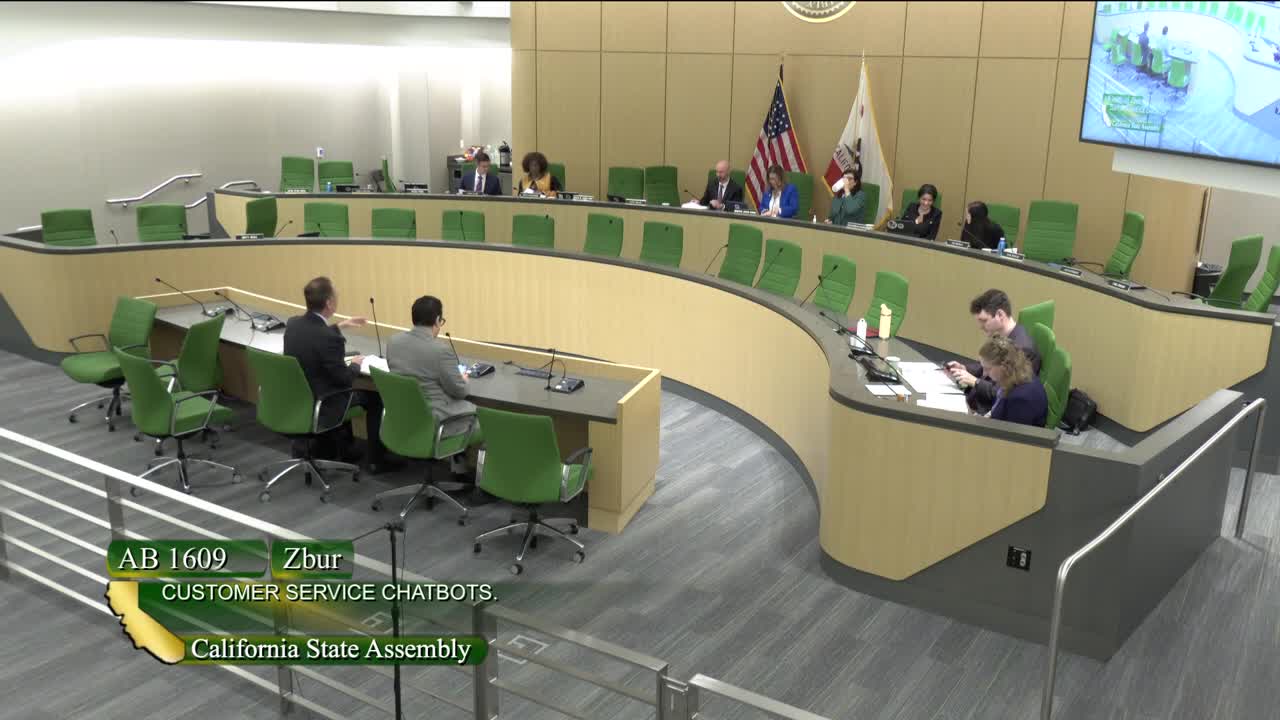 27MIN
Assembly Standing Committee on Privacy and Consumer Protection
Bill Author

Bill Co-Author(s):