AB 1611: Taxation: capital gains and losses: single-family rental homes.
- Session Year: 2025-2026
- House: Assembly
- Latest Version Date: 2026-04-20
Current Status:
In Progress
(2026-04-27: In committee: Set, second hearing. Held under submission.)
Introduced
In Committee
Awaiting First Chamber Vote
Passed First Chamber
In Committee
Awaiting Second Chamber Vote
Passed Second Chamber
Enacted
The Personal Income Tax Law and the Corporation Tax Law, in modified conformity with federal income tax laws, exclude the recognition of any gain or loss on the exchange of property held for productive use in a trade or business or for investment, if that property is exchanged solely for property of a like kind that is to be held either for productive use in a trade or business or for investment, unless an exception applies.
This bill would, under both the Personal Income Tax Law and Corporation Tax Law, prohibit the application of the above-described law to gain from the exchange of single-family residential rental real property property, as defined, in this state if the taxpayer owns, as defined, 50 or more single-family residential rental real properties at the time of the sale. The bill would apply to exchanges completed on or after January 1, 2026, for purposes of taxable years commencing on or after January 1, 2026.
This bill would include a change in state statute that would result in a taxpayer paying a higher tax within the meaning of Section 3 of Article XIIIA of the California Constitution, and thus would require for passage the approval of 2/3 of the membership of each house of the Legislature.
This bill would take effect immediately as a tax levy.
The Personal Income Tax Law and the Corporation Tax Law, in modified conformity with federal income tax laws, exclude the recognition of any gain or loss on the exchange of property held for productive use in a trade or business or for investment, if that property is exchanged solely for property of a like kind that is to be held either for productive use in a trade or business or for investment, unless an exception applies.
This bill would, under both the Personal Income Tax Law and Corporation Tax Law, prohibit the application of the above-described law to gain from the exchange of single-family residential rental real property in this state if the taxpayer owns, as defined, 50 or more single-family residential rental real properties at the time of the sale. The bill would apply to exchanges completed on or after January 1, 2026, for purposes of taxable years commencing on or after January 1, 2026.
This bill would include a change in state statute that would result in a taxpayer paying a higher tax within the meaning of Section 3 of Article XIIIA of the California Constitution, and thus would require for passage the approval of 2/3 of the membership of each house of the Legislature.
This bill would take effect immediately as a tax levy.
(a)Notwithstanding any other law, Section 1031 of the Internal Revenue Code, relating to exchange of property held for productive use or investment, shall not apply to gain from the exchange of qualified property in this state if the taxpayer owns 50 or more qualified properties at the time the exchange is completed.
(b)For purposes of this section, the following definitions shall apply:
(1)Owns includes direct ownership as a named owner of the property or indirect ownership through any partial or full ownership interest in an entity that owns the property.
(2)Qualified property means a single-family residential rental real property.
(3)Single-family residential rental real property means any of the following:
(A)Real property improved with one to four dwelling units, including any leasehold exceeding one years duration of such.
(B)A unit in a residential stock cooperative, condominium, or planned unit development.
(C)A mobilehome or manufactured home when offered for sale or sold through a real estate broker pursuant to Section 10131.6 of the Business and Professions Code.
(c)(1)This section shall apply to exchanges completed on or after January 1, 2026, for purposes of taxable years commencing on or after January 1, 2026.
(2)This section shall not apply to an exchange where the property to be disposed of by the taxpayer in the exchange is disposed of by that taxpayer on or before January 1, 2026, or where the property to be received by the taxpayer in the exchange is received by that taxpayer on or before January 1, 2026.
SEC. 2.Section 24941.6 is added to the Revenue and Taxation Code, to read:24941.6.(a)Notwithstanding any other law, Section 1031 of the Internal Revenue Code, relating to exchange of property held for productive use or investment, shall not apply to gain from the exchange of qualified property in this state if the taxpayer owns 50 or more qualified properties at the time the exchange is completed.
(b)For purposes of this section, the following definitions shall apply:
(1)Owns includes direct ownership as a named owner of the property or indirect ownership through any partial or full ownership interest in an entity that owns the property.
(2)Qualified property means a single-family residential rental real property.
(3)Single-family residential rental real property means any of the following:
(A)Real property improved with one to four dwelling units, including any leasehold exceeding one years duration of such.
(B)A unit in a residential stock cooperative, condominium, or planned unit development.
(C)A mobilehome or manufactured home when offered for sale or sold through a real estate broker pursuant to Section 10131.6 of the Business and Professions Code.
(c)(1)This section shall apply to exchanges completed on or after January 1, 2026, for purposes of taxable years commencing on or after January 1, 2026.
(2)This section shall not apply to an exchange where the property to be disposed of by the taxpayer in the exchange is disposed of by that taxpayer on or before January 1, 2026, or where the property to be received by the taxpayer in the exchange is received by that taxpayer on or before January 1, 2026.
SEC. 3.This act provides for a tax levy within the meaning of Article IV of the California Constitution and shall go into immediate effect.
(a)Notwithstanding any law, Section 1031 of the Internal Revenue Code, relating to exchange of property held for productive use or investment, shall not apply to gain from the exchange of qualified property in this state if the taxpayer owns 50 or more qualified properties at the time the exchange is completed.
(b)For purposes of this section, the following definitions shall apply:
(1)Owns includes direct ownership as a named owner of the property or indirect ownership through any partial or full ownership interest in an entity that owns the property.
(2)Qualified property means a single-family residential rental real property.
(c)(1)This section shall apply to exchanges completed on or after January 1, 2026, for purposes of taxable years commencing on or after January 1, 2026.
(2)This section shall not apply to an exchange where the property to be disposed of by the taxpayer in the exchange is disposed of by that taxpayer on or before January 1, 2026, or where the property to be received by the taxpayer in the exchange is received by that taxpayer on or before January 1, 2026.
SEC. 2.Section 24941.6 is added to the Revenue and Taxation Code, to read:24941.6.(a)Notwithstanding any law, Section 1031 of the Internal Revenue Code, relating to exchange of property held for productive use or investment, shall not apply to gain from the exchange of qualified property in this state if the taxpayer owns 50 or more qualified properties at the time the exchange is completed.
(b)For purposes of this section, the following definitions shall apply:
(1)Owns includes direct ownership as a named owner of the property or indirect ownership through any partial or full ownership interest in an entity that owns the property.
(2)Qualified property means a single-family residential rental real property.
(c)(1)This section shall apply to exchanges completed on or after January 1, 2026, for purposes of taxable years commencing on or after January 1, 2026.
(2)This section shall not apply to an exchange where the property to be disposed of by the taxpayer in the exchange is disposed of by that taxpayer on or before January 1, 2026, or where the property to be received by the taxpayer in the exchange is received by that taxpayer on or before January 1, 2026.
SEC. 3.This act provides for a tax levy within the meaning of Article IV of the California Constitution and shall go into immediate effect.
|
Date
|
Status
|
|---|---|
| Apr 27, 2026 | In committee: Set, second hearing. Held under submission. |
| Apr 21, 2026 | Re-referred to Com. on REV. & TAX. |
| Apr 20, 2026 | From committee chair, with author's amendments: Amend, and re-refer to Com. on REV. & TAX. Read second time and amended. |
| Apr 6, 2026 | In committee: Set, first hearing. Referred to REV. & TAX. suspense file. |
| Mar 2, 2026 | Referred to Com. on REV. & TAX. |
| Jan 21, 2026 | From printer. May be heard in committee February 20. |
| Jan 20, 2026 | Read first time. To print. |
This list shows positions taken on this bill by organizations on the date displayed, which is linked to the original source.
Positions by individuals are not included.
|
Organization
|
Position
|
Date
|
|---|---|---|
| Aids Healthcare Foundation | ** Support | |
| Alliance of Californians for Community Empowerment Action | ** Support | |
| American Federation Of State, County And Municipal Employees, Afl-Cio | ** Support | |
| California Apartment Association | ** Against | |
| California Association Of Realtors | ** Against | |
| California Building Industry Association | ** Against | |
| California Business Properties Association | ** Against | |
| California Chamber Of Commerce | ** Against | |
| California Coalition For Rural Housing | ** Support | |
| California Faculty Association | ** Support | |
| California Federation of Labor Unions, Afl-cio | ** Support | |
| California Immigrant Policy Center | ** Support | |
| California Mortgage Bankers Association | ** Against | |
| California Nurses Association | ** Support | |
| California Rural Legal Assistance Foundation, Inc. | ** Support | |
| California School Employees Association, AFL-CIO | ** Support | |
| California State Council of Service Employees International Union | ** Support | |
| California Tax Reform Association | ** Support | |
| California Teachers Association | ** Support | |
| CFT – a Union of Educators & Classified Professionals, AFT, AFL-CIO | ** Support | |
| End Poverty in California | ** Support | |
| Engineers and Scientists of California, IFPTE Local 20 | ** Support | |
| Glide | ** Support | |
| Housing California | ** Support | |
| Indivisible California StateStrong | ** Support | |
| Los Angeles Unified School District | ** Support | |
| National Housing Law Project | ** Support | |
| National Rental Home Council | ** Against | |
| Powerca Action | ** Support | |
| Rise Economy | ** Support | |
| Rise Economy (Sponsor) | ** Support | |
| Santa Monica Democratic Club | ** Support | |
| Southern California Rental Housing Association | ** Against | |
| UDW/AFSCME Local 3930 | ** Support |
Date of Hearing: April 27, 2026
ASSEMBLY COMMITTEE ON REVENUE AND TAXATION
Mike Gipson, Chair
ABPCA Bill Id:AB 1611 (
Author:Haney) – As Amended Ver:April 20, 2026
SUSPENSE
2/3 vote. Tax levy. Fiscal committee.
SUBJECT: Taxation: capital gains and losses: single-family rental homes
SUMMARY: Prohibits, under both the Personal Income Tax (PIT) Law and the Corporation Tax (CT) Law, application of "like-kind exchange" treatment to gain from exchanges of "qualified property" in this state if the taxpayer owns, as defined, 50 or more "qualified properties" at the time the exchange is completed. Specifically, this bill:
- Provides that, notwithstanding any other law, Internal Revenue Code (IRC) Section 1031, relating to exchange of property held for productive use or investment, shall not apply to gain from the exchange of "qualified property" in this state if the taxpayer "owns" 50 or more "qualified properties" at the time the exchange is completed.
- Defines "qualified property" as a "single-family residential rental real property".
- Defines a "single-family residential rental real property" as any of the following:
- Real property improved with one to four dwelling units, including any leasehold exceeding one year's duration of such;
- A unit in a residential stock cooperative, condominium, or planned unit development; or,
- A mobilehome or manufactured home when offered for sale or sold through a real estate broker pursuant to Business and Professions Code Section 10131.6.
- Defines "owns" to include direct ownership as a named owner of the property or indirect ownership through any partial or full ownership interest in an entity that owns the property.
- Specifies that this bill applies to exchanges completed on or after January 1, 2026, for purposes of taxable years commencing on or after January 1, 2026.
- Provides that this bill shall not apply to an exchange where the property to be disposed of by the taxpayer in the exchange is disposed of by that taxpayer on or before January 1, 2026, or where the property to be received by the taxpayer in the exchange is received by that taxpayer on or before January 1, 2026.
- Takes immediate effect as a tax levy.
EXISTING LAW:
- Excludes, in modified conformity with federal income tax laws, the recognition of any gain or loss on the exchange of property held for productive use in a trade or business or for investment, if that property is exchanged solely for property of a like kind that is to be held either for productive use in a trade or business or for investment, unless an exception applies. (Revenue and Taxation Code (R&TC) Section 18031 et seq.)
- Requires taxpayers deferring gain or loss under IRC Section 1031 when they exchange California real property for like-kind property located outside of California to file form FTB 3840 with the Franchise Tax Board (FTB). This form must be filed in the year the exchange is completed and each subsequent year the deferred gain or loss from the exchange is not recognized. (R&TC Section 18032.)
FISCAL EFFECT: The FTB estimates that this bill would increase General Fund revenues by $9.8 million in fiscal year (FY) 2026-27, by $6.3 million in FY 2027-28, and by $6.3 million in FY 2028-29.
COMMENTS:
- The author has provided the following statement in support of this bill:
Nearly half of Californians do not own a home, and investor ownership remains a major feature of the state's housing landscape. Recent reporting based on property records estimates that roughly 19% of California homes are investor-owned, about 1.45 million homes statewide, placing California among the states with the largest total number of investor-owned homes.
In the wake of the Los Angeles wildfires, corporate investors have also been moving quickly to purchase burned or damaged properties from homeowners facing financial hardship. In some cases, families who once owned their homes are now renting in the same neighborhoods after investors bought their properties at distressed prices. This trend has raised concerns that disaster recovery is becoming another opportunity for large corporations to expand their rental portfolios at the expense of displaced homeowners.
AB 1611 would limit that benefit for the biggest players. The measure would apply to sellers who, directly or indirectly, own more than 50 single-family homes. When those large owners sell a single-family home, the bill would require them to recognize the gain for California tax purposes rather than deferring it and rolling the proceeds into more housing.
- This bill is sponsored by Rise Economy, which notes:
Nearly half of Californians do not own a home. At the same time, Wall Street now owns about 1.3 million homes in California making California second in the nation for total investor-owned homes. Wall Street companies are buying thousands of homes that should be within reach for working Californians and first-time buyers. By swooping in with millions of dollars and outbidding local families through cash offers, Wall Street and private equity corporations are driving up prices and making it harder for people to purchase a home and build a stable future.
- This bill is supported by GLIDE, which notes:
Under current law, Wall Street can use a tax break known as a 1031 exchange to avoid paying capital gains taxes when they sell an investment or rental property, as long as they roll the profits into another similar investment property.
In practice, this means a Wall Street landlord can sell one rental and reinvest the money into another property, including single-family homes, without paying taxes on the profit at the time of sale. This allows Wall Street to keep expanding their housing portfolios without paying taxes each time they sell, giving them a financial advantage that regular homebuyers do not have.
The California Department of Finance estimates the state will potentially lose about $1.2 billion in revenue this fiscal year due to 1031 exchanges. Wall Street landlords are using that tax advantage to keep expanding their hold on the housing market. Landlords that own more than 50 homes control roughly 110,000 single-family houses in California, including about 80,000 homes held by Wall Street portfolios exceeding 100 properties.
AB 1611 would end the current tax break for capital gains on sale of single-family houses for corporations that own more than 50 single-family homes. Instead, when a home is sold by a Wall Street landlord, they would pay taxes on the gain, like everyone else. The goal is simple: stop subsidizing the biggest portfolio builders and reduce the incentives that help them keep buying homes that could have gone to California families.
- This bill is opposed by the Southern California Rental Housing Association, which notes:
Like-kind exchanges are not a tax loophole – they are a long-standing tool that allows property owners to reinvest in housing, upgrade aging units, and reallocate capital into more productive uses. By removing this tool for larger operators, AB 1611 creates a strong "lock-in effect," incentivizing owners to hold properties longer rather than sell or reposition them. This will reduce the number of homes available for purchase – whether by prospective homeowners or smaller landlords – and slow the natural turnover that supports a healthy housing market.
Additionally, the bill disproportionately targets scale rather than behavior. Many property owners with larger portfolios are not speculative actors, but long-term housing providers responsible for maintaining and improving rental stock. Penalizing them based solely on the number of units they own introduces uncertainty into the market and sends a troubling signal about California's investment climate. This could drive capital out of state, further constraining housing production and rehabilitation.
AB 1611 may also have unintended consequences for tenants. Reduced reinvestment in properties can lead to deferred maintenance, fewer upgrades, and diminished housing quality over time. Moreover, limiting portfolio flexibility may reduce the ability of housing providers to respond to changing market conditions, including shifting units into ownership opportunities or redeveloping properties to better meet community needs.
At a time when California faces a severe housing shortage, policy solutions should encourage – not discourage – investment, mobility, and the efficient use of existing housing stock. AB 1611 moves in the opposite direction.
- The FTB has identified the following considerations in its analysis of this bill:
- "This bill would provide disparate treatment for similarly situated taxpayers who have completed exchanges on or after January 1, 2026, but have different taxable year periods. The bill would be operative for exchanges completed on or after January 1, 2026, for taxable years beginning on or after January 1, 2026, but would not apply to exchanges completed on or after January 1, 2026, for taxable years beginning before January 1, 2026. If this is not the intent, the author may wish to amend the bill."
- "This bill would create differences between federal and California tax law; thereby increasing the complexity of California tax return preparation. If this is contrary to the author's intent, the author may wish to amend the bill."
- Committee Staff Comments:
- A brief history of like-kind exchange treatment: Congress adopted the first "modern" income tax in 1913, and the first antecedent of today's like-kind exchange regime was enacted shortly thereafter in 1921.[1] In 2014, the U.S. Treasury's Office of Tax Analysis summarized the policy rationale for like-kind exchanges as follows:
One of the arguments for not treating the exchange of like-kind property as a realization event is that the taxpayers were continuing their on-going investment in the same business activity rather than cashing in their investment. In addition, Congress recognized that the dramatic increase in tax rates on capital gains during World War I had created substantial lock-in effects that greatly interfered with normal business transactions. Exchanges of property would be discouraged because there wouldn't be enough money left after paying the capital gains tax to purchase a replacement property of comparable value. Persuaded by these arguments, Congress has allowed capital gains taxes to be deferred in such exchanges since 1921 with only modest changes in the rules.[2]
Despite the arguments set forth above, IRC Section 1031 is not without its detractors. Critics of like-kind exchanges note that an optimal tax provision should be equitably distributed, minimize economic distortions, and be relatively straightforward to administer. According to critics, IRC Section 1031 arguably fails all three criteria by disproportionately benefiting wealthy taxpayers, encouraging overinvestment in qualifying properties, and giving rise to litigation and labyrinthine administrative complexity.[3] Specifically, critics contend that, "[w]hile section 1031 may have served a valid purpose when first enacted, it arguably has evolved into an entrenched, expensive, undeserved, and unnecessary benefit."[4]
- The mechanics of like-kind exchanges: IRC Section 1031 generally allows the deferral of gain from the sale or disposition of property used in a trade or business or held for investment purposes if the taxpayer acquires replacement property of a "like-kind". There are several specific requirements that must be met to qualify for this treatment. Specifically, if the taxpayer transfers property but will not receive other property in exchange until a later date, the transaction must comply with the following requirements:
- The property to be received must be identified within 45 days after the taxpayer transfers the property given up in the exchange; and,
- The identified property must be received by the earlier of:
- The 180th day after the date on which the taxpayer transferred the property given up in the exchange; or,
- The due date of the taxpayer's tax return for the year in which the taxpayer transferred the property given up.
- The mechanics of like-kind exchanges: IRC Section 1031 generally allows the deferral of gain from the sale or disposition of property used in a trade or business or held for investment purposes if the taxpayer acquires replacement property of a "like-kind". There are several specific requirements that must be met to qualify for this treatment. Specifically, if the taxpayer transfers property but will not receive other property in exchange until a later date, the transaction must comply with the following requirements:
To qualify as a deferred exchange, a transaction must be an exchange of property for other property, and not a transfer of property for money, even if the taxpayer buys replacement property of a like-kind at a later date. Thus, a sale of property followed by a purchase of property that is of a like-kind does not qualify for like-kind treatment even if the other requirements for a like-kind exchange are met.
Additionally, a partially taxable exchange occurs when the taxpayer receives money or unlike property in addition to like-kind property in the exchange for which the taxpayer realizes a gain. The taxpayer must recognize the gain to the extent of the money and of the fair market value of the unlike property.
- What would this bill do? For exchanges completed on or after January 1, 2026, this bill would modify California's conformity to federal law by providing that exchanges of single-family residential rental real properties by taxpayers owning 50 or more such properties would not qualify for gain deferral under like-kind exchange rules.
The author argues that this bill is needed to stop subsidies that enable large real-estate holders to keep buying homes that could have otherwise gone to California families. The author also contends that, in many cases, institutional investment is concentrated in predominantly working-class communities where families largely depend on homeownership to build equity[5]. To this end, the author's office notes:
Nearly half of Californians do not own a home. At the same time, Wall Street now owns about 1.3 million homes in California, making California second in the nation for total investor-owned homes.
In recent years, Wall Street landlords have rapidly expanded their share of the single-family housing market. Today, about one in five homes in California is owned by an investor. This trend accelerated after the Great Recession, when Wall Street purchased more than 200,000 single-family homes between 2011 and 2017, spending approximately $36 billion.
Wall Street buying surged again during the COVID-19 pandemic. In the first quarter of 2022, Wall Street accounted for 28% of single-family home purchases, far above the average of 16%, further shrinking the pool of homes available to working families and first-time buyers.
The California Department of Finance estimates the state will potentially lose about $1.2 billion in revenue this fiscal year due to 1031 exchanges. At the same time, Wall Street landlords are using that tax advantage to keep expanding their hold on the housing market. Landlords that own more than 50 homes control roughly 110,000 single-family houses in California, including about 80,000 homes held by Wall Street portfolios exceeding 100 properties. These large corporations and hedge funds can move quickly and outbid working families and first-time buyers.
When Wall Street wins those homes, families lose the chance to build equity and long-term stability and are often pushed into renting from the same landlords who shut them out. The result is a system where wealth climbs up to corporate balance sheets while regular Californians fall further behind in the fight for homeownership.
- A brief history of institutional investment: The author's office notes that institutional investment in single-family homes increased significantly during the Great Recession. During this financial crisis, home prices dropped significantly, and large investors were able to purchase distressed or foreclosed properties, often at a significant discount. The author's office points out that, with hundreds of thousands of properties going into foreclosure, the federal government sought to stabilize the housing market by increasing demand for homes "which it accomplished largely by creating incentives for private investors to make bulk purchases."[6]
This bill is by no means the Legislature's first examination of the role played by corporate actors in California's real estate market. In 2024, Assemblymember Lee introduced AB 2584 to prohibit certain business entities with an interest in more than 1,000 single-family homes from purchasing and leasing any additional single-family properties. In its analysis of AB 2584, the Assembly Committee on Judiciary noted that California is facing a housing crisis and that the inventory of available homes – especially affordable entry-level homes – is severely constrained. The Committee also noted that, as institutional investors acquire a larger number of homes, they may contribute to an increase in property prices, making it more challenging for individual households to enter the market. At the same time, however, the analysis highlighted that the role of "mega-investors" (i.e., those with more than 1,000 single-family homes) is relatively limited in California. Specifically, the analysis noted, "[t]he rise of corporation ownership of single-family homes is limited in this state – the percentage of homes purchased by the 'mega investors' [. . .] was less than 1% of home purchases in 2023."[7]
- Open question: As noted above, this bill targets taxpayers that own 50 or more single-family residential rental real properties. It is not clear, however, whether there are any geographic limits to this ownership test. Would this bill's provisions apply to a taxpayer that owns 5 qualifying properties in California, but 45 in Arizona and Nevada? Is this bill meant to apply to taxpayers that own fewer than 50 qualifying properties in the United States but that own a substantial portfolio in another country? The author may wish to amend this provision to provide greater clarity.
- Suggested technical amendments: Committee staff suggests adoption of the following technical amendments:
- On page 2, in line 30, delete "on or";
- On page 2, in line 32, delete "on or";
- On page 3, in line 30, delete "on or"; and,
- On page 3, in line 32, delete "on or".
- Prior legislation:
- AB 2584 (Lee), of the 2023-24 Legislative Session, would have prohibited a business entity, as defined, that has an interest in more than 1,000 single-family residential properties from purchasing, acquiring, or otherwise obtaining an ownership interest in another single-family residential property and subsequently leasing the property, as specified. AB 2584 was never heard by the Senate Judiciary Committee.
- SB 1212 (Skinner), of the 2023-24 Legislative Session, would have made it unlawful for a real estate investment trust, as defined, to purchase or acquire an interest in a single-family dwelling or other dwelling that consists of one or two residential units, unless the housing has been listed for sale to the general public for at least 60 days. SB 1212 was never heard by the Senate Judiciary Committee.
REGISTERED SUPPORT / OPPOSITION:
Support
Rise Economy (Sponsor)
AIDS Healthcare Foundation
Alliance of Californians for Community Empowerment Action
American Federation of State, County and Municipal Employees, AFL-CIO
California Coalition for Rural Housing
California Faculty Association
California Federation of Labor Unions, AFL-CIO
California Immigrant Policy Center
California Nurses Association
California Rural Legal Assistance Foundation, Inc.
California School Employees Association, AFL-CIO
California State Council of Service Employees International Union
California Tax Reform Association
California Teachers Association
CFT – A Union of Educators & Classified Professionals, AFT, AFL-CIO
End Poverty In California
Engineers and Scientists of California, IFPTE Local 20
GLIDE
Housing California
Indivisible California Statestrong
Los Angeles Unified School District
National Housing Law Project
PowerCA Action
Santa Monica Democratic Club
UDW/AFSCME Local 3930
Opposition
California Apartment Association
California Association of Realtors
California Building Industry Association
California Business Properties Association
California Chamber of Commerce
California Mortgage Bankers Association
National Rental Home Council
Southern California Rental Housing Association
Analysis Prepared by: M. David Ruff / REV. & TAX. / (916) 319-2098
Bradley T. Borden et al., To Repeal or Retain Section 1031: A Tempest in a $6 Billion Teapot, American Bar Association NewsQuarterly, Vol. 34, No. 3, at 17 (Spring 2015). ↑
Id. at 20. ↑
Id. at 18. ↑
Id. ↑
See Graziani, T., Montano, J., Roy, A. & Stephens, P. (2020). Who profits from crisis? Housing grabs in times of recovery. UCLA Luskin Institute for Inequality and Democracy. ↑
In February 2012, the Federal Housing Finance Agency launched a real estate owned (REO) pilot project specifically designed to help stabilize communities and home values in areas hard-hit by the foreclosure crisis. ↑
Assembly Committee on Judiciary, Analysis of AB 2584 (Lee) (Apr. 2024). ↑
Date of Hearing: April 6, 2026
ASSEMBLY COMMITTEE ON REVENUE AND TAXATION
Mike Gipson, Chair
ABPCA Bill Id:AB 1611 (
Author:Haney) – As Introduced Ver:January 20, 2026
2/3 vote. Tax levy. Fiscal committee.
SUBJECT: Taxation: capital gains and losses: single-family rental homes
SUMMARY: Prohibits, under both the Personal Income Tax (PIT) Law and the Corporation Tax (CT) Law, application of "like-kind exchange" treatment to gain from exchanges of "qualified property" in this state if the taxpayer owns, as defined, 50 or more "qualified properties" at the time the exchange is completed. Specifically, this bill:
- Provides that, notwithstanding any law, Internal Revenue Code (IRC) Section 1031, relating to exchange of property held for productive use or investment, shall not apply to gain from the exchange of "qualified property" in this state if the taxpayer "owns" 50 or more "qualified properties" at the time the exchange is completed.
- Defines "qualified property" as a single-family residential rental real property.
- Defines "owns" to include direct ownership as a named owner of the property or indirect ownership through any partial or full ownership interest in an entity that owns the property.
- Specifies that this bill applies to exchanges completed on or after January 1, 2026, for purposes of taxable years commencing on or after January 1, 2026.
- Provides that this bill shall not apply to an exchange where the property to be disposed of by the taxpayer in the exchange is disposed of by that taxpayer on or before January 1, 2026, or where the property to be received by the taxpayer in the exchange is received by that taxpayer on or before January 1, 2026.
- Takes immediate effect as a tax levy.
EXISTING LAW:
- Excludes, in modified conformity with federal income tax laws, the recognition of any gain or loss on the exchange of property held for productive use in a trade or business or for investment, if that property is exchanged solely for property of a like kind that is to be held either for productive use in a trade or business or for investment, unless an exception applies. (Revenue and Taxation Code (R&TC) Section 18031 et seq.)
- Requires taxpayers deferring gain or loss under IRC Section 1031 when they exchange California real property for like-kind property located outside of California to file form FTB 3840 with the Franchise Tax Board (FTB). This form must be filed in the year the exchange is completed and each subsequent year the deferred gain or loss from the exchange is not recognized. (R&TC Section 18032.)
FISCAL EFFECT: The FTB estimates that this bill would increase General Fund revenues by $9.8 million in fiscal year (FY) 2026-27, by $6.3 million in FY 2027-28, and by $6.3 million in FY 2028-29.
COMMENTS:
- The author has provided the following statement in support of this bill:
Nearly half of Californians do not own a home, and investor ownership remains a major feature of the state's housing landscape. Recent reporting based on property records estimates that roughly 19% of California homes are investor-owned, about 1.45 million homes statewide, placing California among the states with the largest total number of investor-owned homes.
In the wake of the Los Angeles wildfires, corporate investors have also been moving quickly to purchase burned or damaged properties from homeowners facing financial hardship. In some cases, families who once owned their homes are now renting in the same neighborhoods after investors bought their properties at distressed prices. This trend has raised concerns that disaster recovery is becoming another opportunity for large corporations to expand their rental portfolios at the expense of displaced homeowners.
AB 1611 would limit that benefit for the biggest players. The measure would apply to sellers who, directly or indirectly, own more than 50 single-family homes. When those large owners sell a single-family home, the bill would require them to recognize the gain for California tax purposes rather than deferring it and rolling the proceeds into more housing.
- This bill is sponsored by Rise Economy, which notes:
Nearly half of Californians do not own a home. At the same time, Wall Street now owns about 1.3 million homes in California making California second in the nation for total investor-owned homes. Wall Street companies are buying thousands of homes that should be within reach for working Californians and first-time buyers. By swooping in with millions of dollars and outbidding local families through cash offers, Wall Street and private equity corporations are driving up prices and making it harder for people to purchase a home and build a stable future.
- This bill is supported by GLIDE, which notes:
Under current law, Wall Street can use a tax break known as a 1031 exchange to avoid paying capital gains taxes when they sell an investment or rental property, as long as they roll the profits into another similar investment property.
In practice, this means a Wall Street landlord can sell one rental and reinvest the money into another property, including single-family homes, without paying taxes on the profit at the time of sale. This allows Wall Street to keep expanding their housing portfolios without paying taxes each time they sell, giving them a financial advantage that regular homebuyers do not have.
The California Department of Finance estimates the state will potentially lose about $1.2 billion in revenue this fiscal year due to 1031 exchanges. Wall Street landlords are using that tax advantage to keep expanding their hold on the housing market. Landlords that own more than 50 homes control roughly 110,000 single-family houses in California, including about 80,000 homes held by Wall Street portfolios exceeding 100 properties.
AB 1611 would end the current tax break for capital gains on sale of single-family houses for corporations that own more than 50 single-family homes. Instead, when a home is sold by a Wall Street landlord, they would pay taxes on the gain, like everyone else. The goal is simple: stop subsidizing the biggest portfolio builders and reduce the incentives that help them keep buying homes that could have gone to California families.
- This bill is opposed by the Southern California Rental Housing Association, which notes:
Like-kind exchanges are not a tax loophole – they are a long-standing tool that allows property owners to reinvest in housing, upgrade aging units, and reallocate capital into more productive uses. By removing this tool for larger operators, AB 1611 creates a strong "lock-in effect," incentivizing owners to hold properties longer rather than sell or reposition them. This will reduce the number of homes available for purchase – whether by prospective homeowners or smaller landlords – and slow the natural turnover that supports a healthy housing market.
Additionally, the bill disproportionately targets scale rather than behavior. Many property owners with larger portfolios are not speculative actors, but long-term housing providers responsible for maintaining and improving rental stock. Penalizing them based solely on the number of units they own introduces uncertainty into the market and sends a troubling signal about California's investment climate. This could drive capital out of state, further constraining housing production and rehabilitation.
AB 1611 may also have unintended consequences for tenants. Reduced reinvestment in properties can lead to deferred maintenance, fewer upgrades, and diminished housing quality over time. Moreover, limiting portfolio flexibility may reduce the ability of housing providers to respond to changing market conditions, including shifting units into ownership opportunities or redeveloping properties to better meet community needs.
At a time when California faces a severe housing shortage, policy solutions should encourage – not discourage – investment, mobility, and the efficient use of existing housing stock. AB 1611 moves in the opposite direction.
- The FTB has identified the following considerations in its analysis of this bill:
- "The bill uses the undefined term, 'single-family residential rental real property.' To ensure the bill can be implemented as intended by the author and for clarity and ease of administration, it is recommended that the author amend the bill to define this term."
- "This bill would provide disparate treatment for similarly situated taxpayers who have completed exchanges on or after January 1, 2026, but have different taxable year periods. The bill would be operative for exchanges completed on or after January 1, 2026, for taxable years beginning on or after January 1, 2026, but would not apply to exchanges completed on or after January 1, 2026, for taxable years beginning before January 1, 2026. If this is not the intent, the author may wish to amend the bill."
- "This bill would create differences between federal and California tax law; thereby increasing the complexity of California tax return preparation. If this is contrary to the author's intent, the author may wish to amend the bill."
- Committee Staff Comments:
- A brief history of like-kind exchange treatment: Congress adopted the first "modern" income tax in 1913, and the first antecedent of today's like-kind exchange regime was enacted shortly thereafter in 1921.[1] In 2014, the U.S. Treasury's Office of Tax Analysis summarized the policy rationale for like-kind exchanges as follows:
One of the arguments for not treating the exchange of like-kind property as a realization event is that the taxpayers were continuing their on-going investment in the same business activity rather than cashing in their investment. In addition, Congress recognized that the dramatic increase in tax rates on capital gains during World War I had created substantial lock-in effects that greatly interfered with normal business transactions. Exchanges of property would be discouraged because there wouldn't be enough money left after paying the capital gains tax to purchase a replacement property of comparable value. Persuaded by these arguments, Congress has allowed capital gains taxes to be deferred in such exchanges since 1921 with only modest changes in the rules.[2]
Despite the arguments set forth above, IRC Section 1031 is not without its detractors. Critics of like-kind exchanges note that an optimal tax provision should be equitably distributed, minimize economic distortions, and be relatively straightforward to administer. According to critics, IRC Section 1031 arguably fails all three criteria by disproportionately benefiting wealthy taxpayers, encouraging overinvestment in qualifying properties, and giving rise to litigation and labyrinthine administrative complexity.[3] Specifically, critics contend that, "[w]hile section 1031 may have served a valid purpose when first enacted, it arguably has evolved into an entrenched, expensive, undeserved, and unnecessary benefit."[4]
- The mechanics of like-kind exchanges: IRC Section 1031 generally allows the deferral of gain from the sale or disposition of property used in a trade or business or held for investment purposes if the taxpayer acquires replacement property of a "like-kind". There are several specific requirements that must be met to qualify for this treatment. Specifically, if the taxpayer transfers property but will not receive other property in exchange until a later date, the transaction must comply with the following requirements:
- The property to be received must be identified within 45 days after the taxpayer transfers the property given up in the exchange; and,
- The identified property must be received by the earlier of:
- The 180th day after the date on which the taxpayer transferred the property given up in the exchange; or,
- The due date of the taxpayer's tax return for the year in which the taxpayer transferred the property given up.
- The mechanics of like-kind exchanges: IRC Section 1031 generally allows the deferral of gain from the sale or disposition of property used in a trade or business or held for investment purposes if the taxpayer acquires replacement property of a "like-kind". There are several specific requirements that must be met to qualify for this treatment. Specifically, if the taxpayer transfers property but will not receive other property in exchange until a later date, the transaction must comply with the following requirements:
To qualify as a deferred exchange, a transaction must be an exchange of property for other property, and not a transfer of property for money, even if the taxpayer buys replacement property of a like-kind at a later date. Thus, a sale of property followed by a purchase of property that is of a like-kind does not qualify for like-kind treatment even if the other requirements for a like-kind exchange are met.
Additionally, a partially taxable exchange occurs when the taxpayer receives money or unlike property in addition to like-kind property in the exchange for which the taxpayer realizes a gain. The taxpayer must recognize the gain to the extent of the money and of the fair market value of the unlike property.
- What would this bill do? For exchanges completed on or after January 1, 2026, this bill would modify California's conformity to federal law by providing that exchanges of single-family residential rental real properties by taxpayers owning 50 or more such properties would not qualify for gain deferral under like-kind exchange rules.
The author argues that this bill is needed to stop subsidies that enable large real-estate holders to keep buying homes that could have otherwise gone to California families. The author also contends that, in many cases, institutional investment is concentrated in predominantly working-class communities where families largely depend on homeownership to build equity[5]. To this end, the author's office notes:
Nearly half of Californians do not own a home. At the same time, Wall Street now owns about 1.3 million homes in California, making California second in the nation for total investor-owned homes.
In recent years, Wall Street landlords have rapidly expanded their share of the single-family housing market. Today, about one in five homes in California is owned by an investor. This trend accelerated after the Great Recession, when Wall Street purchased more than 200,000 single-family homes between 2011 and 2017, spending approximately $36 billion.
Wall Street buying surged again during the COVID-19 pandemic. In the first quarter of 2022, Wall Street accounted for 28% of single-family home purchases, far above the average of 16%, further shrinking the pool of homes available to working families and first-time buyers.
The California Department of Finance estimates the state will potentially lose about $1.2 billion in revenue this fiscal year due to 1031 exchanges. At the same time, Wall Street landlords are using that tax advantage to keep expanding their hold on the housing market. Landlords that own more than 50 homes control roughly 110,000 single-family houses in California, including about 80,000 homes held by Wall Street portfolios exceeding 100 properties. These large corporations and hedge funds can move quickly and outbid working families and first-time buyers.
When Wall Street wins those homes, families lose the chance to build equity and long-term stability and are often pushed into renting from the same landlords who shut them out. The result is a system where wealth climbs up to corporate balance sheets while regular Californians fall further behind in the fight for homeownership.
- A brief history of institutional investment: The author's office notes that institutional investment in single-family homes increased significantly during the Great Recession. During this financial crisis, home prices dropped significantly, and large investors were able to purchase distressed or foreclosed properties, often at a significant discount. The author's office points out that, with hundreds of thousands of properties going into foreclosure, the federal government sought to stabilize the housing market by increasing demand for homes "which it accomplished largely by creating incentives for private investors to make bulk purchases."[6]
This bill is by no means the Legislature's first examination of the role played by corporate actors in California's real estate market. In 2024, Assemblymember Lee introduced AB 2584 to prohibit certain business entities with an interest in more than 1,000 single-family homes from purchasing and leasing any additional single-family properties. In its analysis of AB 2584, the Assembly Committee on Judiciary noted that California is facing a housing crisis and that the inventory of available homes – especially affordable entry-level homes – is severely constrained. The Committee also noted that, as institutional investors acquire a larger number of homes, they may contribute to an increase in property prices, making it more challenging for individual households to enter the market. At the same time, however, the analysis highlighted that the role of "mega-investors" (i.e., those with more than 1,000 single-family homes) is relatively limited in California. Specifically, the analysis noted, "[t]he rise of corporation ownership of single-family homes is limited in this state – the percentage of homes purchased by the 'mega investors' [. . .] was less than 1% of home purchases in 2023."[7]
- Open question: As noted above, this bill targets taxpayers that own 50 or more single-family residential rental real properties. It is not clear, however, whether there are any geographic limits to this ownership test. Would this bill's provisions apply to a taxpayer that owns 5 qualifying properties in California, but 45 in Arizona and Nevada? Is this bill meant to apply to taxpayers that own fewer than 50 qualifying properties in the United States but that own a substantial portfolio in another country? The author may wish to amend this provision to provide greater clarity.
- Suggested technical amendments: Committee staff suggests adoption of the following technical amendments:
- On page 2, in line 21, delete "on or";
- On page 2, in line 23, delete "on or";
- On page 3, in line 11, delete "on or"; and,
- On page 3, in line 13, delete "on or".
- Prior legislation:
- AB 2584 (Lee), of the 2023-24 Legislative Session, would have prohibited a business entity, as defined, that has an interest in more than 1,000 single-family residential properties from purchasing, acquiring, or otherwise obtaining an ownership interest in another single-family residential property and subsequently leasing the property, as specified. AB 2584 was never heard by the Senate Judiciary Committee.
- SB 1212 (Skinner), of the 2023-24 Legislative Session, would have made it unlawful for a real estate investment trust, as defined, to purchase or acquire an interest in a single-family dwelling or other dwelling that consists of one or two residential units, unless the housing has been listed for sale to the general public for at least 60 days. SB 1212 was never heard by the Senate Judiciary Committee.
REGISTERED SUPPORT / OPPOSITION:
Support
Rise Economy (Sponsor)
American Federation of State, County and Municipal Employees, AFL-CIO
California Federation of Labor Unions, AFL-CIO
California Immigrant Policy Center
California School Employees Association, AFL-CIO
California Tax Reform Association
CFT – A Union of Educators & Classified Professionals, AFT, AFL-CIO
End Poverty In California
Engineers and Scientists of California, IFPTE Local 20
GLIDE
Santa Monica Democratic Club
Service Employees International Union California State Council
UDW/AFSCME Local 3930
Opposition
California Apartment Association
California Association of Realtors
California Building Industry Association
California Business Properties Association
California Chamber of Commerce
California Mortgage Bankers Association
National Rental Home Council
Southern California Rental Housing Association
Analysis Prepared by: M. David Ruff / REV. & TAX. / (916) 319-2098
Bradley T. Borden et al., To Repeal or Retain Section 1031: A Tempest in a $6 Billion Teapot, American Bar Association NewsQuarterly, Vol. 34, No. 3, at 17 (Spring 2015). ↑
Id. at 20. ↑
Id. at 18. ↑
Id. ↑
See Graziani, T., Montano, J., Roy, A. & Stephens, P. (2020). Who profits from crisis? Housing grabs in times of recovery. UCLA Luskin Institute for Inequality and Democracy. ↑
In February 2012, the Federal Housing Finance Agency launched a real estate owned (REO) pilot project specifically designed to help stabilize communities and home values in areas hard-hit by the foreclosure crisis. ↑
Assembly Committee on Judiciary, Analysis of AB 2584 (Lee) (Apr. 2024). ↑
Discussed in Hearing
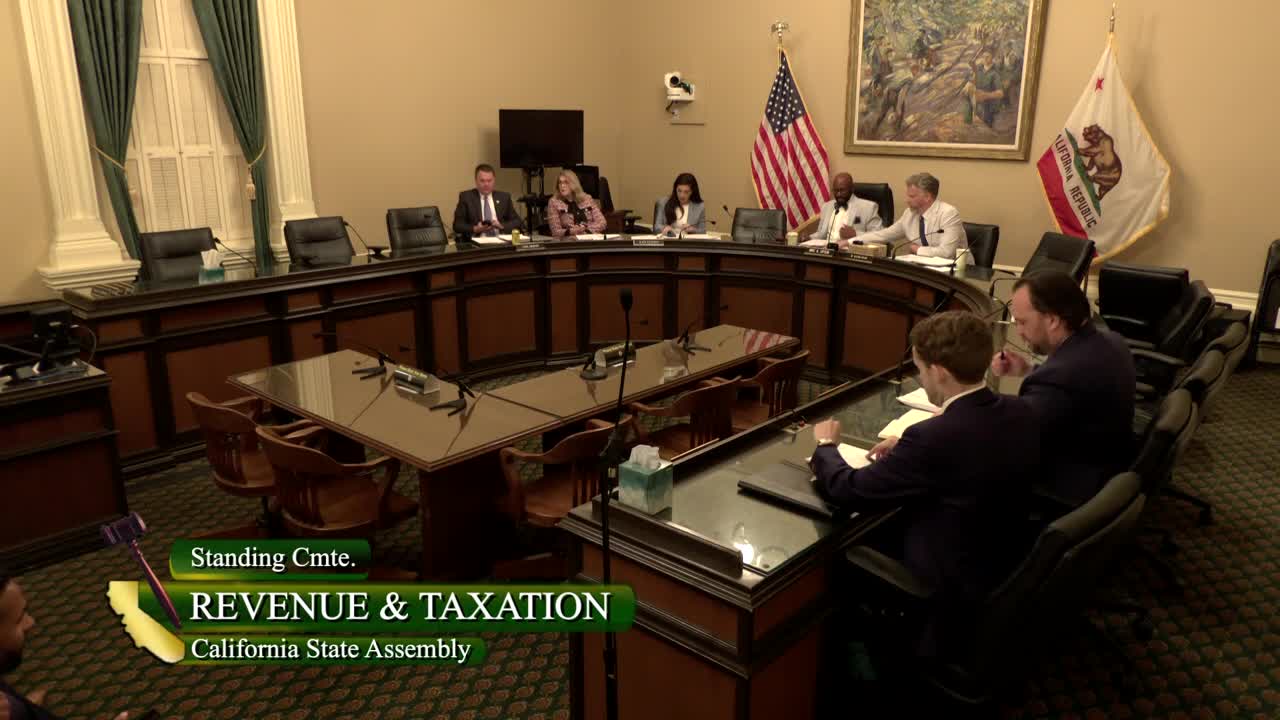 12MIN
Assembly Standing Committee on Revenue and Taxation
Bill Author

Bill Co-Author(s):