AB 1615: Firearms: unsafe handguns.
- Session Year: 2025-2026
- House: Assembly
- Latest Version Date: 2026-09-14
Current Status:
Passed
(2026-09-15: Chaptered by Secretary of State - Chapter 198, Statutes of 2026.)
Introduced
In Committee
Awaiting First Chamber Vote
Passed First Chamber
In Committee
Awaiting Second Chamber Vote
Passed Second Chamber
Enacted
Existing law makes it a crime, punishable by not more than one year in county jail, to manufacture or cause to be manufactured, import into the state for sale, keep for sale, offer or expose for sale, give, or lend an unsafe handgun. Existing law establishes certain exemptions to this prohibition, including, among others, exemptions for sales to specified law enforcement agencies and other specified government agencies for use by specified employees and sales to specified peace officers.
Existing law specifies that the sale of an unsafe handgun to certain specified entities, including county probation departments, and members of those entities, is only authorized if the handgun is to be used as a service weapon by a peace officer who has successfully completed the basic course prescribed by the Commission on Peace Officer Standards and Training (POST) and who qualifies with the handgun, as specified, at least every 6 months. Existing law also provides that this training requirement may be satisfied by completion of the firearm portion of a training course prescribed by POST, if that training was completed before January 1, 2021.
This bill would instead authorize a peace officer employed by a county probation department and using an unsafe handgun as a service weapon to satisfy the above-described training requirement by completion of the firearm portion of a training course prescribed by POST and who qualifies with the handgun, as specified, at least every 3 months.
Existing law imposes certain vehicle storage requirements on specified persons who obtain an unsafe handgun, including sworn members of a county probation department who have completed the basic course or, prior to January 1, 2021, completed the firearm portion of a training course described above. A violation of those provisions is a crime.
Because the bill would expand the application of the crime described above to sworn members of a county probation department who have completed the firearm portion of a training course, this bill would impose a state-mandated local program.
The California Constitution requires the state to reimburse local agencies and school districts for certain costs mandated by the state. Statutory provisions establish procedures for making that reimbursement.
This bill would provide that no reimbursement is required by this act for a specified reason.
(a)(1)A person in this state who manufactures or causes to be manufactured, imports into the state for sale, keeps for sale, offers or exposes for sale, gives, or lends an unsafe handgun shall be punished by imprisonment in a county jail not exceeding one year.
(2)The failure to report to the Department of Justice in accordance with the provisions of paragraph (2) of subdivision (e) the sale or transfer of an unsafe handgun obtained pursuant to paragraph (4), (6), or (7) of subdivision (b) may be subject to a civil penalty not to exceed ten thousand dollars ($10,000).
(3)In addition to any criminal penalty provided in paragraph (1), the unlawful sale or transfer of an unsafe handgun obtained pursuant to paragraph (4), (6), or (7) of subdivision (b) may be subject to a civil penalty not to exceed ten thousand dollars ($10,000).
(b)This section does not apply to any of the following:
(1)The manufacture in this state, or importation into this state, of a prototype handgun when the manufacture or importation is for the sole purpose of allowing an independent laboratory certified by the Department of Justice pursuant to Section 32010 to conduct an independent test to determine whether that handgun is prohibited by Sections 31900 to 32110, inclusive, and, if not, allowing the department to add the firearm to the roster of handguns that may be sold in this state pursuant to Section 32015.
(2)The importation or lending of a handgun by employees or authorized agents of entities determining whether the weapon is prohibited by this section.
(3)Firearms listed as curios or relics, as defined in Section 478.11 of Title 27 of the Code of Federal Regulations.
(4)The sale or purchase of a handgun, if the handgun is sold to, or purchased by, the Department of Justice, a police department, a sheriffs official, a marshals office, the Department of Corrections and Rehabilitation, the Department of the California Highway Patrol, any district attorneys office, any federal law enforcement agency, or the military or naval forces of this state or of the United States for use in the discharge of their official duties. This section does not prohibit the sale to, or purchase by, sworn members of these agencies of a handgun.
(5)The sale, purchase, or delivery of a handgun, if the sale, purchase, or delivery of the handgun is made pursuant to subdivision (d) of Section 10334 of the Public Contract Code.
(6)(A)Subject to the limitations set forth in subdivision (c), the sale or purchase of a handgun for use as a service weapon, if the handgun is sold to, or purchased by, any of the following entities for use by, or sold to or purchased by, sworn members of these entities who have satisfactorily completed the POST basic course or, before January 1, 2021, have satisfactorily completed the firearms portion of a training course prescribed by the Commission on Peace Officer Standards and Training (POST) pursuant to Section 832, and who, as a condition of carrying that handgun, complete a live-fire qualification prescribed by their employing entity at least once every six months:
(i)The Department of Parks and Recreation.
(ii)The Department of Alcoholic Beverage Control.
(iii)The Division of Investigation of the Department of Consumer Affairs.
(iv)The Department of Motor Vehicles.
(v)The Fraud Division of the Department of Insurance.
(vi)The State Department of State Hospitals.
(vii)The Department of Fish and Wildlife.
(viii)The State Department of Developmental Services.
(ix)The Department of Forestry and Fire Protection.
(x)The Los Angeles World Airports, as defined in Section 830.15.
(xi)A K12 public school district for use by a school police officer, as described in Section 830.32.
(xii)A municipal water district for use by a park ranger, as described in Section 830.34.
(xiii)A county for use by a welfare fraud investigator or inspector, as described in Section 830.35.
(xiv)A county for use by the coroner or the deputy coroner, as described in Section 830.35.
(xv)The Supreme Court and the courts of appeal for use by marshals of the Supreme Court and bailiffs of the courts of appeal, and coordinators of security for the judicial branch, as described in Section 830.36.
(xvi)A fire department or fire protection agency of a county, city, city and county, district, or the state for use by either of the following:
(I)A member of an arson-investigating unit, regularly paid and employed in that capacity pursuant to Section 830.37.
(II)A member other than a member of an arson-investigating unit, regularly paid and employed in that capacity pursuant to Section 830.37.
(xvii)The University of California Police Department, or the California State University Police Departments, as described in Section 830.2.
(xviii)A California Community College police department, as described in Section 830.32.
(xix)A harbor or port district or other entity employing peace officers described in subdivision (b) of Section 830.33, the San Diego Unified Port District Harbor Police, and the Harbor Department of the City of Los Angeles.
(xx)A local agency employing park rangers described in subdivision (b) of Section 830.31.
(xxi)The Department of Cannabis Control.
(B)Subject to the limitations set forth in subdivision (c), the sale or purchase of a handgun for use as a service weapon, if the handgun is sold to, or purchased by, a county probation department for use by, or sold to or purchased by, sworn members of the county probation department who have satisfactorily completed the firearms portion of a training course prescribed by POST pursuant to Section 832. As a condition of carrying that handgun, a member shall complete a live-fire qualification prescribed by their employing entity at least once every three months.
(7)(A)Subject to the limitations set forth in subdivision (c), the sale or purchase of a handgun, if the handgun is sold to, or purchased by, any of the following entities for use as a service weapon by the sworn members of these entities who have satisfactorily completed the POST basic course or, before January 1, 2021, have satisfactorily completed the firearms portion of a training course prescribed by the POST pursuant to Section 832, and who, as a condition of carrying that handgun, complete a live-fire qualification prescribed by their employing entity at least once every six months:
(i)The California Horse Racing Board.
(ii)The State Department of Health Care Services.
(iii)The State Department of Public Health.
(iv)The State Department of Social Services.
(v)The Department of Toxic Substances Control.
(vi)The Office of Statewide Health Planning and Development.
(vii)The Public Employees Retirement System.
(viii)The Department of Housing and Community Development.
(ix)Investigators of the Department of Financial Protection and Innovation.
(x)The Law Enforcement Branch of the Office of Emergency Services.
(xi)The California State Lottery.
(xii)The Franchise Tax Board.
(B)This paragraph does not authorize the sale to, or purchase by, sworn members of the entities specified in subparagraph (A) in a personal capacity.
(c)(1)Notwithstanding Section 26825, a person licensed pursuant to Sections 26700 to 26915, inclusive, shall not process the sale or transfer of an unsafe handgun between a person who has obtained an unsafe handgun pursuant to an exemption specified in paragraph (6) or (7) of subdivision (b) and a person who is not exempt from the requirements of this section.
(2)(A)A person who obtains or has use of an unsafe handgun pursuant to paragraph (6) or (7) of subdivision (b) shall, when leaving the handgun in an unattended vehicle, lock the handgun in the vehicles trunk, lock the handgun in a locked container and place the container out of plain view, or lock the handgun in a locked container that is permanently affixed to the vehicles interior and not in plain view.
(B)A violation of subparagraph (A) is an infraction punishable by a fine not exceeding one thousand dollars ($1,000).
(C)For purposes of this paragraph, the following definitions shall apply:
(i)Vehicle has the same meaning as defined in Section 670 of the Vehicle Code.
(ii)A vehicle is unattended when a person who is lawfully carrying or transporting a handgun in the vehicle is not within close proximity to the vehicle to reasonably prevent unauthorized access to the vehicle or its contents.
(iii)Locked container has the same meaning as defined in Section 16850.
(D)Subparagraph (A) does not apply to a peace officer during circumstances requiring immediate aid or action that are within the course of their official duties.
(E)This paragraph does not supersede any local ordinance that regulates the storage of handguns in unattended vehicles if the ordinance was in effect before January 1, 2017.
(d)Violations of subdivision (a) are cumulative with respect to each handgun and shall not be construed as restricting the application of any other law. However, an act or omission punishable in different ways by this section and other provisions of law shall not be punished under more than one provision, but the penalty to be imposed shall be determined as set forth in Section 654.
(e)(1)The Department of Justice shall maintain a database of unsafe handguns obtained pursuant to paragraph (4), (6), or (7) of subdivision (b). This requirement shall apply retroactively to include information in the departments possession. The department may satisfy this requirement by maintaining this information in any existing firearm database that reasonably facilitates compliance with this subdivision.
(2)A person or entity that is in possession of an unsafe handgun obtained pursuant to paragraph (4), (6), or (7) of subdivision (b), shall notify the Department of Justice of any sale or transfer of that handgun within 72 hours of the sale or transfer in a manner and format prescribed by the department. This requirement shall be deemed satisfied if the sale or transfer is processed through a licensed firearms dealer pursuant to Section 27545. A sale or transfer accomplished through an exception to Section 27545 is not exempt from this reporting requirement.
(3)By no later than March 1, 2021, the Department of Justice shall provide a notification to persons or entities possessing an unsafe handgun pursuant to paragraph (4), (6), or (7) of subdivision (b) regarding the prohibitions on the sale or transfer of that handgun contained in this section. Thereafter, the department shall, upon notification of sale or transfer, provide the same notification to the purchaser or transferee of any unsafe handgun sold or transferred pursuant to those provisions.
SEC. 2.No reimbursement is required by this act pursuant to Section 6 of Article XIIIB of the California Constitution because the only costs that may be incurred by a local agency or school district will be incurred because this act creates a new crime or infraction, eliminates a crime or infraction, or changes the penalty for a crime or infraction, within the meaning of Section 17556 of the Government Code, or changes the definition of a crime within the meaning of Section 6 of Article XIIIB of the California Constitution.
(a)(1)A person in this state who manufactures or causes to be manufactured, imports into the state for sale, keeps for sale, offers or exposes for sale, gives, or lends an unsafe handgun shall be punished by imprisonment in a county jail not exceeding one year.
(2)The failure to report to the Department of Justice in accordance with the provisions of paragraph (2) of subdivision (e) the sale or transfer of an unsafe handgun obtained pursuant to paragraph (4), (6), or (7) of subdivision (b) may be subject to a civil penalty not to exceed ten thousand dollars ($10,000).
(3)In addition to any criminal penalty provided in paragraph (1), the unlawful sale or transfer of an unsafe handgun obtained pursuant to paragraph (4), (6), or (7) of subdivision (b) may be subject to a civil penalty not to exceed ten thousand dollars ($10,000).
(b)This section shall does not apply to any of the following:
(1)The manufacture in this state, or importation into this state, of a prototype handgun when the manufacture or importation is for the sole purpose of allowing an independent laboratory certified by the Department of Justice pursuant to Section 32010 to conduct an independent test to determine whether that handgun is prohibited by Sections 31900 to 32110, inclusive, and, if not, allowing the department to add the firearm to the roster of handguns that may be sold in this state pursuant to Section 32015.
(2)The importation or lending of a handgun by employees or authorized agents of entities determining whether the weapon is prohibited by this section.
(3)Firearms listed as curios or relics, as defined in Section 478.11 of Title 27 of the Code of Federal Regulations.
(4)The sale or purchase of a handgun, if the handgun is sold to, or purchased by, the Department of Justice, a police department, a sheriffs official, a marshals office, the Department of Corrections and Rehabilitation, the Department of the California Highway Patrol, any district attorneys office, any federal law enforcement agency, or the military or naval forces of this state or of the United States for use in the discharge of their official duties. This section does not prohibit the sale to, or purchase by, sworn members of these agencies of a handgun.
(5)The sale, purchase, or delivery of a handgun, if the sale, purchase, or delivery of the handgun is made pursuant to subdivision (d) of Section 10334 of the Public Contract Code.
(6)(A)Subject to the limitations set forth in subdivision (c), the sale or purchase of a handgun for use as a service weapon, if the handgun is sold to, or purchased by, any of the following entities for use by, or sold to or purchased by, sworn members of these entities who have satisfactorily completed the POST basic course or, before January 1, 2021, have satisfactorily completed the firearms portion of a training course prescribed by the Commission on Peace Officer Standards and Training (POST) pursuant to Section 832, and who, as a condition of carrying that handgun, complete a live-fire qualification prescribed by their employing entity at least once every six months:
(i)The Department of Parks and Recreation.
(ii)The Department of Alcoholic Beverage Control.
(iii)The Division of Investigation of the Department of Consumer Affairs.
(iv)The Department of Motor Vehicles.
(v)The Fraud Division of the Department of Insurance.
(vi)The State Department of State Hospitals.
(vii)The Department of Fish and Wildlife.
(viii)The State Department of Developmental Services.
(ix)The Department of Forestry and Fire Protection.
(x)The Los Angeles World Airports, as defined in Section 830.15.
(xi)A K12 public school district for use by a school police officer, as described in Section 830.32.
(xii)A municipal water district for use by a park ranger, as described in Section 830.34.
(xiii)A county for use by a welfare fraud investigator or inspector, as described in Section 830.35.
(xiv)A county for use by the coroner or the deputy coroner, as described in Section 830.35.
(xv)The Supreme Court and the courts of appeal for use by marshals of the Supreme Court and bailiffs of the courts of appeal, and coordinators of security for the judicial branch, as described in Section 830.36.
(xvi)A fire department or fire protection agency of a county, city, city and county, district, or the state for use by either of the following:
(I)A member of an arson-investigating unit, regularly paid and employed in that capacity pursuant to Section 830.37.
(II)A member other than a member of an arson-investigating unit, regularly paid and employed in that capacity pursuant to Section 830.37.
(xvii)The University of California Police Department, or the California State University Police Departments, as described in Section 830.2.
(xviii)A California Community College police department, as described in Section 830.32.
(xix)A harbor or port district or other entity employing peace officers described in subdivision (b) of Section 830.33, the San Diego Unified Port District Harbor Police, and the Harbor Department of the City of Los Angeles.
(xx)A local agency employing park rangers described in subdivision (b) of Section 830.31.
(xxi)The Department of Cannabis Control.
(B)Subject to the limitations set forth in subdivision (c), the sale or purchase of a handgun for use as a service weapon, if the handgun is sold to, or purchased by, a county probation department for use by, or sold to or purchased by, sworn members of the county probation department who have satisfactorily completed the firearms portion of a training course prescribed by POST pursuant to Section 832. As a condition of carrying that handgun, a member shall complete a live-fire qualification prescribed by their employing entity at least once every three months.
(7)(A)Subject to the limitations set forth in subdivision (c), the sale or purchase of a handgun, if the handgun is sold to, or purchased by, any of the following entities for use as a service weapon by the sworn members of these entities who have satisfactorily completed the POST basic course or, before January 1, 2021, have satisfactorily completed the firearms portion of a training course prescribed by the POST pursuant to Section 832, and who, as a condition of carrying that handgun, complete a live-fire qualification prescribed by their employing entity at least once every six months:
(i)The California Horse Racing Board.
(ii)The State Department of Health Care Services.
(iii)The State Department of Public Health.
(iv)The State Department of Social Services.
(v)The Department of Toxic Substances Control.
(vi)The Office of Statewide Health Planning and Development.
(vii)The Public Employees Retirement System.
(viii)The Department of Housing and Community Development.
(ix)Investigators of the Department of Financial Protection and Innovation.
(x)The Law Enforcement Branch of the Office of Emergency Services.
(xi)The California State Lottery.
(xii)The Franchise Tax Board.
(B)This paragraph does not authorize the sale to, or purchase by, sworn members of the entities specified in subparagraph (A) in a personal capacity.
(c)(1)Notwithstanding Section 26825, a person licensed pursuant to Sections 26700 to 26915, inclusive, shall not process the sale or transfer of an unsafe handgun between a person who has obtained an unsafe handgun pursuant to an exemption specified in paragraph (6) or (7) of subdivision (b) and a person who is not exempt from the requirements of this section.
(2)(A)A person who obtains or has use of an unsafe handgun pursuant to paragraph (6) or (7) of subdivision (b) shall, when leaving the handgun in an unattended vehicle, lock the handgun in the vehicles trunk, lock the handgun in a locked container and place the container out of plain view, or lock the handgun in a locked container that is permanently affixed to the vehicles interior and not in plain view.
(B)A violation of subparagraph (A) is an infraction punishable by a fine not exceeding one thousand dollars ($1,000).
(C)For purposes of this paragraph, the following definitions shall apply:
(i)Vehicle has the same meaning as defined in Section 670 of the Vehicle Code.
(ii)A vehicle is unattended when a person who is lawfully carrying or transporting a handgun in the vehicle is not within close proximity to the vehicle to reasonably prevent unauthorized access to the vehicle or its contents.
(iii)Locked container has the same meaning as defined in Section 16850.
(D)Subparagraph (A) does not apply to a peace officer during circumstances requiring immediate aid or action that are within the course of their official duties.
(E)This paragraph does not supersede any local ordinance that regulates the storage of handguns in unattended vehicles if the ordinance was in effect before January 1, 2017.
(d)Violations of subdivision (a) are cumulative with respect to each handgun and shall not be construed as restricting the application of any other law. However, an act or omission punishable in different ways by this section and other provisions of law shall not be punished under more than one provision, but the penalty to be imposed shall be determined as set forth in Section 654.
(e)(1)The Department of Justice shall maintain a database of unsafe handguns obtained pursuant to paragraph (4), (6), or (7) of subdivision (b). This requirement shall apply retroactively to include information in the departments possession. The department may satisfy this requirement by maintaining this information in any existing firearm database that reasonably facilitates compliance with this subdivision.
(2)A person or entity that is in possession of an unsafe handgun obtained pursuant to paragraph (4), (6), or (7) of subdivision (b), shall notify the Department of Justice of any sale or transfer of that handgun within 72 hours of the sale or transfer in a manner and format prescribed by the department. This requirement shall be deemed satisfied if the sale or transfer is processed through a licensed firearms dealer pursuant to Section 27545. A sale or transfer accomplished through an exception to Section 27545 is not exempt from this reporting requirement.
(3)By no later than March 1, 2021, the Department of Justice shall provide a notification to persons or entities possessing an unsafe handgun pursuant to paragraph (4), (6), or (7) of subdivision (b) regarding the prohibitions on the sale or transfer of that handgun contained in this section. Thereafter, the department shall, upon notification of sale or transfer, provide the same notification to the purchaser or transferee of any unsafe handgun sold or transferred pursuant to those provisions.
SEC. 2.No reimbursement is required by this act pursuant to Section 6 of Article XIIIB of the California Constitution because the only costs that may be incurred by a local agency or school district will be incurred because this act creates a new crime or infraction, eliminates a crime or infraction, or changes the penalty for a crime or infraction, within the meaning of Section 17556 of the Government Code, or changes the definition of a crime within the meaning of Section 6 of Article XIIIB of the California Constitution.
(a)(1)A person in this state who manufactures or causes to be manufactured, imports into the state for sale, keeps for sale, offers or exposes for sale, gives, or lends an unsafe handgun shall be punished by imprisonment in a county jail not exceeding one year.
(2)The failure to report to the Department of Justice in accordance with the provisions of paragraph (2) of subdivision (e) the sale or transfer of an unsafe handgun obtained pursuant to paragraph (4), (6), (7), or (8) or (7) of subdivision (b) may be subject to a civil penalty not to exceed ten thousand dollars ($10,000).
(3)In addition to any criminal penalty provided in paragraph (1), the unlawful sale or transfer of an unsafe handgun obtained pursuant to paragraph (4), (6), (7), or (8) or (7) of subdivision (b) may be subject to a civil penalty not to exceed ten thousand dollars ($10,000).
(b)This section shall not apply to any of the following:
(1)The manufacture in this state, or importation into this state, of a prototype handgun when the manufacture or importation is for the sole purpose of allowing an independent laboratory certified by the Department of Justice pursuant to Section 32010 to conduct an independent test to determine whether that handgun is prohibited by Sections 31900 to 32110, inclusive, and, if not, allowing the department to add the firearm to the roster of handguns that may be sold in this state pursuant to Section 32015.
(2)The importation or lending of a handgun by employees or authorized agents of entities determining whether the weapon is prohibited by this section.
(3)Firearms listed as curios or relics, as defined in Section 478.11 of Title 27 of the Code of Federal Regulations.
(4)The sale or purchase of a handgun, if the handgun is sold to, or purchased by, the Department of Justice, a police department, a sheriffs official, a marshals office, the Department of Corrections and Rehabilitation, the Department of the California Highway Patrol, any district attorneys office, any federal law enforcement agency, or the military or naval forces of this state or of the United States for use in the discharge of their official duties. This section does not prohibit the sale to, or purchase by, sworn members of these agencies of a handgun.
(5)The sale, purchase, or delivery of a handgun, if the sale, purchase, or delivery of the handgun is made pursuant to subdivision (d) of Section 10334 of the Public Contract Code.
(6)(A)Subject to the limitations set forth in subdivision (c), the sale or purchase of a handgun for use as a service weapon, if the handgun is sold to, or purchased by, any of the following entities for use by, or sold to or purchased by, sworn members of these entities who have satisfactorily completed the POST basic course or, before January 1, 2021, have satisfactorily completed the firearms portion of a training course prescribed by the Commission on Peace Officer Standards and Training (POST) pursuant to Section 832, and who, as a condition of carrying that handgun, complete a live-fire qualification prescribed by their employing entity at least once every six months:
(A)(i)The Department of Parks and Recreation.
(B)(ii)The Department of Alcoholic Beverage Control.
(C)(iii)The Division of Investigation of the Department of Consumer Affairs.
(D)(iv)The Department of Motor Vehicles.
(E)(v)The Fraud Division of the Department of Insurance.
(F)(vi)The State Department of State Hospitals.
(G)(vii)The Department of Fish and Wildlife.
(H)(viii)The State Department of Developmental Services.
(I)(ix)The Department of Forestry and Fire Protection.
(J)(x)The Los Angeles World Airports, as defined in Section 830.15.
(K)(xi)A K12 public school district for use by a school police officer, as described in Section 830.32.
(L)(xii)A municipal water district for use by a park ranger, as described in Section 830.34.
(M)(xiii)A county for use by a welfare fraud investigator or inspector, as described in Section 830.35.
(N)(xiv)A county for use by the coroner or the deputy coroner, as described in Section 830.35.
(O)(xv)The Supreme Court and the courts of appeal for use by marshals of the Supreme Court and bailiffs of the courts of appeal, and coordinators of security for the judicial branch, as described in Section 830.36.
(P)(xvi)A fire department or fire protection agency of a county, city, city and county, district, or the state for use by either of the following:
(i)(I)A member of an arson-investigating unit, regularly paid and employed in that capacity pursuant to Section 830.37.
(ii)(II)A member other than a member of an arson-investigating unit, regularly paid and employed in that capacity pursuant to Section 830.37.
(Q)(xvii)The University of California Police Department, or the California State University Police Departments, as described in Section 830.2.
(R)(xviii)A California Community College police department, as described in Section 830.32.
(S)(xix)A harbor or port district or other entity employing peace officers described in subdivision (b) of Section 830.33, the San Diego Unified Port District Harbor Police, and the Harbor Department of the City of Los Angeles.
(T)(xx)A local agency employing park rangers described in subdivision (b) of Section 830.31.
(U)(xxi)The Department of Cannabis Control.
(B)Subject to the limitations set forth in subdivision (c), the sale or purchase of a handgun for use as a service weapon, if the handgun is sold to, or purchased by, a county probation department for use by, or sold to or purchased by, sworn members of the county probation department who have satisfactorily completed the firearms portion of a training course prescribed by POST pursuant to Section 832. As a condition of carrying that handgun, a member shall complete a live-fire qualification prescribed by their employing entity at least once every three months.
(7)(A)Subject to the limitations set forth in subdivision (c), the sale or purchase of a handgun, if the handgun is sold to, or purchased by, any of the following entities for use as a service weapon by the sworn members of these entities who have satisfactorily completed the POST basic course or, before January 1, 2021, have satisfactorily completed the firearms portion of a training course prescribed by the POST pursuant to Section 832, and who, as a condition of carrying that handgun, complete a live-fire qualification prescribed by their employing entity at least once every six months:
(i)The California Horse Racing Board.
(ii)The State Department of Health Care Services.
(iii)The State Department of Public Health.
(iv)The State Department of Social Services.
(v)The Department of Toxic Substances Control.
(vi)The Office of Statewide Health Planning and Development.
(vii)The Public Employees Retirement System.
(viii)The Department of Housing and Community Development.
(ix)Investigators of the Department of Financial Protection and Innovation.
(x)The Law Enforcement Branch of the Office of Emergency Services.
(xi)The California State Lottery.
(xii)The Franchise Tax Board.
(B)This paragraph does not authorize the sale to, or purchase by, sworn members of the entities specified in subparagraph (A) in a personal capacity.
(8)Subject to the limitations set forth in subdivision (c), the sale or purchase of a handgun for use as a service weapon, if the handgun is sold to, or purchased by a county probation department for use by, or sold to or purchased by, sworn members of the department who have satisfactorily completed the firearms portion of a training course prescribed by POST pursuant to Section 832. As a condition of carrying that handgun, a member shall complete a live-fire qualification prescribed by their employing entity at least once every three months.(c)(1)Notwithstanding Section 26825, a person licensed pursuant to Sections 26700 to 26915, inclusive, shall not process the sale or transfer of an unsafe handgun between a person who has obtained an unsafe handgun pursuant to an exemption specified in paragraph (6), (7), or (8) (6) or (7) of subdivision (b) and a person who is not exempt from the requirements of this section.
(2)(A)A person who obtains or has use of an unsafe handgun pursuant to paragraph (6), (7), or (8) (6) or (7) of subdivision (b) shall, when leaving the handgun in an unattended vehicle, lock the handgun in the vehicles trunk, lock the handgun in a locked container and place the container out of plain view, or lock the handgun in a locked container that is permanently affixed to the vehicles interior and not in plain view.
(B)A violation of subparagraph (A) is an infraction punishable by a fine not exceeding one thousand dollars ($1,000).
(C)For purposes of this paragraph, the following definitions shall apply:
(i)Vehicle has the same meaning as defined in Section 670 of the Vehicle Code.
(ii)A vehicle is unattended when a person who is lawfully carrying or transporting a handgun in the vehicle is not within close proximity to the vehicle to reasonably prevent unauthorized access to the vehicle or its contents.
(iii)Locked container has the same meaning as defined in Section 16850.
(D)Subparagraph (A) does not apply to a peace officer during circumstances requiring immediate aid or action that are within the course of their official duties.
(E)This paragraph does not supersede any local ordinance that regulates the storage of handguns in unattended vehicles if the ordinance was in effect before January 1, 2017.
(d)Violations of subdivision (a) are cumulative with respect to each handgun and shall not be construed as restricting the application of any other law. However, an act or omission punishable in different ways by this section and other provisions of law shall not be punished under more than one provision, but the penalty to be imposed shall be determined as set forth in Section 654.
(e)(1)The Department of Justice shall maintain a database of unsafe handguns obtained pursuant to paragraph (4), (6), (7), or (8) or (7) of subdivision (b). This requirement shall apply retroactively to include information in the departments possession. The department may satisfy this requirement by maintaining this information in any existing firearm database that reasonably facilitates compliance with this subdivision.
(2)A person or entity that is in possession of an unsafe handgun obtained pursuant to paragraph (4), (6), (7), or (8) or (7) of subdivision (b), shall notify the Department of Justice of any sale or transfer of that handgun within 72 hours of the sale or transfer in a manner and format prescribed by the department. This requirement shall be deemed satisfied if the sale or transfer is processed through a licensed firearms dealer pursuant to Section 27545. A sale or transfer accomplished through an exception to Section 27545 is not exempt from this reporting requirement.
(3)By no later than March 1, 2021, the Department of Justice shall provide a notification to persons or entities possessing an unsafe handgun pursuant to paragraph (4), (6), or (7) of subdivision (b) regarding the prohibitions on the sale or transfer of that handgun contained in this section. Thereafter, the department shall, upon notification of sale or transfer, provide the same notification to the purchaser or transferee of any unsafe handgun sold or transferred pursuant to those provisions.
SEC. 2.No reimbursement is required by this act pursuant to Section 6 of Article XIIIB of the California Constitution because the only costs that may be incurred by a local agency or school district will be incurred because this act creates a new crime or infraction, eliminates a crime or infraction, or changes the penalty for a crime or infraction, within the meaning of Section 17556 of the Government Code, or changes the definition of a crime within the meaning of Section 6 of Article XIIIB of the California Constitution.
(a)(1)A person in this state who manufactures or causes to be manufactured, imports into the state for sale, keeps for sale, offers or exposes for sale, gives, or lends an unsafe handgun shall be punished by imprisonment in a county jail not exceeding one year.
(2)The failure to report to the Department of Justice in accordance with the provisions of paragraph (2) of subdivision (e) the sale or transfer of an unsafe handgun obtained pursuant to paragraph (4), (6), (7), or (7) (8) of subdivision (b) may be subject to a civil penalty not to exceed ten thousand dollars ($10,000).
(3)In addition to any criminal penalty provided in paragraph (1), the unlawful sale or transfer of an unsafe handgun obtained pursuant to paragraph (4), (6), (7), or (7) (8) of subdivision (b) may be subject to a civil penalty not to exceed ten thousand dollars ($10,000).
(b)This section shall not apply to any of the following:
(1)The manufacture in this state, or importation into this state, of a prototype handgun when the manufacture or importation is for the sole purpose of allowing an independent laboratory certified by the Department of Justice pursuant to Section 32010 to conduct an independent test to determine whether that handgun is prohibited by Sections 31900 to 32110, inclusive, and, if not, allowing the department to add the firearm to the roster of handguns that may be sold in this state pursuant to Section 32015.
(2)The importation or lending of a handgun by employees or authorized agents of entities determining whether the weapon is prohibited by this section.
(3)Firearms listed as curios or relics, as defined in Section 478.11 of Title 27 of the Code of Federal Regulations.
(4)The sale or purchase of a handgun, if the handgun is sold to, or purchased by, the Department of Justice, a police department, a sheriffs official, a marshals office, the Department of Corrections and Rehabilitation, the Department of the California Highway Patrol, any district attorneys office, any federal law enforcement agency, or the military or naval forces of this state or of the United States for use in the discharge of their official duties. This section does not prohibit the sale to, or purchase by, sworn members of these agencies of a handgun.
(5)The sale, purchase, or delivery of a handgun, if the sale, purchase, or delivery of the handgun is made pursuant to subdivision (d) of Section 10334 of the Public Contract Code.
(6)Subject to the limitations set forth in subdivision (c), the sale or purchase of a handgun for use as a service weapon, if the handgun is sold to, or purchased by, any of the following entities for use by, or sold to or purchased by, sworn members of these entities who have satisfactorily completed the POST basic course or, before January 1, 2021, have satisfactorily completed the firearms portion of a training course prescribed by the Commission on Peace Officer Standards and Training (POST) pursuant to Section 832, and who, as a condition of carrying that handgun, complete a live-fire qualification prescribed by their employing entity at least once every six months:
(A)The Department of Parks and Recreation.
(B)The Department of Alcoholic Beverage Control.
(C)The Division of Investigation of the Department of Consumer Affairs.
(D)The Department of Motor Vehicles.
(E)The Fraud Division of the Department of Insurance.
(F)The State Department of State Hospitals.
(G)The Department of Fish and Wildlife.
(H)The State Department of Developmental Services.
(I)The Department of Forestry and Fire Protection.
(J)A county probation department. (K)(J)The Los Angeles World Airports, as defined in Section 830.15.
(L)(K)A K12 public school district for use by a school police officer, as described in Section 830.32.
(M)(L)A municipal water district for use by a park ranger, as described in Section 830.34.
(N)(M)A county for use by a welfare fraud investigator or inspector, as described in Section 830.35.
(O)(N)A county for use by the coroner or the deputy coroner, as described in Section 830.35.
(P)(O)The Supreme Court and the courts of appeal for use by marshals of the Supreme Court and bailiffs of the courts of appeal, and coordinators of security for the judicial branch, as described in Section 830.36.
(Q)(P)A fire department or fire protection agency of a county, city, city and county, district, or the state for use by either of the following:
(i)A member of an arson-investigating unit, regularly paid and employed in that capacity pursuant to Section 830.37.
(ii)A member other than a member of an arson-investigating unit, regularly paid and employed in that capacity pursuant to Section 830.37.
(R)(Q)The University of California Police Department, or the California State University Police Departments, as described in Section 830.2.
(S)(R)A California Community College police department, as described in Section 830.32.
(T)(S)A harbor or port district or other entity employing peace officers described in subdivision (b) of Section 830.33, the San Diego Unified Port District Harbor Police, and the Harbor Department of the City of Los Angeles.
(U)(T)A local agency employing park rangers described in subdivision (b) of Section 830.31.
(V)(U)The Department of Cannabis Control.
(7)(A)Subject to the limitations set forth in subdivision (c), the sale or purchase of a handgun, if the handgun is sold to, or purchased by, any of the following entities for use as a service weapon by the sworn members of these entities who have satisfactorily completed the POST basic course or, before January 1, 2021, have satisfactorily completed the firearms portion of a training course prescribed by the POST pursuant to Section 832, and who, as a condition of carrying that handgun, complete a live-fire qualification prescribed by their employing entity at least once every six months:
(i)The California Horse Racing Board.
(ii)The State Department of Health Care Services.
(iii)The State Department of Public Health.
(iv)The State Department of Social Services.
(v)The Department of Toxic Substances Control.
(vi)The Office of Statewide Health Planning and Development.
(vii)The Public Employees Retirement System.
(viii)The Department of Housing and Community Development.
(ix)Investigators of the Department of Financial Protection and Innovation.
(x)The Law Enforcement Branch of the Office of Emergency Services.
(xi)The California State Lottery.
(xii)The Franchise Tax Board.
(B)This paragraph does not authorize the sale to, or purchase by, sworn members of the entities specified in subparagraph (A) in a personal capacity.
(8)Subject to the limitations set forth in subdivision (c), the sale or purchase of a handgun for use as a service weapon, if the handgun is sold to, or purchased by a county probation department for use by, or sold to or purchased by, sworn members of the department who have satisfactorily completed the firearms portion of a training course prescribed by POST pursuant to Section 832. As a condition of carrying that handgun, a member shall complete a live-fire qualification prescribed by their employing entity at least once every three months.
(c)(1)Notwithstanding Section 26825, a person licensed pursuant to Sections 26700 to 26915, inclusive, shall not process the sale or transfer of an unsafe handgun between a person who has obtained an unsafe handgun pursuant to an exemption specified in paragraph (6) (6), (7), or (7) (8) of subdivision (b) and a person who is not exempt from the requirements of this section.
(2)(A)A person who obtains or has use of an unsafe handgun pursuant to paragraph (6) (6), (7), or (7) (8) of subdivision (b) shall, when leaving the handgun in an unattended vehicle, lock the handgun in the vehicles trunk, lock the handgun in a locked container and place the container out of plain view, or lock the handgun in a locked container that is permanently affixed to the vehicles interior and not in plain view.
(B)A violation of subparagraph (A) is an infraction punishable by a fine not exceeding one thousand dollars ($1,000).
(C)For purposes of this paragraph, the following definitions shall apply:
(i)Vehicle has the same meaning as defined in Section 670 of the Vehicle Code.
(ii)A vehicle is unattended when a person who is lawfully carrying or transporting a handgun in the vehicle is not within close proximity to the vehicle to reasonably prevent unauthorized access to the vehicle or its contents.
(iii)Locked container has the same meaning as defined in Section 16850.
(D)Subparagraph (A) does not apply to a peace officer during circumstances requiring immediate aid or action that are within the course of their official duties.
(E)This paragraph does not supersede any local ordinance that regulates the storage of handguns in unattended vehicles if the ordinance was in effect before January 1, 2017.
(d)Violations of subdivision (a) are cumulative with respect to each handgun and shall not be construed as restricting the application of any other law. However, an act or omission punishable in different ways by this section and other provisions of law shall not be punished under more than one provision, but the penalty to be imposed shall be determined as set forth in Section 654.
(e)(1)The Department of Justice shall maintain a database of unsafe handguns obtained pursuant to paragraph (4), (6), (7), or (7) (8) of subdivision (b). This requirement shall apply retroactively to include information in the departments possession. The department may satisfy this requirement by maintaining this information in any existing firearm database that reasonably facilitates compliance with this subdivision.
(2)A person or entity that is in possession of an unsafe handgun obtained pursuant to paragraph (4), (6), (7), or (7) (8) of subdivision (b), shall notify the department Department of Justice of any sale or transfer of that handgun within 72 hours of the sale or transfer in a manner and format prescribed by the department. This requirement shall be deemed satisfied if the sale or transfer is processed through a licensed firearms dealer pursuant to Section 27545. A sale or transfer accomplished through an exception to Section 27545 is not exempt from this reporting requirement.
(3)By no later than March 1, 2021, the department Department of Justice shall provide a notification to persons or entities possessing an unsafe handgun pursuant to paragraph (4), (6), or (7) of subdivision (b) regarding the prohibitions on the sale or transfer of that handgun contained in this section. Thereafter, the department shall, upon notification of sale or transfer, provide the same notification to the purchaser or transferee of any unsafe handgun sold or transferred pursuant to those provisions.
SEC. 2.No reimbursement is required by this act pursuant to Section 6 of Article XIIIB of the California Constitution because the only costs that may be incurred by a local agency or school district will be incurred because this act creates a new crime or infraction, eliminates a crime or infraction, or changes the penalty for a crime or infraction, within the meaning of Section 17556 of the Government Code, or changes the definition of a crime within the meaning of Section 6 of Article XIIIB of the California Constitution.
|
Date
|
Status
|
|---|---|
| Sep 15, 2026 | Chaptered by Secretary of State - Chapter 198, Statutes of 2026. |
| Sep 15, 2026 | Approved by the Governor. |
| Sep 14, 2026 | Chaptered by Secretary of State - Chapter 198, Statutes of 2026. |
| Sep 14, 2026 | Approved by the Governor. |
| Sep 4, 2026 | Enrolled and presented to the Governor at 4 p.m. |
| Aug 27, 2026 | Senate amendments concurred in. To Engrossing and Enrolling. (Ayes 78. Noes 0. Page 6686.). |
| Aug 27, 2026 | In Assembly. Concurrence in Senate amendments pending. |
| Aug 27, 2026 | Senate amendments concurred in. To Engrossing and Enrolling. (Ayes 78. Noes 0.). |
| Aug 26, 2026 | Read third time. Passed. Ordered to the Assembly. (Ayes 39. Noes 0. Page 5900.). |
| Aug 26, 2026 | Read third time. Passed. Ordered to the Assembly. (Ayes 38. Noes 0.). |
| Aug 20, 2026 | Read second time. Ordered to third reading. |
| Aug 19, 2026 | Read third time and amended. Ordered to second reading. |
| Aug 10, 2026 | Ordered to third reading. |
| Aug 10, 2026 | From Consent Calendar. |
| Aug 4, 2026 | Read second time. Ordered to Consent Calendar. |
| Aug 3, 2026 | From committee: Be ordered to second reading file pursuant to Senate Rule 28.8 and ordered to Consent Calendar. |
| Jun 24, 2026 | From committee: Do pass and re-refer to Com. on APPR. with recommendation: To Consent Calendar. (Ayes 6. Noes 0.) (June 23). Re-referred to Com. on APPR. |
| Jun 10, 2026 | Referred to Com. on PUB. S. |
| May 28, 2026 | In Senate. Read first time. To Com. on RLS. for assignment. |
| May 27, 2026 | Read third time. Passed. Ordered to the Senate. (Ayes 79. Noes 0. Page 5469.) |
| May 27, 2026 | Read third time. Passed. Ordered to the Senate. (Ayes 79. Noes 0.) |
| May 27, 2026 | Read third time. Passed. Ordered to the Senate. |
| May 19, 2026 | Read second time. Ordered to third reading. |
| May 18, 2026 | Read second time and amended. Ordered returned to second reading. |
| May 14, 2026 | From committee: Amend, and do pass as amended. (Ayes 11. Noes 0.) (May 14). |
| Apr 8, 2026 | In committee: Set, first hearing. Referred to APPR. suspense file. |
| Mar 4, 2026 | From committee: Do pass and re-refer to Com. on APPR. with recommendation: To Consent Calendar. (Ayes 9. Noes 0.) (March 3). Re-referred to Com. on APPR. |
| Feb 2, 2026 | Referred to Com. on PUB. S. |
| Jan 22, 2026 | From printer. May be heard in committee February 21. |
| Jan 21, 2026 | Read first time. To print. |
|
Date
|
Description
|
Location
|
Votes
|
|
|---|---|---|---|---|
| Aug 27, 2026 | AB 1615 Nguyen Concurrence in Senate Amendments | Assembly Floor |
Passed |
|
| Aug 26, 2026 | Assembly 3rd Reading AB1615 Nguyen et al. By Arreguín | Senate Floor |
Passed |
|
| Jun 23, 2026 | Do pass, but first be re-referred to the Committee on [Appropriations] with the recommendation: To Consent Calendar | Senate Standing Committee on Public Safety |
Passed |
|
| May 27, 2026 | AB 1615 Nguyen Assembly Third Reading | Assembly Floor |
Passed |
|
| May 14, 2026 | Do pass as amended. | Assembly Standing Committee on Appropriations |
Passed |
|
| Mar 3, 2026 | Do pass and be re-referred to the Committee on [Appropriations] with recommendation: To Consent Calendar | Assembly Standing Committee on Public Safety |
Passed |
This list shows positions taken on this bill by organizations on the date displayed, which is linked to the original source.
Positions by individuals are not included.
|
Organization
|
Position
|
Date
|
|---|---|---|
| Association Of Orange County Deputy Sheriffs | ** Support | |
| California Fraternal Order of Police | ** Support | |
| Chief Probation Officers Of California | ** Support | |
| Long Beach Police Officers Association | ** Support | |
| Los Angeles County Probation Officers Union, Afscme Local 685 | ** Support | |
| Monterey County Probation Association | ** Support | |
| Napa County Probation Professionals Association | ** Support | |
| Peace Officers Research Association Of California | ** Support | |
| Riverside Sheriffs Association | ** Support | |
| Sacramento County Deputy Sheriffs Association | ** Support | |
| Sacramento County Probation Association | ** Support | |
| san bernardino county sheriff's employees' benefit association | ** Support | |
| San Diego County Probation Officers Association | ** Support | |
| San Joaquin County Probation Officers Association | ** Support | |
| Santa Ana Police Officers Association | ** Support | |
| Stanislaus County Deputy Probation Officers Association | ** Support | |
| State Coalition Of Probation Organizations | ** Support | |
| Supervising Deputy Probation Officers Union, Teamsters Local 986 | ** Support | |
| VENTURA COUNTY PROFESSIONAL PEACE OFFICERS ASSOCIATION | ** Support |
CONCURRENCE IN SENATE AMENDMENTS
CSA1 Bill Id:AB 1615
Author:(Nguyen)
As Amended Ver:August 19, 2026
Majority vote
SUMMARY
Authorizes a peace officer employed by a county probation department to use a non-rostered handgun as a service weapon if the county probation employee has satisfied defined training requirements.
Senate Amendments
Make technical non-substantive changes.
COMMENTS
As Passed by the Assembly, this bill: Authorized a peace officer employed by a county probation department to use a non-rostered handgun as a service weapon if the county probation employee has satisfied defined training requirements.
Major Provisions
- Exempted county probation department personnel from the prohibition on the sale or purchase of a non-rostered handgun (i.e., a handgun not on the California Department of Justice′s (DOJ) safe handgun roster) for use as a service weapon, if the handgun is sold to, or purchased by, a county probation department for use by, or sold to or purchased by, sworn members of the department who have satisfactorily completed the firearms portion of a training course prescribed by the Commission on Peace Officer Standards and Training (POST).
- Required that a county probation department member, as a condition of carrying a non-rostered handgun, complete a live-fire qualification prescribed by their employing entity at least once every three months.
According to the Author
According to the author, ″AB 1615 restores and adds clarity pertaining to probation′s existing inclusion in Penal Code 32000 which authorizes probation officers to use non-roster handguns, similar to other law enforcement and as currently authorized, ensuring officers have the necessary tools for officer and community safety, interoperability, task force collaboration in emergency situations, and in carrying out their duties.
″Penal Code 32000 already sets forth the state exemptions for authorized peace officers to purchase non-roster handguns. Legislation in 2020, AB 2699 (Santiago) [Chapter 289, Statutes of 2020] made changes to this section that inadvertently impacted the language around probation′s use of these firearms. Probation officers undergo the same firearms training as other peace officers through [Penal Code] (PC) 832, which includes the firearms and arrest modules from the POST Basic Academy. Additionally, probation departments complete live-fire qualifications on a quarterly basis.″
Arguments in Support
According to one of the bill′s sponsors, the Chief Probation Officers of California, ″On behalf of the Chief Probation Officers of California (CPOC), we are pleased to co-sponsor AB 1615, which would restore clarity around the language regarding the use of non-roster handguns by probation peace officers.
″Penal Code 32000 sets forth the state exemptions for authorized peace officers to purchase non-roster handguns in their peace officer capacity. Non-roster firearms are only available for purchase by law enforcement departments and are designed to address the needs and practices of a peace officer performing their duties including functionality around the most up to date technology, aspects that can be individualized to the officer, and other functions important in emergency situations.
″In 2016, AB 2165 (Bonta) [Chapter 640, Statutes of 2016] was enacted and, among other provisions, authorized specified peace officers, which included probation, who have completed the Commission on Peace Officer Standards and Training (POST) prescribed firearms training course as required in Penal Code 832, to be exempt from the state prohibition relating to the sale or purchase of a non-roster firearm.
″As stated in the AB 2165 analysis … ″These categories of peace officers participate in mutual aid situations, task forces, sting operations and arrests—all high-risk situations require that these officers be properly armed. It is imperative that we provide the statutory basis for the parity between agencies that has existed since the creation of the roster.″
″In 2020, AB 2699 (Santiago) was enacted which changed requirements for all peace officers to complete the POST basic course, rather than the longstanding requirements that peace officers complete the statutorily required and POST certified PC 832 firearms and arrest course and inadvertently did not reflect the training that probation completes both through POST PC 832 but also training through the BSCC STC program.
″Probation officers undergo the same firearms training as other law enforcement officers through PC 832, which includes the firearms and arrest modules from the POST Basic Academy. Additionally, probation departments complete live-fire qualifications on a quarterly basis.
″Departments often use a certain model of a firearm as it contributes to uniformity in training. Further, some counties purchase and train on the same firearm so that when there are instances such as an active shooter incident, fires, evacuations, and other emergency response efforts, officers are trained and can use firearms interchangeably. The interoperability, training, and specific functionality of non-roster firearms becomes critical in situations where probation is responding to an incident, serving in mutual aid coordination, or serving in taskforces with other law enforcement.
″This proposal would restore clarity and language pertaining to Probation′s existing inclusion in Penal Code 32000 list of state exemptions for all authorized peace officers to purchase non-roster handguns while maintaining all of the other applicable requirements around non-roster use that currently exist.″
Arguments in Opposition
None submitted.
FISCAL COMMENTS
According to the Assembly Appropriations Committee, ″This bill would result in one-time costs to the Department of Justice (DOJ) of a likely minor and absorbable amount.″
VOTES:
ASM PUBLIC SAFETY: 9-0-0
YES: Schultz, Alanis, Mark González, Haney, Harabedian, Lackey, Nguyen, Ramos, Wilson
ASM APPROPRIATIONS: 11-0-4
YES: Wicks, Aguiar-Curry, Calderon, Caloza, Fong, Mark González, Krell, Pacheco, Pellerin, Sharp-Collins, Solache
ABS, ABST OR NV: Hoover, Dixon, Ta, Tangipa
ASSEMBLY FLOOR: 79-0-1
YES: Addis, Aguiar-Curry, Ahrens, Alanis, Alvarez, Arambula, Ávila Farías, Bains, Bauer-Kahan, Bennett, Berman, Boerner, Bonta, Bryan, Calderon, Caloza, Carrillo, Castillo, Chen, Connolly, Davies, DeMaio, Dixon, Elhawary, Ellis, Flora, Fong, Gabriel, Gallagher, Garcia, Gipson, Jeff Gonzalez, Mark González, Hadwick, Haney, Harabedian, Hart, Hoover, Irwin, Jackson, Johnson, Kalra, Krell, Lackey, Lee, Lowenthal, Macedo, McKinnor, Muratsuchi, Nguyen, Ortega, Pacheco, Papan, Patel, Patterson, Pellerin, Petrie-Norris, Quirk-Silva, Ramos, Ransom, Michelle Rodriguez, Rogers, Blanca Rubio, Sanchez, Schiavo, Schultz, Sharp-Collins, Solache, Soria, Stefani, Ta, Tangipa, Valencia, Wallis, Ward, Wicks, Wilson, Zbur, Rivas
ABS, ABST OR NV: Celeste Rodriguez
UPDATED
VERSION: August 19, 2026
CONSULTANT: Dustin Weber / PUB. S. / (916) 319-3744 FN: 0004315
SENATE RULES COMMITTEE Office of Senate Floor Analyses (916) 651-4171 | AB 1615 |
THIRD READING
Bill No: AB 1615
Author: Nguyen (D)
Amended: 8/19/26 in Assembly
Vote: 21
SENATE PUBLIC SAFETY COMMITTEE: 6-0, 6/23/26
AYES: Arreguín, Seyarto, Caballero, Cortese, Pérez, Wiener
SENATE APPROPRIATIONS COMMITTEE: Senate Rule 28.8
ASSEMBLY FLOOR: 79-0, 5/27/26 - See last page for vote
SUBJECT: Firearms: unsafe handguns
SOURCE: Chief Probation Officers of California; State Coalition of Probation Organizations
DIGEST:
This bill authorizes the sale or purchase of a handgun that does not appear on the Department of Justice (DOJ) roster of “not unsafe” handguns for use as a service weapon by sworn members of a county probation department, provided that the sworn member of the department has satisfactorily completed specified firearms training.
Senate Floor Amendments of 8/19/26 add several Assembly coauthors.
ANALYSIS:
Existing law:
- Sets forth a definition of “unsafe handgun” for both revolvers and pistols, which applies to the provisions listed below.
- A revolver meets the definition of “unsafe handgun” if it 1) does not have a safety device that causes the hammer to retract to a point where the firing pin does not rest upon the primer of the cartridge, 2) does not meet the firing requirements for handguns, as specified, or 3) does not meet the drop safety requirement for handguns.
- A pistol meets the definition of “unsafe handgun” if 1) it does not have a positive manually operated safety device, as specified, 2) it does not meet the firing requirement for handguns, 3) it does not meet the drop safety requirement for handguns, 4) it does not have a chamber load indicator, 5) it does not have a magazine disconnect mechanism if it has a detachable magazine, or 6) it is not designed and equipped with a microscopic array of characters used to identify the pistol, as specified (see more below). (Penal (Pen.) Code § 31910, subds. (a), (b).)
- Requires DOJ, on and after January 1, 2001, to compile, publish, and thereafter maintain a roster listing all of the pistols, revolvers, and other firearms capable of being concealed upon the person that have been tested by a certified testing laboratory, have been determined not to be unsafe handguns, and may be sold in this state, as specified. The roster shall list, for each firearm, the manufacturer, model number, and model name. (Pen. Code, § 32015, subd. (a).)
- Provides that DOJ may charge every person in California who is licensed as a manufacturer of firearms, as specified, and any person in California who manufactures or causes to be manufactured, imports into California for sale, keeps for sale, or offers or exposes for sale any pistol, revolver, or other firearm capable of being concealed upon the person in California, an annual fee not exceeding the costs of preparing, publishing, and maintaining the roster of firearms determined not be unsafe, and the costs of research and development, report analysis, firearms storage, and other program infrastructure costs, as specified. (Pen. Code, § 32015, subd. (b)(1).)
- Provides that a person in this state who manufactures or causes to be manufactured, imports into the state for sale, keeps for sale, offers or exposes for sale, gives, or lends an unsafe handgun shall be punished by imprisonment in a county jail not exceeding one year, and that other specified violations may be punished by specified civil penalties. (Pen. Code, § 32000, subd. (a).)
- Sets forth several exemptions to the penalties above, including for the manufacture or importation into this state of a prototype handgun for the sole purpose of testing of that handgun to determine whether it is prohibited, as specified, for the importation or lending of a handgun by employees or authorized agents of entities determining whether such a weapon is prohibited, for firearms listed as curios or relics, and for the sale or purchase of a handgun that is sold to or purchased by specified law enforcement agencies, as specified. (Pen. Code, § 32000, subd. (b)(1)-(4).)
- Exempts from the penalties set forth in Penal Code § 32000, subdivision (a), the sale or purchase of a handgun for use as a service weapon, if the handgun is sold to, or purchased by, any of several specified entities, including county probation departments, for use by, or sold to or purchased by, sworn members of those entities who have satisfactorily completed the basic course of training offered by the Commission on Peace Officer Standards and Training (POST) or, before January 1, 2021, have satisfactorily completed the firearms portion of a training course prescribed by the POST, and who, as a condition of carrying that handgun, complete a live-fire qualification prescribed by their employing entity at least once every six months. (Pen. Code 32000, subd. (b)(6).)
- Exempts from the penalties set forth in Penal Code § 32000, subdivision (a), the sale or purchase of a handgun, if the handgun is sold to, or purchased by, any of several other specified entities for use as a service weapon by the sworn members of those entities who have satisfactorily completed the basic course of training offered by the POST or, before January 1, 2021, have satisfactorily completed the firearms portion of a training course prescribed by the POST, and who, as a condition of carrying that handgun, complete a live-fire qualification prescribed by their employing entity at least once every six months. (Pen. Code, § 32000, subd. (b)(7).)
- Provides that a licensed firearms dealer shall not process the sale or transfer of an unsafe handgun between a person who has obtained an unsafe handgun pursuant to the exemptions set forth in Section 32000, subdivision (b)(6)-(7), and a person who is not exempt from the penalties specified in Penal Code Section 32000. (Pen. Code, § 32000, subd. (c)(1).)
- Provides that a person who obtains or has use of an unsafe handgun pursuant to an exemption set forth in Section 32000, subdivision (b)(6)-(7) shall, when leaving the handgun in an unattended vehicle, lock the handgun in the vehicle’s trunk, lock the handgun in a locked container and place the container out of plain view, or lock the handgun in a locked container that is permanently affixed to the vehicle’s interior and not in plain view, as specified. (Pen. Code, § 32000, subd. (c)(2).)
- Requires the DOJ to maintain a database of unsafe handguns obtained pursuant to several of the exemptions to the penalties in Penal Code Section 32000 described above, and provides that a person or entity that is in possession of an unsafe handgun obtained pursuant to those exemptions shall notify the DOJ of any sale or transfer of that handgun within 72 hours of the sale or transfer, as specified. (Pen. Code, § 32000, subd. (e)(1)-(2).)
This bill:
- Removes county probation departments from an existing exemption to prohibitions relating to the sale, import and transfer of unsafe handguns, and instead sets forth a standalone exemption for the sale or purchase of an unsafe handgun for use as a service weapon, if the handgun is sold to or purchased by a county probation department for use by, or sold to or purchased by, sworn members of the department who have satisfactorily completed the firearms portion of a training course prescribed by POST.
- Specifies that as a condition of carrying that unsafe handgun, a sworn member of a county probation department shall complete a live-fire qualification prescribed by their employing entity at least once every three months.
Comments
In 1999, the Legislature passed SB 15 (Polanco, Chapter 248, Statutes of 1999) also known as the Unsafe Handgun Act (UHA), which made it a misdemeanor for any person in California to manufacture, import for sale, offer for sale, give, or lend any unsafe handgun, with certain specific exceptions. SB 15 defined an “unsafe handgun” as a handgun that (1) does not meet a specified “drop safety” test, (2) does not meet specified firing tests, and (3) does not have a requisite safety device. The law also required DOJ to compile and publish a roster listing all of the handguns and concealable firearms that they deem “not unsafe” and which are certified for sale in the state.
California’s unsafe handgun law also contains a tiered exemption scheme for specified law enforcement entities, set forth in Penal Code Section 32000, establishing three groups of entities that are subject to varying prerequisites for purchase, eligibility to purchase for personal use, and restrictions on resale of un-rostered handguns. The first, most permissive tier of exempt law enforcement entities and individuals includes the DOJ, police departments, sheriff’s officials, marshal’s offices, the California Department of Corrections and Rehabilitation (CDCR), California Highway Patrol, any district attorney’s office, any federal law enforcement agency, and the military or naval forces of the United States or California. Sworn members belonging to these entities may purchase non-roster handguns for personal use and may generally sell or transfer the non-roster handgun to any firearm eligible purchaser at a licensed firearm dealer. Sworn members belonging to the second tier of exempt law enforcement entities, which includes county probation departments, are permitted to purchase non-roster handguns solely for use as service weapons, as long as they have completed specified training, and may only resell the firearms to sworn members of exempt agencies. The third exemption tier is similar to the second in most respects except that individual members of the exempt entities may not purchase non-rostered firearms directly, and may only use such firearms purchased by the entities themselves.
AB 2699 (Santiago, Chapter 289, Statutes of 2020) was the most recent measure modifying California’s tiered system of exemptions from the state’s unsafe handgun law. AB 2699 added greater restrictions and limitations on the acquisition and usage of unsafe handguns by law enforcement agencies. As a compromise, additional law enforcement entities were added to the list of agencies that could acquire and use non-rostered firearms but additional limitations were placed on those agencies. These limitations included that the sale of a un-rostered handgun to an agency is only authorized if the handgun is to be used as a service weapon by a peace officer who has successfully completed the basic course prescribed by POST and who completes a live-fire qualification with the handgun at least every six months. AB 2699 also required the DOJ to account for and maintain a database of unsafe handguns obtained pursuant to the law enforcement exemptions in Penal Code section 32000, and authorized the DOJ to levy civil penalties for failure to report the sale or transfer of an unsafe handgun pursuant to those exemptions.
According to the Author and sponsor of the bill, the Chief Probation Officers of California, the impetus behind this bill is a drafting error in AB 2699 that included probation officers in the second tier of exempted entities, which, as stated above, must have completed a POST basic training course. Negotiations regarding AB 2699 failed to take into account that probation officers are not POST certified. Rather, the training requirements for county probation officers are mandated through the Standards and Training for Corrections Division of the Board of State and Community Corrections (STC and BSCC, respectively). Accordingly, this bill removes county probation departments from the exemption tier requiring sworn members in that tier to complete a POST basic course, and creates a standalone provision providing that sworn members of county probation departments are not subject to the prohibition against the purchase or sale of non-rostered handguns, provided that the purchase or sale is for use as a service weapon and the sworn members using such firearms have satisfactorily completed a POST firearms training course. This bill also requires sworn members of probation departments who use non-roster firearms to complete a live-fire qualification prescribed by their employing entity at least once every three months.
FISCAL EFFECT: Appropriation: No Fiscal Com.: Yes Local: Yes
SUPPORT: (Verified 8/19/26)
Chief Probation Officers of California (co-source)
State Coalition of Probation Organizations (co-source)
Association of Orange County Deputy Sheriffs
California Fraternal Order of Police
Long Beach Police Officers Association
Los Angeles County Probation Officers Union, Afscme Local 685
Peace Officers Research Association of California
Riverside Sheriffs Association
Sacramento County Deputy Sheriffs Association
Sacramento County Probation Association
San Bernardino County Sheriff's Employees' Benefit Association
San Diego County Probation Officers Association
San Joaquin County Probation Officers Association
Santa Ana Police Officers Association
Supervising Deputy Probation Officers Union, Teamsters Local 986
OPPOSITION: (Verified 8/19/26)
None received
ASSEMBLY FLOOR: 79-0, 5/27/26
AYES: Addis, Aguiar-Curry, Ahrens, Alanis, Alvarez, Arambula, Ávila Farías, Bains, Bauer-Kahan, Bennett, Berman, Boerner, Bonta, Bryan, Calderon, Caloza, Carrillo, Castillo, Chen, Connolly, Davies, DeMaio, Dixon, Elhawary, Ellis, Flora, Fong, Gabriel, Gallagher, Garcia, Gipson, Jeff Gonzalez, Mark González, Hadwick, Haney, Harabedian, Hart, Hoover, Irwin, Jackson, Johnson, Kalra, Krell, Lackey, Lee, Lowenthal, Macedo, McKinnor, Muratsuchi, Nguyen, Ortega, Pacheco, Papan, Patel, Patterson, Pellerin, Petrie-Norris, Quirk-Silva, Ramos, Ransom, Michelle Rodriguez, Rogers, Blanca Rubio, Sanchez, Schiavo, Schultz, Sharp-Collins, Solache, Soria, Stefani, Ta, Tangipa, Valencia, Wallis, Ward, Wicks, Wilson, Zbur, Rivas
NO VOTE RECORDED: Celeste Rodriguez
Prepared by: Alex Barnett / PUB. S. /
8/20/26 10:40:53
SENATE RULES COMMITTEE Office of Senate Floor Analyses (916) 651-4171 | AB 1615 |
THIRD READING
Bill No: AB 1615
Author: Nguyen (D)
Amended: 5/18/26 in Assembly
Vote: 21
SENATE PUBLIC SAFETY COMMITTEE: 6-0, 6/23/26
AYES: Arreguín, Seyarto, Caballero, Cortese, Pérez, Wiener
SENATE APPROPRIATIONS COMMMITTEE: Senate Rule 28.8
ASSEMBLY FLOOR: 79-0, 5/27/26 - See last page for vote
SUBJECT: Firearms: unsafe handguns
SOURCE: Chief Probation Officers’ of California; State Coalition of Probation Organizations
DIGEST:
This bill authorizes the sale or purchase of a handgun that does not appear on the Department of Justice (DOJ) roster of “not unsafe” handguns for use as a service weapon by sworn members of a county probation department, provided that the sworn member of the department has satisfactorily completed specified firearms training.
ANALYSIS:
Existing law:
- Sets forth a definition of “unsafe handgun” for both revolvers and pistols, which applies to the provisions listed below.
- A revolver meets the definition of “unsafe handgun” if it 1) does not have a safety device that causes the hammer to retract to a point where the firing pin does not rest upon the primer of the cartridge, 2) does not meet the firing requirements for handguns, as specified, or 3) does not meet the drop safety requirement for handguns.
- A pistol meets the definition of “unsafe handgun” if 1) it does not have a positive manually operated safety device, as specified, 2) it does not meet the firing requirement for handguns, 3) it does not meet the drop safety requirement for handguns, 4) it does not have a chamber load indicator, 5) it does not have a magazine disconnect mechanism if it has a detachable magazine, or 6) it is not designed and equipped with a microscopic array of characters used to identify the pistol, as specified (see more below). (Penal [Pen.] Code § 31910, subds. (a), (b).)
- Requires DOJ, on and after January 1, 2001, to compile, publish, and thereafter maintain a roster listing all of the pistols, revolvers, and other firearms capable of being concealed upon the person that have been tested by a certified testing laboratory, have been determined not to be unsafe handguns, and may be sold in this state, as specified. The roster shall list, for each firearm, the manufacturer, model number, and model name. (Pen. Code, § 32015, subd. (a).)
- Provides that DOJ may charge every person in California who is licensed as a manufacturer of firearms, as specified, and any person in California who manufactures or causes to be manufactured, imports into California for sale, keeps for sale, or offers or exposes for sale any pistol, revolver, or other firearm capable of being concealed upon the person in California, an annual fee not exceeding the costs of preparing, publishing, and maintaining the roster of firearms determined not be unsafe, and the costs of research and development, report analysis, firearms storage, and other program infrastructure costs, as specified. (Pen. Code, § 32015, subd. (b)(1).)
- Provides that a person in this state who manufactures or causes to be manufactured, imports into the state for sale, keeps for sale, offers or exposes for sale, gives, or lends an unsafe handgun shall be punished by imprisonment in a county jail not exceeding one year, and that other specified violations may be punished by specified civil penalties. (Pen. Code, § 32000, subd. (a).)
- Sets forth several exemptions to the penalties above, including for the manufacture or importation into this state of a prototype handgun for the sole purpose of testing of that handgun to determine whether it is prohibited, as specified, for the importation or lending of a handgun by employees or authorized agents of entities determining whether such a weapon is prohibited, for firearms listed as curios or relics, and for the sale or purchase of a handgun that is sold to or purchased by specified law enforcement agencies, as specified. (Pen. Code, § 32000, subd. (b)(1)-(4).)
- Exempts from the penalties set forth in Penal Code § 32000, subdivision (a), the sale or purchase of a handgun for use as a service weapon, if the handgun is sold to, or purchased by, any of several specified entities, including county probation departments, for use by, or sold to or purchased by, sworn members of those entities who have satisfactorily completed the basic course of training offered by the Commission on Peace Officer Standards and Training (POST) or, before January 1, 2021, have satisfactorily completed the firearms portion of a training course prescribed by the POST, and who, as a condition of carrying that handgun, complete a live-fire qualification prescribed by their employing entity at least once every six months. (Pen. Code 32000, subd. (b)(6).)
- Exempts from the penalties set forth in Penal Code § 32000, subdivision (a), the sale or purchase of a handgun, if the handgun is sold to, or purchased by, any of several other specified entities for use as a service weapon by the sworn members of those entities who have satisfactorily completed the basic course of training offered by the POST or, before January 1, 2021, have satisfactorily completed the firearms portion of a training course prescribed by the POST, and who, as a condition of carrying that handgun, complete a live-fire qualification prescribed by their employing entity at least once every six months. (Pen. Code, § 32000, subd. (b)(7).)
- Provides that a licensed firearms dealer shall not process the sale or transfer of an unsafe handgun between a person who has obtained an unsafe handgun pursuant to the exemptions set forth in Section 32000, subdivision (b)(6)-(7), and a person who is not exempt from the penalties specified in Penal Code Section 32000. (Pen. Code, § 32000, subd. (c)(1).)
- Provides that a person who obtains or has use of an unsafe handgun pursuant to an exemption set forth in Section 32000, subdivision (b)(6)-(7) shall, when leaving the handgun in an unattended vehicle, lock the handgun in the vehicle’s trunk, lock the handgun in a locked container and place the container out of plain view, or lock the handgun in a locked container that is permanently affixed to the vehicle’s interior and not in plain view, as specified. (Pen. Code, § 32000, subd. (c)(2).)
- Requires the DOJ to maintain a database of unsafe handguns obtained pursuant to several of the exemptions to the penalties in Penal Code Section 32000 described above, and provides that a person or entity that is in possession of an unsafe handgun obtained pursuant to those exemptions shall notify the DOJ of any sale or transfer of that handgun within 72 hours of the sale or transfer, as specified. (Pen. Code, § 32000, subd. (e)(1)-(2).)
This bill:
- Removes county probation departments from an existing exemption to prohibitions relating to the sale, import and transfer of unsafe handguns, and instead sets forth a standalone exemption for the sale or purchase of an unsafe handgun for use as a service weapon, if the handgun is sold to or purchased by a county probation department for use by, or sold to or purchased by, sworn members of the department who have satisfactorily completed the firearms portion of a training course prescribed by POST.
- Specifies that as a condition of carrying that unsafe handgun, a sworn member of a county probation department shall complete a live-fire qualification prescribed by their employing entity at least once every three months.
Comments
In 1999, the Legislature passed SB 15 (Polanco, Chapter 248, Statutes of 1999), also known as the Unsafe Handgun Act (UHA), which made it a misdemeanor for any person in California to manufacture, import for sale, offer for sale, give, or lend any unsafe handgun, with certain specific exceptions. SB 15 defined an “unsafe handgun” as a handgun that (1) does not meet a specified “drop safety” test, (2) does not meet specified firing tests, and (3) does not have a requisite safety device. The law also required DOJ to compile and publish a roster listing all of the handguns and concealable firearms that they deem “not unsafe” and which are certified for sale in the state.
California’s unsafe handgun law also contains a tiered exemption scheme for specified law enforcement entities, set forth in Penal Code Section 32000, establishing three groups of entities that are subject to varying prerequisites for purchase, eligibility to purchase for personal use, and restrictions on resale of un-rostered handguns. The first, most permissive tier of exempt law enforcement entities and individuals includes the DOJ, police departments, sheriff’s officials, marshal’s offices, the California Department of Corrections and Rehabilitation, California Highway Patrol, any district attorney’s office, any federal law enforcement agency, and the military or naval forces of the United States or California. Sworn members belonging to these entities may purchase non-roster handguns for personal use and may generally sell or transfer the non-roster handgun to any firearm eligible purchaser at a licensed firearm dealer. Sworn members belonging to the second tier of exempt law enforcement entities, which includes county probation departments, are permitted to purchase non-roster handguns solely for use as service weapons, as long as they have completed specified training, and may only resell the firearms to sworn members of exempt agencies. The third exemption tier is similar to the second in most respects except that individual members of the exempt entities may not purchase non-rostered firearms directly, and may only use such firearms purchased by the entities themselves.
AB 2699 (Santiago, Chapter 289, Statutes of 2020), was the most recent measure modifying California’s tiered system of exemptions from the state’s unsafe handgun law. AB 2699 added greater restrictions and limitations on the acquisition and usage of unsafe handguns by law enforcement agencies. As a compromise, additional law enforcement entities were added to the list of agencies that could acquire and use non-rostered firearms but additional limitations were placed on those agencies. These limitations included that the sale of an un-rostered handgun to an agency is only authorized if the handgun is to be used as a service weapon by a peace officer who has successfully completed the basic course prescribed by POST and who completes a live-fire qualification with the handgun at least every six months. AB 2699 also required the DOJ to account for and maintain a database of unsafe handguns obtained pursuant to the law enforcement exemptions in Penal Code section 32000, and authorized the DOJ to levy civil penalties for failure to report the sale or transfer of an unsafe handgun pursuant to those exemptions.
According to the Author and sponsor of the bill, the Chief Probation Officers of California, the impetus behind this bill is a drafting error in AB 2699 that included probation officers in the second tier of exempted entities, which, as stated above, must have completed a POST basic training course. Negotiations regarding AB 2699 failed to take into account that probation officers are not POST certified. Rather, the training requirements for county probation officers are mandated through the Standards and Training for Corrections Division of the Board of State and Community Corrections. Accordingly, this bill removes county probation departments from the exemption tier requiring sworn members in that tier to complete a POST basic course, and creates a standalone provision providing that sworn members of county probation departments are not subject to the prohibition against the purchase or sale of non-rostered handguns, provided that the purchase or sale is for use as a service weapon and the sworn members using such firearms have satisfactorily completed a POST firearms training course. The bill also requires sworn members of probation departments who use non-roster firearms to complete a live-fire qualification prescribed by their employing entity at least once every three months.
FISCAL EFFECT: Appropriation: No Fiscal Com.: Yes Local: Yes
SUPPORT: (Verified 8/3/26)
Chief Probation Officers’ of California (co-source)
State Coalition of Probation Organizations (co-source)
Association of Orange County Deputy Sheriffs
California Fraternal Order of Police
Long Beach Police Officers Association
Los Angeles County Probation Officers Union, Afscme Local 685
Peace Officers Research Association of California
Riverside Sheriffs Association
Sacramento County Deputy Sheriffs Association
Sacramento County Probation Association
San Bernardino County Sheriff's Employees' Benefit Association
San Diego County Probation Officers Association
San Joaquin County Probation Officers Association
Santa Ana Police Officers Association
Supervising Deputy Probation Officers Union, Teamsters Local 986
OPPOSITION: (Verified 8/3/26)
None received
ASSEMBLY FLOOR: 79-0, 5/27/26
AYES: Addis, Aguiar-Curry, Ahrens, Alanis, Alvarez, Arambula, Ávila Farías, Bains, Bauer-Kahan, Bennett, Berman, Boerner, Bonta, Bryan, Calderon, Caloza, Carrillo, Castillo, Chen, Connolly, Davies, DeMaio, Dixon, Elhawary, Ellis, Flora, Fong, Gabriel, Gallagher, Garcia, Gipson, Jeff Gonzalez, Mark González, Hadwick, Haney, Harabedian, Hart, Hoover, Irwin, Jackson, Johnson, Kalra, Krell, Lackey, Lee, Lowenthal, Macedo, McKinnor, Muratsuchi, Nguyen, Ortega, Pacheco, Papan, Patel, Patterson, Pellerin, Petrie-Norris, Quirk-Silva, Ramos, Ransom, Michelle Rodriguez, Rogers, Blanca Rubio, Sanchez, Schiavo, Schultz, Sharp-Collins, Solache, Soria, Stefani, Ta, Tangipa, Valencia, Wallis, Ward, Wicks, Wilson, Zbur, Rivas
NO VOTE RECORDED: Celeste Rodriguez
Prepared by: Alex Barnett / PUB. S. /
8/11/26 9:16:56
**** END ****
SENATE RULES COMMITTEE Office of Senate Floor Analyses (916) 651-4171 | AB 1615 |
CONSENT
Bill No: AB 1615
Author: Nguyen (D)
Amended: 5/18/26 in Assembly
Vote: 21
SENATE PUBLIC SAFETY COMMITTEE: 6-0, 6/23/26
AYES: Arreguín, Seyarto, Caballero, Cortese, Pérez, Wiener
SENATE APPROPRIATIONS COMMMITTEE: Senate Rule 28.8
ASSEMBLY FLOOR: 79-0, 5/27/26 - See last page for vote
SUBJECT: Firearms: unsafe handguns
SOURCE: Chief Probation Officers’ of California; State Coalition of Probation Organizations
DIGEST:
This bill authorizes the sale or purchase of a handgun that does not appear on the Department of Justice (DOJ) roster of “not unsafe” handguns for use as a service weapon by sworn members of a county probation department, provided that the sworn member of the department has satisfactorily completed specified firearms training.
ANALYSIS:
Existing law:
- Sets forth a definition of “unsafe handgun” for both revolvers and pistols, which applies to the provisions listed below.
- A revolver meets the definition of “unsafe handgun” if it 1) does not have a safety device that causes the hammer to retract to a point where the firing pin does not rest upon the primer of the cartridge, 2) does not meet the firing requirements for handguns, as specified, or 3) does not meet the drop safety requirement for handguns.
- A pistol meets the definition of “unsafe handgun” if 1) it does not have a positive manually operated safety device, as specified, 2) it does not meet the firing requirement for handguns, 3) it does not meet the drop safety requirement for handguns, 4) it does not have a chamber load indicator, 5) it does not have a magazine disconnect mechanism if it has a detachable magazine, or 6) it is not designed and equipped with a microscopic array of characters used to identify the pistol, as specified (see more below). (Penal [Pen.] Code § 31910, subds. (a), (b).)
- Requires DOJ, on and after January 1, 2001, to compile, publish, and thereafter maintain a roster listing all of the pistols, revolvers, and other firearms capable of being concealed upon the person that have been tested by a certified testing laboratory, have been determined not to be unsafe handguns, and may be sold in this state, as specified. The roster shall list, for each firearm, the manufacturer, model number, and model name. (Pen. Code, § 32015, subd. (a).)
- Provides that DOJ may charge every person in California who is licensed as a manufacturer of firearms, as specified, and any person in California who manufactures or causes to be manufactured, imports into California for sale, keeps for sale, or offers or exposes for sale any pistol, revolver, or other firearm capable of being concealed upon the person in California, an annual fee not exceeding the costs of preparing, publishing, and maintaining the roster of firearms determined not be unsafe, and the costs of research and development, report analysis, firearms storage, and other program infrastructure costs, as specified. (Pen. Code, § 32015, subd. (b)(1).)
- Provides that a person in this state who manufactures or causes to be manufactured, imports into the state for sale, keeps for sale, offers or exposes for sale, gives, or lends an unsafe handgun shall be punished by imprisonment in a county jail not exceeding one year, and that other specified violations may be punished by specified civil penalties. (Pen. Code, § 32000, subd. (a).)
- Sets forth several exemptions to the penalties above, including for the manufacture or importation into this state of a prototype handgun for the sole purpose of testing of that handgun to determine whether it is prohibited, as specified, for the importation or lending of a handgun by employees or authorized agents of entities determining whether such a weapon is prohibited, for firearms listed as curios or relics, and for the sale or purchase of a handgun that is sold to or purchased by specified law enforcement agencies, as specified. (Pen. Code, § 32000, subd. (b)(1)-(4).)
- Exempts from the penalties set forth in Penal Code § 32000, subdivision (a), the sale or purchase of a handgun for use as a service weapon, if the handgun is sold to, or purchased by, any of several specified entities, including county probation departments, for use by, or sold to or purchased by, sworn members of those entities who have satisfactorily completed the basic course of training offered by the Commission on Peace Officer Standards and Training (POST) or, before January 1, 2021, have satisfactorily completed the firearms portion of a training course prescribed by the POST, and who, as a condition of carrying that handgun, complete a live-fire qualification prescribed by their employing entity at least once every six months. (Pen. Code 32000, subd. (b)(6).)
- Exempts from the penalties set forth in Penal Code § 32000, subdivision (a), the sale or purchase of a handgun, if the handgun is sold to, or purchased by, any of several other specified entities for use as a service weapon by the sworn members of those entities who have satisfactorily completed the basic course of training offered by the POST or, before January 1, 2021, have satisfactorily completed the firearms portion of a training course prescribed by the POST, and who, as a condition of carrying that handgun, complete a live-fire qualification prescribed by their employing entity at least once every six months. (Pen. Code, § 32000, subd. (b)(7).)
- Provides that a licensed firearms dealer shall not process the sale or transfer of an unsafe handgun between a person who has obtained an unsafe handgun pursuant to the exemptions set forth in Section 32000, subdivision (b)(6)-(7), and a person who is not exempt from the penalties specified in Penal Code Section 32000. (Pen. Code, § 32000, subd. (c)(1).)
- Provides that a person who obtains or has use of an unsafe handgun pursuant to an exemption set forth in Section 32000, subdivision (b)(6)-(7) shall, when leaving the handgun in an unattended vehicle, lock the handgun in the vehicle’s trunk, lock the handgun in a locked container and place the container out of plain view, or lock the handgun in a locked container that is permanently affixed to the vehicle’s interior and not in plain view, as specified. (Pen. Code, § 32000, subd. (c)(2).)
- Requires the DOJ to maintain a database of unsafe handguns obtained pursuant to several of the exemptions to the penalties in Penal Code Section 32000 described above, and provides that a person or entity that is in possession of an unsafe handgun obtained pursuant to those exemptions shall notify the DOJ of any sale or transfer of that handgun within 72 hours of the sale or transfer, as specified. (Pen. Code, § 32000, subd. (e)(1)-(2).)
This bill:
- Removes county probation departments from an existing exemption to prohibitions relating to the sale, import and transfer of unsafe handguns, and instead sets forth a standalone exemption for the sale or purchase of an unsafe handgun for use as a service weapon, if the handgun is sold to or purchased by a county probation department for use by, or sold to or purchased by, sworn members of the department who have satisfactorily completed the firearms portion of a training course prescribed by POST.
- Specifies that as a condition of carrying that unsafe handgun, a sworn member of a county probation department shall complete a live-fire qualification prescribed by their employing entity at least once every three months.
Comments
In 1999, the Legislature passed SB 15 (Polanco, Chapter 248, Statutes of 1999), also known as the Unsafe Handgun Act (UHA), which made it a misdemeanor for any person in California to manufacture, import for sale, offer for sale, give, or lend any unsafe handgun, with certain specific exceptions. SB 15 defined an “unsafe handgun” as a handgun that (1) does not meet a specified “drop safety” test, (2) does not meet specified firing tests, and (3) does not have a requisite safety device. The law also required DOJ to compile and publish a roster listing all of the handguns and concealable firearms that they deem “not unsafe” and which are certified for sale in the state.
California’s unsafe handgun law also contains a tiered exemption scheme for specified law enforcement entities, set forth in Penal Code Section 32000, establishing three groups of entities that are subject to varying prerequisites for purchase, eligibility to purchase for personal use, and restrictions on resale of un-rostered handguns. The first, most permissive tier of exempt law enforcement entities and individuals includes the DOJ, police departments, sheriff’s officials, marshal’s offices, the California Department of Corrections and Rehabilitation, California Highway Patrol, any district attorney’s office, any federal law enforcement agency, and the military or naval forces of the United States or California. Sworn members belonging to these entities may purchase non-roster handguns for personal use and may generally sell or transfer the non-roster handgun to any firearm eligible purchaser at a licensed firearm dealer. Sworn members belonging to the second tier of exempt law enforcement entities, which includes county probation departments, are permitted to purchase non-roster handguns solely for use as service weapons, as long as they have completed specified training, and may only resell the firearms to sworn members of exempt agencies. The third exemption tier is similar to the second in most respects except that individual members of the exempt entities may not purchase non-rostered firearms directly, and may only use such firearms purchased by the entities themselves.
AB 2699 (Santiago, Chapter 289, Statutes of 2020), was the most recent measure modifying California’s tiered system of exemptions from the state’s unsafe handgun law. AB 2699 added greater restrictions and limitations on the acquisition and usage of unsafe handguns by law enforcement agencies. As a compromise, additional law enforcement entities were added to the list of agencies that could acquire and use non-rostered firearms but additional limitations were placed on those agencies. These limitations included that the sale of an un-rostered handgun to an agency is only authorized if the handgun is to be used as a service weapon by a peace officer who has successfully completed the basic course prescribed by POST and who completes a live-fire qualification with the handgun at least every six months. AB 2699 also required the DOJ to account for and maintain a database of unsafe handguns obtained pursuant to the law enforcement exemptions in Penal Code section 32000, and authorized the DOJ to levy civil penalties for failure to report the sale or transfer of an unsafe handgun pursuant to those exemptions.
According to the Author and sponsor of the bill, the Chief Probation Officers of California, the impetus behind this bill is a drafting error in AB 2699 that included probation officers in the second tier of exempted entities, which, as stated above, must have completed a POST basic training course. Negotiations regarding AB 2699 failed to take into account that probation officers are not POST certified. Rather, the training requirements for county probation officers are mandated through the Standards and Training for Corrections Division of the Board of State and Community Corrections. Accordingly, this bill removes county probation departments from the exemption tier requiring sworn members in that tier to complete a POST basic course, and creates a standalone provision providing that sworn members of county probation departments are not subject to the prohibition against the purchase or sale of non-rostered handguns, provided that the purchase or sale is for use as a service weapon and the sworn members using such firearms have satisfactorily completed a POST firearms training course. The bill also requires sworn members of probation departments who use non-roster firearms to complete a live-fire qualification prescribed by their employing entity at least once every three months.
FISCAL EFFECT: Appropriation: No Fiscal Com.: Yes Local: Yes
SUPPORT: (Verified 8/3/26)
Chief Probation Officers’ of California (co-source)
State Coalition of Probation Organizations (co-source)
Association of Orange County Deputy Sheriffs
California Fraternal Order of Police
Long Beach Police Officers Association
Los Angeles County Probation Officers Union, Afscme Local 685
Peace Officers Research Association of California
Riverside Sheriffs Association
Sacramento County Deputy Sheriffs Association
Sacramento County Probation Association
San Bernardino County Sheriff's Employees' Benefit Association
San Diego County Probation Officers Association
San Joaquin County Probation Officers Association
Santa Ana Police Officers Association
Supervising Deputy Probation Officers Union, Teamsters Local 986
OPPOSITION: (Verified 8/3/26)
None received
ASSEMBLY FLOOR: 79-0, 5/27/26
AYES: Addis, Aguiar-Curry, Ahrens, Alanis, Alvarez, Arambula, Ávila Farías, Bains, Bauer-Kahan, Bennett, Berman, Boerner, Bonta, Bryan, Calderon, Caloza, Carrillo, Castillo, Chen, Connolly, Davies, DeMaio, Dixon, Elhawary, Ellis, Flora, Fong, Gabriel, Gallagher, Garcia, Gipson, Jeff Gonzalez, Mark González, Hadwick, Haney, Harabedian, Hart, Hoover, Irwin, Jackson, Johnson, Kalra, Krell, Lackey, Lee, Lowenthal, Macedo, McKinnor, Muratsuchi, Nguyen, Ortega, Pacheco, Papan, Patel, Patterson, Pellerin, Petrie-Norris, Quirk-Silva, Ramos, Ransom, Michelle Rodriguez, Rogers, Blanca Rubio, Sanchez, Schiavo, Schultz, Sharp-Collins, Solache, Soria, Stefani, Ta, Tangipa, Valencia, Wallis, Ward, Wicks, Wilson, Zbur, Rivas
NO VOTE RECORDED: Celeste Rodriguez
Prepared by: Alex Barnett / PUB. S. /
8/5/26 14:57:26
**** END ****
SENATE COMMITTEE ON PUBLIC SAFETY
Senator Jesse Arreguín, Chair
2025 - 2026 Regular
Bill No: AB 1615 Hearing Date: June 23, 2026
Author: | Nguyen | ||
Version: | May 18, 2026 | ||
Urgency: | No | Fiscal: | Yes |
Consultant: | AB | ||
Subject: Firearms: unsafe handguns
HISTORY
Source: Chief Probation Officers’ of California; State Coalition of Probation Organizations
Prior Legislation: AB 879 (Patterson), held in Senate Appropriations, 2025
SB 377 (Skinner), held in Assembly Appropriations, 2024
AB 669 (Lackey), failed in Senate Public Safety, 2021
AB 2699 (Santiago), Ch. 289, Stats. of 2020
AB 1794 (Jones-Sawyer), held Sen. Appropriations, 2019
AB 1872 (Voepel), Ch. 56, Stats. of 2018
AB 2165 (Bonta), Ch. 640, Stats. of 2016
AB 892 (Achadjian), Ch. 203, Stats. of 2015
Support: Association of Orange County Deputy Sheriffs; California Fraternal Order of Police; Long Beach Police Officers Association; Peace Officers Research Association of California; Sacramento County Deputy Sheriffs Association; Sacramento County Probation Association; San Bernardino County Sheriff's Employees' Benefit Association; San Diego County Probation Officers Association; San Joaquin County Probation Officers Association; Santa Ana Police Officers Association; State Coalition of Probation Organizations
Opposition: None known
Assembly Floor Vote: 79 - 0
PURPOSE
The purpose of this bill is to authorize the sale or purchase of a handgun that does not appear on the Department of Justice (DOJ) roster of “not unsafe” handguns for use as a service weapon by sworn members of a county probation department, provided that the sworn member of the department has satisfactorily completed specified firearms training.
Existing law sets forth a definition of “unsafe handgun” for both revolvers and pistols, which applies to the provisions listed below.
- A revolver meets the definition of “unsafe handgun” if it 1) does not have a safety device that causes the hammer to retract to a point where the firing pin does not rest upon the primer of the cartridge, 2) does not meet the firing requirements for handguns, as specified, or 3) does not meet the drop safety requirement for handguns.
- A pistol meets the definition of “unsafe handgun” if 1) it does not have a positive manually operated safety device, as specified, 2) it does not meet the firing requirement for handguns, 3) it does not meet the drop safety requirement for handguns, 4) it does not have a chamber load indicator, 5) it does not have a magazine disconnect mechanism if it has a detachable magazine, or 6) it is not designed and equipped with a microscopic array of characters used to identify the pistol, as specified (see more below). (Pen. Code § 31910, subds. (a), (b).)
Existing law requires DOJ, on and after January 1, 2001, to compile, publish, and thereafter maintain a roster listing all of the pistols, revolvers, and other firearms capable of being concealed upon the person that have been tested by a certified testing laboratory, have been determined not to be unsafe handguns, and may be sold in this state, as specified. The roster shall list, for each firearm, the manufacturer, model number, and model name. (Pen. Code, § 32015, subd. (a).)
Existing law provides that DOJ may charge every person in California who is licensed as a manufacturer of firearms, as specified, and any person in California who manufactures or causes to be manufactured, imports into California for sale, keeps for sale, or offers or exposes for sale any pistol, revolver, or other firearm capable of being concealed upon the person in California, an annual fee not exceeding the costs of preparing, publishing, and maintaining the roster of firearms determined not be unsafe, and the costs of research and development, report analysis, firearms storage, and other program infrastructure costs, as specified. (Pen. Code, § 32015, subd. (b)(1).)
Existing law provides that a person in this state who manufactures or causes to be manufactured, imports into the state for sale, keeps for sale, offers or exposes for sale, gives, or lends an unsafe handgun shall be punished by imprisonment in a county jail not exceeding one year, and that other specified violations may be punished by specified civil penalties. (Pen. Code, § 32000, subd. (a).)
Existing law sets forth several exemptions to the penalties above, including for the manufacture or importation into this state of a prototype handgun for the sole purpose of testing of that handgun to determine whether it is prohibited, as specified, for the importation or lending of a handgun by employees or authorized agents of entities determining whether such a weapon is prohibited, for firearms listed as curios or relics, and for the sale or purchase of a handgun that is sold to or purchased by specified law enforcement agencies, as specified. (Pen. Code, § 32000, subd. (b)(1)-(4).)
Existing law exempts from the penalties set forth in Penal Code § 32000, subdivision (a), the sale or purchase of a handgun for use as a service weapon, if the handgun is sold to, or purchased by, any of several specified entities, including county probation departments, for use by, or sold to or
purchased by, sworn members of those entities who have satisfactorily completed the basic
course of training offered by the Commission on Peace Officer Standards and Training (POST) or, before January 1, 2021, have satisfactorily completed the firearms portion of a training course prescribed by the POST, and who, as a condition of carrying that handgun, complete a live-fire qualification prescribed by their employing entity at least once every six months. (Pen. Code 32000, subd. (b)(6).)
Existing law exempts from the penalties set forth in Penal Code § 32000, subdivision (a), the sale or purchase of a handgun, if the handgun is sold to, or purchased by, any of several other specified entities for use as a service weapon by the sworn members of those entities who have
satisfactorily completed the basic course of training offered by the POST or, before January 1, 2021, have satisfactorily completed the firearms portion of a training course prescribed by the POST, and who, as a condition of carrying that handgun, complete a live-fire qualification prescribed by their employing entity at least once every six months. (Pen. Code, § 32000, subd. (b)(7).)
Existing law provides that a licensed firearms dealer shall not process the sale or transfer of an unsafe handgun between a person who has obtained an unsafe handgun pursuant to the exemptions set forth in Section 32000, subdivision (b)(6)-(7), and a person who is not exempt from the penalties specified in Penal Code Section 32000. (Pen. Code, § 32000, subd. (c)(1).)
Existing law provides that a person who obtains or has use of an unsafe handgun pursuant to an exemption set forth in Section 32000, subdivision (b)(6)-(7) shall, when leaving the handgun in an unattended vehicle, lock the handgun in the vehicle’s trunk, lock the handgun in a locked container and place the container out of plain view, or lock the handgun in a locked container that is permanently affixed to the vehicle’s interior and not in plain view, as specified. (Pen. Code, § 32000, subd. (c)(2).)
Existing law requires the DOJ to maintain a database of unsafe handguns obtained pursuant to several of the exemptions to the penalties in Penal Code Section 32000 described above, and provides that a person or entity that is in possession of an unsafe handgun obtained pursuant to those exemptions shall notify the DOJ of any sale or transfer of that handgun within 72 hours of the sale or transfer, as specified. (Pen. Code, § 32000, subd. (e)(1)-(2).)
This bill removes county probation departments from an existing exemption to prohibitions relating to the sale, import and transfer of unsafe handguns, and instead sets forth a standalone exemption for the sale or purchase of an unsafe handgun for use as a service weapon, if the handgun is sold to or purchased by a county probation department for use by, or sold to or purchased by, sworn members of the department who have satisfactorily completed the firearms portion of a training course prescribed by POST.
This bill specifies that as a condition of carrying that unsafe handgun, a sworn member of a county probation department shall complete a live-fire qualification prescribed by their employing entity at least once every three months.
COMMENTS
- Need for This Bill
According to the author:
AB 1615 restores and adds clarity pertaining to probation’s existing inclusion in Penal Code 32000 which authorizes probation officers to use non-roster handguns, similar to other law enforcement and as currently authorized, ensuring officers have the necessary tools for officer and community safety, interoperability, task force collaboration in emergency situations, and in carrying out their duties.
Penal Code 32000 already sets forth the state exemptions for authorized peace officers to purchase non-roster handguns. Legislation in 2020, AB 2699 (Santiago) made changes to this section that inadvertently impacted the language around probation’s use of these firearms. Probation officers undergo the same firearms training as other peace officers through PC 832, which includes the firearms and arrest modules from the POST Basic Academy. Additionally, probation departments complete live-fire qualifications on a quarterly basis.
- California Unsafe Handgun Law Generally
In 1999, the Legislature passed SB 15 (Polanco), Chapter 248, Statutes of 1999, also known as the Unsafe Handgun Act (UHA), which made it a misdemeanor for any person in California to manufacture, import for sale, offer for sale, give, or lend any unsafe handgun, with certain specific exceptions. SB 15 defined an “unsafe handgun” as a handgun that (1) does not meet a specified “drop safety” test, (2) does not meet specified firing tests, and (3) does not have a requisite safety device.[1] The law also required DOJ to compile and publish a roster listing all of the handguns and concealable firearms that they deem “not unsafe” and which are certified for sale in the state.[2] A subsequent reform, enacted in 2003, added new design safety requirements for semiautomatic pistols.[3]
In 2007, the Legislature enacted AB 1471 (Feuer), Chapter 572, Statutes of 2007, which made microstamping capability a prerequisite for any semiautomatic pistol not already designated a safe handgun to be placed on the DOJ roster. That measure defined microstamping capability as “a microscopic array of characters that identify the make, model and serial number of the pistol, etched in 2 or more places on the interior surface or internal working parts of the pistol, and that are transferred by imprinting on each cartridge case when the firearm is fired.[4] AB 1471 delayed implementation of the microstamping prerequisite until January 1, 2010, “provided that the Department of Justice certifies that the technology used to create the imprint is available to more than one manufacturer unencumbered by any patent restrictions.” On May 17, 2013, the DOJ certified the microstamping technology required by AB 1471.[5] In 2020, the Legislature passed AB 2847 (Chiu), Chapter 292, Statutes of 2020, which required microstamp markings in just one place on the interior of a firearm.[6] And in 2023, the Legislature passed SB 452 (Blakespear), Ch Chapter 253, Statutes of 2023, which modified and strengthened the microstamping requirement by removing it from the UHA altogether and, beginning in July 2028, prohibiting licensed firearm dealers from selling, offering, exchanging, giving or otherwise transferring a pistol unless it has been verified by the DOJ as a “microstamping-enabled pistol.”[7]
For a new handgun to be added to the DOJ roster, it must undergo rigorous testing by a DOJ-certified laboratory to ensure that it meets the strict requirements laid out above. But not all provisions of the unsafe handgun statute are clearly tied to consumer safety. For example, handguns for which “the annual maintenance fee is not paid” can also be removed from the certified roster, and thereby be declared unsafe. Moreover, a previously certified handgun can be removed from the roster if a manufacturer goes out of business because the proprietor retired.[8] Even in cases where a handgun passes all testing requirements, DOJ is authorized to mandate retesting for the handguns of that model at a laboratory of its choosing if it is has reason to believe that the model does not comply with the law. If a model fails but a “similar” of that model has been approved, the similar model can be de-rostered without testing. Relatedly, should the model that failed then get successfully retested and reinstated, DOJ is nevertheless permitted to keep the similar model off the roster despite never testing it for safety.[9]
- Law Enforcement Exemptions and Effect of This Bill
California’s unsafe handgun law also contains a tiered exemption scheme for specified law enforcement entities, set forth in Penal Code Section 32000, establishing three groups of entities that are subject to varying prerequisites for purchase, eligibility to purchase for personal use, and restrictions on resale of un-rostered handguns. The first, most permissive tier of exempt law enforcement entities and individuals includes the DOJ, police departments, sheriff’s officials, marshal’s offices, the California Department of Corrections and Rehabilitation (CDCR), California Highway Patrol, any district attorney’s office, any federal law enforcement agency, and the military or naval forces of the United States or California. Sworn members belonging to these entities may purchase non-roster handguns for personal use and may generally sell or transfer the non-roster handgun to any firearm eligible purchaser at a licensed firearm dealer.[10] Sworn members belonging to the second tier of exempt law enforcement entities,[11] which includes county probation departments, are permitted to purchase non-roster handguns solely for use as service weapons, as long as they have completed specified training, and may only resell the firearms to sworn members of exempt agencies.[12] The third exemption tier is similar to the second in most respects except that individual members of the exempt entities may not purchase non-rostered firearms directly, and may only use such firearms purchased by the entities themselves.[13]
AB 2699 (Santiago), Chapter 289, Statutes of 2020, was the most recent measure modifying California’s tiered system of exemptions from the state’s unsafe handgun law. AB 2699 added greater restrictions and limitations on the acquisition and usage of unsafe handguns by law enforcement agencies. As a compromise, additional law enforcement entities were added to the list of agencies that could acquire and use non-rostered firearms but additional limitations were placed on those agencies. These limitations included that the sale of a un-rostered handgun to an agency is only authorized if the handgun is to be used as a service weapon by a peace officer who has successfully completed the basic course prescribed by POST and who completes a live-fire qualification with the handgun at least every six months. AB 2699 also required the DOJ to account for and maintain a database of unsafe handguns obtained pursuant to the law enforcement exemptions in Penal Code section 32000, and authorized the DOJ to levy civil penalties for failure to report the sale or transfer of an unsafe handgun pursuant to those exemptions.[14]
According to the Author and sponsor of the bill, the Chief Probation Officers of California, the impetus behind this bill is a drafting error in AB 2699 that included probation officers in the second tier of exempted entities, which, as stated above, must have completed a POST basic training course. Negotiations regarding AB 2699 failed to take into account that probation officers are not POST certified. Rather, the training requirements for county probation officers are mandated through the Standards and Training for Corrections Division of the Board of State and Community Corrections (STC and BSCC, respectively). Accordingly, this bill removes county probation departments from the exemption tier requiring sworn members in that tier to complete a POST basic course, and creates a standalone provision providing that sworn members of county probation departments are not subject to the prohibition against the purchase or sale of non-rostered handguns, provided that the purchase or sale is for use as a service weapon and the sworn members using such firearms have satisfactorily completed a POST firearms training course. The bill also requires sworn members of probation departments who use non-roster firearms to complete a live-fire qualification prescribed by their employing entity at least once every three months.
- Prior Legislation
This bill is substantially similar to AB 879 (Patterson), which was introduced last year and passed out of this Committee on the consent calendar, but was ultimately held in Senate Appropriations Committee.
- Argument in Support
According to a coalition of police associations:
Several years ago, AB 2165 (Bonta) was enacted to afford probation departments and probation officers the same access to non-roster firearms enjoyed by police officers, deputy sheriffs and other law enforcement personnel. Unfortunately, because of a drafting oversight in subsequent legislation, namely AB 2699 (Santiago), access to these weapons was barred to probation departments and officers. This change in the law has cost, and will continue to cost, probation departments thousands of dollars in weapon replacement costs.
AB 1615 would reinstate for county probation departments the prior requirements under AB 2165 (Bonta) by removing the “Post basic course” requirement for county probation departments thus preventing the need for county probation departments to replace non-roster firearms that have been in use for several years if that firearm is removed from the list. Rest assured, probation officers receive the same, and many instances more, training for the use of non-roster firearms than their police officer and sheriff deputy counterparts. AB 1615 will exempt sales to, or purchases by, a county probation department and sworn members who have completed the firearms portion of a training course prescribed by POST pursuant to Section 832, and who, as a condition of carrying that handgun, complete a live-fire qualification prescribed by their employing entity at least once every 3 months.
As stated above, AB 1615 would eliminate the need for probation departments to purchase new firearms anytime a rostered firearm falls off the list and becomes a non-roster firearm. For example, the estimated cost for Sacramento County to purchase new firearms would be approximately $377,000. This cost will occur every time their departmental firearm falls off the list. AB 1615 would prevent that from happening.
-- END --
Pen. Code, §§ 31900, 31905, 31910. ↑
Pen. Code, § 32015. ↑
SB 489 (Scott, Ch. 500, Stats. of 2003) requires that for a new semiautomatic center-fire pistol firearm to be added to the roster it has to be equipped with a chamber load indicator and a magazine disconnect (if it has a detachable magazine). ↑
Penal Code § 31910(a)(6)(A). ↑
“Information Bulletin: Certification of Microstamping Technology pursuant to Penal Code section 31910, subdivision (b)(7)(A).” Department of Justice. Issued 17 May, 2013. https://oag.ca.gov/sites/all/files/agweb/pdfs/firearms/infobuls/2013-BOF-03.pdf ↑
AB 2847 also required that for every safe new gun introduced in California, three unsafe guns on the roster that had been ‘grandfathered’ in would be removed from the roster. ↑
Pen. Code, §§27531-27534. ↑
Cal. Code Regs., tit. 11, § 4070, subd. (c)(1). ↑
Cal. Code Regs., tit. 11, § 4073. ↑
“State Exemptions for Authorized Peace Officers – Non-Roster Handgun Exemptions.” Department of Justice Official Website. Accessed 14 March 2023. https://oag.ca.gov/firearms/exemptpo ↑
See Pen. Code, § 32000, subd. (b)(6), which includes several state agencies, such as the Departments of Parks and Recreation, Alcoholic Beverage Control, Motor Vehicles, Fish and Wildlife, as well as several other entities like school (k-12 and college) police officers, specified park rangers, coroners, fraud inspectors, and others. ↑
Ibid; The training requirements and restriction to purchase for use as a service weapon were added by AB 2699 (Santiago, Ch. 289, Stats of 2020), discussed in the following paragraph. ↑
Pen. Code, § 32000, subd. (b)(7). ↑
Penal Code §32000, subds. (a)(2)-(3), (e). ↑
ASSEMBLY THIRD READING
ATR Bill Id:AB 1615
Author:(Nguyen)
As Amended Ver:May 18, 2026
Majority vote
SUMMARY
Authorizes a peace officer employed by a county probation department to use a non-rostered handgun as a service weapon if the county probation employee has satisfied defined training requirements.
Major Provisions
- Exempts county probation department personnel from the prohibition on the sale or purchase of a non-rostered handgun (i.e., a handgun not on the California Department of Justice′s (DOJ) safe handgun roster) for use as a service weapon, if the handgun is sold to, or purchased by, a county probation department for use by, or sold to or purchased by, sworn members of the department who have satisfactorily completed the firearms portion of a training course prescribed by the Commission on Peace Officer Standards and Training (POST).
- Requires that a county probation department member, as a condition of carrying a non-rostered handgun, complete a live-fire qualification prescribed by their employing entity at least once every three months.
COMMENTS
According to the Author
According to the author, ″AB 1615 restores and adds clarity pertaining to probation′s existing inclusion in Penal Code 32000 which authorizes probation officers to use non-roster handguns, similar to other law enforcement and as currently authorized, ensuring officers have the necessary tools for officer and community safety, interoperability, task force collaboration in emergency situations, and in carrying out their duties.
″Penal Code 32000 already sets forth the state exemptions for authorized peace officers to purchase non-roster handguns. Legislation in 2020, AB 2699 (Santiago) [Chapter 289, Statutes of 2020] made changes to this section that inadvertently impacted the language around probation′s use of these firearms. Probation officers undergo the same firearms training as other peace officers through [Penal Code] (PC) 832, which includes the firearms and arrest modules from the POST Basic Academy. Additionally, probation departments complete live-fire qualifications on a quarterly basis.″
Arguments in Support
According to one of the bill′s sponsors, the Chief Probation Officers of California, ″On behalf of the Chief Probation Officers of California (CPOC), we are pleased to co-sponsor AB 1615, which would restore clarity around the language regarding the use of non-roster handguns by probation peace officers.
″Penal Code 32000 sets forth the state exemptions for authorized peace officers to purchase non-roster handguns in their peace officer capacity. Non-roster firearms are only available for purchase by law enforcement departments and are designed to address the needs and practices of a peace officer performing their duties including functionality around the most up to date technology, aspects that can be individualized to the officer, and other functions important in emergency situations.
″In 2016, AB 2165 (Bonta) [Chapter 640, Statutes of 2016] was enacted and, among other provisions, authorized specified peace officers, which included probation, who have completed the Commission on Peace Officer Standards and Training (POST) prescribed firearms training course as required in Penal Code 832, to be exempt from the state prohibition relating to the sale or purchase of a non-roster firearm.
″As stated in the AB 2165 analysis … ″These categories of peace officers participate in mutual aid situations, task forces, sting operations and arrests—all high-risk situations require that these officers be properly armed. It is imperative that we provide the statutory basis for the parity between agencies that has existed since the creation of the roster.″
″In 2020, AB 2699 (Santiago) was enacted which changed requirements for all peace officers to complete the POST basic course, rather than the longstanding requirements that peace officers complete the statutorily required and POST certified PC 832 firearms and arrest course and inadvertently did not reflect the training that probation completes both through POST PC 832 but also training through the BSCC STC program.
″Probation officers undergo the same firearms training as other law enforcement officers through PC 832, which includes the firearms and arrest modules from the POST Basic Academy. Additionally, probation departments complete live-fire qualifications on a quarterly basis.
″Departments often use a certain model of a firearm as it contributes to uniformity in training. Further, some counties purchase and train on the same firearm so that when there are instances such as an active shooter incident, fires, evacuations, and other emergency response efforts, officers are trained and can use firearms interchangeably. The interoperability, training, and specific functionality of non-roster firearms becomes critical in situations where probation is responding to an incident, serving in mutual aid coordination, or serving in taskforces with other law enforcement.
″This proposal would restore clarity and language pertaining to Probation′s existing inclusion in Penal Code 32000 list of state exemptions for all authorized peace officers to purchase non-roster handguns while maintaining all of the other applicable requirements around non-roster use that currently exist.″
Arguments in Opposition
None submitted.
FISCAL COMMENTS
According to the Assembly Appropriations Committee, ″This bill would result in one-time costs to the Department of Justice (DOJ) of a likely minor and absorbable amount.″
VOTES
ASM PUBLIC SAFETY: 9-0-0
YES: Schultz, Alanis, Mark González, Haney, Harabedian, Lackey, Nguyen, Ramos, Wilson
ASM APPROPRIATIONS: 11-0-4
YES: Wicks, Aguiar-Curry, Calderon, Caloza, Fong, Mark González, Krell, Pacheco, Pellerin, Sharp-Collins, Solache
ABS, ABST OR NV: Hoover, Dixon, Ta, Tangipa
UPDATED
VERSION: May 18, 2026
CONSULTANT: Dustin Weber / PUB. S. / (916) 319-3744 FN: 0002902
Date of Hearing: April 8, 2026
ASSEMBLY COMMITTEE ON APPROPRIATIONS
Buffy Wicks, Chair
ABPCA Bill Id:AB 1615
Author:(Nguyen) – As Introduced Ver:January 21, 2026
Policy Committee: | Public Safety | Vote: | 9 - 0 |
|
| ||
|
|
Urgency: No State Mandated Local Program: Yes Reimbursable: No
SUMMARY:
This bill authorizes a peace officer employed by a county probation department to use an off-roster handgun as a service weapon if the county probation employee has satisfied defined training requirements.
FISCAL EFFECT:
This bill would result in one-time costs to the Department of Justice (DOJ) of approximately $400,000 or less, likely from the General Fund, because existing special fund resources are insufficient to cover implementation. Although the workload would ordinarily be funded through the Dealers’ Record of Sale (DROS) Account, DOJ indicates that current revenues in that account are inadequate to absorb the new costs associated with the bill. As a result, implementation would require a General Fund appropriation, and DOJ states it cannot implement the bill within existing budgeted resources.
The costs are primarily related to information technology modifications and limited staff workload needed to implement a new statutory exemption in firearms databases and reporting systems. DOJ’s California Justice Information Services Division anticipates contracting for short-term consultants—including a systems analyst, developer, and quality assurance specialist—to update multiple systems such as CFARS, AFS, DROS, and related databases and reporting tools. Additional overtime workload within the Bureau of Firearms would be required to develop business and functional requirements, conduct testing, update training materials, and revise system workflows. DOJ also anticipates a small amount of consultant time for a Deputy Attorney General to assist during the requirements phase. Overall, these activities generate minor one-time implementation costs but require General Fund support due to insufficient DROS revenues.
The Legislative Analyst’s Office recently warned of General Fund structural deficits of around $35 billion per year in the 2027-28 fiscal year and ongoing.
COMMENTS:
California law generally prohibits the manufacture, sale, or transfer of handguns unless the specific model has been tested and certified by the Department of Justice (DOJ). Under the state’s “Unsafe Handgun Act,” a handgun may be sold in California only if it satisfies specified safety requirements and is listed on the DOJ’s roster of certified handguns. These requirements include the presence of a specified safety mechanism, successful completion of firing reliability testing, and passing drop-safety testing designed to ensure the firearm does not discharge if dropped. DOJ places handgun models that meet these criteria on the roster and such handguns may be sold to the public, subject to other firearm purchase restrictions. Handguns that have not undergone certification—commonly referred to as “off-roster” or “unsafe” handguns—generally may not be sold in California.
Existing law, however, provides several exemptions for law enforcement agencies and peace officers, allowing them to purchase off-roster handguns that are otherwise unavailable to the general public. Historically, these exemptions have allowed officers to obtain and use such firearms as service weapons if they meet specified training and qualification standards. County probation officers, like other peace officers, complete Peace Officer Standards and Training (POST) firearms modules and POST-style training, including regular live-fire qualification tests, before they are authorized to carry a firearm.
This bill clarifies that a peace officer employed by a county probation department may use an off-roster handgun as a service weapon if the officer has completed the required firearms training and continues to meet qualification standards. According to the Public Safety Committee’s analysis of this measure, county probation officers were inadvertently excluded from the roster exemption framework during earlier statutory revisions, even though similarly situated law enforcement personnel retained access to these firearms. This bill would correct that inconsistency by restoring county probation officers’ ability to use off-roster handguns for official duties under the same training and qualification conditions that apply to other peace officers.
Analysis Prepared by: Shiran Zohar / APPR. / (916) 319-2081
Date of Hearing:
Counsel: Dustin Weber
ASSEMBLY COMMITTEE ON
Nick Schultz, Chair
ABPCA Bill Id:
Author:() – As Ver:
SUMMARY:
Authorizes a peace officer employed by a county probation department to use an unsafe handgun as a service weapon if the county probation employee has satisfied defined training requirements. Specifically, this bill:
- Exempts county probation department personnel from the prohibition on the sale or purchase of an unsafe handgun (i.e., a handgun not on the California Department of Justice’s (DOJ) safe handgun roster) for use as a service weapon, if the handgun is sold to, or purchased by a county probation department for use by, or sold to or purchased by, sworn members of the department who have satisfactorily completed the firearms portion of a training course prescribed by the Commission on Peace Officer Standards and Training (POST).
- Requires that a county probation department member, as a condition of carrying an unsafe handgun, complete a live-fire qualification prescribed by their employing entity at least once every three months.
EXISTING LAW:
- States that a person who manufactures or causes to be manufactured, imports into the state for sale, keeps for sale, offers or exposes for sale, gives, or lends an unsafe handgun shall be punished by imprisonment in a county jail not exceeding one year. (Pen. Code, § 32000, subd. (a)(1).)
- Establishes that the prohibition on unsafe handguns shall not apply to the manufacture or importation into this state of a prototype handgun when the manufacture or importation is for the sole purpose of allowing an independent laboratory certified by the DOJ to conduct an independent test to determine whether that handgun is prohibited and, if not, allowing DOJ to add the firearm to the roster of handguns that may be sold in this state. (Pen. Code, § 32000, subd. (b)(1).)
- States that the prohibition on unsafe handguns shall not apply to the importation or lending of a handgun by employees or authorized agents of entities in determining whether the weapon is prohibited, as specified. (Pen. Code, § 32000, subd. (b)(2).)
- Establishes that the prohibition on unsafe handguns shall not apply to the sale or purchase of a handgun, if the handgun is sold to, or purchased by, the DOJ, a police department, a sheriff’s official, a marshal’s office, the Department of Corrections and Rehabilitation, the Department of the California Highway Patrol, any district attorney’s office, any federal law enforcement agency, or the military or naval forces of this state or of the United States for use in the discharge of their official duties. This section does not prohibit the sale to, or purchase by, sworn members of these agencies of a handgun. (Pen. Code, § 32000, subd. (b)(4).)
- Exempts defined personnel from the prohibition on the sale or purchase of a handgun for use as a service weapon, if the handgun is sold to, or purchased by, any of the following entities for use by, or sold to or purchased by, sworn members of these entities who have satisfactorily completed the POST basic course or, before January 1, 2021, have satisfactorily completed the firearms portion of a training course prescribed by the POST, and who, as a condition of carrying that handgun, complete a live-fire qualification prescribed by their employing entity at least once every six months. (Pen. Code, § 32000, subd. (b)(6).)
- Exempts defined personnel from the prohibition on the sale or purchase of a handgun, if the handgun is sold to, or purchased by, any of the following entities for use as a service weapon by the sworn members of these entities who have satisfactorily completed the POST basic course or, before January 1, 2021, have satisfactorily completed the firearms portion of a training course prescribed by the POST, and who, as a condition of carrying that handgun, complete a live-fire qualification prescribed by their employing entity at least once every six months. (Pen. Code, § 32000, subd. (b)(7).)
- States that a licensed person shall not process the sale or transfer of an unsafe handgun between a person who has obtained an unsafe handgun pursuant to an exemption and a person who is not exempt. (Pen. Code, § 32000, subd. (c)(1).)
- Requires the DOJ to maintain a database of unsafe handguns, as defined. (Pen. Code, § 32000, subd. (e)(1).)
- States that a person or entity that is in possession of an unsafe handgun shall notify the DOJ of any sale or transfer of that handgun within 72 hours of the sale or transfer. This requirement shall be deemed satisfied if the sale or transfer is processed through a licensed firearms dealer. A sale or transfer accomplished through an exception to is not exempt from this reporting requirement. (Pen. Code, § 32000, subd. (e)(2).)
- Establishes that the DOJ shall provide notification to persons or entities possessing an unsafe handgun regarding the prohibitions on the sale or transfer of that handgun. Thereafter, the DOJ shall, upon notification of sale or transfer, provide the same notification to the purchaser or transferee of any unsafe handgun sold or transferred pursuant to those provisions. (Pen. Code, § 32000, subd. (e)(3).)
FISCAL EFFECT:
Unknown
COMMENTS:
- Author's Statement: According to the author, “AB 1615 restores and adds clarity pertaining to probation’s existing inclusion in Penal Code 32000 which authorizes probation officers to use non-roster handguns, similar to other law enforcement and as currently authorized, ensuring officers have the necessary tools for officer and community safety, interoperability, task force collaboration in emergency situations, and in carrying out their duties.
“Penal Code 32000 already sets forth the state exemptions for authorized peace officers to purchase non-roster handguns. Legislation in 2020, AB 2699 (Santiago) made changes to this section that inadvertently impacted the language around probation’s use of these firearms. Probation officers undergo the same firearms training as other peace officers through PC 832, which includes the firearms and arrest modules from the POST Basic Academy. Additionally, probation departments complete live-fire qualifications on a quarterly basis.”
- Effect of the Bill: This bill would return to county probation officers the ability to use a non-rostered handgun, for those who have satisfactorily completed the firearms portion of a POST-certified training course. County probation officers also would be required to complete a quarterly live fire qualification exercise.
There are understandable reasons for prohibiting certain groups of people to access firearms. Even peace officers, who are subject to and complete comprehensive training before being authorized to carry a firearm, can make mistakes in handling firearms. Certain professions, however, create an understandable need for people in those roles to have access to particular arms.
As the Chief Probation Officers of California (CPOC) have noted, county probation personnel undergo a variety of training, including the firearms modules from POST Basic and a litany of additional modules from their Standards for Corrections and Training program (SCT), including Criminal Justice System and Process, Field Contacts, Legal Foundations and Liability, Crisis Communication and De-escalation, Field Searches, Booking and Evidence, Gangs, Community Supervision, Domestic Violence, Use of Restraints, Signs and Symptoms of Substance Abuse, Trauma, Interventions and Resources, among many others. Additionally, law enforcement personnel often engage in interorganizational training exercises. They also participate in essential training exercises with other law enforcement organizations and high-risk sting operations.
One impact of the current law is that county probation personnel cannot participate in training activities where non-rostered handguns may be involved. While this restriction is arguably minor when weighed against the purported public safety benefit of additional non-rostered handguns being in circulation, the inconsistent application of the restriction somewhat moots this argument. Moreover, there is at least some tangible public safety benefit to increased training opportunities for county probation personnel.
This bill would authorize county probation officers to access the same types of firearms as sworn members of similarly situated departments at the state and county levels. County probation officers had this authorization prior to AB 2699’s (Santiago) passage. (Ch. 289, Stats. 2020.) County probation officers were carved out from the non-roster handgun exemption list, which created another inconsistency in the law. This bill would undo that inconsistency and return authorization to county probation officers to use non-rostered handguns in defined cases that they had six years ago.
- “Unsafe Handguns”: The California Roster of Handguns Certified for Sale: This bill would exempt county probation officers from the prohibition against the purchase, use, transfer, or sale of, among other things, unsafe handguns. California’s handgun roster was developed in an attempt to enforce commonsense product safety requirements for handguns and, thereby, protect California consumers. (See Pen. Code, §§ 31900-31910 [for product safety requirements and testing].) California’s handgun roster clearly establishes which handguns are permitted for sale, but whether the roster is a truly accurate reflection of the relative safety of handguns is not as clear.
Handguns that fail product safety tests are not rostered as certified safe and for sale to most consumers in California. These product safety tests, including installation of a safety device, drop tests, and firing tests (Pen. Code, §§ 31900-31905) present objective, measurable criteria against which any manufacturer who wishes to sell in California can design and modify its products. But not all provisions of the unsafe handgun statute are clearly tied to consumer safety. For example, handguns for which “the annual maintenance fee is not paid” can also be removed from the certified roster and thereby be declared unsafe. (Cal. Code Regs., tit. 11, § 4070, subd. (c)(1).) A previously certified handgun can also be removed from the roster and deemed unsafe if a manufacturer goes out of business because the proprietor retired. (Cal. Code Regs., tit. 11, § 4070.)
Even in cases where firearms pass all testing requirements, DOJ is authorized to mandate retesting for the same models, at a laboratory of its choosing, if it has “reason to believe” that the model does not comply with the law. (Cal. Code Regs., tit. 11, § 4073.) If a model fails but a “similar” of that model has been approved, the similar model can be de-rostered without testing. (Ibid.) Relatedly, should the model that failed then get successfully retested and reinstated, DOJ is nevertheless permitted to keep the similar off the roster despite never testing it for safety. (Ibid.)
Furthermore, while courts currently appear skeptical of microstamping (see Boland v. Bonta (2023) 662 F.Supp.3d 1077, 1081), SB 452 (Blakespear) recently defined a semiautomatic pistol without microstamping as an unsafe handgun beginning on January 1, 2028. (Ch. 253, Stats. 2023.) The Boland court gutted almost exactly the same roster requirement from AB 2847 (Chiu), which became law in 2020. (Ch. 292, Stats. 2020.) A federal district court additionally found certain requirements of California’s roster unconstitutional. (Renna v. Bonta (2023) 667 F.Supp.3d 1048.) Decided four years prior to New York State Rifle & Pistol Association Inc. v. Bruen (2022) 597 U.S. 1 (Bruen) the Ninth Circuit Court of Appeals held California’s handgun roster constitutional, applying intermediate scrutiny to the unsafe handgun law because the court found the law dealt with commercial sales of arms, not individual possession or use, which would have triggered strict scrutiny analysis at the time (and the “national historical tradition” test following Bruen). (Pena v. Lindley (2018) 898 F.3d 969.) Most laws, approximately 70% according to one study, do not survive constitutional review using a strict scrutiny analysis.[1] Though direct comparisons are challenging, following Bruen and depending on jurisdiction, studies have shown Second Amendment challenges succeeding approximately 11-22% of the time.[2]
County probation officers all complete POST firearms training modules and POST-style training with quarterly live-fire tests before being authorized to carry a firearm. This bill would simply reauthorize sworn county probation officers to access the same types of firearms as similarly situated law enforcement agents.
- Legislative History: SB 15 (Polanco), Chapter 248, Statutes of 1999, made it a misdemeanor for any person in California to manufacture, import for sale, offer for sale, give, or lend any unsafe handgun, with certain specific exceptions. SB 15 defined an “unsafe handgun” as follows: (a) does not have a requisite safety device, (b) does not meet specified firing tests, and (c) does not meet a specified drop safety test.
- Required Safety Device: The Safe Handgun Law requires a revolver to have a safety device that, either automatically in the case of a double-action firing mechanism or by manual operation in the case of a single-action firing mechanism, causes the hammer to retract to a point where the firing pin does not rest upon the primer of the cartridge or in the case of a pistol have a positive manually operated safety device.
- Firing Test: In order to meet the “firing requirements” under the Safe Handgun Law, the manufacturer must submit three unaltered handguns of the make and model for which certification is sought to an independent laboratory certified by the Attorney General. The laboratory shall fire 600 rounds from each gun under certain conditions. A handgun shall pass the test if each of the three test guns fires the first 20 rounds without a malfunction and fires the full 600 rounds without more than six malfunctions and without any crack or breakage of an operating part of the handgun that increases the risk of injury to the user. "Malfunction" is defined as a failure to properly feed, fire or eject a round; failure of a pistol to accept or reject a manufacturer-approved magazine; or failure of a pistol's slide to remain open after a manufacturer approved magazine has been expended.
- Drop Test: The Safe Handgun Law provides that at the conclusion of the firing test, the same three manufacturer's handguns must undergo and pass a "drop safety requirement" test. The three handguns are dropped a specified number of times, in specified ways, with a primed case (no powder or projectile) inserted into the handgun, and the primer is examined for indentations after each drop. The handgun passes the test if each of the three test guns does not fire the primer. (Pen. Code, §§ 31900-31910.)
In 2016, AB 2165 (Bonta), Chapter 640, Statutes of 2016, exempted peace officers, including probation officers, who have completed the POST-prescribed firearms training from the state prohibition relating to the sale or purchase of a non-rostered firearm.
In 2020, AB 2699 (Santiago), Chapter 289, Statutes of 2020, further modified California’s rostering of handguns by adding additional limitations on their acquisition and usage by defined law enforcement agencies. Additional law enforcement entities were included on the list of agencies that could acquire and use non-rostered firearms, but additional limitations were placed on all agencies that were authorized to use these handguns. These limitations included any sale of a non-rostered handgun to an agency is only authorized if the handgun is to be used as a service weapon by a peace officer who has successfully completed the basic course prescribed by POST and who qualifies with the handgun at least every six months.
Proponents of the bill have consistently cited the potential cross-training opportunities being lost for county probation officers because they are unable to handle a non-rostered handgun. Loss of those training opportunities could be a public safety detriment and a particular strain on smaller counties where these opportunities are not plentiful. This bill would reauthorize sufficiently trained county probation personnel to handle non-rostered firearms.
- Unintentional Firearms Incidents: From 2016-2022, in California, the rate of firearms incidents, where the injury intent was noted as “unintentional,” has stayed relatively stable. Incidents in this period totaled between 7-12 injuries per 100,000 person-years.[3] Like many other public safety metrics, the unintentional firearm injury rate peaked at 12 injuries per 100,000 person-years during the pandemic in 2021, while it hit a low of 7.1 injuries per 100,000 person-years in 2018.[4]
Intent is meant to capture the reason for the incident. Intent in these studies include unintentional (accidental), suicide/self-harm, homicide/assault, undetermined, and legal intervention/war operations.[5] Intent is recorded by coroners or medical examiners for fatal injuries and clinicians or hospital staff for non-fatal injuries.[6] Interestingly, for non-fatal injuries, coding guidelines from the Centers for Medicare and Medicaid Services state that when the injury intent is unknown, the coders should default to unintentional intent.[7]
It is reasonable to conclude that non-fatal unintentional firearm injuries are likely over-reported and non-fatal assault firearm injuries are likely under-reported due to this coding standard. With the relative stability of these incidents, specifically over the past 5-7 years, reauthorizing county probation personnel to carry non-roster handguns seems unlikely to negatively impact the rate of unintentional firearms incidents.
- Argument in Support: According to one of the bill’s sponsors, the Chief Probation Officers of California, “On behalf of the Chief Probation Officers of California (CPOC), we are pleased to co-sponsor AB 1615, which would restore clarity around the language regarding the use of non-roster handguns by probation peace officers.
“Penal Code 32000 sets forth the state exemptions for authorized peace officers to purchase non-roster handguns in their peace officer capacity. Non-roster firearms are only available for purchase by law enforcement departments and are designed to address the needs and practices of a peace officer performing their duties including functionality around the most up to date technology, aspects that can be individualized to the officer, and other functions important in emergency situations.
“In 2016, AB 2165 (Bonta) was enacted and, among other provisions, authorized specified peace officers, which included probation, who have completed the Commission on Peace Officer Standards and Training (POST) prescribed firearms training course as required in Penal Code 832, to be exempt from the state prohibition relating to the sale or purchase of a non-roster firearm.
“As stated in the AB 2165 analysis … “These categories of peace officers participate in mutual aid situations, task forces, sting operations and arrests—all high-risk situations require that these officers be properly armed. It is imperative that we provide the statutory basis for the parity between agencies that has existed since the creation of the roster."
“In 2020, AB 2699 (Santiago) was enacted which changed requirements for all peace officers to complete the POST basic course, rather than the longstanding requirements that peace officers complete the statutorily required and POST certified PC 832 firearms and arrest course and inadvertently did not reflect the training that probation completes both through POST PC 832 but also training through the BSCC STC program.
“Probation officers undergo the same firearms training as other law enforcement officers through PC 832, which includes the firearms and arrest modules from the POST Basic Academy. Additionally, probation departments complete live-fire qualifications on a quarterly basis.
“Departments often use a certain model of a firearm as it contributes to uniformity in training. Further, some counties purchase and train on the same firearm so that when there are instances such as an active shooter incident, fires, evacuations, and other emergency response efforts, officers are trained and can use firearms interchangeably. The interoperability, training, and specific functionality of non-roster firearms becomes critical in situations where probation is responding to an incident, serving in mutual aid coordination, or serving in taskforces with other law enforcement.
“This proposal would restore clarity and language pertaining to Probation’s existing inclusion in Penal Code 32000 list of state exemptions for all authorized peace officers to purchase non-roster handguns while maintaining all of the other applicable requirements around non-roster use that currently exist.”
- Argument in Opposition: None submitted.
- Related Legislation: AB 1589 (Chen) would exempt specified level I reserve peace officers from the prohibition on possessing firearms suppressors. This bill is pending hearing in the Assembly Public Safety Committee.
- Prior Legislation:
- SB 15 (Blakespear), of the 2025-2026 Legislative Session, would have authorized the DOJ to remove a person from the centralized list who has willfully failed to comply with specified licensing requirements or who failed to remedy violations discovered as a result of an inspection. SB 15 was held in the Senate Appropriations Committee.
- SB 248 (Rubio), of the 2025-2026 Legislative Session, would have required the DOJ to mail to any person involved in a firearms transaction a letter that includes information relevant to firearm ownership, such as how to legally relinquish a firearm and resources regarding gun violence restraining orders. SB 248 was held in the Senate Appropriations Committee.
- AB 879 (Rubio), of the 2025-2026 Legislative Session, would have exempted county probation officers from certain restrictions on non-rostered handguns. AB 879 was held in the Senate Appropriations Committee.
- AB 669 (Lackey), of the 2021-2022 Legislative Session, would have exempted sales to, or purchases by, a county probation department and sworn members thereof who have completed specified firearms training prescribed by POST and who completed the above-described live-fire qualification at least once every three months. AB 669 failed passage in the Senate Public Safety Committee.
- AB 1478 (Chiu), of the 2021-2022 Legislative Session, would have required microscopic characters to be imprinted in two or more places on the interior of the pistol, provided that the department certifies that the technology used to create the imprint is available to more than one manufacturer unencumbered by any patent restrictions. The hearing on AB 1478 in the Assembly Public Safety Committee was canceled at the request of the author.
REGISTERED SUPPORT / OPPOSITION
Support
Chief Probation Officers' of California (CPOC) (Co-Sponsor)
Monterey County Probation Association
Napa County Probation Professionals Association
Riverside Sheriffs' Association
Sacramento County Probation Association
San Diego County Probation Officers Association
San Joaquin County Probation Officers Association
Stanislaus County Deputy Probation Officers Association
State Coalition of Probation Organizations
Ventura County Professional Peace Officers Association
Analysis Prepared by:
Winkler, Fatal in Theory and Strict in Fact: An Empirical Analysis of Strict Scrutiny in the Federal Courts (2006) 59 Vanderbilt L.Rev. 793, 815 <https://scholarship.law.vanderbilt.edu/vlr/vol59/iss3/3/> [as of Feb. 16, 2026]. ↑
Willinger, History and Tradition as Heightened Scrutiny (2025) 60 Wake Forest L.Rev. 415, 434 <https://www.wakeforestlawreview.com/wp-content/uploads/2025/05/Willinger.pdf> [as of Feb. 16, 2026]. ↑
California Firearm Injury Dashboard (Feb. 2, 2024) Cal. Dept. of Public Health <https://skylab4.cdph.ca.gov/firearm-injuries/> (“Person-years are the population multiplied by the number of years of observation. Incidence rates can be conceptualized as the number of events per 100,000 persons, per year.”) [as of Feb. 16, 2026]. ↑
Ibid. ↑
Ibid. ↑
Ibid. ↑
Id., at fn. 1. ↑
Discussed in Hearing
View Older Hearings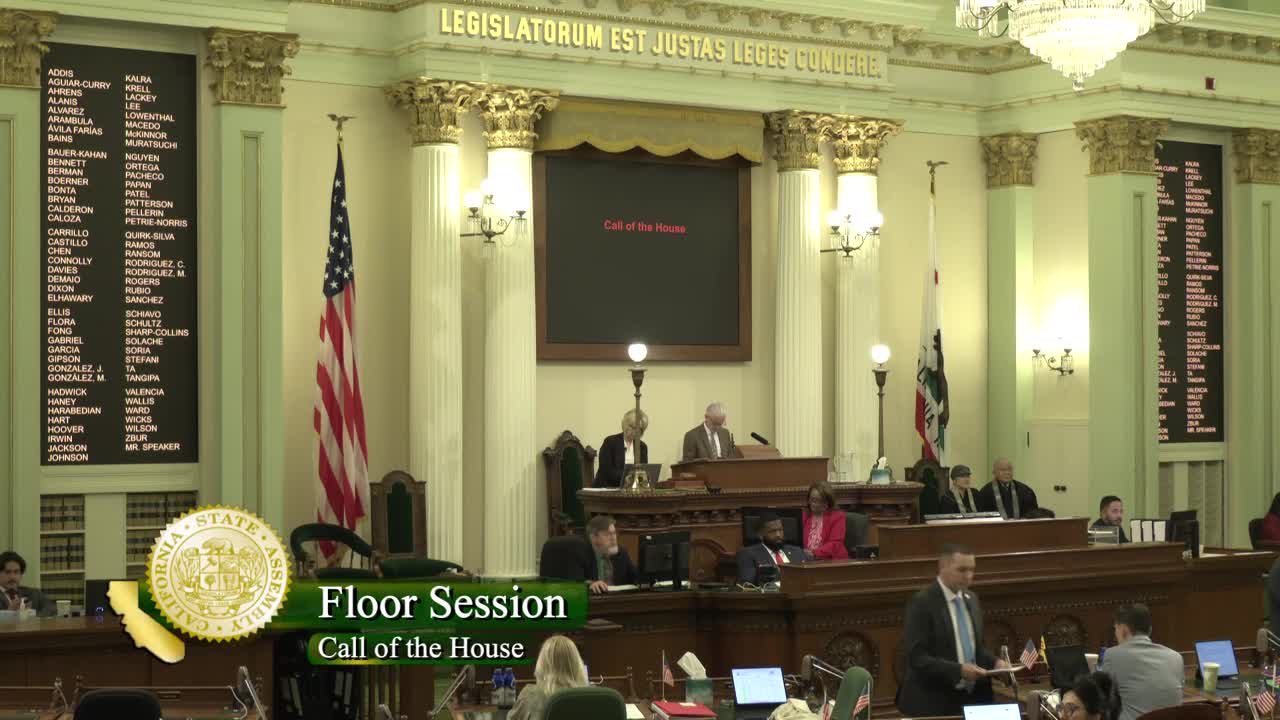
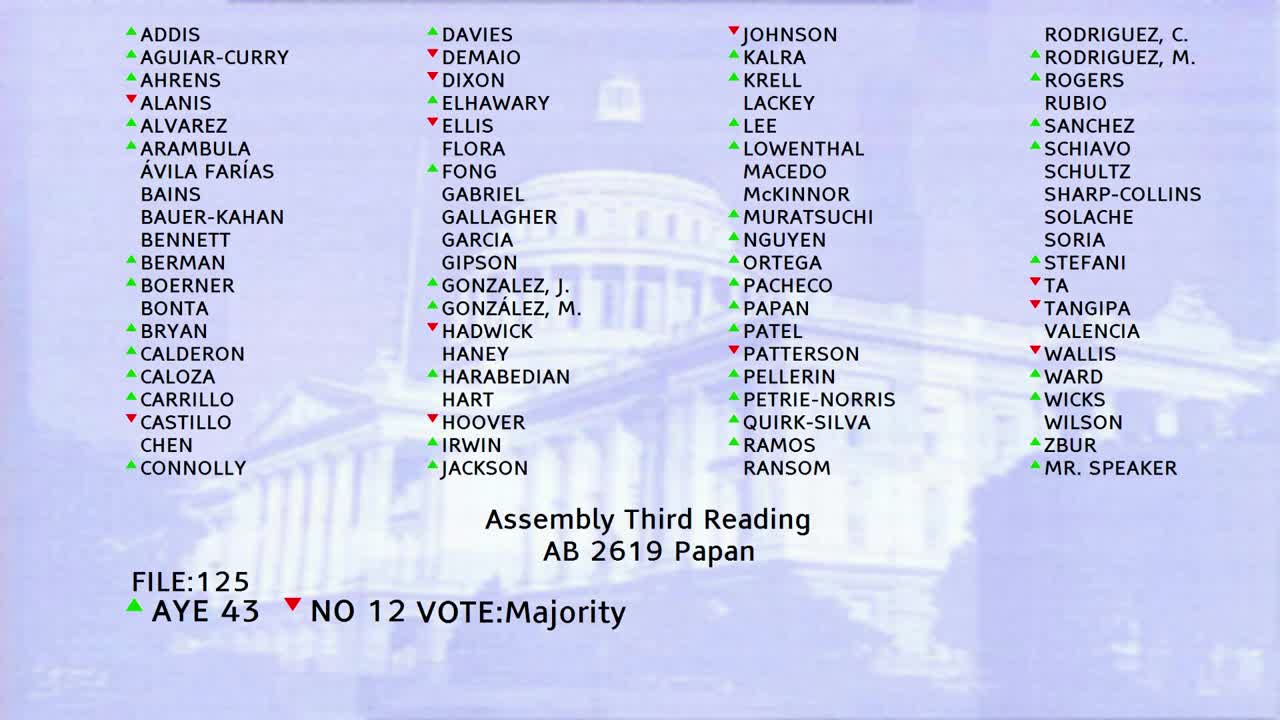
Bill Author