AB 1619: Public employees’ retirement: administration.
- Session Year: 2025-2026
- House: Assembly
- Latest Version Date: 2026-09-27
Current Status:
Passed
(2026-09-27: Chaptered by Secretary of State - Chapter 533, Statutes of 2026.)
Introduced
In Committee
Awaiting First Chamber Vote
Passed First Chamber
In Committee
Awaiting Second Chamber Vote
Passed Second Chamber
Enacted
(1)Existing law, the Teachers Retirement Law, establishes the State Teachers Retirement System (STRS) and creates the Defined Benefit Program of the State Teachers Retirement Plan, which provides a defined benefit to members of the program, based on final compensation, credited service, and age at retirement, subject to certain variations. STRS is administered by the Teachers Retirement Board. Existing law also creates the Cash Balance Benefit Program, which is administered by the board, to provide a retirement plan for the benefit of participating employees who provide creditable service for less than 50% of full time. Existing law requires certain board members to receive $100 for attendance at board and committee meetings.
This bill would increase that rate to $320.
(2)Existing law, the Public Employees Retirement Law (PERL), creates the Public Employees Retirement System (PERS) for the purpose of providing pension benefits to state employees and employees of contracting agencies and prescribes the rights and duties of members of the system and their beneficiaries. Existing law vests management and control of PERS in its board of administration. Existing law authorizes certain board members to receive $100 for attendance at a meeting of the board or committee thereof, as prescribed.
This bill would increase that rate to $320.
(3)Existing law, the County Employees Retirement Law of 1937, authorizes counties to establish retirement systems pursuant to its provisions in order to provide pension benefits to county, city, and district employees and their beneficiaries. Existing law sets forth the membership composition for boards of retirement and boards of investment, as specified. Existing law authorizes the board of supervisors for counties for which these provisions apply to provide that certain members of these boards shall receive compensation at a rate of not more than $100 for a meeting or for a meeting of a committee authorized by the entire board.
This bill would authorize the above-described compensation rate to be increased by the board of retirement to not more than $320 per meeting, and would provide that this provision would not be operative in any county until it is publicly noticed and adopted by a majority vote of the board of supervisors, as specified.
Existing law, applicable to Los Angeles County, authorizes the board of supervisors to provide compensation to certain members of the board of retirement and board of investments at a rate of not more than $100 for a board or committee meeting, subject to certain limits.
This bill would authorize the above-described compensation rate to be increased by the board of retirement or board of investments to a rate of not more than $320 per meeting. The bill would prohibit this provision from becoming operative until it is publicly noticed and adopted by a majority vote of the board of supervisors, as specified.
(1)Existing law, the Teachers Retirement Law, establishes the State Teachers Retirement System (STRS) and creates the Defined Benefit Program of the State Teachers Retirement Plan, which provides a defined benefit to members of the program, based on final compensation, credited service, and age at retirement, subject to certain variations. STRS is administered by the Teachers Retirement Board. Existing law also creates the Cash Balance Benefit Program, which is administered by the board, to provide a retirement plan for the benefit of participating employees who provide creditable service for less than 50% of full time. Existing law requires certain board members to receive $100 for attendance at board and committee meetings.
This bill would increase that rate to $320.
(2)Existing law, the Public Employees Retirement Law (PERL), creates the Public Employees Retirement System (PERS) for the purpose of providing pension benefits to state employees and employees of contracting agencies and prescribes the rights and duties of members of the system and their beneficiaries. Existing law vests management and control of PERS in its board of administration. Existing law authorizes certain board members to receive $100 for attendance at a meeting of the board or committee thereof, as prescribed.
This bill would increase that rate to $320.
Existing(3)Existing law, the County Employees Retirement Law of 1937, authorizes counties to establish retirement systems pursuant to its provisions in order to provide pension benefits to county, city, and district employees and their beneficiaries. Existing law sets forth the membership composition for boards of retirement and boards of investment, as specified. Existing law authorizes the board of supervisors for counties for which these provisions apply to provide that certain members of these boards shall receive compensation at a rate of not more than $100 for a meeting or for a meeting of a committee authorized by the entire board.
This bill would authorize the above-described compensation rate to be increased by the board of retirement to not more than $320 per meeting, and would provide that this provision would not be operative in any county until it is publicly noticed and adopted by a majority vote of the board of supervisors. supervisors, as specified.
Existing law, applicable to Los Angeles County, authorizes the board of supervisors to provide compensation to certain members of the board of retirement and board of investments at a rate of not more than $100 for a board or committee meeting, subject to certain limits.
This bill would authorize the above-described compensation rate to be increased by the board of retirement or board of investments to a rate of not more than $320 per meeting. The bill would prohibit this provision from becoming operative until it is publicly noticed and adopted by a majority vote of the board of supervisors, as specified.
Existing law, the County Employees Retirement Law of 1937, authorizes counties to establish retirement systems pursuant to its provisions in order to provide pension benefits to county, city, and district employees and their beneficiaries. Existing law sets forth the membership composition for boards of retirement and boards of investment, as specified. Existing law authorizes the board of supervisors for counties for which these provisions apply to provide that certain members of these boards shall receive compensation at a rate of not more than $100 for a meeting or for a meeting of a committee authorized by the entire board.
This bill would authorize the above-described compensation rate to be increased by the board of retirement to not more than $320 per meeting, and would provide that this provision would not be operative in any county until it is adopted by a majority vote of the board of supervisors.
The members of the board who are not active members of the Defined Benefit Program or active participants of the Cash Balance Benefit Program and who are appointed by the Governor pursuant to Section 22200 shall receive three hundred twenty dollars ($320) for every day of actual attendance at meetings of the board or any meeting of any committee of the board of which the person is a member, and that is conducted for the purpose of carrying out the powers and duties of the board, together with their necessary traveling expenses incurred in connection with performance of their official duties.
SEC. 2.Section 20091 of the Government Code is amended to read:20091.The members of the board appointed by the Governor pursuant to subdivision (e) of Section 20090, the public member appointed jointly by the Senate Committee on Rules and the Speaker of the Assembly pursuant to subdivision (f) of Section 20090, and any retired person serving on the board pursuant to subdivision (g) of Section 20090 shall receive three hundred twenty dollars ($320) for every day or portion thereof of actual attendance at meetings of the board or any meeting of any committee of the board of which committee the person is a member and which meeting is conducted for the purpose of carrying out the powers and duties of the board, together with their necessary traveling expenses incurred in connection with performance of their official duties.
SEC. 3.Section 31521 of the Government Code is amended to read:31521.(a)The board of supervisors may provide that the fourth and fifth members, and in counties having a board consisting of nine members or nine members and an alternate retired member, the fourth, fifth, sixth, eighth, ninth, and alternate retired members, and in counties having a board of investments under Section 31520.2, the fifth, sixth, seventh, eighth, and ninth members of the board of investments, shall receive compensation at a rate of not more than one hundred dollars ($100) for a meeting, or for a meeting of a committee authorized by the board, for not more than five meetings per month, together with actual and necessary expenses for all members of the board.
(b)The compensation rate established by the board of supervisors pursuant to subdivision (a) may be increased by the board of retirement to a rate of not more than three hundred twenty dollars ($320). This subdivision shall not be operative in any county until it is publicly noticed and adopted by a majority vote of the board of supervisors, and shall not be adopted by a consent calendar.SEC. 4.Section 31521.1 of the Government Code is amended to read:31521.1.(a)The board of supervisors may provide that in counties having a board consisting of nine members and an alternate retired member, the fourth, fifth, sixth, eighth, ninth, and alternate retired members, and in counties having a board of investments under Section 31520.2, the fifth, sixth, seventh, eighth, and ninth members of the board of investments, shall receive compensation at a rate of not more than one hundred dollars ($100) for a meeting, or for a meeting of a committee authorized by the board, for not more than five meetings per month, together with actual and necessary expenses for all members of the board.
(b)The compensation rate established by the board of supervisors pursuant to subdivision (a) may be increased by the board of retirement or board of investments to a rate of not more than three hundred twenty dollars ($320). This subdivision shall not become operative until it is publicly noticed and adopted by a majority vote of the board of supervisors, and shall not be adopted by a consent calendar.
(c)This section shall apply only in a county of the first class, as defined by Section 28020, as amended by Chapter 1204 of the Statutes of 1971, and Section 28022, as amended by Chapter 43 of the Statutes of 1961.
The members of the board who are not active members of the Defined Benefit Program or active participants of the Cash Balance Benefit Program and who are appointed by the Governor pursuant to Section 22200 shall receive one hundred dollars ($100) three hundred twenty dollars ($320) for every day of actual attendance at meetings of the board or any meeting of any committee of the board of which the person is a member, and that is conducted for the purpose of carrying out the powers and duties of the board, together with their necessary traveling expenses incurred in connection with performance of their official duties.
SEC. 2.Section 20091 of the Government Code is amended to read:20091.The members of the board appointed by the Governor pursuant to subdivision (e) of Section 20090, the public member appointed jointly by the Senate Committee on Rules and the Speaker of the Assembly pursuant to subdivision (f) of Section 20090, and any retired person serving on the board pursuant to subdivision (g) of Section 20090 shall receive one hundred dollars ($100) three hundred twenty dollars ($320) for every day or portion thereof of actual attendance at meetings of the board or any meeting of any committee of the board of which committee the person is a member and which meeting is conducted for the purpose of carrying out the powers and duties of the board, together with their necessary traveling expenses incurred in connection with performance of their official duties.
SECTION 1.SEC. 3.Section 31521 of the Government Code is amended to read:31521.(a)The board of supervisors may provide that the fourth and fifth members, and in counties having a board consisting of nine members or nine members and an alternate retired member, the fourth, fifth, sixth, eighth, ninth, and alternate retired members, and in counties having a board of investments under Section 31520.2, the fifth, sixth, seventh, eighth, and ninth members of the board of investments, shall receive compensation at a rate of not more than one hundred dollars ($100) for a meeting, or for a meeting of a committee authorized by the board, for not more than five meetings per month, together with actual and necessary expenses for all members of the board.
(b)The compensation rate established by the board of supervisors pursuant to subdivision (a) may be increased by the board of retirement to a rate of not more than three hundred twenty dollars ($320). This subdivision shall not be operative in any county until it is publicly noticed and adopted by a majority vote of the board of supervisors. supervisors, and shall not be adopted by a consent calendar.SEC. 4.Section 31521.1 of the Government Code is amended to read:31521.1.(a)The board of supervisors may provide that in counties having a board consisting of nine members and an alternate retired member, the fourth, fifth, sixth, eighth, ninth, and alternate retired members, and in counties having a board of investments under Section 31520.2, the fifth, sixth, seventh, eighth, and ninth members of the board of investments, shall receive compensation at a rate of not more than one hundred dollars ($100) for a meeting, or for a meeting of a committee authorized by the board, for not more than five meetings per month, together with actual and necessary expenses for all members of the board.
(b)The compensation rate established by the board of supervisors pursuant to subdivision (a) may be increased by the board of retirement or board of investments to a rate of not more than three hundred twenty dollars ($320). This subdivision shall not become operative until it is publicly noticed and adopted by a majority vote of the board of supervisors, and shall not be adopted by a consent calendar.
(b)(c)This section shall apply only in a county of the first class, as defined by Section 28020, as amended by Chapter 1204 of the Statutes of 1971, and Section 28022, as amended by Chapter 43 of the Statutes of 1961.
(a)The board of supervisors may provide that the fourth and fifth members, and in counties having a board consisting of nine members or nine members and an alternate retired member, the fourth, fifth, sixth, eighth, ninth, and alternate retired members, and in counties having a board of investments under Section 31520.2, the fifth, sixth, seventh, eighth, and ninth members of the board of investments, shall receive compensation at a rate of not more than one hundred dollars ($100) for a meeting, or for a meeting of a committee authorized by the board, for not more than five meetings per month, together with actual and necessary expenses for all members of the board.
(b)The compensation rate established by the board of supervisors pursuant to subdivision (a) may be increased by the board of retirement to a rate of not more than three hundred twenty dollars ($320). This subdivision shall not be operative in any county until it is adopted by a majority vote of the board of supervisors.
|
Date
|
Status
|
|---|---|
| Sep 27, 2026 | Chaptered by Secretary of State - Chapter 533, Statutes of 2026. |
| Sep 27, 2026 | Approved by the Governor. |
| Aug 25, 2026 | Enrolled and presented to the Governor at 4 p.m. |
| Aug 19, 2026 | In Assembly. Ordered to Engrossing and Enrolling. |
| Aug 19, 2026 | Read third time. Passed. Ordered to the Assembly. (Ayes 37. Noes 0. Page 5544.). |
| Aug 19, 2026 | Read third time. Passed. Ordered to the Assembly. (Ayes 37. Noes 0.). |
| Jun 30, 2026 | Read second time. Ordered to third reading. |
| Jun 29, 2026 | From committee: Be ordered to second reading pursuant to Senate Rule 28.8. |
| Jun 17, 2026 | From committee: Do pass and re-refer to Com. on APPR. (Ayes 5. Noes 0.) (June 17). Re-referred to Com. on APPR. |
| Jun 3, 2026 | Referred to Com. on L., P.E. & R. |
| May 27, 2026 | In Senate. Read first time. To Com. on RLS. for assignment. |
| May 26, 2026 | Read third time. Passed. Ordered to the Senate. (Ayes 74. Noes 2. Page 5392.) |
| May 26, 2026 | Read third time. Passed. Ordered to the Senate. (Ayes 74. Noes 2.) |
| May 26, 2026 | Read third time. Passed. Ordered to the Senate. |
| May 14, 2026 | Read second time. Ordered to third reading. |
| May 13, 2026 | From committee: Do pass. (Ayes 15. Noes 0.) (May 13). |
| Apr 27, 2026 | Re-referred to Com. on APPR. pursuant to Joint Rule 10.5. |
| Apr 27, 2026 | Read second time. Ordered to third reading. |
| Apr 23, 2026 | Read second time and amended. Ordered returned to second reading. |
| Apr 22, 2026 | From committee: Amend, and do pass as amended. (Ayes 7. Noes 0.) (April 22). |
| Feb 2, 2026 | Referred to Com. on P. E. & R. |
| Jan 22, 2026 | From printer. May be heard in committee February 21. |
| Jan 21, 2026 | Read first time. To print. |
|
Date
|
Description
|
Location
|
Votes
|
|
|---|---|---|---|---|
| Aug 19, 2026 | Assembly 3rd Reading AB1619 Valencia et al. By Umberg | Senate Floor |
Passed |
|
| Jun 17, 2026 | Do pass, but first be re-referred to the Committee on [Appropriations] | Senate Standing Committee on Labor, Public Employment and Retirement |
Passed |
|
| May 26, 2026 | AB 1619 Valencia Assembly Third Reading | Assembly Floor |
Passed |
|
| May 13, 2026 | Do pass. | Assembly Standing Committee on Appropriations |
Passed |
|
| Apr 22, 2026 | Do pass as amended. | Assembly Standing Committee on Public Employment and Retirement |
Passed |
This list shows positions taken on this bill by organizations on the date displayed, which is linked to the original source.
Positions by individuals are not included.
|
Organization
|
Position
|
Date
|
|---|---|---|
| Contra Costa County Employees' Retirement Association | ** Support | |
| Contra Costa County Employees’ Retirement Association | ** Support | |
| Contra Costa County Employees' Retirement Association (CCCERA) | ** Support | |
| Contra Costa County Employment Retirement Association | ** Support | |
| Los Angeles County Employees Retirement Association | ** Support | |
| Orange County Board of Supervisors | ** Support | |
| Orange County Employees Association | ** Support | |
| Orange County Employees Retirement System | ** Support | |
| Orange County Employees Retirement System (Ocers) | ** Support |
SENATE RULES COMMITTEE Office of Senate Floor Analyses (916) 651-4171 | AB 1619 |
THIRD READING
Bill No: AB 1619
Author: Valencia (D), et al.
Amended: 4/23/26 in Assembly
Vote: 21
SENATE LABOR, PUB. EMP. & RET. COMMITTEE: 5-0, 6/17/26
AYES: Smallwood-Cuevas, Strickland, Cortese, Durazo, Laird
SENATE APPROPRIATIONS COMMITTEE: Senate Rule 28.8
ASSEMBLY FLOOR: 74-2, 5/26/26 - See last page for vote
SUBJECT: Public employees’ retirement: administration
SOURCE: Orange County Employees Retirement System
DIGEST:
This bill increases the compensation for specified board members of the Public Employees’ Retirement System (CalPERS) and the State Teachers’ Retirement System (CalSTRS) from $100 to $320 and authorizes boards of supervisors in counties operating a retirement system under the County Employees Retirement Law of 1937 (CERL) to adopt an identical increase for specified board members.
ANALYSIS:
Existing law:
- Provides under the state constitution that public pension fund retirement boards have the sole and exclusive fiduciary authority over the investment and sole and exclusive responsibility over the administration of their respective retirement systems. (CA CONST art. XVI, §17)
- Establishes the California Public Employees’ Retirement System (CalPERS), which provides a defined benefit pension to state employees, classified school employees, and employees of contracting public agencies. (Government Code §20000 et seq.)
- Vests the management and control of CalPERS in its board of administration. Existing law also provides the board with all powers reasonably necessary to invest the assets associated with, and to administer and implement the provisions of, the California Public Employees’ Pension Reform Act of 2013. (Government Code §20004 and §20120)
- Provides that the members of the CalPERS board appointed by the Governor, the public member appointed jointly by the Seante Committee on Rules and the Speaker of the Assembly, and any retired person serving on the board shall receive $100 for every day or portion thereof of actual attendance at meetings of the board or any meeting of any committee of the board of which committee the person is a member and which meeting is conducted for the purpose of carrying out the powers and duties of the board, together with their necessary traveling expenses incurred in connection with performance of their official duties. (Government Code §20091)
- Establishes the California State Teachers’ Retirement System (CalSTRS) to provide a financially sound plan for the retirement of the state’s public school teachers, teachers of schools supported by the state, and other persons employed in connection with the schools. (Education Code §22001)
- Provides that CalSTRS is administered by the Teachers’ Retirement Board. Requires the board to set policy and have the sole power and authority to hear and determine all facts pertaining to application for benefits under the plan or any matters pertaining to administration of the plan and CalSTRS. (Education Code §22200 and §22201)
- Provides that members of the CalSTRS board who are not active members of the Defined Benefit Program or active participants of the Cash Balance Benefit Program and who are appointed by the Governor shall receive $100 for every day of actual attendance at meetings of the board or any meeting of any committee of the board of which the person is a member, and that is conducted for the purpose of carrying out the powers and duties of the board, together with their necessary traveling expenses incurred in connection with performance of their official duties. (Education Code §22223)
- Establishes the County Employees Retirement Law of 1937 (commonly referred to as the “CERL,” “1937 Act,” or “’37 Act”), which governs 20 independent county retirement associations and provides for retirement systems for county and district employees in those counties adopting its provisions. Currently, 20 counties operate retirement systems under the CERL. (Government Code §31450 et seq.)
- Vests the management of a CERL retirement system in its retirement board, consisting of five members or nine members and one alternate, or in its board of investment. (Government Code §31520 and §31520.1)
- Authorizes boards of supervisors in counties operating a CERL retirement system to provide the fourth and fifth members, and in counties having a board of retirement consisting of nine members or nine members and an alternate retired member, the fourth, fifth, sixth, eight, ninth, and alternate retired members, and in counties having a board of investments, the fifth, sixth, seventh, eight, and ninth members, compensation at a rate of not more than $100 for a meeting, or for a meeting of a committee authorized by the board, for not more than five meetings per month, together with actual and necessary expenses for all members of the board. (Government Code §31521)
- Authorizes, in a county of the first class, the board of supervisors to provide the fourth, fifth, sixth, eighth, ninth, and alternate retired members of the board of retirement and the fifth, sixth, seventh, eight, and ninth members of the board of investments, compensation at a rate of not more than $100 for a meeting, or for a meeting of a committee authorized by the board, for not more than five meetings per month, together with actual and necessary expenses for all members of the board. (Government Code §31521.1)
- Denominates Los Angeles County “a county of the first class.” (Government Code §28020)
- Provides, for CERL retirement systems, that the official duties of elected board members who are employees of the county or a district shall be included as part of their county or district employment and their board duties normally take precedence over any other duties. The elected board members who are county or district employees shall not receive any additional compensation by virtue of their election to the board. (Government Code §31522)
This bill:
- Increases the compensation for specified CalPERS board members from $100 to $320 for every day or portion thereof of actual attendance at meetings of the board or any meeting of any committee of the board of which committee the person is a member and which meeting is conducted for the purpose of carrying out the powers and duties of the board.
- Increases the compensation for specified CalSTRS board members from $100 to $320 for every day of actual attendance at meetings of the board or any meeting of any committee of the board of which the person is a member, and that is conducted for the purpose of carrying out the powers and duties of the board.
- Authorizes the board of retirement, in counties operating a CERL retirement system, to increase the compensation of specified board members to a rate of not more than $320.
- Provides that the increase in compensation in 3) shall not be operative in any county until it is publicly noticed and adopted by a majority vote of the board of supervisors and shall not be adopted by a consent calendar.
- Authorizes, in a county of the first class, the board of retirement or the board of investments to increase the compensation of specified board members to a rate of not more than $320.
- Provides that the increase in compensation in 5) shall not become operative until it is publicly noticed and adopted by a majority vote of the board of supervisors and shall not be adopted by a consent calendar.
Background
The CalPERS, CalSTRS, and CERL boards of retirement and investment are responsible for overseeing the administration of their respective retirement systems and safeguarding the financial security of their members. These boards meet regularly to fulfill their fiduciary duties.
CalPERS. The CalPERS board consists of 13 members who are elected, appointed, or hold office ex officio. The board compensation is mandated by law and can only be changed by a majority of the registered voters in the state. Among other responsibilities, the board sets employer contribution rates, determines investment asset allocations, and provides actuarial valuations. The CalPERS board includes:
Six elected members
- Two elected by and from all CalPERS members
- One elected by and from all active state members
- One elected by and from all active CalPERS school members
- One elected by and from all active CalPERS public agency members (employed by contracting public agencies)
- One elected by and from retired members of CalPERS
Three appointed members
- Two appointed by the Governor - an elected official of a local government and an official of a life insurer
- One public representative appointed jointly by the Speaker of the Assembly and the Senate Rules Committee
Four ex officio members
- The State Treasurer
- The State Controller
- The Director of the California Department of Human Resources
- A Representative of the State Personnel Board
The members appointed by the Governor, the public member appointed by the Speaker of the Assembly and the Senate Rules Committee, and any retired person on the board receive $100 for every day or portion thereof of actual attendance at meetings of the board or any meeting of any committee of the board of which committee the person is a member and which meeting is conducted for the purpose of carrying out the powers and duties of the board. Money from the Public Employees’ Retirement Fund is used to pay board members.
CalSTRS . The CalSTRS board consists of 12 members who are elected, appointed, or hold office ex officio. The board sets the policies and makes rules for the system and is responsible for ensuring benefits are paid by the system in accordance with law. The CalSTRS retirement board includes:
- Three member-elected positions representing current educators.
- A retired CalSTRS member appointed by the Governor and confirmed by the Senate.
- Three public representatives appointed by the Governor and confirmed by the Senate.
- A school board representative appointed by the Governor and confirmed by the Senate.
- Four board members who serve in an ex officio capacity by virtue of their office: Director of Finance, State Controller, State Superintendent of Public Instruction and State Treasurer.
The members of the board who are not active members of the Defined Benefit Program or active participants of the Cash Balance Benefit Program and who are appointed by the Governor receive $100 for every day or portion thereof of actual attendance at meetings of the board or any meeting of any committee of the board of which committee the person is a member and which meeting is conducted for the purpose of carrying out the powers and duties of the board. Money from the Teachers’ Retirement Fund is used to pay board members.
CERL . CERL retirement systems are administered by a board of retirement or a board of investments. Boards of retirement can consist of either five members or nine members and one alternate. Existing law grants county boards of supervisors the authority to adopt specialized CERL provisions to apply to their respective retirement systems through the adoption of county ordinance. This structure allows the CERL to provide flexibility for the different needs and demands of the 20 county retirement systems that the CERL authorizes.
Generally, the composition of a five-member board is as follows:
- Member 1 is the county treasurer.
- Members 2 and 3 are active general members of the retirement association, elected by the active general members.
- Members 4 and 5 are qualified electors of the county not connected with county government, with the exception that one of these members may be a member of the board of supervisors. These individuals are appointed by the board of supervisors.
On a five-member board, members 4 and 5 receive compensation at a rate of not more than $100 for a meeting, or for a meeting of a committee authorized by the board, for not more than five meetings per month, together with actual and necessary expenses for all members of the board.
Generally, the composition of a nine-member board is as follows:
- Member 1 is the county treasurer.
- Members 2 and 3 are active general members of the retirement association, elected by the active general members.
- Members 4, 5, 6, and 9 are qualified electors of the county not connected with county government, with the exception that one of these members may be a member of the board of supervisors. These individuals are appointed by the board of supervisors.
- Member 7 is an active safety member of the retirement association, elected by active safety members.
- Member 8 is a retired member of the retirement association, elected by retired members.
On a nine-member board, members 4, 5, 6, 8, and 9 receive compensation at a rate of not more than $100 for a meeting, or for a meeting of a committee authorized by the board, for not more than five meetings per month, together with actual and necessary expenses for all members of the board.
Generally, the composition of a board of investments is as follows:
- Member 1 is the county treasurer.
- Members 2 and 3 are active general members of the retirement association, elected by the active general members.
- Member 4 is a safety member elected by safety members.
- Members 5,6,7, and 9 are qualified electors of the county not connected with county government, with the exception that one of these members may be a member of the board of supervisors. These individuals are appointed by the board of supervisors.
- Member 8 is a retired member of the retirement association, elected by retired members.
Members 5, 6, 7, 8, and 9 on a board of investments receive compensation at a rate of not more than $100 for a meeting, or for a meeting of a committee authorized by the board, for not more than five meetings per month, together with actual and necessary expenses for all members of the board.
FISCAL EFFECT: Appropriation: No Fiscal Com.: Yes Local: No
SUPPORT: (Verified 6/29/26)
Orange County Employees Retirement System (Source)
Contra Costa County Employment Retirement Association
Los Angeles County Employees Retirement Association
Orange County Board of Supervisors
Orange County Employees Association
OPPOSITION: (Verified 6/29/26)
None received
ARGUMENTS IN SUPPORT: The sponsor of the measure, the Orange County Employees Retirement System, argues:
“[AB 1619] represents a prudent and long-overdue adjustment for several compelling reasons:
Inflation Adjustment: The current per-meeting stipend of $100 was established fifty years ago (and adopted by the Orange County Board of Supervisors 40 years ago). The proposed $320 maximum represents the inflation-adjusted equivalent of that original rate and simply brings compensation in line with current economic realities…”
ASSEMBLY FLOOR: 74-2, 5/26/26
AYES: Addis, Aguiar-Curry, Ahrens, Alanis, Alvarez, Arambula, Ávila Farías, Bains, Bennett, Berman, Boerner, Bonta, Bryan, Calderon, Caloza, Carrillo, Castillo, Chen, Connolly, Davies, Dixon, Elhawary, Ellis, Flora, Fong, Gabriel, Gallagher, Garcia, Gipson, Jeff Gonzalez, Mark González, Haney, Harabedian, Hart, Hoover, Irwin, Jackson, Johnson, Kalra, Krell, Lackey, Lee, Lowenthal, Macedo, McKinnor, Nguyen, Ortega, Pacheco, Papan, Patel, Patterson, Pellerin, Petrie-Norris, Quirk-Silva, Ramos, Ransom, Michelle Rodriguez, Rogers, Blanca Rubio, Schiavo, Schultz, Sharp-Collins, Solache, Soria, Stefani, Ta, Tangipa, Valencia, Wallis, Ward, Wicks, Wilson, Zbur, Rivas
NOES: DeMaio, Sanchez
NO VOTE RECORDED: Bauer-Kahan, Hadwick, Muratsuchi, Celeste Rodriguez
Prepared by: Emma Bruce / L., P.E. & R. / (916) 651-1556
7/1/26 16:54:56
**** END ****
SENATE COMMITTEE ON LABOR, PUBLIC EMPLOYMENT AND RETIREMENT
Senator Lola Smallwood-Cuevas, Chair
2025 - 2026 Regular
Bill No: AB 1619 Hearing Date: June 17, 2026
Author: | Valencia | ||
Version: | April 23, 2026 | ||
Urgency: | No | Fiscal: | Yes |
Consultant: | Emma Bruce | ||
SUBJECT: Public employees’ retirement: administration
KEY ISSUE
This bill increases the compensation for specified board members of the Public Employees’ Retirement System (CalPERS) and the State Teachers’ Retirement System (CalSTRS) from $100 to $320 and authorizes boards of supervisors in counties operating a retirement system under the County Employees Retirement Law of 1937 (CERL) to adopt an identical increase for specified board members.
ANALYSIS
Existing law:
- Provides under the state constitution that public pension fund retirement boards have the sole and exclusive fiduciary authority over the investment and sole and exclusive responsibility over the administration of their respective retirement systems. (CA CONST art. XVI, §17)
- Establishes the California Public Employees’ Retirement System (CalPERS), which provides a defined benefit pension to state employees, classified school employees, and employees of contracting public agencies. (Government Code §20000 et seq.)
- Vests the management and control of CalPERS in its board of administration. Existing law also provides the board with all powers reasonably necessary to invest the assets associated with, and to administer and implement the provisions of, the California Public Employees’ Pension Reform Act of 2013. (Government Code §20004 and §20120)
- Provides that the members of the CalPERS board appointed by the Governor, the public member appointed jointly by the Seante Committee on Rules and the Speaker of the Assembly, and any retired person serving on the board shall receive $100 for every day or portion thereof of actual attendance at meetings of the board or any meeting of any committee of the board of which committee the person is a member and which meeting is conducted for the purpose of carrying out the powers and duties of the board, together with their necessary traveling expenses incurred in connection with performance of their official duties. (Government Code §20091)
- Establishes the California State Teachers’ Retirement System (CalSTRS) to provide a financially sound plan for the retirement of the state’s public school teachers, teachers of schools supported by the state, and other persons employed in connection with the schools. (Education Code §22001)
- Provides that CalSTRS is administered by the Teachers’ Retirement Board. Requires the board to set policy and have the sole power and authority to hear and determine all facts pertaining to application for benefits under the plan or any matters pertaining to administration of the plan and CalSTRS. (Education Code §22200 and §22201)
- Provides that members of the CalSTRS board who are not active members of the Defined Benefit Program or active participants of the Cash Balance Benefit Program and who are appointed by the Governor shall receive $100 for every day of actual attendance at meetings of the board or any meeting of any committee of the board of which the person is a member, and that is conducted for the purpose of carrying out the powers and duties of the board, together with their necessary traveling expenses incurred in connection with performance of their official duties. (Education Code §22223)
- Establishes the County Employees Retirement Law of 1937 (commonly referred to as the “CERL,” “1937 Act,” or “’37 Act”), which governs 20 independent county retirement associations and provides for retirement systems for county and district employees in those counties adopting its provisions. Currently, 20 counties operate retirement systems under the CERL. (Government Code §31450 et seq.)
- Vests the management of a CERL retirement system in its retirement board, consisting of five members or nine members and one alternate, or in its board of investment. (Government Code §31520 and §31520.1)
- Authorizes boards of supervisors in counties operating a CERL retirement system to provide the fourth and fifth members, and in counties having a board of retirement consisting of nine members or nine members and an alternate retired member, the fourth, fifth, sixth, eight, ninth, and alternate retired members, and in counties having a board of investments, the fifth, sixth, seventh, eight, and ninth members, compensation at a rate of not more than $100 for a meeting, or for a meeting of a committee authorized by the board, for not more than five meetings per month, together with actual and necessary expenses for all members of the board. (Government Code §31521)
- Authorizes, in a county of the first class, the board of supervisors to provide the fourth, fifth, sixth, eighth, ninth, and alternate retired members of the board of retirement and the fifth, sixth, seventh, eight, and ninth members of the board of investments, compensation at a rate of not more than $100 for a meeting, or for a meeting of a committee authorized by the board, for not more than five meetings per month, together with actual and necessary expenses for all members of the board. (Government Code §31521.1)
- Denominates Los Angeles County “a county of the first class.” (Government Code §28020)
- Provides, for CERL retirement systems, that the official duties of elected board members who are employees of the county or a district shall be included as part of their county or district employment and their board duties normally take precedence over any other duties. The elected board members who are county or district employees shall not receive any additional compensation by virtue of their election to the board. (Government Code §31522)
This bill:
- Increases the compensation for specified CalPERS board members from $100 to $320 for every day or portion thereof of actual attendance at meetings of the board or any meeting of any committee of the board of which committee the person is a member and which meeting is conducted for the purpose of carrying out the powers and duties of the board.
- Increases the compensation for specified CalSTRS board members from $100 to $320 for every day of actual attendance at meetings of the board or any meeting of any committee of the board of which the person is a member, and that is conducted for the purpose of carrying out the powers and duties of the board.
- Authorizes the board of retirement, in counties operating a CERL retirement system, to increase the compensation of specified board members to a rate of not more than $320.
- Provides that the increase in compensation in 3) shall not be operative in any county until it is publicly noticed and adopted by a majority vote of the board of supervisors and shall not be adopted by a consent calendar.
- Authorizes, in a county of the first class, the board of retirement or the board of investments to increase the compensation of specified board members to a rate of not more than $320.
- Provides that the increase in compensation in 5) shall not become operative until it is publicly noticed and adopted by a majority vote of the board of supervisors and shall not be adopted by a consent calendar.
COMMENTS
1. Background:
The CalPERS, CalSTRS, and CERL boards of retirement and investment are responsible for overseeing the administration of their respective retirement systems and safeguarding the financial security of their members. These boards meet regularly to fulfill their fiduciary duties.
CalPERS
The CalPERS board consists of 13 members who are elected, appointed, or hold office ex officio. The board compensation is mandated by law and can only be changed by a majority of the registered voters in the state. Among other responsibilities, the board sets employer contribution rates, determines investment asset allocations, and provides actuarial valuations. The CalPERS board includes:
Six elected members
- Two elected by and from all CalPERS members
- One elected by and from all active state members
- One elected by and from all active CalPERS school members
- One elected by and from all active CalPERS public agency members (employed by contracting public agencies)
- One elected by and from retired members of CalPERS
Three appointed members
- Two appointed by the Governor - an elected official of a local government and an official of a life insurer
- One public representative appointed jointly by the Speaker of the Assembly and the Senate Rules Committee
Four ex officio members
- The State Treasurer
- The State Controller
- The Director of the California Department of Human Resources
- A Representative of the State Personnel Board
The members appointed by the Governor, the public member appointed by the Speaker of the Assembly and the Senate Rules Committee, and any retired person on the board receive $100 for every day or portion thereof of actual attendance at meetings of the board or any meeting of any committee of the board of which committee the person is a member and which meeting is conducted for the purpose of carrying out the powers and duties of the board. Money from the Public Employees’ Retirement Fund is used to pay board members.
CalSTRS
The CalSTRS board consists of 12 members who are elected, appointed, or hold office ex officio. The board sets the policies and makes rules for the system and is responsible for ensuring benefits are paid by the system in accordance with law.
The CalSTRS retirement board includes:
- Three member-elected positions representing current educators.
- A retired CalSTRS member appointed by the Governor and confirmed by the Senate.
- Three public representatives appointed by the Governor and confirmed by the Senate.
- A school board representative appointed by the Governor and confirmed by the Senate.
- Four board members who serve in an ex officio capacity by virtue of their office: Director of Finance, State Controller, State Superintendent of Public Instruction and State Treasurer.
The members of the board who are not active members of the Defined Benefit Program or active participants of the Cash Balance Benefit Program and who are appointed by the Governor receive $100 for every day or portion thereof of actual attendance at meetings of the board or any meeting of any committee of the board of which committee the person is a member and which meeting is conducted for the purpose of carrying out the powers and duties of the board. Money from the Teachers’ Retirement Fund is used to pay board members.
CERL
CERL retirement systems are administered by a board of retirement or a board of investments. Boards of retirement can consist of either five members or nine members and one alternate. Existing law grants county boards of supervisors the authority to adopt specialized CERL provisions to apply to their respective retirement systems through the adoption of county ordinance. This structure allows the CERL to provide flexibility for the different needs and demands of the 20 county retirement systems that the CERL authorizes.
Generally, the composition of a five-member board is as follows:
- Member 1 is the county treasurer.
- Members 2 and 3 are active general members of the retirement association, elected by the active general members.
- Members 4 and 5 are qualified electors of the county not connected with county government, with the exception that one of these members may be a member of the board of supervisors. These individuals are appointed by the board of supervisors.
On a five-member board, members 4 and 5 receive compensation at a rate of not more than $100 for a meeting, or for a meeting of a committee authorized by the board, for not more than five meetings per month, together with actual and necessary expenses for all members of the board.
Generally, the composition of a nine-member board is as follows:
- Member 1 is the county treasurer.
- Members 2 and 3 are active general members of the retirement association, elected by the active general members.
- Members 4, 5, 6, and 9 are qualified electors of the county not connected with county government, with the exception that one of these members may be a member of the board of supervisors. These individuals are appointed by the board of supervisors.
- Member 7 is an active safety member of the retirement association, elected by active safety members.
- Member 8 is a retired member of the retirement association, elected by retired members.
On a nine-member board, members 4, 5, 6, 8, and 9 receive compensation at a rate of not more than $100 for a meeting, or for a meeting of a committee authorized by the board, for not more than five meetings per month, together with actual and necessary expenses for all members of the board.
Generally, the composition of a board of investments is as follows:
- Member 1 is the county treasurer.
- Members 2 and 3 are active general members of the retirement association, elected by the active general members.
- Member 4 is a safety member elected by safety members.
- Members 5,6,7, and 9 are qualified electors of the county not connected with county government, with the exception that one of these members may be a member of the board of supervisors. These individuals are appointed by the board of supervisors.
- Member 8 is a retired member of the retirement association, elected by retired members.
Members 5, 6, 7, 8, and 9 on a board of investments receive compensation at a rate of not more than $100 for a meeting, or for a meeting of a committee authorized by the board, for not more than five meetings per month, together with actual and necessary expenses for all members of the board.
2. Need for this bill?
According to the author:
“The problem that AB 1619 seeks to address is that the attendance stipend for appointed county retirement system board members, California state teacher’s retirement system and California public employees’ retirement system has not been adjusted for inflation in decades, despite the increase in administrative complexity. AB 1619 allows these systems to increase the stipend from $100 to $320.”
3. Proponent Arguments:
The sponsor of the measure, the Orange County Employees Retirement System, argues:
“[AB 1619] represents a prudent and long-overdue adjustment for several compelling reasons:
Inflation Adjustment: The current per-meeting stipend of $100 was established fifty years ago (and adopted by the Orange County Board of Supervisors 40 years ago). The proposed $320 maximum represents the inflation-adjusted equivalent of that original rate and simply brings compensation in line with current economic realities.
Workload Recognition: The work of a county retirement system trustee can be extensive. Board members bear substantial fiduciary responsibilities and must dedicate significant time to understanding complex investment strategies, actuarial analyses, legal compliance requirements, and benefit administration. The current $100 rate per meeting (with a maximum of five meetings per month) does not adequately reflect the substantial time, expertise, and fiduciary responsibilities trustees undertake.
Expanding the Candidate Pool: Critically, paying an adequate stipend would enable counties to expand the pool of eligible candidates for appointed board members. Currently, only individuals who can afford the time required to serve on a County Board of Retirement can do so. This effectively excludes many qualified candidates, particularly those from working-class backgrounds or communities that may not be well represented on retirement boards. Updated compensation will help ensure that board service is accessible to a broader range of experienced, qualified individuals, leading to better representation and stronger governance.
Consistency with Other Special Districts: The proposed increase aligns with compensation adjustments made for governing boards of other California special districts. AB 2329 (Obernolte, 2018) amended the enabling legislation of several types of special districts—including health care districts, cemetery districts, and regional park districts—to increase the maximum monthly compensation of board members for attending meetings and provide for annual increases thereafter. CERL boards of retirement should have similar flexibility to increase compensation.
Local Flexibility: The proposed amendment is permissive rather than mandatory, giving each CERL system county the option to make the adjustment based on local circumstances. The amount of the stipend would ultimately be at each Retirement Board's discretion, with a maximum of $320 per meeting. This allows each County Board of Supervisors to analyze local concerns with trustee appointments, retention, and fair compensation before the matter is brought before the Board of Retirement to determine what might be an appropriate increase.”
4. Opponent Arguments:
None received.
4. Prior Legislation:
AB 1323 (Chen, 2025) would have authorized boards of supervisors in counties operating retirement systems under the CERL to increase the compensation of specified board members by an amount not to exceed 5 percent of the rate for each calendar year following the operative date of the last adjustment. The increase would not be operative in any county until it is adopted by a majority vote of the board of supervisors. This bill was held in the Assembly Public Employment and Retirement Committee.
AB 753 (Committee on Public Employees, Retirement and Social Security, Chapter 320, Statutes of 2007) authorized the Los Angeles County Board of Supervisors to provide compensation to specified members of the board of retirement for reviewing disability retirement cases and authorized the boards of supervisors in counties operating retirement systems under the CERL to pay per diem, as specified, to the alternate retired board member.
SUPPORT
Orange County Employees Retirement System (Sponsor)
Contra Costa County Employment Retirement Association
County of Orange
Los Angeles County Employees Retirement Association
Orange County Employees Association
OPPOSITION
None received
-- END --
ASSEMBLY THIRD READING
ATR Bill Id:AB 1619
Author:(Valencia)
As Amended Ver:April 23, 2026
Majority vote
SUMMARY
Increases the compensation of certain county employee retirement system board members, Public Employees' Retirement System (CalPERS) board members, and State Teachers' Retirement System (CalSTRS) board members from $100 to $320 per official meeting, among other provisions.
Major Provisions
- Amend existing law with respect to county employee retirement system boards of retirement or investment to authorize the increase after adoption by majority vote of the county Board of Supervisors (BOS) subject to the matter being publicly noticed by the BOS and not placed on a consent calendar.
- Similarly amend existing separate law applicable to the Los Angeles county employees retirement system to apply the same compensation amount along with the same BOS adoption requirements.
- Amend existing laws applicable to CalPERS and CalSTRS, respectively, to increase the compensation of certain board members from $100 to $320 per official meeting.
COMMENTS
Various statutes exist that specify compensation for a variety of local and state boards, commissions, and other similar bodies. The current general compensation rate of $100 was established multiple decades ago and has not been adjusted to be consistent with inflationary changes since that time. Enacted federal legislation that has adjusted the minimum wage, as well as those of various states, including California, have increased the wages for all lawfully employed individuals during the same period. However, although serving the interests of the public, the compensation for government board members generally has not. This includes pension system board members when considering their legal and statutory mandates exclusively owed to millions of public employees and their beneficiaries throughout California and those who are retired.
Generally, an abundance of various state-level boards or commissions provide compensation for their members that may come from various sources, including the state general fund. In other instances, the source might be from a special fund, or self-funded fund. The compensation specific to this bill is derived from a pension fund source and not a public fund source (e.g., general fund) and the costs of the proposed compensation increase are absorbed by the system, itself. For example, as to CalSTRS, the Teachers' Retirement Fund (TRF) is the source of funds to pay board members covered by Section 22223 of the Educ. Code. During each of the two past consecutive fiscal years, the total amount paid to those board members from the TRF was $3,700 (2024-25), and $6,000 (2023-24). As to CalPERS, the Public Employees' Retirement Fund (PERF) is the source of funds to pay board members covered by Section 20091 of the Gov Code. From February 2024 to January 2026, the total amount paid to those board members from the PERF was $11,200. For some county employees retirement law (CERL) systems, the compensation may be sourced by the county general treasury, but reimbursed by the CERL system fund.
The proposed increase to $320 for the respective retirement system segments and the applicable board members recognizes their legal obligations to their members and beneficiaries; the administrative complexity to ensure the provision of retirement and other benefits, and when considering that the current level of $100 compensation has not changed in multiple decades. Further, by maintaining the current explicit authority of BOS approval of CERL board compensation increases, any potential for ambiguity is removed relating to the ultimate governing body that has authority to increase the compensation.
Please see the policy committee analysis for a full discussion of this bill.
According to the Author
"[This bill] will modernize… stipends for specified pension board members. By adjusting the stipend amount to reflect inflation, we will fairly compensate trustees for their fiduciary responsibilities of overseeing public pension administration, and managing complex investments."
Arguments in Support
Among other things, the Orange County Employees Retirement System (OCERS) states, "[we] appreciate that the bill provides for local adoption through a two-step implementation process: (1) adoption by majority vote of the County [BOS] to make the provision operative, and (2) action by the [BOR] to establish the increased compensation rate up to the $320 maximum. This approach respects local control while providing the necessary flexibility for each county and retirement board to set appropriate compensation, taking into account the unique circumstances of each system." Further, the OCERS states, "[t]his legislation represents a prudent and long-overdue adjustment for several compelling reasons: (i) inflation adjustment; (ii) workload recognition; (iii) expanding the candidate pool for eligible appointed board member candidates; (iv) consistency with other special districts, and (v) local flexibility."
The Orange County Employees Association states, "[t]hese board members carry significant fiduciary responsibilities, including investment oversight, actuarial review, governance policy development, and compliance with complex state and federal regulations. Despite these substantial duties, the compensation structure for board members has remained capped at $100 per meeting for decades and no longer reflects the time, expertise, and accountability required to effectively fulfill these responsibilities. [This bill] provides a reasonable and locally controlled update by allowing the compensation rate for certain retirement board members to increase to a maximum of $320 per meeting. Importantly, the bill preserves local discretion by requiring approval from a county's [BOS] before any increase becomes operative. This ensures that counties maintain control over compensation decisions while giving retirement systems the flexibility needed to attract and retain qualified board members capable of managing complex public pension systems responsibly."
The Contra Costa County Employees' Retirement Association states, among other things, "[our] board is made up of twelve trustees…" in which "seven are currently compensated at $100 per meeting, including committee meetings authorized by the entire board, pursuant to [existing law]. We note that the work of [CERL] trustees can be extensive" and the "current per-meeting stipend of $100 does not adequately reflect the substantial time, expertise, and fiduciary responsibilities trustees undertake. Updated compensation will help CERL systems attract and retain the experienced, qualified trustees that are essential to sound pension governance. Further, paying and adequate stipend could lead to representation from communities that may not be well represented currently, as only some individuals are able to afford the time it takes to serve on a [CERL] board."
Arguments in Opposition
None on file.
FISCAL COMMENTS
According to the Assembly Committee on Appropriations, this bill would result in ongoing cost of an unknown but likely minor amount, potentially in the low tens of thousands of dollars annually, to the Teachers' Retirement Fund (TRF) and Public Employees' Retirement Fund (PERF). According to CalSTRS, the total amount paid to board members in fiscal year 2024-25 was $3,700, and, according to CalPERS, the total amount paid to board members between February 2024 and January 2026 was $11,200.
VOTES
ASM PUBLIC EMPLOYMENT AND RETIREMENT: 7-0-0
YES: McKinnor, Lackey, Alanis, Boerner, Garcia, Nguyen, Michelle Rodriguez
ASM APPROPRIATIONS: 15-0-0
YES: Wicks, Hoover, Bauer-Kahan, Calderon, Caloza, Ellis, Fong, Mark González, Krell, Pacheco, Pellerin, Sharp-Collins, Solache, Ta, Tangipa
UPDATED
VERSION: April 23, 2026
CONSULTANT: Michael Bolden / P. E. & R. / (916) 319-3957 FN: 0002547
Date of Hearing: May 13, 2026
ASSEMBLY COMMITTEE ON APPROPRIATIONS
Buffy Wicks, Chair
ABPCA Bill Id:AB 1619
Author:(Valencia) – As Amended Ver:April 23, 2026
Policy Committee: | Public Employment and Retirement | Vote: | 7 - 0 |
|
| ||
|
|
Urgency: No State Mandated Local Program: No Reimbursable: No
SUMMARY:
This bill increases the per-official meeting compensation for board members of the Public Employees’ Retirement System (CalPERS) and the State Teachers’ Retirement System (CalSTRS) from $100 to $320 and authorizes a like increase for County Employee Retirement Law (CERL) board members, if adopted by a majority vote of the respective board of supervisors.
FISCAL EFFECT:
Ongoing cost of an unknown but likely minor amount, potentially in the low tens of thousands of dollars annually, to the Teachers’ Retirement Fund (TRF) and Public Employees’ Retirement Fund (PERF).
According to CalSTRS, the total amount paid to board members in fiscal year 2024-25 was $3,700, and, according to CalPERS, the total amount paid to board members between February 2024 and January 2026 was $11,200.
COMMENTS:
Current law providing compensation of $100 per-official meeting for CalPERS, CalSTRS, and CERL board members was established decades ago, 1995 in the case of CalPERS, and has not been adjusted for inflation or otherwise. According to the Contra Costa County Employees’ Retirement Association:
[The] current per-meeting stipend of $100 does not adequately reflect the substantial time, expertise, and fiduciary responsibilities trustees undertake. Updated compensation will help CERL systems attract and retain the experienced, qualified trustees that are essential to sound pension governance. Further, paying and adequate stipend could lead to representation from communities that may not be well represented currently, as only some individuals are able to afford the time it takes to serve on a [CERL] board.
This bill increases compensation for CalPERS and CalSTRS board members from $100 to $320 and authorizes the same increase for CERL board members, subject to approval by the county board of supervisors.
Analysis Prepared by: Aaron Heredia / APPR. / (916) 319-2081
ASSEMBLY THIRD READING
ATR Bill Id:AB 1619
Author:(Valencia)
As Introduced Ver:January 21, 2026
Majority vote
SUMMARY
Increases the compensation of certain County Employee Retirement Board (CERL) board members, Public Employees' Retirement System (CalPERS) members, and State Teachers' Retirement System (CalSTRS) members from $100 to $320 per official meeting, among other provisions.
Major Provisions
- Amends existing law with respect to CERL boards to authorize the increase after adoption by majority vote of the county Board of Supervisors (BOS) subject to the matter being publicly noticed and not placed on a consent calendar.
- Similarly amends existing separate law applicable to the Los Angeles CERL system to apply the same compensation amount along with the same BOS adoption requirements.
- Amends existing laws applicable to CalPERS and CalSTRS, respectively, to increase the compensation of certain board members from $100 to $320 per official meeting.
COMMENTS
Various statutes exist that specify compensation for a variety of local and state boards, commissions, and other similar bodies. The current general compensation rate of $100 was established multiple decades ago and has not been adjusted to be consistent with inflationary changes since that time. Enacted federal legislation that has adjusted the minimum wage, as well as those of various states, including California, have increased the wages for all lawfully employed individuals during the same period. However, although serving the interests of the public, the compensation for government board members generally has not. This includes pension system board members when considering their legal and statutory mandates exclusively owed to millions of public employees and their beneficiaries throughout California and those who are retired.
Generally, an abundance of various state-level boards or commissions provide compensation for their members that may come from various sources, including the state general fund. In other instances, the source might be from a special fund, or self-funded fund. The compensation specific to this bill is derived from a pension fund source and not a public fund source (e.g., general fund) and the costs of the proposed compensation increase are absorbed by the system, itself. For example, as to CalSTRS, the Teachers' Retirement Fund (TRF) is the source of funds to pay board members covered by Section 22223 of the Education Code. During each of the two past consecutive fiscal years, the total amount paid to those board members from the TRF was $3,700 (2024-25), and $6,000 (2023-24). As to CalPERS, the Public Employees' Retirement Fund (PERF) is the source of funds to pay board members covered by Section 20091 of the Gov Code. From February 2024 to January 2026, the total amount paid to those board members from the PERF was $11,200. For some CERL systems, the compensation may be sourced by the county general treasury, but reimbursed by the CERL system fund.
The proposed increase to $320 for the respective retirement system segments and the applicable board members recognizes their legal obligations to their members and beneficiaries; the administrative complexity to ensure the provision of retirement and other benefits, and when considering that the current level of $100 compensation has not changed in multiple decades. Further, by maintaining the current explicit authority of BOS approval of CERL board compensation increases, any potential for ambiguity is removed relating to the ultimate governing body that has authority to increase the compensation.
Please see the policy committee analysis for a full discussion of this bill.
According to the Author
"[This bill] will modernize… stipends for specified pension board members. By adjusting the stipend amount to reflect inflation, we will fairly compensate trustees for their fiduciary responsibilities of overseeing public pension administration, and managing complex investments."
Arguments in Support
Among other things, the Orange County Employees Retirement System (OCERS) states, "[we] appreciate that the bill provides for local adoption through a two-step implementation process: (1) adoption by majority vote of the County [BOS] to make the provision operative, and (2) action by the [BOR] to establish the increased compensation rate up to the $320 maximum. This approach respects local control while providing the necessary flexibility for each county and retirement board to set appropriate compensation, taking into account the unique circumstances of each system." Further, the OCERS states, "[t]his legislation represents a prudent and long-overdue adjustment for several compelling reasons: (i) inflation adjustment; (ii) workload recognition; (iii) expanding the candidate pool for eligible appointed board member candidates; (iv) consistency with other special districts, and (v) local flexibility."
The Orange County Employees Association states, "[t]hese board members carry significant fiduciary responsibilities, including investment oversight, actuarial review, governance policy development, and compliance with complex state and federal regulations. Despite these substantial duties, the compensation structure for board members has remained capped at $100 per meeting for decades and no longer reflects the time, expertise, and accountability required to effectively fulfill these responsibilities. [This bill] provides a reasonable and locally controlled update by allowing the compensation rate for certain retirement board members to increase to a maximum of $320 per meeting. Importantly, the bill preserves local discretion by requiring approval from a county's [BOS] before any increase becomes operative. This ensures that counties maintain control over compensation decisions while giving retirement systems the flexibility needed to attract and retain qualified board members capable of managing complex public pension systems responsibly."
The Contra Costa County Employees' Retirement Association (CCCERA) states, among other things, "[our] board is made up of twelve trustees…" in which "seven are currently compensated at $100 per meeting, including committee meetings authorized by the entire board, pursuant to [existing law]. We note that the work of [CERL] trustees can be extensive" and the "current per-meeting stipend of $100 does not adequately reflect the substantial time, expertise, and fiduciary responsibilities trustees undertake. Updated compensation will help CERL systems attract and retain the experienced, qualified trustees that are essential to sound pension governance. Further, paying and adequate stipend could lead to representation from communities that may not be well represented currently, as only some individuals are able to afford the time it takes to serve on a [CERL] board."
Arguments in Opposition
None on file.
FISCAL COMMENTS
None.
VOTES
ASM PUBLIC EMPLOYMENT AND RETIREMENT: 7-0-0
YES: McKinnor, Lackey, Alanis, Boerner, Garcia, Nguyen, Michelle Rodriguez
UPDATED
VERSION: January 21, 2026
CONSULTANT: Michael Bolden / P. E. & R. / (916) 319-3957 FN: 0002387
Date of Hearing: April 22, 2026
ASSEMBLY COMMITTEE ON PUBLIC EMPLOYMENT AND RETIREMENT
Tina S. McKinnor, Chair
ABPCA Bill Id:AB 1619 (
Author:Valencia) – As Introduced Ver:January 21, 2026
SUBJECT: County employees’ retirement: administration
SUMMARY: Authorizes a Board of Retirement (BOR) of a County Employees’ Retirement System (CERL) to increase the compensation of certain board members to no more than $320 and provides that the increase is not operative in any county until adopted by a majority vote of the Board of Supervisors (BOS).
EXISTING LAW:
- Establishes the County Employees Retirement Law of 1937 (commonly referred to as the “CERL,” “1937 Act,” or “’37 Act”), which governs 20 independent county retirement associations and provides for retirement systems for county and district employees in those counties adopting its provisions. Currently, 20 counties operate retirement systems under the CERL, including Sonoma County.
Further establishes that the purpose of the CERL is to recognize a public obligation to county and district employees who become incapacitated by age or long service in public employment and its accompanying physical disabilities by making provision for retirement compensation and death benefits as additional elements of compensation for future services, and to provide a means by which public employees who become incapacitated may be replaced by more capable employees to the betterment of public service without prejudice and without inflicting a hardship upon the employees removed. (Sections 31450 et seq., Gov. Code.)
- Provides, pursuant to Section 17, art. XVI of the California Constitution, that the boards of California's public retirement systems have "plenary authority and fiduciary responsibility for [the] investment of monies and administration of the system." Among other things, "[t]he members of the retirement board of a public pension or retirement system shall discharge their duties with respect to the system solely in the interest of, and for the exclusive purposes of providing benefits to, participants and their beneficiaries, minimizing employer contributions thereto, and defraying reasonable expenses of administrating the system…[and] the board shall diversify the investments of the system so as to minimize the risk of loss and to maximize the rate of return unless under the circumstances it is clearly prudent to do so."
- Authorizes, pursuant to the CERL, the BOS to provide a $100 compensation to specified CERL BOR and board of investment members along with actual and necessary expenses for a meeting or a meeting of a committee authorized by the board, but limits such meetings to five per month. (Section 31521, Gov. Code.)
- Provides, as examples, a $100 compensation for public members of the Commission on the Status of Women and Girls (Section 8242, Gov. Code); a $50 compensation for members of the County Consolidation Review Commission (Section 23537, Gov. Code); up to a $50 compensation for members of the County Formation Review Commission (Section 23343, Gov. Code); a $100 compensation for members of the California Youth Empowerment Commission (Section 8266, Gov. Code); a $100 compensation for members of the California Transportation Commission (Section 14509.5, Gov. Code); and, a $100 compensation for members of the California Commission on Disability Access (Section 14985.2, Gov. Code).
- Establishes, pursuant to the CERL, that the official duties of elected board members who are employees of the county or a district must be included as part of their county or district employment and their board duties must normally take precedence over any other duties. Elected board members who are such employees must not receive any additional compensation by virtue of their election to the board. (Section 31522, Gov. Code)
- Requires payment of $100 for every day or portion thereof of actual attendance for board and other specifically related meetings as compensation to members of the Board of Administration of the California Public Employee’s Retirement System (CalPERS) who are appointed by the Governor, a public member appointed by Senate committee on Rules and the Speaker of the Assembly, and any retired person serving on the board. Also provides that employing agencies that have an elected member of the board must be reimbursed by the retirement fund for salary and benefits paid to them for that member’s regular work schedule during their leave form the employing agency to attend meetings or activities of the board, as prescribed. Further provides that member of the board must serve without compensation, but must be reimbursed for actual and necessary expenses incurred for such service. (Sections 20091 through 20093, Gov. Code.)
- Provides, together with necessary traveling expenses, $100 as compensation for every day of actual attendance of meetings to carry out their official duties for California State Teachers’ Retirement System (CalSTRS) board members who are not active members of the CalSTRS Defined Benefit (DB) Program or active participants of its Cash Balance (CB) Benefit Program and were appointed by the Governor. For CalSTRS board members who are member of the CalSTRS DB Program and participants of the CB Benefit Program who are either elected to the board or appointed by the Governor, their compensation may not be reduced by their employer for an absence associated with service on the board, and their employer must be reimbursed by the retirement fund for cost incurred by employing a replacement. (Sections 22223 and 22225, respectively, Educ. Code.)
FISCAL EFFECT: None. This bill is keyed nonfiscal by Legslative Counsel.
COMMENTS:
Background
Information provided by the author states that, “[the] problem that [this bill] seeks to address is increasing the attendance stipend for appointed county retirement system board members, as the stipend set in statute has not be adjusted for inflation. [Section 31521, Gov. Code] states that these board of investment members shall receive a compensation at a rate of not more than $100 for a meeting, or for a meeting of a committee authorized by the board, for not more than five meetings per month. The current stipend is set at $100. The bill is necessary to adjust the compensation rate for appointed [CERL] board members who sit on [CERL] boards statewide. Additionally, [Section 31521.3. Gov. Code] states that, for retired board members who review and provide analysis of disability retirement cases, the compensation rate shall be adjusted biennially by the [BOR] to reflect any change in the Consumer Price Index for the Los Angeles, Riverside, and Orange County areas. This adjustment does not apply in cases where members are not reviewing disability retirement cases, nor in other counties other than the three in statute.”
Brief background regarding the CERL
In addition to what was previously stated under “Existing Law,” the CERL establishes “classes” of each county operating a retirement system, which mirrors the population of each county as ascertained and determined pursuant to Section 28020 of the Gov. Code. For example, under the CERL, Los Angeles County is of the first class; Orange County is of the second class; San Diego County is the third class; Alameda County is the fourth class; and so forth. Under the CERL, none of these counties are within the same class.[1] Currently, there are 20 such systems in counties that have adopted the CERL.
Where the Public Employees’ Retirement Law and the Teachers’ Retirement Law for the statewide public employee retirement systems establish uniform standards that commonly apply to CalPERS and CalSTRS, respectively, and their members, participating agencies and school districts governed by those laws, the CERL provides uniform standards in the administration of retirement benefits by all CERL systems, but also recognizes and allows for a modicum of variation in the administration of retirement benefits among them since each county and CERL system is separate and unique.
Each CERL system operates pursuant to the CERL and on occasion, an issue might arise related to the administration of retirement benefits. However, the issue may only be applicable to an individual system due to its interpretation of a provision in the CERL, variation of administration when compared to other systems, or interpretation of a CERL provision that is specific to that jurisdiction. For example, Chapter 97, Statutes of 2018 (Assembly Bill 2076, Rodriguez) provides authority to the Los Angeles County Employees Retirement Association (LACERA) – a CERL system – to reconsider its decisions regarding the effective date of a disability retirement during a specific period. That measure only applied to LACERA because the issue sought to be addressed only existed in that system.
Although a modicum of variation has resulted in concerning substantial challenges that, in one instance, required subsequent actions by many, but not all, CERL systems to align their administration of retirement to the requirements of the PEPRA following a decision by the California Supreme Court,[2] the practical and operational mechanics of the CERL permit such variation.
CERL Systems and Comparison to Other Public Employee Retirement Systems in California
Like many of California’s public employee retirement system boards, CERL boards of retirement and investment, respectively, regularly meet to discuss and make decisions pursuant to their fiduciary duties consistent with the Cal. Const., ibid., regarding system administration, retirement, and investments that strictly inure to benefit their respective members. At times, such meetings might not be convened at their principal place of business, i.e., headquarters, which also may necessitate reimbursement of reasonable travel expenses necessary to attend such meetings. Board members also may travel beyond California, including internationally, in support and in furtherance of performing their fiduciary duties.
Among all of California’s public employee retirement systems, CalPERS is the largest in the nation with approximately $606 billion in assets as of June 30, 2025 (providing retirement, health, and death benefits to more than 2 million members and their beneficiaries), followed second by CalSTRS with approximately $367 billion in assets as of the same date (providing benefits to approximately 1 million members).
Though not as large by asset holdings or total membership (including active members, retirees, and beneficiaries), but equally important, a comparison among a few select CERL systems shows the following:[3]
- The LACERA, of the first class, has a net actuarial valuation of approximately $79.2 billion and provides benefits to approximately 195,000 members.
- The Orange County Employees Retirement System, of the second class, has a net actuarial valuation of $21.6 billion and provides benefits to approximately 53,000 members.
- The Alameda County Employees’ Retirement Association, of the fourth class, has a net actuarial valuation of approximately $11.6 billion and provides benefits to approximately 26,400 members.
- The San Bernardino County Employees’ Retirement Association, of the seventh class, has a net actuarial valuation of approximately $15.2 billion and provides benefits to approximately 50,000 members.
- The Sacramento County Employees’ Retirement System, of the eight class, has a net actuarial valuation of approximately $13.3 billion and provides benefits to approximately 33,000 members.
- The Sonoma County Employees’ Retirement Association, of the nineteenth class, has a net actuarial valuation of approximately $3.7 billion and provides benefits to approximately 12,200 members.
Based on the comparisons above, and as a matter of this specific public policy proposal, this begs the following question regarding this bill.
What Makes CERL Boards Unique in Comparison to CalPERS’ and CalSTRS’ Respective Boards Such That This Bill Should Only Afford Certain CERL Board Members an Increase in Compensation?
As noted under “Existing Law,” various statutes exist that specify compensation for a variety of local and state boards, commissions, and other similar bodies. It is further noted that the current general rate of per diem was established multiple decades ago and the $100 compensation rate has not been adjusted to be consistent with inflationary changes since that time.
Enacted federal legislation that has adjusted the minimum wage, as well as those of various states, including California, have increased the wages for all lawfully employed individuals during the same period. However, although serving the interests of the public, the compensation for government board members generally has not. This includes pension system board members when considering their legal and statutory mandates exclusively owed to millions of public employees and their beneficiaries throughout California and those who are retired.
Notwithstanding what is previously discussed, it is curious that this proposal only targets CERL systems absent comparative consideration of the significance in scope and breadth of CalPERS and CalSTRS and their respective assets, total memberships, board compositions, and the increased complexity in the administration of retirement, death benefits, health (applicable to CalPERS), and CalSTRS’ respective members, and (b) that this proposed statute would change existing law to grant discretionary authority to CERL boards to increase their own compensation, albeit, subject to BOS majority-vote adoption.
Committee proposed amendments
Given what was previously discussed, the committee proposes all the amendments generally described to address these matters (RN 2608934).
- Amend Section 31521, Gov. Code applicable to CERL systems such that BOS majority vote adoption to increase CERL board of retirement or board of investments is contingent upon the matter being publicly noticed and not adopted by the BOS via consent calendar.
- Since the LACERA has a separate CERL compensation statute, amend Section 31521.1, Gov. Code applicable to that system to provide a compensation increase from $100 to $320 and require the same BOS approval requirements noted above.
- Amend Section 20091, Gov. Code applicable to specified CalPERS Board members such that the compensation also is increased from $100 to $320.
- Amend Section 22223, Educ. Code applicable to specified CalSTRS board members such that the compensation also is increased from $100 to $320.
In sum, the committee’s proposed amendments maintain the proposed increase to $320 for the respective system segments and the applicable board members to provide compensation parity among them recognizing their legal obligations to their members and administrative complexity to ensure the provision of retirement and other benefits, as well as when considering that the current level of $100 compensation has not changed in multiple decades. Further, by maintaining the current explicit authority of BOS approval of CERL board compensation increases, any potential for ambiguity is removed relating to the ultimate governing body that has authority to increase compensation.
Source of Funds for Board Member Compensation
Generally, an abundance of various state-level boards or commissions provide compensation for their members that may come from various sources, including the state general fund. In other instances, the source might be from a special fund, or self-funded fund. To the extent that CalPERS, CalSTRS, and CERL board member compensation specific to this bill is derived from a pension fund source and not a public fund source (e.g., general fund), the costs of the proposed compensation increase may be minor and absorbable by the system, itself.[4]
It is noted that as to CalSTRS, the Teachers’ Retirement Fund (TRF) is the source of funds to pay board members covered by Section 22223 of the Educ. Code. During each of the two past consecutive fiscal years, the total amount paid to those board members from the TRF was $3,700 (2024-25), and $6,000 (2023-24).[5] It also is noted that as to CalPERS, the Public Employees’ Retirement Fund (PERF) is the source of funds to pay board members covered by Section 20091 of the Gov Code. From February 2024 to January 2026, the total amount paid to those board members from the PERF was $11,200.[6]
Author’s Statement
“[This bill] will modernize [CERL] board stipends for specified board members. By adjusting the stipend amount to reflect inflation, we will fairly compensate trustees for their fiduciary responsibilities of overseeing public pension administration, and managing complex investments.”
Comments by Supporters
Among other things, the Orange County Employees Retirement System (OCERS) states, “[we] appreciate that the bill provides for local adoption through a two-step implementation process: (1) adoption by majority vote of the County [BOS] to make the provision operative, and (2) action by the [BOR] to establish the increased compensation rate up to the $320 maximum. This approach respects local control while providing the necessary flexibility for each county and retirement board to set appropriate compensation, taking into account the unique circumstances of each system.” Further, the OCERS states, “[t]his legislation represents a prudent and long-overdue adjustment for several compelling reasons: (i) inflation adjustment; (ii) workload recognition; (iii) expanding the candidate pool for eligible appointed board member candidates; (iv) consistency with other special districts, and (v) local flexibility.”
The Orange County Employees Association states, “[t]hese board members carry significant fiduciary responsibilities, including investment oversight, actuarial review, governance policy development, and compliance with complex state and federal regulations. Despite these substantial duties, the compensation structure for board members has remained capped at $100 per meeting for decades and no longer reflects the time, expertise, and accountability required to effectively fulfill these responsibilities. [This bill] provides a reasonable and locally controlled update by allowing the compensation rate for certain retirement board members to increase to a maximum of $320 per meeting. Importantly, the bill preserves local discretion by requiring approval from a county’s [BOS] before any increase becomes operative. This ensures that counties maintain control over compensation decisions while giving retirement systems the flexibility needed to attract and retain qualified board members capable of managing complex public pension systems responsibly.”
The Contra Costa County Employees’ Retirement Association (CCCERA) states, among other things, “[our] board is made up of twelve trustees…” in which “seven are currently compensated at $100 per meeting, including committee meetings authorized by the entire board, pursuant to [existing law]. We note that the work of [CERL] trustees can be extensive” and the “current per-meeting stipend of $100 does not adequately reflect the substantial time, expertise, and fiduciary responsibilities trustees undertake. Updated compensation will help CERL systems attract and retain the experienced, qualified trustees that are essential to sound pension governance. Further, paying and adequate stipend could lead to representation from communities that may not be well represented currently, as only some individuals are able to afford the time it takes to serve on a [CERL] board.”
Comments by Opponents
None on file.
Prior or Related Legislation
Assembly Bill 1323 (Chen, 2025) proposed to authorize the Orange County Employees Retirement System (OCERS) to increase the compensation rate for its board members from one hundred dollars ($100) to up to three hundred-twenty dollars ($320) per meeting, including committee meetings authorized by the board. This bill was held in the Assembly Committee on Public Employment and Retirement.
Chapter 170, Statutes of 2018 (Assembly Bill 2329, Obernolte) increased the compensation of special district board members per month, and commencing January 1, 2019, required that if the special district compensates its members for more than four meetings in a calendar month, the special district must annually adopt a written policy describing, based on a finding supported by substantial evidence, why more than four meetings per calendar month are necessary for the effective operation of the district.
Chapter 320, Statutes of 2007 (Assembly Bill 753, Committee on Public Employees, Retirement and Social Security) authorizes the Los Angeles County BOS to provide compensation to specified members of the board of retirement for reviewing disability retirement cases; allows the boards of supervisors in counties operating retirement systems under the CERL to pay per diem, as specified, and to the alternate retired board member, among other provisions.
REGISTERED SUPPORT / OPPOSITION:
Support
Orange County Employees Retirement System (Sponsor)
Contra Costa County Employment Retirement Association
Orange County Employees Association
Opposition
None on file.
Analysis Prepared by: Michael Bolden / P. E. & R. / (916) 319-3957
Section 28020, Gov. Code. ↑
Alameda County Deputy Sheriff’s Assn. v. Alameda County Employees’ Retirement Assn. (2020) 9 Cal.5th 1032. Three separate, but similar legal cases were consolidated into a single case (Alameda) by the C. Sup. Ct. They were Alameda, (id.); Contra Costa County Deputy Sheriffs Assn. v. Contra Costa County Employees’ Ret. Assn., and American Fed. of State, County and Municipal Employees v. Merced County Employees’ Retirement Assn. ↑
These figures are based on the CERL systems’ independent Actual Valuation and Review as of the period ending on June 30, 2024. ↑
This discussion is only intended to provide context regarding potential costs and the funding source for such costs. The determination of costs and funding source for such costs is deferred to the Assembly Committee on Appropriations. ↑
Data received from CalSTRS. ↑
Data received from CalPERS. ↑
Date of Hearing: April 22, 2026
ASSEMBLY COMMITTEE ON PUBLIC EMPLOYMENT AND RETIREMENT
Tina S. McKinnor, Chair
ABPCA Bill Id:AB 1619 (
Author:Valencia) – As Introduced Ver:January 21, 2026
SUBJECT: County employees’ retirement: administration
SUMMARY: Authorizes a Board of Retirement (BOR) of a County Employees’ Retirement System (CERL) to increase the compensation of certain board members to no more than $320 and provides that the increase is not operative in any county until adopted by a majority vote of the Board of Supervisors (BOS).
EXISTING LAW:
- Establishes the County Employees Retirement Law of 1937 (commonly referred to as the “CERL,” “1937 Act,” or “’37 Act”), which governs 20 independent county retirement associations and provides for retirement systems for county and district employees in those counties adopting its provisions. Currently, 20 counties operate retirement systems under the CERL, including Sonoma County.
Further establishes that the purpose of the CERL is to recognize a public obligation to county and district employees who become incapacitated by age or long service in public employment and its accompanying physical disabilities by making provision for retirement compensation and death benefits as additional elements of compensation for future services, and to provide a means by which public employees who become incapacitated may be replaced by more capable employees to the betterment of public service without prejudice and without inflicting a hardship upon the employees removed. (Sections 31450 et seq., Gov. Code.)
- Provides, pursuant to Section 17, art. XVI of the California Constitution, that the boards of California's public retirement systems have "plenary authority and fiduciary responsibility for [the] investment of monies and administration of the system." Among other things, "[t]he members of the retirement board of a public pension or retirement system shall discharge their duties with respect to the system solely in the interest of, and for the exclusive purposes of providing benefits to, participants and their beneficiaries, minimizing employer contributions thereto, and defraying reasonable expenses of administrating the system…[and] the board shall diversify the investments of the system so as to minimize the risk of loss and to maximize the rate of return unless under the circumstances it is clearly prudent to do so."
- Authorizes, pursuant to the CERL, the BOS to provide a $100 compensation to specified CERL BOR and board of investment members along with actual and necessary expenses for a meeting or a meeting of a committee authorized by the board, but limits such meetings to five per month. (Section 31521, Gov. Code.)
- Provides, as examples, a $100 compensation for public members of the Commission on the Status of Women and Girls (Section 8242, Gov. Code); a $50 compensation for members of the County Consolidation Review Commission (Section 23537, Gov. Code); up to a $50 compensation for members of the County Formation Review Commission (Section 23343, Gov. Code); a $100 compensation for members of the California Youth Empowerment Commission (Section 8266, Gov. Code); a $100 compensation for members of the California Transportation Commission (Section 14509.5, Gov. Code); and, a $100 compensation for members of the California Commission on Disability Access (Section 14985.2, Gov. Code).
- Establishes, pursuant to the CERL, that the official duties of elected board members who are employees of the county or a district must be included as part of their county or district employment and their board duties must normally take precedence over any other duties. Elected board members who are such employees must not receive any additional compensation by virtue of their election to the board. (Section 31522, Gov. Code)
- Requires payment of $100 for every day or portion thereof of actual attendance for board and other specifically related meetings as compensation to members of the Board of Administration of the California Public Employee’s Retirement System (CalPERS) who are appointed by the Governor, a public member appointed by Senate committee on Rules and the Speaker of the Assembly, and any retired person serving on the board. Also provides that employing agencies that have an elected member of the board must be reimbursed by the retirement fund for salary and benefits paid to them for that member’s regular work schedule during their leave form the employing agency to attend meetings or activities of the board, as prescribed. Further provides that member of the board must serve without compensation, but must be reimbursed for actual and necessary expenses incurred for such service. (Sections 20091 through 20093, Gov. Code.)
- Provides, together with necessary traveling expenses, $100 as compensation for every day of actual attendance of meetings to carry out their official duties for California State Teachers’ Retirement System (CalSTRS) board members who are not active members of the CalSTRS Defined Benefit (DB) Program or active participants of its Cash Balance (CB) Benefit Program and were appointed by the Governor. For CalSTRS board members who are member of the CalSTRS DB Program and participants of the CB Benefit Program who are either elected to the board or appointed by the Governor, their compensation may not be reduced by their employer for an absence associated with service on the board, and their employer must be reimbursed by the retirement fund for cost incurred by employing a replacement. (Sections 22223 and 22225, respectively, Educ. Code.)
FISCAL EFFECT: None. This bill is keyed nonfiscal by Legslative Counsel.
COMMENTS:
Background
Information provided by the author states that, “[the] problem that [this bill] seeks to address is increasing the attendance stipend for appointed county retirement system board members, as the stipend set in statute has not be adjusted for inflation. [Section 31521, Gov. Code] states that these board of investment members shall receive a compensation at a rate of not more than $100 for a meeting, or for a meeting of a committee authorized by the board, for not more than five meetings per month. The current stipend is set at $100. The bill is necessary to adjust the compensation rate for appointed [CERL] board members who sit on [CERL] boards statewide. Additionally, [Section 31521.3. Gov. Code] states that, for retired board members who review and provide analysis of disability retirement cases, the compensation rate shall be adjusted biennially by the [BOR] to reflect any change in the Consumer Price Index for the Los Angeles, Riverside, and Orange County areas. This adjustment does not apply in cases where members are not reviewing disability retirement cases, nor in other counties other than the three in statute.”
Brief background regarding the CERL
In addition to what was previously stated under “Existing Law,” the CERL establishes “classes” of each county operating a retirement system, which mirrors the population of each county as ascertained and determined pursuant to Section 28020 of the Gov. Code. For example, under the CERL, Los Angeles County is of the first class; Orange County is of the second class; San Diego County is the third class; Alameda County is the fourth class; and so forth. Under the CERL, none of these counties are within the same class.[1] Currently, there are 20 such systems in counties that have adopted the CERL.
Where the Public Employees’ Retirement Law and the Teachers’ Retirement Law for the statewide public employee retirement systems establish uniform standards that commonly apply to CalPERS and CalSTRS, respectively, and their members, participating agencies and school districts governed by those laws, the CERL provides uniform standards in the administration of retirement benefits by all CERL systems, but also recognizes and allows for a modicum of variation in the administration of retirement benefits among them since each county and CERL system is separate and unique.
Each CERL system operates pursuant to the CERL and on occasion, an issue might arise related to the administration of retirement benefits. However, the issue may only be applicable to an individual system due to its interpretation of a provision in the CERL, variation of administration when compared to other systems, or interpretation of a CERL provision that is specific to that jurisdiction. For example, Chapter 97, Statutes of 2018 (Assembly Bill 2076, Rodriguez) provides authority to the Los Angeles County Employees Retirement Association (LACERA) – a CERL system – to reconsider its decisions regarding the effective date of a disability retirement during a specific period. That measure only applied to LACERA because the issue sought to be addressed only existed in that system.
Although a modicum of variation has resulted in concerning substantial challenges that, in one instance, required subsequent actions by many, but not all, CERL systems to align their administration of retirement to the requirements of the PEPRA following a decision by the California Supreme Court,[2] the practical and operational mechanics of the CERL permit such variation.
CERL Systems and Comparison to Other Public Employee Retirement Systems in California
Like many of California’s public employee retirement system boards, CERL boards of retirement and investment, respectively, regularly meet to discuss and make decisions pursuant to their fiduciary duties consistent with the Cal. Const., ibid., regarding system administration, retirement, and investments that strictly inure to benefit their respective members. At times, such meetings might not be convened at their principal place of business, i.e., headquarters, which also may necessitate reimbursement of reasonable travel expenses necessary to attend such meetings. Board members also may travel beyond California, including internationally, in support and in furtherance of performing their fiduciary duties.
Among all of California’s public employee retirement systems, CalPERS is the largest in the nation with approximately $606 billion in assets as of June 30, 2025 (providing retirement, health, and death benefits to more than 2 million members and their beneficiaries), followed second by CalSTRS with approximately $367 billion in assets as of the same date (providing benefits to approximately 1 million members).
Though not as large by asset holdings or total membership (including active members, retirees, and beneficiaries), but equally important, a comparison among a few select CERL systems shows the following:[3]
- The LACERA, of the first class, has a net actuarial valuation of approximately $79.2 billion and provides benefits to approximately 195,000 members.
- The Orange County Employees Retirement System, of the second class, has a net actuarial valuation of $21.6 billion and provides benefits to approximately 53,000 members.
- The Alameda County Employees’ Retirement Association, of the fourth class, has a net actuarial valuation of approximately $11.6 billion and provides benefits to approximately 26,400 members.
- The San Bernardino County Employees’ Retirement Association, of the seventh class, has a net actuarial valuation of approximately $15.2 billion and provides benefits to approximately 50,000 members.
- The Sacramento County Employees’ Retirement System, of the eight class, has a net actuarial valuation of approximately $13.3 billion and provides benefits to approximately 33,000 members.
- The Sonoma County Employees’ Retirement Association, of the nineteenth class, has a net actuarial valuation of approximately $3.7 billion and provides benefits to approximately 12,200 members.
Based on the comparisons above, and as a matter of this specific public policy proposal, this begs the following question regarding this bill…
What Makes CERL Boards Unique in Comparison to CalPERS’ and CalSTRS’ Respective Boards Such That This Bill Should Only Afford Certain CERL Board Members an Increase in Compensation?
As noted under “Existing Law,” various statutes exist that specify compensation for a variety of local and state boards, commissions, and other similar bodies. It is further noted that the current general rate of per diem was established multiple decades ago and the $100 compensation rate has not been adjusted to be consistent with inflationary changes since that time.
Enacted federal legislation that has adjusted the minimum wage, as well as those of various states, including California, have increased the wages for all lawfully employed individuals during the same period. However, although serving the interests of the public, the compensation for government board members generally has not. This includes pension system board members when considering their legal and statutory mandates exclusively owed to millions of public employees and their beneficiaries throughout California and those who are retired.
Notwithstanding what is previously discussed, it is curious that this proposal only targets CERL systems absent comparative consideration of the significance in scope and breadth of CalPERS and CalSTRS and their respective assets, total memberships, board compositions, and the increased complexity in the administration of retirement, death benefits, health (applicable to CalPERS), and CalSTRS’ respective members, and (b) that this proposed statute would change existing law to grant discretionary authority to CERL boards to increase their own compensation, albeit, subject to BOS majority-vote adoption.
Committee proposed amendments
Given what was previously discussed, the committee proposes all the amendments generally described to address these matters (RN 2608934).
- Amend Section 31521, Gov. Code applicable to CERL systems such that BOS majority vote adoption to increase CERL board of retirement or board of investments is contingent upon the matter being publicly noticed and not adopted by the BOS via consent calendar.
- Since the LACERA has a separate CERL compensation statute, amend Section 31521.1, Gov. Code applicable to that system to provide a compensation increase from $100 to $320 and require the same BOS approval requirements noted above.
- Amend Section 20091, Gov. Code applicable to specified CalPERS Board members such that the compensation also is increased from $100 to $320.
- Amend Section 22223, Educ. Code applicable to specified CalSTRS board members such that the compensation also is increased from $100 to $320.
In sum, the committee’s proposed amendments maintain the proposed increase to $320 for the respective system segments and the applicable board members to provide compensation parity among them recognizing their legal obligations to their members and administrative complexity to ensure the provision of retirement and other benefits, as well as when considering that the current level of $100 compensation has not changed in multiple decades. Further, by maintaining the current explicit authority of BOS approval of CERL board compensation increases, any potential for ambiguity is removed relating to the ultimate governing body that has authority to increase compensation.
Source of Funds for Board Member Compensation
Generally, an abundance of various state-level boards or commissions provide compensation for their members that may come from various sources, including the state general fund. In other instances, the source might be from a special fund, or self-funded fund. To the extent that CalPERS, CalSTRS, and CERL board member compensation specific to this bill is derived from a pension fund source and not a public fund source (e.g., general fund), the costs of the proposed compensation increase may be minor and absorbable by the system, itself.[4]
It is noted that as to CalSTRS, the Teachers’ Retirement Fund (TRF) is the source of funds to pay board members covered by Section 22223 of the Educ. Code. During each of the two past consecutive fiscal years, the total amount paid to those board members from the TRF was $3,700 (2024-25), and $6,000 (2023-24).[5] It also is noted that as to CalPERS, the Public Employees’ Retirement Fund (PERF) is the source of funds to pay board members covered by Section 20091 of the Gov Code. From February 2024 to January 2026, the total amount paid to those board members from the PERF was $11,200.[6]
Author’s Statement
“[This bill] will modernize [CERL] board stipends for specified board members. By adjusting the stipend amount to reflect inflation, we will fairly compensate trustees for their fiduciary responsibilities of overseeing public pension administration, and managing complex investments.”
Comments by Supporters
Among other things, the Orange County Employees Retirement System (OCERS) states, “[we] appreciate that the bill provides for local adoption through a two-step implementation process: (1) adoption by majority vote of the County [BOS] to make the provision operative, and (2) action by the [BOR] to establish the increased compensation rate up to the $320 maximum. This approach respects local control while providing the necessary flexibility for each county and retirement board to set appropriate compensation, taking into account the unique circumstances of each system.” Further, the OCERS states, “[t]his legislation represents a prudent and long-overdue adjustment for several compelling reasons: (i) inflation adjustment; (ii) workload recognition; (iii) expanding the candidate pool for eligible appointed board member candidates; (iv) consistency with other special districts, and (v) local flexibility.”
The Orange County Employees Association states, “[t]hese board members carry significant fiduciary responsibilities, including investment oversight, actuarial review, governance policy development, and compliance with complex state and federal regulations. Despite these substantial duties, the compensation structure for board members has remained capped at $100 per meeting for decades and no longer reflects the time, expertise, and accountability required to effectively fulfill these responsibilities. [This bill] provides a reasonable and locally controlled update by allowing the compensation rate for certain retirement board members to increase to a maximum of $320 per meeting. Importantly, the bill preserves local discretion by requiring approval from a county’s [BOS] before any increase becomes operative. This ensures that counties maintain control over compensation decisions while giving retirement systems the flexibility needed to attract and retain qualified board members capable of managing complex public pension systems responsibly.”
The Contra Costa County Employees’ Retirement Association (CCCERA) states, among other things, “[our] board is made up of twelve trustees…” in which “seven are currently compensated at $100 per meeting, including committee meetings authorized by the entire board, pursuant to [existing law]. We note that the work of [CERL] trustees can be extensive” and the “current per-meeting stipend of $100 does not adequately reflect the substantial time, expertise, and fiduciary responsibilities trustees undertake. Updated compensation will help CERL systems attract and retain the experienced, qualified trustees that are essential to sound pension governance. Further, paying and adequate stipend could lead to representation from communities that may not be well represented currently, as only some individuals are able to afford the time it takes to serve on a [CERL] board.”
Comments by Opponents
None on file.
Prior or Related Legislation
Assembly Bill 1323 (Chen, 2025) proposed to authorize the Orange County Employees Retirement System (OCERS) to increase the compensation rate for its board members from one hundred dollars ($100) to up to three hundred-twenty dollars ($320) per meeting, including committee meetings authorized by the board. This bill was held in the Assembly Committee on Public Employment and Retirement.
Chapter 170, Statutes of 2018 (Assembly Bill 2329, Obernolte) increased the compensation of special district board members per month, and commencing January 1, 2019, required that if the special district compensates its members for more than four meetings in a calendar month, the special district must annually adopt a written policy describing, based on a finding supported by substantial evidence, why more than four meetings per calendar month are necessary for the effective operation of the district.
Chapter 320, Statutes of 2007 (Assembly Bill 753, Committee on Public Employees, Retirement and Social Security) authorizes the Los Angeles County BOS to provide compensation to specified members of the board of retirement for reviewing disability retirement cases; allows the boards of supervisors in counties operating retirement systems under the CERL to pay per diem, as specified, and to the alternate retired board member, among other provisions.
REGISTERED SUPPORT / OPPOSITION:
Support
Contra Costa County Employment Retirement Association
Orange County Employees Association
Orange County Employees Retirement System
Opposition
None on file.
Analysis Prepared by: Michael Bolden / P. E. & R. / (916) 319-3957
Section 28020, Gov. Code. ↑
Alameda County Deputy Sheriff’s Assn. v. Alameda County Employees’ Retirement Assn. (2020) 9 Cal.5th 1032. Three separate, but similar legal cases were consolidated into a single case (Alameda) by the C. Sup. Ct. They were Alameda, (id.); Contra Costa County Deputy Sheriffs Assn. v. Contra Costa County Employees’ Ret. Assn., and American Fed. of State, County and Municipal Employees v. Merced County Employees’ Retirement Assn. ↑
These figures are based on the CERL systems’ independent Actual Valuation and Review as of the period ending on June 30, 2024. ↑
This discussion is only intended to provide context regarding potential costs and the funding source for such costs. The determination of costs and funding source for such costs is deferred to the Assembly Committee on Appropriations. ↑
Data received from CalSTRS. ↑
Data received from CalPERS. ↑
Discussed in Hearing
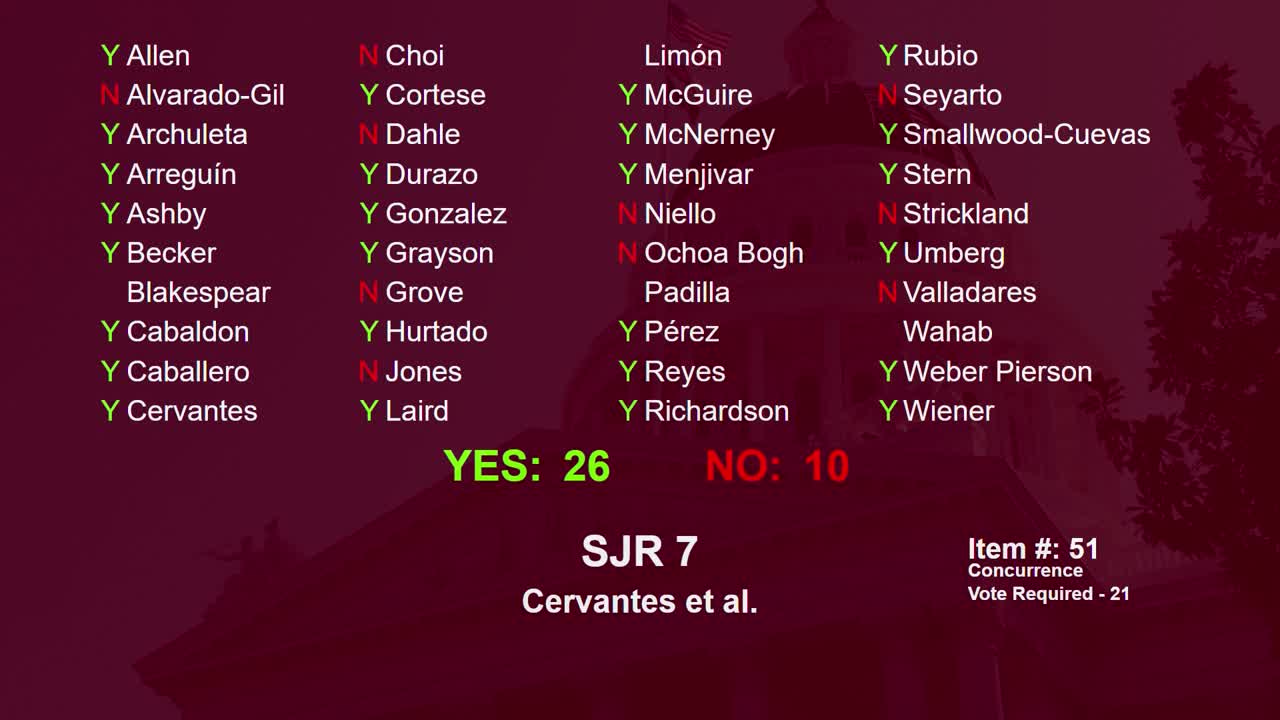 2MIN
Senate Floor
 5MIN
Senate Standing Committee on Labor, Public Employment and Retirement
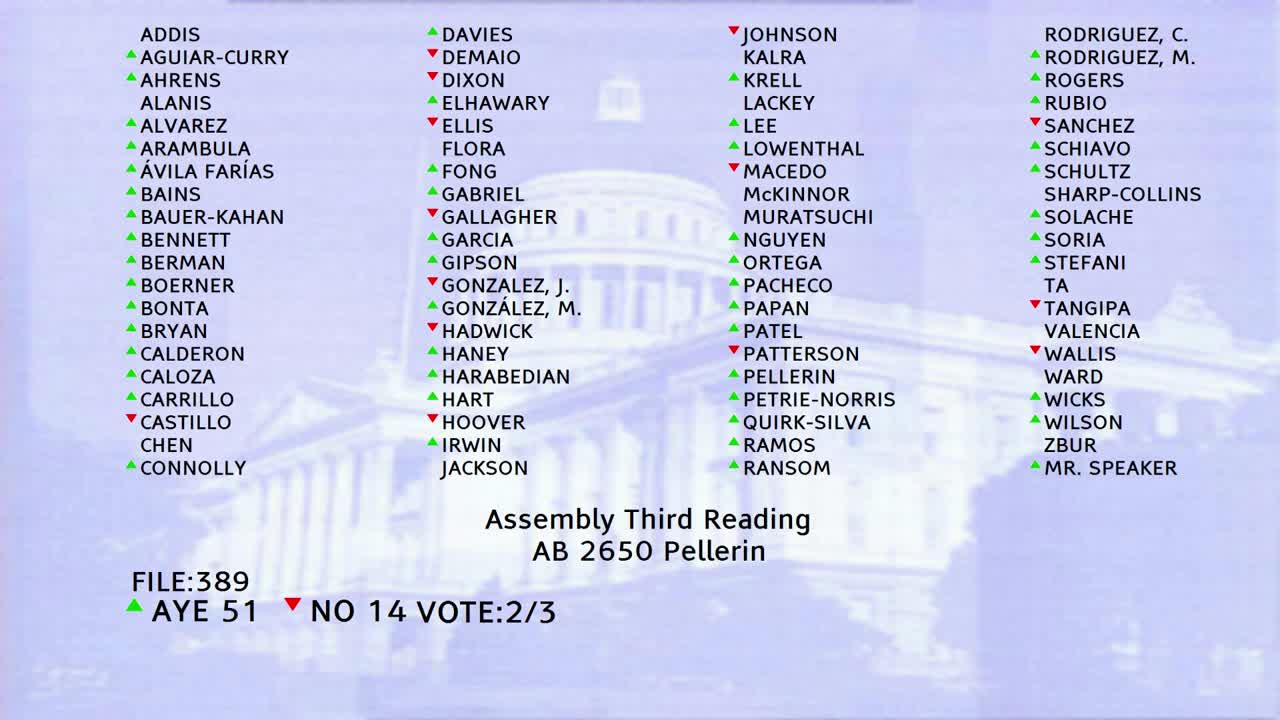 1MIN
Assembly Floor
 7MIN
Assembly Standing Committee on Public Employment and Retirement
Bill Author

Bill Co-Author(s):