AB 1628: Child protection: safe surrender.
- Session Year: 2025-2026
- House: Assembly
- Latest Version Date: 2026-09-27
Current Status:
Passed
(2026-09-27: Chaptered by Secretary of State - Chapter 534, Statutes of 2026.)
Introduced
In Committee
Awaiting First Chamber Vote
Passed First Chamber
In Committee
Awaiting Second Chamber Vote
Passed Second Chamber
Enacted
Existing law defines a safe-surrender site to mean a location designated by the board of supervisors of a county or by a local fire agency, or a location within a public or private hospital that is designated by that hospital, to be responsible for accepting physical custody of a minor child who is 72 hours old or younger from a parent or individual who has lawful custody of that child and who surrenders the child. Existing law requires personnel on duty at a safe-surrender site to accept physical custody of the minor child, and to notify child protective services or a county agency providing child welfare services as soon as possible, but no later than 48 hours after accepting custody of the child.
Under existing law, a parent or other individual with lawful custody of a minor child 72 hours old or younger who voluntarily surrenders physical custody of the child to personnel on duty at a safe-surrender site cannot be prosecuted for child abandonment.
This bill, the Keeping Infants from Danger (KID) Act, would expand the scope of these provisions to apply to children who are 30 days of age or younger. By imposing new duties on local officials, the bill would impose a state-mandated local program.
This bill would also make a conforming change.
The California Constitution requires the state to reimburse local agencies and school districts for certain costs mandated by the state. Statutory provisions establish procedures for making that reimbursement.
This bill would provide that, if the Commission on State Mandates determines that the bill contains costs mandated by the state, reimbursement for those costs shall be made pursuant to the statutory provisions noted above.
This act shall be known, and may be cited, as The Keeping Infants from Danger (KID) Act.
SEC. 2.Section 51934 of the Education Code is amended to read:51934.(a)Each school district shall ensure that all pupils in grades 7 to 12, inclusive, receive comprehensive sexual health education and HIV prevention education from instructors trained in the appropriate courses. Each pupil shall receive this instruction at least once in junior high or middle school and at least once in high school. This instruction shall include all of the following:
(1)Information on the nature of HIV, as well as other sexually transmitted infections, and their effects on the human body.
(2)Information on the manner in which HIV and other sexually transmitted infections are and are not transmitted, including information on the relative risk of infection according to specific behaviors, including sexual activities and injection drug use.
(3)Information that abstinence from sexual activity and injection drug use is the only certain way to prevent HIV and other sexually transmitted infections and abstinence from sexual intercourse is the only certain way to prevent unintended pregnancy. This instruction shall provide information about the value of delaying sexual activity while also providing medically accurate information on other methods of preventing HIV and other sexually transmitted infections and pregnancy.
(4)Information about the effectiveness and safety of all federal Food and Drug Administration (FDA) approved methods that prevent or reduce the risk of contracting HIV and other sexually transmitted infections, including use of antiretroviral medication, consistent with the federal Centers for Disease Control and Prevention.
(5)Information about the effectiveness and safety of reducing the risk of HIV transmission as a result of injection drug use by decreasing needle use and needle sharing.
(6)Information about the treatment of HIV and other sexually transmitted infections, including how antiretroviral therapy can dramatically prolong the lives of many people living with HIV and reduce the likelihood of transmitting HIV to others.
(7)Discussion about social views on HIV and AIDS, including addressing unfounded stereotypes and myths regarding HIV and AIDS and people living with HIV. This instruction shall emphasize that successfully treated HIV-positive individuals have a normal life expectancy, all people are at some risk of contracting HIV, and the only way to know if one is HIV-positive is to get tested.
(8)Information about local resources, how to access local resources, and pupils legal rights to access local resources for sexual and reproductive health care such as testing and medical care for HIV and other sexually transmitted infections and pregnancy prevention and care, as well as local resources for assistance with sexual assault and intimate partner violence.
(9)Information about the effectiveness and safety of all FDA-approved contraceptive methods in preventing pregnancy, including, but not limited to, emergency contraception. Instruction on pregnancy shall include an objective discussion of all legally available pregnancy outcomes, including, but not limited to, all of the following:
(A)Parenting, adoption, and abortion.
(B)Information on the law on surrendering physical custody of a minor child 30 days of age or younger, pursuant to Section 1255.7 of the Health and Safety Code and Section 271.5 of the Penal Code.
(C)The importance of prenatal care.
(10)Information about sexual assault, sexual harassment, sexual abuse, and human trafficking. Information on human trafficking shall include both of the following:
(A)Information on the prevalence, nature, and strategies to reduce the risk of human trafficking, techniques to set healthy boundaries, and how to safely seek assistance.
(B)Information on how social media and mobile device applications are used for human trafficking.
(11)Information about adolescent relationship abuse and intimate partner violence, including the early warning signs thereof, and information about the resources available to pupils related to adolescent relationship abuse and intimate partner violence, including the National Domestic Violence Hotline and local domestic violence hotlines that provide confidential support services for pupils that have experienced domestic violence or stalking and are available by telephone 24 hours a day.
(b)A school district may provide optional instruction, as part of comprehensive sexual health education and HIV prevention education, regarding the potential risks and consequences of creating and sharing sexually suggestive or sexually explicit materials through cellular telephones, social networking internet websites, computer networks, or other digital media.
(c)A school district may provide comprehensive sexual health education or HIV prevention education consisting of age-appropriate instruction earlier than grade 7 using instructors trained in the appropriate courses. A school district that elects to offer comprehensive sexual health education or HIV prevention education earlier than grade 7 may provide age appropriate and medically accurate information on any of the general topics contained in paragraphs (1) to (11), inclusive, of subdivision (a).
SEC. 3.Section 1255.7 of the Health and Safety Code is amended to read:1255.7.(a)(1)For purposes of this section, safe-surrender site means either of the following:
(A)A location designated by the board of supervisors of a county or by a local fire agency, upon the approval of the appropriate local governing body of the agency, to be responsible for accepting physical custody of a minor child who is 30 days of age or younger from a parent or individual who has lawful custody of the child and who surrenders the child pursuant to Section 271.5 of the Penal Code. Before designating a location as a safe-surrender site pursuant to this subdivision, the designating entity shall consult with the governing body of a city, if the site is within the city limits, and with representatives of a fire department and a child welfare agency that may provide services to a child who is surrendered at the site, if that location is selected.
(B)A location within a public or private hospital that is designated by that hospital to be responsible for accepting physical custody of a minor child who is 30 days of age or younger from a parent or individual who has lawful custody of the child and who surrenders the child pursuant to Section 271.5 of the Penal Code.
(2)For purposes of this section, parent means a birth parent of a minor child who is 30 days of age or younger.
(3)For purposes of this section, personnel means a person who is an officer or employee of a safe-surrender site or who has staff privileges at the site.
(4)A hospital and a safe-surrender site designated by the county board of supervisors or by a local fire agency, upon the approval of the appropriate local governing body of the agency, shall post a sign displaying a statewide logo that has been adopted by the State Department of Social Services that notifies the public of the location where a minor child 30 days of age or younger may be safely surrendered pursuant to this section.
(b)Personnel on duty at a safe-surrender site shall accept physical custody of a minor child 30 days of age or younger pursuant to this section if a parent or other individual having lawful custody of the child voluntarily surrenders physical custody of the child to personnel who are on duty at the safe-surrender site. Safe-surrender site personnel shall ensure that a qualified person does all of the following:
(1)Places a coded, confidential ankle bracelet on the child.
(2)Provides, or makes a good faith effort to provide, to the parent or other individual surrendering the child a copy of a unique, coded, confidential ankle bracelet identification in order to facilitate reclaiming the child pursuant to subdivision (f). However, possession of the ankle bracelet identification, in and of itself, does not establish parentage or a right to custody of the child.
(3)Provides, or makes a good faith effort to provide, to the parent or other individual surrendering the child a medical information questionnaire, which may be declined, voluntarily filled out and returned at the time the child is surrendered, or later filled out and mailed in the envelope provided for this purpose. This medical information questionnaire shall not require identifying information about the child or the parent or individual surrendering the child, other than the identification code provided in the ankle bracelet placed on the child. Every questionnaire provided pursuant to this section shall begin with the following notice in no less than 12-point type:
NOTICE: THE BABY YOU HAVE BROUGHT IN TODAY MAY HAVE SERIOUS MEDICAL NEEDS IN THE FUTURE THAT WE DONT KNOW ABOUT TODAY. SOME ILLNESSES, INCLUDING CANCER, ARE BEST TREATED WHEN WE KNOW ABOUT FAMILY MEDICAL HISTORIES. IN ADDITION, SOMETIMES RELATIVES ARE NEEDED FOR LIFE-SAVING TREATMENTS. TO MAKE SURE THIS BABY WILL HAVE A HEALTHY FUTURE, YOUR ASSISTANCE IN COMPLETING THIS QUESTIONNAIRE FULLY IS ESSENTIAL. THANK YOU.
(c)Personnel of a safe-surrender site that has physical custody of a minor child pursuant to this section shall ensure that a medical screening examination and any necessary medical care is provided to the minor child. Notwithstanding any other provision of law, the consent of the parent or other relative shall not be required to provide that care to the minor child.
(d)(1)As soon as possible, but in no event later than 48 hours after the physical custody of a child has been accepted pursuant to this section, personnel of the safe-surrender site that has physical custody of the child shall notify child protective services or a county agency providing child welfare services pursuant to Section 16501 of the Welfare and Institutions Code, that the safe-surrender site has physical custody of the child pursuant to this section. In addition, medical information pertinent to the childs health, including, but not limited to, information obtained pursuant to the medical information questionnaire described in paragraph (3) of subdivision (b) that has been received by or is in the possession of the safe-surrender site shall be provided to that child protective services or county agency.
(2)Any personal identifying information that pertains to a parent or individual who surrenders a child that is obtained pursuant to the medical information questionnaire is confidential and shall be exempt from disclosure by the child protective services or county agency under the California Public Records Act (Division 10 (commencing with Section 7920.000) of Title 1 of the Government Code). Personal identifying information that pertains to a parent or individual who surrenders a child shall be redacted from any medical information provided to child protective services or the county agency providing child welfare services.
(e)Child protective services or the county agency providing child welfare services pursuant to Section 16501 of the Welfare and Institutions Code shall assume temporary custody of the child pursuant to Section 300 of the Welfare and Institutions Code immediately upon receipt of notice under subdivision (d). Child protective services or the county agency providing child welfare services pursuant to Section 16501 of the Welfare and Institutions Code shall immediately investigate the circumstances of the case and file a petition pursuant to Section 311 of the Welfare and Institutions Code. Child protective services or the county agency providing child welfare services pursuant to Section 16501 of the Welfare and Institutions Code shall immediately notify the State Department of Social Services of each child to whom this subdivision applies upon taking temporary custody of the child pursuant to Section 300 of the Welfare and Institutions Code. As soon as possible, but no later than 24 hours after temporary custody is assumed, child protective services or the county agency providing child welfare services pursuant to Section 16501 of the Welfare and Institutions Code shall report all known identifying information concerning the child, except personal identifying information pertaining to the parent or individual who surrendered the child, to the California Missing Children Clearinghouse and to the National Crime Information Center.
(f)If, prior to the filing of a petition under subdivision (e), a parent or individual who has voluntarily surrendered a child pursuant to this section requests that the safe-surrender site that has physical custody of the child pursuant to this section return the child and the safe-surrender site still has custody of the child, personnel of the safe-surrender site shall either return the child to the parent or individual or contact a child protective agency if any personnel at the safe-surrender site knows or reasonably suspects that the child has been the victim of child abuse or neglect. The voluntary surrender of a child pursuant to this section is not in and of itself a sufficient basis for reporting child abuse or neglect. The terms child abuse, child protective agency, mandated reporter, neglect, and reasonably suspects shall be given the same meanings as in Article 2.5 (commencing with Section 11164) of Title 1 of Part 4 of the Penal Code.
(g)Subsequent to the filing of a petition under subdivision (e), if, within 14 days of the voluntary surrender described in this section, the parent or individual who surrendered custody returns to claim physical custody of the child, the child welfare agency shall verify the identity of the parent or individual, conduct an assessment of that persons circumstances and ability to parent, and request that the juvenile court dismiss the petition for dependency and order the release of the child, if the child welfare agency determines that none of the conditions described in subdivisions (a) to (d), inclusive, of Section 319 of the Welfare and Institutions Code currently exist.
(h)A safe-surrender site, or the personnel of a safe-surrender site, shall not have liability of any kind for a surrendered child prior to taking actual physical custody of the child. A safe-surrender site, or personnel of the safe-surrender site, that accepts custody of a surrendered child pursuant to this section shall not be subject to civil, criminal, or administrative liability for accepting the child and caring for the child in the good faith belief that action is required or authorized by this section, including, but not limited to, instances where the child is older than 30 days of age or the parent or individual surrendering the child did not have lawful physical custody of the child. A safe-surrender site, or the personnel of a safe-surrender site, shall not be subject to civil, criminal, or administrative liability for a surrendered child prior to the time that the site or its personnel know, or should know, that the child has been surrendered. This subdivision does not confer immunity from liability for personal injury or wrongful death, including, but not limited to, injury resulting from medical malpractice.
(i)(1)In order to encourage assistance to persons who voluntarily surrender physical custody of a child pursuant to this section or Section 271.5 of the Penal Code, no person who, without compensation and in good faith, provides assistance for the purpose of effecting the safe surrender of a minor 30 days of age or younger shall be civilly liable for injury to or death of the minor child as a result of the persons acts or omissions. This immunity does not apply to an act or omission constituting gross negligence, recklessness, or willful misconduct.
(2)For purposes of this section, assistance means transporting the minor child to the safe-surrender site as a person with lawful custody, or transporting or accompanying the parent or person with lawful custody at the request of that parent or person to effect the safe surrender, or performing any other act in good faith for the purpose of effecting the safe surrender of the minor.
(j)For purposes of this section, lawful custody means physical custody of a minor 30 days of age or younger accepted by a person from a parent of the minor, who the person believes in good faith is the parent of the minor, with the specific intent and promise of effecting the safe surrender of the minor.
(k)Any identifying information that pertains to a parent or individual who surrenders a child pursuant to this section, that is obtained as a result of the questionnaire described in paragraph (3) of subdivision (b) or in any other manner, is confidential, shall be exempt from disclosure under the California Public Records Act (Division 10 (commencing with Section 7920.000) of Title 1 of the Government Code), and shall not be disclosed by any personnel of a safe-surrender site that accepts custody of a child pursuant to this section.
SEC. 4.Section 271.5 of the Penal Code is amended to read:271.5.(a)A parent or other individual having lawful custody of a minor child 30 days of age or younger shall not be prosecuted for a violation of Section 270, 270.5, 271, or 271a if that person voluntarily surrenders physical custody of the child to personnel on duty at a safe-surrender site.
(b)For purposes of this section, safe-surrender site has the same meaning as defined in paragraph (1) of subdivision (a) of Section 1255.7 of the Health and Safety Code.
(c)(1)For purposes of this section, lawful custody has the same meaning as defined in subdivision (j) of Section 1255.7 of the Health and Safety Code.
(2)For purposes of this section, personnel has the same meaning as defined in paragraph (3) of subdivision (a) of Section 1255.7 of the Health and Safety Code.
SEC. 5.If the Commission on State Mandates determines that this act contains costs mandated by the state, reimbursement to local agencies and school districts for those costs shall be made pursuant to Part 7 (commencing with Section 17500) of Division 4 of Title 2 of the Government Code.
This act shall be known, and may be cited, as The Keeping Infants from Danger (KID) Act.
SEC. 2.Section 51934 of the Education Code is amended to read:51934.(a)Each school district shall ensure that all pupils in grades 7 to 12, inclusive, receive comprehensive sexual health education and HIV prevention education from instructors trained in the appropriate courses. Each pupil shall receive this instruction at least once in junior high or middle school and at least once in high school. This instruction shall include all of the following:
(1)Information on the nature of HIV, as well as other sexually transmitted infections, and their effects on the human body.
(2)Information on the manner in which HIV and other sexually transmitted infections are and are not transmitted, including information on the relative risk of infection according to specific behaviors, including sexual activities and injection drug use.
(3)Information that abstinence from sexual activity and injection drug use is the only certain way to prevent HIV and other sexually transmitted infections and abstinence from sexual intercourse is the only certain way to prevent unintended pregnancy. This instruction shall provide information about the value of delaying sexual activity while also providing medically accurate information on other methods of preventing HIV and other sexually transmitted infections and pregnancy.
(4)Information about the effectiveness and safety of all federal Food and Drug Administration (FDA) approved methods that prevent or reduce the risk of contracting HIV and other sexually transmitted infections, including use of antiretroviral medication, consistent with the federal Centers for Disease Control and Prevention.
(5)Information about the effectiveness and safety of reducing the risk of HIV transmission as a result of injection drug use by decreasing needle use and needle sharing.
(6)Information about the treatment of HIV and other sexually transmitted infections, including how antiretroviral therapy can dramatically prolong the lives of many people living with HIV and reduce the likelihood of transmitting HIV to others.
(7)Discussion about social views on HIV and AIDS, including addressing unfounded stereotypes and myths regarding HIV and AIDS and people living with HIV. This instruction shall emphasize that successfully treated HIV-positive individuals have a normal life expectancy, all people are at some risk of contracting HIV, and the only way to know if one is HIV-positive is to get tested.
(8)Information about local resources, how to access local resources, and pupils legal rights to access local resources for sexual and reproductive health care such as testing and medical care for HIV and other sexually transmitted infections and pregnancy prevention and care, as well as local resources for assistance with sexual assault and intimate partner violence.
(9)Information about the effectiveness and safety of all FDA-approved contraceptive methods in preventing pregnancy, including, but not limited to, emergency contraception. Instruction on pregnancy shall include an objective discussion of all legally available pregnancy outcomes, including, but not limited to, all of the following:
(A)Parenting, adoption, and abortion.
(B)Information on the law on surrendering physical custody of a minor child 30 days of age or younger, pursuant to Section 1255.7 of the Health and Safety Code and Section 271.5 of the Penal Code.
(C)The importance of prenatal care.
(10)Information about sexual assault, sexual harassment, sexual abuse, and human trafficking. Information on human trafficking shall include both of the following:
(A)Information on the prevalence, nature, and strategies to reduce the risk of human trafficking, techniques to set healthy boundaries, and how to safely seek assistance.
(B)Information on how social media and mobile device applications are used for human trafficking.
(11)Information about adolescent relationship abuse and intimate partner violence, including the early warning signs thereof, and information about the resources available to pupils related to adolescent relationship abuse and intimate partner violence, including the National Domestic Violence Hotline and local domestic violence hotlines that provide confidential support services for pupils that have experienced domestic violence or stalking and are available by telephone 24 hours a day.
(b)A school district may provide optional instruction, as part of comprehensive sexual health education and HIV prevention education, regarding the potential risks and consequences of creating and sharing sexually suggestive or sexually explicit materials through cellular telephones, social networking internet websites, computer networks, or other digital media.
(c)A school district may provide comprehensive sexual health education or HIV prevention education consisting of age-appropriate instruction earlier than grade 7 using instructors trained in the appropriate courses. A school district that elects to offer comprehensive sexual health education or HIV prevention education earlier than grade 7 may provide age appropriate and medically accurate information on any of the general topics contained in paragraphs (1) to (11), inclusive, of subdivision (a).
SEC. 3.Section 1255.7 of the Health and Safety Code is amended to read:1255.7.(a)(1)For purposes of this section, safe-surrender site means either of the following:
(A)A location designated by the board of supervisors of a county or by a local fire agency, upon the approval of the appropriate local governing body of the agency, to be responsible for accepting physical custody of a minor child who is 30 days of age or younger from a parent or individual who has lawful custody of the child and who surrenders the child pursuant to Section 271.5 of the Penal Code. Before designating a location as a safe-surrender site pursuant to this subdivision, the designating entity shall consult with the governing body of a city, if the site is within the city limits, and with representatives of a fire department and a child welfare agency that may provide services to a child who is surrendered at the site, if that location is selected.
(B)A location within a public or private hospital that is designated by that hospital to be responsible for accepting physical custody of a minor child who is 30 days of age or younger from a parent or individual who has lawful custody of the child and who surrenders the child pursuant to Section 271.5 of the Penal Code.
(2)For purposes of this section, parent means a birth parent of a minor child who is 30 days of age or younger.
(3)For purposes of this section, personnel means a person who is an officer or employee of a safe-surrender site or who has staff privileges at the site.
(4)A hospital and a safe-surrender site designated by the county board of supervisors or by a local fire agency, upon the approval of the appropriate local governing body of the agency, shall post a sign displaying a statewide logo that has been adopted by the State Department of Social Services that notifies the public of the location where a minor child 30 days of age or younger may be safely surrendered pursuant to this section.
(b)Personnel on duty at a safe-surrender site shall accept physical custody of a minor child 30 days of age or younger pursuant to this section if a parent or other individual having lawful custody of the child voluntarily surrenders physical custody of the child to personnel who are on duty at the safe-surrender site. Safe-surrender site personnel shall ensure that a qualified person does all of the following:
(1)Places a coded, confidential ankle bracelet on the child.
(2)Provides, or makes a good faith effort to provide, to the parent or other individual surrendering the child a copy of a unique, coded, confidential ankle bracelet identification in order to facilitate reclaiming the child pursuant to subdivision (f). However, possession of the ankle bracelet identification, in and of itself, does not establish parentage or a right to custody of the child.
(3)Provides, or makes a good faith effort to provide, to the parent or other individual surrendering the child a medical information questionnaire, which may be declined, voluntarily filled out and returned at the time the child is surrendered, or later filled out and mailed in the envelope provided for this purpose. This medical information questionnaire shall not require identifying information about the child or the parent or individual surrendering the child, other than the identification code provided in the ankle bracelet placed on the child. Every questionnaire provided pursuant to this section shall begin with the following notice in no less than 12-point type:
NOTICE: THE BABY YOU HAVE BROUGHT IN TODAY MAY HAVE SERIOUS MEDICAL NEEDS IN THE FUTURE THAT WE DONT KNOW ABOUT TODAY. SOME ILLNESSES, INCLUDING CANCER, ARE BEST TREATED WHEN WE KNOW ABOUT FAMILY MEDICAL HISTORIES. IN ADDITION, SOMETIMES RELATIVES ARE NEEDED FOR LIFE-SAVING TREATMENTS. TO MAKE SURE THIS BABY WILL HAVE A HEALTHY FUTURE, YOUR ASSISTANCE IN COMPLETING THIS QUESTIONNAIRE FULLY IS ESSENTIAL. THANK YOU.
(c)Personnel of a safe-surrender site that has physical custody of a minor child pursuant to this section shall ensure that a medical screening examination and any necessary medical care is provided to the minor child. Notwithstanding any other provision of law, the consent of the parent or other relative shall not be required to provide that care to the minor child.
(d)(1)As soon as possible, but in no event later than 48 hours after the physical custody of a child has been accepted pursuant to this section, personnel of the safe-surrender site that has physical custody of the child shall notify child protective services or a county agency providing child welfare services pursuant to Section 16501 of the Welfare and Institutions Code, that the safe-surrender site has physical custody of the child pursuant to this section. In addition, medical information pertinent to the childs health, including, but not limited to, information obtained pursuant to the medical information questionnaire described in paragraph (3) of subdivision (b) that has been received by or is in the possession of the safe-surrender site shall be provided to that child protective services or county agency.
(2)Any personal identifying information that pertains to a parent or individual who surrenders a child that is obtained pursuant to the medical information questionnaire is confidential and shall be exempt from disclosure by the child protective services or county agency under the California Public Records Act (Division 10 (commencing with Section 7920.000) of Title 1 of the Government Code). Personal identifying information that pertains to a parent or individual who surrenders a child shall be redacted from any medical information provided to child protective services or the county agency providing child welfare services.
(e)Child protective services or the county agency providing child welfare services pursuant to Section 16501 of the Welfare and Institutions Code shall assume temporary custody of the child pursuant to Section 300 of the Welfare and Institutions Code immediately upon receipt of notice under subdivision (d). Child protective services or the county agency providing child welfare services pursuant to Section 16501 of the Welfare and Institutions Code shall immediately investigate the circumstances of the case and file a petition pursuant to Section 311 of the Welfare and Institutions Code. Child protective services or the county agency providing child welfare services pursuant to Section 16501 of the Welfare and Institutions Code shall immediately notify the State Department of Social Services of each child to whom this subdivision applies upon taking temporary custody of the child pursuant to Section 300 of the Welfare and Institutions Code. As soon as possible, but no later than 24 hours after temporary custody is assumed, child protective services or the county agency providing child welfare services pursuant to Section 16501 of the Welfare and Institutions Code shall report all known identifying information concerning the child, except personal identifying information pertaining to the parent or individual who surrendered the child, to the California Missing Children Clearinghouse and to the National Crime Information Center.
(f)If, prior to the filing of a petition under subdivision (e), a parent or individual who has voluntarily surrendered a child pursuant to this section requests that the safe-surrender site that has physical custody of the child pursuant to this section return the child and the safe-surrender site still has custody of the child, personnel of the safe-surrender site shall either return the child to the parent or individual or contact a child protective agency if any personnel at the safe-surrender site knows or reasonably suspects that the child has been the victim of child abuse or neglect. The voluntary surrender of a child pursuant to this section is not in and of itself a sufficient basis for reporting child abuse or neglect. The terms child abuse, child protective agency, mandated reporter, neglect, and reasonably suspects shall be given the same meanings as in Article 2.5 (commencing with Section 11164) of Title 1 of Part 4 of the Penal Code.
(g)Subsequent to the filing of a petition under subdivision (e), if, within 14 days of the voluntary surrender described in this section, the parent or individual who surrendered custody returns to claim physical custody of the child, the child welfare agency shall verify the identity of the parent or individual, conduct an assessment of that persons circumstances and ability to parent, and request that the juvenile court dismiss the petition for dependency and order the release of the child, if the child welfare agency determines that none of the conditions described in subdivisions (a) to (d), inclusive, of Section 319 of the Welfare and Institutions Code currently exist.
(h)A safe-surrender site, or the personnel of a safe-surrender site, shall not have liability of any kind for a surrendered child prior to taking actual physical custody of the child. A safe-surrender site, or personnel of the safe-surrender site, that accepts custody of a surrendered child pursuant to this section shall not be subject to civil, criminal, or administrative liability for accepting the child and caring for the child in the good faith belief that action is required or authorized by this section, including, but not limited to, instances where the child is older than 30 days of age or the parent or individual surrendering the child did not have lawful physical custody of the child. A safe-surrender site, or the personnel of a safe-surrender site, shall not be subject to civil, criminal, or administrative liability for a surrendered child prior to the time that the site or its personnel know, or should know, that the child has been surrendered. This subdivision does not confer immunity from liability for personal injury or wrongful death, including, but not limited to, injury resulting from medical malpractice.
(i)(1)In order to encourage assistance to persons who voluntarily surrender physical custody of a child pursuant to this section or Section 271.5 of the Penal Code, no person who, without compensation and in good faith, provides assistance for the purpose of effecting the safe surrender of a minor 30 days of age or younger shall be civilly liable for injury to or death of the minor child as a result of the persons acts or omissions. This immunity does not apply to an act or omission constituting gross negligence, recklessness, or willful misconduct.
(2)For purposes of this section, assistance means transporting the minor child to the safe-surrender site as a person with lawful custody, or transporting or accompanying the parent or person with lawful custody at the request of that parent or person to effect the safe surrender, or performing any other act in good faith for the purpose of effecting the safe surrender of the minor.
(j)For purposes of this section, lawful custody means physical custody of a minor 30 days of age or younger accepted by a person from a parent of the minor, who the person believes in good faith is the parent of the minor, with the specific intent and promise of effecting the safe surrender of the minor.
(k)Any identifying information that pertains to a parent or individual who surrenders a child pursuant to this section, that is obtained as a result of the questionnaire described in paragraph (3) of subdivision (b) or in any other manner, is confidential, shall be exempt from disclosure under the California Public Records Act (Division 10 (commencing with Section 7920.000) of Title 1 of the Government Code), and shall not be disclosed by any personnel of a safe-surrender site that accepts custody of a child pursuant to this section.
SEC. 4.Section 271.5 of the Penal Code is amended to read:271.5.(a)No A parent or other individual having lawful custody of a minor child 30 days of age or younger may shall not be prosecuted for a violation of Section 270, 270.5, 271, or 271a if that person voluntarily surrenders physical custody of the child to personnel on duty at a safe-surrender site.
(b)For purposes of this section, safe-surrender site has the same meaning as defined in paragraph (1) of subdivision (a) of Section 1255.7 of the Health and Safety Code.
(c)(1)For purposes of this section, lawful custody has the same meaning as defined in subdivision (j) of Section 1255.7 of the Health and Safety Code.
(2)For purposes of this section, personnel has the same meaning as defined in paragraph (3) of subdivision (a) of Section 1255.7 of the Health and Safety Code.
SEC. 5.If the Commission on State Mandates determines that this act contains costs mandated by the state, reimbursement to local agencies and school districts for those costs shall be made pursuant to Part 7 (commencing with Section 17500) of Division 4 of Title 2 of the Government Code.
REVISIONS: HeadingLine 3.This act shall be known, and may be cited, as The Keeping Infants from Danger (KID) Act.
SEC. 2.Section 51934 of the Education Code is amended to read:51934.(a)Each school district shall ensure that all pupils in grades 7 to 12, inclusive, receive comprehensive sexual health education and HIV prevention education from instructors trained in the appropriate courses. Each pupil shall receive this instruction at least once in junior high or middle school and at least once in high school. This instruction shall include all of the following:
(1)Information on the nature of HIV, as well as other sexually transmitted infections, and their effects on the human body.
(2)Information on the manner in which HIV and other sexually transmitted infections are and are not transmitted, including information on the relative risk of infection according to specific behaviors, including sexual activities and injection drug use.
(3)Information that abstinence from sexual activity and injection drug use is the only certain way to prevent HIV and other sexually transmitted infections and abstinence from sexual intercourse is the only certain way to prevent unintended pregnancy. This instruction shall provide information about the value of delaying sexual activity while also providing medically accurate information on other methods of preventing HIV and other sexually transmitted infections and pregnancy.
(4)Information about the effectiveness and safety of all federal Food and Drug Administration (FDA) approved methods that prevent or reduce the risk of contracting HIV and other sexually transmitted infections, including use of antiretroviral medication, consistent with the federal Centers for Disease Control and Prevention.
(5)Information about the effectiveness and safety of reducing the risk of HIV transmission as a result of injection drug use by decreasing needle use and needle sharing.
(6)Information about the treatment of HIV and other sexually transmitted infections, including how antiretroviral therapy can dramatically prolong the lives of many people living with HIV and reduce the likelihood of transmitting HIV to others.
(7)Discussion about social views on HIV and AIDS, including addressing unfounded stereotypes and myths regarding HIV and AIDS and people living with HIV. This instruction shall emphasize that successfully treated HIV-positive individuals have a normal life expectancy, all people are at some risk of contracting HIV, and the only way to know if one is HIV-positive is to get tested.
(8)Information about local resources, how to access local resources, and pupils legal rights to access local resources for sexual and reproductive health care such as testing and medical care for HIV and other sexually transmitted infections and pregnancy prevention and care, as well as local resources for assistance with sexual assault and intimate partner violence.
(9)Information about the effectiveness and safety of all FDA-approved contraceptive methods in preventing pregnancy, including, but not limited to, emergency contraception. Instruction on pregnancy shall include an objective discussion of all legally available pregnancy outcomes, including, but not limited to, all of the following:
(A)Parenting, adoption, and abortion.
(B)Information on the law on surrendering physical custody of a minor child 72 hours 30 days of age or younger, pursuant to Section 1255.7 of the Health and Safety Code and Section 271.5 of the Penal Code.
(C)The importance of prenatal care.
(10)Information about sexual assault, sexual harassment, sexual abuse, and human trafficking. Information on human trafficking shall include both of the following:
(A)Information on the prevalence, nature, and strategies to reduce the risk of human trafficking, techniques to set healthy boundaries, and how to safely seek assistance.
(B)Information on how social media and mobile device applications are used for human trafficking.
(11)Information about adolescent relationship abuse and intimate partner violence, including the early warning signs thereof, and information about the resources available to pupils related to adolescent relationship abuse and intimate partner violence, including the National Domestic Violence Hotline and local domestic violence hotlines that provide confidential support services for pupils that have experienced domestic violence or stalking and are available by telephone 24 hours a day.
(b)A school district may provide optional instruction, as part of comprehensive sexual health education and HIV prevention education, regarding the potential risks and consequences of creating and sharing sexually suggestive or sexually explicit materials through cellular telephones, social networking internet websites, computer networks, or other digital media.
(c)A school district may provide comprehensive sexual health education or HIV prevention education consisting of age-appropriate instruction earlier than grade 7 using instructors trained in the appropriate courses. A school district that elects to offer comprehensive sexual health education or HIV prevention education earlier than grade 7 may provide age appropriate and medically accurate information on any of the general topics contained in paragraphs (1) to (11), inclusive, of subdivision (a).
SEC. 3.Section 1255.7 of the Health and Safety Code is amended to read:1255.7.(a)(1)For purposes of this section, safe-surrender site means either of the following:
(A)A location designated by the board of supervisors of a county or by a local fire agency, upon the approval of the appropriate local governing body of the agency, to be responsible for accepting physical custody of a minor child who is 72 hours old 30 days of age or younger from a parent or individual who has lawful custody of the child and who surrenders the child pursuant to Section 271.5 of the Penal Code. Before designating a location as a safe-surrender site pursuant to this subdivision, the designating entity shall consult with the governing body of a city, if the site is within the city limits, and with representatives of a fire department and a child welfare agency that may provide services to a child who is surrendered at the site, if that location is selected.
(B)A location within a public or private hospital that is designated by that hospital to be responsible for accepting physical custody of a minor child who is 72 hours old 30 days of age or younger from a parent or individual who has lawful custody of the child and who surrenders the child pursuant to Section 271.5 of the Penal Code.
(2)For purposes of this section, parent means a birth parent of a minor child who is 72 hours old 30 days of age or younger.
(3)For purposes of this section, personnel means a person who is an officer or employee of a safe-surrender site or who has staff privileges at the site.
(4)A hospital and a safe-surrender site designated by the county board of supervisors or by a local fire agency, upon the approval of the appropriate local governing body of the agency, shall post a sign displaying a statewide logo that has been adopted by the State Department of Social Services that notifies the public of the location where a minor child 72 hours old 30 days of age or younger may be safely surrendered pursuant to this section.
(b)Personnel on duty at a safe-surrender site shall accept physical custody of a minor child 72 hours old 30 days of age or younger pursuant to this section if a parent or other individual having lawful custody of the child voluntarily surrenders physical custody of the child to personnel who are on duty at the safe-surrender site. Safe-surrender site personnel shall ensure that a qualified person does all of the following:
(1)Places a coded, confidential ankle bracelet on the child.
(2)Provides, or makes a good faith effort to provide, to the parent or other individual surrendering the child a copy of a unique, coded, confidential ankle bracelet identification in order to facilitate reclaiming the child pursuant to subdivision (f). However, possession of the ankle bracelet identification, in and of itself, does not establish parentage or a right to custody of the child.
(3)Provides, or makes a good faith effort to provide, to the parent or other individual surrendering the child a medical information questionnaire, which may be declined, voluntarily filled out and returned at the time the child is surrendered, or later filled out and mailed in the envelope provided for this purpose. This medical information questionnaire shall not require identifying information about the child or the parent or individual surrendering the child, other than the identification code provided in the ankle bracelet placed on the child. Every questionnaire provided pursuant to this section shall begin with the following notice in no less than 12-point type:
NOTICE: THE BABY YOU HAVE BROUGHT IN TODAY MAY HAVE SERIOUS MEDICAL NEEDS IN THE FUTURE THAT WE DONT KNOW ABOUT TODAY. SOME ILLNESSES, INCLUDING CANCER, ARE BEST TREATED WHEN WE KNOW ABOUT FAMILY MEDICAL HISTORIES. IN ADDITION, SOMETIMES RELATIVES ARE NEEDED FOR LIFE-SAVING TREATMENTS. TO MAKE SURE THIS BABY WILL HAVE A HEALTHY FUTURE, YOUR ASSISTANCE IN COMPLETING THIS QUESTIONNAIRE FULLY IS ESSENTIAL. THANK YOU.
(c)Personnel of a safe-surrender site that has physical custody of a minor child pursuant to this section shall ensure that a medical screening examination and any necessary medical care is provided to the minor child. Notwithstanding any other provision of law, the consent of the parent or other relative shall not be required to provide that care to the minor child.
(d)(1)As soon as possible, but in no event later than 48 hours after the physical custody of a child has been accepted pursuant to this section, personnel of the safe-surrender site that has physical custody of the child shall notify child protective services or a county agency providing child welfare services pursuant to Section 16501 of the Welfare and Institutions Code, that the safe-surrender site has physical custody of the child pursuant to this section. In addition, medical information pertinent to the childs health, including, but not limited to, information obtained pursuant to the medical information questionnaire described in paragraph (3) of subdivision (b) that has been received by or is in the possession of the safe-surrender site shall be provided to that child protective services or county agency.
(2)Any personal identifying information that pertains to a parent or individual who surrenders a child that is obtained pursuant to the medical information questionnaire is confidential and shall be exempt from disclosure by the child protective services or county agency under the California Public Records Act (Division 10 (commencing with Section 7920.000) of Title 1 of the Government Code). Personal identifying information that pertains to a parent or individual who surrenders a child shall be redacted from any medical information provided to child protective services or the county agency providing child welfare services.
(e)Child protective services or the county agency providing child welfare services pursuant to Section 16501 of the Welfare and Institutions Code shall assume temporary custody of the child pursuant to Section 300 of the Welfare and Institutions Code immediately upon receipt of notice under subdivision (d). Child protective services or the county agency providing child welfare services pursuant to Section 16501 of the Welfare and Institutions Code shall immediately investigate the circumstances of the case and file a petition pursuant to Section 311 of the Welfare and Institutions Code. Child protective services or the county agency providing child welfare services pursuant to Section 16501 of the Welfare and Institutions Code shall immediately notify the State Department of Social Services of each child to whom this subdivision applies upon taking temporary custody of the child pursuant to Section 300 of the Welfare and Institutions Code. As soon as possible, but no later than 24 hours after temporary custody is assumed, child protective services or the county agency providing child welfare services pursuant to Section 16501 of the Welfare and Institutions Code shall report all known identifying information concerning the child, except personal identifying information pertaining to the parent or individual who surrendered the child, to the California Missing Children Clearinghouse and to the National Crime Information Center.
(f)If, prior to the filing of a petition under subdivision (e), a parent or individual who has voluntarily surrendered a child pursuant to this section requests that the safe-surrender site that has physical custody of the child pursuant to this section return the child and the safe-surrender site still has custody of the child, personnel of the safe-surrender site shall either return the child to the parent or individual or contact a child protective agency if any personnel at the safe-surrender site knows or reasonably suspects that the child has been the victim of child abuse or neglect. The voluntary surrender of a child pursuant to this section is not in and of itself a sufficient basis for reporting child abuse or neglect. The terms child abuse, child protective agency, mandated reporter, neglect, and reasonably suspects shall be given the same meanings as in Article 2.5 (commencing with Section 11164) of Title 1 of Part 4 of the Penal Code.
(g)Subsequent to the filing of a petition under subdivision (e), if, within 14 days of the voluntary surrender described in this section, the parent or individual who surrendered custody returns to claim physical custody of the child, the child welfare agency shall verify the identity of the parent or individual, conduct an assessment of that persons circumstances and ability to parent, and request that the juvenile court dismiss the petition for dependency and order the release of the child, if the child welfare agency determines that none of the conditions described in subdivisions (a) to (d), inclusive, of Section 319 of the Welfare and Institutions Code currently exist.
(h)A safe-surrender site, or the personnel of a safe-surrender site, shall not have liability of any kind for a surrendered child prior to taking actual physical custody of the child. A safe-surrender site, or personnel of the safe-surrender site, that accepts custody of a surrendered child pursuant to this section shall not be subject to civil, criminal, or administrative liability for accepting the child and caring for the child in the good faith belief that action is required or authorized by this section, including, but not limited to, instances where the child is older than 72 hours 30 days of age or the parent or individual surrendering the child did not have lawful physical custody of the child. A safe-surrender site, or the personnel of a safe-surrender site, shall not be subject to civil, criminal, or administrative liability for a surrendered child prior to the time that the site or its personnel know, or should know, that the child has been surrendered. This subdivision does not confer immunity from liability for personal injury or wrongful death, including, but not limited to, injury resulting from medical malpractice.
(i)(1)In order to encourage assistance to persons who voluntarily surrender physical custody of a child pursuant to this section or Section 271.5 of the Penal Code, no person who, without compensation and in good faith, provides assistance for the purpose of effecting the safe surrender of a minor 72 hours old 30 days of age or younger shall be civilly liable for injury to or death of the minor child as a result of the persons acts or omissions. This immunity does not apply to an act or omission constituting gross negligence, recklessness, or willful misconduct.
(2)For purposes of this section, assistance means transporting the minor child to the safe-surrender site as a person with lawful custody, or transporting or accompanying the parent or person with lawful custody at the request of that parent or person to effect the safe surrender, or performing any other act in good faith for the purpose of effecting the safe surrender of the minor.
(j)For purposes of this section, lawful custody means physical custody of a minor 72 hours old 30 days of age or younger accepted by a person from a parent of the minor, who the person believes in good faith is the parent of the minor, with the specific intent and promise of effecting the safe surrender of the minor.
(k)Any identifying information that pertains to a parent or individual who surrenders a child pursuant to this section, that is obtained as a result of the questionnaire described in paragraph (3) of subdivision (b) or in any other manner, is confidential, shall be exempt from disclosure under the California Public Records Act (Division 10 (commencing with Section 7920.000) of Title 1 of the Government Code), and shall not be disclosed by any personnel of a safe-surrender site that accepts custody of a child pursuant to this section.
SEC. 4.Section 271.5 of the Penal Code is amended to read:271.5.(a)No parent or other individual having lawful custody of a minor child 72 hours old 30 days of age or younger may be prosecuted for a violation of Section 270, 270.5, 271, or 271a if he or she that person voluntarily surrenders physical custody of the child to personnel on duty at a safe-surrender site.
(b)For purposes of this section, safe-surrender site has the same meaning as defined in paragraph (1) of subdivision (a) of Section 1255.7 of the Health and Safety Code.
(c)(1)For purposes of this section, lawful custody has the same meaning as defined in subdivision (j) of Section 1255.7 of the Health and Safety Code.
(2)For purposes of this section, personnel has the same meaning as defined in paragraph (3) of subdivision (a) of Section 1255.7 of the Health and Safety Code.
SEC. 5.If the Commission on State Mandates determines that this act contains costs mandated by the state, reimbursement to local agencies and school districts for those costs shall be made pursuant to Part 7 (commencing with Section 17500) of Division 4 of Title 2 of the Government Code.
|
Date
|
Status
|
|---|---|
| Sep 27, 2026 | Chaptered by Secretary of State - Chapter 534, Statutes of 2026. |
| Sep 27, 2026 | Approved by the Governor. |
| Sep 3, 2026 | Enrolled and presented to the Governor at 4 p.m. |
| Aug 27, 2026 | In Assembly. Ordered to Engrossing and Enrolling. |
| Aug 26, 2026 | Read third time. Passed. Ordered to the Assembly. (Ayes 40. Noes 0. Page 5911.). |
| Aug 26, 2026 | Read third time. Passed. Ordered to the Assembly. (Ayes 39. Noes 0.). |
| Aug 13, 2026 | Read second time. Ordered to third reading. |
| Aug 13, 2026 | From committee: Do pass. (Ayes 7. Noes 0.) (August 13). |
| Jun 29, 2026 | In committee: Referred to APPR. suspense file. |
| Jun 17, 2026 | From committee: Do pass and re-refer to Com. on APPR. with recommendation: To Consent Calendar. (Ayes 11. Noes 0.) (June 16). Re-referred to Com. on APPR. |
| Jun 3, 2026 | Referred to Com. on JUD. |
| May 21, 2026 | In Senate. Read first time. To Com. on RLS. for assignment. |
| May 21, 2026 | Read third time. Passed. Ordered to the Senate. (Ayes 74. Noes 0. Page 5189.) |
| May 21, 2026 | Read third time. Passed. Ordered to the Senate. (Ayes 74. Noes 0.) |
| May 18, 2026 | Read second time. Ordered to third reading. |
| May 14, 2026 | Joint Rule 62(a), file notice suspended. (Page 5030.) |
| May 14, 2026 | From committee: Do pass. (Ayes 15. Noes 0.) (May 14). |
| May 14, 2026 | Joint Rule 62(a), file notice suspended. |
| May 13, 2026 | In committee: Set, first hearing. Referred to APPR. suspense file. |
| Apr 23, 2026 | From committee: Do pass and re-refer to Com. on APPR. (Ayes 7. Noes 0.) (April 23). Re-referred to Com. on APPR. |
| Apr 23, 2026 | Coauthors revised. |
| Apr 8, 2026 | From committee: Do pass and re-refer to Com. on HUM. S. (Ayes 8. Noes 0.) (April 7). Re-referred to Com. on HUM. S. |
| Apr 8, 2026 | Coauthors revised. |
| Mar 23, 2026 | Re-referred to Com. on PUB. S. |
| Mar 19, 2026 | From committee chair, with author's amendments: Amend, and re-refer to Com. on PUB. S. Read second time and amended. |
| Mar 16, 2026 | Referred to Coms. on PUB. S. and HUM. S. |
| Jan 27, 2026 | From printer. May be heard in committee February 26. |
| Jan 26, 2026 | Read first time. To print. |
|
Date
|
Description
|
Location
|
Votes
|
|
|---|---|---|---|---|
| Aug 26, 2026 | Assembly 3rd Reading AB1628 Michelle Rodriguez By Umberg | Senate Floor |
Passed |
|
| Aug 13, 2026 | Do pass | Senate Standing Committee on Appropriations |
Passed |
|
| Jun 29, 2026 | Placed on suspense file | Senate Standing Committee on Appropriations |
Passed |
|
| Jun 16, 2026 | Do pass, but first be re-referred to the Committee on [Appropriations] with the recommendation: To Consent Calendar | Senate Standing Committee on Judiciary |
Passed |
|
| May 21, 2026 | AB 1628 Michelle Rodriguez Assembly Third Reading | Assembly Floor |
Passed |
|
| May 14, 2026 | Do pass. | Assembly Standing Committee on Appropriations |
Passed |
|
| Apr 23, 2026 | Do pass and be re-referred to the Committee on [Appropriations] | Assembly Standing Committee on Human Services |
Passed |
|
| Apr 7, 2026 | Do pass and be re-referred to the Committee on [Human Services] | Assembly Standing Committee on Public Safety |
Passed |
This list shows positions taken on this bill by organizations on the date displayed, which is linked to the original source.
Positions by individuals are not included.
|
Organization
|
Position
|
Date
|
|---|---|---|
| American Academy Of Pediatrics, California | ** Support | |
| California Baptist Capitol Ministry | ** Support | |
| California Baptist for Biblical Values | ** Support | |
| California Baptists for Biblical Values | ** Support | |
| California Catholic Conference | ** Support | |
| California Family Resource Association | ** Support | |
| California Fire Chiefs Association | ** Support | |
| California Legislative Women's Caucus | ** Support | |
| California Legislative Women’s Caucus | ** Support | |
| California Professional Firefighters | ** Support | |
| Child Abuse Prevention Center | ** Support | |
| Church State Council | ** Support | |
| City of Glendale | ** Support | |
| City of Sunnyvale | ** Support | |
| Concerned Women for America | ** Support | |
| Fire Districts Association Of California | ** Support | |
| Health Officers Association Of California | ** Support | |
| Hilde B Foundation | ** Support | |
| Los Angeles Dependency Lawyers, INC | ** Support | |
| Orange County Fire Authority | ** Support | |
| Prevent Child Abuse California | ** Support | |
| Protection of The Educational Rights of Kids | ** Support | |
| Safe Kids California | ** Support | |
| The California Baptist Capitol Ministry | ** Support | |
| Women Lawyers of Sacramento | ** Support |
SENATE RULES COMMITTEE Office of Senate Floor Analyses (916) 651-4171 | AB 1628 |
THIRD READING
Bill No: AB 1628
Author: Michelle Rodriguez (D), et al.
Amended: 3/19/26 in Assembly
Vote: 21
SENATE JUDICIARY COMMITTEE: 11-0, 6/16/26
AYES: Umberg, Niello, Allen, Caballero, Durazo, Laird, Reyes, Stern, Valladares, Wahab, Wiener
NO VOTE RECORDED: Ashby, Weber Pierson
SENATE APPROPRIATIONS COMMITTEE: 7-0, 8/13/26
AYES: Cervantes, Seyarto, Cabaldon, Dahle, Grayson, Richardson, Wahab
ASSEMBLY FLOOR: 74-0, 5/21/26 - See last page for vote
SUBJECT: Child protection: safe surrender
SOURCE: Author
DIGEST:
This bill expands the safe-surrender program, through which a parent may surrender a child aged up to 72 hours at a designated safe-surrender site without incurring civil or criminal liability for child abandonment, to permit a parent to surrender a child of up to 30 days of age.
ANALYSIS:
Existing law:
- Defines a “safe surrender site” as either of the following:
- A location designated by the board of supervisors of a county or by a local fire agency, with the approval of the agency, to be responsible for accepting physical custody of a minor child who is 72 hours old or younger from a parent or individual who has lawful custody of the child and who surrenders the child pursuant to 11); before designating a location as a safe-surrender site, the designating entity shall consult with the governing body of a city, if the site is within city limits, and with representatives of a fire department and a child welfare agency that may provide services to a child who is surrendered at the site.
- A location within a public or private hospital that is designated by that hospital to be responsible for accepting physical custody of a minor child who is 72 hours old or younger from a parent or individual who has lawful custody of the child and who surrenders the child pursuant to 11). (Health & Safety Code, § 1255.7(a)(1).)
- Defines the additional relevant terms for purposes of the safe surrender statute:
- “Parent” means a birth parent of a minor child who is 72 hours old or younger.
- “Personnel” means a person who is an officer or employee of a safe-surrender site or who has staff privileges at this site.
- “Assistance” means transporting a minor child to the safe-surrender site as a person with lawful custody, or transporting or accompanying the parent or person with lawful custody at the request of that parent or person to effect the safe surrender, or performing any other act in good faith for the performance of effecting the safe surrender of the minor.
- “Lawful custody” means physical custody of a minor 72 hours or younger accepted by a person from the parent of a minor, whom the person believes in good faith is the parent of the minor, with the specific intent and promise of effecting the safe surrender of the minor. (Health & Safety Code, § 1255.7(a)(2) & (3), (i)(2), (j).)
- Requires a hospital and designated safe-surrender site to post a sign that displays the statewide safe-surrender logo and notifies the public of the location where a minor child 72 hours or younger may be safely surrendered. (Health & Safety Code, § 1255.7(a)(4).)
- Requires on-duty personnel at a safe-surrender site to accept physical custody of a minor 72 hours or younger if a parent or other individual having lawful custody of the child voluntarily surrenders physical custody of the child to the personnel, and to ensure that a qualified person does all of the following:
- Places a coded, confidential ankle bracelet on the child.
- Provides, or makes a good faith effort to provide, to the surrendering person a copy of a unique, coded, confidential ankle bracelet identification in order to facilitate reclaiming the child, as provided; however, possession of the ankle bracelet identification does not, in and of itself, establish parentage or a right to custody of the child.
- Provides, or makes a good faith effort to provide, to the parent or other individual surrendering the child a medical information questionnaire, which may be declined, filled out at the time of surrender, or filled out and mailed later; the questionnaire shall not require personal identifying information about the child or surrendering person, other than the identification code provided in the ankle bracelet, and shall include a specified notice relating to the importance of providing health information on the questionnaire. (Health & Safety Code, § 1255.7(b).)
- Requires personnel at a safe-surrender site, as soon as possible, and in no event later than 48 hours following the assumption of physical custody of the child, to notify child protective services or a county agency providing child welfare services that the safe-surrender site has physical custody of a child. (Health & Safety Code, § 1255.7(d).)
- Requires child protective services or the county agency to assume temporary custody immediately upon receipt of notice under 5) and immediately investigate the circumstances of the case and file a petition with the juvenile court for a finding that the child is a dependent of the juvenile court, as defined.
- Child protective services or the county agency must immediately notify the State Department of Social Services immediately upon taking custody of the child.
- As soon as possible, but no later than 24 hours after assuming temporary custody, child protective services or the county agency shall report all known identifying information concerning the child, except for personal identifying information relating to the parent or individual who surrendered the child, to the California Missing Children Clearinghouse and to the National Crime Information Center. (Health & Safety Code, § 1255.7(e).)
- Permits a parent or individual who surrendered custody of a child to reclaim custody of the child within 14 days of the voluntary surrender, subject to the child welfare agency’s confirmation of the parent or individual’s identity and an assessment of the person’s circumstances and ability to parent; the welfare agency must also request the court dismiss the petition for dependency and order release of the child, if the agency determines that there is no basis for dependency jurisdiction. (Health & Safety Code, § 1255.7(g).)
- Limits the liability of a safe-surrender site, and the personnel of a safe-surrender site, as follows:
- There shall be no liability of any kind for the surrendered child prior to taking actual physical custody of the child.
- Once the site accepts custody of a surrendered child, neither the site nor the personnel shall be subject to civil, criminal, or administrative liability for accepting the child and caring for the child in the good faith belief that such action is required, including instances where the child is older than 72 hours or the person surrendering the child did not have lawful physical custody of the child.
- Neither the site nor the personnel shall be subject to criminal, civil, or administrative liability for a surrendered child prior to the time the site or the personnel knew, or should have known, that the child has been surrendered.
- These provisions do not confer immunity from liability for personal injury or wrongful death, including, but not limited to, injury resulting from medical malpractice. (Health & Safety Code, § 1255.7(h).)
- Provides that, in order to encourage persons who voluntarily surrender physical custody of a child in accordance with law, no person who, without compensation and in good faith, provides assistance for the purpose of effecting the safe surrender of a minor 72 hours old or younger, shall be civilly liable for injury or death of the minor child as a result of the person’s acts or omissions, unless the act or omission constitutes gross negligence, recklessness, or willful misconduct. (Health & Safety Code, § 1255.7(i).)
- Makes it a crime for a parent to willfully neglect, abandon, or desert their child, or to refuse, without lawful excuse, to accept their child into their home. (Penal Code, §§ 270, 270.5, 271, 271a.)
- Provides, notwithstanding 9), that no parent or other individual having lawful custody of a minor child 72 hours old or younger may be prosecuted for a crime under 9) if they voluntarily surrender physical custody of the child to personnel on duty at a safe-surrender site. (Penal Code, § 271.5.)
- Requires each school district to ensure that all pupils in grades 7 to 12, inclusive, receive comprehensive sexual health education and HIV prevention education from appropriately trained instructors; the instruction must include specified required topics, including information surrounding the law on surrendering physical custody of a minor child 72 hours of age or younger at safe surrender sites. (Education Code, § 51934.)
This bill:
- Establishes the KID Act.
- Increases the age of a child who may be surrendered at a safe-surrender site without incurring civil or criminal liability, in accordance with existing law, from 72 hours or younger to 30 days or younger.
- Modifies the instruction that must be provided to pupils regarding safe surrender sites to reflect the increased age in 2).
- Makes nonsubstantive technical and conforming changes.
Comments
California’s Safely Surrendered Baby Law was enacted in 2001 in response to a spate of high-profile cases in which newborn infants died after being abandoned in unsafe locations. To prevent unsafe abandonments by parents who are, for whatever reason, unable to care for their newborns, the Safely Surrendered Baby Law provides parents with locations where they can surrender custody of their infants aged 72 hours or younger on a “no questions asked” basis. “Safe-surrender sites” are designated by counties and local fire agencies; when a baby is surrendered at a designated site, the site’s personnel are required to take specified steps, including notifying child protective services. A parent, or person with lawful custody of the child, who surrenders their child at a designated site cannot be civilly, criminally, or administratively liable for child abandonment or similar offenses. By giving parents a safe location to anonymously surrender a newborn, the Safely Surrendered Baby Law has reduced the rate of newborn deaths as a result of abandonment.
According to the author and supporters of the bill, 72 hours is an insufficient timeframe for a parent, particularly one experiencing postpartum trauma, to determine whether a safe surrender of their child is the best option. This bill, therefore, extends the age at which a child may be safely surrendered, to 30 days, to give parents additional time to stabilize, seek support, and make safe decisions before the window for safe surrender closes.
FISCAL EFFECT: Appropriation: No Fiscal Com.: Yes Local: Yes
According to the Senate Appropriations Committee, the fiscal effect is as follows:
Minor costs to the Department of Social Services (DSS) to update the statewide logo, public outreach and educational materials, training materials for safe-surrender site personnel, and modifications to the Office of Child Abuse Prevention’s existing surrender-tracking and reporting infrastructure.
Minor costs to local agencies for the replacement of statewide logo signage at hospitals, fire stations, and other designated safe-surrender sites to reflect the 30-day eligibility window.
Unknown, moderate costs to county child welfare services agencies for any incremental increase in safe-surrender intake, dependency petitions, and DSS notifications resulting from the extended eligibility window. Cost magnitude depends on the extent to which the extended window increases the volume of surrenders (General Fund).
Minor workload cost pressure to the courts for any incremental dependency petitions filed in connection with surrendered children (Trial Court Trust Fund, General Fund).
SUPPORT: (Verified 8/13/26)
California Baptist Capitol Ministry
California Baptists for Biblical Values
California Catholic Conference
California Family Resource Association
California Fire Chiefs Association
California Legislative Women’s Caucus
California Professional Firefighters
Child Abuse Prevention Center
Church State Council
City of Glendale
City of Sunnyvale
Fire Districts Association of California
Health Officers Association of California
Hilde B Foundation
Orange County Fire Authority
Women Lawyers of Sacramento
One individual
OPPOSITION: (Verified 8/13/26)
1 individual
ARGUMENTS IN SUPPORT: According to California Professional Firefighters:
California’s Safe Surrender Law protects the health and safety of infants at risk of abandonment by allowing the parents or legal guardians of newborns to confidentially surrender the baby at a hospital room or designated fire station without risk of prosecution. This law has saved the lives of children who may have otherwise been abandoned by parents not equipped to care for them or who are in unstable or dangerous situations not suited for an infant. However, the current law only allows for the safe surrender of a child in the first 72 hours of their life, a narrow window in which the birthing parent may not have yet recovered enough to reach a safe surrender site or realized the need to surrender their child.
AB 1628 extends this window from 72 hours to 30 days while still maintaining important child abuse and neglect laws, ensuring that parents who have realized they are unable to adequately care for their child are able to bring them to safety. This measure recognizes the impossible circumstances faced by many new parents while protecting the safety of children during the most vulnerable period of their lives.
ASSEMBLY FLOOR: 74-0, 5/21/26
AYES: Addis, Aguiar-Curry, Ahrens, Alanis, Alvarez, Ávila Farías, Bains, Bauer-Kahan, Bennett, Berman, Boerner, Bonta, Bryan, Calderon, Caloza, Carrillo, Castillo, Connolly, Davies, DeMaio, Dixon, Elhawary, Ellis, Flora, Fong, Gabriel, Gallagher, Gipson, Jeff Gonzalez, Mark González, Hadwick, Haney, Harabedian, Hart, Hoover, Irwin, Jackson, Johnson, Kalra, Krell, Lee, Lowenthal, Macedo, McKinnor, Muratsuchi, Nguyen, Ortega, Pacheco, Papan, Patel, Patterson, Pellerin, Petrie-Norris, Quirk-Silva, Ransom, Michelle Rodriguez, Rogers, Blanca Rubio, Sanchez, Schiavo, Schultz, Sharp-Collins, Solache, Soria, Stefani, Ta, Tangipa, Valencia, Wallis, Ward, Wicks, Wilson, Zbur, Rivas
NO VOTE RECORDED: Arambula, Chen, Garcia, Lackey, Ramos, Celeste Rodriguez
Prepared by: Allison Whitt Meredith / JUD. / (916) 651-4113 8/14/26 13:16:27
SENATE COMMITTEE ON
Senator Sabrina Cervantes, Chair
2025 - 2026 Regular Session
AB 1628 (Michelle Rodriguez) - Child protection: safe surrender
Version: | Policy Vote: |
Urgency: | Mandate: |
Hearing Date: | Consultant: |
Bill Summary:
AB 1628 would extend from 72 hours to 30 days, the period of time during which a parent may surrender a child without incurring civil or criminal penalties for child abandonment. By expanding the duties of an existing program, the bill would impose a state mandated local program.
Fiscal Impact:
Minor costs to the Department of Social Services (DSS) to
update the statewide logo, public outreach and educational materials, training materials for safe-surrender site personnel, and modifications to the Office of Child Abuse Prevention’s existing surrender-tracking and reporting infrastructure.
Minor costs to local agencies for the replacement of statewide logo signage at hospitals, fire stations, and other designated safe-surrender sites to reflect the 30-day eligibility window.
Unknown, moderate costs to county child welfare services agencies for any incremental increase in safe-surrender intake, dependency petitions, and DSS notifications resulting from the extended eligibility window. Cost magnitude depends on the extent to which the extended window increases the volume of surrenders (General Fund).
Minor workload cost pressure to the courts for any incremental dependency petitions filed in connection with surrendered children (Trial Court Trust Fund, General Fund).
Background:
California’s Safely Surrendered Baby Law was enacted in 2001 in response to a spate of high-profile cases in which newborn infants died after being abandoned in unsafe locations. To prevent unsafe abandonments by parents who are, for whatever reason, unable to care for their newborns, the Safely Surrendered Baby Law provides parents with locations where they can surrender custody of their infants aged 72 hours or younger on a “no questions asked” basis. “Safe-surrender sites” are designated by counties and local fire agencies; when a baby is surrendered at a designated site, the site’s personnel are required to take specified steps, including notifying child protective services.
California is one of six states that limits the age of a child who may be safely surrendered to 72 hours of age. 21 states permit safe surrender of a child up to 30 days of age.
Proposed Law:
According to the author and supporters of the bill, 72 hours is an insufficient timeframe for a parent, particularly one experiencing postpartum trauma, to determine whether a safe surrender of their child is the best option. This bill, therefore, extends the age at which a child may be safely surrendered, to 30 days, to give parents additional time to stabilize, seek support, and make safe decisions before the window for safe surrender closes.
Staff Comments:
DSS Safely Surrendered Baby data show two positive trends: The number of safety surrendered babies is increasing with 118 surrendered in 2024 and the number of abandoned surviving/deceased babies is declining.
Overall DSS 2001 to 2024, Safely Surrendered Baby Data
Reclaimed: 65
Safely Surrendered: 1,542
Total Abandoned: 202
Abandoned Surviving: 88
Abandoned Decrease: 114
The number of unsafely abandoned infants has declined substantially, from a high of 26 in 2006 to 3 in 2024.
SENATE COMMITTEE ON
Senator Sabrina Cervantes, Chair
2025 - 2026 Regular Session
AB 1628 (Michelle Rodriguez) - Child protection: safe surrender
Version: | Policy Vote: |
Urgency: | Mandate: |
Hearing Date: | Consultant: |
Bill Summary:
AB 1628 would extend from 72 hours to 30 days of age the period of time during which a parent may surrender a child without incurring civil or criminal penalties for child abandonment. By expanding the duties of an existing program, the bill would impose a state mandated local program.
Fiscal Impact:
Minor costs to the Department of Social Services (DSS) to
update the statewide logo, public outreach and educational materials, training materials for safe-surrender site personnel, and modifications to the Office of Child Abuse Prevention’s existing surrender-tracking and reporting infrastructure.
Minor costs to local agencies for the replacement of statewide logo signage at hospitals, fire stations, and other designated safe-surrender sites to reflect the 30-day eligibility window.
Unknown, moderate costs to county child welfare services agencies for any incremental increase in safe-surrender intake, dependency petitions, and DSS notifications resulting from the extended eligibility window. Cost magnitude depends on the extent to which the extended window increases the volume of surrenders (General Fund).
Minor workload cost pressure to the courts for any incremental dependency petitions filed in connection with surrendered children (Trial Court Trust Fund, General Fund).
Background:
California’s Safely Surrendered Baby Law was enacted in 2001 in response to a spate of high-profile cases in which newborn infants died after being abandoned in unsafe locations. To prevent unsafe abandonments by parents who are, for whatever reason, unable to care for their newborns, the Safely Surrendered Baby Law provides parents with locations where they can surrender custody of their infants aged 72 hours or younger on a “no questions asked” basis. “Safe-surrender sites” are designated by counties and local fire agencies; when a baby is surrendered at a designated site, the site’s personnel are required to take specified steps, including notifying child protective services.
California is one of six states that limits the age of a child who may be safely surrendered to 72 hours of age. 21 states permit safe surrender of a child up to 30 days of age.
Proposed Law:
According to the author and supporters of the bill, 72 hours is an insufficient timeframe for a parent, particularly one experiencing postpartum trauma, to determine whether a safe surrender of their child is the best option. This bill, therefore, extends the age at which a child may be safely surrendered, to 30 days, to give parents additional time to stabilize, seek support, and make safe decisions before the window for safe surrender closes.
Staff Comments:
DSS Safely Surrendered Baby data show two positive trends: The number of safety surrendered babies is increasing with 118 surrendered in 2024 and the number of abandoned surviving/deceased babies is declining.
Overall DSS 2001 to 2024, Safely Surrendered Baby Data
Reclaimed: 65
Safely Surrendered: 1,542
Total Abandoned: 202
Abandoned Surviving: 88
Abandoned Decrease: 114
The number of unsafely abandoned infants has declined substantially, from a high of 26 in 2006 to 3 in 2024.
Senator Thomas Umberg, Chair
2025-2026 Regular Session
Bill No: AB 1628 (Author:Michelle Rodriguez)
Version: March 19, 2026
Hearing Date: June 16, 2026
Fiscal: Yes
Urgency: No
Consultant: AWM
SUBJECT
Child protection: safe surrender
DIGEST
This bill expands the safe-surrender program, through which a parent may surrender a child aged up to 72 hours at a designated safe-surrender site without incurring civil or criminal liability for child abandonment, to permit a parent to surrender a child of up to 30 days of age.
EXECUTIVE SUMMARY
California’s Safely Surrendered Baby Law was enacted in 2001 in response to a spate of high-profile cases in which newborn infants died after being abandoned in unsafe locations. To prevent unsafe abandonments by parents who are, for whatever reason, unable to care for their newborns, the Safely Surrendered Baby Law provides parents with locations where they can surrender custody of their infants aged 72 hours or younger on a “no questions asked” basis. “Safe-surrender sites” are designated by counties and local fire agencies; when a baby is surrendered at a designated site, the site’s personnel are required to take specified steps, including notifying child protective services. A parent, or person with lawful custody of the child, who surrenders their child at a designated site cannot be civilly, criminally, or administratively liable for child abandonment or similar offenses. By giving parents a safe location to anonymously surrender a newborn, the Safely Surrendered Baby Law has reduced the rate of newborn deaths as a result of abandonment.
According to the author and supporters of the bill, 72 hours is an insufficient timeframe for a parent, particularly one experiencing postpartum trauma, to determine whether a safe surrender of their child is the best option. This bill, therefore, extends the age at which a child may be safely surrendered, to 30 days, to give parents additional time to stabilize, seek support, and make safe decisions before the window for safe surrender closes.
This bill is sponsored by the author and is supported by California Baptist Capitol Ministry, the California Catholic Conference , the California Fire Chiefs Association, California Professional Firefighters, the Fire Districts Association of California, the Health Officers Association of California, and Women Lawyers of Sacramento. The Committee has not received timely opposition to this bill.
PROPOSED CHANGES TO THE LAW
Existing law:
- Defines a “safe surrender site” as either of the following:
- A location designated by the board of supervisors of a county or by a local fire agency, with the approval of the agency, to be responsible for accepting physical custody of a minor child who is 72 hours old or younger from a parent or individual who has lawful custody of the child and who surrenders the child pursuant to 11); before designating a location as a safe-surrender site, the designating entity shall consult with the governing body of a city, if the site is within city limits, and with representatives of a fire department and a child welfare agency that may provide services to a child who is surrendered at the site.
- A location within a public or private hospital that is designated by that hospital to be responsible for accepting physical custody of a minor child who is 72 hours old or younger from a parent or individual who has lawful custody of the child and who surrenders the child pursuant to 11). (Health & Saf. Code, § 1255.7(a)(1).)
- Defines the additional relevant terms for purposes of the safe surrender statute:
- “Parent” means a birth parent of a minor child who is 72 hours old or younger.
- “Personnel” means a person who is an officer or employee of a safe-surrender site or who has staff privileges at this site.
- “Assistance” means transporting a minor child to the safe-surrender site as a person with lawful custody, or transporting or accompanying the parent or person with lawful custody at the request of that parent or person to effect the safe surrender, or performing any other act in good faith for the performance of effecting the safe surrender of the minor.
- “Lawful custody” means physical custody of a minor 72 hours or younger accepted by a person from the parent of a minor, whom the person believes in good faith is the parent of the minor, with the specific intent and promise of effecting the safe surrender of the minor. (Health & Saf. Code, § 1255.7(a)(2) & (3), (i)(2), (j).)
- Requires a hospital and designated safe-surrender site to post a sign that displays the statewide safe-surrender logo and notifies the public of the location where a minor child 72 hours or younger may be safely surrendered. (Health & Saf. Code, § 1255.7(a)(4).)
- Requires on-duty personnel at a safe-surrender site to accept physical custody of a minor 72 hours or younger if a parent or other individual having lawful custody of the child voluntarily surrenders physical custody of the child to the personnel, and to ensure that a qualified person does all of the following:
- Places a coded, confidential ankle bracelet on the child.
- Provides, or makes a good faith effort to provide, to the surrendering person a copy of a unique, coded, confidential ankle bracelet identification in order to facilitate reclaiming the child, as provided; however, possession of the ankle bracelet identification does not, in and of itself, establish parentage or a right to custody of the child.
- Provides, or makes a good faith effort to provide, to the parent or other individual surrendering the child a medical information questionnaire, which may be declined, filled out at the time of surrender, or filled out and mailed later; the questionnaire shall not require personal identifying information about the child or surrendering person, other than the identification code provided in the ankle bracelet, and shall include a specified notice relating to the importance of providing health information on the questionnaire. (Health & Saf. Code, § 1255.7(b).)
- Requires personnel at a safe-surrender site, as soon as possible, and in no event later than 48 hours following the assumption of physical custody of the child, to notify child protective services or a county agency providing child welfare services that the safe-surrender site has physical custody of a child. (Health & Saf. Code, § 1255.7(d).)
- Requires child protective services or the county agency to assume temporary custody immediately upon receipt of notice under 5) and immediately investigate the circumstances of the case and file a petition with the juvenile court for a finding that the child is a dependent of the juvenile court, as defined.
- Child protective services or the county agency must immediately notify the State Department of Social Services immediately upon taking custody of the child.
- As soon as possible, but no later than 24 hours after assuming temporary custody, child protective services or the county agency shall report all known identifying information concerning the child, except for personal identifying information relating to the parent or individual who surrendered the child, to the California Missing Children Clearinghouse and to the National Crime Information Center. (Health & Saf. Code, § 1255.7(e).)
- Permits a parent or individual who surrendered custody of a child to reclaim custody of the child within 14 days of the voluntary surrender, subject to the child welfare agency’s confirmation of the parent or individual’s identity and an assessment of the person’s circumstances and ability to parent; the welfare agency must also request the court dismiss the petition for dependency and order release of the child, if the agency determines that there is no basis for dependency jurisdiction. (Health & Saf. Code, § 1255.7(g).)
- Limits the liability of a safe-surrender site, and the personnel of a safe-surrender site, as follows:
- There shall be no liability of any kind for the surrendered child prior to taking actual physical custody of the child.
- Once the site accepts custody of a surrendered child, neither the site nor the personnel shall be subject to civil, criminal, or administrative liability for accepting the child and caring for the child in the good faith belief that such action is required, including instances where the child is older than 72 hours or the person surrendering the child did not have lawful physical custody of the child.
- Neither the site nor the personnel shall be subject to criminal, civil, or administrative liability for a surrendered child prior to the time the site or the personnel knew, or should have known, that the child has been surrendered.
- These provisions do not confer immunity from liability for personal injury or wrongful death, including, but not limited to, injury resulting from medical malpractice. (Health & Saf. Code, § 1255.7(h).)
- Provides that, in order to encourage persons who voluntarily surrender physical custody of a child in accordance with law, no person who, without compensation and in good faith, provides assistance for the purpose of effecting the safe surrender of a minor 72 hours old or younger, shall be civilly liable for injury or death of the minor child as a result of the person’s acts or omissions, unless the act or omission constitutes gross negligence, recklessness, or willful misconduct. (Health & Saf. Code, § 1255.7(i).)
- Makes it a crime for a parent to willfully neglect, abandon, or desert their child, or to refuse, without lawful excuse, to accept their child into their home. (Pen. Code, §§ 270, 270.5, 271, 271a.)
- Provides, notwithstanding 9), that no parent or other individual having lawful custody of a minor child 72 hours old or younger may be prosecuted for a crime under 9) if they voluntarily surrender physical custody of the child to personnel on duty at a safe-surrender site. (Pen. Code, § 271.5.)
- Requires each school district to ensure that all pupils in grades 7 to 12, inclusive, receive comprehensive sexual health education and HIV prevention education from appropriately trained instructors; the instruction must include specified required topics, including information surrounding the law on surrendering physical custody of a minor child 72 hours of age or younger at safe surrender sites. (Ed. Code, § 51934.)
This bill:
- Establishes the KID Act.
- Increases the age of a child who may be surrendered at a safe-surrender site without incurring civil or criminal liability, in accordance with existing law, from 72 hours or younger to 30 days or younger.
- Modifies the instruction that must be provided to pupils regarding safe surrender sites to reflect the increased age in 2).
- Makes nonsubstantive technical and conforming changes.
COMMENTS
- Author’s comment
According to the author:
The postpartum period is one of the most vulnerable times in a person’s life both physically and emotionally. In the days after childbirth, many mothers are recovering from trauma, experiencing severe hormonal changes, and, in some cases, facing postpartum depression, anxiety, or isolation. Expecting a life-altering decision within just 72 hours does not reflect this modern reality.
AB 1628 extends the safe surrender window to 30 days, giving mothers the time they need to stabilize, seek support, and make a safe decision for their child. This bill is about recognizing the realities of postpartum depression and ensuring that no mother in crisis feels rushed into a moment of fear that could lead to tragedy. It is a compassionate, life-saving policy update that protects both mothers and their children.
2. Background on California’s Safely Surrendered Baby Law
As explained by the California Department of Social Services (CDSS), California’s Safely Surrendered Baby Law “respond[ed] to the increasing number of newborn infant deaths due to abandonment in unsafe locations.”[1] The intent of the law “is to save lives of newborns at risk of abandonment by encouraging parents or persons with lawful custody to safely surrender the infant within 72 hours of birth, with no questions asked.”[2] Between 2001 and the end of 2017, 931 newborns were safely surrendered in California, and the rate of newborn abandonment has decreased.[3]
The safe surrender program permits the birth parent of a child 72 hours or younger, or a person who has lawful custody of the child, to place the child in the physical custody of personnel at a safe-surrender site on an anonymous basis.[4] A parent or person having custody who surrenders a child to a designated safe-surrender law in accordance with the law’s requirements will not be criminally or civilly liable for the abandonment or desertion of the child, notwithstanding the general requirement that a parent care for and house their child;[5] by giving parents this “no questions asked” avenue to surrender custody of their child without risking liability, the state provides parents in crisis with an avenue to ensure that their child is taken care of when the parent is unable to do so.
Once a child has been surrendered, safe-surrender site personnel must take specified steps to care for the child and to begin dependency proceedings for the child.[6] Safe-surrender personnel have no liability for the child prior to the child’s surrender, and cannot be liable for accepting and caring for a child whom the personnel believe in good faith meets the criteria for surrender, including the age of the child.[7] A parent or person who had custody of the child may, within 14 days of the surrender, seek to recover custody of the child, subject to verification of their identity; the dependency petition filed for the child may or may not be dismissed at that point, depending on whether the social worker or county welfare agency determines that the child is likely to be within the jurisdiction of the juvenile court when returned to their parent’s custody.[8]
3. This bill increases the age of a child who may be delivered to a safe surrender site by a parent or person with custody of the child, from 72 hours to 30 days of age
California is one of only 6 states that limits the age of a child who may be safely surrendered to 72 hours of age.[9] A plurality of states (21) permit safe surrender of a child up to 30 days of age.[10] The remaining states’ safe surrender limits range from seven days to 90 days, with one state—North Dakota—permitting safe surrender of a child of up to 365 days of age.[11]
According to the author and stakeholders, California’s 72-hour surrender window is insufficient for new parents who are struggling. For example, as explained by the Health Officers Association of California:
The first days following childbirth are often physically and emotionally overwhelming, with many parents recovering from birth-related trauma, severe hormonal changes, postpartum depression, anxiety, and social isolation. The current 72-hour limit may not provide sufficient time for families in crisis to safely access support and make informed decisions.
While the Safely Surrendered Baby Law includes a liability exemption for site personnel who accept a baby in good faith who is, ultimately, discovered to be older than 72 hours,[12] the current 72-hour limit may deter parents from bringing an older infant to a safe surrender site in the first place.
This bill is intended to align California’s Safely Surrendered Baby Law with our current understanding that postpartum depression and other post-birth conditions do not always arise within the first 72 hours after a birth, by extending the timeframe in which a newborn may be safely surrendered without liability, to 30 days. This change will benefit both infants and parents by giving parents additional time to seek help and assess their needs before choosing safe surrender.
4. Arguments in support
According to California Professional Firefighters:
California’s Safe Surrender Law protects the health and safety of infants at risk of abandonment by allowing the parents or legal guardians of newborns to confidentially surrender the baby at a hospital room or designated fire station without risk of prosecution. This law has saved the lives of children who may have otherwise been abandoned by parents not equipped to care for them or who are in unstable or dangerous situations not suited for an infant. However, the current law only allows for the safe surrender of a child in the first 72 hours of their life, a narrow window in which the birthing parent may not have yet recovered enough to reach a safe surrender site or realized the need to surrender their child.
AB 1628 extends this window from 72 hours to 30 days while still maintaining important child abuse and neglect laws, ensuring that parents who have realized they are unable to adequately care for their child are able to bring them to safety. This measure recognizes the impossible circumstances faced by many new parents while protecting the safety of children during the most vulnerable period of their lives.
SUPPORT
California Baptist Capitol Ministry
California Catholic Conference
California Fire Chiefs Association
California Professional Firefighters
Fire Districts Association of California
Women Lawyers of Sacramento
OPPOSITION
None received
RELATED LEGISLATION
Pending legislation: AB 2073 (Johnson, 2026) permits, but does not require, a safe-surrender site to install an infant safety device, as defined, and exempts a parent or person with lawful custody of a minor 72 hours or younger from liability or prosecution if they place the minor in an infant safety device at a safe-surrender site. AB 2073 is pending before the Assembly Public Safety Committee.
Prior legislation: None known.
PRIOR VOTES
Assembly Floor (Ayes 74, Noes 0)
Assembly Appropriations Committee (Ayes 15, Noes 0)
Assembly Human Services Committee (Ayes 7, Noes 0)
Assembly Public Safety Committee (Ayes 8, Noes 0)
**************
CDSS, Safely Surrendered Baby Law (2026) https://www.cdss.ca.gov/inforesources/safely-surrendered-baby. All links in this analysis are current as of June 11, 2026. ↑
Ibid. ↑
Ibid. ↑
See Health & Saf. Code, § 1255.7. ↑
Ibid.; see Pen. Code, §§ 270, 270.5, 271, 271a. ↑
Health & Saf. Code, § 1255.7. ↑
Ibid. ↑
Ibid. ↑
See World Population Review, State Haven Laws by State 2026 (2026) https://worldpopulationreview.com/state-rankings/safe-haven-laws-by-state. ↑
Ibid. ↑
Ibid. ↑
Health & Saf. Code, § 1255.7. ↑
ASSEMBLY THIRD READING
ATR Bill Id:AB 1628
Author:(Michelle Rodriguez)
As Amended Ver:March 19, 2026
Majority vote
SUMMARY
Extends the laws providing for safe surrender of infants at designated locations from 72 hours or younger to 30 days of age or younger.
Major Provisions
COMMENTS
According to the Author
"The postpartum period is one of the most vulnerable times in a person's life both physically and emotionally. In the days after childbirth, many mothers are recovering from trauma, experiencing severe hormonal changes, and, in some cases, facing postpartum depression, anxiety, or isolation. Expecting a life-altering decision within just 72 hours does not reflect this modern reality."
"AB 1628 extends the safe surrender window to 30 days, giving mothers the time they need to stabilize, seek support, and make a safe decision for their child. This bill is about recognizing the realities of postpartum depression and ensuring that no mother in crisis feels rushed into a moment of fear that could lead to tragedy. It is a compassionate, life-saving policy update that protects both mothers and their children."
Arguments in Support
According to the California Professional Firefighters, "California's Safe Surrender Law protects the health and safety of infants at risk of abandonment by allowing the parents or legal guardians of newborns to confidentially surrender the baby at a hospital room or designated fire station without risk of prosecution. This law has saved the lives of children who may have otherwise been abandoned by parents not equipped to care for them or who are in unstable or dangerous situations not suited for an infant. However, the current law only allows for the safe surrender of a child in the first 72 hours of their life, a narrow window in which the birthing parent may not have yet recovered enough to reach a safe surrender site or realized the need to surrender their child. "
"AB 1628 extends this window from 72 hours to 30 days while still maintaining important child abuse and neglect laws, ensuring that parents who have realized they are unable to adequately care for their child are able to bring them to safety. This measure recognizes the impossible circumstances faced by many new parents while protecting the safety of children during the most vulnerable period of their lives."
Arguments in Opposition
None submitted.
FISCAL COMMENTS
According to the Assembly Appropriations Committee:
- One-time unknown costs of an unknown but potentially minor amount (General Fund) to the California Departments of Social Services (CDSS) for updates to the statewide logo, public outreach and educational materials, training materials for safe-surrender site personnel, and modifications to the Office of Child Abuse Prevention's existing surrender-tracking and reporting infrastructure.
- Reimbursable mandate costs (General Fund), of an unknown but likely minor amount, to local agencies for the one-time replacement of statewide logo signage at hospitals, fire stations, and other designated safe-surrender sites to reflect the 30-day eligibility window. The bill expressly provides that, if the Commission on State Mandates determines the act contains costs mandated by the state, reimbursement shall be made pursuant to existing statutory provisions.
- Reimbursable mandate costs (Proposition 98 General Fund), of an unknown but likely minor amount, to school districts for the one-time update of comprehensive sexual health and HIV prevention education curriculum and instructional materials to reflect the 30-day eligibility window.
- Costs of an unknown but likely moderate amount to county child welfare services agencies for any incremental increase in safe-surrender intake, dependency petitions, and CDSS notifications resulting from the extended eligibility window. CDSS reports approximately 1,542 infants have been safely surrendered statewide since the program's enactment in 2001. Cost magnitude depends on the extent to which the extended window increases the volume of surrenders.
- Costs of an unknown but likely minor amount for workload costs to trial courts (Trial Court Trust Fund, General Fund) for any incremental dependency petitions filed in connection with surrendered children.
The Legislative Analyst's Office recently warned of General Fund structural deficits of around $35 billion per year in the 2027-28 fiscal year and ongoing.
VOTES
ASM PUBLIC SAFETY: 8-0-1
YES: Schultz, Alanis, Mark González, Haney, Harabedian, Nguyen, Ramos, Sharp-Collins
ABS, ABST OR NV: Lackey
ASM HUMAN SERVICES: 7-0-0
YES: Lee, Castillo, Calderon, Elhawary, Blanca Rubio, Ahrens, Tangipa
ASM APPROPRIATIONS: 15-0-0
YES: Wicks, Hoover, Aguiar-Curry, Calderon, Caloza, Dixon, Fong, Mark González, Krell, Pacheco, Pellerin, Sharp-Collins, Solache, Ta, Tangipa
UPDATED
VERSION: March 19, 2026
CONSULTANT: Dustin Weber / PUB. S. / (916) 319-3744 FN: 0002800
Date of Hearing: May 13, 2026
ASSEMBLY COMMITTEE ON APPROPRIATIONS
Buffy Wicks, Chair
ABPCA Bill Id:AB 1628
Author:(Michelle Rodriguez) – As Amended Ver:March 19, 2026
Policy Committee: | Public Safety | Vote: | 8 - 0 |
Human Services | 7 - 0 | ||
|
|
Urgency: No State Mandated Local Program: Yes Reimbursable: Yes
SUMMARY:
This bill extends the age eligibility for infant safe surrender from 72 hours to 30 days of age.
FISCAL EFFECT:
- One-time unknown costs of an unknown but potentially minor amount (General Fund) to the California Departments of Social Services (CDSS) for updates to the statewide logo, public outreach and educational materials, training materials for safe-surrender site personnel, and modifications to the Office of Child Abuse Prevention’s existing surrender-tracking and reporting infrastructure.
- Reimbursable mandate costs (General Fund), of an unknown but likely minor amount, to local agencies for the one-time replacement of statewide logo signage at hospitals, fire stations, and other designated safe-surrender sites to reflect the 30-day eligibility window. The bill expressly provides that, if the Commission on State Mandates determines the act contains costs mandated by the state, reimbursement shall be made pursuant to existing statutory provisions.
- Reimbursable mandate costs (Proposition 98 General Fund), of an unknown but likely minor amount, to school districts for the one-time update of comprehensive sexual health and HIV prevention education curriculum and instructional materials to reflect the 30-day eligibility window.
- Costs of an unknown but likely moderate amount to county child welfare services agencies for any incremental increase in safe-surrender intake, dependency petitions, and CDSS notifications resulting from the extended eligibility window. CDSS reports approximately 1,542 infants have been safely surrendered statewide since the program’s enactment in 2001. Cost magnitude depends on the extent to which the extended window increases the volume of surrenders.
- Costs of an unknown but likely minor amount for workload costs to trial courts (Trial Court Trust Fund, General Fund) for any incremental dependency petitions filed in connection with surrendered children.
The Legislative Analyst’s Office recently warned of General Fund structural deficits of around $35 billion per year in the 2027-28 fiscal year and ongoing.
COMMENTS:
- Purpose. According to the author:
The postpartum period is one of the most vulnerable times in a person’s life both physically and emotionally. In the days after childbirth, many mothers are recovering from trauma, experiencing severe hormonal changes, and, in some cases, facing postpartum depression, anxiety, or isolation. Expecting a life-altering decision within just 72 hours does not reflect this modern reality.
AB 1628 extends the safe surrender window to 30 days, giving mothers the time they need to stabilize, seek support, and make a safe decision for their child. This bill is about recognizing the realities of postpartum depression and ensuring that no mother in crisis feels rushed into a moment of fear that could lead to tragedy. It is a compassionate, life-saving policy update that protects both mothers and their children.
- Background. California’s Safely Surrendered Baby Law was enacted in 2001 in response to a pattern of newborn deaths resulting from unsafe abandonment. Under existing law, a parent or other individual having lawful custody of a minor child 72 hours old or younger may voluntarily surrender physical custody of the child at a designated safe-surrender site — typically a hospital emergency room or staffed fire station — without fear of prosecution for child abandonment. Site personnel place a coded ankle bracelet on the child, provide a duplicate to the surrendering individual, offer a voluntary medical questionnaire, ensure that medical care is provided, and notify county child welfare services within 48 hours. The county agency assumes temporary custody, files a dependency petition, and notifies CDSS, with the surrendering parent retaining a 14-day window to reclaim the child.
According to CDSS, 1,542 infants have been safely surrendered statewide between January 1, 2001 and December 31, 2024. Annual safe surrender volume has grown over time, from fewer than 20 per year in the program’s first two years to between 70 and 118 per year over the past decade, including 118 in 2024. Over the same period, the number of unsafely abandoned infants has declined substantially, from a high of 26 in 2006 to between two and six per year in recent years. As the policy committee analyses note, the existing 72-hour limit functions as an approximate rather than precise threshold: site personnel are not neonatal specialists, and the existing good-faith immunity provision recognizes that age verification is often based on observable physical indicators rather than a definitive determination. A 30-day window is more readily verifiable than a 72-hour window, as a one-month-old infant is visually and medically distinguishable from a newborn in ways that a two- or three-day-old infant generally is not.
- Prior Legislation. AB 2262 (Torrico), of the 2007-08 Legislative Session, would have expanded the Safe-Surrender law to allow the birth parent or individual who has lawful custody of a child seven-days old or younger to surrender a child to a safe-surrender site as designated. AB 2262 was vetoed by the Governor Schwarzenegger citing safety concerns.
AB 1873 (Torrico), of the 2005-06 Legislative Session, would have extended, from 72 hours or younger to up to thirty days old, the age at which a parent or other person with lawful custody of a child may surrender that child at a safe-surrender site, and would have expanded the definition of a safe surrender site to include a local fire agency. AB 1873 was vetoed by Governor Schwarzenegger citing safety concerns.
Analysis Prepared by: Shiran Zohar / APPR. / (916) 319-2081
Date of Hearing: April 23, 2026
ASSEMBLY COMMITTEE ON HUMAN SERVICES
Alex Lee, Chair
ABPCA Bill Id:AB 1628 (
Author:Michelle Rodriguez) – As Amended Ver:March 19, 2026
SUBJECT: Child protection: safe surrender
SUMMARY: Increases the age that applies for a baby to be safely surrendered by a parent or individual who has lawful custody of the child, from 72 hours to 30 days. Specifically, this bill:
- States this act shall be known, and may be cited, as The Keeping Infants from Danger (KID) Act.
- Updates the requirement that personnel on duty at a safe-surrender site accept physical custody of a minor 30 days of age or younger if a parent or other individual having lawful custody of the child voluntarily surrenders physical custody of the child to personnel who are on duty at the safe-surrender site.
- Extends the requirement for a safe-surrender site, or personnel of the safe-surrender site, that accepts custody of a surrendered child shall not be subject to civil, criminal, or administrative liability for accepting the child and caring for the child in the good faith belief that action is required or authorized by these provisions, including, but not limited to, instances where the child is older than 30 days of age instead of 72 hours old, or the parent or individual surrendering the child did not have lawful physical custody of the child.
- Revises requirement that in order to encourage assistance to persons who voluntarily surrender physical custody of a child, no person who, without compensation and in good faith, provides assistance for the purpose of effecting the safe surrender of a minor 30 days of age or younger, instead of 72 hours old, shall be civilly liable for injury to or death of the minor child as a result of the person’s acts or omissions.
- Updates the information required for all pupils in grades 7 to 12, inclusive, when receiving comprehensive sexual health education and HIV prevention education, that includes information on the law on surrendering physical custody of a minor child to reflect that it is 30 days of age or younger.
- Updates the definition of a “safe-surrender site” to mean a location designated by the board of supervisors of a county or by a local fire agency, upon the approval of the appropriate local governing body of the agency, to be responsible for accepting physical custody of a minor child who is 30 days of age or younger from a parent or individual who has lawful custody of the child and who surrenders the child, and a location within a public or private hospital that is designated by that hospital to be responsible for accepting physical custody of a minor child who 30 days of age or younger from a parent or individual who has lawful custody of the child and who surrenders the child pursuant to existing law.
- Updates the definition of a “parent” to mean a birth parent of a minor child who is 30 days of age or younger.
- Revises definition of “lawful custody” to now mean physical custody of a minor 30 days of age or younger, instead of 72 hours old, accepted by a person from a parent of the minor, who the person believes in good faith is the parent of the minor, with the specific intent and promise of effecting the safe surrender of the minor.
- Revises prohibition on a parent or other individual having lawful custody of a minor child from being prosecuted for specified violations related to child neglect and abandonment if that person voluntarily surrenders physical custody of the child to personnel on duty at a safe-surrender site within 30 days instead of 72 hours.
- Updates the requirement for a hospital and a safe-surrender site designated by the county board of supervisors or by a local fire agency, upon the approval of the appropriate local governing body of the agency, to post a sign displaying a statewide logo that has been adopted by the California Department of Social Services (CDSS) that notifies the public of the location where a minor child 30 days of age or younger may be safely surrendered.
EXISTING LAW:
- Defines parameters for California’s Safely Surrendered Baby Law. Identifies a "safe-surrender site" as a location designated by a county board of supervisors or a designated public or private hospital. Specifies "parent" as a birth parent of a minor child who is 72 hours old or younger. Classifies "personnel" as any officer, employee, or person with staff privileges at a designated site. Requires these sites to display a statewide logo to notify the public where an infant may be safely surrendered. Enables parents or individuals with lawful custody to voluntarily surrender physical custody of an infant without fear of prosecution for abandonment. Establishes that "lawful custody" involves a person accepting physical custody from a parent in good faith with the specific intent of effecting a safe surrender. (Health and Safety Code [HSC] §1255.7)
- Provides legal immunity to parents or individuals with lawful custody, protecting them from prosecution for child abandonment when following the law's procedures. (Penal Code § 271.5)
FISCAL EFFECT: Unknown, this bill has not been analyzed by a fiscal committee.
COMMENTS: This analysis only discusses policy issues germane to the Assembly Committee on Human Services.
Background: California’s Safely Surrendered Baby Law was enacted in response to a pattern of infant deaths resulting from unsafe abandonment. In response to the increasing number of newborn infant deaths due to abandonment in unsafe locations, the law was first created in January 2001. Its enactment followed a broader national conversation before 1999 where roughly 33 newborns per year were abandoned in Texas, approximately 10 in Washington, and about 33 in Illinois, with similar numbers in other states. Roughly one in three of those abandoned newborns did not survive.
California enacted the Safe Arms for Newborns Law in 2001, and subsequently the Safely Surrendered Baby Law in 2006, which aims to protect abandoned babies from being abused or killed by providing a safe-surrender site to parents or lawful custodians who are unable to provide care, for any reason, for their newborns that are not older than three days. Counties and local fire agencies designate safe-surrender sites which are typically hospital emergency rooms and fire stations with oversight from the county board of supervisors. Under the Safely Surrendered Baby law, a parent or person with lawful custody can safely surrender a baby confidentially, and without fear of prosecution, within 72 hours of birth, with no questions asked.
This bill, the KID Act, would extend that protection window from 72 hours to 30 days of age.
Other States. California is not alone in having a safe surrender law, but it sits near the most restrictive end of the national spectrum when it comes to the eligible age of a surrendered infant. Texas was the first state to enact a “Baby Moses Law” in 1999, in reaction to 13 incidents of child abandonment that year, three of which involved infants discovered dead. By 2008, all 50 states had enacted some form of safe-haven law. The variation among states is substantial. In 21 states, the age limit to surrender an infant is approximately 30 days, and in nine states, the limit is approximately 60 days.
The remaining states vary, with some only allowing surrender within the first 72 hours of
life, and one state, North Dakota, allowing relinquishment of infants up to one year of age. A 2021 summary by the federal Child Welfare Information Gateway identified that Alabama,
California, Colorado, Hawaii, Michigan, Washington, and Wisconsin limit relinquishment
to infants no more than 72 hours old.[1] However, as of March 15, 2026, the age limit for relinquishment in Wisconsin increased from 72 hours to 30 days under the 2025 Wisconsin Act 94.
When Nebraska enacted its safe-haven law in July 2008, it was interpreted to cover any child under 18 years of age, resulting in the desertion of children older than infants and some as old as teenagers with at least 35 children dropped off in hospitals over a four-month span, including five from out of state. The law was changed in November 2008 to limit eligibility to infants 30 days old or younger. The National Safe Haven Alliance recommends a minimum age limit of 30 days, with a recommended range of 30 to 60 days. Several policy organizations, including the Lozier Institute, have urged states with sub-30-day limits to bring their laws into alignment, prominently citing extension to at least 30 days as a first-look improvement recommendation.[2]
This bill would bring California into alignment with the plurality of states and with the
Alliance’s minimum recommendation by extending the length of time a baby can be safely surrendered from 72 hours to 30 days.
How the Age of a Safely Surrendered Baby is Determined. In practice, California’s Safely Surrendered Baby law is designed to be as frictionless as possible for the surrendering parent. A parent or person with lawful custody brings the infant to a designated site, most commonly a hospital emergency room or staffed fire station, and hands the baby directly to on-duty personnel. Safe surrender personnel must ensure a medical screening examination and any necessary medical care are provided to the baby, and the consent of a parent or other relative is not required. Within 48 hours, personnel notify child protective services (CPS), and within 24 hours after CPS assumes temporary custody, a petition is filed to bring the baby under the protection of the court. Personnel make a good-faith effort to provide the surrendering parent with a coded ankle bracelet matching one placed on the baby, which the parent can later use to reclaim the child before the dependency petition is finalized. No identification is required from the surrendering parent, and the law is explicitly designed not to penalize the act of surrender itself. Safe-surrender site personnel accepting custody of a surrendered child are not subject to civil, criminal, or administrative liability for accepting a child in good faith, including instances where the child is found to be older than permitted or the surrendering person did not actually have lawful custody, as long as they acted in good faith.
The current 72-hour limit could be described as an approximate science considering personnel at a fire station or emergency room are not neonatal specialists. When a baby is brought in without documentation, staff rely on medical assessments to estimate age. This assessment of the baby is conducted as soon as possible to estimate their age and health status, but is ultimately an estimate, not a legal determination of compliance. Physical indicators such as umbilical cord status, skin condition, and birthweight can suggest approximate age but are inexact. In practice, the good-faith immunity provision functions as a recognition that precise age verification is often not possible.
A 30-day window is more observable and verifiable than 72 hours because a one-month-old infant is visually and medically distinguishable from a newborn in ways that a 48- or 60-hour-old infant is not. On the other hand, a 30-day window could meaningfully change the nature of the surrender itself. A parent who surrenders a 72-hour-old infant has had almost no bonding or parenting relationship while a parent surrendering a 25- or 28-day-old child may have had weeks of caretaking responsibility, and the child has had weeks of exposure to caregivers. Some researchers note that the severity of relinquishment trauma increases the older a child is upon surrender, and separating a child from its mother at a later stage of development could cause harm. At the same time, the counterargument is that the risk of unsafe abandonment does not disappear on day four of a newborn’s life, and parents in crisis may be acting under postpartum psychiatric conditions, extreme poverty, or social isolation that does not resolve within 72 hours which this bill would attempt to address.
This bill retains the existing good-faith immunity structure, explicitly noting that safe-surrender sites are not liable for accepting a child believed in good faith to be 30 days of age or younger, even if the child is later found to be older, which is an acknowledgment of the inherent imprecision of age estimation when a baby is surrendered.
The bill also makes conforming changes to the requirement that comprehensive sexual health education in grades 7 through 12 include information about the law permitting surrender of a child 30 days of age or younger. This component serves as a public awareness function, since research consistently identifies low public awareness as one of the primary barriers to safe surrender utilization.
Data on Effectiveness. CDSS, through its Office of Child Abuse Prevention, administers the law at the state level and is responsible for maintaining data, producing legislative reports, and overseeing public outreach. California has produced more systematic data on its Safely Surrendered Baby law than most states. From January 1, 2001, to December 31, 2017, 931 newborns were surrendered in California, and 88 newborns were surrendered during the 2017 calendar year alone. More recent data from CDSS indicates that since 2001, 1,424 infants have been safely surrendered, and yearly abandonment rates dropped from 25 in 2002 to 12 in recent years. Available data indicate a generally decreasing trend of abandonments since enactment of the Safely Surrendered Baby law, from 25 cases in 2002 to five or fewer cases per year since 2010, representing a decrease of at least 80%.[3]
At the national level, analysis from a 2020 Centers for Disease Control (CDC) study published in the Morbidity and Mortality Weekly Report showed that during 2008 to 2017, the overall infant homicide rate was 7.2 per 100,000 person-years, and on the first day of life was 74.0 per 100,000 person-years, representing a 66.7% decrease from 1989 to 1998. However, the homicide rate on the first day of life was still 5.4 times higher than that for any other time in life. The CDC study found no obvious association between infant homicide rates and safe-haven age limits suggesting that the specific age threshold does not, by itself, drive outcomes.[4] That finding is reinforced by another data point from the same study: the majority (92.4%) of homicides occurred among infants who were too old for safe-haven relinquishment at the time of their deaths. Legal scholars have identified the lack of education and resources to promote awareness of safe haven laws as an important issue in their effectiveness, with research indicating that women are often unaware of the laws or how to use a safe haven.
Author’s Statement: According to the Author, “The postpartum period is one of the most vulnerable times in a person’s life both physically and emotionally. In the days after childbirth, many mothers are recovering from trauma, experiencing severe hormonal changes, and, in some cases, facing postpartum depression, anxiety, or isolation. Expecting a life-altering decision within just 72 hours does not reflect this modern reality.
“[This bill] extends the safe surrender window to 30 days, giving mothers the time they need to stabilize, seek support, and make a safe decision for their child. This bill is about recognizing the realities of postpartum depression and ensuring that no mother in crisis feels rushed into a moment of fear that could lead to tragedy. It is a compassionate, life-saving policy update that protects both mothers and their children.”
Equity Implications: The provisions of this bill position California to join the majority of states in extending protection through the first 30 days of life, while the existing immunity framework and the education code amendments address the awareness and implementation gaps the research identifies as most consequential. Safe surrender laws appear to have contributed to meaningful reductions in unsafe abandonment and infant homicide over time, and California’s abandonment trend line is among the more encouraging nationally. Data suggests that public awareness, access to services, and addressing the underlying circumstances of crisis are also important components to this policy. Previous attempts to increase the allowable timeframe have been vetoed due to concerns that a longer period encourages parents to keep infants in potentially volatile or neglectful environments. However, a desire to surrender a child is typically driven by a lack of resources or a crisis of circumstance rather than an inherent danger to the infant; extending the timeframe simply provides a vital safety valve for parents whose desperation peaks after the initial 72-hour window of birth.
Double referral: This bill was previously heard by the Assembly Committee on Public Safety on April 7, 2026, and was approved on an 8-0 vote.
Arguments in Support: According to the Legislative Women’s Caucus, “The intent of the Safely Surrendered Baby (SSB) Law is to save lives of newborn infants at risk of abandonment by encouraging parents or persons with lawful custody to safely surrender the infant within 72 hours of birth, with no questions asked. . .Since its enactment in 2001, the California Legislature has amended the Safely Surrendered Baby Law multiple times to reflect modern medical, emotional, and practical realities surrounding childbirth and postpartum recovery. The current 72-hour timeline no longer reflects those realities. Medical understanding of postpartum depression and related conditions has evolved significantly, with many parents experiencing serious emotional and psychological challenges well beyond the first few days after birth.
This bill extends the original lifesaving purpose of the law while ensuring it continues to serve California families as medical knowledge and social realities evolve.”
Arguments in Opposition: None on file.
RELATED AND PRIOR LEGISLATION:
AB 2262 (Torrico) of 2008, would have expanded the "Safe-Surrender" law to allow the birth parent or individual who has lawful custody of the child seven-days old or younger to be surrendered to a safe-surrender site as designated. AB 2262 was vetoed by Governor Schwarzenegger citing safety concerns.
AB 1873 (Torrico) of 2006, would have extended, from 72 hours or younger to up to thirty days old, the age at which a parent or other person with lawful custody of a child may surrender that child at a "safe-surrender site," and would have expanded the definition of a "safe surrender site" to include a local fire agency. AB 1873 was vetoed by Governor Schwarzenegger citing safety concerns.
SB 1368 (Brulte), Chapter 824, Statutes of 2000, provided that no parent or lawful custodian of a child 72 hours old or younger may be prosecuted for the crime of child abandonment if they voluntarily surrender physical custody of the child to an employee at a hospital emergency room.
REGISTERED SUPPORT / OPPOSITION:
Support
American Academy of Pediatrics, California
California Baptist for Biblical Values
California Catholic Conference
California Family Resource Association
California Legislative Women's Caucus
California Professional Firefighters
Child Abuse Prevention Center and its Affiliates Safe Kids California, Prevent Child Abuse California and the California Family Resource Association
Los Angeles Dependency Lawyers, INC
Protection of the Educational Rights of Kids
The California Baptist Capitol Ministry
One private citizen
Opposition
None on file.
Analysis Prepared by: Jessica Langtry / HUM. S. / (916) 319-2089
https://cwig-prod-prod-drupal-s3fs-us-east-1.s3.amazonaws.com/public/documents/infant-safe-haven-laws.pdf? VersionId=.hD12VjDycO7cpLYzA5SqGUqoFsFWyz6 ↑
https://lozierinstitute.org/safe-haven-laws-an-invitation-to-life/ ↑
https://www.cdss.ca.gov/inforesources/safely-surrendered-baby ↑
https://www.cdc.gov/mmwr/volumes/69/wr/mm6939a1.htm#:~:text=Data%20for%20this%20analysis%20come,codes%20X85%E2%80%93Y09,%20Y87. ↑
Date of Hearing:
Counsel: Dustin Weber
ASSEMBLY COMMITTEE ON
Nick Schultz, Chair
ABPCA Bill Id:
Author:() – As Ver:
SUMMARY:
Extends the laws providing for safe surrender of infants at designated locations from 72 hours or younger to 30 days of age or younger.
EXISTING LAW:
- States that a parent of a minor child who willfully omits to furnish necessary clothing, food, shelter or medical attendance, or other remedial care for his or her child, is guilty of a misdemeanor punishable by a fine not exceeding $2,000, or by imprisonment in the county jail not exceeding one year, or by both. (Pen. Code, § 270.)
- Provides that proof of abandonment or desertion of a child by such parent, or the omission by such parent to furnish necessary food, clothing, shelter or medical attendance or other remedial care for his or her child is evidence that such abandonment or desertion or omission to furnish necessary food, clothing, shelter or medical attendance or other remedial care is willful and without lawful excuse. (Pen. Code, § 270.)
- Establishes that every parent who refuses to accept his or her minor child into the parent’s home, or, failing to do so, to provide alternative shelter, upon being requested to do so by a child protective agency and after being informed of the duty imposed by this statute to do so, is guilty of a misdemeanor and shall be punished by a fine of not more than $500. (Pen. Code, § 270.5, subd. (a).)
- States that every parent of any child under the age of 14 years, and every person to whom any such child has been confided for nurture, or education, who deserts such child in any place whatever with intent to abandon it, is punishable by a wobbler. (Pen. Code, § 271.)
- Provides that no parent or other individual having lawful custody of a minor child 72 hours old or younger may be prosecuted for specified violations if he or she voluntarily surrenders physical custody of the child to personnel on duty at a safe-surrender site. (Pen. Code, § 271.5, subd. (a).)
- Provides that each school district shall ensure that all pupils in grades 7 to 12, inclusive, receive comprehensive sexual health education and HIV prevention education from instructors trained in the appropriate courses. Each pupil shall receive this instruction at least once in junior high or middle school and at least once in high school. This instruction shall include all of the following:
- Requires the instruction to include information about the effectiveness and safety of all FDA-approved contraceptive methods in preventing pregnancy, including objective discussion of all legally available pregnancy outcomes, including, but not limited to, information on the law on surrendering physical custody of a minor child 72 hours of age or younger. (Ed. Code, § 51934, subd. (a)(9)(B).)
- States that a hospital and a safe-surrender site designated by the county board of supervisors or by a local fire agency, upon the approval of the appropriate local governing body of the agency, shall post a sign displaying a statewide logo that has been adopted by the State Department of Social Services (DSS) that notifies the public of the location where a minor child 72 hours old or younger may be safely surrendered. (Health & Saf. Code, § 1255.7, subd. (a)(4).)
- Requires personnel on duty at a safe-surrender site to accept physical custody of a minor child 72 hours old or younger if a parent or other individual having lawful custody of the child voluntarily surrenders physical custody of the child to personnel who are on duty at the safe-surrender site. Safe-surrender site personnel shall ensure that a qualified person does all of the following:
- Places a coded, confidential ankle bracelet on the child;
- Provides, or makes a good faith effort to provide, to the parent or other individual surrendering the child a copy of a unique, coded, confidential ankle bracelet identification in order to facilitate reclaiming the child; and,
- Provides, or makes a good faith effort to provide, to the parent or other individual surrendering the child a medical information questionnaire, which may be declined, voluntarily filled out and returned at the time the child is surrendered, or later filled out and mailed in the envelope provided for this purpose. This medical information questionnaire shall not require identifying information about the child or the parent or individual surrendering the child, other than the identification code provided in the ankle bracelet placed on the child. (Health & Saf. Code, § 1255.7, subd. (b).)
- Requires personnel of a safe-surrender site that has physical custody of a minor child to ensure that a medical screening examination and any necessary medical care is provided to the minor child. (Health & Saf. Code, § 1255.7, subd. (c).)
- Provides that as soon as possible, but in no event later than 48 hours after the physical custody of a child has been accepted, personnel of the safe-surrender site that has physical custody of the child shall notify child protective services or a county agency providing child welfare services, as specified, that the safe-surrender site has physical custody of the child. (Health & Saf. Code, § 1255.7, subd. (d)(1).)
- States that any personal identifying information that pertains to a parent or individual who surrenders a child that is obtained pursuant to the medical information questionnaire is confidential and shall be exempt from disclosure by the child protective services or county agency. (Health & Saf. Code, § 1255.7, subd. (d)(2).)
- Personal identifying information that pertains to a parent or individual who surrenders a child shall be redacted from any medical information provided to child protective services or the county agency providing child welfare services. (Health & Saf. Code, § 1255.7, subd. (d)(2).)
- Requires child protective services or the county agency providing child welfare services to assume temporary custody of the child immediately upon receipt of notice. (Health & Saf. Code, § 1255.7, subd. (e).)
- Requires child protective services or the county agency providing child welfare services to immediately investigate the circumstances of the case and file a petition. (Health & Saf. Code, § 1255.7, subd. (e).)
- Requires child protective services or the county agency providing child welfare services to immediately notify DSS of each surrendered child upon taking temporary custody of the child. (Health & Saf. Code, § 1255.7, subd. (e).)
- Provides that, as soon as possible, but no later than 24 hours after temporary custody is assumed, child protective services or the county agency providing child welfare services shall report all known identifying information concerning the child, except personal identifying information pertaining to the parent or individual who surrendered the child, to the California Missing Children Clearinghouse and to the National Crime Information Center. (Health & Saf. Code, § 1255.7, subd. (e).)
- States that if, prior to the filing of a petition, a parent or individual who has voluntarily surrendered a child requests that the safe-surrender site that has physical custody of the child return the child and the safe-surrender site still has custody of the child, personnel of the safe-surrender site shall either return the child to the parent or individual or contact a child protective agency if any personnel at the safe-surrender site knows or reasonably suspects that the child has been the victim of child abuse or neglect. (Health & Saf. Code, § 1255.7, subd. (f).)
- States that a safe-surrender site, or the personnel of a safe-surrender site, shall not have liability of any kind for a surrendered child prior to taking actual physical custody of the child, and shall not be subject to civil, criminal, or administrative liability for accepting the child and caring for the child in the good faith belief that action is required or authorized. (Health & Saf. Code, § 1255.7, subd. (h).)
- States that in order to encourage assistance to persons who voluntarily surrender physical custody of a child, no person who, without compensation and in good faith, provides assistance for the purpose of effecting the safe surrender of a minor 72 hours old or younger shall be civilly liable for injury to or death of the minor child as a result of the person’s acts or omissions. This immunity does not apply to an act or omission constituting gross negligence, recklessness, or willful misconduct. (Health & Saf. Code, § 1255.7, subd. (i)(1).)
- Provides that any identifying information that pertains to a parent or individual who surrenders a child, that is obtained is confidential, shall be exempt from disclosure, and shall not be disclosed by any personnel of a safe-surrender site that accepts custody of a child. (Health & Saf. Code, § 1255.7, subd. (k).)
FISCAL EFFECT:
Unknown
COMMENTS:
- Author's Statement: According to the author, “The postpartum period is one of the most vulnerable times in a person’s life both physically and emotionally. In the days after childbirth, many mothers are recovering from trauma, experiencing severe hormonal changes, and, in some cases, facing postpartum depression, anxiety, or isolation. Expecting a life-altering decision within just 72 hours does not reflect this modern reality.
“AB 1628 extends the safe surrender window to 30 days, giving mothers the time they need to stabilize, seek support, and make a safe decision for their child. This bill is about recognizing the realities of postpartum depression and ensuring that no mother in crisis feels rushed into a moment of fear that could lead to tragedy. It is a compassionate, life-saving policy update that protects both mothers and their children.”
- Effect of the Bill: A safe surrender site is generally defined as a location designated by a local governing agency, established in consultation with local fire departments and child welfare agencies that may provide services for surrendered infants. (Health & Saf. Code, § 1255.7, subd. (a)(5)(A).) A public or private hospital with the responsibility and capacity to take in a surrendered infant is also permissible. (Health & Saf. Code, § 1255.7, subd. (a)(5)(B).) Safe surrender sites shall post signage notifying the public of its location and qualified personnel must be on duty at safe surrender sites. (Health & Saf. Code, § 1255.7, subds. (b) & (c).) No questions are required to be answered by the surrendering guardian(s) and the law protects surrendering individuals from prosecution of abandonment. (Pen. Code, § 271.5.)
This bill would extend immunity from prosecution for guardians who surrender an infant up to 30 days of age. The extension offers parents a safe surrender option if they find themselves in crisis at some point between the time their child is four days of age and up to 30 days of age.
- Safe Surrender in California: Only designated safe surrendered sites can accept physical custody of infants who are voluntarily surrendered by a parent or other person with legal custody.[1] No questions will be asked and the person who surrenders an infant in accordance with this law is granted immunity from criminal liability for child abandonment.[2] This person may reclaim the surrendered infant within 14 days.[3] While there is some minor deviations in how the surrender process works among counties, certain parts of the process are standardized.
The following include some of the standard processes for handling a surrendered baby: 1) welcome the parent or person surrendering the infant, where applicable, and avoid judgment; 2) accept the infant (even if it appears older than 72 hours) and begin to assess for any medical needs; 3) initiate a medical report of the infant (at fire stations, receiving personnel should notify the communications center and arrange for a Code 2 ambulance); 4) locate and open the Newborn Safe Surrender Kit, then place a coded, confidential ankle bracelet on the infant and record the code on the face of the Newborn Surrender Kit envelope, and hand the duplicate coded bracelet to the surrendering person (have the surrendering adult complete the medical questionnaire, if possible); 5) once on scene, ambulance personnel shall assume custody of the infant and continue to assess and provide for any medical needs of the infant; 6) ambulance personnel shall accompany the infant to the receiving hospital and transfer custody to a designated hospital employee, where the receiving hospital will take custody of the infant and make phone notification with Children and Family Services; and 7) receiving personnel at hospitals should notify CFS by them faxing a copy of the Notes on the face of the surrender kit.[4]
Guardians surrendering infants appear to be extraordinarily rare. According to one stakeholder group, some fire personnel have never experienced a safe surrender incident after decades on the job. Designated fire personnel are mandated reporters and Health Insurance Portability and Accountability Act (HIPAA)-protected. The duplicate bracelets and attached QR codes allow secure tracking of the surrendered infant from the fire station, or other safe surrender site, to the hospital and any other locations.
There does not appear to be much uniformity in safe surrender laws across the country, making data collection and analysis difficult.[5] In one study led by Dr. Micah Orliss, his team found over half of surrendered infants had medical issues, while the majority were surrendered in communities with low median incomes.[6] The National Safe Haven Alliance estimates more than 4,500 babies have been surrendered pursuant to safe haven laws since 1999.[7] They additionally estimate another roughly 1,600 babies were illegally abandoned, of which fewer than 50% were found alive.[8]
While some experts emphasize the importance of investing in evidence-based prenatal and postnatal care, instead of relying exclusively on safe surrender, California appears ahead of many peers in prenatal and postnatal investments.[9] California is a national leader in prenatal and postnatal services, according to the March of Dimes, ranking seventh nationally.[10] According to Forbes, California ranks third in the nation in best states to have a baby.[11] Safe surrender in California does not appear to be a replacement for investments in parents and young children, but rather another option for parents or guardians experiencing a crisis so severe they feel they must surrender their newborn baby.
An extension to thirty days gives new parents an option to safely surrender their child in cases where a crisis may arise a couple weeks after the birth of a child. Existing law now only makes room for those crisis situations that occur immediately or very shortly after birth. Furthermore, while immunity from prosecution may not already extend past the three-day age of the surrendered child, personnel at safe surrender sites will take any newborn, or even minor child, surrendered to them regardless of the child’s age.
There is ample precedent in states across the country for lawful surrender up to 30 days.[12] Given that it appears more common for members of underprivileged and underresourced communities to safely surrender a child, a new parent experiencing a crisis may be less likely to know to contact a child welfare office, or even how to contact one of those offices, particularly during a crisis. There also may be more comfort and confidence for parents surrendering an infant to personnel at a fire house. Firefighters are ubiquitous and trusted. Fire houses, firefighters, and fire trucks are easily and readily identifiable. Polling by the CPF has shown that firefighters hold a position of trust by an overwhelming majority of Californians.[13]
- Argument in Support: According to the California Professional Firefighters, “California’s Safe Surrender Law protects the health and safety of infants at risk of abandonment by allowing the parents or legal guardians of newborns to confidentially surrender the baby at a hospital room or designated fire station without risk of prosecution. This law has saved the lives of children who may have otherwise been abandoned by parents not equipped to care for them or who are in unstable or dangerous situations not suited for an infant. However, the current law only allows for the safe surrender of a child in the first 72 hours of their life, a narrow window in which the birthing parent may not have yet recovered enough to reach a safe surrender site or realized the need to surrender their child.
“AB 1628 extends this window from 72 hours to 30 days while still maintaining important child abuse and neglect laws, ensuring that parents who have realized they are unable to adequately care for their child are able to bring them to safety. This measure recognizes the impossible circumstances faced by many new parents while protecting the safety of children during the most vulnerable period of their lives.”
- Argument in Opposition: None submitted.
- Related Legislation: AB 2073 (Johnson) exempts from prosecution, for willfully omitting from a child certain necessities of life, among other defined crimes against children, an individual who voluntarily places a child 72 hours old or younger in an infant safety device at a safe-surrender site. AB 2073 is pending a hearing in this committee.
- Prior Legislation:
- AB 1048 (Torrico), Chapter 567, Statutes of 2010, permitted a local fire agency, upon the approval of the appropriate local governing body of the agency, to designate a safe-surrender site.
- AB 81 (Torrico), of the 2007-2008 Legislative Session, was substantially similar to AB 1048. AB 81 was vetoed by the Governor.
- AB 2262 (Torrico), of the 2007-2008 Legislative Session, was substantially similar to AB 1048. AB 2262 was vetoed by the Governor.
- SB 116 (Dutton), Chapter 625, Statutes of 2005, repealed the sunset date for laws that made it a crime, among other things, for a parent of a minor child, without lawful excuse, to not furnish necessary clothing, food, shelter, or medical or remedial care for the child, or to refuse, without lawful excuse, to accept the child in his or her home or provide alternate shelter.
- AB 1873 (Torrico), of the 2005-2006 Legislative Session, would have designated certain locations as safe‑surrender sites for the safe surrender of newborn children who are 30 days of age or younger. AB 1873 was vetoed by the Governor.
- SB 1413 (Brulte), Chapter 103, Statutes of 2004, provided that no person who, without compensation and in good faith, provides assistance for the purpose of effecting the safe surrender of a minor 72 hours old or younger shall be civilly liable for injury to, or the death of, the minor child as a result of any of his or her acts or omissions.
- SB 139 (Brulte), Chapter 139, Statutes of 2003, eliminated the requirement that the child be surrendered to a designated employee on duty in the emergency room of a hospital or location designated by the board of supervisors, and allowed for the surrender of the child to a safe-surrender site, as defined, at a hospital or location designated for this purpose by a county board of supervisors.
- AB 1048 (Torrico), Chapter 567, Statutes of 2010, permitted a local fire agency, upon the approval of the appropriate local governing body of the agency, to designate a safe-surrender site.
REGISTERED SUPPORT / OPPOSITION:
Support
California Baptist for Biblical Values
California Catholic Conference
California Family Resource Association
California Fire Chiefs Association
California Professional Firefighters
Child Abuse Prevention Center and its Affiliates Safe Kids California, Prevent Child Abuse California and the California Family Resource Association; the
Concerned Women for America
Fire Districts Association of California
Protection of the Educational Rights of Kids
The California Baptist Capitol Ministry
Opposition
None Submitted.
Analysis Prepared by:
Safely Surrendered Baby. Contra Costa Health <https://www.cchealth.org/health-and-safety-information/new-parent-guidance/safely-surrendered-baby> [as of Mar. 29, 2026]. ↑
Ibid. ↑
Ibid. ↑
Ibid. ↑
Lewis, C and Oberman, M. Wildly Inconsistent Safe Haven Laws Put Surrendered Infants, Parents at Risk (Jan. 17, 2023) Governing < https://www.governing.com/now/wildly-inconsistent-safe-haven-laws-put-surrendered-infants-parents-at-risk> [as of Mar. 18, 2026] (The author of this analysis attended law school where one author of this article, Professor Michelle Oberman, teaches courses. However, the analysis’ author did not have a class taught by Professor Oberman.). ↑
Orliss, M, et al. Safely surrendered infants in Los Angeles County: A medically vulnerable population (July 30, 2019) National Institute of Health (NIH) <https://pubmed.ncbi.nlm.nih.gov/31322754/> [as of Mar. 18, 2026]. ↑
Ibid. ↑
Ibid. ↑
Ibid. ↑
2025 Report Card for California <https://www.marchofdimes.org/peristats/reports/california/report-card> [as of Mar. 18, 2026]. ↑
Galan, F. What’s the best state in the US to have a baby? Here’s where California ranked (Sep. 17, 2024) https://www.sacbee.com/news/california/article292451854.html#storylink=cpy> [as of Mar. 18, 2026]. ↑
Safe Haven Laws by State 2026. World Population Review <https://worldpopulationreview.com/state-rankings/safe-haven-laws-by-state> [as of Mar. 29, 2026] (showing approximately half the states in the US provide for safe surrender up to 30+ days of age.) ↑
In conversation with CFA, they noted their polling has shown up to 95% of Californians have trust in firefighters. ↑
Discussed in Hearing
 2MIN
Senate Floor
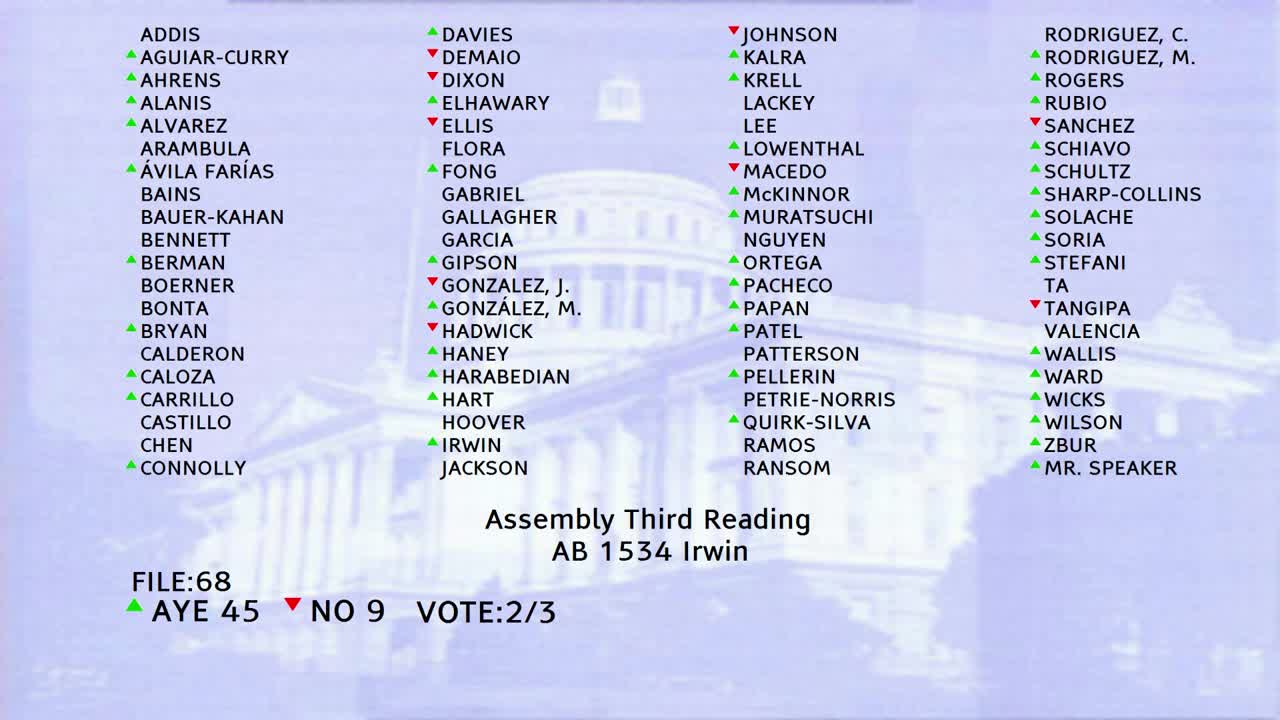 1MIN
Assembly Floor
 5MIN
Assembly Standing Committee on Human Services
 6MIN