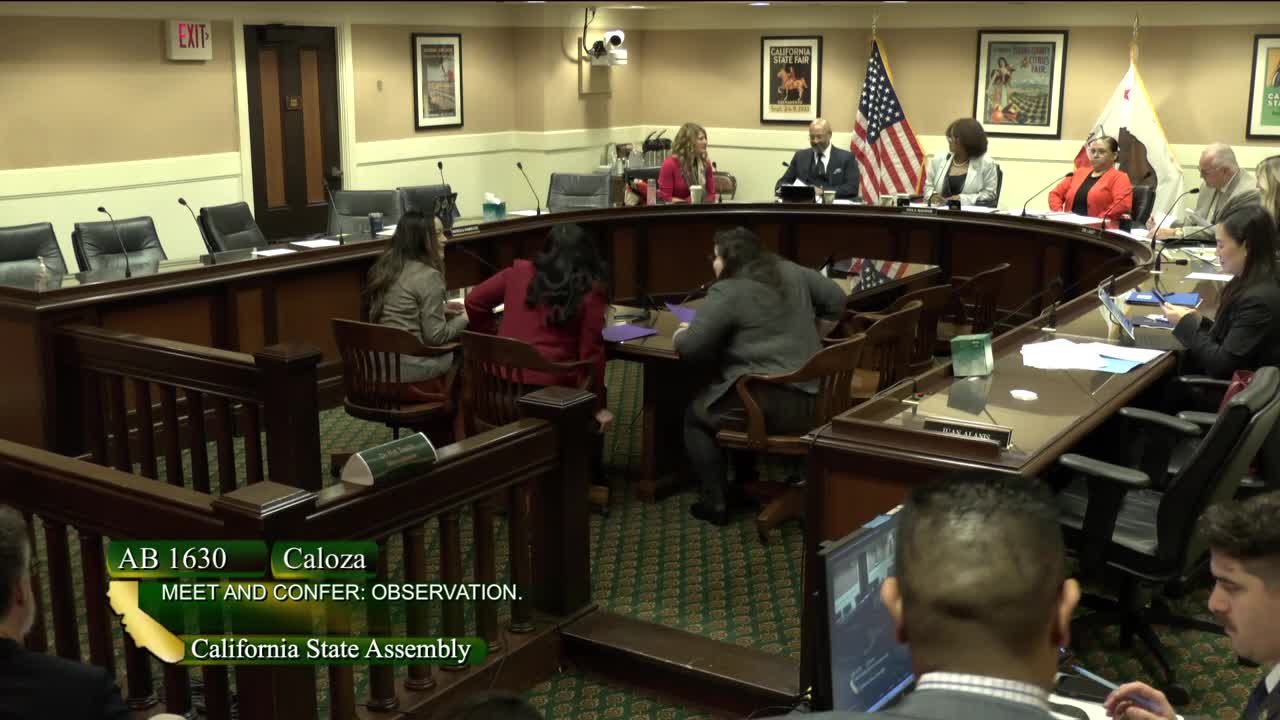
AB 1630: Meet and confer: observation.
- Session Year: 2025-2026
- House: Assembly
- Latest Version Date: 2026-05-22
Current Status:
In Progress
(2026-08-13: In committee: Held under submission.)
Introduced
In Committee
Awaiting First Chamber Vote
Passed First Chamber
In Committee
Awaiting Second Chamber Vote
Passed Second Chamber
Enacted
Existing law provides for negotiations concerning wages, hours, and other terms and conditions of employment between a higher education employer and an exclusive representative of a recognized or certified employee organization, as these terms are defined. Existing law requires higher education employers, or such representatives as they may designate, to engage in meeting and conferring with the employee organization selected as exclusive representative of an appropriate unit on all matters within the scope of representation. Existing law requires a reasonable number of representatives of an exclusive representative to have the right to receive reasonable periods of released or reassigned time without loss of compensation when engaged in meeting and conferring and for the processing of grievances prior to the adoption of the initial memorandum of understanding.
This bill would authorize an exclusive representative, in their discretion, to invite one or more members of a bargaining unit to remotely and passively observe a session held for the purpose of a meet and confer on a memorandum of understanding. The bill would prohibit, absent an agreement of the parties, a member of a bargaining unit observing a session pursuant to these provisions from receiving released or reassigned time or compensation to observe a session. The bill would not prevent the parties from agreeing to allow in-person observers or greater participation by observers in a meet and confer session. The bill would also not require any change in existing practices that allow in-person observers or greater participation by observers in a meet and confer session.
Existing law provides for negotiations concerning wages, hours, and other terms and conditions of employment between a higher education employer and an exclusive representative of a recognized or certified employee organization, as these terms are defined. Existing law requires higher education employers, or such representatives as they may designate, to engage in meeting and conferring with the employee organization selected as exclusive representative of an appropriate unit on all matters within the scope of representation. Existing law requires a reasonable number of representatives of an exclusive representative to have the right to receive reasonable periods of released or reassigned time without loss of compensation when engaged in meeting and conferring and for the processing of grievances prior to the adoption of the initial memorandum of understanding.
This bill would authorize an exclusive representative, in their discretion, to invite one or more members of a bargaining unit to remotely and passively observe a session held for the purpose of a meet and confer on a memorandum of understanding. The bill would prohibit, absent an agreement of the parties, a member of a bargaining unit observing a session pursuant to these provisions from receiving released or reassigned time or compensation to observe a session.
(a)An exclusive representative may, in their discretion, invite one or more members of a bargaining unit to remotely and passively observe a session held for the purpose of a meet and confer on a memorandum of understanding. At the request of the exclusive representative, remote access shall be provided for this purpose. A remote observer may not delay or disrupt a meet and confer session.
(b)Absent an agreement of the parties, a member of a bargaining unit observing a session pursuant to this section shall not receive released or reassigned time or compensation to observe a session.
(c)Nothing in this section shall prevent the parties from agreeing to allow in-person observers or greater participation by observers in sessions held for the purpose of a meet and confer. Nothing in this section shall require any change in existing practices that allow in-person observers or greater participation by observers in sessions held for the purpose of a meet and confer.
(a)An exclusive representative may, in their discretion, invite one or more members of a bargaining unit to remotely and passively observe a session held for the purpose of a meet and confer on a memorandum of understanding. At the request of the exclusive representative, remote access shall be provided for this purpose.
(b)Absent an agreement of the parties, a member of a bargaining unit observing a session pursuant to this section shall not receive released or reassigned time or compensation to observe a session.
|
Date
|
Status
|
|---|---|
| Aug 13, 2026 | In committee: Held under submission. |
| Jun 29, 2026 | In committee: Referred to APPR. suspense file. |
| Jun 17, 2026 | From committee: Do pass and re-refer to Com. on APPR. (Ayes 4. Noes 1.) (June 17). Re-referred to Com. on APPR. |
| Jun 3, 2026 | Referred to Com. on L., P.E. & R. |
| May 27, 2026 | In Senate. Read first time. To Com. on RLS. for assignment. |
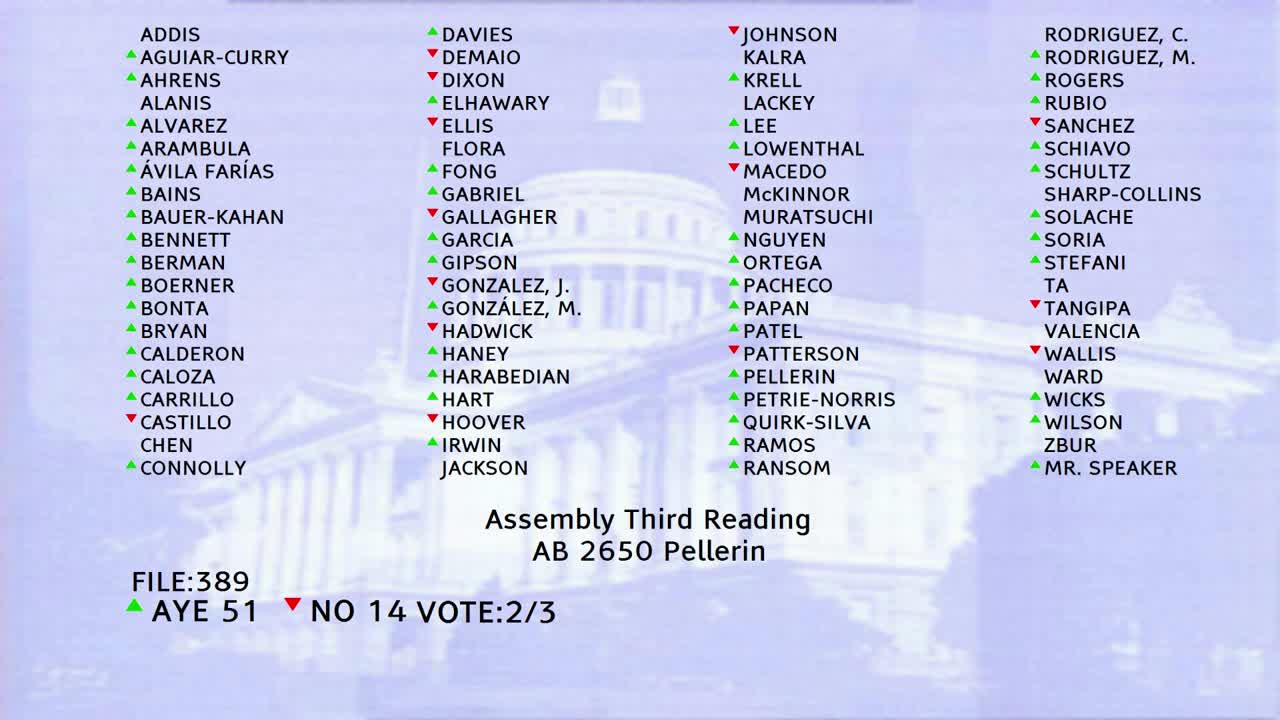
| May 26, 2026 | Read third time. Passed. Ordered to the Senate. (Ayes 64. Noes 5. Page 5394.) |
| May 26, 2026 | Read third time. Passed. Ordered to the Senate. (Ayes 64. Noes 5.) |
| May 26, 2026 | Read third time. Passed. Ordered to the Senate. |
| May 22, 2026 | Read third time and amended. Ordered to third reading. (Page 5271.) |
| May 22, 2026 | Read third time and amended. Ordered to third reading. |
| May 18, 2026 | Read second time. Ordered to third reading. |
| May 14, 2026 | From committee: Do pass. (Ayes 13. Noes 0.) (May 14). |
| May 6, 2026 | In committee: Set, first hearing. Referred to APPR. suspense file. |
| Apr 8, 2026 | From committee: Do pass and re-refer to Com. on APPR. (Ayes 5. Noes 0.) (April 8). Re-referred to Com. on APPR. |
| Mar 13, 2026 | In committee: Set, first hearing. Hearing canceled at the request of author. |
| Feb 17, 2026 | Referred to Com. on P. E. & R. |
| Jan 27, 2026 | From printer. May be heard in committee February 26. |
| Jan 26, 2026 | Read first time. To print. |
|
Date
|
Description
|
Location
|
Votes
|
|
|---|---|---|---|---|
| Jun 29, 2026 | Placed on suspense file | Senate Standing Committee on Appropriations |
Passed |
|
| Jun 17, 2026 | Do pass, but first be re-referred to the Committee on [Appropriations] | Senate Standing Committee on Labor, Public Employment and Retirement |
Passed |
|
| May 26, 2026 | AB 1630 Caloza Assembly Third Reading | Assembly Floor |
Passed |
|
| May 14, 2026 | Do pass. | Assembly Standing Committee on Appropriations |
Passed |
|
| Apr 8, 2026 | Do pass and be re-referred to the Committee on [Appropriations] | Assembly Standing Committee on Public Employment and Retirement |
Passed |
This list shows positions taken on this bill by organizations on the date displayed, which is linked to the original source.
Positions by individuals are not included.
|
Organization
|
Position
|
Date
|
|---|---|---|
| Bay Area Council | ** Against | |
| California Faculty Association | ** Support | |
| California Federation Of Teachers | ** Support | |
| California State University | ** Against | |
| California State University Employees Union | ** Support | |
| California State University, Office Of The Chancellor | ** Against | |
| SEIU California | ** Support | |
| Teamsters California | ** Support | |
| University of California | ** Against | |
| University of California Office of the President | ** Against |
SENATE COMMITTEE ON
Senator Sabrina Cervantes, Chair
2025 - 2026 Regular Session
AB 1630 (Caloza) - Meet and confer: observation
Version: | Policy Vote: |
Urgency: | Mandate: |
Hearing Date: | Consultant: |
Bill Summary:
AB 1630 would modify the Higher Education Employer-Employee Relations Act (HEERA) to authorize an exclusive representative to invite one or more members of a bargaining unit to remotely observe a session held for the purpose of a meet and confer on a memorandum of understanding (MOU).
Fiscal Impact:
- The University of California (UC) indicates that it would incur one-time costs of $100,000 to $200,000, and $270,000 to $430,000 annually thereafter, to implement the provisions of the bill (General Fund). Cost drivers include procuring the requisite technology platform, creating policies and procedures and training staff, and hiring additional information technology support necessary to facilitate remote and passive observation of bargaining sessions.
- The bill would result in ongoing General Fund costs of up to $255,000 annually for the California State University (CSU) to procure the necessary technology platform, create policies and procedures, and hire additional information technology support necessary to facilitate remote and passive observation of bargaining sessions.
Background:
HEERA establishes the framework governing labor relations between UC, CSU and their employees. The Act requires higher education employers and employee organizations to engage in collective bargaining over matters within the scope of representation, including wages, hours, and other terms and conditions of employment. Disputes concerning compliance with these obligations may be brought before the Public Employment Relations Board (PERB) through the unfair practice process.
HEERA also establishes protections for employees and employee organizations by prohibiting conduct that interferes with the exercise of collective bargaining rights. Among other provisions, employers may not discriminate against, retaliate against, or coerce employees or applicants because of their participation in protected labor activities. Similar restrictions apply to employee organizations. The Act further provides for released or reassigned time for employee representatives engaged in collective bargaining and related labor-relations activities, subject to the terms of any applicable MOU.
The scope and conduct of collective bargaining under HEERA have also been shaped by PERB decisions addressing bargaining procedures and ground rules. In decisions arising under other public-sector labor relations statutes, PERB has concluded that bargaining ground rules are themselves mandatory subjects of negotiation and that, absent mutual agreement, collective bargaining sessions generally are limited to designated representatives of the parties. As a result, decisions regarding the presence of bargaining-unit members as observers during negotiations have traditionally been determined through mutual agreement between the employer/exclusive representative.
Proposed Law:
This bill, among other things, would do the following:
- Authorize an exclusive representative to, at their discretion, invite one or more members of a bargaining unit to remotely observe a session held for the purpose of a meet and confer on a memorandum of understanding. However, it would clarify that a remote observer may not delay/disrupt a meet and confer session.
- Require that remote access be provided for this purpose at the request of the exclusive representative.
- Provide that nothing shall prevent the parties from agreeing to allow, nor require any change in existing practices to, in-person observers or greater participation by observers in sessions held for the purpose of a meet and confer.
Related Legislation:
- AB 1818 (Ortega) would amend HEERA relating to CSU, a written MOU, and funding on the MOU via the annual state Budget Act. Specifically, it would require, with regards to whether a MOU requires legislative action or if the Legislature or Governor fail to fully fund the MOU or take requisite curative action, the determination to be made by the Director of Finance by written notification to the parties. The bill is currently pending in the Senate Committee on Labor, Public Employment and Retirement.
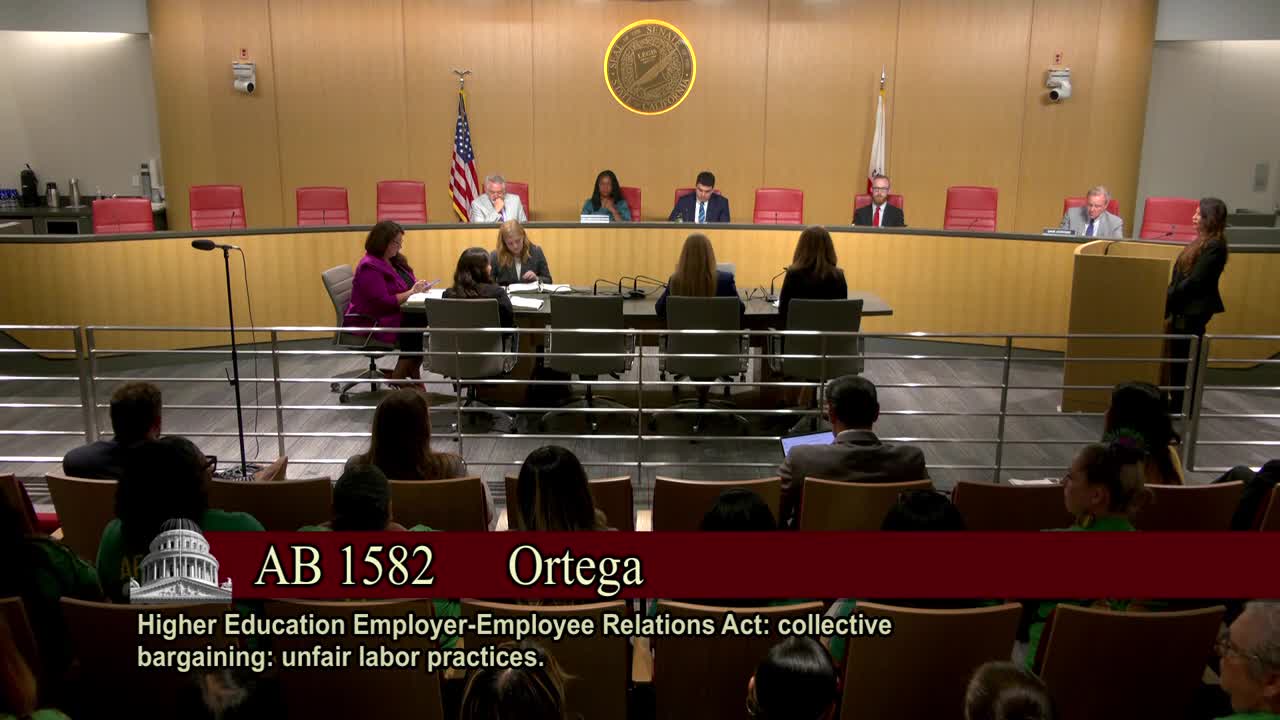
- AB 1582 (Ortega) would amend HEERA by adding other prohibited acts of a higher education employer relating to arbitration and violation of a collective bargaining agreement (CBA). Specifically, the bill would make HEERA employers who disregard arbitration decisions related to CBA violation disputes over outsourcing “the same or similar services” of bargaining unit work, subject to PERB unfair labor practice charges and penalties for repeat offenders, as specified. The bill is currently pending in the Senate Committee on Judiciary.
Staff Comments:
As noted above, this bill would modify the framework for institutions governed by HEERA by authorizing an exclusive representative to permit bargaining-unit members to remotely observe negotiations over an MOU. Upon request of the exclusive representative, the employer would be required to provide remote access for such observation. The bill specifies that observers may not disrupt or delay negotiations and, unless otherwise agreed by the parties, would not be entitled to released time or compensation for participating as observers.
-- END --
SENATE COMMITTEE ON LABOR, PUBLIC EMPLOYMENT AND RETIREMENT
Senator Lola Smallwood-Cuevas, Chair
2025 - 2026 Regular
Bill No: AB 1630 Hearing Date: June 17, 2026
Author: | Caloza | ||
Version: | May 22, 2026 | ||
Urgency: | No | Fiscal: | Yes |
Consultant: | Alma Perez-Schwab | ||
SUBJECT: Meet and confer: observation
KEY ISSUE
This bill makes changes to the Higher Education Employer-Employee Relations Act (HEERA) to authorize an exclusive representative to invite one or more members of a bargaining unit to remotely observe a session held for the purpose of a meet and confer on a memorandum of understanding (MOU).
ANALYSIS
Existing law:
- Governs collective bargaining in the private sector under the federal National Labor Relations Act (NLRA) but leaves it to the states to regulate collective bargaining in their respective public sectors. (United States Code, Title 29, §151 et seq.)
- Provides several statutory frameworks in state law granting public employees collective bargaining rights, governing public employer-employee relations, and limiting labor strife and economic disruption in the public sector through a reasonable method of resolving disputes regarding wages, hours and other terms and conditions of employment between public employers and recognized public employee organizations or their exclusive representatives. The Higher Education Employer-Employee Relations Act (HEERA) governs these employment relations for the University of California, the California State University, and UC College of the Law San Francisco (formerly, Hastings College of Law). (Government Code §3560 et seq.)
- Pursuant to the HEERA, requires higher education employers to meet and confer with the exclusive representative of employees on all matters within the scope of representation. Failure by the employer to bargain, authorizes the exclusive representative to file an unfair practice charge with the Public Employment Relations Board (PERB). (Government Code §3570 & §3563.2)
- Establishes for the CSU, among other things, that the duty to meet and confer in good faith requires the parties to begin negotiations prior to the adoption of the final budget for the ensuing year sufficiently in advance of the adoption date to provide adequate time for an agreement to be reached or for an impasse to be resolved. (Government Code §3572)
- Defines, pursuant to the HEERA, “meet and confer” to mean the performance of the mutual obligation of the higher education employer and the exclusive representative of its employees to meet at reasonable times and to confer in good faith with respect to matters within the scope of representation, including wages, hours of employment, and other terms and conditions of employment, and to endeavor to reach agreement on matters within the scope of representation. The process also must include adequate time for the resolution of impasses. If agreement is reached between representatives of the higher education employer and the exclusive representative, they must jointly prepare a written memorandum of understanding (MOU) that must be presented to the higher education employer for concurrence. However, these obligations must not compel either party to agree to any proposal or require the making of a concession. (Government Code §3562(m))
- Grants a reasonable number of representatives of an exclusive representative the right to receive periods of released or reassigned time without loss of compensation when engaged in, among other things, meeting and conferring. However, when a MOU is in effect, released or reassigned time must be in accord with the terms of the MOU. (Government Code §3569)
- Establishes the Public Employment Relations Board (PERB), a quasi-judicial administrative agency charged with administering certain statutory frameworks governing California state and local public employer-employee relations, resolving disputes, and enforcing the statutory duties and rights of public agency employers, employees, and employee organizations. (Government Code §3541 et seq.)
This bill:
- Authorizes an exclusive representative to, at their discretion, invite one or more members of a bargaining unit to remotely observe a session held for the purpose of a meet and confer on a memorandum of understanding. However, it clarifies that a remote observer may not delay or disrupt a meet and confer session.
- Requires that remote access be provided for this purpose at the request of the exclusive representative.
- Provides that, absent an agreement of the parties, a member of a bargaining unit observing a session shall not receive released or reassigned time or compensation to observe a session.
- Provides that nothing shall prevent the parties from agreeing to allow, nor require any change in existing practices to, in-person observers or greater participation by observers in sessions held for the purpose of a meet and confer.
COMMENTS
1. Background:
HEERA:
The Higher Education Employer-Employee Relations Act (HEERA) governs the employment relations for the University of California, the California State University, and UC College of the Law San Francisco (formerly, Hastings College of Law). The HEERA explicitly requires higher education employers to meet and confer with the exclusive representative of employees on all matters within the scope of representation. If either party fails to bargain as required, they may file an unfair practice charge against the other party with the Public Employment Relations Board (PERB).
The HEERA expressly prescribes unlawful acts by the employer as well as those by the employee organization. (Government Code §3571 and §3571.1) As applied to the employer, among other things, it is: (i) prohibited from imposing or threatening to impose reprisals on employees, and (ii) discriminating or threatening to discriminate against employees, or interfering with, restraining, or coercing employees because of their exercise of rights guaranteed by the act. This specific provision applies to both employees and applicants for employment or reemployment. Similar provisions also exist regarding unlawful conduct by an employee organization.
Among other rights prescribed by the HEERA, the act requires reasonable periods of released or reassigned time without loss of compensation for a reasonable number of representatives of an exclusive representative when engaged in, among other things, meeting and conferring, and the processing of grievances prior to the adoption of a MOU. When the MOU is in effect, released or reassigned time must be in accordance with the MOU.
PERB Decision Regarding Ground Rules:
As noted above, the HEERA expressly prescribes the limitations of the scope of representation and subjects of collective bargaining. For both the UC and CSU, pursuant to Government Code Section 3562, the scope of representation is limited to wages, hours of employment, and other terms and conditions of employment. The issue of having observers of the meet and confer process has been discussed as part of cases brought before the Public Employment Relations Board.
Not specific to HEERA, but in a 2018 Meyers-Milias-Brown Act case before the PERB, governing local public employment, the board issued a decision relating to the observation of the meet and confer process stating in part that “ground rules must be bargained over just as any other mandatory subject of bargaining.”[1] Furthermore, in a 2016 decision related to the Education Employment Relations Act, PERB stated that “absent agreement, the default rule of negotiations is that observers are excluded from negotiations.”[2]
Government Code Section 3562, combined with the PERB decisions, means that the decision of whether members of a bargaining unit will be allowed to observe a meet and confer session will have to be negotiated and agreed to by both parties as part of the ground rules of bargaining.
Opponents of this bill argue that this longstanding principle reflects the understanding that the collective bargaining table is reserved for designated representatives unless both parties mutually agree to a different approach. Proponents of the measure argue that remote access during the pandemic showed that this practice not only increased participation by rank-and-file members but also helped accelerate the path to an agreement by discouraging unproductive tactics, compelling both parties to focus.
This bill proposes, for HEERA employment relations only, to statutorily authorize an exclusive representative, at their discretion, to invite one or more members of a bargaining unit to remotely observe a meet and confer session on an MOU. Remote access would be required to be provided at the request of the exclusive representative. Observers may not delay or disrupt a meet and confer session and, absent an agreement of the parties, are not required to receive released or reassigned time or compensation to observe a session.
2. Need for this bill?
According to the author:
“During the pandemic, the transition to remote bargaining and observation proved that transparency works. Member engagement surged as employees joined as their schedules allowed, streamlining feedback and accelerating the bargaining timeline. This increased accountability also shifted the focus from 'hard bargaining' to a shared goal of improving student achievement.
Under current law, employers must consent to observers. Despite maintaining remote sessions, the UC and CSU now refuse to allow remote observation. AB 1630 would restore this transparency by giving unions the discretion to invite remote observers, ensuring efficient communication and preventing the unproductive bargaining tactics that currently stall progress.”
3. Proponent Arguments:
According to the sponsors, SEIU California, “because "ground rules" are currently a mandatory subject of bargaining, employers hold unilateral veto power over transparency. This allows the UC and CSU to block rank-and-file members from observing the negotiations that shape their working conditions and livelihoods.
The UC and CSU systems manage statewide workforces characterized by diverse schedules and high turnover—factors that historically complicate communication during negotiations. The pandemic, however, proved that remote transparency is a powerful solution. When rank-and-file members were permitted to observe sessions virtually, engagement surged, streamlining communication and accelerating the path to agreement. The added layer of accountability discouraged unproductive “hard bargaining” tactics, compelling both parties to focus on their shared mission of improving university operations.
Despite this proven success, the UC and CSU have since retreated to closed-door sessions, rejecting all subsequent requests for remote observation. AB 1630 would require the UC and CSU to allow remote observation when requested by the union. This bill restores the transparency necessary to ensure efficient communication and prevents the tactics that currently obstruct progress at the bargaining table.”
4. Opponent Arguments:
The California State University (CSU) is opposed arguing:
“The CSU shares the author’s desire for transparency in collective bargaining and has demonstrated this commitment through regular bargaining updates and communications, full public disclosure of agreements, and a public vote at a Board of Trustee Meeting. The CSU’s labor partners likewise provide regular updates, hold town halls, and share proposals with their members. Transparency is already embedded in the collective bargaining process, and both employees and members of the public may access information through the CSU’s Labor and Employee Relations website.
However, the CSU is opposed to AB 1630 as it would significantly alter the dynamics of collective bargaining in a manner that could delay agreements and complicate bargaining sessions. The bill provides “one or more” bargaining unit members may attend collective bargaining meetings at the exclusive representative’s discretion but does not define the parameters around that attendance. Without clear limits, this language could be interpreted to permit an unlimited number of observers, creating logistical challenges, and potentially undermining candid dialogue at the bargaining table that is often necessary to reach agreements…
By substituting statutory language for negotiated ground rules, and by permitting potentially unlimited observers without mutual agreement, AB 1630 removes from the bargaining table a subject that PERB has expressly determined must be negotiated. California’s labor relations system functions effectively because procedural matters, including bargaining ground rules, are determined by the parties through negotiation, not imposed by statute. AB 1630 could also set a broader precedent for unlimited observer access in meet-and-confer bargaining sessions across all of California’s public sector employers, further disrupting established collective bargaining practices.”
The University of California is also opposed and write:
“The recent amendments only intensify the University's operational and structural concerns with this bill. By striking the requirement that remote attendance must be strictly "passive," the bill opens the door to active disruption. While the amended text notes that an observer may not "delay or disrupt" sessions, stripping the passivity guardrail leaves higher education employers vulnerable to widespread, uncoordinated interference during critical negotiations….
Implementing this mandate would create a logistical and technical burden on the University. Standardizing secure, authenticated platforms capable of hosting thousands of potential observers across ten campuses and five medical centers requires substantial resources. Furthermore, the bill threatens to destabilize current bargaining practices, under which exclusive representatives and university teams have already successfully negotiated balanced, mutually agreeable ground rules on team sizes and observer access.
The University believes that maintaining the flexibility to determine observation protocols through the collective bargaining process best serves the interests of all parties. This allows employers and exclusive representatives to tailor environments to the unique needs of each bargaining unit, keeping negotiations efficient, focused, and collaborative.”
5. Prior Legislation:
AB 1818 (Ortega, 2026) amends the HEERA relating to the CSU, a written MOU, and funding on the MOU via the annual state Budget Act. Specifically, requires, with regards to whether a MOU requires legislative action or if the Legislature or Governor fail to fully fund the MOU or take requisite curative action, the determination to be made by the Director of Finance by written notification to the parties. AB 1818 is pending in this Committee.
AB 1582 (Ortega, 2026) amends the HEERA by adding other prohibited acts of a higher education employer relating to arbitration and violation of a collective bargaining agreement (CBA). Specifically, the bill makes HEERA employers who disregard arbitration decisions related to CBA violation disputes over outsourcing “the same or similar services” of bargaining unit work, subject to PERB unfair labor practice charges and penalties for repeat offenders, as specified. AB 1582 is pending in this Committee.
SUPPORT
California Faculty Association
California Federation of Teachers
California State University Employees Union
SEIU California
Teamsters California
OPPOSITION
Bay Area Council
California State University
University of California
-- END --
ASSEMBLY THIRD READING
ATR Bill Id:AB 1630
Author:(Caloza)
As Introduced Ver:May 22, 2026
Majority vote
SUMMARY
Makes changes to the Higher Education Employer-Employee Relations Act (HEERA) regarding observation of the meet and confer process.
Major Provisions
- Authorize, at their discretion, an exclusive representative to invite one or member bargaining unit members to remotely observe a meet and confer session on a memorandum of understanding (MOU). However, a remote observer may not delay or disrupt the session.
- Require remote access to be provided for this purpose at the request of the exclusive representative.
- Provide that, absent agreement by the parties to the MOU, a bargaining unit member observing a session must not receive released or reassigned time or compensation to observe the session.
- Provide that nothing must prevent the parties from agreeing to allow, nor require any change in existing practices to, in-person observers or greater participation by those observers in sessions held for the purpose of the meet and confer.
COMMENTS
Participating in the Meet and Confer Process Under the HEERA
The HEERA explicitly requires both higher education employers and exclusive representatives to meet and confer in good faith on all matters within the scope of representation. (Sections 3570 and 3571.1(c), Government Code). If either party fails to bargain as required, they may file an unfair practice charge with the Public Employment Relations Board (PERB). (Sections 3563 et seq., Government Code.)
The HEERA also expressly prescribes unlawful acts by the employer as well as those by the employee organization. (Sections 3571 and 3571.1, Government Code, respectively.) Among other things prescribed by the HEERA, the act requires reasonable periods of released or reassigned time without loss of compensation for a reasonable number of representatives of an exclusive representative when engaged in, among other things, meeting and conferring, and the processing of grievances prior to the adoption of a MOU. When the MOU is in effect, released or reassigned time must be in accordance with the MOU. (Section 3569, Government Code.)
As the HEERA expressly prescribes the limitations of the scope of representation, i.e., mandatory subjects of collective bargaining, for the University of California (UC) and California State University (CSU), respectively, the Public Employment Relations Board (PERB) has issued decisions relating to the observation of the meet and confer process where "ground rules must be bargained over just as any other mandatory subject of bargaining." (Orange County Employees Assoc., et al. v. County of Orange (2018) PERB No. 2594-M.) And, "absent agreement, the default rule of negotiations is that observers are excluded from negotiations." (Petaluma Fed. of Teachers v. Petaluma City Elementary Sch. Dist. (2016) PERB No. 2485.) Thus, in addition to the statutory subjects of bargaining that are mandatory, among establishing the ground rules for the meet and confer process, observers are excluded, and their participation as an observer also is a mandatory subject of bargaining.
This Bill
In lieu of the aforementioned PERB decisions, this bill proposes to statutorily address the observation of collective bargaining negotiations between the HEERA-covered employer and HEERA-covered employee organization for bargaining unit members who are not directly involved in the negotiations. In so doing, at the discretion of the exclusive representative, it would allow bargaining unit members to remotely and passively observe such sessions, and remote access must be provided for this purpose at the request of the exclusive representative. However, unless there are agreed upon terms of a MOU, these bargaining unit members must not receive released or reassigned time or compensation to observe the session.
Please refer to the policy committee analysis for a full discussion of this bill.
According to the Author
"CSU and UC workers are the backbone of our higher education system. When we protect their rights, we strengthen the future of education across our State. [This bill] guarantees unions a real, meaningful seat at the table and ensures every worker is heard. Under existing law, the UC and CSU can block rank-and-file union members from observing remote bargaining sessions. This slows communication, weakens transparency, and drags out negotiations. [This bill] delivers the accountability workers deserve. It protects the right of our unions to have a seat at the table in decisions that affect them. Because when our workers are represented, our universities and classrooms flourish."
Arguments in Support
Among other things, the California State Council of the Service Employees International Union states that, "[t]he UC and CSU systems manage statewide workforces characterized by diverse schedules and high turnover – factors that historically complicate communication during negotiations. The pandemic, however, proved that remote transparency is a powerful solution. When rank-and-file members were permitted to observe sessions virtually, engagement surged, streamlining communication and accelerating the path to agreement. The added layer of accountability discouraged unproductive "hard bargaining" tactics, compelling both parties to focus on their shared mission of improving university operations. Despite this proven success, the UC and CSU have since retreated to closed-door sessions, rejecting all subsequent requests for remote observation. [This bill] would require the UC and CSU to allow remote, passive observation when requested by the union. This bill restores the transparency necessary to ensure efficient communication and prevents the tactics that currently obstruct progress at the bargaining table."
The California Faculty Association states, "[t]he UC and CSU systems manage statewide workforces characterized by diverse schedules and high turnover – factors that historically complicate communication during negotiations. The pandemic, however, proved that remote transparency is a powerful solution. When rank-and-file members were permitted to observe sessions virtually, engagement surged, streamlining communication and accelerating the path to agreement. The added layer of accountability discouraged unproductive "hard bargaining" tactics, compelling both parties to focus on their shared mission of improving university operations. Despite this proven success, the UC and CSU have since retreated to closed-door sessions, rejecting all subsequent requests for remote observation. [This bill] would require the UC and CSU to allow remote, passive observation when requested by the union, [and] restores the transparency necessary to ensure efficient communication and prevents the tactics that currently obstruct progress at the bargaining table."
The California Federation of Teachers – a Union of Education and Classified Professionals, AFT, AFL-CIO states, "[this bill] fosters an environment of transparency, allowing for broader passive participation without impacting compensation mechanisms. We believe that such involvement is essential in ensuring more informed and democratic decision-making processes, laying a foundation for more robust and representative agreements between higher education employers and employee organizations."
Teamsters California expresses that, "[the] right for an exclusive representative to invite a bargaining unit member to observe meeting and conferring on a [MOU] is critical to protect the transparency and efficacy of bargaining. This is already common practice for many employee organizations and employers in California and across the globe. [This bill] is an important next step for California to continue its long leadership protecting workers' rights."
Others in support offer similar statements regarding this bill.
Arguments in Opposition
The UC states, in part, "[c]urrent California labor law and [PERB] precedent, specifically PERB Decision 2485: Petaluma City Elementary School District (2016), emphasize that the effectiveness of negotiations relies on an environment that allows for informal and frank discussion. [The] PERB has historically maintained that if a union wishes to permit employee observers to attend negotiations, that should be settled through the bargaining of contractual rights and ground rules. Switching to a model of broad remote observation might unintentionally shift the focus from constructive compromise to more rigid, performative posturing. Current bargaining unit practices already provide meaningful access and representation for bargaining unit members, including broad systemwide bargaining teams, release time, and opportunities for in-person observation. Implementing this new mandate would create significant logistical and technical burdens for the University. Standardizing secure platforms for thousands of observers across ten campuses and five medical centers would be a massive undertaking that would require substantial resources. The bill also lacks clear rules for verifying identities or ensuring that "passive" observation remains truly passive. Even a simple technical glitch or dropped connection could lead to formal disputes, prolonging negotiations, or even the increased likelihood of an impasse.
Among other things, the CSU states that, "[it] shares the author's desire for transparency in collective bargaining and has demonstrated this commitment through regular bargaining updates and communications, full public disclosure of agreements, and a public vote at a Board of Trustee Meeting. The CSU's labor partners likewise provide regular updates, hold town halls, and share proposals with their members. Transparency is already embedded in the collective bargaining process, and both employees and members of the public may access information through the CSU's Labor and Employee Relations website. However, […] this bill would significantly alter the dynamics of collective bargaining in a manner that could delay agreements and complicate bargaining sessions. The bill provides 'one or more' bargaining unit members may attend collective bargaining meetings at the exclusive representative's discretion but does not define the parameters around that attendance. Without clear limits, this language could be interpreted to permit an unlimited number of observers, creating logistical challenges, and potentially undermining candid dialogue at the bargaining table that is often necessary to reach agreements." Similarly citing the PERB's decision in Petaluma, id., the CSU further states that, [this bill] would override this established framework by mandating observer access without requiring mutual agreement. By substituting statutory language for negotiated ground rules, and by permitting potentially unlimited observers without mutual agreement, [this bill] removes from the bargaining table a subject that PERB has expressly determined must be negotiated…."
FISCAL COMMENTS
According to the Assembly Committee on Appropriations, this bill would result in the following:
- Ongoing General Fund costs of approximately $100,000 to $300,000 annually for the University of California (UC) to procure the necessary technology platform, create policies and procedures, and hire additional information technology support necessary to facilitate remote and passive observation of bargaining sessions.
According to the UC Office of the President, the UC system employs over 180,000 represented employees across 18 systemwide bargaining units and 22 local units.
- Ongoing General Fund costs of up to $255,000 annually for the California State University (CSU) to procure the necessary technology platform, create policies and procedures, and hire additional information technology support necessary to facilitate remote and passive observation of bargaining sessions.
The Legislative Analyst's Office recently warned of General Fund structural deficits of around $35 billion per year in the 2027-28 fiscal year and ongoing.
VOTES
ASM PUBLIC EMPLOYMENT AND RETIREMENT: 5-0-2
YES: McKinnor, Boerner, Garcia, Nguyen, Michelle Rodriguez
ABS, ABST OR NV: Lackey, Alanis
ASM APPROPRIATIONS: 13-0-2
YES: Wicks, Hoover, Aguiar-Curry, Calderon, Caloza, Fong, Mark González, Krell, Pacheco, Pellerin, Sharp-Collins, Solache, Tangipa
ABS, ABST OR NV: Dixon, Ta
UPDATED
VERSION: May 22, 2026
CONSULTANT: Michael Bolden / P. E. & R. / (916) 319-3957 FN: 0003134
ASSEMBLY THIRD READING
ATR Bill Id:AB 1630
Author:(Caloza)
As Introduced Ver:January 26, 2026
Majority vote
SUMMARY
Makes changes to the Higher Education Employer-Employee Relations Act (HEERA) regarding observation of the meet and confer process.
Major Provisions
- Authorize, at their discretion, an exclusive representative to invite one or member bargaining unit members to remotely and passively observe a meet and confer session on a memorandum of understanding (MOU).
- Require remote access to be provided for this purpose at the request of the exclusive representative.
- Provide that, absent agreement by the parties to the MOU, a bargaining unit member observing a session must not receive released or reassigned time or compensation to observe the session.
COMMENTS
Participating in the Meet and Confer Process Under the HEERA
The HEERA explicitly requires both higher education employers and exclusive representatives to meet and confer in good faith on all matters within the scope of representation. (Sections 3570 and 3571.1(c), Gov. Code). If either party fails to bargain as required, they may file an unfair practice charge with the Public Employment Relations Board (PERB). (Sections 3563 et seq., Gov. Code.)
The HEERA also expressly prescribes unlawful acts by the employer as well as those by the employee organization. (Sections 3571 and 3571.1, Gov. Code, respectively.) Among other things prescribed by the HEERA, the act requires reasonable periods of released or reassigned time without loss of compensation for a reasonable number of representatives of an exclusive representative when engaged in, among other things, meeting and conferring, and the processing of grievances prior to the adoption of a MOU. When the MOU is in effect, released or reassigned time must be in accordance with the MOU. (Section 3569, Gov. Code.)
As the HEERA expressly prescribes the limitations of the scope of representation, i.e., mandatory subjects of collective bargaining, for the University of California (UC) and California State University (CSU), respectively, the Public Employment Relations Board (PERB) has issued decisions relating to the observation of the meet and confer process where "ground rules must be bargained over just as any other mandatory subject of bargaining." (Orange County Employees Assoc., et al. v. County of Orange (2018) PERB No. 2594-M.) And, "absent agreement, the default rule of negotiations is that observers are excluded from negotiations." (Petaluma Fed. of Teachers v. Petaluma City Elementary Sch. Dist. (2016) PERB No. 2485.) Thus, in addition to the statutory subjects of bargaining that are mandatory, among establishing the ground rules for the meet and confer process, observers are excluded, and their participation as an observer also is mandatory subject of bargaining.
This Bill
In lieu of the aforementioned PERB decisions, this bill proposes to statutorily address the observation of collective bargaining negotiations between the HEERA-covered employer and HEERA-covered employee organization for bargaining unit members who are not directly involved in the negotiations. In so doing, at the discretion of the exclusive representative, it would allow bargaining unit members to remotely and passively observe such sessions, and remote access must be provided for this purpose at the request of the exclusive representative. However, unless there are agreed upon terms of a MOU, these bargaining unit members must not receive released or reassigned time or compensation to observe the session.
Please refer to the policy committee analysis for a full discussion of this bill.
According to the Author
"CSU and UC workers are the backbone of our higher education system. When we protect their rights, we strengthen the future of education across our State. [This bill] guarantees unions a real, meaningful seat at the table and ensures every worker is heard. Under existing law, the UC and CSU can block rank-and-file union members from observing remote bargaining sessions. This slows communication, weakens transparency, and drags out negotiations. [This bill] delivers the accountability workers deserve. It protects the right of our unions to have a seat at the table in decisions that affect them. Because when our workers are represented, our universities and classrooms flourish."
Arguments in Support
Among other things, the California State Council of the Service Employees International Union states that, "[t]he UC and CSU systems manage statewide workforces characterized by diverse schedules and high turnover – factors that historically complicate communication during negotiations. The pandemic, however, proved that remote transparency is a powerful solution. When rank-and-file members were permitted to observe sessions virtually, engagement surged, streamlining communication and accelerating the path to agreement. The added layer of accountability discouraged unproductive "hard bargaining" tactics, compelling both parties to focus on their shared mission of improving university operations. Despite this proven success, the UC and CSU have since retreated to closed-door sessions, rejecting all subsequent requests for remote observation. [This bill] would require the UC and CSU to allow remote, passive observation when requested by the union. This bill restores the transparency necessary to ensure efficient communication and prevents the tactics that currently obstruct progress at the bargaining table."
The California Faculty Association states, "[t]he UC and CSU systems manage statewide workforces characterized by diverse schedules and high turnover – factors that historically complicate communication during negotiations. The pandemic, however, proved that remote transparency is a powerful solution. When rank-and-file members were permitted to observe sessions virtually, engagement surged, streamlining communication and accelerating the path to agreement. The added layer of accountability discouraged unproductive "hard bargaining" tactics, compelling both parties to focus on their shared mission of improving university operations. Despite this proven success, the UC and CSU have since retreated to closed-door sessions, rejecting all subsequent requests for remote observation. [This bill] would require the UC and CSU to allow remote, passive observation when requested by the union, [and] restores the transparency necessary to ensure efficient communication and prevents the tactics that currently obstruct progress at the bargaining table."
The California Federation of Teachers – a Union of Education and Classified Professionals, AFT, AFL-CIO states, "[this bill] fosters an environment of transparency, allowing for broader passive participation without impacting compensation mechanisms. We believe that such involvement is essential in ensuring more informed and democratic decision-making processes, laying a foundation for more robust and representative agreements between higher education employers and employee organizations.
Teamsters California expresses that, "[the] right for an exclusive representative to invite a bargaining unit member to observe meeting and conferring on a [MOU] is critical to protect the transparency and efficacy of bargaining. This is already common practice for many employee organizations and employers in California and across the globe. [This bill] is an important next step for California to continue its long leadership protecting workers' rights."
Others in support offer similar statements regarding this bill.
Arguments in Opposition
The UC states, in part, "[c]urrent California labor law and [PERB] precedent, specifically PERB Decision 2485: Petaluma City Elementary School District (2016), emphasize that the effectiveness of negotiations relies on an environment that allows for informal and frank discussion. [The] PERB has historically maintained that if a union wishes to permit employee observers to attend negotiations, that should be settled through the bargaining of contractual rights and ground rules. Switching to a model of broad remote observation might unintentionally shift the focus from constructive compromise to more rigid, performative posturing. Current bargaining unit practices already provide meaningful access and representation for bargaining unit members, including broad systemwide bargaining teams, release time, and opportunities for in-person observation. Implementing this new mandate would create significant logistical and technical burdens for the University. Standardizing secure platforms for thousands of observers across ten campuses and five medical centers would be a massive undertaking that would require substantial resources. The bill also lacks clear rules for verifying identities or ensuring that "passive" observation remains truly passive. Even a simple technical glitch or dropped connection could lead to formal disputes, prolonging negotiations, or even the increased likelihood of an impasse."
Among other things, the CSU states that, "[it] shares the author's desire for transparency in collective bargaining and has demonstrated this commitment through regular bargaining updates and communications, full public disclosure of agreements, and a public vote at a Board of Trustee Meeting. The CSU's labor partners likewise provide regular updates, hold town halls, and share proposals with their members. Transparency is already embedded in the collective bargaining process, and both employees and members of the public may access information through the CSU's Labor and Employee Relations website. However, […] this bill would significantly alter the dynamics of collective bargaining in a manner that could delay agreements and complicate bargaining sessions. The bill provides 'one or more' bargaining unit members may attend collective bargaining meetings at the exclusive representative's discretion but does not define the parameters around that attendance. Without clear limits, this language could be interpreted to permit an unlimited number of observers, creating logistical challenges, and potentially undermining candid dialogue at the bargaining table that is often necessary to reach agreements." Similarly citing the PERB's decision in Petaluma, id., the CSU further states that, [this bill] would override this established framework by mandating observer access without requiring mutual agreement. By substituting statutory language for negotiated ground rules, and by permitting potentially unlimited observers without mutual agreement, [this bill] removes from the bargaining table a subject that PERB has expressly determined must be negotiated…."
FISCAL COMMENTS
According to the Assembly Committee on Appropriations, this bill would result in the following:
- Ongoing General Fund costs of approximately $100,000 to $300,000 annually for the University of California (UC) to procure the necessary technology platform, create policies and procedures, and hire additional information technology support necessary to facilitate remote and passive observation of bargaining sessions.
According to the UC Office of the President, the UC system employs over 180,000 represented employees across 18 systemwide bargaining units and 22 local units.
- Ongoing General Fund costs of up to $255,000 annually for the California State University (CSU) to procure the necessary technology platform, create policies and procedures, and hire additional information technology support necessary to facilitate remote and passive observation of bargaining sessions.
The Legislative Analyst's Office recently warned of General Fund structural deficits of around $35 billion per year in the 2027-28 fiscal year and ongoing.
VOTES
ASM PUBLIC EMPLOYMENT AND RETIREMENT: 5-0-2
YES: McKinnor, Boerner, Garcia, Nguyen, Michelle Rodriguez
ABS, ABST OR NV: Lackey, Alanis
ASM APPROPRIATIONS: 13-0-2
YES: Wicks, Hoover, Aguiar-Curry, Calderon, Caloza, Fong, Mark González, Krell, Pacheco, Pellerin, Sharp-Collins, Solache, Tangipa
ABS, ABST OR NV: Dixon, Ta
UPDATED
VERSION: January 26, 2026
CONSULTANT: Michael Bolden / P. E. & R. / (916) 319-3957 FN: 0002824
Date of Hearing: May 6, 2026
ASSEMBLY COMMITTEE ON APPROPRIATIONS
Buffy Wicks, Chair
ABPCA Bill Id:AB 1630
Author:(Caloza) – As Introduced Ver:January 26, 2026
Policy Committee: | Public Employment and Retirement | Vote: | 5 - 0 |
|
| ||
|
|
Urgency: No State Mandated Local Program: No Reimbursable: No
SUMMARY:
This bill amends the Higher Education Employer-Employee Relations Act (HEERA) to authorize an exclusive representative, at their discretion, to invite one or more bargaining unit members to remotely and passively observe a meet and confer session on a memorandum of understanding (MOU).
FISCAL EFFECT:
- Ongoing General Fund costs of approximately $100,000 to $300,000 annually for the University of California (UC) to procure the necessary technology platform, create policies and procedures, and hire additional information technology support necessary to facilitate remote and passive observation of bargaining sessions.
According to the UC Office of the President, the UC system employs over 180,000 represented employees across 18 systemwide bargaining units and 22 local units.
- Ongoing General Fund costs of up to $255,000 annually for the California State University (CSU) to procure the necessary technology platform, create policies and procedures, and hire additional information technology support necessary to facilitate remote and passive observation of bargaining sessions.
The Legislative Analyst’s Office recently warned of General Fund structural deficits of around $35 billion per year in the 2027-28 fiscal year and ongoing.
COMMENTS:
- Purpose. According to the author:
During the pandemic, the transition to remote bargaining and observation proved that transparency works. Member engagement surged as employees joined as their schedules allowed, streamlining feedback and accelerating the bargaining timeline. This increased accountability also shifted the focus from 'hard bargaining' to a shared goal of improving student achievement. Under current law, employers must consent to observers. Despite maintaining remote sessions, the UC and CSU now refuse to allow remote observation. This bill would restore this transparency by giving unions the discretion to invite remote observers, ensuring efficient communication and preventing the unproductive bargaining tactics that currently stall progress.
- Background.
Higher Education Employer-Employee Relations Act (HEERA). The HEERA, established by the Legislature in 1978, governs collective bargaining in higher education. Unlike the treatment for other public employers under existing law, the HEERA provides that a Memorandum of Understanding (MOU) between a higher education employer and its employees is not subject to review or approval by the Legislature. Current law places administration of the HEERA under the jurisdiction of the Public Employment Relations Board (PERB).
The negotiation process that results in ratified MOUs between a higher education employer and bargaining units, ultimately resulting in a collective bargaining agreement (CBA), consists largely of the meet and confer sessions referred to in this bill. HEERA compels the CSU and UC and their labor partners to meet and confer in “good faith” pursuant to a prescribed timeline to facilitate timely arrival at an agreement. Current law is permissive regarding the inclusion of non-participatory observation of the meet and confer process by members of the respective bargaining unit being negotiated with. With the increase in remote meetings during the COVID-19 Pandemic, the UC and CSU allowed remote observation of the meet and confer process by multiple rank-and-file employees from the represented bargaining unit. However, according to the California Faculty Association, speaking in support of this bill, current law ultimately “allows the UC and CSU to block rank-and-file members from observing he negotiations that shape their working conditions and livelihoods” because “employers hold unilateral veto power over transparency.” This bill allows a bargaining unit representative, at their discretion, to invite one or more bargaining unit members to observe, remotely and passively, a meet and confer session.
- Related Legislation. AB 1818 (Ortega), of the current legislative session, prohibits the CSU from failing comply with its obligations under a CBA with a labor organization should the Legislature and Governor fail to fund the amount of state funding for the CSU assumed in the bargaining process. AB 1818 was referred to the committee’s suspense file.
Analysis Prepared by: Aaron Heredia / APPR. / (916) 319-2081
Date of Hearing: April 8, 2026
ASSEMBLY COMMITTEE ON PUBLIC EMPLOYMENT AND RETIREMENT
Tina S. McKinnor, Chair
ABPCA Bill Id:AB 1630 (
Author:Caloza) – As Introduced Ver:January 26, 2026
SUBJECT: Meet and confer: observation
SUMMARY: Makes changes to the Higher Education Employer-Employee Relations Act (HEERA) regarding observation of the meet and confer process. Specifically, this bill:
- Authorizes, at their discretion, an exclusive representative to invite one or member bargaining unit members to remotely and passively observe a meet and confer session on a memorandum of understanding (MOU).
- Requires remote access to be provided for this purpose at the request of the exclusive representative.
- Provides that, absent agreement by the parties to the MOU, a bargaining unit member observing a session must not receive released or reassigned time or compensation to observe the session.
EXISTING LAW:
- Governs collective bargaining in the private sector under the federal National Labor Relations Act (NLRA), but leaves it to the states to regulate collective bargaining in their respective public sectors. (Sections 151 et seq., Title 29, United States Code.)
While the NLRA and the decisions of its National Labor Relations Board (NLRB) often provide persuasive precedent in interpreting state collective bargaining law, public employees have no collective bargaining rights absent specific statutory authority establishing those rights.
- Provides several statutory frameworks under California law to provide public employees collective bargaining rights, govern public employer-employee relations, and limit labor strife and economic disruption in the public sector through a reasonable method of resolving disputes regarding wages, hours and other terms and conditions of employment between public employers and recognized public employee organizations or their exclusive representatives. These include the HEERA governing employment relations for the University of California, CSU, and UC Law San Francisco (formerly, Hastings College of Law). (Sections 3560 et seq., Gov. Code.)
- Explicitly requires higher education employers to meet and confer with the exclusive representative of employees on all matters within the scope of representation. (Section 3570, Gov. Code.) If the employer fails to bargain, the exclusive representative is authorized to file an unfair practice charge with the Public Employment Relations Board (PERB). (Section 3563.2, Gov. Code.)
- Establishes, among other things, that the duty to meet and confer in good faith and requires the parties to begin negotiations prior to the adoption of the final budget for the ensuing year sufficiently in advance of the adoption date to provide adequate time for an agreement to be reached or for an impasse to be resolved. (Section 3572, Gov. Code.)
- Defines, pursuant to the HEERA, “meet and confer” to mean the performance of the mutual obligation of the higher education employer and the exclusive representative of its employees to meet at reasonable times and to confer in good faith with respect to matters within the scope of representation and to endeavor to reach agreement on matters within the scope of representation. The process also must include adequate time for the resolution of impasses. If agreement is reached between representatives of the higher education employer and the exclusive representative, they must jointly prepare a written MOU that must be presented to the higher education employer for concurrence. However, these obligations must not compel either party to agree to any proposal or require the making of a concession. (Section 3562(m), Gov. Code.)
- Conveys a right to an exclusive representative to have a reasonable number of representatives receive periods of released or reassigned time without loss of compensation when engaged in, among other things, meeting and conferring. However, when a MOU is in effect, released or reassigned time must be in accord with the terms of the MOU. (Section 3569, Gov. Code.)
- Establishes the PERB, a quasi-judicial administrative agency charged with administering certain statutory frameworks governing employer-employee relations, resolving disputes, and enforcing the statutory duties and rights of public agency employers and employee organizations, but provides the City and County of Los Angeles a local alternative to PERB oversight. (Sections 3541 et seq., Gov. Code.)
FISCAL EFFECT: Unknown. This bill is flagged as fiscal by Legislative Counsel.
COMMENTS:
Among other things, information provided by the author states that, “[u]nder HEERA, the UC and CSU can deny a union’s request to invite non-participating observers to a bargaining session. The UC and CSU employ workers statewide with diverse schedules, making time-sensitive communication with rank-and-file members difficult. In high-turnover positions, connecting with new hires is particularly challenging, leading to delays in proposal acceptance and the overall bargaining process. During the pandemic, the transition to remote bargaining and observation proved that transparency works. Member engagement surged as employees joined as their schedules allowed, streamlining feedback and accelerating the bargaining timeline. This increased accountability also shifted the focus from 'hard bargaining' to a shared goal of improving student achievement. Under current law, employers must consent to observers. Despite maintaining remote sessions, the UC and CSU now refuse to allow remote observation. [This bill] would restore this transparency by giving unions the discretion to invite remote observers, ensuring efficient communication and preventing the unproductive bargaining tactics that currently stall progress.”
Participating in the Meet and Confer Process Under the HEERA
The HEERA explicitly requires both higher education employers and exclusive representatives to meet and confer in good faith on all matters within the scope of representation. (Sections 3570 and 3571.1(c), ibid., respectively). If either party fails to bargain as required, they may file an unfair practice charge with the PERB. (Sections 3563 et seq., Gov. Code.)
The HEERA also expressly prescribes unlawful acts by the employer as well as those by the employee organization. (Sections 3571 and 3571.1, Gov. Code, respectively.) As applied to the employer, among other things, it is: (i) prohibited from imposing or threatening to impose reprisals on employees, and (ii) discriminating or threatening to discriminate against employees, or interfering with, restraining, or coercing employees because of their exercise of rights guaranteed by the act. This specific provision applies to both employees and applicants for employment or reemployment. (Section 3571(a), ibid.) Similar provisions also exist regarding unlawful conduct by an employee organization (Section 3571.1(b), ibid.)
Among other rights prescribed by the HEERA, the act requires reasonable periods of released or reassigned time without loss of compensation for a reasonable number of representatives of an exclusive representative when engaged in, among other things, meeting and conferring, and the processing of grievances prior to the adoption of a MOU. When the MOU is in effect, released or reassigned time must be in accordance with the MOU. (Section 3569, Gov. Code.)
As the HEERA expressly prescribes the limitations of the scope of representation, i.e., mandatory subjects of collective bargaining, for the UC and CSU, respectively,[1] the PERB has issued decisions relating to the observation of the meet and confer process where “ground rules must be bargained over just as any other mandatory subject of bargaining. (Orange County Employees Assoc., et al. v. County of Orange (2018) PERB No. 2594-M.)[2] And, “absent agreement, the default rule of negotiations is that observers are excluded from negotiations.” (Petaluma Fed. of Teachers v. Petaluma City Elementary Sch. Dist. (2016) PERB No. 2485.)[3] Thus, in addition to the statutory subjects of bargaining that are mandatory, among establishing the ground rules for the meet and confer process, observers are excluded, and their participation as an observer also is mandatory subject of bargaining.
This Bill
In lieu of the PERB’s decisions previously discussed, this bill proposes to statutorily address the observation of collective bargaining negotiations between the HEERA-covered employer and HEERA-covered employee organization for bargaining unit members who are not directly involved in the negotiations. In so doing, at the discretion of the exclusive representative, it would allow bargaining unit members to remotely and passively observe such sessions, and remote access must be provided for this purpose at the request of the exclusive representative. However, unless there are agreed upon terms of a MOU, these bargaining unit members must not receive released or reassigned time or compensation to observe the session.
Appreciating that one premise of this bill is to encourage bargaining unit member engagement relating to meet and confer sessions on matters involving their employment, however, this bill does not prescribe a limitation on the number of bargaining unit members who may be invited to such sessions. Because there is no prescribed limitation, this may present concerns regarding the manageability or practicability of using and maintaining live technology for a potentially substantial number of remote observers without technological issue or interruption during session, and/or concerns relating to the potential intrusive nature or effect that an unlimited number of remote and passive bargaining unit member observers may have on the meet and confer session. In addition, there exists the potential that remote passive observation could become active. For example, signage or other similar object that may be displayed or seen by others on a screen, or physical movement(s), that could be considered as more than passive observation such that it is disruptive during a session.[4] Notwithstanding the aforementioned matters, admittedly, similar circumstances may exist currently with respect to the passive observation by bargaining unit members who attend meet and confer sessions in person.
Author’s Statement
“CSU and UC workers are the backbone of our higher education system. When we protect their rights, we strengthen the future of education across our State. [This bill] guarantees unions a real, meaningful seat at the table and ensures every worker is heard. Under existing law, the UC and CSU can block rank-and-file union members from observing remote bargaining sessions. This slows communication, weakens transparency, and drags out negotiations. [This bill] delivers the accountability workers deserve. It protects the right of our unions to have a seat at the table in decisions that affect them. Because when our workers are represented, our universities and classrooms flourish.”
Comments by Supporters
Among other things, the California State Council of the Service Employees International Union states that, “[t]he UC and CSU systems manage statewide workforces characterized by diverse schedules and high turnover – factors that historically complicate communication during negotiations. The pandemic, however, proved that remote transparency is a powerful solution. When rank-and-file members were permitted to observe sessions virtually, engagement surged, streamlining communication and accelerating the path to agreement. The added layer of accountability discouraged unproductive “hard bargaining” tactics, compelling both parties to focus on their shared mission of improving university operations. Despite this proven success, the UC and CSU have since retreated to closed-door sessions, rejecting all subsequent requests for remote observation. [This bill] would require the UC and CSU to allow remote, passive observation when requested by the union. This bill restores the transparency necessary to ensure efficient communication and prevents the tactics that currently obstruct progress at the bargaining table.”
The California Faculty Association states, “[t]he UC and CSU systems manage statewide workforces characterized by diverse schedules and high turnover – factors that historically complicate communication during negotiations. The pandemic, however, proved that remote transparency is a powerful solution. When rank-and-file members were permitted to observe sessions virtually, engagement surged, streamlining communication and accelerating the path to agreement. The added layer of accountability discouraged unproductive “hard bargaining” tactics, compelling both parties to focus on their shared mission of improving university operations. Despite this proven success, the UC and CSU have since retreated to closed-door sessions, rejecting all subsequent requests for remote observation. [This bill] would require the UC and CSU to allow remote, passive observation when requested by the union, [and] restores the transparency necessary to ensure efficient communication and prevents the tactics that currently obstruct progress at the bargaining table.”
The California Federation of Teachers – a Union of Education and Classified Professionals, AFT, AFL-CIO states, “[this bill] fosters an environment of transparency, allowing for broader passive participation without impacting compensation mechanisms. We believe that such involvement is essential in ensuring more informed and democratic decision-making processes, laying a foundation for more robust and representative agreements between higher education employers and employee organizations.
Teamsters California expresses that, “[the] right for an exclusive representative to invite a bargaining unit member to observe meeting and conferring on a [MOU] is critical to protect the transparency and efficacy of bargaining. This is already common practice for many employee organizations and employers in California and across the globe. [This bill] is an important next step for California to continue its long leadership protecting workers’ rights.”
Others in support offer similar statements regarding this bill.
Comments by Opponents
The UC states, in part, “[c]urrent California labor law and [PERB] precedent, specifically PERB Decision 2485: Petaluma City Elementary School District (2016), emphasize that the effectiveness of negotiations relies on an environment that allows for informal and frank discussion. [The] PERB has historically maintained that if a union wishes to permit employee observers to attend negotiations, that should be settled through the bargaining of contractual rights and ground rules. Switching to a model of broad remote observation might unintentionally shift the focus from constructive compromise to more rigid, performative posturing. Current bargaining unit practices already provide meaningful access and representation for bargaining unit members, including broad systemwide bargaining teams, release time, and opportunities for in-person observation. Implementing this new mandate would create significant logistical and technical burdens for the University. Standardizing secure platforms for thousands of observers across ten campuses and five medical centers would be a massive undertaking that would require substantial resources. The bill also lacks clear rules for verifying identities or ensuring that "passive" observation remains truly passive. Even a simple technical glitch or dropped connection could lead to formal disputes, prolonging negotiations, or even the increased likelihood of an impasse.
Among other things, the CSU states that, “[it] shares the author’s desire for transparency in collective bargaining and has demonstrated this commitment through regular bargaining updates and communications, full public disclosure of agreements, and a public vote at a Board of Trustee Meeting. The CSU’s labor partners likewise provide regular updates, hold town halls, and share proposals with their members. Transparency is already embedded in the collective bargaining process, and both employees and members of the public may access information through the CSU’s Labor and Employee Relations website. However, […] this bill would significantly alter the dynamics of collective bargaining in a manner that could delay agreements and complicate bargaining sessions. The bill provides ‘one or more’ bargaining unit members may attend collective bargaining meetings at the exclusive representative’s discretion but does not define the parameters around that attendance. Without clear limits, this language could be interpreted to permit an unlimited number of observers, creating logistical challenges, and potentially undermining candid dialogue at the bargaining table that is often necessary to reach agreements.” Similarly citing the PERB’s decision in Petaluma, id., the CSU further states that, [this bill] would override this established framework by mandating observer access without requiring mutual agreement. By substituting statutory language for negotiated ground rules, and by permitting potentially unlimited observers without mutual agreement, [this bill] removes from the bargaining table a subject that PERB has expressly determined must be negotiated….”
Prior or Related Legislation
Assembly Bill 1818 (Ortega, 2026) amends the HEERA relating to the California State University (CSU), a written memorandum of understanding (MOU), and the state Budget Act, among other provisions. This bill is currently pending in the Assembly Committee on Appropriations.
Assembly Bill 1582 (Ortega, 2026) amends the HEERA by adding other prohibited acts of a higher education employer relating to arbitration and violation of a collective bargaining agreement (CBA), among other provisions. This bill is currently pending in the Assembly Committee on Appropriations.
REGISTERED SUPPORT / OPPOSITION:
Support
California State Council of Service Employees International Union (Sponsor)
California Faculty Association
California Federation of Teachers – a Union of Educators & Classified Professionals, AFT,
AFL-CIO
California State University Employees Union
Teamsters California
Opposition
California State University, Office of the Chancellor
University of California Office of the President
Analysis Prepared by: Michael Bolden / P. E. & R. / (916) 319-3957
Sections 3562(q), Gov. Code re: the UC, and 3562(r), Gov. Code re: the CSU. ↑
Relating to this matter under the Meyers-Milias-Brown Act governing local public employment relations. ↑
Relating to this matter under the Educational Employment Relations Act governing employment relations for K-12 public school districts and community college districts. ↑
It is noted that matters relating to signage, for example, may involve balancing the exercise of First Amendment rights (e.g., free speech). ↑
Discussed in Hearing
 10MIN
Senate Standing Committee on Labor, Public Employment and Retirement
 1MIN
Assembly Floor
 12MIN
Assembly Standing Committee on Public Employment and Retirement
Bill Author

Bill Co-Author(s):