AB 1646: Juvenile facilities: visitation.
- Session Year: 2025-2026
- House: Assembly
- Latest Version Date: 2026-09-27
Current Status:
Passed
(2026-09-27: Chaptered by Secretary of State - Chapter 537, Statutes of 2026.)
Introduced
In Committee
Awaiting First Chamber Vote
Passed First Chamber
In Committee
Awaiting Second Chamber Vote
Passed Second Chamber
Enacted
Existing law establishes the Youth Bill of Rights for all youth confined in a juvenile facility, which includes the right to maintain frequent and continuing contact with parents, guardians, siblings, children, and extended family members, through in-person visits, among others. Existing law regulates the provision of these rights.
This bill, the Hug Act, would require that all youth confined in a juvenile facility have the right to engage in certain types of consensual physical contact with visitors during in-person visits, as specified. The bill would require that limitations to this physical contact only be implemented when a significant safety and security concern is present, as described, and would require that all significant safety and security concerns and subsequent contact limitations be documented, as described. The bill would require all juvenile facilities to establish regulations and procedures consistent with these provisions. The bill would make related findings and declarations.
To the extent that this bill would impose a higher level of service on local facilities, it would impose a state-mandated local program.
The California Constitution requires the state to reimburse local agencies and school districts for certain costs mandated by the state. Statutory provisions establish procedures for making that reimbursement.
This bill would provide that, if the Commission on State Mandates determines that the bill contains costs mandated by the state, reimbursement for those costs shall be made pursuant to the statutory provisions noted above.
Existing law establishes the Youth Bill of Rights for all youth confined in a juvenile facility, which includes the right to maintain frequent and continuing contact with parents, guardians, siblings, children, and extended family members, through in-person visits, among others. Existing law regulates the provision of these rights.
This bill, the Hug Act, would add the require that all youth confined in a juvenile facility have the right to engage in certain types of consensual physical contact with visitors during in-person visits to the Youth Bill of Rights, and would establish requirements for the provision of this right. visits, as specified. The bill would require that limitations to this physical contact only be implemented when a significant safety and security concern is present, as described, and would require that all significant safety and security concerns and subsequent contact limitations be documented, as described. The bill would require all juvenile facilities to establish regulations and procedures consistent with these provisions. The bill would make related findings and declarations.
To the extent that this bill would impose a higher level of service on local facilities, it would impose a state-mandated local program.
The California Constitution requires the state to reimburse local agencies and school districts for certain costs mandated by the state. Statutory provisions establish procedures for making that reimbursement.
This bill would provide that, if the Commission on State Mandates determines that the bill contains costs mandated by the state, reimbursement for those costs shall be made pursuant to the statutory provisions noted above.
Existing law establishes the Youth Bill of Rights for all youth confined in a juvenile facility, which includes the right to maintain frequent and continuing contact with parents, guardians, siblings, children, and extended family members, through in-person visits, among others. Existing law regulates the provision of these rights.
This bill, the Hugs Hug Act, would require that all youth confined in a juvenile facility have the right to engage in certain types of nonsexual physical contact during in-person visits, as provided. add the right to engage in certain types of consensual physical contact with visitors during in-person visits to the Youth Bill of Rights, and would establish requirements for the provision of this right. The bill would require that limitations to this physical contact only be implemented when a significant safety and security concern is present, as described, and would require that all significant safety and security concerns and subsequent contact limitations be documented, as described. The bill would require all juvenile facilities to establish regulations and procedures consistent with these provisions. To The bill would make related findings and declarations.
To the extent that this bill would impose a higher level of service on local facilities, it would impose a state-mandated local program.
The California Constitution requires the state to reimburse local agencies and school districts for certain costs mandated by the state. Statutory provisions establish procedures for making that reimbursement.
This bill would provide that, if the Commission on State Mandates determines that the bill contains costs mandated by the state, reimbursement for those costs shall be made pursuant to the statutory provisions noted above.
Existing law establishes the Youth Bill of Rights for all youth confined in a juvenile facility, which includes the right to maintain frequent and continuing contact with parents, guardians, siblings, children, and extended family members, through in-person visits, among others. Existing law regulates the provision of these rights.
This bill, the Hug Hugs Act, would require that all youth confined in a juvenile facility have the right to engage in certain types of nonsexual physical contact during in-person visits, as provided. The bill would require that limitations to this physical contact only be implemented when a significant safety and security concern is present, as described, and would require that all significant safety and security concerns and subsequent contact limitations be documented, as described. The bill would require all juvenile facilities to establish regulations and procedures consistent with this requirement. these provisions. To the extent that this bill would impose a higher level of service on local facilities, it would impose a state-mandated local program.
The California Constitution requires the state to reimburse local agencies and school districts for certain costs mandated by the state. Statutory provisions establish procedures for making that reimbursement.
This bill would provide that, if the Commission on State Mandates determines that the bill contains costs mandated by the state, reimbursement for those costs shall be made pursuant to the statutory provisions noted above.
Existing law establishes the Youth Bill of Rights for all youth confined in a juvenile facility, which includes the right to maintain frequent and continuing contact with parents, guardians, siblings, children, and extended family members, through in-person visits, among others. Existing law regulates the provision of these rights.
This bill, the Hug Act, would require that all youth confined in a juvenile facility have the right to engage in certain types of nonsexual physical contact during in-person visits, as provided. The bill would require all juvenile facilities to establish regulations and procedures consistent with this requirement. To the extent that this bill would impose a higher level of service on local facilities, it would impose a state-mandated local program.
The California Constitution requires the state to reimburse local agencies and school districts for certain costs mandated by the state. Statutory provisions establish procedures for making that reimbursement.
This bill would provide that, if the Commission on State Mandates determines that the bill contains costs mandated by the state, reimbursement for those costs shall be made pursuant to the statutory provisions noted above.
This act shall be known, and may be cited, as the Hug Act.
SEC. 2.The Legislature finds and declares both of the following:
(a)Research demonstrates that physical touch is essential to the health, development, and well-being of young people. Affective touch produces measurable physiological benefits, and promotes attachment security and stress resilience. Conversely, touch deprivation in adolescents is associated with higher rates of anxiety, depression, and aggression.
(b)Youth confined in juvenile facilities are separated from their families and communities at a critical stage of development. Maintaining meaningful physical connection with family members and loved ones during visits supports the trauma-responsive, rehabilitative goals of the juvenile justice system and promotes successful reentry and reintegration.
SEC. 3.Section 224.75 is added to the Welfare and Institutions Code, to read:224.75.(a)Consistent with subdivision (g) of Section 224.71, all youth confined in a juvenile facility, before, during, or after adjudication of wardship, shall have the right to engage in consensual physical contact with visitors during in-person visits that a reasonable person would find appropriate under the circumstances, including, but not limited to, hugging at the beginning and end of the visit and holding hands.
(b)(1)The physical contact described in subdivision (a) shall not be restricted as a disciplinary measure. Limitations to the physical contact described in subdivision (a) shall only be implemented when a significant safety and security concern is present, including pursuant to any court-ordered restrictions on visitations or visitors for a youth confined in a juvenile facility or a temporary and specific health concern. When the limitations are implemented, physical contact shall only be temporarily restricted for a specific youth or visitor as necessary to address the significant safety and security concern.
(2)All significant safety and security concerns and subsequent contact limitations shall be documented in detail, including the duration of the contact limitation and any additional accommodations or security measures implemented to facilitate a return to physical contact visits. The documentation required by this paragraph shall be made available to the Division of the Ombudsperson of the Office of Youth and Community Restoration upon request.
(c)All juvenile facilities shall establish regulations and procedures for in-person visitation consistent with the requirements of this section.
SEC. 4.If the Commission on State Mandates determines that this act contains costs mandated by the state, reimbursement to local agencies and school districts for those costs shall be made pursuant to Part 7 (commencing with Section 17500) of Division 4 of Title 2 of the Government Code.
This act shall be known, and may be cited, as the Hug Act.
SEC. 2.The Legislature finds and declares both of the following:
(a)Research demonstrates that physical touch is essential to the health, development, and well-being of young people. Affective touch produces measurable physiological benefits, and promotes attachment security and stress resilience. Conversely, touch deprivation in adolescents is associated with higher rates of anxiety, depression, and aggression.
(b)Youth confined in juvenile facilities are separated from their families and communities at a critical stage of development. Maintaining meaningful physical connection with family members and loved ones during visits supports the trauma-responsive, rehabilitative goals of the juvenile justice system and promotes successful reentry and reintegration.
SEC. 3.Section 224.71 of the Welfare and Institutions Code is amended to read:224.71.It is the policy of the state that all youth confined in a juvenile facility shall have the following rights, which are established by existing law and regulation:(a)To live in a safe, healthy, and clean environment conducive to treatment, positive youth development, and healing and where they are treated with dignity and respect.(b)To be free from physical, sexual, emotional, or other abuse, or corporal punishment.(c)To receive adequate and healthy meals and snacks, clean water at any time, timely access to toilets, access to daily showers, sufficient personal hygiene items, clean bedding, and clean clothing in good repair, including clean undergarments on a daily basis, and new underwear that fits. Clothing, grooming, and hygiene products shall be adequate and respect the childs culture, ethnicity, and gender identity and expression.(d)To receive adequate, appropriate, and timely medical, reproductive, dental, vision, behavioral health, and mental health services provided by qualified professionals and consistent with current professional standards of care.(e)To refuse the administration of psychotropic and other medications consistent with applicable law or unless immediately necessary for the preservation of life or the prevention of serious bodily harm.(f)To not be searched for the purpose of harassment or humiliation, a form of discipline or punishment, or to verify the youths gender. To searches that preserve the privacy and dignity of the person and to have access to a written search policy at any time, including the policy on who may perform searches.(g)To maintain frequent and continuing contact with parents, guardians, siblings, children, and extended family members, through visits, telephone calls, and mail. Youth may be provided with access to computer technology and the internet for maintaining relationships with family as an alternative, but not as a replacement for, in-person visiting.(h)To make and receive confidential telephone calls, send and receive confidential mail, and have confidential visits with attorneys and their authorized representatives, ombudspersons, including the Division of the Ombudsperson of the Office of Youth and Community Restoration, and other advocates, holders of public office, state and federal court personnel, and legal service organizations.(i)To have fair and equal access to all available services, housing, care, treatment, and benefits, and to not be subjected to discrimination or harassment on the basis of actual or perceived race, ethnicity, ancestry, national origin, language, color, religion, sex, sexual orientation, gender identity, gender expression, mental or physical disability, immigration status, or HIV status.(j)To have daily opportunities for age-appropriate physical exercise and recreation, including time spent outdoors and access to leisure reading, letter writing, and entertainment.(k)To contact attorneys, ombudspersons, including the Division of the Ombudsperson of the Office of Youth and Community Restoration, and other advocates, and representatives of state or local agencies, regarding conditions of confinement or violations of rights, and to be free from retaliation for making these contacts or complaints.(l)To exercise the religious or spiritual practice of their choice and to participate in or refuse to participate in religious services and activities.(m)To not be deprived of any of the following as a disciplinary measure: food, contact with parents, guardians, family, or attorneys, sleep, exercise, education, bedding, clothing, access to religious services, a daily shower, clean water, a toilet, hygiene products, medical services, reading material, or the right to send and receive mail; to not be subject to room confinement as a disciplinary measure; to access written disciplinary policies, including the right to be informed of accusations against them, have an opportunity to be heard, present evidence and testimony, and their right to appeal disciplinary decisions.(n)To receive a rigorous, quality education that complies with state law, and the abilities of students and prepares them for high school graduation, career entry, and postsecondary education; to attend appropriate level school classes and vocational training; to have access to postsecondary academic and career technical education courses and programs; to have access to computer technology and the internet for the purposes of education and to continue to receive educational services while on disciplinary or medical status; and to have access to information about the educational options available to youth.(o)To information about their rights as parents, including available parental support, reunification advocacy, and opportunities to maintain or develop a connection with their children; to access educational information or programming about pregnancy, infant care, parenting, and breast-feeding, and childhood development; to proper prenatal care, diet, vitamins, nutrition, and medical treatment; to counseling for pregnant and postpartum youth; to not be restrained by the use of leg irons, waist chains, or handcuffs behind the body while pregnant or in recovery after delivery; to not be restrained during a medical emergency, labor, delivery, or recovery unless deemed necessary for their safety and security, and to have restraints removed when a medical professional determines removal is medically necessary; and to access written policies about pregnant, postpartum, and lactating youth.(p)To attend all court hearings pertaining to them.(q)To have counsel and a prompt probable cause hearing when detained on probation violations.(r)To make at least two free telephone calls within an hour after initially being placed in a juvenile facility following an arrest.(s)To engage in consensual physical contact with visitors during in-person visits, consistent with Section 224.75.SEC. 4.SEC. 3.Section 224.75 is added to the Welfare and Institutions Code, to read:224.75.(a)Consistent with subdivision (s) (g) of Section 224.71, all youth confined in a juvenile facility, before, during, or after adjudication of wardship, shall have the right to engage in consensual physical contact with visitors during in-person visits that a reasonable person would find appropriate under the circumstances, including, but not limited to, hugging at the beginning and end of the visit and holding hands.
(b)(1)The physical contact described in subdivision (a) shall not be restricted as a disciplinary measure. Limitations to the physical contact described in subdivision (a) shall only be implemented when a significant safety and security concern is present, including pursuant to any court-ordered restrictions on visitations or visitors for a youth confined in a juvenile facility or a temporary and specific health concern. When the limitations are implemented, physical contact shall only be temporarily restricted for a specific youth or visitor as necessary to address the significant safety and security concern.
(2)All significant safety and security concerns and subsequent contact limitations shall be documented in detail, including the duration of the contact limitation and any additional accommodations or security measures implemented to facilitate a return to physical contact visits. The documentation required by this paragraph shall be made available to the Division of the Ombudsperson of the Office of Youth and Community Restoration upon request.
(c)All juvenile facilities shall establish regulations and procedures for in-person visitation consistent with the requirements of this section.
SEC. 5.SEC. 4.If the Commission on State Mandates determines that this act contains costs mandated by the state, reimbursement to local agencies and school districts for those costs shall be made pursuant to Part 7 (commencing with Section 17500) of Division 4 of Title 2 of the Government Code.
This act shall be known, and may be cited, as the Hugs Hug Act.
SEC. 2.The Legislature finds and declares both of the following:
(a)Research demonstrates that physical touch is essential to the health, development, and well-being of young people. Affective touch produces measurable physiological benefits, and promotes attachment security and stress resilience. Conversely, touch deprivation in adolescents is associated with higher rates of anxiety, depression, and aggression.
(b)Youth confined in juvenile facilities are separated from their families and communities at a critical stage of development. Maintaining meaningful physical connection with family members and loved ones during visits supports the trauma-responsive, rehabilitative goals of the juvenile justice system and promotes successful reentry and reintegration.
SEC. 3.Section 224.71 of the Welfare and Institutions Code is amended to read:224.71.It is the policy of the state that all youth confined in a juvenile facility shall have the following rights, which are established by existing law and regulation:
(a)To live in a safe, healthy, and clean environment conducive to treatment, positive youth development, and healing and where they are treated with dignity and respect.
(b)To be free from physical, sexual, emotional, or other abuse, or corporal punishment.
(c)To receive adequate and healthy meals and snacks, clean water at any time, timely access to toilets, access to daily showers, sufficient personal hygiene items, clean bedding, and clean clothing in good repair, including clean undergarments on a daily basis, and new underwear that fits. Clothing, grooming, and hygiene products shall be adequate and respect the childs culture, ethnicity, and gender identity and expression.
(d)To receive adequate, appropriate, and timely medical, reproductive, dental, vision, behavioral health, and mental health services provided by qualified professionals and consistent with current professional standards of care.
(e)To refuse the administration of psychotropic and other medications consistent with applicable law or unless immediately necessary for the preservation of life or the prevention of serious bodily harm.
(f)To not be searched for the purpose of harassment or humiliation, a form of discipline or punishment, or to verify the youths gender. To searches that preserve the privacy and dignity of the person and to have access to a written search policy at any time, including the policy on who may perform searches.
(g)To maintain frequent and continuing contact with parents, guardians, siblings, children, and extended family members, through visits, telephone calls, and mail. Youth may be provided with access to computer technology and the internet for maintaining relationships with family as an alternative, but not as a replacement for, in-person visiting.
(h)To make and receive confidential telephone calls, send and receive confidential mail, and have confidential visits with attorneys and their authorized representatives, ombudspersons, including the Division of the Ombudsperson of the Office of Youth and Community Restoration, and other advocates, holders of public office, state and federal court personnel, and legal service organizations.
(i)To have fair and equal access to all available services, housing, care, treatment, and benefits, and to not be subjected to discrimination or harassment on the basis of actual or perceived race, ethnicity, ancestry, national origin, language, color, religion, sex, sexual orientation, gender identity, gender expression, mental or physical disability, immigration status, or HIV status.
(j)To have daily opportunities for age-appropriate physical exercise and recreation, including time spent outdoors and access to leisure reading, letter writing, and entertainment.
(k)To contact attorneys, ombudspersons, including the Division of the Ombudsperson of the Office of Youth and Community Restoration, and other advocates, and representatives of state or local agencies, regarding conditions of confinement or violations of rights, and to be free from retaliation for making these contacts or complaints.
(l)To exercise the religious or spiritual practice of their choice and to participate in or refuse to participate in religious services and activities.
(m)To not be deprived of any of the following as a disciplinary measure: food, contact with parents, guardians, family, or attorneys, sleep, exercise, education, bedding, clothing, access to religious services, a daily shower, clean water, a toilet, hygiene products, medical services, reading material, or the right to send and receive mail; to not be subject to room confinement as a disciplinary measure; to access written disciplinary policies, including the right to be informed of accusations against them, have an opportunity to be heard, present evidence and testimony, and their right to appeal disciplinary decisions.
(n)To receive a rigorous, quality education that complies with state law, and the abilities of students and prepares them for high school graduation, career entry, and postsecondary education; to attend appropriate level school classes and vocational training; to have access to postsecondary academic and career technical education courses and programs; to have access to computer technology and the internet for the purposes of education and to continue to receive educational services while on disciplinary or medical status; and to have access to information about the educational options available to youth.
(o)To information about their rights as parents, including available parental support, reunification advocacy, and opportunities to maintain or develop a connection with their children; to access educational information or programming about pregnancy, infant care, parenting, and breast-feeding, and childhood development; to proper prenatal care, diet, vitamins, nutrition, and medical treatment; to counseling for pregnant and postpartum youth; to not be restrained by the use of leg irons, waist chains, or handcuffs behind the body while pregnant or in recovery after delivery; to not be restrained during a medical emergency, labor, delivery, or recovery unless deemed necessary for their safety and security, and to have restraints removed when a medical professional determines removal is medically necessary; and to access written policies about pregnant, postpartum, and lactating youth.
(p)To attend all court hearings pertaining to them.
(q)To have counsel and a prompt probable cause hearing when detained on probation violations.
(r)To make at least two free telephone calls within an hour after initially being placed in a juvenile facility following an arrest.
(s)To engage in consensual physical contact with visitors during in-person visits, consistent with Section 224.75.
SEC. 2.SEC. 4.Section 224.75 is added to the Welfare and Institutions Code, to read:224.75.(a)Consistent with subdivision (g) (s) of Section 224.71, all youth confined in a juvenile facility, before, during, or after adjudication of wardship, shall have the right to engage in consensual physical contact with visitors during in-person visits that a reasonable person would find nonsexual and appropriate under the circumstances, including including, but not limited to, hugging at the beginning and end of the visit and holding hands.
(b)(1)The physical contact described in subdivision (a) shall not be restricted as a disciplinary measure. Limitations to the physical contact described in subdivision (a) shall only be implemented when a significant safety and security concern is present, including pursuant to any court-ordered restrictions on visitations or visitors for a youth confined in a juvenile facility or a temporary and specific health concern. When the limitations are implemented, physical contact shall only be temporarily restricted for a specific youth or visitor as necessary to address the significant safety and security concern.
(2)All significant safety and security concerns and subsequent contact limitations shall be documented in detail, including the duration of the contact limitation and any additional accommodations or security measures implemented to facilitate a return to physical contact visits. The documentation required by this paragraph shall be made available to the Division of the Ombudsperson of the Office of Youth and Community Restoration upon request.
(c)All juvenile facilities shall establish regulations and procedures for in-person visitation consistent with the requirements of this section.
SEC. 3.SEC. 5.If the Commission on State Mandates determines that this act contains costs mandated by the state, reimbursement to local agencies and school districts for those costs shall be made pursuant to Part 7 (commencing with Section 17500) of Division 4 of Title 2 of the Government Code.
This act shall be known, and may be cited, as the Hug Hugs Act.
SEC. 2.Section 224.75 is added to the Welfare and Institutions Code, to read:224.75.(a)Consistent with subdivision (g) of Section 224.71, all youth confined in a juvenile facility, before, during, or after adjudication of wardship, shall have the right to engage in physical contact with visitors during in-person visits that a reasonable person would find nonsexual and appropriate under the circumstances, including hugging at the beginning and end of the visit and holding hands.
(b)(1)Limitations to the physical contact described in subdivision (a) shall only be implemented when a significant safety and security concern is present, including pursuant to any court-ordered restrictions on visitations or visitors for a youth confined in a juvenile facility or a temporary and specific health concern. When the limitations are implemented, physical contact shall only be temporarily restricted for a specific youth or visitor as necessary to address the significant safety and security concern.
(2)All significant safety and security concerns and subsequent contact limitations shall be documented in detail, including the duration of the contact limitation and any additional accommodations or security measures implemented to facilitate a return to physical contact visits.
(b)(c)All juvenile facilities shall establish regulations and procedures for in-person visitation consistent with the requirements of this section.
SEC. 3.If the Commission on State Mandates determines that this act contains costs mandated by the state, reimbursement to local agencies and school districts for those costs shall be made pursuant to Part 7 (commencing with Section 17500) of Division 4 of Title 2 of the Government Code.
This act shall be known, and may be cited, as the Hug Act.
SEC. 2.Section 224.75 is added to the Welfare and Institutions Code, to read:224.75.(a)Consistent with subdivision (g) of Section 224.71, all youth confined in a juvenile facility, before, during, or after adjudication of wardship, shall have the right to engage in physical contact with visitors during in-person visits that a reasonable person would find nonsexual and appropriate under the circumstances, including hugging at the beginning and end of the visit and holding hands.
(b)All juvenile facilities shall establish regulations and procedures for in-person visitation consistent with the requirements of this section.
SEC. 3.If the Commission on State Mandates determines that this act contains costs mandated by the state, reimbursement to local agencies and school districts for those costs shall be made pursuant to Part 7 (commencing with Section 17500) of Division 4 of Title 2 of the Government Code.
REVISIONS: HeadingLine 2.|
Date
|
Status
|
|---|---|
| Sep 27, 2026 | Chaptered by Secretary of State - Chapter 537, Statutes of 2026. |
| Sep 27, 2026 | Approved by the Governor. |
| Sep 14, 2026 | Enrolled and presented to the Governor at 1:30 p.m. |
| Aug 31, 2026 | Senate amendments concurred in. To Engrossing and Enrolling. (Ayes 62. Noes 7. Page 6970.). |
| Aug 31, 2026 | Senate amendments concurred in. To Engrossing and Enrolling. (Ayes 62. Noes 7.). |
| Aug 31, 2026 | Senate amendments concurred in. To Engrossing and Enrolling. |
| Aug 30, 2026 | In Assembly. Concurrence in Senate amendments pending. |
| Aug 27, 2026 | Read third time. Passed. Ordered to the Assembly. (Ayes 32. Noes 2. Page 6032.). |
| Aug 27, 2026 | Read third time. Passed. Ordered to the Assembly. (Ayes 32. Noes 2.). |
| Aug 17, 2026 | Read second time. Ordered to third reading. |
| Aug 13, 2026 | Read second time and amended. Ordered returned to second reading. |
| Aug 13, 2026 | From committee: Amend, and do pass as amended. (Ayes 5. Noes 0.) (August 13). |
| Aug 3, 2026 | In committee: Referred to APPR. suspense file. |
| Jun 25, 2026 | Read second time and amended. Re-referred to Com. on APPR. |
| Jun 24, 2026 | From committee: Amend, and do pass as amended and re-refer to Com. on APPR. (Ayes 5. Noes 1.) (June 23). |
| Jun 3, 2026 | Referred to Com. on PUB. S. |
| May 27, 2026 | In Senate. Read first time. To Com. on RLS. for assignment. |
| May 26, 2026 | Read third time. Passed. Ordered to the Senate. (Ayes 59. Noes 7. Page 5357.) |
| May 26, 2026 | Read third time. Passed. Ordered to the Senate. (Ayes 59. Noes 7.) |
| May 26, 2026 | Read third time. Passed. Ordered to the Senate. |
| May 19, 2026 | Read second time. Ordered to third reading. |
| May 18, 2026 | Read second time and amended. Ordered returned to second reading. |
| May 14, 2026 | From committee: Amend, and do pass as amended. (Ayes 11. Noes 1.) (May 14). |
| Apr 8, 2026 | In committee: Set, first hearing. Referred to APPR. suspense file. |
| Mar 4, 2026 | From committee: Do pass and re-refer to Com. on APPR. (Ayes 7. Noes 0.) (March 3). Re-referred to Com. on APPR. |
| Mar 4, 2026 | Coauthors revised. |
| Feb 9, 2026 | Referred to Com. on PUB. S. |
| Jan 28, 2026 | From printer. May be heard in committee February 27. |
| Jan 27, 2026 | Read first time. To print. |
|
Date
|
Description
|
Location
|
Votes
|
|
|---|---|---|---|---|
| Aug 31, 2026 | AB 1646 Bryan Concurrence in Senate Amendments | Assembly Floor |
Passed |
|
| Aug 27, 2026 | Assembly 3rd Reading AB1646 Bryan et al. By Becker | Senate Floor |
Passed |
|
| Aug 13, 2026 | Do pass as amended | Senate Standing Committee on Appropriations |
Passed |
|
| Aug 3, 2026 | Placed on suspense file | Senate Standing Committee on Appropriations |
Passed |
|
| Jun 23, 2026 | Do pass as amended, but first amend, and re-refer to the Committee on [Appropriations] | Senate Standing Committee on Public Safety |
Passed |
|
| May 26, 2026 | AB 1646 Bryan Assembly Third Reading | Assembly Floor |
Passed |
|
| May 14, 2026 | Do pass as amended. | Assembly Standing Committee on Appropriations |
Passed |
|
| Mar 3, 2026 | Do pass and be re-referred to the Committee on [Appropriations] | Assembly Standing Committee on Public Safety |
Passed |
This list shows positions taken on this bill by organizations on the date displayed, which is linked to the original source.
Positions by individuals are not included.
|
Organization
|
Position
|
Date
|
|---|---|---|
| 1 Private Individual | ** Support | |
| Aclu California Action | ** Support | |
| Alliance for Boys and Men of Color | ** Support | |
| A New Way of Life Re-Entry Project | ** Support | |
| Anti-Recidivism Coalition | ** Support | |
| Arts for Healing and Justice Network | ** Support | |
| Back to the Start | ** Support | |
| California Alliance for Youth and Community Justice | ** Support | |
| California Attorneys For Criminal Justice | ** Support | |
| Californians United for a Responsible Budget | ** Support | |
| California Public Defenders Association | ** Support | |
| Cancel the Contract | ** Support | |
| Chief Probation Officers’ of California | ** Against | |
| Children’s Advocacy Institute | ** Support | |
| Children's Defense Fund - CA | ** Support | |
| Children’s Defense Fund-CA | ** Support | |
| Communities United for Restorative Youth Justice | ** Support | |
| Courage California | ** Support | |
| Ella Baker Center For Human Rights | ** Support | |
| Fresh Lifelines for Youth | ** Support | |
| Friends Committee On Legislation Of California | ** Support | |
| Grip Training Institute | ** Support | |
| Hangoutdogood | ** Support | |
| Hang Out Do Good | ** Support | |
| Haywood Burns Institute | ** Support | |
| Hoops4Justice | ** Support | |
| Hoops 4 Justice (co-source) | ** Support | |
| Initiate Justice | ** Support | |
| InsideOUT Writers | ** Support | |
| Justice2jobs Coalition | ** Support | |
| Juvenile Justice and Delinquency Prevention Commission | ** Support | |
| LA Defensa | ** Support | |
| LA Public Defender’s Office | ** Support | |
| Legal Services for Prisoners with Children | ** Support | |
| Liberty Hill Foundation | ** Support | |
| Local 148 Los Angeles County Public Defender’s Union | ** Support | |
| Los Angeles County | ** Support | |
| Los Angeles County Public Defender's Office | ** Support | |
| Loyola Law School's Youth Justice Education Clinic | ** Support | |
| Loyola Law School’s Youth Justice Education Clinic | ** Support | |
| Milpa Collective | ** Support | |
| National Center for Youth Law | ** Support | |
| National Institute for Criminal Justice Reform | ** Support | |
| Nuestra Causa | ** Support | |
| Office of Youth and Community Restoration | ** Support | |
| Peace and Justice Law Center | ** Support | |
| Public Works Alliance | ** Support | |
| San Francisco Public Defender | ** Support | |
| San Quentin Skunkworks | ** Support | |
| Santa Cruz Barrios Unidos | ** Support | |
| Santa Cruz County Board of Supervisors | ** Support | |
| SFV Alliance | ** Against | |
| Silicon Valley De-Bug | ** Support | |
| Sister Warriors Freedom Coalition | ** Support | |
| The Action Project | ** Support | |
| The California Youth Justice Project | ** Support | |
| The Change Parallel Project | ** Support | |
| The Children's Partnership | ** Support | |
| The Children’s Partnership | ** Support | |
| The Collective for Liberatory Lawyering | ** Support | |
| Tia Chucha's Centro Cultural | ** Support | |
| Tia Chucha’s Centro Cultural | ** Support | |
| Ujima Adult and Family Serivces | ** Support | |
| Ujima Adult and Family Services | ** Support | |
| Underground Grit | ** Support | |
| Universidad Popular | ** Support | |
| Upward Together | ** Support | |
| Urban Peace Institute | ** Support | |
| Urban Peace Institute (co-source) | ** Support | |
| Youngsters for Change | ** Support | |
| Youth Alliance | ** Support | |
| Youth Forward | ** Support | |
| Youth Leadership Institute | ** Support |
CONCURRENCE IN SENATE AMENDMENTS
CSA1 Bill Id:AB 1646
Author:(Bryan and Mark González)
As Amended Ver:August 13, 2026
Majority vote
SUMMARY
Establishes the right of youth confined in juvenile facilities to nonsexual and appropriate physical contact with visitors during in-person visits.
Senate Amendments
- Provide that physical contact from visitors during in-person visits shall not be restricted as a disciplinary measure.
- Provide that documentation of safety and security concerns and contact limitations shall be made available to the Division of the Ombudsperson of the Office of Youth and Community Restoration upon request.
- Add legislative findings and declarations.
COMMENTS
As Passed by the Assembly, this bill: Established the right of youth confined in juvenile facilities to nonsexual and appropriate physical contact with visitors during in-person visits.
Major Provisions
- Provided that all youth confined in a juvenile facility, before, during, or after adjudication of wardship, shall have the right to engage in physical contact with visitors during in-person visits that a reasonable person would find nonsexual and appropriate under the circumstances, including hugging at the beginning and end of the visit and holding hands.
- Stated that limitations to the physical contact described above shall only be implemented when a significant safety and security concern is present, including pursuant to any court-ordered restrictions on visitations or visitors for a youth confined in a juvenile facility or a temporary and specific health concern.
- Specified that when the limitations are implemented, physical contact shall only be temporarily restricted for a specific youth or visitor as necessary to address the significant safety and security concern.
- Provided that all significant safety and security concerns and subsequent contact limitations shall be documented in detail, including the duration of the contact limitation and any additional accommodations or security measures implemented to facilitate a return to physical contact visits.
- Required all juvenile facilities to establish regulations and procedures for in-person visitation consistent with the above.
According to the Author
"The ability to receive and give a hug to your loved ones is a critical part of the healing and transformation process for young people who are incarcerated. It's time to stop weaponizing essential pieces of our shared humanity and calling it rehabilitation."
Arguments in Support
According to Legal Services for Prisoners with Children, "California has made meaningful progress in advancing a rehabilitative, youth-centered approach to juvenile justice. Family engagement remains a cornerstone of that framework, and in-person visitation plays an important role in supporting youth well-being and successful reintegration. Yet across California, youth sit separated from families often by plexiglass, unable to hug hello or goodbye. A mother takes the bus for two hours to see her son and cannot hold his hand. A father watches his daughter cry and cannot embrace her. A grandchild sees his grandmother on her birthday, greets her with a hug, and has his visitation cancelled for a month. These are children, and we are denying them basic human connection at the moment they need it most."
"While current law guarantees access to visitation, policies regarding physical contact during visits vary across facilities. California's Youth Bill of Rights (AB 2417, 2022) for incarcerated youth already guarantees "visitation that reflects contact that occurs in typical family relationships." The Office of Youth and Community Restoration (OYCR) has explicitly stated this includes "physical affection consistent with typical family relationships, such as hugs and holding hands." AB 1646 provides clear, uniform guidance statewide to ensure visitation practices are consistent and aligned with trauma-informed care principles. OYCR's own guidance recognizes that maintaining family bonds through physical contact is essential to rehabilitation—yet without statutory clarity, counties implement vastly different and often restrictive policies that undermine this goal. By establishing a common standard, the bill supports facilities in maintaining safe environments while preserving healthy family connection."
"Research in child development and trauma-informed care underscores the importance of supportive relationships for young people, particularly those who have experienced adversity. Ensuring that visitation reflects typical family interaction, within appropriate boundaries, promotes emotional stability and reinforces California's commitment to rehabilitation. Touch deprivation in adolescents increases anxiety, depression, and aggression. Youth who receive parental visits show rapid declines in depressive symptoms. Youth who are never visited have significantly higher rates of behavioral incidents. Physical contact lowers stress hormones and maintains attachment bonds that protect against stress. This isn't sentimentality -- it's neuroscience. Denying physical contact serves no safety purpose-- it harms youth development."
"California closed the Division of Juvenile Justice (DJJ) to keep youth close to their communities and families. We invested millions in rehabilitation because we believe in supporting youth development, not punishment. We cannot claim to practice trauma-informed, family centered care while simultaneously denying youth the comfort of their family's embrace. AB 1646 ensures our practices match our stated values."
Arguments in Opposition
According to the SFV Alliance, "The mission of placing children in juvenile detention centers / facilities is to focus on rehabilitation rather than punishment. Juvenile detention centers are also mixed with those children while still needing rehabilitation, awaiting trial and or placement, and can be considered a risk to themselves, staff, and other children in the center with them."
"This bill has no stipulation to the assessment of the child being allowed to have human contact with visitors. Some children may be prone to violence. A child may have connections outside of the facility that encourages or has intimidated the child to commit violence to another. Allowing hugging or holding hands creates a pathway of transferring contra band from the visitor to the child. This could put the child, the staff and other children at risk of violence, harm and/or death."
"I appreciate the author's attempt at bringing healing to our youth through touch, yet I feel that this legislation has the potential to do more harm than good."
FISCAL COMMENTS
According to the Senate Appropriations Committee, "Likely major costs to county probation departments to provide the right to consensual physical contact in juvenile facilities. Expanded physical contact allowances and the requirement that such contact shall be permitted during in person visits may require operational adjustments to maintain institutional safety and security. These costs, possibly reimbursable by the state could be both major at the local level (Los Angeles County is estimating up to $1 million annually) and greater in the aggregate statewide. Costs will depend on whether the duties imposed by this bill constitute a reimbursable state mandate, as determined by the Commission on State Mandates. (General Fund)."
VOTES:
ASM PUBLIC SAFETY: 7-0-2
YES: Schultz, Mark González, Haney, Harabedian, Nguyen, Ramos, Wilson
ABS, ABST OR NV: Alanis, Lackey
ASM APPROPRIATIONS: 11-1-3
YES: Wicks, Aguiar-Curry, Calderon, Caloza, Fong, Mark González, Krell, Pacheco, Pellerin, Sharp-Collins, Solache
NO: Tangipa
ABS, ABST OR NV: Hoover, Dixon, Ta
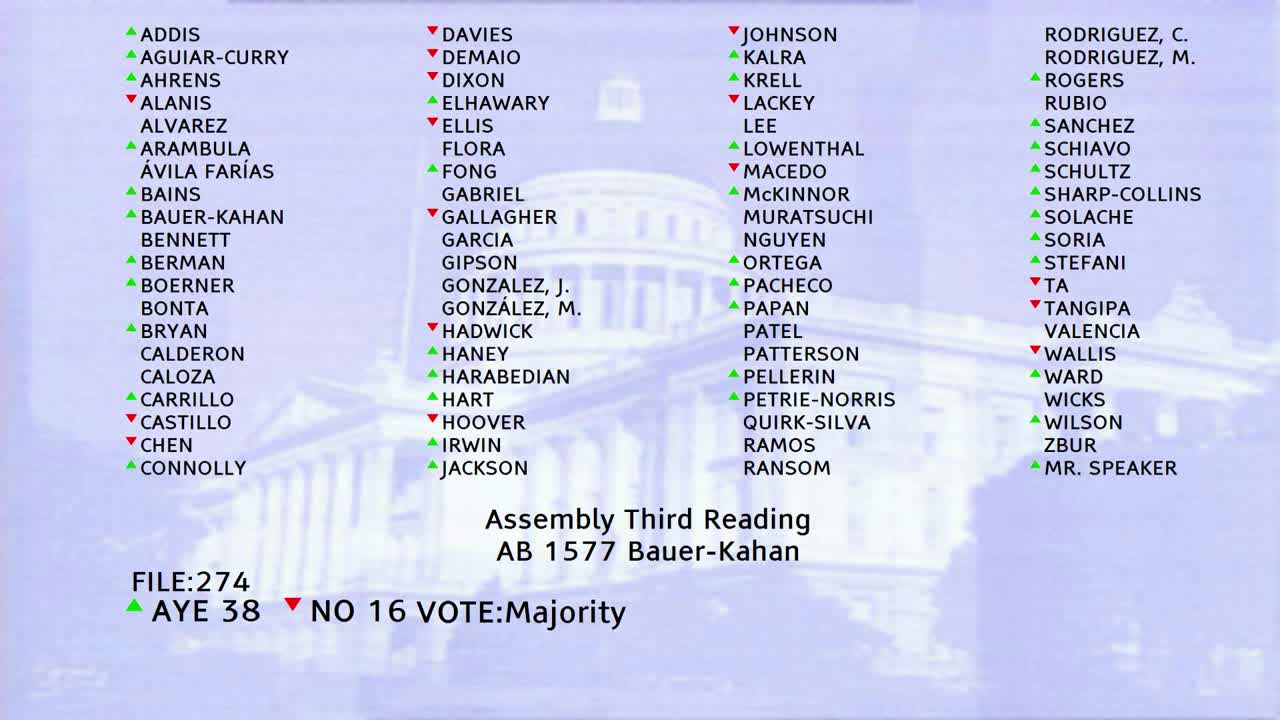
ASSEMBLY FLOOR: 59-7-14
YES: Addis, Aguiar-Curry, Ahrens, Alvarez, Arambula, Ávila Farías, Bains, Bauer-Kahan, Bennett, Berman, Boerner, Bonta, Bryan, Calderon, Caloza, Carrillo, Connolly, Elhawary, Fong, Gabriel, Garcia, Gipson, Mark González, Hadwick, Haney, Harabedian, Hart, Irwin, Jackson, Kalra, Krell, Lee, Lowenthal, McKinnor, Nguyen, Ortega, Pacheco, Papan, Patel, Pellerin, Petrie-Norris, Quirk-Silva, Ramos, Ransom, Michelle Rodriguez, Rogers, Blanca Rubio, Schiavo, Schultz, Sharp-Collins, Solache, Soria, Stefani, Wallis, Ward, Wicks, Wilson, Zbur, Rivas
NO: DeMaio, Flora, Gallagher, Johnson, Macedo, Sanchez, Tangipa
ABS, ABST OR NV: Alanis, Castillo, Chen, Davies, Dixon, Ellis, Jeff Gonzalez, Hoover, Lackey, Muratsuchi, Patterson, Celeste Rodriguez, Ta, Valencia
SENATE FLOOR: 32-2-6
YES: Allen, Archuleta, Arreguín, Ashby, Becker, Blakespear, Cabaldon, Caballero, Cervantes, Cortese, Dahle, Durazo, Gonzalez, Grayson, Hurtado, Laird, Limón, McGuire, McNerney, Menjivar, Ochoa Bogh, Padilla, Pérez, Reyes, Richardson, Rubio, Smallwood-Cuevas, Stern, Umberg, Wahab, Weber Pierson, Wiener
NO: Seyarto, Strickland
ABS, ABST OR NV: Alvarado-Gil, Choi, Grove, Jones, Niello, Valladares
UPDATED
VERSION: August 13, 2026
CONSULTANT: Andrew Ironside / PUB. S. / (916) 319-3744 FN: 0004420
SENATE RULES COMMITTEE Office of Senate Floor Analyses (916) 651-4171 | AB 1646 |
THIRD READING
Bill No: AB 1646
Author: Bryan (D) and Mark González (D), et al.
Amended: 8/13/26 in Senate
Vote: 21
SENATE PUBLIC SAFETY COMMITTEE: 5-1, 6/23/26
AYES: Arreguín, Caballero, Cortese, Pérez, Wiener
NOES: Seyarto
SENATE APPROPRIATIONS COMMITTEE: 5-0, 8/13/26
AYES: Cervantes, Cabaldon, Grayson, Richardson, Wahab
NO VOTE RECORDED: Seyarto, Dahle
ASSEMBLY FLOOR: 59-7, 5/26/26 - See last page for vote
SUBJECT: Juvenile facilities: visitation
SOURCE: Hoops 4 Justice; Urban Peace Institute
DIGEST:
This bill establishes the right of youth confined in juvenile facilities to engage in certain types of consensual physical contact with visitors during in-person visits, as specified.
ANALYSIS:
Existing law:
- Provides that the purpose of the juvenile court system is to provide for the protection and safety of the public and each minor under the jurisdiction of the juvenile court and that minors under the jurisdiction of the juvenile court who are in need of protective services shall receive care treatment and guidance consistent with their best interest and the best interests of the public. (Welfare & Institutions (Welf. & Inst.) Code, § 202, subds. (a), (b).)
- Authorizes the court to place a ward of the court in juvenile facility, as specified. (Welf. & Inst. Code, § 726.)
- Defines “juvenile facility” to mean a juvenile hall, juvenile camp or ranch, a facility of the California Department of Corrections and Rehabilitation (CDCR), Division of Juvenile Facilities, a regional youth educational facility, a youth correctional center, a juvenile regional facility or any other local or state facility used for the confinement of minors or wards. (Welf. & Inst. Code, § 208.3, subd. (a).)
- Provides that juvenile halls shall not be deemed to be, nor be treated as, penal institutions and that juvenile halls shall be safe and supportive homelike environments. (Welf. & Inst. Code, § 851.)
- Requires the Board of State and Community Corrections (BSCC) to adopt minimum standards for the operation and maintenance of juvenile halls for the confinement of minors. (Welf. & Inst. Code, § 210.)
- Establishes the Youth Bill of Rights, which applies to youth confined in a juvenile facility, and provides youth have specified rights. (Welf. & Inst. Code, § 241.71.)
- Provides that it is the policy of the state that all youth confined in a juvenile facility have specified rights, including, among others:
- To maintain frequent and continuing contact with parents, guardians, siblings, children, and extended family members, through visits, phone calls, and mail. Specifies that youth may be given access to computer technology for maintaining relationships with family as an alternative, but not as a replacement for, in-person visiting.
- To not be deprived of contact with parents, guardians, family, or attorneys as a disciplinary measure.
- To information about their rights as parents, including available parental support, reunification advocacy, and opportunities to maintain or develop a connection with their children. (Welf. & Inst. Code, § 241.71, subds. (g), (m), (o).)
This bill:
- Establishes a right for all youth confined in a juvenile facility to have the right to engage in consensual physical contact with visitors during in-person visits that a reasonable person would find appropriate under the circumstances, including hugging at the beginning and end of the visit and holding hands.
- Prohibits physical contact from being restricted as a disciplinary measure.
- Requires that limitations to physical contact during in-person visits is only implemented when a significant safety and security concern is present, including pursuant to any court-ordered restrictions on visitations or visitors for a youth confined in a juvenile facility or a temporary and specific health concern. Requires that physical contact is only temporarily restricted for a specific youth or visitor as necessary to address the significant safety and security concern.
- Requires that all significant safety and security concerns and subsequent contact limitations to be documented in detail, including the duration of the contact limitation and any additional accommodations or security measures implemented to facilitate a return to physical contact visits.
- Requires that all juvenile facilities establish regulations and procedures for in-person visitation consistent with the requirements in the bill.
Background
SB 518 (Migden, Chapter 649, Statutes of 2007), established the Youth Bill of Rights which enumerates several rights for youth confined in any juvenile facility within the state, including the right to live in a safe, healthy, and clean environment; to be free from various forms of abuse; to receive adequate and healthy meals, clean water at any time, timely access to toilets, access to daily showers, sufficient personal hygiene items, clean bedding, and clean clothing in good repair; to receive adequate, appropriate, and timely medical, reproductive, dental, vision, and mental health services provided by qualified professionals; to not be searched for the purpose of harassment or humiliation, a form of discipline or punishment, or to verify the youth’s gender; to receive a rigorous, quality education; and to have daily opportunities for age-appropriate physical exercise and recreation, among others. (Welf. & Inst. Code, § 241.71.) Of relevance to this bill, the Youth Bill of Rights provides for the right to maintain frequent and continuing contact with parents, guardians, siblings, children, and extended family members through visits, and the right to not be deprived of contact with parents, guardians, family, or attorneys as a disciplinary measure. (Welf. & Inst. Code, § 241.71, subds. (g), (m).)
The BSCC establishes minimum standards for juvenile facilities. Existing BSCC regulations require juvenile facilities to develop and implement written policies and procedures for visiting. Youth must be allowed to receive visits by parents, guardians, and the youth’s children. (California Code of Regulations (Cal. Code Regs.), tit. 15, § 1374.) Regulations authorize visits with other family members and other supportive adults. Regulations require visitation to occur at reasonable times unless restrictions are necessary to maintain order and security. (Ibid.) Regulations prohibit a visitor from being denied visitation solely based on the visitor’s criminal history unless staff determine that the visitor would be a safety risk to youth or staff in the facility. (Ibid.) Facilities are required to provide opportunities for at least two hours of visitation per week, and facility staff are prohibited from monitoring conversations during visitation unless there is a security or safety need. (Ibid.) Finally, facilities may not replace in-person visitation with technological alternatives. (Ibid.)
This bill establishes the right for youth confined in a juvenile facility to engage in consensual physical contact with visitors during in-person visits. This bill specifies that the physical contact is contact “that a reasonable person would find appropriate under the circumstances, including hugging at the beginning and end of the visit and holding hands.”
This bill allows for limitations on this right but provides that limitations can only be implemented when a significant safety and security concern is present. This bill specifies that a safety or security concern could include a court-ordered restriction on visitation or visitors for a youth as well as a temporary and specific health concern. This bill provides that limitations on the right to physical contact during in-person visits can only be restricted temporarily for a specific youth or visitor as necessary to address the significant safety and security concern.
This bill additionally requires that all significant safety and security concerns and subsequent contact limitations are documented in detail, including the duration of the contact limitation and any additional accommodations or security measures implemented to facilitate a return to physical contact visits. Finally, all juvenile facilities must establish regulations and procedures for in-person visitation consistent with the requirements outlined in this bill.
FISCAL EFFECT: Appropriation: No Fiscal Com.: Yes Local: Yes
According to the Senate Appropriations Committee:
Likely major costs to county probation departments to provide the right to consensual physical contact in juvenile facilities. Expanded physical contact allowances and the requirement that such contact shall be permitted during in person visits may require operational adjustments to maintain institutional safety and security. These costs, possibly reimbursable by the state could be both major at the local level (Los Angeles County is estimating up to $1 million annually) and greater in the aggregate statewide. Costs will depend on whether the duties imposed by this bill constitute a reimbursable state mandate, as determined by the Commission on State Mandates. (General Fund).
SUPPORT: (Verified 8/13/26)
Hoops 4 Justice (co-source)
Urban Peace Institute (co-source)
A New Way of Life Re-Entry Project
ACLU California Action
Alliance for Boys and Men of Color
Anti-Recidivism Coalition
Arts for Healing and Justice Network
Back to the Start
California Alliance for Youth and Community Justice
California Attorneys for Criminal Justice
California Public Defenders Association
Californians United for a Responsible Budget
Cancel the Contract
Children’s Advocacy Institute
Children’s Defense Fund-CA
Communities United for Restorative Youth Justice;
Ella Baker Center for Human Rights
Fresh Lifelines for Youth
Friends Committee on Legislation of California
GRIP Training Institute
Initiate Justice
InsideOUT Writers
Justice2Jobs Coalition
Juvenile Justice and Delinquency Prevention Commission
La Defensa
LA Public Defender’s Office
Legal Services for Prisoner With Children
Liberty Hill Foundation
Local 148 Los Angeles County Public Defender’s Union
Los Angeles County
Loyola Law School’s Youth Justice Education Clinic
MILPA Collective
National Center for Youth Law
National Institute for Criminal Justice Reform
Nuestra Causa
Peace and Justice Law Center
Public Works Alliance
San Quentin Skunkworks
Santa Cruz Barrios Unidos
Santa Cruz County Board of Supervisors
Silicon Valley De-Bug
Sister Warriors Freedom Coalition
The Action Project
The California Youth Justice Project
The Change Parallel Project
The Children’s Partnership
The Collective for Liberatory Lawyering
Tia Chucha’s Centro Cultural
Ujima Adult and Family Services
Underground GRIT
Universidad Popular
Upward Together
Youngsters for Change
Youth Alliance
Youth Forward
Youth Leadership Institute
OPPOSITION: (Verified 8/13/26)
Chief Probation Officers’ of California
ASSEMBLY FLOOR: 59-7, 5/26/26
AYES: Addis, Aguiar-Curry, Ahrens, Alvarez, Arambula, Ávila Farías, Bains, Bauer-Kahan, Bennett, Berman, Boerner, Bonta, Bryan, Calderon, Caloza, Carrillo, Connolly, Elhawary, Fong, Gabriel, Garcia, Gipson, Mark González, Hadwick, Haney, Harabedian, Hart, Irwin, Jackson, Kalra, Krell, Lee, Lowenthal, McKinnor, Nguyen, Ortega, Pacheco, Papan, Patel, Pellerin, Petrie-Norris, Quirk-Silva, Ramos, Ransom, Michelle Rodriguez, Rogers, Blanca Rubio, Schiavo, Schultz, Sharp-Collins, Solache, Soria, Stefani, Wallis, Ward, Wicks, Wilson, Zbur, Rivas
NOES: DeMaio, Flora, Gallagher, Johnson, Macedo, Sanchez, Tangipa
NO VOTE RECORDED: Alanis, Castillo, Chen, Davies, Dixon, Ellis, Jeff Gonzalez, Hoover, Lackey, Muratsuchi, Patterson, Celeste Rodriguez, Ta, Valencia
Prepared by: Stephanie Jordan / PUB. S. /
8/17/26 10:38:05
**** END ****
SENATE COMMITTEE ON
Senator Sabrina Cervantes, Chair
2025 - 2026 Regular Session
AB 1646 (Bryan) - Juvenile facilities: visitation
Version: | Policy Vote: |
Urgency: | Mandate: |
Hearing Date: | Consultant: |
Bill Summary:
AB 1646, the Hug Act, would add the right to engage in certain types of consensual physical contact with visitors during in-person visits to the Youth Bill of Rights and would establish requirements for the provision of this right.
*********** ANALYSIS ADDENDUM – SUSPENSE FILE ***********
The following information is revised to reflect amendments
adopted by the committee on August 13, 2026
Fiscal Impact:
Likely major costs to county probation departments to provide the right to consensual physical contact in juvenile facilities. Expanded physical contact allowances and the requirement that such contact shall be permitted during in person visits may require operational adjustments to maintain institutional safety and security. These costs, possibly reimbursable by the state could be both major at the local level (Los Angeles County is estimating up to $1 million annually) and greater in the aggregate statewide. Costs will depend on whether the duties imposed by this bill constitute a reimbursable state mandate, as determined by the Commission on State Mandates. (General Fund).
Committee Amendments:
Remove the statutory right to engage in consensual physical contact.
-- END --
SENATE COMMITTEE ON
Senator Sabrina Cervantes, Chair
2025 - 2026 Regular Session
AB 1646 (Bryan) - Juvenile facilities: visitation
Version: | Policy Vote: |
Urgency: | Mandate: |
Hearing Date: | Consultant: |
Bill Summary:
AB 1646, the Hug Act, would add the right to engage in certain types of consensual physical contact with visitors during in-person visits to the Youth Bill of Rights and would establish requirements for the provision of this right. To the extent that this bill would impose a higher level of service on local facilities, it would impose a state mandated local program.
Fiscal Impact:
Likely major costs to county probation departments to provide the right to consensual physical contact in juvenile facilities. Expanded physical contact allowances and the requirement that such contact shall be permitted during in person visits may require operational adjustments to maintain institutional safety and security. These costs, possibly reimbursable by the state could be both major at the local level (Los Angeles County is estimating up to $1 million annually) and greater in the aggregate statewide. Costs will depend on whether the duties imposed by this bill constitute a reimbursable state mandate, as determined by the Commission on State Mandates. (General Fund).
Background:
Existing law provides that the purpose of the juvenile court system is to provide for the protection and safety of the public and each minor under the jurisdiction of the juvenile court and that minors under the jurisdiction of the juvenile court who are in need of protective services shall receive care treatment and guidance consistent with their best interest and the best interests of the public
Proposed Law:
This bill establishes a right for all youth confined in a juvenile facility to have the right to engage in physical contact with visitors during in-person visits that a reasonable person would find nonsexual and appropriate under the circumstances, including hugging at the beginning and end of the visit and holding hands.
This bill requires that limitations to physical contact during in-person visits is only implemented when a significant safety and security concern is present, including pursuant to any court-ordered restrictions on visitations or visitors for a youth confined in a juvenile facility or a temporary and specific health concern. Requires that physical contact is only temporarily restricted for a specific youth or visitor as necessary to address the significant safety and security concern.
This bill requires that all significant safety and security concerns and subsequent contact limitations shall be documented in detail, including the duration of the contact limitation and any additional accommodations or security measures implemented to facilitate a return to physical contact visits. The documentation shall be made available to the Division of the Ombudsman of the Office of Youth and Community Restoration upon request.
This bill requires that all juvenile facilities establish regulations and procedures for in-person visitation consistent with the requirements in this bill.
Related Legislation:
AB 1645 (M Gonzalez) would enact the Humanizing and Uniting Generations Safely (HUGS) Act of 2026 to require California Department of Corrections and Rehabilitation (CDCR) regulations recognize the importance of physical contact in incarcerated person visitations. CDCR would be prohibited from unreasonably restricting the ability of incarcerated persons or their visitors to engage in certain types of nonsexual physical contact during the visit. It would not provide a right to nonsexual physical contact. AB 1645 is pending in the Senate Approrpriations Committee.
SENATE COMMITTEE ON PUBLIC SAFETY
Senator Jesse Arreguín, Chair
2025 - 2026 Regular
Bill No: AB 1646 Hearing Date: June 23, 2026
Author: | Bryan | ||
Version: | May 18, 2026 | ||
Urgency: | No | Fiscal: | Yes |
Consultant: | SJ | ||
Subject: Juvenile facilities: visitation
HISTORY
Source: Hoops 4 Justice; Urban Peace Institute
Prior Legislation: AB 2417 (Ting), Ch. 786, Stats. 2022
SB 1139 (Kamlager), Ch. 837, Stats. of 2022
SB 92 (Com. on Budget & Fiscal Rev.), Ch. 18, Stats. of 2021
SB 823 (Com. on Budget & Fiscal Rev.), Ch. 337, Stats. of 2020
AB 811 (Gipson), vetoed, 2017
SB 1250 (Yee), Ch. 522, Stats. 2008
SB 518 (Migden), Ch. 649, Stats. 2007
Support: A New Way of Life Re-Entry Project; ACLU California Action; Alliance for Boys and Men of Color; Anti-Recidivism Coalition; Arts for Healing and Justice Network; California Alliance for Youth and Community Justice; California Attorneys for Criminal Justice; California Public Defenders Association; Californians United for a Responsible Budget; Cancel the Contract; Children’s Advocacy Institute; Children’s Defense Fund-CA; Communities United for Restorative Youth Justice; Ella Baker Center for Human Rights; Fresh Lifelines for Youth; GRIP Training Institute; InsideOUT Writers; Justice2Jobs Coalition; Juvenile Justice and Delinquency Prevention Commission; La Defensa; LA Public Defender’s Office; Legal Services for Prisoner With Children; Liberty Hill Foundation; Local 148 Los Angeles County Public Defender’s Union; Los Angeles County; Loyola Law School’s Youth Justice Education Clinic; MILPA Collective; National Center for Youth Law; National Institute for Criminal Justice Reform; Nuestra Causa; Peace and Justice Law Center; Public Works Alliance; San Quentin Skunkworks; Santa Cruz Barrios Unidos; Santa Cruz County Board of Supervisors; Silicon Valley De-Bug; Sister Warriors Freedom Coalition; The Action Project; The California Youth Justice Project; The Change Parallel Project; The Children’s Partnership; The Collective for Liberatory Lawyering; Tia Chucha’s Centro Cultural; Ujima Adult and Family Services; Underground GRIT; Upward Together; Youngsters for Change; Youth Alliance; Youth Forward; Youth Leadership Institute
Opposition: Chief Probation Officers’ of California
Assembly Floor Vote: 59 - 7
PURPOSE
The purpose of this bill is to establish a right for youth confined in a juvenile facility to engage in non-sexual physical contact with visitors during in-person visits, as specified.
Existing law provides that the purpose of the juvenile court system is to provide for the protection and safety of the public and each minor under the jurisdiction of the juvenile court and that minors under the jurisdiction of the juvenile court who are in need of protective services shall receive care treatment and guidance consistent with their best interest and the best interests of the public. (Welf. & Inst. Code, § 202, subds. (a), (b).)
Existing law authorizes the court to place a ward of the court in juvenile facility, as specified. (Welf. & Inst. Code, § 726.)
Existing law defines “juvenile facility” to mean a juvenile hall, juvenile camp or ranch, a facility of the CDCR, Division of Juvenile Facilities, a regional youth educational facility, a youth correctional center, a juvenile regional facility or any other local or state facility used for the confinement of minors or wards. (Welf. & Inst. Code, § 208.3, subd. (a).)
Existing law provides that juvenile halls shall not be deemed to be, nor be treated as, penal institutions and that juvenile halls shall be safe and supportive homelike environments. (Welf. & Inst. Code, § 851.)
Existing law requires the Board of State and Community Corrections (BSCC) to adopt minimum standards for the operation and maintenance of juvenile halls for the confinement of minors. (Welf. & Inst. Code, § 210.)
Existing law establishes the Youth Bill of Rights, which applies to youth confined in a juvenile facility, and provides youth have specified rights. (Welf. & Inst. Code, § 241.71.)
Existing law provides that it is the policy of the state that all youth confined in a juvenile facility have specified rights, including, among others:
- To maintain frequent and continuing contact with parents, guardians, siblings, children, and extended family members, through visits, phone calls, and mail. Specifies that youth may be given access to computer technology for maintaining relationships with family as an alternative, but not as a replacement for, in-person visiting.
- To not be deprived of contact with parents, guardians, family, or attorneys as a disciplinary measure.
- To information about their rights as parents, including available parental support, reunification advocacy, and opportunities to maintain or develop a connection with their children. (Welf. & Inst. Code, § 241.71, subds. (g), (m), (o).)
This bill establishes a right for all youth confined in a juvenile facility to have the right to engage in physical contact with visitors during in-person visits that a reasonable person would find nonsexual and appropriate under the circumstances, including hugging at the beginning and end of the visit and holding hands.
This bill requires that limitations to physical contact during in-person visits is only implemented when a significant safety and security concern is present, including pursuant to any court-ordered restrictions on visitations or visitors for a youth confined in a juvenile facility or a temporary and specific health concern. Requires that physical contact is only temporarily restricted for a specific youth or visitor as necessary to address the significant safety and security concern.
This bill requires that all significant safety and security concerns and subsequent contact limitations shall be documented in detail, including the duration of the contact limitation and any additional accommodations or security measures implemented to facilitate a return to physical contact visits.
This bill requires that all juvenile facilities establish regulations and procedures for in-person visitation consistent with the requirements in this bill.
COMMENTS
- Need For This Bill
According to the author:
The ability to receive and give a hug to your loved ones is a critical part of the healing and transformation process for young people who are incarcerated. It’s time to stop weaponizing essential pieces of our shared humanity and calling it rehabilitation.
- Visitation Rights
SB 518 (Migden), Chapter 649, Statutes of 2007, established the Youth Bill of Rights which enumerates several rights for youth confined in any juvenile facility within the state, including the right to live in a safe, healthy, and clean environment; to be free from various forms of abuse; to receive adequate and healthy meals, clean water at any time, timely access to toilets, access to daily showers, sufficient personal hygiene items, clean bedding, and clean clothing in good repair; to receive adequate, appropriate, and timely medical, reproductive, dental, vision, and mental health services provided by qualified professionals; to not be searched for the purpose of harassment or humiliation, a form of discipline or punishment, or to verify the youth’s gender; to receive a rigorous, quality education; and to have daily opportunities for age-appropriate physical exercise and recreation, among others. (Welf. & Inst. Code, § 241.71.) Of relevance to this bill, the Youth Bill of Rights provides for the right to maintain frequent and continuing contact with parents, guardians, siblings, children, and extended family members through visits, and the right to not be deprived of contact with parents, guardians, family, or attorneys as a disciplinary measure. (Welf. & Inst. Code, § 241.71, subds. (g), (m).)
The BSCC establishes minimum standards for juvenile facilities. Existing BSCC regulations require juvenile facilities to develop and implement written policies and procedures for visiting. Youth must be allowed to receive visits by parents, guardians, and the youth’s children. (Cal. Code Regs., tit. 15, § 1374.) Regulations authorize visits with other family members and other supportive adults. Regulations require visitation to occur at reasonable times unless restrictions are necessary to maintain order and security. (Ibid.) Regulations prohibit a visitor from being denied visitation solely based on the visitor’s criminal history unless staff determine that the visitor would be a safety risk to youth or staff in the facility. (Ibid.) Facilities are required to provide opportunities for at least two hours of visitation per week, and facility staff are prohibited from monitoring conversations during visitation unless there is a security or safety need. (Ibid.) Finally, facilities may not replace in-person visitation with technological alternatives. (Ibid.)
This bill establishes the right for youth confined in a juvenile facility to engage in physical contact with visitors during in-person visits. This bill specifies that the physical contact is contact “that a reasonable person would find nonsexual and appropriate under the circumstances, including hugging at the beginning and end of the visit and holding hands.”
The bill allows for limitations on this right but provides that limitations can only be implemented when a significant safety and security concern is present. The bill specifies that a safety or security concern could include a court-ordered restriction on visitation or visitors for a youth as well as a temporary and specific health concern. The bill provides that limitations on the right to physical contact during in-person visits can only be restricted temporarily for a specific youth or visitor as necessary to address the significant safety and security concern.
This bill additionally requires that all significant safety and security concerns and subsequent contact limitations are documented in detail, including the duration of the contact limitation and any additional accommodations or security measures implemented to facilitate a return to physical contact visits. Finally, all juvenile facilities must establish regulations and procedures for in-person visitation consistent with the requirements outlined in this bill.
- Amendments
The author intends to take several amendments in Committee. The amendments add uncodified legislative findings and declarations, amend Welfare and Institutions Code section 224.71 (the Youth Bill of Rights) to create a right to engage in consensual physical contact with visitors during in-person visits and cross-reference the existing provisions of this bill, and provide that the documentation required when there are limits to physical contact be made available to the Division of the Ombudsperson of the Office of Youth and Community Restoration upon request.
224.71 (s) To engage in consensual physical contact with visitors during in-person visits, consistent with Section 224.75.
224.75. (a) Consistent with subdivision (g) (s) of Section 224.71, all youth confined in a juvenile facility, before, during, or after adjudication of wardship, shall have the right to engage in consensual physical contact with visitors during in-person visits that a reasonable person would find nonsexual and appropriate under the circumstances, including including, but not limited to, hugging at the beginning and end of the visit and holding hands.
(b) (1) The physical contact described in subdivision (a) shall not be restricted as a disciplinary measure. Limitations to the physical contact described in subdivision (a) shall only be implemented when a significant safety and security concern is present, including pursuant to any court-ordered restrictions on visitations or visitors for a youth confined in a juvenile facility or a temporary and specific health concern. When the limitations are implemented, physical contact shall only be temporarily restricted for a specific youth or visitor as necessary to address the significant safety and security concern.
(2) All significant safety and security concerns and subsequent contact limitations shall be documented in detail, including the duration of the contact limitation and any additional accommodations or security measures implemented to facilitate a return to physical contact visits. The documentation required by this paragraph shall be made available to the Division of the Ombudsperson of the Office of Youth and Community Restoration upon request.
- Argument in Support
According to the Ella Baker Center for Human Rights:
California has made meaningful progress in advancing a rehabilitative, youth-centered approach to juvenile justice. Family engagement remains a cornerstone of that framework, and in-person visitation plays an important role in supporting youth well-being and successful reintegration. Yet across California, youth sit separated from families, often by plexiglass, unable to hug hello or goodbye. A mother takes the bus for two hours to see her son and cannot hold his hand. A father watches his daughter cry and cannot embrace her. A grandchild sees his grandmother on her birthday, greets her with a hug, and has his visitation canceled for
While current law guarantees access to visitation, policies regarding physical contact during visits vary across facilities. California’s Youth Bill of Rights (AB 2417, 2022) for incarcerated youth already guarantees “visitation that reflects contact that occurs in typical family relationships.” The Office of Youth and Community Restoration (OYCR) has explicitly stated this includes “physical affection consistent with typical family relationships, such as hugs and holding hands.” AB 1646 provides clear, uniform guidance statewide to ensure visitation practices are consistent and aligned with trauma-informed care principles. OYCR’s own guidance recognizes that maintaining family bonds through physical contact is essential to rehabilitation—yet without statutory clarity, counties implement vastly different and often restrictive policies that undermine this goal. By establishing a common standard, the bill supports facilities in maintaining safe environments while preserving healthy family connection.
Research in child development and trauma-informed care underscores the importance of supportive relationships for young people, particularly those who have experienced adversity. Ensuring that visitation reflects typical family interaction, within appropriate boundaries, promotes emotional stability and reinforces California’s commitment to rehabilitation. Touch deprivation in adolescents increases anxiety, depression, and aggression. Youth who receive parental visits show rapid declines in depressive symptoms. Youth who are never visited have significantly higher rates of behavioral incidents. Physical contact lowers stress hormones and maintains attachment bonds that protect against stress. This isn’t sentimentality -- it’s neuroscience. Denying physical contact serves no safety purpose-- it harms youth development.
California closed DJJ to keep youth close to their communities and families. We invested millions in rehabilitation because we believe in supporting youth development, not punishment. We cannot claim to practice trauma-informed, family centered care while simultaneously denying youth the comfort of their family’s embrace. AB 1646 ensures our practices match our stated values.
- Argument in Opposition
The Chief Probation Officers’ of California writes:
We are opposed unless amended to remove the language on making nonsexual contact a right and instead approach it from the perspective of requiring policies on contact during visitation, remove prescribed reference to hand holding, and updating the safety and security language to ensure it reflects institutional operational realities for the safety of the youth, visitors, and staff.
First and importantly, we value the importance of family visitation, engagement, and fostering connections as part of a youth’s time in detention and upon reentry. However, the approach laid out in the bill to establish prescribed forms of contact as a right, creates operational, fiscal and liability concerns.
The approach to establish this as a right, combined with the prescriptiveness of the types of contact such as hand holding, and the lack of comprehensive safety and security considerations and responses in a detention environment create safety, liability, and fiscal impacts. Further, local policies are already in place to address visitation practices, but because they are locally adopted, they are crafted to ensure they work operationally and without creating other unintended consequences.
This bill, and the specific approach it takes, omits flexibility that is necessary to maintain the safety and security of facilities and visitation for all members and staff. Additionally, the inclusion of subjective language such as “that a reasonable person would find nonsexual and appropriate” utilized in relation to the establishment of a right, opens up concerns about unintended consequences.
For these reasons, while we are not opposed to the premise of fostering family engagement and safe and appropriate contact, those issues are already addressed through local policies which is the appropriate forum to do so to account for the myriad of considerations that exist and must be balanced.
-- END --
ASSEMBLY THIRD READING
ATR Bill Id:AB 1646
Author:(Bryan and Mark González)
As Amended Ver:May 18, 2026
Majority vote
SUMMARY
Establishes the right of youth confined in juvenile facilities to nonsexual and appropriate physical contact with visitors during in-person visits.
Major Provisions
- Provides that all youth confined in a juvenile facility, before, during, or after adjudication of wardship, shall have the right to engage in physical contact with visitors during in-person visits that a reasonable person would find nonsexual and appropriate under the circumstances, including hugging at the beginning and end of the visit and holding hands.
- States that limitations to the physical contact described above shall only be implemented when a significant safety and security concern is present, including pursuant to any court-ordered restrictions on visitations or visitors for a youth confined in a juvenile facility or a temporary and specific health concern.
- Specifies that when the limitations are implemented, physical contact shall only be temporarily restricted for a specific youth or visitor as necessary to address the significant safety and security concern.
- Provides that all significant safety and security concerns and subsequent contact limitations shall be documented in detail, including the duration of the contact limitation and any additional accommodations or security measures implemented to facilitate a return to physical contact visits.
- Requires all juvenile facilities to establish regulations and procedures for in-person visitation consistent with the above.
COMMENTS
According to the Author
"The ability to receive and give a hug to your loved ones is a critical part of the healing and transformation process for young people who are incarcerated. It's time to stop weaponizing essential pieces of our shared humanity and calling it rehabilitation."
Arguments in Support
According to Legal Services for Prisoners with Children, "California has made meaningful progress in advancing a rehabilitative, youth-centered approach to juvenile justice. Family engagement remains a cornerstone of that framework, and in-person visitation plays an important role in supporting youth well-being and successful reintegration. Yet across California, youth sit separated from families often by plexiglass, unable to hug hello or goodbye. A mother takes the bus for two hours to see her son and cannot hold his hand. A father watches his daughter cry and cannot embrace her. A grandchild sees his grandmother on her birthday, greets her with a hug, and has his visitation cancelled for a month. These are children, and we are denying them basic human connection at the moment they need it most."
"While current law guarantees access to visitation, policies regarding physical contact during visits vary across facilities. California's Youth Bill of Rights (AB 2417, 2022) for incarcerated youth already guarantees "visitation that reflects contact that occurs in typical family relationships." The Office of Youth and Community Restoration (OYCR) has explicitly stated this includes "physical affection consistent with typical family relationships, such as hugs and holding hands." AB 1646 provides clear, uniform guidance statewide to ensure visitation practices are consistent and aligned with trauma-informed care principles. OYCR's own guidance recognizes that maintaining family bonds through physical contact is essential to rehabilitation—yet without statutory clarity, counties implement vastly different and often restrictive policies that undermine this goal. By establishing a common standard, the bill supports facilities in maintaining safe environments while preserving healthy family connection."
"Research in child development and trauma-informed care underscores the importance of supportive relationships for young people, particularly those who have experienced adversity. Ensuring that visitation reflects typical family interaction, within appropriate boundaries, promotes emotional stability and reinforces California's commitment to rehabilitation. Touch deprivation in adolescents increases anxiety, depression, and aggression. Youth who receive parental visits show rapid declines in depressive symptoms. Youth who are never visited have significantly higher rates of behavioral incidents. Physical contact lowers stress hormones and maintains attachment bonds that protect against stress. This isn't sentimentality -- it's neuroscience. Denying physical contact serves no safety purpose-- it harms youth development."
"California closed the Division of Juvenile Justice (DJJ) to keep youth close to their communities and families. We invested millions in rehabilitation because we believe in supporting youth development, not punishment. We cannot claim to practice trauma-informed, family centered care while simultaneously denying youth the comfort of their family's embrace. AB 1646 ensures our practices match our stated values."
Arguments in Opposition
According to the SFV Alliance, "The mission of placing children in juvenile detention centers / facilities is to focus on rehabilitation rather than punishment. Juvenile detention centers are also mixed with those children while still needing rehabilitation, awaiting trial and or placement, and can be considered a risk to themselves, staff, and other children in the center with them."
"This bill has no stipulation to the assessment of the child being allowed to have human contact with visitors. Some children may be prone to violence. A child may have connections outside of the facility that encourages or has intimidated the child to commit violence to another. Allowing hugging or holding hands creates a pathway of transferring contra band from the visitor to the child. This could put the child, the staff and other children at risk of violence, harm and/or death."
"I appreciate the author's attempt at bringing healing to our youth through touch, yet I feel that this legislation has the potential to do more harm than good."
FISCAL COMMENTS
According to the Assembly Appropriations Committee:
- Unknown reimbursable annual costs (General Fund) for juvenile facilities to establish policies and procedures for in-person visitation consistent with this measure. Juvenile facilities would encounter unknown, but likely minor costs to implement the changes the bill proposes. If the Commission on State Mandates determines this bill's requirements to be a reimbursable state mandate, the state would need to reimburse these costs to local agencies.
The Legislative Analyst's Office recently warned of General Fund structural deficits of around $35 billion per year in the 2027-28 fiscal year and ongoing.
- The Board of State and Community Corrections (BSCC) reports no significant costs, estimating that the impact of this measure would be absorbable into its current workload.
VOTES
ASM PUBLIC SAFETY: 7-0-2
YES: Schultz, Mark González, Haney, Harabedian, Nguyen, Ramos, Wilson
ABS, ABST OR NV: Alanis, Lackey
ASM APPROPRIATIONS: 11-1-3
YES: Wicks, Aguiar-Curry, Calderon, Caloza, Fong, Mark González, Krell, Pacheco, Pellerin, Sharp-Collins, Solache
NO: Tangipa
ABS, ABST OR NV: Hoover, Dixon, Ta
UPDATED
VERSION: May 18, 2026
CONSULTANT: Andrew Ironside / PUB. S. / (916) 319-3744 FN: 0002906
Date of Hearing: April 8, 2026
ASSEMBLY COMMITTEE ON APPROPRIATIONS
Buffy Wicks, Chair
ABPCA Bill Id:AB 1646
Author:(Bryan) – As Introduced Ver:January 27, 2026
Policy Committee: | Public Safety | Vote: | 7 - 0 |
|
| ||
|
|
Urgency: No State Mandated Local Program: Yes Reimbursable: Yes
SUMMARY:
This bill establishes the right of youth confined in juvenile facilities to nonsexual and appropriate physical contact with visitors during in-person visits.
FISCAL EFFECT:
- Unknown reimbursable annual costs (General Fund) for juvenile facilities to establish policies and procedures for in-person visitation consistent with this measure. Juvenile facilities would encounter unknown, but likely minor costs to implement the changes the bill proposes. If the Commission on State Mandates determines this bill’s requirements to be a reimbursable state mandate, the state would need to reimburse these costs to local agencies.
The Legislative Analyst’s Office recently warned of General Fund structural deficits of around $35 billion per year in the 2027-28 fiscal year and ongoing.
- The Board of State and Community Corrections (BSCC) reports no significant costs, estimating that the impact of this measure would be absorbable into its current workload.
COMMENTS:
- Background. Existing law recognizes the importance of maintaining family contact for youth confined in juvenile facilities. The Youth Bill of Rights, enacted in 2007, guarantees confined youth the right to maintain frequent and continuing contact with parents, guardians, siblings, children, and extended family through visitation, and prohibits facilities from denying contact with family or attorneys as a form of discipline. State regulations adopted by the BSCC establish minimum standards for juvenile facilities, including requirements that facilities allow visitation with parents, guardians, and a youth’s children and provide at least two hours of visitation per week at reasonable times, unless security concerns justify restrictions. Facilities may also permit visits with other family members or supportive adults, may not deny visitation solely based on a visitor’s criminal history unless the person presents a safety risk, and generally may not replace in-person visits with technological alternatives.
This bill builds on those visitation rights by requiring that youth confined in juvenile facilities be permitted reasonable, nonsexual physical contact with visitors during in-person visits, such as hugging or holding hands. Facilities would be required to adopt policies governing visitation that are consistent with this right. The bill applies broadly to youth confined in juvenile facilities, which include juvenile halls, camps or ranches, and local secure youth treatment facilities. This framework reflects the broader restructuring of California’s juvenile justice system following the closure of the Division of Juvenile Justice (DJJ). Historically, the state operated large juvenile correctional facilities, but legislation, beginning with SB 81(Committee on Budget and Fiscal Review), Chapter 175, Statutes of 2007, shifted responsibility toward counties, and SB 823 (Committee on Budget and Fiscal Review), Chapter 337, Statutes of 2020, ultimately closed DJJ and required counties to house youth who previously would have been committed there in local Secure Youth Treatment Facilities. As a result, most youth are now confined in county-run facilities rather than state institutions, and the visitation standards addressed by this bill primarily apply to those local settings.
The BSCC is the state entity responsible for establishing minimum standards for the operation of these local detention facilities. The BSCC adopts regulations governing the treatment and conditions of confined youth, such as rules on visitation, and monitors local facilities for compliance with those standards.
- Related Legislation. AB 1645 (Gonzalez) would prohibit Department of Corrections and Rehabilitation (CDCR) regulations from unreasonably restricting nonsexual physical contact between incarcerated people and visitors during contact visits.
Analysis Prepared by: Shiran Zohar / APPR. / (916) 319-2081
Date of Hearing:
Chief Counsel: Andrew Ironside
ASSEMBLY COMMITTEE ON
Nick Schultz, Chair
ABPCA Bill Id:
Author:() – As Ver:
SUMMARY:
Establishes the right of youth confined in juvenile facilities to nonsexual and appropriate physical contact with visitors during in-person visits. Specifically, this bill:
- Provides that all youth confined in a juvenile facility, before, during, or after adjudication of wardship, shall have the right to engage in physical contact with visitors during in-person visits that a reasonable person would find nonsexual and appropriate under the circumstances, including hugging at the beginning and end of the visit and holding hands.
- Requires all juvenile facilities to establish regulations and procedures for in-person visitation consistent with the above.
EXISTING LAW:
- States that the purpose of the juvenile court system is to provide for the protection and safety of the public and each minor under the jurisdiction of the juvenile court and that minors under the jurisdiction of the juvenile court who are in need of protective services shall receive care treatment and guidance consistent with their best interest and the best interests of the public. (Welf. & Inst. Code, § 202, subds. (a), (b).)
- Defines “juvenile facility” as juvenile hall, juvenile camp or ranch, a facility of the CDCR, Division of Juvenile Facilities, a regional youth educational facility, a youth correctional center, a juvenile regional facility or any other local or state facility used for the confinement of minors or wards. (Welf. & Inst. Code, § 208.3, subd. (a).)
- Authorizes the court to place a ward of the court in juvenile facility, as specified. (Welf. & Inst. Code, § 726.)
- Provides that juvenile halls shall not be deemed to be, nor be treated as, penal institutions and that juvenile halls shall be safe and supportive homelike environments. (Welf. & Inst. Code, § 851.)
- Requires the Board of State and Community Corrections (BSCC) to adopt minimum standards for the operation and maintenance of juvenile halls for the confinement of minors. (Welf. & Inst. Code, § 210.)
- Establishes the Youth Bill of Rights. (Welf. & Inst. Code, § 241.7 et seq.)
- States that it is the policy of the state that all youth confined in a juvenile facility have specified rights, including, among others,
- To maintain frequent and continuing contact with parents, guardians, siblings, children, and extended family members, through visits, telephone calls, and mail.
- To not be deprived of contact with parents, guardians, family, or attorneys as a disciplinary measure.
- To information about their rights as parents, including available parental support, reunification advocacy, and opportunities to maintain or develop a connection with their children. (Welf. & Inst. Code, § 241.71, subds. (g), (m), (o).)
- Provides that youth may be provided with access to computer technology and the internet for maintaining relationships with family as an alternative, but not as a replacement for, in-person visiting. (Welf. & Inst. Code, § 241.71, subd. (g).)
- Provides, generally, that a minor who is between 12 years of age and 17 years of age, inclusive, when the minor violates any law defining a crime, is subject to the jurisdiction of the juvenile court and to adjudication as a ward. (Welf. & Inst. Code, § 602, subd. (a).)
FISCAL EFFECT:
Unknown
COMMENTS:
- Author's Statement: According to the author, “The ability to receive and give a hug to your loved ones is a critical part of the healing and transformation process for young people who are incarcerated. It’s time to stop weaponizing essential pieces of our shared humanity and calling it rehabilitation.”
- Effect of this bill: Existing law establishes the importance of visitation for juveniles confined in juvenile facilities. In 2007, SB 518 (Migden), Chapter 649, Statutes of 2007, created The Youth Bill of Rights governing the treatment of youth confined in juvenile and adult facilities. (Ch. 649, Stats. 2007.) Among others, the Youth Bill of Rights provided for the right to maintain frequent and continuing contact with parents, guardians, siblings, children, and extended family members through visits; and, the right to not be deprived of contact with parents, guardians, family, or attorneys as a disciplinary measure. (Welf. & Inst. Code, § 241.71, subds. (g) & (m).) The list was later expanded to include, for juvenile parents, the right to information about their rights as parents, including available parental support, reunification advocacy, and opportunities to maintain or develop a connection with their children. (Welf. & Inst. Code, § 241.71, subd. (o).)
The BSCC establishes minimum standards for juvenile facilities. Existing BSCC regulations require juvenile facilities to provide for juvenile visitation with parents, guardians, and the juvenile’s children; and authorize facilities to provide for juvenile visitation with other family members, siblings, and other supportive adults. (Cal. Code Regs., tit. 15, § 1374.) BSCC regulations require visitation to occur at reasonable times, unless restrictions are justified by security concerns. (Ibid.) A potential visitor cannot be denied solely based on the visitor’s criminal history, unless staff determine that the visitor would be a safety risk to youth or staff in the facility. (Ibid.) Facilities shall provide for opportunities for at least two hours of visitation per week, and prohibits facility staff from monitoring conversations during visitation unless there is a security or safety need. (Ibid.) Facilities may not replace in-person visitation with technological alternatives. (Ibid.)
This bill provides that all youth confined in a juvenile facility, before, during, or after adjudication of wardship, shall have the right to engage in physical contact with visitors during in-person visits that a reasonable person would find nonsexual and appropriate under the circumstances, including hugging at the beginning and end of the visit and holding hands. It also requires all juvenile facilities to establish regulations and procedures for in-person visitation consistent with the above. - Closure of the Division of Juvenile Justice (DJJ): This bill establishes the right of youth confined in juvenile facilities to nonsexual and appropriate physical contact with visitors during in-person visits. Existing law defines juvenile facilities as juvenile halls, juvenile camps or ranches, a facility of the CDCR, Division of Juvenile Facilities, a regional youth educational facility, a youth correctional center, a juvenile regional facility, or any other local or state facility used for the confinement of minors or wards. (Welf. & Inst. Code, § 208.3, subd. (a).)
Historically the CDCR’s DJJ housed the majority of the state’s juvenile offenders with the number of juveniles housed in these facilities exceeding 15,000 in the 1990’s. In 2003, plaintiffs filed a lawsuit, Farrell v. Hickman (originally Farrell v. Harper), alleging that CDCR was providing inadequate care for minors housed in its facilities. In January 2005, the state and plaintiffs entered into an agreement which committed reforming the state’s juvenile justice system to a rehabilitative model.
In 2007, the Legislature passed SB 81, Chapter 175, Statutes of 2007, known as juvenile justice realignment. The premise was that local authorities were better able than the State to provide rehabilitation for many juvenile offenders. Under this legislation, juvenile courts were prohibited from committing juveniles adjudicated after September 1, 2007, to DJJ unless the adjudication was for certain serious, violent, or sexual offenses.[1] Non-violent offenders housed at DJJ were transferred back to the counties. And in return, counties were provided with funding.
The Governor’s January Budget in 2020 proposed to transfer DJJ to a newly created independent department within the Health and Human Services Agency on July 1, 2020. That approach was intended to align the rehabilitative mission of the state’s juvenile justice system with trauma-informed and developmentally appropriate services supported by programs overseen by the state’s Health and Human Services Agency. The unprecedented impact of COVID-19 resulted in the withdrawal of this proposal. Subsequently, the May Revision of the Budget proposed to expand on previous efforts to reform the state’s juvenile justice system by transferring the responsibility for managing all youthful offenders to local jurisdictions.
SB 823 (Committee on Budget), Chapter 337, Statutes of 2020, included intent language to establish a secure youth treatment facility as a commitment option for youth adjudicated for DJJ eligible offenses by March 1, 2021. SB 823 closed intake at the (DJJ) on July 1, 2021. Effective July 1, 2023, all DJJ facilities have closed.[2]
Secure Youth Treatment Facilities (SYTFs) were created as local custodial options for the custody and care of juveniles who would have previously been sent to DJJ but can no longer be committed there because of its closure. A minor can only be committed to an SYTF upon adjudication for a 707(b) offense committed at age 14 or older. As under prior law with regards to DJJ commitments, that 707(b) offense must be the most recent offense for which the minor has been adjudicated. (See Welf. & Inst, Code, §§ 875, subd. (a)(2) & 733.)
- Argument in Support: According to Legal Services for Prisoners with Children, “California has made meaningful progress in advancing a rehabilitative, youth-centered approach to juvenile justice. Family engagement remains a cornerstone of that framework, and in-person visitation plays an important role in supporting youth well-being and successful reintegration. Yet across California, youth sit separated from families often by plexiglass, unable to hug hello or goodbye. A mother takes the bus for two hours to see her son and cannot hold his hand. A father watches his daughter cry and cannot embrace her. A grandchild sees his grandmother on her birthday, greets her with a hug, and has his visitation cancelled for a month. These are children, and we are denying them basic human connection at the moment they need it most.
“While current law guarantees access to visitation, policies regarding physical contact during visits vary across facilities. California’s Youth Bill of Rights (AB 2417, 2022) for incarcerated youth already guarantees "visitation that reflects contact that occurs in typical family relationships." The Office of Youth and Community Restoration (OYCR) has explicitly stated this includes “physical affection consistent with typical family relationships, such as hugs and holding hands.” AB 1646 provides clear, uniform guidance statewide to ensure visitation practices are consistent and aligned with trauma-informed care principles. OYCR's own guidance recognizes that maintaining family bonds through physical contact is essential to rehabilitation—yet without statutory clarity, counties implement vastly different and often restrictive policies that undermine this goal. By establishing a common standard, the bill supports facilities in maintaining safe environments while preserving healthy family connection.
“Research in child development and trauma-informed care underscores the importance of supportive relationships for young people, particularly those who have experienced adversity. Ensuring that visitation reflects typical family interaction, within appropriate boundaries, promotes emotional stability and reinforces California’s commitment to rehabilitation. Touch deprivation in adolescents increases anxiety, depression, and aggression. Youth who receive parental visits show rapid declines in depressive symptoms. Youth who are never visited have significantly higher rates of behavioral incidents. Physical contact lowers stress hormones and maintains attachment bonds that protect against stress. This isn’t sentimentality -- it’s neuroscience. Denying physical contact serves no safety purpose-- it harms youth development.
“California closed DJJ to keep youth close to their communities and families. We invested millions in rehabilitation because we believe in supporting youth development, not punishment. We cannot claim to practice trauma-informed, family centered care while simultaneously denying youth the comfort of their family’s embrace. AB 1646 ensures our practices match our stated values.” - Related Legislation:
- AB 1645 (Gonzalez) would prohibit Department of Corrections and Rehabilitation (CDCR) regulations from unreasonably restricting nonsexual physical contact between incarcerated person and visitors during contact visits. AB 1645 is set to be heard today in this committee.
- AB 1647 (Bryan) would require the court to find beyond a reasonable doubt, instead of by clear and convincing evidence, that a minor is not amenable to rehabilitation while under the jurisdiction of the juvenile court for purposes of transfer to adult criminal court. AB 1647 is set to be heard today in this committee.
- AB 2040 (Macedo) would reduce the burden of proof for transferring minors to adult criminal court from clear and convincing evidence to preponderance of the evidence that the minor is not amenable to rehabilitation while under the jurisdiction of the juvenile court. AB 2040 is pending referral.
- AB 1645 (Gonzalez) would prohibit Department of Corrections and Rehabilitation (CDCR) regulations from unreasonably restricting nonsexual physical contact between incarcerated person and visitors during contact visits. AB 1645 is set to be heard today in this committee.
- Prior Legislation:
- SB 2321 (Jones-Sawyer), Chapter 781, Statutes of 2022, redefined the exception to room confinement in juvenile facilities for brief periods to a brief period lasting no more than one hour when necessary for institutional operations, and ensures that minors and wards confined at juvenile facilities are provided reasonable access to toilets at all hours, including during normal sleeping hours.
- SB 1143 (Leno), Chapter 726, Statutes of 2016, limited the use of room confinement in juvenile facilities, and banned its use for the purposes of punishment, coercion, convenience, or retaliation.
- SB 92 (Committee on Budget and Fiscal Review), Chapter 18, Statutes of 2021, closes DJJ on June 30, 2023, and allows counties to establish SYTFs for certain youth who are 14 years of age or older and found to be a ward of the court based on an offense that would have resulted in a commitment to DJJ.
- SB 823 (Committee on Budget and Fiscal Review), Chapter 337, Statutes of 2020, transferred the responsibility for managing all youthful offenders to local jurisdictions and closed DJJ intake on July 1, 2021, subject to certain exceptions. SB 823 also stated legislative intent to establish a separate, long-term local dispositional track for higher-need youth.
- SB 2321 (Jones-Sawyer), Chapter 781, Statutes of 2022, redefined the exception to room confinement in juvenile facilities for brief periods to a brief period lasting no more than one hour when necessary for institutional operations, and ensures that minors and wards confined at juvenile facilities are provided reasonable access to toilets at all hours, including during normal sleeping hours.
REGISTERED SUPPORT / OPPOSITION:
Support
All of US or None (HQ)
Alliance for Boys & Men of Color
Anti-recidivism Coalition
Arts for Healing and Justice Network
California Alliance for Youth and Community Justice
California Attorneys for Criminal Justice
California Public Defenders Association
California United for a Responsible Budget (CURB)
Cancel the Contract
Children's Advocacy Institute, University of San Diego School of Law
Children's Defense Fund - CA
Communities United for Restorative Youth Justice (CURYJ)
Courage California
Ella Baker Center for Human Rights
Fresh Lifelines for Youth
Hang Out Do Good
Hangoutdogood
Haywood Burns Institute
Hoops4justice
Initiate Justice
Insideout Writers
Justice2jobs Coalition
LA Defensa
Legal Services for Prisoners With Children
Liberty Hill Foundation
Local 148 LA County Public Defenders Union
Los Angeles County Public Defender's Office
Loyola Law School's Youth Justice Education Clinic
Milpa Collective
National Center for Youth Law (NCYL)
National Institute for Criminal Justice Reform
Peace and Justice Law Center
Public Works Alliance
San Francisco Public Defender
Santa Cruz Barrios Unidos
Silicon Valley De-bug
Sister Warriors Freedom Coalition
The Change Parallel Project
The Children's Partnership
The Collective for Liberatory Lawyering
Tia Chucha's Centro Cultural
Ujima Adult and Family Serivces
Underground Grit
Urban Peace Institute
Youth Alliance
Youth Forward
Youth Leadership Institute
1 Private Individual
Opposition
None Submitted
Analysis Prepared by:
These offenses are referred to as 707(b) offenses because that is the statute in which they are listed. ↑