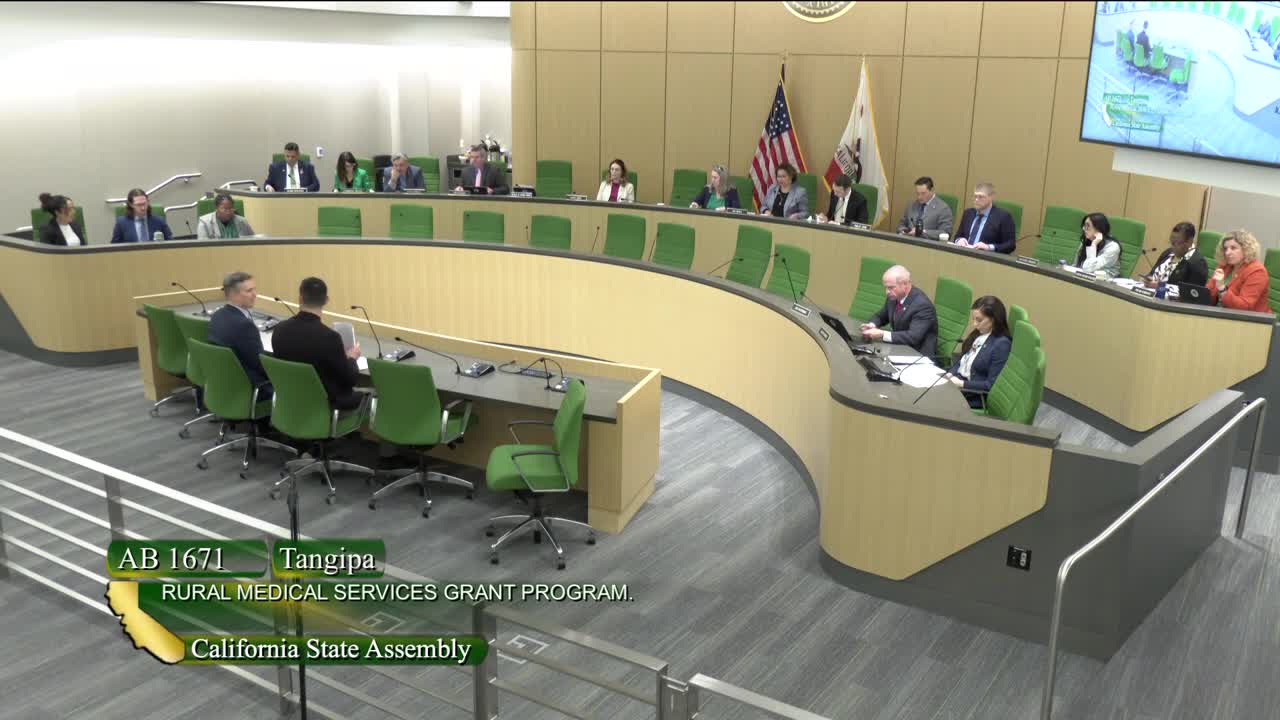
AB 1671: Rural medical services grant program.
- Session Year: 2025-2026
- House: Assembly
- Latest Version Date: 2026-03-19
Current Status:
In Progress
(2026-05-14: In committee: Held under submission.)
Introduced
In Committee
Awaiting First Chamber Vote
Passed First Chamber
In Committee
Awaiting Second Chamber Vote
Passed Second Chamber
Enacted
Existing law establishes the Office of Rural Health within the California Health and Human Services Agency to promote a strong working relationship between state government and local and federal agencies, universities, private and public interest groups, rural consumers, health care providers, foundations, and other offices of rural health, as well as to develop health initiatives and maximize the use of existing resources without duplicating existing effort. Existing law requires the office to serve as a key information and referral source to promote coordinated planning for the delivery of health services in rural California.
This bill would require the office to develop and administer, upon appropriation by the Legislature, a competitive grant program for the delivery of, or the support, sustenance, or expansion of the delivery of, medical services, as defined, to individuals who reside in rural areas, as defined. The bill would authorize the office upon that appropriation to expend up to $3,000,000 annually and would authorize a qualified provider, as defined, to apply to the office once per year for a grant of up to $10,000 for those purposes. The bill would require the office to establish specified standards and procedures, including criteria and standards for eligibility and the measurement of outcomes achieved, and and, on or before January 1, 2028, and annually thereafter, to publish this information on its internet website.
Existing law establishes the Office of Rural Health within the California Health and Human Services Agency to promote a strong working relationship between state government and local and federal agencies, universities, private and public interest groups, rural consumers, health care providers, foundations, and other offices of rural health, as well as to develop health initiatives and maximize the use of existing resources without duplicating existing effort. Existing law requires the office to serve as a key information and referral source to promote coordinated planning for the delivery of health services in rural California.
This bill would require the office to develop and administer administer, upon appropriation by the Legislature, a competitive grant program for the delivery of of, or the support, sustenance, or expansion of the delivery of, medical services, as defined, to individuals who reside in rural areas, as defined. The bill would authorize the office upon that appropriation to expend up to $3,000,000 annually and would authorize a qualified provider, as defined, to apply to the office once per year for a grant of up to $10,000 for those purposes. The bill would require the office to establish specified standards and procedures, including criteria and standards for eligibility and the measurement of outcomes achieved, and to publish this information on its internet website.
Existing law establishes the Office of Rural Health within the California Health and Human Services Agency to promote a strong working relationship between state government and local and federal agencies, universities, private and public interest groups, rural consumers, health care providers, foundations, and other offices of rural health, as well as to develop health initiatives and maximize the use of existing resources without duplicating existing effort. Existing law requires the office to serve as a key information and referral source to promote coordinated planning for the delivery of health services in rural California.
This bill would require the office to develop and administer a competitive grant program for the delivery of medical services, as defined, to individuals who reside in rural areas, as defined. The bill would authorize a qualified provider, as defined, to apply to the office once per year for a grant of up to $10,000 for those purposes. The bill would require the office to establish specified standards and procedures, including criteria and standards for eligibility and the measurement of outcomes achieved, and to publish this information on its internet website.
(a)For the purposes of this section, the following terms have the following meanings:
(1)(A)Medical services means the diagnosis, treatment, and prevention of illness, injury, or other physical or mental conditions performed by a qualified provider who is physically present while providing those services. Medical services includes, but is not limited to, doctor visits, hospital care, surgeries, mental health therapy, telehealth services, and rehabilitative treatments.
(B)Medical services does not include either of the following: elective cosmetic procedures.
(i)Elective cosmetic procedures.(ii)Telehealth services.(2)Qualified provider means an individual licensed in the state as any of the following:
(A)A dental hygienist licensed pursuant to Article 9 (commencing with Section 1900) of Chapter 4 of Division 2 of the Business and Professions Code.
(B)A certified nurse-midwife licensed pursuant to Article 2.5 (commencing with Section 2746) of Chapter 6 of Division 2 of the Business and Professions Code.
(C)A chiropractor licensed pursuant to Chapter 2 (commencing with Section 1000) of Division 2 of the Business and Professions Code.
(D)A dentist, including a dentist that performs oral and maxillofacial surgery, licensed pursuant to Chapter 4 (commencing with Section 1600) of Division 2 of the Business and Professions Code.
(E)A doctor of podiatric medicine licensed pursuant to Article 22 (commencing with Section 2460) of Chapter 5 of Division 2 of the Business and Professions Code.
(F)An optometrist licensed pursuant to Chapter 7 (commencing with Section 3000) of Division 2 of the Business and Professions Code.
(G)An osteopathic physician and surgeon licensed pursuant to Article 4.5 (commencing with Section 2099.5) of Chapter 5 of Division 2 of the Business and Professions Code.
(H)A pharmacist licensed pursuant to Chapter 9 (commencing with Section 4000) of Division 2 of the Business and Professions Code.
(I)A physical therapist licensed pursuant to Chapter 5.7 (commencing with Section 2600) of Division 2 of the Business and Professions Code.
(J)A physician and surgeon licensed pursuant to Chapter 5 (commencing with Section 2000) of Division 2 of the Business and Professions Code.
(K)A physician assistant licensed pursuant to Chapter 7.7 (commencing with Section 3500) of Division 2 of the Business and Professions Code.
(L)A psychologist licensed pursuant to Chapter 6.6 (commencing with Section 2900) of Division 2 of the Business and Professions Code.
(M)A registered nurse or nurse practitioner licensed pursuant to Chapter 6 (commencing with Section 2700) of Division 2 of the Business and Professions Code.
(N)A speech-language pathologist or audiologist licensed pursuant to Chapter 5.3 (commencing with Section 2530) of Division 2 of the Business and Professions Code.
(O)An occupational therapist licensed pursuant to Chapter 5.6 (commencing with Section 2570) of Division 2 of the Business and Professions Code.
(3)Rural area has the same meaning as in Section 50199.21.
(4)Support, sustenance, or expansion of the delivery of medical services includes, but is not limited to, all of the following:
(A)Workforce support.
(B)Equipment.
(C)Operational costs.
(D)Infrastructure improvements.
(E)Other expenses necessary to increase access to care.
(b)(1)Upon appropriation by the Legislature, the Office of Rural Health shall develop and administer a competitive grant program to compensate qualified providers for the delivery of medical services, or the support, sustenance, or expansion of the delivery of medical services, to individuals who reside in rural areas of California.
(2)Upon the appropriation described in paragraph (1), the office may expend up to three million dollars ($3,000,000) annually for the purposes of this section.
(3)A qualified provider may apply to the office once per year for a grant of up to ten thousand dollars ($10,000) for the purposes described in paragraph (1).
(c)(1)The office shall establish the criteria and standards for the grant program for all of the following:
(A)Eligibility requirements for applicants, including, but not limited to, all of the following:
(i)Proof of an active license in good standing in this state.
(ii)Proof that the applicant provides in-person medical services throughout the year, either part-time or full-time, in a rural area.
(iii)A description of how the grant funding will improve, sustain, or expand medical services in rural areas.
(B)The application review process.
(C)Compliance monitoring.
(D)The measurement of outcomes achieved, including, but not limited to, both of the following:
(i)The impact on access to in-person medical care in rural areas of the state.
(ii)The impact on provider recruitment and retention in rural areas of the state.
(2)The On or before January 1, 2028, and annually thereafter, the office shall publish the information described in paragraph (1) on its internet website.
(a)For the purposes of this section, the following terms have the following meanings:
(1)(A)Medical services means the diagnosis, treatment, and prevention of illness, injury, or other physical or mental conditions performed by a qualified provider who is physically present while providing those services. Medical services includes, but is not limited to, doctor visits, hospital care, surgeries, mental health therapy, and rehabilitative treatments.
(B)Medical services does not include either of the following:
(i)Elective cosmetic procedures.
(ii)Telehealth services.
(2)Qualified provider means an individual licensed in the state as any of the following:
(A)A dental hygienist licensed pursuant to Article 9 (commencing with Section 1900) of Chapter 4 of Division 2 of the Business and Professions Code.
(B)A certified nurse-midwife licensed pursuant to Article 2.5 (commencing with Section 2746) of Chapter 6 of Division 2 of the Business and Professions Code.
(C)A chiropractor licensed pursuant to Chapter 2 (commencing with Section 1000) of Division 2 of the Business and Professions Code.
(D)A dentist, including a dentist that performs oral and maxillofacial surgery, licensed pursuant to Chapter 4 (commencing with Section 1600) of Division 2 of the Business and Professions Code.
(E)A doctor of podiatric medicine licensed pursuant to Article 22 (commencing with Section 2460) of Chapter 5 of Division 2 of the Business and Professions Code.
(F)An optometrist licensed pursuant to Chapter 7 (commencing with Section 3000) of Division 2 of the Business and Professions Code.
(G)An osteopathic physician and surgeon licensed pursuant to Article 4.5 (commencing with Section 2099.5) of Chapter 5 of Division 2 of the Business and Professions Code.
(H)A pharmacist licensed pursuant to Chapter 9 (commencing with Section 4000) of Division 2 of the Business and Professions Code.
(H)(I)A physical therapist licensed pursuant to Chapter 5.7 (commencing with Section 2600) of Division 2 of the Business and Professions Code.
(I)(J)A physician and surgeon licensed pursuant to Chapter 5 (commencing with Section 2000) of Division 2 of the Business and Professions Code.
(J)(K)A physician assistant licensed pursuant to Chapter 7.7 (commencing with Section 3500) of Division 2 of the Business and Professions Code.
(K)(L)A psychologist licensed pursuant to Chapter 6.6 (commencing with Section 2900) of Division 2 of the Business and Professions Code.
(L)(M)A registered nurse or nurse practitioner licensed pursuant to Chapter 6 (commencing with Section 2700) of Division 2 of the Business and Professions Code.
(M)(N)A speech-language pathologist or audiologist licensed pursuant to Chapter 5.3 (commencing with Section 2530) of Division 2 of the Business and Professions Code.
(3)Rural area has the same meaning as in Section 50199.21.
(4)Support, sustenance, or expansion of the delivery of medical services includes, but is not limited to, all of the following:
(A)Workforce support.
(B)Equipment.
(C)Operational costs.
(D)Infrastructure improvements.
(E)Other expenses necessary to increase access to care.
(b)(1)Upon appropriation by the Legislature, the Office of Rural Health shall develop and administer a competitive grant program to compensate qualified providers for the delivery of medical services services, or the support, sustenance, or expansion of the delivery of medical services, to individuals who reside in rural areas of California.
(2)Upon the appropriation described in paragraph (1), the office may expend up to three million dollars ($3,000,000) annually for the purposes of this section.
(2)(3)A qualified provider may apply to the office once per year for a grant of up to ten thousand dollars ($10,000) for the purposes described in paragraph (1).
(c)(1)The office shall establish the criteria and standards for the grant program for all of the following:
(A)Eligibility requirements for applicants. applicants, including, but not limited to, all of the following:
(i)Proof of an active license in good standing in this state.
(ii)Proof that the applicant provides in-person medical services throughout the year, either part-time or full-time, in a rural area.
(iii)A description of how the grant funding will improve, sustain, or expand medical services in rural areas.
(B)The application review process.
(C)Compliance monitoring.
(D)The measurement of outcomes achieved. achieved, including, but not limited to, both of the following:
(i)The impact on access to in-person medical care in rural areas of the state.
(ii)The impact on provider recruitment and retention in rural areas of the state.
(2)The office shall publish the information described in paragraph (1) on its internet website.
(a)For the purposes of this section, the following terms have the following meanings:
(1)(A)Medical services means the diagnosis, treatment, and prevention of illness, injury, or other physical or mental conditions performed by a qualified provider who is physically present while providing those services. Medical services includes, but is not limited to, doctor visits, hospital care, surgeries, mental health therapy, and rehabilitative treatments.
(B)Medical services does not include either of the following:
(i)Elective cosmetic procedures.
(ii)Telehealth services.
(2)Qualified provider means an individual licensed in the state as any of the following:
(A)A dental hygienist licensed pursuant to Article 9 (commencing with Section 1900) of Chapter 4 of Division 2 of the Business and Professions Code.
(B)A certified nurse-midwife licensed pursuant to Article 2.5 (commencing with Section 2746) of Chapter 6 of Division 2 of the Business and Professions Code.
(C)A chiropractor licensed pursuant to Chapter 2 (commencing with Section 1000) of Division 2 of the Business and Professions Code.
(D)A dentist, including a dentist that performs oral and maxillofacial surgery, licensed pursuant to Chapter 4 (commencing with Section 1600) of Division 2 of the Business and Professions Code.
(E)A doctor of podiatric medicine licensed pursuant to Article 22 (commencing with Section 2460) of Chapter 5 of Division 2 of the Business and Professions Code.
(F)An optometrist licensed pursuant to Chapter 7 (commencing with Section 3000) of Division 2 of the Business and Professions Code.
(G)An osteopathic physician and surgeon licensed pursuant to Article 4.5 (commencing with Section 2099.5) of Chapter 5 of Division 2 of the Business and Professions Code.
(H)A physical therapist licensed pursuant to Chapter 5.7 (commencing with Section 2600) of Division 2 of the Business and Professions Code.
(I)A physician and surgeon licensed pursuant to Chapter 5 (commencing with Section 2000) of Division 2 of the Business and Professions Code.
(J)A physician assistant licensed pursuant to Chapter 7.7 (commencing with Section 3500) of Division 2 of the Business and Professions Code.
(K)A psychologist licensed pursuant to Chapter 6.6 (commencing with Section 2900) of Division 2 of the Business and Professions Code.
(L)A registered nurse or nurse practitioner licensed pursuant to Chapter 6 (commencing with Section 2700) of Division 2 of the Business and Professions Code.
(M)A speech-language pathologist or audiologist licensed pursuant to Chapter 5.3 (commencing with Section 2530) of Division 2 of the Business and Professions Code.
(3)Rural area has the same meaning as in Section 50199.21.
(b)(1)Upon appropriation by the Legislature, the Office of Rural Health shall develop and administer a competitive grant program to compensate qualified providers for the delivery of medical services to individuals who reside in rural areas of California.
(2)A qualified provider may apply to the office once per year for a grant of up to ten thousand dollars ($10,000) for the purposes described in paragraph (1).
(c)(1)The office shall establish the criteria and standards for the grant program for all of the following:
(A)Eligibility requirements for applicants.
(B)The application review process.
(C)Compliance monitoring.
(D)The measurement of outcomes achieved.
(2)The office shall publish the information described in paragraph (1) on its internet website.
|
Date
|
Status
|
|---|---|
| May 14, 2026 | In committee: Held under submission. |
| Apr 8, 2026 | In committee: Set, first hearing. Referred to APPR. suspense file. |
| Mar 23, 2026 | Re-referred to Com. on APPR. |
| Mar 19, 2026 | Read second time and amended. |
| Mar 18, 2026 | From committee: Amend, and do pass as amended and re-refer to Com. on APPR. (Ayes 16. Noes 0.) (March 17). |
| Mar 4, 2026 | Re-referred to Com. on HEALTH. |
| Mar 3, 2026 | From committee chair, with author's amendments: Amend, and re-refer to Com. on HEALTH. Read second time and amended. |
| Feb 17, 2026 | Referred to Com. on HEALTH. |
| Feb 3, 2026 | From printer. May be heard in committee March 5. |
| Feb 2, 2026 | Read first time. To print. |
|
Date
|
Description
|
Location
|
Votes
|
|
|---|---|---|---|---|
| Mar 17, 2026 | Do pass as amended and be re-referred to the Committee on [Appropriations] | Assembly Standing Committee on Health |
Passed |
This list shows positions taken on this bill by organizations on the date displayed, which is linked to the original source.
Positions by individuals are not included.
|
Organization
|
Position
|
Date
|
|---|---|---|
| California Society Of Health-System Pharmacists | ** Support | |
| California Society Of Pathologists | ** Support | |
| California Youth Empowerment Network | ** Support | |
| Community Health Centers of America | ** Support | |
| Mental Health America of California | ** Support | |
| Retired Public Employees Association | ** Support |
Date of Hearing: April 8, 2026
ASSEMBLY COMMITTEE ON APPROPRIATIONS
Buffy Wicks, Chair
ABPCA Bill Id:AB 1671
- Author:(Tangipa) – As Amended Ver:March 19, 2026
Policy Committee: | Health | Vote: | 16 - 0 |
|
| ||
|
|
Urgency: No State Mandated Local Program: No Reimbursable: No
SUMMARY:
This bill requires, upon appropriation by the Legislature, the Office of Rural Health (ORH) develop and administer a competitive grant program to compensate qualified providers to deliver medical services, or to support, sustain, or expand the delivery of medical services, to individuals who reside in rural areas.
Specifically, this bill:
- Authorizes ORH to expend up to $3 million annually for the purposes of this bill.
- Authorizes a qualified provider to apply to ORH once per year for a grant of up to $10,000.
- Requires ORH to establish the criteria and standards for the grant program and publish this information on or before January 1, 2028, and annually thereafter.
- Defines “qualified provider” to include a registered nurse, physician, certified nurse-midwife, dentist, dental hygienist, physical therapist, physician assistant, podiatrist, pharmacist, psychologist, optometrist, chiropractor, speech-language pathologist or audiologist, and occupational therapist.
- Defines “support, sustenance, or expansion of the delivery of medical services” to include workforce support, equipment, infrastructure improvements, operational costs, and other expenses necessary to increase access to care.
FISCAL EFFECT:
General Fund costs of $3 million one-time to the Department of Health Care Access and Information (HCAI), ORH. The author is preparing a request for $3 million in the state budget to fund the requirements of this bill.
The Legislative Analyst’s Office recently warned of General Fund structural deficits of around $35 billion per year in the 2027-28 fiscal year and ongoing.
COMMENTS:
- Purpose. According to the author:
Rural communities in California have long faced significant challenges in attracting and retaining qualified medical professionals, leaving residents without consistent access to essential healthcare services. …By helping offset operational, workforce, and practice-related costs, this bill strengthens provider retention and stabilizes healthcare access in underserved regions. Improving continuity of care in rural communities can reduce reliance on emergency rooms, support preventive and primary care services, and promote healthier, more economically stable communities.
- Background. Rural Health Care Provider Workforce. According to 2023 data from the Medical Board of California, the supply of primary care physicians (PCPs) in California barely met the recommended minimum. However, for rural areas, the physician workforce is not adequate: four of the nine regions fell short of the recommended supply of PCPs, and one region was below the recommended supply of specialists. The Inland Empire, San Joaquin Valley, Northern, and Sierra regions had the lowest ratios of PCPs and specialists per 100,000 population of all regions in the state. An August 2025 report from the Healthforce Center at the University of California San Francisco asserts the health care provider shortage is especially severe in the San Joaquin Valley, where structural barriers, economic inequities, and geographic isolation deepen health care disparities. Six of the region’s eight counties –Fresno, Kings, Madera, Merced, San Joaquin, and Tulare – are designated as federal Health Professional Shortage Areas, facing critical shortages in primary care, dental, and mental health providers. All eight counties, including Kern and Stanislaus, are also federally designated Medically Underserved Areas, signaling insufficient access to basic but essential primary care services.
California Rural Health Transformation (CA-RHT) Program. The federal Centers for Medicare and Medicaid Services (CMS) recently awarded California $233.6 million for federal fiscal year 2026 to support rural and frontier communities across the state. The federal RHT program is funded by a five-year initiative to strengthen health care in rural communities where access, workforce shortages, and infrastructure gaps create unique challenges. The CA-RHT will target the state’s 2.7 million rural residents, with a focus on high-need geographies that demonstrate the most persistent health and infrastructure gaps. Program emphasis will focus on rural Californians living in counties with a high burden of chronic disease; limited access to primary, maternity, and specialty care; and reliance on geographically isolated hospitals with constrained resources.
- Related Legislation. AB 1431 (Tangipa), of the current legislative session, would have allowed a credit under the Personal Income Tax Law for certain health care providers who perform services in a rural area of the state. AB 1431 was held in the Assembly Committee on Revenue and Taxation.
Analysis Prepared by: Allegra Kim / APPR. / (916) 319-2081
Date of Hearing: March 17, 2026
ASSEMBLY COMMITTEE ON HEALTH
Mia Bonta, Chair
ABPCA Bill Id:AB 1671
Author:(Tangipa) – As Amended Ver:March 3, 2026
SUBJECT: Rural medical services grant program.
SUMMARY: Requires the Office of Rural Health (ORH) to develop and administer a competitive grant program for the delivery of medical services, as defined, to individuals who reside in rural areas. Specifically, this bill:
- Requires, upon appropriation by the Legislature, the ORH to develop and administer a competitive grant program to compensate qualified providers for the delivery of medical services to individuals who reside in rural areas of California. Authorizes ORH to expend up to three million dollars ($3,000,000) annually for the purposes of this bill, upon appropriation.
- Defines “qualified provider” to mean an individual licensed in the state as any of the following:
- A dental hygienist;
- A certified nurse-midwife;
- A chiropractor;
- A dentist, including a dentist that performs oral and maxillofacial surgery;
- A doctor of podiatric medicine;
- An optometrist;
- An osteopathic physician and surgeon;
- A pharmacist;
- A physical therapist;
- A physician and surgeon;
- A physician assistant;
- A psychologist;
- A registered nurse or nurse practitioner; and,
- A speech-language pathologist or audiologist.
- Defines a “Rural area” has the same meaning as described in 4) of Existing Law, below.
- Defines “Support, sustenance, or expansion of the delivery of medical services” to include, but not be limited to all of the following:
- Workforce support;
- Equipment;
- Operational costs;
- Infrastructure improvement; and,
- Other expenses necessary to increase access to care.
- Defines “Medical services” to mean the diagnosis, treatment, and prevention of illness, injury, or other physical or mental conditions performed by a qualified provider who is physically present while providing those services. Includes in this definition, but does not limit it to, doctor visits, hospital care, surgeries, mental health therapy, and rehabilitative treatments.
- Excludes elective cosmetic procedures and telehealth services from the definition of medical services.
- Authorizes a qualified provider to apply to the ORH once per year for a grant of up to ten thousand dollars ($10,000) for the purposes described in 4) above.
- Requires the ORH to establish the criteria and standards for the grant program for all of the following:
- Eligibility requirements for applicants including, but not limited to the following;
- Proof of an active license in good standing in this state;
- Proof that the applicant provides in-person medical services throughout the year either part-time or full-time, in a rural area; and,
- A description of how the grant funding will improve, sustain, or expand medical services in rural areas.
- The application review process;
- Compliance monitoring; and,
- The measurement of outcomes achieved including, but not limited to both of the following:
- The impact on access to in-person medical care in rural areas of the state; and,
- The impact on provider recruitment and retention in rural areas of the state.
- Eligibility requirements for applicants including, but not limited to the following;
- Requires the ORH to publish the information described in 8) above on its internet website.
EXISTING LAW:
- Establishes the Department of Health Care Access and Information (HCAI) to, among other functions, collect, analyze, and publish data about health care workforce and health professional training, identify areas of health workforce shortages, and provide scholarships, loan repayments, and grants to students, graduates, and institutions providing direct patient care in areas of unmet need. [Health and Safety Code (HSC) § 127750, et seq.]
- Requires the Secretary of the Health and Welfare Agency to establish an ORH, or an alternative organizational structure, in one of the departments of the Health and Welfare Agency to promote a strong working relationship between state government and local and federal agencies, universities, private and public interest groups, rural consumers, health care providers, foundations, and other offices of rural health, as well as to develop health initiatives and maximize the use of existing resources without duplicating existing effort. Requires the ORH to serve as a key information and referral source to promote coordinated planning for the delivery of health services in rural California. [HSC § 1179.1]
- Establishes various practice acts in the Business and Professions Code (BPC) governed by various boards within the Department of Consumer Affairs (DCA) which provide for the licensing and regulation of health care professionals including: physicians and surgeons (under the Medical Practice Act); osteopathic physicians and surgeons (under the Osteopathic Medical Practice Act); nurse practitioners (NPs) and certified nurse-midwives (CNMs) (under the Nursing Practice Act); and physician assistants (PA) (under the Physician Assistant Practice Act). [BPC §§ 2000 et seq.; 2099.5 et seq.; 2700 et seq.; 3500 et seq.]
- Defines a “Rural area” to mean an area that on January 1 of any calendar year satisfies any of the following criteria:
- The area is eligible for financing under a multifamily housing program pursuant to Section 3560.1(a)(1) of Title 7 of the Code of Federal Regulations as it read on January 1, 2023, or successor program, of the United States Department of Agriculture Rural Development.
- The area is located in a nonmetropolitan area;
- The area is any of the following:
- An incorporated city having a population of 40,000 or fewer as identified in the most recent Report E-1 published by the Demographic Research Unit of the Department of Finance, provided that the area is not located within a census block designated as an urban area by the United States Census Bureau in the most recent decennial census;
- An unincorporated area that adjoins a city having a population of 40,000 or fewer, provided that the adjoining unincorporated area is not located within a census block designated as an urban area by the United States Census Bureau in the most recent decennial census; or,
- An unincorporated area that does not adjoin a city and is not located within a census block designated as an urban area by the United States Census Bureau in the most recent decennial census. [HSC § 50199.21]
FISCAL EFFECT: Unknown. This bill has not been analyzed by a fiscal committee.
COMMENTS:
- PURPOSE OF THIS BILL. According to the author, rural communities in California have long faced significant challenges in attracting and retaining qualified medical professionals, leaving residents without consistent access to essential healthcare services. The author states that this bill addresses this issue by establishing a targeted grant program to support licensed providers who deliver in-person care in rural areas. By helping offset operational, workforce, and practice-related costs, this bill strengthens provider retention and stabilizes healthcare access in underserved regions. Improving continuity of care in rural communities can reduce reliance on emergency rooms, support preventive and primary care services, and promote healthier, more economically stable communities. The author concludes that this bill represents an important investment in improving access to care for low-income, elderly, and rural populations across California.
- BACKGROUND. According to HCAI (based on U.S Census American Community Survey estimates) California has over 2.7 million rural residents, and of the state’s 58 counties, 57 contain rural areas. Over 80% of California is a rural census tract, and approximately 76% of these are in a Primary Care Health Professional Shortage Area (PCHPSA). The state has 279 Rural Health Clinics, 20 Tribal Health Clinic Systems, 296 Federally Qualified Health Centers (FQHCs) and 108 rural hospitals.
- Rural Provider shortages. According to the 2025 California Health Care Foundation (CHCF) Health Care Almanac, supplies of physicians, physician assistants, and three types of advanced practice nurses in California grew between 2020 and 2023, while the supply of clinical nurse specialists decreased. Nurse practitioners had the highest rate of growth while medical doctors (MDs) had the largest increase in the number of professionals. Medical care can be obtained from physicians (MDs and Doctors of Osteopathy (DOs)), nurse practitioners, and physician assistants. In 2023, MDs and DOs composed 76% of these health care providers in California. Data collected by the Association of American Medical Colleges in 2020 and by the Medical Board of California (MBC) in 2023 suggest that California's most recent supplies of primary care physicians (PCPs) and specialists met the minimum per capita ratios recommended by the Council on Graduate Medical Education. According to MBC data, the supply of PCPs in California just barely met the minimum recommended supply. However, physician supply varied by region. Out of the nine regions, four regions fell short of the recommended supply of PCPs, and one region was below the recommended supply of specialists. The Inland Empire, San Joaquin Valley, and Northern and Sierra regions had the lowest ratios of PCPs and specialists per 100,000 population of all regions in the state.
According to the Healthforce Center at the University of California San Francisco August 2025 report, “Insight on Health Care Workforce Development in the San Joaquin Valley,” there is a national health care provider shortage that is projected to worsen over the next decade, and this crisis is especially severe in the San Joaquin Valley, where structural barriers, economic inequities, and geographic isolation deepen health care disparities. Despite being an agricultural powerhouse known to produce a quarter of the nation’s food, six of the region’s eight counties: Fresno, Kings, Madera, Merced, San Joaquin, and Tulare are designated as Health Professional Shortage Areas (HPSAs), facing critical shortages in primary care, dental, and mental health providers. All eight counties, including Kern and Stanislaus, are also considered Medically Underserved Areas (MUAs), signaling insufficient access to basic but essential primary care services.
- California State Office of Rural Health and the California Rural Health Transformation Program (CA-RHT). The ORH within HCAI serves as a key information and referral source to promote coordinated planning for the delivery of health services in rural California. Currently ORH is overseeing the Rural Health Transformation Program (RHTP) which is a federal initiative designed to strengthen health care in rural communities where access, workforce shortages, and infrastructure gaps create unique challenges. California has been awarded $233.6 million for Federal Fiscal Year 2026 through the RHTP to support rural and frontier communities across the state. According to the ORH website, through this funding, HCAI and its partners will begin implementing a shared vision of a connected and resilient rural health system where rural and frontier Californians can access timely, person-centered care closer to home.
- Health Care Access. The CA-RHT program will target the over 2.7 million rural residents throughout the state, with a focus on high-need geographies that demonstrate the most persistent health and infrastructure gaps. Priority populations include rural families; pregnant and postpartum women and infants in counties with minimal obstetric services or classified as maternity care deserts; residents of health professional shortage areas; Tribal and agricultural communities; older adults; individuals with chronic health conditions; and rural households without reliable broadband or transportation access. Program emphasis will focus on rural Californians living in counties with a high burden of chronic disease; limited access to primary, maternity, and specialty care; and reliance on geographically isolated hospitals with constrained resources. Geographically, the CA-RHT program will focus on program delivery across state designated Medical Service Study Areas (MSSAs), Health Resources and Services Administration (HRSA)-defined rural and frontier areas, Primary Care Health Professional Shortage Areas (PCHPSAs) within all rural communities, with early assessment and implementation in counties identified as having the greatest need. MSSAs are predefined rational service areas recognized by HRSA.
- California State Office of Rural Health and the California Rural Health Transformation Program (CA-RHT). The ORH within HCAI serves as a key information and referral source to promote coordinated planning for the delivery of health services in rural California. Currently ORH is overseeing the Rural Health Transformation Program (RHTP) which is a federal initiative designed to strengthen health care in rural communities where access, workforce shortages, and infrastructure gaps create unique challenges. California has been awarded $233.6 million for Federal Fiscal Year 2026 through the RHTP to support rural and frontier communities across the state. According to the ORH website, through this funding, HCAI and its partners will begin implementing a shared vision of a connected and resilient rural health system where rural and frontier Californians can access timely, person-centered care closer to home.
The final activities and budget may change pending the Center for Medicare and Medicaid Services (CMS) award decisions. Program activities will be offered to all rural hospitals, rural health clinics, rural community health centers, community-based organizations, behavioral health facilities, and Tribal clinics with carefully designed opt-in model(s), activities, and grant opportunities promoting a scalable statewide approach to rural health transformation. California’s Tribal communities experience a life expectancy of about 71.8 years, the lowest among racial and ethnic groups in the state, and face higher mortality rates from diabetes, chronic liver disease, and suicide than other Californians. American Indian and Alaska Native (AI/AN) individuals are also two to five times more likely than other racial or ethnic groups to experience serious psychological distress and have the highest percentage of impairment related to mental health challenges. In California, a significantly greater proportion of American Indians with asthma (51%) report having an exacerbation, proportionately more American Indians experience heart disease than other ethnic minorities. These findings are consistent with national statistics that show AI/AN have the highest asthma prevalence compared to any other population. To address these disparities, the CA-RHT program will dedicate a minimum of 5% of its overall budget to support the participation of Tribal clinics and health centers in the Transformative Care Model.
- Digital Health and Infrastructure. Persistent disparities in digital infrastructure within rural communities in California continue to hinder access to healthcare, particularly in the areas of telehealth and electronic health record (EHR) adoption. Although telehealth use rose significantly statewide between 2019 and 2020, adults in rural areas remained less likely to use telehealth than those in urban regions. Many rural counties maintained or increased California Medicaid telehealth use post-2020; however, these communities continue to face barriers such as limited reliable broadband coverage and high technology costs, with implementation expenses reaching up to $50,000 and annual fees exceeding $60,000. Medicaid reimburses all four telehealth modalities: live video, store and forward, remote patient self-monitoring, and audio only, although some limits may apply. Providers have continued to face challenges with both implementation and effective use. A 2025 analysis found that 74% of urban physicians used certified EHRs compared with 64% of rural physicians, underscoring ongoing disparities in adoption and interoperability. Although nearly all family physicians statewide now use EHRs, the small group of non-adopters is concentrated among independent rural practices with limited funding, staffing, and technical resources.
These challenges limit the ability of rural providers to exchange data, participate in coordinated care, and leverage statewide health information networks. Addressing these gaps will require expanded support for interoperability infrastructure, workforce training, and system integration. As currently drafted, this bill excludes telehealth from its list of allowable medical services.
- Budget Request. The author’s office is submitting a budget request for three million dollars ($3,000,000) in funding for the provisions of this bill.
- SUPPORT. The California Youth Empowerment Network (CAYEN) supports this bill and states that approximately 11.4 million Californians live in federally designated PCHPSAs. In addition, rural counties are unable to meet minimum provider ratios per capita. Youth in those areas may experience significant delays in services and extended wait times, discouraging them from accessing care. CAYEN notes that with more providers delivering care in-person, this grant program will help connect youth to quality care and improve delivery of services in a timely manner. LGBTQ+ Inclusivity, Visibility, and Empowerment supports this bill and states that expanding access to in-person care will improve the timely delivery of services and lead to better health outcomes for the rural LGBTQ+ population.
- RELATED LEGISLATION. AB 2082 (Jeff Gonzalez) would require the Department of Public Health (DPH), beginning July 1, 2027, to establish a program to work with local nonprofit organizations who have a history of serving farmworker communities to provide free menstrual products in rural or agricultural communities. Would require DPH to prioritize the rural or agricultural communities with the highest rates of poverty.
- PREVIOUS LEGISLATION.
- AB 1431 (Tangipa) of 2025 would have allowed a credit under the Personal Income Tax Law for certain health care providers who perform services in a rural area of the state. AB 1431 was held in the Assembly Committee on Revenue and Taxation.
- SB 338 (Becker), Chapter 311, Statutes of 2025 requires DPH to administer a Virtual Health Hub for Rural Communities Pilot Program to deploy mobile units in two rural communities based on farmworker population and access to health care. Creates the Virtual Health Hub Fund to fund the program using non-General Fund dollars.
- AB 1131 (Garcia), of 2023 would have established the Hospitals First Revolving Fund, administered by HCAI, to offer grants and low-cost loans to hospitals in rural and medically underserved communities to prevent the closure of a hospital or facilitate the reopening of a closed hospital. AB 1131 was held in the Assembly Appropriations Committee.
- AB 112 (Budget Committee), Chapter 6, Statutes of 2023 establishes the Distressed Hospital Loan Program (DHLP), until January 1, 2032, which will provide interest free cashflow loans to not-for-profit hospitals and public hospitals, as defined, and in significant financial distress, or to governmental entities representing a closed hospital. Requires HCAI to administer the DHLP and to enter into an interagency agreement with the California Health Facilities Financing Authority to implement the DHLP.
- SUGGESTED AMENDMENTS.
- The Committee may wish to amend this bill to include telehealth as an allowable medical service and to require ORH to post measurement outcomes on its website on an annual basis.
- The author is proposing to amend this bill to include Occupational Therapists in the list of qualified providers.
REGISTERED SUPPORT / OPPOSITION:
Support
California Society of Health-System Pharmacists
California Society of Pathologists
California Youth Empowerment Network
Community Health Centers of America
LGBTQ+ Inclusivity, Visibility, and Empowerment (LIVE)
Mental Health America of California
Retired Public Employees Association
Opposition
None on file
Analysis Prepared by: Lara Flynn / HEALTH / (916) 319-2097
Bill Author
Bill Co-Author(s):