AB 1675: Corporation Tax Law: tax expenditures: No Tax Breaks for ICE Contractors Act of 2026.
- Session Year: 2025-2026
- House: Assembly
- Latest Version Date: 2026-06-16
Current Status:
In Progress
(2026-06-24: In committee: Set, first hearing. Hearing canceled at the request of author.)
Introduced
In Committee
Awaiting First Chamber Vote
Passed First Chamber
In Committee
Awaiting Second Chamber Vote
Passed Second Chamber
Enacted
Existing law, the Corporation Tax Law, imposes taxes based upon gross income, and defines gross income as all income from whatever source derived, unless specifically excluded. Existing law allows various credits against the taxes imposed by that law. The Corporation Tax Law conforms to federal law in its treatment of certain exclusions and credits. Existing law provides for certain programs for free legal services for indigent persons.
This bill would, for taxable years beginning on or after January 1, 2027, and before January 1, 2032, enact the No Tax Breaks for ICE Contractors Act of 2026, which would deny all tax credits otherwise available under the Corporation Tax Law to any taxpayer that contracts with United States Department of Homeland Security, except as provided. The bill would establish the California Immigrant Resilience Fund in the State Treasury. The bill would require the Franchise Tax Board, in consultation with the Department of Finance, to estimate the amount of additional revenue resulting from the provisions of the bill, notify the Controller of that amount, and require the Controller to transfer that amount to the fund. The bill would make moneys in the fund available to provide immigration-related services, including removal defense, as provided, upon appropriation by the Legislature.
This bill would include a change in state statute that would result in a taxpayer paying a higher tax within the meaning of Section 3 of Article XIIIA of the California Constitution, and thus would require for passage the approval of 2/3 of the membership of each house of the Legislature.
This bill would take effect immediately as a tax levy.
Existing law, the Corporation Tax Law, imposes taxes based upon gross income, and defines gross income as all income from whatever source derived, unless specifically excluded. Existing law allows various credits against the taxes imposed by that law. The Corporation Tax Law conforms to federal law in its treatment of certain exclusions and credits. Existing law provides for certain programs for free legal services for indigent persons.
This bill would, for taxable years beginning on or after January 1, 2027, and before January 1, 2032, enact the No Tax Breaks for ICE Contractors Act of 2026, which would deny all tax expenditures, as defined, credits otherwise available under the Corporation Tax Law to any taxpayer that contracts with United States Department of Homeland Security, as provided. The bill would establish the California Immigrant Resilience Fund in the State Treasury. The bill would require the Franchise Tax Board, in consultation with the Department of Finance, to estimate the amount of additional revenue resulting from the provisions of the bill, notify the Controller of that amount, and require the Controller to transfer that amount to the fund. The bill would make moneys in the fund available to provide immigration-related services, including removal defense, as provided, upon appropriation by the Legislature.
This bill would include a change in state statute that would result in a taxpayer paying a higher tax within the meaning of Section 3 of Article XIIIA of the California Constitution, and thus would require for passage the approval of 2/3 of the membership of each house of the Legislature.
This bill would take effect immediately as a tax levy.
Existing law, the Personal Income Corporation Tax Law, imposes taxes based upon gross income, and defines gross income as all income from whatever source derived, unless specifically excluded. Existing law allows various credits against the taxes imposed by that law. The Personal Income Corporation Tax Law conforms to federal law in its treatment of certain exclusions. exclusions and credits. Existing law provides for certain programs for free legal services for indigent persons.
This bill would state the intent of the Legislature to enact future legislation known as the No Tax Breaks for ICE Contractors Act of 2026 that would, among other things, commencing with tax year 2027, prohibit a corporation that contracts with the United States Department of Homeland Security for goods or services from being eligible to pay employees on a pretax basis for the employer pension contributions exclusion, require revenue savings be directed toward legal services for people in the federal immigration legal process, and deem the act inoperative for any single tax year upon specified determinations by the Governor and Attorney General. would, for taxable years beginning on or after January 1, 2027, and before January 1, 2032, enact the No Tax Breaks for ICE Contractors Act of 2026, which would deny all tax expenditures, as defined, otherwise available under the Corporation Tax Law to any taxpayer that contracts with United States Department of Homeland Security, as provided. The bill would establish the California Immigrant Resilience Fund in the State Treasury. The bill would require the Franchise Tax Board, in consultation with the Department of Finance, to estimate the amount of additional revenue resulting from the provisions of the bill, notify the Controller of that amount, and require the Controller to transfer that amount to the fund. The bill would make moneys in the fund available to provide immigration-related services, including removal defense, as provided, upon appropriation by the Legislature.
This bill would include a change in state statute that would result in a taxpayer paying a higher tax within the meaning of Section 3 of Article XIIIA of the California Constitution, and thus would require for passage the approval of 2/3 of the membership of each house of the Legislature.
This bill would take effect immediately as a tax levy.
Existing law, the Personal Income Tax Law, imposes taxes based upon gross income, and defines gross income as all income from whatever source derived, unless specifically excluded. The Personal Income Tax Law conforms to federal law in its treatment of certain exclusions. Existing law provides for certain programs for free legal services for indigent persons.
This bill would state the intent of the Legislature to enact future legislation known as the No Tax Breaks for ICE Contractors Act of 2026 that would, among other things, commencing with tax year 2027, prohibit a corporation that contracts with the United States Department of Homeland Security for goods or services from being eligible to pay employees on a pretax basis for the employer pension contributions exclusion, require revenue savings be directed toward legal services for people in the federal immigration legal process, and deem the act inoperative for any single tax year upon specified determinations by the Governor and Attorney General.
This chapter shall be known, and may be cited, as the No Tax Breaks for ICE Contractors Act of 2026.
25001.For the purposes of this chapter, the following definitions apply:
(a)Contracting corporation means any taxpayer that contracts with the Department of Homeland Security, either directly or through subcontracts, to provide goods or services. services through the federal government procurement or contracting process that does not include goods or services acquired through a platform or mechanism available to the general public.
(b)Department of Homeland Security refers to the United States Department of Homeland Security when the Department of Homeland Security is contracting on behalf of either the United States Customs and Border Protection or the United States Immigration and Customs Enforcement, and the following agencies that are an operational or support component of the department:
(1)United States Customs and Border Protection.
(2)United States Immigration and Customs Enforcement.
(3)Management Directorate.(c)Nonprofit housing sponsor has the same meaning as defined in Section 50091 of the Health and Safety Code.
(d)Nonprofit sponsored venture means either a limited partnership in which a nonprofit housing sponsor or an entity wholly owned by a nonprofit housing sponsor is designated as the managing general partner, or a limited liability company in which a nonprofit housing sponsor or an entity wholly owned by a nonprofit housing sponsor is designated as the managing member.
25002.For taxable years beginning on or after January 1, 2027, and before January 1, 2032, a contracting corporation shall not be eligible to claim any credit provided under this part for the taxable year. year, except for the following:
(a)A tax credit received by any direct or indirect partner or member of a nonprofit sponsored venture to which the claiming party has made a direct or indirect loan or capital contribution.
(b)Any tax credit allowed pursuant to Section 12206, 17058, or 23610.5 directly or indirectly purchased from a nonprofit housing sponsor.
25003.(a)(1)No later than June 1, 2027, the Franchise Tax Board, in consultation with the Department of Finance, shall estimate the amount of revenue that would have resulted if the modifications made with respect to the eligibility for tax credits by this chapter had applied to taxable years beginning on or after January 1, 2026, and before January 1, 2027, and notify the Controller of that amount.
(2)No later than June 1, 2028, and annually thereafter, the Franchise Tax Board, in consultation with the Department of Finance, shall estimate the amount of additional revenue resulting from the modifications made with respect to the calculation of taxable income by this chapter for the taxable years beginning on or after January 1 of the calendar year immediately preceding the year in which the estimate is made and before January 1 of the calendar year in which the estimate is made and notify the Controller of that amount.
(b)(1)The California Immigrant Resilience Fund is hereby established in the State Treasury.
(2)Upon receiving the notifications from the Franchise Tax Board pursuant to subdivision (a), the Controller shall transfer an amount equal to the amount estimated by the Franchise Tax Board in those notifications from the General Fund to the California Immigrant Resilience Fund to be made available, upon appropriation by the Legislature, for grants or contracts, and state operations, under the authority of Chapter 5.6 (commencing with Section 13300) of Part 3 of Division 9 of the Welfare and Institutions Code, with organizations qualified pursuant to that chapter, to provide immigration-related services, including removal defense.
(c)The Administrative Procedure Act (Chapter 3.5 (commencing with Section 11340) of Part 1 of Division 3 of Title 2 of the Government Code) shall not apply to any standard, criterion, procedure, determination, rule, notice, guideline, or any other guidance established or issued by the board pursuant to this section.
25004.This chapter shall remain operative only until December 1, 2032, and as of that date is repealed.
SEC. 2.This act provides for a tax levy within the meaning of Article IV of the California Constitution and shall go into immediate effect.
This chapter shall be known, and may be cited, as the No Tax Breaks for ICE Contractors Act of 2026.
25001.For the purposes of this chapter, the following definitions apply:
(a)Contracting corporation means any taxpayer that contracts with the Department of Homeland Security, either directly or through subcontracts, to provide goods or services.
(b)Department of Homeland Security refers to the United States Department of Homeland Security and the following agencies that are an operational or support component of the department:
(1)United States Customs and Border Protection.
(2)United States Immigration and Customs Enforcement.
(3)Management Directorate.
(c)Tax expenditure means a credit, deduction, exclusion, exemption, or other tax benefit as provided for by this part.25002.For taxable years beginning on or after January 1, 2027, and before January 1, 2032, a contracting corporation shall not be eligible to claim any tax expenditure for corporations subject to reporting pursuant to Section 13305 of the Government Code. credit provided under this part for the taxable year.
25003.(a)(1)No later than June 1, 2027, the Franchise Tax Board, in consultation with the Department of Finance, shall estimate the amount of revenue that would have resulted if the modifications made with respect to the calculation of taxable income eligibility for tax credits by this chapter had applied to taxable years beginning on or after January 1, 2026, and before January 1, 2027, and notify the Controller of that amount.
(2)No later than June 1, 2028, and annually thereafter, the Franchise Tax Board, in consultation with the Department of Finance, shall estimate the amount of additional revenue resulting from the modifications made with respect to the calculation of taxable income by this chapter for the taxable years beginning on or after January 1 of the calendar year immediately preceding the year in which the estimate is made and before January 1 of the calendar year in which the estimate is made and notify the Controller of that amount.
(b)(1)The California Immigrant Resilience Fund is hereby established in the State Treasury.
(2)Upon receiving the notifications from the Franchise Tax Board pursuant to subdivision (a), the Controller shall transfer an amount equal to the amount estimated by the Franchise Tax Board in those notifications from the General Fund to the California Immigrant Resilience Fund to be made available, upon appropriation by the Legislature, for grants or contracts, and state operations, under the authority of Chapter 5.6 (commencing with Section 13300) of Part 3 of Division 9 of the Welfare and Institutions Code, with organizations qualified pursuant to that chapter, to provide immigration-related services, including removal defense.
(c)The Administrative Procedure Act (Chapter 3.5 (commencing with Section 11340) of Part 1 of Division 3 of Title 2 of the Government Code) shall not apply to any standard, criterion, procedure, determination, rule, notice, guideline, or any other guidance established or issued by the board pursuant to this section.
25004.This chapter shall remain operative only until December 1, 2032, and as of that date is repealed.
SEC. 2.This act provides for a tax levy within the meaning of Article IV of the California Constitution and shall go into immediate effect.
This chapter shall be known, and may be cited, as the No Tax Breaks for ICE Contractors Act of 2026.
25001.For the purposes of this chapter, the following definitions apply:
(a)Contracting corporation means any taxpayer that contracts with the Department of Homeland Security, either directly or through subcontracts, to provide goods or services.
(b)Department of Homeland Security refers to the United States Department of Homeland Security and the following agencies that are an operational or support component of the department:
(1)United States Customs and Border Protection.
(2)United States Immigration and Customs Enforcement.
(3)Management Directorate.
(c)Tax expenditure means a credit, deduction, exclusion, exemption, or other tax benefit as provided for by this part.
25002.For taxable years beginning on or after January 1, 2027, and before January 1, 2032, a contracting corporation shall not be eligible to claim any tax expenditure for corporations subject to reporting pursuant to Section 13305 of the Government Code.
25003.(a)(1)No later than June 1, 2027, the Franchise Tax Board, in consultation with the Department of Finance, shall estimate the amount of revenue that would have resulted if the modifications made with respect to the calculation of taxable income by this chapter had applied to taxable years beginning on or after January 1, 2026, and before January 1, 2027, and notify the Controller of that amount.
(2)No later than June 1, 2028, and annually thereafter, the Franchise Tax Board, in consultation with the Department of Finance, shall estimate the amount of additional revenue resulting from the modifications made with respect to the calculation of taxable income by this chapter for the taxable years beginning on or after January 1 of the calendar year immediately preceding the year in which the estimate is made and before January 1 of the calendar year in which the estimate is made and notify the Controller of that amount.
(b)(1)The California Immigrant Resilience Fund is hereby established in the State Treasury.
(2)Upon receiving the notifications from the Franchise Tax Board pursuant to subdivision (a), the Controller shall transfer an amount equal to the amount estimated by the Franchise Tax Board in those notifications from the General Fund to the California Immigrant Resilience Fund to be made available, upon appropriation by the Legislature, for grants or contracts, and state operations, under the authority of Chapter 5.6 (commencing with Section 13300) of Part 3 of Division 9 of the Welfare and Institutions Code, with organizations qualified pursuant to that chapter, to provide immigration-related services, including removal defense.
25004.This chapter shall remain operative only until December 1, 2032, and as of that date is repealed.
SEC. 2.This act provides for a tax levy within the meaning of Article IV of the California Constitution and shall go into immediate effect.
SECTION 1.It is the intent of the Legislature to enact future legislation known as the No Tax Breaks for ICE Contractors Act of 2026 that does all of the following:(a)Commencing with tax year 2027, prohibits a corporation that contracts with the United States Department of Homeland Security for goods or services from being eligible to do any of the following:(1)Claim any tax expenditure for corporations subject to reporting pursuant to Section 13305 of the Government Code.(2)Pay employees on a pretax basis for the employer pension contributions exclusion pursuant to Section 17501 of the Revenue and Taxation Code.(3)Pay employees on a pretax basis for the employer contributions to health plans exclusion pursuant to Section 17131 of the Revenue and Taxation Code.(b)Requires revenue savings to be directed toward legal services for people in the federal immigration legal process.(c)Deems the act inoperative for any single tax year upon determinations by both the Governor and Attorney General that the activities by the United States Department of Homeland Security are within expected boundaries of lawfulness or not instigating civil unrest and requires that the determinations must be made by December 1 prior to the tax year in order to have effect.It is the intent of the Legislature to enact future legislation known as the No Tax Breaks for ICE Contractors Act of 2026 that does all of the following:
(a)Commencing with tax year 2027, prohibits a corporation that contracts with the United States Department of Homeland Security for goods or services from being eligible to do any of the following:
(1)Claim any tax expenditure for corporations subject to reporting pursuant to Section 13305 of the Government Code.
(2)Pay employees on a pretax basis for the employer pension contributions exclusion pursuant to Section 17501 of the Revenue and Taxation Code.
(3)Pay employees on a pretax basis for the employer contributions to health plans exclusion pursuant to Section 17131 of the Revenue and Taxation Code.
(b)Requires revenue savings to be directed toward legal services for people in the federal immigration legal process.
(c)Deems the act inoperative for any single tax year upon determinations by both the Governor and Attorney General that the activities by the United States Department of Homeland Security are within expected boundaries of lawfulness or not instigating civil unrest and requires that the determinations must be made by December 1 prior to the tax year in order to have effect.
|
Date
|
Status
|
|---|---|
| Jun 24, 2026 | In committee: Set, first hearing. Hearing canceled at the request of author. |
| Jun 16, 2026 | From committee chair, with author's amendments: Amend, and re-refer to committee. Read second time, amended, and re-referred to Com. on REV. & TAX. |
| Jun 10, 2026 | Referred to Com. on REV. & TAX. |
| May 28, 2026 | In Senate. Read first time. To Com. on RLS. for assignment. |
| May 27, 2026 | Read third time. Passed. Ordered to the Senate. (Ayes 54. Noes 20. Page 5487.) |
| May 27, 2026 | Read third time. Passed. Ordered to the Senate. (Ayes 54. Noes 20.) |
| May 27, 2026 | Read third time. Passed. Ordered to the Senate. |
| May 18, 2026 | Read second time. Ordered to third reading. |
| May 14, 2026 | Joint Rule 62(a), file notice suspended. (Page 5030.) |
| May 14, 2026 | From committee: Do pass. (Ayes 11. Noes 4.) (May 14). |
| May 14, 2026 | Joint Rule 62(a), file notice suspended. |
| May 13, 2026 | In committee: Set, first hearing. Referred to APPR. suspense file. |
| Apr 30, 2026 | Re-referred to Com. on APPR. |
| Apr 29, 2026 | Read second time and amended. |
| Apr 28, 2026 | From committee: Amend, and do pass as amended and re-refer to Com. on APPR. (Ayes 5. Noes 2.) (April 27). |
| Apr 20, 2026 | In committee: Set, first hearing. Referred to REV. & TAX. suspense file. |
| Mar 24, 2026 | Re-referred to Com. on REV. & TAX. |
| Mar 23, 2026 | Referred to Com. on REV. & TAX. |
| Mar 23, 2026 | From committee chair, with author's amendments: Amend, and re-refer to Com. on REV. & TAX. Read second time and amended. |
| Feb 3, 2026 | From printer. May be heard in committee March 5. |
| Feb 2, 2026 | Read first time. To print. |
|
Date
|
Description
|
Location
|
Votes
|
|
|---|---|---|---|---|
| May 27, 2026 | AB 1675 Lee Assembly Third Reading | Assembly Floor |
Passed |
|
| May 14, 2026 | Do pass. | Assembly Standing Committee on Appropriations |
Passed |
|
| Apr 27, 2026 | Do pass as amended and be re-referred to the Committee on [Appropriations] | Assembly Standing Committee on Revenue and Taxation |
Passed |
This list shows positions taken on this bill by organizations on the date displayed, which is linked to the original source.
Positions by individuals are not included.
|
Organization
|
Position
|
Date
|
|---|---|---|
| Acclamation Insurance Management Services | ** Against | |
| Allied Managed Care | ** Against | |
| American Petroleum and Convenience Store Association | ** Against | |
| Associated General Contractors, California | ** Against | |
| Associated General Contractors - San Diego Chapter | ** Against | |
| CalBroadband | ** Against | |
| CALIFORNIA ASSOCIATION OF SHEET METAL & AIR CONDITIONING CONTRACTORS NATIONAL ASSOCIATION | ** Against | |
| California Bankers Association | ** Against | |
| California Chamber Of Commerce | ** Against | |
| California Chapters of the National Electrical Contractors Association | ** Against | |
| California Community Foundation | ** Support | |
| California Federation Of Teachers | ** Support | |
| California Legislative Conference Of Plumbing, Heating & Piping Industry | ** Against | |
| California Taxpayers Association | ** Against | |
| California Trucking Association | ** Against | |
| Construction Employers' Association | ** Against | |
| Construction Employers’ Association | ** Against | |
| Drug Policy Alliance | ** Support | |
| Flasher Barricade Association | ** Against | |
| Los Angeles County Democratic Party | ** Support | |
| National Electrical Contractors Association | ** Against | |
| Santa Monica Democratic Club | ** Support | |
| Screen Credits, LLC | ** Against | |
| Southern California Contractors Association | ** Against | |
| United Contractors | ** Against | |
| Wall and Ceiling Alliance | ** Against | |
| Western Center on Law & Poverty, INC. | ** Support | |
| Western Wall And Ceiling Contractors Association | ** Against |
SENATE COMMITTEE ON REVENUE AND TAXATION
Senator Jerry McNerney, Chair
2025 - 2026 Regular
Bill No: | AB 1675 | Hearing Date: | 6/24/26 |
Author: | Lee | Tax Levy: | Yes |
Version: | 6/16/26 Amended | Fiscal: | Yes |
Consultant: | Grinnell | ||
Corporation Tax Law: tax expenditures: No Tax Breaks for ICE Contractors Act of 2026
Enacts the No Tax Breaks for ICE Contractors Act of 2026.
Background
Businesses can be organized in many different forms by filing specified documents with the Secretary of State. Once formed, for-profit businesses incur state income tax obligations. How California taxes a business depends largely on the entity’s form. Specifically:
- Businesses formed as C-corporations are subject to California’s Corporation Tax, and generally taxed on their net income or profit at the entity level. A corporation’s owners or shareholders also incur a tax liability on their personal income tax returns when the corporation pays a dividend, or when they generate a capital gain from the sale of stock.
- Other business types are taxed as pass-through entities, where income tax is usually not applied at the entity level, but rather the income of the business is “passed through” to owners who report the income from the business on their personal income tax returns and are subject to the Personal Income Tax. Pass-through entities (PTEs) include S-corporations, Limited Liability Companies (LLCs), partnerships, and disregarded-entity pass-throughs (single-owner entities) such as sole proprietorships, single-member LLCs, and qualified Subchapter S subsidiaries. However, in some cases, these entities may elect to be taxed as corporations. California also imposes entity-level taxes on most PTEs under the Personal Income Tax.
Corporate income tax. While some states apply taxes on a business’s gross receipts, California taxes net apportioned business income and allocated net nonbusiness income of corporations doing business in California at a rate of 8.84%, or imposes the $800 minimum tax, whichever is greater. California applies the combined report method for corporate taxation. This method requires a corporation computing its California tax liability to include the tax returns of each of its unitary subsidiaries and affiliates into one report. The combined report method generally allows for the cancellation of any intercompany transactions, such as dividends paid from a subsidiary to its corporate parent. However, taxpaying corporations can elect to exclude the income and expenses of its foreign subsidiaries from its combined report, called the “water’s edge” election, with some exceptions.
Tax expenditures. California law allows various income tax credits, deductions, exemptions, and exclusions. The Legislature enacts such tax incentives to compensate taxpayers for incurring certain expenses, such as child adoption, or to influence certain behavior, such as charitable giving. The Legislature uses tax incentives to encourage taxpayers to do something they would otherwise not do, but for the tax credit. The Department of Finance (DOF) is required to annually publish a list of tax expenditures, which currently total around $94.2 billion per year.[1]
Tax credits. Among its tax expenditures, California currently offers several credits against Personal Income and Corporation Taxes to create incentives for certain behavior, including:
- The California Competes Tax Credit
- California Motion Picture and Television Production Tax Credit, including the Soundstage Filming Tax Credit
- Cannabis Equity Credit
- College Access Tax Credit
- Disabled Access for Eligible Small Business
- Donated Fresh Fruits and Vegetables
- High-Road Cannabis Employer
- Homeless Hiring Credit
- Low-Income Housing Tax Credit
- Natural Heritage Preservation
- New Advanced Strategic Aircraft
- New Employment Credit
- Prior Year Alternative Minimum Tax Credit
- Prison Inmate Labor
- Research and Development
- State Historic Preservation Credit
Credit Limitation. In 2024, the Legislature limited the total of all business credits, with some exceptions, including credit carry forwards, to $5,000,000 in the 2024, 2025, and 2026 taxable years, unless the Director of Finance determines that General Fund money over the multiyear forecast is sufficient without the revenue impact of the net operating loss suspension and credit limitation (SB 167 and SB 175, Committee on Budget & Fiscal Review). Taxpayers can make an irrevocable election to receive an annual refundable credit claimed in future tax years for business credits equal to credit amounts not claimed due to the limitation.
In his 2026-27 May Revision to the Governor’s Budget, Governor Newsom proposed to permanently limit tax credit use to $5 million or 50% of liability, whichever is greater, effective in the 2027 taxable year and thereafter. This week, the Legislature approved SB 122 (Committee on Budget & Fiscal Review), which extends the current temporary limitation while maintaining the refundable credit election until the 2030 taxable year, with some modifications, after which time credits are limited to 75% of liability or $5 million, whichever is greater.
Immigration Enforcement. Beginning in January 2025, Immigration and Customs Enforcement (ICE) launched an interior enforcement campaign with no parallel in recent history in both its scale and its tactics. According to the Brookings Institution, federal immigration policy previously worked through the criminal justice system and remained largely out of public view, and a person generally had to be arrested for something unrelated to their immigration status before ICE decided whether to begin removal proceedings.[2] Agents conducted worksite raids, entered private homes, and made arrests outside schools, churches, and hospitals. Of the 115,000 arrests ICE made in the first half of 2025, 55,000 were at large, meaning they took place in the community, rather than in jails or detention facilities. Videos of these encounters spread widely on social media, and news coverage was extensive and sustained.
The Brookings reports adds:
The consequences of arrest are serious and well-publicized. Detainees report overcrowded, freezing conditions. At least 46 people died in detention. ICE transferred individuals to a maximum-security prison in El Salvador and sent others to South Sudan. Family members have been unable to locate detained relatives. Though unauthorized immigrants were most at risk, legal status offered unreliable protection. ICE deported Kilmar Ábrego García despite a standing court order barring his removal, a case that drew national attention but was not isolated. Additionally, current policy creates a “chilling effect”, whereby immigrant households, including those with legal status, withdrew from public life out of fear of interacting with government officials.
Seeking to eliminate tax subsidies for companies that have increasingly profited from mass immigration detention, the author wants to make companies contacting with the Department of Homeland Security ineligible for state tax credits.
Proposed Law
Assembly Bill 1675 enacts the No Tax Breaks for ICE Contractors Act of 2026, which makes ineligible for a credit against the Corporation Tax for the taxable year any contracting corporation, defined as one that contracts with the Department of Homeland Security, either directly or through subcontracts, to provide goods or services through the federal government procurement or contracting process that does not include goods or services acquired through a platform or mechanism available to the general public. The bill applies to contracts with the “Department of Homeland Security” when the Department of Homeland Security is contracting on behalf of either the United States Customs and Border Protection or the United States Immigration and Customs Enforcement, as well as contracts with the United States Customs and Border Protection, United States Immigration and Customs Enforcement, and the Management Directorate.
The bill exempts from its provisions tax credits received by any direct or indirect partner or member of a nonprofit sponsored venture to which the claiming party has made a direct or indirect loan or capital contribution, as well as Low-Income Housing Tax Credits directly or indirectly purchased from a nonprofit housing sponsor.
The bill requires the Franchise Tax Board (FTB) by June 1, 2027, to estimate the amount of revenue that would have resulted if the modifications made by the bill, with respect to the eligibility for tax credits, applied to the 2026 taxable year, and notify the Controller of that amount. Each June 1st thereafter, the measure directs FTB to estimate the amount of revenue resulting from the bill’s provisions in the previous year and notify the Controller. The bill then directs the Controller to transfer an amount equal to the amounts in those notifications from the General Fund to the California Immigrant Resilience Fund, which the bill establishes in the State Treasury. The Legislature can then appropriate moneys in the Fund for grants or contracts, and state operations, under the authority of a program administered by the State Department of Social Services, to contract with qualified nonprofit legal services organizations to provide legal services to unaccompanied undocumented minors who are transferred to the care and custody of the federal Office of Refugee Resettlement and who are present in this state, for the sole purpose of providing legal representation to unaccompanied undocumented minors who are in the physical custody of the federal Office of Refugee Resettlement or who are residing with a family member or other sponsor.
AB 1675 provides that the Administrative Procedures Act does not apply to any standard, criterion, procedure, determination, rule, notice, guideline, or any other guidance it establishes or issues, and sunsets its provisions on December 1, 2032.
State Revenue Impact
According to FTB, “To determine the magnitude of the potential revenue impact of this bill, the number of business entities no longer eligible for tax credits and the amount of tax credits that would no longer be available to those businesses must be known. Because it is difficult to predict the number of affected business entities that would be ineligible for any tax credits and the amount of disallowed tax credits, the revenue impact of this bill is unknown. However, it is assumed that for every $1 million in tax credits claimed by qualified taxpayers who would become ineligible under this bill, the estimated revenue gain would be $1 million.”
Comments
1. Purpose of the bill. According to the author, “ICE is executing Americans, abducting toddlers, and violently breaking into homes and cars to drag innocent people into their unmarked vehicles. More kidnappings mean more profits for ICE contractors. By doing business with armed and masked thugs acting with impunity, corporations are raking in multi-million deals and tearing families apart. ICE must be abolished and its rogue elements prosecuted. The No Tax Breaks for ICE Contractors Act ensures that California does not subsidize corporations that profit off of ICE’s terror campaign, and instead directs public investments to our communities.”
2. Precedents. The Legislature has enacted several tax incentives over the years to encourage taxpayers to do something they would otherwise not do, but for the tax credit. While the Legislature has limited the utilization of tax credits for all taxpayers to generate revenue (and may do so again soon), and denied business expense deductions for clubs that restrict membership or the use of its services or facilities on the basis of ancestry, it hasn’t limited a taxpayer’s ability to claim credits because it disfavors its otherwise lawful business activities. Additionally, proceeds of the state’s general taxes – Personal Income, Corporation, and Sales and Use – flow to the General Fund, from which the Legislature appropriates them in the Budget Act. AB 1675 would instead allocate its revenues outside the Budget Act to the California Immigrant Resilience Fund, only allowing the Legislature to then appropriate those funds for purposes of immigration-related services and programs within the state. The Legislature can appropriate any funds it wishes for those purposes by appropriation or the Budget Act. Lastly, the measure also isn’t clear whether its additional revenues are subject to Proposition 98’s K-14 educational guarantee or whether Proposition 2’s Budget reserve must be satisfied before the Controller transfers moneys from the General Fund to the California Immigrant Resilience Fund.
3. Proportionality. AB 1675 applies to any contract with an entity that contracts with the Department of Homeland Security, either directly or through subcontracts, to provide goods or services. Its credit limitation applies regardless of the number or duration of the contracts, or the type of goods or services contracted for. As a result, firms that provide goods and services that directly support mass deportation are treated in the same way as a company that provides products and services necessary to facility operation, like food service, janitorial supplies, or health care.
4. Self-reporting. AB 1675 would have each of the 1.1 million annual Corporation Tax filers answer a question on the return whether they meet the criteria set by the bill, making them ineligible to claim a tax credit. If they answer “No”, they can claim a credit, but if they answer “Yes,” FTB must deny any claimed credit. As a result, the bill’s effectiveness will largely depend on truthful voluntary self-reporting and auditing efforts. While taxpayers are subject to a penalty of perjury when filing a return, criminal convictions are rare. If FTB were to go beyond the taxpayer’s answer for the question on the return, an audit would require inspecting a company’s contracts to determine whether the entities they contract with met the criteria in the bill, which would differ from FTB’s current audit process that mainly seeks to verify that the amount of tax paid is accurate.
5. Loopholes. Large companies can have thousands, if not tens of thousands, of subsidiaries and affiliates. Two or more corporations conducting a unitary business within and outside of California must use the combined reporting approach to determine California source income. However, AB 1675 applies to individual corporate taxpayers, not combined groups. As a result, a corporation taxpayer with tax credits that would be ineligible to claim them, because it is invested in or contracts with an entity defined in AB 1675, could simply assign them to another company within its combined group using current law (AB 1452, Committee on Budget, 2008). The taxpayer receiving the credit could simply claim the credit assigned to it to reduce its tax, therefore leaving the combined group no worse off as a result of the bill. Additionally, because the measure only applies to the Corporation Tax, a firm could reorganize as an S-Corporation of Limited Liability Company and evade the bill’s provisions entirely because those entities are taxable under the Personal Income Tax.
6. Implementation. AB 1675 requires FTB to estimate the amount of revenue that would have resulted if the modifications made with respect to the eligibility for tax credits made by the bill applied to the 2026 taxable year and notify the Controller of that amount by June 1, 2027. However, the filing deadline for business entities for the 2026 taxable year was March 2027, with many filing a six-month extension. It will take time for FTB to scan and process returns, as well as make an estimate, which is unlikely to be completed in time. Additionally, the bill does not contain language aligning each of the annual taxable year estimates required by the bill with the Controller’s transfers.
7. Not everything. As noted above, AB 1675 applies solely to credits against the Corporation Tax, and not the Personal Income Tax. Additionally, the measure would not apply to the California Alternative Energy and Advanced Transportation Financing Authority’s (CAEATFA’s) sales and use tax exclusion program, which awards state and local sales and use tax exemptions to successful applicants who are manufacturers of alternative source technology used for renewable electricity generation, advanced transportation, advanced manufacturing, and that use recycled feedstock.
8. Related legislation. At its June 24th hearing, the Committee will also consider:
- AB 1633 (Haney), which imposes an annual tax upon all “private detention facility operators” equal to 50% of the operator’s gross receipts derived from the operation of each “private detention facility” in California.
- AB 2465 (Ortega), which makes a business entity ineligible for any credit under the Personal Income or Corporation Taxes if it is directly invested in, owns, manages, or profits from a private detention facility, or contracts with a private detention facility or agency engaging in immigration enforcement.
9. 2/3. AB 1675 constitutes a change in state statute that would result in any taxpayer paying a higher tax, which requires a 2/3 vote by each house of the Legislature to be enacted under Section 3 of Article XIIIA of the California Constitution.
Assembly Actions
Assembly Judiciary Committee: 9-3
Assembly Revenue & Taxation Committee: 5-2
Assembly Appropriations Committee: 11-4
Assembly Floor: 55-20
Support and Opposition
(6/18/26)
Support: California Community Foundation
California Federation of Teachers
Drug Policy Alliance
Los Angeles County Democratic Party
Santa Monica Democratic Club
Western Center on Law & Poverty, Inc.
Opposition: Acclamation Insurance Management Services
Allied Managed Care
American Petroleum and Convenience Store Association
Associated General Contractors - San Diego Chapter
Associated General Contractors, California
CalBroadband
California Association of Sheet Metal & Air Conditioning Contractors National Association
California Bankers Association
California Chamber of Commerce
California Chapters of the National Electrical Contractors Association
California Legislative Conference of Plumbing, Heating & Piping Industry
California Taxpayers Association
California Trucking Association
Construction Employers’ Association
Flasher Barricade Association
National Electrical Contractors Association
Screen Credits, LLC
Southern California Contractors Association
United Contractors
Wall and Ceiling Alliance
Western Wall and Ceiling Contractors Association
-- END --
https://dof.ca.gov/media/docs/forecasting/revenue-and-taxation/tax-expenditure-reports/2025-26-Tax-Expenditure-Report.pdf ↑
Marcela Escobari, Ian Seyel, and Paul Beach. “Shock, awe, and economic fallout: The employment effects of ICE enforcement in US cities.” Brookings. May 29, 2026. https://www.brookings.edu/articles/ice-enforcement-employment-effects-us-cities/ ↑
ASSEMBLY THIRD READING
ATR Bill Id:AB 1675
Author:(Lee, et al.)
As Amended Ver:April 29, 2026
2/3 vote. Tax Levy
SUMMARY
Enacts the No Tax Breaks for ICE Contractors Act of 2026, which denies, for taxable years beginning on or after January 1, 2027, and before January 1, 2032, all tax credits otherwise available under the Corporation Tax (CT) Law to a taxpayer that contracts with the U.S. Department of Homeland Security (DHS).
Major Provisions
- Defines "contracting corporation" as any taxpayer that contracts with DHS, either directly or through subcontracts, to provide goods or services.
- Defines DHS to also refer to the following agencies that are an operational or support component of the department: (a) U.S. Customs and Border Protection, (b) U.S. Immigration and Customs Enforcement (ICE), and (c) Management Directorate.
- Establishes the California Immigrant Resilience Fund (Fund) in the State Treasury.
- Requires the Franchise Tax Board (FTB), in consultation with the Department of Finance (DOF), to annually estimate the amount of additional revenue resulting from the denial of tax credits, notify the State Controller (SCO) of the amount, and require the SCO to transfer the amount to the Fund, with money in the Fund available, upon appropriation, for grants, contracts, and state operations with certain organizations to provide immigration-related services, including removal defense.
COMMENTS
- Prior attempts to ban private prisons: Since Donald Trump first took office in 2017, the Legislature has responded to both Trump administrations' aggressive immigration tactics by enacting bills that prohibit state and local governments from contracting for immigration detention centers, require the Attorney General to develop and disseminate guidance for state and local agencies in their interactions with immigration enforcement agents, and require schools and daycares to restrict federal agents' access to their campuses, among numerous other efforts. While some of California's legislation in response to the Trump Administration's immigration enforcement has withstood legal scrutiny, the state has not always been successful. In 2019, the Legislature enacted AB 32 (Bonta), Chapter 739, Statutes of 2019, which prohibited privately owned detention facilities from operating in California. The Trump Administration challenged the new statute and after a series of hearings and appeals, the state requested an en banc review of the case before the Ninth Circuit. In that review, the court held that the statute likely violated the Supremacy Clause of the United States Constitution. Geo Group, Inc. v. Newsom, 50 F.4th 745 (2022).
The Ninth Circuit held that AB 32 both improperly dictated who the federal government could contract with in order to carry out its obligations and frustrated the ability of their proxies to function in California so as to create an obstacle for the federal government to engage in immigration detention. Therefore, California's attempt to ban private detention facilities in the state amounted to unconstitutional control of the federal government and discrimination against those who contract with the federal government by the state in violation of the Supremacy Clause.
- Doctrine of intergovernmental immunity: The Supremacy Clause of the Constitution has also been interpreted to impose limits on the extent to which the state and federal governments can encroach on each other's sovereignty. Since 1819, the Supreme Court has held that states cannot directly tax the federal government or its instrumentalities. McCulloch v. Maryland, 17 U.S. 316 (1819). The Supreme Court has further interpreted the Supremacy Clause to, in part, prohibit the states from "interfering with or controlling the operations of the Federal Government" but a law that indirectly imposes a cost on the federal government may be constitutional "so long as the law imposes those costs in a neutral, nondiscriminatory way." United States v. Washington, 596 U.S. 832, 838-39 (2022). While otherwise generally applicable sales and property taxes paid by federal government contractors have survived judicial review, disallowing the use of certain tax benefits based on a corporation's contracts with the federal government, as proposed by this bill, may be challenged as discriminatory and, thus, unconstitutional.
According to the Author
The author has provided the following statement in support of this bill:
ICE is executing Americans, abducting toddlers, and violently breaking into homes and cars to drag innocent people into their unmarked vehicles. More kidnappings mean more profits for ICE contractors. By doing business with armed and masked thugs acting with impunity, corporations are raking in multi-million deals and tearing families apart. ICE must be abolished and its rogue elements prosecuted. The No Tax Breaks for ICE Contractors Act ensures that California does not subsidize corporations that profit off of ICE's terror campaign, and instead directs public investments to our communities.
Arguments in Support
This bill is supported by the California Community Foundation, which notes, in part:
Since 2015, CCF has invested more than $40 million in immigrant-serving nonprofits advancing social, civic, and economic inclusion. However, the continued erosion of safety and stability for immigrant communities forces individuals and families to live in fear, undermining their ability to fully participate in the economy, engage in civic life, and support their families' well-being.
CCF does not support directing public resources to entities whose business practices contribute to or sustain fear, harm, and instability in immigrant communities. We remain committed to advancing policies and investments that protect and strengthen the well-being of immigrant communities, particularly as new challenges emerge.
AB 1675 would ensure that California's tax policy does not subsidize or incentivize business practices that contribute to harm in our communities. It establishes a clear and values-driven standard where public resources should not support or reward systems that undermine the safety, stability, and dignity of our immigrant communities.
Additionally, the California Immigrant Resilience Fund would reinvest funding to expand access to legal representation, removal defense, and other critical services that help ensure fairness and due process—especially at a time when demand for these supports continues to grow.
Arguments in Opposition
This bill is opposed by a coalition of business advocates led by the California Chamber of Commerce, which notes, in part:
AB 1675 is not limited to companies with any direct contact with immigration detention facilities. Any businesses who has a contract (recent, or signed during a prior administration) to provide any services or supplies to any element of DHS and its named agencies, regardless of whether there is a connection to an immigration detention facility, will face the punishment of AB 1675.
For context: it is worth noting that DHS performs many critical, non-controversial duties – including but not limited to:
- Overseeing the Federal Emergency Management Agency (FEMA) and its life-saving, post-disaster response.
- Protecting the United States' cyber infrastructure via the Cybersecurity and Infrastructure Agency.
- Overseeing the US Coast Guard, which patrols US waterways.
In that context, a few examples of covered products help illustrate the scope of AB 1675:
- A contract to provide blankets to FEMA would seem to qualify as a contract with DHS, and therefore trigger a loss of any California tax benefits.
- A contract to provide information technology (IT) support to the Cybersecurity and Infrastructure Agency would be a contract with DHS, and therefore trigger a loss of any California tax benefits.
- A contract to repair a US Coast Guard vessel (which is under DHS in peacetime) would be a contract with DHS, and therefore trigger a loss of any California tax benefits.
With this overbreadth in mind, we see AB 1675 potentially erasing the essential tax benefits that help keep companies operating in California, despite the higher cost of living and amenities.
FISCAL COMMENTS
According to the Assembly Committee on Appropriations:
- Potential CT revenue gain of an unknown amount, potentially in the tens of millions of dollars or more, approximately equal to the amount of tax credits claimed by a taxpayer that would become ineligible for credits under this bill (General Fund (GF)). The FTB notes that to determine the magnitude of the potential revenue impact, the number of taxpayers no longer eligible to claim a CT credit and the value of such credits must be known, which are difficult to predict. Additionally, certain application-based tax credit programs may subsequently allocate a credit that would have gone to a disallowed taxpayer to a non-disallowed taxpayer, offsetting the amount of revenue gain.
By increasing CT revenue, this bill also likely increases Proposition 98 GF spending by approximately 40% of the revenue gain (the exact amount depends on the operative test of the annual Proposition 98 guarantee), despite requiring revenues be subsequently transferred to the Fund.
- Costs of an unknown, but potentially significant amount, in excess of $150,000, to the FTB to administer the credit disallowance and estimate the revenue impact with DOF (General Fund).
- Likely absorbable costs to DOF to estimate the revenue impact with the FTB and to the SCO to transfer revenues to the Fund.
- Potential GF cost pressures to provide grants and contracts to certain organizations to fund immigration-related services, to the extent sufficient revenues are not deposited into the Fund to support such services.
The Legislative Analyst's Office recently warned of General Fund structural deficits of around $35 billion per year beginning in the 2027-28 fiscal year.
VOTES
ASM REVENUE AND TAXATION: 5-2-0
YES: Gipson, Carrillo, McKinnor, Quirk-Silva, Michelle Rodriguez
NO: Sanchez, DeMaio
ASM APPROPRIATIONS: 11-4-0
YES: Wicks, Aguiar-Curry, Calderon, Caloza, Fong, Mark González, Krell, Pacheco, Pellerin, Sharp-Collins, Solache
NO: Hoover, Dixon, Ta, Tangipa
UPDATED
VERSION: April 29, 2026
CONSULTANT: Wesley Whitaker / REV. & TAX. / (916) 319-2098 FN: 0002775
Date of Hearing: May 13, 2026
ASSEMBLY COMMITTEE ON APPROPRIATIONS
Buffy Wicks, Chair
ABPCA Bill Id:AB 1675
Author:(Lee) – As Amended Ver:April 29, 2026
Policy Committee: | Revenue and Taxation | Vote: | 5 - 2 |
|
| ||
|
|
Urgency: No State Mandated Local Program: No Reimbursable: No
SUMMARY:
This bill enacts the No Tax Breaks for ICE Contractors Act of 2026.
Specifically, this bill:
- Denies, for taxable years beginning on or after January 1, 2027, and before January 1, 2032, all tax credits otherwise available under the Corporation Tax (CT) Law to a taxpayer that contracts with the U.S. Department of Homeland Security (DHS).
- Defines DHS to also refer to the following agencies that are an operational or support component of the department: (a) U.S. Customs and Border Protection, (b) U.S. Immigration and Customs Enforcement (ICE), and (c) Management Directorate, and defines “contracting corporation” to mean a taxpayer that contracts with DHS, either directly or through subcontracts, to provide goods or services.
- Establishes the California Immigrant Resilience Fund (Fund) in the State Treasury.
- Requires the Franchise Tax Board (FTB), in consultation with the Department of Finance (DOF), to annually estimate the amount of additional revenue resulting from the denial of tax credits, notify the State Controller (SCO) of the amount, and require the SCO to transfer the amount to the Fund, with money in the Fund available, upon appropriation, for grants, contracts, and state operations with certain organizations to provide immigration-related services, including removal defense.
FISCAL EFFECT:
- Potential CT revenue gain of an unknown amount, potentially in the tens of millions of dollars or more, approximately equal to the amount of tax credits claimed by a taxpayer that would become ineligible for credits under this bill (General Fund (GF)). The FTB notes that to determine the magnitude of the potential revenue impact, the number of taxpayers no longer eligible to claim a CT credit and the value of such credits must be known, which are difficult to predict. Additionally, certain application-based tax credit programs may subsequently allocate a credit that would have gone to a disallowed taxpayer to a non-disallowed taxpayer, offsetting the amount of revenue gain.
By increasing CT revenue, this bill also likely increases Proposition 98 GF spending by approximately 40% of the revenue gain (the exact amount depends on the operative test of the annual Proposition 98 guarantee), despite requiring revenues be subsequently transferred to the Fund.
- Costs of an unknown, but potentially significant amount, in excess of $150,000, to the FTB to administer the credit disallowance and estimate the revenue impact with DOF (General Fund).
- Likely absorbable costs to DOF to estimate the revenue impact with the FTB and to the SCO to transfer revenues to the Fund.
- Potential GF cost pressures to provide grants and contracts to certain organizations to fund immigration-related services, to the extent sufficient revenues are not deposited into the Fund to support such services.
The Legislative Analyst’s Office recently warned of General Fund structural deficits of around $35 billion per year beginning in the 2027-28 fiscal year.
COMMENTS:
- Purpose. According to the author:
More kidnappings mean more profits for ICE contractors. By doing business with armed and masked thugs acting with impunity, corporations are raking in multi-million deals and tearing families apart. ICE must be abolished and its rogue elements prosecuted. The No Tax Breaks for ICE Contractors Act ensures that California does not subsidize corporations that profit off of ICE’s terror campaign, and instead directs public investments to our communities.
- Restricting Federal Actions. The Legislature has made many attempts to confront the Trump administration’s aggressive immigration tactics. While some legislation has withstood legal scrutiny, the state has not always been successful – notably, the Ninth Circuit’s en banc decision in Geo Group, Inc. v. Newsom, 50 F.4th 745 (2022), which held that AB 32 (Bonta), Chapter 739, Statutes of 2019, prohibiting private detention facilities, likely violated the Supremacy Clause.
This bill does not prohibit private detention facilities from operating in California or other types of businesses from contracting with the federal government, but instead disallows a corporation from claiming CT credits if the corporation contracts with DHS, with resulting revenues used to partially offset the impacts federal actions on California’s immigrant communities. However, to the extent this bill is challenged in court, any defense costs would be borne by the Department of Justice. Additionally, as noted in the FTB’s analysis of this bill, “This bill would remove the ability to claim tax expenditures for corporations under the [CT] Law that would be available to other business entities under the Personal Income Tax Law…Thus, this bill would provide different treatment based solely on classification” and may result in various corporate entities continuing to benefit from state tax credits despite contracting or subcontracting with DHS.
- Support and Opposition. This bill is supported by a labor organization and community groups, with the California Community Foundation arguing this bill “would ensure that California’s tax policy does not subsidize or incentivize business practices that contribute to harm in our communities.”
This bill is opposed by a coalition of business groups, led by the California Chamber of Commerce, which argues “it will force businesses into the middle of a political dispute between state and federal authorities, and will punish even businesses who are in no way involved in the targeted conduct.”
- Related Legislation. AB 1633 (Haney) enacts the Private Detention Facility Tax Law to impose an annual tax on each private detention facility operator equal to 50% of the operator’s gross receipts. AB 1633 is pending hearing by this committee.
AB 2465 (Ortega) enacts the No Taxpayer Dollars for Family Separation Act to prohibit tax credits for a business entity that invests in or contracts with a private detention facility engaging in immigration enforcement on behalf of out-of-state or federal agencies. AB 2465 is pending on this committee’s suspense file.
Analysis Prepared by: Irene Ho / APPR. / (916) 319-2081
Date of Hearing: April 27, 2026
ASSEMBLY COMMITTEE ON REVENUE AND TAXATION
Mike Gipson, Chair
ABPCA Bill Id:AB 1675 (
Author:Lee) – As Amended Ver:March 23, 2026
SUSPENSE
2/3 vote. Tax levy. Fiscal committee.
SUBJECT: Corporation Tax Law: tax expenditures: No Tax Breaks for ICE Contractors Act of 2026
SUMMARY: Enacts the No Tax Breaks for ICE Contractors Act of 2026. Specifically, this bill:
- Makes a "contracting corporation" ineligible, for taxable years beginning on or after January 1, 2027, and before January 1, 2032, for any "tax expenditure" under the Corporation Tax (CT) Law that is subject to reporting in the Department of Finance's annual tax expenditure report.
- Defines the following terms:
- "Contracting corporation" means any taxpayer that contracts with the Department of Homeland Security, either directly or through subcontracts, to provide goods or services.
- "Department of Homeland Security" refers to the United States Department of Homeland Security and the following agencies that are an operational or support component of the department:
- United States Customs and Border Protection;
- United States Immigration and Customs Enforcement; and,
- Management Directorate.
- "Tax expenditure" means a credit, deduction, exclusion, exemption, or other tax benefit provided under the CT Law.
- Requires, no later than June 1, 2027, the Franchise Tax Board (FTB), in consultation with the Department of Finance, to estimate the amount of revenue that would have resulted if the modifications made with respect to the calculation of taxable income by this bill had applied to taxable years beginning on or after January 1, 2026, and before January 1, 2027, and notify the State Controller of that amount.
- Requires, no later than June 1, 2028, and annually thereafter, the FTB in consultation with the Department of Finance, to estimate the amount of additional revenue resulting from the modifications made with respect to the calculation of taxable income by this bill for the taxable years beginning on or after January 1 of the calendar year immediately preceding the year in which the estimate is made and before January 1 of the calendar year in which the estimate is made and notify the State Controller of that amount.
- Creates the California Immigrant Resilience Fund in the State Treasury and provides that, upon notification from the FTB, the State Controller shall transfer an amount as described above from the General Fund (GF) to the California Immigrant Resilience Fund to be made available, upon appropriation by the Legislature, for grants or contracts, and state operations to provide immigration-related services, including removal defense, as specified.
- Repeals these provisions on December 1, 2032.
- Takes immediate effect as a tax levy.
EXISTING LAW:
- Prohibits any local government agency from entering into or renewing a contract with the federal government or a private corporation to house or detain noncitizens in a detention facility for purposes of civil immigration custody. (Civil Code Section 1670.9.)
- Allows various tax credits under the PIT Law and CT Law. These credits are generally designed to provide tax relief for taxpayers that incur certain expenses (e.g., motion picture production costs) or to influence behavior, including business practices and decisions (e.g., research credits or hiring credits). These credits generally are designed to provide incentives for taxpayers to perform various actions or activities that they may not otherwise undertake. (R&TC Sections 17041 et seq. and 23608 et seq.)
- Generally allows for a credit generated by any member of a combined group to be assigned and used by another member of a combined group. The election to assign the credit is irrevocable and cannot be modified once an election is made. (R&TC Section 23663.)
- Requires the Department of Finance to provide an annual report to the Legislature on tax expenditures by no later than November 1 of each year, including, but not limited to, the following information:
- A comprehensive list of tax expenditures exceeding $5,000,000 in annual cost;
- The statutory authority for each credit, deduction, exclusion, exemption, or any other tax benefit as provided by state law;
- A description of the legislative intent for each tax expenditure, if the act adding or amending the expenditure contains legislative findings and declarations of that intent, or that legislative intent is otherwise expressed or specified by that act;
- The sunset date of each credit, deduction, exclusion, exemption, or any other tax benefit as provided by state law, if applicable;
- A brief description of the beneficiaries of the credit, deduction, exclusion, exemption, or other tax benefit as provided by state law;
- For corporation tax and sales and use tax expenditures, the number of returns filed or business entities affected, as applicable, for the most recent tax year for which full year data is available;
- A listing of any comparable federal tax benefit, if any; and,
- A description of any tax expenditure evaluation or compilation of information completed by any state agency since the last report made under this section. (Government Code Section 13305.)
FISCAL EFFECT: According to the FTB: "To determine the magnitude of the potential revenue impact of this bill, the number of taxpayers no longer eligible to claim tax expenditures and the amount of tax expenditures that would no longer be claimed must be known. Because it is difficult to predict these values, the revenue impact of this bill is unknown." Committee staff estimate that the revenue increases resulting from disallowed tax expenditures pursuant to this bill exceed this Committee's Suspense File threshold.
COMMENTS:
- The author has provided the following statement in support of this bill:
ICE is executing Americans, abducting toddlers, and violently breaking into homes and cars to drag innocent people into their unmarked vehicles. More kidnappings mean more profits for ICE contractors. By doing business with armed and masked thugs acting with impunity, corporations are raking in multi-million deals and tearing families apart. ICE must be abolished and its rogue elements prosecuted. The No Tax Breaks for ICE Contractors Act ensures that California does not subsidize corporations that profit off of ICE's terror campaign, and instead directs public investments to our communities.
- This bill is supported by the California Community Foundation, which notes, in part:
Since 2015, CCF has invested more than $40 million in immigrant-serving nonprofits advancing social, civic, and economic inclusion. However, the continued erosion of safety and stability for immigrant communities forces individuals and families to live in fear, undermining their ability to fully participate in the economy, engage in civic life, and support their families' well-being.
CCF does not support directing public resources to entities whose business practices contribute to or sustain fear, harm, and instability in immigrant communities. We remain committed to advancing policies and investments that protect and strengthen the well-being of immigrant communities, particularly as new challenges emerge.
AB 1675 would ensure that California's tax policy does not subsidize or incentivize business practices that contribute to harm in our communities. It establishes a clear and values-driven standard where public resources should not support or reward systems that undermine the safety, stability, and dignity of our immigrant communities.
Additionally, the California Immigrant Resilience Fund would reinvest funding to expand access to legal representation, removal defense, and other critical services that help ensure fairness and due process—especially at a time when demand for these supports continues to grow.
- This bill is opposed by a coalition of business advocates led by the California Chamber of Commerce. The coalition makes efforts to clarify that they do not assume their position in order to support the actions of the federal government: "To the contrary, we oppose the economic disruption caused by recent federal immigration activities and have long supported the creation of a pathway to citizenship for undocumented workers…"
Further, the coalition notes, in part:
AB 1675 is not limited to companies with any direct contact with immigration detention facilities. Any businesses who has a contract (recent, or signed during a prior administration) to provide any services or supplies to any element of DHS and its named agencies, regardless of whether there is a connection to an immigration detention facility, will face the punishment of AB 1675.
For context: it is worth noting that DHS performs many critical, non-controversial duties – including but not limited to:
- Overseeing the Federal Emergency Management Agency (FEMA) and its life-saving, post-disaster response.
- Protecting the United States' cyber infrastructure via the Cybersecurity and Infrastructure Agency.
- Overseeing the US Coast Guard, which patrols US waterways.
In that context, a few examples of covered products help illustrate the scope of AB 1675:
- A contract to provide blankets to FEMA would seem to qualify as a contract with DHS, and therefore trigger a loss of any California tax benefits.
- A contract to provide information technology (IT) support to the Cybersecurity and Infrastructure Agency would be a contract with DHS, and therefore trigger a loss of any California tax benefits.
- A contract to repair a US Coast Guard vessel (which is under DHS in peacetime) would be a contract with DHS, and therefore trigger a loss of any California tax benefits.
With this overbreadth in mind, we see AB 1675 potentially erasing the essential tax benefits that help keep companies operating in California, despite the higher cost of living and amenities.
- Committee Staff Comments:
- What is a "tax expenditure"? Existing law provides various credits, deductions, exclusions, and exemptions for particular taxpayer groups. In the late 1960s, U.S. Treasury officials began arguing that these features of the tax law should be referred to as "expenditures" since they are generally enacted to accomplish some governmental purpose and there is a determinable cost associated with each (in the form of foregone revenues).
As the Department of Finance notes in its annual Tax Expenditure Report, there are several key differences between tax expenditures and direct expenditures. First, tax expenditures are typically reviewed less frequently than direct expenditures. Second, there is generally no control over the amount of revenue losses associated with any given tax expenditure. Finally, it should also be noted that, once enacted, it takes a two-thirds vote to rescind an existing tax expenditure absent a sunset date. This effectively results in a "one-way ratchet" whereby tax expenditures can be conferred by majority vote, but cannot be rescinded, irrespective of their efficacy or cost, without a supermajority vote.
- Getting into the weeds: Despite falling into the same general category, there are important differences between tax credits, deductions, exclusions, and elections. Briefly, a credit reduces, dollar-for-dollar, the amount of tax owed; it is 'credited' against one's tax bill. A deduction or exclusion, on the other hand, allows a taxpayer to reduce the amount of income that is subject to tax. For personal income taxes, most taxpayers take the standard deduction and perhaps an "above-the-line" deduction if they made qualifying contributions to a retirement account or made qualifying student loan interest payments. For corporate income taxes, however, deductions are far more common and complicated. Necessary and ordinary business expenses, for example, are deductible under Internal Revenue Code (IRC) Section 162 and California R&TC Section 24343. Disallowing common deductions for corporations would raise significant administrative complexities for both the FTB and taxpayers.
- Prior attempts to ban private prisons: Since Donald Trump first took office in 2017, the Legislature has responded to both Trump Administrations' aggressive immigration tactics by enacting bills that prohibit state and local governments from contracting for immigration detention centers, require the Attorney General to develop and disseminate guidance for state and local agencies in their interactions with immigration enforcement agents, and require schools and daycares to restrict federal agents' access to their campuses, among numerous other efforts.
- Getting into the weeds: Despite falling into the same general category, there are important differences between tax credits, deductions, exclusions, and elections. Briefly, a credit reduces, dollar-for-dollar, the amount of tax owed; it is 'credited' against one's tax bill. A deduction or exclusion, on the other hand, allows a taxpayer to reduce the amount of income that is subject to tax. For personal income taxes, most taxpayers take the standard deduction and perhaps an "above-the-line" deduction if they made qualifying contributions to a retirement account or made qualifying student loan interest payments. For corporate income taxes, however, deductions are far more common and complicated. Necessary and ordinary business expenses, for example, are deductible under Internal Revenue Code (IRC) Section 162 and California R&TC Section 24343. Disallowing common deductions for corporations would raise significant administrative complexities for both the FTB and taxpayers.
While some of California's legislation in response to the Trump Administration's immigration enforcement has withstood legal scrutiny, the state has not always been successful. In 2019, the Legislature enacted AB 32 (Bonta), Chapter 739, Statutes of 2019, which prohibited privately owned detention facilities from operating in the state. Although the language captured any private detention facility, including private prisons, it functionally undermined the ability of the federal government to detain and house immigrants in California due to its outsized reliance on private detention facilities. The Trump Administration challenged the new statute and after a series of hearings and appeals, the state requested an en banc review of the case before the Ninth Circuit. In that review, the court held that the statute likely violated the Supremacy Clause of the United States Constitution. Geo Group, Inc. v. Newsom, 50 F.4th 745 (2022).
The Ninth Circuit acknowledged a distinction between federal contractors and federal instrumentalities, and that the measure potentially imposed a restriction on federal contractors. Whether AB 32 dictated the actions of the federal government then came down to whether the challenged statute interfered with or controlled the operations of the federal government by deciding who got federal work. The Ninth Circuit ultimately determined that "AB 32 would give California the power to control ICE's immigration detention operations in the state by preventing ICE from hiring the personnel of its choice. […] To comply with California law, ICE would have to cease its ongoing immigration detention operations in California and adopt an entirely new approach in the state." Id. at 757-58. Under the court's logic, by banning private detention centers in California, the state was functionally controlling who the federal government could contract with to carry out immigration detention operations.
The Ninth Circuit further held that AB 32 also violated the Supremacy Clause's doctrine of intergovernmental immunity by discriminating against the federal government via its contractors. In making this determination, the court reasoned that although AB 32's prohibitions applied to all private detention facilities, including those traditionally under the jurisdiction of the state to manage, in effect the statute heavily impacted federal immigration facilities that were not under the state's traditional control. The court reasoned that "Congress sought to delegate to the DHS Secretary the responsibility to 'arrange for appropriate places of detention[,]' [and] AB 32 frustrates that congressional intent [.] […] Such interference with the discretion that federal law delegates to federal officials goes to the heart of obstacle preemption." Id. at 762.
In sum, the Ninth Circuit held that AB 32 both improperly dictated who the federal government could contract with in order to carry out its obligations and frustrated the ability of their proxies to function in the state so as to create an obstacle for the federal government to engage in immigration detention. Therefore, California's attempt to ban private detention facilities in the state amounted to unconstitutional control of the federal government and discrimination against those who contract with the federal government by the state in violation of the Supremacy Clause.
- Doctrine of intergovernmental immunity: The Supremacy Clause of the Constitution has also been interpreted to impose limits on the extent to which the state and federal governments can encroach on each other's sovereignty. Since 1819, the Supreme Court has held that states cannot directly tax the federal government or its instrumentalities. McCulloch v. Maryland, 17 U.S. 316 (1819). The Supreme Court has further interpreted the Supremacy Clause to, in part, prohibit the states from "interfering with or controlling the operations of the Federal Government" but a law that indirectly imposes a cost on the federal government may be constitutional "so long as the law imposes those costs in a neutral, nondiscriminatory way." United States v. Washington, 596 U.S. 832, 838-39 (2022). While otherwise generally applicable sales and property taxes paid by federal government contractors have survived judicial review, disallowing the use of certain tax benefits based on a corporation's contracts with the federal government, as proposed by this bill, may be challenged as discriminatory and, thus, unconstitutional.
- Implementation considerations: The FTB has identified a number of considerations, including, but not limited to:
- All expenditures? As currently drafted, the definition of tax expenditure in this bill refers to those provided under Part 11 of the R&TC. However, this bill also references tax expenditures reported pursuant to Government Code Section 13305, which requires the Department of Finance to annually report only those tax expenditures that exceed $5 million in annual costs. Additionally, because data for this list is reported after the close of the taxable year, it is not clear which list should match to which taxable year for purposes of disallowing a tax expenditure.
- Administrative details: As currently drafted, this bill lacks the administrative details necessary to implement its provisions and to determine the impact to the FTB's systems, processes, and forms. For example, when an entity is determined to be a "contracting corporation," would each taxable year stand on its own? If the company was no longer a "contracting corporation," could they then be eligible for all tax expenditures?
- All expenditures? As currently drafted, the definition of tax expenditure in this bill refers to those provided under Part 11 of the R&TC. However, this bill also references tax expenditures reported pursuant to Government Code Section 13305, which requires the Department of Finance to annually report only those tax expenditures that exceed $5 million in annual costs. Additionally, because data for this list is reported after the close of the taxable year, it is not clear which list should match to which taxable year for purposes of disallowing a tax expenditure.
- Related legislation:
- AB 1633 (Haney) would enact the Private Detention Facility Tax Law, which would impose, beginning January 1, 2027, an annual tax upon all private detention facility operators equal to 50% of the operator's gross receipts derived from the operation of each private detention facility in California. AB 1633 is currently pending hearing by this Committee.
- AB 2465 (Ortega) would enact the No Taxpayer Dollars for Family Separation Act, which would make ineligible for any tax credit under the Personal Income Tax (PIT) Law or CT Law any business entity that is directly invested in, owns, manages, or profits from a private detention facility or contracts with a private detention facility or agency engaging in immigration enforcement for the purpose of aiding in or furthering immigration enforcement. AB 2465 was referred to the Assembly Committee on Judiciary, which passed the bill on April 14, 2026, by a vote of 9 to 3. AB 2645 will be heard by this Committee today.
- AB 1633 (Haney) would enact the Private Detention Facility Tax Law, which would impose, beginning January 1, 2027, an annual tax upon all private detention facility operators equal to 50% of the operator's gross receipts derived from the operation of each private detention facility in California. AB 1633 is currently pending hearing by this Committee.
REGISTERED SUPPORT / OPPOSITION:
Support
California Community Foundation
Los Angeles County Democratic Party
Santa Monica Democratic Club
Opposition
American Petroleum and Convenience Store Association
Associated General Contractors, California
Associated General Contractors-San Diego Chapter
CalBroadband
California Association of Sheet Metal & Air Conditioning Contractors National Association
California Chamber of Commerce
California Taxpayers Association
California Trucking Association
Construction Employers' Association
Analysis Prepared by: Wesley Whitaker / REV. & TAX. / (916) 319-2098
Date of Hearing: April 20, 2026
ASSEMBLY COMMITTEE ON REVENUE AND TAXATION
Mike Gipson, Chair
ABPCA Bill Id:AB 1675 (
Author:Lee) – As Amended Ver:March 23, 2026
2/3 vote. Tax levy. Fiscal committee.
SUBJECT: Corporation Tax Law: tax expenditures: No Tax Breaks for ICE Contractors Act of 2026
SUMMARY: Enacts the No Tax Breaks for ICE Contractors Act of 2026. Specifically, this bill:
- Makes a "contracting corporation" ineligible, for taxable years beginning on or after January 1, 2027, and before January 1, 2032, for any "tax expenditure" under the Corporation Tax (CT) Law that is subject to reporting in the Department of Finance's annual tax expenditure report.
- Defines the following terms:
- "Contracting corporation" means any taxpayer that contracts with the Department of Homeland Security, either directly or through subcontracts, to provide goods or services.
- "Department of Homeland Security" refers to the United States Department of Homeland Security and the following agencies that are an operational or support component of the department:
- United States Customs and Border Protection;
- United States Immigration and Customs Enforcement; and,
- Management Directorate.
- "Tax expenditure" means a credit, deduction, exclusion, exemption, or other tax benefit provided under the CT Law.
- Requires, no later than June 1, 2027, the Franchise Tax Board (FTB), in consultation with the Department of Finance, to estimate the amount of revenue that would have resulted if the modifications made with respect to the calculation of taxable income by this bill had applied to taxable years beginning on or after January 1, 2026, and before January 1, 2027, and notify the State Controller of that amount.
- Requires, no later than June 1, 2028, and annually thereafter, the FTB in consultation with the Department of Finance, to estimate the amount of additional revenue resulting from the modifications made with respect to the calculation of taxable income by this bill for the taxable years beginning on or after January 1 of the calendar year immediately preceding the year in which the estimate is made and before January 1 of the calendar year in which the estimate is made and notify the State Controller of that amount.
- Creates the California Immigrant Resilience Fund in the State Treasury and provides that, upon notification from the FTB, the State Controller shall transfer an amount as described above from the General Fund (GF) to the California Immigrant Resilience Fund to be made available, upon appropriation by the Legislature, for grants or contracts, and state operations to provide immigration-related services, including removal defense, as specified.
- Repeals these provisions on December 1, 2032.
- Takes immediate effect as a tax levy.
EXISTING LAW:
- Prohibits any local government agency from entering into or renewing a contract with the federal government or a private corporation to house or detain noncitizens in a detention facility for purposes of civil immigration custody. (Civil Code Section 1670.9.)
- Allows various tax credits under the PIT Law and CT Law. These credits are generally designed to provide tax relief for taxpayers that incur certain expenses (e.g., motion picture production costs) or to influence behavior, including business practices and decisions (e.g., research credits or hiring credits). These credits generally are designed to provide incentives for taxpayers to perform various actions or activities that they may not otherwise undertake. (R&TC Sections 17041 et seq. and 23608 et seq.)
- Generally allows for a credit generated by any member of a combined group to be assigned and used by another member of a combined group. The election to assign the credit is irrevocable and cannot be modified once an election is made. (R&TC Section 23663.)
- Requires the Department of Finance to provide an annual report to the Legislature on tax expenditures by no later than November 1 of each year, including, but not limited to, the following information:
- A comprehensive list of tax expenditures exceeding $5,000,000 in annual cost;
- The statutory authority for each credit, deduction, exclusion, exemption, or any other tax benefit as provided by state law;
- A description of the legislative intent for each tax expenditure, if the act adding or amending the expenditure contains legislative findings and declarations of that intent, or that legislative intent is otherwise expressed or specified by that act;
- The sunset date of each credit, deduction, exclusion, exemption, or any other tax benefit as provided by state law, if applicable;
- A brief description of the beneficiaries of the credit, deduction, exclusion, exemption, or other tax benefit as provided by state law;
- For corporation tax and sales and use tax expenditures, the number of returns filed or business entities affected, as applicable, for the most recent tax year for which full year data is available;
- A listing of any comparable federal tax benefit, if any; and,
- A description of any tax expenditure evaluation or compilation of information completed by any state agency since the last report made under this section. (Government Code Section 13305.)
FISCAL EFFECT: According to the FTB: "To determine the magnitude of the potential revenue impact of this bill, the number of taxpayers no longer eligible to claim tax expenditures and the amount of tax expenditures that would no longer be claimed must be known. Because it is difficult to predict these values, the revenue impact of this bill is unknown." Committee staff estimate that the revenue increases resulting from disallowed tax expenditures pursuant to this bill exceed this Committee's Suspense File threshold.
COMMENTS:
- The author has provided the following statement in support of this bill:
ICE is executing Americans, abducting toddlers, and violently breaking into homes and cars to drag innocent people into their unmarked vehicles. More kidnappings mean more profits for ICE contractors. By doing business with armed and masked thugs acting with impunity, corporations are raking in multi-million deals and tearing families apart. ICE must be abolished and its rogue elements prosecuted. The No Tax Breaks for ICE Contractors Act ensures that California does not subsidize corporations that profit off of ICE's terror campaign, and instead directs public investments to our communities.
- This bill is supported by the California Community Foundation, which notes, in part:
Since 2015, CCF has invested more than $40 million in immigrant-serving nonprofits advancing social, civic, and economic inclusion. However, the continued erosion of safety and stability for immigrant communities forces individuals and families to live in fear, undermining their ability to fully participate in the economy, engage in civic life, and support their families' well-being.
CCF does not support directing public resources to entities whose business practices contribute to or sustain fear, harm, and instability in immigrant communities. We remain committed to advancing policies and investments that protect and strengthen the well-being of immigrant communities, particularly as new challenges emerge.
AB 1675 would ensure that California's tax policy does not subsidize or incentivize business practices that contribute to harm in our communities. It establishes a clear and values-driven standard where public resources should not support or reward systems that undermine the safety, stability, and dignity of our immigrant communities.
Additionally, the California Immigrant Resilience Fund would reinvest funding to expand access to legal representation, removal defense, and other critical services that help ensure fairness and due process—especially at a time when demand for these supports continues to grow.
- This bill is opposed by a coalition of business advocates led by the California Chamber of Commerce. The coalition makes efforts to clarify that they do not assume their position in order to support the actions of the federal government: "To the contrary, we oppose the economic disruption caused by recent federal immigration activities and have long supported the creation of a pathway to citizenship for undocumented workers…"
Further, the coalition notes, in part:
AB 1675 is not limited to companies with any direct contact with immigration detention facilities. Any businesses who has a contract (recent, or signed during a prior administration) to provide any services or supplies to any element of DHS and its named agencies, regardless of whether there is a connection to an immigration detention facility, will face the punishment of AB 1675.
For context: it is worth noting that DHS performs many critical, non-controversial duties – including but not limited to:
- Overseeing the Federal Emergency Management Agency (FEMA) and its life-saving, post-disaster response.
- Protecting the United States' cyber infrastructure via the Cybersecurity and Infrastructure Agency.
- Overseeing the US Coast Guard, which patrols US waterways.
In that context, a few examples of covered products help illustrate the scope of AB 1675:
- A contract to provide blankets to FEMA would seem to qualify as a contract with DHS, and therefore trigger a loss of any California tax benefits.
- A contract to provide information technology (IT) support to the Cybersecurity and Infrastructure Agency would be a contract with DHS, and therefore trigger a loss of any California tax benefits.
- A contract to repair a US Coast Guard vessel (which is under DHS in peacetime) would be a contract with DHS, and therefore trigger a loss of any California tax benefits.
With this overbreadth in mind, we see AB 1675 potentially erasing the essential tax benefits that help keep companies operating in California, despite the higher cost of living and amenities.
- Committee Staff Comments:
- What is a "tax expenditure"? Existing law provides various credits, deductions, exclusions, and exemptions for particular taxpayer groups. In the late 1960s, U.S. Treasury officials began arguing that these features of the tax law should be referred to as "expenditures" since they are generally enacted to accomplish some governmental purpose and there is a determinable cost associated with each (in the form of foregone revenues).
As the Department of Finance notes in its annual Tax Expenditure Report, there are several key differences between tax expenditures and direct expenditures. First, tax expenditures are typically reviewed less frequently than direct expenditures. Second, there is generally no control over the amount of revenue losses associated with any given tax expenditure. Finally, it should also be noted that, once enacted, it takes a two-thirds vote to rescind an existing tax expenditure absent a sunset date. This effectively results in a "one-way ratchet" whereby tax expenditures can be conferred by majority vote, but cannot be rescinded, irrespective of their efficacy or cost, without a supermajority vote.
- Getting into the weeds: Despite falling into the same general category, there are important differences between tax credits, deductions, exclusions, and elections. Briefly, a credit reduces, dollar-for-dollar, the amount of tax owed; it is 'credited' against one's tax bill. A deduction or exclusion, on the other hand, allows a taxpayer to reduce the amount of income that is subject to tax. For personal income taxes, most taxpayers take the standard deduction and perhaps an "above-the-line" deduction if they made qualifying contributions to a retirement account or made qualifying student loan interest payments. For corporate income taxes, however, deductions are far more common and complicated. Necessary and ordinary business expenses, for example, are deductible under Internal Revenue Code (IRC) Section 162 and California R&TC Section 24343. Disallowing common deductions for corporations would raise significant administrative complexities for both the FTB and taxpayers.
- Prior attempts to ban private prisons: Since Donald Trump first took office in 2017, the Legislature has responded to both Trump Administrations' aggressive immigration tactics by enacting bills that prohibit state and local governments from contracting for immigration detention centers, require the Attorney General to develop and disseminate guidance for state and local agencies in their interactions with immigration enforcement agents, and require schools and daycares to restrict federal agents' access to their campuses, among numerous other efforts.
- Getting into the weeds: Despite falling into the same general category, there are important differences between tax credits, deductions, exclusions, and elections. Briefly, a credit reduces, dollar-for-dollar, the amount of tax owed; it is 'credited' against one's tax bill. A deduction or exclusion, on the other hand, allows a taxpayer to reduce the amount of income that is subject to tax. For personal income taxes, most taxpayers take the standard deduction and perhaps an "above-the-line" deduction if they made qualifying contributions to a retirement account or made qualifying student loan interest payments. For corporate income taxes, however, deductions are far more common and complicated. Necessary and ordinary business expenses, for example, are deductible under Internal Revenue Code (IRC) Section 162 and California R&TC Section 24343. Disallowing common deductions for corporations would raise significant administrative complexities for both the FTB and taxpayers.
While some of California's legislation in response to the Trump Administration's immigration enforcement has withstood legal scrutiny, the state has not always been successful. In 2019, the Legislature enacted AB 32 (Bonta), Chapter 739, Statutes of 2019, which prohibited privately owned detention facilities from operating in the state. Although the language captured any private detention facility, including private prisons, it functionally undermined the ability of the federal government to detain and house immigrants in California due to its outsized reliance on private detention facilities. The Trump Administration challenged the new statute and after a series of hearings and appeals, the state requested an en banc review of the case before the Ninth Circuit. In that review, the court held that the statute likely violated the Supremacy Clause of the United States Constitution. Geo Group, Inc. v. Newsom, 50 F.4th 745 (2022).
The Ninth Circuit acknowledged a distinction between federal contractors and federal instrumentalities, and that the measure potentially imposed a restriction on federal contractors. Whether AB 32 dictated the actions of the federal government then came down to whether the challenged statute interfered with or controlled the operations of the federal government by deciding who got federal work. The Ninth Circuit ultimately determined that "AB 32 would give California the power to control ICE's immigration detention operations in the state by preventing ICE from hiring the personnel of its choice. […] To comply with California law, ICE would have to cease its ongoing immigration detention operations in California and adopt an entirely new approach in the state." Id. at 757-58. Under the court's logic, by banning private detention centers in California, the state was functionally controlling who the federal government could contract with to carry out immigration detention operations.
The Ninth Circuit further held that AB 32 also violated the Supremacy Clause's doctrine of intergovernmental immunity by discriminating against the federal government via its contractors. In making this determination, the court reasoned that although AB 32's prohibitions applied to all private detention facilities, including those traditionally under the jurisdiction of the state to manage, in effect the statute heavily impacted federal immigration facilities that were not under the state's traditional control. The court reasoned that "Congress sought to delegate to the DHS Secretary the responsibility to 'arrange for appropriate places of detention[,]' [and] AB 32 frustrates that congressional intent [.] […] Such interference with the discretion that federal law delegates to federal officials goes to the heart of obstacle preemption." Id. at 762.
In sum, the Ninth Circuit held that AB 32 both improperly dictated who the federal government could contract with in order to carry out its obligations and frustrated the ability of their proxies to function in the state so as to create an obstacle for the federal government to engage in immigration detention. Therefore, California's attempt to ban private detention facilities in the state amounted to unconstitutional control of the federal government and discrimination against those who contract with the federal government by the state in violation of the Supremacy Clause.
- Doctrine of intergovernmental immunity: The Supremacy Clause of the Constitution has also been interpreted to impose limits on the extent to which the state and federal governments can encroach on each other's sovereignty. Since 1819, the Supreme Court has held that states cannot directly tax the federal government or its instrumentalities. McCulloch v. Maryland, 17 U.S. 316 (1819). The Supreme Court has further interpreted the Supremacy Clause to, in part, prohibit the states from "interfering with or controlling the operations of the Federal Government" but a law that indirectly imposes a cost on the federal government may be constitutional "so long as the law imposes those costs in a neutral, nondiscriminatory way." United States v. Washington, 596 U.S. 832, 838-39 (2022). While otherwise generally applicable sales and property taxes paid by federal government contractors have survived judicial review, disallowing the use of certain tax benefits based on a corporation's contracts with the federal government, as proposed by this bill, may be challenged as discriminatory and, thus, unconstitutional.
- Implementation considerations: The FTB has identified a number of considerations, including, but not limited to:
- All expenditures? As currently drafted, the definition of tax expenditure in this bill refers to those provided under Part 11 of the R&TC. However, this bill also references tax expenditures reported pursuant to Government Code Section 13305, which requires the Department of Finance to annually report only those tax expenditures that exceed $5 million in annual costs. Additionally, because data for this list is reported after the close of the taxable year, it is not clear which list should match to which taxable year for purposes of disallowing a tax expenditure.
- Administrative details: As currently drafted, this bill lacks the administrative details necessary to implement its provisions and to determine the impact to the FTB's systems, processes, and forms. For example, when an entity is determined to be a "contracting corporation," would each taxable year stand on its own? If the company was no longer a "contracting corporation," could they then be eligible for all tax expenditures?
- All expenditures? As currently drafted, the definition of tax expenditure in this bill refers to those provided under Part 11 of the R&TC. However, this bill also references tax expenditures reported pursuant to Government Code Section 13305, which requires the Department of Finance to annually report only those tax expenditures that exceed $5 million in annual costs. Additionally, because data for this list is reported after the close of the taxable year, it is not clear which list should match to which taxable year for purposes of disallowing a tax expenditure.
- Related legislation:
- AB 1633 (Haney) would enact the Private Detention Facility Tax Law, which would impose, beginning January 1, 2027, an annual tax upon all private detention facility operators equal to 50% of the operator's gross receipts derived from the operation of each private detention facility in California. AB 1633 is currently pending hearing by this Committee.
- AB 2465 (Ortega) would enact the No Taxpayer Dollars for Family Separation Act, which would make ineligible for any tax credit under the Personal Income Tax (PIT) Law or CT Law any business entity that is directly invested in, owns, manages, or profits from a private detention facility or contracts with a private detention facility or agency engaging in immigration enforcement for the purpose of aiding in or furthering immigration enforcement. AB 2465 was referred to the Assembly Committee on Judiciary, which passed the bill on April 14, 2026, by a vote of 9 to 3. AB 2645 will be heard by this Committee today.
- AB 1633 (Haney) would enact the Private Detention Facility Tax Law, which would impose, beginning January 1, 2027, an annual tax upon all private detention facility operators equal to 50% of the operator's gross receipts derived from the operation of each private detention facility in California. AB 1633 is currently pending hearing by this Committee.
REGISTERED SUPPORT / OPPOSITION:
Support
California Community Foundation
Los Angeles County Democratic Party
Santa Monica Democratic Club
Opposition
American Petroleum and Convenience Store Association
Associated General Contractors, California
Associated General Contractors-San Diego Chapter
CalBroadband
California Association of Sheet Metal & Air Conditioning Contractors National Association
California Chamber of Commerce
California Taxpayers Association
California Trucking Association
Construction Employers' Association
Analysis Prepared by: Wesley Whitaker / REV. & TAX. / (916) 319-2098
Discussed in Hearing
 9MIN
Assembly Floor
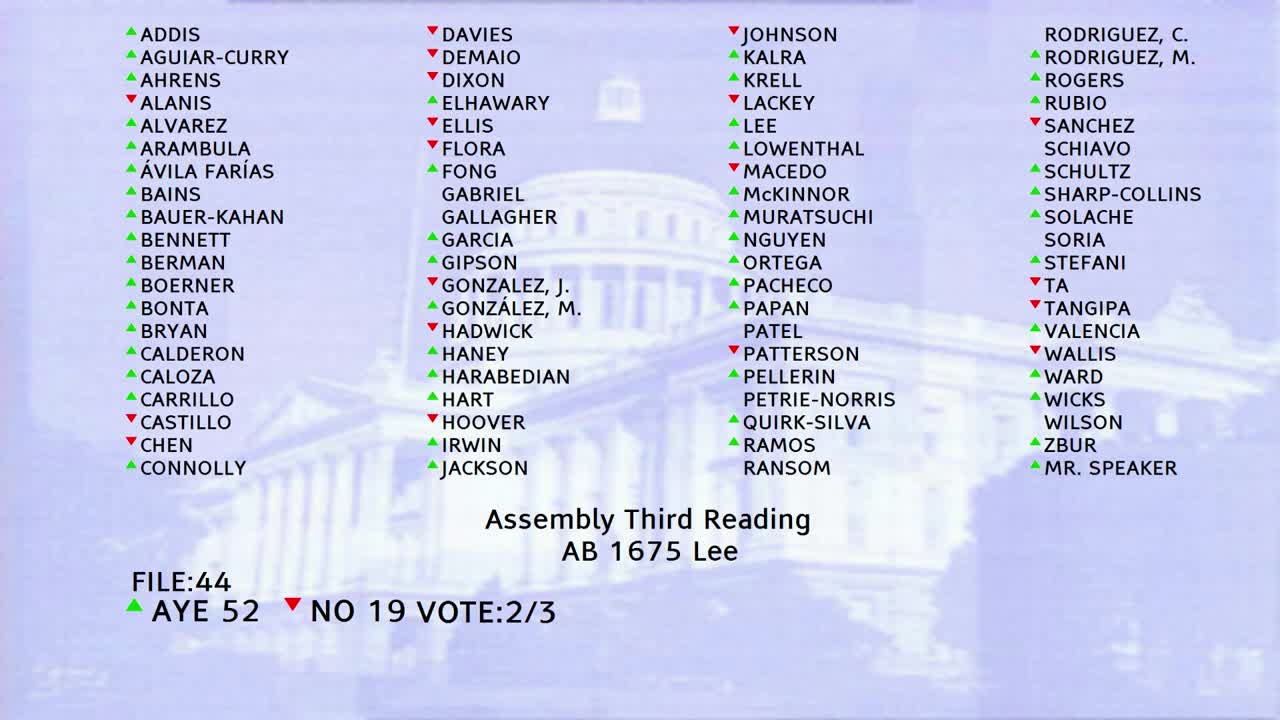 33SEC
Assembly Floor
 7MIN