AB 1686: Vehicles: driving under the influence: felonies.
- Session Year: 2025-2026
- House: Assembly
- Latest Version Date: 2026-02-02
Current Status:
Failed
(2026-04-21: From committee: Without further action pursuant to Joint Rule 62(a).)
Introduced
In Committee
Awaiting First Chamber Vote
Passed First Chamber
In Committee
Awaiting Second Chamber Vote
Passed Second Chamber
Enacted
Under existing law, it is unlawful to drive a motor vehicle while under the influence (DUI) of alcohol or 0.08% or more, by weight, of alcohol in ones blood. A first violation of this prohibition is punishable as a misdemeanor. Under existing law, if a person is convicted of a DUI violation and the offense occurs within 10 years of one or 2 separate DUI violations that resulted in specified convictions, the offense is also punishable as a misdemeanor, as specified, with escalating fines, suspensions, and other sanctions. Under existing law, if a person is convicted of a DUI violation and the offense occurs within 10 years of 3 or more separate DUI violations that resulted in specified convictions, the offense is punishable either as a misdemeanor or as a felony.
This bill would make a conviction of a DUI violation with the offense occurring within 10 years of one or 2 separate DUI violations that resulted in specified convictions also punishable either as a misdemeanor or as a felony. By increasing the punishment for a crime, the bill imposes a state-mandated local program.
The California Constitution requires the state to reimburse local agencies and school districts for certain costs mandated by the state. Statutory provisions establish procedures for making that reimbursement.
This bill would provide that no reimbursement is required by this act for a specified reason.
(a)If a person is convicted of a violation of Section 23152 and the offense occurred within 10 years of a separate violation of Section 23103, as specified in Section 23103.5, 23152, or 23153, that resulted in a conviction, that person shall be punished by imprisonment in the county jail for not less than 90 days nor more than one year pursuant to subdivision (h) of Section 1170 of the Penal Code or in the county jail for not less than 180 days nor more than one year, and by a fine of not less than three hundred ninety dollars ($390) nor more than one thousand dollars ($1,000). The persons privilege to operate a motor vehicle shall be suspended by the department pursuant to paragraph (3) of subdivision (a) of Section 13352. The court shall require the person to surrender the persons drivers license to the court in accordance with Section 13550.
(b)Whenever, when considering the circumstances taken as a whole, the court determines that the person punished under this section would present a traffic safety or public safety risk if authorized to operate a motor vehicle during the period of suspension imposed under paragraph (3) of subdivision (a) of Section 13352, the court may disallow the issuance of a restricted drivers license required under Section 13352.5.
(c)This section shall become operative on September 20, 2005.
SEC. 2.Section 23546 of the Vehicle Code is amended to read:23546.(a)If a person is convicted of a violation of Section 23152 and the offense occurred within 10 years of two separate violations of Section 23103, as specified in Section 23103.5, 23152, or 23153, or any combination thereof, that resulted in convictions, that person shall be punished by imprisonment in the county jail for not less than 120 days nor more than one year pursuant to subdivision (h) of Section 1170 of the Penal Code or in the county jail for not less than 180 days nor more than one year, and by a fine of not less than three hundred ninety dollars ($390) nor more than one thousand dollars ($1,000). The persons privilege to operate a motor vehicle shall be revoked by the Department of Motor Vehicles as required in paragraph (5) of subdivision (a) of Section 13352. The court shall require the person to surrender his or her the persons drivers license to the court in accordance with Section 13550.
(b)A person convicted of a violation of Section 23152 punishable under this section shall be designated as a habitual traffic offender for a period of three years, subsequent to the conviction. The person shall be advised of this designation pursuant to subdivision (b) of Section 13350.
SEC. 3.No reimbursement is required by this act pursuant to Section 6 of Article XIIIB of the California Constitution because the only costs that may be incurred by a local agency or school district will be incurred because this act creates a new crime or infraction, eliminates a crime or infraction, or changes the penalty for a crime or infraction, within the meaning of Section 17556 of the Government Code, or changes the definition of a crime within the meaning of Section 6 of Article XIIIB of the California Constitution.
|
Date
|
Status
|
|---|---|
| Apr 21, 2026 | From committee: Without further action pursuant to Joint Rule 62(a). |
| Apr 21, 2026 | In committee: Set, final hearing. Failed passage. |
| Mar 24, 2026 | In committee: Set, final hearing. Failed passage. Reconsideration granted. |
| Mar 17, 2026 | In committee: Set, second hearing. Hearing canceled at the request of author. |
| Mar 6, 2026 | In committee: Set, first hearing. Hearing canceled at the request of author. |
| Feb 17, 2026 | Referred to Com. on PUB. S. |
| Feb 3, 2026 | From printer. May be heard in committee March 5. |
| Feb 2, 2026 | Read first time. To print. |
|
Date
|
Description
|
Location
|
Votes
|
|
|---|---|---|---|---|
| Apr 21, 2026 | Do pass and be re-referred to the Committee on [Appropriations] | Assembly Standing Committee on Public Safety |
Failed |
|
| Mar 24, 2026 | Do pass and be re-referred to the Committee on [Appropriations] | Assembly Standing Committee on Public Safety |
Failed |
This list shows positions taken on this bill by organizations on the date displayed, which is linked to the original source.
Positions by individuals are not included.
|
Organization
|
Position
|
Date
|
|---|---|---|
| 3 Private Individuals | ** Support | |
| Aclu California Action | ** Against | |
| American Medical Response West | ** Support | |
| Arcadia Police Officers' Association | ** Support | |
| Brea Police Association | ** Support | |
| Burbank Police Officers' Association | ** Support | |
| California Association Of Drinking Driver Treatment Programs | ** Support | |
| California Association Of Highway Patrolmen | ** Support | |
| California Association of School Police Chiefs | ** Support | |
| California Attorneys For Criminal Justice | ** Against | |
| California Coalition of School Safety Professionals | ** Support | |
| California District Attorneys Association | ** Support | |
| California Narcotic Officers' Association | ** Support | |
| Californians United for a Responsible Budget | ** Against | |
| California Peace Officers Association | ** Support | |
| California Police Chiefs Association | ** Support | |
| California Public Defenders Association | ** Against | |
| California Reserve Peace Officers Association | ** Support | |
| California State Sheriffs' Association | ** Support | |
| Center on Juvenile and Criminal Justice | ** Against | |
| City of Seal Beach | ** Support | |
| Claremont Police Officers' Association | ** Support | |
| Corona Police Officers' Association | ** Support | |
| Culver City Police Officers' Association | ** Support | |
| Ella Baker Center For Human Rights | ** Against | |
| Fullerton Police Officers' Association | ** Support | |
| Initiate Justice | ** Against | |
| Justice2jobs Coalition | ** Against | |
| LA Defensa | ** Against | |
| Local 148 Los Angeles County Public Defender's Union | ** Against | |
| Los Angeles County Sheriff'S Department | ** Support | |
| Los Angeles School Police Management Association | ** Support | |
| los angeles school police officers association | ** Support | |
| Mothers Against Drunk Driving | ** Support | |
| Murrieta Police Officers' Association | ** Support | |
| Newport Beach Police Association | ** Support | |
| Palos Verdes Police Officers' Association | ** Support | |
| Peace Officers Research Association of California (PORAC) | ** Support | |
| Placer County Deputy Sheriffs' Association | ** Support | |
| Pomona Police Officers' Association | ** Support | |
| Riverside County Sheriff's Office | ** Support | |
| Riverside Police Officers' Association | ** Support | |
| Riverside Sheriffs' Association | ** Support | |
| Safe California Roads Coalition | ** Support | |
| Safety and Advocacy for Empowerment (SAFE) | ** Support | |
| San Bernardino County | ** Support | |
| San Francisco Public Defender | ** Against | |
| Smart Justice California, a Project of Beyond Impact | ** Against | |
| Streets are for Everyone Inland Empire | ** Support | |
| Streets for All | ** Support | |
| The River's Edge Ranch | ** Support | |
| We Save Lives | ** Support |
Date of Hearing:
Counsel: Ilan Zur
ASSEMBLY COMMITTEE ON
Nick Schultz, Chair
ABPCA Bill Id:
Author:() – As Ver:
VOTE ONLY
SUMMARY:
Increases the punishment for driving under the influence (DUI) with one or two priors from a misdemeanor to an alternate felony-misdemeanor, and increases the minimum jail time for these offenses. Specifically, this bill:
- Increases the punishment for a DUI[1] with one prior[2] from a misdemeanor, punishable by 90 days to one year in county jail, to an alternate felony-misdemeanor (wobbler), punishable either as a misdemeanor by 180 days to one year in county jail, or as a jail-eligible felony by 16 months, or two or three years.
- Increases the punishment for a person convicted of a DUI with two priors from a misdemeanor, punishable by 120 days to one year in county jail, to a wobbler, punishable either as a misdemeanor by 180 days to one year in county jail, or as a jail-eligible felony by 16 months, or two or three years.
EXISTING LAW:
- Makes it unlawful for any person who is under the influence of any alcoholic beverage or drug, or under the combined influence of any alcoholic beverage and drug, or who has 0.08 percent or more, by weight, of alcohol (BAC) in their blood, to drive a vehicle (hereafter DUI). (Veh. Code, § 23152 subds. (a), (b) (f), & (g).)
- Punishes a DUI as follows:
- First DUI:
- A misdemeanor punishable by imprisonment for four days to six months in county jail (two days must be continuous), or if given probation, possibly two days to six months in jail.
- A fine of $390 to $1,000, plus penalty assessments.
- An order to install a functioning, certified ignition interlock device (IID) on any vehicle that person operates for up to six months (if the offense involved alcohol), at the court’s discretion.
- Six-month license suspension or a 10-month suspension if probation is given and a 9-month DUI program is ordered; and,
- In counties with approved programs, completion of a three-month (30-hour) DUI program, or a nine-month (60-hour) program if the person’s BAC was .20% or more, or they refused to take a chemical test, if given probation. (Veh. Code, §§ 13352, subd. (a)(1); 13352.1, subd. (a); 23536, subds. (a) & (c); 23538, subds. (a) & (b); 23575.3, subd. (h)(1)(A)(i).)
- DUI with one prior:
- A misdemeanor punishable by imprisonment for three months to one year in county jail, or if given probation, 10 days to one year, or four days to one year, as specified.
- A fine of $390 to $1,000, plus penalty assessments.
- One-year IID installation mandate (if the offense involved alcohol).
- Two-year license suspension.
- Completion of an 18-month or 30-month DUI program, as specified, if given probation. (Veh. Code, §§ 13352, subd. (a)(3); 23540, subd. (a); 23542, subds. (a) & (b); 23575.3, subd. (h)(1)(B).)
- DUI with two priors:
- A misdemeanor punishable by imprisonment for four months to one year in county jail, or 30 days to one year if given probation and ordered to complete a 30-month DUI program.
- A fine of $390 to $1,000, plus penalty assessments.
- Two-year IID installation mandate (if the offense involved alcohol).
- Three-year license revocation, and 3-year designation as a habitual traffic offender.
- An 18- or 30-month DUI program, as specified, if given probation and at the court's discretion. (Veh. Code, §§ 13352, subd. (a)(5); 23546; 23548, subds. (a) & (b); 23575.3, subd. (h)(1)(C).)
- 10-year license revocation, at the court’s discretion, if a person has been convicted of three or more DUIs or DUIs causing bodily injury, the last of which was punishable as a DUI or DUI causing bodily injury with two priors, a DUI with three or more priors, or as a wobbler because of a prior specified felony. (Veh. Code, § 23597, subd. (a).)
- DUI with three or more priors:
- A wobbler punishable by imprisonment for six months to one year in jail, or as a jail-eligible felony by 16 months, or two or three years, or 30 days to one year if given probation and ordered to complete a 30-month DUI program.
- A fine of $390 to $1,000, plus penalty assessments.
- Three-year IID installation mandate (if the offense involved alcohol).
- Four-year license revocation, and three-year designation as a habitual traffic offender.
- An 18- or 30-month DUI program, as specified, if given probation and at the court’s discretion. (Veh. Code, §§ 13352, subd. (a)(7); 23550; 23552, subds. (a) & (b); 23575.3, subd. (h)(1)(D).)
- First DUI:
- Makes it unlawful for any person who is under the influence of any alcoholic beverage or drug, or the combined influence of the two, or who has a BAC of .08 or more, to drive a vehicle, and concurrently do any act forbidden by law or neglect any duty imposed by law in driving the vehicle, which proximately causes bodily injury to any person other than the driver (hereafter DUI causing bodily injury.) (Veh. Code, § 23153 subds. (a), (f), & (g).)
- Punishes a DUI causing bodily injury, as follows:
- First DUI causing bodily injury,
- A wobbler punishable by imprisonment for three months to one year in county jail or 16 months, or two or three years in state prison, or if given probation, five days to one year in county jail.
- A fine of $390 to $1,000, plus penalty assessments.
- One-year IID installation mandate (if the offense involved alcohol).
- One-year license suspension.
- In counties with approved programs, completion of a three-month (30-hour) DUI treatment program, or a nine-month (60-hour) program if the person’s BAC was .20% or more or they refused to take a chemical test, if given probation. (Veh. Code, §§ 13352 subd. (a)(2), 23554; 23556, subds. (a) & (b); 23575.3, subd. (h)(2)(A).)
- DUI causing bodily injury with one prior:
- A wobbler punishable by imprisonment for four months to one year in county jail or 16 months, or two or three years in state prison, or if given probation, four months in jail, or 30 days to one year in jail.
- A fine of $390 to $5,000 fine, plus penalty assessments, or $390 to $1,000 if given probation as specified.
- Two-year IID installation mandate (if the offense involved alcohol).
- Three-year license revocation.
- An 18- or 30-month DUI program, as specified, if given probation and at the court's discretion. (Veh. Code, §§ 13352 subd. (a)(4); 23560; 23562, subds. (a) & (b); 23575.3, subd. (h)(2)(B).)
- DUI causing bodily injury with two or more priors:
- A felony punishable by imprisonment in state prison for two, three, or four years, or if given probation, either a minimum of one year in county jail, or 30 days to one year in county jail if ordered to complete an 18 or 30-month DUI program.
- A fine of $1,015 to $5,000, or $390 to $5,000 if given probation, and a requirement to make restitution or reparation.
- Three-year IID installation mandate (if offense involved alcohol).
- Five-year license revocation, and three-year designation as a habitual traffic offender.
- An 18- or 30-month DUI program, as specified, if given probation. (Veh. Code, §§ 13352 subd. (a)(6); 23566; 23568, subds. (a) & (b); 23575.3, subd. (h)(2)(C.)
- Provides that a person who is convicted of a DUI causing bodily injury, which proximately causes bodily injury or death to more than one victim and results in a felony conviction, shall receive a one-year sentence enhancement in state prison for each additional victim injured (maximum of three). (Veh. Code, § 23558.)
- Punishes a person convicted of a DUI causing bodily injury, where the violation proximately causes great bodily injury (GBI) to any person other than the driver, and the offense occurred within 10 years of two or more priors, as a felony by imprisonment for two, three, or four years in state prison, a $1,015 to $5,000 fine, and a five-year license revocation. (Veh. Code, §§ 23566, subd. (b); 13352 subd. (a)(6).)
- Provides that if a person is convicted for the above offense, and the underlying offense occurred within 10 years of four or more priors, there shall be an additional punishment of three years in state prison, which shall be served in addition and consecutive to the sentence imposed above. (Veh. Code, § 23566, subd. (c).)
- First DUI causing bodily injury,
- Makes any DUI or DUI causing bodily injury (hereafter any DUI) a wobbler if that person has previously been convicted of certain impaired driving crimes:
- Punishes a person convicted of any DUI within 10 years of specified felonies – a DUI with three or more priors, a DUI causing bodily injury, or gross vehicular manslaughter – as a wobbler with a $390 to $1,000 fine, a four- or five-year license revocation (including a three-year designation as a habitual traffic offender ), and a three- or four-year IID mandate.[3] (Veh. Code, §§ 13352 subd. (a)(6)-(7); 23550.5, subds. (a), (c) & (d); 23575.3, subd. (h)(1)-(2).)
- Punishes a person convicted of any DUI, who has a prior conviction for felony intoxicated vehicular manslaughter, as a wobbler with a fine of $390 to $1,000, a four- or five-year license revocation, and a three- or four-year IID mandate. (Veh. Code, §§ 13352 subd. (a)(6)-(7); 23550.5, subds. (b), (c) & (d); 23575.3, subd. (h)(1)-(2).)
- Requires a court to advise a person convicted of a DUI or a DUI causing bodily injury, or who pleads to a reckless driving conviction in satisfaction of, or as a substitute for an original DUI charge, of the following: “You are hereby advised that being under the influence of alcohol or drugs, or both, impairs your ability to safely operate a motor vehicle. Therefore, it is extremely dangerous to human life to drive while under the influence of alcohol or drugs, or both. If you continue to drive while under the influence of alcohol or drugs, or both, and, as a result of that driving, someone is killed, you can be charged with murder.” (Veh. Code, § 23593, subd. (a).)
FISCAL EFFECT:
Unknown
COMMENTS:
- Author's Statement: According to the author, “As a CHP officer, I have stood on the side of the road with families who have just lost loved ones to drunk drivers. Those scenes will never leave me. We owe it to those families to hold repeat offenders accountable. AB 1686 does this by making a second DUI a wobbler.”
- Statewide Increase in Traffic Fatalities, Including DUI Fatalities. There has been a substantial increase in crash fatalities in California in the last decade. Traffic fatalities can result from a variety of factors, including impaired driving, speeding, distracted driving, unsecured passengers, and unhelmeted motorcyclists, among others.[4] According to data published by the California Office of Traffic Safety (OTS), total crash fatalities across the state increased by about 31 percent, from 3,107 to 4,061, from 2013 to 2023.[5] This has been driven by an increase in almost all of the major crash fatality categories. According to OTS data, from 2013 to 2023, there was an approximate 54% increase in alcohol-impaired fatalities,[6] a 51% increase in unrestrained occupant fatalities,[7] a 51% increase in pedestrian fatalities,[8] a 31% increase in speeding-related fatalities,[9] and a 26% increase in motorcycle fatalities.[10] However, the latest data suggests this trend may be reversing. Total traffic fatalities decreased by 1.9% from 2021 to 2022,[11] and again by 11% from 2022 to 2023.[12] Alcohol-impaired driving fatalities similarly decreased by 4.5% from 2022 to 2023.[13]
For context, alcohol and drug-involved crash fatalities (hereinafter, “DUI crash fatalities”), which have historically comprised a significant portion of total crash fatalities, peaked at 2,065 in 2005, before declining to a multi-decade low of 1,416 in 2010.[14] DUI crash fatalities have steadily increased since then, reaching 1,644 in 2015 and 1,868 in 2021; an increase of about 32% from 2010 to 2021.[15] While DUI crash fatalities have increased in the last decade, they comprise an increasingly lower proportion of total crash fatalities. In 2013, DUI crash fatalities were responsible for 54.7% of all crash fatalities; in 2021, 41.7%.[16] That is the lowest proportion of total crash fatalities since 2001.[17] Further, non-alcohol-involved crash fatalities increased from 2010 to 2021 by an alarming 88% percent, from 1,667 to 3,133.[18] This indicates that vehicle safety factors, other than alcohol-involved impaired driving, are playing a significant role in driving California’s increase in crash fatalities.
- Reduced Enforcement of DUI Laws: The increase in DUI fatalities has coincided with a significant decline in DUI arrests and convictions. In 2010, when impaired fatalities were at a multi-decade low, there were 195,879 DUI arrests and 148,042 DUI convictions in California.[19] From 2010 to 2015, DUI arrests and convictions both decreased by approximately 28%.[20] Arrests and convictions have continued to steadily decrease since then, reaching 110,017 arrests and 81,248 convictions in 2021.[21] In sum, between 2010 and 2021, DUI arrests and convictions decreased by approximately 44% and 45%, respectively.[22] Unsurprisingly, from 2011 to 2021, the DUI arrest rate per 100,000 licensed drivers decreased from 752 to 401.[23] This decrease in DUI arrests and convictions, considered alongside the significant increase in DUI fatalities, suggests a substantial reduction in the enforcement of California’s DUI laws.
- California’s DUI Framework: Existing law makes it unlawful for any person who is under the influence of any alcoholic beverage or drug, or under the combined influence of any alcoholic beverage and drug, or who has 0.08 percent or more, by weight, of BAC in their blood, to drive a vehicle. (Veh. Code, § 23152 subds. (a), (b) (f), & (g).) This is California’s primary DUI statute that establishes the crime of DUI that does not cause bodily injury. DUIs that cause bodily injury or death are punished separately and more severely. The punishment for a DUI generally depends on the defendant’s number of separate “priors” within 10 years of the current offense. (Veh. Code, § 23540.) Convictions that are considered “priors” are a DUI under Vehicle Code section 23152, a DUI causing bodily injury under Vehicle Code section 23153, and a “wet reckless” conviction under Vehicle Code section 23103.5. (Ibid.) A wet reckless conviction occurs where the prosecution agrees to a plea to a charge of reckless driving under Vehicle Code 23103, in satisfaction of, or as a substitute for, an original DUI charge, as specified. (Veh. Code, § 23103.5.)
A first, a second, and a third DUI within ten years of the current offense are all misdemeanor offenses. (Veh. Code, §§ 23536; 23540; 23546.) However, as noted below, the amount of minimum jail time, license suspension length, and IID installation term all increase with each prior. (Veh. Code, §§ 13352, subd. (a)(1)-(5); 23536; 23540; 23546; 23575.3, subd. (h)(1)(A)-(C).) Currently, only a DUI with three or more priors can be prosecuted as a felony. (Veh. Code, § 23550.)
Specifically, a first-time DUI is punishable by imprisonment for four days to six months in county jail, a fine of $390 to $1,000, a possible six-month IID installation order, a six- to 10-month suspension, and, if given probation, completion of a three- or nine-month DUI program. (Veh. Code, §§ 13352, subd. (a)(1); 13352.1, subd. (a); 23536, subds. (a) & (c); 23538, subds. (a) & (b); 23575.3, subd. (h)(1)(A)(i).) A DUI with one prior is punishable by imprisonment for three months to one year in county jail, a $390 to $1,000 fine, a one-year IID mandate, a two-year license suspension, and, if given probation, completion of an 18- or 30-month DUI program. (Veh. Code, §§ 13352, subd. (a)(3); 23540, subd. (a); 23542, subds. (a) & (b); 23575.3, subd. (h)(1)(B).) A DUI with two priors is punishable by imprisonment for four months to one year in county jail, a $390 to $1,000 fine, a two-year IID mandate, a three-year license revocation, and, if given probation, a possible 18- or 30-month DUI program. (Veh. Code, §§ 13352, subd. (a)(5); 23546; 23548, subds. (a) & (b); 23575.3, subd. (h)(1)(C).) A DUI with three or more priors is a wobbler, punishable by imprisonment for six months to one year in county jail, or as a jail-eligible felony by 16 months, or two or three years. (Veh. Code, § 23550.) Additionally, this offense is subject to a $390 to $1,000 fine, a three-year IID mandate, a four-year license revocation, and, if given probation, a possible 18- or 30-month DUI program. (Veh. Code, §§ 13352, subd. (a)(7); 23550; 23552, subds. (a) & (b); 23575.3, subd. (h)(1)(D).)
- Effect of this Bill: This bill gives prosecutors discretion to charge a DUI with one prior and a DUI with two priors as a felony. These offenses are currently misdemeanors. It additionally increases the minimum jail time for these offenses if they are prosecuted as a misdemeanor. Specifically, it increases the punishment for a DUI with one prior from a misdemeanor, punishable by 90 days to one year in county jail, to a wobbler, punishable either as a misdemeanor by 180 days to one year in county jail, or as a jail-eligible felony by 16 months, or two or three years. It similarly increases the punishment for a DUI with two priors from a misdemeanor, punishable by 120 days to one year in county jail, to a wobbler, punishable either as a misdemeanor by 180 days to one year in county jail, or as a jail-eligible felony by 16 months, or two or three years.
This bill is distinct from AB 1546 (Schultz), which this Committee passed out on March 3, 2026. That bill increases penalties for a narrower category of serious repeat DUI offenders: DUI offenders with two priors and DUI offenders with four or more priors. Here, while this bill similarly makes a DUI with two priors a wobbler, it also authorizes felony charges for a DUI with just one prior. While first-time DUI offenders make up the bulk of DUI offenses, second-time DUI offenders are the next most common offender category. Together, second and third-time DUI offenders – the category of offenders impacted by this bill – typically comprise approximately a quarter of total DUI convictions. In 2020, 74.7% of DUI convictions were for first-time DUIs, 19.2% for second-time DUIs, 4.6% for third-time DUIs, and 1.4% for fourth or subsequent DUIs.[24] In 2019, the conviction numbers for a second-time and third-time DUI were similarly 20.2% and 5.3%, respectively.[25] In 2018, 20.5% and 5.3%, respectively.[26] The most recent annual data from the DMV shows there were 81,248 DUI convictions in 2021.[27] If these conviction numbers remain steady, let alone increase to levels seen in prior years, this bill could authorize tens of thousands of new felony charges annually, which could place a significant strain on California’s county jails.
- Existing Penalties for Conduct Prohibited by this Bill: A recent series of reporting by Cal Matters, titled “License to Kill,”[28] highlighted the significant increase in DUI-related fatalities in California. This reporting identified some troubling gaps in California’s DUI framework, such as communication failures between courts and the DMV.[29] A frequently repeated claim from this reporting series is that “California has some of the weakest DUI laws in the country.”[30] Whether this is in fact true is unclear. California’s impaired driving criminal laws are extensive and address conduct far beyond the specific crime of a DUI that does not cause injury under Vehicle Code section 23152. In addition to this particular crime, there are numerous criminal penalties, including felony crimes and sentence enhancements, that can be leveraged against impaired drivers. Available penalties include the following:
- Felony DUI Causing Bodily Injury
A first-time DUI that causes bodily injury to another can be prosecuted as a felony. Existing law makes it unlawful for any person who is under the influence of any alcoholic beverage or drug, or the combined influence of the two, or who has a BAC of .08 or more, to drive a vehicle, and concurrently do any act forbidden by law or neglect any duty imposed by law in driving the vehicle, which proximately causes bodily injury to any person other than the driver. (Veh. Code, § 23153 subds. (a), (f), & (g).) A first offense is a wobbler punishable by imprisonment for 90 days to one year in jail or 16 months, or two or three years in state prison. (Veh. Code, § 23554.) A DUI causing bodily injury with one prior is also a wobbler, while a DUI causing bodily injury with two priors is a straight felony punishable in state prison by imprisonment for two, three, or four years. (Veh. Code, §§ 13352 subd. (a)(6); 23560; 23566; 23568, subds. (a) & (b); 23575.3, subd. (h)(2)(C.)
- Felony DUI Crimes Due to Specified Priors or GBI
In addition to the crimes of a DUI or a DUI causing bodily injury, whereby the severity of punishment increases in accordance with that person's number of priors, any DUI can be punished as a felony if that person has previously been convicted of certain impaired driving offenses or if the DUI causes certain injury. (Veh. Code, § 23550.5, subds. (a), (c) & (d).)
First, any DUI within 10 years of a conviction for a specified felony – a DUI with three or more priors, a DUI causing bodily injury, or gross vehicular manslaughter – is punishable as a wobbler with a $390 to $1,000 fine, a four or five year license revocation (including designation as a habitual traffic offender for three years), and a three- or four-year IID mandate. (Veh. Code, §§ 13352 subd. (a)(6)-(7); 23550.5, subds. (a), (c) & (d); 23575.3, subd. (h)(1)-(2).) Accordingly, a DUI offender who was previously convicted of a felony DUI causing bodily injury can be subject to felony, rather than misdemeanor charges.
Second, a person convicted of any DUI who has previously been convicted of felony vehicular manslaughter while intoxicated can also face felony charges. This crime is punishable as a wobbler with a fine of $390 to $1,000, a four- or five-year license revocation, and a three- or four-year IID mandate. (Veh. Code, §§ 13352 subd. (a)(6)-(7); 23550.5, subds. (b), (c) & (d); 23575.3, subd. (h)(1)-(2).) Notably, this offense does not have a 10-year washout period. A person convicted of felony vehicular manslaughter while intoxicated who subsequently is convicted of a DUI 20 years later may be charged with a felony.
Third, a DUI causing bodily injury, where the violation proximately causes GBI to a person other than the driver, and the offense occurred within 10 years of two or more priors, is punishable as a straight felony by imprisonment for two, three, or four years in state prison, a $1,015 to $5,000 fine, and a five-year license revocation (Veh. Code, §§ 23566, subd. (b); 13352 subd. (a)(6).)
- Impaired Driving Involving Death
A person who kills someone while driving impaired may be subject to several additional felonies.
First, a person who kills someone while impaired by alcohol or drugs can be prosecuted with implied malice, second-degree murder, punishable by 15 years-to-life in state prison. (Pen. Code, § 187; 190, subd. (a); 1 CALCRIM 520 (2026); People v. Watson (1981) 30 Cal.3d 290, 300.) Notably, a person convicted of a DUI is required to be advised of the dangers of driving under the influence, and that they may be charged with murder if they continue to drink and drive and kill someone as a result. (Veh. Code, § 23593, subd. (a).)
Second, a person who kills someone while driving impaired and with gross negligence may be convicted of the crime of “gross vehicular manslaughter while intoxicated.” This is defined as the unlawful killing of a person without malice while driving a vehicle while intoxicated, and the killing was either a proximate result of an unlawful act, not amounting to a felony, and with gross negligence, or the proximate result of a lawful act that might produce death, in an unlawful manner, and with gross negligence. (Pen. Code, § 191.5, subds. (a) & (c)(1).) Gross vehicular manslaughter while intoxicated is a felony punishable by imprisonment for four, six, or 10 years in state prison. (Pen. Code, § 191.5, subd. (c)(1).) If this offense does not involve gross negligence, the offense becomes “vehicular manslaughter while intoxicated,” which is punishable as a wobbler with a heightened felony option of imprisonment for 16 months, or two or four years. (Pen. Code, § 191.5, subd. (c)(2).)
Additionally, a person who is convicted of gross vehicular manslaughter while intoxicated, who has previously been convicted of any DUI, among other offenses, may be punished by a state prison term of 15 years-to-life. (Pen. Code, § 191.5, subd. (d).)
- Sentence Enhancements
Impaired drivers may be subject to multiple types of sentence enhancements.
First, a person who is convicted of a DUI causing bodily injury, which proximately causes bodily injury or death to more than one victim and results in a felony conviction, shall receive a one-year sentence enhancement in state prison for each additional victim injured (maximum of three victims). (Veh. Code, § 23558.) Consider a person who drives impaired and causes a car crash that injures three people in the other car. That person may be charged with a felony DUI causing bodily injury, punishable by up to three years in state prison, and an enhancement of two years for the two additional injured victims. (Veh. Code, §§ 23554; 23558.)
Second, where a person is convicted of the felony crime of DUI causing bodily injury that proximately causes GBI and that occurred within 10 years of two or more priors, if the underlying offense occurred within 10 years of four or more priors that person shall be subject to an additional three-year prison enhancement, which shall be served in addition to and consecutive to the base term. (Veh. Code, § 23566, subds. (b) & (c).) For example, if a person is convicted of a DUI that causes GBI with four or more priors under this sentence enhancement, they may be punished by up to four years in state prison, and an additional three-year sentence enhancement. (Ibid.)
Third, a person convicted of a felony DUI may be subject to an additional three-year sentence enhancement if they personally inflicted GBI in the commission of the felony DUI. (Pen. Code, § 12022.7, subds. (a) & (g).) For example, if a person is convicted of a felony DUI causing bodily injury, and the defendant personally inflicted GBI during the offense, that person can face up to three years for the offense, and an additional three-year enhancement. (Pen. Code, § 23554; See e.g., People v. Wilson (2003) 114 Cal.App.4th 953, 956; People v. Sainz (1999) 74 Cal.App.4th 565, 576.) This does not apply where GBI is an element of the offense and is inapplicable to murder or manslaughter. (Pen. Code, § 12022.7, subds. (a) & (g).)
- Minimum Mandatory Terms and Jail Enhancements
A DUI can result in substantial jail time, even when prosecuted as a misdemeanor. A DUI conviction mandates minimum jail time as follows: first DUI (four days); second DUI (three months); third DUI (four months); and fourth or subsequent DUI (six months if prosecuted as a misdemeanor). (Veh. Code, §§ 23536; 23540; 23546; 23550.) Although probation, which is frequently granted, results in less minimum jail time.
In addition, existing law mandates additional jail time under certain circumstances. Generally, these jail enhancements apply regardless of whether probation was granted.
First, existing law mandates additional jail time if the DUI offense involved excessive speeding. Specifically, it requires an additional and consecutive term of two months in county jail if a person, during the commission of a DUI drives 30 miles per hour or more over the speed limit on a freeway, or 20 miles per hour over the posted speed limit on any other street or highway, in a manner that constitutes reckless driving (Veh. Code, § 23582, subd. (a).) Accordingly, a person convicted of a DUI with one prior while driving recklessly over 20 miles per hour over the speed limit on a highway may receive a minimum of five months of jail time; three months for their second DUI, and an additional two months for speeding.
Second, a person convicted of a DUI, where a minor under 14 years old was a passenger at the time of the offense, is subject to additional jail time as follows: first DUI (48 continuous hours); second DUI (10 days); third DUI (30 days); and fourth or subsequent DUI (three months). (Veh. Code, § 23572, subd. (a).)
Third, existing law also requires additional jail time for a person convicted of a DUI who, at the time of arrest, willfully failed to submit to or complete a breath or urine test, regardless of whether probation is granted. Additional jail time is mandated as follows: first DUI (heightened probation conditions); first DUI causing bodily injury (additional 48 continuous hours jail); any DUI with one prior (four days); DUI with two priors (10 days); and a DUI with three priors or a DUI with a prior specified felony (18 days). (Veh. Code, § 23577, subd. (a).)
- Vehicle Impoundment
A person convicted of a DUI may also have their vehicle impounded, and possibly even sold. Currently, courts have discretion to impound a DUI offender’s vehicle for up to 30 days for a first offense, where the vehicle was used in the commission of the offense, or up to 90 days if the offense occurs within five years of two or more prior DUIs. (Veh. Code, § 23594, subds. (a) & (b).) The impoundment must be ordered at the registered owner’s expense, except for unusual cases where the interests of justice would be best served by not ordering impoundment. (Ibid.) Additionally, a court may declare a defendant-owner’s vehicle to be a nuisance and subject the vehicle to sale if the defendant is convicted of any of the following: 1) a DUI within seven years of two or more prior DUI or intoxicated vehicular manslaughter convictions; 2) a DUI causing bodily injury within seven years of a prior DUI or intoxicated vehicular manslaughter conviction; or 3) intoxicated vehicular manslaughter. (Veh. Code, § 23596, subds. (a) & (b).)
Additionally, a court may impound the vehicle of a vehicle owner for up to six months upon a conviction for driving with a suspended or revoked license and up to one year for a second or subsequent violation for that same offense. (Veh. Code, § 23592, subd. (a).)
- Increased Penalties and Lack of Deterrent Effect: According to the National Institute of Justice (NIJ), “Laws and policies designed to deter crime by focusing mainly on increasing the severity of punishment are ineffective partly because criminals know little about the sanctions for specific crimes. More severe punishments do not ‘chasten’ individuals convicted of crimes, and prisons may exacerbate recidivism.”[31] Rather than penalty increases, the NIJ emphasizes the need for policies that “increase[] the perception that criminals will be caught and punished” because “[t]he certainty of being caught is a vastly more powerful deterrent than the punishment.” [32]
In a 2014 report, the Little Hoover Commission similarly addressed the disconnect between science and sentencing – that is, “put[ting] away offenders for increasingly longer periods of time, with no evidence that lengthy incarceration, for many, brings any additional public safety benefit.”[33] Accordingly, while this bill guarantees greater punishment for second and third-time DUI offenders, it is less clear whether it will effectively deter impaired driving behavior. - Argument in Support: According to the Safe California Roads Coalition, “The Safe California Roads Coalition strongly supports AB 1686, which would allow repeat DUI offenses within a 10-year period to be charged as either a misdemeanor or a felony. This bill is a critical step toward holding drivers who repeatedly endanger lives accountable for their actions. AB 1686 ensures that our laws reflect the serious harm caused by impaired driving and the need to protect all Californians on our roads.
“California’s current DUI laws treat a second or third offense within 10 years as a misdemeanor, even though these drivers have demonstrated a pattern of dangerous behavior. AB 1686 corrects this gap by providing prosecutors the ability to pursue felony charges when appropriate. The Safe California Roads Coalition supports this bill as a vital part of our mission to reduce DUI-related deaths and injuries. Strengthening accountability for repeat offenders helps prevent future crashes, protects families, and ensures that California’s roads are safer for everyone.”
- Argument in Opposition: According to California Attorneys for Criminal Justice (CACJ), AB 1646 “expands felony exposure by making a second or third DUI offense without injuries within ten years a “wobbler.” This proposal focuses on increased punishment rather than prevention and addresses only a narrow subset of cases. By making both second and third offenses punishable as felonies and imposing the same mandatory minimum jail sentence for each, the bill collapses California’s graduated penalty structure for repeat DUI offenses and eliminates the meaningful distinction between escalating levels of culpability.
“Nothing in this bill distinguishes between cases where the priors are close to the current offense versus cases when there have been many years in between. Nor does this bill focus on high b.a.c. cases and could include cases where someone had a “wet” and were borderline of the b.a.c. limits.
“Data from the California Department of Motor Vehicles (DMV) and the National Highway Traffic Safety Administration (NHTSA) show that roughly three-quarters of individuals arrested for a first DUI are never rearrested for another DUI within ten years, meaning most impaired-driving cases involve individuals who do not become repeat offenders.
“The most effective way to reduce impaired driving is to prevent first-time offenders from becoming repeat offenders. Preventing repeat offenses therefore requires addressing underlying substance-use disorders. Research consistently shows that treatment-based interventions reduce recidivism. Studies of court-mandated mental-health and substance-use treatment programs demonstrate meaningful reductions in reoffending among individuals who participate in treatment. Rather than expanding felony punishment for the small fraction of cases involving multiple repeat offenses, the Legislature should prioritize treatment-based diversion programs that address the root causes of impaired driving and thereby make California’s roadways safer.
“California’s existing DUI penalties are not lenient. In the most serious DUI fatality cases, prosecutors in California may pursue second-degree murder charges, exposing a defendant to a sentence of fifteen years to life. Despite the possibility of life imprisonment, a minority of drivers with a prior DUI conviction do reoffend because of substance-use disorders. This reality underscores that impaired driving is often driven by addiction and behavioral health issues, not by a lack of severe criminal penalties. Individuals who decide to drive while intoxicated are, by definition, impaired at the time of the decision, which limits the deterrent effect of harsher statutory penalties.
“This year the California Legislature has introduced at least a dozen DUI bills. CACJ urges the Legislature to convene broad stakeholder working groups to identify a []holistic approach to reform as needed. This would increase the likelihood of an efficient balanced resolution to any amendments.”
- Related Legislation:
- AB 1546 (Schultz) increases the punishment for a DUI with two priors from a misdemeanor to a wobbler and increases the punishment for a DUI with four or more priors from a wobbler to a straight felony. AB 1546 is pending a hearing in the Assembly Appropriations Committee.
- SB 907 (Archuleta) adds intoxicated vehicular manslaughter and gross vehicular manslaughter to the violent felonies list and subjects a person convicted of specified vehicle offenses, including a felony DUI, to a three-year sentence enhancement for each prior conviction for specified vehicle offenses, among other changes. SB 907 is pending a hearing in the Senate Public Safety Committee.
- AB 1748 (Sanchez) lengthens the license suspension and revocation periods for first-time and repeat DUI offenders, among other changes. AB 1748 is being heard in this Committee today.
- AB 1830 (Petrie-Norris) requires courts to order first-time DUI offenders to install, maintain, and service an IID for up to six months on every vehicle they operate. AB 1830 is being heard in this Committee today.
- AB 1687 (Lackey) punishes a person convicted of three or more specified vehicle offenses, including a DUI or a DUI causing bodily injury, among others, with an eight-year license revocation. AB 1687 is being heard in this Committee today.
- AB 1814 (Alanis) requires specified officers assigned to traffic enforcement to complete a course of training on detecting and apprehending impaired drivers within one year of their assignment to traffic enforcement, and every two years thereafter. AB 1814 is pending a hearing in this Committee.
- Prior Legislation:
- SB 421 (Bradford) of the 2021-2022 Legislative Session would have established a pretrial diversion scheme with specific conditions for misdemeanor DUI violations. SB 421 was held in Senate Appropriations.
- SB 783 (Bradford) of the 2021-2022 Legislative Session was substantially similar to SB 421. SB 783 was never heard.
- AB 401 (Flora) of the 2019-2020 Legislative Session would have made a DUI conviction that occurs within 10 years after four or more previous specified convictions, only punishable as a felony, among other changes. AB 401 failed passage in this Committee.
- AB 2690 (Mullin) Chapter 590, Statutes of 2014, changed the term "prior violations" to "separate violations" in a statute that authorizes enhanced penalties if the current offense occurred within 10 years of a specified felony DUI offense.
- AB 2605 (Bogh) of the 2005-2006 Legislative Session would have increased the penalty for a person convicted of a third DUI offense within 10 years from a misdemeanor to an alternative misdemeanor/felony, among other changes. AB 2605 failed passage in this Committee.
- SB 1694 (Torlakson), Chapter 550, Statutes of 2004, increased, from seven to 10 years, the "washout" period in which a person convicted of DUI would no longer be subject to increased penalties for having a prior specified DUI.
REGISTERED SUPPORT / OPPOSITION:
Support
American Medical Response West
Arcadia Police Officers' Association
Brea Police Association
Burbank Police Officers' Association
California Association of Drinking Driver Treatment Programs
California Association of Highway Patrolmen
California Association of School Police Chiefs
California Coalition of School Safety Professionals
California District Attorneys Association
California Narcotic Officers' Association
California Peace Officers Association
California Police Chiefs Association
California Reserve Peace Officers Association
California State Sheriffs' Association
City of Seal Beach
Claremont Police Officers Association
Corona Police Officers Association
Culver City Police Officers' Association
Fullerton Police Officers' Association
Los Angeles County Sheriff's Department
Los Angeles School Police Management Association
Los Angeles School Police Officers Association
Mothers Against Drunk Driving
Murrieta Police Officers' Association
Newport Beach Police Association
Palos Verdes Police Officers Association
Peace Officers Research Association of California (PORAC)
Placer County Deputy Sheriffs' Assocation
Pomona Police Officers' Association
Riverside County Sheriff's Office
Riverside Police Officers Association
Riverside Sheriffs' Association
Safety and Advocacy for Empowerment (SAFE)
San Bernardino County
Streets are for Everyone Inland Empire
Streets for All
The River's Edge Ranch
We Save Lives
3 Private Individuals
Opposition
ACLU California Action
California Attorneys for Criminal Justice
California Public Defenders Association
Californians United for a Responsible Budget
Center on Juvenile and Criminal Justice
Ella Baker Center for Human Rights
Initiate Justice
Justice2jobs Coalition
LA Defensa
Local 148 Los Angeles County Public Defender's Union
San Francisco Public Defender
Smart Justice California, a Project of Beyond Impact
1 Private Individual
Analysis Prepared by:
For purposes of this analysis, a “DUI” refers to a DUI punishable under Vehicle Code section 23152 that does not cause bodily injury. “A DUI causing bodily injury” to another is punished separately under Vehicle Code section 23153. ↑
For purposes of this analysis and unless otherwise specified, a “prior” means a separate DUI conviction under Vehicle Code sections 23152 (DUI), 23153 (DUI causing bodily injury), or a “wet reckless” conviction under 23103.5 (plea to reckless driving in satisfaction of an original DUI charge) that occurred within 10 years of the current violation. ↑
If the conviction is for a DUI, it is a three-year IID term. (Veh. Code, §23575.3, subd. (h)(1)D). If it is for a DUI causing bodily injury, then a four-year IID term. (Veh. Code, §23575.3, subd. (h)(2)D). ↑
OTS, California Annual Report: Fiscal Year 2024, p. 30, (2024), available at: https://www.ots.ca.gov/wp-content/uploads/sites/67/2025/09/FY-2024-Annual-Report-Final-7.31-ALT-TEXT.pdf ↑
OTS, California’s Annual Report 2018, p. 11, (2018), available at: https://www.ots.ca.gov/wp-content/uploads/sites/67/2019/06/2018-Annual-Report.pdf; OTS, California Traffic Safety Quick Stats (accessed February 4, 2026), available at: https://www.ots.ca.gov/ots-and-traffic-safety/score-card/ ↑
OTS, California’s Annual Report 2018, at p. 11; OTS, 2025 Traffic Safety Fact Sheet: Alcohol-Impaired and Alcohol-Involved Driving (2025), available at: https://safetrec.berkeley.edu/2025-safetrec-traffic-safety-facts-alcohol-impaired-and-alcohol-involved-driving ↑
OTS, California’s Annual Report 2018, at p. 11; OTS, 2025 Traffic Safety Fact Sheet: Occupant Protection and Child Passenger Safety (2025), https://safetrec.berkeley.edu/2025-safetrec-traffic-safety-facts-occupant-protection-and-child-passenger-safety. ↑
OTS, California’s Annual Report 2018, at p. 11; OTS, 2025 Traffic Safety Fact Sheet: Pedestrian Safety (2025), available at: https://safetrec.berkeley.edu/2025-safetrec-traffic-safety-facts-pedestrian-safety ↑
OTS, California’s Annual Report 2018, at p. 11; OTS, 2025 Traffic Safety Fact Sheet: Speeding-Related and Other Crashes (2025), available at: https://safetrec.berkeley.edu/2025-safetrec-traffic-safety-facts-speeding-related-and-other-crashes ↑
OTS, California’s Annual Report 2018, at p. 11; OTS, 2025 Traffic Safety Fact Sheet: Motorcycle Safety (2025), available at: https://safetrec.berkeley.edu/2025-safetrec-traffic-safety-facts-motorcycle-safety ↑
OTS, California Annual Report: Fiscal Year 2024, at p. 8 ↑
OTS, California Traffic Safety Quick Stats (accessed February 4, 2026), available at: https://www.ots.ca.gov/ots-and-traffic-safety/score-card/ ↑
Ibid. ↑
State of California DMV, DUI Summary Statistics (accessed February 3, 2026), available at: https://www.dmv.ca.gov/portal/dmv-research-reports/research-development-data-dashboards/dui-management-information-system-dashboards/dui-summary-statistics/. ↑
Ibid. ↑
Ibid. ↑
Ibid. ↑
Ibid. ↑
State of California DMV, DUI Summary Statistics (accessed February 3, 2026), available at: https://www.dmv.ca.gov/portal/dmv-research-reports/research-development-data-dashboards/dui-management-information-system-dashboards/dui-summary-statistics/. ↑
Ibid. ↑
Ibid. ↑
Ibid. ↑
DMV, 32nd Annual Report of the California Dui Management Information System (2025), at p. 6, available at: https://www.dmv.ca.gov/portal/uploads/2025/10/32nd-Annual-Report-of-the-California-DUI-Managment-Information-System.pdf ↑
DMV, 32nd Annual Report of the California Dui Management Information System (2025), at p. 30, available at: https://www.dmv.ca.gov/portal/uploads/2025/10/32nd-Annual-Report-of-the-California-DUI-Managment-Information-System.pdf ↑
DMV, Annual Report of the California DUI Management Information System (2023), at p. 29, available at: https://www.dmv.ca.gov/portal/uploads/2023/09/2022-DUI-MIS-Report.pdf ↑
DMV, 2021 Annual Report of the California DUI Management Information System (2022), at p. 29, available at: https://www.dmv.ca.gov/portal/uploads/2022/05/2021-DUI-MIS-Report-Update-11.3.22.pdf ↑
State of California DMV, DUI Summary Statistics (accessed February 3, 2026), available at: https://www.dmv.ca.gov/portal/dmv-research-reports/research-development-data-dashboards/dui-management-information-system-dashboards/dui-summary-statistics/. ↑
Cal Matters, License to Kill (accessed Feb. 13, 2026), available at: https://calmatters.org/series/license-to-kill/ ↑
Lauren Hepler and Robet Lewis, They were convicted of killing with their cars. No one told the California DMV, Cal Matters (June 25, 2025), available at: https://calmatters.org/investigation/2025/06/california-courts-dmv/?series=license-to-kill ↑
Robert Lewis and Lauren Hepler, 15 DUIs, still driving: California’s failure to take repeat drunk drivers off the road (Oct. 30, 2025), available at: https://calmatters.org/investigation/2025/10/california-dui-failure/?series=license-to-kill; Robert Lewis and Lauren Hepler, 40,000 people died on California roads. State leaders looked away (Dec. 11, 2025), available at: https://calmatters.org/investigation/2025/12/california-roadway-deaths-inaction/?series=license-to-kill ↑
National Institute of Justice, U.S. Department of Justice, Five Things about Deterrence (June 5, 2016) https://nij.ojp.gov/topics/articles/five-things-about-deterrence. ↑
Ibid. ↑
Little Hoover Commission, Sensible Sentencing for a Safer California (Feb. 2014) at p. 4, https://lhc.ca.gov/wp-content/uploads/Reports/219/Report219.pdf ↑
Date of Hearing:
Counsel: Ilan Zur
ASSEMBLY COMMITTEE ON
Nick Schultz, Chair
ABPCA Bill Id:
Author:() – As Ver:
SUMMARY:
Increases the punishment for driving under the influence (DUI) with one or two priors from a misdemeanor to an alternate felony-misdemeanor, and increases the minimum jail time for these offenses. Specifically, this bill:
- Increases the punishment for a DUI[1] with one prior[2] from a misdemeanor, punishable by 90 days to one year in county jail, to an alternate felony-misdemeanor (wobbler), punishable either as a misdemeanor by 180 days to one year in county jail, or as a jail-eligible felony by 16 months, or two or three years.
- Increases the punishment for a person convicted of a DUI with two priors from a misdemeanor, punishable by 120 days to one year in county jail, to a wobbler, punishable either as a misdemeanor by 180 days to one year in county jail, or as a jail-eligible felony by 16 months, or two or three years.
EXISTING LAW:
- Makes it unlawful for any person who is under the influence of any alcoholic beverage or drug, or under the combined influence of any alcoholic beverage and drug, or who has 0.08 percent or more, by weight, of alcohol (BAC) in their blood, to drive a vehicle (hereafter DUI). (Veh. Code, § 23152 subds. (a), (b) (f), & (g).)
- Punishes a DUI as follows:
- First DUI:
- A misdemeanor punishable by imprisonment for four days to six months in county jail (two days must be continuous), or if given probation, possibly two days to six months in jail.
- A fine of $390 to $1,000, plus penalty assessments.
- An order to install a functioning, certified ignition interlock device (IID) on any vehicle that person operates for up to six months (if the offense involved alcohol), at the court’s discretion.
- Six-month license suspension or a 10-month suspension if probation is given and a 9-month DUI program is ordered; and,
- In counties with approved programs, completion of a three-month (30-hour) DUI program, or a nine-month (60-hour) program if the person’s BAC was .20% or more, or they refused to take a chemical test, if given probation. (Veh. Code, §§ 13352, subd. (a)(1); 13352.1, subd. (a); 23536, subds. (a) & (c); 23538, subds. (a) & (b); 23575.3, subd. (h)(1)(A)(i).)
- DUI with one prior:
- A misdemeanor punishable by imprisonment for three months to one year in county jail, or if given probation, 10 days to one year, or four days to one year, as specified.
- A fine of $390 to $1,000, plus penalty assessments.
- One-year IID installation mandate (if the offense involved alcohol).
- Two-year license suspension.
- Completion of an 18-month or 30-month DUI program, as specified, if given probation. (Veh. Code, §§ 13352, subd. (a)(3); 23540, subd. (a); 23542, subds. (a) & (b); 23575.3, subd. (h)(1)(B).)
- DUI with two priors:
- A misdemeanor punishable by imprisonment for four months to one year in county jail, or 30 days to one year if given probation and ordered to complete a 30-month DUI program.
- A fine of $390 to $1,000, plus penalty assessments.
- Two-year IID installation mandate (if the offense involved alcohol).
- Three-year license revocation, and 3-year designation as a habitual traffic offender.
- An 18- or 30-month DUI program, as specified, if given probation and at the court's discretion. (Veh. Code, §§ 13352, subd. (a)(5); 23546; 23548, subds. (a) & (b); 23575.3, subd. (h)(1)(C).)
- 10-year license revocation, at the court’s discretion, if a person has been convicted of three or more DUIs or DUIs causing bodily injury, the last of which was punishable as a DUI or DUI causing bodily injury with two priors, a DUI with three or more priors, or as a wobbler because of a prior specified felony. (Veh. Code, § 23597, subd. (a).)
- DUI with three or more priors:
- A wobbler punishable by imprisonment for six months to one year in jail, or as a jail-eligible felony by 16 months, or two or three years, or 30 days to one year if given probation and ordered to complete a 30-month DUI program.
- A fine of $390 to $1,000, plus penalty assessments.
- Three-year IID installation mandate (if the offense involved alcohol).
- Four-year license revocation, and three-year designation as a habitual traffic offender.
- An 18- or 30-month DUI program, as specified, if given probation and at the court’s discretion. (Veh. Code, §§ 13352, subd. (a)(7); 23550; 23552, subds. (a) & (b); 23575.3, subd. (h)(1)(D).)
- First DUI:
- Makes it unlawful for any person who is under the influence of any alcoholic beverage or drug, or the combined influence of the two, or who has a BAC of .08 or more, to drive a vehicle, and concurrently do any act forbidden by law or neglect any duty imposed by law in driving the vehicle, which proximately causes bodily injury to any person other than the driver (hereafter DUI causing bodily injury.) (Veh. Code, § 23153 subds. (a), (f), & (g).)
- Punishes a DUI causing bodily injury, as follows:
- First DUI causing bodily injury,
- A wobbler punishable by imprisonment for three months to one year in county jail or 16 months, or two or three years in state prison, or if given probation, five days to one year in county jail.
- A fine of $390 to $1,000, plus penalty assessments.
- One-year IID installation mandate (if the offense involved alcohol).
- One-year license suspension.
- In counties with approved programs, completion of a three-month (30-hour) DUI treatment program, or a nine-month (60-hour) program if the person’s BAC was .20% or more or they refused to take a chemical test, if given probation. (Veh. Code, §§ 13352 subd. (a)(2), 23554; 23556, subds. (a) & (b); 23575.3, subd. (h)(2)(A).)
- DUI causing bodily injury with one prior:
- A wobbler punishable by imprisonment for four months to one year in county jail or 16 months, or two or three years in state prison, or if given probation, four months in jail, or 30 days to one year in jail.
- A fine of $390 to $5,000 fine, plus penalty assessments, or $390 to $1,000 if given probation as specified.
- Two-year IID installation mandate (if the offense involved alcohol).
- Three-year license revocation.
- An 18- or 30-month DUI program, as specified, if given probation and at the court's discretion. (Veh. Code, §§ 13352 subd. (a)(4); 23560; 23562, subds. (a) & (b); 23575.3, subd. (h)(2)(B).)
- DUI causing bodily injury with two or more priors:
- A felony punishable by imprisonment in state prison for two, three, or four years, or if given probation, either a minimum of one year in county jail, or 30 days to one year in county jail if ordered to complete an 18 or 30-month DUI program.
- A fine of $1,015 to $5,000, or $390 to $5,000 if given probation, and a requirement to make restitution or reparation.
- Three-year IID installation mandate (if offense involved alcohol).
- Five-year license revocation, and three-year designation as a habitual traffic offender.
- An 18- or 30-month DUI program, as specified, if given probation. (Veh. Code, §§ 13352 subd. (a)(6); 23566; 23568, subds. (a) & (b); 23575.3, subd. (h)(2)(C.)
- Provides that a person who is convicted of a DUI causing bodily injury, which proximately causes bodily injury or death to more than one victim and results in a felony conviction, shall receive a one-year sentence enhancement in state prison for each additional victim injured (maximum of three). (Veh. Code, § 23558.)
- Punishes a person convicted of a DUI causing bodily injury, where the violation proximately causes great bodily injury (GBI) to any person other than the driver, and the offense occurred within 10 years of two or more priors, as a felony by imprisonment for two, three, or four years in state prison, a $1,015 to $5,000 fine, and a five-year license revocation. (Veh. Code, §§ 23566, subd. (b); 13352 subd. (a)(6).)
- Provides that if a person is convicted for the above offense, and the underlying offense occurred within 10 years of four or more priors, there shall be an additional punishment of three years in state prison, which shall be served in addition and consecutive to the sentence imposed above. (Veh. Code, § 23566, subd. (c).)
- First DUI causing bodily injury,
- Makes any DUI or DUI causing bodily injury (hereafter any DUI) a wobbler if that person has previously been convicted of certain impaired driving crimes:
- Punishes a person convicted of any DUI within 10 years of specified felonies – a DUI with three or more priors, a DUI causing bodily injury, or gross vehicular manslaughter – as a wobbler with a $390 to $1,000 fine, a four- or five-year license revocation (including a three-year designation as a habitual traffic offender ), and a three- or four-year IID mandate.[3] (Veh. Code, §§ 13352 subd. (a)(6)-(7); 23550.5, subds. (a), (c) & (d); 23575.3, subd. (h)(1)-(2).)
- Punishes a person convicted of any DUI, who has a prior conviction for felony intoxicated vehicular manslaughter, as a wobbler with a fine of $390 to $1,000, a four- or five-year license revocation, and a three- or four-year IID mandate. (Veh. Code, §§ 13352 subd. (a)(6)-(7); 23550.5, subds. (b), (c) & (d); 23575.3, subd. (h)(1)-(2).)
- Requires a court to advise a person convicted of a DUI or a DUI causing bodily injury, or who pleads to a reckless driving conviction in satisfaction of, or as a substitute for an original DUI charge, of the following: “You are hereby advised that being under the influence of alcohol or drugs, or both, impairs your ability to safely operate a motor vehicle. Therefore, it is extremely dangerous to human life to drive while under the influence of alcohol or drugs, or both. If you continue to drive while under the influence of alcohol or drugs, or both, and, as a result of that driving, someone is killed, you can be charged with murder.” (Veh. Code, § 23593, subd. (a).)
FISCAL EFFECT:
Unknown
COMMENTS:
- Author's Statement: According to the author, “As a CHP officer, I have stood on the side of the road with families who have just lost loved ones to drunk drivers. Those scenes will never leave me. We owe it to those families to hold repeat offenders accountable. AB 1686 does this by making a second DUI a wobbler.”
- Statewide Increase in Traffic Fatalities, Including DUI Fatalities. There has been a substantial increase in crash fatalities in California in the last decade. Traffic fatalities can result from a variety of factors, including impaired driving, speeding, distracted driving, unsecured passengers, and unhelmeted motorcyclists, among others.[4] According to data published by the California Office of Traffic Safety (OTS), total crash fatalities across the state increased by about 31 percent, from 3,107 to 4,061, from 2013 to 2023.[5] This has been driven by an increase in almost all of the major crash fatality categories. According to OTS data, from 2013 to 2023, there was an approximate 54% increase in alcohol-impaired fatalities,[6] a 51% increase in unrestrained occupant fatalities,[7] a 51% increase in pedestrian fatalities,[8] a 31% increase in speeding-related fatalities,[9] and a 26% increase in motorcycle fatalities.[10] However, the latest data suggests this trend may be reversing. Total traffic fatalities decreased by 1.9% from 2021 to 2022,[11] and again by 11% from 2022 to 2023.[12] Alcohol-impaired driving fatalities similarly decreased by 4.5% from 2022 to 2023.[13]
For context, alcohol and drug-involved crash fatalities (hereinafter, “DUI crash fatalities”), which have historically comprised a significant portion of total crash fatalities, peaked at 2,065 in 2005, before declining to a multi-decade low of 1,416 in 2010.[14] DUI crash fatalities have steadily increased since then, reaching 1,644 in 2015 and 1,868 in 2021; an increase of about 32% from 2010 to 2021.[15] While DUI crash fatalities have increased in the last decade, they comprise an increasingly lower proportion of total crash fatalities. In 2013, DUI crash fatalities were responsible for 54.7% of all crash fatalities; in 2021, 41.7%.[16] That is the lowest proportion of total crash fatalities since 2001.[17] Further, non-alcohol-involved crash fatalities increased from 2010 to 2021 by an alarming 88% percent, from 1,667 to 3,133.[18] This indicates that vehicle safety factors, other than alcohol-involved impaired driving, are playing a significant role in driving California’s increase in crash fatalities.
- Reduced Enforcement of DUI Laws: The increase in DUI fatalities has coincided with a significant decline in DUI arrests and convictions. In 2010, when impaired fatalities were at a multi-decade low, there were 195,879 DUI arrests and 148,042 DUI convictions in California.[19] From 2010 to 2015, DUI arrests and convictions both decreased by approximately 28%.[20] Arrests and convictions have continued to steadily decrease since then, reaching 110,017 arrests and 81,248 convictions in 2021.[21] In sum, between 2010 and 2021, DUI arrests and convictions decreased by approximately 44% and 45%, respectively.[22] Unsurprisingly, from 2011 to 2021, the DUI arrest rate per 100,000 licensed drivers decreased from 752 to 401.[23] This decrease in DUI arrests and convictions, considered alongside the significant increase in DUI fatalities, suggests a substantial reduction in the enforcement of California’s DUI laws.
- California’s DUI Framework: Existing law makes it unlawful for any person who is under the influence of any alcoholic beverage or drug, or under the combined influence of any alcoholic beverage and drug, or who has 0.08 percent or more, by weight, of BAC in their blood, to drive a vehicle. (Veh. Code, § 23152 subds. (a), (b) (f), & (g).) This is California’s primary DUI statute that establishes the crime of DUI that does not cause bodily injury. DUIs that cause bodily injury or death are punished separately and more severely. The punishment for a DUI generally depends on the defendant’s number of separate “priors” within 10 years of the current offense. (Veh. Code, § 23540.) Convictions that are considered “priors” are a DUI under Vehicle Code section 23152, a DUI causing bodily injury under Vehicle Code section 23153, and a “wet reckless” conviction under Vehicle Code section 23103.5. (Ibid.) A wet reckless conviction occurs where the prosecution agrees to a plea to a charge of reckless driving under Vehicle Code 23103, in satisfaction of, or as a substitute for, an original DUI charge, as specified. (Veh. Code, § 23103.5.)
A first, a second, and a third DUI within ten years of the current offense are all misdemeanor offenses. (Veh. Code, §§ 23536; 23540; 23546.) However, as noted below, the amount of minimum jail time, license suspension length, and IID installation term all increase with each prior. (Veh. Code, §§ 13352, subd. (a)(1)-(5); 23536; 23540; 23546; 23575.3, subd. (h)(1)(A)-(C).) Currently, only a DUI with three or more priors can be prosecuted as a felony. (Veh. Code, § 23550.)
Specifically, a first-time DUI is punishable by imprisonment for four days to six months in county jail, a fine of $390 to $1,000, a possible six-month IID installation order, a six- to 10-month suspension, and, if given probation, completion of a three- or nine-month DUI program. (Veh. Code, §§ 13352, subd. (a)(1); 13352.1, subd. (a); 23536, subds. (a) & (c); 23538, subds. (a) & (b); 23575.3, subd. (h)(1)(A)(i).) A DUI with one prior is punishable by imprisonment for three months to one year in county jail, a $390 to $1,000 fine, a one-year IID mandate, a two-year license suspension, and, if given probation, completion of an 18- or 30-month DUI program. (Veh. Code, §§ 13352, subd. (a)(3); 23540, subd. (a); 23542, subds. (a) & (b); 23575.3, subd. (h)(1)(B).) A DUI with two priors is punishable by imprisonment for four months to one year in county jail, a $390 to $1,000 fine, a two-year IID mandate, a three-year license revocation, and, if given probation, a possible 18- or 30-month DUI program. (Veh. Code, §§ 13352, subd. (a)(5); 23546; 23548, subds. (a) & (b); 23575.3, subd. (h)(1)(C).) A DUI with three or more priors is a wobbler, punishable by imprisonment for six months to one year in county jail, or as a jail-eligible felony by 16 months, or two or three years. (Veh. Code, § 23550.) Additionally, this offense is subject to a $390 to $1,000 fine, a three-year IID mandate, a four-year license revocation, and, if given probation, a possible 18- or 30-month DUI program. (Veh. Code, §§ 13352, subd. (a)(7); 23550; 23552, subds. (a) & (b); 23575.3, subd. (h)(1)(D).)
- Effect of this Bill: This bill gives prosecutors discretion to charge a DUI with one prior and a DUI with two priors as a felony. These offenses are currently misdemeanors. It additionally increases the minimum jail time for these offenses if they are prosecuted as a misdemeanor. Specifically, it increases the punishment for a DUI with one prior from a misdemeanor, punishable by 90 days to one year in county jail, to a wobbler, punishable either as a misdemeanor by 180 days to one year in county jail, or as a jail-eligible felony by 16 months, or two or three years. It similarly increases the punishment for a DUI with two priors from a misdemeanor, punishable by 120 days to one year in county jail, to a wobbler, punishable either as a misdemeanor by 180 days to one year in county jail, or as a jail-eligible felony by 16 months, or two or three years.
This bill is distinct from AB 1546 (Schultz), which this Committee passed out on March 3, 2026. That bill increases penalties for a narrower category of serious repeat DUI offenders: DUI offenders with two priors and DUI offenders with four or more priors. Here, while this bill similarly makes a DUI with two priors a wobbler, it also authorizes felony charges for a DUI with just one prior. While first-time DUI offenders make up the bulk of DUI offenses, second-time DUI offenders are the next most common offender category. Together, second and third-time DUI offenders – the category of offenders impacted by this bill – typically comprise approximately a quarter of total DUI convictions. In 2020, 74.7% of DUI convictions were for first-time DUIs, 19.2% for second-time DUIs, 4.6% for third-time DUIs, and 1.4% for fourth or subsequent DUIs.[24] In 2019, the conviction numbers for a second-time and third-time DUI were similarly 20.2% and 5.3%, respectively.[25] In 2018, 20.5% and 5.3%, respectively.[26] The most recent annual data from the DMV shows there were 81,248 DUI convictions in 2021.[27] If these conviction numbers remain steady, let alone increase to levels seen in prior years, this bill could authorize tens of thousands of new felony charges annually, which could place a significant strain on California’s county jails.
- Existing Penalties for Conduct Prohibited by this Bill: A recent series of reporting by Cal Matters, titled “License to Kill,”[28] highlighted the significant increase in DUI-related fatalities in California. This reporting identified some troubling gaps in California’s DUI framework, such as communication failures between courts and the DMV.[29] A frequently repeated claim from this reporting series is that “California has some of the weakest DUI laws in the country.”[30] Whether this is in fact true is unclear. California’s impaired driving criminal laws are extensive and address conduct far beyond the specific crime of a DUI that does not cause injury under Vehicle Code section 23152. In addition to this particular crime, there are numerous criminal penalties, including felony crimes and sentence enhancements, that can be leveraged against impaired drivers. Available penalties include the following:
- Felony DUI Causing Bodily Injury
A first-time DUI that causes bodily injury to another can be prosecuted as a felony. Existing law makes it unlawful for any person who is under the influence of any alcoholic beverage or drug, or the combined influence of the two, or who has a BAC of .08 or more, to drive a vehicle, and concurrently do any act forbidden by law or neglect any duty imposed by law in driving the vehicle, which proximately causes bodily injury to any person other than the driver. (Veh. Code, § 23153 subds. (a), (f), & (g).) A first offense is a wobbler punishable by imprisonment for 90 days to one year in jail or 16 months, or two or three years in state prison. (Veh. Code, § 23554.) A DUI causing bodily injury with one prior is also a wobbler, while a DUI causing bodily injury with two priors is a straight felony punishable in state prison by imprisonment for two, three, or four years. (Veh. Code, §§ 13352 subd. (a)(6); 23560; 23566; 23568, subds. (a) & (b); 23575.3, subd. (h)(2)(C.)
- Felony DUI Crimes Due to Specified Priors or GBI
In addition to the crimes of a DUI or a DUI causing bodily injury, whereby the severity of punishment increases in accordance with that person's number of priors, any DUI can be punished as a felony if that person has previously been convicted of certain impaired driving offenses or if the DUI causes certain injury. (Veh. Code, § 23550.5, subds. (a), (c) & (d).)
First, any DUI within 10 years of a conviction for a specified felony – a DUI with three or more priors, a DUI causing bodily injury, or gross vehicular manslaughter – is punishable as a wobbler with a $390 to $1,000 fine, a four or five year license revocation (including designation as a habitual traffic offender for three years), and a three- or four-year IID mandate. (Veh. Code, §§ 13352 subd. (a)(6)-(7); 23550.5, subds. (a), (c) & (d); 23575.3, subd. (h)(1)-(2).) Accordingly, a DUI offender who was previously convicted of a felony DUI causing bodily injury can be subject to felony, rather than misdemeanor charges.
Second, a person convicted of any DUI who has previously been convicted of felony vehicular manslaughter while intoxicated can also face felony charges. This crime is punishable as a wobbler with a fine of $390 to $1,000, a four- or five-year license revocation, and a three- or four-year IID mandate. (Veh. Code, §§ 13352 subd. (a)(6)-(7); 23550.5, subds. (b), (c) & (d); 23575.3, subd. (h)(1)-(2).) Notably, this offense does not have a 10-year washout period. A person convicted of felony vehicular manslaughter while intoxicated who subsequently is convicted of a DUI 20 years later may be charged with a felony.
Third, a DUI causing bodily injury, where the violation proximately causes GBI to a person other than the driver, and the offense occurred within 10 years of two or more priors, is punishable as a straight felony by imprisonment for two, three, or four years in state prison, a $1,015 to $5,000 fine, and a five-year license revocation (Veh. Code, §§ 23566, subd. (b); 13352 subd. (a)(6).)
- Impaired Driving Involving Death
A person who kills someone while driving impaired may be subject to several additional felonies.
First, a person who kills someone while impaired by alcohol or drugs can be prosecuted with implied malice, second-degree murder, punishable by 15 years-to-life in state prison. (Pen. Code, § 187; 190, subd. (a); 1 CALCRIM 520 (2026); People v. Watson (1981) 30 Cal.3d 290, 300.) Notably, a person convicted of a DUI is required to be advised of the dangers of driving under the influence, and that they may be charged with murder if they continue to drink and drive and kill someone as a result. (Veh. Code, § 23593, subd. (a).)
Second, a person who kills someone while driving impaired and with gross negligence may be convicted of the crime of “gross vehicular manslaughter while intoxicated.” This is defined as the unlawful killing of a person without malice while driving a vehicle while intoxicated, and the killing was either a proximate result of an unlawful act, not amounting to a felony, and with gross negligence, or the proximate result of a lawful act that might produce death, in an unlawful manner, and with gross negligence. (Pen. Code, § 191.5, subds. (a) & (c)(1).) Gross vehicular manslaughter while intoxicated is a felony punishable by imprisonment for four, six, or 10 years in state prison. (Pen. Code, § 191.5, subd. (c)(1).) If this offense does not involve gross negligence, the offense becomes “vehicular manslaughter while intoxicated,” which is punishable as a wobbler with a heightened felony option of imprisonment for 16 months, or two or four years. (Pen. Code, § 191.5, subd. (c)(2).)
Additionally, a person who is convicted of gross vehicular manslaughter while intoxicated, who has previously been convicted of any DUI, among other offenses, may be punished by a state prison term of 15 years-to-life. (Pen. Code, § 191.5, subd. (d).)
- Sentence Enhancements
Impaired drivers may be subject to multiple types of sentence enhancements.
First, a person who is convicted of a DUI causing bodily injury, which proximately causes bodily injury or death to more than one victim and results in a felony conviction, shall receive a one-year sentence enhancement in state prison for each additional victim injured (maximum of three victims). (Veh. Code, § 23558.) Consider a person who drives impaired and causes a car crash that injures three people in the other car. That person may be charged with a felony DUI causing bodily injury, punishable by up to three years in state prison, and an enhancement of two years for the two additional injured victims. (Veh. Code, §§ 23554; 23558.)
Second, where a person is convicted of the felony crime of DUI causing bodily injury that proximately causes GBI and that occurred within 10 years of two or more priors, if the underlying offense occurred within 10 years of four or more priors that person shall be subject to an additional three-year prison enhancement, which shall be served in addition to and consecutive to the base term. (Veh. Code, § 23566, subds. (b) & (c).) For example, if a person is convicted of a DUI that causes GBI with four or more priors under this sentence enhancement, they may be punished by up to four years in state prison, and an additional three-year sentence enhancement. (Ibid.)
Third, a person convicted of a felony DUI may be subject to an additional three-year sentence enhancement if they personally inflicted GBI in the commission of the felony DUI. (Pen. Code, § 12022.7, subds. (a) & (g).) For example, if a person is convicted of a felony DUI causing bodily injury, and the defendant personally inflicted GBI during the offense, that person can face up to three years for the offense, and an additional three-year enhancement. (Pen. Code, § 23554; See e.g., People v. Wilson (2003) 114 Cal.App.4th 953, 956; People v. Sainz (1999) 74 Cal.App.4th 565, 576.) This does not apply where GBI is an element of the offense and is inapplicable to murder or manslaughter. (Pen. Code, § 12022.7, subds. (a) & (g).)
- Minimum Mandatory Terms and Jail Enhancements
A DUI can result in substantial jail time, even when prosecuted as a misdemeanor. A DUI conviction mandates minimum jail time as follows: first DUI (four days); second DUI (three months); third DUI (four months); and fourth or subsequent DUI (six months if prosecuted as a misdemeanor). (Veh. Code, §§ 23536; 23540; 23546; 23550.) Although probation, which is frequently granted, results in less minimum jail time.
In addition, existing law mandates additional jail time under certain circumstances. Generally, these jail enhancements apply regardless of whether probation was granted.
First, existing law mandates additional jail time if the DUI offense involved excessive speeding. Specifically, it requires an additional and consecutive term of two months in county jail if a person, during the commission of a DUI drives 30 miles per hour or more over the speed limit on a freeway, or 20 miles per hour over the posted speed limit on any other street or highway, in a manner that constitutes reckless driving (Veh. Code, § 23582, subd. (a).) Accordingly, a person convicted of a DUI with one prior while driving recklessly over 20 miles per hour over the speed limit on a highway may receive a minimum of five months of jail time; three months for their second DUI, and an additional two months for speeding.
Second, a person convicted of a DUI, where a minor under 14 years old was a passenger at the time of the offense, is subject to additional jail time as follows: first DUI (48 continuous hours); second DUI (10 days); third DUI (30 days); and fourth or subsequent DUI (three months). (Veh. Code, § 23572, subd. (a).)
Third, existing law also requires additional jail time for a person convicted of a DUI who, at the time of arrest, willfully failed to submit to or complete a breath or urine test, regardless of whether probation is granted. Additional jail time is mandated as follows: first DUI (heightened probation conditions); first DUI causing bodily injury (additional 48 continuous hours jail); any DUI with one prior (four days); DUI with two priors (10 days); and a DUI with three priors or a DUI with a prior specified felony (18 days). (Veh. Code, § 23577, subd. (a).)
- Vehicle Impoundment
A person convicted of a DUI may also have their vehicle impounded, and possibly even sold. Currently, courts have discretion to impound a DUI offender’s vehicle for up to 30 days for a first offense, where the vehicle was used in the commission of the offense, or up to 90 days if the offense occurs within five years of two or more prior DUIs. (Veh. Code, § 23594, subds. (a) & (b).) The impoundment must be ordered at the registered owner’s expense, except for unusual cases where the interests of justice would be best served by not ordering impoundment. (Ibid.) Additionally, a court may declare a defendant-owner’s vehicle to be a nuisance and subject the vehicle to sale if the defendant is convicted of any of the following: 1) a DUI within seven years of two or more prior DUI or intoxicated vehicular manslaughter convictions; 2) a DUI causing bodily injury within seven years of a prior DUI or intoxicated vehicular manslaughter conviction; or 3) intoxicated vehicular manslaughter. (Veh. Code, § 23596, subds. (a) & (b).)
Additionally, a court may impound the vehicle of a vehicle owner for up to six months upon a conviction for driving with a suspended or revoked license and up to one year for a second or subsequent violation for that same offense. (Veh. Code, § 23592, subd. (a).)
- Increased Penalties and Lack of Deterrent Effect: According to the National Institute of Justice (NIJ), “Laws and policies designed to deter crime by focusing mainly on increasing the severity of punishment are ineffective partly because criminals know little about the sanctions for specific crimes. More severe punishments do not ‘chasten’ individuals convicted of crimes, and prisons may exacerbate recidivism.”[31] Rather than penalty increases, the NIJ emphasizes the need for policies that “increase[] the perception that criminals will be caught and punished” because “[t]he certainty of being caught is a vastly more powerful deterrent than the punishment.” [32]
In a 2014 report, the Little Hoover Commission similarly addressed the disconnect between science and sentencing – that is, “put[ting] away offenders for increasingly longer periods of time, with no evidence that lengthy incarceration, for many, brings any additional public safety benefit.”[33] Accordingly, while this bill guarantees greater punishment for second and third-time DUI offenders, it is less clear whether it will effectively deter impaired driving behavior. - Argument in Support: According to the Safe California Roads Coalition, “The Safe California Roads Coalition strongly supports AB 1686, which would allow repeat DUI offenses within a 10-year period to be charged as either a misdemeanor or a felony. This bill is a critical step toward holding drivers who repeatedly endanger lives accountable for their actions. AB 1686 ensures that our laws reflect the serious harm caused by impaired driving and the need to protect all Californians on our roads.
“California’s current DUI laws treat a second or third offense within 10 years as a misdemeanor, even though these drivers have demonstrated a pattern of dangerous behavior. AB 1686 corrects this gap by providing prosecutors the ability to pursue felony charges when appropriate. The Safe California Roads Coalition supports this bill as a vital part of our mission to reduce DUI-related deaths and injuries. Strengthening accountability for repeat offenders helps prevent future crashes, protects families, and ensures that California’s roads are safer for everyone.”
- Argument in Opposition: According to California Attorneys for Criminal Justice (CACJ), AB 1646 “expands felony exposure by making a second or third DUI offense without injuries within ten years a “wobbler.” This proposal focuses on increased punishment rather than prevention and addresses only a narrow subset of cases. By making both second and third offenses punishable as felonies and imposing the same mandatory minimum jail sentence for each, the bill collapses California’s graduated penalty structure for repeat DUI offenses and eliminates the meaningful distinction between escalating levels of culpability.
“Nothing in this bill distinguishes between cases where the priors are close to the current offense versus cases when there have been many years in between. Nor does this bill focus on high b.a.c. cases and could include cases where someone had a “wet” and were borderline of the b.a.c. limits.
“Data from the California Department of Motor Vehicles (DMV) and the National Highway Traffic Safety Administration (NHTSA) show that roughly three-quarters of individuals arrested for a first DUI are never rearrested for another DUI within ten years, meaning most impaired-driving cases involve individuals who do not become repeat offenders.
“The most effective way to reduce impaired driving is to prevent first-time offenders from becoming repeat offenders. Preventing repeat offenses therefore requires addressing underlying substance-use disorders. Research consistently shows that treatment-based interventions reduce recidivism. Studies of court-mandated mental-health and substance-use treatment programs demonstrate meaningful reductions in reoffending among individuals who participate in treatment. Rather than expanding felony punishment for the small fraction of cases involving multiple repeat offenses, the Legislature should prioritize treatment-based diversion programs that address the root causes of impaired driving and thereby make California’s roadways safer.
“California’s existing DUI penalties are not lenient. In the most serious DUI fatality cases, prosecutors in California may pursue second-degree murder charges, exposing a defendant to a sentence of fifteen years to life. Despite the possibility of life imprisonment, a minority of drivers with a prior DUI conviction do reoffend because of substance-use disorders. This reality underscores that impaired driving is often driven by addiction and behavioral health issues, not by a lack of severe criminal penalties. Individuals who decide to drive while intoxicated are, by definition, impaired at the time of the decision, which limits the deterrent effect of harsher statutory penalties.
“This year the California Legislature has introduced at least a dozen DUI bills. CACJ urges the Legislature to convene broad stakeholder working groups to identify a []holistic approach to reform as needed. This would increase the likelihood of an efficient balanced resolution to any amendments.”
- Related Legislation:
- AB 1546 (Schultz) increases the punishment for a DUI with two priors from a misdemeanor to a wobbler and increases the punishment for a DUI with four or more priors from a wobbler to a straight felony. AB 1546 is pending a hearing in the Assembly Appropriations Committee.
- SB 907 (Archuleta) adds intoxicated vehicular manslaughter and gross vehicular manslaughter to the violent felonies list and subjects a person convicted of specified vehicle offenses, including a felony DUI, to a three-year sentence enhancement for each prior conviction for specified vehicle offenses, among other changes. SB 907 is pending a hearing in the Senate Public Safety Committee.
- AB 1748 (Sanchez) lengthens the license suspension and revocation periods for first-time and repeat DUI offenders, among other changes. AB 1748 is being heard in this Committee today.
- AB 1830 (Petrie-Norris) requires courts to order first-time DUI offenders to install, maintain, and service an IID for up to six months on every vehicle they operate. AB 1830 is being heard in this Committee today.
- AB 1687 (Lackey) punishes a person convicted of three or more specified vehicle offenses, including a DUI or a DUI causing bodily injury, among others, with an eight-year license revocation. AB 1687 is being heard in this Committee today.
- AB 1814 (Alanis) requires specified officers assigned to traffic enforcement to complete a course of training on detecting and apprehending impaired drivers within one year of their assignment to traffic enforcement, and every two years thereafter. AB 1814 is pending a hearing in this Committee.
- Prior Legislation:
- SB 421 (Bradford) of the 2021-2022 Legislative Session would have established a pretrial diversion scheme with specific conditions for misdemeanor DUI violations. SB 421 was held in Senate Appropriations.
- SB 783 (Bradford) of the 2021-2022 Legislative Session was substantially similar to SB 421. SB 783 was never heard.
- AB 401 (Flora) of the 2019-2020 Legislative Session would have made a DUI conviction that occurs within 10 years after four or more previous specified convictions, only punishable as a felony, among other changes. AB 401 failed passage in this Committee.
- AB 2690 (Mullin) Chapter 590, Statutes of 2014, changed the term "prior violations" to "separate violations" in a statute that authorizes enhanced penalties if the current offense occurred within 10 years of a specified felony DUI offense.
- AB 2605 (Bogh) of the 2005-2006 Legislative Session would have increased the penalty for a person convicted of a third DUI offense within 10 years from a misdemeanor to an alternative misdemeanor/felony, among other changes. AB 2605 failed passage in this Committee.
- SB 1694 (Torlakson), Chapter 550, Statutes of 2004, increased, from seven to 10 years, the "washout" period in which a person convicted of DUI would no longer be subject to increased penalties for having a prior specified DUI.
REGISTERED SUPPORT / OPPOSITION:
Support
Arcadia Police Officers' Association
Brea Police Association
Burbank Police Officers' Association
California Association of Drinking Driver Treatment Programs
California Association of Highway Patrolmen
California Association of School Police Chiefs
California Coalition of School Safety Professionals
California District Attorneys Association
California Narcotic Officers' Association
California Police Chiefs Association
California Reserve Peace Officers Association
California State Sheriffs' Association
Claremont Police Officers Association
Corona Police Officers Association
Culver City Police Officers' Association
Fullerton Police Officers' Association
Los Angeles County Sheriff's Department
Los Angeles School Police Management Association
Los Angeles School Police Officers Association
Mothers Against Drunk Driving
Murrieta Police Officers' Association
Newport Beach Police Association
Palos Verdes Police Officers Association
Peace Officers Research Association of California (PORAC)
Placer County Deputy Sheriffs' Assocation
Pomona Police Officers' Association
Riverside County Sheriff's Office
Riverside Police Officers Association
Riverside Sheriffs' Association
Safety and Advocacy for Empowerment (SAFE)
San Bernardino County
Streets are for Everyone Inland Empire
Streets for All
The River's Edge Ranch
We Save Lives
3 Private Individuals
Opposition
ACLU California Action
California Attorneys for Criminal Justice
California Public Defenders Association
Californians United for a Responsible Budget
Center on Juvenile and Criminal Justice
Ella Baker Center for Human Rights
Initiate Justice
Justice2jobs Coalition
LA Defensa
Local 148 Los Angeles County Public Defender's Union
San Francisco Public Defender
Smart Justice California, a Project of Beyond Impact
Analysis Prepared by:
For purposes of this analysis, a “DUI” refers to a DUI punishable under Vehicle Code section 23152 that does not cause bodily injury. “A DUI causing bodily injury” to another is punished separately under Vehicle Code section 23153. ↑
For purposes of this analysis and unless otherwise specified, a “prior” means a separate DUI conviction under Vehicle Code sections 23152 (DUI), 23153 (DUI causing bodily injury), or a “wet reckless” conviction under 23103.5 (plea to reckless driving in satisfaction of an original DUI charge) that occurred within 10 years of the current violation. ↑
If the conviction is for a DUI, it is a three-year IID term. (Veh. Code, §23575.3, subd. (h)(1)D). If it is for a DUI causing bodily injury, then a four-year IID term. (Veh. Code, §23575.3, subd. (h)(2)D). ↑
OTS, California Annual Report: Fiscal Year 2024, p. 30, (2024), available at: https://www.ots.ca.gov/wp-content/uploads/sites/67/2025/09/FY-2024-Annual-Report-Final-7.31-ALT-TEXT.pdf ↑
OTS, California’s Annual Report 2018, p. 11, (2018), available at: https://www.ots.ca.gov/wp-content/uploads/sites/67/2019/06/2018-Annual-Report.pdf; OTS, California Traffic Safety Quick Stats (accessed February 4, 2026), available at: https://www.ots.ca.gov/ots-and-traffic-safety/score-card/ ↑
OTS, California’s Annual Report 2018, at p. 11; OTS, 2025 Traffic Safety Fact Sheet: Alcohol-Impaired and Alcohol-Involved Driving (2025), available at: https://safetrec.berkeley.edu/2025-safetrec-traffic-safety-facts-alcohol-impaired-and-alcohol-involved-driving ↑
OTS, California’s Annual Report 2018, at p. 11; OTS, 2025 Traffic Safety Fact Sheet: Occupant Protection and Child Passenger Safety (2025), https://safetrec.berkeley.edu/2025-safetrec-traffic-safety-facts-occupant-protection-and-child-passenger-safety. ↑
OTS, California’s Annual Report 2018, at p. 11; OTS, 2025 Traffic Safety Fact Sheet: Pedestrian Safety (2025), available at: https://safetrec.berkeley.edu/2025-safetrec-traffic-safety-facts-pedestrian-safety ↑
OTS, California’s Annual Report 2018, at p. 11; OTS, 2025 Traffic Safety Fact Sheet: Speeding-Related and Other Crashes (2025), available at: https://safetrec.berkeley.edu/2025-safetrec-traffic-safety-facts-speeding-related-and-other-crashes ↑
OTS, California’s Annual Report 2018, at p. 11; OTS, 2025 Traffic Safety Fact Sheet: Motorcycle Safety (2025), available at: https://safetrec.berkeley.edu/2025-safetrec-traffic-safety-facts-motorcycle-safety ↑
OTS, California Annual Report: Fiscal Year 2024, at p. 8 ↑
OTS, California Traffic Safety Quick Stats (accessed February 4, 2026), available at: https://www.ots.ca.gov/ots-and-traffic-safety/score-card/ ↑
Ibid. ↑
State of California DMV, DUI Summary Statistics (accessed February 3, 2026), available at: https://www.dmv.ca.gov/portal/dmv-research-reports/research-development-data-dashboards/dui-management-information-system-dashboards/dui-summary-statistics/. ↑
Ibid. ↑
Ibid. ↑
Ibid. ↑
Ibid. ↑
State of California DMV, DUI Summary Statistics (accessed February 3, 2026), available at: https://www.dmv.ca.gov/portal/dmv-research-reports/research-development-data-dashboards/dui-management-information-system-dashboards/dui-summary-statistics/. ↑
Ibid. ↑
Ibid. ↑
Ibid. ↑
DMV, 32nd Annual Report of the California Dui Management Information System (2025), at p. 6, available at: https://www.dmv.ca.gov/portal/uploads/2025/10/32nd-Annual-Report-of-the-California-DUI-Managment-Information-System.pdf ↑
DMV, 32nd Annual Report of the California Dui Management Information System (2025), at p. 30, available at: https://www.dmv.ca.gov/portal/uploads/2025/10/32nd-Annual-Report-of-the-California-DUI-Managment-Information-System.pdf ↑
DMV, Annual Report of the California DUI Management Information System (2023), at p. 29, available at: https://www.dmv.ca.gov/portal/uploads/2023/09/2022-DUI-MIS-Report.pdf ↑
DMV, 2021 Annual Report of the California DUI Management Information System (2022), at p. 29, available at: https://www.dmv.ca.gov/portal/uploads/2022/05/2021-DUI-MIS-Report-Update-11.3.22.pdf ↑
State of California DMV, DUI Summary Statistics (accessed February 3, 2026), available at: https://www.dmv.ca.gov/portal/dmv-research-reports/research-development-data-dashboards/dui-management-information-system-dashboards/dui-summary-statistics/. ↑
Cal Matters, License to Kill (accessed Feb. 13, 2026), available at: https://calmatters.org/series/license-to-kill/ ↑
Lauren Hepler and Robet Lewis, They were convicted of killing with their cars. No one told the California DMV, Cal Matters (June 25, 2025), available at: https://calmatters.org/investigation/2025/06/california-courts-dmv/?series=license-to-kill ↑
Robert Lewis and Lauren Hepler, 15 DUIs, still driving: California’s failure to take repeat drunk drivers off the road (Oct. 30, 2025), available at: https://calmatters.org/investigation/2025/10/california-dui-failure/?series=license-to-kill; Robert Lewis and Lauren Hepler, 40,000 people died on California roads. State leaders looked away (Dec. 11, 2025), available at: https://calmatters.org/investigation/2025/12/california-roadway-deaths-inaction/?series=license-to-kill ↑
National Institute of Justice, U.S. Department of Justice, Five Things about Deterrence (June 5, 2016) https://nij.ojp.gov/topics/articles/five-things-about-deterrence. ↑
Ibid. ↑
Little Hoover Commission, Sensible Sentencing for a Safer California (Feb. 2014) at p. 4, https://lhc.ca.gov/wp-content/uploads/Reports/219/Report219.pdf ↑
Discussed in Hearing
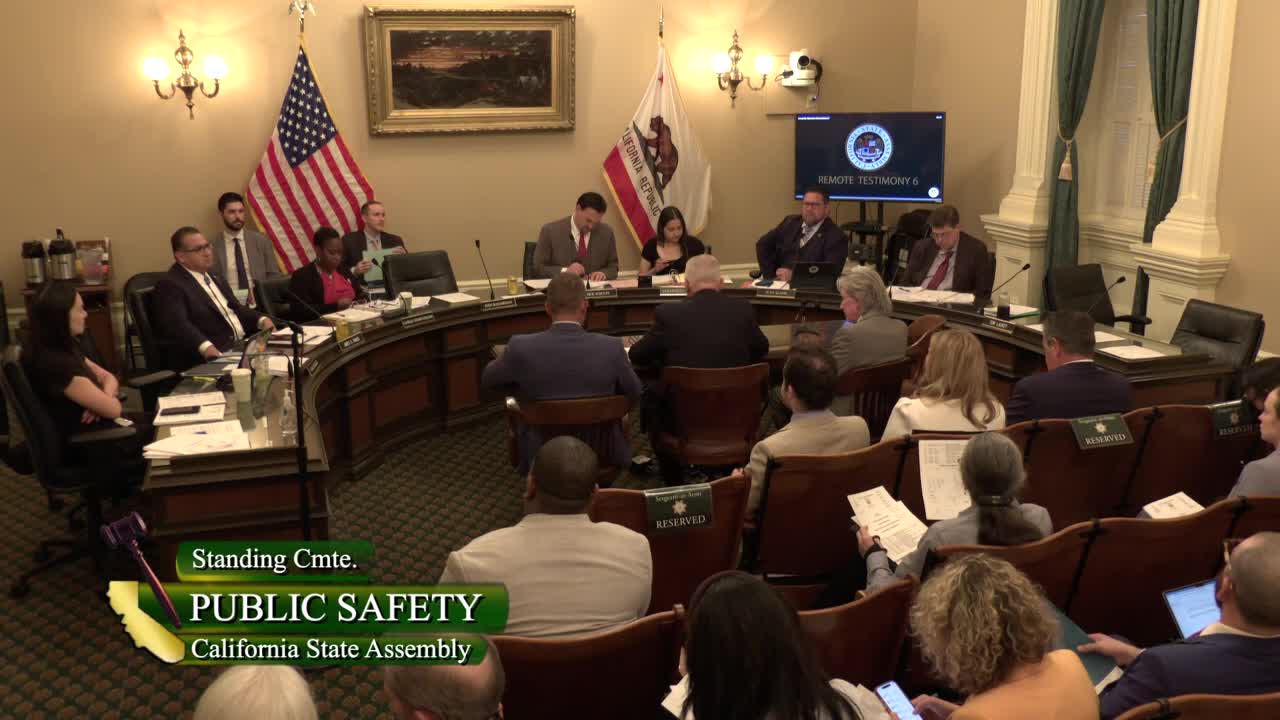 23MIN
Assembly Standing Committee on Public Safety
Bill Author


