AB 1691: Marine resources: copper-based antifouling paint: standards, studies, and best methods.
- Session Year: 2025-2026
- House: Assembly
- Latest Version Date: 2026-02-03
Current Status:
In Progress
(2026-05-14: In committee: Held under submission.)
Introduced
In Committee
Awaiting First Chamber Vote
Passed First Chamber
In Committee
Awaiting Second Chamber Vote
Passed Second Chamber
Enacted
Existing law, the California Ocean Resources Stewardship Act of 2000, finds that it is the policy of the state to, among other things, ensure adequate coordination of ocean resources management science among state, regional, and federal agencies and marine science institutions, as provided. Existing law requires every manufacturer of, importer of, or dealer in any pesticide, except as specified, to obtain a certificate of registration from the Department of Pesticide Regulation before the pesticide is offered for sale. Existing law requires the Director of Pesticide Regulation to endeavor to eliminate from use in the state pesticides that endanger the agricultural or nonagricultural environment, among other things, and in carrying out this responsibility, to develop an orderly program for the continuous evaluation of all pesticides actually registered, as specified.
This bill would require, on or before January 1, 2029, the Department of Pesticide Regulation to complete a reevaluation of copper-based antifouling boat paint products, and to make the determination to retain, modify, or suspend its standards or to place new appropriate standards on the chemical composition or use of copper-based antifouling paints. The bill would require, on or before June 1, 2028, the California Environmental Protection Agency, the State Water Resources Control Board, regional water control boards, and the Department of Pesticide Regulation to collaborate on active studies related to the effectiveness of low-leach-rate paint and elevated copper concentrations in saltwater harbors, bays, and marinas that are primarily a result of the use of copper-based antifouling paint, and would require the Department of Pesticide Regulation to finish and release these studies. The bill would require, on or before January 1, 2029, the California Environmental Protection Agency, the State Resources Control Board, and the Department of Pesticide Regulation to collaborate to determine the best methods to address elevated copper concentrations in saltwater harbors, bays, and marinas that are primarily a result of the use of this paint in the state. The bill would require, on or before January 1, 2029, the California Environmental Protection Agency to post on its internet website these best methods.
(a)The Legislature finds and declares both of the following:
(1)The Department of Pesticide Regulation has been conducting studies for several years on the amount of dissolved copper, which is found in antifouling paint, that is discharged into Californias harbors, and the State Water Resources Control Board, regional water quality control boards, and the Department of Pesticide Regulation have issued regulations in an attempt to reduce the amount of dissolved copper that is discharged.
(2)The requirements of this section are necessary to better coordinate the multiple jurisdictions with interests in, and regulatory authority over, the issue described in paragraph (1).
(b)On or before January 1, 2029, the Department of Pesticide Regulation shall complete a reevaluation of copper-based antifouling boat paint products, and shall make the determination to retain, modify, or suspend its standards or to place new appropriate standards on the chemical composition or use of copper-based antifouling paint.
(c)On or before June 1, 2028, the California Environmental Protection Agency, the State Water Resources Control Board, regional water quality control boards, and the Department of Pesticide Regulation shall collaborate on, and the Department of Pesticide Regulation shall finish and release, any active studies related to the effectiveness of low-leach-rate paint and elevated copper concentrations in saltwater harbors, bays, and marinas that are primarily a result of the use of copper-based antifouling paint within the state.
(d)On or before January 1, 2029, the California Environmental Protection Agency, the State Water Resources Control Board, and the Department of Pesticide Regulation shall collaborate to determine the best methods to address elevated copper concentrations in saltwater harbors, bays, and marinas that are primarily a result of the use of copper-based antifouling paint within the state.
(e)On or before January 1, 2029, the California Environmental Protection Agency shall post on its internet website the best methods to address elevated copper concentrations in saltwater harbors, bays, and marinas that are primarily a result of the use of copper-based antifouling paint, as determined by the collaborative process described in subdivision (d). The best methods may include, but are not limited to, guidelines for compliance and public workshops.
|
Date
|
Status
|
|---|---|
| May 14, 2026 | In committee: Held under submission. |
| Apr 8, 2026 | In committee: Set, first hearing. Referred to APPR. suspense file. |
| Mar 11, 2026 | From committee: Do pass and re-refer to Com. on APPR. (Ayes 7. Noes 0.) (March 10). Re-referred to Com. on APPR. |
| Feb 17, 2026 | Referred to Com. on E.S & T.M. |
| Feb 4, 2026 | From printer. May be heard in committee March 6. |
| Feb 3, 2026 | Read first time. To print. |
|
Date
|
Description
|
Location
|
Votes
|
|
|---|---|---|---|---|
| Mar 10, 2026 | Do pass and be re-referred to the Committee on [Appropriations] | Assembly Standing Committee on Environmental Safety and Toxic Materials |
Passed |
This list shows positions taken on this bill by organizations on the date displayed, which is linked to the original source.
Positions by individuals are not included.
|
Organization
|
Position
|
Date
|
|---|---|---|
| Author's Office | ** Support | |
| A Voice for Choice Advocacy | ** Support | |
| Boat Owners Association of the United States | ** Against | |
| City of Newport Beach | ** Support | |
| Marina Del Rey Lessees Association | ** Support | |
| Recreational Boaters Of California | ** Against |
Date of Hearing: April 8, 2026
ASSEMBLY COMMITTEE ON APPROPRIATIONS
Buffy Wicks, Chair
ABPCA Bill Id:AB 1691
Author:(Dixon) – As Introduced Ver:February 3, 2026
Policy Committee: | Environmental Safety and Toxic Materials | Vote: | 7 - 0 |
|
| ||
|
|
Urgency: No State Mandated Local Program: No Reimbursable: No
SUMMARY:
This bill requires the Department of Pesticide Regulation (DPR) to reevaluate copper-based boat antifouling paint (AFP) products and requires the California Environmental Protection Agency (CalEPA), the State Water Resources Control Board (State Water Board), and DPR to determine the best methods to address elevated copper concentrations in marine water bodies.
Specifically, this bill, among other things:
- Requires DPR, by January 1, 2029, to complete a reevaluation of copper-based boat AFP products, and to make the determination to retain, modify, or suspend its standards or to place new appropriate standards on the chemical composition or use of copper-based AFP.
- Requires CalEPA, the State Water Board, regional water quality control boards, and DPR, by June 1, 2028, to collaborate on, and DPR to finish and release, any active studies related to the effectiveness of low-leach-rate paint and elevated copper concentrations in saltwater harbors, bays, and marinas that are primarily a result of the use of copper-based AFP within the state.
- Requires CalEPA, the State Water Board, and DPR, by January 1, 2029, to collaborate to determine the best methods to address elevated copper concentrations in saltwater harbors, bays, and marinas that are primarily a result of the use of copper-based AFP within the state.
- Requires CalEPA, by January 1, 2029, to post on its website the best methods to address elevated copper concentrations in saltwater harbors, bays, and marinas that are primarily a result of the use of copper-based AFP, as determined by the collaborative process described above, and provides that the best methods may include guidelines for compliance and public workshops.
FISCAL EFFECT:
1) DPR estimates initial one-time costs of approximately $877,000 in the first year of implementation followed by ongoing annual costs of approximately $828,000 (DPR Fund or General Fund) for four staff, operating expenses, and equipment to implement the requirements of the bill. DPR notes it may require additional one-time funding, ranging from the low- to mid-hundreds of thousands of dollars, to support studies and contracts to develop the required best methods, guidelines for compliance, and public workshops.
The Legislative Analyst’s Office recently warned of General Fund structural deficits of around $35 billion per year in the 2027-28 fiscal year and ongoing.
2) The State Water Board estimates ongoing costs of approximately $250,000 for one position in its Division of Water Quality to coordinate with DPR, collaborate on active studies, and determine the best methods to address elevated copper concentrations through amendments to its basin plans (Waste Discharge Permit Fund).
3) CalEPA estimates minor and absorbable costs. CalEPA will likely rely on the State Water Board and DPR to implement the requirements of this bill.
COMMENTS:
1) Background. State Action on Copper-Based AFP. Copper-based AFP is a California-registered pesticide widely used and proven to be the most effective barrier against marine growth (or biofouling) on boats, which, if left unaddressed, can lead to increased fuel consumption, reduced maneuverability, damage to boat hulls, and the spread of invasive aquatic species. Toxins released from antifouling coatings and pollutants generated during boat hull maintenance may impair water quality and threaten the health of aquatic habitats. Several regional water quality control boards have adopted or are in the process of adopting Total Maximum Daily Loads (TMDLs) for copper. TMDLs are action plans to restore clean water by defining how much of a pollutant a water body can tolerate and still meet water quality standards.
Current law requires DPR to investigate all reports of actual or potentially significant adverse effects to people or the environment resulting from the use of pesticides. If DPR has reason to believe that a pesticide may cause a significant adverse impact to people or the environment, it must reevaluate the pesticide to determine if it should remain registered. DPR began reevaluating copper-based AFPs in 2010, after studies revealed that copper from these paints was contaminating marinas, exceeding water quality standards, and harming aquatic life. DPR identified passive leaching and in-water hull cleaning as primary pathways for copper pollution in salt and brackish water marinas. As a result, DPR required registrants to submit detailed data on paint type, leach rates, and mitigation strategies. In response to legislation in 2013, DPR proposed and finalized a regulation establishing a maximum allowable copper leach rate for all copper-based AFP and coating products labeled for use on recreational vessels, effective July 1, 2018. When issuing the reevaluation, DPR determined no additional mitigation measures were necessary at that point.
According to the author’s office:
AB 1691 will provide cities and boaters regulatory clarity regarding the usage of copper-based antifouling boat paint. Under current law, [DPR] and [the State Water Board] have issued conflicting regulations on the usage of copper-based boat paint. One agency is regulating the maximum allowable leach rate while [the State Water Board] has set maximum concentration levels in harbors. Unfortunately, this has [lead] to a situation where boaters are using products regulated by DPR in accordance with their rules, while cities are operating in accordance with [the State Water Board]…By requiring all agencies involved in the regulation of copper-based boat paint to come together, we will create a uniform regulatory structure around leach rates AND total concentrations in our waterways.
According to DPR, the department has an active study related to the continuous evaluation of copper-based AFP products. DPR collects water samples every other year, conducts a chemical analysis of the copper levels in geographically diverse marinas, and releases findings from the analysis. DPR released its most recent analysis in March 2025. More sampling and chemical analysis is underway, and a draft report is expected to be released in 2027. Further, DPR notes its staff is in regular contact with regional water boards and local marinas on copper-based AFP.
DPR Fund and Reevaluations. The fiscal year (FY) 2024-25 budget included $10.8 million from the DPR Fund and 47 new permanent positions in FY 2024‑25 (increasing to $35.1 million and 117 positions in FY 2027‑28 and ongoing) to support various programmatic expansions for the department. These enhancements were enabled by two significant policy and administrative changes that will increase the amount of annual revenues deposited into the DPR Fund. First, AB 2113 (Garcia), Chapter 60, Statutes of 2024, increased the mill assessment – a tax levied on pesticides when they are first sold into or within the state – over a four-year period. Second, DPR will use its existing authority to increase both registration and licensing fees through regulations. In addition to supporting programmatic expansions, the additional revenues are intended to address the structural deficit the DPR Fund has experienced over the past several years.
On July 1, 2026, DPR will receive the last batch of the 117 newly authorized positions and is in the process of hiring new staff. Separately, the Governor’s budget includes the permanent elimination of certain vacant state positions in environmental departments to generate budgetary savings, initially proposed as part of the 2025-26 budget but delayed subject to further legislative review. As part of this effort, DPR is being asked to eliminate 19 of its positions. The Joint Legislative Budget Committee did not concur with the elimination of 15 of these 19 positions, and conversations are ongoing as part of the budget process.
A key provision in AB 2113 relates to reevaluations. Specifically, the legislation requires DPR to annually initiate a set number of formal pesticide reevaluations and complete them in specified timeframes. DPR will submit a report to the legislature by July 1, 2026, on how it can improve its reevaluation process. It is not clear how the reevaluation requirement in this bill (AB 1691) intersects with the reevaluation framework in AB 2113. In his signing message for AB 1963 (Friedman), Chapter 688, Statutes of 2024 – which requires DPR to reevaluate the toxic pesticide paraquat – the Governor stated:
While I am signing this bill, moving forward, I believe the selection of pesticides for re-evaluation must be done through the department-led, data-driven investigatory process agreed upon under Assembly Bill 2113. Making the decision to place a pesticide into re-evaluation should be a holistic, public process, which takes into consideration multiple factors, such as the development of alternatives. We must allow DPR to utilize this process, as it is critical to support the systemwide adoption of sustainable pest management.
2) Related Legislation. AB 773 (Dixon) of the current legislative session is substantially similar to this bill and was held on this committee’s suspense file.
Analysis Prepared by: Nikita Koraddi / APPR. / (916) 319-2081
Date of Hearing: March 10, 2026
ASSEMBLY COMMITTEE ON ENVIRONMENTAL SAFETY AND TOXIC MATERIALS
Damon Connolly, Chair
ABPCA Bill Id:AB 1691 (
Author:Dixon) – As Introduced Ver:February 3, 2026
SUBJECT: Marine resources: copper-based antifouling paint: standards, studies, and best methods
SUMMARY: Requires the Department of Pesticide Regulation (DPR) to reevaluate copper-based boat antifouling paint (AFP) products and requires the California Environmental Protection Agency (CalEPA), the State Water Resources Control Board (State Water Board), and DPR to determine the best methods to address elevated copper concentrations in marine water bodies. Specifically, this bill:
- Requires on or before January 1, 2029, DPR to complete a reevaluation of copper-based AFP products for boats, and to make the determination to retain, modify, or suspend its standards or to place new appropriate standards on the chemical composition or use of copper-based AFP.
- Requires, on or before June 1, 2028, CalEPA, the State Water Board, the regional water quality control boards, and DPR to collaborate on, and DPR to finish and release, any active studies related to the effectiveness of low-leach-rate paint and elevated copper concentrations in saltwater harbors, bays, and marinas that are primarily a result of the use of copper-based AFP within the state.
- Requires, on or before January 1, 2029, CalEPA, the State Water Board, and DPR to collaborate to determine the best methods to address elevated copper concentrations in saltwater harbors, bays, and marinas that are primarily a result of the use of copper-based AFP within the state.
- Requires, on or before January 1, 2029, CalEPA to post on its internet website the best methods to address elevated copper concentrations in saltwater harbors, bays, and marinas that are primarily a result of the use of copper-based AFP, as determined by the collaborative process described above. Provides that the best methods may include, but are not limited to, guidelines for compliance and public workshops.
EXISTING LAW:
- Establishes the federal Clean Water Act (CWA) to regulate discharges of pollutants into the waters of the United States and to set quality standards for surface waters. (33 United States Code (USC §1251 et seq.)
- Requires, under the CWA, each state to identify those waters within its boundaries for which federal effluent limitations are not stringent enough to implement any water quality standard applicable to such waters. Requires the state to establish a priority ranking for such waters, taking into account the severity of the pollution and the uses to be made of such waters. (This is often referred to as Section 303 (d)) (33 USC § 1313 (d))
- Establishes the Porter-Cologne Water Quality Control Act, which prohibits the discharge of pollutants to surface waters unless the discharger obtains a permit from the State Water Board. (Water Code ((WC)) § 13000 et seq.)
- Designates the State Water Board as the water pollution control agency for all purposes stated in the federal CWA. Authorizes the State Water Board to give any certificate or statement required by any federal agency pursuant to the CWA. (WC § 13160)
- Authorizes the state's pesticide regulatory program and mandates DPR to, among other things, provide for the proper, safe, and efficient use of pesticides essential for the production of food and fiber; for the protection of public health and safety; and, for the protection of the environment from environmentally harmful pesticides by prohibiting, regulating, or ensuring proper stewardship of those pesticides. (Food and Agriculture Code (FAC) § 11401, et seq.)
- Requires the director of DPR to endeavor to eliminate from use in the state any pesticide that endangers the agricultural or nonagricultural environment, is not beneficial for the purposes for which it is sold, or is misrepresented. Requires the director of DPR, in carrying out this responsibility, to develop an orderly program for the continuous evaluation of all pesticides actually registered. (FAC § 12824)
- Authorizes the director of DPR, in carrying out the responsibility outlined in FAC § 12824 and after a hearing, to cancel the registration of, or refuse to register, any pesticide that, among other things, has demonstrated serious uncontrollable adverse effects; the use of which is of less public value or greater detriment to the environment than the benefit received by its use; for which there is a reasonable, effective, and practicable alternate material or procedure that is demonstrably less destructive to the environment; when properly used is detrimental to vegetation, except weeds, to domestic animals, or to public health and safety; and, for which the director determines the registrant has failed to report an adverse effect or risk as required by law. (FAC § 12825)
- Requires the registrant of a pesticide, if they have factual or scientific evidence of any adverse effect or risk of the pesticide to human health, livestock, crops, or the environment that has not been previously submitted to DPR, to submit the evidence to the director of DPR in a timely manner. (FAC § 12825.5)
- Authorizes the director of DPR, if they have reason to believe that any of the conditions stated in FAC § 12825 are applicable to any registered pesticide and that the use or continued use of that pesticide constitutes an immediate substantial danger to persons or to the environment, to, after notice to the registrant, suspend the registration of that pesticide pending a hearing and final decision. (FAC § 12826)
- Authorizes the director of DPR to cancel a certificate of registration, or refuse to issue certification to any manufacturer, importer, or dealer for any pesticide that repeatedly violates pesticide law or regulations. (FAC § 12827)
- Authorizes the director of DPR to, at any time, evaluate a registered pesticide to carry out specified statutory requirements. (Title 3 of the California Code of Regulations (3 CCR) § 6220)
- Requires the director of DPR to investigate all reported episodes and information received by the director that indicate a pesticide may have caused, or is likely to cause, a significant adverse impact, or that indicate there is an alternative that may significantly reduce an adverse environmental impact. (3 CCR § 6220)
- Requires, if the director of DPR finds from the above investigation that a significant adverse impact has occurred or is likely to occur or that such an alternative is available, that the pesticide involved be reevaluated. (3 CCR § 6220)
- Specifies factors under which DPR may initiate a reevaluation, including public or worker health hazard; environmental contamination; pesticide residue overtolerance; fish or wildlife hazard; lack of efficacy; undesirable phytotoxicity; hazardous packaging; inadequate labeling; disruption of the implementation or conduct of pest management; availability of an effective and feasible alternative material or procedure that is demonstrably less destructive to the environment; discovery that data upon which a registration was issued is false, misleading, or incomplete; and, other information suggesting a significant adverse effect. (3 CCR § 6221)
- Provides, under the Federal Insecticide, Fungicide, and Rodenticide Act (FIFRA), for federal regulation of pesticide distribution, sale, and use. Requires all pesticides distributed or sold in the United States to be registered (licensed) by the United States Environmental Protection Agency (US EPA). Requires, before US EPA registers a pesticide, the applicant to show, among other things, that using the pesticide according to specifications will not generally cause unreasonable adverse effects on the environment. (7 USC § 136 (a))
- Defines, under FIFRA, ''unreasonable adverse effects on the environment'' to mean any unreasonable risk to man or the environment, taking into account the economic, social, and environmental costs and benefits of the use of any pesticide, or a human dietary risk from residues that result from the use of a pesticide in or on any food, as specified. (7 USC § 136 (bb))
FISCAL EFFECT: Unknown.
COMMENTS:
Need for the bill: According to the author, "AB 1691 will provide cities and boaters regulatory clarity regarding the usage of copper-based antifouling boat paint.
Under current law, [DPR] and [the State Water Board] have issued conflicting regulations on the usage of copper-based boat paint. One agency is regulating the maximum allowable leach rate while [the State Water Board] has set maximum concentration levels in harbors. Unfortunately, this has [lead] to a situation where boaters are using products regulated by DPR in accordance with their rules, while cities are operating in accordance with [the State Water Board].
AB 1691 will rectify this convoluted system of regulations by requiring DPR to complete a reevaluation of its copper-based boat paint regulations. Following this, all relevant agencies, including Cal EPA, DPR and [the State Water Board] will be required to collaborate with each other to create a uniform set of regulations to address elevated copper concentrations in harbors. By utilizing an evidence-based approach, AB 1691 will increase regulatory clarity for cities and boaters alike, all while maintaining the highest level of protection for our coastal ecosystems."
Biofouling: Marine biofouling refers to the attachment of marine organisms, such as barnacles, oysters, shipworms, mussels, algae, and sponges, to objects submerged in ocean environments. Excessive biofouling on boat hulls leads to increased fuel consumption and thus increased greenhouse gas emissions, a reduction in maneuverability, damage to boat hulls, and the spread of invasive aquatic species.
Controlling biofouling: The California Coastal Commission provided the following background information on biofouling and antifouling boat hull coatings in their "Boat Hull Cleaning and Hull Coating Selection for Water Pollution Prevention: Water Quality Factsheet for Marina Operators and Boaters," (Coastal Commission Factsheet) published in December, 2019.
Antifouling hull paints or coatings are typically applied to marine vessels to deter the attachment and growth of fouling organisms that attach to boat hulls. These products work either by releasing a toxic chemical (biocide), or by creating a hard or slippery surface that minimizes attachment by fouling organisms. Some AFPs are designed to slowly release biocide particles over time (ablative coatings), thus continually exposing fouling organisms to fresh releases of biocides.
Boats that are kept in the water also require maintenance to physically remove fouling organisms. Toxins released from antifouling coatings and pollutants generated during boat hull maintenance may impair water quality and threaten the health of aquatic habitats. Water quality impacts from antifouling hull coatings and boat hull maintenance can be minimized by selecting a less toxic or non-toxic hull coating, using appropriate hull cleaning methods, and reducing the release of toxic chemicals from hull cleaning products.
Copper-based hull paints: Copper has been a standard biocide in anti-fouling hull paints for many decades, and copper-based AFPs are currently the most commonly used antifouling coating. Copper in hull paint slowly leaches into the water column, and can also be released from the hull as particles that fall to the sediment. Copper discourages fouling organisms, and is also highly toxic to a broad range of aquatic organisms, including fish, aquatic invertebrates, aquatic plants, and algae, and thus may also adversely impact non-targeted aquatic species. For many aquatic species, the greatest risk of adverse impacts is from long-term accumulation of copper in sediment, elevating copper levels in benthic and epibenthic organisms and indirectly in other animals through the food web.
In the last decade and a half, water quality sampling has shown that copper-based AFP can, in some cases, cause copper levels in the water and underlying sediment to exceed water quality standards. In some southern California coastal waters, high densities of boats with copper-based hull paint in areas with a low water circulation rate have caused levels of copper to exceed water quality standards, and thus these waters have been included on the state’s list of impaired water bodies (per the Clean Water Act, Section 303(d)).
As no AFPs are completely effective, in-water hull cleaning is a standard maintenance practice for boats that are kept in the water. In the case of soft or ablative copper paints, this maintenance also releases some paint to the water column, which significantly increases the likelihood that the copper concentration in the water will exceed water quality standards.
Total Maximum Daily Loads (TMDLs): According to the San Francisco Bay Regional Water Quality Control Board, TMDLs are action plans to restore clean water by defining how much of a pollutant a water body can tolerate and still meet water quality standards. Section 303(d) of the federal Clean Water Act requires that states identify water bodies -- bays, rivers, streams, creeks, and coastal areas -- that do not meet or are not expected to meet, water quality standards (i.e., impaired water bodies) and also identify the pollutants that impair these water bodies. TMDLs examine the water quality problems, identify sources of pollutants, and specify actions that create solutions for the impaired water bodies. TMDLs account for all the sources of a pollutant, including discharges from wastewater treatment facilities; runoff from homes, agriculture, and streets or highways; "toxic hot spots;" and deposits from the air. In addition to accounting for past and current activities, TMDLs may also consider projected growth that could increase pollutant levels. TMDLs in California are developed either by the regional water quality control boards or by the US EPA. TMDLs developed by the regional water quality control boards are proposed as Water Quality Control Plan (Basin Plan) amendments and include implementation provisions. TMDLs developed by the US EPA typically contain the total load and load allocations required by Section 303(d), but do not contain comprehensive implementation provisions.
Copper TMDLs: Several regional water quality control boards in California have adopted or are in the process or adopting copper TMDLs. In San Diego County, the San Diego Regional Water Quality Control Board (San Diego Water Board) adopted the Shelter Island Yacht Basin (SIYB) TMDL for Dissolved Copper on February 9, 2005. The State Water Board and the Office of Administrative Law approved the TMDL on September 22, 2005 and December 2, 2005, respectively. The US EPA granted final approval of the TMDL on February 8, 2006. After receipt of all approvals, the SIYB TMDL was incorporated into Chapter 7 of the Basin Plan.
The San Diego Water Board continues to monitor elevated levels of dissolved copper in areas of the SIYB where water circulation is limited, recreational vessel activity is highest, and, therefore, there are continued exceedances of water quality objectives. To address this, San Diego Water Board staff are collaborating with stakeholders to revise the management plan in an effort to support healthy habitats, robust ecosystems, emphasize measures of biological integrity, and guide regulatory and management actions.
In Los Angeles County, the Los Angeles Regional Water Quality Control Board (Los Angeles Water Board) relays that it first adopted the Marina del Rey Harbor Toxic Pollutants TMDL in 2005 to address impairments of copper and other pollutants in the harbor. In 2014, the Los Angeles Water Board revised the 2005 TMDL to update numeric targets and expand coverage to the entire harbor. The 2014 revision determined that copper based AFPs used on boats moored in the harbor are the primary source of dissolved copper to the water column. The 2014 TMDL revision included the opportunity for a special study to examine a water effect ratio (WER, the difference between the effects of water in the harbor and water in the laboratory) for the purpose of developing a site-specific objective for copper in the Marina del Rey Harbor. The completed study was submitted to the Los Angeles Water Board in August 2021.
In response to the findings in the study, the Los Angeles Water Board adopted a Basin Plan amendment on June 27, 2024, to revise the 2014 Marina del Rey Harbor Toxics TMDL to establish site-specific copper water quality objectives and to revise the assigned load allocations (LAs) for boats discharging copper in accordance with the revised LAs. The Los Angeles Water Board regularly meets with Los Angeles County for discussions on implementation, and it is anticipated that the Los Angeles Water Board will submit its TMDL to the State Water Board for approval in late 2026.
In Orange County, the Santa Ana Regional Water Quality Control Board (Santa Ana Water Board) adopted a resolution on December 2, 2022, approving an amendment to the Water Quality Control Plan for the Santa Ana River Basin to incorporate TMDLs for copper in Newport Bay. The Copper TMDLs would supersede the US EPA technical TMDLs for copper that were established as part of the TMDLs for toxic pollutants in the San Diego Creek/Newport Bay Watershed in 2002. According to the most recent documents on the State Water Board's website, both Upper and Lower Newport Bay continue to exceed the California Toxics Rule chronic and acute criteria for dissolved copper in salt water. The largest source of copper to Newport Bay is discharges from copper AFPs on boats (both recreational and commercial vessels) from passive leaching and underwater hull cleaning. The proposed amendment would establish TMDLs for dissolved copper for Upper Newport Bay and Lower Newport Bay. The Santa Ana Water Board’s Newport Bay Copper TMDL was approved by the State Water Board on August 5, 2025, and will be submitted to the Office of Administrative Law prior to being submitted to US EPA for review.
DPR’s reevaluation process: FAC § 12824 requires DPR to "eliminate from use" any pesticide that "endangers the agricultural or nonagricultural environment, is not beneficial for the purposes for which it is sold, or is misrepresented." Statute also requires that, in order to do so, DPR must have "an orderly program for the continuous evaluation of all pesticides actually registered." To carry out this requirement, regulation requires DPR to continuously evaluate pesticides currently registered in California.
DPR, in its "Semiannual Report Summarizing the Reevaluation Status of Pesticide Products during the Period of July 1, 2023, through December 31, 2023," (2023 Semiannual Report) provided the following description of the reevaluation process.
California regulations require DPR to investigate all reports of adverse effects to public health or the environment that indicate a pesticide may have caused or is likely to cause a significant adverse impact. Reevaluation of a registered pesticide is required if, from the investigation, a significant adverse impact occurred, or is likely to occur, from its use.
Regulation specifies factors under which DPR may initiate a reevaluation, including public or worker health hazard; environmental contamination; residue overtolerance; fish or wildlife hazard; lack of efficacy; undesirable phytotoxicity; hazardous packaging; inadequate labeling; disruption of the implementation or conduct of pest management; availability of an effective and feasible alternative material or procedure that is demonstrably less destructive to the environment; discovery that data upon which a registration was issued is false, misleading, or incomplete; and, other information suggesting a significant adverse effect. An ongoing DPR pesticide review may also trigger a reevaluation, as can data or information received from registrants; state and county pesticide use surveillance and illness investigations; pesticide residue sample analyses; environmental monitoring activities; and, issues that may concern other state or federal agencies.
When a pesticide enters the reevaluation process, DPR reviews existing data and may require that registrants provide additional data to characterize the nature and extent of the potential hazard and identify appropriate mitigation measures, if needed.
DPR concludes reevaluations in several ways. If the data demonstrates that the use of the pesticide presents no significant adverse effects, DPR concludes the reevaluation without additional mitigation measures. If additional mitigation measures are necessary, DPR will place appropriate restrictions on the use of the pesticide to mitigate the potential significant adverse effect. If the adverse impact cannot be mitigated, DPR cancels or suspends the pesticide product registration.
DPR's reevaluation of copper based antifouling paint: Because they are biocides, copper-based AFP and coatings are regulated by DPR. According to DPR's February 2018 "Final Decision Concerning Reevaluation of Copper Based Antifouling Paint," on June 1, 2010, DPR commenced reevaluation of products containing the active ingredients copper oxide, copper hydroxide, and cuprous thiocyanate and that are intended for use as AFP (AFP) pesticides (California Notice 2010-03). This reevaluation involved 11 registrants and 209 pesticide products.
DPR placed the before mentioned copper-based AFP pesticide products into reevaluation based on findings from a June 2009 DPR report titled, "Monitoring for Indicators of Antifouling Paint Pollution in California Marinas." The report indicates that dissolved copper concentrations in more than half the water samples taken from salt and brackish water marinas exceeded the US EPA California Toxics Rule chronic water quality standard for copper, a criterion intended to protect aquatic life. In addition, about one-third of the water samples exceeded the acute water quality standard for copper. DPR also observed toxicity to aquatic test organisms in some marina samples that was likely caused by high dissolved copper concentrations.
DPR’s report concluded that in salt and brackish water marinas, copper-based AFP pesticide products applied to recreational boat hulls are likely a major source of copper in these areas, particularly during dry-weather periods. Passive leaching of copper-based AFP-painted boat hulls and underwater boat-hull cleaning appear to be the main pathways of copper contamination. Since the California Regional Water Quality Control Board water quality objectives require that "all waters shall be maintained free of toxic substances in concentrations that are toxic to, or that produce detrimental physiological responses in human, plant, animal, or aquatic life," DPR determined additional data were necessary to determine the leaching potential of copper-based AFP and measures to reduce copper loading in marinas in order to protect non-target aquatic organisms.
For the reevaluation, DPR required registrants of copper-based AFPs to submit the following: information identifying the paint type (e.g., ablative, epoxy ester); data characterizing the product’s copper leach rate; specific mitigation strategies that reduce dissolved copper concentrations in California salt and brackish water marinas; marina monitoring data; and, information about the impact of in-water hull cleaning activities on copper concentrations in California marinas. During this time, DPR began taking steps, including collaborative mitigation and outreach opportunities with partners, including US EPA, to reduce copper concentrations in California marinas.
Legislative action on copper-based AFPs: During the course of DPR's reevaluation, in 2013, the California Legislature passed, and Governor Jerry Brown signed, Assembly Bill (AB) 425 (Atkins, Chapter 587, Statutes of 2013), which required DPR, no later than February 1, 2014, to propose a leach rate for copper-based AFPs used on recreational vessels and to recommend mitigation measures to protect the aquatic environment from copper-based AFP exposure.
On January 30, 2014, DPR proposed two maximum allowable leach rates depending on hull cleaning practices, but after a hull cleaning study, utilization of modeling tools (to simulate the fate of copper in typical California marinas), discussions with stakeholders, and accounting for enforcement challenges, DPR determined that establishing a single maximum allowable leach rate of 9.5 µg/cm2 /day for copper-based AFP products intended for use on recreational vessels would be the most effective measure to reduce copper contamination in California surface waters.
In early 2016, DPR initiated the rulemaking process, proposing to require registrants of all new copper-based AFP products and coatings to submit copper leach rate data and to establish a maximum allowable copper leach rate for products used on recreational vessels, and on July 21, 2017, the new copper-based AFP and coatings regulation was filed with the Secretary of State. DPR's final reevaluation decision states that effective January 1, 2018, the copper-based AFP and coatings regulation requires all registrants of new copper-based AFP and coating products to submit copper leach rate data, as specified. Effective July 1, 2018, the regulation establishes a maximum allowable copper leach rate of 9.5 µg/cm2/day for all copper-based AFP and coating products labeled for use on recreational vessels. When issuing the reevaluation, DPR determined no additional mitigation measures were necessary at that point.
This bill: This bill requires DPR to, on or before January 1, 2029, complete another reevaluation of copper-based antifouling boat paint products, and to make the determination to retain, modify, or suspend its standards or to place new appropriate standards on the chemical composition or use of copper-based AFP. This bill also requires, on or before January 1, 2029, CalEPA, the State Water Board, and DPR to collaborate to determine the best methods to address elevated copper concentrations in saltwater harbors, bays, and marinas that are primarily a result of the use of copper-based AFP within the state; and, CalEPA to post those best methods on its internet website. Additionally, this bill requires, on or before June 1, 2028, CalEPA, the State Water Board, regional water quality control boards, and DPR to collaborate on, and DPR to finish and release, any active studies related to the effectiveness of low-leach-rate paint and elevated copper concentrations in saltwater harbors, bays, and marinas that are primarily a result of the use of copper-based AFP within the state.
The author’s office explains the problem this bill is attempting to solve as follows: "By requiring all agencies involved in the regulation of copper-based boat paint to come together, we will create a uniform regulatory structure around leach rates AND total concentrations in our waterways. Currently, the lack of communication and collaboration between agencies has caused significant confusion for cities and boaters alike. The approach used by AB 1691 will ensure data and evidence driven decisions that provide clarity for all those involved, while maintaining the health of our ecosystems."
Alternative hull coatings: According to the Coastal Commission Factsheet, new hull coating alternatives to copper-based antifouling hull paints have been developed in response to water quality concerns. Alternative hull coatings can be classified into two categories: biocide and non-biocide hull coatings. Biocide coatings are designed to slowly release toxic substances such as copper, zinc, fluorine, chlorine, and various organic biocides. Switching from copper to other biocides such as zinc may potentially create water quality problems as well. In addition, there is limited information on the toxicity and long-term environmental impact of Econea, a new organic biocide being used in hull paint formulations.
Non-biocide coatings present a hard or slippery surface to deter attachment by fouling organisms. Non-biocide coatings can be classified as either soft or hard. Soft nonbiocide coatings may contain silicon or fluoropolymers that result in a slick surface, making it difficult for fouling organisms to attach. Hard non-biocide coatings may be ceramic or epoxy, and are generally used on racing boats and boats stored out of water. All of these alternatives need to be evaluated to determine whether they have their own deleterious impacts on the aquatic environment. Additionally, methods of biofouling control other than hull coatings should continue to be explored.
Arguments in support: The Marina del Rey Lessees Association writes in support,
"…DPR is tasked with the development, formulation and approval of antifouling bottom paints that will address both concerns above without an unduly significant harmful effect to marine organisms or impact to the overall health of local waterways. The SWRCB is focused on meeting water contamination standards which are often lower than the expected localized discharge level of the bottom paints, even though that same paint is state authorized to be sold and used in California. The state is enforcing regulatory, copper water quality compliance while concurrently allowing necessary copper-based paints to be sold. This is creating regulatory confusion for coastal harbors and ports, resulting in significant expenditures on studies, areas of unsuccessful/unobtainable compliance, and exposure to threatened actions and/or fines.
Despite the potential localized impacts of legal, copper-based coatings, there is also a concern that replacement of copper with other biocides may cause different, and potentially more harmful, environmental impacts. The United States Environmental Protection Agency determined that there are no direct substitutions for copper as a biocide that are as affordable or as effective, without posing similar risks to non-target aquatic species.
Over the last several years, DPR has been conducting studies on the amount of dissolved copper found in antifouling paint that is discharged in California harbors. Additionally, SWRCB, regional water quality control boards, and DPR have issued several regulations to reduce the amount of dissolved copper that is discharged, and to unjustly place the compliance burden upon the local government/agencies. We believe that state-mandated regulations as they relate to antifouling paint formulation and the approved copper leach rate, should be regulated and enforced at the state level much like the State regulates vehicle copper brake pads and smog emissions.
Under the State Environmental Protection Agency, the DPR and the regional water boards act as sister agencies but with different missions, objectives and rules. Their conflicting guidance on compliance has created confusion regarding enforcement which has largely been unjustly directed to local agencies to address. AB 1691 attempts to remedy this confusion by bringing all regulatory entities to the table to contemplate and set forth statewide standards on copper-based antifouling boat paint."
Arguments in opposition: The Recreational Boaters of California and BoatUS writing in opposition,
"Copper-based anti-fouling marine coatings are important to boating. From recreational boats in the water for a season to commercial ships that are in the water year-round, antifouling paint on the underwater part of the boat is fundamental to the proper maintenance and performance of almost all watercraft. The uncontrolled growth of marine organisms on boats significantly de-grades performance, increases fuel consumption, contributes to the spread of aquatic invasive species and can even lead to a vessel sinking in extreme cases.
Boaters are doing their part to address the presence of copper in impaired water bodies in California. They are buying and using low-leach-rate copper-based anti-fouling marine coatings approved by the Department of Pesticide Regulation in an attempt to reduce the amount of dissolved copper that is discharged into impaired water bodies.
Boaters have also been participating in studies to identify potential alternatives. To date, however, there is no replacement that is effective, affordable and available.
It is unfortunate that this year’s legislation, AB 1691, does not propose to suspend enforcement of regulations relating to copper-based anti-fouling marine coatings until specific determinations are made of the best methods to regulate the use of copper-based anti-fouling marine coatings within the state.
We have several concerns with AB 1691 as introduced: The legislation focuses on copper-based anti-fouling marine coatings and fails to consider the other sources of copper in salt-water harbors, bays and marinas… Studies have already been conducted and call into question the necessity for the new studies the legislation would require… The legislation would require collaboration between state and regional agencies in completing studies and determining best methods to address elevated copper concentrations but with no required engagement with or input by interested and invest-ed stakeholders including the recreational boating community. The AB 773 reference to regulatory processes is not proposed in AB 1691… The new studies would impose significant new costs during a difficult period for the state budget… Any restrictions or prohibitions on the use of copper-based anti-fouling marine coatings must be accompanied by findings that alternatives are effective, affordable and available."
Related legislation:
- AB 773 (Dixon, 2025). Would have required DPR to reevaluate copper-based boat AFP products and required CalEPA, the State Water Board, and DPR to determine the best methods to address elevated copper concentrations in marine water bodies. This bill was held on the Assembly Appropriations Committee suspense file.
- AB 425 (Atkins, Chapter 587, Statutes of 2013). Requires DPR, no later than February 1, 2014, to determine a leach rate for copper-based AFP used on recreational vessels and make recommendations for appropriate mitigation measures that may be implemented to address the protection of aquatic environments from the effects of exposure to that paint if it is registered as a pesticide.
- SB 623 (Kehoe, 2011). As passed by the Assembly Environmental Safety and Toxic Materials Committee, would have restricted the use of copper AFP on recreational vessels. The contents of this bill were later deleted and the bill was amended to include unrelated material.
- SB 346 (Kehoe) Chapter 307, Statutes of 2010). Establishes a phase out of copper in automotive brake pads.
REGISTERED SUPPORT / OPPOSITION:
Support
A Voice for Choice Advocacy
City of Newport Beach
Marina Del Rey Lessees Association
Opposition
Boat Owners Association of the United States
Recreational Boaters of California
Analysis Prepared by: Shannon McKinney / E.S. & T.M. / (916) 319-3965
Discussed in Hearing
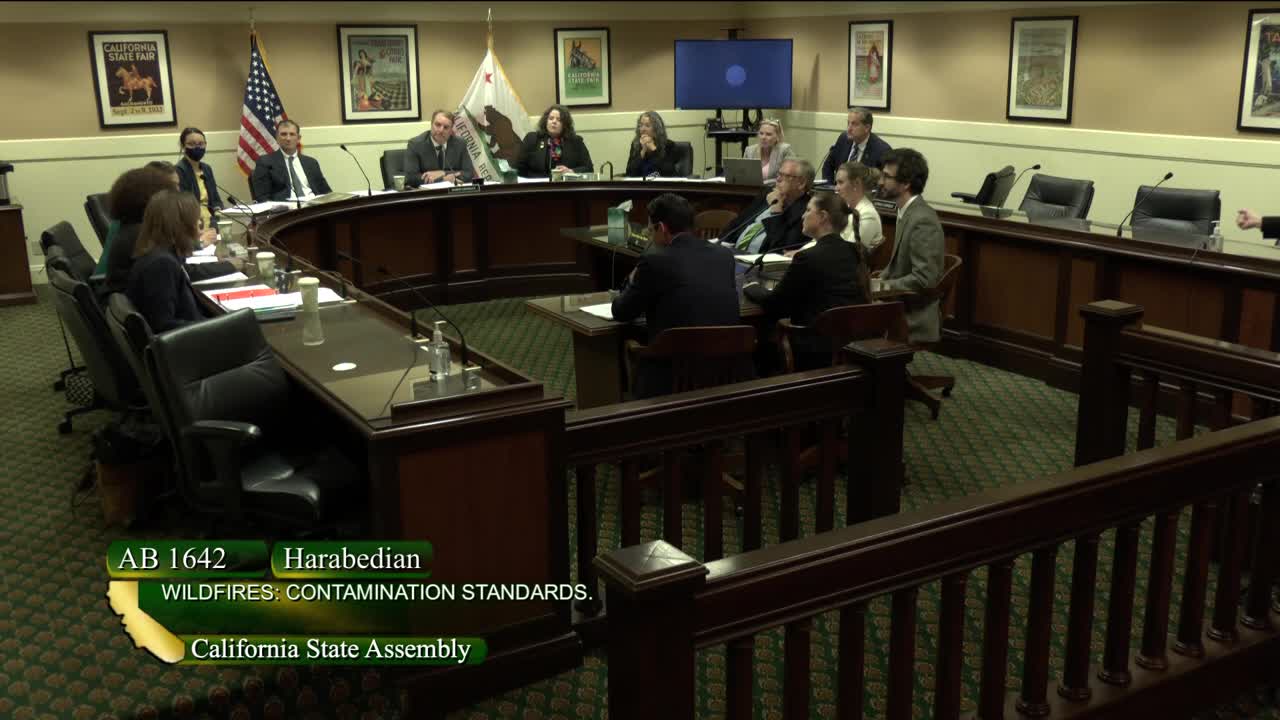 17MIN
Assembly Standing Committee on Environmental Safety and Toxic Materials
Bill Author

Bill Co-Author(s):