AB 1712: City of Santa Fe Springs: sale of water utility property.
- Session Year: 2025-2026
- House: Assembly
- Latest Version Date: 2026-09-20
Current Status:
Passed
(2026-09-20: Chaptered by Secretary of State - Chapter 371, Statutes of 2026.)
Introduced
In Committee
Awaiting First Chamber Vote
Passed First Chamber
In Committee
Awaiting Second Chamber Vote
Passed Second Chamber
Enacted
Existing law authorizes the furnishing of utility services by publicly owned public utilities, including municipal corporations, that are subject to control by their governing bodies. Existing law authorizes any municipal corporation to acquire, construct, own, operate, or lease any public utility, as defined, and authorizes a municipal corporation to sell or dispose of any public utility it owns. Existing law establishes procedures whereby a municipal corporation may lease, sell, or transfer that portion of a water utility used for furnishing water service outside or inside the boundaries of the municipal corporation, including, in the case of sale or transfer of the public utility located inside the municipal boundaries, the determination that the public utility is not necessary for supplying water to its own inhabitants or that its inhabitants will be provided with equal or better service by the acquiring entity, if the sale or transfer is approved by a majority of all voters voting on the issue in an election, and the acquiring entity discloses specified information before the election.
This bill would authorize the City of Santa Fe Springs, until January 1, 2032, to sell its public utility for furnishing water service for the purpose of consolidating its public water system with another public water system pursuant to specified procedures if certain requirements are met. The bill would require the city to consider oral and written protests, as provided, and would prohibit the city from selling the public utility for one year if 50% of interested persons, as defined, protest the sale.
This bill would make legislative findings and declarations as to the necessity of a special statute for the City of Santa Fe Springs.
Existing law authorizes the legislative body of a city, if it finds that public interest and convenience require the sale of any public building and site dedicated to a public use, to adopt a resolution of its finding and intention to sell the property.This bill would make nonsubstantive changes to the provision described above relating to sale of a public building and site.Existing law authorizes the legislative body of a city, if it finds that public interest and convenience require the sale of any public building and site dedicated to a public use, to adopt a resolution of its finding and intention to sell the property.
This bill would make nonsubstantive changes to the provision described above relating to sale of a public building and site.
(a)Notwithstanding Article 2 (commencing with Section 10051) of Chapter 1 of Division 5 of the Public Utilities Code, the City of Santa Fe Springs may sell its public utility for furnishing water service pursuant to this article for the purpose of consolidating its public water system with another public water system if its legislative body determines that it is not in the public interest to own and operate the public utility for furnishing water service, subject to all of the following requirements:
(1)The legislative body of the city shall not sell the water utility property for less than its fair market value, as defined in Section 1263.320 of the Code of Civil Procedure.
(2)The legislative body of the city shall not sell the water utility property without obtaining a four-fifths vote of the citys legislative body.
(3)The citys existing water supply is contaminated, impaired, or otherwise presents a risk to public health, and the city lacks the technical, managerial, or financial capacity to provide for necessary treatment or replacement, or the cost of continued operation, maintenance, or treatment by the city would impose an unreasonable financial burden on ratepayers, as demonstrated by an independent financial analysis applying financial industry standards in adherence to Section 6 of Article XIII D of the California Constitution, commonly referred to as Proposition 218.
(4)The receiving water systems service area borders the service area of the subsumed water system.
(5)Consolidation of the water systems shall be economically feasible for the ratepayers of the subsumed water system. Ratepayers of the subsumed water system shall be notified of the applicable rate that will be in effect during the first year after consolidation has been completed. Any rate increases following the sale of a public utility for furnishing water service shall be phased in over time.
(6)Consolidation of the water systems shall ensure continued water service to all existing customers without interruption or degradation in service quality.
(7)(A)The legislative body of the city shall not sell its public utility for furnishing water service unless it considers oral and written protests at its second regularly scheduled meeting following the adoption of a resolution pursuant to Section 37422 and publication pursuant to subparagraph (B). In addition to the requirements of Section 37422, the resolution shall allow 45 days for hearing protests to the sale and shall state the citys intended use of the sale proceeds. Notice of the sale may be given by including notice in the agencys regular billing statement. One written protest per parcel, filed by an owner or tenant of the parcel, shall be counted in calculating a protest. The city shall maintain all written protests for a minimum of two years following the date of the hearing to consider written protests.
(B)Notwithstanding Section 37423, the resolution shall be published at least once in a daily newspaper published and circulated in the city or, if there is none, the legislative body shall designate a newspaper published in the county. It shall also be posted for not less than 10 days in at least three conspicuous places in the city.
(C)(i)Notwithstanding Section 37425, if the legislative body of the city finds that protests have been filed by at least 10 percent of interested persons, the legislative body of the city shall call an election pursuant to Section 37427. If an election is called pursuant to this paragraph, the legislative body of the city shall not sell the public utility for furnishing water service unless the sale is approved by a majority of the citys registered voters voting on the issue.
(ii)If 50 percent or more of interested persons protest the sale of the public utility, the city shall not take further steps for the sale of the public utility. The city, after one year has passed, may sell the public utility if the requirements of this section are met, including adoption of a new resolution pursuant to subparagraph (A).
(iii)For purposes of this paragraph, interested person means a person who is a resident of the city proposing to sell its public utility pursuant to this section and a person who is not a resident of the city but who is a ratepayer of the public utility proposed to be sold pursuant to this section.
(8)The legislative body of the city has adopted a resolution, at a regularly scheduled meeting, that paragraphs (1) to (7), inclusive, have been met.
(b)This section shall remain in effect only until January 1, 2032, and as of that date is repealed.
SEC. 2.The Legislature finds and declares that a special statute is necessary and that a general statute cannot be made applicable within the meaning of Section 16 of Article IV of the California Constitution because of the unique circumstances in the City of Santa Fe Springs.
(a)Notwithstanding Article 2 (commencing with Section 10051) of Chapter 1 of Division 5 of the Public Utilities Code, the City of Santa Fe Springs may sell its public utility for furnishing water service pursuant to this article for the purpose of consolidating its public water system with another public water system if its legislative body determines that it is not in the public interest to own and operate the public utility for furnishing water service, subject to all of the following requirements:
(1)The legislative body of the city shall not sell the water utility property for less than its fair market value, as defined in Section 1263.320 of the Code of Civil Procedure.
(2)The legislative body of the city shall not sell the water utility property without obtaining a four-fifths vote of the citys legislative body.
(3)The citys existing water supply is contaminated, impaired, or otherwise presents a risk to public health, and the city lacks the technical, managerial, or financial capacity to provide for necessary treatment or replacement, or the cost of continued operation, maintenance, or treatment by the city would impose an unreasonable financial burden on ratepayers, as demonstrated by an independent financial analysis applying financial industry standards in adherence to Section 6 of Article XIII D of the California Constitution, commonly referred to as Proposition 218.
(4)The receiving water systems service area borders the service area of the subsumed water system.
(4)(5)Consolidation of the water systems shall be economically feasible for the ratepayers of the subsumed water system. Ratepayers of the subsumed water system shall be notified of the applicable rate that will be in effect during the first year after consolidation has been completed. Any rate increases following the sale of a public utility for furnishing water service shall be phased in over time.
(5)(6)Consolidation of the water systems shall ensure continued water service to all existing customers without interruption or degradation in service quality.
(6)(7)(A)The legislative body of the city shall not sell its public utility for furnishing water service unless it considers oral and written protests at its second regularly scheduled meeting following the adoption of a resolution pursuant to Section 37422 and publication pursuant to subparagraph (B). In addition to the requirements of Section 37422, the resolution shall allow 45 days for hearing protests to the sale and shall state the citys intended use of the sale proceeds. Notice of the sale may be given by including notice in the agencys regular billing statement. One written protest per parcel, filed by an owner or tenant of the parcel, shall be counted in calculating a protest. The city shall maintain all written protests for a minimum of two years following the date of the hearing to consider written protests.
(B)Notwithstanding Section 37423, the resolution shall be published at least once in a daily newspaper published and circulated in the city or, if there is none, the legislative body shall designate a newspaper published in the county. It shall also be posted for not less than 10 days in at least three conspicuous places in the city.
(C)(i)Notwithstanding Section 37425, if the legislative body of the city finds that protests have been filed by at least 10 percent of interested persons, the legislative body of the city shall call an election pursuant to Section 37427. If an election is called pursuant to this paragraph, the legislative body of the city shall not sell the public utility for furnishing water service unless the sale is approved by a majority of the citys registered voters voting on the issue.
(ii)If 50 percent or more of interested persons protest the sale of the public utility, the city shall not take further steps for the sale of the public utility. The city, after one year has passed, may sell the public utility if the requirements of this section are met, including adoption of a new resolution pursuant to subparagraph (A).
(iii)For purposes of this paragraph, interested person means a person who is a resident of the city proposing to sell its public utility pursuant to this section and a person who is not a resident of the city but who is a ratepayer of the public utility proposed to be sold pursuant to this section.
(7)(8)The legislative body of the city has adopted a resolution, at a regularly scheduled meeting, that paragraphs (1) to (6), (7), inclusive, have been met.
(b)This section shall remain in effect only until January 1, 2032, and as of that date is repealed.
SEC. 2.The Legislature finds and declares that a special statute is necessary and that a general statute cannot be made applicable within the meaning of Section 16 of Article IV of the California Constitution because of the unique circumstances in the City of Santa Fe Springs.
(a)Notwithstanding Article 2 (commencing with Section 10051) of Chapter 1 of Division 5 of the Public Utilities Code, the City of Santa Fe Springs may sell its public utility for furnishing water service pursuant to this article for the purpose of consolidating its public water system with another public water system if its legislative body determines that it is not in the public interest to own and operate the public utility for furnishing water service, subject to all of the following requirements:
(1)The legislative body of the city shall not sell the water utility property for less than its fair market value, as defined in Section 1263.320 of the Code of Civil Procedure.
(2)The legislative body of the city shall not sell the water utility property without obtaining a four-fifths vote of the citys legislative body.
(3)The citys existing water supply is contaminated, impaired, or otherwise presents a risk to public health, and the city lacks the technical, managerial, or financial capacity to provide for necessary treatment or replacement, or the cost of continued operation, maintenance, or treatment by the city would impose an unreasonable financial burden on ratepayers, as demonstrated by an independent financial analysis applying financial industry standards in adherence to Section 6 of Article XIII D of the California Constitution, commonly referred to as Proposition 218.
(4)Consolidation of the water systems shall be economically feasible for the ratepayers of the subsumed water system. Ratepayers of the subsumed water system shall be notified of the applicable rate that will be in effect during the first year after consolidation has been completed. Any rate increases following the sale of a public utility for furnishing water service shall be phased in over time.
(5)Consolidation of the water systems shall ensure continued water service to all existing customers without interruption or degradation in service quality.
(6)(A)The legislative body of the city shall not sell its public utility for furnishing water service unless it considers oral and written protests at its second regularly scheduled meeting following the adoption of a resolution pursuant to Section 37422 and publication pursuant to subparagraph (B). In addition to the requirements of Section 37422, the resolution shall allow 45 days for hearing protests to the sale and shall state the citys intended use of the sale proceeds. Notice of the sale may be given by including notice in the agencys regular billing statement. One written protest per parcel, filed by an owner or tenant of the parcel, shall be counted in calculating a protest. The city shall maintain all written protests for a minimum of two years following the date of the hearing to consider written protests.
(B)Notwithstanding Section 37423, the resolution shall be published at least once in a daily newspaper published and circulated in the city or, if there is none, the legislative body shall designate a newspaper published in the county. It shall also be posted for not less than 10 days in at least three conspicuous places in the city.
(C)(i)Notwithstanding Section 37425, if the legislative body of the city finds that protests have been filed by at least 10 percent of interested persons, the legislative body of the city shall call an election pursuant to Section 37427. If an election is called pursuant to this paragraph, the legislative body of the city shall not sell the public utility for furnishing water service unless the sale is approved by a majority of the citys registered voters voting on the issue.
(ii)If 50 percent or more of interested persons protest the sale of the public utility, the city shall not take further steps for the sale of the public utility. The city, after one year has passed, may sell the public utility if the requirements of this section are met, including adoption of a new resolution pursuant to subparagraph (A).
(iii)For purposes of this paragraph, interested person means a person who is a resident of the city proposing to sell its public utility pursuant to this section. section and a person who is not a resident of the city but who is a ratepayer of the public utility proposed to be sold pursuant to this section.
(7)The legislative body of the city has adopted a resolution, at a regularly scheduled meeting, that paragraphs (1) to (6), inclusive, have been met.
(b)This section shall remain in effect only until January 1, 2032, and as of that date is repealed.
SEC. 2.The Legislature finds and declares that a special statute is necessary and that a general statute cannot be made applicable within the meaning of Section 16 of Article IV of the California Constitution because of the unique circumstances in the City of Santa Fe Springs.
(a)Notwithstanding Article 2 (commencing with Section 10051) of Chapter 1 of Division 5 of the Public Utilities Code, the City of Santa Fe Springs may sell its public utility for furnishing water service pursuant to this article for the purpose of consolidating its public water system with another public water system if its legislative body determines that it is not in the public interest to own and operate the public utility for furnishing water service, subject to all of the following requirements:
(1)The legislative body of the city shall not sell the water utility property for less than its fair market value, as defined in Section 1263.320 of the Code of Civil Procedure.
(2)The legislative body of the city shall not sell the water utility property without obtaining a four-fifths vote of the citys legislative body.
(3)The citys existing water supply is contaminated, impaired, or otherwise presents a risk to public health, and the city lacks the technical, managerial, or financial capacity to provide for necessary treatment or replacement, or the cost of continued operation, maintenance, or treatment by the city would impose an unreasonable financial burden on ratepayers, as demonstrated by an independent financial analysis applying financial industry standards in adherence to Section 6 of Article XIII D of the California Constitution, commonly referred to as Proposition 218.
(4)Consolidation of the water systems shall be economically feasible for the ratepayers of the subsumed water system. Ratepayers of the subsumed water system shall be notified of the applicable rate that will be in effect during the first year after consolidation has been completed. Any rate increases following the sale of a public utility for furnishing water service shall be phased in over time.
(5)Consolidation of the water systems shall ensure continued water service to all existing customers without interruption or degradation in service quality.
(6)(A)The legislative body of the city shall not sell its public utility for furnishing water service unless it considers oral and written protests at its second regularly scheduled meeting following the adoption of a resolution pursuant to Section 37422 and publication pursuant to subparagraph (B). In addition to the requirements of Section 37422, the resolution shall allow 45 days for hearing protests to the sale and shall state the citys intended use of the sale proceeds. Notice of the sale may be given by including notice in the agencys regular billing statement. One written protest per parcel, filed by an owner or tenant of the parcel, shall be counted in calculating a protest. The city shall maintain all written protests for a minimum of two years following the date of the hearing to consider written protests.
(B)Notwithstanding Section 37423, the resolution shall be published at least once in a daily newspaper published and circulated in the city or, if there is none, the legislative body shall designate a newspaper published in the county. It shall also be posted for not less than 10 days in at least three conspicuous places in the city.
(C)(i)Notwithstanding Section 37425, if the legislative body of the city finds that protests have been filed by at least 10 percent of interested persons, the legislative body of the city shall call an election pursuant to Section 37427. If an election is called pursuant to this paragraph, the legislative body of the city shall not sell the public utility for furnishing water service unless the sale is approved by a majority of the citys registered voters voting on the issue.
(ii)If 50 percent or more of interested persons protest the sale of the public utility, the city shall not take further steps for the sale of the public utility. The city, after one year has passed, may sell the public utility if the requirements of this section are met, including adoption of a new resolution pursuant to subparagraph (A).
(iii)For purposes of this paragraph, interested person means a person who is a resident of the city proposing to sell its public utility pursuant to this section.
(7)The legislative body of the city has adopted a resolution, at a regularly scheduled meeting, that paragraphs (1) to (6), inclusive, have been met.
(b)This section shall remain in effect only until January 1, 2032, and as of that date is repealed.
SEC. 2.The Legislature finds and declares that a special statute is necessary and that a general statute cannot be made applicable within the meaning of Section 16 of Article IV of the California Constitution because of the unique circumstances in the City of Santa Fe Springs.
SECTION 1.Section 37421 of the Government Code is amended to read:37421.If the legislative body of a city finds that public interest and convenience require the sale of any public building and site dedicated to a public use, it may adopt a resolution of its finding and intention to sell the property.When If the legislative body of a city finds the that public interest and convenience require the sale of any public building and site dedicated to a public use, it may adopt a resolution of its finding and intention to sell the property.
|
Date
|
Status
|
|---|---|
| Sep 20, 2026 | Chaptered by Secretary of State - Chapter 371, Statutes of 2026. |
| Sep 20, 2026 | Approved by the Governor. |
| Aug 24, 2026 | Enrolled and presented to the Governor at 4:30 p.m. |
| Aug 17, 2026 | In Assembly. Ordered to Engrossing and Enrolling. |
| Aug 17, 2026 | Read third time. Passed. Ordered to the Assembly. (Ayes 40. Noes 0. Page 5494.). |
| Aug 17, 2026 | Read third time. Passed. Ordered to the Assembly. (Ayes 40. Noes 0.). |
| Jun 30, 2026 | Read second time. Ordered to third reading. |
| Jun 29, 2026 | From committee: Be ordered to second reading pursuant to Senate Rule 28.8. |
| Jun 17, 2026 | From committee: Do pass and re-refer to Com. on APPR. (Ayes 6. Noes 0.) (June 17). Re-referred to Com. on APPR. |
| May 27, 2026 | Referred to Com. on L. GOV. |
| May 14, 2026 | In Senate. Read first time. To Com. on RLS. for assignment. |
| May 14, 2026 | Read third time. Passed. Ordered to the Senate. (Ayes 77. Noes 0. Page 5045.) |
| May 14, 2026 | Read third time. Passed. Ordered to the Senate. (Ayes 77. Noes 0.) |
| May 7, 2026 | Read second time. Ordered to third reading. |
| May 6, 2026 | From committee: Do pass. (Ayes 14. Noes 0.) (May 6). |
| Apr 15, 2026 | From committee: Do pass and re-refer to Com. on APPR. (Ayes 13. Noes 0.) (April 14). Re-referred to Com. on APPR. |
| Apr 7, 2026 | Re-referred to Com. on W., P., & W. |
| Apr 6, 2026 | From committee chair, with author's amendments: Amend, and re-refer to Com. on W., P., & W. Read second time and amended. |
| Mar 25, 2026 | From committee: Do pass and re-refer to Com. on W., P., & W. (Ayes 10. Noes 0.) (March 25). Re-referred to Com. on W., P., & W. |
| Mar 17, 2026 | Re-referred to Com. on L. GOV. |
| Mar 16, 2026 | From committee chair, with author's amendments: Amend, and re-refer to Com. on L. GOV. Read second time and amended. |
| Mar 10, 2026 | Re-referred to Com. on L. GOV. |
| Mar 9, 2026 | From committee chair, with author's amendments: Amend, and re-refer to Com. on L. GOV. Read second time and amended. |
| Mar 9, 2026 | Referred to Coms. on L. GOV. and W., P., & W. |
| Feb 5, 2026 | From printer. May be heard in committee March 7. |
| Feb 4, 2026 | Read first time. To print. |
|
Date
|
Description
|
Location
|
Votes
|
|
|---|---|---|---|---|
| Aug 17, 2026 | Assembly 3rd Reading AB1712 Pacheco By Archuleta | Senate Floor |
Passed |
|
| Jun 17, 2026 | Do pass, but first be re-referred to the Committee on [Appropriations] | Senate Standing Committee on Local Government |
Passed |
|
| May 14, 2026 | AB 1712 Pacheco Assembly Third Reading | Assembly Floor |
Passed |
|
| May 6, 2026 | Do pass. | Assembly Standing Committee on Appropriations |
Passed |
|
| Apr 14, 2026 | Do pass and be re-referred to the Committee on [Appropriations] | Assembly Standing Committee on Water, Parks, and Wildlife |
Passed |
|
| Mar 25, 2026 | Do pass and be re-referred to the Committee on [Water, Parks, and Wildlife] | Assembly Standing Committee on Local Government |
Passed |
This list shows positions taken on this bill by organizations on the date displayed, which is linked to the original source.
Positions by individuals are not included.
|
Organization
|
Position
|
Date
|
|---|---|---|
| California Contract Cities Association | ** Support | |
| California Water Association | ** Support | |
| City of Santa Fe Springs | ** Support | |
| San Gabriel Valley Water Company | ** Support |
SENATE RULES COMMITTEE Office of Senate Floor Analyses (916) 651-4171 | AB 1712 |
THIRD READING
Bill No: AB 1712
Author: Pacheco (D)
Amended: 4/6/26 in Assembly
Vote: 21
SENATE LOCAL GOVERNMENT COMMITTEE: 6-0, 6/17/26
AYES: Durazo, Choi, Arreguín, Cervantes, Laird, Seyarto
NO VOTE RECORDED: Ashby
SENATE APPROPRIATIONS COMMITTEE: Senate Rule 28.8
ASSEMBLY FLOOR: 77-0, 5/14/26 - See last page for vote
SUBJECT: City of Santa Fe Springs: sale of water utility property
SOURCE: City of Santa Fe Springs
DIGEST:
This bill allows the City of Santa Fe Springs to sell its water utility without voter approval under specified circumstances.
ANALYSIS:
Existing law:
- Establishes a policy of the state that every human being has the right to safe, clean, affordable, and accessible water adequate for human consumption, cooking, and sanitary purposes.
- Encourages the consolidation of small community water systems that serve disadvantaged communities, under specified conditions.
- Allows, under specified conditions, the State Water Resources Control Board (State Water Board) to order the consolidation of a public water system or a state small water system within a disadvantaged community.
- Limits the liability of any agency in the chain of distribution that delivers water to a consolidated water system.
- Allows cities to sell their public utilities when they determine doing so to be in the public interest with a 2/3 vote. However, cities can lease, sell, or transfer their water utilities with majority governing board and voter approval instead.
This bill:
- Allows the City of Santa Fe Springs to sell its water utility for the purpose of consolidating its public water system with another public water system if its legislative body determines it is not in the public interest for the city to own and operate the utility, pursuant to the following requirements:
- The City shall not sell the water utility property for less than its fair market value, as defined.
- The City shall not sell the water utility property without obtaining a 4/5ths vote of its legislative body.
- The City’s existing water supply is contaminated, impaired, or otherwise presents a risk to public health, and the City lacks the technical, managerial, or financial capacity to provide for necessary treatment or replacement, or the cost of continued operation, maintenance, or treatment by the City would impose an unreasonable financial burden on ratepayers, as demonstrated by an independent financial analysis applying financial industry standards in adherence to Section 6 of Article XIII D of the California Constitution, commonly referred to as Proposition 218.
- Consolidation of the water systems shall be economically feasible for the ratepayers of the subsumed water system. Ratepayers of the subsumed water system shall be notified of the applicable rate that will be in effect during the first year after consolidation has been completed. Any rate increases following the sale of a public utility for furnishing water service shall be phased in over time.
- Consolidation of the water systems shall ensure continued water service to all existing customers without interruption or degradation in service quality.
- The City shall not sell its public utility for furnishing water service unless it considers oral and written protests at its second regularly schedule meeting following the adoption of a specified resolution and publication. The resolution shall allow 45 days for hearing protests to the sale and shall state the city’s intended use of the sale proceeds. Notice of the sale may be given by including notice in the agency’s regular billing statement. One written protest per parcel, filed by an owner or tenant of the parcel, shall be counted in calculating a protest. The City shall maintain all written protests for a minimum of two years following the date of the hearing to consider written protests.
- The resolution shall be published at least once in a daily newspaper published and circulated in the City or, if there is none, the City shall designate a newspaper published in the county. It shall also be posted for not less than 10 days in at least three conspicuous places in the City.
- If the City finds that protests have been filed by at least 10% of interested persons, the City shall call an election, as specified. If an election is called, the City shall not sell the public utility for furnishing water service unless the sale is approved by a majority of the City’s registered voters voting on the issue.
- If 50% or more of interested persons protest the sale of the public utility, the city shall not take further steps for the sale of the public utility. The City, after one year has passed, may sell the public utility if the requirements of this bill are met, including adoption of a new resolution.
- Sunsets the city’s authority on January 1, 2032.
Background
Sales of water utilities. In 2018, the Legislature allowed the Cities of El Monte, Montebello, and Willows to sell their water utilities for the purposes of consolidating with another agency without voter approval under specific circumstances (AB 2339, Gipson, Chapter 866, Statutes of 2018) using a process substantially similar to the one that AB 1712 authorizes for the City of Santa Fe Springs. AB 850 (Gallagher, Chapter 705, Statutes of 2021) extended the sunset on the authorization for the Cities of El Monte, Montebello, and Willows to sell their water utilities without voter approval under specified circumstances from January 1, 2022, to January 1, 2024. The City of Montebello successfully sold its water utility to the San Gabriel Valley Water Company in 2023 for $15.9 million. Later in 2023, California Water Service purchased the City of Willow’s water utility. So far, the City of El Monte has not sold its water utility.
Santa Fe Springs. The City of Santa Fe Springs is located in Southeast Los Angeles County with a population of approximately 19,000 residents. According to the City’s 2024 Annual Water Quality Report, the City obtains its water from treated groundwater and water from the Metropolitan Water District of Southern California. As of 2020, the City’s water system had 6,788 municipal water connections. The City’s water system serves most, but not all, of the City, and parts of the cities of Downey and Norwalk.
Comments
Purpose of the bill. According to the author, “All Californians deserve access to clean, affordable water. However, smaller water systems – such as the one owned by the city of Santa Fe Springs – cannot always afford to hold rates steady while performing much-needed upgrades. If Santa Fe Springs were to finance its desperately needed upgrades, ratepayers would see a nearly 300% increase on their bills. In contrast, if the city sells its system to a larger entity regulated by the California Public Utilities Commission, the larger ratepayer base will allow the new entity to perform critical upgrades with significantly lower rate increases. AB 1712 allows the city to sell its water system through a public protest process (rather than a municipal election), thus saving the city, and ultimately ratepayers, money while supporting much-needed upgrades to the water system.”
Public participation. Cities form municipal utilities to control the provision of vital public services, such as water. Instead of distant private corporations owned by shareholders, municipal ownership of utilities provides public control and accountability: voters know who to contact when service is substandard, infrastructure improvements are needed, or rates are too high. If the city sells to a private water utility, residents have to go to the California Public Utilities Commission in San Francisco and navigate the Commission’s complex intervenor process to have their voices heard. Like AB 2339 before it, AB 1712 gives residents the opportunity to protest the proposed sale of the utility if they want to keep it in the hands of local officials. However, if the city receives an insufficient number of protests, it can move forward with the sale of the utility without an election. Does the protest process give residents sufficient opportunity to weigh in on a potential sale of a city’s water utility?
FISCAL EFFECT: Appropriation: No Fiscal Com.: Yes Local: No
SUPPORT: (Verified 6/30/26)
City of Santa Fe Springs (Source)
California Contract Cities Association
California Water Association
OPPOSITION: (Verified 6/30/26)
None received
ASSEMBLY FLOOR: 77-0, 5/14/26
AYES: Addis, Aguiar-Curry, Ahrens, Alanis, Alvarez, Ávila Farías, Bains, Bauer-Kahan, Bennett, Berman, Boerner, Bonta, Bryan, Calderon, Caloza, Carrillo, Castillo, Chen, Connolly, Davies, DeMaio, Dixon, Elhawary, Ellis, Fong, Gabriel, Gallagher, Garcia, Gipson, Jeff Gonzalez, Mark González, Hadwick, Haney, Harabedian, Hart, Hoover, Irwin, Jackson, Johnson, Kalra, Krell, Lackey, Lee, Lowenthal, Macedo, McKinnor, Muratsuchi, Nguyen, Ortega, Pacheco, Papan, Patel, Patterson, Pellerin, Petrie-Norris, Quirk-Silva, Ramos, Ransom, Michelle Rodriguez, Rogers, Blanca Rubio, Sanchez, Schiavo, Schultz, Sharp-Collins, Solache, Soria, Stefani, Ta, Tangipa, Valencia, Wallis, Ward, Wicks, Wilson, Zbur, Rivas
NO VOTE RECORDED: Arambula, Flora, Celeste Rodriguez
Prepared by: Jonathan Peterson / L. GOV. / (916) 651-4119
7/1/26 16:54:57
**** END ****
SENATE COMMITTEE ON LOCAL GOVERNMENT
Senator María Elena Durazo, Chair
2025 - 2026 Regular
Bill No: | AB 1712 | Hearing Date: | 6/17/26 |
Author: | Pacheco | Fiscal: | Yes |
Version: | 4/6/26 | Consultant: | Peterson |
City of Santa Fe Springs: sale of water utility property
Allows the City of Santa Fe Springs to sell its water utility without voter approval under specified circumstances.
Background
Cities can purchase, lease, receive, hold and enjoy real and personal property, and control and dispose of it for the common benefit. A city can sell property it owns when its governing board finds the public interest and convenience requires the sale of any public building and site dedicated to a public use, and approves a resolution authorizing the sale with specified contents. Anybody can protest the sale in writing or orally, which the city can override with a 4/5 vote of its governing board. If no protests are received, the city can proceed with the sale with majority approval of its governing board. If a protest is received, and the city does not override it, the sale must be approved by a majority of voters.
Sales of water utilities. Cities can own and operate public utilities. Cities can sell their public utilities when they determine doing so to be in the public interest with a 2/3 vote. However, cities can lease, sell, or transfer their water utilities with majority governing board and voter approval instead (SB 2111, Beverly, 1996). The supermajority vote continues to apply to sales of other types of public utilities such as power, sewage, drainage, and transportation.
Under SB 2111, a city can sell all or any portion of a utility within its jurisdiction to another public entity or utility if:
- The city determines that the utility is not necessary for supplying water to its own inhabitants, or that its inhabitants will be provided with equal or better service by the acquiring entity on terms that are just and reasonable and do not discriminate against the customers of the acquired entity;
- A majority of the city council approves the issue;
- The city submits the issue to the qualified voters of the municipality at a special or general election, and a majority of voters approve it;
- The acquiring agency concurs; and
- The acquiring agency discloses to the customers they are seeking to acquire within 30 days of the election a summary of the price and terms of the proposed acquisition, a comparison of the applicable water charges, and the estimated costs or savings resulting from the acquisition.
Proposition 218. Proposition 218 (1996) generally prohibits taxes, assessments, fees, and charges “assessed by any agency upon any parcel of property or upon any person as an incident of property ownership.” The initiative sets forth a specific notice, hearing, and protest process, which agencies must comply with to impose a new fee or increase an existing one. After the agency provides written notification to all property owners subject to the fee, the agency must hold a meeting within 45 days on the new or increased fee. The agency cannot impose or increase the fee if a majority of the affected property owners file written protests opposing the rates before the end of the public hearing.
In 2018, the Legislature allowed the Cities of El Monte, Montebello, and Willows to sell their water utilities for the purposes of consolidating with another agency without voter approval under specific circumstances (AB 2339, Gipson):
- The potentially subsumed public water system be wholly within the boundaries of the city;
- The city determines that it is uneconomical and not in the public interest to own and operate the public utility for furnishing water service;
- The sale is not for less than fair market value, as defined;
- The legislative body of the city approves the sale by four-fifths vote;
- At least two water suppliers that provide drinking water to residents in the city exist prior to the sale;
- The city has deferred necessary maintenance for its aging or failing water infrastructure, demonstrated by a study conducted by an independent third party that evaluates performance of the system applying American Water Works Association standards or its equivalent;
- The receiving water system’s service area borders the service area of the subsumed water system;
- The subsumed water system’s customers do not pay water rates different from customers already receiving service from the receiving water system;
- Consolidation of the water systems is economically feasible for the ratepayers of the subsumed water system;
- Ratepayers of the subsumed water system are notified of the applicable rate that will be in effect during the first year after consolidation has been completed. Any rate increases following the sale of a public utility for furnishing water service must be phased in over time; and
- Consolidation of the water systems is technically and economically feasible.
Additionally, AB 2339 only allows the three cities to sell the utility after complying with protest process similar to that required by Proposition 218. Specifically, the cities must:
- Include in the resolution authorizing the sale a 45-day period for hearing protests to the sale, and state the city’s intended use of the sale proceeds;
- Consider oral and written protests at its second regularly scheduled meeting following adopting the resolution authorizing the sale;
- Maintain all written protests for a minimum of two years following the date of the hearing to consider written protests;
- Publish the resolution at least once in a daily newspaper published and circulated in the city or, if there is none, then a newspaper published in the county designated by the city’s legislative body; and
- Post the resolution for ten or more days in at least three conspicuous places in the city.
If the legislative body of the specified cities finds that protests have been filed by at least 10% of interested persons, it must call an election. In this case, AB 2339 precludes the city from selling the public utility unless the sale is approved by a majority of the city’s registered voters voting on the issue. The bill also prohibits the city from taking further steps for the sale of the public utility if 50% or more of interested persons protest the sale of the public utility. However, the city can reinitiate the sale after one year.
AB 850 (Gallagher, 2021) extended the sunset on the authorization for the Cities of El Monte, Montebello, and Willows to sell their water utilities without voter approval under specified circumstances from January 1, 2022, to January 1, 2024.
The City of Montebello successfully sold its water utility to the San Gabriel Valley Water Company in 2023 for $15.9 million. Later in 2023, California Water Service purchased the City of Willow’s water utility. So far, the City of El Monte has not sold its water utility.
Santa Fe Springs. The City of Santa Fe Springs is located in Southeast Los Angeles County with a population of approximately 19,000 residents. According to the City’s 2024 Annual Water Quality Report, the City obtains its water from treated groundwater and water from the Metropolitan Water District of Southern California. As of 2020, the City’s water system had 6,788 municipal water connections. The City’s water system serves most, but not all, of the City, and parts of the cities of Downey and Norwalk.
According to the City of Santa Fe Springs, the sponsors of this bill, “The City of Santa Fe Springs Water System has become a financial drain on the city’s budget. The system does not serve the entire city but does include portions of the City of Downey and the City of Norwalk. It is, however, subsidized by all the residents of Santa Fe Springs. It currently runs an annual deficit between $2.5 to $3.0 million. It faces extensive deferred infrastructure upgrades and groundwater contamination issues that are beyond the means of the city. Raising the capital would require a significant rate hike or bonds that would place more pressure on our annual budget.”
The City of Santa Fe Springs wants the authority to sell their water utility without a vote.
Proposed Law
Assembly Bill 1712 allows the City of Santa Fe Springs to sell its water utility for the purpose of consolidating its public water system with another public water system if its legislative body determines it is not in the public interest for the city to own and operate the utility, subject to the similar requirements as AB 2339 except that the utility’s service area does not have to be entirely within the City of Santa Fe Springs.
AB 1712 sunsets the city’s authority on January 1, 2032.
Comments
1. Purpose of the bill. According to the author, “All Californians deserve access to clean, affordable water. However, smaller water systems – such as the one owned by the city of Santa Fe Springs – cannot always afford to hold rates steady while performing much-needed upgrades. If Santa Fe Springs were to finance its desperately needed upgrades, ratepayers would see a nearly 300% increase on their bills. In contrast, if the city sells its system to a larger entity regulated by the California Public Utilities Commission, the larger ratepayer base will allow the new entity to perform critical upgrades with significantly lower rate increases. AB 1712 allows the city to sell its water system through a public protest process (rather than a municipal election), thus saving the city, and ultimately ratepayers, money while supporting much-needed upgrades to the water system.”
2. Public participation. Cities form municipal utilities to control the provision of vital public services, such as water. Instead of distant private corporations owned by shareholders, municipal ownership of utilities provides public control and accountability: voters know who to contact when service is substandard, infrastructure improvements are needed, or rates are too high. If the city sells to a private water utility, residents have to go to the California Public Utilities Commission in San Francisco and navigate the Commission’s complex intervenor process to have their voices heard. Like AB 2339 before it, AB 1712 gives residents the opportunity to protest the proposed sale of the utility if they want to keep it in the hands of local officials. However, if the city receives an insufficient number of protests, it can move forward with the sale of the utility without an election. Does the protest process give residents sufficient opportunity to weigh in on a potential sale of a city’s water utility?
3. One of many. Before it enacted AB 2339 in 2018, the Legislature had previously approved a series of specific exemptions to the majority voter requirement subject to varying requirements, including the Cities of Montebello (SB 248, Montoya, 1987), Fontana (AB 2867, Brulte, 1995), and West Covina (AB 1128, Miller, 1997). In 2005, Governor Schwarzenegger vetoed a bill that would have allowed the City of Palm Springs to sell its wastewater utility to the Desert Water Agency (SB 557, Battin, 2005). However, in 2007, the Legislature provided that voter approval did not apply to the lease, sale, or transfer of public utilities by a municipal corporation to another local agency when completing the Local Agency Formation Commission process under the Cortese-Knox-Hertzberg Act (SB 558, Cogdill, 2007).
4. Special legislation. The California Constitution prohibits special legislation when a general law can apply (Article IV, §16). AB 1712 contains findings and declarations explaining that a special statute is necessary, because of the unique circumstances in the City of Santa Fe Springs.
Assembly Actions
Assembly Committee on Local Government: 10-0
Assembly Committee on Water, Parks, and Wildlife: 13-0
Assembly Committee on Appropriations: 14-0
Assembly Floor: 77-0
Support and Opposition
(6/12/2026)
Support: City of Santa Fe Springs (Sponsor)
California Contract Cities Association
California Water Association
Opposition: None Submitted
-- END --
ASSEMBLY THIRD READING
ATR Bill Id:AB 1712
Author:(Pacheco)
As Amended Ver:April 6, 2026
Majority vote
SUMMARY
Authorizes the City of Santa Fe Springs to utilize alternative procedures to sell their public water utilities for consolidation.
Major Provisions
- Authorizes the City to sell its public utility for furnishing water service for the purpose of consolidating its public water system with another public water system if its legislative body determines that it is not in the public interest to own and operate the public utility for furnishing water service, subject to all of the following requirements:
- The City shall not sell the water utility property for less than its fair market value, as defined.
- The City shall not sell the water utility property without obtaining a 4/5ths vote of its legislative body.
- The City's existing water supply is contaminated, impaired, or otherwise presents a risk to public health, and the City lacks the technical, managerial, or financial capacity to provide for necessary treatment or replacement, or the cost of continued operation, maintenance, or treatment by the City would impose an unreasonable financial burden on ratepayers, as demonstrated by an independent financial analysis applying financial industry standards in adherence to Section 6 of Article XIII D of the California Constitution, commonly referred to as Proposition 218.
- The receiving water system's service area borders the service area of the subsumed water system.
- Consolidation of the water systems shall be economically feasible for the ratepayers of the subsumed water system. Ratepayers of the subsumed water system shall be notified of the applicable rate that will be in effect during the first year after consolidation has been completed. Any rate increases following the sale of a public utility for furnishing water service shall be phased in over time.
- Consolidation of the water systems shall ensure continued water service to all existing customers without interruption or degradation in service quality.
- The City shall not sell its public utility for furnishing water service unless it considers oral and written protests at its second regularly schedule meeting following the adoption of a specified resolution and publication pursuant to g), below. The resolution shall allow 45 days for hearing protests to the sale and shall state the city's intended use of the sale proceeds. Notice of the sale may be given by including notice in the agency's regular billing statement. One written protest per parcel, filed by an owner or tenant of the parcel, shall be counted in calculating a protest. The City shall maintain all written protests for a minimum of two years following the date of the hearing to consider written protests.
- The resolution shall be published at least once in a daily newspaper published and circulated in the City or, if there is none, the City shall designate a newspaper published in the county. It shall also be posted for not less than 10 days in at least three conspicuous places in the City.
- If the City finds that protests have been filed by at least 10% of interested persons, the City shall call an election, as specified. If an election is called, the City shall not sell the public utility for furnishing water service unless the sale is approved by a majority of the City's registered voters voting on the issue.
- If 50% or more of interested persons protest the sale of the public utility, the city shall not take further steps for the sale of the public utility. The City, after one year has passed, may sell the public utility if the requirements of this bill are met, including adoption of a new resolution.
- Defines "interested person", for the purposes of this bill, to mean a person who is a resident of the City proposing to sell its public utility pursuant to this bill and a person who is not a resident of the City but who is a ratepayer of the public utility proposed to be sold.
- The City has adopted a resolution, at a regularly scheduled meeting that a), through j), inclusive, have been met.
- Specifies that this bill shall remain in effect only until January 1, 2032, and as of that date is repealed.
COMMENTS
- Santa Fe Springs. The City is located in Southeast Los Angeles County with a population of approximately 19,000 residents. According to the City's 2024 Annual Water Quality Report, the City obtains its water from treated groundwater and water from the Metropolitan Water District of Southern California. As of 2020, the City's water system had 6,788 municipal water connections. The City's water system does not include the entire city, but it does include ratepayers within the cities of Downey and Norwalk.
- Sales of Water Utilities. Cities can own and operate public utilities. The city can sell its public utility when the public interest and necessity demand with two-thirds vote of the governing board and voters when it provides any authorized service. However, the Legislature provided that cities can lease, sell, or transfer their water utilities with majority governing board and voter approval instead [SB 2111 (Beverly), Chapter 169, Statutes of 1996]. The supermajority vote continues to apply to sales of other types of public utilities such as power, drainage, and transportation.
Under SB 2111, a city can sell all or any portion of a utility within its jurisdiction to another public entity or utility upon a majority vote of the board, if the city:
- Determines that the utility is not necessary for supplying water to its own inhabitants, or that its inhabitants will be provided with equal or better service by the acquiring entity on terms that are just and reasonable and do not discriminate against the customers of the acquired entity.
- The city submits the issue to the qualified voters of the municipality at a special or general election, and a majority of voters approve it.
- The acquiring agency concurs.
- The acquiring agency discloses to the customers they are seeking to acquire within 30 days of the election a summary of the price and terms of the proposed acquisition, a comparison of the applicable water charges, and the estimated costs or savings resulting from the acquisition.
- Special Circumstances. AB 2339 (Gipson), Chapter 866, Statutes of 2018, authorized the Cities of El Monte, Montebello, and Willows, until January 1, 2022, to sell their water systems for the purpose of consolidating with another public water system under specified circumstances. Specifically, this bill required these cities to determine that it is uneconomical and not in the public interest to own and operate the public water utility and allows the sale if fourth-fifths of the city's legislative body adopts a resolution at a regularly scheduled meeting and all the following requirements have been met:
- The sale is not for less than fair market value.
- There are at least two water suppliers that provide drinking water to residents in the city prior to the sale.
- The city has deferred maintenance for the public water system as demonstrated by a study conducted by an independent third party, as specified.
- The potentially subsumed public water system is wholly within the boundaries of the city.
- The receiving water system's service area borders the service area of the subsumed public water system.
- The subsumed water systems' customers will pay the same rates as customers of the receiving water system. The consolidation shall be economically feasible for the ratepayers in the subsumed system, the ratepayers will be notified of the applicable rate that will be in effect during the first year after consolidation has been completed, and any rate increases will be phased in.
- Consolidation of the water systems is technically and economically feasible.
- The city has considered oral and written protest at its second regularly scheduled meeting following adoption of a resolution, as specified, to sell the public utility, and has allowed 45 days for hearing protests. The city must state its intended use of the sale proceeds.
- The resolution has been published at least once in a daily newspaper published and circulated in the city, or if there is none, the city council shall choose a newspaper published in the county. The resolution must also be posted for not less than 10 days in at least three conspicuous places within the city.
- The sale is subject to a majority vote of voters voting on the issue if at least 10% of residents of the city protest the sale at a regularly scheduled meeting. If 50% or more protest the sale, the city shall not sell the utility until one year has passed. If the sale fails, the city must wait at least one year before attempting another sale.
- The legislative body has adopted a resolution that all of the above provisions have been met.
AB 850 (Gallagher), Chapter 705, Statutes of 2021, extended the sunset date of the authorization of the Cities of El Monte, Montebello, and Willows to use alternative procedures to sell their water systems from January 1, 2022 to January 1, 2024. Approved by the PUC, the City of Montebello successfully sold its water utility to the San Gabriel Valley Water Company in 2023 for $15.9 million. Later in 2023, California Water Service purchased the City of Willow's water utility. The City of El Monte did not sell its water utility prior to January 1, 2024.
According to the Author
"All Californians deserve access to clean, affordable water. However, smaller water systems – such as the one owned by the city of Santa Fe Springs – cannot always afford to hold rates steady while performing much-needed upgrades. If Santa Fe Springs were to finance its desperately needed upgrades, ratepayers would see a nearly 300% increase on their bills. In contrast, if the city sells its system to a larger entity regulated by the California Public Utilities Commission, the larger ratepayer base will allow the new entity to perform critical upgrades with significantly lower rate increases. AB 1712 allows the city to sell its water system through a public protest process (rather than a municipal election), thus saving the city, and ultimately ratepayers, money while supporting much-needed upgrades to the water system."
Arguments in Support
According to the City of Santa Fe Springs, the sponsors of this bill, "The City of Santa Fe Springs Water System has become a financial drain on the city's budget. The system does not serve the entire city but does include portions of the City of Downey and the City of Norwalk. It is, however, subsidized by all the residents of Santa Fe Springs. It currently runs an annual deficit between $2.5 to $3.0 million. It faces extensive deferred infrastructure upgrades and groundwater contamination issues that are beyond the means of the city. Raising the capital would require a significant rate hike or bonds that would place more pressure on our annual budget.
"…The city is unable to finance the improvements and with the economy slowing budget revenues are expected to be lower in the coming year. The Tariff's imposed by the Trump administration have increased cost for materials and made budgeting more difficult."
Arguments in Opposition
None on file.
FISCAL COMMENTS
According to the Assembly Appropriations Committee:
- Absorbable state costs. The State Water Resources Control Board (State Water Board) regularly handles public water system permits and amendments. If the city uses the ownership transfer process authorized in this bill, the State Water Board must review technical, managerial, and financial (TMF) capacity and issue a new permit. The State Water Board indicates this creates no extra cost because it routinely reviews, issues, and reissues hundreds of water system permits and amendments on an annual basis.
- Local costs are not reimbursable by the state.
VOTES
ASM LOCAL GOVERNMENT: 10-0-0
YES: Carrillo, Ta, Johnson, Pacheco, Ramos, Ransom, Blanca Rubio, Stefani, Ward, Wilson
ASM WATER, PARKS, AND WILDLIFE: 13-0-0
YES: Papan, Jeff Gonzalez, Alanis, Alvarez, Ávila Farías, Bains, Bennett, Boerner, Caloza, Gallagher, Hart, Muratsuchi, Rogers
ASM APPROPRIATIONS: 14-0-1
YES: Wicks, Hoover, Aguiar-Curry, Caloza, Dixon, Fong, Mark González, Krell, Pacheco, Pellerin, Sharp-Collins, Solache, Ta, Tangipa
ABS, ABST OR NV: Arambula
UPDATED
VERSION: April 6, 2026
CONSULTANT: Jimmy MacDonald / L. GOV. / (916) 319-3958 FN: 0002493
Date of Hearing: May 6, 2026
ASSEMBLY COMMITTEE ON APPROPRIATIONS
Buffy Wicks, Chair
ABPCA Bill Id:AB 1712
Author:(Pacheco) – As Amended Ver:April 6, 2026
Policy Committee: | Local Government | Vote: | 10 - 0 |
Water, Parks and Wildlife | 13 - 0 | ||
|
|
Urgency: No State Mandated Local Program: No Reimbursable: No
SUMMARY:
This bill authorizes the City of Santa Fe Springs, until January 1, 2032, to sell its water system without voter approval for the purpose of consolidating with another public water system if its city council determines doing so is in the public interest and other requirements are met.
Specifically, this bill:
Requires the City of Santa Fe Springs to determine it is uneconomical, and not in the public interest, to own and operate the public water utility, and allow the sale if four-fifths of the city’s legislative body adopts a resolution at a regularly scheduled meeting and all the following requirements have been met:
- The sale is not for less than fair market value.
- The city’s existing water supply is impaired or otherwise presents a risk to public health and the city lacks the managerial and financial resources necessary to treat the water or replace the system, or the cost of continued management of the water utility by the city would impose an unreasonable financial burden on ratepayers, as demonstrated by an independent rate study meeting the standards under Proposition 218.
- The receiving water system’s service area borders the service area of the subsumed water system.
- Consolidation of the water systems is economically feasible for the ratepayers of the subsumed water system.
- Consolidation of the water systems ensures continued water service to all existing customers without interruption or degradation in service quality.
- The city has considered oral and written protest at its second regularly scheduled meeting following adoption of a resolution, as specified, to sell the public utility, and has allowed 45 days for hearing protests. The city must state its intended use of the sale proceeds.
- The sale is subject to a majority vote of voters voting on the issue if at least 10% of interested persons protest the sale at a regularly scheduled meeting. If 50% or more protest the sale, the city may not sell the water utility for one year.
- The city adopts a resolution at a regularly scheduled meeting that the above requirements have been met.
FISCAL EFFECT:
- Absorbable state costs. The State Water Resources Control Board (State Water Board) regularly handles public water system permits and amendments. If the city uses the ownership transfer process authorized in this bill, the State Water Board must review technical, managerial, and financial (TMF) capacity and issue a new permit. The State Water Board indicates this creates no extra cost because it routinely reviews, issues, and reissues hundreds of water system permits and amendments on an annual basis.
- Local costs are not reimbursable by the state.
COMMENTS:
- Purpose. According to the author:
All Californians deserve access to clean, affordable water. However, smaller water systems – such as the one owned by the city of Santa Fe Springs – cannot always afford to hold rates steady while performing much-needed upgrades. If Santa Fe Springs were to finance its desperately needed upgrades, ratepayers would see a nearly 300% increase on their bills. In contrast, if the city sells its system to a larger entity regulated by the California Public Utilities Commission, the larger ratepayer base will allow the new entity to perform critical upgrades with significantly lower rate increases. [This bill] allows the city to sell its water system through a public protest process (rather than a municipal election), thus saving the city, and ultimately ratepayers, money while supporting much-needed upgrades to the water system.
- Background. Existing law allows cities to own and operate public utilities to provide various services to their residents, including water; light; heat; power; sewage collection, treatment, or disposal; transportation; or means of communication. Generally, if a city determines it is necessary and in the public interest, it can sell a utility it owns and operates if two-thirds of its city council and two-thirds of its residents approve the sale after notice and an opportunity for protest is provided.
Existing law creates a separate process for the sale or transfer of a water utility operated by a city. Under this process, a city can lease, sell, or transfer a water utility it operates by a majority vote of its city council and a majority vote of its residents.
AB 2339 (Gipson), Chapter 866, Statutes of 2018, authorized the Cities of El Monte, Montebello, and Willows to sell their water systems for the purpose of consolidating with another public water system under specified circumstances. If a city determined it was uneconomical and not in the public interest to own and operate its public water utility, AB 2339 allowed for the sale if four-fifths of the city's legislative body adopted a resolution and specified conditions, similar to the ones required in this bill, were met.
The City of Santa Fe Springs, population 19,000, is located in southeast Los Angeles County. According to the city’s 2024 Annual Water Quality Report, the city obtains its water from treated groundwater and from the Metropolitan Water District of Southern California. According to the City of Santa Fe Springs, the sponsor of this bill:
The City of Santa Fe Springs Water System has become a financial drain on the city’s budget. The system does not serve the entire city but does include portions of the City of Downey and the City of Norwalk. It is, however, subsidized by all the residents of Santa Fe Springs. It currently runs an annual deficit between $2.5 to $3.0 million. It faces extensive deferred infrastructure upgrades and groundwater contamination issues that are beyond the means of the city. Raising the capital would require a significant rate hike or bonds that would place more pressure on our annual budget.
This bill allows the City of Santa Fe Springs to sell its water utility to consolidate it with another utility under requirements similar to the requirements in AB 2339.
Existing law gives the State Water Board the authority to evaluate the ability of a proposed new public water system’s ability to meet drinking water standards for the foreseeable future and to deny a permit if it is determined that the new public water system will not be sustainable into the future.
Analysis Prepared by: Jennifer Swenson / APPR. / (916) 319-2081
Date of Hearing: April 14, 2026
ASSEMBLY COMMITTEE ON WATER, PARKS, AND WILDLIFE
Diane Papan, Chair
ABPCA Bill Id:AB 1712 (
Author:Pacheco) – As Amended Ver:April 6, 2026
SUBJECT: City of Santa Fe Springs: sale of water utility property
SUMMARY: Permits the City of Santa Fe Springs to sell and consolidate its water utility with another public water system if its city council determines doing so is in the public interest and other requirements are met. Specifically, this bill:
- Authorizes the City of Santa Fe Springs to sell and consolidate its water utility to another public water system if its city council determines it is not in the public interest to own and operate the water utility and the following requirements are met:
- The city shall not sell water utility property for less than its fair market value;
- The city council must approve the sale by a 4/5’s vote;
- The city’s existing water supply is impaired or otherwise presents a risk to public health and the city lacks the managerial and financial resources necessary to treat the water or replace the system or the cost of continued management of the water utility by the city would impose an unreasonable financial burden on ratepayers. An independent rate study meeting the standards under Proposition 218 shall be required to demonstrate that there is an unreasonable financial burden on ratepayers;
- Consolidation of the water systems shall be economically feasible for the ratepayers of the subsumed water system. Ratepayers of the subsumed water system shall be notified of the applicable rate that will be in effect during the first year after consolidation has been completed. Any rate increases following the sale of a public utility for furnishing water service shall be phased in over time;
- Consolidation of the water systems shall ensure continued water service to all existing customers without interruption or degradation in service quality;
- The city shall provide notice of the sale and allow 45 days to receive and hear and consider protests to the sale of its water utility. The city shall include in the notice its intended use of proceeds from the sale of the water utility.
- If the city receives protests from at least 10% of the interested persons affected by the sale, the city council shall call a special election on the sale of the water utility and not sell the water utility unless a majority of those voting on the question approve the sale; and
- If the city receives protests from 50% or more of the interested persons affected by the sale, the city council shall not proceed with the sale of the water utility.
- Defines “interested person” as a person who is a resident of the city proposing to sell its water utility or a person who is not a resident of the city, but a ratepayer of the water utility to be sold.
- Sunsets this bill on January 1, 2032.
- Provides that the Legislature finds and declares that a special statute is necessary and that a general statute cannot be made applicable because of the unique circumstances in the City of Santa Fe Springs.
EXISTING LAW:
- Establishes a policy of the state that every human being has the right to safe, clean, affordable, and accessible water adequate for human consumption, cooking, and sanitary purposes (Water Code § 106.3).
- Authorizes the city council to sell city-owned property if it finds such sale is in the public interest and convenience. The city council must provide public notice and an opportunity for the public to protest the sale. A 4/5’s vote of the city council is then required to finalize the sale. However, if a member of the public protests the sale of property, the city council must over-rule the protest by a 4/5’s vote or, if it does not achieve the 4/5’s vote threshold, submit the question to its voters in a special election. If a majority of voters approve the sale at the special election, the city may sell the property (Government Code §§ 37420 – 37430).
- Authorizes a city to sell any public utility it owns if its city council determines that the public interest and necessity demand such sale and the city council, by a 2/3’s vote of its members, submits the question to qualified voters at an election held for that purpose. A vote of 2/3’s of the voters voting in the special election is necessary to authorize the sale [Public Utilities Code (PUC) §§ 10051 – 10055].
- Authorizes a city to lease, sell, or transfer any part of its water or sewer utility that serves customers outside its city limits if a majority of its city council determines that the utility is not necessary to provide water or sewer service to its residents and approves the lease, sale, or transfer [PUC § 10061(b)].
- Authorizes a city to sell or transfer any part of its water or sewer utility that serves customers within its city limits to another city, public agency, water corporation, or sewer system corporation if the sale or transfer is approved as follows:
- A majority of the city council determines that its residents will be provided with equal or better service by the acquiring entity on terms that are just and reasonable and that the sale or transfer does not discriminate against existing customers of the acquiring entity;
- A majority of the city council or board of directors of the acquiring entity approves the sale or transfer;
- A majority of residents of the city selling or transferring the water or sewer utility approves the sale or transfer at a special election; and
- The entity acquiring the water utility provides the following information to the water utility’s existing customers at least 30 days prior to the election: the price and terms of the sale; a comparison of water or sewer rates before and after the sale; and the savings to be achieved or additional costs expected as a result of the sale [PUC § 10061(c)].
- Permits a city to lease its water or sewer utility by a resolution adopted by a majority of its city council. The lease need not include term or meet other restrictions under law [PUC § 10061(d)].
FISCAL EFFECT: Unknown. This bill is keyed fiscal.
COMMENTS:
- Purpose of this bill. Current law requires a city to obtain a majority vote of its electorate before property owned by its public water or sewer utility can be sold. This bill, instead, allows the City of Santa Fe Springs to sell its drinking water utility without an election. However, the city must first conduct protest proceedings similar to the method required by Proposition 218 (1996). A majority vote election is required if 10% of residents file a written or oral protest. This bill requires all property to be sold for fair market value, among other requirements, and is sponsored by the City of Santa Fe Springs.
According to the author: “All Californians deserve access to clean, affordable water. However, smaller water systems – such as the one owned by the city of Santa Fe Springs – cannot always afford to hold rates steady while performing much-needed upgrades. If Santa Fe Springs were to finance its desperately needed upgrades, ratepayers would see a nearly 300% increase on their bills. In contrast, if the city sells its system to a larger entity regulated by the California Public Utilities Commission, the larger ratepayer base will allow the new entity to perform critical upgrades with significantly lower rate increases. [This bill] allows the city to sell its water system through a public protest process (rather than a municipal election), thus saving the city, and ultimately ratepayers, money while supporting much-needed upgrades to the water system.”
- Background. Cities can own and operate public utilities to provide various services to their residents, including water; light; heat; power; sewage collection, treatment, or disposal; transportation; or means of communication. Generally, if a city determines that it is necessary and in the public interest, it can sell a utility it owns and operates if 2/3’s of its city council and 2/3’s of its residents approve the sale after notice and an opportunity for protest is provided. SB 2111 (Beverly), Chapter 169, Statues of 1996, created a separate process for the sale or transfer of a water utility operated by a city. Under this process, a city can lease, sell, or transfer a water utility it operates by a majority vote of its city council and a majority vote of its residents. AB 2179 (Gibson), Chapter 863, Statutes of 2018, expanded the application of majority vote process created by SB 2111 to also apply to the sale of a sewer utility; nonetheless, the supermajority vote requirement still applies to sales of other types of public utilities such as light, heat, power, transportation, or communication.
City of Santa Fe Springs. Santa Fe Springs is located in Southeast Los Angeles County with a population of approximately 19,000 residents. According to its 2024 Annual Water Quality Report, Santa Fe Springs obtains its water from treated groundwater and water from the Metropolitan Water District of Southern California. As of 2020, the city’s water system had 6,788 municipal water connections. Santa Fe Springs’ water system does not include the entire city, but it does have customers within the cities of Downey and Norwalk.
Proposition 218. Enacted in November 1996, Proposition 218 amended the California Constitution by placing restrictions on how local agencies use fees, charges, or special assessments (“property-related services”) to cover the cost of providing services, including for water service. In order to assess a fee, water agencies must ensure it meets five standards under Proposition 218: that a fee or charge (1) not exceed the cost of providing the service for which it is charged or (2) be used for any purpose other than that for which it is charged; (3) that a fee not exceed the proportional cost of providing a service to an individual property; (4) that no fee be imposed for a service unless that service is actually used by or available to a property owner; and (5) that no fee or charge may be imposed for general governmental services that are available to the public in the same manner as it is to property owners. To comply with Proposition 218, water agencies have to undertake a detailed rate study to establish the basis upon which the amount of a proposed fee or charge is calculated, notify customers of a proposed fee or charge, and hold a public hearing on the proposed fee or charge. If a majority of the property owners that will be subject to the proposed fee or charge protest the fee or charge, a local agency may not impose the fee or charge. - Arguments in support. According to the City of Santa Fe Springs, the sponsor of this bill, “The City of Santa Fe Springs Water System has become a financial drain on the city’s budget. The system does not serve the entire city but does include portions of the City of Downey and the City of Norwalk. It is, however, subsidized by all the residents of Santa Fe Springs. It currently runs an annual deficit between $2.5 to $3.0 million. It faces extensive deferred infrastructure upgrades and groundwater contamination issues that are beyond the means of the city. Raising the capital would require a significant rate hike or bonds that would place more pressure on our annual budget.
“…The city is unable to finance the improvements and with the economy slowing budget revenues are expected to be lower in the coming year. The Tariff’s imposed by the Trump administration have increased cost for materials and made budgeting more difficult.”
- Dual referral. This bill was also referred to the Assembly Local Government Committee where it passed by a vote of 10-0 on March 25, 2026.
- Related legislation. AB 850 (Gallagher), Chapter 705, Statutes of 2021, extends the deadline for the cities of El Monte, Montebello, and Willows to sell their public water utilities for consolidation by two years, from January 1, 2022, to January 1, 2024.
AB 2339 (Gibson), Chapter 866, Statutes of 2018, authorizes the Cities of El Monte, Montebello, and Willows to sell their water systems, until January 1, 2022, for the purpose of consolidating with another public water system without obtaining voter approval.
AB 2179 (Gibson), Chapter 863, Statutes of 2018, authorizes the sale or transfer of a city’s sewer utility to another entity if a majority of its legislative body and its residents approve the sale or transfer.
AB 2501 (Chu), Chapter 871, Statutes of 2018, revises and expands the State Water Resources Control Board's (State Water Board) authority granted in SB 88 to order the consolidation of, and appoint an administrator for, drinking water systems that serve a disadvantaged community and that consistently fail to provide safe, affordable drinking water.
SB 88 (Committee on Budget), Chapter 27, Statues of 2015, among other provisions, allowed the State Water Board to order consolidation of a public water system or a small water system within a disadvantaged community under specified conditions. Additionally, limits the liability of any agency in the chain of distribution that delivers water to a consolidated water system.
SB 558 (Cogdill), Chapter 209, Statutes of 2007, provides that voter approval does not apply to the lease, sale, or transfer of public utilities by a city to another local agency when completing the Local Agency Formation Commission process.
SB 557 (Battin) of 2005 would have allowed the City of Palm Springs to sell its wastewater utility to the Desert Water Agency. SB 557 was vetoed by Governor Schwarzenegger.
SB 2111 (Beverly), Chapter 169, Statutes of 1996, authorized a city to sell or transfer its water utility to another entity with a majority vote of its legislative body and its residents.
REGISTERED SUPPORT / OPPOSITION:
Support
City of Santa Fe Springs (sponsor)
California Water Association
San Gabriel Valley Water Company
Opposition
None on file
Analysis Prepared by: Pablo Garza / W., P., & W. / (916) 319-2096
Date of Hearing: March 25, 2026
ASSEMBLY COMMITTEE ON LOCAL GOVERNMENT
Juan Carrillo, Chair
ABPCA Bill Id:AB 1712 (
Author:Pacheco) – As Amended Ver:March 16, 2026
SUBJECT: City of Santa Fe Springs: sale of water utility property.
SUMMARY: Authorizes the City of Santa Fe Springs to utilize alternative procedures to sell their public water utilities for consolidation. Specifically, this bill:
- Authorizes the City to sell its public utility for furnishing water service for the purpose of consolidating its public water system with another public water system if its legislative body determines that it is not in the public interest to own and operate the public utility for furnishing water service, subject to all of the following requirements:
- The City shall not sell the water utility property for less than its fair market value, as defined.
- The City shall not sell the water utility property without obtaining a 4/5ths vote of its legislative body.
- The City’s existing water supply is contaminated, impaired, or otherwise presents a risk to public health, and the City lacks the technical, managerial, or financial capacity to provide for necessary treatment or replacement, or the cost of continued operation, maintenance, or treatment by the City would impose an unreasonable financial burden on ratepayers, as demonstrated by an independent financial analysis applying financial industry standards in adherence to Section 6 of Article XIII D of the California Constitution, commonly referred to as Proposition 218.
- Consolidation of the water systems shall be economically feasible for the ratepayers of the subsumed water system. Ratepayers of the subsumed water system shall be notified of the applicable rate that will be in effect during the first year after consolidation has been completed. Any rate increases following the sale of a public utility for furnishing water service shall be phased in over time.
- Consolidation of the water systems shall ensure continued water service to all existing customers without interruption or degradation in service quality.
- The City shall not sell its public utility for furnishing water service unless it considers oral and written protests at its second regularly schedule meeting following the adoption of a specified resolution and publication pursuant to g), below. The resolution shall allow 45 days for hearing protests to the sale and shall state the city’s intended use of the sale proceeds. Notice of the sale may be given by including notice in the agency’s regular billing statement. One written protest per parcel, filed by an owner or tenant of the parcel, shall be counted in calculating a protest. The City shall maintain all written protests for a minimum of two years following the date of the hearing to consider written protests.
- The resolution shall be published at least once in a daily newspaper published and circulated in the City or, if there is none, the City shall designate a newspaper published in the county. It shall also be posted for not less than 10 days in at least three conspicuous places in the City.
- If the City finds that protests have been filed by at least 10% of interested persons, the City shall call an election, as specified. If an election is called, the City shall not sell the public utility for furnishing water service unless the sale is approved by a majority of the City’s registered voters voting on the issue.
- If 50% or more of interested persons protest the sale of the public utility, the city shall not take further steps for the sale of the public utility. The City, after one year has passed, may sell the public utility if the requirements of this bill are met, including adoption of a new resolution.
- Defines “interested person”, for the purposes of this bill, to mean a person who is a resident of the City proposing to sell its public utility pursuant to this bill and a person who is not a resident of the City but who is a ratepayer of the public utility proposed to be sold.
- The City has adopted a resolution, at a regularly scheduled meeting that a), through j), inclusive, have been met.
- Specifies that this bill shall remain in effect only until January 1, 2032, and as of that date is repealed.
- Provides that the Legislature finds and declares that a special statute is necessary and that a general statute cannot be made applicable because of the unique circumstances in the City.
EXISTING LAW:
- Establishes a policy of the state that every human being has the right to safe, clean, affordable, and accessible water adequate for human consumption, cooking, and sanitary purposes (Water Code § 106.3).
- Encourages the consolidation of small community water systems that serve disadvantaged communities, under specified conditions [Health and Safety Code (HSC) §§ 116680 & 116682].
- Allows, under specified conditions, the State Water Resources Control Board (State Water Board) to order the consolidation of a public water system or a state small water system within a disadvantaged community (HSC § 116682).
- Limits the liability of any agency in the chain of distribution that delivers water to a consolidated water system (HSC § 116684).
FISCAL EFFECT: This bill is keyed fiscal.
COMMENTS:
- Background. According to the 2024 Annual Compliance Report from the State Water Resources Control Board, there were 3,189 violations of the National Primary Drinking Water Regulations from the 7,313 water board regulated public water systems. Of these systems in non-compliance, over 91 percent are the smaller public water systems.
A community water system is a public water system that serves at least 15 service connections used by yearlong residents, or regularly serves at least 25 yearlong residents. These water systems primarily serve cities, neighborhoods, schools and businesses. The State Water Board data primarily captures community water systems; of systems in the State Water Board data, almost 70% are very small systems serving populations of 25-499 connections. Those very small systems represent 92% of all drinking water standard violations in 2024.
In 1997, the Public Utilities Commission (PUC) was required to use fair market value when setting rates creating a greater incentive for PUC regulated water providers to consolidate. In 2015, the State Water Board was given the authority to order consolidation of a public water system within a disadvantaged community under specified conditions. In 2016, the State Water Board was given the authority to evaluate of the ability of a proposed new public water system’s ability to meet drinking water standards for the foreseeable future and to deny a permit if it is determined that the new public water system will not be sustainable into the future. Today, it is generally the policy of the state to encourage the consolidation of small water systems when possible. - Santa Fe Springs. The City is located in Southeast Los Angeles County with a population of approximately 19,000 residents. According to the City’s 2024 Annual Water Quality Report, the City obtains its water from treated groundwater and water from the Metropolitan Water District of Southern California. As of 2020, the City’s water system had 6,788 municipal water connections. The City’s water system does not include the entire city, but it does include ratepayers within the cities of Downey and Norwalk.
- Sales of Water Utilities. Cities can own and operate public utilities. The city can sell its public utility when the public interest and necessity demand with 2/3 vote of the governing board and voters when it provides any authorized service. However, the Legislature provided that cities can lease, sell, or transfer their water utilities with majority governing board and voter approval instead [SB 2111 (Beverly), Chapter 169, Statutes of 1996]. The supermajority vote continues to apply to sales of other types of public utilities such as power, drainage, and transportation.
Under SB 2111, a city can sell all or any portion of a utility within its jurisdiction to another public entity or utility upon a majority vote of the board, if the city:
- Determines that the utility is not necessary for supplying water to its own inhabitants, or that its inhabitants will be provided with equal or better service by the acquiring entity on terms that are just and reasonable and do not discriminate against the customers of the acquired entity.
- The city submits the issue to the qualified voters of the municipality at a special or general election, and a majority of voters approve it.
- The acquiring agency concurs.
- The acquiring agency discloses to the customers they are seeking to acquire within 30 days of the election a summary of the price and terms of the proposed acquisition, a comparison of the applicable water charges, and the estimated costs or savings resulting from the acquisition.
- Determines that the utility is not necessary for supplying water to its own inhabitants, or that its inhabitants will be provided with equal or better service by the acquiring entity on terms that are just and reasonable and do not discriminate against the customers of the acquired entity.
- Special Circumstances. AB 2339 (Gipson), Chapter 866, Statutes of 2018, authorized the Cities of El Monte, Montebello, and Willows, until January 1, 2022, to sell their water systems for the purpose of consolidating with another public water system under specified circumstances. Specifically, this bill required these cities to determine that it is uneconomical and not in the public interest to own and operate the public water utility and allows the sale if fourth-fifths of the city's legislative body adopts a resolution at a regularly scheduled meeting and all the following requirements have been met:
- The sale is not for less than fair market value.
- There are at least two water suppliers that provide drinking water to residents in the city prior to the sale.
- The city has deferred maintenance for the public water system as demonstrated by a study conducted by an independent third party, as specified.
- The potentially subsumed public water system is wholly within the boundaries of the city.
- The receiving water system's service area borders the service area of the subsumed public water system.
- The subsumed water systems' customers will pay the same rates as customers of the receiving water system. The consolidation shall be economically feasible for the ratepayers in the subsumed system, the ratepayers will be notified of the applicable rate that will be in effect during the first year after consolidation has been completed, and any rate increases will be phased in.
- Consolidation of the water systems is technically and economically feasible.
- The city has considered oral and written protest at its second regularly scheduled meeting following adoption of a resolution, as specified, to sell the public utility, and has allowed 45 days for hearing protests. The city must state its intended use of the sale proceeds.
- The resolution has been published at least once in a daily newspaper published and circulated in the city, or if there is none, the city council shall choose a newspaper published in the county. The resolution must also be posted for not less than 10 days in at least three conspicuous places within the city.
- The sale is subject to a majority vote of voters voting on the issue if at least 10% of residents of the city protest the sale at a regularly scheduled meeting. If 50% or more protest the sale, the city shall not sell the utility until one year has passed. If the sale fails, the city must wait at least one year before attempting another sale.
- The legislative body has adopted a resolution that all of the above provisions have been met.
AB 850 (Gallagher), Chapter 705, Statutes of 2021, extended the sunset date of the authorization of the Cities of El Monte, Montebello, and Willows to use alternative procedures to sell their water systems from January 1, 2022 to January 1, 2024. Approved by the PUC, the City of Montebello successfully sold its water utility to the San Gabriel Valley Water Company in 2023 for $15.9 million. Later in 2023, California Water Service purchased the City of Willow’s water utility. The City of El Monte did not sell its water utility prior to January 1, 2024.
- Bill Summary and Author’s Statement. Current law requires a city to obtain a majority vote of its electorate before property owned by its public utility before it can be sold. This bill instead allows, in limited circumstances, the City to sell its drinking water property without an election. However, the City must first conduct protest proceedings similar to the method required by Proposition 218 (1996). A majority vote election is required if 10% of residents file a written or oral protest. This bill requires all property to be sold for fair market value, among other requirements. This bill is sponsored by the City of Santa Fe Springs.
According to the author, “All Californians deserve access to clean, affordable water. However, smaller water systems – such as the one owned by the city of Santa Fe Springs – cannot always afford to hold rates steady while performing much-needed upgrades. If Santa Fe Springs were to finance its desperately needed upgrades, ratepayers would see a nearly 300% increase on their bills. In contrast, if the city sells its system to a larger entity regulated by the California Public Utilities Commission, the larger ratepayer base will allow the new entity to perform critical upgrades with significantly lower rate increases. AB 1712 allows the city to sell its water system through a public protest process (rather than a municipal election), thus saving the city, and ultimately ratepayers, money while supporting much-needed upgrades to the water system.”
- Policy Consideration. Protest processes and elections are common practices
for the general public to become involved in the local agency decision-making process. While elections are more common, protest proceedings are used in a number of ways to gauge a community’s support or opposition to a proposed local agency action. For instance, agencies are required to conduct protest proceedings when following Proposition 218’s rate setting process, and local agency formation commissions (LAFCOs) typically hold a public protest hearing when making a change of organization, such as an annexation or agency consolidation. Nonetheless, there are some key differences between elections and protest.
In this instance, elections require a minimum of 50% plus one of those that vote to approve the sale of public utility property. For example, if only 15% of 5,000 people vote, 376 people need to vote “no” in order to successfully oppose the sale of property. A protest process, on the other hand, requires 10% of the parcels to provide an oral or written protest to trigger an election and for the protest to be successful. Continuing this example, out of the same 5,000 people, in order to reach a protest of 10%, opponents (one per parcel) would have to file 500 protests, and 2,501 to reach 50% protest to stop the sale outright. While circumstances may differ in each property sale, it is possible that the proposed protest process in this bill makes it more difficult for opponents to stop the sale. In light of the differences between protest processes and elections, the Committee may wish to consider if this bill allows for sufficient opportunity for ratepayers to object to the sale of the City’s water utility.
- Related Legislation. AB 272 (Gipson) of 2018, was substantially similar to AB 2339 (Gipson) of 2018. AB 272 was held in Assembly Appropriations Committee.
SB 1263 (Wieckowski) Chapter 843, Statutes of 2016, required a person submitting an application for a permit for a proposed new public water system to first submit a preliminary technical report, with specified information, to the State Water Board at least six months before initiating construction of any water-related development. Authorized the State Water Board to direct the applicant to engage in negotiations to receive services from existing water systems.
SB 88 (Committee on Budget), Chapter 27, Statues of 2015, allowed the State Water Board to order consolidation of a public water system or a small water system within a disadvantaged community under specified conditions. Additionally, limits the liability of any agency in the chain of distribution that delivers water to a consolidated water system.
AB 685 (Eng), Chapter 524, Statutes of 2012, established the human right to water policy that every human being has the right to safe, clean, affordable, and accessible water adequate for human consumption, cooking, and sanitary purposes. - Arguments in Support. According to the City of Santa Fe Springs, the sponsors of this bill, “The City of Santa Fe Springs Water System has become a financial drain on the city’s budget. The system does not serve the entire city but does include portions of the City of Downey and the City of Norwalk. It is, however, subsidized by all the residents of Santa Fe Springs. It currently runs an annual deficit between $2.5 to $3.0 million. It faces extensive deferred infrastructure upgrades and groundwater contamination issues that are beyond the means of the city. Raising the capital would require a significant rate hike or bonds that would place more pressure on our annual budget.
“…The city is unable to finance the improvements and with the economy slowing budget revenues are expected to be lower in the coming year. The Tariff’s imposed by the Trump administration have increased cost for materials and made budgeting more difficult.”
- Arguments in Opposition. None on file.
- Double-referral. This bill has been double-referred to the Assembly Committee on Water, Parks, and Wildlife.
REGISTERED SUPPORT / OPPOSITION:
Support
City of Santa Fe Springs [SPONSOR]
Opposition
None on file
Analysis Prepared by: Jimmy MacDonald / L. GOV. / (916) 319-3958
Discussed in Hearing
 2MIN
Senate Floor
 6MIN
Senate Standing Committee on Local Government
 3MIN
Assembly Floor
 8MIN
Assembly Standing Committee on Water, Parks, and Wildlife
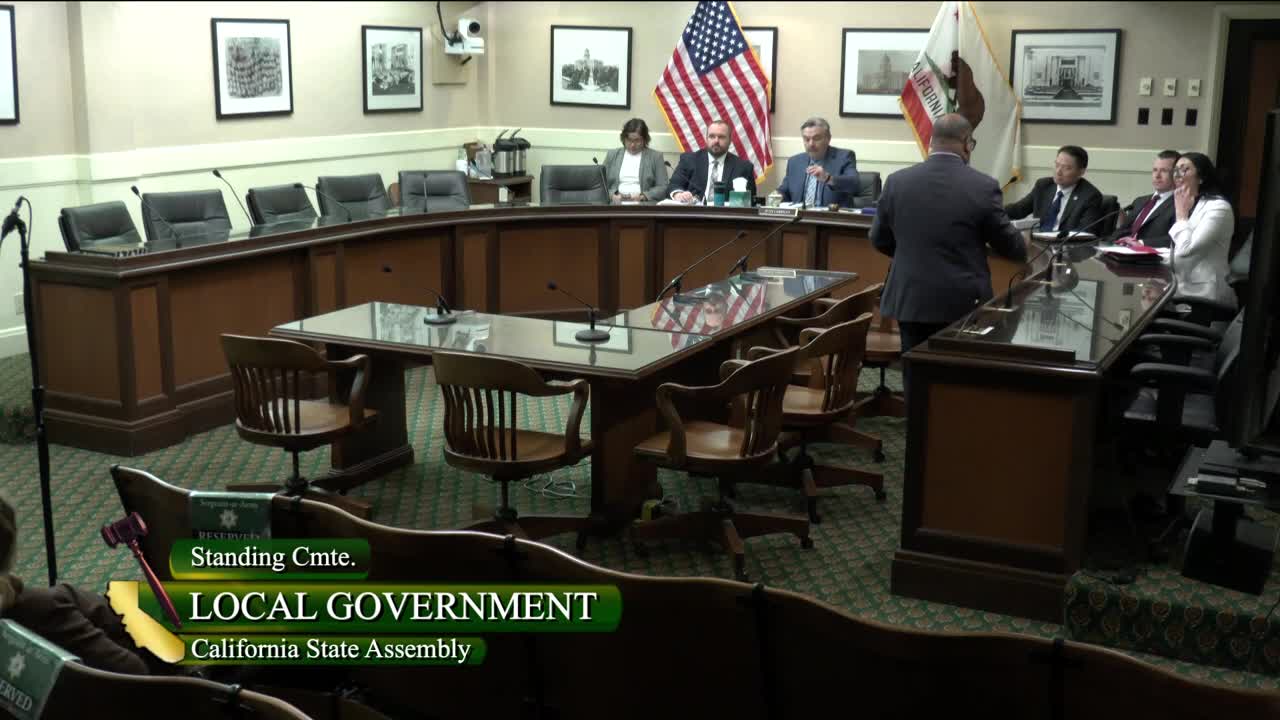 5MIN
Assembly Standing Committee on Local Government
Bill Author

Bill Co-Author(s):