AB 1713: Public postsecondary education: students with disabilities: verification: academic accommodations.
- Session Year: 2025-2026
- House: Assembly
- Latest Version Date: 2026-09-30
Current Status:
Passed
(2026-09-30: Chaptered by Secretary of State - Chapter 891, Statutes of 2026.)
Introduced
In Committee
Awaiting First Chamber Vote
Passed First Chamber
In Committee
Awaiting Second Chamber Vote
Passed Second Chamber
Enacted
Existing law provides for various programs and services for students with disabilities in public postsecondary education. Existing law requires the California Community Colleges and the California State University, and authorizes the University of California, with respect to services provided for disabled students, to, at a minimum, conform to the level and quality of services provided by the Department of Rehabilitation to its clients, as provided.
If a campus of the California Community Colleges, the California State University, or the University of California requires verification of a students disability before providing academic accommodations requested by the student, this bill, commencing September 1, 2027, would require that campus to accept, as verification of the students disability, an individualized education program and a specified plan issued by a school district, county office of education, or charter school, and an individual program plan issued by a regional center that contracts with the State Department of Developmental Services that documents the students disability. If a student requests academic accommodations due to a disability, the bill, commencing September 1, 2027, would prohibit a campus of the California Community Colleges, the California State University, or the University of California from requiring the student to obtain new or additional diagnostic evaluations, as provided, and would authorize the campus to require supplemental information to evaluate the students request for academic accommodations and to determine the type of reasonable accommodations that are appropriate and best suited for the students educational needs, as provided.
Existing law provides for various programs and services for students with disabilities in public postsecondary education. Existing law requires the California Community Colleges and the California State University, and authorizes the University of California, with respect to services provided for disabled students, to, at a minimum, conform to the level and quality of services provided by the Department of Rehabilitation to its clients, as provided.
If a campus of the California Community Colleges, the California State University, or the University of California requires verification of a students disability before providing academic accommodations requested by the student, this bill, commencing September 1, 2027, would require that campus to accept, as verification of the students disability, an individualized education program and a specified plan issued by a school district, county office of education, or charter school school, and an individual program plan issued by a regional center that contracts with the State Department of Developmental Services that documents the students disability. If a student requests academic accommodations due to a disability, the bill, commencing September 1, 2027, would prohibit a campus of the California Community Colleges, the California State University, or the University of California from requiring the student to obtain new or additional diagnostic evaluations, as provided, and would authorize the campus to require supplemental information from the student solely for determining reasonable accommodations best suited for the student, to evaluate the students request for academic accommodations and to determine the type of reasonable accommodations that are appropriate and best suited for the students educational needs, as provided.
Existing law provides for various programs and services for students with disabilities in public postsecondary education. Existing law requires the California Community Colleges and the California State University, and authorizes the University of California, with respect to services provided for disabled students, to, at a minimum, conform to the level and quality of services provided by the Department of Rehabilitation to its clients, as provided.
If a campus of the California Community Colleges, the California State University, or the University of California requires verification of a students disability before providing academic accommodations requested by the student, this bill, commencing September 1, 2027, would require that campus to accept, as verification of the students disability, an individualized education program and a specified plan issued by a school district, county office of education, or charter school that documents the students disability. If a student requests academic accommodations due to a disability, the bill, commencing September 1, 2027, would prohibit a campus of the California Community Colleges, the California State University, or the University of California from requiring the student to obtain new or additional diagnostic evaluations, as provided, and would authorize the campus to require supplemental information from the student solely for determining reasonable accommodations best suited for the student, as provided.
Existing law establishes the California Longitudinal Pupil Achievement Data System and requires, among other things, the State Department of Education, in consultation with the Department of Finance and the Legislative Analysts Office, to include data on a quarterly rate of pupil attendance in the system, if federal funds are received for this purpose. Existing law requires the system to support local educational agencies in their efforts to identify and support pupils at risk of dropping out, and requires the system to be capable of issuing periodic reports to local educational agencies that include school district, school, class, and individual pupil reports on the rates of absence and chronic absentees, as defined.This bill would make nonsubstantive changes to these provisions.Existing law establishes the California Longitudinal Pupil Achievement Data System and requires, among other things, the State Department of Education, in consultation with the Department of Finance and the Legislative Analysts Office, to include data on a quarterly rate of pupil attendance in the system, if federal funds are received for this purpose. Existing law requires the system to support local educational agencies in their efforts to identify and support pupils at risk of dropping out, and requires the system to be capable of issuing periodic reports to local educational agencies that include school district, school, class, and individual pupil reports on the rates of absence and chronic absentees, as defined.
This bill would make nonsubstantive changes to these provisions.
(a)For purposes of this section, the following definitions apply:
(1)504 plan means a plan adopted pursuant to Section 504 of the federal Rehabilitation Act of 1973 (29 U.S.C. Sec. 794).
(2)IEP means an individualized education program adopted pursuant to Chapter 4 (commencing with Section 56300) of Part 30 of Division 4 of Title 2 and the federal Individuals with Disabilities Education Act (20 U.S.C. Sec. 1400 et seq.).
(3)IPP means an individual program plan developed pursuant to Article 2 (commencing with Section 4640) of Chapter 5 of Division 4.5 of the Welfare and Institutions Code.
(4)Local educational agency means a school district, county office of education, or charter school.
(5)Public higher education institution or institution means a campus of the California Community Colleges, the California State University, or the University of California.
(b)Commencing on September 1, 2027, if a public higher education institution requires verification of a students disability before providing academic accommodations requested by the student, the institution shall accept an IEP, an IPP, a 504 plan, or any combination of an IEP, an IPP, or a 504 plan, issued by a local educational agency or a regional center for the student as verification of the existence of the students disability.
(c)Commencing on September 1, 2027, if a student has requested academic accommodations due to a disability, a public higher education institution shall not require the student to obtain a new or an additional diagnostic evaluation solely to verify the existence of a disability that is documented in an IEP, an IPP, or a 504 plan issued by a local educational agency or a regional center for the student.
(d)Commencing on September 1, 2027, if a student has requested academic accommodations due to a disability, a public higher education institution may require supplemental information that is reasonably necessary to evaluate the students request for academic accommodations and to determine the type of reasonable accommodations that are appropriate and best suited for the students educational needs. A public higher education institution may use the supplemental information to assess the functional limitations associated with the students disability and the reasonable accommodations necessary to provide equal access to the institutions programs, services, and activities. A public higher education institution shall not use the supplemental information to dispute or invalidate an underlying disability determination that is documented in an IEP, an IPP, a 504 plan, or any combination of an IEP, an IPP, or a 504 plan, issued by a local educational agency or a regional center.
(e)An IEP, an IPP, or a 504 plan accepted pursuant to this section shall only serve as a verification of the existence of a students disability, and shall not require a public higher education institution to provide the accommodations, modifications, or services documented in the IEP, IPP, or 504 plan. A public higher education institution shall determine and approve reasonable accommodations consistent with applicable state and federal law and within existing institutional resources.
(f)This section shall be implemented in a manner that is consistent with the Americans with Disabilities Act of 1990 (42 U.S.C. Sec. 12101 et seq.) and Section 504 of the Rehabilitation Act of 1973 (29 U.S.C. Sec. 794).
(g)This section does not apply to a public higher education institutions implementation of Title IX of the federal Education Amendments of 1972 (20 U.S.C. Sec. 1681 et seq.) or Section 66281.7.
(h)Notwithstanding Section 67400, this section shall apply to the University of California.
(a)For purposes of this section, the following definitions apply:
(1)504 plan means a plan adopted pursuant to Section 504 of the federal Rehabilitation Act of 1973 (29 U.S.C. Sec. 794).
(2)IEP means an individualized education program adopted pursuant to Chapter 4 (commencing with Section 56300) of Part 30 of Division 4 of Title 2 and the federal Individuals with Disabilities Education Act (20 U.S.C. Sec. 1400 et seq.).
(3)(3)IPP means an individual program plan developed pursuant to Article 2 (commencing with Section 4640) of Chapter 5 of Division 4.5 of the Welfare and Institutions Code.
(4)Local educational agency means a school district, county office of education, or charter school.
(4)(5)Public higher education institution or institution means a campus of the California Community Colleges, the California State University, or the University of California.
(b)Commencing on September 1, 2027, if a public higher education institution requires verification of a students disability before providing academic accommodations requested by the student, the institution shall accept an IEP, an IPP, a 504 plan, or both, any combination of an IEP, an IPP, or a 504 plan, issued by a local educational agency or a regional center for the student as verification of the existence of the students disability.
(c)Commencing on September 1, 2027, if a student has requested academic accommodations due to a disability, a public higher education institution shall not require the student to obtain a new or an additional diagnostic evaluation solely to verify the existence of a disability that is documented in an IEP IEP, an IPP, or a 504 plan issued by a local educational agency or a regional center for the student.
(d)Commencing on September 1, 2027, if a student has requested academic accommodations due to a disability, a public higher education institution may require supplemental information from the student solely for determining the type of reasonable accommodations best suited for the student as are necessary to ensure the academic requirements of the institution do not have a discriminatory affect or effect against the student. that is reasonably necessary to evaluate the students request for academic accommodations and to determine the type of reasonable accommodations that are appropriate and best suited for the students educational needs. A public higher education institution may use the supplemental information to assess the functional limitations associated with the students disability and the reasonable accommodations necessary to provide equal access to the institutions programs, services, and activities. A public higher education institution shall not use the supplemental information to dispute or invalidate an underlying disability determination that is documented in an IEP, an IPP, a 504 plan, or both, any combination of an IEP, an IPP, or a 504 plan, issued by a local educational agency. agency or a regional center.
(e)An IEP, an IPP, or a 504 plan accepted pursuant to this section shall only serve as a verification of the existence of a students disability, and shall not require a public higher education institution to provide the accommodations, modifications, or services documented in the IEP, IPP, or 504 plan. A public higher education institution shall determine and approve reasonable accommodations consistent with applicable state and federal law and within existing institutional resources.
(e)(f)This section shall be implemented in a manner that is consistent with the Americans with Disabilities Act of 1990 (42 U.S.C. Sec. 12101 et seq.) and Section 504 of the Rehabilitation Act of 1973 (29 U.S.C. Sec. 794).
(f)(g)This section does not apply to a public higher education institutions implementation of Title IX of the federal Education Amendments of 1972 (20 U.S.C. Sec. 1681 et seq.) or Section 66281.7.
(g)(h)Notwithstanding Section 67400, this section shall apply to the University of California.
(a)For purposes of this section, the following definitions apply:
(1)504 plan means a plan adopted pursuant to Section 504 of the federal Rehabilitation Act of 1973 (29 U.S.C. Sec. 794).
(2)IEP means an individualized education program adopted pursuant to Chapter 4 (commencing with Section 56300) of Part 30 of Division 4 of Title 2 and the federal Individuals with Disabilities Education Act (20 U.S.C. Sec. 1400 et seq.).
(3)Local educational agency means a school district, county office of education, or charter school.
(4)Public higher education institution or institution means a campus of the California Community Colleges, the California State University, or the University of California.
(b)Commencing on September 1, 2027, if a public higher education institution requires verification of a students disability before providing academic accommodations requested by the student, the institution shall accept an IEP, 504 plan, or both, issued by a local educational agency for the student as verification of the existence of the students disability.
(c)Commencing on September 1, 2027, if a student has requested academic accommodations due to a disability, a public higher education institution shall not require the student to obtain a new or an additional diagnostic evaluation solely to verify the existence of a disability that is documented in an IEP or a 504 plan issued by a local educational agency for the student.
(d)Commencing on September 1, 2027, if a student has requested academic accommodations due to a disability, a public higher education institution may require supplemental information from the student solely for determining the type of reasonable accommodations best suited for the student as are necessary to ensure the academic requirements of the institution do not have a discriminatory affect or effect against the student. A public higher education institution shall not use the supplemental information to dispute or invalidate an underlying disability determination that is documented in an IEP, 504 plan, or both, issued by a local educational agency.
(e)This section shall be implemented in a manner that is consistent with the Americans with Disabilities Act of 1990 (42 U.S.C. Sec. 12101 et seq.) and Section 504 of the Rehabilitation Act of 1973 (29 U.S.C. Sec. 794).
(f)This section does not apply to a public higher education institutions implementation of Title IX of the federal Education Amendments of 1972 (20 U.S.C. Sec. 1681 et seq.) or Section 66281.7.
(g)Notwithstanding Section 67400, this section shall apply to the University of California.
SECTION 1.Section 60901 of the Education Code is amended to read:60901.(a)Contingent upon the receipt of federal funds for this purpose, the department, in consultation with the Department of Finance and the Legislative Analysts Office, shall prepare the California Longitudinal Pupil Achievement Data System established pursuant to Section 60900 to include data on a quarterly rate of pupil attendance. Preparation shall include all of the following:(1)The addition of fields to facilitate the transfer of data.(2)System development activities including any business rules and definitions that would be needed to improve the quality and consistency of the data.(3)Processes for the transfer of data from local educational agencies.(4)Consultation with organizations representing school, school district, and county office of education administrators, classified and certified staff, and parents in order to develop the criteria and frequency of reports on pupil attendance data and other indicators as may be submitted by local educational agencies.(b)The system shall support local educational agencies in their efforts to identify and support pupils at risk of dropping out and shall be capable of issuing to local educational agencies periodic reports that include, but may not be limited to, school district, school, class, and individual pupil reports on both of the following:(1)Rates of absence.(2)Chronic absentees.(c)(1)For purposes of this section, chronic absentee means a pupil who is absent for 10 percent or more of the schooldays in the school year when the total number of days a pupil is absent is divided by the total number of days the pupil is enrolled and school was actually taught in the regular day schools of the school district, exclusive of Saturdays and Sundays.(2)Once available, chronic absentee rates shall be incorporated into the annual report on dropouts required pursuant to Section 48070.6.(3)In addition to the calculation of absentee rates performed pursuant to paragraph (1), once the department has completed and reported the collection of data pursuant to paragraph (4) of subdivision (d) of Section 46211, the department shall also report an alternate chronic absenteeism rate calculation, which includes pupil attendance accrued through an attendance recovery program pursuant to Sections 46210 and 46211.(d)It is the intent of the Legislature to support the development of early warning systems to enable the identification and support of individual pupils who are at risk of academic failure or dropping out of school. The early warning systems shall encompass the following characteristics:(1)The use of highly predictive indicators, including attendance, course grades or completion, performance on assessments of pupil achievement, suspensions, and expulsions.(2)A thorough validation process to ensure the predictive reliability of the systems.(3)Periodic reports that inform principals, teachers, and parents in a manner that enables timely identification and support of individual pupils who are at risk of academic failure or dropping out.(e)When the early warning system established pursuant to Section 60900 is prepared to accept data on a quarterly rate of pupil attendance, a local educational agency may submit data to the department on a quarterly rate of pupil attendance and other indicators as identified by the department. It is the intent of the Legislature that schools identified on the list of persistently lowest-achieving schools will fully use the early warning systems described in subdivision (d).(f)A local educational agency that reports attendance data for pupils to the system established pursuant to Section 60900 may request, and the department shall provide, the early warning report described in subdivision (d) up to four times each school year.(g)The department shall notify local educational agencies that reporting pupil attendance and chronic absentee data pursuant to this section is voluntary. The notice shall include a description of the benefits of reporting pupil attendance and chronic absentee data in fostering the development of effective supports and interventions for at-promise pupils.(h)This section shall not be implemented unless federal funds are appropriated specifically for the purposes of this section.(a)Contingent upon the receipt of federal funds for this purpose, the department, in consultation with the Department of Finance and the Legislative Analysts Office, shall prepare the California Longitudinal Pupil Achievement Data System established pursuant to Section 60900 to include data on a quarterly rate of pupil attendance. Preparation shall include all of the following:
(1)The addition of fields to facilitate the transfer of data.
(2)System development activities including any business rules and definitions that would be needed to improve the quality and consistency of the data.
(3)Processes for the transfer of data from local educational agencies.
(4)Consultation with organizations representing school, school district, and county office of education administrators, classified and certified staff, and parents in order to develop the criteria and frequency of reports on pupil attendance data and other indicators as may be submitted by local educational agencies.
(b)The system shall support local educational agencies in their efforts to identify and support pupils at risk of dropping out and shall be capable of issuing to local educational agencies periodic reports that include, but may not be limited to, school district, school, class, and individual pupil reports on both of the following:
(1)Rates of absence.
(2)Chronic absentees.
(c)(1)For purposes of this section, chronic absentee means a pupil who is absent on for 10 percent or more of the schooldays in the school year when the total number of days a pupil is absent is divided by the total number of days the pupil is enrolled and school was actually taught in the regular day schools of the school district, exclusive of Saturdays and Sundays.
(2)Once available, chronic absentee rates shall be incorporated into the annual report on dropouts required pursuant to Section 48070.6.
(3)In addition to the calculation of absentee rates performed pursuant to paragraph (1), once the department has completed and reported the collection of data pursuant to paragraph (4) of subdivision (d) of Section 46211, the department shall also report an alternate chronic absenteeism rate calculation, which includes pupil attendance accrued through an attendance recovery program pursuant to Sections 46210 and 46211.
(d)It is the intent of the Legislature to support the development of early warning systems to enable the identification and support of individual pupils who are at risk of academic failure or dropping out of school. The early warning systems shall encompass the following characteristics:
(1)The utilization use of highly predictive indicators, including attendance, course grades or completion, performance on assessments of pupil achievement, suspensions, and expulsions.
(2)A thorough validation process to ensure the predictive reliability of the systems.
(3)Periodic reports that inform principals, teachers, and parents in a manner that enables timely identification and support of individual pupils who are at risk of academic failure or dropping out.
(e)When the early warning system established pursuant to Section 60900 is prepared to accept data on a quarterly rate of pupil attendance, a local educational agency may submit data to the department on a quarterly rate of pupil attendance and other indicators as identified by the department. It is the intent of the Legislature that schools identified on the list of persistently lowest-achieving schools will fully utilize use the early warning systems described in subdivision (d).
(f)A local educational agency that reports attendance data for pupils to the system established pursuant to Section 60900 may request, and the department shall provide, the early warning report described in subdivision (d) up to four times each school year.
(g)The department shall notify local educational agencies that reporting pupil attendance and chronic absentee data pursuant to this section is voluntary. The notice shall include a description of the benefits of reporting pupil attendance and chronic absentee data in fostering the development of effective supports and interventions for at-promise pupils.
(h)This section shall not be implemented unless federal funds are appropriated specifically for the purposes of this section.
|
Date
|
Status
|
|---|---|
| Sep 30, 2026 | Chaptered by Secretary of State - Chapter 891, Statutes of 2026. |
| Sep 30, 2026 | Approved by the Governor. |
| Aug 31, 2026 | Enrolled and presented to the Governor at 4 p.m. |
| Aug 25, 2026 | Senate amendments concurred in. To Engrossing and Enrolling. (Ayes 78. Noes 0. Page 6461.). |
| Aug 25, 2026 | Senate amendments concurred in. To Engrossing and Enrolling. (Ayes 78. Noes 0.). |
| Aug 24, 2026 | In Assembly. Concurrence in Senate amendments pending. |
| Aug 24, 2026 | Read third time. Passed. Ordered to the Assembly. (Ayes 39. Noes 0. Page 5695.). |
| Aug 24, 2026 | Read third time. Passed. Ordered to the Assembly. (Ayes 39. Noes 0.). |
| Jul 2, 2026 | Read second time. Ordered to third reading. |
| Jul 1, 2026 | Read third time and amended. Ordered to second reading. |
| Jun 16, 2026 | Read second time. Ordered to third reading. |
| Jun 15, 2026 | From committee: Be ordered to second reading pursuant to Senate Rule 28.8. |
| Jun 4, 2026 | From committee: Do pass and re-refer to Com. on APPR. (Ayes 6. Noes 0.) (June 3). Re-referred to Com. on APPR. |
| May 20, 2026 | Referred to Com. on ED. |
| May 12, 2026 | In Senate. Read first time. To Com. on RLS. for assignment. |
| May 11, 2026 | Read third time. Passed. Ordered to the Senate. (Ayes 72. Noes 0. Page 5003.) |
| May 11, 2026 | Read third time. Passed. Ordered to the Senate. (Ayes 72. Noes 0.) |
| May 11, 2026 | Read third time. Passed. Ordered to the Senate. |
| May 7, 2026 | Read second time. Ordered to third reading. |
| May 6, 2026 | From committee: Do pass. (Ayes 14. Noes 0.) (May 6). |
| Apr 15, 2026 | From committee: Do pass and re-refer to Com. on APPR. (Ayes 9. Noes 0.) (April 14). Re-referred to Com. on APPR. |
| Mar 17, 2026 | Re-referred to Com. on HIGHER ED. |
| Mar 16, 2026 | From committee chair, with author's amendments: Amend, and re-refer to Com. on HIGHER ED. Read second time and amended. |
| Mar 16, 2026 | Referred to Com. on HIGHER ED. |
| Feb 5, 2026 | From printer. May be heard in committee March 7. |
| Feb 4, 2026 | Read first time. To print. |
|
Date
|
Description
|
Location
|
Votes
|
|
|---|---|---|---|---|
| Aug 25, 2026 | AB 1713 Ransom Concurrence in Senate Amendments | Assembly Floor |
Passed |
|
| Aug 24, 2026 | Assembly 3rd Reading AB1713 Ransom et al. By Menjivar | Senate Floor |
Passed |
|
| Jun 3, 2026 | Do pass, but first be re-referred to the Committee on [Appropriations] | Senate Standing Committee on Education |
Passed |
|
| May 11, 2026 | AB 1713 Ransom Assembly Third Reading | Assembly Floor |
Passed |
|
| May 6, 2026 | Do pass. | Assembly Standing Committee on Appropriations |
Passed |
|
| Apr 14, 2026 | Do pass and be re-referred to the Committee on [Appropriations] | Assembly Standing Committee on Higher Education |
Passed |
This list shows positions taken on this bill by organizations on the date displayed, which is linked to the original source.
Positions by individuals are not included.
|
Organization
|
Position
|
Date
|
|---|---|---|
| California Association for Postsecondary Education and Disabilities | ** Support | |
| California Community Colleges, Chancellor’s Office | ** Support | |
| Disability Resources Agency for Independent Living | ** Support | |
| Disability Resources Agency for Independent Living (DRAIL) | ** Support | |
| National Center for Disabilities | ** Support | |
| National Center for Learning Disabilities | ** Support | |
| Southwestern Community College District | ** Support |
CONCURRENCE IN SENATE AMENDMENTS
CSA1 Bill Id:AB 1713
Author:(Ransom)
As Amended Ver:July 1, 2026
Majority vote
SUMMARY
Requires the California Community Colleges (CCCs) and the California State University (CSU), and requests the University of California (UC) as of September 1, 2027, to accept a student’s individualized education program (IEP), Individual Program Plan (IPP), or Section 504 plan as verification of disability for purposes of requesting academic accommodations; (2) prohibits public postsecondary institutions from requiring students to obtain new or additional diagnostic evaluations solely to verify a disability, while authorizing institutions to request supplemental information necessary to evaluate accommodation requests and determine appropriate reasonable accommodations; and (3) clarifies that an IEP, IPP, or Section 504 plan serves only to verify the existence of a disability and does not require a public postsecondary institution to provide the accommodations, modifications, or services identified in those documents.
Senate Amendments
- Defines IPP as an individual program plan developed pursuant to Article 2 of Chapter 5 of Division 4.5 of the Welfare and Institutions Code.
- Clarifies that a CCC, CSU, or UC is permitted to request supplemental information from a student beyond an IPP, IEP, or a Section 504 plan in order to determine the type of reasonable accommodation that is best for the student in order to maintain equal access to the institution’s programs, services, and activities.
- Clarifies the IEP, IPP, or Section 504 plan will only serve to verify the existence of the student’s disability. Clarifies that a CCC, CSU, or UC is not required to implement the accommodations as listed by the IEP, IPP, or Section 504 Plan.
COMMENTS
Disabled students and the right of equal access to education. Both federal civil rights laws and state civil rights laws prohibit a higher education institution from discriminating against a student based on their actual or perceived disability. Both federal and state laws outline the roles and responsibilities of higher education institutions to provide modifications to existing academic programs to ensure a student maintains equal access under the law. These modifications are known as reasonable accommodations. While the laws governing disability rights cover both K-12 schools and higher education institutions, there is a primary difference in the scope of services provided. A K-12 school is obligated to provide accommodations that will ensure the student′s academic success; whereas a higher education institution is required to provide accommodations that maintain equal access to educational opportunities for the student.
This measure seeks to take the documentation created during a student′s time in the K-12 education system and to apply this documentation to higher education institutions for purposes of identifying a student′s disability. The student has already received testing from qualified individuals and therefore the documentation of an IEP or 504 Plan should qualify a student for disability services at a public higher education institution. This measure does not require the same support services, accommodations, or academic modifications contained within the IEP or 504 Plan to be implemented by the public higher education institution; but rather, requires the institution to use the IPP, IEP or 504 Plan as a verification document of the student′s disability.
Disability services at public higher education institutions. Each public higher education institution in the state of California provides disabled services and programs to students with disabilities. In the 2024-2025 academic year, the CCCs served 129,970 disabled students at community colleges throughout the state. In a report to the Legislature from 2024, the CCC Chancellor′s Office explains the, ″Disabled Student Programs and Services (DSPS) assist students with disabilities, to ensure they have equal access to all educational programs and activities. DSPS provides personalized support services to students with physical disabilities, learning disabilities, psychological disabilities, developmental delays, brain injuries, visual impairments, health problems and hearing impairments. Among the array of services offered to students are priority registration, class scheduling assistance, specialized counseling and tutoring, mobility assistance, test proctoring, transcription services and interpreter services for hearing impaired or deaf students.″ The accommodations provided by the DSPS program are so impactful to a student′s ability to matriculate towards a degree, that data showed CCC DSPS students who enrolled during the 2019-2020 academic year and graduated in the 2023-2024 academic year had higher completion rates than their non-disabled counterparts.
Every CSU campus has a ″Student′s with Disabilities Office″ to provide services and accommodations to students with a certified disability. In fall 2023, the CSU enrolled 21,753 students who identified as having a disability. The CSU has a systemwide policy for ″The Provision of Accommodations and Support Services to Students with Disabilities;″ which, encapsulates the type of disabilities the CSU recognizes as requiring accommodations and the types of documentation a student may be asked to produce to verify the disability. The policy permits ″documentation from external sources [including] educational or medical records, reports and assessments created by health care providers, school psychologists, teachers, or the educational system.″
In a presentation to the UC Regents in March 2025, it was reported that the UC enrolled 65,802 undergraduate students with a disability in the 2023-2024 academic year. All ten UC campuses have a disability services office with specialized staff equipped to provide services and supports to meet the individual need of disabled students. The services provided by these disability service offices include reading services, note-taking services, diction and transcription, deaf and hard-of-hearing services, housing and dining accommodations, and transportation accommodations. Of the 65,802 students identifying as disabled, 23,472 received accommodations, roughly 31%.
This measure allows students to be able to produce verifiable documentation to seamlessly demonstrate a disability to a public higher education institution for purposes of seeking academic accommodations. This measure seeks to reduce out-of-pocket expenses for disabled students by permitting a student to use an IPP, IEP or 504 Plan as sufficient evidence of a disability instead of costly medical test or third-party tests to verify the disability.
According to the Author
According to the author, ″AB 1713 is focused on providing students with disabilities recognition of their unique needs to ensure they are able to participate in California’s world-renowned higher education system without difficulty or discrimination. AB 1713 will require institutions of higher education to accept a student’s diagnosis from their IEP or Section 504 Plan from their previous educational institution, fast-tracking their access to the accommodations they need and allowing them to spend more time in the classroom and less time in the doctor’s office.″
Arguments in Support
As stated by the Disability Resources Agency for Independent Living, ″through our work, we regularly hear from students and families who face unnecessary barriers when transitioning from K–12 to higher education. Despite existing protections under laws such as the Americans with Disabilities Act and Section 504 of the Rehabilitation Act, students are often required to resubmit documentation, meet different verification standards, or even obtain updated medical diagnoses for conditions that are already well-established. These duplicative processes can delay access to accommodations, create financial burdens, and discourage students from fully engaging in their education. AB 1713 provides a practical and thoughtful solution by requiring institutions of higher education to accept a student′s existing medical diagnosis in conjunction with their Individualized Education Program (IEP) or Section 504 Plan. By recognizing prior documentation, this bill helps streamline access to accommodations and reduces unnecessary barriers.″
Arguments in Opposition
None on file.
FISCAL COMMENTS
According to the Senate Committee on Appropriations, pursuant to Senate Rule 28.8, negligible state costs.
VOTES:
ASM HIGHER EDUCATION: 9-0-1
YES: Fong, DeMaio, Boerner, Jeff Gonzalez, Jackson, Muratsuchi, Patel, Sharp-Collins, Tangipa
ABS, ABST OR NV: Celeste Rodriguez
ASM APPROPRIATIONS: 14-0-1
YES: Wicks, Hoover, Aguiar-Curry, Caloza, Dixon, Fong, Mark González, Krell, Pacheco, Pellerin, Sharp-Collins, Solache, Ta, Tangipa
ABS, ABST OR NV: Arambula
ASSEMBLY FLOOR: 72-0-8
YES: Addis, Aguiar-Curry, Ahrens, Alanis, Alvarez, Ávila Farías, Bains, Bauer-Kahan, Bennett, Berman, Boerner, Bonta, Bryan, Calderon, Caloza, Carrillo, Castillo, Chen, Connolly, Davies, DeMaio, Dixon, Elhawary, Ellis, Flora, Fong, Gabriel, Garcia, Gipson, Jeff Gonzalez, Mark González, Hadwick, Haney, Harabedian, Hart, Hoover, Irwin, Jackson, Johnson, Kalra, Krell, Lackey, Lee, Macedo, McKinnor, Muratsuchi, Nguyen, Ortega, Pacheco, Papan, Patel, Patterson, Pellerin, Petrie-Norris, Ramos, Ransom, Rogers, Blanca Rubio, Sanchez, Schiavo, Schultz, Sharp-Collins, Stefani, Ta, Tangipa, Valencia, Wallis, Ward, Wicks, Wilson, Zbur, Rivas
ABS, ABST OR NV: Arambula, Gallagher, Lowenthal, Quirk-Silva, Celeste Rodriguez, Michelle Rodriguez, Solache, Soria
SENATE FLOOR: 39-0-1
YES: Allen, Alvarado-Gil, Archuleta, Arreguín, Ashby, Becker, Blakespear, Cabaldon, Caballero, Cervantes, Choi, Cortese, Dahle, Durazo, Gonzalez, Grayson, Grove, Hurtado, Jones, Laird, Limón, McGuire, McNerney, Menjivar, Niello, Ochoa Bogh, Padilla, Pérez, Richardson, Rubio, Seyarto, Smallwood-Cuevas, Stern, Strickland, Umberg, Valladares, Wahab, Weber Pierson, Wiener
ABS, ABST OR NV: Reyes
UPDATED
VERSION: July 1, 2026
CONSULTANT: Ellen Cesaretti-Monroy / HIGHER ED. / (916) 319-3960 FN: 0004079
CONCURRENCE IN SENATE AMENDMENTS
CSA1 Bill Id:AB 1713
Author:(Ransom)
As Amended Ver:July 1, 2026
Majority vote
SUMMARY
Requires the California Community Colleges (CCCs) and the California State University (CSU), and requests the University of California (UC) as of September 1, 2027, to accept a student’s individualized education program (IEP), Individual Program Plan (IPP), or Section 504 plan as verification of disability for purposes of requesting academic accommodations; (2) prohibits public postsecondary institutions from requiring students to obtain new or additional diagnostic evaluations solely to verify a disability, while authorizing institutions to request supplemental information necessary to evaluate accommodation requests and determine appropriate reasonable accommodations; and (3) clarifies that an IEP, IPP, or Section 504 plan serves only to verify the existence of a disability and does not require a public postsecondary institution to provide the accommodations, modifications, or services identified in those documents.
Senate Amendments
- Defines IPP as an individual program plan developed pursuant to Article 2 of Chapter 5 of Division 4.5 of the Welfare and Institutions Code.
- Clarifies that a CCC, CSU, or UC is permitted to request supplemental information from a student beyond an IPP, IEP, or a Section 504 plan in order to determine the type of reasonable accommodation that is best for the student in order to maintain equal access to the institution’s programs, services, and activities.
- Clarifies the IEP, IPP, or Section 504 plan will only serve to verify the existence of the student’s disability. Clarifies that a CCC, CSU, or UC is not required to implement the accommodations as listed by the IEP, IPP, or Section 504 Plan.
COMMENTS
Disabled students and the right of equal access to education. Both federal civil rights laws and state civil rights laws prohibit a higher education institution from discriminating against a student based on their actual or perceived disability. Both federal and state laws outline the roles and responsibilities of higher education institutions to provide modifications to existing academic programs to ensure a student maintains equal access under the law. These modifications are known as reasonable accommodations. While the laws governing disability rights cover both K-12 schools and higher education institutions, there is a primary difference in the scope of services provided. A K-12 school is obligated to provide accommodations that will ensure the student′s academic success; whereas a higher education institution is required to provide accommodations that maintain equal access to educational opportunities for the student.
This measure seeks to take the documentation created during a student′s time in the K-12 education system and to apply this documentation to higher education institutions for purposes of identifying a student′s disability. The student has already received testing from qualified individuals and therefore the documentation of an IEP or 504 Plan should qualify a student for disability services at a public higher education institution. This measure does not require the same support services, accommodations, or academic modifications contained within the IEP or 504 Plan to be implemented by the public higher education institution; but rather, requires the institution to use the IPP, IEP or 504 Plan as a verification document of the student′s disability.
Disability services at public higher education institutions. Each public higher education institution in the state of California provides disabled services and programs to students with disabilities. In the 2024-2025 academic year, the CCCs served 129,970 disabled students at community colleges throughout the state. In a report to the Legislature from 2024, the CCC Chancellor′s Office explains the, ″Disabled Student Programs and Services (DSPS) assist students with disabilities, to ensure they have equal access to all educational programs and activities. DSPS provides personalized support services to students with physical disabilities, learning disabilities, psychological disabilities, developmental delays, brain injuries, visual impairments, health problems and hearing impairments. Among the array of services offered to students are priority registration, class scheduling assistance, specialized counseling and tutoring, mobility assistance, test proctoring, transcription services and interpreter services for hearing impaired or deaf students.″ The accommodations provided by the DSPS program are so impactful to a student′s ability to matriculate towards a degree, that data showed CCC DSPS students who enrolled during the 2019-2020 academic year and graduated in the 2023-2024 academic year had higher completion rates than their non-disabled counterparts.
Every CSU campus has a ″Student′s with Disabilities Office″ to provide services and accommodations to students with a certified disability. In fall 2023, the CSU enrolled 21,753 students who identified as having a disability. The CSU has a systemwide policy for ″The Provision of Accommodations and Support Services to Students with Disabilities;″ which, encapsulates the type of disabilities the CSU recognizes as requiring accommodations and the types of documentation a student may be asked to produce to verify the disability. The policy permits ″documentation from external sources [including] educational or medical records, reports and assessments created by health care providers, school psychologists, teachers, or the educational system.″
In a presentation to the UC Regents in March 2025, it was reported that the UC enrolled 65,802 undergraduate students with a disability in the 2023-2024 academic year. All ten UC campuses have a disability services office with specialized staff equipped to provide services and supports to meet the individual need of disabled students. The services provided by these disability service offices include reading services, note-taking services, diction and transcription, deaf and hard-of-hearing services, housing and dining accommodations, and transportation accommodations. Of the 65,802 students identifying as disabled, 23,472 received accommodations, roughly 31%.
This measure allows students to be able to produce verifiable documentation to seamlessly demonstrate a disability to a public higher education institution for purposes of seeking academic accommodations. This measure seeks to reduce out-of-pocket expenses for disabled students by permitting a student to use an IPP, IEP or 504 Plan as sufficient evidence of a disability instead of costly medical test or third-party tests to verify the disability.
According to the Author
According to the author, ″AB 1713 is focused on providing students with disabilities recognition of their unique needs to ensure they are able to participate in California’s world-renowned higher education system without difficulty or discrimination. AB 1713 will require institutions of higher education to accept a student’s diagnosis from their IEP or Section 504 Plan from their previous educational institution, fast-tracking their access to the accommodations they need and allowing them to spend more time in the classroom and less time in the doctor’s office.″
Arguments in Support
As stated by the Disability Resources Agency for Independent Living, ″through our work, we regularly hear from students and families who face unnecessary barriers when transitioning from K–12 to higher education. Despite existing protections under laws such as the Americans with Disabilities Act and Section 504 of the Rehabilitation Act, students are often required to resubmit documentation, meet different verification standards, or even obtain updated medical diagnoses for conditions that are already well-established. These duplicative processes can delay access to accommodations, create financial burdens, and discourage students from fully engaging in their education. AB 1713 provides a practical and thoughtful solution by requiring institutions of higher education to accept a student′s existing medical diagnosis in conjunction with their Individualized Education Program (IEP) or Section 504 Plan. By recognizing prior documentation, this bill helps streamline access to accommodations and reduces unnecessary barriers.″
Arguments in Opposition
None on file.
FISCAL COMMENTS
According to the Senate Committee on Appropriations, pursuant to Senate Rule 28.8, negligible state costs.
VOTES:
ASM HIGHER EDUCATION: 9-0-1
YES: Fong, DeMaio, Boerner, Jeff Gonzalez, Jackson, Muratsuchi, Patel, Sharp-Collins, Tangipa
ABS, ABST OR NV: Celeste Rodriguez
ASM APPROPRIATIONS: 14-0-1
YES: Wicks, Hoover, Aguiar-Curry, Caloza, Dixon, Fong, Mark González, Krell, Pacheco, Pellerin, Sharp-Collins, Solache, Ta, Tangipa
ABS, ABST OR NV: Arambula
ASSEMBLY FLOOR: 72-0-8
YES: Addis, Aguiar-Curry, Ahrens, Alanis, Alvarez, Ávila Farías, Bains, Bauer-Kahan, Bennett, Berman, Boerner, Bonta, Bryan, Calderon, Caloza, Carrillo, Castillo, Chen, Connolly, Davies, DeMaio, Dixon, Elhawary, Ellis, Flora, Fong, Gabriel, Garcia, Gipson, Jeff Gonzalez, Mark González, Hadwick, Haney, Harabedian, Hart, Hoover, Irwin, Jackson, Johnson, Kalra, Krell, Lackey, Lee, Macedo, McKinnor, Muratsuchi, Nguyen, Ortega, Pacheco, Papan, Patel, Patterson, Pellerin, Petrie-Norris, Ramos, Ransom, Rogers, Blanca Rubio, Sanchez, Schiavo, Schultz, Sharp-Collins, Stefani, Ta, Tangipa, Valencia, Wallis, Ward, Wicks, Wilson, Zbur, Rivas
ABS, ABST OR NV: Arambula, Gallagher, Lowenthal, Quirk-Silva, Celeste Rodriguez, Michelle Rodriguez, Solache, Soria
UPDATED
VERSION: July 1, 2026
CONSULTANT: Ellen Cesaretti-Monroy / HIGHER ED. / (916) 319-3960 FN: 0004079
SENATE RULES COMMITTEE Office of Senate Floor Analyses (916) 651-4171 | AB 1713 |
THIRD READING
Bill No: AB 1713
Author: Ransom (D)
Amended: 7/1/26 in Senate
Vote: 21
SENATE EDUCATION COMMITTEE: 6-0, 6/3/26
AYES: Pérez, Ochoa Bogh, Choi, Cortese, Gonzalez, Reyes
NO VOTE RECORDED: Cabaldon
SENATE APPROPRIATIONS COMMITTEE: Senate Rule 28.8
ASSEMBLY FLOOR: 72-0, 5/11/26 - See last page for vote
SUBJECT: Public postsecondary education: students with disabilities: verification: academic accommodations
SOURCE: Author
DIGEST:
This bill (1) requires the California Community Colleges (CCCs) and the California State University (CSU), and requests the University of California (UC), to accept a student’s individualized education program (IEP), Individual Program Plan (IPP), or Section 504 plan as verification of disability for purposes of requesting academic accommodations; (2) prohibits public postsecondary institutions from requiring students to obtain new or additional diagnostic evaluations solely to verify a disability, while authorizing institutions to request supplemental information necessary to evaluate accommodation requests and determine appropriate reasonable accommodations; and (3) clarifies that an IEP, IPP, or Section 504 plan serves only to verify the existence of a disability and does not require a public postsecondary institution to provide the accommodations, modifications, or services identified in those documents.
Senate Floor amendments of 7/1/26 (1) expand this bill to recognize an Individual Program Plan (IPP) developed by a regional center as documentation that may be used to verify a student’s disability; (2) clarify that public postsecondary institutions may request supplemental information reasonably necessary to evaluate a student’s request for accommodations and assess the student’s functional limitations for purposes of determining appropriate reasonable accommodations, while prohibiting institutions from using that information to dispute or invalidate the underlying disability determination; and (3) specify that an IEP, IPP, or Section 504 plan serves only to verify the existence of a disability and does not require a public postsecondary institution to provide the specific accommodations, modifications, or services identified in those documents.
ANALYSIS:
Existing law:
- Prohibits discrimination on the basis of disability under Section 504 of the federal Rehabilitation Act of 1973 and requires entities receiving federal financial assistance, including public postsecondary institutions, to provide equal access to educational opportunities for individuals with disabilities.
- Prohibits discrimination against individuals with disabilities under the federal Americans with Disabilities Act (ADA).
- Prohibits postsecondary educational institutions that receive state financial assistance from discriminating on the basis of disability or other protected characteristics.
- Defines “disability” for purposes of the Equity in Higher Education Act to mean a mental or physical disability.
- Expresses legislative intent to provide funding for Disabled Student Programs and Services (DSPS) at the CCCs, including funding for disability-related counseling, mobility assistance, interpreter services, testing accommodations, specialized tutoring, and other supports for students with disabilities.
- Requires, beginning in fall 2026, the CSU to establish, and requests the UC and independent institutions to establish, a Disability Access and Compliance Training Program to ensure campus personnel understand their legal responsibilities related to accommodations for students with disabilities.
- Provides that provisions of the Donahoe Higher Education Act do not apply to the UC unless adopted by the Regents.
This bill:
- Defines the following terms for purposes of this bill:
- “504 plan” to mean a plan adopted pursuant to Section 504 of the federal Rehabilitation Act of 1974.
- “IEP” to mean an individualized education program adopted pursuant to state and federal special education law.
- “IPP” to mean an individual program plan developed pursuant to Article 2 (commencing with Section 4640) of Chapter 5 of Division 4.5 of the Welfare and Institutions Code.
- “Local educational agency” to mean a school district, county office of education, or charter school.
- “Public higher education institution” to mean a campus of the CCCs, the CSU, or the UC.
- Requires, beginning September 1, 2027, a public higher education institution that requires documentation to verify a student’s disability for purposes of academic accommodations to accept an IEP, IPP, a Section 504 plan, or any combination thereof, issued by a local educational agency (LEA) or regional center, as verification of the student’s disability.
- Prohibits, beginning September 1, 2027, a public higher education institution from requiring a student to obtain a new or additional diagnostic evaluation to verify a disability if the student has provided an IEP or Section 504 plan documenting the disability.
- Authorizes a public higher education institution to request supplemental information reasonably necessary to evaluate a student’s request for academic accommodations, assess the functional limitations associated with the student’s disability, and determine appropriate reasonable accommodations.
- Prohibits a public higher education institution from using supplemental information to invalidate or dispute a student’s disability as documented in the student’s IEP or Section 504 plan.
- Specifies that an IEP, IPP, or Section 504 plan accepted pursuant to this bill serves only to verify the existence of a student's disability and does not require a public higher education institution to provide the accommodations, modifications, or services identified in those documents.
- Requires implementation of this bill to be consistent with the Americans with Disabilities Act of 1990 and Section 504 of the federal Rehabilitation Act of 1973.
- Specifies that this bill does not apply to a public higher education institution’s implementation of Title IX of the federal Education Amendments of 1972.
- Applies this bill’s provisions to the UC, contingent upon action by the Regents.
Comments
Need for this bill. According to the author, “AB 1713 is focused on providing students with disabilities recognition of their unique needs to ensure they are able to participate in California’s world-renowned higher education system without difficulty or discrimination. AB 1713 will require institutions of higher education to accept a student’s diagnosis from their IEP or Section 504 Plan from their previous educational institution, fast-tracking their access to the accommodations they need and allowing them to spend more time in the classroom and less time in the doctor’s office.”
Standardizing the disability verification practices across California’s public higher education systems. This bill addresses the documentation process students with disabilities encounter when seeking accommodations in higher education. Under current practice, postsecondary institutions may establish their own standards regarding what documentation is necessary to verify a disability and determine eligibility for accommodations. As a result, documentation standards and verification practices may vary across campuses and higher education segments.
This bill establishes a statewide standard requiring public postsecondary institutions to accept an IEP, IPP, or Section 504 plan as sufficient documentation that a disability exists, while still preserving institutional discretion to determine appropriate accommodations in the higher education environment.
K-12 and higher education disability systems serve different legal and operational purposes. The provisions of this bill operate between two distinct disability accommodation systems. In the K-12 system, schools are responsible for identifying students with disabilities, evaluating eligibility, and proactively developing plans and services intended to support student success. By contrast, higher education institutions generally operate under an access-based framework in which students self-identify, request accommodations, and participate in an interactive process to determine reasonable accommodations.
As a result, while IEPs, IPPs, and Section 504 plans may establish the existence of a disability, the accommodations provided in K-12 settings do not necessarily translate directly into the postsecondary environment. This bill appears to acknowledge that distinction by requiring institutions to accept these documents for disability verification purposes, while still permitting institutions to request supplemental information necessary to determine reasonable accommodations at the college level.
Could reduce duplicative evaluation costs and administrative burdens for some students. Students with disabilities transitioning from the K-12 system into higher education may encounter differing institutional documentation requirements when seeking accommodations. In some cases, students who previously received services pursuant to an IEP or Section 504 plan may nonetheless be asked to obtain updated medical or psychoeducational evaluations to verify a disability in the postsecondary setting.
This bill establishes greater consistency across California’s public higher education systems by requiring institutions to recognize existing K-12 disability documentation as sufficient verification of a disability. To the extent students would otherwise be required to obtain additional evaluations solely for verification purposes, this bill could reduce both administrative burdens and out-of-pocket costs associated with securing accommodations.
At the same time, this bill preserves institutional authority to request supplemental information necessary to determine reasonable accommodations in the postsecondary environment, recognizing that accommodations appropriate in K-12 settings may not always translate directly to higher education coursework, instructional models, or campus environments.
FISCAL EFFECT: Appropriation: No Fiscal Com.: Yes Local: No
SUPPORT: (Verified 7/8/26)
California Association for Postsecondary Education and Disabilities
California Community Colleges, Chancellor’s Office
Southwestern Community College District
OPPOSITION: (Verified 7/8/26)
None received
ASSEMBLY FLOOR: 72-0, 5/11/26
AYES: Addis, Aguiar-Curry, Ahrens, Alanis, Alvarez, Ávila Farías, Bains, Bauer-Kahan, Bennett, Berman, Boerner, Bonta, Bryan, Calderon, Caloza, Carrillo, Castillo, Chen, Connolly, Davies, DeMaio, Dixon, Elhawary, Ellis, Flora, Fong, Gabriel, Garcia, Gipson, Jeff Gonzalez, Mark González, Hadwick, Haney, Harabedian, Hart, Hoover, Irwin, Jackson, Johnson, Kalra, Krell, Lackey, Lee, Macedo, McKinnor, Muratsuchi, Nguyen, Ortega, Pacheco, Papan, Patel, Patterson, Pellerin, Petrie-Norris, Ramos, Ransom, Rogers, Blanca Rubio, Sanchez, Schiavo, Schultz, Sharp-Collins, Stefani, Ta, Tangipa, Valencia, Wallis, Ward, Wicks, Wilson, Zbur, Rivas
NO VOTE RECORDED: Arambula, Gallagher, Lowenthal, Quirk-Silva, Celeste Rodriguez, Michelle Rodriguez, Solache, Soria
Prepared by: Ian Johnson / ED. / (916) 651-4105
7/30/26 14:49:19
**** END ****
SENATE RULES COMMITTEE Office of Senate Floor Analyses (916) 651-4171 | AB 1713 |
THIRD READING
Bill No: AB 1713
Author: Ransom (D)
Amended: 3/16/26 in Assembly
Vote: 21
SENATE EDUCATION COMMITTEE: 6-0, 6/3/26
AYES: Pérez, Ochoa Bogh, Choi, Cortese, Gonzalez, Reyes
NO VOTE RECORDED: Cabaldon
SENATE APPROPRIATIONS COMMITTEE: Senate Rule 28.8
ASSEMBLY FLOOR: 72-0, 5/11/26 - See last page for vote
SUBJECT: Public postsecondary education: students with disabilities: verification: academic accommodations
SOURCE: Author
DIGEST:
This bill (1) requires the California Community Colleges (CCCs) and the California State University (CSU), and requests the University of California (UC), to accept a student’s individualized education program (IEP) or Section 504 plan as verification of disability for purposes of requesting academic accommodations; (2) prohibits public postsecondary institutions from requiring students to obtain new or additional diagnostic evaluations solely to verify a disability, while authorizing institutions to request supplemental information necessary to determine appropriate accommodations.
ANALYSIS:
Existing law:
- Prohibits discrimination on the basis of disability under Section 504 of the federal Rehabilitation Act of 1973 and requires entities receiving federal financial assistance, including public postsecondary institutions, to provide equal access to educational opportunities for individuals with disabilities.
- Prohibits discrimination against individuals with disabilities under the federal Americans with Disabilities Act (ADA).
- Prohibits postsecondary educational institutions that receive state financial assistance from discriminating on the basis of disability or other protected characteristics.
- Defines “disability” for purposes of the Equity in Higher Education Act to mean a mental or physical disability.
- Expresses legislative intent to provide funding for Disabled Student Programs and Services (DSPS) at the CCCs, including funding for disability-related counseling, mobility assistance, interpreter services, testing accommodations, specialized tutoring, and other supports for students with disabilities.
- Requires, beginning in fall 2026, the CSU to establish, and requests the UC and independent institutions to establish, a Disability Access and Compliance Training Program to ensure campus personnel understand their legal responsibilities related to accommodations for students with disabilities.
- Provides that provisions of the Donahoe Higher Education Act do not apply to the UC unless adopted by the Regents.
This bill:
- Defines the following terms for purposes of this bill:
- “504 plan” to mean a plan adopted pursuant to Section 504 of the federal Rehabilitation Act of 1974.
- “IEP” to mean an individualized education program adopted pursuant to state and federal special education law.
- “Local educational agency” to mean a school district, county office of education, or charter school.
- “Public higher education institution” to mean a campus of the CCCs, the CSU, or the UC.
- Requires, beginning September 1, 2027, a public higher education institution that requires documentation to verify a student’s disability for purposes of academic accommodations to accept an IEP, a Section 504 plan, or both, issued by a local educational agency (LEA), as verification of the student’s disability.
- Prohibits, beginning September 1, 2027, a public higher education institution from requiring a student to obtain a new or additional diagnostic evaluation to verify a disability if the student has provided an IEP or Section 504 plan documenting the disability.
- Authorizes a public higher education institution to request supplemental information from a student with an IEP or Section 504 plan solely for purposes of determining appropriate accommodations necessary to ensure equal access to the institution’s academic requirements.
- Prohibits a public higher education institution from using supplemental information to invalidate or dispute a student’s disability as documented in the student’s IEP or Section 504 plan.
- Requires implementation of this bill to be consistent with the Americans with Disabilities Act of 1990 and Section 504 of the federal Rehabilitation Act of 1973.
- Specifies that this bill does not apply to a public higher education institution’s implementation of Title IX of the federal Education Amendments of 1972.
- Applies this bill’s provisions to the UC, contingent upon action by the Regents.
Comments
Need for this bill. According to the author, “AB 1713 is focused on providing students with disabilities recognition of their unique needs to ensure they are able to participate in California’s world-renowned higher education system without difficulty or discrimination. AB 1713 will require institutions of higher education to accept a student’s diagnosis from their IEP or Section 504 Plan from their previous educational institution, fast-tracking their access to the accommodations they need and allowing them to spend more time in the classroom and less time in the doctor’s office.”
Standardizing the disability verification practices across California’s public higher education systems. This bill addresses the documentation process students with disabilities encounter when seeking accommodations in higher education. Under current practice, postsecondary institutions may establish their own standards regarding what documentation is necessary to verify a disability and determine eligibility for accommodations. As a result, documentation standards and verification practices may vary across campuses and higher education segments.
This bill establishes a statewide standard requiring public postsecondary institutions to accept an IEP or Section 504 plan as sufficient documentation that a disability exists, while still preserving institutional discretion to determine appropriate accommodations in the higher education environment.
K-12 and higher education disability systems serve different legal and operational purposes. The provisions of this bill operate between two distinct disability accommodation systems. In the K-12 system, schools are responsible for identifying students with disabilities, evaluating eligibility, and proactively developing plans and services intended to support student success. By contrast, higher education institutions generally operate under an access-based framework in which students self-identify, request accommodations, and participate in an interactive process to determine reasonable accommodations.
As a result, while IEPs and Section 504 plans may establish the existence of a disability, the accommodations provided in K-12 settings do not necessarily translate directly into the postsecondary environment. This bill appears to acknowledge that distinction by requiring institutions to accept these documents for disability verification purposes, while still permitting institutions to request supplemental information necessary to determine reasonable accommodations at the college level.
Could reduce duplicative evaluation costs and administrative burdens for some students. Students with disabilities transitioning from the K-12 system into higher education may encounter differing institutional documentation requirements when seeking accommodations. In some cases, students who previously received services pursuant to an IEP or Section 504 plan may nonetheless be asked to obtain updated medical or psychoeducational evaluations to verify a disability in the postsecondary setting.
This bill would establish greater consistency across California’s public higher education systems by requiring institutions to recognize existing K-12 disability documentation as sufficient verification of a disability. To the extent students would otherwise be required to obtain additional evaluations solely for verification purposes, this bill could reduce both administrative burdens and out-of-pocket costs associated with securing accommodations.
At the same time, this bill preserves institutional authority to request supplemental information necessary to determine reasonable accommodations in the postsecondary environment, recognizing that accommodations appropriate in K-12 settings may not always translate directly to higher education coursework, instructional models, or campus environments.
Implementation may require institutions to clarify documentation and accommodation procedures. Although this bill establishes that an IEP or Section 504 plan must be accepted as verification of a disability, it does not establish standards regarding the age, completeness, or specificity of those documents. In practice, documentation contained within IEPs and Section 504 plans may vary depending on the nature of the disability, the age of the student, and the practices of the originating LEA.
As institutions implement this bill, public higher education segments may need to further clarify what types of supplemental information may appropriately be requested for accommodation planning purposes, particularly in situations where a student’s educational needs, course of study, or functional limitations have changed since the issuance of the original plan.
FISCAL EFFECT: Appropriation: No Fiscal Com.: Yes Local: No
SUPPORT: (Verified 6/15/26)
California Association for Postsecondary Education and Disabilities
California Community Colleges, Chancellor's Office
Southwestern Community College District
OPPOSITION: (Verified 6/15/26)
None received
ASSEMBLY FLOOR: 72-0, 5/11/26
AYES: Addis, Aguiar-Curry, Ahrens, Alanis, Alvarez, Ávila Farías, Bains, Bauer-Kahan, Bennett, Berman, Boerner, Bonta, Bryan, Calderon, Caloza, Carrillo, Castillo, Chen, Connolly, Davies, DeMaio, Dixon, Elhawary, Ellis, Flora, Fong, Gabriel, Garcia, Gipson, Jeff Gonzalez, Mark González, Hadwick, Haney, Harabedian, Hart, Hoover, Irwin, Jackson, Johnson, Kalra, Krell, Lackey, Lee, Macedo, McKinnor, Muratsuchi, Nguyen, Ortega, Pacheco, Papan, Patel, Patterson, Pellerin, Petrie-Norris, Ramos, Ransom, Rogers, Blanca Rubio, Sanchez, Schiavo, Schultz, Sharp-Collins, Stefani, Ta, Tangipa, Valencia, Wallis, Ward, Wicks, Wilson, Zbur, Rivas
NO VOTE RECORDED: Arambula, Gallagher, Lowenthal, Quirk-Silva, Celeste Rodriguez, Michelle Rodriguez, Solache, Soria
Prepared by: Ian Johnson / ED. / (916) 651-4105
6/16/26 16:43:00
**** END ****
SENATE COMMITTEE ON EDUCATION
Senator Sasha Renée Pérez, Chair
2025 - 2026 Regular
Bill No: Hearing Date: June 3, 2026
Author: | |||
Version: |
| ||
Urgency: | Fiscal: | ||
Consultant: | |||
Subject:
SUMMARY
This bill requires the California Community Colleges (CCCs) and the California State University (CSU), and requests the University of California (UC), to accept a student’s individualized education program (IEP) or Section 504 plan as verification of disability for purposes of requesting academic accommodations. The bill also prohibits public postsecondary institutions from requiring students to obtain new or additional diagnostic evaluations solely to verify a disability, while authorizing institutions to request supplemental information necessary to determine appropriate accommodations.
BACKGROUND
Existing law:
- Prohibits discrimination on the basis of disability under Section 504 of the federal Rehabilitation Act of 1973 and requires entities receiving federal financial assistance, including public postsecondary institutions, to provide equal access to educational opportunities for individuals with disabilities.
- Prohibits discrimination against individuals with disabilities under the federal Americans with Disabilities Act (ADA).
- Prohibits postsecondary educational institutions that receive state financial assistance from discriminating on the basis of disability or other protected characteristics.
- Defines “disability” for purposes of the Equity in Higher Education Act to mean a mental or physical disability.
- Expresses legislative intent to provide funding for Disabled Student Programs and Services (DSPS) at the CCCs, including funding for disability-related counseling, mobility assistance, interpreter services, testing accommodations, specialized tutoring, and other supports for students with disabilities.
- Requires, beginning in fall 2026, the CSU to establish, and requests the UC and independent institutions to establish, a Disability Access and Compliance Training Program to ensure campus personnel understand their legal responsibilities related to accommodations for students with disabilities.
- Provides that provisions of the Donahoe Higher Education Act do not apply to the UC unless adopted by the Regents.
ANALYSIS
This bill:
- Defines the following terms for purposes of the bill:
- “504 plan” to mean a plan adopted pursuant to Section 504 of the federal Rehabilitation Act of 1974.
- “IEP” to mean an individualized education program adopted pursuant to state and federal special education law.
- “Local educational agency” to mean a school district, county office of education, or charter school.
- “Public higher education institution” to mean a campus of the CCCs, the CSU, or the UC.
- Requires, beginning September 1, 2027, a public higher education institution that requires documentation to verify a student’s disability for purposes of academic accommodations to accept an IEP, a Section 504 plan, or both, issued by a local educational agency (LEA), as verification of the student’s disability.
- Prohibits, beginning September 1, 2027, a public higher education institution from requiring a student to obtain a new or additional diagnostic evaluation to verify a disability if the student has provided an IEP or Section 504 plan documenting the disability.
- Authorizes a public higher education institution to request supplemental information from a student with an IEP or Section 504 plan solely for purposes of determining appropriate accommodations necessary to ensure equal access to the institution’s academic requirements.
- Prohibits a public higher education institution from using supplemental information to invalidate or dispute a student’s disability as documented in the student’s IEP or Section 504 plan.
- Requires implementation of the bill to be consistent with the Americans with Disabilities Act of 1990 and Section 504 of the federal Rehabilitation Act of 1973.
- Specifies that the bill does not apply to a public higher education institution’s implementation of Title IX of the federal Education Amendments of 1972.
- Applies the bill’s provisions to the UC, contingent upon action by the Regents.
STAFF COMMENTS
- Need for the bill. According to the author, “AB 1713 is focused on providing students with disabilities recognition of their unique needs to ensure they are able to participate in California’s world-renowned higher education system without difficulty or discrimination. AB 1713 will require institutions of higher education to accept a student’s diagnosis from their IEP or Section 504 Plan from their previous educational institution, fast-tracking their access to the accommodations they need and allowing them to spend more time in the classroom and less time in the doctor’s office.”
- Standardizing the disability verification practices across California’s public higher education systems. This bill addresses the documentation process students with disabilities encounter when seeking accommodations in higher education. Under current practice, postsecondary institutions may establish their own standards regarding what documentation is necessary to verify a disability and determine eligibility for accommodations. As a result, documentation standards and verification practices may vary across campuses and higher education segments.
This bill would establish a statewide standard requiring public postsecondary institutions to accept an IEP or Section 504 plan as sufficient documentation that a disability exists, while still preserving institutional discretion to determine appropriate accommodations in the higher education environment.
- K-12 and higher education disability systems serve different legal and operational purposes. The provisions of this bill operate between two distinct disability accommodation systems. In the K-12 system, schools are responsible for identifying students with disabilities, evaluating eligibility, and proactively developing plans and services intended to support student success. By contrast, higher education institutions generally operate under an access-based framework in which students self-identify, request accommodations, and participate in an interactive process to determine reasonable accommodations.
As a result, while IEPs and Section 504 plans may establish the existence of a disability, the accommodations provided in K-12 settings do not necessarily translate directly into the postsecondary environment. This bill appears to acknowledge that distinction by requiring institutions to accept these documents for disability verification purposes, while still permitting institutions to request supplemental information necessary to determine reasonable accommodations at the college level.
- Could reduce duplicative evaluation costs and administrative burdens for some students. Students with disabilities transitioning from the K-12 system into higher education may encounter differing institutional documentation requirements when seeking accommodations. In some cases, students who previously received services pursuant to an IEP or Section 504 plan may nonetheless be asked to obtain updated medical or psychoeducational evaluations to verify a disability in the postsecondary setting.
This bill would establish greater consistency across California’s public higher education systems by requiring institutions to recognize existing K-12 disability documentation as sufficient verification of a disability. To the extent students would otherwise be required to obtain additional evaluations solely for verification purposes, the bill could reduce both administrative burdens and out-of-pocket costs associated with securing accommodations.
At the same time, the bill preserves institutional authority to request supplemental information necessary to determine reasonable accommodations in the postsecondary environment, recognizing that accommodations appropriate in K-12 settings may not always translate directly to higher education coursework, instructional models, or campus environments.
- Implementation may require institutions to clarify documentation and accommodation procedures. Although the bill establishes that an IEP or Section 504 plan must be accepted as verification of a disability, it does not establish standards regarding the age, completeness, or specificity of those documents. In practice, documentation contained within IEPs and Section 504 plans may vary depending on the nature of the disability, the age of the student, and the practices of the originating LEA.
As institutions implement the bill, public higher education segments may need to further clarify what types of supplemental information may appropriately be requested for accommodation planning purposes, particularly in situations where a student’s educational needs, course of study, or functional limitations have changed since the issuance of the original plan.
SUPPORT
California Association for Postsecondary Education and Disabilities
California Community Colleges, Chancellor’s Office
Southwestern Community College District
OPPOSITION
None received
-- END --
ASSEMBLY THIRD READING
ATR Bill Id:AB 1713
Author:(Ransom)
As Amended Ver:March 16, 2026
Majority vote
SUMMARY
Requires a public postsecondary education institution to accept a 504 plan or an individualized education plan as a verification document of a student′s disability for purposes of the provision of reasonable accommodations for the student by a public higher education institution.
Major Provisions
- Defines for purposes of the measure the following terms:
- ″504 plan″ means a plan adopted pursuant to Section 504 of the federal Rehabilitation Act of 1974;
- ″IEP″ means an individual education program adopted pursuant to Chapter 4 of Part 30 of Division 4 of Title 2 of the Education Code and the Federal Individuals with Disabilities Education Act;
- ″Local education agency″ means a school district, county office of education, or charter school; and,
- ″Public higher education institution″ or ″institution″ means a campus of the California Community College (CCC), the California State University (CSU), or the University of California (UC).
- Requires a public higher education institution, beginning on September 1, 2027, to accept an IEP or/and a 504 plan as documentation to verify a student′s disability if the institution requires documentation to verify the existence of a disability for purposes of fulfilling an academic accommodation request from a student. The IEP and 504 plans must be issued by a local education agency.
- Prohibits a public higher education institution, beginning on September 1, 2027, from requiring a student to obtain a new or additional diagnostic evaluation to verify the existence of a disability prior to granting a student a reasonable accommodation, if the student has produced an IEP or 504 plan with documentation of the disability.
- Permits a public higher education institution, beginning on September 1, 2027, to require supplemental information from a student with an IEP or 504 plan. The supplemental information will only be requested and used to determine the type of accommodation the student requires to ensure the academic requirements of the institution do not have a discriminating affect or effect against the student. A postsecondary education institution is prohibited from using the supplemental information to invalidate or dispute the student′s disability as documented in the IEP or 504 plan as issued by a local education agency.
- Requires the entirety of the measure to be implemented in accordance with the American Disabilities Act of 1990 and Section 504 of the Rehabilitation Act of 1973.
- Clarifies that the provisions of the measure do not apply to a public higher education institutions implementation of Title IX of the federal Education Amendments of 1972.
- Subjects the University of California to the provisions of the measure.
COMMENTS
Disabled students and the right of equal access to education. Both federal civil rights laws and state civil rights laws prohibit a higher education institution from discriminating against a student based on their actual or perceived disability. Both federal and state laws outline the roles and responsibilities of higher education institutions to provide modifications to existing academic programs to ensure a student maintains equal access under the law. These modifications are known as reasonable accommodations. While the laws governing disability rights cover both K-12 schools and higher education institutions, there is a primary difference in the scope of services provided. A K-12 school is obligated to provide accommodations that will ensure the student′s academic success; whereas a higher education institution is required to provide accommodations that maintain equal access to educational opportunities for the student.
This measure seeks to take the documentation created during a student′s time in the K-12 education system and to apply this documentation to higher education institutions for purposes of identifying a student′s disability. The student has already received testing from qualified individuals and therefore the documentation of an IEP or 504 Plan should qualify a student for disability services at a public higher education institution. This measure does not require the same support services, accommodations, or academic modifications contained within the IEP or 504 Plan to be implemented by the public higher education institution; but rather, requires the institution to use the IEP or 504 Plan as a verification document of the student′s disability.
Disability services at public higher education institutions. Each public higher education institution in the state of California provides disabled services and programs to students with disabilities. In the 2024-2025 academic year, the CCCs served 129,970 disabled students at community colleges throughout the state. In a report to the Legislature from 2024, the CCC Chancellor′s Office explains the, ″Disabled Student Programs and Services (DSPS) assist students with disabilities, to ensure they have equal access to all educational programs and activities. DSPS provides personalized support services to students with physical disabilities, learning disabilities, psychological disabilities, developmental delays, brain injuries, visual impairments, health problems and hearing impairments. Among the array of services offered to students are priority registration, class scheduling assistance, specialized counseling and tutoring, mobility assistance, test proctoring, transcription services and interpreter services for hearing impaired or deaf students.″ The accommodations provided by the DSPS program are so impactful to a student′s ability to matriculate towards a degree, that data showed CCC DSPS students who enrolled during the 2019-2020 academic year and graduated in the 2023-2024 academic year had higher completion rates than their non-disabled counterparts.
Every CSU campus has a ″Student′s with Disabilities Office″ to provide services and accommodations to students with a certified disability. In fall 2023, the CSU enrolled 21,753 students who identified as having a disability. The CSU has a systemwide policy for ″The Provision of Accommodations and Support Services to Students with Disabilities;″ which, encapsulates the type of disabilities the CSU recognizes as requiring accommodations and the types of documentation a student may be asked to produce to verify the disability. The policy permits ″documentation from external sources [including] educational or medical records, reports and assessments created by health care providers, school psychologists, teachers, or the educational system.″
In a presentation to the UC Regents in March 2025, it was reported that the UC enrolled 65,802 undergraduate students with a disability in the 2023-2024 academic year. All ten UC campuses have a disability services office with specialized staff equipped to provide services and supports to meet the individual need of disabled students. The services provided by these disability service offices include reading services, note-taking services, diction and transcription, deaf and hard-of-hearing services, housing and dining accommodations, and transportation accommodations. Of the 65,802 students identifying as disabled, 23,472 received accommodations, roughly 31%.
This measure allows students to be able to produce verifiable documentation to seamlessly demonstrate a disability to a public higher education institution for purposes of seeking academic accommodations. This measure seeks to reduce out-of-pocket expenses for disabled students by permitting a student to use an IEP or 504 Plan as sufficient evidence of a disability instead of costly medical test or third-party tests to verify the disability.
According to the Author
As explained by the author, ″AB 1713 is focused on providing students with disabilities recognition of their unique needs to ensure they are able to participate in California′s world-renowned higher education system without difficulty or discrimination. AB 1713 will require institutions of higher education to accept a student′s diagnosis from their IEP or Section 504 Plan from their previous educational institution, fast-tracking their access to the accommodations they need and allowing them to spend more time in the classroom and less time in the doctor′s office.″
The author further adds, ″the enactment of AB 1713 will require institutions of higher education to accept the medical diagnosis associated with a student′s IEP or 504 plan so that the student can be assessed and receive accommodations for their unique needs as quickly as possible.″
Arguments in Support
As stated by the Disability Resources Agency for Independent Living, ″through our work, we regularly hear from students and families who face unnecessary barriers when transitioning from K–12 to higher education. Despite existing protections under laws such as the Americans with Disabilities Act and Section 504 of the Rehabilitation Act, students are often required to resubmit documentation, meet different verification standards, or even obtain updated medical diagnoses for conditions that are already well-established. These duplicative processes can delay access to accommodations, create financial burdens, and discourage students from fully engaging in their education. AB 1713 provides a practical and thoughtful solution by requiring institutions of higher education to accept a student′s existing medical diagnosis in conjunction with their Individualized Education Program (IEP) or Section 504 Plan. By recognizing prior documentation, this bill helps streamline access to accommodations and reduces unnecessary barriers.″
Arguments in Opposition
None on file.
FISCAL COMMENTS
According to the Assembly Committee on Appropriations, no new state costs.
VOTES
ASM HIGHER EDUCATION: 9-0-1
YES: Fong, DeMaio, Boerner, Jeff Gonzalez, Jackson, Muratsuchi, Patel, Sharp-Collins, Tangipa
ABS, ABST OR NV: Celeste Rodriguez
ASM APPROPRIATIONS: 14-0-1
YES: Wicks, Hoover, Aguiar-Curry, Caloza, Dixon, Fong, Mark González, Krell, Pacheco, Pellerin, Sharp-Collins, Solache, Ta, Tangipa
ABS, ABST OR NV: Arambula
UPDATED
VERSION: March 16, 2026
CONSULTANT: Ellen Cesaretti-Monroy / HIGHER ED. / (916) 319-3960 FN: 0002510
Date of Hearing: May 6, 2026
ASSEMBLY COMMITTEE ON APPROPRIATIONS
Buffy Wicks, Chair
ABPCA Bill Id:AB 1713
Author:(Ransom) – As Amended Ver:March 16, 2026
Policy Committee: | Higher Education | Vote: | 9 - 0 |
|
| ||
|
|
Urgency: No State Mandated Local Program: No Reimbursable: No
SUMMARY:
This bill requires, beginning September 1, 2027, a public higher education institution to recognize a student’s Individualized Education Plan (IEP), 504 plan, or both, issued by a local educational agency (LEA) for purposes of verification of the student’s disability or diagnostic evaluation of a disability for an academic accommodation. The bill authorizes a public higher education institution to require supplemental information from the student only for determining the type of accommodation best suited to the student and their academic needs.
FISCAL EFFECT:
No new state costs.
COMMENTS:
- Purpose. According to the author:
AB 1713 will require institutions of higher education to accept a student’s diagnosis from their IEP or Section 504 Plan from their previous educational institution, fast-tracking their access to the accommodations they need and allowing them to spend more time in the classroom and less time in the doctor’s office.
- Background.
504 Plans and IEPs. Section 504 of the Rehabilitation Act of 1973 prohibits a public school from denying an individual with a disability in the United States, as defined, solely by reason of his or her disability, participation in the benefits of education, or from subjecting a student to discrimination under any program or activity receiving federal financial assistance.
Section 504 regulations requires a public school to provide a Free and Appropriate Public Eeducation to qualified students in their jurisdictions who have a physical or mental impairment that substantially limits one or more major life activities. To qualify for protections under Section 504, a student must (a) have a physical or mental impairment that substantially limits one or more major life activities; (b) have a record of such an impairment; or (c) be regarded as having such an impairment. Major life activities include walking, seeing, hearing, speaking, breathing, working, performing manual tasks, and learning.
Unlike under the Federal Individuals with Disabilities Education Act (IDEA), Section 504 regulations do not require that a student have one of a list of specified disabling conditions to qualify for a 504 plan. Some students who do not qualify for an IEP under the IDEA may qualify for a 504 plan. Process requirements for the development of 504 plans are less prescriptive than IEPs in several ways.
A school must make the “substantial limitation” determination on an individualized basis. Section 504 requires that a group of knowledgeable persons (sometimes constituted as a team) draw upon information from a variety of sources in making this determination. Unlike under the IDEA, the composition of group is not specified. This team develops a 504 plan that delineates the services or changes to the learning environment required to meet the needs of the child as adequately as other students.
Transition to Higher Education. Federal law requires that when a student with disabilities is 16, the student’s IEP—a federally mandated plan to determine services and supports for students with disabilities—be updated to include a postsecondary transition plan and services determined by the plan be provided. Students are invited to the IEP team meeting regarding the transition plan and the plan is to be updated annually thereafter. State law mirrors federal law, except to say postsecondary transition planning can begin earlier “if determined appropriate by the IEP team.” However, according to the National Center for Disabilities states, writing in support of this bill:
Many students with disabilities receive accommodations throughout Pre-K–12 education, but when they transition to college they must navigate new and often burdensome requirements for documentation of their disability. College students with disabilities are often saddled with a maze of new and frequently costly requirements to "prove" that they have a disability to access disability services. Many students must pay out-of-pocket ($500-$2,500+) for new psychoeducational evaluations to demonstrate they indeed have a disability, despite their well-documented history of having accommodations or supports for their disability in their Individualized Education Program (IEP) or 504 plan.
This bill allows a CSU, UC, or CCC student’s existing IEP or 504 plan provided by their local educational agency to serve as sufficient verification for purposes of establishing their disability.
Analysis Prepared by: Aaron Heredia / APPR. / (916) 319-2081
Date of Hearing: April 14, 2026
ASSEMBLY COMMITTEE ON HIGHER EDUCATION
Mike Fong, Chair
ABPCA Bill Id:AB 1713 (
Author:Ransom) – As Amended Ver:March 16, 2026
SUBJECT: Public postsecondary education: students with disabilities: verification: academic accommodations
SUMMARY: Requires a public postsecondary education institution to accept a 504 plan or an individualized education plan as a verification document of a student’s disability for purposes of the provision of reasonable accommodations for the student by a public higher education institution. Specifically, this bill:
- Defines for purposes of the measure the following terms:
- “504 plan” means a plan adopted pursuant to Section 504 of the federal Rehabilitation Act of 1974;
- “IEP” means an individual education program adopted pursuant to Chapter 4 of Part 30 of Division 4 of Title 2 of the Education Code and the Federal Individuals with Disabilities Education Act;
- “Local education agency” means a school district, county office of education, or charter school; and,
- “Public higher education institution” or “institution” means a campus of the California Community College (CCC), the California State University (CSU), or the University of California (UC).
- Requires a public higher education institution, beginning on September 1, 2027, to accept an IEP or/and a 504 plan as documentation to verify a student’s disability if the institution requires documentation to verify the existence of a disability for purposes of fulfilling an academic accommodation request from a student. The IEP and 504 plans must be issued by a local education agency.
- Prohibits a public higher education institution, beginning on September 1, 2027, from requiring a student to obtain a new or additional diagnostic evaluation to verify the existence of a disability prior to granting a student a reasonable accommodation, if the student has produced an IEP or 504 plan with documentation of the disability.
- Permits a public higher education institution, beginning on September 1, 2027, to require supplemental information from a student with an IEP or 504 plan. The supplemental information will only be requested and used to determine the type of accommodation the student requires to ensure the academic requirements of the institution do not have a discriminating affect or effect against the student. A postsecondary education institution is prohibited from using the supplemental information to invalidate or dispute the student’s disability as documented in the IEP or 504 plan as issued by a local education agency.
- Requires the entirety of the measure to be implemented in accordance with the American Disabilities Act of 1990 and Section 504 of the Rehabilitation Act of 1973.
- Clarifies that the provisions of the measure do not apply to a public higher education institutions implementation of Title IX of the federal Education Amendments of 1972.
- Subjects the University of California to the provisions of the measure.
EXISTING LAW: Federal law.
- Section 504 of the Rehabilitation Act states no person with a disability in the United States will be denied benefits or be subjected to discrimination based on their disability in any program or activity that receives federal financial assistance. This applies to postsecondary education institutions who receive federal funding and therefore, the institutions are subject to the regulations promulgated by the Federal Government to address and prevent discrimination of people with disabilities (United States Code (USC), Title 29, Chapter 16, Subchapter V, Section 794, Colloquially known as “Section 504 of the Rehabilitation Act).
- The American with Disabilities Act prohibits discrimination against people with disabilities in everyday activities. Establishes people with disabilities as a protected class and prohibits discrimination in the same manner as prohibitions against racial or sex discrimination. This law guarantees that people with disabilities have the same employment opportunities, ability to access goods and services, and the ability to participate in state and local government programs (USC Title 42, Chapter 126).
State law.
- The Unruh Civil Rights Act, states all people in California are free and equal and no matter their sex, race, color, religion, ancestry, national origin, disability, medical condition, genetic condition, marital status, sexual orientation, citizenship, primary language, or immigration status and are entitled to the full and equal accommodations, advantages, facilities, privileges, or services in all business establishments of ever kind whatsoever (Civil Code section 51).
- Defines disability for the Equity in Higher Education Act to mean a mental or physical disability (Education Code (EDC) Section 66260.5).
- Prohibits a postsecondary education institution that receives state funding from discriminating against anyone on the basis of disability, gender, gender identity, gender expression, nationality, race or ethnicity, religion, sexual orientation, or any characteristic listed or defined in Section 11135 of the Government Code or any other characteristic that is contained in the prohibition of hate crimes set forth in subdivision (a) of Section 422.6 of the Penal Code, including immigration status (EDC Section 66270).
- Stipulates no provision of the Donahue Higher Education Act shall apply to the UC unless the UC Regents adopts the provision (Education Code (EDC) Section 67400).
- States that it is the desire and intention of the Legislature to provide funding for disabled student programs and services and that the funding provided will be based on three categories of cost:
- Fixed cost associated with the ongoing administration and operation of services and programs;
- Continuing variable costs that fluctuate with changes in the number of students receiving the services and the type of services provided. Services covered by this cost can include diagnostic assessments, on-campus mobility assistance, disability-related counseling and advising, interpreter services, reader services, special class instruction, speech services, adaptations in course testing, transcript services, notetakers, and specialized tutoring; and,
- One-time variable cost associated with equipment for disabled students or disabled students’ services (EDC Section 67311).
- Beginning in the fall of 2026, the California State University (CSU) is required and the UC along with the independent colleges and universities are requested to establish a “Disability Access and Compliance Training Program” for their campus to ensure that campus personnel are aware: (a) of the legal and procedural responsibility of the institution to provide effective accommodations for disabled students and (b) on the resources available on campus for disabled students (EDC Section 67312.5).
FISCAL EFFECT: Unknown.
COMMENTS: Author’s intent. As explained by the author, “AB 1713 is focused on providing students with disabilities recognition of their unique needs to ensure they are able to participate in California’s world-renowned higher education system without difficulty or discrimination. AB 1713 will require institutions of higher education to accept a student’s diagnosis from their IEP or Section 504 Plan from their previous educational institution, fast-tracking their access to the accommodations they need and allowing them to spend more time in the classroom and less time in the doctor’s office.”
The author further adds, “the enactment of AB 1713 will require institutions of higher education to accept the medical diagnosis associated with a student’s IEP or 504 plan so that the student can be assessed and receive accommodations for their unique needs as quickly as possible.”
Disabled students and the right of equal access to education. Both federal civil rights laws and state civil rights laws prohibit a higher education institution from discriminating against a student based on their actual or perceived disability. Both federal and state laws outline the roles and responsibilities of higher education institutions to provide modifications to existing academic programs to ensure a student maintains equal access under the law. These modifications are known as reasonable accommodations. While the laws governing disability rights cover both K-12 schools and higher education institutions, there is a primary difference in the scope of services provided. A K-12 school is obligated to provide accommodations that will ensure the student’s academic success; whereas a higher education institution is required to provide accommodations that maintain equal access for the student.[1]
This core difference in the outcomes of the services for disabled students in K-12 vs higher education is elementary in how and when services are provided. The chart below shows the differences between K-12 and higher education requirements under the law:
K-12 Local Education Agencies | Higher Education Institutions |
Focus is on student success | Focus is on student access |
The local education agency is responsible for identifying a student’s disability, determining eligibility for services, and implementing appropriate accommodations. | Students identify their request for services to the disability office and provide documentation that verifies eligibility for accommodations specific to a functional limitation. |
Individual Education Plans (IEP) or 504 Plans are created to guide the students’ instruction and to identify the mandates services required to ensure the student’s success. | After the student requests accommodation, the institution begins an interactive interview process. During this interview process, reasonable accommodation is requested and identified to ensure equal access and participation. |
School-based services based on demonstrated need are put in place to promote success, such as special education classes, co-teaching and resource room, assistants or personal aides, speech therapy/OT/PT. | College accommodations are intended to mitigate the impact of a disability on access to education. Accommodations may include alternative testing arrangements, assistive technology or software, and counseling.[2] |
AB 1713 (Ransom) seeks to take the documentation created during a student’s time in the K-12 education system and to apply this documentation to higher education institutions for purposes of identifying a student’s disability. The student has already received testing from qualified individuals and therefore the documentation of an IEP or 504 Plan should qualify a student for disability services at a public higher education institution. AB 1713 (Ransom) does not require the same support services, accommodations, or academic modifications contained within the IEP or 504 Plan to be implemented by the public higher education institution; but rather, requires the institution to use the IEP or 504 Plan as a verification document of the student’s disability.
Disability services at public higher education institutions. Each public higher education institution in the state of California provides disabled services and programs to students with disabilities. In the 2024-2025 academic year, the CCCs served 129,970 disabled students at community colleges throughout the state.[3] In a report to the Legislature from 2024, the CCC Chancellor’s Office explains the, “Disabled Student Programs and Services (DSPS) assist students with disabilities, to ensure they have equal access to all educational programs and activities. DSPS provides personalized support services to students with physical disabilities, learning disabilities, psychological disabilities, developmental delays, brain injuries, visual impairments, health problems and hearing impairments. Among the array of services offered to students are priority registration, class scheduling assistance, specialized counseling and tutoring, mobility assistance, test proctoring, transcription services and interpreter services for hearing impaired or deaf students.”[4] The accommodations provided by the DSPS program are so impactful to a student’s ability to matriculate towards a degree, that data showed CCC DSPS students who enrolled during the 2019-2020 academic year and graduated in the 2023-2024 academic year had higher completion rates than their non-disabled counterparts.4
Every CSU campus has a “Student’s with Disabilities Office” to provide services and accommodations to students with a certified disability.[5] In fall 2023, the CSU enrolled 21,753 students who identified as having a disability.[6] The CSU has a systemwide policy for “The Provision of Accommodations and Support Services to Students with Disabilities;” which, encapsulates the type of disabilities the CSU recognizes as requiring accommodations and the types of documentation a student may be asked to produce to verify the disability. The policy permits “documentation from external sources [including] educational or medical records, reports and assessments created by health care providers, school psychologists, teachers, or the educational system.”[7]
In a presentation to the UC Regents in March 2025, it was reported that the UC enrolled 65,802 undergraduate students with a disability in the 2023-2024 academic year.[8] All ten UC campuses have a disability services office with specialized staff equipped to provide services and supports to meet the individual need of disabled students. The services provided by these disability service offices includes reading services, note-taking services, diction and transcription, deaf and hard-of-hearing services, housing and dining accommodations, and transportation accommodations.8 Of the 65,802 students identifying as disabled, 23,472 received accommodations, roughly 31%.8
AB 1713 (Ransom) allows students to be able to produce verifiable documentation to seamlessly demonstrate a disability to a public higher education institution for purposes of seeking academic accommodations. This measure seeks to reduce out-of-pocket expenses for disabled students by permitting a student to use an IEP or 504 Plan as sufficient evidence of a disability instead of costly medical test or third-party tests to verify the disability.
Arguments in support. As stated by the Disability Resources Agency for Independent Living, “through our work, we regularly hear from students and families who face unnecessary barriers when transitioning from K–12 to higher education. Despite existing protections under laws such as the Americans with Disabilities Act and Section 504 of the Rehabilitation Act, students are often required to resubmit documentation, meet different verification standards, or even obtain updated medical diagnoses for conditions that are already well-established. These duplicative processes can delay access to accommodations, create financial burdens, and discourage students from fully engaging in their education. AB 1713 provides a practical and thoughtful solution by requiring institutions of higher education to accept a student’s existing medical diagnosis in conjunction with their Individualized Education Program (IEP) or Section 504 Plan. By recognizing prior documentation, this bill helps streamline access to accommodations and reduces unnecessary barriers.”
REGISTERED SUPPORT / OPPOSITION:
Support
Disability Resources Agency for Independent Living (DRAIL)
National Center for Learning Disabilities
Opposition
None on file.
Analysis Prepared by: Ellen Cesaretti-Monroy / HIGHER ED. / (916) 319-3960
2022 AHED Survey Results – California State University Systemwide. ↑
https://cae.ucla.edu/resources/k12-postsecondary-education ↑
Data Mart CCC Chancellor’s Office ↑
https://www.cccco.edu/-/media/CCCCO-Website/docs/report/2024-disabled-student-programs-and-service-legislative-report-a11y.pdf?la=en&hash=7F37AD8FB7A149D25E39B1B46C92626ED0D1CABE ↑
https://www.calstate.edu/attend/student-services/Pages/service-for-students-with-disabilities.aspx ↑
https://www.calstate.edu/attend/student-services/Pages/service-for-students-with-disabilities.aspx - Students with disabilities profile and statistics ↑
https://calstate.policystat.com/policy/14568219/latest/ ↑
https://regents.universityofcalifornia.edu/regmeet/mar25/a2.pdf ↑
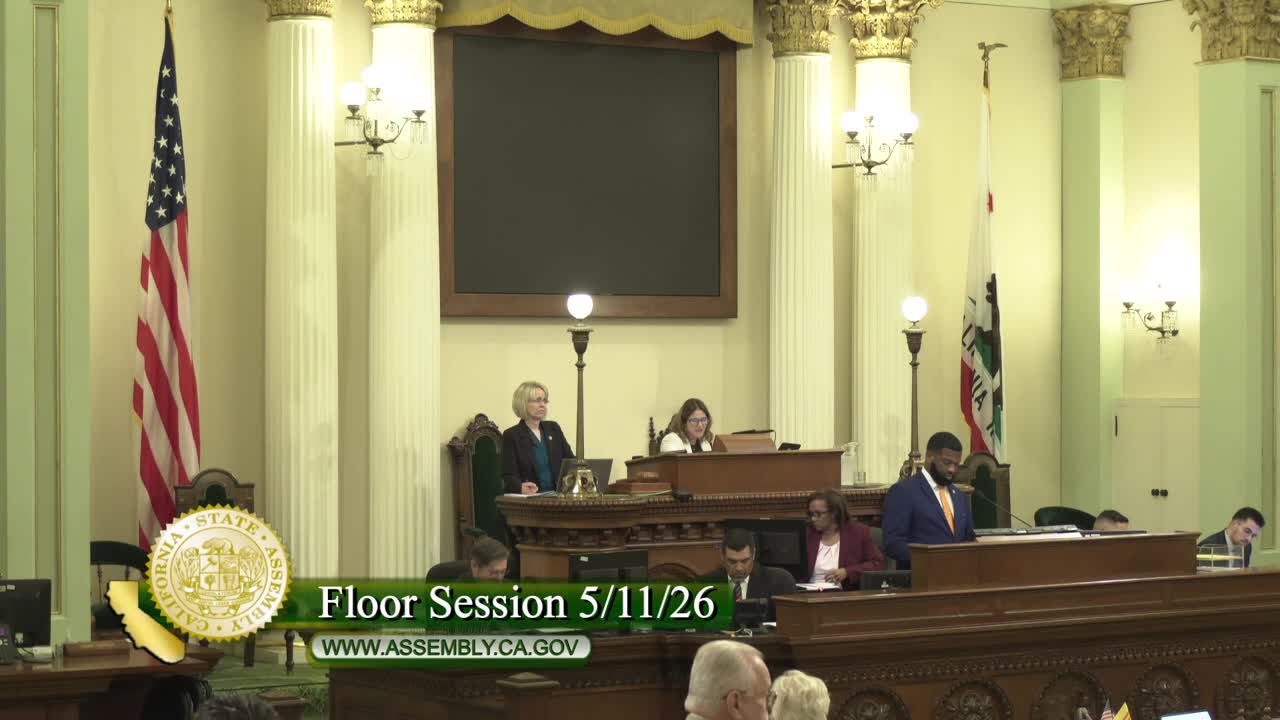
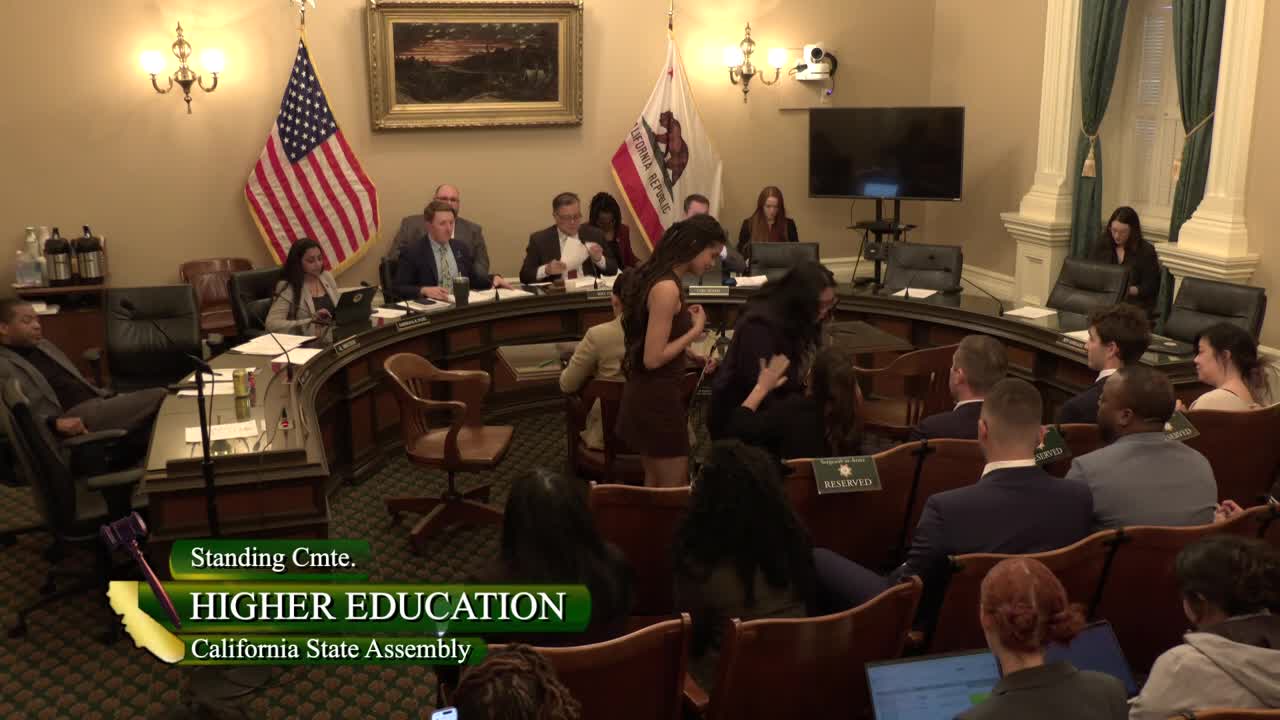
Bill Author
Bill Co-Author(s):