AB 1714: Personal income tax: credit: first-time homebuyer program: required repairs.
- Session Year: 2025-2026
- House: Assembly
- Latest Version Date: 2026-03-23
Current Status:
In Progress
(2026-04-27: In committee: Set, final hearing. Held under submission.)
Introduced
In Committee
Awaiting First Chamber Vote
Passed First Chamber
In Committee
Awaiting Second Chamber Vote
Passed Second Chamber
Enacted
The Personal Income Tax Law allows various credits against the taxes imposed by those laws.
This bill would allow a credit against those taxes for each taxable year beginning on or after January 1, 2028, and before January 1, 2033, in an amount equal to 40% of the amount paid or incurred, not to exceed $25,000, during the taxable year for repairs that are required as a condition of closing the sale of real property to a purchaser utilizing a first-time homebuyer assistance program, as specified. The bill would prohibit a taxpayer from claiming more than one credit for a taxable year or more than one taxpayer from claiming the credit with respect to a property for a taxable year.
Existing law requires any bill authorizing a new tax expenditure, as defined, to include tax credits, to contain, among other things, specific goals, purposes, and objectives that the tax credit will achieve, detailed performance indicators, and data collection requirements.
This bill would include findings and reporting requirements in compliance with this requirement.
This bill would take effect immediately as a tax levy.
The Personal Income Tax Law allows various credits against the taxes imposed by those laws.
This bill would allow a credit against those taxes for each taxable year beginning on or after January 1, 2028, and before January 1, 2033, in an amount equal to the amount paid or incurred, not to exceed $25,000, during the taxable year for repairs that are required as a condition of closing the sale of real property to a purchaser utilizing a first-time homebuyer assistance program, as specified.
Existing law requires any bill authorizing a new tax expenditure, as defined, to include tax credits, to contain, among other things, specific goals, purposes, and objectives that the tax credit will achieve, detailed performance indicators, and data collection requirements.
This bill would include findings and reporting requirements in compliance with this requirement.
This bill would take effect immediately as a tax levy.
(a) For each taxable year taxable years beginning on or after January 1, 2028, and before January 1, 2033, there shall be allowed as a credit against the net tax, as defined in Section 17039, an amount equal to 100 40 percent of the amount paid or incurred during the taxable year for qualified repair expenses by a taxpayer. The credit shall not taxpayer, not to exceed twenty-five thousand dollars ($25,000) per taxable year.
(b)For purposes of this section:
(1)Cosmetic improvements means modifications to residential real property that are intended solely to improve the visual appearance or aesthetic appeal of the property and that do not affect the structural integrity, safety, habitability, or essential systems of the property.
(1)(2)First-time homebuyer assistance program means any program under Chapter 11 (commencing with Section 51500) or Chapter 12 (commencing with Section 51520) of Part 3 of Division 31 of the Health and Safety Code.
(2)(3)(A)Qualified repair expenses means amounts paid or incurred during the taxable year by the seller for repairs that are required as a condition of closing the sale of real property to a purchaser utilizing a first-time homebuyer assistance program administered by the California Housing Finance Agency, including repairs identified by any of the following:
(i)A lender appraisal.
(ii)A property inspection report required by the lender.
(iii)Any health and safety requirement imposed as a condition of financing under a first-time homebuyer assistance program administered by the California Housing Finance Agency.
(B)Qualified repair expenses does not include cosmetic improvements, renovations, or upgrades not required as a condition of financing, including, but not limited to, remodeling, landscaping, or aesthetic enhancements.
(c)To be eligible for the credit allowed by this section, a taxpayer shall substantiate, in the form and manner prescribed by the Franchise Tax Board, all of the following:
(1)The repairs qualified repair expenses were required as a condition of closing the sale.
(2)The repairs qualified repair expenses were completed prior to or as part of the sale transaction.
(3)The purchaser utilized a first-time homebuyer assistance program administered by the California Housing Finance Agency.
(d)(1)A taxpayer shall claim no more than one credit allowed by this section in a taxable year.
(2)If real property for which qualified repair expenses are incurred is owned by more than one taxpayer, only one taxpayer shall claim the credit allowed by this section for the taxable year in which the qualified repair expenses are incurred.
(d)(e)If the credit allowed by this section exceeds the net tax, the excess may be carried over to reduce the net tax in the following taxable year, and succeeding years if necessary, until the credit is exhausted. up to five years.
(e)(f)For the purposes of complying with Section 41, the Legislature finds and declares all of the following:
(1)The specific goal, purpose, and objective of the tax credit allowed by this section is to reduce failed transactions and expand access to homeownership by offsetting unavoidable repair costs that disproportionately affect older housing stock and first-time buyers.
(2)The performance indicators for the Legislature to use when measuring whether the tax expenditure meets the goals, purposes, and objectives shall be the total number of returns claiming the credit and the aggregate dollar amount of credits claimed. allowed.
(3)The Franchise Tax Board shall analyze the performance indicators for each taxable year and shall report its findings on or before December 1, 2033, 2034, to the Legislature, in compliance with Section 9795 of the Government Code.
(4)The disclosure provisions of this subdivision shall be treated as an exception to Section 19542.
(f)(g)This section shall remain in effect only until December 1, 2033, and as of that date is repealed.
SEC. 2.This act provides for a tax levy within the meaning of Article IV of the California Constitution and shall go into immediate effect.
(a) For each taxable year beginning on or after January 1, 2028, and before January 1, 2033, there shall be allowed as a credit against the net tax, as defined in Section 17039, an amount equal to 100 percent of the amount paid or incurred during the taxable year for qualified repair expenses by a taxpayer. The credit shall not exceed twenty-five thousand dollars ($25,000) per taxable year.
(b) For purposes of this section:
(1)First-time homebuyer assistance program means any program under Chapter 11 (commencing with Section 51500) or Chapter 12 (commencing with Section 51520) of Part 3 of Division 31 of the Health and Safety Code.
(2)(A)Qualified repair expenses means amounts paid or incurred by the seller for repairs that are required as a condition of closing the sale of real property to a purchaser utilizing a first-time homebuyer assistance program administered by the California Housing Finance Agency, including repairs identified by any of the following:
(i)A lender appraisal.
(ii)A property inspection report required by the lender.
(iii)Any health and safety requirement imposed as a condition of financing under a first-time homebuyer assistance program administered by the California Housing Finance Agency.
(B)Qualified repair expenses does not include cosmetic improvements, renovations, or upgrades not required as a condition of financing, including, but not limited to, remodeling, landscaping, or aesthetic enhancements.
(c)To be eligible for the credit allowed by this section, a taxpayer shall substantiate, in the manner prescribed by the Franchise Tax Board, all of the following:
(1)The repairs were required as a condition of closing the sale.
(2)The repairs were completed prior to or as part of the sale transaction.
(3)The purchaser utilized a first-time homebuyer assistance program administered by the California Housing Finance Agency.
(d)If the credit allowed by this section exceeds the net tax, the excess may be carried over to reduce the net tax in the following taxable year, and succeeding years if necessary, until the credit is exhausted.
(e)For the purposes of complying with Section 41, the Legislature finds and declares all of the following:
(1)The specific goal, purpose, and objective of the tax credit allowed by this section is to reduce failed transactions and expand access to homeownership by offsetting unavoidable repair costs that disproportionately affect older housing stock and first-time buyers.
(2)The performance indicators for the Legislature to use when measuring whether the tax expenditure meets the goals, purposes, and objectives shall be the total number of returns claiming the credit and the aggregate dollar amount of credits claimed.
(3)The Franchise Tax Board shall analyze the performance indicators for each taxable year and shall report its findings on or before December 1, 2033, to the Legislature, in compliance with Section 9795 of the Government Code.
(4)The disclosure provisions of this subdivision shall be treated as an exception to Section 19542.
(f)This section shall remain in effect only until December 1, 2033, and as of that date is repealed.
SEC. 2.This act provides for a tax levy within the meaning of Article IV of the California Constitution and shall go into immediate effect.
|
Date
|
Status
|
|---|---|
| Apr 27, 2026 | In committee: Set, final hearing. Held under submission. |
| Apr 6, 2026 | In committee: Set, second hearing. Referred to REV. & TAX. suspense file. |
| Mar 24, 2026 | Re-referred to Com. on REV. & TAX. |
| Mar 23, 2026 | From committee chair, with author's amendments: Amend, and re-refer to Com. on REV. & TAX. Read second time and amended. |
| Mar 16, 2026 | In committee: Set, first hearing. Hearing canceled at the request of author. |
| Feb 23, 2026 | Referred to Com. on REV. & TAX. |
| Feb 5, 2026 | From printer. May be heard in committee March 7. |
| Feb 4, 2026 | Read first time. To print. |
This list shows positions taken on this bill by organizations on the date displayed, which is linked to the original source.
Positions by individuals are not included.
|
Organization
|
Position
|
Date
|
|---|---|---|
| California Federation Of Teachers | ** Against | |
| California Tax Reform Association | ** Against | |
| California Teachers Association | ** Against | |
| United Way Fresno and Madera Counties | ** Support |
Date of Hearing: April 27, 2026
ASSEMBLY COMMITTEE ON REVENUE AND TAXATION
Mike Gipson, Chair
ABPCA Bill Id:AB 1714 (
Author:Tangipa) – As Amended Ver:March 23, 2026
SUSPENSE
Majority vote. Tax levy. Fiscal committee.
SUBJECT: Personal income tax: credit: first-time homebuyer program: required repairs
SUMMARY: Authorizes a credit under the Personal Income Tax (PIT) Law for five years equal to 40% of the amount paid or incurred during the taxable year for certain repairs that are required as a condition of closing certain sales of real property. Specifically, this bill:
- Authorizes a credit under the PIT Law, for each taxable year beginning on or after January 1, 2028, and before January 1, 2033, equal to 40% of the amount paid or incurred during the taxable year for "qualified repair expenses" by a taxpayer.
- Limits the amount of credit to $25,000 per taxable year.
- Defines "qualified repair expenses" as amounts paid or incurred by the seller for repairs that are required as a condition of closing the sale of real property to a purchaser utilizing a "first-time homebuyer assistance program" administered by the California Housing Finance Agency (CalHFA), including repairs identified by any of the following:
- A lender appraisal;
- A property inspection report required by the lender; or,
- Any health and safety requirement imposed as a condition of financing under a first-time homebuyer assistance program administered by the CalHFA.
- Excludes from the definition of "qualified repair expenses" "cosmetic improvements," renovations, or upgrades not required as a condition of financing, including, but not limited to, remodeling, landscaping, or aesthetic enhancements.
- Defines "first-time homebuyer assistance program" as any program under the California Homebuyer's Downpayment Assistance Program or the California Dream for All Program (CDAP).
- Defines "cosmetic improvements" as modifications to residential real property that are intended solely to improve the visual appearance or aesthetic appeal of the property and that do not affect the structural integrity, safety, habitability, or essential systems of the property.
- Requires a taxpayer claiming the credit to substantiate, in the manner prescribed by the Franchise Tax Board (FTB), that:
- The repairs were required as a condition of closing the sale;
- The repairs were completed prior to or as a part of the sale transaction; and,
- The purchaser utilized a first-time homebuyer assistance program administered by the CalHFA.
- Authorizes excess amounts of unused credit to be carried forward to reduce liability in the following taxable year, and succeeding year if necessary, up to five years.
- Prohibits a taxpayer from claiming more than one credit in a taxable year.
- Limits the credit to only one taxpayer in a given taxable year if the real property for which the qualified repair expenses were incurred is owned by more than one taxpayer.
- Provides that, for the purposes of complying with Revenue and Taxation Code (R&TC) Section 41, the specific goal, purpose, and objective of this bill is to reduce failed transactions and expand access to homeownership by offsetting unavoidable repair costs that disproportionately affect older housing stock and first-time buyers.
- Requires the FTB to submit the total number of returns claiming this bill's credit and the aggregate amount of credits claimed pursuant to this bill for each taxable year to the Legislature by December 1, 2033, such that the Legislature may use those metrics to determine whether this bill's credit meets its stated goal, purpose, and objective.
- Takes immediate effect as a tax levy.
- Repeals this bill's provisions on December 1, 2033.
EXISTING LAW:
- Authorizes various credits under the PIT Law to incentivize certain actions the taxpayer may not otherwise take or to provide relief to certain taxpayers. (R&TC Section 17052 et. seq.)
- Requires the CalHFA to administer a home purchase assistance program for the purpose of assisting low- and moderate-income first-time homebuyers to qualify for the purchase of owner-occupied homes. Homeownership assistance includes, but is not limited to:
- An interest rate subsidy to reduce the interest rate;
- A deferred-payment, low-interest, subordinate mortgage loan, including downpayment assistance, closing-cost assistance, or both, to make financing affordable to low- and moderate-income homebuyers; and,
- Buying down the cost of mortgage insurance.
Any home purchase assistance must be paired with first mortgage loan financing, as specified. (Health and Safety Code (H&SC) Sections 51341 through 51349.)
- Establishes the CDAP to provide "shared appreciation loans" to assist qualified low- and moderate-income first-time homebuyers in purchasing owner-occupied homes, and requires the CalHFA to administer the CDAP. A "shared appreciation loan" is defined as a deferred -payment subordinate mortgage loan, the repayment of which is based on the amount of the subordinate loan plus the appreciation in the value of the home financed by the loan from the time of the purchase to the time the home is sold or refinanced. (H&SC 51520 through 51529.)
- Allows a deduction on the depreciation of qualifying business property, as specified. Any amount of deduction taken on the depreciation of a qualified business property must be offset by a reduction in the basis of that property. (IRC Section 167 and R&TC Section 17042.5(b).)
- Authorizes a deduction equal to the ordinary and necessary expenses paid or incurred during the taxable year in carrying on any trade or business, as specified. (IRC Section 162 and R&TC Section 17042.5(b).)
- Requires that certain costs with respect to certain properties must be capitalized. Capitalization is the method by which expenses incurred on certain property are included in that property's basis. (IRC Section 263A and R&TC Section 17042.5(b).)
- Requires that any proposed tax expenditure under the PIT Law stipulate:
- Specific goals, purposes, and objectives that the tax expenditure must meet;
- Detailed performance indicators for the Legislature to determine whether the tax expenditure meets its stated goal, purpose, and objective; and,
- Data collection requirements to enable the Legislature to receive the detailed performance indicators in order to determine the efficacy of the tax expenditure. (R&TC Section 41.)
FISCAL EFFECT: The FTB estimates that this bill would result in no revenue change in the 2026-27 fiscal year (FY), and a revenue loss of $4.5 million in FY 2027-28 and $9.2 million in FY 2028-29.
COMMENTS:
- The author has submitted the following statement in support of this bill:
Homeownership remains one of the most important pathways to financial stability and long-term wealth for California families. While programs like those offered through CalHFA help first-time buyers achieve this goal, barriers still prevent many of these transactions from being completed.
Lender-required repairs identified during escrow must often be completed before a mortgage can be finalized. In competitive housing markets, sellers may be unwilling or unable to absorb these costs, which can lead to failed escrows or discourage sellers from accepting offers from assisted buyers.
AB 1714 provides a tax credit to offset the cost of necessary repairs and improvements, helping expand the number of homes available to first-time buyers using homeownership assistance programs.
- United Ways of Fresno and Madera Counties, writing in support of this bill, states, in part:
This bill addresses a common point of failure in first-time homebuyer transactions: mandatory health and safety repairs identified through lender appraisals or inspections. These costs are often unavoidable, disproportionately affect older housing stock, and frequently cause otherwise viable sales to fall through. By allowing sellers to offset these required repair costs, the bill helps reduce failed escrows and expand access to homeownership without subsidizing cosmetic or discretionary improvements, while lowering the overall cost of homes.
- The California Federation of Teachers (CFT), writing in opposition to this bill, states, in part:
Funding for tax expenditures, such as tax credits, burdens California's public education system. For every dollar that is provided as a tax credit, approximately 40 cents of that dollar comes out of our classrooms. [The] CFT asserts that it is bad public policy to raid the funds that provide for our students, especially when it is education that can help prevent residents from facing financial situations that lead to being unhoused, for tax credits.
- Committee Staff Comments:
- Federal Housing Authority (FHA) loans: The FHA insures mortgage loans made by approved lenders to prospective homebuyers who may have insufficient credit, available cash for downpayment, or both. The program requires at least a 3.5% downpayment for buyers with a credit score above 580.
- US Department of Housing and Urban Development (HUD) Section 203(k) Program: Existing federal law allows mortgages issued by FHA-approved lenders to finance up to $75,000 in rehabilitation or renovations to a qualifying residential or mixed-use property.
- Pass-through entities: Certain business entities do not pay income tax at the entity level. Rather, the tax attributes of these businesses pass, or flow, through to the owner of the pass-through entity, and those tax attributes may generally be applied to the income tax return of the owner. Thus, credits, deductions, gains, losses, etc. may be applied to the income tax return of the owner of the pass-through entity.
- CalHFA MyHome Assistance Program: CalHFA administers a series of homebuyer assistance programs. The MyHome Assistance Program (MyHome), the program to assist low- and moderate-income first-time homebuyers generally, offers a deferred payment junior loan up to a certain percentage of the purchase price or appraised value to assist with down payment, closing costs, or both. Assuming a buyer meets the other requirements for a FHA loan, the downpayment assistance provided by CalHFA meets the minimum downpayment requirement to qualify for an FHA loan.
CalHFA does not issue mortgages directly, rather they partner with approved lenders who comply with certain federal requirements to secure financing for eligible homebuyers. The lender undertakes routine procedures to evaluate the financing available to the homebuyer based on standard criteria, such as credit score and income, similar to how a lender would evaluate a non-subsidized homebuyer. This mortgage pre-approval process provides the lender and buyer with some sense of the property the buyer can afford. Once a buyer determines they would like to purchase a home, they enter negotiations with the seller. This process culminates in a final sales contract, where the buyer and seller agree to the sale, pending certain final negotiations. At this point, a mortgage lender undertakes a final analysis of the buyer's relevant data to formally approve issuing a mortgage to that buyer.
Upon agreement of a final sales contract, and while the lender undertakes the process of final approval for a buyer's mortgage, a lender may make a reservation with CalHFA for downpayment assistance for that particular transaction on that particular property. If the sale is not finalized, the reservation must be cancelled and remade for a subsequent transaction.
The downpayment assistance attaches to the property as a subordinate mortgage loan, commonly referred to as a "silent second mortgage." Thus, when a homeowner who received downpayment assistance through MyHome sells that property, CalHFA is reimbursed for the downpayment assistance provided when that owner initially bought the property.
- CalHFA CDAP: The CDAP is a more targeted downpayment assistance program. Similar to MyHome, the program is directed at first-time homebuyers, but also requires that at least one of the buyers be a first-generation home buyer. A first-generation home buyer is one who has not been on title, held an ownership interest, or been named on a mortgage to a home in the last seven years and whose parents do not have a present ownership interest in a home or, if deceased, did not have any ownership interest at the time of their death.
Downpayment assistance through the CDAP is more generous, providing up to 20% of the purchase price of the home. Correspondingly, the reimbursement to the state is larger. Rather than recuperating the value of the assistance, this program vests the state with a share of the appreciated equity equal to the percentage of the assistance. In other words, a home that has appreciated $100,000 that received 20% downpayment assistance would result in $20,000 in appreciated value being returned to the state, plus the principal amount of assistance. Thus, while the CDAP is more generous on the front-end for qualifying homebuyers, it also requires larger reimbursement when disposing of the subsidized home.
- This bill: As currently drafted, this bill would authorize a credit equal to 40% of the amount paid or incurred during the taxable year by the seller of a home to a first-time homebuyer receiving assistance through certain CalHFA programs if those repairs are required as a condition of closing the sale.
The author notes that this bill is intended to help first-time homebuyers receiving downpayment assistance overcome barriers in the real estate transaction process. This Committee has not received any evidence substantiating that the cost of repairs is inhibiting the ability of eligible first-time homebuyers from successfully closing a transaction.
- Wait, how does this work? As noted above, CalHFA only provides downpayment assistance to homebuyers who have already been deemed to be eligible for a mortgage issued by lenders pre-approved by CalHFA. The requirements to determine whether a homebuyer is eligible are established by the lender, for their own liability determinations, and by the FHA, which stipulates the types of loans that they will insure. Thus, the CalHFA does not participate in the mortgage process. The CalHFA simply verifies that the mortgage complies with requirements established by other entities before issuing downpayment assistance.
- Standard transaction negotiations: In a standard real estate transaction, the buyer and seller enter into a final sales contract, subject to certain conditions that generally allow either signatory to terminate the transaction. These conditions include negotiating certain costs that may arise as the transaction unfolds. Some such costs arise from the evaluation of the property, often through a property inspection report. When these potential costs to remediate issues with the property arise, the buyer and seller will often negotiate additional terms to the contract to address those costs. Sometimes this will be a credit offered by the seller to the buyer to cover certain costs. Other times, the seller may choose to undertake those repairs themselves and not issue any consideration to the buyer for those repairs. Regardless, this type of negotiation occurs in the vast majority of real estate transactions.
When those issues arise and they represent a health and safety concern or a habitability concern, lenders often become less willing to assume the risk of that property. Lenders, when issuing a mortgage, use the underlying property as collateral should the mortgage borrower default for any reason. Thus, the lender, whether an approved CalHFA lender or a conventional lender, has a vested interest in ensuring the mortgaged property does not present a liability in excess of its value. As a result, sellers are generally heavily incentivized to correct these deficiencies regardless of the purchaser as lenders would be less likely to assume the liability of a property that cannot act as sufficient collateral to cover the mortgage amount, making that property more difficult to sell. Committee staff is unclear as to why the state should subsidize actions that sellers are already likely to undertake.
- Deficiency of supply or demand: This bill would reward sellers for taking certain actions when selling to qualifying first-time homebuyers, but it is not readily apparent that an acute supply deficiency is impeding transactions. Rather, it appears there is currently a lack of buyer demand. According to a California Housing Market Analysis published by Redfin, the state had a year-over-year (YOY) increase in the number of homes with price drops and a YOY decrease in the number of homes sold above list price[1]. This would suggest that sellers are reducing prices to attract demand from buyers. One might reasonably question whether incentivizing sellers to undertake certain repairs would meaningfully increase the rate at which first-time homebuyers receiving downpayment assistance successfully purchase a home if there is insufficient demand at current offering prices.
- Drafting considerations: As currently drafted, this bill raises a number of considerations. First, this bill references two different programs, the California Homebuyer's Downpayment Assistance Program and the CDAP. The statute authorizing the former program has been made inoperative and rolled into the general statutory construction directing the CalHFA to develop a downpayment assistance program. This requirement is stipulated in H&SC Division 31, Part 3, Chapter 6.8. The author may wish to reference the operative, rather than inoperative, downpayment assistance program.
The credit authorized by this bill would offset the repair costs associated with selling to certain first-time homebuyers. Presumably, this would allow a lower sales price for the home as the proponents of this bill note. This bill does not, however, require that the seller provide any consideration to the buyer as a condition of receiving the credit. As noted previously, these actions would likely already be taken by a seller. Thus, it appears this bill would simply reward sellers without any benefit to the purchaser. The Committee may wish to consider whether this bill's cost would better support first-time homebuyers by augmenting the existing CalHFA downpayment assistance programs.
This bill authorizes a credit under the PIT Law only. Individuals, limited partnerships, limited liability partnerships, and limited liability corporations not classified as corporations are subject to taxation under the PIT Law and would qualify for this bill's credit. Corporations or LLCs classified as corporations would not qualify. If the author's intent is to limit this credit to individuals, the author may wish to amend this bill.
- Double-dipping: Some property qualifying for this bill's credit may be business property, in the form of residential rental property. As such, these properties would benefit from certain tax treatment resulting from the repair costs this bill seeks to subsidize. While the type of benefit varies depending on whether the costs incurred are related to a repair or improvement, some consideration is provided for incurring these costs on business property under existing law. These benefits come in the form of an ordinary and necessary business expense deduction or capitalization of the costs into the basis of a depreciable business property. Thus, by providing a credit on those costs without limiting other tax benefits that consider those same costs, this bill provides a double-benefit to certain sellers of residential rental property.
- Implementation considerations: As currently drafted, this bill provides that if the property is owned by more than one taxpayer, only one taxpayer may claim the credit. This bill does not, however, specify the manner in which that determination would be made. For example, would the determination be based on the taxpayer that incurs the higher percentage of qualified repair expenses or another basis?
Additionally, this bill uses the terms "seller" and "taxpayer". For clarity, the author may wish to amend this bill to provide that a "qualified taxpayer" is eligible for this credit, and define a "qualified taxpayer" as "a taxpayer that sells property and pays or incurs qualified repair expenses" to limit those claiming the credit to only sellers of property if that is author's intent.
- Technical consideration: The current carry-forward language differs from carry-forward language elsewhere in the R&TC. For consistency, the author may wish to consider amending this bill to provide that the carryover provisions read "and the succeeding four years, until the credit is exhausted" if the author intends to have the credit carry-forward for five years.
- What is a "tax expenditure"? Existing law provides various credits, deductions, exclusions, and exemptions for particular taxpayer groups. In the late 1960s, United States Treasury officials began arguing that these features of the tax law should be referred to as "expenditures" since they are generally enacted to accomplish some governmental purpose and there is a determinable cost associated with each of them (in the form of forgone revenues). This bill would authorize a new credit under the PIT Law, thereby constituting a tax expenditure.
- Committee's tax expenditure policy: SB 1335 (Leno), Chapter 845, Statutes of 2014, added R&TC Section 41, which recognized that the Legislature should apply the same level of review used for government spending programs to tax credits introduced on or after January 1, 2015. AB 263 (Burke), Chapter 743, Statutes of 2019, extended the requirements in R&TC Section 41 to all tax expenditure measures under the PIT Law, the Corporation Tax Law, and the Sales and Use Tax Law introduced on or after January 1, 2020.
A tax expenditure proposal must outline specific goals, purposes, and objectives that the tax expenditure will achieve, along with detailed performance indicators for the Legislature to use when measuring whether the tax expenditure meets those stated goals, purposes, and objectives. In addition to the R&TC Section 41 requirements, this Committee's policy also requires that all tax expenditure proposals contain an appropriate sunset provision to be eligible for a vote[2]. Sunsets are required because eliminating a tax expenditure generally requires a 2/3rd vote. These requirements must be satisfied before a bill can receive a vote in this Committee. This bill contains an appropriate five-year sunset, and complies with the requirements of R&TC Section 41.
REGISTERED SUPPORT / OPPOSITION:
Support
United Way Fresno and Madera Counties
Opposition
California Federation of Teachers
California Tax Reform Association
California Teachers Association
Analysis Prepared by: Harrison Bowlby / REV. & TAX. / (916) 319-2098
Redfin, California Housing Market. https://www.redfin.com/state/California/housing-market (accessed March 2026). ↑
An "appropriate sunset provision" shall mean five years, except in the case of a tax expenditure measure providing relief to California veterans, in which case "appropriate sunset provision" shall mean 10 years. ↑
Date of Hearing: April 6, 2026
ASSEMBLY COMMITTEE ON REVENUE AND TAXATION
Mike Gipson, Chair
ABPCA Bill Id:AB 1714 (
Author:Tangipa) – As Amended Ver:March 23, 2026
Majority vote. Tax levy. Fiscal committee.
SUBJECT: Personal income tax: credit: first-time homebuyer program: required repairs
SUMMARY: Authorizes a credit under the Personal Income Tax (PIT) Law for five years equal to 40% of the amount paid or incurred during the taxable year for certain repairs that are required as a condition of closing certain sales of real property. Specifically, this bill:
- Authorizes a credit under the PIT Law, for each taxable year beginning on or after January 1, 2028, and before January 1, 2033, equal to 40% of the amount paid or incurred during the taxable year for "qualified repair expenses" by a taxpayer.
- Limits the amount of credit to $25,000 per taxable year.
- Defines "qualified repair expenses" as amounts paid or incurred by the seller for repairs that are required as a condition of closing the sale of real property to a purchaser utilizing a "first-time homebuyer assistance program" administered by the California Housing Finance Agency (CalHFA), including repairs identified by any of the following:
- A lender appraisal;
- A property inspection report required by the lender; or,
- Any health and safety requirement imposed as a condition of financing under a first-time homebuyer assistance program administered by the CalHFA.
- Excludes from the definition of "qualified repair expenses" "cosmetic improvements," renovations, or upgrades not required as a condition of financing, including, but not limited to, remodeling, landscaping, or aesthetic enhancements.
- Defines "first-time homebuyer assistance program" as any program under the California Homebuyer's Downpayment Assistance Program or the California Dream for All Program (CDAP).
- Defines "cosmetic improvements" as modifications to residential real property that are intended solely to improve the visual appearance or aesthetic appeal of the property and that do not affect the structural integrity, safety, habitability, or essential systems of the property.
- Requires a taxpayer claiming the credit to substantiate, in the manner prescribed by the Franchise Tax Board (FTB), that:
- The repairs were required as a condition of closing the sale;
- The repairs were completed prior to or as a part of the sale transaction; and,
- The purchaser utilized a first-time homebuyer assistance program administered by the CalHFA.
- Authorizes excess amounts of unused credit to be carried forward to reduce liability in the following taxable year, and succeeding year if necessary, up to five years.
- Prohibits a taxpayer from claiming more than one credit in a taxable year.
- Limits the credit to only one taxpayer in a given taxable year if the real property for which the qualified repair expenses were incurred is owned by more than one taxpayer.
- Provides that, for the purposes of complying with Revenue and Taxation Code (R&TC) Section 41, the specific goal, purpose, and objective of this bill is to reduce failed transactions and expand access to homeownership by offsetting unavoidable repair costs that disproportionately affect older housing stock and first-time buyers.
- Requires the FTB to submit the total number of returns claiming this bill's credit and the aggregate amount of credits claimed pursuant to this bill for each taxable year to the Legislature by December 1, 2033, such that the Legislature may use those metrics to determine whether this bill's credit meets its stated goal, purpose, and objective.
- Takes immediate effect as a tax levy.
- Repeals this bill's provisions on December 1, 2033.
EXISTING LAW:
- Authorizes various credits under the PIT Law to incentivize certain actions the taxpayer may not otherwise take or to provide relief to certain taxpayers. (R&TC Section 17052 et. seq.)
- Requires the CalHFA to administer a home purchase assistance program for the purpose of assisting low- and moderate-income first-time homebuyers to qualify for the purchase of owner-occupied homes. Homeownership assistance includes, but is not limited to:
- An interest rate subsidy to reduce the interest rate;
- A deferred-payment, low-interest, subordinate mortgage loan, including downpayment assistance, closing-cost assistance, or both, to make financing affordable to low- and moderate-income homebuyers; and,
- Buying down the cost of mortgage insurance.
Any home purchase assistance must be paired with first mortgage loan financing, as specified. (Health and Safety Code (H&SC) Sections 51341 through 51349.)
- Establishes the CDAP to provide "shared appreciation loans" to assist qualified low- and moderate-income first-time homebuyers in purchasing owner-occupied homes, and requires the CalHFA to administer the CDAP. A "shared appreciation loan" is defined as a deferred -payment subordinate mortgage loan, the repayment of which is based on the amount of the subordinate loan plus the appreciation in the value of the home financed by the loan from the time of the purchase to the time the home is sold or refinanced. (H&SC 51520 through 51529.)
- Allows a deduction on the depreciation of qualifying business property, as specified. Any amount of deduction taken on the depreciation of a qualified business property must be offset by a reduction in the basis of that property. (IRC Section 167 and R&TC Section 17042.5(b).)
- Authorizes a deduction equal to the ordinary and necessary expenses paid or incurred during the taxable year in carrying on any trade or business, as specified. (IRC Section 162 and R&TC Section 17042.5(b).)
- Requires that certain costs with respect to certain properties must be capitalized. Capitalization is the method by which expenses incurred on certain property are included in that property's basis. (IRC Section 263A and R&TC Section 17042.5(b).)
- Requires that any proposed tax expenditure under the PIT Law stipulate:
- Specific goals, purposes, and objectives that the tax expenditure must meet;
- Detailed performance indicators for the Legislature to determine whether the tax expenditure meets its stated goal, purpose, and objective; and,
- Data collection requirements to enable the Legislature to receive the detailed performance indicators in order to determine the efficacy of the tax expenditure. (R&TC Section 41.)
FISCAL EFFECT: The FTB estimates that this bill would result in no revenue change in the 2026-27 fiscal year (FY), and a revenue loss of $4.5 million in FY 2027-28 and $9.2 million in FY 2028-29.
COMMENTS:
- The author has submitted the following statement in support of this bill:
Homeownership remains one of the most important pathways to financial stability and long-term wealth for California families. While programs like those offered through CalHFA help first-time buyers achieve this goal, barriers still prevent many of these transactions from being completed.
Lender-required repairs identified during escrow must often be completed before a mortgage can be finalized. In competitive housing markets, sellers may be unwilling or unable to absorb these costs, which can lead to failed escrows or discourage sellers from accepting offers from assisted buyers.
AB 1714 provides a tax credit to offset the cost of necessary repairs and improvements, helping expand the number of homes available to first-time buyers using homeownership assistance programs.
- United Ways of Fresno and Madera Counties, writing in support of this bill, states, in part:
This bill addresses a common point of failure in first-time homebuyer transactions: mandatory health and safety repairs identified through lender appraisals or inspections. These costs are often unavoidable, disproportionately affect older housing stock, and frequently cause otherwise viable sales to fall through. By allowing sellers to offset these required repair costs, the bill helps reduce failed escrows and expand access to homeownership without subsidizing cosmetic or discretionary improvements, while lowering the overall cost of homes.
- The California Federation of Teachers (CFT), writing in opposition to this bill, states, in part:
Funding for tax expenditures, such as tax credits, burdens California's public education system. For every dollar that is provided as a tax credit, approximately 40 cents of that dollar comes out of our classrooms. [The] CFT asserts that it is bad public policy to raid the funds that provide for our students, especially when it is education that can help prevent residents from facing financial situations that lead to being unhoused, for tax credits.
- Committee Staff Comments:
- Federal Housing Authority (FHA) loans: The FHA insures mortgage loans made by approved lenders to prospective homebuyers who may have insufficient credit, available cash for downpayment, or both. The program requires at least a 3.5% downpayment for buyers with a credit score above 580.
- US Department of Housing and Urban Development (HUD) Section 203(k) Program: Existing federal law allows mortgages issued by FHA-approved lenders to finance up to $75,000 in rehabilitation or renovations to a qualifying residential or mixed-use property.
- Pass-through entities: Certain business entities do not pay income tax at the entity level. Rather, the tax attributes of these businesses pass, or flow, through to the owner of the pass-through entity, and those tax attributes may generally be applied to the income tax return of the owner. Thus, credits, deductions, gains, losses, etc. may be applied to the income tax return of the owner of the pass-through entity.
- CalHFA MyHome Assistance Program: CalHFA administers a series of homebuyer assistance programs. The MyHome Assistance Program (MyHome), the program to assist low- and moderate-income first-time homebuyers generally, offers a deferred payment junior loan up to a certain percentage of the purchase price or appraised value to assist with down payment, closing costs, or both. Assuming a buyer meets the other requirements for a FHA loan, the downpayment assistance provided by CalHFA meets the minimum downpayment requirement to qualify for an FHA loan.
CalHFA does not issue mortgages directly, rather they partner with approved lenders who comply with certain federal requirements to secure financing for eligible homebuyers. The lender undertakes routine procedures to evaluate the financing available to the homebuyer based on standard criteria, such as credit score and income, similar to how a lender would evaluate a non-subsidized homebuyer. This mortgage pre-approval process provides the lender and buyer with some sense of the property the buyer can afford. Once a buyer determines they would like to purchase a home, they enter negotiations with the seller. This process culminates in a final sales contract, where the buyer and seller agree to the sale, pending certain final negotiations. At this point, a mortgage lender undertakes a final analysis of the buyer's relevant data to formally approve issuing a mortgage to that buyer.
Upon agreement of a final sales contract, and while the lender undertakes the process of final approval for a buyer's mortgage, a lender may make a reservation with CalHFA for downpayment assistance for that particular transaction on that particular property. If the sale is not finalized, the reservation must be cancelled and remade for a subsequent transaction.
The downpayment assistance attaches to the property as a subordinate mortgage loan, commonly referred to as a "silent second mortgage." Thus, when a homeowner who received downpayment assistance through MyHome sells that property, CalHFA is reimbursed for the downpayment assistance provided when that owner initially bought the property.
- CalHFA CDAP: The CDAP is a more targeted downpayment assistance program. Similar to MyHome, the program is directed at first-time homebuyers, but also requires that at least one of the buyers be a first-generation home buyer. A first-generation home buyer is one who has not been on title, held an ownership interest, or been named on a mortgage to a home in the last seven years and whose parents do not have a present ownership interest in a home or, if deceased, did not have any ownership interest at the time of their death.
Downpayment assistance through the CDAP is more generous, providing up to 20% of the purchase price of the home. Correspondingly, the reimbursement to the state is larger. Rather than recuperating the value of the assistance, this program vests the state with a share of the appreciated equity equal to the percentage of the assistance. In other words, a home that has appreciated $100,000 that received 20% downpayment assistance would result in $20,000 in appreciated value being returned to the state, plus the principal amount of assistance. Thus, while the CDAP is more generous on the front-end for qualifying homebuyers, it also requires larger reimbursement when disposing of the subsidized home.
- This bill: As currently drafted, this bill would authorize a credit equal to 40% of the amount paid or incurred during the taxable year by the seller of a home to a first-time homebuyer receiving assistance through certain CalHFA programs if those repairs are required as a condition of closing the sale.
The author notes that this bill is intended to help first-time homebuyers receiving downpayment assistance overcome barriers in the real estate transaction process. This Committee has not received any evidence substantiating that the cost of repairs is inhibiting the ability of eligible first-time homebuyers from successfully closing a transaction.
- Wait, how does this work? As noted above, CalHFA only provides downpayment assistance to homebuyers who have already been deemed to be eligible for a mortgage issued by lenders pre-approved by CalHFA. The requirements to determine whether a homebuyer is eligible are established by the lender, for their own liability determinations, and by the FHA, which stipulates the types of loans that they will insure. Thus, the CalHFA does not participate in the mortgage process. The CalHFA simply verifies that the mortgage complies with requirements established by other entities before issuing downpayment assistance.
- Standard transaction negotiations: In a standard real estate transaction, the buyer and seller enter into a final sales contract, subject to certain conditions that generally allow either signatory to terminate the transaction. These conditions include negotiating certain costs that may arise as the transaction unfolds. Some such costs arise from the evaluation of the property, often through a property inspection report. When these potential costs to remediate issues with the property arise, the buyer and seller will often negotiate additional terms to the contract to address those costs. Sometimes this will be a credit offered by the seller to the buyer to cover certain costs. Other times, the seller may choose to undertake those repairs themselves and not issue any consideration to the buyer for those repairs. Regardless, this type of negotiation occurs in the vast majority of real estate transactions.
When those issues arise and they represent a health and safety concern or a habitability concern, lenders often become less willing to assume the risk of that property. Lenders, when issuing a mortgage, use the underlying property as collateral should the mortgage borrower default for any reason. Thus, the lender, whether an approved CalHFA lender or a conventional lender, has a vested interest in ensuring the mortgaged property does not present a liability in excess of its value. As a result, sellers are generally heavily incentivized to correct these deficiencies regardless of the purchaser as lenders would be less likely to assume the liability of a property that cannot act as sufficient collateral to cover the mortgage amount, making that property more difficult to sell. Committee staff is unclear as to why the state should subsidize actions that sellers are already likely to undertake.
- Deficiency of supply or demand: This bill would reward sellers for taking certain actions when selling to qualifying first-time homebuyers, but it is not readily apparent that an acute supply deficiency is impeding transactions. Rather, it appears there is currently a lack of buyer demand. According to a California Housing Market Analysis published by Redfin, the state had a year-over-year (YOY) increase in the number of homes with price drops and a YOY decrease in the number of homes sold above list price[1]. This would suggest that sellers are reducing prices to attract demand from buyers. One might reasonably question whether incentivizing sellers to undertake certain repairs would meaningfully increase the rate at which first-time homebuyers receiving downpayment assistance successfully purchase a home if there is insufficient demand at current offering prices.
- Drafting considerations: As currently drafted, this bill raises a number of considerations. First, this bill references two different programs, the California Homebuyer's Downpayment Assistance Program and the CDAP. The statute authorizing the former program has been made inoperative and rolled into the general statutory construction directing the CalHFA to develop a downpayment assistance program. This requirement is stipulated in H&SC Division 31, Part 3, Chapter 6.8. The author may wish to reference the operative, rather than inoperative, downpayment assistance program.
The credit authorized by this bill would offset the repair costs associated with selling to certain first-time homebuyers. Presumably, this would allow a lower sales price for the home as the proponents of this bill note. This bill does not, however, require that the seller provide any consideration to the buyer as a condition of receiving the credit. As noted previously, these actions would likely already be taken by a seller. Thus, it appears this bill would simply reward sellers without any benefit to the purchaser. The Committee may wish to consider whether this bill's cost would better support first-time homebuyers by augmenting the existing CalHFA downpayment assistance programs.
This bill authorizes a credit under the PIT Law only. Individuals, limited partnerships, limited liability partnerships, and limited liability corporations not classified as corporations are subject to taxation under the PIT Law and would qualify for this bill's credit. Corporations or LLCs classified as corporations would not qualify. If the author's intent is to limit this credit to individuals, the author may wish to amend this bill.
- Double-dipping: Some property qualifying for this bill's credit may be business property, in the form of residential rental property. As such, these properties would benefit from certain tax treatment resulting from the repair costs this bill seeks to subsidize. While the type of benefit varies depending on whether the costs incurred are related to a repair or improvement, some consideration is provided for incurring these costs on business property under existing law. These benefits come in the form of an ordinary and necessary business expense deduction or capitalization of the costs into the basis of a depreciable business property. Thus, by providing a credit on those costs without limiting other tax benefits that consider those same costs, this bill provides a double-benefit to certain sellers of residential rental property.
- Implementation considerations: As currently drafted, this bill provides that if the property is owned by more than one taxpayer, only one taxpayer may claim the credit. This bill does not, however, specify the manner in which that determination would be made. For example, would the determination be based on the taxpayer that incurs the higher percentage of qualified repair expenses or another basis?
Additionally, this bill uses the terms "seller" and "taxpayer". For clarity, the author may wish to amend this bill to provide that a "qualified taxpayer" is eligible for this credit, and define a "qualified taxpayer" as "a taxpayer that sells property and pays or incurs qualified repair expenses" to limit those claiming the credit to only sellers of property if that is author's intent.
- Technical consideration: The current carry-forward language differs from carry-forward language elsewhere in the R&TC. For consistency, the author may wish to consider amending this bill to provide that the carryover provisions read "and the succeeding four years, until the credit is exhausted" if the author intends to have the credit carry-forward for five years.
- What is a "tax expenditure"? Existing law provides various credits, deductions, exclusions, and exemptions for particular taxpayer groups. In the late 1960s, United States Treasury officials began arguing that these features of the tax law should be referred to as "expenditures" since they are generally enacted to accomplish some governmental purpose and there is a determinable cost associated with each of them (in the form of forgone revenues). This bill would authorize a new credit under the PIT Law, thereby constituting a tax expenditure.
- Committee's tax expenditure policy: SB 1335 (Leno), Chapter 845, Statutes of 2014, added R&TC Section 41, which recognized that the Legislature should apply the same level of review used for government spending programs to tax credits introduced on or after January 1, 2015. AB 263 (Burke), Chapter 743, Statutes of 2019, extended the requirements in R&TC Section 41 to all tax expenditure measures under the PIT Law, the Corporation Tax Law, and the Sales and Use Tax Law introduced on or after January 1, 2020.
A tax expenditure proposal must outline specific goals, purposes, and objectives that the tax expenditure will achieve, along with detailed performance indicators for the Legislature to use when measuring whether the tax expenditure meets those stated goals, purposes, and objectives. In addition to the R&TC Section 41 requirements, this Committee's policy also requires that all tax expenditure proposals contain an appropriate sunset provision to be eligible for a vote[2]. Sunsets are required because eliminating a tax expenditure generally requires a 2/3rd vote. These requirements must be satisfied before a bill can receive a vote in this Committee. This bill contains an appropriate five-year sunset, and complies with the requirements of R&TC Section 41.
REGISTERED SUPPORT / OPPOSITION:
Support
United Way Fresno and Madera Counties
Opposition
California Federation of Teachers
California Tax Reform Association
Analysis Prepared by: Harrison Bowlby / REV. & TAX. / (916) 319-2098
Redfin, California Housing Market. https://www.redfin.com/state/California/housing-market (accessed March 2026). ↑
An "appropriate sunset provision" shall mean five years, except in the case of a tax expenditure measure providing relief to California veterans, in which case "appropriate sunset provision" shall mean 10 years. ↑
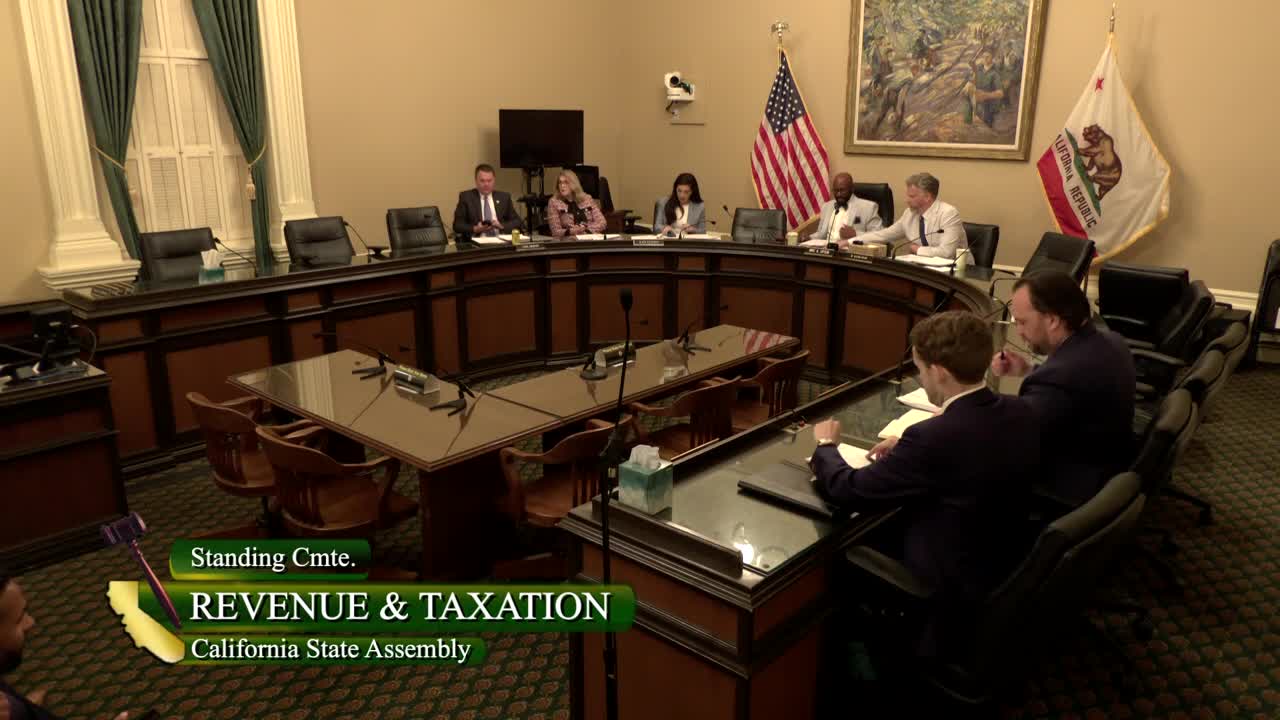
Discussed in Hearing
 8MIN
Assembly Standing Committee on Revenue and Taxation
Bill Author

Bill Co-Author(s):