AB 1732: California Environmental Quality Act: exemption: affordable housing projects: public university or public college housing projects.
- Session Year: 2025-2026
- House: Assembly
- Latest Version Date: 2026-09-29
Current Status:
Passed
(2026-09-29: Chaptered by Secretary of State - Chapter 792, Statutes of 2026.)
Introduced
In Committee
Awaiting First Chamber Vote
Passed First Chamber
In Committee
Awaiting Second Chamber Vote
Passed Second Chamber
Enacted
The California Environmental Quality Act (CEQA) requires a lead agency, as defined, to prepare, or cause to be prepared, and certify the completion of, an environmental impact report on a project that it proposes to carry out or approve that may have a significant effect on the environment or to adopt a negative declaration if it finds that the project will not have that effect. CEQA also requires a lead agency to prepare a mitigated negative declaration for a project that may have a significant effect on the environment if revisions in the project would avoid or mitigate that effect and there is no substantial evidence that the project, as revised, would have a significant effect on the environment.
CEQA, until January 1, 2033, exempts from its requirements certain actions for affordable housing projects that meet specified requirements, including confirmation by a public agency that, among other things, the project site satisfies specified requirements and a vacant project site does not contain tribal cultural resources that could be affected by the development that were found pursuant to a consultation and the effects of which cannot be mitigated, as provided.
This bill would extend the operation of the above-described exemption to January 1, 2037, and would expand the exemption to also include a public university or public college housing project, as defined, that meets specified requirements. Because the bill would extend the operation of the exemption and would increase duties on a lead agency related to the expansion of this exemption, the bill would impose a state-mandated local program.
The California Constitution requires the state to reimburse local agencies and school districts for certain costs mandated by the state. Statutory provisions establish procedures for making that reimbursement.
This bill would provide that no reimbursement is required by this act for a specified reason.
The California Environmental Quality Act (CEQA) requires a lead agency, as defined, to prepare, or cause to be prepared, and certify the completion of, an environmental impact report on a project that it proposes to carry out or approve that may have a significant effect on the environment or to adopt a negative declaration if it finds that the project will not have that effect. CEQA also requires a lead agency to prepare a mitigated negative declaration for a project that may have a significant effect on the environment if revisions in the project would avoid or mitigate that effect and there is no substantial evidence that the project, as revised, would have a significant effect on the environment.
CEQA exempts from its requirements certain housing development projects that meet specified conditions, including a condition that the project is consistent with the applicable general plan and zoning ordinance, as well as any applicable local coastal program. CEQA requires a local government to provide formal notification to each California Native American tribe that is traditionally and culturally affiliated with the project site as an invitation to consult on the proposed project, as provided.This bill would provide that a housing development project that is consistent with the applicable public higher education land use plan would also meet that condition. The bill would further provide that a housing development project that is not subject to an applicable general plan, zoning ordinance, or public higher education land use plan would satisfy that condition if there is substantial evidence that would allow a reasonable person to conclude that the housing development project meets specified conditions, including a condition that the project satisfies the statewide performance standards for infill projects, as provided. Because the bill would increase duties on a local government related to this exemption by expanding the exemption to additional projects, this bill would impose a state-mandated local program.CEQA, until January 1, 2033, exempts from its requirements certain actions for affordable housing projects that meet specified requirements, including confirmation by a public agency that, among other things, the project site satisfies specified requirements and a vacant project site does not contain tribal cultural resources that could be affected by the development that were found pursuant to a consultation and the effects of which cannot be mitigated, as provided.
This bill would extend the operation of the above-described exemption to January 1, 2037, and would expand the exemption to also include a public university or public college housing project, as defined, that meets specified requirements. Because the bill would extend the operation of the exemption and would increase duties on a lead agency related to the expansion of this exemption, the bill would impose a state-mandated local program.
The California Constitution requires the state to reimburse local agencies and school districts for certain costs mandated by the state. Statutory provisions establish procedures for making that reimbursement.
This bill would provide that no reimbursement is required by this act for a specified reason.
The California Environmental Quality Act (CEQA) requires a lead agency, as defined, to prepare, or cause to be prepared, and certify the completion of, an environmental impact report on a project that it proposes to carry out or approve that may have a significant effect on the environment or to adopt a negative declaration if it finds that the project will not have that effect. CEQA also requires a lead agency to prepare a mitigated negative declaration for a project that may have a significant effect on the environment if revisions in the project would avoid or mitigate that effect and there is no substantial evidence that the project, as revised, would have a significant effect on the environment.
CEQA, until January 1, 2033, exempts from its requirements certain actions for affordable housing projects that meet specified requirements, including confirmation by a public agency that, among other things, the project site satisfies specified requirements and a vacant project site does not contain tribal cultural resources that could be affected by the development that were found pursuant to a consultation and the effects of which cannot be mitigated, as provided.This bill would expand the above-described exemption to also include a public university or public college housing project, as defined, that meets specified requirements. The bill would delete the requirement relating to tribal cultural resources on a vacant project site and would instead require a lead agency to provide notice to, and consult with, California Native American tribes before approving or carrying out an affordable housing or public university or public college housing project, as provided. The bill would authorize the lead agency to impose conditions of approval on these housing projects to avoid or mitigate potential impacts to tribal cultural resources. The bill would require a lead agency, rather than a public agency, to make the confirmations described above. Because the bill would increase duties on a lead agency related to the expansion of this exemption, the bill would impose a state-mandated local program. The bill would extend the operation of these provisions to January 1, 2037.CEQA exempts from its requirements certain housing development projects that meet specified conditions, including a condition that the project is consistent with the applicable general plan and zoning ordinance, as well as any applicable local coastal program. CEQA requires a local government to provide formal notification to each California Native American tribe that is traditionally and culturally affiliated with the project site as an invitation to consult on the proposed project, as provided.
This bill would provide that a housing development project that is consistent with the applicable public higher education land use plan would also meet that condition. The bill would further provide that a housing development project that is not subject to an applicable general plan, zoning ordinance, or public higher education land use plan would satisfy that condition if there is substantial evidence that would allow a reasonable person to conclude that the housing development project meets specified conditions, including a condition that the project satisfies the statewide performance standards for infill projects, as provided. Because the bill would increase duties on a local government related to this exemption by expanding the exemption to additional projects, this bill would impose a state-mandated local program.
The California Constitution requires the state to reimburse local agencies and school districts for certain costs mandated by the state. Statutory provisions establish procedures for making that reimbursement.
This bill would provide that no reimbursement is required by this act for a specified reason.
The California Environmental Quality Act (CEQA) requires a lead agency, as defined, to prepare, or cause to be prepared, and certify the completion of, an environmental impact report on a project that it proposes to carry out or approve that may have a significant effect on the environment or to adopt a negative declaration if it finds that the project will not have that effect. CEQA also requires a lead agency to prepare a mitigated negative declaration for a project that may have a significant effect on the environment if revisions in the project would avoid or mitigate that effect and there is no substantial evidence that the project, as revised, would have a significant effect on the environment.
CEQA, until January 1, 2033, exempts from its requirements certain actions for affordable housing projects that meet specified requirements, including confirmation by a public agency that, among other things, the project site satisfies specified requirements and a vacant project site does not contain tribal cultural resources that could be affected by the development that were found pursuant to a consultation and the effects of which cannot be mitigated, as provided.
This bill would expand the above-described exemption to also include a public university or public college housing project, as defined, that meets specified requirements. The bill would delete the requirement relating to tribal cultural resources on a vacant project site and would instead require a lead agency to provide notice to, and consult with, California Native American tribes before approving or carrying out an affordable housing or public university or public college housing project, as provided. The bill would authorize the lead agency to impose conditions of approval on these housing projects to avoid or mitigate potential impacts to tribal cultural resources. The bill would require a lead agency, rather than a public agency, to make the confirmations described above. Because the bill would increase duties on a lead agency related to the expansion of this exemption, the bill would impose a state-mandated local program. The bill would extend the operation of these provisions to January 1, 2037.
The California Constitution requires the state to reimburse local agencies and school districts for certain costs mandated by the state. Statutory provisions establish procedures for making that reimbursement.
This bill would provide that no reimbursement is required by this act for a specified reason.
The California Environmental Quality Act (CEQA) requires a lead agency, as defined, to prepare, or cause to be prepared, and certify the completion of, an environmental impact report on a project that it proposes to carry out or approve that may have a significant effect on the environment or to adopt a negative declaration if it finds that the project will not have that effect. CEQA also requires a lead agency to prepare a mitigated negative declaration for a project that may have a significant effect on the environment if revisions in the project would avoid or mitigate that effect and there is no substantial evidence that the project, as revised, would have a significant effect on the environment.
CEQA exempts from its requirements certain housing development projects that meet specified conditions, including a condition that the project is consistent with the applicable general plan and zoning ordinance, as well as any applicable local coastal program. CEQA requires a local government to provide formal notification to each California Native American tribe that is traditionally and culturally affiliated with the project site as an invitation to consult on the proposed project, as provided.This bill would provide that a housing development project that is consistent with the applicable public higher education land use plan would also meet that condition. The bill would further provide that a housing development project that is not subject to an applicable general plan, zoning ordinance, or public higher education land use plan would satisfy that condition if there is substantial evidence that would allow a reasonable person to conclude that the housing development project meets specified conditions, including a condition that the project satisfies the statewide performance standards for infill projects, as provided. Because the bill would increase duties on a local government related to this exemption by expanding the exemption to additional projects, this bill would impose a state-mandated local program.CEQA, until January 1, 2033, exempts from its requirements certain actions for affordable housing projects that meet specified requirements, including confirmation by a public agency that, among other things, the project site satisfies specified requirements and a vacant project site does not contain tribal cultural resources that could be affected by the development that were found pursuant to a consultation and the effects of which cannot be mitigated, as provided.
This bill would expand the above-described exemption to also include a public university or public college housing project, as defined, that meets specified requirements. The bill would delete the requirement relating to tribal cultural resources on a vacant project site and would instead require a lead agency to provide notice to, and consult with, California Native American tribes before approving or carrying out an affordable housing or public university or public college housing project, as provided. The bill would authorize the lead agency to impose conditions of approval on these housing projects to avoid or mitigate potential impacts to tribal cultural resources. The bill would require a lead agency, rather than a public agency, to make the confirmations described above. Because the bill would increase duties on a lead agency related to the expansion of this exemption, the bill would impose a state-mandated local program. The bill would extend the operation of these provisions to January 1, 2037.
The California Constitution requires the state to reimburse local agencies and school districts for certain costs mandated by the state. Statutory provisions establish procedures for making that reimbursement.
This bill would provide that no reimbursement is required by this act for a specified reason.
The California Environmental Quality Act (CEQA) requires a lead agency, as defined, to prepare, or cause to be prepared, and certify the completion of, an environmental impact report on a project that it proposes to carry out or approve that may have a significant effect on the environment or to adopt a negative declaration if it finds that the project will not have that effect. CEQA also requires a lead agency to prepare a mitigated negative declaration for a project that may have a significant effect on the environment if revisions in the project would avoid or mitigate that effect and there is no substantial evidence that the project, as revised, would have a significant effect on the environment.
CEQA exempts from its requirements certain housing development projects that meet specified conditions, including a condition that the project is consistent with the applicable general plan and zoning ordinance, as well as any applicable local coastal program. CEQA requires a local government to provide formal notification to each California Native American tribe that is traditionally and culturally affiliated with the project site as an invitation to consult on the proposed project, as provided.
This bill would provide that a housing development project that is consistent with the applicable public higher education land use plan would also meet that condition. The bill would further provide that a housing development project that is not subject to an applicable general plan, zoning ordinance, or public higher education land use plan would satisfy that condition if there is substantial evidence that would allow a reasonable person to conclude that the housing development project meets specified conditions, including a condition that the project satisfies the statewide performance standards for infill projects, as provided. Because the bill would increase duties on a local government related to this exemption by expanding the exemption to additional projects, this bill would impose a state-mandated local program.
The California Constitution requires the state to reimburse local agencies and school districts for certain costs mandated by the state. Statutory provisions establish procedures for making that reimbursement.
This bill would provide that no reimbursement is required by this act for a specified reason.
(a)For purposes of this section, the following definitions apply:
(1)Affordable housing project means a project consisting of multifamily residential uses only or a mix of multifamily residential and nonresidential uses, with at least two-thirds of the square footage of the project designated for residential use, and that satisfies all of the following requirements:
(A)The project meets either of the following:
(i)All of the residential units within the project, excluding managers units, are dedicated to lower income households, as defined by Section 50079.5 of the Health and Safety Code.
(ii)The project complies with all of the requirements of Section 65914.7 of the Government Code.
(B)(i)The project meets the labor standards set forth in Section 65912.130 of the Government Code.
(ii)In addition to clause (i), for a project with 50 or more residential units, the project meets the labor standards set forth in Section 65912.131 of the Government Code.
(C)The project is located on a legal parcel or parcels in any of the following locations:
(i)In a city where the city boundaries include some portion of either an urbanized area or urban cluster, as designated by the United States Census Bureau, or in an unincorporated area, and the legal parcel or parcels are wholly within the boundaries of an urbanized area or urban cluster, as designated by the United States Census Bureau.
(ii)Within one-half mile walking distance to either a high-quality transit corridor or a major transit stop.
(iii)In a very low vehicle travel area.
(iv)Proximal to six or more amenities pursuant to paragraph (3) as of the date of submission of the application for the project.
(D)Parcels that are developed with urban uses adjoin at least 75 percent of the perimeter of the project site or at least three sides of a four-sided project site. For purposes of this subparagraph, parcels that are only separated by a street or highway shall be considered to be adjoined.
(2)High-quality transit corridor has the same meaning as set forth in subdivision (b) of Section 21155.
(3)Proximal to an amenity means either of the following:
(A)Within one-half mile of any of the following amenities:
(i)A bus station.
(ii)A ferry terminal.
(iii)A shuttle or bus stop operated by a public university or public college.
(B)Within one mile, or for a parcel in a rural area, as defined in Section 50199.21 of the Health and Safety Code, within two miles, of any of the following amenities:
(i)A supermarket or grocery store.
(ii)A public park.
(iii)A community center.
(iv)A pharmacy or drugstore.
(v)A medical clinic or hospital.
(vi)A public library.
(vii)A school that maintains a kindergarten or any of grades 1 to 12, inclusive.
(4)Public university or public college housing project means one or more housing facilities to be occupied by students, faculty, or staff of one or more campuses of the University of California, California State University, or California Community Colleges, including dining, academic, student support service spaces, and other necessary and usual attendant and related facilities and equipment, and that satisfies all of the following requirements:
(A)(i)The project meets the labor standards set forth in Section 65912.130 of the Government Code.
(ii)In addition to clause (i), for a project with 50 or more residential units, the project meets the labor standards set forth in Section 65912.131 of the Government Code.
(B)The project is located on a legal parcel or parcels in any of the following locations:
(i)In a city where the city boundaries include some portion of either an urbanized area or urban cluster, as designated by the United States Census Bureau, or in an unincorporated area, and the legal parcel or parcels are wholly within the boundaries of an urbanized area or urban cluster, as designated by the United States Census Bureau.
(ii)Within one-half mile walking distance to either a high-quality transit corridor or a major transit stop.
(iii)In a very low vehicle travel area.
(iv)Proximal to six or more amenities pursuant to subparagraph (B) of paragraph (3) as of the date of submission of the application for the project.
(C)Parcels that are developed with urban uses adjoin at least 75 percent of the perimeter of the project site or at least three sides of a four-sided project site. For purposes of this subparagraph, parcels that are only separated by a street or highway shall be considered to be adjoined.
(5)Vacant site means a site without any houses, offices, buildings, or other significant improvements on it.
(6)(A)Very low vehicle travel area means an urbanized area, as designated by the United States Census Bureau, where the existing residential development generates vehicle miles traveled per capita that is below 85 percent of either regional vehicle miles traveled per capita or city vehicle miles traveled per capita.
(B)For purposes of subparagraph (A), area may include a travel analysis zone, hexagon, or grid.
(C)For the purposes of determining regional vehicle miles traveled per capita pursuant to subparagraph (A), a region is the entirety of incorporated and unincorporated areas governed by a multicounty or single-county metropolitan planning organization, or the entirety of the incorporated and unincorporated areas of an individual county that is not part of a metropolitan planning organization.
(b)Subject to subdivision (c), this division does not apply to any of the following:
(1)The issuance of an entitlement by a public agency or lead agency for an affordable housing project or a public university or public college housing project.
(2)An action to lease, convey, or encumber land owned by a public agency or lead agency for an affordable housing project or a public university or public college housing project.
(3)An action to facilitate the lease, conveyance, or encumbrance of land owned or to be purchased by a public agency or lead agency for an affordable housing project or a public university or public college housing project.
(4)Rezoning, specific plan amendments, general plan amendments, or higher education land use plan amendments required specifically and exclusively to allow the construction of an affordable housing project or a public university or public college housing project.
(5)An action to provide financial assistance in furtherance of implementing an affordable housing project or a public university or public college housing project.
(c)Subdivision (b) applies if the action described in subdivision (b) requires the housing project to meet all of the following requirements:
(1)For an affordable housing project, the project will be subject to a recorded California Tax Credit Allocation Committee regulatory agreement. This requirement does not apply to affordable housing projects that comply with all of the requirements of Section 65914.7 of the Government Code.
(2)The housing project site can be adequately served by existing utilities or extensions.
(3)The lead agency confirms all of the following:
(A)The project site satisfies the requirements specified in subparagraphs (B) to (K), inclusive, of paragraph (6) of subdivision (a) of Section 65913.4 of the Government Code.
(B)For a vacant site, the project site does not contain tribal cultural resources that could be affected by the development that were found pursuant to a consultation described in Section 21080.3.1 and the effects of which cannot be mitigated pursuant to the process described in Section 21080.3.2.
(C)(i)The development proponent has completed a phase I environmental assessment, as defined in Section 78090 of the Health and Safety Code. If a recognized environmental condition is found, the development proponent shall undertake a preliminary endangerment assessment, as defined in Section 78095 of the Health and Safety Code, prepared by an environmental assessor to determine the existence of any release of a hazardous substance on the site and to determine the potential for exposure of future occupants to significant health hazards from any nearby property or activity.
(ii)If a release of a hazardous substance is found to exist on the site, the release shall be removed, or any significant effects of the release shall be mitigated to a level of insignificance in compliance with current state and federal requirements.
(iii)If a potential for exposure to significant hazards from surrounding properties or activities is found to exist, the effects of the potential exposure shall be mitigated to a level of insignificance in compliance with current state and federal requirements.
(D)For a project site where multifamily housing is not a permitted use, all of the following are met:
(i)None of the housing is located within 500 feet of a freeway, as defined in Section 332 of the Vehicle Code.
(ii)None of the housing is located within 3,200 feet of a facility that actively extracts or refines oil or natural gas.
(iii)The project site is not within a very high fire hazard severity zone, as indicated on maps adopted by the Department of Forestry and Fire Protection pursuant to Section 4202 or as designated pursuant to subdivisions (a) and (b) of Section 51179 of the Government Code.
(d)If a lead agency determines that an activity is not subject to this division pursuant to this section and determines to approve or carry out the activity, the lead agency shall file a notice of exemption with the Office of Planning and Research and the county clerk of the county in which the activity will occur in the manner specified in subdivisions (b) and (c) of Section 21108 or subdivisions (b) and (c) of Section 21152.
(e)This section shall remain in effect only until January 1, 2037, and as of that date is repealed.
SEC. 2.No reimbursement is required by this act pursuant to Section 6 of Article XIIIB of the California Constitution because a local agency or school district has the authority to levy service charges, fees, or assessments sufficient to pay for the program or level of service mandated by this act, within the meaning of Section 17556 of the Government Code.
(a)For purposes of this section, the following definitions apply:
(1)Affordable housing project means a project consisting of multifamily residential uses only or a mix of multifamily residential and nonresidential uses, with at least two-thirds of the square footage of the project designated for residential use, and that satisfies all of the following requirements:
(A)The project meets either of the following:
(i)All of the residential units within the project, excluding managers units, are dedicated to lower income households, as defined by Section 50079.5 of the Health and Safety Code.
(ii)The project complies with all of the requirements of Section 65914.7 of the Government Code.
(B)(i)The project meets the labor standards set forth in Section 65912.130 of the Government Code.
(ii)In addition to clause (i), for a project with 50 or more residential units, the project meets the labor standards set forth in Section 65912.131 of the Government Code.
(C)The project is located on a legal parcel or parcels in any of the following locations:
(i)In a city where the city boundaries include some portion of either an urbanized area or urban cluster, as designated by the United States Census Bureau, or in an unincorporated area, and the legal parcel or parcels are wholly within the boundaries of an urbanized area or urban cluster, as designated by the United States Census Bureau.
(ii)Within one-half mile walking distance to either a high-quality transit corridor or a major transit stop.
(iii)In a very low vehicle travel area.
(iv)Proximal to six or more amenities pursuant to paragraph (3) as of the date of submission of the application for the project.
(D)Parcels that are developed with urban uses adjoin at least 75 percent of the perimeter of the project site or at least three sides of a four-sided project site. For purposes of this paragraph, subparagraph, parcels that are only separated by a street or highway shall be considered to be adjoined.
(2)High-quality transit corridor has the same meaning as set forth in subdivision (b) of Section 21155.
(3)Proximal to an amenity means either of the following:
(A)Within one-half mile of any of the following amenities:
(i)A bus station.
(ii)A ferry terminal.
(iii)A shuttle or bus stop operated by a public university or public college.
(B)Within one mile, or for a parcel in a rural area, as defined in Section 50199.21 of the Health and Safety Code, within two miles, of any of the following amenities:
(i)A supermarket or grocery store.
(ii)A public park.
(iii)A community center.
(iv)A pharmacy or drugstore.
(v)A medical clinic or hospital.
(vi)A public library.
(vii)A school that maintains a kindergarten or any of grades 1 to 12, inclusive.
(4)Public university or public college housing project means one or more housing facilities to be occupied by students, faculty, or staff of one or more campuses of the University of California, California State University, or California Community Colleges, including dining, academic, student support service spaces, and other necessary and usual attendant and related facilities and equipment, and that satisfies all of the following requirements:
(A)(i)The project meets the labor standards set forth in Section 65912.130 of the Government Code.
(ii)In addition to clause (i), for a project with 50 or more residential units, the project meets the labor standards set forth in Section 65912.131 of the Government Code.
(B)The project is located on a legal parcel or parcels in any of the following locations:
(i)In a city where the city boundaries include some portion of either an urbanized area or urban cluster, as designated by the United States Census Bureau, or in an unincorporated area, and the legal parcel or parcels are wholly within the boundaries of an urbanized area or urban cluster, as designated by the United States Census Bureau.
(ii)Within one-half mile walking distance to either a high-quality transit corridor or a major transit stop.
(iii)In a very low vehicle travel area.
(iv)Proximal to six or more amenities pursuant to subparagraph (B) of paragraph (3) as of the date of submission of the application for the project.
(C)Parcels that are developed with urban uses adjoin at least 75 percent of the perimeter of the project site or at least three sides of a four-sided project site. For purposes of this paragraph, subparagraph, parcels that are only separated by a street or highway shall be considered to be adjoined.
(5)Vacant site means a site without any houses, offices, buildings, or other significant improvements on it.
(6)(A)Very low vehicle travel area means an urbanized area, as designated by the United States Census Bureau, where the existing residential development generates vehicle miles traveled per capita that is below 85 percent of either regional vehicle miles traveled per capita or city vehicle miles traveled per capita.
(B)For purposes of subparagraph (A), area may include a travel analysis zone, hexagon, or grid.
(C)For the purposes of determining regional vehicle miles traveled per capita pursuant to subparagraph (A), a region is the entirety of incorporated and unincorporated areas governed by a multicounty or single-county metropolitan planning organization, or the entirety of the incorporated and unincorporated areas of an individual county that is not part of a metropolitan planning organization.
(b)Subject to subdivision (c), this division does not apply to any of the following:
(1)The issuance of an entitlement by a public agency or lead agency for an affordable housing project or a public university or public college housing project.
(2)An action to lease, convey, or encumber land owned by a public agency or lead agency for an affordable housing project or a public university or public college housing project.
(3)An action to facilitate the lease, conveyance, or encumbrance of land owned or to be purchased by a public agency or lead agency for an affordable housing project or a public university or public college housing project.
(4)Rezoning, specific plan amendments, or general plan amendments, or higher education land use plan amendments required specifically and exclusively to allow the construction of an affordable housing project or a public university or public college housing project.
(5)An action to provide financial assistance in furtherance of implementing an affordable housing project or a public university or public college housing project.
(c)Subdivision (b) applies if the action described in subdivision (b) requires the housing project to meet all of the following requirements:
(1)For an affordable housing project, the project will be subject to a recorded California Tax Credit Allocation Committee regulatory agreement. This requirement does not apply to affordable housing projects that comply with all of the requirements of Section 65914.7 of the Government Code.
(2)The housing project site can be adequately served by existing utilities or extensions.
(3)The lead agency confirms all of the following:
(A)The project site satisfies the requirements specified in subparagraphs (B) to (K), inclusive, of paragraph (6) of subdivision (a) of Section 65913.4 of the Government Code.
(B)For a vacant site, the project site does not contain tribal cultural resources that could be affected by the development that were found pursuant to a consultation described in Section 21080.3.1 and the effects of which cannot be mitigated pursuant to the process described in Section 21080.3.2.
(C)(i)The development proponent has completed a phase I environmental assessment, as defined in Section 78090 of the Health and Safety Code. If a recognized environmental condition is found, the development proponent shall undertake a preliminary endangerment assessment, as defined in Section 78095 of the Health and Safety Code, prepared by an environmental assessor to determine the existence of any release of a hazardous substance on the site and to determine the potential for exposure of future occupants to significant health hazards from any nearby property or activity.
(ii)If a release of a hazardous substance is found to exist on the site, the release shall be removed, or any significant effects of the release shall be mitigated to a level of insignificance in compliance with current state and federal requirements.
(iii)If a potential for exposure to significant hazards from surrounding properties or activities is found to exist, the effects of the potential exposure shall be mitigated to a level of insignificance in compliance with current state and federal requirements.
(D)For a project site where multifamily housing is not a permitted use, all of the following are met:
(i)None of the housing is located within 500 feet of a freeway, as defined in Section 332 of the Vehicle Code.
(ii)None of the housing is located within 3,200 feet of a facility that actively extracts or refines oil or natural gas.
(iii)The project site is not within a very high fire hazard severity zone, as indicated on maps adopted by the Department of Forestry and Fire Protection pursuant to Section 4202 or as designated pursuant to subdivisions (a) and (b) of Section 51179 of the Government Code.
(d)If a lead agency determines that an activity is not subject to this division pursuant to this section and determines to approve or carry out the activity, the lead agency shall file a notice of exemption with the Office of Planning and Research and the county clerk of the county in which the activity will occur in the manner specified in subdivisions (b) and (c) of Section 21108 or subdivisions (b) and (c) of Section 21152.
(e)This section shall remain in effect only until January 1, 2037, and as of that date is repealed.
SEC. 2.No reimbursement is required by this act pursuant to Section 6 of Article XIIIB of the California Constitution because a local agency or school district has the authority to levy service charges, fees, or assessments sufficient to pay for the program or level of service mandated by this act, within the meaning of Section 17556 of the Government Code.
(a)For purposes of this section, the following definitions apply:
(1)Affordable housing project means a project consisting of multifamily residential uses only or a mix of multifamily residential and nonresidential uses, with at least two-thirds of the square footage of the project designated for residential use, and that satisfies all of the following requirements:
(A)The project meets either of the following:
(i)All of the residential units within the project, excluding managers units, are dedicated to lower income households, as defined by Section 50079.5 of the Health and Safety Code.
(ii)The project complies with all of the requirements of Section 65914.7 of the Government Code.
(B)(i)The project meets the labor standards set forth in Section 65912.130 of the Government Code.
(ii)In addition to clause (i), for a project with 50 or more residential units, the project meets the labor standards set forth in Section 65912.131 of the Government Code.
(C)The project is located on a legal parcel or parcels in any of the following locations:
(i)In a city where the city boundaries include some portion of either an urbanized area or urban cluster, as designated by the United States Census Bureau, or in an unincorporated area, and the legal parcel or parcels are wholly within the boundaries of an urbanized area or urban cluster, as designated by the United States Census Bureau.
(ii)Within one-half mile walking distance to either a high-quality transit corridor or a major transit stop.
(iii)In a very low vehicle travel area.
(iv)Proximal to six or more amenities pursuant to paragraph (3) as of the date of submission of the application for the project.
(D)Parcels that are developed with urban uses adjoin at least 75 percent of the perimeter of the project site or at least three sides of a four-sided project site. For purposes of this paragraph, parcels that are only separated by a street or highway shall be considered to be adjoined.
(2)High-quality transit corridor has the same meaning as set forth in subdivision (b) of Section 21155.
(3)Proximal to an amenity means either of the following:
(A)Within one-half mile of any of the following amenities:
(i)A bus station.
(ii)A ferry terminal.
(B)Within one mile, or for a parcel in a rural area, as defined in Section 50199.21 of the Health and Safety Code, within two miles, of any of the following amenities:
(i)A supermarket or grocery store.
(ii)A public park.
(iii)A community center.
(iv)A pharmacy or drugstore.
(v)A medical clinic or hospital.
(vi)A public library.
(vii)A school that maintains a kindergarten or any of grades 1 to 12, inclusive.
(4)Public university or public college housing project means one or more housing facilities to be occupied by students, faculty, or staff of one or more campuses of the University of California, California State University, or California Community Colleges, including dining, academic, student support service spaces, and other necessary and usual attendant and related facilities and equipment, and that satisfies all of the following requirements:
(A)(i)The project meets the labor standards set forth in Section 65912.130 of the Government Code.
(ii)In addition to clause (i), for a project with 50 or more residential units, the project meets the labor standards set forth in Section 65912.131 of the Government Code.
(B)The project is located on a legal parcel or parcels in any of the following locations:
(i)In a city where the city boundaries include some portion of either an urbanized area or urban cluster, as designated by the United States Census Bureau, or in an unincorporated area, and the legal parcel or parcels are wholly within the boundaries of an urbanized area or urban cluster, as designated by the United States Census Bureau.
(ii)Within one-half mile walking distance to either a high-quality transit corridor or a major transit stop.
(iii)In a very low vehicle travel area.
(iv)Proximal to six or more amenities pursuant to subparagraph (B) of paragraph (3) as of the date of submission of the application for the project.
(C)Parcels that are developed with urban uses adjoin at least 75 percent of the perimeter of the project site or at least three sides of a four-sided project site. For purposes of this paragraph, parcels that are only separated by a street or highway shall be considered to be adjoined.
(4)(5)Vacant site means a site without any houses, offices, buildings, or other significant improvements on it.
(5)(6)(A)Very low vehicle travel area means an urbanized area, as designated by the United States Census Bureau, where the existing residential development generates vehicle miles traveled per capita that is below 85 percent of either regional vehicle miles traveled per capita or city vehicle miles traveled per capita.
(B)For purposes of subparagraph (A), area may include a travel analysis zone, hexagon, or grid.
(C)For the purposes of determining regional vehicle miles traveled per capita pursuant to subparagraph (A), a region is the entirety of incorporated and unincorporated areas governed by a multicounty or single-county metropolitan planning organization, or the entirety of the incorporated and unincorporated areas of an individual county that is not part of a metropolitan planning organization.
(b)Subject to subdivision (c), this division does not apply to any of the following:
(1)The issuance of an entitlement by a public agency or lead agency for an affordable housing project. project or a public university or public college housing project.
(2)An action to lease, convey, or encumber land owned by a public agency or lead agency for an affordable housing project. project or a public university or public college housing project.
(3)An action to facilitate the lease, conveyance, or encumbrance of land owned or to be purchased by a public agency or lead agency for an affordable housing project. project or a public university or public college housing project.
(4)Rezoning, specific plan amendments, or general plan amendments required specifically and exclusively to allow the construction of an affordable housing project. project or a public university or public college housing project.
(5)An action to provide financial assistance in furtherance of implementing an affordable housing project. project or a public university or public college housing project.
(c)Subdivision (b) applies if the action described in subdivision (b) requires the affordable housing project to meet all of the following requirements:
(1)The For an affordable housing project, the project will be subject to a recorded California Tax Credit Allocation Committee regulatory agreement. This requirement does not apply to affordable housing projects that comply with all of the requirements of Section 65914.7 of the Government Code.
(2)The affordable housing project site can be adequately served by existing utilities or extensions.
(3)A public The lead agency confirms all of the following:
(A)The project site satisfies the requirements specified in subparagraphs (B) to (K), inclusive, of paragraph (6) of subdivision (a) of Section 65913.4 of the Government Code.
(B)For a vacant site, the project site does not contain tribal cultural resources that could be affected by the development that were found pursuant to a consultation described in Section 21080.3.1 and the effects of which cannot be mitigated pursuant to the process described in Section 21080.3.2.
(C)(i)The development proponent has completed a phase I environmental assessment, as defined in Section 25319.1 78090 of the Health and Safety Code. If a recognized environmental condition is found, the development proponent shall undertake a preliminary endangerment assessment, as defined in Section 25319.5 78095 of the Health and Safety Code, prepared by an environmental assessor to determine the existence of any release of a hazardous substance on the site and to determine the potential for exposure of future occupants to significant health hazards from any nearby property or activity.
(ii)If a release of a hazardous substance is found to exist on the site, the release shall be removed, or any significant effects of the release shall be mitigated to a level of insignificance in compliance with current state and federal requirements.
(iii)If a potential for exposure to significant hazards from surrounding properties or activities is found to exist, the effects of the potential exposure shall be mitigated to a level of insignificance in compliance with current state and federal requirements.
(D)For a project site where multifamily housing is not a permitted use, all of the following are met:
(i)None of the housing is located within 500 feet of a freeway, as defined in Section 332 of the Vehicle Code.
(ii)None of the housing is located within 3,200 feet of a facility that actively extracts or refines oil or natural gas.
(iii)The project site is not within a very high fire hazard severity zone, as indicated on maps adopted by the Department of Forestry and Fire Protection pursuant to Section 4202 or as designated pursuant to subdivisions (a) and (b) of Section 51179 of the Government Code.
(d)If a lead agency determines that an activity is not subject to this division pursuant to this section and determines to approve or carry out the activity, the lead agency shall file a notice of exemption with the Office of Planning and Research and the county clerk of the county in which the activity will occur in the manner specified in subdivisions (b) and (c) of Section 21108 or subdivisions (b) and (c) of Section 21152.
(e)This section shall remain in effect only until January 1, 2033, 2037, and as of that date is repealed.
SEC. 2.No reimbursement is required by this act pursuant to Section 6 of Article XIIIB of the California Constitution because a local agency or school district has the authority to levy service charges, fees, or assessments sufficient to pay for the program or level of service mandated by this act, within the meaning of Section 17556 of the Government Code.
SECTION 1.Section 21080.66 of the Public Resources Code is amended to read:21080.66.(a)Without limiting any other statutory or categorical exemption, this division does not apply to any aspect of a housing development project, as defined in subdivision (b) of Section 65905.5 of the Government Code, including any permits, approvals, or public improvements required for the housing development project, as may be required by this division, if the housing development project meets all of the following conditions:(1)(A)Except as provided in subparagraph (B), the project site is not more than 20 acres.(B)The project site or the parcel size for a builders remedy project, as defined in paragraph (11) of subdivision (h) of Section 65589.5 of the Government Code, or the project site or the parcel size for a project that applied pursuant to paragraph (5) of subdivision (d) of Section 65589.5 of the Government Code as it read before January 1, 2025, is not more than four acres.(2)The project site meets either of the following criteria:(A)Is located within the boundaries of an incorporated municipality.(B)Is located within an urban area, as defined by the United States Census Bureau.(3)The project site meets any of the following criteria:(A)Has been previously developed with an urban use.(B)At least 75 percent of the perimeter of the site adjoins parcels that are developed with urban uses.(C)At least 75 percent of the area within a one-quarter mile radius of the site is developed with urban uses.(D)For sites with four sides, at least three out of four sides are developed with urban uses and at least two-thirds of the perimeter of the site adjoins parcels that are developed with urban uses.(4)(A)The project is consistent with the applicable general plan and zoning ordinance or public higher education land use plan, as well as any applicable local coastal program as defined in Section 30108.6. For purposes of this section, a housing development project shall be deemed consistent with the applicable general plan and zoning ordinance or public higher education land use plan, and any applicable local coastal program, if there is substantial evidence that would allow a reasonable person to conclude that the housing development project is consistent.(B)If the zoning and general plan are not consistent with one another, a project shall be deemed consistent with both if the project is consistent with one.(C)The approval of a density bonus, incentives or concessions, waivers or reductions of development standards, and reduced parking ratios pursuant to Section 65915 of the Government Code shall not be grounds for determining that the project is inconsistent with the applicable general plan, zoning ordinance, or local coastal program.(D)For a housing development project that is not subject to an applicable general plan, zoning ordinance, or public higher education land use plan, the housing development project shall satisfy the requirements to meet the condition imposed by this paragraph if there is substantial evidence that would allow a reasonable person to conclude that the housing development project meets all of the following conditions:(i)The project is located in a land use zone, category, or designation that allows residential or mixed-use development in the general plan of the city, city and county, or unincorporated city or county in which the project is located.(ii)The project does not exceed the maximum allowable building height and density in the zoning code of the city, city and county, or unincorporated city or county in which the project is located.(iii)The project satisfies the statewide performance standards for infill projects, pursuant to paragraph (2) of subdivision (b) of Section 15183.3 and Appendix M of Chapter 3 (commencing with Section 15000) of Division 6 of Title 14 of the California Code of Regulations.(5)The project will be at least one-half of the applicable density specified in subparagraph (B) of paragraph (3) of subdivision (c) of Section 65583.2 of the Government Code.(6)The project satisfies the requirements specified in paragraph (6) of subdivision (a) of Section 65913.4 of the Government Code.(7)The project does not require the demolition of a historic structure that was placed on a national, state, or local historic register before the date a preliminary application was submitted for the project pursuant to Section 65941.1 of the Government Code.(8)For a project that was deemed complete pursuant to paragraph (5) of subdivision (h) of Section 65589.5 of the Government Code on or after January 1, 2025, no portion of the project is designated for use as a hotel, motel, bed and breakfast inn, or other transient lodging. For the purposes of this section, other transient lodging does not include either of the following:(A)A residential hotel, as defined in Section 50519 of the Health and Safety Code.(B)After the issuance of a certificate of occupancy, a residents use or marketing of a unit as short-term lodging, as defined in Section 17568.8 of the Business and Professions Code, in a manner consistent with local law.(b)(1)(A)A local government shall provide formal notification via certified mail and email to each California Native American tribe that is traditionally and culturally affiliated with the project site as an invitation to consult on the proposed project, its location, and the projects potential effects on tribal cultural resources pursuant to one of the following deadlines:(i)Within 14 days of the application for the project being deemed complete pursuant to paragraph (5) of subdivision (h) of Section 65589.5 of the Government Code.(ii)For projects whose applications were deemed complete pursuant to paragraph (5) of subdivision (h) of Section 65589.5 of the Government Code before July 1, 2026, within 14 days of notifying the local government that the project is eligible to be exempt from this division pursuant to this section.(B)The formal notification shall include all of the following:(i)Detailed project information to help inform the consultation, including site maps, proposed project scope, and any known cultural resource studies.(ii)Contact information for the local government.(iii)Contact information for the project proponent.(iv)Notice that the California Native American tribe has 60 days to request consultation with the local government pursuant to this subdivision.(2)(A)Each California Native American tribe has 60 days to notify the local government that it accepts the invitation to consult.(B)If a California Native American tribe chooses not to accept the invitation to consult, or does not notify the local government of its decision within 60 days, the consultation shall be considered to have concluded.(3)(A)Within 14 days of receiving the notification that the California Native American tribe has elected to consult, pursuant to subparagraph (A) of paragraph (2), the local government shall initiate the consultation.(B)During the consultation, the local government shall act in good faith to identify whether a tribal cultural resource could be affected by the proposed project and shall give deference to the tribal information, tribal knowledge and customs, and the significance of the resource to the California Native American tribe.(C)The project proponent may participate in the consultation with the approval of the California Native American tribe if the project proponent agrees to engage in good faith and comply with the confidentiality requirements of Sections 7927.000 and 7927.005 of the Government Code, subdivision (d) of Section 21082.3, subdivision (d) of Section 15120 of Title 14 of the California Code of Regulations, and any confidentiality standards adopted by the California Native American tribe participating in the consultation.(D)The consultation shall seek to find measures that would avoid significant impacts to a tribal cultural resource.(E)The local government shall document the results of the consultation.(F)The consultation shall conclude within 45 days of initiation, subject to a one-time 15-day extension upon request by a participating California Native American tribe.(4)The local government shall include, as binding conditions of the project approval, all of the following:(A)Any enforceable agreements reached during the project consultation.(B)All of the following measures, unless there is mutual agreement between the California Native American tribe and the project proponent not to include the measure as a binding condition:(i)Upon request by a California Native American tribe, the project shall include tribal monitoring during all ground-disturbing activities, as follows:(I)The California Native American tribe shall designate the monitor.(II)The tribal monitor shall comply with applicants site access and workplace safety requirements.(III)The applicant shall compensate the tribal monitor at a reasonable rate, determined in good faith, that aligns with customary compensation for cultural resource monitoring, taking into account factors such as the scope and duration of the project.(ii)Tribal cultural resources shall be avoided where feasible, in accordance with subdivision (a) of Section 21084.3. In furtherance of this requirement, where feasible, the project applicant shall provide deference to tribal preferences regarding access to spiritual, ceremonial, and burial sites, and incorporate tribal traditional knowledge in the protection and sustainable use of tribal cultural resources and landscapes.(iii)All treatment and documentation of tribal cultural resources shall be conducted in a culturally appropriate manner, consistent with Section 21083.9.(iv)A California Historical Resources Information System archaeological records search and a tribal cultural records search shall be completed for the project site.(v)A Sacred Lands Inventory request shall be submitted to the Native American Heritage Commission.(vi)The project shall comply with Section 7050.5 of the Health and Safety Code and Section 5097.98, including immediate work stoppage upon discovery of human remains or burial grounds, and treatment in accordance with applicable law and in consultation with the affected California Native American tribe.(vii)An application of tribal ecological knowledge into habitat restoration efforts undertaken by the project as applicable to the specific environmental context and conditions of the project.(5)For purposes of this subdivision, the following definitions apply:(A)California Native American tribe has the same meaning as defined in Section 21073.(B)Enforceable agreement means an agreement between the local government, project proponent, and any California Native American tribe that has engaged in consultation pursuant to this subdivision regarding the methods, measures, and conditions for tribal cultural resource identification, treatment, and protection, including consideration of avoidance. Compliance with the enforceable agreement shall be a required condition of approval for the project and its terms must be enforceable against the project proponent by the local government and the California Native American tribe.(C)Tribal cultural resource means a site, feature, place, cultural landscape, sacred place, including a Native American sanctified cemetery, Indian cemetery, or Indian burial area, or an object with cultural value to a California Native American tribe that is any of the following:(i)Included or eligible for inclusion in the California Register of Historical Resources or the National Register of Historic Places.(ii)Included in a local register of historical resources as defined in subdivision (k) of Section 5020.1.(iii)Identified by the Native American Heritage Commission as a sacred place pursuant to Section 5097.94 or 5097.96.(iv)Included in a local tribal register.(c)(1)(A)The local government shall, as a condition of approval for the development, require the development proponent to complete a phase I environmental assessment, as defined in Section 78090 of the Health and Safety Code.(B)If a recognized environmental condition is found, the development proponent shall complete a preliminary endangerment assessment, as defined in Section 78095 of the Health and Safety Code, prepared by an environmental assessor to determine the existence of any release of a hazardous substance on the site and to determine the potential for exposure of future occupants to significant health hazards from any nearby property or activity.(C)If a release of a hazardous substance is found to exist on the site, the release shall be removed or any effects of the release shall be mitigated to levels required by current federal and state statutory and regulatory standards before the local government issues a certificate of occupancy.(D)If a potential for exposure to significant hazards from surrounding properties or activities is found to exist, the effects of the potential exposure shall be mitigated to levels required by current federal and state statutory and regulatory standards before the local government issues a certificate of occupancy.(2)For any housing on the site located within 500 feet of a freeway, all of the following shall apply:(A)The building shall have a centralized heating, ventilation, and air-conditioning system.(B)The outdoor air intakes for the heating, ventilation, and air-conditioning system shall face away from the freeway.(C)The building shall provide air filtration media for outside and return air that provides a minimum efficiency reporting value of 16.(D)The air filtration media shall be replaced at the manufacturers designated interval.(E)The building shall not have any balconies facing the freeway.(d)(1)Notwithstanding any other law, all construction workers employed in the execution of a housing development project exempt from this division pursuant to this section where 100 percent of the units within the development project are dedicated to lower income households, as defined by Section 50079.5 of the Health and Safety Code, shall be paid at least the general prevailing rate of per diem wages for the type of work and geographic area, as determined by the Director of Industrial Relations pursuant to Sections 1773 and 1773.9 of the Labor Code, except that apprentices registered in programs approved by the Chief of the Division of Apprenticeship Standards may be paid at least the applicable apprentice prevailing rate, regardless of whether the housing development project is a public work.(2)Notwithstanding any other law, the labor standards of paragraph (8) of subdivision (a) of Section 65913.4 of the Government Code shall apply to buildings over 85 feet in height above grade in any housing development project exempt from this division pursuant to this section.(3)(A)Notwithstanding any other law, the labor standards of Article 4 (commencing with Section 65912.130) of Chapter 4.1 of Division 1 of Title 7 of the Government Code shall apply for projects of 50 units or greater in the City and County of San Francisco that are not covered by paragraph (2), for any construction craft where at least 50 percent of the units in market-rate multifamily housing projects that received their certificate of occupancy between 2022 and 2024, inclusive, were built by workers that were paid not less than the general prevailing rate of per diem wages.(B)For purposes of this section, market-rate multifamily housing development project means a housing development project of greater than 10 units where less than 95 percent of the units are dedicated to lower income households, as defined by Section 50079.5 of the Health and Safety Code.(C)(i)The eligibility of this subparagraph, by classification, will be determined by the Department of Industrial Relations and published on its internet website by January 1, 2026.(ii)In making a determination of eligibility pursuant to this subparagraph, the Director of Industrial Relations shall obtain and consider data from the labor organizations and employers or employer associations concerned no later than October 1, 2025.(iii)To determine the number of market-rate multifamily housing projects that received their certificate of occupancy in a given year, the Department of Industrial Relations shall use the annual progress report data as reported by the jurisdiction pursuant to Section 65400 of the Government Code.(4)The provisions of Section 218.8 of the Labor Code shall extend to the development proponent in addition to the direct contractor or subcontractor. For purposes of this paragraph, development proponent shall mean a developer who submits the housing development project application to a local government that is exempt from this division pursuant to this section.(5)(A)A joint labor-management cooperation committee established pursuant to the federal Labor Management Cooperation Act of 1978 (29 U.S.C. Sec. 175a) may undertake any of the following on a housing development project that is exempt from this division pursuant to this section:(i)Bring an action in a court of competent jurisdiction against a contractor or subcontractor at any tier on behalf of construction workers employed by the contractor or subcontractor on a housing development project that is exempt from this division pursuant to this section to enforce Section 226 of the Labor Code. A contractor is not subject to an action pursuant to this subparagraph due to the failure of a subcontractor to comply with Section 226 of the Labor Code.(ii)Bring an action in a court of competent jurisdiction on behalf of an affected employee against an employer for damages as if Division 4 (commencing with Section 3200) of the Labor Code did not apply, if the employer fails to secure the payment of compensation as required by Article 1 (commencing with Section 3700) of Chapter 4 of Part 1 of Division 4 of the Labor Code.(iii)In addition to the remedies set forth in Section 7028.3 of the Business and Professions Code, on proper showing by a joint labor-management cooperation committee of a continuing violation of Chapter 9 (commencing with Section 7000) of Division 3 of the Business and Professions Code by a person who constructs a housing project and does not hold a state contractors license in any classification, an injunction shall issue by a court specified in Section 7028.3 of the Business and Professions Code at the request of the joint labor-management cooperation committee, prohibiting that violation.(B)For any action brought pursuant to this paragraph, the court shall award a prevailing joint labor-management committee its reasonable attorneys fees and costs incurred maintaining the action.(C)An action brought pursuant to this paragraph shall be filed within one year of a local government issuing a certificate of occupancy for the housing development project or for the portion relating to the action.(D)This paragraph shall apply only to violations that occur on the site of construction of the housing development project.(e)This section does not affect the eligibility of a housing development project for a density bonus, incentives or concessions, waivers or reductions of development standards, and reduced parking ratios pursuant to Section 65915 of the Government Code.(f)If a lead agency determines that this division does not apply to an activity pursuant to this section and determines to approve or carry out the activity, the lead agency shall file a notice of exemption with the Governors Office of Land Use and Climate Innovation and the county clerk of the county in which the activity will occur in the manner specified in subdivisions (b) and (c) of Section 21108 or subdivisions (b) and (c) of Section 21152, as applicable.(g)For purposes of this section, the following terms apply:(1)Adjoins includes parcels that are only separated by a street, pedestrian path, or bicycle path.(2)Construction worker means one performing onsite work associated with construction, including work involving alteration, demolition, building, excavation, renovation, remodeling, maintenance, improvement, repair work, and any other work as described by Chapter 9 (commencing with Section 7000) of Division 3 of the Business and Professions Code, and other similar or related occupations or trades.(3)Urban use means any current or previous residential or commercial development, public institution, or public park that is surrounded by other urban uses, parking lot or structure, transit or transportation passenger facility, or retail use, or any combination of those uses.SEC. 2.No reimbursement is required by this act pursuant to Section 6 of Article XIIIB of the California Constitution because a local agency or school district has the authority to levy service charges, fees, or assessments sufficient to pay for the program or level of service mandated by this act, within the meaning of Section 17556 of the Government Code.(a)Without limiting any other statutory or categorical exemption, this division does not apply to any aspect of a housing development project, as defined in subdivision (b) of Section 65905.5 of the Government Code, including any permits, approvals, or public improvements required for the housing development project, as may be required by this division, if the housing development project meets all of the following conditions:
(1)(A)Except as provided in subparagraph (B), the project site is not more than 20 acres.
(B)The project site or the parcel size for a builders remedy project, as defined in paragraph (11) of subdivision (h) of Section 65589.5 of the Government Code, or the project site or the parcel size for a project that applied pursuant to paragraph (5) of subdivision (d) of Section 65589.5 of the Government Code as it read before January 1, 2025, is not more than four acres.
(2)The project site meets either of the following criteria:
(A)Is located within the boundaries of an incorporated municipality.
(B)Is located within an urban area, as defined by the United States Census Bureau.
(3)The project site meets any of the following criteria:
(A)Has been previously developed with an urban use.
(B)At least 75 percent of the perimeter of the site adjoins parcels that are developed with urban uses.
(C)At least 75 percent of the area within a one-quarter mile radius of the site is developed with urban uses.
(D)For sites with four sides, at least three out of four sides are developed with urban uses and at least two-thirds of the perimeter of the site adjoins parcels that are developed with urban uses.
(4)(A)The project is consistent with the applicable general plan and zoning ordinance, ordinance or public higher education land use plan, as well as any applicable local coastal program as defined in Section 30108.6. For purposes of this section, a housing development project shall be deemed consistent with the applicable general plan and zoning ordinance, ordinance or public higher education land use plan, and any applicable local coastal program, if there is substantial evidence that would allow a reasonable person to conclude that the housing development project is consistent.
(B)If the zoning and general plan are not consistent with one another, a project shall be deemed consistent with both if the project is consistent with one.
(C)The approval of a density bonus, incentives or concessions, waivers or reductions of development standards, and reduced parking ratios pursuant to Section 65915 of the Government Code shall not be grounds for determining that the project is inconsistent with the applicable general plan, zoning ordinance, or local coastal program.
(D)For a housing development project that is not subject to an applicable general plan, zoning ordinance, or public higher education land use plan, the housing development project shall satisfy the requirements to meet the condition imposed by this paragraph if there is substantial evidence that would allow a reasonable person to conclude that the housing development project meets all of the following conditions:
(i)The project is located in a land use zone, category, or designation that allows residential or mixed-use development in the general plan of the city, city and county, or unincorporated city or county in which the project is located.
(ii)The project does not exceed the maximum allowable building height and density in the zoning code of the city, city and county, or unincorporated city or county in which the project is located.
(iii)The project satisfies the statewide performance standards for infill projects, pursuant to paragraph (2) of subdivision (b) of Section 15183.3 and Appendix M of Chapter 3 (commencing with Section 15000) of Division 6 of Title 14 of the California Code of Regulations.
(5)The project will be at least one-half of the applicable density specified in subparagraph (B) of paragraph (3) of subdivision (c) of Section 65583.2 of the Government Code.
(6)The project satisfies the requirements specified in paragraph (6) of subdivision (a) of Section 65913.4 of the Government Code.
(7)The project does not require the demolition of a historic structure that was placed on a national, state, or local historic register before the date a preliminary application was submitted for the project pursuant to Section 65941.1 of the Government Code.
(8)For a project that was deemed complete pursuant to paragraph (5) of subdivision (h) of Section 65589.5 of the Government Code on or after January 1, 2025, no portion of the project is designated for use as a hotel, motel, bed and breakfast inn, or other transient lodging. For the purposes of this section, other transient lodging does not include either of the following:
(A)A residential hotel, as defined in Section 50519 of the Health and Safety Code.
(B)After the issuance of a certificate of occupancy, a residents use or marketing of a unit as short-term lodging, as defined in Section 17568.8 of the Business and Professions Code, in a manner consistent with local law.
(b)(1)(A)A local government shall provide formal notification via certified mail and email to each California Native American tribe that is traditionally and culturally affiliated with the project site as an invitation to consult on the proposed project, its location, and the projects potential effects on tribal cultural resources pursuant to one of the following deadlines:
(i)Within 14 days of the application for the project being deemed complete pursuant to paragraph (5) of subdivision (h) of Section 65589.5 of the Government Code.
(ii)For projects whose applications were deemed complete pursuant to paragraph (5) of subdivision (h) of Section 65589.5 of the Government Code before July 1, 2026, within 14 days of notifying the local government that the project is eligible to be exempt from this division pursuant to this section.
(B)The formal notification shall include all of the following:
(i)Detailed project information to help inform the consultation, including site maps, proposed project scope, and any known cultural resource studies.
(ii)Contact information for the local government.
(iii)Contact information for the project proponent.
(iv)Notice that the California Native American tribe has 60 days to request consultation with the local government pursuant to this subdivision.
(2)(A)Each California Native American tribe has 60 days to notify the local government that it accepts the invitation to consult.
(B)If a California Native American tribe chooses not to accept the invitation to consult, or does not notify the local government of its decision within 60 days, the consultation shall be considered to have concluded.
(3)(A)Within 14 days of receiving the notification that the California Native American tribe has elected to consult, pursuant to subparagraph (A) of paragraph (2), the local government shall initiate the consultation.
(B)During the consultation, the local government shall act in good faith to identify whether a tribal cultural resource could be affected by the proposed project and shall give deference to the tribal information, tribal knowledge and customs, and the significance of the resource to the California Native American tribe.
(C)The project proponent may participate in the consultation with the approval of the California Native American tribe if the project proponent agrees to engage in good faith and comply with the confidentiality requirements of Sections 7927.000 and 7927.005 of the Government Code, subdivision (d) of Section 21082.3, subdivision (d) of Section 15120 of Title 14 of the California Code of Regulations, and any confidentiality standards adopted by the California Native American tribe participating in the consultation.
(D)The consultation shall seek to find measures that would avoid significant impacts to a tribal cultural resource.
(E)The local government shall document the results of the consultation.
(F)The consultation shall conclude within 45 days of initiation, subject to a one-time 15-day extension upon request by a participating California Native American tribe.
(4)The local government shall include, as binding conditions of the project approval, all of the following:
(A)Any enforceable agreements reached during the project consultation.
(B)All of the following measures, unless there is mutual agreement between the California Native American tribe and the project proponent not to include the measure as a binding condition:
(i)Upon request by a California Native American tribe, the project shall include tribal monitoring during all ground-disturbing activities, as follows:
(I)The California Native American tribe shall designate the monitor.
(II)The tribal monitor shall comply with applicants site access and workplace safety requirements.
(III)The applicant shall compensate the tribal monitor at a reasonable rate, determined in good faith, that aligns with customary compensation for cultural resource monitoring, taking into account factors such as the scope and duration of the project.
(ii)Tribal cultural resources shall be avoided where feasible, in accordance with subdivision (a) of Section 21084.3. In furtherance of this requirement, where feasible, the project applicant shall provide deference to tribal preferences regarding access to spiritual, ceremonial, and burial sites, and incorporate tribal traditional knowledge in the protection and sustainable use of tribal cultural resources and landscapes.
(iii)All treatment and documentation of tribal cultural resources shall be conducted in a culturally appropriate manner, consistent with Section 21083.9.
(iv)A California Historical Resources Information System archaeological records search and a tribal cultural records search shall be completed for the project site.
(v)A Sacred Lands Inventory request shall be submitted to the Native American Heritage Commission.
(vi)The project shall comply with Section 7050.5 of the Health and Safety Code and Section 5097.98, including immediate work stoppage upon discovery of human remains or burial grounds, and treatment in accordance with applicable law and in consultation with the affected California Native American tribe.
(vii)An application of tribal ecological knowledge into habitat restoration efforts undertaken by the project as applicable to the specific environmental context and conditions of the project.
(5)For purposes of this subdivision, the following definitions apply:
(A)California Native American tribe has the same meaning as defined in Section 21073.
(B)Enforceable agreement means an agreement between the local government, project proponent, and any California Native American tribe that has engaged in consultation pursuant to this subdivision regarding the methods, measures, and conditions for tribal cultural resource identification, treatment, and protection, including consideration of avoidance. Compliance with the enforceable agreement shall be a required condition of approval for the project and its terms must be enforceable against the project proponent by the local government and the California Native American tribe.
(C)Tribal cultural resource means a site, feature, place, cultural landscape, sacred place, including a Native American sanctified cemetery, Indian cemetery, or Indian burial area, or an object with cultural value to a California Native American tribe that is any of the following:
(i)Included or eligible for inclusion in the California Register of Historical Resources or the National Register of Historic Places.
(ii)Included in a local register of historical resources as defined in subdivision (k) of Section 5020.1.
(iii)Identified by the Native American Heritage Commission as a sacred place pursuant to Section 5097.94 or 5097.96.
(iv)Included in a local tribal register.
(c)(1)(A)The local government shall, as a condition of approval for the development, require the development proponent to complete a phase I environmental assessment, as defined in Section 78090 of the Health and Safety Code.
(B)If a recognized environmental condition is found, the development proponent shall complete a preliminary endangerment assessment, as defined in Section 78095 of the Health and Safety Code, prepared by an environmental assessor to determine the existence of any release of a hazardous substance on the site and to determine the potential for exposure of future occupants to significant health hazards from any nearby property or activity.
(C)If a release of a hazardous substance is found to exist on the site, the release shall be removed or any effects of the release shall be mitigated to levels required by current federal and state statutory and regulatory standards before the local government issues a certificate of occupancy.
(D)If a potential for exposure to significant hazards from surrounding properties or activities is found to exist, the effects of the potential exposure shall be mitigated to levels required by current federal and state statutory and regulatory standards before the local government issues a certificate of occupancy.
(2)For any housing on the site located within 500 feet of a freeway, all of the following shall apply:
(A)The building shall have a centralized heating, ventilation, and air-conditioning system.
(B)The outdoor air intakes for the heating, ventilation, and air-conditioning system shall face away from the freeway.
(C)The building shall provide air filtration media for outside and return air that provides a minimum efficiency reporting value of 16.
(D)The air filtration media shall be replaced at the manufacturers designated interval.
(E)The building shall not have any balconies facing the freeway.
(d)(1)Notwithstanding any other law, all construction workers employed in the execution of a housing development project exempt from this division pursuant to this section where 100 percent of the units within the development project are dedicated to lower income households, as defined by Section 50079.5 of the Health and Safety Code, shall be paid at least the general prevailing rate of per diem wages for the type of work and geographic area, as determined by the Director of Industrial Relations pursuant to Sections 1773 and 1773.9 of the Labor Code, except that apprentices registered in programs approved by the Chief of the Division of Apprenticeship Standards may be paid at least the applicable apprentice prevailing rate, regardless of whether the housing development project is a public work.
(2)Notwithstanding any other law, the labor standards of paragraph (8) of subdivision (a) of Section 65913.4 of the Government Code shall apply to buildings over 85 feet in height above grade in any housing development project exempt from this division pursuant to this section.
(3)(A)Notwithstanding any other law, the labor standards of Article 4 (commencing with Section 65912.130) of Chapter 4.1 of Division 1 of Title 7 of the Government Code shall apply for projects of 50 units or greater in the City and County of San Francisco that are not covered by paragraph (2), for any construction craft where at least 50 percent of the units in market-rate multifamily housing projects that received their certificate of occupancy between 2022 and 2024, inclusive, were built by workers that were paid not less than the general prevailing rate of per diem wages.
(B)For purposes of this section, market-rate multifamily housing development project means a housing development project of greater than 10 units where less than 95 percent of the units are dedicated to lower income households, as defined by Section 50079.5 of the Health and Safety Code.
(C)(i)The eligibility of this subparagraph, by classification, will be determined by the Department of Industrial Relations and published on its internet website by January 1, 2026.
(ii)In making a determination of eligibility pursuant to this subparagraph, the Director of Industrial Relations shall obtain and consider data from the labor organizations and employers or employer associations concerned no later than October 1, 2025.
(iii)To determine the number of market-rate multifamily housing projects that received their certificate of occupancy in a given year, the Department of Industrial Relations shall use the annual progress report data as reported by the jurisdiction pursuant to Section 65400 of the Government Code.
(4)The provisions of Section 218.8 of the Labor Code shall extend to the development proponent in addition to the direct contractor or subcontractor. For purposes of this paragraph, development proponent shall mean a developer who submits the housing development project application to a local government that is exempt from this division pursuant to this section.
(5)(A)A joint labor-management cooperation committee established pursuant to the federal Labor Management Cooperation Act of 1978 (29 U.S.C. Sec. 175a) may undertake any of the following on a housing development project that is exempt from this division pursuant to this section:
(i)Bring an action in a court of competent jurisdiction against a contractor or subcontractor at any tier on behalf of construction workers employed by the contractor or subcontractor on a housing development project that is exempt from this division pursuant to this section to enforce Section 226 of the Labor Code. A contractor is not subject to an action pursuant to this subparagraph due to the failure of a subcontractor to comply with Section 226 of the Labor Code.
(ii)Bring an action in a court of competent jurisdiction on behalf of an affected employee against an employer for damages as if Division 4 (commencing with Section 3200) of the Labor Code did not apply, if the employer fails to secure the payment of compensation as required by Article 1 (commencing with Section 3700) of Chapter 4 of Part 1 of Division 4 of the Labor Code.
(iii)In addition to the remedies set forth in Section 7028.3 of the Business and Professions Code, on proper showing by a joint labor-management cooperation committee of a continuing violation of Chapter 9 (commencing with Section 7000) of Division 3 of the Business and Professions Code by a person who constructs a housing project and does not hold a state contractors license in any classification, an injunction shall issue by a court specified in Section 7028.3 of the Business and Professions Code at the request of the joint labor-management cooperation committee, prohibiting that violation.
(B)For any action brought pursuant to this paragraph, the court shall award a prevailing joint labor-management committee its reasonable attorneys fees and costs incurred maintaining the action.
(C)An action brought pursuant to this paragraph shall be filed within one year of a local government issuing a certificate of occupancy for the housing development project or for the portion relating to the action.
(D)This paragraph shall apply only to violations that occur on the site of construction of the housing development project.
(e)This section does not affect the eligibility of a housing development project for a density bonus, incentives or concessions, waivers or reductions of development standards, and reduced parking ratios pursuant to Section 65915 of the Government Code.
(f)If a lead agency determines that this division does not apply to an activity pursuant to this section and determines to approve or carry out the activity, the lead agency shall file a notice of exemption with the Governors Office of Land Use and Climate Innovation and the county clerk of the county in which the activity will occur in the manner specified in subdivisions (b) and (c) of Section 21108 or subdivisions (b) and (c) of Section 21152, as applicable.
(g)For purposes of this section, the following terms apply:
(1)Adjoins includes parcels that are only separated by a street, pedestrian path, or bicycle path.
(2)Construction worker means one performing onsite work associated with construction, including work involving alteration, demolition, building, excavation, renovation, remodeling, maintenance, improvement, repair work, and any other work as described by Chapter 9 (commencing with Section 7000) of Division 3 of the Business and Professions Code, and other similar or related occupations or trades.
(3)Urban use means any current or previous residential or commercial development, public institution, or public park that is surrounded by other urban uses, parking lot or structure, transit or transportation passenger facility, or retail use, or any combination of those uses.
SEC. 2.No reimbursement is required by this act pursuant to Section 6 of Article XIIIB of the California Constitution because a local agency or school district has the authority to levy service charges, fees, or assessments sufficient to pay for the program or level of service mandated by this act, within the meaning of Section 17556 of the Government Code.
SECTION 1.Section 21080.40 of the Public Resources Code is amended to read:21080.40.(a)For purposes of this section, the following definitions apply:(1)Affordable housing project means a project consisting of multifamily residential uses only or a mix of multifamily residential and nonresidential uses, with at least two-thirds of the square footage of the project designated for residential use, and that satisfies all of the following requirements:(A)The project meets either of the following:(i)All of the residential units within the project, excluding managers units, are dedicated to lower income households, as defined by Section 50079.5 of the Health and Safety Code.(ii)The project complies with all of the requirements of Section 65914.7 of the Government Code.(B)(i)The project meets the labor standards set forth in Section 65912.130 of the Government Code.(ii)In addition to clause (i), for a project with 50 or more residential units, the project meets the labor standards set forth in Section 65912.131 of the Government Code.(C)The project is located on a legal parcel or parcels in any of the following locations:(i)In a city where the city boundaries include some portion of either an urbanized area or urban cluster, as designated by the United States Census Bureau, or in an unincorporated area, and the legal parcel or parcels are wholly within the boundaries of an urbanized area or urban cluster, as designated by the United States Census Bureau.(ii)Within one-half mile walking distance to either a high-quality transit corridor or a major transit stop.(iii)In a very low vehicle travel area.(iv)Proximal to six or more amenities pursuant to paragraph (3) as of the date of submission of the application for the project.(D)Parcels that are developed with urban uses adjoin at least 75 percent of the perimeter of the project site or at least three sides of a four-sided project site. For purposes of this paragraph, parcels that are only separated by a street or highway shall be considered to be adjoined.(2)High-quality transit corridor has the same meaning as set forth in subdivision (b) of Section 21155.(3)Proximal to an amenity means either of the following:(A)Within one-half mile of any of the following amenities:(i)A bus station.(ii)A ferry terminal.(B)Within one mile, or for a parcel in a rural area, as defined in Section 50199.21 of the Health and Safety Code, within two miles, of any of the following amenities:(i)A supermarket or grocery store.(ii)A public park.(iii)A community center.(iv)A pharmacy or drugstore.(v)A medical clinic or hospital.(vi)A public library.(vii)A school that maintains a kindergarten or any of grades 1 to 12, inclusive.(4)Public university or public college housing project means one or more housing facilities to be occupied by students, faculty, or staff of one or more campuses of the University of California, California State University, or California Community Colleges, including dining, academic, student support service spaces, and other necessary and usual attendant and related facilities and equipment, and that satisfies all of the following requirements:(A)(i)The project meets the labor standards set forth in Section 65912.130 of the Government Code.(ii)In addition to clause (i), for a project with 50 or more residential units, the project meets the labor standards set forth in Section 65912.131 of the Government Code.(B)The project is located on a legal parcel or parcels in any of the following locations:(i)In a city where the city boundaries include some portion of either an urbanized area or urban cluster, as designated by the United States Census Bureau, or in an unincorporated area, and the legal parcel or parcels are wholly within the boundaries of an urbanized area or urban cluster, as designated by the United States Census Bureau.(ii)Within one-half mile walking distance to either a high-quality transit corridor or a major transit stop.(iii)In a very low vehicle travel area.(iv)Proximal to six or more amenities pursuant to subparagraph (B) of paragraph (3) as of the date of submission of the application for the project.(C)Parcels that are developed with urban uses adjoin at least 75 percent of the perimeter of the project site or at least three sides of a four-sided project site. For purposes of this paragraph, parcels that are only separated by a street or highway shall be considered to be adjoined.(5)Vacant site means a site without any houses, offices, buildings, or other significant improvements on it.(6)(A)Very low vehicle travel area means an urbanized area, as designated by the United States Census Bureau, where the existing residential development generates vehicle miles traveled per capita that is below 85 percent of either regional vehicle miles traveled per capita or city vehicle miles traveled per capita.(B)For purposes of subparagraph (A), area may include a travel analysis zone, hexagon, or grid.(C)For the purposes of determining regional vehicle miles traveled per capita pursuant to subparagraph (A), a region is the entirety of incorporated and unincorporated areas governed by a multicounty or single-county metropolitan planning organization, or the entirety of the incorporated and unincorporated areas of an individual county that is not part of a metropolitan planning organization.(b)Subject to subdivision (c), this division does not apply to any of the following:(1)The issuance of an entitlement by a public agency or lead agency for an affordable housing project or a public university or public college housing project.(2)An action to lease, convey, or encumber land owned by a public agency or lead agency for an affordable housing project or a public university or public college housing project.(3)An action to facilitate the lease, conveyance, or encumbrance of land owned or to be purchased by a public agency or lead agency for an affordable housing project or a public university or public college housing project.(4)Rezoning, specific plan amendments, or general plan amendments required specifically and exclusively to allow the construction of an affordable housing project or a public university or public college housing project.(5)An action to provide financial assistance in furtherance of implementing an affordable housing project or a public university or public college housing project.(c)Subdivision (b) applies if the action described in subdivision (b) requires the housing project to meet all of the following requirements:(1)For an affordable housing project, the project will be subject to a recorded California Tax Credit Allocation Committee regulatory agreement. This requirement does not apply to affordable housing projects that comply with all of the requirements of Section 65914.7 of the Government Code.(2)The housing project site can be adequately served by existing utilities or extensions.(3)The lead agency confirms all of the following:(A)The project site satisfies the requirements specified in subparagraphs (B) to (K), inclusive, of paragraph (6) of subdivision (a) of Section 65913.4 of the Government Code.(B)(i)The development proponent has completed a phase I environmental assessment, as defined in Section 78090 of the Health and Safety Code. If a recognized environmental condition is found, the development proponent shall undertake a preliminary endangerment assessment, as defined in Section 78095 of the Health and Safety Code, prepared by an environmental assessor to determine the existence of any release of a hazardous substance on the site and to determine the potential for exposure of future occupants to significant health hazards from any nearby property or activity.(ii)If a release of a hazardous substance is found to exist on the site, the release shall be removed, or any significant effects of the release shall be mitigated to a level of insignificance in compliance with current state and federal requirements.(iii)If a potential for exposure to significant hazards from surrounding properties or activities is found to exist, the effects of the potential exposure shall be mitigated to a level of insignificance in compliance with current state and federal requirements.(C)For a project site where multifamily housing is not a permitted use, all of the following are met:(i)None of the housing is located within 500 feet of a freeway, as defined in Section 332 of the Vehicle Code.(ii)None of the housing is located within 3,200 feet of a facility that actively extracts or refines oil or natural gas.(iii)The project site is not within a very high fire hazard severity zone, as indicated on maps adopted by the Department of Forestry and Fire Protection pursuant to Section 4202 or as designated pursuant to subdivisions (a) and (b) of Section 51179 of the Government Code.(d)The lead agency shall provide notice to, and consult with, California Native American tribes in accordance with Sections 21074, 21080.3.1, 21080.3.2, 21082.3, 21084.2, and 21084.3 before approving or carrying out a project pursuant to this section, and a lead agency may impose conditions or approval on the project to avoid or mitigate potential impacts to tribal cultural resources.(e)If a lead agency determines that an activity is not subject to this division pursuant to this section and determines to approve or carry out the activity, the lead agency shall file a notice of exemption with the Office of Planning and Research and the county clerk of the county in which the activity will occur in the manner specified in subdivisions (b) and (c) of Section 21108 or subdivisions (b) and (c) of Section 21152.(f)This section shall remain in effect only until January 1, 2037, and as of that date is repealed.SEC. 2.No reimbursement is required by this act pursuant to Section 6 of Article XIIIB of the California Constitution because a local agency or school district has the authority to levy service charges, fees, or assessments sufficient to pay for the program or level of service mandated by this act, within the meaning of Section 17556 of the Government Code.(a)For purposes of this section, the following definitions apply:
(1)Affordable housing project means a project consisting of multifamily residential uses only or a mix of multifamily residential and nonresidential uses, with at least two-thirds of the square footage of the project designated for residential use, and that satisfies all of the following requirements:
(A)The project meets either of the following:
(i)All of the residential units within the project, excluding managers units, are dedicated to lower income households, as defined by Section 50079.5 of the Health and Safety Code.
(ii)The project complies with all of the requirements of Section 65914.7 of the Government Code.
(B)(i)The project meets the labor standards set forth in Section 65912.130 of the Government Code.
(ii)In addition to clause (i), for a project with 50 or more residential units, the project meets the labor standards set forth in Section 65912.131 of the Government Code.
(C)The project is located on a legal parcel or parcels in any of the following locations:
(i)In a city where the city boundaries include some portion of either an urbanized area or urban cluster, as designated by the United States Census Bureau, or in an unincorporated area, and the legal parcel or parcels are wholly within the boundaries of an urbanized area or urban cluster, as designated by the United States Census Bureau.
(ii)Within one-half mile walking distance to either a high-quality transit corridor or a major transit stop.
(iii)In a very low vehicle travel area.
(iv)Proximal to six or more amenities pursuant to paragraph (3) as of the date of submission of the application for the project.
(D)Parcels that are developed with urban uses adjoin at least 75 percent of the perimeter of the project site or at least three sides of a four-sided project site. For purposes of this paragraph, parcels that are only separated by a street or highway shall be considered to be adjoined.
(2)High-quality transit corridor has the same meaning as set forth in subdivision (b) of Section 21155.
(3)Proximal to an amenity means either of the following:
(A)Within one-half mile of any of the following amenities:
(i)A bus station.
(ii)A ferry terminal.
(B)Within one mile, or for a parcel in a rural area, as defined in Section 50199.21 of the Health and Safety Code, within two miles, of any of the following amenities:
(i)A supermarket or grocery store.
(ii)A public park.
(iii)A community center.
(iv)A pharmacy or drugstore.
(v)A medical clinic or hospital.
(vi)A public library.
(vii)A school that maintains a kindergarten or any of grades 1 to 12, inclusive.
(4)Public university or public college housing project means one or more housing facilities to be occupied by students, faculty, or staff of one or more campuses of the University of California, California State University, or California Community Colleges, including dining, academic, student support service spaces, and other necessary and usual attendant and related facilities and equipment, and that satisfies all of the following requirements:
(A)(i)The project meets the labor standards set forth in Section 65912.130 of the Government Code.
(ii)In addition to clause (i), for a project with 50 or more residential units, the project meets the labor standards set forth in Section 65912.131 of the Government Code.
(B)The project is located on a legal parcel or parcels in any of the following locations:
(i)In a city where the city boundaries include some portion of either an urbanized area or urban cluster, as designated by the United States Census Bureau, or in an unincorporated area, and the legal parcel or parcels are wholly within the boundaries of an urbanized area or urban cluster, as designated by the United States Census Bureau.
(ii)Within one-half mile walking distance to either a high-quality transit corridor or a major transit stop.
(iii)In a very low vehicle travel area.
(iv)Proximal to six or more amenities pursuant to subparagraph (B) of paragraph (3) as of the date of submission of the application for the project.
(C)Parcels that are developed with urban uses adjoin at least 75 percent of the perimeter of the project site or at least three sides of a four-sided project site. For purposes of this paragraph, parcels that are only separated by a street or highway shall be considered to be adjoined.
(5)Vacant site means a site without any houses, offices, buildings, or other significant improvements on it.
(6)(A)Very low vehicle travel area means an urbanized area, as designated by the United States Census Bureau, where the existing residential development generates vehicle miles traveled per capita that is below 85 percent of either regional vehicle miles traveled per capita or city vehicle miles traveled per capita.
(B)For purposes of subparagraph (A), area may include a travel analysis zone, hexagon, or grid.
(C)For the purposes of determining regional vehicle miles traveled per capita pursuant to subparagraph (A), a region is the entirety of incorporated and unincorporated areas governed by a multicounty or single-county metropolitan planning organization, or the entirety of the incorporated and unincorporated areas of an individual county that is not part of a metropolitan planning organization.
(b)Subject to subdivision (c), this division does not apply to any of the following:
(1)The issuance of an entitlement by a public agency or lead agency for an affordable housing project or a public university or public college housing project.
(2)An action to lease, convey, or encumber land owned by a public agency or lead agency for an affordable housing project or a public university or public college housing project.
(3)An action to facilitate the lease, conveyance, or encumbrance of land owned or to be purchased by a public agency or lead agency for an affordable housing project or a public university or public college housing project.
(4)Rezoning, specific plan amendments, or general plan amendments required specifically and exclusively to allow the construction of an affordable housing project or a public university or public college housing project.
(5)An action to provide financial assistance in furtherance of implementing an affordable housing project or a public university or public college housing project.
(c)Subdivision (b) applies if the action described in subdivision (b) requires the housing project to meet all of the following requirements:
(1)For an affordable housing project, the project will be subject to a recorded California Tax Credit Allocation Committee regulatory agreement. This requirement does not apply to affordable housing projects that comply with all of the requirements of Section 65914.7 of the Government Code.
(2)The housing project site can be adequately served by existing utilities or extensions.
(3)The lead agency confirms all of the following:
(A)The project site satisfies the requirements specified in subparagraphs (B) to (K), inclusive, of paragraph (6) of subdivision (a) of Section 65913.4 of the Government Code.
(B)(i)The development proponent has completed a phase I environmental assessment, as defined in Section 78090 of the Health and Safety Code. If a recognized environmental condition is found, the development proponent shall undertake a preliminary endangerment assessment, as defined in Section 78095 of the Health and Safety Code, prepared by an environmental assessor to determine the existence of any release of a hazardous substance on the site and to determine the potential for exposure of future occupants to significant health hazards from any nearby property or activity.
(ii)If a release of a hazardous substance is found to exist on the site, the release shall be removed, or any significant effects of the release shall be mitigated to a level of insignificance in compliance with current state and federal requirements.
(iii)If a potential for exposure to significant hazards from surrounding properties or activities is found to exist, the effects of the potential exposure shall be mitigated to a level of insignificance in compliance with current state and federal requirements.
(C)For a project site where multifamily housing is not a permitted use, all of the following are met:
(i)None of the housing is located within 500 feet of a freeway, as defined in Section 332 of the Vehicle Code.
(ii)None of the housing is located within 3,200 feet of a facility that actively extracts or refines oil or natural gas.
(iii)The project site is not within a very high fire hazard severity zone, as indicated on maps adopted by the Department of Forestry and Fire Protection pursuant to Section 4202 or as designated pursuant to subdivisions (a) and (b) of Section 51179 of the Government Code.
(d)The lead agency shall provide notice to, and consult with, California Native American tribes in accordance with Sections 21074, 21080.3.1, 21080.3.2, 21082.3, 21084.2, and 21084.3 before approving or carrying out a project pursuant to this section, and a lead agency may impose conditions or approval on the project to avoid or mitigate potential impacts to tribal cultural resources.
(e)If a lead agency determines that an activity is not subject to this division pursuant to this section and determines to approve or carry out the activity, the lead agency shall file a notice of exemption with the Office of Planning and Research and the county clerk of the county in which the activity will occur in the manner specified in subdivisions (b) and (c) of Section 21108 or subdivisions (b) and (c) of Section 21152.
(f)This section shall remain in effect only until January 1, 2037, and as of that date is repealed.
SEC. 2.No reimbursement is required by this act pursuant to Section 6 of Article XIIIB of the California Constitution because a local agency or school district has the authority to levy service charges, fees, or assessments sufficient to pay for the program or level of service mandated by this act, within the meaning of Section 17556 of the Government Code.
(a)For purposes of this section, the following definitions apply:
(1)Affordable housing project means a project consisting of multifamily residential uses only or a mix of multifamily residential and nonresidential uses, with at least two-thirds of the square footage of the project designated for residential use, and that satisfies all of the following requirements:
(A)The project meets either of the following:
(i)All of the residential units within the project, excluding managers units, are dedicated to lower income households, as defined by Section 50079.5 of the Health and Safety Code.
(ii)The project complies with all of the requirements of Section 65914.7 of the Government Code.
(B)(i)The project meets the labor standards set forth in Section 65912.130 of the Government Code.
(ii)In addition to clause (i), for a project with 50 or more residential units, the project meets the labor standards set forth in Section 65912.131 of the Government Code.
(C)The project is located on a legal parcel or parcels in any of the following locations:
(i)In a city where the city boundaries include some portion of either an urbanized area or urban cluster, as designated by the United States Census Bureau, or in an unincorporated area, and the legal parcel or parcels are wholly within the boundaries of an urbanized area or urban cluster, as designated by the United States Census Bureau.
(ii)Within one-half mile walking distance to either a high-quality transit corridor or a major transit stop.
(iii)In a very low vehicle travel area.
(iv)Proximal to six or more amenities pursuant to paragraph (3) as of the date of submission of the application for the project.
(D)Parcels that are developed with urban uses adjoin at least 75 percent of the perimeter of the project site or at least three sides of a four-sided project site. For purposes of this paragraph, parcels that are only separated by a street or highway shall be considered to be adjoined.
(2)High-quality transit corridor has the same meaning as set forth in subdivision (b) of Section 21155.
(3)Proximal to an amenity means either of the following:
(A)Within one-half mile of any of the following amenities:
(i)A bus station.
(ii)A ferry terminal.
(B)Within one mile, or for a parcel in a rural area, as defined in Section 50199.21 of the Health and Safety Code, within two miles, of any of the following amenities:
(i)A supermarket or grocery store.
(ii)A public park.
(iii)A community center.
(iv)A pharmacy or drugstore.
(v)A medical clinic or hospital.
(vi)A public library.
(vii)A school that maintains a kindergarten or any of grades 1 to 12, inclusive.
(4)Public university or public college housing project means one or more housing facilities to be occupied by students, faculty, or staff of one or more campuses of the University of California, California State University, or California Community Colleges, including dining, academic, student support service spaces, and other necessary and usual attendant and related facilities and equipment, and that satisfies all of the following requirements:
(A)(i)The project meets the labor standards set forth in Section 65912.130 of the Government Code.
(ii)In addition to clause (i), for a project with 50 or more residential units, the project meets the labor standards set forth in Section 65912.131 of the Government Code.
(B)The project is located on a legal parcel or parcels in any of the following locations:
(i)In a city where the city boundaries include some portion of either an urbanized area or urban cluster, as designated by the United States Census Bureau, or in an unincorporated area, and the legal parcel or parcels are wholly within the boundaries of an urbanized area or urban cluster, as designated by the United States Census Bureau.
(ii)Within one-half mile walking distance to either a high-quality transit corridor or a major transit stop.
(iii)In a very low vehicle travel area.
(iv)Proximal to six or more amenities pursuant to subparagraph (B) of paragraph (3) as of the date of submission of the application for the project.
(C)Parcels that are developed with urban uses adjoin at least 75 percent of the perimeter of the project site or at least three sides of a four-sided project site. For purposes of this paragraph, parcels that are only separated by a street or highway shall be considered to be adjoined.
(4)(5)Vacant site means a site without any houses, offices, buildings, or other significant improvements on it.
(5)(6)(A)Very low vehicle travel area means an urbanized area, as designated by the United States Census Bureau, where the existing residential development generates vehicle miles traveled per capita that is below 85 percent of either regional vehicle miles traveled per capita or city vehicle miles traveled per capita.
(B)For purposes of subparagraph (A), area may include a travel analysis zone, hexagon, or grid.
(C)For the purposes of determining regional vehicle miles traveled per capita pursuant to subparagraph (A), a region is the entirety of incorporated and unincorporated areas governed by a multicounty or single-county metropolitan planning organization, or the entirety of the incorporated and unincorporated areas of an individual county that is not part of a metropolitan planning organization.
(b)Subject to subdivision (c), this division does not apply to any of the following:
(1)The issuance of an entitlement by a public agency for an affordable housing project. project or a public university or public college housing project.
(2)An action to lease, convey, or encumber land owned by a public agency for an affordable housing project. project or a public university or public college housing project.
(3)An action to facilitate the lease, conveyance, or encumbrance of land owned or to be purchased by a public agency for an affordable housing project. project or a public university or public college housing project.
(4)Rezoning, specific plan amendments, or general plan amendments required specifically and exclusively to allow the construction of an affordable housing project. project or a public university or public college housing project.
(5)An action to provide financial assistance in furtherance of implementing an affordable housing project. project or a public university or public college housing project.
(c)Subdivision (b) applies if the action described in subdivision (b) requires the affordable housing project to meet all of the following requirements:
(1)The For an affordable housing project, the project will be subject to a recorded California Tax Credit Allocation Committee regulatory agreement. This requirement does not apply to affordable housing projects that comply with all of the requirements of Section 65914.7 of the Government Code.
(2)The affordable housing project site can be adequately served by existing utilities or extensions.
(3)A public The lead agency confirms all of the following:
(A)The project site satisfies the requirements specified in subparagraphs (B) to (K), inclusive, of paragraph (6) of subdivision (a) of Section 65913.4 of the Government Code.
(B)For a vacant site, the project site does not contain tribal cultural resources that could be affected by the development that were found pursuant to a consultation described in Section 21080.3.1 and the effects of which cannot be mitigated pursuant to the process described in Section 21080.3.2.(C)(B)(i)The development proponent has completed a phase I environmental assessment, as defined in Section 25319.1 78090 of the Health and Safety Code. If a recognized environmental condition is found, the development proponent shall undertake a preliminary endangerment assessment, as defined in Section 25319.5 78095 of the Health and Safety Code, prepared by an environmental assessor to determine the existence of any release of a hazardous substance on the site and to determine the potential for exposure of future occupants to significant health hazards from any nearby property or activity.
(ii)If a release of a hazardous substance is found to exist on the site, the release shall be removed, or any significant effects of the release shall be mitigated to a level of insignificance in compliance with current state and federal requirements.
(iii)If a potential for exposure to significant hazards from surrounding properties or activities is found to exist, the effects of the potential exposure shall be mitigated to a level of insignificance in compliance with current state and federal requirements.
(D)(C)For a project site where multifamily housing is not a permitted use, all of the following are met:
(i)None of the housing is located within 500 feet of a freeway, as defined in Section 332 of the Vehicle Code.
(ii)None of the housing is located within 3,200 feet of a facility that actively extracts or refines oil or natural gas.
(iii)The project site is not within a very high fire hazard severity zone, as indicated on maps adopted by the Department of Forestry and Fire Protection pursuant to Section 4202 or as designated pursuant to subdivisions (a) and (b) of Section 51179 of the Government Code.
(d)The lead agency shall provide notice to, and consult with, California Native American tribes in accordance with Sections 21074, 21080.3.1, 21080.3.2, 21082.3, 21084.2, and 21084.3 before approving or carrying out a project pursuant to this section, and a lead agency may impose conditions or approval on the project to avoid or mitigate potential impacts to tribal cultural resources.
(d)(e)If a lead agency determines that an activity is not subject to this division pursuant to this section and determines to approve or carry out the activity, the lead agency shall file a notice of exemption with the Office of Planning and Research and the county clerk of the county in which the activity will occur in the manner specified in subdivisions (b) and (c) of Section 21108 or subdivisions (b) and (c) of Section 21152.
(e)(f)This section shall remain in effect only until January 1, 2033, 2037, and as of that date is repealed.
SEC. 2.No reimbursement is required by this act pursuant to Section 6 of Article XIIIB of the California Constitution because a local agency or school district has the authority to levy service charges, fees, or assessments sufficient to pay for the program or level of service mandated by this act, within the meaning of Section 17556 of the Government Code.
(a)Without limiting any other statutory or categorical exemption, this division does not apply to any aspect of a housing development project, as defined in subdivision (b) of Section 65905.5 of the Government Code, including any permits, approvals, or public improvements required for the housing development project, as may be required by this division, if the housing development project meets all of the following conditions:
(1)(A)Except as provided in subparagraph (B), the project site is not more than 20 acres.
(B)The project site or the parcel size for a builders remedy project, as defined in paragraph (11) of subdivision (h) of Section 65589.5 of the Government Code, or the project site or the parcel size for a project that applied pursuant to paragraph (5) of subdivision (d) of Section 65589.5 of the Government Code as it read before January 1, 2025, is not more than four acres.
(2)The project site meets either of the following criteria:
(A)Is located within the boundaries of an incorporated municipality.
(B)Is located within an urban area, as defined by the United States Census Bureau.
(3)The project site meets any of the following criteria:
(A)Has been previously developed with an urban use.
(B)At least 75 percent of the perimeter of the site adjoins parcels that are developed with urban uses.
(C)At least 75 percent of the area within a one-quarter mile radius of the site is developed with urban uses.
(D)For sites with four sides, at least three out of four sides are developed with urban uses and at least two-thirds of the perimeter of the site adjoins parcels that are developed with urban uses.
(4)(A)The project is consistent with the applicable general plan and zoning ordinance, ordinance or public higher education land use plan, as well as any applicable local coastal program as defined in Section 30108.6. For purposes of this section, a housing development project shall be deemed consistent with the applicable general plan and zoning ordinance, ordinance or public higher education land use plan, and any applicable local coastal program, if there is substantial evidence that would allow a reasonable person to conclude that the housing development project is consistent.
(B)If the zoning and general plan are not consistent with one another, a project shall be deemed consistent with both if the project is consistent with one.
(C)The approval of a density bonus, incentives or concessions, waivers or reductions of development standards, and reduced parking ratios pursuant to Section 65915 of the Government Code shall not be grounds for determining that the project is inconsistent with the applicable general plan, zoning ordinance, or local coastal program.
(D)For a housing development project that is not subject to an applicable general plan, zoning ordinance, or public higher education land use plan, the housing development project shall satisfy the requirements to meet the condition imposed by this paragraph if there is substantial evidence that would allow a reasonable person to conclude that the housing development project meets all of the following conditions:
(i)The project is located in a land use zone, category, or designation that allows residential or mixed-use development in the general plan of the city, city and county, or unincorporated city or county in which the project is located.
(ii)The project does not exceed the maximum allowable building height and density in the zoning code of the city, city and county, or unincorporated city or county in which the project is located.
(iii)The project satisfies the statewide performance standards for infill projects, pursuant to paragraph (2) of subdivision (b) of Section 15183.3 and Appendix M of Chapter 3 (commencing with Section 15000) of Division 6 of Title 14 of the California Code of Regulations.
(5)The project will be at least one-half of the applicable density specified in subparagraph (B) of paragraph (3) of subdivision (c) of Section 65583.2 of the Government Code.
(6)The project satisfies the requirements specified in paragraph (6) of subdivision (a) of Section 65913.4 of the Government Code.
(7)The project does not require the demolition of a historic structure that was placed on a national, state, or local historic register before the date a preliminary application was submitted for the project pursuant to Section 65941.1 of the Government Code.
(8)For a project that was deemed complete pursuant to paragraph (5) of subdivision (h) of Section 65589.5 of the Government Code on or after January 1, 2025, no portion of the project is designated for use as a hotel, motel, bed and breakfast inn, or other transient lodging. For the purposes of this section, other transient lodging does not include either of the following:
(A)A residential hotel, as defined in Section 50519 of the Health and Safety Code.
(B)After the issuance of a certificate of occupancy, a residents use or marketing of a unit as short-term lodging, as defined in Section 17568.8 of the Business and Professions Code, in a manner consistent with local law.
(b)(1)(A)A local government shall provide formal notification via certified mail and email to each California Native American tribe that is traditionally and culturally affiliated with the project site as an invitation to consult on the proposed project, its location, and the projects potential effects on tribal cultural resources pursuant to one of the following deadlines:
(i)Within 14 days of the application for the project being deemed complete pursuant to paragraph (5) of subdivision (h) of Section 65589.5 of the Government Code.
(ii)For projects whose applications were deemed complete pursuant to paragraph (5) of subdivision (h) of Section 65589.5 of the Government Code before July 1, 2026, within 14 days of notifying the local government that the project is eligible to be exempt from this division pursuant to this section.
(B)The formal notification shall include all of the following:
(i)Detailed project information to help inform the consultation, including site maps, proposed project scope, and any known cultural resource studies.
(ii)Contact information for the local government.
(iii)Contact information for the project proponent.
(iv)Notice that the California Native American tribe has 60 days to request consultation with the local government pursuant to this subdivision.
(2)(A)Each California Native American tribe has 60 days to notify the local government that it accepts the invitation to consult.
(B)If a California Native American tribe chooses not to accept the invitation to consult, or does not notify the local government of its decision within 60 days, the consultation shall be considered to have concluded.
(3)(A)Within 14 days of receiving the notification that the California Native American tribe has elected to consult, pursuant to subparagraph (A) of paragraph (2), the local government shall initiate the consultation.
(B)During the consultation, the local government shall act in good faith to identify whether a tribal cultural resource could be affected by the proposed project and shall give deference to the tribal information, tribal knowledge and customs, and the significance of the resource to the California Native American tribe.
(C)The project proponent may participate in the consultation with the approval of the California Native American tribe if the project proponent agrees to engage in good faith and comply with the confidentiality requirements of Sections 7927.000 and 7927.005 of the Government Code, subdivision (d) of Section 21082.3, subdivision (d) of Section 15120 of Title 14 of the California Code of Regulations, and any confidentiality standards adopted by the California Native American tribe participating in the consultation.
(D)The consultation shall seek to find measures that would avoid significant impacts to a tribal cultural resource.
(E)The local government shall document the results of the consultation.
(F)The consultation shall conclude within 45 days of initiation, subject to a one-time 15-day extension upon request by a participating California Native American tribe.
(4)The local government shall include, as binding conditions of the project approval, all of the following:
(A)Any enforceable agreements reached during the project consultation.
(B)All of the following measures, unless there is mutual agreement between the California Native American tribe and the project proponent not to include the measure as a binding condition:
(i)Upon request by a California Native American tribe, the project shall include tribal monitoring during all ground-disturbing activities, as follows:
(I)The California Native American tribe shall designate the monitor.
(II)The tribal monitor shall comply with applicants site access and workplace safety requirements.
(III)The applicant shall compensate the tribal monitor at a reasonable rate, determined in good faith, that aligns with customary compensation for cultural resource monitoring, taking into account factors such as the scope and duration of the project.
(ii)Tribal cultural resources shall be avoided where feasible, in accordance with subdivision (a) of Section 21084.3. In furtherance of this requirement, where feasible, the project applicant shall provide deference to tribal preferences regarding access to spiritual, ceremonial, and burial sites, and incorporate tribal traditional knowledge in the protection and sustainable use of tribal cultural resources and landscapes.
(iii)All treatment and documentation of tribal cultural resources shall be conducted in a culturally appropriate manner, consistent with Section 21083.9.
(iv)A California Historical Resources Information System archaeological records search and a tribal cultural records search shall be completed for the project site.
(v)A Sacred Lands Inventory request shall be submitted to the Native American Heritage Commission.
(vi)The project shall comply with Section 7050.5 of the Health and Safety Code and Section 5097.98, including immediate work stoppage upon discovery of human remains or burial grounds, and treatment in accordance with applicable law and in consultation with the affected California Native American tribe.
(vii)An application of tribal ecological knowledge into habitat restoration efforts undertaken by the project as applicable to the specific environmental context and conditions of the project.
(5)For purposes of this subdivision, the following definitions apply:
(A)California Native American tribe has the same meaning as defined in Section 21073.
(B)Enforceable agreement means an agreement between the local government, project proponent, and any California Native American tribe that has engaged in consultation pursuant to this subdivision regarding the methods, measures, and conditions for tribal cultural resource identification, treatment, and protection, including consideration of avoidance. Compliance with the enforceable agreement shall be a required condition of approval for the project and its terms must be enforceable against the project proponent by the local government and the California Native American tribe.
(C)Tribal cultural resource means a site, feature, place, cultural landscape, sacred place, including a Native American sanctified cemetery, Indian cemetery, or Indian burial area, or an object with cultural value to a California Native American tribe that is any of the following:
(i)Included or eligible for inclusion in the California Register of Historical Resources or the National Register of Historic Places.
(ii)Included in a local register of historical resources as defined in subdivision (k) of Section 5020.1.
(iii)Identified by the Native American Heritage Commission as a sacred place pursuant to Section 5097.94 or 5097.96.
(iv)Included in a local tribal register.
(c)(1)(A)The local government shall, as a condition of approval for the development, require the development proponent to complete a phase I environmental assessment, as defined in Section 78090 of the Health and Safety Code.
(B)If a recognized environmental condition is found, the development proponent shall complete a preliminary endangerment assessment, as defined in Section 78095 of the Health and Safety Code, prepared by an environmental assessor to determine the existence of any release of a hazardous substance on the site and to determine the potential for exposure of future occupants to significant health hazards from any nearby property or activity.
(C)If a release of a hazardous substance is found to exist on the site, the release shall be removed or any effects of the release shall be mitigated to levels required by current federal and state statutory and regulatory standards before the local government issues a certificate of occupancy.
(D)If a potential for exposure to significant hazards from surrounding properties or activities is found to exist, the effects of the potential exposure shall be mitigated to levels required by current federal and state statutory and regulatory standards before the local government issues a certificate of occupancy.
(2)For any housing on the site located within 500 feet of a freeway, all of the following shall apply:
(A)The building shall have a centralized heating, ventilation, and air-conditioning system.
(B)The outdoor air intakes for the heating, ventilation, and air-conditioning system shall face away from the freeway.
(C)The building shall provide air filtration media for outside and return air that provides a minimum efficiency reporting value of 16.
(D)The air filtration media shall be replaced at the manufacturers designated interval.
(E)The building shall not have any balconies facing the freeway.
(d)(1)Notwithstanding any other law, all construction workers employed in the execution of a housing development project exempt from this division pursuant to this section where 100 percent of the units within the development project are dedicated to lower income households, as defined by Section 50079.5 of the Health and Safety Code, shall be paid at least the general prevailing rate of per diem wages for the type of work and geographic area, as determined by the Director of Industrial Relations pursuant to Sections 1773 and 1773.9 of the Labor Code, except that apprentices registered in programs approved by the Chief of the Division of Apprenticeship Standards may be paid at least the applicable apprentice prevailing rate, regardless of whether the housing development project is a public work.
(2)Notwithstanding any other law, the labor standards of paragraph (8) of subdivision (a) of Section 65913.4 of the Government Code shall apply to buildings over 85 feet in height above grade in any housing development project exempt from this division pursuant to this section.
(3)(A)Notwithstanding any other law, the labor standards of Article 4 (commencing with Section 65912.130) of Chapter 4.1 of Division 1 of Title 7 of the Government Code shall apply for projects of 50 units or greater in the City and County of San Francisco that are not covered by paragraph (2), for any construction craft where at least 50 percent of the units in market-rate multifamily housing projects that received their certificate of occupancy between 2022 and 2024, inclusive, were built by workers that were paid not less than the general prevailing rate of per diem wages.
(B)For purposes of this section, market-rate multifamily housing development project means a housing development project of greater than 10 units where less than 95 percent of the units are dedicated to lower income households, as defined by Section 50079.5 of the Health and Safety Code.
(C)(i)The eligibility of this subparagraph, by classification, will be determined by the Department of Industrial Relations and published on its internet website by January 1, 2026.
(ii)In making a determination of eligibility pursuant to this subparagraph, the Director of Industrial Relations shall obtain and consider data from the labor organizations and employers or employer associations concerned no later than October 1, 2025.
(iii)To determine the number of market-rate multifamily housing projects that received their certificate of occupancy in a given year, the Department of Industrial Relations shall use the annual progress report data as reported by the jurisdiction pursuant to Section 65400 of the Government Code.
(4)The provisions of Section 218.8 of the Labor Code shall extend to the development proponent in addition to the direct contractor or subcontractor. For purposes of this paragraph, development proponent shall mean a developer who submits the housing development project application to a local government that is exempt from this division pursuant to this section.
(5)(A)A joint labor-management cooperation committee established pursuant to the federal Labor Management Cooperation Act of 1978 (29 U.S.C. Sec. 175a) may undertake any of the following on a housing development project that is exempt from this division pursuant to this section:
(i)Bring an action in a court of competent jurisdiction against a contractor or subcontractor at any tier on behalf of construction workers employed by the contractor or subcontractor on a housing development project that is exempt from this division pursuant to this section to enforce Section 226 of the Labor Code. A contractor is not subject to an action pursuant to this subparagraph due to the failure of a subcontractor to comply with Section 226 of the Labor Code.
(ii)Bring an action in a court of competent jurisdiction on behalf of an affected employee against an employer for damages as if Division 4 (commencing with Section 3200) of the Labor Code did not apply, if the employer fails to secure the payment of compensation as required by Article 1 (commencing with Section 3700) of Chapter 4 of Part 1 of Division 4 of the Labor Code.
(iii)In addition to the remedies set forth in Section 7028.3 of the Business and Professions Code, on proper showing by a joint labor-management cooperation committee of a continuing violation of Chapter 9 (commencing with Section 7000) of Division 3 of the Business and Professions Code by a person who constructs a housing project and does not hold a state contractors license in any classification, an injunction shall issue by a court specified in Section 7028.3 of the Business and Professions Code at the request of the joint labor-management cooperation committee, prohibiting that violation.
(B)For any action brought pursuant to this paragraph, the court shall award a prevailing joint labor-management committee its reasonable attorneys fees and costs incurred maintaining the action.
(C)An action brought pursuant to this paragraph shall be filed within one year of a local government issuing a certificate of occupancy for the housing development project or for the portion relating to the action.
(D)This paragraph shall apply only to violations that occur on the site of construction of the housing development project.
(e)This section does not affect the eligibility of a housing development project for a density bonus, incentives or concessions, waivers or reductions of development standards, and reduced parking ratios pursuant to Section 65915 of the Government Code.
(f)If a lead agency determines that this division does not apply to an activity pursuant to this section and determines to approve or carry out the activity, the lead agency shall file a notice of exemption with the Governors Office of Land Use and Climate Innovation and the county clerk of the county in which the activity will occur in the manner specified in subdivisions (b) and (c) of Section 21108 or subdivisions (b) and (c) of Section 21152, as applicable.
(g)For purposes of this section, the following terms apply:
(1)Adjoins includes parcels that are only separated by a street, pedestrian path, or bicycle path.
(2)Construction worker means one performing onsite work associated with construction, including work involving alteration, demolition, building, excavation, renovation, remodeling, maintenance, improvement, repair work, and any other work as described by Chapter 9 (commencing with Section 7000) of Division 3 of the Business and Professions Code, and other similar or related occupations or trades.
(3)Urban use means any current or previous residential or commercial development, public institution, or public park that is surrounded by other urban uses, parking lot or structure, transit or transportation passenger facility, or retail use, or any combination of those uses.
SEC. 2.No reimbursement is required by this act pursuant to Section 6 of Article XIIIB of the California Constitution because a local agency or school district has the authority to levy service charges, fees, or assessments sufficient to pay for the program or level of service mandated by this act, within the meaning of Section 17556 of the Government Code.
|
Date
|
Status
|
|---|---|
| Sep 29, 2026 | Chaptered by Secretary of State - Chapter 792, Statutes of 2026. |
| Sep 29, 2026 | Approved by the Governor. |
| Aug 31, 2026 | Enrolled and presented to the Governor at 4 p.m. |
| Aug 25, 2026 | Senate amendments concurred in. To Engrossing and Enrolling. (Ayes 77. Noes 0. Page 6482.). |
| Aug 25, 2026 | Senate amendments concurred in. To Engrossing and Enrolling. (Ayes 77. Noes 0.). |
| Aug 20, 2026 | In Assembly. Concurrence in Senate amendments pending. |
| Aug 20, 2026 | Read third time. Passed. Ordered to the Assembly. (Ayes 39. Noes 0. Page 5589.). |
| Aug 20, 2026 | Read third time. Passed. Ordered to the Assembly. (Ayes 39. Noes 0.). |
| Aug 18, 2026 | Ordered to special consent calendar. |
| Aug 13, 2026 | Read second time. Ordered to third reading. |
| Aug 13, 2026 | From committee: Do pass. (Ayes 7. Noes 0.) (August 13). |
| Aug 10, 2026 | In committee: Referred to APPR. suspense file. |
| Aug 3, 2026 | From committee chair, with author's amendments: Amend, and re-refer to committee. Read second time, amended, and re-referred to Com. on APPR. |
| Jul 29, 2026 | In committee: Hearing postponed by committee. |
| Jul 1, 2026 | From committee: Do pass and re-refer to Com. on APPR. (Ayes 9. Noes 0.) (June 30). Re-referred to Com. on APPR. |
| Jun 24, 2026 | From committee: Do pass and re-refer to Com. on HOUSING. (Ayes 7. Noes 0.) (June 24). Re-referred to Com. on HOUSING. |
| Jun 10, 2026 | Referred to Coms. on E.Q. and HOUSING. |
| May 28, 2026 | In Senate. Read first time. To Com. on RLS. for assignment. |
| May 27, 2026 | Read third time. Passed. Ordered to the Senate. (Ayes 78. Noes 0. Page 5442.) |
| May 27, 2026 | Read third time. Passed. Ordered to the Senate. (Ayes 78. Noes 0.) |
| May 27, 2026 | Read third time. Passed. Ordered to the Senate. |
| May 20, 2026 | Read third time and amended. Ordered to third reading. (Page 5167.) |
| May 20, 2026 | Read third time and amended. Ordered to third reading. |
| May 18, 2026 | Read second time. Ordered to third reading. |
| May 14, 2026 | Read second time and amended. Ordered returned to second reading. |
| May 13, 2026 | From committee: Amend, and do pass as amended. (Ayes 14. Noes 0.) (May 13). |
| May 6, 2026 | In committee: Hearing postponed by committee. |
| Apr 28, 2026 | Re-referred to Com. on APPR. |
| Apr 27, 2026 | Read second time and amended. |
| Apr 23, 2026 | From committee: Amend, and do pass as amended and re-refer to Com. on APPR. (Ayes 12. Noes 0.) (April 22). |
| Apr 16, 2026 | Re-referred to Com. on H. & C.D. |
| Apr 15, 2026 | Read second time and amended. |
| Apr 14, 2026 | From committee: Amend, and do pass as amended and re-refer to Com. on H. & C.D. (Ayes 13. Noes 0.) (April 13). |
| Mar 2, 2026 | Referred to Coms. on NAT. RES. and H. & C.D. |
| Feb 6, 2026 | From printer. May be heard in committee March 8. |
| Feb 5, 2026 | Read first time. To print. |
|
Date
|
Description
|
Location
|
Votes
|
|
|---|---|---|---|---|
| Aug 25, 2026 | AB 1732 Alvarez Concurrence in Senate Amendments | Assembly Floor |
Passed |
|
| Aug 20, 2026 | Special Consent AB1732 Alvarez et al. By Blakespear | Senate Floor |
Passed |
|
| Aug 13, 2026 | Do pass | Senate Standing Committee on Appropriations |
Passed |
|
| Aug 10, 2026 | Placed on suspense file | Senate Standing Committee on Appropriations |
Passed |
|
| Jun 30, 2026 | Do pass, but first be re-referred to the Committee on [Appropriations] | Senate Standing Committee on Housing |
Passed |
|
| Jun 24, 2026 | Do pass, but first be re-referred to the Committee on [Housing] | Senate Standing Committee on Environmental Quality |
Passed |
|
| May 27, 2026 | AB 1732 Alvarez Assembly Third Reading | Assembly Floor |
Passed |
|
| May 13, 2026 | Do pass as amended. | Assembly Standing Committee on Appropriations |
Passed |
|
| Apr 22, 2026 | Do pass as amended and be re-referred to the Committee on [Appropriations] | Assembly Standing Committee on Housing and Community Development |
Passed |
|
| Apr 13, 2026 | Do pass as amended and be re-referred to the Committee on [Housing and Community Development] | Assembly Standing Committee on Natural Resources |
Passed |
This list shows positions taken on this bill by organizations on the date displayed, which is linked to the original source.
Positions by individuals are not included.
|
Organization
|
Position
|
Date
|
|---|---|---|
| 21St Century Alliance | ** Support | |
| ABUNDANT HOUSING L.A. | ** Support | |
| Abundant Housing Los Angeles | ** Support | |
| ASUCD Housing and Transportation Advocacy Committee | ** Support | |
| Bay Area Council | ** Support | |
| California Apartment Association | ** Support | |
| california college democrats | ** Support | |
| California Community Colleges Chancellor's Office | ** Support | |
| California Faculty Association | ** Support | |
| California School Employees Association | ** Support | |
| California YIMBY | ** Support | |
| Chris Ricci - Modesto City Councilmember | ** Support | |
| Circulate Planning & Policy | ** Support | |
| City of Culver City | ** Support | |
| City of Gilroy Council Member Zach Hilton | ** Support | |
| City of Monterey Park | ** Support | |
| College Democrats At UC Irvine | ** Support | |
| Davis College Democrats | ** Support | |
| Fieldstead And Company, Inc. | ** Support | |
| GenerationUp | ** Support | |
| Generationup, Incorporated | ** Support | |
| Housing Action Coalition | ** Support | |
| Inner City Law Center | ** Support | |
| San Diego Housing Commission | ** Support | |
| San Diego Housing Federation | ** Support | |
| San Diego Regional Chamber Of Commerce | ** Support | |
| San Francisco Bay Area Planning & Urban Research Association | ** Support | |
| Santa Monica Community College District | ** Support | |
| SPUR | ** Support | |
| Student Homes At SJSU | ** Support | |
| Student Homes At UCLA | ** Support | |
| Student Homes At UCSB | ** Support | |
| Student Homes At UCSD | ** Support | |
| Student Homes Coalition | ** Support | |
| Student Homes Coalition (co-sponsor) | ** Support | |
| Student Homes Coalition (sponsor) | ** Support | |
| The Two Hundred | ** Support | |
| The Two Hundred for Homeownership | ** Support | |
| UCLA Undergraduate Student Association Council | ** Support | |
| UC San Diego Triton Lobby Corps | ** Support | |
| University of California | ** Support | |
| University of California Office of the President | ** Support | |
| University Of California Student Association | ** Support | |
| Urban Studies Student Association | ** Support | |
| Youthbridge Housing | ** Support |
CONCURRENCE IN SENATE AMENDMENTS
CSA1 Bill Id:AB 1732
Author:(Alvarez and Wicks)
As Amended Ver:August 3, 2026
Majority vote
SUMMARY
Adds public university and college housing projects (for students, faculty, and staff) to an existing California Environmental Quality Act (CEQA) exemption for affordable housing projects and extends the exemption′s sunset from 2033 to 2037.
Senate Amendments
- Add a ″shuttle or bus stop operated by a public university or public college″ to the criteria for ″proximal″ for purposes of qualifying for the exemption.
- Add an exemption for ″higher education land use plan amendments″ required specifically and exclusively to allow the construction of an affordable housing project or a public university or public college housing project.
COMMENTS
Since 1978, CEQA has included statutory exemptions for housing projects. There are now at least 15 distinct CEQA exemptions for housing projects. Three are specific to projects with an affordable housing fraction, the rest are available to affordable and market-rate projects alike. Each exemption includes a range of conditions, including requirements for prior planning-level review, as well as limitations on the location and characteristics of the site. These conditions are intended to guard against the approval of projects with significant environmental impacts that go undisclosed and unmitigated – endangering workers, residents and the greater environment. The majority of residential projects are approved via exemption or negative declaration under CEQA, or through ministerial permits where CEQA does not apply.
The CEQA Guidelines have included categorical exemptions for housing projects for decades, allowing projects with no significant environmental impacts to proceed to approval without environmental review. These exemptions are well-known and widely used for small housing projects of one to six units, as well larger housing projects in incorporated areas, on infill sites up to five acres, with no limit on the number of units.
These existing exemptions can include university-sponsored projects, as well as private projects to house university students, faculty and staff. Public universities also periodically adopt planning-level EIRs, which can serve as the basis for streamlined review of subsequent housing projects.
According to the Author
California′s public colleges and universities are among the finest higher education institutions in the world. They are also at the frontlines of the student housing crisis, yet they are uniquely disadvantaged by a legal technicality that prevents them from accessing the same CEQA streamlining available to private higher education institutions and other housing developers. AB 1732 closes this gap…At a time when housing insecurity affects students and employees across California′s public higher education system, it is difficult to justify maintaining procedural barriers that private developers and private colleges are not required to overcome.
Arguments in Support
According to the California Community Colleges Chancellor′s Office, this bill aims to streamline the construction of affordable housing for students, faculty, and staff at public higher education institutions by extending CEQA infill-style exemptions…Developing housing projects near colleges remains a challenging endeavor due to restrictive local zoning and existing CEQA pathways. Furthermore, housing costs represent the largest financial barrier to higher education in California, especially for low-income and underserved populations.
Arguments in Opposition
None received.
FISCAL COMMENTS
According to the Senate Appropriations Committee:
- Unknown costs, possibly in the low hundreds of thousands of dollars per project (General Fund or other fund), for public postsecondary institutions to meet the requirements of this bill. Project costs could include needing to meet prevailing wage requirements and, for projects of fifty or more residential units, apprenticeship and healthcare expenditure standards; completing a phase I environmental assessment and, if a recognized environmental condition is found, a preliminary endangerment assessment; and verifying that the project site meets specified location and adjacency criteria. To the extent that the labor standards exceed the institution′s existing public works obligations, per-project construction costs could be higher, potentially in amounts that exceed the administrative costs of the exemption. These costs would be incurred only where an institution elects to use the exemption and would likely be offset by cost savings due to being exempt from CEQA.
- Minor costs for lead agencies to confirm that qualifying projects satisfy the specified site and environmental criteria and to file notices of exemption with the Governor′s Office of Land Use and Climate Innovation and the county clerk.
VOTES:
ASM NATURAL RESOURCES: 13-0-1
YES: Bryan, Ellis, Alanis, Connolly, Garcia, Haney, Hoover, Kalra, Macedo, Muratsuchi, Schultz, Hart, Zbur
ABS, ABST OR NV: Pellerin
ASM HOUSING AND COMMUNITY DEVELOPMENT: 12-0-0
YES: Haney, Patterson, Ávila Farías, Caloza, Garcia, Kalra, Lee, Quirk-Silva, Ta, Tangipa, Wicks, Wilson
ASM APPROPRIATIONS: 14-0-1
YES: Wicks, Hoover, Bauer-Kahan, Calderon, Caloza, Ellis, Fong, Mark González, Krell, Pacheco, Sharp-Collins, Solache, Ta, Tangipa
ABS, ABST OR NV: Pellerin
ASSEMBLY FLOOR: 78-0-2
YES: Addis, Aguiar-Curry, Ahrens, Alanis, Alvarez, Arambula, Ávila Farías, Bains, Bauer-Kahan, Bennett, Berman, Boerner, Bonta, Bryan, Calderon, Caloza, Carrillo, Castillo, Chen, Connolly, Davies, DeMaio, Dixon, Elhawary, Ellis, Flora, Fong, Gabriel, Gallagher, Garcia, Gipson, Jeff Gonzalez, Mark González, Hadwick, Haney, Harabedian, Hart, Hoover, Irwin, Jackson, Johnson, Kalra, Krell, Lackey, Lee, Lowenthal, Macedo, McKinnor, Muratsuchi, Nguyen, Ortega, Pacheco, Papan, Patel, Patterson, Petrie-Norris, Quirk-Silva, Ramos, Ransom, Michelle Rodriguez, Rogers, Blanca Rubio, Sanchez, Schiavo, Schultz, Sharp-Collins, Solache, Soria, Stefani, Ta, Tangipa, Valencia, Wallis, Ward, Wicks, Wilson, Zbur, Rivas
ABS, ABST OR NV: Pellerin, Celeste Rodriguez
SENATE FLOOR: 39-0-1
YES: Allen, Alvarado-Gil, Archuleta, Arreguín, Ashby, Becker, Blakespear, Cabaldon, Caballero, Cervantes, Choi, Cortese, Dahle, Durazo, Gonzalez, Grayson, Grove, Hurtado, Jones, Laird, Limón, McGuire, McNerney, Menjivar, Niello, Ochoa Bogh, Padilla, Pérez, Richardson, Rubio, Seyarto, Smallwood-Cuevas, Stern, Strickland, Umberg, Valladares, Wahab, Weber Pierson, Wiener
ABS, ABST OR NV: Reyes
UPDATED
VERSION: August 3, 2026
CONSULTANT: Lawrence Lingbloom / NAT. RES. / FN: 0003955
SENATE RULES COMMITTEE Office of Senate Floor Analyses (916) 651-4171 | AB 1732 |
THIRD READING
Bill No: AB 1732
Author: Alvarez (D) and Wicks (D), et al.
Amended: 8/3/26 in Senate
Vote: 21
SENATE ENVIRONMENTAL QUALITY COMMITTEE: 7-0, 6/24/26
AYES: Blakespear, Valladares, Allen, Dahle, Gonzalez, Hurtado, Menjivar
SENATE HOUSING COMMITTEE: 9-0, 6/30/26
AYES: Arreguín, Seyarto, Cabaldon, Caballero, Cortese, Durazo, Grayson, Ochoa Bogh, Padilla
NO VOTE RECORDED: Gonzalez
SENATE APPROPRIATIONS COMMITTEE: 7-0, 8/13/26
AYES: Cervantes, Seyarto, Cabaldon, Dahle, Grayson, Richardson, Wahab
ASSEMBLY FLOOR: 78-0, 5/27/26 - See last page for vote
SUBJECT: California Environmental Quality Act: exemption: affordable housing projects: public university or public college housing projects
SOURCE: Author
DIGEST:
This bill adds public university and college housing projects (for students, faculty, and staff) to an existing California Environmental Quality Act (CEQA) exemption for affordable housing projects and extends the exemption's sunset from 2033 to 2037.
ANALYSIS:
Existing law:
- Under CEQA, a lead agency determines whether a project is exempt from CEQA, or if it must do an initial study to determine if a project will have significant effects on the environment. If a project has no effect on the environment or effects that can be mitigated, the lead agency prepares a negative declaration (ND) or mitigated ND (MND). If the project will have significant impacts, the lead agency prepares an environmental impact report (EIR) to evaluate and propose mitigation measures for any effects on the environment, including impacts or likely impacts to land, air, water, minerals, flora, fauna, ambient noise, and historic or aesthetic significance. (Public Resources Code (PRC) §§21000 et seq.)
- Exempts from CEQA specified actions related to qualifying affordable housing projects, including the issuance of entitlements, land disposition actions, rezonings or plan amendments required to facilitate the project, and the provision of financial assistance, if the project meets specified requirements in AB 1449 (Alvarez, Chapter 761, Statutes of 2023) meeting the following criteria:
- Defines a qualifying “affordable housing project” as a project consisting of multifamily residential uses only or a mix of multifamily residential and nonresidential uses, with at least two-thirds of the square footage designated for residential use, that meets one of the following:
- All residential units, excluding managers’ units, are dedicated to lower income households; or
- The project is on a site owned by a local educational agency and complies with specified affordability requirements.
- Requires the affordable housing project to meet specified labor standards, including prevailing wage requirements and, for projects of 50 or more units, additional labor standards.
- Requires the affordable housing project to be located on infill areas meeting the following criteria for the parcel or parcels:
- In a city where the city boundaries include some portion of an urbanized area or urban cluster, or in an unincorporated area where the parcel is wholly within an urbanized area or urban cluster;
- Within one-half mile walking distance of a major transit stop or high-quality transit corridor;
- In a very low VMT area; or
- Proximal to specified amenities.
- Requires the project to meet specified site and environmental conditions
- Requires the lead agency, when applying this exemption, to file a notice of exemption with the Governor’s Office of Land Use and Climate Innovation (LCI) and the county clerk.
- Sunsets the CEQA exemption above, on January 1, 2033.
- Defines a qualifying “affordable housing project” as a project consisting of multifamily residential uses only or a mix of multifamily residential and nonresidential uses, with at least two-thirds of the square footage designated for residential use, that meets one of the following:
This bill:
- Expands an existing CEQA exemption for qualifying affordable housing projects established in AB 1449 (Alvarez, 2023) to also apply to public university or public college housing projects and related actions (including amendments to long range development plans to allow for affordable housing) if they meet the following criteria:
- Labor standards established in AB 2011 (Wicks, Chapter 647, Statutes of 2022);
- The project is located on parcels in these locations:
- In a city where the city boundaries include some portion of either an urbanized area or urban cluster;
- In an unincorporated area where the legal parcel or parcels are wholly within the boundaries of an urbanized area or urban cluster;
- Within one-half mile walking distance of either a high-quality transit corridor or a major transit stop, or a public college or university shuttle;
- In a very low VMT area; or
- Proximal to 6 or more specified amenities; and
- The project is located on a site where parcels developed with urban uses adjoin at least 75% of the perimeter, or at least 3 sides of a 4-sided site.
- The project is not located on any of the following sites as specified:
- A vacant site that contains tribal cultural resources that could be affected by the development that were found pursuant to a consultation process;
- A coast zone, as specified;
- Either prime farmland or farmland of statewide importance;
- Wetlands;
- Within a very high fire hazard severity zone;
- A hazardous waste site;
- Within a delineated earthquake fault zone;
- Within a flood plain;
- Within a floodway;
- Lands identified for conservation in an adopted natural community conservation plan, habitat conservation plan, or other adopted natural resource protection plan;
- Habitat for protected species identified as candidate, sensitive, or species of special status by state or federal agencies, fully protected specifies, or species protected by the federal Endangered Species Act of 1973, the California Endangered Species Act, or the Native Plan Protection Act, as specified; or,
- Lands under conservation easement.
- Requires that sites be evaluated for hazardous substances in a phase one environmental assessment and preliminary endangerment assessment as needed, and requires mitigation if any hazardous substances are found to exist on the site.
- Requires that the site be set back 500 feet from a freeway and 3200 feet from a facility that actively extracts or refines oil or natural gas.
- Extends the sunset date for the CEQA exemption for both affordable housing projects and public university or public college housing projects from January 1, 2033, to January 1, 2037.
Background
- The A, B, C’s of CEQA. CEQA is an environmental planning law designed to (a) make government agencies and the public aware of the environmental impacts of a proposed project, (b) ensure the public can take part in the review process, and (c) identify and implement measures to mitigate or eliminate any negative impact the project may have on the environment.
CEQA is enforced by civil lawsuits that can challenge any project’s environmental review, and it is the only state environmental law that allows civil suits. Under CEQA, projects (unless they have a specific exemption) must undergo environmental analysis.
This process starts with an initial study which determines what level of further environmental review is needed for a given project. If a project has no significant effects on the environment, or if those effects can be fully mitigated, the project can move forward with an ND or mitigated MND. If the initial study finds the project has potential significant effects on the environment, then a full EIR is conducted. An EIR provides a thorough environmental review of a proposed project, analyzing the significant direct and indirect environmental impacts of a proposed project. The EIR also includes proposed mitigation measures for any significant effects that it identifies and considers alternatives to the proposed project.
- CEQA exemptions. A project is exempt from CEQA if it is ministerial (i.e., it does not involve discretionary decisions), or if there is a specific statutory or categorical exemption that applies to the project. Statutory exemptions are created by the Legislature and apply even if a project has the potential to significantly affect the environment. In contrast, categorical exemptions, which are listed in the CEQA guidelines, generally do not apply if there are significant environmental impacts associated with the project.
- CEQA exemptions for infill and student housing. Numerous exemptions already exist for infill housing. Primary among these is the very broad infill housing exemption passed in 2025 in AB 130 (AB 130, Chapter 22, Statutes of 2025).
Existing law also already includes a specific exemption for student housing at the UCs. The exemption for student housing at the UCs was initially developed in 2022 through SB 886 (Wiener, Chapter 663, Statutes of 2022), and was later revised in 2024 through SB 312 (Weiner, Chapter 284, Statutes of 2024). To qualify for the CEQA exemption for student and faculty housing projects, universities had to attain very high environmental and labor criteria, including requirements that the project be consistent with the university’s long range development plan, that the project be eligible for LEED platinum, that the project does not result in any additional GHGs, that the project meets certain labor criteria, and that the project is not located in sensitive sites as defined.
- Need for student housing. A recent report from the Public Policy Institute of California (PPIC) shows that students spend more on housing than tuition while attending public university.[1] While public colleges have made significant efforts to house students on campus in recent years, the vast majority of California’s college students still rely on a limited number of increasingly unaffordable and inaccessible off-campus housing units available through the private market. While public universities are not required to obtain approval to build student housing on their own land, so long as they have a master plan in place, private developers building housing near college campuses must undergo an often lengthy and costly approval process. Furthermore, student housing need is not accounted for in the Regional Housing Needs Assessment (RHNA) process by the California Department of Housing & Community Development (HCD), so Californians attending university may be underserved by our current production pipeline.
According to a 2023 survey from the California Student Aid Commission, a majority of California college students experience rent burdens and housing insecurity due to high housing costs.[2] Nearly 24% of CCC, 11% of CSU, and 8% of UC students are unable to keep up with the high cost of housing and fall into homelessness in a given year.[3]
Comments
- Purpose of Bill. According to the author, “California's public colleges and universities are among the finest higher education institutions in the world. They are also at the frontlines of the student housing crisis, yet they are uniquely disadvantaged by a legal technicality that prevents them from accessing the same CEQA streamlining available to private higher education institutions and other housing developers. AB 1732 closes this gap. By extending the infill exemption framework to housing projects consistent with public higher education land use plans, we can accelerate the construction of the affordable student housing that our students urgently need, without sacrificing environmental protections or labor standards.
“UC, CSU and CCC Campus housing projects are some of the most environmentally friendly buildings and located in already dense areas, often around transit options. In fact, several public higher education land use plans explicitly reference campus housing as a Vehicle Miles Traveled-reduction strategy. At a time when housing insecurity affects students and employees across California's public higher education system, it is difficult to justify maintaining procedural barriers that private developers and private colleges are not required to overcome.”
- Intuitive infill definition. The CEQA exemption for a campus housing proposed in AB 1732 is restricted to infill areas as defined in AB 1449. AB 1449 established a definition of infill that is broader than what had previously been considered in the CEQA guidelines and directly speaks to the experience of residents living in the housing being developed. This definition of infill requires that three sides of a parcel be surrounded by urban uses, has urban density requirements, and specifies that eligible areas are within walking distance to either a high-quality transit corridor or a major transit stop and be in a very low vehicle travel area, among others. These criteria serve a dual purpose: they add important guardrails to ensure that the more permissive definition of urban infill does not result in increased VMT and makes it easier to identify which geographic areas are eligible for this exemption. This last piece is possible because the office of land use and climate innovation (LCI) maintains a “site check” mapping tool that identifies, among other variables, areas of the state that meet the very-low VMT threshold.
A search of CEQAnet, the statewide database of CEQA documents, shows that the AB 1449 CEQA exemption for affordable infill housing has been used 10 times since it became the law in 2023, with almost all of these uses occurring in 2026. This demonstrates that the AB 1449 criteria, which now apply to university and college housing under AB 1732, are useable.
Related/Prior Legislation
AB 1449 (Alvarez, Chapter 761, Statutes of 2023) exempts from CEQA, until 2033, the planning, funding, and development of affordable housing projects, as defined, that meet specified location and labor requirements established in AB 2011.
SB 312 (Weiner, Chapter 284, Statutes of 2024) relaxes several conditions attached to the CEQA exemption for public university housing projects established by SB 886 (Wiener) in 2022.
SB 886 (Wiener,, Chapter 663, Statutes of 2022) provided a CEQA exemption until January 1, 2030, for certain UC, CSU, and CCC faculty, staff, and student housing projects if they meet certain environmental standards.
AB 130 (Assembly Committee on Budget, Chapter 22, Statutes of 2025) creates a CEQA exemption for a housing development project (i.e., projects where at least two-thirds of the square footage is residential) that is up to 20 acres and in an infill area and not located on a sensitive site.
FISCAL EFFECT: Appropriation: No Fiscal Com.: Yes Local: Yes
- Unknown costs, possibly in the low hundreds of thousands of dollars per project (General Fund or other fund), for public postsecondary institutions to meet the requirements of this bill. Project costs could include needing to meet prevailing wage requirements and, for projects of 50 or more residential units, apprenticeship and healthcare expenditure standards; completing a phase I environmental assessment and, if a recognized environmental condition is found, a preliminary endangerment assessment; and verifying that the project site meets specified location and adjacency criteria. To the extent that the labor standards exceed the institution's existing public works obligations, per-project construction costs could be higher, potentially in amounts that exceed the administrative costs of the exemption. These costs would be incurred only where an institution elects to use the exemption and would likely be offset by cost savings due to being exempt from CEQA.
- Minor costs for lead agencies to confirm that qualifying projects satisfy the specified site and environmental criteria and to file notices of exemption with the Governor's Office of Land Use and Climate Innovation and the county clerk.
SUPPORT: (Verified 8/13/26)
21st Century Alliance
Abundant Housing L.a.
Abundant Housing Los Angeles
Bay Area Council
California Apartment Association
California Community Colleges Chancellor's Office
California Faculty Association
California School Employees Association
California Yimby
Circulate Planning & Policy
City of Gilroy Council Member Zach Hilton
City of Monterey Park
Davis College Democrats
Fieldstead and Company, INC.
Housing Action Coalition
San Diego Housing Commission
San Diego Housing Federation
San Diego Regional Chamber of Commerce
San Francisco Bay Area Planning & Urban Research Association
Spur
Student Homes At Sjsu
Student Homes At Ucla
Student Homes At Ucsb
Student Homes At Ucsd
Student Homes Coalition
The Two Hundred
The Two Hundred for Homeownership
University of California
Youthbridge Housing
OPPOSITION: (Verified 8/13/26)
None received
ASSEMBLY FLOOR: 78-0, 5/27/26
AYES: Addis, Aguiar-Curry, Ahrens, Alanis, Alvarez, Arambula, Ávila Farías, Bains, Bauer-Kahan, Bennett, Berman, Boerner, Bonta, Bryan, Calderon, Caloza, Carrillo, Castillo, Chen, Connolly, Davies, DeMaio, Dixon, Elhawary, Ellis, Flora, Fong, Gabriel, Gallagher, Garcia, Gipson, Jeff Gonzalez, Mark González, Hadwick, Haney, Harabedian, Hart, Hoover, Irwin, Jackson, Johnson, Kalra, Krell, Lackey, Lee, Lowenthal, Macedo, McKinnor, Muratsuchi, Nguyen, Ortega, Pacheco, Papan, Patel, Patterson, Petrie-Norris, Quirk-Silva, Ramos, Ransom, Michelle Rodriguez, Rogers, Blanca Rubio, Sanchez, Schiavo, Schultz, Sharp-Collins, Solache, Soria, Stefani, Ta, Tangipa, Valencia, Wallis, Ward, Wicks, Wilson, Zbur, Rivas
NO VOTE RECORDED: Pellerin, Celeste Rodriguez
Prepared by: Brynn Cook / E.Q. / (916) 651-4108
8/14/26 15:27:57
**** END ****
https://www.ppic.org/publication/keeping-college-affordable-for-california-students/#:~:text=In%20fact%2C%20for%20a%20majority,community%20college%20(Figure%201). ↑
https://www.csac.ca.gov/sites/main/files/file-attachments/food_and_housing_basic_needs_survey_2023.pdf?1700100691&utm_medium=email&utm_source=ActiveCampaign&utm_medium=email&utm_content=California+Democrats+gather+to+pick+favorites+-+and+party&utm_campaign=WhatMatters ↑
https://lao.ca.gov/reports/2024/4898/Update-on-Student-Housing-Assistance-050724.pdf ↑
SENATE COMMITTEE ON
Senator Sabrina Cervantes, Chair
2025 - 2026 Regular Session
AB 1732 (Alvarez) - California Environmental Quality Act: exemption: affordable housing projects: public university or public college housing projects
Version: | Policy Vote: |
Urgency: | Mandate: |
Hearing Date: | Consultant: |
Bill Summary:
This bill would add public university or college housing projects to an existing California Environmental Quality Act (CEQA) exemption and extend its sunset by 4 years.
Fiscal Impact:
- Unknown costs, possibly in the low hundreds of thousands of dollars per project (General Fund or other fund), for public postsecondary institutions to meet the requirements of this bill. Project costs could include needing to meet prevailing wage requirements and, for projects of fifty or more residential units, apprenticeship and healthcare expenditure standards; completing a phase I environmental assessment and, if a recognized environmental condition is found, a preliminary endangerment assessment; and verifying that the project site meets specified location and adjacency criteria. To the extent that the labor standards exceed the institution's existing public works obligations, per-project construction costs could be higher, potentially in amounts that exceed the administrative costs of the exemption. These costs would be incurred only where an institution elects to use the exemption and would likely be offset by cost savings due to being exempt from CEQA.
- Minor costs for lead agencies to confirm that qualifying projects satisfy the specified site and environmental criteria and to file notices of exemption with the Governor's Office of Land Use and Climate Innovation and the county clerk.
Background:
CEQA is an environmental planning law designed to make government agencies and the public aware of the environmental impacts of a proposed project, ensure the public can take part in the review process, and identify and implement measures to mitigate or eliminate any negative impact the project may have on the environment. CEQA is enforced by civil lawsuits that can challenge any project's environmental review, and it is the only state environmental law that allows civil suits. Unless a project has a specific exemption, it must undergo environmental analysis, beginning with an initial study that determines what level of further review is needed. If a project has no significant effects on the environment, or if those effects can be fully mitigated, the project can move forward with a negative declaration or mitigated negative declaration. If the initial study finds potential significant effects, a full environmental impact report (EIR) is conducted, analyzing the significant direct and indirect environmental impacts of the project and proposing mitigation measures.
CEQA exemptions. A project is exempt from CEQA if it is ministerial, or if a specific statutory or categorical exemption applies. Statutory exemptions are created by the Legislature and apply even if a project has the potential to significantly affect the environment. Categorical exemptions, listed in the CEQA guidelines, generally do not apply if there are significant environmental impacts associated with the project.
Existing exemptions for infill and student housing. Numerous exemptions already exist for infill housing, primary among them the broad infill housing exemption in AB 130 (2025), covering housing development projects up to 20 acres in infill areas not located on sensitive sites. Existing law also includes a specific exemption for student housing: SB 886 (Wiener, 2022) exempted certain UC, CSU, and CCC faculty, staff, and student housing projects through January 1, 2030, subject to very high environmental and labor criteria — consistency with the university's long range development plan, LEED platinum eligibility, no additional greenhouse gas emissions, specified labor standards, and avoidance of sensitive sites — and SB 312 (Wiener, 2024) relaxed several of those conditions.
The AB 1449 exemption this bill would extend. AB 1449 (Alvarez, 2023) exempts from CEQA, until January 1, 2033, specified actions related to qualifying affordable housing projects — the issuance of entitlements, land disposition actions, rezonings or plan amendments required to facilitate the project, and the provision of financial assistance. Qualifying projects must dedicate all residential units to lower income households or meet specified alternative affordability requirements, meet the labor standards established in AB 2011 (Wicks, 2022), and be located on infill parcels meeting location criteria: within an urbanized area or urban cluster, within one-half mile walking distance of a major transit stop or high-quality transit corridor, in a very low vehicle miles traveled area, or proximal to specified amenities, with urban uses adjoining at least 75% of the site perimeter or three sides of a four-sided site. Projects must also satisfy site and environmental conditions, including hazardous substance assessment and avoidance of sensitive sites. A search of CEQAnet, the statewide database of CEQA documents, shows the AB 1449 exemption has been used 10 times since it became law in 2023, with almost all of those uses occurring in 2026.
Need for student housing. A recent report from the Public Policy Institute of California shows that students spend more on housing than tuition while attending public university. While public colleges have made significant efforts to house students on campus in recent years, the vast majority of California's college students still rely on a limited number of increasingly unaffordable and inaccessible off-campus housing units available through the private market. According to a 2023 survey from the California Student Aid Commission, a majority of California college students experience rent burdens and housing insecurity due to high housing costs, and nearly 24% of CCC, 11% of CSU, and 8% of UC students fall into homelessness in a given year.
Proposed Law:
This bill would:
- Add public university and college housing projects to an existing CEQA exemption for affordable housing projects, without requiring affordability-based deed restrictions for these projects.
- Define "public university or public college housing project" as one or more housing facilities to be occupied by students, faculty, or staff of one or more campuses of the University of California (UC), California State University (CSU), or California Community Colleges (CCC), including dining, academic, student support service spaces, and other necessary and usual attendant and related facilities and equipment.
- Require a public university or public college housing project to be eligible for the exemption only if it meets all of the following:
- The labor standards established in AB 2011 (Wicks, 2022), including, for a project with 50 or more residential units, additional labor standards.
- Location on a legal parcel or parcels in a city whose boundaries include some portion of an urbanized area or urban cluster, or wholly within an urbanized area or urban cluster in an unincorporated area; within one-half mile walking distance of a high-quality transit corridor or a major transit stop; in a very low vehicle travel area; or proximal to six or more specified amenities.
- Parcels developed with urban uses adjoin at least 75% of the perimeter of the project site or at least three sides of a four-sided project site.
- Add a shuttle or bus stop operated by a public university or public college to the amenities that qualify a site as proximal within one-half mile.
Related Legislation:
AB 130 (Committee on Budget, 2025) creates a CEQA exemption for a housing development project — a project where at least two-thirds of the square footage is residential — that is up to 20 acres, in an infill area, and not located on a sensitive site.
SB 312 (Wiener, 2024) relaxes several conditions attached to the CEQA exemption for public university housing projects established by SB 886 (Wiener, 2022).
AB 1449 (Alvarez, 2023) exempts from CEQA, until 2033, the planning, funding, and development of affordable housing projects, as defined, that meet specified location and labor requirements established in AB 2011 (Wicks, 2022).
SB 886 (Wiener, 2022) provided a CEQA exemption until January 1, 2030, for certain UC, CSU, and CCC faculty, staff, and student housing projects if they meet certain environmental standards.
AB 2011 (Wicks, 2022) required specified housing development projects to be a use by right on specified sites zoned for retail, office, or parking, as specified.
Staff Comments:
What a CEQA exemption forgoes. A CEQA exemption removes the case-by-case environmental review process and what that process provides, including the identification of a project's specific impacts, the obligation to adopt feasible mitigation, the analysis of alternatives, and the public comment process. In its place, this bill would rely on eligibility criteria adopted in advance, including infill location requirements, exclusions for sensitive sites, hazardous substance assessment and remediation, and specified setbacks, while other environmental laws continue to apply independently. Because the criteria screen for categories of sensitivity rather than examining each project, effects the categories do not anticipate would not be identified or mitigated through CEQA. The fiscal implications would run in both directions: public universities and colleges acting as lead agencies would avoid the costs and delay of preparing environmental documents for qualifying projects, while any impacts that review would have identified and mitigated are unknown and would depend upon the specific projects.
-- END --
SENATE COMMITTEE ON HOUSING
Senator Jesse Arreguín, Chair
2025 - 2026 Regular
Bill No: AB 1732 Hearing Date: 6/30/2026
Author: | Alvarez | ||
Version: | 5/20/2026 Amended | ||
Urgency: | No | Fiscal: | Yes |
Consultant: | Hank Brady | ||
SUBJECT: California Environmental Quality Act: exemption: affordable housing projects: public university or public college housing projects
DIGEST: This bill adds public university and college housing projects (for students, faculty, and staff) to an existing California Environmental Quality Act (CEQA) exemption for affordable housing projects and extends existing sunset from 2033 to 2037.
ANALYSIS:
Existing law:
- Establishes CEQA, which requires public agencies with the principal responsibility for carrying out or approving a proposed project to prepare a negative declaration, mitigated negative declaration, or an environmental impact report (EIR) for this action, unless the project is exempt.
- Establishes the Affordable Housing and High Road Jobs Act (Wick, AB 2011, Chapter 647, Statutes of 2022), which allows the development of 100% affordable and qualifying mixed-income housing development projects in commercial zones and corridors.
- Establishes, pursuant to AB 1449 (Alvarez, Chapter 761, Statutes of 2024), a CEQA exemption for specified actions related to qualifying affordable housing projects, including the issuance of entitlements, land disposition actions, rezonings or plan amendments required to facilitate the project, and the provision of financial assistance, if the project meets specified requirements.
This bill:
- Adds public university and college housing projects to an existing exemption for affordable housing projects, without requiring affordability-based deed restrictions for these projects.
- Defines "public university or public college housing project" as one or more housing facilities to be occupied by students, faculty, or staff of one or more campuses of the University of California (UC), California State University (CSU), or California Community Colleges, (CCCs) including dining, academic, student support service spaces, and other necessary and usual attendant and related facilities and equipment.
- Extends the exemption's sunset from 2033 to 2037.
Background
California’s Housing Crisis. California faces a severe housing shortage. A variety of factors have contributed to the lack of housing production. The Statewide Housing Plan adopted by the Department of Housing and Community Development in 2022 found California needs approximately 2.5 million units of housing, including one million units affordable to lower income households, to address this mismatch over the next eight years. That would require production of over 300,000 units a year, including over 120,000 units a year of housing affordable to lower income households. However, production in the past decade has lagged at under 100,000 units per year – including less than 10,000 units of affordable housing per year.
Comments
- Author’s statement. “California's public colleges and universities are among the finest higher education institutions in the world. They are also at the frontlines of the student housing crisis, yet they are uniquely disadvantaged by a legal technicality that prevents them from accessing the same CEQA streamlining available to private higher education institutions and other housing developers. AB 1732 closes this gap. By extending the infill exemption framework to housing projects consistent with public higher education land use plans, we can accelerate the construction of the affordable student housing that our students urgently need, without sacrificing environmental protections or labor standards.
UC, CSU and CCC Campus housing projects are some of the most environmentally friendly buildings and located in already dense areas, often around transit options. In fact, several public higher education land use plans explicitly reference campus housing as a Vehicle Miles Traveled-reduction strategy. At a time when housing insecurity affects students and employees across California's public higher education system, it is difficult to justify maintaining procedural barriers that private developers and private colleges are not required to overcome.”
- Zoning codes and designations. Zoning codes are generally adopted by cities and counties to identify allowable activities (e.g., office, retail, housing, etc.) as well as the allowed intensity of those activities (e.g., height, density, etc.) in specific areas of their jurisdiction. Zoning codes are as varied as cities and counties themselves. Some jurisdictions opt for broad, all-encompassing zoning designations that allow multiple uses. Others adopt remarkably specific zoning designations that regulate allowable uses to a fine degree of detail. In addition to identifying the types of uses allowed (and not allowed) within a specific zone, cities and counties may denote the conditions under which a use is allowed. For example, a city may allow single-family housing construction as a use by right in a low density residential zone, but require a conditional use permit for multifamily developments of more than five units in that same zone.
Cities and counties may also grant variances from strict application of the code to allow developments that otherwise would not comply with the strict interpretation of the zoning code. The process for granting a variance may be embedded in the zoning code and is typically subject to a hearing by the zoning administrator or the legislative body of the city or county.
- Zoning ordinances and CEQA. CEQA establishes a process for evaluating the environmental effects of a project. Under CEQA, a local agency carrying out a discretionary project must first determine if the project may have a significant effect on the environment. Projects can include jurisdiction-wide efforts such as the update of a general plan, approval of jurisdiction-wide contracts (e.g., waste hauling contracts or water service), and zoning ordinance amendments. A project can also include individual development actions such as the approval of housing developments, stadiums, gas storage facilities, and other types of developments. In the case of any discretionary project, if a local agency finds that the potential for significant environmental impacts exists, CEQA requires the agency to prepare and certify the completion of an environmental impact report (EIR). While CEQA includes certain statutory and categorical exemptions, the provisions of CEQA explicitly apply to “discretionary projects proposed to be carried out or approved by public agencies, including, but not limited to, the enactment and amendment of zoning ordinances, the issuance of zoning variances, the issuance of conditional use permits, and the approval of tentative subdivision maps unless the project is exempt from this division.” (Emphasis added).
- Housing development projects and CEQA generally. In light of the state’s ongoing housing crisis, the Legislature created several statutory exemptions from CEQA for specific types of housing development projects in order to increase the production of housing. The Legislature also created several statutory schemes that require local governments to approve specified housing development projects ministerially. Ministerial approvals remove a project from all discretionary decisions of a public agency and thus are not subject to CEQA which only applies to discretionary approvals.
Bypassing CEQA can provide a tremendous benefit to property owners, developers, local governments and other parties involved in the approval of a project as it allows for the project to be completed in an expedited fashion. The Legislature balances the risk of allowing projects to proceed without a full environmental review by ensuring that these projects comply with scores of objective standards and criteria and that they are not located on environmentally sensitive sites. These standards and criteria ensure that exempt projects do not result in harm to public health and safety and the environment.
- Affordable housing, schools, and CEQA. AB 1449 (Alvarez, Chapter 761, Statutes of 2024), amended CEQA to exempt 100% affordable housing projects funded by low-income housing tax credits (LIHTC) from CEQA. To qualify, the projects must meet objective standards, cannot be located on environmentally sensitive sites, and must be located on an infill site; they must also be located near a major transit stop, a very low vehicle travel area, or at least six specified entities. Finally, construction of the project must meet the labor standards required by AB 2011 (Wicks, Chapter 647, Statutes of 2022). AB 1021 (Wicks, Chapter 503, Statutes of 2025) expanded the CEQA exemption created by AB 1449 to cover affordable housing developments on properties owned by local education agencies.
This bill adds public university and public college housing projects that will be occupied by students, faculty or staff of a UC, CSU or CCC campus to the projects that are covered by the AB 1449 CEQA exemption.
Related/Prior Legislation
AB 1449 (Alvarez, Chapter 761, Statutes of 2024) – exempts certain housing affordable housing projects on infill sites from CEQA, as specified.
AB 2011 (Wicks, Chapter 647, Statutes of 2022) — required specified housing development projects to be a use by right on specified sites zoned for retail, office, or parking, as specified.
FISCAL EFFECT: Appropriation: Fiscal Com.: Local:
POSITIONS: (Communicated to the committee before noon on Wednesday, June 24th, 2026.)
SUPPORT:
Student Homes Coalition (Sponsor)
21st Century Alliance
Abundant Housing Los Angeles
Bay Area Council
California Apartment Association
California Community Colleges Chancellor's Office
California Faculty Association
California School Employees Association
California Yimby
Circulate Planning & Policy
City of Gilroy Council Member Zach Hilton
City of Monterey Park
Davis College Democrats
Fieldstead and Company, INC.
Housing Action Coalition
Inner City Law Center
San Diego Housing Commission
San Diego Housing Federation
San Diego Regional Chamber of Commerce
Spur
Student Homes At Sjsu
Student Homes At Ucla
Student Homes At Ucsb
Student Homes At Ucsd
The Two Hundred for Homeownership
University of California
University of California Student Association
Youthbridge Housing
OPPOSITION:
None received.
-- END --
SENATE COMMITTEE ON ENVIRONMENTAL QUALITY
Senator Blakespear, Chair
2025 - 2026 Regular
Bill No: AB 1732
Author: | Alvarez and Wicks | ||
Version: | 4/27/2026 | Hearing Date: | 6/24/2026 |
Urgency: | No | Fiscal: | Yes |
Consultant: | Brynn Cook | ||
SUBJECT: California Environmental Quality Act: exemption: affordable housing projects: public university or public college housing projects
DIGEST: This bill adds public university and college housing projects (for students, faculty, and staff) to an existing California Environmental Quality Act (CEQA) exemption for affordable housing projects and extends the exemption's sunset from 2033 to 2037.
ANALYSIS:
Existing law:
- Under CEQA, a lead agency determines whether a project is exempt from CEQA, or if it must do an initial study to determine if a project will have significant effects on the environment. If a project has no effect on the environment or effects that can be mitigated, the lead agency prepares a negative declaration (ND) or mitigated ND (MND). If the project will have significant impacts, the lead agency prepares an environmental impact report (EIR) to evaluate and propose mitigation measures for any effects on the environment, including impacts or likely impacts to land, air, water, minerals, flora, fauna, ambient noise, and historic or aesthetic significance. (Public Resources Code (PRC) §§21000 et seq.)
- Establishes specific CEQA exemptions for infill development and housing development, including:
- A CEQA exemption for housing projects up to 20 acres in size in urban infill areas, so long as they are not located on specific sensitive sites, and are consistent with existing general plan or specific plan if applicable, and meets set density requirements (i.e, at least 5 units per acre for an unincorporated area in a nonmetropolitan county, 10 units per acre in a suburban jurisdiction, and 15 units per acre in a metropolitan jurisdiction).
- Residential projects, employment center projects, and mixed-use development projects, including any subdivision or zoning change, that are:
- within a transit priority area;
- undertaken to implement and is consistent with a specific plan for which an EIR has been certified; and
- consistent with the general use designation, density, building intensity, and applicable policies specified for the project area in either a sustainable communities strategy (SCS) or alternative planning strategy (APS) for which the California Air Resources Board (CARB) has accepted a metropolitan planning organization’s determination that the SCS or APS would achieve the greenhouse gas emissions reduction targets (PRC §21155.4), commonly known as the transit-oriented development (TOD) exemption.
- Specifies residential housing projects which meet detailed criteria established to ensure the project does not have significant effects on the environment (PRC §§21159.21 – 21159.124). These exemptions are available to:
- Urban infill housing projects not more than 100 units on a site not more than four acres in size which is within one-half mile of a major transit stop;
- Affordable agricultural housing projects not more than 45 units on a site not more than five acres in size; and
- Urban affordable housing projects not more than 100 units on a site not more than 5 acres in size.
- Establishes a ministerial approval process (i.e., not subject to CEQA) for certain multifamily affordable housing projects in local jurisdictions that have not met regional housing needs. Eligibility is contingent on labor standards and site specifics. (Government Code (GOV) § 65913.4)
- Establishes a ministerial approval process for affordable housing projects in commercial zones. Requires eligible projects to pay prevailing wage to construction workers and requires projects of 50 units or more to participate in an apprenticeship program and make specified healthcare contributions for construction workers. (GOV § 65912.100 et seq., added by AB 2011 (Wicks), Chapter 647, Statutes of 2022)
- Exempts from CEQA, until January 1, 2030, a public university housing project, as defined, carried out by a public university on real property owned by the public university that is consistent with the university’s most recent LRDP EIR, is LEED platinum, has low vehicle miles traveled (VMT) and does not result in any net greenhouse gases (GHGs), among other criteria (PRC 21080.58)
- Exempts from CEQA specified actions related to qualifying affordable housing projects, including the issuance of entitlements, land disposition actions, rezonings or plan amendments required to facilitate the project, and the provision of financial assistance, if the project meets specified requirements in AB 1449 (Alvarez, 2023) meeting the following criteria:
- Defines a qualifying “affordable housing project” as a project consisting of multifamily residential uses only or a mix of multifamily residential and nonresidential uses, with at least two-thirds of the square footage designated for residential use, that meets one of the following:
- All residential units, excluding managers’ units, are dedicated to lower income households; or
- The project is on a site owned by a local educational agency and complies with specified affordability requirements.
- Requires the affordable housing project to meet specified labor standards, including prevailing wage requirements and, for projects of 50 or more units, additional labor standards.
- Requires the affordable housing project to be located on infill areas meeting the following criteria for the parcel or parcels:
- In a city where the city boundaries include some portion of an urbanized area or urban cluster, or in an unincorporated area where the parcel is wholly within an urbanized area or urban cluster;
- Within one-half mile walking distance of a major transit stop or high-quality transit corridor;
- In a very low VMT area; or
- Proximal to specified amenities.
- Requires the project to meet specified site and environmental conditions
- Requires the lead agency, when applying this exemption, to file a notice of exemption with the Governor’s Office of Land Use and Climate Innovation (LCI) and the county clerk.
- Sunsets the CEQA exemption above, on January 1, 2033.
- Defines a qualifying “affordable housing project” as a project consisting of multifamily residential uses only or a mix of multifamily residential and nonresidential uses, with at least two-thirds of the square footage designated for residential use, that meets one of the following:
This bill:
- Expands an existing CEQA exemption for qualifying affordable housing projects to also apply to public university or public college housing projects, and related actions. Public university or public college housing projects are eligible for the CEQA exemption if they meet the following criteria:
- Labor standards established in AB 2011 (Wicks), Chapter 647, Statutes of 2022;
- The project is located on parcels in these locations:
- In a city where the city boundaries include some portion of either an urbanized area or urban cluster;
- In an unincorporated area where the legal parcel or parcels are wholly within the boundaries of an urbanized area or urban cluster;
- Within one-half mile walking distance of either a high-quality transit corridor or a major transit stop;
- In a very low VMT area; or
- Proximal to six or more specified amenities; and
- The project is located on a site where parcels developed with urban uses adjoin at least 75% of the perimeter, or at least three sides of a four-sided site.
- The project is not located on any of the following sites as specified:
- A vacant site that contains tribal cultural resources that could be affected by the development that were found pursuant to a consultation process;
- A coast zone, as specified;
- Either prime farmland or farmland of statewide importance;
- Wetlands;
- Within a very high fire hazard severity zone;
- A hazardous waste site;
- Within a delineated earthquake fault zone;
- Within a flood plain;
- Within a floodway;
- Lands identified for conservation in an adopted natural community conservation plan, habitat conservation plan, or other adopted natural resource protection plan;
- Habitat for protected species identified as candidate, sensitive, or species of special status by state or federal agencies, fully protected specifies, or species protected by the federal Endangered Species Act of 1973, the California Endangered Species Act, or the Native Plan Protection Act, as specified; or,
- Lands under conservation easement.
- Requires that sites be evaluated for hazardous substances in a phase one environmental assessment and preliminary endangerment assessment as needed, and requires mitigation if any hazardous substances are found to exist on the site.
- Requires that the site be set back 500 feet from a freeway and 3200 feet from a facility that actively extracts or refines oil or natural gas.
- Extends the sunset date for the CEQA exemption for both affordable housing projects and public university or public college housing projects from January 1, 2033, to January 1, 2037.
Background
- The A, B, C’s of CEQA. CEQA is an environmental planning law designed to (a) make government agencies and the public aware of the environmental impacts of a proposed project, (b) ensure the public can take part in the review process, and (c) identify and implement measures to mitigate or eliminate any negative impact the project may have on the environment.
CEQA is enforced by civil lawsuits that can challenge any project’s environmental review, and it is the only state environmental law that allows civil suits. Under CEQA, projects (unless they have a specific exemption) must undergo environmental analysis.
This process starts with an initial study which determines what level of further environmental review is needed for a given project. If a project has no significant effects on the environment, or if those effects can be fully mitigated, the project can move forward with a negative declaration (ND) or mitigated negative declaration (MND). If the initial study finds the project has potential significant effects on the environment, then a full EIR is conducted. An EIR provides a thorough environmental review of a proposed project, analyzing the significant direct and indirect environmental impacts of a proposed project. The EIR also includes proposed mitigation measures for any significant effects that it identifies and considers alternatives to the proposed project.
- CEQA exemptions. A project is exempt from CEQA if it is ministerial (i.e., it does not involve discretionary decisions), or if there is a specific statutory or categorical exemption that applies to the project. Statutory exemptions are created by the Legislature and apply even if a project has the potential to significantly affect the environment. In contrast, categorical exemptions, which are listed in the CEQA guidelines, generally do not apply if there are significant environmental impacts associated with the project.
- CEQA exemptions for infill and student housing. Numerous exemptions already exist for infill housing. Primary among these is the very broad infill housing exemption passed in 2025 in AB 130 (AB 130, Chapter 22, Statutes of 2025).
Existing law also already includes a specific exemption for student housing at the UCs. The exemption for student housing at the UCs was initially developed in 2022 through SB 886, and was later revised in 2024 through SB 312. To qualify for the CEQA exemption for student and faculty housing projects, universities had to attain very high environmental and labor criteria, including requirements that the project be consistent with the university’s long range development plan, that the project be eligible for LEED platinum, that the project does not result in any additional GHGs, that the project meets certain labor criteria, and that the project is not located sensitive sites as defined.
- Need for student housing. A recent report from the Public Policy Institute of California (PPIC) shows that students spend more on housing than tuition while attending public university.[1] While public colleges have made significant efforts to house students on campus in recent years, the vast majority of California’s college students still rely on a limited number of increasingly unaffordable and inaccessible off-campus housing units available through the private market. While public universities are not required to obtain approval to build student housing on their own land, so long as they have a master plan in place, private developers building housing near college campuses must undergo an often lengthy and costly approval process. Furthermore, student housing need is not accounted for in the Regional Housing Needs Assessment (RHNA) process by the California Department of Housing & Community Development (HCD), so Californians attending university may be underserved by our current production pipeline.
According to a 2023 survey from the California Student Aid Commission, a majority of California college students experience rent burdens and housing insecurity due to high housing costs.[2] Nearly 24% of CCC, 11% of CSU, and 8% of UC students are unable to keep up with the high cost of housing and fall into homelessness in a given year.[3]
Comments
- Purpose of Bill. According to the author, “California's public colleges and universities are among the finest higher education institutions in the world. They are also at the frontlines of the student housing crisis, yet they are uniquely disadvantaged by a legal technicality that prevents them from accessing the same CEQA streamlining available to private higher education institutions and other housing developers. AB 1732 closes this gap. By extending the infill exemption framework to housing projects consistent with public higher education land use plans, we can accelerate the construction of the affordable student housing that our students urgently need, without sacrificing environmental protections or labor standards.
“UC, CSU and CCC Campus housing projects are some of the most environmentally friendly buildings and located in already dense areas, often around transit options. In fact, several public higher education land use plans explicitly reference campus housing as a Vehicle Miles Traveled-reduction strategy. At a time when housing insecurity affects students and employees across California's public higher education system, it is difficult to justify maintaining procedural barriers that private developers and private colleges are not required to overcome.”
- Intuitive infill definition. The CEQA exemption for a campus housing proposed in AB 1732 is restricted to infill areas as defined in AB 1449. AB 1449 established a definition of infill that is more broad than what had previously been considered in the CEQA guidelines and directly speaks to the experience of residents living in the housing being developed. This definition of infill requires that three sides of a parcel be surrounded by urban uses, has urban density requirement, and specifies that eligible areas are within walking distance to either a high-quality transit corridor or a major transit stop and be in a very low vehicle travel area, among others. These criteria serve a dual purpose: they add important guardrails to ensure that the more permissive definition of urban infill does not result in increased VMT and makes it easier to identify which geographic areas are eligible for this exemption. This last piece is possible because the office of land use and climate innovation (LCI) maintains a “site check” mapping tool that identifies, among other variables, areas of the state that meet the very-low VMT threshold.
A search of CEQAnet, the statewide database of CEQA documents, shows that the AB 1449 CEQA exemption for affordable infill housing has been used 10 times since it became the law in 2023, with almost all of these uses occurring in 2026. This demonstrates that the AB 1449 criteria, which now apply to university and college housing under AB 1732, are useable.
DOUBLE REFERRAL:
If this measure is approved by the Senate Environmental Quality Committee, the do pass motion must include the action to re-refer the bill to the Senate Housing Committee.
Related/Prior Legislation
AB 1449 (Alvarez, Chapter 761, Statutes of 2023) exempts from CEQA, until 2033, the planning, funding, and development of affordable housing projects, as defined, that meet specified location and labor requirements established in AB 2011.
SB 312 (Weiner, Chapter 284, Statutes of 2024. relaxes several conditions attached to the CEQA exemption for public university housing projects established by SB 886 (Wiener) in 2022.
SB 886 (Wiener,, Chapter 663, Statutes of 2022) provided a CEQA exemption until January 1, 2030, for certain UC, CSU, and CCC faculty, staff, and student housing projects if they meet certain environmental standards.
AB 130 (Chapter 22, Statutes of 2025) creates a CEQA exemption for a housing development project (i.e., projects where at least two-thirds of the square footage is residential) that is up to 20 acres and in an infill area and not located on a sensitive site.
SUPPORT:
21st Century Alliance
Abundant Housing L.a.
Abundant Housing Los Angeles
Bay Area Council
California Apartment Association
California Community Colleges Chancellor's Office
California Faculty Association
California School Employees Association
California Yimby
Circulate Planning & Policy
City of Gilroy Council Member Zach Hilton
City of Monterey Park
Davis College Democrats
Fieldstead and Company, INC.
Housing Action Coalition
San Diego Housing Commission
San Diego Housing Federation
San Diego Regional Chamber of Commerce
San Francisco Bay Area Planning & Urban Research Association (SPUR)
Spur
Student Homes At Sjsu
Student Homes At Ucla
Student Homes At Ucsb
Student Homes At Ucsd
Student Homes Coalition
The Two Hundred
The Two Hundred for Homeownership
University of California
Youthbridge Housing
OPPOSITION:
None received
-- END --
https://www.ppic.org/publication/keeping-college-affordable-for-california-students/#:~:text=In%20fact%2C%20for%20a%20majority,community%20college%20(Figure%201). ↑
https://www.csac.ca.gov/sites/main/files/file-attachments/food_and_housing_basic_needs_survey_2023.pdf?1700100691&utm_medium=email&utm_source=ActiveCampaign&utm_medium=email&utm_content=California+Democrats+gather+to+pick+favorites+-+and+party&utm_campaign=WhatMatters ↑
https://lao.ca.gov/reports/2024/4898/Update-on-Student-Housing-Assistance-050724.pdf ↑
ASSEMBLY THIRD READING
ATR Bill Id:AB 1732
Author:(Alvarez and Wicks)
As Amended Ver:May 20, 2026
Majority vote
SUMMARY
Adds public university and college housing projects (for students, faculty, and staff) to an existing California Environmental Quality Act (CEQA) exemption for affordable housing projects and extends the exemption's sunset from 2033 to 2037.
Major Provisions
- Adds public university and college housing projects to an existing exemption for affordable housing projects, without requiring affordability-based deed restrictions for these projects.
- Defines "public university or public college housing project" as one or more housing facilities to be occupied by students, faculty, or staff of one or more campuses of the University of California (UC), California State University (CSU), or California Community Colleges, (CCCs) including dining, academic, student support service spaces, and other necessary and usual attendant and related facilities and equipment.
- Extends the exemption's sunset from 2033 to 2037.
COMMENTS
Since 1978, CEQA has included statutory exemptions for housing projects. There are now at least 15 distinct CEQA exemptions for housing projects. There are specific to projects with an affordable housing fraction, the rest are available to affordable and market-rate projects alike. Each exemption includes a range of conditions, including requirements for prior planning-level review, as well as limitations on the location and characteristics of the site. These conditions are intended to guard against the approval of projects with significant environmental impacts that go undisclosed and unmitigated – endangering workers, residents and the greater environment. The majority of residential projects are approved via exemption or negative declaration under CEQA, or through ministerial permits where CEQA does not apply.
The CEQA Guidelines have included categorical exemptions for housing projects for decades, allowing projects with no significant environmental impacts to proceed to approval without environmental review. These exemptions are well-known and widely used for small housing projects of one to six units, as well larger housing projects in incorporated areas, on infill sites up to five acres, with no limit on the number of units.
These existing exemptions can include university-sponsored projects, as well as private projects to house university students, faculty and staff. Public universities also periodically adopt planning-level environmental impact report (EIRs), which can serve as the basis for streamlined review of subsequent housing projects.
Existing CEQA requirements to consider impacts on tribal cultural resources are predicated not only on conducting consultation with tribes that are traditionally and culturally affiliated with a project site, but also having a CEQA review process and environmental document that can consider and adopt measures to avoid or mitigate impacts identified via the consultation.
These mechanisms don't exist with an exemption. The exemption process doesn't provide the time or process that would accommodate legitimate tribal consultation, or any means to adopt and enforce avoidance or mitigation measures if impacts on tribal cultural resources are identified. With an exemption, the affected tribe(s) may not find out about the project until a notice of exemption is filed, at which point, it's too late.
To the extent tribal cultural resources are intended to be considered in an exemption, it calls for a different approach. One approach, added to the SB 35 process by AB 168 (Aguiar-Curry), Chapter 166, Statutes of 2020, is a detailed custom consultation process. Another approach used in several prior exemption bills, is requiring the lead agency to find there are no significant impacts on tribal cultural resources, based on the principle that if there are impacts, the project shouldn't be exempt.
This bill relies on a tribal consultation provision that applies only to projects on "vacant sites" and doesn't clearly require the lead agency to initiate consultation, or adopt and enforce mitigation or avoidance measures if impacts on tribal cultural resources are identified through consultation. Prior (April 15) amendments to this bill revise its tribal consultation requirements to incorporate the established CEQA procedures, require notification of the affected tribe(s), and clearly authorize the lead agency to require measures to mitigate or avoid impacts to tribal cultural resources. These amendments have been removed.
According to the Author
California's public colleges and universities are among the finest higher education institutions in the world. They are also at the frontlines of the student housing crisis, yet they are uniquely disadvantaged by a legal technicality that prevents them from accessing the same CEQA streamlining available to private higher education institutions and other housing developers. AB 1732 closes this gap…At a time when housing insecurity affects students and employees across California's public higher education system, it is difficult to justify maintaining procedural barriers that private developers and private colleges are not required to overcome.
Arguments in Support
According to the California Community Colleges Chancellor's Office, this bill aims to "streamline the construction of affordable housing for students, faculty, and staff at public higher education institutions by extending CEQA infill-style exemptions…Developing housing projects near colleges remains a challenging endeavor due to restrictive local zoning and existing CEQA pathways. Furthermore, housing costs represent the largest financial barrier to higher education in California, especially for low-income and underserved populations."
Arguments in Opposition
None received.
FISCAL COMMENTS
According to the Assembly Appropriation Committee:
- UC anticipates General Fund cost savings of an unknown but potentially significant amount, stating the bill "will help the University build…housing faster and more efficiently, stretching limited financial capacity further."
- CSU anticipates General Fund cost savings of an unknown amount.
- CCC anticipates Proposition 98 General Fund cost savings for qualifying community college student housing projects that are not state-funded but notes that projects that proceed through the State Public Works Board must still complete and document CEQA compliance prior to preliminary plan approval.
VOTES
ASM NATURAL RESOURCES: 13-0-1
YES: Bryan, Ellis, Alanis, Connolly, Garcia, Haney, Hoover, Kalra, Macedo, Muratsuchi, Schultz, Hart, Zbur
ABS, ABST OR NV: Pellerin
ASM HOUSING AND COMMUNITY DEVELOPMENT: 12-0-0
YES: Haney, Patterson, Ávila Farías, Caloza, Garcia, Kalra, Lee, Quirk-Silva, Ta, Tangipa, Wicks, Wilson
ASM APPROPRIATIONS: 14-0-1
YES: Wicks, Hoover, Bauer-Kahan, Calderon, Caloza, Ellis, Fong, Mark González, Krell, Pacheco, Sharp-Collins, Solache, Ta, Tangipa
ABS, ABST OR NV: Pellerin
UPDATED
VERSION: May 20, 2026
CONSULTANT: Lawrence Lingbloom / NAT. RES. / (916) 319-2092 FN: 0003095
ASSEMBLY THIRD READING
ATR Bill Id:AB 1732
Author:(Alvarez and Wicks)
As Amended Ver:May 14, 2026
Majority vote
SUMMARY
Expands the California Environmental Quality Act (CEQA) exemption for housing development projects added by AB 130 (Committee on Budget), Chapter 22, Statutes of 2025, to include 1) projects that are consistent with a public higher education land use plan and 2) projects that are not subject to a general plan, zoning ordinance, or public higher education land use plan, but that meet specified alternative standards.
Major Provisions
- Exempts from CEQA housing development projects that are consistent with a "public higher education land use plan." (This term is not defined in this bill, but apparently refers to long-range development plans adopted by each campus and medical center of the University of California (UC), as well as California State University (CSU) campuses and the California Community Colleges (CCC). These plans require the preparation of an environmental impact report pursuant to Section 21080.09 of the Public Resources Code.)
- Exempts from CEQA housing development projects that are not subject to an applicable general plan, zoning ordinance, or public higher education land use plan, if there is substantial evidence that would allow a reasonable person to conclude that the housing development project meets all of the following conditions:
- The project is located in a land use zone, category, or designation that allows residential or mixed-use development in the general plan of the city, city and county, or unincorporated city or county in which the project is located
- The project does not exceed the maximum allowable building height and density in the zoning code of the city, city and county, or unincorporated city or county in which the project is located.
- The project satisfies performance standards for infill projects pursuant to Appendix M of the CEQA Guidelines.
COMMENTS
AB 130, a 2025 budget trailer bill, established a broad new CEQA exemption for housing projects on sites up to 20 acres. Among its conditions, AB 130 requires an exempt housing project to be consistent with the applicable general plan or zoning ordinance, with certain exceptions. Because a public higher education long-range development plan is not a "general plan" and universities and colleges typically don't adopt "zoning ordinances" like cities, the AB 130 exemption does not apply to housing projects under the jurisdiction of public universities and colleges. This bill amends AB 130 so that its exemption can be used by a public university or college wishing to approve a housing project without CEQA review. This bill also relaxes AB 130's "general plan or zoning consistency" requirement across the board so that any otherwise eligible housing project in any jurisdiction may be eligible for exemption if it meets alternative standards, including being located where residential or mixed-use development is allowed, within allowable building height and density, and satisfying the performance standards for infill projects pursuant to Appendix M of the CEQA Guidelines.
Rather than rely on established CEQA requirements for tribal consultation, AB 130 requires tribal consultation pursuant to novel procedures that require the local government to notify affected California Native American tribes and consult for a period not to exceed 60 days. Instead of requiring avoidance or mitigation of impacts on tribal cultural resources through enforceable measures adopted by the local government, AB 130 relies on agreements with the project proponent.
Note this bill was gutted and amended in the Assembly Appropriations Committee and has not been heard by a policy committee.
According to the Author
California's public colleges and universities are among the finest higher education institutions in the world. They are also at the frontlines of the student housing crisis, yet they are uniquely disadvantaged by a legal technicality that prevents them from accessing the same CEQA streamlining available to private higher education institutions and other housing developers. AB 1732 closes this gap…At a time when housing insecurity affects students and employees across California's public higher education system, it is difficult to justify maintaining procedural barriers that private developers and private colleges are not required to overcome.
Arguments in Support
According to the California Community Colleges Chancellor's Office, "this bill aims to streamline the construction of affordable housing for students, faculty, and staff at public higher education institutions by extending CEQA infill-style exemptions…Developing housing projects near colleges remains a challenging endeavor due to restrictive local zoning and existing CEQA pathways. Furthermore, housing costs represent the largest financial barrier to higher education in California, especially for low-income and underserved populations."
Arguments in Opposition
None received.
FISCAL COMMENTS
No fiscal estimate has been provided for the current (May 14) version of this bill. According to the Assembly Appropriation Committee analysis of the prior (April 27) version:
- UC anticipates General Fund cost savings of an unknown but potentially significant amount, stating the bill "will help the University build…housing faster and more efficiently, stretching limited financial capacity further."
- CSU anticipates General Fund cost savings of an unknown amount.
- CCC anticipates Proposition 98 General Fund cost savings for qualifying community college student housing projects that are not state-funded but notes that projects that proceed through the State Public Works Board must still complete and document CEQA compliance prior to preliminary plan approval.
VOTES
ASM NATURAL RESOURCES: 13-0-1
YES: Bryan, Ellis, Alanis, Connolly, Garcia, Haney, Hoover, Kalra, Macedo, Muratsuchi, Schultz, Hart, Zbur
ABS, ABST OR NV: Pellerin
ASM HOUSING AND COMMUNITY DEVELOPMENT: 12-0-0
YES: Haney, Patterson, Ávila Farías, Caloza, Garcia, Kalra, Lee, Quirk-Silva, Ta, Tangipa, Wicks, Wilson
ASM APPROPRIATIONS: 14-0-1
YES: Wicks, Hoover, Bauer-Kahan, Calderon, Caloza, Ellis, Fong, Mark González, Krell, Pacheco, Sharp-Collins, Solache, Ta, Tangipa
ABS, ABST OR NV: Pellerin
UPDATED
VERSION: May 14, 2026
CONSULTANT: Lawrence Lingbloom / NAT. RES. / (916) 319-2092 FN: 0003036
Date of Hearing: May 13, 2026
ASSEMBLY COMMITTEE ON APPROPRIATIONS
Buffy Wicks, Chair
ABPCA Bill Id:AB 1732
Author:(Alvarez) – As Amended Ver:April 27, 2026
Policy Committee: | Natural Resources | Vote: | 13 - 0 |
Housing and Community Development | 12 - 0 | ||
|
|
Urgency: No State Mandated Local Program: Yes Reimbursable: No
SUMMARY:
This bill adds public university and college housing projects to an existing California Environmental Quality Act (CEQA) exemption for affordable housing projects, while revising tribal consultation requirements and extending the sunset until 2037.
Specifically, this bill, among other things:
- Adds a “public university housing or public college housing project” that meets specified requirements to an existing section in Public Resources Code (PRC), section 21080.40, that exempts from CEQA certain actions (such as the issuance of entitlements, land disposition, and related planning actions) for affordable housing projects that meet specified requirements, including confirmation by a public agency that, for a vacant site, the project does not contain tribal cultural resources that could be affected by the development that were found pursuant to a consultation and the effects of which cannot be mitigated, as provided.
- Strikes the above requirement relating to tribal cultural resources on a vacant project site and instead (a) requires a lead agency to provide notice to, and consult with, California Native American tribes in accordance with specified statutory requirements before approving or carrying out an affordable housing or public university or public college housing project, as provided, and (b) authorizes a lead agency to impose conditions or approval on the project to avoid or mitigate potential impacts to tribal cultural resources.
- Defines “public university or public college housing project” as one or more housing facilities to be occupied by students, faculty, or staff of one or more campuses of the University of California (UC), California State University (CSU), or California Community Colleges (CCC), including dining, academic, student support service spaces, and other necessary and usual attendant and related facilities and equipment, and that satisfies numerous requirements specified in the bill.
- Extends the sunset on PRC section 21080.40 from January 1, 2033, to January 1, 2037.
- Makes other conforming changes, such as adding “or lead agency” (in addition to “public agency”) to various provisions to ensure housing projects by the UC, CSU, and CCC are covered by the bill.
FISCAL EFFECT:
1) UC anticipates General Fund cost savings of an unknown but potentially significant amount, stating the bill “will help the University build…housing faster and more efficiently, stretching limited financial capacity further.”
2) CSU anticipates General Fund cost savings of an unknown amount.
3) CCC anticipates Proposition 98 General Fund cost savings for qualifying community college student housing projects that are not state-funded but notes that projects that proceed through the State Public Works Board must still complete and document CEQA compliance prior to preliminary plan approval.
COMMENTS:
1) Purpose. According to the author:
California's public colleges and universities are among the finest higher education institutions in the world. They are also at the frontlines of the student housing crisis, yet they are uniquely disadvantaged by a legal technicality that prevents them from accessing the same CEQA streamlining available to private higher education institutions and other housing developers. AB 1732 closes this gap…At a time when housing insecurity affects students and employees across California's public higher education system, it is difficult to justify maintaining procedural barriers that private developers and private colleges are not required to overcome.
2) Background. CEQA generally requires state and local government agencies to inform decisionmakers and the public about the potential environmental impacts of a proposed project and to prevent and minimize damage to the environment. Since 1978, CEQA has included statutory exemptions for housing projects. There are now at least 15 distinct CEQA exemptions for housing projects. Three are specific to projects with an affordable housing fraction and the rest are available to affordable and market-rate projects alike. Each exemption includes a range of conditions, including requirements for prior planning-level review, as well as limitations on the location and characteristics of the site. Most residential projects are approved via exemption or negative declaration under CEQA, or through ministerial permits where CEQA does not apply. The CEQA Guidelines include categorical exemptions for housing projects, allowing projects with no significant environmental impacts to proceed to approval without environmental review. In recent years, the Legislature has approved numerous statutory exemptions for infill housing developments.
This bill expands – with some modifications, including a requirement related to tribal consultation – an existing CEQA statutory exemption that currently applies to qualifying affordable housing projects, established by AB 1449 (Alvarez), Chapter 761, Statutes of 2023. The UC Student Association (UCSA), the sponsor of this bill, argues the need for more housing on college campuses is dire and CEQA is a major driver of housing unaffordability on campuses. UCSA asserts that according to the UC Regents, seven UC student housing projects were sued under CEQA between 2018 and 2022, and that litigation delays projects and “drives up housing costs, resulting in fewer available units, increased student housing insecurity and homelessness, and even deferred college acceptance for some incoming freshmen.” UCSA argues that by exempting public student housing projects from CEQA through existing pathways, this bill will support its “broader efforts to scale solutions that mitigate and address the ongoing student housing crisis by allowing campuses to build housing faster and more affordably for the sake of students across the state.”
Analysis Prepared by: Nikita Koraddi / APPR. / (916) 319-2081
Date of Hearing: April 22, 2026
ASSEMBLY COMMITTEE ON HOUSING AND COMMUNITY DEVELOPMENT
Matt Haney, Chair
ABPCA Bill Id:AB 1732 (
Author:Alvarez) – As Amended Ver:April 15, 2026
SUBJECT: California Environmental Quality Act: exemption: affordable housing projects: public university or public college housing projects
SUMMARY: Expands an existing California Environmental Quality Act (CEQA) statutory exemption for infill affordable housing to include qualifying public university and community college housing projects, allowing those projects to proceed without environmental review if they meet specified labor, location, and environmental standards. Specifically, this bill:
- Defines “public university or public college housing project” as one or more housing facilities to be occupied by students, faculty, or staff on a University of California (UC), California State University (CSU), or California Community College (CCC) campus, including dining, academic, student support service spaces, and other facilities that meet the following requirements:
- The labor standards established in AB 2011 (Wicks), Chapter 647, Statutes of 2022;
- The project is located on a legal parcel or parcels in any of the following locations:
- In a city where the city boundaries include some portion of either an urbanized area or urban cluster;
- In an unincorporated area where the legal parcel or parcels are wholly within the boundaries of an urbanized area or urban cluster;
- Within one-half mile walking distance of either a high-quality transit corridor or a major transit stop;
- In a very low vehicle miles traveled (VMT) area; or
- Proximal to six or more specified amenities; and
- The project is located on a site where parcels developed with urban uses adjoin at least 75% of the perimeter, or at least three sides of a four-sided site.
- Expands an existing CEQA exemption for qualifying affordable housing projects to also apply to public university or public college housing projects meeting the criteria in 1).
- Extends the CEQA exemption to specified actions related to public university or public college housing projects, including the issuance of entitlements, land disposition actions, rezonings or plan amendments required to facilitate the project, and the provision of financial assistance, consistent with the actions already exempted for affordable housing projects.
- Modifies existing law governing the CEQA exemption for both affordable housing projects, and the new addition of public university or public college housing projects, by requiring the lead agency to provide notice to, and consult with, California Native American tribes prior to project approval, and authorizing the lead agency to impose conditions of approval to avoid or mitigate impacts to tribal cultural resources.
- Applies existing environmental and site eligibility requirements under the CEQA exemption to public university or public college housing projects, including requirements related to hazardous materials assessment and remediation, exposure to environmental hazards, and specified siting constraints.
- Extends the sunset date for the CEQA exemption for both affordable housing projects and public university or public college housing projects from January 1, 2033, to January 1, 2037.
EXISTING LAW:
- Requires a lead agency to prepare, or cause to be prepared, and certify the completion of an environmental impact report (EIR) for a project it proposes to carry out or approve that may have a significant effect on the environment, or to adopt a negative declaration or mitigated negative declaration, as applicable, unless the project is exempt from CEQA. (Public Resources Code (PRC) Section 21000 et seq.)
- Exempts from CEQA specified actions related to qualifying affordable housing projects, including the issuance of entitlements, land disposition actions, rezonings or plan amendments required to facilitate the project, and the provision of financial assistance, if the project meets specified requirements. (PRC 21080.40)
- Defines a qualifying “affordable housing project” as a project consisting of multifamily residential uses only or a mix of multifamily residential and nonresidential uses, with at least two-thirds of the square footage designated for residential use, that meets one of the following:
- All residential units, excluding managers’ units, are dedicated to lower income households; or
- The project is on a site owned by a local educational agency and complies with specified affordability requirements.
- Requires the affordable housing project to meet specified labor standards, including prevailing wage requirements and, for projects of 50 or more units, additional labor standards.
- Requires the affordable housing project to be located on a legal parcel or parcels in any of the following locations:
- In a city where the city boundaries include some portion of an urbanized area or urban cluster, or in an unincorporated area where the parcel is wholly within an urbanized area or urban cluster;
- Within one-half mile walking distance of a major transit stop or high-quality transit corridor;
- In a very low vehicle miles traveled (VMT) area; or
- Proximal to specified amenities.
- Requires the project to meet specified site and environmental conditions
- Requires the lead agency to file a notice of exemption with the Office of Planning and Research (OPR) and the county clerk.
- Sunsets these provisions in 1)-7), above, on January 1, 2033.
FISCAL EFFECT: Unknown.
COMMENTS:
Author’s Statement: According to the author, “California's public colleges and universities are among the finest higher education institutions in the world. They are also at the frontlines of the student housing crisis, yet they are uniquely disadvantaged by a legal technicality that prevents them from accessing the same CEQA streamlining available to private higher education institutions and other housing developers. AB 1732 closes this gap. By extending the infill exemption framework to housing projects consistent with public higher education land use plans, we can accelerate the construction of the affordable student housing that our students urgently need, without sacrificing environmental protections or labor standards.
UC, CSU and CCC Campus housing projects are some of the most environmentally friendly buildings and located in already dense areas, often around transit options. In fact, several public higher education land use plans explicitly reference campus housing as a Vehicle Miles Traveled-reduction strategy. At a time when housing insecurity affects students and employees across California's public higher education system, it is difficult to justify maintaining procedural barriers that private developers and private colleges are not required to overcome.
Student Housing Need: California’s housing crisis is a half-century in the making.[1] After decades of underproduction, supply is far behind need, and housing costs are soaring. As a result, millions of Californians must make hard decisions about paying for housing at the expense of food, health care, child care, and transportation, directly impacting the quality of life in the state. One in three households in the state doesn’t earn enough money to meet their basic needs. In 2024, over 187,000 Californians experienced homelessness on a given night.[2]
To meet this housing need, the Department of Housing and Community Development (HCD) determined that California must plan for more than 2.5 million new homes, and no less than one million of those homes must be affordable to lower-income households, in the 6th Regional Housing Needs Allocation (RHNA). By contrast, housing production in the past decade has been under 100,000 units per year – including less than 10,000 units of affordable housing per year.[3]
A recent report from the Public Policy Institute of California (PPIC) shows that students spend more on housing than tuition while attending public university.[4] While public colleges have made significant efforts to house students on campus in recent years, the vast majority of California’s college students still rely on a limited number of increasingly unaffordable and inaccessible off-campus housing units available through the private market. While public universities are not required to obtain approval to build student housing on their own land, so long as they have a master plan in place, private developers building housing near college campuses must undergo an often lengthy and costly approval process. Furthermore, student housing need is not accounted for in the RHNA process by HCD, so Californians attending university may be underserved by our current production pipeline.
According to a 2023 survey from the California Student Aid Commission, a majority of California college students experience rent burdens and housing insecurity due to high housing costs.[5] Nearly 24% of CCC, 11% of CSU, and 8% of UC students are unable to keep up with the high cost of housing and fall into homelessness in a given year.[6] The largest representative study of homelessness since the 1990s found that the most common reason for leaseholders leaving their last housing was economic.[7]
CEQA: CEQA was enacted in 1970 and signed into law by Governor Reagan in response to growing public concern about the environmental consequences of development. Over time, CEQA has become a central feature of land use planning in California, influencing how and where development proposals, including proposed housing developments, can proceed. Modeled after the National Environmental Policy Act (NEPA), CEQA requires public agencies to identify, disclose, and, where feasible, mitigate the significant environmental impacts of proposed projects. The level of environmental review varies depending on a project’s potential impacts or its eligibility for exemption under CEQA. Projects may qualify for a statutory or categorical exemption, or, if not exempt, may require a Negative Declaration, Mitigated Negative Declaration (MND), or a full EIR. While categorical exemptions typically apply to project types that are unlikely to have significant environmental impacts, statutory exemptions may apply even if a project could result in significant impacts, based on policy decisions made by the Legislature.
While CEQA is intended to promote transparency and environmental protection, it also introduces time, complexity, and litigation risk to proposed developments, particularly for multifamily or infill housing projects. Developers and local governments often face challenges navigating CEQA’s technical requirements, including preparing lengthy documentation and coordinating among various departments and consultants. CEQA includes statutory timelines intended to guide the environmental review process, but these deadlines are largely unenforceable in practice. Statute establishes time limits for completing various levels of environmental review, such as a one-year timeframe to complete a full EIR, but courts have consistently interpreted CEQA’s timeframes as advisory rather than mandatory, meaning there are no penalties for exceeding them. As a result, environmental review under CEQA can often extend well beyond the statutory timelines, contributing to uncertainty and delays in project approvals, especially for complex or controversial developments.
In a 2024 report, the Little Hoover Commission (Commission) found that debates over CEQA can function as a “proxy battle,” for other policy disputes, such as debates over land-use and local control.[8] CEQA’s broad standing provisions allow virtually any party to file a lawsuit challenging the adequacy of a CEQA analysis, which can lead to costly and time-consuming delays even for projects that comply with all applicable state and local requirements. While CEQA litigation is often cited as a key barrier to housing production, the Commission finds that lawsuits are relatively rare in proportion to the overall number of projects subject to CEQA review.[9] On average, approximately 200 CEQA lawsuits are filed annually, representing about 2% of all developments that are subject to CEQA.[10] This low rate of litigation is partly attributable to CEQA’s broad applicability, as the vast majority of all projects subject to CEQA have minimal environmental impact, and can proceed under CEQA exemptions or some other form of streamlined review.[11] For example, fewer than 10% of housing projects, representing slightly under a quarter of the total number of residential units proposed in the timeframe and jurisdictions analyzed by the Commission, required the preparation of a full EIR.[12]
However, the Commission’s report also notes that when litigation does occur, it disproportionately targets housing developments, particularly multifamily and mixed-use projects.[13] Approximately 25% of all CEQA lawsuits filed challenged residential or mixed-use housing, with many such lawsuits being filed for infill housing and transit-oriented developments, which are central to California’s housing and climate policy objectives.[14] Research cited by the Commission suggests that litigation may disproportionately affect housing developments proposed in higher-income communities and in transit priority areas.[15] Furthermore, the broader impact of CEQA litigation on housing development is difficult to measure. Beyond formal lawsuits, CEQA’s influence extends to project delays associated with preparing defensible environmental documentation, settlements between developers and opponents to avoid litigation, or the deterrent effect on projects never proposed due to the uncertainty and risk that going through CEQA review poses. The Commission concludes that while CEQA litigation is infrequent, its potential to disrupt critical housing production, particularly the types of projects aligned with state policy goals, warrants continued attention.
CEQA Exemptions for Housing Developments: Certain housing developments are currently exempt from CEQA review altogether, including projects that are:
- Ministerial (i.e., those that do not involve discretionary approvals);
- Covered by statutory exemptions enacted by the Legislature; or
- Eligible for categorical exemptions under CEQA Guidelines.
These exemptions are intended to streamline the approval process for housing developments that are typically unlikely to result in significant environmental impacts, especially in urban infill locations. However, the criteria for these exemptions are often narrow and challenging to use, particularly for larger or more complex projects. Categorical exemptions, such as the Class 32 Infill Development Exemption, are intended to streamline CEQA review for projects that are unlikely to cause significant environmental impacts, including small-scale housing developments on sites that are five acres or less in urbanized areas. However, local governments may hesitate to rely on these exemptions due to the risk of litigation. Under CEQA, even if a project meets all the technical criteria for a categorical exemption, opponents can challenge its use by claiming the presence of “unusual circumstances” that could result in significant environmental effects. This legal uncertainty creates a strong incentive for local agencies to conduct a full environmental review, even for projects that qualify, simply to avoid the time and cost of defending an exemption in court. Additionally, the strict requirements regarding traffic, noise, air quality, and water quality impacts further limit the practical application of Class 32 to smaller, less complex projects. As a result, categorical exemptions, while available in theory, are often underutilized in practice, especially for the types of larger infill housing developments needed to address California’s housing shortage.
In recent years, the Legislature has increasingly implemented statutory exemptions for infill housing developments in order to address the difficulties associated with CEQA compliance. These include statutory exemptions for:
- Accessory Dwelling Units (ADUs);
- Streamlined multifamily housing meeting certain criteria in jurisdictions falling short of their RHNA targets - SB 35 (Wiener, Chapter 366, Statutes of 2017) and SB 423 (Wiener, Chapter 778, Statutes of 2023);
- Lot splits and duplexes - SB 9 (Atkins, Chapter 162, Statutes of 2021);
- Mixed-income housing along commercial corridors - AB 2011 (Wicks, Chapter 647, Statutes of 2022);
- 100% affordable housing projects that meet certain locational criteria - AB 1449 (Alvarez), Chapter 761, Statutes of 2023;
- Affordable housing development on faith and independent higher-education organization-owned land - SB 4 (Wiener, Chapter 771, Statutes of 2023); and
- Qualifying infill housing development projects meeting specified size and locational standards - AB 130 (Committee on Budget), Chapter 22, Statutes of 2025.
These laws are designed to facilitate housing production by exempting certain projects from CEQA, and expediting approvals if they meet certain conditions. ADUs and SB 9 projects benefit from relatively broad statutory exemptions, as they target small-scale developments with minimal environmental impacts. More recently, AB 130 established a broader CEQA exemption pathway for infill housing projects that meet specified objective criteria related to site size, urban location, surrounding uses, and consistency with applicable planning standards. This exemption is intended to address longstanding limitations of categorical exemptions, particularly for larger infill projects, by providing a more durable statutory pathway that is less vulnerable to legal challenge.
Specific to public university housing development projects, previous legislative efforts to streamline approvals include SB 886 (Wiener), Chapter 663, Statutes of 2022, which established a statutory exemption but imposed highly prescriptive requirements, such as LEED Platinum certification as a prerequisite to using the exemption, which limited its practical use. Subsequent legislation, SB 312 (Wiener) Chapter 284, Statutes of 2024, sought to address implementation challenges in SB 886 by modifying certain requirements, including allowing LEED certification to occur after project completion. However, stakeholders report that these frameworks remain difficult to utilize in practice.
This Bill: This bill expands an existing CEQA statutory exemption that currently applies to qualifying affordable housing projects, established by AB 1449 (Alvarez), to also include certain public university and public college housing projects. Specifically, this bill establishes a new category of “public university or public college housing project,” defined to include student, faculty, and staff housing on UC, CSU, and CCCC campuses, along with associated facilities, that meet specified labor, location, and site criteria.
This bill applies the existing CEQA exemption framework in Public Resources Code Section 21080.40 to these projects, including exempting specified actions, including the issuance of entitlements, land disposition, and related planning actions, from CEQA review. In doing so, this bill effectively extends to public higher education housing the same streamlined approval pathway currently available to qualifying affordable housing developments that meet infill, environmental, and labor requirements.
In addition to expanding the scope of eligible projects, this bill modifies certain requirements within the existing exemption framework that apply to both affordable housing projects and the newly covered public university and public college housing projects. Most notably, the bill replaces existing provisions related to tribal cultural resources with a requirement that the lead agency provide notice to, and consult with, California Native American tribes prior to project approval, and authorizes the imposition of conditions of approval to avoid or mitigate impacts to tribal cultural resources. This bill also maintains existing environmental and site eligibility requirements related to the existing CEQA exemption, such as those related to hazardous materials, environmental hazards, and site suitability, and applies them to public higher education housing projects.
Finally, the bill extends the sunset date for this CEQA exemption framework from January 1, 2033, to January 1, 2037.
Arguments in Support: The Student Homes Coalition, the bill sponsor, writes in support: “While the legislature has made significant progress towards CEQA streamlining, California has yet to pass an exemption that is workable for public student housing projects. Previous attempts to streamline UC and CSU housing specifically, namely SB 886 and SB 312, include financially burdensome requirements and as such have never been used. Rather than creating another new exemption, AB 1732 will build on existing pathways that have been proven effective for affordable housing projects. By expanding AB 1449 (2023) to include UCs, CSUs, and CCC housing projects, AB 1732 will ensure that California's public institutions have viable streamlined pathways in line with those currently available to private developers.”
Arguments in Opposition: None on file.
Committee Amendments: Add “or lead agency” to PRC 21080.40(b) as follows, to ensure that housing development projects by UCs, CSUs, and CCCs are covered:
(b) Subject to subdivision (c), this division does not apply to any of the following:
(1) The issuance of an entitlement by a public agency or lead agency for an affordable housing project or a public university or public college housing project.
(2) An action to lease, convey, or encumber land owned by a public agency or lead agency for an affordable housing project or a public university or public college housing project.
(3) An action to facilitate the lease, conveyance, or encumbrance of land owned or to be purchased by a public agency or lead agency for an affordable housing project or a public university or public college housing project.
Related Legislation:
AB 130 (Committee on Budget), Chapter 22, Statutes of 2025, exempted qualifying infill housing development projects meeting specified size and locational standards from CEQA.
AB 1449 (Alvarez), Chapter 761, Statutes of 2023, exempted certain affordable housing projects from CEQA until 2033.
SB 312 (Wiener) Chapter 284, Statutes of 2024, sought to address implementation challenges in SB 886 by modifying certain requirements, including allowing LEED certification to occur after project completion.
SB 886 (Wiener), Chapter 663, Statutes of 2022, established a statutory exemption but imposed highly prescriptive requirements, such as LEED Platinum certification as a prerequisite to using the exemption, which limited its practical use.
Double-Referred: This bill was also referred to the Committee on Natural Resources, where it passed with a vote of 13-0 on April 13, 2026.
REGISTERED SUPPORT / OPPOSITION:
Support
Student Homes Coalition (Sponsor)
University of California Student Association (Sponsor)
21st Century Alliance
Abundant Housing LA
ASUCD Housing and Transportation Advocacy Committee
California Apartment Association
California College Democrats
California Faculty Association
California School Employees Association
California YIMBY
Chris Ricci - Modesto City Councilmember
City of Culver City
City of Gilroy Council Member Zach Hilton
City of Monterey Park
College Democrats At UC Irvine
Davis College Democrats
GenerationUp, Incorporated
Inner City Law Center
Santa Monica Community College District
Student Homes At SJSU
Student Homes At UCLA
Student Homes At UCSB
Student Homes At UCSD
UC San Diego Triton Lobby Corps
UCLA Undergraduate Student Association Council
Urban Studies Student Association
YouthBridge Housing
Opposition
None on file.
Analysis Prepared by: Dori Ganetsos / H. & C.D. / (916) 319-2085
California Department of Housing and Community Development, A Home for Every Californian: 2022 Statewide Housing Plan. March 2022, https://storymaps.arcgis.com/stories/94729ab1648d43b1811c1698a748c136 ↑
U.S. Department of Housing and Urban Development, Point in Time Counts. https://www.huduser.gov/portal/datasets/ahar/2023-ahar-part-1-pit-estimates-of-homelessness-in-the-us.html ↑
https://www.hcd.ca.gov/policy-research/housing-challenges.shtml ↑
https://www.ppic.org/publication/keeping-college-affordable-for-california-students/#:~:text=In%20fact%2C%20for%20a%20majority,community%20college%20(Figure%201). ↑
https://www.csac.ca.gov/sites/main/files/file-attachments/food_and_housing_basic_needs_survey_2023.pdf?1700100691&utm_medium=email&utm_source=ActiveCampaign&utm_medium=email&utm_content=California+Democrats+gather+to+pick+favorites+-+and+party&utm_campaign=WhatMatters ↑
https://lao.ca.gov/reports/2024/4898/Update-on-Student-Housing-Assistance-050724.pdf ↑
https://homelessness.ucsf.edu/our-impact/studies/california-statewide-study-people-experiencing-homelessness ↑
Little Hoover Commission Report # 279, CEQA: Targeted Reforms for California’s Core Environmental Law, May 2024. Page 12 ↑
IBID. ↑
IBID. ↑
IBID. ↑
IBID. ↑
IBID. ↑
IBID. ↑
IBID. ↑
Date of Hearing: April 13, 2026
ASSEMBLY COMMITTEE ON NATURAL RESOURCES
Isaac G. Bryan, Chair
ABPCA Bill Id:AB 1732 (
Author:Alvarez) – As Introduced Ver:February 5, 2026 As proposed to be amended
SUBJECT: California Environmental Quality Act: exemption: housing development project: public higher education land use plan
SUMMARY: Adds public university and college housing projects (for students, faculty, and staff) to an existing California Environmental Quality Act (CEQA) exemption for affordable housing projects, while revising tribal consultation requirements and extending the sunset until 2037.
EXISTING LAW, CEQA:
- Requires lead agencies with the principal responsibility for carrying out or approving a proposed project to prepare a negative declaration, mitigated negative declaration, or environmental impact report (EIR) for this action, unless the project is exempt from CEQA. (Public Resources Code (PRC) 21000 et seq.)
- Exempts an affordable housing project that satisfies several requirements, including:
- The project meets specified labor standards, including that all construction workers are paid the prevailing wage, and the labor standards can be enforced by the Labor Commissioner, an underpaid worker, or a joint labor-management committee;
- The project is located on parcels that meet any of the following:
- In a city where the city boundaries include some portion of either an urbanized area or urban cluster;
- In an unincorporated area, and the legal parcel or parcels are wholly within the boundaries of an urbanized area or urban cluster;
- Within one-half mile walking distance to either a high-quality transit corridor or a major transit stop;
- In a very low vehicle travel area, as defined; or
- Within two miles for rural areas, and one mile for all other areas, of six or more specified amenities.
- Requires the affordable housing project to meet all of the following requirements:
- The affordable housing project is subject to a recorded California Tax Credit Allocation Committee (TCAC) regulatory agreement for at least 55 years upon completion of construction;
- The affordable housing project site can be adequately served by existing utilities or extensions; and
- A public agency confirms all of the following:
- The project is not built on environmentally sensitive or hazardous land, as specified;
- For a vacant site, the project site does not contain tribal cultural resources that could be affected by the development which cannot be mitigated, as specified;
- The site has tested for hazardous substances, and any hazardous substances must be remediated, as specified; and
- For a project site where multifamily housing is not a permitted use, all of the following are met:
- None of the housing is located within 500 feet of a freeway;
- None of the housing is located within 3,200 feet of a facility that actively extracts or refines oil or natural gas; and
- The project site is not within a very high fire hazard severity zone.
- Requires the lead agency to file a notice of exemption with the Office of Planning and Research and the relevant county clerk.
- Sunsets January 1, 2033
(PRC 21080.40)
THIS BILL:
- Adds public university and college housing projects to the exemption above, with revisions including not requiring the TCAC deed restriction for these projects and updating tribal consultation requirements to apply to all development sites, requiring appropriate notice to affected tribes to facilitate consultation, and clarifying that the lead agency may impose conditions to avoid or mitigate impacts to tribal cultural resources.
- Defines “public university or public college housing project” as one or more housing facilities to be occupied by students, faculty, or staff of one or more campuses of the University of California, California State University, or California Community Colleges, including dining, academic, student support service spaces, and other necessary and usual attendant and related facilities and equipment.
- Extends sunset from 2033 to 2037.
FISCAL EFFECT: Unknown
COMMENTS:
- Background. Since 1978, CEQA has included statutory exemptions for housing projects. There are now at least 15 distinct CEQA exemptions for housing projects. Three are specific to projects with an affordable housing fraction, the rest are available to affordable and market-rate projects alike. Each exemption includes a range of conditions, including requirements for prior planning-level review, as well as limitations on the location and characteristics of the site. These conditions are intended to guard against the approval of projects with significant environmental impacts that go undisclosed and unmitigated – endangering workers, residents and the greater environment. The majority of residential projects are approved via exemption or negative declaration under CEQA, or through ministerial permits where CEQA does not apply.
The CEQA Guidelines have included categorical exemptions for housing projects for decades, allowing projects with no significant environmental impacts to proceed to approval without environmental review. These exemptions are well-known and widely used for small housing projects of one to six units, as well larger housing projects in incorporated areas, on infill sites up to five acres, with no limit on the number of units.
These existing exemptions can include university-sponsored projects, as well as private projects to house university students, faculty and staff. Public universities also periodically adopt planning-level EIRs, which can serve as the basis for streamlined review of subsequent housing projects.
- Author’s statement:
California’s public colleges and universities are among the finest higher education institutions in the world. They are also at the frontlines of the student housing crisis, yet they are uniquely disadvantaged by a legal technicality that prevents them from accessing the same CEQA streamlining available to private higher education institutions and other housing developers.
AB 1732 closes this gap. By extending the infill exemption framework to housing projects consistent with public higher education land use plans, we can accelerate the construction of the affordable student housing that our students urgently need, without sacrificing environmental protections or labor standards.
UC, CSU and CCC Campus housing projects are some of the most environmentally friendly buildings and located in already dense areas, often around transit options. In fact, several public higher education land use plans explicitly reference campus housing as a Vehicle Miles Traveled-reduction strategy.
At a time when housing insecurity affects students and employees across California’s public higher education system, it is difficult to justify maintaining procedural barriers that private developers and private colleges are not required to overcome.
- How are impacts on tribal cultural resources identified, mitigated or avoided in an exemption? Existing CEQA requirements to consider tribal cultural resources are predicated not only on conducting consultation with tribes that are traditionally and culturally affiliated with a project site, but also having a CEQA review process and environmental document (e.g., mitigated negative declaration or EIR) that can consider and adopt measures to avoid or mitigate impacts identified via the consultation.
These mechanisms don’t exist with an exemption. The exemption process doesn’t provide the time or process that would accommodate legitimate tribal consultation, or any means to adopt and enforce avoidance or mitigation measures if impacts on tribal cultural resources are identified. With an exemption, the affected tribe(s) may not find out about the project until a notice of exemption is filed, at which point, it’s too late.
To the extent tribal cultural resources are intended to be considered in an exemption, it calls for a different approach. One approach, added to the SB 35 process by AB 168 (Aguiar-Curry), Chapter 166, Statutes of 2020, is a detailed custom consultation process. Another approach used in several prior exemption bills, is requiring the lead agency to find there are no significant impacts on tribal cultural resources, based on the principle that if there are impacts, the project shouldn’t be exempt.
This bill revises tribal consultation requirements for its exemption to incorporate the established CEQA procedures, require notification of the affected tribe(s), and clearly authorize the lead agency to require measures to mitigate or avoid impacts to tribal cultural resources.
- Double referral. This bill has been double-referred to the Housing and Community Development Committee.
REGISTERED SUPPORT / OPPOSITION:
Support
Student Homes Coalition (co-sponsor)
University of California Student Association (co-sponsor)
21st Century Alliance
Abundant Housing LA
ASUCD Housing and Transportation Advocacy Committee
California College Democrats
California School Employees Association
California YIMBY
Chris Ricci - Modesto City Councilmember
City of Gilroy Council Member Zach Hilton
City of Monterey Park
College Democrats at UC Irvine
Davis College Democrats
GenerationUp
Santa Monica Community College District
Student Homes At SJSU
Student Homes At UCLA
Student Homes At UCSB
Student Homes At UCSD
UCLA Undergraduate Student Association Council
University of California Office of the President
Urban Studies Student Association
Youthbridge Housing
Opposition
None on file
Analysis Prepared by: Lawrence Lingbloom / NAT. RES. /
Discussed in Hearing
 1MIN
Assembly Floor
 6MIN
Senate Standing Committee on Housing
 9MIN
Senate Standing Committee on Environmental Quality
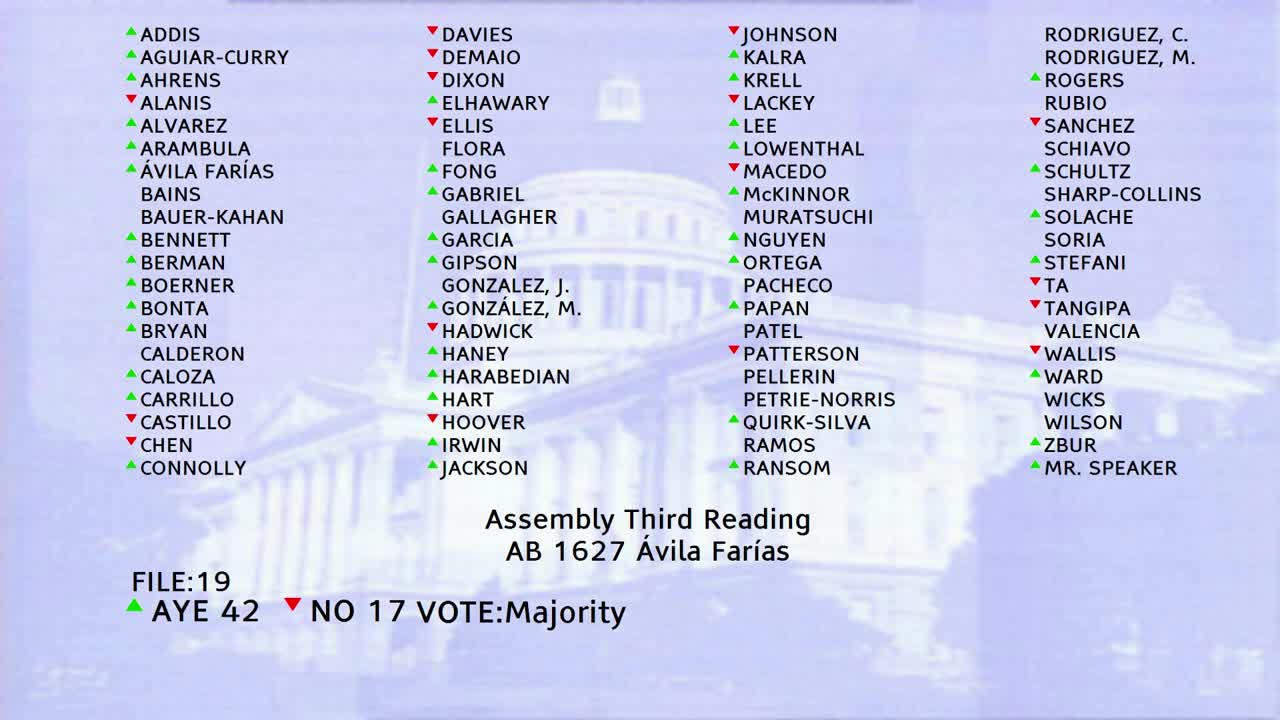 2MIN
Assembly Floor
 4MIN
Assembly Standing Committee on Appropriations
 7MIN
Assembly Standing Committee on Housing and Community Development
 18MIN