AB 1747: Crimes involving vehicles.
- Session Year: 2025-2026
- House: Assembly
- Latest Version Date: 2026-02-09
Current Status:
Failed
(2026-04-27: From committee: Without further action pursuant to Joint Rule 62(a).)
Introduced
In Committee
Awaiting First Chamber Vote
Passed First Chamber
In Committee
Awaiting Second Chamber Vote
Passed Second Chamber
Enacted
Existing law defines vehicular manslaughter while intoxicated as the unlawful killing of a human being without malice aforethought, in the driving of a vehicle while intoxicated and the killing was either the proximate result of the commission of an unlawful act, not amounting to a felony, but without gross negligence, or the proximate result of the commission of a lawful act that might produce death, in an unlawful manner, but without gross negligence. Under existing law, a violation of this provision is punishable as a misdemeanor or felony.
This bill would make a violation of the above provision punishable only as a felony.
The California Constitution requires the state to reimburse local agencies and school districts for certain costs mandated by the state. Statutory provisions establish procedures for making that reimbursement.
This bill would provide that no reimbursement is required by this act for a specified reason.
(a)Gross vehicular manslaughter while intoxicated is the unlawful killing of a human being without malice aforethought, in the driving of a vehicle, where the driving was in violation of Section 23140, 23152, or 23153 of the Vehicle Code, and the killing was either the proximate result of the commission of an unlawful act, not amounting to a felony, and with gross negligence, or the proximate result of the commission of a lawful act that might produce death, in an unlawful manner, and with gross negligence.
(b)Vehicular manslaughter while intoxicated is the unlawful killing of a human being without malice aforethought, in the driving of a vehicle, where the driving was in violation of Section 23140, 23152, or 23153 of the Vehicle Code, and the killing was either the proximate result of the commission of an unlawful act, not amounting to a felony, but without gross negligence, or the proximate result of the commission of a lawful act that might produce death, in an unlawful manner, but without gross negligence.
(c)(1)Except as provided in subdivision (d), gross vehicular manslaughter while intoxicated in violation of subdivision (a) is punishable by imprisonment in the state prison for 4, 6, or 10 years.
(2)Vehicular manslaughter while intoxicated in violation of subdivision (b) is punishable by imprisonment in a county jail for not more than one year or by imprisonment pursuant to subdivision (h) of Section 1170 for 16 months or two or four years.
(d)A person convicted of violating subdivision (a) who has one or more prior convictions of this section or of paragraph (1) of subdivision (c) of Section 192, subdivision (a) or (b) of Section 192.5 of this code, or of violating Section 23152 punishable under Sections 23540, 23542, 23546, 23548, 23550, or 23552 of, or convicted of Section 23153 of, the Vehicle Code, shall be punished by imprisonment in the state prison for a term of 15 years to life. Article 2.5 (commencing with Section 2930) of Chapter 7 of Title 1 of Part 3 shall apply to reduce the term imposed pursuant to this subdivision.
(e)Notwithstanding Section 1203.1 or 1203a, if a person is convicted of a violation of this section and is granted probation, the period of probation shall be not less than three nor more than five years.
(f)This section shall not be construed as prohibiting or precluding a charge of murder under Section 188 upon facts exhibiting wantonness and a conscious disregard for life to support a finding of implied malice, or upon facts showing malice consistent with the holding of the California Supreme Court in People v. Watson, 30 Cal.3d 290.
(g)This section shall not be construed as making any homicide in the driving of a vehicle or the operation of a vessel punishable which is not a proximate result of the commission of an unlawful act, not amounting to felony, or of the commission of a lawful act which might produce death, in an unlawful manner.
(h)For the penalties in subdivision (d) to apply, the existence of any fact required under subdivision (d) shall be alleged in the information or indictment and either admitted by the defendant in open court or found to be true by the trier of fact.
SEC. 2.No reimbursement is required by this act pursuant to Section 6 of Article XIIIB of the California Constitution because the only costs that may be incurred by a local agency or school district will be incurred because this act creates a new crime or infraction, eliminates a crime or infraction, or changes the penalty for a crime or infraction, within the meaning of Section 17556 of the Government Code, or changes the definition of a crime within the meaning of Section 6 of Article XIIIB of the California Constitution.
|
Date
|
Status
|
|---|---|
| Apr 27, 2026 | From committee: Without further action pursuant to Joint Rule 62(a). |
| Mar 24, 2026 | In committee: Set, second hearing. Failed passage. |
| Mar 9, 2026 | In committee: Set, first hearing. Hearing canceled at the request of author. |
| Feb 23, 2026 | Referred to Com. on PUB. S. |
| Feb 10, 2026 | From printer. May be heard in committee March 12. |
| Feb 9, 2026 | Read first time. To print. |
|
Date
|
Description
|
Location
|
Votes
|
|
|---|---|---|---|---|
| Mar 24, 2026 | Do pass and be re-referred to the Committee on [Appropriations] | Assembly Standing Committee on Public Safety |
Failed |
This list shows positions taken on this bill by organizations on the date displayed, which is linked to the original source.
Positions by individuals are not included.
|
Organization
|
Position
|
Date
|
|---|---|---|
| Aclu California Action | ** Against | |
| California Association Of Highway Patrolmen | ** Support | |
| California Attorneys For Criminal Justice | ** Against | |
| California District Attorneys Association | ** Support | |
| California Narcotic Officers' Association | ** Support | |
| Californians United for a Responsible Budget | ** Against | |
| California Police Chiefs Association | ** Support | |
| California Public Defenders Association | ** Against | |
| California State Sheriffs' Association | ** Support | |
| Community Works West | ** Against | |
| Ella Baker Center For Human Rights | ** Against | |
| Friends Committee On Legislation Of California | ** Against | |
| Initiate Justice | ** Against | |
| Justice2jobs Coalition | ** Against | |
| LA Defensa | ** Against | |
| Local 148 Los Angeles County Public Defender's Union | ** Against | |
| Mothers Against Drunk Driving | ** Support | |
| Orange County Sheriff's Department | ** Support | |
| Peace Officers Research Association of California (PORAC) | ** Support | |
| Riverside County Sheriff's Office | ** Support | |
| Riverside Sheriffs' Association | ** Support | |
| San Francisco Public Defender | ** Against | |
| Smart Justice California, a Project of Beyond Impact | ** Against | |
| Streets are for Everyone (SAFE) (ORG) | ** Support | |
| Streets for All | ** Against |
Date of Hearing:
Counsel: Ilan Zur
ASSEMBLY COMMITTEE ON
Nick Schultz, Chair
ABPCA Bill Id:
Author:() – As Ver:
SUMMARY:
Increases the punishment for the crime of intoxicated vehicular manslaughter without gross negligence from an alternate-felony misdemeanor (hereafter “wobbler”), punishable by up to one year in county jail or as a jail-eligible felony by imprisonment for 16 months, or two or four years, to a straight jail-eligible felony punishable by 16 months, or two or four years.
EXISTING LAW:
- Establishes the crime of intoxicated vehicular manslaughter without gross negligence, as follows:
- Defines this offense to mean the unlawful killing of a human being without malice aforethought, in the driving of a vehicle in violation of specified driving under the influence (DUI) laws, and the killing was either the proximate result of an unlawful act, not amounting to a felony, but without gross negligence, or the proximate result of a lawful act that might produce death, in an unlawful manner, but without gross negligence. (Pen. Code, § 191.5, subd. (b).)
- Makes this crime a wobbler punishable by imprisonment in a county jail for not more than one year or by imprisonment for 16 months, or two or four years. (Pen. Code, § 191.5, subd. (c)(2).)
- Establishes the crime of gross vehicular manslaughter while intoxicated, as follows:
- Defines this offense to mean the unlawful killing of a human being without malice aforethought, in the driving of a vehicle in violation of specified DUI laws, and the killing was either the proximate result of an unlawful act, not amounting to a felony, and with gross negligence, or the proximate result of a lawful act that might produce death, in an unlawful manner, and with gross negligence. (Pen. Code, § 191.5, subd. (a).)
- Makes this crime a felony punishable by imprisonment in state prison for four, six, or 10 years. (Pen. Code, § 191.5, subd. (c)(1).)
- Punishes this crime by imprisonment in the state prison for a term of 15 years to life if that person has one or more prior convictions for intoxicated gross vehicular manslaughter, intoxicated vehicular manslaughter without gross negligence, gross vehicular manslaughter, intoxicated vehicular manslaughter while operating a vessel, as specified, DUI with one prior, DUI with two priors, DUI with three or more priors, or DUI causing bodily injury. The existence of any required fact shall be alleged in the information or indictment and either admitted by the defendant in open court or found to be true by the trier of fact. (Pen. Code, § 191.5, subd. (d).)
- Specifies that, notwithstanding other provisions of law, if a person is convicted of a violation of any of the above offenses and is granted probation, the period of probation shall be not less than three or more than five years. (Pen. Code, § 191.5, subd. (e).)
- Specifies that none of the above shall be construed as prohibiting or precluding a charge of murder upon facts exhibiting wantonness and a conscious disregard for life to support a finding of implied malice, or upon facts showing malice consistent with the holding of the California Supreme Court in People v. Watson, 30 Cal.3d 290. (Pen. Code, § 191.5, subd. (f).)
- Specified that none of the above shall be construed as making any homicide in the driving of a vehicle or the operation of a vessel punishable which is not a proximate result of the commission of an unlawful act, not amounting to felony, or of the commission of a lawful act which might produce death, in an unlawful manner. (Pen. Code, § 191.5, subd. (g).)
- Provides that a person who flees the scene of the crime after committing intoxicated vehicular manslaughter, with or without gross negligence, upon conviction for intoxicated vehicular manslaughter, shall be punished by an additional term of imprisonment of five years in the state prison, which shall be in addition to and consecutive to the prescribed punishment. (Veh. Code, § 20001, subd. (c).)
FISCAL EFFECT:
Unknown
COMMENTS:
- Author's Statement: According to the author, “Driving is a privilege that requires the responsibility of sobriety. AB 1747 sends a clear message that when an individual chooses to drive while intoxicated and takes an innocent life as a result, the state of California will treat that act with the seriousness of a felony.”
- Effect of this Bill: Intoxicated vehicular manslaughter without gross negligence requires the prosecution to prove four elements: 1) the defendant drove in violation of specified DUI laws; 2) while driving a vehicle or vessel under the influence the defendant also committed a misdemeanor, infraction, or otherwise lawful act that might cause death; 3) the defendant committed the misdemeanor, infraction, or otherwise lawful act that might cause death with ordinary negligence; and 4) the defendant’s negligent conduct caused the death of another person. (1 CALCRIM 591 (2026).) An act causes death if the death is the direct, natural, and probable consequence of the act, and would not have occurred without the act. (Ibid.) The driver’s negligent conduct need not be the only factor that causes the death of another person. (Ibid.) Rather, it must be a substantial factor in causing the death, which means more than a trivial or remote factor. (Ibid.)
The primary distinction between this offense and gross vehicular manslaughter while intoxicated is the presence of gross versus ordinary negligence. Intoxicated vehicular manslaughter without gross negligence only requires ordinary negligence or “the failure to use reasonable care to prevent reasonably foreseeable harm to oneself or someone else.” (1 CALCRIM 591 (2026).) This occurs if a person does something that a reasonably careful person in the same situation would not do or fails to do something that a reasonable person in the same situation would do. (Ibid.) Gross vehicular manslaughter while intoxicated requires gross negligence, which is “more than ordinary carelessness, inattention, or mistake in judgment.” (1 CALCRIM 590 (2026).) Gross negligence occurs if a person acts in a reckless way that creates a high risk of death or great bodily injury, and a reasonable person would have known that acting in that way creates such a risk. (Ibid.) Phrased differently, the person acts so differently from the way an ordinarily careful person would act in that same situation that their act amounts to “disregard for human life or indifference to the consequences of that act.” (Ibid; See also People v. Penny (1955) 44 Cal.2d 861, 879.) Driving a vehicle while under the influence and violating a traffic law is not sufficient to establish gross negligence. (People v. Givan (2015) 233 Cal.App.4th 335, 349.) However, “one who drives with a very high level of intoxication is indeed more negligent, more dangerous, and thus more culpable than one who drives near the legal limit of intoxication, just as one who exceeds the speed limit by 50 miles per hour exhibits greater negligence than one who exceeds the speed limit by 5 miles per hour.” (People v. Von Staden (1987) 195 Cal.App.3d 1423, 1428.) In determining if conduct rose to gross negligence, juries must consider the manner in which the defendant operated the vehicle, their level of intoxication, and any other relevant conduct. (Givan, 233 Cal.App.4th at p. 349.)
The distinction between gross and ordinary negligence is reflected in the punishment for offenses. Gross vehicular manslaughter while intoxicated, which requires gross negligence, is a felony punishable by imprisonment in the state prison for four, six, or 10 years. (Pen. Code, § 191.5, subd. (c)(1).) Notably, a person convicted of this offense who has previously been convicted of other impaired driving offenses, such as intoxicated vehicular manslaughter and specified DUI offenses, may be punished by a state prison term of 15 years to life. (Pen. Code, § 191.5, subd. (d).) Vehicular manslaughter while intoxicated without gross negligence is a wobbler, punishable by imprisonment in a county jail for not more than one year or by imprisonment for 16 months or two or four years. (Pen. Code, § 191.5, subd. (c)(2).) Here, this bill increases the punishment for intoxicated vehicular manslaughter without gross negligence from a wobbler to a straight felony punishable by 16 months or two or four years. This would make any intoxicated vehicular manslaughter crime a straight felony, regardless of whether the person’s conduct amounted to ordinary or gross negligence.
- Removal of Judicial and Prosecutorial Discretion: Currently, the crime of intoxicated vehicular manslaughter without gross negligence is a wobbler, meaning prosecutors and courts have discretion to charge the offense as a misdemeanor, and courts have discretion to reduce the offense to a misdemeanor, as specified. (Pen. Code, § 17, subd. (b).) This bill removes this discretion and requires this offense to be prosecuted as a felony in every circumstance.
Judicial discretion permits courts to tailor the sentence in the appropriate manner based on the facts of the crime, the person’s history, and the person’s current circumstances. As stated by the California Supreme Court, “Society receives maximum protection when the penalty, treatment or disposition of the offender is tailored to the individual case.” (People v. Williams (1970) 30 Cal.3d 470, 482 [citation and internal quotation marks omitted].) “Only the trial judge has the knowledge, ability and tools at hand to properly individualize the treatment of the offender." (Ibid.)
Intoxicated vehicular manslaughter without gross negligence may encompass a wide range of offenders. Prosecutors and courts may find that felony charges are appropriate for a significantly impaired driver with a lengthy criminal history whose negligent conduct fell just short of gross negligence, and where the driver’s negligence was the sole cause of the death. On the other hand, a court may find that misdemeanor charges are more appropriate for a first-time offender whose negligent conduct amounted to low-level speeding, and there were other contributing causal factors that led to the accident. There is little evidence that courts are using this discretion improperly, and, as such, the need for this bill is unclear.
- Increased Penalties and Lack of Deterrent Effect: According to the National Institute of Justice (NIJ), “Laws and policies designed to deter crime by focusing mainly on increasing the severity of punishment are ineffective partly because criminals know little about the sanctions for specific crimes. More severe punishments do not ‘chasten’ individuals convicted of crimes, and prisons may exacerbate recidivism.”[1] Rather than penalty increases, the NIJ emphasizes the need for policies that “increase[] the perception that criminals will be caught and punished” because “[t]he certainty of being caught is a vastly more powerful deterrent than the punishment.” [2]
In a 2014 report, the Little Hoover Commission similarly addressed the disconnect between science and sentencing – that is, “put[ting] away offenders for increasingly longer periods of time, with no evidence that lengthy incarceration, for many, brings any additional public safety benefit.”[3] Accordingly, while this bill guarantees greater punishment for the crime of intoxicated vehicular manslaughter without gross negligence, it is less clear whether it will effectively deter impaired driving behavior. - Argument in Support: According to Mothers Against Drunk Driving, “Currently, impaired drivers who are charged with vehicular manslaughter can be charged with either a misdemeanor or a felony. In some cases, impaired drivers who kill someone can face a lighter sentence than an impaired driver who causes an injury. AB 1747 corrects this loophole by ensuring impaired drivers who cause a fatality and is charged with vehicular manslaughter must be charged as a felony.
“Victims who lose a loved one due to impaired driving are left with a life sentence. AB 1747 helps to make the punishment fit the crime so that those who cause death in an impaired driving crash face stiffer consequences than those who cause injuries.
“In addressing the gaps in California’s DUI law, MADD believes lawmakers must take an all of the above approach to ensure accountability, prevention and public safety. MADD urges you to support and advance AB 1747 to help provide justice for victims of impaired driving.”
- Argument in Opposition: According to the California Public Defenders Association, “AB 1747 would amend Penal Code section 191.5(b) to increase the penalty for that form of vehicular manslaughter from an alternative felony-misdemeanor (“wobbler”) to a straight felony pursuant to Penal code section 1170(h). In doing so it would adopt a “one size fits all” treatment for an offense that includes a broad range of culpability, removes the discretion of prosecutors and judges to craft an appropriate penalty for the unique circumstances of the offense and situation of the offender, and unnecessarily exacerbates the expense involved in prosecuting and punishing such offenses.
“While Penal Code section 191.5(b) makes it a crime to cause the death of another while driving under the influence, it is the most mitigated version of such offenses. The offense is committed WITHOUT malice aforethought, WITHOUT gross negligence, and as the proximate result of an unlawful act NOT amounting to a felony.
“It is also important to note that, although the offense is denominated “vehicular manslaughter while intoxicated”, it does NOT require a causal nexus between the intoxication and the fatality. It only requires that while intoxicated the driver commits ANOTHER act not amounting to a felony which proximately causes the death. That non-felony act could be something as commonplace and innocuous as failing to signal a turn, rolling slowly through a sign at a four-way stop, going 45 mph in a 35 mph zone, or blinding an opposing driver by neglecting to dim one’s bright lights. The only reason that this offense is currently a wobbler is because of the element of intoxication. Without that element the offence would be a straight misdemeanor pursuant to Penal Code section192(c)(2).
“Recognizing that the intoxication is not a causal element, it is enough that the peripheral circumstance of intoxication has elevated the offense to a wobbler without also making it a straight felony. The current sentence range is sufficient to appropriately penalize the conduct involved. Prosecutors can already allege the offense as a felony. If so, charged judges can already sentence the offender to prison.
“AB 1747 removes discretion from prosecutors and judges to treat the offense as a misdemeanor where the conduct is mitigated and/or where the offender has little or no record or there are compelling circumstances that would make a lengthy sentence unjust. If a person has led an exemplary life and if the death would have occurred with or without intoxication it would be manifestly unjust to label that person as a felon for the rest of his life without an opportunity to earn a misdemeanor through good conduct on felony probation. It is a truism of our criminal justice system that the penalty should fit the crime, but this bill would cast that aside for a one size fits all approach.
“That approach does not come without costs. Felony prosecutions require felony preliminary hearings with police testimony and felonies are much more likely to result in trials than misdemeanors are, with the consequent expense to courts, prosecutors, police, and public defenders. Finally, felony sentences are longer and more costly than misdemeanor sentences. It makes no sense to incur that cost when the current law already allows the court to impose the appropriate sentence to fit each individual situation.”
- Prior Legislation:
- AB 1087 (Patterson), Chapter 180, Statutes of 2025, increased the term of probation from two years to three to five years for a person convicted of vehicular manslaughter while intoxicated or gross vehicular manslaughter while intoxicated.
- AB 2823 (Patterson), of the 2023-2024 Legislative Session, was substantially similar to AB 1087. AB 2823 was never heard.
- AB 1462 (Mendoza), of the 2011-2012 Legislative Session, would have reduced worktime credits and imposed minimum mandatory fines for those convicted of specified vehicular manslaughter offenses. AB 1462 failed passage in this Committee.
- AB 303 (Spitzer), of the 2007-2008 Legislative Session, would have increased the penalty for vehicular manslaughter while intoxicated without gross negligence from a wobbler to a straight felony, punishable by 16 months, or 2 or 4 years in state prison. AB 303 was held in the Assembly Appropriations Committee.
- AB 1000 (Runner), of the 2005-06 Legislative Session, would have increased the penalty for vehicular manslaughter while intoxicated from an alternate felony-misdemeanor to a straight felony punishable by imprisonment in the state prison for two, four, or six years. AB 1000 failed passage in this Committee.
- AB 2623 (Mountjoy), of the 2001-2002 Legislative Session, would have expanded the definition of gross vehicular manslaughter while intoxicated to include the unlawful killing of the fetus of another human being. AB 2623 failed passage in this Committee.
REGISTERED SUPPORT / OPPOSITION:
Support
California Association of Highway Patrolmen
California District Attorneys Association
California Narcotic Officers' Association
California Police Chiefs Association
California State Sheriffs' Association
Mothers Against Drunk Driving
Orange County Sheriff's Department
Peace Officers Research Association of California (PORAC)
Riverside County Sheriff's Office
Riverside Sheriffs' Association
Streets are for Everyone (SAFE) (ORG)
Opposition
ACLU California Action
California Attorneys for Criminal Justice
California Public Defenders Association
Californians United for a Responsible Budget
Community Works West
Ella Baker Center for Human Rights
Friends Committee on Legislation of California
Initiate Justice
Justice2jobs Coalition
LA Defensa
Local 148 Los Angeles County Public Defender's Union
San Francisco Public Defender
Smart Justice California, a Project of Beyond Impact
Streets for All
Analysis Prepared by:
National Institute of Justice, U.S. Department of Justice, Five Things about Deterrence (June 5, 2016) https://nij.ojp.gov/topics/articles/five-things-about-deterrence. ↑
Ibid. ↑
Little Hoover Commission, Sensible Sentencing for a Safer California (Feb. 2014) at p. 4, https://lhc.ca.gov/wp-content/uploads/Reports/219/Report219.pdf ↑
Discussed in Hearing
 15MIN
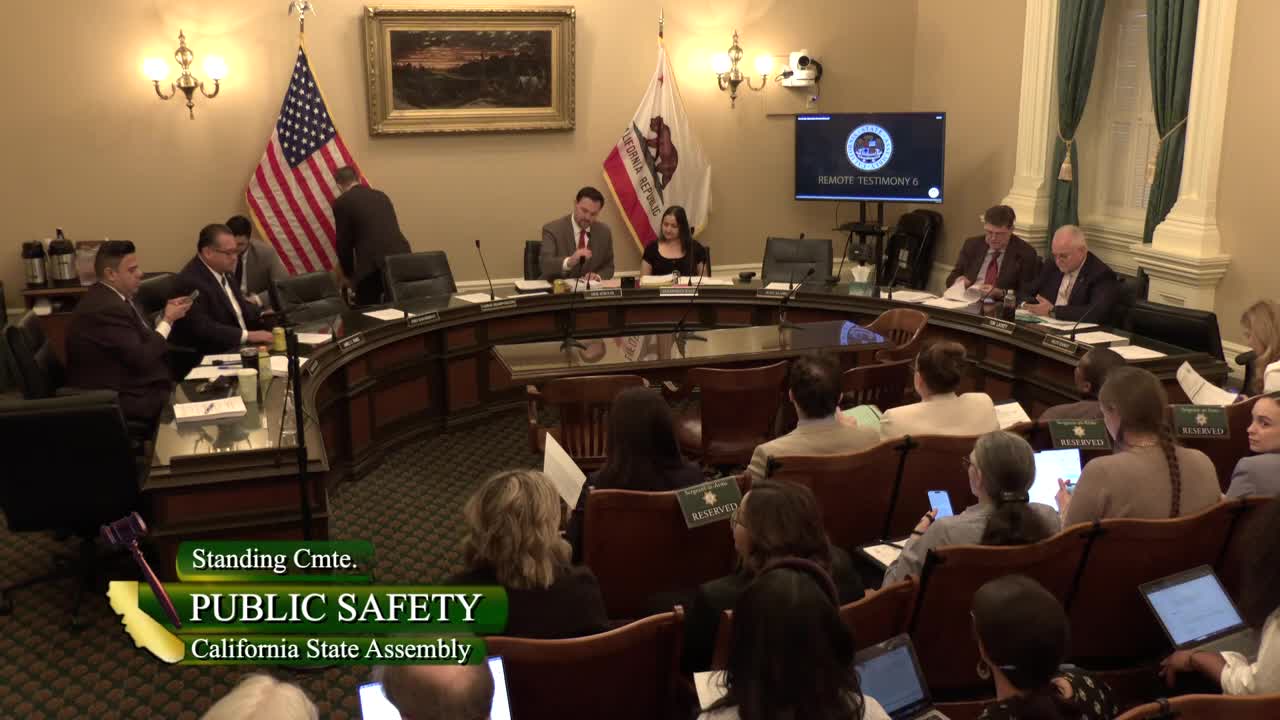
Assembly Standing Committee on Public Safety
Bill Author

Bill Co-Author(s):