AB 1749: Interfering with wildfire suppression and emergency responses with drone.
- Session Year: 2025-2026
- House: Assembly
- Latest Version Date: 2026-09-29
Current Status:
Passed
(2026-09-29: Chaptered by Secretary of State - Chapter 762, Statutes of 2026.)
Introduced
In Committee
Awaiting First Chamber Vote
Passed First Chamber
In Committee
Awaiting Second Chamber Vote
Passed Second Chamber
Enacted
Existing law makes it a crime for a person to operate or use an unmanned aerial vehicle, remote-piloted aircraft, or drone at the scene of an emergency for the purpose of viewing the scene or emergency or military personnel, and thereby impede the emergency or military personnel, in the performance of their duties in coping with the emergency. Existing law excuses a local public entity or public employee from liability for damage to an unmanned aircraft or unmanned aircraft system, if the damage was caused while the local public entity or public employee of a local public entity was providing, and the unmanned aircraft or unmanned aircraft system was interfering with, the operation, support, or enabling of any emergency service, as specified. Existing law makes everyone responsible for an injury occasioned to another by their want of ordinary care or skill in the management of their property or person, as provided.
This bill would prohibit a person from operating or using an unmanned aerial vehicle, remote-piloted aircraft, or drone to knowingly or recklessly interfere with, among other things, a wildfire suppression or law enforcement or emergency response efforts related to a wildfire suppression. The bill would authorize the Attorney General or a county counsel or city attorney to bring civil action to enforce the prohibition and authorize a prevailing plaintiff to recover civil penalties, injunctive relief, or reasonable attorneys fees and costs, as specified.
Existing law makes it a crime for a person to operate or use an unmanned aerial vehicle, remote-piloted aircraft, or drone at the scene of an emergency for the purpose of viewing the scene or emergency or military personnel, and thereby impede the emergency or military personnel, in the performance of their duties in coping with the emergency. Existing law excuses a local public entity or public employee from liability for damage to an unmanned aircraft or unmanned aircraft system, if the damage was caused while the local public entity or public employee of a local public entity was providing, and the unmanned aircraft or unmanned aircraft system was interfering with, the operation, support, or enabling of any emergency service, as specified. Existing law makes everyone responsible for an injury occasioned to another by their want of ordinary care or skill in the management of their property or person, as provided.
This bill would prohibit a person from operating or using an unmanned aerial vehicle, remote-piloted aircraft, or drone to knowingly or recklessly interfere with with, among other things, a wildfire suppression or law enforcement or emergency response efforts related to a wildfire suppression. The bill would authorize the Attorney General or a county counsel or city attorney to bring civil action to enforce the prohibition and authorize a prevailing plaintiff to recover civil penalties, injunctive relief, or reasonable attorneys fees and costs, as specified.
Existing law makes it a crime for a person to operate or use an unmanned aerial vehicle, remote-piloted aircraft, or drone at the scene of an emergency for the purpose of viewing the scene or emergency or military personnel, and thereby impede the emergency or military personnel, in the performance of their duties in coping with the emergency. Existing law excuses a local public entity or public employee from liability for damage to an unmanned aircraft or unmanned aircraft system, if the damage was caused while the local public entity or public employee of a local public entity was providing, and the unmanned aircraft or unmanned aircraft system was interfering with, the operation, support, or enabling of any emergency service, as specified. Existing law makes everyone responsible for an injury occasioned to another by their want of ordinary care or skill in the management of their property or person, as provided.
This bill would prohibit a person from operating or using an unmanned aerial vehicle, remote-piloted aircraft, or drone to knowingly or recklessly interfere with a wildfire suppression or law enforcement or emergency response efforts related to a wildfire suppression, except as provided. suppression. The bill would authorize the Attorney General or a county counsel or city attorney to bring civil action to enforce the prohibition and authorize a prevailing plaintiff to recover civil penalties, injunctive relief, or reasonable attorneys fees and costs, as specified.
Existing law makes it a crime for a person to operate or use an unmanned aerial vehicle, remote piloted remote-piloted aircraft, or drone at the scene of an emergency for the purpose of viewing the scene or emergency or military personnel, and thereby impede the emergency or military personnel, in the performance of their duties in coping with the emergency. Existing law excuses a local public entity or public employee from liability for damage to an unmanned aircraft or unmanned aircraft system, if the damage was caused while the local public entity or public employee of a local public entity was providing, and the unmanned aircraft or unmanned aircraft system was interfering with, the operation, support, or enabling of any emergency service, as specified. Existing law imposes liability for physical invasion of privacy on a person if the person knowingly enters onto the land or into the airspace above the land of another person without permission or otherwise commits a trespass in order to capture any image or recording of the other person engaging in a private activity and the invasion occurs in a manner that is offensive to a reasonable person. Existing law makes everyone responsible for an injury occasioned to another by their want of ordinary care or skill in the management of their property or person, as provided.
This bill would prohibit a person from operating or using an unmanned aerial vehicle, remote piloted remote-piloted aircraft, or drone at the scene of an emergency and thereby impeding firefighters, peace officers, medical personnel, military personnel, or other emergency personnel in the performance of their fire suppression, law enforcement, or emergency response duties, unless the person has a federal operational waiver, as specified, or it is part of their employment duties to view the scene or activities. to knowingly or recklessly interfere with a wildfire suppression or law enforcement or emergency response efforts related to a wildfire suppression, except as provided. The bill would authorize the Attorney General or a county counsel or city attorney to bring civil action to enforce the prohibition and authorize a prevailing plaintiff to recover civil penalties, injunctive relief, or reasonable attorneys fees and costs, as specified.
Existing law makes it a crime for a person to operate or use an unmanned aerial vehicle, remote piloted aircraft, or drone at the scene of an emergency for the purpose of viewing the scene or emergency or military personnel, and thereby impede the emergency or military personnel, in the performance of their duties in coping with the emergency. Existing law excuses a local public entity or public employee from liability for damage to an unmanned aircraft or unmanned aircraft system, if the damage was caused while the local public entity or public employee of a local public entity was providing, and the unmanned aircraft or unmanned aircraft system was interfering with, the operation, support, or enabling of any emergency service, as specified. Existing law imposes liability for physical invasion of privacy on a person if the person knowingly enters onto the land or into the airspace above the land of another person without permission or otherwise commits a trespass in order to capture any image or recording of the other person engaging in a private activity and the invasion occurs in a manner that is offensive to a reasonable person.
This bill would prohibit a person from operating or using an unmanned aerial vehicle, remote piloted aircraft, or drone at the scene of an emergency and thereby impeding firefighters, peace officers, medical personnel, military personnel, or other emergency personnel in the performance of their fire suppression, law enforcement, or emergency response duties, unless the person has a federal operational waiver, as specified, or it is part of their employment duties to view the scene or activities. The bill would authorize the Attorney General or a county counsel or city attorney to bring civil action to enforce the prohibition and authorize a prevailing plaintiff to recover civil penalties, injunctive relief, or reasonable attorneys fees and costs, as specified.
(a)A person shall not operate or use an unmanned aerial vehicle, remote-piloted aircraft, or drone to knowingly or recklessly interfere with either of the following:
(1)A wildfire suppression, or law enforcement or emergency response efforts related to a wildfire suppression.
(2)An emergency response related to an incident for which a temporary flight restriction has been issued by the Federal Aviation Administration.
(b)The Attorney General or a county counsel or city attorney may bring a civil action to enforce subdivision (a). The prevailing plaintiff in an action may recover any of the following in any court of competent jurisdiction:
(1)A civil penalty not exceeding seventy-five thousand dollars ($75,000) for each violation.
(2)Injunctive relief.
(3)Reasonable attorneys fees and costs.
(a)A person shall not operate or use an unmanned aerial vehicle, remote-piloted aircraft, or drone to knowingly or recklessly interfere with a either of the following:
(1)A wildfire suppression, or law enforcement or emergency response efforts related to a wildfire suppression.
(2)An emergency response related to an incident for which a temporary flight restriction has been issued by the Federal Aviation Administration.
(b)The Attorney General or a county counsel or city attorney may bring a civil action to enforce subdivision (a). The prevailing plaintiff in an action may recover any of the following in any court of competent jurisdiction:
(1)A civil penalty not exceeding seventy-five thousand dollars ($75,000) for each violation.
(2)Injunctive relief.
(3)Reasonable attorneys fees and costs.
(a)A person shall not operate or use an unmanned aerial vehicle, remote-piloted aircraft, or drone to knowingly or recklessly interfere with a wildfire suppression, or law enforcement or emergency response efforts related to a wildfire suppression.
(b)The Attorney General or a county counsel or city attorney may bring a civil action to enforce subdivision (a). The prevailing plaintiff in an action may recover any of the following in any court of competent jurisdiction:
(1)A civil penalty not exceeding seventy-five thousand dollars ($75,000) for each violation.
(2)Injunctive relief.
(3)Reasonable attorneys fees and costs.
(c)Subdivision (a) shall not apply to either of the following:(1)A person who has been granted a Part 107 Operational Waiver issued by the Federal Aviation Administration pursuant to Section 107.200 of the Code of Federal Regulations.(2)A person for whom it is a part of the duties of that persons employment to view that scene or those activities.(a)A person shall not operate or use an unmanned aerial vehicle, remote-piloted aircraft, or drone to knowingly or recklessly interfere with a wildfire suppression, or law enforcement or emergency response efforts related to a wildfire suppression.
(b)The Attorney General or a county counsel or city attorney may bring a civil action to enforce subdivision (a). The prevailing plaintiff in an action may recover any of the following in any court of competent jurisdiction:
(1)A civil penalty not exceeding seventy-five thousand dollars ($75,000) for each violation.
(2)Injunctive relief.
(3)Reasonable attorneys fees and costs.
(c)Subdivision (a) shall not apply to either of the following:
(1)A person who has been granted a Part 107 Operational Waiver issued by the Federal Aviation Administration pursuant to Section 107.200 of the Code of Federal Regulations.
(2)A person for whom it is a part of the duties of that persons employment to view that scene or those activities.
(a)(1)A person shall not operate or use an unmanned aerial vehicle, remote piloted aircraft, or drone at the scene of an emergency and thereby impede firefighters, peace officers, medical personnel, military personnel, or other emergency personnel in the performance of their fire suppression, law enforcement, or emergency response duties.
(2)Impede firefighters, peace officers, medical personnel, military personnel, or other emergency personnel in the performance of their fire suppression, law enforcement, or emergency response duties means to inhibit the ability to perform duties in coping with the emergency during the time it is necessary for emergency vehicles or those personnel to be at the scene of the emergency or to be moving to or from the scene of the emergency for the purpose of protecting lives or property, as described in Section 402 of the Penal Code.
(b)The Attorney General or a county counsel or city attorney may bring a civil action to enforce subdivision (a). The prevailing plaintiff in an action may recover any of the following in any court of competent jurisdiction:
(1)A civil penalty not exceeding seventy-five thousand dollars ($75,000) for each violation.
(2)Injunctive relief.
(3)Reasonable attorneys fees and costs.
(c)Subdivision (a) shall not apply to either of the following:
(1)A person who has been granted a Part 107 Operational Waiver issued by the Federal Aviation Administration pursuant to Section 107.200 of the Code of Federal Regulations.
(2)A person for whom it is a part of the duties of that persons employment to view that scene or those activities.
|
Date
|
Status
|
|---|---|
| Sep 29, 2026 | Chaptered by Secretary of State - Chapter 762, Statutes of 2026. |
| Sep 29, 2026 | Approved by the Governor. |
| Aug 28, 2026 | Enrolled and presented to the Governor at 3:30 p.m. |
| Aug 24, 2026 | Senate amendments concurred in. To Engrossing and Enrolling. (Ayes 76. Noes 0. Page 6402.). |
| Aug 24, 2026 | Senate amendments concurred in. To Engrossing and Enrolling. (Ayes 76. Noes 0.). |
| Aug 24, 2026 | Senate amendments concurred in. To Engrossing and Enrolling. |
| Aug 20, 2026 | In Assembly. Concurrence in Senate amendments pending. |
| Aug 20, 2026 | Read third time. Passed. Ordered to the Assembly. (Ayes 39. Noes 0. Page 5589.). |
| Aug 20, 2026 | Read third time. Passed. Ordered to the Assembly. (Ayes 39. Noes 0.). |
| Aug 18, 2026 | Ordered to special consent calendar. |
| Aug 13, 2026 | Read second time. Ordered to third reading. |
| Aug 13, 2026 | From committee: Do pass. (Ayes 7. Noes 0.) (August 13). |
| Aug 3, 2026 | In committee: Referred to APPR. suspense file. |
| Jul 1, 2026 | From committee: Do pass and re-refer to Com. on APPR. with recommendation: To Consent Calendar. (Ayes 13. Noes 0.) (June 30). Re-referred to Com. on APPR. |
| Jun 24, 2026 | From committee: Do pass and re-refer to Com. on JUD. (Ayes 9. Noes 0.) (June 23). Re-referred to Com. on JUD. |
| Jun 17, 2026 | From committee chair, with author's amendments: Amend, and re-refer to committee. Read second time, amended, and re-referred to Com. on E.M. |
| Jun 10, 2026 | Referred to Coms. on E.M. and JUD. |
| May 28, 2026 | In Senate. Read first time. To Com. on RLS. for assignment. |
| May 27, 2026 | Read third time. Passed. Ordered to the Senate. (Ayes 77. Noes 0. Page 5447.) |
| May 27, 2026 | Read third time. Passed. Ordered to the Senate. (Ayes 77. Noes 0.) |
| May 27, 2026 | Read third time. Passed. Ordered to the Senate. |
| May 18, 2026 | Read second time. Ordered to third reading. |
| May 14, 2026 | From committee: Do pass. (Ayes 15. Noes 0.) (May 14). |
| Apr 29, 2026 | In committee: Set, first hearing. Referred to APPR. suspense file. |
| Apr 15, 2026 | From committee: Do pass and re-refer to Com. on APPR. (Ayes 12. Noes 0.) (April 14). Re-referred to Com. on APPR. |
| Apr 3, 2026 | In committee: Hearing postponed by committee. |
| Mar 24, 2026 | From committee: Do pass and re-refer to Com. on JUD. with recommendation: To Consent Calendar. (Ayes 6. Noes 0.) (March 23). Re-referred to Com. on JUD. |
| Mar 23, 2026 | Re-referred to Com. on E.M. |
| Mar 19, 2026 | From committee chair, with author's amendments: Amend, and re-refer to Com. on E.M. Read second time and amended. |
| Mar 3, 2026 | Re-referred to Com. on E.M. |
| Mar 2, 2026 | From committee chair, with author's amendments: Amend, and re-refer to Com. on E.M. Read second time and amended. |
| Feb 23, 2026 | Referred to Coms. on E.M and JUD. |
| Feb 10, 2026 | From printer. May be heard in committee March 12. |
| Feb 9, 2026 | Read first time. To print. |
|
Date
|
Description
|
Location
|
Votes
|
|
|---|---|---|---|---|
| Aug 24, 2026 | AB 1749 Dixon Concurrence in Senate Amendments | Assembly Floor |
Passed |
|
| Aug 20, 2026 | Special Consent AB1749 Dixon | Senate Floor |
Passed |
|
| Aug 13, 2026 | Do pass | Senate Standing Committee on Appropriations |
Passed |
|
| Aug 3, 2026 | Placed on suspense file | Senate Standing Committee on Appropriations |
Passed |
|
| Jun 30, 2026 | Do pass, but first be re-referred to the Committee on [Appropriations] with the recommendation: To Consent Calendar | Senate Standing Committee on Judiciary |
Passed |
|
| Jun 23, 2026 | Do pass, but first be re-referred to the Committee on [Judiciary] | Senate Standing Committee on Emergency Management |
Passed |
|
| May 27, 2026 | AB 1749 Dixon Assembly Third Reading | Assembly Floor |
Passed |
|
| May 14, 2026 | Do pass. | Assembly Standing Committee on Appropriations |
Passed |
|
| Apr 14, 2026 | Do pass and be re-referred to the Committee on [Appropriations] | Assembly Standing Committee on Judiciary |
Passed |
|
| Mar 23, 2026 | Do pass and be re-referred to the Committee on [Judiciary] with recommendation: To Consent Calendar | Assembly Standing Committee on Emergency Management |
Passed |
This list shows positions taken on this bill by organizations on the date displayed, which is linked to the original source.
Positions by individuals are not included.
|
Organization
|
Position
|
Date
|
|---|---|---|
| American Medical Response West | ** Support | |
| Arcadia Police Officers' Association | ** Support | |
| Brea Police Association | ** Support | |
| Burbank Police Officers' Association | ** Support | |
| California Narcotic Officers' Association | ** Support | |
| California Professional Firefighters | ** Support | |
| California Reserve Peace Officers Association | ** Support | |
| California Special Districts Association | ** Support | |
| California State Sheriffs' Association | ** Support | |
| California State Sheriffs’ Association | ** Support | |
| Corona Police Officers Association | ** Support | |
| Culver City Police Officers' Association | ** Support | |
| Fullerton Police Officers' Association | ** Support | |
| Mayor Todd Gloria, City of San Diego | ** Support | |
| Murrieta Police Officers' Association | ** Support | |
| Newport Beach Police Association | ** Support | |
| Orange County Fire Authority | ** Support | |
| Pacific Gas And Electric Company | ** Support | |
| Palos Verdes Police Officers' Association | ** Support | |
| Peace Officers Research Association Of California | ** Support | |
| Placer County Deputy Sheriffs' Association | ** Support | |
| Pomona Police Officers' Association | ** Support | |
| RIVERSIDE POLICE OFFICERS ASSOCIATION | ** Support | |
| Riverside Sheriffs' Association | ** Support | |
| TECHNET SOUTHWEST | ** Against |
CONCURRENCE IN SENATE AMENDMENTS
CSA1 Bill Id:AB 1749
Author:(Dixon)
As Amended Ver:June 17, 2026
Majority vote
SUMMARY
Prohibits the use of a drone to knowingly or recklessly interfere with wildfire suppression efforts or emergency response efforts related to an incident with a temporary flight restriction, and authorizes the Attorney General, a county counsel, or a city attorney to bring civil actions, as specified, for each violation.
Senate Amendments
Additionally prohibits operating or using an unmanned aerial vehicle, remote-piloted aircraft, or drone to knowingly or recklessly interfere with an emergency response related to an incident for which a temporary flight restriction has been issued by the Federal Aviation Administration.
COMMENTS
Background: Firefighting aircraft play a crucial role in wildfire suppression by delivering water and fire retardant, as well as transporting personnel. Firefighting aircraft operate at very low altitudes—often just a few hundred feet above the ground—the same airspace where drones are typically flown. This creates a significant risk of midair collisions or pilot distractions that could lead to serious or fatal accidents. When unauthorized drones enter wildfire airspace, fire agencies often have to ground the firefighting aircraft to prevent midair collisions.
Suspending air operations can reduce the effectiveness of suppression efforts, allowing wildfires to grow larger and move into untreated terrain, thus endangering both firefighters and the public. Additionally, if a drone loses its communication link, it could crash and injure firefighters or civilians below. To increase public awareness of these dangers, the U.S. Forest Service and the U.S. Department of Agriculture (USDA) launched the "If You Fly, We Can't" campaign, emphasizing the importance of keeping drones away from wildfire areas.
Documented Cases: According to the Federal Aviation Administration (FAA), more than 100 documented cases of unauthorized drones interfering with wildfire response nationwide in recent years. According to the USDA, in 2019, at least 20 documented instances of unauthorized drone flights in seven states—including at least three in California—resulted in the shutdown of aerial firefighting operations on nine occasions. More recently, during the 2025 Palisades Fire, a drone crashed into a Super Scooper aircraft, a firefighting aircraft that can carry and drop up to 1,500 gallons of water at a time. The drone damaged the Super Scooper's left wing, causing a hole and requiring the plane to be grounded for several days. This aircraft also held two firefighters, placing their safety at risk, as well as the safety of anyone on the ground below if the pilot could not land the plane.
Temporary Flight Restrictions: The FAA frequently establishes Temporary Flight Restrictions (TFRs) around wildfires to protect firefighting aircraft. All unauthorized aircraft, including drones, are prohibited from entering these restricted areas unless operated by a firefighting agency. However, even when a TFR is not in place, interfering with wildfire suppression is still a federal crime.
Federal Penalties: Federal law imposes strict penalties on individuals who interfere with wildfire suppression efforts. Violators can face up to 12 months in prison for disrupting firefighting operations on public lands. Additionally, Congress has authorized the FAA to impose civil fines of up to $75,000 against drone operators who conduct unsafe or unauthorized operations. This may include any interference with wildfire suppression, law enforcement, or emergency response operations.
According to the Author
"AB 1749 is a necessary tool for our emergency services when unauthorized drones impede on wildfire suppression. According to the U.S. Forest Service, there were nine public drone incursions that resulted in the grounding of aerial firefighting efforts. Recently with the Palisades Fire in Los Angeles, a drone crashed into a firefighting Super Scooper plane, leaving a hole in the wing and grounding the aircraft for several days. Not only are the repairs to the specialized equipment costly, but an aircraft or multiple aircrafts being grounded for an unspecified amount of time can be life threatening."
Arguments in Support
According to the California Professional Firefighters, "AB 1749 will impose civil liability onto individuals who operate a drone in an emergency area and impede emergency response while providing an exemption for necessary, licensed operation, ensuring that firefighters are able to carry out their lifesaving, dangerous work without the inhibition of civilian unmanned aircraft interference."
Arguments in Opposition
According to TechNet Southwest, "We respectfully request amendments to ensure the bill does not inadvertently restrict legitimate, federally authorized drone operations that provide significant public and economic benefits. Specifically, we recommend including a clear exemption for drones operating pursuant to authorization by the Federal Aviation Administration (FAA), including those engaged in commercial activities under established federal frameworks. As currently drafted, the bill could create ambiguity for operators who are compliant with FAA regulations and operating under lawful authority, including those supporting critical services."
FISCAL COMMENTS
According to the Senate Appropriations Committee:
- Unknown, potentially significant workload cost pressures to the state funded trial court system to adjudicate any civil actions filed as a result of this bill (Trial Court Trust Fund, General Fund). The fiscal impact of this bill to the courts will depend on many unknowns, including the number of cases filed and the factors unique to each case. An eight-hour court day costs approximately $8,000 in staff in workload. If court days exceed 10, costs to the trial courts could reach hundreds of thousands of dollars. While the courts are not funded on a workload basis, an increase in workload could result in delayed court services and would put pressure on the General Fund to fund additional staff and resources and to increase the amount appropriated to backfill for trial court operations.
- Unknown, potentially minor costs to the Attorney General (AG). The Department of Justice (DOJ) does not anticipate a significant fiscal impact, indicating that the AG may choose not to pursue enforcement actions under this bill.
VOTES:
ASM EMERGENCY MANAGEMENT: 6-0-1
YES: Alanis, Arambula, Ávila Farías, Bennett, DeMaio, Ransom
ABS, ABST OR NV: Bains
ASM JUDICIARY: 12-0-0
YES: Kalra, Macedo, Bauer-Kahan, Bryan, Connolly, Dixon, Harabedian, Pacheco, Papan, Sanchez, Stefani, Zbur
ASM APPROPRIATIONS: 15-0-0
YES: Wicks, Hoover, Aguiar-Curry, Calderon, Caloza, Dixon, Fong, Mark González, Krell, Pacheco, Pellerin, Sharp-Collins, Solache, Ta, Tangipa
ASSEMBLY FLOOR: 77-0-3
YES: Addis, Aguiar-Curry, Ahrens, Alanis, Alvarez, Arambula, Ávila Farías, Bains, Bauer-Kahan, Bennett, Berman, Boerner, Bonta, Bryan, Calderon, Caloza, Carrillo, Castillo, Chen, Connolly, Davies, DeMaio, Dixon, Elhawary, Ellis, Flora, Fong, Gabriel, Gallagher, Garcia, Gipson, Jeff Gonzalez, Mark González, Hadwick, Haney, Harabedian, Hart, Hoover, Irwin, Johnson, Kalra, Krell, Lackey, Lowenthal, Macedo, McKinnor, Muratsuchi, Nguyen, Ortega, Pacheco, Papan, Patel, Patterson, Pellerin, Petrie-Norris, Quirk-Silva, Ramos, Ransom, Michelle Rodriguez, Rogers, Blanca Rubio, Sanchez, Schiavo, Schultz, Sharp-Collins, Solache, Soria, Stefani, Ta, Tangipa, Valencia, Wallis, Ward, Wicks, Wilson, Zbur, Rivas
ABS, ABST OR NV: Jackson, Lee, Celeste Rodriguez
SENATE FLOOR: 39-0-1
YES: Allen, Alvarado-Gil, Archuleta, Arreguín, Ashby, Becker, Blakespear, Cabaldon, Caballero, Cervantes, Choi, Cortese, Dahle, Durazo, Gonzalez, Grayson, Grove, Hurtado, Jones, Laird, Limón, McGuire, McNerney, Menjivar, Niello, Ochoa Bogh, Padilla, Pérez, Richardson, Rubio, Seyarto, Smallwood-Cuevas, Stern, Strickland, Umberg, Valladares, Wahab, Weber Pierson, Wiener
ABS, ABST OR NV: Reyes
UPDATED
VERSION: June 17, 2026
CONSULTANT: Ryan Fleming / E.M. / (916) 319-3802 FN: 0003962
SENATE RULES COMMITTEE Office of Senate Floor Analyses (916) 651-4171 | AB 1749 |
THIRD READING
Bill No: AB 1749
Author: Dixon (R)
Amended: 6/17/26 in Senate
Vote: 21
SENATE EMERGENCY MGT. COMMITTEE: 9-0, 6/23/26
AYES: Stern, Seyarto, Allen, Ashby, Blakespear, Dahle, Grayson, Pérez, Rubio
SENATE JUDICIARY COMMITTEE: 13-0, 6/30/26
AYES: Umberg, Niello, Allen, Ashby, Caballero, Durazo, Laird, Reyes, Stern, Valladares, Wahab, Weber Pierson, Wiener
SENATE APPROPRIATIONS COMMITTEE: 7-0, 8/13/26
AYES: Cervantes, Seyarto, Cabaldon, Dahle, Grayson, Richardson, Wahab
ASSEMBLY FLOOR: 77-0, 5/27/26 - See last page for vote
SUBJECT: Interfering with wildfire suppression and emergency responses with drone
SOURCE: Author
DIGEST:
This bill makes it unlawful to operate or use an unmanned aerial vehicle, remote piloted aircraft, or drone to knowingly or recklessly interfere with wildfire suppression efforts or incidents involving a temporary flight restriction (TFR) issued by the Federal Aviation Administration (FAA) and authorizes related civil enforcement action, as specified.
ANALYSIS:
Existing federal law establishes that an individual who operates an unmanned aircraft and knowingly or recklessly interferes with wildfire suppression, or law enforcement or emergency response efforts related to a wildfire suppression, subject to a fine or imprisonment, or both.
Existing state law:
- Defines “unmanned aircraft” and “unmanned aircraft systems” as follows:
- “Unmanned aircraft” means an aircraft that is operated without the possibility of direct human intervention from within or on the aircraft;
- “Unmanned aircraft system” means an unmanned aircraft and associated elements, including, but not limited to, communication links and the components that control the unmanned aircraft that are required for the pilot in command to operate safely and efficiently in the national airspace system.
- Exempts a local public entity, local public employees, and emergency responders from liability for damage caused to an unmanned aircraft if the damage was caused while providing emergency services and the unmanned aircraft interfered, as specified.
- Makes a person at the scene of an emergency with the intention to view the emergency that impedes the emergency response personnel in responding to the emergency, as specified, including the operation of an unmanned aerial vehicle or drone, guilty of a misdemeanor.
This bill:
- Prohibits a person from operating or using an unmanned aerial vehicle, remote piloted aircraft, or drone to knowingly or recklessly interfere with either of the following:
- A wildfire suppression, or law enforcement or emergency response efforts related to a wildfire suppression.
- An emergency response related to an incident for which a TFR has been issued by the FAA.
- Allows the Attorney General (AG), county counsel, or city attorney to bring a civil action to enforce 1) above and authorizes the following for each violation:
- a civil penalty not exceeding $75,000 for each violation;
- injunctive relief; and
- reasonable attorney’s fees and costs.
Background
The use of drones in firefighting and emergency response. Unmanned aircraft systems, commonly known as drones, are tools that aid in wildfire management, search and rescue, crowd management and risk reduction for first responders. Drones used by the Department of Forestry and Fire Protection (CAL FIRE) are equipped with high-zoom and wide-angle cameras, thermal imaging, aerial ignition capabilities and heavy cargo capacity and serve several functions when fighting fires. Pilots monitor thermal cameras to help crews battle wildfires through real-time fire hot spot detection. High-resolution aerial mapping can identify areas of highly flammable material and complete pre- and post-fire surveys of land to inform future fire prevention efforts.
Drones are also critical for search and rescue. Thermal cameras enhance the search capabilities for missing people, particularly in areas with low visibility or rugged terrain. Drones can also drop a series of glow sticks to create a visual path for rescuers to follow or deliver essential supplies to the scene. The drones are used to assess potential emergencies and reduce future risk to rescue personnel or other emergency responders.
Drone incursion warnings and consequences. In recent years, CAL FIRE has warned the public about the incursion of drones and other unmanned aerial systems into firefighting airspace. These incursions raise serious concern as they force the temporary suspension of critical aerial firefighting operations, as required by TFRs issued by the FAA. The FAA regularly implements TFRs around wildfire areas to protect the safety of aircraft participating in firefighting operations. All aircraft, including drones, are explicitly prohibited from entering these restricted areas unless they are operated by an agency directly involved in wildfire suppression efforts. Even when a TFR is not in effect, drone pilots are strongly urged to avoid flying near wildfires as it is a crime to interfere with the air attack operations.
When drones are detected within firefighting airspace, fire response agencies must ground their aircraft to mitigate the risk of a midair collision. Aircraft not only drop water and fire retardant, but also serve as lookouts to support firefighters on the ground. This delay in airborne response can allow fires to continue spreading and poses a significant threat to the safety of firefighters on the ground, residents, and properties in nearby communities. Aircraft do not resume flying until the airspace is deemed clear.
According to CAL FIRE, the U.S. Forest Service reported more than 200 drone sightings over active wildfires in 2025. More than half of these incidents occurred during the Eaton and Palisades fires in Southern California. In one case, a drone struck a Canadian “Super Scooper,” punching a hole in the aircraft’s wing and grounding it for several days for repairs.
CAL FIRE reminds the public that individuals who operate drones without proper authorization over wildfire-affected areas can be found in violation of federal, state, and local laws, regulations, and ordinances. Those who are determined to have interfered with wildfire suppression efforts and/or endangered manned aircraft or people on the ground with a drone may face severe consequences. Under the FAA, operating a drone over active wildfires is a federal crime that can result in up to 12 months in prison and civil penalties of up to $20,000.
FISCAL EFFECT: Appropriation: No Fiscal Com.: Yes Local: No
According to the Senate Appropriations Committee:
- Unknown, potentially significant workload cost pressures to the state funded trial court system to adjudicate any civil actions filed as a result of this bill (Trial Court Trust Fund, General Fund). The fiscal impact of this bill to the courts will depend on many unknowns, including the number of cases filed and the factors unique to each case. An eight-hour court day costs approximately $8,000 in staff in workload. If court days exceed 10, costs to the trial courts could reach hundreds of thousands of dollars. While the courts are not funded on a workload basis, an increase in workload could result in delayed court services and would put pressure on the General Fund to fund additional staff and resources and to increase the amount appropriated to backfill for trial court operations.
- Unknown, potentially minor costs to the AG. The Department of Justice does not anticipate a significant fiscal impact, indicating that the AG may choose not to pursue enforcement actions under this bill.
SUPPORT: (Verified 8/13/26)
California Professional Firefighters
California Special Districts Association
California State Sheriffs' Association
Pacific Gas and Electric Company
Peace Officers Research Association of California
OPPOSITION: (Verified 8/13/26)
None received
ARGUMENTS IN SUPPORT: In support of this bill, the California Professional Firefighters writes that, “These devices are flown by hobbyists seeking dramatic footage of an emergency incident and are simultaneously small enough to be difficult for pilots to see while flying and also capable of causing enough damage to ground the plane if the collision occurs in a sensitive area. AB 1749 will impose civil liability onto individuals who operate a drone in an emergency area and impede emergency response while….ensuring that firefighters are able to carry out their lifesaving, dangerous work without the inhibition of civilian unmanned aircraft interference. For these reasons, we are pleased to support this important measure.”
ASSEMBLY FLOOR: 77-0, 5/27/26
AYES: Addis, Aguiar-Curry, Ahrens, Alanis, Alvarez, Arambula, Ávila Farías, Bains, Bauer-Kahan, Bennett, Berman, Boerner, Bonta, Bryan, Calderon, Caloza, Carrillo, Castillo, Chen, Connolly, Davies, DeMaio, Dixon, Elhawary, Ellis, Flora, Fong, Gabriel, Gallagher, Garcia, Gipson, Jeff Gonzalez, Mark González, Hadwick, Haney, Harabedian, Hart, Hoover, Irwin, Johnson, Kalra, Krell, Lackey, Lowenthal, Macedo, McKinnor, Muratsuchi, Nguyen, Ortega, Pacheco, Papan, Patel, Patterson, Pellerin, Petrie-Norris, Quirk-Silva, Ramos, Ransom, Michelle Rodriguez, Rogers, Blanca Rubio, Sanchez, Schiavo, Schultz, Sharp-Collins, Solache, Soria, Stefani, Ta, Tangipa, Valencia, Wallis, Ward, Wicks, Wilson, Zbur, Rivas
NO VOTE RECORDED: Jackson, Lee, Celeste Rodriguez
Prepared by: Cassie Royce / E.M. /
8/14/26 15:38:37
**** END ****
SENATE COMMITTEE ON
Senator Sabrina Cervantes, Chair
2025 - 2026 Regular Session
AB 1749 (Dixon) - Interfering with wildfire suppression and emergency responses with drone
Version: | Policy Vote: |
Urgency: | Mandate: |
Hearing Date: | Consultant: |
Bill Summary:
AB 1749 prohibits a person from operating or using an unmanned aerial vehicle, remote piloted aircraft, or drone to knowingly or recklessly interfere with wildfire suppression efforts or incidents involving a temporary flight restriction (TFR) issued by the Federal Aviation Administration (FAA) and authorizes related civil enforcement action, as specified.
Fiscal Impact:
- Unknown, potentially significant workload cost pressures to the state funded trial court system to adjudicate any civil actions filed as a result of this bill (Trial Court Trust Fund, General Fund). The fiscal impact of this bill to the courts will depend on many unknowns, including the number of cases filed and the factors unique to each case. An eight-hour court day costs approximately $8,000 in staff in workload. If court days exceed 10, costs to the trial courts could reach hundreds of thousands of dollars. While the courts are not funded on a workload basis, an increase in workload could result in delayed court services and would put pressure on the General Fund to fund additional staff and resources and to increase the amount appropriated to backfill for trial court operations.
- Unknown, potentially minor costs to the Attorney General (AG). The Department of Justice (DOJ) does not anticipate a significant fiscal impact, indicating that the AG may choose not to pursue enforcement actions under this bill.
Background:
In recent years, the California Department of Forestry and Fire Protection (CAL FIRE) has warned the public about the incursion of drones and other unmanned aerial systems into firefighting airspace. These incursions raise serious concern as they force the temporary suspension of critical aerial firefighting operations, as required by TFRs issued by the FAA. The FAA regularly implements TFRs around wildfire areas to protect the safety of aircraft participating in firefighting operations. All aircraft, including drones, are explicitly prohibited from entering these restricted areas unless they are operated by an agency directly involved in wildfire suppression efforts. Even when a TFR is not in effect, drone pilots are strongly urged to avoid flying near wildfires as it is a crime to interfere with the air attack operations.
When drones are detected within firefighting airspace, fire response agencies must ground their aircraft to mitigate the risk of a midair collision. Aircraft not only drop water and fire retardant, but also serve as lookouts to support firefighters on the ground. This delay in airborne response can allow fires to continue spreading and poses a significant threat to the safety of firefighters on the ground, residents, and properties in nearby communities. Aircraft do not resume flying until the airspace is deemed clear.
According to CAL FIRE, the U.S. Forest Service reported more than 200 drone sightings over active wildfires in 2025. More than half of these incidents occurred during the Eaton and Palisades fires in Southern California. In one case, a drone struck a Canadian “Super Scooper,” punching a hole in the aircraft’s wing and grounding it for several days for repairs.
Proposed Law:
- Prohibits a person from operating or using an unmanned aerial vehicle, remote piloted aircraft, or drone to knowingly or recklessly interfere with either of the following:
- A wildfire suppression, or law enforcement or emergency response efforts related to a wildfire suppression.
- An emergency response related to an incident for which a TFR has been issued by the FAA.
- Allows the AG, county counsel, or city attorney to bring a civil action to enforce the above prohibition and authorizes the following for each violation:
- A civil penalty not exceeding $75,000 for each violation
- Injunctive relief.
- Reasonable attorney’s fees and costs.
-- END --
Senator Thomas Umberg, Chair
2025-2026 Regular Session
Bill No: AB 1749 (Author:Dixon)
Version: June 17, 2026
Hearing Date: June 30, 2026
Fiscal: Yes
Urgency: No
Consultant: AM
SUBJECT
Interfering with wildfire suppression and emergency responses with drone
DIGEST
This bill prohibits a person from operating or using an unmanned aerial vehicle, remote-piloted aircraft, or drone to knowingly or recklessly interfere with a wildfire suppression, law enforcement or emergency response efforts related to a wildfire suppression, or an emergency response related to an incident for which a temporary flight restriction has been issued by the Federal Aviation Administration. A violation of this prohibition may be punished by a civil penalty.
EXECUTIVE SUMMARY
In January 2025, a number of deadly wildfires in Los Angeles, including the Palisades and Eaton fires, collectively burned over 39,000 acres,[1] caused at least 30 deaths,[2] destroyed over 16,000 structures, and resulted in property damage estimates ranging from $28 to $53.8 billion.[3] There was at least one reported incident of a drone colliding with firefighting aircraft, which forced the aircraft to be taken out of commission for repairs, hampering the efforts of first responders.[4] This bill seeks to prohibit a person from using or operating any drone or other unmanned aerial vehicle at the scene of an emergency thereby impeding emergency personnel in the performance of their duties. This bill is substantially similar to AB 426 (Dixon, 2025), which passed this Committee on a vote of 12 to 0, but was ultimately held in the Senate Appropriations Committee.
The bill is author sponsored and supported by the Peace Officers’ Research Association of California (PORAC), the California Special Districts Association, and the California State Sheriffs' Association. This bill passed the Senate Emergency Management Committee on a vote of 9 to 0.
PROPOSED CHANGES TO THE LAW
Existing federal law:
- Provides that an individual who operates an unmanned aircraft and knowingly or recklessly interferes with a wildfire suppression, or law enforcement or emergency response efforts related to a wildfire suppression, is liable for a fine as defined or imprisonment for up to two years, or both. (18 U.S.C. § 40a.)
Existing state law:
- Exempts a local public entity and local public employees from liability for damage caused to an unmanned aircraft if the damage was caused while providing emergency services, as specified, and the unmanned aircraft interfered, as specified. (Gov. Code § 853.)
- Declares each person at the scene of an emergency with the intention to view the emergency, as specified, that impedes the emergency response personnel in responding to the emergency, as specified, including the operation of an unmanned aerial vehicle or drone, is guilty of a misdemeanor. (Pen. Code § 402.)
- Exempts an emergency responder from liability for damage caused to an unmanned aircraft if the damage was caused while the emergency responder was providing emergency services, as specified, and the unmanned aircraft interfered, as specified. (Civ. Code § 43.101.)
- Defines unmanned aircraft and unmanned aircraft systems as follows:
- “Unmanned aircraft” means an aircraft that is operated without the possibility of direct human intervention from within or on the aircraft;
- “Unmanned aircraft system” means an unmanned aircraft and associated elements, including, but not limited to, communication links and the components that control the unmanned aircraft that are required for the pilot in command to operate safely and efficiently in the national airspace system. (Gov. Code § 853.5.)
This bill:
- Prohibits a person from operating or using an unmanned aerial vehicle, remote-piloted aircraft, or drone to knowingly or recklessly interfere with a wildfire suppression, or law enforcement or emergency response efforts related to a wildfire suppression or an emergency response related to an incident for which a temporary flight restriction has been issued by the Federal Aviation Administration.
- Authorizes the Attorney General, a county counsel, or a city attorney to bring a civil action to enforce the prohibition and authorizes a prevailing plaintiff to recover civil penalty not exceeding $75,000 for each violation; injunctive relief; and reasonable attorney’s fees and costs.
COMMENTS
- Stated need for the bill
The author writes:
AB 1749 is a simple, commonsense piece of legislation to provide additional protection to our first responders when responding to a wildfire emergency. By creating a civil penalty when an individual knowingly or recklessly interferes with wildfire suppression or an emergency response related to a wildfire, we disincentivize unlawful activity that could hamper an effective wildfire response. Additionally, this legislation avoids unnecessary criminalization by simply creating a civil penalty.
According to the FAA, in recent years, there have been more than 100 documented cases of unauthorized drones flying near wildfires. In fact, during the Palisades wildfire response a super scooper aircraft was grounded for multiple days due to damage caused by a collision with an unauthorized drone. This legislation will protect firefighters and ensure uninterrupted wildfire response efforts from our first responders.
- This bill seeks to provide more deterrence against a person flying drones over emergencies
In January 2025, a number of deadly wildfires in Los Angeles, including the Palisades and Eaton fires, collectively burned over 39,000 acres,[5] caused at least 30 deaths,[6] destroyed over 16,000 structures, and resulted in property damage estimates ranging from $28 to $53.8 billion.[7] In one instance, a man flew a drone over the Pacific Palisades, which collided with a Super Scooper plane conducting firefighting activities.[8] The impact of the drone with the Super Scooper caused an “approximately 3-inch-by-6-inch hole in the left wing” that resulted in repair costs of at least $65,169. Additionally, this incident rendered an important firefighting tool out of commission. The man in this instance has pled guilty to recklessly operating a drone in violation of federal law. The acting U. S. Attorney for the case, Joseph T. McNally stated the “damage caused to the Super Scooper is a stark reminder that flying drones during times of emergency poses an extreme threat to personnel trying to help people and compromises the overall ability of police and fire to conduct operations.” This bill seeks to prevent situations like the one above by providing further deterrence for persons from flying drones or other unmanned aerial vehicles over emergency responses to wildfires. The bill authorizes the Attorney General, county counsel, or city attorney to bring a civil action to enforce the prohibition and authorizes a prevailing plaintiff to recover civil penalty not exceeding $75,000 for each violation; injunctive relief; and reasonable attorney’s fees and costs.
- Statements in support
The Peace Officers’ Research Association of California (PORAC) writes in support stating:
AB 1749 strengthens protections for emergency responders by prohibiting individuals from knowingly or recklessly operating drones in a manner that interferes with wildfire suppression efforts or related law enforcement and emergency response activities. As California continues to face increasingly dangerous wildfire conditions, it is critical that first responders are able to perform their duties without unnecessary interference.
Unauthorized drone activity near wildfire incidents can create serious safety hazards for both ground personnel and aerial firefighting operations. By clarifying that reckless or intentional drone interference with wildfire response efforts is prohibited, AB 1749 helps ensure that emergency personnel can respond effectively and safely during these high-risk incidents.
SUPPORT
California Special Districts Association
California State Sheriffs’ Association
Peace Officers’ Research Association of California (PORAC)
OPPOSITION
None received
RELATED LEGISLATION
Pending Legislation: None known.
Prior Legislation: AB 426 (Dixon, 2025) would have prohibited a person from operating or using an unmanned aerial vehicle, remote piloted aircraft, or drone at the scene of an emergency and thereby impeding firefighters, peace officers, medical personnel, military personnel, or other emergency personnel in the performance of their fire suppression, law enforcement, or emergency response, and makes a person who violates the prohibition subject to a civil penalty not to exceed $75,000 for each violation. AB 426 died in the Senate Appropriations Committee.
PRIOR VOTES
Senate Emergency Management Committee (Ayes 9, Noes 0)
Assembly Floor (Ayes 77, Noes 0)
Assembly Appropriations Committee (Ayes 15, Noes 0)
Assembly Judiciary Committee (Ayes 12, Noes 0)
Assembly Emergency Management Committee (Ayes 6, Noes 0)
**************
Governor’s Exec. Order No. N-4-25 (Jan. 12, 2025). ↑
Jesus Jiménez, L.A. Fires Death Toll Rises to 30 After Remains Are Found, L.A. Times, (Apr. 3, 2025), available at https://www.nytimes.com/2025/04/03/us/la-fires-death-toll.html. ↑
Palisades and Eaton wildfires caused up to $53.8 billion in property damage, study finds, The Orange County Register, (Feb. 27, 2025), available at https://www.ocregister.com/2025/02/27/palisades-and-eaton-wildfires-caused-up-to-53-8-billion-in-property-damage-study-finds/. ↑
See Comment 2, below. ↑
Governor’s Exec. Order No. N-4-25 (Jan. 12, 2025). ↑
Jesus Jiménez, L.A. Fires Death Toll Rises to 30 After Remains Are Found, L.A. Times, (Apr. 3, 2025), available at https://www.nytimes.com/2025/04/03/us/la-fires-death-toll.html. ↑
Palisades and Eaton wildfires caused up to $53.8 billion in property damage, study finds, The Orange County Register, (Feb. 27, 2025), available at https://www.ocregister.com/2025/02/27/palisades-and-eaton-wildfires-caused-up-to-53-8-billion-in-property-damage-study-finds/. ↑
U.S. Att. Off., Cent. Dist. of Cal., Press Release, Culver City Man Agrees to Plead Guilty to Recklessly Crashing Drone into Super Scooper Firefighting Aircraft During Palisades Fire, (Jan, 31, 2025), available at https://www.justice.gov/usao-cdca/pr/culver-city-man-agrees-plead-guilty-recklessly-crashing-drone-super-scooper. ↑
SENATE COMMITTEE ON EMERGENCY MANAGEMENT
Senator Henry Stern
Chair
2025 - 2026 Regular
Bill No: Hearing Date: 6/23/2026
Author: | |||
Version: | Amended | ||
Urgency: | Fiscal: | ||
Consultant: | |||
SUBJECT:
SUMMARY: Makes it unlawful to operate or use an unmanned aerial vehicle, remote piloted aircraft, or drone to knowingly or recklessly interfere with wildfire suppression efforts or incidents involving a temporary flight restriction (TFR) issued by the Federal Aviation Administration (FAA) and authorizes related civil enforcement action, as specified.
ANALYSIS:
Existing federal law establishes that an individual who operates an unmanned aircraft and knowingly or recklessly interferes with wildfire suppression, or law enforcement or emergency response efforts related to a wildfire suppression, subject to a fine or imprisonment, or both.
Existing state law:
- Defines “unmanned aircraft” and “unmanned aircraft systems” as follows:
- “Unmanned aircraft” means an aircraft that is operated without the possibility of direct human intervention from within or on the aircraft;
- “Unmanned aircraft system” means an unmanned aircraft and associated elements, including, but not limited to, communication links and the components that control the unmanned aircraft that are required for the pilot in command to operate safely and efficiently in the national airspace system.
- Exempts a local public entity, local public employees, and emergency responders from liability for damage caused to an unmanned aircraft if the damage was caused while providing emergency services and the unmanned aircraft interfered, as specified.
- Makes a person at the scene of an emergency with the intention to view the emergency that impedes the emergency response personnel in responding to the emergency, as specified, including the operation of an unmanned aerial vehicle or drone, guilty of a misdemeanor.
This bill:
- Prohibits a person from operating or using an unmanned aerial vehicle, remote piloted aircraft, or drone to knowingly or recklessly interfere with either of the following:
- A wildfire suppression, or law enforcement or emergency response efforts related to a wildfire suppression.
- An emergency response related to an incident for which a TFR has been issued by the FAA.
- Allows the Attorney General, county counsel, or city attorney to bring a civil action to enforce 1) above and authorizes the following for each violation:
- a civil penalty not exceeding $75,000 for each violation;
- injunctive relief; and
- reasonable attorney’s fees and costs.
Background
Author’s statement. According to the author, “AB 1749 is a simple, commonsense piece of legislation to provide additional protection to our first responders when responding to a wildfire emergency. By creating a civil penalty when an individual knowingly or recklessly interferes with wildfire suppression or an emergency response related to a wildfire, we disincentivize unlawful activity that could hamper an effective wildfire response. Additionally, this legislation avoids unnecessary criminalization by simply creating a civil penalty. According to the FAA, in recent years, there have been more than 100 documented cases of unauthorized drones flying near wildfires. In fact, during the Palisades wildfire response a super scooper aircraft was grounded for multiple days due to damage caused by a collision with an unauthorized drone. This legislation will protect firefighters and ensure uninterrupted wildfire response efforts from our first responders.”
The use of drones in firefighting and emergency response. Unmanned aircraft systems, commonly known as drones, are tools that aid in wildfire management, search and rescue, crowd management and risk reduction for first responders. Drones used by the Department of Forestry and Fire Protection (CAL FIRE) are equipped with high-zoom and wide-angle cameras, thermal imaging, aerial ignition capabilities and heavy cargo capacity and serve several functions when fighting fires. Pilots monitor thermal cameras to help crews battle wildfires through real-time fire hot spot detection. High-resolution aerial mapping can identify areas of highly flammable material and complete pre- and post-fire surveys of land to inform future fire prevention efforts.
Drones are also critical for search and rescue. Thermal cameras enhance the search capabilities for missing people, particularly in areas with low visibility or rugged terrain. Drones can also drop a series of glow sticks to create a visual path for rescuers to follow or deliver essential supplies to the scene. The drones are used to assess potential emergencies and reduce future risk to rescue personnel or other emergency responders.
Drone incursion warnings and consequences. In recent years, CAL FIRE has warned the public about the incursion of drones and other unmanned aerial systems into firefighting airspace. These incursions raise serious concern as they force the temporary suspension of critical aerial firefighting operations, as required by TFRs issued by the FAA. The FAA regularly implements TFRs around wildfire areas to protect the safety of aircraft participating in firefighting operations. All aircraft, including drones, are explicitly prohibited from entering these restricted areas unless they are operated by an agency directly involved in wildfire suppression efforts. Even when a TFR is not in effect, drone pilots are strongly urged to avoid flying near wildfires as it is a crime to interfere with the air attack operations.
When drones are detected within firefighting airspace, fire response agencies must ground their aircraft to mitigate the risk of a midair collision. Aircraft not only drop water and fire retardant, but also serve as lookouts to support firefighters on the ground. This delay in airborne response can allow fires to continue spreading and poses a significant threat to the safety of firefighters on the ground, residents, and properties in nearby communities. Aircraft do not resume flying until the airspace is deemed clear.
According to CAL FIRE, the U.S. Forest Service reported more than 200 drone sightings over active wildfires in 2025. More than half of these incidents occurred during the Eaton and Palisades fires in Southern California. In one case, a drone struck a Canadian “Super Scooper,” punching a hole in the aircraft’s wing and grounding it for several days for repairs.
CAL FIRE reminds the public that individuals who operate drones without proper authorization over wildfire-affected areas can be found in violation of federal, state, and local laws, regulations, and ordinances. Those who are determined to have interfered with wildfire suppression efforts and/or endangered manned aircraft or people on the ground with a drone may face severe consequences. Under the FAA, operating a drone over active wildfires is a federal crime that can result in up to 12 months in prison and civil penalties of up to $20,000.
Prior/Related Legislation
AB 426 (Dixon) of 2025 would have prohibited the operation of a drone at the site of an emergency that obstructs emergency response and authorized the Attorney General, a county counsel, or a city attorney to bring civil actions, as specified, for each violation. (Held in the Senate Appropriations Committee)
SB 807 (Gaines) Chapter 834, Statutes of 2016, grants civil immunity to local public entities, public employees, and unpaid volunteers and private entities that damage an unmanned aircraft system in the course of providing emergency services, as specified.
AB 1680 (Rodriguez) Chapter 817, Statutes of 2016 provides that it shall be a misdemeanor to use a drone to impede specified emergency personnel in the performance of their duties while handling an emergency.
FISCAL EFFECT: Appropriation: Fiscal Com.: Local:
SUPPORT:
California Professional Firefighters
California Special Districts Association
California State Sheriffs' Association
Peace Officers Research Association of California
OPPOSITION:
None on file
ARGUMENTS IN SUPPORT: In support of this bill, the California Professional Firefighters writes that, “These devices are flown by hobbyists seeking dramatic footage of an emergency incident and are simultaneously small enough to be difficult for pilots to see while flying and also capable of causing enough damage to ground the plane if the collision occurs in a sensitive area. AB 1749 will impose civil liability onto individuals who operate a drone in an emergency area and impede emergency response while….ensuring that firefighters are able to carry out their lifesaving, dangerous work without the inhibition of civilian unmanned aircraft interference. For these reasons, we are pleased to support this important measure.”
DUAL REFERRAL: Senate Emergency Management Committee & Senate Judiciary Committee
ASSEMBLY THIRD READING
ATR Bill Id:AB 1749
Author:(Dixon)
As Amended Ver:March 19, 2026
Majority vote
SUMMARY
Prohibits the use of a drone to knowingly or recklessly interfere with wildfire suppression efforts or related emergency response efforts, and authorizes the Attorney General, a county counsel, or a city attorney to bring civil actions, as specified, for each violation
Major Provisions
- Prohibits the operation or use of an unmanned aerial vehicle, remote piloted aircraft, or drone to knowingly or recklessly interfere with a wildfire suppression, or law enforcement or emergency response efforts related to a wildfire suppression.
- Authorizes the Attorney General or a county counsel or a city attorney to bring civil actions to enforce the above prohibition and authorizes the following for each violation:
- A civil penalty of up to $75,000
- Injunctive Relief
- Reasonable attorney's fees and costs
COMMENTS
Background: Firefighting aircraft play a crucial role in wildfire suppression by delivering water and fire retardant, as well as transporting personnel. Firefighting aircraft operate at very low altitudes—often just a few hundred feet above the ground—the same airspace where drones are typically flown. This creates a significant risk of midair collisions or pilot distractions that could lead to serious or fatal accidents. When unauthorized drones enter wildfire airspace, fire agencies often have to ground the firefighting aircraft to prevent midair collisions.
Suspending air operations can reduce the effectiveness of suppression efforts, allowing wildfires to grow larger and move into untreated terrain, thus endangering both firefighters and the public. Additionally, if a drone loses its communication link, it could crash and injure firefighters or civilians below.
To increase public awareness of these dangers, the U.S. Forest Service and USDA launched the "If You Fly, We Can't" campaign, emphasizing the importance of keeping drones away from wildfire areas.
Documented Cases: According to the Federal Aviation Administration (FAA), more than 100 documented cases of unauthorized drones interfering with wildfire response nationwide in recent years. According to the U.S. Department of Agriculture (USDA), in 2019, at least 20 documented instances of unauthorized drone flights in seven states—including at least 3 in California—resulted in the shutdown of aerial firefighting operations on nine occasions. More recently, during the 2025 Palisades Fire, a drone crashed into a Super Scooper aircraft, a firefighting aircraft that can carry and drop up to 1,500 gallons of water at a time. The drone damaged the Super Scooper's left wing, causing a hole and requiring the plane to be grounded for several days. This aircraft also held two firefighters, placing their safety at risk, as well as the safety of anyone on the ground below if the pilot could not land the plane.
Temporary Flight Restrictions: The FAA frequently establishes Temporary Flight Restrictions (TFRs) around wildfires to protect firefighting aircraft. All unauthorized aircraft, including drones, are prohibited from entering these restricted areas unless operated by a firefighting agency. However, even when a TFR is not in place, interfering with wildfire suppression is still a federal crime.
Federal Penalties: Federal law imposes strict penalties on individuals who interfere with wildfire suppression efforts. Violators can face up to 12 months in prison for disrupting firefighting operations on public lands. Additionally, Congress has authorized the FAA to impose civil fines of up to $75,000 against drone operators who conduct unsafe or unauthorized operations. This may include any interference with wildfire suppression, law enforcement, or emergency response operations.
According to the Author
"AB 1749 is a necessary tool for our emergency services when unauthorized drones impede on wildfire suppression. According to the U.S. Forest Service, there were nine public drone incursions that resulted in the grounding of aerial firefighting efforts. Recently with the Palisades Fire in Los Angeles, a drone crashed into a firefighting Super Scooper plane, leaving a hole in the wing and grounding the aircraft for several days. Not only are the repairs to the specialized equipment costly, but an aircraft or multiple aircrafts being grounded for an unspecified amount of time can be life threatening."
Arguments in Support
According to the California Professional Firefighters, "AB 1749 will impose civil liability onto individuals who operate a drone in an emergency area and impede emergency response while providing an exemption for necessary, licensed operation, ensuring that firefighters are able to carry out their lifesaving, dangerous work without the inhibition of civilian unmanned aircraft interference."
Arguments in Opposition
None on file.
FISCAL COMMENTS
According to the Assembly Committee on Appropriations:
- Likely minor costs to the AG. The Department of Justice reports no significant impact from this bill, indicating the AG is unlikely to pursue related enforcement actions.
- Ongoing cost pressures of an unknown amount, potentially up to $150,000, to the courts in additional workload by authorizing a new civil action to enforce the drone interference prohibition that may be filed by the AG, county counsel, or city attorney (General Fund (GF) or Trial Court Trust Fund). It is unclear how many civil actions may be filed statewide and how much court time may be needed to resolve each case, but it generally costs approximately $1,000 to operate a courtroom for one hour. Although courts are not funded on the basis of workload, increased pressure on staff and the TCTF may create a demand for increased court funding from the GF. The state budget provides annual GF backfills to the TCTF to offset revenue reductions, totaling approximately $117.3 million in fiscal year 2025-26.
VOTES
ASM EMERGENCY MANAGEMENT: 6-0-1
YES: Alanis, Arambula, Ávila Farías, Bennett, DeMaio, Ransom
ABS, ABST OR NV: Bains
ASM JUDICIARY: 12-0-0
YES: Kalra, Macedo, Bauer-Kahan, Bryan, Connolly, Dixon, Harabedian, Pacheco, Papan, Sanchez, Stefani, Zbur
ASM APPROPRIATIONS: 15-0-0
YES: Wicks, Hoover, Aguiar-Curry, Calderon, Caloza, Dixon, Fong, Mark González, Krell, Pacheco, Pellerin, Sharp-Collins, Solache, Ta, Tangipa
UPDATED
VERSION: March 19, 2026
CONSULTANT: Ryan Fleming / E.M. / (916) 319-3802 FN: 0002739
Date of Hearing: April 29, 2026
ASSEMBLY COMMITTEE ON APPROPRIATIONS
Buffy Wicks, Chair
ABPCA Bill Id:AB 1749
Author:(Dixon) – As Amended Ver:March 19, 2026
Policy Committee: | Emergency Management | Vote: | 6 - 0 |
Judiciary | 12 - 0 | ||
|
|
Urgency: No State Mandated Local Program: No Reimbursable: No
SUMMARY:
This bill prohibits a person from operating or using a drone to knowingly or recklessly interfere with a wildfire suppression effort.
This bill authorizes the Attorney General (AG) or a county counsel or city attorney to bring a civil action to enforce the prohibition and authorizes a prevailing plaintiff to recover a civil penalty of up to $75,000 per violation, injunctive relief, and reasonable attorney’s fees and costs.
FISCAL EFFECT:
- Likely minor costs to the AG. The Department of Justice reports no significant impact from this bill, indicating the AG is unlikely to pursue related enforcement actions.
- Ongoing cost pressures of an unknown amount, potentially up to $150,000, to the courts in additional workload by authorizing a new civil action to enforce the drone interference prohibition that may be filed by the AG, county counsel, or city attorney (General Fund (GF) or Trial Court Trust Fund). It is unclear how many civil actions may be filed statewide and how much court time may be needed to resolve each case, but it generally costs approximately $1,000 to operate a courtroom for one hour. Although courts are not funded on the basis of workload, increased pressure on staff and the TCTF may create a demand for increased court funding from the GF. The state budget provides annual GF backfills to the TCTF to offset revenue reductions, totaling approximately $117.3 million in fiscal year 2025-26.
The Legislative Analyst’s Office recently warned of GF structural deficits of around $35 billion per year in the 2027-28 fiscal year and ongoing.
COMMENTS:
- Purpose. According to the author, this bill is a “necessary tool for our emergency services when unauthorized drones impede wildfire suppression efforts.” The author explains:
According to the U.S. Forest Service, there were nine public drone incursions that resulted in the grounding of aerial firefighting efforts. Recently with the Palisades Fire in Los Angeles, a drone crashed into a firefighting Super Scooper plane, leaving a hole in the wing and grounding the aircraft for several days. Not only are the repairs to the specialized equipment costly, but an aircraft or multiple aircrafts being grounded for an unspecified amount of time can be life threatening.
- Impeding Emergency Response. Existing federal law provides that an individual operating a drone who knowingly or recklessly interferes with wildfire suppression is liable for a fine or up to two years of imprisonment. Existing state law imposes misdemeanor criminal liability on an individual at the scene of an emergency for the sole purpose of witnessing the emergency who impedes the ability of emergency responders to do their jobs. This criminal liability extends to an individual who impedes the emergency response by flying a drone over or around the site of an emergency. This bill prohibits and imposes civil liability on the operation or use of a drone to knowingly or recklessly interfere with a wildfire suppression effort.
- Support and Opposition. This bill is supported by law enforcement and first responder associations, with the California Professional Firefighters arguing this bill targets drone operators who “impede emergency response while providing an exemption for necessary, licensed operation, ensuring that firefighters are able to carry out their lifesaving, dangerous work without the inhibition of civilian unmanned aircraft interference.”
This bill is opposed by TechNet, unless amended to “ensure the bill does not inadvertently restrict legitimate, federally authorized drone operations that provide significant public and economic benefits” by providing “a clear exemption for drones operating pursuant to authorization by the Federal Aviation Administration (FAA), including those engaged in commercial activities under established federal frameworks.”
- Related Legislation. AB 426 (Dixon) is similar to this bill, except AB 426 does not contain the “knowingly or recklessly” standard and prohibits any operation of a drone at the scene of an emergency response, with an exemption for a person granted a certain FAA waiver. AB 426 was held on the Senate Appropriations Committee’s suspense file.
Analysis Prepared by: Irene Ho / APPR. / (916) 319-2081
Date of Hearing: April 14, 2026
ASSEMBLY COMMITTEE ON JUDICIARY
Ash Kalra, Chair
ABPCA Bill Id:AB 1749
Author:(Dixon) – As Amended Ver:March 19, 2026
SUBJECT: Interfering with wildfire suppression with drone
KEY ISSUE: SHOULD A PERSON BE HELD CIVILLY LIABILE FOR OPERATING A DRONE that KNOWINGLY OR RECKLESSLY interferes WITH LAW ENFORCEMENT OR EMERGENCY RESPONSE EFFORTS RELATED TO WILDFIRE SUPPRESSION?
SYNOPSIS
In response to the devastating fires that swept through parts of Los Angeles in 2025, last year, Assemblymember Dixon authored AB 426 (Dixon, 2025). AB 426 would have prohibited a person from operating a drone at the scene of an emergency that impeded various first responders and law enforcement in the performance of fire suppression, law enforcement, or emergency response duties. However, after concerns were raised about the bill’s scope and potential unintended consequences that may have inappropriately implicated First Amendment protections, the author held the bill in the Senate. This bill is the author’s second attempt at addressing the same issue – to protect first responders’ ability to perform their duties and engage in wildfire suppression without unnecessary interference from someone operating a drone. The bill only prohibits the use of drones when such use is done knowingly or recklessly to interfere with wildfire suppression, or law enforcement or emergency response efforts related to wildfire suppression. The bill also authorizes a public prosecutor to bring a civil action to enforce against a violation.
This author-sponsored bill enjoys support from a number of law enforcement organizations and City of San Diego Mayor Todd Gloria. There is no known opposition, although TechNet has submitted a position of oppose unless amended. This bill was previously heard by the Assembly Committee on Emergency Management where it was approved on consent.
SUMMARY: Prohibits a person from operating or using a drone or similar unmanned aerial vehicle to knowingly or recklessly interfere with wildfire suppression or efforts related to wildfire suppression. Specifically, this bill:
- Prohibits a person from operating or using an unmanned aerial vehicle, remote-piloted aircraft, or drone to knowingly or recklessly interfere with a wildfire suppression, or law enforcement or emergency response efforts related to wildfire suppression.
- Authorizes the Attorney General or a county counsel or city attorney to bring a civil action to enforce against a violation. Authorizes a prevailing plaintiff in an action to recover any of the following in any court of competent jurisdiction:
- A civil penalty not exceeding seventy-five thousand dollars ($75,000) for each violation;
- Injunctive relief;
- Reasonable attorney’s fees and costs.
EXISTING LAW:
- Defines unmanned aircraft and unmanned aircraft systems as follows:
- “Unmanned aircraft” means an aircraft that is operated without the possibility of direct human intervention from within or on the aircraft;
- “Unmanned aircraft system” means an unmanned aircraft and associated elements, including, but not limited to, communication links and the components that control the unmanned aircraft that are required for the pilot in command to operate safely and efficiently in the national airspace system. (Government Code Section 853.5.)
- Exempts a local public entity and local public employees from liability for damage caused to an unmanned aircraft if the damage was caused while providing emergency services, as specified, and the unmanned aircraft interfered, as specified. (Government Code Section 853.)
- Declares each person at the scene of an emergency with the intention to view the emergency, as specified, that impedes the emergency response personnel in responding to the emergency, as specified, including the operation of an unmanned aerial vehicle or drone, guilty of a misdemeanor. (Penal Code Section 402.)
- Exempts an emergency responder from liability for damage caused to an unmanned aircraft if the damage was caused while the emergency responder was providing emergency services, as specified, and the unmanned aircraft interfered, as specified. (Civil Code Section 43.101.)
- Makes an individual who operates an unmanned aircraft and knowingly or recklessly interferes with a wildfire suppression, or law enforcement or emergency response efforts related to a wildfire suppression, liable for a fine as defined or imprisonment for up to two years, or both. (18 U.S.C. Section 40a.)
FISCAL EFFECT: As currently in print this bill is keyed fiscal.
COMMENTS: In January 2025, the Los Angeles area experienced a devastating series of wildfires, made up in large part by the Eaton and Palisades fires. The Palisades fire burned more than 23,000 acres, destroyed nearly 7,000 structures, and resulted in at least 13 deaths. (Department of Forestry and Fire Protection, Palisades Fire available at: https://www.fire.ca.gov/incidents/2025/1/7/palisades-fire#:~:text=973,Confirmed%20Firefighter%20Injuries.) The emergency response to the blazes included resources from the state Department of Forestry and Fire Protection (CAL FIRE), as well as requisitions from Los Angeles County Fire, the Los Angeles City Fire Department, neighboring jurisdictions, and federal mutual aid resources. On at least one occasion, a drone operated by a private individual damaged an emergency response “super scooper,” an amphibious aircraft often used in fighting wildfires to scoop water out of nearby bodies of water to drop on wildfires. (United States Attorney’s Office Central District of California, Culver City Man Agrees to Plead Guilty to Recklessly Crashing Drone into Super Scooper Firefighting Aircraft During Palisades Fire (January 31, 2025) available at: https://www.justice.gov/usao-cdca/pr/culver-city-man-agrees-plead-guilty-recklessly-crashing-drone-super-scooper.) Drones often prevent wildfire firefighters from operating aircraft, according to the Federal Aviation Administration (FAA). “Sadly, these incidents occur on a regular basis. In recent years, there have been more than 100 documented cases of unauthorized drones flying near wildfires. Your photos and video footage of the wildfires are not worth the lives and crucial operations they jeopardize.” The National Interagency Fire Center (NIFC) says it best: “If You Fly, We Can’t.” https://www.faa.gov/sites/faa.gov/files/uas/resources/community_engagement/FAA_drones_wildfires_toolkit.pdf.) According to the author:
AB 1749 is a necessary tool for our emergency services when unauthorized drones impede wildfire suppression efforts. According to the U.S. Forest Service, there were nine public drone incursions that resulted in the grounding of aerial firefighting efforts. Recently with the Palisades Fire in Los Angeles, a drone crashed into a firefighting Super Scooper plane, leaving a hole in the wing and grounding the aircraft for several days. Not only are the repairs to the specialized equipment costly, but an aircraft or multiple aircrafts being grounded for an unspecified amount of time can be life threatening.
This bill would prohibit a person from operating or using an unmanned aerial vehicle, remote-piloted aircraft, or drone to knowingly or recklessly interfere with a wildfire suppression, or law enforcement or emergency response efforts related to a wildfire suppression. The bill would additionally authorize specific public prosecutors to bring an action to enforce its provisions and authorize recovery of a civil penalty of up to $75,000 per violation, injunctive relief, and reasonable attorney’s fees and costs.
Last year, this Committee heard and approved AB 426 (Dixon, 2025). While, like the current measure, the author’s previous attempt was also intended to address the same problem of potential interference with wildfire suppression, this new approach deviates from last year’s in two notable ways.
First, AB 426 proposed imposing liability on any individual who operated or used a drone at the scene of an emergency that impeded law enforcement and first responders, regardless of whether the behavior was intentional or the harm was merely accidental. This bill takes a more measured approach and would only impose such liability if the operator of a drone either knowingly or recklessly interferes with law enforcement or emergency responders. Second, AB 426 would have imposed that restriction on anyone operating a drone that impedes certain law enforcement and first responders “in the performance of their fire suppression, law enforcement, or emergency response duties.” Towards the end of the legislative process, opponents to AB 426 raised concerns that, as drafted, the measure would have potentially imposed liability on efforts to observe law enforcement in capacities outside of wildfire suppression – such as at protests or other events where law enforcement may be present. Seemingly in recognition of that concern, AB 1749 has taken a much narrower approach. This year’s attempt does not include reference to “law enforcement or emergency response duties.” As opposed to last year’s iteration, AB 1749 would therefore seem to only capture individuals who are aware that their drone operations are likely to impede important wildfire response efforts, or those that do so with the explicit aim of frustrating wildfire suppression efforts.
TechNet has assumed a position of oppose unless amended. While recognizing the author’s intent, TechNet raises concern that the bill may “inadvertently restrict legitimate, federally authorized drone operations that provide significant public and economic benefits.” They request an amendment to clearly “exempt drones operating pursuant to authorization by the Federal Aviation Administration (FAA), including those engaged in commercial activities under established federal frameworks.” However, the amendment suggested by TechNet risks creating a significant loophole in the current measure. By its text it would exempt anyone who operates a drone “that is being used for commercial purposes” if they are in compliance with all applicable FAA rules, restrictions and exemptions, and all required FAA authorizations. This Committee is not ideally situated to speak to the breadth of potential regulations and restrictions imposed by the FAA. However it seems possible that a drone may be otherwise authorized for commercial purposes and meet FAA regulations and guidelines, and still impede the work of firefighters and other first responders, in violation of this bill’s provisions. Moreover, the examples provided by TechNet, namely that drones are used to assess damage, monitor fire perimeters, support search and rescue efforts, and assist with recovery and rebuilding activities, arguably would not fall under the bill’s scope assuming drones used in those efforts do not negligently or recklessly interfere with wildfire suppression efforts.
ARGUMENTS IN SUPPORT: This bill is supported by a number of law enforcement organizations and the City of San Diego Mayor Todd Gloria. In support of the bill, the California Professional Firefighters submit:
The devastating firestorms in Los Angeles County at the beginning of 2025 brought unprecedented devastation to our state, destroying thousands of homes and businesses totaling billions of dollars in damage. The heroic work of firefighters and other emergency personnel saved countless lives and structures through difficult and dangerous work protecting their communities, working in difficult and dangerous conditions for the greater good.
However, during the response an unmanned aerial device that was being operated during the area where firefighting aircraft were working to slow the blazes collided with a “super scooper” plan and caused significant damage as well as pulling it from service. These devices are flown by hobbyists seeking dramatic footage of an emergency incident and are simultaneously small enough to be difficult for pilots to see while flying and also capable of causing enough damage to ground the plane if the collision occurs in a sensitive area.
AB 1749 will impose civil liability onto individuals who operate a drone in an emergency area and impede emergency response while providing an exemption for necessary, licensed operation, ensuring that firefighters are able to carry out their lifesaving, dangerous work without the inhibition of civilian unmanned aircraft interference. For these reasons, we are pleased to support this important measure.
REGISTERED SUPPORT / OPPOSITION:
Support
American Medical Response West
Arcadia Police Officers' Association
Brea Police Association
Burbank Police Officers' Association
California Narcotic Officers' Association
California Professional Firefighters
California Reserve Peace Officers Association
California Special Districts Association
California State Sheriffs' Association
Corona Police Officers Association
Culver City Police Officers' Association
Fullerton Police Officers' Association
Mayor Todd Gloria, City of San Diego
Murrieta Police Officers' Association
Newport Beach Police Association
Orange County Fire Authority
Palos Verdes Police Officers Association
Peace Officers Research Association of California (PORAC)
Placer County Deputy Sheriffs' Association
Pomona Police Officers' Association
Riverside Police Officers Association
Riverside Sheriffs' Association
Opposition
None on file
Analysis Prepared by: Manuela Boucher-de la Cadena / JUD. / (916) 319-2334
Date of Hearing: March 23, 2026
ASSEMBLY COMMITTEE ON EMERGENCY MANAGEMENT
Rhodesia Ransom, Chair
ABPCA Bill Id:AB 1749 (
Author:Dixon) – As Amended Ver:March 19, 2026
SUBJECT: Interfering with wildfire suppression with drone
SUMMARY: Prohibits the use of a drone to knowingly or recklessly interfere with wildfire suppression efforts or related emergency response efforts, and authorizes the Attorney General, a county counsel, or a city attorney to bring civil actions, as specified, for each violation. Specifically, this bill:
- Prohibits the operation or use of an unmanned aerial vehicle, remote piloted aircraft, or drone to knowingly or recklessly interfere with a wildfire suppression, or law enforcement or emergency response efforts related to a wildfire suppression.
- Authorizes the Attorney General or a county counsel or a city attorney to bring civil actions to enforce the above prohibition and authorizes the following for each violation:
- A civil penalty of up to $75,000
- Injunctive Relief
- Reasonable attorney's fees and costs
EXISTING LAW:
- Defines unmanned aircraft and unmanned aircraft systems, as specified. (Government Code § 853.5)
- Declares each person at the scene of an emergency with the intention to view the emergency, as specified, that impedes the emergency response personnel in responding to the emergency, as specified, including the operation of an unmanned aerial vehicle or drone, guilty of a misdemeanor. (Penal Code § 402)
- Exempts an emergency responder from liability for damage caused to an unmanned aircraft if the damage was caused while the emergency responder was providing emergency services, as specified, and the unmanned aircraft interfered, as specified. ( Civil Code § 43.101)
- Exempts a local public entity and local public employees from liability for damage caused to an unmanned aircraft if the damage was caused while providing emergency services, as specified, and the unmanned aircraft interfered, as specified. Government Code § 853)
FISCAL EFFECT: Unknown. A fiscal committee has not heard this bill.
COMMENTS:
Author Statement: “AB 1749 is a necessary tool for our emergency services when unauthorized drones impede on wildfire suppression. According to the U.S. Forest Service, there were nine public drone incursions that resulted in the grounding of aerial firefighting efforts. Recently with the Palisades Fire in Los Angeles, a drone crashed into a firefighting Super Scooper plane, leaving a hole in the wing and grounding the aircraft for several days. Not only are the repairs to the specialized equipment costly, but an aircraft or multiple aircrafts being grounded for an unspecified amount of time can be life threatening.”
Equity Statement: “This bill would not have any equity impact on affected groups.”
Background: Firefighting aircraft play a crucial role in wildfire suppression by delivering water and fire retardant, as well as transporting personnel. Firefighting aircraft operate at very low altitudes—often just a few hundred feet above the ground—the same airspace where drones are typically flown. This creates a significant risk of midair collisions or pilot distractions that could lead to serious or fatal accidents. When unauthorized drones enter wildfire airspace, fire agencies often have to ground the firefighting aircraft to prevent midair collisions.
Suspending air operations can reduce the effectiveness of suppression efforts, allowing wildfires to grow larger and move into untreated terrain, thus endangering both firefighters and the public. Additionally, if a drone loses its communication link, it could crash and injure firefighters or civilians below.
To increase public awareness of these dangers, the U.S. Forest Service and USDA launched the "If You Fly, We Can’t" campaign, emphasizing the importance of keeping drones away from wildfire areas.
Documented Cases: According to the Federal Aviation Administration (FAA), more than 100 documented cases of unauthorized drones interfering with wildfire response nationwide in recent years. According to the U.S. Department of Agriculture (USDA), in 2019, at least 20 documented instances of unauthorized drone flights in seven states—including at least 3 in California—resulted in the shutdown of aerial firefighting operations on nine occasions. More recently, during the 2025 Palisades Fire, a drone crashed into a Super Scooper aircraft, a firefighting aircraft that can carry and drop up to 1,500 gallons of water at a time. The drone damaged the Super Scooper’s left wing, causing a hole and requiring the plane to be grounded for several days. This aircraft also held two firefighters, placing their safety at risk, as well as the safety of anyone on the ground below if the pilot could not land the plane.
Temporary Flight Restrictions: The FAA frequently establishes Temporary Flight Restrictions (TFRs) around wildfires to protect firefighting aircraft. All unauthorized aircraft, including drones, are prohibited from entering these restricted areas unless operated by a firefighting agency. However, even when a TFR is not in place, interfering with wildfire suppression is still a federal crime.
Federal Penalties: Federal law imposes strict penalties on individuals who interfere with wildfire suppression efforts. Violators can face up to 12 months in prison for disrupting firefighting operations on public lands. Additionally, Congress has authorized the FAA to impose civil fines of up to $75,000 against drone operators who conduct unsafe or unauthorized operations. This may include any interference with wildfire suppression, law enforcement, or emergency response operations.
Part 107 FAA Regulations and Waivers: To fly a drone under the FAA's Small UAS Rule (Part 107), the drone operator must obtain a Remote Pilot Certificate from the FAA. This certificate demonstrates that the operator understands the regulations, operating requirements, and procedures for safely flying drones. An operator may apply for a waiver, an official document issued by the FAA, which approves certain aircraft operations outside the limitations of the Part 107 regulations.
Arguments in Support: According to the California Professional Firefighters, “AB 1749 will impose civil liability onto individuals who operate a drone in an emergency area and impede emergency response while providing an exemption for necessary, licensed operation, ensuring that firefighters are able to carry out their lifesaving, dangerous work without the inhibition of civilian unmanned aircraft interference.”
Double referral: Should this bill be approved, it will be referred to the Assembly Committee on the Judiciary.
Prior and Related Legislation:
AB 426 (Dixon, 2025). This bill would have prohibited the operation of a drone at the site of an emergency that obstructs the emergency response and authorized the Attorney General, a county counsel, or a city attorney to bring civil actions, as specified, for each violation. (Held in Senate Appropriations)
SB 807 (Gaines) Chapter 834, Statutes of 2016. Grants civil immunity to local public entities, public employees, and unpaid volunteers and private entities acting within the scope of delegated authority granted by a local public entity that damage an unmanned aircraft system (UAS) in the course of providing emergency services.
AB 1680 (Rodriguez) Chapter 817, Statutes of 2016. Makes it a misdemeanor to use a drone to impede specified emergency personnel in the performance of their duties while coping with an emergency.
REGISTERED SUPPORT / OPPOSITION:
Support
California Professional Firefighters
California State Sheriffs' Association
Mayor Todd Gloria, City of San Diego
Peace Officers Research Association of California (PORAC)
Opposition
None on file.
Analysis Prepared by: Ryan Fleming / E.M. / (916) 319-3802
Discussed in Hearing
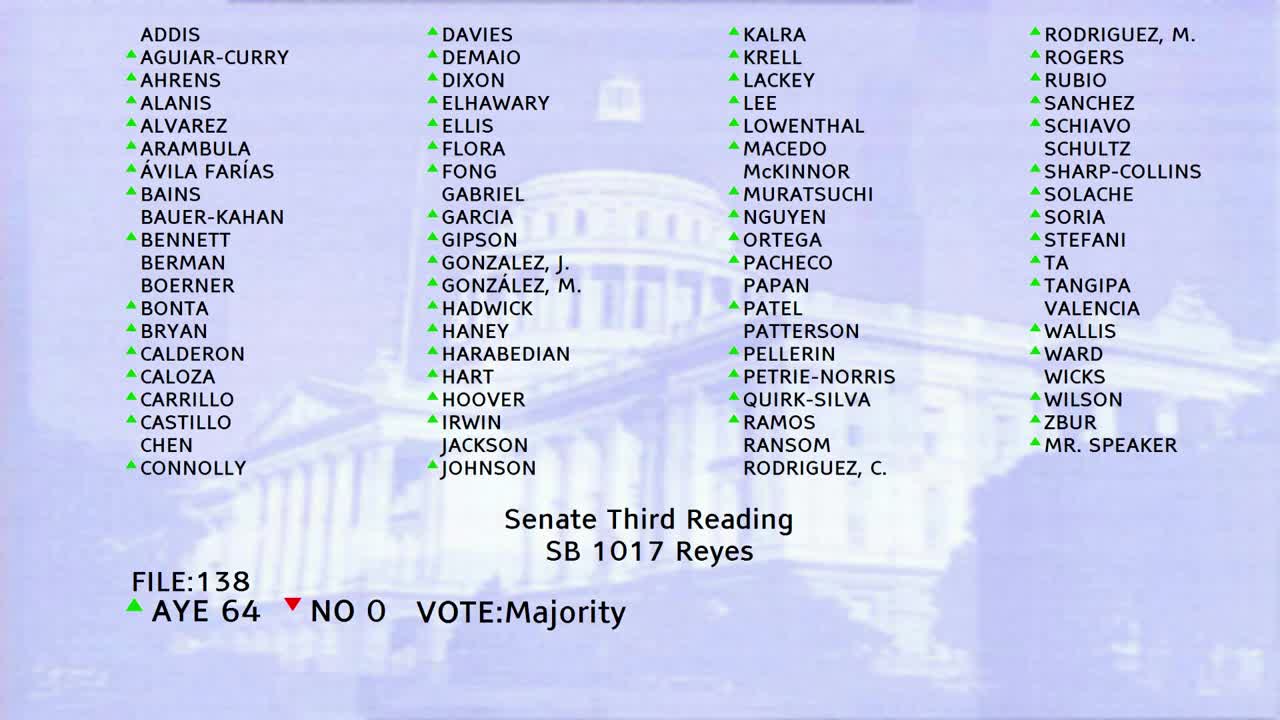 1MIN
Assembly Floor
 6MIN
Senate Standing Committee on Emergency Management
 1MIN
Assembly Floor
 5MIN
Assembly Standing Committee on Judiciary
Bill Author

Bill Co-Author(s):