AB 1754: State general obligation bonds: requirements.
- Session Year: 2025-2026
- House: Assembly
- Latest Version Date: 2026-06-15
Current Status:
In Progress
(2026-08-13: In committee: Held under submission.)
Introduced
In Committee
Awaiting First Chamber Vote
Passed First Chamber
In Committee
Awaiting Second Chamber Vote
Passed Second Chamber
Enacted
Existing law, the State General Obligation Bond Law, generally sets forth the procedures for the issuance and sale of bonds governed by its provisions and for the disbursal of the proceeds of the sale of those bonds. Existing law specifies various provisions required for inclusion in a bond act. Existing law requires any state bond measure approved on or after January 1, 2004, to be subject to an annual reporting process, with the head of the lead state agency administering the bond proceeds reporting certain information about the projects being funded to the Legislature and the Department of Finance. Existing law permits this information to be provided on the agencys internet website or the states open data portal under certain circumstances. Existing law authorizes the costs of the report to be included in the cost of administering the bond act unless prohibited by the bond act.
Existing law defines various terms for these purposes, including board. Existing law defines board to mean the state board, department, or agency authorized by a bond act to request the committee to cause bonds to be issued for the purpose of creating a fund that is to be expended by the board for the purposes specified in the bond act.
Existing law, the Administrative Procedure Act, sets forth the requirements for the adoption, publication, review, and implementation of regulations by state agencies.
For any state general obligation bond measure that is approved by voters on and after January 1, 2027, this bill would require a bond act to include specified information about the objectives of the bond expenditure and related data. The bill would also require the board to post on its internet website a notification that contains, among other information, details about the programs and projects authorized to be funded by the bond. The bill would require the board to provide a short, one page, executive summary style written report to the Department of Finance, the Legislative Analyst, and specified legislative committees that contains certain information regarding the general obligation bond, in accordance with the above-described provision permitting this information to be provided on the boards internet website or the states online data portal. The bill would require the report to include, among other information, whether the project, grant, or other expenditure of bond proceeds has been done in a timely manner. The bill would require a bond act to include a provision requiring the cost of the report to be included in the cost of administering the bond act and would require the cost of compliance with the above-described report requirements be included in the cost of administering the bond act. The bill would exempt from the requirements of the Administrative Procedure Act the development and adoption of program guidelines, recommendations, or criteria pursuant to the bill. The bill would also make nonsubstantive and conforming changes.
Existing law, the State General Obligation Bond Law, generally sets forth the procedures for the issuance and sale of bonds governed by its provisions and for the disbursal of the proceeds of the sale of those bonds. Existing law specifies various provisions required for inclusion in a bond act. Existing law requires any state bond measure approved on or after January 1, 2004, to be subject to an annual reporting process, with the head of the lead state agency administering the bond proceeds reporting certain information about the projects being funded to the Legislature and the Department of Finance. Existing law permits this information to be provided on the agencys internet website or the states open data portal under certain circumstances. Existing law authorizes the costs of the report to be included in the cost of administering the bond act unless prohibited by the bond act.
Existing law defines various terms for these purposes, including board. Existing law defines board to mean the state board, department, or agency authorized by a bond act to request the committee to cause bonds to be issued for the purpose of creating a fund that is to be expended by the board for the purposes specified in the bond act.
For any state general obligation bond measure that is approved by voters on and after January 1, 2027, this bill would require a bond act to include specified information about the objectives of the bond expenditure and related data. The bill would also require the head of the lead state agency administering the bond board to post on its internet website a notification that contains, among other information, details about the programs and projects authorized to be funded by the bond. The bill would require each state agency subject to these provisions the board to provide a short, one page, executive summary style written report to the Department of Finance, the Legislative Analyst, and specified legislative committees that contains certain information regarding the general obligation bond, in accordance with the above-described provision permitting this information to be provided on the agencys boards internet website or the states online data portal. The bill would require the report to include, among other information, whether the project, grant, or other expenditure of bond proceeds has been done in a timely manner. The bill would require a bond act to include a provision requiring the cost of the report to be included in the cost of administering the bond act, act and would require the cost of compliance with the above-described report requirements be included in the cost of administering the bond act. The bill would also make non-substantive nonsubstantive and conforming changes to certain cross-references. changes.
Existing law, the State General Obligation Bond Law, generally sets forth the procedures for the issuance and sale of bonds governed by its provisions and for the disbursal of the proceeds of the sale of those bonds. Existing law specifies various provisions required for inclusion in a bond act. Existing law requires any state bond measure approved on or after January 1, 2004, to be subject to an annual reporting process, with the head of the lead state agency administering the bond proceeds reporting certain information about the projects being funded to the Legislature and the Department of Finance. Existing law permits this information to be provided on the agencys internet website or the states open data portal under certain circumstances. Existing law authorizes the costs of the report to be included in the cost of administering the bond act unless prohibited by the bond act.
For any state general obligation bond measure that is approved by voters on and after January 1, 2027, this bill would require a bond act to include specified information about the objectives of the bond expenditure and related data. The bill would also require the head of the lead state agency administering the bond to post on its internet website a notification that contains, among other information, details about the programs and projects authorized to be funded by the bond. The bill would require each state agency subject to these provisions to provide a written report to the Department of Finance, the Legislative Analyst, and specified legislative committees that contains certain information regarding the general obligation bond, in accordance with the above-described provision permitting this information to be provided on the agencys internet website or the states online data portal. The bill would require the report to include, among other information, whether the project, grant, or other expenditure of bond proceeds has been done in a timely manner. The bill would require a bond act to include a provision requiring the cost of the report to be included in the cost of administering the bond act, and would require the cost of compliance with the above-described report requirements be included in the cost of administering the bond act. The bill would also make non-substantive and conforming changes to certain cross-references.
This act shall be known, and may be cited, as the Bond Outcomes and Reporting Act.
SEC. 2.(a)The Legislature finds and declares all of the following:
(1)Upon approval by California voters, general obligation bonds are used to make important investments in the states infrastructure and to meet specific funding needs.
(2)As the fourth largest economy in the world, and with nearly 40,000,000 in population, California needs to make ongoing investments in its infrastructure.
(3)Bond expenditures and related information should be provided to voters to promote greater transparency and trust of the voters who approve bond funding for the purpose of ensuring a vital infrastructure future for California.
(4)The public should be assured that bond funds will be used as the voters intended.
(5)Bond funds should be spent efficiently, effectively, and in the best interests of Californians.
(6)Accountability regarding the expenditure of bond funds begins with establishing criteria for determining whether the intended outcomes are being achieved.
(7)Ongoing updates and auditing completed projects can help determine that the bond expenditures were consistent with the established criteria and all applicable laws.
(8)Accountability consists of ensuring bond expenditures contribute to long-lasting, meaningful improvements to critical infrastructure in this state, as well as providing the public with readily accessible information about how the bonds they approved and are paying for are being spent annually.
(b)Therefore, it is the intent of the Legislature to accomplish all of the following:
(1)Ensure general obligation bond dollars are expended after specified objectives are established for the expenditure of those bond dollars. As agencies have capabilities already in place to comply with Executive Order No. S-02-07, the objectives required by this measure are intended to be simple disclosures of existing information that link individual bond-funded activities to quantifiable strategic goals. For example, Treat 2,000,000 acres to reduce fuel load by 2035. This is routine best practice for program administration and intends only to increase public transparency of performance metrics that agencies should already have created to effectively manage public funds.
(2)Ensure that the internet website information required by this act provides the public with ready access to information on how bond proceeds are being utilized and are meeting their intended goals and objectives. In addition to including each bond-funded activitys contribution to quantifiable strategic goals, this measure intends to require a short, one-page, executive summary style report to synthesize this information into an overview of how these activities are meeting long-term quantifiable strategic objectives.
(3)Establish criteria for the expenditure of bond funds to ensure that the state achieves the intended outcomes of those bond expenditures.
(4)When expending bond funds, not only should the public body comply with the authorizing bond act, the State General Obligation Bond Law, and other applicable state and federal laws, those expenditures should meet clear, brief accountability criteria to ensure that bond proceeds are spent efficiently, effectively, and in the best interests of California.
(5)Reimburse additional costs to an agency from bond funding so there is no additional state funding required to implement this measure.
SEC. 3.Section 16724.2 is added to the Government Code, to read:16724.2.(a)For any state bond measure approved by the voters on and after January 1, 2027, the bond act shall include all of the following:
(1)Specific goals, purposes, and objectives that the bond expenditure is intended to achieve.
(2)Detailed performance indicators for the public to have when measuring whether the bond expenditure meets the goals, purposes, and objectives established.
(3)Data collection requirements to enable the public to determine whether the bond expenditure is meeting, failing to meet, or exceeding those specific goals, purposes, and objectives.
(4) Specific data and baseline measurements to be collected and remitted annually while the bond is being expended.
(5)A provision requiring the costs of the report required under subdivision (e) to be included in the cost of administering the bond act.
(b)The criteria established shall evaluate the intended outcomes of the bond both at the issuance of the bond and once the funded projects are completed.
(c)The board shall post on its internet website a notification that contains the items set forth in subdivision (a). This notification shall include, but not be limited to, the following information:
(1)An overview of the various programs and projects authorized to be funded by the bond.
(2)A summary of the status of bond use by major program category.
(3)An explanation of the accountability criteria that will govern the use of the bond funds.
(4)Detailed information about bond use by program or individual infrastructure project.
(5)Objectives of the program or project to be funded by the bond.
(d)Any relevant board shall cooperate in the implementation of this section.
(e)(1)The board shall provide a short, one page, executive summary style written report to the Department of Finance, the Legislative Analyst, the Assembly Committee on Budget, and the Senate Committee on Budget and Fiscal Review that, at a minimum, sets forth the following information regarding the general obligation bond:
(A)Whether the project, grant, or other expenditure of bond proceeds has been done in a timely and efficient manner.
(B)Whether the project, grant, or other expenditure of bond proceeds has or has not achieved its intended purpose.
(C)Whether the project, grant, or other expenditure of bond proceeds was done in compliance with all statutory and regulatory requirements.
(2)The written report required pursuant to paragraph (1) shall also be posted conspicuously on the boards internet website, in accordance with subdivision (c) of Section 16724.4.
(3)The report required pursuant to paragraph (1) shall be submitted in compliance with Section 9795.
(f)The cost of the report required under subdivision (e) shall be included in the cost of administering the bond act.
(g)Chapter 3.5 (commencing with Section 11340) of Part 1 of Division 3 shall not apply to the development and adoption of program guidelines, recommendations, or criteria pursuant to this section.
SEC. 4.Section 16724.4 of the Government Code is amended to read:16724.4.Any state bond measure approved by the voters on or after January 1, 2004, shall be subject to an annual reporting process, as follows:
(a)The board shall report to the Legislature and the Department of Finance no later than January 1, 2005, or the January 1 of the second year following the enactment of the bond measure, whichever is later, and at least once a year thereafter. The annual report shall contain all of the following:
(1)A list of all projects and their geographical location that have been funded or are required or authorized to receive funds.
(2)The amount of funds allocated on each project.
(3)The status of any project required or authorized to be funded.
(b)Costs of the report may be included in the cost of administering the bond measure unless the measure specifically prohibits those expenses.
(c)If the board has developed and continuously maintains an alternative digital method of providing all the information required pursuant to subdivision (a), such as a publicly available data display on the boards internet website or the states open data portal, an annual notification to the Legislature and the Department of Finance that includes specific instructions to locate the information may meet the annual reporting process requirements of this section.
This act shall be known, and may be cited, as the Bond Outcomes and Reporting Act.
SEC. 2.(a)The Legislature finds and declares all of the following:
(1)Upon approval by California voters, general obligation bonds are used to make important investments in the states infrastructure and to meet specific funding needs.
(2)As the fourth largest economy in the world, and with nearly 40,000,000 in population, California needs to make ongoing investments in its infrastructure.
(3)Bond expenditures and related information should be provided to voters to promote greater transparency and trust of the voters who approve bond funding for the purpose of ensuring a vital infrastructure future for California.
(4)The public should be assured that bond funds will be used as the voters intended.
(5)Bond funds should be spent efficiently, effectively, and in the best interests of Californians.
(6)Accountability regarding the expenditure of bond funds begins with establishing criteria for determining whether the intended outcomes are being achieved.
(7)Ongoing updates and auditing completed projects can help determine that the bond expenditures were consistent with the established criteria and all applicable laws.
(8)Accountability consists of ensuring bond expenditures contribute to long-lasting, meaningful improvements to critical infrastructure in this state, as well as providing the public with readily accessible information about how the bonds they approved and are paying for are being spent annually.
(b)Therefore, it is the intent of the Legislature to accomplish all of the following:
(1)Ensure general obligation bond dollars are expended after specified objectives are established for the expenditure of those bond dollars. As agencies have capabilities already in place to comply with Executive Order No. S-02-07, the objectives required by this measure are intended to be simple disclosures of existing information that link individual bond-funded activities to quantifiable strategic goals. For example, Treat 2,000,000 acres to reduce fuel load by 2035. This is routine best practice for program administration and intends only to increase public transparency of performance metrics that agencies should already have created to effectively manage public funds.
(2)Ensure that the internet website information required by this act provides the public with ready access to information on how bond proceeds are being utilized and are meeting their intended goals and objectives. In addition to including each bond-funded activitys contribution to quantifiable strategic goals, this measure intends to require a short, one-page, executive summary style report to synthesize this information into an overview of how these activities are meeting long-term quantifiable strategic objectives.
(3)Establish criteria for the expenditure of bond funds to ensure that the state achieves the intended outcomes of those bond expenditures.
(4)When expending bond funds, not only should the public body comply with the authorizing bond act, the State General Obligation Bond Law, and other applicable state and federal laws, those expenditures should meet clear clear, brief accountability criteria to ensure that bond proceeds are spent efficiently, effectively, and in the best interests of California.
(5)Reimburse additional costs to an agency from bond funding. funding so there is no additional state funding required to implement this measure.
SEC. 3.Section 19967 of the Education Code is amended to read:19967.(a)A facility, or the part thereof, acquired, constructed, remodeled, or rehabilitated with grants received pursuant to this chapter shall be dedicated to public library direct service use for a period of not less than 20 years following completion of the project, or the useful life of the building, whichever is longer.(b)If the facility, or part thereof, acquired, constructed, remodeled, or rehabilitated with grants received pursuant to this chapter ceases to be used for public library direct service prior to the expiration of the period specified in subdivision (a), the board shall be entitled to recover from the grant recipient or the recipients successor in the maintenance of the facility, an amount which bears the same ratio to the value of the facility, or the appropriate part thereof, at the time it ceased to be used from public library direct service as the amount of the grant bore to the cost of the facility or appropriate part thereof. For purposes of this subdivision, the value of the facility, or the appropriate part thereof, shall be determined by the mutual agreement of the parties, or through an action brought for that purpose in the superior court.(c)The board may release the grant recipient or the recipients successor in the maintenance of the facility from its obligation under subdivision (a), and waive the requirements of subdivision (b), if the board determines that so doing would not diminish the quality of public library service in the community served by the facility.(d)Notwithstanding paragraph (6) of subdivision (a) of Section 16724 of the Government Code, moneys recovered pursuant to subdivision (b) shall be deposited in the fund, and shall be available for the purpose of awarding grants for other projects.SEC. 4.Section 19999 of the Education Code is amended to read:19999.(a)A facility, or the part thereof, acquired, constructed, or remodeled, or rehabilitated with grants received pursuant to this chapter shall be dedicated to public library direct service use for a period of not less than 20 years following completion of the project.(b)The interest of the state in land or a facility, or both, pursuant to the funding of a project under this chapter, as described in subdivision (a), may be transferred by the State Librarian from the land or facility, or both, for which that funding was granted to a replacement site and facility acquired or constructed for the purpose of providing public library direct service.(c)If the facility, or any part thereof, acquired, constructed, remodeled, or habilitated with grants received pursuant to this chapter ceases to be used for public library direct service prior to the expiration of the period specified in subdivision (a), the board is entitled to recover, from the grant recipient or the recipients successor in the maintenance of the facility, an amount that bears the same ratio to the value of the facility, or the appropriate part thereof, at the time it ceased to be used for public library direct service as the amount of the grant bore to the cost of the facility or the appropriate part thereof. For purposes of this subdivision, the value of the facility, or the appropriate part thereof, is determined by the mutual agreement of the board and the grant recipient or successor, or through an action brought for that purpose in the superior court.(d)Notwithstanding paragraph (6) of subdivision (a) of Section 16724 of the Government Code, any money recovered pursuant to subdivision (c) shall be deposited in the fund, and shall be available for the purpose of awarding grants for other projects.SEC. 5.Section 16724 of the Government Code is amended to read:16724.(a)For any state bond measure approved by the voters before January 1, 2027, the bond act shall contain all of the following provisions:(1)A statement of the total amount of bonds authorized to be issued and the purpose for which the proceeds from the sale of the bonds may be used.(2)The creation of a committee and fund, and the naming of the board as these items are defined in Section 16722.(3)A statement that the bonds are valid obligations of the state and a pledge of the full faith and credit of the state for the punctual payment of both principal and interest thereof.(4)An appropriation from the General Fund in the State Treasury of the sum annually as shall be necessary to pay the principal and interest on the bonds as they become due and payable.(5)A requirement that there be collected annually in the same manner and at the same time as other state revenue is collected the sum, in addition to the ordinary revenues of the state, as is required to pay the principal and interest on the bonds; and a provision making it the duty of all officers charged by law with any duty in regard to the collections of the revenue to do and perform each and every act which is necessary to collect that additional sum.(6)If the bond act provides that the fund shall have any receipts other than the proceeds of the sale of bonds, the proceeds of interim financing, or the investment earnings on the proceeds of bond sales or interim financing, then the bond act shall also specify whether those receipts shall be transferred to the General Fund as a reimbursement for debt service payments or be used for the same purpose for which the proceeds of the sale of the bonds may be used.(7)A provision incorporating the provisions of this chapter, and a declaration that the provisions hereof are included in the act as though set out in full therein.(8)A statement that the bonds may be refunded in accordance with Article 6 (commencing with Section 16780), and that approval of the authorization of the bonds by the electors includes approval of any bonds issued to refund the bonds originally issued.(9)A statement that notwithstanding any other provision of the bond act, or of the State General Obligation Bond Law (Chapter 4 (commencing with Section 16720) of Part 3 of Division 4 of Title 2 of the Government Code), if the Treasurer sells bonds pursuant to this bond act that include a bond counsel opinion to the effect that the interest on the bonds is excluded from gross income for federal tax purposes under designated conditions, the Treasurer may maintain separate accounts for the bond proceeds invested and the investment earnings on those proceeds, and may use or direct the use of those proceeds or earnings to pay any rebate, penalty, or other payment required under federal law, or take any other action with respect to the investment and use of those bond proceeds, as may be required or desirable under federal law in order to maintain the tax-exempt status of those bonds and to obtain any other advantage under federal law on behalf of the funds of this state.(10)A statement that the board may request the Pooled Money Investment Board to make a loan from the Pooled Money Investment Account, in accordance with Section 16312, for the purposes of carrying out the bond act. The amount of the request shall not exceed the amount of the unsold bonds that the committee has by resolution authorized to be sold for the purpose of carrying out the bond act. The board shall execute any documents required by the Pooled Money Investment Board to obtain and repay the loan. Any amounts loaned shall be deposited in the fund to be allocated by the board in accordance with the bond act.(b)For any state bond measure approved by the voters on or after January 1, 2027, the bond act shall contain the provisions specified in subdivision (a), in addition to a provision requiring the costs of the report, as specified in Section 16724.2, to be included in the cost of administering the bond act.SEC. 6.SEC. 3.Section 16724.2 is added to the Government Code, to read:16724.2.(a)For any state bond measure approved by the voters on and after January 1, 2027, the bond act shall include all of the following:
(1)Specific goals, purposes, and objectives that the bond expenditure is intended to achieve.
(2)Detailed performance indicators for the public to have when measuring whether the bond expenditure meets the goals, purposes, and objectives established.
(3)Data collection requirements to enable the public to determine whether the bond expenditure is meeting, failing to meet, or exceeding those specific goals, purposes, and objectives.
(4) Specific data and baseline measurements to be collected and remitted annually while the bond is being expended.
(5)A provision requiring the costs of the report required under subdivision (e) to be included in the cost of administering the bond act.
(b)The criteria established shall evaluate the intended outcomes of the bond both at the issuance of the bond and once the funded projects are completed.
(c)The head of the lead state agency administering the bond board shall post on its internet website a notification that contains the items set forth in subdivision (a). This notification shall include, but not be limited to, the following information:
(1)An overview of the various programs and projects authorized to be funded by the bond.
(2)A summary of the status of bond use by major program category.
(3)An explanation of the accountability criteria that will govern the use of the bond funds.
(4)Detailed information about bond use by program or individual infrastructure project.
(5)Objectives of the program or project to be funded by the bond.
(d)Any relevant state agency board shall cooperate in the implementation of this section.
(e)(1)Each lead state agency that is subject to this section The board shall provide a short, one page, executive summary style written report to the Department of Finance, the Legislative Analyst, the Assembly Committee on Budget, and the Senate Committee on Budget and Fiscal Review that, at a minimum, sets forth the following information regarding the general obligation bond:
(A)Whether the project, grant, or other expenditure of bond proceeds has been done in a timely and efficient manner.
(B)Whether the project, grant, or other expenditure of bond proceeds has or has not achieved its intended purpose.
(C)Whether the project, grant, or other expenditure of bond proceeds was done in compliance with all statutory and regulatory requirements.
(2)The written report required pursuant to paragraph (1) shall also be posted conspicuously on the state agencys boards internet website, in accordance with subdivision (c) of Section 16724.4.
(3)The report required pursuant to paragraph (1) shall be submitted in compliance with Section 9795.
(f)The cost of the report, as specified in subdivision (e), report required under subdivision (e) shall be included in the cost of administering the bond act as provided in subdivision (b) of Section 16724. act.
SEC. 7.Section 16786 of the Government Code is amended to read:16786.This article applies only to the refunding of bonds authorized at a statewide election held after the effective date of this article pursuant to a bond act expressly mentioning the right of the state to refund the bonds so authorized. In any such bond act, the provisions included therein pursuant to paragraphs (3), (4), (5), and (6) of subdivision (a) of Section 16724 apply to refunding bonds to the same extent and in the same manner as those provisions applied to the bonds being refunded.SEC. 4.Section 16724.4 of the Government Code is amended to read:16724.4.Any state bond measure approved by the voters on or after January 1, 2004, shall be subject to an annual reporting process, as follows:
(a)The head of the lead state agency administering the bond proceeds board shall report to the Legislature and the Department of Finance no later than January 1, 2005, or the January 1 of the second year following the enactment of the bond measure, whichever is later, and at least once a year thereafter. The annual report shall contain all of the following:
(1)A list of all projects and their geographical location that have been funded or are required or authorized to receive funds.
(2)The amount of funds allocated on each project.
(3)The status of any project required or authorized to be funded.
(b)Costs of the report may be included in the cost of administering the bond measure unless the measure specifically prohibits those expenses.
(c)If the head of the lead state agency administering the bond proceeds board has developed and continuously maintains an alternative digital method of providing all the information required pursuant to subdivision (a), such as a publicly available data display on the agencys boards internet website or the states open data portal, an annual notification to the Legislature and the Department of Finance that includes specific instructions to locate the information may meet the annual reporting process requirements of this section.
This act shall be known, and may be cited, as the Bond Outcomes and Reporting Act.
SEC. 2.(a)The Legislature finds and declares all of the following:
(1)Upon approval by California voters, general obligation bonds are used to make important investments in the states infrastructure and to meet specific funding needs.
(2)As the fourth largest economy in the world, and with nearly 40,000,000 in population, California needs to make ongoing investments in its infrastructure.
(3)Bond expenditures and related information should be provided to voters to promote greater transparency and trust of the voters who approve bond funding for the purpose of ensuring a vital infrastructure future for California.
(4)The public should be assured that bond funds will be used as the voters intended.
(5)Bond funds should be spent efficiently, effectively, and in the best interests of Californians.
(6)Accountability regarding the expenditure of bond funds begins with establishing criteria for determining whether the intended outcomes are being achieved.
(7)Ongoing updates and auditing completed projects can help determine that the bond expenditures were consistent with the established criteria and all applicable laws.
(8)Accountability consists of ensuring bond expenditures contribute to long-lasting, meaningful improvements to critical infrastructure in this state, as well as providing the public with readily accessible information about how the bonds they approved and are paying for are being spent annually.
(b)Therefore, it is the intent of the Legislature to accomplish all of the following:
(1)Ensure general obligation bond dollars are expended after specified objectives are established for the expenditure of those bond dollars.
(2)Ensure that the internet website information required by this act provides the public with ready access to information on how bond proceeds are being utilized and are meeting their intended goals and objectives.
(3)Establish criteria for the expenditure of bond funds to ensure that the state achieves the intended outcomes of those bond expenditures.
(4)When expending bond funds, not only should the public body comply with the authorizing bond act, the State General Obligation Bond Law, and other applicable state and federal laws, those expenditures should meet clear accountability criteria to ensure that bond proceeds are spent efficiently, effectively, and in the best interests of California.
(5)Reimburse additional costs to an agency from bond funding.
SEC. 3.Section 19967 of the Education Code is amended to read:19967.(a)A facility, or the part thereof, acquired, constructed, remodeled, or rehabilitated with grants received pursuant to this chapter shall be dedicated to public library direct service use for a period of not less than 20 years following completion of the project, or the useful life of the building, whichever is longer.
(b)If the facility, or part thereof, acquired, constructed, remodeled, or rehabilitated with grants received pursuant to this chapter ceases to be used for public library direct service prior to the expiration of the period specified in subdivision (a), the board shall be entitled to recover from the grant recipient or the recipients successor in the maintenance of the facility, an amount which bears the same ratio to the value of the facility, or the appropriate part thereof, at the time it ceased to be used from public library direct service as the amount of the grant bore to the cost of the facility or appropriate part thereof. For purposes of this subdivision, the value of the facility, or the appropriate part thereof, shall be determined by the mutual agreement of the parties, or through an action brought for that purpose in the superior court.
(c)The board may release the grant recipient or the recipients successor in the maintenance of the facility from its obligation under subdivision (a), and waive the requirements of subdivision (b), if the board determines that so doing would not diminish the quality of public library service in the community served by the facility.
(d)Notwithstanding subdivision (f) paragraph (6) of subdivision (a) of Section 16724 of the Government Code, moneys recovered pursuant to subdivision (b) shall be deposited in the fund, and shall be available for the purpose of awarding grants for other projects.
SEC. 4.Section 19999 of the Education Code is amended to read:19999.(a)A facility, or the part thereof, acquired, constructed, or remodeled, or rehabilitated with grants received pursuant to this chapter shall be dedicated to public library direct service use for a period of not less than 20 years following completion of the project.
(b)The interest of the state in land or a facility, or both, pursuant to the funding of a project under this chapter, as described in subdivision (a), may be transferred by the State Librarian from the land or facility, or both, for which that funding was granted to a replacement site and facility acquired or constructed for the purpose of providing public library direct service.
(c)If the facility, or any part thereof, acquired, constructed, remodeled, or habilitated with grants received pursuant to this chapter ceases to be used for public library direct service prior to the expiration of the period specified in subdivision (a), the board is entitled to recover, from the grant recipient or the recipients successor in the maintenance of the facility, an amount that bears the same ratio to the value of the facility, or the appropriate part thereof, at the time it ceased to be used for public library direct service as the amount of the grant bore to the cost of the facility or the appropriate part thereof. For purposes of this subdivision, the value of the facility, or the appropriate part thereof, is determined by the mutual agreement of the board and the grant recipient or successor, or through an action brought for that purpose in the superior court.
(d)Notwithstanding subdivision (f) paragraph (6) of subdivision (a) of Section 16724 of the Government Code, any money recovered pursuant to subdivision (c) shall be deposited in the fund, and shall be available for the purpose of awarding grants for other projects.
SEC. 5.Section 16724 of the Government Code is amended to read:16724.The (a)For any state bond measure approved by the voters before January 1, 2027, the bond act shall contain all of the following provisions:
(a)(1)A statement of the total amount of bonds authorized to be issued and the purpose for which the proceeds from the sale of the bonds may be used.
(b)(2)The creation of a committee and fund, and the naming of the board as these items are defined in Section 16722.
(c)(3)A statement that the bonds are valid obligations of the state and a pledge of the full faith and credit of the state for the punctual payment of both principal and interest thereof.
(d)(4)An appropriation from the General Fund in the State Treasury of the sum annually as shall be necessary to pay the principal and interest on the bonds as they become due and payable.
(e)(5)A requirement that there be collected annually in the same manner and at the same time as other state revenue is collected the sum, in addition to the ordinary revenues of the state, as is required to pay the principal and interest on the bonds; and a provision making it the duty of all officers charged by law with any duty in regard to the collections of the revenue to do and perform each and every act which is necessary to collect that additional sum.
(f)(6)If the bond act provides that the fund shall have any receipts other than the proceeds of the sale of bonds, the proceeds of interim financing, or the investment earnings on the proceeds of bond sales or interim financing, then the bond act shall also specify whether those receipts shall be transferred to the General Fund as a reimbursement for debt service payments or be used for the same purpose for which the proceeds of the sale of the bonds may be used.
(g)(7)A provision incorporating the provisions of this chapter, and a declaration that the provisions hereof are included in the act as though set out in full therein.
(h)(8)A statement that the bonds may be refunded in accordance with Article 6 (commencing with Section 16780), and that approval of the authorization of the bonds by the electors includes approval of any bonds issued to refund the bonds originally issued.
(i)(9)A statement that notwithstanding any other provision of the bond act, or of the State General Obligation Bond Law (Chapter 4 (commencing with Section 16720) of Part 3 of Division 4 of Title 2 of the Government Code), if the Treasurer sells bonds pursuant to this bond act that include a bond counsel opinion to the effect that the interest on the bonds is excluded from gross income for federal tax purposes under designated conditions, the Treasurer may maintain separate accounts for the bond proceeds invested and the investment earnings on those proceeds, and may use or direct the use of those proceeds or earnings to pay any rebate, penalty, or other payment required under federal law, or take any other action with respect to the investment and use of those bond proceeds, as may be required or desirable under federal law in order to maintain the tax-exempt status of those bonds and to obtain any other advantage under federal law on behalf of the funds of this state.
(j)(10)A statement that the board may request the Pooled Money Investment Board to make a loan from the Pooled Money Investment Account, in accordance with Section 16312, for the purposes of carrying out the bond act. The amount of the request shall not exceed the amount of the unsold bonds that the committee has by resolution authorized to be sold for the purpose of carrying out the bond act. The board shall execute any documents required by the Pooled Money Investment Board to obtain and repay the loan. Any amounts loaned shall be deposited in the fund to be allocated by the board in accordance with the bond act.
(b)For any state bond measure approved by the voters on or after January 1, 2027, the bond act shall contain the provisions specified in subdivision (a), in addition to a provision requiring the costs of the report, as specified in Section 16724.2, to be included in the cost of administering the bond act.
SEC. 6.Section 16724.2 is added to the Government Code, to read:16724.2.(a)For any state bond measure approved by the voters on and after January 1, 2027, the bond act shall include all of the following:
(1)Specific goals, purposes, and objectives that the bond expenditure is intended to achieve.
(2)Detailed performance indicators for the public to have when measuring whether the bond expenditure meets the goals, purposes, and objectives established.
(3)Data collection requirements to enable the public to determine whether the bond expenditure is meeting, failing to meet, or exceeding those specific goals, purposes, and objectives.
(4)Specific data and baseline measurements to be collected and remitted annually while the bond is being expended.
(b)The criteria established shall evaluate the intended outcomes of the bond both at the issuance of the bond and once the funded projects are completed.
(c)The head of the lead state agency administering the bond shall post on its internet website a notification that contains the items set forth in subdivision (a). This notification shall include, but not be limited to, the following information:
(1)An overview of the various programs and projects authorized to be funded by the bond.
(2)A summary of the status of bond use by major program category.
(3)An explanation of the accountability criteria that will govern the use of the bond funds.
(4)Detailed information about bond use by program or individual infrastructure project.
(5)Objectives of the program or project to be funded by the bond.
(d)Any relevant state agency shall cooperate in the implementation of this section.
(e)(1)Each lead state agency that is subject to this section shall provide a written report to the Department of Finance, the Legislative Analyst, the Assembly Committee on Budget, and the Senate Committee on Budget and Fiscal Review that, at a minimum, sets forth the following information regarding the general obligation bond:
(A)Whether the project, grant, or other expenditure of bond proceeds has been done in a timely and efficient manner.
(B)Whether the project, grant, or other expenditure of bond proceeds has or has not achieved its intended purpose.
(C)Whether the project, grant, or other expenditure of bond proceeds was done in compliance with all statutory and regulatory requirements.
(2)The written report required pursuant to paragraph (1) shall also be posted conspicuously on the state agencys internet website, in accordance with subdivision (c) of Section 16724.4.
(3)The report required pursuant to paragraph (1) shall be submitted in compliance with Section 9795.
(f)The cost of the report, as specified in subdivision (e), shall be included in the cost of administering the bond act as provided in subdivision (b) of Section 16724.
SEC. 7.Section 16786 of the Government Code is amended to read:16786.This article applies only to the refunding of bonds authorized at a statewide election held after the effective date of this article pursuant to a bond act expressly mentioning the right of the state to refund the bonds so authorized. In any such bond act, the provisions included therein pursuant to subdivisions (c), (d), (e), and (f) paragraphs (3), (4), (5), and (6) of subdivision (a) of Section 16724 apply to refunding bonds to the same extent and in the same manner as those provisions applied to the bonds being refunded.
|
Date
|
Status
|
|---|---|
| Aug 13, 2026 | In committee: Held under submission. |
| Aug 3, 2026 | In committee: Referred to APPR. suspense file. |
| Jun 23, 2026 | From committee: Do pass and re-refer to Com. on APPR. (Ayes 14. Noes 0.) (June 23). Re-referred to Com. on APPR. |
| Jun 15, 2026 | From committee chair, with author's amendments: Amend, and re-refer to committee. Read second time, amended, and re-referred to Com. on G.O. |
| Jun 3, 2026 | Referred to Com. on G.O. |
| May 27, 2026 | In Senate. Read first time. To Com. on RLS. for assignment. |
| May 26, 2026 | Read third time. Passed. Ordered to the Senate. (Ayes 73. Noes 0. Page 5360.) |
| May 26, 2026 | Read third time. Passed. Ordered to the Senate. (Ayes 73. Noes 0.) |
| May 26, 2026 | Read third time. Passed. Ordered to the Senate. |
| May 19, 2026 | Read second time. Ordered to third reading. |
| May 18, 2026 | Read second time and amended. Ordered returned to second reading. |
| May 14, 2026 | From committee: Amend, and do pass as amended. (Ayes 11. Noes 1.) (May 14). |
| Apr 15, 2026 | In committee: Set, first hearing. Referred to APPR. suspense file. |
| Mar 19, 2026 | From committee: Do pass and re-refer to Com. on APPR. with recommendation: To Consent Calendar. (Ayes 18. Noes 0.) (March 18). Re-referred to Com. on APPR. |
| Feb 23, 2026 | Referred to Com. on G.O. |
| Feb 10, 2026 | From printer. May be heard in committee March 12. |
| Feb 9, 2026 | Read first time. To print. |
|
Date
|
Description
|
Location
|
Votes
|
|
|---|---|---|---|---|
| Aug 3, 2026 | Placed on suspense file | Senate Standing Committee on Appropriations |
Passed |
|
| Jun 23, 2026 | Do pass, but first be re-referred to the Committee on [Appropriations] | Senate Standing Committee on Governmental Organization |
Passed |
|
| May 26, 2026 | AB 1754 Pacheco Assembly Third Reading | Assembly Floor |
Passed |
|
| May 14, 2026 | Do pass as amended. | Assembly Standing Committee on Appropriations |
Passed |
|
| Mar 18, 2026 | Do pass and be re-referred to the Committee on [Appropriations] with recommendation: To Consent Calendar | Assembly Standing Committee on Governmental Organization |
Passed |
This list shows positions taken on this bill by organizations on the date displayed, which is linked to the original source.
Positions by individuals are not included.
|
Organization
|
Position
|
Date
|
|---|---|---|
| Association Of California Water Agencies | ** Against | |
| California State Association Of Counties | ** Against | |
| Elevate California | ** Support | |
| Rural County Representatives of California | ** Against | |
| San Juan Water District | ** Against |
SENATE COMMITTEE ON
Senator Sabrina Cervantes, Chair
2025 - 2026 Regular Session
AB 1754 (Pacheco) - State general obligation bonds: requirements
Version: | Policy Vote: |
Urgency: | Mandate: |
Hearing Date: | Consultant: |
Bill Summary:
AB 1754 establishes new data collection, reporting, and evaluation requirements for entities administering statewide general obligation (G.O.) bonds approved by voters on or after January 1, 2027.
Fiscal Impact:
- Unknown potentially significant costs, likely in the low hundreds of thousands of dollars per bond, for administering agencies (various bond funds). Costs for this additional reporting will vary depending on each bond act’s specific data collection requirements and outcome criteria, as well as the extent to which lead agencies already track the metrics required by the bill.
For context, the Department of General Services’ (DGS) Office of Public School Construction (OPSC) currently administers Proposition 2, a $10 billion statewide public school facilities G.O. bond measure approved by voters in November 2024. If a future bond measure with similar terms to Prop. 2 is approved to continue the School Facilities Program, DGS estimates the program would face cost pressures of $100,000 to update the OPSC Online system, plus an additional $32,000 to meet expanded data collection and reporting requirements (bond funds).
- Unknown ongoing costs for the Secretary of State (SOS), to the extent including additional information on G.O. bond measure goals and performance indicators lengthens the statutory text enough to require an additional page to the Statewide Voter Information Guide. SOS indicates that printing and mailing costs associated with placing a measure on the statewide ballot are $123,000 per page, depending on the length of the ballot. Actual costs would depend upon the number of bond measures for each election, length of the title and summary, analysis by the Legislative Analyst’s Office, proponent and opponent arguments, and text of the proposal.
Background:
G.O. bonds are a form of long-term borrowing that California uses to finance major capital and infrastructure investments. Historically, the state has relied on G.O. bonds to fund significant public works projects, including roads, schools, prisons, parks, water infrastructure, and state office buildings. G.O. bonds may only be issued pursuant to voter approval and are authorized through a bond act that specifies the amount to be borrowed and the purposes for which the proceeds may be used, consistent with the California Constitution, the State G.O. Bond Law, and the applicable bond resolution. Under the California Constitution, G.O. bonds may be placed before voters either through an act of the Legislature or through the initiative process. The timing of bond sales is determined by the State Treasurer, while the state’s overall fiscal condition and credit ratings influence the cost of borrowing.
The principal rationale for bond financing is that infrastructure projects often provide public benefits over many decades. As a result, the costs of those investments can be shared by both current and future taxpayers who will benefit from the facilities. Bond financing also allows the state to undertake large-scale projects that may be impractical to fund entirely with available cash resources. However, borrowing carries additional costs because the state must repay both principal and interest, making bond financing more expensive over time than cash financing. G.O. bonds are backed by the full faith and credit of the State of California and its taxing authority, enabling the state to obtain relatively low-cost, long-term financing. Although debt service is generally paid from the General Fund, certain bonds are supported by dedicated revenue sources, the General Fund serving as a backstop if those revenues prove insufficient.
Proposed Law:
- Establishes the Bond Outcomes and Reporting Act.
- Requires any state bond measure approved by voters on or after January 1, 2027, to include all of the following:
- Specific goals, purposes, and objectives that the bond expenditure is intended to achieve.
- Detailed performance indicators for the public to use in measuring whether the bond expenditures meet the established goals, purposes, and objectives.
- Data collection requirements enabling the public to determine whether the bond expenditures are meeting, failing to meet, or exceeding those specific goals, purposes, and objectives.
- Specific data and baseline measurements to be collected and remitted annually while bond funds are being expended.
- A provision requiring the costs of the administering board’s report to be included in the overall cost of administering the bond act.
- Requires that established criteria evaluate the intended outcomes of the bond both at issuance and upon completion of the funded projects.
- Requires the administering board to post a notification on its website detailing all specified elements of the bond act, including:
- An overview of the various programs and projects for bond funding.
- A summary of the status of bond use by major program category.
- An explanation of the accountability criteria governing the use of bond funds.
- Detailed information about bond use by program or individual infrastructure project.
- The objectives of the program or projects to be funded.
- Requires any relevant board to cooperate in the implementation of the Act.
- Requires the administering board to submit a short, one-page executive summary report to the Department of Finance, the Legislative Analyst, the Assembly Committee on Budget, and the Senate Committee on Budget and Fiscal Review. This report must also be posted on the board's website and include, at a minimum, the following information regarding the bond:
- Whether the project, grant, or other expenditure of bond proceeds was executed in a timely and efficient manner.
- Whether the project, grant, or other expenditure of bond proceeds achieved its intended purpose.
- Whether the project, grant, or other expenditure of bond proceeds complied with all statutory and regulatory requirements.
- Requires the costs associated with the Act’s new reporting requirements to be included in the cost of administering the bond act.
- Exempts the development and adoption of program guidelines, recommendations, or criteria required by this bill from the provisions of the Administrative Procedures Act.
- States legislative intent.
- States legislative findings and declarations.
-- END --
SENATE COMMITTEE ON GOVERNMENTAL ORGANIZATION
Senator Susan Rubio
Chair
2025 - 2026 Regular
Bill No: Hearing Date: 6/23/2026
Author: | , et al. | ||
Version: | Amended | ||
Urgency: | Fiscal: | ||
Consultant: | |||
SUBJECT:
DIGEST: This bill establishes new accountability, transparency, and reporting requirements for future statewide general obligation (G.O.) bonds including, but not limited to specific goals, performance metrics, data collection standards, public reporting, and evaluations, as specified.
ANALYSIS:
Existing law:
- Sets forth, pursuant to the State G.O. Bond Law, the procedures for the issuance and sale of bonds governed by its provisions and for the disbursal of the proceeds of the sale of those bonds.
- Specifies various provisions required for inclusion in a bond act, as specified.
- Requires any state bond measure to be subject to an annual reporting process, with the head of the lead state agency administering the bond proceeds reporting certain information about the projects being funded to the Legislature and the Department of Finance.
- Permits the information described above to be provided on the agency’s internet website or the state’s open data portal under certain circumstances.
- Authorizes the costs of the report to be included in the cost of administering the bond act unless prohibited by the bond act.
- Defines “board” to mean the state board, department, or agency authorized by a bond act to request the committee to cause bonds to be issued for the purpose of creating a fund that is to be expended by the board for the purposes specified in the bond act.
- Sets forth, Pursuant to the Administrative Procedures Act (APA), the requirements for the adoption, publication, review, and implementation of regulations by state agencies.
- Provides that any report required or requested by law to be submitted as an electronic copy to the Secretary of the Senate, the Chief Clerk of the Assembly, and the Legislative Counsel, as specified.
This bill:
- Requires, for any state bond measure approved by the voters on and after January 1, 2027, the bond act to include all the following:
- Specific goals, purposes, and objectives that the bond expenditure is intended to achieve.
- Detailed performance indicators for the public to have when measuring whether the bond expenditure meets the goals, purposes, and objectives established.
- Data collection requirements to enable the public to determine whether the bond expenditure is meeting, failing to meet, or exceeding those specific goals, purposes, and objectives.
- Specific data and baseline measurements to be collected and remitted annually while the bond is being expended.
- A provision requiring the costs of the report required by this bill to be included in the cost of administering the bond act.
- Requires that the criteria established to evaluate the intended outcomes of the bond both at the time issuance of the bond and once the funded projects are completed.
- Requires the board to post on its internet website a notification that contains the items set forth above. This notification shall include, but not be limited to, the following information:
- An overview of the various programs and projects authorized to be funded by the bond.
- A summary of the status of bond use by major program category.
- An explanation of the accountability criteria that will govern the use of the bond funds.
- Detailed information about bond use by program or individual infrastructure project.
- Objectives of the program or project to be funded by the bond.
- Requires any relevant board to cooperate in the implementation of this bill.
- Requires the board to provide a short, one-page, executive summary style written report to the Department of Finance (DOF), the Legislative Analyst, the Assembly Committee on Budget, and the Senate Committee on Budget and Fiscal Review that, at a minimum, sets forth the following information regarding the G.O. bond:
a) Whether the project, grant, or other expenditure of bond proceeds has been done in a timely and efficient manner.
- Whether the project, grant, or other expenditure of bond proceeds has or has not achieved its intended purpose.
- Whether the project, grant, or other expenditure of bond proceeds was done in compliance with all statutory and regulatory requirements.
- Requires the written report to also be posted conspicuously on the board’s internet website, as specified.
- Requires the written report to be submitted to the Legislature, as specified.
- Requires that the cost of the written report be included in the cost of administering the bond act.
- Exempts the development and adoption of program guidelines, recommendations, or criteria required by this bill from the provisions of the APA.
- Makes non-substantive and conforming changes to cross-references.
- Makes various related Legislative findings and declarations.
Background
Author Statement. According to the author’s office, “AB 1754 aims to strengthen public trust in government through enhanced accountability. As California increasingly relies on state G.O. Bonds to fund critical infrastructure projects, voters deserve transparency about whether these investments achieve their intended purposes. Currently, the existing mechanism focuses on preventing abuse during bond spending but fails to track and report bond spending outcomes. This bill closes that gap, requiring future state general obligation funds to clearly state specific goals and objectives for voters. As the approved bond funding is used, the issuing agency must provide brief, executive summary-style progress reports measuring outcomes against these established targets. This straightforward oversight mechanism will help our issuing agencies while also demonstrating to voters that their tax dollars are being invested effectively, increasing the likelihood that they support bond measures in the future.”
Statewide General Obligation Bonds. G.O. bonds are a form of long-term borrowing that California uses to finance major capital and infrastructure investments. Historically, the state has relied on G.O. bonds to fund significant public works projects, including roads, schools, prisons, parks, water infrastructure, and state office buildings. G.O. bonds may only be issued pursuant to voter approval and are authorized through a bond act that specifies the amount to be borrowed and the purposes for which the proceeds may be used, consistent with the California Constitution, the State G.O. Bond Law, and the applicable bond resolution. Under the California Constitution, G.O. bonds may be placed before voters either through an act of the Legislature or through the initiative process. The timing of bond sales is determined by the State Treasurer (Treasurer), while the state’s overall fiscal condition and credit ratings influence the cost of borrowing.
The principal rationale for bond financing is that infrastructure projects often provide public benefits over many decades. As a result, the costs of those investments can be shared by both current and future taxpayers who will benefit from the facilities. Bond financing also allows the state to undertake large-scale projects that may be impractical to fund entirely with available cash resources. However, borrowing carries additional costs because the state must repay both principal and interest, making bond financing more expensive over time than cash financing. G.O. bonds are backed by the full faith and credit of the State of California and its taxing authority, enabling the state to obtain relatively low-cost, long-term financing. Although debt service is generally paid from the General Fund (GF), certain bonds are supported by dedicated revenue sources, the GF serving as a backstop if those revenues prove insufficient.
According to a 2024 report by the Legislative Analyst’s Office, California had approximately $79 billion in outstanding bond debt, the vast majority of which consists of G.O. bonds, and an additional $30 billion in voter- and legislatively-authorized bonds that had not yet been issued. While the state’s nominal debt levels have remained relatively stable over the past decade, inflation-adjusted debt levels have generally declined following a period of substantial bond authorizations during the mid-2000s. Most recently, voters approved three major statewide bond measures in 2024: Proposition 1, a $6.4 billion bond for behavioral health treatment facilities and supportive housing; Proposition 2, a $10 billion bond for K-12 school and community college facilities; and Proposition 4, a $10 billion bond supporting climate resilience, natural resource conservation, wildlife prevention, water projects, and other environmental initiatives. These measures reflect the state’s continued reliance on bond financing to address significant long-term infrastructure and public investment needs.
The author’s office argues that California is increasingly relying on G.O. bonds to fund critical infrastructure projects and that voters deserve transparency about whether these investments achieve their intended purposes. Currently, existing mechanisms in statute focus on preventing abuse during bond spending but fail to track and report adequately on bond spending outcomes. This bill closes that gap, requiring future state G.O. funds to clearly state specific goals and objectives for voters.
Bond Outcomes and Reporting Act. This bill imposes new accountability, transparency, and reporting requirements on statewide G.O. bonds approved by voters on or after January 1, 2027. Specifically, the bill requires future bond acts to identify specific goals, purposes, and objectives that bond expenditures are intended to achieve, establish performance indicators to measure progress toward those objectives, and require the collection and annual reporting of data and baseline measurements that allow the public to evaluate whether bond-funded activities are meeting, failing to meet, or exceeding their intended outcomes.
This bill also requires that bond accountability criteria be established at the outset of a bond program and be used to evaluate outcomes both during implementation and after completion of the funded projects. In addition, this bill requires the administering board (the state board, department, or agency authorized by a bond act) to make key information publicly available on its internet website, including an overview of authorized programs and projects, the status of bond expenditures by major program category, the accountability criteria governing the use of bond funds, project-level expenditure information, and the objectives associated with each bond-funded activity. The bill is intended to provide voters and taxpayers with greater visibility into how bond proceeds are being spent and whether those expenditures are achieving the results promised when the bond measure was presented to voters.
The administering board will be required to prepare and submit a brief executive-summary-style written report to the DOF, the Legislative Analyst’s Office, and the Legislature, as specified. At a minimum, the report will assess whether bond-funded projects, grants, or expenditures were completed in a timely and efficient manner, whether they achieved their intended purposes, and whether they complied with all applicable statutory and regulatory requirements. That report will be made publicly available on the board’s internet website.
Finally, this bill specifies that the costs associated with preparing these reports will be paid from bond administrative funds rather than requiring additional GF support. The bill also exempts the development and adoption of program guidelines, recommendations, and criteria required by this bill from the APA.
Prior/Related Legislation
AB 699 (Stefani, 2025) would have required, upon request, a local elections official to include on the ballot label, for certain local tax or bond measures, a statement directing voters to the county voter information guide for required tax rate information, in lieu of providing the information directly on the ballot label. (Vetoed by Governor Newsom)
AB 905 (Pacheco, 2025) would have required a G.O. bond act to include certain information about the objectives of the bond expenditure and related performance data. (Held on the Assembly Appropriations Suspense File)
FISCAL EFFECT: Appropriation: Fiscal Com.: Local:
SUPPORT:
Elevate California (Source)
OPPOSITION:
Association of California Water Agencies
California State Association of Counties
Rural County Representatives of California
San Juan Water District
ARGUMENTS IN SUPPORT: In support of the bill, Elevate California writes, in part, “[e]ach year, California spends between 3% and 6% of the General Fund—roughly $8 billion annually—on bond debt service. With rising interest rates since 2023, newer bonds will carry even higher long-term costs. For certain departments and agencies, bond reliance is especially significant. For example, the Environmental and Natural Resources Fund provides nearly half of all funding for state parks and about 12% of funding for water infrastructure.”
Further, “[a]lthough Government Code Section 16724.4 requires annual bond reporting—either through reports or websites—compliance is inconsistent. A February 2024 CalMatters analysis found that only 30% of required reports (including, but not limited to, bond reports) have been submitted. While agencies like the Natural Resources Agency have demonstrated exemplary transparency, others fall short.”
And finally, “[b]est practices from other states and public policy organizations highlight the value of outcome-based reporting. The Urban Institute’s report on Evidence-Based Policymaking at the State Level recognizes six states that apply outcome-based budgeting to bond expenditures. Elevate California commissioned a report recommending that California adopt similar outcome-focused standards to evaluate bond performance—both to ensure success and to learn from any shortcomings. Elevate California has accepted amendments to AB 1754, directly addressing concerns raised by opposition. Specifically, the amendment exempts the bill's program guidelines, recommendations, and criteria from the Administrative Procedure Act's rulemaking requirements, streamlining implementation without diminishing the bill's core transparency and accountability objectives. For these reasons, we are pleased to support and sponsor AB 1754 and urge an ‘Aye’ vote.”
ARGUMENTS IN OPPOSITION: The coalition of opposition listed above jointly write, in part, “[w]e support the intent of the author to provide Californians with more data and transparency in the administration of public funds authorized by voters through bond measures. However, as currently written, this bill would have unintended consequences that would lead to barriers to the timely expenditure of these funds for the projects that voters have supported. This bill would have negative impacts on projects intended to address housing, education, climate change, and other areas of urgent need. The need for expeditious investment of bond funds is even more critical in the current environment, given the drastic reductions in federal funding and uncertainty regarding the viability of remaining federal funds.”
Further, “[t]his bill would create substantial new duties for staff within every agency that administers bond funding (which is dozens in a typical bond measure) to develop performance metrics across an array of different mandated activities in a bond measure, as well as requirements for how the data used to evaluate progress along these metrics shall be collected. The establishment of new metrics to satisfy the bill’s requirements will be a complex process that will divert state personnel from the direct oversight of bond funds being awarded to projects and reduce the effectiveness of the programs that will be needed to work with project proponents who will deliver the results expected by voters. As there is no identified source of funding in the bill, any activities mandated by this bill will be an additional strain on already precarious agency budgets.”
And finally, “any new data collection requirements will, by necessity, impact project proponents, who will need to provide information on a regular basis to state agencies in order to have meaningful information for the purposes of this bill. Any entity using bond funds to complete a project already faces existing reporting requirements to state agencies, and while this may be an extant feature of the public infrastructure landscape, the complex informational requirements imposed by this bill will represent a significant increase in this reporting burden for proponents. This will result in especially problematic impacts on those entities carrying out projects on behalf of disadvantaged communities. These communities already face challenges in planning and developing infrastructure projects and frequently require technical assistance from agencies and nonprofit organizations to even apply for bond funding in the same manner as more well-resourced communities. Disadvantaged communities will struggle to comply with the elevated data monitoring necessitated by this bill’s provisions.”
ASSEMBLY THIRD READING
ATR Bill Id:AB 1754
Author:(Pacheco)
As Amended Ver:May 18, 2026
Majority vote
SUMMARY
This bill enacts the Bond Outcomes and Reporting Act, applicable to a state general obligation (G.O.) bond measure approved by voters on or after January 1, 2027. This bill would require a bond act to include specified information about the objectives of the bond expenditure and related data, as specified.
Major Provisions
1) Provides for any state bond measure approved by the voters on and after January 1, 2027, the bond act shall include all of the following:
- Specific goals, purposes, and objectives that the bond expenditure is intended to achieve.
- Detailed performance indicators for the public to have when measuring whether the bond expenditure meets the goals, purposes, and objectives established.
- Data collection requirements to enable the public to determine whether the bond expenditure is meeting, failing to meet, or exceeding those specific goals, purposes, and objectives.
- Specific data and baseline measurements to be collected and remitted annually while the bond is being expended.
2) Provides the criteria established shall evaluate the intended outcomes of the bond both at the issuance of the bond and once the funded projects are completed.
3) Provides the board shall post on its internet website a notification that contains specified items, as described. This notification shall include, but not be limited to, the following information:
- An overview of the various programs and projects authorized to be funded by the bond.
- A summary of the status of bond use by major program category.
- An explanation of the accountability criteria that will govern the use of the bond funds.
- Detailed information about bond use by program or individual infrastructure project.
- Objectives of the program or project to be funded by the bond.
4) Provides any relevant board shall cooperate in the implementation of this measure.
5) Provides the board shall provide a short, one page, executive summary style written report to the Department of Finance, the Legislative Analyst, the Assembly Committee on Budget, and the Senate Committee on Budget and Fiscal Review that, at a minimum, sets forth the following information regarding the general obligation bond:
- Whether the project, grant, or other expenditure of bond proceeds has been done in a timely and efficient manner.
- Whether the project, grant, or other expenditure of bond proceeds has or has not achieved its intended purpose.
- Whether the project, grant, or other expenditure of bond proceeds was done in compliance with all statutory and regulatory requirements.
6) Provides the written report required shall also be posted conspicuously on the board's internet website, as specified. Provides the costs of the report and compliance, as required, shall be included in the cost of administering the bond act.
7) Makes various legislative findings and declares this act shall be known as the Bond Outcomes and Reporting Act.
8) Makes non-substantive and conforming changes to specific cross-references in the law.
COMMENTS
General Obligation Bond. G.O. Bond financing is a form of long-term borrowing that the state uses to raise funds for specific purposes. Historically, the state has relied on bonds to finance significant public infrastructure projects, such as roads, schools, prisons, parks, water projects, and office buildings. State G.O. Bonds are issued under a voter-approved bond act, which must be passed by a majority vote. This act authorizes the issuance of bonds up to a specified amount for outlined purposes, in accordance with the California Constitution, the State General Obligation Bond Law (Government Code Section 16720 et seq.), and a bond resolution. Per the California Constitution, there are two pathways for G.O. Bonds to appear on the ballot: 1) Through an act of the Legislature; and, 2) Via the citizens' initiative process. The State Treasurer determines the timing of bond sales, while the state's financial health impacts G.O. Bond ratings, subsequently affecting borrowing costs.
A main reason for issuing bonds—instead of paying for the project all at once, also known as cash financing—is that the project provides services over many years. Thus, it is reasonable for not only current, but also future, taxpayers to help pay for them. Additionally, the large dollar costs of these projects can be difficult to pay for all at once. One of the major downsides of using bonds is that they are costlier overall than cash financing due to the interest that has to be paid.
State G.O. bonds are backed by the full financial resources and taxing authority of the State, allowing the State to obtain low‑cost, long‑term, fixed‑rate financing. Under the State Constitution, G.O. bonds cannot be used to fund State budget deficits. Although G.O. bonds are generally repaid from the General Fund, some are supported by dedicated revenue streams, with the General Fund serving only as a backstop if those revenues are insufficient. A major example is the use of commercial vehicle weight fee revenues, which are applied to debt service on certain transportation‑related bonds.
Overview of State Bond Debt Service. According to a 2024 report by the Legislative Analyst's Office, "California has a total of about $79 billion in outstanding bond debt—the vast majority of which is from G.O. bonds. In addition, the Legislature and voters have authorized another $30 billion in bonds that have not yet been issued (sold). As these bonds get issued in future years, they will increase the state's outstanding debt. Over the last decade, outstanding debt has been paid off at roughly the same rate as new debt has been issued, resulting in a relatively steady level of state debt (not adjusting for inflation).
After adjusting for inflation, state G.O. Bond debt—as well as authorized but unissued debt—has declined over the last decade. This decline followed a period in the mid-2000s when voters authorized several large bonds and, as a result, the state's overall debt level increased significantly.
Most recently, state voters passed Proposition 1 (2024), a $6.4 billion bond to build more places for mental health care and drug or alcohol treatment and more housing for people with mental health, drug, or alcohol challenges; Proposition 2 (2024), a $10 billion bond to build new or renovate existing public school and community college facilities; and Proposition 4 (2024), a $10 billion bond to fund various activities aimed at conserving natural resources, as well as responding to the causes and effects of climate change.
How Much Debt Service Does the State Pay Each Year? Regular payments made to bond investors—including both interest and principal—are known as debt service payments. The state currently pays nearly $8 billion per year in bond debt service payments—mostly for G.O. Bonds. These payments have decreased slightly over the last decade, after adjusting for inflation.
Pending Legislative Bond Measures. AB 48 (Alvarez) of the current legislative session authorizes a bond of an unspecified amount to finance the construction and modernization of postsecondary education facilities, if approved by voters. AB 48 is pending referral by the Senate Rules Committee.
AB 736 (Wicks) of the current legislative session authorizes a $10 billion bond to finance affordable rental housing and home ownership programs, if approved by voters. AB 736 is pending on the Senate floor.
SB 417 (Cabaldon) of the current legislative session authorizes a $10 billion bond to finance affordable rental housing and home ownership programs, if approved by voters. SB 417 is pending on the Assembly floor.
According to the Author
According to the author, "As California increasingly relies on state [GO bonds] to fund critical infrastructure projects, voters deserve transparency about whether these investments achieve their intended purposes. Currently, existing mechanism focuses on preventing abuse during bond spending but fails to track and report bond spending outcomes. This bill closes that gap, requiring future state [GO] funds to clearly state specific goals and objectives for voters. As the approved bond funding is used, the issuing agency must provide progress reports measuring outcomes against these established targets."
Arguments in Support
Elevate California writes, "One of our core goals is to promote accountability in state spending and public services. This bill will help strengthen public trust in bond-funded initiatives by ensuring voters can clearly see whether bond dollars are achieving their intended outcomes. As California increasingly relies on bonds to support critical infrastructure, education, and environmental initiatives, transparent reporting is essential. By demonstrating how funds are spent—and whether those investments deliver results—AB 1754 gives voters the confidence they need and the accountability they deserve. Although Government Code Section 16724.4 requires annual bond reporting—either through reports or websites—compliance is inconsistent. A February 2024 CalMatters analysis found that only 30% of required reports (including, but not limited to, bond reports) have been submitted. While agencies like the Natural Resources Agency have demonstrated exemplary transparency, others fall short."
Arguments in Opposition
The California State Association of Counties writes, "As currently written, this bill would have unintended consequences that would lead to barriers to the timely expenditure of these funds for the projects that voters have supported. This bill would have negative impacts on projects intended to address housing, education, climate change, and other areas of urgent need. The need for expeditious investment of bond funds is even more critical in the current environment, given the drastic reductions in federal funding and uncertainty regarding the viability of remaining federal funds."
FISCAL COMMENTS
- According to the Assembly Committee on Appropriations, "Ongoing costs of an unknown amount to the Secretary of State (SOS), to the extent including additional information regarding the goals and related performance indicators of a GO bond measure makes the language of the act required to be printed in the statewide Voter Information Guide (VIG) longer, necessitating the addition of a page to the VIG (General Fund). The SOS estimates an average per-page cost of $123,000 for printing and mailing the VIG. Actual costs will depend on the number of bond measures at each election and the length of the additional text, if applicable. Existing law generally requires the VIG to only include the text of a proposed law subject to voter approval, so the VIG would not include uncodified sections of a bond act, such as findings and declarations or intent language.
- Costs of an unknown amount, potentially in the low hundreds of thousands of dollars per bond, to state agencies to analyze and report specified bond expenditure information online (bond funds). The magnitude of costs depends on the number of GO bond measures enacted after January 1, 2027, the complexity of each bond's data collection requirements, and the extent to which each bond's lead agency has existing protocols in alignment with this bill's notification and reporting requirements.
For example, the California Natural Resources Agency (NRA), which is currently administering Proposition 4 (2024) expenditures, notes that it already does what is being asked by this bill via NRA's bond accountability protocols and publishing bond-related information on NRA's bond accountability website. However, if this current level of reporting is insufficient to meet the requirements of this bill, NRA may need to make considerable changes to its project data systems and require additional data collection from administering departments and grantees. Although Proposition 4's approval pre-dates the proposed effective date of this bill, NRA estimates cost pressures to comply (or costs to comply, should another future bond measure require NRA to serve as the lead agency) to be approximately $300,000 annually for system updates and staff resources. As bond measures generally have a statewide costs allowance for bond management and accountability, and this bill requires an agency's reporting costs to be included in the cost of administering the bond act, such increased costs would mean less money overall to implement bond projects.
Similarly, the Department of General Services' Office of Public School Construction (OPSC), which is currently administering Proposition 2 (2024) expenditures, estimates likely one-time cost pressures (or costs, should another future bond measure require OPSC to serve as the lead agency) of approximately $100,000 for system updates to OPSC's online portal for school districts to reflect the additional data reporting requirements, and one-time costs of approximately $32,000 to conduct stakeholder meetings to discuss proposed amendments to regulations and changes to forms needed to collect additional project data for school districts; post additional bond program information to OPSC's website; and provide the report (bond funds). OPSC has administered six statewide school bonds since 1998."
VOTES
ASM GOVERNMENTAL ORGANIZATION: 18-0-4
YES: Blanca Rubio, Davies, Berman, Carrillo, Dixon, Fong, Gabriel, Gallagher, Macedo, McKinnor, Nguyen, Pacheco, Michelle Rodriguez, Solache, Soria, Ta, Valencia, Wallis
ABS, ABST OR NV: Alvarez, Bryan, Gipson, Ramos
ASM APPROPRIATIONS: 11-1-3
YES: Wicks, Aguiar-Curry, Calderon, Caloza, Fong, Mark González, Krell, Pacheco, Pellerin, Sharp-Collins, Solache
NO: Tangipa
ABS, ABST OR NV: Hoover, Dixon, Ta
UPDATED
VERSION: May 18, 2026
CONSULTANT: Eric Johnson / G.O. / (916) 319-2531 FN: 0003024
Date of Hearing: April 15, 2026
ASSEMBLY COMMITTEE ON APPROPRIATIONS
Buffy Wicks, Chair
ABPCA Bill Id:AB 1754
Author:(Pacheco) – As Introduced Ver:February 9, 2026
Policy Committee: | Governmental Organization | Vote: | 18 - 0 |
|
| ||
|
|
Urgency: No State Mandated Local Program: No Reimbursable: No
SUMMARY:
This bill enacts the Bond Outcomes and Reporting Act, applicable to a state general obligation (GO) bond measure approved by voters on or after January 1, 2027.
Specifically, this bill:
- Requires a bond act for a state GO bond measure approved by voters after January 1, 2027, to include certain information about the goals of the bond expenditure, including detailed performance indicators for which data must be collected and remitted annually while the bond is being expended, so the public may measure whether the bond expenditure meets established goals.
- Requires the head of the lead state agency administering the bond to post on the agency’s website a notification that contains details about bond expenditure goals, performance indicators, and data collection requirements, among other information. The agency must provide a report to the Department of Finance, Legislative Analyst, and specified legislative committees with certain information about the bond, and post the report on the agency’s website. The bond act must include a provision requiring the agency’s reporting costs to be included in the cost of administering the bond act.
FISCAL EFFECT:
- Ongoing costs of an unknown amount to the Secretary of State (SOS), to the extent including additional information regarding the goals and related performance indicators of a GO bond measure makes the language of the act required to be printed in the statewide Voter Information Guide (VIG) longer, necessitating the addition of a page to the VIG (General Fund). The SOS estimates an average per-page cost of $123,000 for printing and mailing the VIG. Actual costs will depend on the number of bond measures at each election and the length of the additional text, if applicable. Existing law generally requires the VIG to only include the text of a proposed law subject to voter approval, so the VIG would not include uncodified sections of a bond act, such as findings and declarations or intent language.
- Costs of an unknown amount, potentially in the low hundreds of thousands of dollars per bond, to state agencies to analyze and report specified bond expenditure information online (bond funds). The magnitude of costs depends on the number of GO bond measures enacted after January 1, 2027, the complexity of each bond’s data collection requirements, and the extent to which each bond’s lead agency has existing protocols in alignment with this bill’s notification and reporting requirements.
For example, the California Natural Resources Agency (NRA), which is currently administering Proposition 4 (2024) expenditures, notes that it already does what is being asked by this bill via NRA’s bond accountability protocols and publishing bond-related information on NRA’s bond accountability website. However, if this current level of reporting is insufficient to meet the requirements of this bill, NRA may need to make considerable changes to its project data systems and require additional data collection from administering departments and grantees. Although Proposition 4’s approval pre-dates the proposed effective date of this bill, NRA estimates cost pressures to comply (or costs to comply, should another future bond measure require NRA to serve as the lead agency) to be approximately $300,000 annually for system updates and staff resources. As bond measures generally have a statewide costs allowance for bond management and accountability, and this bill requires an agency’s reporting costs to be included in the cost of administering the bond act, such increased costs would mean less money overall to implement bond projects.
Similarly, the Department of General Services’ Office of Public School Construction (OPSC), which is currently administering Proposition 2 (2024) expenditures, estimates likely one-time cost pressures (or costs, should another future bond measure require OPSC to serve as the lead agency) of approximately $100,000 for system updates to OPSC’s online portal for school districts to reflect the additional data reporting requirements, and one-time costs of approximately $32,000 to conduct stakeholder meetings to discuss proposed amendments to regulations and changes to forms needed to collect additional project data for school districts; post additional bond program information to OPSC’s website; and provide the report (bond funds). OPSC has administered six statewide school bonds since 1998.
COMMENTS:
- Purpose. According to the author:
As California increasingly relies on state [GO bonds] to fund critical infrastructure projects, voters deserve transparency about whether these investments achieve their intended purposes. Currently, existing mechanism focuses on preventing abuse during bond spending but fails to track and report bond spending outcomes. This bill closes that gap, requiring future state [GO] funds to clearly state specific goals and objectives for voters. As the approved bond funding is used, the issuing agency must provide progress reports measuring outcomes against these established targets.
This bill is sponsored by Elevate California.
- GO Bonds. GO bond financing is a form of long-term borrowing the state uses to raise funds for specified purposes. State GO bonds are issued under a majority voter-approved bond act. Historically, the state has relied on bonds to finance significant public infrastructure projects, such as roads, schools, prisons, parks, and water projects. Most recently, state voters passed Proposition 1 (2024), a $6.4 billion bond to build more places for mental health care and drug or alcohol treatment and more housing for people with mental health, drug, or alcohol challenges; Proposition 2 (2024), a $10 billion bond to build new or renovate existing public school and community college facilities; and Proposition 4 (2024), a $10 billion bond to fund various activities aimed at conserving natural resources, as well as responding to the causes and effects of climate change. This bill requires a state GO bond measure passed after January 1, 2027, to include certain information about the objectives of the bond expenditure and related performance data, and requires the lead state agency administering the bond to report certain bond performance details online.
- Related Legislation. AB 905 (Pacheco) is substantially similar to this bill. AB 905 was held on this committee’s suspense file.
- Pending Legislative Bond Measures. AB 48 (Alvarez) authorizes a bond of an unspecified amount to finance the construction and modernization of postsecondary education facilities, if approved by voters. AB 48 is pending referral by the Senate Rules Committee.
AB 736 (Wicks) authorizes a $10 billion bond to finance affordable rental housing and home ownership programs, if approved by voters. AB 736 is pending referral by the Senate Rules Committee.
SB 417 (Cabaldon) authorizes a $10 billion bond to finance affordable rental housing and home ownership programs, if approved by voters. SB 417 is pending referral at the Assembly Desk.
Analysis Prepared by: Irene Ho / APPR. / (916) 319-2081
Date of Hearing: March 18, 2026
ASSEMBLY COMMITTEE ON GOVERNMENTAL ORGANIZATION
Blanca Rubio, Chair
ABPCA Bill Id:AB 1754 (
Author:Pacheco) – As Introduced Ver:February 9, 2026
SUBJECT: State general obligation bonds: requirements
SUMMARY: This bill requires a bond act for a state general obligation (G.O.) bond measure approved by voters on or after January 1, 2027 to include specified information about the objectives of the bond expenditures and related data. Specifically, this bill:
1) Provides for any state general obligation bond measure that is approved by voters on and after January 1, 2027, this bill would require a bond act to include specified information about the objectives of the bond expenditure and related data, for example:
- Specific goals, purposes, and objectives that the bond expenditure is intended to achieve.
- Detailed performance indicators for the public to have when measuring whether the bond expenditure meets the goals, purposes, and objectives established.
- Data collection requirements to enable the public to determine whether the bond expenditure is meeting, failing to meet, or exceeding those specific goals, purposes, and objectives.
- Specific data and baseline measurements to be collected and remitted annually while the bond is being expended.
2) Requires the head of the lead state agency administering the bond to post on its internet website a notification that contains, among other information, details about the programs and projects authorized to be funded by the bond.
3) Requires each state agency subject to these provisions to provide a written report to the Department of Finance (DOF), the Legislative Analyst, and the Assembly Committee on Budget, and the Senate Committee on Budget and Fiscal Review that contains certain information regarding the general obligation bond, in accordance with the above-described provisions and includes all of the following:
- Whether the project, grant, or other expenditure of bond proceeds has been done in a timely and efficient manner.
- Whether the project, grant, or other expenditure of bond proceeds has or has not achieved its intended purpose.
- Whether the project, grant, or other expenditure of bond proceeds was done in compliance with all statutory and regulatory requirements.
4) Requires a bond act to include a provision requiring the cost of the report to be included in the cost of administering the bond act, and would require the cost of compliance with the above-described report requirements to be included in the cost of administering the bond act.
5) Makes non-substantive and conforming changes to certain cross-references.
6) Makes various legislative findings and declarations.
EXISTING LAW:
1) Authorizes, pursuant to Section One of Article XVI of the California Constitution and the State General Obligation Bond Law, the issuance of general obligation bonds. (California Government Code §§ 16720-16727).
2) Authorizes the Legislature to place G.O. Bonds on the ballot for specific purposes with a two-thirds vote of the Assembly and Senate. Voters also can place bonds on the ballot by initiative.
3) Requires any state bond measure approved by the voters on or after January 1, 2004, to be subject to an annual reporting process, with the head of the lead state agency administering the bond proceeds reporting certain information about the projects being funded to the Legislature and the Department of Finance.
4) Provides the annual report shall contain all of the following:
- A list of all projects and their geographical location that have been funded or are required or authorized to receive funds.
- The amount of funds allocated on each project.
- The status of any project required or authorized to be funded.
5) Provides the Controller, the State Treasurer and the committee shall keep full and particular account and record of all their proceedings under the bond act, and they shall transmit to the Governor an abstract of all such proceedings thereunder, with an annual report, to be transmitted by the Governor to the Legislature annually. All books and papers pertaining to the matters provided for in the bond act and this chapter shall at all times be open to the inspection of the Governor, the Attorney General, any committee of either branch of the Legislature, or any joint committee of both, any citizen of the State, or any interested party.
6) Requires a state agency to post on its internet website any report required or requested by law, or identified in the Legislative Analyst Office’s Supplemental Report of the Budget Act, and requires Legislative Counsel to make available to the public a link to the list of state and local agency reports submitted by state and local agencies to a committee of the Legislature or to the Members of either house of the Legislature generally, as specified.
7) Allows any report required or requested by law to be provided.
8) Requires the statement of all measures submitted to the voters to be abbreviated on the ballot in a ballot label. Prohibits the ballot label from containing more than 75 words and requires it to be the condensed version of the ballot title and summary including the financial impact summary prepared pursuant to existing law. (Elections Code §§9051, 13247)
FISCAL EFFECT: This bill is keyed fiscal by Legislative Counsel.
COMMENTS:
What problem does this bill solve? According to information provided by the author’s office, “As the fourth largest economy in the world, and with nearly 40,000,000 in population, California needs to make ongoing investments in its infrastructure. From environmental programs to education and housing development, California relies on general obligation bonds to close funding gaps and make these infrastructure initiatives possible. Bonds have consistently proven successful in addressing the state's needs. However, California’s bond measures have not come without their cost. A report from the LAO in 2024 highlighted that California pays about $6 billion each year from the General Fund to repay bonds. At a time of budget difficulty, it is essential that all our spending is justified. While the current mechanism does focus on preventing waste, fraud, and abuse with bond spending, they fail to track outcomes.
Although the state has implemented some limited monitoring and evaluation of bond fund spending, these data systems are incomplete and, in many cases, not guided by clear strategies with measurable outcomes. As a result, we have a crisis of confidence that public money is being effectively spent on things that impact people’s lives. Bond expenditures and related information should be provided to voters to promote greater transparency and trust in the voters who approve bond funding for the purpose of ensuring a vital infrastructure future for California. The public should be assured that bond funds will be used as the voters intended. Accountability regarding the expenditure of bond funds begins with establishing criteria for determining whether the intended outcomes are being achieved. AB 1754 creates that process, ensuring that voters have access to ongoing updates and reports regarding programs funded by bonds, ensuring that voter-approved funds are being used for what they were intended, and the state upholds its role as a responsible spender.
Purpose of the bill. According to the author, “AB 1754 aims to strengthen public trust in government through enhanced accountability. As California increasingly relies on state G.O. Bonds to fund critical infrastructure projects, voters deserve transparency about whether these investments achieve their intended purposes. Currently, existing mechanism focuses on preventing abuse during bond spending but fails to track and report bond spending outcomes. This bill closes that gap, requiring future state general obligation funds to clearly state specific goals and objectives for voters. As the approved bond funding is used, the issuing agency must provide progress reports measuring outcomes against these established targets. This straightforward oversight mechanism will help our issuing agencies while also demonstrating to voters that their tax dollars are being invested effectively, increasing the likelihood that they support bond measures in the future.”
Background.
General Obligation Bond. G.O. Bond financing is a form of long-term borrowing that the state uses to raise funds for specific purposes. Historically, the state has relied on bonds to finance significant public infrastructure projects, such as roads, schools, prisons, parks, water projects, and office buildings. State G.O. Bonds are issued under a voter-approved bond act, which must be passed by a majority vote. This act authorizes the issuance of bonds up to a specified amount for outlined purposes, in accordance with the California Constitution, the State General Obligation Bond Law (Government Code Section 16720 et seq.), and a bond resolution. Per the California Constitution, there are two pathways for G.O. Bonds to appear on the ballot: 1) Through an act of the Legislature; and, 2) Via the citizens' initiative process. The State Treasurer determines the timing of bond sales, while the state's financial health impacts G.O. Bond ratings, subsequently affecting borrowing costs.
A main reason for issuing bonds—instead of paying for the project all at once, also known as cash financing—is that the project provides services over many years. Thus, it is reasonable for not only current, but also future, taxpayers to help pay for them. Additionally, the large dollar costs of these projects can be difficult to pay for all at once. One of the major downsides of using bonds is that they are costlier overall than cash financing due to the interest that has to be paid.
State G.O. bonds are backed by the full financial resources and taxing authority of the State, allowing the State to obtain low‑cost, long‑term, fixed‑rate financing. Under the State Constitution, G.O. bonds cannot be used to fund State budget deficits. Although G.O. bonds are generally repaid from the General Fund, some are supported by dedicated revenue streams, with the General Fund serving only as a backstop if those revenues are insufficient. A major example is the use of commercial vehicle weight fee revenues, which are applied to debt service on certain transportation‑related bonds.
Overview of State Bond Debt Service. According to a 2024 report by the Legislative Analyst's Office, “California has a total of about $79 billion in outstanding bond debt—the vast majority of which is from G.O. bonds. In addition, the Legislature and voters have authorized another $30 billion in bonds that have not yet been issued (sold). As these bonds get issued in future years, they will increase the state’s outstanding debt. Over the last decade, outstanding debt has been paid off at roughly the same rate as new debt has been issued, resulting in a relatively steady level of state debt (not adjusting for inflation).
After adjusting for inflation, state G.O. Bond debt—as well as authorized but unissued debt—has declined over the last decade. This decline followed a period in the mid-2000s when voters authorized several large bonds and, as a result, the state’s overall debt level increased significantly.
Most recently, state voters passed Proposition 1 (2024), a $6.4 billion bond to build more establishments for mental health care and drug or alcohol treatment and more housing for people with mental health, drug, or alcohol challenges; Proposition 2 (2024), a $10 billion bond to build new or renovate existing public school and community college facilities; and Proposition 4 (2024), a $10 billion bond to fund various activities aimed at conserving natural resources, as well as responding to the causes and effects of climate change.
How Much Debt Service Does the State Pay Each Year? Regular payments made to bond investors—including both interest and principal—are known as debt service payments. The state currently pays nearly $8 billion per year in bond debt service payments—mostly for G.O. Bonds. These payments have decreased slightly over the last decade, after adjusting for inflation.
In support. Elevate California writes, “One of our core goals is to promote accountability in state spending and public services. This bill will help strengthen public trust in bond-funded initiatives by ensuring voters can clearly see whether bond dollars are achieving their intended outcomes. As California increasingly relies on bonds to support critical infrastructure, education, and environmental initiatives, transparent reporting is essential. By demonstrating how funds are spent—and whether those investments deliver results—AB 1754 gives voters the confidence they need and the accountability they deserve. Although Government Code Section 16724.4 requires annual bond reporting—either through reports or websites—compliance is inconsistent. A February 2024 CalMatters analysis found that only 30% of required reports (including, but not limited to, bond reports) have been submitted. While agencies like the Natural Resources Agency have demonstrated exemplary transparency, others fall short.”
Prior legislation. AB 699 (Stefani) of 2025. This bill would have required, upon request, a local elections official to include on the ballot label, for certain local tax or bond measures, a statement directing voters to the county voter information guide for required tax rate information, in lieu of providing the information directly on the ballot label. (Vetoed by Governor)
AB 736 (Wicks) of 2025. Would authorize the Affordable Housing Bond Act of 2026 to place a $10 billion housing bond on the March 2, 2026 primary ballot to fund production of affordable housing and supportive housing. (Senate Rules Committee)
AB 905 (Pacheco) of 2025. This bill would have required a bond act for a state general obligation (G.O.) bond measure to include certain information about the objectives of the bond expenditure and related performance data. (Assembly Committee on Appropriations – Held on Suspense Fle)
SB 417 (Cabaldon) of 2025. This urgency bill authorizes the Affordable Housing Bond Act of 2026 to place a $10 billion housing bond on the November 3, 2026 statewide general election ballot to fund production of affordable housing and supportive housing. (Assembly Rules Committee)
SB 867 (Allen) of 2024. Enacted the Safe Drinking Water, Wildfire Prevention, Drought Preparedness, and Clean Air Bond Act of 2024, which authorizes a $10 billion bond to be placed before the state’s voters for approval, as provided.
AB 531 (Irwin), Chapter 789, Statutes of 2023. Created the Behavioral Health Infrastructure Bond Act of 2024 to, subject to voter approval, authorize $6.380 billion in G.O. Bonds to finance permanent supportive housing for veterans and others, as well as, unlocked and locked behavioral health treatment and residential settings for individuals experiencing homelessness or at risk of homelessness with severe behavioral health challenges. Allows for by right streamlined, ministerial review for capital projects funded by the bond.
AB 2551 (Wilk), Chapter 908, Statutes of 2014. Added a new requirement to the tax rate statement. Specifically, AB 2551 required the statement to include the best estimate from official sources of the total debt service, including the principal and interest that would be required to be repaid if all the bonds are issued and sold.
SB 838 (Petris), Chapter 813, Statutes of 1968. Required the elections official to mail to voters with the sample ballot a tax rate statement for local bond measures. The purpose of the tax rate statement is to provide tax rate information and educate voters on what they will be voting on. Until 2014, aside from a few technical changes, the information required to be included in this statement had mostly been unchanged since the requirement was enacted in 1968.
REGISTERED SUPPORT / OPPOSITION:
Support
Elevate California
Opposition
None on file
Analysis Prepared by: Eric Johnson / G.O. / (916) 319-2531
Discussed in Hearing
 53SEC
Senate Standing Committee on Appropriations
 15MIN
Senate Standing Committee on Governmental Organization
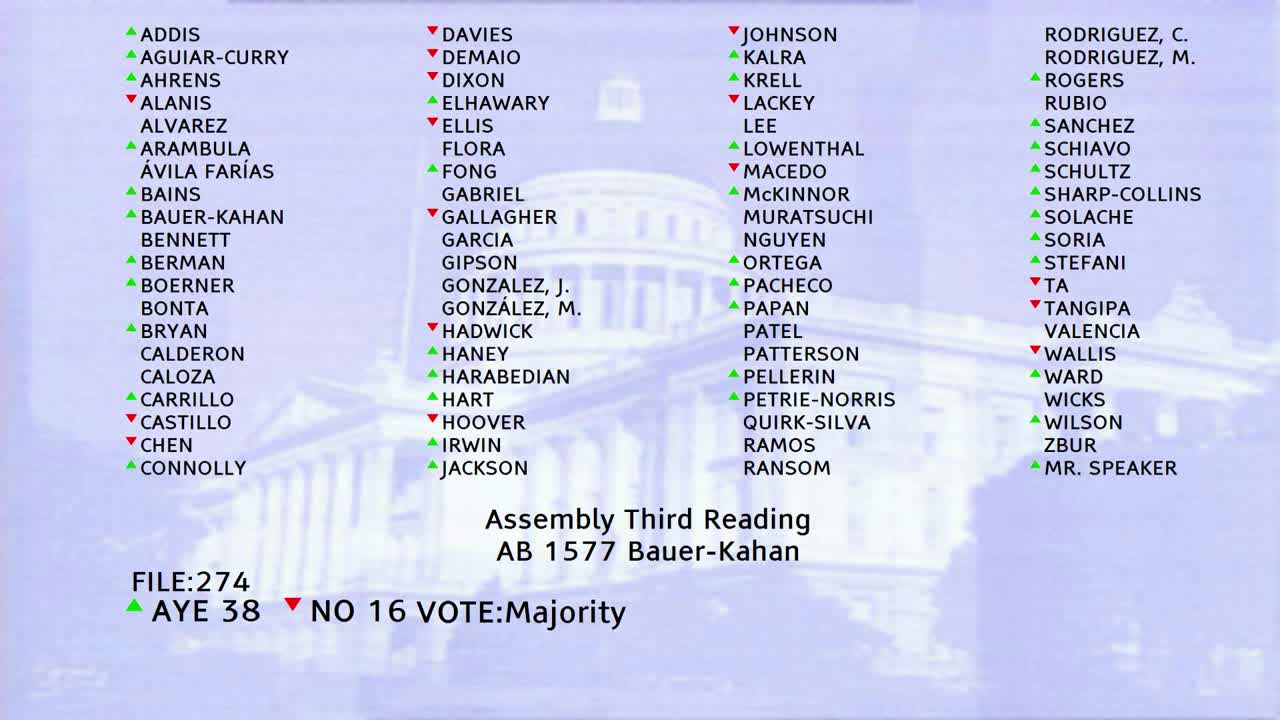 1MIN
Assembly Floor
Bill Author

Bill Co-Author(s):
