AB 1757: Energy: nuclear facilities.
- Session Year: 2025-2026
- House: Assembly
- Latest Version Date: 2026-03-16
Current Status:
In Progress
(2026-04-06: In committee: Set, first hearing. Failed passage. Reconsideration granted.)
Introduced
In Committee
Awaiting First Chamber Vote
Passed First Chamber
In Committee
Awaiting Second Chamber Vote
Passed Second Chamber
Enacted
Existing law prohibits the State Energy Resources Conservation and Development Commission from certifying a nuclear fission thermal powerplant, except for specified powerplants, and provides that a nuclear fission thermal powerplant, except specified powerplants, is not a permitted land use in California unless certain conditions are met regarding the existence of technology for the construction and operation of nuclear fuel rod processing plants, plants and of demonstrated technology or means for the disposal of high-level nuclear waste, as specified.
This bill would make nonsubstantive changes to that provision. exempt a nuclear microreactor, as defined, from those provisions.
Existing law prohibits the State Energy Resources Conservation and Development Commission from certifying a nuclear fission thermal powerplant, except for specified powerplants, and provides that a nuclear fission thermal powerplant, except specified powerplants, is not a permitted land use in California unless certain conditions are met regarding the existence of technology for the construction and operation of nuclear fuel rod processing plants, as specified.
This bill would make nonsubstantive changes to that provision.
(a)Except for the existing Diablo Canyon Units 1 and 2 owned by Pacific Gas and Electric Company and San Onofre Units 2 and 3 owned by Southern California Edison Company and San Diego Gas and Electric Company, a nuclear fission thermal powerplant requiring the reprocessing of fuel rods, including any to which this chapter does not otherwise apply, except those having a vested right as defined in this section, shall not be a permitted land use in the state or, where applicable, certified by the commission until both of the following conditions are met:
(1)The commission finds that the United States through its authorized agency has identified and approved, and there exists a technology for the construction and operation of, nuclear fuel rod reprocessing plants.
(2)(A)The commission has reported its findings and the reasons therefor pursuant to paragraph (1) to the Legislature. That report shall be assigned to the appropriate policy committees for review. The commission may proceed to certify nuclear fission thermal powerplants 100 legislative days after reporting its findings unless within those 100 legislative days either house of the Legislature adopts by a majority vote of its members a resolution disaffirming the findings of the commission made pursuant to paragraph (1).
(B)A resolution of disaffirmance shall set forth the reasons for the action and shall provide, to the extent possible, guidance to the commission as to an appropriate method of bringing the commissions findings into conformance with paragraph (1).
(C)If a disaffirming resolution is adopted, the commission shall reexamine its original findings consistent with matters raised in the resolution. On conclusion of its reexamination, the commission shall transmit its findings in writing, with the reasons therefor, to the Legislature.
(D)If the findings are that the conditions of paragraph (1) have been met, the commission may proceed to certify nuclear fission thermal powerplants 100 legislative days after reporting its findings to the Legislature unless within those 100 legislative days both houses of the Legislature act by statute to declare the findings null and void and takes appropriate action.
(E)To allow sufficient time for the Legislature to act, the reports of findings of the commission shall be submitted to the Legislature at least six calendar months before the adjournment of the Legislature sine die.
(b)The commission shall further find on a case-by-case basis that facilities with adequate capacity to reprocess nuclear fuel rods from a certified nuclear facility or to store that fuel if that storage is approved by an authorized agency of the United States are in actual operation or will be in operation at the time that the nuclear facility requires reprocessing or storage if the storage of fuel is in an offsite location to the extent necessary to provide continuous onsite full core reserve storage capacity.
(c)The commission shall continue to receive and process notices of intention and applications for certification pursuant to this division, but shall not issue a decision pursuant to Section 25523 granting a certificate until the requirements of this section have been met. All other permits, licenses, approvals, or authorizations for the entry or use of the land, including orders of court, that may be required may be processed and granted by the governmental entity concerned, but construction work to install permanent equipment or structures shall not commence until the requirements of this section have been met.
(d)(1)This section does not apply to a nuclear microreactor.
(2)For purposes of this subdivision, nuclear microreactor means a nuclear fission reactor that meets all of the following criteria:
(A)The nuclear fission reactor has a rated electrical output of not more than 20 megawatts per unit.
(B)The nuclear fission reactor is designed for modular construction and deployment.
(C)All components of the nuclear fission reactor are fully assembled in a factory and shipped to a location, and the nuclear fission reactor is highly portable and requires little or no construction onsite.
(D)The nuclear fission reactor is licensed, or eligible for licensing, by the United States Nuclear Regulatory Commission or is authorized by the United States Department of Energy or the United States Department of Defense.
SEC. 2.Section 25524.2 of the Public Resources Code is amended to read:25524.2.(a)Except for the existing Diablo Canyon Units 1 and 2 owned by Pacific Gas and Electric Company and San Onofre Units 2 and 3 owned by Southern California Edison Company and San Diego Gas and Electric Company, no a nuclear fission thermal powerplant, including any to which this chapter does not otherwise apply, but excepting except those exempted herein, by this section, shall not be a permitted land use in the state, or state or, where applicable, be certified by the commission until both of the following conditions have been met:
(a)(1)The commission finds that there has been developed and that the United States through its authorized agency has approved and there exists a demonstrated technology or means for the disposal of high-level nuclear waste.
(b)(1)(2)(A)The commission has reported its findings and the reasons therefor pursuant to paragraph (a) to the Legislature. That report shall be assigned to the appropriate policy committees for review. The commission may proceed to certify nuclear fission thermal powerplants 100 legislative days after reporting its findings unless within those 100 legislative days either house of the Legislature adopts by a majority vote of its members a resolution disaffirming the findings of the commission made pursuant to subdivision (a). paragraph (1).
(2)(B)A resolution of disaffirmance shall set forth the reasons for the action and shall provide, to the extent possible, guidance to the commission as to an appropriate method of bringing the commissions findings into conformance with subdivision (a). paragraph (1).
(3)(C)If a disaffirming resolution is adopted, the commission shall reexamine its original findings consistent with matters raised in the resolution. On conclusion of its reexamination, the commission shall transmit its findings in writing, with the reasons therefor, to the Legislature.
(4)(D)If the findings are that the conditions of subdivision (a) paragraph (1) have been met, the commission may proceed to certify nuclear fission thermal powerplants 100 legislative days after reporting its findings to the Legislature unless within those 100 legislative days both houses of the Legislature act by statute to declare the findings null and void and take appropriate action.
(5)(E)To allow sufficient time for the Legislature to act, the reports of findings of the commission shall be submitted to the Legislature at least six calendar months prior to before the adjournment of the Legislature sine die.
(c)As used in subdivision (a),(b)For purposes of this section, technology or means for the disposal of high-level nuclear waste means a method for the permanent and terminal disposition of high-level nuclear waste. Nothing in this section requires This section does not require that facilities for the application of that technology or means be available at the time that the commission makes its findings. That disposition of high-level nuclear waste does not preclude the possibility of an approved process for retrieval of the waste.
(d)(c)The commission shall continue to receive and process notices of intention and applications for certification pursuant to this division division, but shall not issue a decision pursuant to Section 25523 granting a certificate until the requirements of this section have been met. All other permits, licenses, approvals, or authorizations for the entry or use of the land, including orders of court, which that may be required may be processed and granted by the governmental entity concerned, but construction work to install permanent equipment or structures shall not commence until the requirements of this section have been met.
(d)(1)This section does not apply to a nuclear microreactor.
(2)For purposes of this subdivision, nuclear microreactor has the same meaning as defined in Section 25524.1.
(a)Except for the existing Diablo Canyon Units 1 and 2 owned by Pacific Gas and Electric Company and San Onofre Units 2 and 3 owned by Southern California Edison Company and San Diego Gas and Electric Company, no a nuclear fission thermal powerplant requiring the reprocessing of fuel rods, including any to which this chapter does not otherwise apply, excepting any except those having a vested right as defined in this section, shall not be a permitted land use in the state or, where applicable, certified by the commission until both of the following conditions are met:
(1)The commission finds that the United States through its authorized agency has identified and approved, and there exists a technology for the construction and operation of, nuclear fuel rod reprocessing plants.
(2)(A)The commission has reported its findings and the reasons therefor pursuant to paragraph (1) to the Legislature. That report shall be assigned to the appropriate policy committees for review. The commission may proceed to certify nuclear fission thermal powerplants 100 legislative days after reporting its findings unless within those 100 legislative days either house of the Legislature adopts by a majority vote of its members a resolution disaffirming the findings of the commission made pursuant to paragraph (1).
(3)(B)A resolution of disaffirmance shall set forth the reasons for the action and shall provide, to the extent possible, guidance to the commission as to an appropriate method of bringing the commissions findings into conformance with paragraph (1).
(4)(C)If a disaffirming resolution is adopted, the commission shall reexamine its original findings consistent with matters raised in the resolution. On conclusion of its reexamination, the commission shall transmit its findings in writing, with the reasons therefor, to the Legislature.
(5)(D)If the findings are that the conditions of paragraph (1) have been met, the commission may proceed to certify nuclear fission thermal powerplants 100 legislative days after reporting its findings to the Legislature unless within those 100 legislative days both houses of the Legislature act by statute to declare the findings null and void and takes appropriate action.
(6)(E)To allow sufficient time for the Legislature to act, the reports of findings of the commission shall be submitted to the Legislature at least six calendar months prior to before the adjournment of the Legislature sine die.
(b)The commission shall further find on a case-by-case basis that facilities with adequate capacity to reprocess nuclear fuel rods from a certified nuclear facility or to store that fuel if that storage is approved by an authorized agency of the United States are in actual operation or will be in operation at the time that the nuclear facility requires reprocessing or storage; provided, however, that storage if the storage of fuel is in an offsite location to the extent necessary to provide continuous onsite full core reserve storage capacity.
(c)The commission shall continue to receive and process notices of intention and applications for certification pursuant to this division, but shall not issue a decision pursuant to Section 25523 granting a certificate until the requirements of this section have been met. All other permits, licenses, approvals, or authorizations for the entry or use of the land, including orders of court, which that may be required may be processed and granted by the governmental entity concerned, but construction work to install permanent equipment or structures shall not commence until the requirements of this section have been met.
|
Date
|
Status
|
|---|---|
| Apr 6, 2026 | In committee: Set, first hearing. Failed passage. Reconsideration granted. |
| Mar 17, 2026 | Re-referred to Com. on NAT. RES. |
| Mar 16, 2026 | From committee chair, with author's amendments: Amend, and re-refer to Com. on NAT. RES. Read second time and amended. |
| Mar 16, 2026 | Referred to Coms. on NAT. RES. and U. & E. |
| Feb 10, 2026 | From printer. May be heard in committee March 12. |
| Feb 9, 2026 | Read first time. To print. |
|
Date
|
Description
|
Location
|
Votes
|
|
|---|---|---|---|---|
| Apr 6, 2026 | Do pass and be re-referred to the Committee on [Appropriations] | Assembly Standing Committee on Natural Resources |
Failed |
This list shows positions taken on this bill by organizations on the date displayed, which is linked to the original source.
Positions by individuals are not included.
|
Organization
|
Position
|
Date
|
|---|---|---|
| Alliance for Nuclear Responsibility | ** Against | |
| Clean Earth 4 Kids | ** Against | |
| Climate Resolve | ** Against | |
| Committee to Bridge the Gap | ** Against | |
| Ecological Options Network | ** Against | |
| Environment California | ** Against | |
| Fresnans Against Fracking | ** Against | |
| Parents Against SSFL | ** Against | |
| Physicians for Social Responsibility - Los Angeles | ** Against | |
| Radiant Industries | ** Support | |
| Resource Renewal Institute | ** Against | |
| Samuel Lawrence Foundation | ** Against | |
| San Luis Obispo Mothers for Peace | ** Against | |
| Santa Cruz Climate Action Network | ** Against | |
| Sierra Club California | ** Against | |
| SoCal 350 Climate Action | ** Against | |
| The Utility Reform Network (TURN) | ** Against | |
| Union Of Concerned Scientists | ** Against |
Date of Hearing: April 6, 2026
ASSEMBLY COMMITTEE ON NATURAL RESOURCES
Isaac G. Bryan, Chair
ABPCA Bill Id:AB 1757 (
Author:Gallagher) – As Amended Ver:March 16, 2026
SUBJECT: Energy: nuclear facilities
SUMMARY: Exempts nuclear “microreactors” (nuclear fission powerplants comprised of units 20 megawatts or less) from the conditional moratorium on permitting new nuclear fission powerplants.
EXISTING LAW prohibits any new nuclear fission power plant until the California Energy Commission (CEC) has determined that technologies exist for the reprocessing of nuclear fuel rods and the disposal of high-level nuclear waste. (Public Resources Code 25524.1 and 25524.2)
THIS BILL:
- Provides that both existing moratoria do not apply to nuclear microreactors, as defined, making nuclear microreactors a permissible land use.
- Defines “nuclear microreactor” as a nuclear fission reactor that meets all of the following criteria:
- The nuclear fission reactor has a rated electrical output of not more than 20 megawatts per unit.
- The nuclear fission reactor is designed for modular construction and deployment.
- All components of the nuclear fission reactor are fully assembled in a factory and shipped to a location, and the nuclear fission reactor is highly portable and requires little or no construction onsite.
- The nuclear fission reactor is licensed, or eligible for licensing, by the United States Nuclear Regulatory Commission (NRC) or is authorized by the United States Department of Energy (DOE) or the United States Department of Defense (DOD).
FISCAL EFFECT: Unknown
COMMENTS:
- Background. Since 2012, only one of the four nuclear power plants developed in California by electric utilities has continued to operate: PG&E’s Diablo Canyon powerplant. Two other nuclear powerplants, PG&E’s Humboldt Bay plant and SMUD’s Rancho Seco plant, have been decommissioned. Developed in the early 1960’s, Humboldt Bay was shut down in 1976 for refueling and never restarted due to seismic and cost issues. Developed in the early 1970’s, Rancho Seco was shut down in 1989 in response to voter referendum. The fourth, the San Onofre Nuclear Generating Station (SONGS) jointly owned by Southern California Edison and San Diego Gas and Electric, was closed in 2012 for repairs, permanently retired in 2013, and is in the process of decommissioning, at a forecasted cost of more than $4.5 billion. High-level radioactive waste from these plants’ operation remains stored on site. Diablo Canyon operates at nine-figure annual deficits, borne by PG&E customers, despite massive public subsidies.
In 1976, the Legislature passed AB 2820 (Goggin) and AB 2822 (Nestande) to establish a moratorium on permitting new nuclear powerplants. Since that time, the CEC has not found that a high-level waste disposal technology has been demonstrated or approved. Likewise, the NRC, which regulates commercial nuclear power plants and other uses of nuclear materials, has never made a finding that a demonstrated technology exists for either nuclear fuel rod preprocessing plants or the disposal of high-level nuclear waste.
The California moratorium was challenged by PG&E and ultimately reviewed by the U.S. Supreme Court. In PG&E v. Energy Commission, 461 U.S. 190 (1983), the Supreme Court upheld California’s moratorium law. A key basis of the Court's decision was a division of authority to make safety determinations (federal) and economic determinations (state). The Court found that the absence of a permanent waste disposal site could lead to unknown negative economic consequences. So the moratorium has remained in effect and no new nuclear plant has been proposed in California since the Diablo Canyon and SONGS units that were in the permitting pipeline at the time the moratorium was enacted.
The federal government is responsible for providing for the permanent disposal of high-level radioactive waste and spent nuclear fuel and was required to begin accepting spent nuclear fuel from nuclear power plants by 1998. However, although Congress selected the Yucca Mountain site in Nevada for a permanent deep geologic repository for the disposal of spent nuclear fuel, the federal waste disposal program has been plagued with technical and legal challenges, managerial problems, licensing delays, persistent weaknesses in quality assurance for the program, and increasing costs.
No repository or reprocessing facility for spent nuclear fuel has been licensed in the U.S. The federal waste disposal program is paid for by the nuclear electricity generators and waste owners. Under the provisions of the federal Nuclear Waste Policy Act, utilities pay regular fees to the Nuclear Waste Fund to pay for siting, construction and operating a federal waste repository. California ratepayers have paid billions to fund a repository that has never been built. Reprocessing (the separation of spent fuel into high-level wastes and reusable fuel) remains substantially more expensive than waste storage and disposal and has adverse implications for the U.S. effort to halt the proliferation of nuclear weapons.
While CEC does not have a recent independent evaluation, NRC, DOE, and Congressional reports confirm that the U.S. does not have a permanent repository or reprocessing facility for commercial spent nuclear fuel. While the U.S. has a disposal facility for defense-generated nuclear waste from DOE sites, it does not accept commercial spent nuclear fuel. Commercial spent nuclear fuel is stored at reactor sites.
As far as the committee can ascertain, no “microreactor” or associated spent fuel storage facility has been licensed by the NRC. Transporting active microreactors and nuclear fuel on public roads or railways, where they would be more susceptible to accidents or sabotage, would seem to magnify the inherent safety and security risks.
It should also be noted that a mobile or modular “microreactor” may not be subject to either CEC or local government land use authority. Combine this possibility with the potential for the microreactor to be used to power the same data centers, chip fabricators, or other power-hungry facilities seeking to claim exemption from the California Environmental Quality Act as “advanced manufacturing” under the botched exemption enacted by last year’s SB 131.
- Author’s statement:
California’s nuclear moratorium was enacted in 1976 under very different technological and energy-market conditions, at a time when advanced reactor designs did not exist and when policymakers anticipated a near-term federal solution for permanent waste disposal. Nearly 50 years later, that statutory framework has remained unchanged despite major advancements in nuclear engineering, passive safety systems, fuel efficiency, and modular construction techniques. Meanwhile, California faces persistent grid reliability warnings during extreme weather events, some of the highest retail electricity rates in the nation, and a statutory mandate under SB 100 to achieve 100 percent clean electricity by 2045. Achieving deep decarbonization while maintaining affordability and reliability requires firm, dispatchable, zero-emission resources to complement intermittent renewables and storage.
AB 1757 does not repeal California’s longstanding moratorium; instead, it creates a narrow and carefully structured carveout to allow the deployment of nuclear microreactors—small-scale advanced reactors designed with enhanced passive safety features, reduced fuel volumes, and compact footprints. These systems are federally licensed by the NRC, DOE, or DOD and are intended for applications such as industrial facilities, research campuses, remote communities, military installations, or critical infrastructure, rather than broad commercial baseload deployment. By establishing clear guardrails—continued federal oversight, compliance with waste management requirements, and appropriate state regulatory coordination, this bill enables innovation without compromising safety or environmental protections. AB 1757 ensures California has the option to responsibly assess next-generation nuclear technology as part of a diversified, resilient, and affordable clean energy portfolio.
- Is the California moratorium to blame for the lack of nuclear power development? Proponents of nuclear power must consider the array of reasons that very few nuclear power plants have proceeded to construction in the U.S. since before the accident at Three Mile Island in 1979.
Many other states enacted conditions, moratoria or bans (e.g., Connecticut, Illinois, Kentucky, Maine, Massachusetts, Minnesota, Montana, New Jersey, Oregon, West Virginia, Wisconsin) in response to the economic and environmental problems plaguing nuclear power in the 1970’s. However, nuclear power has not thrived in the many states without any legal limitations on its development. Several western states are potential sites for nuclear power plants that could serve the California electricity market.
Among the many reasons, in addition to lack of public acceptance, is the fact that nuclear power has not been the choice of the market during the past 30 years of increasing deregulation and competition in the electric utility industry. Cost, financial risk, and need for government/public support for insurance and waste management/disposal all suggest that nuclear power is more suited for centrally-planned, monopolistic approaches to electricity supply, such as the model employed in France.
- Related legislation:
AB 2647 (Calderon) exempts “advanced nuclear reactors,” as defined, from both moratoria, provided the projects meets specified requirements requiring construction workers. AB 2647 is pending in this committee.
AB 305 (Arambula) exempted “small modular reactors” (SMR, a nuclear reactor up to 300 megawatts per unit) from the conditional moratorium and required the Public Utilities Commission (PUC) to adopt a plan to increase the procurement of electricity generated from nuclear facilities and to phase out the procurement of electricity generated from natural gas facilities. In 2025, AB 305 died in this committee without a hearing.
AB 65 (Mathis) was identical to AB 305. AB 65 failed in this committee on April 10, 2023.
AB 1035 (DeVore) exempted from the CEC power plant certification laws the first nuclear power plant to obtain an early site permit from the NRC. AB 1035 failed in this committee on April 20, 2009.
AB 1776 (DeVore) repealed the moratorium and established new conditions on siting new nuclear plants related to seismic hazard, cooling water outflow and waste storage. AB 1776 failed in this committee on April 7, 2008.
AB 2788 (DeVore) was identical to AB 1035. AB 2788 failed in this committee on April 7, 2008.
AB 719 (DeVore) repealed the moratorium. AB 719 failed in this committee on April 16, 2007.
- Double referral. This bill is double-referred to the Assembly Utilities and Energy Committee.
REGISTERED SUPPORT / OPPOSITION:
Support
Radiant Industries
Opposition
Alliance for Nuclear Responsibility
Clean Earth 4 Kids
Climate Resolve
Committee to Bridge the Gap
Ecological Options Network
Environment California
Fresnans Against Fracking
Parents Against SSFL
Physicians for Social Responsibility - Los Angeles
Resource Renewal Institute
Samuel Lawrence Foundation
San Luis Obispo Mothers for Peace
Santa Cruz Climate Action Network
Sierra Club California
SoCal 350 Climate Action
The Utility Reform Network (TURN)
Union of Concerned Scientists
Analysis Prepared by: Lawrence Lingbloom / NAT. RES. /
Discussed in Hearing
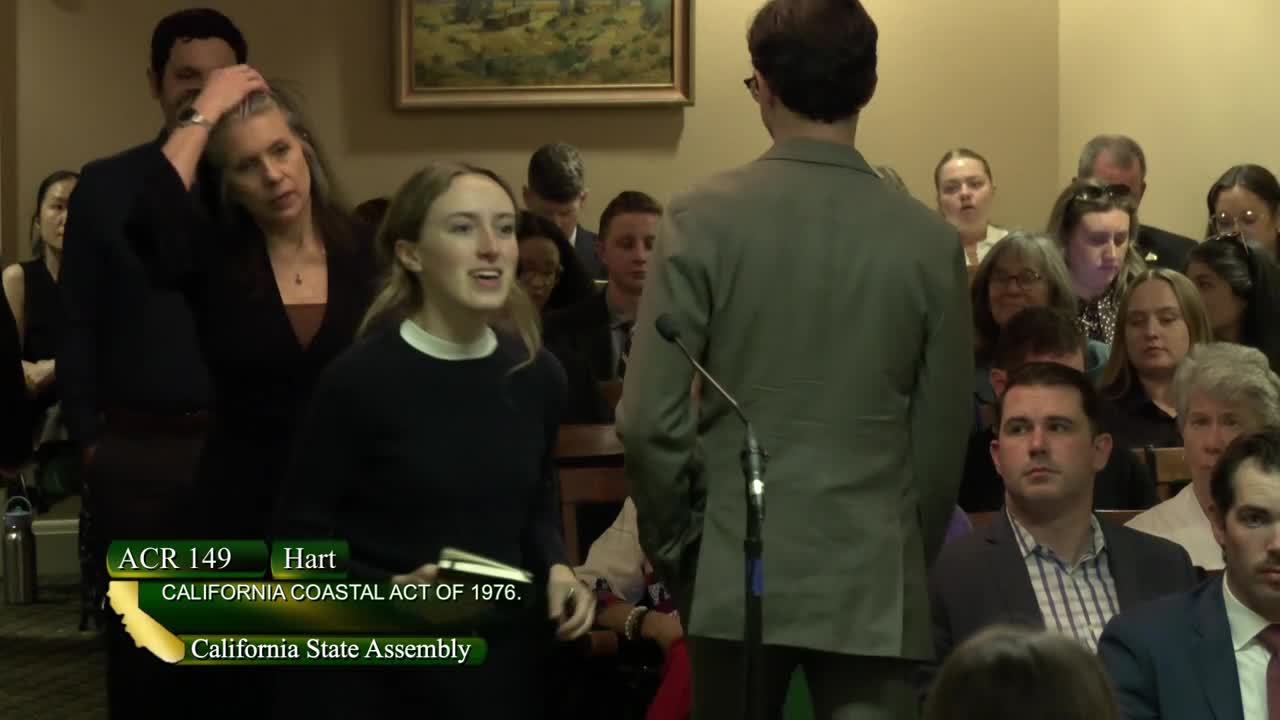 29MIN
Assembly Standing Committee on Natural Resources
Bill Author