AB 1803: Employment: sexual harassment training and education: anti-hate speech training.
- Session Year: 2025-2026
- House: Assembly
- Latest Version Date: 2026-09-27
Current Status:
Passed
(2026-09-27: Chaptered by Secretary of State - Chapter 547, Statutes of 2026.)
Introduced
In Committee
Awaiting First Chamber Vote
Passed First Chamber
In Committee
Awaiting Second Chamber Vote
Passed Second Chamber
Enacted
The California Fair Employment and Housing Act makes specified employment practices unlawful, including the harassment of an employee directly by the employer or indirectly by agents of the employer with the employers knowledge. Under existing law, the Civil Rights Department administers these provisions. Existing law requires a specified employer with 5 or more employees to, by January 1, 2021, provide at least 2 hours of classroom or other effective interactive training and education regarding sexual harassment to all supervisory employees and at least one hour of classroom or other effective interactive training and education regarding sexual harassment to all nonsupervisory employees in California and, after that date, once every 2 years. Existing law requires an employer to include prevention of abusive conduct as a component of that training and education.
This bill would additionally require that, beginning January 1, 2028, the above-described training and education include, as a component of the training and education, anti-hate speech training, as specified.
The California Fair Employment and Housing Act makes specified employment practices unlawful, including the harassment of an employee directly by the employer or indirectly by agents of the employer with the employers knowledge. Under existing law, the Civil Rights Department administers these provisions. Existing law requires a specified employer with 5 or more employees to, by January 1, 2021, provide at least 2 hours of classroom or other effective interactive training and education regarding sexual harassment to all supervisory employees and at least one hour of classroom or other effective interactive training and education regarding sexual harassment to all nonsupervisory employees in California and, after that date, once every 2 years. Existing law requires an employer to include prevention of abusive conduct as a component of that training and education.
This bill would additionally require that, beginning January 1, 2028, the above-described training and education include, as a component of the training and education, anti-hate speech training. training, as specified.
The California Fair Employment and Housing Act makes specified employment practices unlawful, including the harassment of an employee directly by the employer or indirectly by agents of the employer with the employers knowledge. Under existing law, the Civil Rights Department administers these provisions. Existing law requires a specified employer with 5 or more employees to, by January 1, 2021, provide at least 2 hours of classroom or other effective interactive training and education regarding sexual harassment to all supervisory employees and at least one hour of classroom or other effective interactive training and education regarding sexual harassment to all nonsupervisory employees in California and, after that date, once every 2 years. Existing law requires an employer to include prevention of abusive conduct as a component of that training and education.
This bill would additionally require that that, beginning January 1, 2028, the above-described training and education include, as a component of the training and education, anti-hate speech training.
The California Fair Employment and Housing Act makes specified employment practices unlawful, including the harassment of an employee directly by the employer or indirectly by agents of the employer with the employers knowledge. Under existing law, the Civil Rights Department administers these provisions. Existing law requires a specified employer with 5 or more employees to, by January 1, 2021, provide at least 2 hours of classroom or other effective interactive training and education regarding sexual harassment to all supervisory employees and at least one hour of classroom or other effective interactive training and education regarding sexual harassment to all nonsupervisory employees in California and, after that date, once every 2 years. Existing law requires an employer to include prevention of abusive conduct as a component of that training and education.
This bill would additionally require that the above-described training and education include, as a component of the training and education, anti-hate speech training.
(a)(1)By January 1, 2021, an employer having five or more employees shall provide at least two hours of classroom or other effective interactive training and education regarding sexual harassment to all supervisory employees and at least one hour of classroom or other effective interactive training and education regarding sexual harassment to all nonsupervisory employees in California. Thereafter, each employer covered by this section shall provide sexual harassment training and education to each employee in California once every two years. New nonsupervisory employees shall be provided training within six months of hire. New supervisory employees shall be provided training within six months of the assumption of a supervisory position. An employer may provide this training in conjunction with other training provided to the employees. The training may be completed by employees individually or as part of a group presentation, and may be completed in shorter segments, as long as the applicable hourly total requirement is met. An employer who has provided this training and education to an employee in 2019 is not required to provide refresher training and education again until two years thereafter. The training and education required by this section shall include information and practical guidance regarding the federal and state statutory provisions concerning the prohibition against and the prevention and correction of sexual harassment and the remedies available to victims of sexual harassment in employment. The training and education shall also include practical examples aimed at instructing supervisors in the prevention of harassment, discrimination, and retaliation, and shall be presented by trainers or educators with knowledge and expertise in the prevention of harassment, discrimination, and retaliation. The department shall provide a method for employees who have completed the training to save electronically and print a certificate of completion.
(2)An employer shall also include prevention of abusive conduct as a component of the training and education specified in paragraph (1).
(3)An employer shall also provide training inclusive of harassment based on gender identity, gender expression, and sexual orientation as a component of the training and education specified in paragraph (1). The training and education shall include practical examples inclusive of harassment based on gender identity, gender expression, and sexual orientation, and shall be presented by trainers or educators with knowledge and expertise in those areas.
(4)(A)Beginning January 1, 2028, an employer shall also include anti-hate speech training as a component of the training and education specified in paragraph (1). Anti-hate speech training shall provide supervisors and employees with practical guidance on recognizing, reporting, and confronting workplace speech that vilifies, humiliates, or incites hatred against people based on the protected characteristics listed in subdivision (a) of Section 12940.
(B)A training that includes information about the prohibition against unlawful harassment and prevention of abusive conduct that is based on an individuals protected characteristics listed in subdivision (a) of Section 12940 satisfies the requirement in subparagraph (A).
(b)The state shall incorporate the training required by subdivision (a) into the 80 hours of training provided to all new employees pursuant to subdivision (b) of Section 19995.4, using existing resources.
(c)Notwithstanding subdivisions (j) and (k) of Section 12940, a claim that the training and education required by this section did not reach a particular individual or individuals shall not in and of itself result in the liability of any employer to any present or former employee or applicant in any action alleging sexual harassment. Conversely, an employers compliance with this section does not insulate the employer from liability for sexual harassment of any current or former employee or applicant.
(d)If an employer violates this section, the department may seek an order requiring the employer to comply with these requirements.
(e)The training and education required by this section is intended to establish a minimum threshold and should not discourage or relieve any employer from providing for longer, more frequent, or more elaborate training and education regarding workplace harassment or other forms of unlawful discrimination in order to meet its obligations to take all reasonable steps necessary to prevent and correct harassment and discrimination. This section shall not be construed to override or supersede statutes, including, but not limited to, Section 1684 of the Labor Code, that meet or exceed the training for nonsupervisory employees required under this section.
(f)Except as provided in subdivision (l), beginning January 1, 2021, for seasonal, temporary, or other employees that are hired to work for less than six months, an employer shall provide training within 30 calendar days after the hire date or within 100 hours worked, whichever occurs first. In the case of a temporary employee employed by a temporary services employer, as defined in Section 201.3 of the Labor Code, to perform services for clients, the training shall be provided by the temporary services employer, not the client.
(g)Beginning January 1, 2020, sexual harassment prevention training for migrant and seasonal agricultural workers, as defined in the federal Migrant and Seasonal Agricultural Worker Protection Act (29 U.S.C. 1801, et seq.), shall be consistent with training for nonsupervisory employees pursuant to paragraph (8) of subdivision (a) of Section 1684 of the Labor Code.
(h)(1)For purposes of this section only, employer means any person regularly employing five or more persons or regularly receiving the services of five or more persons providing services pursuant to a contract, or any person acting as an agent of an employer, directly or indirectly, the state, or any political or civil subdivision of the state, and cities.
(2)For purposes of this section, abusive conduct means conduct of an employer or employee in the workplace, with malice, that a reasonable person would find hostile, offensive, and unrelated to an employers legitimate business interests. Abusive conduct may include repeated infliction of verbal abuse, such as the use of derogatory remarks, insults, and epithets, verbal or physical conduct that a reasonable person would find threatening, intimidating, or humiliating, or the gratuitous sabotage or undermining of a persons work performance. A single act shall not constitute abusive conduct, unless especially severe and egregious.
(i)For purposes of providing training to employees as required by this section, an employer may develop its own training module or may direct employees to view the online training course referenced in subdivision (j) and this shall be deemed to have complied with and satisfied the employers obligations as set forth in this section and Section 12950.
(j)The department shall develop or obtain two online training courses on the prevention of sexual harassment in the workplace in accordance with the provisions of this section. The course for nonsupervisory employees shall be one hour in length and the course for supervisory employees shall be two hours in length.
(k)The department shall make the online training courses available on its internet website. The online training courses shall contain an interactive feature that requires the viewer to respond to a question periodically in order for the online training courses to continue to play. Any questions resulting from the online training course described in this subdivision shall be directed to the trainees employers human resources department or equally qualified professional rather than the department.
(l)(1)An employer that employs workers pursuant to a multiemployer collective bargaining agreement in the construction industry may satisfy the requirements of subdivision (a) or (f) by demonstrating that the employee has received the training required by subdivision (a) within the past two years under any of the following circumstances:
(A)While the employee was employed by another employer that is also signatory to a multiemployer collective bargaining agreement with the same trade in the building and construction industry.
(B)While the employee was an apprentice registered in a building and construction trades apprenticeship program approved by the Division of Apprenticeship Standards.
(C)Through a building and construction trades apprenticeship program approved by the Division of Apprenticeship Standards, a labor management training trust, or labor management cooperation committee. For purposes of this subdivision, labor management cooperation committee shall mean a committee that is established pursuant to Section 175a of Title 29 of the United States Code.
(2)For purposes of this subdivision, multiemployer collective bargaining agreement means a bona fide collective bargaining agreement to which multiple employers are signatory, including predecessor and successor agreements.
(3)An employer shall require verification that an employee has undergone prevention of harassment training pursuant to this subdivision within the past two years. The employer shall provide prevention of harassment training pursuant to subdivision (a) for any employee for whom verification cannot be obtained.
(4)A state-approved apprenticeship program, labor management training trust, or labor management cooperation committee shall maintain a certificate of completion of training for each person to whom the entity has provided prevention of harassment training pursuant to this subdivision for a period of not less than four years. The apprenticeship program, labor management training trust, or labor management cooperation committee shall maintain a database of journey-level worker and apprentice training that entity has provided and shall provide verification of an employees or apprentices prevention of harassment training status upon the request of an employer that is a party to the multiemployer collective bargaining agreement.
(5)(A)A qualified trainer may provide prevention of harassment training on behalf of an apprenticeship program, labor management training trust, or labor management cooperation committee.
(B)A qualified trainer, for purposes of this subdivision, is any person who, through a combination of training and experience, has the ability to train employees about the following:
(i)How to identify behavior that may constitute unlawful harassment, discrimination, or retaliation under both California and federal law.
(ii)What steps to take when harassing behavior occurs in the workplace.
(iii)How to report harassment complaints.
(iv)Supervisory employees obligation to report harassing, discriminatory, or retaliatory behavior of which they become aware.
(v)How to respond to a harassment complaint.
(vi)The employers obligation to conduct a workplace investigation of a harassment complaint.
(vii)What constitutes retaliation and how to prevent it.
(viii)Essential components of an antiharassment policy.
(ix)The effect of harassment on harassed employees, coworkers, harassers, and employers.
(C)A qualified trainer includes, but is not limited to, an attorney admitted to the State Bar of California with at least two years of experience practicing employment law, a human resources professional with at least two years of practical experience in prevention of harassment training, investigation, and advising employers in the prevention of harassment, or any other person who has received training in the provision of prevention of harassment training from a qualified trainer.
(6)An apprenticeship program, labor management training trust, or labor management cooperation committee may also provide training by use of the online training courses referenced in subdivision (j).
(7)An apprenticeship program, labor management training trust, or labor management cooperation committee shall not incur any liability for providing prevention of harassment training or for maintaining records pursuant to this subdivision.
(m)An employee who has received training in compliance with this section within the prior two years either from a current, a prior, or an alternate or a joint employer, or who received a valid work permit from the Labor Commissioner that required the employee to receive training in compliance with this section within the prior two years, shall be given, and required to read and to acknowledge receipt of, the employers antiharassment policy within six months of assuming the employees new position. That employee shall then be put on a two year tracking schedule based on the employees last training. The current employer shall have the burden of establishing that the prior training was legally compliant with this section.
(a)(1)By January 1, 2021, an employer having five or more employees shall provide at least two hours of classroom or other effective interactive training and education regarding sexual harassment to all supervisory employees and at least one hour of classroom or other effective interactive training and education regarding sexual harassment to all nonsupervisory employees in California. Thereafter, each employer covered by this section shall provide sexual harassment training and education to each employee in California once every two years. New nonsupervisory employees shall be provided training within six months of hire. New supervisory employees shall be provided training within six months of the assumption of a supervisory position. An employer may provide this training in conjunction with other training provided to the employees. The training may be completed by employees individually or as part of a group presentation, and may be completed in shorter segments, as long as the applicable hourly total requirement is met. An employer who has provided this training and education to an employee in 2019 is not required to provide refresher training and education again until two years thereafter. The training and education required by this section shall include information and practical guidance regarding the federal and state statutory provisions concerning the prohibition against and the prevention and correction of sexual harassment and the remedies available to victims of sexual harassment in employment. The training and education shall also include practical examples aimed at instructing supervisors in the prevention of harassment, discrimination, and retaliation, and shall be presented by trainers or educators with knowledge and expertise in the prevention of harassment, discrimination, and retaliation. The department shall provide a method for employees who have completed the training to save electronically and print a certificate of completion.
(2)An employer shall also include prevention of abusive conduct as a component of the training and education specified in paragraph (1).
(3)An employer shall also provide training inclusive of harassment based on gender identity, gender expression, and sexual orientation as a component of the training and education specified in paragraph (1). The training and education shall include practical examples inclusive of harassment based on gender identity, gender expression, and sexual orientation, and shall be presented by trainers or educators with knowledge and expertise in those areas.
(4)An Beginning January 1, 2028, an employer shall also include anti-hate speech training as a component of the training and education specified in paragraph (1). Anti-hate speech training shall provide supervisors and employees with practical guidance on recognizing, reporting, and confronting workplace speech that vilifies, humiliates, or incites hatred against people based on the protected characteristics listed in subdivision (a) of Section 12940.
(b)The state shall incorporate the training required by subdivision (a) into the 80 hours of training provided to all new employees pursuant to subdivision (b) of Section 19995.4, using existing resources.
(c)Notwithstanding subdivisions (j) and (k) of Section 12940, a claim that the training and education required by this section did not reach a particular individual or individuals shall not in and of itself result in the liability of any employer to any present or former employee or applicant in any action alleging sexual harassment. Conversely, an employers compliance with this section does not insulate the employer from liability for sexual harassment of any current or former employee or applicant.
(d)If an employer violates this section, the department may seek an order requiring the employer to comply with these requirements.
(e)The training and education required by this section is intended to establish a minimum threshold and should not discourage or relieve any employer from providing for longer, more frequent, or more elaborate training and education regarding workplace harassment or other forms of unlawful discrimination in order to meet its obligations to take all reasonable steps necessary to prevent and correct harassment and discrimination. This section shall not be construed to override or supersede statutes, including, but not limited to, Section 1684 of the Labor Code, that meet or exceed the training for nonsupervisory employees required under this section.
(f)Except as provided in subdivision (l), beginning January 1, 2021, for seasonal, temporary, or other employees that are hired to work for less than six months, an employer shall provide training within 30 calendar days after the hire date or within 100 hours worked, whichever occurs first. In the case of a temporary employee employed by a temporary services employer, as defined in Section 201.3 of the Labor Code, to perform services for clients, the training shall be provided by the temporary services employer, not the client.
(g)Beginning January 1, 2020, sexual harassment prevention training for migrant and seasonal agricultural workers, as defined in the federal Migrant and Seasonal Agricultural Worker Protection Act (29 U.S.C. 1801, et seq.), shall be consistent with training for nonsupervisory employees pursuant to paragraph (8) of subdivision (a) of Section 1684 of the Labor Code.
(h)(1)For purposes of this section only, employer means any person regularly employing five or more persons or regularly receiving the services of five or more persons providing services pursuant to a contract, or any person acting as an agent of an employer, directly or indirectly, the state, or any political or civil subdivision of the state, and cities.
(2)For purposes of this section, abusive conduct means conduct of an employer or employee in the workplace, with malice, that a reasonable person would find hostile, offensive, and unrelated to an employers legitimate business interests. Abusive conduct may include repeated infliction of verbal abuse, such as the use of derogatory remarks, insults, and epithets, verbal or physical conduct that a reasonable person would find threatening, intimidating, or humiliating, or the gratuitous sabotage or undermining of a persons work performance. A single act shall not constitute abusive conduct, unless especially severe and egregious.
(i)For purposes of providing training to employees as required by this section, an employer may develop its own training module or may direct employees to view the online training course referenced in subdivision (j) and this shall be deemed to have complied with and satisfied the employers obligations as set forth in this section and Section 12950.
(j)The department shall develop or obtain two online training courses on the prevention of sexual harassment in the workplace in accordance with the provisions of this section. The course for nonsupervisory employees shall be one hour in length and the course for supervisory employees shall be two hours in length.
(k)The department shall make the online training courses available on its internet website. The online training courses shall contain an interactive feature that requires the viewer to respond to a question periodically in order for the online training courses to continue to play. Any questions resulting from the online training course described in this subdivision shall be directed to the trainees employers human resources department or equally qualified professional rather than the department.
(l)(1)An employer that employs workers pursuant to a multiemployer collective bargaining agreement in the construction industry may satisfy the requirements of subdivision (a) or (f) by demonstrating that the employee has received the training required by subdivision (a) within the past two years under any of the following circumstances:
(A)While the employee was employed by another employer that is also signatory to a multiemployer collective bargaining agreement with the same trade in the building and construction industry.
(B)While the employee was an apprentice registered in a building and construction trades apprenticeship program approved by the Division of Apprenticeship Standards.
(C)Through a building and construction trades apprenticeship program approved by the Division of Apprenticeship Standards, a labor management training trust, or labor management cooperation committee. For purposes of this subdivision, labor management cooperation committee shall mean a committee that is established pursuant to Section 175a of Title 29 of the United States Code.
(2)For purposes of this subdivision, multiemployer collective bargaining agreement means a bona fide collective bargaining agreement to which multiple employers are signatory, including predecessor and successor agreements.
(3)An employer shall require verification that an employee has undergone prevention of harassment training pursuant to this subdivision within the past two years. The employer shall provide prevention of harassment training pursuant to subdivision (a) for any employee for whom verification cannot be obtained.
(4)A state-approved apprenticeship program, labor management training trust, or labor management cooperation committee shall maintain a certificate of completion of training for each person to whom the entity has provided prevention of harassment training pursuant to this subdivision for a period of not less than four years. The apprenticeship program, labor management training trust, or labor management cooperation committee shall maintain a database of journey-level worker and apprentice training that entity has provided and shall provide verification of an employees or apprentices prevention of harassment training status upon the request of an employer that is a party to the multiemployer collective bargaining agreement.
(5)(A)A qualified trainer may provide prevention of harassment training on behalf of an apprenticeship program, labor management training trust, or labor management cooperation committee.
(B)A qualified trainer, for purposes of this subdivision, is any person who, through a combination of training and experience, has the ability to train employees about the following:
(i)How to identify behavior that may constitute unlawful harassment, discrimination, or retaliation under both California and federal law.
(ii)What steps to take when harassing behavior occurs in the workplace.
(iii)How to report harassment complaints.
(iv)Supervisory employees obligation to report harassing, discriminatory, or retaliatory behavior of which they become aware.
(v)How to respond to a harassment complaint.
(vi)The employers obligation to conduct a workplace investigation of a harassment complaint.
(vii)What constitutes retaliation and how to prevent it.
(viii)Essential components of an antiharassment policy.
(ix)The effect of harassment on harassed employees, coworkers, harassers, and employers.
(C)A qualified trainer includes, but is not limited to, an attorney admitted to the State Bar of California with at least two years of experience practicing employment law, a human resources professional with at least two years of practical experience in prevention of harassment training, investigation, and advising employers in the prevention of harassment, or any other person who has received training in the provision of prevention of harassment training from a qualified trainer.
(6)An apprenticeship program, labor management training trust, or labor management cooperation committee may also provide training by use of the online training courses referenced in subdivision (j).
(7)An apprenticeship program, labor management training trust, or labor management cooperation committee shall not incur any liability for providing prevention of harassment training or for maintaining records pursuant to this subdivision.
(m)An employee who has received training in compliance with this section within the prior two years either from a current, a prior, or an alternate or a joint employer, or who received a valid work permit from the Labor Commissioner that required the employee to receive training in compliance with this section within the prior two years, shall be given, and required to read and to acknowledge receipt of, the employers antiharassment policy within six months of assuming the employees new position. That employee shall then be put on a two year tracking schedule based on the employees last training. The current employer shall have the burden of establishing that the prior training was legally compliant with this section.
(a)(1)By January 1, 2021, an employer having five or more employees shall provide at least two hours of classroom or other effective interactive training and education regarding sexual harassment to all supervisory employees and at least one hour of classroom or other effective interactive training and education regarding sexual harassment to all nonsupervisory employees in California. Thereafter, each employer covered by this section shall provide sexual harassment training and education to each employee in California once every two years. New nonsupervisory employees shall be provided training within six months of hire. New supervisory employees shall be provided training within six months of the assumption of a supervisory position. An employer may provide this training in conjunction with other training provided to the employees. The training may be completed by employees individually or as part of a group presentation, and may be completed in shorter segments, as long as the applicable hourly total requirement is met. An employer who has provided this training and education to an employee in 2019 is not required to provide refresher training and education again until two years thereafter. The training and education required by this section shall include information and practical guidance regarding the federal and state statutory provisions concerning the prohibition against and the prevention and correction of sexual harassment and the remedies available to victims of sexual harassment in employment. The training and education shall also include practical examples aimed at instructing supervisors in the prevention of harassment, discrimination, and retaliation, and shall be presented by trainers or educators with knowledge and expertise in the prevention of harassment, discrimination, and retaliation. The department shall provide a method for employees who have completed the training to save electronically and print a certificate of completion.
(2)An employer shall also include prevention of abusive conduct as a component of the training and education specified in paragraph (1).
(3)An employer shall also provide training inclusive of harassment based on gender identity, gender expression, and sexual orientation as a component of the training and education specified in paragraph (1). The training and education shall include practical examples inclusive of harassment based on gender identity, gender expression, and sexual orientation, and shall be presented by trainers or educators with knowledge and expertise in those areas.
(4)An employer shall also include anti-hate speech training as a component of the training and education specified in paragraph (1). Anti-hate speech training shall provide supervisors and employees with practical guidance on recognizing, reporting, and confronting workplace speech that vilifies, humiliates, or incites hatred against people based on the protected characteristics listed in subdivision (a) of Section 12940.
(b)The state shall incorporate the training required by subdivision (a) into the 80 hours of training provided to all new employees pursuant to subdivision (b) of Section 19995.4, using existing resources.
(c)Notwithstanding subdivisions (j) and (k) of Section 12940, a claim that the training and education required by this section did not reach a particular individual or individuals shall not in and of itself result in the liability of any employer to any present or former employee or applicant in any action alleging sexual harassment. Conversely, an employers compliance with this section does not insulate the employer from liability for sexual harassment of any current or former employee or applicant.
(d)If an employer violates this section, the department may seek an order requiring the employer to comply with these requirements.
(e)The training and education required by this section is intended to establish a minimum threshold and should not discourage or relieve any employer from providing for longer, more frequent, or more elaborate training and education regarding workplace harassment or other forms of unlawful discrimination in order to meet its obligations to take all reasonable steps necessary to prevent and correct harassment and discrimination. This section shall not be construed to override or supersede statutes, including, but not limited to, Section 1684 of the Labor Code, that meet or exceed the training for nonsupervisory employees required under this section.
(f)Except as provided in subdivision (l), beginning January 1, 2021, for seasonal, temporary, or other employees that are hired to work for less than six months, an employer shall provide training within 30 calendar days after the hire date or within 100 hours worked, whichever occurs first. In the case of a temporary employee employed by a temporary services employer, as defined in Section 201.3 of the Labor Code, to perform services for clients, the training shall be provided by the temporary services employer, not the client.
(g)Beginning January 1, 2020, sexual harassment prevention training for migrant and seasonal agricultural workers, as defined in the federal Migrant and Seasonal Agricultural Worker Protection Act (29 U.S.C. 1801, et seq.), shall be consistent with training for nonsupervisory employees pursuant to paragraph (8) of subdivision (a) of Section 1684 of the Labor Code.
(h)(1)For purposes of this section only, employer means any person regularly employing five or more persons or regularly receiving the services of five or more persons providing services pursuant to a contract, or any person acting as an agent of an employer, directly or indirectly, the state, or any political or civil subdivision of the state, and cities.
(2)For purposes of this section, abusive conduct means conduct of an employer or employee in the workplace, with malice, that a reasonable person would find hostile, offensive, and unrelated to an employers legitimate business interests. Abusive conduct may include repeated infliction of verbal abuse, such as the use of derogatory remarks, insults, and epithets, verbal or physical conduct that a reasonable person would find threatening, intimidating, or humiliating, or the gratuitous sabotage or undermining of a persons work performance. A single act shall not constitute abusive conduct, unless especially severe and egregious.
(i)For purposes of providing training to employees as required by this section, an employer may develop its own training module or may direct employees to view the online training course referenced in subdivision (j) and this shall be deemed to have complied with and satisfied the employers obligations as set forth in this section and Section 12950.
(j)The department shall develop or obtain two online training courses on the prevention of sexual harassment in the workplace in accordance with the provisions of this section. The course for nonsupervisory employees shall be one hour in length and the course for supervisory employees shall be two hours in length.
(k)The department shall make the online training courses available on its internet website. The online training courses shall contain an interactive feature that requires the viewer to respond to a question periodically in order for the online training courses to continue to play. Any questions resulting from the online training course described in this subdivision shall be directed to the trainees employers human resources department or equally qualified professional rather than the department.
(l)(1)An employer that employs workers pursuant to a multiemployer collective bargaining agreement in the construction industry may satisfy the requirements of subdivision (a) or (f) by demonstrating that the employee has received the training required by subdivision (a) within the past two years under any of the following circumstances:
(A)While the employee was employed by another employer that is also signatory to a multiemployer collective bargaining agreement with the same trade in the building and construction industry.
(B)While the employee was an apprentice registered in a building and construction trades apprenticeship program approved by the Division of Apprenticeship Standards.
(C)Through a building and construction trades apprenticeship program approved by the Division of Apprenticeship Standards, a labor management training trust, or labor management cooperation committee. For purposes of this subdivision, labor management cooperation committee shall mean a committee that is established pursuant to Section 175a of Title 29 of the United States Code.
(2)For purposes of this subdivision, multiemployer collective bargaining agreement means a bona fide collective bargaining agreement to which multiple employers are signatory, including predecessor and successor agreements.
(3)An employer shall require verification that an employee has undergone prevention of harassment training pursuant to this subdivision within the past two years. The employer shall provide prevention of harassment training pursuant to subdivision (a) for any employee for whom verification cannot be obtained.
(4)A state-approved apprenticeship program, labor management training trust, or labor management cooperation committee shall maintain a certificate of completion of training for each person to whom the entity has provided prevention of harassment training pursuant to this subdivision for a period of not less than four years. The apprenticeship program, labor management training trust, or labor management cooperation committee shall maintain a database of journey-level worker and apprentice training that entity has provided and shall provide verification of an employees or apprentices prevention of harassment training status upon the request of an employer that is a party to the multiemployer collective bargaining agreement.
(5)(A)A qualified trainer may provide prevention of harassment training on behalf of an apprenticeship program, labor management training trust, or labor management cooperation committee.
(B)A qualified trainer, for purposes of this subdivision, is any person who, through a combination of training and experience, has the ability to train employees about the following:
(i)How to identify behavior that may constitute unlawful harassment, discrimination, or retaliation under both California and federal law.
(ii)What steps to take when harassing behavior occurs in the workplace.
(iii)How to report harassment complaints.
(iv)Supervisory employees obligation to report harassing, discriminatory, or retaliatory behavior of which they become aware.
(v)How to respond to a harassment complaint.
(vi)The employers obligation to conduct a workplace investigation of a harassment complaint.
(vii)What constitutes retaliation and how to prevent it.
(viii)Essential components of an antiharassment policy.
(ix)The effect of harassment on harassed employees, coworkers, harassers, and employers.
(C)A qualified trainer includes, but is not limited to, an attorney admitted to the State Bar of California with at least two years of experience practicing employment law, a human resources professional with at least two years of practical experience in prevention of harassment training, investigation, and advising employers in the prevention of harassment, or any other person who has received training in the provision of prevention of harassment training from a qualified trainer.
(6)An apprenticeship program, labor management training trust, or labor management cooperation committee may also provide training by use of the online training courses referenced in subdivision (j).
(7)An apprenticeship program, labor management training trust, or labor management cooperation committee shall not incur any liability for providing prevention of harassment training or for maintaining records pursuant to this subdivision.
(m)An employee who has received training in compliance with this section within the prior two years either from a current, a prior, or an alternate or a joint employer, or who received a valid work permit from the Labor Commissioner that required the employee to receive training in compliance with this section within the prior two years, shall be given, and required to read and to acknowledge receipt of, the employers antiharassment policy within six months of assuming the employees new position. That employee shall then be put on a two year tracking schedule based on the employees last training. The current employer shall have the burden of establishing that the prior training was legally compliant with this section.
(a)(1)By January 1, 2021, an employer having five or more employees shall provide at least two hours of classroom or other effective interactive training and education regarding sexual harassment to all supervisory employees and at least one hour of classroom or other effective interactive training and education regarding sexual harassment to all nonsupervisory employees in California. Thereafter, each employer covered by this section shall provide sexual harassment training and education to each employee in California once every two years. New nonsupervisory employees shall be provided training within six months of hire. New supervisory employees shall be provided training within six months of the assumption of a supervisory position. An employer may provide this training in conjunction with other training provided to the employees. The training may be completed by employees individually or as part of a group presentation, and may be completed in shorter segments, as long as the applicable hourly total requirement is met. An employer who has provided this training and education to an employee in 2019 is not required to provide refresher training and education again until two years thereafter. The training and education required by this section shall include information and practical guidance regarding the federal and state statutory provisions concerning the prohibition against and the prevention and correction of sexual harassment and the remedies available to victims of sexual harassment in employment. The training and education shall also include practical examples aimed at instructing supervisors in the prevention of harassment, discrimination, and retaliation, and shall be presented by trainers or educators with knowledge and expertise in the prevention of harassment, discrimination, and retaliation. The department shall provide a method for employees who have completed the training to save electronically and print a certificate of completion.
(2)An employer shall also include prevention of abusive conduct as a component of the training and education specified in paragraph (1).
(3)An employer shall also provide training inclusive of harassment based on gender identity, gender expression, and sexual orientation as a component of the training and education specified in paragraph (1). The training and education shall include practical examples inclusive of harassment based on gender identity, gender expression, and sexual orientation, and shall be presented by trainers or educators with knowledge and expertise in those areas.
(4)An employer shall also include anti-hate speech training as a component of the training and education specified in paragraph (1).
(b)The state shall incorporate the training required by subdivision (a) into the 80 hours of training provided to all new employees pursuant to subdivision (b) of Section 19995.4, using existing resources.
(c)Notwithstanding subdivisions (j) and (k) of Section 12940, a claim that the training and education required by this section did not reach a particular individual or individuals shall not in and of itself result in the liability of any employer to any present or former employee or applicant in any action alleging sexual harassment. Conversely, an employers compliance with this section does not insulate the employer from liability for sexual harassment of any current or former employee or applicant.
(d)If an employer violates this section, the department may seek an order requiring the employer to comply with these requirements.
(e)The training and education required by this section is intended to establish a minimum threshold and should not discourage or relieve any employer from providing for longer, more frequent, or more elaborate training and education regarding workplace harassment or other forms of unlawful discrimination in order to meet its obligations to take all reasonable steps necessary to prevent and correct harassment and discrimination. This section shall not be construed to override or supersede statutes, including, but not limited to, Section 1684 of the Labor Code, that meet or exceed the training for nonsupervisory employees required under this section.
(f)Except as provided in subdivision (l), beginning January 1, 2021, for seasonal, temporary, or other employees that are hired to work for less than six months, an employer shall provide training within 30 calendar days after the hire date or within 100 hours worked, whichever occurs first. In the case of a temporary employee employed by a temporary services employer, as defined in Section 201.3 of the Labor Code, to perform services for clients, the training shall be provided by the temporary services employer, not the client.
(g)Beginning January 1, 2020, sexual harassment prevention training for migrant and seasonal agricultural workers, as defined in the federal Migrant and Seasonal Agricultural Worker Protection Act (29 U.S.C. 1801, et seq.), shall be consistent with training for nonsupervisory employees pursuant to paragraph (8) of subdivision (a) of Section 1684 of the Labor Code.
(h)(1)For purposes of this section only, employer means any person regularly employing five or more persons or regularly receiving the services of five or more persons providing services pursuant to a contract, or any person acting as an agent of an employer, directly or indirectly, the state, or any political or civil subdivision of the state, and cities.
(2)For purposes of this section, abusive conduct means conduct of an employer or employee in the workplace, with malice, that a reasonable person would find hostile, offensive, and unrelated to an employers legitimate business interests. Abusive conduct may include repeated infliction of verbal abuse, such as the use of derogatory remarks, insults, and epithets, verbal or physical conduct that a reasonable person would find threatening, intimidating, or humiliating, or the gratuitous sabotage or undermining of a persons work performance. A single act shall not constitute abusive conduct, unless especially severe and egregious.
(i)For purposes of providing training to employees as required by this section, an employer may develop its own training module or may direct employees to view the online training course referenced in subdivision (j) and this shall be deemed to have complied with and satisfied the employers obligations as set forth in this section and Section 12950.
(j)The department shall develop or obtain two online training courses on the prevention of sexual harassment in the workplace in accordance with the provisions of this section. The course for nonsupervisory employees shall be one hour in length and the course for supervisory employees shall be two hours in length.
(k)The department shall make the online training courses available on its internet website. The online training courses shall contain an interactive feature that requires the viewer to respond to a question periodically in order for the online training courses to continue to play. Any questions resulting from the online training course described in this subdivision shall be directed to the trainees employers human resources department or equally qualified professional rather than the department.
(l)(1)An employer that employs workers pursuant to a multiemployer collective bargaining agreement in the construction industry may satisfy the requirements of subdivision (a) or (f) by demonstrating that the employee has received the training required by subdivision (a) within the past two years under any of the following circumstances:
(A)While the employee was employed by another employer that is also signatory to a multiemployer collective bargaining agreement with the same trade in the building and construction industry.
(B)While the employee was an apprentice registered in a building and construction trades apprenticeship program approved by the Division of Apprenticeship Standards.
(C)Through a building and construction trades apprenticeship program approved by the Division of Apprenticeship Standards, a labor management training trust, or labor management cooperation committee. For purposes of this subdivision, labor management cooperation committee shall mean a committee that is established pursuant to Section 175a of Title 29 of the United States Code.
(2)For purposes of this subdivision, multiemployer collective bargaining agreement means a bona fide collective bargaining agreement to which multiple employers are signatory, including predecessor and successor agreements.
(3)An employer shall require verification that an employee has undergone prevention of harassment training pursuant to this subdivision within the past two years. The employer shall provide prevention of harassment training pursuant to subdivision (a) for any employee for whom verification cannot be obtained.
(4)A state-approved apprenticeship program, labor management training trust, or labor management cooperation committee shall maintain a certificate of completion of training for each person to whom the entity has provided prevention of harassment training pursuant to this subdivision for a period of not less than four years. The apprenticeship program, labor management training trust, or labor management cooperation committee shall maintain a database of journey-level worker and apprentice training that entity has provided and shall provide verification of an employees or apprentices prevention of harassment training status upon the request of an employer that is a party to the multiemployer collective bargaining agreement.
(5)(A)A qualified trainer may provide prevention of harassment training on behalf of an apprenticeship program, labor management training trust, or labor management cooperation committee.
(B)A qualified trainer, for purposes of this subdivision, is any person who, through a combination of training and experience, has the ability to train employees about the following:
(i)How to identify behavior that may constitute unlawful harassment, discrimination, or retaliation under both California and federal law.
(ii)What steps to take when harassing behavior occurs in the workplace.
(iii)How to report harassment complaints.
(iv)Supervisory employees obligation to report harassing, discriminatory, or retaliatory behavior of which they become aware.
(v)How to respond to a harassment complaint.
(vi)The employers obligation to conduct a workplace investigation of a harassment complaint.
(vii)What constitutes retaliation and how to prevent it.
(viii)Essential components of an antiharassment policy.
(ix)The effect of harassment on harassed employees, coworkers, harassers, and employers.
(C)A qualified trainer includes, but is not limited to, an attorney admitted to the State Bar of California with at least two years of experience practicing employment law, a human resources professional with at least two years of practical experience in prevention of harassment training, investigation, and advising employers in the prevention of harassment, or any other person who has received training in the provision of prevention of harassment training from a qualified trainer.
(6)An apprenticeship program, labor management training trust, or labor management cooperation committee may also provide training by use of the online training courses referenced in subdivision (j).
(7)An apprenticeship program, labor management training trust, or labor management cooperation committee shall not incur any liability for providing prevention of harassment training or for maintaining records pursuant to this subdivision.
(m)An employee who has received training in compliance with this section within the prior two years either from a current, a prior, or an alternate or a joint employer, or who received a valid work permit from the Labor Commissioner that required the employee to receive training in compliance with this section within the prior two years, shall be given, and required to read and to acknowledge receipt of, the employers anti-harassment antiharassment policy within six months of assuming the employees new position. That employee shall then be put on a two year tracking schedule based on the employees last training. The current employer shall have the burden of establishing that the prior training was legally compliant with this section.
|
Date
|
Status
|
|---|---|
| Sep 27, 2026 | Chaptered by Secretary of State - Chapter 547, Statutes of 2026. |
| Sep 27, 2026 | Approved by the Governor. |
| Sep 3, 2026 | Enrolled and presented to the Governor at 4 p.m. |
| Aug 26, 2026 | Senate amendments concurred in. To Engrossing and Enrolling. (Ayes 60. Noes 11. Page 6596.). |
| Aug 26, 2026 | Senate amendments concurred in. To Engrossing and Enrolling. (Ayes 60. Noes 11.). |
| Aug 25, 2026 | In Assembly. Concurrence in Senate amendments pending. |
| Aug 25, 2026 | Read third time. Passed. Ordered to the Assembly. (Ayes 30. Noes 8. Page 5763.). |
| Aug 25, 2026 | Read third time. Passed. Ordered to the Assembly. (Ayes 30. Noes 7.). |
| Aug 17, 2026 | Read second time. Ordered to third reading. |
| Aug 13, 2026 | Read second time and amended. Ordered returned to second reading. |
| Aug 13, 2026 | From committee: Amend, and do pass as amended. (Ayes 5. Noes 2.) (August 13). |
| Aug 3, 2026 | In committee: Referred to APPR. suspense file. |
| Jul 1, 2026 | From committee: Do pass and re-refer to Com. on APPR. (Ayes 11. Noes 1.) (June 30). Re-referred to Com. on APPR. |
| Jun 17, 2026 | From committee chair, with author's amendments: Amend, and re-refer to committee. Read second time, amended, and re-referred to Com. on JUD. |
| Jun 10, 2026 | From committee: Do pass and re-refer to Com. on JUD. (Ayes 4. Noes 0.) (June 10). Re-referred to Com. on JUD. |
| May 13, 2026 | Referred to Coms. on L., P.E. & R. and JUD. |
| May 5, 2026 | In Senate. Read first time. To Com. on RLS. for assignment. |
| May 4, 2026 | Read third time. Passed. Ordered to the Senate. (Ayes 57. Noes 10. Page 4905.) |
| May 4, 2026 | Read third time. Passed. Ordered to the Senate. (Ayes 57. Noes 10.) |
| May 4, 2026 | Read third time. Passed. Ordered to the Senate. |
| Apr 23, 2026 | Read second time. Ordered to third reading. |
| Apr 22, 2026 | From committee: Do pass. (Ayes 9. Noes 2.) (April 22). |
| Apr 13, 2026 | Re-referred to Com. on APPR. |
| Apr 9, 2026 | Read second time and amended. |
| Apr 8, 2026 | From committee: Amend, and do pass as amended and re-refer to Com. on APPR. (Ayes 9. Noes 2.) (April 7). |
| Mar 19, 2026 | From committee: Do pass and re-refer to Com. on JUD. (Ayes 6. Noes 0.) (March 18). Re-referred to Com. on JUD. |
| Feb 23, 2026 | Referred to Coms. on L. & E. and JUD. |
| Feb 11, 2026 | From printer. May be heard in committee March 13. |
| Feb 10, 2026 | Read first time. To print. |
|
Date
|
Description
|
Location
|
Votes
|
|
|---|---|---|---|---|
| Aug 26, 2026 | AB 1803 Lowenthal Concurrence in Senate Amendments By JACKSON | Assembly Floor |
Passed |
|
| Aug 25, 2026 | Assembly 3rd Reading AB1803 Lowenthal et al. By Smallwood-Cuevas | Senate Floor |
Passed |
|
| Aug 13, 2026 | Do pass as amended | Senate Standing Committee on Appropriations |
Passed |
|
| Aug 3, 2026 | Placed on suspense file | Senate Standing Committee on Appropriations |
Passed |
|
| Jun 30, 2026 | Do pass, but first be re-referred to the Committee on [Appropriations] | Senate Standing Committee on Judiciary |
Passed |
|
| Jun 10, 2026 | Do pass, but first be re-referred to the Committee on [Judiciary] | Senate Standing Committee on Labor, Public Employment and Retirement |
Passed |
|
| May 4, 2026 | AB 1803 Lowenthal Assembly Third Reading | Assembly Floor |
Passed |
|
| Apr 22, 2026 | Do pass. | Assembly Standing Committee on Appropriations |
Passed |
|
| Apr 7, 2026 | Do pass as amended and be re-referred to the Committee on [Appropriations] | Assembly Standing Committee on Judiciary |
Passed |
|
| Mar 18, 2026 | Do pass and be re-referred to the Committee on [Judiciary] | Assembly Standing Committee on Labor and Employment |
Passed |
This list shows positions taken on this bill by organizations on the date displayed, which is linked to the original source.
Positions by individuals are not included.
|
Organization
|
Position
|
Date
|
|---|---|---|
| Asian Americans Advancing Justice Southern California | ** Support | |
| California Baptists for Biblical Values | ** Against | |
| California Employment Lawyers Association | ** Support | |
| California Family Council | ** Against | |
| California Teachers Supporting Gender-nonconforming Youth | ** Against | |
| CAUSE | ** Against | |
| Cause: Californians United for Sex-based Evidence in Policy and Law | ** Against | |
| Center for American Liberty | ** Against | |
| CFT – A Union of Educators & Classified Professionals | ** Support | |
| Chinese for Affirmative Action | ** Support | |
| Concerned Women for America | ** Against | |
| Democrats for an Informed Approach to Gender | ** Against | |
| Engineers and Scientists of California, IFPTE Local 20 | ** Support | |
| Engineers and Scientists of California Loca 20 | ** Support | |
| Equality California | ** Support | |
| Foundation for Individual Rights and Expression | ** Against | |
| Foundation for Individual Rights and Expression (FIRE) | ** Against | |
| Fresno Unified School District | ** Support | |
| IFPTE (ESC) | ** Support | |
| Lesbians Advocating for a Resilient Future | ** Against | |
| LGB Alliance USA | ** Against | |
| Moms for Liberty Placer County | ** Against | |
| Our Duty | ** Against | |
| Pacific Justice Institute | ** Against | |
| Real Impact | ** Against | |
| SFV Alliance | ** Against | |
| Stop AAPI Hate | ** Support | |
| The California Family Council | ** Against | |
| Women Are Real | ** Against |
CONCURRENCE IN SENATE AMENDMENTS
CSA1 Bill Id:AB 1803
Author:(Lowenthal and Zbur)
As Amended Ver:August 13, 2026
Majority vote
SUMMARY
Adds to the sexual harassment and abusive conduct training requirement for employers of five or more employees, a component on anti-hate speech. The anti-hate speech training shall provide supervisors and employees with practical guidance on recognizing, reporting, and confronting workplace speech that vilifies, humiliates, or incites hatred against people based on the protected characteristics provided under the Fair Housing and Employment Act.
Senate Amendments
- Delay the bill's implementation date to January 1, 2028.
- Provide that a training that includes information about the prohibition against unlawful harassment and prevention of abusive conduct that is based on an individual's protected characteristics under FEHA satisfies the bill's training requirement.
COMMENTS
Hate crime incidents overall are on the rise and there's an urgent need to address this disturbing trend. According to the author, "over the last decade, reported hate crimes in California increased by 159.9%. From 2019 to 2022 alone, hate crimes against Black Californians nearly tripled from 243 to 661, hate crimes against Latinos almost doubled from 110 to 210, and hate crimes against Asians more than tripled from 43 to 143.[1] Meanwhile, California's Civil Rights Department estimated that 2.6 million Californians experienced at least one act of hate between 2022 and 2023, with approximately 525,000 encountering hate that was potentially criminal and another 5 million reporting that they witnessed such acts.[2]" In terms of hate incidents in the workplace, the 2023 California Health Interview Survey found that more than 1 in 3 Californians experienced hate at a business in the previous year.[3]
According to the Author
According to the author, "California must make meaningful progress to train Californians on the danger of hate speech not only in the workplaces, but in society as a whole. Our laws have not kept pace with the hate that millions of Californians experience every single day. AB 1803 fills a critical void by ensuring that employers provide workers with the training they need to recognize, report, and confront hate speech in our society. This bill is part of a broader legislative package developed in partnership with the Select Committee on Racism, Hate, and Xenophobia and Assemblymember Corey Jackson, reflecting our shared commitment to addressing the root causes of hate in our communities.
No Californian should have to endure slurs, bigotry, or bias-motivated hostility at work, or anywhere in California. AB 1803 is a commonsense, evidence-based step toward making California more equitable for everyone, particularly the communities that have been most harmed by the rise of hate across our state."
Arguments in Support
Equality California is in support and states, "LGBTQ+ workers are disproportionately affected by workplace hostility. Research from the UCLA Williams Institute finds that nearly one in five LGBTQ+ employees report experiencing harassment or discrimination in the workplace in the past year. Ensuring that workers and employers understand how hate speech contributes to hostile work environments is an important step toward creating workplaces where all Californians can work safely and with dignity. AB 1803 closes this gap by incorporating anti-hate speech content into employers’ existing harassment prevention training. Importantly, the bill does not increase the total number of training hours required; rather, it ensures that anti-hate speech education becomes a standard component of the training that employers are already required to provide. By embedding this requirement within California’s existing training framework, AB 1803 promotes the sustained cultural change needed to meaningfully reduce hate in workplaces."
Arguments in Opposition
The California Family Council is opposed and states, "Many California employers, including churches, religious nonprofits, and faith-motivated small businesses, hold sincere beliefs about human sexuality, marriage, and gender that mainstream culture increasingly labels "hateful." AB 1803 provides no religious exemption or conscience protection. Employees and employers who hold traditional religious convictions could be required to sit through, or deliver, training that characterizes their sincerely held beliefs as a form of hate. This places religious organizations in direct conflict with state mandates, threatening their ability to operate according to their convictions.
States and localities that have implemented hate speech frameworks in workplace or educational settings have documented significant chilling effects on free expression. A 2021 survey by the Foundation for Individual Rights in Education found that over 60% of college students selfcensor due to fear that their views would be considered offensive. Applying similar mandates to private workplaces predictably produces the same result: employees silence legitimate viewpoints rather than risk being flagged during mandated training reviews."
FISCAL COMMENTS
According to the Senate Appropriations Committee,
- The California Department of Human Resources (CalHR) indicates that this bill would result in one-time costs of $150,000, and annual costs of $750,000 for additional system capacity and staffing to support increased course registrations, customer service needs, course assignments, and program reporting requirements (General Fund).
- The Civil Rights Department (CRD) indicates that it would incur a one-time General Fund cost of $35,000 to implement the provisions of the bill (General Fund).
VOTES:
ASM LABOR AND EMPLOYMENT: 6-0-1
YES: Ortega, Chen, Elhawary, Kalra, Lee, Arambula
ABS, ABST OR NV: Alanis
ASM JUDICIARY: 9-2-1
YES: Kalra, Lee, Bryan, Connolly, Harabedian, Pacheco, Papan, Stefani, Zbur
NO: Macedo, Sanchez
ABS, ABST OR NV: Dixon
ASM APPROPRIATIONS: 9-2-4
YES: Wicks, Arambula, Caloza, Fong, Mark González, Krell, Pacheco, Pellerin, Solache
NO: Hoover, Tangipa
ABS, ABST OR NV: Calderon, Dixon, Muratsuchi, Ta
ASSEMBLY FLOOR: 57-10-13
YES: Addis, Aguiar-Curry, Ahrens, Alvarez, Ávila Farías, Bains, Bauer-Kahan, Berman, Boerner, Bonta, Bryan, Calderon, Carrillo, Connolly, Elhawary, Fong, Gabriel, Garcia, Gipson, Mark González, Haney, Harabedian, Hart, Irwin, Jackson, Kalra, Krell, Lee, Lowenthal, McKinnor, Muratsuchi, Nguyen, Ortega, Pacheco, Papan, Patel, Pellerin, Petrie-Norris, Quirk-Silva, Ramos, Ransom, Celeste Rodriguez, Michelle Rodriguez, Rogers, Blanca Rubio, Schiavo, Schultz, Sharp-Collins, Solache, Soria, Stefani, Valencia, Ward, Wicks, Wilson, Zbur, Rivas
NO: DeMaio, Ellis, Gallagher, Hadwick, Hoover, Johnson, Macedo, Patterson, Sanchez, Tangipa
ABS, ABST OR NV: Alanis, Arambula, Bennett, Caloza, Castillo, Chen, Davies, Dixon, Flora, Jeff Gonzalez, Lackey, Ta, Wallis
UPDATED
VERSION: August 13, 2026
CONSULTANT: Megan Lane / L. & E. / (916) 319-2091 FN: 0004153
Public Policy Institute of California, “Hate Crime Trends in California,” May 28, 2024. https://www.ppic.org/blog/hate-crime-trends-in-california/. ↑
Civil Rights Department, State of California, “Civil Rights Department Highlights Results of First State-Sponsored Survey on Hate Acts Across California,” April 10, 2025.
https://calcivilrights.ca.gov/2025/04/10/civil-rights-department-highlights-results-of-first-state-sponsored-survey-on-hate-acts-across-california/ ↑
Commission on the State of Hate, 2024-2025 Annual Report, p. 9. ↑
SENATE RULES COMMITTEE Office of Senate Floor Analyses (916) 651-4171 | AB 1803 |
THIRD READING
Bill No: AB 1803
Author: Lowenthal (D) and Zbur (D), et al.
Amended: 8/13/26 in Senate
Vote: 21
SENATE LABOR, PUB. EMP. & RET. COMMITTEE: 4-0, 6/10/26
AYES: Smallwood-Cuevas, Cortese, Durazo, Laird
NO VOTE RECORDED: Strickland
SENATE JUDICIARY COMMITTEE: 11-1, 6/30/26
AYES: Umberg, Allen, Ashby, Caballero, Durazo, Laird, Reyes, Stern, Wahab, Weber Pierson, Wiener
NOES: Niello
NO VOTE RECORDED: Valladares
SENATE APPROPRIATIONS COMMITTEE: 5-2, 8/13/26
AYES: Cervantes, Cabaldon, Grayson, Richardson, Wahab
NOES: Seyarto, Dahle
ASSEMBLY FLOOR: 57-10, 5/4/26 - See last page for vote
SUBJECT: Employment: sexual harassment training and education: anti-hate speech training
SOURCE: Author
DIGEST:
This bill requires employers, beginning January 1, 2028, to include anti-hate speech training as a component of the currently required sexual harassment prevention training for employees.
ANALYSIS:
Existing law:
- Under the Fair Employment and Housing Act (FEHA), makes it an unlawful employment practice for an employer to harass, or fail to prevent certain others from harassing, an employee because of the employee’s race, sex, gender identity, disability, or other protected characteristic. (Government Code §12940 (a)-(j))
- Requires an employer of five or more employees to provide at least two hours of classroom or other effective interactive training and education regarding sexual harassment to all supervisory employees and at least one hour of classroom or other effective interactive training and education regarding sexual harassment to all nonsupervisory employees in California once every two years. New nonsupervisory employees are required to be provided with training within six months of hire. (Government Code §12950.1)
- Authorizes an employer to provide this training in conjunction with other training provided to the employees. The training may be completed by employees individually or as part of a group presentation, and may be completed in shorter segments, as long as the applicable hourly total requirement is met. (Government Code §12950.1)
- Requires the training to include information and practical guidance regarding the federal and state statutory provisions concerning the prohibition against and the prevention and correction of sexual harassment and the remedies available to victims of sexual harassment in employment. (Government Code §12950.1)
- Requires the training to also include practical examples aimed at instructing supervisors in the prevention of harassment, discrimination, and retaliation, and to be presented by trainers or educators with knowledge and expertise in the prevention of harassment, discrimination, and retaliation. (Government Code §12950.1)
- Requires employers to also include the following as a component of the two hour training and education specified above:
- Prevention of abusive conduct; and
- Harassment based on gender identity, gender expression, and sexual orientation. The training must include practical examples of such harassment and be presented by trainers or educators with knowledge and expertise in those areas. (Government Code §12950.1)
- Defines “abusive conduct” to mean conduct of an employer or employee in the workplace, with malice, that a reasonable person would find hostile, offensive, and unrelated to an employer’s legitimate business interests. Abusive conduct may include repeated infliction of verbal abuse, such as the use of derogatory remarks, insults, and epithets, verbal or physical conduct that a reasonable person would find threatening, intimidating, or humiliating, or the gratuitous sabotage or undermining of a person’s work performance. A single act shall not constitute abusive conduct, unless especially severe and egregious. (Government Code §12950.1)
- Requires the Civil Rights Department (CRD) to develop or obtain two online training courses on the prevention of sexual harassment in the workplace in accordance with the provisions specified above. CRD is required to make the online training courses available on its internet website and contain an interactive feature, as specified. (Government Code §12950.1)
- For purposes of providing training to employees, authorizes an employer to develop its own training module or may direct employees to view the online training course referenced above. (Government Code §12950.1)
This bill:
- Beginning January 1, 2028, requires an employer to include anti-hate speech training as a component of the currently required sexual harassment and abusive conduct training and education.
- Requires the anti-hate speech training to provide supervisors and employees with practical guidance on recognizing, reporting, and confronting workplace speech that vilifies, humiliates, or incites hatred against people based on characteristics protected under FEHA.
- Provides that a training that includes information about the prohibition against unlawful harassment and prevention of abusive conduct that is based on an individual’s protected characteristic, pursuant to FEHA, satisfies these additional training requirements.
Background
California’s FEHA protects employees from discrimination based on an employee’s race, sex, gender identity, disability, or other protected characteristic. FEHA makes it an unlawful employment practice for an employer to harass employees based on these protected characteristics or fail to prevent others from engaging in this conduct if they knew or should have known about the conduct and failed to take immediate and appropriate corrective action.
As noted under existing law above, employers with five or more employees are required to provide at least two hours of classroom or other effective interactive training and education regarding sexual harassment prevention to all supervisory employees and at least one hour to all nonsupervisory employees once every two years. Existing law also requires the employer to include, as a component of the training and education, prevention of abusive conduct and harassment based on gender identity, gender expression, and sexual orientation. Existing law defines “abusive conduct” to mean “conduct of an employer or employee in the workplace, with malice, that a reasonable person would find hostile, offensive, and unrelated to an employer’s legitimate business interests. Abusive conduct may include repeated infliction of verbal abuse, such as the use of derogatory remarks, insults, and epithets, verbal or physical conduct that a reasonable person would find threatening, intimidating, or humiliating, or the gratuitous sabotage or undermining of a person’s work performance. A single act shall not constitute abusive conduct, unless especially severe and egregious.”
This bill requires that anti-hate speech training be included as a component of the existing sexual harassment prevention training requirements. Training on hate speech may already be included as part of the training on “abusive conduct” prevention which, as noted above, already includes the infliction of verbal abuse. This bill does not increase the hours required for the training nor does it impose restrictions on freedom of speech but rather, this bill ensures that anti-hate speech is specifically included as part of the existing anti-discrimination training mandates.
Need for this bill? According to the author:
“California must make meaningful progress to train Californians on the danger of hate speech not only in the workplaces, but in society as a whole. Our laws have not kept pace with the hate that millions of Californians experience every single day. AB 1803 fills a critical void by ensuring that employers provide workers with the training they need to recognize, report, and confront hate speech in our society. This bill is part of a broader legislative package developed in partnership with the Select Committee on Racism, Hate, and Xenophobia and Assemblymember Corey Jackson, reflecting our shared commitment to addressing the root causes of hate in our communities.
No Californian should have to endure slurs, bigotry, or bias-motivated hostility at work, or anywhere in California. AB 1803 is a commonsense, evidence-based step toward making California more equitable for everyone, particularly the communities that have been most harmed by the rise of hate across our state.”
Prior/Related Legislation
AB 1578 (Jackson, 2026) would require an employer that is a state agency or local agency to include anti-hate speech training as a component of the training and education required for sexual harassment prevention for all elected state or local officials. AB 1578 is pending on the Senate Floor.
SB 778 (Committee on Labor, Public Employment and Retirement, Chapter 215, Statutes of 2019) extended the deadline for specified employers to provide sexual harassment prevention training and education, clarified when such training and education must be provided to new employees, and outlined when refresher training must be provided.
SB 1343 (Mitchell, Chapter 956, Statutes of 2018) reduced the sexual harassment training requirement threshold from employers with 50 or more employees to employers with five or more employees, included non-supervisorial employees in the training, and requires that the Civil Rights Department develop an online training course and make it available on the Department’s website.
AB 2053 (Gonzalez, Chapter 306, Statutes of 2014) expanded on existing sexual harassment training for supervisory employees to also include training on the prevention of abusive conduct.
FISCAL EFFECT: Appropriation: No Fiscal Com.: Yes Local: No
According to the Senate Appropriations Committee:
- The California Department of Human Resources (CalHR) indicates that this bill would result in one-time costs of $150,000, and annual costs of $750,000 for additional system capacity and staffing to support increased course registrations, customer service needs, course assignments, and program reporting requirements (General Fund).
- The Civil Rights Department (CRD) indicates that it would incur a one-time General Fund cost of $35,000 to implement the provisions of the bill (General Fund).
SUPPORT: (Verified 8/13/26)
Asian Americans Advancing Justice Southern California
California Employment Lawyers Association
CFT – A Union of Educators & Classified Professionals
Chinese for Affirmative Action
Engineers and Scientists of California, IFPTE Local 20
Equality California
Fresno Unified School District
Stop AAPI Hate
OPPOSITION: (Verified 8/13/26)
California Baptists for Biblical Values
California Family Council
California Teachers Supporting Gender-Nonconforming Youth
CAUSE: Californians United for Sex-Based Evidence in Policy and Law
Center for American Liberty
Concerned Women for America
Democrats for an Informed Approach to Gender
Foundation for Individual Rights and Expression
Lesbians Advocating for a Resilient Future
LGB Alliance USA
Moms for Liberty Placer County
Our Duty
Pacific Justice Institute
Real Impact
SFV Alliance
Women are Real
ARGUMENTS IN SUPPORT: According to the Asian Americans Advancing Justice Southern California:
“Current law requires employers to train workers on sexual harassment, abusive conduct, and harassment based on gender identity and sexual orientation but it contains no requirement to train on hate speech targeting race, religion, ethnicity, or national origin. This gap leaves employees exposed to hostile work environments rooted in bias and discriminatory language, and leaves employers without clear guidance on how to prevent and address it. Hate speech that is severe or pervasive enough to alter the conditions of employment can itself constitute illegal harassment yet current law creates a blind spot that puts California workers at risk every day.
AB 1803 addresses this directly. By embedding anti-hate speech training into the existing mandatory framework, the bill does not impose new burdens on employers — it does not add training hours or create a separate compliance obligation. Instead, it ensures that the training employers are already required to provide reflects the full landscape of workplace hostility that their employees are facing. When workers can recognize hate speech, report it, and intervene as bystanders, hate loses the silent tolerance it depends on to persist.”
ARGUMENTS IN OPPOSITION: According to the Foundation for Individual Rights and Expression:
“The state may regulate workplace behavior and forbid conduct, like sexual harassment. It may also require trainings on employees’ obligations under those laws. But the state may not ban or regulate “hate speech,” which is not a category of unprotected speech under the First Amendment and has no legal definition. Efforts to regulate “hate speech” risk granting governments broad authority to suppress disfavored or unpopular viewpoints. Indeed, around the world, such laws have often been used to silence political dissent. California must not go down this path.
The government cannot compel private employers to adopt or promote particular viewpoints about lawful speech others may consider hateful or offensive. Many prominent and contested public issues, such as the war in Ukraine or the Israeli–Palestinian conflict, give rise to strongly held but opposing views about what slogans or opinions are offensive, or even hateful. Mandating training that goes beyond preventing unlawful conduct and instead promotes or restricts viewpoints about controversial issues would violate the First Amendment rights of both employers and employees.”
ASSEMBLY FLOOR: 57-10, 5/4/26
AYES: Addis, Aguiar-Curry, Ahrens, Alvarez, Ávila Farías, Bains, Bauer-Kahan, Berman, Boerner, Bonta, Bryan, Calderon, Carrillo, Connolly, Elhawary, Fong, Gabriel, Garcia, Gipson, Mark González, Haney, Harabedian, Hart, Irwin, Jackson, Kalra, Krell, Lee, Lowenthal, McKinnor, Muratsuchi, Nguyen, Ortega, Pacheco, Papan, Patel, Pellerin, Petrie-Norris, Quirk-Silva, Ramos, Ransom, Celeste Rodriguez, Michelle Rodriguez, Rogers, Blanca Rubio, Schiavo, Schultz, Sharp-Collins, Solache, Soria, Stefani, Valencia, Ward, Wicks, Wilson, Zbur, Rivas
NOES: DeMaio, Ellis, Gallagher, Hadwick, Hoover, Johnson, Macedo, Patterson, Sanchez, Tangipa
NO VOTE RECORDED: Alanis, Arambula, Bennett, Caloza, Castillo, Chen, Davies, Dixon, Flora, Jeff Gonzalez, Lackey, Ta, Wallis
Prepared by: Alma Perez-Schwab / L., P.E. & R. / (916) 651-1556
8/17/26 10:42:52
**** END ****
SENATE COMMITTEE ON
Senator Sabrina Cervantes, Chair
2025 - 2026 Regular Session
AB 1803 (Lowenthal) - Employment: sexual harassment training and education: anti-hate speech training
Version: | Policy Vote: |
Urgency: | Mandate: |
Hearing Date: | Consultant: |
Bill Summary:
AB 1803 would require employers to include, within the categories of topics addressed in biannual employee trainings on sexual harassment prevention pursuant to the California Fair Employment and Housing Act (FEHA), a component addressing anti-hate speech training.
*********** ANALYSIS ADDENDUM – SUSPENSE FILE ***********
The following information is revised to reflect amendments
adopted by the committee on August 13, 2026
Fiscal Impact:
- The California Department of Human Resources (CalHR) indicates that this bill would result in one-time costs of $150,000, and annual costs of $750,000 for additional system capacity and staffing to support increased course registrations, customer service needs, course assignments, and program reporting requirements (General Fund).
- The Civil Rights Department (CRD) indicates that it would incur a one-time General Fund cost of $35,000 to implement the provisions of the bill (General Fund).
Author Amendments:
Provide that a training that includes information about the prohibition against unlawful harassment and prevention of abusive conduct that is based on an individual’s protected characteristics listed in subdivision (a) of Government Code Section 12940 satisfies the bill’s requirement.
-- END --
SENATE COMMITTEE ON
Senator Sabrina Cervantes, Chair
2025 - 2026 Regular Session
AB 1803 (Lowenthal) - Employment: sexual harassment training and education: anti-hate speech training
Version: | Policy Vote: |
Urgency: | Mandate: |
Hearing Date: | Consultant: |
Bill Summary:
AB 1803 would require employers to include, within the categories of topics addressed in biannual employee trainings on sexual harassment prevention pursuant to the California Fair Employment and Housing Act (FEHA), a component addressing anti-hate speech training.
Fiscal Impact:
- The California Department of Human Resources (CalHR) indicates that this bill would result in one-time costs of $150,000, and annual costs of $750,000 for additional system capacity and staffing to support increased course registrations, customer service needs, course assignments, and program reporting requirements (General Fund).
- The Civil Rights Department (CRD) indicates that it would incur a one-time General Fund cost of $35,000 to implement the provisions of the bill (General Fund, see Staff Comments).
Background:
FEHA establishes a comprehensive framework prohibiting employment discrimination, harassment, and retaliation based on specified protected characteristics, including race, sex, gender identity, disability, religion, and other legally protected attributes. FEHA requires employers to take reasonable steps to prevent and address unlawful harassment and discrimination in the workplace, including corrective action when an employer knew or should have known that prohibited conduct occurred.
Existing law requires employers with five or more employees to provide periodic workplace harassment prevention training. Employers must provide at least two hours of interactive training to supervisory employees and at least one hour of interactive training to nonsupervisory employees every two years. The training must address the prevention of sexual harassment, abusive conduct, and harassment based on gender identity, gender expression, and sexual orientation.
Existing law defines abusive conduct as workplace conduct undertaken with malice that a reasonable person would find hostile, offensive, and unrelated to legitimate business interests. This may include repeated verbal abuse, derogatory remarks, threatening or humiliating conduct, or actions intended to undermine an individual’s work performance. A single act generally does not constitute abusive conduct unless it is particularly severe or egregious.
CRD is responsible for developing model online harassment prevention training courses for employer use, including a two-hour course for supervisors and a one-hour course for nonsupervisory employees. In addition to its workplace discrimination enforcement responsibilities, CRD administers the CA vs. Hate Resource Line and Network, a statewide effort to support individuals and communities impacted by hate incidents. The program provides resources and referrals, assists individuals in identifying available remedies, and collects data to inform hate prevention and response efforts.
CRD distinguishes between hate incidents and hate crimes. Hate incidents are acts or expressions motivated by bias that may or may not violate criminal or civil laws but can cause harm to individuals and communities. Hate crimes are criminal offenses committed, in whole or in part, because of a victim’s actual or perceived characteristics, including race, ethnicity, nationality, religion, disability, gender, gender identity, or sexual orientation, or because of the victim’s association with a person or group with those characteristics.
The Commission on the State of Hate, established within CRD pursuant to AB 1126 (Bloom, 2021), evaluates trends in hate activity and develops recommendations to reduce hate and promote respect among California’s diverse communities. The Commission’s 2024-25 Annual Report found that hate continues to affect a significant number of Californians, with an estimated 8 percent of residents over age 12 experiencing at least one act of hate between 2022 and 2023. The report also found that businesses and public spaces are common locations for hate incidents, with more than one-third of adult victims reporting experiencing hate at a business.
The Commission identified race or skin color as the most common motivation for reported hate experiences, followed by ancestry, national origin, language, gender-related characteristics, sexual orientation, religion, disability, and immigration status. Historically targeted communities continue to experience disproportionate rates of hate, and reported hate crimes motivated by religious bias have increased in recent years. The Commission has encouraged additional efforts focused on preventing hate in business settings, including programs designed to promote welcoming and inclusive environments.
Proposed Law:
This bill would require an employer to include, as a component of its anti-sexual harassment, abusive conduct and harassment training, anti-hate speech training. The bill would require this training to provide supervisors and employees with practical guidance on recognizing, reporting, and confronting workplace speech that vilifies, humiliates, or incites hatred against people based on the characteristics protected under the FEHA.
Related Legislation:
- AB 1578 (Jackson) would require an employer that is a state agency or local agency to include anti-hate speech training as a component of the training and education required for sexual harassment prevention for all elected state or local officials. The bill is currently pending in this Committee.
- SB 778 (Committee on Labor, Public Employment and Retirement, Chapter 215, Statutes of 2019) extended the deadline for specified employers to provide sexual harassment prevention training and education, clarifies when such training and education must be provided to new employees, and outlines when refresher training must be provided.
- SB 1343 (Mitchell, Chapter 956, Statutes of 2018) reduced the sexual harassment training requirement threshold from employers with 50 or more employees to employers with five or more employees, included non-supervisorial employees in the training, and requires that CRD develop an online training course and make it available on the Department’s website.
- AB 2053 (Gonzalez, Chapter 306, Statutes of 2014) expanded on existing sexual harassment training for supervisory employees to also include training on the prevention of abusive conduct.
Staff Comments:
As noted above, this bill would require CRD to update the mandatory sexual harassment in the workplace training to add a training module about responding to hate speech. CRD would require $35,000 on a one-time basis to pay vendors to translate the updated training into five languages, create the voice files in five languages, and translate updated sexual harassment resources available on the department’s website (fact sheet, poster, employer/employee FAQ, and other materials), and remediate all of the files. The department also notes that the bill would also result in additional, absorbable workload to update (1) the content of the harassment training (including course review, course updates, and data collection), and (2) sexual harassment resources on the department’s website (fact sheet, poster, employer/employee FAQ, and other materials).
-- END --
Senator Thomas Umberg, Chair
2025-2026 Regular Session
Bill No: AB 1803 (Author:Lowenthal)
Version: June 17, 2026
Hearing Date: June 30, 2026
Fiscal: Yes
Urgency: No
Consultant: AWM
SUBJECT
Employment: sexual harassment training and education: anti-hate speech training
DIGEST
This bill requires employers to include, within the categories of topics addressed in biannual employee trainings on sexual harassment prevention pursuant to the California Fair Employment and Housing Act (FEHA), a component addressing anti-hate speech training.
EXECUTIVE SUMMARY
California’s FEHA protects employees from discrimination based on their race, sex, gender identity, disability, or other protected characteristics. The FEHA also makes it an unlawful employment practice for an employer to harass employees based on these protected characteristics or fail to prevent others from engaging in this conduct if they knew or should have known about the conduct and failed to take immediate and appropriate corrective action. To increase awareness about conduct that may be discriminatory under the FEHA, employers with five or more employees are required to provide at least two hours of training to all supervisory employees, and at least one hour to all nonsupervisory employees, regarding sexual harassment prevention, prevention of abusive conduct, and harassment based on gender identity, gender expression, and sexual orientation.
This bill requires employers to include, as a component of their FEHA-mandated biannual employee and supervisor trainings, “anti-hate speech training.” This component must include supervisors and employees with practical guidance on recognizing, reporting, and confronting workplace speech that vilifies, humiliates, or incites hatred against people based on the characteristics protected under the FEHA.
This bill is sponsored by the author and is supported by Asian Americans Advancing Justice Southern California, Chinese for Affirmative Action, Engineers and Scientists of California Loca 20, IFPTE (ESC), and Stop AAPI Hate. This bill is opposed by the California Family Council, California Baptists for Biblical Values, California Teachers Supporting Gender Non-Conforming Youth, CAUSE, Democrats for an Informed Approach to Gender, Lesbians Advocating for a Resilient Future, and Women Are Real. The Senate Labor, Public Employment and Retirement Committee passed this bill with a vote of 4-0.
PROPOSED CHANGES TO THE LAW
Existing law:
- Establishes the FEHA, which makes it an unlawful employment practice, unless based upon a bona fide occupational qualification, or, except where based upon applicable security regulations, for an employer, on the basis of a person’s protected characteristics, to refuse to hire or employ the person or to refuse to select the person for a training program leading to employment, or to bar or to discharge the person from employment or from a training program leading to employment, or to discriminate against the person in compensation or in terms, conditions, or privileges of employment. (Gov. Code, § 12940.)
- Provides that the protected characteristics under FEHA are: race, religious creed, color, national origin, ancestry, physical disability, mental disability, reproductive health decisionmaking, medical condition, genetic information, marital status, sex, gender, gender identity, gender expression, age, sexual orientation, or veteran or military status. (Gov. Code, § 12940.)
- Sets forth clarifying definitions for the characteristics listed in 2), including specifying that discrimination on the basis of any combination of protected characteristics is prohibited. (Gov. Code, § 12926.)
- Specifically prohibits an employer, labor organization, employment agency, apprenticeship training program, or any training program leading to employment to do either of the following:
- Harass an employee, applicant, intern or volunteer, or other person providing services pursuant to a contract, on the basis of a protected characteristic in 1); “harassment” includes where the employer, its agents, or its supervisors know or should know that harassment is being committed by an employee or, in specified conditions, a nonemployee, and failed to take immediate and appropriate corrective action.
- Fail to take all reasonable steps necessary to prevent discrimination and harassment from occurring. (Gov. Code, § 12940(j), (k).)
- Requires every employer, in addition to its responsibilities in 4), to ensure a workplace free of sexual harassment through specified steps, including posting the Civil Rights Department’s (CRD) poster on sexual harassment and providing training on the prevention of sexual harassment. (Gov. Code, § 12950.)
- Requires every employer with five or more employees to provide at least two hours of classroom or other effective interactive training and education regarding sexual harassment to all supervisory employees, and at least one hour of such training to nonsupervisory employees in California, on a biannual basis.
- New employees must be provided the training within six months of hire.
- New supervisory employees must be provided the training within six months of the assumption of a supervisory position.
- The training may be provided in connection with other training provided to employees.
- The training shall include practical examples aimed at instructing supervisors in the prevention of harassment, discrimination, and retaliation, and be presented by educators with knowledge and expertise in the prevention of harassment, discrimination, and retaliation.
- The training shall include, as a component, prevention of abusive conduct.
- The training shall include, as a component, training inclusive of harassment based on gender identity, gender expression, and sexual orientation, including practical examples of such forms of harassment. (Gov. Code, § 12950.1)
- Provides that, if an employer violates the training required under 6), the CRD may seek an order requiring the employer to comply with those requirements. (Gov. Code, § 12950.1(d).)
- Defines “hate crime” as a criminal act committed, in whole or in part, because of one or more of the following actual or perceived characteristics of the victim:
- Disability.
- Gender.
- Nationality.
- Race or ethnicity.
- Religion.
- Sexual orientation.
- Association with a person or group with one or more of these actual or perceived characteristics. (Pen. Code, § 422.55.)
- Makes it a crime, whether or not acting under color of law, to do any of the following in whole or in part because of one or more of the actual or perceived characteristics of the victim listed in 8):
- By force or threat of force, willfully injure, intimidate, interfere with, oppress, or threaten any other person in the free exercise or employment of a right or privilege secured under state, federal, or Constitutional law.
- Knowingly deface, damage, or destroy the real or personal property of any other person for the purpose of intimidating or interfering with the free exercise or enjoyment of a right secured under state, federal, or Constitutional law. (Pen. Code, § 422.66.)
This bill:
- Requires an employer to include, as a component of its anti-sexual harassment, abusive conduct and harassment training, anti-hate speech training.
- Requires the training in 1) to provide supervisors and employees with practical guidance on recognizing, reporting, and confronting workplace speech that vilifies, humiliates, or incites hatred against people based on the characteristics protected under the FEHA.
COMMENTS
- Author’s comment
According to the author:
California must make meaningful progress to train Californians on the danger of hate speech not only in the workplaces, but in society as a whole. Our laws have not kept pace with the hate that millions of Californians experience every single day. AB 1803 fills a critical void by ensuring that employers provide workers with the training they need to recognize, report, and confront hate speech in our society. This bill is part of a broader legislative package developed in partnership with the Select Committee on Racism, Hate, and Xenophobia and Assemblymember Corey Jackson, reflecting our shared commitment to addressing the root causes of hate in our communities.
No Californian should have to endure slurs, bigotry, or bias-motivated hostility at work, or anywhere in California. AB 1803 is a commonsense, evidence-based step toward making California more equitable for everyone, particularly the communities that have been most harmed by the rise of hate across our state.
2. Background on the FEHA and required employee trainings
The FEHA protects employees from discrimination based on their race, sex, gender identity, disability, or other protected characteristics.[1] The FEHA also makes it an unlawful employment practice for an employer to harass employees based on these protected characteristics or fail to prevent others from engaging in this conduct if they knew or should have known about the conduct and failed to take immediate and appropriate corrective action.[2]
Employers with five or more employees are required to provide at least two hours of classroom or other effective interactive training and education regarding sexual harassment prevention to all supervisory employees and at least one hour to all nonsupervisory employees once every two years.[3] Existing law also requires the employer to include, as a component of the training and education, prevention of abusive conduct and harassment based on gender identity, gender expression, and sexual orientation.[4] “Abusive conduct,” for purposes of the training, means “conduct of an employer or employee in the workplace, with malice, that a reasonable person would find hostile, offensive, and unrelated to an employer’s legitimate business interests,” and can include “repeated infliction of verbal abuse, such as the use of derogatory remarks, insults, and epithets; verbal or physical conduct that a reasonable person would find threatening, intimidating, or humiliating; or the gratuitous sabotage or undermining of a person’s work performance.”[5] A single act generally does not constitute abusive conduct, but it can if the conduct is especially severe and egregious.[6]
3. This bill requires mandated biannual FEHA trainings to include anti-hate speech training as a component of the training
This bill requires employers to include, as a component of their FEHA-mandated biannual employee and supervisor trainings, “anti-hate speech training.” This component must include supervisors and employees with practical guidance on recognizing, reporting, and confronting workplace speech that vilifies, humiliates, or incites hatred against people based on the characteristics protected under the FEHA.
Given that the supervisor trainings already require practical examples aimed at instructing supervisors in the prevention of harassment, discrimination, and retaliation, and that all trainings already require training on the prevention of abusive conduct, it does not appear that employers will have to significantly change their existing course programming. According to the Assembly Judiciary Committee’s analysis of this bill, many existing programs already include discussions of hate speech as part of the discussion of abusive conduct. Additionally, the bill does not add time to the training requirements—the anti-hate speech training need only be incorporated into the existing one- and two-hour courses. At the time this analysis was released, no employer group has submitted opposition to, or even expressed concerns about, this bill.
The bill’s opponents argue that this bill violates the First Amendment to the United States Constitution and the California Constitutions protections for speech. These objections confuse the difference between the law on whether the state can prohibit or criminalize speech (for the most part, it cannot) and whether speech can constitute harassing or abusive conduct that constitutes discrimination under the FEHA (of course it can).[7] That’s why the CRD’s sexual harassment prevention training programs already address the kinds of comments that are, or are not, appropriate for the office.[8] Moreover, this bill does not prohibit speech at all; it simply requires an added component to be discussed in the existing trainings.
4. Arguments in support
According to Stop AAPI Hate:
Current law requires employers to train workers on sexual harassment, abusive conduct, and harassment based on gender identity and sexual orientation, but it contains no requirement to train on hate speech targeting race, religion, ethnicity, or national origin. This gap leaves employees exposed to hostile work environments rooted in bias and discriminatory language, and leaves employers without clear guidance on how to prevent and address it. Hate speech that is severe or pervasive enough to alter the conditions of employment can itself constitute illegal harassment, yet current law creates a blind spot that puts California workers at risk every day.
5. Arguments in opposition
According to CAUSE:
AB 1803’s Author says this training is needed because of a rise in hate crimes. It is important to note this rise refers to hate crime reporting, not convictions. California has spent years building an administrative structure around hate crime reporting which alone would account for a large increase in reporting. But regardless, there is no proven connection between hate crimes and speech. Decades of hate crime research identify the actual drivers are economic stress, triggering events like terror attacks, individual psychology, and organized extremist recruitment…
SUPPORT
Asian Americans Advancing Justice Southern California
Chinese for Affirmative Action
Engineers and Scientists of California Loca 20, IFPTE (ESC)
Stop AAPI Hate
OPPOSITION
California Family Council
California Baptists for Biblical Values
California Teachers Supporting Gender Non-Conforming Youth
CAUSE
Democrats for an Informed Approach to Gender
Lesbians Advocating for a Resilient Future
Women Are Real
RELATED LEGISLATION
Pending legislation: AB 1578 (Jackson, 2026) requires, beginning January 1, 2028, an employer that is a state agency or local agency to include, as part of its FEHA-mandated anti-sexual harassment, harassment, discrimination, and abuse training, anti-hate speech training, as specified. AB 1578 is pending before the Senate Appropriations Committee.
Prior legislation: None known.
PRIOR VOTES
Senate Labor, Public Employment and Retirement Committee (Ayes 4, Noes 0)
Assembly Floor (Ayes 57, Noes 10)
Assembly Appropriations Committee (Ayes 9, Noes 2)
Assembly Judiciary Committee (Ayes 9, Noes 2)
Assembly Labor and Employment Committee (Ayes 6, Noes 0)
**************
Gov. Code, § 12940. ↑
Id. § 12940(j), (k). ↑
Id., § 12950.1. ↑
Ibid. ↑
Ibid. ↑
Ibid.; see, e.g., Hughes v. Pair (2009) 46 Cal.4th 1035, 1043. ↑
See, e.g., Rehmani v. Superior Court (2012) 204 Cal.App.4th 945, 953-954 (discussing comments made to employee on the basis of his nationality that gave rise to a triable question of fact on his FEHA claim); Turman v. Turning Point of Central California, Inc. (2010) 191 Cal.App.4th 53, 56 (plaintiff established claim for hostile work environment under the FEHA where she was subjected to sexual harassment “in the form of lewd and sexually offensive name-calling and reference to sexual acts”). ↑
E.g., CRD, Sexual Harassment Prevention Training, Slides 20-22, 26, 28, 34, 36-37, available at https://sexual-harassment-prevention-training.calcivilrights.ca.gov/SupervisoryEnglish/story.html (link current as of June 25, 2026). ↑
SENATE COMMITTEE ON LABOR, PUBLIC EMPLOYMENT AND RETIREMENT
Senator Lola Smallwood-Cuevas, Chair
2025 - 2026 Regular
Bill No: AB 1803 Hearing Date: June 10, 2026
Author: | Lowenthal | ||
Version: | April 9, 2026 | ||
Urgency: | No | Fiscal: | Yes |
Consultant: | Alma Perez-Schwab | ||
SUBJECT: Employment: sexual harassment training and education: anti-hate speech training
KEY ISSUE
This bill requires employers to include anti-hate speech training as a component of the currently required sexual harassment prevention training for employees.
ANALYSIS
Existing law:
- Under the Fair Employment and Housing Act (FEHA), makes it an unlawful employment practice for an employer to harass, or fail to prevent certain others from harassing, an employee because of the employee’s race, sex, gender identity, disability, or other protected characteristic. (Government Code §12940 (a)-(j))
- Requires an employer of five or more employees to provide at least two hours of classroom or other effective interactive training and education regarding sexual harassment to all supervisory employees and at least one hour of classroom or other effective interactive training and education regarding sexual harassment to all nonsupervisory employees in California once every two years. New nonsupervisory employees are required to be provided with training within six months of hire. (Government Code §12950.1)
- Authorizes an employer to provide this training in conjunction with other training provided to the employees. The training may be completed by employees individually or as part of a group presentation, and may be completed in shorter segments, as long as the applicable hourly total requirement is met. (Government Code §12950.1)
- Requires the training to include information and practical guidance regarding the federal and state statutory provisions concerning the prohibition against and the prevention and correction of sexual harassment and the remedies available to victims of sexual harassment in employment. (Government Code §12950.1)
- Requires the training to also include practical examples aimed at instructing supervisors in the prevention of harassment, discrimination, and retaliation, and to be presented by trainers or educators with knowledge and expertise in the prevention of harassment, discrimination, and retaliation. (Government Code §12950.1)
- Requires employers to also include the following as a component of the two hour training and education specified above:
- Prevention of abusive conduct; and
- Harassment based on gender identity, gender expression, and sexual orientation. The training must include practical examples of such harassment and be presented by trainers or educators with knowledge and expertise in those areas.
(Government Code §12950.1)
- Defines “abusive conduct” to mean conduct of an employer or employee in the workplace, with malice, that a reasonable person would find hostile, offensive, and unrelated to an employer’s legitimate business interests. Abusive conduct may include repeated infliction of verbal abuse, such as the use of derogatory remarks, insults, and epithets, verbal or physical conduct that a reasonable person would find threatening, intimidating, or humiliating, or the gratuitous sabotage or undermining of a person’s work performance. A single act shall not constitute abusive conduct, unless especially severe and egregious. (Government Code §12950.1)
- Requires the Civil Rights Department (CRD) to develop or obtain two online training courses on the prevention of sexual harassment in the workplace in accordance with the provisions specified above. CRD is required to make the online training courses available on its internet website and contain an interactive feature, as specified. (Government Code §12950.1)
- For purposes of providing training to employees, authorizes an employer to develop its own training module or may direct employees to view the online training course referenced above. (Government Code §12950.1)
This bill:
- Requires an employer to include anti-hate speech training as a component of the currently required sexual harassment and abusive conduct training and education.
- Requires the anti-hate speech training to provide supervisors and employees with practical guidance on recognizing, reporting, and confronting workplace speech that vilifies, humiliates, or incites hatred against people based on characteristics protected under the Fair Employment and Housing Act.
COMMENTS
1. Background:
California’s Fair Employment and Housing Act (FEHA) protects employees from discrimination based on an employee’s race, sex, gender identity, disability, or other protected characteristic. FEHA makes it an unlawful employment practice for an employer to harass employees based on these protected characteristics or fail to prevent others from engaging in this conduct if they knew or should have known about the conduct and failed to take immediate and appropriate corrective action.
As noted under existing law above, employers with five or more employees are required to provide at least two hours of classroom or other effective interactive training and education regarding sexual harassment prevention to all supervisory employees and at least one hour to all nonsupervisory employees once every two years. Existing law also requires the employer to include, as a component of the training and education, prevention of abusive conduct and harassment based on gender identity, gender expression, and sexual orientation. Existing law defines “abusive conduct” to mean “conduct of an employer or employee in the workplace, with malice, that a reasonable person would find hostile, offensive, and unrelated to an employer’s legitimate business interests. Abusive conduct may include repeated infliction of verbal abuse, such as the use of derogatory remarks, insults, and epithets, verbal or physical conduct that a reasonable person would find threatening, intimidating, or humiliating, or the gratuitous sabotage or undermining of a person’s work performance. A single act shall not constitute abusive conduct, unless especially severe and egregious.”
The Civil Rights Department: CRD is tasked with developing two online training courses, a two hour course for supervisors and a one hour for nonsupervisory employees, on the prevention of sexual harassment in the workplace for employer use. Additionally, CRD has been provided funding and authority from the Legislature to establish a non-emergency CA vs. Hate Resource Line and Network to support individuals and communities targeted for hate. CRD is available to assist in identifying next steps after a hate incident, connecting victims with resources, and collecting and reporting data related to hate incidents to enhance hate crimes prevention and response. For these purposes, the CRD specifies the following:
- Hate Incidents: A hate incident is a hostile expression or action that may be motivated by bias against another person’s actual or perceived identity(ies). Perpetrators may be motivated by different discriminatory biases, including, but not limited to, bias on the basis of race, color, disability, religion, national origin, sexual orientation, or gender, including gender identity. There are two main kinds of hate incidents – (1) acts of hate that are not crimes but violate civil rights laws, and (2) acts of hate that may not violate the law but still cause significant harm in a community.
- Hate Crime: Under California law, a hate crime is a criminal act committed, in whole or in part, because of one or more of the following actual or perceived characteristics of the victim: disability, gender, nationality, race or ethnicity, religion, sexual orientation; or because of the person’s association with a person or group with one or more of these actual or perceived characteristics. (Penal Code §422.55)
Commission on the State of Hate: The Commission on the State of Hate, created within the CRD by AB 1126 (Bloom, Chapter 712, Statutes of 2021), was established to strengthen California’s efforts to stop hate and promote mutual respect among California’s diverse population through a comprehensive accounting of hate activity as well as the development of recommendation for reducing hate crimes. Among other things, the Commission's 2024-2025 Annual Report[1] found that:
- An estimated 8% of Californians over the age of 12 (nearly 2.6 million people) experienced at least one act of hate within a one-year period between 2022 and 2023.
- Nearly half (45%) of adult victims of hate in California experienced hate on a street or sidewalk, and more than one in three (34%) experienced hate at a business within the past year.
- Race or skin color was the most common bias motivation of hate. Nearly two-thirds (62%) of adults and 38% of adolescents who experienced hate were targeted due to their race or skin color.
- About one in five adult victims of hate (21%) were targeted because of their ancestry, national origin, and/or language. Other common bias motivations were gender/sex/gender identity, age, sexual orientation, and religion (15%, 15%, 13%, and 11% of adult victims of hate, respectively). Nearly 7% of adults who experienced hate were targeted due to a disability, and 6% experienced hate due to their immigration status.
- Groups who have been historically targeted by hate continue to experience hate at disproportionate rates. Within a recent one-year period in California, an estimated 14% of Black adults, 7% of Latino adults, 9% of Asian American adults, and 15% of American Indian/Alaska Native adults experienced hate.
- In recent years, reported hate crimes motivated by religious bias have increased significantly. Religious bias hate crime events recorded in the California Department of Justice (DOJ) data increased by 30% in 2023.
In terms of recommendations relevant to businesses, the Commission notes that over one in three adult victims of hate in California experienced hate at a business. Though hate in businesses could be addressed through anti-hate efforts broadly, the Commission encourages researching novel business-specific initiatives, such as the Welcome In program piloted in 2024 by CRD.[2]
This bill would require that anti-hate speech training be included as a component of the existing sexual harassment prevention training requirements. Training on hate speech may already be included as part of the training on “abusive conduct” prevention which, as noted above, already includes the infliction of verbal abuse. The bill does not increase the hours required for the training nor does it impose restrictions on freedom of speech but rather, the bill would ensure that anti-hate speech is specifically included as part of the existing anti-discrimination training mandates.
2. Need for this bill?
According to the author:
“California must make meaningful progress to train Californians on the danger of hate speech not only in the workplaces, but in society as a whole. Our laws have not kept pace with the hate that millions of Californians experience every single day. AB 1803 fills a critical void by ensuring that employers provide workers with the training they need to recognize, report, and confront hate speech in our society. This bill is part of a broader legislative package developed in partnership with the Select Committee on Racism, Hate, and Xenophobia and Assemblymember Corey Jackson, reflecting our shared commitment to addressing the root causes of hate in our communities.
No Californian should have to endure slurs, bigotry, or bias-motivated hostility at work, or anywhere in California. AB 1803 is a commonsense, evidence-based step toward making California more equitable for everyone, particularly the communities that have been most harmed by the rise of hate across our state.”
3. Proponent Arguments:
According to the Asian Americans Advancing Justice Southern California:
“California is facing a hate crisis that is increasingly spilling into the workplace. Reported hate crimes in the state have risen by nearly 160% over the last decade, with particularly sharp increases targeting Black, Latino, and Asian communities between 2019 and 2022. More than one in three adult hate victims in California report experiencing hate at a business location, making workplaces one of the most prevalent settings for hate in the state. These are not isolated incidents; they reflect a sustained and worsening pattern of hostility that California's existing training laws are not currently addressing.
Current law requires employers to train workers on sexual harassment, abusive conduct, and harassment based on gender identity and sexual orientation but it contains no requirement to train on hate speech targeting race, religion, ethnicity, or national origin. This gap leaves employees exposed to hostile work environments rooted in bias and discriminatory language, and leaves employers without clear guidance on how to prevent and address it. Hate speech that is severe or pervasive enough to alter the conditions of employment can itself constitute illegal harassment yet current law creates a blind spot that puts California workers at risk every day.
AB 1803 addresses this directly. By embedding anti-hate speech training into the existing mandatory framework, the bill does not impose new burdens on employers — it does not add training hours or create a separate compliance obligation. Instead, it ensures that the training employers are already required to provide reflects the full landscape of workplace hostility that their employees are facing. When workers can recognize hate speech, report it, and intervene as bystanders, hate loses the silent tolerance it depends on to persist.”
4. Opponent Arguments:
According to the Foundation for Individual Rights and Expression (FIRE):
“The state may regulate workplace behavior and forbid conduct, like sexual harassment. It may also require trainings on employees’ obligations under those laws. But the state may not ban or regulate “hate speech,” which is not a category of unprotected speech under the First Amendment and has no legal definition. Efforts to regulate “hate speech” risk granting governments broad authority to suppress disfavored or unpopular viewpoints. Indeed, around the world, such laws have often been used to silence political dissent. California must not go down this path.
The government cannot compel private employers to adopt or promote particular viewpoints about lawful speech others may consider hateful or offensive. Many prominent and contested public issues, such as the war in Ukraine or the Israeli–Palestinian conflict, give rise to strongly held but opposing views about what slogans or opinions are offensive, or even hateful. Mandating training that goes beyond preventing unlawful conduct and instead promotes or restricts viewpoints about controversial issues would violate the First Amendment rights of both employers and employees.
As the Assembly Labor and Employment Committee bill analysis acknowledges, “hate speech itself is not illegal but can violate employment law if it rises to an actionable level of workplace harassment or discrimination.” The bill is not limited to speech that meets the legal standards for harassment. It fails to define what “anti-hate speech training” would entail, leaving employers without clear guidance on compliance. While some speech or conduct that is commonly described as “hateful” may fall into unprotected categories — such as harassment, true threats, or discriminatory conduct — the bill does not distinguish between protected and unprotected speech. As a result, the bill encompasses protected speech, and employers are likely to discourage such speech in an attempt to comply with this legislation.
Importantly, even a more precise definition of “hate speech” would not necessarily cure these
defects unless it’s clearly restricted to unprotected speech. Common definitions of “hate speech” often sweep in substantial amounts of protected expression….Finally, the bill would expose the state to significant litigation risk. Such lawsuits would impose financial and administrative burdens on the state, entangling it in prolonged and costly litigation—
after which the state is likely to lose.
5. Double Referral and Staff Comment:
This bill has been double referred and if approved by this Committee today, will be sent to Senate Judiciary Committee for a hearing. Senate Judiciary Committee will be able to provide a more in-depth analysis on the opposition arguments regarding the First Amendment.
6. Prior/Related Legislation:
AB 1578 (Jackson, 2026) would require an employer that is a state agency or local agency to include anti-hate speech training as a component of the training and education required for sexual harassment prevention for all elected state or local officials. AB 1578 has been referred to the Senate Local Government and Governmental Organization Committees.
SB 778 (Committee on Labor, Public Employment and Retirement, Chapter 215, Statutes of 2019) extended the deadline for specified employers to provide sexual harassment prevention training and education, clarifies when such training and education must be provided to new employees, and outlines when refresher training must be provided.
SB 1343 (Mitchell, Chapter 956, Statutes of 2018) reduced the sexual harassment training requirement threshold from employers with 50 or more employees to employers with five or more employees, included non-supervisorial employees in the training, and requires that the Civil Rights Department develop an online training course and make it available on the Department’s website.
AB 2053 (Gonzalez, Chapter 306, Statutes of 2014) expanded on existing sexual harassment training for supervisory employees to also include training on the prevention of abusive conduct.
SUPPORT
Asian Americans Advancing Justice Southern California
California Employment Lawyers Association
CFT – A Union of Educators & Classified Professionals
Chinese for Affirmative Action
Engineers and Scientists of California, IFPTE Local 20
Equality California
Stop AAPI Hate
OPPOSITION
California Family Council
California Teachers Supporting Gender-Nonconforming Youth
CAUSE: Californians United for Sex-Based Evidence in Policy and Law
Center for American Liberty
Concerned Women for America
Democrats for an Informed Approach to Gender
Foundation for Individual Rights and Expression
Lesbians Advocating for a Resilient Future
LGB Alliance USA
Moms for Liberty Placer County
Our Duty
Pacific Justice Institute
SFV Alliance
Women are Real
-- END --
Civil Rights Department, “2024-2025 Annual Report Commission On The State of Hate,” https://calcivilrights.ca.gov/wp-content/uploads/sites/32/2026/02/CSH_24-25_AnnualReport.pdf ↑
Ibid. and additional information about the Welcome In program is available at https://calcivilrights.ca.gov/welcome-in/ ↑
ASSEMBLY THIRD READING
ATR Bill Id:AB 1803
Author:(Lowenthal and Zbur)
As Amended Ver:April 9, 2026
Majority vote
SUMMARY
Adds to the sexual harassment and abusive conduct training requirement for employers of five or more employees, a component on anti-hate speech. The anti-hate speech training shall provide supervisors and employees with practical guidance on recognizing, reporting, and confronting workplace speech that vilifies, humiliates, or incites hatred against people based on the protected characteristics provided under the Fair Housing and Employment Act.
Major Provisions
See the summary above.
COMMENTS
As noted in the background materials for the bill, hate crime incidents overall are on the rise and there's an urgent need to address this disturbing trend. According to the author, "over the last decade, reported hate crimes in California increased by 159.9%. From 2019 to 2022 alone, hate crimes against Black Californians nearly tripled from 243 to 661, hate crimes against Latinos almost doubled from 110 to 210, and hate crimes against Asians more than tripled from 43 to 143.[1] Meanwhile, California's Civil Rights Department estimated that 2.6 million Californians experienced at least one act of hate between 2022 and 2023, with approximately 525,000 encountering hate that was potentially criminal and another 5 million reporting that they witnessed such acts.[2]" In terms of hate incidents in the workplace, the 2023 California Health Interview Survey found that more than 1 in 3 Californians experienced hate at a business in the previous year.[3]
According to the Author
According to the author, "California must make meaningful progress to train Californians on the danger of hate speech not only in the workplaces, but in society as a whole. Our laws have not kept pace with the hate that millions of Californians experience every single day. AB 1803 fills a critical void by ensuring that employers provide workers with the training they need to recognize, report, and confront hate speech in our society. This bill is part of a broader legislative package developed in partnership with the Select Committee on Racism, Hate, and Xenophobia and Assemblymember Corey Jackson, reflecting our shared commitment to addressing the root causes of hate in our communities.
No Californian should have to endure slurs, bigotry, or bias-motivated hostility at work, or anywhere in California. AB 1803 is a commonsense, evidence-based step toward making California more equitable for everyone, particularly the communities that have been most harmed by the rise of hate across our state."
The author continues, "AB 1803 (also) promotes equity solutions by directly confronting racial bias and hate speech in one of the spaces where Californians frequent the most. By requiring mandatory anti-hate speech training, the bill seeks to transform workplace culture not only for employees, but also for the clients and communities those businesses serve. As the data demonstrates, over one in three adult hate victims in California report experiencing hate at a business location, underscoring the urgent need for intervention at the employer level.
Underserved and marginalized communities bear a disproportionate burden of hate speech and its consequences. The steep rise in hate crimes against Black, Latino, and Asian Californians between 2019 and 2022 reflects the real and compounding harm that unchecked bias and hate speech inflicts on communities of color. By mandating that all employees, a part of business with 5 employees or more receive training on recognizing and reporting hate speech, AB 1803 maximizes benefits for these communities by creating a structural safeguard within one of the most common environments in which hate is experienced. Establishing this baseline not only empowers targeted individuals to identify and report misconduct, but also holds bystanders and supervisors accountable, fostering a broader culture of intervention and accountability that serves California's most vulnerable workers."
Arguments in Support
Equality California is in support and states, "LGBTQ+ workers are disproportionately affected by workplace hostility. Research from the UCLA Williams Institute finds that nearly one in five LGBTQ+ employees report experiencing harassment or discrimination in the workplace in the past year. Ensuring that workers and employers understand how hate speech contributes to hostile work environments is an important step toward creating workplaces where all Californians can work safely and with dignity.
AB 1803 closes this gap by incorporating anti-hate speech content into employers' existing harassment prevention training. Importantly, the bill does not increase the total number of training hours required; rather, it ensures that anti-hate speech education becomes a standard component of the training that employers are already required to provide.
By embedding this requirement within California's existing training framework, AB 1803 promotes the sustained cultural change needed to meaningfully reduce hate in workplaces."
Arguments in Opposition
The California Family Council is opposed and states, "Many California employers, including churches, religious nonprofits, and faith-motivated small businesses, hold sincere beliefs about human sexuality, marriage, and gender that mainstream culture increasingly labels "hateful." AB 1803 provides no religious exemption or conscience protection. Employees and employers who hold traditional religious convictions could be required to sit through, or deliver, training that characterizes their sincerely held beliefs as a form of hate. This places religious organizations in direct conflict with state mandates, threatening their ability to operate according to their convictions.
States and localities that have implemented hate speech frameworks in workplace or educational settings have documented significant chilling effects on free expression. A 2021 survey by the Foundation for Individual Rights in Education found that over 60% of college students self censor due to fear that their views would be considered offensive. Applying similar mandates to private workplaces predictably produces the same result: employees silence legitimate viewpoints rather than risk being flagged during mandated training reviews."
FISCAL COMMENTS
According to the Assembly Appropriations Committee:
- One-time costs of an absorbable amount to the Civil Rights Department (CRD) in staff workload to update required harassment training course content, related website resources (such as a fact sheet, poster, and frequently asked questions for employers and employees), and regulations. Additionally, one-time costs of approximately $35,000 to CRD in vendor contract payments to translate the updated training content into five languages, including the creation of voice files and related website resources (General Fund).
- Costs of an unknown, but potentially absorbable amount, across the state as an employer, to the extent a state agency must update its sexual harassment training program to include an anti-hate speech training component (General Fund or special fund). Similarly, potential costs to local government agency employers (non-reimbursable).
VOTES
ASM LABOR AND EMPLOYMENT: 6-0-1
YES: Ortega, Chen, Elhawary, Kalra, Lee, Arambula
ABS, ABST OR NV: Alanis
ASM JUDICIARY: 9-2-1
YES: Kalra, Lee, Bryan, Connolly, Harabedian, Pacheco, Papan, Stefani, Zbur
NO: Macedo, Sanchez
ABS, ABST OR NV: Dixon
ASM APPROPRIATIONS: 9-2-4
YES: Wicks, Arambula, Caloza, Fong, Mark González, Krell, Pacheco, Pellerin, Solache
NO: Hoover, Tangipa
ABS, ABST OR NV: Calderon, Dixon, Muratsuchi, Ta
UPDATED
VERSION: April 9, 2026
CONSULTANT: Megan Lane / L. & E. / (916) 319-2091 FN: 0002388
Public Policy Institute of California, "Hate Crime Trends in California," May 28, 2024. https://www.ppic.org/blog/hate-crime-trends-in-california/. ↑
Civil Rights Department, State of California, "Civil Rights Department Highlights Results of First State-Sponsored Survey on Hate Acts Across California," April 10, 2025.
https://calcivilrights.ca.gov/2025/04/10/civil-rights-department-highlights-results-of-first-state-sponsored-survey-on-hate-acts-across-california/ ↑
Commission on the State of Hate, 2024-2025 Annual Report, p. 9. ↑
Date of Hearing: April 22, 2026
ASSEMBLY COMMITTEE ON APPROPRIATIONS
Buffy Wicks, Chair
ABPCA Bill Id:AB 1803
Author:(Lowenthal) – As Amended Ver:April 9, 2026
Policy Committee: | Labor and Employment | Vote: | 6 - 0 |
Judiciary | 9 - 2 | ||
|
|
Urgency: No State Mandated Local Program: No Reimbursable: No
SUMMARY:
This bill adds anti-hate speech training as a component of the existing sexual harassment training certain employers must provide to employees.
The anti-hate speech training must provide supervisors and employees with practical guidance on recognizing, reporting, and confronting workplace speech that vilifies, humiliates, or incites hatred against people based on protected characteristics under California’s Fair Employment and Housing Act (FEHA).
FISCAL EFFECT:
- One-time costs of an absorbable amount to the Civil Rights Department (CRD) in staff workload to update required harassment training course content, related website resources (such as a fact sheet, poster, and frequently asked questions for employers and employees), and regulations. Additionally, one-time costs of approximately $35,000 to CRD in vendor contract payments to translate the updated training content into five languages, including the creation of voice files and related website resources (General Fund).
- Costs of an unknown, but potentially absorbable amount, across the state as an employer, to the extent a state agency must update its sexual harassment training program to include an anti-hate speech training component (General Fund or special fund). Similarly, potential costs to local government agency employers (non-reimbursable).
COMMENTS:
- Purpose. The author notes that this bill is part of a broader legislative package developed in partnership with the Select Committee on Racism, Hate, and Xenophobia. According to the author:
No Californian should have to endure slurs, bigotry, or bias-motivated hostility at work, or anywhere in California. AB 1803 is a commonsense, evidence-based step toward making California more equitable for everyone, particularly the communities that have been most harmed by the rise of hate across our state.
- FEHA and Related Training. FEHA protects employees from discrimination based on various protected characteristics, including race, religious creed, and sex. Thus, an employer has a legal obligation to protect employees from related harassment, as well as self-interest in ensuring all employees are aware of what constitutes harassment under the law. Consistent with this interest, existing law requires an employer with five or more employees to provide employees with classroom or other interactive training designed to prevent sexual harassment in the workplace, which must also include training to prevent “abusive conduct.” A supervisory employee must receive two hours of such training every two years, with a one-hour requirement for a non-supervisory employee. CRD must develop or obtain two online training courses that meet these hourly requirements and make the courses available on CRD’s website.
This bill adds anti-hate speech training as a component of an employer’s existing sexual harassment training requirement. As noted in the Assembly Judiciary Committee’s analysis of this bill:
While “hate speech” will not always constitute a form of sexual harassment, existing law already specifies that the training on sexual harassment should include training on the recognition and prevention of “abusive conduct,” which is defined to include “repeated infliction of verbal abuse, such as the use of derogatory remarks, insults, and epithets.” Not surprisingly, then, many existing training programs already include discussions of hate speech as part of the discussion of abusive conduct.
- Support and Opposition. This bill is supported by civil and workers’ rights groups, with the California Employment Lawyers Association arguing, “California workplaces have been increasingly affected by a surge in hate, yet existing mandatory training law does not cover hate speech targeting race, religion, ethnicity, or national origin – among the most commonly reported forms of workplace hostility.”
This bill is opposed by groups citing First Amendment concerns, with the California Family Council arguing this bill’s “core defect is definitional: ‘hate speech’ has no settled legal meaning in U.S. law. The bill fails to define the term, leaving employers and trainers to rely on shifting cultural or ideological frameworks to determine what speech is ‘hateful.’”
- Related Legislation. AB 1578 (Jackson) requires local and state officials to complete training related to anti-hate speech. AB 1578 is pending hearing by the Assembly Governmental Organization Committee.
Analysis Prepared by: Irene Ho / APPR. / (916) 319-2081
Date of Hearing: April 7, 2026
ASSEMBLY COMMITTEE ON JUDICIARY
Ash Kalra, Chair
ABPCA Bill Id:AB 1803
Author:(Lowenthal) – As Introduced Ver:February 10, 2026
As Proposed to be Amended
SUBJECT: Employment: sexual harassment training and education: anti-hate speech training
KEY ISSUE: Should an employer with five or more employees be required to include anti-hate speech training as part of the curRently required anti-harassment training?
SYNOPSIS
Existing law requires employers with five or more employees to provide employees with classroom or other interactive training designed to prevent sexual harassment in the workplace. Supervisory employers must receive two hours of sexual harassment prevention training every two years. Nonsupervisory employees must receive one hour of training every two years. Existing law also requires the employer to include training to prevent “abusive conduct” as part of the sexual harassment training, and specifies that sexual harassment includes harassment based on gender identity, gender expression, and sexual orientation. This bill would require that “anti-hate speech training” be included as a component of the existing anti-harassment training requirement. It would not add to the existing time requirements. Apparently, most employers already include discussions of hate speech in the existing requirements to cover “abusive conduct.”
This bill is part of a package of bills sponsored by the Select Committee on Racism, Hate, and Xenophobia. It is supported by the California Employment Lawyers Association and Equality California. It is opposed by several groups on First Amendment and related grounds. The bill recently passed out of the Assembly Labor Committee on a 6-0 vote, with one member not voting. The author will take clarifying amendments in this Committee. The amendments are reflected in the SUMMARY below and included in the analysis.
SUMMARY: Requires that anti-hate speech training be included as part of an employer’s existing obligation to provide employees with sexual harassment prevention training. Specifies that anti-hate speech training must provide supervisors and employees with practical guidance on recognizing, reporting, and confronting workplace speech that vilifies, humiliates, or incites hatred against people based on characteristics protected under the Fair Employment and Housing Act.
EXISTING LAW:
- Makes it an unlawful employment practice for an employer to harass, or fail to prevent certain others from harassing, an employee because of the employee’s race, sex, gender identity, disability, or other protected characteristic. (Government Code Section 12940 (a)-(j).)
- Requires an employer with five or more employees to provide, every two years, at least two hours of classroom or other effective interactive training and education regarding sexual harassment to all supervisory employees and at least one hour of classroom or other effective interactive training and education regarding sexual harassment to all nonsupervisory employees in California. (Government Code Section 12950.1.)
- Specifies that the training required in 2) above shall include training to prevent abusive conduct and harassment based on gender identity, gender expression, and sexual orientation. (Government Code Section 12950.1 (a)(2)-(3).)
FISCAL EFFECT: As currently in print this bill is keyed fiscal.
COMMENTS: According to the author:
California must make meaningful progress to train Californians on the danger of hate speech not only in the workplaces, but in society as a whole. Our laws have not kept pace with the hate that millions of Californians experience every single day. AB 1803 fills a critical void by ensuring that employers provide workers with the training they need to recognize, report, and confront hate speech in our society. This bill is part of a broader legislative package developed in partnership with the Select Committee on Racism, Hate, and Xenophobia and Assemblymember Corey Jackson, reflecting our shared commitment to addressing the root causes of hate in our communities.
No Californian should have to endure slurs, bigotry, or bias-motivated hostility at work, or anywhere in California. AB 1803 is a commonsense, evidence-based step toward making California more equitable for everyone, particularly the communities that have been most harmed by the rise of hate across our state.
Background. Both state and federal law protects employees from sexual harassment. California’s Fair Employment and Housing Act (FEHA) protects employees from discrimination based on various protected characteristics, including discrimination based on sex. (Government Code Section 12940 (a).) Under FEHA, sexual harassment in considered a form of sex discrimination. An employer is also responsible for the acts of other employees or nonemployees, if the employer or the employer’s agents knew or should have known of the conduct and failed to take immediate and appropriate corrective action. (Government Code Section 12940 (j).) Similarly, Title VII of the federal Civil Rights Act of 1964 prohibits employment discrimination based on race, color, religion, sex, or national origin, and sexual harassment is prohibited as a form of sex discrimination. Federal law similarly requires the employer to both refrain from harassment and to prevent others in the workplace from harassing employees.
Because employers have a legal obligation to protect employees from sexual harassment, and are liable for harassment committed by fellow employees, it is in the employer’s interest to ensure that all employees are aware of what constitutes harassment under the law. Consistent with this interest, existing law requires employers with five or more employees to provide employees with classroom or other interactive training designed to prevent sexual harassment in the workplace. Supervisory employers must receive two hours of sexual harassment prevention training every two years. Nonsupervisory employees must receive one hour of training every two years. Existing law specifies that sexual harassment includes harassment based on gender identity, gender expression, and sexual orientation. Existing law also requires the employer to include training to prevent “abusive conduct” as part of the sexual harassment training.
This bill would require that “anti-hate speech training” be included as a component of the existing anti-harassment training requirement. While “hate speech” will not always constitute a form of sexual harassment, existing law already specifies that the training on sexual harassment should include training on the recognition and prevention of “abusive conduct,” which is defined to include “repeated infliction of verbal abuse, such as the use of derogatory remarks, insults, and epithets.” Not surprisingly, then, many existing training programs already include discussions of hate speech as part of the discussion of abusive conduct. This bill will simply ensure that all employers include that coverage. Significantly, the bill does not add to the existing time requirements. Employers are still only required to provide two hours of training every two years for supervisory employees, and one hour every two years for nonsupervisory employees. That many employers already include discussions of hate speech in existing training, and that this bill does not require any additional time spent on training, may explain why no employer groups have registered any opposition to this bill.
Opponents appear to conflate training about hate speech with prohibition of speech and compelled speech. Several opponents of this bill claim that requiring anti-hate speech training will violate the First Amendment. The opponents are certainly correct that “hate speech” – if we mean by that offensive speech that demeans certain groups – is protected by the First Amendment, especially where that speech is uttered in the public square. [See, e.g., R.A.V. v St. Paul (1992) 505 U.S. 377; Brandenburg v Ohio (1969) 395 U.S. 444; Matel v Tam (2017) 582 U.S. 218]. However, to suggest that anti-hate speech training violates the First Amendment conflates distinct issues, in at least two ways.
First, the existing training modified by this bill does not target speech per se; rather, it seeks to confront forms of conduct that constitute sexual harassment or create a hostile work environment. To be sure, the line between protected “speech” and unprotected “conduct” is not always easy to draw, but abundant case law makes it clear that speech may be delivered and directed in such a way that it rises to the level of harassment, intimidation, and even threats. This is especially true in the workplace, where speech may constitute conduct that is sufficiently severe or pervasive to create a hostile work environment. Making racist statements in the public square, after all, is far different than making those statements in the confines of the workplace among employees who must interact daily. (See e.g. Robinson v Jacksonville Shipyards (1991) 760 F. Supp. 1486.) Addressing racist or sexually explicit comments in a work setting is no more an infringement upon free expression than requiring an employee to comply with a dress code or grooming policy, so long as the policy serves a legitimate business need and does not discriminate because of race, sex, religion, or another protected characteristic. [(EEOC v Abercrombie & Fitch Stores (2015) 575 U.S. 768.) (holding that while employers may enforce a neutral dress code, they cannot enforce one that discriminates, in this case against religion).]
Second – and more important – the opponents confuse training about hate speech with prohibitions on hate speech. Nothing in this bill prohibits speech; rather, the bill merely requires an existing anti-harassment training requirement to include a discussion of hate speech and ways to identify, report, and confront it. If the Legislature adopts laws or a public employer adopts a specific policy that goes too far, then the policy may be challenged on First Amendment grounds. In addition, the method of enforcing anti-harassment laws may sometimes raise First Amendment issues. But training that accurately informs employees as to the state of existing law and policies – and of the employer’s existing legal obligation to protect workers from sexual harassment and a hostile work environment – does not offend the First Amendment. This bill does not impose any restrictions on speech; rather it seeks to educate both employees and management on what constitutes unlawful harassment, how to recognize it, and how to report it.
A more plausible, but not necessarily persuasive, case could be made that requiring employers to provide training on politically contested issues is a form of “compelled speech” under First Amendment case law. However, the content of anti-harassment training – precisely because it is required by law – cannot be construed as a reflection of the employer’s beliefs or opinions about contested matters. A law requiring employers to provide anti-harassment training, particularly a factual training about existing laws, does not compel speech any more than a law requiring employers to post notices informing employees of their rights and obligations under various labor laws. The aim of the anti-harassment training, like the aim of labor law notices, is to ensure that everyone – employers, managers, and employees – is aware of rights and obligations under existing law. The training is not a reflection of the employer’s opinion, and no reasonable person would construe it as such.
Proposed Author Amendments. The author will take the following clarifying amendments in this Committee.
- On page 3, beginning on line 8, amend paragraph (4) as follows:
(4) An employer shall also include anti-hate speech training as a component of the training and education specified in paragraph (1). Anti-hate speech training shall provide supervisors and employees with practical guidance on recognizing, reporting, and confronting workplace speech that vilifies, humiliates, or incites hatred against people based on the protected characteristics listed in subdivision (a) of Section 12940.
ARGUMENTS IN SUPPORT: The California Employment Lawyers Association (CELA) writes in support:
Just last month the California Commission on the State of Hate (Commission) released its third annual report, which showed that hate activity remains at near record highs across the country. According to a recent survey sponsored by the Commission estimated, approximately 1 in 12 Californians over the age of 12 experienced at least one act of hate between 2022 and 2023. The same survey also found that roughly 1 in 7 Native American adults, 1 in 7 Black adults, and 1 in 11 Asian American adults experienced hate in California.
California workplaces have been increasingly affected by a surge in hate, yet existing mandatory training law does not cover hate speech targeting race, religion, ethnicity, or national origin — among the most commonly reported forms of workplace hostility.
AB 1803 closes this gap by confronting hate speech directly. By embedding this requirement into an existing framework, the bill moves beyond a one-time fix toward the sustained cultural shift necessary to meaningfully reduce hate in California workplaces.
ARGUMENTS IN OPPOSITION: The California Family Council (CFC) opposes this bill because, it believes, the First Amendment does not permit government to compel anti-hate speech curricula. CFC writes in support of this claim: “The Supreme Court has consistently held that there is no ‘hate speech’ exception to the First Amendment. In Matal v. Tam (2017), the Court unanimously reaffirmed that the government may not prohibit speech simply because it is deemed offensive or hateful. By mandating employer-delivered training that categorizes certain viewpoints as ‘hate," California risks compelling employers to endorse the government's preferred speech norms — a form of compelled speech that violates the First Amendment principles articulated in Wooley v. Maynard (1977).”
CFC also contends that this bill creates conflicts of conscience for employers and employees who “hold sincere beliefs about human sexuality, marriage, and gender that mainstream culture increasingly labels ‘hateful.’ AB 1803 provides no religious exemption or conscience protection. Employees and employers who hold traditional religious convictions could be required to sit through, or deliver, training that characterizes their sincerely held beliefs as a form of hate. This places religious organizations in direct conflict with state mandates, threatening their ability to operate according to their convictions.”
Finally, CFC adds that, because the bill does not define “hate speech,” the “courts will be left to resolve what training must include, and what employer conduct crosses the line into non-compliance. California's small and mid-sized businesses, already burdened by extensive compliance mandates, will face new legal uncertainty and potential litigation exposure. This regulatory ambiguity falls hardest on employers with limited legal resources and disproportionately disadvantages faith-based and minority-owned businesses whose speech norms may not align with prevailing progressive definitions of acceptable expression.”
REGISTERED SUPPORT / OPPOSITION:
Support
California Employment Lawyers Association
Chinese for Affirmative Action
Engineers and Scientists of California, IFPTE, Local 20
Equality California
Stop AAPI Hate
Opposition
California Family Council
California Teachers Supporting Gender-nonconforming Youth
Cause: Californians United for Sex-based Evidence in Policy and Law
Center for American Liberty
Foundation for Individual Rights and Expression (FIRE)
Lesbians Advocating for a Resilient Future
LGB Alliance USA
Moms for Liberty Placer County
Our Duty
Pacific Justice Institute
SFV Alliance
Women are Real
Analysis Prepared by: Tom Clark / JUD. / (916) 319-2334
Date of Hearing: March 18, 2026
ASSEMBLY COMMITTEE ON LABOR AND EMPLOYMENT
Liz Ortega, Chair
ABPCA Bill Id:AB 1803 (
Author:Lowenthal) – As Introduced Ver:February 10, 2026
SUBJECT: Employment: sexual harassment training and education: anti-hate speech training
SUMMARY: Adds to the sexual harassment and abusive conduct training requirement for employers of five or more employees, a component on anti-hate speech.
EXISTING LAW:
- Requires an employer having five or more employees to provide at least two hours of classroom or other effective interactive training and education regarding sexual harassment to all supervisory employees and at least one hour of classroom or other effective interactive training and education regarding sexual harassment to all nonsupervisory employees in California once every two years. (Gov. Code 12950.1(a)(1)).
- Permits an employer to provide this training in conjunction with other training provided to the employees. The training may be completed by employees individually or as part of a group presentation, and may be completed in shorter segments, as long as the applicable hourly total requirement is met. (Gov. Code 12950.1(a)(1)).
- Requires the training to include information and practical guidance regarding the federal and state statutory provisions concerning the prohibition against and the prevention and correction of sexual harassment and the remedies available to victims of sexual harassment in employment. (Gov. Code 12950.1(a)(1)).
- Requires the training to also include practical examples aimed at instructing supervisors in the prevention of harassment, discrimination, and retaliation, and to be presented by trainers or educators with knowledge and expertise in the prevention of harassment, discrimination, and retaliation. (Gov. Code 12950.1(a)(1)).
- Requires the training to be inclusive of harassment based on gender identity, gender expression, and sexual orientation. (Gov. Code 12950.1(a)(3)).
- Requires the employer to also include prevention of abusive conduct as a component of the training. (Gov. Code 12950.1(a)(2)).
- Defines “abusive conduct” to mean conduct of an employer or employee in the workplace, with malice, that a reasonable person would find hostile, offensive, and unrelated to an employer’s legitimate business interests. Abusive conduct may include repeated infliction of verbal abuse, such as the use of derogatory remarks, insults, and epithets, verbal or physical conduct that a reasonable person would find threatening, intimidating, or humiliating, or the gratuitous sabotage or undermining of a person’s work performance. A single act shall not constitute abusive conduct, unless especially severe and egregious. (Gov. Code 12950.1(h)(2)).
FISCAL EFFECT: Unknown.
COMMENTS: This bill is double referred to the Assembly Judiciary Committee upon passage out of this Committee.
According to the author, “California must make meaningful progress to train Californians on the danger of hate speech not only in the workplaces, but in society as a whole. Our laws have not kept pace with the hate that millions of Californians experience every single day. AB 1803 fills a critical void by ensuring that employers provide workers with the training they need to recognize, report, and confront hate speech in our society. This bill is part of a broader legislative package developed in partnership with the Select Committee on Racism, Hate, and Xenophobia and Assemblymember Corey Jackson, reflecting our shared commitment to addressing the root causes of hate in our communities.
No Californian should have to endure slurs, bigotry, or bias-motivated hostility at work, or anywhere in California. AB 1803 is a commonsense, evidence-based step toward making California more equitable for everyone, particularly the communities that have been most harmed by the rise of hate across our state.”
The author continues, “AB 1803 (also) promotes equity solutions by directly confronting racial bias and hate speech in one of the spaces where Californians frequent the most. By requiring mandatory anti-hate speech training, the bill seeks to transform workplace culture not only for employees, but also for the clients and communities those businesses serve. As the data demonstrates, over one in three adult hate victims in California report experiencing hate at a business location, underscoring the urgent need for intervention at the employer level.
Underserved and marginalized communities bear a disproportionate burden of hate speech and its consequences. The steep rise in hate crimes against Black, Latino, and Asian Californians between 2019 and 2022 reflects the real and compounding harm that unchecked bias and hate speech inflicts on communities of color. By mandating that all employees, a part of business with 5 employees or more receive training on recognizing and reporting hate speech, AB 1803 maximizes benefits for these communities by creating a structural safeguard within one of the most common environments in which hate is experienced. Establishing this baseline not only empowers targeted individuals to identify and report misconduct, but also holds bystanders and supervisors accountable, fostering a broader culture of intervention and accountability that serves California's most vulnerable workers.”
As noted in the background materials for the bill, hate crime incidents overall are on the rise and there’s an urgent need to address this disturbing trend. According to the author, “over the last decade, reported hate crimes in California increased by 159.9%. From 2019 to 2022 alone, hate crimes against Black Californians nearly tripled from 243 to 661, hate crimes against Latinos almost doubled from 110 to 210, and hate crimes against Asians more than tripled from 43 to 143.[1] Meanwhile, California's Civil Rights Department estimated that 2.6 million Californians experienced at least one act of hate between 2022 and 2023, with approximately 525,000 encountering hate that was potentially criminal and another 5 million reporting that they witnessed such acts.[2]” In terms of hate incidents in the workplace, the 2023 California Health Interview Survey found that more than 1 in 3 Californians experienced hate at a business in the previous year.[3]
While the effectiveness of workplace training on topics such as harassment, discrimination, or bias merits additional study, at least one recent literature review found positive outcomes from such trainings. For example, a review of antiracism trainings found that “five out of seven of the antiracism training studies reported statistically significant results for at least one measured outcome, including improvements in knowledge and awareness or attitudes (e.g. decreased color-blind attitudes, more open attitudes about racial issues, privilege, and institutional discrimination, increased confidence in applying antiracism knowledge in the workplace and teaching antiracism awareness to others) following completion of trainings.”[4]
Committee Comments
Definition of Hate Speech
As drafted, AB 1803 does not define hate speech. Committee staff is not aware of a definition of hate speech in California law. Hate speech itself is not illegal but can violate employment law if it rises to an actionable level of workplace harassment or discrimination. Nevertheless, the author may wish to consider defining hate speech in the bill so as to give guidance to employers and the CRD since these entities will be developing the anti-hate speech training. Various organizations have proposed a definition for hate speech. For example, the American Library Association defines hate speech to mean “any form of expression through which speakers intend to vilify, humiliate, or incite hatred against a group or class of persons on the basis of race, religion, skin color, sexual identity, gender identity, ethnicity, disability or national origin.” Similarly, the United Nations defines hate speech as referring to “offensive discourse targeting a group or an individual based on inherent characteristics (such as race, religion or gender) and that may threaten social peace. Hate speech can be conveyed through any form of expression, including images, cartoons, memes, objects, gestures and symbols and it can be disseminated offline or online. Hate speech is “discriminatory” (biased, bigoted or intolerant) or “pejorative” (prejudiced, contemptuous or demeaning) of an individual or group.”
Need for the bill?
California’s mandatory workplace sexual harassment training includes a component on abusive conduct. The definition of abusive conduct in existing law is “conduct of an employer or employee in the workplace, with malice, that a reasonable person would find hostile, offensive, and unrelated to an employer’s legitimate business interests. Abusive conduct may include repeated infliction of verbal abuse, such as the use of derogatory remarks, insults, and epithets, verbal or physical conduct that a reasonable person would find threatening, intimidating, or humiliating, or the gratuitous sabotage or undermining of a person’s work performance. A single act shall not constitute abusive conduct, unless especially severe and egregious.” Hate speech is arguably covered under this definition, particularly in the form of “derogatory remarks, insults, and epithets.”
Arguments in Support
Equality California is in support, and states, “Workplaces are not immune from rising incidents of hate, yet existing mandatory training laws contain a significant gap. Current law requires employers to provide training on sexual harassment, abusive conduct, and harassment based on sexual orientation, gender identity, and gender expression. However, there is no requirement that workers receive training on anti-hate speech. This gap leaves employees vulnerable to hostile work environments, while also leaving employers without clear guidance on how to prevent and address these behaviors.”
Arguments in Opposition
None on file.
Related and Prior Legislation
AB 1578 (Jackson) of 2026 would require a local agency official to receive at least one hour of antihate speech training and education within the first 6 months of taking office and every 4 years thereafter. This bill is pending in the Assembly Local Government Committee.
SB 778 (Committee on Labor, Public Employment and Retirement) Statutes of 2019, Chapter 215 extended the deadline for specified employers to provide sexual harassment prevention training and education, clarifies when such training and education must be provided to new employees, and outlines when refresher training must be provided.
SB 1343 (Mitchell) Statutes of 2018, Chapter 956 reduced the sexual harassment training requirement threshold from employers with 50 or more employees to employers with five or more employees, include non-supervisorial employees in the training, and requires that the Department of Fair Employment and Housing develop an online training course and make it available on the Department’s website.
AB 2053 (Gonzalez) Statutes of 2014, Chapter 306 expanded on existing sexual harassment training for supervisory employees to also include training on the prevention of abusive conduct.
REGISTERED SUPPORT / OPPOSITION:
Support
Engineers and Scientists of California, IFPTE Local 20, AFL-CIO
Equality California
Opposition
None on File
Analysis Prepared by: Megan Lane / L. & E. /
Public Policy Institute of California, “Hate Crime Trends in California,” May 28, 2024. https://www.ppic.org/blog/hate-crime-trends-in-california/. ↑
Civil Rights Department, State of California, “Civil Rights Department Highlights Results of First State-Sponsored Survey on Hate Acts Across California,” April 10, 2025.
https://calcivilrights.ca.gov/2025/04/10/civil-rights-department-highlights-results-of-first-state-sponsored-survey-on-hate-acts-across-california/ ↑
Commission on the State of Hate, 2024-2025 Annual Report, p. 9. ↑
Wang, Monica L., Gomes, Alexis, and Rosa, Marielis, et al. “A systematic review of diversity, equity, and inclusion and antiracism training studies: Findings and future directions,” Journal of Translational Behavioral Medicine, October 19; 2023, pgs. 156–171. ↑
Discussed in Hearing
 2MIN
Assembly Floor
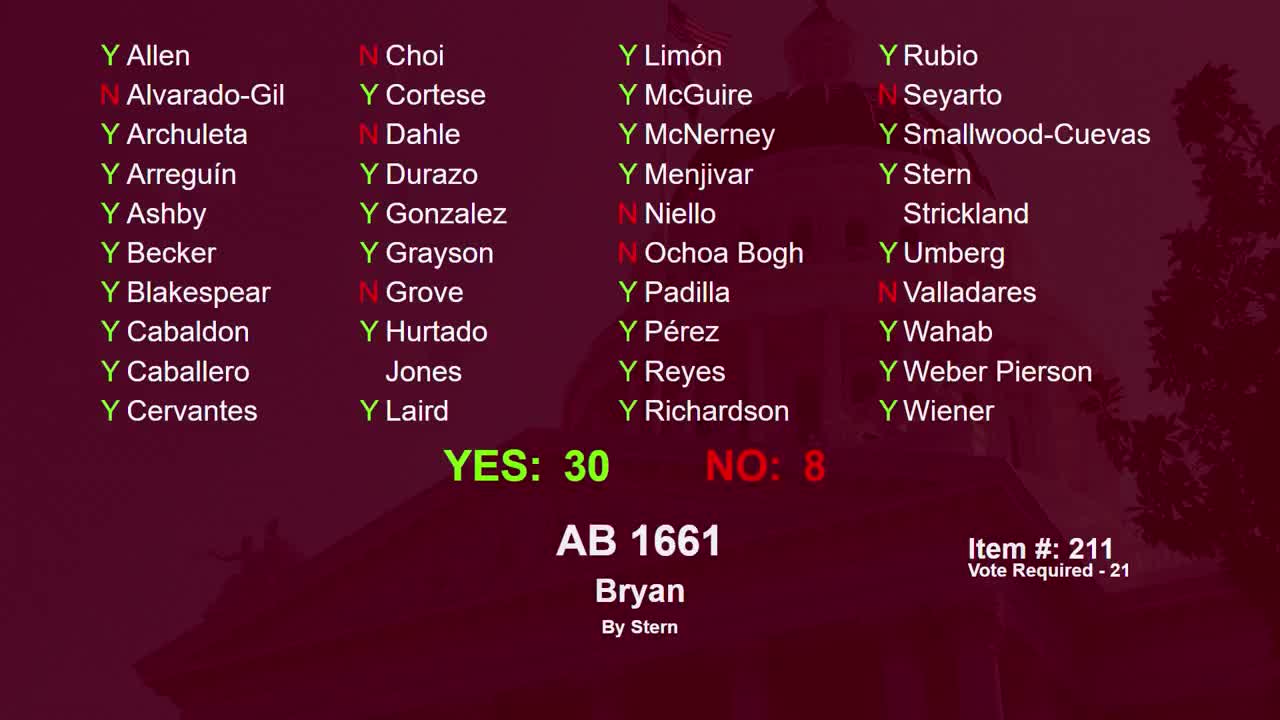 2MIN
Senate Floor
 14MIN
Senate Standing Committee on Judiciary
 16MIN
Senate Standing Committee on Labor, Public Employment and Retirement
 6MIN
Assembly Floor
 32MIN
Assembly Standing Committee on Appropriations
 15MIN
Assembly Standing Committee on Judiciary
 15MIN