AB 1814: Peace officer training: driving under the influence.
- Session Year: 2025-2026
- House: Assembly
- Latest Version Date: 2026-03-25
Current Status:
In Progress
(2026-05-14: In committee: Held under submission.)
Introduced
In Committee
Awaiting First Chamber Vote
Passed First Chamber
In Committee
Awaiting Second Chamber Vote
Passed Second Chamber
Enacted
Existing law establishes the Commission on Peace Officer Standards and Training, and requires the commission to, among other things, establish a certification program for peace officers, as defined. Existing law requires the commission, in consultation with specified subject matter experts, to develop guidelines and a course of instruction and training for law enforcement officers, including, but not limited to, hate crimes, elder and dependent abuse, and stalking.
This bill would require, no later than July 1, 2027, the commission to establish and maintain a training course relating to the detection and apprehension of drivers whose behavior indicates that they may be driving under the influence of drugs or alcohol. The bill would require the course to be at least 3 hours and to include certain topics, such as standardized field sobriety testing, physiology of drugs, and report writing, among others. The bill would require peace officers assigned to traffic enforcement to complete the course within one year of their assignment and every 2 years thereafter. The bill would authorize a peace officer to complete other specified training courses, in lieu of this requirement.This bill would require peace officers assigned primarily to traffic enforcement to complete a National Highway Transportation Safety Administration (NHTSA)-approved standard field sobriety testing course of a minimum of 16 hours within one year of their assignment and, if an officer leaves employment with a law enforcement agency and does not become employed by a law enforcement agency within 2 years of their departure date, would require the officer to complete any of several specified commission-certified training courses, including a NHTSA refresher course if they are assigned to traffic enforcement. Because this bill would require additional training for local peace officers, it would impose a state-mandated local program.
The California Constitution requires the state to reimburse local agencies and school districts for certain costs mandated by the state. Statutory provisions establish procedures for making that reimbursement.
This bill would provide that, if the Commission on State Mandates determines that the bill contains costs mandated by the state, reimbursement for those costs shall be made pursuant to the statutory provisions noted above.
Existing law establishes the Commission on Peace Officer Standards and Training, and requires the commission to, among other things, establish a certification program for peace officers, as defined. Existing law requires the commission, in consultation with specified subject matter experts, to develop guidelines and a course of instruction and training for law enforcement officers, including, but not limited to, hate crimes, elder and dependent abuse, and stalking.
This bill would require, no later than July 1, 2027, the commission to establish and maintain a training course relating to the detection and apprehension of drivers whose behavior indicates that they may be driving under the influence of drugs or alcohol. The bill would require the course to be at least 3 hours and to include certain topics, such as standardized field sobriety testing, physiology of drugs, and report writing, among others. The bill would require peace officers assigned to traffic enforcement to complete the course within one year of their assignment and every 2 years thereafter. The bill would authorize a peace officer to complete other specified training courses, in lieu of this requirement. Because this bill would require additional training for local peace officers, it would impose a state-mandated local program.
The California Constitution requires the state to reimburse local agencies and school districts for certain costs mandated by the state. Statutory provisions establish procedures for making that reimbursement.
This bill would provide that, if the Commission on State Mandates determines that the bill contains costs mandated by the state, reimbursement for those costs shall be made pursuant to the statutory provisions noted above.
(a)A peace officer with a rank of supervisor or below who is assigned primarily to traffic enforcement shall complete the course described in subdivision (a) within one year of their assignment to traffic enforcement, and every two years thereafter for as long as they are assigned a National Highway Transportation Safety Administration-approved standard field sobriety testing course of a minimum of 16 hours within one year of their assignment to traffic enforcement. Assigned to traffic enforcement does not include an officer who enforces traffic laws as an ancillary function of a general patrol assignment.
(d)Notwithstanding subdivision (c), a peace officer may complete either of the following in lieu of the course described in subdivision (a):(b)A peace officer described in subdivision (a) who completed the course in subdivision (a) and who leaves employment with a law enforcement agency and who does not become reemployed by a law enforcement agency within two years of their departure shall, if assigned to traffic enforcement, complete one of the following courses within one year of their assignment to traffic enforcement:
(1)Any of the below commission-certified courses provided by the Department of the California Highway Patrol: Patrol or a local law enforcement agency:
(A)Standardized field sobriety testing course.
(B)National Highway Transportation Safety Administration-approved standard field sobriety testing refresher course.
(B)(C)Drug recognition expert classroom course.
(C)(D)Drug recognition expert recertification course.
(D)(E)Advanced roadside impaired driving enforcement course.
(2)Any other commission-certified, continuing professional training-eligible course relating to law enforcement detection and apprehension of drivers whose behavior indicates that they may be driving under the influence of drugs or alcohol in violation of Section 23152 of the Vehicle Code.
(e) The commission shall implement this section on or before July 1, 2027.SEC. 2.If the Commission on State Mandates determines that this act contains costs mandated by the state, reimbursement to local agencies and school districts for those costs shall be made pursuant to Part 7 (commencing with Section 17500) of Division 4 of Title 2 of the Government Code.
(a)The commission shall establish and maintain a continuing training course that includes instructor-led active learning, such as scenario-based training, relating to law enforcement detection and apprehension of drivers whose behavior indicates that they may be driving under the influence of drugs or alcohol in violation of Section 23152 of the Vehicle Code.
(b)This course shall be at least three consecutive hours, may include training scenarios and facilitated learning activities, and shall, at a minimum, include all of the following topics:
(1)Standardized field sobriety testing.
(2)The seven major drug categories.
(3)Signs and symptomatology.
(4)Physiology of drugs.
(5)Drug combinations.
(6)Courtroom testimony.
(7)Report writing.
(c)Except as described in subdivision (d), each peace officer with a rank of supervisor or below who is assigned primarily to traffic enforcement shall complete the course described in subdivision (a) within one year of their assignment to traffic enforcement, and every two years thereafter for as long as they are assigned to traffic enforcement. Assigned to traffic enforcement does not include an officer who enforces traffic laws as an ancillary function of a general patrol assignment.
(d)Notwithstanding subdivision (c), a peace officer may complete either of the following in lieu of the course described in subdivision (a):
(1)Any of the below commission-certified courses provided by the Department of the California Highway Patrol:
(A)Standardized field sobriety testing course.
(B)Drug recognition expert classroom course.
(C)Drug recognition expert recertification course.
(D)Advanced roadside impaired driving enforcement course.
(2)Any other commission-certified, continuing professional training-eligible course relating to law enforcement detection and apprehension of drivers whose behavior indicates that they may be driving under the influence of drugs or alcohol in violation of Section 23152 of the Vehicle Code.
(e)The commission shall implement this section on or before July 1, 2027.
SEC. 2.If the Commission on State Mandates determines that this act contains costs mandated by the state, reimbursement to local agencies and school districts for those costs shall be made pursuant to Part 7 (commencing with Section 17500) of Division 4 of Title 2 of the Government Code.
|
Date
|
Status
|
|---|---|
| May 14, 2026 | In committee: Held under submission. |
| May 6, 2026 | In committee: Set, first hearing. Referred to APPR. suspense file. |
| Apr 15, 2026 | From committee: Do pass and re-refer to Com. on APPR. (Ayes 9. Noes 0.) (April 14). Re-referred to Com. on APPR. |
| Mar 26, 2026 | Re-referred to Com. on PUB. S. |
| Mar 25, 2026 | From committee chair, with author's amendments: Amend, and re-refer to Com. on PUB. S. Read second time and amended. |
| Mar 16, 2026 | Referred to Com. on PUB. S. |
| Feb 11, 2026 | From printer. May be heard in committee March 13. |
| Feb 10, 2026 | Read first time. To print. |
|
Date
|
Description
|
Location
|
Votes
|
|
|---|---|---|---|---|
| Apr 14, 2026 | Do pass and be re-referred to the Committee on [Appropriations] | Assembly Standing Committee on Public Safety |
Passed |
This list shows positions taken on this bill by organizations on the date displayed, which is linked to the original source.
Positions by individuals are not included.
|
Organization
|
Position
|
Date
|
|---|---|---|
| AAA Northern California, Nevada & Utah | ** Support | |
| Arcadia Police Officers' Association | ** Support | |
| Association for Los Angeles Deputy Sheriffs (ALADS) | ** Support | |
| Automobile Club of Southern California | ** Support | |
| Brea Police Association | ** Support | |
| Burbank Police Officers' Association | ** Support | |
| California District Attorneys Association | ** Support | |
| California Narcotic Officers' Association | ** Support | |
| California Peace Officers Association | ** Support | |
| California Reserve Peace Officers Association | ** Support | |
| CLAREMONT POLICE OFFICERS ASSOCIATION | ** Support | |
| Corona Police Officers' Association | ** Support | |
| Culver City Police Officers' Association | ** Support | |
| Fullerton Police Officers' Association | ** Support | |
| League Of California Cities | ** Support | |
| Murrieta Police Officers' Association | ** Support | |
| Newport Beach Police Association | ** Support | |
| Palos Verdes Police Officers' Association | ** Support | |
| Placer County Deputy Sheriffs' Assocation | ** Support | |
| Pomona Police Officers' Association | ** Support | |
| RIVERSIDE POLICE OFFICERS ASSOCIATION | ** Support | |
| Riverside Sheriffs' Association | ** Support | |
| Safety and Advocacy for Empowerment (SAFE) | ** Support | |
| Streets for All | ** Support |
Date of Hearing: May 6, 2026
ASSEMBLY COMMITTEE ON APPROPRIATIONS
Buffy Wicks, Chair
ABPCA Bill Id:AB 1814
Author:(Alanis) – As Amended Ver:March 25, 2026
Policy Committee: | Public Safety | Vote: | 9 - 0 |
|
| ||
|
|
Urgency: No State Mandated Local Program: Yes Reimbursable: Yes
SUMMARY:
This bill requires a peace officer of a rank of supervisor or below who is assigned primarily to traffic enforcement to complete a National Highway Traffic Safety Administration (NHTSA)-approved standard field sobriety testing course of a minimum of 16 hours within one year of the assignment.
Specifically, this bill:
- Excludes from the requirement officers who enforce traffic laws only as an ancillary function of a general patrol assignment.
- Requires an officer who completed the required training, left law enforcement, and returns to a traffic enforcement assignment after more than two years away to complete one of several POST-certified CHP or local courses — including the standardized field sobriety test (FST) course, NHTSA-approved FST refresher, drug recognition expert (DRE) classroom or recertification course, or Advanced Roadside Impaired Driving Enforcement (ARIDE) course — or another POST-certified, CPT-eligible course relating to the detection and apprehension of impaired drivers, within one year of the new assignment.
FISCAL EFFECT:
- Potentially reimbursable state-mandated local program costs (General Fund), unknown but likely in the low millions of dollars one-time and minor ongoing, for local law enforcement agencies to send traffic enforcement officers through the 16-hour training course and to backfill patrol and investigative coverage while officers are in training. Actual reimbursement is contingent on Commission on State Mandates determination. The magnitude cannot be estimated with precision because neither POST nor the state otherwise tracks the number of peace officers assigned primarily to traffic enforcement.
- Unknown, but potentially significant, cost pressures on the Peace Officers’ Training Fund (POTF) (special fund) and General Fund. Agencies may claim reimbursement from the Peace Officers’ Training Fund (POTF) only for POST-certified courses; to the extent agencies select a POST-certified option — such as CHP’s existing NHTSA-aligned FST course — those reimbursement claims will place pressure on POTF. POTF is a special fund that has faced structural revenue shortfalls for over a decade as penalty assessment collections have declined — a decline driven in part by the same drop in DUI arrests and convictions cited by the policy committee — and has previously required General Fund backfill and reductions to local assistance to remain solvent. Adding a new reimbursable training obligation to this fund would compound existing pressure on an already strained revenue base.
- Unknown, but potentially significant, costs to state law enforcement agencies (General Fund, various special funds) — including CHP, DOJ, State Parks, and others employing peace officers assigned primarily to traffic enforcement — to complete the required training and backfill coverage.
The Legislative Analyst’s Office recently warned of General Fund structural deficits of around $35 billion per year beginning in the 2027-28 fiscal year.
COMMENTS:
- Purpose. According to the author:
As a former law enforcement officer, I’ve seen firsthand how dangerous impaired driving can be for our communities. With DUI incidents continuing to impact families across California, it’s critical that every peace officer is properly trained to recognize and stop impaired drivers. Right now, that training isn’t consistent across the state. This bill makes sure all officers get the same clear, reliable training so we can keep our roads safer for everyone.
- Background. The bill draws on a 2021 recommendation from the CHP-convened impaired driving task force established under SB 94 (Committee on Budget and Fiscal Review, Chapter 27, Statutes of 2017). That task force recommended that law enforcement personnel assigned to traffic enforcement complete ARIDE training within one year of assignment, with continuing education every two years on impaired driving. This bill applies a similar framework to the NHTSA-aligned 16-hour standardized FST course that CHP currently offers. POST has advised the committee that, contrary to assertions that DUI training varies across agencies, every peace officer in California receives the same baseline academy training. Relevant instruction spans multiple learning domains — including LD 12 (Controlled Substances), which covers major drug categories and symptomology, and LD 28 (Traffic Enforcement), which covers standardized field sobriety testing. This bill would add a post-academy training requirement on top of the existing standardized academy curriculum for officers in specified assignments. The bill’s initial 16-hour training requirement in subdivision (a) references only “NHTSA-approved” courses, without requiring POST certification, while every course option available to returning officers under subdivision (b) must be POST-certified.
Analysis Prepared by: Shiran Zohar / APPR. / (916) 319-2081
Date of Hearing:
Counsel: Ilan Zur
ASSEMBLY COMMITTEE ON
Nick Schultz, Chair
ABPCA Bill Id:
Author:() – As Ver:
SUMMARY:
Requires specified peace officers assigned primarily to traffic enforcement to complete a National Highway Transportation Safety Administration (NHTSA)-approved standard field sobriety testing (FST) course within one year of assignment to traffic enforcement. Specifically, this bill:
- Requires a peace officer with a rank of supervisor or below who is assigned primarily to traffic enforcement to complete a NHTSA-approved standard FST course of a minimum of 16 hours within one year of their assignment to traffic enforcement.
- Provides that “assigned to traffic enforcement” does not include an officer who enforces traffic laws as an ancillary function of a general patrol assignment.
- Requires a peace officer described above who completed the NHTSA-approved standard FST course and who leaves employment with a law enforcement agency (LEA) and who does not become reemployed by an LEA within two years of their departure, if assigned to traffic enforcement, to complete one of the following courses within one year of their assignment to traffic enforcement:
- Any of the below Commission on Peace Officer Standards and Training (POST)-certified courses provided by the Department of the California Highway Patrol (CHP) or a local LEA:
- Standardized FST course.
- NHTSA-approved standard FST refresher course.
- Drug recognition expert (DRE) classroom course.
- Drug recognition expert (DRE) recertification course.
- Advanced roadside impaired driving enforcement (ARIDE) course.
- Any other POST-certified, continuing professional training-eligible course relating to law enforcement detection and apprehension of drivers whose behavior indicates that they may be driving under the influence (DUI) of drugs or alcohol, as specified.
- Any of the below Commission on Peace Officer Standards and Training (POST)-certified courses provided by the Department of the California Highway Patrol (CHP) or a local LEA:
EXISTING LAW:
- Requires every person described as a peace officer to satisfactorily complete an introductory training course established by POST. (Pen. Code, § 832.)
- Requires POST to adopt rules establishing minimum standards relating to the recruitment, training, and fitness of state and local law enforcement officers. (Pen. Code, §§ 13510, 13510.5.)
- Provides that if a person is lawfully arrested for a DUI involving an alcoholic beverage, the person has the choice of whether the test shall be of their blood or breath, and the officer shall advise the person that they have that choice. (Veh. Code, § 23612, (a)(2)(A).)
- Permits a person who chooses to submit to a breath test to be requested to submit to a blood test if the officer has reasonable cause to believe that the person was DUI of a drug and if the officer has reasonable cause to believe that a blood test will reveal evidence of the person being under the influence, requires the officer to state in their report the facts upon which those beliefs are based, and requires the officer to advise the person that they required to submit to an additional test. (Veh. Code, § 23612, (a)(2)(C).)
- Requires an officer, for a person lawfully arrested for a specified DUI offense, to advise the person that they do not have the right to have an attorney present before stating whether they will submit to a test, before deciding which test to take, or during administration of the test or tests chosen, and that, in the event of refusal to submit to a test or tests, the refusal may be used against them in a court of law. (Veh. Code, § 23612, (a)(4).)
- Provides that if an officer decides to use a preliminary alcohol screening test, the officer shall advise the person that they are requesting that person to take a preliminary alcohol screening test to assist the officer in determining if that person is under the influence, as specified. (Veh. Code, § 23612, (i).)
- Specifies that a person’s obligation to submit to a blood, breath, or urine test, as required, for the purpose of determining the alcohol or drug content of that person’s blood, is not satisfied by the person submitting to a preliminary alcohol screening test, and an officer shall advise the person of that fact and of the person’s right to refuse to take the preliminary alcohol screening test. (Veh. Code, § 23612, (i).)
- Permits a peace officer who has completed a POST-approved course or courses of instruction in the investigation of traffic accidents to prepare, in triplicate, on a form approved by the Judicial Council, a written notice to appear when the peace officer has reasonable cause to believe that any person involved in a traffic accident has violated a provision of the Vehicle Code that is a felony, or a local ordinance, and the violation was a factor in the occurrence of the traffic accident. (Veh. Code, § 40600, subd. (a).)
- Requires the CHP Commissioner to appoint an impaired driving task force to develop recommendations for best practices, protocols, proposed legislation, and other policies that will address the issue of impaired driving, and requires the task force to examine the use of technology, including field testing technologies and validated field sobriety tests, to identify specified drivers under the influence of prescription drugs, cannabis, and controlled substances. The task force shall include, but is not limited to, the CHP commissioner and members of specified organizations and agencies, including the Office of Traffic Safety and NHTSA. (Veh. Code, § 2429.7, subd. (a).)
- Requires the task force to make recommendations regarding the prevention of impaired driving, means of identifying impaired driving, and responses to impaired driving that reduce re-occurrence, as specified. (Veh. Code, § 2429.7, subd. (d).)
- Requires, by January 1, 2021, the task force to report to the Legislature its policy recommendations and the steps state agencies are taking regarding impaired driving. (Veh. Code, § 2429.7, subd. (e).)
FISCAL EFFECT:
Unknown
COMMENTS:
- Author's Statement: According to the author, “As a former law enforcement officer, I’ve seen firsthand how dangerous impaired driving can be for our communities. With DUI incidents continuing to impact families across California, it’s critical that every peace officer is properly trained to recognize and stop impaired drivers. Right now, that training isn’t consistent across the state. This bill makes sure all officers get the same clear, reliable training so we can keep our roads safer for everyone.”
- Statewide Increase in Traffic Fatalities, Including DUI Fatalities. There has been a substantial increase in crash fatalities in California in the last decade. Traffic fatalities can result from a variety of factors, including impaired driving, speeding, distracted driving, unsecured passengers, and unhelmeted motorcyclists, among others.[1] According to data published by the California Office of Traffic Safety (OTS), total crash fatalities across the state increased by about 31 percent, from 3,107 to 4,061, from 2013 to 2023.[2] This has been driven by an increase in almost all of the major crash fatality categories. According to OTS data, from 2013 to 2023, there was an approximate 54% increase in alcohol-impaired fatalities,[3] a 51% increase in unrestrained occupant fatalities,[4] a 51% increase in pedestrian fatalities,[5] a 31% increase in speeding-related fatalities,[6] and a 26% increase in motorcycle fatalities.[7] However, the latest data suggests this trend may be reversing. Total traffic fatalities decreased by 1.9% from 2021 to 2022,[8] and again by 11% from 2022 to 2023.[9] Alcohol-impaired driving fatalities similarly decreased by 4.5% from 2022 to 2023.[10]
For context, alcohol and drug-involved crash fatalities (hereafter DUI crash fatalities), which have historically comprised a significant portion of total crash fatalities, peaked at 2,065 in 2005, before declining to a multi-decade low of 1,416 in 2010.[11] DUI crash fatalities have steadily increased since then, reaching 1,644 in 2015 and 1,868 in 2021; an increase of about 32% from 2010 to 2021.[12] While DUI crash fatalities have increased in the last decade, they comprise an increasingly lower proportion of total crash fatalities. In 2013, DUI crash fatalities were responsible for 54.7% of all crash fatalities; in 2021, 41.7%.[13] That is the lowest proportion of total crash fatalities since 2001.[14] Further, non-alcohol-involved crash fatalities increased from 2010 to 2021 by an alarming 88% percent, from 1,667 to 3,133.[15] This indicates that vehicle safety factors other than alcohol-involved impaired driving are playing a significant role in driving California’s increase in crash fatalities.
- Reduced Enforcement of DUI Laws: The increase in DUI fatalities has coincided with a significant decline in DUI arrests and convictions. In 2010, when impaired fatalities were at a multi-decade low, there were 195,879 DUI arrests and 148,042 DUI convictions in California.[16] From 2010 to 2015, DUI arrests and convictions both decreased by approximately 28%.[17] Arrests and convictions have continued to steadily decrease since then, reaching 110,017 arrests and 81,248 convictions in 2021.[18] In sum, between 2010 and 2021, DUI arrests and convictions decreased by approximately 44% and 45%, respectively.[19] Unsurprisingly, from 2011 to 2021, the DUI arrest rate per 100,000 licensed drivers decreased from 752 to 401.[20] This decrease in DUI arrests and convictions, considered alongside the significant increase in DUI fatalities, suggests a substantial reduction in the enforcement of California’s DUI laws.
- Peace Officer DUI Training Courses: The POST-certified regular basic course of training for peace officers includes a minimum of 664 hours of POST-developed training, broken down into 42 Learning Domains.[21] The basic course includes training on California DUI laws and how to properly perform FSTs. Learning Domain 28, titled “Traffic Enforcement,” requires peace officers to learn the principles of traffic law as established in the California Vehicle Code to carry out their traffic enforcement responsibilities.[22] Chapter 5 of this Learning Domain pertains to DUI, and focuses “on the detection and apprehension of persons who are [DUI] of any alcoholic beverage and/or any drug”[23] and establishes the following learning objectives:
- Recognize the elements and common names for violations involving the possession of alcoholic beverages in a motor vehicle.
- Explain the meaning of the phrase “under the influence.”
- Recognize the elements and common names for violations involving DUI.
- Recognize driving that might indicate a driver of a vehicle may be under the influence.
- Recognize the indications of driving under the influence of any alcoholic beverage and/or any drug that a peace officer may observe upon making contact with a driver
- Discuss medical conditions that may cause a person to appear under the influence
- Recognize appropriate peace officer actions if a subject refuses to cooperate in an FST.
- Demonstrate FSTs that may be used to determine impairment, including horizontal gaze nystagmus, one-leg-stand, and walk and turn.
- Discuss the primary elements included in the statutory admonition read to drivers who refuse to submit to a chemical test.[24]
In addition to POST’s basic course of training, peace officers must complete at least 24 hours of Continuing Professional Training (CPT) every two years.[25] Peace officers can satisfy their CPT requirements, in part, by completing certain DUI-related trainings offered by certain organizations and agencies.[26] Most notably, CHP offers a variety of DUI-related trainings, including a 16-hour FST course, a 72-hour DRE classroom course, an 8-hour DRE recertification course, a 40-hour DRE Instructor Course, an eight or 16-hour Drug Impairment Training for Educational Professionals (DITEP) Course, and a 16-hour ARIDE Course.[27] However, unlike other types of training, such as the required elder abuse training for officers assigned to field or investigative duties,[28] officers are generally not required to complete specific DUI training courses outside of their basic course of training.
In 2017, the Legislature enacted SB 94 (Committee on Budget and Fiscal Review), Chapter 27, Statutes of 2017, which required the CHP Commissioner to appoint an impaired driving task force to develop recommendations for best practices, protocols, proposed legislation, and other policies that will address the issue of impaired driving, and to submit a report to the Legislature on the task force’s findings. (Veh. Code, § 2429.7, subds. (a) & (f).) This report was submitted to the Legislature in January 2021 and, among other things, recommended increasing peace officer training obligations pertaining to detecting impaired driving.[29] Specifically, the report included three peace officer training recommendations:
- POST should consider a requirement that a 24-hour SFT training be taught in all law enforcement academies in California.
- All law enforcement personnel assigned to traffic enforcement responsibilities shall receive ARIDE training within one year of being assigned and bi-annual continuing education related to impaired driving.
- The CHP should make all efforts to increase the number of DRE-trained officers statewide by four percent over the next five years.[30]
- Effect of this Bill: This bill seeks to improve law enforcement training surrounding the detection and enforcement of impaired driving. This may help remedy the reduction in the enforcement of DUI, described above. This bill is based in part upon one of the recommendations included in the CHP task force report, which suggests requiring specified impaired driving training for law enforcement within a year of being assigned to traffic enforcement.
Specifically, this bill requires a peace officer with a rank of supervisor or below who is assigned primarily to traffic enforcement to complete a 16-hour or more NHTSA-approved standard FST course within one year of their assignment to traffic enforcement. As previously noted, CHP currently provides such a 16-hour FST training.[31] This bill can be expected to increase the number of peace officers in California who complete this CHP-provided FST training. An officer who enforces traffic laws only as an ancillary function of a general patrol assignment is not subject to this requirement. Additionally, this bill requires a peace officer who completes this course, and leaves their employing LEA and who does not become reemployed by an LEA within two years of their departure, to, if assigned to traffic enforcement, complete certain courses within one year of their assignment to traffic enforcement. This includes specified POST-certified courses provided by CHP or a local LEA, as well as any other POST-certified, continuing professional training-eligible course relating to law enforcement detection and apprehension of drivers whose behavior indicates that they may be driving under the influence of drugs or alcohol, as specified.
- Argument in Support: According to the California Peace Officers Association, “AB 1814 “would expand law enforcement DUI training.
“Local law enforcement training varies widely in California, meaning that officers aren’t always trained in how to test for drunk and drugged driving.
“AB 1814 would increase DUI training for police officers who work traffic enforcement to ensure they are proficient in areas like sobriety testing and report writing.
“Peace officers strongly support legislation aimed at reducing DUI incidents because impaired driving remains one of the leading causes of preventable deaths on California roadways.
“On average, more than 1,300 people are killed each year in alcohol-involved crashes in California—accounting for roughly one-third of all traffic fatalities—and DUI-related deaths have risen significantly over the past decade. From a law enforcement perspective, these numbers represent repeated, preventable tragedies often involving repeat offenders.
“Policies that strengthen deterrence, improve accountability, and reduce impaired driving directly support officers’ core mission to protect the public, save lives, and prevent families from experiencing entirely avoidable loss.”
- Argument in Opposition: None submitted
- Prior Legislation:
- SB 94 (Committee on Budget and Fiscal Review), Chapter 27, Statutes of 2017, required, among other things, the CHP Commissioner to appoint an impaired driving task force to develop recommendations for best practices, protocols, proposed legislation, and other policies that will address the issue of impaired driving, and to submit a report to the Legislature on the task force’s findings.
REGISTERED SUPPORT / OPPOSITION:
Support
AAA Northern California, Nevada & Utah
Arcadia Police Officers' Association
Association for Los Angeles Deputy Sheriffs (ALADS)
Automobile Club of Southern California
Brea Police Association
Burbank Police Officers' Association
California District Attorneys Association
California Narcotic Officers' Association
California Peace Officers Association
California Reserve Peace Officers Association
Claremont Police Officers Association
Corona Police Officers Association
Culver City Police Officers' Association
Fullerton Police Officers' Association
League of California Cities
Murrieta Police Officers' Association
Newport Beach Police Association
Palos Verdes Police Officers Association
Placer County Deputy Sheriffs' Assocation
Pomona Police Officers' Association
Riverside Police Officers Association
Riverside Sheriffs' Association
Safety and Advocacy for Empowerment (SAFE)
Streets for All
Opposition
None submitted.
Analysis Prepared by:
OTS, California Annual Report: Fiscal Year 2024, p. 30, (2024), available at: https://www.ots.ca.gov/wp-content/uploads/sites/67/2025/09/FY-2024-Annual-Report-Final-7.31-ALT-TEXT.pdf ↑
OTS, California’s Annual Report 2018, p. 11, (2018), available at: https://www.ots.ca.gov/wp-content/uploads/sites/67/2019/06/2018-Annual-Report.pdf; OTS, California Traffic Safety Quick Stats (accessed February 4, 2026), available at: https://www.ots.ca.gov/ots-and-traffic-safety/score-card/ ↑
OTS, California’s Annual Report 2018, at p. 11; OTS, 2025 Traffic Safety Fact Sheet: Alcohol-Impaired and Alcohol-Involved Driving (2025), available at: https://safetrec.berkeley.edu/2025-safetrec-traffic-safety-facts-alcohol-impaired-and-alcohol-involved-driving ↑
OTS, California’s Annual Report 2018, at p. 11; OTS, 2025 Traffic Safety Fact Sheet: Occupant Protection and Child Passenger Safety (2025), https://safetrec.berkeley.edu/2025-safetrec-traffic-safety-facts-occupant-protection-and-child-passenger-safety. ↑
OTS, California’s Annual Report 2018, at p. 11; OTS, 2025 Traffic Safety Fact Sheet: Pedestrian Safety (2025), available at: https://safetrec.berkeley.edu/2025-safetrec-traffic-safety-facts-pedestrian-safety ↑
OTS, California’s Annual Report 2018, at p. 11; OTS, 2025 Traffic Safety Fact Sheet: Speeding-Related and Other Crashes (2025), available at: https://safetrec.berkeley.edu/2025-safetrec-traffic-safety-facts-speeding-related-and-other-crashes ↑
OTS, California’s Annual Report 2018, at p. 11; OTS, 2025 Traffic Safety Fact Sheet: Motorcycle Safety (2025), available at: https://safetrec.berkeley.edu/2025-safetrec-traffic-safety-facts-motorcycle-safety ↑
OTS, California Annual Report: Fiscal Year 2024, at p. 8 ↑
OTS, California Traffic Safety Quick Stats (accessed February 4, 2026), available at: https://www.ots.ca.gov/ots-and-traffic-safety/score-card/ ↑
Ibid. ↑
State of California DMV, DUI Summary Statistics (accessed February 3, 2026), available at: https://www.dmv.ca.gov/portal/dmv-research-reports/research-development-data-dashboards/dui-management-information-system-dashboards/dui-summary-statistics/. ↑
Ibid. ↑
Ibid. ↑
Ibid. ↑
Ibid. ↑
State of California DMV, DUI Summary Statistics (accessed February 3, 2026), available at: https://www.dmv.ca.gov/portal/dmv-research-reports/research-development-data-dashboards/dui-management-information-system-dashboards/dui-summary-statistics/. ↑
Ibid. ↑
Ibid. ↑
Ibid. ↑
DMV, 32nd Annual Report of the California Dui Management Information System (2025), at p. 6, available at: https://www.dmv.ca.gov/portal/uploads/2025/10/32nd-Annual-Report-of-the-California-DUI-Managment-Information-System.pdf ↑
POST, Peace Officer Basic Training (accessed April 3, 2026), available at: https://post.ca.gov/peace-officer-basic-training ↑
POST, Learning Domain 28: Traffic Enforcement (Oct. 2025), at p. 1-1, available at: https://post.ca.gov/portals/0/post_docs/basic_course_resources/workbooks/LD_28-V8.1.pdf ↑
Id. at p. 5-2 (citation omitted). ↑
Id. at pp. 5-1, 5-2. ↑
POST, Learning Portal Training that Meets Mandates, (accessed April 3, 2026), available at: https://post.ca.gov/Learning-Portal-Training-that-Meets-Mandates ↑
POST, Reimbursable Training Courses (accessed April 3, 2026), available at: https://post.ca.gov/Reimbursable-Training-Courses; POST, Course Catalog (accessed April 3, 2026), available at: https://catalog.post.ca.gov/SearchMap.aspx?mapLocation=&latLong=&radius=10&mapTitle=DUI&mapFromDate=04%2f03%2f2026&mapToDate=04%2f03%2f2028&mapPresenter=&pageId=1&searchForPSRequirements=False&includeSelfPaced=True&MAC=22%2fe7%2fLH0xnZPA99t12z9JHwBJs ↑
California Highway Patrol, Schedule of Classes (accessed April 3, 2026), available at: https://www.chp.ca.gov/programs-services/for-law-enforcement/drug-recognition-evaluator-program/schedule-of-classes/ ↑
Pen. Code, § 13515. ↑
CHP, Report to the Legislature: Senate Bill No. 94 (Jan. 2021), at p. 36, available at: https://www.chp.ca.gov/siteassets/files/idtf_sb_94_2020.pdf ↑
Ibid. ↑
CHP, Standardized Field Sobriety Testing (SFST) Course, (accessed April 3, 2026), available at: https://www.chp.ca.gov/programs-services/for-law-enforcement/drug-recognition-evaluator-program/schedule-of-classes/sfst/ ↑
Discussed in Hearing
 3MIN
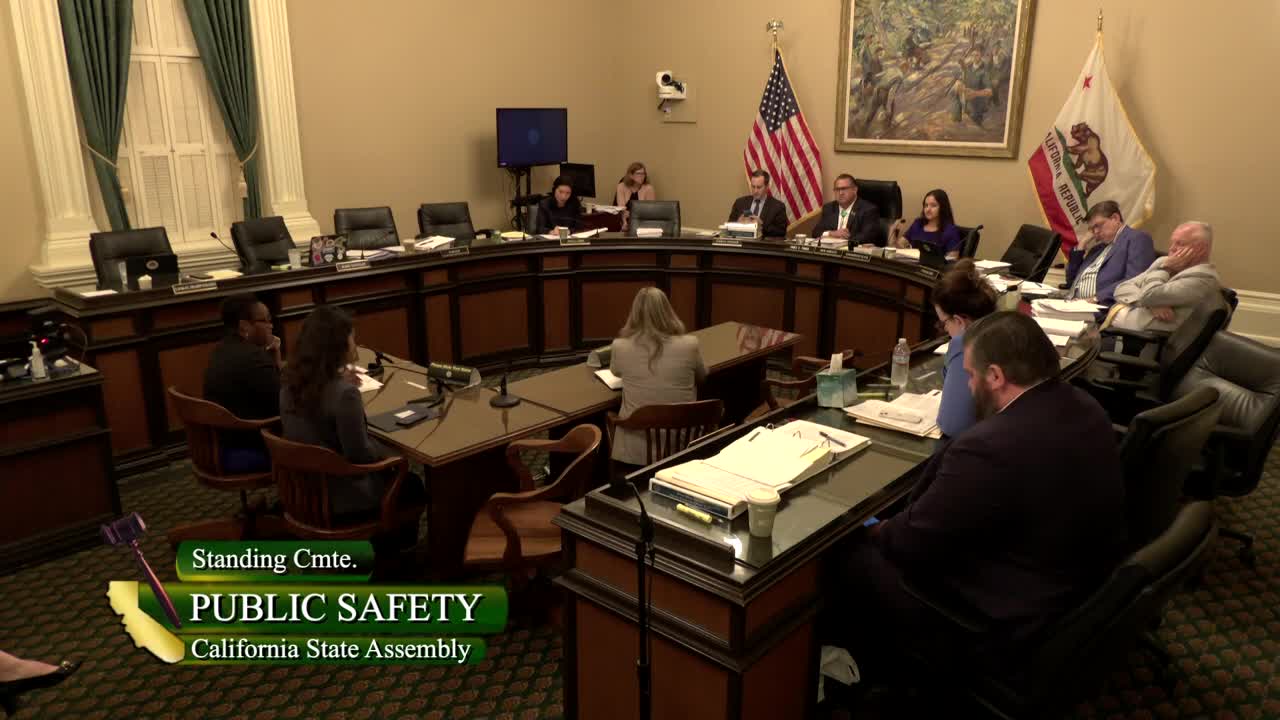
Assembly Standing Committee on Public Safety
Bill Author

Bill Co-Author(s):