AB 1837: Video imaging of parking violations.
- Session Year: 2025-2026
- House: Assembly
- Latest Version Date: 2026-09-30
Current Status:
Passed
(2026-09-30: Chaptered by Secretary of State - Chapter 900, Statutes of 2026.)
Introduced
In Committee
Awaiting First Chamber Vote
Passed First Chamber
In Committee
Awaiting Second Chamber Vote
Passed Second Chamber
Enacted
Existing law authorizes a public transit operator in the state, until January 1, 2027, and authorizes the City and County of San Francisco indefinitely, to enforce parking violations in specified transit-only traffic lanes and at transit stops through the use of video imaging, and to install automated forward facing parking control devices on city-owned public transit vehicles for the purpose of video imaging parking violations occurring in transit-only traffic lanes, as specified. Existing law requires a public transit operator, prior to issuing notices of parking violations, to issue warning notices for the first 60 days and to make a public announcement of the program. Existing law requires a designated employee, or a contracted law enforcement agency, to review video image recordings for the purpose of determining whether a parking violation occurred in a transit-only traffic lane or at a transit stop and to issue a notice of violation to the registered owner of a vehicle within 15 calendar days, as specified. Existing law makes these video image records confidential and provides that these records are available only to public agencies to enforce parking violations. Existing law requires a public transit operator that implements an automated enforcement system to enforce parking violations in transit-only traffic lanes and at transit stops to submit a report to specified committees of the Legislature by no later than January 1, 2025.
This bill would extend the authorization for the use of video imaging to enforce parking and stopping violations until January 1, 2034. The bill would require that a public transit operator issue warnings for 60 days prior to issuing notices of violations when it uses video imaging for enforcement of a violation that it has not previously used video imaging to enforce. The bill would require a public transit operator that uses video imaging to enforce parking violations to report to the Legislature, as specified. The bill would exempt the City and County of San Francisco from this requirement. The bill would allow only local agencies to use video image records to enforce parking violations and would prohibit the use or access of these records for general law enforcement purposes or by federal authorities, as specified.
Existing constitutional provisions require that a statute that limits the right of access to the meetings of public bodies or the writings of public officials and agencies be adopted with findings demonstrating the interest protected by the limitation and the need for protecting that interest.
This bill would make legislative findings to that effect.
This bill would make legislative findings and declarations as to the necessity of a special statute for the City and County of San Francisco.
Existing law authorizes a public transit operator in the state, until January 1, 2027, and authorizes the City and County of San Francisco indefinitely, to enforce parking violations in specified transit-only traffic lanes and at transit stops through the use of video imaging, and to install automated forward facing parking control devices on city-owned public transit vehicles for the purpose of video imaging parking violations occurring in transit-only traffic lanes, as specified. Existing law requires a public transit operator, prior to issuing notices of parking violations, to issue warning notices for the first 60 days and to make a public announcement of the program. Existing law requires a designated employee, or a contracted law enforcement agency, to review video image recordings for the purpose of determining whether a parking violation occurred in a transit-only traffic lane or at a transit stop and to issue a notice of violation to the registered owner of a vehicle within 15 calendar days, as specified. Existing law makes these video image records confidential and provides that these records are available only to public agencies to enforce parking violations. Existing law requires a public transit operator that implements an automated enforcement system to enforce parking violations in transit-only traffic lanes and at transit stops to submit a report to specified committees of the Legislature by no later than January 1, 2025.
This bill would extend the authorization for the use of video imaging to enforce parking and stopping violations until January 1, 2034. The bill would require that a public transit operator issue warnings for 60 days prior to issuing notices of violations when it uses video imaging for enforcement of a violation that it has not previously used video imaging to enforce. The bill would require that a public transit operator that used uses video imaging to enforce parking violations who has or has not had a system in operation at any time prior to January 1, 2027, to report to the Legislature, as specified. The bill would exempt the City and County of San Francisco from this requirement. The bill would allow only local agencies to use video image records to enforce parking violations and would prohibit the use or access of these records for general law enforcement purposes or by federal authorities, as specified.
Existing constitutional provisions require that a statute that limits the right of access to the meetings of public bodies or the writings of public officials and agencies be adopted with findings demonstrating the interest protected by the limitation and the need for protecting that interest.
This bill would make legislative findings to that effect.
This bill would make legislative findings and declarations as to the necessity of a special statute for the City and County of San Francisco.
Existing law authorizes a public transit operator in the state, until January 1, 2027, and authorizes the City and County of San Francisco indefinitely, to enforce parking violations in specified transit-only traffic lanes and at transit stops through the use of video imaging, and to install automated forward facing parking control devices on city-owned public transit vehicles for the purpose of video imaging parking violations occurring in transit-only traffic lanes, as specified. Existing law requires a public transit operator, prior to issuing notices of parking violations, to issue warning notices for the first 60 days and to make a public announcement of the program. Existing law requires a designated employee, or a contracted law enforcement agency, to review video image recordings for the purpose of determining whether a parking violation occurred in a transit-only traffic lane or at a transit stop and to issue a notice of violation to the registered owner of a vehicle within 15 calendar days, as specified. Existing law makes these video image records confidential and provides that these records are available only to public agencies to enforce parking violations. Existing law requires a public transit operator that implements an automated enforcement system to enforce parking violations in transit-only traffic lanes and at transit stops to submit a report to specified committees of the Legislature by no later than January 1, 2025.
This bill would extend the authorization for the use of video imaging to enforce parking and stopping violations indefinitely. violations until January 1, 2034. The bill would require that a public transit operator issue warnings for 60 days prior to issuing notices of violations when it uses video imaging for enforcement of a violation that it has not previously used video imaging to enforce. The bill would require that a public transit operator that used video imaging to enforce parking violations who has or has not had a system in operation at any time prior to January 1, 2027, to report to the Legislature until January 1, 2031, as specified. Legislature, as specified. The bill would allow only local agencies to use video image records to enforce parking violations and would prohibit the use or access of these records for general law enforcement purposes or by federal authorities, as specified.
Existing constitutional provisions require that a statute that limits the right of access to the meetings of public bodies or the writings of public officials and agencies be adopted with findings demonstrating the interest protected by the limitation and the need for protecting that interest.
This bill would make legislative findings to that effect.
Existing law authorizes a public transit operator in the state, until January 1, 2027, and authorizes the City and County of San Francisco indefinitely, to enforce parking violations in specified transit-only traffic lanes and at transit stops through the use of video imaging, and to install automated forward facing parking control devices on city-owned public transit vehicles for the purpose of video imaging parking violations occurring in transit-only traffic lanes, as specified. Existing law requires a public transit operator, prior to issuing notices of parking violations, to issue warning notices for the first 60 days and to make a public announcement of the program. Existing law requires a designated employee, or a contracted law enforcement agency, to review video image recordings for the purpose of determining whether a parking violation occurred in a transit-only traffic lane or at a transit stop and to issue a notice of violation to the registered owner of a vehicle within 15 calendar days, as specified. Existing law makes these video image records confidential and provides that these records are available only to public agencies to enforce parking violations. Existing law requires a public transit operator that implements an automated enforcement system to enforce parking violations in transit-only traffic lanes and at transit stops to submit a report to specified committees of the Legislature by no later than January 1, 2025.
This bill would extend the authorization for the use of video imaging to enforce parking and stopping violations indefinitely and would expand the types of violations to include stopping or parking on the roadway side of a vehicle stopped, parked, or standing, as specified, or unlawfully stopping or parking in a bikeway. indefinitely. The bill would require that a public transit operator issue warnings for 60 days prior to issuing notices of violations when it uses video imaging for enforcement of a violation that it has not previously used video imaging to enforce. The bill would require that a public transit operator that used video imaging to enforce parking violations who has not had a system in operation at any time prior to January 1, 2027, to report to the Legislature until January 1, 2031, as specified.
Existing constitutional provisions require that a statute that limits the right of access to the meetings of public bodies or the writings of public officials and agencies be adopted with findings demonstrating the interest protected by the limitation and the need for protecting that interest.
This bill would make legislative findings to that effect.
Existing law authorizes a public transit operator in the state, until January 1, 2027, and authorizes the City and County of San Francisco indefinitely, to enforce parking violations in specified transit-only traffic lanes and at transit stops through the use of video imaging, and to install automated forward facing parking control devices on city-owned public transit vehicles for the purpose of video imaging parking violations occurring in transit-only traffic lanes, as specified. Existing law requires a public transit operator, prior to issuing notices of parking violations, to issue warning notices for the first 60 days and to make a public announcement of the program. Existing law requires a designated employee, or a contracted law enforcement agency, to review video image recordings for the purpose of determining whether a parking violation occurred in a transit-only traffic lane or at a transit stop and to issue a notice of violation to the registered owner of a vehicle within 15 calendar days, as specified. Existing law makes these video image records confidential and provides that these records are available only to public agencies to enforce parking violations. Existing law requires a public transit operator that implements an automated enforcement system to enforce parking violations in transit-only traffic lanes and at transit stops to submit a report to specified committees of the Legislature by no later than January 1, 2025.
This bill would extend the authorization for the use of video imaging to enforce parking and stopping violations indefinitely and would expand the types of violations to include stopping or parking on the roadway side of a vehicle stopped, parked, or standing, as specified, or unlawfully stopping or parking in a bikeway. The bill would require that a public transit operator issue warnings for 60 days prior to issuing notices of violations when it uses video imaging for enforcement of a violation that it has not previously used video imaging to enforce. The bill would require that a public transit operator that used video imaging to enforce parking violations who has not had a system in operation at any time prior to January 1, 2027, to report to the Legislature until January 1, 2031, as specified.
Existing constitutional provisions require that a statute that limits the right of access to the meetings of public bodies or the writings of public officials and agencies be adopted with findings demonstrating the interest protected by the limitation and the need for protecting that interest.
This bill would make legislative findings to that effect.
(a)(1)A public transit operator, as defined in Section 99210 of the Public Utilities Code, may install automated forward facing parking control devices on city-owned or district-owned public transit vehicles, as defined by Section 99501 of the Public Utilities Code, for the purpose of video imaging of parking violations occurring in transit-only traffic lanes and at transit stops. Citations shall be issued only for violations captured during the posted hours of operation for a transit-only traffic lane or during the scheduled operating hours at transit stops.
(2)The devices shall be angled and focused so as to capture video images of parking violations and not unnecessarily capture identifying images of other drivers, vehicles, and pedestrians. The devices shall record the date and time of the violation at the same time as the video images are captured. Transit agencies may share the relevant data, video, and images of parking violations collected by automated forward facing parking control devices with the local parking enforcement entity and local agency in the jurisdiction where the violation occurred. A transit operator may only install forward facing cameras pursuant to this section if the examiner or issuing agency, as described in Section 40215, includes options to reduce or waive the payment of a parking penalty if the examiner or issuing agency determines that the person is an indigent person as defined in Section 40220.
(b)(1)Prior to issuing notices of parking violations pursuant to subdivision (a) of Section 40241, a public transit operator, in partnership with a city, county, city and county, or local enforcement authority, shall commence a program to issue only warning notices for 60 days and shall also make a public announcement of the program and provide the public with information about the enforcement program, existing parking regulations, and the payment options available for low-income persons at least 60 days prior to commencement of issuing notices of parking violations.
(2)A public transit operator shall issue a notice pursuant to paragraph (1) when it uses video imaging for enforcement of a violation described in subdivision (a) that it has not previously used video imaging to enforce.
(c)A designated employee of a city, county, city and county, or a contracted law enforcement agency for a special transit district, who is qualified by a city, county, city and county, or district to issue parking citations, shall review video image recordings for the purpose of determining whether a parking violation occurred in a transit-only traffic lane or at a transit stop. A violation of a statute, regulation, or ordinance governing vehicle parking under this code, under a federal or state statute or regulation, or under an ordinance enacted by a city, county, city and county, or special transit district occurring in a transit-only traffic lane or at a transit stop observed by the designated employee in the recordings is subject to a civil penalty.
(d)The registered owner shall be permitted to review the video image evidence of the alleged violation during normal business hours at no cost.
(e)(1)Except as it may be included in court records described in Section 68152 of the Government Code, or as provided in paragraph (2), the video image evidence may be retained for up to six months from the date the information was first obtained, or 60 days after final disposition of the citation, whichever date is later, after which time the information shall be destroyed.
(2)Notwithstanding Section 26202.6 of the Government Code, video image evidence from forward facing automated enforcement devices that does not contain evidence of a parking violation occurring in a transit-only traffic lane or at a transit stop shall be destroyed within 15 days after the information was first obtained. Video image data and records collected pursuant to this section shall not be used or processed by an automated license plate recognition system, as defined in Section 1798.90.5 of the Civil Code, unless the public transit operator, city, county, city and county, or local enforcement authority meets the requirements in this paragraph and paragraph (1), the requirements of subdivision (f), and the requirements of subdivision (e) of Section 40241.
(f)Notwithstanding Article 1 (commencing with Section 7922.500) and Article 2 (commencing with Section 7922.525) of Chapter 1 of Part 3 of Division 10 of Title 1 of the Government Code, or any other law, the video image records are confidential. Local agencies shall use and allow access to these records only for the purposes authorized by this article. These records shall not use biometric identifying technology, including, but not limited to, facial recognition technology that identifies specific individuals. These records shall not be used or accessed for general law enforcement purposes or by federal authorities without a court order from a federal or California court of competent jurisdiction. Any images of other drivers, nonrelevant vehicle license plates, or pedestrians unnecessarily captured shall be blurred.
(g)The following definitions shall apply for purposes of this article:
(1)Local agency means a public transit operator as defined in Section 99210 of the Public Utilities Code or a local city, county, or city and county parking enforcement authority.
(2)Transit-only traffic lane means any designated transit-only lane on which use is restricted to mass transit vehicles, or other designated vehicles including taxis and vanpools, during posted times.
(h)A public transit operator shall not implement a new program pursuant to this section on or after January 1, 2032.
(i)This section shall remain in effect only until January 1, 2034, and as of that date is repealed.
SEC. 2.Section 40240 of the Vehicle Code, as amended by Section 156 of Chapter 28 of the Statutes of 2022, is amended to read:40240.(a)The City and County of San Francisco may install automated forward facing parking control devices on city-owned or district-owned public transit vehicles, as defined in Section 99211 of the Public Utilities Code, for the purpose of video imaging of parking violations occurring in transit-only traffic lanes and at transit stops. Citations shall be issued only for violations captured during the posted hours of operation for a transit-only traffic lane or during the scheduled operating hours at transit stops. The devices shall be angled and focused so as to capture video images of parking violations and not unnecessarily capture identifying images of other drivers, vehicles, and pedestrians. The devices shall record the date and time of the violation at the same time as the video images are captured. Transit agencies may share the relevant data, video, and images of parking violations collected by automated forward facing parking control devices with the local parking enforcement entity and local agency in the jurisdiction where the violation occurred. The City and County of San Francisco may only install forward facing cameras pursuant to this section if the examiner or issuing agency, as described in Section 40215, includes options to reduce or waive the payment of a parking penalty if the examiner or issuing agency determines that the person is an indigent person as defined in Section 40220.
(b)Prior to issuing notices of parking violations pursuant to subdivision (a) of Section 40241, the City and County of San Francisco shall commence a program to issue only warning notices for 60 days and shall also make a public announcement of the program and provide the public with information about the enforcement program, existing parking regulations, and the payment options available for low-income persons at least 60 days prior to commencement of issuing notices of parking violations.
(c)A designated employee of the City and County of San Francisco who is qualified to issue parking citations shall review video image recordings for the purpose of determining whether a parking violation occurred in a transit-only traffic lane or at a transit stop. A violation of a statute, regulation, or ordinance governing vehicle parking under this code, under a federal or state statute or regulation, or under an ordinance enacted by the City and County of San Francisco occurring in a transit-only traffic lane or at a transit stop observed by the designated employee in the recordings is subject to a civil penalty.
(d)The registered owner shall be permitted to review the video image evidence of the alleged violation during normal business hours at no cost.
(e)(1)Except as it may be included in court records described in Section 68152 of the Government Code, or as provided in paragraph (2), the video image evidence may be retained for up to six months from the date the information was first obtained, or 60 days after final disposition of the citation, whichever date is later, after which time the information shall be destroyed.
(2)Notwithstanding Section 26202.6 of the Government Code, video image evidence from forward facing automated enforcement devices that does not contain evidence of a parking violation occurring in a transit-only traffic lane or at a transit stop shall be destroyed within 15 days after the information was first obtained. Video image data and records collected pursuant to this section shall not be used or processed by an automated license plate recognition system, as defined in Section 1798.90.5 of the Civil Code, unless the public transit operator, city, county, city and county, or local enforcement authority meets the requirements of this paragraph and paragraph (1), the requirements of subdivision (f), and the requirements of subdivision (e) of Section 40241.
(f)Notwithstanding Article 1 (commencing with Section 7922.500) and Article 2 (commencing with Section 7922.525) of Chapter 1 of Part 3 of Division 10 of Title 1 of the Government Code or any other law, the video image records are confidential. Public agencies shall use and allow access to these records only for the purposes authorized by this article.
(g)For purposes of this article, transit-only traffic lane means any designated transit-only lane on which use is restricted to mass transit vehicles or other designated vehicles, including taxis and vanpools, during posted times.
(h)This section shall become operative on January 1, 2034.
SEC. 3.Section 40240.5 of the Vehicle Code is amended to read:40240.5.(a)A public transit operator that implements an automated enforcement system to enforce parking violations pursuant to this article, shall provide to the transportation, privacy, and judiciary committees of the Legislature an evaluation report of the enforcement systems effectiveness, impact on privacy, impact on traffic outcomes, cost to implement, change in citations issued, and generation of revenue. The evaluation report shall include the precise data and methodology used to draw the conclusions contained in the evaluation report. The evaluation report shall be submitted as follows:
(1)For a public transit operator that implemented an automated enforcement system to enforce parking violations prior to January 1, 2027, the report shall be submitted by January 1, 2029.
(2)For a public transit operator that implemented an automated enforcement system to enforce parking violations after January 1, 2027, the report shall be submitted two years after the implementation of the system.
(3)The requirements of this section shall not apply to the City and County of San Francisco.
(b)A report submitted pursuant to this section shall be submitted in compliance with Section 9795 of the Government Code.
SEC. 4.Section 40241 of the Vehicle Code, as amended by Section 5 of Chapter 709 of the Statutes of 2021, is amended to read:40241.(a)A designated employee of the local agency, including a contracted law enforcement agency, shall issue a notice of parking violation to the registered owner of a vehicle within 15 calendar days of the date of the violation. A designated employee or contracted law enforcement agency may decline to issue a ticket based on the evidence in the video illustrating hardship. The notice of parking violation shall set forth the violation of a statute, regulation, or ordinance governing vehicle parking under this code, under a federal or state statute or regulation, or under an ordinance enacted by the local agency occurring in a transit-only traffic lane or at a transit stop, a statement indicating that payment is required within 21 calendar days from the date of citation issuance, and the procedure for the registered owner, lessee, or rentee to deposit the parking penalty or contest the citation pursuant to Section 40215. The notice of parking violation shall also set forth the date, time, and location of the violation, the vehicle license number, registration expiration date, if visible, the color of the vehicle, and, if possible, the make of the vehicle. The notice of parking violation, or copy of the notice, shall be considered a record kept in the ordinary course of business of the local agency and shall be prima facie evidence of the facts contained in the notice. The local agency shall send information regarding the process for requesting review of the video image evidence along with the notice of parking violation.
(b)The notice of parking violation shall be served by depositing the notice in the United States mail to the registered owners last known address listed with the Department of Motor Vehicles. Proof of mailing demonstrating that the notice of parking violation was mailed to that address shall be maintained by the local agency. If the registered owner, by appearance or by mail, makes payment to the processing agency or contests the violation within either 21 calendar days from the date of mailing of the citation, or 14 calendar days after the mailing of the notice of delinquent parking violation, the parking penalty shall consist solely of the amount of the original penalty.
(c)If, within 21 days after the notice of parking violation is issued, the local agency determines that, in the interest of justice, the notice of parking violation should be canceled, the local agency shall cancel the notice of parking violation pursuant to subdivision (a) of Section 40215. The reason for the cancellation shall be set forth in writing.
(d)Following an initial review by the local agency, and an administrative hearing, pursuant to Section 40215, a contestant may seek court review by filing an appeal pursuant to Section 40230.
(e)A local agency or a contracted law enforcement agency, may contract with a private vendor for the processing of notices of parking violations and notices of delinquent violations. The local agency shall maintain overall control and supervision of the program.
(f)This section shall remain in effect only until January 1, 2034, and as of that date is repealed.
SEC. 5.Section 40241 of the Vehicle Code, as added by Section 6 of Chapter 709 of the Statutes of 2021, is amended to read:40241.(a)A designated employee of the City and County of San Francisco, including a contracted law enforcement agency, shall issue a notice of parking violation to the registered owner of a vehicle within 15 calendar days of the date of the violation. A designated employee or contracted law enforcement agency may decline to issue a ticket based on the evidence in the video illustrating hardship. The notice of parking violation shall set forth the violation of a statute, regulation, or ordinance governing vehicle parking under this code, under a federal or state statute or regulation, or under an ordinance enacted by the City and County of San Francisco occurring in a transit-only traffic lane or at a transit stop, a statement indicating that payment is required within 21 calendar days from the date of citation issuance, and the procedure for the registered owner, lessee, or rentee to deposit the parking penalty or contest the citation pursuant to Section 40215. The notice of parking violation shall also set forth the date, time, and location of the violation, the vehicle license number, registration expiration date, if visible, the color of the vehicle, and, if possible, the make of the vehicle. The notice of parking violation, or copy of the notice, shall be considered a record kept in the ordinary course of business of the City and County of San Francisco and shall be prima facie evidence of the facts contained in the notice. The City and County of San Francisco shall send information regarding the process for requesting review of the video image evidence along with the notice of parking violation.
(b)The notice of parking violation shall be served by depositing the notice in the United States mail to the registered owners last known address listed with the Department of Motor Vehicles. Proof of mailing demonstrating that the notice of parking violation was mailed to that address shall be maintained by the City and County of San Francisco. If the registered owner, by appearance or by mail, makes payment to the processing agency or contests the violation within either 21 calendar days from the date of mailing of the citation, or 14 calendar days after the mailing of the notice of delinquent parking violation, the parking penalty shall consist solely of the amount of the original penalty.
(c)If, within 21 days after the notice of parking violation is issued, the City and County of San Francisco determines that, in the interest of justice, the notice of parking violation should be canceled, the City and County of San Francisco shall cancel the notice of parking violation pursuant to subdivision (a) of Section 40215. The reason for the cancellation shall be set forth in writing.
(d)Following an initial review by the City and County of San Francisco and an administrative hearing pursuant to Section 40215, a contestant may seek court review by filing an appeal pursuant to Section 40230.
(e)The City and County of San Francisco or a contracted law enforcement agency may contract with a private vendor for the processing of notices of parking violations and notices of delinquent violations. The City and County of San Francisco shall maintain overall control and supervision of the program.
(f)This section shall become operative on January 1, 2034.
SEC. 6.The Legislature finds and declares that Section 1 of this act, which amends Section 40240 of the Vehicle Code, imposes a limitation on the publics right of access to the meetings of public bodies or the writings of public officials and agencies within the meaning of Section 3 of Article I of the California Constitution. Pursuant to that constitutional provision, the Legislature makes the following findings to demonstrate the interest protected by this limitation and the need for protecting that interest:
In order to protect the individual privacy rights of those individuals depicted in video camera footage relating to parking violations, it is necessary that this act limit the publics right of access to the images captured by an automated parking control device installed on public transit vehicles owned by a city, county, city and county, or transit district.
SEC. 7.The Legislature finds and declares that a special statute is necessary and that a general statute cannot be made applicable within the meaning of Section 16 of Article IV of the California Constitution because, at the time of this enactment, the City and County of San Francisco has demonstrated by its participation in the pilot program and reporting to the Legislature that it has adequately addressed various privacy and equity impacts of an automated enforcement system to enforce parking violations occurring in transit-only traffic lanes.
(a)(1)A public transit operator, as defined in Section 99210 of the Public Utilities Code, may install automated forward facing parking control devices on city-owned or district-owned public transit vehicles, as defined by Section 99501 of the Public Utilities Code, for the purpose of video imaging of parking violations occurring in transit-only traffic lanes and at transit stops. Citations shall be issued only for violations captured during the posted hours of operation for a transit-only traffic lane or during the scheduled operating hours at transit stops.
(2)The devices shall be angled and focused so as to capture video images of parking violations and not unnecessarily capture identifying images of other drivers, vehicles, and pedestrians. The devices shall record the date and time of the violation at the same time as the video images are captured. Transit agencies may share the relevant data, video, and images of parking violations collected by automated forward facing parking control devices with the local parking enforcement entity and local agency in the jurisdiction where the violation occurred. A transit operator may only install forward facing cameras pursuant to this section if the examiner or issuing agency, as described in Section 40215, includes options to reduce or waive the payment of a parking penalty if the examiner or issuing agency determines that the person is an indigent person as defined in Section 40220.
(b)(1)Prior to issuing notices of parking violations pursuant to subdivision (a) of Section 40241, a public transit operator, in partnership with a city, county, city and county, or local enforcement authority, shall commence a program to issue only warning notices for 60 days and shall also make a public announcement of the program and provide the public with information about the enforcement program, existing parking regulations, and the payment options available for low-income persons at least 60 days prior to commencement of issuing notices of parking violations.
(2)A public transit operator shall issue a notice pursuant to paragraph (1) when it uses video imaging for enforcement of a violation described in subdivision (a) that it has not previously used video imaging to enforce.
(c)A designated employee of a city, county, city and county, or a contracted law enforcement agency for a special transit district, who is qualified by a city, county, city and county, or district to issue parking citations, shall review video image recordings for the purpose of determining whether a parking violation occurred in a transit-only traffic lane or at a transit stop. A violation of a statute, regulation, or ordinance governing vehicle parking under this code, under a federal or state statute or regulation, or under an ordinance enacted by a city, county, city and county, or special transit district occurring in a transit-only traffic lane or at a transit stop observed by the designated employee in the recordings is subject to a civil penalty.
(d)The registered owner shall be permitted to review the video image evidence of the alleged violation during normal business hours at no cost.
(e)(1)Except as it may be included in court records described in Section 68152 of the Government Code, or as provided in paragraph (2), the video image evidence may be retained for up to six months from the date the information was first obtained, or 60 days after final disposition of the citation, whichever date is later, after which time the information shall be destroyed.
(2)Notwithstanding Section 26202.6 of the Government Code, video image evidence from forward facing automated enforcement devices that does not contain evidence of a parking violation occurring in a transit-only traffic lane or at a transit stop shall be destroyed within 15 days after the information was first obtained. Video image data and records collected pursuant to this section shall not be used or processed by an automated license plate recognition system, as defined in Section 1798.90.5 of the Civil Code, unless the public transit operator, city, county, city and county, or local enforcement authority meets the requirements in this paragraph and paragraph (1), the requirements of subdivision (f), and the requirements of subdivision (e) of Section 40241.
(f)Notwithstanding Article 1 (commencing with Section 7922.500) and Article 2 (commencing with Section 7922.525) of Chapter 1 of Part 3 of Division 10 of Title 1 of the Government Code, or any other law, the video image records are confidential. Local agencies shall use and allow access to these records only for the purposes authorized by this article. These records shall not use biometric identifying technology, including, but not limited to, facial recognition technology that identifies specific individuals. These records shall not be used or accessed for general law enforcement purposes or by federal authorities without a court order from a federal or California court of competent jurisdiction. Any images of other drivers, nonrelevant vehicle license plates, or pedestrians unnecessarily captured shall be blurred.
(g)The following definitions shall apply for purposes of this article:
(1)Local agency means a public transit operator as defined in Section 99210 of the Public Utilities Code or a local city, county, or city and county parking enforcement authority.
(2)Transit-only traffic lane means any designated transit-only lane on which use is restricted to mass transit vehicles, or other designated vehicles including taxis and vanpools, during posted times.
(h)A public transit operator shall not implement a new program pursuant to this section on or after January 1, 2032.
(i)This section shall remain in effect only until January 1, 2034, and as of that date is repealed.
SEC. 2.Section 40240 of the Vehicle Code, as amended by Section 156 of Chapter 28 of the Statutes of 2022, is amended to read:40240.(a)The City and County of San Francisco may install automated forward facing parking control devices on city-owned or district-owned public transit vehicles, as defined in Section 99211 of the Public Utilities Code, for the purpose of video imaging of parking violations occurring in transit-only traffic lanes and at transit stops. Citations shall be issued only for violations captured during the posted hours of operation for a transit-only traffic lane or during the scheduled operating hours at transit stops. The devices shall be angled and focused so as to capture video images of parking violations and not unnecessarily capture identifying images of other drivers, vehicles, and pedestrians. The devices shall record the date and time of the violation at the same time as the video images are captured. Transit agencies may share the relevant data, video, and images of parking violations collected by automated forward facing parking control devices with the local parking enforcement entity and local agency in the jurisdiction where the violation occurred. The City and County of San Francisco may only install forward facing cameras pursuant to this section if the examiner or issuing agency, as described in Section 40215, includes options to reduce or waive the payment of a parking penalty if the examiner or issuing agency determines that the person is an indigent person as defined in Section 40220.
(b)Prior to issuing notices of parking violations pursuant to subdivision (a) of Section 40241, the City and County of San Francisco shall commence a program to issue only warning notices for 60 days and shall also make a public announcement of the program and provide the public with information about the enforcement program, existing parking regulations, and the payment options available for low-income persons at least 60 days prior to commencement of issuing notices of parking violations.
(c)A designated employee of the City and County of San Francisco who is qualified to issue parking citations shall review video image recordings for the purpose of determining whether a parking violation occurred in a transit-only traffic lane or at a transit stop. A violation of a statute, regulation, or ordinance governing vehicle parking under this code, under a federal or state statute or regulation, or under an ordinance enacted by the City and County of San Francisco occurring in a transit-only traffic lane or at a transit stop observed by the designated employee in the recordings is subject to a civil penalty.
(d)The registered owner shall be permitted to review the video image evidence of the alleged violation during normal business hours at no cost.
(e)(1)Except as it may be included in court records described in Section 68152 of the Government Code, or as provided in paragraph (2), the video image evidence may be retained for up to six months from the date the information was first obtained, or 60 days after final disposition of the citation, whichever date is later, after which time the information shall be destroyed.
(2)Notwithstanding Section 26202.6 of the Government Code, video image evidence from forward facing automated enforcement devices that does not contain evidence of a parking violation occurring in a transit-only traffic lane or at a transit stop shall be destroyed within 15 days after the information was first obtained. Video image data and records collected pursuant to this section shall not be used or processed by an automated license plate recognition system, as defined in Section 1798.90.5 of the Civil Code, unless the public transit operator, city, county, city and county, or local enforcement authority meets the requirements of this paragraph and paragraph (1), the requirements of subdivision (f), and the requirements of subdivision (e) of Section 40241.
(f)Notwithstanding Article 1 (commencing with Section 7922.500) and Article 2 (commencing with Section 7922.525) of Chapter 1 of Part 3 of Division 10 of Title 1 of the Government Code or any other law, the video image records are confidential. Public agencies shall use and allow access to these records only for the purposes authorized by this article.
(g)For purposes of this article, transit-only traffic lane means any designated transit-only lane on which use is restricted to mass transit vehicles or other designated vehicles, including taxis and vanpools, during posted times.
(h)This section shall become operative on January 1, 2034.
SEC. 3.Section 40240.5 of the Vehicle Code is amended to read:40240.5.(a)(1)A public transit operator that implements an automated enforcement system to enforce parking violations, who has not had an automated enforcement system in operation at any time prior to January 1, 2027, violations pursuant to this article, shall provide to the transportation, privacy, and judiciary committees of the Legislature an evaluation report of the enforcement systems effectiveness, impact on privacy, impact on traffic outcomes, cost to implement, change in citations issued, and generation of revenue two years after the implementation of the system. revenue. The evaluation report shall include the precise data and methodology used to draw the conclusions contained in the evaluation report. The evaluation report shall be submitted as follows:
(1)For a public transit operator that implemented an automated enforcement system to enforce parking violations prior to January 1, 2027, the report shall be submitted by January 1, 2029.
(2)For a public transit operator that implemented an automated enforcement system to enforce parking violations after January 1, 2027, the report shall be submitted two years after the implementation of the system.
(3)The requirements of this section shall not apply to the City and County of San Francisco.
(2)Paragraph (1) applies to a public transit operator that, prior to January 1, 2027, implemented an automated enforcement system to enforce parking violations but has not provided the evaluation report described in paragraph (1). The evaluation report shall be provided by January 1, 2033.(b)A report submitted pursuant to this section shall be submitted in compliance with Section 9795 of the Government Code.
SEC. 4.Section 40241 of the Vehicle Code, as amended by Section 5 of Chapter 709 of the Statutes of 2021, is amended to read:40241.(a)A designated employee of the local agency, including a contracted law enforcement agency, shall issue a notice of parking violation to the registered owner of a vehicle within 15 calendar days of the date of the violation. A designated employee or contracted law enforcement agency may decline to issue a ticket based on the evidence in the video illustrating hardship. The notice of parking violation shall set forth the violation of a statute, regulation, or ordinance governing vehicle parking under this code, under a federal or state statute or regulation, or under an ordinance enacted by the local agency occurring in a transit-only traffic lane or at a transit stop, a statement indicating that payment is required within 21 calendar days from the date of citation issuance, and the procedure for the registered owner, lessee, or rentee to deposit the parking penalty or contest the citation pursuant to Section 40215. The notice of parking violation shall also set forth the date, time, and location of the violation, the vehicle license number, registration expiration date, if visible, the color of the vehicle, and, if possible, the make of the vehicle. The notice of parking violation, or copy of the notice, shall be considered a record kept in the ordinary course of business of the local agency and shall be prima facie evidence of the facts contained in the notice. The local agency shall send information regarding the process for requesting review of the video image evidence along with the notice of parking violation.
(b)The notice of parking violation shall be served by depositing the notice in the United States mail to the registered owners last known address listed with the Department of Motor Vehicles. Proof of mailing demonstrating that the notice of parking violation was mailed to that address shall be maintained by the local agency. If the registered owner, by appearance or by mail, makes payment to the processing agency or contests the violation within either 21 calendar days from the date of mailing of the citation, or 14 calendar days after the mailing of the notice of delinquent parking violation, the parking penalty shall consist solely of the amount of the original penalty.
(c)If, within 21 days after the notice of parking violation is issued, the local agency determines that, in the interest of justice, the notice of parking violation should be canceled, the local agency shall cancel the notice of parking violation pursuant to subdivision (a) of Section 40215. The reason for the cancellation shall be set forth in writing.
(d)Following an initial review by the local agency, and an administrative hearing, pursuant to Section 40215, a contestant may seek court review by filing an appeal pursuant to Section 40230.
(e)A local agency or a contracted law enforcement agency, may contract with a private vendor for the processing of notices of parking violations and notices of delinquent violations. The local agency shall maintain overall control and supervision of the program.
(f)This section shall remain in effect only until January 1, 2034, and as of that date is repealed.
SEC. 5.Section 40241 of the Vehicle Code, as added by Section 6 of Chapter 709 of the Statutes of 2021, is amended to read:40241.(a)A designated employee of the City and County of San Francisco, including a contracted law enforcement agency, shall issue a notice of parking violation to the registered owner of a vehicle within 15 calendar days of the date of the violation. A designated employee or contracted law enforcement agency may decline to issue a ticket based on the evidence in the video illustrating hardship. The notice of parking violation shall set forth the violation of a statute, regulation, or ordinance governing vehicle parking under this code, under a federal or state statute or regulation, or under an ordinance enacted by the City and County of San Francisco occurring in a transit-only traffic lane or at a transit stop, a statement indicating that payment is required within 21 calendar days from the date of citation issuance, and the procedure for the registered owner, lessee, or rentee to deposit the parking penalty or contest the citation pursuant to Section 40215. The notice of parking violation shall also set forth the date, time, and location of the violation, the vehicle license number, registration expiration date, if visible, the color of the vehicle, and, if possible, the make of the vehicle. The notice of parking violation, or copy of the notice, shall be considered a record kept in the ordinary course of business of the City and County of San Francisco and shall be prima facie evidence of the facts contained in the notice. The City and County of San Francisco shall send information regarding the process for requesting review of the video image evidence along with the notice of parking violation.
(b)The notice of parking violation shall be served by depositing the notice in the United States mail to the registered owners last known address listed with the Department of Motor Vehicles. Proof of mailing demonstrating that the notice of parking violation was mailed to that address shall be maintained by the City and County of San Francisco. If the registered owner, by appearance or by mail, makes payment to the processing agency or contests the violation within either 21 calendar days from the date of mailing of the citation, or 14 calendar days after the mailing of the notice of delinquent parking violation, the parking penalty shall consist solely of the amount of the original penalty.
(c)If, within 21 days after the notice of parking violation is issued, the City and County of San Francisco determines that, in the interest of justice, the notice of parking violation should be canceled, the City and County of San Francisco shall cancel the notice of parking violation pursuant to subdivision (a) of Section 40215. The reason for the cancellation shall be set forth in writing.
(d)Following an initial review by the City and County of San Francisco and an administrative hearing pursuant to Section 40215, a contestant may seek court review by filing an appeal pursuant to Section 40230.
(e)The City and County of San Francisco or a contracted law enforcement agency may contract with a private vendor for the processing of notices of parking violations and notices of delinquent violations. The City and County of San Francisco shall maintain overall control and supervision of the program.
(f)This section shall become operative on January 1, 2034.
SEC. 6.The Legislature finds and declares that Section 1 of this act, which amends Section 40240 of the Vehicle Code, imposes a limitation on the publics right of access to the meetings of public bodies or the writings of public officials and agencies within the meaning of Section 3 of Article I of the California Constitution. Pursuant to that constitutional provision, the Legislature makes the following findings to demonstrate the interest protected by this limitation and the need for protecting that interest:
In order to protect the individual privacy rights of those individuals depicted in video camera footage relating to parking violations, it is necessary that this act limit the publics right of access to the images captured by an automated parking control device installed on public transit vehicles owned by a city, county, city and county, or transit district.
SEC. 7.The Legislature finds and declares that a special statute is necessary and that a general statute cannot be made applicable within the meaning of Section 16 of Article IV of the California Constitution because, at the time of this enactment, the City and County of San Francisco has demonstrated by its participation in the pilot program and reporting to the Legislature that it has adequately addressed various privacy and equity impacts of an automated enforcement system to enforce parking violations occurring in transit-only traffic lanes.
(a)(1)A public transit operator, as defined in Section 99210 of the Public Utilities Code, may install automated forward facing parking control devices on city-owned or district-owned public transit vehicles, as defined by Section 99501 of the Public Utilities Code, for the purpose of video imaging of parking violations occurring in transit-only traffic lanes and at transit stops. Citations shall be issued only for violations captured during the posted hours of operation for a transit-only traffic lane or during the scheduled operating hours at transit stops.
(2)The devices shall be angled and focused so as to capture video images of parking violations and not unnecessarily capture identifying images of other drivers, vehicles, and pedestrians. The devices shall record the date and time of the violation at the same time as the video images are captured. Transit agencies may share the relevant data, video, and images of parking violations collected by automated forward facing parking control devices with the local parking enforcement entity and local agency in the jurisdiction where the violation occurred. A transit operator, including the City and County of San Francisco and the Alameda-Contra Costa Transit District, operator may only install forward facing cameras pursuant to this section if the examiner or issuing agency, as described in Section 40215, includes options to reduce or waive the payment of a parking penalty if the examiner or issuing agency determines that the person is an indigent person as defined in Section 40220.
(b)(1)Prior to issuing notices of parking violations pursuant to subdivision (a) of Section 40241, a public transit operator, in partnership with a city, county, city and county, or local enforcement authority, shall commence a program to issue only warning notices for 60 days and shall also make a public announcement of the program and provide the public with information about the enforcement program, existing parking regulations, and the payment options available for low-income persons at least 60 days prior to commencement of issuing notices of parking violations.
(2)A public transit operator shall issue a notice pursuant to paragraph (1) when it uses video imaging for enforcement of a violation described in subdivision (a) that it has not previously used video imaging to enforce.
(c)A designated employee of a city, county, city and county, or a contracted law enforcement agency for a special transit district, who is qualified by a city, county, city and county, or district to issue parking citations, shall review video image recordings for the purpose of determining whether a parking violation occurred in a transit-only traffic lane or at a transit stop. A violation of a statute, regulation, or ordinance governing vehicle parking under this code, under a federal or state statute or regulation, or under an ordinance enacted by a city, county, city and county, or special transit district occurring in a transit-only traffic lane or at a transit stop observed by the designated employee in the recordings is subject to a civil penalty.
(d)The registered owner shall be permitted to review the video image evidence of the alleged violation during normal business hours at no cost.
(e)(1)Except as it may be included in court records described in Section 68152 of the Government Code, or as provided in paragraph (2), the video image evidence may be retained for up to six months from the date the information was first obtained, or 60 days after final disposition of the citation, whichever date is later, after which time the information shall be destroyed.
(2)Notwithstanding Section 26202.6 of the Government Code, video image evidence from forward facing automated enforcement devices that does not contain evidence of a parking violation occurring in a transit-only traffic lane or at a transit stop shall be destroyed within 15 days after the information was first obtained. Video image data and records collected pursuant to this section shall not be used or processed by an automated license plate recognition system, as defined in Section 1798.90.5 of the Civil Code, unless the public transit operator, city, county, city and county, or local enforcement authority meets the requirements in this paragraph and paragraph (1), the requirements of subdivision (f), and the requirements of subdivision (e) of Section 40241.
(f)Notwithstanding Article 1 (commencing with Section 7922.500) and Article 2 (commencing with Section 7922.525) of Chapter 1 of Part 3 of Division 10 of Title 1 of the Government Code, or any other law, the video image records are confidential. Public Local agencies shall use and allow access to these records only for the purposes authorized by this article. These records shall not use biometric identifying technology, including, but not limited to, facial recognition technology that identifies specific individuals. These records shall not be used or accessed for general law enforcement purposes or by federal authorities without a court order from a federal or California court of competent jurisdiction. Any images of other drivers, nonrelevant vehicle license plates, or pedestrians unnecessarily captured shall be blurred.
(g)The following definitions shall apply for purposes of this article:
(1)Local agency means a public transit operator as defined in Section 99210 of the Public Utilities Code or a local city, county, or city and county parking enforcement authority.
(2)Transit-only traffic lane means any designated transit-only lane on which use is restricted to mass transit vehicles, or other designated vehicles including taxis and vanpools, during posted times.
(h)A public transit operator shall not implement a program pursuant to this section on or after January 1, 2032.
(i)This section shall remain in effect only until January 1, 2034, and as of that date is repealed.
SEC. 2.Section 40240 of the Vehicle Code, as amended by Section 156 of Chapter 28 of the Statutes of 2022, is repealed.SEC. 2.Section 40240 of the Vehicle Code, as amended by Section 156 of Chapter 28 of the Statutes of 2022, is amended to read:40240.(a)The City and County of San Francisco may install automated forward facing parking control devices on city-owned or district-owned public transit vehicles, as defined in Section 99211 of the Public Utilities Code, for the purpose of video imaging of parking violations occurring in transit-only traffic lanes and at transit stops. Citations shall be issued only for violations captured during the posted hours of operation for a transit-only traffic lane or during the scheduled operating hours at transit stops. The devices shall be angled and focused so as to capture video images of parking violations and not unnecessarily capture identifying images of other drivers, vehicles, and pedestrians. The devices shall record the date and time of the violation at the same time as the video images are captured. Transit agencies may share the relevant data, video, and images of parking violations collected by automated forward facing parking control devices with the local parking enforcement entity and local agency in the jurisdiction where the violation occurred. The City and County of San Francisco may only install forward facing cameras pursuant to this section if the examiner or issuing agency, as described in Section 40215, includes options to reduce or waive the payment of a parking penalty if the examiner or issuing agency determines that the person is an indigent person as defined in Section 40220.
(b)Prior to issuing notices of parking violations pursuant to subdivision (a) of Section 40241, the City and County of San Francisco shall commence a program to issue only warning notices for 60 days and shall also make a public announcement of the program and provide the public with information about the enforcement program, existing parking regulations, and the payment options available for low-income persons at least 60 days prior to commencement of issuing notices of parking violations.
(c)A designated employee of the City and County of San Francisco who is qualified to issue parking citations shall review video image recordings for the purpose of determining whether a parking violation occurred in a transit-only traffic lane or at a transit stop. A violation of a statute, regulation, or ordinance governing vehicle parking under this code, under a federal or state statute or regulation, or under an ordinance enacted by the City and County of San Francisco occurring in a transit-only traffic lane or at a transit stop observed by the designated employee in the recordings is subject to a civil penalty.
(d)The registered owner shall be permitted to review the video image evidence of the alleged violation during normal business hours at no cost.
(e)(1)Except as it may be included in court records described in Section 68152 of the Government Code, or as provided in paragraph (2), the video image evidence may be retained for up to six months from the date the information was first obtained, or 60 days after final disposition of the citation, whichever date is later, after which time the information shall be destroyed.
(2)Notwithstanding Section 26202.6 of the Government Code, video image evidence from forward facing automated enforcement devices that does not contain evidence of a parking violation occurring in a transit-only traffic lane or at a transit stop shall be destroyed within 15 days after the information was first obtained. Video image data and records collected pursuant to this section shall not be used or processed by an automated license plate recognition system, as defined in Section 1798.90.5 of the Civil Code, unless the public transit operator, city, county, city and county, or local enforcement authority meets the requirements of this paragraph and paragraph (1), the requirements of subdivision (f), and the requirements of subdivision (e) of Section 40241.
(f)Notwithstanding Article 1 (commencing with Section 7922.500) and Article 2 (commencing with Section 7922.525) of Chapter 1 of Part 3 of Division 10 of Title 1 of the Government Code or any other law, the video image records are confidential. Public agencies shall use and allow access to these records only for the purposes authorized by this article.
(g)For purposes of this article, transit-only traffic lane means any designated transit-only lane on which use is restricted to mass transit vehicles or other designated vehicles, including taxis and vanpools, during posted times.
(h)This section shall become operative on January 1, 2027. 2034.
SEC. 3.Section 40240.5 of the Vehicle Code is amended to read:40240.5.(a)(1)A public transit operator that implements an automated enforcement system to enforce parking violations, who has not had an automated enforcement system in operation at any time prior to January 1, 2027, pursuant to this article, shall provide to the transportation, privacy, and judiciary committees of the Legislature an evaluation report of the enforcement systems effectiveness, impact on privacy, impact on traffic outcomes, cost to implement, change in citations issued, and generation of revenue two years after the implementation of the system. The evaluation report shall include the precise data and methodology used to draw the conclusions contained in the evaluation report.
(2)Paragraph (1) applies to a public transit operator that, prior to January 1, 2027, implemented an automated enforcement system to enforce parking violations but has not provided the evaluation report described in paragraph (1). The evaluation report shall be provided by January 1, 2033.
(b)A report submitted pursuant to this section shall be submitted in compliance with Section 9795 of the Government Code.
(c)Pursuant to Section 10231.5 of the Government Code, this section is repealed on January 1, 2031.SEC. 4.Section 40241 of the Vehicle Code, as amended by Section 5 of Chapter 709 of the Statutes of 2021, is amended to read:40241.(a)A designated employee of the local agency, including a contracted law enforcement agency, shall issue a notice of parking violation to the registered owner of a vehicle within 15 calendar days of the date of the violation. A designated employee or contracted law enforcement agency may decline to issue a ticket based on the evidence in the video illustrating hardship. The notice of parking violation shall set forth the violation of a statute, regulation, or ordinance governing vehicle parking under this code, under a federal or state statute or regulation, or under an ordinance enacted by the local agency occurring in a transit-only traffic lane or at a transit stop, a statement indicating that payment is required within 21 calendar days from the date of citation issuance, and the procedure for the registered owner, lessee, or rentee to deposit the parking penalty or contest the citation pursuant to Section 40215. The notice of parking violation shall also set forth the date, time, and location of the violation, the vehicle license number, registration expiration date, if visible, the color of the vehicle, and, if possible, the make of the vehicle. The notice of parking violation, or copy of the notice, shall be considered a record kept in the ordinary course of business of the local agency and shall be prima facie evidence of the facts contained in the notice. The local agency shall send information regarding the process for requesting review of the video image evidence along with the notice of parking violation.
(b)The notice of parking violation shall be served by depositing the notice in the United States mail to the registered owners last known address listed with the Department of Motor Vehicles. Proof of mailing demonstrating that the notice of parking violation was mailed to that address shall be maintained by the local agency. If the registered owner, by appearance or by mail, makes payment to the processing agency or contests the violation within either 21 calendar days from the date of mailing of the citation, or 14 calendar days after the mailing of the notice of delinquent parking violation, the parking penalty shall consist solely of the amount of the original penalty.
(c)If, within 21 days after the notice of parking violation is issued, the local agency determines that, in the interest of justice, the notice of parking violation should be canceled, the local agency shall cancel the notice of parking violation pursuant to subdivision (a) of Section 40215. The reason for the cancellation shall be set forth in writing.
(d)Following an initial review by the local agency, and an administrative hearing, pursuant to Section 40215, a contestant may seek court review by filing an appeal pursuant to Section 40230.
(e)A local agency or a contracted law enforcement agency, may contract with a private vendor for the processing of notices of parking violations and notices of delinquent violations. The local agency shall maintain overall control and supervision of the program.
(f)This section shall remain in effect only until January 1, 2034, and as of that date is repealed.
SEC. 5.Section 40241 of the Vehicle Code, as added by Section 6 of Chapter 709 of the Statutes of 2021, is repealed.SEC. 5.Section 40241 of the Vehicle Code, as added by Section 6 of Chapter 709 of the Statutes of 2021, is amended to read:40241.(a)A designated employee of the City and County of San Francisco, including a contracted law enforcement agency, shall issue a notice of parking violation to the registered owner of a vehicle within 15 calendar days of the date of the violation. A designated employee or contracted law enforcement agency may decline to issue a ticket based on the evidence in the video illustrating hardship. The notice of parking violation shall set forth the violation of a statute, regulation, or ordinance governing vehicle parking under this code, under a federal or state statute or regulation, or under an ordinance enacted by the City and County of San Francisco occurring in a transit-only traffic lane or at a transit stop, a statement indicating that payment is required within 21 calendar days from the date of citation issuance, and the procedure for the registered owner, lessee, or rentee to deposit the parking penalty or contest the citation pursuant to Section 40215. The notice of parking violation shall also set forth the date, time, and location of the violation, the vehicle license number, registration expiration date, if visible, the color of the vehicle, and, if possible, the make of the vehicle. The notice of parking violation, or copy of the notice, shall be considered a record kept in the ordinary course of business of the City and County of San Francisco and shall be prima facie evidence of the facts contained in the notice. The City and County of San Francisco shall send information regarding the process for requesting review of the video image evidence along with the notice of parking violation.
(b)The notice of parking violation shall be served by depositing the notice in the United States mail to the registered owners last known address listed with the Department of Motor Vehicles. Proof of mailing demonstrating that the notice of parking violation was mailed to that address shall be maintained by the City and County of San Francisco. If the registered owner, by appearance or by mail, makes payment to the processing agency or contests the violation within either 21 calendar days from the date of mailing of the citation, or 14 calendar days after the mailing of the notice of delinquent parking violation, the parking penalty shall consist solely of the amount of the original penalty.
(c)If, within 21 days after the notice of parking violation is issued, the City and County of San Francisco determines that, in the interest of justice, the notice of parking violation should be canceled, the City and County of San Francisco shall cancel the notice of parking violation pursuant to subdivision (a) of Section 40215. The reason for the cancellation shall be set forth in writing.
(d)Following an initial review by the City and County of San Francisco and an administrative hearing pursuant to Section 40215, a contestant may seek court review by filing an appeal pursuant to Section 40230.
(e)The City and County of San Francisco or a contracted law enforcement agency may contract with a private vendor for the processing of notices of parking violations and notices of delinquent violations. The City and County of San Francisco shall maintain overall control and supervision of the program.
(f)This section shall become operative on January 1, 2027. 2034.
SEC. 6.The Legislature finds and declares that Section 1 of this act, which amends Section 40240 of the Vehicle Code, imposes a limitation on the publics right of access to the meetings of public bodies or the writings of public officials and agencies within the meaning of Section 3 of Article I of the California Constitution. Pursuant to that constitutional provision, the Legislature makes the following findings to demonstrate the interest protected by this limitation and the need for protecting that interest:
In order to protect the individual privacy rights of those individuals depicted in video camera footage relating to parking violations, it is necessary that this act limit the publics right of access to the images captured by an automated parking control device installed on public transit vehicles owned by a city, county, city and county, or transit district.
(a)(1)A public transit operator, as defined in Section 99210 of the Public Utilities Code, may install automated forward facing parking control devices on city-owned or district-owned public transit vehicles, as defined by Section 99501 of the Public Utilities Code, for the purpose of video imaging of any of the following violations: parking violations occurring in transit-only traffic lanes and at transit stops. Citations shall be issued only for violations captured during the posted hours of operation for a transit-only traffic lane or during the scheduled operating hours at transit stops.
(A)Parking violations occurring in transit-only traffic lanes and at transit stops. Citations shall be issued only for violations captured during the posted hours of operation for a transit-only traffic lane or during the scheduled operating hours at transit stops.(B)Stopping or parking on the roadway side of a vehicle stopped, parked, or standing at the curb or edge of a highway, as described in subdivision (h) of Section 22500.(C)Unlawfully stopping or parking in a bikeway.(2)The devices shall be angled and focused so as to capture video images of parking violations and not unnecessarily capture identifying images of other drivers, vehicles, and pedestrians. The devices shall record the date and time of the violation at the same time as the video images are captured. Transit agencies may share the relevant data, video, and images of parking violations collected by automated forward facing parking control devices with the local parking enforcement entity and local agency in the jurisdiction where the violation occurred. A transit operator, including the City and County of San Francisco and the Alameda-Contra Costa Transit District, may only install forward facing cameras pursuant to this section if the examiner or issuing agency, as described in Section 40215, includes options to reduce or waive the payment of a parking penalty if the examiner or issuing agency determines that the person is an indigent person as defined in Section 40220.
(b)(1)Prior to issuing notices of parking violations pursuant to subdivision (a) of Section 40241, a public transit operator, in partnership with a city, county, city and county, or local enforcement authority, shall commence a program to issue only warning notices for 60 days and shall also make a public announcement of the program and provide the public with information about the enforcement program, existing parking regulations, and the payment options available for low-income persons at least 60 days prior to commencement of issuing notices of parking violations.
(2)A public transit operator shall issue a notice pursuant to paragraph (1) when it uses video imaging for enforcement of a violation described in subdivision (a) that it has not previously used video imaging to enforce.
(c)A designated employee of a city, county, city and county, or a contracted law enforcement agency for a special transit district, who is qualified by a city, county, city and county, or district to issue parking citations, shall review video image recordings for the purpose of determining whether a parking violation occurred in a transit-only traffic lane or at a transit stop. A violation of a statute, regulation, or ordinance governing vehicle parking under this code, under a federal or state statute or regulation, or under an ordinance enacted by a city, county, city and county, or special transit district occurring in a transit-only traffic lane or at a transit stop observed by the designated employee in the recordings is subject to a civil penalty.
(d)The registered owner shall be permitted to review the video image evidence of the alleged violation during normal business hours at no cost.
(e)(1)Except as it may be included in court records described in Section 68152 of the Government Code, or as provided in paragraph (2), the video image evidence may be retained for up to six months from the date the information was first obtained, or 60 days after final disposition of the citation, whichever date is later, after which time the information shall be destroyed.
(2)Notwithstanding Section 26202.6 of the Government Code, video image evidence from forward facing automated enforcement devices that does not contain evidence of a parking violation occurring in a transit-only traffic lane or at a transit stop shall be destroyed within 15 days after the information was first obtained. Video image data and records collected pursuant to this section shall not be used or processed by an automated license plate recognition system, as defined in Section 1798.90.5 of the Civil Code, unless the public transit operator, city, county, city and county, or local enforcement authority meets the requirements in this paragraph and paragraph (1), the requirements of subdivision (f), and the requirements of subdivision (e) of Section 40241.
(f)Notwithstanding Article 1 (commencing with Section 7922.500) and Article 2 (commencing with Section 7922.525) of Chapter 1 of Part 3 of Division 10 of Title 1 of the Government Code, or any other law, the video image records are confidential. Public agencies shall use and allow access to these records only for the purposes authorized by this article.
(g)The following definitions shall apply for purposes of this article:
(1)Local agency means a public transit operator as defined in Section 99210 of the Public Utilities Code or a local city, county, or city and county parking enforcement authority.
(2)Transit-only traffic lane means any designated transit-only lane on which use is restricted to mass transit vehicles, or other designated vehicles including taxis and vanpools, during posted times.
SEC. 2.Section 40240 of the Vehicle Code, as amended by Section 156 of Chapter 28 of the Statutes of 2022, is repealed.SEC. 3.Section 40240.5 of the Vehicle Code is amended to read:40240.5.(a)A public transit operator that implements an automated enforcement system to enforce parking violations, who has not had an automated enforcement system in operation at any time prior to January 1, 2027, pursuant to this article, shall provide to the transportation, privacy, and judiciary committees of the Legislature an evaluation report of the enforcement systems effectiveness, impact on privacy, impact on traffic outcomes, cost to implement, change in citations issued, and generation of revenue two years after the implementation of the system.
(b)A report submitted pursuant to this section shall be submitted in compliance with Section 9795 of the Government Code.
(c)Pursuant to Section 10231.5 of the Government Code, this section is repealed on January 1, 2031.
SEC. 4.Section 40241 of the Vehicle Code, as amended by Section 5 of Chapter 709 of the Statutes of 2021, is amended to read:40241.(a)A designated employee of the local agency, including a contracted law enforcement agency, shall issue a notice of parking violation to the registered owner of a vehicle within 15 calendar days of the date of the violation. A designated employee or contracted law enforcement agency may decline to issue a ticket based on the evidence in the video illustrating hardship. The notice of parking violation shall set forth the violation of a statute, regulation, or ordinance governing vehicle parking under this code, under a federal or state statute or regulation, or under an ordinance enacted by the local agency occurring in a transit-only traffic lane or at a transit stop, a statement indicating that payment is required within 21 calendar days from the date of citation issuance, and the procedure for the registered owner, lessee, or rentee to deposit the parking penalty or contest the citation pursuant to Section 40215. The notice of parking violation shall also set forth the date, time, and location of the violation, the vehicle license number, registration expiration date, if visible, the color of the vehicle, and, if possible, the make of the vehicle. The notice of parking violation, or copy of the notice, shall be considered a record kept in the ordinary course of business of the local agency and shall be prima facie evidence of the facts contained in the notice. The local agency shall send information regarding the process for requesting review of the video image evidence along with the notice of parking violation.
(b)The notice of parking violation shall be served by depositing the notice in the United States mail to the registered owners last known address listed with the Department of Motor Vehicles. Proof of mailing demonstrating that the notice of parking violation was mailed to that address shall be maintained by the local agency. If the registered owner, by appearance or by mail, makes payment to the processing agency or contests the violation within either 21 calendar days from the date of mailing of the citation, or 14 calendar days after the mailing of the notice of delinquent parking violation, the parking penalty shall consist solely of the amount of the original penalty.
(c)If, within 21 days after the notice of parking violation is issued, the local agency determines that, in the interest of justice, the notice of parking violation should be canceled, the local agency shall cancel the notice of parking violation pursuant to subdivision (a) of Section 40215. The reason for the cancellation shall be set forth in writing.
(d)Following an initial review by the local agency, and an administrative hearing, pursuant to Section 40215, a contestant may seek court review by filing an appeal pursuant to Section 40230.
(e)A local agency or a contracted law enforcement agency, may contract with a private vendor for the processing of notices of parking violations and notices of delinquent violations. The local agency shall maintain overall control and supervision of the program.
SEC. 5.Section 40241 of the Vehicle Code, as added by Section 6 of Chapter 709 of the Statutes of 2021, is repealed.SEC. 6.The Legislature finds and declares that Section 1 of this act, which amends Section 40240 of the Vehicle Code, imposes a limitation on the publics right of access to the meetings of public bodies or the writings of public officials and agencies within the meaning of Section 3 of Article I of the California Constitution. Pursuant to that constitutional provision, the Legislature makes the following findings to demonstrate the interest protected by this limitation and the need for protecting that interest:
In order to protect the individual privacy rights of those individuals depicted in video camera footage relating to parking violations, it is necessary that this act limit the publics right of access to the images captured by an automated parking control device installed on public transit vehicles owned by a city, county, city and county, or transit district.
(a)(1)A public transit operator, as defined in Section 99210 of the Public Utilities Code, may install automated forward facing parking control devices on city-owned or district-owned public transit vehicles, as defined by Section 99211 99501 of the Public Utilities Code, for the purpose of video imaging of parking violations occurring in transit-only traffic lanes and at transit stops.Citations shall be issued only for violations captured during the posted hours of operation for a transit-only traffic lane or during the scheduled operating hours at transit stops. any of the following violations:
(A)Parking violations occurring in transit-only traffic lanes and at transit stops. Citations shall be issued only for violations captured during the posted hours of operation for a transit-only traffic lane or during the scheduled operating hours at transit stops.
(B)Stopping or parking on the roadway side of a vehicle stopped, parked, or standing at the curb or edge of a highway, as described in subdivision (h) of Section 22500.
(C)Unlawfully stopping or parking in a bikeway.
The
(2)The devices shall be angled and focused so as to capture video images of parking violations and not unnecessarily capture identifying images of other drivers, vehicles, and pedestrians. The devices shall record the date and time of the violation at the same time as the video images are captured. Transit agencies may share the relevant data, video, and images of parking violations collected by automated forward facing parking control devices with the local parking enforcement entity and local agency in the jurisdiction where the violation occurred. A transit operator, including the City and County of San Francisco and the Alameda-Contra Costa Transit District, may only install forward facing cameras pursuant to this section if the examiner or issuing agency, as described in Section 40215, includes options to reduce or waive the payment of a parking penalty if the examiner or issuing agency determines that the person is an indigent person as defined in Section 40220.
(b)(1)Prior to issuing notices of parking violations pursuant to subdivision (a) of Section 40241, a public transit operator, in partnership with a city, county, city and county, or local enforcement authority, shall commence a program to issue only warning notices for 60 days and shall also make a public announcement of the program and provide the public with information about the enforcement program, existing parking regulations, and the payment options available for low-income persons at least 60 days prior to commencement of issuing notices of parking violations.
(2)A public transit operator shall issue a notice pursuant to paragraph (1) when it uses video imaging for enforcement of a violation described in subdivision (a) that it has not previously used video imaging to enforce.
(c)A designated employee of a city, county, city and county, or a contracted law enforcement agency for a special transit district, who is qualified by a city, county, city and county, or district to issue parking citations, shall review video image recordings for the purpose of determining whether a parking violation occurred in a transit-only traffic lane or at a transit stop. A violation of a statute, regulation, or ordinance governing vehicle parking under this code, under a federal or state statute or regulation, or under an ordinance enacted by a city, county, city and county, or special transit district occurring in a transit-only traffic lane or at a transit stop observed by the designated employee in the recordings is subject to a civil penalty.
(d)The registered owner shall be permitted to review the video image evidence of the alleged violation during normal business hours at no cost.
(e)(1)Except as it may be included in court records described in Section 68152 of the Government Code, or as provided in paragraph (2), the video image evidence may be retained for up to six months from the date the information was first obtained, or 60 days after final disposition of the citation, whichever date is later, after which time the information shall be destroyed.
(2)Notwithstanding Section 26202.6 of the Government Code, video image evidence from forward facing automated enforcement devices that does not contain evidence of a parking violation occurring in a transit-only traffic lane or at a transit stop shall be destroyed within 15 days after the information was first obtained. Video image data and records collected pursuant to this section shall not be used or processed by an automated license plate recognition system, as defined in Section 1798.90.5 of the Civil Code, unless the public transit operator, city, county, city and county, or local enforcement authority meets the requirements in this paragraph and paragraph (1), the requirements of subdivision (f), and the requirements of subdivision (e) of Section 40241.
(f)Notwithstanding Article 1 (commencing with Section 7922.500) and Article 2 (commencing with Section 7922.525) of Chapter 1 of Part 3 of Division 10 of Title 1 of the Government Code, or any other law, the video image records are confidential. Public agencies shall use and allow access to these records only for the purposes authorized by this article.
(g)The following definitions shall apply for purposes of this article:
(1)Local agency means a public transit operator as defined in Section 99210 of the Public Utilities Code or a local city, county, or city and county parking enforcement authority.
(2)Transit-only traffic lane means any designated transit-only lane on which use is restricted to mass transit vehicles, or other designated vehicles including taxis and vanpools, during posted times.
(h)This section shall remain in effect only until January 1, 2027, and as of that date is repealed.SEC. 2.Section 40240 of the Vehicle Code, as amended by Section 156 of Chapter 28 of the Statutes of 2022, is repealed.40240.(a)The City and County of San Francisco may install automated forward facing parking control devices on city-owned or district-owned public transit vehicles, as defined in Section 99211 of the Public Utilities Code, for the purpose of video imaging of parking violations occurring in transit-only traffic lanes and at transit stops. Citations shall be issued only for violations captured during the posted hours of operation for a transit-only traffic lane or during the scheduled operating hours at transit stops. The devices shall be angled and focused so as to capture video images of parking violations and not unnecessarily capture identifying images of other drivers, vehicles, and pedestrians. The devices shall record the date and time of the violation at the same time as the video images are captured. Transit agencies may share the relevant data, video, and images of parking violations collected by automated forward facing parking control devices with the local parking enforcement entity and local agency in the jurisdiction where the violation occurred. The City and County of San Francisco may only install forward facing cameras pursuant to this section if the examiner or issuing agency, as described in Section 40215, includes options to reduce or waive the payment of a parking penalty if the examiner or issuing agency determines that the person is an indigent person as defined in Section 40220.(b)Prior to issuing notices of parking violations pursuant to subdivision (a) of Section 40241, the City and County of San Francisco shall commence a program to issue only warning notices for 60 days and shall also make a public announcement of the program and provide the public with information about the enforcement program, existing parking regulations, and the payment options available for low-income persons at least 60 days prior to commencement of issuing notices of parking violations.(c)A designated employee of the City and County of San Francisco who is qualified to issue parking citations shall review video image recordings for the purpose of determining whether a parking violation occurred in a transit-only traffic lane or at a transit stop. A violation of a statute, regulation, or ordinance governing vehicle parking under this code, under a federal or state statute or regulation, or under an ordinance enacted by the City and County of San Francisco occurring in a transit-only traffic lane or at a transit stop observed by the designated employee in the recordings is subject to a civil penalty.(d)The registered owner shall be permitted to review the video image evidence of the alleged violation during normal business hours at no cost.(e)(1)Except as it may be included in court records described in Section 68152 of the Government Code, or as provided in paragraph (2), the video image evidence may be retained for up to six months from the date the information was first obtained, or 60 days after final disposition of the citation, whichever date is later, after which time the information shall be destroyed.(2)Notwithstanding Section 26202.6 of the Government Code, video image evidence from forward facing automated enforcement devices that does not contain evidence of a parking violation occurring in a transit-only traffic lane or at a transit stop shall be destroyed within 15 days after the information was first obtained. Video image data and records collected pursuant to this section shall not be used or processed by an automated license plate recognition system, as defined in Section 1798.90.5 of the Civil Code, unless the public transit operator, city, county, city and county, or local enforcement authority meets the requirements of this paragraph and paragraph (1), the requirements of subdivision (f), and the requirements of subdivision (e) of Section 40241.(f)Notwithstanding Article 1 (commencing with Section 7922.500) and Article 2 (commencing with Section 7922.525) of Chapter 1 of Part 3 of Division 10 of Title 1 of the Government Code or any other law, the video image records are confidential. Public agencies shall use and allow access to these records only for the purposes authorized by this article.(g)For purposes of this article, transit-only traffic lane means any designated transit-only lane on which use is restricted to mass transit vehicles or other designated vehicles, including taxis and vanpools, during posted times.(h)This section shall become operative on January 1, 2027.SEC. 3.Section 40240.5 of the Vehicle Code is amended to read:40240.5.(a)A public transit operator, including the Alameda-Contra Costa Transit District, operator that implements an automated enforcement system to enforce parking violations occurring in transit-only traffic lanes and at transit stops violations, who has not had an automated enforcement system in operation at any time prior to January 1, 2027, pursuant to this article, article, shall provide to the transportation, privacy, and judiciary committees of the Legislature an evaluation report of the enforcement systems effectiveness, impact on privacy, impact on traffic outcomes, cost to implement, change in citations issued, and generation of revenue, no later than January 1, 2025. This section shall not apply to the City and County of San Francisco. revenue two years after the implementation of the system.
(b)A report submitted pursuant to this section shall be submitted in compliance with Section 9795 of the Government Code.
(c)Pursuant to Section 10231.5 of the Government Code, this section is repealed on January 1, 2031.
SEC. 4.Section 40241 of the Vehicle Code, as amended by Section 5 of Chapter 709 of the Statutes of 2021, is amended to read:40241.(a)A designated employee of the local agency, including a contracted law enforcement agency, shall issue a notice of parking violation to the registered owner of a vehicle within 15 calendar days of the date of the violation. A designated employee or contracted law enforcement agency may decline to issue a ticket based on the evidence in the video illustrating hardship. The notice of parking violation shall set forth the violation of a statute, regulation, or ordinance governing vehicle parking under this code, under a federal or state statute or regulation, or under an ordinance enacted by the local agency occurring in a transit-only traffic lane or at a transit stop, a statement indicating that payment is required within 21 calendar days from the date of citation issuance, and the procedure for the registered owner, lessee, or rentee to deposit the parking penalty or contest the citation pursuant to Section 40215. The notice of parking violation shall also set forth the date, time, and location of the violation, the vehicle license number, registration expiration date, if visible, the color of the vehicle, and, if possible, the make of the vehicle. The notice of parking violation, or copy of the notice, shall be considered a record kept in the ordinary course of business of the local agency and shall be prima facie evidence of the facts contained in the notice. The local agency shall send information regarding the process for requesting review of the video image evidence along with the notice of parking violation.
(b)The notice of parking violation shall be served by depositing the notice in the United States mail to the registered owners last known address listed with the Department of Motor Vehicles. Proof of mailing demonstrating that the notice of parking violation was mailed to that address shall be maintained by the local agency. If the registered owner, by appearance or by mail, makes payment to the processing agency or contests the violation within either 21 calendar days from the date of mailing of the citation, or 14 calendar days after the mailing of the notice of delinquent parking violation, the parking penalty shall consist solely of the amount of the original penalty.
(c)If, within 21 days after the notice of parking violation is issued, the local agency determines that, in the interest of justice, the notice of parking violation should be canceled, the local agency shall cancel the notice of parking violation pursuant to subdivision (a) of Section 40215. The reason for the cancellation shall be set forth in writing.
(d)Following an initial review by the local agency, and an administrative hearing, pursuant to Section 40215, a contestant may seek court review by filing an appeal pursuant to Section 40230.
(e)A local agency or a contracted law enforcement agency, may contract with a private vendor for the processing of notices of parking violations and notices of delinquent violations. The local agency shall maintain overall control and supervision of the program.
(f)This section shall remain in effect only until January 1, 2027, and as of that date is repealed.SEC. 5.Section 40241 of the Vehicle Code, as added by Section 6 of Chapter 709 of the Statutes of 2021, is repealed.40241.(a)A designated employee of the City and County of San Francisco, including a contracted law enforcement agency, shall issue a notice of parking violation to the registered owner of a vehicle within 15 calendar days of the date of the violation. A designated employee or contracted law enforcement agency may decline to issue a ticket based on the evidence in the video illustrating hardship. The notice of parking violation shall set forth the violation of a statute, regulation, or ordinance governing vehicle parking under this code, under a federal or state statute or regulation, or under an ordinance enacted by the City and County of San Francisco occurring in a transit-only traffic lane or at a transit stop, a statement indicating that payment is required within 21 calendar days from the date of citation issuance, and the procedure for the registered owner, lessee, or rentee to deposit the parking penalty or contest the citation pursuant to Section 40215. The notice of parking violation shall also set forth the date, time, and location of the violation, the vehicle license number, registration expiration date, if visible, the color of the vehicle, and, if possible, the make of the vehicle. The notice of parking violation, or copy of the notice, shall be considered a record kept in the ordinary course of business of the City and County of San Francisco and shall be prima facie evidence of the facts contained in the notice. The City and County of San Francisco shall send information regarding the process for requesting review of the video image evidence along with the notice of parking violation.(b)The notice of parking violation shall be served by depositing the notice in the United States mail to the registered owners last known address listed with the Department of Motor Vehicles. Proof of mailing demonstrating that the notice of parking violation was mailed to that address shall be maintained by the City and County of San Francisco. If the registered owner, by appearance or by mail, makes payment to the processing agency or contests the violation within either 21 calendar days from the date of mailing of the citation, or 14 calendar days after the mailing of the notice of delinquent parking violation, the parking penalty shall consist solely of the amount of the original penalty.(c)If, within 21 days after the notice of parking violation is issued, the City and County of San Francisco determines that, in the interest of justice, the notice of parking violation should be canceled, the City and County of San Francisco shall cancel the notice of parking violation pursuant to subdivision (a) of Section 40215. The reason for the cancellation shall be set forth in writing.(d)Following an initial review by the City and County of San Francisco and an administrative hearing pursuant to Section 40215, a contestant may seek court review by filing an appeal pursuant to Section 40230.(e)The City and County of San Francisco or a contracted law enforcement agency may contract with a private vendor for the processing of notices of parking violations and notices of delinquent violations. The City and County of San Francisco shall maintain overall control and supervision of the program.(f)This section shall become operative on January 1, 2027.SEC. 6.The Legislature finds and declares that Section 1 of this act, which amends Section 40240 of the Vehicle Code, imposes a limitation on the publics right of access to the meetings of public bodies or the writings of public officials and agencies within the meaning of Section 3 of Article I of the California Constitution. Pursuant to that constitutional provision, the Legislature makes the following findings to demonstrate the interest protected by this limitation and the need for protecting that interest:
In order to protect the individual privacy rights of those individuals depicted in video camera footage relating to parking violations, it is necessary that this act limit the publics right of access to the images captured by an automated parking control device installed on public transit vehicles owned by a city, county, city and county, or transit district.
|
Date
|
Status
|
|---|---|
| Sep 30, 2026 | Chaptered by Secretary of State - Chapter 900, Statutes of 2026. |
| Sep 30, 2026 | Approved by the Governor. |
| Aug 27, 2026 | Enrolled and presented to the Governor at 4 p.m. |
| Aug 20, 2026 | Senate amendments concurred in. To Engrossing and Enrolling. (Ayes 64. Noes 8. Page 6319.). |
| Aug 20, 2026 | Senate amendments concurred in. To Engrossing and Enrolling. (Ayes 64. Noes 8.). |
| Aug 20, 2026 | Senate amendments concurred in. To Engrossing and Enrolling. |
| Aug 19, 2026 | In Assembly. Concurrence in Senate amendments pending. |
| Aug 19, 2026 | Read third time. Passed. Ordered to the Assembly. (Ayes 28. Noes 9. Page 5545.). |
| Aug 19, 2026 | Read third time. Passed. Ordered to the Assembly. (Ayes 28. Noes 9.). |
| Jun 30, 2026 | Read second time. Ordered to third reading. |
| Jun 29, 2026 | From committee: Do pass. (Ayes 7. Noes 2.) (June 29). |
| Jun 24, 2026 | From committee: Do pass and re-refer to Com. on P., D.T., & C.P. (Ayes 9. Noes 4.) (June 23). Re-referred to Com. on P., D.T., & C.P. |
| Jun 15, 2026 | From committee chair, with author's amendments: Amend, and re-refer to committee. Read second time, amended, and re-referred to Com. on TRANS. |
| Jun 3, 2026 | Referred to Coms. on TRANS. and P., D.T., & C.P. |
| May 21, 2026 | In Senate. Read first time. To Com. on RLS. for assignment. |
| May 21, 2026 | Read third time. Passed. Ordered to the Senate. (Ayes 61. Noes 6. Page 5177.) |
| May 21, 2026 | Read third time. Passed. Ordered to the Senate. (Ayes 61. Noes 6.) |
| Apr 27, 2026 | Read second time. Ordered to third reading. |
| Apr 23, 2026 | Read second time and amended. Ordered returned to second reading. |
| Apr 22, 2026 | From committee: Amend, and do pass as amended. (Ayes 13. Noes 2.) (April 21). |
| Mar 31, 2026 | In committee: Hearing postponed by committee. |
| Mar 24, 2026 | From committee: Do pass and re-refer to Com. on P. & C.P. (Ayes 14. Noes 1.) (March 23). Re-referred to Com. on P. & C.P. |
| Mar 16, 2026 | Re-referred to Com. on TRANS. |
| Mar 12, 2026 | From committee chair, with author's amendments: Amend, and re-refer to Com. on TRANS. Read second time and amended. |
| Mar 2, 2026 | Referred to Coms. on TRANS. and P. & C.P. |
| Feb 12, 2026 | From printer. May be heard in committee March 14. |
| Feb 11, 2026 | Read first time. To print. |
|
Date
|
Description
|
Location
|
Votes
|
|
|---|---|---|---|---|
| Aug 20, 2026 | AB 1837 Mark González Concurrence in Senate Amendments | Assembly Floor |
Passed |
|
| Aug 19, 2026 | Assembly 3rd Reading AB1837 Mark González et al. By Arreguín | Senate Floor |
Passed |
|
| Jun 29, 2026 | Do pass | Senate Standing Committee on Privacy, Digital Technologies, and Consumer Protection |
Passed |
|
| Jun 23, 2026 | Do pass, but first be re-referred to the Committee on [Privacy, Digital Technologies, and Consumer Protection] | Senate Standing Committee on Transportation |
Passed |
|
| May 21, 2026 | AB 1837 Mark González Assembly Third Reading | Assembly Floor |
Passed |
|
| Apr 21, 2026 | Do pass as amended. | Assembly Standing Committee on Privacy and Consumer Protection |
Passed |
|
| Mar 23, 2026 | Do pass and be re-referred to the Committee on [Privacy and Consumer Protection] | Assembly Standing Committee on Transportation |
Passed |
This list shows positions taken on this bill by organizations on the date displayed, which is linked to the original source.
Positions by individuals are not included.
|
Organization
|
Position
|
Date
|
|---|---|---|
| Active San Gabriel Valley | ** Support | |
| Alameda-Contra Costa Transit District | ** Support | |
| Alameda-Contra Costa Transit District (Ac Transit) | ** Support | |
| Alameda-contra Costa Transit District (ac Transit) (Co-Sponsor) | ** Support | |
| Alameda County Transportation Commission | ** Support | |
| Bike East Bay | ** Support | |
| California City Transportation Initiative | ** Support | |
| California City Transportation Initiative (CACTI) | ** Support | |
| California Public Parking Association | ** Support | |
| California Transit Association | ** Support | |
| California YIMBY | ** Support | |
| Circulate Planning & Policy | ** Support | |
| City and County of San Francisco | ** Support | |
| Los Angeles County Metropolitan Transportation Authority | ** Support | |
| Metropolitan Transportation Commission | ** Support | |
| Monterey-Salinas Transit District | ** Support | |
| Move LA | ** Support | |
| Napa County Transportation And Planning Agency/Napa Valley Transportation Authority | ** Support | |
| OAKLAND; CITY OF | ** Support | |
| Sacramento Area Bicycle Advocates | ** Support | |
| Sacramento Regional Transit District | ** Support | |
| San Diego County Bicycle Coalition | ** Support | |
| San Francisco Bicycle Coalition | ** Support | |
| San Francisco Board of Supervisors | ** Support | |
| San Francisco Municipal Transportation Agency | ** Support | |
| San Francisco Municipal Transportation Agency (SFMTA) | ** Support | |
| San Mateo County Transit District | ** Support | |
| San Mateo County Transit District (SAMTRANS) | ** Support | |
| Santa Monica Department of Transportation | ** Support | |
| Seamless Bay Area | ** Support | |
| South Pas Active Streets | ** Support | |
| Streets for All | ** Support | |
| Sunline Transit Agency | ** Support | |
| The California Transit Association | ** Support | |
| West Hollywood; City of | ** Support |
CONCURRENCE IN SENATE AMENDMENTS
CSA1 Bill Id:AB 1837
Author:(Mark González)
As Amended Ver:June 15, 2026
Majority vote
SUMMARY
Extends a previously authorized pilot program that allows transit agencies to enforce parking violations in transit-only lanes and at transit stops using video images until January 1, 2034.
Senate Amendments
- Prohibit a public transit operator from implementing the pilot program after January 1, 2032.
- Change the timeline in which a report is due to the Legislature depending on when the program was implemented.
COMMENTS
Cities are designating lanes for transit-only use in order to make public transit more efficient. According to Best Practices in Implementing Tactical Transit Lanes, a guide produced by UCLA Institute of Transportation Studies, transit-only lanes have been able to improve peak congestion travel times by 20-28%. These lanes can produce dramatic decreases in the variability of transit travel times. Research suggests that reducing total amount of time it takes a transit rider to go door-to-door by 5-15% can increase urban pike ridership by 2-9%.
Current law generally requires parking tickets to be physically placed on a vehicle. This bill modernizes this by permanently authorizing transit agencies ty to use automated cameras and allowing citations to be mailed directly to the registered vehicle owner—a process that ensures enforcement without requiring a physical officer to intercept the vehicle in traffic.
Car parking in transit-only lanes can reduce the benefits of these lanes by slowing down transit vehicles. In San Francisco, this problem was successfully addressed with the passage of AB 101 (Ma), Chapter 377, Statutes of 2007, which authorized San Francisco Municipal Transportation Agency (SFMTA) to equip transit buses with forward-facing parking control devices and to issue citations to vehicles blocking a bus in a transit-only lane. A report issued on the effectiveness of that program by SFMTA showed that during the pilot phase of the program, transit delays were reduced by as much as 20%.
Moreover, there is also reason to believe the enforcement changed behavior of motorists as intended. In 2012, 3,700 citations were issued using the cameras authorized by this program. Those numbers dropped to 3,400 in 2014. Evidence suggests the program functions as an effective deterrent rather than a permanent revenue stream: in San Francisco, the number of vehicles receiving three or more citations dropped by 50% within two years of implementation. In 2009, when the program started, 101 vehicles were issued three or more citations. By 2011 that number dropped to 51. Only 13.7% of the vehicles cited in 2014 had two or more citations.
Following SFMTA′s success, the California Legislature passed SB 1051 (Hancock), Chapter 427, Statutes of 2016, which authorized Alameda-Contra Costa (AC) Transit to use cameras on buses to enforce parking in transit-only lanes until January 1, 2022. Like SFMTA, AC Transit was required to provide the Legislature with a report on their program′s implementation. Due to implementation delays, AC Transit began using the cameras in October of 2020. Unlike SFMTA, AC Transit did not have data to show a before-and-after effect, as AC Transit did not have transit-only lanes in operation prior to this program′s implementation. AC Transit reports that on-time performance improved from 54% to 75% since the service began.
AB 917 (Bloom), Chapter 709, Statutes of 2021 made the AC Transit pilot program a statewide pilot for five years. In the last five years, Los Angeles Metro (LA Metro), Sacramento Regional Transit Association (SacRT), and Santa Monica Department of Transportation (Big Blue Bus) have participated in the pilot program. Big Blue Bus did not begin the pilot until September 1, 2025, and does not plan on releasing a report until the one year anniversary of the program.
LA Metro began issuing citations with fines starting in February 2025. From February 2025 to 2026 the system issued 127,437 citations. Over time, the number of citations issued per bus decreased by 33%. The program ultimately generated $22 million in fine revenue, 75% of this revenue went to LA Metro and 25% went to the City of Los Angeles. An analysis on the improvement of bus speed was not conducted.
SacRT issued their report to the Legislature on February 10, 2026. SacRT has installed cameras on 100 buses on 22 bus routes. Unlike the other transit districts, SacRT does not have bus-only lanes. Instead SacRT issued tickets to violators parking at bus stations as permitted by the new pilot program. 19,238 citations were issued, with a 44.7% decline in citations between March and December of 2025. SacRT did not report specific time savings as a result of the enforcement but noted that ″With fewer bus stops blocked by illegal parking, buses are more frequently able to board and alight passengers at the curb rather than in the street. In addition to safety, accessibility, and on-time performance benefits, increased availability of bus stops reduces the need for boarding and alighting in active traffic lanes.″
Bus lane camera enforcement programs around the country have been proven to be effective. New York City has been operating cameras in bus-only lanes since 2010. New York City also uses stationary cameras to enforce parking in bus lanes. According to the New York City Metropolitan Transit Authority (MTA), ″From January 1, 2022, through December 31, 2023, 36,117,200 total camera events associated with bus lanes were recorded by DOT stationary cameras, and 500,882 total camera events associated with bus lanes were recorded.″ Of the vehicles that received a notice of liability in 2022, 86% of vehicles received only one violation, 9% of vehicles received two, and 5% received three or more. Of the vehicles that received a notice of liability in 2023, 80% of vehicles received only one violation, 12% of vehicles received two, and 8% received three or more. According to MTA, bus routes equipped with automated enforcement on average have increased speeds by 5% with some corridors seeing gains as high as 30%. These routes have also experienced a 20% reduction in collisions; and a 5% to 10% estimated reduction in emissions. There has also been a 40% reduction in bus stops being blocked by vehicles on these routes.
According to the Author
″I introduced AB 1837 because Californians deserve a transit system that actually moves. We know this technology works. in San Francisco, these cameras cut transit delays by 20%. Now, agencies like LA Metro in my district are seeing those same benefits. If we let this authority expire, our transit lanes will clog back up. It is essential for our buses to move efficiently and safely throughout our cities, and AB 1837 ensures we can keep doing just that.″
Arguments in Support
The California Transit Association, a co-sponsor of this bill, argues ″California has witnessed a growing number of cars on the state′s roads in recent years, and with it an increase in drivers parking in designated transit-only lanes, at transit stops and double parking. Illegal parking in these zones compromises transit operators′ ability to provide safe, reliable, and accessible public transit service. Until the vehicle relocates, transit-only lanes, general traffic lanes, and transit stops are effectively rendered out of service. This reduces transit system reliability by slowing down transit vehicle speeds and negatively impacts transit riders. In addition to the service impacts, a partially blocked transit stop creates significant safety concerns.
″When a transit operator cannot reach the curb, riders are forced to negotiate the street and the gap that is created between the transit vehicle and the curb. This is a potentially dangerous maneuver for riders to make, and an impossible one for those with a disability or mobility limitations, including seniors. The Association has long-supported efforts allowing transit agencies to use innovative technologies to improve service and passenger safety.″
Arguments in Opposition
None on file.
FISCAL COMMENTS
This bill is keyed non-fiscal by Legislative Counsel.
VOTES:
ASM TRANSPORTATION: 14-1-1
YES: Wilson, Davies, Aguiar-Curry, Ahrens, Carrillo, Harabedian, Hart, Hoover, Jackson, Papan, Ransom, Rogers, Sharp-Collins, Ward
NO: Macedo
ABS, ABST OR NV: Lackey
ASM PRIVACY AND CONSUMER PROTECTION: 13-2-0
YES: Bauer-Kahan, Bryan, Hoover, Irwin, Lowenthal, McKinnor, Ortega, Patterson, Pellerin, Petrie-Norris, Ward, Wicks, Wilson
NO: Macedo, DeMaio
ASSEMBLY FLOOR: 61-6-13
YES: Addis, Aguiar-Curry, Ahrens, Alvarez, Ávila Farías, Bauer-Kahan, Bennett, Berman, Boerner, Bonta, Bryan, Calderon, Caloza, Carrillo, Connolly, Davies, Elhawary, Fong, Gabriel, Gipson, Jeff Gonzalez, Mark González, Haney, Harabedian, Hart, Hoover, Irwin, Jackson, Kalra, Krell, Lee, Lowenthal, McKinnor, Muratsuchi, Nguyen, Ortega, Pacheco, Papan, Patel, Patterson, Pellerin, Petrie-Norris, Quirk-Silva, Ransom, Michelle Rodriguez, Rogers, Blanca Rubio, Schiavo, Schultz, Sharp-Collins, Solache, Soria, Stefani, Tangipa, Valencia, Wallis, Ward, Wicks, Wilson, Zbur, Rivas
NO: DeMaio, Gallagher, Hadwick, Johnson, Macedo, Sanchez
ABS, ABST OR NV: Alanis, Arambula, Bains, Castillo, Chen, Dixon, Ellis, Flora, Garcia, Lackey, Ramos, Celeste Rodriguez, Ta
SENATE FLOOR: 28-9-3
YES: Allen, Archuleta, Arreguín, Ashby, Becker, Cabaldon, Caballero, Cervantes, Cortese, Durazo, Gonzalez, Grayson, Hurtado, Laird, McGuire, McNerney, Menjivar, Padilla, Pérez, Reyes, Richardson, Rubio, Smallwood-Cuevas, Stern, Umberg, Wahab, Weber Pierson, Wiener
NO: Alvarado-Gil, Choi, Dahle, Jones, Niello, Ochoa Bogh, Seyarto, Strickland, Valladares
ABS, ABST OR NV: Blakespear, Grove, Limón
UPDATED
VERSION: June 15, 2026
CONSULTANT: David Sforza / TRANS. / (916) 319-2093 FN: 0003806
SENATE RULES COMMITTEE Office of Senate Floor Analyses (916) 651-4171 | AB 1837 |
THIRD READING
Bill No: AB 1837
Author: Mark González (D), et al.
Amended: 6/15/26 in Senate
Vote: 21
SENATE TRANSPORTATION COMMITTEE: 9-4, 6/23/26
AYES: Cortese, Archuleta, Arreguín, Blakespear, Gonzalez, Grayson, Menjivar, Richardson, Wiener
NOES: Strickland, Dahle, Seyarto, Valladares
SENATE PRIV., DIGITAL TECH. & CONS. PROT. COMMITTEE: 7-2, 6/29/26
AYES: Cabaldon, Gonzalez, McNerney, Padilla, Reyes, Umberg, Wiener
NOES: Seyarto, Ochoa Bogh
ASSEMBLY FLOOR: 61-6, 5/21/26 - See last page for vote
SUBJECT: Video imaging of parking violations
SOURCE: Alameda-contra Costa Transit District
California Transit Association
Los Angeles County Metropolitan Transportation Authority
Streets for All
DIGEST:
This bill extends a previously authorized pilot program that allows transit agencies to enforce parking violations in transit-only lanes and at transit stops using video images until January 1, 2034.
ANALYSIS:
Existing law:
- Authorizes a public transit operator to install automated forward facing parking control devices on city-owned or district-owned public transit vehicles for the purpose of video imaging of parking violations occurring in transit-only traffic lanes and at transit stops until January 1, 2027. (Vehicle Code (VEH) § 40240)
- Authorizes a transit operator in the City and County of San Francisco to install automated forward facing parking control devices on city-owned or district-owned public transit vehicles for the purpose of video imaging of parking violations occurring in transit-only traffic lanes. (VEH § 40240)
- States that citations shall only be issued for violations captured during the posted hours of operation for a transit-only traffic lane. (VEH § 40420)
- Provides that a violation of any regulation governing the standing or parking of a vehicle under the Vehicle Code, federal statute or regulation, or local ordinance, is subject to a civil penalty. (VEH § 40200)
- Authorizes designated employees to review video image recordings for the purpose of determining whether a parking violation occurred in a transit-only traffic lane and permits alleged violators to review the video image evidence of the alleged violation during normal business hours at no cost. (VEH § 40240)
- Requires automated forward facing parking control devices to be angled and focused so as to capture video images of parking violations and not unnecessarily capture identifying images of other drivers, vehicles, and pedestrians. (VEH § 40240)
- Requires that prior to issuing notices of parking violations in transit-only lanes using bus-mounted video equipment, the City and County of San Francisco and Alameda-Contra Costa Transit District commence a program to issue only warning notices for 60 days and make a public announcement of the program at least 60 days prior to commencement of issuing notices of parking violations. (VEH § 40240)
- Defines a “transit-only traffic lane” to mean any designated transit-only lane on which use is restricted to mass transit vehicles, or other designated vehicles including taxis and vanpools, during posted times. (VEH § 40240)
- Provides that notice of a parking violation must contain certain information, including information stating that unless the parking penalty is paid or contested within 21 calendar days from the issuance of a citation, or 14 calendar days from the mailing of the violation, as specified, the renewal of the vehicle registration shall be contingent upon compliance with the notice. (VEH § 40207)
This bill:
- Extends a previously authorized pilot program that allows transit agencies to enforce parking violations in transit-only lanes and at transit stops using video images until 2034.
- Requires a public transit operator to issue warning notices when it uses video images for enforcement of a violation that it has not previously used video imaging to enforce, specifically for parking in transit-only lanes and at transit stops
- Prohibits the video image records from using biometric identifying technology, including facial recognition technology that identifies specific individuals.
- Prohibits video image records from being used or accessed for general law enforcement purposes or by federal authorities without a court order from a federal or California court of competent jurisdiction.
- Requires that any images of other drivers, nonrelevant vehicle license plates, or pedestrians unnecessarily captured be blurred.
- Prohibits new video imaging programs from being implemented by public transit operators on or after January 1, 2032.
- Specifies that transit operators’ evaluation reports must include the precise data and methodology used to draw the conclusions contained in the evaluation reports of their video imaging of parking violations programs.
Comments
- Purpose of the bill. According to the author, “I introduced AB 1837 because Californians deserve a transit system that actually moves. We know this technology works. in San Francisco, these cameras cut transit delays by 20%. Now, agencies like LA Metro in my district are seeing those same benefits. If we let this authority expire, our transit lanes will clog back up. It is essential for our buses to move efficiently and safely throughout our cities, and AB 1837 ensures we can keep doing just that.”
- Parked cars obstruct transit-only lanes and transit stops. Unauthorized parking in bus stops and transit-only lanes can impair the safety, accessibility, and reliability of public transit service. When vehicles park in designated bus stops, bus operators are often unable to safely pull up to the curb, forcing passengers to board in the street and away from the designated stop area. This creates safety risks for riders and may present an insurmountable barrier for individuals with disabilities, mobility limitations, or older adults who depend on curb-level access. Obstructed bus stops can also delay service and reduce the overall efficiency of transit operations.
Similarly, unauthorized parking in transit-only lanes undermines the purpose and effectiveness of those lanes. According to the UCLA Institute of Transportation Studies report Best Practices in Implementing Tactical Transit Lanes, “without enforcement, transit-only lanes break down.” The report notes that even a single parked vehicle can disrupt lane operations, forcing buses to maneuver into mixed traffic and diminishing the reliability and travel-time benefits that transit-only lanes are designed to provide. Where violations occur frequently, bus operators may avoid using the lanes altogether, defeating their intended purpose.
- History of camera enforcement in transit-only lanes and transit stops. AB 101 (Ma, Chapter 377, Statutes of 2007) authorized the San Francisco Municipal Transportation Agency (SFMTA) to equip transit buses with forward-facing parking control devices and to issue citations to vehicles blocking a bus in a transit-only lane. A report issued on the effectiveness of that program by SFMTA showed that during the pilot phase of the program, transit delays were reduced by as much as 20%.
In 2016, the Legislature passed SB 1051 (Hancock, Chapter 427), which authorized Alameda-Contra Costa (AC) Transit to use cameras on buses to enforce parking in transit-only lanes until January 1, 2022. AB 917 (Bloom, Chapter 709, Statutes of 2021) opened the AC Transit pilot program to any transit agency statewide for five years. In the last five years, Los Angeles Metro (LA Metro), Sacramento Regional Transit Association (SacRT), and Santa Monica Department of Transportation (Big Blue Bus) have participated in the pilot program, in addition to AC Transit and SFMTA.
- AB 1837 extends the sunset, boosts guardrails. AB 917 (Bloom, 2021) only granted statewide authority for transit agencies to use camera enforcement until 2027. In anticipation of the upcoming expiration, AB 1837 extends the sunset to 2034. Amendments in Assembly Privacy and Consumer Protection Committee strengthened privacy requirements for operators, including prohibiting biometric identifying technology, such as facial recognition technology that identifies specific individuals. Privacy protections within this bill additionally limit data sharing and mandate blurring of nonrelevant information, such as other drivers.
Lastly, this bill adds specificity to the existing program’s reporting requirements in an effort to improve the quality of information provided to the Legislature. Transit operators’ reports on their camera enforcement programs would need to include the precise data and methodology used to draw the conclusions contained in the evaluation report.
FISCAL EFFECT: Appropriation: No Fiscal Com.: No Local: No
SUPPORT: (Verified 7/1/26)
Alameda-contra Costa Transit District (co-source)
California Transit Association (co-source)
Los Angeles County Metropolitan Transportation Authority (co-source)
Streets for All (co-source)
Active San Gabriel Valley
Alameda County Transportation Commission
Bike East Bay
California City Transportation Initiative
California Public Parking Association
California Yimby
Circulate Planning & Policy
City and County of San Francisco
Metropolitan Transportation Commission
Monterey-Salinas Transit District
Move LA
Napa County Transportation and Planning Agency/napa Valley Transportation Authority
Oakland; City of
Sacramento Area Bicycle Advocates
Sacramento Regional Transit District
San Diego County Bicycle Coalition
San Francisco Bicycle Coalition
San Francisco Board of Supervisors
San Francisco Municipal Transportation Agency
San Mateo County Transit District
Santa Monica Department of Transportation
Seamless Bay Area
South Pas Active Streets
Sunline Transit Agency
West Hollywood; City of
OPPOSITION: (Verified 7/1/26)
None received
ASSEMBLY FLOOR: 61-6, 5/21/26
AYES: Addis, Aguiar-Curry, Ahrens, Alvarez, Ávila Farías, Bauer-Kahan, Bennett, Berman, Boerner, Bonta, Bryan, Calderon, Caloza, Carrillo, Connolly, Davies, Elhawary, Fong, Gabriel, Gipson, Jeff Gonzalez, Mark González, Haney, Harabedian, Hart, Hoover, Irwin, Jackson, Kalra, Krell, Lee, Lowenthal, McKinnor, Muratsuchi, Nguyen, Ortega, Pacheco, Papan, Patel, Patterson, Pellerin, Petrie-Norris, Quirk-Silva, Ransom, Michelle Rodriguez, Rogers, Blanca Rubio, Schiavo, Schultz, Sharp-Collins, Solache, Soria, Stefani, Tangipa, Valencia, Wallis, Ward, Wicks, Wilson, Zbur, Rivas
NOES: DeMaio, Gallagher, Hadwick, Johnson, Macedo, Sanchez
NO VOTE RECORDED: Alanis, Arambula, Bains, Castillo, Chen, Dixon, Ellis, Flora, Garcia, Lackey, Ramos, Celeste Rodriguez, Ta
Prepared by: Isabelle LaSalle / TRANS. / (916) 651-4121
7/1/26 16:55:01
**** END ****
SENATE PRIVACY, DIGITAL TECHNOLOGIES, AND CONSUMER PROTECTION COMMITTEE
Senator Christopher Cabaldon, Chair
2025-2026 Regular Session
Bill No: AB 1837 (Author:Mark González)
Version: April 23, 2026
Hearing Date: June 29, 2026
Fiscal: No
Urgency: No
Consultant: BD
SUBJECT
Video imaging of parking violations
DIGEST
This bill extends the sunset date for camera enforcement for parking violations in transit-only lanes and transit stops to January 1, 2034.
EXECUTIVE SUMMARY
To this point, California has taken an incremental approach to phasing in automated enforcement of certain laws. In 1994, the Legislature authorized automated rail crossing enforcement systems, recognizing the potentially fatal consequences of the relevant violations. Over the years that followed, California has passed laws authorizing red-light cameras, automated speed enforcement, cameras on street sweeping vehicles, and automated enforcement of parking violations. One of these programs relates to camera enforcement for parking violations in transit-only lanes and transit stops. In addition to enabling automated enforcement, the pilot included certain privacy protections and required reports to the Legislature on privacy impacts, among other requirements. The authorization for such programs is set to expire on January 1, 2027.
This bill extends authorization for these programs to January 1, 2034. It also expands the privacy protections in the pilot by prohibiting the use of biometric identifying technology, further restricting access to records, and requiring that any nonrelevant images be blurred. Lastly, the bill seeks to bolster evaluation reports by requiring the inclusion of precise data and the methodology used to draw the various conclusions in the reports.
This bill is sponsored by AC Transit, the California Transit Association, LA Metro, and Streets For All. It is supported by a wide array of transit agencies, cities, and street safety organizations. No timely opposition has been received. The bill passed out of the Senate Transportation Committee on a vote of 9 to 4.
PROPOSED CHANGES TO THE LAW
Existing law:
- Authorizes a public transit operator to install automated forward facing parking control devices on city-owned or district-owned public transit vehicles for the purpose of video imaging of parking violations occurring in transit only traffic lanes and at transit stops until January 1, 2027. (Veh. Code § 40240 (a).)
- Authorizes a transit operator in the City and County of San Francisco to install automated forward facing parking control devices on city-owned or district-owned public transit vehicles for the purpose of video imaging of parking violations occurring in transit only traffic lanes. (Veh. Code § 40240 (a).)
- States that citations shall only be issued for violations captured during the posted hours of operation for a transit-only traffic lane. Requires designated employees to review video image recordings for the purpose of determining whether a parking violation occurred in a transit-only traffic lane and permits alleged violators to review the video image evidence of the alleged violation during normal business hours at no cost. (Veh. Code § 40420.)
- Authorizes designated employees to review video image recordings for the purpose of determining whether a parking violation occurred in a transit-only traffic lane and permits alleged violators to review the video image evidence of the alleged violation during normal business hours at no cost. (Veh. Code § 40240(c).)
- Requires automated forward facing parking control devices to be angled and focused so as to capture video images of parking violations and not unnecessarily capture identifying images of other drivers, vehicles, and pedestrians. (Veh. Code § 40240(a).)
- Requires that prior to issuing notices of parking violations in transit-only lanes using bus-mounted video equipment, the City and County of San Francisco and Alameda-Contra Costa Transit commence a program to issue only warning notices for 60 days and make a public announcement of the program at least 60 days prior to commencement of issuing notices of parking violations. (Veh. Code § 40240(b).)
- Defines a “transit-only traffic lane” to mean any designated transit-only lane on which use is restricted to mass transit vehicles, or other designated vehicles including taxis and vanpools, during posted times. (Veh. Code § 40240(g)(2).)
This bill:
- Extends the sunset date for the authorization of a public transit operator to install automated forward facing parking control devices on city-owned or district-owned public transit vehicles for the purpose of video imaging of parking violations occurring in transit only traffic lanes and at transit stops until January 1, 2034
- Requires a public transit operator to issue warning notices when it uses video images for enforcement of a violation that it has not previously used video imaging to enforce, specifically for parking in transit-only lanes and at transit stops
- Prohibits a public transit operator from implementing a new program pursuant to the above provision on or after January 1, 2032.
- Prohibits records collected pursuant to 1) from using biometric identifying technology, including, but not limited to, facial recognition technology.
- Prohibits records collected pursuant to 1) from being usable or accessible for general law enforcement purposes or by federal authorities without a court order from a federal or California court of competent jurisdiction.
- Requires images collected pursuant to 1) of other drivers, non-relevant vehicle license plates, or pedestrians unnecessarily captured to be blurred.
- Specifies that transit operators’ evaluation reports must include the precise data and methodology used to draw the conclusions contained in the evaluation reports of their video imaging of parking violations programs.
COMMENTS
- The history of automated enforcement
While some counties may have installed automated traffic enforcement systems at an earlier date, legislative authorization for automated enforcement procedures relating to traffic violations began in 1994 with SB 1802 (Rosenthal, Ch. 1216, Stats. 1994). That bill authorized the use of “automated rail crossing enforcement systems” to enforce prohibitions on drivers from passing around or under rail crossings while the gates are closed. (Veh. Code § 22451.) Those systems functioned by photographing the front license plate and the driver of vehicles who proceeded around closed rail crossing gates in violation of the Vehicle Code provisions. The drivers of photographed vehicles, in turn, received citations for their violations.
In 1995, the Legislature authorized a three-year trial for red light camera enforcement programs. (SB 833, Kopp, Ch. 922, Stats. 1995.) Using similar technology, that program used sensors connected to cameras to take photographs of the front license plate and driver upon entering an intersection on a red light. That program was permanently extended in 1998 by SB 1136 (Kopp, Ch. 54, Stats. 1998).
In 2007, the Legislature authorized a four-year pilot project where San Francisco was authorized to install video cameras on city-owned public transit vehicles for the purpose of video imaging parking violations occurring in transit-only traffic lanes. (AB 101, Ma, Ch. 377, Stats. 2007.) Three years later, the Legislature authorized a five-year statewide pilot project to allow local public agencies to use automated parking enforcement systems for street sweeping-related violations. (AB 2567, Bradford, Ch. 471, Stats. 2010.) In 2011, the Legislature extended San Francisco’s automated transit-only lane enforcement program for an additional year and required the City and County to provide a report to the Transportation and Judiciary Committees of the Legislature no later than March 1, 2015, describing the effectiveness of the pilot program and its impact on privacy. (AB 1041, Ma, Ch. 325, Stats. 2011.) Following the receipt of that report, San Francisco’s transit-only lane enforcement program was permanently extended in AB 1287 (Chiu, Ch. 485, Stats. 2015).
The following year, AB 1051 (Hancock, Ch. 427, Stats. 2016) authorized AC Transit to operate an automated transit-only lane enforcement program similar to San Francisco’s, with a sunset on January 1, 2022. AC Transit was required to provide to the Transportation, Privacy and Consumer Protection, and Judiciary Committees of the Legislature an evaluation report of the enforcement system’s effectiveness, impact on privacy, cost to implement, and generation of revenue, no later than January 1, 2021. (Veh. Code § 40240.5.)
AB 917 (Bloom, Ch. 709, Stats. 2021) expanded automated enforcement of parking violations using forward-facing cameras on transit vehicles to include both transit-only lanes and transit stops and extended the authorization statewide until January 1, 2027.
2. Privacy, in particular
The Senate Transportation Committee has already evaluated the effectiveness of these programs. What is of particular importance to this Committee is the privacy impact of various automated enforcement programs. To that end, and as it relates to this bill, existing programs for automated enforcement for parking violations in transit-only lanes and transit stops contain the following protections:
- Requires the devices to be angled and focused to capture video images of parking violations and not unnecessarily capture identifying images of other drivers, vehicles, and pedestrians.
- Establishes a retention period of up to six months from the date the information was first obtained, or 60 days after final disposition of the citation, whichever date is later, after which time the information shall be destroyed.
- Requires that video image evidence from forward facing automated enforcement devices that does not contain evidence of a parking violation occurring in a transit-only traffic lane or at a transit stop shall be destroyed within 15 days after the information was first obtained.
- Generally, prohibits video image data and records collected from being used or processed by an automated license plate recognition system.
- Requires that video image records remain confidential and shall only be used for the parking enforcement program.
- Exempts any footage captured from disclosure under the Public Records Act and allows public agencies to use and allow access to the data only for parking enforcement.
As previously mentioned, participating transportation districts are required to submit reports detailing various aspects of the enforcement system, including a privacy impact assessment. Not all programs have conducted these evaluations, and among those that have, some lack scrutiny. For instance, in the Alameda – Contra Costa Transit District’s report, the privacy impacts sections simply note that no privacy complaints have been received.
3. What this bill does
This bill extends the sunset date of AB 917 (Bloom, 2021) to extend authority for transit agencies to use camera enforcement until 2034. Additionally, in recognition of the ever-changing state of surveillance, this bill adds additional privacy protections. These include prohibiting the use of biometric identifying technology, such as facial recognition technology; prohibiting access to records for general law enforcement purposes or by federal authorities without a court order; and requiring that any images of other drivers, non-relevant license plates, or pedestrians be blurred. Lastly, the bill seeks to bolster evaluation reports by requiring the inclusion of precise data and the methodology used to draw the various conclusions in the reports.
According to the author:
I introduced AB 1837 because Californians deserve a transit system that actually moves. We know this technology works. In San Francisco, these cameras cut transit delays by 20%. Now, agencies like LA Metro in my district are seeing those same benefits. If we let this authority expire, our transit lanes will clog back up. It is essential for our buses to move efficiently and safely throughout our cities, and AB 1837 ensures we can keep doing just that.
SUPPORT
Alameda-contra Costa Transit District (ac Transit) (Co-Sponsor)
Los Angeles County Metropolitan Transportation Authority (Co-Sponsor)
Streets for All (Co-Sponsor)
Active San Gabriel Valley
Alameda County Transportation Commission
Bike East Bay
California City Transportation Initiative (CACTI)
California Transit Association
California Yimby
City and County of San Francisco
Metropolitan Transportation Commission
Monterey-salinas Transit
Move LA
Napa County Transportation and Planning Agency/napa Valley Transportation Authority
Oakland; City of
Sacramento Area Bicycle Advocates
Sacramento Regional Transit District
San Diego County Bicycle Coalition
San Francisco Bicycle Coalition
San Francisco Board of Supervisors
San Mateo County Transit District (SAMTRANS)
Santa Monica Department of Transportation
Seamless Bay Area
South Pas Active Streets
Sunline Transit Agency
OPPOSITION
None received
RELATED LEGISLATION
SB 1292 (Richardson, 2026) authorizes a local agency, as defined, to establish an enhanced curb management system that records images of vehicles for the purpose of enforcing parking violations or automating parking payments if certain requirements are met. It requires a local agency that automates parking payments by charging vehicles a fee for access to outline the fee, and any adjusted rates, in an ordinance or resolution. SB 1292 is currently in the Senate Transportation Committee.
AB 917 (Bloom, Ch. 709, Stats. 2021) See Comment 1.
AB 1051 (Hancock, Ch. 427, Stats. 2016) See Comment 1.
AB 1287 (Chiu, Ch. 485, Stats. 2015) See Comment 1.
AB 1041 (Ma, Ch. 325, Stats. 2011) See Comment 1.
AB 2567 (Bradford, Ch. 471, Stats. 2010) See Comment 1.
AB 101 (Ma, Ch. 377, Stats. 2007) See Comment 1.
SB 1136 (Kopp, Ch. 54, Stats. 1998) See Comment 1.
SB 833 (Kopp, Ch. 922, Stats. 1995) See Comment 1.
SB 1802 (Rosenthal, Ch. 1216, Stats. 1994) See Comment 1.
PRIOR VOTES:
Assembly Floor (Ayes 61, Noes 6)
Assembly Privacy and Consumer Protection Committee (Ayes 13, Noes 2)
Assembly Transportation Committee (Ayes 14, Noes 1)
**************
SENATE COMMITTEE ON TRANSPORTATION
Senator Dave Cortese, Chair
2025 - 2026 Regular
Bill No: Hearing Date: 6/23/2026
Author: | Mark González | ||
Version: | 6/15/2026 Amended | ||
Urgency: | No | Fiscal: | No |
Consultant: | Isabelle LaSalle | ||
SUBJECT:
DIGEST: This bill extends a previously authorized pilot program that allows transit agencies to enforce parking violations in transit-only lanes and at transit stops using video images until January 1, 2034.
ANALYSIS:
Existing law:
- Authorizes a public transit operator to install automated forward facing parking control devices on city-owned or district-owned public transit vehicles for the purpose of video imaging of parking violations occurring in transit-only traffic lanes and at transit stops until January 1, 2027. (VEH 40240)
- Authorizes a transit operator in the City and County of San Francisco to install automated forward facing parking control devices on city-owned or district-owned public transit vehicles for the purpose of video imaging of parking violations occurring in transit-only traffic lanes. (VEH 40240)
- States that citations shall only be issued for violations captured during the posted hours of operation for a transit-only traffic lane. (VEH 40420)
- Provides that a violation of any regulation governing the standing or parking of a vehicle under the Vehicle Code, federal statute or regulation, or local ordinance, is subject to a civil penalty. (VEH 40200)
- Authorizes designated employees to review video image recordings for the purpose of determining whether a parking violation occurred in a transit-only traffic lane and permits alleged violators to review the video image evidence of the alleged violation during normal business hours at no cost. (VEH 40240)
- Requires automated forward facing parking control devices to be angled and focused so as to capture video images of parking violations and not unnecessarily capture identifying images of other drivers, vehicles, and pedestrians. (VEH 40240)
- Requires that prior to issuing notices of parking violations in transit-only lanes using bus-mounted video equipment, the City and County of San Francisco and Alameda-Contra Costa Transit District commence a program to issue only warning notices for 60 days and make a public announcement of the program at least 60 days prior to commencement of issuing notices of parking violations. (VEH 40240)
- Defines a “transit-only traffic lane” to mean any designated transit-only lane on which use is restricted to mass transit vehicles, or other designated vehicles including taxis and vanpools, during posted times. (VEH 40240)
- Provides that notice of a parking violation must contain certain information, including information stating that unless the parking penalty is paid or contested within 21 calendar days from the issuance of a citation, or 14 calendar days from the mailing of the violation, as specified, the renewal of the vehicle registration shall be contingent upon compliance with the notice. (VEH 40207)
This bill:
- Extends a previously authorized pilot program that allows transit agencies to enforce parking violations in transit-only lanes and at transit stops using video images until 2034.
- Requires a public transit operator to issue warning notices when it uses video images for enforcement of a violation that it has not previously used video imaging to enforce, specifically for parking in transit-only lanes and at transit stops
- Prohibits the video image records from using biometric identifying technology, including facial recognition technology that identifies specific individuals.
- Prohibits video image records from being used or accessed for general law enforcement purposes or by federal authorities without a court order from a federal or California court of competent jurisdiction.
- Requires that any images of other drivers, nonrelevant vehicle license plates, or pedestrians unnecessarily captured be blurred.
- Prohibits new video imaging programs from being implemented by public transit operators on or after January 1, 2032.
- Specifies that transit operators’ evaluation reports must include the precise data and methodology used to draw the conclusions contained in the evaluation reports of their video imaging of parking violations programs.
COMMENTS:
- Purpose of the bill. According to the author, “I introduced AB 1837 because Californians deserve a transit system that actually moves. We know this technology works. in San Francisco, these cameras cut transit delays by 20%. Now, agencies like LA Metro in my district are seeing those same benefits. If we let this authority expire, our transit lanes will clog back up. It is essential for our buses to move efficiently and safely throughout our cities, and AB 1837 ensures we can keep doing just that.”
- Parked cars obstruct transit-only lanes and transit stops. Unauthorized parking in bus stops and transit-only lanes can impair the safety, accessibility, and reliability of public transit service. When vehicles park in designated bus stops, bus operators are often unable to safely pull up to the curb, forcing passengers to board in the street and away from the designated stop area. This creates safety risks for riders and may present an insurmountable barrier for individuals with disabilities, mobility limitations, or older adults who depend on curb-level access. Obstructed bus stops can also delay service and reduce the overall efficiency of transit operations.
Similarly, unauthorized parking in transit-only lanes undermines the purpose and effectiveness of those lanes. According to the UCLA Institute of Transportation Studies report Best Practices in Implementing Tactical Transit Lanes, “without enforcement, transit-only lanes break down.” The report notes that even a single parked vehicle can disrupt lane operations, forcing buses to maneuver into mixed traffic and diminishing the reliability and travel-time benefits that transit-only lanes are designed to provide. Where violations occur frequently, bus operators may avoid using the lanes altogether, defeating their intended purpose.
While these findings demonstrate the importance of effective enforcement, it remains unclear whether automated photo enforcement is the most effective solution. The UCLA report notes that photo enforcement programs, where authorized by law, typically rely on officers reviewing video footage captured by cameras mounted on transit vehicles before issuing citations. According to the report, transit officials have raised concerns regarding the effectiveness of this approach. For example, a planner with the San Francisco Municipal Transportation Agency (SFMTA) indicated that the process is time-consuming, resource-intensive, and may have limited deterrent value because such programs are not widely known to the public. Similarly, staff at the Maryland Transit Administration considered photo enforcement but ultimately questioned its value due to the volume of data generated and concerns regarding image quality.[1]
- History of camera enforcement in transit-only lanes and transit stops. AB 101 (Ma, Chapter 377, Statutes of 2007) authorized SFMTA to equip transit buses with forward-facing parking control devices and to issue citations to vehicles blocking a bus in a transit-only lane. A report issued on the effectiveness of that program by SFMTA showed that during the pilot phase of the program, transit delays were reduced by as much as 20%.
In 2016, the Legislature passed SB 1051 (Hancock, Chapter 427), which authorized Alameda-Contra Costa (AC) Transit to use cameras on buses to enforce parking in transit-only lanes until January 1, 2022. Like SFMTA, AC Transit was required to provide the Legislature with a report on their program's implementation. Due to implementation delays, AC Transit began using the cameras in October of 2020. Unlike SFMTA, AC Transit did not have data to show a before-and-after effect, as AC Transit did not have transit-only lanes in operation prior to this program's implementation. AC Transit reports that on-time performance improved from 54% to 75% since the service began.
AB 917 (Bloom, Chapter 709, Statutes of 2021) opened the AC Transit pilot program to any transit agency statewide for five years. In the last five years, Los Angeles Metro (LA Metro), Sacramento Regional Transit Association (SacRT), and Santa Monica Department of Transportation (Big Blue Bus) have participated in the pilot program. Big Blue Bus did not begin the pilot until September 1, 2025, and does not plan on releasing a report until the one-year anniversary of the program.
- Review of the current programs. Five jurisdictions currently use video imaging to enforce parking restrictions in transit-only lanes and transit stops. While not every program has been in operation long enough to provide substantive reporting, the available reports offer important insight for this Committee. Below is a summary of the programs that have recently released reports.
AC Transit utilizes Hayden AI to provide automated bus lane and bus stop enforcement technology across the Tempo Bus Rapid Transit corridor to cite illegally parked vehicles at bus stops and in bus lanes. As of November 2024, a total of 33,281 “events” have been captured by the Hayden AI system and sent to the third-party vendor for review and processing. During the same period, $356,400.00 in citation revenue has been collected. AC Transit has seen a three percent increase in on time performance since the launch of the automated bus lane and bus stop enforcement system. AC Transit reports that the agency has not received complaints regarding impacts on privacy as a result of this program.
In the summer of 2024, SacRT conducted a 70-day pilot program on two busy downtown routes to assess the impact of vehicles illegally parked in bus stops. During the pilot, buses detected 286 parking violations obstructing bus stops. The high volume of violations confirmed the need for a targeted enforcement program to ensure accessible and safe boarding for all passengers. SacRT launched its AB 917 bus stop parking enforcement program on December 19, 2024, beginning with the issuance of warnings for a two-month period, followed by citations with fines commencing on February 18, 2025. The
systems are now installed on 100 buses. From the start of citation issuance through December 31, 2025, a total of 19,238 citations were issued for bus stop violations. Over time, enforcement has resulted in a significant reduction in
violations, with citations declining by 44.76 percent between March and December 2025.
LA Metro launched its Bus Lane Enforcement Program in November 2024, beginning with the statutorily required warning period and public outreach campaign. The program enforces restrictions in both dedicated bus lanes and bus stop zones. Following a phased, line-by-line rollout, the program expanded to 100 buses equipped with specialized automated camera systems by May 2025. From February 2025, when citations carrying fines were first issued, through January 2026, the program issued 127,437 citations. Of those, 76,012 fines were paid, resulting in a collection rate of approximately 60 percent. The program appears to be having a positive effect on driver behavior. During the first year of enforcement, the number of citations issued per bus on the monitored routes declined by 33 percent, indicating increased compliance with bus lane and bus stop restrictions.
The City of Santa Monica implemented an AB 917 Automated Bus Lane Enforcement (ABLE) program, starting with a 60-day warning period on July 1, 2025. Ten buses were equipped with automated forward-facing cameras on Big Blue Bus, the City’s fixed route public transit service. While citations issued have remained relatively steady during the existing few months of the program, there was a noticeable dip in the number of citations issued following the conclusion of the 60-day warning period when compared with the number of warnings issued for citable behavior during that 60-day period.
- AB 1837 extends the sunset, boosts guardrails. AB 917 (Bloom, 2021) only granted statewide authority for transit agencies to use camera enforcement until 2027. In anticipation of the upcoming expiration, AB 1837 extends the sunset to 2034. Amendments in Assembly Privacy and Consumer Protection Committee strengthened privacy requirements for operators, including prohibiting biometric identifying technology, such as facial recognition technology that identifies specific individuals. Privacy protections within the bill additionally limit data sharing and mandate blurring of nonrelevant information, such as other drivers.
Lastly, this bill adds specificity to the existing program’s reporting requirements in an effort to improve the quality of information provided to the Legislature. Transit operators’ reports on their camera enforcement programs would need to include the precise data and methodology used to draw the conclusions contained in the evaluation report.
- Double referral. This bill has been double referred to the Senate Privacy, Digital Technologies, and Consumer Protection Committee.
Related/previous Legislation:
AB 917 (Bloom, Chapter 709, Statutes of 2021) – Authorized all public transit operators to install automated forward-facing parking control devices on transit vehicles for the purposes of enforcing parking violations occurring in transit-only traffic lanes and at transit stops until January 1, 2027.
SB 1051 (Hancock, Chapter 427, Statutes of 2016) – Authorized a pilot program for video enforcement of parking violations in transit-only traffic lanes.
AB 1287 (Chiu, Chapter 485, Statutes of 2015) – Removed the sunset on the authority of San Francisco’s pilot program for video enforcement of parking violations in transit-only traffic lanes.
AB 1041 (Ma, Chapter 325, Statutes of 2011) – Extended the sunset on the authority of San Francisco’s pilot program for video enforcement of parking violations in transit-only traffic lanes to January 1, 2016.
AB 101 (Ma, Chapter 377, Statutes of 2007) – Authorized San Francisco to establish a pilot program for video enforcement of parking violations in transit-only traffic lanes which expired January 1, 2012.
FISCAL EFFECT: Appropriation: Fiscal Com.: Local:
POSITIONS: (Communicated to the committee before noon on Wednesday, June 17, 2026.)
SUPPORT:
Active San Gabriel Valley
Alameda County Transportation Commission
Alameda-contra Costa Transit District (AC Transit)
Bike East Bay
California City Transportation Initiative (CACTI)
California Public Parking Association
California Transit Association
California Yimby
Circulate Planning & Policy
City and County of San Francisco
Los Angeles County Metropolitan Transportation Authority
Metropolitan Transportation Commission
Monterey-Salinas Transit District
Move LA
Napa County Transportation and Planning Agency/napa Valley Transportation
Authority
Oakland; City of
Sacramento Area Bicycle Advocates
Sacramento Regional Transit District
San Diego County Bicycle Coalition
San Francisco Bicycle Coalition
San Francisco Municipal Transportation Agency (SFMTA)
San Mateo County Transit District (SAMTRANS)
Santa Monica Department of Transportation
Seamless Bay Area
South Pas Active Streets
Streets for All
Sunline Transit Agency
West Hollywood; City of
OPPOSITION:
None received.
-- END --
Gahbauer, J., & Matute, J. (2019). Best Practices in Implementing Tactical Transit Lanes. UCLA: Institute of Transportation Studies. Retrieved from https://escholarship.org/uc/item/1tj0974b ↑
ASSEMBLY THIRD READING
ATR Bill Id:AB 1837
Author:(Mark González)
As Amended Ver:April 23, 2026
Majority vote
SUMMARY
Extends a previously authorized pilot program that allows transit agencies to enforce parking violations in transit-only lanes and at transit stops using video images until January 1, 2034.
COMMENTS
Cities are designating lanes for transit-only use in order to make public transit more efficient. According to Best Practices in Implementing Tactical Transit Lanes, a guide produced by UCLA Institute of Transportation Studies, transit-only lanes have been able to improve peak congestion travel times by 20-28%. These lanes can produce dramatic decreases in the variability of transit travel times. Research suggests that reducing total amount of time it takes a transit rider to go door-to-door by 5-15% can increase urban pike ridership by 2-9%.
Current law generally requires parking tickets to be physically placed on a vehicle. This bill modernizes this by permanently authorizing transit agencies ty to use automated cameras and allowing citations to be mailed directly to the registered vehicle owner—a process that ensures enforcement without requiring a physical officer to intercept the vehicle in traffic.
Car parking in transit-only lanes can reduce the benefits of these lanes by slowing down transit vehicles. In San Francisco, this problem was successfully addressed with the passage of AB 101 (Ma), Chapter 377, Statutes of 2007, which authorized San Francisco Municipal Transportation Agency (SFMTA) to equip transit buses with forward-facing parking control devices and to issue citations to vehicles blocking a bus in a transit-only lane. A report issued on the effectiveness of that program by SFMTA showed that during the pilot phase of the program, transit delays were reduced by as much as 20%.
Moreover, there is also reason to believe the enforcement changed behavior of motorists as intended. In 2012, 3,700 citations were issued using the cameras authorized by this program. Those numbers dropped to 3,400 in 2014. Evidence suggests the program functions as an effective deterrent rather than a permanent revenue stream: in San Francisco, the number of vehicles receiving three or more citations dropped by 50% within two years of implementation. In 2009, when the program started, 101 vehicles were issued three or more citations. By 2011 that number dropped to 51. Only 13.7% of the vehicles cited in 2014 had two or more citations.
Following SFMTA's success, the California Legislature passed SB 1051 (Hancock), Chapter 427, Statutes of 2016, which authorized Alameda-Contra Costa (AC) Transit to use cameras on buses to enforce parking in transit-only lanes until January 1, 2022. Like SFMTA, AC Transit was required to provide the Legislature with a report on their program's implementation. Due to implementation delays, AC Transit began using the cameras in October of 2020. Unlike SFMTA, AC Transit did not have data to show a before-and-after effect, as AC Transit did not have transit-only lanes in operation prior to this program's implementation. AC Transit reports that on-time performance improved from 54% to 75% since the service began.
AB 917 (Bloom), Chapter 709, Statutes of 2021 made the AC Transit pilot program a statewide pilot for five years. In the last five years, Los Angeles Metro (LA Metro), Sacramento Regional Transit Association (SacRT), and Santa Monica Department of Transportation (Big Blue Bus) have participated in the pilot program. Big Blue Bus did not begin the pilot until September 1, 2025, and does not plan on releasing a report until the one-year anniversary of the program.
LA Metro began issuing citations with fines starting in February 2025. From February 2025 to 2026 the system issued 127,437 citations. Over time, the number of citations issued per bus decreased by 33%. The program ultimately generated $22 million in fine revenue, 75% of this revenue went to LA Metro and 25% went to the City of Los Angeles. An analysis on the improvement of bus speed was not conducted.
SacRT issued their report to the Legislature on February 10, 2026. SacRT has installed cameras on 100 buses on 22 bus routes. Unlike the other transit districts, SacRT does not have bus-only lanes. Instead SacRT issued tickets to violators parking at bus stations as permitted by the new pilot program. 19,238 citations were issued, with a 44.7% decline in citations between March and December of 2025. SacRT did not report specific time savings as a result of the enforcement but noted that, "With fewer bus stops blocked by illegal parking, buses are more frequently able to board and alight passengers at the curb rather than in the street. In addition to safety, accessibility, and on-time performance benefits, increased availability of bus stops reduces the need for boarding and alighting in active traffic lanes."
Bus lane camera enforcement programs around the country have been proven to be effective. New York City has been operating cameras in bus-only lanes since 2010. New York City also uses stationary cameras to enforce parking in bus lanes. According to the New York City Metropolitan Transit Authority (MTA), "From January 1, 2022, through December 31, 2023, 36,117,200 total camera events associated with bus lanes were recorded by DOT stationary cameras, and 500,882 total camera events associated with bus lanes were recorded." Of the vehicles that received a notice of liability in 2022, 86% of vehicles received only one violation, 9% of vehicles received two, and 5% received three or more. Of the vehicles that received a notice of liability in 2023, 80% of vehicles received only one violation, 12% of vehicles received two, and 8% received three or more. According to MTA, bus routes equipped with automated enforcement on average have increased speeds by 5% with some corridors seeing gains as high as 30%. These routes have also experienced a 20% reduction in collisions; and a 5% to 10% estimated reduction in emissions. There has also been a 40% reduction in bus stops being blocked by vehicles on these routes.
According to the Author
"I introduced AB 1837 because Californians deserve a transit system that actually moves. We know this technology works. in San Francisco, these cameras cut transit delays by 20%. Now, agencies like LA Metro in my district are seeing those same benefits. If we let this authority expire, our transit lanes will clog back up. It is essential for our buses to move efficiently and safely throughout our cities, and AB 1837 ensures we can keep doing just that."
Arguments in Support
The California Transit Association, a co-sponsor of this bill, argues "California has witnessed a growing number of cars on the state's roads in recent years, and with it an increase in drivers parking in designated transit-only lanes, at transit stops and double parking. Illegal parking in these zones compromises transit operators' ability to provide safe, reliable, and accessible public transit service. Until the vehicle relocates, transit-only lanes, general traffic lanes, and transit stops are effectively rendered out of service. This reduces transit system reliability by slowing down transit vehicle speeds and negatively impacts transit riders. In addition to the service impacts, a partially blocked transit stop creates significant safety concerns."
"When a transit operator cannot reach the curb, riders are forced to negotiate the street and the gap that is created between the transit vehicle and the curb. This is a potentially dangerous maneuver for riders to make, and an impossible one for those with a disability or mobility limitations, including seniors. The Association has long-supported efforts allowing transit agencies to use innovative technologies to improve service and passenger safety."
Arguments in Opposition
None on file.
FISCAL COMMENTS
This bill is keyed non-fiscal by Legislative Counsel
VOTES
ASM TRANSPORTATION: 14-1-1
YES: Wilson, Davies, Aguiar-Curry, Ahrens, Carrillo, Harabedian, Hart, Hoover, Jackson, Papan, Ransom, Rogers, Sharp-Collins, Ward
NO: Macedo
ABS, ABST OR NV: Lackey
ASM PRIVACY AND CONSUMER PROTECTION: 13-2-0
YES: Bauer-Kahan, Bryan, Hoover, Irwin, Lowenthal, McKinnor, Ortega, Patterson, Pellerin, Petrie-Norris, Ward, Wicks, Wilson
NO: Macedo, DeMaio
UPDATED
VERSION: April 23, 2026
CONSULTANT: David Sforza / TRANS. / (916) 319-2093 FN: 0002409
ASSEMBLY THIRD READING
ATR Bill Id:AB 1837
Author:(Mark González)
As Amended Ver:March 12, 2026
Majority vote
SUMMARY
Makes permanent a previously authorized pilot program that allows transit agencies to enforce parking violations in transit-only lanes and at transit stops using video images.
COMMENTS
Cities are designating lanes for transit-only use in order to make public transit more efficient. According to Best Practices in Implementing Tactical Transit Lanes, a guide produced by UCLA Institute of Transportation Studies, transit-only lanes have been able to improve peak congestion travel times by 20-28%. These lanes can produce dramatic decreases in the variability of transit travel times. Research suggests that reducing total amount of time it takes a transit rider to go door-to-door by 5-15% can increase urban pike ridership by 2-9%.
Current law generally requires parking tickets to be physically placed on a vehicle. This bill modernizes this by permanently authorizing transit agencies ty to use automated cameras and allowing citations to be mailed directly to the registered vehicle owner—a process that ensures enforcement without requiring a physical officer to intercept the vehicle in traffic.
Car parking in transit-only lanes can reduce the benefits of these lanes by slowing down transit vehicles. In San Francisco, this problem was successfully addressed with the passage of AB 101 (Ma), Chapter 377, Statutes of 2007, which authorized San Francisco Municipal Transportation Agency (SFMTA) to equip transit buses with forward-facing parking control devices and to issue citations to vehicles blocking a bus in a transit-only lane. A report issued on the effectiveness of that program by SFMTA showed that during the pilot phase of the program, transit delays were reduced by as much as 20%.
Moreover, there is also reason to believe the enforcement changed behavior of motorists as intended. In 2012, 3,700 citations were issued using the cameras authorized by this program. Those numbers dropped to 3,400 in 2014. Evidence suggests the program functions as an effective deterrent rather than a permanent revenue stream: in San Francisco, the number of vehicles receiving three or more citations dropped by 50% within two years of implementation. In 2009, when the program started, 101 vehicles were issued three or more citations. By 2011 that number dropped to 51. Only 13.7% of the vehicles cited in 2014 had two or more citations.
Following SFMTA's success, the California Legislature passed SB 1051 (Hancock), Chapter 427, Statutes of 2016, which authorized Alameda-Contra Costa (AC) Transit to use cameras on buses to enforce parking in transit-only lanes until January 1, 2022. Like SFMTA, AC Transit was required to provide the Legislature with a report on their program's implementation. Due to implementation delays, AC Transit began using the cameras in October of 2020. Unlike SFMTA, AC Transit did not have data to show a before-and-after effect, as AC Transit did not have transit-only lanes in operation prior to this program's implementation. AC Transit reports that on-time performance improved from 54% to 75% since the service began.
AB 917 (Bloom), Chapter 709, Statutes of 2021 made the AC Transit pilot program a statewide pilot for five years. In the last five years, Los Angeles Metro (LA Metro), Sacramento Regional Transit Association (SacRT), and Santa Monica Department of Transportation (Big Blue Bus) have participated in the pilot program. Big Blue Bus did not begin the pilot until September 1, 2025, and does not plan on releasing a report until the one-year anniversary of the program.
LA Metro began issuing citations with fines starting in February 2025. From February 2025 to 2026 the system issued 127,437 citations. Over time, the number of citations issued per bus decreased by 33%. The program ultimately generated $22 million in fine revenue, 75% of this revenue went to LA Metro and 25% went to the City of Los Angeles. An analysis on the improvement of bus speed was not conducted.
SacRT issued their report to the Legislature on February 10, 2026. SacRT has installed cameras on 100 buses on 22 bus routes. Unlike the other transit districts, SacRT does not have bus-only lanes. Instead SacRT issued tickets to violators parking at bus stations as permitted by the new pilot program. 19,238 citations were issued, with a 44.7% decline in citations between March and December of 2025. SacRT did not report specific time savings as a result of the enforcement but noted that, "With fewer bus stops blocked by illegal parking, buses are more frequently able to board and alight passengers at the curb rather than in the street. In addition to safety, accessibility, and on-time performance benefits, increased availability of bus stops reduces the need for boarding and alighting in active traffic lanes."
Bus lane camera enforcement programs around the country have been proven to be effective. New York City has been operating cameras in bus-only lanes since 2010. New York City also uses stationary cameras to enforce parking in bus lanes. According to the New York City Metropolitan Transit Authority (MTA), "From January 1, 2022, through December 31, 2023, 36,117,200 total camera events associated with bus lanes were recorded by DOT stationary cameras, and 500,882 total camera events associated with bus lanes were recorded." Of the vehicles that received a notice of liability in 2022, 86% of vehicles received only one violation, 9% of vehicles received two, and 5% received three or more. Of the vehicles that received a notice of liability in 2023, 80% of vehicles received only one violation, 12% of vehicles received two, and 8% received three or more. According to MTA, bus routes equipped with automated enforcement on average have increased speeds by 5% with some corridors seeing gains as high as 30%. These routes have also experienced a 20% reduction in collisions; and a 5% to 10% estimated reduction in emissions. There has also been a 40% reduction in bus stops being blocked by vehicles on these routes.
According to the Author
"I introduced AB 1837 because Californians deserve a transit system that actually moves. We know this technology works. in San Francisco, these cameras cut transit delays by 20%. Now, agencies like LA Metro in my district are seeing those same benefits. If we let this authority expire, our transit lanes will clog back up. It is essential for our buses to move efficiently and safely throughout our cities, and AB 1837 ensures we can keep doing just that."
Arguments in Support
The California Transit Association, a co-sponsor of this bill, argues "California has witnessed a growing number of cars on the state's roads in recent years, and with it an increase in drivers parking in designated transit-only lanes, at transit stops and double parking. Illegal parking in these zones compromises transit operators' ability to provide safe, reliable, and accessible public transit service. Until the vehicle relocates, transit-only lanes, general traffic lanes, and transit stops are effectively rendered out of service. This reduces transit system reliability by slowing down transit vehicle speeds and negatively impacts transit riders. In addition to the service impacts, a partially blocked transit stop creates significant safety concerns."
"When a transit operator cannot reach the curb, riders are forced to negotiate the street and the gap that is created between the transit vehicle and the curb. This is a potentially dangerous maneuver for riders to make, and an impossible one for those with a disability or mobility limitations, including seniors. The Association has long-supported efforts allowing transit agencies to use innovative technologies to improve service and passenger safety."
Arguments in Opposition
None on file.
FISCAL COMMENTS
This bill is keyed non-fiscal by Legislative Counsel
VOTES
ASM TRANSPORTATION: 14-1-1
YES: Wilson, Davies, Aguiar-Curry, Ahrens, Carrillo, Harabedian, Hart, Hoover, Jackson, Papan, Ransom, Rogers, Sharp-Collins, Ward
NO: Macedo
ABS, ABST OR NV: Lackey
ASM PRIVACY AND CONSUMER PROTECTION: 13-2-0
YES: Bauer-Kahan, Bryan, Hoover, Irwin, Lowenthal, McKinnor, Ortega, Patterson, Pellerin, Petrie-Norris, Ward, Wicks, Wilson
NO: Macedo, DeMaio
UPDATED
VERSION: March 12, 2026
CONSULTANT: David Sforza / TRANS. / (916) 319-2093 FN: 0002409
Date of Hearing: April 21, 2026
Fiscal:
ASSEMBLY COMMITTEE ON PRIVACY AND CONSUMER PROTECTION
Rebecca Bauer-Kahan, Chair
ABPCA Bill Id:AB 1837 (
Author:Mark González) – As Amended Ver:March 12, 2026
PROPOSED AMENDMENTS
SUBJECT: Video imaging of parking violations
SYNOPSIS
To this point, California has taken an incremental approach at phasing in automated enforcement of certain laws. In 1994, the Legislature authorized automated rail crossing enforcement systems, recognizing the potentially fatal consequences of the relevant violations. Over the following years, the trend moved to red-light cameras on a trial basis that was then made permanent. Likewise, speed cameras, in certain jurisdictions and subject to certain conditions, have been allowed. Initially, as it pertains to this bill, a very limited pilot was authorized in San Francisco to install cameras on public transit vehicles, for the first time explicitly authorizing automated enforcement of parking violations. However, this program was limited to transit-only lanes. A similar trial was authorized in connection with the Alameda-Contra Costa Transit District (AC Transit). Both programs came with requirements to report back to the Legislature on the impact of the programs. In 2021, the pilot was expanded statewide with a 5-year sunset date and reporting requirements. This bill proposes eliminating the sunset date altogether.
The privacy protections in the current program limit the retention period for the videos, provide clear limitations on the use of the images captured by these cameras, and, with the Committee amendments, require the blurring of any passively captured cars or people. However, as with other tools of surveillance, prohibitions in state law related to how the equipment is used do not necessarily guarantee compliance or sufficient protection. As a result, a system that captures images of cars or faces for any law enforcement purpose, including parking violations, puts the privacy of individuals at risk.
To better understand the impact on people’s privacy, the required evaluation for the current program included an assessment of the effectiveness of the privacy provisions. Unfortunately, not all transportation districts have conducted the required evaluations and for some of those that have, the evaluations lack any real detail or analysis. As a result, the Committee amendments described in Comment #5 extend the sunset for seven years, instead of removing it altogether, and clarify that additional detail needs to be included in evaluations, for those that have not yet done them.
This bill is co-sponsored by California Transit Association, Los Angeles Metropolitan Transit District, Alameda Contra Costa Transit District, and Streets for All. In addition, the bill enjoys the support of a number of other transit districts and agencies. There is no registered opposition.
This bill was previously heard by the Transportation Committee, where it passed on a 14-1 vote.
EXISTING LAW:
- Authorizes a public transit operator to install automated forward facing parking control devices on city-owned or district-owned public transit vehicles for the purpose of video imaging of parking violations occurring in transit only traffic lanes and at transit stops until January 1, 2027. (Veh. Code § 40240 (a).)
- Authorizes a transit operator in the City and County of San Francisco to install automated forward facing parking control devices on city-owned or district-owned public transit vehicles for the purpose of video imaging of parking violations occurring in transit only traffic lanes. (Veh. Code § 40240 (a).)
- States that citations shall only be issued for violations captured during the posted hours of operation for a transit-only traffic lane. Requires designated employees to review video image recordings for the purpose of determining whether a parking violation occurred in a transit-only traffic lane and permits alleged violators to review the video image evidence of the alleged violation during normal business hours at no cost. (Veh. Code § 40420.)
- Authorizes designated employees to review video image recordings for the purpose of determining whether a parking violation occurred in a transit-only traffic lane and permits alleged violators to review the video image evidence of the alleged violation during normal business hours at no cost. (Veh. Code § 40240(c).)
- Requires automated forward facing parking control devices to be angled and focused so as to capture video images of parking violations and not unnecessarily capture identifying images of other drivers, vehicles, and pedestrians. (Veh. Code § 40240(a).)
- Requires that prior to issuing notices of parking violations in transit-only lanes using bus-mounted video equipment, the City and County of San Francisco and Alameda-Contra Costa Transit commence a program to issue only warning notices for 60 days and make a public announcement of the program at least 60 days prior to commencement of issuing notices of parking violations. (Veh. Code § 40240(b).)
- Defines a “transit-only traffic lane” to mean any designated transit-only lane on which use is restricted to mass transit vehicles, or other designated vehicles including taxis and vanpools, during posted times. (Veh. Code § 40240(g)(2).)
THIS BILL:
- Makes permanent a previously authorized pilot program that allows transit agencies to enforce parking violations in transit-only lanes and at transit stops using video images.
- Requires a public transit operator to issue warning notices when it uses video images for enforcement of a violation that it has not previously used video imaging to enforce, specifically for parking in transit-only lanes and at transit stops
- Requires a transit operator that implements an automated enforcement system to enforce parking violations, who did not have an automated enforcement system in operation at any time prior to January 1, 2027, to provide the Transportation, Privacy, and Judiciary Committees of the Legislature an evaluation report that contains the following information:
- The enforcement system’s effectiveness.
- Impact on privacy.
- Impact on traffic outcomes.
- Cost to implement.
- Change in citations issued.
- Generation of revenue two years after the implementation of the system.
- Repeals the evaluation requirement on January 1, 2031.
COMMENTS:
1) Author’s statement. According to the author:
The only way to keep Californians moving is by ensuring public transportation is on time and uninterrupted. I am proud to AB 1837 will ensure those who choose to park in designated bus lanes are cited for their action. Disrupting the flow of these lanes is not only about delaying commuters' schedules, but also about the safety of the passengers and transit workers. By keeping these lanes clear, our neighbors don’t have to cross dangerous gaps in the street, or that busses have access to the sidewalk for disabled riders who require use of ADA ramps.
2) Background. While some counties may have installed automated traffic enforcement systems at an earlier date, legislative authorization for automated enforcement procedures relating to traffic violations began in 1994 with SB 1802.[1] That bill authorized the use of “automated rail crossing enforcement systems” to enforce prohibitions on drivers from passing around or under rail crossings while the gates are closed.[2] Those systems functioned by photographing the front license plate and the driver of vehicles who proceeded around closed rail crossing gates in violation of the Vehicle Code provisions. The drivers of photographed vehicles, in turn, received citations for their violations.
In 1995, the Legislature authorized a three-year trial for red light camera enforcement programs. (SB 833, Kopp, Ch. 922, Stats. 1995.) Using similar technology, that program used sensors connected to cameras to take photographs of the front license plate and driver upon entering an intersection on a red light. That program was permanently extended in 1998 by SB 1136 (Kopp, Ch. 54, Stats. 1998).
In 2007, the Legislature authorized a four-year pilot project where San Francisco was authorized to install video cameras on city-owned public transit vehicles for the purpose of video imaging parking violations occurring in transit-only traffic lanes. (AB 101, Ma, Ch. 377, Stats. 2007.) Three years later, the Legislature authorized a five-year statewide pilot project to allow local public agencies to use automated parking enforcement systems for street sweeping-related violations. (AB 2567, Bradford, Ch. 471, Stats. 2010.) In 2011, the Legislature extended San Francisco’s automated transit-only lane enforcement program for an additional year and required the City and County to provide a report to the Transportation and Judiciary Committees of the Legislature no later than March 1, 2015, describing the effectiveness of the pilot program and its impact on privacy. (AB 1041, Ma, Ch. 325, Stats. 2011.) Following the receipt of that report, San Francisco’s transit-only lane enforcement program was permanently extended in AB 1287 (Chiu, Ch. 485, Stats. 2015).
The following year, AB 1051 (Hancock, Ch. 427, Stats. 2016) authorized AC Transit to operate an automated transit-only lane enforcement program similar to San Francisco’s with a sunset on January 1, 2022. AC Transit was required to provide to the Transportation, Privacy and Consumer Protection, and Judiciary Committees of the Legislature an evaluation report of the enforcement system’s effectiveness, impact on privacy, cost to implement, and generation of revenue, no later than January 1, 2021.[3]
In 2021, AB 917 (Bloom, Ch.709, Stats. 2021) extended the sunset to January 1, 2027, and opened the pilot to anyone in the state.
3) Privacy protections contained in this bill. This Committee regularly expresses significant concerns about the widespread use of surveillance technology, including in a recent informational hearing on mass surveillance. In fact, for the last 50 years, legislators in California, along with privacy experts, have been ringing alarm bells about the dangers of increasing government, and private, surveillance. In 1972, at the Legislature’s urging, the people of California used the initiative process to add “privacy” to the list of “inalienable rights” in the state constitution.[4] Proponents noted the initiative was specifically designed to preserve Californians’ private lives and fundamental rights in the face of technological advances. They argued: “The right of privacy is the right to be left alone. . . . It prevents government and business interests from collecting and stockpiling unnecessary information about us and from misusing information gathered for one purpose in order to serve other purposes. . . .”[5]
Because this bill authorizes the use of a surveillance tool on cars, drivers, and passersby, the primary concern of this Committee is to ensure that there are sufficient privacy protections. Toward that end, the existing pilot program contains the following protections:
- Requires the devices to be angled and focused to capture video images of parking violations and not unnecessarily capture identifying images of other drivers, vehicles, and pedestrians.
- Establishes a retention period of up to six months from the date the information was first obtained, or 60 days after final disposition of the citation, whichever date is later, after which time the information shall be destroyed.
- Requires that video image evidence from forward facing automated enforcement devices that does not contain evidence of a parking violation occurring in a transit-only traffic lane or at a transit stop shall be destroyed within 15 days after the information was first obtained.
- Generally, prohibits video image data and records collected from being used or processed by an automated license plate recognition system.
- Requires that video image records remain confidential and shall only be used for the parking enforcement program.
- Exempts any footage captured from disclosure under the Public Records Act and allows public agencies to use and allow access to the data only for parking enforcement.
As detailed in comment #5, the Committee amendments add the additional requirement that any unnecessarily captured images of other drivers, vehicles, or pedestrians be blurred.
4) Inadequate evaluations. The California Constitution provides that all people have inalienable rights, including the right to pursue and obtain privacy.[6] Attaching surveillance cameras to the front of mass transit vehicles erodes that right, as does virtually all surveillance technology. In the case of this pilot project, the privacy implications of equipping large numbers of transit vehicles with forward-facing video cameras that record not only other vehicles, but also individuals on sidewalks and commercial and residential property adjacent to the roadway should not be taken lightly. While the Legislature endeavors to ensure that relevant statutes include stringent privacy requirements, without robust evaluation and feedback, it is difficult to know whether those protections are sufficient.
To better understand the impact on people’s privacy, the required evaluation included an assessment of the effectiveness of the privacy provisions. Unfortunately, not all transportation districts have conducted the required evaluations and for some of those that have, the evaluations lack any real detail or analysis. As an example, Alameda Contra Costa Transit District, a co-sponsor of the bill, notes in their support letter:
The necessity of this technology is evident in AC Transit’s current deployment, now operating on 100 buses across Alameda County. On-time performance has improved by nearly six percent on routes using the cameras and citation trends show that the technology effectively discourages illegal parking. Additionally, the law requires AC Transit to report to the Legislature on the program’s impact on privacy. As noted in our recent report, individuals cited under the law have not raised any privacy concerns. [Emphasis added.]
Crucially, the statute governing the pilot project evaluations requires public transit operators, including the Alameda-Contra Costa Transit District, conduct an evaluation report on the enforcement system’s effectiveness, impact on privacy, impact on traffic outcomes, cost to implement, change in citations issued, and generation of revenue. While it may be that the statute lacks sufficient detail, it does not state that the evaluation of privacy should hinge only on whether a person who has been cited has raised any privacy concerns.
As a result of the quality of the evaluations along with the missing reports, the Committee amendments extend the sunset for seven years, instead of removing it altogether, and clarify that additional detail needs to be included in evaluations, for those that have not yet done them.
5) Amendments. The author has agreed to the following committee amendments, detailed below, that extend the sunset for seven years, rather than eliminating it; prohibit a district from joining the pilot in its last two years; increase privacy protections; and add additional requirements to the evaluation. The specific amendments are as follows:
40240.
(a) (1) A public transit operator, as defined in Section 99210 of the Public Utilities Code, may install automated forward facing parking control devices on city-owned or district-owned public transit vehicles, as defined by Section 99501 of the Public Utilities Code, for the purpose of video imaging of parking violations occurring in transit-only traffic lanes and at transit stops. Citations shall be issued only for violations captured during the posted hours of operation for a transit-only traffic lane or during the scheduled operating hours at transit stops.
(2) The devices shall be angled and focused so as to capture video images of parking violations and not unnecessarily capture identifying images of other drivers, vehicles, and pedestrians. The devices shall record the date and time of the violation at the same time as the video images are captured. Transit agencies may share the relevant data, video, and images of parking violations collected by automated forward facing parking control devices with the local parking enforcement entity and local agency in the jurisdiction where the violation occurred. A transit operator, including the City and County of San Francisco and the Alameda-Contra Costa Transit District, may only install forward facing cameras pursuant to this section if the examiner or issuing agency, as described in Section 40215, includes options to reduce or waive the payment of a parking penalty if the examiner or issuing agency determines that the person is an indigent person as defined in Section 40220.
(f) Notwithstanding Article 1 (commencing with Section 7922.500) and Article 2 (commencing with Section 7922.525) of Chapter 1 of Part 3 of Division 10 of Title 1 of the Government Code, or any other law, the video image records are confidential. Public Local agencies shall use and allow access to these records only for the purposes authorized by this article., these records shall not be used or accessed for general law enforcement purposes or by Federal authorities, and shall not use biometric identifying technology, including but not limited to facial recognition technology that identifies specific individuals, without a court order from a federal or California court of competent jurisdiction. Any images of other drivers, non-relevant vehicle license plates, or pedestrians unnecessarily captured, shall be blurred.
(h) This section shall remain in effect only until December 31, 2034, January 1, 2027, and as of that date is repealed. A public transit operator may not implement a program after December 31, 2032 to comply with the requirements of section 40240.5.
40240.5.
(a) A public transit operator that implements an automated enforcement system to enforce parking violations, who has not submitted that required evaluation of their program, had an automated enforcement system in operation at any time prior to January 1, 2027, pursuant to this article, shall provide to the transportation, privacy, and judiciary committees of the Legislature an evaluation report of the enforcement system’s effectiveness, impact on privacy, impact on traffic outcomes, cost to implement, change in citations issued, and generation of revenue that includes the precise data and methodology used to draw the conclusions contained in the report, two years after the implementation of the system.
(b) A report submitted pursuant to this section shall be submitted in compliance with Section 9795 of the Government Code.
(c) Pursuant to Section 10231.5 of the Government Code, this section is repealed on January 1, 2031 2035.
40241.
(f) This section shall remain in effect only until December 31, 2034, January 1, 2027, and as of that date is repealed.
ARGUMENTS IN SUPPORT: Streets for All, co-sponsors of the bill, write in support:
AB 1837 extends and expands the authorization for public transit agencies to use video imaging technology to enforce parking violations that obstruct transit operations. The bill allows transit agencies to use forward-facing cameras on transit vehicles to identify vehicles illegally blocking transit-only lanes and transit stops.
Across California, illegally parked vehicles frequently block transit lanes and bus stops. These obstructions slow buses and force riders to board in unsafe conditions, increasing crash risks. Current authorization for automated enforcement is set to expire, limiting agencies’ ability to continue using this tool.
AB 1837 addresses this issue by extending authorization for automated video enforcement and expanding it to cover additional violations next to stopped vehicles. The bill also requires a 60-day warning period before citations are issued for newly enforced violations.
Reliable transit is essential to reducing car dependency and building a safer and more reliable transportation system for millions of people. This technology also eases the mental toll of the bus operator job, which increases operator retention at a critical time of bus driver shortages. By helping keep bus lanes and bus stops clear of illegal parking, AB 1837 supports faster transit service for our transit riders.
California Transit Association, also co-sponsors, notes:
AB 917 (Bloom, 2021) authorized transit agencies statewide to install forward-facing cameras on their transit vehicles to collect images of parking violations that occur in transit-only lanes and at transit stops. The images are then sent to a locality’s parking enforcement division or to local law enforcement who review the violation and, if warranted, issue a parking citation through the mail to the registered vehicle owner. Existing law allows a reviewing agency to decline to issue a ticket if the video shows evidence of a hardship, contains privacy protections (at no point do transit agencies have access to personally identifying information), and sets noticing requirements for a newly enacted program, as well as a 60-day warning period. Parking citations do not negatively impact a driver’s record, carry the same fine as a parking ticket, and can be appealed. In 2021, we worked with the Committee to establish the law’s existing provisions, which have since been modeled by several other pieces of legislation dealing with the use of cameras to enforce the rules of the road.
California has witnessed a growing number of cars on the state’s roads in recent years, and with it an increase in drivers parking in designated transit-only lanes and at transit stops. Illegal parking in these zones compromises transit operators’ ability to provide safe, reliable, and accessible public transit service. Until the vehicle relocates, transit-only lanes, general traffic lanes, and transit stops are effectively rendered out of service. This reduces transit system reliability by slowing down transit vehicle speeds and negatively impacts transit riders. Data from recent reports from transit operators show that these programs deter this behavior and improve transit service. Additionally, the reports required under the law dictate that operators discuss their program’s “impact on privacy.” Each report submitted indicates individuals cited under the law have not raised any privacy concerns.
In addition to the service impacts, a partially blocked transit stop creates significant safety concerns. When a transit operator cannot reach the curb, riders are forced to negotiate the street and the gap that is created between the transit vehicle and the curb. This is a potentially dangerous maneuver for riders to make, and an impossible one for those with a disability or mobility limitations, including seniors.
REGISTERED SUPPORT / OPPOSITION:
Support
Alameda-contra Costa Transit District (ac Transit) (Co-Sponsor)
California Transit Association (Co-Sponsor)
Los Angeles County Metropolitan Transportation Authority (Co-Sponsor)
Streets for All (Co-Sponsor)
California Public Parking Association
City and County of San Francisco
Monterey-Salinas Transit District
Sacramento Regional Transit District
San Francisco Municipal Transportation Agency (SFMTA)
San Mateo County Transit District (SAMTRANS)
Santa Monica Department of Transportation
Opposition
None on file.
Analysis Prepared by: Julie Salley / P. & C.P. / (916) 319-2200
Rosenthal; Ch. 1216, Stats. 1994 ↑
Veh. Code § 22451. ↑
Veh. Code § 40240.5. ↑
California Proposition 11 (1972), “Constitutional Right to Privacy Amendment.” ↑
Right of Privacy California Proposition 11, UC L. SF SCHOLARSHIP REPOSITORY (1972), pp. 26–27, https://repository.uclawsf.edu/cgi/viewcontent.cgi?article=1761&context=ca_ballot_props. ↑
Cal. Const., art. I, Sec. 1. ↑
Date of Hearing: March 23, 2026
ASSEMBLY COMMITTEE ON TRANSPORTATION
Lori D. Wilson, Chair
ABPCA Bill Id:AB 1837 (
Author:Mark González) – As Amended Ver:March 12, 2026
SUBJECT: Video imaging of parking violations
SUMMARY: Makes permanent a previously authorized pilot program that allows transit agencies to enforce parking violations in transit-only lanes and at transit stops using video images. Specifically, this bill:
- Requires a public transit operator to issue warning notices when it uses video images for enforcement of a violation that it has not previously used video imaging to enforce, specifically for parking in transit-only lanes and at transit stops
- Requires a transit operator that implements an automated enforcement system to enforce parking violations, who has not had an automated enforcement system in operation at any time prior to January 1, 2027, to provide the transportation, privacy, and judiciary committees of the Legislature an evaluation report of the enforcement system’s effectiveness, impact on privacy, impact on traffic outcomes, cost to implement, change in citations issued, and generation of revenue two years after the implementation of the system. This section is repealed on January 1, 2031.
EXISTING LAW:
- Authorizes a public transit operator to install automated forward facing parking control devices on city-owned or district-owned public transit vehicles for the purpose of video imaging of parking violations occurring in transit only traffic lanes and at transit stops until January 1, 2027. (Vehicle Code Section (VEH) 40240)
- Authorizes a transit operator in the City and County of San Francisco to install automated forward facing parking control devices on city-owned or district-owned public transit vehicles for the purpose of video imaging of parking violations occurring in transit only traffic lanes. (VEH 40240)
- States that citations shall only be issued for violations captured during the posted hours of operation for a transit-only traffic lane. Existing law requires designated employees to review video image recordings for the purpose of determining whether a parking violation occurred in a transit-only traffic lane and permits alleged violators to review the video image evidence of the alleged violation during normal business hours at no cost. (VEH 40420)
- Provides that a violation of any regulation governing the standing or parking of a vehicle under the Vehicle Code, federal statute or regulation, or local ordinance, is subject to a civil penalty. (VEH 40200)
- Authorizes designated employees to review video image recordings for the purpose of determining whether a parking violation occurred in a transit-only traffic lane and permits alleged violators to review the video image evidence of the alleged violation during normal business hours at no cost. (VEH 40240)
- Requires automated forward facing parking control devices to be angled and focused so as to capture video images of parking violations and not unnecessarily capture identifying images of other drivers, vehicles, and pedestrians. (VEH 40240)
- Requires that prior to issuing notices of parking violations in transit-only lanes using bus-mounted video equipment, the City and County of San Francisco and Alameda-Contra Costa Transit commence a program to issue only warning notices for 60 days and make a public announcement of the program at least 60 days prior to commencement of issuing notices of parking violations. (VEH 40240)
- Defines a “transit-only traffic lane” to mean any designated transit-only lane on which use is restricted to mass transit vehicles, or other designated vehicles including taxis and vanpools, during posted times. (VEH 40240)
- Provides that notice of a parking violation must contain certain information, including information stating that unless the parking penalty is paid or contested within 21 calendar days from the issuance of a citation, or 14 calendar days from the mailing of the violation, as specified, the renewal of the vehicle registration shall be contingent upon compliance with the notice.(VEH 40207)
FISCAL EFFECT: Unknown
COMMENTS: Cities are designating lanes for transit-only use in order to make public transit more efficient. According to Best Practices in Implementing Tactical Transit Lanes, a guide produced by UCLA Institute of Transportation Studies, transit-only lanes have been able to improve peak congestion travel times by 20-28%. These lanes can produce dramatic decreases in the variability of transit travel times. Research suggests that reducing total amount of time it takes a transit rider to go door-to-door by 5-15% can increase urban pike ridership by 2-9%.
Current law generally requires parking tickets to be physically placed on a vehicle. This bill modernizes this by permanently authorizing transit agencies ty to use automated cameras and allowing citations to be mailed directly to the registered vehicle owner—a process that ensures enforcement without requiring a physical officer to intercept the vehicle in traffic.
Car parking in transit-only lanes can reduce the benefits of these lanes by slowing down transit vehicles. In San Francisco, this problem was successfully addressed with the passage of AB 101 (Ma), Chapter 377, Statutes of 2007, which authorized San Francisco Municipal Transportation Agency (SFMTA) to equip transit buses with forward-facing parking control devices and to issue citations to vehicles blocking a bus in a transit-only lane. A report issued on the effectiveness of that program by SFMTA showed that during the pilot phase of the program, transit delays were reduced by as much as 20%.
Moreover, there is also reason to believe the enforcement changed behavior of motorists as intended. In 2012, 3,700 citations were issued using the cameras authorized by this program. Those numbers dropped to 3,400 in 2014. Evidence suggests the program functions as an effective deterrent rather than a permanent revenue stream: in San Francisco, the number of vehicles receiving three or more citations dropped by 50% within two years of implementation. In 2009, when the program started, 101 vehicles were issued three or more citations. By 2011 that number dropped to 51. Only 13.7% of the vehicles cited in 2014 had two or more citations.
Following SFMTA’s success, the California Legislature passed SB 1051 (Hancock), Chapter 427, Statutes of 2016, which authorized Alameda-Contra Costa (AC) Transit to use cameras on buses to enforce parking in transit-only lanes until January 1, 2022. Like SFMTA, AC Transit was required to provide the Legislature with a report on their program’s implementation. Due to implementation delays, AC Transit began using the cameras in October of 2020. Unlike SFMTA, AC Transit did not have data to show a before-and-after effect, as AC Transit did not have transit-only lanes in operation prior to this program’s implementation. AC Transit reports that on-time performance improved from 54% to 75% since the service began.
AB 917 (Bloom), Chapter 709, Statutes of 2021 made the AC Transit pilot program a statewide pilot for five years. In the last five years, Los Angeles Metro (LA Metro), Sacramento Regional Transit Association (SacRT), and Santa Monica Department of Transportation (Big Blue Bus) have participated in the pilot program. Big Blue Bus did not begin the pilot until September 1, 2025, and does not plan on releasing a report until the one year anniversary of the program.
LA Metro began issuing citations with fines starting in February 2025. From February 2025 to 2026 the system issued 127,437 citations. Over time, the number of citations issued per bus decreased by 33%. The program ultimately generated $22 million in fine revenue, 75% of this revenue went to LA Metro and 25% went to the City of Los Angeles. An analysis on the improvement of bus speed was not conducted.
SacRT issued their report to the Legislature on February 10, 2026. SacRT has installed cameras on 100 buses on 22 bus routes. Unlike the other transit districts, SacRT does not have bus-only lanes. Instead SacRT issued tickets to violators parking at bus stations as permitted by the new pilot program. 19,238 citations were issued, with a 44.7% decline in citations between March and December of 2025. SacRT did not report specific time savings as a result of the enforcement but noted that “With fewer bus stops blocked by illegal parking, buses are more frequently able to board and alight passengers at the curb rather than in the street. In addition to safety, accessibility, and on-time performance benefits, increased availability of bus stops reduces the need for boarding and alighting in active traffic lanes.”
Bus lane camera enforcement programs around the country have been proven to be effective. New York City has been operating cameras in bus-only lanes since 2010. New York City also uses stationary cameras to enforce parking in bus lanes. According to the New York City Metropolitan Transit Authority (MTA), “From January 1, 2022, through December 31, 2023, 36,117,200 total camera events associated with bus lanes were recorded by DOT stationary cameras, and 500,882 total camera events associated with bus lanes were recorded.” Of the vehicles that received a notice of liability in 2022, 86% of vehicles received only one violation, 9% of vehicles received two, and 5% received three or more. Of the vehicles that received a notice of liability in 2023, 80% of vehicles received only one violation, 12% of vehicles received two, and 8% received three or more. According to MTA, bus routes equipped with automated enforcement on average have increased speeds by 5% with some corridors seeing gains as high as 30%. These routes have also experienced a 20% reduction in collisions; and a 5% to 10% estimated reduction in emissions. There has also been a 40% reduction in bus stops being blocked by vehicles on these routes.
According to the author, "I introduced AB 1837 because Californians deserve a transit system that actually moves. We know this technology works. in San Francisco, these cameras cut transit delays by 20%. Now, agencies like LA Metro in my district are seeing those same benefits. If we let this authority expire, our transit lanes will clog back up. It is essential for our buses to move efficiently and safely throughout our cities, and AB 1837 ensures we can keep doing just that.”
The California Transit Association, a co-sponsor of this bill, argues “California has witnessed a growing number of cars on the state’s roads in recent years, and with it an increase in drivers parking in designated transit-only lanes, at transit stops and double parking. Illegal parking in these zones compromises transit operators’ ability to provide safe, reliable, and accessible public transit service. Until the vehicle relocates, transit-only lanes, general traffic lanes, and transit stops are effectively rendered out of service. This reduces transit system reliability by slowing down transit vehicle speeds and negatively impacts transit riders. In addition to the service impacts, a partially blocked transit stop creates significant safety concerns.
“When a transit operator cannot reach the curb, riders are forced to negotiate the street and the gap that is created between the transit vehicle and the curb. This is a potentially dangerous maneuver for riders to make, and an impossible one for those with a disability or mobility limitations, including seniors. The Association has long-supported efforts allowing transit agencies to use innovative technologies to improve service and passenger safety.”
Previous legislation: AB 917 (Bloom), Chapter 709, Statutes of 2021 authorized all public transit operators to install automated forward-facing parking control devices on transit vehicles for the purposes of enforcing parking violations occurring in transit-only traffic lanes and at transit stops until January 1, 2027.
SB 1051 (Hancock), Chapter 427, Statutes of 2016 authorized a pilot program for video enforcement of parking violations in transit-only traffic lanes.
AB 1287 (Chiu), Chapter 485, Statutes of 2015 removed the sunset on the authority of San Francisco’s pilot program for video enforcement of parking violations in transit-only traffic lanes.
AB 1041 (Ma), Chapter 325, Statutes of 2011 extended the sunset on the authority of San Francisco’s pilot program for video enforcement of parking violations in transit-only traffic lanes to January 1, 2016.
AB 101 (Ma), Chapter 377, Statutes of 2007 authorized San Francisco to establish a pilot program for video enforcement of parking violations in transit-only traffic lanes which expired January 1, 2012.
REGISTERED SUPPORT / OPPOSITION:
Support
Alameda-Contra Costa Transit District California Transit Association
City and County of San Francisco
Los Angeles County Metropolitan Transportation Authority
Monterey-Salinas Transit District
Sacramento Regional Transit District
San Francisco Municipal Transportation Agency
Santa Monica Department of Transportation
Opposition
None on file
Analysis Prepared by: David Sforza / TRANS. / (916) 319-2093
Discussed in Hearing
 40SEC
Assembly Floor
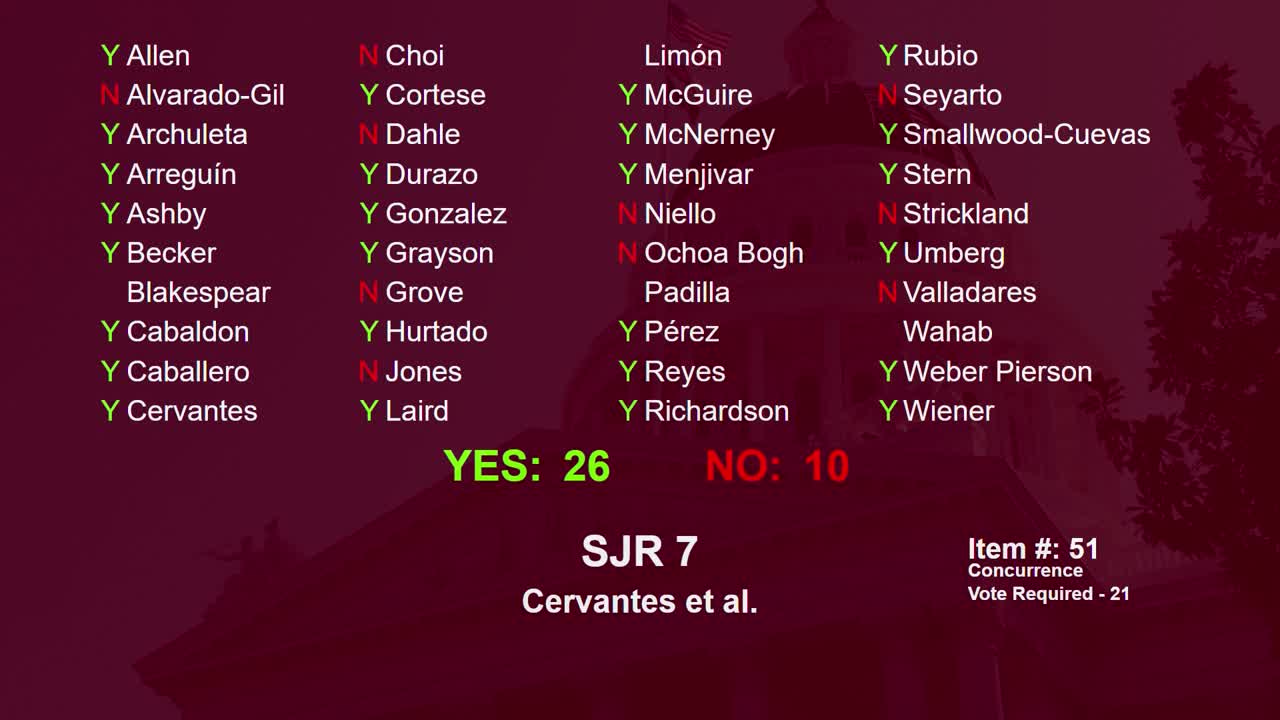 2MIN
Senate Floor
 16MIN
Senate Standing Committee on Privacy, Digital Technologies, and Consumer Protection
 4MIN
Senate Standing Committee on Transportation
 1MIN
Assembly Floor
 11MIN
Assembly Standing Committee on Privacy and Consumer Protection
 14MIN
Assembly Standing Committee on Transportation
Bill Author