AB 1841: State holidays: Native American Day.
- Session Year: 2025-2026
- House: Assembly
- Latest Version Date: 2026-09-25
Current Status:
Passed
(2026-09-25: Chaptered by Secretary of State - Chapter 447, Statutes of 2026.)
Introduced
In Committee
Awaiting First Chamber Vote
Passed First Chamber
In Committee
Awaiting Second Chamber Vote
Passed Second Chamber
Enacted
Existing law entitles state employees to a paid holiday on specific days, including the 3rd Monday in February, except as specified. Existing law, in addition, authorizes state employees to elect to use 8 hours of vacation, annual leave, compensating time off, or personal holiday credit corresponding with specific dates, including the 4th Friday in September, known as Native American Day, as specified.
This bill would, upon appropriation by the Legislature, entitle state employees to a holiday on the 4th Friday in September, known as Native American Day, as specified, in lieu of the above-described election. The bill would authorize any state bargaining unit to negotiate for a paid holiday on Native American Day, as specified.
This bill would incorporate additional changes to Sections 19853 and 19853.1 of the Government Code proposed by AB 2017 and SB 1394 to be operative only if this bill and either or both of those bills are enacted and this bill is enacted last.
Existing law entitles state employees to a paid holiday on specific days, including the 3rd Monday in February, except as specified. Existing law, in addition, authorizes state employees to elect to use 8 hours of vacation, annual leave, compensating time off, or personal holiday credit corresponding with specific dates, including the 4th Friday in September, known as Native American Day, as specified.
This bill would, upon the Department of Human Resources determination that sufficient funds exist, appropriation by the Legislature, entitle state employees to a holiday on the 4th Friday in September, known as Native American Day, as specified, in lieu of the above-described election. The bill would authorize any state bargaining unit to negotiate for a paid holiday on Native American Day, as specified.
Existing law entitles state employees to a paid holiday on specific days, including the 3rd Monday in February, except as specified. Existing law, in addition, authorizes state employees to elect to use 8 hours of vacation, annual leave, compensating time off, or personal holiday credit corresponding with specific dates, including the 4th Friday in September, known as Native American Day, as specified.
This bill would, upon the Department of Human Resources determination that sufficient funds exist, entitle state employees to a holiday on the 4th Friday in September, known as Native American Day, as specified, in lieu of the above-described election. The bill would authorize any state bargaining unit to negotiate for a paid holiday on Native American Day, as specified.
(a)(1)All state employees shall be entitled to the following holidays: January 1, the third Monday in January, the third Monday in February, March 31, the last Monday in May, July 4, the first Monday in September, November 11, Thanksgiving Day, the day after Thanksgiving, December 25, the day chosen by an employee pursuant to Section 19854, and every day appointed by the Governor of this state for a public fast, thanksgiving, or holiday.
(2)Upon appropriation by the Legislature, all state employees shall be entitled to a holiday on the fourth Friday in September, known as Native American Day, in lieu of the election described in subdivision (e).
(b)If a day described in subdivision (a) falls on a Sunday, the following Monday shall be deemed to be the holiday in lieu of the day observed. If November 11 falls upon a Saturday, the preceding Friday shall be deemed to be the holiday in lieu of the day observed.
(c)(1)Any state employee who may be required to work on any of the holidays included in this section, and who does work on any of these holidays, shall be entitled to receive straight-time pay and eight hours of holiday credit.
(2)Notwithstanding paragraph (1), an employee who is excluded from the definition of state employee in subdivision (c) of Section 3513 and who is required to work on January 1, the last Monday in May, July 4, the first Monday in September, Thanksgiving Day, or December 25 shall be subject to the following:
(A)Excluded employees who are eligible for overtime payments under the federal Fair Labor Standards Act shall be paid one and one-half times their salary rate for all hours worked on the holiday and up to eight hours of holiday credit. This pay shall count toward any premium overtime compensation earned during the same workweek. Part-time employees shall receive prorated amounts subject to department rules.
(B)Excluded employees who are ineligible for overtime payments under the federal Fair Labor Standards Act shall receive up to eight hours of holiday credit and four hours of informal time off. Part-time employees shall receive prorated amounts of holiday credit and informal time off, subject to department rules.
(d)For the purpose of computing the number of hours worked, time when an employee is excused from work because of holidays, sick leave, vacation, annual leave, compensating time off, or any other leave shall not be considered as time worked by the employee for the purpose of computing cash compensation for overtime or compensating time off for overtime.
(e)Any state employee, as defined in subdivision (c) of Section 3513, may elect to receive eight hours of holiday credit for the date corresponding with the new moon following the winter solstice, or the third new moon following the winter solstice should an intercalary month intervene, known as Lunar New Year, April 24, known as Genocide Remembrance Day, the 15th day of the month of Kartik in the Hindu lunar calendar of each year, known as Diwali, June 19, known as Juneteenth, or the fourth Friday in September, known as Native American Day, except as provided in paragraph (2) of subdivision (a), in lieu of receiving eight hours of personal holiday credit in accordance with Section 19854.
(f)Persons employed on less than a full-time basis shall receive holidays in accordance with the Department of Human Resources rules.
(g)If subdivision (a), (c), or (d) is in conflict with the provisions of a memorandum of understanding executed or amended pursuant to Section 3517.5 on or after February 1, 2009, or the date that the act adding this section takes effect, whichever is later, the memorandum of understanding shall be controlling without further legislative action, except that if those provisions of the memorandum of understanding require the expenditure of funds, the provisions shall not become effective unless approved by the Legislature in the annual Budget Act.
SEC. 1.1.Section 19853 of the Government Code is amended to read:19853.(a)(1)All state employees shall be entitled to the following holidays: January 1, the third Monday in January, the third Monday in February, March 31, the last Monday in May, July 4, the first Monday in September, November 11, Thanksgiving Day, the day after Thanksgiving, December 25, the day chosen by an employee pursuant to Section 19854, and every day appointed by the Governor of this state for a public fast, thanksgiving, or holiday.
(2)Upon appropriation by the Legislature, all state employees shall be entitled to a holiday on the fourth Friday in September, known as Native American Day, in lieu of the election described in subdivision (e).
(b)If a day described in subdivision (a) falls on a Sunday, the following Monday shall be deemed to be the holiday in lieu of the day observed. If November 11 falls upon a Saturday, the preceding Friday shall be deemed to be the holiday in lieu of the day observed.
(c)(1)Any state employee who may be required to work on any of the holidays included in this section, and who does work on any of these holidays, shall be entitled to receive straight-time pay and eight hours of holiday credit.
(2)Notwithstanding paragraph (1), an employee who is excluded from the definition of state employee in subdivision (c) of Section 3513 and who is required to work on January 1, the last Monday in May, July 4, the first Monday in September, Thanksgiving Day, or December 25 shall be subject to the following:
(A)Excluded employees who are eligible for overtime payments under the federal Fair Labor Standards Act shall be paid one and one-half times their salary rate for all hours worked on the holiday and up to eight hours of holiday credit. This pay shall count toward any premium overtime compensation earned during the same workweek. Part-time employees shall receive prorated amounts subject to department rules.
(B)Excluded employees who are ineligible for overtime payments under the federal Fair Labor Standards Act shall receive up to eight hours of holiday credit and four hours of informal time off. Part-time employees shall receive prorated amounts of holiday credit and informal time off, subject to department rules.
(d)For the purpose of computing the number of hours worked, time when an employee is excused from work because of holidays, sick leave, vacation, annual leave, compensating time off, or any other leave shall not be considered as time worked by the employee for the purpose of computing cash compensation for overtime or compensating time off for overtime.
(e)Any state employee, as defined in subdivision (c) of Section 3513, may elect to receive eight hours of holiday credit for the date corresponding with the new moon following the winter solstice, or the third new moon following the winter solstice should an intercalary month intervene, known as Lunar New Year, the first day of the month of Shawwal in the Islamic lunar calendar, known as Eid al-Fitr, April 24, known as Genocide Remembrance Day, the 15th day of the month of Kartik in the Hindu lunar calendar of each year, known as Diwali, June 19, known as Juneteenth, the 10th day of the month of Dhu al-Hijjah in the Islamic lunar calendar, known as Eid al-Adha, or the fourth Friday in September, known as Native American Day, except as provided in paragraph (2) of subdivision (a), in lieu of receiving eight hours of personal holiday credit in accordance with Section 19854. For those holidays whose dates vary annually, the employee may instead make the election on the dates designated by their group.
(f)Persons employed on less than a full-time basis shall receive holidays in accordance with the Department of Human Resources rules.
(g)If subdivision (a), (c), or (d) is in conflict with the provisions of a memorandum of understanding executed or amended pursuant to Section 3517.5 on or after February 1, 2009, or the date that the act adding this section takes effect, whichever is later, the memorandum of understanding shall be controlling without further legislative action, except that if those provisions of the memorandum of understanding require the expenditure of funds, the provisions shall not become effective unless approved by the Legislature in the annual Budget Act.
SEC. 1.2.Section 19853 of the Government Code is amended to read:19853.(a)(1)All state employees shall be entitled to the following holidays: January 1, the third Monday in January, the third Monday in February, April 10, the last Monday in May, July 4, the first Monday in September, November 11, Thanksgiving Day, the day after Thanksgiving, December 25, the day chosen by an employee pursuant to Section 19854, and every day appointed by the Governor of this state for a public fast, thanksgiving, or holiday.
(2)Upon appropriation by the Legislature, all state employees shall be entitled to a holiday on the fourth Friday in September, known as Native American Day, in lieu of the election described in subdivision (e).
(b)If a day described in subdivision (a) falls on a Sunday, the following Monday shall be deemed to be the holiday in lieu of the day observed. If November 11 falls upon a Saturday, the preceding Friday shall be deemed to be the holiday in lieu of the day observed.
(c)(1)Any state employee who may be required to work on any of the holidays included in this section, and who does work on any of these holidays, shall be entitled to receive straight-time pay and eight hours of holiday credit.
(2)Notwithstanding paragraph (1), an employee who is excluded from the definition of state employee in subdivision (c) of Section 3513 and who is required to work on January 1, the last Monday in May, July 4, the first Monday in September, Thanksgiving Day, or December 25 shall be subject to the following:
(A)Excluded employees who are eligible for overtime payments under the federal Fair Labor Standards Act shall be paid one and one-half times their salary rate for all hours worked on the holiday and up to eight hours of holiday credit. This pay shall count toward any premium overtime compensation earned during the same workweek. Part-time employees shall receive prorated amounts subject to department rules.
(B)Excluded employees who are ineligible for overtime payments under the federal Fair Labor Standards Act shall receive up to eight hours of holiday credit and four hours of informal time off. Part-time employees shall receive prorated amounts of holiday credit and informal time off, subject to department rules.
(d)For the purpose of computing the number of hours worked, time when an employee is excused from work because of holidays, sick leave, vacation, annual leave, compensating time off, or any other leave shall not be considered as time worked by the employee for the purpose of computing cash compensation for overtime or compensating time off for overtime.
(e)Any state employee, as defined in subdivision (c) of Section 3513, may elect to receive eight hours of holiday credit for the date corresponding with the new moon following the winter solstice, or the third new moon following the winter solstice should an intercalary month intervene, known as Lunar New Year, April 24, known as Genocide Remembrance Day, the 15th day of the month of Kartik in the Hindu lunar calendar of each year, known as Diwali, June 19, known as Juneteenth, or the fourth Friday in September, known as Native American Day, except as provided in paragraph (2) of subdivision (a), in lieu of receiving eight hours of personal holiday credit in accordance with Section 19854.
(f)Persons employed on less than a full-time basis shall receive holidays in accordance with the Department of Human Resources rules.
(g)If subdivision (a), (c), or (d) is in conflict with the provisions of a memorandum of understanding executed or amended pursuant to Section 3517.5 on or after February 1, 2009, or the date that the act adding this section takes effect, whichever is later, the memorandum of understanding shall be controlling without further legislative action, except that if those provisions of the memorandum of understanding require the expenditure of funds, the provisions shall not become effective unless approved by the Legislature in the annual Budget Act.
SEC. 1.3.Section 19853 of the Government Code is amended to read:19853.(a)(1)All state employees shall be entitled to the following holidays: January 1, the third Monday in January, the third Monday in February, April 10, the last Monday in May, July 4, the first Monday in September, November 11, Thanksgiving Day, the day after Thanksgiving, December 25, the day chosen by an employee pursuant to Section 19854, and every day appointed by the Governor of this state for a public fast, thanksgiving, or holiday.
(2)Upon appropriation by the Legislature, all state employees shall be entitled to a holiday on the fourth Friday in September, known as Native American Day, in lieu of the election described in subdivision (e).
(b)If a day described in subdivision (a) falls on a Sunday, the following Monday shall be deemed to be the holiday in lieu of the day observed. If November 11 falls upon a Saturday, the preceding Friday shall be deemed to be the holiday in lieu of the day observed.
(c)(1)Any state employee who may be required to work on any of the holidays included in this section, and who does work on any of these holidays, shall be entitled to receive straight-time pay and eight hours of holiday credit.
(2)Notwithstanding paragraph (1), an employee who is excluded from the definition of state employee in subdivision (c) of Section 3513 and who is required to work on January 1, the last Monday in May, July 4, the first Monday in September, Thanksgiving Day, or December 25 shall be subject to the following:
(A)Excluded employees who are eligible for overtime payments under the federal Fair Labor Standards Act shall be paid one and one-half times their salary rate for all hours worked on the holiday and up to eight hours of holiday credit. This pay shall count toward any premium overtime compensation earned during the same workweek. Part-time employees shall receive prorated amounts subject to department rules.
(B)Excluded employees who are ineligible for overtime payments under the federal Fair Labor Standards Act shall receive up to eight hours of holiday credit and four hours of informal time off. Part-time employees shall receive prorated amounts of holiday credit and informal time off, subject to department rules.
(d)For the purpose of computing the number of hours worked, time when an employee is excused from work because of holidays, sick leave, vacation, annual leave, compensating time off, or any other leave shall not be considered as time worked by the employee for the purpose of computing cash compensation for overtime or compensating time off for overtime.
(e)Any state employee, as defined in subdivision (c) of Section 3513, may elect to receive eight hours of holiday credit for the date corresponding with the new moon following the winter solstice, or the third new moon following the winter solstice should an intercalary month intervene, known as Lunar New Year, the first day of the month of Shawwal in the Islamic lunar calendar, known as Eid al-Fitr, April 24, known as Genocide Remembrance Day, the 15th day of the month of Kartik in the Hindu lunar calendar of each year, known as Diwali, June 19, known as Juneteenth, the 10th day of the month of Dhu al-Hijjah in the Islamic lunar calendar, known as Eid al-Adha, or the fourth Friday in September, known as Native American Day, except as provided in paragraph (2) of subdivision (a), in lieu of receiving eight hours of personal holiday credit in accordance with Section 19854. For those holidays whose dates vary annually, the employee may instead make the election on the dates designated by their group.
(f)Persons employed on less than a full-time basis shall receive holidays in accordance with the Department of Human Resources rules.
(g)If subdivision (a), (c), or (d) is in conflict with the provisions of a memorandum of understanding executed or amended pursuant to Section 3517.5 on or after February 1, 2009, or the date that the act adding this section takes effect, whichever is later, the memorandum of understanding shall be controlling without further legislative action, except that if those provisions of the memorandum of understanding require the expenditure of funds, the provisions shall not become effective unless approved by the Legislature in the annual Budget Act.
SEC. 2.Section 19853.1 of the Government Code is amended to read:19853.1.(a)Notwithstanding Section 19853, this section shall apply to state employees in State Bargaining Unit 5.
(b)(1)Except as provided in subdivision (c), all employees shall be entitled to the following holidays: January 1, the third Monday in January, the third Monday in February, March 31, the last Monday in May, July 4, the first Monday in September, November 11, the day after Thanksgiving, December 25, and every day appointed by the Governor of this state for a public fast, thanksgiving, or holiday.
If a day described in this subdivision falls on a Sunday, the following Monday shall be deemed to be the holiday in lieu of the day observed. If November 11 falls upon a Saturday, the preceding Friday shall be deemed to be the holiday in lieu of the day observed. Any employee who may be required to work on any of the holidays included in this section and who does work on any of these holidays shall be entitled to be paid compensation or given compensating time off for that work in accordance with their classifications assigned workweek group.
(2)Upon appropriation by the Legislature as described in paragraph (2) of subdivision (a) of Section 19853, all employees shall be entitled to a holiday on the fourth Friday in September, known as Native American Day, in lieu of the election described in subdivision (e).
(c)If the provisions of subdivision (b) are in conflict with the provisions of a memorandum of understanding reached pursuant to Section 3517.5, the memorandum of understanding shall be controlling without further legislative action, except that if the provisions of a memorandum of understanding require the expenditure of funds, the provisions shall not become effective unless approved by the Legislature in the annual Budget Act.
(d)Any employee who either is excluded from the definition of state employee in subdivision (c) of Section 3513, or is a nonelected officer or employee of the executive branch of government who is not a member of the civil service, is entitled to the following holidays, with pay, in addition to any official state holiday appointed by the Governor:
(1)January 1, the third Monday in January, the third Monday in February, March 31, the last Monday in May, July 4, the first Monday in September, November 11, Thanksgiving Day, the day after Thanksgiving, and December 25.
(2)Upon appropriation by the Legislature as described in paragraph (2) of subdivision (a) of Section 19853, the fourth Friday in September, known as Native American Day.
(3)When November 11 falls on a Saturday, employees shall be entitled to the preceding Friday as a holiday with pay.
(4)When a holiday, other than a personal holiday, falls on a Saturday, an employee shall, regardless of whether the employee works on the holiday, accrue only an additional eight hours of personal holiday credit per fiscal year for the holiday. The holiday credit shall be accrued on the actual date of the holiday and shall be used within the same fiscal year.
(5)When a holiday other than a personal holiday falls on Sunday, employees shall be entitled to the following Monday as a holiday with pay.
(6)Employees who are required to work on a holiday shall be entitled to pay or compensating time off for this work in accordance with their classifications assigned workweek group.
(7)Persons employed on less than a full-time basis shall receive holidays in accordance with the Department of Human Resources rules.
(e)Any employee, as defined in subdivision (c) of Section 3513, may elect to use eight hours of vacation, annual leave, or compensating time off consistent with departmental operational needs and collective bargaining agreements for the date corresponding with the second new moon following the winter solstice, or the third new moon following the winter solstice should an intercalary month intervene, known as Lunar New Year, April 24, known as Genocide Remembrance Day, the 15th day of the month of Kartik in the Hindu lunar calendar of each year, known as Diwali, June 19, known as Juneteenth, and the fourth Friday in September, known as Native American Day, except as provided in paragraph (2) of subdivision (b).
(f)This section shall become effective with regard to the March 31 holiday only when the Department of Human Resources notifies the Legislature that the language contained in this section has been agreed to by all exclusive representatives, and the Department of Human Resources authorizes this holiday to be applied to employees designated as excluded from the Ralph C. Dills Act (Chapter 10.3 (commencing with Section 3512), Division 4, Title 1), and the necessary statutes are amended to reflect this change.
SEC. 2.1.Section 19853.1 of the Government Code is amended to read:19853.1.(a)Notwithstanding Section 19853, this section shall apply to state employees in State Bargaining Unit 5.
(b)(1)Except as provided in subdivision (c), all employees shall be entitled to the following holidays: January 1, the third Monday in January, the third Monday in February, March 31, the last Monday in May, July 4, the first Monday in September, November 11, the day after Thanksgiving, December 25, and every day appointed by the Governor of this state for a public fast, thanksgiving, or holiday.
If a day described in this subdivision falls on a Sunday, the following Monday shall be deemed to be the holiday in lieu of the day observed. If November 11 falls upon a Saturday, the preceding Friday shall be deemed to be the holiday in lieu of the day observed. Any employee who may be required to work on any of the holidays included in this section and who does work on any of these holidays shall be entitled to be paid compensation or given compensating time off for that work in accordance with their classifications assigned workweek group.
(2)Upon appropriation by the Legislature as described in paragraph (2) of subdivision (a) of Section 19853, all employees shall be entitled to a holiday on the fourth Friday in September, known as Native American Day, in lieu of the election described in subdivision (e).
(c)If the provisions of subdivision (b) are in conflict with the provisions of a memorandum of understanding reached pursuant to Section 3517.5, the memorandum of understanding shall be controlling without further legislative action, except that if the provisions of a memorandum of understanding require the expenditure of funds, the provisions shall not become effective unless approved by the Legislature in the annual Budget Act.
(d)Any employee who either is excluded from the definition of state employee in subdivision (c) of Section 3513, or is a nonelected officer or employee of the executive branch of government who is not a member of the civil service, is entitled to the following holidays, with pay, in addition to any official state holiday appointed by the Governor:
(1)January 1, the third Monday in January, the third Monday in February, March 31, the last Monday in May, July 4, the first Monday in September, November 11, Thanksgiving Day, the day after Thanksgiving, and December 25.
(2)Upon appropriation by the Legislature as described in paragraph (2) of subdivision (a) of Section 19853, the fourth Friday in September, known as Native American Day.
(3)When November 11 falls on a Saturday, employees shall be entitled to the preceding Friday as a holiday with pay.
(4)When a holiday, other than a personal holiday, falls on a Saturday, an employee shall, regardless of whether the employee works on the holiday, accrue only an additional eight hours of personal holiday credit per fiscal year for the holiday. The holiday credit shall be accrued on the actual date of the holiday and shall be used within the same fiscal year.
(5)When a holiday other than a personal holiday falls on Sunday, employees shall be entitled to the following Monday as a holiday with pay.
(6)Employees who are required to work on a holiday shall be entitled to pay or compensating time off for this work in accordance with their classifications assigned workweek group.
(7)Persons employed on less than a full-time basis shall receive holidays in accordance with the Department of Human Resources rules.
(e)Any employee, as defined in subdivision (c) of Section 3513, may elect to use eight hours of vacation, annual leave, or compensating time off consistent with departmental operational needs and collective bargaining agreements for the date corresponding with the second new moon following the winter solstice, or the third new moon following the winter solstice should an intercalary month intervene, known as Lunar New Year, the first day of the month of Shawwal in the Islamic lunar calendar, known as Eid al-Fitr, April 24, known as Genocide Remembrance Day, the 15th day of the month of Kartik in the Hindu lunar calendar of each year, known as Diwali, June 19, known as Juneteenth, the 10th day of the month of Dhu al-Hijjah in the Islamic lunar calendar, known as Eid al-Adha, and the fourth Friday in September, known as Native American Day, except as provided in paragraph (2) of subdivision (b). For those holidays whose dates vary annually, the employee may instead make the election on the dates designated by their group.
(f)This section shall become effective with regard to the March 31 holiday only when the Department of Human Resources notifies the Legislature that the language contained in this section has been agreed to by all exclusive representatives, and the Department of Human Resources authorizes this holiday to be applied to employees designated as excluded from the Ralph C. Dills Act (Chapter 10.3 (commencing with Section 3512), Division 4, Title 1), and the necessary statutes are amended to reflect this change.
SEC. 2.2.Section 19853.1 of the Government Code is amended to read:19853.1.(a)Notwithstanding Section 19853, this section shall apply to state employees in State Bargaining Unit 5.
(b)(1)Except as provided in subdivision (c), all employees shall be entitled to the following holidays: January 1, the third Monday in January, the third Monday in February, April 10, the last Monday in May, July 4, the first Monday in September, November 11, the day after Thanksgiving, December 25, and every day appointed by the Governor of this state for a public fast, thanksgiving, or holiday.
If a day described in this subdivision falls on a Sunday, the following Monday shall be deemed to be the holiday in lieu of the day observed. If November 11 falls upon a Saturday, the preceding Friday shall be deemed to be the holiday in lieu of the day observed. Any employee who may be required to work on any of the holidays included in this section and who does work on any of these holidays shall be entitled to be paid compensation or given compensating time off for that work in accordance with their classifications assigned workweek group.
(2)Upon appropriation by the Legislature as described in paragraph (2) of subdivision (a) of Section 19853, all employees shall be entitled to a holiday on the fourth Friday in September, known as Native American Day, in lieu of the election described in subdivision (e).
(c)If the provisions of subdivision (b) are in conflict with the provisions of a memorandum of understanding reached pursuant to Section 3517.5, the memorandum of understanding shall be controlling without further legislative action, except that if the provisions of a memorandum of understanding require the expenditure of funds, the provisions shall not become effective unless approved by the Legislature in the annual Budget Act.
(d)Any employee who either is excluded from the definition of state employee in subdivision (c) of Section 3513, or is a nonelected officer or employee of the executive branch of government who is not a member of the civil service, is entitled to the following holidays, with pay, in addition to any official state holiday appointed by the Governor:
(1)January 1, the third Monday in January, the third Monday in February, April 10, the last Monday in May, July 4, the first Monday in September, November 11, Thanksgiving Day, the day after Thanksgiving, and December 25.
(2)Upon appropriation by the Legislature as described in paragraph (2) of subdivision (a) of Section 19853, the fourth Friday in September, known as Native American Day.
(3)When November 11 falls on a Saturday, employees shall be entitled to the preceding Friday as a holiday with pay.
(4)When a holiday, other than a personal holiday, falls on a Saturday, an employee shall, regardless of whether the employee works on the holiday, accrue only an additional eight hours of personal holiday credit per fiscal year for the holiday. The holiday credit shall be accrued on the actual date of the holiday and shall be used within the same fiscal year.
(5)When a holiday other than a personal holiday falls on Sunday, employees shall be entitled to the following Monday as a holiday with pay.
(6)Employees who are required to work on a holiday shall be entitled to pay or compensating time off for this work in accordance with their classifications assigned workweek group.
(7)Persons employed on less than a full-time basis shall receive holidays in accordance with the Department of Human Resources rules.
(e)Any employee, as defined in subdivision (c) of Section 3513, may elect to use eight hours of vacation, annual leave, or compensating time off consistent with departmental operational needs and collective bargaining agreements for the date corresponding with the second new moon following the winter solstice, or the third new moon following the winter solstice should an intercalary month intervene, known as Lunar New Year, April 24, known as Genocide Remembrance Day, the 15th day of the month of Kartik in the Hindu lunar calendar of each year, known as Diwali, June 19, known as Juneteenth, and the fourth Friday in September, known as Native American Day, except as provided in paragraph (2) of subdivision (b).
SEC. 2.3.Section 19853.1 of the Government Code is amended to read:19853.1.(a)Notwithstanding Section 19853, this section shall apply to state employees in State Bargaining Unit 5.
(b)(1)Except as provided in subdivision (c), all employees shall be entitled to the following holidays: January 1, the third Monday in January, the third Monday in February, April 10, the last Monday in May, July 4, the first Monday in September, November 11, the day after Thanksgiving, December 25, and every day appointed by the Governor of this state for a public fast, thanksgiving, or holiday.
If a day described in this subdivision falls on a Sunday, the following Monday shall be deemed to be the holiday in lieu of the day observed. If November 11 falls upon a Saturday, the preceding Friday shall be deemed to be the holiday in lieu of the day observed. Any employee who may be required to work on any of the holidays included in this section and who does work on any of these holidays shall be entitled to be paid compensation or given compensating time off for that work in accordance with their classifications assigned workweek group.
(2)Upon appropriation by the Legislature as described in paragraph (2) of subdivision (a) of Section 19853, all employees shall be entitled to a holiday on the fourth Friday in September, known as Native American Day, in lieu of the election described in subdivision (e).
(c)If the provisions of subdivision (b) are in conflict with the provisions of a memorandum of understanding reached pursuant to Section 3517.5, the memorandum of understanding shall be controlling without further legislative action, except that if the provisions of a memorandum of understanding require the expenditure of funds, the provisions shall not become effective unless approved by the Legislature in the annual Budget Act.
(d)Any employee who either is excluded from the definition of state employee in subdivision (c) of Section 3513, or is a nonelected officer or employee of the executive branch of government who is not a member of the civil service, is entitled to the following holidays, with pay, in addition to any official state holiday appointed by the Governor:
(1)January 1, the third Monday in January, the third Monday in February, April 10, the last Monday in May, July 4, the first Monday in September, November 11, Thanksgiving Day, the day after Thanksgiving, and December 25.
(2)Upon appropriation by the Legislature as described in paragraph (2) of subdivision (a) of Section 19853, the fourth Friday in September, known as Native American Day.
(3)When November 11 falls on a Saturday, employees shall be entitled to the preceding Friday as a holiday with pay.
(4)When a holiday, other than a personal holiday, falls on a Saturday, an employee shall, regardless of whether the employee works on the holiday, accrue only an additional eight hours of personal holiday credit per fiscal year for the holiday. The holiday credit shall be accrued on the actual date of the holiday and shall be used within the same fiscal year.
(5)When a holiday other than a personal holiday falls on Sunday, employees shall be entitled to the following Monday as a holiday with pay.
(6)Employees who are required to work on a holiday shall be entitled to pay or compensating time off for this work in accordance with their classifications assigned workweek group.
(7)Persons employed on less than a full-time basis shall receive holidays in accordance with the Department of Human Resources rules.
(e)Any employee, as defined in subdivision (c) of Section 3513, may elect to use eight hours of vacation, annual leave, or compensating time off consistent with departmental operational needs and collective bargaining agreements for the date corresponding with the second new moon following the winter solstice, or the third new moon following the winter solstice should an intercalary month intervene, known as Lunar New Year, the first day of the month of Shawwal in the Islamic lunar calendar, known as Eid al-Fitr, April 24, known as Genocide Remembrance Day, the 15th day of the month of Kartik in the Hindu lunar calendar of each year, known as Diwali, June 19, known as Juneteenth, the 10th day of the month of Dhu al-Hijjah in the Islamic lunar calendar, known as Eid al-Adha, and the fourth Friday in September, known as Native American Day, except as provided in paragraph (2) of subdivision (b). For those holidays whose dates vary annually, the employee may instead make the election on the dates designated by their group.
SEC. 3.Section 19853.3 is added to the Government Code, to read:19853.3.Notwithstanding any other law, any state bargaining unit may negotiate, as part of their memorandum of understanding, to receive the fourth Friday in September, known as Native American Day, as a paid holiday.
SEC. 4.(a)Section 1.1 of this bill incorporates amendments to Section 19853 of the Government Code proposed by both this bill and Assembly Bill 2017. That section of this bill shall only become operative if (1) both bills are enacted and become effective on or before January 1, 2027, (2) each bill amends Section 19853 of the Government Code, (3) Senate Bill 1394 is not enacted or as enacted does not amend that section, and (4) this bill is enacted after Assembly Bill 2017, in which case Sections 1, 1.2, and 1.3 of this bill shall not become operative.
(b)Section 1.2 of this bill incorporates amendments to Section 19853 of the Government Code proposed by both this bill and Senate Bill 1394. That section of this bill shall only become operative if (1) both bills are enacted and become effective on or before January 1, 2027, (2) each bill amends Section 19853 of the Government Code, (3) Assembly Bill 2017 is not enacted or as enacted does not amend that section, and (4) this bill is enacted after Senate Bill 1394 in which case Sections 1, 1.1, and 1.3 of this bill shall not become operative.
(c)Section 1.3 of this bill incorporates amendments to Section 19853 of the Government Code proposed by this bill, Assembly Bill 2017, and Senate Bill 1394. That section of this bill shall only become operative if (1) all three bills are enacted and become effective on or before January 1, 2027, (2) all three bills amend Section 19853 of the Government Code, and (3) this bill is enacted after Assembly Bill 2017 and Senate Bill 1394, in which case Sections 1, 1.1, and 1.2 of this bill shall not become operative.
SEC. 5.(a)Section 2.1 of this bill incorporates amendments to Section 19853.1 of the Government Code proposed by both this bill and Assembly Bill 2017. That section of this bill shall only become operative if (1) both bills are enacted and become effective on or before January 1, 2027, (2) each bill amends Section 19853.1 of the Government Code, (3) Senate Bill 1394 is not enacted or as enacted does not amend that section, and (4) this bill is enacted after Assembly Bill 2017, in which case Sections 2, 2.2, and 2.3 of this bill shall not become operative.
(b)Section 2.2 of this bill incorporates amendments to Section 19853.1 of the Government Code proposed by both this bill and Senate Bill 1394. That section of this bill shall only become operative if (1) both bills are enacted and become effective on or before January 1, 2027, (2) each bill amends Section 19853.1 of the Government Code, (3) Assembly Bill 2017 is not enacted or as enacted does not amend that section, and (4) this bill is enacted after Senate Bill 1394 in which case Sections 2, 2.1, and 2.3 of this bill shall not become operative.
(c)Section 2.3 of this bill incorporates amendments to Section 19853.1 of the Government Code proposed by this bill, Assembly Bill 2017, and Senate Bill 1394. That section of this bill shall only become operative if (1) all three bills are enacted and become effective on or before January 1, 2027, (2) all three bills amend Section 19853.1 of the Government Code, and (3) this bill is enacted after Assembly Bill 2017 and Senate Bill 1394, in which case Sections 2, 2.1, and 2.2 of this bill shall not become operative.
(a)(1)All state employees shall be entitled to the following holidays: January 1, the third Monday in January, the third Monday in February, March 31, the last Monday in May, July 4, the first Monday in September, November 11, Thanksgiving Day, the day after Thanksgiving, December 25, the day chosen by an employee pursuant to Section 19854, and every day appointed by the Governor of this state for a public fast, thanksgiving, or holiday.
(2)Upon appropriation by the Legislature, all state employees shall be entitled to a holiday on the fourth Friday in September, known as Native American Day, in lieu of the election described in subdivision (e).
(b)If a day described in subdivision (a) falls on a Sunday, the following Monday shall be deemed to be the holiday in lieu of the day observed. If November 11 falls upon a Saturday, the preceding Friday shall be deemed to be the holiday in lieu of the day observed.
(c)(1)Any state employee who may be required to work on any of the holidays included in this section, and who does work on any of these holidays, shall be entitled to receive straight-time pay and eight hours of holiday credit.
(2)Notwithstanding paragraph (1), an employee who is excluded from the definition of state employee in subdivision (c) of Section 3513 and who is required to work on January 1, the last Monday in May, July 4, the first Monday in September, Thanksgiving Day, or December 25 shall be subject to the following:
(A)Excluded employees who are eligible for overtime payments under the federal Fair Labor Standards Act shall be paid one and one-half times their salary rate for all hours worked on the holiday and up to eight hours of holiday credit. This pay shall count toward any premium overtime compensation earned during the same workweek. Part-time employees shall receive prorated amounts subject to department rules.
(B)Excluded employees who are ineligible for overtime payments under the federal Fair Labor Standards Act shall receive up to eight hours of holiday credit and four hours of informal time off. Part-time employees shall receive prorated amounts of holiday credit and informal time off, subject to department rules.
(d)For the purpose of computing the number of hours worked, time when an employee is excused from work because of holidays, sick leave, vacation, annual leave, compensating time off, or any other leave shall not be considered as time worked by the employee for the purpose of computing cash compensation for overtime or compensating time off for overtime.
(e)Any state employee, as defined in subdivision (c) of Section 3513, may elect to receive eight hours of holiday credit for the date corresponding with the new moon following the winter solstice, or the third new moon following the winter solstice should an intercalary month intervene, known as Lunar New Year, April 24, known as Genocide Remembrance Day, the 15th day of the month of Kartik in the Hindu lunar calendar of each year, known as Diwali, June 19, known as Juneteenth, or the fourth Friday in September, known as Native American Day, except as provided in paragraph (2) of subdivision (a), in lieu of receiving eight hours of personal holiday credit in accordance with Section 19854.
(f)Persons employed on less than a full-time basis shall receive holidays in accordance with the Department of Human Resources rules.
(g)If subdivision (a), (c), or (d) is in conflict with the provisions of a memorandum of understanding executed or amended pursuant to Section 3517.5 on or after February 1, 2009, or the date that the act adding this section takes effect, whichever is later, the memorandum of understanding shall be controlling without further legislative action, except that if those provisions of the memorandum of understanding require the expenditure of funds, the provisions shall not become effective unless approved by the Legislature in the annual Budget Act.
SEC. 1.1.Section 19853 of the Government Code is amended to read:19853.(a)(1)All state employees shall be entitled to the following holidays: January 1, the third Monday in January, the third Monday in February, March 31, the last Monday in May, July 4, the first Monday in September, November 11, Thanksgiving Day, the day after Thanksgiving, December 25, the day chosen by an employee pursuant to Section 19854, and every day appointed by the Governor of this state for a public fast, thanksgiving, or holiday.
(2)Upon appropriation by the Legislature, all state employees shall be entitled to a holiday on the fourth Friday in September, known as Native American Day, in lieu of the election described in subdivision (e).
(b)If a day described in subdivision (a) falls on a Sunday, the following Monday shall be deemed to be the holiday in lieu of the day observed. If November 11 falls upon a Saturday, the preceding Friday shall be deemed to be the holiday in lieu of the day observed.
(c)(1)Any state employee who may be required to work on any of the holidays included in this section, and who does work on any of these holidays, shall be entitled to receive straight-time pay and eight hours of holiday credit.
(2)Notwithstanding paragraph (1), an employee who is excluded from the definition of state employee in subdivision (c) of Section 3513 and who is required to work on January 1, the last Monday in May, July 4, the first Monday in September, Thanksgiving Day, or December 25 shall be subject to the following:
(A)Excluded employees who are eligible for overtime payments under the federal Fair Labor Standards Act shall be paid one and one-half times their salary rate for all hours worked on the holiday and up to eight hours of holiday credit. This pay shall count toward any premium overtime compensation earned during the same workweek. Part-time employees shall receive prorated amounts subject to department rules.
(B)Excluded employees who are ineligible for overtime payments under the federal Fair Labor Standards Act shall receive up to eight hours of holiday credit and four hours of informal time off. Part-time employees shall receive prorated amounts of holiday credit and informal time off, subject to department rules.
(d)For the purpose of computing the number of hours worked, time when an employee is excused from work because of holidays, sick leave, vacation, annual leave, compensating time off, or any other leave shall not be considered as time worked by the employee for the purpose of computing cash compensation for overtime or compensating time off for overtime.
(e)Any state employee, as defined in subdivision (c) of Section 3513, may elect to receive eight hours of holiday credit for the date corresponding with the new moon following the winter solstice, or the third new moon following the winter solstice should an intercalary month intervene, known as Lunar New Year, the first day of the month of Shawwal in the Islamic lunar calendar, known as Eid al-Fitr, April 24, known as Genocide Remembrance Day, the 15th day of the month of Kartik in the Hindu lunar calendar of each year, known as Diwali, June 19, known as Juneteenth, the 10th day of the month of Dhu al-Hijjah in the Islamic lunar calendar, known as Eid al-Adha, or the fourth Friday in September, known as Native American Day, except as provided in paragraph (2) of subdivision (a), in lieu of receiving eight hours of personal holiday credit in accordance with Section 19854. For those holidays whose dates vary annually, the employee may instead make the election on the dates designated by their group.
(f)Persons employed on less than a full-time basis shall receive holidays in accordance with the Department of Human Resources rules.
(g)If subdivision (a), (c), or (d) is in conflict with the provisions of a memorandum of understanding executed or amended pursuant to Section 3517.5 on or after February 1, 2009, or the date that the act adding this section takes effect, whichever is later, the memorandum of understanding shall be controlling without further legislative action, except that if those provisions of the memorandum of understanding require the expenditure of funds, the provisions shall not become effective unless approved by the Legislature in the annual Budget Act.
SEC. 1.2.Section 19853 of the Government Code is amended to read:19853.(a)(1)All state employees shall be entitled to the following holidays: January 1, the third Monday in January, the third Monday in February, March 17, April 10, the last Monday in May, July 4, the first Monday in September, November 11, Thanksgiving Day, the day after Thanksgiving, December 25, the day chosen by an employee pursuant to Section 19854, and every day appointed by the Governor of this state for a public fast, thanksgiving, or holiday.
(2)Upon appropriation by the Legislature, all state employees shall be entitled to a holiday on the fourth Friday in September, known as Native American Day, in lieu of the election described in subdivision (e).
(b)If a day described in subdivision (a) falls on a Sunday, the following Monday shall be deemed to be the holiday in lieu of the day observed. If November 11 falls upon a Saturday, the preceding Friday shall be deemed to be the holiday in lieu of the day observed.
(c)(1)Any state employee who may be required to work on any of the holidays included in this section, and who does work on any of these holidays, shall be entitled to receive straight-time pay and eight hours of holiday credit.
(2)Notwithstanding paragraph (1), an employee who is excluded from the definition of state employee in subdivision (c) of Section 3513 and who is required to work on January 1, the last Monday in May, July 4, the first Monday in September, Thanksgiving Day, or December 25 shall be subject to the following:
(A)Excluded employees who are eligible for overtime payments under the federal Fair Labor Standards Act shall be paid one and one-half times their salary rate for all hours worked on the holiday and up to eight hours of holiday credit. This pay shall count toward any premium overtime compensation earned during the same workweek. Part-time employees shall receive prorated amounts subject to department rules.
(B)Excluded employees who are ineligible for overtime payments under the federal Fair Labor Standards Act shall receive up to eight hours of holiday credit and four hours of informal time off. Part-time employees shall receive prorated amounts of holiday credit and informal time off, subject to department rules.
(d)For the purpose of computing the number of hours worked, time when an employee is excused from work because of holidays, sick leave, vacation, annual leave, compensating time off, or any other leave shall not be considered as time worked by the employee for the purpose of computing cash compensation for overtime or compensating time off for overtime.
(e)Any state employee, as defined in subdivision (c) of Section 3513, may elect to receive eight hours of holiday credit for the date corresponding with the new moon following the winter solstice, or the third new moon following the winter solstice should an intercalary month intervene, known as Lunar New Year, April 24, known as Genocide Remembrance Day, the 15th day of the month of Kartik in the Hindu lunar calendar of each year, known as Diwali, June 19, known as Juneteenth, or the fourth Friday in September, known as Native American Day, except as provided in paragraph (2) of subdivision (a), in lieu of receiving eight hours of personal holiday credit in accordance with Section 19854.
(f)Persons employed on less than a full-time basis shall receive holidays in accordance with the Department of Human Resources rules.
(g)If subdivision (a), (c), or (d) is in conflict with the provisions of a memorandum of understanding executed or amended pursuant to Section 3517.5 on or after February 1, 2009, or the date that the act adding this section takes effect, whichever is later, the memorandum of understanding shall be controlling without further legislative action, except that if those provisions of the memorandum of understanding require the expenditure of funds, the provisions shall not become effective unless approved by the Legislature in the annual Budget Act.
SEC. 1.3.Section 19853 of the Government Code is amended to read:19853.(a)(1)All state employees shall be entitled to the following holidays: January 1, the third Monday in January, the third Monday in February, March 17, April 10, the last Monday in May, July 4, the first Monday in September, November 11, Thanksgiving Day, the day after Thanksgiving, December 25, the day chosen by an employee pursuant to Section 19854, and every day appointed by the Governor of this state for a public fast, thanksgiving, or holiday.
(2)Upon appropriation by the Legislature, all state employees shall be entitled to a holiday on the fourth Friday in September, known as Native American Day, in lieu of the election described in subdivision (e).
(b)If a day described in subdivision (a) falls on a Sunday, the following Monday shall be deemed to be the holiday in lieu of the day observed. If November 11 falls upon a Saturday, the preceding Friday shall be deemed to be the holiday in lieu of the day observed.
(c)(1)Any state employee who may be required to work on any of the holidays included in this section, and who does work on any of these holidays, shall be entitled to receive straight-time pay and eight hours of holiday credit.
(2)Notwithstanding paragraph (1), an employee who is excluded from the definition of state employee in subdivision (c) of Section 3513 and who is required to work on January 1, the last Monday in May, July 4, the first Monday in September, Thanksgiving Day, or December 25 shall be subject to the following:
(A)Excluded employees who are eligible for overtime payments under the federal Fair Labor Standards Act shall be paid one and one-half times their salary rate for all hours worked on the holiday and up to eight hours of holiday credit. This pay shall count toward any premium overtime compensation earned during the same workweek. Part-time employees shall receive prorated amounts subject to department rules.
(B)Excluded employees who are ineligible for overtime payments under the federal Fair Labor Standards Act shall receive up to eight hours of holiday credit and four hours of informal time off. Part-time employees shall receive prorated amounts of holiday credit and informal time off, subject to department rules.
(d)For the purpose of computing the number of hours worked, time when an employee is excused from work because of holidays, sick leave, vacation, annual leave, compensating time off, or any other leave shall not be considered as time worked by the employee for the purpose of computing cash compensation for overtime or compensating time off for overtime.
(e)Any state employee, as defined in subdivision (c) of Section 3513, may elect to receive eight hours of holiday credit for the date corresponding with the new moon following the winter solstice, or the third new moon following the winter solstice should an intercalary month intervene, known as Lunar New Year, the first day of the month of Shawwal in the Islamic lunar calendar, known as Eid al-Fitr, April 24, known as Genocide Remembrance Day, the 15th day of the month of Kartik in the Hindu lunar calendar of each year, known as Diwali, June 19, known as Juneteenth, the 10th day of the month of Dhu al-Hijjah in the Islamic lunar calendar, known as Eid al-Adha, or the fourth Friday in September, known as Native American Day, except as provided in paragraph (2) of subdivision (a), in lieu of receiving eight hours of personal holiday credit in accordance with Section 19854. For those holidays whose dates vary annually, the employee may instead make the election on the dates designated by their group.
(f)Persons employed on less than a full-time basis shall receive holidays in accordance with the Department of Human Resources rules.
(g)If subdivision (a), (c), or (d) is in conflict with the provisions of a memorandum of understanding executed or amended pursuant to Section 3517.5 on or after February 1, 2009, or the date that the act adding this section takes effect, whichever is later, the memorandum of understanding shall be controlling without further legislative action, except that if those provisions of the memorandum of understanding require the expenditure of funds, the provisions shall not become effective unless approved by the Legislature in the annual Budget Act.
SEC. 2.Section 19853.1 of the Government Code is amended to read:19853.1.(a)Notwithstanding Section 19853, this section shall apply to state employees in State Bargaining Unit 5.
(b)(1)Except as provided in subdivision (c), all employees shall be entitled to the following holidays: January 1, the third Monday in January, the third Monday in February, March 31, the last Monday in May, July 4, the first Monday in September, November 11, the day after Thanksgiving, December 25, and every day appointed by the Governor of this state for a public fast, thanksgiving, or holiday.
If a day described in this subdivision falls on a Sunday, the following Monday shall be deemed to be the holiday in lieu of the day observed. If November 11 falls upon a Saturday, the preceding Friday shall be deemed to be the holiday in lieu of the day observed. Any employee who may be required to work on any of the holidays included in this section and who does work on any of these holidays shall be entitled to be paid compensation or given compensating time off for that work in accordance with their classifications assigned workweek group.
(2)Upon appropriation by the Legislature as described in paragraph (2) of subdivision (a) of Section 19853, all employees shall be entitled to a holiday on the fourth Friday in September, known as Native American Day, in lieu of the election described in subdivision (e).
(c)If the provisions of subdivision (b) are in conflict with the provisions of a memorandum of understanding reached pursuant to Section 3517.5, the memorandum of understanding shall be controlling without further legislative action, except that if the provisions of a memorandum of understanding require the expenditure of funds, the provisions shall not become effective unless approved by the Legislature in the annual Budget Act.
(d)Any employee who either is excluded from the definition of state employee in subdivision (c) of Section 3513, or is a nonelected officer or employee of the executive branch of government who is not a member of the civil service, is entitled to the following holidays, with pay, in addition to any official state holiday appointed by the Governor:
(1)January 1, the third Monday in January, the third Monday in February, March 31, the last Monday in May, July 4, the first Monday in September, November 11, Thanksgiving Day, the day after Thanksgiving, and December 25.
(2)Upon appropriation by the Legislature as described in paragraph (2) of subdivision (a) of Section 19853, the fourth Friday in September, known as Native American Day.
(3)When November 11 falls on a Saturday, employees shall be entitled to the preceding Friday as a holiday with pay.
(4)When a holiday, other than a personal holiday, falls on a Saturday, an employee shall, regardless of whether the employee works on the holiday, accrue only an additional eight hours of personal holiday credit per fiscal year for the holiday. The holiday credit shall be accrued on the actual date of the holiday and shall be used within the same fiscal year.
(5)When a holiday other than a personal holiday falls on Sunday, employees shall be entitled to the following Monday as a holiday with pay.
(6)Employees who are required to work on a holiday shall be entitled to pay or compensating time off for this work in accordance with their classifications assigned workweek group.
(7)Persons employed on less than a full-time basis shall receive holidays in accordance with the Department of Human Resources rules.
(e)Any employee, as defined in subdivision (c) of Section 3513, may elect to use eight hours of vacation, annual leave, or compensating time off consistent with departmental operational needs and collective bargaining agreements for the date corresponding with the second new moon following the winter solstice, or the third new moon following the winter solstice should an intercalary month intervene, known as Lunar New Year, April 24, known as Genocide Remembrance Day, the 15th day of the month of Kartik in the Hindu lunar calendar of each year, known as Diwali, June 19, known as Juneteenth, and the fourth Friday in September, known as Native American Day, except as provided in paragraph (2) of subdivision (b).
(f)This section shall become effective with regard to the March 31 holiday only when the Department of Human Resources notifies the Legislature that the language contained in this section has been agreed to by all exclusive representatives, and the Department of Human Resources authorizes this holiday to be applied to employees designated as excluded from the Ralph C. Dills Act (Chapter 10.3 (commencing with Section 3512), Division 4, Title 1), and the necessary statutes are amended to reflect this change.
SEC. 2.1.Section 19853.1 of the Government Code is amended to read:19853.1.(a)Notwithstanding Section 19853, this section shall apply to state employees in State Bargaining Unit 5.
(b)(1)Except as provided in subdivision (c), all employees shall be entitled to the following holidays: January 1, the third Monday in January, the third Monday in February, March 31, the last Monday in May, July 4, the first Monday in September, November 11, the day after Thanksgiving, December 25, and every day appointed by the Governor of this state for a public fast, thanksgiving, or holiday.
If a day described in this subdivision falls on a Sunday, the following Monday shall be deemed to be the holiday in lieu of the day observed. If November 11 falls upon a Saturday, the preceding Friday shall be deemed to be the holiday in lieu of the day observed. Any employee who may be required to work on any of the holidays included in this section and who does work on any of these holidays shall be entitled to be paid compensation or given compensating time off for that work in accordance with their classifications assigned workweek group.
(2)Upon appropriation by the Legislature as described in paragraph (2) of subdivision (a) of Section 19853, all employees shall be entitled to a holiday on the fourth Friday in September, known as Native American Day, in lieu of the election described in subdivision (e).
(c)If the provisions of subdivision (b) are in conflict with the provisions of a memorandum of understanding reached pursuant to Section 3517.5, the memorandum of understanding shall be controlling without further legislative action, except that if the provisions of a memorandum of understanding require the expenditure of funds, the provisions shall not become effective unless approved by the Legislature in the annual Budget Act.
(d)Any employee who either is excluded from the definition of state employee in subdivision (c) of Section 3513, or is a nonelected officer or employee of the executive branch of government who is not a member of the civil service, is entitled to the following holidays, with pay, in addition to any official state holiday appointed by the Governor:
(1)January 1, the third Monday in January, the third Monday in February, March 31, the last Monday in May, July 4, the first Monday in September, November 11, Thanksgiving Day, the day after Thanksgiving, and December 25.
(2)Upon appropriation by the Legislature as described in paragraph (2) of subdivision (a) of Section 19853, the fourth Friday in September, known as Native American Day.
(3)When November 11 falls on a Saturday, employees shall be entitled to the preceding Friday as a holiday with pay.
(4)When a holiday, other than a personal holiday, falls on a Saturday, an employee shall, regardless of whether the employee works on the holiday, accrue only an additional eight hours of personal holiday credit per fiscal year for the holiday. The holiday credit shall be accrued on the actual date of the holiday and shall be used within the same fiscal year.
(5)When a holiday other than a personal holiday falls on Sunday, employees shall be entitled to the following Monday as a holiday with pay.
(6)Employees who are required to work on a holiday shall be entitled to pay or compensating time off for this work in accordance with their classifications assigned workweek group.
(7)Persons employed on less than a full-time basis shall receive holidays in accordance with the Department of Human Resources rules.
(e)Any employee, as defined in subdivision (c) of Section 3513, may elect to use eight hours of vacation, annual leave, or compensating time off consistent with departmental operational needs and collective bargaining agreements for the date corresponding with the second new moon following the winter solstice, or the third new moon following the winter solstice should an intercalary month intervene, known as Lunar New Year, the first day of the month of Shawwal in the Islamic lunar calendar, known as Eid al-Fitr, April 24, known as Genocide Remembrance Day, the 15th day of the month of Kartik in the Hindu lunar calendar of each year, known as Diwali, June 19, known as Juneteenth, the 10th day of the month of Dhu al-Hijjah in the Islamic lunar calendar, known as Eid al-Adha, and the fourth Friday in September, known as Native American Day, except as provided in paragraph (2) of subdivision (b). For those holidays whose dates vary annually, the employee may instead make the election on the dates designated by their group.
(f)This section shall become effective with regard to the March 31 holiday only when the Department of Human Resources notifies the Legislature that the language contained in this section has been agreed to by all exclusive representatives, and the Department of Human Resources authorizes this holiday to be applied to employees designated as excluded from the Ralph C. Dills Act (Chapter 10.3 (commencing with Section 3512), Division 4, Title 1), and the necessary statutes are amended to reflect this change.
SEC. 2.2.Section 19853.1 of the Government Code is amended to read:19853.1.(a)Notwithstanding Section 19853, this section shall apply to state employees in State Bargaining Unit 5.
(b)(1)Except as provided in subdivision (c), all employees shall be entitled to the following holidays: January 1, the third Monday in January, the third Monday in February, March 17, April 10, the last Monday in May, July 4, the first Monday in September, November 11, the day after Thanksgiving, December 25, and every day appointed by the Governor of this state for a public fast, thanksgiving, or holiday.
If a day described in this subdivision falls on a Sunday, the following Monday shall be deemed to be the holiday in lieu of the day observed. If November 11 falls upon a Saturday, the preceding Friday shall be deemed to be the holiday in lieu of the day observed. Any employee who may be required to work on any of the holidays included in this section and who does work on any of these holidays shall be entitled to be paid compensation or given compensating time off for that work in accordance with their classifications assigned workweek group.
(2)Upon appropriation by the Legislature as described in paragraph (2) of subdivision (a) of Section 19853, all employees shall be entitled to a holiday on the fourth Friday in September, known as Native American Day, in lieu of the election described in subdivision (e).
(c)If the provisions of subdivision (b) are in conflict with the provisions of a memorandum of understanding reached pursuant to Section 3517.5, the memorandum of understanding shall be controlling without further legislative action, except that if the provisions of a memorandum of understanding require the expenditure of funds, the provisions shall not become effective unless approved by the Legislature in the annual Budget Act.
(d)Any employee who either is excluded from the definition of state employee in subdivision (c) of Section 3513, or is a nonelected officer or employee of the executive branch of government who is not a member of the civil service, is entitled to the following holidays, with pay, in addition to any official state holiday appointed by the Governor:
(1)January 1, the third Monday in January, the third Monday in February, March 17, April 10, the last Monday in May, July 4, the first Monday in September, November 11, Thanksgiving Day, the day after Thanksgiving, and December 25.
(2)Upon appropriation by the Legislature as described in paragraph (2) of subdivision (a) of Section 19853, the fourth Friday in September, known as Native American Day.
(3)When November 11 falls on a Saturday, employees shall be entitled to the preceding Friday as a holiday with pay.
(4)When a holiday, other than a personal holiday, falls on a Saturday, an employee shall, regardless of whether the employee works on the holiday, accrue only an additional eight hours of personal holiday credit per fiscal year for the holiday. The holiday credit shall be accrued on the actual date of the holiday and shall be used within the same fiscal year.
(5)When a holiday other than a personal holiday falls on Sunday, employees shall be entitled to the following Monday as a holiday with pay.
(6)Employees who are required to work on a holiday shall be entitled to pay or compensating time off for this work in accordance with their classifications assigned workweek group.
(7)Persons employed on less than a full-time basis shall receive holidays in accordance with the Department of Human Resources rules.
(e)Any employee, as defined in subdivision (c) of Section 3513, may elect to use eight hours of vacation, annual leave, or compensating time off consistent with departmental operational needs and collective bargaining agreements for the date corresponding with the second new moon following the winter solstice, or the third new moon following the winter solstice should an intercalary month intervene, known as Lunar New Year, April 24, known as Genocide Remembrance Day, the 15th day of the month of Kartik in the Hindu lunar calendar of each year, known as Diwali, June 19, known as Juneteenth, and the fourth Friday in September, known as Native American Day, except as provided in paragraph (2) of subdivision (b).
SEC. 2.3.Section 19853.1 of the Government Code is amended to read:19853.1.(a)Notwithstanding Section 19853, this section shall apply to state employees in State Bargaining Unit 5.
(b)(1)Except as provided in subdivision (c), all employees shall be entitled to the following holidays: January 1, the third Monday in January, the third Monday in February, March 17, April 10, the last Monday in May, July 4, the first Monday in September, November 11, the day after Thanksgiving, December 25, and every day appointed by the Governor of this state for a public fast, thanksgiving, or holiday.
If a day described in this subdivision falls on a Sunday, the following Monday shall be deemed to be the holiday in lieu of the day observed. If November 11 falls upon a Saturday, the preceding Friday shall be deemed to be the holiday in lieu of the day observed. Any employee who may be required to work on any of the holidays included in this section and who does work on any of these holidays shall be entitled to be paid compensation or given compensating time off for that work in accordance with their classifications assigned workweek group.
(2)Upon appropriation by the Legislature as described in paragraph (2) of subdivision (a) of Section 19853, all employees shall be entitled to a holiday on the fourth Friday in September, known as Native American Day, in lieu of the election described in subdivision (e).
(c)If the provisions of subdivision (b) are in conflict with the provisions of a memorandum of understanding reached pursuant to Section 3517.5, the memorandum of understanding shall be controlling without further legislative action, except that if the provisions of a memorandum of understanding require the expenditure of funds, the provisions shall not become effective unless approved by the Legislature in the annual Budget Act.
(d)Any employee who either is excluded from the definition of state employee in subdivision (c) of Section 3513, or is a nonelected officer or employee of the executive branch of government who is not a member of the civil service, is entitled to the following holidays, with pay, in addition to any official state holiday appointed by the Governor:
(1)January 1, the third Monday in January, the third Monday in February, March 17, April 10, the last Monday in May, July 4, the first Monday in September, November 11, Thanksgiving Day, the day after Thanksgiving, and December 25.
(2)Upon appropriation by the Legislature as described in paragraph (2) of subdivision (a) of Section 19853, the fourth Friday in September, known as Native American Day.
(3)When November 11 falls on a Saturday, employees shall be entitled to the preceding Friday as a holiday with pay.
(4)When a holiday, other than a personal holiday, falls on a Saturday, an employee shall, regardless of whether the employee works on the holiday, accrue only an additional eight hours of personal holiday credit per fiscal year for the holiday. The holiday credit shall be accrued on the actual date of the holiday and shall be used within the same fiscal year.
(5)When a holiday other than a personal holiday falls on Sunday, employees shall be entitled to the following Monday as a holiday with pay.
(6)Employees who are required to work on a holiday shall be entitled to pay or compensating time off for this work in accordance with their classifications assigned workweek group.
(7)Persons employed on less than a full-time basis shall receive holidays in accordance with the Department of Human Resources rules.
(e)Any employee, as defined in subdivision (c) of Section 3513, may elect to use eight hours of vacation, annual leave, or compensating time off consistent with departmental operational needs and collective bargaining agreements for the date corresponding with the second new moon following the winter solstice, or the third new moon following the winter solstice should an intercalary month intervene, known as Lunar New Year, the first day of the month of Shawwal in the Islamic lunar calendar, known as Eid al-Fitr, April 24, known as Genocide Remembrance Day, the 15th day of the month of Kartik in the Hindu lunar calendar of each year, known as Diwali, June 19, known as Juneteenth, the 10th day of the month of Dhu al-Hijjah in the Islamic lunar calendar, known as Eid al-Adha, and the fourth Friday in September, known as Native American Day, except as provided in paragraph (2) of subdivision (b). For those holidays whose dates vary annually, the employee may instead make the election on the dates designated by their group.
SEC. 3.Section 19853.3 is added to the Government Code, to read:19853.3.Notwithstanding any other law, any state bargaining unit may negotiate, as part of their memorandum of understanding, to receive the fourth Friday in September, known as Native American Day, as a paid holiday.
SEC. 4.(a)Section 1.1 of this bill incorporates amendments to Section 19853 of the Government Code proposed by both this bill and Assembly Bill 2017. That section of this bill shall only become operative if (1) both bills are enacted and become effective on or before January 1, 2027, (2) each bill amends Section 19853 of the Government Code, (3) Senate Bill 1394 is not enacted or as enacted does not amend that section, and (4) this bill is enacted after Assembly Bill 2017, in which case Sections 1, 1.2, and 1.3 of this bill shall not become operative.
(b)Section 1.2 of this bill incorporates amendments to Section 19853 of the Government Code proposed by both this bill and Senate Bill 1394. That section of this bill shall only become operative if (1) both bills are enacted and become effective on or before January 1, 2027, (2) each bill amends Section 19853 of the Government Code, (3) Assembly Bill 2017 is not enacted or as enacted does not amend that section, and (4) this bill is enacted after Senate Bill 1394 in which case Sections 1, 1.1, and 1.3 of this bill shall not become operative.
(c)Section 1.3 of this bill incorporates amendments to Section 19853 of the Government Code proposed by this bill, Assembly Bill 2017, and Senate Bill 1394. That section of this bill shall only become operative if (1) all three bills are enacted and become effective on or before January 1, 2027, (2) all three bills amend Section 19853 of the Government Code, and (3) this bill is enacted after Assembly Bill 2017 and Senate Bill 1394, in which case Sections 1, 1.1, and 1.2 of this bill shall not become operative.
SEC. 5.(a)Section 2.1 of this bill incorporates amendments to Section 19853.1 of the Government Code proposed by both this bill and Assembly Bill 2017. That section of this bill shall only become operative if (1) both bills are enacted and become effective on or before January 1, 2027, (2) each bill amends Section 19853.1 of the Government Code, (3) Senate Bill 1394 is not enacted or as enacted does not amend that section, and (4) this bill is enacted after Assembly Bill 2017, in which case Sections 2, 2.2, and 2.3 of this bill shall not become operative.
(b)Section 2.2 of this bill incorporates amendments to Section 19853.1 of the Government Code proposed by both this bill and Senate Bill 1394. That section of this bill shall only become operative if (1) both bills are enacted and become effective on or before January 1, 2027, (2) each bill amends Section 19853.1 of the Government Code, (3) Assembly Bill 2017 is not enacted or as enacted does not amend that section, and (4) this bill is enacted after Senate Bill 1394 in which case Sections 2, 2.1, and 2.3 of this bill shall not become operative.
(c)Section 2.3 of this bill incorporates amendments to Section 19853.1 of the Government Code proposed by this bill, Assembly Bill 2017, and Senate Bill 1394. That section of this bill shall only become operative if (1) all three bills are enacted and become effective on or before January 1, 2027, (2) all three bills amend Section 19853.1 of the Government Code, and (3) this bill is enacted after Assembly Bill 2017 and Senate Bill 1394, in which case Sections 2, 2.1, and 2.2 of this bill shall not become operative.
(a)(1)All state employees shall be entitled to the following holidays: January 1, the third Monday in January, the third Monday in February, March 31, the last Monday in May, July 4, the first Monday in September, November 11, Thanksgiving Day, the day after Thanksgiving, December 25, the day chosen by an employee pursuant to Section 19854, and every day appointed by the Governor of this state for a public fast, thanksgiving, or holiday.
(2)Upon appropriation by the Legislature, all state employees shall be entitled to a holiday on the fourth Friday in September, known as Native American Day, in lieu of the election described in subdivision (e).
(b)If a day described in subdivision (a) falls on a Sunday, the following Monday shall be deemed to be the holiday in lieu of the day observed. If November 11 falls upon a Saturday, the preceding Friday shall be deemed to be the holiday in lieu of the day observed.
(c)(1)Any state employee who may be required to work on any of the holidays included in this section, and who does work on any of these holidays, shall be entitled to receive straight-time pay and eight hours of holiday credit.
(2)Notwithstanding paragraph (1), an employee who is excluded from the definition of state employee in subdivision (c) of Section 3513 and who is required to work on January 1, the last Monday in May, July 4, the first Monday in September, Thanksgiving Day, or December 25 shall be subject to the following:
(A)Excluded employees who are eligible for overtime payments under the federal Fair Labor Standards Act shall be paid one and one-half times their salary rate for all hours worked on the holiday and up to eight hours of holiday credit. This pay shall count toward any premium overtime compensation earned during the same workweek. Part-time employees shall receive prorated amounts subject to department rules.
(B)Excluded employees who are ineligible for overtime payments under the federal Fair Labor Standards Act shall receive up to eight hours of holiday credit and four hours of informal time off. Part-time employees shall receive prorated amounts of holiday credit and informal time off, subject to department rules.
(d)For the purpose of computing the number of hours worked, time when an employee is excused from work because of holidays, sick leave, vacation, annual leave, compensating time off, or any other leave shall not be considered as time worked by the employee for the purpose of computing cash compensation for overtime or compensating time off for overtime.
(e)Any state employee, as defined in subdivision (c) of Section 3513, may elect to receive eight hours of holiday credit for the date corresponding with the new moon following the winter solstice, or the third new moon following the winter solstice should an intercalary month intervene, known as Lunar New Year, April 24, known as Genocide Remembrance Day, the 15th day of the month of Kartik in the Hindu lunar calendar of each year, known as Diwali, June 19, known as Juneteenth, or the fourth Friday in September, known as Native American Day, except as provided in paragraph (2) of subdivision (a), in lieu of receiving eight hours of personal holiday credit in accordance with Section 19854.
(f)Persons employed on less than a full-time basis shall receive holidays in accordance with the Department of Human Resources rules.
(g)If subdivision (a), (c), or (d) is in conflict with the provisions of a memorandum of understanding executed or amended pursuant to Section 3517.5 on or after February 1, 2009, or the date that the act adding this section takes effect, whichever is later, the memorandum of understanding shall be controlling without further legislative action, except that if those provisions of the memorandum of understanding require the expenditure of funds, the provisions shall not become effective unless approved by the Legislature in the annual Budget Act.
SEC. 1.1.Section 19853 of the Government Code is amended to read:19853.(a)(1)All state employees shall be entitled to the following holidays: January 1, the third Monday in January, the third Monday in February, March 31, the last Monday in May, July 4, the first Monday in September, November 11, Thanksgiving Day, the day after Thanksgiving, December 25, the day chosen by an employee pursuant to Section 19854, and every day appointed by the Governor of this state for a public fast, thanksgiving, or holiday.
(2)Upon appropriation by the Legislature, all state employees shall be entitled to a holiday on the fourth Friday in September, known as Native American Day, in lieu of the election described in subdivision (e).
(b)If a day listed described in this subdivision (a) falls on a Sunday, the following Monday shall be deemed to be the holiday in lieu of the day observed. If November 11 falls upon a Saturday, the preceding Friday shall be deemed to be the holiday in lieu of the day observed.
(c)(1)Any state employee who may be required to work on any of the holidays included in this section, and who does work on any of these holidays, shall be entitled to receive straight-time pay and eight hours of holiday credit.
(2)Notwithstanding paragraph (1), an employee who is excluded from the definition of state employee in subdivision (c) of Section 3513 and who is required to work on January 1, the last Monday in May, July 4, the first Monday in September, Thanksgiving Day, or December 25 shall be subject to the following:
(A)Excluded employees who are eligible for overtime payments under the federal Fair Labor Standards Act shall be paid one and one-half times their salary rate for all hours worked on the holiday and up to eight hours of holiday credit. This pay shall count toward any premium overtime compensation earned during the same workweek. Part-time employees shall receive prorated amounts subject to department rules.
(B)Excluded employees who are ineligible for overtime payments under the federal Fair Labor Standards Act shall receive up to eight hours of holiday credit and four hours of informal time off. Part-time employees shall receive prorated amounts of holiday credit and informal time off, subject to department rules.
(d)For the purpose of computing the number of hours worked, time when an employee is excused from work because of holidays, sick leave, vacation, annual leave, compensating time off, or any other leave shall not be considered as time worked by the employee for the purpose of computing cash compensation for overtime or compensating time off for overtime.
(e)Any state employee, as defined in subdivision (c) of Section 3513, may elect to receive eight hours of holiday credit for the date corresponding with the new moon following the winter solstice, or the third new moon following the winter solstice should an intercalary month intervene, known as Lunar New Year, the first day of the month of Shawwal in the Islamic lunar calendar, known as Eid al-Fitr, April 24, known as Genocide Remembrance Day, the 15th day of the month of Kartik in the Hindu lunar calendar of each year, known as Diwali, June 19, known as Juneteenth, the 10th day of the month of Dhu al-Hijjah in the Islamic lunar calendar, known as Eid al-Adha, or the fourth Friday in September, known as Native American Day, except as provided in paragraph (2) of subdivision (a), in lieu of receiving eight hours of personal holiday credit in accordance with Section 19854. For those holidays whose dates vary annually, the employee may instead make the election on the dates designated by their group.
(f)Persons employed on less than a full-time basis shall receive holidays in accordance with the Department of Human Resources rules.
(g)If subdivision (a), (c), or (d) is in conflict with the provisions of a memorandum of understanding executed or amended pursuant to Section 3517.5 on or after February 1, 2009, or the date that the act adding this section takes effect, whichever is later, the memorandum of understanding shall be controlling without further legislative action, except that if those provisions of the memorandum of understanding require the expenditure of funds, the provisions shall not become effective unless approved by the Legislature in the annual Budget Act.
SEC. 1.2.Section 19853 of the Government Code is amended to read:19853.(a)(1)All state employees shall be entitled to the following holidays: January 1, the third Monday in January, the third Monday in February, March 31, 17, the last Monday in May, July 4, the first Monday in September, November 11, Thanksgiving Day, the day after Thanksgiving, December 25, the day chosen by an employee pursuant to Section 19854, and every day appointed by the Governor of this state for a public fast, thanksgiving, or holiday.
(2)Upon appropriation by the Legislature, all state employees shall be entitled to a holiday on the fourth Friday in September, known as Native American Day, in lieu of the election described in subdivision (e).
(b)If a day listed described in this subdivision (a) falls on a Sunday, the following Monday shall be deemed to be the holiday in lieu of the day observed. If November 11 falls upon a Saturday, the preceding Friday shall be deemed to be the holiday in lieu of the day observed.
(c)(1)Any state employee who may be required to work on any of the holidays included in this section, and who does work on any of these holidays, shall be entitled to receive straight-time pay and eight hours of holiday credit.
(2)Notwithstanding paragraph (1), an employee who is excluded from the definition of state employee in subdivision (c) of Section 3513 and who is required to work on January 1, the last Monday in May, July 4, the first Monday in September, Thanksgiving Day, or December 25 shall be subject to the following:
(A)Excluded employees who are eligible for overtime payments under the federal Fair Labor Standards Act shall be paid one and one-half times their salary rate for all hours worked on the holiday and up to eight hours of holiday credit. This pay shall count toward any premium overtime compensation earned during the same workweek. Part-time employees shall receive prorated amounts subject to department rules.
(B)Excluded employees who are ineligible for overtime payments under the federal Fair Labor Standards Act shall receive up to eight hours of holiday credit and four hours of informal time off. Part-time employees shall receive prorated amounts of holiday credit and informal time off, subject to department rules.
(d)For the purpose of computing the number of hours worked, time when an employee is excused from work because of holidays, sick leave, vacation, annual leave, compensating time off, or any other leave shall not be considered as time worked by the employee for the purpose of computing cash compensation for overtime or compensating time off for overtime.
(e)Any state employee, as defined in subdivision (c) of Section 3513, may elect to receive eight hours of holiday credit for the date corresponding with the new moon following the winter solstice, or the third new moon following the winter solstice should an intercalary month intervene, known as Lunar New Year, April 24, known as Genocide Remembrance Day, the 15th day of the month of Kartik in the Hindu lunar calendar of each year, known as Diwali, June 19, known as Juneteenth, or the fourth Friday in September, known as Native American Day, except as provided in paragraph (2) of subdivision (a), in lieu of receiving eight hours of personal holiday credit in accordance with Section 19854.
(f)Persons employed on less than a full-time basis shall receive holidays in accordance with the Department of Human Resources rules.
(g)If subdivision (a), (c), or (d) is in conflict with the provisions of a memorandum of understanding executed or amended pursuant to Section 3517.5 on or after February 1, 2009, or the date that the act adding this section takes effect, whichever is later, the memorandum of understanding shall be controlling without further legislative action, except that if those provisions of the memorandum of understanding require the expenditure of funds, the provisions shall not become effective unless approved by the Legislature in the annual Budget Act.
SEC. 1.3.Section 19853 of the Government Code is amended to read:19853.(a)(1)All state employees shall be entitled to the following holidays: January 1, the third Monday in January, the third Monday in February, March 31, 17, the last Monday in May, July 4, the first Monday in September, November 11, Thanksgiving Day, the day after Thanksgiving, December 25, the day chosen by an employee pursuant to Section 19854, and every day appointed by the Governor of this state for a public fast, thanksgiving, or holiday.
(2)Upon appropriation by the Legislature, all state employees shall be entitled to a holiday on the fourth Friday in September, known as Native American Day, in lieu of the election described in subdivision (e).
(b)If a day listed described in this subdivision (a) falls on a Sunday, the following Monday shall be deemed to be the holiday in lieu of the day observed. If November 11 falls upon a Saturday, the preceding Friday shall be deemed to be the holiday in lieu of the day observed.
(c)(1)Any state employee who may be required to work on any of the holidays included in this section, and who does work on any of these holidays, shall be entitled to receive straight-time pay and eight hours of holiday credit.
(2)Notwithstanding paragraph (1), an employee who is excluded from the definition of state employee in subdivision (c) of Section 3513 and who is required to work on January 1, the last Monday in May, July 4, the first Monday in September, Thanksgiving Day, or December 25 shall be subject to the following:
(A)Excluded employees who are eligible for overtime payments under the federal Fair Labor Standards Act shall be paid one and one-half times their salary rate for all hours worked on the holiday and up to eight hours of holiday credit. This pay shall count toward any premium overtime compensation earned during the same workweek. Part-time employees shall receive prorated amounts subject to department rules.
(B)Excluded employees who are ineligible for overtime payments under the federal Fair Labor Standards Act shall receive up to eight hours of holiday credit and four hours of informal time off. Part-time employees shall receive prorated amounts of holiday credit and informal time off, subject to department rules.
(d)For the purpose of computing the number of hours worked, time when an employee is excused from work because of holidays, sick leave, vacation, annual leave, compensating time off, or any other leave shall not be considered as time worked by the employee for the purpose of computing cash compensation for overtime or compensating time off for overtime.
(e)Any state employee, as defined in subdivision (c) of Section 3513, may elect to receive eight hours of holiday credit for the date corresponding with the new moon following the winter solstice, or the third new moon following the winter solstice should an intercalary month intervene, known as Lunar New Year, the first day of the month of Shawwal in the Islamic lunar calendar, known as Eid al-Fitr, April 24, known as Genocide Remembrance Day, the 15th day of the month of Kartik in the Hindu lunar calendar of each year, known as Diwali, June 19, known as Juneteenth, the 10th day of the month of Dhu al-Hijjah in the Islamic lunar calendar, known as Eid al-Adha, or the fourth Friday in September, known as Native American Day, except as provided in paragraph (2) of subdivision (a), in lieu of receiving eight hours of personal holiday credit in accordance with Section 19854. For those holidays whose dates vary annually, the employee may instead make the election on the dates designated by their group.
(f)Persons employed on less than a full-time basis shall receive holidays in accordance with the Department of Human Resources rules.
(g)If subdivision (a), (c), or (d) is in conflict with the provisions of a memorandum of understanding executed or amended pursuant to Section 3517.5 on or after February 1, 2009, or the date that the act adding this section takes effect, whichever is later, the memorandum of understanding shall be controlling without further legislative action, except that if those provisions of the memorandum of understanding require the expenditure of funds, the provisions shall not become effective unless approved by the Legislature in the annual Budget Act.
SEC. 2.Section 19853.1 of the Government Code is amended to read:19853.1.(a)Notwithstanding Section 19853, this section shall apply to state employees in State Bargaining Unit 5.
(b)(1)Except as provided in subdivision (c), all employees shall be entitled to the following holidays: January 1, the third Monday in January, the third Monday in February, March 31, the last Monday in May, July 4, the first Monday in September, November 11, the day after Thanksgiving, December 25, and every day appointed by the Governor of this state for a public fast, thanksgiving, or holiday.
If a day described in this subdivision falls on a Sunday, the following Monday shall be deemed to be the holiday in lieu of the day observed. If November 11 falls upon a Saturday, the preceding Friday shall be deemed to be the holiday in lieu of the day observed. Any employee who may be required to work on any of the holidays included in this section and who does work on any of these holidays shall be entitled to be paid compensation or given compensating time off for that work in accordance with their classifications assigned workweek group.
(2)Upon appropriation by the Legislature as described in paragraph (2) of subdivision (a) of Section 19853, all employees shall be entitled to a holiday on the fourth Friday in September, known as Native American Day, in lieu of the election described in subdivision (e).
(c)If the provisions of subdivision (b) are in conflict with the provisions of a memorandum of understanding reached pursuant to Section 3517.5, the memorandum of understanding shall be controlling without further legislative action, except that if the provisions of a memorandum of understanding require the expenditure of funds, the provisions shall not become effective unless approved by the Legislature in the annual Budget Act.
(d)Any employee who either is excluded from the definition of state employee in subdivision (c) of Section 3513, or is a nonelected officer or employee of the executive branch of government who is not a member of the civil service, is entitled to the following holidays, with pay, in addition to any official state holiday appointed by the Governor:
(1)January 1, the third Monday in January, the third Monday in February, March 31, the last Monday in May, July 4, the first Monday in September, November 11, Thanksgiving Day, the day after Thanksgiving, and December 25.
(2)Upon appropriation by the Legislature as described in paragraph (2) of subdivision (a) of Section 19853, the fourth Friday in September, known as Native American Day.
(3)When November 11 falls on a Saturday, employees shall be entitled to the preceding Friday as a holiday with pay.
(4)When a holiday, other than a personal holiday, falls on a Saturday, an employee shall, regardless of whether the employee works on the holiday, accrue only an additional eight hours of personal holiday credit per fiscal year for the holiday. The holiday credit shall be accrued on the actual date of the holiday and shall be used within the same fiscal year.
(5)When a holiday other than a personal holiday falls on Sunday, employees shall be entitled to the following Monday as a holiday with pay.
(6)Employees who are required to work on a holiday shall be entitled to pay or compensating time off for this work in accordance with their classifications assigned workweek group.
(7)Persons employed on less than a full-time basis shall receive holidays in accordance with the Department of Human Resources rules.
(e)Any employee, as defined in subdivision (c) of Section 3513, may elect to use eight hours of vacation, annual leave, or compensating time off consistent with departmental operational needs and collective bargaining agreements for the date corresponding with the second new moon following the winter solstice, or the third new moon following the winter solstice should an intercalary month intervene, known as Lunar New Year, April 24, known as Genocide Remembrance Day, the 15th day of the month of Kartik in the Hindu lunar calendar of each year, known as Diwali, June 19, known as Juneteenth, and the fourth Friday in September, known as Native American Day, except as provided in paragraph (2) of subdivision (b).
(f)This section shall become effective with regard to the March 31 holiday only when the Department of Human Resources notifies the Legislature that the language contained in this section has been agreed to by all exclusive representatives, and the Department of Human Resources authorizes this holiday to be applied to employees designated as excluded from the Ralph C. Dills Act (Chapter 10.3 (commencing with Section 3512), Division 4, Title 1), and the necessary statutes are amended to reflect this change.
SEC. 2.1.Section 19853.1 of the Government Code is amended to read:19853.1.(a)Notwithstanding Section 19853, this section shall apply to state employees in State Bargaining Unit 5.
(b)(1)Except as provided in subdivision (c), all employees shall be entitled to the following holidays: January 1, the third Monday in January, the third Monday in February, March 31, the last Monday in May, July 4, the first Monday in September, November 11, the day after Thanksgiving, December 25, and every day appointed by the Governor of this state for a public fast, thanksgiving, or holiday.
If a day listed described in this subdivision falls on a Sunday, the following Monday shall be deemed to be the holiday in lieu of the day observed. If November 11 falls upon a Saturday, the preceding Friday shall be deemed to be the holiday in lieu of the day observed. Any employee who may be required to work on any of the holidays included in this section and who does work on any of these holidays shall be entitled to be paid compensation or given compensating time off for that work in accordance with their classifications assigned workweek group.
(2)Upon appropriation by the Legislature as described in paragraph (2) of subdivision (a) of Section 19853, all employees shall be entitled to a holiday on the fourth Friday in September, known as Native American Day, in lieu of the election described in subdivision (e).
(c)If the provisions of subdivision (b) are in conflict with the provisions of a memorandum of understanding reached pursuant to Section 3517.5, the memorandum of understanding shall be controlling without further legislative action, except that if the provisions of a memorandum of understanding require the expenditure of funds, the provisions shall not become effective unless approved by the Legislature in the annual Budget Act.
(d)Any employee who either is excluded from the definition of state employee in subdivision (c) of Section 3513, or is a nonelected officer or employee of the executive branch of government who is not a member of the civil service, is entitled to the following holidays, with pay, in addition to any official state holiday appointed by the Governor:
(1)January 1, the third Monday in January, the third Monday in February, March 31, the last Monday in May, July 4, the first Monday in September, November 11, Thanksgiving Day, the day after Thanksgiving, and December 25.
(2)Upon appropriation by the Legislature as described in paragraph (2) of subdivision (a) of Section 19853, the fourth Friday in September, known as Native American Day.
(2)(3)When November 11 falls on a Saturday, employees shall be entitled to the preceding Friday as a holiday with pay.
(3)(4)When a holiday, other than a personal holiday, falls on a Saturday, an employee shall, regardless of whether the employee works on the holiday, accrue only an additional eight hours of personal holiday credit per fiscal year for the holiday. The holiday credit shall be accrued on the actual date of the holiday and shall be used within the same fiscal year.
(4)(5)When a holiday other than a personal holiday falls on Sunday, employees shall be entitled to the following Monday as a holiday with pay.
(5)(6)Employees who are required to work on a holiday shall be entitled to pay or compensating time off for this work in accordance with their classifications assigned workweek group.
(6)(7)Persons employed on less than a full-time basis shall receive holidays in accordance with the Department of Human Resources rules.
(e)Any employee, as defined in subdivision (c) of Section 3513, may elect to use eight hours of vacation, annual leave, or compensating time off consistent with departmental operational needs and collective bargaining agreements for the date corresponding with the second new moon following the winter solstice, or the third new moon following the winter solstice should an intercalary month intervene, known as Lunar New Year, the first day of the month of Shawwal in the Islamic lunar calendar, known as Eid al-Fitr, April 24, known as Genocide Remembrance Day, the 15th day of the month of Kartik in the Hindu lunar calendar of each year, known as Diwali, June 19, known as Juneteenth, the 10th day of the month of Dhu al-Hijjah in the Islamic lunar calendar, known as Eid al-Adha, and the fourth Friday in September, known as Native American Day. Day, except as provided in paragraph (2) of subdivision (b). For those holidays whose dates vary annually, the employee may instead make the election on the dates designated by their group.
(f)This section shall become effective with regard to the March 31 holiday only when the Department of Human Resources notifies the Legislature that the language contained in this section has been agreed to by all exclusive representatives, and the Department of Human Resources authorizes this holiday to be applied to employees designated as excluded from the Ralph C. Dills Act (Chapter 10.3 (commencing with Section 3512), Division 4, Title 1), and the necessary statutes are amended to reflect this change.
SEC. 2.2.Section 19853.1 of the Government Code is amended to read:19853.1.(a)Notwithstanding Section 19853, this section shall apply to state employees in State Bargaining Unit 5.
(b)(1)Except as provided in subdivision (c), all employees shall be entitled to the following holidays: January 1, the third Monday in January, the third Monday in February, March 31, 17, the last Monday in May, July 4, the first Monday in September, November 11, the day after Thanksgiving, December 25, and every day appointed by the Governor of this state for a public fast, thanksgiving, or holiday.
If a day listed described in this subdivision falls on a Sunday, the following Monday shall be deemed to be the holiday in lieu of the day observed. If November 11 falls upon a Saturday, the preceding Friday shall be deemed to be the holiday in lieu of the day observed. Any employee who may be required to work on any of the holidays included in this section and who does work on any of these holidays shall be entitled to be paid compensation or given compensating time off for that work in accordance with their classifications assigned workweek group.
(2)Upon appropriation by the Legislature as described in paragraph (2) of subdivision (a) of Section 19853, all employees shall be entitled to a holiday on the fourth Friday in September, known as Native American Day, in lieu of the election described in subdivision (e).
(c)If the provisions of subdivision (b) are in conflict with the provisions of a memorandum of understanding reached pursuant to Section 3517.5, the memorandum of understanding shall be controlling without further legislative action, except that if the provisions of a memorandum of understanding require the expenditure of funds, the provisions shall not become effective unless approved by the Legislature in the annual Budget Act.
(d)Any employee who either is excluded from the definition of state employee in subdivision (c) of Section 3513, or is a nonelected officer or employee of the executive branch of government who is not a member of the civil service, is entitled to the following holidays, with pay, in addition to any official state holiday appointed by the Governor:
(1)January 1, the third Monday in January, the third Monday in February, March 31, 17, the last Monday in May, July 4, the first Monday in September, November 11, Thanksgiving Day, the day after Thanksgiving, and December 25.
(2)Upon appropriation by the Legislature as described in paragraph (2) of subdivision (a) of Section 19853, the fourth Friday in September, known as Native American Day.
(2)(3)When November 11 falls on a Saturday, employees shall be entitled to the preceding Friday as a holiday with pay.
(3)(4)When a holiday, other than a personal holiday, falls on a Saturday, an employee shall, regardless of whether the employee works on the holiday, accrue only an additional eight hours of personal holiday credit per fiscal year for the holiday. The holiday credit shall be accrued on the actual date of the holiday and shall be used within the same fiscal year.
(4)(5)When a holiday other than a personal holiday falls on Sunday, employees shall be entitled to the following Monday as a holiday with pay.
(5)(6)Employees who are required to work on a holiday shall be entitled to pay or compensating time off for this work in accordance with their classifications assigned workweek group.
(6)(7)Persons employed on less than a full-time basis shall receive holidays in accordance with the Department of Human Resources rules.
(e)Any employee, as defined in subdivision (c) of Section 3513, may elect to use eight hours of vacation, annual leave, or compensating time off consistent with departmental operational needs and collective bargaining agreements for the date corresponding with the second new moon following the winter solstice, or the third new moon following the winter solstice should an intercalary month intervene, known as Lunar New Year, April 24, known as Genocide Remembrance Day, the 15th day of the month of Kartik in the Hindu lunar calendar of each year, known as Diwali, June 19, known as Juneteenth, and the fourth Friday in September, known as Native American Day. Day, except as provided in paragraph (2) of subdivision (b).
(f)This section shall become effective with regard to the March 31 holiday only when the Department of Human Resources notifies the Legislature that the language contained in this section has been agreed to by all exclusive representatives, and the Department of Human Resources authorizes this holiday to be applied to employees designated as excluded from the Ralph C. Dills Act (Chapter 10.3 (commencing with Section 3512), Division 4, Title 1), and the necessary statutes are amended to reflect this change.SEC. 2.3.Section 19853.1 of the Government Code is amended to read:19853.1.(a)Notwithstanding Section 19853, this section shall apply to state employees in State Bargaining Unit 5.
(b)(1)Except as provided in subdivision (c), all employees shall be entitled to the following holidays: January 1, the third Monday in January, the third Monday in February, March 31, 17, the last Monday in May, July 4, the first Monday in September, November 11, the day after Thanksgiving, December 25, and every day appointed by the Governor of this state for a public fast, thanksgiving, or holiday.
If a day listed described in this subdivision falls on a Sunday, the following Monday shall be deemed to be the holiday in lieu of the day observed. If November 11 falls upon a Saturday, the preceding Friday shall be deemed to be the holiday in lieu of the day observed. Any employee who may be required to work on any of the holidays included in this section and who does work on any of these holidays shall be entitled to be paid compensation or given compensating time off for that work in accordance with their classifications assigned workweek group.
(2)Upon appropriation by the Legislature as described in paragraph (2) of subdivision (a) of Section 19853, all employees shall be entitled to a holiday on the fourth Friday in September, known as Native American Day, in lieu of the election described in subdivision (e).
(c)If the provisions of subdivision (b) are in conflict with the provisions of a memorandum of understanding reached pursuant to Section 3517.5, the memorandum of understanding shall be controlling without further legislative action, except that if the provisions of a memorandum of understanding require the expenditure of funds, the provisions shall not become effective unless approved by the Legislature in the annual Budget Act.
(d)Any employee who either is excluded from the definition of state employee in subdivision (c) of Section 3513, or is a nonelected officer or employee of the executive branch of government who is not a member of the civil service, is entitled to the following holidays, with pay, in addition to any official state holiday appointed by the Governor:
(1)January 1, the third Monday in January, the third Monday in February, March 31, 17, the last Monday in May, July 4, the first Monday in September, November 11, Thanksgiving Day, the day after Thanksgiving, and December 25.
(2)Upon appropriation by the Legislature as described in paragraph (2) of subdivision (a) of Section 19853, the fourth Friday in September, known as Native American Day.
(2)(3)When November 11 falls on a Saturday, employees shall be entitled to the preceding Friday as a holiday with pay.
(3)(4)When a holiday, other than a personal holiday, falls on a Saturday, an employee shall, regardless of whether the employee works on the holiday, accrue only an additional eight hours of personal holiday credit per fiscal year for the holiday. The holiday credit shall be accrued on the actual date of the holiday and shall be used within the same fiscal year.
(4)(5)When a holiday other than a personal holiday falls on Sunday, employees shall be entitled to the following Monday as a holiday with pay.
(5)(6)Employees who are required to work on a holiday shall be entitled to pay or compensating time off for this work in accordance with their classifications assigned workweek group.
(6)(7)Persons employed on less than a full-time basis shall receive holidays in accordance with the Department of Human Resources rules.
(e)Any employee, as defined in subdivision (c) of Section 3513, may elect to use eight hours of vacation, annual leave, or compensating time off consistent with departmental operational needs and collective bargaining agreements for the date corresponding with the second new moon following the winter solstice, or the third new moon following the winter solstice should an intercalary month intervene, known as Lunar New Year, the first day of the month of Shawwal in the Islamic lunar calendar, known as Eid al-Fitr, April 24, known as Genocide Remembrance Day, the 15th day of the month of Kartik in the Hindu lunar calendar of each year, known as Diwali, June 19, known as Juneteenth, the 10th day of the month of Dhu al-Hijjah in the Islamic lunar calendar, known as Eid al-Adha, and the fourth Friday in September, known as Native American Day. Day, except as provided in paragraph (2) of subdivision (b). For those holidays whose dates vary annually, the employee may instead make the election on the dates designated by their group.
(f)This section shall become effective with regard to the March 31 holiday only when the Department of Human Resources notifies the Legislature that the language contained in this section has been agreed to by all exclusive representatives, and the Department of Human Resources authorizes this holiday to be applied to employees designated as excluded from the Ralph C. Dills Act (Chapter 10.3 (commencing with Section 3512), Division 4, Title 1), and the necessary statutes are amended to reflect this change.SEC. 3.Section 19853.3 is added to the Government Code, to read:19853.3.Notwithstanding any other law, any state bargaining unit may negotiate, as part of their memorandum of understanding, to receive the fourth Friday in September, known as Native American Day, as a paid holiday.
SEC. 4.(a)Section 1.1 of this bill incorporates amendments to Section 19853 of the Government Code proposed by both this bill and Assembly Bill 2017. That section of this bill shall only become operative if (1) both bills are enacted and become effective on or before January 1, 2027, (2) each bill amends Section 19853 of the Government Code, (3) Senate Bill 1394 is not enacted or as enacted does not amend that section, and (4) this bill is enacted after Assembly Bill 2017, in which case Sections 1, 1.2, and 1.3 of this bill shall not become operative.
(b)Section 1.2 of this bill incorporates amendments to Section 19853 of the Government Code proposed by both this bill and Senate Bill 1394. That section of this bill shall only become operative if (1) both bills are enacted and become effective on or before January 1, 2027, (2) each bill amends Section 19853 of the Government Code, (3) Assembly Bill 2017 is not enacted or as enacted does not amend that section, and (4) this bill is enacted after Senate Bill 1394 in which case Sections 1, 1.1, and 1.3 of this bill shall not become operative.
(c)Section 1.3 of this bill incorporates amendments to Section 19853 of the Government Code proposed by this bill, Assembly Bill 2017, and Senate Bill 1394. That section of this bill shall only become operative if (1) all three bills are enacted and become effective on or before January 1, 2027, (2) all three bills amend Section 19853 of the Government Code, and (3) this bill is enacted after Assembly Bill 2017 and Senate Bill 1394, in which case Sections 1, 1.1, and 1.2 of this bill shall not become operative.
SEC. 5.(a)Section 2.1 of this bill incorporates amendments to Section 19853.1 of the Government Code proposed by both this bill and Assembly Bill 2017. That section of this bill shall only become operative if (1) both bills are enacted and become effective on or before January 1, 2027, (2) each bill amends Section 19853.1 of the Government Code, (3) Senate Bill 1394 is not enacted or as enacted does not amend that section, and (4) this bill is enacted after Assembly Bill 2017, in which case Sections 2, 2.2, and 2.3 of this bill shall not become operative.
(b)Section 2.2 of this bill incorporates amendments to Section 19853.1 of the Government Code proposed by both this bill and Senate Bill 1394. That section of this bill shall only become operative if (1) both bills are enacted and become effective on or before January 1, 2027, (2) each bill amends Section 19853.1 of the Government Code, (3) Assembly Bill 2017 is not enacted or as enacted does not amend that section, and (4) this bill is enacted after Senate Bill 1394 in which case Sections 2, 2.1, and 2.3 of this bill shall not become operative.
(c)Section 2.3 of this bill incorporates amendments to Section 19853.1 of the Government Code proposed by this bill, Assembly Bill 2017, and Senate Bill 1394. That section of this bill shall only become operative if (1) all three bills are enacted and become effective on or before January 1, 2027, (2) all three bills amend Section 19853.1 of the Government Code, and (3) this bill is enacted after Assembly Bill 2017 and Senate Bill 1394, in which case Sections 2, 2.1, and 2.2 of this bill shall not become operative.
(a)(1)All state employees shall be entitled to the following holidays: January 1, the third Monday in January, the third Monday in February, March 31, the last Monday in May, July 4, the first Monday in September, November 11, Thanksgiving Day, the day after Thanksgiving, December 25, the day chosen by an employee pursuant to Section 19854, and every day appointed by the Governor of this state for a public fast, thanksgiving, or holiday.
(2)Upon the Department of Human Resources determination that sufficient funds exist to provide a holiday for all state employees, appropriation by the Legislature, all state employees shall be entitled to a holiday on the fourth Friday in September, known as Native American Day, in lieu of the election described in subdivision (e).
(b)If a day described in subdivision (a) falls on a Sunday, the following Monday shall be deemed to be the holiday in lieu of the day observed. If November 11 falls upon a Saturday, the preceding Friday shall be deemed to be the holiday in lieu of the day observed.
(c)(1)Any state employee who may be required to work on any of the holidays included in this section, and who does work on any of these holidays, shall be entitled to receive straight-time pay and eight hours of holiday credit.
(2)Notwithstanding paragraph (1), an employee who is excluded from the definition of state employee in subdivision (c) of Section 3513 and who is required to work on January 1, the last Monday in May, July 4, the first Monday in September, Thanksgiving Day, or December 25 shall be subject to the following:
(A)Excluded employees who are eligible for overtime payments under the federal Fair Labor Standards Act shall be paid one and one-half times their salary rate for all hours worked on the holiday and up to eight hours of holiday credit. This pay shall count toward any premium overtime compensation earned during the same workweek. Part-time employees shall receive prorated amounts subject to department rules.
(B)Excluded employees who are ineligible for overtime payments under the federal Fair Labor Standards Act shall receive up to eight hours of holiday credit and four hours of informal time off. Part-time employees shall receive prorated amounts of holiday credit and informal time off, subject to department rules.
(d)For the purpose of computing the number of hours worked, time when an employee is excused from work because of holidays, sick leave, vacation, annual leave, compensating time off, or any other leave shall not be considered as time worked by the employee for the purpose of computing cash compensation for overtime or compensating time off for overtime.
(e)Any state employee, as defined in subdivision (c) of Section 3513, may elect to receive eight hours of holiday credit for the date corresponding with the new moon following the winter solstice, or the third new moon following the winter solstice should an intercalary month intervene, known as Lunar New Year, April 24, known as Genocide Remembrance Day, the 15th day of the month of Kartik in the Hindu lunar calendar of each year, known as Diwali, June 19, known as Juneteenth, or the fourth Friday in September, known as Native American Day, except as provided in paragraph (2) of subdivision (a), in lieu of receiving eight hours of personal holiday credit in accordance with Section 19854.
(f)Persons employed on less than a full-time basis shall receive holidays in accordance with the Department of Human Resources rules.
(g)If subdivision (a), (c), or (d) is in conflict with the provisions of a memorandum of understanding executed or amended pursuant to Section 3517.5 on or after February 1, 2009, or the date that the act adding this section takes effect, whichever is later, the memorandum of understanding shall be controlling without further legislative action, except that if those provisions of the memorandum of understanding require the expenditure of funds, the provisions shall not become effective unless approved by the Legislature in the annual Budget Act.
SEC. 2.Section 19853.1 of the Government Code is amended to read:19853.1.(a)Notwithstanding Section 19853, this section shall apply to state employees in State Bargaining Unit 5.
(b)(1)Except as provided in subdivision (c), all employees shall be entitled to the following holidays: January 1, the third Monday in January, the third Monday in February, March 31, the last Monday in May, July 4, the first Monday in September, November 11, the day after Thanksgiving, December 25, and every day appointed by the Governor of this state for a public fast, thanksgiving, or holiday.
If a day described in this subdivision falls on a Sunday, the following Monday shall be deemed to be the holiday in lieu of the day observed. If November 11 falls upon a Saturday, the preceding Friday shall be deemed to be the holiday in lieu of the day observed. Any employee who may be required to work on any of the holidays included in this section and who does work on any of these holidays shall be entitled to be paid compensation or given compensating time off for that work in accordance with their classifications assigned workweek group.
(2)Upon the determination appropriation by the Legislature as described in paragraph (2) of subdivision (a) of Section 19853, all employees shall be entitled to a holiday on the fourth Friday in September, known as Native American Day, in lieu of the election described in subdivision (e).
(c)If the provisions of subdivision (b) are in conflict with the provisions of a memorandum of understanding reached pursuant to Section 3517.5, the memorandum of understanding shall be controlling without further legislative action, except that if the provisions of a memorandum of understanding require the expenditure of funds, the provisions shall not become effective unless approved by the Legislature in the annual Budget Act.
(d)Any employee who either is excluded from the definition of state employee in subdivision (c) of Section 3513, or is a nonelected officer or employee of the executive branch of government who is not a member of the civil service, is entitled to the following holidays, with pay, in addition to any official state holiday appointed by the Governor:
(1)January 1, the third Monday in January, the third Monday in February, March 31, the last Monday in May, July 4, the first Monday in September, November 11, Thanksgiving Day, the day after Thanksgiving, and December 25.
(2)Upon the determination appropriation by the Legislature as described in paragraph (2) of subdivision (a) of Section 19853, the fourth Friday in September, known as Native American Day.
(3)When November 11 falls on a Saturday, employees shall be entitled to the preceding Friday as a holiday with pay.
(4)When a holiday, other than a personal holiday, falls on a Saturday, an employee shall, regardless of whether the employee works on the holiday, accrue only an additional eight hours of personal holiday credit per fiscal year for the holiday. The holiday credit shall be accrued on the actual date of the holiday and shall be used within the same fiscal year.
(5)When a holiday other than a personal holiday falls on Sunday, employees shall be entitled to the following Monday as a holiday with pay.
(6)Employees who are required to work on a holiday shall be entitled to pay or compensating time off for this work in accordance with their classifications assigned workweek group.
(7)Persons employed on less than a full-time basis shall receive holidays in accordance with the Department of Human Resources rules.
(e)Any employee, as defined in subdivision (c) of Section 3513, may elect to use eight hours of vacation, annual leave, or compensating time off consistent with departmental operational needs and collective bargaining agreements for the date corresponding with the second new moon following the winter solstice, or the third new moon following the winter solstice should an intercalary month intervene, known as Lunar New Year, April 24, known as Genocide Remembrance Day, the 15th day of the month of Kartik in the Hindu lunar calendar of each year, known as Diwali, June 19, known as Juneteenth, and the fourth Friday in September, known as Native American Day, except as provided in paragraph (2) of subdivision (b).
(f)This section shall become effective with regard to the March 31 holiday only when the Department of Human Resources notifies the Legislature that the language contained in this section has been agreed to by all exclusive representatives, and the Department of Human Resources authorizes this holiday to be applied to employees designated as excluded from the Ralph C. Dills Act (Chapter 10.3 (commencing with Section 3512), Division 4, Title 1), and the necessary statutes are amended to reflect this change.
SEC. 3.Section 19853.3 is added to the Government Code, to read:19853.3.Notwithstanding any other law, any state bargaining unit may negotiate, as part of their memorandum of understanding, to receive the fourth Friday in September, known as Native American Day, as a paid holiday.
(a)(1)All state employees shall be entitled to the following holidays: January 1, the third Monday in January, the third Monday in February, March 31, the last Monday in May, July 4, the first Monday in September, November 11, Thanksgiving Day, the day after Thanksgiving, December 25, the day chosen by an employee pursuant to Section 19854, and every day appointed by the Governor of this state for a public fast, thanksgiving, or holiday.
(2)Upon the Department of Human Resources determination that sufficient funds exist to provide a holiday for all state employees, all state employees shall be entitled to a holiday on the fourth Friday in September, known as Native American Day, in lieu of the election described in subdivision (e).
(b)If a day listed described in this subdivision (a) falls on a Sunday, the following Monday shall be deemed to be the holiday in lieu of the day observed. If November 11 falls upon a Saturday, the preceding Friday shall be deemed to be the holiday in lieu of the day observed.
(c)(1)Any state employee who may be required to work on any of the holidays included in this section, and who does work on any of these holidays, shall be entitled to receive straight-time pay and eight hours of holiday credit.
(2)Notwithstanding paragraph (1), an employee who is excluded from the definition of state employee in subdivision (c) of Section 3513 and who is required to work on January 1, the last Monday in May, July 4, the first Monday in September, Thanksgiving Day, or December 25 shall be subject to the following:
(A)Excluded employees who are eligible for overtime payments under the federal Fair Labor Standards Act shall be paid one and one-half times their salary rate for all hours worked on the holiday and up to eight hours of holiday credit. This pay shall count toward any premium overtime compensation earned during the same workweek. Part-time employees shall receive prorated amounts subject to department rules.
(B)Excluded employees who are ineligible for overtime payments under the federal Fair Labor Standards Act shall receive up to eight hours of holiday credit and four hours of informal time off. Part-time employees shall receive prorated amounts of holiday credit and informal time off, subject to department rules.
(d)For the purpose of computing the number of hours worked, time when an employee is excused from work because of holidays, sick leave, vacation, annual leave, compensating time off, or any other leave shall not be considered as time worked by the employee for the purpose of computing cash compensation for overtime or compensating time off for overtime.
(e)Any state employee, as defined in subdivision (c) of Section 3513, may elect to receive eight hours of holiday credit for the date corresponding with the new moon following the winter solstice, or the third new moon following the winter solstice should an intercalary month intervene, known as Lunar New Year, April 24, known as Genocide Remembrance Day, the 15th day of the month of Kartik in the Hindu lunar calendar of each year, known as Diwali, June 19, known as Juneteenth, or the fourth Friday in September, known as Native American Day, except as provided in paragraph (2) of subdivision (a), in lieu of receiving eight hours of personal holiday credit in accordance with Section 19854.
(f)Persons employed on less than a full-time basis shall receive holidays in accordance with the Department of Human Resources rules.
(g)If subdivision (a), (c), or (d) is in conflict with the provisions of a memorandum of understanding executed or amended pursuant to Section 3517.5 on or after February 1, 2009, or the date that the act adding this section takes effect, whichever is later, the memorandum of understanding shall be controlling without further legislative action, except that if those provisions of the memorandum of understanding require the expenditure of funds, the provisions shall not become effective unless approved by the Legislature in the annual Budget Act.
SEC. 2.Section 19853.1 of the Government Code is amended to read:19853.1.(a)Notwithstanding Section 19853, this section shall apply to state employees in State Bargaining Unit 5.
(b)(1)Except as provided in subdivision (c), all employees shall be entitled to the following holidays: January 1, the third Monday in January, the third Monday in February, March 31, the last Monday in May, July 4, the first Monday in September, November 11, the day after Thanksgiving, December 25, and every day appointed by the Governor of this state for a public fast, thanksgiving, or holiday.
If a day listed described in this subdivision falls on a Sunday, the following Monday shall be deemed to be the holiday in lieu of the day observed. If November 11 falls upon a Saturday, the preceding Friday shall be deemed to be the holiday in lieu of the day observed. Any employee who may be required to work on any of the holidays included in this section and who does work on any of these holidays shall be entitled to be paid compensation or given compensating time off for that work in accordance with their classifications assigned workweek group.
(2)Upon the determination described in paragraph (2) of subdivision (a) of Section 19853, all employees shall be entitled to a holiday on the fourth Friday in September, known as Native American Day, in lieu of the election described in subdivision (e).
(c)If the provisions of subdivision (b) are in conflict with the provisions of a memorandum of understanding reached pursuant to Section 3517.5, the memorandum of understanding shall be controlling without further legislative action, except that if the provisions of a memorandum of understanding require the expenditure of funds, the provisions shall not become effective unless approved by the Legislature in the annual Budget Act.
(d)Any employee who either is excluded from the definition of state employee in subdivision (c) of Section 3513, or is a nonelected officer or employee of the executive branch of government who is not a member of the civil service, is entitled to the following holidays, with pay, in addition to any official state holiday appointed by the Governor:
(1)January 1, the third Monday in January, the third Monday in February, March 31, the last Monday in May, July 4, the first Monday in September, November 11, Thanksgiving Day, the day after Thanksgiving, and December 25.
(2)Upon the determination described in paragraph (2) of subdivision (a) of Section 19853, the fourth Friday in September, known as Native American Day.
(2)(3)When November 11 falls on a Saturday, employees shall be entitled to the preceding Friday as a holiday with pay.
(3)(4)When a holiday, other than a personal holiday, falls on a Saturday, an employee shall, regardless of whether the employee works on the holiday, accrue only an additional eight hours of personal holiday credit per fiscal year for the holiday. The holiday credit shall be accrued on the actual date of the holiday and shall be used within the same fiscal year.
(4)(5)When a holiday other than a personal holiday falls on Sunday, employees shall be entitled to the following Monday as a holiday with pay.
(5)(6)Employees who are required to work on a holiday shall be entitled to pay or compensating time off for this work in accordance with their classifications assigned workweek group.
(6)(7)Persons employed on less than a full-time basis shall receive holidays in accordance with the Department of Human Resources rules.
(e)Any employee, as defined in subdivision (c) of Section 3513, may elect to use eight hours of vacation, annual leave, or compensating time off consistent with departmental operational needs and collective bargaining agreements for the date corresponding with the second new moon following the winter solstice, or the third new moon following the winter solstice should an intercalary month intervene, known as Lunar New Year, April 24, known as Genocide Remembrance Day, the 15th day of the month of Kartik in the Hindu lunar calendar of each year, known as Diwali, June 19, known as Juneteenth, and the fourth Friday in September, known as Native American Day. Day, except as provided in paragraph (2) of subdivision (b).
(f)This section shall become effective with regard to the March 31 holiday only when the Department of Human Resources notifies the Legislature that the language contained in this section has been agreed to by all exclusive representatives, and the Department of Human Resources authorizes this holiday to be applied to employees designated as excluded from the Ralph C. Dills Act (Chapter 10.3 (commencing with Section 3512), Division 4, Title 1), and the necessary statutes are amended to reflect this change.
SEC. 3.Section 19853.3 is added to the Government Code, to read:19853.3.Notwithstanding any other law, any state bargaining unit may negotiate, as part of their memorandum of understanding, to receive the fourth Friday in September, known as Native American Day, as a paid holiday.
|
Date
|
Status
|
|---|---|
| Sep 25, 2026 | Chaptered by Secretary of State - Chapter 447, Statutes of 2026. |
| Sep 25, 2026 | Approved by the Governor. |
| Sep 14, 2026 | Enrolled and presented to the Governor at 1:30 p.m. |
| Aug 31, 2026 | Senate amendments concurred in. To Engrossing and Enrolling. (Ayes 78. Noes 0. Page 7034.). |
| Aug 31, 2026 | Senate amendments concurred in. To Engrossing and Enrolling. (Ayes 78. Noes 0.). |
| Aug 31, 2026 | Senate amendments concurred in. To Engrossing and Enrolling. |
| Aug 31, 2026 | In Assembly. Concurrence in Senate amendments pending. |
| Aug 31, 2026 | Read third time. Passed. Ordered to the Assembly. (Ayes 40. Noes 0.). |
| Aug 30, 2026 | Read second time. Ordered to third reading. |
| Aug 28, 2026 | Read third time and amended. Ordered to second reading. |
| Aug 24, 2026 | Read second time. Ordered to third reading. |
| Aug 21, 2026 | Read third time and amended. Ordered to second reading. |
| Aug 19, 2026 | Read second time. Ordered to third reading. |
| Aug 18, 2026 | Read third time and amended. Ordered to second reading. |
| Aug 13, 2026 | Read second time. Ordered to third reading. |
| Aug 13, 2026 | From committee: Do pass. (Ayes 7. Noes 0.) (August 13). |
| Aug 3, 2026 | In committee: Referred to APPR. suspense file. |
| Jun 23, 2026 | From committee: Do pass and re-refer to Com. on APPR. (Ayes 14. Noes 0.) (June 23). Re-referred to Com. on APPR. |
| Jun 3, 2026 | Referred to Com. on G.O. |
| May 27, 2026 | In Senate. Read first time. To Com. on RLS. for assignment. |
| May 26, 2026 | Read third time. Passed. Ordered to the Senate. (Ayes 76. Noes 0. Page 5301.) |
| May 26, 2026 | Read third time. Passed. Ordered to the Senate. (Ayes 76. Noes 0.) |
| May 26, 2026 | Read third time. Passed. Ordered to the Senate. |
| May 18, 2026 | Read second time. Ordered to third reading. |
| May 14, 2026 | From committee: Do pass. (Ayes 15. Noes 0.) (May 14). |
| Apr 22, 2026 | In committee: Set, first hearing. Referred to APPR. suspense file. |
| Mar 18, 2026 | From committee: Do pass and re-refer to Com. on APPR. with recommendation: To Consent Calendar. (Ayes 7. Noes 0.) (March 18). Re-referred to Com. on APPR. |
| Feb 23, 2026 | Referred to Com. on P. E. & R. |
| Feb 12, 2026 | From printer. May be heard in committee March 14. |
| Feb 11, 2026 | Read first time. To print. |
|
Date
|
Description
|
Location
|
Votes
|
|
|---|---|---|---|---|
| Aug 31, 2026 | AB 1841 Ramos Concurrence in Senate Amendments | Assembly Floor |
Passed |
|
| Aug 31, 2026 | Assembly 3rd Reading AB1841 Ramos et al. By Richardson | Senate Floor |
Passed |
|
| Aug 13, 2026 | Do pass | Senate Standing Committee on Appropriations |
Passed |
|
| Aug 3, 2026 | Placed on suspense file | Senate Standing Committee on Appropriations |
Passed |
|
| Jun 23, 2026 | Do pass, but first be re-referred to the Committee on [Appropriations] | Senate Standing Committee on Governmental Organization |
Passed |
|
| May 26, 2026 | AB 1841 Ramos Assembly Third Reading | Assembly Floor |
Passed |
|
| May 14, 2026 | Do pass. | Assembly Standing Committee on Appropriations |
Passed |
|
| Mar 18, 2026 | Do pass and be re-referred to the Committee on [Appropriations] with recommendation: To Consent Calendar | Assembly Standing Committee on Public Employment and Retirement |
Passed |
This list shows positions taken on this bill by organizations on the date displayed, which is linked to the original source.
Positions by individuals are not included.
|
Organization
|
Position
|
Date
|
|---|---|---|
| California Federation of Labor Unions, Afl-cio | ** Support | |
| California Native Vote Project | ** Support | |
| California Rural Indian Health Board, Inc. | ** Support | |
| Habematolel Pomo Of Upper Lake | ** Support | |
| Morongo Band Of Mission Indians | ** Support | |
| Office of the Mayor - City of San Bernardino | ** Support | |
| Redding Rancheria | ** Support | |
| Service Employees International Union, Local 1000 | ** Support | |
| Wilton Rancheria | ** Support | |
| Yuhaaviatam of San Manuel Nation | ** Support | |
| Yurok Tribe | ** Support |
CONCURRENCE IN SENATE AMENDMENTS
CSA1 Bill Id:AB 1841
Author:(Ramos)
As Amended Ver:August 28, 2026
Majority vote
SUMMARY
Entitles state employees to a holiday on the fourth Friday in September, known as "Native American Day," as provided, upon an appropriation by the Legislature.
Senate Amendments
- Remove the holiday's contingency that it be implemented upon a determination by the Department of Human Resources (CalHR) that sufficient funds exist and, instead, require implementation to be upon appropriation by the Legislature.
- Incorporate additional changes proposed by Assembly Bill 2017 (Haney) that proposes to add "Eid" as a state holiday, as provided, and Senate Bill 1394 (Gonzalez) regarding "Farmworkers Day," to resolve code conflicts.
COMMENTS
Native American Day. Under existing law, "Native American Day," the fourth Friday of September, is listed as one of the available holidays state employees may observe using their yearly allowance of personal holidays. (Section 19853, Gov. Code.) In 2021, the Legislature enacted Chapter 283, Statutes of 2021 (Assembly Bill 855, Ramos) that made "Native American Day" a paid judicial holiday and removed Columbus Day from its approved list of observed holidays. This change was part of the Judicial Branch's ongoing efforts to modernize itself and provide recognition of the importance of diversity within the court system. This bill proposes to expand that effort to the Executive Branch of state government.
Please refer to the various policy committee analyses for a full discussion of this bill.
According to the Author
"Native American Day is a celebration honoring California's First People, their cultures, their achievements, and their resilience after centuries of violence and discrimination. It serves as a reminder that while the state has taken meaningful steps toward addressing the historical injustices committed against Native communities, the work of healing the deep scars that remain has only begun. Establishing Native American Day as an official state holiday affirms the state's commitment to building a long and meaningful relationship with its sovereign tribes. It acknowledges that despite years of displacement and violence, California's First People remain and will continue to be an essential part of the state's history and culture."
Arguments in Support
Generally, the various supporters express that this bill will serve as an opportunity for the public to learn more about California's history, and encourage communities to dedicate time to learn.
Arguments in Opposition
None.
FISCAL COMMENTS
According to the Senate Committee on Appropriations, the CalHR reports annual costs of approximately $16.3 million ($12.2 million General Fund) to provide state employees with an additional paid holiday. While the bill makes the holiday contingent upon a determination by CalHR, the department notes that assessing fund sufficiency falls under the jurisdiction of the Department of Finance. Additionally, if the holiday is phased in over time across multiple bargaining units, CalHR notes that overall state costs will change, and likely increase, depending on unit membership, salary ranges, and future wage increases.
VOTES:
ASM PUBLIC EMPLOYMENT AND RETIREMENT: 7-0-0
YES: McKinnor, Lackey, Alanis, Boerner, Garcia, Nguyen, Michelle Rodriguez
ASM APPROPRIATIONS: 15-0-0
YES: Wicks, Hoover, Aguiar-Curry, Calderon, Caloza, Dixon, Fong, Mark González, Krell, Pacheco, Pellerin, Sharp-Collins, Solache, Ta, Tangipa
ASSEMBLY FLOOR: 76-0-4
YES: Addis, Aguiar-Curry, Ahrens, Alanis, Alvarez, Arambula, Ávila Farías, Bains, Bauer-Kahan, Bennett, Berman, Boerner, Bonta, Bryan, Calderon, Caloza, Carrillo, Castillo, Chen, Connolly, Davies, Dixon, Elhawary, Ellis, Flora, Fong, Gabriel, Garcia, Gipson, Jeff Gonzalez, Mark González, Hadwick, Haney, Harabedian, Hart, Hoover, Irwin, Jackson, Johnson, Kalra, Krell, Lackey, Lee, Lowenthal, Macedo, McKinnor, Nguyen, Ortega, Pacheco, Papan, Patel, Patterson, Pellerin, Petrie-Norris, Quirk-Silva, Ramos, Ransom, Michelle Rodriguez, Rogers, Blanca Rubio, Sanchez, Schiavo, Schultz, Sharp-Collins, Solache, Soria, Stefani, Ta, Tangipa, Valencia, Wallis, Ward, Wicks, Wilson, Zbur, Rivas
ABS, ABST OR NV: DeMaio, Gallagher, Muratsuchi, Celeste Rodriguez
UPDATED
VERSION: August 18, 2026
CONSULTANT: Michael Bolden / P. E. & R. / (916) 319-3957 FN: 0004540
SENATE RULES COMMITTEE Office of Senate Floor Analyses (916) 651-4171 | AB 1841 |
THIRD READING
Bill No: AB 1841
Author: Ramos (D), et al.
Amended: 8/28/26 in Senate
Vote: 21
SENATE GOVERNMENTAL ORG. COMMITTEE: 14-0, 6/23/26
AYES: Rubio, Valladares, Archuleta, Ashby, Blakespear, Cervantes, Dahle, Hurtado, Ochoa Bogh, Padilla, Richardson, Smallwood-Cuevas, Wahab, Weber Pierson
NO VOTE RECORDED: Alvarado-Gil
SENATE APPROPRIATIONS COMMITTEE: 7-0, 8/13/26
AYES: Cervantes, Seyarto, Cabaldon, Dahle, Grayson, Richardson, Wahab
ASSEMBLY FLOOR: 76-0, 5/26/26 - See last page for vote
SUBJECT: State holidays: Native American Day
SOURCE: Author
This bill, upon appropriation by the Legislature, entitles state employees to a holiday on the fourth Friday in September, known as “Native American Day,” in lieu of a personal holiday, as specified, and authorizes any state bargaining unit to negotiate for a paid holiday on Native American Day, as specified.
Senate Floor Amendments of 8/28/26 incorporate additional changes to the Government Code proposed by SB 1394.
Senate Floor Amendments of 8/21/26 address conflicting statutory chaptering issues with similar legislation, as specified.
Senate Floor Amendments of 8/18/26 require that the implementation of this bill be contingent upon appropriation by the Legislature, rather than upon the determination of the Department of Human Resources that sufficient funds exist to provide a holiday for all state employees, and add coauthors, as specified.
ANALYSIS:
Existing law:
- States that it is the policy of the state that the workweek of the state employee is 40 hours, and the workday of state employees is eight hours, except as specified.
- Provides that all state employees are entitled to the following holidays: January 1, the third Monday in January, the third Monday in February, March 31, the last Monday in May, July 4, the first Monday in September, November 11, Thanksgiving Day, the day after Thanksgiving, December 25, the day chosen by an employee as a personal holiday, and every day appointed by the Governor of this state for a public fast, thanksgiving, or holiday.
- Authorizes any state employee to elect to receive eight hours of holiday credit for the date known as “Lunar New Year,” the date known as “Genocide Remembrance Day,” the date known as “Diwali,” the date known as “Juneteenth,” or the date known as “Native American Day,” in lieu of receiving eight hours of personal holiday credit, as specified.
- Authorizes a state employee to elect to receive eight hours of holiday credit for observance of a holiday or ceremony of the state employee’s religion, culture, or heritage in lieu of receiving eight hours of personal holiday credit, as specified.
- Entitles every employee, upon completion of six months of his or her initial probationary period in state service, to one personal holiday per fiscal year, as specified.
- Establishes the fourth Friday in September, known as “Native American Day,” as a holiday in this state.
This bill:
- Provides that, upon appropriation by the Legislature, all state employees shall be entitled to a holiday on the fourth Friday in September, known as “Native American Day,” in lieu of the personal holiday, as specified.
- Authorizes any state bargaining unit to negotiate to receive this day as a paid holiday as a part of their memorandum of understanding (MOU).
Background
Author Statement. According to the author’s office, “Native American Day is a celebration honoring California’s First People, their cultures, their achievements, and their resilience after centuries of violence and discrimination. It serves as a reminder that while the state has taken meaningful steps toward addressing the historical injustices committed against Native communities, the work of healing the deep scars that remain has only begun. Establishing Native American Day as an official state holiday affirms the state’s commitment to building a long and meaningful relationship with its sovereign tribes. It acknowledges that despite years of displacement and violence, California’s First People remain and will continue to be an essential part of the state’s history and culture.”
Native American Day. Among other things, information provided by the author states that, “[under] Section 19853 of the Gov. Code, Native American Day, the 4th Friday of September, is listed as one of the available holidays state employees may observe using their yearly allowance of personal holidays.” While this policy acknowledges Native American Day as a holiday and allows state employees the option to observe it with pay, the policy does not adequately emphasize the significance of this day to California's history and culture.
In 2021, the California Legislature passed AB 855 (Ramos, Chapter 283, Statutes of 2021) making Native American Day a paid judicial holiday and removing Columbus Day from its approved list of observed holidays. This change was part of the Judicial Branch’s ongoing efforts to modernize itself and provide recognition of the importance of diversity within the court system. However, while the Judicial Branch now formally observes Native American Day, the remainder of state government does not. Under current law, most state employees may observe the day only by using a personal holiday, which results in an uneven recognition and inconsistent treatment of this important cultural holiday for California tribes. This bill is intended to correct that disparity and ensure that Native American Day is recognized uniformly across all branches of state government.
Related/Prior Legislation
AB 2017 (Haney, 2026) would add the first day of the month of Shawwal in the Islamic lunar calendar, known as “Eid al-Fitr,” and the 10th day of the month of Dhu al-Hijjah in the Islamic lunar calendar, known as “Eid al-Adha” to the existing list of state holidays, as specified. (Pending on the Senate Floor)
AB 2294 (Ta, 2026) designates “Sylvia Mendez Day” as a state holiday, as specified. (Pending on the Senate Floor)
AB 2455 (Haney, 2026, Chapter 49, Statutes of 20026) requires the Governor to annually proclaim May 17 as “Bruce Lee Day,” and designates and sets apart that date each year as having special significance, as specified.
AB 855 (Ramos, Chapter 283, Statutes of 2021) replaced Columbus Day with Native American Day as an approved judicial holiday.
FISCAL EFFECT: Appropriation: No Fiscal Com.: Yes Local: No
According to the Senate Appropriations Committee, CalHR reports annual costs of approximately $16.3 million ($12.2 million General Fund) to provide state employees with an additional paid holiday. While the bill makes the holiday contingent upon a determination by CalHR, the department notes that assessing fund sufficiency falls under the jurisdiction of the Department of Finance.
Additionally, if the holiday is phased in over-time across multiple bargaining units, CalHR notes that overall state costs will change, and likely increase, depending on unit membership, salary ranges, and future wage increases.
SUPPORT: (Verified 8/21/26)
California Federation of Labor Unions, AFL-CIO
California Native Vote Project
California Rural Indian Health Board, INC.
Habematolel Pomo of Upper Lake
Morongo Band of Mission Indians
Office of the Mayor - City of San Bernardino
Redding Rancheria
Service Employees International Union, Local 1000
Wilton Rancheria
Yuhaaviatam of San Manuel Nation
Yurok Tribe
OPPOSITION: (Verified 8/21/26)
None received
ARGUMENTS IN SUPPORT: In support of this bill, the California Native American Vote Project writes that, “[a]s an organization dedicated to advancing civic engagement and political power in Native American communities across California, the California Native Vote Project works to ensure Native voices are heard, respected, and represented at all levels of government. Recognizing Native American Day as an official state holiday aligns with our mission to uplift Native identities, cultures, and histories, and reflects an ongoing commitment to equity, visibility, and tribal sovereignty.”
Further, “AB 1841 would make Native American Day, the fourth Friday in September, an official paid holiday for state employees. We believe this bill elevates the importance of this historic day, not just for native people, but all Californians. Native American Day is a celebration of the resilience of California’s First People and their struggle for survival. More importantly, it serves as a reminder to all that there is still more work to be done to help heal the scars of violence and discrimination that many tribes bare to this day.
And finally, “[i]n addition to its symbolic importance, Native American Day would serve as an opportunity for the public to learn more about California’s history. Formal recognition would encourage communities to dedicate time to learning about the people who inhabited these lands long before it was ever a state.”
ASSEMBLY FLOOR: 76-0, 5/26/26
AYES: Addis, Aguiar-Curry, Ahrens, Alanis, Alvarez, Arambula, Ávila Farías, Bains, Bauer-Kahan, Bennett, Berman, Boerner, Bonta, Bryan, Calderon, Caloza, Carrillo, Castillo, Chen, Connolly, Davies, Dixon, Elhawary, Ellis, Flora, Fong, Gabriel, Garcia, Gipson, Jeff Gonzalez, Mark González, Hadwick, Haney, Harabedian, Hart, Hoover, Irwin, Jackson, Johnson, Kalra, Krell, Lackey, Lee, Lowenthal, Macedo, McKinnor, Nguyen, Ortega, Pacheco, Papan, Patel, Patterson, Pellerin, Petrie-Norris, Quirk-Silva, Ramos, Ransom, Michelle Rodriguez, Rogers, Blanca Rubio, Sanchez, Schiavo, Schultz, Sharp-Collins, Solache, Soria, Stefani, Ta, Tangipa, Valencia, Wallis, Ward, Wicks, Wilson, Zbur, Rivas
NO VOTE RECORDED: DeMaio, Gallagher, Muratsuchi, Celeste Rodriguez
Prepared by: Brian Duke / G.O. / (916) 651-1530
8/30/26 14:44:15
**** END ****
SENATE RULES COMMITTEE Office of Senate Floor Analyses (916) 651-4171 | AB 1841 |
THIRD READING
Bill No: AB 1841
Author: Ramos (D), et al.
Amended: 8/21/26 in Senate
Vote: 21
SENATE GOVERNMENTAL ORG. COMMITTEE: 14-0, 6/23/26
AYES: Rubio, Valladares, Archuleta, Ashby, Blakespear, Cervantes, Dahle, Hurtado, Ochoa Bogh, Padilla, Richardson, Smallwood-Cuevas, Wahab, Weber Pierson
NO VOTE RECORDED: Alvarado-Gil
SENATE APPROPRIATIONS COMMITTEE: 7-0, 8/13/26
AYES: Cervantes, Seyarto, Cabaldon, Dahle, Grayson, Richardson, Wahab
ASSEMBLY FLOOR: 76-0, 5/26/26 - See last page for vote
SUBJECT: State holidays: Native American Day
SOURCE: Author
DIGEST:
This bill, upon appropriation by the Legislature, entitles state employees to a holiday on the fourth Friday in September, known as “Native American Day,” in lieu of a personal holiday, as specified, and authorizes any state bargaining unit to negotiate for a paid holiday on Native American Day, as specified.
Senate Floor Amendments of 8/21/26 address conflicting statutory chaptering issues with similar legislation, as specified.
Senate Floor Amendments of 8/18/26 require that the implementation of this bill be contingent upon appropriation by the Legislature, rather than upon the determination of the Department of Human Resources that sufficient funds exist to provide a holiday for all state employees, and add coauthors, as specified.
ANALYSIS:
Existing law:
- States that it is the policy of the state that the workweek of the state employee is 40 hours, and the workday of state employees is eight hours, except as specified.
- Provides that all state employees are entitled to the following holidays: January 1, the third Monday in January, the third Monday in February, March 31, the last Monday in May, July 4, the first Monday in September, November 11, Thanksgiving Day, the day after Thanksgiving, December 25, the day chosen by an employee as a personal holiday, and every day appointed by the Governor of this state for a public fast, thanksgiving, or holiday.
- Authorizes any state employee to elect to receive eight hours of holiday credit for the date known as “Lunar New Year,” the date known as “Genocide Remembrance Day,” the date known as “Diwali,” the date known as “Juneteenth,” or the date known as “Native American Day,” in lieu of receiving eight hours of personal holiday credit, as specified.
- Authorizes a state employee to elect to receive eight hours of holiday credit for observance of a holiday or ceremony of the state employee’s religion, culture, or heritage in lieu of receiving eight hours of personal holiday credit, as specified.
- Entitles every employee, upon completion of six months of his or her initial probationary period in state service, to one personal holiday per fiscal year, as specified.
- Establishes the fourth Friday in September, known as “Native American Day,” as a holiday in this state.
This bill:
- Provides that, upon appropriation by the Legislature, all state employees shall be entitled to a holiday on the fourth Friday in September, known as “Native American Day,” in lieu of the personal holiday, as specified.
- Authorizes any state bargaining unit to negotiate to receive this day as a paid holiday as a part of their memorandum of understanding (MOU).
Background
Author Statement. According to the author’s office, “Native American Day is a celebration honoring California’s First People, their cultures, their achievements, and their resilience after centuries of violence and discrimination. It serves as a reminder that while the state has taken meaningful steps toward addressing the historical injustices committed against Native communities, the work of healing the deep scars that remain has only begun. Establishing Native American Day as an official state holiday affirms the state’s commitment to building a long and meaningful relationship with its sovereign tribes. It acknowledges that despite years of displacement and violence, California’s First People remain and will continue to be an essential part of the state’s history and culture.”
Native American Day. Among other things, information provided by the author states that, “[under] Section 19853 of the Gov. Code, Native American Day, the 4th Friday of September, is listed as one of the available holidays state employees may observe using their yearly allowance of personal holidays.” While this policy acknowledges Native American Day as a holiday and allows state employees the option to observe it with pay, the policy does not adequately emphasize the significance of this day to California's history and culture.
In 2021, the California Legislature passed AB 855 (Ramos, Chapter 283, Statutes of 2021) making Native American Day a paid judicial holiday and removing Columbus Day from its approved list of observed holidays. This change was part of the Judicial Branch’s ongoing efforts to modernize itself and provide recognition of the importance of diversity within the court system. However, while the Judicial Branch now formally observes Native American Day, the remainder of state government does not. Under current law, most state employees may observe the day only by using a personal holiday, which results in an uneven recognition and inconsistent treatment of this important cultural holiday for California tribes. This bill is intended to correct that disparity and ensure that Native American Day is recognized uniformly across all branches of state government.
Related/Prior Legislation
AB 2017 (Haney, 2026) would add the first day of the month of Shawwal in the Islamic lunar calendar, known as “Eid al-Fitr,” and the 10th day of the month of Dhu al-Hijjah in the Islamic lunar calendar, known as “Eid al-Adha” to the existing list of state holidays, as specified. (Pending on the Senate Floor)
AB 2294 (Ta, 2026) designates “Sylvia Mendez Day” as a state holiday, as specified. (Pending on the Senate Floor)
AB 2455 (Haney, 2026, Chapter 49, Statutes of 20026) requires the Governor to annually proclaim May 17 as “Bruce Lee Day,” and designates and sets apart that date each year as having special significance, as specified.
AB 855 (Ramos, Chapter 283, Statutes of 2021) replaced Columbus Day with Native American Day as an approved judicial holiday.
FISCAL EFFECT: Appropriation: No Fiscal Com.: Yes Local: No
According to the Senate Appropriations Committee, CalHR reports annual costs of approximately $16.3 million ($12.2 million General Fund) to provide state employees with an additional paid holiday. While the bill makes the holiday contingent upon a determination by CalHR, the department notes that assessing fund sufficiency falls under the jurisdiction of the Department of Finance.
Additionally, if the holiday is phased in over-time across multiple bargaining units, CalHR notes that overall state costs will change, and likely increase, depending on unit membership, salary ranges, and future wage increases.
SUPPORT: (Verified 8/21/26)
California Federation of Labor Unions, AFL-CIO
California Native Vote Project
California Rural Indian Health Board, INC.
Habematolel Pomo of Upper Lake
Morongo Band of Mission Indians
Office of the Mayor - City of San Bernardino
Redding Rancheria
Service Employees International Union, Local 1000
Wilton Rancheria
Yuhaaviatam of San Manuel Nation
Yurok Tribe
OPPOSITION: (Verified 8/21/26)
None received
ARGUMENTS IN SUPPORT: In support of this bill, the California Native American Vote Project writes that, “[a]s an organization dedicated to advancing civic engagement and political power in Native American communities across California, the California Native Vote Project works to ensure Native voices are heard, respected, and represented at all levels of government. Recognizing Native American Day as an official state holiday aligns with our mission to uplift Native identities, cultures, and histories, and reflects an ongoing commitment to equity, visibility, and tribal sovereignty.”
Further, “AB 1841 would make Native American Day, the fourth Friday in September, an official paid holiday for state employees. We believe this bill elevates the importance of this historic day, not just for native people, but all Californians. Native American Day is a celebration of the resilience of California’s First People and their struggle for survival. More importantly, it serves as a reminder to all that there is still more work to be done to help heal the scars of violence and discrimination that many tribes bare to this day.
And finally, “[i]n addition to its symbolic importance, Native American Day would serve as an opportunity for the public to learn more about California’s history. Formal recognition would encourage communities to dedicate time to learning about the people who inhabited these lands long before it was ever a state.”
ASSEMBLY FLOOR: 76-0, 5/26/26
AYES: Addis, Aguiar-Curry, Ahrens, Alanis, Alvarez, Arambula, Ávila Farías, Bains, Bauer-Kahan, Bennett, Berman, Boerner, Bonta, Bryan, Calderon, Caloza, Carrillo, Castillo, Chen, Connolly, Davies, Dixon, Elhawary, Ellis, Flora, Fong, Gabriel, Garcia, Gipson, Jeff Gonzalez, Mark González, Hadwick, Haney, Harabedian, Hart, Hoover, Irwin, Jackson, Johnson, Kalra, Krell, Lackey, Lee, Lowenthal, Macedo, McKinnor, Nguyen, Ortega, Pacheco, Papan, Patel, Patterson, Pellerin, Petrie-Norris, Quirk-Silva, Ramos, Ransom, Michelle Rodriguez, Rogers, Blanca Rubio, Sanchez, Schiavo, Schultz, Sharp-Collins, Solache, Soria, Stefani, Ta, Tangipa, Valencia, Wallis, Ward, Wicks, Wilson, Zbur, Rivas
NO VOTE RECORDED: DeMaio, Gallagher, Muratsuchi, Celeste Rodriguez
Prepared by: Brian Duke / G.O. / (916) 651-1530
8/24/26 11:23:43
**** END ****
SENATE RULES COMMITTEE Office of Senate Floor Analyses (916) 651-4171 | AB 1841 |
THIRD READING
Bill No: AB 1841
Author: Ramos (D), et al.
Amended: 8/18/26 in Senate
Vote: 21
SENATE GOVERNMENTAL ORG. COMMITTEE: 14-0, 6/23/26
AYES: Rubio, Valladares, Archuleta, Ashby, Blakespear, Cervantes, Dahle, Hurtado, Ochoa Bogh, Padilla, Richardson, Smallwood-Cuevas, Wahab, Weber Pierson
NO VOTE RECORDED: Alvarado-Gil
SENATE APPROPRIATIONS COMMITTEE: 7-0, 8/13/26
AYES: Cervantes, Seyarto, Cabaldon, Dahle, Grayson, Richardson, Wahab
ASSEMBLY FLOOR: 76-0, 5/26/26 - See last page for vote
SUBJECT: State holidays: Native American Day
SOURCE: Author
DIGEST:
This bill, upon appropriation by the Legislature, entitles state employees to a holiday on the fourth Friday in September, known as “Native American Day,” in lieu of a personal holiday, as specified, and authorizes any state bargaining unit to negotiate for a paid holiday on Native American Day, as specified.
Senate Floor Amendments of 8/18/26 require that the implementation of this bill be contingent upon appropriation by the Legislature, rather than upon the determination of the Department of Human Resources that sufficient funds exist to provide a holiday for all state employees, and add coauthors, as specified.
ANALYSIS:
Existing law:
- States that it is the policy of the state that the workweek of the state employee is 40 hours, and the workday of state employees is eight hours, except as specified.
- Provides that all state employees are entitled to the following holidays: January 1, the third Monday in January, the third Monday in February, March 31, the last Monday in May, July 4, the first Monday in September, November 11, Thanksgiving Day, the day after Thanksgiving, December 25, the day chosen by an employee as a personal holiday, and every day appointed by the Governor of this state for a public fast, thanksgiving, or holiday.
- Authorizes any state employee to elect to receive eight hours of holiday credit for the date known as “Lunar New Year,” the date known as “Genocide Remembrance Day,” the date known as “Diwali,” the date known as “Juneteenth,” or the date known as “Native American Day,” in lieu of receiving eight hours of personal holiday credit, as specified.
- Authorizes a state employee to elect to receive eight hours of holiday credit for observance of a holiday or ceremony of the state employee’s religion, culture, or heritage in lieu of receiving eight hours of personal holiday credit, as specified.
- Entitles every employee, upon completion of six months of his or her initial probationary period in state service, to one personal holiday per fiscal year, as specified.
- Establishes the fourth Friday in September, known as “Native American Day,” as a holiday in this state.
This bill:
- Provides that, upon appropriation by the Legislature, all state employees shall be entitled to a holiday on the fourth Friday in September, known as “Native American Day,” in lieu of the personal holiday, as specified.
- Authorizes any state bargaining unit to negotiate to receive this day as a paid holiday as a part of their memorandum of understanding (MOU).
Background
Author Statement. According to the author’s office, “Native American Day is a celebration honoring California’s First People, their cultures, their achievements, and their resilience after centuries of violence and discrimination. It serves as a reminder that while the state has taken meaningful steps toward addressing the historical injustices committed against Native communities, the work of healing the deep scars that remain has only begun. Establishing Native American Day as an official state holiday affirms the state’s commitment to building a long and meaningful relationship with its sovereign tribes. It acknowledges that despite years of displacement and violence, California’s First People remain and will continue to be an essential part of the state’s history and culture.”
Native American Day. Among other things, information provided by the author states that, “[under] Section 19853 of the Gov. Code, Native American Day, the 4th Friday of September, is listed as one of the available holidays state employees may observe using their yearly allowance of personal holidays.” While this policy acknowledges Native American Day as a holiday and allows state employees the option to observe it with pay, the policy does not adequately emphasize the significance of this day to California's history and culture.
In 2021, the California Legislature passed AB 855 (Ramos, Chapter 283, Statutes of 2021) making Native American Day a paid judicial holiday and removing Columbus Day from its approved list of observed holidays. This change was part of the Judicial Branch’s ongoing efforts to modernize itself and provide recognition of the importance of diversity within the court system. However, while the Judicial Branch now formally observes Native American Day, the remainder of state government does not. Under current law, most state employees may observe the day only by using a personal holiday, which results in an uneven recognition and inconsistent treatment of this important cultural holiday for California tribes. This bill is intended to correct that disparity and ensure that Native American Day is recognized uniformly across all branches of state government.
Related/Prior Legislation
AB 2017 (Haney, 2026) would add the first day of the month of Shawwal in the Islamic lunar calendar, known as “Eid al-Fitr,” and the 10th day of the month of Dhu al-Hijjah in the Islamic lunar calendar, known as “Eid al-Adha” to the existing list of state holidays, as specified. (Pending on the Senate Floor)
AB 2294 (Ta, 2026) designates “Sylvia Mendez Day” as a state holiday, as specified. (Pending on the Senate Floor)
AB 2455 (Haney, 2026, Chapter 49, Statutes of 20026) requires the Governor to annually proclaim May 17 as “Bruce Lee Day,” and designates and sets apart that date each year as having special significance, as specified.
AB 855 (Ramos, Chapter 283, Statutes of 2021) replaced Columbus Day with Native American Day as an approved judicial holiday.
FISCAL EFFECT: Appropriation: No Fiscal Com.: Yes Local: No
According to the Senate Appropriations Committee, CalHR reports annual costs of approximately $16.3 million ($12.2 million General Fund) to provide state employees with an additional paid holiday. While the bill makes the holiday contingent upon a determination by CalHR, the department notes that assessing fund sufficiency falls under the jurisdiction of the Department of Finance.
Additionally, if the holiday is phased in over-time across multiple bargaining units, CalHR notes that overall state costs will change, and likely increase, depending on unit membership, salary ranges, and future wage increases.
SUPPORT: (Verified 8/18/26)
California Federation of Labor Unions, AFL-CIO
California Native Vote Project
California Rural Indian Health Board, INC.
Habematolel Pomo of Upper Lake
Morongo Band of Mission Indians
Office of the Mayor - City of San Bernardino
Redding Rancheria
Service Employees International Union, Local 1000
Wilton Rancheria
Yuhaaviatam of San Manuel Nation
Yurok Tribe
OPPOSITION: (Verified 8/18/26)
None received
ARGUMENTS IN SUPPORT: In support of this bill, the California Native American Vote Project writes that, “[a]s an organization dedicated to advancing civic engagement and political power in Native American communities across California, the California Native Vote Project works to ensure Native voices are heard, respected, and represented at all levels of government. Recognizing Native American Day as an official state holiday aligns with our mission to uplift Native identities, cultures, and histories, and reflects an ongoing commitment to equity, visibility, and tribal sovereignty.”
Further, “AB 1841 would make Native American Day, the fourth Friday in September, an official paid holiday for state employees. We believe this bill elevates the importance of this historic day, not just for native people, but all Californians. Native American Day is a celebration of the resilience of California’s First People and their struggle for survival. More importantly, it serves as a reminder to all that there is still more work to be done to help heal the scars of violence and discrimination that many tribes bare to this day.
And finally, “[i]n addition to its symbolic importance, Native American Day would serve as an opportunity for the public to learn more about California’s history. Formal recognition would encourage communities to dedicate time to learning about the people who inhabited these lands long before it was ever a state.”
ASSEMBLY FLOOR: 76-0, 5/26/26
AYES: Addis, Aguiar-Curry, Ahrens, Alanis, Alvarez, Arambula, Ávila Farías, Bains, Bauer-Kahan, Bennett, Berman, Boerner, Bonta, Bryan, Calderon, Caloza, Carrillo, Castillo, Chen, Connolly, Davies, Dixon, Elhawary, Ellis, Flora, Fong, Gabriel, Garcia, Gipson, Jeff Gonzalez, Mark González, Hadwick, Haney, Harabedian, Hart, Hoover, Irwin, Jackson, Johnson, Kalra, Krell, Lackey, Lee, Lowenthal, Macedo, McKinnor, Nguyen, Ortega, Pacheco, Papan, Patel, Patterson, Pellerin, Petrie-Norris, Quirk-Silva, Ramos, Ransom, Michelle Rodriguez, Rogers, Blanca Rubio, Sanchez, Schiavo, Schultz, Sharp-Collins, Solache, Soria, Stefani, Ta, Tangipa, Valencia, Wallis, Ward, Wicks, Wilson, Zbur, Rivas
NO VOTE RECORDED: DeMaio, Gallagher, Muratsuchi, Celeste Rodriguez
Prepared by: Brian Duke / G.O. / (916) 651-1530
8/19/26 10:16:57
SENATE RULES COMMITTEE Office of Senate Floor Analyses (916) 651-4171 | AB 1841 |
THIRD READING
Bill No: AB 1841
Author: Ramos (D), et al.
Introduced: 2/11/26
Vote: 21
SENATE GOVERNMENTAL ORG. COMMITTEE: 14-0, 6/23/26
AYES: Rubio, Valladares, Archuleta, Ashby, Blakespear, Cervantes, Dahle, Hurtado, Ochoa Bogh, Padilla, Richardson, Smallwood-Cuevas, Wahab, Weber Pierson
NO VOTE RECORDED: Alvarado-Gil
SENATE APPROPRIATIONS COMMITTEE: 7-0, 8/13/26
AYES: Cervantes, Seyarto, Cabaldon, Dahle, Grayson, Richardson, Wahab
ASSEMBLY FLOOR: 76-0, 5/26/26 - See last page for vote
SUBJECT: State holidays: Native American Day
SOURCE: Author
DIGEST:
This bill, upon determination by the California Department of Human Resources (CalHR) that sufficient funds exist to provide a state holiday to all state employees, entitles state employees to a holiday on the fourth Friday in September, known as “Native American Day,” as specified.
ANALYSIS:
Existing law:
- States that it is the policy of the state that the workweek of the state employee is 40 hours, and the workday of state employees is eight hours, except as specified.
- Provides that all state employees are entitled to the following holidays: January 1, the third Monday in January, the third Monday in February, March 31, the last Monday in May, July 4, the first Monday in September, November 11, Thanksgiving Day, the day after Thanksgiving, December 25, the day chosen by an employee as a personal holiday, and every day appointed by the Governor of this state for a public fast, thanksgiving, or holiday.
- Authorizes any state employee to elect to receive eight hours of holiday credit for the date known as “Lunar New Year,” the date known as “Genocide Remembrance Day,” the date known as “Diwali,” the date known as “Juneteenth,” or the date known as “Native American Day,” in lieu of receiving eight hours of personal holiday credit, as specified.
- Authorizes a state employee to elect to receive eight hours of holiday credit for observance of a holiday or ceremony of the state employee’s religion, culture, or heritage in lieu of receiving eight hours of personal holiday credit, as specified.
- Entitles every employee, upon completion of six months of his or her initial probationary period in state service, to one personal holiday per fiscal year, as specified.
- Establishes the fourth Friday in September, known as “Native American Day,” as a holiday in this state.
This bill:
- Provides, upon CalHR’s determination that sufficient funds exist to provide a holiday for all state employees, all state employees shall be entitled to a holiday on the fourth Friday in September, known as “Native American Day,” in lieu of the personal holiday.
- Authorizes any state bargaining unit to negotiate to receive this day as a paid holiday as a part of their memorandum of understanding (MOU).
Background
Author Statement. According to the author’s office, “Native American Day is a celebration honoring California’s First People, their cultures, their achievements, and their resilience after centuries of violence and discrimination. It serves as a reminder that while the state has taken meaningful steps toward addressing the historical injustices committed against Native communities, the work of healing the deep scars that remain has only begun. Establishing Native American Day as an official state holiday affirms the state’s commitment to building a long and meaningful relationship with its sovereign tribes. It acknowledges that despite years of displacement and violence, California’s First People remain and will continue to be an essential part of the state’s history and culture.”
Native American Day. Among other things, information provided by the author states that, “[under] Section 19853 of the Gov. Code, Native American Day, the 4th Friday of September, is listed as one of the available holidays state employees may observe using their yearly allowance of personal holidays. While this policy acknowledges Native American Day as a holiday and allows state employees the option to observe it with pay, the policy does not adequately emphasize the significance of this day to California's history and culture.
In 2021, the California Legislature passed AB 855 (Chapter 283, Statutes of 2021) making Native American Day a paid judicial holiday and removing Columbus Day from its approved list of observed holidays. This change was part of the Judicial Branch’s ongoing efforts to modernize itself and provide recognition of the importance of diversity within the court system. However, while the Judicial Branch now formally observes Native American Day, the remainder of state government does not. Under current law, most state employees may observe the day only by using a personal holiday, which results in an uneven recognition and inconsistent treatment of this important cultural holiday for California tribes. This bill is needed to correct that disparity and ensure that Native American Day is truly recognized uniformly across all branches of state government.”
California Department of Human Resources. CalHR oversees a wide range of matters related to employee salaries and benefits, job classifications, civil rights, training, exams, recruitment and retention. For most employees, many of these matters are determined through the collective bargaining process managed by CalHR. CalHR maintains an internet website where employees can find information regarding state holidays including dates and eligibility requirements.
Related/Prior Legislation
AB 2017 (Haney, 2026) proposes to add the first day of the month of Shawwal in the Islamic lunar calendar, known as “Eid al-Fitr,” and the 10th day of the month of Dhu al-Hijjah in the Islamic lunar calendar, known as “Eid al-Adha” to the existing list of state holidays, as specified. (Pending in the Senate Appropriations Committee)
AB 2294 (Ta, 2026) designates Sylvia Mendez Day as a state holiday, as specified. (Pending on the Senate Floor)
AB 2455 (Haney, 2026, Chapter 49, Statutes of 20026) requires the Governor to annually proclaim May 17 as Bruce Lee Day, and designates and sets apart that date each year as having special significance, as specified.
AB 855 (Ramos, Chapter 283, Statutes of 2021) replaced Columbus Day with Native American Day as an approved judicial holiday.
FISCAL EFFECT: Appropriation: No Fiscal Com.: Yes Local: No
According to the Senate Appropriations Committee, CalHR reports annual costs of approximately $16.3 million ($12.2 million General Fund) to provide state employees with an additional paid holiday. While the bill makes the holiday contingent upon a determination by CalHR, the department notes that assessing fund sufficiency falls under the jurisdiction of the Department of Finance.
Additionally, if the holiday is phased in over time across multiple bargaining units, CalHR notes that overall state costs will change, and likely increase, depending on unit membership, salary ranges, and future wage increases.
SUPPORT: (Verified 8/13/26)
California Federation of Labor Unions, AFL-CIO
California Native Vote Project
California Rural Indian Health Board, INC.
Habematolel Pomo of Upper Lake
Morongo Band of Mission Indians
Office of the Mayor - City of San Bernardino
Service Employees International Union, Local 1000
Wilton Rancheria
Yuhaaviatam of San Manuel Nation
Yurok Tribe
OPPOSITION: (Verified 8/13/26)
None received
ARGUMENTS IN SUPPORT: In support of the bill, the California Native American Vote Project writes that, “[a]s an organization dedicated to advancing civic engagement and political power in Native American communities across California, the California Native Vote Project works to ensure Native voices are heard, respected, and represented at all levels of government. Recognizing Native American Day as an official state holiday aligns with our mission to uplift Native identities, cultures, and histories, and reflects an ongoing commitment to equity, visibility, and tribal sovereignty.”
Further, “AB 1841 would make Native American Day, the fourth Friday in September, an official paid holiday for state employees. We believe this bill elevates the importance of this historic day, not just for native people, but all Californians. Native American Day is a celebration of the resilience of California’s First People and their struggle for survival. More importantly, it serves as a reminder to all that there is still more work to be done to help heal the scars of violence and discrimination that many tribes bare to this day.
And finally, “[i]n addition to its symbolic importance, Native American Day would serve as an opportunity for the public to learn more about California’s history. Formal recognition would encourage communities to dedicate time to learning about the people who inhabited these lands long before it was ever a state.”
ASSEMBLY FLOOR: 76-0, 5/26/26
AYES: Addis, Aguiar-Curry, Ahrens, Alanis, Alvarez, Arambula, Ávila Farías, Bains, Bauer-Kahan, Bennett, Berman, Boerner, Bonta, Bryan, Calderon, Caloza, Carrillo, Castillo, Chen, Connolly, Davies, Dixon, Elhawary, Ellis, Flora, Fong, Gabriel, Garcia, Gipson, Jeff Gonzalez, Mark González, Hadwick, Haney, Harabedian, Hart, Hoover, Irwin, Jackson, Johnson, Kalra, Krell, Lackey, Lee, Lowenthal, Macedo, McKinnor, Nguyen, Ortega, Pacheco, Papan, Patel, Patterson, Pellerin, Petrie-Norris, Quirk-Silva, Ramos, Ransom, Michelle Rodriguez, Rogers, Blanca Rubio, Sanchez, Schiavo, Schultz, Sharp-Collins, Solache, Soria, Stefani, Ta, Tangipa, Valencia, Wallis, Ward, Wicks, Wilson, Zbur, Rivas
NO VOTE RECORDED: DeMaio, Gallagher, Muratsuchi, Celeste Rodriguez
Prepared by: Brian Duke / G.O. / (916) 651-1530
8/14/26 13:27:13
**** END ****
SENATE COMMITTEE ON
Senator Sabrina Cervantes, Chair
2025 - 2026 Regular Session
AB 1841 (Ramos) - State holidays: Native American Day
Version: | Policy Vote: |
Urgency: | Mandate: |
Hearing Date: | Consultant: |
Bill Summary:
AB 1841 upon determination by the California Department of Human Resources (CalHR) that sufficient funds exist to provide a state holiday to all state employees, entitles state employees to a holiday on the fourth Friday in September, known as “Native American Day,” as specified.
Fiscal Impact:
CalHR reports annual costs of approximately $16.3 million ($12.2 million General Fund) to provide state employees with an additional paid holiday. While the bill makes the holiday contingent upon a determination by CalHR, the department notes that assessing fund sufficiency falls under the jurisdiction of the Department of Finance. Additionally, if the holiday is phased in over time across multiple bargaining units, CalHR notes that overall state costs will change, and likely increase, depending on unit membership, salary ranges, and future wage increases.
Background:
CalHR oversees a wide range of matters related to employee salaries and benefits, job classifications, civil rights, training, exams, recruitment and retention. For most employees, many of these matters are determined through the collective bargaining process managed by CalHR.
Native American Day. Among other things, information provided by the author states that, “[under] Section 19853 of the Gov. Code, Native American Day, the 4th Friday of September, is listed as one of the available holidays state employees may observe using their yearly allowance of personal holidays. While this policy acknowledges Native American Day as a holiday and allows state employees the option to observe it with pay, the policy does not adequately emphasize the significance of this day to California's history and culture. In 2021, the California Legislature passed AB 855 (Chapter 283, Statutes of 2021) making Native American Day a paid judicial holiday and removing Columbus Day from its approved list of observed holidays. This change was part of the Judicial Branch’s ongoing efforts to modernize itself and provide recognition of the importance of diversity within the court system. However, while the Judicial Branch now formally observes Native American Day, the remainder of state government does not. Under current law, most state employees may observe the day only by using a personal holiday, which results in an uneven recognition and inconsistent treatment of this important cultural holiday for California tribes. This bill is needed to correct that disparity and ensure that Native American Day is truly recognized uniformly across all branches of state government.”
Proposed Law:
- Provides, upon CalHR’s determination that sufficient funds exist to provide a holiday for all state employees, all state employees shall be entitled to a holiday on the fourth Friday in September, known as “Native American Day,” in lieu of the personal holiday.
- Authorizes any state bargaining unit to negotiate to receive this day as a paid holiday as a part of their memorandum of understanding (MOU).
Related Legislation:
AB 2017 (Haney, 2026) establishes Eid al-Fitr and Eid al-Adha as state holidays, authorizes related closures for K-12 schools and community colleges, and permits state employees to exchange their personal holiday credit for time off during these observances, as specified. AB 2017 is pending in this committee.
-- END --
SENATE COMMITTEE ON GOVERNMENTAL ORGANIZATION
Senator Susan Rubio
Chair
2025 - 2026 Regular
Bill No: Hearing Date: 6/23/2026
Author: | , et al. | ||
Version: | Introduced | ||
Urgency: | Fiscal: | ||
Consultant: | |||
SUBJECT:
DIGEST: This bill, upon determination by the California Department of Human Resources (CalHR) that sufficient funds exist to provide a state holiday to all state employees, entitles state employees to a holiday on the fourth Friday in September, known as “Native American Day,” as specified.
ANALYSIS:
Existing law:
- States that it is the policy of the state that the workweek of the state employee is 40 hours, and the workday of state employees is eight hours, except as specified.
- Provides that all state employees are entitled to the following holidays: January 1, the third Monday in January, the third Monday in February, March 31, the last Monday in May, July 4, the first Monday in September, November 11, Thanksgiving Day, the day after Thanksgiving, December 25, the day chosen by an employee as a personal holiday, and every day appointed by the Governor of this state for a public fast, thanksgiving, or holiday.
- Authorizes any state employee to elect to receive eight hours of holiday credit for the date known as “Lunar New Year,” the date known as “Genocide Remembrance Day,” the date known as “Diwali,” the date known as “Juneteenth,” or the date known as “Native American Day,” in lieu of receiving eight hours of personal holiday credit, as specified.
- Authorizes a state employee to elect to receive eight hours of holiday credit for observance of a holiday or ceremony of the state employee’s religion, culture, or heritage in lieu of receiving eight hours of personal holiday credit, as specified.
- Entitles every employee, upon completion of six months of his or her initial probationary period in state service, to one personal holiday per fiscal year, as specified.
- Establishes the fourth Friday in September, known as “Native American Day,” as a holiday in this state.
This bill:
- Provides, upon CalHR’s determination that sufficient funds exist to provide a holiday for all state employees, all state employees shall be entitled to a holiday on the fourth Friday in September, known as “Native American Day,” in lieu of the personal holiday.
- Authorizes any state bargaining unit to negotiate to receive this day as a paid holiday as a part of their memorandum of understanding (MOU).
Background
Author Statement. According to the author’s office, “Native American Day is a celebration honoring California’s First People, their cultures, their achievements, and their resilience after centuries of violence and discrimination. It serves as a reminder that while the state has taken meaningful steps toward addressing the historical injustices committed against Native communities, the work of healing the deep scars that remain has only begun. Establishing Native American Day as an official state holiday affirms the state’s commitment to building a long and meaningful relationship with its sovereign tribes. It acknowledges that despite years of displacement and violence, California’s First People remain and will continue to be an essential part of the state’s history and culture.”
Native American Day. Among other things, information provided by the author states that, “[under] Section 19853 of the Gov. Code, Native American Day, the 4th Friday of September, is listed as one of the available holidays state employees may observe using their yearly allowance of personal holidays. While this policy acknowledges Native American Day as a holiday and allows state employees the option to observe it with pay, the policy does not adequately emphasize the significance of this day to California's history and culture. In 2021, the California Legislature passed AB 855 (Chapter 283, Statutes of 2021) making Native American Day a paid judicial holiday and removing Columbus Day from its approved list of observed holidays. This change was part of the Judicial Branch’s ongoing efforts to modernize itself and provide recognition of the importance of diversity within the court system. However, while the Judicial Branch now formally observes Native American Day, the remainder of state government does not. Under current law, most state employees may observe the day only by using a personal holiday, which results in an uneven recognition and inconsistent treatment of this important cultural holiday for California tribes. This bill is needed to correct that disparity and ensure that Native American Day is truly recognized uniformly across all branches of state government.”
California Department of Human Resources. CalHR oversees a wide range of matters related to employee salaries and benefits, job classifications, civil rights, training, exams, recruitment and retention. For most employees, many of these matters are determined through the collective bargaining process managed by CalHR. CalHR maintains an internet website where employees can find information regarding state holidays including dates and eligibility requirements.
Prior/Related Legislation
AB 2017 (Haney, 2026) proposes to add the first day of the month of Shawwal in the Islamic lunar calendar, known as “Eid al-Fitr,” and the 10th day of the month of Dhu al-Hijjah in the Islamic lunar calendar, known as “Eid al-Adha” to the existing list of state holidays, as specified. (Pending in the Senate Governmental Organization Committee)
AB 2294 (Ta, 2026) designates Sylvia Mendez Day as a state holiday, as specified. (Pending on the Senate Floor)
AB 2455 (Haney, 2026) requires the Governor to annually proclaim May 17 as Bruce Lee Day, and designates and sets apart that date each year as having special significance, as specified. (Pending in Engrossing and Enrolling)
AB 989 (Ramos, 2025) proposed to remove the “fourth Friday in September, known as Native American Day, as an elective holiday for state employees and, instead, make it a paid state holiday for those employees. (Held on the Assembly Appropriations Committee Suspense File)
AB 855 (Ramos, Chapter 283, Statutes of 2021) replaced Columbus Day with Native American Day as an approved judicial holiday.
FISCAL EFFECT: Appropriation: Fiscal Com.: Local:
SUPPORT:
California Federation of Labor Unions, AFL-CIO
California Native Vote Project
California Rural Indian Health Board, INC.
Habematolel Pomo of Upper Lake
Morongo Band of Mission Indians
Office of the Mayor - City of San Bernardino
Service Employees International Union, Local 1000
Wilton Rancheria
Yuhaaviatam of San Manuel Nation
Yurok Tribe
OPPOSITION:
None received
ARGUMENTS IN SUPPORT: In support of the bill, the California Native American Vote Project writes that, “[a]s an organization dedicated to advancing civic engagement and political power in Native American communities across California, the California Native Vote Project works to ensure Native voices are heard, respected, and represented at all levels of government. Recognizing Native American Day as an official state holiday aligns with our mission to uplift Native identities, cultures, and histories, and reflects an ongoing commitment to equity, visibility, and tribal sovereignty.”
Further, “AB 1841 would make Native American Day, the fourth Friday in September, an official paid holiday for state employees. We believe this bill elevates the importance of this historic day, not just for native people, but all Californians. Native American Day is a celebration of the resilience of California’s First People and their struggle for survival. More importantly, it serves as a reminder to all that there is still more work to be done to help heal the scars of violence and discrimination that many tribes bare to this day.
And finally, “[i]n addition to its symbolic importance, Native American Day would serve as an opportunity for the public to learn more about California’s history. Formal recognition would encourage communities to dedicate time to learning about the people who inhabited these lands long before it was ever a state.”
ASSEMBLY THIRD READING
ATR Bill Id:AB 1841
Author:(Ramos)
As Introduced Ver:February 11, 2026
Majority vote
SUMMARY
Entitles state employees to a holiday on the fourth Friday in September, known as "Native American Day," among other provisions.
Major Provisions
- Entitle all state employees to a holiday on the fourth Friday in September, known as "Native American Day," in lieu of that day as an elective holiday under existing law, upon determination by the California Department of Human Resources (CalHR) that sufficient funds exist to provide the holiday for all state employes.
- Authorizes any state bargaining unit to negotiate to receive this day as a paid holiday as part of their memorandum of understanding.
COMMENTS
Please refer to the policy committee analysis for a full discussion of this bill.
According to the Author
"Native American Day is a celebration honoring California's First People, their cultures, their achievements, and their resilience after centuries of violence and discrimination. It serves as a reminder that while the state has taken meaningful steps toward addressing the historical injustices committed against Native communities, the work of healing the deep scars that remain has only begun. Establishing Native American Day as an official state holiday affirms the state's commitment to building a long and meaningful relationship with its sovereign tribes. It acknowledges that despite years of displacement and violence, California's First People remain and will continue to be an essential part of the state's history and culture."
Arguments in Support
Stating that it "believes this bill will help truly recognize the history of California's First People and their role in shaping the course of this state's history[,]" the Service Employees International Union, Local 1000 further expresses that "[its] Native American Committee recognizes as a nation we have yet to fully acknowledge our history of injustice, including the legacy of marginalization of indigenous peoples. Before we can effectively address contemporary issues, we must work to fully acknowledge and tell the truth about our history. The struggle of California's First People is not separate, it is the foundation of every fight for fair wages, safety, and dignity on the job. [This bill] would make the Native American Day – the fourth Friday in September – an official paid holiday for state employees. We believe this bill elevates the importance of this historic day, not just for native people, but for all Californians. Native American Day is a celebration of the resilience of California's First People, their struggle for survival, and serves as a reminder to all that there is still more work to be done to help heal the scars of violence and discrimination that many tribes bear to this day."
Arguments in Opposition
None on file.
FISCAL COMMENTS
According to the Assembly Committee on Appropriations, this bill would result in annual costs of approximately $16.3 million to the state to provide state employees with an additional paid holiday, including $12.2 million General Fund, the remainder special fund.
According to the CalHR, bargaining units may negotiate for holidays under current law and the determination of sufficient funds, though it is undefined, is the jurisdiction of the Department of Finance, not the CalHR. To the extent implementation of this holiday occurs over time across multiple bargaining units until all state employees received the paid holiday, overall state costs would change depending on bargaining unit membership and associated salary ranges and increases.
VOTES
ASM PUBLIC EMPLOYMENT AND RETIREMENT: 7-0-0
YES: McKinnor, Lackey, Alanis, Boerner, Garcia, Nguyen, Michelle Rodriguez
ASM APPROPRIATIONS: 15-0-0
YES: Wicks, Hoover, Aguiar-Curry, Calderon, Caloza, Dixon, Fong, Mark González, Krell, Pacheco, Pellerin, Sharp-Collins, Solache, Ta, Tangipa
UPDATED
VERSION: February 11, 2026
CONSULTANT: Michael Bolden / P. E. & R. / (916) 319-3957 FN: 0002850
Date of Hearing: April 22, 2026
ASSEMBLY COMMITTEE ON APPROPRIATIONS
Buffy Wicks, Chair
ABPCA Bill Id:AB 1841
Author:(Ramos) – As Introduced Ver:February 11, 2026
Policy Committee: | Public Employment and Retirement | Vote: | 7 - 0 |
|
| ||
|
|
Urgency: No State Mandated Local Program: No Reimbursable: No
SUMMARY:
This bill establishes the fourth Friday in September as Native American Day and entitles all state employees to a holiday, upon determination by the California Department of Human Resources (CalHR) that sufficient funds exist to support it and authorizes any state bargaining unit to negotiate this day as a paid holiday as part of their memorandum of understanding (MOU).
FISCAL EFFECT:
Annual costs of approximately $16.3 million to the state to provide state employees with an additional paid holiday, including $12.2 million General Fund, the remainder special fund.
According to CalHR, bargaining units may negotiate for holidays under current law and the determination of sufficient funds, though it is undefined, is the jurisdiction of the Department of Finance, not CalHR. To the extent implementation of this holiday occurs over time across multiple bargaining units until all state employees received the paid holiday, overall state costs would change depending on bargaining unit membership and associated salary ranges and increases.
COMMENTS:
- Purpose. According to the author:
In 2021, the California Legislature passed AB 855 (Chapter 283, Statutes of 2021) making Native American Day a paid judicial holiday and removing Columbus Day from its approved list of observed holidays. This change was part of the Judicial Branch’s ongoing efforts to modernize itself and provide recognition to the importance of diversity within the court system. However, while the Judicial Branch now formally observes Native American Day, the remainder of state government does not. Under current law, most state employees may observe the day only by using a personal holiday, which results in an uneven recognition and inconsistent treatment of this important cultural holiday for California tribes. This bill is needed to correct that disparity and ensure that Native American Day is truly recognized uniformly across all branches of state government.
This bill is supported by numerous tribes and tribal organizations.
- Background. Native American Day. California is home to more Native Americans and federally recognized tribes than any other state in the United States. Native American Day in California began in 1939, when the Governor dedicated October 1 as “Indian Day.” AB 1973 (Roger Hernández), Chapter 537, Statutes of 2014, recognized the fourth Friday in September as Native American Day and made the day an official state holiday. AB 855 (Ramos), Chapter 283, Statutes of 2021, provided that Native American Day is designated as a holiday on which courts are closed, in lieu of Columbus Day.
State Holidays with Paid Time Off. Existing law provides state employees with paid time off for certain holidays, such as New Year’s Day, Farmworkers Day, and Thanksgiving, and also provides state employees with one personal holiday per year. Although Native American Day is an official state holiday, the day is not on the list of holidays for which state employees receive paid time off. However, existing law authorizes a state employee to elect to receive holiday credit for certain additional holidays in lieu of receiving personal holiday credit. A state employer may require an employee to provide five working days’ advance notice before a personal holiday is taken, and allows the employer to deny use of the personal holiday, subject to operational needs. The eligible additional holidays are Lunar New Year, Genocide Remembrance Day, Juneteenth, Native American Day, and Diwali. This bill shifts Native American Day from that list to the list of holidays for which state employees directly receive paid time off upon determination by CalHR that sufficient funds exist to support the cost. The bill also authorizes individual bargaining units to negotiate to receive the day as a paid holiday.
- Related Legislation. AB 268 (Kalra), Statutes of 2025, Chapter 358, added Diwali to the list of state holidays, and authorized public schools to close and state employees to take time off in recognition of Diwali.
AB 989 (Ramos), of the current legislative session, was substantially similar to this bill but its implementation was not predicated upon CalHR’s determination of sufficient funding. AB 989 was held in this committee.
Analysis Prepared by: Aaron Heredia / APPR. / (916) 319-2081
Date of Hearing: March 18, 2026
ASSEMBLY COMMITTEE ON PUBLIC EMPLOYMENT AND RETIREMENT
Tina S. McKinnor, Chair
ABPCA Bill Id:AB 1841 (
Author:Ramos) – As Introduced Ver:February 11, 2026
SUBJECT: State holidays: Native American Day
SUMMARY: Entitles state employees to a holiday on the 4th Friday in September, known as “Native American Day,” among other provisions. Specifically, this bill:
- Entitles all state employees to a holiday on the fourth Friday in September, known as “Native American Day,” in lieu of that day as an elective holiday under existing law, upon determination by the California Department of Human Resources (CalHR) that sufficient funds exist to provide the holiday for all state employes.
- Authorizes any state bargaining unit to negotiate to receive this day as a paid holiday as part of their memorandum of understanding.
EXISTING LAW:
- Establishes the holidays of the state as: Every Sunday; January 1; Dr. Martin Luther King; Jr. Day (the third Monday in January); Lunar New Year (date corresponding with the second new moon following the winter solstice, or the third new moon following the winter solstice should an intercalary month intervene); Lincoln Day (February 12); the third Monday in February; Cesar Chavez Day (March 31); Genocide Remembrance Day (April 24); Diwali (the 15th day of the month of Kartik in the Hindu calendar each year); the last Monday in May; Juneteenth (June 19); July 4; the first Monday in September, Admission Day (September 9); Native American Day (the fourth Friday in September); Columbus Day (the second Monday in October); Veterans Day (November 11); December 25; Good Friday (from 12 noon until 3 p.m.); and every day appointed by the President or Governor as a public fast, thanksgiving, or holiday, as provided. (Section 6700, Gov. Code.)
- Entitles state employees to the following holidays: January 1; the third Monday in January; the third Monday in February; March 31; the last Monday in May; July 4; the first Monday in September; November 11; Thanksgiving Day and day after; December 25; the day chosen by an employee as a personal holiday; and every day appointed by the Governor of this state for a public fast, thanksgiving, or holiday. (Section 19853(a), Gov. Code.)
- Allows a state employee to elect to receive eight hours of holiday credit for the Lunar New Year, Genocide Remembrance Day, Juneteenth, Native American Day, and Diwali in lieu of receiving eight hours of personal holiday credit. (Section 19853(e), Government (Gov.) Code.)
- Authorizes certain state employees to elect to receive holiday credit to observe their religion, culture, or heritage, among other provisions, including those relating to collective bargaining. (Section 19853.2, Gov. Code.)
- Includes “Diwali” to the list of state holidays; authorized state employees to elect to take time off with pay for this day; authorized community colleges and public schools to close on Diwali, as specified; and, added this day to the list of holidays excluded from designation as a judicial holiday. (Section 135, CCP; Sections 37220.7, 45203, 79020, and 88203, Educ. Code., and Sections 6700, 19853, and 19853.1Gov. Code.)
- Establishes the day for observance of a state holiday when the holiday falls on a Saturday or Sunday. (Section 6701, Gov. Code.)
- Provides that if specified holidays fall on a Sunday, the following Monday must be deemed to be the holiday in lieu of the day observed. If November 11 falls upon a Saturday, the preceding Friday must be deemed to be the holiday in lieu of the day observed. (Section 19853(b), Gov. Code.)
- Entitles a state employee required to work on specified holidays to receive straight-time pay and eight hours of holiday credit. (Section 19853(c), Gov. Code.)
- Provides for the payment of compensation and specified state employees through the annual Budget Act. (Sections 19829.7 et seq., Gov. Code.)
- Excludes holidays and other specified time off from the calculation for overtime pay or compensating time off. (Section 19853(d), Gov. Code.)
- Governs collective bargaining in the private sector under the federal National Labor Relations Act (NLRA) but leaves to the states the regulation of collective bargaining in their respective public sectors. (Sections 151 et seq., Title 29, United States Code.)
While the NLRA and the decisions of its National Labor Relations Board (NLRB) often provide persuasive precedent in interpreting state collective bargaining law, public employees generally have no collective bargaining rights absent specific statutory authority establishing those rights.
- Provides several statutory frameworks under California law to provide public employees collective bargaining rights, govern public employer-employee relations, and limit labor strife and economic disruption in the public sector through a reasonable method of resolving disputes regarding wages, hours and other terms and conditions of employment between public employers and recognized public employee organizations or their exclusive representatives. These statutory frameworks include the Dills Act governing employment relations for certain executive branch employees. (Sections 3512 et seq., Gov. Code.)
- Creates the CalHR and vests it with the powers, duties, and authorities necessary to operate the state civil service system pursuant to Article VII of the California Constitution, the Government Code, the merit principle, and applicable rules duly adopted by the State Personnel Board. (Sections 18500 et seq., Gov. Code.)
- Requires the Governor and the recognized state employee organizations to meet and confer in good faith regarding wages, hours, and other terms and conditions of employment and, if they reach an agreement, to jointly prepare a written memorandum of understanding (MOU), which the Governor must present, when appropriate, to the Legislature for determination. (Sections 3517 et seq., Gov. Code.)
- Establishes the Public Employment Relations Board (PERB), a quasi-judicial administrative agency, charged with administering the several statewide collective bargaining statutes covering public employees including school, college, state, local agency, and trial court employees. (Sections 3541 et seq., Gov. Code)
- Provides that if the current statutory provisions entitling state employees to specified holidays, straight time and a holiday credit for working holidays, and the exclusion of holiday and other time off from overtime calculations conflicts with an MOU pursuant to Ralph C. Dills Act, the MOU shall control, as specified. (Section 19853(g), Gov. Code.)
FISCAL EFFECT: Unknown. This bill is flagged as fiscal by Legislative Counsel.
COMMENTS:
Among other things, information provided by the author states that, “[under] Section 19853 of the Gov. Code, Native American Day, the 4th Friday of September, is listed as one of the available holidays state employees may observe using their yearly allowance of personal holidays. While this policy acknowledges Native America Day as a holiday and allows state employees the option to observe it with pay, the policy does not adequately emphasize the significance of this day to California's history and culture. In 2021, the California Legislature passed AB 855 (Chapter 283, Statutes of 2021) making Native American Day a paid judicial holiday and removing Columbus Day from its approved list of observed holidays. This change was part of the Judicial Branch’s ongoing efforts to modernize itself and provide recognition to the importance of diversity within the court system. However, while the Judicial Branch now formally observes Native American Day, the remainder of state government does not. Under current law, most state employees may observe the day only by using a personal holiday, which results in an uneven recognition and inconsistent treatment of this important cultural holiday for California tribes. This bill is needed to correct that disparity and ensure that Native American Day is truly recognized uniformly across all branches of state government.”
Conflict Notice to the Author
The author is informed that the Office of Legislative Counsel has issued a conflict notice regarding this bill and AB 2017 (Haney).
A conflict exists when two or more bills and/or constitutional amendments amend, add, repeal, or amend and renumber the same section, article, chapter, division, title, or heading. The enactment of these measures in their present form could give rise to a serious legal problem that may be avoided by appropriate amendments.
Author’s Statement
“Native American Day is a celebration honoring California’s First People, their cultures, their achievements, and their resilience after centuries of violence and discrimination. It serves as a reminder that while the state has taken meaningful steps toward addressing the historical injustices committed against Native communities, the work of healing the deep scars that remain has only begun. Establishing Native American Day as an official state holiday affirms the state’s commitment to building a long and meaningful relationship with its sovereign tribes. It acknowledges that despite years of displacement and violence, California’s First People remain and will continue to be an essential part of the state’s history and culture.”
Comments by Supporters
Stating that it “believes this bill will help truly recognize the history of California’s First People and their role in shaping the course of this state’s history[,]” the Service Employees Internation Union, Local 1000 further expresses that “[its] Native American Committee recognizes as a nation we have yet to fully acknowledge our history of injustice, including the legacy of marginalization of indigenous peoples. Before we can effectively address contemporary issues, we must work to fully acknowledge and tell the truth about our history. The struggle of California’s First People is not separate, it is the foundation of every fight for fair wages, safety, and dignity on the job. [This bill] would make the Native American Day – the fourth Friday in September – an official paid holiday for state employees. We believe this bill elevates the importance of this historic day, not just for native people, but for all Californians. Native American Day is a celebration of the resilience of California’s First People, their struggle for survival, and serves as a reminder to all that there is still more work to be done to help heal the scars of violence and discrimination that many tribes bear to this day.”
Comments by Opponents
None on file.
Prior or Related Legislation
Assembly Bill 2017 (Haney, 2026) proposes to add the first day of the month of Shawwal in the Islamic lunar calendar, known as “Eid al-Fitr,” and the 10th day of the month of Dhu al-Hijjah in the Islamic lunar calendar, known as “Eid al-Adha” to the existing list of state holidays by authorizing state employees to elect to take time off with pay for this day; authorizes community colleges and public schools to close on these days, and, adds these days to the list of holidays excluded from designation as a judicial holiday. This bill is currently pending in the Assembly Committee on Government Organization, and is dual referred to the Assembly Committee on Public Employment and Retirement.
Assembly Bill 2294 (Ta, 2026) proposes to add April 15, to be known as “Sylvia Mendez Day” as a state holiday and includes uncodified legislative findings and declarations for these purposes. This bill is currently pending in the Assembly Committee on Government Organization.
Assembly Bill 989 (Ramos, 2025) proposed to remove the “fourth Friday in September, known as Native American Day” as an elective holiday for state employees and, instead, make it a paid state holiday for those employees. This bill was held in the Assembly Committee on Appropriations.
Chapter 358, Statutes of 2025 (Assembly Bill 268, Kalra) added “Diwali” to the list of state holidays; authorized state employees to elect to take time off with pay for this day; authorized community colleges and public schools to close on Diwali, as specified; and, added this day to the list of holidays excluded from designation as a judicial holiday.
Resolution Chapter 166, Statutes of 2024 (Assembly Concurrent Resolution 140, Ramos) recognized the importance of California Native American Day, as provided.
Resolution Chapter 164, Statutes of 2023 (Assembly Concurrent Resolution 17, Ramos) recognized the importance of California Native American Day, as provided.
Resolution Chapter 70, Statutes of 2023 (Senate Concurrent Resolution 37, Wahab) celebrates “NowRoz,” Tuesday, March 21, 2023, as the beginning of the Persian New Year and extends best wishes for a peaceful and prosperous “NowRuz” to all Californians.
Resolution Chapter 122, Statutes of 2023 (Assembly Concurrent Resolution 94, Jones-Sawyer) recognizes June 19, 2023, as Juneteenth and urges the people of California to join in celebrating this day as a day of honor and reflect on the significant role that African Americans have played in the history of the United States and how they enriched society through their steadfast commitment to promoting unity and equality. This resolution is currently pending in the Senate.
Chapter 792, Statutes of 2022 (Assembly Bill 2596, Low) recognizes Lunar New Year as a state holiday and authorizes eligible state employees to elect to receive eight hours of holiday credit for that date in lieu of receiving eight hours of personal credit, as provided.
Assembly Bill 1872 (Low, 2022) proposed to make the day of a statewide general election in even-numbered years a state holiday and eliminate Washington Day (sometimes referred to as Presidents’ Day) as a holiday in those years. This bill was held in the Assembly Committee on Appropriations.
Chapter 753, Statutes of 2022 (Assembly Bill 1655, Jones-Sawyer) added June 19, known as “Juneteenth,” to the list of state holidays and authorized state employees to elect to take time off with pay in recognition of Juneteenth, as specified.
Chapter 761, Statutes of 2022 (Assembly Bill 1801, Nazarian), added April 24, known as “Genocide Remembrance Day,” to the list of state holidays and authorized state employees to elect to take time off with pay in recognition of this day, as specified.
Chapter 283, Statutes of 2021 (Assembly Bill 855, Ramos) replaced Columbus Day with Native American Day as an approved judicial holiday.
Assembly Bill 53 (Low, 2021) was substantially similar to Assembly Bill 1872 (Low, 2022). This bill was held in the Assembly Committee on Appropriations.
Resolution Chapter 95, Statutes of 2021 (Assembly Concurrent Resolution 82, Cooper) recognized June 19, 2021, as “Juneteenth,’ and urged the people of California to join in celebrating Juneteenth as a day to honor and reflect on the significant role that African Americans have played in the history of the United States, and how they have enriched society through their steadfast commitment to promoting unity and equality.
Assembly Bill 177 (Low, 2019) proposed to make the first Tuesday after the first Monday in November of each even-numbered year a state holiday. This bill was held in the Assembly Committee on Appropriations.
Assembly Bill 2165 (Low, 2018) was substantially similar to Assembly Bill 177 (Low, 2019). This bill was held in the Assembly Committee on Appropriations.
Resolution Chapter 112, Statutes of 2018 (Senate Concurrent Resolution 145, Bradford) was substantially similar to Resolution Chapter 95, Statutes of 2021 (Assembly Concurrent Resolution 82, Cooper).
Assembly Bill 674 (Low, 2017) was substantially similar to Assembly Bills 2165 (Low, 2018). This bill was held in the Assembly Committee on Appropriations.
Senate Resolution 47 (Bradford, 2017) recognized June 19, 2017, as “Juneteenth.” This resolution was adopted by the Senate.
Resolution Chapter 116, Statutes of 2017 (Assembly Concurrent Resolution 100, Holden) was substantially similar to Resolution Chapter 112, Statutes of 2018 (Senate Concurrent Resolution 145, Bradford).
Assembly Bill 1023 (Brough, 2017) proposed to recognize February 6 as “Ronald Reagan Day,” as a state holiday, among other provisions. This bill was held in the Assembly Committee on Public Employees, Retirement, and Social Security.
Chapter 114, Statutes of 2010 (Senate Bill 944, Runner), designates February 6 each year as “Ronald Reagan Day;” encourages public schools and educational institutions to engage in exercises remembering the life of Ronald Reagan, and requires the Governor to annually proclaim February 6 as “Ronald Reagan Day.”
Assembly Bill 2634 (Torrico, 2008) proposed to make the first Tuesday after the first Monday in November of each year in which a statewide or national election is held a state holiday. This bill was held in the Assembly Committee on Governmental Organization.
Resolution Chapter 10, Statutes of 2004 (Assembly Concurrent Resolution 164, Haynes) recognized February 6, as “Ronald Reagan Day.”
Resolution Chapter 88, Statutes of 2003 (Senate Concurrent Resolution 37, Vincent) was substantially similar to Resolution Chapter 112, Statutes of 2018 (Senate Concurrent Resolution 145, Bradford).
Chapter 213, Statutes of 2000 (Senate Bill 984, Polanco) established and designated March 31 as “Cesar Chavez Day” a state holiday in which employees receive compensated time off from work.
Chapter 637, Statutes of 1998 (Assembly Bill 1953, Baca) renamed “California Native American Indian Day” as “Native American Day” on the 4th Friday in September, among other provisions.
REGISTERED SUPPORT / OPPOSITION:
Support
Service Employees International Union, Local 1000
Opposition
None on file.
Analysis Prepared by: Michael Bolden / P. E. & R. / (916) 319-3957
Discussed in Hearing
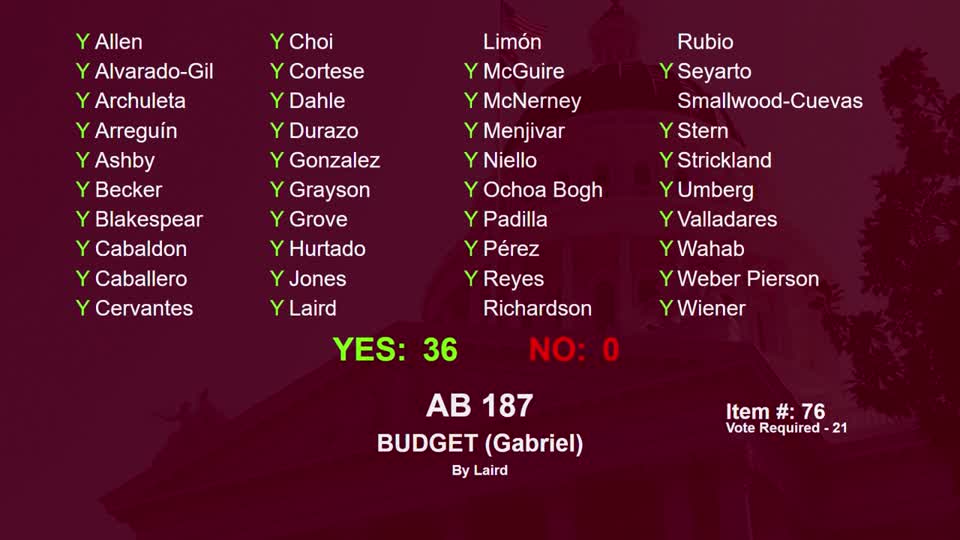 1MIN
Senate Floor
 1MIN
Assembly Floor
 1MIN
Senate Floor
 1MIN
Senate Standing Committee on Appropriations
 13MIN
Senate Standing Committee on Governmental Organization
 2MIN
Assembly Floor
 32MIN
Assembly Standing Committee on Appropriations
Bill Author