AB 1847: Mortgage forbearance: state of emergency: wildfire.
- Session Year: 2025-2026
- House: Assembly
- Latest Version Date: 2026-09-15
Current Status:
Passed
(2026-09-15: Chaptered by Secretary of State - Chapter 242, Statutes of 2026.)
Introduced
In Committee
Awaiting First Chamber Vote
Passed First Chamber
In Committee
Awaiting Second Chamber Vote
Passed Second Chamber
Enacted
Existing law authorizes a borrower to request forbearance on their residential mortgage loan for a period of 12 months if, among other things, the borrower affirms that they are experiencing financial hardship that prevents them from making timely payments on the loan due directly to the wildfire disaster described in the proclamation of a state of emergency issued by Governor Gavin Newsom on January 7, 2025, or the federally declared disaster, declared on January 8, 2025, related to the Eaton Wildfire, the Palisades Fire, and the Straight-line Winds. Existing law requires an applicant requesting forbearance on their residential mortgage loan to affirm that they are experiencing a financial hardship due to the wildfire disaster. Existing law requires that request to be made before the earlier of either 6 months after the date upon which the state of emergency is terminated or January 7, 2027. Existing law requires a borrower to be notified by the mortgage servicer within 10 business days whether their request for forbearance has been approved. Existing law prohibits any late fees from being assessed to the borrowers account during the period of forbearance, and the borrower from being charged a default rate of interest.
This bill would extend the period of mortgage forbearance to 24 months and extend the latest possible deadline for a borrowers request for forbearance to January 7, 2029. The bill would require an applicant requesting forbearance on their residential mortgage loan to further affirm that the property securing the loan is uninhabitable due to the wildfire disaster. Because the bill would expand the crime of perjury, the bill would impose a state-mandated local program. If the borrower has requested an extension of a forbearance period that would result in a total forbearance period of more than 12 months, the bill would authorize a mortgage servicer to request certain related documentation from the borrower, as specified. The bill would extend the amount of time the mortgage servicer has to notify the borrower whether their request for forbearance has been approved to 21 days or longer, as specified. During the period in which the borrower is waiting to be notified, the bill would prohibit any late fees from being assessed to the borrowers account, and the borrower from being charged a default rate of interest.
Existing law requires a mortgage servicer to disclose to a borrower to whom a forbearance has been granted that the forborne mortgage payments are required to be repaid. Existing law prohibits requiring a borrower who was current on the residential mortgage loan when they entered forbearance to make a lump sum payment.
This bill would require a mortgage servicer to offer the borrower the option to defer repayment of forborne amounts to the end of the loan term, as specified.
The California Constitution requires the state to reimburse local agencies and school districts for certain costs mandated by the state. Statutory provisions establish procedures for making that reimbursement.
This bill would provide that no reimbursement is required by this act for a specified reason.
Existing law authorizes a borrower to request forbearance on their residential mortgage loan for a period of 12 months if, among other things, the borrower affirms that they are experiencing financial hardship that prevents them from making timely payments on the loan due directly to the wildfire disaster described in the proclamation of a state of emergency issued by Governor Gavin Newsom on January 7, 2025, or the federally declared disaster, declared on January 8, 2025, related to the Eaton Wildfire, the Palisades Fire, and the Straight-line Winds. Existing law requires an applicant requesting forbearance on their residential mortgage loan to affirm that they are experiencing a financial hardship due to the wildfire disaster. Existing law requires that request to be made before the earlier of either 6 months after the date upon which the state of emergency is terminated or January 7, 2027. Existing law requires a borrower to be notified by the mortgage servicer within 10 business days whether their request for forbearance has been approved. Existing law prohibits any late fees from being assessed to the borrowers account during the period of forbearance, and the borrower from being charged a default rate of interest.
This bill would extend the period of mortgage forbearance to 24 months and extend the latest possible deadline for a borrowers request for forbearance to January 7, 2029. The bill would require an applicant requesting forbearance on their residential mortgage loan to further affirm that the property securing the loan is uninhabitable due to the wildfire disaster. Because the bill would expand the crime of perjury, the bill would impose a state-mandated local program. If the borrower has requested an extension of a forbearance period that would result in a total forbearance period of more than 12 months, the bill would authorize a mortgage servicer to request certain related documentation from the borrower, as specified. The bill would extend the amount of time the mortgage servicer has to notify the borrower whether their request for forbearance has been approved to 21 days or longer, as specified. During the period in which the borrower is waiting to be notified, the bill would prohibit any late fees from being assessed to the borrowers account, and the borrower from being charged a default rate of interest.
Existing law requires a mortgage servicer to disclose to a borrower to whom a forbearance has been granted that the forborne mortgage payments are required to be repaid. Existing law prohibits requiring a borrower who was current on the residential mortgage loan when they entered forbearance to make a lump sum payment.
This bill would require a mortgage servicer to offer the borrower the option to defer repayment of forborne amounts to the end of the loan term, as specified.
The California Constitution requires the state to reimburse local agencies and school districts for certain costs mandated by the state. Statutory provisions establish procedures for making that reimbursement.
This bill would provide that no reimbursement is required by this act for a specified reason.
Existing law authorizes a borrower to request forbearance on their residential mortgage loan for a period of 12 months if, among other things, the borrower affirms that they are experiencing financial hardship that prevents them from making timely payments on the loan due directly to the wildfire disaster described in the proclamation of a state of emergency issued by Governor Gavin Newsom on January 7, 2025, or the federally declared disaster, declared on January 8, 2025, related to the Eaton Wildfire, the Palisades Fire, and the Straight-line Winds. Existing law requires an applicant requesting forbearance on their residential mortgage loan to affirm that they are experiencing a financial hardship due to the wildfire disaster. Existing law requires that request to be made before the earlier of either 6 months after the date upon which the state of emergency is terminated or January 7, 2027. Existing law requires a borrower to be notified by the mortgage servicer within 10 business days whether their request for forbearance has been approved. Existing law prohibits any late fees from being assessed to the borrowers account during the period of forbearance, and the borrower from being charged a default rate of interest.
This bill would extend the period of mortgage forbearance to 24 months and extend the latest possible deadline for a borrowers request for forbearance to January 7, 2029. The bill would require an applicant requesting forbearance on their residential mortgage loan to further affirm that the property securing the loan is uninhabitable due to the wildfire disaster. Because the bill would expand the crime of perjury, the bill would impose a state-mandated local program. If the borrower has requested an extension of a forbearance period that would result in a total forbearance period of more than 12 months, the bill would authorize a mortgage servicer to request certain related documentation from the borrower, as specified. The bill would extend the amount of time the mortgage servicer has to notify the borrower whether their request for forbearance has been approved to 21 days or longer, as specified. During the period in which the borrower is waiting to be notified, the bill would prohibit any late fees from being assessed to the borrowers account, and the borrower from being charged a default rate of interest.
Existing law requires a mortgage servicer to disclose to a borrower to whom a forbearance has been granted that the forborne mortgage payments are required to be repaid. Existing law prohibits requiring a borrower who was current on the residential mortgage loan when they entered forbearance to make a lump sum payment.
This bill would require a mortgage servicer to offer the borrower the option to defer repayment of forborne amounts to the end of the loan term, as specified.
The California Constitution requires the state to reimburse local agencies and school districts for certain costs mandated by the state. Statutory provisions establish procedures for making that reimbursement.
This bill would provide that no reimbursement is required by this act for a specified reason.
Existing law authorizes a borrower to request forbearance on their residential mortgage loan for a period of 12 months if, among other things, the borrower affirms that they are experiencing financial hardship that prevents them from making timely payments on the loan due directly to the wildfire disaster described in the proclamation of a state of emergency issued by Governor Gavin Newsom on January 7, 2025, or the federally declared disaster, declared on January 8, 2025, related to the Eaton Wildfire, the Palisades Fire, and the Straight-line Winds. Existing law requires an applicant requesting forbearance on their residential mortgage loan to affirm that they are experiencing a financial hardship due to the wildfire disaster. Existing law requires that request to be made before the earlier of either 6 months after the date upon which the state of emergency is terminated or January 7, 2027.
This bill would extend the period of mortgage forbearance to 36 24 months and extend the latest possible deadline for a borrowers request for forbearance to January 7, 2029. The bill would require an applicant requesting forbearance on their residential mortgage loan to further affirm that the property securing the loan is uninhabitable due to the wildfire disaster. Because the bill would expand the crime of perjury, the bill would impose a state-mandated local program.
Existing law requires a mortgage servicer to disclose to a borrower to whom a forbearance has been granted that the forborne mortgage payments are required to be repaid. Existing law prohibits requiring a borrower who was current on the residential mortgage loan when they entered forbearance to make a lump sum payment.
This bill would require a mortgage servicer to offer the borrower the option to defer repayment of forborne amounts to the end of the loan term, as specified.
The California Constitution requires the state to reimburse local agencies and school districts for certain costs mandated by the state. Statutory provisions establish procedures for making that reimbursement.
This bill would provide that no reimbursement is required by this act for a specified reason.
Existing law authorizes a borrower to request forbearance on their residential mortgage loan for a period of 12 months if, among other things, the borrower affirms that they are experiencing financial hardship that prevents them from making timely payments on the loan due directly to the wildfire disaster described in the proclamation of a state of emergency issued by Governor Gavin Newsom on January 7, 2025, or the federally declared disaster, declared on January 8, 2025, related to the Eaton Wildfire, the Palisades Fire, and the Straight-line Winds. Existing law requires that request to be made before the earlier of either 6 months after the date upon which the state of emergency is terminated or January 7, 2027.
This bill would extend the period of mortgage forbearance to 36 months and extend the latest possible deadline for a borrowers request for forbearance to January 7, 2029. Because the bill would expand the crime of perjury, the bill would impose a state-mandated local program.
Existing law requires a mortgage servicer to disclose to a borrower to whom a forbearance has been granted that the forborne mortgage payments are required to be repaid. Existing law prohibits requiring a borrower who was current on the residential mortgage loan when they entered forbearance to make a lump sum payment.
This bill would require a mortgage servicer to offer the borrower the option to defer repayment of forborne amounts to the end of the loan term, as specified.
The California Constitution requires the state to reimburse local agencies and school districts for certain costs mandated by the state. Statutory provisions establish procedures for making that reimbursement.
This bill would provide that no reimbursement is required by this act for a specified reason.
This bill would declare that it is to take effect immediately as an urgency statute.Existing law authorizes a borrower to request forbearance on their residential mortgage loan for a period of 12 months if, among other things, the borrower affirms that they are experiencing financial hardship that prevents them from making timely payments on the loan due directly to the wildfire disaster described in the proclamation of a state of emergency issued by Governor Gavin Newsom on January 7, 2025, or the federally declared disaster, declared on January 8, 2025, related to the Eaton Wildfire, the Palisades Fire, and the Straight-line Winds. Existing law requires that request to be made before the earlier of either 6 months after the date upon which the state of emergency is terminated or January 7, 2027.
This bill would extend the period of mortgage forbearance to 36 months and extend the latest possible deadline for a borrowers request for forbearance to January 7, 2029. Because the bill would expand the crime of perjury, the bill would impose a state-mandated local program.
Existing law requires a mortgage servicer to disclose to a borrower to whom a forbearance has been granted that the forborne mortgage payments are required to be repaid. Existing law prohibits requiring a borrower who was current on the residential mortgage loan when they entered forbearance to make a lump sum payment.
This bill would require a mortgage servicer to offer the borrower the option to defer repayment of forborne amounts to the end of the loan term, as specified.
The California Constitution requires the state to reimburse local agencies and school districts for certain costs mandated by the state. Statutory provisions establish procedures for making that reimbursement.
This bill would provide that no reimbursement is required by this act for a specified reason.
This bill would declare that it is to take effect immediately as an urgency statute.
Existing law authorizes a borrower to request forbearance on their residential mortgage loan for a period of 12 months if, among other things, the borrower affirms that they are experiencing financial hardship that prevents them from making timely payments on the loan due directly to the wildfire disaster described in the proclamation of a state of emergency issued by Governor Gavin Newsom on January 7, 2025, or the federally declared disaster, declared on January 8, 2025, related to the Eaton Wildfire, the Palisades Fire, and the Straight-line Winds. Existing law requires that request to be made before the earlier of either 6 months after the date upon which the state of emergency is terminated or January 7, 2027.
This bill would extend the period of mortgage forbearance to 36 months and extend the latest possible deadline for a borrowers request for forbearance to January 7, 2029. Because the bill would expand the crime of perjury, the bill would impose a state-mandated local program.
Existing law requires a mortgage servicer to disclose to a borrower to whom a forbearance has been granted that the forborne mortgage payments are required to be repaid. Existing law prohibits requiring a borrower who was current on the residential mortgage loan when they entered forbearance to make a lump sum payment.
This bill would require a mortgage servicer to offer the borrower the option to defer repayment of forborne amounts to the end of the loan term, as specified.
The California Constitution requires the state to reimburse local agencies and school districts for certain costs mandated by the state. Statutory provisions establish procedures for making that reimbursement.
This bill would provide that no reimbursement is required by this act for a specified reason.
(a)A borrower who is experiencing financial hardship that prevents the borrower from making timely payments on a residential mortgage loan due directly to the wildfire disaster may request forbearance on the residential mortgage loan by doing all of the following:
(1)Submitting a request to the borrowers mortgage loan servicer before the earlier of either of the following:
(A)Six months after the date upon which the state of emergency issued by Governor Gavin Newsom on January 7, 2025, is terminated.
(B)January 7, 2029.
(2)Affirming that the borrower is experiencing a financial hardship due to the wildfire disaster.
(3)Affirming that the property securing the residential mortgage loan is uninhabitable due to the wildfire disaster.
(b)(1)Upon a request by a borrower for forbearance under subdivision (a), a mortgage servicer shall offer mortgage payment forbearance for a period of up to an initial 90 days, which shall be extended at the request of the borrower in 90-day increments, up to a maximum forbearance period of 24 months.
(2)Notwithstanding paragraph (1), a mortgage servicer may request documentation from the borrower beyond the documentation described in subdivision (a) if all of the following conditions apply:
(A)The borrower has requested an extension of a forbearance period pursuant to paragraph (1) that would result in a total forbearance period of more than 12 months.
(B)The mortgage servicer has received a written request from the investor, guarantor, insurer, or holder of the residential mortgage loan, requesting documentation from the borrower that the investor, guarantor, insurer, or holder requires and that is reasonably necessary to decide whether to approve a request from a borrower for a forbearance period that exceeds 12 months.
(C)The documentation is related to any of the following:
(i)The nature of the financial hardship affirmed by the borrower.
(ii)The habitability of the property securing the residential mortgage loan.
(iii)Efforts undertaken by the borrower to remedy the damage incurred on the property securing the residential mortgage loan with the objective of restoring the habitability of the property.
(D)Upon a request from the borrower, the mortgage servicer provides a copy of the written request described in subparagraph (B) to the borrower.
(3)The intent of this subdivision is to provide a streamlined process for forbearance related to the wildfire disaster and to limit the documentation that a borrower must provide their mortgage servicer to those documents that the investor, guarantor, insurer, or holder of the residential mortgage loan requires to approve or deny a request for forbearance that extends the forbearance period beyond 12 months.
(c)(1)The borrower shall be notified within 21 days by the mortgage servicer whether their request for forbearance has been approved.
(2)The 21-day period provided by paragraph (1) may be extended upon agreement between the borrower and the mortgage servicer to allow additional time for the borrower to provide the documentation described in paragraph (2) of subdivision (b) and for the mortgage servicer to receive approval from the investor, guarantor, insurer, or holder of the residential mortgage loan to provide forbearance beyond a 12-month duration.
(d)If the mortgage servicer, acting under delegated authority to make forbearance determinations on behalf of the investor, denies a forbearance request within the maximum allowable forbearance period of 24 months pursuant to subdivision (b), the mortgage servicer shall not be in violation of this section if the mortgage servicer provides written notice to the borrower stating the specific reason for denial. The notice shall include both of the following:
(1)A clear and concise explanation of the specific investor provision that is the basis for the denial.
(2)The text of the specific investor guideline or contractual provision that is the basis for the denial of the borrowers forbearance request.
(e)If the written notice in subdivision (c) cites any defect in the borrowers request, including an incomplete application or missing information, that is curable, the mortgage servicer shall do all of the following:
(1)Specifically identify any curable defect in the written notice.
(2)Provide 21 calendar days from the mailing date of the written notice for the borrower to cure any identified defect.
(3)Accept the borrowers revised request for forbearance before the 21-day period described in paragraph (2) lapses.
(4)Respond to the borrowers revised request within five business days of receipt of the revised request.
(f)The forbearance period required by subdivision (b) shall include any period of forbearance related to the wildfire disaster that a mortgage servicer has provided to a borrower before the effective date of this title.
(g)During the period of forbearance required by this section, including the period during which the borrower is waiting to be notified pursuant to subdivision (c) whether their forbearance request is approved, no late fees shall be assessed to the borrowers account and the borrower shall not be charged a default rate of interest.
(h)No later than 30 calendar days before the end of a forbearance period provided pursuant to subdivision (b), a mortgage servicer shall provide written notice to the borrower disclosing both of the following:
(1)Any documentation or forms that the mortgage servicer requires the borrower to furnish or complete to be considered for an additional period of forbearance.
(2)A description of the deadlines and timelines associated with considering the borrower for an additional period of forbearance.
(i)A mortgage servicer shall report the credit obligations of borrowers under a disaster-related forbearance plan in compliance with the federal Fair Credit Reporting Act (15 U.S.C. Sec. 1681 et seq.). For accounts granted disaster-related mortgage payment relief pursuant to this title, a mortgage servicer shall not furnish information during the forbearance period indicating that the payments are in forbearance and shall do either of the following:
(1)Report the credit obligation or account as current.
(2)If a borrower was delinquent before the disaster-related forbearance plan, the mortgage servicer shall:
(A)Maintain the delinquent status during the period in which the plan is in effect.
(B)If the consumer brings the account current during the forbearance period, report the account as current.
SEC. 2.Section 3273.24 of the Civil Code is amended to read:3273.24.(a)A mortgage servicer shall disclose to a borrower to whom a forbearance has been granted pursuant to Section 3273.23 that the forborne mortgage payments are required to be repaid.
(b)The disclosure required by subdivision (a) is only required to be furnished to the borrower once at the beginning of the forbearance period.
(c)A lump sum payment shall not be required for a borrower who was current on the residential mortgage loan when the borrower entered forbearance.
(d)Unless it is prohibited by the terms of the applicable investor contract or servicing guidelines, a mortgage servicer shall offer the borrower the option to defer repayment of forborne amounts to the end of the loan term, through a loan deferral or comparable loss mitigation option, consistent with the servicers contractual authority.
SEC. 3.No reimbursement is required by this act pursuant to Section 6 of Article XIIIB of the California Constitution because the only costs that may be incurred by a local agency or school district will be incurred because this act creates a new crime or infraction, eliminates a crime or infraction, or changes the penalty for a crime or infraction, within the meaning of Section 17556 of the Government Code, or changes the definition of a crime within the meaning of Section 6 of Article XIIIB of the California Constitution.
(a)A borrower who is experiencing financial hardship that prevents the borrower from making timely payments on a residential mortgage loan due directly to the wildfire disaster may request forbearance on the residential mortgage loan by doing all of the following:
(1)Submitting a request to the borrowers mortgage loan servicer before the earlier of either of the following:
(A)Six months after the date upon which the state of emergency issued by Governor Gavin Newsom on January 7, 2025, is terminated.
(B)January 7, 2029.
(2)Affirming that the borrower is experiencing a financial hardship due to the wildfire disaster.
(3)Affirming that the property securing the residential mortgage loan is uninhabitable due to the wildfire disaster.
(b)(1)Upon a request by a borrower for forbearance under subdivision (a), a mortgage servicer shall offer mortgage payment forbearance for a period of up to an initial 90 days, which shall be extended at the request of the borrower in 90-day increments, up to a maximum forbearance period of 24 months.
(2)Notwithstanding paragraph (1), a mortgage servicer may request documentation from the borrower beyond the documentation described in subdivision (a) if all of the following conditions apply:
(A)The borrower has requested an extension of a forbearance period pursuant to paragraph (1) that would result in a total forbearance period of more than 12 months.
(B)The mortgage servicer has received a written request from the investor, guarantor, insurer, or holder of the residential mortgage loan, requesting documentation from the borrower that the investor, guarantor, insurer, or holder requires and that is reasonably necessary to decide whether to approve a request from a borrower for a forbearance period that exceeds 12 months.
(C)The documentation is related to any of the following:
(i)The nature of the financial hardship affirmed by the borrower.
(ii)The habitability of the property securing the residential mortgage loan.
(iii)Efforts undertaken by the borrower to remedy the damage incurred on the property securing the residential mortgage loan with the objective of restoring the habitability of the property.
(D)Upon a request from the borrower, the mortgage servicer provides a copy of the written request described in subparagraph (B) to the borrower.
(3)The intent of this subdivision is to provide a streamlined process for forbearance related to the wildfire disaster and to limit the documentation that a borrower must provide their mortgage servicer to those documents that the investor, guarantor, insurer, or holder of the residential mortgage loan requires to approve or deny a request for forbearance that extends the forbearance period beyond 12 months.
(c)(1)The borrower shall be notified within 21 days by the mortgage servicer whether their request for forbearance has been approved.
(2)The 21-day period provided by paragraph (1) may be extended upon agreement between the borrower and the mortgage servicer to allow additional time for the borrower to provide the documentation described in paragraph (2) of subdivision (b) and for the mortgage servicer to receive approval from the investor, guarantor, insurer, or holder of the residential mortgage loan to provide forbearance beyond a 12-month duration.
(d)If the mortgage servicer, acting under delegated authority to make forbearance determinations on behalf of the investor, denies a forbearance request within the maximum allowable forbearance period of 24 months pursuant to subdivision (b), the mortgage servicer shall not be in violation of this section if the mortgage servicer provides written notice to the borrower stating the specific reason for denial. The notice shall include both of the following:
(1)A clear and concise explanation of the specific investor provision that is the basis for the denial.
(2)The text of the specific investor guideline or contractual provision that is the basis for the denial of the borrowers forbearance request.
(e)If the written notice in subdivision (c) cites any defect in the borrowers request, including an incomplete application or missing information, that is curable, the mortgage servicer shall do all of the following:
(1)Specifically identify any curable defect in the written notice.
(2)Provide 21 calendar days from the mailing date of the written notice for the borrower to cure any identified defect.
(3)Accept the borrowers revised request for forbearance before the 21-day period described in paragraph (2) lapses.
(4)Respond to the borrowers revised request within five business days of receipt of the revised request.
(f)The forbearance period required by subdivision (b) shall include any period of forbearance related to the wildfire disaster that a mortgage servicer has provided to a borrower before the effective date of this title.
(g)During the period of forbearance required by this section, including the period during which the borrower is waiting to be notified pursuant to subdivision (c) whether their forbearance request is approved, no late fees shall be assessed to the borrowers account and the borrower shall not be charged a default rate of interest.
(h)No later than 30 calendar days before the end of a forbearance period provided pursuant to subdivision (b), a mortgage servicer shall provide written notice to the borrower disclosing both of the following:
(1)Any documentation or forms that the mortgage servicer requires the borrower to furnish or complete to be considered for an additional period of forbearance.
(2)A description of the deadlines and timelines associated with considering the borrower for an additional period of forbearance.
(i)A mortgage servicer shall report the credit obligations of borrowers under a disaster-related forbearance plan in compliance with the federal Fair Credit Reporting Act (15 U.S.C. Sec. 1681 et seq.). For accounts granted disaster-related mortgage payment relief pursuant to this title, a mortgage servicer shall not furnish information during the forbearance period indicating that the payments are in forbearance and shall do either of the following:
(1)Report the credit obligation or account as current.
(2)If a borrower was delinquent before the disaster-related forbearance plan, the mortgage servicer shall:
(A)Maintain the delinquent status during the period in which the plan is in effect.
(B)If the consumer brings the account current during the forbearance period, report the account as current.
SEC. 2.Section 3273.24 of the Civil Code is amended to read:3273.24.(a)A mortgage servicer shall disclose to a borrower to whom a forbearance has been granted pursuant to Section 3273.23 that the forborne mortgage payments are required to be repaid.
(b)The disclosure required by subdivision (a) is only required to be furnished to the borrower once at the beginning of the forbearance period.
(c)A lump sum payment shall not be required for a borrower who was current on the residential mortgage loan when the borrower entered forbearance.
(d)Unless it is prohibited by the terms of the applicable investor contract or servicing guidelines, a mortgage servicer shall offer the borrower the option to defer repayment of forborne amounts to the end of the loan term, through a loan deferral or comparable loss mitigation option, consistent with the servicers contractual authority.
SEC. 3.No reimbursement is required by this act pursuant to Section 6 of Article XIIIB of the California Constitution because the only costs that may be incurred by a local agency or school district will be incurred because this act creates a new crime or infraction, eliminates a crime or infraction, or changes the penalty for a crime or infraction, within the meaning of Section 17556 of the Government Code, or changes the definition of a crime within the meaning of Section 6 of Article XIIIB of the California Constitution.
(a)A borrower who is experiencing financial hardship that prevents the borrower from making timely payments on a residential mortgage loan due directly to the wildfire disaster may request forbearance on the residential mortgage loan by doing both all of the following:
(1)Submitting a request to the borrowers mortgage loan servicer before the earlier of either of the following:
(A)Six months after the date upon which the state of emergency issued by Governor Gavin Newsom on January 7, 2025, is terminated.
(B)January 7, 2029.
(2)Affirming that the borrower is experiencing a financial hardship due to the wildfire disaster.
(3)Affirming that the property securing the residential mortgage loan is uninhabitable due to the wildfire disaster.
(b)(1)Upon a request by a borrower for forbearance under subdivision (a), a mortgage servicer shall offer mortgage payment forbearance for a period of up to an initial 90 days, which shall be extended at the request of the borrower in 90-day increments, up to a maximum forbearance period of 24 months.
(2)Notwithstanding paragraph (1), a mortgage servicer may request documentation from the borrower beyond the documentation described in subdivision (a) if all of the following conditions apply:
(A)The borrower has requested an extension of a forbearance period pursuant to paragraph (1) that would result in a total forbearance period of more than 12 months.
(B)The mortgage servicer has received a written request from the investor, guarantor, insurer, or holder of the residential mortgage loan, requesting documentation from the borrower that the investor, guarantor, insurer, or holder requires and that is reasonably necessary to decide whether to approve a request from a borrower for a forbearance period that exceeds 12 months.
(C)The documentation is related to any of the following:
(i)The nature of the financial hardship affirmed by the borrower.
(ii)The habitability of the property securing the residential mortgage loan.
(iii)Efforts undertaken by the borrower to remedy the damage incurred on the property securing the residential mortgage loan with the objective of restoring the habitability of the property.
(D)Upon a request from the borrower, the mortgage servicer provides a copy of the written request described in subparagraph (B) to the borrower.
(3)The intent of this subdivision is to provide a streamlined process for forbearance related to the wildfire disaster and to limit the documentation that a borrower must provide their mortgage servicer to those documents that the investor, guarantor, insurer, or holder of the residential mortgage loan requires to approve or deny a request for forbearance that extends the forbearance period beyond 12 months.
(c)(1)The borrower shall be notified within 10 business 21 days by the mortgage servicer whether their request for forbearance has been approved.
(2)The 21-day period provided by paragraph (1) may be extended upon agreement between the borrower and the mortgage servicer to allow additional time for the borrower to provide the documentation described in paragraph (2) of subdivision (b) and for the mortgage servicer to receive approval from the investor, guarantor, insurer, or holder of the residential mortgage loan to provide forbearance beyond a 12-month duration.
(d)If the mortgage servicer, acting under delegated authority to make forbearance determinations on behalf of the investor, denies a forbearance request within the maximum allowable forbearance period of 24 months pursuant to subdivision (b), the mortgage servicer shall not be in violation of this section if the mortgage servicer provides written notice to the borrower stating the specific reason for denial. The notice shall include both of the following:
(1)A clear and concise explanation of the specific investor provision that is the basis for the denial.
(2)The text of the specific investor guideline or contractual provision that is the basis for the denial of the borrowers forbearance request.
(e)If the written notice in subdivision (c) cites any defect in the borrowers request, including an incomplete application or missing information, that is curable, the mortgage servicer shall do all of the following:
(1)Specifically identify any curable defect in the written notice.
(2)Provide 21 calendar days from the mailing date of the written notice for the borrower to cure any identified defect.
(3)Accept the borrowers revised request for forbearance before the 21-day period described in paragraph (2) lapses.
(4)Respond to the borrowers revised request within five business days of receipt of the revised request.
(f)The forbearance period required by subdivision (b) shall include any period of forbearance related to the wildfire disaster that a mortgage servicer has provided to a borrower before the effective date of this title.
(g)During the period of forbearance required by this section, including the period during which the borrower is waiting to be notified pursuant to subdivision (c) whether their forbearance request is approved, no late fees shall be assessed to the borrowers account and the borrower shall not be charged a default rate of interest.
(h)No later than 30 calendar days before the end of an initial forbearance period, a forbearance period provided pursuant to subdivision (b), a mortgage servicer shall provide written notice to the borrower disclosing both of the following:
(1)Any documentation or forms that the mortgage servicer requires the borrower to furnish or complete to be considered for an additional period of forbearance.
(2)A description of the deadlines and timelines associated with considering the borrower for an additional period of forbearance.
(i)A mortgage servicer shall report the credit obligations of borrowers under a disaster-related forbearance plan in compliance with the federal Fair Credit Reporting Act (15 U.S.C. Sec. 1681 et seq.). For accounts granted disaster-related mortgage payment relief pursuant to this title, a mortgage servicer shall not furnish information during the forbearance period indicating that the payments are in forbearance and shall do either of the following:
(1)Report the credit obligation or account as current.
(2)If a borrower was delinquent before the disaster-related forbearance plan, the mortgage servicer shall:
(A)Maintain the delinquent status during the period in which the plan is in effect.
(B)If the consumer brings the account current during the forbearance period, report the account as current.
SEC. 2.Section 3273.24 of the Civil Code is amended to read:3273.24.(a)A mortgage servicer shall disclose to a borrower to whom a forbearance has been granted pursuant to Section 3273.23 that the forborne mortgage payments are required to be repaid.
(b)The disclosure required by subdivision (a) is only required to be furnished to the borrower once at the beginning of the forbearance period.
(c)A lump sum payment shall not be required for a borrower who was current on the residential mortgage loan when the borrower entered forbearance.
(d)Unless it is prohibited by the terms of the applicable investor contract or servicing guidelines, a mortgage servicer shall offer the borrower the option to defer repayment of forborne amounts to the end of the loan term, through a loan deferral or comparable loss mitigation option, consistent with the servicers contractual authority.
SEC. 3.No reimbursement is required by this act pursuant to Section 6 of Article XIIIB of the California Constitution because the only costs that may be incurred by a local agency or school district will be incurred because this act creates a new crime or infraction, eliminates a crime or infraction, or changes the penalty for a crime or infraction, within the meaning of Section 17556 of the Government Code, or changes the definition of a crime within the meaning of Section 6 of Article XIIIB of the California Constitution.
(a)A borrower who is experiencing financial hardship that prevents the borrower from making timely payments on a residential mortgage loan due directly to the wildfire disaster may request forbearance on the residential mortgage loan by doing both of the following:
(1)Submitting a request to the borrowers mortgage loan servicer before the earlier of either of the following:
(A)Six months after the date upon which the state of emergency issued by Governor Gavin Newsom on January 7, 2025, is terminated.
(B)January 7, 2029.
(2)Affirming that the borrower is experiencing a financial hardship due to the wildfire disaster.
(3)Affirming that the property securing the residential mortgage loan is uninhabitable due to the wildfire disaster.
(b)Upon a request by a borrower for forbearance under subdivision (a), a mortgage servicer shall offer mortgage payment forbearance for a period of up to an initial 90 days, which shall be extended at the request of the borrower in 90-day increments, up to a maximum forbearance period of 36 24 months.
(c)The borrower shall be notified within 10 business days by the mortgage servicer whether their request for forbearance has been approved.
(d)If the mortgage servicer, acting under delegated authority to make forbearance determinations on behalf of the investor, denies a forbearance request within the maximum allowable forbearance period of 36 24 months pursuant to subdivision (b), the mortgage servicer shall not be in violation of this section if the mortgage servicer provides written notice to the borrower stating the specific reason for denial. The notice shall include both of the following:
(1)A clear and concise explanation of the specific investor provision that is the basis for the denial.
(2)The text of the specific investor guideline or contractual provision that is the basis for the denial of the borrowers forbearance request.
(e)If the written notice in subdivision (c) cites any defect in the borrowers request, including an incomplete application or missing information, that is curable, the mortgage servicer shall do all of the following:
(1)Specifically identify any curable defect in the written notice.
(2)Provide 21 calendar days from the mailing date of the written notice for the borrower to cure any identified defect.
(3)Accept the borrowers revised request for forbearance before the 21-day period described in paragraph (2) lapses.
(4)Respond to the borrowers revised request within five business days of receipt of the revised request.
(f)The forbearance period required by subdivision (b) shall include any period of forbearance related to the wildfire disaster that a mortgage servicer has provided to a borrower before the effective date of this title.
(g)During the period of forbearance required by this section, no late fees shall be assessed to the borrowers account and the borrower shall not be charged a default rate of interest.
(h)No later than 30 calendar days before the end of an initial forbearance period, a mortgage servicer shall provide written notice to the borrower disclosing both of the following:
(1)Any documentation or forms that the mortgage servicer requires the borrower to furnish or complete to be considered for an additional period of forbearance.
(2)A description of the deadlines and timelines associated with considering the borrower for an additional period of forbearance.
(i)A mortgage servicer shall report the credit obligations of borrowers under a disaster-related forbearance plan in compliance with the federal Fair Credit Reporting Act (15 U.S.C. Sec. 1681 et seq.). For accounts granted disaster-related mortgage payment relief pursuant to this title, a mortgage servicer shall not furnish information during the forbearance period indicating that the payments are in forbearance and shall do either of the following:
(1)Report the credit obligation or account as current.
(2)If a borrower was delinquent before the disaster-related forbearance plan, the mortgage servicer shall:
(A)Maintain the delinquent status during the period in which the plan is in effect.
(B)If the consumer brings the account current during the forbearance period, report the account as current.
SEC. 2.Section 3273.24 of the Civil Code is amended to read:3273.24.(a)A mortgage servicer shall disclose to a borrower to whom a forbearance has been granted pursuant to Section 3273.23 that the forborne mortgage payments are required to be repaid.
(b)The disclosure required by subdivision (a) is only required to be furnished to the borrower once at the beginning of the forbearance period.
(c)A lump sum payment shall not be required for a borrower who was current on the residential mortgage loan when the borrower entered forbearance.
(d)Unless it is prohibited by the terms of the applicable investor contract or servicing guidelines, a mortgage servicer shall offer the borrower the option to defer repayment of forborne amounts to the end of the loan term, through a loan deferral or comparable loss mitigation option, consistent with the servicers contractual authority.
SEC. 3.No reimbursement is required by this act pursuant to Section 6 of Article XIIIB of the California Constitution because the only costs that may be incurred by a local agency or school district will be incurred because this act creates a new crime or infraction, eliminates a crime or infraction, or changes the penalty for a crime or infraction, within the meaning of Section 17556 of the Government Code, or changes the definition of a crime within the meaning of Section 6 of Article XIIIB of the California Constitution.
(a)A borrower who is experiencing financial hardship that prevents the borrower from making timely payments on a residential mortgage loan due directly to the wildfire disaster may request forbearance on the residential mortgage loan by doing both of the following:
(1)Submitting a request to the borrowers mortgage loan servicer before the earlier of either of the following:
(A)Six months after the date upon which the state of emergency issued by Governor Gavin Newsom on January 7, 2025, is terminated.
(B)January 7, 2029.
(2)Affirming that the borrower is experiencing a financial hardship due to the wildfire disaster.
(b)Upon a request by a borrower for forbearance under subdivision (a), a mortgage servicer shall offer mortgage payment forbearance for a period of up to an initial 90 days, which shall be extended at the request of the borrower in 90-day increments, up to a maximum forbearance period of 36 months.
(c)The borrower shall be notified within 10 business days by the mortgage servicer whether their request for forbearance has been approved.
(d)If the mortgage servicer, acting under delegated authority to make forbearance determinations on behalf of the investor, denies a forbearance request within the maximum allowable forbearance period of 36 months pursuant to subdivision (b), the mortgage servicer shall not be in violation of this section if the mortgage servicer provides written notice to the borrower stating the specific reason for denial. The notice shall include both of the following:
(1)A clear and concise explanation of the specific investor provision that is the basis for the denial.
(2)The text of the specific investor guideline or contractual provision that is the basis for the denial of the borrowers forbearance request.
(e)If the written notice in subdivision (c) cites any defect in the borrowers request, including an incomplete application or missing information, that is curable, the mortgage servicer shall do all of the following:
(1)Specifically identify any curable defect in the written notice.
(2)Provide 21 calendar days from the mailing date of the written notice for the borrower to cure any identified defect.
(3)Accept the borrowers revised request for forbearance before the 21-day period described in paragraph (2) lapses.
(4)Respond to the borrowers revised request within five business days of receipt of the revised request.
(f)The forbearance period required by subdivision (b) shall include any period of forbearance related to the wildfire disaster that a mortgage servicer has provided to a borrower before the effective date of this title.
(g)During the period of forbearance required by this section, no late fees shall be assessed to the borrowers account and the borrower shall not be charged a default rate of interest.
(h)No later than 30 calendar days before the end of an initial forbearance period, a mortgage servicer shall provide written notice to the borrower disclosing both of the following:
(1)Any documentation or forms that the mortgage servicer requires the borrower to furnish or complete to be considered for an additional period of forbearance.
(2)A description of the deadlines and timelines associated with considering the borrower for an additional period of forbearance.
(i)A mortgage servicer shall report the credit obligations of borrowers under a disaster-related forbearance plan in compliance with the federal Fair Credit Reporting Act (15 U.S.C. Sec. 1681 et seq.). For accounts granted disaster-related mortgage payment relief pursuant to this title, a mortgage servicer shall not furnish information during the forbearance period indicating that the payments are in forbearance and shall do either of the following:
(1)Report the credit obligation or account as current.
(2)If a borrower was delinquent before the disaster-related forbearance plan, the mortgage servicer shall:
(A)Maintain the delinquent status during the period in which the plan is in effect.
(B)If the consumer brings the account current during the forbearance period, report the account as current.
SEC. 2.Section 3273.24 of the Civil Code is amended to read:3273.24.(a)A mortgage servicer shall disclose to a borrower to whom a forbearance has been granted pursuant to Section 3273.23 that the forborne mortgage payments are required to be repaid.
(b)The disclosure required by subdivision (a) is only required to be furnished to the borrower once at the beginning of the forbearance period.
(c)A lump sum payment shall not be required for a borrower who was current on the residential mortgage loan when the borrower entered forbearance.
(d)Unless it is prohibited by the terms of the applicable investor contract or servicing guidelines, a mortgage servicer shall offer the borrower the option to defer repayment of forborne amounts to the end of the loan term, through a loan deferral or comparable loss mitigation option, consistent with the servicers contractual authority.
SEC. 3.No reimbursement is required by this act pursuant to Section 6 of Article XIIIB of the California Constitution because the only costs that may be incurred by a local agency or school district will be incurred because this act creates a new crime or infraction, eliminates a crime or infraction, or changes the penalty for a crime or infraction, within the meaning of Section 17556 of the Government Code, or changes the definition of a crime within the meaning of Section 6 of Article XIIIB of the California Constitution.
SEC. 4.This act is an urgency statute necessary for the immediate preservation of the public peace, health, or safety within the meaning of Article IV of the California Constitution and shall go into immediate effect. The facts constituting the necessity are:To avert economic and social harm by providing relief to financially distressed borrowers during conditions of extreme peril to the safety of persons and property that exist due to impacts of the Eaton Fire, the Palisades Fire, and the windstorm, it is necessary that this act take effect immediately.(a)A borrower who is experiencing financial hardship that prevents the borrower from making timely payments on a residential mortgage loan due directly to the wildfire disaster may request forbearance on the residential mortgage loan by doing both of the following:
(1)Submitting a request to the borrowers mortgage loan servicer before the earlier of either of the following:
(A)Six months after the date upon which the state of emergency issued by Governor Gavin Newsom on January 7, 2025, is terminated.
(B)January 7, 2029.
(2)Affirming that the borrower is experiencing a financial hardship due to the wildfire disaster.
(b)Upon a request by a borrower for forbearance under subdivision (a), a mortgage servicer shall offer mortgage payment forbearance for a period of up to an initial 90 days, which shall be extended at the request of the borrower in 90-day increments, up to a maximum forbearance period of 36 months.
(c)The borrower shall be notified within 10 business days by the mortgage servicer whether their request for forbearance has been approved.
(d)If the mortgage servicer, acting under delegated authority to make forbearance determinations on behalf of the investor, denies a forbearance request within the maximum allowable forbearance period of 36 months pursuant to subdivision (b), the mortgage servicer shall not be in violation of this section if the mortgage servicer provides written notice to the borrower stating the specific reason for denial. The notice shall include both of the following:
(1)A clear and concise explanation of the specific investor provision that is the basis for the denial.
(2)The text of the specific investor guideline or contractual provision that is the basis for the denial of the borrowers forbearance request.
(e)If the written notice in subdivision (c) cites any defect in the borrowers request, including an incomplete application or missing information, that is curable, the mortgage servicer shall do all of the following:
(1)Specifically identify any curable defect in the written notice.
(2)Provide 21 calendar days from the mailing date of the written notice for the borrower to cure any identified defect.
(3)Accept the borrowers revised request for forbearance before the 21-day period described in paragraph (2) lapses.
(4)Respond to the borrowers revised request within five business days of receipt of the revised request.
(f)The forbearance period required by subdivision (b) shall include any period of forbearance related to the wildfire disaster that a mortgage servicer has provided to a borrower before the effective date of this title.
(g)During the period of forbearance required by this section, no late fees shall be assessed to the borrowers account and the borrower shall not be charged a default rate of interest.
(h)No later than 30 calendar days before the end of an initial forbearance period, a mortgage servicer shall provide written notice to the borrower disclosing both of the following:
(1)Any documentation or forms that the mortgage servicer requires the borrower to furnish or complete to be considered for an additional period of forbearance.
(2)A description of the deadlines and timelines associated with considering the borrower for an additional period of forbearance.
(i)A mortgage servicer shall report the credit obligations of borrowers under a disaster-related forbearance plan in compliance with the federal Fair Credit Reporting Act (15 U.S.C. Sec. 1681 et seq.). For accounts granted disaster-related mortgage payment relief pursuant to this title, a mortgage servicer shall not furnish information during the forbearance period indicating that the payments are in forbearance and shall do either of the following:
(1)Report the credit obligation or account as current.
(2)If a borrower was delinquent before the disaster-related forbearance plan, the mortgage servicer shall:
(A)Maintain the delinquent status during the period in which the plan is in effect.
(B)If the consumer brings the account current during the forbearance period, report the account as current.
SEC. 2.Section 3273.24 of the Civil Code is amended to read:3273.24.(a)A mortgage servicer shall disclose to a borrower to whom a forbearance has been granted pursuant to Section 3273.23 that the forborne mortgage payments are required to be repaid.
(b)The disclosure required by subdivision (a) is only required to be furnished to the borrower once at the beginning of the forbearance period.
(c)A lump sum payment shall not be required for a borrower who was current on the residential mortgage loan when the borrower entered forbearance.
(d)Unless it is prohibited by the terms of the applicable investor contract or servicing guidelines, a mortgage servicer shall offer the borrower the option to defer repayment of forborne amounts to the end of the loan term, through a loan deferral or comparable loss mitigation option, consistent with the servicers contractual authority.
SEC. 3.No reimbursement is required by this act pursuant to Section 6 of Article XIIIB of the California Constitution because the only costs that may be incurred by a local agency or school district will be incurred because this act creates a new crime or infraction, eliminates a crime or infraction, or changes the penalty for a crime or infraction, within the meaning of Section 17556 of the Government Code, or changes the definition of a crime within the meaning of Section 6 of Article XIIIB of the California Constitution.
SEC. 4.This act is an urgency statute necessary for the immediate preservation of the public peace, health, or safety within the meaning of Article IV of the California Constitution and shall go into immediate effect. The facts constituting the necessity are:
To avert economic and social harm by providing relief to financially distressed borrowers during conditions of extreme peril to the safety of persons and property that exist due to impacts of the Eaton Fire, the Palisades Fire, and the windstorm, it is necessary that this act take effect immediately.
(a)A borrower who is experiencing financial hardship that prevents the borrower from making timely payments on a residential mortgage loan due directly to the wildfire disaster may request forbearance on the residential mortgage loan by doing both of the following:
(1)Submitting a request to the borrowers mortgage loan servicer before the earlier of either of the following:
(A)Six months after the date upon which the state of emergency issued by Governor Gavin Newsom on January 7, 2025, is terminated.
(B)January 7, 2027. 2029.
(2)Affirming that the borrower is experiencing a financial hardship due to the wildfire disaster.
(b)Upon a request by a borrower for forbearance under subdivision (a), a mortgage servicer shall offer mortgage payment forbearance for a period of up to an initial 90 days, which shall be extended at the request of the borrower in 90-day increments, up to a maximum forbearance period of 12 36 months.
(c)The borrower shall be notified within 10 business days by the mortgage servicer whether their request for forbearance has been approved.
(d)If the mortgage servicer, acting under delegated authority to make forbearance determinations on behalf of the investor, denies a forbearance request within the maximum allowable forbearance period of 12 36 months pursuant to subdivision (b), the mortgage servicer shall not be in violation of this section if the mortgage servicer provides written notice to the borrower stating the specific reason for denial. The notice shall include both of the following:
(1)A clear and concise explanation of the specific investor provision that is the basis for the denial.
(2)The text of the specific investor guideline or contractual provision that is the basis for the denial of the borrowers forbearance request.
(e)If the written notice in subdivision (c) cites any defect in the borrowers request, including an incomplete application or missing information, that is curable, the mortgage servicer shall do all of the following:
(1)Specifically identify any curable defect in the written notice.
(2)Provide 21 calendar days from the mailing date of the written notice for the borrower to cure any identified defect.
(3)Accept the borrowers revised request for forbearance before the 21-day period described in paragraph (2) lapses.
(4)Respond to the borrowers revised request within five business days of receipt of the revised request.
(f)The forbearance period required by subdivision (b) shall include any period of forbearance related to the wildfire disaster that a mortgage servicer has provided to a borrower before the effective date of this title.
(g)During the period of forbearance required by this section, no late fees shall be assessed to the borrowers account and the borrower shall not be charged a default rate of interest.
(h)No later than 30 calendar days before the end of an initial forbearance period, a mortgage servicer shall provide written notice to the borrower disclosing both of the following:
(1)Any documentation or forms that the mortgage servicer requires the borrower to furnish or complete to be considered for an additional period of forbearance.
(2)A description of the deadlines and timelines associated with considering the borrower for an additional period of forbearance.
(i)A mortgage servicer shall report the credit obligations of borrowers under a disaster-related forbearance plan in compliance with the federal Fair Credit Reporting Act (15 U.S.C. Sec. 1681 et seq.). For accounts granted disaster-related mortgage payment relief pursuant to this title, a mortgage servicer shall not furnish information during the forbearance period indicating that the payments are in forbearance and shall do either of the following:
(1)Report the credit obligation or account as current.
(2)If a borrower was delinquent before the disaster-related forbearance plan, the mortgage servicer shall:
(A)Maintain the delinquent status during the period in which the plan is in effect.
(B)If the consumer brings the account current during the forbearance period, report the account as current.
SEC. 2.Section 3273.24 of the Civil Code is amended to read:3273.24.(a)A mortgage servicer shall disclose to a borrower to whom a forbearance has been granted pursuant to Section 3273.23 that the forborne mortgage payments are required to be repaid.
(b)The disclosure required by subdivision (a) is only required to be furnished to the borrower once at the beginning of the forbearance period.
(c)A lump sum payment shall not be required for a borrower who was current on the residential mortgage loan when the borrower entered forbearance.
(d)Unless it is prohibited by the terms of the applicable investor contract or servicing guidelines, a mortgage servicer shall offer the borrower the option to defer repayment of forborne amounts to the end of the loan term, through a loan deferral or comparable loss mitigation option, consistent with the servicers contractual authority.
SEC. 3.No reimbursement is required by this act pursuant to Section 6 of Article XIIIB of the California Constitution because the only costs that may be incurred by a local agency or school district will be incurred because this act creates a new crime or infraction, eliminates a crime or infraction, or changes the penalty for a crime or infraction, within the meaning of Section 17556 of the Government Code, or changes the definition of a crime within the meaning of Section 6 of Article XIIIB of the California Constitution.
|
Date
|
Status
|
|---|---|
| Sep 15, 2026 | Chaptered by Secretary of State - Chapter 242, Statutes of 2026. |
| Sep 15, 2026 | Approved by the Governor. |
| Aug 31, 2026 | Enrolled and presented to the Governor at 4 p.m. |
| Aug 25, 2026 | Senate amendments concurred in. To Engrossing and Enrolling. (Ayes 73. Noes 0. Page 6454.). |
| Aug 25, 2026 | Senate amendments concurred in. To Engrossing and Enrolling. (Ayes 73. Noes 0.). |
| Aug 24, 2026 | In Assembly. Concurrence in Senate amendments pending. |
| Aug 24, 2026 | Read third time. Passed. Ordered to the Assembly. (Ayes 37. Noes 0. Page 5708.). |
| Aug 24, 2026 | Read third time. Passed. Ordered to the Assembly. (Ayes 36. Noes 0.). |
| Aug 17, 2026 | Read second time. Ordered to third reading. |
| Aug 13, 2026 | Read second time and amended. Ordered returned to second reading. |
| Aug 13, 2026 | From committee: Amend, and do pass as amended. (Ayes 5. Noes 0.) (August 13). |
| Aug 3, 2026 | In committee: Referred to APPR. suspense file. |
| Jul 1, 2026 | From committee: Do pass and re-refer to Com. on APPR. (Ayes 11. Noes 0.) (June 30). Re-referred to Com. on APPR. |
| Jun 22, 2026 | Read second time and amended. Re-referred to Com. on JUD. |
| Jun 18, 2026 | From committee: Amend, and do pass as amended and re-refer to Com. on JUD. (Ayes 5. Noes 0.) (June 17). |
| Jun 3, 2026 | Referred to Coms. on B. & F.I. and JUD. |
| May 27, 2026 | In Senate. Read first time. To Com. on RLS. for assignment. |
| May 26, 2026 | Read third time. Passed. Ordered to the Senate. (Ayes 49. Noes 18. Page 5364.) |
| May 26, 2026 | Read third time. Passed. Ordered to the Senate. (Ayes 49. Noes 18.) |
| May 26, 2026 | Read third time. Passed. Ordered to the Senate. |
| May 22, 2026 | Read third time and amended. Ordered to third reading. (Page 5272.) |
| May 22, 2026 | Read third time and amended. Ordered to third reading. |
| May 19, 2026 | Read second time. Ordered to third reading. |
| May 18, 2026 | Read second time and amended. Ordered returned to second reading. |
| May 14, 2026 | From committee: Amend, and do pass as amended. (Ayes 10. Noes 4.) (May 14). |
| May 6, 2026 | In committee: Set, first hearing. Referred to APPR. suspense file. |
| Apr 22, 2026 | From committee: Do pass and re-refer to Com. on APPR. (Ayes 8. Noes 3.) (April 21). Re-referred to Com. on APPR. |
| Apr 21, 2026 | From committee: Do pass and re-refer to Com. on JUD. (Ayes 5. Noes 2.) (April 20). Re-referred to Com. on JUD. |
| Apr 21, 2026 | From committee: Do pass and re-refer to Com. on JUD. (Ayes 6. Noes 2.) (April 20). Re-referred to Com. on JUD. |
| Apr 13, 2026 | Assembly Rule 56 suspended. (Page 4580.) |
| Apr 13, 2026 | (Pending re-refer to Com. on JUD.) |
| Apr 13, 2026 | Assembly Rule 56 suspended. |
| Feb 23, 2026 | Referred to Coms. on B. & F. and JUD. |
| Feb 12, 2026 | From printer. May be heard in committee March 14. |
| Feb 11, 2026 | Read first time. To print. |
|
Date
|
Description
|
Location
|
Votes
|
|
|---|---|---|---|---|
| Aug 25, 2026 | AB 1847 Harabedian Concurrence in Senate Amendments | Assembly Floor |
Passed |
|
| Aug 24, 2026 | Assembly 3rd Reading AB1847 Harabedian et al. By Grayson | Senate Floor |
Passed |
|
| Aug 13, 2026 | Do pass as amended | Senate Standing Committee on Appropriations |
Passed |
|
| Aug 3, 2026 | Placed on suspense file | Senate Standing Committee on Appropriations |
Passed |
|
| Jun 30, 2026 | Do pass, but first be re-referred to the Committee on [Appropriations] | Senate Standing Committee on Judiciary |
Passed |
|
| Jun 17, 2026 | Do pass as amended, but first amend, and re-refer to the Committee on [Judiciary] | Senate Standing Committee on Banking and Financial Institutions |
Passed |
|
| May 26, 2026 | AB 1847 Harabedian Assembly Third Reading | Assembly Floor |
Passed |
|
| May 14, 2026 | Do pass as amended. | Assembly Standing Committee on Appropriations |
Passed |
|
| Apr 21, 2026 | Do pass and be re-referred to the Committee on [Appropriations] | Assembly Standing Committee on Judiciary |
Passed |
|
| Apr 20, 2026 | Do pass and be re-referred to the Committee on [Judiciary] | Assembly Standing Committee on Banking and Finance |
Passed |
This list shows positions taken on this bill by organizations on the date displayed, which is linked to the original source.
Positions by individuals are not included.
|
Organization
|
Position
|
Date
|
|---|---|---|
| American Federation Of State, County And Municipal Employees, Afl-Cio | ** Support | |
| California Association Of Realtors | ** Against | |
| California Bankers Association | ** Against | |
| California Business Roundtable | ** Against | |
| California Chamber Of Commerce | ** Against | |
| California Charter Schools Association | ** Support | |
| California Community Banking Network | ** Against | |
| California Community Foundation | ** Support | |
| California Low-Income Consumer Coalition | ** Support | |
| California Mortgage Association | ** Against | |
| California Mortgage Bankers Association | ** Against | |
| California Professional Firefighters | ** Support | |
| California's Credit Unions | ** Against | |
| Center for Responsible Lending | ** Support | |
| CFT – a Union of Educators & Classified Professionals, AFT, AFL-CIO | ** Support | |
| City Of Los Angeles | ** Support | |
| Consumer Attorneys Of California | ** Support | |
| Consumer Watchdog | ** Support | |
| Eaton Fire Survivors Network | ** Support | |
| Eaton Fire Survivors Network (UNREG) | ** Support | |
| Habitat For Humanity California | ** Support | |
| Insurance Commissioner Ricardo Lara / California Department of Insurance | ** Support | |
| Los Angeles; City Of | ** Support | |
| Los Angeles County | ** Support | |
| Office of Los Angeles Mayor Karen Bass | ** Support | |
| Office of Los Angeles Mayor Karen Bass (sponsor) | ** Support | |
| pacific palisades community council | ** Support | |
| Rise Economy | ** Support | |
| Rise Economy | ** Support | |
| SEIU California | ** Support | |
| University Of California Student Association | ** Support | |
| University Of California Student Association | ** Support | |
| western center on law and poverty | ** Support |
CONCURRENCE IN SENATE AMENDMENTS
CSA1 Bill Id:AB 1847
Author:(Harabedian)
As Amended Ver:August 13, 2026
Majority vote
SUMMARY
This bill would extend the existing period of emergency mortgage forbearance under AB 238 (Harabedian) Chapter 128, Statutes of 2025 to a total 24 months and extend the latest possible deadline for a borrower's request for forbearance to January 7, 2029.
Senate Amendments
- Requires the borrower to affirm that the property securing the residential mortgage loan is uninhabitable due to wildfire disaster in addition to the previously existing requirements to request mortgage forbearance.
- Permits the mortgage servicer to request documentation from the borrower beyond the minimum required hardship attestations if all the following conditions apply:
- The borrower has requested an extension of a forbearance period that would result in a total forbearance period of more than 12 months.
- The mortgage servicer has received a written request from the investor, guarantor, insurer, or holder of the residential mortgage loan, requesting documentation from the borrower that the investor, guarantor, insurer, or holder requires and that is reasonably necessary to decide whether to approve a request from a borrower for a forbearance period that exceeds 12 months.
- The documentation is related to any of the following:
- The nature of the financial hardship affirmed by the borrower.
- The habitability of the property securing the residential mortgage loan.
- Efforts undertaken by the borrower to remedy the damage incurred on the property securing the residential mortgage loan with the objective of restoring the habitability of the property.
- Upon a request from the borrower, the mortgage servicer provides a copy of the written request described in subparagraph (b) to the borrower.
- Adds intent language about the preceding process: The intent of this subdivision is to provide a streamlined process for forbearance related to the wildfire disaster and to limit the documentation that a borrower must provide their mortgage servicer to those documents that the investor, guarantor, insurer, or holder of the residential mortgage loan requires to approve or deny a request for forbearance that extends the forbearance period beyond 12 months.
- Increases the amount of time for a servicer to notify the borrower of approval from 10 business days to 21 days.
- Permits an extension in the 21-day period for notice if the borrower and mortgage servicer agree.
- Clarifies that no late fees shall be assessed including the period during which the borrower is waiting to be notified of whether their request was approved.
COMMENTS
- Background
In January 2025, lives for families in Los Angeles County changed overnight in the costliest fire in the world.[1] These wildfires, often referred to as firestorms due to the intense hurricane-force winds that helped the fires quickly spread, destroyed more than 17,000 structures and has led to widespread hardship for victims and the surrounding communities. On January 18, 2025, Governor Gavin Newsom announced "commitments from major lenders to provide firestorm survivors with forbearance relief." Under these commitments, qualified borrowers could receive 90 days of forbearance with no lump sum payment at the end of the period under a streamlined request process, relief from mortgage-related late fees accruing during the forbearance period for 90 days, protection from new foreclosures or evictions for at least 60 days, and no reporting of late payments of forborne amounts to credit agencies.
- AB 238 The Mortgage Forbearance Act
On January 13, 2025, AB 238 co-authored by Assemblymembers Harabedian and Irwin, was introduced to codify similar terms of the commitment announced by the Governor on January 18, 2025. Given the nature of the subject matter, AB 238 was introduced as an urgency measure to take effect immediately upon enactment, opposed to the standard default effective date of January 1 of the following year for non-urgency bills.
Industry stakeholders engaged in the legislative process with the author to collaborate on a final bill that would be inclusive, immediately actualized, and not impede federal contractual obligations for some lenders. Pertinent terms of the existing law are outlined above in the so titled section.
- One year After the Firestorms–and Outcome Reviews Learning
According to the most recently available data from the Department of Insurance, a total of 42,121 insurance claims have been filed in relation to these fires. 39,677 insurance claims have been partially paid, with $22.4 billion claims paid as of November 2025. However, in January 2026, CalMatters reported that survivors are facing more downstream issues such as delayed or denied insurance claims and rise in insurance premiums. Seven in ten survivors have yet to return home a year after the firestorms.[2]
On March 20, 2026, the Assembly Banking and Finance Committee held an Outcomes Review Hearing[3] to hear directly from survivors and community supporters who provide aid to impacted families, as well as representatives from the DFPI, the California Bankers Association, and the California Residential Mortgage Lenders. Relating to this bill, survivors shared a common appeal for forbearance, not forgiveness. Many survivors spoke about the difficulty with the process of obtaining and maintaining forbearance.[4] Despite the financial uncertainty,[5] foreclosure would be a devastating financial loss on top of the new expenditures for displacement. Many survivors shared their fears about managing mortgage payments and rent payments as both forbearance and insurance-paid additional living expenses (ALE) ends.
- Examining Rebuilds of Other Recent Disasters
The benefit of hindsight can provide some guidance as to reasonable expectations for rebuilding a residential community after a natural disaster. These are some recent disasters of various types and locations throughout the state and the process of rebuilding.
- Planada Flood (2023):
- Losses: More than half (52%, 461 of 891 surveyed) of Planada households reported property loss. Of the 461 households that experienced flooding, 74% (340) lost property inside their home. This included anything from furniture and beds to electrical wiring for lights or the foundation of the home. An additional 7% (30 households) did not lose property in their home but still lost a vehicle.[6]
- Rebuild: $20 million secured in FY 2023-2024 State Budget for flood recovery. As of Jan. 23, 2026, three years after the flood, $13.7 million has been paid in direct assistance to residents for lost wages, business and housing repairs, a total of 1,337 claims. 133 home repair applications have been completed and 44 more moving through the process. The goal of Merced County is to complete repair work by June 2026.[7]
- Camp Fire (2018)
- Losses: 85 lives lost.[8] The community of Concow and the town of Paradise lost an estimated 95% of their buildings. Across the affected areas, nearly 19,000 buildings were destroyed, most of them homes, along with five public schools in Paradise, a rest home, churches, part of Feather River hospital, a Christmas tree farm, a large shopping center, several fast food chains, and numerous small businesses.[9]
- Rebuild: As of 2026, seven years later, approximately 40% of the Paradise housing has been restored and the population has grown to more than 11,000, compared to 26,000 before the fire.[10]
- Woolsey Fire (2018)
- Planada Flood (2023):
Examination of this history led to discovery of an academic report on the exact issue. The report made the following relevant findings:
Regarding factors that affect rebuilding, the study[13] showed:
- There are meaningful differences between neighborhoods where homes were rebuilt and those where they were not. In particular, homes that were rebuilt tend to be in more populated areas with newer housing stock, while homes that were not rebuilt tend to be in higher-income areas.
- One of the strongest predictors of home rebuilding is population density. Homes in neighborhoods with higher populations, more single-family homes, and higher home values are all associated with a greater likelihood of rebuilding. Neighborhoods with a lower probability of rebuilding tend to have a larger retirement-age population and older housing stock, although some of these estimates are inconsistent across data points.
- Interestingly, homes in higher-income areas are less likely to be rebuilt, which is somewhat counterintuitive but could reflect a greater reliance on insurance settlements or stricter environmental review processes.
- The Woolsey Fire, which offers the closest comparison to the Palisades and Eaton fires geographically, shows just how slow rebuilding can be when permitting delays, underinsurance, and financial straits coincide. In the Woolsey case, more homes were rebuilt in the fourth year following the fire, a stark contrast to other fires, such as Atlas and Carr, where rebuilding began at a brisk pace the following year.
- Senate Amendments
This bill extends a forbearance intervention that would apply to mortgage servicers of both conforming and nonconforming loans. While the prior underlying legislation is modeled after the successful federal CARES Act, the situation facing fire victims is different than the pandemic and thus may call for a modified approach. (Please see the Banking and Finance Committee analysis for a detailed analysis of each of the following considerations.)
The Senate amendments appear to solve for most of the major concerns raised by industry stakeholders, which were centered around lack of proof and the potential for fraud. The Senate amendments permit the mortgage servicer to request documents and proof that appear currently in line with the practices of mortgage services of all sizes. As a result, all opposition has been removed.
According to the Author
The Eaton and Palisades wildfires displaced nearly 192,000 people and forced many into prolonged recovery with insurance delays, rebuilding challenges, and financial strain. AB 1847 extends the Mortgage Forbearance Act for an additional year to ensure these homeowners can delay mortgage payments without penalties or foreclosure risk. This bill provides critical stability and supports equitable recovery for disaster impacted families still working to rebuild their homes and lives. By preventing unnecessary foreclosures, it also protects long term community stability and helps preserve neighborhoods affected by these devastating fires.
Arguments in Support
"While AB 238 provided critical initial relief, recovery from these fires has taken far longer than anticipated. Many families remain displaced due to insurance delays, permitting backlogs, labor shortages, and escalating rebuilding costs. In many cases, mortgage payments are resuming even though homes remain uninhabitable.
AB 1847 provides necessary continuity and stability by extending existing forbearance protections, ensuring that families are not forced into foreclosure or financial hardship while they work to rebuild. This extension recognizes the realities of disaster recovery and protects homeowners through no fault of their own."—Western Center on Law and Poverty
Arguments in Opposition
None received. Last verified 8/24/2026.
FISCAL COMMENTS
The following is from the analysis of the Senate Committee on Appropriations, hearing date August 13, 2026:
The Department of Financial Protection and Innovation (DFPI) and the Department of Real Estate (DRE) anticipate costs associated with the bill to be absorbable (Financial Protection Fund and Real Estate Fund, respectively). However, to the extent there is a spike in cases related to forbearance extensions, there may be a corresponding but unquantifiable enforcement workload impact on both the DFPI and DRE programs.
VOTES:
ASM BANKING AND FINANCE: 5-2-2
YES: Valencia, Fong, Krell, Michelle Rodriguez, Schiavo
NO: Chen, Dixon
ABS, ABST OR NV: Blanca Rubio, Soria
ASM JUDICIARY: 8-3-1
YES: Kalra, Bauer-Kahan, Bryan, Connolly, Harabedian, Papan, Stefani, Zbur
NO: Macedo, Dixon, Sanchez
ABS, ABST OR NV: Pacheco
ASM APPROPRIATIONS: 10-4-1
YES: Wicks, Aguiar-Curry, Calderon, Caloza, Fong, Mark González, Krell, Pellerin, Sharp-Collins, Solache
NO: Hoover, Dixon, Ta, Tangipa
ABS, ABST OR NV: Pacheco
ASSEMBLY FLOOR: 49-18-13
YES: Addis, Aguiar-Curry, Ahrens, Alvarez, Arambula, Ávila Farías, Bains, Bauer-Kahan, Bennett, Berman, Boerner, Bonta, Bryan, Calderon, Caloza, Carrillo, Connolly, Elhawary, Fong, Gabriel, Garcia, Gipson, Mark González, Haney, Harabedian, Hart, Irwin, Jackson, Kalra, Lee, Lowenthal, McKinnor, Ortega, Papan, Pellerin, Petrie-Norris, Quirk-Silva, Ramos, Rogers, Schiavo, Schultz, Sharp-Collins, Solache, Stefani, Valencia, Ward, Wicks, Zbur, Rivas
NO: Alanis, Chen, DeMaio, Dixon, Ellis, Flora, Gallagher, Jeff Gonzalez, Hadwick, Hoover, Johnson, Lackey, Macedo, Patterson, Sanchez, Ta, Tangipa, Wallis
ABS, ABST OR NV: Castillo, Davies, Krell, Muratsuchi, Nguyen, Pacheco, Patel, Ransom, Celeste Rodriguez, Michelle Rodriguez, Blanca Rubio, Soria, Wilson
SENATE FLOOR: 37-0-3
YES: Allen, Alvarado-Gil, Archuleta, Arreguín, Ashby, Becker, Blakespear, Cabaldon, Caballero, Cervantes, Cortese, Durazo, Gonzalez, Grayson, Grove, Hurtado, Jones, Laird, Limón, McGuire, McNerney, Menjivar, Ochoa Bogh, Padilla, Pérez, Reyes, Richardson, Rubio, Seyarto, Smallwood-Cuevas, Stern, Strickland, Umberg, Valladares, Wahab, Weber Pierson, Wiener
ABS, ABST OR NV: Choi, Dahle, Niello
UPDATED
VERSION: August 13, 2026
CONSULTANT: Desiree Nguyen Orth / B. & F. / (916) 319-3081 FN: 0004032
https://www.sfchronicle.com/california-wildfires/article/los-angeles-palisades-eaton-insurance-20775841.php ↑
La, L. (2026, January ) Southern California fires: One year late. CalMatters. https://calmatters.org/newsletter/southern-california-fires/ Last visited April 11, 2026. ↑
On November 20, 2025, California Assembly Speaker Rivas announced an initiative to examine the impact of past policy measures and increase legislative accountability. https://speaker.asmdc.org/press-releases/20251120-speaker-rivas-announces-first-its-kind-outcomes-review-legislative. Last visited 3/15/2026. ↑
These experiences are discussed in the analysis for AB 1842, a bill to develop a statewide emergency mortgage forbearance act. ↑
Nearly all survivors described receiving a repayment of plan for cascading payments, remodification that would extend the term significantly, or a lump sum. ↑
"Disaster Response: The Planada Flood, Federal Policy Gaps, and Unmet Community Needs" University of California Merced, Community and Labor Center (May, 2023) ↑
McEwen, L. (2026, February 11) "Three years after devastating floods, Planada residents still inching toward 'normal'" SJV Water. https://sjvwater.org/three-years-after-devastating-floods-planada-residents-still-inching-toward-normal/. Last visited April 8, 2026. ↑
The Camp Fire Public Report: A Summary of the Camp Fire Investigation (Report). Butte County District Attorney. June 16, 2020. Last visited April 8, 2026. ↑
"Camp Fire devastates Paradise near Chico – businesses, church, numerous homes burn". San Francisco Chronicle. November 8, 2018. Last visited April 8, 2026 ↑
Cortez, D. (2025, November 8). "Paradise rebuilding efforts continue 7 years after Camp Fire". KCRA3. Last visited April 8, 2026. ↑
"Woolsey Fire Incident Update". Los Angeles County Fire Department. Archived from the original on November 12, 2018. Last visited April 8, 2026. ↑
https://malibupermits.ci.malibu.ca.us/WoolseyRebuildStats.aspx?returnId=901. Last visited April 8, 2026. ↑
"Burned, Sold, and Rebuilt? The Long Road to Recovery After California Wildfires" Pepperdine University Beacon Economics. (January, 2026) ↑
CONCURRENCE IN SENATE AMENDMENTS
CSA1 Bill Id:AB 1847
Author:(Harabedian)
As Amended Ver:August 13, 2026
Majority vote
SUMMARY
This bill would extend the existing period of emergency mortgage forbearance under AB 238 (Harabedian) Chapter 128, Statutes of 2025 to a total 24 months and extend the latest possible deadline for a borrower's request for forbearance to January 7, 2029.
Senate Amendments
- Requires the borrower to affirm that the property securing the residential mortgage loan is uninhabitable due to wildfire disaster in addition to the previously existing requirements to request mortgage forbearance.
- Permits the mortgage servicer to request documentation from the borrower beyond the minimum required hardship attestations if all the following conditions apply:
- The borrower has requested an extension of a forbearance period that would result in a total forbearance period of more than 12 months.
- The mortgage servicer has received a written request from the investor, guarantor, insurer, or holder of the residential mortgage loan, requesting documentation from the borrower that the investor, guarantor, insurer, or holder requires and that is reasonably necessary to decide whether to approve a request from a borrower for a forbearance period that exceeds 12 months.
- The documentation is related to any of the following:
- The nature of the financial hardship affirmed by the borrower.
- The habitability of the property securing the residential mortgage loan.
- Efforts undertaken by the borrower to remedy the damage incurred on the property securing the residential mortgage loan with the objective of restoring the habitability of the property.
- Upon a request from the borrower, the mortgage servicer provides a copy of the written request described in subparagraph (b) to the borrower.
- Adds intent language about the preceding process: The intent of this subdivision is to provide a streamlined process for forbearance related to the wildfire disaster and to limit the documentation that a borrower must provide their mortgage servicer to those documents that the investor, guarantor, insurer, or holder of the residential mortgage loan requires to approve or deny a request for forbearance that extends the forbearance period beyond 12 months.
- Increases the amount of time for a servicer to notify the borrower of approval from 10 business days to 21 days.
- Permits an extension in the 21-day period for notice if the borrower and mortgage servicer agree.
- Clarifies that no late fees shall be assessed including the period during which the borrower is waiting to be notified of whether their request was approved.
COMMENTS
- Background
In January 2025, lives for families in Los Angeles County changed overnight in the costliest fire in the world.[1] These wildfires, often referred to as firestorms due to the intense hurricane-force winds that helped the fires quickly spread, destroyed more than 17,000 structures and has led to widespread hardship for victims and the surrounding communities. On January 18, 2025, Governor Gavin Newsom announced "commitments from major lenders to provide firestorm survivors with forbearance relief." Under these commitments, qualified borrowers could receive 90 days of forbearance with no lump sum payment at the end of the period under a streamlined request process, relief from mortgage-related late fees accruing during the forbearance period for 90 days, protection from new foreclosures or evictions for at least 60 days, and no reporting of late payments of forborne amounts to credit agencies.
- AB 238 The Mortgage Forbearance Act
On January 13, 2025, AB 238 co-authored by Assemblymembers Harabedian and Irwin, was introduced to codify similar terms of the commitment announced by the Governor on January 18, 2025. Given the nature of the subject matter, AB 238 was introduced as an urgency measure to take effect immediately upon enactment, opposed to the standard default effective date of January 1 of the following year for non-urgency bills.
Industry stakeholders engaged in the legislative process with the author to collaborate on a final bill that would be inclusive, immediately actualized, and not impede federal contractual obligations for some lenders. Pertinent terms of the existing law are outlined above in the so titled section.
- One year After the Firestorms–and Outcome Reviews Learning
According to the most recently available data from the Department of Insurance, a total of 42,121 insurance claims have been filed in relation to these fires. 39,677 insurance claims have been partially paid, with $22.4 billion claims paid as of November 2025. However, in January 2026, CalMatters reported that survivors are facing more downstream issues such as delayed or denied insurance claims and rise in insurance premiums. Seven in ten survivors have yet to return home a year after the firestorms.[2]
On March 20, 2026, the Assembly Banking and Finance Committee held an Outcomes Review Hearing[3] to hear directly from survivors and community supporters who provide aid to impacted families, as well as representatives from the DFPI, the California Bankers Association, and the California Residential Mortgage Lenders. Relating to this bill, survivors shared a common appeal for forbearance, not forgiveness. Many survivors spoke about the difficulty with the process of obtaining and maintaining forbearance.[4] Despite the financial uncertainty,[5] foreclosure would be a devastating financial loss on top of the new expenditures for displacement. Many survivors shared their fears about managing mortgage payments and rent payments as both forbearance and insurance-paid additional living expenses (ALE) ends.
- Examining Rebuilds of Other Recent Disasters
The benefit of hindsight can provide some guidance as to reasonable expectations for rebuilding a residential community after a natural disaster. These are some recent disasters of various types and locations throughout the state and the process of rebuilding.
- Planada Flood (2023):
- Losses: More than half (52%, 461 of 891 surveyed) of Planada households reported property loss. Of the 461 households that experienced flooding, 74% (340) lost property inside their home. This included anything from furniture and beds to electrical wiring for lights or the foundation of the home. An additional 7% (30 households) did not lose property in their home but still lost a vehicle.[6]
- Rebuild: $20 million secured in FY 2023-2024 State Budget for flood recovery. As of Jan. 23, 2026, three years after the flood, $13.7 million has been paid in direct assistance to residents for lost wages, business and housing repairs, a total of 1,337 claims. 133 home repair applications have been completed and 44 more moving through the process. The goal of Merced County is to complete repair work by June 2026.[7]
- Camp Fire (2018)
- Losses: 85 lives lost.[8] The community of Concow and the town of Paradise lost an estimated 95% of their buildings. Across the affected areas, nearly 19,000 buildings were destroyed, most of them homes, along with five public schools in Paradise, a rest home, churches, part of Feather River hospital, a Christmas tree farm, a large shopping center, several fast food chains, and numerous small businesses.[9]
- Rebuild: As of 2026, seven years later, approximately 40% of the Paradise housing has been restored and the population has grown to more than 11,000, compared to 26,000 before the fire.[10]
- Woolsey Fire (2018)
- Planada Flood (2023):
Examination of this history led to discovery of an academic report on the exact issue. The report made the following relevant findings:
Regarding factors that affect rebuilding, the study[13] showed:
- There are meaningful differences between neighborhoods where homes were rebuilt and those where they were not. In particular, homes that were rebuilt tend to be in more populated areas with newer housing stock, while homes that were not rebuilt tend to be in higher-income areas.
- One of the strongest predictors of home rebuilding is population density. Homes in neighborhoods with higher populations, more single-family homes, and higher home values are all associated with a greater likelihood of rebuilding. Neighborhoods with a lower probability of rebuilding tend to have a larger retirement-age population and older housing stock, although some of these estimates are inconsistent across data points.
- Interestingly, homes in higher-income areas are less likely to be rebuilt, which is somewhat counterintuitive but could reflect a greater reliance on insurance settlements or stricter environmental review processes.
- The Woolsey Fire, which offers the closest comparison to the Palisades and Eaton fires geographically, shows just how slow rebuilding can be when permitting delays, underinsurance, and financial straits coincide. In the Woolsey case, more homes were rebuilt in the fourth year following the fire, a stark contrast to other fires, such as Atlas and Carr, where rebuilding began at a brisk pace the following year.
- Senate Amendments
This bill extends a forbearance intervention that would apply to mortgage servicers of both conforming and nonconforming loans. While the prior underlying legislation is modeled after the successful federal CARES Act, the situation facing fire victims is different than the pandemic and thus may call for a modified approach. (Please see the Banking and Finance Committee analysis for a detailed analysis of each of the following considerations.)
The Senate amendments appear to solve for most of the major concerns raised by industry stakeholders, which were centered around lack of proof and the potential for fraud. The Senate amendments permit the mortgage servicer to request documents and proof that appear currently in line with the practices of mortgage services of all sizes. As a result, all opposition has been removed.
According to the Author
The Eaton and Palisades wildfires displaced nearly 192,000 people and forced many into prolonged recovery with insurance delays, rebuilding challenges, and financial strain. AB 1847 extends the Mortgage Forbearance Act for an additional year to ensure these homeowners can delay mortgage payments without penalties or foreclosure risk. This bill provides critical stability and supports equitable recovery for disaster impacted families still working to rebuild their homes and lives. By preventing unnecessary foreclosures, it also protects long term community stability and helps preserve neighborhoods affected by these devastating fires.
Arguments in Support
"While AB 238 provided critical initial relief, recovery from these fires has taken far longer than anticipated. Many families remain displaced due to insurance delays, permitting backlogs, labor shortages, and escalating rebuilding costs. In many cases, mortgage payments are resuming even though homes remain uninhabitable.
AB 1847 provides necessary continuity and stability by extending existing forbearance protections, ensuring that families are not forced into foreclosure or financial hardship while they work to rebuild. This extension recognizes the realities of disaster recovery and protects homeowners through no fault of their own."—Western Center on Law and Poverty
Arguments in Opposition
None received. Last verified 8/24/2026.
FISCAL COMMENTS
The following is from the analysis of the Senate Committee on Appropriations, hearing date August 13, 2026:
The Department of Financial Protection and Innovation (DFPI) and the Department of Real Estate (DRE) anticipate costs associated with the bill to be absorbable (Financial Protection Fund and Real Estate Fund, respectively). However, to the extent there is a spike in cases related to forbearance extensions, there may be a corresponding but unquantifiable enforcement workload impact on both the DFPI and DRE programs.
VOTES:
ASM BANKING AND FINANCE: 5-2-2
YES: Valencia, Fong, Krell, Michelle Rodriguez, Schiavo
NO: Chen, Dixon
ABS, ABST OR NV: Blanca Rubio, Soria
ASM JUDICIARY: 8-3-1
YES: Kalra, Bauer-Kahan, Bryan, Connolly, Harabedian, Papan, Stefani, Zbur
NO: Macedo, Dixon, Sanchez
ABS, ABST OR NV: Pacheco
ASM APPROPRIATIONS: 10-4-1
YES: Wicks, Aguiar-Curry, Calderon, Caloza, Fong, Mark González, Krell, Pellerin, Sharp-Collins, Solache
NO: Hoover, Dixon, Ta, Tangipa
ABS, ABST OR NV: Pacheco
ASSEMBLY FLOOR: 49-18-13
YES: Addis, Aguiar-Curry, Ahrens, Alvarez, Arambula, Ávila Farías, Bains, Bauer-Kahan, Bennett, Berman, Boerner, Bonta, Bryan, Calderon, Caloza, Carrillo, Connolly, Elhawary, Fong, Gabriel, Garcia, Gipson, Mark González, Haney, Harabedian, Hart, Irwin, Jackson, Kalra, Lee, Lowenthal, McKinnor, Ortega, Papan, Pellerin, Petrie-Norris, Quirk-Silva, Ramos, Rogers, Schiavo, Schultz, Sharp-Collins, Solache, Stefani, Valencia, Ward, Wicks, Zbur, Rivas
NO: Alanis, Chen, DeMaio, Dixon, Ellis, Flora, Gallagher, Jeff Gonzalez, Hadwick, Hoover, Johnson, Lackey, Macedo, Patterson, Sanchez, Ta, Tangipa, Wallis
ABS, ABST OR NV: Castillo, Davies, Krell, Muratsuchi, Nguyen, Pacheco, Patel, Ransom, Celeste Rodriguez, Michelle Rodriguez, Blanca Rubio, Soria, Wilson
UPDATED
VERSION: August 13, 2026
CONSULTANT: Desiree Nguyen Orth / B. & F. / (916) 319-3081 FN: 0004032
https://www.sfchronicle.com/california-wildfires/article/los-angeles-palisades-eaton-insurance-20775841.php ↑
La, L. (2026, January ) Southern California fires: One year late. CalMatters. https://calmatters.org/newsletter/southern-california-fires/ Last visited April 11, 2026. ↑
On November 20, 2025, California Assembly Speaker Rivas announced an initiative to examine the impact of past policy measures and increase legislative accountability. https://speaker.asmdc.org/press-releases/20251120-speaker-rivas-announces-first-its-kind-outcomes-review-legislative. Last visited 3/15/2026. ↑
These experiences are discussed in the analysis for AB 1842, a bill to develop a statewide emergency mortgage forbearance act. ↑
Nearly all survivors described receiving a repayment of plan for cascading payments, remodification that would extend the term significantly, or a lump sum. ↑
"Disaster Response: The Planada Flood, Federal Policy Gaps, and Unmet Community Needs" University of California Merced, Community and Labor Center (May, 2023) ↑
McEwen, L. (2026, February 11) "Three years after devastating floods, Planada residents still inching toward 'normal'" SJV Water. https://sjvwater.org/three-years-after-devastating-floods-planada-residents-still-inching-toward-normal/. Last visited April 8, 2026. ↑
The Camp Fire Public Report: A Summary of the Camp Fire Investigation (Report). Butte County District Attorney. June 16, 2020. Last visited April 8, 2026. ↑
"Camp Fire devastates Paradise near Chico – businesses, church, numerous homes burn". San Francisco Chronicle. November 8, 2018. Last visited April 8, 2026 ↑
Cortez, D. (2025, November 8). "Paradise rebuilding efforts continue 7 years after Camp Fire". KCRA3. Last visited April 8, 2026. ↑
"Woolsey Fire Incident Update". Los Angeles County Fire Department. Archived from the original on November 12, 2018. Last visited April 8, 2026. ↑
https://malibupermits.ci.malibu.ca.us/WoolseyRebuildStats.aspx?returnId=901. Last visited April 8, 2026. ↑
"Burned, Sold, and Rebuilt? The Long Road to Recovery After California Wildfires" Pepperdine University Beacon Economics. (January, 2026) ↑
SENATE RULES COMMITTEE Office of Senate Floor Analyses (916) 651-4171 | AB 1847 |
THIRD READING
Bill No: AB 1847
Author: Harabedian (D), et al.
Amended: 8/13/26 in Senate
Vote: 21
SENATE BANKING & F.I. COMMITTEE: 5-0, 6/17/26
AYES: Grayson, Cervantes, Hurtado, Reyes, Richardson
NO VOTE RECORDED: Niello, Strickland
SENATE JUDICIARY COMMITTEE: 11-0, 6/30/26
AYES: Umberg, Allen, Ashby, Caballero, Durazo, Laird, Reyes, Stern, Wahab, Weber Pierson, Wiener
NO VOTE RECORDED: Niello, Valladares
SENATE APPROPRIATIONS COMMITTEE: 5-0, 8/13/26
AYES: Cervantes, Cabaldon, Grayson, Richardson, Wahab
NO VOTE RECORDED: Seyarto, Dahle
ASSEMBLY FLOOR: 49-18, 5/26/26 - See last page for vote
SUBJECT: Mortgage forbearance: state of emergency: wildfire
SOURCE: Author
DIGEST:
This bill extends the maximum period of forbearance required to be offered to mortgage borrowers affected by the 2025 Los Angeles wildfires from 12 months to 24 months and requires a mortgage servicer to offer the borrower the option to defer repayment of forborne amounts to the end of loan term, unless prohibited by investor contract terms or servicing guidelines.
ANALYSIS:
Existing law:
- Defines “wildfire disaster” to mean the conditions described in specified disaster proclamations related to the Eaton Wildfire, the Palisades Fire, and the Straight-line Winds that occurred in January 2025. (Civil Code Section 3273.21(f))
- Permits a borrower who is experiencing financial hardship that prevents the borrower from making timely payments on a residential mortgage loan due directly to the wildfire disaster to request forbearance on the residential mortgage loan, as specified. (Civil Code Section 3273.23(a))
- Requires a mortgage servicer, upon a request from a borrower pursuant to #2 above, to offer mortgage payment forbearance for a period of up to an initial 90 days, which shall be extended at the request of the borrower in 90-day increments, up to a maximum forbearance period of 12 months, which shall include any period of forbearance provided to the borrower prior to the enactment of this bill. (Civil Code Section 3273.23(b))
- Provides that a mortgage servicer, if acting under delegated authority to make forbearance determinations on behalf of the investor, shall not be in violation of #3 above if the mortgage servicer denies a forbearance request and provides written notice to the borrower stating the specific reason for denial, as specified. (Civil Code Section 3273.23(d))
- Provides a specified process for a borrower to cure a defect in the borrower’s forbearance request. (Civil Code Section 3273.23(e))
- Prohibits a mortgage servicer, for accounts granted disaster-related mortgage payment relief, from furnishing information during the forbearance period indicating that the payments are in forbearance. (Civil Code Section 3273.23(i))
- Prohibits a mortgage servicer from the following acts:
- Assessing any late fees or charging a default rate of interest during the forbearance period. (Civil Code Section 3273.23(g))
- Requiring a lump sum payment for a borrower who was current on the residential mortgage loan when the borrower entered forbearance. (Civil Code Section 3273.24(c))
- Initiating any judicial or nonjudicial foreclosure process, moving for a foreclosure judgment or order of sale, or executing a foreclosure-related eviction or foreclosure sale during the time of forbearance, if the borrower is performing pursuant to the terms of the forbearance. (Civil Code Section 3273.25)
- Provides that failure to comply with the provisions of this bill shall not affect the validity of a trustee’s sale or a sale to a bona fide purchaser of value. (Civil Code Section 3273.26)
- Provides that a person shall not be held liable for a violation of a provision of this bill if compliance with such a provision conflicts with specified servicing guidelines. (Civil Code Section 3273.27)
- Requires the Department of Financial Protection and Innovation to post the following information on its website:
- Links to the provisions of servicing guidelines pertaining to disaster-related forbearance relief for federally backed loans.
- A summary of Fannie Mae and Freddie Mac guidance to assist borrowers in understanding their forbearance programs.
- A dedicated telephone number for borrowers seeking assistance. (Civil Code Section 3273.28)
- Declares the intent of the Legislature that a mortgage servicer offer a borrower forbearance that is consistent with the mortgage servicer’s contractual or other authority. Provides that nothing in this bill requires a mortgage servicer to take any action that would require the mortgage servicer to breach the terms of an existing contract with the investor that owns the residential mortgage loan. (Civil Code Section 3273.29)
This bill:
- Extends the deadline for a borrower to request wildfire disaster-related forbearance to the earlier of six months after the state of emergency is terminated or January 7, 2029.
- Increases the maximum forbearance period that mortgage servicers are required to offer, at the request of the borrower in 90-day increments, to 24 months.
- Requires a borrower, in order to receive forbearance, to affirm that the property securing the residential mortgage loan is uninhabitable due to the wildfire disaster.
- Authorizes a mortgage servicer to request documentation from the borrower if all of the following conditions apply:
- The borrower has requested an extension of forbearance that would result in a total forbearance period of more than 12 months.
- The mortgage servicer has received a written request from the investor, guarantor, insurer, or holder of the residential mortgage loan, requesting documentation from the borrower that the investor, guarantor, insurer, or holder requires and that is reasonably necessary to decide whether to approve a request from a borrower for a forbearance period that exceeds 12 months.
- The documentation is related to the nature of the financial hardship affirmed by the borrower, the habitability of the property, or efforts undertaken by the borrower to remedy the damage incurred on the property securing the loan.
- Changes from 10 business days to 21 business days the requirement in existing law that a borrower be notified by the mortgage servicer whether the borrower’s forbearance request has been approved. Authorizes an extension of the 21-day period upon agreement between the borrower and mortgage servicer.
- Requires a mortgage servicer who, if acting under delegated authority to make forbearance determinations on behalf of the investor, denies a forbearance request within the maximum allowable 24-month period to provide written notice to the borrower stating the specific reason for denial.
- Requires a mortgage service to offer the borrower the option to defer repayment of forborne amounts to the end of the loan term, through a loan deferral or comparable loss mitigation option, consistent with the servicer’s contractual authority, unless such an offer is prohibited by the terms of the applicable investor contract or servicing guidelines.
Comments
Purpose. According to the author:
Existing law under AB 238 provided temporary mortgage forbearance relief to homeowners impacted by the Eaton and Palisades wildfires for one year. However, rebuilding has taken significantly longer due to insurance claim delays, permitting delays, construction timelines, labor and material shortages, and the added burden of temporary housing costs. As a result, some homeowners are reaching the end of their original forbearance period with the need for continued financial relief. AB 1847 addresses this gap by extending the existing forbearance protections for an additional two years, ensuring continued stability for families still rebuilding and supporting long-term community recovery. By doing so, the bill will help families who are still rebuilding from renewed mortgage obligations, increases risk of foreclosure and long-term financial instability through no fault of their own.
Background
Mortgage forbearance. Mortgage borrowers affected by wildfires may face challenges in making their mortgage payments, particularly those borrowers who experience a loss of employment, reduced earnings, or unexpected expenses due to the emergency, including being displaced from one’s home while waiting to rebuild. For these mortgage borrowers, a temporary pause in their mortgage payment obligations will afford them the opportunity to get back on their feet and avoid the cascading expenses and challenges that accompany mortgage delinquency and foreclosure.
Mortgage forbearance refers to a temporary pause in monthly payments, offered to borrowers who face financial challenges. These payments are not forgiven, and the borrower is required to repay the scheduled payments at a later date, often with interest accruing over the time that the payments are deferred.
Mortgage servicers typically allow a borrower to receive forbearance when dealing with a financial hardship. Servicers of federally backed mortgages are subject to guidelines that establish expectations, responsibilities, and authorities when servicing mortgages on behalf of the investors who purchase mortgage-backed securities and the government agencies that insure or guarantee certain mortgages.[1] These guidelines authorize – but do not require – servicers to offer forbearance to borrowers facing a financial hardship, whether related to a natural disaster or a more typical hardship, such as the loss of employment. Servicers of fully private mortgages, which do not receive government support, often follow federal guidelines, at least in part, when servicing these loans.
Mortgage relief for LA wildfire survivors. Wildfires in Los Angeles in January 2025, including the Palisades Fire and Eaton Fire, destroyed more than 16,000 structures and wreaked economic damage in the affected areas with an estimated output loss of between $5 billion and $10 billion through 2029. Labor income losses are estimated at $2.2 billion to $4.2 billion, affecting between 28,000 and 55,000 job-years.[2]
To help survivors manage their financial hardships, the author of this bill authored AB 238 (Harabedian, Chapter 128, Statutes of 2025) which provided streamlined access for victims of the wildfires to obtain at least 12 months forbearance of their mortgage payments. Additionally, the state has provided more than $39 million in mortgage relief to 1,155 households under the CalAssist Mortgage Relief program. This program provides up to $100,000 in mortgage payments over 12 months to disaster survivors with household incomes below $281,400.[3]
In addition to government mandates and programs, the mortgage industry has provided relief voluntarily, including Bank of America which offers forbearance of up to three years for clients who plan to rebuild their home.[4] Other financial institutions have also offered extended forbearance options, though timelines differ based on the type of mortgage and varying decisions made by each institution.[5]
Where do LA wildfire survivors stand today? The pace of recovery after the LA wildfires has been slow. Survey data gathered by the Department of Angels, a nonprofit founded to help survivors of the fires, tell a frightening story of the realities facing so many survivors.[6] The survey is extensive, and the report published in April 2026 and cited in this paragraph covers issues related to housing stability, financial impacts, health concerns, insurance issues, and views on governmental response, among others. Selected summary statistics related to this bill include:
- Two-thirds of respondents who were living in Altadena or Pacific Palisades remain displaced and living in temporary housing.
- For those relying on insurance to pay for temporary housing, 22% have run out of benefits and another 24% have less than 12 months of coverage. Among households with incomes of less than $500,000, fewer than one in three believe they could afford housing for more than a year after their displacement coverage ends.
- More than 40% of survivors have taken on debt, and the median amount of new debt taken out by these survivors is just over $100,000.
- After accounting for insurance proceeds received or expected, homeowners estimate they would need about $660,000, on average, to rebuild their home.
These sobering data points and analysis of the pace of recovery suggest that the 12-month forbearance offered by AB 238, while certainly helpful to those who received it, remains insufficient to adequately bridge the financial gaps faced by many survivors who owned – and then lost – their homes. The author of this bill argues that additional patience by mortgage servicers and holders is critical to these survivors.
FISCAL EFFECT: Appropriation: No Fiscal Com.: Yes Local: Yes
According to the Senate Appropriations Committee, the Department of Financial Protection and Innovation (DFPI) and the Department of Real Estate (DRE) anticipate costs associated with the bill to be absorbable (Financial Protection Fund and Real Estate Fund, respectively). However, to the extent there is a spike in cases related to forbearance extensions, there may be a corresponding but unquantifiable enforcement workload impact on both the DFPI and DRE programs.
SUPPORT: (Verified 8/13/26)
American Federation of State, County and Municipal Employees, AFL-CIO
California Charter Schools Association
California Community Foundation
California Low-income Consumer Coalition
California Professional Firefighters
Center for Responsible Lending
CFT – a Union of Educators & Classified Professionals, AFT, AFL-CIO
Consumer Attorneys of California
Consumer Watchdog
Habitat for Humanity California
Insurance Commissioner Ricardo Lara / California Department of Insurance
Los Angeles County
Office of Los Angeles Mayor Karen Bass
Pacific Palisades Community Council
SEIU California
Western Center on Law & Poverty, INC.
OPPOSITION: (Verified 8/13/26)
None received
ARGUMENTS IN SUPPORT: Eaton Fire Survivors Network writes in support:
The Eaton Fire Survivors Network (EFSN) is the nation’s largest survivor recovery hub, bringing together more than 10,000 wildfire survivors and allies. Our members include families across Los Angeles who remain displaced due to destroyed homes, severe smoke contamination, and prolonged insurance delays that continue to stall recovery.
While AB 238 provided critical initial relief, recovery from these fires has taken far longer than anticipated. Many families remain displaced because of insurance delays, permitting backlogs, labor shortages, and sharply rising rebuilding costs. In many cases, mortgage payments are now resuming even though homes remain uninhabitable.
AB 1847 provides essential stability by extending existing forbearance protections so that families are not forced into foreclosure or financial hardship while they work to rebuild. This extension reflects the real timeline of disaster recovery and protects homeowners who are struggling through circumstances entirely beyond their control.
Without this extension, many fire survivors could face the devastating prospect of losing their homes before they even have a chance to rebuild them.
ASSEMBLY FLOOR: 49-18, 5/26/26
AYES: Addis, Aguiar-Curry, Ahrens, Alvarez, Arambula, Ávila Farías, Bains, Bauer-Kahan, Bennett, Berman, Boerner, Bonta, Bryan, Calderon, Caloza, Carrillo, Connolly, Elhawary, Fong, Gabriel, Garcia, Gipson, Mark González, Haney, Harabedian, Hart, Irwin, Jackson, Kalra, Lee, Lowenthal, McKinnor, Ortega, Papan, Pellerin, Petrie-Norris, Quirk-Silva, Ramos, Rogers, Schiavo, Schultz, Sharp-Collins, Solache, Stefani, Valencia, Ward, Wicks, Zbur, Rivas
NOES: Alanis, Chen, DeMaio, Dixon, Ellis, Flora, Gallagher, Jeff Gonzalez, Hadwick, Hoover, Johnson, Lackey, Macedo, Patterson, Sanchez, Ta, Tangipa, Wallis
NO VOTE RECORDED: Castillo, Davies, Krell, Muratsuchi, Nguyen, Pacheco, Patel, Ransom, Celeste Rodriguez, Michelle Rodriguez, Blanca Rubio, Soria, Wilson
Prepared by: Michael Burdick / B. & F.I. /
8/17/26 10:42:55
**** END ****
The federal government supports the mortgage financing system through several programs designed to ensure liquidity in mortgage markets, subsidize costs for credit-challenged borrowers, aid first-time homebuyers, and to increase homeownership. Approximately 70% of mortgages nationwide are supported by federal agencies or government-sponsored enterprises, like Fannie Mae and Freddie Mac (see, e.g., https://www.urban.org/urban-wire/price-tag-keeping-29-million-families-their-homes-162-billion). Each federal program maintains maximum loan amounts to qualify. Given the higher prices of California real estate compared to the national average, it is likely that federally back mortgages comprise significantly less than 70% of outstanding mortgages in California, though there is no publicly available data to provide a more precise estimate. ↑
Economic impact estimates were calculated by the Los Angeles County Department of Economic Opportunity and the Los Angeles County Economic Development Corporation’s Institute for Applied Economics. https://opportunity.lacounty.gov/economictrendfire/ ↑
https://www.gov.ca.gov/2026/05/12/more-than-1000-la-firestorm-survivors-have-accessed-calassist-mortgage-relief/ ↑
https://newsroom.bankofamerica.com/content/newsroom/press-releases/2025/11/bofa-to-help-l-a--wildfire-clients-rebuild-with-financing--rate-.html ↑
https://www.epa.gov/newsreleases/epa-highlights-new-mortgage-forbearance-extension-secured-la-wildfire-survivors ↑
The information is based on a survey of 2,158 adults between March 30 – April 10, 2026: https://static1.squarespace.com/static/6792c245599ed84703227b1e/t/69fb99d59526446388bdd51b/1778096597336/Department+of+Angels+Community+Voices+LA+Fire+Recovery+Report+_+Q1+April+2026.pdf ↑
SENATE COMMITTEE ON
Senator Sabrina Cervantes, Chair
2025 - 2026 Regular Session
AB 1847 (Harabedian) - Mortgage forbearance: state of emergency: wildfire
Version: | Policy Vote: |
Urgency: | Mandate: |
Hearing Date: | Consultant: |
Bill Summary:
AB 1847 extends to January 7, 2029, the period by which a homeowner may request forbearance from their mortgage servicer for hardship due to the 2025 Los Angeles wildfires, and increases from 12 to 24 months the maximum allowable forbearance period.
*********** ANALYSIS ADDENDUM – SUSPENSE FILE ***********
The following information is revised to reflect amendments
adopted by the committee on August 13, 2026
Fiscal Impact:
The Department of Financial Protection and Innovation (DFPI) and the Department of Real Estate (DRE) anticipate costs associated with the bill to be absorbable (Financial Protection Fund and Real Estate Fund, respectively). However, to the extent there is a spike in cases related to forbearance extensions, there may be a corresponding but unquantifiable enforcement workload impact on both the DFPI and DRE programs.
Author Amendments:
- Authorize a mortgage servicer to request additional documentation from a borrower if all of the following conditions apply:
- The borrower has requested an extension of a forbearance period that would result in a total forbearance period of more than 12 months.
- The mortgage servicer has received a written request from the residential mortgage loan’s investor, guarantor, insurer, or holder, requesting documentation from the borrower that is reasonably necessary to decide whether to approve a forbearance period exceeding 12 months.
- The documentation relates to the name of the financial hardship affirmed by the borrower, the habitability of the property securing the residential mortgage loan, or the efforts undertaken by the borrower to remedy property damage to restore its habitability.
- Upon the borrower’s request, the mortgage servicer provides the borrower with a copy of the written request for additional documentation.
- State legislative intent to provide a streamlined process for forbearance related to the wildfire disaster and to limit the documentation that a borrower must provide their mortgage servicer to only those documents required by the loan's investor, guarantor, insurer, or holder to approve or deny a forbearance extension beyond 12 months.
- Extend the notification period from 10 to 21 business days and authorize further extensions upon agreement between the borrower and the mortgage servicer.
-- END --
SENATE COMMITTEE ON
Senator Sabrina Cervantes, Chair
2025 - 2026 Regular Session
AB 1847 (Harabedian) - Mortgage forbearance: state of emergency: wildfire
Version: | Policy Vote: |
Urgency: | Mandate: |
Hearing Date: | Consultant: |
Bill Summary:
AB 1847 extends to January 7, 2029, the period by which a homeowner may request forbearance from their mortgage servicer for hardship due to the 2025 Los Angeles wildfires, and increases from 12 to 24 months the maximum allowable forbearance period.
Fiscal Impact:
The Department of Financial Protection and Innovation (DFPI) and the Department of Real Estate (DRE) anticipate costs associated with the bill to be absorbable (Financial Protection Fund and Real Estate Fund, respectively). However, to the extent there is a spike in cases related to forbearance extensions, there may be a corresponding but unquantifiable enforcement workload impact on both the DFPI and DRE programs.
Background:
Mortgage forbearance refers to a temporary pause in monthly payments, offered to borrowers who face financial challenges. These payments are not forgiven, and the borrower is required to repay the scheduled payments at a later date, often with interest accruing over the time that the payments are deferred. As recognized by the federal Consumer Financial Protection Bureau: “Forbearance is complicated. There isn’t a ‘one size fits all’ answer, because the options depend on many factors.” Forbearance is not a giveaway to borrowers; it is a tool that can be used to avoid unnecessary defaults, late fees, and foreclosures caused by temporary disruptions to a borrower’s financial situation.
Mortgage servicers typically allow a borrower to receive forbearance when dealing with a financial hardship. Servicers of federally backed mortgages are subject to guidelines that establish expectations, responsibilities, and authorities when servicing mortgages on behalf of the investors who purchase mortgage-backed securities and the government agencies that insure or guarantee certain mortgages. These guidelines authorize, but do not require, servicers to offer forbearance to borrowers facing a financial hardship, whether related to a natural disaster or a more typical hardship, such as the loss of employment. Servicers of fully private mortgages, which do not receive government support, often follow federal guidelines, at least in part, when servicing these loans
Proposed Law:
- Extends the period by which a borrower may submit a request to their mortgage servicer for forbearance for hardship due to the 2025 Los Angeles wildfires, from January 7, 2027 to January 7, 2029.
- Extends the maximum allowable forbearance period under the above-described provisions from 12 to 24 months.
- Requires that a borrower requesting forbearance under these provisions must attest under penalty of perjury that the property securing the residential mortgage loan remains uninhabitable due to the wildfire disaster.
- Specifies that, unless it is prohibited by the terms of the applicable investor contract or servicing guidelines, a mortgage servicer must offer the borrower the option to defer repayment of forborne amounts to the end of the loan term, through a loan deferral or comparable loss mitigation option, consistent with the servicer’s contractual authority.
Related Legislation:
AB 1842 (Harabedian, 2026) permits a borrower of a loan secured by residential real property of four or fewer residential units to request and extend mortgage forbearance for up to 12 months of total forbearance, as specified, when the borrower’s real property has become uninhabitable as a direct result of a federally-declared disaster, as specified. AB 1842 is pending in this committee.
-- END --
Senator Thomas Umberg, Chair
2025-2026 Regular Session
Bill No: AB 1847 (Author:Harabedian)
Version: June 22, 2026
Hearing Date: June 30, 2026
Fiscal: Yes
Urgency: No
Consultant: ID
SUBJECT
Mortgage forbearance: state of emergency: wildfire
DIGEST
This bill extends to January 7, 2029, the period by which a homeowner may request forbearance from their mortgage servicer for hardship due to the 2025 Los Angeles wildfires, and increases from 12 to 24 months the maximum allowable forbearance period.
EXECUTIVE SUMMARY
In early January 2025, extremely dry conditions and high winds in Los Angeles resulted in two of the worst wildfires in state history: the Palisades and Eaton fires. The fires burned 37,469 acres and damaged or destroyed almost 18,000 structures, including 373 mobilehomes, and resulted in 29 fatalities. Many homeowners were significantly affected by the wildfires, because their properties were covered by hazardous debris and ash, significantly damaged, or completely destroyed by the blazes.
To provide homeowners affected by the fires relief, the Legislature passed AB 238 (Harabedian, Ch. 547, Stats. 2025) to permit homeowners of properties with four or fewer residential units to request mortgage payment forbearance, and required mortgage servicers to provide forbearance for an initial 90-day period, and for additional 90-day periods up to a maximum of 12 months of forbearance. AB 238 also prohibited a mortgage servicer from assessing late fees or charging a higher, default interest rate during the period of forbearance, or from initiating or carrying out any foreclosure proceedings. AB 1847 builds upon this forbearance, giving borrowers until January 7, 2029, to request forbearance, and expanding the maximum forbearance to 24 months. AB 1847 would also require that borrowers attest in their request that the property remains uninhabitable due to the wildfire disaster, and requires a mortgage servicer to offer the borrower the option to defer repayment of forborne amounts, unless prohibited by the terms of an applicable investor contract or servicing guidelines, as specified.
AB 1847 is sponsored by Los Angeles Mayor Karen Bass, and is supported by the Consumer Attorneys of California, Consumer Watchdog, Habitat for Humanity California, Pacific Palisades Community Council, SEIU California, and a number of other groups. It is opposed by the California Bankers Association, the California Association of Realtors, and other groups. It previously passed out of the Senate Banking and Financial Institutions Committee by a vote of 5 to 0.
PROPOSED CHANGES TO THE LAW
Existing law:
- Establishes comprehensive procedures for conducting a non-judicial foreclosure sale, pursuant to a power of sale in the deed or mortgage, through an auction conducted by a trustee (also known as a “trustee’s sale”). (Civ. Code §§ 2924g & 2924h.)
- Prohibits a mortgage servicer, mortgagee, trustee, beneficiary, or authorized agent from recording a notice of default until specified actions have been taken, including the following:
- the mortgage servicer contacts the borrower in person or by telephone at least 30 days before the recording of the notice of default to assess the borrower’s financial situation and explore options for the borrower to avoid foreclosure; and
- the mortgage servicer processes a complete application for a first lien loan modification application. (Civ. Code §§ 2923.5(a)(2) & 2923.55(b)(2).)
- Prohibits a mortgage servicer from taking specified acts related to foreclosure while a borrower’s application for a loan modification is pending. (Civ. Code § 2924.11.)
- Permits a borrower experiencing financial hardship that prevents them from making timely payments on a residential mortgage loan due to the Eaton and Palisades fires or the Straight-line Winds to request payment forbearance on their residential mortgage, and requires their mortgage servicer to provide mortgage forbearance upon this request. Specifies that this period of forbearance be for a period of up to 90 days, which must be extended in 90-day segments at the request of the borrower, up to a maximum forbearance period of 12 months. (Civ. Code § 3273.23.)
- Requires that the borrower submit a request for forbearance by the earlier of: six months after the termination of the state of emergency issued by the Governor on January 7, 2025; or January 7, 2027. Requires a borrower to affirm that they are experiencing financial hardship due to the wildfire disaster in this request. (Civ. Code § 3273.23(a).)
- Requires the mortgage servicer to notify the borrower within 10 business days whether the request for forbearance is approved, and if the mortgage servicer denies the forbearance request, requires the mortgage servicer to provide written notice to the borrower stating the specific reason for denial, in order to not be in violation of these provisions, as specified. Specifies that, if this notice cites a defect in the borrower’s request that is curable, the servicer must identify the curable defect and provide the borrower 21 days to cure the defect. (Civ. Code § 3273.23(d).)
- Prohibits a mortgage servicer from assessing any late fees or charging a default rate of interest for the period of forbearance, and prohibits mortgage servicers from initiating any foreclosure process, moving for a foreclosure judgment or order of sale, or from executing a foreclosure-related eviction or foreclosure sale if the borrower is performing the terms required under the forbearance. (Civ. Code §§ 3273.23(g), 3273.25.)
- Requires the mortgage servicer to provide written notice, no later than 30 calendar days before the end of the initial forbearance period, that discloses any required forms or documentation for requesting an additional period of forbearance and the deadlines and timelines for considering any request for an additional period of forbearance. (Civ. Code § 3273.23(h).)
- Requires a mortgage servicer to report the credit obligations of borrowers under a disaster-related forbearance plan in compliance with the federal Fair Credit Reporting Act, and prohibits the mortgage servicer from furnishing information regarding borrowers granted disaster-related mortgage payment relief indicating that the payments are in forbearance, as specified. (Civ. Code § 3273.23(i).)
- Requires that a mortgage servicer disclose to a recipient of forbearance at the beginning of the forbearance period that the forborne mortgage payments are required to be repaid. Prohibits a mortgage servicer from requiring a borrower who was current on their mortgage when they entered into forbearance to pay a lump sum. (Civ. Code § 3273.24.)
- Specifies that, for federally-backed loans, a person may not be held liable for a violation of these provisions if compliance with these provisions conflicts with the servicing guidelines applicable to the federally-backed loan. For a mortgage not federally-backed, specifies that the person may not be held liable for a violation of these provisions if compliance with these provisions conflicts with the servicing guidelines issued by Fannie Mae or Freddie Mac. (Civ. Code § 3273.27.)
- Requires the Department of Financial Protection and Innovation to post links to the servicing guidelines pertaining to disaster-related forbearance relief for federally-backed loans, a summary of Fannie Mae and Freddie Mac guidance on their forbearance programs, and a dedicated telephone number for borrowers seeking assistance. (Civ. Code § 3273.28.)
- Defines, for the purposes of its provisions, the following:
- “borrower” to mean a natural person who is a mortgagor or trustor, or someone who holds a power of attorney for a mortgagor or trustor, and not a person who has surrendered their property or who has a recorded notice of default against their property that was recorded before the wildfire disaster;
- “mortgage servicer” to mean a person or entity who directly services a loan or who is responsible for interacting with the borrower, managing the loan account or any escrow account, or enforcing the note and security instrument, but not to mean a subservicing agent or a trustee or their agent;
- “residential mortgage loan” to mean a loan that is secured by residential real property improved by four or fewer residential units; and
- “wildfire disaster” to mean the conditions described in the state of emergency proclamation made by the Governor on January 7, 2025, or the federally-declared disaster, related to the Eaton Wildfire, Palisades Fire, and the Straight-line Winds. (Civ. Code § 3273.21.)
This bill:
- Extends the period by which a borrower may submit a request to their mortgage servicer for forbearance described in (5), above, from January 7, 2027 to January 7, 2029.
- Extends the maximum allowable forbearance period under the above-described provisions from 12 to 24 months.
- Requires that a borrower requesting forbearance under these provisions must attest under penalty of perjury that the property securing the residential mortgage loan remains uninhabitable due to the wildfire disaster.
- Specifies that, unless it is prohibited by the terms of the applicable investor contract or servicing guidelines, a mortgage servicer must offer the borrower the option to defer repayment of forborne amounts to the end of the loan term, through a loan deferral or comparable loss mitigation option, consistent with the servicer’s contractual authority.
COMMENTS
- Author’s statement
In support of this measure, the author states:
AB 1847 extends the protections and framework established under AB 238 for an additional year, for a total of two, ensuring continuity of relief for disaster-impacted homeowners. By doing so, the bill will help families who are still rebuilding from renewed mortgage obligations and increased risk of foreclosure and long-term financial instability through no fault of their own.
- The Palisades and Eaton fires were two of the most destructive fires in California history
In early January 2025, extremely dry conditions and high winds in Los Angeles resulted in two of the most destructive wildfires in state history. The Palisades fire began on January 7th, burning a total of 23,448 acres and damaging or destroying almost 8,000 structures in the Pacific Palisades and Topanga State Park area of west Los Angeles.[1] The Eaton fire also began that same day, and consumed 14,021 acres and damaged or destroyed more than 10,000 structures, including significant portions of the city of Altadena.[2] About half of all properties in the Pacific Palisades and Altadena were destroyed by the Palisades and Eaton fires, and both fires together tragically took the lives of 29 civilians and injured a dozen firefighters. Real estate losses have been estimated to be as high as $30 billion, and just under 13,000 households were displaced by the Palisades and Eaton fires.[3] An estimated 9,592 single family homes and condominiums, 678 apartment units, 2,210 duplex and bungalow courts, and 373 mobilehomes were either heavily damaged or destroyed. All told, the January wildfires in Los Angeles were some of the most tragic and destructive wildfires in state history.
Many homeowners were significantly affected by the wildfires, because their properties were covered by hazardous debris and ash, significantly damaged, or completely destroyed by the blazes. The wildfires also interrupted numerous businesses and many people’s jobs. Homeowners whose homes were damaged or destroyed found themselves searching for temporary housing while they worked to rebuild or clean up their properties, all while still having mortgage payments due. At the same time, rents throughout the region spiked, as thousands were displaced and in need of temporary housing. Thus, many homeowners have experienced significant financial strain as a result of the fires, strain that likely put many at risk of default on their mortgages and foreclosure.
Recognizing this, the Newsom administration negotiated with major mortgage lenders to provide relief to homeowners impacted by the fires. An agreement was announced on January 18th in which the major lenders would provide victims of the LA wildfires 90-day forbearance periods for mortgage payments.[4] Forbearance is a process by which a borrower may temporarily pause making payments on their mortgage without being in default of their mortgage and risking foreclosure. While forbearance does excuse a borrower from paying off their mortgage for a period of time, it does not excuse them entirely from paying; they must still pay back the mortgage and make up for the forborne payments eventually. However, it does provide borrowers experiencing financial strain a temporary reprieve as they get on more stable financial footing.
As part of the Governor’s agreement, lenders agreed to provide: a streamlined process for requesting forbearance; a variety of payment options at the end of the forbearance period, including ones that do not require paying all forborne payments immediately; relief from late fees during the forbearance period; protection from new foreclosure or eviction proceedings for at least 60 days; a pause in reporting late payments for the forborne amounts to credit reporting agencies; and an opportunity for borrowers to extend their periods of forbearance. However, many impacted homeowners’ periods of forbearance were only for 90 days.
- Current mortgage options and forbearance for homeowners experiencing financial difficulties
All mortgages in the United States are either “federally-backed” mortgages, in which they are owned, insured, or guaranteed by an agency of the federal government, such as the Fair Housing Administration (FHA), or they are privately-backed mortgages. Of privately-backed mortgages, a majority are what are called “conforming mortgages,” in which they are backed by a Government-Sponsored Enterprise (GSE) like Fannie Mae or Freddie Mac. Fannie Mae and Freddie Mac historically were private companies that operated under government regulation as GSEs; however, after the 2008 financial crisis, both came under the control of the government.[5] A majority of mortgages in the United States are federally-backed mortgages or conforming mortgages.
Government-backed mortgages must follow the rules and requirements set by the agency that is backing the mortgage. Conforming loans backed by a GSE must follow specific guidelines established by the GSE for the servicing of the loan.[6] Under the servicing guidelines for Fannie Mae, mortgage servicers may provide a borrower with mortgage forbearance for six months, and for an additional six months after an initial forbearance, when they are experiencing temporary financial difficulties, but they are not required to do so. If a mortgage servicer of a conforming mortgage does provide forbearance, the servicing guidelines specify various requirements for this forbearance. For example, the mortgage servicer must counsel the borrower regarding their options and the availability of federal disaster relief that may be available when the forbearance is the result of a disaster. When forbearance is requested as a result of a disaster, the servicing guidelines authorize a mortgage servicer to provide forbearance periods of three months.
While forbearance under the servicing guidelines are permissive, the servicing guidelines do require that a mortgage servicer provide a borrower with disaster payment deferral when the borrower qualifies because they had financial hardship related to a disaster. However, deferral is different from forbearance; a deferral is typically a solution for when a borrower is coming out of forbearance, and can resume making mortgage payments, but cannot pay back the forborne amount. With payment deferral, the amount deferred is paid in a lump sum at the end of the mortgage, without accruing interest.
During the COVID-19 pandemic, the federal CARES Act (Coronavirus Aid, Relief, and Economic Security (CARES) Act, Pub. L. No. 116-136 (Mar. 27, 2020) 134 Stat. 281, Section 4022(b)) provided owners of properties with four or fewer residential units that have federally-backed mortgages the ability to obtain forbearance. Unlike the GSE guidelines on forbearance, forbearance under the CARES Act was mandatory when requested by a borrower who qualified due to financial hardship related to the pandemic. The CARES Act provided for up to two six-month periods of forbearance, and prohibited interest, fees, and penalties from being charged beyond what would be able to be charged if the borrower was making full, timely payments under the mortgage contract.
- AB 238 created a process to request forbearance for homeowners impacted by the LA wildfires
To provide victims of the Palisades and Eaton fires greater mortgage forbearance, the Legislature passed AB 238 (Harabedian, Ch. 128, Stats. 2025). AB 238 was similar to the CARES Act and required mortgage servicers to provide borrowers who are experiencing financial hardship due to the Los Angeles wildfires three months of forbearance, with the possibility to renew the forbearance period for a total of 12 months of forbearance. AB 238 included in this 12-month period any forbearance that the borrower’s mortgage servicer has already provided related to the LA wildfires. During the period of forbearance, the mortgage servicer is prohibited from charging a borrower late fees or the interest rate applicable to a mortgage that is in default. AB 238 also prohibited a mortgage servicer from initiating a foreclosure, obtaining a foreclosure judgment, or executing a foreclosure-related eviction or sale if the borrower is meeting the terms of the forbearance.
AB 238 provided a process by which a borrower denied forbearance may cure a defect in their request for forbearance, and required that the mortgage servicer provide the borrower various notices, including a notice that the borrower is still required to repay the loan once forbearance ends. Once the forbearance period ends, AB 238 prohibited a mortgage servicer from requiring that the borrower make a lump sum payment of the forborne payments at the end of the forbearance, if the borrower was current on their mortgage before entering forbearance.
AB 238’s provisions applied to all loans made on a property that contains four or fewer residential units and in which the borrower is a natural person. A borrower who is eligible must request forbearance by the earlier of: six months after the expiration of the state of emergency declared by the Governor regarding the Los Angeles wildfires, or January 7, 2027.
- AB 1847 extends and expands AB 238’s forbearance requirements
According to the author, rebuilding from the LA wildfires has taken significantly longer than expected for many due to insurance claim delays, permitting delays, construction timelines, shortages in labor and construction materials, and the added burden on families of temporary housing costs. It is indeed true that the recovery process has taken an extensive amount of time. According to the city of Los Angeles, permits for rebuilding are taking an average of more than six months to be approved, even with the city’s one-stop, expedited permitting centers.[7] With toxic hazards clean up, design and permitting, receiving insurance payouts to cover rebuilding, and the actual construction process, it is likely that rebuilding is taking victims of the fires more than a year. Due to these delays and extended recovery, the author asserts that some homeowners are reaching the end of their original forbearance period and still need continued relief.
In order to provide additional relief, AB 1847 extends AB 238’s forbearance provisions and provides for additional forbearance. First, it extends the timeline for submitting a request for forbearance from January 7, 2027, to January 7, 2029, providing borrowers an additional two years to request forbearance. It should be noted that this timeline is the earlier of either that date, or the date of the termination of the state of emergency; if the state of emergency is terminated before 2029, borrowers would still be foreclosed from requesting any more forbearance.
AB 1847 also expands how much maximum forbearance a borrower may obtain, from 12 months to 24 total months of forbearance. However, it does place a new requirement on this forbearance as well, which is that a borrower must attest under penalty of perjury that the property securing the mortgage remains uninhabitable due to the wildfire.
Lastly, AB 1847 clarifies that, unless it is prohibited by the terms of an investor contract with the lender or the servicing guidelines for the lender, the mortgage servicer must offer the borrower the option to defer repayment of forborne amounts to the end of the loan term, through a loan deferral or comparable loss mitigation option.
These changes would provide victims of the Palisades and Eaton fires additional ability to request and benefit from forbearance, and would help them explore repayment options with their lender at the end of the forbearance. Considering that the forborne amount after 24 months may be significant, allowing fire victims to pursue deferment could be considerably helpful. Many victims of the wildfires are already coming up on, or have already surpassed, 12 months of forbearance, AB 1847 ensures that they can obtain at least another year of forbearance while they continue to rebuild. However, AB 1847 now requires them to attest that their property is uninhabitable, a requirement that did not previously exist, thereby attempting to ensure that they need forbearance because they are still rebuilding from the fires.
This added protection could be vital to many victims who are still struggling and undergoing the building process, as they may otherwise default on their loan and go into foreclosure. Such a result would exacerbate the borrower’s situation and halt any rebuilding or recovery. Certainly, it is in the state and lenders’ best interests to prevent such an outcome and help those continuing to try to rebuild from such a devastating disaster. AB 1847 provides that additional help and protection.
- Arguments in support
According to Los Angeles Mayor Karen Bass, who is the sponsor of AB 1847:
In early 2025, devastating wildfires caused destruction and financial hardship for residents across Los Angeles. While the initial 12-month forbearance period provided by AB 238 (Harabedian) provided vital immediate relief, rebuilding from such widespread devastation requires a longer recovery timeline. Many residents are still struggling to stabilize their housing and finances in the aftermath of this disaster.
[AB 1847] would provide extended protection for Los Angeles homeowners impacted by these disasters. By allowing up to 24 months of forbearance and prohibiting required lump-sum repayments this bill ensures that vulnerable residents are not forced into foreclosure while they are still attempting to recover from these tragic events. It gives our communities the time to rebuild without the threat of losing their homes.
- Arguments in opposition
According to the California Bankers Association and a coalition of other groups in opposition to AB 1847:
FORBEARANCE IS INTENDED TO BE A TEMPORARY TOOL Forbearance is most effective as a short-term financial bridge tailored to the individual needs of a borrower experiencing hardship — not a long-term solution as contemplated by this bill.
FEDERAL PROGRAMS ALREADY PROVIDE FLEXIBILITY The GSEs and FHA already allow forbearance extensions beyond 12 months on a case-by-case basis based on a borrower’s specific financial circumstances and ability to recover.
A 36-MONTH STATE MANDATE IS UNWORKABLE The bill would effectively create a state expectation of up to 36 months of forbearance for all borrowers unless prohibited by the investor. This creates a significant gap between what state law appears to promise and what servicers are actually permitted to offer under federal and investor guidelines.
THE BILL CREATES MISLEADING BORROWER EXPECTATIONS The bill suggests borrowers are entitled to extended forbearance periods as a matter of right, even though federal housing programs evaluate extensions individually based on borrower need and eligibility.
MANDATED DEFERMENT LANGUAGE IS ALSO MISLEADING The bill’s requirement that servicers offer deferment unless prohibited by the investor does not reflect current market realities. In general, deferment options are not available beyond 12 months under existing investor guidelines.
SIGNIFICANT COST AND ENFORCEMENT CONCERNS The bill will likely generate a substantial increase in borrower complaints from individuals who believe they are automatically entitled to three years of forbearance or deferment relief. These complaints will create additional investigation and enforcement burdens for the Department of Financial Protection and Innovation (DFPI).
SUPPORT
Office of Los Angeles Mayor Karen Bass (sponsor)
American Federation of State, County and Municipal Employees, AFL-CIO
California Community Foundation
California Professional Firefighters
Center for Responsible Lending
Consumer Attorneys of California
Consumer Watchdog
Habitat for Humanity California
Pacific Palisades Community Council
SEIU California
OPPOSITION
California Association of Realtors
California Bankers Association
California Business Roundtable
California Chamber of Commerce
California Community Banking Network
California Mortgage Association
California Mortgage Bankers Association
California's Credit Unions
RELATED LEGISLATION
Pending Legislation: AB 1842 (Harabedian, 2026) authorizes a borrower to request forbearance on a residential mortgage that has become uninhabitable as a direct result of a federally-declared disaster, and requires a mortgage servicer to offer forbearance for a period of up to an initial 180 days, to be extended in 90-day increments for a maximum forbearance of 12 months.
Prior Legislation:
SB 610 (Pérez, Ch. 547, Stats. 2025) required, among other things, that the Commissioner of Financial Protection and Innovation of the Department of Financial Protection and Innovation to coordinate with mortgage lenders and servicers operating in the state to facilitate and monitor the implementation and promotion of mortgage forbearance, foreclosure prevention, and loss mitigation programs available to borrowers who experience a material decrease in household income or an increase in household expenses due to a wildfire, upon the declaration of a state of emergency due to wildfire.
AB 238 (Harabedian, Ch. 128, Stats. 2025) see Comment 4.
PRIOR VOTES:
Senate Banking and Financial Institutions Committee (Ayes 5, Noes 0)
Assembly Floor (Ayes 49, Noes 18)
Assembly Appropriations Committee (Ayes 10, Noes 4)
Assembly Judiciary Committee (Ayes 8, Noes 3)
Assembly Banking and Finance Committee (Ayes 5, Noes 2)
**************
CalFire, “Palisades Fire,” (3/27/2025) https://www.fire.ca.gov/incidents/2025/1/7/palisades-fire. ↑
CalFire, “Eaton Fire,” (3/04/2025) https://www.fire.ca.gov/incidents/2025/1/7/eaton-fire. ↑
Doug Smith and Sandhya Kambhampati, “Real Estate losses from fires may top $30 billion, from old mobile homes to $23-million mansions,” Los Angeles Times (Feb. 21, 2025) https://www.latimes.com/california/story/2025-02-21/real-estate-losses-from-palisades-and-eaton-fires-top-30-billion#:~:text=Los%20Angeles%20Housing%20Department%20records,the%20city's%20rent%20stabilization%20ordinance. ↑
Office of the Governor, “Governor Newsom announces commitments from major lenders to provide firestorm survivors with mortgage relief” (Jan. 18, 2025) https://www.gov.ca.gov/2025/01/18/governor-newsom-announces-commitments-from-major-lenders-to-provide-firestorm-survivors-with-mortgage-relief/. ↑
Consumer Financial Protection Bureau, “What are Fannie Mae and Freddie Mac?” (Feb. 2, 2024), https://www.consumerfinance.gov/ask-cfpb/what-are-fannie-mae-and-freddie-mac-en-1959/. ↑
See Fannie Mae, Servicing Guide: Fannie Mae Single Family (Jun. 11, 2025), available at https://servicing-guide.fanniemae.com/. ↑
See, “Track LA’s progress,” CA.gov, https://www.ca.gov/lafires/track-progress/ (accessed Jun. 18, 2026). ↑
SENATE COMMITTEE ON
BANKING AND FINANCIAL INSTITUTIONS
Senator Timothy Grayson, Chair
2025 - 2026 Regular
Bill No: AB 1847 Hearing Date: June 17, 2026
Author: | Harabedian | ||
Version: | May 22, 2026 Amended | ||
Urgency: | No | Fiscal: | Yes |
Consultant: | Michael Burdick | ||
Subject: Mortgage forbearance: state of emergency: wildfire
SUMMARY
This bill extends the maximum period of forbearance required to be offered to mortgage borrowers affected by the 2025 Los Angeles wildfires from 12 months to 36 months and requires a mortgage servicer to offer the borrower the option to defer repayment of forborne amounts to the end of loan term, unless prohibited by investor contract terms or servicing guidelines.
EXISTING LAW
- Defines “wildfire disaster” to mean the conditions described in specified disaster proclamations related to the Eaton Wildfire, the Palisades Fire, and the Straight-line Winds that occurred in January 2025. (Civil Code Section 3273.21(f))
- Permits a borrower who is experiencing financial hardship that prevents the borrower from making timely payments on a residential mortgage loan due directly to the wildfire disaster to request forbearance on the residential mortgage loan, as specified. (Civil Code Section 3273.23(a))
- Requires a mortgage servicer, upon a request from a borrower pursuant to #2 above, to offer mortgage payment forbearance for a period of up to an initial 90 days, which shall be extended at the request of the borrower in 90-day increments, up to a maximum forbearance period of 12 months, which shall include any period of forbearance provided to the borrower prior to the enactment of this bill. (Civil Code Section 3273.23(b))
- Provides that a mortgage servicer, if acting under delegated authority to make forbearance determinations on behalf of the investor, shall not be in violation of #3 above if the mortgage servicer denies a forbearance request and provides written notice to the borrower stating the specific reason for denial, as specified. (Civil Code Section 3273.23(d))
- Provides a specified process for a borrower to cure a defect in the borrower’s forbearance request. (Civil Code Section 3273.23(e))
- Prohibits a mortgage servicer, for accounts granted disaster-related mortgage payment relief, from furnishing information during the forbearance period indicating that the payments are in forbearance. (Civil Code Section 3273.23(i))
- Prohibits a mortgage servicer from the following acts:
- Assessing any late fees or charging a default rate of interest during the forbearance period. (Civil Code Section 3273.23(g))
- Requiring a lump sum payment for a borrower who was current on the residential mortgage loan when the borrower entered forbearance. (Civil Code Section 3273.24(c))
- Initiating any judicial or nonjudicial foreclosure process, moving for a foreclosure judgment or order of sale, or executing a foreclosure-related eviction or foreclosure sale during the time of forbearance, if the borrower is performing pursuant to the terms of the forbearance. (Civil Code Section 3273.25)
- Provides that failure to comply with the provisions of this bill shall not affect the validity of a trustee’s sale or a sale to a bona fide purchaser of value. (Civil Code Section 3273.26)
- Provides that a person shall not be held liable for a violation of a provision of this bill if compliance with such a provision conflicts with specified servicing guidelines. (Civil Code Section 3273.27)
- Requires the Department of Financial Protection and Innovation to post the following information on its website:
- Links to the provisions of servicing guidelines pertaining to disaster-related forbearance relief for federally backed loans.
- A summary of Fannie Mae and Freddie Mac guidance to assist borrowers in understanding their forbearance programs.
- A dedicated telephone number for borrowers seeking assistance. (Civil Code Section 3273.28)
- Declares the intent of the Legislature that a mortgage servicer offer a borrower forbearance that is consistent with the mortgage servicer’s contractual or other authority. Provides that nothing in this bill requires a mortgage servicer to take any action that would require the mortgage servicer to breach the terms of an existing contract with the investor that owns the residential mortgage loan. (Civil Code Section 3273.29)
THIS BILL
- Extends the deadline for a borrower to request wildfire disaster-related forbearance to the earlier of six months after the state of emergency is terminated or January 7, 2029.
- Increases the maximum forbearance period that mortgage servicers are required to offer, at the request of the borrower in 90-day increments, to 36 months.
- Requires a mortgage servicer who, if acting under delegated authority to make forbearance determinations on behalf of the investor, denies a forbearance request within the maximum allowable 36-month period to provide written notice to the borrower stating the specific reason for denial.
- Requires a mortgage service to offer the borrower the option to defer repayment of forborne amounts to the end of the loan term, through a loan deferral or comparable loss mitigation option, consistent with the servicer’s contractual authority, unless such an offer is prohibited by the terms of the applicable investor contract or servicing guidelines.
COMMENTS
- Purpose
According to the author:
Existing law under AB 238 provided temporary mortgage forbearance relief to homeowners impacted by the Eaton and Palisades wildfires for one year. However, rebuilding has taken significantly longer due to insurance claim delays, permitting delays, construction timelines, labor and material shortages, and the added burden of temporary housing costs. As a result, some homeowners are reaching the end of their original forbearance period with the need for continued financial relief. AB 1847 addresses this gap by extending the existing forbearance protections for an additional two years, ensuring continued stability for families still rebuilding and supporting long-term community recovery. By doing so, the bill will help families who are still rebuilding from renewed mortgage obligations, increases risk of foreclosure and long-term financial instability through no fault of their own.
- Background – mortgage forbearance
Mortgage borrowers affected by wildfires may face challenges in making their mortgage payments, particularly those borrowers who experience a loss of employment, reduced earnings, or unexpected expenses due to the emergency, including being displaced from one’s home while waiting to rebuild. As people and communities affected by an emergency have time to recover, many of these borrowers will have the opportunity to find other employment opportunities, stabilize their earnings, and normalize their expenses. For these mortgage borrowers, a temporary pause in their mortgage payment obligations will afford them the opportunity to get back on their feet and avoid the cascading expenses and challenges that accompany mortgage delinquency and foreclosure.
Mortgage forbearance refers to a temporary pause in monthly payments, offered to borrowers who face financial challenges. These payments are not forgiven, and the borrower is required to repay the scheduled payments at a later date, often with interest accruing over the time that the payments are deferred. As recognized by the federal Consumer Financial Protection Bureau: “Forbearance is complicated. There isn’t a ‘one size fits all’ answer, because the options depend on many factors.”[1] Forbearance is not a giveaway to borrowers; it is a tool that can be used to avoid unnecessary defaults, late fees, and foreclosures caused by temporary disruptions to a borrower’s financial situation.
Mortgage servicers typically allow a borrower to receive forbearance when dealing with a financial hardship. Servicers of federally backed mortgages are subject to guidelines that establish expectations, responsibilities, and authorities when servicing mortgages on behalf of the investors who purchase mortgage-backed securities and the government agencies that insure or guarantee certain mortgages.[2] These guidelines authorize – but do not require – servicers to offer forbearance to borrowers facing a financial hardship, whether related to a natural disaster or a more typical hardship, such as the loss of employment. Servicers of fully private mortgages, which do not receive government support, often follow federal guidelines, at least in part, when servicing these loans.
- Background – mortgage relief for LA wildfire survivors
Wildfires in Los Angeles in January 2025, including the Palisades Fire and Eaton Fire, destroyed more than 16,000 structures and wreaked economic damage in the affected areas with an estimated output loss of between $5 billion and $10 billion through 2029. Labor income losses are estimated at $2.2 billion to $4.2 billion, affecting between 28,000 and 55,000 job-years.[3]
To help survivors manage their financial hardships, the author of this bill authored AB 238 (Harabedian, Chapter 128, Statutes of 2025) which provided streamlined access for victims of the wildfires to obtain at least 12 months forbearance of their mortgage payments. Additionally, the state has provided more than $39 million in mortgage relief to 1,155 households under the CalAssist Mortgage Relief program. This program provides up to $100,000 in mortgage payments over 12 months to disaster survivors with household incomes below $281,400.[4]
In addition to government mandates and programs, the mortgage industry has provided relief voluntarily, including Bank of America which offers forbearance of up to three years for clients who plan to rebuild their home.[5] Other financial institutions have also offered extended forbearance options, though timelines differ based on the type of mortgage and varying decisions made by each institution.[6]
- Where do LA wildfire survivors stand today?
The pace of recovery after the LA wildfires has been slow. As reported by POLITICO on April 13, 2026:
A POLITICO analysis of local permitting data found just 34 homes have been built in Pacific Palisades and Altadena in the 15 months since the blazes, a figure that trails the rate of construction following two recent, similarly destructive fires in Northern California.
The review also determined that owners of fewer than half of the 9,900 lots on which homes were destroyed have applied for permits for new houses.
The data show what residents and policymakers alike have increasingly feared is the case: Los Angeles is falling short of early expectations for rapid rebuilding, as frustrated wildfire survivors continue to confront barriers to returning home.[7]
Survey data gathered by the Department of Angels, a nonprofit founded to help survivors of the fires, tell a more detailed and frightening story of the realities facing so many survivors.[8] The survey is extensive, and the report published in April 2026 and cited in this paragraph covers issues related to housing stability, financial impacts, health concerns, insurance issues, and views on governmental response, among others. Selected summary statistics related to this bill include:
- Two-thirds of respondents who were living in Altadena or Pacific Palisades remain displaced and living in temporary housing.
- For those relying on insurance to pay for temporary housing, 22% have run out of benefits and another 24% have less than 12 months of coverage. Among households with incomes of less than $500,000, fewer than one in three believe they could afford housing for more than a year after their displacement coverage ends.
- More than 40% of survivors have taken on debt, and the median amount of new debt taken out by these survivors is just over $100,000.
- After accounting for insurance proceeds received or expected, homeowners estimate they would need about $660,000, on average, to rebuild their home.
The POLITICO article closes with the following:
Recovery experts cautioned that it remains premature to assess the ultimate trajectory of Los Angeles’ rebuild. But early action matters. Many survivors will begin to lose insurance coverage for additional living expenses over the next year, meaning that unless they’re in a new home, they may have to pay rent for their temporary residence, the mortgage on their destroyed property as well as covering any gaps in rebuilding costs. The Times found that in the wake of the Tubbs, Camp and other recent California wildfires, home completions peaked between two and three years afterward regardless of how many houses were rebuilt.
“We should be learning from every fire and making progress on timelines and getting funds to the people who need it,” said Joy Chen, an Altadena resident and executive director of the nonprofit Every Fire Survivor’s Network. “To the contrary, things are going even more slowly.” [emphasis added]
These sobering data points and analysis of the pace of recovery suggest that the 12-month forbearance offered by AB 238, while certainly helpful to those who received it, remains insufficient to adequately bridge the financial gaps faced by many survivors who owned – and then lost – their homes. The author of this bill argues that additional patience by mortgage servicers and holders is critical to these survivors. As outlined in the following comments, the author’s intent to provide three years of mortgage forbearance may be realized by a lucky segment of borrowers, particularly those borrowers where the holder of the mortgage already has aligned incentives to wait for the borrower to rebuild and start paying their mortgage again. But many borrowers will not be as fortunate and will continue to face financial uncertainty and challenges.
- How does AB 238 inform policy related to emergency forbearance?
AB 238 was crafted in the wake of a devastating disaster, informed by the challenges that borrowers were facing in the immediate weeks and months after the wildfires. The provisions of AB 238 went into effect on September 22, 2025, more than eight months after the onset of the disaster. During an oversight hearing held by the Assembly Banking and Finance Committee on March 20, 2026, testimony from the Department of Financial Protection and Innovation (DFPI) indicated that the department had received 233 consumer complaints regarding mortgage forbearance, with many of those complaints coming prior to the enactment of AB 238; however, the department has received complaints after enactment, primarily related to required lump sum payments at the end of a forbearance period.
The March 2026 hearing was framed as an “outcomes review” hearing, but it remains difficult to answer key questions about AB 238 related to its effectiveness, factors that contribute to borrowers’ expectations remaining unmet, or how to improve the policy framework. The hearing, however, was effective in surfacing the perspectives of wildfire survivors. Several themes emerged from the testimonies of survivors:
- Survivors often feel that they have done nothing wrong, that they have paid their mortgages on time, and that they should essentially be held harmless related to any mortgage obligations. Based on these premises, they believe that they should be able to pause their mortgage payments and shift any deferred payments to the end of the mortgage loan.
- Survivors feel strongly about protecting their credit scores. They do not believe that their credit reports should be negatively affected by entering into a forbearance plan. Some survivors are actively shopping for construction loans or other forms of financing to aid in rebuilding, and negative information on their credit report could hinder their recovery.
- The risk or threat of being required to pay a lump sum payment at the end of the forbearance period is a material factor for some borrowers in deciding whether to accept a forbearance offer. Survivors generally yearn for clarity, if not certainty, in how the deferred payments will be treated at the end of the forbearance period.
- Survivors received varying responses from their servicers when the survivor asked about forbearance options, sometimes even hearing conflicting information from the same company depending on which person they speak with on a given day. Some survivors were satisfied with how their servicer handled the forbearance process, though a majority expressed dissatisfaction. Committee staff is unaware of any data to inform whether these survivors’ experiences generally represent the experiences of all survivors who sought forbearance after the LA wildfires.
- A 12-month forbearance period is not well-aligned with the realities of disaster recovery. Rebuilding a house after a total loss event is a process that takes two or more years in many cases. The financial health of survivors is heavily reliant on their insurance coverage, particularly how much of their rebuild costs will be covered by insurance and the extent of their coverage for additional living expenses. Important to the forbearance issue, several survivors discussed the concerning prospect of losing coverage for additional living expenses in the coming months – which will lead to a difficult reality of needing to pay rent at their temporary residence while facing a mortgage payment on a property that is uninhabitable.
- Some national banks have allegedly told survivors that the bank is not bound by the requirements of AB 238. If a national bank held such an opinion, there are several legal arguments upon which a national bank could rely. Irrespective of the arguments or whether a court would agree, the immediate effect is that survivors may believe that AB 238 provides them with legally enforceable rights, but their servicer may perceive the law differently.
These perspectives of survivors may force the Legislature to confront questions of legal authority, enforcement, and trade-offs. One challenging reality is that a “mortgage” is not a uniform product governed by one set of rules or provided by similarly incentivized holders and servicers. While it is understandable to yearn for a one-size-fits-all, simple approach to forbearance, that is not an outcome that the state of California has legally authority to achieve. An attempt to enact policy on this topic must grapple with the fact that the federal government provides backing to many mortgage products – a support that comes with differing requirements, policies, and guidelines that private sector mortgage originators and servicers must follow. Additionally, national banks play prominent roles in mortgage markets, especially in the non-government-backed space, and states are limited in the types of policies that can be enforced against national banks. Furthermore, contract law and attendant constitutional concerns may constrain the Legislature’s ability to enact laws that impair existing contractual obligations. With such a wide array of mortgage-related contracts that are held and/or serviced by a variety of entities, a simple and standardized approach to dealing with emergency-related forbearance is not possible for a state to implement.
For policy goals that are attainable, the Legislature may confront how to allocate the costs imposed by a disaster among stakeholders who had no hand in causing the underlying disaster. Some wildfire survivors argue that they did everything right and are only victims of bad luck, so they should be granted relief on their mortgages. The mortgage servicer and mortgage holder could also argue that they have done nothing wrong and may question whether they should bear the costs of mortgage deferrals. Important to the issue of mortgage forbearance, some proponents seem to believe that deferring mortgage payments and adding those payments to the end of the mortgage term imposes no costs to the mortgage holder, but that argument ignores the time value of money and opportunity costs. Particularly when the rate on an outstanding mortgage affected by an emergency is much lower than the prevailing mortgage rates at the time a borrower enters forbearance, the economic costs to a mortgage servicer or holder can be significant. Unavoidably, large-scale disasters impose significant costs on society, and oftentimes, one or more groups of innocent parties are forced to bear those costs.
- Extending streamlined forbearance for LA wildfire survivors further strains questions of legal authority, enforcement, and trade-offs
The challenges laid out in the preceding comment would only deepen with the proposed extension of streamlined forbearance from 12 months to 36 months. Many mortgage servicers could comply with the intent of AB 238 as federal entities backing the mortgage markets generally allowed providing 12 months of forbearance under existing guidelines. Likewise, privately-backed mortgages are often serviced in manners that generally conform to guidelines promulgated by federal entities, such as Fannie Mae. Undoubtedly, AB 238 caused some confusion for servicers where the law differed from their standard practices, but the gaps between the law and practice would be far wider if this bill is enacted. Importantly, servicers often have the ability to extend forbearance beyond 12 months in some cases, but rarely, if ever, do existing servicing guidelines and industry standard practices allow for going beyond 12 months solely on a self-affirmation from the borrower that they have a financial hardship.
Additionally, the requirement in this bill that a servicer offer the borrower the option to defer repayment of forborne amounts to the end of the loan term may not comport with servicing guidelines and standard industry practices. In this case, the bill offers a clear exception for cases where a servicer is prohibited from offering such an option by the terms of the applicable investor contract or servicing guidelines. But the inclusion of this provision is the bill raises the material risk that borrowers will believe they are entitled to a favorable repayment option, only later to discover that such an option is not available to them.
A bank or other holder of a mortgage that services a mortgage it holds in its own portfolio will not face the particular challenge of servicers that act as an agent for an investor and are stuck between following the provisions of this bill and adhering to what the servicer believes are its contractual duties. In the cases of these portfolio loans, however, this bill still presents a risk that the portfolio lender will not follow the law, viewing this bill as an unconstitutional impairment of its contractual rights. While the merits of such constitutional arguments are better left to the Committee on Judiciary, it seems that the further this bill pushes mortgage holders to bear more costs of the wildfire disaster, the higher likelihood that mortgage holders seek to protect their contractual rights, irrespective of the letter of the law.
- Arguments in Support
Eaton Fire Survivors Network writes in support:
The Eaton Fire Survivors Network (EFSN) is the nation’s largest survivor recovery hub, bringing together more than 10,000 wildfire survivors and allies. Our members include families across Los Angeles who remain displaced due to destroyed homes, severe smoke contamination, and prolonged insurance delays that continue to stall recovery.
While AB 238 provided critical initial relief, recovery from these fires has taken far longer than anticipated. Many families remain displaced because of insurance delays, permitting backlogs, labor shortages, and sharply rising rebuilding costs. In many cases, mortgage payments are now resuming even though homes remain uninhabitable.
AB 1847 provides essential stability by extending existing forbearance protections so that families are not forced into foreclosure or financial hardship while they work to rebuild. This extension reflects the real timeline of disaster recovery and protects homeowners who are struggling through circumstances entirely beyond their control.
Without this extension, many fire survivors could face the devastating prospect of losing their homes before they even have a chance to rebuild them.
- Arguments in Opposition
A coalition of mortgage industry participants writes in opposition:
While we support efforts to assist homeowners experiencing financial hardship and share goals of protecting vulnerable borrowers. We have significant concerns about the proposal to extend mortgage forbearance by an additional two years.
This bill creates unrealistic borrower expectations and imposes requirements that conflict with existing federal mortgage servicing and investor standards. While temporary forbearance can be an important disaster-relief tool, the bill’s broad mandates are unworkable in practice and risk creating confusion for borrowers and servicers alike.
The letter goes on to identify key concerns, including that federal programs already provide flexibility, a 36-month mandate is far beyond what servicers are permitted to offer under federal and investor guidelines, and that the bill creates misleading expectations for borrowers that will not be realized.
- Amendments
Committee staff offers the following amendments intended to alleviate, in part, some of the concerns expressed by the mortgage industry.
- Reduce the maximum forbearance period from 36 months to 24 months.
To be clear, any statutorily required forbearance that exceeds 12 months raises concerns from the mortgage servicing industry, especially related to conflicts between servicing guidelines related to federally-backed mortgages. For privately-backed mortgages, the reduction to 24 months may attenuate some concerns about the length that a borrower would be in forbearance.
Amendment: strike “36” and replace with “24” in subdivisions (a) and (b) of Section 3273.23.
- Add a condition that a property must be uninhabitable for the borrower to qualify for forbearance under the bill
Most borrowers who seek disaster-related forbearance under this bill will likely be in challenging financial situations that support their request. In the outside chance that a borrower could try to game the system and seek extended forbearance under this bill, the following amendment would prevent a borrower who is (or could be) living in the property or renting it out from qualifying for extended forbearance.
Amendment: add the following paragraph to subdivision (a) of Section 3273.23:
(3) Attesting under penalty of perjury that the property securing the residential mortgage loan remains uninhabitable due to the wildfire disaster.
- Double Referral
This bill is double referred to the Committee on Judiciary.
LIST OF REGISTERED SUPPORT/OPPOSITION
Support
American Federation of State, County and Municipal Employees, AFL-CIO
California Charter Schools Association
California Community Foundation
California Professional Firefighters
Consumer Attorneys of California
Consumer Watchdog
Eaton Fire Survivors Network
Habitat for Humanity California
Insurance Commissioner Ricardo Lara / California Department of Insurance
Los Angeles County
Office of Los Angeles Mayor Karen Bass
Pacific Palisades Community Council
SEIU California
Opposition
California Association of Realtors
California Bankers Association
California Business Roundtable
California Community Banking Network
California Mortgage Association
California Mortgage Bankers Association
California's Credit Unions
-- END --
https://www.consumerfinance.gov/ask-cfpb/what-is-mortgage-forbearance-en-289/ ↑
The federal government supports the mortgage financing system through several programs designed to ensure liquidity in mortgage markets, subsidize costs for credit-challenged borrowers, aid first-time homebuyers, and to increase homeownership. Approximately 70% of mortgages nationwide are supported by federal agencies or government-sponsored enterprises, like Fannie Mae and Freddie Mac (see, e.g., https://www.urban.org/urban-wire/price-tag-keeping-29-million-families-their-homes-162-billion). Each federal program maintains maximum loan amounts to qualify. Given the higher prices of California real estate compared to the national average, it is likely that federally back mortgages comprise significantly less than 70% of outstanding mortgages in California, though there is no publicly available data to provide a more precise estimate. ↑
Economic impact estimates were calculated by the Los Angeles County Department of Economic Opportunity and the Los Angeles County Economic Development Corporation’s Institute for Applied Economics. https://opportunity.lacounty.gov/economictrendfire/ ↑
https://www.gov.ca.gov/2026/05/12/more-than-1000-la-firestorm-survivors-have-accessed-calassist-mortgage-relief/ ↑
https://newsroom.bankofamerica.com/content/newsroom/press-releases/2025/11/bofa-to-help-l-a--wildfire-clients-rebuild-with-financing--rate-.html ↑
https://www.epa.gov/newsreleases/epa-highlights-new-mortgage-forbearance-extension-secured-la-wildfire-survivors ↑
https://www.politico.com/news/2026/04/13/california-leaders-los-angeles-fire-recovery-delays-00867498 ↑
The information is based on a survey of 2,158 adults between March 30 – April 10, 2026: https://static1.squarespace.com/static/6792c245599ed84703227b1e/t/69fb99d59526446388bdd51b/1778096597336/Department+of+Angels+Community+Voices+LA+Fire+Recovery+Report+_+Q1+April+2026.pdf ↑
ASSEMBLY THIRD READING
ATR Bill Id:AB 1847
Author:(Harabedian)
As Amended Ver:May 22, 2026
Majority vote.
SUMMARY
This bill would extend the existing period of emergency mortgage forbearance under AB 238 to a total 36 months and extend the latest possible deadline for a borrower′s request for forbearance to January 7, 2029.
The floor amendment removed the urgency.
Major Provisions
Specifically, this bill:
- Would extend the period of mortgage forbearance under AB 238 to 36 months.
- Extend the latest possible deadline for a borrower′s request for forbearance to January 7, 2029.
- Unless otherwise prohibited, require a mortgage servicer to offer the borrower the option to defer repayment of forborne amounts to the end of the loan term, through a loan deferral or comparable loss mitigation option as specified.
COMMENTS
According to the Author
″The Eaton and Palisades wildfires displaced nearly 192,000 people and forced many into prolonged recovery with insurance delays, rebuilding challenges, and financial strain. AB 1847 extends the Mortgage Forbearance Act for an additional two years to ensure these homeowners can delay mortgage payments without penalties or foreclosure risk. This bill provides critical stability and supports equitable recovery for disaster impacted families still working to rebuild their homes and lives. By preventing unnecessary foreclosures, it also protects long term community stability and helps preserve neighborhoods affected by these devastating fires.″
Arguments in Support
″While AB 238 provided critical initial relief, recovery from these fires has taken far longer than anticipated. Many families remain displaced due to insurance delays, permitting backlogs, labor shortages, and escalating rebuilding costs. In many cases, mortgage payments are resuming even though homes remain uninhabitable.
AB 1847 provides necessary continuity and stability by extending existing forbearance protections, ensuring that families are not forced into foreclosure or financial hardship while they work to rebuild. This extension recognizes the realities of disaster recovery and protects homeowners through no fault of their own.″ California State Council of Service Employees International Union (SEIU California)
Arguments in Opposition
″While offering up to three years of forbearance may appear beneficial, it presents serious unintended consequences that could ultimately harm borrowers. At the conclusion of an extended forbearance period, homeowners generally face three options: 1) a loan modification, 2) deferral of all missed principal, interest, taxes, and insurance to the end of the loan term, or 3) a lump-sum repayment, which is rarely feasible.
In practice, most borrowers receive either a modification or deferral. A modification capitalizes missed payments into the remaining balance, often increasing the monthly payment, potentially beyond what a financially distressed borrower can afford. A deferral, while avoiding an immediate payment increase, creates a sizable balloon balance at maturity and may significantly reduce equity, particularly for borrowers with low down payments, potentially placing them underwater.
These scenarios are likely to create borrower confusion, financial stress, and long-term instability. Additionally, overlapping or conflicting forbearance programs may inadvertently expose borrowers to predatory practices or scams, as bad actors exploit confusion in the marketplace. Extended forbearance could also impact borrowers′ credit profiles, potentially making it more difficult for them to access future credit or refinance their loans.
Beyond these borrower-level impacts, implementing extended forbearance outside of existing federal and private mortgage servicing standards introduces significant legal, operational, and financial challenges. Mortgage servicers must comply with federal regulations, investor requirements, and contractual obligations. Requiring servicers to advance monthly payments, taxes, and insurance to investors during prolonged forbearance periods could also place smaller and local banks at significant risk of insolvency, potentially resulting in bankruptcy, receivership, or even liquidation. Mandates that conflict with these obligations risk creating investor disputes, raising constitutional contract issues, and generating additional unintended harm to consumers. It is important to note that federal law preempts local mandates under the Supremacy Clause of the U.S. Constitution. Any attempt to impose requirements that conflict with federal servicing guidelines or investor agreements could be rendered unenforceable.″ California Bankers Association
FISCAL COMMENTS
The following comments are from the analysis of the Assembly Appropriations Committee.
The Department of Financial Protection and Innovation (DFPI) anticipates a material but absorbable impact from this bill related to continued complaints and increased call volume associated with wildfire-related mortgage forbearance, updating examination procedures and increasing examinations as a result of increased complaint volume, and post-examination corrective action monitoring. However, DFPI notes that while revenue from examinations may help offset ongoing administration and enforcement costs, actual costs will depend on the number of borrower complaints received and examinations conducted. Given the complexity of providing forbearance relief in light of federal requirements and the importance of relief to borrowers after a disaster, it is reasonable to anticipate a significant volume of complaints and examination issues related to this bill, resulting in costs to DFPI in excess of $150,000 (Financial Protection Fund).
VOTES
ASM BANKING AND FINANCE: 5-2-2
YES: Valencia, Fong, Krell, Michelle Rodriguez, Schiavo
NO: Chen, Dixon
ABS, ABST OR NV: Blanca Rubio, Soria
ASM JUDICIARY: 8-3-1
YES: Kalra, Bauer-Kahan, Bryan, Connolly, Harabedian, Papan, Stefani, Zbur
NO: Macedo, Dixon, Sanchez
ABS, ABST OR NV: Pacheco
ASM APPROPRIATIONS: 10-4-1
YES: Wicks, Aguiar-Curry, Calderon, Caloza, Fong, Mark González, Krell, Pellerin, Sharp-Collins, Solache
NO: Hoover, Dixon, Ta, Tangipa
ABS, ABST OR NV: Pacheco
UPDATED
VERSION: May 22, 2026
CONSULTANT: Desiree Nguyen Orth / B. & F. / (916) 319-3081 FN: 0003131
ASSEMBLY THIRD READING
ATR Bill Id:AB 1847
Author:(Harabedian)
As Amended Ver:May 18, 2026
2/3 vote Urgency
SUMMARY
This bill would extend the existing period of emergency mortgage forbearance under AB 238 (Harabedian) Chapter 128, Statutes of 2025 to a total 36 months and extend the latest possible deadline for a borrower′s request for forbearance to January 7, 2029. This bill was recently amended to become an urgency measure.
Major Provisions
Specifically, this bill:
- Would extend the period of mortgage forbearance under AB 238 to 36 months.
- Extend the latest possible deadline for a borrower′s request for forbearance to January 7, 2029.
- Unless otherwise prohibited, require a mortgage servicer to offer the borrower the option to defer repayment of forborne amounts to the end of the loan term, through a loan deferral or comparable loss mitigation option as specified.
COMMENTS
- Background
In January 2025, lives for families in Los Angeles County changed overnight in the costliest fire in the world.[1] These wildfires, often referred to as firestorms due to the intense hurricane-force winds that helped the fires quickly spread, destroyed more than 17,000 structures and has led to widespread hardship for victims and the surrounding communities. On January 18, 2025, Governor Gavin Newsom announced ″commitments from major lenders to provide firestorm survivors with forbearance relief.″ Under these commitments, qualified borrowers could receive 90 days of forbearance with no lump sum payment at the end of the period under a streamlined request process, relief from mortgage-related late fees accruing during the forbearance period for 90 days, protection from new foreclosures or evictions for at least 60 days, and no reporting of late payments of forborne amounts to credit agencies.
- AB 238 The Mortgage Forbearance Act
On January 13, 2025, AB 238 co-authored by Assemblymembers Harabedian and Irwin, was introduced to codify similar terms of the commitment announced by the Governor on January 18, 2025. Given the nature of the subject matter, AB 238 was introduced as an urgency measure to take effect immediately upon enactment, opposed to the standard default effective date of January 1 of the following year for non-urgency bills.
Industry stakeholders engaged in the legislative process with the author to collaborate on a final bill that would be inclusive, immediately actualized, and not impede federal contractual obligations for some lenders. Pertinent terms of the existing law are outlined above in the so titled section.
- One year After the Firestorms–and Outcome Reviews Learning
According to the most recently available data from the Department of Insurance, a total of 42,121 insurance claims have been filed in relation to these fires. 39,677 insurance claims have been partially paid, with $22.4 billion claims paid as of November 2025. However, in January 2026, CalMatters reported that survivors are facing more downstream issues such as delayed or denied insurance claims and rise in insurance premiums. Seven in ten survivors have yet to return home a year after the firestorms.[2]
On March 20, 2026, this committee held an Outcomes Review Hearing[3] to hear directly from survivors and community supporters who provide aid to impacted families, as well as representatives from the DFPI, the California Bankers Association, and the California Residential Mortgage Lenders. Relating to this bill, survivors shared a common appeal for forbearance, not forgiveness. Many survivors spoke about the difficulty with the process of obtaining and maintaining forbearance.[4] Despite the financial uncertainty,[5] foreclosure would be a devastating financial loss on top of the new expenditures for displacement. Many survivors shared their fears about managing mortgage payments and rent payments as both forbearance and insurance-paid additional living expenses (ALE) ends.
- Examining Rebuilds of Other Recent Disasters
The benefit of hindsight can provide some guidance as to reasonable expectations for rebuilding a residential community after a natural disaster. These are some recent disasters of various types and locations throughout the state and the process of rebuilding.
- Planada Flood (2023):
- Losses: More than half (52%, 461 of 891 surveyed) of Planada households reported property loss. Of the 461 households that experienced flooding, 74% (340) lost property inside their home. This included anything from furniture and beds to electrical wiring for lights or the foundation of the home. An additional 7% (30 households) did not lose property in their home but still lost a vehicle.[6]
- Rebuild: $20 million secured in FY 2023-2024 State Budget for flood recovery. As of Jan. 23, 2026, three years after the flood, $13.7 million has been paid in direct assistance to residents for lost wages, business and housing repairs, a total of 1,337 claims. 133 home repair applications have been completed and 44 more moving through the process. The goal of Merced County is to complete repair work by June 2026.[7]
- Camp Fire (2018)
- Losses: 85 lives lost.[8] The community of Concow and the town of Paradise lost an estimated 95% of their buildings. Across the affected areas, nearly 19,000 buildings were destroyed, most of them homes, along with five public schools in Paradise, a rest home, churches, part of Feather River hospital, a Christmas tree farm, a large shopping center, several fast food chains, and numerous small businesses.[9]
- Rebuild: As of 2026, seven years later, approximately 40% of the Paradise housing has been restored and the population has grown to more than 11,000, compared to 26,000 before the fire.[10]
- Woolsey Fire (2018)
Examination of this history led to discovery of an academic report on the exact issue. The report made the following relevant findings:
Regarding factors that affect rebuilding, the study[13] showed:
- There are meaningful differences between neighborhoods where homes were rebuilt and those where they were not. In particular, homes that were rebuilt tend to be in more populated areas with newer housing stock, while homes that were not rebuilt tend to be in higher-income areas.
- One of the strongest predictors of home rebuilding is population density. Homes in neighborhoods with higher populations, more single-family homes, and higher home values are all associated with a greater likelihood of rebuilding. Neighborhoods with a lower probability of rebuilding tend to have a larger retirement-age population and older housing stock, although some of these estimates are inconsistent across data points.
- Interestingly, homes in higher-income areas are less likely to be rebuilt, which is somewhat counterintuitive but could reflect a greater reliance on insurance settlements or stricter environmental review processes.
- The Woolsey Fire, which offers the closest comparison to the Palisades and Eaton fires geographically, shows just how slow rebuilding can be when permitting delays, underinsurance, and financial straits coincide. In the Woolsey case, more homes were rebuilt in the fourth year following the fire, a stark contrast to other fires, such as Atlas and Carr, where rebuilding began at a brisk pace the following year.
- Additional Policy Considerations
This bill extends a forbearance intervention that would apply to mortgage servicers of both conforming and nonconforming loans. While the prior underlying legislation is modeled after the successful federal CARES Act, the situation facing fire victims is different than the pandemic and thus may call for a modified approach. (Please see the Banking and Finance Committee analysis for a detailed analysis of each of the following considerations.)
- Confusion around qualifying mortgages
- There may be misuse by some borrowers.
- Extended forbearance is a very onerous on services, especially small servicers.
- Continued forbearance extensions will invite legal challenges from lenders and mortgage servicers as the financial strains continue to spread across all parties affected by the fires.
According to the Author
″The Eaton and Palisades wildfires displaced nearly 192,000 people and forced many into prolonged recovery with insurance delays, rebuilding challenges, and financial strain. AB 1847 extends the Mortgage Forbearance Act for an additional two years to ensure these homeowners can delay mortgage payments without penalties or foreclosure risk. This bill provides critical stability and supports equitable recovery for disaster impacted families still working to rebuild their homes and lives. By preventing unnecessary foreclosures, it also protects long term community stability and helps preserve neighborhoods affected by these devastating fires.″
Arguments in Support
″While AB 238 provided critical initial relief, recovery from these fires has taken far longer than anticipated. Many families remain displaced due to insurance delays, permitting backlogs, labor shortages, and escalating rebuilding costs. In many cases, mortgage payments are resuming even though homes remain uninhabitable.
AB 1847 provides necessary continuity and stability by extending existing forbearance protections, ensuring that families are not forced into foreclosure or financial hardship while they work to rebuild. This extension recognizes the realities of disaster recovery and protects homeowners through no fault of their own.″ California State Council of Service Employees International Union (SEIU California)
Arguments in Opposition
″While offering up to three years of forbearance may appear beneficial, it presents serious unintended consequences that could ultimately harm borrowers. At the conclusion of an extended forbearance period, homeowners generally face three options: 1) a loan modification, 2) deferral of all missed principal, interest, taxes, and insurance to the end of the loan term, or 3) a lump-sum repayment, which is rarely feasible.
In practice, most borrowers receive either a modification or deferral. A modification capitalizes missed payments into the remaining balance, often increasing the monthly payment, potentially beyond what a financially distressed borrower can afford. A deferral, while avoiding an immediate payment increase, creates a sizable balloon balance at maturity and may significantly reduce equity, particularly for borrowers with low down payments, potentially placing them underwater.
These scenarios are likely to create borrower confusion, financial stress, and long-term instability. Additionally, overlapping or conflicting forbearance programs may inadvertently expose borrowers to predatory practices or scams, as bad actors exploit confusion in the marketplace. Extended forbearance could also impact borrowers′ credit profiles, potentially making it more difficult for them to access future credit or refinance their loans.
Beyond these borrower-level impacts, implementing extended forbearance outside of existing federal and private mortgage servicing standards introduces significant legal, operational, and financial challenges. Mortgage servicers must comply with federal regulations, investor requirements, and contractual obligations. Requiring servicers to advance monthly payments, taxes, and insurance to investors during prolonged forbearance periods could also place smaller and local banks at significant risk of insolvency, potentially resulting in bankruptcy, receivership, or even liquidation. Mandates that conflict with these obligations risk creating investor disputes, raising constitutional contract issues, and generating additional unintended harm to consumers. It is important to note that federal law preempts local mandates under the Supremacy Clause of the U.S. Constitution. Any attempt to impose requirements that conflict with federal servicing guidelines or investor agreements could be rendered unenforceable.″ California Bankers Association
FISCAL COMMENTS
The following comments are from the analysis of the Assembly Appropriations Committee.
- The Department of Financial Protection and Innovation (DFPI) anticipates a material but absorbable impact from this bill related to continued complaints and increased call volume associated with wildfire-related mortgage forbearance, updating examination procedures and increasing examinations as a result of increased complaint volume, and post-examination corrective action monitoring. However, DFPI notes that while revenue from examinations may help offset ongoing administration and enforcement costs, actual costs will depend on the number of borrower complaints received and examinations conducted. Given the complexity of providing forbearance relief in light of federal requirements and the importance of relief to borrowers after a disaster, it is reasonable to anticipate a significant volume of complaints and examination issues related to this bill, resulting in costs to DFPI in excess of $150,000 (Financial Protection Fund).
- Similarly, the Department of Real Estate (DRE), which regulates DRE licensees who service mortgages, anticipates minor and absorbable costs to process, review, investigate, and adjudicate consumer complaints and answer public inquiries, but notes that workload will ultimately depend on the volume of complaints and complexity of any subsequent cases.
VOTES
ASM BANKING AND FINANCE: 5-2-2
YES: Valencia, Fong, Krell, Michelle Rodriguez, Schiavo
NO: Chen, Dixon
ABS, ABST OR NV: Blanca Rubio, Soria
ASM JUDICIARY: 8-3-1
YES: Kalra, Bauer-Kahan, Bryan, Connolly, Harabedian, Papan, Stefani, Zbur
NO: Macedo, Dixon, Sanchez
ABS, ABST OR NV: Pacheco
ASM APPROPRIATIONS: 10-4-1
YES: Wicks, Aguiar-Curry, Calderon, Caloza, Fong, Mark González, Krell, Pellerin, Sharp-Collins, Solache
NO: Hoover, Dixon, Ta, Tangipa
ABS, ABST OR NV: Pacheco
UPDATED
VERSION: May 18, 2026
CONSULTANT: Desiree Nguyen Orth / B. & F. / (916) 319-3081 FN: 0002827
https://www.sfchronicle.com/california-wildfires/article/los-angeles-palisades-eaton-insurance-20775841.php ↑
La, L. (2026, January ) Southern California fires: One year late. CalMatters. https://calmatters.org/newsletter/southern-california-fires/ Last visited April 11, 2026. ↑
On November 20, 2025, California Assembly Speaker Rivas announced an initiative to examine the impact of past policy measures and increase legislative accountability. https://speaker.asmdc.org/press-releases/20251120-speaker-rivas-announces-first-its-kind-outcomes-review-legislative. Last visited 3/15/2026. ↑
These experiences are discussed in the analysis for AB 1842, a bill to develop a statewide emergency mortgage forbearance act. ↑
Nearly all survivors described receiving a repayment of plan for cascading payments, remodification that would extend the term significantly, or a lump sum. ↑
"Disaster Response: The Planada Flood, Federal Policy Gaps, and Unmet Community Needs" University of California Merced, Community and Labor Center (May, 2023) ↑
McEwen, L. (2026, February 11) "Three years after devastating floods, Planada residents still inching toward 'normal'" SJV Water. https://sjvwater.org/three-years-after-devastating-floods-planada-residents-still-inching-toward-normal/. Last visited April 8, 2026. ↑
The Camp Fire Public Report: A Summary of the Camp Fire Investigation (Report). Butte County District Attorney. June 16, 2020. Last visited April 8, 2026. ↑
"Camp Fire devastates Paradise near Chico – businesses, church, numerous homes burn". San Francisco Chronicle. November 8, 2018. Last visited April 8, 2026 ↑
Cortez, D. (2025, November 8). "Paradise rebuilding efforts continue 7 years after Camp Fire". KCRA3. Last visited April 8, 2026. ↑
"Woolsey Fire Incident Update". Los Angeles County Fire Department. Archived from the original on November 12, 2018. Last visited April 8, 2026. ↑
https://malibupermits.ci.malibu.ca.us/WoolseyRebuildStats.aspx?returnId=901. Last visited April 8, 2026. ↑
"Burned, Sold, and Rebuilt? The Long Road to Recovery After California Wildfires" Pepperdine University Beacon Economics. (January, 2026) ↑
Date of Hearing: May 6, 2026
ASSEMBLY COMMITTEE ON APPROPRIATIONS
Buffy Wicks, Chair
ABPCA Bill Id:AB 1847
Author:(Harabedian) – As Introduced Ver:February 11, 2026
Policy Committee: | Banking and Finance | Vote: | 5 - 2 |
Judiciary | 8 - 3 | ||
|
|
Urgency: No State Mandated Local Program: Yes Reimbursable: No
SUMMARY:
This bill extends the mortgage forbearance period, from 12 months to 36 months, for borrowers experiencing financial hardship due to the 2025 Los Angeles-area wildfire disaster.
This bill also requires a mortgage servicer to offer the borrower the option to defer repayment of forborne amounts to the end of the loan term through a loan deferral or comparable loss mitigation option, consistent with the servicer’s contractual authority, unless prohibited by the terms of the applicable investor contract or servicing guidelines.
FISCAL EFFECT:
- The Department of Financial Protection and Innovation (DFPI) anticipates a material but absorbable impact from this bill related to continued complaints and increased call volume associated with wildfire-related mortgage forbearance, updating examination procedures and increasing examinations as a result of increased complaint volume, and post-examination corrective action monitoring. However, DFPI notes that while revenue from examinations may help offset ongoing administration and enforcement costs, actual costs will depend on the number of borrower complaints received and examinations conducted. Given the complexity of providing forbearance relief in light of federal requirements and the importance of relief to borrowers after a disaster, it is reasonable to anticipate a significant volume of complaints and examination issues related to this bill, resulting in costs to DFPI in excess of $150,000 (Financial Protection Fund).
- Similarly, the Department of Real Estate (DRE), which regulates DRE licensees who service mortgages, anticipates minor and absorbable costs to process, review, investigate, and adjudicate consumer complaints and answer public inquiries, but notes that workload will ultimately depend on the volume of complaints and complexity of any subsequent cases.
COMMENTS:
- Purpose. According to the author:
The Eaton and Palisades wildfires displaced nearly 192,000 people and forced many into prolonged recovery with insurance delays, rebuilding challenges, and financial strain. AB 1847 extends the Mortgage Forbearance Act for an additional two years to ensure these homeowners can delay mortgage payments without penalties or foreclosure risk. This bill provides critical stability and supports equitable recovery for disaster impacted families still working to rebuild their homes and lives. By preventing unnecessary foreclosures, it also protects long term community stability and helps preserve neighborhoods affected by these devastating fires.
- Background. Mortgage Forbearance. Mortgage forbearance provides temporary relief to a borrower when the borrower experiences unexpected financial hardship. Under a forbearance plan, a borrower and lender agree to allow the borrower to pause or reduce mortgage payments during the period of hardship, with the borrower paying that outstanding amount at a later time (usually with interest). Thus, the borrower receives a temporary (albeit potentially costly) reprieve from payments in hopes of regaining financial stability, while the lender avoids a lengthy and expensive foreclosure process.
During the COVID-19 pandemic, federal law provided mortgage payment forbearance for borrowers who, directly or indirectly, suffered a financial hardship due to the COVID-19 national emergency. As part of that unprecedented intervention, no documentation was required to prove hardship beyond an attestation that the borrower was suffering, and a borrower was eligible for up to 180 days of relief, which could be extended another 180 days.
2025 Los Angeles-area Wildfire Disaster. On January 23, 2025, Governor Newsom announced a commitment from 270 (a number that quickly grew to over 420) state-chartered banks, credit unions, lenders, and servicers to provide 90 days of mortgage forbearance for property owners in certain zip codes following the Los Angeles-area wildfire disaster. The commitment also included: (a) streamlined processes for requesting initial relief, opportunities for additional relief, and payment options that do not require immediate repayment of unpaid amounts; (b) relief from late fees accruing during the 90-day forbearance period; (c) foreclosure and eviction protection for at least 60 days; and (d) no reporting of late payments to credit agencies by financial institutions.
AB 238 (Harabedian), Chapter 128, Statutes of 2025, required a mortgage servicer to offer forbearance to a borrower experiencing financial hardship due directly to the 2025 Los Angeles-area wildfire disaster for an initial period of 90 days, which must be extended at the request of the borrower in 90-day increments for a total maximum forbearance period of one year. This bill extends the maximum forbearance period to three years and requires a mortgage servicer to offer the borrower the option to defer forbearance repayment to the end of the loan term, unless the servicer is prohibited from doing so by the terms of the applicable investor contract or servicing guidelines.
AB 238 Outcomes Review. As noted in the Assembly Banking and Finance Committee’s analysis of this bill:
Unlike the COVID-19 era forbearance, there is not a federal law requiring streamlined and automatic forbearance for fire victims. And, most servicers are subject to GSE (government-sponsored enterprise) guidelines that were agreed to when a GSE backed a loan, and these guidelines outline how a servicer may offer forbearance during a natural disaster. The potential differences between the GSE guidelines and AB 1847’s requirements mean that in some situations, servicers could be forced to choose between complying with state law or with guidelines that were agreed to as part of the GSE backing process.
It is unclear how significant or common these conflicts will be, and after seven months of implementation as of the date of this writing, this information is still unknown.”
AB 238 provides that a person is not liable for a violation if compliance conflicts with servicing guidelines applicable to the federally backed loan and, as continued by this bill, requires a mortgage servicer that denies a forbearance request, such as a request in violation of GSE guidelines, to provide a written notice to the borrower stating the specific reason for the denial. The notice must include a clear and concise explanation and the text of the specific investor guideline or contractual provision that is the basis for the denial. During the Assembly Banking and Finance Committee’s March 20, 2026, Outcomes Review Hearing on AB 238, ten testimonial witnesses “shared their experience navigating a twisting and confusing process to request forbearance. Of the many that were denied, none received documentation that meets the requirements of the above provision.” A borrower may also experience confusion to the extent this bill prescribes a forbearance process out of sync with GSE guidelines, while allowing denial of a forbearance request that violates GSE guidelines.
- Support and Opposition. This bill is supported by labor organizations, consumer groups, and local community groups, with the Eaton Fire Survivors Network arguing, “In many cases, mortgage payments are now resuming even though homes remain inhabitable” and “This extension reflects the real timeline of disaster recovery and protects homeowners who are struggling through circumstances entirely beyond their control.”
This bill is opposed by a coalition of financial services and business groups, led by the California Bankers Association, which argues, “While offering up to three years of forbearance may appear beneficial, it presents serious unintended consequences that could ultimately harm borrowers” and “extended forbearance outside of existing federal and private mortgage servicing standards introduces significant legal, operational, and financial challenges.”
- Related Legislation. AB 1842 (Harabedian) extends AB 238 forbearance relief to a borrower whose property is uninhabitable due to a state of emergency. AB 1842 is pending hearing in this committee.
Analysis Prepared by: Irene Ho / APPR. / (916) 319-2081
Date of Hearing: April 20, 2026
ASSEMBLY COMMITTEE ON BANKING AND FINANCE
Avelino Valencia, Chair
ABPCA Bill Id:AB 1847 (
Author:Harabedian) – As Introduced Ver:February 11, 2026
SUBJECT: Mortgage forbearance: state of emergency: wildfire
SUMMARY: Specifically, this bill:
- Would extend the period of mortgage forbearance under AB 238 to 36 months.
- Extend the latest possible deadline for a borrower’s request for forbearance to January 7, 2029.
- Unless otherwise prohibited, require a mortgage servicer to offer the borrower the option to defer repayment of forborne amounts to the end of the loan term, through a loan deferral or comparable loss mitigation option as specified.
EXISTING LAW:
- Defines “wildfire disaster” to mean the conditions described in the proclamation of a state of emergency issued by Governor Gavin Newsom on January 7, 2025, or the federally declared disaster, declared on January 8, 2025, related to the Eaton Wildfire, the Palisades Fire, and the Straight-line Winds. California Civil Code (Cal.Civ.Code) section 3273.21(f).
- Permits a borrower who is experiencing financial hardship that prevents them from making their mortgage payment as a direct result of the wildfire disaster to request forbearance on their residential mortgage loan by doing both:
- Submitting a request to their servicer before the earlier of i) six months after the date upon which the wildfire disaster declared on January 7, 2025 is terminated, or ii) January 7, 2027; and
- Affirming that the borrower is experiencing a financial hardship due to the wildfire disaster. Cal.Civ.Code section 3273.23.
- Requires a mortgage servicer to provide a borrower notice of forbearance approval within 10 business days of the request for forbearance. Cal.Civ.Code section 3273.23(c).
- Requires a mortgage servicer to offer mortgage payment forbearance for a period of up to an initial 90 days, which shall be extended at the request of the borrower in 90-day increments, up to a maximum forbearance period of 12 months. Cal.Civ.Code section 3273.23(b).
- Specifies that a mortgage servicer acting under delegated authority to make forbearance determinations on behalf of investors is not in violation if it denies a forbearance request if it provides written notice to the borrower stating the specific reason for denial. The notice must contain the both of the following:
- A clear and concise explanation of the specific investor provision that is the basis for the denial, and
- The text of the specific investor guideline or contractual provision that is the basis for the denial of the borrower’s forbearance request. Cal.Civ.Code section 3273.23(d).
- If the written notice provided in #3 cites any curable defect in the borrower’s request, the mortgage servicer must do all of the following:
- Specifically identify any curable defect in the written notice.
- Provide 21 calendar days from the mailing date of the written notice for the borrower to cure any identified defect.
- Accept the borrower’s revised request for forbearance before the 21-day period described in paragraph (b) lapses, and
- Respond to the borrower’s revised request within five business days of receipt of the revised request. Cal.Civ.Code section 3273.23(e).
- Prohibits late fees during the period of forbearance required by this section and prohibits the mortgage servicer from charging the borrower a default rate of interest. Cal.Civ.Code section 3273.23(g).
- Requires a mortgage servicer, no later than 30 calendar days before the end of an initial forbearance period, to provide written notice to the borrower disclosing both of the following:
- Any documentation or forms that the mortgage servicer requires the borrower to furnish or complete to be considered for an additional period of forbearance, and
- A description of the deadlines and timelines associated with considering the borrower for an additional period of forbearance. Cal.Civ.Code section 3273.23(h).
- For accounts granted disaster-related mortgage payment relief pursuant to this title, a mortgage servicer shall not furnish information during the forbearance period indicating that the payments are in forbearance and shall do either of the following:
- Report the credit obligation or account as current.
- If a borrower was delinquent before the disaster-related forbearance plan, the mortgage servicer shall:
- Maintain the delinquent status during the period in which the plan is in effect, or
- If the consumer brings the account current during the forbearance period, report the account as current. Cal.Civ.Code section 3273.23(i).
- Prohibits a lump sum payment from a borrower who was current on the residential mortgage loan when the borrower entered forbearance. Cal.Civ.Code section 3273.24(c).
- During the time of forbearance granted pursuant to this title, a mortgage servicer shall not initiate any judicial or nonjudicial foreclosure process, move for a foreclosure judgment or order of sale, or execute a foreclosure-related eviction or foreclosure sale if the borrower is performing pursuant to the terms of the forbearance. Cal.Civ.Code section 3273.25.
- With respect to a federally backed loan, a person shall not be held liable for a violation of this title if compliance with this title conflicts with the servicing guidelines applicable to the federally backed loan. Cal.Civ.Code section 3273.27(a).
- With respect to a residential mortgage loan that is not a federally backed loan, a person shall not be held liable for a violation of this title if compliance with this title conflicts with the servicing guidelines issued by Fannie Mae or Freddie Mac..
- For purposes of this section, “conflicts with” means that it is impossible to comply with this title and the person’s obligation under the applicable servicing guidelines. Cal.Civ.Code section 3273.27(b)
- Requires the Department of Financial Protection and Innovation to post all of the following on its website:
- Links to the provisions of servicing guidelines pertaining to disaster-related forbearance relief for federally backed loans.
- A summary of Fannie Mae and Freddie Mac guidance to assist borrowers in understanding their forbearance programs, and
- A dedicated telephone number for borrowers seeking assistance. Cal.Civ.Code section 3273.28.
FISCAL EFFECT: Unknown. This bill is keyed Fiscal by Legislative Counsel.>
COMMENTS:
- Purpose
According to the Author
“The Eaton and Palisades wildfires displaced nearly 192,000 people and forced many into prolonged recovery with insurance delays, rebuilding challenges, and financial strain. AB 1847 extends the Mortgage Forbearance Act for an additional two years to ensure these homeowners can delay mortgage payments without penalties or foreclosure risk. This bill provides critical stability and supports equitable recovery for disaster impacted families still working to rebuild their homes and lives. By preventing unnecessary foreclosures, it also protects long term community stability and helps preserve neighborhoods affected by these devastating fires.
Arguments in Support
“While AB 238 provided critical initial relief, recovery from these fires has taken far longer than anticipated. Many families remain displaced due to insurance delays, permitting backlogs, labor shortages, and escalating rebuilding costs. In many cases, mortgage payments are resuming even though homes remain uninhabitable.
AB 1847 provides necessary continuity and stability by extending existing forbearance protections, ensuring that families are not forced into foreclosure or financial hardship while they work to rebuild. This extension recognizes the realities of disaster recovery and protects homeowners through no fault of their own.”-- California State Council of Service Employees International Union (SEIU California)
Arguments in Opposition
“While offering up to three years of forbearance may appear beneficial, it presents serious unintended consequences that could ultimately harm borrowers. At the conclusion of an extended forbearance period, homeowners generally face three options: (1) a loan modification, (2) deferral of all missed principal, interest, taxes, and insurance to the end of the loan term, or (3) a lump-sum repayment, which is rarely feasible.
In practice, most borrowers receive either a modification or deferral. A modification capitalizes missed payments into the remaining balance, often increasing the monthly payment, potentially beyond what a financially distressed borrower can afford. A deferral, while avoiding an immediate payment increase, creates a sizable balloon balance at maturity and may significantly reduce equity, particularly for borrowers with low down payments, potentially placing them underwater.
These scenarios are likely to create borrower confusion, financial stress, and long-term instability. Additionally, overlapping or conflicting forbearance programs may inadvertently expose borrowers to predatory practices or scams, as bad actors exploit confusion in the marketplace. Extended forbearance could also impact borrowers’ credit profiles, potentially making it more difficult for them to access future credit or refinance their loans.
Beyond these borrower-level impacts, implementing extended forbearance outside of existing federal and private mortgage servicing standards introduces significant legal, operational, and financial challenges. Mortgage servicers must comply with federal regulations, investor requirements, and contractual obligations. Requiring servicers to advance monthly payments, taxes, and insurance to investors during prolonged forbearance periods could also place smaller and local banks at significant risk of insolvency, potentially resulting in bankruptcy, receivership, or even liquidation. Mandates that conflict with these obligations risk creating investor disputes, raising constitutional contract issues, and generating additional unintended harm to consumers. It is important to note that federal law preempts local mandates under the Supremacy Clause of the U.S. Constitution. Any attempt to impose requirements that conflict with federal servicing guidelines or investor agreements could be rendered unenforceable.”-- California Bankers Association
- Background
The January 2025 wildfires in the Los Angeles area, often referred to as firestorms due to the intense hurricane-force winds that helped the fires quickly spread, destroyed more than 17,000 structures and has led to widespread hardship for victims and the surrounding communities.
On January 18, 2025, Governor Gavin Newsom announced “commitments from major lenders to provide firestorm survivors with forbearance relief.”[1] Under these commitments, qualified borrowers could receive 90 days of forbearance with no lump sum payment at the end of the period under a streamlined request process,[2] relief from mortgage-related late fees accruing during the forbearance period for 90 days, protection from new foreclosures or evictions for at least 60 days, and no reporting of late payments of forborne amounts to credit agencies. Less than a week later on January 23, 2025, the Governor’s office announced that the same commitment was adopted by additional financial institutions, and mortgage servicers[3]. The commitments were made by 270 state-chartered institutions, with collaboration from the California Bankers Association, the California Credit Union League, and the California Mortgage Bankers Association.
- Understanding the impact
According to data provided by Intercontinental Exchange, Inc. (ICE) more than 17,000 single family homes and condos were in the direct path of the recent Palisades and Eaton wildfires, with underlying values exceeding $45 billion.[4] Roughly one-third of that value is tied to structures which were severely damaged or destroyed by the recent fires. More than 13,000 (>70% of) homes in the path of the recent fires have an active mortgage, with aggregate outstanding debt of roughly $11 billion. More than 6 in 10 affected mortgages are portfolio-held loans, with Government Sponsored Enterprise (GSE) mortgages (Fannie Mae and Freddie Mac) accounting for another one-third according to ICE mortgage performance data.[5] 18% of mortgages affected by the Palisades fire are in GSE securities, with a minimal share of FHA or VA mortgages, while roughly half of mortgages in the Eaton area are held in GSE securities.
Further review of monthly reported mortgage data for February 2025 revealed a -4.8% and -4.7% change in mortgage payments in the wildfire zones of Eaton and Palisades respectively compared to -0.6% for California as a whole, and -1.0% for Los Angeles. However, this data reflects mortgage payments collected before the 17th of the month with the fires starting on January 7; it is likely that a portion of payments were not impacted by the fires for this reporting period. Thus the monthly reported data for March 2025 better represents wildfire impact on mortgage payments across all affected survivors as February payments came due approximately three weeks after the outset of the fires. While California as a whole reported a +0.2% change in mortgage payments received by the 14th business day of the month and Los Angeles reported -0.1%, Eaton and Palisade wildfire zones reported -16.7% and -23.9% respectively.[6]
- AB 238 The Mortgage Forbearance Act
On January 13, 2025, AB 238 co-authored by Assemblymembers Harabedian and Irwin, was introduced to codify similar terms of the commitment announced by the Governor on January 18, 2025. Given the nature of the subject matter, AB 238 was introduced as an urgency measure to take effect immediately upon enactment, opposed to the standard default effective date of January 1 of the following year for non-urgency bills.
Industry stakeholders engaged in the legislative process with the author to collaborate on a final bill that would be inclusive, immediately actualized, and not impede federal contractual obligations for some lenders.
- Agency Support
The Department of Financial Protection and Innovation’s (DFPI) Consumer Services Office established a dedicated task force to manage complaints and support consumers throughout the dispute resolution process. Since January 2025, DFPI has received 233 consumer complaints regarding mortgage forbearance. 224 of those complaints were resolved, with 9 still in review, and 207, or 92%, were resolved in the consumer’s favor.[7] The DFPI has also provided easily accessible flyers on mortgage relief resources and fraud and scam prevention for consumers on its website.
The DFPI has created a hub dedicated to mortgage relief information for consumers including providing a list of lenders and servicers committed to providing additional relief, information for Fannie Mae and Freddie Mac disaster relief, help with any mortgage issues, renters’ rights, and emergency housing.[8]
- One year After the Firestorms–and Outcome Reviews Learning
According to the most recently available data from the Department of Insurance, a total of 42,121 insurance claims have been filed in relation to these fires. 39,677 insurance claims have been partially paid, with $22.4 billion claims paid as of November 2025. However, in January 2026, CalMatters reported that survivors are facing more downstream issues such as delayed or denied insurance claims and rise in insurance premiums. Seven in ten survivors have yet to return home a year after the firestorms.[9]
On March 20, 2026, this committee held an Outcomes Review Hearing[10] at Pasadena City College to hear directly from survivors and community supporters who provide aid to impacted families, as well as representatives from the DFPI, the California Bankers Association, and the California Residential Mortgage Lenders. Relating to this bill, survivors shared a common appeal for forbearance, not forgiveness. Many survivors spoke about the difficulty with the process of obtaining and maintaining forbearance.[11] Despite the financial uncertainty,[12] foreclosure would be a devastating financial loss on top of the new expenditures for displacement. Many survivors shared their fears about managing mortgage payments and rent payments as both forbearance and insurance-paid additional living expenses (ALE) ends.
- Examining Rebuilds of Other Recent Disasters
The benefit of hindsight can provide some guidance as to reasonable expectations for rebuilding a residential community after a natural disaster. These are some recent disasters of various types and locations throughout the state and the process of rebuilding.
- Planada Flood (2023):
- Losses: More than half (52%, 461 of 891 surveyed) of Planada households reported property loss. Of the 461 households that experienced flooding, 74% (340) lost property inside their home. This included anything from furniture and beds to electrical wiring for lights or the foundation of the home. An additional 7% (30 households) did not lose property in their home, but still lost a vehicle.[13]
- Rebuild: $20 million secured in FY 2023-2024 State Budget for flood recovery. As of Jan. 23, 2026, three years after the flood, $13.7 million has been paid in direct assistance to residents for lost wages, business and housing repairs, a total of 1,337 claims. 133 home repair applications have been completed and 44 more moving through the process. The goal of Merced County is to complete repair work by June 2026.[14]
- Camp Fire (2018)
- Losses: 85 lives lost.[15] The community of Concow and the town of Paradise lost an estimated 95% of their buildings. Across the affected areas, nearly 19,000 buildings were destroyed, most of them homes, along with five public schools in Paradise, a rest home, churches, part of Feather River hospital, a Christmas tree farm, a large shopping center, several fast food chains, and numerous small businesses.[16]
- Rebuild: As of 2026, seven years later, approximately 40% of the Paradise housing has been restored and the population has grown to more than 11,000, compared to 26,000 before the fire.[17]
- Woolsey Fire (2018)
- Planada Flood (2023):
Examination of this history led to discovery of an academic report on the exact issue. The report made the following relevant findings:
Regarding factors that affect rebuilding, the study[20] showed:
- There are meaningful differences between neighborhoods where homes were rebuilt and those where they were not. In particular, homes that were rebuilt tend to be in more populated areas with newer housing stock, while homes that were not rebuilt tend to be in higher-income areas.
- One of the strongest predictors of home rebuilding is population density. Homes in neighborhoods with higher populations, more single-family homes, and higher home values are all associated with a greater likelihood of rebuilding. Neighborhoods with a lower probability of rebuilding tend to have a larger retirement-age population and older housing stock, although some of these estimates are inconsistent across data points.
- Interestingly, homes in higher-income areas are less likely to be rebuilt, which is somewhat counterintuitive but could reflect a greater reliance on insurance settlements or stricter environmental review processes.
- The Woolsey Fire, which offers the closest comparison to the Palisades and Eaton fires geographically, shows just how slow rebuilding can be when permitting delays, underinsurance, and financial straits coincide. In the Woolsey case, more homes were rebuilt in the fourth year following the fire, a stark contrast to other fires, such as Atlas and Carr, where rebuilding began at a brisk pace the following year.
- Additional Policy Considerations
This bill extends a forbearance intervention that would apply to mortgage servicers of both conforming and nonconforming loans. While the prior underlying legislation is modeled after the successful federal CARES Act, the situation facing fire victims is different than the pandemic and thus may call for a modified approach. The author may wish to consider the following issues as the bill moves forward:
- Confusion Around Qualifying Mortgages
Unlike the COVID-19 era forbearance, there is not a federal law requiring streamlined and automatic forbearance for fire victims. And, most servicers are subject to GSE (government-sponsored enterprise) guidelines that were agreed to when a GSE backed a loan, and these guidelines outline how a servicer may offer forbearance during a natural disaster. The potential differences between the GSE guidelines and AB 1847’s requirements mean that in some situations, servicers could be forced to choose between complying with state law or with guidelines that were agreed to as part of the GSE backing process.
It is unclear how significant or common these conflicts will be, and after seven months of implementation as of the date of this writing, this information is still unknown. For example, AB 1847 could make it difficult for servicers to comply with GSE documentation or borrower communication requirements, such as the requirement that a servicer must attempt to achieve “quality right party contact,” which is a process to determine the reason for the forbearance request and whether or not the borrower has the ability to repay the mortgage loan debt. AB 1847’s simple attestation, meant to streamline and automate requests, may not satisfy the GSE quality right party contact requirement.
As another example, Fannie Mae does not allow forbearance to extend a loan’s total delinquency beyond 12 months. Thus, if the borrower was already delinquent prior to the forbearance agreement, then the forbearance period must be shorter than 12 months. AB 1847, in contrast, could require a servicer to provide an additional 12 months of forbearance to a loan that is already delinquent, meaning that total delinquency could extend past the 12-month cap under the GSE guidelines.
In consideration of this committee’s prior analysis, the author provided clarification to both the underlying AB 238 and this, AB 1847:
“If the mortgage servicer, acting under delegated authority to make forbearance determinations on behalf of the investor, denies a forbearance request within the maximum allowable forbearance period of 36 months pursuant to subdivision (b), the mortgage servicer shall not be in violation of this section if the mortgage servicer provides written notice to the borrower stating the specific reason for denial. The notice shall include both of the following:
(1) A clear and concise explanation of the specific investor provision that is the basis for the denial.
(2) The text of the specific investor guideline or contractual provision that is the basis for the denial of the borrower’s forbearance request.”
However, all ten testimonial witnesses at the Outcomes Review Hearing shared their experience navigating a twisting and confusing process to request forbearance. Of the many that were denied, none received documentation that meets the requirements in the above provision. Additional comments from community members bore a common thread of frustration over being rerouted over multiple calls and letters. Industry stakeholders echo the same sentiment, there are concerns of public confusion over which mortgages qualify under AB 238 and will continue to do so under AB 1847.
- There may be misuse by some borrowers.
Concerns of misuse by some borrowers was raised in AB 238, and again for AB 1847. The combination of the simple attestation, the automatic approval, and a prohibition on interest accruing during the forbearance period means that some borrowers who do not face financial hardship would nevertheless strategically pause mortgage payments for a financial gain. However, as many witnesses shared, and as reported in detail by the LA Times[21], AB 238 and AB 1847 forbearance is not COVID era forbearance by any means. Unlike COVID era forbearance,[22] there are no guidelines or requirements on repayment, other than the prohibition of lump sum payment upon termination of forbearance. Still, many borrowers reported receiving statements for a lump sum payment, as well as loan modification, which indeed lowered interest, but extended the mortgage terms by 15 years.
And for many survivors, their additional living expense (ALE) coverage is soon to expire (January 2027).[23] Consequently, survivors will face the concurrent burden of rent and mortgage payments. Routine daily expenditures, frequently overlooked in the wake of a disaster, introduce further financial strain; for instance, the destruction of home appliances necessitates per-load laundry costs, while the loss of a previously owned vehicle in an automobile-dependent environment creates new financing liabilities when insurance settlements fall short of replacement values. These looming financial realities coupled with unknown and significantly burdensome repayment terms makes forbearance a strings-attached, temporary hardship mitigator that is the lesser of limited costly options for displaced borrowers.
Prior to the Outcomes Review Hearing, a frequently used outsider’s view that no one wants to pay a mortgage on a home that isn’t standing seemed like a plausible driver for seeking an extension of forbearance. However, the survivors' experiences conveyed a sense of firmly grasping onto their mortgage responsibilities as if laying claim to their vacant lot during a forced displacement. In this chief consultant’s firsthand impression at the hearing, the witnesses want to return to their communities and appear to be saving as much money as possible to put towards rebuilding, with some moving out of state entirely to be spared the high costs of California rent.
- Extended Forbearance is a very Onerous on Services, Especially Small Servicers
For GSE loans, during an emergency-related forbearance stemming from a federally declared emergency, mortgage servicers are generally required to advance payments to investors for a limited period—often up to four months—even if they do not receive them from borrowers in forbearance. However, no such limitation exists for servicers of GSE loans who provide state-declared emergency forbearance for its borrowers. As a result, the servicer continues to make payments to the investors on behalf of the borrower during the forbearance period when the emergency is not a federally-declared emergency. An extension of forbearance is financially strenuous, especially on smaller servicers who operate in California where underlying mortgages are already high.
Continued forbearance extensions will invite legal challenges from lenders and mortgage servicers as the financial strains continue to spread across all parties affected by the fires.
REGISTERED SUPPORT / OPPOSITION:
Support
Last verified 4/15/26
American Federation of State, County and Municipal Employees, Afl-cio
California Charter Schools Association
California Community Foundation
California Professional Firefighters
California State Council of Service Employees International Union (seiu California)
Cft – a Union of Educators & Classified Professionals, Aft, Afl-cio
Consumer Attorneys of California
Consumer Watchdog
Eaton Fire Survivors Network (UNREG)
Los Angeles County
Los Angeles; City of
Rise Economy
University of California Student Association
Opposition
Last verified 4/15/26
Cal Chamber
California Association of Realtors
California Bankers Association
California Business Roundtable
California Community Banking Network
California Mortgage Association
California Mortgage Bankers Association
California's Credit Unions
Analysis Prepared by: Desiree NguyenOrth / B. & F. / (916) 319-3081
https://www.gov.ca.gov/2025/01/18/governor-newsom-announces-commitments-from-major-lenders-to-provide-firestorm-survivors-with-mortgage-relief/ . Last visited 3/17/2026. ↑
The Governor’s press release referred to a streamlined process as requesting initial relief without submitting forms or documents. ↑
https://www.gov.ca.gov/2025/01/23/governor-newsom-announces-commitments-from-state-banks-and-credit-unions-to-provide-mortgage-relief-for-firestorm-survivors/ Last visited 3/17/2026. ↑
Intercontinental Exchange, Inc. Mortgage Monitor Report- February 20225 at page 7. ↑
Id. ↑
Intercontinental Exchange, Inc. Mortgage Monitor Report- March 20225 at page 6. ↑
https://dfpi.ca.gov/lafires/response/ Last visited 3/17/2026. ↑
dfpi.ca.gov/LAFires. Last visited 3/18/2026. ↑
La, L. (2026, January ) Southern California fires: One year late. CalMatters. https://calmatters.org/newsletter/southern-california-fires/ Last visited April 11, 2026. ↑
On November 20, 2025, California Assembly Speaker Rivas announced an initiative to examine the impact of past policy measures and increase legislative accountability. https://speaker.asmdc.org/press-releases/20251120-speaker-rivas-announces-first-its-kind-outcomes-review-legislative. Last visited 3/15/2026. ↑
These experiences are discussed in the analysis for AB 1842, a bill to develop a statewide emergency mortgage forbearance act. ↑
Nearly all survivors described receiving a repayment of plan for cascading payments, remodification that would extend the term significantly, or a lump sum. ↑
“Disaster Response: The Planada Flood, Federal Policy Gaps, and Unmet Community Needs” University of California Merced, Community and Labor Center (May, 2023) ↑
McEwen, L. (2026, February 11) “Three years after devastating floods, Planada residents still inching toward ‘normal’” SJV Water. https://sjvwater.org/three-years-after-devastating-floods-planada-residents-still-inching-toward-normal/. Last visited April 8, 2026. ↑
The Camp Fire Public Report: A Summary of the Camp Fire Investigation (Report). Butte County District Attorney. June 16, 2020. Last visited April 8, 2026. ↑
"Camp Fire devastates Paradise near Chico – businesses, church, numerous homes burn". San Francisco Chronicle. November 8, 2018. Last visited April 8, 2026 ↑
Cortez, D. (2025, November 8). “Paradise rebuilding efforts continue 7 years after Camp Fire”. KCRA3. Last visited April 8, 2026. ↑
"Woolsey Fire Incident Update". Los Angeles County Fire Department. Archived from the original on November 12, 2018. Last visited April 8, 2026. ↑
https://malibupermits.ci.malibu.ca.us/WoolseyRebuildStats.aspx?returnId=901. Last visited April 8, 2026. ↑
“Burned, Sold, and Rebuilt? The Long Road to Recovery After California Wildfires” Pepperdine University Beacon Economics. (January, 2026) ↑
See They lost their homes in the L.A. wildfires. Now they can’t get the mortgage relief the state promised” Los Angeles Times, Laurence Darmiento, December 15, 2025. ↑
During COVID under the CARES Act, borrowers of federally held mortgages could pause or reduce payment for their loans for up to 18-24 months due to hardship. One of the most popular repayment options was deferment in which missed payments are moved to the end of the loan term, payable upon selling, refinancing, or maturing. ↑
In the event of a covered loss relating to a state of emergency, as defined in Section 8558 of the Government Code, coverage for additional living expenses shall be for a period of no less than 24 months from the inception of the loss, but shall be subject to other policy provisions. Insurance Code, section 2060(b)(1). ↑
Date of Hearing: April 21, 2026
ASSEMBLY COMMITTEE ON JUDICIARY
Ash Kalra, Chair
ABPCA Bill Id:AB 1847
Author:(Harabedian) – As Introduced Ver:February 11, 2026
SUBJECT: Mortgage forbearance: state of emergency: wildfire
KEY ISSUE: should the existing authority to grant mortgage forbearance to victims of the 2025 los angeles county wildfires be exteNded to 36 months?
SYNOPSIS
On January 7, 2025, two massive wind-driven wildland fires became urban conflagrations in the greater Los Angeles Area. By the time the sun rose over Los Angeles on January 8th, more than 11,000 homes were destroyed and the Eaton and Palisades Fires had killed at least 29 Californians. The sudden loss of 11,000 housing units immediately wrought havoc upon Los Angeles County’s already precarious housing market. Seeking to help impacted homeowners, last year, the Legislature enacted AB 238 (Harabedian) Chap. 128, Stats. 2025, to provide displaced families one year of mortgage forbearance. However, allegations of industry non-compliance and the on-the-ground realities of the rebuilding process are highlighting that many impacted families may need more time before restarting mortgage payments.
This bill would extend the AB 238 forbearance authorization from 12 to 36 months. The bill also clarifies that at the end of the forbearance period a borrower may seek to have the missed payments added to the end of the mortgage repayment period.
This bill is supported by a coalition of fire victim advocates, local governments, and labor unions. The proponents highlight the long timelines associated with post-fire rebuilds and the need to provide additional relief to impacted families. This bill is opposed by the financial services industry who contend that the measure may violate federal lending standards and inadvertently saddle borrowers with unexpected lump sum payments. This bill will heard by the Assembly Committee on Banking and Finance the day before this hearing.
SUMMARY: Extends the permissible mortgage payment forbearance period for persons impacted by the 2025 Los Angeles County Wildfires to 36 months. Specifically, this bill:
- Clarifies that a borrower impacted by a specified wildfire disaster may request a forbearance on their residential mortgage before the earlier of either:
- Six months after the date upon which the state of emergency issued by Governor Gavin Newsom on January 7, 2025, is terminated; or
- January 7, 2029.
- Authorizes a borrower granted a forbearance following a request pursuant to 1) to obtain a forbearance for up to 36 months.
- Requires, unless it is prohibited by the terms of the applicable investor contract or servicing guidelines, a mortgage servicer to offer the borrower the option to defer repayment of forborne amounts to the end of the loan term, through a loan deferral or comparable loss mitigation option, consistent with the servicer’s contractual authority.
EXISTING LAW:
- Authorizes a borrower who is experiencing financial hardship that prevents the borrower from making timely payments on a residential mortgage loan due directly to the wildfire disaster may request forbearance on the residential mortgage loan by doing both of the following:
- Submitting a request to the borrower’s mortgage loan servicer before the earlier of either of the following:
- Six months after the date upon which the state of emergency issued by Governor Gavin Newsom on January 7, 2025, is terminated; or
- January 7, 2027.
- Affirming that the borrower is experiencing a financial hardship due to the wildfire disaster. (Civil Code Section 3273.23 (a).)
- Submitting a request to the borrower’s mortgage loan servicer before the earlier of either of the following:
- Requires that, upon a request by a borrower for forbearance under 1), a mortgage servicer to offer mortgage payment forbearance for a period of up to an initial 90 days, which must be extended at the request of the borrower in 90-day increments, up to a maximum forbearance period of 12 months. (Civil Code Section 3273.23 (c).)
- Provides that if the mortgage servicer, acting under delegated authority to make forbearance determinations on behalf of the investor, denies a forbearance request within the maximum allowable forbearance period of 12 months the mortgage servicer is in violation of the law if the mortgage servicer provides written notice to the borrower stating the specific reason for denial as follows:
- A clear and concise explanation of the specific investor provision that is the basis for the denial;
- The text of the specific investor guideline or contractual provision that is the basis for the denial of the borrower’s forbearance request. (Civil Code Section 3273.23 (d).)
- Prohibits late fees from being assessed to the borrower’s account and the borrower from being charged a default rate of interest during the period of forbearance. (Civil Code Section 3273.23 (g).)
- Requires a mortgage servicer granting a forbearance in accordance with 2) to disclose to a borrower that the forborne mortgage payments are required to be repaid. (Civil Code Section 3273.24 (a).
- Prohibits the imposition of a lump sum payment upon the conclusion of a forbearance for a borrower who was current on the residential mortgage loan when the borrower entered forbearance. (Civil Code Section 3273.4 (c).)
- Defines “wildfire disaster” to mean the conditions described in the proclamation of a state of emergency issued by Governor Gavin Newsom on January 7, 2025, or the federally declared disaster, declared on January 8, 2025, related to the Eaton Wildfire, the Palisades Fire, and the Straight-line Winds (DR-4856-CA). (Civil Code Section 3273.21 (f).)
- Requires, pursuant to the Homeowner Bill of Rights, that a lender who foreclosed on 175 or more homes in the last year to undertake a series of steps to explore loan modification and loss mitigation with a residential owner-occupant borrower who is delinquent on their home loan, prior to foreclosing on the home. (Civil Code Sections 2923.6, 2923.7, 2923.55, 2924.9, 2924.10, 2924.11, and 2924.17.)
FISCAL EFFECT: As currently in print this bill is keyed fiscal.
COMMENTS: On January 7, 2025, the Palisades Fire in Pacific Palisades and the Eaton Fire in Altadena and Pasadena destroyed more than 11,000 homes in a matter of hours. While many displaced families will be able to rebuild their homes, rebuilding after a wildfire takes time, as demonstrated by the lived experience of those in Santa Rosa and Paradise. Absent legislation enacted last year, AB 238 (Harabedian) Chap. 128, Stats. 2025, displaced families would have been required to continue paying their mortgage while rebuilding. That measure provided fire victim’s up to 12 months of mortgage forbearance. This bill would extend the forbearance period to up to 36 months. In support of the bill, the author states:
The Eaton and Palisades wildfires displaced nearly 192,000 people and forced many into prolonged recovery with insurance delays, rebuilding challenges, and financial strain. AB 1847 extends the Mortgage Forbearance Act for an additional two years to ensure these homeowners can delay mortgage payments without penalties or foreclosure risk. This bill provides critical stability and supports equitable recovery for disaster impacted families still working to rebuild their homes and lives. By preventing unnecessary foreclosures, it also protects long term community stability and helps preserve neighborhoods affected by these devastating fires.
Post-wildfire recovery is a multi-year process. Unfortunately, the Palisades Fire and the Eaton Fire were not California’s first experience with massive urban configurations. Since 2015, California has seen some of the most destructive wildfires in the nation’s history. A prime example guiding how rebuilding in Los Angeles County is likely to unfold can be found in Santa Rosa. In 2017, the Tubbs Fire destroyed more than 3,000 homes and large portions of several neighborhoods in the Sonoma County city. Although rebuilding took several years, the overwhelming majority of the properties lost in the Tubbs Fire have been rebuilt; city infrastructure has been restored; and the parks and schools damaged by the flames have been restored. (Paulina Pineda, Santa Rosa wrote the playbook for the long road to recovery after 2017 Tubbs Fire. These lessons could aid Los Angeles, The Santa Rosa Press Democrat (Feb. 2, 2025) available at: https://www.pressdemocrat.com/article/news/santa-rosa-fire-lessons-los-angeles/#:~:text=More%20than%20seven%20years%20since,risen%20in%20the%20burn%20area.)
In fact, a large scale study of post-fire rebuilding efforts notes that nearly 60 percent of properties destroyed in wildfires were rebuilt within six years of the fire and that virtually all properties were restored within 20 years. (Kramer et at, Post-wildfire rebuilding and new development in California indicates minimal adaptation to fire risk (2021) 107 Land Use Policy 105502, available at: https://www.sciencedirect.com/science/article/abs/pii/S0264837721002258#:~:text=Rebuilding%20was%20common%3A%2058%25%20of,course%20of%2013%E2%80%9325%20yr.) Unfortunately, life’s financial obligations are one of the few things left unscathed in a wildfire. These financial obligations include mortgages and other loans related to properties destroyed in the conflagration. The original mortgage must be paid on top of the rent and other expenses fire victims must pay in order to obtain alternate shelter while their original property is rebuilt.
Recognizing the strain that post-fire rebuilds can place on families, last year, the Legislature enacted AB 238 to permit borrowers to seek up to 12 months of mortgage forbearance while they worked to find alternative shelter and begin rebuilding their lives. The proponents note that, based on the on-the-ground conditions in Pacific Palisades, Pasadena, and Altadena, the existing 12 months of mortgage relief is insufficient.
This bill aims to extend the mortgage forbearance relief originally enacted in AB 238. The bill would extend the forbearance period from 12 to 36 months. The bill also recognizes that some families may only now begin to need the relief, as insurance payments and other financial assistance dries up, and provides borrowers the ability to seek forbearance through January 2029, unless the Governor ends the state of emergency earlier. Seeking to prevent borrowers from having to tender balloon payments at the end of the mortgage forbearance period, the bill permits a borrower to tack the deferred cost onto the end of the original loan, unless such an action is prohibited by the terms of the applicable investor contract or servicing guidelines.
Despite opposition concerns, the existing law enacted by AB 238 appears to provide mortgage servicers the flexibility needed to adhere to contractual obligations. Unsurprisingly, this bill is opposed by the banking industry. Several of these concerns surround the means by which relief is being granted to borrowers in this bill. The opposition notes that industry practice in disasters usually involve loan modifications and not forbearances. However, the bill appears to permit just that by explicitly authorizing a forbearance payment to be added to the end of the loan, unless otherwise prohibited by contract. Furthermore, the author and proponents of this bill note that the existing law is not being properly followed by some mortgage servicers, thus undercutting the hope the industry would voluntarily work with borrowers. Indeed, the background document procedure for the Assembly Banking and Finance Committee’s Outcome Review and Oversight hearing on AB 238 noted that of the hundreds of complaints received by the Department of Finance Protection and Innovation about non-compliance with the existing law’s mortgage forbearance requirements, 92 percent were resolved in the borrower’s favor. (https://dfpi.ca.gov/lafires/response/.)
The opposition also notes that the lengthy forbearance permitted by this bill would violate federal lending standards. Although not modified by this measure, the existing law appears to address this concern. As enacted in AB 238, the existing law already permits a lender to deny forbearance if it would violate a “specific investor guideline or contractual provision.” While it is understandable that the industry would prefer not to deny the request of a fire victim, the law appears to permit them to do just that in order to comply with federal guidelines. Nonetheless, the author and stakeholders are encouraged to continue discussions to place fire victims and their needs at the front of policy considerations. The author has pledged to this Committee as well as the Committee on Banking and Finance to do just that.
ARGUMENTS IN SUPPORT: This measure is supported by a coalition of fire victim advocates, local governments, and labor groups. In support of the bill, the Eaton Fire Survivors Network states:
The Eaton Fire Survivors Network (EFSN) is the nation’s largest survivor recovery hub, bringing together more than 10,000 wildfire survivors and allies. Our members include families across Los Angeles who remain displaced due to destroyed homes, severe smoke contamination, and prolonged insurance delays that continue to stall recovery.
While AB 238 provided critical initial relief, recovery from these fires has taken far longer than anticipated. Many families remain displaced because of insurance delays, permitting backlogs, labor shortages, and sharply rising rebuilding costs. In many cases, mortgage payments are now resuming even though homes remain uninhabitable.
AB 1847 provides essential stability by extending existing forbearance protections so that families are not forced into foreclosure or financial hardship while they work to rebuild. This extension reflects the real timeline of disaster recovery and protects homeowners who are struggling through circumstances entirely beyond their control.
Without this extension, many fire survivors could face the devastating prospect of losing their homes before they even have a chance to rebuild them.
The County of Los Angeles also states:
AB 1847 builds on that framework by expanding forbearance protections to 36 months and extending the deadline for a homeowner to request forbearance to January 2029, giving survivors the time and stability they need to make sound financial decisions.
Last year’s Eaton and Palisades fires inflicted incomprehensible damage on our county community, destroying over 18,000 homes and structures, claiming 29 lives, and displacing hundreds of thousands of residents. While many families have begun the difficult work of rebuilding, the sheer scale of the devastation continues to cast a long shadow over their financial futures
Fire survivors need continuous support and stability as they navigate difficult financial decisions, insurance payouts, and the rebuilding process. This legislation will provide them with much-needed relief and hope as they begin returning to their community.
ARGUMENTS IN OPPOSITION: As noted this bill is opposed by the financial services industry. A coalition in opposition to the measure states:
While offering up to three years of forbearance may appear beneficial, it presents serious unintended consequences that could ultimately harm borrowers. At the conclusion of an extended forbearance period, homeowners generally face three options: (1) a loan modification, (2) deferral of all missed principal, interest, taxes, and insurance to the end of the loan term, or (3) a lump-sum repayment, which is rarely feasible.
In practice, most borrowers receive either a modification or deferral. A modification capitalizes missed payments into the remaining balance, often increasing the monthly payment, potentially beyond what a financially distressed borrower can afford. A deferral, while avoiding an immediate payment increase, creates a sizable balloon balance at maturity and may significantly reduce equity, particularly for borrowers with low down payments, potentially placing them underwater.
These scenarios are likely to create borrower confusion, financial stress, and long-term instability. Additionally, overlapping or conflicting forbearance programs may inadvertently expose borrowers to predatory practices or scams, as bad actors exploit confusion in the marketplace. Extended forbearance could also impact borrowers’ credit profiles, potentially making it more difficult for them to access future credit or refinance their loans.
Beyond these borrower-level impacts, implementing extended forbearance outside of existing federal and private mortgage servicing standards introduces significant legal, operational, and financial challenges. Mortgage servicers must comply with federal regulations, investor requirements, and contractual obligations. Requiring servicers to advance monthly payments, taxes, and insurance to investors during prolonged forbearance periods could also place smaller and local banks at significant risk of insolvency, potentially resulting in bankruptcy, receivership, or even liquidation. Mandates that conflict with these obligations risk creating investor disputes, raising constitutional contract issues, and generating additional unintended harm to consumers. It is important to note that federal law preempts local mandates under the Supremacy Clause of the U.S. Constitution. Any attempt to impose requirements that conflict with federal servicing guidelines or investor agreements could be rendered unenforceable.
Federal programs administered by Fannie Mae, Freddie Mac, FHA, VA, and USDA already provide proven and flexible forbearance frameworks designed to meet individual borrower needs. Aligning any state or local policy with these well-established federal structures ensures sustainable, consistent relief and helps prevent borrowers from accumulating unmanageable debt or facing foreclosure once forbearance ends.
Mortgage servicers are legally required to follow the servicing handbooks and contractual requirements of the GSEs, federal insurers, and private investors. Loans backed by Fannie Mae, Freddie Mac, FHA, VA, or USDA cannot be placed into extended forbearance or modified beyond what their servicing guides allow. Private investors also maintain their own specific standards governing forbearance and loss mitigation. Servicers must adhere to strict monthly reporting requirements, escrow standards, and operational timelines. A local mandate that extends forbearance beyond federal authority would disrupt these processes, trigger investor disputes, create uncertainty in mortgage-backed securities pools, and could impair asset-quality metrics used in safety-and-soundness examinations, ultimately affecting liquidity and credit availability statewide. Reduced credit availability and uncertainty in the mortgage market can have broader economic consequences, including downward pressure on home values, decreased property tax revenues for local governments, and increased instability in affected neighborhoods.
REGISTERED SUPPORT / OPPOSITION:
Support
American Federation of State, County and Municipal Employees, AFL-CIO
California Charter Schools Association
California Community Foundation
California Professional Firefighters
California State Council of Service Employees International Union
CFT – a Union of Educators & Classified Professionals, Aft, AFL-CIO
City of Los Angeles
Consumer Attorneys of California
Consumer Watchdog
Eaton Fire Survivors Network
Los Angeles County
Rise Economy
University of California Student Association
Opposition
Cal Chamber
California Association of Realtors
California Bankers Association
California Business Roundtable
California Community Banking Network
California Mortgage Association
California Mortgage Bankers Association
California's Credit Unions
Analysis Prepared by: Nicholas Liedtke / JUD. / (916) 319-2334
Discussed in Hearing
 1MIN
Assembly Floor
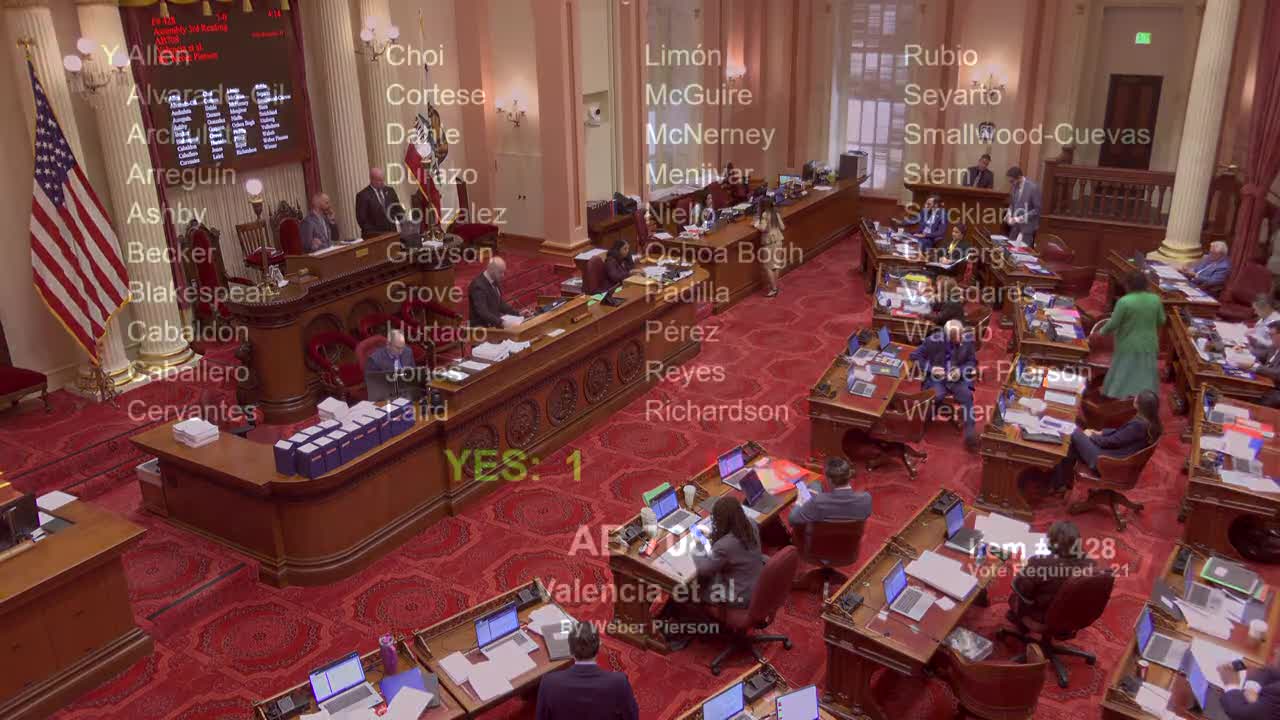 2MIN
Senate Floor
 3MIN
Senate Standing Committee on Judiciary
 16MIN
Senate Standing Committee on Banking and Financial Institutions
 2MIN
Assembly Floor
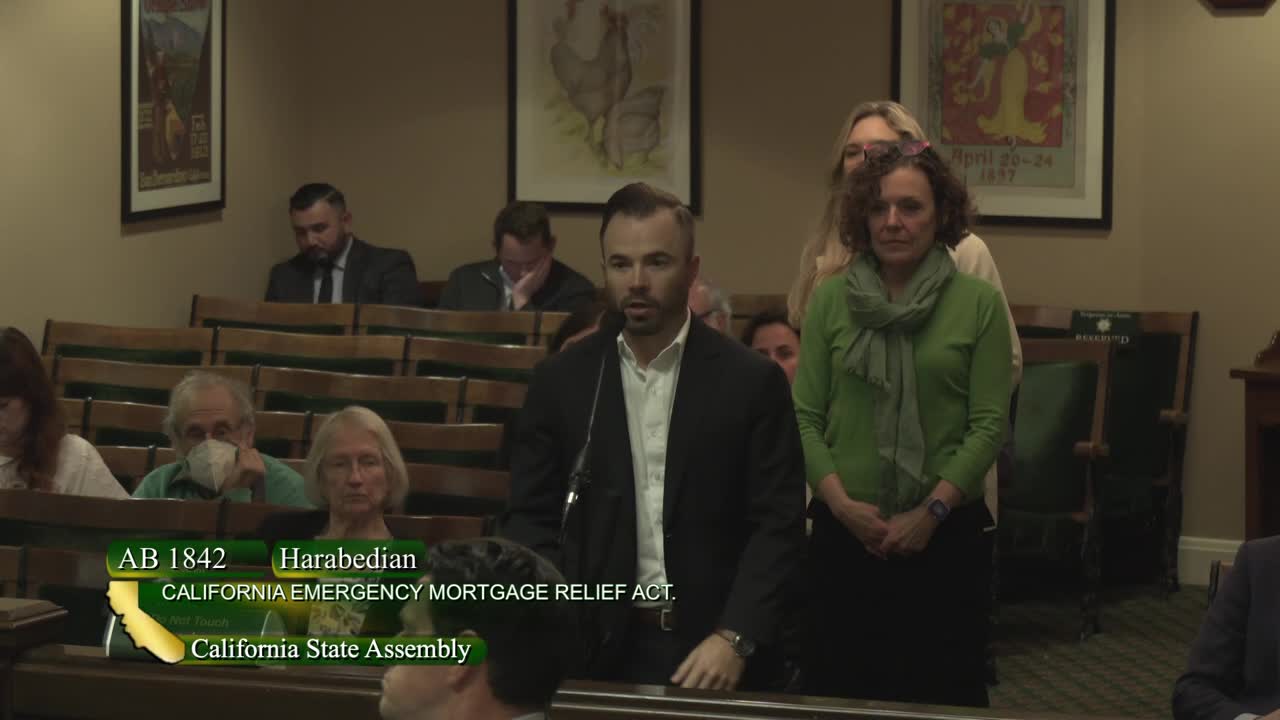 7MIN
Assembly Standing Committee on Judiciary
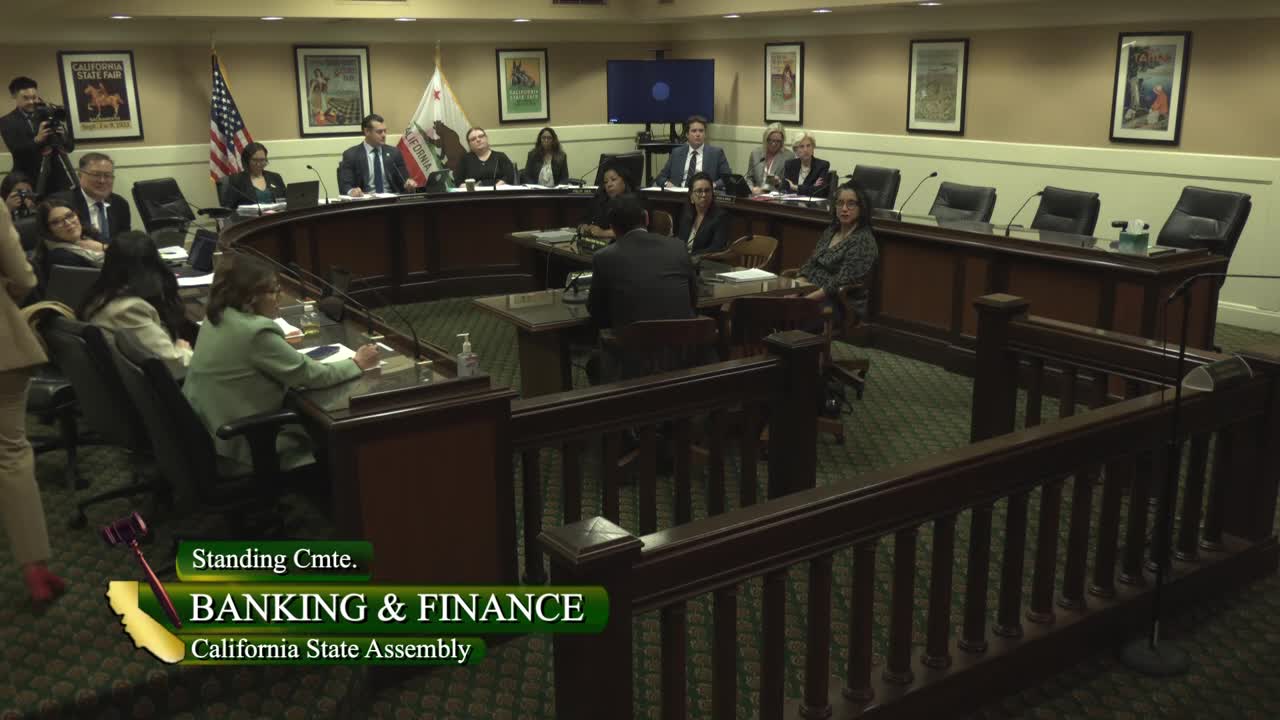 56MIN
Assembly Standing Committee on Banking and Finance
Bill Author