AB 1856: Age verification signals: software applications.
- Session Year: 2025-2026
- House: Assembly
- Latest Version Date: 2026-09-10
Current Status:
Passed
(2026-09-10: Chaptered by Secretary of State - Chapter 184, Statutes of 2026.)
Introduced
In Committee
Awaiting First Chamber Vote
Passed First Chamber
In Committee
Awaiting Second Chamber Vote
Passed Second Chamber
Enacted
Existing law, the Digital Age Assurance Act (DAAA), beginning January 1, 2027, requires, among other things related to age verification with respect to software applications, an operating system provider, as defined, to provide an accessible interface at account setup that requires an account holder, as defined, to indicate the birth date, age, or both, of the user of that device for the purpose of providing a signal regarding the users age bracket to applications available in a covered application store. Existing law defines the term user for these purposes to mean a child that is the primary user of a device.
This bill would, among other things, delete that definition of user, would specify that the requirement of an operating system provider to provide an accessible interface applies if an operating system operates on a device and has an account setup feature, and would require the signal to be provided to a covered application store or application developer, as prescribed. The bill would prohibit a person from requesting a signal with respect to a particular user from an operating system provider or a covered application store if not required to do so by the DAAA or any other applicable law.
Existing law, the Digital Age Assurance Act (DAAA), beginning January 1, 2027, requires, among other things related to age verification with respect to software applications, an operating system provider, as defined, to provide an accessible interface at account setup that requires an account holder, as defined, to indicate the birth date, age, or both, of the user of that device for the purpose of providing a signal regarding the users age bracket to applications available in a covered application store. Existing law defines the term user for these purposes to mean a child that is the primary user of a device.
This bill would, among other things, delete that definition of user, would specify that the requirement of an operating system provider to provide an accessible interface applies if the an operating system providers operating system operates on a device and has an account setup feature with respect to the use of the operating system on a particular device, feature, and would require the signal to be provided to a covered application store or application developer, as prescribed. The bill would prohibit a person from requesting a signal with respect to a particular user from an operating system provider or a covered application store if not required to do so by the DAAA or any other applicable law.
Existing law, the Digital Age Assurance Act, Act (DAAA), beginning January 1, 2027, requires, among other things related to age verification with respect to software applications, an operating system provider, as defined, to provide an accessible interface at account setup that requires an account holder, as defined, to indicate the birth date, age, or both, of the user of that device for the purpose of providing a signal regarding the users age bracket to applications available in a covered application store. Existing law defines the term user for these purposes to mean a child that is the primary user of a device.
This bill would, among other things, delete that definition of user and user, would specify that the requirement of an operating system provider to provide an accessible interface applies if the operating system providers operating system has an account setup feature with respect to the use of the operating system on a particular device device, and would require the signal to be provided to a covered application store, application developer, browser provider, or an internet website operator, store or application developer, as prescribed. The bill would prohibit a person from requesting a signal with respect to a particular user from an operating system provider or a covered application store if not required to do so by the DAAA or any other applicable law.
Existing law deems a developer that receives a signal pursuant to these provisions to have actual knowledge of the age range of the user to whom that signal pertains across all platforms of the application and points of access of the application even if the developer willfully disregards the signal. This bill would recast those provisions to instead deem a developer or internet website operator that receives a signal to have actual knowledge of the age range of the user to whom that signal pertains when the user accesses the application from a specified device and would delete the provision that deems the developer to have actual knowledge across all platforms of the application and points of access of the application.Existing law, the Digital Age Assurance Act, beginning January 1, 2027, requires, among other things related to age verification with respect to software applications, an operating system provider, as defined, to provide an accessible interface at account setup that requires an account holder, as defined, to indicate the birth date, age, or both, of the user of that device for the purpose of providing a signal regarding the users age bracket to applications available in a covered application store. Existing law defines the term user for these purposes to mean a child that is the primary user of a device.
This bill would, among other things, delete that definition of user and would specify that the requirement of an operating system provider to provide an accessible interface applies if the operating system providers operating system has an account setup feature with respect to the use of the operating system on a particular device and would require the signal to be provided to a covered application store, application developer, browser provider, or an internet website operator, as prescribed.
Existing law deems a developer that receives a signal pursuant to these provisions to have actual knowledge of the age range of the user to whom that signal pertains across all platforms of the application and points of access of the application even if the developer willfully disregards the signal.
This bill would recast those provisions to instead deem a developer or internet website operator that receives a signal to have actual knowledge of the age range of the user to whom that signal pertains when the user accesses the application from a specified device and would delete the provision that deems the developer to have actual knowledge across all platforms of the application and points of access of the application.
Existing law, the Digital Age Assurance Act, beginning January 1, 2027, requires, among other things related to age verification with respect to software applications, an operating system provider, as defined, to provide an accessible interface at account setup that requires an account holder, as defined, to indicate the birth date, age, or both, of the user of that device for the purpose of providing a signal regarding the users age bracket to applications available in a covered application store. Existing law defines the term user for these purposes to mean a child that is the primary user of a device.
This bill would, among other things, delete that definition of user and would specify that the requirement of an operating system provider to provide an accessible interface applies if the operating system providers operating system has an account setup feature with respect to the use of the operating system on a particular device. device and would require the signal to be provided to a covered application store, application developer, browser provider, or an internet website operator, as prescribed.
Existing law deems a developer that receives a signal pursuant to these provisions to have actual knowledge of the age range of the user to whom that signal pertains across all platforms of the application and points of access of the application even if the developer willfully disregards the signal.
This bill would recast those provisions to instead deem a developer or internet website operator that receives a signal to have actual knowledge of the age range of the user to whom that signal pertains when the user accesses the application from a specified device and would delete the provision that deems the developer to have actual knowledge across all platforms of the application and points of access of the application. The bill would define application for these purposes to also include, with certain exceptions, an online service, product, or feature.
Existing law, the Digital Age Assurance Act, beginning January 1, 2027, requires, among other things related to age verification with respect to software applications, an operating system provider, as defined, to provide an accessible interface at account setup that requires an account holder, as defined, to indicate the birth date, age, or both, of the user of that device for the purpose of providing a signal regarding the users age bracket to applications available in a covered application store. Existing law defines the term user for these purposes to mean a child that is the primary user of a device.
This bill would would, among other things, delete that definition of user and would specify that the requirement of an operating system provider to provide an accessible interface applies if the operating system providers operating system has an account setup feature with respect to the use of the operating system on a particular device. The bill would also make conforming changes.
Existing law deems a developer that receives a signal pursuant to these provisions to have actual knowledge of the age range of the user to whom that signal pertains across all platforms of the application and points of access of the application even if the developer willfully disregards the signal.
This bill would recast those provisions to instead deem a developer that receives a signal to have actual knowledge of the age range of the user to whom that signal pertains when the user accesses the application from a specified device and would delete the provision that deems the developer to have actual knowledge across all platforms of the application and points of access of the application. The bill would define application for these purposes to also include, with certain exceptions, an online service, product, or feature.
Existing law, the Digital Age Assurance Act, beginning January 1, 2027, requires, among other things related to age verification with respect to software applications, an operating system provider, as defined, to provide an accessible interface at account setup that requires an account holder, as defined, to indicate the birth date, age, or both, of the user of that device for the purpose of providing a signal regarding the users age bracket to applications available in a covered application store. Existing law defines the term user for these purposes to mean a child that is the primary user of a device.
This bill would make nonsubstantive changes to that provision. delete that definition of user and would specify that the requirement of an operating system provider to provide an accessible interface applies if the operating system providers operating system has an account setup feature with respect to the use of the operating system on a particular device. The bill would also make conforming changes.
Existing law, beginning January 1, 2027, requires, among other things related to age verification with respect to software applications, an operating system provider, as defined, to provide an accessible interface at account setup that requires an account holder, as defined, to indicate the birth date, age, or both, of the user of that device for the purpose of providing a signal regarding the users age bracket to applications available in a covered application store.
This bill would make nonsubstantive changes to that provision.
For the purposes of this title:
(a)(1)Account holder means an individual who is at least 18 years of age or a parent or legal guardian of a user who is under 18 years of age in the state.
(2)Account holder does not include a parent of an emancipated minor or a parent or legal guardian who is not associated with a users device.
(b)Age bracket data means nonpersonally identifiable data derived from a users birth date or age for the purpose of sharing with developers of applications that indicates the users age range, including, at a minimum, the following:
(1)Whether a user is under 13 years of age.
(2)Whether the user is at least 13 years of age and under 16 years of age.
(3)Whether the user is at least 16 years of age and under 18 years of age.
(4)Whether the user is at least 18 years of age.
(c)(1)Application means a software application that may be run or directed by a user on a computer, a mobile device, or any other general-purpose computing device that can access a covered application store or download an application.
(2)Application does not include software components that are not themselves offered to consumers as a stand-alone executable application through a covered application store.
(d)Child means a natural person who is under 18 years of age.
(e)(1)Covered application store means a publicly available internet website, software application, online service, or platform that distributes and facilitates the download of applications from third-party developers to users of a computer, a mobile device, or any other general-purpose computing that can access a covered application store or can download an application.
(2)Covered application store does not mean an online service or platform that distributes extensions, plug-ins, add-ons, or other software applications that run exclusively within a separate host application.
(f)Developer means a person that owns an application, or maintains or controls the hosting of the application, in a covered application store.
(g)(1)Operating system provider means a person or entity that develops, licenses, or controls the operating system software on a computer, mobile device, or any other general-purpose computing device.
(2)Operating system provider does not mean a person or entity that distributes an operating system or application under license terms that permit a recipient to copy, redistribute, and modify the software.
(h)Signal means age bracket data that pertains to the primary user of a device that is sent by a real-time secure application programming interface or operating system to an application.
SEC. 2.Section 1798.501 of the Civil Code is amended to read:1798.501.(a)If an operating system operates on a device and has an account setup feature, the operating system provider shall do all of the following:
(1)Provide an accessible interface, at account setup, that requires an account holder to indicate the birth date, age, or both, of the primary user of that device for the purpose of providing a signal regarding the primary users age bracket to all of the following:
(A)A covered application store.
(B)A developer.
(2)Provide a developer or covered application store who has requested a signal with respect to a particular user with a digital signal via a reasonably consistent real-time application programming interface that identifies, at a minimum, which of the following categories pertains to the user:
(A)Under 13 years of age.
(B)At least 13 years of age and under 16 years of age.
(C)At least 16 years of age and under 18 years of age.
(D)At least 18 years of age.
(3)Send only the minimum amount of information necessary to comply with this title.
(b)An operating system provider shall not share the digital signal information with a third party for a purpose not required by this title.
(c)A covered application store shall do both of the following with respect to a user of the covered application store:
(1)Request a signal from the users operating system provider.
(2)Provide the signal received pursuant to paragraph (1) to a developer upon request.
(d)(1)(A)A developer shall request a signal with respect to a particular user from an operating system provider or a covered application store when the application is downloaded onto, and launched from, a particular device.
(B)An entity subject to this title shall not prompt the user to change the users age information.
(2)(A)Subject to subparagraph (B) or paragraph (3), a developer that receives a signal pursuant to this title shall be deemed to have actual knowledge of the age range of the user to whom that signal pertains across both of the following even if the developer willfully disregards the signal:
(i)Any platform of an application, including an internet website owned, maintained, or controlled by a developer, through which the user may create an account for the platform accessed by that same application.
(ii)Any point of access of the application, including an internet website owned, maintained, or controlled by a developer and accessed by a user to create an account or log into an account from the device referenced in paragraph (1).
(B)A developer shall not willfully disregard internal clear and convincing information otherwise available to the developer that indicates that a users age is different than the age bracket data indicated by a signal provided by an operating system provider or covered application store.
(3)(A)Except as provided in subparagraph (B), a developer shall treat a signal received pursuant to this title as the primary indicator of a users age range for purposes of determining the users age.
(B)(i)If a developer has internal clear and convincing information that a users age is different than the age indicated by a signal received pursuant to this title, the developer shall use that information as the primary indicator of the users age and shall be deemed to have actual knowledge of the age range of the user to whom that information pertains.
(ii)As used in this subparagraph, clear and convincing information includes, but is not limited to, age information shared with a developer or by an account holder regarding the age of a user of a subaccount of the primary account of the account holder or age information shared with a developer by an account holder regarding the age of a user associated with the account or account settings established by the primary account holder.
(4)A developer that receives a signal pursuant to this title shall use that signal to comply with applicable law but shall not do any of the following:
(A)Request more information from an operating system provider or covered application store than the minimum amount of information necessary to comply with this title.
(B)Share the signal with a third party for a purpose not required by this title.
(e)A person shall not request a signal with respect to a particular user from an operating system provider or a covered application store if not required to do so by this title or any other applicable law.
SEC. 3.Section 1798.502 of the Civil Code is amended to read:1798.502.(a)With respect to a device for which account setup was completed before January 1, 2027, an operating system provider shall, before July 1, 2027, provide an accessible interface that allows an account holder to indicate the birth date, age, or both, of the primary user of that device for the purpose of providing a signal regarding the primary users age bracket to applications available in a covered application store.
(b)If an application last updated with updates on or after January 1, 2026, was downloaded to a device before January 1, 2027, and a developer has not requested a signal with respect to the user of the device on which the application was downloaded, the developer shall request a signal from a covered application store or an operating system provider with respect to that user before July 1, 2027.
SEC. 4.Section 1798.503 of the Civil Code is amended to read:1798.503.(a)A person that violates this title shall be subject to an injunction and liable for a civil penalty of not more than two thousand five hundred dollars ($2,500) per affected child for each negligent violation or not more than seven thousand five hundred dollars ($7,500) per affected child for each intentional violation, which shall be assessed and recovered only in a civil action brought in the name of the people of the State of California by the Attorney General.
(b)An operating system or covered application store that makes a good faith effort to comply with this title, taking into consideration available technology and any reasonable technical limitations or outages, shall not be liable for an erroneous signal indicating a users age range or any conduct by a developer that receives a signal indicating a users age range.
(c)A developer that makes a good faith effort to comply with this title, taking into consideration available technology and any reasonable technical limitations or outages, shall not be liable for an erroneous signal indicating a users age range or any conduct by an operating system that sent a signal indicating a users age range.
SEC. 5.Section 1798.504 of the Civil Code is amended to read:1798.504.(a)This title does not modify, impair, or supersede the operation of any antitrust law.
(b)This title does not require the collection of additional personal information from device owners or device users other than that which is necessary to comply with Section 1798.501.
(c)An operating system provider or a covered application store shall comply with this title in a nondiscriminatory manner, including, but not limited to, by complying with both of the following:
(1)An operating system provider or a covered application store shall impose at least the same restrictions and obligations on its own applications and application distribution as it does on those from third-party applications or application distributors.
(2)An operating system provider or a covered application store shall not use data collected from a third party in the course of compliance with this title to compete against that third party, give the covered application stores services preference relative to those of a third party, or to otherwise use this data or consent mechanism in an anticompetitive manner.
(d)The protections provided by this title are in addition to those provided by any other applicable law, including, but not limited to, the California Age-Appropriate Design Code Act (Title 1.81.47 (commencing with Section 1798.99.28)).
(e)If any provision of this title, or application thereof, to any person or circumstance is held invalid, that invalidity shall not affect other provisions or applications of this title that can be given effect without the invalid provision or application, and to this end the provisions of this title are declared to be severable.
(f)This title does not apply to any of the following:
(1)A broadband internet access service, as defined in Section 3100.
(2)A telecommunications service, as defined in Section 153 of Title 47 of the United States Code.
(3)The delivery or use of a physical product.
(g)This title does not impose liability that arises from the use of a shared device or application by a person who is not the user to whom a signal pertains.
(h)This title does not require a developer that is in compliance with this title to request an age signal at every account log in after the initial creation of an account.
(i)This title does not prohibit a developer from periodically requesting an age signal to maintain compliance with this title after download and launch of an application.
For the purposes of this title:
(a)(1)Account holder means an individual who is at least 18 years of age or a parent or legal guardian of a user who is under 18 years of age in the state.
(2)Account holder does not include a parent of an emancipated minor or a parent or legal guardian who is not associated with a users device.
(b)Age bracket data means nonpersonally identifiable data derived from a users birth date or age for the purpose of sharing with developers of applications that indicates the users age range, including, at a minimum, the following:
(1)Whether a user is under 13 years of age.
(2)Whether the user is at least 13 years of age and under 16 years of age.
(3)Whether the user is at least 16 years of age and under 18 years of age.
(4)Whether the user is at least 18 years of age.
(c)(1)Application means a software application that may be run or directed by a user on a computer, a mobile device, or any other general-purpose computing device that can access a covered application store or download an application.
(2)Application does not include software components that are not themselves offered to consumers as a stand-alone executable application through a covered application store.
(d)Child means a natural person who is under 18 years of age.
(e)(1)Covered application store means a publicly available internet website, software application, online service, or platform that distributes and facilitates the download of applications from third-party developers to users of a computer, a mobile device, or any other general-purpose computing that can access a covered application store or can download an application.
(2)Covered application store does not mean an online service or platform that distributes extensions, plug-ins, add-ons, or other software applications that run exclusively within a separate host application.
(f)Developer means a person that owns an application, or maintains or controls the hosting of the application, in a covered application store.
(g)(1)Operating system provider means a person or entity that develops, licenses, or controls the operating system software on a computer, mobile device, or any other general-purpose computing device.
(2)Operating system provider does not mean a person or entity that distributes an operating system or application under license terms that permit a recipient to copy, redistribute, and modify the software.
(h)Signal means age bracket data that pertains to the primary user of a device that is sent by a real-time secure application programming interface or operating system to an application.
SEC. 2.Section 1798.501 of the Civil Code is amended to read:1798.501.(a)If an operating system providers operating system operates on a device and has an account setup feature with respect to the use of the operating system on a particular device, an feature, the operating system provider shall do all of the following:
(1)Provide an accessible interface, at account setup, that requires an account holder to indicate the birth date, age, or both, of the primary user of that device for the purpose of providing a signal regarding the primary users age bracket to all of the following:
(A)A covered application store.
(B)A developer.
(2)Provide a developer or covered application store who has requested a signal with respect to a particular user with a digital signal via a reasonably consistent real-time application programming interface that identifies, at a minimum, which of the following categories pertains to the user:
(A)Under 13 years of age.
(B)At least 13 years of age and under 16 years of age.
(C)At least 16 years of age and under 18 years of age.
(D)At least 18 years of age.
(3)Send only the minimum amount of information necessary to comply with this title.
(b)An operating system provider shall not share the digital signal information with a third party for a purpose not required by this title.
(c)A covered application store shall do both of the following with respect to a user of the covered application store:
(1)Request a signal from the users operating system provider.
(2)Provide the signal received pursuant to paragraph (1) to a developer upon request.
(d)(1)(A)A developer shall request a signal with respect to a particular user from an operating system provider or a covered application store when the application is downloaded onto, and launched from, a particular device.
(B)An entity subject to this title shall not prompt the user to change the users age information.
(2)(A)Subject to subparagraph (B) or paragraph (3), a developer that receives a signal pursuant to this title shall be deemed to have actual knowledge of the age range of the user to whom that signal pertains across all platforms of an application, including an internet website owned, maintained, or controlled by a developer, and points of access of the application, including an internet website owned, maintained, or controlled by a developer and accessed by a user to create an account or log into an account, from the device referenced in paragraph (1) even if the developer willfully disregards the signal. both of the following even if the developer willfully disregards the signal:
(i)Any platform of an application, including an internet website owned, maintained, or controlled by a developer, through which the user may create an account for the platform accessed by that same application.
(ii)Any point of access of the application, including an internet website owned, maintained, or controlled by a developer and accessed by a user to create an account or log into an account from the device referenced in paragraph (1).
(B)A developer shall not willfully disregard internal clear and convincing information otherwise available to the developer that indicates that a users age is different than the age bracket data indicated by a signal provided by an operating system provider or covered application store.
(3)(A)Except as provided in subparagraph (B), a developer shall treat a signal received pursuant to this title as the primary indicator of a users age range for purposes of determining the users age.
(B)(i)If a developer has internal clear and convincing information that a users age is different than the age indicated by a signal received pursuant to this title, the developer shall use that information as the primary indicator of the users age and shall be deemed to have actual knowledge of the age range of the user to whom that information pertains.
(ii)As used in this subparagraph, clear and convincing information includes, but is not limited to, age information shared with a developer or by an account holder regarding the age of a user of a subaccount of the primary account of the account holder or age information shared with a developer by an account holder regarding the age of a user associated with the account. account or account settings established by the primary account holder.
(4)A developer that receives a signal pursuant to this title shall use that signal to comply with applicable law but shall not do any of the following:
(A)Request more information from an operating system provider or covered application store than the minimum amount of information necessary to comply with this title.
(B)Share the signal with a third party for a purpose not required by this title.
(e)A person shall not request a signal with respect to a particular user from an operating system provider or a covered application store if not required to do so by this title or any other applicable law.
SEC. 3.Section 1798.502 of the Civil Code is amended to read:1798.502.(a)With respect to a device for which account setup was completed before January 1, 2027, an operating system provider shall, before July 1, 2027, provide an accessible interface that allows an account holder to indicate the birth date, age, or both, of the primary user of that device for the purpose of providing a signal regarding the primary users age bracket to applications available in a covered application store.
(b)If an application last updated with updates on or after January 1, 2026, was downloaded to a device before January 1, 2027, and a developer has not requested a signal with respect to the user of the device on which the application was downloaded, the developer shall request a signal from a covered application store or an operating system provider with respect to that user before July 1, 2027.
SEC. 4.Section 1798.503 of the Civil Code is amended to read:1798.503.(a)A person that violates this title shall be subject to an injunction and liable for a civil penalty of not more than two thousand five hundred dollars ($2,500) per affected child for each negligent violation or not more than seven thousand five hundred dollars ($7,500) per affected child for each intentional violation, which shall be assessed and recovered only in a civil action brought in the name of the people of the State of California by the Attorney General.
(b)An operating system or covered application store that makes a good faith effort to comply with this title, taking into consideration available technology and any reasonable technical limitations or outages, shall not be liable for an erroneous signal indicating a users age range or any conduct by a developer that receives a signal indicating a users age range.
(c)A developer that makes a good faith effort to comply with this title, taking into consideration available technology and any reasonable technical limitations or outages, shall not be liable for an erroneous signal indicating a users age range or any conduct by an operating system that sent a signal indicating a users age range.
SEC. 5.Section 1798.504 of the Civil Code is amended to read:1798.504.(a)This title does not modify, impair, or supersede the operation of any antitrust law.
(b)This title does not require the collection of additional personal information from device owners or device users other than that which is necessary to comply with Section 1798.501.
(c)An operating system provider or a covered application store shall comply with this title in a nondiscriminatory manner, including, but not limited to, by complying with both of the following:
(1)An operating system provider or a covered application store shall impose at least the same restrictions and obligations on its own applications and application distribution as it does on those from third-party applications or application distributors.
(2)An operating system provider or a covered application store shall not use data collected from a third party in the course of compliance with this title to compete against that third party, give the covered application stores services preference relative to those of a third party, or to otherwise use this data or consent mechanism in an anticompetitive manner.
(d)The protections provided by this title are in addition to those provided by any other applicable law, including, but not limited to, the California Age-Appropriate Design Code Act (Title 1.81.47 (commencing with Section 1798.99.28)).
(e)If any provision of this title, or application thereof, to any person or circumstance is held invalid, that invalidity shall not affect other provisions or applications of this title that can be given effect without the invalid provision or application, and to this end the provisions of this title are declared to be severable.
(f)This title does not apply to any of the following:
(1)A broadband internet access service, as defined in Section 3100.
(2)A telecommunications service, as defined in Section 153 of Title 47 of the United States Code.
(3)The delivery or use of a physical product.
(g)This title does not impose liability that arises from the use of a shared device or application by a person who is not the user to whom a signal pertains.
(h)This title does not require a developer that is in compliance with this title to request an age signal at every account log in after the initial creation of an account.
(i)This title does not prohibit a developer from periodically requesting an age signal to maintain compliance with this title after download and launch of an application.
For the purposes of this title:
(a)(1)Account holder means an individual who is at least 18 years of age or a parent or legal guardian of a user who is under 18 years of age in the state.
(2)Account holder does not include a parent of an emancipated minor or a parent or legal guardian who is not associated with a users device.
(b)Age bracket data means nonpersonally identifiable data derived from a users birth date or age for the purpose of sharing with developers of applications that indicates the users age range, including, at a minimum, the following:
(1)Whether a user is under 13 years of age.
(2)Whether the user is at least 13 years of age and under 16 years of age.
(3)Whether the user is at least 16 years of age and under 18 years of age.
(4)Whether the user is at least 18 years of age.
(c)(1)Application means a software application that may be run or directed by a user on a computer, a mobile device, or any other general purpose general-purpose computing device that can access a covered application store or download an application.
(2)Application does not include software components that are not themselves offered to consumers as a stand-alone executable application through a covered application store.
(d)Browser means an application that enables a user to visit an internet website.(e)Browser provider means a person or entity that controls or operates a browser for use on a computer, mobile device, or any other general purpose computing device.(f)(d)Child means a natural person who is under 18 years of age.
(g)(e)(1)Covered application store means a publicly available internet website, software application, online service, or platform that distributes and facilitates the download of applications from third-party developers to users of a computer, a mobile device, or any other general purpose general-purpose computing that can access a covered application store or can download an application.
(2)Covered application store does not mean an online service or platform that distributes extensions, plug-ins, add-ons, or other software applications that run exclusively within a separate host application.
(h)(f)Developer means a person that owns an application, or maintains or controls the hosting of the application, in a covered application store.
(i)Internet website operator means a person that owns, maintains, or controls an internet website that is subject to a law that requires the internet website operator to verify the age of users.(j)(g)(1)Operating system provider means a person or entity that develops, licenses, or controls the operating system software on a computer, mobile device, or any other general purpose general-purpose computing device.
(2)Operating system provider does not mean a person or entity that distributes an operating system or application under license terms that permit a recipient to copy, redistribute, and modify the software.
(k)(h)Signal means age bracket data that pertains to the primary user of a device that is either of the following: sent by a real-time secure application programming interface or operating system to an application.
(1)Sent by a real-time secure application programming interface or operating system to an application.(2)Communicated by a browser provider to an internet website operator in any technically feasible manner.SEC. 2.Section 1798.501 of the Civil Code is amended to read:1798.501.(a)If an operating system providers operating system has an account setup feature with respect to the use of the operating system on a particular device, an operating system provider shall do all of the following:
(1)Provide an accessible interface, at account setup, that requires an account holder to indicate the birth date, age, or both, of the primary user of that device for the purpose of providing a signal regarding the primary users age bracket to all of the following:
(A)A covered application store.
(B)A developer.
(C)A browser provider.(D)An internet website operator.(2)Provide a developer, developer or covered application store, or browser provider store who has requested a signal with respect to a particular user with a digital signal via a reasonably consistent real-time application programming interface that identifies, at a minimum, which of the following categories pertains to the user:
(A)Under 13 years of age.
(B)At least 13 years of age and under 16 years of age.
(C)At least 16 years of age and under 18 years of age.
(D)At least 18 years of age.
(3)Send only the minimum amount of information necessary to comply with this title.
(b)An operating system provider shall not share the digital signal information with a third party for a purpose not required by this title.
(c)(1)A covered application store shall do both of the following with respect to a user of the covered application store:
(A)(1)Request a signal from the users operating system provider.
(B)(2)Provide the signal received pursuant to subparagraph (A) paragraph (1) to a developer upon request.
(2)A browser provider shall do both of the following with respect to a user of the browser:(A)Request a signal from the users operating system provider.(B)Provide the signal received pursuant to subparagraph (A) to an internet website operator upon request.(d)(1)(A)A developer shall request a signal with respect to a particular user from an operating system provider or a covered application store when the application is downloaded onto, and launched from, a particular device.
(B)An internet website operator shall request a signal with respect to a particular user from the users browser provider when the user accesses the internet website.(C)(B)An entity subject to this title shall not prompt the user to change the users age information.
(2)(A)Subject to subparagraph (B) or paragraph (3), a developer or internet website operator that receives a signal pursuant to this title shall be deemed to have actual knowledge of the age range of the user to whom that signal pertains when the user accesses the application or internet website from the device referenced in paragraph (1) even if the developer or internet website operator willfully disregards the signal. across all platforms of an application, including an internet website owned, maintained, or controlled by a developer, and points of access of the application, including an internet website owned, maintained, or controlled by a developer and accessed by a user to create an account or log into an account, from the device referenced in paragraph (1) even if the developer willfully disregards the signal.
(B)A developer or internet website operator shall not willfully disregard internal clear and convincing information otherwise available to the developer or internet website operator that indicates that a users age is different than the age bracket data indicated by a signal provided by an operating system provider, browser provider, provider or covered application store.
(3)(A)Except as provided in subparagraph (B), a developer or internet website operator shall treat a signal received pursuant to this title as the primary indicator of a users age range for purposes of determining the users age.
(B)(i)If a developer or internet website operator has internal clear and convincing information that a users age is different than the age indicated by a signal received pursuant to this title, the developer or internet website provider shall use that information as the primary indicator of the users age and shall be deemed to have actual knowledge of the age range of the user to whom that information pertains.
(ii)As used in this subparagraph, clear and convincing information includes, but is not limited to, age information shared with a developer or internet website operator by an account holder regarding the age of a user of a subaccount of the primary account of the account holder or age information shared with a developer by an account holder regarding the age of a user associated with the account.
(4)A developer or internet website operator that receives a signal pursuant to this title shall use that signal to comply with applicable law but shall not do either any of the following:
(A)Request more information from an operating system provider, internet website operator, provider or covered application store than the minimum amount of information necessary to comply with this title.
(B)Share the signal with a third party for a purpose not required by this title.
(e)A person shall not request a signal with respect to a particular user from an operating system provider or a covered application store if not required to do so by this title or any other applicable law.
SEC. 3.Section 1798.502 of the Civil Code is amended to read:1798.502.(a)With respect to a device for which account setup was completed before January 1, 2027, an operating system provider shall, before July 1, 2027, provide an accessible interface that allows an account holder to indicate the birth date, age, or both, of the primary user of that device for the purpose of providing a signal regarding the primary users age bracket to applications available in a covered application store.
(b)If an application last updated with updates on or after January 1, 2026, was downloaded to a device before January 1, 2027, and a developer has not requested a signal with respect to the user of the device on which the application was downloaded, the developer shall request a signal from a covered application store or an operating system provider with respect to that user before July 1, 2027.
SEC. 4.Section 1798.503 of the Civil Code is amended to read:1798.503.(a)A person that violates this title shall be subject to an injunction and liable for a civil penalty of not more than two thousand five hundred dollars ($2,500) per affected child for each negligent violation or not more than seven thousand five hundred dollars ($7,500) per affected child for each intentional violation, which shall be assessed and recovered only in a civil action brought in the name of the people of the State of California by the Attorney General.
(b)An operating system provider, browser provider, or covered application store that makes a good faith effort to comply with this title, taking into consideration available technology and any reasonable technical limitations or outages, shall not be liable for an erroneous signal indicating a users age range or any conduct by a developer or internet website operator that receives a signal indicating a users age range.
SEC. 5.Section 1798.504 of the Civil Code is amended to read:1798.504.(a)This title does not modify, impair, or supersede the operation of any antitrust law.
(b)This title does not require the collection of additional personal information from device owners or device users other than that which is necessary to comply with Section 1798.501.
(c)An operating system provider or a covered application store shall comply with this title in a nondiscriminatory manner, including, but not limited to, by complying with both of the following:
(1)An operating system provider or a covered application store shall impose at least the same restrictions and obligations on its own applications and application distribution as it does on those from third-party applications or application distributors.
(2)An operating system provider or a covered application store shall not use data collected from a third party in the course of compliance with this title to compete against that third party, give the covered application stores services preference relative to those of a third party, or to otherwise use this data or consent mechanism in an anticompetitive manner.
(d)The protections provided by this title are in addition to those provided by any other applicable law, including, but not limited to, the California Age-Appropriate Design Code Act (Title 1.81.47 (commencing with Section 1798.99.28)).
(e)If any provision of this title, or application thereof, to any person or circumstance is held invalid, that invalidity shall not affect other provisions or applications of this title that can be given effect without the invalid provision or application, and to this end the provisions of this title are declared to be severable.
(f)This title does not apply to any of the following:
(1)A broadband internet access service, as defined in Section 3100.
(2)A telecommunications service, as defined in Section 153 of Title 47 of the United States Code.
(3)The delivery or use of a physical product.
(g)This title does not impose liability that arises from the use of a shared device or application by a person who is not the user to whom a signal pertains.
For the purposes of this title:
(a)(1)Account holder means an individual who is at least 18 years of age or a parent or legal guardian of a user who is under 18 years of age in the state.
(2)Account holder does not include a parent of an emancipated minor or a parent or legal guardian who is not associated with a users device.
(b)Age bracket data means nonpersonally identifiable data derived from a users birth date or age for the purpose of sharing with developers of applications that indicates the users age range, including, at a minimum, the following:
(1)Whether a user is under 13 years of age.
(2)Whether the user is at least 13 years of age and under 16 years of age.
(3)Whether the user is at least 16 years of age and under 18 years of age.
(4)Whether the user is at least 18 years of age.
(c)(1)Application means a software application that may be run or directed by a user on a computer, a mobile device, or any other general purpose computing device that can access a covered application store or download an application.
(2)Application does not include software components that are not themselves offered to consumers as a stand-alone executable application through a covered application store.
(d)Browser means an application that enables a user to visit an internet website.
(e)Browser provider means a person or entity that controls or operates a browser for use on a computer, mobile device, or any other general purpose computing device.
(f)Child means a natural person who is under 18 years of age.
(g)(1)Covered application store means a publicly available internet website, software application, online service, or platform that distributes and facilitates the download of applications from third-party developers to users of a computer, a mobile device, or any other general purpose computing that can access a covered application store or can download an application.
(2)Covered application store does not mean an online service or platform that distributes extensions, plug-ins, add-ons, or other software applications that run exclusively within a separate host application.
(h)Developer means a person that owns, maintains, or controls an application. owns an application, or maintains or controls the hosting of the application, in a covered application store.
(i)Internet website operator means a person that owns, maintains, or controls an internet website that is subject to a law that requires the internet website operator to verify the age of users.
(j)(1)Operating system provider means a person or entity that develops, licenses, or controls the operating system software on a computer, mobile device, or any other general purpose computing device.
(2)Operating system provider does not mean a person or entity that distributes an operating system or application under license terms that permit a recipient to copy, redistribute, and modify the software.
(k)Signal means age bracket data that pertains to the primary user of a device that is either of the following:
(1)Sent by a real-time secure application programming interface or operating system to an application.
(2)Communicated by a browser provider to an internet website operator in any technically feasible manner.
SEC. 2.Section 1798.501 of the Civil Code is amended to read:1798.501.(a)If an operating system providers operating system has an account setup feature with respect to the use of the operating system on a particular device, an operating system provider shall do all of the following:
(1)Provide an accessible interface, at account setup, that requires an account holder to indicate the birth date, age, or both, of the primary user of that device for the purpose of providing a signal regarding the primary users age bracket to all of the following:
(A)A covered application store.
(B)A developer.
(C)A browser provider.
(D)An internet website operator.
(2)Provide a developer, covered application store, or browser provider who has requested a signal with respect to a particular user with a digital signal via a reasonably consistent real-time application programming interface that identifies, at a minimum, which of the following categories pertains to the user:
(A)Under 13 years of age.
(B)At least 13 years of age and under 16 years of age.
(C)At least 16 years of age and under 18 years of age.
(D)At least 18 years of age.
(3)Send only the minimum amount of information necessary to comply with this title.
(b)An operating system provider shall not share the digital signal information with a third party for a purpose not required by this title.
(c)(1)A covered application store shall do both of the following with respect to a user of the covered application store:
(A)Request a signal from the users operating system provider.
(B)Provide the signal received pursuant to subparagraph (A) to a developer upon request.
(2)A browser provider shall do both of the following with respect to a user of the browser:
(A)Request a signal from the users operating system provider.
(B)Provide the signal received pursuant to subparagraph (A) to an internet website operator upon request.
(d)(1)(A)A developer shall request a signal with respect to a particular user from an operating system provider or a covered application store when the application is downloaded onto, and launched from, a particular device.
(B)An internet website operator shall request a signal with respect to a particular user from the users browser provider when the user accesses the internet website.
(C)An entity subject to this title shall not prompt the user to change the users age information.
(2)(A)Subject to subparagraph (B) or paragraph (3), a developer or internet website operator that receives a signal pursuant to this title shall be deemed to have actual knowledge of the age range of the user to whom that signal pertains when the user accesses the application or internet website from the device referenced in paragraph (1) even if the developer or internet website operator willfully disregards the signal.
(B)A developer or internet website operator shall not willfully disregard internal clear and convincing information otherwise available to the developer or internet website operator that indicates that a users age is different than the age bracket data indicated by a signal provided by an operating system provider, browser provider, or covered application store.
(3)(A)Except as provided in subparagraph (B), a developer or internet website operator shall treat a signal received pursuant to this title as the primary indicator of a users age range for purposes of determining the users age.
(B)(i)If a developer or internet website operator has internal clear and convincing information that a users age is different than the age indicated by a signal received pursuant to this title, the developer or internet website provider shall use that information as the primary indicator of the users age and shall be deemed to have actual knowledge of the age range of the user to whom that information pertains.
(ii)As used in this subparagraph, clear and convincing information includes, but is not limited to, age information shared with a developer or internet website operator by an account holder regarding the age of a user of a subaccount of the primary account of the account holder. holder or age information shared with a developer by an account holder regarding the age of a user associated with the account.
(4)A developer or internet website operator that receives a signal pursuant to this title shall use that signal to comply with applicable law but shall not do either of the following:
(A)Request more information from an operating system provider, internet website operator, or covered application store than the minimum amount of information necessary to comply with this title.
(B)Share the signal with a third party for a purpose not required by this title.
SEC. 3.Section 1798.502 of the Civil Code is amended to read:1798.502.(a)With respect to a device for which account setup was completed before January 1, 2027, an operating system provider shall, before July 1, 2027, provide an accessible interface that allows an account holder to indicate the birth date, age, or both, of the primary user of that device for the purpose of providing a signal regarding the primary users age bracket to applications available in a covered application store.
(b)If an application last updated with updates on or after January 1, 2026, was downloaded to a device before January 1, 2027, and a developer has not requested a signal with respect to the user of the device on which the application was downloaded, the developer shall request a signal from a covered application store or an operating system provider with respect to that user before July 1, 2027.
SEC. 4.Section 1798.503 of the Civil Code is amended to read:1798.503.(a)A person that violates this title shall be subject to an injunction and liable for a civil penalty of not more than two thousand five hundred dollars ($2,500) per affected child for each negligent violation or not more than seven thousand five hundred dollars ($7,500) per affected child for each intentional violation, which shall be assessed and recovered only in a civil action brought in the name of the people of the State of California by the Attorney General.
(b)An operating system provider, browser provider, or covered application store that makes a good faith effort to comply with this title, taking into consideration available technology and any reasonable technical limitations or outages, shall not be liable for an erroneous signal indicating a users age range or any conduct by a developer or internet website operator that receives a signal indicating a users age range.
SEC. 5.Section 1798.504 of the Civil Code is amended to read:1798.504.(a)This title does not modify, impair, or supersede the operation of any antitrust law.
(b)This title does not require the collection of additional personal information from device owners or device users other than that which is necessary to comply with Section 1798.501.
(c)An operating system provider or a covered application store shall comply with this title in a nondiscriminatory manner, including, but not limited to, by complying with both of the following:
(1)An operating system provider or a covered application store shall impose at least the same restrictions and obligations on its own applications and application distribution as it does on those from third-party applications or application distributors.
(2)An operating system provider or a covered application store shall not use data collected from a third party in the course of compliance with this title to compete against that third party, give the covered application stores services preference relative to those of a third party, or to otherwise use this data or consent mechanism in an anticompetitive manner.
(d)The protections provided by this title are in addition to those provided by any other applicable law, including, but not limited to, the California Age-Appropriate Design Code Act (Title 1.81.47 (commencing with Section 1798.99.28)).
(e)If any provision of this title, or application thereof, to any person or circumstance is held invalid, that invalidity shall not affect other provisions or applications of this title that can be given effect without the invalid provision or application, and to this end the provisions of this title are declared to be severable.
(f)This title does not apply to any of the following:
(1)A broadband internet access service, as defined in Section 3100.
(2)A telecommunications service, as defined in Section 153 of Title 47 of the United States Code.
(3)The delivery or use of a physical product.
(g)This title does not impose liability that arises from the use of a shared device or application by a person who is not the user to whom a signal pertains.
For the purposes of this title:
(a)(1)Account holder means an individual who is at least 18 years of age or a parent or legal guardian of a user who is under 18 years of age in the state.
(2)Account holder does not include a parent of an emancipated minor or a parent or legal guardian who is not associated with a users device.
(b)Age bracket data means nonpersonally identifiable data derived from a users birth date or age for the purpose of sharing with developers of applications that indicates the users age range, including, at a minimum, the following:
(1)Whether a user is under 13 years of age.
(2)Whether the user is at least 13 years of age and under 16 years of age.
(3)Whether the user is at least 16 years of age and under 18 years of age.
(4)Whether the user is at least 18 years of age.
(c)Application means a software application or online service, product, or feature that may be run or directed by a user on a computer, a mobile device, or any other general purpose computing device that can access a covered application store or download an application.
(d)Browser means an application that enables a user to visit an internet website.
(e)Browser provider means a person or entity that controls or operates a browser for use on a computer, mobile device, or any other general purpose computing device.
(d)(f)Child means a natural person who is under 18 years of age.
(e)(g)(1)Covered application store means a publicly available internet website, software application, online service, or platform that distributes and facilitates the download of applications from third-party developers to users of a computer, a mobile device, or any other general purpose computing that can access a covered application store or can download an application.
(2)Covered application store does not mean an online service or platform that distributes extensions, plug-ins, add-ons, or other software applications that run exclusively within a separate host application.
(f)(h)Developer means a person that owns, maintains, or controls an application.
(g)Online service, product, or feature does not mean any of the following:(1)A broadband internet access service, as defined in Section 3100.(2)A telecommunications service, as defined in Section 153 of Title 47 of the United States Code.(3)The delivery or use of a physical product.(i)Internet website operator means a person that owns, maintains, or controls an internet website that is subject to a law that requires the internet website operator to verify the age of users.
(h)(j)Operating system provider means a person or entity that develops, licenses, or controls the operating system software on a computer, mobile device, or any other general purpose computing device.
(i)(k)Signal means age bracket data that pertains to the primary user of a device sent by a real-time secure application programming interface or operating system to an application. that is either of the following:
(1)Sent by a real-time secure application programming interface or operating system to an application.
(2)Communicated by a browser provider to an internet website operator in any technically feasible manner.
SEC. 2.Section 1798.501 of the Civil Code is amended to read:1798.501.(a)If an operating system providers operating system has an account setup feature with respect to the use of the operating system on a particular device, an operating system provider shall do all of the following:
(1)Provide an accessible interface, at account setup, that requires an account holder to indicate the birth date, age, or both, of the primary user of that device for the purpose of providing a signal regarding the primary users age bracket to applications available in a covered application store. all of the following:
(A)A covered application store.
(B)A developer.
(C)A browser provider.
(D)An internet website operator.
(2)Provide a developer developer, covered application store, or browser provider who has requested a signal with respect to a particular user with a digital signal via a reasonably consistent real-time application programming interface that identifies, at a minimum, which of the following categories pertains to the user:
(A)Under 13 years of age.
(B)At least 13 years of age and under 16 years of age.
(C)At least 16 years of age and under 18 years of age.
(D)At least 18 years of age.
(3)Send only the minimum amount of information necessary to comply with this title.
(b)An operating system provider shall not share the digital signal information with a third party for a purpose not required by this title.
(c)(1)A covered application store shall do both of the following with respect to a user of the covered application store:
(A)Request a signal from the users operating system provider.
(B)Provide the signal received pursuant to subparagraph (A) to a developer upon request.
(2)A browser provider shall do both of the following with respect to a user of the browser:
(A)Request a signal from the users operating system provider.
(B)Provide the signal received pursuant to subparagraph (A) to an internet website operator upon request.
(c)(d)(1)(A)A developer shall request a signal with respect to a particular user from an operating system provider or a covered application store when the application is downloaded onto, and launched from, a particular device.
(B)An internet website operator shall request a signal with respect to a particular user from the users browser provider when the user accesses the internet website.
(C)An entity subject to this title shall not prompt the user to change the users age information.
(2)(A)A Subject to subparagraph (B) or paragraph (3), a developer or internet website operator that receives a signal pursuant to this title shall be deemed to have actual knowledge of the age range of the user to whom that signal pertains when the user accesses the application or internet website from the device referenced in paragraph (1) even if the developer or internet website operator willfully disregards the signal.
(B)A developer or internet website operator shall not willfully disregard internal clear and convincing information otherwise available to the developer or internet website operator that indicates that a users age is different than the age bracket data indicated by a signal provided by an operating system provider provider, browser provider, or a covered application store.
(3)(A)Except as provided in subparagraph (B), a developer or internet website operator shall treat a signal received pursuant to this title as the primary indicator of a users age range for purposes of determining the users age.
(B)(i)If a developer or internet website operator has internal clear and convincing information that a users age is different than the age indicated by a signal received pursuant to this title, the developer or internet website provider shall use that information as the primary indicator of the users age. age and shall be deemed to have actual knowledge of the age range of the user to whom that information pertains.
(ii)As used in this subparagraph, clear and convincing information includes, but is not limited to, age information shared with a developer or internet website operator by an account holder regarding the age of a user of a subaccount of the primary account of the account holder.
(4)A developer or internet website operator that receives a signal pursuant to this title shall use that signal to comply with applicable law but shall not do either of the following:
(A)Request more information from an operating system provider provider, internet website operator, or a covered application store than the minimum amount of information necessary to comply with this title.
(B)Share the signal with a third party for a purpose not required by this title.
SEC. 3.Section 1798.502 of the Civil Code is amended to read:1798.502.(a)With respect to a device for which account setup was completed before January 1, 2027, an operating system provider shall, before July 1, 2027, provide an accessible interface that allows an account holder to indicate the birth date, age, or both, of the primary user of that device for the purpose of providing a signal regarding the primary users age bracket to applications available in a covered application store.
(b)If an application last updated with updates on or after January 1, 2026, was downloaded to a device before January 1, 2027, and a developer has not requested a signal with respect to the user of the device on which the application was downloaded, the developer shall request a signal from a covered application store or an operating system provider with respect to that user before July 1, 2027.
SEC. 4.Section 1798.503 of the Civil Code is amended to read:1798.503.(a)A person that violates this title shall be subject to an injunction and liable for a civil penalty of not more than two thousand five hundred dollars ($2,500) per affected child for each negligent violation or not more than seven thousand five hundred dollars ($7,500) per affected child for each intentional violation, which shall be assessed and recovered only in a civil action brought in the name of the people of the State of California by the Attorney General.
(b)An operating system provider provider, browser provider, or a covered application store that makes a good faith effort to comply with this title, taking into consideration available technology and any reasonable technical limitations or outages, shall not be liable for an erroneous signal indicating a users age range or any conduct by a developer or internet website operator that receives a signal indicating a users age range.
SEC. 5.Section 1798.504 of the Civil Code is amended to read:1798.504.(a)This title does not modify, impair, or supersede the operation of any antitrust law.
(b)This title does not require the collection of additional personal information from device owners or device users other than that which is necessary to comply with Section 1798.501.
(c)An operating system provider or a covered application store shall comply with this title in a nondiscriminatory manner, including, but not limited to, by complying with both of the following:
(1)An operating system provider or a covered application store shall impose at least the same restrictions and obligations on its own applications and application distribution as it does on those from third-party applications or application distributors.
(2)An operating system provider or a covered application store shall not use data collected from a third party in the course of compliance with this title to compete against that third party, give the covered application stores services preference relative to those of a third party, or to otherwise use this data or consent mechanism in an anticompetitive manner.
(d)The protections provided by this title are in addition to those provided by any other applicable law, including, but not limited to, the California Age-Appropriate Design Code Act (Title 1.81.47 (commencing with Section 1798.99.28)).
(e)If any provision of this title, or application thereof, to any person or circumstance is held invalid, that invalidity shall not affect other provisions or applications of this title that can be given effect without the invalid provision or application, and to this end the provisions of this title are declared to be severable.
(f)This title does not apply to any of the following:
(1)A broadband internet access service, as defined in Section 3100.
(2)A telecommunications service, as defined in Section 153 of Title 47 of the United States Code.
(3)The delivery or use of a physical product.
(g)This title does not impose liability on an operating system provider, a covered application store, or a developer that arises from the use of a device or application by a person who is not the user to whom a signal pertains.
For the purposes of this title:
(a)(1)Account holder means an individual who is at least 18 years of age or a parent or legal guardian of a user who is under 18 years of age in the state.
(2)Account holder does not include a parent of an emancipated minor or a parent or legal guardian who is not associated with a users device.
(b)Age bracket data means nonpersonally identifiable data derived from a users birth date or age for the purpose of sharing with developers of applications that indicates the users age range, including, at a minimum, the following:
(1)Whether a user is under 13 years of age.
(2)Whether the user is at least 13 years of age and under 16 years of age.
(3)Whether the user is at least 16 years of age and under 18 years of age.
(4)Whether the user is at least 18 years of age.
(c)Application means a software application or online service, product, or feature that may be run or directed by a user on a computer, a mobile device, or any other general purpose computing device that can access a covered application store or download an application.
(d)Child means a natural person who is under 18 years of age.
(e)(1)Covered application store means a publicly available internet website, software application, online service, or platform that distributes and facilitates the download of applications from third-party developers to users of a computer, a mobile device, or any other general purpose computing that can access a covered application store or can download an application.
(2)Covered application store does not mean an online service or platform that distributes extensions, plug-ins, add-ons, or other software applications that run exclusively within a separate host application.
(f)Developer means a person that owns, maintains, or controls an application.
(g)Online service, product, or feature does not mean any of the following:
(1)A broadband internet access service, as defined in Section 3100.
(2)A telecommunications service, as defined in Section 153 of Title 47 of the United States Code.
(3)The delivery or use of a physical product.
(g)(h)Operating system provider means a person or entity that develops, licenses, or controls the operating system software on a computer, mobile device, or any other general purpose computing device.
(h)(i)Signal means age bracket data that pertains to the primary user of a device sent by a real-time secure application programming interface or operating system to an application.
SEC. 2.Section 1798.501 of the Civil Code is amended to read:1798.501.(a)If an operating system providers operating system has an account setup feature with respect to the use of the operating system on a particular device, an operating system provider shall do all of the following:
(1)Provide an accessible interface, at account setup, that requires an account holder to indicate the birth date, age, or both, of the primary user of that device for the purpose of providing a signal regarding the primary users age bracket to applications available in a covered application store.
(2)Provide a developer who has requested a signal with respect to a particular user with a digital signal via a reasonably consistent real-time application programming interface that identifies, at a minimum, which of the following categories pertains to the user:
(A)Under 13 years of age.
(B)At least 13 years of age and under 16 years of age.
(C)At least 16 years of age and under 18 years of age.
(D)At least 18 years of age.
(3)Send only the minimum amount of information necessary to comply with this title.
(b)An operating system provider shall not share the digital signal information with a third party for a purpose not required by this title.
(c)(1)A developer shall request a signal with respect to a particular user from an operating system provider or a covered application store when the application is downloaded onto, and launched from, a particular device.
(2)(A)A developer that receives a signal pursuant to this title shall be deemed to have actual knowledge of the age range of the user to whom that signal pertains across all platforms of the application and points of access of the application when the user accesses the application from the device referenced in paragraph (1) even if the developer willfully disregards the signal.
(B)A developer shall not willfully disregard internal clear and convincing information otherwise available to the developer that indicates that a users age is different than the age bracket data indicated by a signal provided by an operating system provider or a covered application store.
(3)(A)Except as provided in subparagraph (B), a developer shall treat a signal received pursuant to this title as the primary indicator of a users age range for purposes of determining the users age.
(B)(i)If a developer has internal clear and convincing information that a users age is different than the age indicated by a signal received pursuant to this title, the developer shall use that information as the primary indicator of the users age.
(ii)As used in this subparagraph, clear and convincing information includes, but is not limited to, age information shared with a developer by an account holder regarding the age of a user of a subaccount of the primary account of the account holder.
(4)A developer that receives a signal pursuant to this title shall use that signal to comply with applicable law but shall not do either of the following:
(A)Request more information from an operating system provider or a covered application store than the minimum amount of information necessary to comply with this title.
(B)Share the signal with a third party for a purpose not required by this title.
SEC. 3.Section 1798.502 of the Civil Code is amended to read:1798.502.(a)With respect to a device for which account setup was completed before January 1, 2027, an operating system provider shall, before July 1, 2027, provide an accessible interface that allows an account holder to indicate the birth date, age, or both, of the primary user of that device for the purpose of providing a signal regarding the primary users age bracket to applications available in a covered application store.
(b)If an application last updated with updates on or after January 1, 2026, was downloaded to a device before January 1, 2027, and a developer has not requested a signal with respect to the user of the device on which the application was downloaded, the developer shall request a signal from a covered application store or an operating system provider with respect to that user before July 1, 2027.
For the purposes of this title:
(a)(1)Account holder means an individual who is at least 18 years of age or a parent or legal guardian of a user who is under 18 years of age in the state.
(2)Account holder does not include a parent of an emancipated minor or a parent or legal guardian who is not associated with a users device.
(b)Age bracket data means nonpersonally identifiable data derived from a users birth date or age for the purpose of sharing with developers of applications that indicates the users age range, including, at a minimum, the following:
(1)Whether a user is under 13 years of age.
(2)Whether the user is at least 13 years of age and under 16 years of age.
(3)Whether the user is at least 16 years of age and under 18 years of age.
(4)Whether the user is at least 18 years of age.
(c)Application means a software application that may be run or directed by a user on a computer, a mobile device, or any other general purpose computing device that can access a covered application store or download an application.
(d)Child means a natural person who is under 18 years of age.
(e)(1)Covered application store means a publicly available internet website, software application, online service, or platform that distributes and facilitates the download of applications from third-party developers to users of a computer, a mobile device, or any other general purpose computing that can access a covered application store or can download an application.
(2)Covered application store does not mean an online service or platform that distributes extensions, plug-ins, add-ons, or other software applications that run exclusively within a separate host application.
(f)Developer means a person that owns, maintains, or controls an application.
(g)Operating system provider means a person or entity that develops, licenses, or controls the operating system software on a computer, mobile device, or any other general purpose computing device.
(h)Signal means age bracket data that pertains to the primary user of a device sent by a real-time secure application programming interface or operating system to an application.
(i)User means a child that is the primary user of the device.SECTION 1.SEC. 2.Section 1798.501 of the Civil Code is amended to read:1798.501.(a)An If operating system providers operating system has an account setup feature with respect to the use of the operating system on a particular device, an operating system provider shall do all of the following:
(1)Provide an accessible interface, at account setup, that requires an account holder to indicate the birth date, age, or both, of the primary user of that device for the purpose of providing a signal regarding the primary users age bracket to applications available in a covered application store.
(2)Provide a developer who has requested a signal with respect to a particular user with a digital signal via a reasonably consistent real-time application programming interface that identifies, at a minimum, which of the following categories pertains to the user:
(A)Under 13 years of age.
(B)At least 13 years of age and under 16 years of age.
(C)At least 16 years of age and under 18 years of age.
(D)At least 18 years of age.
(3)Send only the minimum amount of information necessary to comply with this title and shall not share the digital signal information with a third party for a purpose not required by this title.
(b)An operating system provider shall not share the digital signal information with a third party for a purpose not required by this title.
(b)(c)(1)A developer shall request a signal with respect to a particular user from an operating system provider or a covered application store when the application is downloaded onto, and launched. launched from, a particular device.
(2)(A)A developer that receives a signal pursuant to this title shall be deemed to have actual knowledge of the age range of the user to whom that signal pertains across all platforms of the application and points of access of the application when the user accesses the application from the device referenced in paragraph (1) even if the developer willfully disregards the signal.
(B)A developer shall not willfully disregard internal clear and convincing information otherwise available to the developer that indicates that a users age is different than the age bracket data indicated by a signal provided by an operating system provider or a covered application store.
(3)(A)Except as provided in subparagraph (B), a developer shall treat a signal received pursuant to this title as the primary indicator of a users age range for purposes of determining the users age.
(B)If a developer has internal clear and convincing information that a users age is different than the age indicated by a signal received pursuant to this title, the developer shall use that information as the primary indicator of the users age.
(4)A developer that receives a signal pursuant to this title shall use that signal to comply with applicable law but shall not do either of the following:
(A)Request more information from an operating system provider or a covered application store than the minimum amount of information necessary to comply with this title.
(B)Share the signal with a third party for a purpose not required by this title.
SEC. 3.Section 1798.502 of the Civil Code is amended to read:1798.502.(a)With respect to a device for which account setup was completed before January 1, 2027, an operating system provider shall, before July 1, 2027, provide an accessible interface that allows an account holder to indicate the birth date, age, or both, of the primary user of that device for the purpose of providing a signal regarding the primary users age bracket to applications available in a covered application store.
(b)If an application last updated with updates on or after January 1, 2026, was downloaded to a device before January 1, 2027, and the a developer has not requested a signal with respect to the user of the device on which the application was downloaded, the developer shall request a signal from a covered application store or an operating system provider with respect to that user before July 1, 2027.
(a)An operating system provider shall do all of the following:
(1)Provide an accessible interface interface, at account setup setup, that requires an account holder to indicate the birth date, age, or both, of the user of that device for the purpose of providing a signal regarding the users age bracket to applications available in a covered application store.
(2)Provide a developer who has requested a signal with respect to a particular user with a digital signal via a reasonably consistent real-time application programming interface that identifies, at a minimum, which of the following categories pertains to the user:
(A)Under 13 years of age.
(B)At least 13 years of age and under 16 years of age.
(C)At least 16 years of age and under 18 years of age.
(D)At least 18 years of age.
(3)Send only the minimum amount of information necessary to comply with this title and shall not share the digital signal information with a third party for a purpose not required by this title.
(b)(1)A developer shall request a signal with respect to a particular user from an operating system provider or a covered application store when the application is downloaded and launched.
(2)(A)A developer that receives a signal pursuant to this title shall be deemed to have actual knowledge of the age range of the user to whom that signal pertains across all platforms of the application and points of access of the application even if the developer willfully disregards the signal.
(B)A developer shall not willfully disregard internal clear and convincing information otherwise available to the developer that indicates that a users age is different than the age bracket data indicated by a signal provided by an operating system provider or a covered application store.
(3)(A)Except as provided in subparagraph (B), a developer shall treat a signal received pursuant to this title as the primary indicator of a users age range for purposes of determining the users age.
(B)If a developer has internal clear and convincing information that a users age is different than the age indicated by a signal received pursuant to this title, the developer shall use that information as the primary indicator of the users age.
(4)A developer that receives a signal pursuant to this title shall use that signal to comply with applicable law but shall not do either of the following:
(A)Request more information from an operating system provider or a covered application store than the minimum amount of information necessary to comply with this title.
(B)Share the signal with a third party for a purpose not required by this title.
|
Date
|
Status
|
|---|---|
| Sep 10, 2026 | Chaptered by Secretary of State - Chapter 184, Statutes of 2026. |
| Sep 10, 2026 | Approved by the Governor. |
| Sep 4, 2026 | Enrolled and presented to the Governor at 4 p.m. |
| Aug 27, 2026 | Senate amendments concurred in. To Engrossing and Enrolling. (Ayes 69. Noes 0. Page 6749.). |
| Aug 27, 2026 | Senate amendments concurred in. To Engrossing and Enrolling. (Ayes 69. Noes 0.). |
| Aug 27, 2026 | In Assembly. Concurrence in Senate amendments pending. |
| Aug 26, 2026 | Read third time. Passed. Ordered to the Assembly. (Ayes 40. Noes 0. Page 5906.). |
| Aug 26, 2026 | Read third time. Passed. Ordered to the Assembly. (Ayes 39. Noes 0.). |
| Aug 24, 2026 | Read second time. Ordered to third reading. |
| Aug 21, 2026 | Read third time and amended. Ordered to second reading. |
| Aug 13, 2026 | Read second time. Ordered to third reading. |
| Aug 13, 2026 | From committee: Do pass. (Ayes 7. Noes 0.) (August 13). |
| Aug 3, 2026 | In committee: Referred to APPR. suspense file. |
| Jul 1, 2026 | Read second time and amended. Re-referred to Com. on APPR. |
| Jun 30, 2026 | From committee: Amend, and do pass as amended and re-refer to Com. on APPR. (Ayes 9. Noes 0.) (June 29). |
| Jun 22, 2026 | In committee: Set, first hearing. Hearing canceled at the request of author. |
| Jun 3, 2026 | Referred to Com. on P., D.T., & C.P. |
| May 27, 2026 | In Senate. Read first time. To Com. on RLS. for assignment. |
| May 26, 2026 | Read third time. Passed. Ordered to the Senate. (Ayes 68. Noes 1. Page 5399.) |
| May 26, 2026 | Read third time. Passed. Ordered to the Senate. (Ayes 68. Noes 1.) |
| May 26, 2026 | Read third time. Passed. Ordered to the Senate. |
| May 19, 2026 | Read second time. Ordered to third reading. |
| May 18, 2026 | Read second time and amended. Ordered returned to second reading. |
| May 14, 2026 | From committee: Amend, and do pass as amended. (Ayes 11. Noes 0.) (May 14). |
| May 6, 2026 | In committee: Set, first hearing. Referred to APPR. suspense file. |
| Apr 27, 2026 | Re-referred to Com. on APPR. |
| Apr 23, 2026 | Read second time and amended. |
| Apr 22, 2026 | From committee: Amend, and do pass as amended and re-refer to Com. on APPR. (Ayes 13. Noes 1.) (April 21). |
| Apr 13, 2026 | In committee: Hearing postponed by committee. |
| Apr 7, 2026 | Re-referred to Com. on P. & C.P. |
| Apr 6, 2026 | From committee chair, with author's amendments: Amend, and re-refer to Com. on P. & C.P. Read second time and amended. |
| Mar 31, 2026 | In committee: Hearing postponed by committee. |
| Mar 23, 2026 | Re-referred to Com. on P. & C.P. |
| Mar 19, 2026 | From committee chair, with author's amendments: Amend, and re-refer to Com. on P. & C.P. Read second time and amended. |
| Mar 19, 2026 | Referred to Com. on P. & C.P. |
| Feb 12, 2026 | From printer. May be heard in committee March 14. |
| Feb 11, 2026 | Read first time. To print. |
|
Date
|
Description
|
Location
|
Votes
|
|
|---|---|---|---|---|
| Aug 27, 2026 | AB 1856 Wicks Concurrence in Senate Amendments | Assembly Floor |
Passed |
|
| Aug 26, 2026 | Assembly 3rd Reading AB1856 Wicks By Padilla | Senate Floor |
Passed |
|
| Aug 13, 2026 | Do pass | Senate Standing Committee on Appropriations |
Passed |
|
| Aug 3, 2026 | Placed on suspense file | Senate Standing Committee on Appropriations |
Passed |
|
| Jun 29, 2026 | Do pass as amended, but first amend, and re-refer to the Committee on [Appropriations] | Senate Standing Committee on Privacy, Digital Technologies, and Consumer Protection |
Passed |
|
| May 26, 2026 | AB 1856 Wicks Assembly Third Reading | Assembly Floor |
Passed |
|
| May 14, 2026 | Do pass as amended. | Assembly Standing Committee on Appropriations |
Passed |
|
| Apr 21, 2026 | Do pass as amended and be re-referred to the Committee on [Appropriations] | Assembly Standing Committee on Privacy and Consumer Protection |
Passed |
This list shows positions taken on this bill by organizations on the date displayed, which is linked to the original source.
Positions by individuals are not included.
|
Organization
|
Position
|
Date
|
|---|---|---|
| 3strands global foundation | ** Support | |
| 4 individuals | ** Against | |
| Bright Light Strategies | ** Support | |
| California Catholic Conference | ** Support | |
| Center for AI and Digital Policy | ** Support | |
| Center for Ai and Digital Policy (CAIDP) | ** Support | |
| Chamber Of Progress | ** Against | |
| Children Now | ** Support | |
| Common Sense Media | ** Support | |
| Electronic Frontier Foundation | ** Against | |
| Elevate California | ** Support | |
| Los Angeles Unified School District | ** Support | |
| Motion Picture Association Of America | ** Against | |
| MPA | ** Against | |
| Newsom Administration | ** Support | |
| Technet | ** Against |
CONCURRENCE IN SENATE AMENDMENTS
CSA1 Bill Id:AB 1856
Author:(Wicks)
As Amended Ver:August 21, 2026
Majority vote
SUMMARY
Updates the Digital Age Assurance Act by clarifying the scope of the Act and, among other things, requiring age signals to be sent to covered application stores as well as developers.
Senate Amendments
- Delete the Act's application to browser providers and website operators.
- Apply the bill's provisions with respect to developers who have received an age signal across any platform of the developer's application, including websites, and to any point of access of the application.
- Prohibit a person from requesting an age signal if the person is not required to do so under the Act.
- Provide that a developer that makes a good faith effort to comply with the Act is not liable for an erroneous signal.
- Make other minor, clarifying, and technical changes.
COMMENTS
The Digital Age Assurance Act. The internet was not designed with children in mind. It was built as an open, anonymous network in which every user is presumed to be an adult, absent affirmative evidence to the contrary – a default assumption that platforms have inherited and, for the most part, maintained. The practical consequence is that the burden of identifying minors – whether to prevent them from accessing age-inappropriate content, or to provide additional privacy protections – must be addressed through additional mechanisms that involve significant tradeoffs and vary considerably in their rigor and cost. The simplest – asking users to enter a birth date or check a box – imposes virtually no burden on anyone but provides no real verification; a minor willing to misrepresent their age can do so with ease. Documentary verification is more reliable, but it requires users to transmit sensitive identity documents to potentially dozens of platforms, creating serious privacy and data security risks, and it disadvantages those segments of the population – including many adolescents – who lack qualifying documents in the first place. Algorithmic and biometric methods, including inferring age from behavior, device signals, or facial analysis, avoid the documentation problem but demand expansive data collection. These methods also perform unreliably at precisely the age boundaries that matter most, and can be circumvented.
AB 1043 (Wicks) Chapter 675, Statutes of 2025, which enacted the Digital Age Assurance Act (Act), sought to achieve a better path forward by creating a system of privacy-protective age verification. Under the Act, operating system providers must provide an accessible interface at account setup that requires an account holder (parent) to indicate the birth date, age, or both, of the user (a child that is the primary user) of that device for the purpose of providing a signal regarding the user's age bracket – under 13, between 13 and 16, between 16 and 18, or at least 18 – to applications available in a covered application store. App developers are required to request signals from application stores and operating system providers when the app is downloaded or launched. Developers who receive signals are deemed to have actual knowledge of the user's age range and must treat the signal as the primary indicator of age, unless they have clear and convincing internal information showing the signal is inaccurate.
According to the Author
Last year's bill, AB 1043, creates a consistent, privacy-first pathway to online age assurance — giving families the confidence that tech platforms can build the right protections for kids into their products without interfering with an app's existing account features, user settings, or ability to set parental controls. This age assurance framework establishes actual knowledge of users' age range in order for these applications to abide by applicable laws, including California's groundbreaking privacy laws. In order to provide additional guidance for age assurance, AB 1856 would clarify provisions for implementing the age assurance framework.
Arguments in Support
Los Angeles Unified School District writes:
At the request of the Newsom Administration, this bill would clarify the original bill's scope, address multi user/family-account scenarios raised by streaming services, add data minimization requirements, and create a parallel age-signal framework for browsers and websites that are otherwise required by law to verify users' ages.
AB 1856 extends the framework of AB 1043 to apply to online products, services, and features accessed through web browsers in addition to applications downloaded from an app store.
Arguments in Opposition
Writing in opposition to a prior version of the bill, TechNet states:
We appreciate the author's efforts to build on California's existing framework governing age-appropriate design and age assurance. Companies are continuing to work in good faith to come into compliance with recently enacted legislation, AB 1043.
However, AB 1856 proposes a significant expansion in scope by extending requirements beyond applications to include any "online service, product, or feature." This raises important questions regarding how such requirements would be operationalized in practice. Unlike applications, which exist within defined distribution and compliance ecosystems, online services do not have a clear or uniform mechanism for implementing these obligations. As a result, it is unclear how entities would determine when and how to comply, or how such requirements would be enforced consistently.
FISCAL COMMENTS
According to the Senate Appropriations Committee:
Possible costs to the Department of Justice (DOJ) of an unknown amount. Actual costs will depend on whether the Attorney General pursues enforcement actions, and, if so, the level of additional staffing DOJ needs to handle the related workload. If DOJ hires staff to handle enforcement actions authorized by this bill, the department would incur significant costs, likely in the low hundreds of thousands of dollars annually at a minimum. If DOJ does not pursue enforcement as authorized by this bill, DOJ would likely not incur any costs. (special funds, General Fund)
As the DAAA is not effective until January 1, 2027, there is no enforcement action data available for reference.
Unknown, potentially significant cost pressure to the trial court system to adjudicate civil actions. Expanding civil penalties could lead to lengthier and more complex court proceedings with attendant workload and resource costs to the court. The fiscal impact of this bill to the courts will depend on many unknowns, including the number of cases filed and the factors unique to each case. An eight-hour court day costs approximately $10,500 in staff workload. While the courts are not funded on a workload basis, an increase in workload could result in delayed court services and would put pressure on the General Fund to fund additional staff and resources. The FY 2026-27 Budget appropriated $70 million General Fund for this purpose (Trial Court Trust Fund, General Fund).
VOTES:
ASM PRIVACY AND CONSUMER PROTECTION: 13-1-1
YES: Bauer-Kahan, Macedo, Bryan, Hoover, Irwin, Lowenthal, McKinnor, Ortega, Pellerin, Petrie-Norris, Ward, Wicks, Wilson
NO: DeMaio
ABS, ABST OR NV: Patterson
ASM APPROPRIATIONS: 11-0-4
YES: Wicks, Aguiar-Curry, Calderon, Caloza, Fong, Mark González, Krell, Pacheco, Pellerin, Sharp-Collins, Solache
ABS, ABST OR NV: Hoover, Dixon, Ta, Tangipa
ASSEMBLY FLOOR: 68-1-11
YES: Addis, Aguiar-Curry, Ahrens, Alanis, Alvarez, Arambula, Ávila Farías, Bains, Bauer-Kahan, Berman, Boerner, Bonta, Bryan, Calderon, Caloza, Carrillo, Castillo, Chen, Connolly, Davies, Dixon, Elhawary, Ellis, Fong, Gabriel, Gallagher, Garcia, Gipson, Jeff Gonzalez, Mark González, Haney, Harabedian, Hart, Hoover, Irwin, Jackson, Kalra, Krell, Lee, Lowenthal, Macedo, McKinnor, Nguyen, Ortega, Pacheco, Papan, Patel, Pellerin, Petrie-Norris, Quirk-Silva, Ramos, Ransom, Michelle Rodriguez, Rogers, Blanca Rubio, Schiavo, Schultz, Sharp-Collins, Solache, Soria, Stefani, Tangipa, Valencia, Wallis, Ward, Wicks, Wilson, Rivas
NO: DeMaio
ABS, ABST OR NV: Bennett, Flora, Hadwick, Johnson, Lackey, Muratsuchi, Patterson, Celeste Rodriguez, Sanchez, Ta, Zbur
SENATE FLOOR: 40-0-0
YES: Allen, Alvarado-Gil, Archuleta, Arreguín, Ashby, Becker, Blakespear, Cabaldon, Caballero, Cervantes, Choi, Cortese, Dahle, Durazo, Gonzalez, Grayson, Grove, Hurtado, Jones, Laird, Limón, McGuire, McNerney, Menjivar, Niello, Ochoa Bogh, Padilla, Pérez, Reyes, Richardson, Rubio, Seyarto, Smallwood-Cuevas, Stern, Strickland, Umberg, Valladares, Wahab, Weber Pierson, Wiener
UPDATED
VERSION: August 21, 2026
CONSULTANT: Josh Tosney / P. & C.P. / (916) 319-2200 FN: 0004342
SENATE RULES COMMITTEE Office of Senate Floor Analyses (916) 651-4171 | AB 1856 |
THIRD READING
Bill No: AB 1856
Author: Wicks (D)
Amended: 8/21/26 in Senate
Vote: 21
SENATE PRIV., DIGITAL TECH. & CONS. PROT. COMMITTEE: 9-0, 6/29/26
AYES: Cabaldon, Seyarto, Gonzalez, McNerney, Ochoa Bogh, Padilla, Reyes, Umberg, Wiener
SENATE APPROPRIATIONS COMMITTEE: 7-0, 8/13/26
AYES: Cervantes, Seyarto, Cabaldon, Dahle, Grayson, Richardson, Wahab
ASSEMBLY FLOOR: 68-1, 5/26/26 - See last page for vote
SUBJECT: Age verification signals: software applications and online services
SOURCE: Author
DIGEST:
This bill updates the Digital Age Assurance Act (DAAA) by clarifying the scope of the Act and, among other things, requiring age signals to be sent to covered application stores as well as developers.
Senate Floor Amendments of 8/21/26 refine provisions regarding operating systems and the application of the provision imputing actual knowledge on developers. The amendments also clarify that the bill does not require certain conduct on the part of developers and limits their liability for certain situations.
ANALYSIS:
Existing law:
- Establishes the Digital Age Assurance Act. (Civil [Civ.] Code § 1798.500 et seq.)
- Defines key terms, including:
- “Account holder” means an individual who is at least 18 years of age and a parent or legal guardian of a user who is under 18 years of age in this state.
- “Age bracket data” means nonpersonally identifiable data derived from a user’s birth date or age for the purpose of sharing with developers of applications that indicates the user’s age range, including, at a minimum, whether the user is under 13, between 13 and 16, between 16 and 18, or at least 18.
- “Covered application store” means a publicly available internet website, software application, online service, or platform that distributes and facilitates the download of applications from third-party developers to users of a computer, a mobile device, or any other general purpose computing device that can access a covered application store or can download an application.
- “Developer” means a person who owns, maintains, or controls an application.
- “Operating system provider” means a person or entity that develops, licenses, or controls the operating system software on a computer, mobile device, or any other general purpose computing device.
- “Signal” means age bracket data sent by a real-time secure application programming interface or operating system to an application.
- “User” means a child under the age of 18 who is the primary user of the device. (Civ. Code § 1798.500.)
- Requires an operating system provider to do all of the following:
- Provide an accessible interface at account setup that requires an account holder to indicate the birth date, age, or both, of the user of that device for the purpose of providing a signal regarding the user’s age bracket to applications available in a covered application store.
- Provide a developer who has requested a signal with respect to a particular user with a digital signal via a reasonably consistent real-time application programming interface that identifies whether the user is under 13, between 13 and 16, between 16 and 18, or at least 18.
- Send only the minimum amount of information necessary to comply with the Act and not share the digital signal information with a third party for a purpose not required by the Act. (Civ. Code § 1798.501(a).)
- Requires developers to request a signal with respect to a particular user from an operating system provider or a covered application store when the application is downloaded and launched.
- Deems a developer who receives a signal to actual knowledge of the user’s age range.
- Prohibits a developer from willfully disregarding internal clear and convincing information otherwise available to the developer that indicates the user’s age is different than the signal indicates.
- Requires a developer to treat a signal as the primary indicator of a user’s age range unless the developer has internal clear and convincing information that the user’s age differs from that indicated by the signal, in which case the developer must use that information as the primary indicator of the user’s age.
- Prohibits a developer that receives an age signal from requesting more information from an operating system provider or a covered application store than the minimum amount of information necessary to comply with the Act, and from sharing the signal with a third party not required by the Act. (Civ. Code § 1798.501(b).)
- Requires an operating system provider, with respect to a device for which account setup was completed before January 1, 2025, to provide an accessible interface that allows an account holder to indicate the birth date, age, or both, of the user of that device for the purpose of providing a signal regarding the user’s age bracket to applications available in a covered application store. (Civ. Code § 1798.502(a).)
- Requires a developer, if the application is updated on or after January 1, 2026, or downloaded before January 1, 2027, to request a signal from a covered application store with respect to a user of the device before July 1, 2027. (Civ. Code § 1798.502(b).)
- Subjects violators to civil penalties for each affected child of up to $2,500 for negligent violations and $7,500 for intentional violations, in an action brought by the Attorney General. Excuses operating system providers and covered application stores from liability for erroneous signals and conduct by developers that receive signals, if the operating system provider or covered application store makes a good faith effort to comply with the Act. (Civ. Code § 1798.503.)
This bill:
- Modifies and adds clarity to the following definitions to the DAAA:
- Specifies that “application” does not include software components that are not themselves offered to consumers as a stand-alone executable application through a covered application store.
- “Developer” means a person who owns an application or maintains or controls the hosting of the application in a covered application store.
- Specifies that “operating system provider” does not mean a person or entity that distributes an operating system or application under license terms that permit a recipient to copy, redistribute, and modify the software.
- “Signal” means age bracket data that pertains to the primary user of a device that is sent by a real-time secure application programming interface or operating system to an application.
- Deletes the definition of “user” and specifies that the obligations of the DAAA only apply to the primary user of a device.
- Specifies that if an operating system operates on a device and has an account setup feature, the operating system provider is required to provide an accessible interface, at account setup, that requires an account holder to indicate age information of the primary user of the device for the purpose of providing an age signal to covered application stores and developers.
- Requires a covered application store to do both of the following with respect to a user of the covered application store:
- Request a signal from the user’s operating system provider.
- Provide the signal to a developer upon request.
- Clarifies that a developer shall request a signal from an operating system provider or covered application store when the application is downloaded onto, and launched from, a particular device.
- Prohibits entities from prompting the user to change their age information.
- Provides that a developer that receives a signal pursuant to the DAAA shall have actual knowledge of the user’s age range across both of the following, even if the developer willfully disregards the signal:
- Any platform of an application, including an internet website owned, maintained, or controlled by a developer, through which the user may create an account for the platform accessed by that same application.
- Any point of access of the application, including an internet website owned, maintained, or controlled by a developer and accessed by a user to create an account or log into an account from the device referenced above.
- Prohibits a person from requesting a signal with respect to particular user from an operating system provider or covered application store if they are not required to do so by the DAAA or any other applicable law.
- Provides that if a developer has internal “clear and convincing information” that a user’s age is different than the age indicated by a signal received, the developer shall use that information as the primary indicator of the user’s age and shall be deemed to have actual knowledge of the age range of the user to whom that information pertains. “Clear and convincing information” includes, but is not limited to, age information shared with a developer or by an account holder regarding the age of a user of a subaccount of the primary account of the account holder or age information shared with a developer by an account holder regarding the age of a user associated with the account or account settings established by the primary account holder.
- Provides that a developer that makes a good faith effort to comply, taking into consideration available technology and any reasonable technical limitations or outages, shall not be liable for an erroneous signal indicating a user’s age range or any conduct by an operating system that sent a signal indicating a user’s age range.
Background
As the internet has facilitated the widespread distribution of inappropriate, exploitative, and harmful content to minors, lawmakers have long grappled with the issue of online age verification. Solutions ranged from simply asking users to confirm they were adults to requiring users to upload government-issued identification, each containing its own trade-offs. Last year, the Legislature passed AB 1043 (Wicks, Chapter 675, Statutes. 2025), which established the DAAA. The act created a framework for device-based verification for users of mobile devices and computers. AB 1043 required that operating system providers communicate age bracket information to developers. The bill further required developers to request and treat age signals as the primary indicator of the user’s age. Once AB 1043 was signed into law, the Governor released a signing message, urging the Legislature to address operational concerns of streaming services and video game developers.
This bill responds to that signing message by clarifying and modestly expanding the scope of the DAAA. It clarifies that the DAAA's requirements apply to users who are the primary users of a device. This bill also makes several clean-up changes.
This bill is author-sponsored and supported by groups such as Children Now and Common Sense Media. It is opposed by groups, including the Chamber of Progress.
Comments
According to the author:
Last year’s bill, AB 1043, creates a consistent, privacy-first pathway to online age assurance — giving families the confidence that tech platforms can build the right protections for kids into their products without interfering with an app’s existing account features, user settings, or ability to set parental controls. This age assurance framework establishes actual knowledge of users’ age range in order for these applications to abide by applicable laws, including California’s groundbreaking privacy laws. In order to provide additional guidance for age assurance, AB 1856 would clarify provisions for implementing the age assurance framework.
FISCAL EFFECT: Appropriation: No Fiscal Com.: Yes Local: No
According to the Senate Appropriations Committee:
Possible costs to the Department of Justice (DOJ) of an unknown amount. Actual costs will depend on whether the Attorney General pursues enforcement actions, and, if so, the level of additional staffing DOJ needs to handle the related workload. If DOJ hires staff to handle enforcement actions authorized by this bill, the department would incur significant costs, likely in the low hundreds of thousands of dollars annually at a minimum. If DOJ does not pursue enforcement as authorized by this bill, DOJ would likely not incur any costs. (special funds, General Fund)
As the DAAA is not effective until January 1, 2027, there is no enforcement action data available for reference.
Unknown, potentially significant cost pressure to the trial court system to adjudicate civil actions. Expanding civil penalties could lead to lengthier and more complex court proceedings with attendant workload and resource costs to the court. The fiscal impact of this bill to the courts will depend on many unknowns, including the number of cases filed and the factors unique to each case. An eight-hour court day costs approximately $10,500 in staff workload. While the courts are not funded on a workload basis, an increase in workload could result in delayed court services and would put pressure on the General Fund to fund additional staff and resources. The FY 2026-27 Budget appropriated $70 million General Fund for this purpose (Trial Court Trust Fund, General Fund).
SUPPORT: (Verified 8/22/26)
3strands Global Foundation
Bright Light Strategies
California Catholic Conference
Center for Ai and Digital Policy
Children Now
Common Sense Media
Elevate California
Los Angeles Unified School District
OPPOSITION: (Verified 8/22/26)
Chamber of Progress
Motion Picture Association of America
Technet
ARGUMENTS IN SUPPORT: Los Angeles Unified School District writes:
At the request of the Newsom Administration, this bill would clarify the original bill’s scope, address multi user/family-account scenarios raised by streaming services, add data minimization requirements, and create a parallel age-signal framework for browsers and websites that are otherwise required by law to verify users' ages.
AB 1856 extends the framework of AB 1043 to apply to online products, services, and features accessed through web browsers in addition to applications downloaded from an app store.
ARGUMENTS IN OPPOSITION: Writing in opposition to a prior version of the bill, Technet writes:
We appreciate the author’s efforts to build on California’s existing framework governing age-appropriate design and age assurance. Companies are continuing to work in good faith to come into compliance with recently enacted legislation, AB 1043.
However, AB 1856 proposes a significant expansion in scope by extending requirements beyond applications to include any “online service, product, or feature.” This raises important questions regarding how such requirements would be operationalized in practice. Unlike applications, which exist within defined distribution and compliance ecosystems, online services do not have a clear or uniform mechanism for implementing these obligations. As a result, it is unclear how entities would determine when and how to comply, or how such requirements would be enforced consistently.
ASSEMBLY FLOOR: 68-1, 5/26/26
AYES: Addis, Aguiar-Curry, Ahrens, Alanis, Alvarez, Arambula, Ávila Farías, Bains, Bauer-Kahan, Berman, Boerner, Bonta, Bryan, Calderon, Caloza, Carrillo, Castillo, Chen, Connolly, Davies, Dixon, Elhawary, Ellis, Fong, Gabriel, Gallagher, Garcia, Gipson, Jeff Gonzalez, Mark González, Haney, Harabedian, Hart, Hoover, Irwin, Jackson, Kalra, Krell, Lee, Lowenthal, Macedo, McKinnor, Nguyen, Ortega, Pacheco, Papan, Patel, Pellerin, Petrie-Norris, Quirk-Silva, Ramos, Ransom, Michelle Rodriguez, Rogers, Blanca Rubio, Schiavo, Schultz, Sharp-Collins, Solache, Soria, Stefani, Tangipa, Valencia, Wallis, Ward, Wicks, Wilson, Rivas
NOES: DeMaio
NO VOTE RECORDED: Bennett, Flora, Hadwick, Johnson, Lackey, Muratsuchi, Patterson, Celeste Rodriguez, Sanchez, Ta, Zbur
Prepared by: Benjamin Diaz / P., D.T., & C.P. / (916) 651-1548, Christian Kurpiewski / P., D.T., & C.P. / (916) 651-1548
8/24/26 14:02:00
SENATE RULES COMMITTEE Office of Senate Floor Analyses (916) 651-4171 | AB 1856 |
THIRD READING
Bill No: AB 1856
Author: Wicks (D)
Amended: 7/1/26 in Senate
Vote: 21
SENATE PRIV., DIGITAL TECH. & CONS. PROT. COMMITTEE: 9-0, 6/29/26
AYES: Cabaldon, Seyarto, Gonzalez, McNerney, Ochoa Bogh, Padilla, Reyes, Umberg, Wiener
SENATE APPROPRIATIONS COMMITTEE: 7-0, 8/13/26
AYES: Cervantes, Seyarto, Cabaldon, Dahle, Grayson, Richardson, Wahab
ASSEMBLY FLOOR: 68-1, 5/26/26 - See last page for vote
SUBJECT: Age verification signals: software applications
SOURCE: Author
DIGEST:
This bill updates the Digital Age Assurance Act (DAAA) by clarifying the scope of the Act and, among other things, requiring age signals to be sent to covered application stores and developers.
ANALYSIS:
Existing law:
- Establishes the Digital Age Assurance Act. (Civil [Civ.] Code § 1798.500 et seq.)
- Defines key terms, including:
- “Account holder” means an individual who is at least 18 years of age and a parent or legal guardian of a user who is under 18 years of age in this state.
- “Age bracket data” means nonpersonally identifiable data derived from a user’s birth date or age for the purpose of sharing with developers of applications that indicates the user’s age range, including, at a minimum, whether the user is under 13, between 13 and 16, between 16 and 18, or at least 18.
- “Covered application store” means a publicly available internet website, software application, online service, or platform that distributes and facilitates the download of applications from third-party developers to users of a computer, a mobile device, or any other general purpose computing device that can access a covered application store or can download an application.
- “Developer” means a person who owns, maintains, or controls an application.
- “Operating system provider” means a person or entity that develops, licenses, or controls the operating system software on a computer, mobile device, or any other general purpose computing device.
- “Signal” means age bracket data sent by a real-time secure application programming interface or operating system to an application.
- “User” means a child under the age of 18 who is the primary user of the device. (Civ. Code § 1798.500.)
- Requires an operating system provider to do all of the following:
- Provide an accessible interface at account setup that requires an account holder to indicate the birth date, age, or both, of the user of that device for the purpose of providing a signal regarding the user’s age bracket to applications available in a covered application store.
- Provide a developer who has requested a signal with respect to a particular user with a digital signal via a reasonably consistent real-time application programming interface that identifies whether the user is under 13, between 13 and 16, between 16 and 18, or at least 18.
- Send only the minimum amount of information necessary to comply with the Act and not share the digital signal information with a third party for a purpose not required by the Act. (Civ. Code § 1798.501(a).)
- Requires developers to request a signal with respect to a particular user from an operating system provider or a covered application store when the application is downloaded and launched.
- Deems a developer who receives a signal to actual knowledge of the user’s age range.
- Prohibits a developer from willfully disregarding internal clear and convincing information otherwise available to the developer that indicates the user’s age is different than the signal indicates.
- Requires a developer to treat a signal as the primary indicator of a user’s age range unless the developer has internal clear and convincing information that the user’s age differs from that indicated by the signal, in which case the developer must use that information as the primary indicator of the user’s age.
- Prohibits a developer that receives an age signal from requesting more information from an operating system provider or a covered application store than the minimum amount of information necessary to comply with the Act, and from sharing the signal with a third party not required by the Act. (Civ. Code § 1798.501(b).)
- Requires an operating system provider, with respect to a device for which account setup was completed before January 1, 2025, to provide an accessible interface that allows an account holder to indicate the birth date, age, or both, of the user of that device for the purpose of providing a signal regarding the user’s age bracket to applications available in a covered application store. (Civ. Code § 1798.502(a).)
- Requires a developer, if the application is updated on or after January 1, 2026, or downloaded before January 1, 2027, to request a signal from a covered application store with respect to a user of the device before July 1, 2027. (Civ. Code § 1798.502(b).)
- Subjects violators to civil penalties for each affected child of up to $2,500 for negligent violations and $7,500 for intentional violations, in an action brought by the Attorney General. Excuses operating system providers and covered application stores from liability for erroneous signals and conduct by developers that receive signals, if the operating system provider or covered application store makes a good faith effort to comply with the Act. (Civ. Code § 1798.503.)
This bill:
- Modifies and adds clarity to the following definitions to the DAAA:
- Specifies that “application” does not include software components that are not themselves offered to consumers as a stand-alone executable application through a covered application store.
- “Developer” means a person who owns an application or maintains or controls the hosting of the application in a covered application store.
- Specifies that “operating system provider” does not mean a person or entity that distributes an operating system or application under license terms that permit a recipient to copy, redistribute, and modify the software.
- “Signal” means age bracket data that pertains to the primary user of a device that is sent by a real-time secure application programming interface or operating system to an application.
- Deletes the definition of “user” and specifies that the obligations of the DAAA only apply to the primary user of a device.
- Specifies that an operating system provider is required to provide an accessible interface to indicate an age signal and an age bracket signal to entities only if the operating system provider’s operating system has an account setup feature.
- Requires a covered application store to do both of the following with respect to a user of the covered application store:
- Request a signal from the user’s operating system provider.
- Provide the signal to a developer upon request.
- Clarifies that a developer shall request a signal from an operating system provider or covered application store when the application is downloaded onto, and launched from, a particular device.
- Prohibits entities from prompting the user to change their age information.
- Provides that a developer that receives a signal pursuant to the DAAA shall have actual knowledge of the user’s age range across all platforms of an application, including an internet website owned, maintained, or controlled by a developer, and points of access of an application, including an internet website owned, maintained, or controlled by a developer and accessed by a user to create or log into an account, even if the developer willfully disregards the signal.
- Prohibits a person from requesting a signal with respect to particular user from an operating system provider or covered application store if they are not required to do so by the DAAA or any other applicable law.
- Provides that if a developer has internal “clear and convincing information” that a user’s age is different than the age indicated by a signal received, the developer shall use that information as the primary indicator of the user’s age and shall be deemed to have actual knowledge of the age range of the user to whom that information pertains. “Clear and convincing information” includes, but is not limited to, age information shared with a developer or by an account holder regarding the age of a user of a subaccount of the primary account of the account holder or age information shared with a developer by an account holder regarding the age of a user associated with the account.
Background
As the internet has facilitated the widespread distribution of inappropriate, exploitative, and harmful content to minors, lawmakers have long grappled with the issue of online age verification. Solutions ranged from simply asking users to confirm they were adults to requiring users to upload government-issued identification, each containing its own trade-offs. Last year, the Legislature passed AB 1043 (Wicks, Chapter 675, Statutes. 2025), which established the DAAA. The act created a framework for device-based verification for users of mobile devices and computers. AB 1043 required that operating system providers communicate age bracket information to developers. The bill further required developers to request and treat age signals as the primary indicator of the user’s age. Once AB 1043 was signed into law, the Governor released a signing message, urging the Legislature to address operational concerns of streaming services and video game developers.
This bill responds to that signing message by clarifying and modestly expanding the scope of the DAAA. It clarifies that the DAAA's requirements apply to users who are the primary users of a device. This bill somewhat expands the DAAA to specify that a developer who receives a signal shall have actual knowledge of a user’s age range across all platforms and points of access of the application, including an internet website owned, maintained, or controlled by a developer and accessed by a user to create an account or log into an account, from the relevant device. This bill also makes several clean-up changes.
This bill is author-sponsored and supported by groups such as Children Now and Common Sense Media. It is opposed by groups, including the Chamber of Progress.
Comments
According to the author:
Last year’s bill, AB 1043, creates a consistent, privacy-first pathway to online age assurance — giving families the confidence that tech platforms can build the right protections for kids into their products without interfering with an app’s existing account features, user settings, or ability to set parental controls. This age assurance framework establishes actual knowledge of users’ age range in order for these applications to abide by applicable laws, including California’s groundbreaking privacy laws. In order to provide additional guidance for age assurance, AB 1856 would clarify provisions for implementing the age assurance framework.
FISCAL EFFECT: Appropriation: No Fiscal Com.: Yes Local: No
According to the Senate Appropriations Committee:
Possible costs to the Department of Justice (DOJ) of an unknown amount. Actual costs will depend on whether the Attorney General pursues enforcement actions, and, if so, the level of additional staffing DOJ needs to handle the related workload. If DOJ hires staff to handle enforcement actions authorized by this bill, the department would incur significant costs, likely in the low hundreds of thousands of dollars annually at a minimum. If DOJ does not pursue enforcement as authorized by this bill, DOJ would likely not incur any costs. (special funds, General Fund)
As the DAAA is not effective until January 1, 2027, there is no enforcement action data available for reference.
Unknown, potentially significant cost pressure to the trial court system to adjudicate civil actions. Expanding civil penalties could lead to lengthier and more complex court proceedings with attendant workload and resource costs to the court. The fiscal impact of this bill to the courts will depend on many unknowns, including the number of cases filed and the factors unique to each case. An eight-hour court day costs approximately $10,500 in staff workload. While the courts are not funded on a workload basis, an increase in workload could result in delayed court services and would put pressure on the General Fund to fund additional staff and resources. The FY 2026-27 Budget appropriated $70 million General Fund for this purpose (Trial Court Trust Fund, General Fund).
SUPPORT: (Verified 8/12/26)
3strands Global Foundation
Bright Light Strategies
California Catholic Conference
Center for Ai and Digital Policy (CAIDP)
Children Now
Common Sense Media
Elevate California
Los Angeles Unified School District
OPPOSITION: (Verified 8/12/26)
Chamber of Progress
Motion Picture Association of America
Technet
ARGUMENTS IN SUPPORT: Los Angeles Unified School District writes:
At the request of the Newsom Administration, this bill would clarify the original bill’s scope, address multi user/family-account scenarios raised by streaming services, add data minimization requirements, and create a parallel age-signal framework for browsers and websites that are otherwise required by law to verify users' ages.
AB 1856 extends the framework of AB 1043 to apply to online products, services, and features accessed through web browsers in addition to applications downloaded from an app store.
ARGUMENTS IN OPPOSITION: Writing in opposition to a prior version of the bill, Technet writes:
We appreciate the author’s efforts to build on California’s existing framework governing age-appropriate design and age assurance. Companies are continuing to work in good faith to come into compliance with recently enacted legislation, AB 1043.
However, AB 1856 proposes a significant expansion in scope by extending requirements beyond applications to include any “online service, product, or feature.” This raises important questions regarding how such requirements would be operationalized in practice. Unlike applications, which exist within defined distribution and compliance ecosystems, online services do not have a clear or uniform mechanism for implementing these obligations. As a result, it is unclear how entities would determine when and how to comply, or how such requirements would be enforced consistently.
ASSEMBLY FLOOR: 68-1, 5/26/26
AYES: Addis, Aguiar-Curry, Ahrens, Alanis, Alvarez, Arambula, Ávila Farías, Bains, Bauer-Kahan, Berman, Boerner, Bonta, Bryan, Calderon, Caloza, Carrillo, Castillo, Chen, Connolly, Davies, Dixon, Elhawary, Ellis, Fong, Gabriel, Gallagher, Garcia, Gipson, Jeff Gonzalez, Mark González, Haney, Harabedian, Hart, Hoover, Irwin, Jackson, Kalra, Krell, Lee, Lowenthal, Macedo, McKinnor, Nguyen, Ortega, Pacheco, Papan, Patel, Pellerin, Petrie-Norris, Quirk-Silva, Ramos, Ransom, Michelle Rodriguez, Rogers, Blanca Rubio, Schiavo, Schultz, Sharp-Collins, Solache, Soria, Stefani, Tangipa, Valencia, Wallis, Ward, Wicks, Wilson, Rivas
NOES: DeMaio
NO VOTE RECORDED: Bennett, Flora, Hadwick, Johnson, Lackey, Muratsuchi, Patterson, Celeste Rodriguez, Sanchez, Ta, Zbur
Prepared by: Benjamin Diaz / P., D.T., & C.P. / (916) 651-1548, Christian Kurpiewski / P., D.T., & C.P. / (916) 651-1548
8/15/26 12:56:30
**** END ****
SENATE COMMITTEE ON
Senator Sabrina Cervantes, Chair
2025 - 2026 Regular Session
AB 1856 (Wicks) - Age verification signals: software applications
Version: | Policy Vote: |
Urgency: | Mandate: |
Hearing Date: | Consultant: |
Bill Summary:
AB 1856 would clarify and expand the Digital Age Assurance Act (DAAA).
Fiscal Impact:
Possible costs to the Department of Justice (DOJ) of an unknown amount. Actual costs will depend on whether the Attorney General pursues enforcement actions, and, if so, the level of additional staffing DOJ needs to handle the related workload. If DOJ hires staff to handle enforcement actions authorized by this bill, the department would incur significant costs, likely in the low hundreds of thousands of dollars annually at a minimum. If DOJ does not pursue enforcement as authorized by this bill, DOJ would likely not incur any costs. (special funds, General Fund)
As the DAAA is not effective until January 1, 2027, there is no enforcement action data available for reference.
Unknown, potentially significant cost pressure to the trial court system to adjudicate civil actions. Expanding civil penalties could lead to lengthier and more complex court proceedings with attendant workload and resource costs to the court. The fiscal impact of this bill to the courts will depend on many unknowns, including the number of cases filed and the factors unique to each case. An eight-hour court day costs approximately $10,500 in staff workload. While the courts are not funded on a workload basis, an increase in workload could result in delayed court services and would put pressure on the General Fund to fund additional staff and resources. The FY 2026-27 Budget appropriated $70 million General Fund for this purpose (Trial Court Trust Fund, General Fund).
Background:
The Legislature has passed numerous measures in recent years requiring businesses and social media companies to tailor their products and services to the unique needs of youth, and to protect the privacy of youth. However, some efforts like the Age Appropriate Design Code, AB 2273 (Wicks), Chapter 320/2022 and the Protecting Our Kids from Social Media Addiction Act SB 976 (Skinner) Chapter 321/2024 have been challenged in court, in part due to federal statutes and Constitutional law that severely constrains the ability of states to regulate online speech and platforms. This bill, and its predecessor, AB 1043 Wicks, Chapter 675/2025, seeks to avoid these legal battles and instead implement a content-neutral approach to age verification that does not dictate product design.
Proposed Law:
This bill clarifies that the requirements of the DAAA apply to child users who are the primary users of a device. The bill expands the DAAA to apply to browsers and websites, as specified, thereby significantly expanding the framework.
Related Legislation:
AB 1043 (Wicks) Chapter 675/2025 requires a device manufacturer to provide an interface in which the account holder of a device may input the age of the primary user of the device for the purpose of complying with age verification and parental consent laws.
In the AB 1043 signing message, Governor Newsom stated, in part:
Streaming services and video game developers contend that this bill’s framework, while well suited to traditional applications, does not fit their respective products. Many of these companies have existing age verification systems in place, addressing complexities such as multi-user accounts shared by a family and user profiles utilized across multiple devices. As this bill does not take effect until January 1, 2027, I urge the Legislature to enact legislation in 2026 to address these particular concerns.
SENATE PRIVACY, DIGITAL TECHNOLOGIES, AND CONSUMER PROTECTION COMMITTEE
Senator Christopher Cabaldon, Chair
2025-2026 Regular Session
Bill No: AB 1856 (Author:Wicks)
Version: May 18, 2026
Hearing Date: June 29, 2026
Fiscal: Yes
Urgency: No
Consultant: BD/CK
SUBJECT
Age verification signals: software applications and online services
DIGEST
This bill updates the Digital Age Assurance Act by clarifying the scope of the Act and expanding the Act to apply to browsers and websites.
EXECUTIVE SUMMARY
As the internet has facilitated the widespread distribution of inappropriate, exploitative, and harmful content to minors, lawmakers have long grappled with the issue of online age verification. Solutions ranged from simply asking users to confirm they were adults to requiring users to upload government-issued identification, each containing its own trade-offs. Last year, the Legislature passed AB 1043 (Wicks, Ch. 675, Stats. 2025), which established the Digital Age Assurance Act. The act created a framework for device-based verification for users of mobile devices and computers. AB 1043 required that operating system providers communicate age bracket information to developers. The bill further required developers to request and treat age signals as the primary indicator of the user’s age. Once AB 1043 was signed into law, the Governor released a signing message, urging the Legislature to address operational concerns of streaming services and video game developers.
This bill responds to that signing message and expands the Act. It clarifies that requirements of the Act apply to child users who are the primary users of a device. The bill further expands the Act to apply to browsers and websites, as specified, thereby significantly expanding the framework. The bill also makes several clean-up changes.
This bill is author-sponsored and supported by groups such as Children Now and Common Sense Media. It is opposed by groups, including the Electronic Frontier Foundation and the Chamber of Progress.
PROPOSED CHANGES TO THE LAW
Existing law:
- Provides a right to free speech and expression. (U.S. Const., 1st amend; Cal. Const., art 1, § 2.)
- Recognizes certain judicially created exceptions to the rights of freedom of speech and expression. (E.g., Virginia v. Black (2003) 538 U.S. 343, 359.)
- Requires, pursuant to the Parent’s Accountability and Child Protection Act, a person or business that conducts business in California, and that seeks to sell any product or service in or into California that is illegal under state law to sell to a minor to, notwithstanding any general term or condition, take reasonable steps, as specified, to ensure that the purchaser is of legal age at the time of purchase or delivery, including, but not limited to, verifying the age of the purchaser. (Civ. Code § 1798.99.1(a)(1).)
- Establishes the CCPA, which grants consumers certain rights with regard to their personal information, including enhanced notice, access, and disclosure; the right to deletion; the right to restrict the sale of information; and protection from discrimination for exercising these rights. It places attendant obligations on businesses to respect those rights. (Civ. Code § 1798.100 et seq.)
- Provides a consumer the right, at any time, to direct a business that sells or shares personal information about the consumer to third parties not to sell or share the consumer’s personal information. It requires such a business to provide notice to consumers, as specified, that this information may be sold or shared and that consumers have the right to opt out of that selling and sharing. (Civ. Code § 1798.120(a)-(b).)
- Prohibits a business, notwithstanding the above, from selling or sharing the personal information of consumers if the business has actual knowledge that the consumer is less than 16 years of age, unless the consumer, in the case of consumers at least 13 years of age and less than 16 years of age, or the consumer’s parent or guardian, in the case of consumers who are less than 13 years of age, has affirmatively authorized the sale or sharing of the consumer’s personal information. A business that willfully disregards the consumer’s age shall be deemed to have had actual knowledge of the consumer’s age. (Civ. Code § 1798.120(c).)
- Establishes the Protecting Our Kids from Social Media Addiction Act, which prohibits an operator of an addictive internet-based service or application from providing an addictive feed to a user unless they have actual knowledge that the user is not a minor or the operator has obtained parental consent. (Health & Saf. Code § 27000 et seq.)
- Establishes the Digital Age Assurance Act. (Civ. Code § 1798.500 et seq.)
- Defines key terms, including:
- “Account holder” means an individual who is at least 18 years of age and a parent or legal guardian of a user who is under 18 years of age in this state.
- “Age bracket data” means nonpersonally identifiable data derived from a user’s birth date or age for the purpose of sharing with developers of applications that indicates the user’s age range, including, at a minimum, whether the user is under 13, between 13 and 16, between 16 and 18, or at least 18.
- “Covered application store” means a publicly available internet website, software application, online service, or platform that distributes and facilitates the download of applications from third-party developers to users of a computer, a mobile device, or any other general purpose computing device that can access a covered application store or can download an application.
- “Developer” means a person who owns, maintains, or controls an application.
- “Operating system provider” means a person or entity that develops, licenses, or controls the operating system software on a computer, mobile device, or any other general purpose computing device.
- “Signal” means age bracket data sent by a real-time secure application programming interface or operating system to an application.
- “User” means a child under the age of 18 who is the primary user of the device. (Civ. Code § 1798.500.)
- Requires an operating system provider to do all of the following:
- Provide an accessible interface at account setup that requires an account holder to indicate the birth date, age, or both, of the user of that device for the purpose of providing a signal regarding the user’s age bracket to applications available in a covered application store.
- Provide a developer who has requested a signal with respect to a particular user with a digital signal via a reasonably consistent real-time application programming interface that identifies whether the user is under 13, between 13 and 16, between 16 and 18, or at least 18.
- Send only the minimum amount of information necessary to comply with the Act and not share the digital signal information with a third party for a purpose not required by the Act. (Civ. Code § 1798.501(a).)
- Requires developers to request a signal with respect to a particular user from an operating system provider or a covered application store when the application is downloaded and launched.
- Deems a developer who receives a signal to actual knowledge of the user’s age range.
- Prohibits a developer from willfully disregarding internal clear and convincing information otherwise available to the developer that indicates the user’s age is different than the signal indicates.
- Requires a developer to treat a signal as the primary indicator of a user’s age range unless the developer has internal clear and convincing information that the user’s age differs from that indicated by the signal, in which case the developer must use that information as the primary indicator of the user’s age.
- Prohibits a developer that receives an age signal from requesting more information from an operating system provider or a covered application store than the minimum amount of information necessary to comply with the Act, and from sharing the signal with a third party not required by the Act. (Civ. Code § 1798.501(b).)
- Requires an operating system provider, with respect to a device for which account setup was completed before January 1, 2025, to provide an accessible interface that allows an account holder to indicate the birth date, age, or both, of the user of that device for the purpose of providing a signal regarding the user’s age bracket to applications available in a covered application store. (Civ. Code § 1798.502(a).)
- Requires a developer, if the application is updated on or after January 1, 2026, or downloaded before January 1, 2027, to request a signal from a covered application store with respect to a user of the device before July 1, 2027. (Civ. Code § 1798.502(b).)
- Subjects violators to civil penalties for each affected child of up to $2,500 for negligent violations and $7,500 for intentional violations, in an action brought by the Attorney General. Excuses operating system providers and covered application stores from liability for erroneous signals and conduct by developers that receive signals, if the operating system provider or covered application store makes a good faith effort to comply with the Act. (Civ. Code § 1798.503.)
This bill:
- Modifies and adds the following definitions to the Digital Age Assurance Act:
- Specifies that “application” does not include software components that are not themselves offered to consumers as a stand-alone executable application through a covered application store.
- “Browser” means an application that enables a user to visit an internet website.
- “Browser provider” means a person or entity that controls or operates a browser for use on a computer, mobile device, or any other general-purpose computing device.
- “Developer” means a person who owns an application or maintains or controls the hosting of the application in a covered application store.
- “Internet website operator” means a person that owns, maintains, or controls an internet website that is subject to a law that requires the internet website operator to verify the age of users.
- Specifies that “operating system provider” does not mean a person or entity that distributes an operating system or application under license terms that permit a recipient to copy, redistribute, and modify the software.
- “Signal” means age bracket data that pertains to the primary user of a device that is either sent by a real-time secure application programming interface or operating system to an application or communicated by a browser provider to an internet website operator in any technically feasible manner.
- Deletes the definition of “user” and specifies that the obligations of the Digital Age Assurance Act only apply to the primary user of a device.
- Expands the Digital Age Assurance Act to apply to browser providers and website operators, including by:
- Requiring an operating system provider to provide an accessible interface to indicate a primary user’s age to a browser provider and internet website operator.
- Requiring an operating system provider to provide a signal that indicates a user’s age bracket to a covered application store and browser provider that has requested a signal.
- Requiring internet website operators to request a signal from the user’s browser provider when the user accesses the internet.
- Expanding the provision that deems a developer to have actual knowledge of the age range of the user to whom that signal pertains, even if the developer willfully disregards the signal, to internet website operators.
- Expanding data minimization requirements to internet website operators.
- Specifies that an operating system provider is required to provide an accessible interface to indicate an age signal and an age bracket signal to entities only if the operating system provider’s operating system has an account setup feature.
- Requires a covered application store to do both of the following with respect to a user of the covered application store:
- Request a signal from the user’s operating system provider.
- Provide the signal to a developer upon request.
- Requires a browser provider to do both of the following with respect to a user of the browser:
- Request a signal from the user’s operating system provider.
- Provide the signal to an internet website upon request.
- Clarifies that a developer shall request a signal from an operating system provider or covered application store when the application is downloaded onto, and launched from, a particular device.
- Prohibits entities from prompting the user to change their age information.
- Removes the provision that deems an entity receiving the signal as having actual knowledge of a user’s age across all platforms and points of access of an application.
- Clarifies that developers or internet website operators that have internal clear and convincing information that a user’s age is different than the age indicated by the signal, the developer or internet website provided shall be deemed to have actual knowledge of the user’s age range.
- Provides, for the purposes of the above provision, “clear and convincing information” includes, but is not limited to, age information shared with a developer or internet website operator by an account holder regarding the age of a user of a subaccount of the primary account of the account holder or age information shared with the developer by an account holder regarding the age of the user associated with the account.
COMMENTS
- Age verification, broadly
Age verification laws have been pursued across the globe:
Government agencies, private companies, and academic researchers have spent years seeking a way to solve the thorny question of how to check internet users’ ages without the risk of revealing intimate information about their online lives. But after all that time, privacy and civil liberties advocates still aren’t convinced the government is ready for the challenge.
“When you have so many proposals floating around, it’s hard to ensure that everything is constitutionally sound and actually effective for kids,” Cody Venzke, a senior policy counsel at the American Civil Liberties Union (ACLU), tells The Verge. “Because it’s so difficult to identify who’s a kid online, it’s going to prevent adults from accessing content online as well.”
In the US and abroad, lawmakers want to limit children’s access to two things: social networks and porn sites. Louisiana, Arkansas, and Utah have all passed laws that set rules for underage users on social media. Meanwhile, multiple US federal bills are on the table, and so are laws in other countries, like the UK’s Online Safety Bill. Some of these laws demand specific features from age verification tools. Others simply punish sites for letting anyone underage use them — a more subtle request for verification.
Online age verification isn’t a new concept. In the US, laws like the Children’s Online Privacy Protection Act (COPPA) already apply special rules to people under 13. And almost everyone who has used the internet — including major platforms like YouTube and Facebook — has checked a box to access adult content or entered a birth date to create an account. But there’s also almost nothing to stop them from faking it.[1]
A report by France’s National Commission on Informatics and Liberty (CNIL) analyzes the various approaches to age verification. It lays out various approaches but cautions that most come with dire flaws:
With regard to the devices currently available on the market, the CNIL would first like to stress that the effectiveness of age verification tools depends on the operating rules of the Internet, which is designed as an open network, freely accessible to site users and publishers. While this finding should not prevent the pursuit of the legitimate objectives of protecting minors, care should also be taken to preserve the many benefits linked to this open model (innovation, freedom of expression, user autonomy, etc.). The move towards a closed digital world, where individuals are encouraged to register mainly in authenticated universes (via the creation of user accounts) to avoid a multiplication of identity or identity attribute verifications (age, address, diplomas, etc.) presents significant risks for the rights and freedoms of individuals, which need to be taken into account.
At present, all the solutions proposed can easily be circumvented. Indeed, the use of a simple VPN locating the Internet user in a country that does not require an age verification of this order can allow a minor to bypass an age verification system applied in France, or to bypass the blocking of a website that does not comply with its legal obligations. Similarly, it is difficult to certify that the person using a proof of age is the one who obtained it.
For example, in the UK, where such measures have long been considered, 23% of minors say they can bypass blocking measures and some pornographic content publishers already offer VPN services.
If the use of VPNs must be subject to a certain vigilance, it should be stressed that such technologies are also one of the essential building blocks of the security of exchanges on the Internet, used by many companies, but also by individuals wishing to protect their browsing from the tracking conducted by public or private stakeholders.[2]
On this latter point, the efficacy of age verification laws on the internet is drastically undercut by the ready access to VPNs. In fact, numerous laws have led to a boom in the industry, as reported by Popular Science in an article entitled “Online porn restrictions are leading to a VPN boom”:
Internet users in a handful of states across the US are finding it more difficult to browse parts of the web anonymously. Over a dozen states, including Texas and Louisiana, have enacted legislation forcing Pornhub and other purveyors of streaming online adult videos to verify the identities of its users to ensure children and teens aren’t accessing “sexual material harmful to minors.” Elsewhere, in states like Florida, lawmakers have introduced so-called online parental consent laws that would limit or ban underage users from accessing social media services over claims they cause psychological harm. In each case, lawmakers want online platforms to collect government-IDs from users or have them submit to third-party age verification methods to ensure they are indeed adults.
But determining whether or not kids and teens are actually accessing those sites means platforms have no choice but to verify the ages of all users accessing their sites, minor or otherwise. Adult porn viewers, who could previously dip in and out of websites with a relative degree of anonymity, may now fear having their government name and photograph at arms length away from their last Pornhub search query. At the same time, critics of the new laws worry some far-right, religiously conservative lawmakers could broadly interpret “adult” material to include content from LGBTQ+ creators or other people from marginalized groups who rely on the internet for a sense of community. In that scenario, teens from abusive or difficult family structures could find themselves shut out from support structures online.
Experts speaking with PopSci say there are signs internet users in many of these states are turning to Virtual Private Networks (VPNs) to access otherwise blocked materials. Leading VPN provider Top10 VPN claims demand from VPN services jumped 275% on March 15, the same day Pornhub cut off access in Texas. The site says demand for VPNs similarly surged by 210% the day after a similar law took effect in Louisiana last year. ExpressVPN, another popular VPN provider, told PopSci it saw increased web traffic to its site the day anti-porn, online age verification bills took effect in seven out of eight states. . . .
VPNs, which date back to the mid 1990s, create an encrypted tunnel for user’s data and can make it appear as if their computer is based in a different geographical location.[3]
- Legislative history: AB 1043
In 2025, the Legislature passed AB 1043 (Wicks, Ch. 675, Stats. 2025), which created an age verification framework to thread the needle between the various benefits and downsides of alternative forms of age verification. AB 1043 required an operating system provider to provide an accessible interface at account setup that requires an account holder to indicate age information of the user of that device for the purpose of providing a signal regarding the user’s age bracket to applications available in a covered application store. Such providers must also respond to developers of applications that have requested a signal with respect to a particular user with a digital signal via a reasonably consistent real-time application programming interface (API) that identifies, at a minimum, the user's age bracket, as provided.
For their part, developers are required to request such a signal from the operating system provider or a covered application store when the relevant application is downloaded and launched. The signal so provided must be treated as the primary indicator of a user’s age range for purposes of determining the user’s age. Importantly, a developer that receives such a signal is deemed to have actual knowledge of the age range of the user to whom that signal pertains across all platforms of the application and points of access of the application, even if the developer willfully disregards it.
Importantly, AB 1043’s provisions were limited to operating system providers. It did not apply to the internet writ large or websites. In signing AB 1043 into law, the Governor gave the following message:
I am signing Assembly Bill 1043, which would establish a much-needed system of age verification for users of mobile devices and computers. Parents who allow their children to be the main user of a device will be able to configure the device to inform application developers of the child’s age. This, in turn, will assist parents in ensuring that their children are downloading and using age-appropriate applications.
Streaming services and video game developers contend that this bill’s framework, while well-suited to traditional software applications, does not fit their respective products. Many of these companies have existing age verification systems in place, addressing complexities such as multi-user accounts shared by a family and user profiles utilized across multiple devices. As this bill does not take effect until January 1, 2027, I urge the Legislature to enact legislation in 2026 to address these particular concerns.
- Responding to the Governor and expanding the scope of the Act
This bill both responds to this signing message and expands the scope of AB 1043. Specifically, rather than carving out streaming services and video game developers, the bill refocuses the Act’s provisions to apply to the primary user of a device.
Operating system providers[4] whose system has an account setup features on a particular device must now provide the accessible interface to not only a covered application store and developers of applications in a covered application store, but also browser providers and website operators. It should be noted that the latter category applies only to websites that are subject to a law that requires the website operator to verify the age of users.
Operating system providers must provide age signals to developers, app stores, and browser providers that request them. Covered app stores and browser providers must request the age signals and provide them, upon request, to developers and website operators, respectively. In turn, the website operators are required to request the signal when a user accesses their website. To prevent circumvention, these entities are prohibited from prompting the user to change the user’s age information.
Interestingly, the bill removes the provision that deems an entity receiving the signal as having actual knowledge of a user’s age across all platforms and points of access of an application.
The bill responds to some of the concerns raised with respect to AB 1043 by providing that a developer or website operator hat has internal clear and convincing information that a user’s age is different than the age indicated by the signal received, the entity shall use that information as the primary indicator of the user’s age and shall be deemed to have actual knowledge of the age range of the user to what the information pertains. The bill now defines “clear and convincing information” as including age information shared with a developer or website operator by an account holder regarding the age of a user of a subaccount of the primary account of the account holder or age information shared with a developer by an account holder regarding the age of a user associated with the account.
According to the author:
Last year’s bill, AB 1043, creates a consistent, privacy-first pathway to online age assurance — giving families the confidence that tech platforms can build the right protections for kids into their products without interfering with an app’s existing account features, user settings, or ability to set parental controls. This age assurance framework establishes actual knowledge of users’ age range in order for these applications to abide by applicable laws, including California’s groundbreaking privacy laws. In order to provide additional guidance for age assurance, AB 1856 would clarify provisions for implementing the age assurance framework and also integrate websites into this framework.
- Opposition concerns
Opposition raises a number of concerns with the bill, asserting the expansion of the scope of the Digital Age Assurance Act is unwieldy and legally risky. Writing in opposition, Chamber of Progress asserts:
AB 1043 worked in part because app stores are centralized environments where operating systems can reliably mediate interactions between users and apps. Extending that same model to websites and online services is fundamentally different, more like applying app store-style rules to the broader web, where access is more fragmented and not always tied to a single operating system. In practice, this could lead to less consistent implementation across devices and browsers, create pressure for broader forms of age verification, and expand the system beyond its original child safety focus. Rather than targeting a specific, high-leverage point in the ecosystem, this change risks turning a focused framework into a more pervasive internet-wide layer without clear evidence of improved outcomes. Furthermore, because the proposed amendments sweep in “online service[s], product[s], [and] feature[s]” without clearly defining these terms, the changes may render the law void for vagueness in violation of the Fifth and Fourteenth Amendments to the United States Constitution.
The Electronic Frontier Foundation (EFF) also raises scoping concerns:
A.B. 1856 would extend A.B. 1043’s age-signaling framework beyond the app and app store ecosystem and into the broader web, requiring browsers and websites to participate in the collection and transmission of age-related information. Doing so would significantly increase the number of entities involved in processing users’ sensitive personal information, thereby amplifying the privacy and security risks. It would also bring a far broader range of online speech within the scope of California’s age-bracketing regime, burdening the rights of adults and minors alike.
To address these concerns, we therefore urge the Legislature to amend A.B. 1856 to eliminate the expansion of the age-signaling framework beyond operating systems, application stores, and application developers. Specifically, browser providers and internet website operators should be removed from the list of entities authorized or required to receive age signals from operating systems under this bill.
EFF also highlights in its opposition letter privacy and equity implications of the bill:
The legislature passed A.B. 1043 in the last legislative session, which creates a blanket mechanism that would impose age gates on all app store users, for every application they download. This creates unnecessary barriers for all users who may not want or need to verify their age simply to access apps—like dictionary apps, map apps, or school resource platforms—with no harmful content or functions.
Under A.B. 1043, manufacturers will be required to track and manage users’ ages, leading to the collection and storage of even more sensitive personal data. Although A.B. 1043 limits the use and disclosure of this personal information, it is an unfortunate reality that it could easily be misused or inadvertently exposed. It also forces all apps into rigid age brackets that do not reflect the diversity and flexibility of all users' needs. This bracketed approach disregards the many nuanced and context-dependent ways in which digital tools are used, and disproportionately impacts vulnerable communities, such as low-income households where a single device may be used by multiple people of different ages.
In its current form, A.B. 1856 does not fix these flaws. Instead, it extends the age-gating regime to browsers and websites, dramatically broadening its scope and pulling more services, developers, and users into an anonymity- and privacy-destroying data collection framework that has not yet been implemented or evaluated.
- Support
Supporters laud the bill for filling in the gaps left by AB 1043. Common Sense Media writes:
Children do not experience the internet in silos. They move fluidly between apps, browsers, websites, and cross-platform services. AB 1856 closes critical gaps by ensuring that age-assurance signals follow the child across all of these environments, so platforms cannot avoid applying youth protections simply because a child accesses content through a different pathway.
AB 1856 makes several essential improvements to the Digital Age Assurance Act:
- Creates a consistent, interoperable age-assurance system by requiring operating systems with account-setup features to transmit age-bracket signals to app stores, developers, browsers, and website operators.
- Expands the Act to browser providers and website operators, ensuring that all online environments where children access content are covered.
- Requires data minimization, directing operating systems to send only the minimum information necessary to comply with the law.
- Clarifies actual knowledge, specifying that developers and website operators have actual knowledge of a user’s age when they receive an age-bracket signal, while allowing “clear and convincing information” to override the signal when appropriate.
- Addresses multi-user and family-account scenarios, resolving implementation issues raised by streaming services and other platforms that rely on subaccounts or shared devices.
These updates reflect how children actually navigate online spaces and ensure that California’s age-assurance framework remains privacy-protective, technically workable, and aligned with the state’s broader child-safety and privacy laws.
Writing in support, Children Now highlights the need for the bill:
Protecting children from exploitation and abuse, both online and offline, is central to our whole-child mission. California has led the nation in requiring social media platforms to maintain accessible mechanisms for reporting CAM and other harmful content. Despite this, research has documented that major platforms continue to avoid these legal obligations through confusing, multi-step reporting systems that are intentionally difficult to navigate, particularly for young people on mobile devices. A 2025 report by the Children's Advocacy Institute at the University of San Diego School of Law, Child Cruelty by Design, evaluated four platforms (Instagram, Facebook, Snapchat, and TikTok) and found that all four undermined California's existing laws establishing standards for users to report CAM and seek relief from cyberbullying.
Even companies that are among the world's foremost experts in user interface design have built reporting mechanisms that are confusing, multi-step, and inaccessible, making it harder for users to flag CSAM, sexual exploitation, cyberbullying, and other violations. This is not an accident: it is a design choice, and it puts children at risk.
SUPPORT
3strands Global Foundation
Bright Light Strategies
California Catholic Conference
Center for Ai and Digital Policy (CAIDP)
Children Now
Common Sense Media
Elevate California
Los Angeles Unified School District
OPPOSITION
Chamber of Progress
Electronic Frontier Foundation
Motion Picture Association of America
Technet-technology Network
4 Individuals
RELATED LEGISLATION
AB 1709 (Lowenthal, 2026) prohibits “covered platforms” that provide addictive feeds from allowing users under the age of 16 to create or maintain an account. The Attorney General (AG) may adopt regulations, as provided. It establishes the e-Safety Advisory Commission to advise the AG on, among other things, implementation and enforcement. AB 1709 is set to be heard in this Committee the same day as this bill.
AB 1043 (Wicks, Ch. 675, Stats. 2025) See Comment 2.
SB 976 (Skinner, Ch. 321, Stats. 2024) prohibited operators of “internet-based services or applications” from providing “addictive feeds,” as those terms are defined, to minors without parental consent and from sending notifications to minors at night and during school hours without parental consent, as provided. SB 976 required operators to make available to parents a series of protective measures for controlling access to and features of the platform for their children. It also required reporting on data regarding children on their platforms, as specified. This law is the subject of ongoing litigation.
AB 1949 (Wicks, 2024) would have prohibited collecting, sharing, selling, using, or disclosing the personal information of minors without affirmative consent from either the minor or their parent or guardian, as provided. It would have required businesses to treat a consumer as under 18 years of age if the consumer, through a platform, technology, or mechanism, transmits a signal indicating that the consumer is less than 18 years of age. AB 1949 was vetoed by Governor Newsom, who stated: “[T]his bill would fundamentally alter the structure of the CCPA to require businesses, at the point of collection, to distinguish between consumers who are adults and minors. I am concerned that making such a significant change to the CCPA would have unanticipated and potentially adverse effects on how businesses and consumers interact with each other, with unclear effects on children’s privacy.”
AB 3080 (Alanis, 2024) would have required a person or business that makes available products that are illegal to make available to minors, including pornographic internet websites, to take reasonable steps to ensure the user is of legal age at the time of access, including by verifying the age of the user. AB 3080 died in the Senate Appropriations Committee.
PRIOR VOTES:
Assembly Floor (Ayes 68, Noes 1)
Assembly Appropriations Committee (Ayes 11, Noes 0)
Assembly Privacy and Consumer Protection Committee (Ayes 13, Noes 1)
**************
Emma Roth, Online age verification is coming, and privacy is on the chopping block (May 15, 2023) The Verge, https://www.theverge.com/23721306/online-age-verification-privacy-laws-child-safety. ↑
Online age verification: balancing privacy and the protection of minors (September 22, 2022) CNIL, https://www.cnil.fr/en/online-age-verification-balancing-privacy-and-protection-minors. ↑
Mack Degeurin, Online porn restrictions are leading to a VPN boom (April 3, 2024) Popular Science, https://www.popsci.com/technology/vpn-boom/. ↑
The bill also carves out of the definition of “operating system provider” a person or entity that distributes an operating system or application under license terms that permit a recipient to copy, redistribute, and modify the software. ↑
SENATE PRIVACY, DIGITAL TECHNOLOGIES, AND CONSUMER PROTECTION COMMITTEE
Senator Christopher Cabaldon, Chair
2025-2026 Regular Session
Bill No: AB 1856 (Author:Wicks)
Version: May 18, 2026
Hearing Date: June 22, 2026
Fiscal: Yes
Urgency: No
Consultant: BD/CK
SUBJECT
Age verification signals: software applications and online services
DIGEST
This bill updates the Digital Age Assurance Act by clarifying the scope of the Act and expanding the Act to apply to browsers and websites.
EXECUTIVE SUMMARY
As the internet has facilitated the widespread distribution of inappropriate, exploitative, and harmful content to minors, lawmakers have long grappled with the issue of online age verification. Solutions ranged from simply asking users to confirm they were adults to requiring users to upload government-issued identification, each containing its own trade-offs. Last year, the Legislature passed AB 1043 (Wicks, Ch. 675, Stats. 2025), which established the Digital Age Assurance Act. The act created a framework for device-based verification for users of mobile devices and computers. AB 1043 required that operating system providers communicate age bracket information to developers. The bill further required developers to request and treat age signals as the primary indicator of the user’s age. Once AB 1043 was signed into law, the Governor released a signing message, urging the Legislature to address operational concerns of streaming services and video game developers.
This bill responds to that signing message and expands the Act. It clarifies that requirements of the Act apply to child users who are the primary users of a device. The bill further expands the Act to apply to browsers and websites, as specified, thereby significantly expanding the framework. The bill also makes several clean-up changes.
This bill is author-sponsored and supported by groups such as Children Now and Common Sense Media. It is opposed by groups, including the Electronic Frontier Foundation and the Chamber of Progress.
PROPOSED CHANGES TO THE LAW
Existing law:
- Provides a right to free speech and expression. (U.S. Const., 1st amend; Cal. Const., art 1, § 2.)
- Recognizes certain judicially created exceptions to the rights of freedom of speech and expression. (E.g., Virginia v. Black (2003) 538 U.S. 343, 359.)
- Requires, pursuant to the Parent’s Accountability and Child Protection Act, a person or business that conducts business in California, and that seeks to sell any product or service in or into California that is illegal under state law to sell to a minor to, notwithstanding any general term or condition, take reasonable steps, as specified, to ensure that the purchaser is of legal age at the time of purchase or delivery, including, but not limited to, verifying the age of the purchaser. (Civ. Code § 1798.99.1(a)(1).)
- Establishes the CCPA, which grants consumers certain rights with regard to their personal information, including enhanced notice, access, and disclosure; the right to deletion; the right to restrict the sale of information; and protection from discrimination for exercising these rights. It places attendant obligations on businesses to respect those rights. (Civ. Code § 1798.100 et seq.)
- Provides a consumer the right, at any time, to direct a business that sells or shares personal information about the consumer to third parties not to sell or share the consumer’s personal information. It requires such a business to provide notice to consumers, as specified, that this information may be sold or shared and that consumers have the right to opt out of that selling and sharing. (Civ. Code § 1798.120(a)-(b).)
- Prohibits a business, notwithstanding the above, from selling or sharing the personal information of consumers if the business has actual knowledge that the consumer is less than 16 years of age, unless the consumer, in the case of consumers at least 13 years of age and less than 16 years of age, or the consumer’s parent or guardian, in the case of consumers who are less than 13 years of age, has affirmatively authorized the sale or sharing of the consumer’s personal information. A business that willfully disregards the consumer’s age shall be deemed to have had actual knowledge of the consumer’s age. (Civ. Code § 1798.120(c).)
- Establishes the Protecting Our Kids from Social Media Addiction Act, which prohibits an operator of an addictive internet-based service or application from providing an addictive feed to a user unless they have actual knowledge that the user is not a minor or the operator has obtained parental consent. (Health & Saf. Code § 27000 et seq.)
- Establishes the Digital Age Assurance Act. (Civ. Code § 1798.500 et seq.)
- Defines key terms, including:
- “Account holder” means an individual who is at least 18 years of age and a parent or legal guardian of a user who is under 18 years of age in this state.
- “Age bracket data” means nonpersonally identifiable data derived from a user’s birth date or age for the purpose of sharing with developers of applications that indicates the user’s age range, including, at a minimum, whether the user is under 13, between 13 and 16, between 16 and 18, or at least 18.
- “Covered application store” means a publicly available internet website, software application, online service, or platform that distributes and facilitates the download of applications from third-party developers to users of a computer, a mobile device, or any other general purpose computing device that can access a covered application store or can download an application.
- “Developer” means a person who owns, maintains, or controls an application.
- “Operating system provider” means a person or entity that develops, licenses, or controls the operating system software on a computer, mobile device, or any other general purpose computing device.
- “Signal” means age bracket data sent by a real-time secure application programming interface or operating system to an application.
- “User” means a child under the age of 18 who is the primary user of the device. (Civ. Code § 1798.500.)
- Requires an operating system provider to do all of the following:
- Provide an accessible interface at account setup that requires an account holder to indicate the birth date, age, or both, of the user of that device for the purpose of providing a signal regarding the user’s age bracket to applications available in a covered application store.
- Provide a developer who has requested a signal with respect to a particular user with a digital signal via a reasonably consistent real-time application programming interface that identifies whether the user is under 13, between 13 and 16, between 16 and 18, or at least 18.
- Send only the minimum amount of information necessary to comply with the Act and not share the digital signal information with a third party for a purpose not required by the Act. (Civ. Code § 1798.501(a).)
- Requires developers to request a signal with respect to a particular user from an operating system provider or a covered application store when the application is downloaded and launched.
- Deems a developer who receives a signal to actual knowledge of the user’s age range.
- Prohibits a developer from willfully disregarding internal clear and convincing information otherwise available to the developer that indicates the user’s age is different than the signal indicates.
- Requires a developer to treat a signal as the primary indicator of a user’s age range unless the developer has internal clear and convincing information that the user’s age differs from that indicated by the signal, in which case the developer must use that information as the primary indicator of the user’s age.
- Prohibits a developer that receives an age signal from requesting more information from an operating system provider or a covered application store than the minimum amount of information necessary to comply with the Act, and from sharing the signal with a third party not required by the Act. (Civ. Code § 1798.501(b).)
- Requires an operating system provider, with respect to a device for which account setup was completed before January 1, 2025, to provide an accessible interface that allows an account holder to indicate the birth date, age, or both, of the user of that device for the purpose of providing a signal regarding the user’s age bracket to applications available in a covered application store. (Civ. Code § 1798.502(a).)
- Requires a developer, if the application is updated on or after January 1, 2026, or downloaded before January 1, 2027, to request a signal from a covered application store with respect to a user of the device before July 1, 2027. (Civ. Code § 1798.502(b).)
- Subjects violators to civil penalties for each affected child of up to $2,500 for negligent violations and $7,500 for intentional violations, in an action brought by the Attorney General. Excuses operating system providers and covered application stores from liability for erroneous signals and conduct by developers that receive signals, if the operating system provider or covered application store makes a good faith effort to comply with the Act. (Civ. Code § 1798.503.)
This bill:
- Modifies and adds the following definitions to the Digital Age Assurance Act:
- Specifies that “application” does not include software components that are not themselves offered to consumers as a stand-alone executable application through a covered application store.
- “Browser” means an application that enables a user to visit an internet website.
- “Browser provider” means a person or entity that controls or operates a browser for use on a computer, mobile device, or any other general-purpose computing device.
- “Developer” means a person who owns an application or maintains or controls the hosting of the application in a covered application store.
- “Internet website operator” means a person that owns, maintains, or controls an internet website that is subject to a law that requires the internet website operator to verify the age of users.
- Specifies that “operating system provider” does not mean a person or entity that distributes an operating system or application under license terms that permit a recipient to copy, redistribute, and modify the software.
- “Signal” means age bracket data that pertains to the primary user of a device that is either sent by a real-time secure application programming interface or operating system to an application or communicated by a browser provider to an internet website operator in any technically feasible manner.
- Deletes the definition of “user” and specifies that the obligations of the Digital Age Assurance Act only apply to the primary user of a device.
- Expands the Digital Age Assurance Act to apply to browser providers and website operators, including by:
- Requiring an operating system provider to provide an accessible interface to indicate a primary user’s age to a browser provider and internet website operator.
- Requiring an operating system provider to provide a signal that indicates a user’s age bracket to a covered application store and browser provider that has requested a signal.
- Requiring internet website operators to request a signal from the user’s browser provider when the user accesses the internet.
- Expanding the provision that deems a developer to have actual knowledge of the age range of the user to whom that signal pertains, even if the developer willfully disregards the signal, to internet website operators.
- Expanding data minimization requirements to internet website operators.
- Specifies that an operating system provider is required to provide an accessible interface to indicate an age signal and an age bracket signal to entities only if the operating system provider’s operating system has an account setup feature.
- Requires a covered application store to do both of the following with respect to a user of the covered application store:
- Request a signal from the user’s operating system provider.
- Provide the signal to a developer upon request.
- Requires a browser provider to do both of the following with respect to a user of the browser:
- Request a signal from the user’s operating system provider.
- Provide the signal to an internet website upon request.
- Clarifies that a developer shall request a signal from an operating system provider or covered application store when the application is downloaded onto, and launched from, a particular device.
- Prohibits entities from prompting the user to change their age information.
- Removes the provision that deems an entity receiving the signal as having actual knowledge of a user’s age across all platforms and points of access of an application.
- Clarifies that developers or internet website operators that have internal clear and convincing information that a user’s age is different than the age indicated by the signal, the developer or internet website provided shall be deemed to have actual knowledge of the user’s age range.
- Provides, for the purposes of the above provision, “clear and convincing information” includes, but is not limited to, age information shared with a developer or internet website operator by an account holder regarding the age of a user of a subaccount of the primary account of the account holder or age information shared with the developer by an account holder regarding the age of the user associated with the account.
COMMENTS
- Age verification, broadly
Age verification laws have been pursued across the globe:
Government agencies, private companies, and academic researchers have spent years seeking a way to solve the thorny question of how to check internet users’ ages without the risk of revealing intimate information about their online lives. But after all that time, privacy and civil liberties advocates still aren’t convinced the government is ready for the challenge.
“When you have so many proposals floating around, it’s hard to ensure that everything is constitutionally sound and actually effective for kids,” Cody Venzke, a senior policy counsel at the American Civil Liberties Union (ACLU), tells The Verge. “Because it’s so difficult to identify who’s a kid online, it’s going to prevent adults from accessing content online as well.”
In the US and abroad, lawmakers want to limit children’s access to two things: social networks and porn sites. Louisiana, Arkansas, and Utah have all passed laws that set rules for underage users on social media. Meanwhile, multiple US federal bills are on the table, and so are laws in other countries, like the UK’s Online Safety Bill. Some of these laws demand specific features from age verification tools. Others simply punish sites for letting anyone underage use them — a more subtle request for verification.
Online age verification isn’t a new concept. In the US, laws like the Children’s Online Privacy Protection Act (COPPA) already apply special rules to people under 13. And almost everyone who has used the internet — including major platforms like YouTube and Facebook — has checked a box to access adult content or entered a birth date to create an account. But there’s also almost nothing to stop them from faking it.[1]
A report by France’s National Commission on Informatics and Liberty (CNIL) analyzes the various approaches to age verification. It lays out various approaches but cautions that most come with dire flaws:
With regard to the devices currently available on the market, the CNIL would first like to stress that the effectiveness of age verification tools depends on the operating rules of the Internet, which is designed as an open network, freely accessible to site users and publishers. While this finding should not prevent the pursuit of the legitimate objectives of protecting minors, care should also be taken to preserve the many benefits linked to this open model (innovation, freedom of expression, user autonomy, etc.). The move towards a closed digital world, where individuals are encouraged to register mainly in authenticated universes (via the creation of user accounts) to avoid a multiplication of identity or identity attribute verifications (age, address, diplomas, etc.) presents significant risks for the rights and freedoms of individuals, which need to be taken into account.
At present, all the solutions proposed can easily be circumvented. Indeed, the use of a simple VPN locating the Internet user in a country that does not require an age verification of this order can allow a minor to bypass an age verification system applied in France, or to bypass the blocking of a website that does not comply with its legal obligations. Similarly, it is difficult to certify that the person using a proof of age is the one who obtained it.
For example, in the UK, where such measures have long been considered, 23% of minors say they can bypass blocking measures and some pornographic content publishers already offer VPN services.
If the use of VPNs must be subject to a certain vigilance, it should be stressed that such technologies are also one of the essential building blocks of the security of exchanges on the Internet, used by many companies, but also by individuals wishing to protect their browsing from the tracking conducted by public or private stakeholders.[2]
On this latter point, the efficacy of age verification laws on the internet is drastically undercut by the ready access to VPNs. In fact, numerous laws have led to a boom in the industry, as reported by Popular Science in an article entitled “Online porn restrictions are leading to a VPN boom”:
Internet users in a handful of states across the US are finding it more difficult to browse parts of the web anonymously. Over a dozen states, including Texas and Louisiana, have enacted legislation forcing Pornhub and other purveyors of streaming online adult videos to verify the identities of its users to ensure children and teens aren’t accessing “sexual material harmful to minors.” Elsewhere, in states like Florida, lawmakers have introduced so-called online parental consent laws that would limit or ban underage users from accessing social media services over claims they cause psychological harm. In each case, lawmakers want online platforms to collect government-IDs from users or have them submit to third-party age verification methods to ensure they are indeed adults.
But determining whether or not kids and teens are actually accessing those sites means platforms have no choice but to verify the ages of all users accessing their sites, minor or otherwise. Adult porn viewers, who could previously dip in and out of websites with a relative degree of anonymity, may now fear having their government name and photograph at arms length away from their last Pornhub search query. At the same time, critics of the new laws worry some far-right, religiously conservative lawmakers could broadly interpret “adult” material to include content from LGBTQ+ creators or other people from marginalized groups who rely on the internet for a sense of community. In that scenario, teens from abusive or difficult family structures could find themselves shut out from support structures online.
Experts speaking with PopSci say there are signs internet users in many of these states are turning to Virtual Private Networks (VPNs) to access otherwise blocked materials. Leading VPN provider Top10 VPN claims demand from VPN services jumped 275% on March 15, the same day Pornhub cut off access in Texas. The site says demand for VPNs similarly surged by 210% the day after a similar law took effect in Louisiana last year. ExpressVPN, another popular VPN provider, told PopSci it saw increased web traffic to its site the day anti-porn, online age verification bills took effect in seven out of eight states. . . .
VPNs, which date back to the mid 1990s, create an encrypted tunnel for user’s data and can make it appear as if their computer is based in a different geographical location.[3]
- Legislative history: AB 1043
In 2025, the Legislature passed AB 1043 (Wicks, Ch. 675, Stats. 2025), which created an age verification framework to thread the needle between the various benefits and downsides of alternative forms of age verification. AB 1043 required an operating system provider to provide an accessible interface at account setup that requires an account holder to indicate age information of the user of that device for the purpose of providing a signal regarding the user’s age bracket to applications available in a covered application store. Such providers must also respond to developers of applications that have requested a signal with respect to a particular user with a digital signal via a reasonably consistent real-time application programming interface (API) that identifies, at a minimum, the user's age bracket, as provided.
For their part, developers are required to request such a signal from the operating system provider or a covered application store when the relevant application is downloaded and launched. The signal so provided must be treated as the primary indicator of a user’s age range for purposes of determining the user’s age. Importantly, a developer that receives such a signal is deemed to have actual knowledge of the age range of the user to whom that signal pertains across all platforms of the application and points of access of the application, even if the developer willfully disregards it.
Importantly, AB 1043’s provisions were limited to operating system providers. It did not apply to the internet writ large or websites. In signing AB 1043 into law, the Governor gave the following message:
I am signing Assembly Bill 1043, which would establish a much-needed system of age verification for users of mobile devices and computers. Parents who allow their children to be the main user of a device will be able to configure the device to inform application developers of the child’s age. This, in turn, will assist parents in ensuring that their children are downloading and using age-appropriate applications.
Streaming services and video game developers contend that this bill’s framework, while well-suited to traditional software applications, does not fit their respective products. Many of these companies have existing age verification systems in place, addressing complexities such as multi-user accounts shared by a family and user profiles utilized across multiple devices. As this bill does not take effect until January 1, 2027, I urge the Legislature to enact legislation in 2026 to address these particular concerns.
- Responding to the Governor and expanding the scope of the Act
This bill both responds to this signing message and expands the scope of AB 1043. Specifically, rather than carving out streaming services and video game developers, the bill refocuses the Act’s provisions to apply to the primary user of a device.
Operating system providers[4] whose system has an account setup features on a particular device must now provide the accessible interface to not only a covered application store and developers of applications in a covered application store, but also browser providers and website operators. It should be noted that the latter category applies only to websites that are subject to a law that requires the website operator to verify the age of users.
Operating system providers must provide age signals to developers, app stores, and browser providers that request them. Covered app stores and browser providers must request the age signals and provide them, upon request, to developers and website operators, respectively. In turn, the website operators are required to request the signal when a user accesses their website. To prevent circumvention, these entities are prohibited from prompting the user to change the user’s age information.
Interestingly, the bill removes the provision that deems an entity receiving the signal as having actual knowledge of a user’s age across all platforms and points of access of an application.
The bill responds to some of the concerns raised with respect to AB 1043 by providing that a developer or website operator hat has internal clear and convincing information that a user’s age is different than the age indicated by the signal received, the entity shall use that information as the primary indicator of the user’s age and shall be deemed to have actual knowledge of the age range of the user to what the information pertains. The bill now defines “clear and convincing information” as including age information shared with a developer or website operator by an account holder regarding the age of a user of a subaccount of the primary account of the account holder or age information shared with a developer by an account holder regarding the age of a user associated with the account.
According to the author:
Last year’s bill, AB 1043, creates a consistent, privacy-first pathway to online age assurance — giving families the confidence that tech platforms can build the right protections for kids into their products without interfering with an app’s existing account features, user settings, or ability to set parental controls. This age assurance framework establishes actual knowledge of users’ age range in order for these applications to abide by applicable laws, including California’s groundbreaking privacy laws. In order to provide additional guidance for age assurance, AB 1856 would clarify provisions for implementing the age assurance framework and also integrate websites into this framework.
- Opposition concerns
Opposition raises a number of concerns with the bill, asserting the expansion of the scope of the Digital Age Assurance Act is unwieldy and legally risky. Writing in opposition, Chamber of Progress asserts:
AB 1043 worked in part because app stores are centralized environments where operating systems can reliably mediate interactions between users and apps. Extending that same model to websites and online services is fundamentally different, more like applying app store-style rules to the broader web, where access is more fragmented and not always tied to a single operating system. In practice, this could lead to less consistent implementation across devices and browsers, create pressure for broader forms of age verification, and expand the system beyond its original child safety focus. Rather than targeting a specific, high-leverage point in the ecosystem, this change risks turning a focused framework into a more pervasive internet-wide layer without clear evidence of improved outcomes. Furthermore, because the proposed amendments sweep in “online service[s], product[s], [and] feature[s]” without clearly defining these terms, the changes may render the law void for vagueness in violation of the Fifth and Fourteenth Amendments to the United States Constitution.
The Electronic Frontier Foundation (EFF) also raises scoping concerns:
A.B. 1856 would extend A.B. 1043’s age-signaling framework beyond the app and app store ecosystem and into the broader web, requiring browsers and websites to participate in the collection and transmission of age-related information. Doing so would significantly increase the number of entities involved in processing users’ sensitive personal information, thereby amplifying the privacy and security risks. It would also bring a far broader range of online speech within the scope of California’s age-bracketing regime, burdening the rights of adults and minors alike.
To address these concerns, we therefore urge the Legislature to amend A.B. 1856 to eliminate the expansion of the age-signaling framework beyond operating systems, application stores, and application developers. Specifically, browser providers and internet website operators should be removed from the list of entities authorized or required to receive age signals from operating systems under this bill.
EFF also highlights in its opposition letter privacy and equity implications of the bill:
The legislature passed A.B. 1043 in the last legislative session, which creates a blanket mechanism that would impose age gates on all app store users, for every application they download. This creates unnecessary barriers for all users who may not want or need to verify their age simply to access apps—like dictionary apps, map apps, or school resource platforms—with no harmful content or functions.
Under A.B. 1043, manufacturers will be required to track and manage users’ ages, leading to the collection and storage of even more sensitive personal data. Although A.B. 1043 limits the use and disclosure of this personal information, it is an unfortunate reality that it could easily be misused or inadvertently exposed. It also forces all apps into rigid age brackets that do not reflect the diversity and flexibility of all users' needs. This bracketed approach disregards the many nuanced and context-dependent ways in which digital tools are used, and disproportionately impacts vulnerable communities, such as low-income households where a single device may be used by multiple people of different ages.
In its current form, A.B. 1856 does not fix these flaws. Instead, it extends the age-gating regime to browsers and websites, dramatically broadening its scope and pulling more services, developers, and users into an anonymity- and privacy-destroying data collection framework that has not yet been implemented or evaluated.
- Support
Supporters laud the bill for filling in the gaps left by AB 1043. Common Sense Media writes:
Children do not experience the internet in silos. They move fluidly between apps, browsers, websites, and cross-platform services. AB 1856 closes critical gaps by ensuring that age-assurance signals follow the child across all of these environments, so platforms cannot avoid applying youth protections simply because a child accesses content through a different pathway.
AB 1856 makes several essential improvements to the Digital Age Assurance Act:
- Creates a consistent, interoperable age-assurance system by requiring operating systems with account-setup features to transmit age-bracket signals to app stores, developers, browsers, and website operators.
- Expands the Act to browser providers and website operators, ensuring that all online environments where children access content are covered.
- Requires data minimization, directing operating systems to send only the minimum information necessary to comply with the law.
- Clarifies actual knowledge, specifying that developers and website operators have actual knowledge of a user’s age when they receive an age-bracket signal, while allowing “clear and convincing information” to override the signal when appropriate.
- Addresses multi-user and family-account scenarios, resolving implementation issues raised by streaming services and other platforms that rely on subaccounts or shared devices.
These updates reflect how children actually navigate online spaces and ensure that California’s age-assurance framework remains privacy-protective, technically workable, and aligned with the state’s broader child-safety and privacy laws.
Writing in support, Children Now highlights the need for the bill:
Protecting children from exploitation and abuse, both online and offline, is central to our whole-child mission. California has led the nation in requiring social media platforms to maintain accessible mechanisms for reporting CAM and other harmful content. Despite this, research has documented that major platforms continue to avoid these legal obligations through confusing, multi-step reporting systems that are intentionally difficult to navigate, particularly for young people on mobile devices. A 2025 report by the Children's Advocacy Institute at the University of San Diego School of Law, Child Cruelty by Design, evaluated four platforms (Instagram, Facebook, Snapchat, and TikTok) and found that all four undermined California's existing laws establishing standards for users to report CAM and seek relief from cyberbullying.
Even companies that are among the world's foremost experts in user interface design have built reporting mechanisms that are confusing, multi-step, and inaccessible, making it harder for users to flag CSAM, sexual exploitation, cyberbullying, and other violations. This is not an accident: it is a design choice, and it puts children at risk.
SUPPORT
California Catholic Conference
Children Now
Common Sense Media
Elevate California
Los Angeles Unified School District
OPPOSITION
Chamber of Progress
Electronic Frontier Foundation
Motion Picture Association of America
4 Individuals
RELATED LEGISLATION
AB 1709 (Lowenthal, 2026) prohibits “covered platforms” that provide addictive feeds from allowing users under the age of 16 to create or maintain an account. The Attorney General (AG) may adopt regulations, as provided. It establishes the e-Safety Advisory Commission to advise the AG on, among other things, implementation and enforcement. AB 1709 is set to be heard in this Committee the same day as this bill.
AB 1043 (Wicks, Ch. 675, Stats. 2025) See Comment 2.
SB 976 (Skinner, Ch. 321, Stats. 2024) prohibited operators of “internet-based services or applications” from providing “addictive feeds,” as those terms are defined, to minors without parental consent and from sending notifications to minors at night and during school hours without parental consent, as provided. SB 976 required operators to make available to parents a series of protective measures for controlling access to and features of the platform for their children. It also required reporting on data regarding children on their platforms, as specified. This law is the subject of ongoing litigation.
AB 1949 (Wicks, 2024) would have prohibited collecting, sharing, selling, using, or disclosing the personal information of minors without affirmative consent from either the minor or their parent or guardian, as provided. It would have required businesses to treat a consumer as under 18 years of age if the consumer, through a platform, technology, or mechanism, transmits a signal indicating that the consumer is less than 18 years of age. AB 1949 was vetoed by Governor Newsom, who stated: “[T]his bill would fundamentally alter the structure of the CCPA to require businesses, at the point of collection, to distinguish between consumers who are adults and minors. I am concerned that making such a significant change to the CCPA would have unanticipated and potentially adverse effects on how businesses and consumers interact with each other, with unclear effects on children’s privacy.”
AB 3080 (Alanis, 2024) would have required a person or business that makes available products that are illegal to make available to minors, including pornographic internet websites, to take reasonable steps to ensure the user is of legal age at the time of access, including by verifying the age of the user. AB 3080 died in the Senate Appropriations Committee.
PRIOR VOTES:
Assembly Floor (Ayes 68, Noes 1)
Assembly Appropriations Committee (Ayes 11, Noes 0)
Assembly Privacy and Consumer Protection Committee (Ayes 13, Noes 1)
**************
Emma Roth, Online age verification is coming, and privacy is on the chopping block (May 15, 2023) The Verge, https://www.theverge.com/23721306/online-age-verification-privacy-laws-child-safety. ↑
Online age verification: balancing privacy and the protection of minors (September 22, 2022) CNIL, https://www.cnil.fr/en/online-age-verification-balancing-privacy-and-protection-minors. ↑
Mack Degeurin, Online porn restrictions are leading to a VPN boom (April 3, 2024) Popular Science, https://www.popsci.com/technology/vpn-boom/. ↑
The bill also carves out of the definition of “operating system provider” a person or entity that distributes an operating system or application under license terms that permit a recipient to copy, redistribute, and modify the software. ↑
ASSEMBLY THIRD READING
ATR Bill Id:AB 1856
Author:(Wicks)
As Amended Ver:May 18, 2026
Majority vote
SUMMARY
Amends the Digital Age Assurance Act to clarify scope, address multi-user/family-account scenarios raised by streaming services, add data minimization requirements, and create a parallel age-signal framework for browsers and websites that are otherwise required by law to verify users' ages.
Major Provisions
- Clarifies the scope of various definitions, including by excluding from the definition of "operating system provider" entities that distribute an operating system or application under license terms that permit a recipient to copy, redistribute, or modify the software.
- Expands the existing Digital Age Assurance Act to apply to browser providers and website operators.
- Specifies that the requirement of an operating system provider to provide an accessible interface applies only if the operating system provider's operating system has an account setup feature with respect to the use of the operating system on a particular device.
- Prohibits covered entities from prompting a user to provide different age information than the bracket signal.
- Requires operating systems to send only the minimum amount of the information necessary to comply with the Act.
- Provides that "clear and convincing information" includes, but is not limited to, age information shared with a developer by an account holder regarding the age of a user of a subaccount of the primary account of the account holder or age information shared with a developer by an account holder regarding the age of a user associated with the account.
- Expressly provides that clear and convincing evidence of age information that differs from the age signal imputes actual knowledge of that age range in lieu of the actual knowledge imputed by the age signal.
- Makes other clarifying and conforming changes.
COMMENTS
The Digital Age Assurance Act. The internet was not designed with children in mind. It was built as an open, anonymous network in which every user is presumed to be an adult, absent affirmative evidence to the contrary – a default assumption that platforms have inherited and, for the most part, maintained. The practical consequence is that the burden of identifying minors – whether to prevent them from accessing age-inappropriate content, or to provide additional privacy protections – must be addressed through additional mechanisms that involve significant tradeoffs and vary considerably in their rigor and cost. The simplest – asking users to enter a birth date or check a box – imposes virtually no burden on anyone but provides no real verification; a minor willing to misrepresent their age can do so with ease. Documentary verification is more reliable, but it requires users to transmit sensitive identity documents to potentially dozens of platforms, creating serious privacy and data security risks, and it disadvantages those segments of the population – including many adolescents – who lack qualifying documents in the first place. Algorithmic and biometric methods, including inferring age from behavior, device signals, or facial analysis, avoid the documentation problem but demand expansive data collection. These methods also perform unreliably at precisely the age boundaries that matter most, and can be circumvented.
AB 1043, which enacted the Digital Age Assurance Act (Act), sought to achieve a better path forward by creating a system of privacy-protective age verification. Under the Act, operating system providers must provide an accessible interface at account setup that requires an account holder (parent) to indicate the birth date, age, or both, of the user (a child that is the primary user) of that device for the purpose of providing a signal regarding the user's age bracket – under 13, between 13 and 16, between 16 and 18, or at least 18 – to applications available in a covered application store. App developers are required to request signals from application stores and operating system providers when the app is downloaded or launched. Developers who receive signals are deemed to have actual knowledge of the user's age range and must treat the signal as the primary indicator of age, unless they have clear and convincing internal information showing the signal is inaccurate.
According to the Author
Last year's bill, AB 1043, creates a consistent, privacy-first pathway to online age assurance — giving families the confidence that tech platforms can build the right protections for kids into their products without interfering with an app's existing account features, user settings, or ability to set parental controls. This age assurance framework establishes actual knowledge of users' age range in order for these applications to abide by applicable laws, including California's groundbreaking privacy laws. AB 1856 would clarify provisions in order for applications and operating system providers to work within this framework of age assurance. In addition, we also want to ensure that all online spaces where children can access, such as websites, are included within this age assurance framework and can comply with applicable laws.
Arguments in Support
Elevate California writes:
Just like we have age restrictions for driving, buying cigarettes, and buying alcohol, age limitations may end up being appropriate to protect minors from online harm. This bill builds on prior California legislation, the Digital Age Assurance Act, AB 1043 (Wicks) of 2025 to require age verification upon device setup that can later be used when the device (rather than the "user") downloads applications and services. Assembly Bill 1043 or 2025 doesn't come into full effect until 2027. We need to coordinate in order to protect children from online harm and protect them from marketers using their data to manipulate and sell to them. These are reasonable restrictions in line with other reasonable age-based restrictions for our children.
Arguments in Opposition
Taking an oppose-unless-amended position, MPA writes:
[. . . ] MPA appreciates that this Bill makes clarifications to the law that partially address the concerns raised by MPA with respect to "family account"-style applications that are shared by multiple members of a household and accessed across multiple devices. However, the Bill does not fully address the implementation challenges that the law creates for services, like many streaming services, which seek to rely on their own customer data. Additionally, the Bill mandates that developers request and process age data for any minor that wants to download their application even if the developer has determined not to make their application available to minors. This needless exchange of minors' data does nothing to advance the law's policy goals.
MPA supports the goal of creating a safe online ecosystem for children. Indeed, MPA is an industry leader in providing parents with the necessary tools to make informed decisions about what content their children can access—including with its gold-standard content ratings system for motion pictures. However, the Bill does not adequately address the law's implementation problems. [ . . . ]
FISCAL COMMENTS
According to the Appropriations Committee:
Enforcement costs (General Fund, special funds) of an unknown amount to the Department of Justice (DOJ). Actual costs will depend on whether the Attorney General pursues enforcement actions to enforce the expanded scope of the Act against browser providers and website operators and, if so, the level of additional staffing needed by DOJ to handle the related workload. If DOJ hires staff to handle enforcement actions authorized by this bill's expanded scope, DOJ will incur significant workload costs, likely in the low hundreds of thousands of dollars annually at a minimum. If DOJ does not pursue enforcement as authorized by this bill, it would likely not incur any costs. The bill does not establish a new state program, regulatory body, or rulemaking authority — the underlying enforcement infrastructure was established by AB 1043.
VOTES
ASM PRIVACY AND CONSUMER PROTECTION: 13-1-1
YES: Bauer-Kahan, Macedo, Bryan, Hoover, Irwin, Lowenthal, McKinnor, Ortega, Pellerin, Petrie-Norris, Ward, Wicks, Wilson
NO: DeMaio
ABS, ABST OR NV: Patterson
ASM APPROPRIATIONS: 11-0-4
YES: Wicks, Aguiar-Curry, Calderon, Caloza, Fong, Mark González, Krell, Pacheco, Pellerin, Sharp-Collins, Solache
ABS, ABST OR NV: Hoover, Dixon, Ta, Tangipa
UPDATED
VERSION: May 18, 2026
CONSULTANT: Josh Tosney / P. & C.P. / (916) 319-2200 FN: 0003042
Date of Hearing: May 6, 2026
ASSEMBLY COMMITTEE ON APPROPRIATIONS
Buffy Wicks, Chair
ABPCA Bill Id:AB 1856
Author:(Wicks) – As Amended Ver:April 23, 2026
Policy Committee: | Privacy and Consumer Protection | Vote: | 13 - 1 |
|
| ||
|
|
Urgency: No State Mandated Local Program: No Reimbursable: No
SUMMARY:
This bill amends the Digital Age Assurance Act, enacted by AB 1043 (Wicks), Chapter 675, Statutes of 2025, to clarify scope, address multi-user/family-account scenarios raised by streaming services, add data minimization requirements, and create a parallel age-signal framework for browsers and websites that are otherwise required by law to verify users’ ages.
Specifically, this bill:
- Provides that the Act’s obligations apply only with respect to the primary user of a device, and that operating system provider obligations apply only if the operating system has an account setup feature.
- Provides that age information shared by an account holder regarding a subaccount user (for example, a child’s profile within a family streaming account) constitutes “clear and convincing information” that overrides the operating system age signal, and that once a developer or website operator has such information, that information — not the signal — is the basis for actual knowledge of the user’s age range.
- Requires operating system providers and covered application stores to send only the minimum information necessary to comply with the Act, and prohibits covered entities from prompting users to change their age information.
- Requires browser providers to request and relay age-bracket signals from operating systems to website operators that are subject to other laws requiring age verification, and subjects browser providers and website operators to the Act’s existing Attorney General-enforced civil penalty scheme.
FISCAL EFFECT:
Enforcement costs (General Fund, special funds) of an unknown amount to the Department of Justice (DOJ). Actual costs will depend on whether the Attorney General pursues enforcement actions to enforce the expanded scope of the Act against browser providers and website operators and, if so, the level of additional staffing needed by DOJ to handle the related workload. If DOJ hires staff to handle enforcement actions authorized by this bill’s expanded scope, DOJ would incur significant workload costs, likely in the low hundreds of thousands of dollars annually at a minimum. If DOJ does not pursue enforcement as authorized by this bill, it would likely not incur any costs. The bill does not establish a new state program, regulatory body, or rulemaking authority — the underlying enforcement infrastructure was established by AB 1043.
COMMENTS:
- Purpose. According to the author:
AB 1856 would clarify provisions in order for applications and operating system providers to work within this framework of age assurance. In addition, we also want to ensure that all online spaces where children can access, such as websites, are included within this age assurance framework and can comply with applicable laws
- Background. AB 1043 enacted the Digital Age Assurance Act, effective in 2027, under which parents configure a device's operating system at account setup to indicate the primary user's age, and the operating system sends a non-identifying age bracket signal (under 13, 13-16, 16-18, or 18+) to application developers via covered application stores. Developers must treat the signal as the primary indicator of age and are deemed to have actual knowledge of the user’s age range upon receipt. In signing AB 1043, Governor Newsom noted that streaming services and video game developers raised concerns about implementation in multi-user family-account contexts and urged the Legislature to address those concerns. This bill responds by clarifying that obligations apply only to primary device users and that subaccount age information overrides device-level signals, and by extending the framework to browsers and websites through a parallel intermediary scheme.
Analysis Prepared by: Shiran Zohar / APPR. / (916) 319-2081
Date of Hearing: April 21, 2026
Fiscal:
ASSEMBLY COMMITTEE ON PRIVACY AND CONSUMER PROTECTION
Rebecca Bauer-Kahan, Chair
ABPCA Bill Id:AB 1856 (
Author:Wicks) – As Amended Ver:April 6, 2026
SUBJECT: Age verification signals: software applications and online services
SYNOPSIS
AB 1043 (Wicks; Ch. 675, Stats. 2025) enacted the Digital Age Assurance Act (Act), which establishes an age verification system for users of mobile devices and computers. Beginning in 2027, parents who allow their children to be the main users of such devices will be able to configure the device to send a non-identifying age bracket signal – under 13, between 13 and 16, between 16 and 18, or at least 18 – that operating systems and application stores must send to application developers. Developers, in turn, must treat the signal as the primary indicator of the user’s age, thereby ensuring that they can’t turn a blind eye to children on apps intended for more mature audiences.
In signing the law, Governor Newsom noted that streaming services and video game developers had asserted that the bill’s framework is suited to traditional software applications rather than their products. Many of these companies have existing age verification systems in place and must grapple with multi-user accounts shared by families across multiple devices. The Governor urged the Legislature to address these concerns.
This bill seeks to address the Governor’s request by clarifying provisions governing the scope of the bill and circumstances in which a developer may override the age signal because a parent indicates the child has different age information for purposes of that application. The bill would also add data minimization provisions. Finally, the bill would provide that all online spaces where children can access, such as websites, are included within the Act.
The bill is author-sponsored and supported by Children Now and Elevate California, who applaud the extension of last year’s bill. It is opposed by the Motion Picture Association (MPA), who argues the bill doesn’t go far enough to address their concerns, and by Chamber of Progress and TechNet, who express concern about the inclusion of additional online spaces.
Committee amendments set forth in Comment #5 expressly place requirements on applications stores to request and relay the age signal to developers; prohibit covered entities from prompting users to provide different age information; expressly provide that clear and convincing evidence of age information that differs from the age signal imputes actual knowledge of that age range in lieu of the actual knowledge imputed by the age signal; and recast provisions integrating websites into the Act by creating a parallel set of requirements applicable to browser providers and website operators.
EXISTING LAW:
- Establishes the Digital Age Assurance Act. (Civ. Code § 1798.500 et seq.)
- Defines key terms, including:
- “Account holder” means an individual who is at least 18 years of age and a parent or legal guardian of a user who is under 18 years of age in this state.
- “Age bracket data” means nonpersonally identifiable data dervice from a user’s birth date or age for the purpose of sharing with developers of applications that indicates the user’s age range, including, at a minimum, whether the user is under 13, between 13 and 16, between 16 and 18, or at least 18.
- “Covered application store” means a publicly available internet website, software application, online service, or platform that distributes and facilitates the download of applications from third-party developers to users of a computer, a mobile device, or any other general purpose computing that can access a covered application store or can download an application.
- “Developer” means a person that owns, maintains, or controls an application.
- “Operating system provider” means a person or entity that develops, licenses, or controls the operating system software on a computer, mobile device, or any other general purpose computing device.
- “Signal” means age bracket data sent by a real-time secure application programming interface or operating system to an application.
- “User” means a child under the age of 18 that is the primary user of the device. (§ 1798.500.)
- Requires an operating system provider to do all of the following:
- Provide an accessible interface at account setup that requires an account holder to indicate the birth date, age, or both, of the user of that device for the purpose of providing a signal regarding the user’s age bracket to applications available in a covered application store.
- Provide a developer who has requested a signal with respect to a particular user with a digital signal via a reasonably consistent real-time application programming interface that identifies whether the user is under 13, between 13 and 16, between 16 and 18, or at least 18.
- Send only the minimum amount of information necessary to comply with the Act and not share the digital signal information with a third party for a purpose not required by the Act. (§ 1798.501(a).)
- Requires developers to request a signal with respect to a particular user from an operating system provider or a covered application store when the application is downloaded and launched.
- Deems a developer that receives a signal to actual knowledge of the user’s age range.
- Prohibits a developer from willfully disregarding internal clear and convincing information otherwise available to the developer that indicates the user’s age is different than the signal indicates.
- Requires a developer to treat a signal as the primary indicator of a user’s age range unless the developer has internal clear and convincing information that the user’s age differs from that indicated by the signal, in which case the developer must use that information as the primary indicator of the user’s age.
- Prohibits a developer that receives an age signal from requesting more information from an operating system provider or a covered application store than the minimum amount of information necessary to comply with the Act, and from sharing the signal with a third party not required by the Act. (§ 1798.501(b).)
- Requires an operating system provider, with respect to a device for which account setup was completed before January 1, 2025, to provide an accessible interface that allows an account holder to indicate the birth date, age, or both, of the user of that device for the purpose of providing a signal regarding the user’s age bracket to applications available in a covered application store. (§ 1798.502(a).)
- Requires a developer, if the application is updated on or after January 1, 2026, or downloaded before January 1, 2027, to request a signal from a covered application store with respect to a user of the device before July 1, 2027. (§ 1798.502(b).)
- Subjects violators to civil penalties for each affected child of up to $2,500 for negligent violations and $7,500 for intentional violations, in an action brought by the Attorney General. Excuses operating system providers and covered application stores from liability for erroneous signals and conduct by developers that receive signals, if the operating system provider or covered application store makes a good faith effort to comply with the Act. (§ 1798.503.)
THIS BILL:
- Expands the definition of “application” to include an online service, product, or feature. Excepts broadband internet access services, telecommunications services, and delivery or use of a physical product from those newly added categories.
- Deletes the definition of “user” and clarifies that the obligations of the Act apply with respect to child users who are the primary users of the device. Clarifies that the definition of “signal” pertains only to the primary user of a device.
- Specifies that the requirement of an operating system provider to provide an accessible interface applies only if the operating system provider’s operating system has an account setup feature with respect to the use of the operating system on a particular device.
- Requires operating systems to send only the minimum amount of the information necessary to comply with the Act.
- Provides that “clear and convincing information” includes, but is not limited to, age information shared with a developer by an account holder regarding the age of a user of a subaccount of the primary account of the account holder.
- Makes other clarifying and conforming changes.
COMMENTS:
1) Author’s statement. According to the author:
Last year’s bill, AB 1043, creates a consistent, privacy-first pathway to online age assurance — giving families the confidence that tech platforms can build the right protections for kids into their products without interfering with an app’s existing account features, user settings, or ability to set parental controls. This age assurance framework establishes actual knowledge of users’ age range in order for these applications to abide by applicable laws, including California’s groundbreaking privacy laws. AB 1856 would clarify provisions in order for applications and operating system providers to work within this framework of age assurance. In addition, we also want to ensure that all online spaces where children can access, such as websites, are included within this age assurance framework and can comply with applicable laws.
2) The Digital Age Assurance Act. The internet was not designed with children in mind. It was built as an open, anonymous network in which every user is presumed to be an adult, absent affirmative evidence to the contrary – a default assumption that platforms have inherited and, for the most part, maintained. The practical consequence is that the burden of identifying minors – whether to prevent them from accessing age-inappropriate content, or to provide additional privacy protections – must be addressed through additional mechanisms that involve significant tradeoffs and vary considerably in their rigor and cost. The simplest – asking users to enter a birth date or check a box – imposes virtually no burden on anyone but provides no real verification; a minor willing to misrepresent their age can do so with ease. Documentary verification is more reliable, but it requires users to transmit sensitive identity documents to potentially dozens of platforms, creating serious privacy and data security risks, and it disadvantages those segments of the population – including many adolescents – who lack qualifying documents in the first place. Algorithmic and biometric methods, including inferring age from behavior, device signals, or facial analysis, avoid the documentation problem but demand expansive data collection. These methods also perform unreliably at precisely the age boundaries that matter most, and can be circumvented.
AB 1043, which enacted the Digital Age Assurance Act (Act), sought to achieve a better path forward by creating a system of privacy-protective age verification. Under the Act, operating system providers must provide an accessible interface at account setup that requires an account holder (parent) to indicate the birth date, age, or both, of the user (a child that is the primary user) of that device for the purpose of providing a signal regarding the user’s age bracket – under 13, between 13 and 16, between 16 and 18, or at least 18 – to applications available in a covered application store. App developers are required to request signals from application stores and operating system providers when the app is downloaded or launched. Developers who receive signals are deemed to have actual knowledge of the user’s age range and must treat the signal as the primary indicator of age, unless they have clear and convincing internal information showing the signal is inaccurate.
3) This bill clarifies the Act and expands it to include websites. Responds to the Governor’s request to address streaming services. In signing AB 1043, Governor Newsom noted that streaming services and video game developers had asserted that the bill’s framework is suited to traditional software applications rather than their products. Many of these companies have existing age verification systems in place and must grapple with multi-user accounts shared by families across multiple devices. The Governor urged the Legislature to address these concerns.
Rather than carve out such services, the author is seeking to address these issues holistically by finding broadly applicable solutions. To this end, the bill deletes the definition of “user” and clarifies that the obligations of the Act apply with respect to child users who are the primary users of the device. In cases involving multiple subaccounts on shared devices, the child will be unlikely to be the primary user of the device. The bill also clarifies that the definition of “signal” pertains only to the primary user of a device. Additionally, the bill provides that “clear and convincing information” includes, but is not limited to, age information shared with a developer by an account holder regarding the age of a user of a subaccount of the primary account of the account holder.
Data minimization. The bill expressly requires operating systems to send only the minimum amount of the information necessary to comply with the Act.
Adds websites to the Act’s framework. When AB 1043 passed this Committee last year on a 13-0 vote, it defined “application” to include any “online service, product, or feature” – thereby covering websites and other online products and features. Later in the process, due to technical and policy complications, the author narrowed the bill to apply only to app developers with the intent to address the issue of websites later.
This bill again defines “application” to include an online service, product, or feature. The bill excepts from those newly added categories, broadband internet access services, telecommunications services, and delivery or use of a physical product. However, because this method of incorporating websites has raised some drafting questions, the author has opted to address this issue by creating a parallel scheme that applies to browsers and websites. Those amendments are described in more detail in Comment #5.
Scoping. The bill additionally specifies that the requirement of an operating system provider to provide an accessible interface applies only if the operating system provider’s operating system has an account setup feature with respect to the use of the operating system on a particular device. This ensures that operating systems that do not or are unable to provide such features are not subject to the Act.
4) Opposition concerns. In a detailed memo, the Motion Picture Association (MPA) argues (1) the Act effectively prohibits applications from relying on their internal data, and (2) the Legislature should permit developers to direct operating system providers to block downloads for minors.
As to the first argument, MPA points to a draft issuing in the Act: Once a developer is provided with an age signal, they are deemed to have actual knowledge and must treat that signal as the primary indicator of age. If, however, there is clear and convincing information to the contrary, the developer must treat that age information as the primary indicator of age. But the statute is silent as to whether the developer is still considered to have actual knowledge based on the age signal. MPA argues the issue should be resolved for streaming services by allowing “family account applications” that offer subaccounts to verify age based on internal data rather than the age signal.
However, MPA’s solution would work only for a subset of developers. In lieu of a carveout, the author has opted to simply clarify the intent: once the developer has clear and convincing information of an age range that differs from that in the age signal, the developer should be deemed to have actual knowledge of the new age range in lieu of the age range indicated by the signal.
As to the second argument, MPA asserts that developers should be able to signal to application stores that they do not want their application accessed by minors, obviating the need to comply with the Act. Although there is some appeal to this point when it comes to applications that, for example, display adult-only content, in practice this exception would sweep far more broadly: any developer who does not want to deal with legal compliance related to minors would have the option to bar minors, severely limiting their access to valuable content and removing the decision from families.
Separately, TechNet writes in opposition to the bill’s extension to any “online service, product, or feature”:
This raises important questions regarding how such requirements would be operationalized in
practice. Unlike applications, which exist within defined distribution and compliance ecosystems, online services do not have a clear or uniform mechanism for implementing these obligations. As a result, it is unclear how entities would determine when and how to comply, or how such requirements would be enforced consistently.
We are particularly concerned that this expansion would apply new obligations to a broad and diverse set of services before the underlying compliance infrastructure has been fully developed or tested under existing law. This creates a risk of uncertainty for both providers and users, and may result in unintended consequences for product functionality and user experience.
Given the scale of this proposed expansion, we believe additional clarity is needed regarding how these requirements would apply to websites and other online services, and how compliance would be achieved in a consistent and workable manner.
As discussed below, amendments omit reference to “online service, product, or feature” and instead directly integrate websites. Going forward, the author has indicated an intent to work closely with stakeholders to ensure compliance can be achieved in a consistent and workable manner.
5) Amendments. Committee amendments set forth below (1) expressly place requirements on applications stores to request and relay the age signal to developers (a clear implicit requirement of the Act); (2) expressly provide that clear and convincing evidence of age information that differs from the age signal imputes actual knowledge of that age range in lieu of the actual knowledge imputed by the age signal; (3) prohibit covered entities from prompting a user to provide different age information; and (4) recast provisions integrating websites into the Act by creating a parallel set of requirements applicable to browser providers and website operators, wherein browser providers serve as intermediaries that request and relay the age signal to website operators that are otherwise required by law to verify age. It is anticipated that this change will necessitate further refinement with stakeholder feedback to ensure technical feasibility.
The amendments are as follows:
1798.500. For the purposes of this title:
(a) (1) “Account holder” means an individual who is at least 18 years of age or a parent or legal guardian of a user who is under 18 years of age in the state.
(2) “Account holder” does not include a parent of an emancipated minor or a parent or legal guardian who is not associated with a user’s device.
(b) “Age bracket data” means nonpersonally identifiable data derived from a user’s birth date or age for the purpose of sharing with developers of applications that indicates the user’s age range, including, at a minimum, the following:
(1) Whether a user is under 13 years of age.
(2) Whether the user is at least 13 years of age and under 16 years of age.
(3) Whether the user is at least 16 years of age and under 18 years of age.
(4) Whether the user is at least 18 years of age.
(c) “Application” means a software application or online service, product, or feature that may be run or directed by a user on a computer, a mobile device, or any other general purpose computing device that can access a covered application store or download an application.
(x) “Browser” means an application that enables a user to visit a website.
(x) “Brower provider” means a person or entity that controls or operates a browser for use on a computer, mobile device, or any other general purpose computing device.
(d) “Child” means a natural person who is under 18 years of age.
(e) (1) “Covered application store” means a publicly available internet website, software application, online service, or platform that distributes and facilitates the download of applications from third-party developers to users of a computer, a mobile device, or any other general purpose computing that can access a covered application store or can download an application.
(2) “Covered application store” does not mean an online service or platform that distributes extensions, plug-ins, add-ons, or other software applications that run exclusively within a separate host application.
(f) “Developer” means a person that owns, maintains, or controls an application.
(g) “Online service, product, or feature” does not mean any of the following:
(1) A broadband internet access service, as defined in Section 3100.
(2) A telecommunications service, as defined in Section 153 of Title 47 of the United States Code.
(3) The delivery or use of a physical product.
(h) “Operating system provider” means a person or entity that develops, licenses, or controls the operating system software on a computer, mobile device, or any other general purpose computing device.
(i) “Signal” means age bracket data that pertains to the primary user of a device that is either of the following:
(A) sSent by a real-time secure application programming interface or operating system to an application.
(B) Communicated by a browser provider to a website operator in any technically feasible manner.
(x) “Website operator” means a person that owns, maintains, or controls a website that is subject to a law that requires the website operator to verify the age of users.
SEC. 2. Section 1798.501 of the Civil Code is amended to read:
1798.501. (a) If an operating system provider’s operating system has an account setup feature with respect to the use of the operating system on a particular device, an operating system provider shall do all of the following:
(1) Provide an accessible interface, at account setup, that requires an account holder to indicate the birth date, age, or both, of the primary user of that device for the purpose of providing a signal regarding the primary user’s age bracket to applications available in a covered application storeall of the following.:
(A) A covered application store.
(B) A developer.
(C) A browser provider.
(D) A website operator.
(2) Provide a developer, a covered application store, or a browser provider who has requested a signal with respect to a particular user with a digital signal via a reasonably consistent real-time application programming interface that identifies, at a minimum, which of the following categories pertains to the user:
(A) Under 13 years of age.
(B) At least 13 years of age and under 16 years of age.
(C) At least 16 years of age and under 18 years of age.
(D) At least 18 years of age.
(3) Send only the minimum amount of information necessary to comply with this title.
(b) An operating system provider shall not share the digital signal information with a third party for a purpose not required by this title.
(c) (1) A covered application store shall do both of the following with respect to a user of the covered application store:
(A) Request a signal from the user’s operating system provider.
(B) Provide the signal received pursuant to subparagraph (A) to a developer upon request.
(2) A browser provider shall do both of the following with respect to a user of the browser:
(A) Request a signal from the user’s operating system provider.
(B) Provide the signal received pursuant to subparagraph (A) to a website operator upon request.
(dc) (1) (A) A developer shall request a signal with respect to a particular user from an operating system provider or a covered application store when the application is downloaded onto, and launched from, a particular device.
(B) A website operator shall request a signal with respect to a particular user from the user’s browser provider when the user accesses the website.
(C) An entity subject to this title shall not prompt the user to change the user’s age information.
(2) (A) A developer or website operator that receives a signal pursuant to this title shall be deemed to have actual knowledge of the age range of the user to whom that signal pertains when the user accesses the application or website from the device referenced in paragraph (1) even if the developer or website operator willfully disregards the signal.
(B) A developer or website operator shall not willfully disregard internal clear and convincing information otherwise available to the developer or website operator that indicates that a user’s age is different than the age bracket data indicated by a signal provided by an operating system provider, or a covered application store, or browser provider.
(3) (A) Except as provided in subparagraph (B), a developer or website operator shall treat a signal received pursuant to this title as the primary indicator of a user’s age range for purposes of determining the user’s age.
(B) (i) If a developer or website operator has internal clear and convincing information that a user’s age is different than the age indicated by a signal received pursuant to this title, the developer or website operator shall use that information as the primary indicator of the user’s age and, notwithstanding subdivision (d)(2)(A), shall be deemed to have actual knowledge of the age range of the user to whom that information pertains.
(iii) As used in this subparagraph, “clear and convincing information” includes, but is not limited to, age information shared with a developer or website operator by an account holder regarding the age of a user of a subaccount of the primary account of the account holder.
(4) A developer or website operator that receives a signal pursuant to this title shall use that signal to comply with applicable law but shall not do either of the following:
(A) Request more information from an operating system provider, or a covered application store, or website browser than the minimum amount of information necessary to comply with this title.
(B) Share the signal with a third party for a purpose not required by this title.
The amendments will also include necessary conforming changes, including integrating browser providers and website operators into the Act’s liability scheme, as well as any other technical, nonsubstantive changes recommended by the Office of Legislative Counsel.
ARGUMENTS IN SUPPORT: Elevate California writes:
Just like we have age restrictions for driving, buying cigarettes, and buying alcohol, age limitations may end up being appropriate to protect minors from online harms. This bill builds on prior California legislation, the Digital Age Assurance Act, AB 1043 (Wicks) of 2025 to require age verification upon device setup that can later be used when the device (rather than the “user”) downloads applications and services. Assembly Bill 1043 or 2025 doesn’t come into full effect until 2027. We need to coordinate in order to protect children from online harms and protect them from marketers using their data to manipulate and sell to them. These are reasonable restrictions in line with other reasonable age based restrictions for our children.
ARGUMENTS IN OPPOSITION: Taking an oppose-unless-amended position, MPA writes:
[. . . ] MPA appreciates that this Bill makes clarifications to the law that partially address the concerns raised by MPA with respect to “family account”-style applications that are shared by multiple members of a household and accessed across multiple devices. However, the Bill does not fully address the implementation challenges that the law creates for services, like many streaming services, which seek to rely on their own customer data. Additionally, the Bill mandates that developers request and process age data for any minor that wants to download their application even if the developer has determined not to make their application available to minors. This needless exchange of minors’ data does nothing to advance the law’s policy goals.
MPA supports the goal of creating a safe online ecosystem for children. Indeed, MPA is an industry leader in providing parents with the necessary tools to make informed decisions about what content their children can access—including with its gold-standard content ratings system for motion pictures. However, the Bill does not adequately address the law’s implementation problems. [ . . . ]
REGISTERED SUPPORT / OPPOSITION:
Support
Children Now
Elevate California
Opposition
Chamber of Progress
TechNet-technology Network
Oppose Unless Amended
Motion Picture Association
Analysis Prepared by: Josh Tosney / P. & C.P. / (916) 319-2200
Discussed in Hearing
 2MIN
Assembly Floor
 3MIN
Senate Floor
 14MIN
Senate Standing Committee on Privacy, Digital Technologies, and Consumer Protection
 56SEC
Assembly Floor
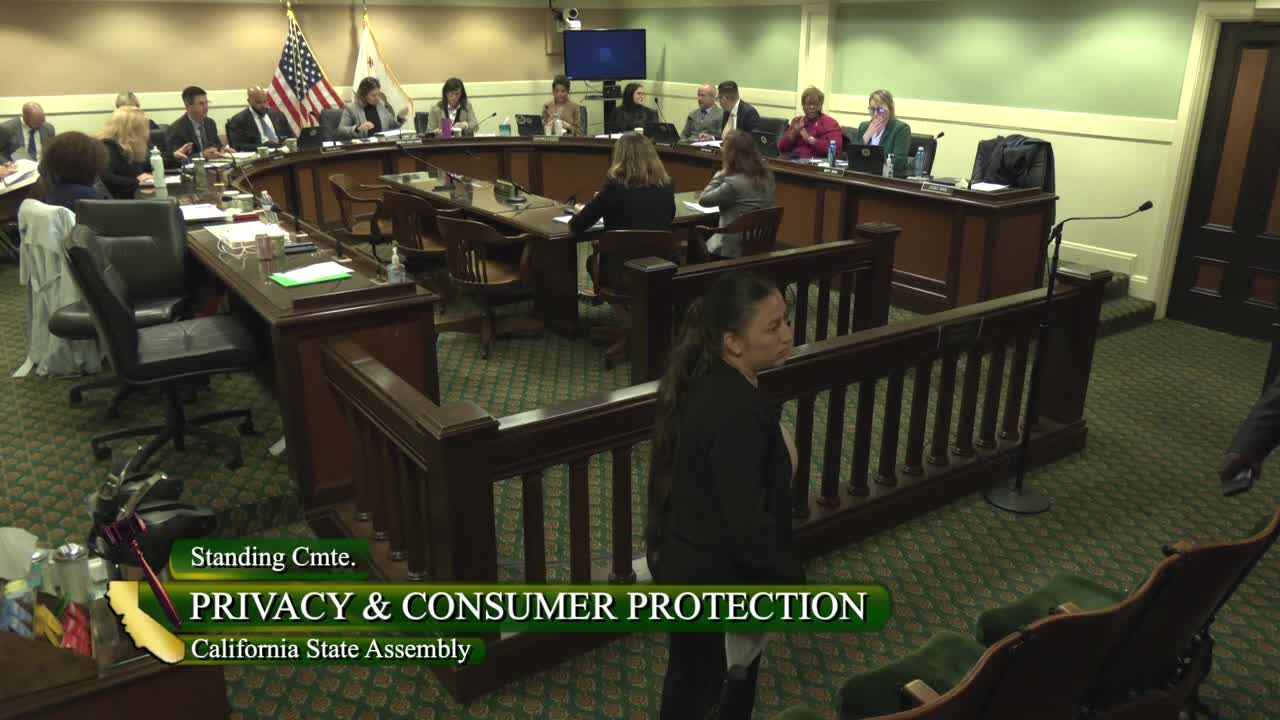 12MIN
Assembly Standing Committee on Privacy and Consumer Protection
Bill Author

Bill Co-Author(s):