AB 1869: Real Estate Investment Trusts: management duties.
- Session Year: 2025-2026
- House: Assembly
- Latest Version Date: 2026-04-14
Current Status:
In Progress
(2026-05-14: In committee: Held under submission.)
Introduced
In Committee
Awaiting First Chamber Vote
Passed First Chamber
In Committee
Awaiting Second Chamber Vote
Passed Second Chamber
Enacted
The Corporation Tax Law, in modified conformity with federal income tax law, allows a corporation, trust, or association that would otherwise be taxable as a domestic corporation to elect to be treated as a real estate investment trust (REIT) if specified requirements are met in relation to the character of income received by the entity, including a requirement that 95% of the entitys income fits into several categories, including rents from real property. Existing law specifically excludes from the term rents from real property impermissible tenant service income, defined to include amounts received directly or indirectly for managing or operating real property.
This bill would clarify that exercising control over, or reserving the right to exercise control over, specified activities of a lodging facility, as defined, are actions that constitute managing or operating real property. The bill would state that this provision does not constitute a change in, but is declaratory of, existing law. The bill would also allow affected employees of a lodging facility facility, as defined, or their representative to provide evidence to the Franchise Tax Board Labor Commissioner of activities performed by a REIT that constitute direct or indirect operation or management of a lodging facility. The bill would require the Franchise Tax Board Labor Commissioner to confirm receipt of that evidence and, within ____ 45 days of receipt, would require the Franchise Tax Board Labor Commissioner to provide the affected employee or representative a written response to the submission. submission, and would require the Labor Commissioner to forward that response to the Franchise Tax Board.
The Corporation Tax Law, in modified conformity with federal income tax law, allows a corporation, trust, or association that would otherwise be taxable as a domestic corporation to elect to be treated as a real estate investment trust (REIT) if specified requirements are met in relation to the character of income received by the entity, including a requirement that 95% of the entitys income fits into several categories, including rents from real property. Existing law specifically excludes from the term rents from real property impermissible tenant service income, defined to include amounts received directly or indirectly for managing or operating real property.
This bill would clarify that exercising control over, or reserving the right to exercise control over, specified activities of a lodging facility, as defined, are actions that constitute managing or operating real property. The bill would state that this provision does not constitute a change in, but is declaratory of, existing law. The bill would also allow affected employees of a lodging facility or their representative to provide evidence to the Franchise Tax Board of activities performed by a REIT that constitute direct or indirect operation or management of a lodging facility. The bill would require the Franchise Tax Board to confirm receipt of that evidence and, within ____ days of receipt, would require the Franchise Tax Board to provide the affected employee or representative a written response to the submission.
(a)Section 856(d)(7)(C)(ii) of the Internal Revenue Code is modified by substituting the phrase if received by an organization described in subdivision (b) of Section 17651 of Part 10 or Section 23731 for the phrase if received by an organization described in section 511(a)(2).
(b)(1)An election under Section 856(e)(5) of the Internal Revenue Code for federal income tax purposes is treated for purposes of this part as an election made by the real estate investment trust under Section 856(e)(5) of the Internal Revenue Code for state purposes and a separate election under paragraph (3) of subdivision (e) of Section 23051.5 is not allowed.
(2)Any revocation of an election under Section 856(e)(5) of the Internal Revenue Code for federal income tax purposes is treated for purposes of this part as a revocation of the election made by the real estate investment trust under Section 856(e)(5) of the Internal Revenue Code for state purposes and a separate election under paragraph (3) of subdivision (e) of Section 23051.5 is not allowed with respect to the property for any subsequent taxable year.
(3)If the real estate investment trust fails to make an election under Section 856(e)(5) of the Internal Revenue Code for federal income tax purposes with respect to any property, that property may not be treated for purposes of this part as foreclosure property, an election under Section 856(e)(5) of the Internal Revenue Code for state purposes with respect to that property is not allowed, and a separate election under paragraph (3) of subdivision (e) of Section 23051.5 is not allowed with respect to that property.
(c)(1)(A)For purposes of Section 856(d)(7)(A) of the Internal Revenue Code, relating to impermissible tenant service income, and Section 856(l)(3)(A) of the Internal Revenue Code, the following actions are considered operating and managing when done in connection with a lodging facility, as that term is defined in Section 856(d)(9)(D) of the Internal Revenue Code:(i)Exercising, or reserving the right to exercise, control over any aspect of the wages, hours, or working conditions of employees at the lodging facility.(ii)Exercising control over the discretion of another entity, including an eligible independent contractor as defined in Section 856(d)(9)(A) of the Internal Revenue Code, to establish any aspect of the wages, hours, or working conditions of employees at the lodging facility through establishing or maintaining an operating budget or operating allowances for the lodging facility, provided that nothing in this clause shall preclude a taxable REIT subsidiary from bearing the expenses for the operation of a qualified lodging facility by an eligible independent contractor pursuant to a management agreement or similar service contract.(iii)Exercising, or reserving the right to exercise, control over the negotiation, approval, or application of any collective bargaining agreement, or any part of a collective bargaining agreement, covering employees at the lodging facility.(B)This paragraph does not constitute a change in, but is declaratory of, existing law.(2)(c)(1)Affected employees at a lodging facility facility, as that term is defined in Section 856(d)(9)(D) of the Internal Revenue Code, or their representative may provide evidence to the Franchise Tax Board Labor Commissioner or their designee that a real estate investment trust or a taxable REIT subsidiary is directly or indirectly operating or managing a lodging facility. At the affected employees or representatives election, the Franchise Tax Board shall treat such communication and any related evidence as confidential. The Franchise Tax Board shall confirm receipt of that evidence and shall, within ____ days of receipt, provide the affected employee or representative a written response to the submission. facility by doing any of the following:
(A)Exercising, or reserving the right to exercise, control over any aspect of the wages, hours, or working conditions of employees at the lodging facility.
(B)Exercising control over the discretion of another entity, including an eligible independent contractor, as defined in Section 856(d)(9)(A) of the Internal Revenue Code, to establish any aspect of the wages, hours, or working conditions of employees at the lodging facility through establishing or maintaining an operating budget or operating allowances for the lodging facility, provided that nothing in this clause shall preclude a taxable REIT subsidiary from bearing the expenses for the operation of a qualified lodging facility by an eligible independent contractor pursuant to a management agreement or similar service contract.
(C)Exercising, or reserving the right to exercise, control over the negotiation, approval, or application of any collective bargaining agreement, or any part of a collective bargaining agreement, covering employees at the lodging facility.
(2)At the election of the affected employee or representative, the Labor Commissioner shall treat such communication and any related evidence as confidential. The Labor Commissioner shall confirm receipt of that evidence and shall, within 45 days of receipt, provide the affected employee or representative a written response to the submission, and shall forward a copy of that response to the Franchise Tax Board.
(a)Section 856(d)(7)(C)(ii) of the Internal Revenue Code is modified by substituting the phrase if received by an organization described in subdivision (b) of Section 17651 of Part 10 or Section 23731 for the phrase if received by an organization described in section 511(a)(2).
(b)(1)An election under Section 856(e)(5) of the Internal Revenue Code for federal income tax purposes is treated for purposes of this part as an election made by the real estate investment trust under Section 856(e)(5) of the Internal Revenue Code for state purposes and a separate election under paragraph (3) of subdivision (e) of Section 23051.5 is not allowed.
(2)Any revocation of an election under Section 856(e)(5) of the Internal Revenue Code for federal income tax purposes is treated for purposes of this part as a revocation of the election made by the real estate investment trust under Section 856(e)(5) of the Internal Revenue Code for state purposes and a separate election under paragraph (3) of subdivision (e) of Section 23051.5 is not allowed with respect to the property for any subsequent taxable year.
(3)If the real estate investment trust fails to make an election under Section 856(e)(5) of the Internal Revenue Code for federal income tax purposes with respect to any property, that property may not be treated for purposes of this part as foreclosure property, an election under Section 856(e)(5) of the Internal Revenue Code for state purposes with respect to that property is not allowed, and a separate election under paragraph (3) of subdivision (e) of Section 23051.5 is not allowed with respect to that property.
(c)(1)(A)For purposes of Section 856(d)(7)(A) of the Internal Revenue Code, relating to impermissible tenant service income, and Section 856(l)(3)(A) of the Internal Revenue Code, the following actions are considered operating and managing when done in connection with a lodging facility, as that term is defined in Section 856(d)(9)(D) of the Internal Revenue Code:
(i)Exercising, or reserving the right to exercise, control over any aspect of the wages, hours, or working conditions of employees at the lodging facility.
(ii)Exercising control over the discretion of another entity, including an eligible independent contractor as defined in Section 856(d)(9)(A) of the Internal Revenue Code, to establish any aspect of the wages, hours, or working conditions of employees at the lodging facility through establishing or maintaining an operating budget or operating allowances for the lodging facility, provided that nothing in this clause shall preclude a taxable REIT subsidiary from bearing the expenses for the operation of a qualified lodging facility by an eligible independent contractor pursuant to a management agreement or similar service contract.
(iii)Exercising, or reserving the right to exercise, control over the negotiation, approval, or application of any collective bargaining agreement, or any part of a collective bargaining agreement, covering employees at the lodging facility.
(B)This paragraph does not constitute a change in, but is declaratory of, existing law.
(2)Affected employees at a lodging facility or their representative may provide evidence to the Franchise Tax Board that a real estate investment trust or a taxable REIT subsidiary is directly or indirectly operating or managing a lodging facility. At the affected employees or representatives election, the Franchise Tax Board shall treat such communication and any related evidence as confidential. The Franchise Tax Board shall confirm receipt of that evidence and shall, within ____ days of receipt, provide the affected employee or representative a written response to the submission.
|
Date
|
Status
|
|---|---|
| May 14, 2026 | In committee: Held under submission. |
| May 6, 2026 | In committee: Set, first hearing. Referred to APPR. suspense file. |
| Apr 23, 2026 | From committee: Do pass and re-refer to Com. on APPR. (Ayes 5. Noes 2.) (April 22). Re-referred to Com. on APPR. |
| Apr 16, 2026 | Re-referred to Com. on L. & E. pursuant to Assembly Rule 96. |
| Apr 15, 2026 | Re-referred to Com. on REV. & TAX. |
| Apr 14, 2026 | From committee chair, with author's amendments: Amend, and re-refer to Com. on REV. & TAX. Read second time and amended. |
| Apr 13, 2026 | In committee: Set, first hearing. Hearing canceled at the request of author. |
| Mar 16, 2026 | Referred to Com. on REV. & TAX. |
| Feb 13, 2026 | From printer. May be heard in committee March 15. |
| Feb 12, 2026 | Read first time. To print. |
|
Date
|
Description
|
Location
|
Votes
|
|
|---|---|---|---|---|
| Apr 22, 2026 | Do pass and be re-referred to the Committee on [Appropriations] | Assembly Standing Committee on Labor and Employment |
Passed |
This list shows positions taken on this bill by organizations on the date displayed, which is linked to the original source.
Positions by individuals are not included.
|
Organization
|
Position
|
Date
|
|---|---|---|
| Advance San Francisco | ** Against | |
| American Hotel and Lodging Association | ** Against | |
| Building Owners and Managers Association of California | ** Against | |
| California Business Properties Association | ** Against | |
| California Business Roundtable | ** Against | |
| California Chamber Of Commerce | ** Against | |
| California Federation of Labor Unions, Afl-cio | ** Support | |
| California Hospitality United Coalition | ** Against | |
| California Hotel and Lodging Association | ** Against | |
| California Self Storage Association | ** Against | |
| California Travel Association | ** Against | |
| Hotel Association of Los Angeles | ** Against | |
| Hotel Council of San Francisco | ** Against | |
| Los Angeles Area Chamber Of Commerce | ** Against | |
| National Association of Real Estate Investment Trusts | ** Against | |
| Orange County Hotel and Lodging Association | ** Against | |
| San Diego County Lodging Association | ** Against | |
| San Francisco Chamber of Commerce | ** Against | |
| Self Storage Association | ** Against | |
| UNITE HERE International Union | ** Support |
Date of Hearing: May 6, 2026
ASSEMBLY COMMITTEE ON APPROPRIATIONS
Buffy Wicks, Chair
ABPCA Bill Id:AB 1869
Author:(Haney) – As Amended Ver:April 14, 2026
Policy Committee: | Labor and Employment | Vote: | 5 - 2 |
|
| ||
|
|
Urgency: No State Mandated Local Program: No Reimbursable: No
SUMMARY:
This bill allows an affected employee of a lodging facility to provide evidence to the Labor Commissioner (LC) about certain activities performed by a real estate investment trust (REIT).
Specifically, this bill:
- Allows an affected employee of a lodging facility or the employee’s representative to provide evidence to the LC about certain activities performed by a REIT that constitute direct or indirect operation or management of a lodging facility, such as exercising control over the wages, hours, or working conditions of the facility’s employees.
- Requires the LC to confirm receipt of such evidence and requires the LC to provide the affected employee or representative a written response to the submission within 45 days and forward the response to the Franchise Tax Board (FTB).
FISCAL EFFECT:
- Costs of an unknown, but potentially significant amount, in excess of $150,000, to the LC to receive and review evidence about a REIT’s activities and provide a written response to the affected employee and FTB within 45 days (special fund). This bill does not further specify the contents of the written response, so it is unclear whether the LC is expected to investigate the allegation within 45 days and present its findings to the employee and FTB, or produce a more simple acknowledgement of next steps.
- Minor and absorbable costs to FTB to receive the written response from the LC.
COMMENTS:
- Purpose. According to the author:
AB 1869 is a straightforward clarification: if a REIT is actively running a hotel, it should not receive a tax benefit meant only for passive owners. The bill defines what conduct crosses that line and gives hotel workers a formal way to report them to the [LC].
This is not a new standard. Federal and California law have always prohibited lodging REITs from directly or indirectly managing the hotels they own. AB 1869 simply makes clear what that means in practice, closes the ambiguity some REITs have exploited, and ensures California has the tools to enforce its own tax laws.
- REIT. The state Corporation Tax (CT) Law allows, in modified conformity with federal income tax law, a corporation, trust, or association that would otherwise be taxable as a domestic corporation to elect to be treated as a REIT if certain income requirements are met. Thus, a REIT may avoid entity-level taxation at the general CT rate of 8.84% by acting as a pass-through entity with earnings distributed to shareholders as dividend payments. A REIT is generally restricted to passive investments, primarily in real estate and securities.
In an August 26, 2024 letter to U.S. Senate Committee on Finance, the Chief Counsel of the Internal Revenue Service explains:
Among the requirements a REIT must satisfy are certain income tests. These income tests are generally met if the REIT receives rents from real property, provided that these rents are not from related parties.
An exception to this prohibition on related party rents exists for qualified lodging facilities. If the REIT leases a lodging facility to its taxable REIT subsidiary (TRS) and the TRS contracts with an eligible independent contractor to operate and manage the qualified lodging facility on behalf of the TRS, then the REIT’s lease payments from the TRS can qualify as rents from real property.
The law is clear that a TRS may not directly or indirectly operate or manage a lodging facility. If it does, it will lose its special tax status with potentially severe adverse tax consequences for its REIT owner. If a REIT and TRS avail themselves of the exception to the related party rent rule discussed above, operation and management of the qualified lodging facility must be performed by the eligible independent contractor.
Whether the activities of a TRS constitute the direct or indirect management and operation of a lodging facility depends on facts and circumstances. However, as a general matter, a TRS is prohibited from managing the day-to-day operation of the lodging facility, which may include recruiting, hiring, daily supervision, and direction of the employees.
This bill allows an affected employee of a lodging facility to provide evidence to the LC about certain activities performed by a REIT that constitute direct or indirect operation or management of a lodging facility, a potential violation of tax law. This bill requires the LC to confirm receipt of the evidence and provide a written response to the employee within 45 days, which the LC must then forward to FTB, presumably for further investigation concerning the REIT’s tax status.
- Support and Opposition. This bill is sponsored by UNITE HERE International Union, which argues, “Workers are often the individuals with the most direct knowledge of how decisions affecting wages, staffing, and working conditions are made, and enabling them to provide relevant information will help ensure proper enforcement of existing law.” This bill is also supported by other labor organizations.
This bill is opposed by a coalition of hospitality and business groups, led by the California Hotel and Lodging Association, which argues this bill would “undermine state conformity with federal law to introduce instability into California’s hotel industry in a manner that threatens the future of hotels in California, downtown recoveries across the state, and the savings of hard-working Californians.”
Analysis Prepared by: Irene Ho / APPR. / (916) 319-2081
Date of Hearing: April 22, 2026
ASSEMBLY COMMITTEE ON LABOR AND EMPLOYMENT
Liz Ortega, Chair
ABPCA Bill Id:AB 1869 (
Author:Haney) – As Amended Ver:April 14, 2026
SUBJECT: Real Estate Investment Trusts: management duties
SUMMARY: Authorizes affected employees at a lodging facility or their representative to provide evidence to the Labor Commissioner (LC) or their designee that a real estate investment trust (REIT) or a taxable REIT subsidiary is directly or indirectly operating or managing a lodging facility, as specified. Requires the LC to, within 45 days of receipt, provide the affected employee or representative a written response to the submission, and to forward a copy of that response to the Franchise Tax Board (FTB). Specifically, this bill:
- Authorizes affected employees at a lodging facility or their representative to provide evidence to the LC or their designee that a REIT or a taxable REIT subsidiary is directly or indirectly operating or managing a lodging facility by doing any of the following:
- Exercising, or reserving the right to exercise, control over any aspect of the wages, hours, or working conditions of employees at the lodging facility.
- Exercising control over the discretion of another entity, including an eligible independent contractor, to establish any aspect of the wages, hours, or working conditions of employees at the lodging facility through establishing or maintaining an operating budget or operating allowances for the lodging facility, provided that nothing in this clause shall preclude a taxable REIT subsidiary from bearing the expenses for the operation of a qualified lodging facility by an eligible independent contractor pursuant to a management agreement or similar service contract.
- Exercising, or reserving the right to exercise, control over the negotiation, approval, or application of any collective bargaining agreement, or any part of a collective bargaining agreement, covering employees at the lodging facility.
- Requires, at the election of the affected employee or representative, the LC to treat such communication and any related evidence as confidential. The LC shall confirm receipt of that evidence and shall, within 45 days of receipt, provide the affected employee or representative a written response to the submission, and shall forward a copy of that response to the FTB.
EXISTING LAW:
- Allows, in modified conformity with federal income tax law, a corporation, trust, or association that would otherwise be taxable as a domestic corporation to elect to be treated as a REIT if specified requirements are met. Among other things, the law requires that 95% of the entity's income fits into several categories, including rents from real property. IRC §856 and Revenue and Taxation Code §24872.4.
- Excludes from the term "rents from real property" impermissible tenant service income. Impermissible tenant service income, in turn, is defined as any amount received or accrued directly or indirectly by the REIT for:
- Services furnished or rendered by the trust to the tenants of such property; or,
- Managing or operating such property. IRC §856 and Revenue and Taxation Code §24872.4.
- Defines “lodging facility” to mean a hotel, motel, or other establishment
more than one-half of the dwelling units in which are used on a transient basis. IRC §856(d)(9)(D).
- Defines “eligible independent contractor” to mean, with respect to any or any if, at the time such contractor enters into a management agreement or other similar service contract with the to operate such or qualified health care property, such contractor (or any related person) is actively engaged in the trade or business of operating qualified lodging facilities or qualified health care properties, respectively, for any person who is not a related person with respect to the REIT or the taxable REIT subsidiary. IRC §856(d)(9)(A).
FISCAL EFFECT: Unknown.
COMMENTS: As mentioned in the author’s statement below, REITs enjoy special tax treatment under our state tax code. In exchange, the law explicitly prohibits lodging REITs and their taxable REIT subsidiaries from "directly or indirectly operating or managing" the hotels they own. Yet current law lacks clarity as to what actions are categorized as operating or managing a property.
Bill proponents argue that the correct interpretation of the prohibition against “directly or indirectly operating or managing” looks at whether a REIT has “reserved” a right to operate or manage the lodging facility.[1] Reserving a right to do so would violate the prohibition. The management agreement between the REIT and the hotel operator can be evidence of this practice if it does not provide that the hotel operator will have exclusive responsibility for hotel operations. Proponents also contend that a REIT’s use of “budgetary power” as a means of controlling workers wages can qualify as directly or indirectly managing a lodging facility because it puts the REIT in the position of joint employer.[2]
Opponents of the bill argue that the above prohibition is narrower and case specific. They cite a 2024 letter from the Chief Counsel of the IRS to the U.S. Senate Committee on Finance that interprets the prohibition as “depending on facts and circumstances.” The letter contends that managing the day-to-day operation of a lodging facility may include “recruiting, hiring, daily supervision, and direction of the employees.” Thus, opponents argue that the bill would interpret the prohibition more broadly than in federal tax law, causing inconsistent outcomes.
Examples of REITS operating or managing hotels
According to the author’s background materials, “evidence that lodging REITs are crossing the line into hotel management is substantial and, in many cases, comes directly from the REITs themselves. During the COVID-19 pandemic, several REIT executives openly described their role in making workforce decisions on earnings calls. Park Hotels & Resorts' CEO discussed targeting housekeeping departments for permanent staffing reductions. DiamondRock Hospitality's CEO stated the company was "combining jobs" and achieving efficiency levels it had "never done before." Host Hotels' CEO described the pandemic as "an opportunity to redefine the hotel operating model." RLJ Lodging Trust reported operating with 47 percent lower wages and benefits compared to prior years as a direct result of its own cost-control measures.
Beyond public statements, actual hotel management agreements obtained from lodging REITs reveal contractual provisions requiring taxable REIT subsidiary approval of employee wages, benefits, and bonuses through budget sign-off, and giving taxable REIT subsidiaries the right to participate in or veto union contract negotiations.”
Committee Comments
AB 1869 provides that an affected employee at a lodging facility or their representative may provide evidence to the LC that a REIT is directly or indirectly managing the facility and the LC must provide a written response within 45 days of receipt. (Proposed Rev. & Tax Code §24872.4(c)(1)-(2)). As written, it is unclear what the LC’s written response would entail. Is it an acknowledgment of the complaint? A detailed analysis of the alleged conduct and a finding of fact? In the future, the author may wish to specify what level of detail is required in a response and if it needs to include a determination as to whether the REIT violated the prohibition on directly or indirectly managing a lodging facility.
Arguments in Support
The California Federation of Labor Unions, AFL-CIO, is in support and states, “REITs that own hotels benefit from a special tax-favored status intended for passive real estate investors. Under both federal law and the California Revenue and Taxation Code, lodging REITs are prohibited from directly or indirectly operating or managing the hotels they own. Instead, hotels must be operated by independent contractors so that the REIT remains a passive investor in real estate rather than an active hotel operator.
Unfortunately, some lodging REITs have crossed this line while continuing to claim the tax advantages associated with passive ownership. In many instances, REITs have become directly involved in operational decisions affecting hotel employees, including setting wages, working conditions, and collective bargaining strategies. These actions undermine the legal framework that allows REITs to receive preferential tax treatment in the first place.
AB 1869 provides important clarification for practices that constitute the “direct or indirect operation or management” of a lodging facility by a REIT. By providing clearer statutory guidance, the bill will help ensure that companies benefiting from favorable tax treatment comply with the rules governing that status.
The bill also establishes a practical mechanism for accountability by allowing hospitality workers to submit evidence to the Franchise Tax Board demonstrating when a lodging REIT may be operating or managing a hotel. Workers are often the individuals with the most direct knowledge of how decisions affecting wages, staffing, and working conditions are made, and enabling them to provide relevant information will help ensure proper enforcement of existing law.”
Arguments in Opposition
A coalition of business associations, including the California Hotel and Lodging Association, is opposed and states, “Real Estate Investment Trusts (“REITs”) are legal entities specifically created to enable everyday people to pool their retirement savings to invest in large projects, like hotels. These may seem like large companies, but that’s by design – millions of people, including 56 percent of Californians, invest their life savings into these entities directly and through retirement funds in the hopes of earning enough to retire, sending their children to college, and chasing their dreams. In turn, these REITs invest in hotels which fund local governments, create well-paying jobs for Californians, and support the local community.
Assembly Bill 1869 would jeopardize all of their futures and broader California hotel stability by undermining state conformity with federal law through a reporting provision which misrepresents and indirectly contravenes existing law. Under this bill, REITs which are acting within the law would face the threat of fines, penalties, and loss of tax status for standard contract terms and for possessing tools given to them by Congress to protect the interests of those everyday people who invest in hotel REITs. Further, this measure would force at least two state agencies to assume more costs via an unwieldy reporting scheme which would generate no additional compliance benefit.”
REGISTERED SUPPORT / OPPOSITION:
Support
California Federation of Labor Unions, AFL-CIO
Unite Here International Union, AFL-CIO
Opposition
Advance San Francisco
American Hotel and Lodging Association
Building Owners and Managers Association of California
California Business Properties Association
California Business Roundtable
California Chamber of Commerce
California Hospitality United Coalition
California Hotel and Lodging Association
California Self Storage Association
California Travel Association
Hotel Association of Los Angeles
Hotel Council of San Francisco
Los Angeles Area Chamber of Commerce
National Association of Real Estate Investment Trusts
Orange County Hotel and Lodging Association
San Diego County Lodging Association
San Francisco Chamber of Commerce
Self Storage Association
Analysis Prepared by: Megan Lane / L. & E. /
Discussed in Hearing
 13MIN
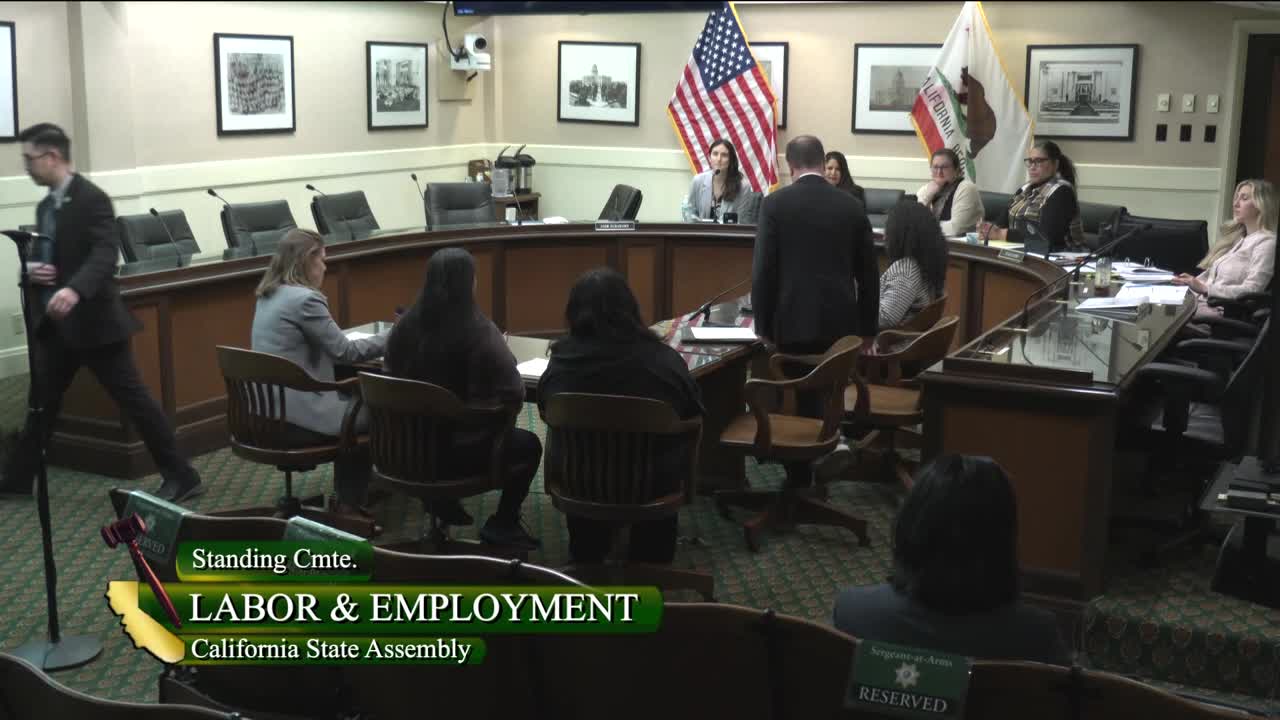
Assembly Standing Committee on Labor and Employment
Bill Author

Bill Co-Author(s):