AB 1871: Pupil instruction: dual enrollment: College and Career Access Pathways partnerships.
- Session Year: 2025-2026
- House: Assembly
- Latest Version Date: 2026-09-27
Current Status:
Passed
(2026-09-27: Chaptered by Secretary of State - Chapter 555, Statutes of 2026.)
Introduced
In Committee
Awaiting First Chamber Vote
Passed First Chamber
In Committee
Awaiting Second Chamber Vote
Passed Second Chamber
Enacted
Existing law authorizes the governing board of a community college district to enter into a College and Career Access Pathways (CCAP) partnership with the governing board of a school district, a county office of education, or the governing body of a charter school for the purpose of offering or expanding dual enrollment opportunities for pupils who may not already be college bound or who are underrepresented in higher education, as provided.
Existing law requires the partnership agreement to outline the terms of the partnership, as specified, and to establish protocols for information sharing, joint facilities use, and parental consent for high school pupils to enroll in community college courses. Existing law requires the protocols to only require a high school pupil participating in a CCAP partnership to submit one parental consent form and principal recommendation for the duration of the pupils participation in the CCAP partnership.
This bill would revise the CCAP partnership provisions to eliminate the requirement that the protocols require principal recommendation.
Existing law requires the Chancellor of the California Community Colleges to revise the special part-time student application process to allow a pupil to complete one application for the duration of the pupils attendance at a community college as a special part-time student participating in a CCAP partnership agreement.
This bill would require a CCAP partnership agreement to also establish protocols that authorize a pupil to complete one application for the duration of the pupils attendance at a community college as a special part-time student participating in a CCAP partnership agreement.
Existing law authorizes a community college district to allow a special part-time student participating in a CCAP partnership agreement to enroll in up to a maximum of 15 units per term in courses offered at the community college campus or the participating high school campus if certain circumstances are satisfied, including that the units constitute no more than 4 community college courses per term.
This bill would eliminate the 4 community college courses per term limit for a special part-time student enrolling in up to 15 units under a CCAP partnership agreement.
Existing law requires, for each CCAP partnership agreement, the affected community college district and school district, county office of education, or charter school to annually report specified information to the office of the Chancellor of the California Community Colleges, including the total number of community college courses, by course category and type and by schoolsite, enrolled in by CCAP partnership participants.
This bill instead would require the affected community college district and school district, county office of education, or charter school to annually report the total number of high school pupils who successfully completed 12 or more units of college coursework by graduation, completed a certificate, or completed the courses required for an associate degree or an associate degree for transfer.
Notwithstanding Section 76001 or any other law:
(a)(1)The governing board of a community college district may enter into a College and Career Access Pathways (CCAP) partnership with the governing board of a school district or a county office of education for the purpose of offering or expanding dual enrollment opportunities for pupils who may not already be college bound or who are underrepresented in higher education, with the goal of developing seamless pathways from high school to community college for career technical education or preparation for transfer, improving high school graduation rates, or helping high school pupils achieve college and career readiness.
(2)As used in this section, high school includes a community school, continuation high school, juvenile court school, or adult education program offering courses for high school diplomas or high school equivalency certificates.
(3)As used in this section, underrepresented in higher education may include first-time college students, low-income students, students who are current or former foster youth, homeless students, students with disabilities, and students with dependent children.
(b)A participating community college district may enter into a CCAP partnership with a school district or county office of education partner that is governed by a CCAP partnership agreement approved by the governing boards of both partners. As a condition of adopting a CCAP partnership agreement, the governing board of each partner shall do both of the following:
(1)For career technical education pathways to be provided under the partnership, consult with, and consider the input of, the appropriate local workforce development board to determine the extent to which the pathways are aligned with regional and statewide employment needs. The governing board of each partner shall have final decisionmaking authority regarding the career technical education pathways to be provided under the partnership.
(2)Present, take comments from the public on, and approve or disapprove the dual enrollment partnership agreement at an open public meeting of the governing board of the partner.
(c)(1)The CCAP partnership agreement shall outline the terms of the CCAP partnership, and shall include, but not be limited to, the total number of high school pupils to be served and the total number of full-time equivalent students projected to be claimed by the community college district for those pupils; the scope, nature, time, location, and listing of community college courses to be offered; and criteria to assess the ability of pupils to benefit from those courses. The CCAP partnership agreement shall also establish protocols for information sharing, in compliance with all applicable state and federal privacy laws, joint facilities use, and parental consent for high school pupils to enroll in community college courses. The protocols shall only require a high school pupil participating in a CCAP partnership to submit one parental consent form for the duration of the pupils participation in the CCAP partnership. The protocols shall authorize a pupil to complete one application for the duration of the pupils attendance at a community college as a special part-time student participating in a CCAP partnership agreement.
(2)The CCAP partnership agreement shall identify a point of contact for the participating community college district and school district or county office of education partner.
(3)A copy of the CCAP partnership agreement shall be filed with the office of the Chancellor of the California Community Colleges and with the department before the start of the CCAP partnership. The chancellor may void any CCAP partnership agreement it determines has not complied with the intent of the requirements of this section.
(d)A community college district participating in a CCAP partnership shall not provide physical education course opportunities to high school pupils pursuant to this section, or any other course opportunities that do not assist in the attainment of at least one of the goals listed in subdivision (a).
(e)A community college district shall allow an existing CCAP partnership to be amended, or a new CCAP agreement to be established with a school district or county office of education and a community college district outside of the primary community college districts service area, if the primary community college district has declined a request from the school district or county office of education, or has failed to take action within 60 calendar days of a request by the school district or county office of education, to either amend into the existing CCAP partnership the requested courses, or to approve another community college district to enter into a CCAP partnership to offer those courses.
(f)A high school pupil enrolled in a course offered through a CCAP partnership shall not be assessed any fee by a local educational agency or community college district that is prohibited by Section 49011.
(g)(1)A community college district participating in a CCAP partnership shall assign priority for enrollment and course registration to a pupil seeking to enroll in a community college course that is required for the pupils CCAP partnership program that is equivalent to the priority assigned to a pupil attending a middle college high school as described in Section 11300 and consistent with the middle college high school provisions in Section 76001.
(2)Units completed by a pupil pursuant to a CCAP partnership agreement may count towards determining a pupils registration priority for enrollment and course registration at a community college.
(h)The CCAP partnership agreement shall certify that any community college instructor teaching a course on a high school campus has not been convicted of any sex offense as defined in Section 87010, or convicted of any controlled substance offense as defined in Section 87011.
(i)The CCAP partnership agreement shall certify that any community college instructor teaching a course at the partnering high school campus has not displaced or resulted in the termination of an existing high school teacher teaching the same course on that high school campus.
(j)The CCAP partnership agreement shall certify that a qualified high school teacher teaching a course offered for college credit at a high school campus has not displaced or resulted in the termination of an existing community college faculty member teaching the same course at the partnering community college campus.
(k)The CCAP partnership agreement shall include a plan by the participating community college district to ensure both of the following:
(1)A community college course offered for college credit at the partnering high school campus does not reduce access to the same course offered at the partnering community college campus.
(2)Participation in a CCAP partnership is consistent with the core mission of the community colleges as described in Section 66010.4, and that pupils participating in a CCAP partnership will not lead to enrollment displacement of otherwise eligible adults in the community college.
(l)The CCAP partnership agreement shall certify that both the school district or county office of education and community college district partners comply with local collective bargaining agreements and all state and federal reporting requirements regarding the qualifications of the teacher or faculty member teaching a CCAP partnership course offered for high school credit.
(m)The CCAP partnership agreement shall specify both of the following:
(1)Which partner will be the employer of record for purposes of assignment monitoring and reporting to the county office of education.
(2)Which partner will assume reporting responsibilities pursuant to applicable federal teacher quality mandates.
(n)The CCAP partnership agreement shall certify that any pretransfer-level course taught by community college faculty at a partnering high school campus shall be offered only to high school pupils who do not meet their grade level standard in mathematics, English, or both on an interim assessment in grade 10 or 11, as determined by the partnering school district or county office of education, and shall involve a collaborative effort between high school and community college faculty to deliver an innovative pretransfer course as an intervention in the pupils junior or senior year to ensure that the pupil is prepared for college-level work upon graduation.
(o)(1)A community college district may limit enrollment in a community college course solely to eligible high school pupils if the course is offered at a high school campus, either in person or using an online platform, during the regular schoolday and the community college course is offered pursuant to a CCAP partnership agreement.
(2)For purposes of allowances and apportionments from Section B of the State School Fund, a community college district conducting a closed course on a high school campus pursuant to paragraph (1) shall be credited with those units of full-time equivalent students attributable to the attendance of eligible high school pupils.
(p)A community college district may allow a special part-time student participating in a CCAP partnership agreement established pursuant to this article to enroll in up to a maximum of 15 units per term in courses offered at the community college campus or the participating high school campus, if both of the following circumstances are satisfied:
(1)The units are part of an academic program that is part of a CCAP partnership agreement established pursuant to this article.
(2)The units are part of an academic program that is designed to award students both a high school diploma and an associate degree or a certificate or credential.
(q)The governing board of a community college district participating in a CCAP partnership agreement established pursuant to this article shall exempt pupils seeking to enroll in a community college course required for the pupils CCAP partnership program from the fee requirements in Sections 76060.5, 76223, 76300, 76350, and 79121.
(r)The governing board of a community college district participating in a CCAP partnership agreement shall enroll high school pupils in any course that is part of a CCAP partnership agreement offered at a community college campus. Courses offered through the CCAP program may be offered at the community college campus or the participating high school campus.
(s)A district or county office of education shall not receive a state allowance or apportionment for an instructional activity for which the partner has been, or shall be, paid an allowance or apportionment.
(t)(1)The attendance of a high school pupil at a community college as a special part-time or full-time student pursuant to this section is authorized attendance for which the community college shall be credited or reimbursed pursuant to Section 48802 or 76002, provided that no school district or county office of education has received reimbursement for the same instructional activity.
(2)For purposes of calculating classroom-based average daily attendance for classroom-based instruction apportionments, at least 80 percent of the instructional time offered by a charter school pursuant to an authorized CCAP partnership agreement shall be at the schoolsite, and the charter school shall require the attendance of a pupil for a minimum of 50 percent of the minimum instructional time required to be offered pursuant to paragraph (1) of subdivision (a) of Section 47612.5, if the pupil is also a special part-time student enrolled in a community college pursuant to this section and the pupil will receive academic credit upon satisfactory completion of enrolled courses.
(u)(1)For each CCAP partnership agreement entered into pursuant to this section, the affected community college district and school district or county office of education shall report annually to the office of the Chancellor of the California Community Colleges all of the following information:
(A)The total number of high school pupils by schoolsite enrolled in each CCAP partnership, aggregated by gender and ethnicity, and reported in compliance with all applicable state and federal privacy laws.
(B)The total number of high school pupils who successfully completed 12 or more units of college coursework by graduation, completed a certificate, or completed the courses required for an associate degree or an associate degree for transfer.
(C)The total number and percentage of successful course completions, by course category and type, including online and in-person, and by schoolsite, of CCAP partnership participants.
(D)The total number of full-time equivalent students generated by CCAP partnership community college district participants.
(E)The total number of full-time equivalent students served online generated by CCAP partnership community college district participants.
(2)On or before May 1 of each year, the chancellor shall aggregate the information annually reported pursuant to paragraph (1) and submit a report of that information to all of the following:
(A)The Legislature, in compliance with Section 9795 of the Government Code.
(B)The Director of Finance.
(C)The Superintendent.
(D)The Education Commissioner.
(3)The chancellor shall ensure that the number of full-time equivalent students generated by CCAP partnerships is reported pursuant to the reporting requirements in Section 76002.
(4)On or before July 31, 2020, the chancellor shall revise the special part-time student application process to allow a pupil to complete one application for the duration of the pupils attendance at a community college as a special part-time student participating in a CCAP partnership agreement.
(v)A community college district that violates this article, including, but not limited to, any restriction imposed by the board of governors pursuant to this article, shall be subject to the same penalty as may be imposed pursuant to subdivision (d) of Section 78032.
(w)This section does not affect a dual enrollment partnership agreement existing on January 1, 2016, under which an early college high school, a middle college high school, or a California Career Pathways Trust existing on January 1, 2016, is operated. An early college high school, middle college high school, or California Career Pathways Trust partnership agreement existing on January 1, 2016, shall not operate as a CCAP partnership unless it complies with this section.
(x)The governing body of a charter school may enter into a CCAP partnership agreement with the governing board of a community college district pursuant to this section. That CCAP partnership agreement shall comply with all applicable requirements of this section.
(y)The governing body of a regional occupational center or program may enter into a CCAP partnership agreement with the governing board of a community college district pursuant to this section. That CCAP partnership agreement shall comply with all applicable requirements of this section.
Notwithstanding Section 76001 or any other law:
(a)(1)The governing board of a community college district may enter into a College and Career Access Pathways (CCAP) partnership with the governing board of a school district or a county office of education for the purpose of offering or expanding dual enrollment opportunities for pupils who may not already be college bound or who are underrepresented in higher education, with the goal of developing seamless pathways from high school to community college for career technical education or preparation for transfer, improving high school graduation rates, or helping high school pupils achieve college and career readiness.
(2)As used in this section, high school includes a community school, continuation high school, juvenile court school, or adult education program offering courses for high school diplomas or high school equivalency certificates.
(3)As used in this section, underrepresented in higher education may include first-time college students, low-income students, students who are current or former foster youth, homeless students, students with disabilities, and students with dependent children.
(b)A participating community college district may enter into a CCAP partnership with a school district or county office of education partner that is governed by a CCAP partnership agreement approved by the governing boards of both partners. As a condition of adopting a CCAP partnership agreement, the governing board of each partner shall do both of the following:
(1)For career technical education pathways to be provided under the partnership, consult with, and consider the input of, the appropriate local workforce development board to determine the extent to which the pathways are aligned with regional and statewide employment needs. The governing board of each partner shall have final decisionmaking authority regarding the career technical education pathways to be provided under the partnership.
(2)Present, take comments from the public on, and approve or disapprove the dual enrollment partnership agreement at an open public meeting of the governing board of the partner.
(c)(1)The CCAP partnership agreement shall outline the terms of the CCAP partnership, and shall include, but not be limited to, the total number of high school pupils to be served and the total number of full-time equivalent students projected to be claimed by the community college district for those pupils; the scope, nature, time, location, and listing of community college courses to be offered; and criteria to assess the ability of pupils to benefit from those courses. The CCAP partnership agreement shall also establish protocols for information sharing, in compliance with all applicable state and federal privacy laws, joint facilities use, and parental consent for high school pupils to enroll in community college courses. The protocols shall only require a high school pupil participating in a CCAP partnership to submit one parental consent form and principal recommendation for the duration of the pupils participation in the CCAP partnership. The protocols shall authorize a pupil to complete one application for the duration of the pupils attendance at a community college as a special part-time student participating in a CCAP partnership agreement.
(2)The CCAP partnership agreement shall identify a point of contact for the participating community college district and school district or county office of education partner.
(3)A copy of the CCAP partnership agreement shall be filed with the office of the Chancellor of the California Community Colleges and with the department before the start of the CCAP partnership. The chancellor may void any CCAP partnership agreement it determines has not complied with the intent of the requirements of this section.
(d)A community college district participating in a CCAP partnership shall not provide physical education course opportunities to high school pupils pursuant to this section, or any other course opportunities that do not assist in the attainment of at least one of the goals listed in subdivision (a).
(e)A community college district shall allow an existing CCAP partnership to be amended, or a new CCAP agreement to be established with a school district or county office of education and a community college district outside of the primary community college districts service area, if the primary community college district has declined a request from the school district or county office of education, or has failed to take action within 60 calendar days of a request by the school district or county office of education, to either amend into the existing CCAP partnership the requested courses, or to approve another community college district to enter into a CCAP partnership to offer those courses.
(f)A high school pupil enrolled in a course offered through a CCAP partnership shall not be assessed any fee by a local educational agency or community college district that is prohibited by Section 49011.
(g)(1)A community college district participating in a CCAP partnership shall assign priority for enrollment and course registration to a pupil seeking to enroll in a community college course that is required for the pupils CCAP partnership program that is equivalent to the priority assigned to a pupil attending a middle college high school as described in Section 11300 and consistent with the middle college high school provisions in Section 76001.
(2)Units completed by a pupil pursuant to a CCAP partnership agreement may count towards determining a pupils registration priority for enrollment and course registration at a community college.
(h)The CCAP partnership agreement shall certify that any community college instructor teaching a course on a high school campus has not been convicted of any sex offense as defined in Section 87010, or convicted of any controlled substance offense as defined in Section 87011.
(i)The CCAP partnership agreement shall certify that any community college instructor teaching a course at the partnering high school campus has not displaced or resulted in the termination of an existing high school teacher teaching the same course on that high school campus.
(j)The CCAP partnership agreement shall certify that a qualified high school teacher teaching a course offered for college credit at a high school campus has not displaced or resulted in the termination of an existing community college faculty member teaching the same course at the partnering community college campus.
(k)The CCAP partnership agreement shall include a plan by the participating community college district to ensure both of the following:
(1)A community college course offered for college credit at the partnering high school campus does not reduce access to the same course offered at the partnering community college campus.
(2)Participation in a CCAP partnership is consistent with the core mission of the community colleges as described in Section 66010.4, and that pupils participating in a CCAP partnership will not lead to enrollment displacement of otherwise eligible adults in the community college.
(l)The CCAP partnership agreement shall certify that both the school district or county office of education and community college district partners comply with local collective bargaining agreements and all state and federal reporting requirements regarding the qualifications of the teacher or faculty member teaching a CCAP partnership course offered for high school credit.
(m)The CCAP partnership agreement shall specify both of the following:
(1)Which partner will be the employer of record for purposes of assignment monitoring and reporting to the county office of education.
(2)Which partner will assume reporting responsibilities pursuant to applicable federal teacher quality mandates.
(n)The CCAP partnership agreement shall certify that any pretransfer-level course taught by community college faculty at a partnering high school campus shall be offered only to high school pupils who do not meet their grade level standard in mathematics, English, or both on an interim assessment in grade 10 or 11, as determined by the partnering school district or county office of education, and shall involve a collaborative effort between high school and community college faculty to deliver an innovative pretransfer course as an intervention in the pupils junior or senior year to ensure that the pupil is prepared for college-level work upon graduation.
(o)(1)A community college district may limit enrollment in a community college course solely to eligible high school pupils if the course is offered at a high school campus, either in person or using an online platform, during the regular schoolday and the community college course is offered pursuant to a CCAP partnership agreement.
(2)For purposes of allowances and apportionments from Section B of the State School Fund, a community college district conducting a closed course on a high school campus pursuant to paragraph (1) shall be credited with those units of full-time equivalent students attributable to the attendance of eligible high school pupils.
(p)A community college district may allow a special part-time student participating in a CCAP partnership agreement established pursuant to this article to enroll in up to a maximum of 15 units per term in courses offered at the community college campus or the participating high school campus, if all both of the following circumstances are satisfied:
(1)The units constitute no more than four community college courses per term.(2)(1)The units are part of an academic program that is part of a CCAP partnership agreement established pursuant to this article.
(3)(2)The units are part of an academic program that is designed to award students both a high school diploma and an associate degree or a certificate or credential.
(q)The governing board of a community college district participating in a CCAP partnership agreement established pursuant to this article shall exempt pupils seeking to enroll in a community college course required for the pupils CCAP partnership program from the fee requirements in Sections 76060.5, 76223, 76300, 76350, and 79121.
(r)The governing board of a community college district participating in a CCAP partnership agreement shall enroll high school pupils in any course that is part of a CCAP partnership agreement offered at a community college campus. Courses offered through the CCAP program may be offered at the community college campus or the participating high school campus.
(s)A district or county office of education shall not receive a state allowance or apportionment for an instructional activity for which the partner has been, or shall be, paid an allowance or apportionment.
(t)(1)The attendance of a high school pupil at a community college as a special part-time or full-time student pursuant to this section is authorized attendance for which the community college shall be credited or reimbursed pursuant to Section 48802 or 76002, provided that no school district or county office of education has received reimbursement for the same instructional activity.
(2)For purposes of calculating classroom-based average daily attendance for classroom-based instruction apportionments, at least 80 percent of the instructional time offered by a charter school pursuant to an authorized CCAP partnership agreement shall be at the schoolsite, and the charter school shall require the attendance of a pupil for a minimum of 50 percent of the minimum instructional time required to be offered pursuant to paragraph (1) of subdivision (a) of Section 47612.5, if the pupil is also a special part-time student enrolled in a community college pursuant to this section and the pupil will receive academic credit upon satisfactory completion of enrolled courses.
(u)(1)For each CCAP partnership agreement entered into pursuant to this section, the affected community college district and school district or county office of education shall report annually to the office of the Chancellor of the California Community Colleges all of the following information:
(A)The total number of high school pupils by schoolsite enrolled in each CCAP partnership, aggregated by gender and ethnicity, and reported in compliance with all applicable state and federal privacy laws.
(B)The total number of community college courses, by course category and type and by schoolsite, enrolled in by CCAP partnership participants. high school pupils who successfully completed 12 or more units of college coursework by graduation, completed a certificate, or completed the courses required for an associate degree or an associate degree for transfer.
(C)The total number and percentage of successful course completions, by course category and type and type, including online and in-person, and by schoolsite, of CCAP partnership participants.
(D)The total number of full-time equivalent students generated by CCAP partnership community college district participants.
(E)The total number of full-time equivalent students served online generated by CCAP partnership community college district participants.
(2)On or before May 1 of each year, the chancellor shall aggregate the information annually reported pursuant to paragraph (1) and submit a report of that information to all of the following:
(A)The Legislature, in compliance with Section 9795 of the Government Code.
(B)The Director of Finance.
(C)The Superintendent.
(3)The chancellor shall ensure that the number of full-time equivalent students generated by CCAP partnerships is reported pursuant to the reporting requirements in Section 76002.
(4)On or before July 31, 2020, the chancellor shall revise the special part-time student application process to allow a pupil to complete one application for the duration of the pupils attendance at a community college as a special part-time student participating in a CCAP partnership agreement.
(v)A community college district that violates this article, including, but not limited to, any restriction imposed by the board of governors pursuant to this article, shall be subject to the same penalty as may be imposed pursuant to subdivision (d) of Section 78032.
(w)This section does not affect a dual enrollment partnership agreement existing on January 1, 2016, under which an early college high school, a middle college high school, or a California Career Pathways Trust existing on January 1, 2016, is operated. An early college high school, middle college high school, or California Career Pathways Trust partnership agreement existing on January 1, 2016, shall not operate as a CCAP partnership unless it complies with this section.
(x)The governing body of a charter school may enter into a CCAP partnership agreement with the governing board of a community college district pursuant to this section. That CCAP partnership agreement shall comply with all applicable requirements of this section.
(y)The governing body of a regional occupational center or program may enter into a CCAP partnership agreement with the governing board of a community college district pursuant to this section. That CCAP partnership agreement shall comply with all applicable requirements of this section.
All matter omitted in this version of the bill appears in the bill as introduced in the Assembly, February 12, 2026. (JR11)Notwithstanding Section 76001 or any other law:
(a)(1)The governing board of a community college district may enter into a College and Career Access Pathways (CCAP) partnership with the governing board of a school district or a county office of education for the purpose of offering or expanding dual enrollment opportunities for pupils who may not already be college bound or who are underrepresented in higher education, with the goal of developing seamless pathways from high school to community college for career technical education or preparation for transfer, improving high school graduation rates, or helping high school pupils achieve college and career readiness.
(2)As used in this section, high school includes a community school, continuation high school, juvenile court school, or adult education program offering courses for high school diplomas or high school equivalency certificates.
(3)As used in this section, underrepresented in higher education may include first-time college students, low-income students, students who are current or former foster youth, homeless students, students with disabilities, and students with dependent children.
(b)A participating community college district may enter into a CCAP partnership with a school district or county office of education partner that is governed by a CCAP partnership agreement approved by the governing boards of both partners. As a condition of adopting a CCAP partnership agreement, the governing board of each partner shall do both of the following:
(1)For career technical education pathways to be provided under the partnership, consult with, and consider the input of, the appropriate local workforce development board to determine the extent to which the pathways are aligned with regional and statewide employment needs. The governing board of each partner shall have final decisionmaking authority regarding the career technical education pathways to be provided under the partnership.
(2)Present, take comments from the public on, and approve or disapprove the dual enrollment partnership agreement at an open public meeting of the governing board of the partner.
(c)(1)The CCAP partnership agreement shall outline the terms of the CCAP partnership, and shall include, but not be limited to, the total number of high school pupils to be served and the total number of full-time equivalent students projected to be claimed by the community college district for those pupils; the scope, nature, time, location, and listing of community college courses to be offered; and criteria to assess the ability of pupils to benefit from those courses. The CCAP partnership agreement shall also establish protocols for information sharing, in compliance with all applicable state and federal privacy laws, joint facilities use, and parental consent for high school pupils to enroll in community college courses. The protocols shall only require a high school pupil participating in a CCAP partnership to submit one parental consent form and principal recommendation for the duration of the pupils participation in the CCAP partnership. The protocols shall authorize a pupil to complete one application for the duration of the pupils attendance at a community college as a special part-time student participating in a CCAP partnership agreement.
(2)The CCAP partnership agreement shall identify a point of contact for the participating community college district and school district or county office of education partner.
(3)A copy of the CCAP partnership agreement shall be filed with the office of the Chancellor of the California Community Colleges and with the department before the start of the CCAP partnership. The chancellor may void any CCAP partnership agreement it determines has not complied with the intent of the requirements of this section.
(d)A community college district participating in a CCAP partnership shall not provide physical education course opportunities to high school pupils pursuant to this section, or any other course opportunities that do not assist in the attainment of at least one of the goals listed in subdivision (a).
(e)A community college district shall allow an existing CCAP partnership to be amended, or a new CCAP agreement to be established with a school district or county office of education and a community college district outside of the primary community college districts service area, if the primary community college district has declined a request from the school district or county office of education, or has failed to take action within 60 calendar days of a request by the school district or county office of education, to either amend into the existing CCAP partnership the requested courses, or to approve another community college district to enter into a CCAP partnership to offer those courses.
(f)A high school pupil enrolled in a course offered through a CCAP partnership shall not be assessed any fee that is prohibited by Section 49011.
(g)(1)A community college district participating in a CCAP partnership shall assign priority for enrollment and course registration to a pupil seeking to enroll in a community college course that is required for the pupils CCAP partnership program that is equivalent to the priority assigned to a pupil attending a middle college high school as described in Section 11300 and consistent with the middle college high school provisions in Section 76001.
(2)Units completed by a pupil pursuant to a CCAP partnership agreement may count towards determining a pupils registration priority for enrollment and course registration at a community college.
(h)The CCAP partnership agreement shall certify that any community college instructor teaching a course on a high school campus has not been convicted of any sex offense as defined in Section 87010, or convicted of any controlled substance offense as defined in Section 87011.
(i)The CCAP partnership agreement shall certify that any community college instructor teaching a course at the partnering high school campus has not displaced or resulted in the termination of an existing high school teacher teaching the same course on that high school campus.
(j)The CCAP partnership agreement shall certify that a qualified high school teacher teaching a course offered for college credit at a high school campus has not displaced or resulted in the termination of an existing community college faculty member teaching the same course at the partnering community college campus.
(k)The CCAP partnership agreement shall include a plan by the participating community college district to ensure both of the following:
(1)A community college course offered for college credit at the partnering high school campus does not reduce access to the same course offered at the partnering community college campus.
(2)Participation in a CCAP partnership is consistent with the core mission of the community colleges as described in Section 66010.4, and that pupils participating in a CCAP partnership will not lead to enrollment displacement of otherwise eligible adults in the community college.
(l)The CCAP partnership agreement shall certify that both the school district or county office of education and community college district partners comply with local collective bargaining agreements and all state and federal reporting requirements regarding the qualifications of the teacher or faculty member teaching a CCAP partnership course offered for high school credit.
(m)The CCAP partnership agreement shall specify both of the following:
(1)Which partner will be the employer of record for purposes of assignment monitoring and reporting to the county office of education.
(2)Which partner will assume reporting responsibilities pursuant to applicable federal teacher quality mandates.
(n)The CCAP partnership agreement shall certify that any pretransfer-level course taught by community college faculty at a partnering high school campus shall be offered only to high school pupils who do not meet their grade level standard in mathematics, English, or both on an interim assessment in grade 10 or 11, as determined by the partnering school district or county office of education, and shall involve a collaborative effort between high school and community college faculty to deliver an innovative pretransfer course as an intervention in the pupils junior or senior year to ensure that the pupil is prepared for college-level work upon graduation.
(o)(1)A community college district may limit enrollment in a community college course solely to eligible high school pupils if the course is offered at a high school campus, either in person or using an online platform, during the regular schoolday and the community college course is offered pursuant to a CCAP partnership agreement.
(2)For purposes of allowances and apportionments from Section B of the State School Fund, a community college district conducting a closed course on a high school campus pursuant to paragraph (1) shall be credited with those units of full-time equivalent students attributable to the attendance of eligible high school pupils.
(p)A community college district may allow a special part-time student participating in a CCAP partnership agreement established pursuant to this article to enroll in up to a maximum of 15 units per term in courses offered at the community college campus or the participating high school campus, if all both of the following circumstances are satisfied:
(1)The units constitute no more than four community college courses per term. (2)(1)The units are part of an academic program that is part of a CCAP partnership agreement established pursuant to this article.
(3)(2)The units are part of an academic program that is designed to award students both a high school diploma and an associate degree or a certificate or credential.
(q)The governing board of a community college district participating in a CCAP partnership agreement established pursuant to this article shall exempt pupils seeking to enroll in a community college course required for the pupils CCAP partnership program from the fee requirements in Sections 76060.5, 76223, 76300, 76350, and 79121.
(r)The governing board of a community college district participating in a CCAP partnership agreement shall enroll high school pupils in any course that is part of a CCAP partnership agreement offered at a community college campus. Courses offered through the CCAP program may be offered at the community college campus or the participating high school campus.
(s)A district or county office of education shall not receive a state allowance or apportionment for an instructional activity for which the partner has been, or shall be, paid an allowance or apportionment.
(t)(1)The attendance of a high school pupil at a community college as a special part-time or full-time student pursuant to this section is authorized attendance for which the community college shall be credited or reimbursed pursuant to Section 48802 or 76002, provided that no school district or county office of education has received reimbursement for the same instructional activity.
(2)For purposes of calculating classroom-based average daily attendance for classroom-based instruction apportionments, at least 80 percent of the instructional time offered by a charter school pursuant to an authorized CCAP partnership agreement shall be at the schoolsite, and the charter school shall require the attendance of a pupil for a minimum of 50 percent of the minimum instructional time required to be offered pursuant to paragraph (1) of subdivision (a) of Section 47612.5, if the pupil is also a special part-time student enrolled in a community college pursuant to this section and the pupil will receive academic credit upon satisfactory completion of enrolled courses.
(u)(1)For each CCAP partnership agreement entered into pursuant to this section, the affected community college district and school district or county office of education shall report annually to the office of the Chancellor of the California Community Colleges all of the following information:
(A)The total number of high school pupils by schoolsite enrolled in each CCAP partnership, aggregated by gender and ethnicity, and reported in compliance with all applicable state and federal privacy laws.
(B)The total number of community college courses, by course category and type and by schoolsite, enrolled in by CCAP partnership participants. high school pupils who successfully completed 12 or more units of college coursework by graduation, completed a certificate, or completed the courses required for an associate degree or an associate degree for transfer.
(C)The total number and percentage of successful course completions, by course category and type and type, including online and in-person, and by schoolsite, of CCAP partnership participants.
(D)The total number of full-time equivalent students generated by CCAP partnership community college district participants.
(E)The total number of full-time equivalent students served online generated by CCAP partnership community college district participants.
(2)On or before May 1 of each year, the chancellor shall aggregate the information annually reported pursuant to paragraph (1) and submit a report of that information to all of the following:
(A)The Legislature, in compliance with Section 9795 of the Government Code.
(B)The Director of Finance.
(C)The Superintendent.
(3)The chancellor shall ensure that the number of full-time equivalent students generated by CCAP partnerships is reported pursuant to the reporting requirements in Section 76002.
(4)On or before July 31, 2020, the chancellor shall revise the special part-time student application process to allow a pupil to complete one application for the duration of the pupils attendance at a community college as a special part-time student participating in a CCAP partnership agreement.
(v)A community college district that violates this article, including, but not limited to, any restriction imposed by the board of governors pursuant to this article, shall be subject to the same penalty as may be imposed pursuant to subdivision (d) of Section 78032.
(w)This section does not affect a dual enrollment partnership agreement existing on January 1, 2016, under which an early college high school, a middle college high school, or a California Career Pathways Trust existing on January 1, 2016, is operated. An early college high school, middle college high school, or California Career Pathways Trust partnership agreement existing on January 1, 2016, shall not operate as a CCAP partnership unless it complies with this section.
(x)The governing body of a charter school may enter into a CCAP partnership agreement with the governing board of a community college district pursuant to this section. That CCAP partnership agreement shall comply with all applicable requirements of this section.
REVISIONS: HeadingLines 2 and 3.|
Date
|
Status
|
|---|---|
| Sep 27, 2026 | Chaptered by Secretary of State - Chapter 555, Statutes of 2026. |
| Sep 27, 2026 | Approved by the Governor. |
| Sep 14, 2026 | Enrolled and presented to the Governor at 1:30 p.m. |
| Aug 31, 2026 | Senate amendments concurred in. To Engrossing and Enrolling. (Ayes 79. Noes 0. Page 7004.). |
| Aug 31, 2026 | Senate amendments concurred in. To Engrossing and Enrolling. (Ayes 79. Noes 0.). |
| Aug 31, 2026 | Senate amendments concurred in. To Engrossing and Enrolling. |
| Aug 31, 2026 | In Assembly. Concurrence in Senate amendments pending. |
| Aug 31, 2026 | Read third time. Passed. Ordered to the Assembly. (Ayes 39. Noes 0.). |
| Aug 30, 2026 | Read second time. Ordered to third reading. |
| Aug 28, 2026 | Read third time and amended. Ordered to second reading. |
| Aug 17, 2026 | Read second time. Ordered to third reading. |
| Aug 13, 2026 | From committee: Amend, and do pass as amended. (Ayes 7. Noes 0.) (August 13). |
| Aug 13, 2026 | Read second time and amended. Ordered returned to second reading. |
| Jun 29, 2026 | In committee: Referred to APPR. suspense file. |
| Jun 17, 2026 | From committee: Do pass and re-refer to Com. on APPR. with recommendation: To Consent Calendar. (Ayes 7. Noes 0.) (June 17). Re-referred to Com. on APPR. |
| Jun 3, 2026 | Referred to Com. on ED. |
| May 21, 2026 | In Senate. Read first time. To Com. on RLS. for assignment. |
| May 21, 2026 | Read third time. Passed. Ordered to the Senate. (Ayes 74. Noes 0. Page 5200.) |
| May 21, 2026 | Read third time. Passed. Ordered to the Senate. (Ayes 74. Noes 0.) |
| May 18, 2026 | Read second time. Ordered to third reading. |
| May 14, 2026 | From committee: Do pass. (Ayes 15. Noes 0.) (May 14). |
| Apr 22, 2026 | In committee: Set, first hearing. Referred to APPR. suspense file. |
| Mar 25, 2026 | From committee: Do pass and re-refer to Com. on APPR. with recommendation: To Consent Calendar. (Ayes 9. Noes 0.) (March 25). Re-referred to Com. on APPR. |
| Mar 18, 2026 | From committee: Do pass and re-refer to Com. on ED. with recommendation: To Consent Calendar. (Ayes 10. Noes 0.) (March 17). Re-referred to Com. on ED. |
| Mar 18, 2026 | Coauthors revised. |
| Mar 2, 2026 | Referred to Coms. on HIGHER ED. and ED. |
| Feb 13, 2026 | From printer. May be heard in committee March 15. |
| Feb 12, 2026 | Read first time. To print. |
|
Date
|
Description
|
Location
|
Votes
|
|
|---|---|---|---|---|
| Aug 31, 2026 | AB 1871 Fong Concurrence in Senate Amendments | Assembly Floor |
Passed |
|
| Aug 31, 2026 | Assembly 3rd Reading AB1871 Fong et al. By Pérez | Senate Floor |
Passed |
|
| Aug 13, 2026 | Do pass as amended | Senate Standing Committee on Appropriations |
Passed |
|
| Jun 29, 2026 | Placed on suspense file | Senate Standing Committee on Appropriations |
Passed |
|
| Jun 17, 2026 | Do pass, but first be re-referred to the Committee on [Appropriations] with the recommendation: To Consent Calendar | Senate Standing Committee on Education |
Passed |
|
| May 21, 2026 | AB 1871 Fong Assembly Third Reading | Assembly Floor |
Passed |
|
| May 14, 2026 | Do pass. | Assembly Standing Committee on Appropriations |
Passed |
|
| Mar 25, 2026 | Do pass and be re-referred to the Committee on [Appropriations] with recommendation: To Consent Calendar | Assembly Standing Committee on Education |
Passed |
|
| Mar 17, 2026 | Do pass and be re-referred to the Committee on [Education] with recommendation: To Consent Calendar | Assembly Standing Committee on Higher Education |
Passed |
This list shows positions taken on this bill by organizations on the date displayed, which is linked to the original source.
Positions by individuals are not included.
|
Organization
|
Position
|
Date
|
|---|---|---|
| AdvancED Consulting, LLC | ** Support | |
| Alameda County Office Of Education | ** Support | |
| Alliance for A Better Community | ** Support | |
| Alliance for a Better Community (UNREG) | ** Support | |
| Asian Americans Advancing Justice Southern California | ** Support | |
| Associated General Contractors, California Chapters | ** Support | |
| Black Women Organized for Political Action | ** Support | |
| BLU Educational Foundation | ** Support | |
| California Alliance of Dual Enrollment Partnerships | ** Support | |
| California Catholic Conference | ** Support | |
| California Charter Schools Association | ** Support | |
| California Coalition of Early & Middle Colleges | ** Support | |
| California Coalition of Early Middle Colleges | ** Support | |
| California Community Colleges, Chancellor’s Office | ** Support | |
| California Community Foundation | ** Support | |
| California EDGE Coalition | ** Support | |
| Campaign For College Opportunity | ** Support | |
| Career Ladders Project | ** Support | |
| Career Launch Path | ** Support | |
| Central American Resource Center of California | ** Support | |
| Children Now | ** Support | |
| Children's Defense Fund-California | ** Support | |
| College for All Coalition | ** Support | |
| Community College League of California | ** Support | |
| Consejo de Federaciones Mexicanas | ** Support | |
| EdTrust-West | ** Support | |
| Faculty Association Of California Community Colleges | ** Support | |
| Future Leaders Of America | ** Support | |
| Go Public Schools | ** Support | |
| Hispanas Organized for Political Equality | ** Support | |
| Hispanas Organized for Political Equality (HOPE) | ** Support | |
| Hispanas Organized for Political Equality (sponsor) | ** Support | |
| Immigrants Rising | ** Support | |
| InnerCity Struggle | ** Support | |
| Journey House | ** Support | |
| Just Equations | ** Support | |
| Kid City Hope Place | ** Support | |
| Latino and Latina Roundtable of the San Gabriel and Pomona Valley | ** Support | |
| Latino Education Advancement Foundation | ** Support | |
| Linked Learning Alliance | ** Support | |
| Long Beach Community College District | ** Support | |
| Los Angeles Unified School District | ** Support | |
| Los Angeles Urban Foundation | ** Support | |
| Mission Graduates | ** Support | |
| NextGen California | ** Support | |
| Parent Institute for Quality Education | ** Support | |
| Prismatic Research & Strategy | ** Support | |
| Puente Learning Center | ** Support | |
| Riverside Community College District | ** Support | |
| San Diego Unified School District | ** Support | |
| Small School Districts Association | ** Support | |
| Southern California College Attainment Network | ** Support | |
| Student Senate for California Community Colleges | ** Support | |
| The RP Group | ** Support | |
| uAspire | ** Support | |
| UC Student Association | ** Support | |
| Unite-LA | ** Support | |
| University Of California Student Association | ** Support | |
| Young Invincibles | ** Support |
SENATE RULES COMMITTEE Office of Senate Floor Analyses (916) 651-4171 | AB 1871 |
THIRD READING
Bill No: AB 1871
Author: Fong (D), et al.
Amended: 8/28/26 in Senate
Vote: 21
SENATE EDUCATION COMMITTEE: 7-0, 6/17/26
AYES: Pérez, Ochoa Bogh, Cabaldon, Choi, Cortese, Gonzalez, Reyes
SENATE APPROPRIATIONS COMMITTEE: 7-0, 8/13/26
AYES: Cervantes, Seyarto, Cabaldon, Dahle, Grayson, Richardson, Wahab
ASSEMBLY FLOOR: 74-0, 5/21/26 - See last page for vote
SUBJECT: Pupil instruction: dual enrollment: College and Career Access Pathways partnerships
SOURCE: Hispanas Organized for Political Equality
DIGEST:
This bill changes the College and Career Access Pathways (CCAP) dual enrollment program by removing the requirement that participating students obtain a principal recommendation, requiring CCAP agreements to permit students to complete a single community college application for the duration of their participation, eliminating the existing limit of four college courses per term while retaining the 15-unit cap, and revising state reporting requirements to emphasize student outcomes.
Senate floor amendments of 8/28/26 add the Education Commissioner to the list of entities to which the Chancellor of the California Community Colleges is required to submit the annual CCAP report.
ANALYSIS:
Existing law:
- Authorizes community college districts to enter into a CCAP partnership agreements with school districts, county offices of education, and charter schools to expand dual enrollment opportunities for students who may not already be college-bound or who are underrepresented in higher education. (Education Code (EC) § 76004)
- Requires CCAP partnership agreements to be approved by the governing boards of participating entities and to include specified provisions related to courses offered, information sharing, facilities use, and student participation. (EC § 76004)
- Requires, as part of CCAP participation protocols, parental consent and a principal recommendation, and provides that participating students need only submit one parental consent form and principal recommendation during their participation in the partnership. (EC § 76004)
- Requires the Chancellor of the California Community Colleges to revise the special part-time student application process so that a student participating in a CCAP partnership may complete a single community college application for the duration of participation. (EC § 76004)
- Authorizes a student participating in a CCAP partnership to enroll in up to 15units per term if specified conditions are met, provided those units constitute no more than four community college courses per term. (EC § 76004)
- Requires participating community college districts and local educational agencies to annually report specified participation and completion data to the Chancellor’s Office, including enrollment, course-taking, course completion, and full-time equivalent students (FTES) information. (EC § 76004)
This bill:
- Deletes the requirement that CCAP participation protocols require a student to obtain a recommendation from the principal to participate in a CCAP partnership.
- Requires CCAP partnership agreements to establish protocols authorizing participating students to complete a single community college application for the duration of their attendance as a special part-time student under the CCAP partnership.
- Removes the existing limitation that restricts CCAP students enrolled under the 15-unit exception to no more than four community college courses per term.
- Retains the existing 15-unit maximum per term for participating students.
- Revises annual reporting requirements by replacing the requirement to report the total number of community college courses taken by CCAP participants with outcome-oriented measures.
- Requires annual reporting of the total number of participating students who:
- Successfully complete 12 or more units of college coursework before graduation;
- Complete a certificate; or
- Complete the coursework required for an associate degree or an associate degree for transfer.
- Requires reporting of successful course completions by instructional modality, including online and in-person coursework.
- Adds the Education Commissioner to the list of entities to which the Chancellor of the California Community Colleges is required to submit the annual CCAP report.
Comments
- Need for the bill. According to the author, “CCAP program was established to enable high school students to take college courses at their school sites, easing logistical barriers. CCAP is an invaluable resource for high school students, setting students up for success in both their academic and professional lives. Despite the benefits of dual enrollment programs, dual enrollment participation has not been equitable for all students. According to the CCCCO, participation rates were measured at 13.9% among white students, 10.9% among Latino students, and 10.8% among the socioeconomically disadvantaged.
“AB 1871 will ensure more equitable access to dual enrollment opportunities for all students by streamlining the application process so that a student completes only one application for the duration of their attendance at a community college as a unique part-time student participating in a CCAP agreement. This will avoid confusion of the application process and remove an unnecessary hurdle that limits access to dual enrollment opportunities. To address potential bias in application approvals, this bill will also remove the requirement that the school principal approves a student’s CCAP application. Applicants from certain racial or ethnic backgrounds may be unfairly favored or discriminated against, which has led to biased outcomes in approving applications. Furthermore, this bill will eliminate the four community college courses per term limit to give students flexibility in meeting the current 15-unit cap on dual enrollment courses. By removing this restriction, students can accumulate more college credits while still in high school, easing the transition to college and reducing future tuition costs. Lastly, AB 1871 will streamline the CCAP reporting requirements so that more outcome-driven data is collected to evaluate the program effectively.”
- Continued legislative interest in expanding dual enrollment participation. Over the last decade, the Legislature has made significant investments in dual enrollment as a strategy to improve college access, accelerate postsecondary attainment, and strengthen college and career pathways. Those efforts include the creation of the CCAP framework in 2015, subsequent statutory refinements, and more recent state investments through the Golden State Pathways Program and Dual Enrollment Funding Opportunity Program. Participation has grown substantially during that period, with nearly 150,000 California students participating in dual enrollment by the Class of 2024. Research consistently finds that students who participate in dual enrollment are more likely to enroll in college, accumulate postsecondary credits, and complete degrees.
This bill continues that policy trend by focusing on administrative barriers that stakeholders argue may discourage student participation without directly advancing academic goals.
- Administrative streamlining versus local discretion. Several provisions of this bill seek to simplify participation in CCAP partnerships. Requiring students to repeatedly complete community college applications and obtain principal recommendations may create additional administrative steps that vary across local partnerships. This bill therefore standardizes certain participation procedures and reduces local gatekeeping requirements.
At the same time, the Legislature may wish to consider whether the principal recommendation requirement serves any meaningful purpose within the CCAP framework. Existing law already requires parental consent and local partnership agreements approved by governing boards. If principal recommendations are rarely used to screen students or identify readiness concerns, their removal may have little practical effect. Conversely, if some districts rely on principal recommendations as part of local student support and advising processes, the bill would reduce local discretion in favor of a more uniform statewide approach.
- Aligning reporting requirements with student outcomes. Current law primarily emphasizes participation metrics, such as enrollment levels, courses taken, and course completion rates. This bill shifts part of the reporting framework toward student outcomes, including completion of at least 12 college units, certificates, and coursework leading to associate degrees or associate degrees for transfer.
This change reflects a broader policy question regarding how the success of dual enrollment programs should be measured. While participation data remains useful for understanding access and scale, outcome measures may provide a clearer picture of whether students are progressing along meaningful postsecondary pathways. The additional data required by this bill could help policymakers evaluate not only how many students participate in CCAP partnerships, but also whether those experiences are translating into measurable academic progress before high school graduation.
- Course limits and accelerated pathways. Current law allows CCAP students to enroll in up to 15 units per term but separately limits those units to no more than four college courses. Because many community college courses carry three units, the four-course restriction can effectively prevent some students from fully utilizing the 15-unit authorization.
By removing the course-count limitation while retaining the overall unit cap, the bill creates greater flexibility for students enrolled in structured pathways designed to lead to certificates, credentials, or degree completion. The change appears intended to better align statutory course limits with the Legislature’s growing interest in accelerated college and career pathways that allow students to accumulate meaningful postsecondary credit while still in high school.
FISCAL EFFECT: Appropriation: No Fiscal Com.: Yes Local: No
According to the Senate Appropriations Committee:
This bill could result in annual Proposition 98 General Fund costs, potentially in the hundreds of thousands of dollars, for additional state apportionments due to increased CCAP enrollment and program participation. However, the bill’s exact costs would depend on the number of new students that participate and the number of courses being taken.
SUPPORT: (Verified 8/28/26)
Hispanas Organized for Political Equality (source)
Advanced Consulting, LLC
Alameda County Office of Education
Alliance for a Better Community
Asian Americans Advancing Justice Southern California
Associated General Contractors, California Chapters
Black Women Organized for Political Action
Blu Educational Foundation
California Alliance of Dual Enrollment Partnerships
California Catholic Conference
California Charter Schools Association
California Community Colleges, Chancellor’s Office
California Community Foundation
California EDGE Coalition
Campaign for College Opportunity
Career Ladders Project
Career Launch Path
Central American Resource Center of California
Children Now
College for All Coalition
Community College League of California
Consejo de Federaciones Mexicanas
EdTrust-West
Faculty Association of California Community Colleges
Future Leaders of America
Go Public Schools
Immigrants Rising
Innercity Struggle
Journey House
Just Equations
Kid City Hope Place
Latino and Latina Roundtable of the San Gabriel and Pomona Valley
Latino Education Advancement Foundation
Linked Learning Alliance
Long Beach Community College District
Los Angeles Unified School District
Los Angeles Urban Foundation
Mission Graduates
NextGen California
Prismatic Research & Strategy
Puente Learning Center
San Diego Unified School District
Small School Districts Association
Southern California College Attainment Network
Student Senate for California Community Colleges
The RP Group
uAspire
UC Student Association
Unite-LA
University of California Student Association
Young Invincibles
OPPOSITION: (Verified 8/28/26)
None received
ASSEMBLY FLOOR: 74-0, 5/21/26
AYES: Addis, Aguiar-Curry, Ahrens, Alanis, Alvarez, Ávila Farías, Bains, Bauer-Kahan, Bennett, Berman, Boerner, Bonta, Bryan, Calderon, Caloza, Carrillo, Castillo, Connolly, Davies, DeMaio, Dixon, Elhawary, Ellis, Flora, Fong, Gabriel, Gallagher, Gipson, Jeff Gonzalez, Mark González, Hadwick, Haney, Harabedian, Hart, Hoover, Irwin, Jackson, Johnson, Kalra, Krell, Lee, Lowenthal, Macedo, McKinnor, Muratsuchi, Nguyen, Ortega, Pacheco, Papan, Patel, Patterson, Pellerin, Petrie-Norris, Quirk-Silva, Ransom, Michelle Rodriguez, Rogers, Blanca Rubio, Sanchez, Schiavo, Schultz, Sharp-Collins, Solache, Soria, Stefani, Ta, Tangipa, Valencia, Wallis, Ward, Wicks, Wilson, Zbur, Rivas
NO VOTE RECORDED: Arambula, Chen, Garcia, Lackey, Ramos, Celeste Rodriguez
Prepared by: Ian Johnson / ED. / (916) 651-4105
8/31/26 0:07:33
CONCURRENCE IN SENATE AMENDMENTS
CSA1 Bill Id:AB 1871
Author:(Fong)
As Amended Ver:August 28, 2026
Majority vote
SUMMARY
Amends provision pertaining to the College and Career Access Pathways (CCAP) partnerships to remove barriers in access for high school students and to align reporting requirements with statewide goals.
Senate Amendments
- Incorporates changes in "existing law" to Education Code 76004 as adopted in AB 126 (Committee on Budget), Chapter 65, Statutes of 2026.
COMMENTS
Purpose of the measure. In February 2021, the California Governor's Council for Postsecondary Education (Council) published a report which ascribed a roadmap for how the State could recover from the COVID -19 pandemic with equity by instituting large scale higher education reform efforts. One of the recommendations included supporting and expanding college preparation and early credit attainment among high school students through dual enrollment programs. The report specifically highlighted CCAP as a successful modality for increasing early college credit attainment.
The recommendations from the report laid the foundation for the 2022 budgetary "compacts" between the Governor and the public postsecondary education segments. The compacts are a list of benchmarks the California Community Colleges (CCC), the California State University (CSU), and the University of California (UC) will meet over five fiscal years (2022-2027) in exchange for increased funding in the annual Budget Act. Contained within the CCC compact (CCC roadmap) is the agreement to: (1) increase the number of high school students who graduate with 12 or more college units by 15%, (2) close participation equity gaps in dual enrollment, and (3) establish dual enrollment pathways in high-need fields of education, healthcare, technology, and climate action. Since 2023, the Chancellor of the CCC has provided an update on the CCC progress in meeting the assigned "roadmap" benchmarks. In 2024-2025 academic year, the CCC enrolled 145,090 students in CCAP coursework at 59 community colleges throughout the state. According to the Governor's Budget Summary for 2026-2027, the Governor reported that dual enrollment at the community college has increased to roughly 285,000 participants across all programs, an increase of 55% since 2018-2019.
In the current budget proposal, the Governor is recommending $100 million in one-time Proposition 98 funds to expand access to dual enrollment. In the Department of Finances TK-12 Omnibus Trailer Bill, the Governor is also proposing to amend CCAP agreements to permit regional occupational centers the ability to enter into a CCAP agreement to allow their students to participate in dual enrollment courses.
The measure seeks to partner with the Governor's vision to maximize dual enrollment participation by seeking to remove barriers in the existing CCAP partnership program that may dissuade students from participating in dual enrollment.
College and Career Access Pathways (CCAP) partnerships. CCAP partnerships were created in 2015, with the enactment of AB 288 (Holden), Chapter 618, Statutes of 2015. According to the Assembly Committee on Higher Education's analyses for the AB 288 (Holden), " (the) measure creates an unprecedented policy shift; allowing high school pupils whose grade 10 or 11 formative assessment show that they are not college proficient, to take remediation courses while in high school, as taught by community college faculty on a high school campus, and receive credit." The goals of CCAP partnerships were to:
- Provide students with a seamless educational pathway from high school to community college for either career technical education or degree transfer;
- Improve high school graduation rates; and,
- Help high school students achieve college and career readiness skills.
- Unlike other dual enrollments authorized by the State, CCAP partnerships can enroll students in up to 15 units of college coursework per semester.
Students qualify to participate in a CCAP partnership if their high school principal recommends them for participation and if the student obtains parental consent to participate. The student can enroll in community college courses offered as articulated by the CCAP partnership. The CCAP partnerships agreement is required to include the specified courses offered to students, the nature, time, and location of the courses, protocols for information sharing and the use of joint facilities, and the employment of the dual enrollment teachers.
The outcome of the agreement is a streamlined process by which the CCC and high school partner to provide college courses to students with the purpose of encouraging college attendance and to reduce time to degree for the students. Every year, the Chancellor of CCC is required to provide a report on the number of enrolled students and the academic outcomes of those who elect to participate in CCAP partnerships. The last published report contained data from the 2023-2024 academic year and reported 77,573 students participated in dual enrollment courses across 72 CCAP partnerships; and, those students successfully completed 79,759 courses.
Assembly Committee on Higher Education (AHED): November 2023 Oversight Hearing. For several years, Committee Staff have heard from K-12 high school districts, community college districts, and educational stakeholders of the need to improve CCAP partnerships. While various iterations of amendments have occurred to the CCAP Education Code Section over the years, fundamental changes to increase access to dual enrollment have not occurred. The state continues to have a myriad of avenues by which dual enrollment can be provided to students, with most of the options being available to those pupils who are scholastically advanced. To learn more about dual enrollment and the changes stakeholders would like to see, the AHED committee held an oversight hearing on November 06, 2023, to understand the benefits and hindrances of dual enrollment programs. During the hearing, the AHED Committee heard from researchers, practitioners, and from both the California Department of Education and the CCC Chancellor's Office as to how the state could assist in expanding dual enrollment opportunities for high school students throughout the state.
During the hearing, there were many suggested changes to the CCAP program that would encourage equitable access across the State. This measure would codify some of the recommendations from the November 2023 oversight hearing and would establish CCAP partnerships as the premier and primary dual enrollment program in the State; which would help unify and streamline college coursework attainment for K-12 students regardless of the location of the high school.
Please see the policy committee analysis for a full discussion of the recommended changes to the CCAP program and the justifications as provided during the oversight hearing.
According to the Author
As stated by the author, "the College and Career Access Pathways (CCAP) program was established to enable high school students to take college courses at their school sites, easing logistical barriers. CCAP is an invaluable resource for high school students, setting students up for success in both their academic and professional lives. Despite the benefits of dual enrollment programs, dual enrollment participation has not been equitable for all students. According to the California Community College Chancellor's Office, participation rates were measured at 13.9% among white students, 10.9% among Latino students, and 10.8% among the socioeconomically disadvantaged."
The author further contends, "AB 1871 will ensure more equitable access to dual enrollment opportunities for all students by streamlining the application process so that a student completes only one application for the duration of their attendance at a community college as a unique part-time student participating in a CCAP agreement. This will avoid confusion of the application process and removes an unnecessary hurdle that limits access to dual enrollment opportunities. To address potential bias in application approvals, this bill will also remove the requirement that the school principal approves a student's CCAP application. Applicants from certain racial or ethnic backgrounds may be unfairly favored or discriminated against, which has led to biased outcomes in approving applications. Furthermore, this bill will eliminate the four community college courses per term limit to give students flexibility in meeting the current 15-unit cap on dual enrollment courses. By removing this restriction, students can accumulate more college credits while still in high school, easing the transition to college and reducing future tuition costs. Lastly, AB 1871 will streamline the CCAP reporting requirements so that more outcome-driven data is collected to evaluate the program effectively."
Arguments in Support
As stated by the Hispanas Organized for Political Equality (HOPE), "research from the Public Policy Institute of California finds that Latino students participate in CCAP at rates representative of their share of the high school population, comprising 58% of participants, while female students represent 57% of enrollment. Despite this progress, implementation barriers continue to limit student access and program effectiveness. These include burdensome application requirements, limited access to actionable participation data, and course cap restrictions that prevent students from maximizing available dual enrollment opportunities. Addressing these barriers is critical to expanding participation, improving college completion, and closing persistent equity gaps. AB 1871 is critical to that work and aligns strongly with HOPE's mission of ensuring equitable access to education for Latinas and other marginalized students in the state. AB 1871 removes student-level barriers to ensure that all students can equitably access, benefit, and participate in CCAP dual enrollment programs. Among other things, AB 1871 streamlines the current application process, removes the existing requirement that the school principal approve the dual enrollment application, and provides flexibility in how students meet the 15-unit course cap. It also builds on AB 368 (Holden, 2022), which HOPE co-sponsored, by reframing existing reporting requirements for dual enrollment programs so that they are outcome-driven and are leveraged to assess how dual enrollment participation is translating into certificates, transfers and success for students. Together, these reforms will not only expand access but also improve program clarity for districts, reduce administrative burden, and strengthen the state's ability to evaluate long-term student outcomes."
Arguments in Opposition
None on file.
FISCAL COMMENTS
According to the Senate Committee on Appropriations:
This bill could result in annual Proposition 98 General Fund costs, potentially in the hundreds of thousands of dollars, for additional state apportionments due to increased CCAP enrollment and program participation. However, the bill's exact costs would depend on the number of new students that participate and the number of courses being taken.
VOTES:
ASM HIGHER EDUCATION: 10-0-0
YES: Fong, DeMaio, Boerner, Jeff Gonzalez, Jackson, Kalra, Muratsuchi, Patel, Sharp-Collins, Tangipa
ASM EDUCATION: 9-0-0
YES: Patel, Hoover, Alvarez, Bonta, Alanis, Garcia, Lowenthal, Pellerin, Zbur
ASM APPROPRIATIONS: 15-0-0
YES: Wicks, Hoover, Aguiar-Curry, Calderon, Caloza, Dixon, Fong, Mark González, Krell, Pacheco, Pellerin, Sharp-Collins, Solache, Ta, Tangipa
ASSEMBLY FLOOR: 74-0-6
YES: Addis, Aguiar-Curry, Ahrens, Alanis, Alvarez, Ávila Farías, Bains, Bauer-Kahan, Bennett, Berman, Boerner, Bonta, Bryan, Calderon, Caloza, Carrillo, Castillo, Connolly, Davies, DeMaio, Dixon, Elhawary, Ellis, Flora, Fong, Gabriel, Gallagher, Gipson, Jeff Gonzalez, Mark González, Hadwick, Haney, Harabedian, Hart, Hoover, Irwin, Jackson, Johnson, Kalra, Krell, Lee, Lowenthal, Macedo, McKinnor, Muratsuchi, Nguyen, Ortega, Pacheco, Papan, Patel, Patterson, Pellerin, Petrie-Norris, Quirk-Silva, Ransom, Michelle Rodriguez, Rogers, Blanca Rubio, Sanchez, Schiavo, Schultz, Sharp-Collins, Solache, Soria, Stefani, Ta, Tangipa, Valencia, Wallis, Ward, Wicks, Wilson, Zbur, Rivas
ABS, ABST OR NV: Arambula, Chen, Garcia, Lackey, Ramos, Celeste Rodriguez
UPDATED
VERSION: August 28, 2026
CONSULTANT: Ellen Cesaretti-Monroy / HIGHER ED. / (916) 319-3960 FN: 0004363
SENATE RULES COMMITTEE Office of Senate Floor Analyses (916) 651-4171 | AB 1871 |
THIRD READING
Bill No: AB 1871
Author: Fong (D), et al.
Introduced: 8/13/26 in Senate
Vote: 21
SENATE EDUCATION COMMITTEE: 7-0, 6/17/26
AYES: Pérez, Ochoa Bogh, Cabaldon, Choi, Cortese, Gonzalez, Reyes
SENATE APPROPRIATIONS COMMITTEE: 7-0, 8/13/26
AYES: Cervantes, Seyarto, Cabaldon, Dahle, Grayson, Richardson, Wahab
ASSEMBLY FLOOR: 74-0, 5/21/26 - See last page for vote
SUBJECT: Pupil instruction: dual enrollment: College and Career Access Pathways partnerships
SOURCE: Hispanas Organized for Political Equality
DIGEST:
This bill changes the College and Career Access Pathways (CCAP) dual enrollment program by removing the requirement that participating students obtain a principal recommendation, requiring CCAP agreements to permit students to complete a single community college application for the duration of their participation, eliminating the existing limit of four college courses per term while retaining the 15-unit cap, and revising state reporting requirements to emphasize student outcomes.
ANALYSIS
Existing law:
- Authorizes community college districts to enter into a CCAP partnership agreements with school districts, county offices of education, and charter schools to expand dual enrollment opportunities for students who may not already be college-bound or who are underrepresented in higher education. (Education Code (EC) § 76004)
- Requires CCAP partnership agreements to be approved by the governing boards of participating entities and to include specified provisions related to courses offered, information sharing, facilities use, and student participation. (EC § 76004)
- Requires, as part of CCAP participation protocols, parental consent and a principal recommendation, and provides that participating students need only submit one parental consent form and principal recommendation during their participation in the partnership. (EC § 76004)
- Requires the Chancellor of the California Community Colleges to revise the special part-time student application process so that a student participating in a CCAP partnership may complete a single community college application for the duration of participation. (EC § 76004)
- Authorizes a student participating in a CCAP partnership to enroll in up to 15units per term if specified conditions are met, provided those units constitute no more than four community college courses per term. (EC § 76004)
- Requires participating community college districts and local educational agencies to annually report specified participation and completion data to the Chancellor’s Office, including enrollment, course-taking, course completion, and full-time equivalent students (FTES) information. (EC § 76004)
This bill:
- Deletes the requirement that CCAP participation protocols require a student to obtain a recommendation from the principal to participate in a CCAP partnership.
- Requires CCAP partnership agreements to establish protocols authorizing participating students to complete a single community college application for the duration of their attendance as a special part-time student under the CCAP partnership.
- Removes the existing limitation that restricts CCAP students enrolled under the 15-unit exception to no more than four community college courses per term.
- Retains the existing 15-unit maximum per term for participating students.
- Revises annual reporting requirements by replacing the requirement to report the total number of community college courses taken by CCAP participants with outcome-oriented measures.
- Requires annual reporting of the total number of participating students who:
- Successfully complete 12 or more units of college coursework before graduation;
- Complete a certificate; or
- Complete the coursework required for an associate degree or an associate degree for transfer.
- Requires reporting of successful course completions by instructional modality, including online and in-person coursework.
Comments
- Need for the bill. According to the author, “CCAP program was established to enable high school students to take college courses at their school sites, easing logistical barriers. CCAP is an invaluable resource for high school students, setting students up for success in both their academic and professional lives. Despite the benefits of dual enrollment programs, dual enrollment participation has not been equitable for all students. According to the CCCCO, participation rates were measured at 13.9% among white students, 10.9% among Latino students, and 10.8% among the socioeconomically disadvantaged.
“AB 1871 will ensure more equitable access to dual enrollment opportunities for all students by streamlining the application process so that a student completes only one application for the duration of their attendance at a community college as a unique part-time student participating in a CCAP agreement. This will avoid confusion of the application process and remove an unnecessary hurdle that limits access to dual enrollment opportunities. To address potential bias in application approvals, this bill will also remove the requirement that the school principal approves a student’s CCAP application. Applicants from certain racial or ethnic backgrounds may be unfairly favored or discriminated against, which has led to biased outcomes in approving applications. Furthermore, this bill will eliminate the four community college courses per term limit to give students flexibility in meeting the current 15-unit cap on dual enrollment courses. By removing this restriction, students can accumulate more college credits while still in high school, easing the transition to college and reducing future tuition costs. Lastly, AB 1871 will streamline the CCAP reporting requirements so that more outcome-driven data is collected to evaluate the program effectively.”
- Continued legislative interest in expanding dual enrollment participation. Over the last decade, the Legislature has made significant investments in dual enrollment as a strategy to improve college access, accelerate postsecondary attainment, and strengthen college and career pathways. Those efforts include the creation of the CCAP framework in 2015, subsequent statutory refinements, and more recent state investments through the Golden State Pathways Program and Dual Enrollment Funding Opportunity Program. Participation has grown substantially during that period, with nearly 150,000 California students participating in dual enrollment by the Class of 2024. Research consistently finds that students who participate in dual enrollment are more likely to enroll in college, accumulate postsecondary credits, and complete degrees.
This bill continues that policy trend by focusing on administrative barriers that stakeholders argue may discourage student participation without directly advancing academic goals.
- Administrative streamlining versus local discretion. Several provisions of this bill seek to simplify participation in CCAP partnerships. Requiring students to repeatedly complete community college applications and obtain principal recommendations may create additional administrative steps that vary across local partnerships. The bill therefore standardizes certain participation procedures and reduces local gatekeeping requirements.
At the same time, the Legislature may wish to consider whether the principal recommendation requirement serves any meaningful purpose within the CCAP framework. Existing law already requires parental consent and local partnership agreements approved by governing boards. If principal recommendations are rarely used to screen students or identify readiness concerns, their removal may have little practical effect. Conversely, if some districts rely on principal recommendations as part of local student support and advising processes, the bill would reduce local discretion in favor of a more uniform statewide approach.
- Aligning reporting requirements with student outcomes. Current law primarily emphasizes participation metrics, such as enrollment levels, courses taken, and course completion rates. This bill shifts part of the reporting framework toward student outcomes, including completion of at least 12 college units, certificates, and coursework leading to associate degrees or associate degrees for transfer.
This change reflects a broader policy question regarding how the success of dual enrollment programs should be measured. While participation data remains useful for understanding access and scale, outcome measures may provide a clearer picture of whether students are progressing along meaningful postsecondary pathways. The additional data required by this bill could help policymakers evaluate not only how many students participate in CCAP partnerships, but also whether those experiences are translating into measurable academic progress before high school graduation.
- Course limits and accelerated pathways. Current law allows CCAP students to enroll in up to 15 units per term but separately limits those units to no more than four college courses. Because many community college courses carry three units, the four-course restriction can effectively prevent some students from fully utilizing the 15-unit authorization.
By removing the course-count limitation while retaining the overall unit cap, the bill creates greater flexibility for students enrolled in structured pathways designed to lead to certificates, credentials, or degree completion. The change appears intended to better align statutory course limits with the Legislature’s growing interest in accelerated college and career pathways that allow students to accumulate meaningful postsecondary credit while still in high school.
FISCAL EFFECT: Appropriation: No Fiscal Com.: Yes Local: No
According to the Senate Appropriations Committee:
This bill could result in annual Proposition 98 General Fund costs, potentially in the hundreds of thousands of dollars, for additional state apportionments due to increased CCAP enrollment and program participation. However, the bill’s exact costs would depend on the number of new students that participate and the number of courses being taken.
SUPPORT: (Verified 8/13/26)
Hispanas Organized for Political Equality (source)
Advanced Consulting, LLC
Alameda County Office of Education
Alliance for a Better Community
Asian Americans Advancing Justice Southern California
Associated General Contractors, California Chapters
Black Women Organized for Political Action
Blu Educational Foundation
California Alliance of Dual Enrollment Partnerships
California Catholic Conference
California Charter Schools Association
California Community Colleges, Chancellor’s Office
California Community Foundation
California EDGE Coalition
Campaign for College Opportunity
Career Ladders Project
Career Launch Path
Central American Resource Center of California
Children Now
College for All Coalition
Community College League of California
Consejo de Federaciones Mexicanas
EdTrust-West
Faculty Association of California Community Colleges
Future Leaders of America
Go Public Schools
Immigrants Rising
Innercity Struggle
Journey House
Just Equations
Kid City Hope Place
Latino and Latina Roundtable of the San Gabriel and Pomona Valley
Latino Education Advancement Foundation
Linked Learning Alliance
Long Beach Community College District
Los Angeles Unified School District
Los Angeles Urban Foundation
Mission Graduates
NextGen California
Prismatic Research & Strategy
Puente Learning Center
San Diego Unified School District
Small School Districts Association
Southern California College Attainment Network
Student Senate for California Community Colleges
The RP Group
uAspire
UC Student Association
Unite-LA
University of California Student Association
Young Invincibles
OPPOSITION: (Verified 8/13/26)
None received
ASSEMBLY FLOOR: 74-0, 5/21/26
AYES: Addis, Aguiar-Curry, Ahrens, Alanis, Alvarez, Ávila Farías, Bains, Bauer-Kahan, Bennett, Berman, Boerner, Bonta, Bryan, Calderon, Caloza, Carrillo, Castillo, Connolly, Davies, DeMaio, Dixon, Elhawary, Ellis, Flora, Fong, Gabriel, Gallagher, Gipson, Jeff Gonzalez, Mark González, Hadwick, Haney, Harabedian, Hart, Hoover, Irwin, Jackson, Johnson, Kalra, Krell, Lee, Lowenthal, Macedo, McKinnor, Muratsuchi, Nguyen, Ortega, Pacheco, Papan, Patel, Patterson, Pellerin, Petrie-Norris, Quirk-Silva, Ransom, Michelle Rodriguez, Rogers, Blanca Rubio, Sanchez, Schiavo, Schultz, Sharp-Collins, Solache, Soria, Stefani, Ta, Tangipa, Valencia, Wallis, Ward, Wicks, Wilson, Zbur, Rivas
NO VOTE RECORDED: Arambula, Chen, Garcia, Lackey, Ramos, Celeste Rodriguez
Prepared by: Ian Johnson / ED. / (916) 651-4105
8/17/26 10:42:57
**** END ****
SENATE COMMITTEE ON
Senator Sabrina Cervantes, Chair
2025 - 2026 Regular Session
AB 1871 (Fong) - Pupil instruction: dual enrollment: College and Career Access Pathways partnerships
Version: | Policy Vote: |
Urgency: | Mandate: |
Hearing Date: | Consultant: |
Bill Summary:
This bill makes various changes to the College and Career Access Pathways (CCAP) dual enrollment program, including the authorization of a single application for student participation, removing the requirement that students obtain a principal recommendation, and eliminating the limit of four college courses per term.
*********** ANALYSIS ADDENDUM – SUSPENSE FILE ***********
The following information is revised to reflect amendments
adopted by the committee on August 13, 2026
Fiscal Impact:
This bill could result in annual Proposition 98 General Fund costs, potentially in the hundreds of thousands of dollars, for additional state apportionments due to increased CCAP enrollment and program participation. However, the bill’s exact costs would depend on the number of new students that participate and the number of courses being taken.
Author Amendments:
Make conforming changes to AB 126 (Committee on Budget, Chapter 65, Statutes of 2026), the education trailer bill.
-- END --
SENATE COMMITTEE ON
Senator Sabrina Cervantes, Chair
2025 - 2026 Regular Session
AB 1871 (Fong) - Pupil instruction: dual enrollment: College and Career Access Pathways partnerships
Version: | Policy Vote: |
Urgency: | Mandate: |
Hearing Date: | Consultant: |
Bill Summary:
This bill makes various changes to the College and Career Access Pathways (CCAP) dual enrollment program, including the authorization of a single application for student participation, removing the requirement that students obtain a principal recommendation, and eliminating the limit of four college courses per term.
Fiscal Impact:
This bill could result in annual Proposition 98 General Fund costs, potentially in the hundreds of thousands of dollars, for additional state apportionments due to increased CCAP enrollment and program participation. However, the bill’s exact costs would depend on the number of new students that participate and the number of courses being taken.
Background:
Existing law authorizes school districts and community college districts to establish CCAP partnerships to offer dual enrollment opportunities for underrepresented or non-college-bound students. It requires students participating in CCAP to obtain a principal recommendation and submit a parental consent form.
Existing law authorizes a community college to claim apportionment for courses offered exclusively to high school students under a CCAP agreement and prohibits the charging of student fees.
Existing law allows high school students under CCAP to enroll in up to 15 units per term, but limits the number of courses to four.
Existing law requires annual reporting of CCAP data, including student demographics, course completions, and full-time equivalent students (FTES) generated.
Proposed Law:
This bill makes various changes to the CCAP dual enrollment program, including the following:
- Eliminates the requirement that a high school principal recommend a student for participation in a CCAP partnership.
- Requires CCAP partnership agreements to establish protocols authorizing participating students to complete a single community college application for the duration of their attendance as a special part-time student under the CCAP partnership.
- Removes the existing limitation that restricts CCAP students enrolled under the 15-unit exception to no more than four community college courses per term.
- Retains the existing 15-unit maximum per term for participating students.
- Revises annual reporting requirements by replacing the requirement to report the total number of community college courses taken by CCAP participants with outcome-oriented measures.
- Requires reporting of successful course completions by instructional modality, including online and in-person coursework.
Related Legislation:
AB 731 (Fong, 2025) was nearly identical to this bill and held on the Suspense File in this committee.
Staff Comments:
Dual enrollment programs enable high school students to concurrently enroll in college courses and earn college credit while still in high school. These programs aim to improve college access, reduce time to degree, and expose students to the expectations of higher education. Specifically, a student may participate in CCAP partnerships, the Early College High School program, or the Middle College High School Program. Students may also take college courses on their own time and not part of an official dual enrollment pathway, but those courses will not count as dual credit. Under CCAP partnerships, an LEA and the community college district in its service area enter into an agreement to provide dual enrollment opportunities to the LEA’s high school students. CCAP statute prohibits colleges from charging students enrollment fees, requires that textbooks and supplies be provided to students free of change, and classes are typically on a high school campus. The Chancellor’s Office indicates that about 75,000 high school students enrolled in community college courses as part of a CCAP program in the 2019-20 school year.
This bill makes various changes to the CCAP dual enrollment program and would codify several recommendations from an Assembly Higher Education committee oversight hearing in November 2023.
-- END --
SENATE COMMITTEE ON EDUCATION
Senator Sasha Renée Pérez, Chair
2025 - 2026 Regular
Bill No: Hearing Date: June 17, 2026
Author: | |||
Version: |
| ||
Urgency: | Fiscal: | ||
Consultant: | |||
Subject:
SUMMARY
This bill changes the College and Career Access Pathways (CCAP) dual enrollment program by removing the requirement that participating students obtain a principal recommendation, requiring CCAP agreements to permit students to complete a single community college application for the duration of their participation, eliminating the existing limit of four college courses per term while retaining the 15-unit cap, and revising state reporting requirements to emphasize student outcomes.
BACKGROUND
Existing law:
- Authorizes community college districts to enter into a CCAP partnership agreements with school districts, county offices of education, and charter schools to expand dual enrollment opportunities for students who may not already be college-bound or who are underrepresented in higher education. (Education Code (EC) § 76004)
- Requires CCAP partnership agreements to be approved by the governing boards of participating entities and to include specified provisions related to courses offered, information sharing, facilities use, and student participation. (EC § 76004)
- Requires, as part of CCAP participation protocols, parental consent and a principal recommendation, and provides that participating students need only submit one parental consent form and principal recommendation during their participation in the partnership. (EC § 76004)
- Requires the Chancellor of the California Community Colleges to revise the special part-time student application process so that a student participating in a CCAP partnership may complete a single community college application for the duration of participation. (EC § 76004)
- Authorizes a student participating in a CCAP partnership to enroll in up to 15units per term if specified conditions are met, provided those units constitute no more than four community college courses per term. (EC § 76004)
- Requires participating community college districts and local educational agencies to annually report specified participation and completion data to the Chancellor’s Office, including enrollment, course-taking, course completion, and full-time equivalent students (FTES) information. (EC § 76004)
ANALYSIS
This bill:
- Deletes the requirement that CCAP participation protocols require a student to obtain a recommendation from the principal to participate in a CCAP partnership.
- Requires CCAP partnership agreements to establish protocols authorizing participating students to complete a single community college application for the duration of their attendance as a special part-time student under the CCAP partnership.
- Removes the existing limitation that restricts CCAP students enrolled under the 15-unit exception to no more than four community college courses per term.
- Retains the existing 15-unit maximum per term for participating students.
- Revises annual reporting requirements by replacing the requirement to report the total number of community college courses taken by CCAP participants with outcome-oriented measures.
- Requires annual reporting of the total number of participating students who:
- Successfully complete 12 or more units of college coursework before graduation;
- Complete a certificate; or
- Complete the coursework required for an associate degree or an associate degree for transfer.
- Requires reporting of successful course completions by instructional modality, including online and in-person coursework.
STAFF COMMENTS
- Need for the bill. According to the author, “CCAP program was established to enable high school students to take college courses at their school sites, easing logistical barriers. CCAP is an invaluable resource for high school students, setting students up for success in both their academic and professional lives. Despite the benefits of dual enrollment programs, dual enrollment participation has not been equitable for all students. According to the CCCCO, participation rates were measured at 13.9% among white students, 10.9% among Latino students, and 10.8% among the socioeconomically disadvantaged.
“AB 1871 will ensure more equitable access to dual enrollment opportunities for all students by streamlining the application process so that a student completes only one application for the duration of their attendance at a community college as a unique part-time student participating in a CCAP agreement. This will avoid confusion of the application process and remove an unnecessary hurdle that limits access to dual enrollment opportunities. To address potential bias in application approvals, this bill will also remove the requirement that the school principal approves a student’s CCAP application. Applicants from certain racial or ethnic backgrounds may be unfairly favored or discriminated against, which has led to biased outcomes in approving applications. Furthermore, this bill will eliminate the four community college courses per term limit to give students flexibility in meeting the current 15-unit cap on dual enrollment courses. By removing this restriction, students can accumulate more college credits while still in high school, easing the transition to college and reducing future tuition costs. Lastly, AB 1871 will streamline the CCAP reporting requirements so that more outcome-driven data is collected to evaluate the program effectively.”
- Continued legislative interest in expanding dual enrollment participation. Over the last decade, the Legislature has made significant investments in dual enrollment as a strategy to improve college access, accelerate postsecondary attainment, and strengthen college and career pathways. Those efforts include the creation of the CCAP framework in 2015, subsequent statutory refinements, and more recent state investments through the Golden State Pathways Program and Dual Enrollment Funding Opportunity Program. Participation has grown substantially during that period, with nearly 150,000 California students participating in dual enrollment by the Class of 2024. Research consistently finds that students who participate in dual enrollment are more likely to enroll in college, accumulate postsecondary credits, and complete degrees.
This bill continues that policy trend by focusing on administrative barriers that stakeholders argue may discourage student participation without directly advancing academic goals.
- Administrative streamlining versus local discretion. Several provisions of this bill seek to simplify participation in CCAP partnerships. Requiring students to repeatedly complete community college applications and obtain principal recommendations may create additional administrative steps that vary across local partnerships. The bill therefore standardizes certain participation procedures and reduces local gatekeeping requirements.
At the same time, the Committee may wish to consider whether the principal recommendation requirement serves any meaningful purpose within the CCAP framework. Existing law already requires parental consent and local partnership agreements approved by governing boards. If principal recommendations are rarely used to screen students or identify readiness concerns, their removal may have little practical effect. Conversely, if some districts rely on principal recommendations as part of local student support and advising processes, the bill would reduce local discretion in favor of a more uniform statewide approach.
- Aligning reporting requirements with student outcomes. Current law primarily emphasizes participation metrics, such as enrollment levels, courses taken, and course completion rates. This bill shifts part of the reporting framework toward student outcomes, including completion of at least 12 college units, certificates, and coursework leading to associate degrees or associate degrees for transfer.
This change reflects a broader policy question regarding how the success of dual enrollment programs should be measured. While participation data remains useful for understanding access and scale, outcome measures may provide a clearer picture of whether students are progressing along meaningful postsecondary pathways. The additional data required by this bill could help policymakers evaluate not only how many students participate in CCAP partnerships, but also whether those experiences are translating into measurable academic progress before high school graduation.
- Course limits and accelerated pathways. Current law allows CCAP students to enroll in up to 15 units per term but separately limits those units to no more than four college courses. Because many community college courses carry three units, the four-course restriction can effectively prevent some students from fully utilizing the 15-unit authorization.
By removing the course-count limitation while retaining the overall unit cap, the bill creates greater flexibility for students enrolled in structured pathways designed to lead to certificates, credentials, or degree completion. The change appears intended to better align statutory course limits with the Legislature’s growing interest in accelerated college and career pathways that allow students to accumulate meaningful postsecondary credit while still in high school.
SUPPORT
Hispanas Organized for Political Equality (sponsor)
Alameda County Office of Education
Alliance for a Better Community
Asian Americans Advancing Justice Southern California
Associated General Contractors, California Chapters
California Catholic Conference
California Charter Schools Association
California Community Colleges, Chancellor’s Office
California EDGE Coalition
California Edge Coalition
Campaign for College Opportunity
Career Ladders Project
Career Launch Path
Children Now
College for All Coalition
Community College League of California
EdTrust-West
Faculty Association of California Community Colleges
Future Leaders of America
Go Public Schools
Immigrants Rising
Journey House
Latino and Latina Roundtable of the San Gabriel and Pomona Valley
Los Angeles Unified School District
Los Angeles Urban Foundation
NextGen California
Prismatic Research & Strategy
Puente Learning Center
San Diego Unified School District
Small School Districts Association
Southern California College Attainment Network
Student Senate for California Community Colleges
The RP Group
UC Student Association
Young Invincibles
OPPOSITION
None received
-- END --
ASSEMBLY THIRD READING
ATR Bill Id:AB 1871
Author:(Fong)
As Introduced Ver:February 12, 2026
Majority vote
SUMMARY
Amends provision pertaining to the College and Career Access Pathways (CCAP) partnerships to remove barriers in access for high school students and to align reporting requirements with statewide goals.
Major Provisions
- Removes the requirement for a student to procure a principal's recommendation in order to participate in a CCAP dual enrollment program.
- Adds to the terms and protocols of a CCAP partnership agreement to include a requirement for a student to complete one application for the duration of the student's participation in the CCAP partnership program.
- Removes the requirement that restricted the number of courses (four courses per term) students can undertake as part of the CCAP partnership program. Retains the requirement that prohibits students from taking more than 15 units per term.
- Amends the data requirements that a community college district is required to collect and annually submit to the office of the Chancellor of the California Community College (CCCCO), as follows:
- The total number of high school pupils who successfully completed 12 or more units of college coursework by graduation, completed a certificate, or completed the courses required for an associate degree or an associate degree for transfer; and,
- The total number and percentage of successful course completions by course category, type, including online, and in-person, and by school site of the CCAP partnership.
COMMENTS
Purpose of the measure. In February 2021, the California Governor's Council for Postsecondary Education (Council) published a report which ascribed a roadmap for how the State could recover from the COVID -19 pandemic with equity by instituting large scale higher education reform efforts. One of the recommendations included supporting and expanding college preparation and early credit attainment among high school students through dual enrollment programs. The report specifically highlighted CCAP as a successful modality for increasing early college credit attainment.
The recommendations from the report laid the foundation for the 2022 budgetary "compacts" between the Governor and the public postsecondary education segments. The compacts are a list of benchmarks the California Community Colleges (CCC), the California State University (CSU), and the University of California (UC) will meet over five fiscal years (2022-2027) in exchange for increased funding in the annual Budget Act. Contained within the CCC compact (CCC roadmap) is the agreement to: (1) increase the number of high school students who graduate with 12 or more college units by 15%, (2) close participation equity gaps in dual enrollment, and (3) establish dual enrollment pathways in high-need fields of education, healthcare, technology, and climate action. Since 2023, the Chancellor of the CCC has provided an update on the CCC progress in meeting the assigned "roadmap" benchmarks. In 2024-2025 academic year, the CCC enrolled 145,090 students in CCAP coursework at 59 community colleges throughout the state. According to the Governor's Budget Summary for 2026-2027, the Governor reported that dual enrollment at the community college has increased to roughly 285,000 participants across all programs, an increase of 55% since 2018-2019.
In the current budget proposal, the Governor is recommending $100 million in one-time Proposition 98 funds to expand access to dual enrollment. In the Department of Finances TK-12 Omnibus Trailer Bill, the Governor is also proposing to amend CCAP agreements to permit regional occupational centers the ability to enter into a CCAP agreement to allow their students to participate in dual enrollment courses.
The measure seeks to partner with the Governor's vision to maximize dual enrollment participation by seeking to remove barriers in the existing CCAP partnership program that may dissuade students from participating in dual enrollment.
College and Career Access Pathways (CCAP) partnerships. CCAP partnerships were created in 2015, with the enactment of AB 288 (Holden), Chapter 618, Statutes of 2015. According to the Assembly Committee on Higher Education's analyses for the AB 288 (Holden), " (the) measure creates an unprecedented policy shift; allowing high school pupils whose grade 10 or 11 formative assessment show that they are not college proficient, to take remediation courses while in high school, as taught by community college faculty on a high school campus, and receive credit." The goals of CCAP partnerships were to:
- Provide students with a seamless educational pathway from high school to community college for either career technical education or degree transfer;
- Improve high school graduation rates; and,
- Help high school students achieve college and career readiness skills.
Unlike other dual enrollments authorized by the State, CCAP partnerships can enroll students in up to 15 units of college coursework per semester.
Students qualify to participate in a CCAP partnership if their high school principal recommends them for participation and if the student obtains parental consent to participate. The student can enroll in community college courses offered as articulated by the CCAP partnership. The CCAP partnerships agreement is required to include the specified courses offered to students, the nature, time, and location of the courses, protocols for information sharing and the use of joint facilities, and the employment of the dual enrollment teachers.
The outcome of the agreement is a streamlined process by which the CCC and high school partner to provide college courses to students with the purpose of encouraging college attendance and to reduce time to degree for the students. Every year, the Chancellor of CCC is required to provide a report on the number of enrolled students and the academic outcomes of those who elect to participate in CCAP partnerships. The last published report contained data from the 2023-2024 academic year and reported 77,573 students participated in dual enrollment courses across 72 CCAP partnerships; and, those students successfully completed 79,759 courses.
Assembly Committee on Higher Education (AHED): November 2023 Oversight Hearing. For several years, Committee Staff have heard from K-12 high school districts, community college districts, and educational stakeholders of the need to improve CCAP partnerships. While various iterations of amendments have occurred to the CCAP Education Code Section over the years, fundamental changes to increase access to dual enrollment have not occurred. The state continues to have a myriad of avenues by which dual enrollment can be provided to students, with most of the options being available to those pupils who are scholastically advanced. To learn more about dual enrollment and the changes stakeholders would like to see, the AHED committee held an oversight hearing on November 06, 2023, to understand the benefits and hindrances of dual enrollment programs. During the hearing, the AHED Committee heard from researchers, practitioners, and from both the California Department of Education and the CCC Chancellor's Office as to how the state could assist in expanding dual enrollment opportunities for high school students throughout the state.
During the hearing, there were many suggested changes to the CCAP program that would encourage equitable access across the State. This measure would codify some of the recommendations from the November 2023 oversight hearing and would establish CCAP partnerships as the premier and primary dual enrollment program in the State; which would help unify and streamline college coursework attainment for K-12 students regardless of the location of the high school.
Please see the policy committee analysis for a full discussion of the recommended changes to the CCAP program and the justifications as provided during the oversight hearing.
According to the Author
As stated by the author, "the College and Career Access Pathways (CCAP) program was established to enable high school students to take college courses at their school sites, easing logistical barriers. CCAP is an invaluable resource for high school students, setting students up for success in both their academic and professional lives. Despite the benefits of dual enrollment programs, dual enrollment participation has not been equitable for all students. According to the California Community College Chancellor's Office, participation rates were measured at 13.9% among white students, 10.9% among Latino students, and 10.8% among the socioeconomically disadvantaged."
The author further contends, "AB 1871 will ensure more equitable access to dual enrollment opportunities for all students by streamlining the application process so that a student completes only one application for the duration of their attendance at a community college as a unique part-time student participating in a CCAP agreement. This will avoid confusion of the application process and removes an unnecessary hurdle that limits access to dual enrollment opportunities. To address potential bias in application approvals, this bill will also remove the requirement that the school principal approves a student's CCAP application. Applicants from certain racial or ethnic backgrounds may be unfairly favored or discriminated against, which has led to biased outcomes in approving applications. Furthermore, this bill will eliminate the four community college courses per term limit to give students flexibility in meeting the current 15-unit cap on dual enrollment courses. By removing this restriction, students can accumulate more college credits while still in high school, easing the transition to college and reducing future tuition costs. Lastly, AB 1871 will streamline the CCAP reporting requirements so that more outcome-driven data is collected to evaluate the program effectively."
Arguments in Support
As stated by the Hispanas Organized for Political Equality (HOPE), "research from the Public Policy Institute of California finds that Latino students participate in CCAP at rates representative of their share of the high school population, comprising 58% of participants, while female students represent 57% of enrollment. Despite this progress, implementation barriers continue to limit student access and program effectiveness. These include burdensome application requirements, limited access to actionable participation data, and course cap restrictions that prevent students from maximizing available dual enrollment opportunities. Addressing these barriers is critical to expanding participation, improving college completion, and closing persistent equity gaps. AB 1871 is critical to that work and aligns strongly with HOPE's mission of ensuring equitable access to education for Latinas and other marginalized students in the state. AB 1871 removes student-level barriers to ensure that all students can equitably access, benefit, and participate in CCAP dual enrollment programs. Among other things, AB 1871 streamlines the current application process, removes the existing requirement that the school principal approve the dual enrollment application, and provides flexibility in how students meet the 15-unit course cap. It also builds on AB 368 (Holden, 2022), which HOPE co-sponsored, by reframing existing reporting requirements for dual enrollment programs so that they are outcome-driven and are leveraged to assess how dual enrollment participation is translating into certificates, transfers and success for students. Together, these reforms will not only expand access but also improve program clarity for districts, reduce administrative burden, and strengthen the state's ability to evaluate long-term student outcomes."
Arguments in Opposition
None on file.
FISCAL COMMENTS
According to the Assembly Committee on Appropriations:
Ongoing Proposition 98 General Fund cost pressures of an unknown amount, potentially in the hundreds of thousands of dollars to the millions of dollars annually, to the extent this bill results in increased state apportionment costs arising from additional student participation in CCAP. Exact costs would depend on the number of students newly participating in CCAP programs and the number of courses they take at a partner Community College District (CCD).
The Budget Act of 2022 included $200 million for dual enrollment expansion, with $100 million earmarked for CCAP expansion, all of which has been fully disbursed by the California Department of Education (CDE). Similarly, the 2026-27 Governor's Budget proposes an additional $100 million one-time funding investment in dual enrollment pathways, all of which could be used to support CCAP expansion.
The Legislative Analyst's Office recently warned of General Fund structural deficits of around $35 billion per year in the 2027-28 fiscal year and ongoing.
VOTES
ASM HIGHER EDUCATION: 10-0-0
YES: Fong, DeMaio, Boerner, Jeff Gonzalez, Jackson, Kalra, Muratsuchi, Patel, Sharp-Collins, Tangipa
ASM EDUCATION: 9-0-0
YES: Patel, Hoover, Alvarez, Bonta, Alanis, Garcia, Lowenthal, Pellerin, Zbur
ASM APPROPRIATIONS: 15-0-0
YES: Wicks, Hoover, Aguiar-Curry, Calderon, Caloza, Dixon, Fong, Mark González, Krell, Pacheco, Pellerin, Sharp-Collins, Solache, Ta, Tangipa
UPDATED
VERSION: February 12, 2026
CONSULTANT: Ellen Cesaretti-Monroy / HIGHER ED. / (916) 319-3960 FN: 0002762
Date of Hearing: April 22, 2026
ASSEMBLY COMMITTEE ON APPROPRIATIONS
Buffy Wicks, Chair
ABPCA Bill Id:AB 1871
Author:(Fong) – As Introduced Ver:February 12, 2026
Policy Committee: | Higher Education | Vote: | 10 - 0 |
Education | 9 - 0 | ||
|
|
Urgency: No State Mandated Local Program: No Reimbursable: No
SUMMARY:
This bill makes various changes to the College and Career Access Pathways (CCAP) program under which students at a participating local educational agency (LEA) may dually enroll in a partnered community college district (CCD).
Specifically, this bill authorizes a student, without a principal’s recommendation, to complete one application for the duration of their attendance at a community college under a CCAP agreement, removes the four course per term limit while retaining the 15 units cap, and revises the annual CCAP reporting requirement on a participating CCD and LEA.
FISCAL EFFECT:
Ongoing Proposition 98 General Fund cost pressures of an unknown amount, potentially in the hundreds of thousands of dollars to the millions of dollars annually, to the extent this bill results in increased state apportionment costs arising from additional student participation in CCAP. Exact costs would depend on the number of students newly participating in CCAP programs and the number of courses they take at a partner CCD.
The Budget Act of 2022 included $200 million for dual enrollment expansion, with $100 million earmarked for CCAP expansion, all of which has been fully disbursed by the California Department of Education (CDE). Similarly, the 2026-27 Governor’s Budget proposes an additional $100 million one-time funding investment in dual enrollment pathways, all of which could be used to support CCAP expansion.
The Legislative Analyst’s Office recently warned of General Fund structural deficits of around $35 billion per year in the 2027-28 fiscal year and ongoing.
COMMENTS:
- Purpose. According to the author:
AB 1871 will ensure more equitable access to dual enrollment opportunities for all students by streamlining the application process so that a student completes only one application for the duration of their attendance at a community college as a unique part-time student participating in a CCAP agreement. This will avoid confusion of the application process and remove an unnecessary hurdle that limits access to dual enrollment opportunities.
- Background. Dual Enrollment. State law provides several avenues for a high school student to concurrently enroll in higher education courses prior to graduation. Specifically, a student may participate in (a) College and Career Access Pathways (CCAP) partnerships, (b) traditional dual enrollment, (c) the Early College High School program (ECHS), or (d) the Middle College High School (MCHS) Program. Additionally, students may take college courses on their own time and not part of an official dual enrollment pathway, in which case the course does not count as dual credit (both high school and college credit).
Under CCAP, an LEA and the CCD in its service area enter into a partnership agreement to provide dual enrollment opportunities to the LEA’s high school students. CCAP has various advantages to students as compared to traditional dual enrollment. CCAP statute prohibits colleges from charging students enrollment fees and requires that textbooks and supplies be provided to students free of change, and classes are typically on a high school campus, among other differences. Since the founding of CCAP, the Legislature has made various statutory changes to refine the program. According to the CCC Chancellor’s Office, in the 2019-20 school year, about 75,000 high school students enrolled in community college courses as part of a CCAP program. In terms of additional full-time-equivalent students (FTES) and the associated funding for participating CCDs, from the academic year 2018-19 and 2025-26, community college dual enrollment (not limited to CCAP) has increased from 37,370 full-time-equivalent (FTE) students to an estimated 65,620 FTE students.
This bill codifies several recommendations from a November 2023 Assembly Higher Education committee oversight hearing on the subject to establish CCAP partnerships as the premier and primary dual enrollment program in the state. The author of this bill contends this codification would help unify and streamline college coursework attainment for K-12 students regardless of the location of the high school.
CCAP Funding. The CCAP program credits a CCD with apportionment funding for students enrolled in CCAP for up to 15 units per term (1.0 FTE). CCAP students may generate full CCC apportionment funding of $7,346 per full-time equivalent student for this instruction, depending on the number of courses taken, credited to the CCC. High school students generate Local Control Funding Formula (LCFF) funding of $12,460 per student annually for the school districts they attend, with additional funding for disadvantaged students. As long as a high school student participating in a CCAP program enrolls in a minimum of three hours of instruction per day at the student’s high school, the student generates full LCFF funding for the school. However, current law prohibits a partner LEA from receiving state funding for an instructional activity for which the CCD receives state funding, and vice versa.
- Related Legislation. AB 988 (Fong), of the current legislative session, requires the Superintendent of Public Instruction (SPI) to develop statewide dual enrollment framework to provide guidance to local educational agencies (LEAs). AB 988 was held in this committee.
AB 731 (Fong), of the current legislative session, was identical to this bill. AB 731 was held in the Senate Appropriations Committee.
- Prior Legislation. AB 359 (Holden), of the 2023-24 Legislative Session, would have updated the CCAP partnership language to address the concerns raised during the Assembly Committee on Higher Education Oversight hearing in November of 2023. AB 359 was vetoed by the Governor who cited significant General Fund costs.
Analysis Prepared by: Aaron Heredia / APPR. / (916) 319-2081
Date of Hearing: March 25, 2026
ASSEMBLY COMMITTEE ON EDUCATION
Darshana R. Patel, Chair
ABPCA Bill Id:AB 1871 (
Author:Fong) – As Introduced Ver:February 12, 2026
[Note: This bill is double referred to the Assembly Higher Education Committee and was heard by that Committee as it relates to issues under its jurisdiction.]
SUBJECT: Pupil instruction: dual enrollment: College and Career Access Pathways partnerships
SUMMARY: Removes a requirement for a recommendation by the principal for a student to participate in a College and Career Access Pathways (CCAP) partnership, requires CCAP partnership agreement protocols to authorize a student to complete one application for the duration of the student’s attendance at a community college as a special part-time student, and updates required data collection. Specifically, this bill:
- Removes a requirement for a recommendation by the principal for a student to participate in a CCAP partnership.
- Adds to the terms and protocols of a CCAP partnership agreement the requirement for a student to complete one application for community college enrollment for the duration of the student’s participation in the CCAP partnership program.
- Authorizes a community college district to allow a special part-time student participating in a CCAP partnership agreement established pursuant to this article to enroll in up to a maximum of 15 units per term in courses offered at the community college campus or the participating high school campus, if both of the following circumstances are satisfied:
- The units are part of an academic program that is part of a CCAP partnership agreement; and
- The units are part of an academic program that is designed to award students both a high school diploma and an associate degree or a certificate or credential.
- Updates the information community college districts and school districts or county offices of education (COEs) must report annually to the office of the Chancellor of the California Community Colleges (CCCCO) to also include:
- The total number of high school pupils who successfully completed 12 or more units of college coursework by graduation, completed a certificate, or completed the courses required for an associate degree or an associate degree for transfer; and
- The type of successful course completions, including online and in-person, of CCAP partnership participants.
EXISTING LAW:
- Authorizes the governing board of a California Community College (CCC) district to enter into a CCAP partnership with the governing board of a school district, COE or the governing body of a charter school for the purpose of offering or expanding dual enrollment opportunities for students who may not already be college bound or who are underrepresented in higher education, with the goal of developing seamless pathways from high school to community college for career technical education (CTE) or preparation for transfer, improving high school graduation rates, or helping high school students achieve college and career readiness. (Education Code (EC) 76004)
- Requires that the CCAP partnership agreement be approved by the respective governing boards of the CCC district and the school district or governing body of the charter school. Requires the governing boards or body to:
- Consult with and consider the input of the appropriate local workforce development board in order to determine to what extent the CTE pathways are aligned with regional and statewide employment needs; and,
- Present, take comments from the public on, and approve or disapprove of the CCAP partnership agreement at an open public meeting of the governing board of the district or governing body of the charter school. (EC 76004)
- Authorizes a student to undertake courses at a CCC if the governing board of a school district, upon recommendation of the principal of the student’s high school and with parental consent, determines a student would benefit from advanced or vocational coursework. The student may attend the CCC during any session or term as a special part-time or full-time student and take one or more courses of instruction offered at the CCC. Provides methods for parents to petition for students to attend community college courses and methods for appeals in case of a denial. Includes criteria for allocating attendance and funding for high school students who attend courses at the community college. (EC 48800)
- Stipulates that summer courses may be offered if a student has met specified conditions and the principal has not recommended summer session attendance to more than 5% of the student’s grade population in the previous year. All physical education courses must adhere to the 5% threshold, and the following courses are exempt:
- Courses which are part of a CCAP and meet specified criteria;
- Courses which are lower division, college-level courses that are either a college-level course that is part of the Intersegmental General Education Transfer Curriculum (IGETC) or apply towards the general education requirements of the California State University (CSU); and
- Courses that are a college-level occupational course, as defined. (EC 48800)
- Requires the CCCCO to report to the California Department of Finance (DOF) and Legislature annually on the amount of full-time equivalent students (FTES) claimed by each CCC district for high school students enrolled in non-credit, non-degree applicable, and degree applicable courses; and provides that, for purposes of receiving state apportionments, CCC districts may only include high school students within the CCC district’s report on FTES if the students are enrolled in courses that are open to the general public, as specified. Additionally, requires the governing board of a CCC district to assign a low enrollment priority to special part-time or full-time students in order to ensure that these students do not displace regularly admitted community college students. (EC 76001 and 76002)
- Requires the Chancellor, on or before May 1 of each year, to prepare a summary report that includes an evaluation of the CCAP partnerships, an assessment of the growth of special admits systemwide and by campus, and recommendations for improving the CCAP partnerships, as specified. Requires the report to be transmitted to the Legislature, the DOF, and the Superintendent of Public Instruction (SPI). Requires the Chancellor to annually collect specified data from the CCC and school districts participating in a CCAP partnership. Requires the data to include:
- The total number of high school students by schoolsite enrolled in each CCAP partnership, aggregated by gender and ethnicity, and reported in compliance with all applicable state and federal privacy laws;
- The total number of community college courses by course category and type, and by schoolsite enrolled in by CCAP partnership participants;
- The total number and percentage of successful course completions, by course category and type, and by schoolsite, of CCAP partnership participants;
- The total number of full-time equivalent students generated by CCAP partnership community college district participants; and
- The total number of full-time equivalent students served online generated by CCAP partnership community college district participants. (EC 76004)
- Requires the California Department of Education (CDE), in consultation with the office of the Chancellor, to, beginning on or before January 1, 2023, administer a competitive grant program to do all of the following:
- Enable more LEAs to establish either middle college or early college high schools that provide students with access to obtain college credits while enrolled in high school;
- Provide incentives for LEAs to establish dual enrollment course opportunities, as specified; and
- Enable LEAs with existing middle college high schools (MCHS), early college high schools (ECHS), or CCAP partnerships to couple robust student advising and success supports with dual enrollment opportunities and establish outreach campaigns to promote dual enrollment for new or existing middle college or early college high schools or CCAP partnerships. Requires, for LEAs with CCAP partnerships, outreach to be focused toward families and students who may not be college bound or who are underrepresented in higher education. (EC 41585)
FISCAL EFFECT: Unknown
COMMENTS:
Need for the bill. According to the author, “CCAP program was established to enable high school students to take college courses at their school sites, easing logistical barriers. CCAP is an invaluable resource for high school students, setting students up for success in both their academic and professional lives. Despite the benefits of dual enrollment programs, dual enrollment participation has not been equitable for all students. According to the CCCCO, participation rates were measured at 13.9% among white students, 10.9% among Latino students, and 10.8% among the socioeconomically disadvantaged.
AB 1871 will ensure more equitable access to dual enrollment opportunities for all students by streamlining the application process so that a student completes only one application for the duration of their attendance at a community college as a unique part-time student participating in a CCAP agreement. This will avoid confusion of the application process and remove an unnecessary hurdle that limits access to dual enrollment opportunities. To address potential bias in application approvals, this bill will also remove the requirement that the school principal approves a student’s CCAP application. Applicants from certain racial or ethnic backgrounds may be unfairly favored or discriminated against, which has led to biased outcomes in approving applications. Furthermore, this bill will eliminate the four community college courses per term limit to give students flexibility in meeting the current 15-unit cap on dual enrollment courses. By removing this restriction, students can accumulate more college credits while still in high school, easing the transition to college and reducing future tuition costs. Lastly, AB 1871 will streamline the CCAP reporting requirements so that more outcome-driven data is collected to evaluate the program effectively.”
Key provisions of the bill. This bill has four primary components that seek to update CCAP programs:
- Require the community college application process to be streamlined so that a student completes only one application for the duration of their attendance at a community college as a unique part-time student participating in a CCAP agreement. Completing multiple applications often presents a significant barrier for students and can create an unnecessary hurdle that limits access to dual enrollment opportunities;
- Update the CCAP reporting requirements to the CCCCO for additional outcome-driven data to be completed for future program evaluation, including the total number of high school pupils who successfully completed 12 or more units of college coursework by graduation, completed a certificate, or completed the courses required for an associate degree or an associate degree for transfer; and the type of successful course completions, including online and in-person, of CCAP partnership participants;
- Eliminate the limit in current law of the four community college courses per term to give students flexibility in meeting the current 15-unit cap on dual enrollment courses. By removing this restriction, students with diverse backgrounds or those facing financial constraints can accumulate more college credits while still in high school, therefore easing the transition to college and reducing future tuition costs; and
- Address potential bias in application approvals by removing the requirement that the school principal approve a student’s CCAP application. Some applicants may be unfairly favored or discriminated against, leading to inequitable outcomes.
Dual Enrollment. According to the United States Department of Education's Institute of Education Sciences Transition to College, What Works Clearinghouse Report of February 2017, dual enrollment programs allow high school pupils to take college courses and earn college credits while still attending high school. Historically, dual enrollment targeted higher-achieving students through Advanced Placement exams or attending community college to take advanced courses after the student had exhausted courses offered at their high school campus. However, within the last decade, policymakers and educators have utilized dual enrollment as a strategy to help more students earn college credit and ease the transition to college.
Such programs, also referred to as concurrent enrollment, dual credit, or early college programs, are designed to increase college access and degree attainment, especially for students typically underrepresented in higher education. According to the report, dual enrollment programs support college credit accumulation and degree attainment via at least three mechanisms:
- Allowing high school students to experience college-level courses helps them prepare for the social and academic requirements of college while having the additional supports available to them as high school pupils (this could reduce the need for developmental coursework).
- Students who accumulate college credits early and consistently are more likely to attain a college degree.
- Many dual enrollment programs offer discounted or free tuition, which reduces the overall cost of college and may increase the number of low socioeconomic status students who can attend and complete college.
College and Career Access Pathways (CCAP) partnerships. To expand the availability of dual enrollment programs to more students, AB 288 (Holden), Chapter 618, Statutes of 2015, created another category of special admit options, the CCAP. The entire premise of CCAP partnerships was to provide expanded opportunities to students who are underrepresented in higher education or who are not currently on an academic path to qualify for college admission. The goals of CCAP partnerships include to:
- Provide students with a seamless educational pathway from high school to community college for either career technical education or degree transfer;
- Improve high school graduation rates; and,
- Help high school students achieve college and career readiness skills.
To establish a CCAP partnership, the governing board of a CCC district and the governing board of a school district (or governing body of a charter school) enter into a formal agreement. The intent of this new pathway is to serve lower achieving students to reduce remediation, increase degree completion, decrease time to earn a degree, and stimulate interest in higher education among high school students who may not already be college bound or who are underrepresented in higher education. The program was structured to authorize a model more like the Long Beach Promise, which offers dual enrollment as a pathway, rather than a series of disconnected individual courses, and to provide greater flexibility in the delivery of courses at the high school campus.
The CCAP partnership authorization provides two incentives to form partnerships:
- Colleges may receive apportionment for providing courses on a high school campus specifically for high school students, which is otherwise closed to the public.
- Students may take up to 15 units per semester. In non-CCAP dual enrollment, the maximum remains 11 units per semester.
In exchange for the greater flexibility, CCAP partners must meet a variety of requirements relative to instructors, job displacement, preserving access for adult students, and allowances and apportionments. Current law provides an articulated plan by which high schools and community colleges agree to offer community college courses to high school students on either a high school or a college campus. The courses are offered during the K-12 school day and are provided free of charge to students. Students can participate in up to 15 units per semester. Unlike the ECHS and MCHS, CCAP partnerships are not eligible for a reduced minimum day to receive full apportionment. Students must be enrolled in 240 minutes a day for the high school to receive full apportionment.
To participate, a student must receive a recommendation from their high school principal, obtain parental consent, and apply to the partnering community college. Some, but not all, communitity colleges require participating high school students to re-enroll each semester or academic year to participate in the CCAP. The student can enroll in community college courses offered as articulated by the CCAP partnership. The CCAP partnerships agreement is required to include the specified courses offered to students, the nature, time, and location of the courses, protocols for information sharing and the use of joint facilities, and the employment of the dual enrollment teachers.
The outcome of the agreement is a streamlined process by which the CCC and high school partner provide college courses to students that would reduce the time to degree for the student upon entry to higher education. Participation in all dual enrollment programs, including CCAP partnerships, has nearly doubled in the last decade, as demonstrated in Figure 1.
Figure 1. Participation in Dual Enrollment, CCAP vs non-CCAP

Source: PPIC
Figure 2 highlights the major difference between traditional dual enrollment and CCAP.
Figure 2: Comparing Traditional Dual Enrollment with CCAP
Traditional Dual Enrollment | CCAP | |
Target Population | Typically advanced high school students who are college bound. | High school students “who may not already be college bound or who are underrepresented in higher education.” |
Location of Classes | Typically a CCC campus. | Typically a high school campus. |
Instructor | Regular CCC faculty. | High school teachers meeting CCC faculty qualifications or regular CCC faculty. |
CCC Apportionment Funding | College can claim only if class is open to the general public. | College can claim even if class is restricted to high school students. |
Enrollment Fee | Colleges may charge students (though fee typically is waived). | Colleges are prohibited from charging students. |
Textbooks and Supplies | Students generally are required to purchase. | Schools/colleges must provide to students free of charge. |
Number of CCC Districts Participating | All 72 local CCC districts. | 51 CCC districts with local agreements (2020). |
Minimum Instructional Hours Per Day for High Schools to Claim ADA Funding | Four hours. | Three hours. |
ADA = average daily attendance. | ||
Source: Legislative Analyst’s Office
Every year, the CCCCO is required to provide a report on the number of enrolled students and the academic outcomes of those who elect to participate in CCAP partnerships. The last published report contains data from the 2021-2022 academic year and indicates 67,914 students participated in dual enrollment courses across 73 CCAP partnerships; and those students successfully completed 106,887 college-level courses.
Assembly Higher Education Committee November 2024 Oversight Hearing. According to the Assembly Higher Education (AEHD) Committee, for several years, Committee staff have heard from K-12 high school districts, community college districts, and educational stakeholders about the need to improve CCAP partnerships. While various iterations of amendments have occurred to the CCAP Education Code Section over the years, fundamental changes to dual enrollment have not transpired. The state continues to have a myriad of avenues by which dual enrollment can be provided to students, with most of the options being available to those pupils who are scholastically advanced. To learn more about dual enrollment and the changes stakeholders would like to see, the AHED committee held an oversight hearing on November 06, 2023 to understand the benefits and hindrances of dual enrollment programs. During the hearing, the AHED Committee heard from researchers, practitioners, and from both the CDE and the Chancellor’s Office as to how the state could assist in expanding dual enrollment opportunities for high school students throughout the state.
During the hearing, the AHED Committee learned of proposed changes to the CCAP program that would encourage equitable access across the State. The chart below demonstrates the changes to the CCAP program as prescribed by AB 731 (M. Fong) and the justification of the recommendation based on information gleaned from the November 2023 oversight hearing:
Change to the CCAP Program | Justification of the Recommendation |
Remove the requirement for the principal’s approval of participation. | Researchers and stakeholders agreed that removing the Principal’s approval for students to participate would remove unintended biases that could be contributing to the equity gaps in participation in dual enrollment programs. Principals do not have to approve if a student wishes to take an AP course and therefore approval in dual enrollment programs should be removed to encourage equitable placement. |
Require only one application from the student to participate in the CCAP partnership. | Some community colleges require participating high school students to reapply every year to participate in courses. This is a redundant practice as the student is already in the system as a CCC student and should not be required to reapply. |
Clarify college courses offered pursuant to a CCAP partnership can be offered online or in person. | One of the concerns raised by community colleges is the restriction of CCAP partnerships to only offer courses on the high school campus during the school day. During a site visit in the fall of 2023, Committee Staff learned that some high schools offer both a CCAP partnership and another form of dual enrollment in order to permit students to take college coursework after school. Students should be able to take the coursework at any time that fits within their schedule and the code should not prohibit them from being able to expand their academic knowledge. |
Removes the language prohibiting students from taking more than four CCC courses per term. | The language permitting students to take up to 15 units per term remains in code. Most community college courses are three units, and therefore, this bill would enable the number of courses to match the number of units. |
By making the changes as highlighted above, AB 1871 (M. Fong) would codify several of the recommendations from the November 2023 oversight hearing and would establish CCAP partnerships as the premier and primary dual enrollment program in the State. This would help unify and streamline college coursework attainment for K-12 students regardless of the location of the high school.
Related bill vetoed. AB 359 (Holden) of the 2023-24 Session would have updated the CCAP partnership language to address the concerns raised during the AEHD Committee Oversight hearing. This bill was vetoed by the Governor who stated:
While I support the author's goal of expanding access and removing barriers to dual enrollment opportunities, this bill creates significant General Fund costs that are not reflected in the state's current fiscal plan.
This bill includes selected updates to CCAP partnerships, also included in AB 359, which would require little to no fiscal cost to implement. The changes in this bill would streamline access for students by removing redundant enrollment barriers and provide additional access to a variety of class offerings.
Dual enrollment in California. In California, four types of dual enrollment programs are authorized: 1) CCAP partnerships, 2) traditional dual enrollment pathways, 3) ECHS, and 4) MCHS. The Committee may wish to consider that a high school student may also elect to independently take college courses on their own time. However, this type of dual enrollment would not count towards dual credit (high school and college credit for the course).
Research from the UC Davis Wheelhouse in collaboration with the California Education Lab and Policy Analysis for California Education, found California has not only exceeded the national average of dual enrollment participation, but has increased dual enrollment participation from 11.3% in 2015-2016 to 18.2% in 2018-19. According to a 2024 Public Policy Institute of California (PPIC) fact sheet, Dual Enrollment in California, access to dual enrollment has historically been uneven and marked by racial/ethnic disparities. Black students, who make up 5% of the class of 2023, are underrepresented in dual enrollment. Latino students, who make up 56% of the class of 2023, are underrepresented overall but better represented in CCAP (55%).
According to a 2021 policy brief from the PPIC, Dual Enrollment in California, more than 112,000 California high school students graduating in the 2019–20 school year participated in dual enrollment—an increase of 56% from 2015–16. Enrollment in dual enrollment leveled off during the COVID-19 pandemic, but in the last several years, participation has rebounded, reaching nearly 150,000 students or about 30% of the high school class of 2024, as shown in Figure 3. After high school, students who participated in dual enrollment enroll at two- and four-year colleges at higher rates compared to all high school graduates.
Figure 3: Participation in Dual Enrollment at Community Colleges has Been Growing

Source: PPIC
In California, high school students or their parents can petition their school board for permission to attend college courses on a college campus for dual credit via traditional dual enrollment or a CCAP partnership agreement. Traditional dual enrollment permits a high school student to attend a CCC as a special part-time or full-time student on the recommendation of the high school principal. A student can take up to 11 units per term, and the high school receives full funding (full average daily attendance) for a student who enrolls in 240 minutes of high school coursework, while colleges can claim apportionment funding. How students divides their time and the structure of the programs vary by school district and CCC. For example, a CCC might enter a formal partnership with a high school district, or a student may take a college-level course independently. The total number of “traditional dual enrollment pathways” is unknown in California.
According to a 2023 PPIC policy brief, Improving College Access and Success through Dual Enrollment, “the use of online dual enrollment is considered a strategy that helps boost access, especially for rural students and for those who might otherwise have scheduling conflicts.” The academic outcomes of those who participate in dual enrollment vary across demographic groups and geographical regions, according to a 2024 PPIC fact sheet, Dual Enrollment in California. The same equity gaps in participation exist in credit completion, with Black and Latinx students both completing fewer college credits than their Asian peers. For the class of 2023, the following are the outcomes by geographical region:
Figure 4. California Dual Enrollment Outcomes, by Region, 2023
Region of the State | Average credits completed | % of completing 12 or more units | # college credentials awarded | # of associate degrees awarded: |
Central Valley/Mother Lode | 10 | 5% | 683 | 469 |
Inland Empire/Desert | 8 | 4% | 285 | 137 |
Los Angeles/Orange County | 7 | 3% | 814 | 426 |
North/Far North | 8 | 3% | 122 | 97 |
San Diego/Imperial | 7 | 1% | 22 | 0 |
San Francisco/Bay Area | 8 | 3% | 3030 | 205 |
South Central Coast | 9 | 3% | 209 | 164 |
Source: PPIC
A contributing factor to the variations in participation in demographic groups and across the state is the lack of a statewide mandate requiring high school districts to offer dual enrollment. In a 2022 50 state comparison, the Education Commission of the States found that 31 states have a mandate requiring high schools to provide dual enrollment courses. According to a 2024 Community College Research Center, Teachers College, Columbia University essay, How Many Students Are Taking Dual Enrollment Courses In High School? New National, State, and College-Level Data, the majority of the states with mandates had higher rates of dual enrollment participation than California.
Other dual enrollment programs. There are two additional dual enrollment programs available to high school students, including a MCHS and an ECHS.
A MCHS is a public high school located on a community college campus. It represents a highly effective collaborative effort between local school districts and community colleges to provide an alternative learning environment to select at-promise high school students who are performing below their academic potential. Students enroll in a MCHS for 11th and 12th grades and graduate with a high school diploma and up to 44 units worth of college credits. Currently, there are 14 MCHS operating throughout the state.
Similar to a MCHS, an ECHS allows students to earn college credit while enrolled in high school; however, an ECHS is a partnership between a charter or non-charter public high school and a local community college, the CSU, or the UC, which enables students to earn a high school diploma and two years of college credit in four years or less. Students enrolled in an ECHS are limited to 11 college course units per semester. According to the CDE, there are 20 ECHS located throughout the state.
Outcomes for students participating in dual enrollment programs. According to a 2017 U.S. Department of Education Institute of Education Sciences review of analyses of dual enrollment programs, What Works Clearinghouse Intervention Report: Dual Enrollment Programs, dual enrollment programs have positive and significant effects on students’ college degree attainment, college access and enrollment, credit accumulation, completing high school, and general academic achievement in high school, with a medium to large extent of evidence.
A 2013 Educational Evaluation and Policy Analysis research article, The Impact of Dual Enrollment on College Degree Attainment: Do Low-SES Students Benefit?, used a nationally representative sample of students who began postsecondary education in 2003, and found that students who took dual enrollment courses were 10% more likely to complete a Bachelor’s degree than their peers who did not participate in dual enrollment. The benefits were even greater (12%) for students whose parents never attended college.
According to a 2021 Public Policy Institute report, Dual Enrollment in California: Promoting Equitable Student Access and Success, there are racial disparities in access to dual enrollment classes in California. Although an increasing number of students of all races are participating in dual enrollment, the demographics of dual enrollment are not proportional to overall high school enrollments. Latino students account for 55% of high school enrollment in California, but only 45% of students in dual enrollment are Latino. Black students are also underrepresented, while white and Asian students are overrepresented. Student academic outcomes are also disparate. Black and Latino students have a grade point average of 2.9, while white and Asian students have grade point averages of 3.2 and 3.4, respectively. On average, Black and Latino students also earn fewer units than their white and Asian peers. According to a 2024 Community College Research Center, Teachers College, Columbia University essay, How Many Students Are Taking Dual Enrollment Courses In High School? New National, State, and College-Level Data, How Many Students Are Taking Dual Enrollment Courses In High School? New National, State, and College-Level Data, a higher percentage of dual enrollment students graduated with a bachelor’s degree when compared with non-dual enrollment students.
The Budget Act of 2023 created two new dual enrollment programs. The Budget Act of 2023 (Chapter 52, Statutes of 2022) included two proposals to support dual enrollment. The Golden State Pathways Program is a new competitive grant program intended to improve college and career readiness. Grantees will be required, as it relates to dual enrollment, to provide high school students a program that includes the opportunity to earn at least 12 college credits; provide articulated pathways from high school to postsecondary education and training that are aligned with regional workforce needs, and collaborate with other entities—such as institutions of higher education and employers—to increase the availability of college and career pathways that address regional workforce needs. Of the $500 million allocated for the program, at least $425 million is to be used for implementation grants to support grantees to collaborate with their program partners, up to $50 million is for regional consortium development and planning grants (for grantees to collaboratively plan with their program partners), and up to $25 million can be used for CDE to contract with up to ten LEAs to provide technical assistance to grantees.
The 2023 Budget Act also included $200 million for the Dual Enrollment Funding Opportunity Program, a competitive grant program aimed at increasing programs that provide high school students with access to college level courses. Of this amount, $100 million is available for LEAs to apply for one-time grants of up to $250,000 for planning and starting MCHS and ECHS on K-12 school sites. The remaining $100 million is available for one-time grants of up to $100,000 to establish CCAP agreements that allow students to take some community college courses at their high school. Priority was given to LEAs with at least half of their student population consisting of English learner students, as well as those that have higher than the state average rates of high school dropouts, suspensions or expulsions, child homelessness, foster youth, or justice-involved youth.
Arguments in support. Hispanas Organized for Political Equality (HOPE) writes, “AB 1871 removes student-level barriers to ensure that all students can equitably access, benefit, and participate in CCAP dual enrollment programs. Among other things, AB 1871 streamlines the current application process, removes the existing requirement that the school principal approve the dual enrollment application, and provides flexibility in how students meet the 15-unit course cap. It also builds on AB 368 (Holden, 2022), which HOPE co-sponsored, by reframing existing reporting requirements for dual enrollment programs so that they are outcome-driven and are leveraged to assess how dual enrollment participation is translating into certificates, transfers and success for students. Together, these reforms will not only expand access but also improve program clarity for districts, reduce administrative burden, and strengthen the state’s ability to evaluate long-term student outcomes.”
Related legislation. AB 731 (Fong) of the 2025-26 Session would have made various changes to the CCAP program, including the authorization of a single application for student participation, would have permitted the use of an online platform, and would have modified CCAP reporting requirements to include additional outcome measures. This bill was held in the Senate Appropriations Committee.
AB 988 (Fong) of the 2025-26 Session would have established a Dual Enrollment Framework Advisory Board charged with developing recommendations for a statewide dual enrollment framework designed to provide universal access to dual enrollment courses to all public high school students in the state. This bill was held in the Assembly Education Committee.
AB 1122 (Bryan) of the 2025-26 Session would have required, by the 2029-30 academic year, every LEA that serves high school students to be required to offer a specified dual enrollment program in partnership with a community college district. This bill was held in the Assembly Education Committee.
SB 438 (Cabaldon) of the 2025-26 Session would have reduced the 240-minute minimum schoolday requirement to 180 minutes for pupils enrolled under a CCAP partnership. This bill was held in the Senate Appropriations Committee.
AB 359 (Holden) of the 2023-24 Session would have amended the dual enrollment program, CCAP partnerships to align with best practices from other dual enrollment programs and to streamline access to dual enrollment for K-12 students throughout the state. This bill was vetoed by the Governor, with the following message:
While I support the author’s goal of expanding access and removing barriers to dual enrollment opportunities, this bill creates significant General Fund costs that are not reflected in the state’s current fiscal plan.
AB 368 (Holden), Chapter 521, Statutes of 2023, requires community colleges who participate in CCAP partnerships to provide priority registration for participating high school students. Adds clarity to existing sections of the CCAP partnerships by providing a definition for “underrepresented in higher education” and that courses offered in CCAP partnerships may be provided to students on either a high school campus or a community college campus.
AB 2617 (Holden) of the 2021-22 Session would have established a grant program administered by the CDE for the purpose of increasing participation in dual enrollment programs at designated LEAs. This bill was held in the Senate Appropriations Committee.
AB 102 (Holden), Chapter 902, Statutes of 2022, authorizes COEs to enter into CCAP partnerships with the governing board of CCC districts, and removes the sunset date for the CCAP partnerships.
AB 181 (Committee on Budget), Chapter 52, Statutes of 2022, the Budget Act of 2023 included funding for two programs to support dual enrollment: $500 million for the Golden State Pathways Program, and $200 million for the Dual Enrollment Funding Opportunity Program, a competitive grant program aimed at increasing programs that provide high school students with access to college level courses.
AB 103 (Holden) of the 2021-22 Session would have required the CDE and the CCCCO, in consultation with experts in the field of CCAP partnerships, to identify best practices for CCAP partnerships and appropriate financial incentives for school districts and community college districts to participate in CCAP partnerships, and to distribute the best practices to school districts and community college districts on or before September 1, 2023. The bill would have also required, on or before September 1, 2023, the CDE and the CCCCO, in consultation with experts in the field of CCAP partnerships and other key stakeholders, to develop a statewide pupil- and parent-centered communication and marketing strategy that includes specified outreach and information, in order to increase the visibility of the CCAP partnerships for all secondary pupils in California. This bill was held in the Assembly Higher Education Committee.
AB 30 (Holden), Chapter 510, Statutes of 2019, streamlines the process for developing CCAPs, in part, by: changing the conditions of how CCAP partnership agreements may be adopted, authorizing high school pupils to complete only one community college application for the duration of their attendance, as specified, and, extending the sunset of the CCAP partnership from January 1, 2022, to January 1, 2027.
SB 586 (Roth), Chapter 529, Statutes of 2019, requires the governing board of a school and CCC district, as part of a career technical education CCAP partnership, to consult with the appropriate local workforce development board to determine the extent to which the pathway is aligned with regional and statewide employment needs.
AB 2019 (Holden) of the 2019-20 Session would have expanded participation in CCAP partnerships to county offices of education. This bill was held in the Senate Appropriations Committee.
AB 1729 (Smith), Chapter 784, Statutes of 2019, exempts additional high school students from counting toward the 5% enrollment cap imposed on summer community college courses and requires students to meet and enroll in courses that meet specified conditions.
AB 1809 (Committee on Budget), Chapter 33, Statutes of 2018, authorizes charter schools to enter into a CCAP with the governing board of a CCC district.
AB 2891 (Holden) of the 2017-18 Session would have authorized the governing body of a charter school to enter into a CCAP partnership with the governing board of a CCC district, which allows high school students to concurrently enroll in community college courses. This bill was held in the Assembly Appropriations Committee.
AB 2364 (Holden), Chapter 299, Statutes of 2016, requires a community college district to exempt all special part-time students, as specified, from nonresident fees and allows these students to be reported as resident FTES to receive associated state apportionments.
AB 288 (Holden), Chapter 618, Statutes of 2015, authorizes the governing board of a CCC district to enter into a CCAP partnership with the governing board of a school district in its immediate service area, with the goal of developing seamless pathways from high school to CCC in order to offer or expand dual enrollment opportunities for students who may not be college bound or who are underrepresented in higher education; and, outlines the conditions that must be met prior to the adoption of the CCAP agreement. Requires, on or before January 1, 2021, the CCC Chancellor to report to the Legislature, an evaluation of the CCAP partnerships, an assessment of trends in the growth of special admits system-wide and by campus, and, based upon the data collected recommendations for program improvements.
AB 1451 (Holden) of the 2013-14 Session was similar in nature to AB 288 of the 2015-16 Session. This bill was held in the Senate Appropriations Committee.
AB 1540 (Hagman) of the 2013-14 Session would have specified that the governing board of a school district may authorize a pupil, at the recommendation of the community college dean of a computer science department or other appropriate community college computer science administrator, and with parental consent, to attend a community college during any session or term as a special part-time student and to undertake one or more computer science courses offered at the community college. This bill was held in the Assembly Appropriations Committee.
AB 2352 (Chesbro) of the 2013-14 Session would have removed ECHS and MCHS students concurrently enrolled at a CCC from receiving low priority admission status. This bill was held in the Senate Appropriations Committee.
REGISTERED SUPPORT / OPPOSITION:
Support
Alameda County Office of Education
Alliance for a Better Community (UNREG)
Blu Educational Foundation
California Catholic Conference
California Charter Schools Association
California Coalition of Early & Middle Colleges
California Community Colleges, Chancellor's Office
Campaign for College Opportunity
Career Ladders Project
Central American Resource Center of California (CARECEN-LA)
Children Now
Children's Defense Fund-california
Consejo De Federaciones Mexicanas (COFEM)
Edtrust-West
Faculty Association of California Community Colleges
Hispanas Organized for Political Equality
Journey House
Just Equations
Latino Education Advancement Foundation
Los Angeles Unified School District
Nextgen California
Parent Institute for Quality Education
Riverside Community College District
Young Invincibles
Opposition
None on file
Analysis Prepared by: Marguerite Ries / ED. / (916) 319-2087
Date of Hearing: March 17, 2026
ASSEMBLY COMMITTEE ON HIGHER EDUCATION
Mike Fong, Chair
ABPCA Bill Id:AB 1871 (
Author:Fong) – As Introduced Ver:February 12, 2026
[Note: This bill is double referred to the Assembly Committee on Education, where the Committee will hear it as it relates to issues under its jurisdiction.]
SUBJECT: Pupil instruction: dual enrollment: College and Career Access Pathways partnerships
SUMMARY: Amends provision pertaining to the College and Career Access Pathways (CCAP) partnerships to remove barriers in access for high school students and to align reporting requirements with statewide goals. Specifically, this bill:
- Removes the requirement for a student to procure a principal’s recommendation in order to participate in a CCAP dual enrollment program.
- Adds to the terms and protocols of a CCAP partnership agreement to include a requirement for a student to complete one application for the duration of the student’s participation in the CCAP partnership program.
- Removes the requirement that restricted the number of courses (four courses per term) students can undertake as part of the CCAP partnership program. Retains the requirement that prohibits students from taking more than 15 units per term.
- Amends the data requirements that a community college district is required to collect and annually submit to the office of the Chancellor of the California Community College (CCCCO), as follows:
- The total number of high school pupils who successfully completed 12 or more units of college coursework by graduation, completed a certificate, or completed the courses required for an associate degree or an associate degree for transfer; and,
- The total number and percentage of successful course completions by course category, type, including online, and in-person, and by school site of the CCAP partnership.
EXISTING LAW:
- Authorizes for a community college district to enter into a CCAP partnership agreement, with a governing board of a high school, the governing board of a charter school district, or a county office of education and outlines specific requirements for participation in the CCAP partnership agreements by the CCC and the local school or charter school district. The purpose of the partnership is to offer or expand dual enrollment opportunities for pupil who may not be college bound or who are underrepresented in higher education. Permits special part-time students participating in the CCAP partnership to receive priority enrollment, enroll in up to 15 course, and receive fee waivers for specified fees. The goal of the partnership is to offer courses which develop seamless pathways from high school to community college for career technical education or the preparation for transfer, improve high school graduation rates, and/or help pupils achieve college and career readiness.
- Requires the CCAP partnership agreement to be approved by the respective governing boards of the community college district and the school district. The governing boards must:
- Consult with and consider the input of the appropriate local workforce development board in order to determine to what extent the career technical education pathways are aligned with regional and statewide employment needs; and,
- Present, take comments from the public on, and approve or disapprove of the CCAP partnership agreement at an open public meeting of the governing board of the district.
- Requires Chancellor of the CCC to annually collect specified data from the CCC and school districts participating in a CCAP partnership and report the data to the Legislature, the Director of Finance, and the Superintendent of Public Instruction. The data shall include:
- The total number of high school pupils by school site enrolled in each CCAP partnership, aggregated by gender and ethnicity;
- The total number of CCC courses taken by CCAP partnership participants disaggregated by category and type and by school site;
- The total number and percentage of courses successfully completed by CCAP partnership participants disaggregated by course category, type, and by school site;
- The total number of full-time equivalent students generated by the CCAP partnership community college district participants; and,
- The total number of full-time equivalent students served online by the CCAP partnership college district participants (EDC Section 76004).
- Requires the CCAP partnership agreement to be approved by the respective governing boards of the community college district and the school district. The governing boards must:
FISCAL EFFECT: Unknown.
COMMENTS: Author’s statement. As stated by the author, “the College and Career Access Pathways (CCAP) program was established to enable high school students to take college courses at their school sites, easing logistical barriers. CCAP is an invaluable resource for high school students, setting students up for success in both their academic and professional lives. Despite the benefits of dual enrollment programs, dual enrollment participation has not been equitable for all students. According to the California Community College Chancellor’s Office, participation rates were measured at 13.9% among white students, 10.9% among Latino students, and 10.8% among the socioeconomically disadvantaged.
The author further contends, “AB 1871 will ensure more equitable access to dual enrollment opportunities for all students by streamlining the application process so that a student completes only one application for the duration of their attendance at a community college as a unique part-time student participating in a CCAP agreement. This will avoid confusion of the application process and removes an unnecessary hurdle that limits access to dual enrollment opportunities. To address potential bias in application approvals, this bill will also remove the requirement that the school principal approves a student’s CCAP application. Applicants from certain racial or ethnic backgrounds may be unfairly favored or discriminated against, which has led to biased outcomes in approving applications. Furthermore, this bill will eliminate the four community college courses per term limit to give students flexibility in meeting the current 15-unit cap on dual enrollment courses. By removing this restriction, students can accumulate more college credits while still in high school, easing the transition to college and reducing future tuition costs. Lastly, AB 1871 will streamline the CCAP reporting requirements so that more outcome-driven data is collected to evaluate the program effectively.”
Purpose of the measure. In February 2021, the California Governor’s Council for Postsecondary Education (Council) published a report which ascribed a roadmap for how the State could recover from the COVID -19 pandemic with equity by instituting large scale higher education reform efforts.[1] One of the recommendations included supporting and expanding college preparation and early credit attainment among high school students through dual enrollment programs. The report specifically highlighted CCAP as a successful modality for increasing early college credit attainment.
The recommendations from the report laid the foundation for the 2022 budgetary “compacts” between the Governor and the public postsecondary education segments. The compacts are a list of benchmarks the CCC, the CSU, and the UC will meet over five fiscal years (2022-2027) in exchange for increased funding in the annual Budget Act. Contained within the CCC compact (CCC roadmap) is the agreement to: (1) increase the number of high school students who graduate with 12 or more college units by 15%, (2) close participation equity gaps in dual enrollment, and (3) establish dual enrollment pathways in high-need fields of education, healthcare, technology, and climate action.[2] Since 2023, the Chancellor of the CCC has provided an update on the CCC progress in meeting the assigned “roadmap” benchmarks. In 2024-2025 academic year, the CCC enrolled 145,090 students in CCAP coursework at 59 community colleges throughout the state.[3] According to the Governor’s Budget Summary for 2026-2027, the Governor reported that dual enrollment at the community college has increased to roughly 285,000 participants across all programs, an increase of 55% since 2018-2019.[4]
In the current budget proposal, the Governor is recommending $100 million in one-time Proposition 98 funds to expand access to dual enrollment.4 In the Department of Finances TK-12 Omnibus Trailer Bill, the Governor is also proposing to amend CCAP agreements to permit regional occupational centers the ability to enter into a CCAP agreement to allow their students to participate in dual enrollment courses.[5]
AB 1871 (M. Fong) seeks to partner with the Governor’s vision to maximize dual enrollment participation by seeking to remove barriers in the existing CCAP partnership program that may dissuade students from participating in dual enrollment.
College and Career Access Pathways (CCAP) partnerships. CCAP partnerships were created in 2015, with the enactment of AB 288 (Holden), Chapter 618, Statutes of 2015. According to the Assembly Committee on Higher Education’s analyses for the AB 288 (Holden), “ (the) measure creates an unprecedented policy shift; allowing high school pupils whose grade 10 or 11 formative assessment show that they are not college proficient, to take remediation courses while in high school, as taught by community college faculty on a high school campus, and receive credit.”[6] The goals of CCAP partnerships were to:
- Provide students with a seamless educational pathway from high school to community college for either career technical education or degree transfer;
- Improve high school graduation rates; and,
- Help high school students achieve college and career readiness skills.
Unlike other dual enrollments authorized by the State, CCAP partnerships can enroll students in up to 15 units of college coursework per semester.
Students qualify to participate in a CCAP partnership if their high school principal recommends them for participation and if the student obtains parental consent to participate. The student can enroll in community college courses offered as articulated by the CCAP partnership. The CCAP partnerships agreement is required to include the specified courses offered to students, the nature, time, and location of the courses, protocols for information sharing and the use of joint facilities, and the employment of the dual enrollment teachers.
The outcome of the agreement is a streamlined process by which the CCC and high school partner to provide college courses to students with the purpose of encouraging college attendance and to reduce time to degree for the students. Every year, the Chancellor of CCC is required to provide a report on the number of enrolled students and the academic outcomes of those who elect to participate in CCAP partnerships. The last published report contained data from the 2023-2024 academic year and reported 77,573 students participated in dual enrollment courses across 72 CCAP partnerships; and, those students successfully completed 79,759 courses.[7]
Assembly Committee on Higher Education (AHED): November 2023 Oversight Hearing. For several years, Committee Staff have heard from K-12 high school districts, community college districts, and educational stakeholders of the need to improve CCAP partnerships. While various iterations of amendments have occurred to the CCAP Education Code Section over the years, fundamental changes to increase access to dual enrollment have not occurred. The state continues to have a myriad of avenues by which dual enrollment can be provided to students, with most of the options being available to those pupils who are scholastically advanced. To learn more about dual enrollment and the changes stakeholders would like to see, the AHED committee held an oversight hearing on November 06, 2023, to understand the benefits and hindrances of dual enrollment programs. During the hearing, the AHED Committee heard from researchers, practitioners, and from both the California Department of Education and the CCC Chancellor’s Office as to how the state could assist in expanding dual enrollment opportunities for high school students throughout the state.
During the hearing, there were many suggested changes to the CCAP program that would encourage equitable access across the State. AB 1871 (M. Fong) includes some of these changes and the chart below provides the justification for the recommended change based on information based on information gleaned from the November 2023 oversight hearing:
Change to the CCAP Program | Justification of the Recommendation |
Remove the Principal’s approval of participation. | Researchers and stakeholders agreed that removing the principal’s approval for students to participate would remove unintended biases that could be contributing to the equity gaps in participation in dual enrollment programs. Principals do not have to approve if a student wishes to take an Advance Placement course and therefore approval in dual enrollment programs should be removed to encourage equitable placement. |
Require only one application by the student during the student’s tenure in the CCAP partnership. | Some community colleges require participating high school students to re-apply every year to participate in courses. This is a redundant practice as the student is already in the system as a CCC student and should not be required to reapply. |
Removes the language prohibiting students from taking more than four CCC courses per term. | The language permitting students to take up to 15 units per term remains in code. Most community college courses are three units and therefore this bill would enable the number of courses to match the number of units. |
By enacting all of the changes as highlighted above, AB 1871 (M. Fong) would codify all of the recommendations from the November 2023 oversight hearing and would establish CCAP partnerships as the premier and primary dual enrollment program in the State; which would help unify and streamline college coursework attainment for K-12 students regardless of the location of the high school.
Arguments in support. As stated by the Hispanas Organized for Political Equality, “research from the Public Policy Institute of California finds that Latino students participate in CCAP at rates representative of their share of the high school population, comprising 58% of participants, while female students represent 57% of enrollment. Despite this progress, implementation barriers continue to limit student access and program effectiveness. These include burdensome application requirements, limited access to actionable participation data, and course cap restrictions that prevent students from maximizing available dual enrollment opportunities. Addressing these barriers is critical to expanding participation, improving college completion, and closing persistent equity gaps. AB 1871 is critical to that work and aligns strongly with HOPE’s mission of ensuring equitable access to education for Latinas and other marginalized students in the state. AB 1871 removes student-level barriers to ensure that all students can equitably access, benefit, and participate in CCAP dual enrollment programs. Among other things, AB 1871 streamlines the current application process, removes the existing requirement that the school principal approve the dual enrollment application, and provides flexibility in how students meet the 15-unit course cap. It also builds on AB 368 (Holden, 2022), which HOPE co-sponsored, by reframing existing reporting requirements for dual enrollment programs so that they are outcome-driven and are leveraged to assess how dual enrollment participation is translating into certificates, transfers and success for students. Together, these reforms will not only expand access but also improve program clarity for districts, reduce administrative burden, and strengthen the state’s ability to evaluate long-term student outcomes.”
Previous legislation. Due to the high number of dual enrollment bills authored in past years, the below list oof measures is limited in scope to highlight the most recent measures:
- AB 731 (M. Fong) of 2025, held in the Senate Committee on Appropriations, the final form measure is identical to AB 1871 (M. Fong). The bill originally included language permitting CCC to offer exclusively online coursework without the requirement a student be in a classroom.
- SB 1244 (Newman), Chapter 789, Statutes of 2024, permitted any community college district to enter into a CCAP agreement with a local education agency within the service area of another community district, if specified conditions are met.
- AB 359 (Holden), of 2024, vetoed by the Governor, would have:
- Permitting CCC to enter into agreements with high schools outside the CCC service area;
- Requiring CCAP courses to be dual credit courses for both high school graduation and college credit;
- Permitting physical education courses to be offered as part of CCAP;
- Removed daunting reporting requirements;
- Removed the principal’s approval for participation;
- Removed duplicative requirements for the approval of career education courses;
- Removed the ability for colleges to offer pretransfer coursework;
- Removed the requirement that a course offered at the high school does not displace a course offered at the community college campus;
- Clarified college courses offered pursuant to a CCAP partnership can be offered online or in person;
- Requiring community colleges to offer CCAP course even if the high school enrollment is small (more than five students);
- Required only one application to be completed by students who participate in the CCAP partnership; and,
- Required all CCAP agreements to be updated based on the changes approved in the measure by the 2030-2031 academic year.
AB 359 (Holden) was vetoed by the Governor as:
“This bill makes various changes and clarifications related to the College and Career Access Pathways (CCAP) partnerships. Specifically, the bill clarifies that CCAP partnerships can offer dual enrollment opportunities to all pupils, removes CCAP requirements regarding consultation with local workforce boards, enables interested local educational agencies to enter into a CCAP agreement with a community college outside its service area, and clarifies that students should receive college credit for CCAP courses.
While I support the author's goal of expanding access and removing barriers to dual enrollment opportunities, this bill creates significant General Fund costs that are not reflected in the state's current fiscal plan.”
- AB 368 (Holden), Chapter 521, Statues of 2023, required community colleges, who participate in CCAP partnerships to provide priority registration for participating high school students. Adds clarity to existing sections of the CCAP partnerships by providing a definition for "underrepresented in higher education" and that courses offered in CCAP partnerships may be provided to students on either a high school campus or a community college campus. Makes a clarifying update on the reporting requirements for CCAP partnerships.
REGISTERED SUPPORT / OPPOSITION:
Support
Alameda County Office of Education
Alliance for a Better Community (UNREG)
BLU Educational Foundation
California Catholic Conference
California Charter Schools Association
California Coalition of Early & Middle Colleges
Campaign for College Opportunity
Career Ladders Project
Children Now
Children's Defense Fund-California
Consejo De Federaciones Mexicanas (COFEM)
EdTrust-West
Faculty Association of California Community Colleges
Hispanas Organized for Political Equality
Journey House
Just Equations
Latino Education Advancement Foundation
Los Angeles Unified School District
NextGen California
Parent Institute for Quality Education
Riverside Community College District
Young Invincibles
Opposition
None on file.
Analysis Prepared by: Ellen Cesaretti-Monroy / HIGHER ED. / (916) 319-3960
https://careereducation.gov.ca.gov/RecoveryWithEquity.pdf ↑
https://dof.ca.gov/wp-content/uploads/sites/352/Programs/Education/CCC-Roadmap-May-2022.pdf ↑
https://datamart.cccco.edu/Students/Student_Special_Population.aspx ↑
https://ebudget.ca.gov/2026-27/pdf/BudgetSummary/HigherEducation.pdf ↑
https://trailerbill.dof.ca.gov/public/trailerBill/pdf/1386 ↑
https://lis.calegis.net/LISWeb/faces/bills/billdetail.xhtml;jsessionid=L7bKciwtyWu1czJ_l9a8-h4Iv6vWoq1fIdKIWtg9LaCJ3lWJTOgd!-402199477!573243648# ↑
https://www.cccco.edu/-/media/CCCCO-Website/docs/report/202223202324dualenrollment11a11y.pdf?la=en&hash=85E43261278A541D6EB5E7323DC6CB47D533660D ↑
Discussed in Hearing
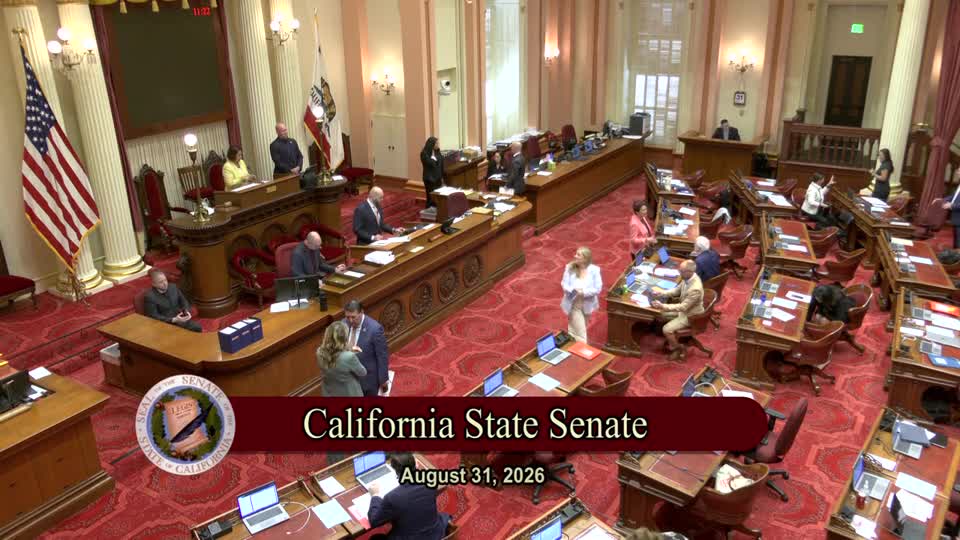 2MIN
Senate Floor
 1MIN
Assembly Floor
 1MIN
Assembly Floor
 32MIN
Assembly Standing Committee on Appropriations
Bill Author