AB 1883: Workplace surveillance tools.
- Session Year: 2025-2026
- House: Assembly
- Latest Version Date: 2026-09-30
Current Status:
Passed
(2026-09-30: Chaptered by Secretary of State - Chapter 853, Statutes of 2026.)
Introduced
In Committee
Awaiting First Chamber Vote
Passed First Chamber
In Committee
Awaiting Second Chamber Vote
Passed Second Chamber
Enacted
Existing law establishes the Division of Labor Standards Enforcement within the Department of Industrial Relations. Existing law authorizes the division, which is headed by the Labor Commissioner, to enforce the Labor Code and all labor laws of the state, the enforcement of which is not specifically vested in any other officer, board, or commission.
This bill would, with certain exceptions, prohibit an employer from using a workplace surveillance tool that uses artificial intelligence to, among other things, collect neural data or recognize an individuals emotional state. The bill would define an employer to include a governmental entity, including, among other entities, charter cities and the University of California.
This bill would authorize the Labor Commissioner or a public prosecutor to enforce the bills provisions. The bill would subject an employer who violates the bills provisions to a civil penalty of up to $500 for each violation. The bill would define various terms for purposes of its provisions.
This bill would exempt from its provisions an employers use of a workplace surveillance tool in specified operations where the use of a workplace surveillance tool is reasonable necessary to comply with a federal statute, federal regulation, or binding federal contract relating to the development of aircraft for use in the national airspace or the development of products or services for national security, military, space, or defense purposes.
The bill would include findings that changes proposed by this bill address a matter of statewide concern rather than a municipal affair and, therefore, apply to all cities, including charter cities.
Existing law establishes the Division of Labor Standards Enforcement within the Department of Industrial Relations. Existing law authorizes the division, which is headed by the Labor Commissioner, to enforce the Labor Code and all labor laws of the state, the enforcement of which is not specifically vested in any other officer, board, or commission.
This bill would, with certain exceptions, prohibit an employer from using a workplace surveillance tool that uses artificial intelligence to, among other things, collect neural data or recognize an individuals emotional state. The bill would define an employer to include a governmental entity, including, among other entities, charter cities and the University of California.
This bill would require authorize the Labor Commissioner or a public prosecutor to enforce the bills provisions and would authorize a public prosecutor to enforce the provisions. provisions. The bill would subject an employer who violates the bills provisions to a civil penalty of up to $500 for each violation. The bill would define various terms for purposes of its provisions.
This bill would exempt from its provisions an employers use of a workplace surveillance tool in specified operations where the use of the a workplace surveillance tool is reasonable necessary to comply with a federal statute, federal regulation, or binding federal contract relating to the development of aircraft for use in the national airspace or the development of products or services for national security, military, space, or defense purposes.
The bill would include findings that changes proposed by this bill address a matter of statewide concern rather than a municipal affair and, therefore, apply to all cities, including charter cities.
Existing law establishes the Division of Labor Standards Enforcement within the Department of Industrial Relations. Existing law authorizes the division, which is headed by the Labor Commissioner, to enforce the Labor Code and all labor laws of the state, the enforcement of which is not specifically vested in any other officer, board, or commission.
This bill would, with certain exceptions, prohibit an employer from using a workplace surveillance tool that uses artificial intelligence to, among other things, collect neural data or recognize an individuals emotional state. The bill would define an employer to include a governmental entity, including, among other entities, charter cities and the University of California.
This bill would require the Labor Commissioner to enforce the bills provisions, would authorize an employee to bring a civil action for specified remedies for a violation of the bills provisions, provisions and would authorize a public prosecutor to enforce the provisions. The bill would subject an employer who violates the bills provisions to a civil penalty of up to $500 for each violation. The bill would define various terms for purposes of its provisions.
This bill would exempt from its provisions the use of a tool to the extent that its use is to ensure safety or is reasonably necessary to comply with, an employers use of a workplace surveillance tool in specified operations where the use of the tool is reasonable necessary to comply with a federal statute, federal regulation, or binding federal contract relating to the development of aircraft for use in the national airspace or the development of products or services for national security, military, space, or defense purposes.
The bill would include findings that changes proposed by this bill address a matter of statewide concern rather than a municipal affair and, therefore, apply to all cities, including charter cities.
Existing law establishes the Division of Labor Standards Enforcement within the Department of Industrial Relations. Existing law authorizes the division, which is headed by the Labor Commissioner, to enforce the Labor Code and all labor laws of the state, the enforcement of which is not specifically vested in any other officer, board, or commission.
This bill would generally regulate the use of workplace surveillance tools and an employers use of worker data. The bill would prohibit an employer from using a workplace surveillance tool on workers for various purposes, including preventing compliance with laws or regulations, inferring information about workers engaging in a protected activity, making inferences about an individuals emotional state or based on their gait, or collecting neural data. The bill would prohibit an employer from using facial recognition technology to make inferences about a worker for firing, deactivation, or disciplinary purposes. The bill would, with certain exceptions, also prohibit an employer from using a workplace surveillance tool to infer specified categories of information about a worker, including, among others, their veteran status, ancestral history, religious beliefs, or disability status.This bill would, with certain exceptions, prohibit an employer from using a workplace surveillance tool that uses artificial intelligence to, among other things, collect neural data or recognize an individuals emotional state. The bill would define an employer to include a governmental entity, including, among other entities, charter cities and the University of California.
This bill would require the Labor Commissioner to enforce the bills provisions, would authorize an employee to bring a civil action for specified remedies for a violation of the bills provisions, and would authorize a public prosecutor to enforce the provisions. The bill would subject an employer who violates the bills provisions to a civil penalty of up to $500 for each violation. The bill would define various terms for purposes of its provisions.
This bill would exempt from its provisions the use of a workplace artificial intelligence tool or a workplace surveillance tool to the extent that its use is required by, to ensure safety or is reasonably necessary to comply with, a federal statute, federal regulation, or binding federal contract relating to the development of aircraft for use in the national airspace or the development of products or services for national security, military, space, or defense purposes.
The bill would include findings that changes proposed by this bill address a matter of statewide concern rather than a municipal affair and, therefore, apply to all cities, including charter cities.
Existing law establishes the Division of Labor Standards Enforcement within the Department of Industrial Relations. Existing law authorizes the division, which is headed by the Labor Commissioner, to enforce the Labor Code and all labor laws of the state, the enforcement of which is not specifically vested in any other officer, board, or commission.
This bill would generally regulate the use of workplace surveillance tools and an employers use of worker data. The bill would prohibit an employer from using a workplace surveillance tool on workers for various purposes, including preventing compliance with laws or regulations, inferring information about workers engaging in a protected activity, making inferences about an individuals emotional state or based on their gait, or collecting neural data. The bill would prohibit an employer from using facial recognition technology, unless it is used strictly to open a locked device or grant access to locked or secure areas. technology to make inferences about a worker for firing, deactivation, or disciplinary purposes. The bill would would, with certain exceptions, also prohibit an employer from using a workplace surveillance tool to infer specified categories of information about a worker, including, among others, their veteran status, ancestral history, religious beliefs, or disability status.
This bill would require the Labor Commissioner to enforce the bills provisions, would authorize an employee to bring a civil action for specified remedies for a violation of the bills provisions, and would authorize a public prosecutor to enforce the provisions. The bill would subject an employer who violates the bills provisions to a civil penalty of up to $500 for each violation. The bill would define various terms for purposes of its provisions.
This bill would exempt from its provisions the use of a workplace artificial intelligence tool or a workplace surveillance tool to the extent that its use is required by, or reasonably necessary to comply with, a federal statute, federal regulation, or binding federal contract relating to the development of aircraft for use in the national airspace or the development of products or services for national security, military, space, or defense purposes.
The bill would include findings that changes proposed by this bill address a matter of statewide concern rather than a municipal affair and, therefore, apply to all cities, including charter cities.
Existing law establishes the Division of Labor Standards Enforcement within the Department of Industrial Relations. Existing law authorizes the division, which is headed by the Labor Commissioner, to enforce the Labor Code and all labor laws of the state, the enforcement of which is not specifically vested in any other officer, board, or commission.
This bill would generally regulate the use of workplace surveillance tools and an employers use of worker data. The bill would prohibit an employer from using certain a workplace surveillance tools, including a workplace surveillance tool that incorporates facial, gait, or emotion recognition technology, except as specified. tool on workers for various purposes, including preventing compliance with laws or regulations, inferring information about workers engaging in a protected activity, making inferences about an individuals emotional state or based on their gait, or collecting neural data. The bill would prohibit an employer from using facial recognition technology, unless it is used strictly to open a locked device or grant access to locked or secure areas. The bill would also prohibit an employer from using a workplace surveillance tool to infer specified categories of information about a worker, including, among others, their veteran status, ancestral history, religious beliefs, or disability status. The
This bill would require the Labor Commissioner to enforce the bills provisions, would authorize an employee to bring a civil action for specified remedies for a violation of the bills provisions, and would authorize a public prosecutor to enforce the provisions. The bill would subject an employer who violates the bills provisions to a civil penalty of up to $500 for each violation. The bill would define various terms for purposes of its provisions.
The bill would include findings that changes proposed by this bill address a matter of statewide concern rather than a municipal affair and, therefore, apply to all cities, including charter cities.
Existing law establishes the Division of Labor Standards Enforcement within the Department of Industrial Relations. Existing law authorizes the division, which is headed by the Labor Commissioner, to enforce the Labor Code and all labor laws of the state, the enforcement of which is not specifically vested in any other officer, board, or commission.
This bill would generally regulate the use of workplace surveillance tools and an employers use of worker data. The bill would prohibit an employer from using certain workplace surveillance tools, including a workplace surveillance tool that incorporates facial, gait, or emotion recognition technology, except as specified. The bill would also prohibit an employer from using a workplace surveillance tool to infer specified categories of information about a worker, including, among others, their veteran status, ancestral history, religious beliefs, or disability status. The bill would require the Labor Commissioner to enforce the bills provisions, would authorize an employee to bring a civil action for specified remedies for a violation of the bills provisions, and would authorize a public prosecutor to enforce the provisions. The bill would subject an employer who violates the bills provisions to a civil penalty of $500 for each violation. The bill would define various terms for purposes of its provisions.
As used in this part:
(a)Artificial intelligence means an engineered or machine-based system that varies in its level of autonomy and that can, for explicit or implicit objectives, infer from the input it receives how to generate outputs that can influence physical or virtual environments.
(b)Employ means to engage, suffer, or permit to work.
(c)Employee means a person employed by an employer.
(d)(1)Employer means a person or governmental entity that directly or indirectly, or through an agent or any other person, employs or exercises control over the wages, hours, or working conditions of any person.
(2)Employer includes all of the following:
(A)All branches of state government, the University of California, the California State University, a city, county, city and county, whether general law or charter, special district, transit district, school district, community college district, or any other state or local governmental entity.
(B)A labor contractor of an employer described in paragraph (1).
(C)A farm labor contractor as defined in Section 1682.
(D)A foreign labor contractor as defined in Section 9998.1 of the Business and Professions Code.
(E)Any entity or individual that contracts with a labor contractor for labor or services, including a client employer as defined in Section 2810.3 or an entity or individual that contracts for property services pursuant to Section 238.5.
(e)Neural data means information that is generated by measuring the activity of an employees central or peripheral nervous system, and that is not inferred from nonneural information.
(f)Public prosecutor has the same meaning as defined in Section 180.
(g)Workplace surveillance tool means any system, application, instrument, or device that collects or facilitates the collection of employee data, activities, communications, actions, biometrics, or behaviors by means other than direct observation by a person, including, but not limited to, video or audio surveillance, continuous incremental time-tracking tools, geolocation, electromagnetic tracking, photoelectronic tracking, or that utilizes a photo-optical system or other means.
1581.(a)An employer shall not use a workplace surveillance tool that uses artificial intelligence on employees for either of the following:
(1)Recognizing, or making inferences or predictions about, an individuals emotional state.
(2)Collecting neural data.
(b)This section does not prohibit an employer from using a workplace surveillance tool to ensure safety, or otherwise if it does not meet the specifications in subdivision (a).
1582.(a)The Labor Commissioner may enforce this part, including investigating an alleged violation, and ordering appropriate temporary relief to mitigate a violation or maintain the status quo pending the completion of a full investigation or hearing through the procedures set forth in Section 98.3, 98.7, 98.74, or 1197.1, including issuing a citation against an employer who violates this part and filing a civil action. If a citation is issued, the procedures for issuing, contesting, and enforcing judgments for citations and civil penalties issued by the Labor Commissioner shall be the same as those set out in Section 98.74 or 1197.1, as applicable.
(b)This part may also be enforced by a public prosecutor pursuant to Chapter 8 (commencing with Section 180) of Division 1.
(c)In any civil action brought pursuant to subdivision (a) or (b) the petitioner may seek appropriate temporary or preliminary injunctive relief, including punitive damages, and reasonable attorneys fees and costs, in addition to other remedies identified in this section.
(d)(1)Except as provided in paragraph (2), in addition to any other remedy, an employer who violates this part may be subject to a penalty of up to five hundred dollars ($500) for each violation.
(2)An employee, the Labor Commissioner, or a public prosecutor may recover a penalty under this part as a statutory penalty paid to the employee or a civil penalty, but not both, for the same violation.
(e)An action brought pursuant to this section may be brought in the superior court in any county in which the violation in question is alleged to have occurred or in which the employer transacts business.
(f)This part does not preempt any city, county, or city and county ordinance that provides equal or greater protection to employees who are covered by this part.
1583.(a)This part does not prohibit the use of a workplace surveillance tool by an employer relating to any of the following:
(1)The development of aircraft for use in the national airspace.
(2)The development of products or services for national security, military, space, or defense purposes.
(b)The exemption in this section applies only to the operations covered by a federal statute, federal regulation, or binding federal contract where the use of a workplace surveillance tool is reasonably necessary to comply with the federal statute, the federal regulation, or the binding federal contract.
SEC. 2.The Legislature finds and declares that Section 1 of this act adding Part 5.8 (commencing with Section 1580) to Division 2 of the Labor Code addresses a matter of statewide concern rather than a municipal affair as that term is used in Section 5 of Article XI of the California Constitution. Therefore, Section 1 of this act applies to all cities, including charter cities.
As used in this part:
(a)Artificial intelligence means an engineered or machine-based system that varies in its level of autonomy and that can, for explicit or implicit objectives, infer from the input it receives how to generate outputs that can influence physical or virtual environments.
(b)Employ means to engage, suffer, or permit to work.
(c)Employee means a person employed by an employer.
(b)(d)(1)Employer means a person or governmental entity that directly or indirectly, or through an agent or any other person, employs or exercises control over the wages, benefits, other compensation, hours, working conditions, access to work or job opportunities, or other terms or conditions of employment, of any worker, including all branches of state government, and all cities, counties, cities and counties, charter cities, charter counties, special districts, including transit districts, the University of California, the California State University, community college districts, school districts, or any other state or local governmental entity. wages, hours, or working conditions of any person.
(2)Employer includes an employers labor contractor.(2)Employer includes all of the following:
(A)All branches of state government, the University of California, the California State University, a city, county, city and county, whether general law or charter, special district, transit district, school district, community college district, or any other state or local governmental entity.
(B)A labor contractor of an employer described in paragraph (1).
(C)A farm labor contractor as defined in Section 1682.
(D)A foreign labor contractor as defined in Section 9998.1 of the Business and Professions Code.
(E)Any entity or individual that contracts with a labor contractor for labor or services, including a client employer as defined in Section 2810.3 or an entity or individual that contracts for property services pursuant to Section 238.5.
(c)(e)Neural data means information that is generated by measuring the activity of a workers an employees central or peripheral nervous system, and that is not inferred from nonneural information.
(d)(f)Public prosecutor has the same meaning as defined in Section 180.
(e)Worker means a natural person, an employee of a business or a state or local governmental entity in a workplace.(f)(g)Workplace surveillance tool means any system, application, instrument, or device that collects or facilitates the collection of worker employee data, activities, communications, actions, biometrics, or behaviors by means other than direct observation by a person, including, but not limited to, video or audio surveillance, continuous incremental time-tracking tools, geolocation, electromagnetic tracking, photoelectronic tracking, or that utilizes a photo-optical system or other means.
1581.(a)An employer shall not use a workplace surveillance tool that uses artificial intelligence on workers that is capable of employees for either of the following:
(1)Recognizing, or making inferences or predictions about, an individuals emotional state.
(2)Collecting neural data.
(b)This section does not prohibit an employer from using a workplace surveillance tool to ensure safety, or otherwise if it does not meet the specifications in subdivision (a).
1582.(a)The Labor Commissioner shall may enforce this part, including investigating an alleged violation, and ordering appropriate temporary relief to mitigate a violation or maintain the status quo pending the completion of a full investigation or hearing through the procedures set forth in Section 98, 98.3, 98.7, 98.74, or 1197.1, including issuing a citation against an employer who violates this part and filing a civil action. If a citation is issued, the procedures for issuing, contesting, and enforcing judgments for citations and civil penalties issued by the Labor Commissioner shall be the same as those set out in Section 98.74 or 1197.1, as applicable.
(b)This part may also be enforced by a public prosecutor pursuant to Chapter 8 (commencing with Section 180) of Division 1.
(c)In any civil action brought pursuant to subdivision (a) or (b) the petitioner may seek appropriate temporary or preliminary injunctive relief, including punitive damages, and reasonable attorneys fees and costs. costs, in addition to other remedies identified in this section.
(d)(1)Except as provided in paragraph (2), in addition to any other remedy, an employer who violates this part may be subject to a penalty of up to five hundred dollars ($500) for each violation.
(2)An employee, the Labor Commissioner, or a public prosecutor may recover a penalty under this part as a statutory penalty paid to the employee or a civil penalty, but not both, for the same violation.
(e)An action brought pursuant to this section may be brought in the superior court in any county in which the violation in question is alleged to have occurred or in which the employer transacts business.
(f)This part does not preempt any city, county, or city and county ordinance that provides equal or greater protection to workers employees who are covered by this part.
1583.(a)This part does not prohibit the use of a workplace surveillance tool by an employer relating to any of the following:
(1)The development of aircraft for use in the national airspace.
(2)The development of products or services for national security, military, space, or defense purposes.
(b)The exemption in this section applies only to the operations covered by a federal statute, federal regulation, or binding federal contract where the use of that a workplace surveillance tool that is reasonably necessary to comply with the federal statute, the federal regulation, or the binding federal contract.
SEC. 2.The Legislature finds and declares that Section 1 of this act adding Part 5.8 (commencing with Section 1580) to Division 2 of the Labor Code addresses a matter of statewide concern rather than a municipal affair as that term is used in Section 5 of Article XI of the California Constitution. Therefore, Section 1 of this act applies to all cities, including charter cities.
As used in this part:
(a)Artificial intelligence means an engineered or machine-based system that varies in its level of autonomy and that can, for explicit or implicit objectives, infer from the input it receives how to generate outputs that can influence physical or virtual environments.
(b)(1)Employer means a person or governmental entity that directly or indirectly, or through an agent or any other person, employs or exercises control over the wages, benefits, other compensation, hours, working conditions, access to work or job opportunities, or other terms or conditions of employment, of any worker, including all branches of state government, and all cities, counties, cities and counties, charter cities, charter counties, special districts, including transit districts, the University of California, the California State University, community college districts, school districts, or any other state or local governmental entity.
(2)Employer includes an employers labor contractor.
(c)Neural data means information that is generated by measuring the activity of a workers central or peripheral nervous system, and that is not inferred from nonneural information.
(d)Public prosecutor has the same meaning as defined in Section 180.
(e)Worker means a natural person, an employee of, or an independent contractor providing service to, or through, of a business or a state or local governmental entity in a workplace.
(f)Workplace surveillance tool means any system, application, instrument, or device that collects or facilitates the collection of worker data, activities, communications, actions, biometrics, or behaviors by means other than direct observation by a person, including, but not limited to, video or audio surveillance, continuous incremental time-tracking tools, geolocation, electromagnetic tracking, photoelectronic tracking, or that utilizes a photo-optical system or other means.
1581.(a)An employer shall not use a workplace surveillance tool that uses artificial intelligence on workers that is capable of either of the following:
(1)Recognizing, or making inferences or predictions about, an individuals emotional state.
(2)Collecting neural data.
(b)This section does not prohibit an employer from using a workplace surveillance tool to ensure safety, or otherwise if it does not meet the specifications in subdivision (a).
1582.(a)The Labor Commissioner shall enforce this part, including investigating an alleged violation, and ordering appropriate temporary relief to mitigate a violation or maintain the status quo pending the completion of a full investigation or hearing through the procedures set forth in Section 98, 98.3, 98.7, 98.74, or 1197.1, including issuing a citation against an employer who violates this part and filing a civil action. If a citation is issued, the procedures for issuing, contesting, and enforcing judgments for citations and civil penalties issued by the Labor Commissioner shall be the same as those set out in Section 98.74 or 1197.1, as applicable.
(b)This part may also be enforced by a public prosecutor pursuant to Chapter 8 (commencing with Section 180) of Division 1.
(c)Alternatively to subdivisions (a) and (b), a worker, or their exclusive representative, who has suffered a violation of this part may bring a civil action in a court of competent jurisdiction for damages caused by the violation.(d)(c)In any civil action brought pursuant to subdivision (a), (b), or (c), (a) or (b) the petitioner may seek appropriate temporary or preliminary injunctive relief, including punitive damages, and reasonable attorneys fees and costs.
(e)(d)(1)Except as provided in paragraph (2), in addition to any other remedy, an employer who violates this part may be subject to a penalty of up to five hundred dollars ($500) for each violation.
(2)An employee, the Labor Commissioner, or a public prosecutor may recover a penalty under this part as a statutory penalty paid to the employee or a civil penalty, but not both, for the same violation.
(f)(e)An action brought pursuant to this section may be brought in the superior court in any county in which the violation in question is alleged to have occurred or in which the employer resides. transacts business.
(g)(f)This part does not preempt any city, county, or city and county ordinance that provides equal or greater protection to workers who are covered by this part.
1583.(a)This part does not prohibit the use of a tool workplace surveillance tool by an employer relating to any of the following:
(1)The development of aircraft for use in the national airspace.
(2)The development of products or services for national security, military, space, or defense purposes.
(b)The exemption in this section applies only to the operations covered by a federal statute, federal regulation, or binding federal contract where the use of a that tool that is reasonably necessary to comply with a the federal statute, the federal regulation, or the binding federal contract.
SEC. 2.The Legislature finds and declares that Section 1 of this act adding Part 5.8 (commencing with Section 1580) to Division 2 of the Labor Code addresses a matter of statewide concern rather than a municipal affair as that term is used in Section 5 of Article XI of the California Constitution. Therefore, Section 1 of this act applies to all cities, including charter cities.
As used in this part:
(a)Artificial intelligence means an engineered or machine-based system that varies in its level of autonomy and that can, for explicit or implicit objectives, infer from the input it receives how to generate outputs that can influence physical or virtual environments.
(a)(b)(1)Employer means a person or governmental entity that directly or indirectly, or through an agent or any other person, employs or exercises control over the wages, benefits, other compensation, hours, working conditions, access to work or job opportunities, or other terms or conditions of employment, of any worker, including all branches of state government, and all cities, counties, cities and counties, charter cities, charter counties, special districts, including transit districts, the University of California, the California State University, community college districts, school districts, or any other state or local governmental entity.
(2)Employer includes an employers labor contractor.
(b)Facial recognition technology means any technology that analyzes a workers facial features to identify, verify, or track a worker in a still or video image.(c)Neural data means information that is generated by measuring the activity of a workers central or peripheral nervous system, and that is not inferred from nonneural information.
(d)Public prosecutor has the same meaning as defined in Section 180.
(e)Worker means a natural person, an employee of, or an independent contractor providing service to, or through, a business or a state or local governmental entity in a workplace.
(f)Workplace surveillance tool means any system, application, instrument, or device that collects or facilitates the collection of worker data, activities, communications, actions, biometrics, or behaviors by means other than direct observation by a person, including, but not limited to, video or audio surveillance, continuous incremental time-tracking tools, geolocation, electromagnetic tracking, photoelectronic tracking, or that utilizes a photo-optical system or other means.
1581.(a)(1)An employer shall not use a workplace surveillance tool on workers to do any of the following: that uses artificial intelligence on workers that is capable of either of the following:
(A)Prevent compliance with or violate any federal, state, or local labor, occupational health and safety, employment, or civil rights laws or regulations.(B)Infer information about workers engaging in activity protected by state or federal law.(C)Make inferences about(1)Recognizing, or making inferences or predictions about, an individuals emotional state.
(D)Make inferences about an individual based on their gait.(E)Collect(2)Collecting neural data.
(2)An employer shall not use facial recognition technology to make inferences about a worker for firing, deactivation, or disciplinary purposes.(3)An employer shall not use a workplace surveillance tool to infer a workers protected status under Section 12940 of the Government Code.(b)This section does not prohibit an employer from using a workplace surveillance tool to ensure safety, provided that the tool does not incorporate artificial intelligence that makes inferences or predictions based on a workers emotional, gait, neural data, protected status under Section 12940 of the Government Code, or about activity protected by state or federal law. or otherwise if it does not meet the specifications in subdivision (a).
1582.(a)The Labor Commissioner shall enforce this part, including investigating an alleged violation, and ordering appropriate temporary relief to mitigate a violation or maintain the status quo pending the completion of a full investigation or hearing through the procedures set forth in Section 98, 98.3, 98.7, 98.74, or 1197.1, including issuing a citation against an employer who violates this part and filing a civil action. If a citation is issued, the procedures for issuing, contesting, and enforcing judgments for citations and civil penalties issued by the Labor Commissioner shall be the same as those set out in Section 98.74 or 1197.1, as applicable.
(b)This part may also be enforced by a public prosecutor pursuant to Chapter 8 (commencing with Section 180) of Division 1.
(c)Alternatively to subdivisions (a) and (b), a worker, or their exclusive representative, who has suffered a violation of this part may bring a civil action in a court of competent jurisdiction for damages caused by the violation.
(d)In any civil action brought pursuant to subdivision (a), (b), or (c), the petitioner may seek appropriate temporary or preliminary injunctive relief, including punitive damages, and reasonable attorneys fees and costs.
(e)(1)Except as provided in paragraph (2), in addition to any other remedy, an employer who violates this part may be subject to a penalty of up to five hundred dollars ($500) for each violation.
(2)An employee, the Labor Commissioner, or a public prosecutor may recover a penalty under this part as a statutory penalty paid to the employee or a civil penalty, but not both, for the same violation.
(f)An action brought pursuant to this section may be brought in the superior court in any county in which the violation in question is alleged to have occurred or in which the employer resides.
(g)This part does not preempt any city, county, or city and county ordinance that provides equal or greater protection to workers who are covered by this part.
1583.(a)This part shall not apply to the use of a workplace artificial intelligence tool or a workplace surveillance tool to the extent that use of the tool is required by, or reasonably necessary to comply with, a federal statute, federal regulation, or binding federal contract does not prohibit the use of a tool relating to any of the following:
(1)The development of aircraft for use in the national airspace.
(2)The development of products or services for national security, military, space, or defense purposes.
(b)The exemption in this section applies only to the operations covered by a federal statute, federal regulation, or binding federal contract outlined in paragraphs (1) and (2) of subdivision (a). the use of a tool that is reasonably necessary to comply with a federal statute, federal regulation, or binding federal contract.
SEC. 2.The Legislature finds and declares that Section 1 of this act adding Part 5.8 (commencing with Section 1580) to Division 2 of the Labor Code addresses a matter of statewide concern rather than a municipal affair as that term is used in Section 5 of Article XI of the California Constitution. Therefore, Section 1 of this act applies to all cities, including charter cities.
As used in this part:
(a)(1)Employer means a person or governmental entity that directly or indirectly, or through an agent or any other person, employs or exercises control over the wages, benefits, other compensation, hours, working conditions, access to work or job opportunities, or other terms or conditions of employment, of any worker, including all branches of state government, and all cities, counties, cities and counties, charter cities, charter counties, special districts, including transit districts, the University of California, the California State University, community college districts, school districts, or any other state or local governmental entity.
(2)Employer includes an employers labor contractor.
(b)Facial recognition technology means any technology that analyzes a workers facial features to identify, verify, or track a worker in a still or video image.
(c)Neural data means information that is generated by measuring the activity of a workers central or peripheral nervous system, and that is not inferred from nonneural information.
(d)Public prosecutor has the same meaning as defined in Section 180.
(e)Worker means a natural person, an employee of, or an independent contractor providing service to, or through, a business or a state or local governmental entity in a workplace.
(f)Workplace surveillance tool means any system, application, instrument, or device that collects or facilitates the collection of worker data, activities, communications, actions, biometrics, or behaviors by means other than direct observation by a person, including, but not limited to, video or audio surveillance, continuous incremental time-tracking tools, geolocation, electromagnetic tracking, photoelectronic tracking, or that utilizes a photo-optical system or other means.
1581.(a)(1)An employer shall not use a workplace surveillance tool on workers to do any of the following:
(A)Prevent compliance with or violate any federal, state, or local labor, occupational health and safety, employment, or civil rights laws or regulations.
(B)Infer information about workers engaging in activity protected by state or federal law.
(C)Make inferences about an individuals emotional state.
(D)Make inferences about an individual based on their gait.
(E)Collect neural data.
(2)An employer shall not use facial recognition technology, unless it is used strictly to open a locked device or grant access to locked or secure areas. technology to make inferences about a worker for firing, deactivation, or disciplinary purposes.
(3)An employer shall not use a workplace surveillance tool to infer a workers protected status under Section 12940 of the Government Code.
(b)This section does not prohibit an employer from using a workplace surveillance tool to ensure safety, provided that the tool does not incorporate artificial intelligence that makes inferences or predictions based on a workers emotional, facial, gait, neural data, protected status under Section 12940 of the Government Code, or about activity protected by state or federal law.
1582.(a)The Labor Commissioner shall enforce this part, including investigating an alleged violation, and ordering appropriate temporary relief to mitigate a violation or maintain the status quo pending the completion of a full investigation or hearing through the procedures set forth in Section 98, 98.3, 98.7, 98.74, or 1197.1, including issuing a citation against an employer who violates this part and filing a civil action. If a citation is issued, the procedures for issuing, contesting, and enforcing judgments for citations and civil penalties issued by the Labor Commissioner shall be the same as those set out in Section 98.74 or 1197.1, as applicable.
(b)This part may also be enforced by a public prosecutor pursuant to Chapter 8 (commencing with Section 180) of Division 1.
(c)Alternatively to subdivisions (a) and (b), a worker, or their exclusive representative, who has suffered a violation of this part may bring a civil action in a court of competent jurisdiction for damages caused by the violation.
(d)In any civil action brought pursuant to subdivision (a), (b), or (c), the petitioner may seek appropriate temporary or preliminary injunctive relief, including punitive damages, and reasonable attorneys fees and costs.
(e)(1)Except as provided in paragraph (2), in addition to any other remedy, an employer who violates this part may be subject to a penalty of up to five hundred dollars ($500) for each violation.
(2)An employee, the Labor Commissioner, or a public prosecutor may recover a penalty under this part as a statutory penalty paid to the employee or a civil penalty, but not both, for the same violation.
(f)An action brought pursuant to this section may be brought in the superior court in any county in which the violation in question is alleged to have occurred or in which the employer resides.
(g)This part does not preempt any city, county, or city and county ordinance that provides equal or greater protection to workers who are covered by this part.
1583.(a)This part shall not apply to the use of a workplace artificial intelligence tool or a workplace surveillance tool to the extent that use of the tool is required by, or reasonably necessary to comply with, a federal statute, federal regulation, or binding federal contract relating to any of the following:
(1)The development of aircraft for use in the national airspace.
(2)The development of products or services for national security, military, space, or defense purposes.
(b)The exemption in this section applies only to the operations covered by a federal statute, federal regulation, or binding federal contract outlined in paragraphs (1) and (2) of subdivision (a).
SEC. 2.The Legislature finds and declares that Section 1 of this act adding Part 5.8 (commencing with Section 1580) to Division 2 of the Labor Code addresses a matter of statewide concern rather than a municipal affair as that term is used in Section 5 of Article XI of the California Constitution. Therefore, Section 1 of this act applies to all cities, including charter cities.
As used in this part:
(a)Agency means the Labor and Workforce Development Agency or any of its designees.(b)Emotion recognition technology means any technology that uses artificial intelligence to analyze a workers biometric data and physical state to infer, predict, or modify a workers internal emotional and behavioral state. Biometric data and physical state includes facial expressions, vocal intonation, gait, heart rate, and skin conductance.(c)(a)(1)Employer means a person or governmental entity that directly or indirectly, or through an agent or any other person, employs or exercises control over the wages, benefits, other compensation, hours, working conditions, access to work or job opportunities, or other terms or conditions of employment, of any worker, including all branches of state government, and all cities, counties, cities and counties, charter cities, charter counties, special districts, including transit districts, the University of California, the California State University, community college districts, school districts, or any other state or local governmental entity.
(2)Employer includes an employers labor contractor.
(d)Employment-related decision means a decision by an employer that impacts wages, wage setting, benefits, compensation, hours, work schedule, performance evaluation, hiring, discipline, promotion, termination, job tasks, skill requirements, responsibilities, assignment of work, access to work and training opportunities, productivity requirements, workplace health and safety, and any other terms or conditions of employment.(e)(b)Facial recognition technology means any technology that analyzes a workers facial features to identify, verify, or track a worker in a still or video image.
(f)Gait recognition technology means any technology that analyzes the shape and movement of a workers body when in motion to identify a worker.(g)(c)Neural data means information that is generated by measuring the activity of a workers central or peripheral nervous system, and that is not inferred from nonneural information.
(h)(d)Public prosecutor has the same meaning as defined in Section 180.
(i)(e)Worker means a natural person, an employee of, or an independent contractor providing service to, or through, a business or a state or local governmental entity in a workplace.
(j)(f)Workplace surveillance tool means any system, application, instrument, or device that collects or facilitates the collection of worker data, activities, communications, actions, biometrics, or behaviors, or those of the public that are also capable of passively surveilling workers, behaviors by means other than direct observation by a person, including, but not limited to, video or audio surveillance, continuous incremental time-tracking tools, geolocation, electromagnetic tracking, photoelectronic tracking, or that utilizes a photo-optical system or other means.
1581.(a)(1)An employer shall not use a workplace surveillance tool that does on workers to do any of the following:
(A)Prevents Prevent compliance with or violates violate any federal, state, or local labor, occupational health and safety, employment, or civil rights laws or regulations.
(B)Identifies, profiles, or infers Infer information about workers engaging in activity protected by state or federal law.
(C)Incorporates any of the following technologies: Make inferences about an individuals emotional state.
(i)Emotion recognition technology.(ii)Facial recognition, unless it is used strictly to open a locked device or grant access to locked or secured areas.(iii)Gait recognition technology.(iv)Neural data collection.(D)Make inferences about an individual based on their gait.
(E)Collect neural data.
(2)An employer shall not use facial recognition technology, unless it is used strictly to open a locked device or grant access to locked or secure areas.
(2)(3)An employer shall not use a workplace surveillance tool to infer a workers protected status under Section 12940 of the Government Code.
(b)This section does not prohibit an employer from using a workplace surveillance tool to ensure safety, provided that the tool does not incorporate artificial intelligence that makes inferences or predictions based on a workers emotional, facial, gait, neural data, protected status under Section 12940 of the Government Code, or about activity protected by state or federal law.
1582.(a)The Labor Commissioner shall enforce this part, including investigating an alleged violation, and ordering appropriate temporary relief to mitigate a violation or maintain the status quo pending the completion of a full investigation or hearing through the procedures set forth in Section 98, 98.3, 98.7, 98.74, or 1197.1, including issuing a citation against an employer who violates this part and filing a civil action. If a citation is issued, the procedures for issuing, contesting, and enforcing judgments for citations and civil penalties issued by the Labor Commissioner shall be the same as those set out in Section 98.74 or 1197.1, as applicable.
(b)This part may also be enforced by a public prosecutor pursuant to Chapter 8 (commencing with Section 180) of Division 1.
(c)Alternatively to subdivisions (a) and (b), a worker, or their exclusive representative, who has suffered a violation of this part may bring a civil action in a court of competent jurisdiction for damages caused by that adverse action, including punitive damages. the violation.
(d)In any civil action brought pursuant to subdivision (a) or(b), (a), (b), or (c), the petitioner may seek appropriate temporary or preliminary injunctive relief, including punitive damages, and reasonable attorneys fees and costs.
(e)(1)Except as provided in paragraph (2), in addition to any other remedy, an employer who violates this part may be subject to a penalty of up to five hundred dollars ($500) per employee for each violation.
(2)An employee, the Labor Commissioner, or a public prosecutor may recover a penalty under this part as a statutory penalty paid to the employee or a civil penalty, but not both, for the same violation.
(f)An action brought pursuant to this section may be brought in the superior court in any county in which the violation in question is alleged to have occurred or in which the employer resides or transacts business. resides.
(g)This part does not preempt any city, county, or city and county ordinance that provides equal or greater protection to workers who are covered by this part.
SEC. 2.The Legislature finds and declares that Section 1 of this act adding Part 5.8 (commencing with Section 1580) to Division 2 of the Labor Code addresses a matter of statewide concern rather than a municipal affair as that term is used in Section 5 of Article XI of the California Constitution. Therefore, Section 1 of this act applies to all cities, including charter cities.
As used in this part:
(a)Agency means the Labor and Workforce Development Agency or any of its designees.
(b)Emotion recognition technology means any technology that uses artificial intelligence to analyze a workers biometric data and physical state to infer, predict, or modify a workers internal emotional and behavioral state. Biometric data and physical state includes facial expressions, vocal intonation, gait, heart rate, and skin conductance.
(c)(1)Employer means a person or governmental entity that directly or indirectly, or through an agent or any other person, employs or exercises control over the wages, benefits, other compensation, hours, working conditions, access to work or job opportunities, or other terms or conditions of employment, of any worker, including all branches of state government, or the several counties, cities and counties, and municipalities thereof, or any other political subdivision of the state, or a school district, or any special district, or any authority, commission, or board or any other agency or instrumentality thereof. and all cities, counties, cities and counties, charter cities, charter counties, special districts, including transit districts, the University of California, the California State University, community college districts, school districts, or any other state or local governmental entity.
(2)Employer includes an employers labor contractor.
(d)Employment-related decision means a decision by an employer that impacts wages, wage setting, benefits, compensation, hours, work schedule, performance evaluation, hiring, discipline, promotion, termination, job tasks, skill requirements, responsibilities, assignment of work, access to work and training opportunities, productivity requirements, workplace health and safety, and any other terms or conditions of employment.
(e)Facial recognition technology means any technology that analyzes a workers facial features to identify, verify, or track a worker in a still or video image.
(f)Gait recognition technology means any technology that analyzes the shape and movement of a workers body when in motion to identify a worker.
(g)Neural data means information that is generated by measuring the activity of a workers central or peripheral nervous system, and that is not inferred from nonneural information.
(h)Public prosecutor has the same meaning as defined in Section 180.
(i)Worker means a natural person, an employee of, or an independent contractor providing service to, or through, a business or a state or local governmental entity in a workplace.
(j)Workplace surveillance tool means any system, application, instrument, or device that collects or facilitates the collection of worker data, activities, communications, actions, biometrics, or behaviors, or those of the public that are also capable of passively surveilling workers, by means other than direct observation by a person, including, but not limited to, video or audio surveillance, continuous incremental time-tracking tools, geolocation, electromagnetic tracking, photoelectronic tracking, or that utilizes a photo-optical system or other means.
1581.(a)(1)An employer shall not use a workplace surveillance tool that does any of the following:
(A)Prevents compliance with or violates any federal, state, or local labor, occupational health and safety, employment, or civil rights laws or regulations.
(B)Identifies, profiles, or infers information about workers engaging in activity protected by state or federal law.
(C)Incorporates any of the following technologies:
(i)Emotion recognition technology.
(ii)Facial recognition, unless it is used strictly to open a locked device or grant access to locked or secured areas.
(iii)Gait recognition technology.
(iv)Neural data collection.
(2)An employer shall not use a workplace surveillance tool to infer a workers protected status under Section 12940 of the Government Code.
1582.(a)The Labor Commissioner shall enforce this part, including investigating an alleged violation, and ordering appropriate temporary relief to mitigate a violation or maintain the status quo pending the completion of a full investigation or hearing through the procedures set forth in Section 98, 98.3, 98.7, 98.74, or 1197.1, including issuing a citation against an employer who violates this part and filing a civil action. If a citation is issued, the procedures for issuing, contesting, and enforcing judgments for citations and civil penalties issued by the Labor Commissioner shall be the same as those set out in Section 98.74 or 1197.1, as applicable.
(b)This part may also be enforced by a public prosecutor pursuant to Chapter 8 (commencing with Section 180) of Division 1.
(c)Alternatively to subdivisions (a) and (b), a worker, or their exclusive representative, who has suffered a violation of this part may bring a civil action in a court of competent jurisdiction for damages caused by that adverse action, including punitive damages.
(d)In any civil action brought pursuant to subdivision (a) or (b), the petitioner may seek appropriate temporary or preliminary injunctive relief, including punitive damages, and reasonable attorneys fees and costs.
(e)(1)Except as provided in paragraph (2), in addition to any other remedy, an employer who violates this part may be subject to a penalty of up to five hundred dollars ($500) per employee for each violation.
(2)An employee, the Labor Commissioner, or a public prosecutor may recover a penalty under this part as a statutory penalty paid to the employee or a civil penalty, but not both, for the same violation.
(f)An action brought pursuant to this section may be brought in the superior court in any county in which the violation in question is alleged to have occurred or in which the employer resides or transacts business.
(g)This part does not preempt any city, county, or city and county ordinance that provides equal or greater protection to workers who are covered by this part.
SEC. 2.The Legislature finds and declares that Section 1 of this act adding Part 5.8 (commencing with Section 1580) to Division 2 of the Labor Code addresses a matter of statewide concern rather than a municipal affair as that term is used in Section 5 of Article XI of the California Constitution. Therefore, Section 1 of this act applies to all cities, including charter cities.
As used in this part:
(a)Agency means the Labor and Workforce Development Agency or any of its designees.
(b)Emotion recognition technology means any technology that uses artificial intelligence to analyze a workers biometric data and physical state to infer, predict, or modify a workers internal emotional and behavioral state. Biometric data and physical state includes facial expressions, vocal intonation, gait, heart rate, and skin conductance.
(c)(1)Employer means a person or governmental entity that directly or indirectly, or through an agent or any other person, employs or exercises control over the wages, benefits, other compensation, hours, working conditions, access to work or job opportunities, or other terms or conditions of employment, of any worker, including all branches of state government, or the several counties, cities and counties, and municipalities thereof, or any other political subdivision of the state, or a school district, or any special district, or any authority, commission, or board or any other agency or instrumentality thereof.
(2)Employer includes an employers labor contractor.
(d)Employment-related decision means a decision by an employer that impacts wages, wage setting, benefits, compensation, hours, work schedule, performance evaluation, hiring, discipline, promotion, termination, job tasks, skill requirements, responsibilities, assignment of work, access to work and training opportunities, productivity requirements, workplace health and safety, and any other terms or conditions of employment.
(e)Facial recognition technology means any technology that analyzes a workers facial features to identify, verify, or track a worker in a still or video image.
(f)Gait recognition technology means any technology that analyzes the shape and movement of a workers body when in motion to identify a worker.
(g)Neural data means information that is generated by measuring the activity of a workers central or peripheral nervous system, and that is not inferred from nonneural information.
(h)Public prosecutor has the same meaning as defined in Section 180.
(i)Worker means a natural person, an employee of, or an independent contractor providing service to, or through, a business or a state or local governmental entity in a workplace.
(j)Workplace surveillance tool means any system, application, instrument, or device that collects or facilitates the collection of worker data, activities, communications, actions, biometrics, or behaviors, or those of the public that are also capable of passively surveilling workers, by means other than direct observation by a person, including, but not limited to, video or audio surveillance, continuous incremental time-tracking tools, geolocation, electromagnetic tracking, photoelectronic tracking, or that utilizes a photo-optical system or other means.
1581.(a)(1)An employer shall not use a workplace surveillance tool that does any of the following:
(A)Prevents compliance with or violates any federal, state, or local labor, occupational health and safety, employment, or civil rights laws or regulations.
(B)Identifies, profiles, or infers information about workers engaging in activity protected by state or federal law.
(C)Incorporates any of the following technologies:
(i)Emotion recognition technology.
(ii)Facial recognition, unless it is used strictly to open a locked device or grant access to locked or secured areas.
(iii)Gait recognition technology.
(iv)Neural data collection.
(2)An employer shall not use a workplace surveillance tool to infer a workers protected status under Section 12940 of the Government Code.
1582.(a)The Labor Commissioner shall enforce this part, including investigating an alleged violation, and ordering appropriate temporary relief to mitigate a violation or maintain the status quo pending the completion of a full investigation or hearing through the procedures set forth in Section 98, 98.3, 98.7, 98.74, or 1197.1, including issuing a citation against an employer who violates this part and filing a civil action. If a citation is issued, the procedures for issuing, contesting, and enforcing judgments for citations and civil penalties issued by the Labor Commissioner shall be the same as those set out in Section 98.74 or 1197.1, as applicable.
(b)This part may also be enforced by a public prosecutor pursuant to Chapter 8 (commencing with Section 180) of Division 1.
(c)Alternatively to subdivisions (a) and (b), a worker, or their exclusive representative, who has suffered a violation of this part may bring a civil action in a court of competent jurisdiction for damages caused by that adverse action, including punitive damages.
(d)In any civil action brought pursuant to subdivision (a) or (b), the petitioner may seek appropriate temporary or preliminary injunctive relief, including punitive damages, and reasonable attorneys fees and costs.
(e)(1)Except as provided in paragraph (2), in addition to any other remedy, an employer who violates this part may be subject to a penalty of up to five hundred dollars ($500) per employee for each violation.
(2)An employee, the Labor Commissioner, or a public prosecutor may recover a penalty under this part as a statutory penalty paid to the employee or a civil penalty, but not both, for the same violation.
(f)An action brought pursuant to this section may be brought in the superior court in any county in which the violation in question is alleged to have occurred or in which the employer resides or transacts business.
(g)This part does not preempt any city, county, or city and county ordinance that provides equal or greater protection to workers who are covered by this part.
|
Date
|
Status
|
|---|---|
| Sep 30, 2026 | Chaptered by Secretary of State - Chapter 853, Statutes of 2026. |
| Sep 30, 2026 | Approved by the Governor. |
| Sep 10, 2026 | Enrolled and presented to the Governor at 3 p.m. |
| Aug 30, 2026 | Senate amendments concurred in. To Engrossing and Enrolling. (Ayes 56. Noes 8. Page 6892.). |
| Aug 30, 2026 | Senate amendments concurred in. To Engrossing and Enrolling. (Ayes 56. Noes 8.). |
| Aug 30, 2026 | Senate amendments concurred in. To Engrossing and Enrolling. |
| Aug 28, 2026 | In Assembly. Concurrence in Senate amendments pending. |
| Aug 28, 2026 | Read third time. Passed. Ordered to the Assembly. (Ayes 28. Noes 9. Page 6081.). |
| Aug 28, 2026 | Read third time. Passed. Ordered to the Assembly. (Ayes 28. Noes 9.). |
| Aug 24, 2026 | Read second time. Ordered to third reading. |
| Aug 21, 2026 | Read third time and amended. Ordered to second reading. |
| Aug 17, 2026 | Read second time. Ordered to third reading. |
| Aug 13, 2026 | Read second time and amended. Ordered returned to second reading. |
| Aug 13, 2026 | From committee: Amend, and do pass as amended. (Ayes 5. Noes 2.) (August 13). |
| Aug 3, 2026 | In committee: Referred to APPR. suspense file. |
| Jul 2, 2026 | Read second time and amended. Re-referred to Com. on APPR. |
| Jul 1, 2026 | From committee: Amend, and do pass as amended and re-refer to Com. on APPR. (Ayes 4. Noes 1.) (July 1). |
| Jun 29, 2026 | From committee: Do pass and re-refer to Com. on L., P.E. & R. (Ayes 8. Noes 1.) (June 29). Re-referred to Com. on L., P.E. & R. |
| Jun 22, 2026 | Referred to Coms. on P., D.T., & C.P. and L., P.E. & R. |
| May 28, 2026 | In Senate. Read first time. To Com. on RLS. for assignment. |
| May 27, 2026 | Read third time. Passed. Ordered to the Senate. (Ayes 52. Noes 12. Page 5490.) |
| May 27, 2026 | Read third time. Passed. Ordered to the Senate. (Ayes 52. Noes 12.) |
| May 27, 2026 | Read third time. Passed. Ordered to the Senate. |
| May 19, 2026 | Read second time. Ordered to third reading. |
| May 18, 2026 | Read second time and amended. Ordered returned to second reading. |
| May 14, 2026 | From committee: Amend, and do pass as amended. (Ayes 10. Noes 1.) (May 14). |
| Apr 29, 2026 | In committee: Set, first hearing. Referred to APPR. suspense file. |
| Apr 20, 2026 | From committee: Do pass and re-refer to Com. on APPR. (Ayes 11. Noes 2.) (April 16). Re-referred to Com. on APPR. |
| Apr 14, 2026 | Re-referred to Com. on P. & C.P. |
| Apr 13, 2026 | From committee chair, with author's amendments: Amend, and re-refer to Com. on P. & C.P. Read second time and amended. |
| Mar 19, 2026 | From committee: Do pass and re-refer to Com. on P. & C.P. (Ayes 5. Noes 0.) (March 18). Re-referred to Com. on P. & C.P. |
| Mar 16, 2026 | Re-referred to Com. on L. & E. |
| Mar 12, 2026 | From committee chair, with author's amendments: Amend, and re-refer to Com. on L. & E. Read second time and amended. |
| Mar 2, 2026 | Referred to Coms. on L. & E., P. & C.P. and JUD. |
| Feb 13, 2026 | From printer. May be heard in committee March 15. |
| Feb 12, 2026 | Read first time. To print. |
|
Date
|
Description
|
Location
|
Votes
|
|
|---|---|---|---|---|
| Aug 30, 2026 | AB 1883 Bryan Concurrence in Senate Amendments | Assembly Floor |
Passed |
|
| Aug 28, 2026 | Assembly 3rd Reading AB1883 Bryan By McNerney | Senate Floor |
Passed |
|
| Aug 13, 2026 | Do pass as amended | Senate Standing Committee on Appropriations |
Passed |
|
| Aug 3, 2026 | Placed on suspense file | Senate Standing Committee on Appropriations |
Passed |
|
| Jul 1, 2026 | Do pass as amended, but first amend, and re-refer to the Committee on [Appropriations] | Senate Standing Committee on Labor, Public Employment and Retirement |
Passed |
|
| Jun 29, 2026 | Do pass, but first be re-referred to the Committee on [Labor, Public Employment and Retirement ] | Senate Standing Committee on Privacy, Digital Technologies, and Consumer Protection |
Passed |
|
| May 27, 2026 | AB 1883 Bryan Assembly Third Reading | Assembly Floor |
Passed |
|
| May 14, 2026 | Do pass as amended. | Assembly Standing Committee on Appropriations |
Passed |
|
| Apr 16, 2026 | Do pass and be re-referred to the Committee on [Appropriations] | Assembly Standing Committee on Privacy and Consumer Protection |
Passed |
|
| Mar 18, 2026 | Do pass and be re-referred to the Committee on [Privacy and Consumer Protection] | Assembly Standing Committee on Labor and Employment |
Passed |
This list shows positions taken on this bill by organizations on the date displayed, which is linked to the original source.
Positions by individuals are not included.
|
Organization
|
Position
|
Date
|
|---|---|---|
| Alameda Labor Council | ** Support | |
| American Federation of Musicians, Local 7 | ** Support | |
| American Federation of State, County and Municipal Employees (AFSCME) California | ** Support | |
| American Petroleum and Convenience Store Association | ** Against | |
| American Petroleum and Convenience Store Association Apca | ** Against | |
| American Petroleum and Convenience Store Association Apca | ** Against | |
| Associated General Contractors Of California | ** Against | |
| Associated General Contractors San Diego | ** Against | |
| Association of California Healthcare Districts | ** Against | |
| Association Of California Healthcare Districts (Achd) | ** Against | |
| Association Of California School Administrators | ** Against | |
| Building Owners and Managers Association of California | ** Against | |
| California Airports Council | ** Against | |
| California Alliance for Retired Americans (CARA) | ** Support | |
| California Apartment Association | ** Against | |
| California Assisted Living Association | ** Against | |
| California Association Of Joint Powers Authorities | ** Against | |
| California Association of Joint Powers Authorities (CAJPA) | ** Against | |
| California Association Of Recreation & Park Districts | ** Against | |
| California Association Of School Business Officials (Casbo) | ** Against | |
| CALIFORNIA ASSOCIATION OF SHEET METAL & AIR CONDITIONING CONTRACTORS NATIONAL ASSOCIATION | ** Against | |
| California Association Of Winegrape Growers | ** Against | |
| California Attractions And Parks Association | ** Against | |
| California Automatic Vendors Council | ** Against | |
| California Business Properties Association | ** Against | |
| California Chamber Of Commerce | ** Against | |
| California Conference Board Of The Amalgamated Transit Union | ** Support | |
| California Conference Of Machinists | ** Support | |
| California Craft Brewers Association | ** Against | |
| California Distributors Association | ** Against | |
| California Employment Lawyers Association | ** Support | |
| California Faculty Association | ** Support | |
| California Farm Bureau | ** Against | |
| California Federation of Labor Unions | ** Support | |
| California Federation of Labor Unions, AFL-CIO (source) | ** Support | |
| California Federation of Teachers Afl-cio | ** Support | |
| California Grocers Association | ** Against | |
| California Hospital Association | ** Against | |
| California Landscape Contractors Association | ** Against | |
| California League of Food Producers | ** Against | |
| California Legislative Conference Of Plumbing, Heating & Piping Industry | ** Against | |
| California Legislative Conference Of Plumbing, Heating & Piping Industry | ** Against | |
| California Legislative Conference of the Plumbing, Heating & Piping Industry | ** Against | |
| California Manufacturers And Technology Association | ** Against | |
| California Moving And Storage Association | ** Against | |
| California Nurses Association | ** Support | |
| California Professional Firefighters | ** Support | |
| California Restaurant Association | ** Against | |
| California Retailers Association | ** Against | |
| California Rural Legal Assistance Foundation | ** Support | |
| California School Employees Association | ** Support | |
| California’s Credit Union | ** Against | |
| California's Credit Unions | ** Against | |
| California Sheet Metal & Air Conditioning Contractors’ National Association | ** Against | |
| California Special Districts Association | ** Against | |
| California State Association of Counties (CSAC) | ** Against | |
| California State Legislative Board of the Sheet Metal, Air, Rail and Transportation Workers - Transportation Division (SMART-TD) | ** Support | |
| California State Legislative Board of the Sheet Metal, Air, Rail and Transportation Workers - Transportation Division (SMART-TD) | ** Support | |
| California State Legislative Board of the Smart - Transportation Division | ** Support | |
| California State University Employees Union, Seiu Local 2579 | ** Support | |
| California Teachers Association | ** Support | |
| California Transit Association | ** Against | |
| California Trucking Association | ** Against | |
| Center on Policy Initiatives | ** Support | |
| Central Coast Labor Council | ** Support | |
| Central Labor Council, Fresno-Madera-Tulare-Kings Counties, AFL-CIO | ** Support | |
| City of San Marcos | ** Against | |
| Civil Justice Association of California (CJAC) | ** Against | |
| Communications Workers of America, District 9 | ** Support | |
| Construction Employers Association | ** Against | |
| County Health Executives Association of California (CHEAC) | ** Against | |
| County of Fresno | ** Against | |
| County Of Kern | ** Against | |
| County of Riverside | ** Against | |
| Electronic Security Association | ** Against | |
| Engineers and Scientists of California, IFPTE Local 20, AFL-CIO | ** Support | |
| Family Business Association of California | ** Against | |
| Finishing Contractors Association Of Southern California | ** Against | |
| Fresno-Madera-Tulare-Kings Central Labor Council | ** Support | |
| Inland Empire Labor Council, AFL-CIO | ** Support | |
| Insights Association | ** Against | |
| Kapor Center Advocacy | ** Support | |
| League Of California Cities | ** Against | |
| Los Angeles Area Chamber Of Commerce | ** Against | |
| National Association of Independent Property Owners | ** Against | |
| National Automatic Merchandising Association | ** Against | |
| National Electrical Contractors Association | ** Against | |
| North Bay Labor Council | ** Support | |
| Northern California Allied Trades | ** Against | |
| North Valley Labor Federation | ** Support | |
| Oakland Privacy | ** Support | |
| Omidyar Network | ** Support | |
| Orange County Employees Association | ** Support | |
| Orange County Labor Federation, AFL-CIO | ** Support | |
| Privacy Rights Clearinghouse | ** Support | |
| Protect App-based Drivers & Services Coalition | ** Against | |
| Public Risk Innovation, Solutions, and Management | ** Against | |
| PUBLIC RISK INNOVATION, SOLUTIONS, AND MANAGEMENT (PRISM) | ** Against | |
| Resource Recovery Coalition Of California | ** Against | |
| Rural County Representatives of California (RCRC) | ** Against | |
| san mateo county central labor council | ** Support | |
| Security Industry Association | ** Against | |
| Self Storage Association | ** Against | |
| Self-Storage Association | ** Against | |
| Service Employees International Union California | ** Support | |
| Shrm California | ** Against | |
| Southern California Glass Management Association | ** Against | |
| Southwest California Legislative Council | ** Against | |
| State Building and Construction Trades Council of California, AFL-CIO | ** Support | |
| Teamsters California | ** Support | |
| TechEquity Collaborative | ** Support | |
| Technet | ** Against | |
| the greater coachella valley chamber of commerce | ** Against | |
| Tri County Chamber Alliance | ** Against | |
| United Contractors | ** Against | |
| UNITE HERE, AFL-CIO | ** Support | |
| Urban Counties of California (UCC) | ** Against | |
| Utility Workers Union of America, AFL-CIO | ** Support | |
| VALLEY INDUSTRY AND COMMERCE ASSOCIATION | ** Against | |
| Wall and Ceiling Alliance | ** Against | |
| Western Growers Association | ** Against | |
| Western Line Constructors Chapter | ** Against | |
| Western Line Constructors Chapter, Inc., Neca, Inc. | ** Against | |
| Western Line Constructors Chapter, Inc., Neca, Inc. | ** Against | |
| Western Painting and Coating Contractors Association | ** Against | |
| Western Painting and Coating Contractors Association | ** Against | |
| WESTERN WALL AND CEILING CONTRACTORS ASSOCIATION (WWCCA) | ** Against | |
| WESTERN WALL AND CEILING CONTRACTORS ASSOCIATION (WWCCA) | ** Against | |
| What We Will | ** Support | |
| Wine Institute | ** Against |
CONCURRENCE IN SENATE AMENDMENTS
CSA1 Bill Id:AB 1883
Author:(Bryan)
As Amended Ver:August 21, 2026
Majority vote
SUMMARY
Regulates an employer's use of workplace surveillance tools, as specified.
Senate Amendments
- Remove the applicability of the bill's provisions to independent contractors and apply them instead only to employees.
- Narrow the prohibition on an employer using a workplace surveillance tool that uses artificial intelligence (AI) on employees to only prohibit such tools that are capable of recognizing, or making inferences or predictions about, an individual's emotional state, or collecting neural data.
- Delete the prohibition on an employer using a workplace surveillance tool that uses AI on workers that is capable of any of the following:
- Preventing compliance with or violating any federal, state, or local labor, occupational health and safety, employment, or civil rights laws or regulations.
- Inferring information about workers engaging in activity protected by state or federal law.
- Making inferences about an individual based on their gait.
- Delete the prohibition on an employer using a workplace surveillance tool that uses AI on workers that is capable of any of the following:
- Delete the prohibition on an employer using facial recognition technology to make inferences about a worker for firing, deactivation, or disciplinary purposes.
- Delete the prohibition on an employer using a workplace surveillance tool to infer a worker's protected status under the Fair Employment and Housing Act (FEHA).
- Authorize, rather than require, the Labor Commissioner (LC) to enforce the bill's provisions.
- Delete the private right of action for a worker, or their exclusive representative, who has suffered a violation under the bill.
- Provide that an action brought pursuant to the bill's provisions may be brought in the superior court in any county in which the violation in question is alleged to have occurred or in which the employer transacts business, rather than where the employer resides.
- Define AI to mean "an engineered or machine-based system that varies in its level of autonomy and that can, for explicit or implicit objectives, infer from the input it receives how to generate outputs that can influence physical or virtual environments."
- Narrow the definition of "employer" to mean a person or governmental entity that directly or indirectly, or through an agent or any other person, employs or exercises control over the wages, hours or working conditions of any person.
- Provide that "employer" additionally includes a farm labor contractor, as defined; a foreign labor contractor, as defined; and any entity or individual that contracts with a labor contractor for labor or services, including a client employer, as defined, or an entity or individual that contracts for property services, as specified.
- Make technical, clarifying and conforming changes.
COMMENTS
Workplace surveillance is not new, but it is rapidly evolving amidst a worldwide AI revolution. While video cameras and microphones have been used in workplace surveillance for many years, the technology now available to employers is much more sophisticated. Employers today can use surveillance tools to not only track worker movements, but also compile vast amounts of data points and analyze them in real time. These technologies allow employers to control their worker's behavior, both implicitly and explicitly, as well.
The author provides the following examples of some of the types of workplace surveillance tools that would be regulated by this bill:
- Emotion recognition technology: "Emotion recognition uses biometric data such as a person's facial expression, heart rate, skin conductance, or tone of voice to infer a person's emotional state. Verint, formerly known as cogito, has developed emotion recognition technology that has been used on call center workers for MetLife and Humana. In both instances, call center workers were monitored by the emotion recognition tool to ensure the caller provided a happy and receptive tone when speaking to customers. The system would additionally provide a report to supervisors with details of which call center workers received the highest number of suggestions."[1]
- Neural recognition technology: "The technology works by capturing the brain activity of a person's central and peripheral nervous system. With this data, developers claim their systems can determine when a worker is concentrating, tired, or stressed. Emotive, a developer of neural recognition hardware and software, offers their tools to employers under the premise that 'understanding a worker's true mental and cognitive state is the key to … an improvement in Return on Investment (ROI).'"[2]
According to the Author
"Workplace surveillance has evolved into highly invasive systems that track worker movements and collect massive amounts of data. Current laws fail to protect workers from these practices. AB 1883 will prohibit the use of invasive surveillance systems in the workplace, systems that pose profound risks not just to employee privacy but also to unaccountable discrimination."
Arguments in Support
A coalition of labor groups are in support, including the California Federation of Labor Unions, and state that "AI enabled surveillance differs from traditional video and audio monitoring in several ways. For one, these tools strip workers of their biometric data, essentially committing a full-scale invasion of workers' physical, mental, and emotional space at all hours of the day. Rather than requiring a human to monitor live surveillance feeds, today's tools utilize active AI monitoring that are capable of monitoring workers with zero interruptions. Heart rate, perspiration, facial expressions, and eye movements are tracked and used as data points to target "unproductive" workers and to "minimize risk" in the workplace.
AI tools rely on black-box algorithms to surveil workers. Data from emotion recognition, neural sensors, and facial and gait sensors are not just observations, but analysis of the data collected. Not only is that data potentially unreliable, but it can have bias built in, further exacerbating discrimination and inequities. For example, tools that utilize emotion recognition technology may very well fail to understand cultural nuances of expression and may be trained on biased information that inaccurately tags certain forms of speech as "aggressive" or "inappropriate.""
Arguments in Opposition
The County of Fresno states in opposition that the bill "could vastly complicate the routine work of local governments, endanger our ability to perform essential public services, impede our ability to manage and respond to workplace violence threats, and make local governments vulnerable to waste, fraud, and abuse of public resources. We have fundamental concerns with this and other bills that aim to restrict how public agencies can use the tools defined as "workplace surveillance tools," which we believe are essential and, in many cases, routine tools used for security.
AB 1883 exposes public agencies to severe litigation risk and steep penalties and would allow employees or employee representatives to bring civil actions against public agencies for violating a law that is vague, sweeping, and littered with unintended consequences. In addition to punitive damages and attorney fees, this bill could cause public agencies to incur staggering penalties of $500 per employee for each violation."
FISCAL COMMENTS
According to the Senate Appropriations Committee:
- Estimated $2.6 million in Fiscal Year (FY) 2026-27, $2.5 million annually thereafter to the Division of Labor Standards Enforcement (DLSE) within the Department of Industrial Relations. The Labor Commission, as chief of the DLSE, enforces wage laws and retaliation laws whereas this bill will require regulating employer conduct. (Labor Enforcement and Compliance Fund)
- Potentially significant costs to the courts to adjudicate new penalties depending on the numbers of employers charged and the factors unique to each case. An eight-hour court day costs approximately $10,500 based on the hourly rate of court personnel including at minimum the judge, clerk, bailiff, court reporter, jury administrator, administrative staff, and jury per-diems. While the courts are not funded on a workload basis, an increase in workload could result in delayed court services and would put pressure on the General Fund to fund additional staff and resources. The FY 2026-27 Budget appropriated $70 million General Fund for this purpose (Trial Court Trust Fund, General Fund).
- Likely minor, if any, costs to state entities found using workplace surveillance tools for prohibited purposes. (Special funds, General Fund)
VOTES:
ASM LABOR AND EMPLOYMENT: 5-0-2
YES: Ortega, Elhawary, Kalra, Lee, Arambula
ABS, ABST OR NV: Alanis, Chen
ASM PRIVACY AND CONSUMER PROTECTION: 11-2-2
YES: Bauer-Kahan, Aguiar-Curry, Bryan, Irwin, Lowenthal, McKinnor, Ortega, Petrie-Norris, Ward, Wicks, Wilson
NO: Macedo, DeMaio
ABS, ABST OR NV: Hoover, Patterson
ASM APPROPRIATIONS: 10-1-4
YES: Wicks, Aguiar-Curry, Calderon, Caloza, Fong, Mark González, Krell, Pellerin, Sharp-Collins, Solache
NO: Tangipa
ABS, ABST OR NV: Hoover, Dixon, Pacheco, Ta
ASSEMBLY FLOOR: 52-12-16
YES: Addis, Aguiar-Curry, Ahrens, Alvarez, Arambula, Bains, Bauer-Kahan, Bennett, Berman, Boerner, Bonta, Bryan, Calderon, Caloza, Connolly, Davies, Elhawary, Fong, Gabriel, Garcia, Mark González, Haney, Harabedian, Hart, Irwin, Jackson, Kalra, Krell, Lee, Lowenthal, McKinnor, Muratsuchi, Nguyen, Ortega, Papan, Patel, Pellerin, Petrie-Norris, Ramos, Ransom, Rogers, Schiavo, Schultz, Sharp-Collins, Solache, Soria, Stefani, Ward, Wicks, Wilson, Zbur, Rivas
NO: Ávila Farías, DeMaio, Dixon, Ellis, Gallagher, Jeff Gonzalez, Hadwick, Johnson, Macedo, Sanchez, Tangipa, Wallis
ABS, ABST OR NV: Alanis, Carrillo, Castillo, Chen, Flora, Gipson, Hoover, Lackey, Pacheco, Patterson, Quirk-Silva, Celeste Rodriguez, Michelle Rodriguez, Blanca Rubio, Ta, Valencia
UPDATED
VERSION: August 21, 2026
CONSULTANT: Erin Hickey / L. & E. / (916) 319-2091 FN: 0004040
SENATE RULES COMMITTEE Office of Senate Floor Analyses (916) 651-4171 | AB 1883 |
THIRD READING
Bill No: AB 1883
Author: Bryan (D)
Amended: 8/21/26 in Senate
Vote: 21
SENATE PRIV., DIGITAL TECH. & CONS. PROT. COMMITTEE: 8-1, 6/29/26
AYES: Cabaldon, Gonzalez, McNerney, Ochoa Bogh, Padilla, Reyes, Umberg, Wiener
NOES: Seyarto
SENATE LABOR, PUB. EMP. & RET. COMMITTEE: 4-1, 7/1/26
AYES: Smallwood-Cuevas, Cortese, Durazo, Laird
NOES: Strickland
SENATE APPROPRIATIONS COMMITTEE: 5-2, 8/13/26
AYES: Cervantes, Cabaldon, Grayson, Richardson, Wahab
NOES: Seyarto, Dahle
ASSEMBLY FLOOR: 52-12, 5/27/26 - See last page for vote
SUBJECT: Workplace surveillance tools
SOURCE: California Federation of Labor Unions
DIGEST:
This bill regulates the use of specified workplace surveillance tools.
Senate Floor amendments of 8/21/26 apply the provisions to employees, as defined, rather than “workers,” add and revise various definitions, and make various technical and conforming changes.
ANALYSIS:
Existing law:
- Provides, pursuant to the California Constitution, that all people have inalienable rights, including the right to pursue and obtain privacy. (California Constitution (Cal. Const.), art. I, § 1.)
- Establishes the California Consumer Privacy Act (CCPA), which grants consumers certain rights with regard to their personal information, including enhanced notice, access, and disclosure; the right to deletion; the right to restrict the sale of information; and protection from discrimination for exercising these rights. It places attendant obligations on businesses to respect those rights. (Civil (Civ.) Code § 1798.100 et seq.)
- Requires a business that collects a consumer’s personal information to, at or before the point of collection, inform consumers of the categories of personal information to be collected and the purposes for which the categories of personal information are collected or used. (Civ. Code § 1798.100(a).)
- Grants a consumer the right to request that a business that collects personal information about the consumer disclose to the consumer the following:
- the categories of personal information it has collected about that consumer;
- the categories of sources from which the personal information is collected;
- the business or commercial purpose for collecting, selling, or sharing personal information;
- the categories of third parties with whom the business shares personal information; and
- the specific pieces of personal information it has collected about that consumer. (Civ. Code § 1798.110.)
This bill:
- Prohibits an employer from using a “workplace surveillance tool” that uses AI on employees for either of the following:
- Recognizing, or making inferences or predictions about, an individual’s emotional state.
- Collecting neural data.
- Defines “workplace surveillance tool” as any system, application, instrument, or device that collects or facilitates the collection of employee data, activities, communications, actions, biometrics, or behaviors by means other than direct observation by a person, including video or audio surveillance, continuous incremental time-tracking tools, geolocation, electromagnetic tracking, photoelectronic tracking, or that utilizes a photo-optical system or other means.
- Provides for civil enforcement by the Labor Commissioner and public prosecutors. Such petitioners may bring a civil action seeking civil penalties, appropriate temporary or preliminary injunctive relief, including punitive damages, and reasonable attorney’s fees and costs, in addition to other specified remedies.
- Authorizes the Labor Commissioner, in addition to the above civil action, to further enforce this part, including by investigating an alleged violation, and ordering appropriate temporary relief to mitigate a violation or maintain the status quo pending the completion of a full investigation or hearing, including issuing a citation against an employer in violation, as specified.
- Provides specified exemptions.
Background
Workplace surveillance technology has expanded dramatically in recent years, evolving from basic security cameras and badge access systems to sophisticated digital monitoring tools that track virtually every aspect of employee activity. These tools may provide benefits to employers in the form of increased productivity and security. However, they raise serious concerns about their impact on privacy and worker organizing; the psychological effects on workers; and when decisions are based on automated performance metrics, issues of algorithmic bias and unfairness.
This bill regulates employers use of “workplace surveillance tools,” specified tools that collect or facilitate the collection of employee data, activities, communications, actions, biometrics, or behaviors by means other than direct observation by a person. This includes video or audio surveillance, continuous incremental time-tracking tools, and geolocation. Employers are prohibited from using a workplace surveillance tool that uses AI on employees for analyzing emotional state or collecting neural data.
This bill is sponsored by the California Federation of Labor Unions. It is supported by a large coalition of labor organizations and advocacy groups, including the State Building and Construction Trades Council of California. It is opposed by a coalition of governmental associations and industry groups, including the League of California Cities. For a more thorough discussion of this bill, please see the Senate Privacy, Digital Technologies, and Consumer Protection Committee analysis, which is incorporated herein by reference.
Comments
According to the author:
Workplace surveillance has evolved into highly invasive systems that track worker movements and collect massive amounts of data. Current laws fail to protect workers from these practices. AB 1883 will prohibit the use of invasive surveillance systems in the workplace, systems that pose profound risks not just to employee privacy but also to unaccountable discrimination. It also prohibits the use of surveillance tools to infer protected and personal information about workers, including immigration and health status, and the likelihood of unionizing or speaking up against workplace violations.
FISCAL EFFECT: Appropriation: No Fiscal Com.: Yes Local: No
According to the Senate Appropriations Committee:
Estimated $2.6 million in FY 2026-27, $2.5 million annually thereafter to the Division of Labor Standards Enforcement within the Department of Industrial Relations. The Labor Commission, as chief of the DLSE, enforces wage laws and retaliation laws whereas this bill will require regulating employer conduct. (Labor Enforcement and Compliance Fund)
Potentially significant costs to the courts to adjudicate new penalties depending on the numbers of employers charged and the factors unique to each case. An eight-hour court day costs approximately $10,500 based on the hourly rate of court personnel including at minimum the judge, clerk, bailiff, court reporter, jury administrator, administrative staff, and jury per-diems. While the courts are not funded on a workload basis, an increase in workload could result in delayed court services and would put pressure on the General Fund to fund additional staff and resources. The FY 2026-27 Budget appropriated $70 million General Fund for this purpose (Trial Court Trust Fund, General Fund).
Likely minor, if any, costs to state entities found using workplace surveillance tools for prohibited purposes. (Special funds, General Fund)
SUPPORT: (Verified 8/24/26)
California Federation of Labor Unions, AFL-CIO (source)
Alameda Labor Council
American Federation of Musicians, Local 7
American Federation of State, County and Municipal Employees (AFSCME) California
California Alliance for Retired Americans (CARA)
California Conference Board of the Amalgamated Transit Union
California Conference of Machinists
California Employment Lawyers Association
California Faculty Association
California Federation of Teachers AFL-CIO
California Nurses Association
California Professional Firefighters
California Rural Legal Assistance Foundation
California School Employees Association
California State Legislative Board of the Smart - Transportation Division
California State University Employees Union, SEIU Local 2579
California Teachers Association
Center on Policy Initiatives
Central Coast Labor Council
Central Labor Council, Fresno-Madera-Tulare-kings Counties, AFL-CIO
Communications Workers of America, District 9
Engineers and Scientists of California, IFPTE Local 20, AFL-CIO
Inland Empire Labor Council, AFL-CIO
Kapor Center Advocacy
North Bay Labor Council
North Valley Labor Federation
Oakland Privacy
Omidyar Network
Orange County Labor Federation, AFL-CIO
Privacy Rights Clearinghouse
San Mateo County Central Labor Council
Service Employees International Union California
State Building and Construction Trades Council of California, AFL-CIO
Teamsters California
TechEquity Collaborative
Unite Here, AFL-CIO
Utility Workers Union of America, AFL-CIO
What We Will
OPPOSITION: (Verified 8/24/26)
American Petroleum and Convenience Store Association
Associated General Contractors of California
Associated General Contractors San Diego
Association of California Healthcare Districts (ACHD)
Association of California School Administrators
Building Owners and Managers Association of California
California Airports Council
California Apartment Association
California Assisted Living Association
California Association of Joint Powers Authorities (CAJPA)
California Association of Recreation & Park Districts
California Association of School Business Officials (CASBO)
California Association of Sheet Metal & Air Conditioning Contractors National Association
California Association of Winegrape Growers
California Attractions and Parks Association
California Automatic Vendors Council
California Business Properties Association
California Chamber of Commerce
California Craft Brewers Association
California Distributors Association
California Grocers Association
California Hospital Association
California Landscape Contractors Association
California League of Food Producers
California Manufacturers and Technology Association
California Moving and Storage Association
California Restaurant Association
California Retailers Association
California Special Districts Association
California State Association of Counties (CSAC)
California Transit Association
California's Credit Unions
Civil Justice Association of California (CJAC)
County Health Executives Association of California (CHEAC)
County of Kern
County of Riverside
Family Business Association of California
Insights Association
League of California Cities
Los Angeles Area Chamber of Commerce
National Association of Independent Property Owners
National Automatic Merchandising Association
Public Risk Innovation, Solutions, and Management (PRISM)
Resource Recovery Coalition of California
Rural County Representatives of California (RCRC)
Security Industry Association
Self Storage Association
Shrm California
Southwest California Legislative Council
Technet
The Greater Coachella Valley Chamber of Commerce
Tri County Chamber Alliance
Urban Counties of California (UCC)
Western Growers Association
Wine Institute
ARGUMENTS IN SUPPORT: A large coalition of labor organizations and advocacy groups, including the California Teachers Association, writes:
Employers have used surveillance to monitor, manage, and control workers for decades. However, today’s employers now have access to a plethora of AI enabled surveillance tools capable of analyzing a worker’s gait, neural activity, emotional state, and face. AI enabled surveillance differs from traditional video and audio monitoring in several ways. For one, these tools strip workers of their biometric data, essentially committing a full-scale invasion of workers’ physical, mental, and emotional space at all hours of the day. Rather than requiring a human to monitor live surveillance feeds, today’s tools utilize active AI monitoring that are capable of monitoring workers with zero interruptions. Heart rate, perspiration, facial expressions, and eye movements are tracked and used as data points to target “unproductive” workers and to “minimize risk” in the workplace.
AI tools rely on black-box algorithms to surveil workers. Data from emotion recognition, neural sensors, and facial and gait sensors are not just observations, but analysis of the data collected. Not only is that data potentially unreliable, but it can have bias built in, further exacerbating discrimination and inequities. For example, tools that utilize emotion recognition technology may very well fail to understand cultural nuances of expression and may be trained on biased information that inaccurately tags certain forms of speech as “aggressive” or “inappropriate.” Similarly, facial recognition has a long history of failing to accurately recognize people of color, thus automating discrimination on a massive scale.
In order to protect workers from unregulated forms of military grade surveillance technology, AB 1883 prohibits employers from deploying gait, emotional, and neural recognition technologies in the workplace. AB 1883 also sets guardrails on the use of facial recognition technology by prohibiting employers from using the technology to make inferences to fire, discipline, or deactivate a worker. AB 1883 also prohibits employers from using any surveillance tool to infer personal and sensitive information of a worker such as their immigration status, gender identity, or sexual orientation and if a worker is exercising their protected rights. Lastly, the bill prohibits the use of any AI tool that prevents compliance with or violates any federal, state, or local labor, occupational health and safety, employment, or civil rights laws or regulations.
ARGUMENTS IN OPPOSITION: A large coalition of associations representing public employers, including the California State Association of Counties, writes:
We have fundamental concerns with this and other bills that aim to restrict how public agencies can use the tools defined as “workplace surveillance tools,” which we believe are essential and, in many cases, routine tools used for security.
- We oppose any legislation that will compromise health, safety, and security for our employees, the public we serve, and our officials.
- We oppose any legislation that compromises our ability to conduct investigations into fraud, waste, or abuse.
- We do not believe it is appropriate to regulate tools used for security and basic operations in response to private sector labor concerns. State law has protected the right of public employees to bargain and most public employees have a property interest in their position that is protected by due process.
AB 1883 would impose several rules on how public agencies may use surveillance tools – a term that is vast in its application, including video cameras, ID badge or key fob access, digital workplace messaging collaboration platforms (e.g. Microsoft Teams or Slack), and a wide array of tools used to keep workplaces safe, conduct essential government services, and protect against abuse, fraud, and waste of public resources.
We understand the reasonable concerns one could have about the rapid integration of surveillance tools into every aspect of daily life, particularly as new technologies emerge. However, we are concerned that this bill and others aimed at limiting workplace technology are too broad, too expensive, and too dangerous for public agencies and those we serve.
ASSEMBLY FLOOR: 52-12, 5/27/26
AYES: Addis, Aguiar-Curry, Ahrens, Alvarez, Arambula, Bains, Bauer-Kahan, Bennett, Berman, Boerner, Bonta, Bryan, Calderon, Caloza, Connolly, Davies, Elhawary, Fong, Gabriel, Garcia, Mark González, Haney, Harabedian, Hart, Irwin, Jackson, Kalra, Krell, Lee, Lowenthal, McKinnor, Muratsuchi, Nguyen, Ortega, Papan, Patel, Pellerin, Petrie-Norris, Ramos, Ransom, Rogers, Schiavo, Schultz, Sharp-Collins, Solache, Soria, Stefani, Ward, Wicks, Wilson, Zbur, Rivas
NOES: Ávila Farías, DeMaio, Dixon, Ellis, Gallagher, Jeff Gonzalez, Hadwick, Johnson, Macedo, Sanchez, Tangipa, Wallis
NO VOTE RECORDED: Alanis, Carrillo, Castillo, Chen, Flora, Gipson, Hoover, Lackey, Pacheco, Patterson, Quirk-Silva, Celeste Rodriguez, Michelle Rodriguez, Blanca Rubio, Ta, Valencia
Prepared by: Christian Kurpiewski / P., D.T., & C.P. / (916) 651-1548
8/24/26 12:58:16
**** END ****
SENATE RULES COMMITTEE Office of Senate Floor Analyses (916) 651-4171 | AB 1883 |
THIRD READING
Bill No: AB 1883
Author: Bryan (D)
Amended: 8/13/26 in Senate
Vote: 21
SENATE PRIV., DIGITAL TECH. & CONS. PROT. COMMITTEE: 8-1, 6/29/26
AYES: Cabaldon, Gonzalez, McNerney, Ochoa Bogh, Padilla, Reyes, Umberg, Wiener
NOES: Seyarto
SENATE LABOR, PUB. EMP. & RET. COMMITTEE: 4-1, 7/1/26
AYES: Smallwood-Cuevas, Cortese, Durazo, Laird
NOES: Strickland
SENATE APPROPRIATIONS COMMITTEE: 5-2, 8/13/26
AYES: Cervantes, Cabaldon, Grayson, Richardson, Wahab
NOES: Seyarto, Dahle
ASSEMBLY FLOOR: 52-12, 5/27/26 - See last page for vote
SUBJECT: Workplace surveillance tools
SOURCE: California Federation of Labor Unions
DIGEST:
This bill regulates the use of specified workplace surveillance tools.
ANALYSIS:
Existing law:
- Provides, pursuant to the California Constitution, that all people have inalienable rights, including the right to pursue and obtain privacy. (California Constitution (Cal. Const.), art. I, § 1.)
- Establishes the California Consumer Privacy Act (CCPA), which grants consumers certain rights with regard to their personal information, including enhanced notice, access, and disclosure; the right to deletion; the right to restrict the sale of information; and protection from discrimination for exercising these rights. It places attendant obligations on businesses to respect those rights. (Civil (Civ.) Code § 1798.100 et seq.)
- Requires a business that collects a consumer’s personal information to, at or before the point of collection, inform consumers of the categories of personal information to be collected and the purposes for which the categories of personal information are collected or used. (Civ. Code § 1798.100(a).)
- Grants a consumer the right to request that a business that collects personal information about the consumer disclose to the consumer the following:
- the categories of personal information it has collected about that consumer;
- the categories of sources from which the personal information is collected;
- the business or commercial purpose for collecting, selling, or sharing personal information;
- the categories of third parties with whom the business shares personal information; and
- the specific pieces of personal information it has collected about that consumer. (Civ. Code § 1798.110.)
This bill:
- Prohibits an employer from using a “workplace surveillance tool” that uses AI on workers that is capable of either of the following:
- Recognizing, or making inferences or predictions about, an individual’s emotional state.
- Collecting neural data.
- Defines “workplace surveillance tool” as any system, application, instrument, or device that collects or facilitates the collection of worker data, activities, communications, actions, biometrics, or behaviors by means other than direct observation by a person, including video or audio surveillance, continuous incremental time-tracking tools, geolocation, electromagnetic tracking, photoelectronic tracking, or that utilizes a photo-optical system or other means.
- Provides for civil enforcement by the Labor Commissioner and public prosecutors. Such petitioners may bring a civil action seeking civil penalties, appropriate temporary or preliminary injunctive relief, including punitive damages, and reasonable attorney’s fees and costs.
- Authorizes the Labor Commissioner, in addition to the above civil action, to further enforce this part, including by investigating an alleged violation, and ordering appropriate temporary relief to mitigate a violation or maintain the status quo pending the completion of a full investigation or hearing, including issuing a citation against an employer in violation, as specified.
- Provides specified exemptions.
Background
Workplace surveillance technology has expanded dramatically in recent years, evolving from basic security cameras and badge access systems to sophisticated digital monitoring tools that track virtually every aspect of employee activity. These tools may provide benefits to employers in the form of increased productivity and security. However, they raise serious concerns about their impact on privacy and worker organizing; the psychological effects on workers; and when decisions are based on automated performance metrics, issues of algorithmic bias and unfairness.
This bill regulates employers use of “workplace surveillance tools,” specified tools that collect or facilitate the collection of worker data, activities, communications, actions, biometrics, or behaviors by means other than direct observation by a person. This includes video or audio surveillance, continuous incremental time-tracking tools, and geolocation. Employers are prohibited from using a workplace surveillance tool that uses AI on workers when capable of analyzing emotional state or collecting neural data.
This bill is sponsored by the California Federation of Labor Unions. It is supported by a large coalition of labor organizations and advocacy groups, including the State Building and Construction Trades Council of California. It is opposed by a coalition of governmental associations and industry groups, including the League of California Cities. For a more thorough discussion of this bill, please see the Senate Privacy, Digital Technologies, and Consumer Protection Committee analysis, which is incorporated herein by reference.
Comment
According to the author:
Workplace surveillance has evolved into highly invasive systems that track worker movements and collect massive amounts of data. Current laws fail to protect workers from these practices. AB 1883 will prohibit the use of invasive surveillance systems in the workplace, systems that pose profound risks not just to employee privacy but also to unaccountable discrimination. It also prohibits the use of surveillance tools to infer protected and personal information about workers, including immigration and health status, and the likelihood of unionizing or speaking up against workplace violations.
FISCAL EFFECT: Appropriation: No Fiscal Com.: Yes Local: No
According to the Senate Appropriations Committee:
Estimated $2.6 million in FY 2026-27, $2.5 million annually thereafter to the Division of Labor Standards Enforcement within the Department of Industrial Relations. The Labor Commission, as chief of the DLSE, enforces wage laws and retaliation laws whereas this bill will require regulating employer conduct. (Labor Enforcement and Compliance Fund)
Potentially significant costs to the courts to adjudicate new penalties depending on the numbers of employers charged and the factors unique to each case. An eight-hour court day costs approximately $10,500 based on the hourly rate of court personnel including at minimum the judge, clerk, bailiff, court reporter, jury administrator, administrative staff, and jury per-diems. While the courts are not funded on a workload basis, an increase in workload could result in delayed court services and would put pressure on the General Fund to fund additional staff and resources. The FY 2026-27 Budget appropriated $70 million General Fund for this purpose (Trial Court Trust Fund, General Fund).
Likely minor, if any, costs to state entities found using workplace surveillance tools for prohibited purposes. (Special funds, General Fund)
SUPPORT: (Verified 8/14/26)
California Federation of Labor Unions, AFL-CIO (sponsor)
Alameda Labor Council
American Federation of Musicians, Local 7
American Federation of State, County and Municipal Employees California
California Alliance for Retired Americans
California Conference Board of the Amalgamated Transit Union
California Conference of Machinists
California Employment Lawyers Association
California Faculty Association
California Federation of Teachers AFL-CIO
California Nurses Association
California Professional Firefighters
California School Employees Association
California State Legislative Board of the Smart - Transportation Division
California State University Employees Union, SEIU Local 2579
California Teachers Association
Center on Policy Initiatives
Central Coast Labor Council
Central Labor Council, Fresno-Madera-Tulare-kings Counties, AFL-CIO
Communications Workers of America, District 9
Engineers and Scientists of California, IFPTE Local 20, AFL-CIO
Inland Empire Labor Council, AFL-CIO
Kapor Center Advocacy
North Bay Labor Council
North Valley Labor Federation
Oakland Privacy
Omidyar Network
Orange County Labor Federation, AFL-CIO
Privacy Rights Clearinghouse
San Mateo County Central Labor Council
Service Employees International Union California
State Building and Construction Trades Council of California, AFL-CIO
Teamsters California
TechEquity Collaborative
Unite Here, AFL-CIO
Utility Workers Union of America, AFL-CIO
What We Will
OPPOSITION: (Verified 8/14/26)
American Petroleum and Convenience Store Association
Associated General Contractors of California
Associated General Contractors San Diego
Association of California Healthcare Districts
Association of California School Administrators
Building Owners and Managers Association of California
California Airports Council
California Apartment Association
California Assisted Living Association
California Association of Joint Powers Authorities
California Association of Recreation & Park Districts
California Association of School Business Officials
California Association of Sheet Metal & Air Conditioning Contractors National Association
California Association of Winegrape Growers
California Attractions and Parks Association
California Automatic Vendors Council
California Business Properties Association
California Chamber of Commerce
California Craft Brewers Association
California Distributors Association
California Grocers Association
California Hospital Association
California Landscape Contractors Association
California League of Food Producers
California Manufacturers and Technology Association
California Moving and Storage Association
California Restaurant Association
California Retailers Association
California Special Districts Association
California State Association of Counties
California Transit Association
California's Credit Unions
Civil Justice Association of California
County Health Executives Association of California
County of Kern
County of Riverside
Family Business Association of California
Insights Association
League of California Cities
Los Angeles Area Chamber of Commerce
National Association of Independent Property Owners
National Automatic Merchandising Association
Public Risk Innovation, Solutions, and Management
Resource Recovery Coalition of California
Rural County Representatives of California
Security Industry Association
Self Storage Association
Shrm California
Southwest California Legislative Council
Technet
The Greater Coachella Valley Chamber of Commerce
Tri County Chamber Alliance
Urban Counties of California
Western Growers Association
Wine Institute
ARGUMENTS IN SUPPORT: A large coalition of labor organizations and advocacy groups, including the California Teachers Association, writes:
Employers have used surveillance to monitor, manage, and control workers for decades. However, today’s employers now have access to a plethora of AI enabled surveillance tools capable of analyzing a worker’s gait, neural activity, emotional state, and face. AI enabled surveillance differs from traditional video and audio monitoring in several ways. For one, these tools strip workers of their biometric data, essentially committing a full-scale invasion of workers’ physical, mental, and emotional space at all hours of the day. Rather than requiring a human to monitor live surveillance feeds, today’s tools utilize active AI monitoring that are capable of monitoring workers with zero interruptions. Heart rate, perspiration, facial expressions, and eye movements are tracked and used as data points to target “unproductive” workers and to “minimize risk” in the workplace.
AI tools rely on black-box algorithms to surveil workers. Data from emotion recognition, neural sensors, and facial and gait sensors are not just observations, but analysis of the data collected. Not only is that data potentially unreliable, but it can have bias built in, further exacerbating discrimination and inequities. For example, tools that utilize emotion recognition technology may very well fail to understand cultural nuances of expression and may be trained on biased information that inaccurately tags certain forms of speech as “aggressive” or “inappropriate.” Similarly, facial recognition has a long history of failing to accurately recognize people of color, thus automating discrimination on a massive scale.
In order to protect workers from unregulated forms of military grade surveillance technology, AB 1883 prohibits employers from deploying gait, emotional, and neural recognition technologies in the workplace. AB 1883 also sets guardrails on the use of facial recognition technology by prohibiting employers from using the technology to make inferences to fire, discipline, or deactivate a worker. AB 1883 also prohibits employers from using any surveillance tool to infer personal and sensitive information of a worker such as their immigration status, gender identity, or sexual orientation and if a worker is exercising their protected rights. Lastly, this bill prohibits the use of any AI tool that prevents compliance with or violates any federal, state, or local labor, occupational health and safety, employment, or civil rights laws or regulations.
ARGUMENTS IN OPPOSITION: A large coalition of associations representing public employers, including the California State Association of Counties, writes:
We have fundamental concerns with this and other bills that aim to restrict how public agencies can use the tools defined as “workplace surveillance tools,” which we believe are essential and, in many cases, routine tools used for security.
- We oppose any legislation that will compromise health, safety, and security for our employees, the public we serve, and our officials.
- We oppose any legislation that compromises our ability to conduct investigations into fraud, waste, or abuse.
- We do not believe it is appropriate to regulate tools used for security and basic operations in response to private sector labor concerns. State law has protected the right of public employees to bargain and most public employees have a property interest in their position that is protected by due process.
AB 1883 would impose several rules on how public agencies may use surveillance tools – a term that is vast in its application, including video cameras, ID badge or key fob access, digital workplace messaging collaboration platforms (e.g. Microsoft Teams or Slack), and a wide array of tools used to keep workplaces safe, conduct essential government services, and protect against abuse, fraud, and waste of public resources.
We understand the reasonable concerns one could have about the rapid integration of surveillance tools into every aspect of daily life, particularly as new technologies emerge. However, we are concerned that this bill and others aimed at limiting workplace technology are too broad, too expensive, and too dangerous for public agencies and those we serve.
ASSEMBLY FLOOR: 52-12, 5/27/26
AYES: Addis, Aguiar-Curry, Ahrens, Alvarez, Arambula, Bains, Bauer-Kahan, Bennett, Berman, Boerner, Bonta, Bryan, Calderon, Caloza, Connolly, Davies, Elhawary, Fong, Gabriel, Garcia, Mark González, Haney, Harabedian, Hart, Irwin, Jackson, Kalra, Krell, Lee, Lowenthal, McKinnor, Muratsuchi, Nguyen, Ortega, Papan, Patel, Pellerin, Petrie-Norris, Ramos, Ransom, Rogers, Schiavo, Schultz, Sharp-Collins, Solache, Soria, Stefani, Ward, Wicks, Wilson, Zbur, Rivas
NOES: Ávila Farías, DeMaio, Dixon, Ellis, Gallagher, Jeff Gonzalez, Hadwick, Johnson, Macedo, Sanchez, Tangipa, Wallis
NO VOTE RECORDED: Alanis, Carrillo, Castillo, Chen, Flora, Gipson, Hoover, Lackey, Pacheco, Patterson, Quirk-Silva, Celeste Rodriguez, Michelle Rodriguez, Blanca Rubio, Ta, Valencia
Prepared by: Christian Kurpiewski / P., D.T., & C.P. / (916) 651-1548
8/17/26 10:54:42
**** END ****
SENATE COMMITTEE ON
Senator Sabrina Cervantes, Chair
2025 - 2026 Regular Session
AB 1883 (Bryan) - Workplace surveillance tools
Version: | Policy Vote: |
Urgency: | Mandate: |
Hearing Date: | Consultant: |
Bill Summary:
AB 1883 would regulate the use of workplace surveillance tools by both public and private employers.
*********** ANALYSIS ADDENDUM – SUSPENSE FILE ***********
The following information is revised to reflect amendments
adopted by the committee on August 13, 2026
Fiscal Impact:
Estimated $2.6 million in FY 2026-27, $2.5 million annually thereafter to the Division of Labor Standards Enforcement within the Department of Industrial Relations. The Labor Commission, as chief of the DLSE, enforces wage laws and retaliation laws whereas this bill will require regulating employer conduct. (Labor Enforcement and Compliance Fund)
Potentially significant costs to the courts to adjudicate new penalties depending on the numbers of employers charged and the factors unique to each case. An eight-hour court day costs approximately $10,500 based on the hourly rate of court personnel including at minimum the judge, clerk, bailiff, court reporter, jury administrator, administrative staff, and jury per-diems. While the courts are not funded on a workload basis, an increase in workload could result in delayed court services and would put pressure on the General Fund to fund additional staff and resources. The FY 2026-27 Budget appropriated $70 million General Fund for this purpose (Trial Court Trust Fund, General Fund).
Likely minor, if any, costs to state entities found using workplace surveillance tools for prohibited purposes. (Special funds, General Fund)
Author Amendments:
Strike private right of action and make clarifying and technical changes.
-- END --
SENATE COMMITTEE ON
Senator Sabrina Cervantes, Chair
2025 - 2026 Regular Session
AB 1883 (Bryan) - Workplace surveillance tools
Version: | Policy Vote: |
Urgency: | Mandate: |
Hearing Date: | Consultant: |
Bill Summary:
AB 1883 would regulate the use of workplace surveillance tools by both public and private employers.
Fiscal Impact:
Estimated $2.6 million in FY 2026-27, $2.5 million annually thereafter to the Division of Labor Standards Enforcement within the Department of Industrial Relations. The Labor Commission, as chief of the DLSE, enforces wage laws and retaliation laws whereas this bill will require regulating employer conduct. (Labor Enforcement and Compliance Fund)
Potentially significant costs to the courts to adjudicate new penalties depending on the numbers of employers charged and the factors unique to each case. An eight-hour court day costs approximately $10,500 based on the hourly rate of court personnel including at minimum the judge, clerk, bailiff, court reporter, jury administrator, administrative staff, and jury per-diems. While the courts are not funded on a workload basis, an increase in workload could result in delayed court services and would put pressure on the General Fund to fund additional staff and resources. The FY 2026-27 Budget appropriated $70 million General Fund for this purpose (Trial Court Trust Fund, General Fund).
Likely minor, if any, costs to state entities found using workplace surveillance tools for prohibited purposes. (Special funds, General Fund)
Background:
This bill regulates employers use of “workplace surveillance tools,” specified tools that collect or facilitate the collection of worker data, activities, communications, actions, biometrics, or behaviors by means other than direct observation by a person. This includes video or audio surveillance, continuous incremental time-tracking tools, and geolocation. Employers are prohibited from using a workplace surveillance tool on workers to carry out certain actions or make certain inferences.
The Labor Commission is the chief of the Division of Labor Standards Enforcement. When workplace violations are found the Labor Commissioner can If violations are found, the commissioner can impose penalties on employers. These may include:
- Fines for noncompliance
- Restitution for unpaid wages or benefits
- Suspension or revocation of business licenses
The Labor Code Private Attorneys General Act authorizes employees to file lawsuits to recover civil penalties on behalf of themselves, other employees, and the State of California for Labor Code violations
Proposed Law:
This bill regulates employers use of “workplace surveillance tools,” specified tools that collect or facilitate the collection of worker data, activities, communications, actions, biometrics, or behaviors by means other than direct observation by a person. This includes video or audio surveillance, continuous incremental time-tracking tools, and geolocation. Employers are prohibited from using a workplace surveillance tool on workers to carry out certain actions or make certain inferences.
The Labor Commissioner shall enforce this part of the Labor Code, including investigating an alleged violation, and ordering appropriate temporary relief to mitigate a violation or maintain the status quo pending the completion of a full investigation or hearing, including issuing a citation against an employer who violates this part and filing a civil action. This part of the Labor Code may also be enforced by a public prosecutor.
A worker, or their exclusive representative, who has suffered a violation may bring a civil action in a court of competent jurisdiction for damage caused by the violation.
In any civil action brought, the petitioner may seek appropriate temporary or preliminary injunctive relief, including punitive damages, and reasonable attorney’s fees and costs.
An employer charged with a violation may be subject to a penalty of up to $500 for each violation.
Related Legislation:
AB 1898 (Schultz) would require an employer to notify a worker of the employer’s use of a workplace artificial intelligence (AI) tool. AB 1898 was held on the Assembly Appropriations Committee’s suspense file.
SENATE COMMITTEE ON LABOR, PUBLIC EMPLOYMENT AND RETIREMENT
Senator Lola Smallwood-Cuevas, Chair
2025 - 2026 Regular
Bill No: AB 1883 Hearing Date: July 1, 2026
Author: | Bryan | ||
Version: | May 18, 2026 | ||
Urgency: | No | Fiscal: | Yes |
Consultant: | Alma Perez-Schwab | ||
SUBJECT: Workplace surveillance tools
KEY ISSUE
This bill regulates the use of workplace surveillance tools, as defined, by both public and private employers by prohibiting their use on workers to carry out certain actions or make certain inferences.
ANALYSIS
Existing law:
- States that the “right to privacy is a personal and fundamental right protected by Section 1 of Article I of the Constitution of California and by the United States Constitution and that all individuals have a right of privacy in information pertaining to them.” Further states these findings of the Legislature:
- The right to privacy is being threatened by the indiscriminate collection, maintenance, and dissemination of personal information and the lack of effective laws and legal remedies.
- The increasing use of computers and other sophisticated information technology has greatly magnified the potential risk to individual privacy that can occur from the maintenance of personal information.
- In order to protect the privacy of individuals, it is necessary that the maintenance and dissemination of personal information be subject to strict limits.
(Civil Code §1798.1)
- States that advances in science and technology have led to the development of new devices and techniques for the purpose of eavesdropping upon private communications and that the invasion of privacy resulting from the continual and increasing use of such devices and techniques has created a serious threat to the free exercise of personal liberties that cannot be tolerated in a free and civilized society. (Penal Code §630)
- Prohibits a person from intentionally, and without the consent of all parties to a confidential communication, using an electronic amplifying or recording device to eavesdrop upon or record the confidential communication. For purposes of these provisions, defines a “person” to mean an individual, business association, partnership, corporation, limited liability company, or other legal entity. (Penal Code §632)
- Defines the following terms:
- “Artificial intelligence” or “AI” means an engineered or machine-based system that varies in its level of autonomy and that can, for explicit or implicit objectives, infer from the input it receives how to generate outputs that can influence physical or virtual environments.
- “Automated decision system” means a computational process derived from machine learning, statistical modeling, data analytics, or artificial intelligence that issues simplified output, including a score, classification, or recommendation, that is used to assist or replace human discretionary decisionmaking and materially impacts natural persons. “Automated decision system” does not include a spam email filter, firewall, antivirus software, identity and access management tools, calculator, database, dataset, or other compilation of data.
- “Generative artificial intelligence” or “GenAI” to mean an artificial intelligence system that can generate derived synthetic content, including text, images, video, and audio that emulates the structure and characteristics of the system’s training data.
(Government Code §11546.45.5 & §11549.64)
- Requires the Office of Emergency Services to, as appropriate, perform a risk analysis of potential threats posed by GenAI to California’s critical infrastructure, including risks that could lead to mass casualty events. Among other things, requires the analysis to include recommendations reflecting changes to AI technology, its applications, and risk management such as further private actions, administrative actions, and collaboration with the Legislature to protect against potential threats and vulnerabilities. (Government Code §11549.65)
- Establishes the California Consumer Privacy Act (CCPA), which grants consumers certain rights with regard to their personal information, including enhanced notice, access, and disclosure; the right to deletion; the right to restrict the sale of information; and protection from discrimination for exercising these rights. It places attendant obligations on businesses to respect those rights. (Civil Code §1798.100 et seq.)
- Grants a consumer the right to request that a business that collects personal information about the consumer disclose to the consumer the following:
- the categories of personal information it has collected about that consumer;
- the categories of sources from which the personal information is collected;
- the business or commercial purpose for collecting, selling, or sharing personal information;
- the categories of third parties with whom the business shares personal information; and
- the specific pieces of personal information it has collected about that consumer. (Civ. Code § 1798.110.)
- Establishes the Consumer Privacy Rights Act (CPRA), which amends the CCPA and creates the California Privacy Protection Agency (PPA), which is charged with implementing these privacy laws, promulgating regulations, and carrying out enforcement actions. (Civil Code §1798.100 et seq.; Proposition 24 (2020))
- Establishes the Department of Industrial Relations (DIR) in the Labor and Workforce Development Agency (LWDA), and vests it with various powers and duties to foster, promote, and develop the welfare of the wage earners of California, to improve their working conditions, and to advance their opportunities for profitable employment. (Labor Code §50.5)
- Establishes within the DIR, various entities including the Division of Labor Standards Enforcement (DLSE) under the direction of the Labor Commissioner (LC), and empowers the LC with ensuring a just day’s pay in every workplace and promotes economic justice through robust enforcement of labor laws. (Labor Code §79-107)
- Requires employers to provide to each employee, upon hire, a written description of each quota to which the employee is subject, as specified, and prohibits an employer from requiring an employee to meet a quota that prevents compliance with meal or rest periods, use of bathroom facilities, including reasonable travel time to and from bathroom facilities, or occupational health and safety laws. Additionally, prohibits an employer from taking adverse employment actions against an employee for failure to meet a quota that does not allow a worker access to these rights. (Labor Code §2101)
- Prohibits an employer from causing an audio or video recording to be made of an employee in a restroom, locker room, or room designated by an employer for changing clothes, unless authorized by court order. No recording made in violation of this prohibition may be used by an employer for any purpose. A violation of this section constitutes an infraction. (Labor Code §435)
- Authorizes, until January 1, 2029, a public prosecutor to prosecute an action, either civil or criminal, for a violation of certain provisions of the labor code or to enforce those provisions independently. (Labor Code §181)
- Establishes the Fair Employment and Housing Act (FEHA), which makes it an unlawful employment practice for an employer, on the basis of a person’s protected characteristics, to refuse to hire, employ, bar or discharge the person or refuse to select the person for a training program leading to employment, or to discriminate against the person in compensation or in terms, conditions, or privileges of employment. [Government Code §12940(a)]
- Provides that the protected characteristics under FEHA are: race, religious creed, color, national origin, ancestry, physical disability, mental disability, reproductive health decisionmaking, medical condition, genetic information, marital status, sex, gender, gender identity, gender expression, age, sexual orientation, or veteran or military status. (Government Code §12940)
This bill:
- Defines, among other terms, the following:
- “Employer” means a person or governmental entity that directly or indirectly, or through an agent or any other person, employs or exercises control over the wages, benefits, other compensation, hours, working conditions, access to work or job opportunities, or other terms or conditions of employment, of any worker, including all branches of state government, and all cities, counties, cities and counties, charter cities, charter counties, special districts, including transit districts, the University of California, the California State University, community college districts, school districts, or any other state or local governmental entity. This includes an employer’s labor contractor.
- “Worker” means a natural person, an employee of, or an independent contractor providing service to, or through, a business or a state or local governmental entity in a workplace.
- “Workplace surveillance tool” as any system, application, instrument, or device that collects or facilitates the collection of worker data, activities, communications, actions, biometrics, or behaviors by means other than direct observation by a person, including video or audio surveillance, continuous incremental time-tracking tools, geolocation, electromagnetic tracking, photoelectronic tracking, or that utilizes a photo-optical system or other means.
- “Neural data” means information that is generated by measuring the activity of a worker’s central or peripheral nervous system, and that is not inferred from nonneural information.
- Prohibits an employer from using a “workplace surveillance tool” on workers to do any of the following:
- Prevent compliance with or violate any federal, state, or local labor, occupational health and safety, employment, or civil rights laws or regulations.
- Infer information about workers engaging in activity protected by state or federal law.
- Make inferences about an individual’s emotional state.
- Make inferences about an individual based on their gait.
- Collect neural data.
- Infer a worker’s protected status under the Fair Employment and Housing Act (FEHA).
- Prohibits an employer from using facial recognition technology to make inferences about a worker for firing, deactivation, or disciplinary purposes.
- Provides that these provisions do not prohibit an employer from using workplace surveillance tool to ensure safety, provided that the tool does not incorporate AI that makes inferences or predictions based on a worker’s emotional, gait, neural data, protected status under FEHA, or about activity protected by state or federal law.
- Provides for civil enforcement by the Labor Commissioner, public prosecutors, and a worker or their representative, who has suffered a violation. Such petitioners may bring a civil action seeking appropriate temporary or preliminary injunctive relief, including punitive damages, and reasonable attorney’s fees and costs. Public enforcers may additionally seek civil penalties.
- Authorizes the Labor Commissioner, in addition to the above civil action, to further enforce this part, including by investigating an alleged violation, and ordering appropriate temporary relief to mitigate a violation or maintain the status quo pending the completion of a full investigation or hearing, including issuing a citation against an employer in violation, as specified.
- Clarifies that these provisions do not apply to the use of a workplace AI tool or a workplace surveillance tool to the extent that use of the tool is required by, or reasonably necessary to comply with, a federal statute, federal regulation, or binding federal contract relating to any of the following:
- The development of aircraft for use in the national airspace.
- The development of products or services for national security, military, space, or defense purposes.
- Provides that the above exemption applies only to the operations covered by a federal statute, federal regulation, or binding federal contract as outlined.
COMMENTS
1. Background:
Artificial Intelligence and Workplace Surveillance Tools
Until recently, advancements in technology often automated physical tasks, such as those performed on factory floors or self-checkouts, but AI functions more like human brainpower. AI can use algorithms to accomplish tasks faster and sometimes at a lower cost than human workers can. Generative AI is a subfield of AI that creates content in response to inputs or prompts learned from underlying patterns and structures of data. Outputs of GenAI can include content like text, images, audio, software code, or even predictions, recommendations, or decisions.
As this technology develops, so do fears of worker displacement in more areas and industries. Beyond replacing workers, GenAI tools like ChatGPT, Gemini or Claude are being used to complement the duties of employees in astonishing numbers. A June 2026 report by the California Policy Lab tracking AI-related job loss using unemployment insurance claims data in California found that by 2025, hundreds of millions of people were using generative AI tools and more than a third of U S workers reported using generative AI to enhance productivity in their jobs.[1] The report notes that, “While these technologies may deliver large productivity gains and complement human labor, they may also result in workers being displaced. Given the speed and potential scale of this transformation, policymakers need timely data to identify emerging trends of AI-related job losses and to inform safety-net and workforce development policies to support these workers.”[2]
In the context of workplace surveillance, employers are deploying AI-powered tools to monitor, collect and analyze employee data that can be used to manage workers. This can include: keylogging and screen monitoring; automated facial recognition; voice and tone analysis during calls; wearables and biometric sensors tracking movement or health data, including the monitoring of eye movements, body shifts and facial expressions; and predictive analytics identifying “unproductive” behavior, among others. As highlighted in a 2021 UC Berkeley study, AI-powered tools are being used in examples such as:
- Hiring software by the company HireVue generates scores of job applicants based on their tone of voice and word choices captured during video interviews.
- Algorithms are being used to predict whether workers will quit, become pregnant, or try to organize a union, which influence employers’ decisions about job assignment and promotion.
- Call center technologies are analyzing customer calls and nudging workers in real time to adjust their behavior, such as coaching them to express more empathy, pace the call more efficiently, or exude more confidence and professionalism.[3]
Employee monitoring and surveillance is not a new phenomenon, unfortunately, the technological advancements of the last few years are putting into question just how far is too far? Amazon is an extreme example of the extent that AI and workplace monitoring and surveillance has taken us. According to various sources, including a claim filed with the National Labor Relations Board by employees, Amazon tracks every minute that workers spend off their tasks.[4] Workers claim they get written warnings for every 30 minutes of time off-task and can be fired if they accumulate 120 minutes of time off-task in a single day or if they have accumulated 30 minutes of time off-task on three separate days in a one-year period.[5] Activities that amount to “time off task” include going to the bathroom, talking to another worker, or going to the wrong work station. Workers reported that they were afraid to go to the bathroom or get a drink of water for fear of being disciplined.[6] In addition to tracking time off-task, Amazon also uses AI cameras at workstations to catalog worker mistakes.[7] Monitoring the workers’ activities non-stop also helps improve the AI computer system, which learns from the responses of Amazon’s video reviewers and becomes more accurate over time.[8]
California Consumer Privacy Act (CCPA) and Worker Rights:
Existing law establishes the California Consumer Privacy Act of 2018 (CCPA), giving consumers more control over the personal information that businesses collect about them. As of January 1, 2023, the CCPA covers employees of specified large employers by granting them certain rights and protections with regards to their privacy at work.
Specifically, the CCPA grants workers, among other things, the right to know when their employers are collecting data on them, the right to access that data, the right to correct and delete data, and grants employees protections from retaliation for exercising these rights. The CCPA applies to a worker’s personal information, such as their IDs, demographics, employment-related data, biometric data, social media data, geolocation data, audio data, and any inferences about the worker’s characteristics and abilities, personal information like religious beliefs and sexual orientation, among other information.
Unfortunately, the CCPA only applies to employees at for-profit companies doing business in the State that meet one or more of the following qualifications[9]:
- Have more than $25 million in gross annual revenue;
- Buy, sell, or share the personal information of 100,000 + consumers or households;
- Derive 50 percent or more of their annual revenue from selling or sharing consumers’ personal information;
In terms of enforcement, the CCPA applies to independent contractors, job applicants, former employees, and third parties that control the collection of an employer’s worker data, as specified. The California Privacy Protection Agency (CPPA) was created to enforce the CCPA and is able to investigate alleged violations and impose administrative fines. California’s AG is also authorized to enforce the CCPA. There is no private right of action except in cases of data breaches.[10]
This bill:
This bill would regulate the use of “workplace surveillance tools” by prohibiting employers from using a workplace surveillance tool on workers to carry out certain actions or make certain inferences. Specifically, employers would be prohibited from using a workplace surveillance tool that: prevents compliance with existing laws or regulations; inferring information about workers engaging in protected activity including based on protected characteristics under FEHA; making inferences about an individual’s emotional state or based on their gait; and collecting neural data.
2. Double Referral and Amendments:
This bill has been double referred to the Senate Committee on Privacy, Digital Technologies, and Consumer Protection and this committee (second). It is scheduled for hearing in the first committee on June 29, 2026 and in this committee on July 1, 2026.
In response to concerns raised, the author agreed to a series of amendments in the Senate Privacy, Digital Technologies and Consumer Protection Committee that dramatically narrow the bill. As agreed to be amended, the bill would prohibit an employer from using a workplace surveillance tool that uses AI on workers that is capable of recognizing or making inferences or predictions about an individual’s emotional state or of collecting neural data.
The amendments remove the provisions that would have prohibit an employer from:
- Using a workplace surveillance tool to prevent compliance with or violate any federal, state, or local labor, occupational health and safety, employment, or civil rights laws or regulations.
- Inferring information about workers engaging in activity protected by state or federal law.
- Making inferences about an individual based on their gait.
- Using facial recognition technology to make inferences about a worker for firing, deactivation, or disciplinary purposes.
- Using a workplace surveillance tool to infer a worker’s protected status under the Fair Employment and Housing Act.
Due to the double referral and the short turnaround for this committee’s hearing, the Senate Privacy, Digital Technologies and Consumer Protection Committee was unable to process the agreed upon amendments. The amendments will be taken in this committee.
3. Need for this bill?
According to the author:
“Employers’ pursuit of productivity combined with high-tech surveillance tools can increase violations of basic labor laws, like breaks, health and safety, access to bathrooms, and others as workers are tethered to electronic leashes that maximize productivity, eliminating downtime and making it harder to slow down or take breaks. Work driven by machines forces humans to work like machines. As a result, workers are prone to increased injuries, accidents, stress, and burnout. A U.S. Senate committee report found that Amazon workers are subject to algorithmic quotas that cause them to move in unsafe ways at unsustainable speeds. Unsurprisingly, Amazon warehouses have injury rates 30% higher than other warehouses.
Increasingly, employers are using sophisticated tools to monitor worker sentiment to prevent workers from unionizing or advocating for their rights. Perceptyx, a company that collects and analyzes employee surveys, digital focus groups, and other information, said it could create a “union vulnerability index” so employers can see which group of workers is at highest risk of unionizing. Whole Foods used predictive analytics to track store locations considered at high risk of union activity. According to reports, Google has a surveillance system that sends an alert to management if there are internal meetings scheduled with 100 or more employees, "partially to weed out employee organizing."
The power, scope, and scale of current surveillance tools surpass anything employers have had in the past. Yet, our laws have not caught up with the advances of technology and give workers scant protection from the most invasive, discriminatory, or harmful surveillance tools on the market.”
4. Proponent Arguments:
According to proponents, including the California Federation of Labor Unions and Teamsters California, co-sponsors of the measure:
“Employers have used surveillance to monitor, manage, and control workers for decades. However, today’s employers now have access to a plethora of AI enabled surveillance tools capable of analyzing a worker’s gait, neural activity, emotional state, and face. AI enabled surveillance differs from traditional video and audio monitoring in several ways. For one, these tools strip workers of their biometric data, essentially committing a full-scale invasion of workers’ physical, mental, and emotional space at all hours of the day. Rather than requiring a human to monitor live surveillance feeds, today’s tools utilize active AI monitoring that are capable of monitoring workers with zero interruptions. Heart rate, perspiration, facial expressions, and eye movements are tracked and used as data points to target “unproductive” workers and to “minimize risk” in the workplace.
AI tools rely on black-box algorithms to surveil workers. Data from emotion recognition, neural sensors, and facial and gait sensors are not just observations, but analysis of the data collected. Not only is that data potentially unreliable, but it can have bias built in, further exacerbating discrimination and inequities. For example, tools that utilize emotion recognition technology may very well fail to understand cultural nuances of expression and may be trained on biased information that inaccurately tags certain forms of speech as “aggressive” or “inappropriate.” Similarly, facial recognition has a long history of failing to accurately recognize people of color, thus automating discrimination on a massive scale.
In order to protect workers from unregulated forms of military grade surveillance technology, AB 1883 prohibits employers from deploying gait, emotional, and neural recognition technologies in the workplace. AB 1883 also sets guardrails on the use of facial recognition technology by prohibiting employers from using the technology to make inferences to fire, discipline, or deactivate a worker.”
5. Opponent Arguments:
A coalition of employer organizations, including the California Chamber of Commerce, are opposed to the measure and argue, among other things, that:
“Proposed Section 1581(a) prohibits any use of tools to determine emotional state. Again, while we appreciate the intent, there are certain legitimate uses that should be allowed, including:
- In-vehicle tools that may detect unsafe driving behavior
- Logistics tools that assess employees’ gait for purposes of evaluating the most efficient way to organize a warehouse or employee job duties
- Tools designed to identify theft or suspicious personnel on premises that would also capture employees or contractors on the premises
- Tools that flag inappropriate behavior during customer interactions
We understand there are scenarios where there should be guardrails about how the tools should be used or when they can be used for an adverse employment action, but a blanket prohibition would impact legitimate uses of certain technologies.”
Additional points of concern from this private sector employer coalition are:
- The bill’s definition of “worker” includes independent contractors, which should be removed from the bill. Contractors are often limited-term workers who are performing a specific job for a company. By definition they are very different from an employee. Their contract will dictate the terms of that job and any job-specific requirements. This trend of treating them the same as employees in every new bill is at odds with prior legislation and court decisions. Further, their inclusion in such a broad bill compounds the bill’s administrative burden on businesses and state and local governments.
- AB 1883 creates a private right of action where any misstep in interpreting or implementing AB 1883’s broad requirements would subject a business of any size to a private right of action, including penalties.
- AB 1883 should preempt local ordinances because, they argue, varying requirements across different cities and counties are often a compliance nightmare. If certain restrictions on technologies are implemented, there should be a statewide rule.
- AB 1883 designates the Labor Commissioner as the primary enforcement authority, requiring the Division of Labor Standards Enforcement to investigate violations, issue citations, and file civil actions. These duties would likely necessitate additional staffing and resources within the Department of Industrial Relations, increasing state operational costs.
Additional opposition from a large coalition of associations representing public employers, including the California State Association of Counties, writes in opposition:
“We have fundamental concerns with this and other bills that aim to restrict how public agencies can use the tools defined as “workplace surveillance tools,” which we believe are essential and, in many cases, routine tools used for security.
- We oppose any legislation that will compromise health, safety, and security for our employees, the public we serve, and our officials.
- We oppose any legislation that compromises our ability to conduct investigations into fraud, waste, or abuse.
- We do not believe it is appropriate to regulate tools used for security and basic operations in response to private sector labor concerns. State law has protected the right of public employees to bargain and most public employees have a property interest in their position that is protected by due process.
AB 1883 would impose several rules on how public agencies may use surveillance tools – a term that is vast in its application, including video cameras, ID badge or key fob access, digital workplace messaging collaboration platforms (e.g. Microsoft Teams or Slack), and a wide array of tools used to keep workplaces safe, conduct essential government services, and protect against abuse, fraud, and waste of public resources.
We understand the reasonable concerns one could have about the rapid integration of surveillance tools into every aspect of daily life, particularly as new technologies emerge. However, we are concerned that this bill and others aimed at limiting workplace technology are too broad, too expensive, and too dangerous for public agencies and those we serve.”
6. Prior/Related Legislation:
AB 1898 (Schultz, 2026) would, among other things, require employers to give workers at least 90 days’ advance written notice to an employee before deploying any workplace AI tool, as defined, used to assist the employer in making employment-related decisions or to surveil workers in the workplace. The bill allows enforcement by the Labor Commissioner, public prosecutors, and workers themselves, with civil penalties of up to $500 per violation. AB 1898 was held under submission in the Assembly Appropriations Committee.
AB 2027 (Ward, 2026) would, among other things, prohibit an employer from using a worker’s personal information, as defined, to train an AI system to replicate, automate, or replace a worker’s job, and would prohibit an employer from selling, disclosing, or otherwise providing access to a worker’s personal information to a third party for the purpose of training an AI system, as specified. AB 2027 was held under submission in the Assembly Appropriations Committee.
AB 2545 (Schiavo, 2026) would create the CA AI Worker Impact Data Assessment Project within the Employment Development Department to, among other things, establish an advisory panel consisting of labor, technology experts and employers to study and report to the Legislature on the existing data collection systems and gaps in data collection related to the use and impact of AI on the labor force, as specified. AB 2545 is pending before the Senate Privacy, Digital Technologies & Consumer Protection Committee.
AB 2575 (Ortega, 2026) would, among other things, require a health facility and other specified health providers that use or deploy a clinical decision support system for patient care to make available, upon the request, an inventory of all clinical decision support systems in use or deployed for patient care and prohibits an employer from retaliating or discriminating against a worker based solely on the worker’s override of, or reliance on, the output of a clinical decision support system, as specified. AB 2575 is pending before the Senate Privacy, Digital Technologies & Consumer Protection Committee.
AB 2656 (Petrie-Norris, 2026) would require certain public employers to provide a recognized employee organization with no less than 45 days’ written notice before developing, purchasing, implementing, or utilizing any GenAI to perform a service that is within the scope of work of the job classification represented by the recognized employee organization. AB 2656 is pending before this Committee.
SB 947 (McNerney, 2026) would, among other things, prohibit an employer from using an automated decision system (ADS) that does certain functions and would limit the purposes and manner in which an ADS may be used to make disciplinary, termination, or deactivation decisions. The bill includes worker anti-retaliation provisions for exercising these rights and specifies enforcement provisions including specified penalties and relief for violations. SB 947 is pending before the Assembly Judiciary Committee.
SB 951 (Reyes, 2026) would, among other things, establish the California Worker Technological Displacement Act requiring a covered employer to provide at least a 60-day advanced written notice before any technological displacement affecting 50 or more workers during any 30-day period. SB 951 is pending before the Assembly Privacy & Consumer Protection Committee.
Several other bills have been introduced in 2026 addressing AI related issues including: SB 813 (McNerney), SB 906 (Padilla), SB 1248 (Cabaldon), AB 1979 (Bonta), AB 2653 (Lee)
AB 1221 (Bryan, 2025) would have required an employer, at least 30 days before introducing a workplace surveillance tool, as defined, to provide a worker who will be affected with a written notice. The bill would have also prohibited an employer from using certain tools, including one that incorporates facial, gait, or emotion recognition technology. The bill would have required the LC to enforce these provisions, authorized an employee to bring a civil action for violations, and authorized a public prosecutor to also enforce these provisions. AB 1221 was held under submission in the Assembly Appropriations Committee.
AB 1331 (Elhawary, 2025) would limit the use of workplace surveillance tools, as defined, by employers, including by prohibiting an employer from monitoring or surveilling workers in employee-only, employer-designated areas, as specified. The bill also includes anti-discrimination provisions protecting workers’ exercise of these rights and includes penalties for violations. AB 1331 is pending on the Senate Floor.
Several other bills in 2025 addressed AI related issues including: SB 7 (McNerney, Vetoed), 238 (Smallwood-Cuevas), SB 503 (Pierson), AB 489 (Bonta), AB 1018 (Bauer-Kahan)
SUPPORT
California Federation of Labor Unions (Co-sponsor)
Teamsters California (Co-sponsor)
Alameda Labor Council
American Federation of Musicians, Local 7
American Federation of State, County and Municipal Employees, California
California Alliance for Retired Americans
California Conference Board of the Amalgamated Transit Union
California Conference of Machinists
California Employment Lawyers Association
California Faculty Association
California Federation of Teachers
California Nurses Association
California Professional Firefighters
California School Employees Association
California State Legislative Board of the SMART - Transportation Division
California State University Employees Union, SEIU Local 2579
California Teachers Association
Center on Policy Initiatives
Central Coast Labor Council
Communications Workers of America, District 9
Engineers and Scientists of California, IFPTE Local 20
Fresno-Madera-Tulare-Kings Central Labor Council
Inland Empire Labor Council, AFL-CIO
Kapor Center Advocacy
North Bay Labor Council
North Valley Labor Federation
Oakland Privacy
Orange County Employees Association
Orange County Labor Federation, AFL-CIO
Privacy Rights Clearinghouse
San Mateo County Central Labor Council
Service Employees International Union, California State Council
State Building and Construction Trades Council of California
Tech Equity
UNITE HERE
Utility Workers Union of America
What We Will
OPPOSITION
Affairs + Public Policy
American Petroleum and Convenience Store Association
Associated General Contractors California
Associated General Contractors San Diego
Association of California Healthcare Districts
Association of California School Administrators
Building Owners and Managers Association of California
California Airports Council
California Apartment Association
California Assisted Living Association
California Association of Joint Powers Authorities
California Association of Recreation & Park Districts
California Association of School Business Officials
California Association of Sheet Metal & Air Conditioning Contractors National
California Association of Winegrape Growers
California Attractions and Parks Association
California Automatic Vendors Council
California Business Properties Association
California Chamber of Commerce
California Craft Brewers Association
California’s Credit Union
California Distributors Association
California Farm Bureau
California Grocers Association
California Hospital Association
California Landscape Contractors Association
California League of Food Producers
California Legislative Conference of the Plumbing, Heating & Piping Industry
California Manufacturers & Technology Association
California Moving and Storage Association
California Restaurant Association
California Retailers Association
California Sheet Metal & Air Conditioning Contractors’ National Association
California Special Districts Association
California State Association of Counties
California Transit Association
California Trucking Association
City of San Marcos
Civil Justice Association of California
Construction Employers Association
County Health Executives Association of California
County of Fresno
County of Kern
County of Riverside
Electronic Security Association
Family Business Association of California
Finishing Contractors Association of Southern California
Greater Coachella Valley Chamber of Commerce
Insights Association
League of California Cities
Los Angeles Area Chamber of Commerce
National Association of Independent Property Owners
National Automatic Merchandising Association
National Electrical Contractors Association
Northern California Allied Trades
Protect App-Based Drivers & Services Coalition
Public Risk Innovation, Solutions, and Management
Resource Recovery Coalition of California
Rural County Representatives of California
Security Industry Association
Self-Storage Association
SHRM California
Southern California Glass Management Association
Southwest California Legislative Council
TechNet
Tri-County Chamber Alliance
United Contractors
Urban Counties of California
Valley Industry and Commerce Association
Wall and Ceiling Alliance
Western Growers Association
Western Line Constructors Chapter
Western Painting and Coating Contractors Association
Western Wall and Ceiling Contractors Association
Wine Institute
-- END --
Hyman, B., Von Wachter, T., Herrera, D., Moghadam, R., Morris, J., Motghare, S., Segal, K. (June 2026) Tracking AI-Related Job Loss Using Unemployment Insurance Claims Data in California. California Policy Lab. https://capolicylab.org/wp-content/uploads/2026/06/Tracking-AI-Related-Job-Loss-Using-Unemployment-Insurance-Claims-Data-in-California.pdf ↑
Ibid. ↑
Bernhardt, A., Kresge, L., Suleiman, R. (2021) UC Berkeley Labor Center. “Data and Algorithms at Work: The Case for Worker Technology Rights.” https://laborcenter.berkeley.edu/data-algorithms-at-work/ ↑
The Guardian, Michael Sainato, May 21, 2024. “You feel like you’re in prison’: workers claim Amazon’s surveillance violates labor law.” https://www..com/us-news/article/2024/may/21/amazon-surveillance-lawsuit-union ↑
Lauren Kaori Gurley, “Internal Documents Show Amazon’s Dystopian System for Tracking Workers Every Minute of Their Shifts” Vice (Jun. 2, 2022) https://www.vice.com/en/article/internal-documents-show-amazons-dystopian-system-for-tracking-workers-every-minute-of-their-shifts/ ↑
Ibid. ↑
Niamh McIntyre and Rosie Bradbury, The eyes of Amazon: a hidden workforce driving a vast surveillance system, The Bureau of Investigative Journalism (Nov. 21, 2022) https://www.thebureauinvestigates.com/stories/2022-11-21/the-eyes-of-amazon-a-hidden-workforce-driving-a-vast-surveillance-system/ ↑
Ibid. ↑
UC Berkeley Labor Center, Kung Feng, December 6, 2023. “Overview of New Rights for Workers under the California Consumer Privacy Act.” https://laborcenter.berkeley.edu/overview-of-new-rights-for-workers-under-the-california-consumer-privacy-act/ ↑
Ibid. ↑
SENATE PRIVACY, DIGITAL TECHNOLOGIES, AND CONSUMER PROTECTION COMMITTEE
Senator Christopher Cabaldon, Chair
2025-2026 Regular Session
Bill No: AB 1883 (Author:Bryan)
Version: May 18, 2026
Hearing Date: June 29, 2026
Fiscal: Yes
Urgency: No
Consultant: CK
SUBJECT
Workplace surveillance tools
DIGEST
This bill regulates the use of workplace surveillance tools, as broadly defined, by both public and private employers.
EXECUTIVE SUMMARY
Workplace surveillance technology has expanded dramatically in recent years, evolving from basic security cameras and badge access systems to sophisticated digital monitoring tools that track virtually every aspect of employee activity. These tools may provide benefits to employers in the form of increased productivity and security. However, they raise serious concerns about their impact on privacy and worker organizing; the psychological effects on workers; and when decisions are based on automated performance metrics, issues of algorithmic bias and unfairness.
This bill regulates employers use of “workplace surveillance tools,” specified tools that collect or facilitate the collection of worker data, activities, communications, actions, biometrics, or behaviors by means other than direct observation by a person. This includes video or audio surveillance, continuous incremental time-tracking tools, and geolocation. Employers are prohibited from using a workplace surveillance tool on workers to carry out certain actions or make certain inferences.
The bill is sponsored by the California Federation of Labor Unions. It is supported by a large coalition of labor organizations and advocacy groups, including the State Building and Construction Trades Council of California and Privacy Rights Clearinghouse. It is opposed by a coalition of governmental associations and industry groups, including the League of California Cities and the Tri County Chamber Alliance. Should the bill pass out of this Committee, it will next be heard in the Senate Labor, Public Employment, and Retirement Committee.
PROPOSED CHANGES TO THE LAW
Existing law:
- Provides, pursuant to the California Constitution, that all people have inalienable rights, including the right to pursue and obtain privacy. (Cal. Const., art. I, § 1.)
- Establishes the California Consumer Privacy Act (CCPA), which grants consumers certain rights with regard to their personal information, including enhanced notice, access, and disclosure; the right to deletion; the right to restrict the sale of information; and protection from discrimination for exercising these rights. It places attendant obligations on businesses to respect those rights. (Civ. Code § 1798.100 et seq.)
- Establishes the California Privacy Rights Act (CPRA), which amends the CCPA. (Civ. Code § 798.100 et seq.; Proposition 24 (2020).)
- Provides consumers the right to request that a business delete any personal information about the consumer which the business has collected from the consumer. (Civ. Code § 1798.105(a).)
- Requires a business that collects a consumer’s personal information to, at or before the point of collection, inform consumers of the categories of personal information to be collected and the purposes for which the categories of personal information are collected or used. (Civ. Code § 1798.100(a).)
- Grants a consumer the right to request that a business that collects personal information about the consumer disclose to the consumer the following:
- the categories of personal information it has collected about that consumer;
- the categories of sources from which the personal information is collected;
- the business or commercial purpose for collecting, selling, or sharing personal information;
- the categories of third parties with whom the business shares personal information; and
- the specific pieces of personal information it has collected about that consumer. (Civ. Code § 1798.110.)
- Provides consumers the right to request that a business that sells or shares the consumer’s personal information, or that discloses it for a business purpose, disclose to the consumer specified information, including the categories of personal information collected, shared, sold, and disclosed and the categories of third parties receiving the information. (Civ. Code § 1798.115.)
This bill:
- Prohibits an employer from using a “workplace surveillance tool” on workers to do any of the following:
- Prevent compliance with or violate any federal, state, or local labor, occupational health and safety, employment, or civil rights laws or regulations.
- Infer information about workers engaging in activity protected by state or federal law.
- Make inferences about an individual’s emotional state.
- Make inferences about an individual based on their gait.
- Collect neural data.
- Infer a worker’s protected status.
- Defines “workplace surveillance tool” as any system, application, instrument, or device that collects or facilitates the collection of worker data, activities, communications, actions, biometrics, or behaviors by means other than direct observation by a person, including video or audio surveillance, continuous incremental time-tracking tools, geolocation, electromagnetic tracking, photoelectronic tracking, or that utilizes a photo-optical system or other means.
- Prohibits an employer from using facial recognition technology to make inferences about a worker for firing, deactivation, or disciplinary purposes.
- Defines additional relevant terms, including:
- “Employer” means a person or governmental entity that directly or indirectly, or through an agent or any other person, employs or exercises control over the wages, benefits, other compensation, hours, working conditions, access to work or job opportunities, or other terms or conditions of employment, of any worker, including all branches of state government, and all cities, counties, cities and counties, charter cities, charter counties, special districts, including transit districts, the University of California, the California State University, community college districts, school districts, or any other state or local governmental entity. This includes an employer’s labor contractor.
- “Worker” means a natural person, an employee of, or an independent contractor providing service to, or through, a business or a state or local governmental entity in a workplace.
- Provides for civil enforcement by the Labor Commissioner, public prosecutors, and a worker or their representative, who has suffered a violation. Such petitioners may bring a civil action seeking appropriate temporary or preliminary injunctive relief, including punitive damages, and reasonable attorney’s fees and costs. Public enforcers may additionally seek civil penalties.
- Authorizes the Labor Commissioner, in addition to the above civil action, to further enforce this part, including by investigating an alleged violation, and ordering appropriate temporary relief to mitigate a violation or maintain the status quo pending the completion of a full investigation or hearing, including issuing a citation against an employer in violation, as specified.
- Clarifies that it does not apply to the use of a workplace AI tool or a workplace surveillance tool to the extent that use of the tool is required by, or reasonably necessary to comply with, a federal statute, federal regulation, or binding federal contract relating to any of the following:
- The development of aircraft for use in the national airspace.
- The development of products or services for national security, military, space, or defense purposes.
- Provides that the above exemption applies only to the operations covered by a federal statute, federal regulation, or binding federal contract as outlined.
- Clarifies that it does not prohibit an employer from using a workplace surveillance tool to ensure safety, provided that the tool does not incorporate AI that makes inferences or predictions based on a worker’s emotional, gait, neural data, protected status, or about activity protected by state or federal law.
COMMENTS
- The rising deployment of workplace surveillance tools
Workplace surveillance tools are technologies used by employers to monitor and evaluate things such as workflow and employee activities and performance. Common examples include keystroke logging software, which tracks keyboard activity to gauge productivity, and screen monitoring tools that capture screenshots or live feeds of employee screens. Email and communication monitoring systems are also widely used to scan messages for sensitive information or inappropriate content. GPS tracking is used to monitor employees’ location and movement, both in the field and in factories and other workplaces. Additionally, video surveillance cameras in offices or warehouses can monitor physical behavior and security.
In recent years, some employers are even requiring workers to wear tracking tools that monitor not only location and movement, but biometric information such as eye movements, body shifts, and facial expressions, captured by computer webcams, to evaluate whether their employees are appropriately attentive in their work tasks. As an example, AI systems at call centers record and grade how workers are handling calls. This technology can be used to “coach” workers while they are talking to customers, telling them to sound happier or be more empathetic.[1] Another example is wearable technology that, among other things, tracks a worker’s movements throughout the day, gathering biometric data, measuring how many times they use the bathroom, how long they spend in break areas, and which employees are spending time together. At least one company sells biometric ID badges with microphones, sensors, and other tools to record conversations, monitor speech, body movements, and location.[2] Even body temperature, sweat, and frequency of bathroom visits can be tracked and analyzed by employers.
These tools aim to enhance productivity and security but often raise serious concerns about privacy and trust, especially as their incidence rapidly expands.
Research out of Cornell University identifies this trend and questions just how useful these tools are for accomplishing employers’ goals:
Organizations using AI to monitor employees’ behavior and productivity can expect them to complain more, be less productive and want to quit more – unless the technology can be framed as supporting their development, Cornell research finds.
Surveillance tools, which are increasingly being used to track and analyze physical activity, facial expressions, vocal tone and verbal and written communication, cause people to feel a greater loss of autonomy than oversight by humans, according to the research.
Businesses and other organizations using the fast-changing technologies to evaluate whether people are slacking off, treating customers well or potentially engaging in cheating or other wrongdoing should consider their unintended consequences, which may prompt resistance and hurt performance, the researchers say. They also suggest an opportunity to win buy-in, if the subjects of surveillance feel the tools are there to assist rather than judge their performance – assessments they fear will lack context and accuracy.
“When artificial intelligence and other advanced technologies are implemented for developmental purposes, people like that they can learn from it and improve their performance,” said Emily Zitek, associate professor of organizational behavior in the ILR School. “The problem occurs when they feel like an evaluation is happening automatically, straight from the data, and they’re not able to contextualize it in any way.” . . .
Algorithmic surveillance has already induced backlash. In 2020, an investment bank swiftly dropped a pilot program testing productivity software to monitor employee activity, including alerting them if they took too many breaks.[3]
The federal Government Accountability Office (GAO) developed a report assessing the use of workplace surveillance tools and their effects. Some of their takeaways are:
- Worsens mental health: Constant surveillance can amplify workers’ stress and anxiety levels, making them feel like they’re under a microscope. The sheer act of surveillance can contribute to workers’ feeling less confident or enthusiastic about their jobs. Workers increasingly reported feeling that they cannot voice concerns or share suggestions out of fear that their digital footprint will bite back. When the work environment makes workers feel scrutinized, it may very well foster a culture of distrust. For example, a call center worker said that surveillance tools have resulted in an unrelenting push to improve sales. They said, “The pressure to sell and the various ways that managers can monitor me creates an enormous amount of stress.”
- Discourages unionization: Being perpetually watched can also eat away at a workers’ sense of autonomy and privacy. Consequently, some workers feel it discourages workplace solidarity and unionization efforts. When workers fear their every move is being tracked, organizing for better conditions feels risky—undermining solidarity and weakening workplace morale.
- Potential to create discrimination: Workers’ advocates and researchers worry about the potential for digital surveillance to create bias or discrimination. Some worry that AI-driven performance metrics might unfairly target certain groups. For instance, those who take longer to complete tasks due to disability or other factors. This could magnify existing disability, racial, or gender inequalities in the workplace.[4]
- Ensuring some transparency regarding workplace surveillance
This bill regulates the use of these “workplace surveillance tools” by employers. The term is defined broadly to mean any system, application, instrument, or device that collects or facilitates the collection of worker data, activities, communications, actions, biometrics, or behaviors by means other than direct observation by a person, including, but not limited to, video or audio surveillance, continuous incremental time-tracking tools, geolocation, electromagnetic tracking, photoelectronic tracking, or that utilizes a photo-optical system or other means. The bill applies to both private and governmental employers and protects employees and independent contractors.
The bill prohibits an employer from using a workplace surveillance tool on workers to do any of the following:
- Prevent compliance with or violate any federal, state, or local labor, occupational health and safety, employment, or civil rights laws or regulations.
- Infer information about workers engaging in activity protected by state or federal law.
- Make inferences about an individual’s emotional state.
- Make inferences about an individual based on their gait.
- Collect neural data.
An employer also cannot use these tools to infer a worker’s protected status. The bill also provides that an employer shall not use facial recognition technology to make inferences about a worker for firing, deactivation, or disciplinary purposes.
There are a host of exemptions and a carveout for using workplace surveillance tools to ensure safety, provided that the tool does not incorporate AI that makes inferences or predictions based on a worker’s emotional, gait, neural data, protected status, or about activity protected by state or federal law.
The Labor Commissioner is authorized to investigate alleged violations and grant specified relief. Civil enforcement actions can be brought by the Labor Commissioner, public prosecutors, and workers, or their representatives.
According to the author:
Workplace surveillance has evolved into highly invasive systems that track worker movements and collect massive amounts of data. Current laws fail to protect workers from these practices. AB 1883 will prohibit the use of invasive surveillance systems in the workplace, systems that pose profound risks not just to employee privacy but also to unaccountable discrimination. It also prohibits the use of surveillance tools to infer protected and personal information about workers, including immigration and health status, and the likelihood of unionizing or speaking up against workplace violations.
- Stakeholder positions
A large coalition of labor organizations and advocacy groups, including the Teamsters California and the California Teachers Association, write in support:
Employers have used surveillance to monitor, manage, and control workers for decades. However, today’s employers now have access to a plethora of AI enabled surveillance tools capable of analyzing a worker’s gait, neural activity, emotional state, and face. AI enabled surveillance differs from traditional video and audio monitoring in several ways. For one, these tools strip workers of their biometric data, essentially committing a full-scale invasion of workers’ physical, mental, and emotional space at all hours of the day. Rather than requiring a human to monitor live surveillance feeds, today’s tools utilize active AI monitoring that are capable of monitoring workers with zero interruptions. Heart rate, perspiration, facial expressions, and eye movements are tracked and used as data points to target “unproductive” workers and to “minimize risk” in the workplace.
AI tools rely on black-box algorithms to surveil workers. Data from emotion recognition, neural sensors, and facial and gait sensors are not just observations, but analysis of the data collected. Not only is that data potentially unreliable, but it can have bias built in, further exacerbating discrimination and inequities. For example, tools that utilize emotion recognition technology may very well fail to understand cultural nuances of expression and may be trained on biased information that inaccurately tags certain forms of speech as “aggressive” or “inappropriate.” Similarly, facial recognition has a long history of failing to accurately recognize people of color, thus automating discrimination on a massive scale.
In order to protect workers from unregulated forms of military grade surveillance technology, AB 1883 prohibits employers from deploying gait, emotional, and neural recognition technologies in the workplace. AB 1883 also sets guardrails on the use of facial recognition technology by prohibiting employers from using the technology to make inferences to fire, discipline, or deactivate a worker. AB 1883 also prohibits employers from using any surveillance tool to infer personal and sensitive information of a worker such as their immigration status, gender identity, or sexual orientation and if a worker is exercising their protected rights. Lastly, the bill prohibits the use of any AI tool that prevents compliance with or violates any federal, state, or local labor, occupational health and safety, employment, or civil rights laws or regulations.
A large coalition of associations representing public employers, including the California State Association of Counties, writes in opposition:
We have fundamental concerns with this and other bills that aim to restrict how public agencies can use the tools defined as “workplace surveillance tools,” which we believe are essential and, in many cases, routine tools used for security.
- We oppose any legislation that will compromise health, safety, and security for our employees, the public we serve, and our officials.
- We oppose any legislation that compromises our ability to conduct investigations into fraud, waste, or abuse.
- We do not believe it is appropriate to regulate tools used for security and basic operations in response to private sector labor concerns. State law has protected the right of public employees to bargain and most public employees have a property interest in their position that is protected by due process.
AB 1883 would impose several rules on how public agencies may use surveillance tools – a term that is vast in its application, including video cameras, ID badge or key fob access, digital workplace messaging collaboration platforms (e.g. Microsoft Teams or Slack), and a wide array of tools used to keep workplaces safe, conduct essential government services, and protect against abuse, fraud, and waste of public resources.
We understand the reasonable concerns one could have about the rapid integration of surveillance tools into every aspect of daily life, particularly as new technologies emerge. However, we are concerned that this bill and others aimed at limiting workplace technology are too broad, too expensive, and too dangerous for public agencies and those we serve.
- Amendments
In response to concerns raised about the breadth of the bill, the author has agreed to a series of amendments that dramatically narrow the bill. As agreed to be amended, the bill prohibits an employer from using a workplace surveillance tool that uses AI on workers that is capable of recognizing or making inferences or predictions about an individual’s emotional state or of collecting neural data.
SUPPORT
California Federation of Labor Unions, AFL-CIO (sponsor)
Alameda Labor Council
American Federation of Musicians, Local 7
American Federation of State, County and Municipal Employees (AFSCME) California
California Alliance for Retired Americans (CARA)
California Conference Board of the Amalgamated Transit Union
California Conference of Machinists
California Employment Lawyers Association
California Faculty Association
California Federation of Teachers AFL-CIO
California Nurses Association
California Professional Firefighters
California School Employees Association
California State Legislative Board of the Smart - Transportation Division
California State University Employees Union, SEIU Local 2579
California Teachers Association
Center on Policy Initiatives
Central Coast Labor Council
Central Labor Council, Fresno-Madera-Tulare-kings Counties, AFL-CIO
Communications Workers of America, District 9
Engineers and Scientists of California, IFPTE Local 20, AFL-CIO
Inland Empire Labor Council, AFL-CIO
Kapor Center Advocacy
North Bay Labor Council
North Valley Labor Federation
Orange County Labor Federation, AFL-CIO
Privacy Rights Clearinghouse
San Mateo County Central Labor Council
Service Employees International Union California
State Building and Construction Trades Council of California, AFL-CIO
Teamsters California
TechEquity Collaborative
Unite Here, AFL-CIO
Utility Workers Union of America, AFL-CIO
What We Will
OPPOSITION
Association of California Healthcare Districts (ACHD)
Association of California School Administrators
California Airports Council
California Association of Joint Powers Authorities (CAJPA)
California Association of Recreation & Park Districts
California Association of School Business Officials (CASBO)
California Manufacturers and Technology Association
California Special Districts Association
California State Association of Counties (CSAC)
California Transit Association
County Health Executives Association of California (CHEAC)
County of Kern
County of Riverside
Insights Association
League of California Cities
Public Risk Innovation, Solutions, and Management (PRISM)
Rural County Representatives of California (RCRC)
Southwest California Legislative Council
The Greater Coachella Valley Chamber of Commerce
Tri County Chamber Alliance
Urban Counties of California (UCC)
RELATED LEGISLATION
SB 947 (McNerney, 2026) establishes a comprehensive set of requirements governing the use of automated decision systems (ADS) in the workplace by requiring human oversight and independent corroboration when employers use ADS for decisions that impact workers’ livelihoods. Certain types of ADS, such as those that infer sensitive information about workers or attempt to predict their behavior, are prohibited. The bill prohibits employers from relying solely on the ADS to make decisions involving discipline, termination, or deactivation. SB 947 is currently on the Assembly floor.
SB 238 (Smallwood-Cuevas, 2025) requires employers to provide the Department of Industrial Relations (DIR) with an annual notice on all workplace surveillance tools being used in the workplace along with specified details regarding them, such as what information they collect, what purposes they are being used for, and who will have access to that data. DIR is required to report to the Legislature regarding these notices. SB 238 is currently in the Assembly Privacy and Consumer Protection Committee.
AB 1221 (Bryan, 2025) would have regulated workplace surveillance technology by, in part, requiring employers to provide advanced notice before deploying these tools and information about them, restricts certain uses, and prohibits employers from selling or disclosing worker data, as provided. AB 1221 was held in the Assembly Appropriations Committee.
AB 1331 (Elhawary, 2025) regulates and limits the use of workplace surveillance tools, by both public and private employers, as specified. AB 1331 is currently on the Senate Inactive File.
PRIOR VOTES:
Assembly Floor (Ayes 52, Noes 12)
Assembly Appropriations Committee (Ayes 10, Noes 1)
Assembly Privacy and Consumer Protection Committee (Ayes 11, Noes 2)
Assembly Labor and Employment Committee (Ayes 5, Noes 0)
**************
Kevin Roose, A Machine May Not Take Your Job, but One Could Become Your Boss (June 23, 2019) The New York Times, https://www.nytimes.com/2019/06/23/technology/artificial-intelligence-ai-workplace.html. All internet citations current as of June 24, 2026. ↑
This ID badge tracks your every move on the job (May 12, 2017) CBS News, https://www.cbsnews.com/news/humanyze-id-badge-tracks-workers-all-day/. ↑
James Dean, More complaints, worse performance when AI monitors work (July 2, 2024) Cornell Chronicle, https://news.cornell.edu/stories/2024/07/more-complaints-worse-performance-when-ai-monitors-work?utm_source=chatgpt.com. ↑
'Why do I feel like somebody’s watching me?' Workplace Surveillance Can Impact More Than Just Productivity (October 29, 2024) GAO, https://www.gao.gov/blog/why-do-i-feel-somebodys-watching-me-workplace-surveillance-can-impact-more-just-productivity. ↑
ASSEMBLY THIRD READING
ATR Bill Id:AB 1883
Author:(Bryan)
As Amended Ver:May 18, 2026
Majority vote
SUMMARY
Regulates an employer's use of workplace surveillance tools, as specified.
Major Provisions
- Prohibits an employer from using a workplace surveillance tool on workers to do any of the following:
- Prevent compliance with or violate any federal, state, or local labor, occupational health and safety, employment, or civil rights laws or regulations.
- Infer information about workers engaging in activity protected by state or federal law.
- Make inferences about an individual's emotional state.
- Make inferences about an individual based on their gait.
- Collect neural data.
- Prohibits an employer from using facial recognition technology to make inferences about a worker for firing, deactivation, or disciplinary purposes.
- Prohibits an employer from using a workplace surveillance tool to infer a worker's protected status under the employment provisions of the Fair Employment and Housing Act (FEHA).
- Provides that 1)-3), above, do not prohibit an employer from using a workplace surveillance tool to ensure safety, provided that the tool does not incorporate artificial intelligence (AI) that makes inferences or predictions based on a worker's emotional, gait, neural data, protected status under Section 12940 of the Government Code, or about activity protected by state or federal law.
Enforcement:
- Requires the Labor Commissioner (LC) to enforce the above provisions and authorizes enforcement by a public prosecutor.
- Authorizes, alternatively to enforcement by the LC or a public prosecutor, a private right of action for a worker, or their exclusive representative, who has suffered a violation.
- Authorizes, in any civil action brought pursuant to 5) or 6), above, the petitioner to seek appropriate temporary or preliminary injunctive relief, including punitive damages, and reasonable attorney's fees and costs.
- Subjects an employer who violates 1)-2), above, to a penalty of up to $500 for each violation.
- Provides that an employee, the LC, or a public prosecutor may recover a penalty as a statutory penalty paid to the employee or a civil penalty, but not both, for the same violation.
- Authorizes an action to be brought in the superior court in any county in which the violation in question is alleged to have occurred or in which the employer resides.
- Provides that the bill's provisions do not preempt any city, county, or city and county ordinance that provides equal or greater protection to workers who are covered by the bill's provisions.
- Provides that this bill does not apply to the use of a workplace AI tool or a workplace surveillance tool to the extent that use of the tool is required by, or reasonably necessary to comply with, a federal statute, federal regulation, or binding federal contract relating to any of the following:
- The development of aircraft for use in the national airspace.
- The development of products or services for national security, military, space, or defense purposes.
- Applies the exemption in 12) above only to the operations covered by a federal statute, federal regulation, or binding federal contract.
Definitions:
- Defines certain terms, including:
- "Employer" to mean a person or governmental entity that directly or indirectly, or through an agent or any other person, employs or exercises control over the wages, benefits, other compensation, hours, working conditions, access to work or job opportunities, or other terms or conditions of employment, of any worker, including all branches of state government, and all cities, counties, cities and counties, charter cities, charter counties, special districts, including transit districts, the University of California, the California State University, community college districts, school districts, or any other state or local governmental entity. "Employer" includes an employer's labor contractor.
- "Facial recognition technology" to mean any technology that analyzes a worker's facial features to identify, verify, or track a worker in a still or video image.
- "Neural data" to mean information that is generated by measuring the activity of a worker's central or peripheral nervous system, and that is not inferred from nonneural information.
- "Worker" to mean a natural person, an employee of, or an independent contractor providing service to, or through, a business or a state or local governmental entity in a workplace.
- "Workplace surveillance tool" to mean any system, application, instrument, or device that collects or facilitates the collection of worker data, activities, communications, actions, biometrics, or behaviors by means other than direct observation by a person, including, but not limited to, video or audio surveillance, continuous incremental time-tracking tools, geolocation, electromagnetic tracking, photoelectronic tracking, or that utilizes a photo-optical system or other means.
COMMENTS
Workplace surveillance is not new, but it is rapidly evolving amidst a worldwide AI revolution. While video cameras and microphones have been used in workplace surveillance for many years, the technology now available to employers is much more sophisticated. Employers today can use surveillance tools to not only track worker movements, but also compile vast amounts of data points and analyze them in real time. These technologies allow employers to control their worker's behavior, both implicitly and explicitly, as well.
The author provides the following examples of some of the types of workplace surveillance tools that would be regulated by this bill:
- Gait recognition technology: "Capable of identifying an individual by analyzing their walking pattern and body shape, gait technology is an extremely powerful form of biometric authentication. KZero, a biometric authentication developer, offers gait recognition services to IT companies that partner directly with employers across a multitude of industries. Able to capture large swaths of biometric data, KZero touts that these tools can aid in 'identifying health risks in individuals…information that may be included as a factor when determining insurance premiums for health and life insurance policies.'"[1]
- Emotion recognition technology: "Emotion recognition uses biometric data such as a person's facial expression, heart rate, skin conductance, or tone of voice to infer a person's emotional state. Verint, formerly known as cogito, has developed emotion recognition technology that has been used on call center workers for MetLife and Humana. In both instances, call center workers were monitored by the emotion recognition tool to ensure the caller provided a happy and receptive tone when speaking to customers. The system would additionally provide a report to supervisors with details of which call center workers received the highest number of suggestions."[2]
- Neural recognition technology: "The technology works by capturing the brain activity of a person's central and peripheral nervous system. With this data, developers claim their systems can determine when a worker is concentrating, tired, or stressed. Emotive, a developer of neural recognition hardware and software, offers their tools to employers under the premise that 'understanding a worker's true mental and cognitive state is the key to … an improvement in ROI.'"[3]
- Facial recognition technology: "Tools such as Amazon's Recognition[4] have become easily accessible for businesses and individual consumers. Employers can use facial recognition for tracking attendance and tardiness, productivity, and location, even without traditional video cameras."
- Technology that infers information about workers engaging in protected activity: Examples provided by the author include Whole Foods using heat maps based on predictive analytics to track store locations considered at high risk of unionizing, and Google using a surveillance system that sends an alert to management if there are internal meetings scheduled with 100 or more employees "partially to weed out employee organizing."[5] Additionally, the author provides the example of a new AI tool called Perceptyx, which collects and analyzes employee surveys, digital focus groups, and other information, and states it can create a "union vulnerability index" to help employers identify which workers have the highest risk of unionizing.[6]
According to the Author
"Workplace surveillance has evolved into highly invasive systems that track worker movements and collect massive amounts of data. Current laws fail to protect workers from these practices. AB 1883 will prohibit the use of invasive surveillance systems in the workplace, systems that pose profound risks not just to employee privacy but also to unaccountable discrimination. It also prohibits the use of surveillance tools to infer protected and personal information about workers, including immigration and health status, and the likelihood of unionizing or speaking up against workplace violations."
The author adds that the bill promotes equity in that "While workers in nearly every industry are surveilled by a network of military grade surveillance tools, workers in low-wage sectors experience some of the most invasive forms of surveillance. Warehouse, grocery, hospitality, and transportation workers are constantly subjected to productivity and biometric tracking technology. Additionally, tools such as emotional recognition and facial recognition are notorious for incorrectly identifying people of color and may very well rely on a potentially biased data leading to false interpretations of behavior, voice, and emotion. By prohibiting these tools in the workplace, California can reduce instances of discrimination in the workplace."
Arguments in Support
A coalition of labor groups are in support, including the California Federation of Labor Unions, and state that "AI enabled surveillance differs from traditional video and audio monitoring in several ways. For one, these tools strip workers of their biometric data, essentially committing a full-scale invasion of workers' physical, mental, and emotional space at all hours of the day. Rather than requiring a human to monitor live surveillance feeds, today's tools utilize active AI monitoring that are capable of monitoring workers with zero interruptions. Heart rate, perspiration, facial expressions, and eye movements are tracked and used as data points to target "unproductive" workers and to "minimize risk" in the workplace.
AI tools rely on black-box algorithms to surveil workers. Data from emotion recognition, neural sensors, and facial and gait sensors are not just observations, but analysis of the data collected. Not only is that data potentially unreliable, but it can have bias built in, further exacerbating discrimination and inequities. For example, tools that utilize emotion recognition technology may very well fail to understand cultural nuances of expression and may be trained on biased information that inaccurately tags certain forms of speech as "aggressive" or "inappropriate." Similarly, facial recognition has a long history of failing to accurately recognize people of color, thus automating discrimination on a massive scale."
Arguments in Opposition
A coalition of business organizations, including the California Chamber of Commerce, state in opposition that, "while we appreciate changes that were made to AB 1883 as compared to its predecessor, AB 1221[(Bryan) of 2025], the bill still contains certain provisions that are not workable…
…Proposed Section 1581(a) prohibits any use of tools to determine emotional state. Again, while we appreciate the intent, there are certain legitimate uses that should be allowed, including:
- In-vehicle tools that may detect unsafe driving behavior
- Logistics tools that assess employees' gait for purposes of evaluating the most efficient way to organize a warehouse or employee job duties
- Tools designed to identify theft or suspicious personnel on premises that would also capture employees or contractors on the premises
- Tools that flag inappropriate behavior during customer interactions
We understand there are scenarios where there should be guardrails about how the tools should be used or when they can be used for an adverse employment action, but a blanket prohibition would impact legitimate uses of certain technologies."
FISCAL COMMENTS
According to the Assembly Appropriations Committee:
- Costs of an unknown, but likely significant amount, in excess of $150,000, to the state as an employer to ensure an existing or future workplace surveillance tool is not used for a prohibited purpose, which may necessitate disposing of existing tools and procuring alternate tools, among other implementation measures (General Fund (GF) or special fund). The magnitude of costs depends on the prevalence of workplace surveillance tools across the state, with some agencies, such as the Department of Corrections and Rehabilitation, likely to incur significantly higher costs than others, given the agency's scope of work.
Similarly, likely significant costs to local government employers, which the state would not need to reimburse because this bill's new requirements for local agencies equally apply to the private sector.
- The Department of Justice (DOJ) reports no significant impact from this bill, indicating DOJ is unlikely to experience an increase in litigation representing state agencies for alleged violations of this bill's prohibitions or pursue civil actions to enforce this bill's provisions as a public prosecutor.
- Annual cost pressures of an unknown amount to the courts in additional workload by authorizing a new civil action against an employer that violates this bill's prohibitions (GF or Trial Court Trust Fund). It is unclear how many civil actions may be filed statewide and how much court time may be needed to resolve each case, but it generally costs approximately $1,000 to operate a courtroom for one hour. Although courts are not funded on the basis of workload, increased pressure on staff and the TCTF may create a demand for increased court funding from the GF. The state budget provides annual GF backfills to the TCTF to offset revenue reductions, totaling approximately $117.3 million in fiscal year 2025-26.
- Costs of an unknown, but likely significant amount, potentially in the millions of dollars, to the LC to enforce this bill's prohibitions (Labor Enforcement and Compliance Fund). The LC's primary mission is enforcement of the state's wage and hour laws and protecting employees from related retaliation, whereas this bill regulates employer conduct that is generally outside the usual scope of enforcement for the LC. For example, an employer that uses a security camera with AI technology that can detect an individual's unease may be subject to LC enforcement.
VOTES
ASM LABOR AND EMPLOYMENT: 5-0-2
YES: Ortega, Elhawary, Kalra, Lee, Arambula
ABS, ABST OR NV: Alanis, Chen
ASM PRIVACY AND CONSUMER PROTECTION: 11-2-2
YES: Bauer-Kahan, Aguiar-Curry, Bryan, Irwin, Lowenthal, McKinnor, Ortega, Petrie-Norris, Ward, Wicks, Wilson
NO: Macedo, DeMaio
ABS, ABST OR NV: Hoover, Patterson
ASM APPROPRIATIONS: 10-1-4
YES: Wicks, Aguiar-Curry, Calderon, Caloza, Fong, Mark González, Krell, Pellerin, Sharp-Collins, Solache
NO: Tangipa
ABS, ABST OR NV: Hoover, Dixon, Pacheco, Ta
UPDATED
VERSION: May 18, 2026
CONSULTANT: Erin Hickey / L. & E. / (916) 319-2091 FN: 0002804
https://kzero.com/resources/guides/authentication/gait-recognition/ ↑
https://www.verint.com/cogito/ ↑
https://www.emotiv.com/blogs/news/workplace-wellness-and-roi?srsltid=AfmBOoqyrrqjzgZbu50BqyW-_CNe8z3VuuKEsab8UNe8mFbpA1D1EBDC ↑
https://aws.amazon.com/rekognition/ ↑
'They Were Spying On Us': Amazon, Walmart, Use Surveillance Technology to Bust Unions - Newsweek (2021). https://www.newsweek.com/they-were-spying-us-amazon-walmart-use-surveillance-technology-bust-unions-1658603 ↑
Wiggin, Teke. 2025. Sage Journals. "Weaponizing the Workplace: How Algorithmic Management Shaped Amazon's Antiunion Campaign in Bessemer, Alabama." https://journals.sagepub.com/doi/epub/10.1177/23780231251318389 ↑
Date of Hearing: April 29, 2026
ASSEMBLY COMMITTEE ON APPROPRIATIONS
Buffy Wicks, Chair
ABPCA Bill Id:AB 1883
Author:(Bryan) – As Amended Ver:April 13, 2026
Policy Committee: | Labor and Employment | Vote: | 5 - 0 |
Privacy and Consumer Protection | 11 - 2 | ||
|
|
Urgency: No State Mandated Local Program: No Reimbursable: No
SUMMARY:
This bill prohibits an employer from using workplace surveillance tools for certain purposes.
Specifically, this bill:
- Prohibits an employer from using a workplace surveillance tool on a worker for various purposes, including inferring information about a worker’s engagement in protected activity, making inferences about an individual based on their gait, and collecting neural data.
- Prohibits an employer from using facial recognition technology, unless the technology is used strictly to open a locked device or grant access to locked or secure areas.
- Prohibits an employer from using a workplace surveillance tool to infer a worker’s protected status under the Fair Employment and Housing Act (FEHA).
- Provides that these prohibitions do not prohibit an employer from using a workplace surveillance tool to ensure safety if the tool does not incorporate artificial intelligence (AI) that makes inferences or predictions based on a worker’s emotional, facial, gait, or neural data; FEHA protected status; or protected activity.
- Requires the Labor Commissioner (LC) to enforce these prohibitions, including issuing a citation and filing a civil action, and authorizes enforcement by a public prosecutor, worker, or worker’s representative through a civil action.
- Allows the petitioner in a civil action to seek temporary or preliminary injunctive relief, including punitive damages and attorney’s fees and costs, and allows an employer in violation to be subject to a penalty of up to $500 per violation.
FISCAL EFFECT:
- Costs of an unknown, but likely significant amount, in excess of $150,000, to the state as an employer to ensure an existing or future workplace surveillance tool is not used for a prohibited purpose, which may necessitate disposing of existing tools and procuring alternate tools, among other implementation measures (General Fund (GF) or special fund). The magnitude of costs depends on the prevalence of workplace surveillance tools across the state, with some agencies, such as the Department of Corrections and Rehabilitation, likely to incur significantly higher costs than others, given the agency’s scope of work.
Similarly, likely significant costs to local government employers, which the state would not need to reimburse because this bill’s new requirements for local agencies equally apply to the private sector.
- The Department of Justice (DOJ) reports no significant impact from this bill, indicating DOJ is unlikely to experience an increase in litigation representing state agencies for alleged violations of this bill’s prohibitions or pursue civil actions to enforce this bill’s provisions as a public prosecutor.
- Annual cost pressures of an unknown amount to the courts in additional workload by authorizing a new civil action against an employer that violates this bill’s prohibitions (GF or Trial Court Trust Fund). It is unclear how many civil actions may be filed statewide and how much court time may be needed to resolve each case, but it generally costs approximately $1,000 to operate a courtroom for one hour. Although courts are not funded on the basis of workload, increased pressure on staff and the TCTF may create a demand for increased court funding from the GF. The state budget provides annual GF backfills to the TCTF to offset revenue reductions, totaling approximately $117.3 million in fiscal year 2025-26.
- Costs of an unknown, but likely significant amount, potentially in the millions of dollars, to the LC to enforce this bill’s prohibitions (Labor Enforcement and Compliance Fund). The LC’s primary mission is enforcement of the state’s wage and hour laws and protecting employees from related retaliation, whereas this bill regulates employer conduct that is generally outside the usual scope of enforcement for the LC. For example, an employer that uses a security camera with AI technology that can detect an individual’s unease may be subject to LC enforcement.
The Legislative Analyst’s Office recently warned of GF structural deficits of around $35 billion per year in the 2027-28 fiscal year and ongoing.
COMMENTS:
- Purpose. According to the author:
AB 1883 will prohibit the use of invasive surveillance systems in the workplace, systems that pose profound risks not just to employee privacy but also to unaccountable discrimination. It also prohibits the use of surveillance tools to infer protected and personal information about workers, including immigration and health status, and the likelihood of unionizing or speaking up against workplace violations.
- Workplace Surveillance Tools. While employers surveilling their workers, both during and after work hours, is far from a new phenomenon, advances in affordable surveillance and AI technology has made that surveillance much more intrusive. Many workers, while generally aware they are being monitored, are not aware of the extent of the surveillance or what is being done with the information. Technology such as motion scanners, Bluetooth beacons, and keystroke logging track every movement of workers in the office to gauge productivity, with some workplaces even using biometric data, such as eye movements, body shifts, and facial expressions captured via webcam, to evaluate whether workers are attentive in their duties. An employer may then use data gathered from workplace AI tools to make a wide range of decisions affecting a worker’s wages and benefits, work schedule, performance evaluation, discipline, promotion, and other workplace conditions. While the appropriate use of certain tools may enhance working conditions, documented harms associated with the use of such tools generally include discrimination from biased training data, physical injuries caused by productivity systems that push workers to unsafe speeds, lower wages set by algorithm, erosion of privacy, and suppression of workers’ right to organize.
This bill prohibits an employer from using workplace surveillance tools for certain invasive purposes, such as inferring information about a worker’s engagement in protected activity. However, this bill allows, with limitations, the use of certain tools for safety-related purposes, such as granting access to a secure area.
- Support and Opposition. This bill is sponsored by the California Federation of Labor Unions, which argues this bill “will prohibit employers from using potentially biased, invasive, and exploitative forms of AI powered surveillance tools to collect data and surveil workers.” This bill is also supported by a large coalition of labor organizations, as well as privacy rights groups.
This bill is opposed by a large coalition of business groups, led by the California Chamber of Commerce, which argues this bill “creates various bans on the use of certain technologies in the workplace” but the “breadth of the bill’s definitions and prohibitions captures various legitimate use cases.” This bill is also opposed by a coalition of local government associations.
- Related Legislation. AB 1221 (Bryan) regulates an employer’s use of workplace surveillance tools and worker data. AB 1221 was held on this committee’s suspense file.
AB 1331 (Elhawary) prohibits an employer from using a workplace surveillance tool to monitor workers in employee-only areas and during off-duty hours. AB 1331 was ordered to the Senate Inactive File.
AB 1898 (Schultz) requires an employer to notify a worker of the employer’s use of a workplace AI tool. AB 1898 is pending hearing by this committee.
SB 7 (McNerney) would have required an employer to provide a written notice to workers regarding the use of certain automated decision systems (ADS) making employment-related decisions. SB 7 was vetoed by Governor Newsom, who stated, “rather than addressing the specific ways employers misuse this technology, the bill imposes unfocused notification requirements on any business using even the most innocuous tools. This proposed solution fails to directly address incidents of misuse.”
SB 238 (Smallwood-Cuevas) requires an employer to annually provide a notice of all the workplace surveillance tools used in the workplace to the Department of Industrial Relations. SB 238 is pending hearing by the Assembly Privacy and Consumer Protection Committee.
SB 947 (McNerney) prohibits an employer from using an ADS to perform certain functions and regulates allowable ADS uses. SB 947 is pending hearing by the Senate Appropriations Committee.
SB 951 (Reyes) requires an employer to provide a 90-day written notice to workers and certain entities before a technological displacement affecting 25 or more workers or 25% of the workforce, whichever is less. SB 951 is pending hearing by the Senate Appropriations Committee.
Analysis Prepared by: Irene Ho / APPR. / (916) 319-2081
Date of Hearing: April 16, 2026
Fiscal:
ASSEMBLY COMMITTEE ON PRIVACY AND CONSUMER PROTECTION
Rebecca Bauer-Kahan, Chair
ABPCA Bill Id:AB 1883 (
Author:Bryan) – As Amended Ver:March 12, 2026
SUBJECT: Workplace surveillance tools
SYNOPSIS
Presumably, the right to privacy should not be a commodity that one is required to exchange for the opportunity of employment – or for people to access goods and services, for that matter. While employers surveilling their workers, both during and after work hours, is far from a new phenomenon, advances in affordable surveillance technology have made that surveillance much more intrusive. As with personal information in general, employers can collect vast dossiers on their employees by gathering sweeping amounts of data about every aspect of their jobs and personal lives. Many workers, while generally aware they are being monitored, are not aware of the extent of the surveillance or what is being done with the information.
Employers are using more surveillance technology than ever — digital cameras, motion scanners, Radio Frequency Identity (RFID) badges, Apple Watch badges, Bluetooth beacons, keystroke logging — to track every single movement of workers in the office and to gauge their productivity, potentially without the employee knowing that they are being surveilled or what personal information is being collected. Some workplaces are using biometric data such as eye movements, body shifts, and facial expressions, captured by webcams to evaluate whether employees are being appropriately attentive in their work tasks. Even body temperature, sweat, and frequency of bathroom visits can be tracked and analyzed by employers.
This bill, sponsored by the California Labor Federation, seeks to regulate a specific subset of particularly invasive and scientifically questionable practices, including inferring information about workers engaging in a protected activity; making inferences about a person’s emotional state; making inferences about an individual based on their gait; or collecting neural data. The bill also states that nothing prohibits employers from using workplace surveillance tools to ensure safety, provided that the tool does not incorporate artificial intelligence that makes inferences or predictions about a worker’s emotional state, gait, protected status, a protected activity, or collect neural data.
This bill is supported by over one dozen labor and privacy organizations. It is opposed by a number of business and local government organizations, including the California State Association of Counties, League of California Cities, the California Chamber of Commerce, and the California Grocers Association.
This bill was previously heard by the Labor and Employment Committee, where it passed on a
5-0 vote. If passed by this Committee, it will next be referred to the Judiciary Committee.
EXISTING LAW:
- Provides, pursuant to the California Constitution, that all people are free and independent by nature and have inalienable rights. Among these is the fundamental right to privacy. (Cal. Const. art. I, § 1.)
- States that the “right to privacy is a personal and fundamental right protected by Section 1 of Article I of the Constitution of California and by the United States Constitution and that all individuals have a right of privacy in information pertaining to them.” Further states these findings of the Legislature:
- The right to privacy is being threatened by the indiscriminate collection, maintenance, and dissemination of personal information and the lack of effective laws and legal remedies.
- The increasing use of computers and other sophisticated information technology has greatly magnified the potential risk to individual privacy that can occur from the maintenance of personal information.
- In order to protect the privacy of individuals, it is necessary that the maintenance and dissemination of personal information be subject to strict limits. (Civ. Code § 1798.1.)
- States that advances in science and technology have led to the development of new devices and techniques for the purpose of eavesdropping upon private communications and that the invasion of privacy resulting from the continual and increasing use of such devices and techniques has created a serious threat to the free exercise of personal liberties and cannot be tolerated in a free and civilized society. (Pen. Code § 630.)
- Prohibits a person from intentionally and without the consent of all parties to a confidential communication, using an electronic amplifying or recording device to eavesdrop upon or record confidential communication.
- For purposes of this section, defines a “person” to mean an individual, business association, partnership, corporation, limited liability company, or other legal entity. (Pen. Code § 632.)
- Establishes the California Consumer Privacy Act (CCPA). (Civ. Code §§ 1798.100-1798.199.100.)
- Provides a consumer, subject to exemptions and qualifications, various rights, including the following:
- The right to know the business or commercial purpose for collecting, selling, or sharing personal information and the categories of persons to whom the business discloses personal information. (Civ. Code § 1798.110.)
- The right to request that a business disclose the specific pieces of information the business has collected about the consumer, and the categories of third parties to whom the personal information was disclosed. (Civ. Code § 1798.110.)
- The right to request deletion of personal information that a business has collected from the consumer. (Civ. Code § 1798.105.)
- The right to opt-out of the sale of the consumer’s personal information if the consumer is over 16 years of age. (Sale of the personal information of a consumer below the age of 16 is barred unless the minor opts-in to its sale.) (Civ. Code § 1798.12.)
- The right to direct a business that collects sensitive personal information about the consumer to limit its use of that information to specified necessary uses. (Civ. Code § 1798.121.)
- The right to equal service and price, despite the consumer’s exercise of any of these rights, unless the difference in price is reasonably related to the value of the customer’s data. (Civ. Code § 1798.125.)
THIS BILL:
- Prohibits an employer from using a workplace surveillance tool on workers to do any of the following:
- Prevent compliance with or violate any federal, state, or local labor, health and safety, employment or civil rights laws or regulations.
- Infer information about workers engaging in a protected activity.
- Make inferences about a person’s emotional state.
- Make inferences about an individual based on their gait.
- Collect neural data.
- Prohibits an employer from using facial recognition technology unless it is strictly used to open a locked device or grant access to a secure area.
- Defines the following:
- “Employer” means a person or governmental entity that directly or indirectly, or through another person, employs or exercises control over a worker, as defined. “Employer” also includes an employer’s labor contractor.
- “Facial recognition technology” means an AI tool that analyzes a person’s facial features and attempts to identify, verify, or track the person in a still or video image.
- “Neural data” to mean information that is generated by measuring the activity of a worker’s central or peripheral nervous system, and that is not inferred from nonneural information.
- “Worker” to mean a natural person, an employee of, or an independent contractor providing service to, or through, a business or a state or local governmental entity in a workplace.
- “Workplace surveillance tool” to mean any system, application, instrument, or device that collects or facilitates the collection of worker data, activities, communications, actions, biometrics, or behaviors, by means other than direct observation by a person, including, but not limited to, video or audio surveillance, continuous incremental time-tracking tools, geolocation, electromagnetic tracking, photoelectronic tracking, or that utilizes a photo-optical system or other means.
- States that nothing prohibits employers from using workplace surveillance tools to ensure safety, provided that the tool does not incorporate artificial intelligence that makes inferences or predictions about a worker’s emotional state, gait, protected status, a protected activity, or to collect neural data.
- Provides for enforcement by the Labor Commissioner, public prosecutor, workers, or the workers’ representative.
COMMENTS:
1) Author’s statement. According to the author:
Workplace surveillance has evolved into highly invasive systems that track worker movements and collect massive amounts of data. Current laws fail to protect workers from these practices. AB 1883 will prohibit the use of invasive surveillance systems in the workplace, systems that pose profound risks not just to employee privacy but also to unaccountable discrimination. It also prohibits the use of surveillance tools to infer protected and personal information about workers, including immigration and health status, and the likelihood of unionizing or speaking up against workplace violations.
2) Surveillance tools in the workplace. Employers surveilling their workers, both during and after work hours, is far from a new phenomenon. For almost 200 years, if not longer, employers have been watching their employees’ activities. The roots of employers actively surveilling their workers in the United States can be traced back to the counting of the North-Western Police Agency, later known as the Pinkerton National Detective Agency, in 1855. The agency was borne out of employers’ desire for more control over their employees, both inside and outside of work. Pinkerton detectives fulfilled that need. Among the roles played by the detectives were monitoring workers who were deemed to be a threat to an employer’s interests; infiltrating and busting unions; and enforcing company rules.[1]
Early efforts at surveilling workers were limited by both the cost of hiring people to watch workers and the lack of technology. Henry Ford, often remembered as the inventor of the modern assembly line, infamously used to prowl his factory floor, timing his workers’ motions with a stopwatch looking for ways to improve efficiency. As with other employers, he also used private investigators to spy on his workers when they were off work to discover if they had any personal problems that could hinder their work.[2]
As the 20th century wore on, punch time-clocks, which allowed employers to track their workers’ work time down to the minute, gave way to closed circuit video cameras, and then starting in the 1980s, computer monitoring became increasingly common.[3] Even then, it was not humanly possible for employers to monitor their workers 24 hours a day, 7 days a week.
Over the last 40 years, advances in technology have allowed employers to surveil their workers in ways that could only have been imagined in science fiction novels. Punch cards have given way to biometric scans, key cards and workplace badges are giving way to RFID tags.
Over the last five years, surveillance tools have become more affordable and more intrusive. As with personal information in general, employers can collect vast dossiers on their employees, gathering sweeping amounts of data about every aspect of their jobs and personal lives. Often that is done “without employees’ full informed or free consent. Many workers, while generally aware they are being monitored, don’t know the extent of the surveillance or what is being done with the information.”[4]
Employers are using more surveillance technology than ever — digital cameras, motion scanners, RFID badges, Apple Watch badges, Bluetooth beacons, keystroke logging — to track every single movement of workers at their workplace and to gauge their productivity. Some workplaces are using biometric data such as eye movements, body shifts, and facial expressions, captured by computer webcams, to evaluate whether their employees are appropriately attentive in their work tasks. As an example, artificial intelligence (AI) systems at call centers record and grade how workers are handling calls. This technology can be used to “coach” workers while they are talking to customers, telling them to sound happier or be more empathetic.[5] Another example is wearable technology that, among other things, tracks a worker’s movements throughout the day, gathering biometric data, measuring how many times they use the bathroom, how long they spend in break areas, and which employees are spending time together. At least one company sells biometric ID badges with microphones, sensors, and other tools to record conversations, monitor speech, body movements, and location.[6] Even body temperature, sweat, and frequency of bathroom visits can be tracked and analyzed by employers.
A recent article in MIT Technology Review describes one company’s surveillance tool this way:
Companies that use electronic employee monitoring report that they are most often looking to the technologies not only to increase productivity but also to manage risk. And software like Teramind[7] offers tools and analysis to help with both priorities. While Teramind, a globally distributed company, keeps its list of over 10,000 client companies private, it provides resources for the financial, health-care, and customer service industries, among others—some of which have strict compliance requirements that can be tricky to keep on top of. The platform allows clients to set data-driven standards for productivity, establish thresholds for alerts about toxic communication tone or language, create tracking systems for sensitive file sharing, and more.
[. . .]
Selecting and tuning the appropriate combination of data is up to Teramind’s clients and depends on the size, goals, and capabilities of the particular company. The companies are also the ones to decide, based on their legal and compliance requirements, what measures to take if thresholds for negative behavior or low performance are hit.[8]
Case study: Amazon. Perhaps the most extreme example of the intrusive surveillance tools used by employers can be found at Amazon. According to documents filed by Amazon workers with the National Labor Relations Board, Amazon tracks every minute that their workers spend off of their tasks. To do this, they use handheld scanners that are also used to track packages. The worker claims they “can receive a written warning for accumulating 30 minutes of time off task in a day one time in a rolling one-year period. They can be fired if they accumulate 120 minutes of time off task in a single day or if they have accumulated 30 minutes of time off task on three separate days in a one-year period.”[9] Counted among the activities considered “time off task” are going to the bathroom, talking to another worker, or going to the wrong workstation. Workers reported that they were afraid to go to the bathroom or get a drink of water for fear of being disciplined.[10] At the end of each shift, supervisors are required to interrogate the worker with the highest time off task.
Along with the handheld devices, Amazon uses an AI camera system trained on each workstation analyzing workers’ movements. The cameras automatically register the location of products and catalog every mistake workers make.[11] Monitoring the workers non-stop manually also helps improve the AI computer system, which learns from the responses of Amazon’s video reviewers and becomes more accurate over time.[12]
Oxfam, an international organization focused on fighting global poverty, investigated the workplace surveillance practices at both Amazon and Walmart warehouses in the United States. Employers, like Amazon, often claim that their surveillance systems are designed to make workers safer. “However,” Oxfam’s report states, “in recent years worker groups have decried the high injury rates and horrific working conditions that workers encounter as Amazon employees.”[13] The report describes the surveillance technology as follows:
The scanners play a key role in the surveillance machine because what the scanner records can lead to “Associate Development and Performance Trackers,” or “ADAPTs,” which are automated write-ups that penalize workers for not meeting production goals. In addition, hundreds of security cameras are constantly monitoring the warehouse floor, ready to notify a manager when a worker is away from their station for too long.
[. . .]
Another example of the detailed metrics that Amazon monitors is a worker’s units per hour (UPH) score, which records how many actions a worker is able to accomplish in an hour. . . . [W]orker metrics are prominently displayed on a monitor, which keeps workers psychologically primed to constantly worry about “making rate” and about how they are doing compared with their co-workers. . . . Importantly, workers are not told what the data that electronic devices are constantly collecting is being used for, nor are they properly notified of their privacy rights.
3) This bill. Prior to the recent amendments, this bill prohibited the use of certain technologies by employers on their employees. Specifically, emotion recognition technology, gait recognition technology, and technology that can collect neural data. The amendments substantially tighten the language to narrowly prohibit specific practices. Allowing employers to continue to use surveillance technology. The only technologic specific restriction is related to facial recognition technology, which can only be used for two purposes – to open a locked device or grant access to locked or secured areas. That restriction remains in the bill.
In addition to moving toward largely technology neutral language, to make it clear that surveillance technology was not banned, the amendments added language stating that the bill does not prohibit an employer from using a workplace surveillance tool for safety or security purposes as long as it is not used for the prohibited purposes.
4) Opposition concerns. A coalition of local government employers, including the League of California Cities and the California State Association of Counties, have raised several concerns about limiting the use of surveillance technology in the workplace:
It is unclear how a court could interpret the meaning of this bill. While we understand and sympathize with the concerns this bill intends to address, our concern is that a reasonable interpretation could blanketly prohibit routine tools used for security, operations, or public health.
Routine security tools like security cameras, key fobs, ID badges, digital workplace collaboration platforms (e.g. Teams or Slack), or GPS trackers passively collect worker data, including when they are actively working at a computer or cell phone or where they are at a given point in a day. Section 1581(a)(1)(B) prohibits any tool that identifies or infers information about workers engaging in activity protected by state or federal law.
We believe it is critical to protect the civil and labor rights of the public workforce. Our concern is that an overbroad interpretation of what it means to “identify,” or “infer,” worker information could endanger essential tools that, while not designed or used to intentionally undermine the rights of employees, may passively collect information that happens to meet the law’s threshold for an outright ban on their use.
While some technologies identified in the bill conjure images from science fiction, we are concerned that their breadth could sweep in routine or innocuous technologies and have other unforeseen operational or safety consequences for public agencies.
The recent amendments appear to address many of the concerns related to prohibiting the use of surveillance tools. Surveillance technology used in the workplace would still be permitted. Employers simply cannot use them for narrow, overly invasive purposes.
It is important to note that the opposition’s suggestion that the bill “conjures images from science fiction” is inaccurate, however. Surveillance technology companies are currently marketing and deploying surveillance tools that claim to collect neural data, make determinations about a person based upon their gait, and determine a person’s emotional and psychological state.
Emotion recognition. As an example, Affectiva, Inc., a spin-off from the MIT Media Lab, has developed emotion AI, specializing in analyzing facial expressions and vocal tones to assess emotional responses.[14] According to their website, Affectiva is a facial expression module that uses facial analysis and “a suite of other biometric sensors” allowing the tool to “simultaneously capture and analyze facial expressions alongside physiological arousal indicators, brain activity, eye tracking, voice analysis, heart rate, and more. This synergy of data sources allows for a complete and nuanced understanding of human behavior, actions, and thoughts.”[15]
Gait recognition. Gait recognition is the identification of individuals based on their walking patterns. Researchers point to its potential to accurately identify individuals from a distance. “Gait recognition systems involve a complex integration of technical, operational and definitional choices and have been applied in a variety of contexts such as security, medical examinations, identity management, and access control.”[16] Recfaces, a biometric identification company, provides tools intended to identify a person based on their walk and movements. On their website they state:
A person’s gait is as unique as their voice timbre. Leveraging this knowledge, gait recognition technology has been developed using Machine Learning (ML) algorithms. ML-based systems can identify a person from an image even if their face is out of view, turned away from the camera, or concealed behind a mask. The system analyzes the silhouette, height, speed, and walking characteristics to identify individuals from a database. This technique is more convenient than retinal scanners or fingerprints in public places as it is unobtrusive. Moreover, gait recognition is unlikely to be fooled – every person’s gait has no duplicates.[17]
Neural data collection. The term neurotech device is a catchall term for gadgets that, with the help of dry electrodes, connect human brains to computers and algorithms that analyze the brain-wave data. Neurotechnology, while initially used in medical research, is becoming more common in the workplace as a means to monitor workers. Examples of this technology include SmartCaps, developed and marketed by Wenco, a company that focuses on mine safety equipment. According to the company, “The Wenco SmartCap fatigue monitoring solution is built around the LifeBand, a battery-powered wearable device that produces highly accurate measures of alertness and fatigue impairment by measuring EEG (electroencephalogram), more commonly known as ‘brainwaves’.”[18] While marketed as a safety tool designed to alert the wearer if they are becoming fatigued or distracted, the company notes, “The real-time data produced by SmartCap is owned by the customer and hosted on the cloud. Our LifeHub management application allows custom configuration, reporting and monitoring to enable real-time actionable insights.”[19]
While many may wish that these technologies were simply science fiction or something imagined for a far-off future, these tools are real. Whether the tools are accurate and work as advertised however remains an open question. Regardless, the tools are increasingly common in the workplace.
ARGUMENTS IN SUPPORT: California Federation of Labor Unions, sponsors of the bill, write in support:
Employers have used surveillance to monitor, manage, and control workers for decades. From auto assembly lines to Amazon warehouses, surveillance has enabled companies to ensure maximum productivity and control. Artificial intelligence has supercharged workplace surveillance and taken it to a new level. Today’s employers now have access to surprisingly affordable high-tech surveillance equipment. These AI surveillance tools not only watch workers but extract, compile, and analyze troves of data instantly to recognize emotions, analyze neural data, and detect faces and gait for the sake of maximizing productivity.
Gait recognition technology has become widespread in recent years. Capable of identifying an individual by analyzing their walking pattern and body shape, gait technology is an extremely powerful form of biometric surveillance. Companies such as KZero market gait recognition services across a multitude of industries. KZero touts that these tools can aid in “identifying health risks in individuals…information that may be included as a factor when determining insurance premiums for health and life insurance policies.” Evidently, employers can use gait to not only identify workers but make decisions impacting their employment based on a machine analyzing their physical movements.
Emotion recognition technology has also seen a boom in the workplace in recent years. Emotion recognition uses biometric data such as a person’s facial expression, heart rate, skin conductance, or tone of voice to infer a person’s emotional state. Verint, formerly known as Cogito, has developed emotion recognition technology that has been used on call center workers for MetLife and Humana. In both instances, call center workers were monitored by the emotion recognition tool to ensure the caller provided a happy and receptive tone when speaking to customers. The system would additionally provide a report to supervisors with details of which call center workers received the highest number of suggestions.
Neural recognition technology is a new addition to the workplace surveillance landscape. It is purported to capture the brain activity of a person’s central and peripheral nervous system to supposedly identify when a worker is concentrating, tired, or stressed. Emotiv, a developer of neural recognition hardware and software, offers their tools to employers under the premise that “understanding a worker’s true mental and cognitive state is the key to…an improvement in ROI.” Employers’ use of neural data can ostensibly allow them to extrapolate the private opinions and feelings of workers that they have not chosen to share.
Facial recognition technology, arguably the most normalized form of surveillance, has existed in the workplace for years. Tools, such as Amazon’s Rekognition, have become easily accessible for businesses and individual consumers. Employers can use facial recognition for tracking attendance and tardiness, productivity, and location, even without traditional video cameras.
These AI enabled surveillance tools differ from traditional video and audio monitoring in several ways. For one, AI tools combine real time surveillance data with massive stores of data extracted and scraped from a worker’s work activity, social media, website browsing, credit scores, and any other data from the workplace or web. Heart rate, perspiration, facial expressions, and eye movements are all tracked and used as data points to target “unproductive” workers and to “minimize risk” in the workplace.
AI tools also notoriously rely on black-box algorithms to analyze workers. Data from emotion recognition, neural sensors, and facial and gait sensors are not just observations, but an analysis of the data collected. Not only is that data potentially unreliable, but it can have bias built in, further exacerbating discrimination and inequities. For example, tools that utilize emotion recognition technology, such as Verint, may very well fail to understand cultural nuances of expression and may be trained on biased data that inaccurately tags certain forms of speech as “aggressive” or “inappropriate.” Similarly, facial recognition has a long history of failing to accurately recognize people of color, thus automating discrimination on a massive scale. The biases of these tools can lead to detrimental decisions affecting the livelihood of workers as seen in the recent lawsuit between UberEats and a driver who was deactivated due to faulty facial recognition technology failing to identify the driver for verification purposes.
Increasingly, employers are using sophisticated tools to monitor worker sentiment to prevent workers from unionizing or advocating for their rights. Perceptyx, a company that collects and analyzes employee surveys, digital focus groups, and other information, claims they could create a “union vulnerability index” so employers can see which group of workers is at highest risk of unionizing. The power, scope, and scale of current surveillance tools surpass anything employers have had in the past. Yet, our laws have not caught up with the advances of technology and give workers scant protection from the most invasive, discriminatory, or harmful surveillance tools on the market.
Also writing in support, Oakland Privacy argues:
When the California Consumer Privacy Act (CCPA) was enacted, it contained an exemption or carve-out for workers who were employed by covered employers. That exemption sun-setted and was not renewed and qualified California employers became subject to the CCPA and the succeeding ballot initiative, the California Privacy Rights Act, CPRA.
As one might expect from a law titled the California Consumer Privacy Act, the CCPA and its later amendment (CPRA) are focused on the public as consumers. We recognize that employer/employee is a different kind of relationship than business/customer and that the power dynamics in place are substantially different. That is why we see enhanced protections for workers on top of the basement protections provided by the comprehensive statewide data privacy law to be appropriate.
An element that Assembly Bill 1883 adds to the privacy protections available to California workers is to extend the protections in this bill to workers who work for public employers in the state, as well as to companies too small to be covered entities under CCPA/CPRA. For that reason alone, workplace privacy protections that are supplementary to CCPA/CPRA are neither duplicative nor excessive.
The protections provided by Assembly Bill 1883 go beyond the right to know, right to correct, and right to opt-out structure provided by CPRA. The bill bans the use of four kinds of biometric surveillance in California workplaces: facial recognition, gait analysis, neural data processing and emotion identification. We agree with the author that these technologies are maximally invasive and impose on an employee’s bodily autonomy. Workers are not owned by their employers, they are in an agreement with them to render services.
We should be able to agree that not every technology that can be invented should be unleashed on California’s workers, and in many cases, California’s most poorly paid and vulnerable workers. Whether we walk more quickly or slowly, what we are thinking silently to ourselves, and how we feel on a given day are literally what privacy is made of.
Business interests like the Chamber of Commerce will likely provide some convincing sounding edge case applications for biometric technologies in the workplace to try to convince you not to ban them. But all of these can be just as effectively performed by other methods, equipment or technologies. These arguments are to evade the central point. California employers want access to the thoughts, feelings and anatomy of their workers in order to exercise more complete control over them during the work day. But if the only way employers can hire, manage and supervise their employees is to have access to their personal thoughts and feelings, then they need to hire robots, not human beings. And if you remember your high school reading of Mary Shelley, the robots won’t like it either.
The ability of employees to tolerate their workplaces and to work with positive morale and energy are tied to safe and empowering workplace conditions. We don’t think it’s debatable that employee energy is crucial to the vitality of California’s economy going forward. By making a California a place where workers don’t have to fear that their private thoughts and feelings are going to become the property of their employer, the Legislature can ensure that California will remain a desirable place to live and work.
ARGUMENTS IN OPPOSITION: In opposition to the bill, a coalition of business organizations, including TechNet and the California Grocers Association, argue:
AB 1883 Contains Certain Provisions that are Unworkable
While we appreciate changes that were made to AB 1883 as compared to its predecessor, AB 1221 (2025) (Bryan), the bill still contains certain provisions that are not workable. For example, Section 1581(a)(1)(B) provides that employers cannot use a workplace surveillance tool that identifies workers engaging in protected activities. A security camera is going to capture whatever footage it captures, which could qualify as “identifying” someone under this language. For example, a camera cannot turn itself off during a strike or if an employee chooses to have a meeting with another employee in an open area. If employees are choosing to use their company emails or messaging functions to discuss protected activity, those communications are under cybersecurity programs or likely being stored on a server for purposes of record retention. While we appreciate the intent of not wanting to deter employees from exercising their rights, this is just not practical as written.
Proposed Section 1581(a)(2) provides that a workplace surveillance tool cannot be used to infer a person’s protected status under FEHA. However, given the breadth of “workplace surveillance tools”, this could include information that employees voluntarily share. For example, employees often voluntarily participate in workforce development surveys to evaluate and enhance business culture. The information that employees voluntarily share often includes demographic information like veteran status, religious beliefs, or health status. The responses to the survey are likely collected through databases or even simple email storage systems that may constitute workplace surveillance tools as defined. Further, many larger employers have affinity groups such as for people of certain religions or mentorship programs for neurodivergent employees, so those meetings will occur over computer platforms or potentially in areas where there are security cameras or require badging in and out. While we appreciate the intent of this provision, we want to ensure that there are no unintended consequences that impact legitimate uses of technology. If an employee believes they’ve been subject to unlawful discrimination, they have the right to bring a claim under FEHA.
Proposed Section 1581(a) prohibits any use of facial recognition, gait recognition, or emotion recognition by a workplace surveillance tool. Again, while we appreciate the intent, there are certain legitimate uses that should be allowed, including:
- Tools used in emergency situations that can determine who is on premises
- Tools that use analytics to detect shouting or calls for help
- In-vehicle tools that may detect unsafe driving behavior
- Logistics tools that assess employees’ gait for purposes of evaluating the most efficient way to organize a warehouse or employee job duties
- Tools designed to identify theft, missing persons, or suspicious personnel on premises that would also capture employees or contractors on the premises
- Tools that flag inappropriate behavior during customer interactions
We understand there are scenarios where there should be guardrails about how the tools should be used or when they can be used for an adverse employment action, but a blanket prohibition would impact legitimate uses of certain technologies.
Independent Contractors Should Not Be Included in The Definition of “Worker”
The bill’s definition of “worker” includes independent contractors, which should be removed from the bill. Contractors are often limited-term workers who are performing a specific job for a company. By definition they are very different from an employee. Their contract will dictate the terms of that job and any job-specific requirements. This trend of treating them the same as employees in every new bill is at odds with prior legislation and court decisions. Further, their inclusion in such a broad bill compounds the bill’s administrative burden on businesses and state and local governments.
REGISTERED SUPPORT / OPPOSITION:
Support
California Federation of Labor Unions, Afl-cio (Sponsor)
Alameda Labor Council
American Federation of Musicians, Local 7
American Federation of State, County and Municipal Employees (AFSCME) California
American Federation of State, County and Municipal Employees (AFSCME), Afl-cio California
California Alliance for Retired Americans (CARA)
California Conference Board of the Amalgamated Transit Union
California Conference of Machinists
California Employment Lawyers Association
California Faculty Association
California Federation of Teachers Afl-cio
California Nurses Association
California Professional Firefighters
California School Employees Association
California State Legislative Board of the Sheet Metal, Air, Rail and Transportation Workers - Transportation Division (SMART-TD)
California State Legislative Board of the Smart - Transportation Division
California State University Employees Union, Seiu Local 2579
California Teachers Association
Central Coast Labor Council
Central Labor Council, Fresno-madera-tulare-kings Counties, Afl-cio
Engineers and Scientists of California, Ifpte Local 20, Afl-cio
Inland Empire Labor Council, Afl-cio
North Bay Labor Council
North Valley Labor Federation
Oakland Privacy
Orange County Labor Federation, Afl-cio
Privacy Rights Clearinghouse
San Mateo County Central Labor Council
Service Employees International Union, California State Council
Teamsters California
Tech Equity
Techequity Collaborative
Unite Here, Afl-cio
Utility Workers Union of America, Afl-cio
What We Will
Opposition
American Petroleum and Convenience Store Association Apca
Associated General Contractors of California
Associated General Contractors San Diego
Association of California Healthcare Districts (ACHD)
Building Owners and Managers Association of California
California Apartment Assocation
California Assisted Living Association
California Association of Joint Powers Authorities (CAJPA)
California Association of Sheet Metal & Air Conditioning Contractors National Association
California Attractions and Parks Association
California Automatic Vendors Council
California Business Properties Association
California Chamber of Commerce
California Craft Brewers Association
California Distributors Association
California Farm Bureau
California Grocers Association
California Hospital Association
California Landscape Contractor's Association
California Landscape Contractors Association
California League of Food Producers
California Legislative Conference of Plumbing, Heating & Piping Industry
California Manufacturers and Technology Association
California Manufactures & Technology Association
California Moving and Storage Association
California Restaurant Association
California Retailers Association
California Special Districts Association
California State Association of Counties (CSAC)
California Trucking Association
California's Credit Unions
Civil Justice Association of California (CJAC)
Construction Employers Association
County Health Executives Association of California (CHEAC)
County of Fresno
Finishing Contractors Association of Southern California
League of California Cities
Los Angeles Area Chamber of Commerce
National Association of Independent Property Owners
National Automatic Merchandising Association
National Electrical Contractors Association (NECA)
Northern California Allied Trades
Public Risk Innovation, Solutions, and Management (PRISM)
Resource Recovery Coalition of California
Rural County Representatives of California (RCRC)
Security Industry Association
Self Storage Association
Shrm California
Technet
United Contractors (UCON)
Urban Counties of California (UCC)
Valley Industry and Commerce Association (VICA)
Wall and Ceiling Alliance
Western Growers
Western Line Constructors Chapter, Inc., Neca, INC.
Western Painting and Coating Contractors Association
Western Wall and Ceiling Contractors Association (WWCCA)
Wine Institute
Analysis Prepared by: Julie Salley / P. & C.P. / (916) 319-2200
Ifeoma Ajunwa, et al. “Limitless Worker Surveillance” 105 California Law Review 735 (2017) https://papers.ssrn.com/sol3/papers.cfm?abstract_id=2746211. ↑
Ibid. ↑
Ibid. ↑
Ibid. ↑
Kevin Roose, “A Machine May Not Take Your Job, but One Could Become Your Boss,” New York Times (Jun. 23, 2019) https://www.nytimes.com/2019/06/23/technology/artificial-intelligence-ai-workplace.html ↑
Humanyze: The Future of Workforce & Market Intelligence https://humanyze.com/ ↑
Rebecca Akermann, “Your Boss is Watching,” MIT Technology Review (Feb. 24, 2025 ↑
Lauren Kaori Gurley, “Internal Documents Show Amazon’s Dystopian System for Tracking Workers Every Minute of Their Shifts” Vice (Jun. 2, 2022) https://www.vice.com/en/article/internal-documents-show-amazons-dystopian-system-for-tracking-workers-every-minute-of-their-shifts/ ↑
Ibid. ↑
Niamh McIntyre and Rosie Bradbury, The eyes of Amazon: a hidden workforce driving a vast surveillance system, The Bureau of Investigative Journalism (Nov. 21, 2022) https://www.thebureauinvestigates.com/stories/2022-11-21/the-eyes-of-amazon-a-hidden-workforce-driving-a-vast-surveillance-system/ ↑
Ibid. ↑
At Work and Under Watch: Surveillance and suffering at Amazon and Walmart warehouse, Oxfam (Apr. 10, 2024) https://www.oxfamamerica.org/explore/research-publications/at-work-and-under-watch/ ↑
Top 10 Companies in Global Emotion AI Market in 2025, Emergen Research (Nov. 14, 2025). https://www.emergenresearch.com/blog/top-10-companies-in-global-emotion-ai-market. ↑
Product: Human Behavioral Research with iMotions. https://www.affectiva.com/product/imotions-behavioral-research/. ↑
Rani, V., Kumar, M. Human gait recognition: A systematic review. Multimed Tools Appl 82, 37003–37037 (2023). https://doi.org/10.1007/s11042-023-15079-5. ↑
Gait recognition system: deep dive into this future tech, https://recfaces.com/articles/what-is-gait-recognition. ↑
The SmartCap Solution, Wenco. https://www.wencomine.com/our-solutions/safety. ↑
Ibid. ↑
Date of Hearing: April 16, 2026
Fiscal:
ASSEMBLY COMMITTEE ON PRIVACY AND CONSUMER PROTECTION
Rebecca Bauer-Kahan, Chair
ABPCA Bill Id:AB 1883 (
Author:Bryan) – As Amended Ver:April 13, 2026
SUBJECT: Workplace surveillance tools
SYNOPSIS
Presumably, the right to privacy should not be a commodity that one is required to exchange for the opportunity of employment – or for people to access goods and services, for that matter. While employers surveilling their workers, both during and after work hours, is far from a new phenomenon, advances in affordable surveillance technology have made that surveillance much more intrusive. As with personal information in general, employers can collect vast dossiers on their employees by gathering sweeping amounts of data about every aspect of their jobs and personal lives. Many workers, while generally aware they are being monitored, are not aware of the extent of the surveillance or what is being done with the information.
Employers are using more surveillance technology than ever — digital cameras, motion scanners, Radio Frequency Identity (RFID) badges, Apple Watch badges, Bluetooth beacons, keystroke logging — to track every single movement of workers in the office and to gauge their productivity, potentially without the employee knowing that they are being surveilled or what personal information is being collected. Some workplaces are using biometric data such as eye movements, body shifts, and facial expressions, captured by webcams to evaluate whether employees are being appropriately attentive in their work tasks. Even body temperature, sweat, and frequency of bathroom visits can be tracked and analyzed by employers.
This bill, sponsored by the California Labor Federation, seeks to regulate a specific subset of particularly invasive and scientifically questionable practices, including inferring information about workers engaging in a protected activity; making inferences about a person’s emotional state; making inferences about an individual based on their gait; or collecting neural data. The bill also states that nothing prohibits employers from using workplace surveillance tools to ensure safety, provided that the tool does not incorporate artificial intelligence that makes inferences or predictions about a worker’s emotional state, gait, protected status, a protected activity, or collect neural data.
This bill is supported by over one dozen labor and privacy organizations. It is opposed by a number of business and local government organizations, including the California State Association of Counties, League of California Cities, the California Chamber of Commerce, and the California Grocers Association.
This bill was previously heard by the Labor and Employment Committee, where it passed on a
5-0 vote. If passed by this Committee, it will next be referred to the Judiciary Committee.
EXISTING LAW:
- Provides, pursuant to the California Constitution, that all people are free and independent by nature and have inalienable rights. Among these is the fundamental right to privacy. (Cal. Const. art. I, § 1.)
- States that the “right to privacy is a personal and fundamental right protected by Section 1 of Article I of the Constitution of California and by the United States Constitution and that all individuals have a right of privacy in information pertaining to them.” Further states these findings of the Legislature:
- The right to privacy is being threatened by the indiscriminate collection, maintenance, and dissemination of personal information and the lack of effective laws and legal remedies.
- The increasing use of computers and other sophisticated information technology has greatly magnified the potential risk to individual privacy that can occur from the maintenance of personal information.
- In order to protect the privacy of individuals, it is necessary that the maintenance and dissemination of personal information be subject to strict limits. (Civ. Code § 1798.1.)
- States that advances in science and technology have led to the development of new devices and techniques for the purpose of eavesdropping upon private communications and that the invasion of privacy resulting from the continual and increasing use of such devices and techniques has created a serious threat to the free exercise of personal liberties and cannot be tolerated in a free and civilized society. (Pen. Code § 630.)
- Prohibits a person from intentionally and without the consent of all parties to a confidential communication, using an electronic amplifying or recording device to eavesdrop upon or record confidential communication.
- For purposes of this section, defines a “person” to mean an individual, business association, partnership, corporation, limited liability company, or other legal entity. (Pen. Code § 632.)
- Establishes the California Consumer Privacy Act (CCPA). (Civ. Code §§ 1798.100-1798.199.100.)
- Provides a consumer, subject to exemptions and qualifications, various rights, including the following:
- The right to know the business or commercial purpose for collecting, selling, or sharing personal information and the categories of persons to whom the business discloses personal information. (Civ. Code § 1798.110.)
- The right to request that a business disclose the specific pieces of information the business has collected about the consumer, and the categories of third parties to whom the personal information was disclosed. (Civ. Code § 1798.110.)
- The right to request deletion of personal information that a business has collected from the consumer. (Civ. Code § 1798.105.)
- The right to opt-out of the sale of the consumer’s personal information if the consumer is over 16 years of age. (Sale of the personal information of a consumer below the age of 16 is barred unless the minor opts-in to its sale.) (Civ. Code § 1798.12.)
- The right to direct a business that collects sensitive personal information about the consumer to limit its use of that information to specified necessary uses. (Civ. Code § 1798.121.)
- The right to equal service and price, despite the consumer’s exercise of any of these rights, unless the difference in price is reasonably related to the value of the customer’s data. (Civ. Code § 1798.125.)
THIS BILL:
- Prohibits an employer from using a workplace surveillance tool on workers to do any of the following:
- Prevent compliance with or violate any federal, state, or local labor, health and safety, employment or civil rights laws or regulations.
- Infer information about workers engaging in a protected activity.
- Make inferences about a person’s emotional state.
- Make inferences about an individual based on their gait.
- Collect neural data.
- Prohibits an employer from using facial recognition technology unless it is strictly used to open a locked device or grant access to a secure area.
- Defines the following:
- “Employer” means a person or governmental entity that directly or indirectly, or through another person, employs or exercises control over a worker, as defined. “Employer” also includes an employer’s labor contractor.
- “Facial recognition technology” means an AI tool that analyzes a person’s facial features and attempts to identify, verify, or track the person in a still or video image.
- “Neural data” to mean information that is generated by measuring the activity of a worker’s central or peripheral nervous system, and that is not inferred from nonneural information.
- “Worker” to mean a natural person, an employee of, or an independent contractor providing service to, or through, a business or a state or local governmental entity in a workplace.
- “Workplace surveillance tool” to mean any system, application, instrument, or device that collects or facilitates the collection of worker data, activities, communications, actions, biometrics, or behaviors, by means other than direct observation by a person, including, but not limited to, video or audio surveillance, continuous incremental time-tracking tools, geolocation, electromagnetic tracking, photoelectronic tracking, or that utilizes a photo-optical system or other means.
- States that nothing prohibits employers from using workplace surveillance tools to ensure safety, provided that the tool does not incorporate artificial intelligence that makes inferences or predictions about a worker’s emotional state, gait, protected status, a protected activity, or to collect neural data.
- Provides for enforcement by the Labor Commissioner, public prosecutor, workers, or the workers’ representative.
COMMENTS:
1) Author’s statement. According to the author:
Workplace surveillance has evolved into highly invasive systems that track worker movements and collect massive amounts of data. Current laws fail to protect workers from these practices. AB 1883 will prohibit the use of invasive surveillance systems in the workplace, systems that pose profound risks not just to employee privacy but also to unaccountable discrimination. It also prohibits the use of surveillance tools to infer protected and personal information about workers, including immigration and health status, and the likelihood of unionizing or speaking up against workplace violations.
2) Surveillance tools in the workplace. Employers surveilling their workers, both during and after work hours, is far from a new phenomenon. For almost 200 years, if not longer, employers have been watching their employees’ activities. The roots of employers actively surveilling their workers in the United States can be traced back to the counting of the North-Western Police Agency, later known as the Pinkerton National Detective Agency, in 1855. The agency was borne out of employers’ desire for more control over their employees, both inside and outside of work. Pinkerton detectives fulfilled that need. Among the roles played by the detectives were monitoring workers who were deemed to be a threat to an employer’s interests; infiltrating and busting unions; and enforcing company rules.[1]
Early efforts at surveilling workers were limited by both the cost of hiring people to watch workers and the lack of technology. Henry Ford, often remembered as the inventor of the modern assembly line, infamously used to prowl his factory floor, timing his workers’ motions with a stopwatch looking for ways to improve efficiency. As with other employers, he also used private investigators to spy on his workers when they were off work to discover if they had any personal problems that could hinder their work.[2]
As the 20th century wore on, punch time-clocks, which allowed employers to track their workers’ work time down to the minute, gave way to closed circuit video cameras, and then starting in the 1980s, computer monitoring became increasingly common.[3] Even then, it was not humanly possible for employers to monitor their workers 24 hours a day, 7 days a week.
Over the last 40 years, advances in technology have allowed employers to surveil their workers in ways that could only have been imagined in science fiction novels. Punch cards have given way to biometric scans, key cards and workplace badges are giving way to RFID tags.
Over the last five years, surveillance tools have become more affordable and more intrusive. As with personal information in general, employers can collect vast dossiers on their employees, gathering sweeping amounts of data about every aspect of their jobs and personal lives. Often that is done “without employees’ full informed or free consent. Many workers, while generally aware they are being monitored, don’t know the extent of the surveillance or what is being done with the information.”[4]
Employers are using more surveillance technology than ever — digital cameras, motion scanners, RFID badges, Apple Watch badges, Bluetooth beacons, keystroke logging — to track every single movement of workers at their workplace and to gauge their productivity. Some workplaces are using biometric data such as eye movements, body shifts, and facial expressions, captured by computer webcams, to evaluate whether their employees are appropriately attentive in their work tasks. As an example, artificial intelligence (AI) systems at call centers record and grade how workers are handling calls. This technology can be used to “coach” workers while they are talking to customers, telling them to sound happier or be more empathetic.[5] Another example is wearable technology that, among other things, tracks a worker’s movements throughout the day, gathering biometric data, measuring how many times they use the bathroom, how long they spend in break areas, and which employees are spending time together. At least one company sells biometric ID badges with microphones, sensors, and other tools to record conversations, monitor speech, body movements, and location.[6] Even body temperature, sweat, and frequency of bathroom visits can be tracked and analyzed by employers.
A recent article in MIT Technology Review describes one company’s surveillance tool this way:
Companies that use electronic employee monitoring report that they are most often looking to the technologies not only to increase productivity but also to manage risk. And software like Teramind[7] offers tools and analysis to help with both priorities. While Teramind, a globally distributed company, keeps its list of over 10,000 client companies private, it provides resources for the financial, health-care, and customer service industries, among others—some of which have strict compliance requirements that can be tricky to keep on top of. The platform allows clients to set data-driven standards for productivity, establish thresholds for alerts about toxic communication tone or language, create tracking systems for sensitive file sharing, and more.
[. . .]
Selecting and tuning the appropriate combination of data is up to Teramind’s clients and depends on the size, goals, and capabilities of the particular company. The companies are also the ones to decide, based on their legal and compliance requirements, what measures to take if thresholds for negative behavior or low performance are hit.[8]
Case study: Amazon. Perhaps the most extreme example of the intrusive surveillance tools used by employers can be found at Amazon. According to documents filed by Amazon workers with the National Labor Relations Board, Amazon tracks every minute that their workers spend off of their tasks. To do this, they use handheld scanners that are also used to track packages. The worker claims they “can receive a written warning for accumulating 30 minutes of time off task in a day one time in a rolling one-year period. They can be fired if they accumulate 120 minutes of time off task in a single day or if they have accumulated 30 minutes of time off task on three separate days in a one-year period.”[9] Counted among the activities considered “time off task” are going to the bathroom, talking to another worker, or going to the wrong workstation. Workers reported that they were afraid to go to the bathroom or get a drink of water for fear of being disciplined.[10] At the end of each shift, supervisors are required to interrogate the worker with the highest time off task.
Along with the handheld devices, Amazon uses an AI camera system trained on each workstation analyzing workers’ movements. The cameras automatically register the location of products and catalog every mistake workers make.[11] Monitoring the workers non-stop manually also helps improve the AI computer system, which learns from the responses of Amazon’s video reviewers and becomes more accurate over time.[12]
Oxfam, an international organization focused on fighting global poverty, investigated the workplace surveillance practices at both Amazon and Walmart warehouses in the United States. Employers, like Amazon, often claim that their surveillance systems are designed to make workers safer. “However,” Oxfam’s report states, “in recent years worker groups have decried the high injury rates and horrific working conditions that workers encounter as Amazon employees.”[13] The report describes the surveillance technology as follows:
The scanners play a key role in the surveillance machine because what the scanner records can lead to “Associate Development and Performance Trackers,” or “ADAPTs,” which are automated write-ups that penalize workers for not meeting production goals. In addition, hundreds of security cameras are constantly monitoring the warehouse floor, ready to notify a manager when a worker is away from their station for too long.
[. . .]
Another example of the detailed metrics that Amazon monitors is a worker’s units per hour (UPH) score, which records how many actions a worker is able to accomplish in an hour. . . . [W]orker metrics are prominently displayed on a monitor, which keeps workers psychologically primed to constantly worry about “making rate” and about how they are doing compared with their co-workers. . . . Importantly, workers are not told what the data that electronic devices are constantly collecting is being used for, nor are they properly notified of their privacy rights.
3) This bill. Prior to the recent amendments, this bill prohibited the use of certain technologies by employers on their employees. Specifically, emotion recognition technology, gait recognition technology, and technology that can collect neural data. The amendments substantially tighten the language to narrowly prohibit specific practices. Allowing employers to continue to use surveillance technology. The only technologic specific restriction is related to facial recognition technology, which can only be used for two purposes – to open a locked device or grant access to locked or secured areas. That restriction remains in the bill.
In addition to moving toward largely technology neutral language, to make it clear that surveillance technology was not banned, the amendments added language stating that the bill does not prohibit an employer from using a workplace surveillance tool for safety or security purposes as long as it is not used for the prohibited purposes.
4) Opposition concerns. A coalition of local government employers, including the League of California Cities and the California State Association of Counties, have raised several concerns about limiting the use of surveillance technology in the workplace:
It is unclear how a court could interpret the meaning of this bill. While we understand and sympathize with the concerns this bill intends to address, our concern is that a reasonable interpretation could blanketly prohibit routine tools used for security, operations, or public health.
Routine security tools like security cameras, key fobs, ID badges, digital workplace collaboration platforms (e.g. Teams or Slack), or GPS trackers passively collect worker data, including when they are actively working at a computer or cell phone or where they are at a given point in a day. Section 1581(a)(1)(B) prohibits any tool that identifies or infers information about workers engaging in activity protected by state or federal law.
We believe it is critical to protect the civil and labor rights of the public workforce. Our concern is that an overbroad interpretation of what it means to “identify,” or “infer,” worker information could endanger essential tools that, while not designed or used to intentionally undermine the rights of employees, may passively collect information that happens to meet the law’s threshold for an outright ban on their use.
While some technologies identified in the bill conjure images from science fiction, we are concerned that their breadth could sweep in routine or innocuous technologies and have other unforeseen operational or safety consequences for public agencies.
The recent amendments appear to address many of the concerns related to prohibiting the use of surveillance tools. Surveillance technology used in the workplace would still be permitted. Employers simply cannot use them for narrow, overly invasive purposes.
It is important to note that the opposition’s suggestion that the bill “conjures images from science fiction” is inaccurate, however. Surveillance technology companies are currently marketing and deploying surveillance tools that claim to collect neural data, make determinations about a person based upon their gait, and determine a person’s emotional and psychological state.
Emotion recognition. As an example, Affectiva, Inc., a spin-off from the MIT Media Lab, has developed emotion AI, specializing in analyzing facial expressions and vocal tones to assess emotional responses.[14] According to their website, Affectiva is a facial expression module that uses facial analysis and “a suite of other biometric sensors” allowing the tool to “simultaneously capture and analyze facial expressions alongside physiological arousal indicators, brain activity, eye tracking, voice analysis, heart rate, and more. This synergy of data sources allows for a complete and nuanced understanding of human behavior, actions, and thoughts.”[15]
Gait recognition. Gait recognition is the identification of individuals based on their walking patterns. Researchers point to its potential to accurately identify individuals from a distance. “Gait recognition systems involve a complex integration of technical, operational and definitional choices and have been applied in a variety of contexts such as security, medical examinations, identity management, and access control.”[16] Recfaces, a biometric identification company, provides tools intended to identify a person based on their walk and movements. On their website they state:
A person’s gait is as unique as their voice timbre. Leveraging this knowledge, gait recognition technology has been developed using Machine Learning (ML) algorithms. ML-based systems can identify a person from an image even if their face is out of view, turned away from the camera, or concealed behind a mask. The system analyzes the silhouette, height, speed, and walking characteristics to identify individuals from a database. This technique is more convenient than retinal scanners or fingerprints in public places as it is unobtrusive. Moreover, gait recognition is unlikely to be fooled – every person’s gait has no duplicates.[17]
Neural data collection. The term neurotech device is a catchall term for gadgets that, with the help of dry electrodes, connect human brains to computers and algorithms that analyze the brain-wave data. Neurotechnology, while initially used in medical research, is becoming more common in the workplace as a means to monitor workers. Examples of this technology include SmartCaps, developed and marketed by Wenco, a company that focuses on mine safety equipment. According to the company, “The Wenco SmartCap fatigue monitoring solution is built around the LifeBand, a battery-powered wearable device that produces highly accurate measures of alertness and fatigue impairment by measuring EEG (electroencephalogram), more commonly known as ‘brainwaves’.”[18] While marketed as a safety tool designed to alert the wearer if they are becoming fatigued or distracted, the company notes, “The real-time data produced by SmartCap is owned by the customer and hosted on the cloud. Our LifeHub management application allows custom configuration, reporting and monitoring to enable real-time actionable insights.”[19]
While many may wish that these technologies were simply science fiction or something imagined for a far-off future, these tools are real. Whether the tools are accurate and work as advertised however remains an open question. Regardless, the tools are increasingly common in the workplace.
ARGUMENTS IN SUPPORT: California Federation of Labor Unions, sponsors of the bill, write in support:
Employers have used surveillance to monitor, manage, and control workers for decades. From auto assembly lines to Amazon warehouses, surveillance has enabled companies to ensure maximum productivity and control. Artificial intelligence has supercharged workplace surveillance and taken it to a new level. Today’s employers now have access to surprisingly affordable high-tech surveillance equipment. These AI surveillance tools not only watch workers but extract, compile, and analyze troves of data instantly to recognize emotions, analyze neural data, and detect faces and gait for the sake of maximizing productivity.
Gait recognition technology has become widespread in recent years. Capable of identifying an individual by analyzing their walking pattern and body shape, gait technology is an extremely powerful form of biometric surveillance. Companies such as KZero market gait recognition services across a multitude of industries. KZero touts that these tools can aid in “identifying health risks in individuals…information that may be included as a factor when determining insurance premiums for health and life insurance policies.” Evidently, employers can use gait to not only identify workers but make decisions impacting their employment based on a machine analyzing their physical movements.
Emotion recognition technology has also seen a boom in the workplace in recent years. Emotion recognition uses biometric data such as a person’s facial expression, heart rate, skin conductance, or tone of voice to infer a person’s emotional state. Verint, formerly known as Cogito, has developed emotion recognition technology that has been used on call center workers for MetLife and Humana. In both instances, call center workers were monitored by the emotion recognition tool to ensure the caller provided a happy and receptive tone when speaking to customers. The system would additionally provide a report to supervisors with details of which call center workers received the highest number of suggestions.
Neural recognition technology is a new addition to the workplace surveillance landscape. It is purported to capture the brain activity of a person’s central and peripheral nervous system to supposedly identify when a worker is concentrating, tired, or stressed. Emotiv, a developer of neural recognition hardware and software, offers their tools to employers under the premise that “understanding a worker’s true mental and cognitive state is the key to…an improvement in ROI.” Employers’ use of neural data can ostensibly allow them to extrapolate the private opinions and feelings of workers that they have not chosen to share.
Facial recognition technology, arguably the most normalized form of surveillance, has existed in the workplace for years. Tools, such as Amazon’s Rekognition, have become easily accessible for businesses and individual consumers. Employers can use facial recognition for tracking attendance and tardiness, productivity, and location, even without traditional video cameras.
These AI enabled surveillance tools differ from traditional video and audio monitoring in several ways. For one, AI tools combine real time surveillance data with massive stores of data extracted and scraped from a worker’s work activity, social media, website browsing, credit scores, and any other data from the workplace or web. Heart rate, perspiration, facial expressions, and eye movements are all tracked and used as data points to target “unproductive” workers and to “minimize risk” in the workplace.
AI tools also notoriously rely on black-box algorithms to analyze workers. Data from emotion recognition, neural sensors, and facial and gait sensors are not just observations, but an analysis of the data collected. Not only is that data potentially unreliable, but it can have bias built in, further exacerbating discrimination and inequities. For example, tools that utilize emotion recognition technology, such as Verint, may very well fail to understand cultural nuances of expression and may be trained on biased data that inaccurately tags certain forms of speech as “aggressive” or “inappropriate.” Similarly, facial recognition has a long history of failing to accurately recognize people of color, thus automating discrimination on a massive scale. The biases of these tools can lead to detrimental decisions affecting the livelihood of workers as seen in the recent lawsuit between UberEats and a driver who was deactivated due to faulty facial recognition technology failing to identify the driver for verification purposes.
Increasingly, employers are using sophisticated tools to monitor worker sentiment to prevent workers from unionizing or advocating for their rights. Perceptyx, a company that collects and analyzes employee surveys, digital focus groups, and other information, claims they could create a “union vulnerability index” so employers can see which group of workers is at highest risk of unionizing. The power, scope, and scale of current surveillance tools surpass anything employers have had in the past. Yet, our laws have not caught up with the advances of technology and give workers scant protection from the most invasive, discriminatory, or harmful surveillance tools on the market.
Also writing in support, Oakland Privacy argues:
When the California Consumer Privacy Act (CCPA) was enacted, it contained an exemption or carve-out for workers who were employed by covered employers. That exemption sun-setted and was not renewed and qualified California employers became subject to the CCPA and the succeeding ballot initiative, the California Privacy Rights Act, CPRA.
As one might expect from a law titled the California Consumer Privacy Act, the CCPA and its later amendment (CPRA) are focused on the public as consumers. We recognize that employer/employee is a different kind of relationship than business/customer and that the power dynamics in place are substantially different. That is why we see enhanced protections for workers on top of the basement protections provided by the comprehensive statewide data privacy law to be appropriate.
An element that Assembly Bill 1883 adds to the privacy protections available to California workers is to extend the protections in this bill to workers who work for public employers in the state, as well as to companies too small to be covered entities under CCPA/CPRA. For that reason alone, workplace privacy protections that are supplementary to CCPA/CPRA are neither duplicative nor excessive.
The protections provided by Assembly Bill 1883 go beyond the right to know, right to correct, and right to opt-out structure provided by CPRA. The bill bans the use of four kinds of biometric surveillance in California workplaces: facial recognition, gait analysis, neural data processing and emotion identification. We agree with the author that these technologies are maximally invasive and impose on an employee’s bodily autonomy. Workers are not owned by their employers, they are in an agreement with them to render services.
We should be able to agree that not every technology that can be invented should be unleashed on California’s workers, and in many cases, California’s most poorly paid and vulnerable workers. Whether we walk more quickly or slowly, what we are thinking silently to ourselves, and how we feel on a given day are literally what privacy is made of.
Business interests like the Chamber of Commerce will likely provide some convincing sounding edge case applications for biometric technologies in the workplace to try to convince you not to ban them. But all of these can be just as effectively performed by other methods, equipment or technologies. These arguments are to evade the central point. California employers want access to the thoughts, feelings and anatomy of their workers in order to exercise more complete control over them during the work day. But if the only way employers can hire, manage and supervise their employees is to have access to their personal thoughts and feelings, then they need to hire robots, not human beings. And if you remember your high school reading of Mary Shelley, the robots won’t like it either.
The ability of employees to tolerate their workplaces and to work with positive morale and energy are tied to safe and empowering workplace conditions. We don’t think it’s debatable that employee energy is crucial to the vitality of California’s economy going forward. By making a California a place where workers don’t have to fear that their private thoughts and feelings are going to become the property of their employer, the Legislature can ensure that California will remain a desirable place to live and work.
ARGUMENTS IN OPPOSITION: In opposition to the bill, a coalition of business organizations, including TechNet and the California Grocers Association, argue:
AB 1883 Contains Certain Provisions that are Unworkable
While we appreciate changes that were made to AB 1883 as compared to its predecessor, AB 1221 (2025) (Bryan), the bill still contains certain provisions that are not workable. For example, Section 1581(a)(1)(B) provides that employers cannot use a workplace surveillance tool that identifies workers engaging in protected activities. A security camera is going to capture whatever footage it captures, which could qualify as “identifying” someone under this language. For example, a camera cannot turn itself off during a strike or if an employee chooses to have a meeting with another employee in an open area. If employees are choosing to use their company emails or messaging functions to discuss protected activity, those communications are under cybersecurity programs or likely being stored on a server for purposes of record retention. While we appreciate the intent of not wanting to deter employees from exercising their rights, this is just not practical as written.
Proposed Section 1581(a)(2) provides that a workplace surveillance tool cannot be used to infer a person’s protected status under FEHA. However, given the breadth of “workplace surveillance tools”, this could include information that employees voluntarily share. For example, employees often voluntarily participate in workforce development surveys to evaluate and enhance business culture. The information that employees voluntarily share often includes demographic information like veteran status, religious beliefs, or health status. The responses to the survey are likely collected through databases or even simple email storage systems that may constitute workplace surveillance tools as defined. Further, many larger employers have affinity groups such as for people of certain religions or mentorship programs for neurodivergent employees, so those meetings will occur over computer platforms or potentially in areas where there are security cameras or require badging in and out. While we appreciate the intent of this provision, we want to ensure that there are no unintended consequences that impact legitimate uses of technology. If an employee believes they’ve been subject to unlawful discrimination, they have the right to bring a claim under FEHA.
Proposed Section 1581(a) prohibits any use of facial recognition, gait recognition, or emotion recognition by a workplace surveillance tool. Again, while we appreciate the intent, there are certain legitimate uses that should be allowed, including:
- Tools used in emergency situations that can determine who is on premises
- Tools that use analytics to detect shouting or calls for help
- In-vehicle tools that may detect unsafe driving behavior
- Logistics tools that assess employees’ gait for purposes of evaluating the most efficient way to organize a warehouse or employee job duties
- Tools designed to identify theft, missing persons, or suspicious personnel on premises that would also capture employees or contractors on the premises
- Tools that flag inappropriate behavior during customer interactions
We understand there are scenarios where there should be guardrails about how the tools should be used or when they can be used for an adverse employment action, but a blanket prohibition would impact legitimate uses of certain technologies.
Independent Contractors Should Not Be Included in The Definition of “Worker”
The bill’s definition of “worker” includes independent contractors, which should be removed from the bill. Contractors are often limited-term workers who are performing a specific job for a company. By definition they are very different from an employee. Their contract will dictate the terms of that job and any job-specific requirements. This trend of treating them the same as employees in every new bill is at odds with prior legislation and court decisions. Further, their inclusion in such a broad bill compounds the bill’s administrative burden on businesses and state and local governments.
REGISTERED SUPPORT / OPPOSITION:
Support
California Federation of Labor Unions, Afl-cio (Sponsor)
Alameda Labor Council
American Federation of Musicians, Local 7
American Federation of State, County and Municipal Employees (AFSCME) California
American Federation of State, County and Municipal Employees (AFSCME), Afl-cio California
California Alliance for Retired Americans (CARA)
California Conference Board of the Amalgamated Transit Union
California Conference of Machinists
California Employment Lawyers Association
California Faculty Association
California Federation of Teachers Afl-cio
California Nurses Association
California Professional Firefighters
California School Employees Association
California State Legislative Board of the Sheet Metal, Air, Rail and Transportation Workers - Transportation Division (SMART-TD)
California State Legislative Board of the Smart - Transportation Division
California State University Employees Union, Seiu Local 2579
California Teachers Association
Central Coast Labor Council
Central Labor Council, Fresno-madera-tulare-kings Counties, Afl-cio
Engineers and Scientists of California, Ifpte Local 20, Afl-cio
Inland Empire Labor Council, Afl-cio
North Bay Labor Council
North Valley Labor Federation
Oakland Privacy
Orange County Labor Federation, Afl-cio
Privacy Rights Clearinghouse
San Mateo County Central Labor Council
Service Employees International Union, California State Council
Teamsters California
Tech Equity
Techequity Collaborative
Unite Here, Afl-cio
Utility Workers Union of America, Afl-cio
What We Will
Opposition
American Petroleum and Convenience Store Association Apca
Associated General Contractors of California
Associated General Contractors San Diego
Association of California Healthcare Districts (ACHD)
Building Owners and Managers Association of California
California Apartment Assocation
California Assisted Living Association
California Association of Joint Powers Authorities (CAJPA)
California Association of Sheet Metal & Air Conditioning Contractors National Association
California Attractions and Parks Association
California Automatic Vendors Council
California Business Properties Association
California Chamber of Commerce
California Craft Brewers Association
California Distributors Association
California Farm Bureau
California Grocers Association
California Hospital Association
California Landscape Contractor's Association
California Landscape Contractors Association
California League of Food Producers
California Legislative Conference of Plumbing, Heating & Piping Industry
California Manufacturers and Technology Association
California Manufactures & Technology Association
California Moving and Storage Association
California Restaurant Association
California Retailers Association
California Special Districts Association
California State Association of Counties (CSAC)
California Trucking Association
California's Credit Unions
Civil Justice Association of California (CJAC)
Construction Employers Association
County Health Executives Association of California (CHEAC)
County of Fresno
Finishing Contractors Association of Southern California
League of California Cities
Los Angeles Area Chamber of Commerce
National Association of Independent Property Owners
National Automatic Merchandising Association
National Electrical Contractors Association (NECA)
Northern California Allied Trades
Public Risk Innovation, Solutions, and Management (PRISM)
Resource Recovery Coalition of California
Rural County Representatives of California (RCRC)
Security Industry Association
Self Storage Association
Shrm California
Technet
United Contractors (UCON)
Urban Counties of California (UCC)
Valley Industry and Commerce Association (VICA)
Wall and Ceiling Alliance
Western Growers
Western Line Constructors Chapter, Inc., Neca, INC.
Western Painting and Coating Contractors Association
Western Wall and Ceiling Contractors Association (WWCCA)
Wine Institute
Analysis Prepared by: Julie Salley / P. & C.P. / (916) 319-2200
Ifeoma Ajunwa, et al. “Limitless Worker Surveillance” 105 California Law Review 735 (2017) https://papers.ssrn.com/sol3/papers.cfm?abstract_id=2746211. ↑
Ibid. ↑
Ibid. ↑
Ibid. ↑
Kevin Roose, “A Machine May Not Take Your Job, but One Could Become Your Boss,” New York Times (Jun. 23, 2019) https://www.nytimes.com/2019/06/23/technology/artificial-intelligence-ai-workplace.html ↑
Humanyze: The Future of Workforce & Market Intelligence https://humanyze.com/ ↑
Rebecca Akermann, “Your Boss is Watching,” MIT Technology Review (Feb. 24, 2025 ↑
Lauren Kaori Gurley, “Internal Documents Show Amazon’s Dystopian System for Tracking Workers Every Minute of Their Shifts” Vice (Jun. 2, 2022) https://www.vice.com/en/article/internal-documents-show-amazons-dystopian-system-for-tracking-workers-every-minute-of-their-shifts/ ↑
Ibid. ↑
Niamh McIntyre and Rosie Bradbury, The eyes of Amazon: a hidden workforce driving a vast surveillance system, The Bureau of Investigative Journalism (Nov. 21, 2022) https://www.thebureauinvestigates.com/stories/2022-11-21/the-eyes-of-amazon-a-hidden-workforce-driving-a-vast-surveillance-system/ ↑
Ibid. ↑
At Work and Under Watch: Surveillance and suffering at Amazon and Walmart warehouse, Oxfam (Apr. 10, 2024) https://www.oxfamamerica.org/explore/research-publications/at-work-and-under-watch/ ↑
Top 10 Companies in Global Emotion AI Market in 2025, Emergen Research (Nov. 14, 2025). https://www.emergenresearch.com/blog/top-10-companies-in-global-emotion-ai-market. ↑
Product: Human Behavioral Research with iMotions. https://www.affectiva.com/product/imotions-behavioral-research/. ↑
Rani, V., Kumar, M. Human gait recognition: A systematic review. Multimed Tools Appl 82, 37003–37037 (2023). https://doi.org/10.1007/s11042-023-15079-5. ↑
Gait recognition system: deep dive into this future tech, https://recfaces.com/articles/what-is-gait-recognition. ↑
The SmartCap Solution, Wenco. https://www.wencomine.com/our-solutions/safety. ↑
Ibid. ↑
Date of Hearing: March 18, 2026
ASSEMBLY COMMITTEE ON LABOR AND EMPLOYMENT
Liz Ortega, Chair
ABPCA Bill Id:AB 1883 (
Author:Bryan) – As Amended Ver:March 12, 2026
SUBJECT: Workplace surveillance tools
SUMMARY: Prohibits an employer from using certain types of workplace surveillance tools, or using workplace surveillance tools to violate or prevent compliance with laws, or infer information about a worker’s legally-protected status or activities. Provides for a civil penalty, enforcement by the Labor Commissioner (LC) or a public prosecutor, and a private right of action. Specifically, this bill:
- Prohibits an employer from using a workplace surveillance tool that does any of the following:
- Prevents compliance with or violates any federal, state, or local labor, occupational health and safety, employment, or civil rights laws or regulations.
- Identifies, profiles, or infers information about workers engaging in activity protected by state or federal law.
- Incorporates any of the following technologies:
- Emotion recognition technology.
- Facial recognition, unless it is used strictly to open a locked device or grant access to locked or secured areas.
- Gait recognition technology.
- Neural data collection.
- Prohibits an employer from using a workplace surveillance tool to infer a worker’s protected status under the employment provisions of the Fair Employment and Housing Act (FEHA). (See (8) below in existing law.)
Enforcement:
- Requires the LC to enforce the above provisions and authorizes enforcement by a public prosecutor.
- Authorizes, alternatively to enforcement by the LC or a public prosecutor, a private right of action for a worker, or their exclusive representative, who has suffered a violation.
- Authorizes, in any civil action brought pursuant to (3) or (4) above, the petitioner to seek appropriate temporary or preliminary injunctive relief, including punitive damages, and reasonable attorney’s fees and costs.
- Subjects an employer who violates (1)-(2) above to a penalty of up to $500 per employee for each violation.
- Provides that an employee, the LC, or a public prosecutor may recover a penalty as a statutory penalty paid to the employee or a civil penalty, but not both, for the same violation.
- Authorizes an action to be brought in the superior court in any county in which the violation in question is alleged to have occurred or in which the employer resides or transacts business.
- Provides that the bill’s provisions do not preempt any city, county, or city and county ordinance that provides equal or greater protection to workers who are covered by the bill’s provisions.
Definitions:
- Defines certain terms, including:
- “Agency” to mean the Labor and Workforce Development Agency. (Note: “Agency” does not appear in the bill’s text; therefore, this definition is unnecessary and should be removed.)
- “Emotion recognition technology” to mean any technology that uses artificial intelligence to analyze a worker’s biometric data and physical state to infer, predict, or modify a worker’s internal emotional and behavioral state. Biometric data and physical state includes facial expressions, vocal intonation, gait, heart rate, and skin conductance.
- “Employer” to mean a person or governmental entity that directly or indirectly, or through an agent or any other person, employs or exercises control over the wages, benefits, other compensation, hours, working conditions, access to work or job opportunities, or other terms or conditions of employment, of any worker, including all branches of state government, and all cities, counties, cities and counties, charter cities, charter counties, special districts, including transit districts, the University of California, the California State University, community college districts, school districts, or any other state or local governmental entity. “Employer” includes an employer’s labor contractor.
- “Employment-related decision” to mean a decision by an employer that impacts wages, wage setting, benefits, compensation, hours, work schedule, performance evaluation, hiring, discipline, promotion, termination, job tasks, skill requirements, responsibilities, assignment of work, access to work and training opportunities, productivity requirements, workplace health and safety, and any other terms or conditions of employment. (Note: “employment-related decision” does not appear in the bill’s text; therefore, this definition is unnecessary and should be removed.)
- “Facial recognition technology” to mean any technology that analyzes a worker’s facial features to identify, verify, or track a worker in a still or video image.
- “Gait recognition technology” to mean any technology that analyzes the shape and movement of a worker’s body when in motion to identify a worker.
- “Neural data” to mean information that is generated by measuring the activity of a worker’s central or peripheral nervous system, and that is not inferred from nonneural information.
- “Worker” to mean a natural person, an employee of, or an independent contractor providing service to, or through, a business or a state or local governmental entity in a workplace.
- “Workplace surveillance tool” to mean any system, application, instrument, or device that collects or facilitates the collection of worker data, activities, communications, actions, biometrics, or behaviors, or those of the public that are also capable of passively surveilling workers, by means other than direct observation by a person, including, but not limited to, video or audio surveillance, continuous incremental time-tracking tools, geolocation, electromagnetic tracking, photoelectronic tracking, or that utilizes a photo-optical system or other means.
EXISTING LAW:
- Establishes the Division of Labor Standards Enforcement (DLSE), under the direction of the LC, within the Department of Industrial Relations, and authorizes the LC to investigate employee complaints and enforce labor laws, as specified. Labor Code § 79 et seq.
- Authorizes the DLSE to enforce the Labor Code and all labor laws of the state, the enforcement of which is not specifically vested in any other officer, board, or commission. Labor Code § 95(a).
- Authorizes the LC to prosecute actions for the collection of wages, penalties, and demands, as specified. Labor Code § 98.3.
- Authorizes the DLSE to investigate employers suspected of discharging or otherwise discriminating against an individual in violation of any law under the jurisdiction of the LC, as specified, and provides that workers may file a complaint with the DLSE within one year after the occurrence of the violation. Labor Code § 98.7.
- Provides for a process for the LC to issue a citation after an investigation of a retaliation or discrimination complaint filed in accordance with (4) above. Labor Code § 98.74.
- Authorizes, until January 1, 2029, a public prosecutor, as defined, to prosecute an action, either civil or criminal, for a violation of certain provisions of the Labor Code or to enforce those provisions independently. Labor Code § 180 et seq.
- Subjects an employer who pays or causes to be paid to any employee a wage less than the minimum wage to a civil penalty, restitution of wages, liquidated damages payable to the employee, and any applicable penalties imposed, as specified. Labor Code § 1197.1.
- Makes it an unlawful employment practice under the FEHA, unless based upon a bona fide occupational qualification or security regulations, for an employer, because of the race, religious creed, color, national origin, ancestry, physical disability, mental disability, reproductive health decision making, medical condition, genetic information, marital status, sex, gender, gender identity, gender expression, age, sexual orientation, or veteran or military status of any person, to refuse to hire or employ the person or to refuse to select the person for a training program leading to employment, or to bar or to discharge the person from employment or from a training program leading to employment, or to discriminate against the person in compensation or in terms, conditions, or privileges of employment. Government Code § 12940.
FISCAL EFFECT: Unknown
COMMENTS: Note: This bill is triple referred to the Assembly committees on Privacy and Consumer Protection, and Judiciary, upon passage out of this Committee.
Workplace surveillance is not new, but it is rapidly evolving amidst a worldwide AI revolution. While video cameras and microphones have been used in workplace surveillance for many years, the technology now available to employers is much more sophisticated. Employers today can use surveillance tools to not only track worker movements, but also compile vast amounts of data points and analyze them in real time. These technologies allow employers to control their worker’s behavior, both implicitly and explicitly, as well.
The author provides the following examples of some of the types of workplace surveillance tools that fall under the prohibited categories in this bill:
- Gait recognition technology: “Capable of identifying an individual by analyzing their walking pattern and body shape, gait technology is an extremely powerful form of biometric authentication. KZero, a biometric authentication developer, offers gait recognition services to IT companies that partner directly with employers across a multitude of industries. Able to capture large swaths of biometric data, KZero touts that these tools can aid in ‘identifying health risks in individuals…information that may be included as a factor when determining insurance premiums for health and life insurance policies.’”[1]
- Emotion recognition technology: “Emotion recognition uses biometric data such as a person’s facial expression, heart rate, skin conductance, or tone of voice to infer a person’s emotional state. Verint, formerly known as cogito, has developed emotion recognition technology that has been used on call center workers for MetLife and Humana. In both instances, call center workers were monitored by the emotion recognition tool to ensure the caller provided a happy and receptive tone when speaking to customers. The system would additionally provide a report to supervisors with details of which call center workers received the highest number of suggestions.”[2]
- Neural recognition technology: “The technology works by capturing the brain activity of a person’s central and peripheral nervous system. With this data, developers claim their systems can determine when a worker is concentrating, tired, or stressed. Emotive, a developer of neural recognition hardware and software, offers their tools to employers under the premise that ‘understanding a worker’s true mental and cognitive state is the key to … an improvement in ROI.’”[3]
- Facial recognition technology: “Tools such as Amazon’s Recognition[4] have become easily accessible for businesses and individual consumers. Employers can use facial recognition for tracking attendance and tardiness, productivity, and location, even without traditional video cameras.”
- Technology that infers information about workers engaging in protected activity: Examples provided by the author include Whole Foods using heat maps based on predictive analytics to track store locations considered at high risk of unionizing, and Google using a surveillance system that sends an alert to management if there are internal meetings scheduled with 100 or more employees “partially to weed out employee organizing.”[5] Additionally, the author provides the example of a new AI tool called Perceptyx, which collects and analyzes employee surveys, digital focus groups, and other information, and states it can create a “union vulnerability index” to help employers identify which workers have the highest risk of unionizing.[6]
Author’s Statements:
According to the author, “Workplace surveillance has evolved into highly invasive systems that track worker movements and collect massive amounts of data. Current laws fail to protect workers from these practices. AB 1883 will prohibit the use of invasive surveillance systems in the workplace, systems that pose profound risks not just to employee privacy but also to unaccountable discrimination. It also prohibits the use of surveillance tools to infer protected and personal information about workers, including immigration and health status, and the likelihood of unionizing or speaking up against workplace violations.”
The author adds that the bill promotes equity in that “While workers in nearly every industry are surveilled by a network of military grade surveillance tools, workers in low-wage sectors experience some of the most invasive forms of surveillance. Warehouse, grocery, hospitality, and transportation workers are constantly subjected to productivity and biometric tracking technology. Additionally, tools such as emotional recognition and facial recognition are notorious for incorrectly identifying people of color and may very well rely on a potentially biased data leading to false interpretations of behavior, voice, and emotion. By prohibiting these tools in the workplace, California can reduce instances of discrimination in the workplace.”
Arguments in Support
A coalition of labor groups are in support, including the California Federation of Labor Unions, and state that “AI enabled surveillance differs from traditional video and audio monitoring in several ways. For one, these tools strip workers of their biometric data, essentially committing a full-scale invasion of workers’ physical, mental, and emotional space at all hours of the day. Rather than requiring a human to monitor live surveillance feeds, today’s tools utilize active AI monitoring that are capable of monitoring workers with zero interruptions. Heart rate, perspiration, facial expressions, and eye movements are tracked and used as data points to target “unproductive” workers and to “minimize risk” in the workplace.
AI tools rely on black-box algorithms to surveil workers. Data from emotion recognition, neural sensors, and facial and gait sensors are not just observations, but analysis of the data collected. Not only is that data potentially unreliable, but it can have bias built in, further exacerbating discrimination and inequities. For example, tools that utilize emotion recognition technology may very well fail to understand cultural nuances of expression and may be trained on biased information that inaccurately tags certain forms of speech as “aggressive” or “inappropriate.” Similarly, facial recognition has a long history of failing to accurately recognize people of color, thus automating discrimination on a massive scale.”
Arguments in Opposition
A coalition of business organizations, including the California Chamber of Commerce, state in opposition that, “while we appreciate changes that were made to AB 1883 as compared to its predecessor, AB 1221 (2025) (Bryan), the bill still contains certain provisions that are not workable. For example, Section 1581(a)(1)(B) provides that employers cannot use a workplace surveillance tool that identifies workers engaging in protected activities. A security camera is going to capture whatever footage it captures, which could qualify as “identifying” someone under this language.”
“Proposed Section 1581(a) prohibits any use of facial recognition, gait recognition, or emotion recognition by a workplace surveillance tool. Again, while we appreciate the intent, there are certain legitimate uses that should be allowed, including:
- Tools used in emergency situations that can determine who is on premises
- Tools that use analytics to detect shouting or calls for help
- In-vehicle tools that may detect unsafe driving behavior
- Logistics tools that assess employees’ gait for purposes of evaluating the most efficient way to organize a warehouse or employee job duties
- Tools designed to identify theft, missing persons, or suspicious personnel on premises that would also capture employees or contractors on the premises.
- Tools that flag inappropriate behavior during customer interactions.”
Prior and Related Legislation
AB 1898 (Schultz) of 2026 would, among other things, require an employer to provide a written notice to an employee that a workplace AI tool, as defined, was used to assist the employer in making employment-related decisions or to surveil the workplace. Pending in this Committee.
SB 947 (McNerney) of 2026 would, among other things, prohibit an employer from using an automated decision system (ADS) to perform certain functions and would limit the purposes for and way in which an ADS may be used. The bill would authorize a worker to request, and require an employer to provide, a copy of the most recent 12 months of the worker’s own data primarily used by an ADS to make a disciplinary, termination, or deactivation decision, as specified. The bill would require an employer that uses an ADS to assist in making a disciplinary, termination, or deactivation decision to provide the affected worker with a written post-use notice, as specified. Pending in the Senate Labor, Public Employment and Retirement Committee.
AB 1331 (Elhawary) of 2025 would limit the use of workplace surveillance tools, as defined, by employers, including by prohibiting an employer from monitoring or surveilling workers in employee-only, employer-designated areas, as specified. On the Senate Inactive File.
AB 1221 (Bryan) of 2025 would have required an employer, at least 30 days before introducing a workplace surveillance tool, as defined, to provide a worker who will be affected a written notice that includes specified disclosures; created certain prohibitions and requirements related to the use of worker data, as defined; prohibited employers from using workplace surveillance tools in specified ways; and provided for enforcement by the LC, employees and representatives, and public prosecutors, and subjected employers in violation to a civil penalty. Held in the Assembly Appropriations Committee.
SB 7 (McNerney) of 2025 would have regulated the use of ADS in the employment setting. Among other things, this bill would have 1) required an employer to provide a written notice that an ADS is in use at the workplace to all workers that will foreseeably be directly affected by the ADS; 2) prohibited in some instances and in others limits the use of an ADS by an employer; 3) provided worker anti-retaliation protections for exercising their rights under these provisions; and 4) specified enforcement provisions that include penalties and relief for violations. Vetoed by Governor Newsom.
AB 1651 (Kalra) of 2022 would have established limitations on the use of data-driven technologies in the workplace by requiring employers to notify workers prior to data collection, initiating electronic monitoring, and deploying algorithms; as well as would have required the technology be used pursuant to a valid business practice and be job-related, and that employers conduct impact assessments with worker input for algorithms. Died in the Assembly Privacy and Consumer Protection Committee.
REGISTERED SUPPORT / OPPOSITION:
Support
California Federation of Labor Unions, AFL-CIO (Sponsor)
Teamsters California (Co-Sponsor)
American Federation of State, County and Municipal Employees- California
California Conference Board of the Amalgamated Transit Union
California Conference of Machinists
California Federation of Teachers AFL-CIO
California Labor Federation, AFL-CIO
California School Employees Association
California State Legislative Board of the Smart - Transportation Division
Engineers and Scientists of California, IFPTE Local 20, AFL-CIO
Oakland Privacy
Orange County Employees Association
Privacy Rights Clearinghouse
Unite-here, AFL-CIO
Utility Workers Union of America, AFL-CIO
Opposition
American Petroleum and Convenience Store Association
Associated General Contractors of California
Associated General Contractors San Diego
Association of California Healthcare Districts
California Assisted Living Association
California Association of Sheet Metal & Air Conditioning Contractors National Association
California Association of Winegrape Growers
California Automatic Vendors Council
California Chamber of Commerce
California Credit Union League
California Distributors Association
California Farm Bureau
California Grocers Association
California Hospital Association
California Landscape Contractor's Association
California Landscape Contractors Association
California League of Food Producers
California Manufacturers and Technology Association
California Manufactures & Technology Association
California Restaurant Association
California Retailers Association
California Special Districts Association
California State Association of Counties
California Trucking Association
League of California Cities
Los Angeles Area Chamber of Commerce
Resource Recovery Coalition of California
Rural County Representatives of California
Security Industry Association
Self Storage Association
Society for Human Resource Management California
Technet-technology Network
Urban Counties of California
Western Growers Association
Analysis Prepared by: Erin Hickey / L. & E. /
https://kzero.com/resources/guides/authentication/gait-recognition/ ↑
https://www.verint.com/cogito/ ↑
https://www.emotiv.com/blogs/news/workplace-wellness-and-roi?srsltid=AfmBOoqyrrqjzgZbu50BqyW-_CNe8z3VuuKEsab8UNe8mFbpA1D1EBDC ↑
https://aws.amazon.com/rekognition/ ↑
‘They Were Spying On Us’: Amazon, Walmart, Use Surveillance Technology to Bust Unions - Newsweek (2021). https://www.newsweek.com/they-were-spying-us-amazon-walmart-use-surveillance-technology-bust-unions-1658603 ↑
Wiggin, Teke. 2025. Sage Journals. “Weaponizing the Workplace: How Algorithmic Management Shaped Amazon’s Antiunion Campaign in Bessemer, Alabama.” https://journals.sagepub.com/doi/epub/10.1177/23780231251318389 ↑
Discussed in Hearing
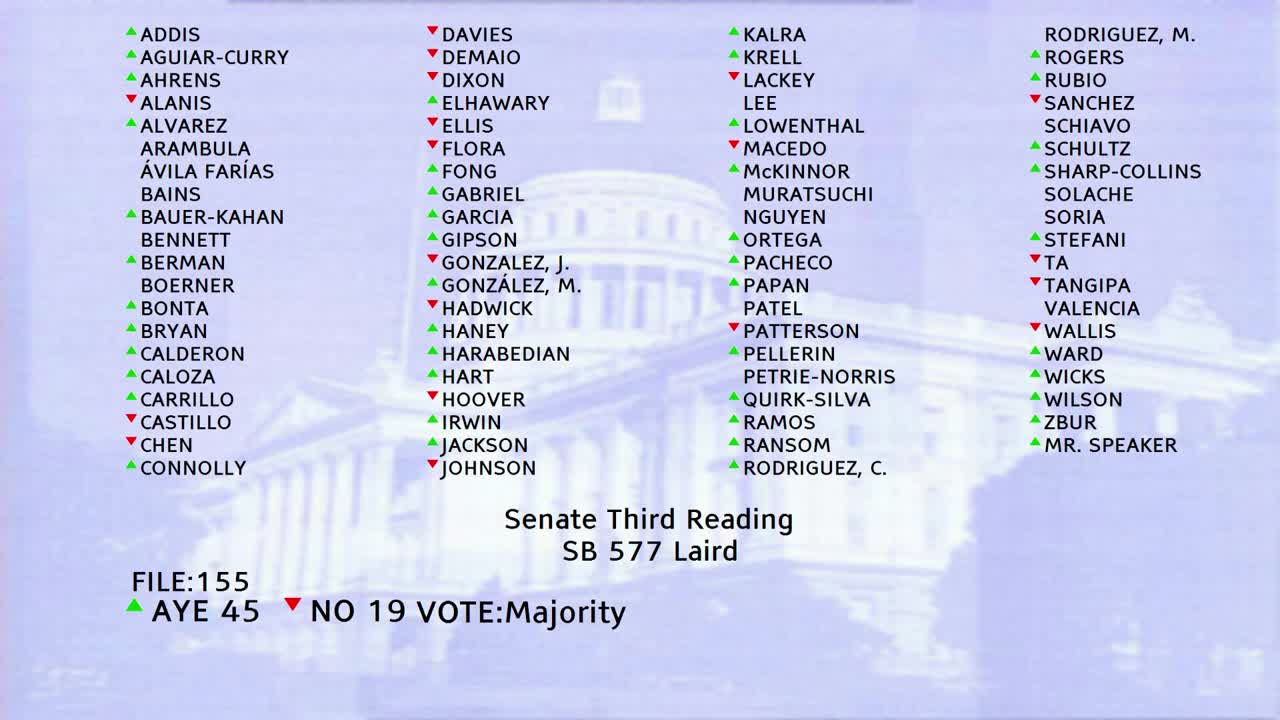 1MIN
Assembly Floor
 5MIN
Senate Floor
 12MIN
Senate Standing Committee on Labor, Public Employment and Retirement
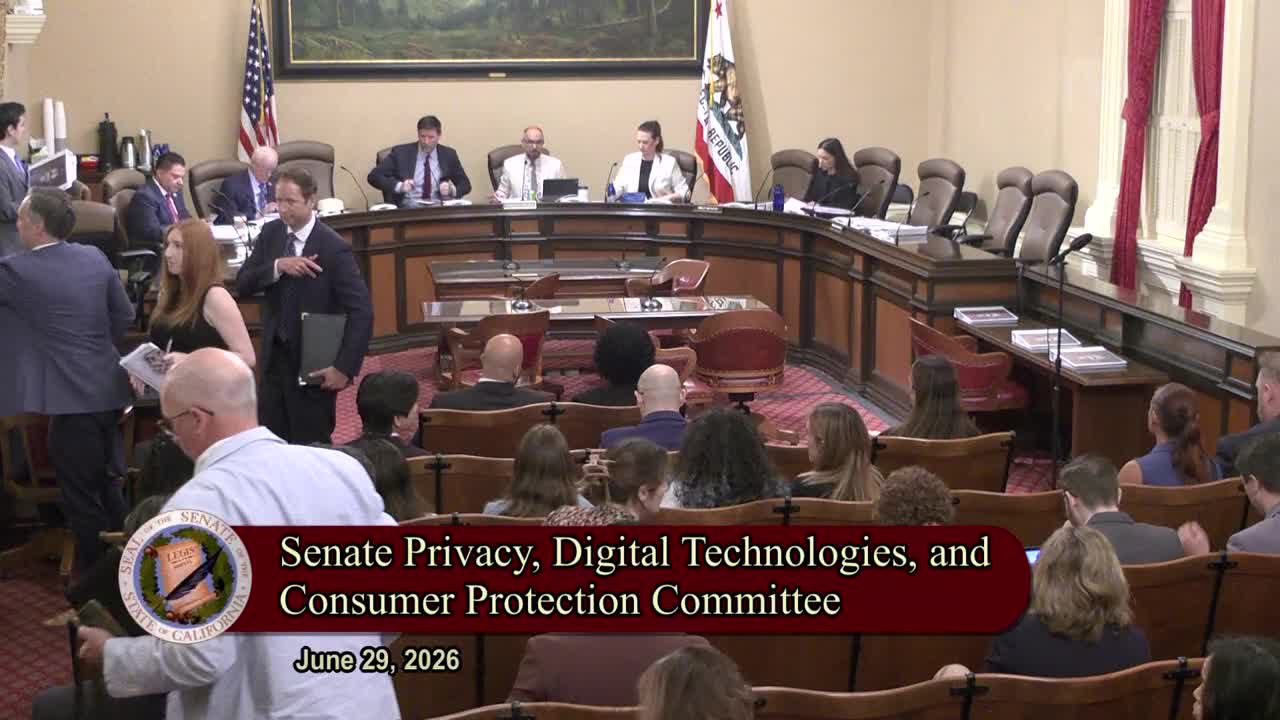 20MIN
Senate Standing Committee on Privacy, Digital Technologies, and Consumer Protection
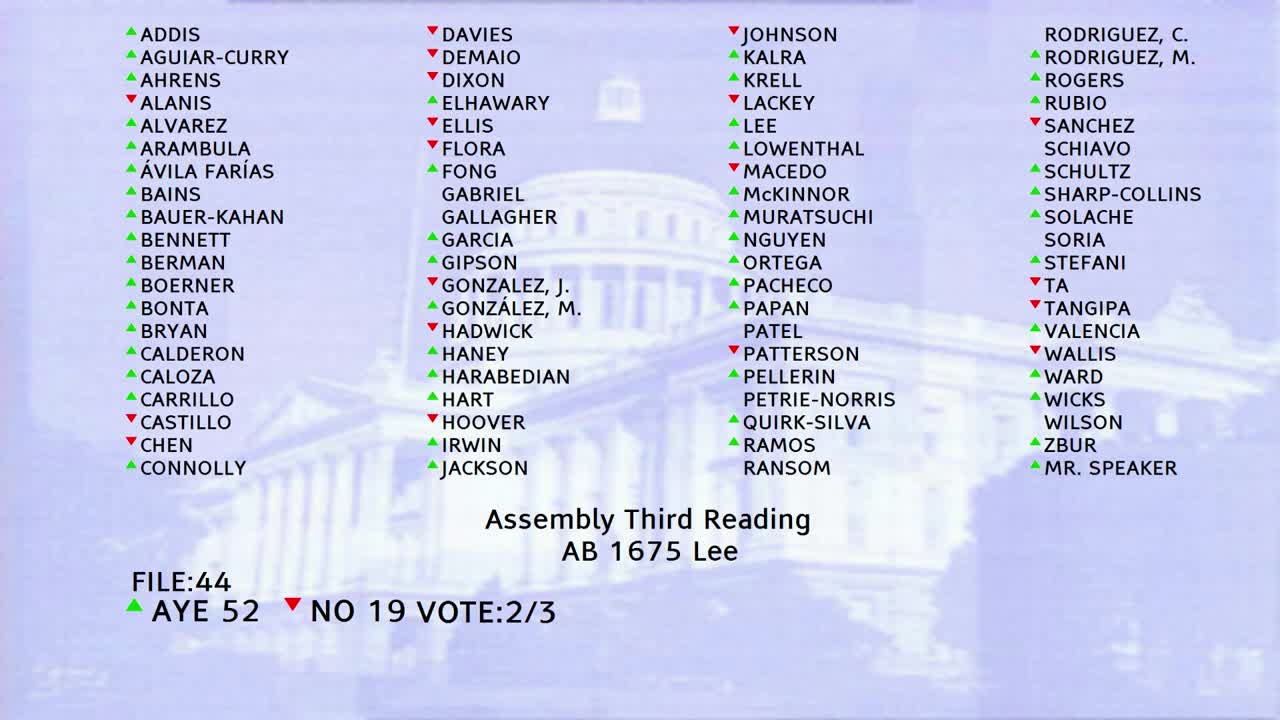 1MIN
Assembly Floor
 38MIN
Assembly Standing Committee on Privacy and Consumer Protection
 17MIN
Assembly Standing Committee on Labor and Employment
Bill Author

Bill Co-Author(s):