AB 1884: Interscholastic athletics: drug testing: suspensions: nicotine use.
- Session Year: 2025-2026
- House: Assembly
- Latest Version Date: 2026-04-09
Current Status:
In Progress
(2026-04-17: In committee: Set, first hearing. Hearing canceled at the request of author.)
Introduced
In Committee
Awaiting First Chamber Vote
Passed First Chamber
In Committee
Awaiting Second Chamber Vote
Passed Second Chamber
Enacted
Existing law authorizes public and private secondary schools to participate in interscholastic sports, and authorizes schools to enter into associations or consortia to enact and enforce rules relating to eligibility for, and participation in, these activities.
Existing law requires the governing board of a school district that maintains one or more schools containing any of grades 7 to 12, inclusive, to establish a policy regarding participation in extracurricular and cocurricular activities by pupils in those grades as a condition for the receipt of specified school funding allocations. Existing law requires the policy to condition pupil participation in extracurricular and cocurricular activities upon satisfactory educational progress in the previous grading period.
This bill would require authorize the governing board of a school district to adopt, as part of the above-described policy regarding participation in extracurricular and cocurricular activities, provisions establishing a drug testing program for pupils in grades 7 to 12, inclusive. The bill would require the an adopted program to include nicotine testing for athletic extracurricular activities, and authorize the program to (1) include testing for alcohol and controlled substances, and (2) apply to other, nonathletic extracurricular activities. substances. The bill would, among other things, require the basis for testing to be random and suspicionless, unless the school has a reasonable suspicion that a pupil used nicotine, or, if applicable, alcohol or a controlled substance. The bill would require the authorize an adopted drug testing program to condition the voluntary participation in athletic extracurricular activities, and, if applicable, other extracurricular activities, activities on participation in the drug testing program, as provided. The bill would prohibit the results of these drug tests from being made available to criminal or juvenile authorities, except as provided, and would require the results to be shared with the superintendent of the school district or their designee, the coach of the extracurricular athletic team, or, if applicable, adult leader of the other extracurricular activity, team, and the pupils parents or other person having legal custody, as provided. Upon the third cumulative instance of a positive drug test, the bill would prohibit a pupil from participating in athletic extracurricular activities for the remainder of that athletic season, as provided. The bill would authorize a pupil drug testing program to require a pupil to participate in a diversion program as a condition of continuing to participate in athletic extracurricular activities upon at least 3 cumulative instances of a positive drug test.
Existing law prohibits a pupil from being suspended from school or recommended for expulsion, unless the superintendent of the school district or the principal of the school in which the pupil is enrolled determines that the pupil has committed a specified act, including, among other acts, that the pupil (1) unlawfully possessed, used, sold, or otherwise furnished, or had been under the influence of, a controlled substance, an alcoholic beverage, or an intoxicant of any kind, or (2) possessed or used tobacco, or products containing tobacco or nicotine products.
Existing law prohibits the suspension of a pupil who voluntarily discloses, in order to seek help through services or supports, their use of a controlled substance, alcohol, intoxicants of any kind, tobacco, products containing tobacco, or nicotine products solely for that disclosure.
This bill would additionally prohibit the suspension of a pupil who tests positive for a controlled substance, alcohol, intoxicants of any kind, tobacco, products containing tobacco, or nicotine products pursuant to the an adopted pupil drug testing program from being suspended solely for that positive test.
Existing law authorizes a principal or the principals designee who, in their professional capacity, has knowledge of or observes a pupil whom they know, or reasonably suspect as evidenced by the pupils apparent intoxication, has consumed an alcoholic beverage or abused a controlled substance, to report the known or suspected instance of alcohol or controlled substance abuse to the parent or parents, or other person having legal custody, of the pupil. Existing law prohibits a principal or principals designee who so reports from being subject to civil or criminal liability, except as specified.
This bill would extend the above-described authorization to report to the parent or parents, or other person having legal custody, and related liability protections, to a principal or the principals designee who knows or reasonably suspects that a pupil has used nicotine, as provided.
Existing law authorizes public and private secondary schools to participate in interscholastic sports, and authorizes schools to enter into associations or consortia to enact and enforce rules relating to eligibility for, and participation in, these activities.
Existing law requires the governing board of a school district that maintains one or more schools containing any of grades 7 to 12, inclusive, to establish a policy regarding participation in extracurricular and cocurricular activities by pupils in those grades as a condition for the receipt of specified school funding allocations. Existing law requires the policy to condition pupil participation in extracurricular and cocurricular activities upon satisfactory educational progress in the previous grading period.
This bill would require the governing board of a school district to adopt, as part of the above-described policy regarding participation in extracurricular and cocurricular activities, provisions establishing a drug testing program for pupils in grades 7 to 12, inclusive. The bill would require the program to include nicotine testing for athletic extracurricular activities, and authorize the program to (1) include testing for alcohol and controlled substances, and (2) apply to other, nonathletic extracurricular activities. The bill would, among other things, require the basis for testing to be random and suspicionless, unless the school has a reasonable suspicion that a pupil used nicotine, or, if applicable, alcohol or a controlled substance. The bill would require the drug testing program to condition the voluntary participation in athletic extracurricular activities, and, if applicable, other extracurricular activities, on participation in the drug testing program, as provided. The bill would prohibit the results of these drug tests from being made available to criminal or juvenile authorities, except as provided, and would require the results to be shared with the superintendent of the school district or their designee, the coach of the extracurricular athletic team, or, if applicable, adult leader of the other extracurricular activity, and the pupils parents or other person having legal custody, as provided. Upon the third cumulative instance of a positive drug test, the bill would prohibit a pupil from participating in athletic extracurricular activities for the remainder of that athletic season, as provided.
Existing law prohibits a pupil from being suspended from school or recommended for expulsion, unless the superintendent of the school district or the principal of the school in which the pupil is enrolled determines that the pupil has committed a specified act, including, among other acts, that the pupil (1) unlawfully possessed, used, sold, or otherwise furnished, or had been under the influence of, a controlled substance, an alcoholic beverage, or an intoxicant of any kind, or (2) possessed or used tobacco, or products containing tobacco or nicotine products.
Existing law prohibits the suspension of a pupil who voluntarily discloses, in order to seek help through services or supports, their use of a controlled substance, alcohol, intoxicants of any kind, tobacco, products containing tobacco, or nicotine products solely for that disclosure.
This bill would additionally prohibit the suspension of a pupil who tests positive for a controlled substance, alcohol, intoxicants of any kind, tobacco, products containing tobacco, or nicotine products pursuant to the pupil drug testing program from being suspended solely for that positive test.
Existing law authorizes a principal or the principals designee who, in their professional capacity, has knowledge of or observes a pupil whom they know, or reasonably suspect as evidenced by the pupils apparent intoxication, has consumed an alcoholic beverage or abused a controlled substance, to report the known or suspected instance of alcohol or controlled substance abuse to the parent or parents, or other person having legal custody, of the pupil. Existing law prohibits a principal or principals designee who so reports from being subject to civil or criminal liability, except as specified.
This bill would extend the above-described authorization to report to the parent or parents, or other person having legal custody, and related liability protections, to a principal or the principals designee who knows or reasonably suspects that a pupil has used nicotine, as provided.
Existing law establishes a system of public elementary and secondary schools operated by local educational agencies throughout this state. Existing law authorizes public and private secondary schools to participate in interscholastic sports, and authorizes schools to enter into associations or consortia to enact and enforce rules relating to eligibility for, and participation in, these activities.Existing law requires the governing entity of the school district or charter school that elects to offer any interscholastic athletic program to ensure that there is a written emergency action plan in place that describes the location of emergency medical equipment and procedures to be followed in the event of sudden cardiac arrest and other medical emergencies, including concussion and heat illness, related to the athletic programs activities or events, as specified.This bill would state the intent of the Legislature to enact subsequent legislation that would authorize school districts that elect to offer any interscholastic athletic program to drug test pupils participating in the programs activities.Existing law establishes a system of public elementary and secondary schools operated by local educational agencies throughout this state. Existing law authorizes public and private secondary schools to participate in interscholastic sports, and authorizes schools to enter into associations or consortia to enact and enforce rules relating to eligibility for, and participation in, these activities.
Existing law requires the governing entity of the school district or charter school that elects to offer any interscholastic athletic program to ensure that there is a written emergency action plan in place that describes the location of emergency medical equipment and procedures to be followed in the event of sudden cardiac arrest and other medical emergencies, including concussion and heat illness, related to the athletic programs activities or events, as specified.
This bill would state the intent of the Legislature to enact subsequent legislation that would authorize school districts that elect to offer any interscholastic athletic program to drug test pupils participating in the programs activities.
This act shall be known, and may be cited, as the California Student-Athlete Drug Abuse Prevention Act.
SEC. 2.(a)The Legislature finds and declares all of the following:
(1)The health, safety, and welfare of pupils are fundamental responsibilities of school districts in California.
(2)Drugs, alcohol, performance enhancing drugs, other controlled substances, and nicotine products, including electronic cigarettes and other vaping devices, pose significant risks to the physical health, mental health, and academic success of pupils.
(3)Nicotine is a highly addictive substance and early exposure during adolescence increases the likelihood of long-term addiction and adverse health outcomes.
(4)The use of drugs, alcohol, or nicotine by pupils participating in school-sponsored athletics or extracurricular activities may impair judgment, increase the risk of injury, and negatively affect the safety of other pupils.
(5)In Board of Ed. of Independent School Dist. No. 92 of Pottawatomie Cty. v. Earls (2002) 536 U.S. 822 and Vernonia School Dist. 47J v. Acton (1995) 515 U.S. 646, the United States Supreme Court held that drug testing of pupils who voluntarily participate in extracurricular activities and random suspicionless drug testing of pupils who voluntarily participate in athletics are consistent with the Fourth Amendment to the United States Constitution and the California Constitution.
(6)School districts in California have adopted drug testing policies consistent with these rulings, exercising their authority pursuant to the following statutory provisions:
(A)Section 35160.5 of the Education Code, which allows districts to adopt policies and rules regarding participation in extracurricular and cocurricular activities.
(B)Section 44049 of the Education Code, related to known or suspected alcohol or controlled substance abuse by pupils.
(C)Section 48900 of the Education Code, related to grounds for suspension or expulsion.
(D)Section 48900.5 of the Education Code, related to limitations on imposing suspensions.
(b)It is the intent of the Legislature to expressly authorize school districts to establish a pupil drug testing program and program, require school districts that establish these programs to test student-athletes for nicotine use as a use, and authorize these programs to condition of voluntary participation in athletic extracurricular activities, activities on participation in these programs, in order to promote pupil health, safety, and welfare.
SEC. 3.Section 35160.5 of the Education Code is amended to read:35160.5.(a)The governing board of a school district that maintains one or more schools containing any of grades 7 to 12, inclusive, as a condition for the receipt of inflation adjustments pursuant to Section 42238.02, as implemented by Section 42238.03, shall establish a school district policy regarding participation in extracurricular and cocurricular activities by pupils in grades 7 to 12, inclusive. The criteria, which shall be applied to extracurricular and cocurricular activities, shall ensure that pupil participation is conditioned upon satisfactory educational progress in the previous grading period.
(1)For purposes of this subdivision, extracurricular activity means a program that has all of the following characteristics:
(A)The program is supervised or financed by the school district.
(B)Pupils participating in the program represent the school district.
(C)Pupils exercise some degree of freedom in either the selection, planning, or control of the program.
(D)The program includes both preparation for performance and performance before an audience or spectators.
(2)For purposes of this subdivision, an extracurricular activity is not part of the regular school curriculum, is not graded, does not offer credit, and does not take place during classroom time.
(3)For purposes of this subdivision, a cocurricular activity is defined as a program that may be associated with the curriculum in a regular classroom.
(4)A teacher-graded or required program or activity for a course that satisfies the entrance requirements for admission to the California State University or the University of California is not an extracurricular or cocurricular activity as defined by this subdivision.
(5)For purposes of this subdivision, satisfactory educational progress shall include, but not be limited to, both of the following:
(A)Maintenance of minimum passing grades, which is defined as at least a 2.0 grade point average in all enrolled courses on a 4.0 scale.
(B)Maintenance of minimum progress toward meeting the high school graduation requirements prescribed by the governing board.
(6)For purposes of this subdivision, previous grading period does not include a grading period in which the pupil was not in attendance for all, or a majority of, the grading period due to absences excused by the school for reasons such as serious illness or injury, approved travel, or work. In that event, previous grading period means the grading period immediately before the grading period or periods excluded pursuant to this paragraph.
(7)A program that has, as its primary goal, the improvement of academic or educational achievements of pupils is not an extracurricular or cocurricular activity as defined by this subdivision.
(8)(A)The governing board of a school district may adopt, as part of its policy established pursuant to this subdivision, provisions that would allow a pupil who does not achieve satisfactory educational progress, as defined in paragraph (5), in the previous grading period to remain eligible to participate in extracurricular and cocurricular activities during a probationary period. The probationary period shall not exceed one semester in length, but may be for a shorter period of time, as determined by the governing board of the school district. A pupil who does not achieve satisfactory educational progress, as defined in paragraph (5), during the probationary period shall not be allowed to participate in extracurricular and cocurricular activities in the subsequent grading period.
(B)Notwithstanding subparagraph (A), the governing board of each school district may adopt a policy that would allow a probationary period to exceed one semester in length through the completion of the 202021 school year due to the impact of COVID-19.
(9)This subdivision does not preclude the governing board of a school district from imposing a more stringent academic standard than that imposed by this subdivision. If the governing board of a school district imposes a more stringent academic standard, the governing board shall establish the criteria for participation in extracurricular and cocurricular activities at a meeting open to the public pursuant to Section 35145.
(10)(A)(i)The governing board of a school district shall may adopt, as part of its policy established pursuant to this subdivision, a pupil drug testing program. The
(ii)A pupil drug testing program adopted pursuant to clause (i) shall include, at minimum, a nicotine testing program for pupils in grades 7 to 12, inclusive, applicable to athletic extracurricular activities. The A pupil drug testing program adopted pursuant to clause (i) may also include testing for alcohol and controlled substances, as listed in Chapter 2 (commencing with Section 11053) of Division 10 of the Health and Safety Code, for pupils in grades 7 to 12, inclusive. The pupil drug testing program may also apply to other extracurricular activities.
(B)The basis for testing pursuant to the pupil drug testing program adopted pursuant to subparagraph (A) shall be random and suspicionless, unless the school has a reasonable suspicion that a pupil used nicotine or, if applicable, alcohol or a controlled substance as listed in Chapter 2 (commencing with Section 11053) of Division 10 of the Health and Safety Code.
(C)The pupil drug testing program adopted pursuant to subparagraph (A) shall may condition the voluntary participation in athletic extracurricular activities, and if, applicable, other extracurricular activities, activities on participation in the pupil drug testing program, and program. If the pupil drug testing program includes such a condition, the school district shall obtain the written consent to participate in the pupil drug testing program from all pupils participating in athletic extracurricular activities, and if applicable, other extracurricular activities, activities and their parents or guardians.
(D)A pupil drug testing program adopted pursuant to subparagraph (A) shall not apply to a cocurricular activity.(E)(D)The results of a pupils drug test pursuant to a pupil drug testing program adopted pursuant to subparagraph (A) shall not be made available to criminal or juvenile authorities unless compelled by a valid and binding subpoena or other legal process. The results shall be made available to the superintendent of the school district or the superintendents designated representative, the coach of the extracurricular athletic team or, if applicable, the adult leader of the other extracurricular activity, team, and the parents or other person having legal custody of the pupil, and shall not be made available to any other person.
(F)(E)The governing board of a school district that establishes a pupil drug testing program pursuant to subparagraph (A) on or after January 1, 2027, shall do so at a meeting open to the public pursuant to Section 35145.
(G)(F)A pupil drug testing program adopted pursuant to subparagraph (A) shall may require that, upon the third at least three cumulative instance instances of a positive test for any substance included within the program, a pupil shall be prohibited from participating in athletic extracurricular activities for the remainder of that athletic season. participate in a diversion program as a condition of continuing to participate in athletic extracurricular activities. A pupil drug testing program adopted pursuant to subparagraph (A) shall not require, as a condition of continuing to participate in athletic extracurricular activities, a pupil to participate in a diversion program upon a first or second positive test.
(H)For purposes of this paragraph, other extracurricular activities means nonathletic extracurricular activities.(11)The governing board of each school district annually shall review the school district policies adopted pursuant to the requirements of this subdivision.
(b)(1)On or before July 1, 1994, the governing board of a school district, as a condition for the receipt of school apportionments from the State School Fund, shall adopt rules and regulations establishing a policy of open enrollment within the district for residents of the district. This requirement does not apply to a school district that has only one school or a school district with schools that do not serve any of the same grade levels.
(2)The policy shall include all of the following elements:
(A)It shall provide that the parent or guardian of each schoolage child who is a resident in the district may select the schools the child shall attend, irrespective of the particular locations of the childs residence within the district, except that school districts shall retain the authority to maintain appropriate racial and ethnic balances among their respective schools at the school districts discretion or as specified in applicable court-ordered or voluntary desegregation plans.
(B)It shall include a selection policy for a school that receives requests for admission in excess of the capacity of the school that ensures that selection of pupils to enroll in the school is made through a random, unbiased process that prohibits an evaluation of whether a pupil should be enrolled based upon the pupils academic or athletic performance. The governing board of a school district shall calculate the capacity of the schools in the district for purposes of this subdivision in a nonarbitrary manner using pupil enrollment and available space. However, school districts may employ existing entrance criteria for specialized schools or programs if the criteria are uniformly applied to all applicants. This subdivision shall not be construed to prohibit school districts from using academic performance to determine eligibility for, or placement in, programs for gifted and talented pupils established pursuant to former Chapter 8 (commencing with Section 52200) of Part 28 of Division 4, as that chapter read on January 1, 2014.
(C)It shall provide that a pupil who currently resides in the attendance area of a school shall not be displaced by pupils transferring from outside the attendance area.
(3)Notwithstanding the requirement of subparagraph (B) of paragraph (2) that the policy include a selection policy for a school that receives requests for admission in excess of the capacity of the school that ensures that the selection is made through a random, unbiased process, the policy may include either of the following elements:
(A)(i)It may provide that special circumstances exist that might be harmful or dangerous to a particular pupil in the current attendance area of the pupil, including, but not limited to, threats of bodily harm or threats to the emotional stability of the pupil, that serve as a basis for granting a priority of attendance outside the current attendance area of the pupil. A finding of harmful or dangerous special circumstances shall be based upon either of the following:
(I)A written statement from a representative of the appropriate state or local agency, including, but not limited to, a law enforcement official or a social worker, or properly licensed or registered professionals, including, but not limited to, psychiatrists, psychologists, marriage and family therapists, clinical social workers, or professional clinical counselors.
(II)A court order, including a temporary restraining order and injunction, issued by a judge.
(ii)A finding of harmful or dangerous special circumstances pursuant to this subparagraph may be used by a school district to approve transfers within the district to schools that have been deemed by the school district to be at capacity and otherwise closed to transfers that are not based on harmful or dangerous special circumstances.
(B)It may provide that schools receiving requests for admission shall give priority for attendance to siblings of pupils already in attendance in that school and to pupils whose parent or legal guardian is assigned to that school as their primary place of employment.
(4)To the extent required and financed by federal law and at the request of the pupils parent or guardian, a school district shall provide transportation assistance to the pupil.
SEC. 4.Section 44049 of the Education Code is amended to read:44049.(a)Except as provided in subdivision (c), a principal or person designated by the principal who, in their professional capacity or within the scope of their employment, has knowledge of or observes a pupil whom they know, or reasonably suspect as evidenced by the pupils apparent intoxication, has consumed an alcoholic beverage, used nicotine, or abused a controlled substance, as listed in Chapter 2 (commencing with Section 11053) of Division 10 of the Health and Safety Code, may report the known or suspected instance of alcohol or controlled substance abuse, or nicotine use, to the parent or parents, or other person having legal custody, of the pupil.
(b)A principal or principals designee who reports a known or suspected instance of alcohol or controlled substance abuse, or nicotine use, by a pupil to the parent or parents, or other person having legal custody, of the pupil shall not be civilly or criminally liable, for any report or as a result of any report, unless it can be proven that a false report was made and the principal or principals designee knew that the report was false or was made with reckless disregard for the truth or falsity of the report. A principal or principals designee who makes a report known to be false or with reckless disregard of the truth or falsity of the report is liable for any damages caused.
(c)A principal or person designated by the principal shall not report a known or suspected instance of alcohol or controlled substance abuse, or nicotine use, by a pupil to the parent or parents, or other person having legal custody, of the pupil if the report would require the disclosure of confidential information in violation of Section 49602 or 72621.
SEC. 5.Section 48900 of the Education Code is amended to read:48900.A pupil shall not be suspended from school or recommended for expulsion, unless the superintendent of the school district or the principal of the school in which the pupil is enrolled determines that the pupil has committed an act as defined pursuant to any of subdivisions (a) to (r), inclusive:
(a)(1)Caused, attempted to cause, or threatened to cause physical injury to another person.
(2)Willfully used force or violence upon the person of another, except in self-defense.
(b)Possessed, sold, or otherwise furnished a firearm, knife, explosive, or other dangerous object, unless, in the case of possession of an object of this type, the pupil had obtained written permission to possess the item from a certificated school employee, which is concurred in by the principal or the designee of the principal.
(c)(1)Unlawfully possessed, used, sold, or otherwise furnished, or been under the influence of, a controlled substance listed in Chapter 2 (commencing with Section 11053) of Division 10 of the Health and Safety Code, an alcoholic beverage, or an intoxicant of any kind.
(2)Pupils who are found to have tested positive for a controlled substance identified in paragraph (1), alcohol, or an intoxicant of any kind pursuant to the a pupil drug testing program established pursuant to paragraph (10) of subdivision (a) Section 35160.5 or who voluntarily disclose their use of a controlled substance, alcohol, or an intoxicant of any kind in order to seek help through services or supports shall not be suspended solely for that positive test or disclosure.
(d)Unlawfully offered, arranged, or negotiated to sell a controlled substance listed in Chapter 2 (commencing with Section 11053) of Division 10 of the Health and Safety Code, an alcoholic beverage, or an intoxicant of any kind, and either sold, delivered, or otherwise furnished to a person another liquid, substance, or material and represented the liquid, substance, or material as a controlled substance, alcoholic beverage, or intoxicant.
(e)Committed or attempted to commit robbery or extortion.
(f)Caused or attempted to cause damage to school property or private property.
(g)Stole or attempted to steal school property or private property.
(h)(1)Possessed or used tobacco, or products containing tobacco or nicotine products, including, but not limited to, vaporizers, electronic cigarettes, cigarettes, cigars, miniature cigars, clove cigarettes, smokeless tobacco, snuff, chew packets, pouches, and betel. However, this section does not prohibit the use or possession by a pupil of the pupils own prescription products.
(2)Pupils who are found to have tested positive for the products described in paragraph (1) pursuant to the a pupil drug testing program established pursuant to paragraph (10) of subdivision (a) of Section 35160.5 or who voluntarily disclose their use of a tobacco product in order to seek help through services or supports shall not be suspended solely for that positive test or disclosure.
(i)Committed an obscene act or engaged in habitual profanity or vulgarity.
(j)Unlawfully possessed or unlawfully offered, arranged, or negotiated to sell drug paraphernalia, as defined in Section 11014.5 of the Health and Safety Code.
(k)(1)Disrupted school activities or otherwise willfully defied the valid authority of supervisors, teachers, administrators, school officials, or other school personnel engaged in the performance of their duties.
(2)Except as provided in Section 48910, a pupil enrolled in kindergarten or any of grades 1 to 5, inclusive, shall not be suspended for any of the acts specified in paragraph (1), and those acts shall not constitute grounds for a pupil enrolled in kindergarten or any of grades 1 to 12, inclusive, to be recommended for expulsion.
(3)Except as provided in Section 48910, a pupil enrolled in any of grades 6 to 8, inclusive, shall not be suspended for any of the acts specified in paragraph (1). This paragraph is inoperative on July 1, 2029.
(4)Except as provided in Section 48910, commencing July 1, 2024, a pupil enrolled in any of grades 9 to 12, inclusive, shall not be suspended for any of the acts specified in paragraph (1). This paragraph is inoperative on July 1, 2029.
(5)(A)A certificated or classified employee may refer a pupil to school administrators for appropriate and timely in-school interventions or supports from the list of other means of correction specified in subdivision (b) of Section 48900.5 for any of the acts enumerated in paragraph (1).
(B)A school administrator shall, within five business days, document the actions taken pursuant to subparagraph (A) and place that documentation in the pupils record to be available for access, to the extent permissible under state and federal law, pursuant to Section 49069.7. The school administrator shall, by the end of the fifth business day, also inform the referring certificated or classified employee, verbally or in writing, what actions were taken and, if none, the rationale used for not providing any appropriate or timely in-school interventions or supports.
(l)Knowingly received stolen school property or private property.
(m)Possessed an imitation firearm. As used in this section, imitation firearm means a replica of a firearm that is so substantially similar in physical properties to an existing firearm as to lead a reasonable person to conclude that the replica is a firearm.
(n)Committed or attempted to commit a sexual assault as defined in Section 261, 266c, 286, 287, 288, or 289 of, or former Section 288a of, the Penal Code or committed a sexual battery as defined in Section 243.4 of the Penal Code.
(o)Harassed, threatened, or intimidated a pupil who is a complaining witness or a witness in a school disciplinary proceeding for purposes of either preventing that pupil from being a witness or retaliating against that pupil for being a witness, or both.
(p)Unlawfully offered, arranged to sell, negotiated to sell, or sold the prescription drug Soma.
(q)Engaged in, or attempted to engage in, hazing. For purposes of this subdivision, hazing means a method of initiation or preinitiation into a pupil organization or body, whether or not the organization or body is officially recognized by an educational institution, that is likely to cause serious bodily injury or personal degradation or disgrace resulting in physical or mental harm to a former, current, or prospective pupil. For purposes of this subdivision, hazing does not include athletic events or school-sanctioned events.
(r)Engaged in an act of bullying. For purposes of this subdivision, the following terms have the following meanings:
(1)Bullying means any severe or pervasive physical or verbal act or conduct, including communications made in writing or by means of an electronic act, and including one or more acts committed by a pupil or group of pupils as defined in Section 48900.2, 48900.3, or 48900.4, directed toward one or more pupils that has or can be reasonably predicted to have the effect of one or more of the following:
(A)Placing a reasonable pupil or pupils in fear of harm to that pupils or those pupils person or property.
(B)Causing a reasonable pupil to experience a substantially detrimental effect on the pupils physical or mental health.
(C)Causing a reasonable pupil to experience substantial interference with the pupils academic performance.
(D)Causing a reasonable pupil to experience substantial interference with the pupils ability to participate in or benefit from the services, activities, or privileges provided by a school.
(2)(A)Electronic act means the creation or transmission originated on or off the schoolsite, by means of an electronic device, including, but not limited to, a telephone, wireless telephone, or other wireless communication device, computer, or pager, of a communication, including, but not limited to, any of the following:
(i)A message, text, sound, video, or image.
(ii)A post on a social network internet website, including, but not limited to:
(I)Posting to or creating a burn page. Burn page means an internet website created for the purpose of having one or more of the effects listed in paragraph (1).
(II)Creating a credible impersonation of another actual pupil for the purpose of having one or more of the effects listed in paragraph (1). Credible impersonation means to knowingly and without consent impersonate a pupil for the purpose of bullying the pupil and such that another pupil would reasonably believe, or has reasonably believed, that the pupil was or is the pupil who was impersonated.
(III)Creating a false profile for the purpose of having one or more of the effects listed in paragraph (1). False profile means a profile of a fictitious pupil or a profile using the likeness or attributes of an actual pupil other than the pupil who created the false profile.
(iii)(I)An act of cyber sexual bullying.
(II)For purposes of this clause, cyber sexual bullying means the dissemination of, or the solicitation or incitement to disseminate, a photograph or other visual recording by a pupil to another pupil or to school personnel by means of an electronic act that has or can be reasonably predicted to have one or more of the effects described in subparagraphs (A) to (D), inclusive, of paragraph (1). A photograph or other visual recording, as described in this subclause, shall include the depiction of a nude, semi-nude, or sexually explicit photograph or other visual recording of a minor where the minor is identifiable from the photograph, visual recording, or other electronic act.
(III)For purposes of this clause, cyber sexual bullying does not include a depiction, portrayal, or image that has any serious literary, artistic, educational, political, or scientific value or that involves athletic events or school-sanctioned activities.
(B)Notwithstanding paragraph (1) and subparagraph (A), an electronic act shall not constitute pervasive conduct solely on the basis that it has been transmitted on the internet or is currently posted on the internet.
(3)Reasonable pupil means a pupil, including, but not limited to, a pupil with exceptional needs, who exercises average care, skill, and judgment in conduct for a person of that age, or for a person of that age with the pupils exceptional needs.
(s)A pupil shall not be suspended or expelled for any of the acts enumerated in this section unless the act is related to a school activity or school attendance occurring within a school under the jurisdiction of the superintendent of the school district or principal or occurring within any other school district. A pupil may be suspended or expelled for acts that are enumerated in this section and related to a school activity or school attendance that occur at any time, including, but not limited to, any of the following:
(1)While on school grounds.
(2)While going to or coming from school.
(3)During the lunch period whether on or off the campus.
(4)During, or while going to or coming from, a school-sponsored activity.
(t)A pupil who aids or abets, as defined in Section 31 of the Penal Code, the infliction or attempted infliction of physical injury to another person may be subject to suspension, but not expulsion, pursuant to this section, except that a pupil who has been adjudged by a juvenile court to have committed, as an aider and abettor, a crime of physical violence in which the victim suffered great bodily injury or serious bodily injury shall be subject to discipline pursuant to subdivision (a).
(u)As used in this section, school property includes, but is not limited to, electronic files and databases.
(v)For a pupil subject to discipline under this section, a superintendent of the school district or principal is encouraged to provide alternatives to suspension or expulsion, using a research-based framework with strategies that improve behavioral and academic outcomes, that are age appropriate and designed to address and correct the pupils specific misbehavior as specified in Section 48900.5.
(w)(1)A suspension or expulsion shall not be imposed against a pupil based solely on the fact that they are truant, tardy, or otherwise absent from school activities.
(2)It is the intent of the Legislature that the Multi-Tiered System of Supports, which includes restorative justice practices, trauma-informed practices, social and emotional learning, and schoolwide positive behavior interventions and support, be used to help pupils gain critical social and emotional skills, receive support to help transform trauma-related responses, understand the impact of their actions, and develop meaningful methods for repairing harm to the school community.
This act shall be known, and may be cited, as the California Student-Athlete Drug Abuse Prevention Act.
SEC. 2.(a)The Legislature finds and declares all of the following:
(1)The health, safety, and welfare of pupils are fundamental responsibilities of school districts in California.
(2)Drugs, alcohol, performance enhancing drugs, other controlled substances, and nicotine products, including electronic cigarettes and other vaping devices, pose significant risks to the physical health, mental health, and academic success of pupils.
(3)Nicotine is a highly addictive substance and early exposure during adolescence increases the likelihood of long-term addiction and adverse health outcomes.
(4)The use of drugs, alcohol, or nicotine by pupils participating in school-sponsored athletics or extracurricular activities may impair judgment, increase the risk of injury, and negatively affect the safety of other pupils.
(5)In Board of Ed. of Independent School Dist. No. 92 of Pottawatomie Cty. v. Earls (2002) 536 U.S. 822 and Vernonia School Dist. 47J v. Acton (1995) 515 U.S. 646, the United States Supreme Court held that drug testing of pupils who voluntarily participate in extracurricular activities and random suspicionless drug testing of pupils who voluntarily participate in athletics are consistent with the Fourth Amendment to the United States Constitution and the California Constitution.
(6)School districts in California have adopted drug testing policies consistent with these rulings, exercising their authority pursuant to the following statutory provisions:
(A)Section 35160.5 of the Education Code, which allows districts to adopt policies and rules regarding participation in extracurricular and cocurricular activities.
(B)Section 44049 of the Education Code, related to known or suspected alcohol or controlled substance abuse by pupils.
(C)Section 48900 of the Education Code, related to grounds for suspension or expulsion.
(D)Section 48900.5 of the Education Code, related to limitations on imposing suspensions.
(b)It is the intent of the Legislature to expressly authorize school districts to establish a pupil drug testing program and require school districts to test student-athletes for nicotine use as a condition of voluntary participation in athletic extracurricular activities, in order to promote pupil health, safety, and welfare.
SEC. 3.Section 35160.5 of the Education Code is amended to read:35160.5.(a)The governing board of a school district that maintains one or more schools containing any of grades 7 to 12, inclusive, as a condition for the receipt of inflation adjustments pursuant to Section 42238.02, as implemented by Section 42238.03, shall establish a school district policy regarding participation in extracurricular and cocurricular activities by pupils in grades 7 to 12, inclusive. The criteria, which shall be applied to extracurricular and cocurricular activities, shall ensure that pupil participation is conditioned upon satisfactory educational progress in the previous grading period.
(1)For purposes of this subdivision, extracurricular activity means a program that has all of the following characteristics:
(A)The program is supervised or financed by the school district.
(B)Pupils participating in the program represent the school district.
(C)Pupils exercise some degree of freedom in either the selection, planning, or control of the program.
(D)The program includes both preparation for performance and performance before an audience or spectators.
(2)For purposes of this subdivision, an extracurricular activity is not part of the regular school curriculum, is not graded, does not offer credit, and does not take place during classroom time.
(3)For purposes of this subdivision, a cocurricular activity is defined as a program that may be associated with the curriculum in a regular classroom.
(4)A teacher-graded or required program or activity for a course that satisfies the entrance requirements for admission to the California State University or the University of California is not an extracurricular or cocurricular activity as defined by this section. subdivision.
(5)For purposes of this subdivision, satisfactory educational progress shall include, but not necessarily be limited to, both of the following:
(A)Maintenance of minimum passing grades, which is defined as at least a 2.0 grade point average in all enrolled courses on a 4.0 scale.
(B)Maintenance of minimum progress toward meeting the high school graduation requirements prescribed by the governing board.
(6)For purposes of this subdivision, previous grading period does not include a grading period in which the pupil was not in attendance for all, or a majority of, the grading period due to absences excused by the school for reasons such as serious illness or injury, approved travel, or work. In that event, previous grading period means the grading period immediately before the grading period or periods excluded pursuant to this paragraph.
(7)A program that has, as its primary goal, the improvement of academic or educational achievements of pupils is not an extracurricular or cocurricular activity as defined by this section. subdivision.
(8)(A)The governing board of each a school district may adopt, as part of its policy established pursuant to this subdivision, provisions that would allow a pupil who does not achieve satisfactory educational progress, as defined in paragraph (5), in the previous grading period to remain eligible to participate in extracurricular and cocurricular activities during a probationary period. The probationary period shall not exceed one semester in length, but may be for a shorter period of time, as determined by the governing board of the school district. A pupil who does not achieve satisfactory educational progress, as defined in paragraph (5), during the probationary period shall not be allowed to participate in extracurricular and cocurricular activities in the subsequent grading period.
(B)Notwithstanding subparagraph (A), the governing board of each school district may adopt a policy that would allow a probationary period to exceed one semester in length through the completion of the 202021 school year due to the impact of COVID-19.
(9)This subdivision does not preclude the governing board of a school district from imposing a more stringent academic standard than that imposed by this subdivision. If the governing board of a school district imposes a more stringent academic standard, the governing board shall establish the criteria for participation in extracurricular and cocurricular activities at a meeting open to the public pursuant to Section 35145.
(10)(A)The governing board of a school district shall adopt, as part of its policy established pursuant to this subdivision, a pupil drug testing program. The pupil drug testing program shall include, at minimum, a nicotine testing program for pupils in grades 7 to 12, inclusive, applicable to athletic extracurricular activities. The pupil drug testing program may also include testing for alcohol and controlled substances, as listed in Chapter 2 (commencing with Section 11053) of Division 10 of the Health and Safety Code, for pupils in grades 7 to 12, inclusive. The pupil drug testing program may also apply to other extracurricular activities.
(B)The basis for testing pursuant to the pupil drug testing program adopted pursuant to subparagraph (A) shall be random and suspicionless, unless the school has a reasonable suspicion that a pupil used nicotine or, if applicable, alcohol or a controlled substance as listed in Chapter 2 (commencing with Section 11053) of Division 10 of the Health and Safety Code.
(C)The pupil drug testing program adopted pursuant to subparagraph (A) shall condition the voluntary participation in athletic extracurricular activities, and if, applicable, other extracurricular activities, on participation in the pupil drug testing program, and the school district shall obtain the written consent to participate in the pupil drug testing program from all pupils participating in athletic extracurricular activities, and if applicable, other extracurricular activities, and their parents or guardians.
(D)A pupil drug testing program adopted pursuant to subparagraph (A) shall not apply to a cocurricular activity.
(E)The results of a pupils drug test pursuant to a pupil drug testing program adopted pursuant to subparagraph (A) shall not be made available to criminal or juvenile authorities unless compelled by a valid and binding subpoena or other legal process. The results shall be made available to the superintendent of the school district or the superintendents designated representative, the coach of the extracurricular athletic team or, if applicable, the adult leader of the other extracurricular activity, and the parents or other person having legal custody of the pupil, and shall not be made available to any other person.
(F)The governing board of a school district that establishes a pupil drug testing program pursuant to subparagraph (A) on or after January 1, 2027, shall do so at a meeting open to the public pursuant to Section 35145.
(G)A pupil drug testing program adopted pursuant to subparagraph (A) shall require that, upon the third cumulative instance of a positive test for any substance included within the program, a pupil shall be prohibited from participating in athletic extracurricular activities for the remainder of that athletic season.
(H)For purposes of this paragraph, other extracurricular activities means nonathletic extracurricular activities.
(10)(11)The governing board of each school district annually shall review the school district policies adopted pursuant to the requirements of this section. subdivision.
(b)(1)On or before July 1, 1994, the governing board of each a school district, as a condition for the receipt of school apportionments from the State School Fund, shall adopt rules and regulations establishing a policy of open enrollment within the district for residents of the district. This requirement does not apply to a school district that has only one school or a school district with schools that do not serve any of the same grade levels.
(2)The policy shall include all of the following elements:
(A)It shall provide that the parent or guardian of each schoolage child who is a resident in the district may select the schools the child shall attend, irrespective of the particular locations of the childs residence within the district, except that school districts shall retain the authority to maintain appropriate racial and ethnic balances among their respective schools at the school districts discretion or as specified in applicable court-ordered or voluntary desegregation plans.
(B)It shall include a selection policy for a school that receives requests for admission in excess of the capacity of the school that ensures that selection of pupils to enroll in the school is made through a random, unbiased process that prohibits an evaluation of whether a pupil should be enrolled based upon the pupils academic or athletic performance. The governing board of a school district shall calculate the capacity of the schools in the district for purposes of this subdivision in a nonarbitrary manner using pupil enrollment and available space. However, school districts may employ existing entrance criteria for specialized schools or programs if the criteria are uniformly applied to all applicants. This subdivision shall not be construed to prohibit school districts from using academic performance to determine eligibility for, or placement in, programs for gifted and talented pupils established pursuant to former Chapter 8 (commencing with Section 52200) of Part 28 of Division 4, as that chapter read on January 1, 2014.
(C)It shall provide that a pupil who currently resides in the attendance area of a school shall not be displaced by pupils transferring from outside the attendance area.
(3)Notwithstanding the requirement of subparagraph (B) of paragraph (2) that the policy include a selection policy for a school that receives requests for admission in excess of the capacity of the school that ensures that the selection is made through a random, unbiased process, the policy may include either of the following elements:
(A)(i)It may provide that special circumstances exist that might be harmful or dangerous to a particular pupil in the current attendance area of the pupil, including, but not necessarily limited to, threats of bodily harm or threats to the emotional stability of the pupil, that serve as a basis for granting a priority of attendance outside the current attendance area of the pupil. A finding of harmful or dangerous special circumstances shall be based upon either of the following:
(I)A written statement from a representative of the appropriate state or local agency, including, but not necessarily limited to, a law enforcement official or a social worker, or properly licensed or registered professionals, including, but not necessarily limited to, psychiatrists, psychologists, marriage and family therapists, clinical social workers, or professional clinical counselors.
(II)A court order, including a temporary restraining order and injunction, issued by a judge.
(ii)A finding of harmful or dangerous special circumstances pursuant to this subparagraph may be used by a school district to approve transfers within the district to schools that have been deemed by the school district to be at capacity and otherwise closed to transfers that are not based on harmful or dangerous special circumstances.
(B)It may provide that schools receiving requests for admission shall give priority for attendance to siblings of pupils already in attendance in that school and to pupils whose parent or legal guardian is assigned to that school as their primary place of employment.
(4)To the extent required and financed by federal law and at the request of the pupils parent or guardian, each a school district shall provide transportation assistance to the pupil.
SEC. 4.Section 44049 of the Education Code is amended to read:44049.(a)Except as provided in subdivision (c), any a principal or person designated by the principal who, in his or her their professional capacity or within the scope of his or her their employment, has knowledge of or observes a pupil whom he or she knows, they know, or reasonably suspects suspect as evidenced by the pupils apparent intoxication, has consumed an alcoholic beverage beverage, used nicotine, or abused a controlled substance, as listed in Chapter 2 (commencing with Section 11053) of Division 10 of the Health and Safety Code, may report the known or suspected instance of alcohol or controlled substance abuse abuse, or nicotine use, to the parent or parents, or other person having legal custody, of the student. pupil.
(b)No A principal or his or her principals designee who reports a known or suspected instance of alcohol or controlled substance abuse abuse, or nicotine use, by a pupil to the parent or parents, or other person having legal custody, of the pupil shall not be civilly or criminally liable, for any report or as a result of any report, unless it can be proven that a false report was made and the principal or his or her principals designee knew that the report was false or was made with reckless disregard for the truth or falsity of the report. Any A principal or his or her principals designee who makes a report known to be false or with reckless disregard of the truth or falsity of the report is liable for any damages caused.
(c)No A principal or person designated by the principal shall not report a known or suspected instance of alcohol or controlled substance abuse abuse, or nicotine use, by a pupil to the parent or parents, or other person having legal custody, of the pupil if the report would require the disclosure of confidential information in violation of Section 49602 or 72621.
SEC. 5.Section 48900 of the Education Code is amended to read:48900.A pupil shall not be suspended from school or recommended for expulsion, unless the superintendent of the school district or the principal of the school in which the pupil is enrolled determines that the pupil has committed an act as defined pursuant to any of subdivisions (a) to (r), inclusive:
(a)(1)Caused, attempted to cause, or threatened to cause physical injury to another person.
(2)Willfully used force or violence upon the person of another, except in self-defense.
(b)Possessed, sold, or otherwise furnished a firearm, knife, explosive, or other dangerous object, unless, in the case of possession of an object of this type, the pupil had obtained written permission to possess the item from a certificated school employee, which is concurred in by the principal or the designee of the principal.
(c)(1)Unlawfully possessed, used, sold, or otherwise furnished, or been under the influence of, a controlled substance listed in Chapter 2 (commencing with Section 11053) of Division 10 of the Health and Safety Code, an alcoholic beverage, or an intoxicant of any kind.
(2)Pupils who are found to have tested positive for a controlled substance identified in paragraph (1), alcohol, or an intoxicant of any kind pursuant to the pupil drug testing program established pursuant to paragraph (10) of subdivision (a) Section 35160.5 or who voluntarily disclose their use of a controlled substance, alcohol, or an intoxicant of any kind in order to seek help through services or supports shall not be suspended solely for that positive test or disclosure.
(d)Unlawfully offered, arranged, or negotiated to sell a controlled substance listed in Chapter 2 (commencing with Section 11053) of Division 10 of the Health and Safety Code, an alcoholic beverage, or an intoxicant of any kind, and either sold, delivered, or otherwise furnished to a person another liquid, substance, or material and represented the liquid, substance, or material as a controlled substance, alcoholic beverage, or intoxicant.
(e)Committed or attempted to commit robbery or extortion.
(f)Caused or attempted to cause damage to school property or private property.
(g)Stole or attempted to steal school property or private property.
(h)(1)Possessed or used tobacco, or products containing tobacco or nicotine products, including, but not limited to, vaporizers, electronic cigarettes, cigarettes, cigars, miniature cigars, clove cigarettes, smokeless tobacco, snuff, chew packets, pouches, and betel. However, this section does not prohibit the use or possession by a pupil of the pupils own prescription products.
(2)Pupils who are found to have tested positive for the products described in paragraph (1) pursuant to the pupil drug testing program established pursuant to paragraph (10) of subdivision (a) of Section 35160.5 or who voluntarily disclose their use of a tobacco product in order to seek help through services or supports shall not be suspended solely for that positive test or disclosure.
(i)Committed an obscene act or engaged in habitual profanity or vulgarity.
(j)Unlawfully possessed or unlawfully offered, arranged, or negotiated to sell drug paraphernalia, as defined in Section 11014.5 of the Health and Safety Code.
(k)(1)Disrupted school activities or otherwise willfully defied the valid authority of supervisors, teachers, administrators, school officials, or other school personnel engaged in the performance of their duties.
(2)Except as provided in Section 48910, a pupil enrolled in kindergarten or any of grades 1 to 5, inclusive, shall not be suspended for any of the acts specified in paragraph (1), and those acts shall not constitute grounds for a pupil enrolled in kindergarten or any of grades 1 to 12, inclusive, to be recommended for expulsion.
(3)Except as provided in Section 48910, a pupil enrolled in any of grades 6 to 8, inclusive, shall not be suspended for any of the acts specified in paragraph (1). This paragraph is inoperative on July 1, 2029.
(4)Except as provided in Section 48910, commencing July 1, 2024, a pupil enrolled in any of grades 9 to 12, inclusive, shall not be suspended for any of the acts specified in paragraph (1). This paragraph is inoperative on July 1, 2029.
(5)(A)A certificated or classified employee may refer a pupil to school administrators for appropriate and timely in-school interventions or supports from the list of other means of correction specified in subdivision (b) of Section 48900.5 for any of the acts enumerated in paragraph (1).
(B)A school administrator shall, within five business days, document the actions taken pursuant to subparagraph (A) and place that documentation in the pupils record to be available for access, to the extent permissible under state and federal law, pursuant to Section 49069.7. The school administrator shall, by the end of the fifth business day, also inform the referring certificated or classified employee, verbally or in writing, what actions were taken and, if none, the rationale used for not providing any appropriate or timely in-school interventions or supports.
(l)Knowingly received stolen school property or private property.
(m)Possessed an imitation firearm. As used in this section, imitation firearm means a replica of a firearm that is so substantially similar in physical properties to an existing firearm as to lead a reasonable person to conclude that the replica is a firearm.
(n)Committed or attempted to commit a sexual assault as defined in Section 261, 266c, 286, 287, 288, or 289 of, or former Section 288a of, the Penal Code or committed a sexual battery as defined in Section 243.4 of the Penal Code.
(o)Harassed, threatened, or intimidated a pupil who is a complaining witness or a witness in a school disciplinary proceeding for purposes of either preventing that pupil from being a witness or retaliating against that pupil for being a witness, or both.
(p)Unlawfully offered, arranged to sell, negotiated to sell, or sold the prescription drug Soma.
(q)Engaged in, or attempted to engage in, hazing. For purposes of this subdivision, hazing means a method of initiation or preinitiation into a pupil organization or body, whether or not the organization or body is officially recognized by an educational institution, that is likely to cause serious bodily injury or personal degradation or disgrace resulting in physical or mental harm to a former, current, or prospective pupil. For purposes of this subdivision, hazing does not include athletic events or school-sanctioned events.
(r)Engaged in an act of bullying. For purposes of this subdivision, the following terms have the following meanings:
(1)Bullying means any severe or pervasive physical or verbal act or conduct, including communications made in writing or by means of an electronic act, and including one or more acts committed by a pupil or group of pupils as defined in Section 48900.2, 48900.3, or 48900.4, directed toward one or more pupils that has or can be reasonably predicted to have the effect of one or more of the following:
(A)Placing a reasonable pupil or pupils in fear of harm to that pupils or those pupils person or property.
(B)Causing a reasonable pupil to experience a substantially detrimental effect on the pupils physical or mental health.
(C)Causing a reasonable pupil to experience substantial interference with the pupils academic performance.
(D)Causing a reasonable pupil to experience substantial interference with the pupils ability to participate in or benefit from the services, activities, or privileges provided by a school.
(2)(A)Electronic act means the creation or transmission originated on or off the schoolsite, by means of an electronic device, including, but not limited to, a telephone, wireless telephone, or other wireless communication device, computer, or pager, of a communication, including, but not limited to, any of the following:
(i)A message, text, sound, video, or image.
(ii)A post on a social network internet website, including, but not limited to:
(I)Posting to or creating a burn page. Burn page means an internet website created for the purpose of having one or more of the effects listed in paragraph (1).
(II)Creating a credible impersonation of another actual pupil for the purpose of having one or more of the effects listed in paragraph (1). Credible impersonation means to knowingly and without consent impersonate a pupil for the purpose of bullying the pupil and such that another pupil would reasonably believe, or has reasonably believed, that the pupil was or is the pupil who was impersonated.
(III)Creating a false profile for the purpose of having one or more of the effects listed in paragraph (1). False profile means a profile of a fictitious pupil or a profile using the likeness or attributes of an actual pupil other than the pupil who created the false profile.
(iii)(I)An act of cyber sexual bullying.
(II)For purposes of this clause, cyber sexual bullying means the dissemination of, or the solicitation or incitement to disseminate, a photograph or other visual recording by a pupil to another pupil or to school personnel by means of an electronic act that has or can be reasonably predicted to have one or more of the effects described in subparagraphs (A) to (D), inclusive, of paragraph (1). A photograph or other visual recording, as described in this subclause, shall include the depiction of a nude, semi-nude, or sexually explicit photograph or other visual recording of a minor where the minor is identifiable from the photograph, visual recording, or other electronic act.
(III)For purposes of this clause, cyber sexual bullying does not include a depiction, portrayal, or image that has any serious literary, artistic, educational, political, or scientific value or that involves athletic events or school-sanctioned activities.
(B)Notwithstanding paragraph (1) and subparagraph (A), an electronic act shall not constitute pervasive conduct solely on the basis that it has been transmitted on the internet or is currently posted on the internet.
(3)Reasonable pupil means a pupil, including, but not limited to, a pupil with exceptional needs, who exercises average care, skill, and judgment in conduct for a person of that age, or for a person of that age with the pupils exceptional needs.
(s)A pupil shall not be suspended or expelled for any of the acts enumerated in this section unless the act is related to a school activity or school attendance occurring within a school under the jurisdiction of the superintendent of the school district or principal or occurring within any other school district. A pupil may be suspended or expelled for acts that are enumerated in this section and related to a school activity or school attendance that occur at any time, including, but not limited to, any of the following:
(1)While on school grounds.
(2)While going to or coming from school.
(3)During the lunch period whether on or off the campus.
(4)During, or while going to or coming from, a school-sponsored activity.
(t)A pupil who aids or abets, as defined in Section 31 of the Penal Code, the infliction or attempted infliction of physical injury to another person may be subject to suspension, but not expulsion, pursuant to this section, except that a pupil who has been adjudged by a juvenile court to have committed, as an aider and abettor, a crime of physical violence in which the victim suffered great bodily injury or serious bodily injury shall be subject to discipline pursuant to subdivision (a).
(u)As used in this section, school property includes, but is not limited to, electronic files and databases.
(v)For a pupil subject to discipline under this section, a superintendent of the school district or principal is encouraged to provide alternatives to suspension or expulsion, using a research-based framework with strategies that improve behavioral and academic outcomes, that are age appropriate and designed to address and correct the pupils specific misbehavior as specified in Section 48900.5.
(w)(1)A suspension or expulsion shall not be imposed against a pupil based solely on the fact that they are truant, tardy, or otherwise absent from school activities.
(2)It is the intent of the Legislature that the Multi-Tiered System of Supports, which includes restorative justice practices, trauma-informed practices, social and emotional learning, and schoolwide positive behavior interventions and support, be used to help pupils gain critical social and emotional skills, receive support to help transform trauma-related responses, understand the impact of their actions, and develop meaningful methods for repairing harm to the school community.
SECTION 1.It is the intent of the Legislature to enact subsequent legislation that would authorize school districts that elect to offer any interscholastic athletic program to drug test pupils participating in the programs activities.It is the intent of the Legislature to enact subsequent legislation that would authorize school districts that elect to offer any interscholastic athletic program to drug test pupils participating in the programs activities.
|
Date
|
Status
|
|---|---|
| Apr 17, 2026 | In committee: Set, first hearing. Hearing canceled at the request of author. |
| Apr 13, 2026 | Re-referred to Com. on ED. |
| Apr 9, 2026 | Read second time and amended. |
| Apr 8, 2026 | From committee: Amend, and do pass as amended and re-refer to Com. on ED. (Ayes 5. Noes 2.) (April 7). |
| Mar 23, 2026 | Re-referred to Com. on A.,E.,S., & T. |
| Mar 19, 2026 | From committee chair, with author's amendments: Amend, and re-refer to Com. on A.,E.,S., & T. Read second time and amended. |
| Mar 19, 2026 | Referred to Coms. on A.,E.,S., & T. and ED. |
| Feb 13, 2026 | From printer. May be heard in committee March 15. |
| Feb 12, 2026 | Read first time. To print. |
|
Date
|
Description
|
Location
|
Votes
|
|
|---|---|---|---|---|
| Apr 7, 2026 | Do pass as amended and be re-referred to the Committee on [Education] | Assembly Standing Committee on Arts, Entertainment, Sports, and Tourism |
Passed |
This list shows positions taken on this bill by organizations on the date displayed, which is linked to the original source.
Positions by individuals are not included.
|
Organization
|
Position
|
Date
|
|---|---|---|
| Alameda County Office Of Education | ** Against | |
| Alliance for Boys and Men of Color | ** Against | |
| All of US or None (HQ) | ** Against | |
| California Youth Defender Center | ** Against | |
| California Youth Empowerment Network | ** Against | |
| Courage California | ** Against | |
| Drug Policy Alliance | ** Against | |
| Ella Baker Center For Human Rights | ** Against | |
| Justice2jobs Coalition | ** Against | |
| LA Defensa | ** Against | |
| Legal Services for Prisoners with Children | ** Against | |
| Rubicon Programs | ** Against | |
| San Quentin Skunkworks | ** Against |
Date of Hearing: April 7, 2026
ASSEMBLY COMMITTEE ON ARTS, ENTERTAINMENT, SPORTS, AND TOURISM
Christopher M. Ward, Chair
ABPCA Bill Id:AB 1884 (
Author:Hadwick) – As Amended Ver:March 19, 2026
SUBJECT: Interscholastic athletics: drug testing: suspensions: nicotine use
SUMMARY: AB 1884 requires the governing boards of school districts to establish drug testing programs for pupils in grades 7 to 12, as part of their policies regarding participation in extracurricular and cocurricular activities. The bill requires programs to include nicotine testing for athletic extracurricular activities, authorizes testing to also include alcohol and other controlled substances, and authorizes testing to apply to other non-athletic extracurricular activities.
Specifically, this bill:
- Requires the governing boards of school districts to adopt, as part of their existing policies on extracurricular and cocurricular activities by pupils in grades 7 to 12, a pupil drug testing program, that must include, at minimum, a nicotine testing program applicable to athletic extracurricular activities.
- Authorizes pupil drug testing programs to also include testing for alcohol and controlled substances, that may also apply to other extracurricular activities.
- Requires the adopted pupil drug testing programs to be random and suspicionless, unless the school has a reasonable suspicion that a pupil used nicotine or, if applicable, alcohol or a controlled substance.
- Requires the adopted pupil drug testing programs to condition the voluntary participation in athletic extracurricular activities, and if applicable, other extracurricular activities, on participation in the pupil drug testing program.
- The school district shall obtain the written consent to participate in the pupil drug testing program from all pupils participating in athletic extracurricular activities, and if applicable, other extracurricular activities, and their parents or guardians.
- Prohibits the results of a pupil drug test from being made available to criminal or juvenile authorities unless compelled by a valid and binding subpoena or other legal process.
- The results shall be made available to the superintendent of the school district or the superintendent’s designated representative, the coach of the extracurricular athletic team or, if applicable, the adult leader of the other extracurricular activity, and the parents or other person having legal custody of the pupil, and shall not be made available to any other person.
- Prohibits pupils from participating in athletic extracurricular activities for the remainder of the season upon the third cumulative instance of a positive test for any substance included within the pupil drug testing program.
EXISTING LAW:
- Requires the governing board of a school district that maintains one or more schools containing grades 7 to 12, to establish a school district policy regarding participation in extracurricular and cocurricular activities by pupils in grades 7 to 12. The criteria, which shall be applied to extracurricular and cocurricular activities, shall ensure that pupil participation is conditioned upon satisfactory educational progress in the previous grading period. (Education Code (EDC) Section 35160.5)
- Defines “extracurricular activity” as a program that has all of the following characteristics:
- The program is supervised or financed by the school district.
- Pupils participating in the program represent the school district.
- Pupils exercise some degree of freedom in either the selection, planning, or control of the program.
- The program includes both preparation for performance and performance before an audience or spectators.
- Defines “cocurricular activity” as a program that may be associated with the curriculum in a regular classroom.
- Defines “satisfactory educational progress” to include, but not necessarily be limited to, both of the following:
- Maintenance of minimum passing grades, which is defined as at least a 2.0 grade point average in all enrolled courses on a 4.0 scale.
- Maintenance of minimum progress toward meeting the high school graduation requirements prescribed by the governing board.
- Allows the governing board of each school district to adopt provisions that would allow a pupil who does not achieve satisfactory educational progress in the previous grading period to remain eligible to participate in extracurricular and cocurricular activities during a probationary period. The probationary period shall not exceed one semester in length, but may be for a shorter period of time, as determined by the governing board of the school district. A pupil who does not achieve satisfactory educational progress during the probationary period shall not be allowed to participate in extracurricular and cocurricular activities in the subsequent grading period.
- Allows the governing board of a school district to impose a more stringent academic standard. If the governing board of a school district imposes a more stringent academic standard, the governing board shall establish the criteria for participation in extracurricular and cocurricular activities at a meeting open to the public.
FISCAL EFFECT: Unknown. This measure has been keyed fiscal by Legislative Counsel.
COMMENTS:
- Author’s statement. According to the author, “As a former Tabacco-Use and Prevention Education Director, I know that nicotine use among young people is rising rapidly, particularly through vaping. It poses serious risks to brain development, physical health, and long-term well-being. Most alarmingly, student athletes have been passing out during athletic activities from vaping and reduced lung capacity. In rural schools, nicotine use is a public health crisis.
“Assembly Bill 1884 takes a non-punitive, commonsense approach by allowing schools to identify students in need of help while ensuring that the response is focused on intervention and support—not penalties. This bill keeps students engaged in school activities while providing schools, parents, and coaches with the tools they need to address this public health crisis.”
- Background. Drug testing of middle and high school athletes in the United States emerged in the late 20th century alongside growing concern about youth drug use and high-profile doping scandals in sports. By the 1980s and early 1990s, schools began exploring testing as a deterrent, especially for substances like marijuana, steroids, and other performance-enhancing drugs. The issue quickly raised constitutional questions about student privacy and search rights under the Fourth Amendment, leading to landmark rulings by the Supreme Court of the United States.
In Vernonia School District v. Acton (1995), the Court upheld random drug testing for student athletes, reasoning that athletes have a reduced expectation of privacy and that schools have a responsibility to prevent drug-related harm. In the 2002 court decision for the Board of Education of Independent School District No. 92 of Pottawatomie County (Oklahoma). v. Earls, the United States Supreme Court held that drug testing of pupils who voluntarily participate in extracurricular activities and random suspicionless drug testing of pupils who voluntarily participate in athletics are consistent with the Fourth Amendment to the United States Constitution and the California Constitution.
Following these decisions, drug testing policies spread, but primarily at the local level rather than through statewide mandates. Organizations like the National Federation of State High School Associations have provided guidance, while medical groups such as the American Academy of Pediatrics have expressed caution, often emphasizing prevention, education, and treatment over punitive measures. As a result, implementation varies widely: some districts adopted random testing programs for athletes and extracurricular participants, while others rejected them due to cost, legal concerns, or community opposition. At the state level, only a few places—such as New Jersey with steroid testing—have pursued more centralized approaches.
Over time, the debate has shifted from legality to effectiveness and equity. Research has produced mixed findings on whether drug testing actually reduces substance use among students, and critics argue that such programs may discourage participation or undermine trust between students and schools. Supporters contend that testing can reinforce drug-free norms and provide a reason for students to refuse peer pressure. Today, drug testing of student athletes remains legally permissible nationwide but unevenly applied, reflecting broader tensions between student safety, privacy rights, and the role of schools in addressing adolescent behavior.
According to a 2024 California Youth Tobacco Survey, conducted by the Department of Public Health’s California Tobacco Prevention Program, which included 105 schools and 16,207 students in grades 8, 10, and 12, fewer than 20% of high school respondents reported ever using tobacco. Active tobacco use among these students was 6.4%. Vapes were identified as the most-used tobacco product, followed by nicotine pouches. The most common reason given for vaping was “to relax or relieve stress and anxiety.” When examining changes in tobacco use between 2022 and 2024, use of vapes decreased significantly between 2023 and 2024.[1]
- Arguments in opposition. According to the Drug Policy Alliance in opposition, “Despite millions of education dollars diverted to random suspicionless drug testing, this humiliating precondition has not been shown to achieve its purported goals of reducing substance use among students. The American Academy of Pediatrics (AAP), the largest professional association of pediatricians in the United States, has opposed school-based drug testing programs, finding a ‘lack of evidence for its effectiveness.’ The AAP policy statement also cautioned about the ‘potential for adverse effects, including decreased participation in sports, breach of confidentiality, increases in use of substances not included on testing panels, and increases in the number of students facing disciplinary action.’
“Drug testing policies that result in suspension or exclusion from extracurricular activities are particularly harmful. Punitive drug testing policies reduce time spent in positive school activities and remove potential support resources, including positive mentors such as coaches, counselors, and faculty advisors. Such policies may also result in many students choosing not to engage in extracurricular activities, which are critically important for social and educational development. Such activities reduce students’ experimentation with or regular use of substances and provide connection to supportive communities that have a beneficial impact on health and wellness.”
- Double-referral. Should the bill pass from this committee, it will be re-referred to the Assembly Committee on Education.
- Policy considerations. It is the opinion of the committee that policies that would deter students from participating in school affiliated athletic activities should be treated with caution. This bill, that would require all student athletes from 7th grade through high school, as well as their parents, to consent to drug testing for nicotine use as a condition of participation, has a high likelihood of doing that. The bill goes even further beyond that, potentially opening mandatory drug testing to an extensive list of controlled substances, including medications, as listed in Chapter 2 (commencing with Section 11053) of Division 10 of the Health and Safety Code, and potentially including other extracurricular activities such as band and afterschool arts programs.
This approach to limiting nicotine use amongst students is far too broad and invasive for the problem it is claiming to address.
- Prior and related legislation:
- AB 1572 (Alanis), of 2026, would require the California Interscholastic Federation (CIF) to annually verify the eligibility of its officials to officiate CIF contests by requiring those officials to annually register through a platform. The bill is currently on Assembly Third Reading (Consent).
- AB 1626 (Gabriel), of 2026, would require coaches for interscholastic athletic programs at California Interscholastic Federation (CIF) member high schools to complete initial training, and subsequent training every 2 years, that covers specified mental health-related topics. The bill is currently in the Assembly Committee on Arts, Entertainment, Sports, and Tourism.
- AB 1665 (Pacheco), of 2026, would enact legislation relating to mental health training for youth sports coaches. This bill is in the Assembly Committee on Education.
- AB 1985 (Irwin), of 2026, would be known as Sarah Shulze’s Law, and would require the Surgeon General to identify and compile a list of age-appropriate mental health training programs that local educational agencies and post-secondary educational institutions can use to train athletic coaches that meet minimum standards. This bill is currently in the Assembly Committee on Health.
- AB 245 (McKinnor), Chapter 422, Statutes of 2023, requires coaches to complete training in CPR, recognizing the signs and symptoms of sudden cardiac arrest, and how to use an automated external defibrillator (AED). It also requires emergency action plans and rehearsal of procedures to be followed in the event of a medical emergency related to athletic program activities.
- AB 1327 (Weber), Chapter 172, Statutes of 2023, requires CDE to develop a standardized incident form to track racial discrimination, harassment, or hazing that occurs at high school sporting games or sporting events.
- SB 1386 (Vasconcellos), of 2004, would have specified that random drug or alcohol testing of pupils by a school district would have been permitted only under specified conditions, and that non-random drug or alcohol testing would have been permitted only upon a reasonable suspicion of the unlawful use of a controlled substance, or alcohol, by a pupil. The bill was vetoed by Governor Arnold Schwarzenegger.
REGISTERED SUPPORT / OPPOSITION:
Support
None on file.
Opposition
Alameda County Office of Education
All of US or None (HQ)
Alliance for Boys and Men of Color
California Youth Defender Center
California Youth Empowerment Network
Courage California
Drug Policy Alliance
Ella Baker Center for Human Rights
Justice2jobs Coalition
LA Defensa
Legal Services for Prisoners With Children
Rubicon Programs
San Quentin Skunkworks
Analysis Prepared by: Brian V. Anderson, Jr. / A.,E.,S., & T. / (916) 319-3450
Discussed in Hearing
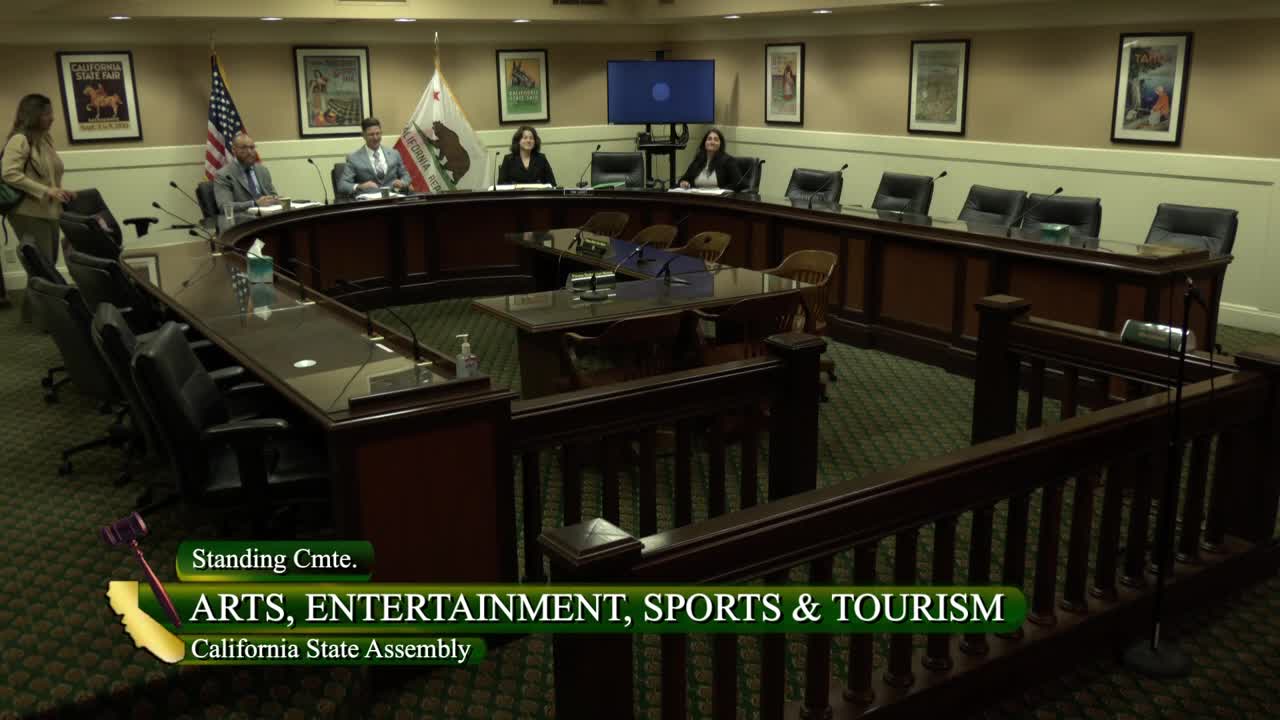 43MIN
Assembly Standing Committee on Arts, Entertainment, Sports, and Tourism


Bill Co-Author(s):