AB 1887: Prescription drug coverage for rare diseases.
- Session Year: 2025-2026
- House: Assembly
- Latest Version Date: 2026-09-27
Current Status:
Passed
(2026-09-27: Chaptered by Secretary of State - Chapter 557, Statutes of 2026.)
Introduced
In Committee
Awaiting First Chamber Vote
Passed First Chamber
In Committee
Awaiting Second Chamber Vote
Passed Second Chamber
Enacted
Existing law, the Knox-Keene Health Care Service Plan Act of 1975, provides for the licensure and regulation of health care service plans by the Department of Managed Health Care, and makes a willful violation of the act a crime. Existing law provides for the regulation of health insurers by the Department of Insurance. Existing law sets forth specified prior authorization and step therapy limitations for health care service plans and health insurers.
This bill would require a health care service plan contract or health insurance policy issued, amended, or renewed on or after January 1, 2027, to require a health care service plan or health insurer to complete prior authorization within 30 days upon initial request, as specified, for a drug approved by the United States Food and Drug Administration (FDA) for the treatment of a rare disease if the drug is prescribed by a specialist with expertise in the condition or disease being treated, the specialist has determined the drug is medically necessary, and the drug is the only FDA-approved treatment for the rare disease. Because a willful violation of these provisions by a health care service plan would be a crime, the bill would impose a state-mandated local program.
The California Constitution requires the state to reimburse local agencies and school districts for certain costs mandated by the state. Statutory provisions establish procedures for making that reimbursement.
This bill would provide that no reimbursement is required by this act for a specified reason.
Existing law, the Knox-Keene Health Care Service Plan Act of 1975, provides for the licensure and regulation of health care service plans by the Department of Managed Health Care, and makes a willful violation of the act a crime. Existing law provides for the regulation of health insurers by the Department of Insurance. Existing law sets forth specified prior authorization and step therapy limitations for health care service plans and health insurers.
This bill would require a health care service plan contract or health insurance policy issued, amended, or renewed on or after January 1, 2027, to require a health care service plan or health insurer to complete prior authorization within 30 days upon initial request, as specified, for a drug approved by the United States Food and Drug Administration (FDA) for the treatment of a rare disease if the drug is prescribed by a specialist with expertise in the condition or disease being treated, the specialist has determined the drug is medically necessary, and the drug is the only FDA-approved treatment for the rare disease. Because a willful violation of these provisions by a health care service plan would be a crime, the bill would impose a state-mandated local program.
The California Constitution requires the state to reimburse local agencies and school districts for certain costs mandated by the state. Statutory provisions establish procedures for making that reimbursement.
This bill would provide that no reimbursement is required by this act for a specified reason.
Existing law, the Knox-Keene Health Care Service Plan Act of 1975, provides for the licensure and regulation of health care service plans by the Department of Managed Health Care, and makes a willful violation of the act a crime. Existing law provides for the regulation of health insurers by the Department of Insurance. Existing law sets forth specified prior authorization and step therapy limitations for health care service plans and health insurers.
This bill would require a health care service plan contract or health insurance policy issued, amended, or renewed on or after January 1, 2027, to require a health care service plan or health insurer to complete prior authorization within 30 days upon initial request, as specified, for a drug approved by the United States Food and Drug Administration (FDA) for the treatment of a rare disease if the drug is prescribed by a specialist with expertise in the condition or disease being treated, the specialist has determined the drug is medically necessary, and the drug is the only FDA-approved treatment for the rare disease. Because a willful violation of these provisions by a health care service plan would be a crime, the bill would impose a state-mandated local program.
The California Constitution requires the state to reimburse local agencies and school districts for certain costs mandated by the state. Statutory provisions establish procedures for making that reimbursement.
This bill would provide that no reimbursement is required by this act for a specified reason.
Existing law, the Knox-Keene Health Care Service Plan Act of 1975, provides for the licensure and regulation of health care service plans by the Department of Managed Health Care, and makes a willful violation of the act a crime. Existing law provides for the regulation of health insurers by the Department of Insurance. Existing law sets forth specified prior authorization and step therapy limitations for health care service plans and health insurers.
This bill would require a health care service plan contract or health insurance policy issued, amended, or renewed on or after January 1, 2027, to require a health care service plan or health insurer to complete prior authorization within 30 days upon initial request, as specified, for a drug approved by the United States Food and Drug Administration (FDA) for the treatment of a rare disease if the drug is prescribed by a specialist with expertise in the condition or disease being treated and treated, the specialist has determined the drug is medically necessary. necessary, and the drug is the only FDA-approved treatment for the rare disease. Because a willful violation of these provisions by a health care service plan would be a crime, the bill would impose a state-mandated local program.
The California Constitution requires the state to reimburse local agencies and school districts for certain costs mandated by the state. Statutory provisions establish procedures for making that reimbursement.
This bill would provide that no reimbursement is required by this act for a specified reason.
Existing law, the Knox-Keene Health Care Service Plan Act of 1975, provides for the licensure and regulation of health care service plans by the Department of Managed Health Care, and makes a willful violation of the act a crime. Existing law provides for the regulation of health insurers by the Department of Insurance. Existing law sets forth specified prior authorization and step therapy limitations for health care service plans and health insurers.
This bill would require a health care service plan contract or health insurance policy issued, amended, or renewed on or after January 1, 2027, to require a health care service plan or health insurer to complete prior authorization or other utilization review within 30 days upon initial request, as specified, for a drug approved for the treatment of a rare disease if the drug is prescribed by a specialist with expertise in the condition or disease being treated and the specialist has determined the drug is medically necessary, unless a biosimilar, interchangeable biologic, or generic version of the drug is available. The bill would prohibit a health care service plan contract or health insurance policy issued, amended, or renewed on or after January 1, 2027, from imposing step therapy for these drugs. necessary. Because a willful violation of these provisions by a health care service plan would be a crime, the bill would impose a state-mandated local program.
The California Constitution requires the state to reimburse local agencies and school districts for certain costs mandated by the state. Statutory provisions establish procedures for making that reimbursement.
This bill would provide that no reimbursement is required by this act for a specified reason.
Existing law, the Knox-Keene Health Care Service Plan Act of 1975, provides for the licensure and regulation of health care service plans by the Department of Managed Health Care, and makes a willful violation of the act a crime. Existing law provides for the regulation of health insurers by the Department of Insurance. Existing law sets forth specified prior authorization and step therapy limitations for health care service plans and health insurers.
This bill would prohibit require a health care service plan contract or health insurance policy issued, amended, or renewed on or after January 1, 2027, from imposing prior authorization, step therapy, to require a health care service plan or health insurer to complete prior authorization or other utilization review within 30 days upon initial request, as specified, for a drug approved for the treatment of a rare disease if the drug is prescribed by a specialist with expertise in the condition or disease being treated and the specialist has determined the drug is medically necessary, unless a biosimilar, interchangeable biologic, or generic version of the drug is available. The bill would prohibit a health care service plan contract or health insurance policy issued, amended, or renewed on or after January 1, 2027, from imposing step therapy for these drugs. Because a willful violation of this provision these provisions by a health care service plan would be a crime, the bill would impose a state-mandated local program.
The California Constitution requires the state to reimburse local agencies and school districts for certain costs mandated by the state. Statutory provisions establish procedures for making that reimbursement.
This bill would provide that no reimbursement is required by this act for a specified reason.
Existing law, the Knox-Keene Health Care Service Plan Act of 1975, provides for the licensure and regulation of health care service plans by the Department of Managed Health Care, and makes a willful violation of the act a crime. Existing law provides for the regulation of health insurers by the Department of Insurance. Existing law sets forth specified prior authorization and step therapy limitations for health care service plans and health insurers.
This bill would prohibit a health care service plan contract or health insurance policy issued, amended, or renewed on or after January 1, 2027, from imposing prior authorization, step therapy, or other utilization review for a drug prescribed approved for the treatment of a rare disease, as specified, disease if the drug is prescribed by a specialist with expertise in the condition or disease being treated and the specialist has determined the drug is medically necessary, unless a biosimilar, interchangeable biologic, or generic version of the drug is available. Because a willful violation of this provision by a health care service plan would be a crime, the bill would impose a state-mandated local program.
The California Constitution requires the state to reimburse local agencies and school districts for certain costs mandated by the state. Statutory provisions establish procedures for making that reimbursement.
This bill would provide that no reimbursement is required by this act for a specified reason.
Existing law, the Knox-Keene Health Care Service Plan Act of 1975, provides for the licensure and regulation of health care service plans by the Department of Managed Health Care, and makes a willful violation of the act a crime. Existing law provides for the regulation of health insurers by the Department of Insurance. Existing law sets forth specified prior authorization and step therapy limitations for health care service plans and health insurers.
This bill would prohibit a health care service plan contract or health insurance policy issued, amended, or renewed on or after January 1, 2027, from imposing prior authorization, step therapy, or other utilization review for a drug prescribed for the treatment of a rare disease, as specified, unless a biosimilar, interchangeable biologic, or generic version of the drug is available. Because a willful violation of this provision by a health care service plan would be a crime, the bill would impose a state-mandated local program.
The California Constitution requires the state to reimburse local agencies and school districts for certain costs mandated by the state. Statutory provisions establish procedures for making that reimbursement.
This bill would provide that no reimbursement is required by this act for a specified reason.
(a)(1)A health care service plan contract issued, amended, or renewed on or after January 1, 2027, shall require a health care service plan to complete prior authorization within 30 days upon initial request for a prescription drug approved by the United States Food and Drug Administration (FDA) that is approved for the treatment of a rare disease if the drug is prescribed by a specialist with expertise in the condition or disease being treated, the specialist has determined the drug is medically necessary, and the drug is the only FDA-approved treatment for the rare disease.
(2)For purposes of paragraph (1), an initial request occurs when a health care provider or the health care providers staff sends a prior authorization request to the health care service plan or health care service plans delegate.
(3)Prior authorization for a drug prescribed pursuant to paragraph (1) shall be immediately approved under either of the following conditions:
(A)A decision approving or denying prior authorization has not been made by the end of the 30-day period.
(B)A dispute between the plan and provider or enrollee regarding the prior authorization is ongoing at the end of the 30-day period.
(b)For purposes of this section, rare disease means a disease that affects fewer than 200,000 people in the United States.
(c)This section does not affect the timelines described in subdivision (h) of Section 1367.01 or in Section 1367.241.
(d)This section does not apply to Medi-Cal managed care contracts with the State Department of Health Care Services entered into pursuant to Chapter 7 (commencing with Section 14000) of, or Chapter 8 (commencing with Section 14200) of, Part 3 of Division 9 of the Welfare and Institutions Code.
SEC. 2.Section 10123.1936 is added to the Insurance Code, to read:10123.1936.(a)(1)A health insurance policy issued, amended, or renewed on or after January 1, 2027, shall require a health insurer to complete prior authorization within 30 days upon initial request for a prescription drug approved by the United States Food and Drug Administration (FDA) that is approved for the treatment of a rare disease if the drug is prescribed by a specialist with expertise in the condition or disease being treated, the specialist has determined the drug is medically necessary, and the drug is the only FDA-approved treatment for the rare disease.
(2)For purposes of paragraph (1), an initial request occurs when a health care provider or the health care providers staff sends a prior authorization request to the health insurer or health insurers delegate.
(3)Prior authorization for a drug prescribed pursuant to paragraph (1) shall be immediately approved under either of the following conditions:
(A)A decision approving or denying prior authorization has not been made by the end of the 30-day period.
(B)A dispute between the insurer and provider or insured regarding the prior authorization is ongoing at the end of the 30-day period.
(b)For purposes of this section, rare disease means a disease that affects fewer than 200,000 people in the United States.
(c)This section does not affect the timelines described in subdivision (h) of Section 10123.135 or in Section 10123.191.
SEC. 3.No reimbursement is required by this act pursuant to Section 6 of Article XIIIB of the California Constitution because the only costs that may be incurred by a local agency or school district will be incurred because this act creates a new crime or infraction, eliminates a crime or infraction, or changes the penalty for a crime or infraction, within the meaning of Section 17556 of the Government Code, or changes the definition of a crime within the meaning of Section 6 of Article XIIIB of the California Constitution.
(a)(1)A health care service plan contract issued, amended, or renewed on or after January 1, 2027, shall require a health care service plan to complete prior authorization within 30 days upon initial request for a prescription drug approved by the United States Food and Drug Administration (FDA) that is approved for the treatment of a rare disease if the drug is prescribed by a specialist with expertise in the condition or disease being treated, the specialist has determined the drug is medically necessary, and the drug is the only FDA-approved treatment for the rare disease.
(2)For purposes of paragraph (1), an initial request occurs when a health care provider or the health care providers staff sends a prior authorization request to the health care service plan or health care service plans delegate.
(3)Prior authorization for a drug prescribed pursuant to paragraph (1) shall be immediately approved under either of the following conditions:
(A)A decision approving or denying prior authorization has not been made by the end of the 30-day period.
(B)A dispute between the plan and provider or enrollee regarding the prior authorization is ongoing at the end of the 30-day period.
(b)For purposes of this section, rare disease means a disease that affects fewer than 200,000 people in the United States.
(c)This section does not affect the timelines described in subdivision (h) of Section 1367.01 or in Section 1367.241.
(d)This section does not apply to Medi-Cal managed care contracts with the State Department of Health Care Services entered into pursuant to Chapter 7 (commencing with Section 14000) of, or Chapter 8 (commencing with Section 14200) of, Part 3 of Division 9 of the Welfare and Institutions Code.
SEC. 2.Section 10123.1936 is added to the Insurance Code, to read:10123.1936.(a)(1)A health insurance policy issued, amended, or renewed on or after January 1, 2027, shall require a health insurer to complete prior authorization within 30 days upon initial request for a prescription drug approved by the United States Food and Drug Administration (FDA) that is approved for the treatment of a rare disease if the drug is prescribed by a specialist with expertise in the condition or disease being treated, the specialist has determined the drug is medically necessary, and the drug is the only FDA-approved treatment for the rare disease.
(2)For purposes of paragraph (1), an initial request occurs when a health care provider or the health care providers staff sends a prior authorization request to the health insurer or health insurers delegate.
(3)Prior authorization for a drug prescribed pursuant to paragraph (1) shall be immediately approved under either of the following conditions:
(A)A decision approving or denying prior authorization has not been made by the end of the 30-day period.
(B)A dispute between the insurer and provider or insured regarding the prior authorization is ongoing at the end of the 30-day period.
(b)For purposes of this section, rare disease means a disease that affects fewer than 200,000 people in the United States.
(c)This section does not affect the timelines described in subdivision (h) of Section 10123.135 or in Section 10123.191.
SEC. 3.No reimbursement is required by this act pursuant to Section 6 of Article XIIIB of the California Constitution because the only costs that may be incurred by a local agency or school district will be incurred because this act creates a new crime or infraction, eliminates a crime or infraction, or changes the penalty for a crime or infraction, within the meaning of Section 17556 of the Government Code, or changes the definition of a crime within the meaning of Section 6 of Article XIIIB of the California Constitution.
(a)(1)A health care service plan contract issued, amended, or renewed on or after January 1, 2027, shall require a health care service plan to complete prior authorization within 30 days upon initial request for a prescription drug approved by the United States Food and Drug Administration (FDA) that is approved for the treatment of a rare disease if the drug is prescribed by a specialist with expertise in the condition or disease being treated, the specialist has determined the drug is medically necessary, and the drug is the only FDA-approved treatment for the rare disease.
(2)For purposes of paragraph (1), an initial request occurs when a health care provider or the health care providers staff sends a prior authorization request to the health care service plan or health care service plans delegate.
(3)Prior authorization for a drug prescribed pursuant to paragraph (1) shall be immediately approved under either of the following conditions:
(A)A decision approving or denying prior authorization has not been made by the end of the 30-day period.
(B)A dispute between the plan and provider or enrollee regarding the prior authorization is ongoing at the end of the 30-day period.
(b)For purposes of this section, rare disease means a disease that affects fewer than 200,000 people in the United States.
(c)This section does not affect the timelines described in subdivision (h) of Section 1367.01. 1367.01 or in Section 1367.241.
(d)This section does not apply to Medi-Cal managed care contracts with the State Department of Health Care Services entered into pursuant to Chapter 7 (commencing with Section 14000) of, or Chapter 8 (commencing with Section 14200) of, Part 3 of Division 9 of the Welfare and Institutions Code.
SEC. 2.Section 10123.1936 is added to the Insurance Code, to read:10123.1936.(a)(1)A health insurance policy issued, amended, or renewed on or after January 1, 2027, shall require a health insurer to complete prior authorization within 30 days upon initial request for a prescription drug approved by the United States Food and Drug Administration (FDA) that is approved for the treatment of a rare disease if the drug is prescribed by a specialist with expertise in the condition or disease being treated, the specialist has determined the drug is medically necessary, and the drug is the only FDA-approved treatment for the rare disease.
(2)For purposes of paragraph (1), an initial request occurs when a health care provider or the health care providers staff sends a prior authorization request to the health insurer or health insurers delegate.
(3)Prior authorization for a drug prescribed pursuant to paragraph (1) shall be immediately approved under either of the following conditions:
(A)A decision approving or denying prior authorization has not been made by the end of the 30-day period.
(B)A dispute between the insurer and provider or insured regarding the prior authorization is ongoing at the end of the 30-day period.
(b)For purposes of this section, rare disease means a disease that affects fewer than 200,000 people in the United States.
(c)This section does not affect the timelines described in subdivision (h) of Section 10123.135. 10123.135 or in Section 10123.191.
SEC. 3.No reimbursement is required by this act pursuant to Section 6 of Article XIIIB of the California Constitution because the only costs that may be incurred by a local agency or school district will be incurred because this act creates a new crime or infraction, eliminates a crime or infraction, or changes the penalty for a crime or infraction, within the meaning of Section 17556 of the Government Code, or changes the definition of a crime within the meaning of Section 6 of Article XIIIB of the California Constitution.
(a)(1)A health care service plan contract issued, amended, or renewed on or after January 1, 2027, shall require a health care service plan to complete prior authorization within 30 days upon initial request for a prescription drug approved by the United States Food and Drug Administration (FDA) that is approved for the treatment of a rare disease if the drug is prescribed by a specialist with expertise in the condition or disease being treated and treated, the specialist has determined the drug is medically necessary. necessary, and the drug is the only FDA-approved treatment for the rare disease.
(2)For purposes of paragraph (1), an initial request occurs when a health care provider or the health care providers staff sends a prior authorization request to the health care service plan or health care service plans delegate.
(3)Prior authorization for a drug prescribed pursuant to paragraph (1) shall be immediately approved under either of the following conditions:
(A)A decision approving or denying prior authorization has not been made by the end of the 30-day period.
(B)A dispute between the plan and provider or enrollee regarding the prior authorization is ongoing at the end of the 30-day period.
(b)For purposes of this section, rare disease means a disease that affects fewer than 200,000 people in the United States.
(c)This section does not affect the timelines described in paragraph (2) of subdivision (h) of Section 1367.01.
(d)This section does not apply to Medi-Cal managed care contracts with the State Department of Health Care Services entered into pursuant to Chapter 7 (commencing with Section 14000) of, or Chapter 8 (commencing with Section 14200) of, Part 3 of Division 9 of the Welfare and Institutions Code.
SEC. 2.Section 10123.1936 is added to the Insurance Code, to read:10123.1936.(a)(1)A health insurance policy issued, amended, or renewed on or after January 1, 2027, shall require a health insurer to complete prior authorization within 30 days upon initial request for a prescription drug approved by the United States Food and Drug Administration (FDA) that is approved for the treatment of a rare disease if the drug is prescribed by a specialist with expertise in the condition or disease being treated and treated, the specialist has determined the drug is medically necessary. necessary, and the drug is the only FDA-approved treatment for the rare disease.
(2)For purposes of paragraph (1), an initial request occurs when a health care provider or the health care providers staff sends a prior authorization request to the health insurer or health insurers delegate.
(3)Prior authorization for a drug prescribed pursuant to paragraph (1) shall be immediately approved under either of the following conditions:
(A)A decision approving or denying prior authorization has not been made by the end of the 30-day period.
(B)A dispute between the insurer and provider or insured regarding the prior authorization is ongoing at the end of the 30-day period.
(b)For purposes of this section, rare disease means a disease that affects fewer than 200,000 people in the United States.
(c)This section does not affect the timelines described in paragraph (2) of subdivision (h) of Section 10123.135.
SEC. 3.No reimbursement is required by this act pursuant to Section 6 of Article XIIIB of the California Constitution because the only costs that may be incurred by a local agency or school district will be incurred because this act creates a new crime or infraction, eliminates a crime or infraction, or changes the penalty for a crime or infraction, within the meaning of Section 17556 of the Government Code, or changes the definition of a crime within the meaning of Section 6 of Article XIIIB of the California Constitution.
(a)(1)A health care service plan contract issued, amended, or renewed on or after January 1, 2027, shall require a health care service plan to complete prior authorization or other utilization review within 30 days upon initial request for a prescription drug approved by the United States Food and Drug Administration that is approved for the treatment of a rare disease if the drug is prescribed by a specialist with expertise in the condition or disease being treated and the specialist has determined the drug is medically necessary, unless a biosimilar, interchangeable biologic, or generic version of the drug is available. necessary.
(2)For purposes of paragraph (1), an initial request occurs when a health care provider or the health care providers staff sends a prior authorization request or utilization review request to the health care service plan or health care service plans delegate.
(3)Prior authorization or other utilization review for a drug prescribed pursuant to paragraph (1) shall be immediately approved under either of the following conditions:
(A)A decision approving or denying prior authorization or other utilization review has not been made by the end of the 30-day period.
(B)A dispute between the plan and provider or enrollee regarding the prior authorization or other utilization review is ongoing at the end of the 30-day period.
(b)Notwithstanding any other law, a health care service plan contract issued, amended, or renewed on or after January 1, 2027, shall not impose step therapy for a drug approved by the United States Food and Drug Administration that is approved for the treatment of a rare disease if the drug is prescribed by a specialist with expertise in the condition or disease being treated and the specialist has determined the drug is medically necessary, unless a biosimilar, interchangeable biologic, or generic version of the drug is available. (c)(b)For purposes of this section, rare disease means a disease that affects fewer than 200,000 people in the United States.
(d)(c)This section does not affect the timelines described in paragraph (2) of subdivision (h) of Section 1367.01.
(e)(d)This section does not apply to Medi-Cal managed care contracts with the State Department of Health Care Services entered into pursuant to Chapter 7 (commencing with Section 14000) of, or Chapter 8 (commencing with Section 14200) of, Part 3 of Division 9 of the Welfare and Institutions Code.
SEC. 2.Section 10123.1936 is added to the Insurance Code, to read:10123.1936.(a)(1)A health insurance policy issued, amended, or renewed on or after January 1, 2027, shall require a health insurer to complete prior authorization or other utilization review within 30 days upon initial request for a prescription drug approved by the United States Food and Drug Administration that is approved for the treatment of a rare disease if the drug is prescribed by a specialist with expertise in the condition or disease being treated and the specialist has determined the drug is medically necessary, unless a biosimilar, interchangeable biologic, or generic version of the drug is available. necessary.
(2)For purposes of paragraph (1), an initial request occurs when a health care provider or the health care providers staff sends a prior authorization request or utilization review request to the health insurer or health insurers delegate.
(3)Prior authorization or other utilization review for a drug prescribed pursuant to paragraph (1) shall be immediately approved under either of the following conditions:
(A)A decision approving or denying prior authorization or other utilization review has not been made by the end of the 30-day period.
(B)A dispute between the insurer and provider or insured regarding the prior authorization or other utilization review is ongoing at the end of the 30-day period.
(b)Notwithstanding any other law, a health insurance policy issued, amended, or renewed on or after January 1, 2027, shall not impose step therapy for a drug approved by the United States Food and Drug Administration that is approved for the treatment of a rare disease if the drug is prescribed by a specialist with expertise in the condition or disease being treated and the specialist has determined the drug is medically necessary, unless a biosimilar, interchangeable biologic, or generic version of the drug is available. (c)(b)For purposes of this section, rare disease means a disease that affects fewer than 200,000 people in the United States.
(d)(c)This section does not affect the timelines described in paragraph (2) of subdivision (h) of Section 10123.135.
SEC. 3.No reimbursement is required by this act pursuant to Section 6 of Article XIIIB of the California Constitution because the only costs that may be incurred by a local agency or school district will be incurred because this act creates a new crime or infraction, eliminates a crime or infraction, or changes the penalty for a crime or infraction, within the meaning of Section 17556 of the Government Code, or changes the definition of a crime within the meaning of Section 6 of Article XIIIB of the California Constitution.
(a)Notwithstanding any other law, a (1)A health care service plan contract issued, amended, or renewed on or after January 1, 2027, shall not impose prior authorization, step therapy, require a health care service plan to complete prior authorization or other utilization review within 30 days upon initial request for a prescription drug approved by the United States Food and Drug Administration that is approved for the treatment of a rare disease if the drug is prescribed by a specialist with expertise in the condition or disease being treated and the specialist has determined the drug is medically necessary, unless a biosimilar, interchangeable biologic, or generic version of the drug is available.
(2)For purposes of paragraph (1), an initial request occurs when a health care provider or the health care providers staff sends a prior authorization request or utilization review request to the health care service plan or health care service plans delegate.
(3)Prior authorization or other utilization review for a drug prescribed pursuant to paragraph (1) shall be immediately approved under either of the following conditions:
(A)A decision approving or denying prior authorization or other utilization review has not been made by the end of the 30-day period.
(B)A dispute between the plan and provider or enrollee regarding the prior authorization or other utilization review is ongoing at the end of the 30-day period.
(b)Notwithstanding any other law, a health care service plan contract issued, amended, or renewed on or after January 1, 2027, shall not impose step therapy for a drug approved by the United States Food and Drug Administration that is approved for the treatment of a rare disease if the drug is prescribed by a specialist with expertise in the condition or disease being treated and the specialist has determined the drug is medically necessary, unless a biosimilar, interchangeable biologic, or generic version of the drug is available.
(b)(c)For purposes of this section, rare disease means a disease that affects fewer than 200,000 people in the United States.
(d)This section does not affect the timelines described in paragraph (2) of subdivision (h) of Section 1367.01.
(c)(e)This section does not apply to Medi-Cal managed care contracts with the State Department of Health Care Services entered into pursuant to Chapter 7 (commencing with Section 14000) of, or Chapter 8 (commencing with Section 14200) of, Part 3 of Division 9 of the Welfare and Institutions Code.
SEC. 2.Section 10123.1936 is added to the Insurance Code, to read:10123.1936.(a)Notwithstanding any other law, a (1)A health insurance policy issued, amended, or renewed on or after January 1, 2027, shall not impose prior authorization, step therapy, require a health insurer to complete prior authorization or other utilization review within 30 days upon initial request for a prescription drug approved by the United States Food and Drug Administration that is approved for the treatment of a rare disease if the drug is prescribed by a specialist with expertise in the condition or disease being treated and the specialist has determined the drug is medically necessary, unless a biosimilar, interchangeable biologic, or generic version of the drug is available.
(2)For purposes of paragraph (1), an initial request occurs when a health care provider or the health care providers staff sends a prior authorization request or utilization review request to the health insurer or health insurers delegate.
(3)Prior authorization or other utilization review for a drug prescribed pursuant to paragraph (1) shall be immediately approved under either of the following conditions:
(A)A decision approving or denying prior authorization or other utilization review has not been made by the end of the 30-day period.
(B)A dispute between the insurer and provider or insured regarding the prior authorization or other utilization review is ongoing at the end of the 30-day period.
(b)Notwithstanding any other law, a health insurance policy issued, amended, or renewed on or after January 1, 2027, shall not impose step therapy for a drug approved by the United States Food and Drug Administration that is approved for the treatment of a rare disease if the drug is prescribed by a specialist with expertise in the condition or disease being treated and the specialist has determined the drug is medically necessary, unless a biosimilar, interchangeable biologic, or generic version of the drug is available.
(b)(c)For purposes of this section, rare disease means a disease that affects fewer than 200,000 people in the United States.
(d)This section does not affect the timelines described in paragraph (2) of subdivision (h) of Section 10123.135.
SEC. 3.No reimbursement is required by this act pursuant to Section 6 of Article XIIIB of the California Constitution because the only costs that may be incurred by a local agency or school district will be incurred because this act creates a new crime or infraction, eliminates a crime or infraction, or changes the penalty for a crime or infraction, within the meaning of Section 17556 of the Government Code, or changes the definition of a crime within the meaning of Section 6 of Article XIIIB of the California Constitution.
(a)Notwithstanding any other law, a health care service plan contract issued, amended, or renewed on or after January 1, 2027, shall not impose prior authorization, step therapy, or other utilization review for a prescription drug approved by the United States Food and Drug Administration that is prescribed approved for the treatment of a rare disease if the prescribing health care professional drug is prescribed by a specialist with expertise in the condition or disease being treated and the specialist has determined the drug is medically necessary, unless a biosimilar, interchangeable biologic, or generic version of the drug is available.
(b)For purposes of this section, rare disease means a disease that affects fewer than 200,000 people in the United States.
(c)This section does not apply to Medi-Cal managed care contracts with the State Department of Health Care Services entered into pursuant to Chapter 7 (commencing with Section 14000) of, or Chapter 8 (commencing with Section 14200) of, Part 3 of Division 9 of the Welfare and Institutions Code.
SEC. 2.Section 10123.1936 is added to the Insurance Code, to read:10123.1936.(a)Notwithstanding any other law, a health insurance policy issued, amended, or renewed on or after January 1, 2027, shall not impose prior authorization, step therapy, or other utilization review for a prescription drug approved by the United States Food and Drug Administration that is prescribed approved for the treatment of a rare disease if the prescribing health care professional drug is prescribed by a specialist with expertise in the condition or disease being treated and the specialist has determined the drug is medically necessary, unless a biosimilar, interchangeable biologic, or generic version of the drug is available.
(b)For purposes of this section, rare disease means a disease that affects fewer than 200,000 people in the United States.
SEC. 3.No reimbursement is required by this act pursuant to Section 6 of Article XIIIB of the California Constitution because the only costs that may be incurred by a local agency or school district will be incurred because this act creates a new crime or infraction, eliminates a crime or infraction, or changes the penalty for a crime or infraction, within the meaning of Section 17556 of the Government Code, or changes the definition of a crime within the meaning of Section 6 of Article XIIIB of the California Constitution.
REVISIONS: HeadingLine 5.(a)Notwithstanding any other law, a health care service plan contract issued, amended, or renewed on or after January 1, 2027, shall not impose prior authorization, step therapy, or other utilization review for a prescription drug approved by the United States Food and Drug Administration that is prescribed for the treatment of a rare disease if the prescribing health care professional has determined the drug is medically necessary, unless a biosimilar, interchangeable biologic, or generic version of the drug is available.
(b)For purposes of this section, rare disease means a disease that affects fewer than 200,000 people in the United States.
(c)This section does not apply to Medi-Cal managed care contracts with the State Department of Health Care Services entered into pursuant to Chapter 7 (commencing with Section 14000) of, or Chapter 8 (commencing with Section 14200) of, Part 3 of Division 9 of the Welfare and Institutions Code.
SEC. 2.Section 10123.1936 is added to the Insurance Code, to read:10123.1936.(a)Notwithstanding any other law, a health insurance policy issued, amended, or renewed on or after January 1, 2027, shall not impose prior authorization, step therapy, or other utilization review for a prescription drug approved by the United States Food and Drug Administration that is prescribed for the treatment of a rare disease if the prescribing health care professional has determined the drug is medically necessary, unless a biosimilar, interchangeable biologic, or generic version of the drug is available.
(b)For purposes of this section, rare disease means a disease that affects fewer than 200,000 people in the United States.
SEC. 3.No reimbursement is required by this act pursuant to Section 6 of Article XIIIB of the California Constitution because the only costs that may be incurred by a local agency or school district will be incurred because this act creates a new crime or infraction, eliminates a crime or infraction, or changes the penalty for a crime or infraction, within the meaning of Section 17556 of the Government Code, or changes the definition of a crime within the meaning of Section 6 of Article XIIIB of the California Constitution.
|
Date
|
Status
|
|---|---|
| Sep 27, 2026 | Chaptered by Secretary of State - Chapter 557, Statutes of 2026. |
| Sep 27, 2026 | Approved by the Governor. |
| Sep 10, 2026 | Enrolled and presented to the Governor at 3 p.m. |
| Aug 30, 2026 | Senate amendments concurred in. To Engrossing and Enrolling. (Ayes 78. Noes 0. Page 6932.). |
| Aug 30, 2026 | Senate amendments concurred in. To Engrossing and Enrolling. (Ayes 78. Noes 0.). |
| Aug 30, 2026 | Senate amendments concurred in. To Engrossing and Enrolling. |
| Aug 30, 2026 | In Assembly. Concurrence in Senate amendments pending. |
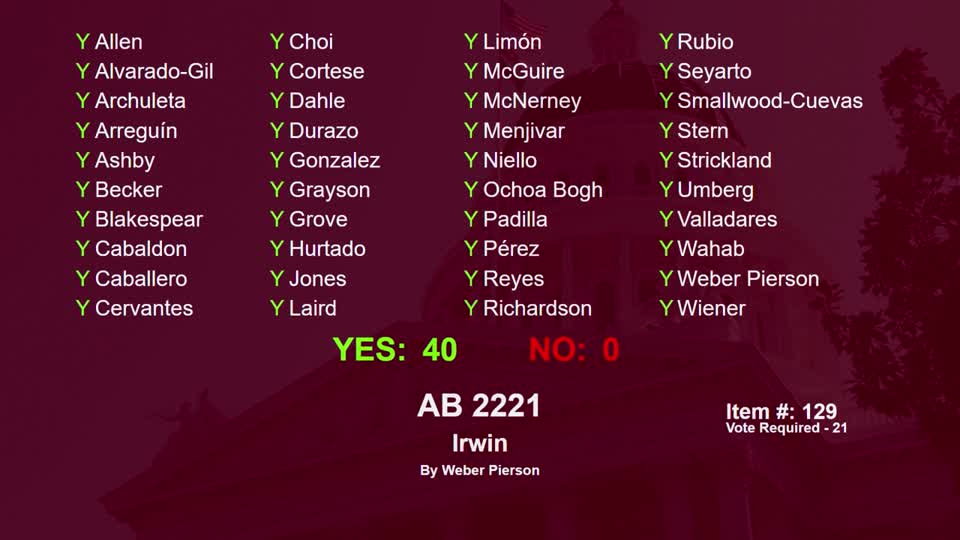
| Aug 30, 2026 | Read third time. Passed. Ordered to the Assembly. (Ayes 40. Noes 0.). |
| Aug 24, 2026 | Read second time. Ordered to third reading. |
| Aug 21, 2026 | Read third time and amended. Ordered to second reading. |
| Aug 17, 2026 | Read second time. Ordered to third reading. |
| Aug 13, 2026 | Read second time and amended. Ordered returned to second reading. |
| Aug 13, 2026 | From committee: Amend, and do pass as amended. (Ayes 7. Noes 0.) (August 13). |
| Aug 3, 2026 | In committee: Referred to APPR. suspense file. |
| Jul 2, 2026 | Read second time and amended. Re-referred to Com. on APPR. |
| Jul 2, 2026 | From committee: Amend, and do pass as amended and re-refer to Com. on APPR. (Ayes 10. Noes 0.) (July 1). |
| Jun 10, 2026 | Referred to Com. on HEALTH. |
| May 28, 2026 | In Senate. Read first time. To Com. on RLS. for assignment. |
| May 27, 2026 | Read third time. Passed. Ordered to the Senate. (Ayes 77. Noes 0. Page 5487.) |
| May 27, 2026 | Read third time. Passed. Ordered to the Senate. (Ayes 77. Noes 0.) |
| May 27, 2026 | Read third time. Passed. Ordered to the Senate. |
| May 20, 2026 | Read third time and amended. Ordered to third reading. (Page 5167.) |
| May 20, 2026 | Read third time and amended. Ordered to third reading. |
| May 18, 2026 | Read second time. Ordered to third reading. |
| May 14, 2026 | Joint Rule 62(a), file notice suspended. (Page 5030.) |
| May 14, 2026 | From committee: Do pass. (Ayes 14. Noes 0.) (May 14). |
| May 14, 2026 | Joint Rule 62(a), file notice suspended. |
| May 13, 2026 | In committee: Set, first hearing. Referred to APPR. suspense file. |
| Apr 22, 2026 | From committee: Do pass and re-refer to Com. on APPR. (Ayes 15. Noes 0.) (April 21). Re-referred to Com. on APPR. |
| Apr 22, 2026 | Coauthors revised. |
| Apr 6, 2026 | Re-referred to Com. on HEALTH. |
| Mar 26, 2026 | From committee chair, with author's amendments: Amend, and re-refer to Com. on HEALTH. Read second time and amended. |
| Mar 2, 2026 | Referred to Com. on HEALTH. |
| Feb 13, 2026 | From printer. May be heard in committee March 15. |
| Feb 12, 2026 | Read first time. To print. |
|
Date
|
Description
|
Location
|
Votes
|
|
|---|---|---|---|---|
| Aug 30, 2026 | AB 1887 Zbur Concurrence in Senate Amendments | Assembly Floor |
Passed |
|
| Aug 30, 2026 | Assembly 3rd Reading AB1887 Zbur et al. By Blakespear | Senate Floor |
Passed |
|
| Aug 13, 2026 | Do pass as amended | Senate Standing Committee on Appropriations |
Passed |
|
| Aug 3, 2026 | Placed on suspense file | Senate Standing Committee on Appropriations |
Passed |
|
| Jul 1, 2026 | Do pass as amended, but first amend, and re-refer to the Committee on [Appropriations] | Senate Standing Committee on Health |
Passed |
|
| May 27, 2026 | AB 1887 Zbur Assembly Third Reading | Assembly Floor |
Passed |
|
| May 14, 2026 | Do pass. | Assembly Standing Committee on Appropriations |
Passed |
|
| Apr 21, 2026 | Do pass and be re-referred to the Committee on [Appropriations] | Assembly Standing Committee on Health |
Passed |
This list shows positions taken on this bill by organizations on the date displayed, which is linked to the original source.
Positions by individuals are not included.
|
Organization
|
Position
|
Date
|
|---|---|---|
| AiArthritis | ** Support | |
| Alliance for Patient Access | ** Support | |
| ALS Association | ** Support | |
| American Kidney Fund | ** Support | |
| Arginase 1 Deficiency Foundation | ** Support | |
| Association for Creatine Deficiencies | ** Support | |
| Association Of California Life And Health Insurance Companies | ** Against | |
| Association of California Life and Health Insurance Companies (ACLHIC) | ** Against | |
| Biocom California | ** Support | |
| Bleeding Disorders Council of California | ** Support | |
| Breathe California | ** Support | |
| Breathe Southern California | ** Support | |
| California Association Of Health Plans | ** Against | |
| California Chamber Of Commerce | ** Against | |
| California Chronic Care Coalition | ** Support | |
| California Life Sciences Association | ** Support | |
| California Pharmacists Association | ** Support | |
| California Rheumatology Alliance | ** Support | |
| California Small Business Association | ** Against | |
| Cedars-Sinai | ** Support | |
| Central Coast Oncology & Hematology | ** Support | |
| Children'S Specialty Care Coalition | ** Support | |
| Chronic Disease Coalition | ** Support | |
| CSNK2A1 Foundation | ** Support | |
| Cure Sma | ** Support | |
| Cystic Fibrosis Research, Inc. | ** Support | |
| Cystic Fibrosis Research, INC. (CFRI) | ** Support | |
| Dravet Syndrome Foundation | ** Support | |
| Eb Research Partnership | ** Support | |
| Everylife Foundation For Rare Diseases | ** Support | |
| Flok Health | ** Support | |
| Hemophilia Foundation of Southern California | ** Support | |
| HERRERA & COMPANY | ** Support | |
| Iga Nephropathy Foundation | ** Support | |
| Infusion Access Foundation | ** Support | |
| International Foundation for Autoimmune and Autoinflammatory Arthritis | ** Support | |
| International Pemphigus and Pemphigoid Foundation | ** Support | |
| Little Legs Big Heart Foundation | ** Support | |
| National Association of Pediatric Nurse Practitioners | ** Support | |
| National Ataxia Foundation | ** Support | |
| National Health Law Program | ** Support | |
| National Kidney Foundation | ** Support | |
| National Kidney Foundation Serving Northern California, Northern Nevada, Oregon, Washington and Alaska | ** Support | |
| National Organization for Rare Disorders | ** Support | |
| National PKU Alliance | ** Support | |
| Nephcure | ** Support | |
| Neuropathy Action Foundation | ** Support | |
| NW Rare Disease Coalition | ** Support | |
| Overcome Lupus | ** Support | |
| Project Alive | ** Support | |
| Psychiatric Physicians Alliance of California | ** Support | |
| Psychiatric Physicians Alliance of California (PPAC) | ** Support | |
| Rare & Ready Coalition | ** Support | |
| RareRising | ** Support | |
| The Everylife Foundation for Rare Diseases | ** Support | |
| TSC Alliance | ** Support | |
| U.S. Pain Foundation | ** Support |
CONCURRENCE IN SENATE AMENDMENTS
CSA1 Bill Id:AB 1887
Author:(Zbur)
As Amended Ver:August 21, 2026
Majority vote
SUMMARY
Requires prior authorization (PA) for prescription drugs prescribed for the treatment of a rare disease to be complete within 30 days of the initial request by a provider. Requires approval of the prescription if the 30-day timeline is not met, as specified.
Senate Amendments
- Strike inclusion of other utilization review (UR) from the 30-day timeline in the bill.
- Strike qualifier that the 30-day approval timeline doesn't apply if there is a biosimilar or generic version of the drug available.
- Strike prohibition on step therapy for rare disease drugs.
- Clarify that the drug must be approved by the United States Food and Drug Administration (FDA) for the treatment of the rare disease.
- Exempt Medi-Cal Managed Care Plans.
- Make technical and clarifying changes.
COMMENTS
Rare diseases are medical disorders, illnesses, or conditions that affect a relatively small number of individuals. According to the National Institutes of Health and the Orphan Drug Act, rare diseases are those that affect fewer than 200,000 people in the United States. Rare diseases are often chronic, serious, and progressive diseases that are life-threatening or life-limiting. Signs of rare diseases are often present at birth or in childhood, although there is a subset of rare diseases that do not appear until adulthood. Rare diseases can affect any organ system and might affect multiple body systems. Approximately 80% of rare diseases are caused by genetic mutations and may be inherited but can also be new mutations. Rare diseases may also be caused by infections or environmental factors. There are an estimated 5,000 to over 10,000 rare diseases in the United States. It is estimated that in 10 Californians, or close to four million Californians, are living with a rare disease, based on national estimates. Only 5% of the 5,000 to 10,000 rare diseases currently have FDA-approved drugs indicated for their treatment. The time to receive a correct diagnosis of a rare disease can vary widely, with four to five years as the average.
California Health Benefits Review Program (CHBRP). CHBRP was created in response to AB 1996 (Thomson), Chapter 795, Statutes of 2002, which requests the University of California to assess legislation proposing a mandated benefit or service and prepare a written analysis with relevant data on the medical, economic, and public health impacts of proposed health plan and health insurance benefit mandate legislation. SB 125 (Hernandez), Chapter 9, Statutes of 2015, added an impact assessment on essential health benefits, and legislation that impacts health insurance benefit designs, cost-sharing, premiums, and other health insurance topics to CHBRP's purview. CHBRP reviewed this bill and included the following impact estimates in their analysis:
- Premium & enrollee out-of-pocket increases. Premiums paid by employers and enrollees would increase upon enaction of this bill by an estimated $148 million. Individual annual premium impacts range from $1.49 to $10.69 depending on market segment. The average annual enrollee premium impact for users is $1.90 for large-group, $3.80 for small-group, $10.69 for individual market, and $1.49 for California Public Employees' Retirement System (CalPERS) enrollees. This premium increase applies to all enrollees regardless of whether they use the new benefit. Annual expenses for those using drugs subject to this bill, including cost sharing and noncovered expenses, would increase by between $900 and $1,200. Over time, utilization of FDA-approved drugs for rare diseases is likely to increase as new drugs are developed and receive FDA approval. These factors would contribute toward increases in premiums.
- Utilization Management (UM) and access to care. CHBRP found there is not enough research on the impact of UM on access to rare-disease drugs. Based on existing literature and discussion with content experts, CHBRP determined that PA is typically the only type of UM used when reviewing access to coverage for FDA-approved drugs for rare-diseases. In studies of non-rare diseases, CHBRP found some evidence that PA results in delays for initiation of prescription drug treatments. CHBRP found that PA leads to a 60-day delay in access to all new prescriptions for users, i.e., individuals with rare diseases starting an FDA-approved drug. The 60-day delay estimate reflects clinical expert opinion from a specialist in rare metabolic diseases with extensive experience managing UM requirements for this patient population. Unlike other studies reviewed, which examined UM delays in more common conditions over shorter timeframes, rare disease PA processes are typically more burdensome, often requiring detailed diagnostic documentation, genetic testing results, and specialist attestation, justifying a longer timeline than observed for other treatments.
- Public health impacts. CHRBP determined that this bill would produce no measurable public health impact at the population level. However, this bill could yield health and quality-of-life improvements at the person-level, such as faster access to medications, potential reductions in unnecessary health care utilization while awaiting PA for medications, and reduced stress and administrative burden for patients, their families, and their clinicians by removing PA requirements.
UM and UR. UM and UR are processes used by health plans to evaluate and manage the use of health care services. UR can occur prospectively, retrospectively, or concurrently and a plan can approve, modify, delay or deny in whole or in part a request based on its medical necessity. PA is a UR technique used by health plans that requires patients to obtain approval of a service or medication before care is provided. PA is intended to allow plans to evaluate whether care that has been prescribed is medically necessary for purposes of coverage. PA is a type of UM tool that's used by health plans, along with others such as concurrent review and step therapy, to control costs, limit unnecessary care, and evaluate safety and appropriateness of a service.
Growing consumer premiums and affordability concerns. Over the last two decades, significant federal policy changes have reshaped the health insurance landscape in California, expanding coverage, increasing affordability, and strengthening consumer protections for millions of residents. These policies drove historic reductions in the uninsured rate and provided greater stability for families, providers, and health systems across the state. These gains, however, are under threat as the expiration and rollback of key federal supports, combined with broader economic uncertainty and rising health care costs, risk reversing hard-won progress and increasing the number of Californians who are struggling to access affordable health care. According to the California Health Care Foundation 2026 Health Policy Survey (CHCF Survey), half of Californians (51%) reported that their health care expenses have increased faster than their incomes, and a vast majority (71%) are experiencing financial strain due to health care costs. About 6 in 10 Californians overall (59%), and 70% of Californians with low incomes, say they skipped or postponed care due to cost in the past year. Nearly half of Californians (47%) say it is "very" or "somewhat" difficult to afford health care.
Covered California. Covered California is the state's ACA marketplace where small-businesses and individuals can directly purchase coverage. Over 90% of Covered California enrollees receive some combination of state and federal subsidies to afford their premiums. However, the expiration of federal enhanced premium tax credits at the end of 2025 is creating stark affordability concerns. Covered California estimates that about 1.7 million Californians will see significant increases to their costs in 2026; on average, enrollees will notice 97% increases to their monthly health insurance premiums. As of February, Covered California estimated a 3% decrease in enrollment overall, with a 32% decrease in new enrollments compared to 2025. One-third of enrollees are opting for lower-cost Bronze plans, compared to 25% in 2025, and 75% of renewals who switched plans downgraded to Bronze-level coverage. About 14% of previous enrollees cancelled their plans, and for those making over 400% of the federal poverty level (FPL), policy termination rates are double what they were in 2025 (22% up from 11%). CHBRP's analysis showed this bill has the highest premium impacts in the Covered California individual and small-group markets.
Employer coverage. For those on employer-based individual and family plans, the California Health Benefits Survey found that the average total premium for family coverage in California has increased by 24% since 2022 – rapidly outpacing the national rates of inflation (12%) and wages (14%). This continues a 20-year trend: according to the UC Labor Center, family health care premiums for private-sector workers have grown by 129% since 2005, faster than the state's median household income (94%) and the inflation rate (69%). Because health insurance is part of an employee's total compensation plan, higher premiums cut into employee wage increases and other benefits.
Office of Health Care Affordability (OHCA) cost targets. OHCA was established in 2022 in response to widespread cost-related access challenges across California. OHCA collects, analyzes, and publicly reports data on total health care expenditures and enforces spending targets. OHCA's spending targets are intended to reduce excess spending and slow health care spending growth. In April of 2024, OHCA approved a statewide cost growth target of 3.5% starting in 2025 and phasing down to 3% by 2029. Health care entities, including health plans and insurers, are subject to the statewide spending target and are subject to progressive enforcement if the entity's costs exceed the target. Some entities have raised concerns that new legislative insurance mandates will make it difficult for them to meet the established cost growth target.
Current law does not explicitly require OHCA to adjust the cost growth targets based on changes to state policy, such as insurance mandates, that may increase spending. However, it does require OHCA to consider state benefit mandates in its development and enforcement of cost growth targets. Specifically, when establishing cost growth target methodology, OHCA is required to review relevant state policy changes impacting covered benefits, provider reimbursement, and costs, among other factors. In addition, in enforcing cost growth targets, OHCA is required to consider factors that contribute to spending in excess of the applicable target, and the extent to which each entity has control over the applicable components of its cost target.
According to the Author
Families living with rare diseases in California often spend years searching for a diagnosis and an effective treatment, only to be forced to "fail first" on less appropriate therapies or wait weeks or months for PA from their health plan before they can start the one FDA‑approved drug that can slow or stop their condition. The author states that these insurer‑imposed delays are unnecessary when a specialist has prescribed an FDA‑approved therapy based on medical necessity, and in some cases they are reckless and life‑threatening. The author continues that this bill removes these barriers by prohibiting PA, step therapy, and other UR for FDA‑approved medications used to treat rare diseases, unless there is a generic or biosimilar alternative, thereby restoring treatment decisions to patients and their doctors. The author concludes that California is a global leader in rare disease research and innovation; this bill ensures that the people who rely on these breakthroughs can access them without bureaucratic obstacles, improving health outcomes and quality of life for some of our most vulnerable residents.
Arguments in Support
The California Chronic Care Coalition (CCCC) is sponsoring this bill, stating that many rare disease patients, especially children, experience years‑long "diagnostic odysseys," seeing an average of 17 providers over more than six years before receiving an accurate diagnosis. CCCC continues that during those years alone, avoidable medical and productivity costs attributable to delayed diagnosis range from approximately $86,000 to $517,000 per patient. CCCC notes that when a rare disease is finally identified and an FDA‑approved therapy exists, UM protocols that delay or deny access effectively extend this costly odyssey at the very point when patients are poised to benefit from appropriate treatment. CCCC argues that economic evidence strongly supports moving cost control "upstream" by ensuring timely access to appropriate treatment for rare disease patients rather than relying on downstream spending from preventable complications. CCCC cites a national study of 379 prevalent rare diseases that estimated the total economic burden at $997 billion annually, including $449 billion in direct medical costs, $437 billion in productivity losses, and substantial non‑medical and uncovered costs. CCCC states that on a per‑patient basis, the average annual economic burden for a person with a rare disease is roughly $266,000—10 times higher than the $26,000 per‑patient burden associated with common diseases. CCCC argues that direct medical costs alone are three to five times higher for rare disease patients than for the general population, with hospital inpatient care and outpatient visits accounting for nearly half of those costs. CCCC continues that California's health policy framework emphasizes equity, quality, and measurable reductions in health disparities. CCCC argues that rare disease patients—especially children, communities of color, rural residents, non‑English speakers, and families with limited resources—face disproportionate challenges navigating PA and step therapy appeals, compounding the inequities they already experience. CCCC concludes that by eliminating these barriers for a narrowly defined set of FDA‑approved rare disease treatments, this bill advances California's equity goals and ensures that access is driven by clinical need rather than by a family's capacity to navigate insurance bureaucracy.
Arguments in Opposition
The Association of California Life and Health Insurance Companies (ACLHIC) and California Association of Health Plans (CAHP) oppose this bill, citing the $148 million projected increase in health insurance premiums when health plans already cover these medications. CAHP and ACLHIC also oppose this bill's 30-day review period for prior authorization requests, arguing that because prior authorization requests for rare disease treatments are typically used as a verification tool rather than a mechanism to deny care, the language around automatic approval should be removed to avoid setting a precedent of preferential treatment for one class of expensive drugs. CAHP and ACLHIC further argue that because this bill does not require a provider's request to be complete or to include all clinically necessary information before the clock begins, it may not hold all parties equally accountable for ensuring patients receive safe and appropriate care.
The California Chamber of Commerce (Chamber) also opposes the bill due to the impacts on insurance premiums for employers and employees. They highlight that employer health care premiums are estimated to increase by over $96 million per year, and the largest increases will be seen in small-group (small businesses with fewer than 51 employees) and individual markets. The Chamber argues that this must also be viewed in the context of consistent increases year after year, partially due to benefit mandates. The Chamber shares that the average premium for family coverage has increased 20% over the five years prior to the publication of the 2022 Kaiser Family Foundation Employer Health Benefits Survey.
FISCAL COMMENTS
According to the Senate Appropriations Committee, there are unknown and likely minor ongoing costs for the Department of Managed Health Care and the California Department of Insurance for state administration, as well as unknown ongoing General Fund costs, potentially in the low millions, due to increases in CalPERS plan premiums.
VOTES:
ASM HEALTH: 15-0-1
YES: Bonta, Addis, Aguiar-Curry, Ahrens, Caloza, Carrillo, Mark González, Johnson, Patel, Patterson, Rogers, Sanchez, Schiavo, Sharp-Collins, Stefani
ABS, ABST OR NV: Chen
ASM APPROPRIATIONS: 14-0-1
YES: Wicks, Hoover, Aguiar-Curry, Calderon, Caloza, Dixon, Fong, Mark González, Krell, Pacheco, Pellerin, Sharp-Collins, Solache, Ta
ABS, ABST OR NV: Tangipa
ASSEMBLY FLOOR: 77-0-3
YES: Addis, Aguiar-Curry, Ahrens, Alanis, Alvarez, Arambula, Ávila Farías, Bains, Bauer-Kahan, Bennett, Berman, Boerner, Bonta, Bryan, Calderon, Caloza, Carrillo, Castillo, Chen, Connolly, Davies, DeMaio, Dixon, Elhawary, Ellis, Flora, Fong, Gabriel, Gallagher, Garcia, Gipson, Jeff Gonzalez, Mark González, Hadwick, Haney, Harabedian, Hart, Hoover, Irwin, Jackson, Johnson, Kalra, Krell, Lackey, Lee, Lowenthal, Macedo, McKinnor, Muratsuchi, Nguyen, Ortega, Pacheco, Papan, Patel, Patterson, Pellerin, Petrie-Norris, Ramos, Ransom, Michelle Rodriguez, Rogers, Blanca Rubio, Sanchez, Schiavo, Schultz, Sharp-Collins, Solache, Soria, Stefani, Ta, Valencia, Wallis, Ward, Wicks, Wilson, Zbur, Rivas
ABS, ABST OR NV: Quirk-Silva, Celeste Rodriguez, Tangipa
UPDATED
VERSION: August 13, 2026
CONSULTANT: Riana King / HEALTH / (916) 319-2097 FN: 0004115
SENATE RULES COMMITTEE Office of Senate Floor Analyses (916) 651-4171 | AB 1887 |
THIRD READING
Bill No: AB 1887
Author: Zbur (D), et al.
Amended: 8/21/26 in Senate
Vote: 21
SENATE HEALTH COMMITTEE: 10-0, 7/1/26
AYES: Weber Pierson, Valladares, Caballero, Durazo, Gonzalez, Grove, Menjivar, Padilla, Pérez, Smallwood-Cuevas
NO VOTE RECORDED: Rubio
SENATE APPROPRIATIONS COMMITTEE: 7-0, 8/13/26
AYES: Cervantes, Seyarto, Cabaldon, Dahle, Grayson, Richardson, Wahab
ASSEMBLY FLOOR: 77-0, 5/27/26 - See last page for vote
SUBJECT: Prescription drug coverage for rare diseases
SOURCE: California Chronic Care Coalition
DIGEST:
This bill (1) requires prior authorization for prescription drugs prescribed for the treatment of a rare disease to be completed within 30 days of the initial request by a provider if the drug is the only U.S. Food and Drug Administration-approved treatment for the rare disease; and (2) requires approval of the prescription if the 30-day timeline is not met due to an unresolved decision or dispute.
Senate Floor Amendments of 8/21/2026 clarify that this bill does not affect the timelines required for prescription drug prior authorization in current law and add the appropriate cross-references.
ANALYSIS:
Existing law:
- Establishes the Department of Managed Health Care (DMHC) to regulate health plans under the Knox-Keene Health Care Service Plan Act of 1975 and the California Department of Insurance (CDI) to regulate health and other insurance. [Health & Safety Code (HSC) §1340, et seq. and Insurance Code (INS) §106, et seq.]
- Requires health plans and insurers that perform utilization review (UR) or utilization management (UM) functions, or who delegate these functions to other contracting providers, to make decisions to approve, modify, or deny, a health service in a timely fashion appropriate for the enrollee’s/insured’s condition, as specified. [HSC §1367.01 and INS §10123.135]
- Requires DMHC and CDI to require health plans and insurers to establish and maintain a prior authorization application programming interface for enrollees/insureds and contracted providers. [HSC §1374.196 and INS §10133.12]
- Requires a health plan or insurer to accept only a standardized prior authorization form developed by DMHC and CDI, or an electronic prior authorization process when requiring prior authorization for prescription drugs. [HSC §1367.241 and INS §10123.201]
- Requires a prior authorization exception to be deemed granted if a health plan or insurer fails to respond, within 72 hours upon the receipt of a completed form, or within 24 hours if exigent circumstances exist. Defines “exigent circumstances” as when an enrollee/insured is suffering from a health condition that may seriously jeopardize their life, health, or ability to regain maximum function, or when an enrollee/insured is undergoing a current course of treatment using a nonformulary drug. [HSC §1367.241 and INS §10123.191]
- Excludes, from health plan or insurer prior authorization requirements, covered health care services that have been approved by the plan/insurer 90% or more times, as determined by DMHC or CDI after reporting and evaluation. Excludes specified services, including outpatient drugs on tier three or tier four of a formulary. Sunsets on January 1, 2034. [HSC §1367.025 and INS §10133.52]
This bill:
- Defines “rare disease” as a disease that affects fewer than 200,000 people in the U.S.
- Requires a health plan or insurer to complete prior authorization within 30 days upon the initial request for a prescription approved by the U.S. Food and Drug Administration (FDA) for the treatment of a rare disease if the drug is prescribed by a specialist with expertise in the condition or disease being treated, the specialist has determined the drug is medically necessary, and the drug is the only FDA-approved treatment for the rare disease.
- Requires the prior authorization to be immediately approved if, at the end of the 30-day period, a decision to approve or deny the prior authorization has not been made or a dispute between the plan and provider or enrollee is ongoing.
Background
According to the author of this bill:
Families living with rare diseases in California often spend years searching for a diagnosis and an effective treatment, only to be forced to "fail first" on less appropriate therapies or wait weeks or months for prior authorization from their health plan before they can start the one FDA-approved drug that can slow or stop their condition. These insurer-imposed delays are unnecessary when a specialist has prescribed an FDA approved therapy based on medical necessity, and in some cases, they are reckless and life threatening. This bill aims to address this by accelerating prior authorization for rare disease treatments when prescribed by an appropriate specialist based on medical necessity. California is a global leader in rare disease research and innovation; this bill ensures that the people who rely on these breakthroughs can access them without bureaucratic obstacles, improving health outcomes and quality of life for some of our most vulnerable residents.
Rare diseases and treatment. According to the National Human Genome Research Institute (NHGRI), and as defined in the federal Food, Drug, and Cosmetic Act, rare diseases are those that affect fewer than 200,000 people in the U.S. There are over 7,000 rare diseases, according to the California Center for Rare Diseases at UCLA, including diseases like cystic fibrosis, Huntington’s disease, Duchenne muscular dystrophy, phenylketonuria, and sickle cell disease. According to the NHGRI, about 80% of rare diseases are genetic. Because many rare diseases are genetic, approximately 75% of rare diseases manifest during childhood, and 50% of patients with rare diseases are children, according to a 2025 review in ACR Open Rheumatology.
The Orphan Drug Act of 1983 created an orphan drug designation that offers financial incentives for pharmaceutical manufacturers to invest in research and development for rare diseases, which, by definition, have a small market. According to a 2024 policy brief from the Congressional Research Service, since the enactment of the Orphan Drug Act, over 500 rare disease drugs have been approved. About 5% of rare diseases have an FDA-approved drug, according to a 2023 study in the Orphanet Journal of Rare Diseases, and up to 15% have least one promising drug candidate in the pipeline for treatment, diagnosis, or prevention.
Prior authorization in California. Prior authorization is a form of UR or UM in which the payer grants permission for the use of the medication after the clinician prescribes it, before the patient can begin treatment. For prescription drugs, state-regulated health plans and insurers must use a standardized prior authorization form and decide requests within 72 hours (or 24 hours for urgent cases), or the request is automatically approved. If additional information is needed, the plan must notify the provider within those same timeframes or the request is deemed approved. Once the missing information is received, the 72- or 24-hour review period restarts. If no decision or request for more information is provided within the required timeframe, the prior authorization is approved for the full prescription, including refills. Denials must include notice to the provider and enrollee/insured of an external appeals process. Because rare disease drugs are specialty drugs, virtually all of them require prior authorization.
Exemption from SB 306. Concerns about prior authorization’s effectiveness, administrative burden, and patient outcomes led the Legislature to pass SB 306 (Becker, Chapter 408, Statutes of 2025), which, beginning in 2028, eliminates prior authorization for services that receive approval at least 90% of the time, as determined by DMHC and CDI. Specialty outpatient drugs on Tier 4 of a drug formulary, like those for rare diseases, are exempt from the SB 306 process.
California Health Benefits Review Program (CHBRP) analysis. Key findings include:
- Coverage impacts and enrollees covered. CHBRP estimates that 13.8 million Californians (36.2% of the state) have CDI- and DMHC-regulated insurance subject to this bill. Medi-Cal managed care plans are excluded from this bill.
- Medical effectiveness. CHBRP did not find any literature on the impacts of UM on the use of prescription drugs for rare diseases. However, there is some evidence that UM leads to delays in access to prescription drugs to treat non-rare diseases, causing delays in the initiation of prescription drug treatment ranging from an average of four to 44 days. Furthermore, there is some evidence from retrospective studies that UM for prescription drugs for non-rare diseases are related to unnecessary hospitalizations, emergency department visits, and increased morbidity resulting from delays in prescription drug treatments. Lastly, CHBRP found conflicting evidence on the impact of UM on denials of prescription drug treatments for non-rare diseases.
- Utilization. CHBRP estimated that the removal of UM would result in 8,200 people starting an additional 17,000 new prescriptions for a medication to treat a rare disease within a plan benefit year, increasing utilization of small-molecule drugs by 4% for those drugs available at the pharmacy and by 8% for those administered by a physician. Utilization of biologics is estimated to increase by 2% for those available through the pharmacy and 2% for those administered by a physician.
- Medi-Cal. This bill does not apply to Medi-Cal plans.
- Impact on premiums. Eliminating an estimated 60-day delay for new rare disease prescriptions is estimated to increase total annual premiums by $148 million, with $96.1 million paid by employers and $51.7 million paid by enrollees/insureds. Average annual enrollee/insured premiums are estimated to increase by between $1.49 and $10.69, depending on the insurance market, with the largest increase in the individual market.
- Impact on cost-sharing. Because this bill is expected to provide two additional 30-day prescriptions per year for affected enrollees/insureds, cost-sharing for those taking those drugs will increase. The annual average cost-sharing for those with drugs subject to this bill is expected to increase by $900 to $1,200, depending on the insurance market, with the largest cost-sharing increases in the individual market.
- Essential health benefits (EHBs). Because this bill does not require coverage for any additional prescription drugs, it does not exceed the current definition of EHBs in California.
- Public health. CHBRP estimates no measurable population-level public health impacts of this bill, although there may be meaningful quality-of-life improvements for the individuals with rare diseases who would be able to access their treatments sooner, and for clinicians, patients, and families who would be able to avoid protracted prior authorization processes.
FISCAL EFFECT: Appropriation: No Fiscal Com.: Yes Local: Yes
According to the Senate Appropriations Committee, there are unknown and likely minor ongoing costs for DMHC and CDI for state administration, as well as unknown ongoing General Fund costs, potentially in the low millions, due to increases in CalPERS plan premiums.
SUPPORT: (Verified 8/21/26)
California Chronic Care Coalition (source)
Arginase 1 Deficiency Foundation
ALS Association
Alliance for Patient Access
Association for Creatine Deficiencies
Biocom California
Bleeding Disorders Council of California
Breathe California
Breathe Southern California
California Chronic Care Coalition
California Life Sciences Association
California Pharmacists Association
California Rheumatology Alliance
Cedars-Sinai
Children's Specialty Care Coalition
Chronic Disease Coalition
CSNK2A1 Foundation
Cure SMA
Cystic Fibrosis Research, Inc.
Dravet Syndrome Foundation
EB Research Partnership
Flok Health
Hemophilia Foundation of Southern California
Herrera & Company
Infusion Access Foundation
International Foundation for Autoimmune and Autoinflammatory Arthritis
International Pemphigus and Pemphigoid Foundation
Little Legs Big Heart Foundation
National Association of Pediatric Nurse Practitioners
National Ataxia Foundation
National Kidney Foundation
National Organization for Rare Disorders
National PKU Alliance
Neuropathy Action Foundation
Overcome Lupus
Project Alive
Psychiatric Physicians Alliance of California
Rare & Ready Coalition
RareRising
The EveryLife Foundation for Rare Diseases
TSC Alliance
OPPOSITION: (Verified 8/21/26)
Association of California Life & Health Insurance Companies
California Association of Health Plans
California Chamber of Commerce
ARGUMENTS IN SUPPORT: The California Chronic Care Coalition (CCCC), the sponsors of this bill, share that many rare disease patients see an average of 17 providers over more than six years before receiving an accurate diagnosis, and the avoidable costs associated with those delays range from $86,000 to $517,000 per patient. The CCCC states that this bill stops prolonged review from standing between a patient and the treatment a specialist has already determined is medically necessary, and many other patient advocacy and disease research groups agree that this bill offers a targeted solution to protect access to rare disease therapies while allowing plans to apply UM controls in situations where true alternatives exist. Many groups share specific examples of difficulties accessing treatments. The Dravet Syndrome Foundation shares that access to the three approved medications for the disease is limited by prior authorization and step therapy requirements, which may result in increased seizure activity, emergency hospitalizations, and long-term impacts. The Hemophilia Foundation of Southern California shares that they have heard directly from families who have had to postpone or miss treatments while waiting for approvals—putting their health, mobility, and quality of life at risk. The ALS Association writes that many patients continue to face significant barriers to accessing the first FDA-approved treatment for a rare and particularly aggressive form of ALS, including prior authorization delays, repeated requests for additional documentation, coverage denials, and lengthy appeals processes. Provider groups state that patients face long diagnostic journeys and uncertainty, and additional administrative delays can lead to disease progression, avoidable complications, and interruptions in care. A provider from the National Association of Pediatric Nurse Practitioners states that it is frustrating to see pediatric patients go weeks without enzyme replacement infusions due to delayed prior authorization. Lastly, The Rare and Ready Coalition and Little Legs Big Heart Foundation supports the bill but also asks the Committee to consider an amendment removing prior authorization requirements for patients age 18 and under.
ARGUMENTS IN OPPOSITION: The Association of California Life and Health Insurance Companies (ACLHIC) and California Association of Health Plans (CAHP) oppose the $148 million projected increase in health insurance premiums, particularly given that health plans already cover these medications. They also oppose this bill’s 30-day review period for prior authorization requests, arguing that because prior authorization requests for rare disease treatments are typically used as a verification tool rather than a mechanism to deny care, the language around automatic approval should be removed to avoid setting a precedent of preferential treatment for one class of expensive drugs. CAHP/ACLHIC also point out that because this bill does not require a provider’s request to be complete or to include all clinically necessary information before the clock begins, it may not hold all parties equally accountable for ensuring patients receive safe and appropriate care. The California Chamber of Commerce also opposes the bill due to the impacts on insurance premiums for employers and employees. They highlight that employer health care premiums are estimated to increase by over $96 million per year, and the largest increases will be seen in small-group (small businesses with fewer than 51 employees) and individual markets. These must also be viewed in the context of consistent increases year after year, partially due to benefit mandates. They share that the average premium for family coverage has increased 20% over the five years prior to the publication of the 2022 Kaiser Family Foundation Employer Health Benefits Survey.
ASSEMBLY FLOOR: 77-0, 5/27/26
AYES: Addis, Aguiar-Curry, Ahrens, Alanis, Alvarez, Arambula, Ávila Farías, Bains, Bauer-Kahan, Bennett, Berman, Boerner, Bonta, Bryan, Calderon, Caloza, Carrillo, Castillo, Chen, Connolly, Davies, DeMaio, Dixon, Elhawary, Ellis, Flora, Fong, Gabriel, Gallagher, Garcia, Gipson, Jeff Gonzalez, Mark González, Hadwick, Haney, Harabedian, Hart, Hoover, Irwin, Jackson, Johnson, Kalra, Krell, Lackey, Lee, Lowenthal, Macedo, McKinnor, Muratsuchi, Nguyen, Ortega, Pacheco, Papan, Patel, Patterson, Pellerin, Petrie-Norris, Ramos, Ransom, Michelle Rodriguez, Rogers, Blanca Rubio, Sanchez, Schiavo, Schultz, Sharp-Collins, Solache, Soria, Stefani, Ta, Valencia, Wallis, Ward, Wicks, Wilson, Zbur, Rivas
NO VOTE RECORDED: Quirk-Silva, Celeste Rodriguez, Tangipa
Prepared by: Natalie Gehred / HEALTH / (916) 651-4111
8/24/26 13:30:58
**** END ****
SENATE RULES COMMITTEE Office of Senate Floor Analyses (916) 651-4171 | AB 1887 |
THIRD READING
Bill No: AB 1887
Author: Zbur (D), et al.
Amended: 8/13/26 in Senate
Vote: 21
SENATE HEALTH COMMITTEE: 10-0, 7/1/26
AYES: Weber Pierson, Valladares, Caballero, Durazo, Gonzalez, Grove, Menjivar, Padilla, Pérez, Smallwood-Cuevas
NO VOTE RECORDED: Rubio
SENATE APPROPRIATIONS COMMITTEE: 7-0, 8/13/26
AYES: Cervantes, Seyarto, Cabaldon, Dahle, Grayson, Richardson, Wahab
ASSEMBLY FLOOR: 77-0, 5/27/26 - See last page for vote
SUBJECT: Prescription drug coverage for rare diseases
SOURCE: California Chronic Care Coalition
DIGEST:
This bill (1) requires prior authorization for prescription drugs prescribed for the treatment of a rare disease to be completed within 30 days of the initial request by a provider if the drug is the only U.S. Food and Drug Administration-approved treatment for the rare disease; (2) requires approval of the prescription if the 30-day timeline is not met due to an unresolved decision or dispute.
ANALYSIS:
Existing law:
- Establishes the Department of Managed Health Care (DMHC) to regulate health plans under the Knox-Keene Health Care Service Plan Act of 1975 and the California Department of Insurance (CDI) to regulate health and other insurance. [Health & Safety Code (HSC) §1340, et seq. and Insurance Code (INS) §106, et seq.]
- Requires health plans and insurers that perform utilization review (UR) or utilization management (UM) functions, or who delegate these functions to other contracting providers, to make decisions to approve, modify, or deny, a health service in a timely fashion appropriate for the enrollee’s/insured’s condition, as specified. [HSC §1367.01 and INS §10123.135]
- Requires DMHC and CDI to require health plans and insurers to establish and maintain a prior authorization application programming interface for enrollees/insureds and contracted providers. [HSC §1374.196 and INS §10133.12]
- Requires a health plan or insurer to accept only a standardized prior authorization form developed by DMHC and CDI, or an electronic prior authorization process when requiring prior authorization for prescription drugs. [HSC §1367.241 and INS §10123.201]
- Requires a prior authorization exception to be deemed granted if a health plan or insurer fails to respond, within 72 hours upon the receipt of a completed form, or within 24 hours if exigent circumstances exist. Defines “exigent circumstances” as when an enrollee/insured is suffering from a health condition that may seriously jeopardize their life, health, or ability to regain maximum function, or when an enrollee/insured is undergoing a current course of treatment using a nonformulary drug. [HSC §1367.241 and INS §10123.191]
- Excludes, from health plan or insurer prior authorization requirements, covered health care services that have been approved by the plan/insurer 90% or more times, as determined by DMHC or CDI after reporting and evaluation. Excludes specified services, including outpatient drugs on tier three or tier four of a formulary. Sunsets on January 1, 2034. [HSC §1367.025 and INS §10133.52]
This bill:
- Defines “rare disease” as a disease that affects fewer than 200,000 people in the U.S.
- Requires a health plan or insurer to complete prior authorization within 30 days upon the initial request for a prescription approved by the U.S. Food and Drug Administration (FDA) for the treatment of a rare disease if the drug is prescribed by a specialist with expertise in the condition or disease being treated, the specialist has determined the drug is medically necessary, and the drug is the only FDA-approved treatment for the rare disease.
- Requires the prior authorization to be immediately approved if, at the end of the 30-day period, a decision to approve or deny the prior authorization has not been made or a dispute between the plan and provider or enrollee is ongoing.
Comments
According to the author of this bill:
Families living with rare diseases in California often spend years searching for a diagnosis and an effective treatment, only to be forced to "fail first" on less appropriate therapies or wait weeks or months for prior authorization from their health plan before they can start the one FDA-approved drug that can slow or stop their condition. These insurer-imposed delays are unnecessary when a specialist has prescribed an FDA approved therapy based on medical necessity, and in some cases, they are reckless and life threatening. This bill aims to address this by accelerating prior authorization for rare disease treatments when prescribed by an appropriate specialist based on medical necessity. California is a global leader in rare disease research and innovation; this bill ensures that the people who rely on these breakthroughs can access them without bureaucratic obstacles, improving health outcomes and quality of life for some of our most vulnerable residents.
Background
Rare diseases and treatment. According to the National Human Genome Research Institute (NHGRI), and as defined in the federal Food, Drug, and Cosmetic Act, rare diseases are those that affect fewer than 200,000 people in the U.S. There are over 7,000 rare diseases, according to the California Center for Rare Diseases at UCLA, including diseases like cystic fibrosis, Huntington’s disease, Duchenne muscular dystrophy, phenylketonuria, and sickle cell disease. According to the NHGRI, about 80% of rare diseases are genetic. Because many rare diseases are genetic, approximately 75% of rare diseases manifest during childhood, and 50% of patients with rare diseases are children, according to a 2025 review in ACR Open Rheumatology.
The Orphan Drug Act of 1983 created an orphan drug designation that offers financial incentives for pharmaceutical manufacturers to invest in research and development for rare diseases, which, by definition, have a small market. According to a 2024 policy brief from the Congressional Research Service, since the enactment of the Orphan Drug Act, over 500 rare disease drugs have been approved. About 5% of rare diseases have an FDA-approved drug, according to a 2023 study in the Orphanet Journal of Rare Diseases, and up to 15% have least one promising drug candidate in the pipeline for treatment, diagnosis, or prevention.
Prior authorization in California. Prior authorization is a form of UR or UM in which the payer grants permission for the use of the medication after the clinician prescribes it, before the patient can begin treatment. For prescription drugs, state-regulated health plans and insurers must use a standardized prior authorization form and decide requests within 72 hours (or 24 hours for urgent cases), or the request is automatically approved. If additional information is needed, the plan must notify the provider within those same timeframes or the request is deemed approved. Once the missing information is received, the 72- or 24-hour review period restarts. If no decision or request for more information is provided within the required timeframe, the prior authorization is approved for the full prescription, including refills. Denials must include notice to the provider and enrollee/insured of an external appeals process. Because rare disease drugs are specialty drugs, virtually all of them require prior authorization.
Exemption from SB 306. Concerns about prior authorization’s effectiveness, administrative burden, and patient outcomes led the Legislature to pass SB 306 (Becker, Chapter 408, Statutes of 2025), which, beginning in 2028, eliminates prior authorization for services that receive approval at least 90% of the time, as determined by DMHC and CDI. Specialty outpatient drugs on Tier 4 of a drug formulary, like those for rare diseases, are exempt from the SB 306 process.
California Health Benefits Review Program (CHBRP) analysis. Key findings include:
- Coverage impacts and enrollees covered. CHBRP estimates that 13.8 million Californians (36.2% of the state) have CDI- and DMHC-regulated insurance subject to this bill. Medi-Cal managed care plans are excluded from this bill.
- Medical effectiveness. CHBRP did not find any literature on the impacts of UM on the use of prescription drugs for rare diseases. However, there is some evidence that UM leads to delays in access to prescription drugs to treat non-rare diseases, causing delays in the initiation of prescription drug treatment ranging from an average of four to 44 days. Furthermore, there is some evidence from retrospective studies that UM for prescription drugs for non-rare diseases are related to unnecessary hospitalizations, emergency department visits, and increased morbidity resulting from delays in prescription drug treatments. Lastly, CHBRP found conflicting evidence on the impact of UM on denials of prescription drug treatments for non-rare diseases.
- Utilization. CHBRP estimated that the removal of UM would result in 8,200 people starting an additional 17,000 new prescriptions for a medication to treat a rare disease within a plan benefit year, increasing utilization of small-molecule drugs by 4% for those drugs available at the pharmacy and by 8% for those administered by a physician. Utilization of biologics is estimated to increase by 2% for those available through the pharmacy and 2% for those administered by a physician.
- Medi-Cal. This bill does not apply to Medi-Cal plans.
- Impact on premiums. Eliminating an estimated 60-day delay for new rare disease prescriptions is estimated to increase total annual premiums by $148 million, with $96.1 million paid by employers and $51.7 million paid by enrollees/insureds. Average annual enrollee/insured premiums are estimated to increase by between $1.49 and $10.69, depending on the insurance market, with the largest increase in the individual market.
- Impact on cost-sharing. Because this bill is expected to provide two additional 30-day prescriptions per year for affected enrollees/insureds, cost-sharing for those taking those drugs will increase. The annual average cost-sharing for those with drugs subject to this bill is expected to increase by $900 to $1,200, depending on the insurance market, with the largest cost-sharing increases in the individual market.
- Essential health benefits (EHBs). Because this bill does not require coverage for any additional prescription drugs, it does not exceed the current definition of EHBs in California.
- Public health. CHBRP estimates no measurable population-level public health impacts of this bill, although there may be meaningful quality-of-life improvements for the individuals with rare diseases who would be able to access their treatments sooner, and for clinicians, patients, and families who would be able to avoid protracted prior authorization processes.
FISCAL EFFECT: Appropriation: No Fiscal Com.: Yes Local: Yes
According to the Senate Appropriations Committee, there are unknown and likely minor ongoing costs for DMHC and CDI for state administration, as well as unknown ongoing General Fund costs, potentially in the low millions, due to increases in CalPERS plan premiums.
California Chronic Care Coalition (source)
Arginase 1 Deficiency Foundation
ALS Association
Alliance for Patient Access
Association for Creatine Deficiencies
Biocom California
Bleeding Disorders Council of California
Breathe California
Breathe Southern California
California Chronic Care Coalition
California Life Sciences Association
California Pharmacists Association
California Rheumatology Alliance
Cedars-Sinai
Children's Specialty Care Coalition
Chronic Disease Coalition
CSNK2A1 Foundation
Cure SMA
Cystic Fibrosis Research, Inc.
Dravet Syndrome Foundation
EB Research Partnership
Flok Health
Hemophilia Foundation of Southern California
Herrera & Company
Infusion Access Foundation
International Foundation for Autoimmune and Autoinflammatory Arthritis
International Pemphigus and Pemphigoid Foundation
Little Legs Big Heart Foundation
National Association of Pediatric Nurse Practitioners
National Ataxia Foundation
National Kidney Foundation
National Organization for Rare Disorders
National PKU Alliance
Neuropathy Action Foundation
Overcome Lupus
Project Alive
Psychiatric Physicians Alliance of California
Rare & Ready Coalition
RareRising
The EveryLife Foundation for Rare Diseases
TSC Alliance
OPPOSITION: (Verified 8/14/26)
Association of California Life & Health Insurance Companies
California Association of Health Plans
California Chamber of Commerce
ARGUMENTS IN SUPPORT: The California Chronic Care Coalition (CCCC), the sponsors of this bill, share that many rare disease patients see an average of 17 providers over more than six years before receiving an accurate diagnosis, and the avoidable costs associated with those delays range from $86,000 to $517,000 per patient. The CCCC states that this bill stops prolonged review from standing between a patient and the treatment a specialist has already determined is medically necessary, and many other patient advocacy and disease research groups agree that this bill offers a targeted solution to protect access to rare disease therapies while allowing plans to apply UM controls in situations where true alternatives exist. Many groups share specific examples of difficulties accessing treatments. The Dravet Syndrome Foundation shares that access to the three approved medications for the disease is limited by prior authorization and step therapy requirements, which may result in increased seizure activity, emergency hospitalizations, and long-term impacts. The Hemophilia Foundation of Southern California shares that they have heard directly from families who have had to postpone or miss treatments while waiting for approvals—putting their health, mobility, and quality of life at risk. The ALS Association writes that many patients continue to face significant barriers to accessing the first FDA-approved treatment for a rare and particularly aggressive form of ALS, including prior authorization delays, repeated requests for additional documentation, coverage denials, and lengthy appeals processes. Provider groups state that patients face long diagnostic journeys and uncertainty, and additional administrative delays can lead to disease progression, avoidable complications, and interruptions in care. A provider from the National Association of Pediatric Nurse Practitioners states that it is frustrating to see pediatric patients go weeks without enzyme replacement infusions due to delayed prior authorization. Lastly, The Rare and Ready Coalition and Little Legs Big Heart Foundationsupports the bill but also asks the Committee to consider an amendment removing prior authorization requirements for patients age 18 and under.
ARGUMENTS IN OPPOSITION: The Association of California Life and Health Insurance Companies (ACLHIC) and California Association of Health Plans (CAHP) oppose the $148 million projected increase in health insurance premiums, particularly given that health plans already cover these medications. They also oppose this bill’s 30-day review period for prior authorization requests, arguing that because prior authorization requests for rare disease treatments are typically used as a verification tool rather than a mechanism to deny care, the language around automatic approval should be removed to avoid setting a precedent of preferential treatment for one class of expensive drugs. CAHP/ACLHIC also point out that because this bill does not require a provider’s request to be complete or to include all clinically necessary information before the clock begins, it may not hold all parties equally accountable for ensuring patients receive safe and appropriate care. The California Chamber of Commerce also opposes the bill due to the impacts on insurance premiums for employers and employees. They highlight that employer health care premiums are estimated to increase by over $96 million per year, and the largest increases will be seen in small-group (small businesses with fewer than 51 employees) and individual markets. These must also be viewed in the context of consistent increases year after year, partially due to benefit mandates. They share that the average premium for family coverage has increased 20% over the five years prior to the publication of the 2022 Kaiser Family Foundation Employer Health Benefits Survey.
ASSEMBLY FLOOR: 77-0, 5/27/26
AYES: Addis, Aguiar-Curry, Ahrens, Alanis, Alvarez, Arambula, Ávila Farías, Bains, Bauer-Kahan, Bennett, Berman, Boerner, Bonta, Bryan, Calderon, Caloza, Carrillo, Castillo, Chen, Connolly, Davies, DeMaio, Dixon, Elhawary, Ellis, Flora, Fong, Gabriel, Gallagher, Garcia, Gipson, Jeff Gonzalez, Mark González, Hadwick, Haney, Harabedian, Hart, Hoover, Irwin, Jackson, Johnson, Kalra, Krell, Lackey, Lee, Lowenthal, Macedo, McKinnor, Muratsuchi, Nguyen, Ortega, Pacheco, Papan, Patel, Patterson, Pellerin, Petrie-Norris, Ramos, Ransom, Michelle Rodriguez, Rogers, Blanca Rubio, Sanchez, Schiavo, Schultz, Sharp-Collins, Solache, Soria, Stefani, Ta, Valencia, Wallis, Ward, Wicks, Wilson, Zbur, Rivas
NO VOTE RECORDED: Quirk-Silva, Celeste Rodriguez, Tangipa
Prepared by: Natalie Gehred / HEALTH / (916) 651-4111
8/17/26 10:42:57
SENATE COMMITTEE ON
Senator Sabrina Cervantes, Chair
2025 - 2026 Regular Session
AB 1887 (Zbur) - Prescription drug coverage for rare diseases
Version: | Policy Vote: |
Urgency: | Mandate: |
Hearing Date: | Consultant: |
Bill Summary:
AB 1887 would require health plans and insurers to complete prior authorization within 30 days upon initial request for a prescription drug for the treatment of a rare disease, as specified.
*********** ANALYSIS ADDENDUM – SUSPENSE FILE ***********
The following information is revised to reflect amendments
adopted by the committee on August 13, 2026
Fiscal Impact:
- Unknown ongoing costs, likely minor, for the Department of Managed Health Care and the California Department of Insurance for state administration.
- Unknown ongoing General Fund costs, potentially low millions, due to increases in CalPERS plan premiums.
Author Amendments:
Add that the prescription drug must be the only U.S. Food and Drug Administration (FDA)-approved treatment for the rare disease.
-- END --
SENATE COMMITTEE ON
Senator Sabrina Cervantes, Chair
2025 - 2026 Regular Session
AB 1887 (Zbur) - Prescription drug coverage for rare diseases
Version: | Policy Vote: |
Urgency: | Mandate: |
Hearing Date: | Consultant: |
Bill Summary:
AB 1887 would require health plans and insurers to complete prior authorization within 30 days upon initial request for a prescription drug for the treatment of a rare disease, as specified.
Fiscal Impact:
- The Department of Managed Health Care (DMHC) anticipates minor and absorbable costs for state administration.
- The California Department of Insurance (CDI) estimates costs of $12,000 in 2026-27, $26,000 in 2027-28, and $3,000 in 2028-29 and ongoing thereafter for state administration (Insurance Fund).
- Unknown ongoing General Fund costs, potentially low millions, due to increases in CalPERS plan premiums.
Background:
Rare Diseases. According to the National Human Genome Research Institute (NHGRI), and as defined in the federal Food, Drug, and Cosmetic Act, rare diseases are those that affect fewer than 200,000 people in the U.S. There are over 7,000 rare diseases, according to the California Center for Rare Diseases at UCLA. Rare diseases are often chronic, serious, and progressive in nature and can be life-threatening or life-limiting, including diseases like cystic fibrosis, Huntington’s disease, Duchenne muscular dystrophy, phenylketonuria, and sickle cell disease. According to the NHGRI, about 80 percent of rare diseases are genetic, some of which can be identified early in California through the California Newborn Screening Program. According to the Rare Diseases Clinical Research Network, symptoms may not immediately appear even in diseases present from birth, and in some diseases, environmental factors may play a larger role.
Health Coverage Prior Authorization. According to the California Health Benefits Review Program (CHBRP), prior authorization is the utilization management technique that is commonly used by health plans/insurers for treatments for rare diseases. The CHBRP finds that utilization management leads to a 60-day delay in access to all new prescriptions for individuals with rare diseases starting a U. S. Food and Drug Administration (FDA)-approved drug. The 60-day delay estimate reflects clinical expert opinion from a specialist in rare metabolic diseases with extensive experience managing utilization management requirements for this patient population. The CHBRP indicates that rare disease prior authorization processes are typically more burdensome, often requiring detailed diagnostic documentation, genetic testing results, and specialist attestation.
Proposed Law:
Specific provisions of the bill would:
- Require health plans and insurers to complete prior authorization within 30 days upon initial request for a prescription drug approved by the FDA that is approved for the treatment of a rare disease if the drug is prescribed by a specialist with expertise in the condition or disease being treated and the specialist has determined the drug is medically necessary.
- Require that prior authorization be immediately approved under either of the following conditions:
- A decision approving or denying prior authorization has not been made by the end of the 30-day period.
- A dispute between the plan/insurer and provider or enrollee/insured regarding the prior authorization is ongoing at the end of the 30-day period.
- Exempt Medi-Cal managed care contracts with the Department of Health Care Services.
Staff Comments:
According to the CHBRP analysis of an earlier version of this bill, AB 1887 would increase total plan premiums by $148 million, which includes an increase in CalPERS plan premiums of $7,360,000. The current version of AB 1887 reflects amendments that narrow the provisions in the bill. The CHBRP indicates that the amendments decrease the bill’s fiscal impact.
-- END --
SENATE COMMITTEE ON HEALTH
Senator Akilah Weber Pierson, Chair
BILL NO: AB 1887
AUTHOR: | Zbur | ||
VERSION: | May 20, 2026 | ||
HEARING DATE: | July 1, 2026 | ||
CONSULTANT: | Natalie Gehred | ||
SUBJECT: Prescription drug coverage for rare diseases
SUMMARY:
Requires prior authorization or utilization review for prescription drugs prescribed for the treatment of a rare disease to be complete within 30 days of the initial request by a provider. Requires approval of the prescription if the 30-day timeline is not met due to an unresolved decision or dispute. Prohibits step therapy for prescription drugs for the treatment of a rare disease if the drug is prescribed by a specialist with expertise in the condition or disease being treated and the specialist has determined the drug is medically necessary, unless a biosimilar, interchangeable biologic or generic is available.
Existing law:
- Establishes the Department of Managed Health Care (DMHC) to regulate health plans under the Knox-Keene Health Care Service Plan Act of 1975 and the California Department of Insurance (CDI) to regulate health and other insurance. [HSC §1340, et seq. and INS §106, et seq.]
- Requires health plans and insurers that perform utilization review (UR) or Utilization Management (UM) functions, or who delegate these functions to other contracting providers, to make decisions to approve, modify, or deny, a health service in a timely fashion appropriate for the enrollee’s/insured’s condition, as specified:
- Requires UR or UM decisions made before or during the provision of that service to be made within five business days from the receipt of the information reasonably necessary and requested to make the determination;
- Reduces this window to 72 hours if the enrollee/insured faces an imminent and serious threat to their health, including, but not limited to, the potential loss of life, limb, or other major bodily function, or if the normal timeframe for the decision-making process would be detrimental to their life or health or could jeopardize the enrollee’s/insured’s ability to regain maximum function;
- Requires a retrospective review decision to be communicated to the individual who received services, or to the individual’s designee, within 30 days of the receipt of information that is reasonably necessary to make this determination; and,
- If a decision to approve, modify, or deny the request for authorization cannot be made within the timeframes specified in a) or b) due to specified reasons, requires the plan to notify the provider and the enrollee/insured of the additional information required and share the anticipated date on which a decision may be made. Requires the plan, upon receipt of all required information, to approve, modify, or deny the request for authorization within the timeframes specified in a) or b) above. [HSC §1367.01 and INS §10123.135]
- Requires DMHC and CDI to require health plans and insurers to establish and maintain a prior authorization application programming interface for enrollees/insureds and contracted providers. [HSC §1374.196 and INS §10133.12]
- Requires DMHC and CDI to jointly develop a uniform prior authorization form for coverage of prescription drugs. Requires a health plan or insurer to accept only a standardized prior authorization form or an electronic prior authorization process when requiring prior authorization for prescription drugs. [HSC §1367.241 and INS §10123.201]
- Requires prior authorization or a step therapy exception to be deemed granted if a health plan or insurer fails to respond, within 72 hours upon the receipt of a completed form, or within 24 hours if exigent circumstances exist. Defines “exigent circumstances” as when an enrollee/insured is suffering from a health condition that may seriously jeopardize their life, health, or ability to regain maximum function, or when an enrollee/insured is undergoing a current course of treatment using a nonformulary drug. [HSC §1367.241 and INS §10123.191]
- Authorizes a health plan or insurer or UR organization to require an enrollee/insured to try an AB-rated generic equivalent, biosimilar, or interchangeable biological product before providing coverage for the equivalent branded prescription. [HSC §1367.206 and INS §10123.201]
- Requires a health plan or insurer to expeditiously grant a step therapy exception when a prescribing provider submits the necessary justification and clinical documentation supporting their determination that the required prescription drug is inconsistent with good professional practice for the provision of medically necessary covered services to the enrollee/insured, taking into consideration the enrollee’s/insured’s needs and medical history, along with the professional judgment of the provider. [HSC §1367.206 and INS §10123.201]
- Excludes, from health plan or insurer prior authorization requirements, covered health care services that have been approved by the plan/insurer 90% or more times, as determined by DMHC or CDI after reporting and evaluation. Excludes outpatient drugs that are on tier three or tier four of a health plan or insurer’s formulary, drugs or devices recommended for a use different from what the FDA has cleared or approved, experimental or investigational services, services prescribed for novel applications, or services provided through an out-of-network provider. Sunsets this law on January 1, 2034. [HSC §1367.025 and INS §10133.52]
This bill:
- Prohibits a health plan or insurer from imposing step therapy for a drug approved by the federal Food and Drug Administration (FDA) for the treatment of a rare disease if the drug is prescribed by a specialist with expertise in the condition or disease being treated and the specialist has determined that the drug is medically necessary, unless a biosimilar, interchangeable biologic, or generic version of the drug is available. Defines “rare disease” as a disease that affects fewer than 200,000 people in the U.S.
- Requires a health plan or insurer to complete prior authorization or other UR within 30 days upon the initial request for a prescription approved by the FDA for the treatment of a rare disease if the drug is prescribed by a specialist with expertise in the condition or disease being treated and the specialist has determined the drug is medically necessary, unless a biosimilar, interchangeable biologic, or generic version of the drug is available.
- Requires the prior authorization or other UR to be immediately approved if, at the end of the 30-day period either: a decision to approve or deny the prior authorization or UR has not been made; or a dispute between the plan and provider or enrollee is ongoing.
- Clarifies that these requirements do not affect the prior authorization timelines in existing law.
FISCAL EFFECT:
According to the Assembly Committee on Appropriations:
The California Health Benefits Review Program (CHBRP) estimates premiums for health plans regulated by DMHC and offered in CalPERS would increase by $7.36 million per year, of which the state's share is about $3.4 million (General Fund). Premiums would also rise for CDI-regulated health insurance policies, the state's share of which would likely be in the low millions of dollars (General Fund).
The Legislative Analyst's Office recently warned of General Fund structural deficits of around $35 billion per year in fiscal year (FY) 2027-28 and ongoing.
CDI estimates costs of $12,000 in FY 2026-27, $26,000 in FY 2027-28, and $3,000 in FY 2028-29 and ongoing (Insurance Fund).
DMHC anticipates minor and absorbable costs.
CHBRP estimates this bill will increase total premiums for all payers by $147.8 million, including $88.7 million for employers, $25.2 million for employees in employer-sponsored insurance, and $26.6 million for individually purchased insurance
PRIOR VOTES:
Assembly Floor: | 77 - 0 |
Assembly Appropriations Committee: | 14 - 0 |
Assembly Health Committee: | 15 - 0 |
COMMENTS:
- Author’s statement. According to the author, families living with rare diseases in California often spend years searching for a diagnosis and an effective treatment, only to be forced to "fail first" on less appropriate therapies or wait weeks or months for prior authorization from their health plan before they can start the one FDA-approved drug that can slow or stop their condition. These insurer-imposed delays are unnecessary when a specialist has prescribed an FDA approved therapy based on medical necessity, and in some cases they are reckless and life threatening. This bill removes these barriers by accelerating prior authorization and prohibiting step therapy for rare disease treatments, unless there is a generic or biosimilar alternative, thereby restoring treatment decisions to patients and their doctors. California is a global leader in rare disease research and innovation; this bill ensures that the people who rely on these breakthroughs can access them without bureaucratic obstacles, improving health outcomes and quality of life for some of our most vulnerable residents.
- Rare diseases and treatment. According to the National Human Genome Research Institute (NHFRI), and as defined in the federal Food, Drug, and Cosmetic Act, rare diseases are those that affect fewer than 200,000 people in the U.S. There are over 7,000 rare diseases, according to the California Center for Rare Diseases at UCLA. Rare diseases are often chronic, serious, and progressive in nature and can be life-threatening or life-limiting, including diseases like cystic fibrosis, Huntington’s disease, Duchenne muscular dystrophy, phenylketonuria, and sickle cell disease. According to the NHGRI, about 80% of rare diseases are genetic, some of which can be identified early in California through the California Newborn Screening Program. Because many rare diseases are genetic, approximately 75% of rare diseases manifest during childhood, and 50% of patients with rare diseases are children, according to a 2025 review in ACR Open Rheumatology. However, according to the Rare Diseases Clinical Research Network, symptoms may not immediately appear even in diseases present from birth, and in some diseases, environmental factors may play a larger role.
The Orphan Drug Act of 1983 created an orphan drug designation that offers financial incentives for pharmaceutical manufacturers to invest in research and development for rare diseases, which, by definition, have a small market. According to a 2024 policy brief from the Congressional Research Service, since the enactment of the Orphan Drug Act, over 500 rare disease drugs have been approved. About 5% of rare diseases have an FDA-approved drug, according to a 2023 study in the Orphanet Journal of Rare Diseases, and up to 15% have least one promising drug candidate in the pipeline for treatment, diagnosis, or prevention.
- Prior authorization and step therapy in California. Prior authorization is a form of UR or UM in which the payer grants permission for the use of the medication after the clinician prescribes it, before the patient can begin treatment. For prescription drugs, state-regulated health plans and insurers must use a standardized prior authorization form and decide requests within 72 hours (or 24 hours for urgent cases), or the request is automatically approved. If additional information is needed, the plan must notify the provider within those same timeframes or the request is deemed approved. Once the missing information is received, the 72- or 24-hour review period restarts. If no decision or request for more information is provided within the required timeframe, the prior authorization is approved for the full prescription, including refills. Denials must include notice to the provider and enrollee/insured of an external appeals process. Because rare disease drugs are specialty drugs, virtually all of them require prior authorization.
Step therapy is a form of UR or UM in which the payer requires an ordered sequence of medications to be attempted before a different prescription medication is approved for a patient. For state-regulated insurance, step therapy is only allowed if there is more than one clinically appropriate drug available for treatment, and exceptions must be granted in situations where the required drug is contraindicated or expected to be ineffective based on the patient’s clinical circumstances. As with prior authorization, step therapy exception decisions must be made within 72 hours for nonurgent requests (24 hours for exigent circumstances), or the request is deemed granted. CHBRP notes that because most treatable rare diseases only have a single FDA-labeled medication, step therapy is not typically used for rare diseases. California scores an “A” for step therapy on the state scorecard developed by the National Organization for Rare Diseases, which grades states on the step therapy exceptions process and timeline, categories of exceptions, and whether the state mandates that a step therapy protocol be based on clinical practice.
- Exemption from SB 306. Concerns about prior authorization’s effectiveness, administrative burden, and patient outcomes led the Legislature to passed SB 306 (Becker, Chapter 408, Statutes of 2025), which exempts health care services that have over 90% approval rates from prior authorization by health plans and insurers. In July 2026, plans and insurers will begin reporting information to their regulators about prior authorization approval rates. DMHC and CDI will publish a list of services that receive prior authorization approval at least 90% of the time, and beginning January 1, 2028, health plans and insurers will no longer require prior authorizations for those services. Regulators are also required to publish a report on the impact of the elimination of prior authorization, including data on prior authorization requests and determinations, the volume of covered health care services subjected to prior authorization, administrative costs, timely access to care, enrollee/insured health outcomes, and data on reinstatements of prior authorization. SB 306 exempts a variety of services, including specialty outpatient drugs on Tier 4 of a drug formulary. Rare disease treatments are specialty drugs and therefore exempt from the SB 306 process.
- California Health Benefits Review Program (CHBRP) analysis. AB 1996 (Thomson, Chapter 795, Statutes of 2002) requests the University of California to assess legislation proposing a mandated benefit or service and prepare a written analysis with relevant data on the medical, economic, and public health impacts of proposed health plan and health insurance benefit mandate legislation. CHBRP was created in response to AB 1996 and reviewed this bill. Key findings include:
- Coverage impacts and enrollees covered. CHBRP estimates that 13.8 million Californians (36.2% of the state) have CDI- and DMHC-regulated insurance subject to this bill. Medi-Cal managed care plans are excluded from this bill.
- Medical effectiveness. CHBRP did not find any literature on the impacts of UM on the use of prescription drugs for rare diseases. However, there is some evidence that UM leads to delays in access to prescription drugs to treat non-rare diseases. Based on five retrospective studies and one prospective cohort study for a variety of medical conditions and pharmaceutical classes, there is some evidence that prior authorization for prescription drug treatments of chronic diseases could cause delays in the initiation of prescription drug treatment ranging from an average of four to 44 days. Furthermore, there is some evidence from retrospective studies that UM for prescription drugs for non-rare diseases are related to unnecessary hospitalizations, emergency department visits, and increased morbidity resulting from delays in prescription drug treatments. Lastly, CHBRP found conflicting evidence on the impact of UM on denials of prescription drug treatments for non-rare diseases.
- Utilization. About 10% of those with health insurance subject to this bill have a rare disease, 82,000 of which are on a drug to treat the rare disease. CHBRP estimates that 10% of these enrollees/insureds start a new prescription in any given year, meaning that approximately 8,200 Californians would be affected by this bill (about 0.06% of most plans). From discussions with a clinical expert, CHBRP assumed that UM leads to a 60-day delay in access to all new rare disease treatment prescriptions for users. Therefore, the elimination of UM would remove the estimated 60-day delay in prescription initiation for new users, so that users starting new drugs would receive 12 months' worth of prescription fills (rather than 10) in the first year of this bill’s enactment, resulting in 8,200 Californians with rare diseases starting 17,000 new prescriptions. This would increase utilization of small-molecule drugs by 4% for those drugs available at the pharmacy and by 8% for those administered by a physician. Utilization of biologics is estimated to increase by 2% for those available through either the pharmacy and 2% for those administered by a physician. No change in unit cost is estimated as a result of this bill.
- Medi-Cal. This bill does not apply to Medi-Cal plans.
- Impact on premiums. Eliminating a 60-day delay for new rare disease prescriptions is estimated to increase total annual premiums by $148 million, with $96.1 million paid by employers and $51.7 million paid by enrollees/insureds. The $51.7 million paid by enrollees/insureds is comprised of $26.6 million paid by those in the individual market and $25.2 million paid by enrollees/insureds of group insurance. Average annual enrollee/insured premiums are estimated to increase by between $1.49 and $10.69, depending on the insurance market, with the largest increase in the individual market.
In the long term, CHBRP expects utilization to grow after the first year of implementation as new drugs receive FDA approval, awareness of rare diseases improves, and diagnostic capabilities advance, which is likely to further increase premiums with increased utilization. However, some of this growth may be offset by the increased availability and use of biosimilar alternatives.
- Impact on cost sharing. Because this bill is expected to provide two additional 30-day prescriptions per year for affected enrollees/insureds, cost-sharing for those taking those drugs will increase. The annual average cost-sharing for those with drugs subject to this bill is expected to increase by $900 to $1,200, depending on the insurance market, with the largest cost-sharing increases in the individual market.
- Essential health benefits (EHBs). Because this bill does not require coverage for any additional prescription drugs, it does not exceed the current definition of EHBs in California.
- Public health. CHBRP estimates no measurable population-level public health impacts of this bill due to the lack of rare-disease specific evidence in the literature regarding the impact of a 60-day delay in treatment on health outcomes and the possibility that people with rare diseases may receive other treatments for symptoms while awaiting approval for a medication subject to prior authorization. However, CHBRP suggests there are likely to be meaningful quality-of-life improvements for the individuals with rare diseases who would be able to access their treatments sooner, and for clinicians, patients, and families who would be able to avoid the administrative hassle of prior authorization or UM exceptions processes.
- Impact of recent amendments. Although CHBRP predicts that this bill’s recent amendments would decrease the bill’s fiscal impact, they would likely delay access to prescription drugs. These delays could match or exceed current wait times, which would limit or reduce health and quality-of-life improvements at the person-level projected by CHBRP in its original analysis. All other portions of CHBRP’s analysis remain relevant.
- Related legislation. AB 1843 (Elhawary) would prohibit health plans and insurers from subjecting direct-acting antiviral drugs that are medically necessary for the treatment of hepatitis C to prior authorization. AB 1843 is set for hearing on August 3, 2026 in the Senate Appropriations Committee.
AB 1970 (Harabedian) would prohibits health plans and insurers from imposing step therapy as a prerequisite to authorizing coverage of any prescription drug used for the treatment of a serious mental illness or substance use disorder. AB 1970 passed thisCommittee by a vote of 9-0 on June 24, 2026.
- Prior legislation. SB 306 (Becker, Chapter 408, Statutes of 2025) excludes covered health care services that have been approved by the plan/insurer 90% or more times from health plan or insurer prior authorization requirements, as determined by DMHC or CDI after reporting and evaluation.
- Support. The California Chronic Care Coalition (CCCC), the sponsors of this bill, share that many rare disease patients see an average of 17 providers over more than six years before receiving an accurate diagnosis, and the avoidable costs associated with those delays range from $86,000 to $517,000 per patient. The CCCC shares that only 4% to 6% of rare diseases have an FDA-approved treatment, and that these therapies are often the only meaningful option available to patients, making step therapy ill-suited to rare diseases. This bill stops prolonged review and step therapy requirements from standing between a patient and the treatment a specialist has already determined is medically necessary, while giving plans a fair window to act, protecting patients from indefinite limbo, and preserving UM where true alternatives exist. Other patient advocacy and disease research groups, including Rare Rising, the Neuropathy Action Foundation, Flok Health, EB Research Partnership, Cystic Fibrosis Research, Inc, AiArthritis, and Project Alive, agree that this bill offers a targeted solution to protect access to specialist-prescribed, FDA-approved therapies while allowing plans to apply UM controls in situations where true alternatives exist. They state that this bill will save lives, cut the hospitalization costs that dominate rare disease spending, and advance California's health equity goals by easing burdens on vulnerable families. Many groups share specific examples of difficulties accessing treatments. The Dravet Syndrome Foundation shares that Dravet Syndrome is among the 5% of rare diseases that have an FDA approved treatment, but access to the three approved medications is limited to specialty pharmacies and are often subject to prior authorization and step therapy requirements, which can result in increased seizure activity, emergency hospitalizations, and long-term impacts. The Hemophilia Foundation of Southern California shares that they have heard directly from families who have had to postpone or miss treatments while waiting for approvals—putting their health, mobility, and quality of life at risk. The ALS Association writes many patients continue to face significant barriers to accessing the first FDA-approved treatment targeting a rare and particularly aggressive form of ALS, including prior authorization delays, repeated requests for additional documentation, coverage denials, and lengthy appeals processes. Provider groups like the Psychiatric Physicians Alliance of California, Children’s Specialty Care Coalition, and Alliance for Patient Access, among others, state that patients with rare diseases already endure prolonged diagnostic journeys and significant uncertainty. Once an effective therapy is identified, additional administrative delays can lead to disease progression, avoidable complications, and interruptions in care for patients. A provider from the National Association of Pediatric Nurse Practitioners states that it is frustrating to see their pediatric patients go weeks without enzyme replacement infusions due to delayed prior authorization. If patients miss too many doses, they must restart, and it can take anywhere between 4 to 18 months to get the patient back to their original maintenance dose. Cedars Sinai appreciates that this bill centers medical necessity and specialist expertise, ensuring that treatment decisions for complex rare conditions remain with the providers best equipped to manage them, and reduces administrative burden for both patients and providers. Many groups highlight the American Medical Association’s survey that found that 93% of physicians reported patient care delays due to prior authorization, 91% stated that prior authorization negatively impacts clinical outcomes, and 34% reported serious adverse events tied to delays, including hospitalization, permanent disability, or death. Lastly, The Rare and Ready Coalition supports the bill but also asks the Committee to consider an amendment removing prior authorization requirements for patients age 18 and under.
- Opposition. The Association of California Life and Health Insurance Companies (ACLHIC) and California Association of Health Plans (CAHP) oppose the $148 million projected increase in health insurance premiums, particularly given that health plans already cover these medications. They remind the Legislature that it has just passed a new and costly $1.5 billion Managed Care Organization Tax, which is expected to increase premiums by at least $100/year/person. With this expected increase, they urge careful consideration of the additional premium costs associated with this bill. They also oppose this bill’s 30-day review period for prior authorization requests, arguing that because prior authorization requests for rare disease treatments are typically used as a verification tool rather than a mechanism to deny care, the language around automatic approval should be removed to avoid setting a precedent of preferential treatment for one class of expensive drugs. They also point out that because this bill does not require a provider’s request to be complete or to include all clinically necessary information before the clock begins, it remains unclear whether the timeline resets if the request is denied, modified, appealed, or requires additional information, and therefore may not hold all parties equally accountable for ensuring patients receive safe and appropriate care. Although CAHP and ACLHIC appreciate the addition of language on biosimilars and generics, they point out that there are limited generic or biosimilar alternatives available for many rare disease drugs and that the language does not account for therapeutically equivalent options that may be the most appropriate choice. The ban on step therapy also restricts a plan or insurer’s ability to manage formularies, as it could restrict their ability to offer lower-tier formulary alternatives before approving top-tier formulary drugs. The California Chamber of Commerce also opposes the bill due to the impacts on insurance premiums for employers and employees. They highlight that employer health care premiums are estimated to increase by over $96 million per year, and the largest increases will be seen in small-group (small businesses with fewer than 51 employees) and individual markets. These must also be viewed in the context of consistent increases year after year, partially due to benefit mandates. They share that the average premium for family coverage has increased 20% over the five years prior to the publication of the 2022 Kaiser Family Foundation Employer Health Benefits Survey.
- Policy comments.
- A 30-day prior authorization clock that ends in automatic approval if decisions have not been made or disputes remain may unintentionally incentivize health plans to more often deny prior authorization requests, potentially increasing administrative burden by requiring patients and providers to appeal or initiate independent review.
- Current law requires health plans and insurers to provide coverage for at least one medication without step therapy for several categories of drugs, including those that reverse opioid overdose and medication assisted treatment for substance use disorder (HSC §1342.75). This framework preserves plans’ and insurers’ ability to require step therapy and prior authorization when there are multiple clinically effective treatments available.
- Amendments. The Chair is requesting amendments to maintain consistency with other bills relating to restrictions on step therapy.
SUPPORT AND OPPOSITION:
Support: California Chronic Care Coalition (sponsor)
ALS Association
Alliance for Patient Access
Association for Creatine Deficiencies
Biocom California
Bleeding Disorders Council of California
Breathe California
Breathe Southern California
California Chronic Care Coalition
California Life Sciences Association
California Pharmacists Association
California Rheumatology Alliance
Cedars-Sinai
Children's Specialty Care Coalition
Chronic Disease Coalition
CSNK2A1 Foundation
Cure SMA
Cystic Fibrosis Research, Inc.
Dravet Syndrome Foundation
EB Research Partnership
Flok Health
Hemophilia Foundation of Southern California
Herrera & Company
Infusion Access Foundation
International Foundation for Autoimmune and Autoinflammatory Arthritis
International Pemphigus and Pemphigoid Foundation
Little Legs Big Heart Foundation
National Association of Pediatric Nurse Practitioners
National Ataxia Foundation
National Kidney Foundation
National Organization for Rare Disorders
National PKU Alliance
Neuropathy Action Foundation
Overcome Lupus
Project Alive
Psychiatric Physicians Alliance of California
Rare & Ready Coalition
RareRising
The EveryLife Foundation for Rare Diseases
TSC Alliance
Oppose: Association of California Life & Health Insurance Companies
California Association of Health Plans
California Chamber of Commerce
-- END --
ASSEMBLY THIRD READING
ATR Bill Id:AB 1887
Author:(Zbur)
As Amended Ver:May 20, 2026
Majority vote
SUMMARY
Prohibits step therapy for prescription drugs for the treatment of a rare disease, as specified. Requires prior authorization (PA) or utilization review (UR) for prescription drugs prescribed for the treatment of a rare disease to be complete within 30 days of the initial request by a provider. Requires approval of the prescription if the 30-day timeline is not met, as specified.
Major Provisions
COMMENTS
Rare diseases are medical disorders, illnesses, or conditions that affect a relatively small number of individuals. According to the National Institutes of Health and the Orphan Drug Act, rare diseases are those that affect fewer than 200,000 people in the United States. Rare diseases are often chronic, serious, and progressive diseases that are life-threatening or life-limiting. Signs of rare diseases are often present at birth or in childhood, although there is a subset of rare diseases that do not appear until adulthood. Rare diseases can affect any organ system and might affect multiple body systems. Approximately 80% of rare diseases are caused by genetic mutations and may be inherited but can also be new mutations. Rare diseases may also be caused by infections or environmental factors. There are an estimated 5,000 to over 10,000 rare diseases in the United States. It is estimated that in 10 Californians, or close to four million Californians, are living with a rare disease, based on national estimates. Only 5% of the 5,000 to 10,000 rare diseases currently have U.S. Food and Drug Administration (FDA)-approved drugs indicated for their treatment. The time to receive a correct diagnosis of a rare disease can vary widely, with four to five years as the average.
California Health Benefits Review Program (CHBRP). CHBRP was created in response to AB 1996 (Thomson), Chapter 795, Statutes of 2002, which requests the University of California to assess legislation proposing a mandated benefit or service and prepare a written analysis with relevant data on the medical, economic, and public health impacts of proposed health plan and health insurance benefit mandate legislation. SB 125 (Hernandez), Chapter 9, Statutes of 2015, added an impact assessment on essential health benefits, and legislation that impacts health insurance benefit designs, cost-sharing, premiums, and other health insurance topics to CHBRP's purview. CHBRP reviewed this bill and included the following impact estimates in their analysis:
- Premium & enrollee out-of-pocket increases. Premiums paid by employers and enrollees would increase upon enaction of this bill by an estimated $148 million. Individual annual premium impacts range from $1.49 to $10.69 depending on market segment. The average annual enrollee premium impact for users is $1.90 for large-group, $3.80 for small-group, $10.69 for individual market, and $1.49 for California Public Employees' Retirement System (CalPERS) enrollees. This premium increase applies to all enrollees regardless of whether they use the new benefit. Annual expenses for those using drugs subject to this bill, including cost sharing and noncovered expenses, would increase by between $900 and $1,200. Over time, utilization of FDA-approved drugs for rare diseases is likely to increase as new drugs are developed and receive FDA approval. These factors would contribute toward increases in premiums.
- Utilization Management (UM) and access to care. CHBRP found there is not enough research on the impact of UM on access to rare-disease drugs. Based on existing literature and discussion with content experts, CHBRP determined that PA is typically the only type of UM used when reviewing access to coverage for FDA-approved drugs for rare-diseases. In studies of non-rare diseases, CHBRP found some evidence that PA results in delays for initiation of prescription drug treatments. CHBRP found that PA leads to a 60-day delay in access to all new prescriptions for users, i.e., individuals with rare diseases starting an FDA-approved drug. The 60-day delay estimate reflects clinical expert opinion from a specialist in rare metabolic diseases with extensive experience managing UM requirements for this patient population. Unlike other studies reviewed, which examined UM delays in more common conditions over shorter timeframes, rare disease PA processes are typically more burdensome, often requiring detailed diagnostic documentation, genetic testing results, and specialist attestation, justifying a longer timeline than observed for other treatments.
- Public health impacts. CHRBP determined that this bill would produce no measurable public health impact at the population level. However, this bill could yield health and quality-of-life improvements at the person-level, such as faster access to medications, potential reductions in unnecessary health care utilization while awaiting PA for medications, and reduced stress and administrative burden for patients, their families, and their clinicians by removing PA requirements.
UM and UR. UM and UR are processes used by health plans to evaluate and manage the use of health care services. UR can occur prospectively, retrospectively, or concurrently and a plan can approve, modify, delay or deny in whole or in part a request based on its medical necessity. PA is a UR technique used by health plans that requires patients to obtain approval of a service or medication before care is provided. PA is intended to allow plans to evaluate whether care that has been prescribed is medically necessary for purposes of coverage. PA is a type of UM tool that's used by health plans, along with others such as concurrent review and step therapy, to control costs, limit unnecessary care, and evaluate safety and appropriateness of a service.
Growing consumer premiums and affordability concerns. Over the last two decades, significant federal policy changes have reshaped the health insurance landscape in California, expanding coverage, increasing affordability, and strengthening consumer protections for millions of residents. These policies drove historic reductions in the uninsured rate and provided greater stability for families, providers, and health systems across the state. These gains, however, are under threat as the expiration and rollback of key federal supports, combined with broader economic uncertainty and rising health care costs, risk reversing hard-won progress and increasing the number of Californians who are struggling to access affordable health care. According to the California Health Care Foundation 2026 Health Policy Survey (CHCF Survey), half of Californians (51%) reported that their health care expenses have increased faster than their incomes, and a vast majority (71%) are experiencing financial strain due to health care costs. About 6 in 10 Californians overall (59%), and 70% of Californians with low incomes, say they skipped or postponed care due to cost in the past year. Nearly half of Californians (47%) say it is "very" or "somewhat" difficult to afford health care.
Covered California. Covered California is the state's ACA marketplace where small-businesses and individuals can directly purchase coverage. Over 90% of Covered California enrollees receive some combination of state and federal subsidies to afford their premiums. However, the expiration of federal enhanced premium tax credits at the end of 2025 is creating stark affordability concerns. Covered California estimates that about 1.7 million Californians will see significant increases to their costs in 2026; on average, enrollees will notice 97% increases to their monthly health insurance premiums. As of February, Covered California estimated a 3% decrease in enrollment overall, with a 32% decrease in new enrollments compared to 2025. One-third of enrollees are opting for lower-cost Bronze plans, compared to 25% in 2025, and 75% of renewals who switched plans downgraded to Bronze-level coverage. About 14% of previous enrollees cancelled their plans, and for those making over 400% of the federal poverty level (FPL), policy termination rates are double what they were in 2025 (22% up from 11%). CHBRP's analysis showed this bill has the highest premium impacts in the Covered California individual and small-group markets.
Employer coverage. For those on employer-based individual and family plans, the California Health Benefits Survey found that the average total premium for family coverage in California has increased by 24% since 2022 – rapidly outpacing the national rates of inflation (12%) and wages (14%). This continues a 20-year trend: according to the UC Labor Center, family health care premiums for private-sector workers have grown by 129% since 2005, faster than the state's median household income (94%) and the inflation rate (69%). Because health insurance is part of an employee's total compensation plan, higher premiums cut into employee wage increases and other benefits.
Office of Health Care Affordability (OHCA) cost targets. OHCA was established in 2022 in response to widespread cost-related access challenges across California. OHCA collects, analyzes, and publicly reports data on total health care expenditures and enforces spending targets. OHCA's spending targets are intended to reduce excess spending and slow health care spending growth. In April of 2024, OHCA approved a statewide cost growth target of 3.5% starting in 2025 and phasing down to 3% by 2029. Health care entities, including health plans and insurers, are subject to the statewide spending target and are subject to progressive enforcement if the entity's costs exceed the target. Some entities have raised concerns that new legislative insurance mandates will make it difficult for them to meet the established cost growth target.
Current law does not explicitly require OHCA to adjust the cost growth targets based on changes to state policy, such as insurance mandates, that may increase spending. However, it does require OHCA to consider state benefit mandates in its development and enforcement of cost growth targets. Specifically, when establishing cost growth target methodology, OHCA is required to review relevant state policy changes impacting covered benefits, provider reimbursement, and costs, among other factors. In addition, in enforcing cost growth targets, OHCA is required to consider factors that contribute to spending in excess of the applicable target, and the extent to which each entity has control over the applicable components of its cost target.
According to the Author
Families living with rare diseases in California often spend years searching for a diagnosis and an effective treatment, only to be forced to "fail first" on less appropriate therapies or wait weeks or months for PA from their health plan before they can start the one [federal Food and Drug Administration] FDA‑approved drug that can slow or stop their condition. The author states that these insurer‑imposed delays are unnecessary when a specialist has prescribed an FDA‑approved therapy based on medical necessity, and in some cases they are reckless and life‑threatening. The author continues that this bill removes these barriers by prohibiting PA, step therapy, and other UR for FDA‑approved medications used to treat rare diseases, unless there is a generic or biosimilar alternative, thereby restoring treatment decisions to patients and their doctors. The author concludes that California is a global leader in rare disease research and innovation; this bill ensures that the people who rely on these breakthroughs can access them without bureaucratic obstacles, improving health outcomes and quality of life for some of our most vulnerable residents.
Arguments in Support
The California Chronic Care Coalition (CCCC) is sponsoring this bill, stating that many rare disease patients, especially children, experience years‑long "diagnostic odysseys," seeing an average of 17 providers over more than six years before receiving an accurate diagnosis. CCCC continues that during those years alone, avoidable medical and productivity costs attributable to delayed diagnosis range from approximately $86,000 to $517,000 per patient. CCCC notes that when a rare disease is finally identified and an FDA‑approved therapy exists, UM protocols that delay or deny access effectively extend this costly odyssey at the very point when patients are poised to benefit from appropriate treatment. CCCC argues that economic evidence strongly supports moving cost control "upstream" by ensuring timely access to appropriate treatment for rare disease patients rather than relying on downstream spending from preventable complications. CCCC cites a national study of 379 prevalent rare diseases that estimated the total economic burden at $997 billion annually, including $449 billion in direct medical costs, $437 billion in productivity losses, and substantial non‑medical and uncovered costs. CCCC states that on a per‑patient basis, the average annual economic burden for a person with a rare disease is roughly $266,000—10 times higher than the $26,000 per‑patient burden associated with common diseases. CCCC argues that direct medical costs alone are three to five times higher for rare disease patients than for the general population, with hospital inpatient care and outpatient visits accounting for nearly half of those costs. CCCC continues that California's health policy framework emphasizes equity, quality, and measurable reductions in health disparities. CCCC argues that rare disease patients—especially children, communities of color, rural residents, non‑English speakers, and families with limited resources—face disproportionate challenges navigating PA and step therapy appeals, compounding the inequities they already experience. CCCC concludes that by eliminating these barriers for a narrowly defined set of FDA‑approved rare disease treatments, this bill advances California's equity goals and ensures that access is driven by clinical need rather than by a family's capacity to navigate insurance bureaucracy.
Arguments in Opposition
The California Association of Health Plans (CAHP) and Association of California Life and Health Insurance Companies (ACLHIC) are strongly opposed to any legislation that will increase premiums for Californians – especially at a time when health care affordability remains a critical concern. CAHP and ACLHIC urge members to vote no on this bill due to its astronomical impact to premiums. CAHP and ACLHIC note that UM is not an arbitrary practice, it ensures patients get the appropriate treatment, at the right time, for the most affordable price. CAHP and ACLHIC continue that this bill seeks to remove all utilization management practices for drugs used to treat rare diseases – which due to their complex formulation to target small populations, range in costs between hundreds of thousands of dollars to millions of dollars. CAHP and ACLHIC state that under this bill plans would have to offer blanket coverage for all new drugs used to treat rare diseases that enter the market (regardless of their efficacy or cost) and be restricted in their abilities to manage formularies and provide appropriate coverage of high-priced drugs. CAHP and ACLHIC appreciate the provision on biosimilars, but state it is important to note that because these conditions are rare, it's likely that many of them are only treated by a biologic and do not have a biosimilar available. CAHP and ACLHIC continue that the legislature has spent the past year discussing policies to address the rising cost of healthcare – with a specific focus on health care premiums. CAHP and ACLHIC conclude by reminding the legislature that mandates have a direct correlation to premium increases for Californians and urge careful and consistent consideration of this individual proposal's impact and the cumulative impact of healthcare mandates.
FISCAL COMMENTS
According to the Assembly Committee on Appropriations:
- CHBRP estimates premiums for health plans regulated by the Department of Managed Health Care (DMHC) and offered in CalPERS would increase by $7.36 million per year, of which the state's share is about $3.4 million (General Fund). Premiums would also rise for Department of Insurance (CDI)-regulated health insurance policies, the state's share of which would likely be in the low millions of dollars (General Fund).
- The Legislative Analyst's Office recently warned of General Fund structural deficits of around $35 billion per year in fiscal year (FY) 2027-28 and ongoing.
- CDI estimates costs of $12,000 in FY 2026-27, $26,000 in FY 2027-28, and $3,000 in FY 2028-29 and ongoing (Insurance Fund).
- DMHC anticipates minor and absorbable costs.
- CHBRP estimates this bill will increase total premiums for all payers by $147.8 million, including $88.7 million for employers, $25.2 million for employees in employer-sponsored insurance, and $26.6 million for individually purchased insurance.
VOTES
ASM HEALTH: 15-0-1
YES: Bonta, Addis, Aguiar-Curry, Ahrens, Caloza, Carrillo, Mark González, Johnson, Patel, Patterson, Rogers, Sanchez, Schiavo, Sharp-Collins, Stefani
ABS, ABST OR NV: Chen
ASM APPROPRIATIONS: 14-0-1
YES: Wicks, Hoover, Aguiar-Curry, Calderon, Caloza, Dixon, Fong, Mark González, Krell, Pacheco, Pellerin, Sharp-Collins, Solache, Ta
ABS, ABST OR NV: Tangipa
UPDATED
VERSION: May 20, 2026
CONSULTANT: Riana King / HEALTH / (916) 319-2097 FN: 0003093
ASSEMBLY THIRD READING
ATR Bill Id:AB 1887
Author:(Zbur)
As Amended Ver:March 26, 2026
Majority vote
SUMMARY
Prohibits prior authorization (PA), step therapy, or any other utilization review (UR) for a federal Food and Drug Administration (FDA) approved drug approved for the treatment of a rare disease if the drug is prescribed by a specialist with expertise in the condition or disease being treated and the specialist has determined the drug is medically necessary, unless a generic, biosimilar, or interchangeable biosimilar is available.
Major Provisions
COMMENTS
Rare diseases are medical disorders, illnesses, or conditions that affect a relatively small number of individuals. According to the National Institutes of Health and the Orphan Drug Act, rare diseases are those that affect fewer than 200,000 people in the United States. Rare diseases are often chronic, serious, and progressive diseases that are life-threatening or life-limiting. Signs of rare diseases are often present at birth or in childhood, although there is a subset of rare diseases that do not appear until adulthood. Rare diseases can affect any organ system and might affect multiple body systems. Approximately 80% of rare diseases are caused by genetic mutations and may be inherited but can also be new mutations. Rare diseases may also be caused by infections or environmental factors. There are an estimated 5,000 to over 10,000 rare diseases in the United States. It is estimated that 1 in 10 Californians, or close to 4 million Californians, are living with a rare disease, based on national estimates. Only 5% of the 5,000 to 10,000 rare diseases currently have FDA-approved drugs indicated for their treatment. The time to receive a correct diagnosis of a rare disease can vary widely, with 4 to 5 years as the average.
California Health Benefits Review Program (CHBRP). CHBRP was created in response to AB 1996 (Thomson), Chapter 795, Statutes of 2002, which requests the University of California to assess legislation proposing a mandated benefit or service and prepare a written analysis with relevant data on the medical, economic, and public health impacts of proposed health plan and health insurance benefit mandate legislation. SB 125 (Hernandez), Chapter 9, Statutes of 2015, added an impact assessment on essential health benefits, and legislation that impacts health insurance benefit designs, cost-sharing, premiums, and other health insurance topics to CHBRP’s purview. CHBRP reviewed this bill and included the following impact estimates in their analysis:
- Premium & enrollee out-of-pocket increases. Premiums paid by employers and enrollees would increase upon enaction of this bill by an estimated $148 million. Individual annual premium impacts range from $1.49 to $10.69 depending on market segment. The average annual enrollee premium impact for users is $1.90 for large-group, $3.80 for small-group, $10.69 for individual market, and $1.49 for California Public Employees' Retirement System (CalPERS) enrollees. This premium increase applies to all enrollees regardless of whether they use the new benefit. Annual expenses for those using drugs subject to this bill, including cost sharing and noncovered expenses, would increase by between $900 and $1,200. Over time, utilization of FDA-approved drugs for rare diseases is likely to increase as new drugs are developed and receive FDA approval. These factors would contribute toward increases in premiums.
- Utilization Management (UM) and access to care. CHBRP found there is not enough research on the impact of UM on access to rare-disease drugs. Based on existing literature and discussion with content experts, CHBRP determined that PA is typically the only type of UM used when reviewing access to coverage for FDA-approved drugs for rare-diseases. In studies of non-rare diseases, CHBRP found some evidence that PA results in delays for initiation of prescription drug treatments. CHBRP found that PA leads to a 60-day delay in access to all new prescriptions for users, i.e., individuals with rare diseases starting an FDA-approved drug. The 60-day delay estimate reflects clinical expert opinion from a specialist in rare metabolic diseases with extensive experience managing UM requirements for this patient population. Unlike other studies reviewed, which examined UM delays in more common conditions over shorter timeframes, rare disease PA processes are typically more burdensome, often requiring detailed diagnostic documentation, genetic testing results, and specialist attestation, justifying a longer timeline than observed for other treatments.
- Public health impacts. CHRBP determined that this bill would produce no measurable public health impact at the population level. However, this bill could yield health and quality-of-life improvements at the person-level, such as faster access to medications, potential reductions in unnecessary health care utilization while awaiting PA for medications, and reduced stress and administrative burden for patients, their families, and their clinicians by removing PA requirements.
UM and UR. UM and UR are processes used by health plans to evaluate and manage the use of health care services. UR can occur prospectively, retrospectively, or concurrently and a plan can approve, modify, delay or deny in whole or in part a request based on its medical necessity. PA is a UR technique used by health plans that requires patients to obtain approval of a service or medication before care is provided. PA is intended to allow plans to evaluate whether care that has been prescribed is medically necessary for purposes of coverage. PA is one type of UM tool that’s used by health plans, along with others such as concurrent review and step therapy, to control costs, limit unnecessary care, and evaluate safety and appropriateness of a service.
Growing consumer premiums and affordability concerns. Over the last two decades, significant federal policy changes have reshaped the health insurance landscape in California, expanding coverage, increasing affordability, and strengthening consumer protections for millions of residents. These policies drove historic reductions in the uninsured rate and provided greater stability for families, providers, and health systems across the state. These gains, however, are under threat as the expiration and rollback of key federal supports, combined with broader economic uncertainty and rising health care costs, risk reversing hard-won progress and increasing the number of Californians who are struggling to access affordable health care. According to the California Health Care Foundation 2026 Health Policy Survey (CHCF Survey), half of Californians (51%) reported that their health care expenses have increased faster than their incomes, and a vast majority (71%) are experiencing financial strain due to health care costs. About 6 in 10 Californians overall (59%), and 70% of Californians with low incomes, say they skipped or postponed care due to cost in the past year. Nearly half of Californians (47%) say it is "very" or "somewhat" difficult to afford health care.
Covered California. Covered California is the state's ACA marketplace where small-businesses and individuals can directly purchase coverage. Over 90% of Covered California enrollees receive some combination of state and federal subsidies to afford their premiums. However, the expiration of federal enhanced premium tax credits at the end of 2025 is creating stark affordability concerns. Covered California estimates that about 1.7 million Californians will see significant increases to their costs in 2026; on average, enrollees will notice 97% increases to their monthly health insurance premiums. As of February, Covered California estimated a 3% decrease in enrollment overall, with a 32% decrease in new enrollments compared to 2025. One-third of enrollees are opting for lower-cost Bronze plans, compared to 25% in 2025, and 75% of renewals who switched plans downgraded to Bronze-level coverage. About 14% of previous enrollees cancelled their plans, and for those making over 400% of the federal poverty level (FPL), policy termination rates are double what they were in 2025 (22% up from 11%). CHBRP’s analysis showed this bill has the highest premium impacts in the Covered California individual and small-group markets.
Employer coverage. For those on employer-based individual and family plans, the California Health Benefits Survey found that the average total premium for family coverage in California has increased by 24% since 2022 – rapidly outpacing the national rates of inflation (12%) and wages (14%). This continues a 20-year trend: according to the UC Labor Center, family health care premiums for private-sector workers have grown by 129% since 2005, faster than the state’s median household income (94%) and the inflation rate (69%). Because health insurance is part of an employee’s total compensation plan, higher premiums cut into employee wage increases and other benefits.
Office of Health Care Affordability (OHCA) cost targets. OHCA was established in 2022 in response to widespread cost-related access challenges across California. OHCA collects, analyzes, and publicly reports data on total health care expenditures and enforces spending targets. OHCA's spending targets are intended to reduce excess spending and slow health care spending growth. In April of 2024, OHCA approved a statewide cost growth target of 3.5% starting in 2025 and phasing down to 3% by 2029. Health care entities, including health plans and insurers, are subject to the statewide spending target and are subject to progressive enforcement if the entity’s costs exceed the target. Some entities have raised concerns that new legislative insurance mandates will make it difficult for them to meet the established cost growth target.
Current law does not explicitly require OHCA to adjust the cost growth targets based on changes to state policy, such as insurance mandates, that may increase spending. However, it does require OHCA to consider state benefit mandates in its development and enforcement of cost growth targets. Specifically, when establishing cost growth target methodology, OHCA is required to review relevant state policy changes impacting covered benefits, provider reimbursement, and costs, among other factors. In addition, in enforcing cost growth targets, OHCA is required to consider factors that contribute to spending in excess of the applicable target, and the extent to which each entity has control over the applicable components of its cost target.
According to the Author
Families living with rare diseases in California often spend years searching for a diagnosis and an effective treatment, only to be forced to "fail first" on less appropriate therapies or wait weeks or months for PA from their health plan before they can start the one FDA‑approved drug that can slow or stop their condition. The author states that these insurer‑imposed delays are unnecessary when a specialist has prescribed an FDA‑approved therapy based on medical necessity, and in some cases they are reckless and life‑threatening. The author continues that this bill removes these barriers by prohibiting PA, step therapy, and other UR for FDA‑approved medications used to treat rare diseases, unless there is a generic or biosimilar alternative, thereby restoring treatment decisions to patients and their doctors. The author concludes that California is a global leader in rare disease research and innovation; this bill ensures that the people who rely on these breakthroughs can access them without bureaucratic obstacles, improving health outcomes and quality of life for some of our most vulnerable residents.
Arguments in Support
The California Chronic Care Coalition (CCCC) is sponsoring this bill, stating that many rare disease patients, especially children, experience years‑long "diagnostic odysseys," seeing an average of 17 providers over more than six years before receiving an accurate diagnosis. CCCC continues that during those years alone, avoidable medical and productivity costs attributable to delayed diagnosis range from approximately $86,000 to $517,000 per patient. CCCC notes that when a rare disease is finally identified and an FDA‑approved therapy exists, UM protocols that delay or deny access effectively extend this costly odyssey at the very point when patients are poised to benefit from appropriate treatment. CCCC argues that economic evidence strongly supports moving cost control "upstream" by ensuring timely access to appropriate treatment for rare disease patients rather than relying on downstream spending from preventable complications. CCCC cites a national study of 379 prevalent rare diseases that estimated the total economic burden at $997 billion annually, including $449 billion in direct medical costs, $437 billion in productivity losses, and substantial non‑medical and uncovered costs. CCCC states that on a per‑patient basis, the average annual economic burden for a person with a rare disease is roughly $266,000—ten times higher than the $26,000 per‑patient burden associated with common diseases. CCCC argues that direct medical costs alone are three to five times higher for rare disease patients than for the general population, with hospital inpatient care and outpatient visits accounting for nearly half of those costs. CCCC continues that California’s health policy framework emphasizes equity, quality, and measurable reductions in health disparities. CCCC argues that rare disease patients—especially children, communities of color, rural residents, non‑English speakers, and families with limited resources—face disproportionate challenges navigating PA and step therapy appeals, compounding the inequities they already experience. CCCC concludes that by eliminating these barriers for a narrowly defined set of FDA‑approved rare disease treatments, this bill advances California's equity goals and ensures that access is driven by clinical need rather than by a family's capacity to navigate insurance bureaucracy
Arguments in Opposition
The California Association of Health Plans (CAHP) and Association of California Life and Health Insurance Companies (ACLHIC) are strongly opposed to any legislation that will increase premiums for Californians – especially at a time when health care affordability remains a critical concern. CAHP and ACLHIC urge members to vote no on this bill due to its astronomical impact to premiums. CAHP and ACLHIC note that UM is not an arbitrary practice, it ensures patients get the appropriate treatment, at the right time, for the most affordable price. CAHP and ACLHIC continue that this bill seeks to remove all utilization management practices for drugs used to treat rare diseases – which due to their complex formulation to target small populations, range in costs between hundreds of thousands of dollars to millions of dollars. CAHP and ACLHIC state that under this bill plans would have to offer blanket coverage for all new drugs used to treat rare diseases that enter the market (regardless of their efficacy or cost) and be restricted in their abilities to manage formularies and provide appropriate coverage of high-priced drugs. CAHP and ACLHIC appreciate the provision on biosimilars, but state it is important to note that because these conditions are rare, it's likely that many of them are only treated by a biologic and do not have a biosimilar available. CAHP and ACLHIC continue that the legislature has spent the past year discussing policies to address the rising cost of healthcare – with a specific focus on health care premiums. CAHP and ACLHIC conclude by reminding the legislature that mandates have a direct correlation to premium increases for Californians and urge careful and consistent consideration of this individual proposal’s impact and the cumulative impact of healthcare mandates.
FISCAL COMMENTS
According to the Assembly Committee on Appropriations:
- CHBRP estimates premiums for health plans regulated by the Department of Managed Health Care (DMHC) and offered in CalPERS would increase by $7.36 million per year, of which the state’s share is about $3.4 million (General Fund). Premiums would also rise for Department of Insurance (CDI)-regulated health insurance policies, the state’s share of which would likely be in the low millions of dollars (General Fund).
- The Legislative Analyst's Office recently warned of General Fund structural deficits of around $35 billion per year in fiscal year (FY) 2027-28 and ongoing.
- CDI estimates costs of $12,000 in FY 2026-27, $26,000 in FY 2027-28, and $3,000 in FY 2028-29 and ongoing (Insurance Fund).
- DMHC anticipates minor and absorbable costs.
- CHBRP estimates this bill will increase total premiums for all payers by $147.8 million, including $88.7 million for employers, $25.2 million for employees in employer-sponsored insurance, and $26.6 million for individually purchased insurance.
VOTES
ASM HEALTH: 15-0-1
YES: Bonta, Addis, Aguiar-Curry, Ahrens, Caloza, Carrillo, Mark González, Johnson, Patel, Patterson, Rogers, Sanchez, Schiavo, Sharp-Collins, Stefani
ABS, ABST OR NV: Chen
ASM APPROPRIATIONS: 14-0-1
YES: Wicks, Hoover, Aguiar-Curry, Calderon, Caloza, Dixon, Fong, Mark González, Krell, Pacheco, Pellerin, Sharp-Collins, Solache, Ta
ABS, ABST OR NV: Tangipa
UPDATED
VERSION: March 26, 2026
CONSULTANT: Riana King / HEALTH / (916) 319-2097 FN: 0002891
ASSEMBLY THIRD READING
ATR Bill Id:AB 1887
Author:(Zbur)
As Amended Ver:May 19, 2026
Majority vote
SUMMARY
Prohibits step therapy for prescription drugs for the treatment of a rare disease, as specified. Requires prior authorization (PA) or utilization review (UR) for prescription drugs prescribed for the treatment of a rare disease to be complete within 30 days of the initial request by a provider. Requires approval of the prescription if the 30-day timeline is not met, as specified.
Major Provisions
COMMENTS
Rare diseases are medical disorders, illnesses, or conditions that affect a relatively small number of individuals. According to the National Institutes of Health and the Orphan Drug Act, rare diseases are those that affect fewer than 200,000 people in the United States. Rare diseases are often chronic, serious, and progressive diseases that are life-threatening or life-limiting. Signs of rare diseases are often present at birth or in childhood, although there is a subset of rare diseases that do not appear until adulthood. Rare diseases can affect any organ system and might affect multiple body systems. Approximately 80% of rare diseases are caused by genetic mutations and may be inherited but can also be new mutations. Rare diseases may also be caused by infections or environmental factors. There are an estimated 5,000 to over 10,000 rare diseases in the United States. It is estimated that in 10 Californians, or close to four million Californians, are living with a rare disease, based on national estimates. Only 5% of the 5,000 to 10,000 rare diseases currently have U.S. Food and Drug Administration (FDA)-approved drugs indicated for their treatment. The time to receive a correct diagnosis of a rare disease can vary widely, with four to five years as the average.
California Health Benefits Review Program (CHBRP). CHBRP was created in response to AB 1996 (Thomson), Chapter 795, Statutes of 2002, which requests the University of California to assess legislation proposing a mandated benefit or service and prepare a written analysis with relevant data on the medical, economic, and public health impacts of proposed health plan and health insurance benefit mandate legislation. SB 125 (Hernandez), Chapter 9, Statutes of 2015, added an impact assessment on essential health benefits, and legislation that impacts health insurance benefit designs, cost-sharing, premiums, and other health insurance topics to CHBRP's purview. CHBRP reviewed this bill and included the following impact estimates in their analysis:
- Premium & enrollee out-of-pocket increases. Premiums paid by employers and enrollees would increase upon enaction of this bill by an estimated $148 million. Individual annual premium impacts range from $1.49 to $10.69 depending on market segment. The average annual enrollee premium impact for users is $1.90 for large-group, $3.80 for small-group, $10.69 for individual market, and $1.49 for California Public Employees' Retirement System (CalPERS) enrollees. This premium increase applies to all enrollees regardless of whether they use the new benefit. Annual expenses for those using drugs subject to this bill, including cost sharing and noncovered expenses, would increase by between $900 and $1,200. Over time, utilization of FDA-approved drugs for rare diseases is likely to increase as new drugs are developed and receive FDA approval. These factors would contribute toward increases in premiums.
- Utilization Management (UM) and access to care. CHBRP found there is not enough research on the impact of UM on access to rare-disease drugs. Based on existing literature and discussion with content experts, CHBRP determined that PA is typically the only type of UM used when reviewing access to coverage for FDA-approved drugs for rare-diseases. In studies of non-rare diseases, CHBRP found some evidence that PA results in delays for initiation of prescription drug treatments. CHBRP found that PA leads to a 60-day delay in access to all new prescriptions for users, i.e., individuals with rare diseases starting an FDA-approved drug. The 60-day delay estimate reflects clinical expert opinion from a specialist in rare metabolic diseases with extensive experience managing UM requirements for this patient population. Unlike other studies reviewed, which examined UM delays in more common conditions over shorter timeframes, rare disease PA processes are typically more burdensome, often requiring detailed diagnostic documentation, genetic testing results, and specialist attestation, justifying a longer timeline than observed for other treatments.
- Public health impacts. CHRBP determined that this bill would produce no measurable public health impact at the population level. However, this bill could yield health and quality-of-life improvements at the person-level, such as faster access to medications, potential reductions in unnecessary health care utilization while awaiting PA for medications, and reduced stress and administrative burden for patients, their families, and their clinicians by removing PA requirements.
UM and UR. UM and UR are processes used by health plans to evaluate and manage the use of health care services. UR can occur prospectively, retrospectively, or concurrently and a plan can approve, modify, delay or deny in whole or in part a request based on its medical necessity. PA is a UR technique used by health plans that requires patients to obtain approval of a service or medication before care is provided. PA is intended to allow plans to evaluate whether care that has been prescribed is medically necessary for purposes of coverage. PA is a type of UM tool that's used by health plans, along with others such as concurrent review and step therapy, to control costs, limit unnecessary care, and evaluate safety and appropriateness of a service.
Growing consumer premiums and affordability concerns. Over the last two decades, significant federal policy changes have reshaped the health insurance landscape in California, expanding coverage, increasing affordability, and strengthening consumer protections for millions of residents. These policies drove historic reductions in the uninsured rate and provided greater stability for families, providers, and health systems across the state. These gains, however, are under threat as the expiration and rollback of key federal supports, combined with broader economic uncertainty and rising health care costs, risk reversing hard-won progress and increasing the number of Californians who are struggling to access affordable health care. According to the California Health Care Foundation 2026 Health Policy Survey (CHCF Survey), half of Californians (51%) reported that their health care expenses have increased faster than their incomes, and a vast majority (71%) are experiencing financial strain due to health care costs. About 6 in 10 Californians overall (59%), and 70% of Californians with low incomes, say they skipped or postponed care due to cost in the past year. Nearly half of Californians (47%) say it is "very" or "somewhat" difficult to afford health care.
Covered California. Covered California is the state's ACA marketplace where small-businesses and individuals can directly purchase coverage. Over 90% of Covered California enrollees receive some combination of state and federal subsidies to afford their premiums. However, the expiration of federal enhanced premium tax credits at the end of 2025 is creating stark affordability concerns. Covered California estimates that about 1.7 million Californians will see significant increases to their costs in 2026; on average, enrollees will notice 97% increases to their monthly health insurance premiums. As of February, Covered California estimated a 3% decrease in enrollment overall, with a 32% decrease in new enrollments compared to 2025. One-third of enrollees are opting for lower-cost Bronze plans, compared to 25% in 2025, and 75% of renewals who switched plans downgraded to Bronze-level coverage. About 14% of previous enrollees cancelled their plans, and for those making over 400% of the federal poverty level (FPL), policy termination rates are double what they were in 2025 (22% up from 11%). CHBRP's analysis showed this bill has the highest premium impacts in the Covered California individual and small-group markets.
Employer coverage. For those on employer-based individual and family plans, the California Health Benefits Survey found that the average total premium for family coverage in California has increased by 24% since 2022 – rapidly outpacing the national rates of inflation (12%) and wages (14%). This continues a 20-year trend: according to the UC Labor Center, family health care premiums for private-sector workers have grown by 129% since 2005, faster than the state's median household income (94%) and the inflation rate (69%). Because health insurance is part of an employee's total compensation plan, higher premiums cut into employee wage increases and other benefits.
Office of Health Care Affordability (OHCA) cost targets. OHCA was established in 2022 in response to widespread cost-related access challenges across California. OHCA collects, analyzes, and publicly reports data on total health care expenditures and enforces spending targets. OHCA's spending targets are intended to reduce excess spending and slow health care spending growth. In April of 2024, OHCA approved a statewide cost growth target of 3.5% starting in 2025 and phasing down to 3% by 2029. Health care entities, including health plans and insurers, are subject to the statewide spending target and are subject to progressive enforcement if the entity's costs exceed the target. Some entities have raised concerns that new legislative insurance mandates will make it difficult for them to meet the established cost growth target.
Current law does not explicitly require OHCA to adjust the cost growth targets based on changes to state policy, such as insurance mandates, that may increase spending. However, it does require OHCA to consider state benefit mandates in its development and enforcement of cost growth targets. Specifically, when establishing cost growth target methodology, OHCA is required to review relevant state policy changes impacting covered benefits, provider reimbursement, and costs, among other factors. In addition, in enforcing cost growth targets, OHCA is required to consider factors that contribute to spending in excess of the applicable target, and the extent to which each entity has control over the applicable components of its cost target.
According to the Author
Families living with rare diseases in California often spend years searching for a diagnosis and an effective treatment, only to be forced to "fail first" on less appropriate therapies or wait weeks or months for PA from their health plan before they can start the one [federal Food and Drug Administration] FDA‑approved drug that can slow or stop their condition. The author states that these insurer‑imposed delays are unnecessary when a specialist has prescribed an FDA‑approved therapy based on medical necessity, and in some cases they are reckless and life‑threatening. The author continues that this bill removes these barriers by prohibiting PA, step therapy, and other UR for FDA‑approved medications used to treat rare diseases, unless there is a generic or biosimilar alternative, thereby restoring treatment decisions to patients and their doctors. The author concludes that California is a global leader in rare disease research and innovation; this bill ensures that the people who rely on these breakthroughs can access them without bureaucratic obstacles, improving health outcomes and quality of life for some of our most vulnerable residents.
Arguments in Support
The California Chronic Care Coalition (CCCC) is sponsoring this bill, stating that many rare disease patients, especially children, experience years‑long "diagnostic odysseys," seeing an average of 17 providers over more than six years before receiving an accurate diagnosis. CCCC continues that during those years alone, avoidable medical and productivity costs attributable to delayed diagnosis range from approximately $86,000 to $517,000 per patient. CCCC notes that when a rare disease is finally identified and an FDA‑approved therapy exists, UM protocols that delay or deny access effectively extend this costly odyssey at the very point when patients are poised to benefit from appropriate treatment. CCCC argues that economic evidence strongly supports moving cost control "upstream" by ensuring timely access to appropriate treatment for rare disease patients rather than relying on downstream spending from preventable complications. CCCC cites a national study of 379 prevalent rare diseases that estimated the total economic burden at $997 billion annually, including $449 billion in direct medical costs, $437 billion in productivity losses, and substantial non‑medical and uncovered costs. CCCC states that on a per‑patient basis, the average annual economic burden for a person with a rare disease is roughly $266,000—10 times higher than the $26,000 per‑patient burden associated with common diseases. CCCC argues that direct medical costs alone are three to five times higher for rare disease patients than for the general population, with hospital inpatient care and outpatient visits accounting for nearly half of those costs. CCCC continues that California's health policy framework emphasizes equity, quality, and measurable reductions in health disparities. CCCC argues that rare disease patients—especially children, communities of color, rural residents, non‑English speakers, and families with limited resources—face disproportionate challenges navigating PA and step therapy appeals, compounding the inequities they already experience. CCCC concludes that by eliminating these barriers for a narrowly defined set of FDA‑approved rare disease treatments, this bill advances California's equity goals and ensures that access is driven by clinical need rather than by a family's capacity to navigate insurance bureaucracy.
Arguments in Opposition
The California Association of Health Plans (CAHP) and Association of California Life and Health Insurance Companies (ACLHIC) are strongly opposed to any legislation that will increase premiums for Californians – especially at a time when health care affordability remains a critical concern. CAHP and ACLHIC urge members to vote no on this bill due to its astronomical impact to premiums. CAHP and ACLHIC note that UM is not an arbitrary practice, it ensures patients get the appropriate treatment, at the right time, for the most affordable price. CAHP and ACLHIC continue that this bill seeks to remove all utilization management practices for drugs used to treat rare diseases – which due to their complex formulation to target small populations, range in costs between hundreds of thousands of dollars to millions of dollars. CAHP and ACLHIC state that under this bill plans would have to offer blanket coverage for all new drugs used to treat rare diseases that enter the market (regardless of their efficacy or cost) and be restricted in their abilities to manage formularies and provide appropriate coverage of high-priced drugs. CAHP and ACLHIC appreciate the provision on biosimilars, but state it is important to note that because these conditions are rare, it's likely that many of them are only treated by a biologic and do not have a biosimilar available. CAHP and ACLHIC continue that the legislature has spent the past year discussing policies to address the rising cost of healthcare – with a specific focus on health care premiums. CAHP and ACLHIC conclude by reminding the legislature that mandates have a direct correlation to premium increases for Californians and urge careful and consistent consideration of this individual proposal's impact and the cumulative impact of healthcare mandates.
FISCAL COMMENTS
According to the Assembly Committee on Appropriations:
- CHBRP estimates premiums for health plans regulated by the Department of Managed Health Care (DMHC) and offered in CalPERS would increase by $7.36 million per year, of which the state's share is about $3.4 million (General Fund). Premiums would also rise for Department of Insurance (CDI)-regulated health insurance policies, the state's share of which would likely be in the low millions of dollars (General Fund).
- The Legislative Analyst's Office recently warned of General Fund structural deficits of around $35 billion per year in fiscal year (FY) 2027-28 and ongoing.
- CDI estimates costs of $12,000 in FY 2026-27, $26,000 in FY 2027-28, and $3,000 in FY 2028-29 and ongoing (Insurance Fund).
- DMHC anticipates minor and absorbable costs.
- CHBRP estimates this bill will increase total premiums for all payers by $147.8 million, including $88.7 million for employers, $25.2 million for employees in employer-sponsored insurance, and $26.6 million for individually purchased insurance.
VOTES
ASM HEALTH: 15-0-1
YES: Bonta, Addis, Aguiar-Curry, Ahrens, Caloza, Carrillo, Mark González, Johnson, Patel, Patterson, Rogers, Sanchez, Schiavo, Sharp-Collins, Stefani
ABS, ABST OR NV: Chen
ASM APPROPRIATIONS: 14-0-1
YES: Wicks, Hoover, Aguiar-Curry, Calderon, Caloza, Dixon, Fong, Mark González, Krell, Pacheco, Pellerin, Sharp-Collins, Solache, Ta
ABS, ABST OR NV: Tangipa
UPDATED
VERSION: May 19, 2026
CONSULTANT: Riana King / HEALTH / (916) 319-2097 FN: 0003093
Date of Hearing: May 13, 2026
ASSEMBLY COMMITTEE ON APPROPRIATIONS
Buffy Wicks, Chair
ABPCA Bill Id:AB 1887
Author:(Zbur) – As Amended Ver:March 26, 2026
Policy Committee: | Health | Vote: | 15 - 0 |
|
| ||
|
|
Urgency: No State Mandated Local Program: Yes Reimbursable: No
SUMMARY:
This bill prohibits a health care service plan or health insurance policy from imposing prior authorization (PA), step therapy, or any other utilization review for a federal Food and Drug Administration (FDA)-approved drug indicated for the treatment of a rare disease if the drug is prescribed by a specialist who has appropriate expertise and has determined the drug is medically necessary, unless a generic, biosimilar, or interchangeable biologic is available.
This bill defines, for purposes of this bill, “rare disease” to mean a disease that affects fewer than 200,000 people in the U.S. The bill does not apply to Medi-Cal managed care contracts.
FISCAL EFFECT:
The California Health Benefits Review Program (CHBRP) estimates premiums for health plans regulated by the Department of Managed Health Care (DMHC) and offered in the California Public Employees Retirement System (CalPERS) would increase by $7.36 million per year, of which the state’s share is about $3.4 million (General Fund). Premiums would also rise for Department of Insurance (CDI)-regulated health insurance policies, the state’s share of which would likely be in the low millions of dollars (General Fund).
The Legislative Analyst’s Office recently warned of General Fund structural deficits of around $35 billion per year in fiscal year (FY) 2027-28 and ongoing.
CDI estimates costs of $12,000 in FY 2026-27, $26,000 in FY 2027-28, and $3,000 in FY 2028-29 and ongoing (Insurance Fund).
DMHC anticipates minor and absorbable costs.
CHBRP estimates this bill will increase total premiums for all payers by $147.8 million, including $88.7 million for employers, $25.2 million for employees in employer-sponsored insurance, and $26.6 million for individually purchased insurance.
- Purpose. This bill is sponsored by the California Chronic Care Coalition. According to the author:
Families living with rare diseases in California often spend years searching for a diagnosis and an effective treatment, only to be forced to “fail first” on less appropriate therapies or wait weeks or months for prior authorization from their health plan before they can start the one FDA‑approved drug that can slow or stop their condition. These insurer‑imposed delays are unnecessary when a specialist has prescribed an FDA‑approved therapy based on medical necessity, and in some cases they are reckless and life‑threatening.
[This bill] removes these barriers by prohibiting prior authorization, step therapy, and other utilization review for FDA‑approved medications used to treat rare diseases, unless there is a generic or biosimilar alternative, thereby restoring treatment decisions to patients and their doctors. California is a global leader in rare disease research and innovation; this bill ensures that the people who rely on these breakthroughs can access them without bureaucratic obstacles, improving health outcomes and quality of life for some of our most vulnerable residents.
[This bill]…prohibits prior authorization and step therapy only when no generic or biosimilar alternative exists. This appropriately recognizes that step therapy has no medical or economic justification when there is only one FDA-approved treatment option.
- Background. Rare Diseases. According to the National Institutes of Health and the Orphan Drug Act, rare diseases are those that affect fewer than 200,000 people in the U.S. Rare diseases are often chronic, serious, and progressive diseases that are life-threatening or life-limiting. Signs of rare diseases are often present at birth or in childhood, although some do not appear until adulthood. Approximately 80% of rare diseases are caused by genetic mutations and may be inherited but can also be new mutations. Rare diseases may also be caused by infections or environmental factors. Based on national estimates, one in 10, or close to four million Californians, are living with a rare disease. Only 5% of the 5,000 to 10,000 rare diseases have FDA-approved drugs indicated for their treatment. The average time to receive a correct diagnosis of a rare disease is four to five years.
PA and Rare Diseases. CHBRP found that PA is the only commonly used form of utilization management (UM) applied to rare diseases. CHBRP estimates PA leads to an average delay of 60 days for access to new prescriptions for individuals with rare diseases starting an FDA-approved drug. Unlike other studies reviewed, which examined UM delays in more common conditions over shorter timeframes, rare disease PA processes are typically more burdensome, often requiring detailed diagnostic documentation, genetic testing results, and specialist attestation, justifying a longer timeline than observed for other treatments.
According to CHRBP, this bill will not change the number of people with rare diseases who receive treatment, nor will this bill produce measurable public health effects at the population level. However, this bill could yield health and quality-of-life improvements at the individual level, such as faster access to medications, potential reductions in less effective health care utilization while awaiting PA for medications, and reduced stress and administrative burden for patients, their families, and their clinicians.
Analysis Prepared by: Allegra Kim / APPR. / (916) 319-2081
Date of Hearing: April 21, 2026
ASSEMBLY COMMITTEE ON HEALTH
Mia Bonta, Chair
ABPCA Bill Id:AB 1887
Author:(Zbur) – As Amended Ver:March 26, 2026
SUBJECT: Prescription drug coverage for rare diseases.
SUMMARY: Prohibits prior authorization (PA), step therapy, or any other utilization review (UR) for a federal Food and Drug Administration (FDA) approved drug approved for the treatment of a rare disease if the drug is prescribed by a specialist with expertise in the condition or disease being treated and the specialist has determined the drug is medically necessary, unless a generic, biosimilar, or interchangeable biosimilar is available.
EXISTING LAW:
- Establishes the Department of Managed Health Care (DMHC) to regulate health plans under the Knox-Keene Health Care Service Plan Act of 1975 (Knox-Keene Act) and California Department of Insurance (CDI) to regulate health and other insurance. [Health & Safety Code (HSC) § 1340, et seq. and Insurance Code (INS) § 106, et seq.]
- Establishes California's essential health benefits (EHBs) benchmark under the Patient Protection and Affordable Care Act (ACA) as the Kaiser Small Group Health Maintenance Organization, establishes existing California health insurance mandates, and the 10 ACA mandated benefits, including prescription drug coverage. [HSC § 1367.005 and INS § 10112.27]
- Defines “basic health care services” as all of the following:
- Physician services, including consultation and referral;
- Hospital inpatient services and ambulatory care services;
- Diagnostic laboratory and therapeutic radiologic services;
- Home health services;
- Preventive health services;
- Emergency health care services, including ambulance and ambulance transport services and out-of-area coverage. Basic health care services includes ambulance and ambulance transport services provided through the 911 emergency response system; and,
- Hospice care, as specified. [HSC § 1345 and INS § 10112.281]
- Requires the criteria or guidelines used by health plans and insurers, or any entities with which plans or insurers contract for UR or utilization management (UM) functions, to determine whether to authorize, modify, or deny health care services to:
- Be developed with involvement from actively practicing health care providers;
- Be consistent with sound clinical principles and processes;
- Be evaluated, and updated if necessary, at least annually;
- If used as the basis of a decision to modify, delay, or deny services in a specified case under review, be disclosed to the provider and the enrollee or insured in that specified case; and,
- Be available to the public upon request. [HSC § 1363.5 and INS § 10123.135]
- Requires health plans and disability insurers and any contracted entity that performs UR or UM functions, prospectively, retrospectively, or concurrently, based on medical necessity requests to comply with specified requirements. [HSC § 1367.01 and INS § 10123.135]
- Requires decisions to approve, modify, or deny, based on medical necessity, requests by providers prior to, or concurrent with the provision of health care services to be made in a timely fashion that does not to exceed five business days from the health plan or health insurer’s receipt of the information reasonably necessary and requested by the plan to make the determination. Requires, in cases where the review is retrospective, the decision to be communicated to the individual who received services, or to the individual’s designee, within 30 days of the receipt of information that is reasonably necessary to make this determination, and be communicated to the provider in a manner that is consistent with current law. [HSC § 1367.01 and INS § 10123.135]
- Requires decisions to approve, modify, or deny requests by providers prior to, or concurrent with, the provision of health care services, to be made in a timely fashion appropriate for the nature of the enrollee or insured’s condition, not to exceed 72 hours when an individual’s condition is such that they face an imminent and serious threat to their health, including, but not limited to, the potential loss of life, limb, or other major bodily function, or the normal timeframe for the decision-making process would be detrimental to the enrollee’s life or health or could jeopardize the enrollee’s ability to regain maximum function, after the plan’s receipt of the information reasonably necessary and requested by the plan to make the determination. [HSC § 1367.01 and INS § 10123.135]
- Authorizes a health care provider or prescribing provider, enrollee, insured, or their designee or guardian to appeal a denial of an exception request for coverage of a nonformulary drug, prior authorization request, or step therapy exception request consistent with the plan’s or insurer’s current UM process. [HSC § 1367.206 and INS § 10123.201]
- Prohibits a health plan or insurer from subjecting antiretroviral drugs that are medically necessary for the prevention of AIDS/HIV, including PrEP or PEP, to PA or step therapy. Permits a health plan or insurer not to cover all of the therapeutically equivalent versions without PA or step therapy, if at least one therapeutically equivalent version is covered without PA or step therapy, if the FDA has approved one or more therapeutic equivalents of a drug, device, or product for the prevention of AIDS/HIV. Limits coverage to a 60-day supply to a single patient once every two years, unless the pharmacist has been directed otherwise by a prescriber. [HSC § 1342.74 and INS § 10123.1933]
- Excludes from health plan and insurer PA requirements specified covered health care service that have been approved by the plan or insurer 90% or more times as determined by DMHC and CDI after health plan and insurer reporting and evaluation by DMHC and CDI. [HSC § 1367.025 and INS § 10133.52]
- Establishes the California Health Care Quality and Affordability Act, which creates the Office of Health Care Affordability (OHCA) within the Department of Health Care Access and Information (HCAI). Identifies OHCA’s three primary responsibilities: managing spending targets, monitoring system performance, and assessing market consolidation. Requires OHCA to collect, analyze, and publicly report data on total health care expenditures, and enforce spending targets set by a Health Care Affordability Board (Board). [HSC § 127500, et seq.]
FISCAL EFFECT: Unknown. This bill has not been analyzed by a fiscal committee.
COMMENTS:
- PURPOSE OF THIS BILL. According to the author, families living with rare diseases in California often spend years searching for a diagnosis and an effective treatment, only to be forced to “fail first” on less appropriate therapies or wait weeks or months for PA from their health plan before they can start the one FDA‑approved drug that can slow or stop their condition. The author states that these insurer‑imposed delays are unnecessary when a specialist has prescribed an FDA‑approved therapy based on medical necessity, and in some cases they are reckless and life‑threatening. The author continues that this bill removes these barriers by prohibiting PA, step therapy, and other UR for FDA‑approved medications used to treat rare diseases, unless there is a generic or biosimilar alternative, thereby restoring treatment decisions to patients and their doctors. The author concludes that California is a global leader in rare disease research and innovation; this bill ensures that the people who rely on these breakthroughs can access them without bureaucratic obstacles, improving health outcomes and quality of life for some of our most vulnerable residents.
- BACKGROUND. Rare diseases are medical disorders, illnesses, or conditions that affect a relatively small number of individuals. According to the National Institutes of Health and the Orphan Drug Act, rare diseases are those that affect fewer than 200,000 people in the United States. Rare diseases are often chronic, serious, and progressive diseases that are life-threatening or life-limiting. Signs of rare diseases are often present at birth or in childhood, although there is a subset of rare diseases that do not appear until adulthood. Rare diseases can affect any organ system and might affect multiple body systems. Approximately 80% of rare diseases are caused by genetic mutations and may be inherited but can also be new mutations. Rare diseases may also be caused by infections or environmental factors. There are an estimated 5,000 to over 10,000 rare diseases in the United States. It is estimated that 1 in 10 Californians, or close to 4 million Californians, are living with a rare disease, based on national estimates. Only 5% of the 5,000 to 10,000 rare diseases currently have FDA-approved drugs indicated for their treatment. The time to receive a correct diagnosis of a rare disease can vary widely, with 4 to 5 years as the average.
- California Health Benefits Review Program (CHBRP). CHBRP was created in response to AB 1996 (Thomson), Chapter 795, Statutes of 2002, which requests the University of California to assess legislation proposing a mandated benefit or service and prepare a written analysis with relevant data on the medical, economic, and public health impacts of proposed health plan and health insurance benefit mandate legislation. SB 125 (Hernandez), Chapter 9, Statutes of 2015, added an impact assessment on EHBs, and legislation that impacts health insurance benefit designs, cost-sharing, premiums, and other health insurance topics to CHBRP’s purview. CHBRP reviewed this bill and included the following impact estimates in their analysis:
- Premium & enrollee out-of-pocket increases. Premiums paid by employers and enrollees would increase upon enaction of this bill by an estimated $148 million. Individual annual premium impacts range from $1.49 to $10.69 depending on market segment. The average annual enrollee premium impact for users is $1.90 for large-group, $3.80 for small-group, $10.69 for individual market, and $1.49 for CalPERS enrollees. This premium increase applies to all enrollees regardless of whether they use the new benefit. Annual expenses for those using drugs subject to this bill, including cost sharing and noncovered expenses, would increase by between $900 and $1,200. Over time, utilization of FDA-approved drugs for rare diseases is likely to increase as new drugs are developed and receive FDA approval. These factors would contribute toward increases in premiums.
- UM and access to care. CHBRP found there is not enough research on the impact of UM on access to rare-disease drugs. Based on existing literature and discussion with content experts, CHBRP determined that PA is typically the only type of UM used when reviewing access to coverage for FDA-approved drugs for rare-diseases. In studies of non-rare diseases, CHBRP found some evidence that PA results in delays for initiation of prescription drug treatments. CHBRP found that PA leads to a 60-day delay in access to all new prescriptions for users, i.e., individuals with rare diseases starting an FDA-approved drug. The 60-day delay estimate reflects clinical expert opinion from a specialist in rare metabolic diseases with extensive experience managing UM requirements for this patient population. Unlike other studies reviewed, which examined UM delays in more common conditions over shorter timeframes, rare disease PA processes are typically more burdensome, often requiring detailed diagnostic documentation, genetic testing results, and specialist attestation, justifying a longer timeline than observed for other treatments.
- Public health impacts. CHRBP determined that this bill would produce no measurable public health impact at the population level. However, this bill could yield health and quality-of-life improvements at the person-level, such as faster access to medications, potential reductions in unnecessary health care utilization while awaiting PA for medications, and reduced stress and administrative burden for patients, their families, and their clinicians by removing PA requirements.
- UM and UR. UM and UR are processes used by health plans to evaluate and manage the use of health care services. UR can occur prospectively, retrospectively, or concurrently and a plan can approve, modify, delay or deny in whole or in part a request based on its medical necessity. PA is a UR technique used by health plans that requires patients to obtain approval of a service or medication before care is provided. PA is intended to allow plans to evaluate whether care that has been prescribed is medically necessary for purposes of coverage. PA is one type of UM tool that’s used by health plans, along with others such as concurrent review and step therapy, to control costs, limit unnecessary care, and evaluate safety and appropriateness of a service.
- Growing consumer premiums and affordability concerns. Over the last two decades, significant federal policy changes have reshaped the health insurance landscape in California, expanding coverage, increasing affordability, and strengthening consumer protections for millions of residents. These policies drove historic reductions in the uninsured rate and provided greater stability for families, providers, and health systems across the state. These gains, however, are under threat as the expiration and rollback of key federal supports, combined with broader economic uncertainty and rising health care costs, risk reversing hard-won progress and increasing the number of Californians who are struggling to access affordable health care. According to the California Health Care Foundation 2026 Health Policy Survey (CHCF Survey), half of Californians (51%) reported that their health care expenses have increased faster than their incomes, and a vast majority (71%) are experiencing financial strain due to health care costs. About 6 in 10 Californians overall (59%), and 70% of Californians with low incomes, say they skipped or postponed care due to cost in the past year. Nearly half of Californians (47%) say it is “very” or “somewhat” difficult to afford health care.
- Covered California. Covered California is the state’s ACA marketplace where small-businesses and individuals can directly purchase coverage. Over 90% of Covered California enrollees receive some combination of state and federal subsidies to afford their premiums. However, the expiration of federal enhanced premium tax credits at the end of 2025 is creating stark affordability concerns. Covered California estimates that about 1.7 million Californians will see significant increases to their costs in 2026; on average, enrollees will notice 97% increases to their monthly health insurance premiums. As of February, Covered California estimated a 3% decrease in enrollment overall, with a 32% decrease in new enrollments compared to 2025. One-third of enrollees are opting for lower-cost Bronze plans, compared to 25% in 2025, and 75% of renewals who switched plans downgraded to Bronze-level coverage. About 14% of previous enrollees cancelled their plans, and for those making over 400% of the federal poverty level (FPL), policy termination rates are double what they were in 2025 (22% up from 11%). CHBRP’s analysis showed this bill has the highest premium impacts in the Covered California individual and small-group markets.
- Employer coverage. For those on employer-based individual and family plans, the California Health Benefits Survey found that the average total premium for family coverage in California has increased by 24% since 2022 – rapidly outpacing the national rates of inflation (12%) and wages (14%). This continues a 20-year trend: according to the UC Labor Center, family health care premiums for private-sector workers have grown by 129% since 2005, faster than the state’s median household income (94%) and the inflation rate (69%). Because health insurance is part of an employee’s total compensation plan, higher premiums cut into employee wage increases and other benefits.
- OHCA cost targets. OHCA was established in 2022 in response to widespread cost-related access challenges across California. OHCA collects, analyzes, and publicly reports data on total health care expenditures and enforces spending targets. OHCA’s spending targets are intended to reduce excess spending and slow health care spending growth. In April of 2024, OHCA approved a statewide cost growth target of 3.5% starting in 2025 and phasing down to 3% by 2029. Health care entities, including health plans and insurers, are subject to the statewide spending target and are subject to progressive enforcement if the entity’s costs exceed the target. Some entities have raised concerns that new legislative insurance mandates will make it difficult for them to meet the established cost growth target.
- California Health Benefits Review Program (CHBRP). CHBRP was created in response to AB 1996 (Thomson), Chapter 795, Statutes of 2002, which requests the University of California to assess legislation proposing a mandated benefit or service and prepare a written analysis with relevant data on the medical, economic, and public health impacts of proposed health plan and health insurance benefit mandate legislation. SB 125 (Hernandez), Chapter 9, Statutes of 2015, added an impact assessment on EHBs, and legislation that impacts health insurance benefit designs, cost-sharing, premiums, and other health insurance topics to CHBRP’s purview. CHBRP reviewed this bill and included the following impact estimates in their analysis:
Current law does not explicitly require OHCA to adjust the cost growth targets based on changes to state policy, such as insurance mandates, that may increase spending. However, it does require OHCA to consider state benefit mandates in its development and enforcement of cost growth targets. Specifically, when establishing cost growth target methodology, OHCA is required to review relevant state policy changes impacting covered benefits, provider reimbursement, and costs, among other factors. In addition, in enforcing cost growth targets, OHCA is required to consider factors that contribute to spending in excess of the applicable target, and the extent to which each entity has control over the applicable components of its cost target.
- SUPPORT. The California Chronic Care Coalition (CCCC) is sponsoring this bill, stating that many rare disease patients, especially children, experience years‑long “diagnostic odysseys,” seeing an average of 17 providers over more than six years before receiving an accurate diagnosis. CCCC continues that during those years alone, avoidable medical and productivity costs attributable to delayed diagnosis range from approximately $86,000 to $517,000 per patient. CCCC notes that when a rare disease is finally identified and an FDA‑approved therapy exists, UM protocols that delay or deny access effectively extend this costly odyssey at the very point when patients are poised to benefit from appropriate treatment. CCCC argues that economic evidence strongly supports moving cost control “upstream” by ensuring timely access to appropriate treatment for rare disease patients rather than relying on downstream spending from preventable complications. CCCC cites a national study of 379 prevalent rare diseases that estimated the total economic burden at $997 billion annually, including $449 billion in direct medical costs, $437 billion in productivity losses, and substantial non‑medical and uncovered costs. CCCC states that on a per‑patient basis, the average annual economic burden for a person with a rare disease is roughly $266,000—ten times higher than the $26,000 per‑patient burden associated with common diseases. CCCC argues that direct medical costs alone are three to five times higher for rare disease patients than for the general population, with hospital inpatient care and outpatient visits accounting for nearly half of those costs. CCCC continues that California’s health policy framework emphasizes equity, quality, and measurable reductions in health disparities. CCCC argues that rare disease patients—especially children, communities of color, rural residents, non‑English speakers, and families with limited resources—face disproportionate challenges navigating PA and step therapy appeals, compounding the inequities they already experience. CCCC concludes that by eliminating these barriers for a narrowly defined set of FDA‑approved rare disease treatments, this bill advances California’s equity goals and ensures that access is driven by clinical need rather than by a family’s capacity to navigate insurance bureaucracy.
- OPPOSITION. The California Association of Health Plans (CAHP) and Association of California Life and Health Insurance Companies (ACLHIC) are strongly opposed to any legislation that will increase premiums for Californians – especially at a time when health care affordability remains a critical concern. CAHP and ACLHIC urge members to vote no on this bill due to its astronomical impact to premiums. CAHP and ACLHIC note that UM is not an arbitrary practice, it ensures patients get the appropriate treatment, at the right time, for the most affordable price. CAHP and ACLHIC continue that this bill seeks to remove all utilization management practices for drugs used to treat rare diseases – which due to their complex formulation to target small populations, range in costs between hundreds of thousands of dollars to millions of dollars. CAHP and ACLHIC state that under this bill plans would have to offer blanket coverage for all new drugs used to treat rare diseases that enter the market (regardless of their efficacy or cost) and be restricted in their abilities to manage formularies and provide appropriate coverage of high-priced drugs. CAHP and ACLHIC appreciate the provision on biosimilars, but state it is important to note that because these conditions are rare, it's likely that many of them are only treated by a biologic and do not have a biosimilar available. CAHP and ACLHIC continue that the legislature has spent the past year discussing policies to address the rising cost of healthcare – with a specific focus on health care premiums. CAHP and ACLHIC conclude by reminding the legislature that mandates have a direct correlation to premium increases for Californians and urge careful and consistent consideration of this individual proposal’s impact and the cumulative impact of healthcare mandates.
- RELATED LEGISLATION. AB 1843 (Elhawary) would prohibit a health plan or health insurer from subjecting direct-acting antiviral drugs that are medically necessary for the treatment of hepatitis C to PA, as specified. AB 1843 is currently pending in the Assembly Health Committee.
- PREVIOUS LEGISLATION.
- SB 306 (Becker), Chapter 408, Statutes of 2025, excludes from health plan and insurer prior authorization requirements specified covered health care service that have been approved by the plan or insurer 90% or more times as determined by DMHC and CDI after health plan and insurer reporting and evaluation by DMHC and CDI.
- AB 384 (Connolly) of 2025, would have prohibited a health plan, health insurer, or Medi-Cal from requiring PA for an individual to be admitted to medically necessary 24-hour inpatient settings for mental health and substance use disorders (SUDs) and for any medically necessary health care services provided to an individual while admitted for that care. AB 384 was held on the Assembly Appropriations Committee suspense file.
- AB 510 (Addis) of 2025, would have required, upon request, an appeal or grievance regarding a decision by a health plan or health insurer delaying, denying, or modifying a health care service based in whole or in part on medical necessity, to be reviewed by a peer physician or health care professional of the same or similar specialty as the requesting provider. AB 510 was held on the Assembly Appropriations Committee suspense file.
- AB 512 (Harabedian) of 2025, would have required health plan and health insurer decisions based on medical necessity to approve, modify, or deny requests by providers prior to the provision of health care services to enrollees to be made in a timely fashion appropriate for the nature of the enrollee’s condition, not to exceed 48 hours for standard requests, or 24 hours for urgent requests, from the plan’s receipt of the information reasonably necessary and requested by the plan to make the determination. AB 512 was vetoed by Governor Newsom, who said in part:
“I strongly support the goal of improving the PA process. Accordingly, I recently signed SB 306 (Becker), which seeks to ensure that enrollees receive timely responses to requests for care by taking a holistic approach to improve the PA process. Under this new law, health plans and health insurers are required to submit data to DMHC and CDI, respectively, regarding the types of health care services subject to PA requirements. The departments must analyze the data and then issue a list of services that should not be subject to a PA requirement by 2027.”
- AB 539 (Schiavo) of 2025, would have required a PA for a health care service to remain valid for a period of at least one year from the date of approval. AB 539 is a two-year bill in the Senate Health Committee.
- AB 574 (Mark González) of 2025, would have prohibited a health plan or health insurer that provides coverage for physical therapy (PT) from requiring PA for the initial 12 treatment visits for a new condition for PT. For a recurring condition, this bill would have allowed a health plan or insurer to impose PA if the individual seeks care within 180 days of their last physical therapy intervention for that condition. AB 574 was vetoed by Governor Newsom whose veto message was similar to that of AB 512.
- AB 669 (Haney) of 2025, would have prohibited concurrent or retrospective review of medical necessity for the first 28 days of in-network inpatient SUD stay. Would have prohibited concurrent or retrospective review of medical necessity of in-network outpatient SUD visits. Would have prohibited retrospective review of medical necessity for the first 28 days of in-network intensive outpatient or partial hospitalization SUD services, as specified. Would have prohibited PA for in-network coverage of medically necessary outpatient prescription drugs to treat SUD. AB 669 was held on the Senate Appropriations Committee suspense file.
- SB 516 (Skinner) of 2024, would have required DMHC and CDI, by July 1, 2025, to issue instructions, including a standard reporting template, to health plans and insurers to report specified information, including all covered health care services, items, and supplies subject to PA. SB 516 was not heard in the Assembly Health Committee.
- SB 598 (Skinner) of 2023, would have prohibited a health plan or insurer from requiring a contracted health professional to complete or obtain a PA for any covered health care services if the plan or insurer approved or would have approved not less than 90% of the PA requests they submitted in the most recent completed one-year contracted period. SB 598 was held on suspense in the Assembly Appropriations Committee.
- SB 250 (Pan) of 2022 was similar to SB 598 and was held on suspense in the Assembly Appropriations Committee.
- AB 1880 (Arambula) of 2022, would have required a health plan or insurer's UM process to ensure that an appeal of a denial, is reviewed by a clinical peer, as specified. Would have defined clinical peer as a physician or other health professional who holds an unrestricted license or certification from any state and whose practice is in the same or a similar specialty as the medical condition, procedures, or treatment under review. AB 1880 was vetoed by Governor Newsom who stated in part:
“Health plans and health insurers should make every effort to streamline UM processes and reduce barriers to all medically necessary care. However, the bill's requirements, which are limited to denied authorizations for prescription drugs, are duplicative of California's existing independent medical review requirements, which provide enrollees, insureds, and their designated representatives with the opportunity to request an external review from an independent provider. I encourage the Legislature to pursue options that leverage existing requirements and resources, rather than creating duplicative new processes.”
- POLICY COMMENTS. As detailed in the background section of this analysis, health insurance premiums are skyrocketing due to federal policy changes and disinvestments. These increasing costs are putting immense pressure on the pockets of millions of Californians and pushing many to abandon coverage altogether. This committee has held two informational hearings on this topic this year already where firsthand stories of these impacts were shared. A Promotora from the Central Valley shared stories of her clients dropping coverage and having to drive to Mexico to purchase essential prescriptions. She also shared how she had to drop her comprehensive health plan for a minimum coverage plan in order to afford her monthly premium and coverage for her newborn daughter. A health insurance agent from rural northern California testified about the 300-400% premium increases her clients are seeing, which is leading them to enroll in less-comprehensive coverage that doesn’t provide meaningful access to care. She shared an example of a client who was subject to a $6,000 deductible for a mammogram – despite paying hundreds of dollars a month for her insurance coverage. A retired veteran from Colusa County testified about premiums for himself and his wife jumping from $540 a month to nearly $4,000 a month from 2025 to 2026. A cost that is more than double his monthly mortgage, and one he simply cannot afford on his fixed income.
These stories represent the current reality for millions of people across the state. This Legislature must thoroughly consider the impact of policies, such as those under this bill, that will significantly impact premiums at a time when there isn’t room for consumers to bear more monthly costs. It’s important to note that prescription drugs to treat rare diseases are already covered. This bill does not expand access to those medications. What this bill does is remove a health plan’s ability to review a prescribed drug before approving it under PA. What that does is ensure that .06% of patients will receive their medication 30-60 days faster than they normally would, improving access for that small population.
What the Legislature must decide is, during this incredibly difficult time in our health care system, if that shortened timeline is worth raising costs by nearly $150 million for the 99.04% of other Californians who won’t see a benefit and are already struggling to maintain the basic care they have.
REGISTERED SUPPORT / OPPOSITION:
Support
California Chronic Care Coalition (sponsor)
AiArthritis
Alliance for Patient Access
American Kidney Fund
Association for Creatine Deficiencies
Biocom
Bleeding Disorders Council of California
California Life Sciences Association
California Pharmacists Association
California Rheumatology Alliance
Cedars-Sinai
Central Coast Oncology & Hematology
Children's Specialty Care Coalition
Chronic Disease Coalition
Csnk2a1 Foundation
Cure Sma
Cystic Fibrosis Research, INC. (CFRI)
Dravet Syndrome Foundation
Eb Research Partnership
EveryLife Foundation for Rare Diseases
Flok Health
Hemophilia Foundation of Southern California
Herrera & Company
Iga Nephropathy Foundation
International Pemphigus and Pemphigoid Foundation
National Health Law Program
National Kidney Foundation Serving Northern California, Northern Nevada, Oregon, Washington and Alaska
National Pku Alliance
Nephcure
Neuropathy Action Foundation
NW Rare Disease Coalition
Project Alive
Psychiatric Physicians Alliance of California (PPAC)
Rare & Ready Coalition
TSC Alliance
U.S. Pain Foundation
Opposition
Association of California Life & Health Insurance Companies
California Association of Health Plans
California Chamber of Commerce
California Small Business Association
Analysis Prepared by: Riana King / HEALTH / (916) 319-2097