AB 1890: County of Napa: farmworker housing: funding.
- Session Year: 2025-2026
- House: Assembly
- Latest Version Date: 2026-09-30
Current Status:
Passed
(2026-09-30: Chaptered by Secretary of State - Chapter 905, Statutes of 2026.)
Introduced
In Committee
Awaiting First Chamber Vote
Passed First Chamber
In Committee
Awaiting Second Chamber Vote
Passed Second Chamber
Enacted
Existing law requires the Department of Housing and Community Development, through its Office of Migrant Services, to assist in the development, construction, reconstruction, rehabilitation, or operation of migrant farm labor centers and authorizes the Director of Housing and Community Development to contract with school districts, housing authorities, health agencies, and other appropriate local public and private nonprofit agencies for the procurement or construction of housing or shelter and to obtain services for migratory agricultural workers.
Existing law establishes the Napa County Farmworker Centers Account to be administered by the department, as specified, to assist in the financing, maintenance, and operation of the Napa County Housing Authoritys Farmworker Centers for year-round use by migrant and nonmigrant farm labor employees. Existing law requires the department to award, annually, up to $250,000 in matching funds to the Napa County Housing Authority upon demonstration that the Napa County Housing Authority is capable of continuing to effectively serve the housing needs of migrant or other farmworkers in the County of Napa and requires the Napa County Housing Authority, to be eligible for funding, to provide equal or greater funds from local sources. Existing law requires the department to use funds allocated from the Building Homes and Jobs Trust Fund, as provided.
This bill would instead require the department to award, annually, up to $500,000 in matching funds to the Napa County Housing Authority upon demonstration that the Napa County Housing Authority is capable of continuing to effectively serve the housing needs of migrant or other farmworkers in the County of Napa. The bill would require all funds awarded under its provisions to comply with specified prohibitions against state funding, loans, grants, or other state subsidies for an employer that employs certain workers, as provided, and would require that employer to reimburse the state or state agency that provided the funding, as provided. The bill would, instead of requiring the department to use specified funds allocated from the Building Homes and Jobs Trust Fund, provide that this bill is not operative until funding is appropriated by the Legislature in the Budget Act or any other measure for the purposes of the bill.
This bill would make legislative findings and declarations as to the necessity of a special statute for the County of Napa.
Existing law requires the Department of Housing and Community Development, through its Office of Migrant Services, to assist in the development, construction, reconstruction, rehabilitation, or operation of migrant farm labor centers and authorizes the Director of Housing and Community Development to contract with school districts, housing authorities, health agencies, and other appropriate local public and private nonprofit agencies for the procurement or construction of housing or shelter and to obtain services for migratory agricultural workers.
Existing law establishes the Napa County Farmworker Centers Account to be administered by the department, as specified, to assist in the financing, maintenance, and operation of the Napa County Housing Authoritys Farmworker Centers for year-round use by migrant and nonmigrant farm labor employees. Existing law requires the department to award, annually, up to $250,000 in matching funds to the Napa County Housing Authority upon demonstration that the Napa County Housing Authority is capable of continuing to effectively serve the housing needs of migrant or other farmworkers in the County of Napa and requires the Napa County Housing Authority, to be eligible for funding, to provide equal or greater funds from local sources. Existing law requires the department to use funds allocated from the Building Homes and Jobs Trust Fund, as provided.
This bill would instead require the department to award, annually, up to $500,000 in matching funds to the Napa County Housing Authority upon demonstration that the Napa County Housing Authority is capable of continuing to effectively serve the housing needs of migrant or other farmworkers in the County of Napa. The bill would, instead of requiring the department to use specified funds allocated from the Building Homes and Jobs Trust Fund, provide that this bill is not operative until funding is appropriated by the Legislature in the Budget Act or any other measure for the purposes of the bill.
This bill would make legislative findings and declarations as to the necessity of a special statute for the County of Napa.
(a)The Napa County Farmworker Centers Account is hereby established, to be administered by the Department of Housing and Community Development, through its Office of Migrant Services pursuant to the authority granted in Sections 50406 and 50710, to assist in the financing, maintenance, and operation of the Napa County Housing Authoritys Farmworker Centers for year-round use by migrant or nonmigrant farm labor employees. The Napa County Housing Authority shall continue to own and operate the farmworker centers pursuant to the local ordinances, regulations, or bylaws currently applicable thereto.
(b)The department shall award, annually, up to five hundred thousand dollars ($500,000) in matching funds, pursuant to this section, to the Napa County Housing Authority upon demonstration that the Napa County Housing Authority is capable of continuing to effectively serve the housing needs of migrant or other farmworkers in the County of Napa. To be eligible for funding, the Napa County Housing Authority shall provide equal or greater funds from local sources to support financing, maintenance, and operations of the housing assisted under this section. The Napa County Housing Authority shall also demonstrate its capability, upon receiving the funds awarded pursuant to this section, of ensuring the fiscal integrity of the farmworker centers and maintaining the project in a decent, safe, and sanitary manner for at least 25 years.
(c)The year-round use provided for in subdivision (a) for farmworker centers may be interrupted, as necessary, to close the housing for maintenance purposes, to allow new migrant farmworkers to obtain housing, or for any other purpose the Napa County Housing Authority deems necessary.
(d)Funds made available for purposes of this section may be used for the costs permitted by or pursuant to subdivisions (b) to (e), inclusive, of Section 50712.5. For purposes of soliciting and awarding funds pursuant to this section, the department shall not be required to promulgate regulations.
(e)All funds awarded under this section shall comply with the prohibitions against state funding, loans, grants, or any other kind of state subsidy for housing under paragraph (1) of subdivision (b) of Section 50205 and paragraph (1) of subdivision (b) of Section 50517.10. Any employer or other recipient of state funding who utilizes state funding under this section shall reimburse the state or state agency that provided the funding in an amount equal to the amount of that state funding expended for those purposes, in accordance with paragraph (2) of subdivision (b) of Section 50205 and paragraph (1) of subdivision (b) of Section 50517.10.
(f)The amendments to this section made by the act adding this subdivision shall not become operative until funding is appropriated by the Legislature in the Budget Act or any other measure for the purposes of this section.
SEC. 2.The Legislature finds and declares that a special statute is necessary and that a general statute cannot be made applicable within the meaning of Section 16 of Article IV of the California Constitution because of the unique circumstances concerning funding for the Napa County Housing Authoritys Farmworker Centers.
(a)The Napa County Farmworker Centers Account is hereby established, to be administered by the Department of Housing and Community Development, through its Office of Migrant Services pursuant to the authority granted in Sections 50406 and 50710, to assist in the financing, maintenance, and operation of the Napa County Housing Authoritys Farmworker Centers for year-round use by migrant or nonmigrant farm labor employees. The Napa County Housing Authority shall continue to own and operate the farmworker centers pursuant to the local ordinances, regulations, or bylaws currently applicable thereto.
(b)The department shall award, annually, up to five hundred thousand dollars ($500,000) in matching funds, pursuant to this section, to the Napa County Housing Authority upon demonstration that the Napa County Housing Authority is capable of continuing to effectively serve the housing needs of migrant or other farmworkers in the County of Napa. To be eligible for funding, the Napa County Housing Authority shall provide equal or greater funds from local sources to support financing, maintenance, and operations of the housing assisted under this section. The Napa County Housing Authority shall also demonstrate its capability, upon receiving the funds awarded pursuant to this section, of ensuring the fiscal integrity of the farmworker centers and maintaining the project in a decent, safe, and sanitary manner for at least 25 years.
(c)The year-round use provided for in subdivision (a) for farmworker centers may be interrupted, as necessary, to close the housing for maintenance purposes, to allow new migrant farmworkers to obtain housing, or for any other purpose the Napa County Housing Authority deems necessary.
(d)Funds made available for purposes of this section may be used for the costs permitted by or pursuant to subdivisions (b) to (e), inclusive, of Section 50712.5. For purposes of soliciting and awarding funds pursuant to this section, the department shall not be required to promulgate regulations.
(e)All funds awarded under this section shall comply with the prohibitions against state funding, loans, grants, or any other kind of state subsidy for housing under paragraph (1) of subdivision (b) of Section 50205 and paragraph (1) of subdivision (b) of Section 50517.10. Any employer or other recipient of state funding who utilizes state funding under this section shall reimburse the state or state agency that provided the funding in an amount equal to the amount of that state funding expended for those purposes, in accordance with paragraph (2) of subdivision (b) of Section 50205 and paragraph (1) of subdivision (b) of Section 50517.10.
(e)(f)The amendments to this section made by the act adding this subdivision shall not become operative until funding is appropriated by the Legislature in the Budget Act or any other measure for the purposes of this section.
SEC. 2.The Legislature finds and declares that a special statute is necessary and that a general statute cannot be made applicable within the meaning of Section 16 of Article IV of the California Constitution because of the unique circumstances concerning funding for the Napa County Housing Authoritys Farmworker Centers.
(a)The Napa County Farmworker Centers Account is hereby established, to be administered by the Department of Housing and Community Development, through its Office of Migrant Services pursuant to the authority granted in Sections 50406 and 50710, to assist in the financing, maintenance, and operation of the Napa County Housing Authoritys Farmworker Centers for year-round use by migrant or nonmigrant farm labor employees. The Napa County Housing Authority shall continue to own and operate the farmworker centers pursuant to the local ordinances, regulations, or bylaws currently applicable thereto.
(b)The department shall award, annually, up to two five hundred fifty thousand dollars ($250,000) ($500,000) in matching funds, pursuant to this section, to the Napa County Housing Authority upon demonstration that the Napa County Housing Authority is capable of continuing to effectively serve the housing needs of migrant or other farmworkers in Napa County. the County of Napa. To be eligible for funding, the Napa County Housing Authority shall provide equal or greater funds from local sources to support financing, maintenance, and operations of the housing assisted under this section. The Napa County Housing Authority shall also demonstrate its capability, upon receiving the funds awarded pursuant to this section, of ensuring the fiscal integrity of the farmworker centers and maintaining the project in a decent, safe, and sanitary manner for at least 25 years.
(c)The year-round use provided for in subdivision (a) for farmworker centers may be interrupted, as necessary, to close the housing for maintenance purposes, to allow new migrant farmworkers to obtain housing, or for any other purpose the Napa County Housing Authority deems necessary.
(d)The department shall use funds allocated from the Building Homes and Jobs Trust Fund pursuant to clause (ii) of subparagraph (C) of paragraph (2) of subdivision (b) of Section 50470, as provided by Senate Bill 2 of the 201718 Regular Session, if that bill is enacted. If Senate Bill 2 of the 201718 Regular Session is not enacted, this section shall be inoperative until a funding source is identified. Funds made available pursuant to this subdivision for purposes of this section may be used for the costs permitted by or pursuant to subdivisions (b) to (e), inclusive, of Section 50712.5. For purposes of soliciting and awarding funds pursuant to this section, the department shall not be required to promulgate regulations.
(e)The amendments to this section made by the act adding this subdivision shall not become operative until funding is appropriated by the Legislature in the Budget Act or any other measure for the purposes of this section.
SEC. 2.The Legislature finds and declares that a special statute is necessary and that a general statute cannot be made applicable within the meaning of Section 16 of Article IV of the California Constitution because of the unique circumstances concerning funding for the Napa County Housing Authoritys Farmworker Centers.
|
Date
|
Status
|
|---|---|
| Sep 30, 2026 | Chaptered by Secretary of State - Chapter 905, Statutes of 2026. |
| Sep 30, 2026 | Approved by the Governor. |
| Sep 10, 2026 | Enrolled and presented to the Governor at 3 p.m. |
| Aug 30, 2026 | In Assembly. Ordered to Engrossing and Enrolling. |
| Aug 30, 2026 | Read third time. Passed. Ordered to the Assembly. (Ayes 39. Noes 0.). |
| Aug 13, 2026 | Read second time. Ordered to third reading. |
| Aug 13, 2026 | From committee: Do pass. (Ayes 7. Noes 0.) (August 13). |
| Jun 22, 2026 | In committee: Referred to APPR. suspense file. |
| Jun 11, 2026 | From committee: Do pass and re-refer to Com. on APPR. (Ayes 10. Noes 0.) (June 10). Re-referred to Com. on APPR. |
| Jun 3, 2026 | Referred to Com. on HOUSING. |
| May 21, 2026 | In Senate. Read first time. To Com. on RLS. for assignment. |
| May 21, 2026 | Read third time. Passed. Ordered to the Senate. (Ayes 74. Noes 0. Page 5201.) |
| May 21, 2026 | Read third time. Passed. Ordered to the Senate. (Ayes 74. Noes 0.) |
| May 18, 2026 | Read second time. Ordered to third reading. |
| May 14, 2026 | From committee: Do pass. (Ayes 14. Noes 0.) (May 14). |
| Apr 22, 2026 | In committee: Set, first hearing. Referred to APPR. suspense file. |
| Mar 25, 2026 | From committee: Do pass and re-refer to Com. on APPR. (Ayes 12. Noes 0.) (March 25). Re-referred to Com. on APPR. |
| Mar 11, 2026 | Re-referred to Com. on H. & C.D. |
| Mar 10, 2026 | From committee chair, with author's amendments: Amend, and re-refer to Com. on H. & C.D. Read second time and amended. |
| Mar 2, 2026 | Referred to Com. on H. & C.D. |
| Feb 13, 2026 | From printer. May be heard in committee March 15. |
| Feb 12, 2026 | Read first time. To print. |
|
Date
|
Description
|
Location
|
Votes
|
|
|---|---|---|---|---|
| Aug 30, 2026 | Assembly 3rd Reading AB1890 Aguiar-Curry et al. By Cabaldon | Senate Floor |
Passed |
|
| Aug 13, 2026 | Do pass | Senate Standing Committee on Appropriations |
Passed |
|
| Jun 22, 2026 | Placed on suspense file | Senate Standing Committee on Appropriations |
Passed |
|
| Jun 10, 2026 | Do pass, but first be re-referred to the Committee on [Appropriations] | Senate Standing Committee on Housing |
Passed |
|
| May 21, 2026 | AB 1890 Aguiar-Curry Assembly Third Reading | Assembly Floor |
Passed |
|
| May 14, 2026 | Do pass. | Assembly Standing Committee on Appropriations |
Passed |
|
| Mar 25, 2026 | Do pass and be re-referred to the Committee on [Appropriations] | Assembly Standing Committee on Housing and Community Development |
Passed |
This list shows positions taken on this bill by organizations on the date displayed, which is linked to the original source.
Positions by individuals are not included.
|
Organization
|
Position
|
Date
|
|---|---|---|
| American Canyon Chamber of Commerce | ** Support | |
| California Farm Bureau Federation | ** Support | |
| City of Napa | ** Support | |
| City of St. Helena | ** Support | |
| Communicare+OLE | ** Support | |
| County of Napa | ** Support | |
| Family Winemakers Of California | ** Support | |
| Generation Housing | ** Support | |
| Napa Chamber of Commerce | ** Support | |
| Napa County | ** Support | |
| Napa County Board of Supervisors | ** Support | |
| Napa County Farm Bureau | ** Support | |
| Napa County Hispanic Chamber of Commerce | ** Support | |
| Napa County Hispanic Network | ** Support | |
| Napa Housing Coalition | ** Support | |
| Napa Valley Community Foundation | ** Support | |
| Napa Valley Community Housing | ** Support | |
| Napa Valley Vintners | ** Support | |
| Providence | ** Support | |
| puertas abiertas community resource center | ** Support | |
| Rios Farming Co. | ** Support | |
| Rios Farming Company, LLC | ** Support | |
| Silverado Farming | ** Support | |
| The Napa Valley Farmworker Foundation | ** Support | |
| Unidosus | ** Support | |
| Upvalley Family Centers of Napa County | ** Support | |
| Up Valley Family Centers of Napa County | ** Support | |
| Winegrowers of Napa County | ** Support |
SENATE RULES COMMITTEE Office of Senate Floor Analyses (916) 651-4171 | AB 1890 |
THIRD READING
Bill No: AB 1890
Author: Aguiar-Curry (D), et al.
Amended: 3/10/26 in Assembly
Vote: 21
SENATE HOUSING COMMITTEE: 10-0, 6/10/26
AYES: Arreguín, Seyarto, Cabaldon, Caballero, Cortese, Durazo, Grayson, Ochoa Bogh, Padilla, Pérez
SENATE APPROPRIATIONS COMMITTEE: 7-0, 8/13/26
AYES: Cervantes, Seyarto, Cabaldon, Dahle, Grayson, Richardson, Wahab
ASSEMBLY FLOOR: 74-0, 5/21/26 - See last page for vote
SUBJECT: County of Napa: farmworker housing: funding
SOURCE: Napa County
DIGEST:
This bill increases the amount of funding the Department of Housing and Community Development (HCD) awards to the Napa County Housing Authority’s (NCHA) farmworker centers from $250,000 to $500,000, annually.
ANALYSIS:
Existing law:
- Establishes the Napa County Farmworker Centers Account (NCFCA) to be administered by HCD through its Office of Migrant Services (OMS) and requires HCD to administer the program.
- Provides that funds provided to NCHA are to assist in financing, maintenance, and operation of the Napa County farmworker centers for year-round use by migrant and nonmigrant farm labor employees.
- Grants the NCHA continued ownership and operation of farmworker centers pursuant to the local ordinances, regulations, or bylaws currently applicable.
- Awards up to $250,000 in matching funds to the NCHA upon demonstration that the NCHA is capable of continuing to effectively serve the housing needs of Napa's farmworkers.
- Requires that the NCHA provide equal or greater funds from local sources to support financing, maintenance, and operations of housing in order to be eligible for NCFCA funding.
- Requires the NCHA to demonstrate its capability of ensuring the fiscal integrity of the farmworker centers and maintaining the projects in a decent, safe, and sanitary manner for at least 25 years.
- Allows year-round use of farmworker centers to be interrupted, if necessary, in order to perform maintenance purposes, to allow new migrant farmworkers to obtain housing, or for any other purpose the NCHA deems necessary.
- Authorizes Napa County to form a county service area fund for the construction and maintenance of farmworker housing centers.
- Levies $10 annually per planted vineyard acre on the agricultural industry to support the three Napa farmworker centers.
- Assists agricultural communities with the development, construction, reconstruction, rehabilitation, and operation of migrant farm labor centers through HCD's OMS Centers Program.
- Establishes the Joe Serna, Jr., Farmworker Housing Grant Program (Serna Program) at HCD to fund the new construction, rehabilitation, and acquisition of housing for farmworkers.
This bill:
- Increases the amount of funding HCD awards to NCHA farmworker centers from $250,000 to $500,000, annually.
- Provides that funding for this program and policy changes made in this bill is contingent upon an appropriation by the Legislature in the Budget.
- Provides that funding provided to NCHA shall not be used to house H-2A workers, and any employer that utilizes Napa County farmworker centers to house H-2A workers is required to reimburse the state for the cost.
Comments
- Author’s statement. “Farmworkers work in the hardest jobs in Napa County’s agricultural economy and play a vital role in its success. But many face limited access to affordable housing. Napa County’s farmworker housing centers are a model for partnerships between employers, government and workers, with subsidies provided by the county and self-assessments on farmers. They provide an important resource by offering low-cost housing and support services for agricultural workers in a region with severe housing shortages. AB 1890 builds on the framework established under AB 317 by extending and increasing the state’s authorized matching funds, addressing rising operating costs and supporting the continued operation of these centers. While the centers are located in Napa County, the agricultural workforce they serve contributes to an industry that is critical to the regional and statewide economy. By sustaining stable housing for farmworkers, AB 1890 helps strengthen California’s agricultural workforce and support the broader food production system.”
- Napa Farmworker Housing. Napa County’s economy is based largely on its $1 billion agriculture industry, the value of which arises almost exclusively from its wine grape crops. This creates a massive demand for farmworkers in the county, and a related need for housing to support these migrant workers. Farmworkers frequently face significant barriers to accessing stable and affordable housing, particularly in regions like Napa County, where housing costs are high and supply is limited.
To address the housing needs of the farmworker workforce, Napa County operates farmworker housing centers that provide dormitory style housing to migrant farmworkers. Napa County’s farmworker centers are different from the other farmworker centers in California. HCD operates the Office of Migrant Services (OMS) program, which manages state-owned farm worker housing centers that provide family-style units that are open 270 days each year. In comparison, Napa County’s centers are dorm-style operations that cater to single male residents. Napa County operates three farmworker centers, totaling 180 beds, serving an average of 400 farmworkers during the eleven months of the year that each is open. Housing consists of dorm-style accommodations with two renters per room, and lodgers receive food, hot showers, laundry facilities, a library, and internet access on-site. The center also provides opportunities to participate in community gardens, health screenings, and literacy programs. Farmworkers tend to have lower incomes, higher risk of living in poverty, and limited access to safe, healthy, and affordable housing choices.
In 2001, AB 1550 (Wiggins, Chapter 340) authorized Napa County to form a county service area (CSA) to raise funding for the purpose of acquiring, constructing, leasing, or maintaining farmworker housing. The Napa County Board of Supervisors (BOS) adopted an ordinance in 2002 to create CSA No. 4, and, with the approval of the affected property owners, levied a $10 assessment per acre of planted vineyard. AB 1550 limited the original assessment levied by CSA No. 4 to a five-year period but authorized the BOS to seek an extension of the assessment every five years thereafter. In 2017, SB 240 (Dodd, Chapter 72), increased the assessment to $15 per acre. This private assessment, now at $14 per acre, generates approximately $650,000 in annual revenue, representing about 30% of the operating costs of the housing centers. The assessment has been reauthorized by the property owners every five years since then.
In 2017, AB 317 (Aguiar-Curry, Chapter 469) authorized $200,000 in state General Funds to support the Napa County farmworker centers. This funding will expire in the fiscal year 2028-29. At the time, the author argued that inflation had increased the farmworker centers’ annual operating expenses, and while the County of Napa and its partners have been fiscally responsible in building reserves, increasing costs had eroded this source. The additional funding provided by AB 317 was intended to prevent the closure of the centers at the time, which the county was predicting would happen by 2018 when the centers would run out of reserves. HCD operates all other OMS centers. AB 317 essentially directed funds that would go toward state-operated OMS centers in Napa to support the existing farmworker centers upon demonstration that the NCHA is capable of continuing to effectively serve the housing needs of migrant or other farmworkers. The NCHA must provide equal or greater funds from local sources.
This bill increases the amount that the state provides to the Napa County farm centers from $250,000 to $500,000 annually. The author is also requesting an allocation in the budget to fund the centers.
- H-2A Visa Program. The H-2A Visa program is a federal program that allows U.S. employers or U.S. agents who meet specific regulatory requirements to bring foreign nationals to the United States to fill temporary agricultural jobs. Petitioners requesting to utilize this program must demonstrate that there are not enough U.S. workers who are able, willing, qualified, and available to do the temporary work. They must also show that employing H-2A workers will not adversely affect the wages and working conditions of similarly employed U.S. workers. Employers must provide clean and safe housing to H-2A workers at no charge to the employee. Employees are responsible for their food costs, but employers must provide a place for workers to prepare their meals. An employer must arrange for a worker’s transportation from the originating country to the place of employment or reimburse the worker for transportation costs.
Since its introduction in 1986, the H-2A program has grown steadily in size. According to the U.S. Department of Labor, in 2000, there were approximately 30,000 visa-holders, in 2010 there were approximately 55,000, and in 2016 there were over 134,000 (including 11,000 in California). This represents about 4-7% of farmworkers nationwide, and 2-3% in California. According to the Economic Policy Institute, this increase is because “most crop workers are unauthorized, and farmers are turning to H-2A guestworkers as unauthorized migration from Mexico to the United States slows, to replace current workers who leave agriculture to find non-farm jobs.”
The H-2A program is not uncontroversial. Farmers convey that the additional cost of providing housing and transportation, without the ability to offset those costs through lower wages, limit their use of the program. However, they cite its practical necessity in the face of a diminishing labor supply and the inability of Congress to pass immigration reform that meets the well-documented needs of the nation’s food producers. Opponents point to the fact that H-2A visa ties the worker to the employer. They cite power imbalance as enabling substantial abuses, including lack of access to legal resources, wage theft, poor housing, denial of medical benefits for on-the-job injuries, and withholding of documents.
AB 1783 (Rivas, Chapter 866, Statutes of 2019) prohibited state housing funds from being utilized for constructing housing for H-2A workers, including the following programs: Community Service Block Grants, Building Homes and Jobs Trust Fund, Joe Serna, Jr. Farmworker Housing Grant Program, and other programs for migratory workers, but does not include any allocation of federal or state low-income housing tax credits.
According to the sponsor of this bill, Napa County farmworker centers do not house H-2A workers. Workers are not referred to the centers by their employers, but rather learn about the center through outreach made by the Napa Housing Authority. Consistent with AB 1783, this bill prohibits centers from providing housing to H-2A workers, and if they do, employers must reimburse the state for the cost of the housing.
FISCAL EFFECT: Appropriation: No Fiscal Com.: Yes Local: No
According to the Senate Appropriations Committee:
- Ongoing annual local assistance costs of up to $250,000, beginning in 2027-28, to provide additional matching funds to the NCHA for its farmworker centers. (General Fund)
- HCD indicates that it would not incur any additional workload-related costs to administer the program as a result of this bill. (General Fund)
SUPPORT: (Verified 8/13/26)
Napa County (source)
City of Napa
County of Napa
Family Winemakers of California
Napa Chamber of Commerce
Napa County Hispanic Chamber of Commerce
Napa Valley Vintners
Providence
Rios Farming Co.
The Napa Valley Farmworker Foundation
Unidosus
Upvalley Family Centers of Napa County
OPPOSITION: (Verified 8/13/26)
None received
ASSEMBLY FLOOR: 74-0, 5/21/26
AYES: Addis, Aguiar-Curry, Ahrens, Alanis, Alvarez, Ávila Farías, Bains, Bauer-Kahan, Bennett, Berman, Boerner, Bonta, Bryan, Calderon, Caloza, Carrillo, Castillo, Connolly, Davies, DeMaio, Dixon, Elhawary, Ellis, Flora, Fong, Gabriel, Gallagher, Gipson, Jeff Gonzalez, Mark González, Hadwick, Haney, Harabedian, Hart, Hoover, Irwin, Jackson, Johnson, Kalra, Krell, Lee, Lowenthal, Macedo, McKinnor, Muratsuchi, Nguyen, Ortega, Pacheco, Papan, Patel, Patterson, Pellerin, Petrie-Norris, Quirk-Silva, Ransom, Michelle Rodriguez, Rogers, Blanca Rubio, Sanchez, Schiavo, Schultz, Sharp-Collins, Solache, Soria, Stefani, Ta, Tangipa, Valencia, Wallis, Ward, Wicks, Wilson, Zbur, Rivas
NO VOTE RECORDED: Arambula, Chen, Garcia, Lackey, Ramos, Celeste Rodriguez
Prepared by: Alison Hughes / HOUSING / (916) 651-4124
8/15/26 13:29:10
**** END ****
SENATE COMMITTEE ON
Senator Sabrina Cervantes, Chair
2025 - 2026 Regular Session
AB 1890 (Aguiar-Curry) - County of Napa: farmworker housing: funding
Version: | Policy Vote: |
Urgency: | Mandate: |
Hearing Date: | Consultant: |
Bill Summary:
AB 1890 would increase the amount of matching funds that the Department of Housing and Community Development (HCD) must award each year to the Napa County Housing Authority (NCHA) for its farmworker centers from up to $250,000 to up to $500,000 annually.
Fiscal Impact:
- Ongoing annual local assistance costs of up to $250,000, beginning in 2027-28, to provide additional matching funds to the NCHA for its farmworker centers. (General Fund)
- HCD indicates that it would not incur any additional workload-related costs to administer the program as a result of this bill. (General Fund)
Background:
Existing law requires HCD, through its Office of Migrant Services (OMS), to assist in the development, construction, reconstruction, rehabilitation, and operation of migrant farm labor centers, which provide subsidized rental housing for 270 days each year during the peak harvesting season. HCD also administers the Joe Serna, Jr. Farmworker Housing Grant Program, which provides funding for new construction, rehabilitation, and acquisition of housing for agricultural workers, but not for ongoing operations.
Napa County’s economy is based largely on its $1 billion agriculture industry, the value of which arises almost exclusively from its wine grape crops. To address the housing needs of its farmworker workforce, Napa County operates three farmworker centers, totaling 180 beds, serving an average of 400 farmworkers during the eleven months of the year that each is open. Housing consists of dormitory style accommodations with two renters per room, and lodgers receive food, hot showers, laundry facilities, a library, and internet access on-site. Rents paid by lodgers, which are currently $18 per night, contribute just over $1 million annually, which represents approximately 46% of the centers’ operating costs.
Existing law, as enacted by AB 1550 (Wiggins), Chap. 340/2001, authorizes the Napa County Board of Supervisors to form a county service area to fund the acquisition, construction, leasing, or maintenance of farmworker housing. Napa County subsequently adopted an ordinance in 2002 to form CSA No.4, and with the approval of affected landowners, levied an assessment of $10 per acre of planted vineyard on the local agricultural industry to support three Napa farmworker centers. In 2017, SB 240 (Dodd), Chap. 72/2017, increased the maximum annual assessment from $10 to $15. This private assessment, which is currently set at $14 per acre, generates approximately $650,000 in annual revenue, representing about 30% of the operating costs of the farmworker housing centers. The assessment has been reauthorized by the property owners every five years.
Although the original construction of the Napa County farmworker centers was supported by state Joe Serna, Jr. Farmworker Housing Grant Program funds, these centers do not receive ongoing state assistance through OMS. With the enactment of SB 317 (Aguiar-Curry), Chap. 469/2017, however, HCD is required to award up to $250,000 annually in matching funds to NCHA upon demonstration that NCHA continues to effectively serve the housing needs of Napa’s farmworkers. These funds are provided through an agreement between HCD and NCHA that requires NCHA to provide equal or greater funds from local sources to receive the funding. According to the Napa County Board of Supervisors, this annual state contribution initially covered approximately 18% of the centers’ operating costs, but currently only covers about 11% of those costs.
Proposed Law:
AB 1890 would increase the amount of matching funds that HCD must award each year to the NCHA for its farmworker centers from up to $250,000 to up to $500,000 annually. The bill would also prohibit funding provided to NCHA for these purposes from being used to house H-2A Visa program workers, and require any employer that utilizes Napa County farmworker centers to house H-2A workers to reimburse the state for any funding used for those purposes. Lastly, the bill specifies that the changes proposed by this bill would not be operative until funding is appropriated in the Budget Act for these purposes.
Related Legislation:
AB 1783 (Rivas), Chap. 866/2019, established a streamlined, ministerial approval process for agricultural employee housing, as specified, and included a provision that prohibits specified state housing funds from being utilized for constructing housing for H-2A workers (nonimmigrant agricultural workers).
AB 317 (Aguiar-Curry), Chap. 469/2017, established the Napa County Farmworker Centers Account, and required HCD to award up to $250,000 in matching funds annually for Napa County’s farmworker centers.
SB 240 (Dodd), Chap. 72/2017, increased the county service area assessment on productive vineyard acres from $10 to $15 per vineyard acre.
AB 1550 (Wiggins), Chap. 340/2001, authorized the County of Napa to establish county service areas for the sole purpose of acquiring, constructing, leasing, or maintaining farmworker housing.
Staff Comments:
This bill would provide enhanced support for the Napa County farmworker centers, but only to the extent that funding is appropriated in the Budget Act for these purposes. Staff notes that the author has requested additional funding in the 2026-27 state budget to cover the increased allocation of funds to NCHA for its farmworker centers, but an additional appropriation for this purpose has not yet been enacted.
-- END --
SENATE COMMITTEE ON HOUSING
Senator Jesse Arreguín, Chair
2025 - 2026 Regular
Bill No: AB 1890 Hearing Date: 6/10/2026
Author: | Aguiar-Curry | ||
Version: | 3/10/2026 Amended | ||
Urgency: | No | Fiscal: | Yes |
Consultant: | Alison Hughes | ||
SUBJECT: County of Napa: farmworker housing: funding
DIGEST: This bill increases the amount of funding the Department of Housing and Community Development (HCD) awards to the Napa County Housing Authority’s (NCHA) farmworker centers from $250,000 to $500,000, annually.
ANALYSIS:
Existing law:
- Establishes the Napa County Farmworker Centers Account (NCFCA) to be administered by HCD through its Office of Migrant Services (OMS) and requires HCD to administer the program.
- Provides that funds provided to NCHA are to assist in financing, maintenance, and operation of the Napa County farmworker centers for year-round use by migrant and nonmigrant farm labor employees.
- Grants the NCHA continued ownership and operation of farmworker centers pursuant to the local ordinances, regulations, or bylaws currently applicable.
- Awards up to $250,000 in matching funds to the NCHA upon demonstration that the NCHA is capable of continuing to effectively serve the housing needs of Napa's farmworkers.
- Requires that the NCHA provide equal or greater funds from local sources to support financing, maintenance, and operations of housing in order to be eligible for NCFCA funding.
- Requires the NCHA to demonstrate its capability of ensuring the fiscal integrity of the farmworker centers and maintaining the projects in a decent, safe, and sanitary manner for at least 25 years.
- Allows year-round use of farmworker centers to be interrupted, if necessary, in order to perform maintenance purposes, to allow new migrant farmworkers to obtain housing, or for any other purpose the NCHA deems necessary.
- Authorizes Napa County to form a county service area fund for the construction and maintenance of farmworker housing centers.
- Levies $10 annually per planted vineyard acre on the agricultural industry to support the three Napa farmworker centers.
- Assists agricultural communities with the development, construction, reconstruction, rehabilitation, and operation of migrant farm labor centers through HCD's OMS Centers Program.
- Establishes the Joe Serna, Jr., Farmworker Housing Grant Program (Serna Program) at HCD to fund the new construction, rehabilitation, and acquisition of housing for farmworkers.
This bill:
- Increases the amount of funding HCD awards to NCHA farmworker centers from $250,000 to $500,000, annually.
- Provides that funding for this program and policy changes made in this bill is contingent upon an appropriation by the Legislature in the Budget.
- Provides that funding provided to NCHA shall not be used to house H-2A workers, and any employer that utilizes Napa County farmworker centers to house H-2A workers is required to reimburse the state for the cost.
Comments
- Author’s statement. “Farmworkers work in the hardest jobs in Napa County’s agricultural economy and play a vital role in its success. But many face limited access to affordable housing. Napa County’s farmworker housing centers are a model for partnerships between employers, government and workers, with subsidies provided by the county and self-assessments on farmers. They provide an important resource by offering low-cost housing and support services for agricultural workers in a region with severe housing shortages. AB 1890 builds on the framework established under AB 317 by extending and increasing the state’s authorized matching funds, addressing rising operating costs and supporting the continued operation of these centers. While the centers are located in Napa County, the agricultural workforce they serve contributes to an industry that is critical to the regional and statewide economy. By sustaining stable housing for farmworkers, AB 1890 helps strengthen California’s agricultural workforce and support the broader food production system.”
- Napa Farmworker Housing. Napa County’s economy is based largely on its $1 billion agriculture industry, the value of which arises almost exclusively from its wine grape crops. This creates a massive demand for farmworkers in the county, and a related need for housing to support these migrant workers. Farmworkers frequently face significant barriers to accessing stable and affordable housing, particularly in regions like Napa County, where housing costs are high and supply is limited.
To address the housing needs of the farmworker workforce, Napa County operates farmworker housing centers that provide dormitory style housing to migrant farmworkers. Napa County’s farmworker centers are different from the other farmworker centers in California. HCD operates the Office of Migrant Services (OMS) program, which manages state-owned farm worker housing centers that provide family-style units that are open 270 days each year. In comparison, Napa County’s centers are dorm-style operations that cater to single male residents. Napa County operates three farmworker centers, totaling 180 beds, serving an average of 400 farmworkers during the eleven months of the year that each is open. Housing consists of dorm-style accommodations with two renters per room, and lodgers receive food, hot showers, laundry facilities, a library, and internet access on-site. The center also provides opportunities to participate in community gardens, health screenings, and literacy programs. Farmworkers tend to have lower incomes, higher risk of living in poverty, and limited access to safe, healthy, and affordable housing choices.
In 2001, AB 1550 (Wiggins, Chapter 340) authorized Napa County to form a county service area (CSA) to raise funding for the purpose of acquiring, constructing, leasing, or maintaining farmworker housing. The Napa County Board of Supervisors (BOS) adopted an ordinance in 2002 to create CSA No. 4, and, with the approval of the affected property owners, levied a $10 assessment per acre of planted vineyard. AB 1550 limited the original assessment levied by CSA No. 4 to a five-year period but authorized the BOS to seek an extension of the assessment every five years thereafter. In 2017, SB 240 (Dodd, Chapter 72), increased the assessment to $15 per acre. This private assessment, now at $14 per acre, generates approximately $650,000 in annual revenue, representing about 30% of the operating costs of the housing centers. The assessment has been reauthorized by the property owners every five years since then.
In 2017, AB 317 (Aguiar-Curry, Chapter 469) authorized $200,000 in state General Funds to support the Napa County farmworker centers. This funding will expire in the fiscal year 2028-29. At the time, the author argued that inflation had increased the farmworker centers’ annual operating expenses, and while the County of Napa and its partners have been fiscally responsible in building reserves, increasing costs had eroded this source. The additional funding provided by AB 317 was intended to prevent the closure of the centers at the time, which the county was predicting would happen by 2018 when the centers would run out of reserves. HCD operates all other OMS centers. AB 317 essentially directed funds that would go toward state-operated OMS centers in Napa to support the existing farmworker centers upon demonstration that the NCHA is capable of continuing to effectively serve the housing needs of migrant or other farmworkers. The NCHA must provide equal or greater funds from local sources.
This bill would increase the amount that the state provides to the Napa County farm centers from $250,000 to $500,000 annually. The author is also requesting an allocation in the budget to fund the centers.
- H-2A Visa Program. The H-2A Visa program is a federal program that allows U.S. employers or U.S. agents who meet specific regulatory requirements to bring foreign nationals to the United States to fill temporary agricultural jobs. Petitioners requesting to utilize this program must demonstrate that there are not enough U.S. workers who are able, willing, qualified, and available to do the temporary work. They must also show that employing H-2A workers will not adversely affect the wages and working conditions of similarly employed U.S. workers. Employers must provide clean and safe housing to H-2A workers at no charge to the employee. Employees are responsible for their food costs, but employers must provide a place for workers to prepare their meals. An employer must arrange for a worker’s transportation from the originating country to the place of employment or reimburse the worker for transportation costs.
Since its introduction in 1986, the H-2A program has grown steadily in size. According to the U.S. Department of Labor, in 2000, there were approximately 30,000 visa-holders, in 2010 there were approximately 55,000, and in 2016 there were over 134,000 (including 11,000 in California). This represents about 4-7% of farmworkers nationwide, and 2-3% in California. According to the Economic Policy Institute, this increase is because “most crop workers are unauthorized, and farmers are turning to H-2A guestworkers as unauthorized migration from Mexico to the United States slows, to replace current workers who leave agriculture to find non-farm jobs.”
The H-2A program is not uncontroversial. Farmers convey that the additional cost of providing housing and transportation, without the ability to offset those costs through lower wages, limit their use of the program. However, they cite its practical necessity in the face of a diminishing labor supply and the inability of Congress to pass immigration reform that meets the well-documented needs of the nation’s food producers. Opponents point to the fact that H-2A visa ties the worker to the employer. They cite power imbalance as enabling substantial abuses, including lack of access to legal resources, wage theft, poor housing, denial of medical benefits for on-the-job injuries, and withholding of documents.
AB 1783 (Rivas, Chapter 866, Statutes of 2019) prohibited state housing funds from being utilized for constructing housing for H-2A workers, including the following programs: Community Service Block Grants, Building Homes and Jobs Trust Fund, Joe Serna, Jr. Farmworker Housing Grant Program, and other programs for migratory workers, but does not include any allocation of federal or state low-income housing tax credits.
According to the sponsor of this bill, Napa County farmworker centers do not house H-2A workers. Workers are not referred to the centers by their employers, but rather learn about the center through outreach made by the Napa Housing Authority. Consistent with AB 1783, this bill prohibits centers from providing housing to H-2A workers, and if they do, employers must reimburse the state for the cost of the housing.
Related/Prior Legislation
AB 1783 (Rivas, Chapter 866, Statutes of 2019) –- created a streamlined, ministerial approval process for agricultural employee housing, as specified. This bill also prohibits specified state housing funds from being utilized for constructing housing for H-2A workers (nonimmigrant agricultural workers).
AB 317 (Aguiar-Curry, Chapter 469, Statutes of 2017) –- established the NCFCA within the Department of Housing and Community Development (HCD) and authorized $250,000 in funding annually.
SB 240 (Dodd, Chapter 72, Statutes of 2017) –- increased the county service area assessment on productive vineyard acres from $10 to $15 per vineyard acre.
AB 1550 (Wiggins, Chapter 340, Statutes of 2001) –- authorized the County of Napa to establish county service areas for the sole purpose of acquiring, constructing, leasing, or maintaining farmworker housing.
FISCAL EFFECT: Appropriation: Fiscal Com.: Local:
POSITIONS: (Communicated to the committee before noon on Wednesday,
June 3rd, 2026.)
SUPPORT:
None Received.
OPPOSITION:
None received.
-- END --
ASSEMBLY THIRD READING
ATR Bill Id:AB 1890
Author:(Aguiar-Curry)
As Amended Ver:March 10, 2026
Majority vote
SUMMARY
Increases the amount of funding the Department of Housing and Community Development (HCD) awards to the Napa County Housing Authorities (NCHA) farmworker centers from $250,000 to $500,000, annually.
Major Provisions
- Provides that funding for this program is contingent upon an appropriation in the Budget.
- Provides that funding provided to NCHA shall not be used to house H-2A workers, and any employer that utilizes Napa County farmworker centers to house H-2A workers is required to reimburse the state for the cost.
COMMENTS
Napa Farmworker Housing: Napa County's economy is based largely on its $1 billion agriculture industry, the value of which arises almost exclusively from its wine grape crops. This creates a massive demand for farmworkers in the county, and a related need for housing to support these migrant workers. Farmworkers frequently face significant barriers to accessing stable and affordable housing, particularly in regions like Napa County, where housing costs are high and supply is limited.
To address the housing needs of the farmworker workforce, Napa County operates farmworker housing centers that provide dormitory style housing to migrant farmworkers. Napa County's farmworker centers are different from the other farmworker centers in California. HCD operates the Office of Migrant Services (OMS) program, which manages state-owned farm worker housing centers that provide family-style units that are open 270 days each year. In comparison, Napa County's centers are dorm-style operations that cater to single male residents. Napa County operates three farmworker centers, totaling 180 beds, serving an average of 400 farmworkers during the eleven months of the year that each is open. Housing consists of dorm-style accommodations with two renters per room, and lodgers receive food, hot showers, laundry facilities, a library, and internet access on-site. The center also provides opportunities to participate in community gardens, health screenings, and literacy programs. Farmworkers tend to have lower incomes, higher risk of living in poverty, and limited access to safe, healthy, and affordable housing choices.
In 2001, Napa County was authorized through AB 1550 (Wiggins) Chapter 340, Statutes of 2001 to form a county service area (CSA) to raise funding for the purpose of acquiring, constructing, leasing, or maintaining farmworker housing. The Napa County Board of Supervisors (BOS) adopted an ordinance in 2002 to create CSA No. 4, and, with the approval of the affected property owners, levied a $10 assessment per acre of planted vineyard. AB 1550 limited the original assessment levied by CSA No. 4 to a five-year period but authorized the BOS to seek an extension of the assessment every five years thereafter. In 2017, SB 240 (Dodd), Chapter 72, increased the assessment to $15 per acre.
This private assessment, now at $14 per acre, generates approximately $650,000 in annual revenue, representing about 30% of the operating costs of the housing centers. The assessment has been reauthorized by the property owners every five years since then. In 2017, AB 317 (Aguiar-Curry), Chapter 469, Statutes of 2017 authorized $200,000 in state General Fund to support the Napa County farmworker centers. This funding will expire in the fiscal year 2028-29. At the time, the author argued that inflation had increased the farmworker centers' annual operating expenses, and while the County of Napa and its partners have been fiscally responsible in building reserves, increasing costs had eroded this source. The additional funding provided by AB 317 would stave off closure of the centers at the time, which the county was predicting would happen by 2018 when the centers would run out of reserves. HCD operates all other OMS centers. AB 317 essentially directed funds that would go toward state-operated OMS centers in Napa to support the existing farmworker centers upon demonstration that the NCHA is capable of continuing to effectively serve the housing needs of migrant or other farmworkers. The NCHA must provide equal or greater funds from local sources.
This bill would increase the amount that the state provides to the Napa County farm centers from $250,000 to $500,000 annually. The author is also requesting an allocation in the budget to fund the centers.
H-2A Visa Program: The H-2A Visa program is a federal program that allows U.S. employers or U.S. agents who meet specific regulatory requirements to bring foreign nationals to the United States to fill temporary agricultural jobs. Petitioners requesting to utilize this program must demonstrate that there are not enough U.S. workers who are able, willing, qualified, and available to do the temporary work. They must also show that employing H-2A workers will not adversely affect the wages and working conditions of similarly employed U.S. workers. Employers must provide clean and safe housing to H-2A workers at no charge to the employee. Employees are responsible for their food costs, but employers must provide a place for workers to prepare their meals. An employer must arrange for a worker's transportation from the originating country to the place of employment or reimburse the worker for transportation costs.
Since its introduction in 1986, the H-2A program has grown steadily in size. According to the U.S. Department of Labor, in 2000, there were approximately 30,000 visa-holders, in 2010 there were approximately 55,000, and in 2016 there were over 134,000 (including 11,000 in California). This represents about 4-7% of farmworkers nationwide, and 2-3% in California. According to the Economic Policy Institute, this increase is because "most crop workers are unauthorized, and farmers are turning to H-2A guestworkers as unauthorized migration from Mexico to the United States slows, to replace current workers who leave agriculture to find non-farm jobs."
The H-2A program is not uncontroversial. Farmers convey that the additional cost of providing housing and transportation, without the ability to offset those costs through lower wages, limit their use of the program. However, they cite its practical necessity in the face of a diminishing labor supply and the inability of Congress to pass immigration reform that meets the well-documented needs of the nation's food producers. Opponents point to the fact that H-2A visa ties the worker to the employer. They cite power imbalance as enabling substantial abuses, including lack of access to legal resources, wage theft, poor housing, denial of medical benefits for on-the-job injuries, and withholding of documents.As stated above, current federal law requires employers utilizing the H-2A program to provide clean and safe housing to H-2A workers at no charge to the employee. According to the sponsor of this bill, Napa County farmworker centers do not house H-2A workers. Workers are not referred to the centers by their employers but rather learn about the center through outreach made by the Napa Housing Authority. This bill prohibits centers from providing housing to H-2A workers, and if they do, employers must reimburse the state for the cost of the housing.
According to the Author
"Farmworkers work in the hardest jobs in Napa County's agricultural economy and play a vital role in its success. But many face limited access to affordable housing. NCHAFC are a model for partnerships between employers, government and workers, with subsidies provided by the county and self-assessments on farmers. They provide an important resource by offering low-cost housing and support services for agricultural workers in a region with severe housing shortages. AB 1890 builds on the framework established under AB 317 by extending and increasing the state's authorized matching funds, addressing rising operating costs and supporting the continued operation of these centers. While the centers are located in Napa County, the agricultural workforce they serve contributes to an industry that is critical to the regional and statewide economy. By sustaining stable housing for farmworkers, AB 1890 helps strengthen California's agricultural workforce and support the broader food production system."
Arguments in Support
According to the sponsor, the Napa County Board of Supervisors, "Farmworkers are essential to California's agricultural economy, yet many struggle to find safe and affordable housing. Limited housing options often force workers to commute long distances, live in overcrowded conditions, or leave the region entirely. Ensuring access to stable, affordable housing is critical to supporting the agricultural workforce that sustains local communities and California's broader food production system. AB 1890 increases the authorized state matching funds to help address rising operating costs and ensure the continued operation of these centers. By strengthening an existing and proven partnership between the state and local housing providers, the bill helps maintain stable housing for farmworkers while supporting the agricultural workforce that California relies on."
Arguments in Opposition
None on file.
FISCAL COMMENTS
According to the Assembly Committee on Appropriations:
- Ongoing annual General Fund cost pressures of up to $250,000 to provide the increase in matching funds to NCHA to assist with the financing, maintenance, and operation of Napa County's farmworker centers.
The author is requesting additional funding in the 2026-27 state budget to cover the increase.
- HCD anticipates minor and absorbable administrative costs resulting from this change.
Legislative Analyst's Office recently warned of General Fund structural deficits of around $35 billion per year in the 2027-28 fiscal year and ongoing.
VOTES
ASM HOUSING AND COMMUNITY DEVELOPMENT: 12-0-0
YES: Haney, Patterson, Ávila Farías, Caloza, Garcia, Kalra, Lee, Quirk-Silva, Ta, Tangipa, Wicks, Wilson
ASM APPROPRIATIONS: 14-0-1
YES: Wicks, Hoover, Aguiar-Curry, Calderon, Caloza, Dixon, Fong, Mark González, Krell, Pacheco, Pellerin, Sharp-Collins, Solache, Ta
ABS, ABST OR NV: Tangipa
UPDATED
VERSION: March 10, 2026
CONSULTANT: Lisa Engel / H. & C.D. / (916) 319-2085 FN: 0002570
Date of Hearing: April 22, 2026
ASSEMBLY COMMITTEE ON APPROPRIATIONS
Buffy Wicks, Chair
ABPCA Bill Id:AB 1890
Author:(Aguiar-Curry) – As Amended Ver:March 10, 2026
Policy Committee: | Housing and Community Development | Vote: | 12 - 0 |
|
| ||
|
|
Urgency: No State Mandated Local Program: No Reimbursable: No
SUMMARY:
This bill increases the amount of annual matching funds the Department of Housing and Community Development (HCD) awards to the Napa County Housing Authority (NCHA) for the operation of its farmworker centers from up to $250,000 to up to $500,000. The bill specifies the increase is not operative until funding is appropriated the annual Budget Act.
The bill prohibits NCHA from using this funding to house H-2A Visa program workers.
FISCAL EFFECT:
- Ongoing annual General Fund cost pressures of up to $250,000 to provide the increase in matching funds to NCHA to assist with the financing, maintenance, and operation of Napa County's farmworker centers.
The author is requesting additional funding in the 2026-27 state budget to cover the increase.
- HCD anticipates minor and absorbable administrative costs resulting from this change.
Legislative Analyst’s Office recently warned of General Fund structural deficits of around $35 billion per year in the 2027-28 fiscal year and ongoing.
COMMENTS:
- Purpose. According to the author:
NCHA farmworker centers are a model for partnerships between employers, government and workers, with subsidies provided by the county and self-assessments on farmers. They provide an important resource by offering low-cost housing and support services for agricultural workers in a region with severe housing shortages. [This bill] builds on the framework established under AB 317 by extending and increasing the state’s authorized matching funds, addressing rising operating costs and supporting the continued operation of these centers.
Background. Napa County Farmworker Centers. Napa County’s economy is based largely on its $1 billion agriculture industry, the value of which arises almost exclusively from its wine grape crops. To address the housing needs of its farmworker workforce, Napa County operates three farmworker centers, totaling 180 beds, serving an average of 400 farmworkers during the eleven months of the year that each is open. Housing consists of dorm-style accommodations with two renters per room, and lodgers receive food, hot showers, laundry facilities, a library, and internet access on-site.
In comparison, the 24 state-owned farmworker centers in other counties are operated by HCD’s Office of Migrant Services (OMS) program through contracts with local housing authorities and counties and provide family-style units that are open 270 days (nine months) each year. No local matching funds are required.
Funding. Napa County funds its farmworker centers through a combination of state funds, a local per-acre assessment on affected property owners, and nightly lodging fees, as follows:
- AB 317 (Aguiar-Curry), Chapter 469, Statues of 2017, requires HCD to award up to $250,000 annually in matching funds to NCHA upon demonstration that NCHA continues to effectively serve the housing needs of Napa’s farmworkers. These funds are provided through an agreement between HCD and NCHA. AB 317 requires NCHA to provide equal or greater funds from local sources to receive the funding.
- The Napa County Board of Supervisors adopted an ordinance in 2002 to form a county service area and, with the approval of the affected property owners, levy an assessment per acre of planted vineyard. Originally capped at $10 per acre, in 2017, SB 240 (Dodd), Chapter 72, increased the maximum assessment to $15 per acre. Property owners have continued to reauthorize the assessment, which is now $14 per acre and generates approximately $650,000 in annual revenue, representing about 30% of the operating costs of the housing centers.
- In addition, lodger rents, currently $18 per night, contribute just over $1 million annually, representing approximately 46% of the centers’ operating costs.
This bill increases the amount the state provides to the Napa County farmworker centers from $250,000 to $500,000 annually. The Napa County Board of Supervisors, sponsor of the bill, explains the increase will “help address rising operating costs and ensure the continued operation of these centers.” The board notes the state’s annual contribution of $250,000 initially covered 18% of operating costs but now covers only 11%. The board attributes the decline primarily to increases in food, utilities, and insurance costs.
- H-2A Visa Program. The H-2A Visa program is a federal program that allows U.S. employers or U.S. agents who meet specific regulatory requirements to bring foreign nationals to the United States to fill temporary agricultural jobs. Federal law requires employers utilizing the H-2A program to provide clean and safe housing to H-2A workers at no charge to the employee. According to the county, Napa County farmworker centers do not house H-2A workers. Nonetheless, this bill prohibits centers from providing housing to H-2A workers, and if they do, requires employers to reimburse the state for the cost of the housing.
Analysis Prepared by: Jennifer Swenson / APPR. / (916) 319-2081
Date of Hearing: March 25, 2026
ASSEMBLY COMMITTEE ON HOUSING AND COMMUNITY DEVELOPMENT
Matt Haney, Chair
ABPCA Bill Id:AB 1890 (
Author:Aguiar-Curry) – As Amended Ver:March 10, 2026
SUBJECT: County of Napa: farmworker housing: funding
SUMMARY: Increases the amount of funding the Department of Housing and Community Development (HCD) awards to the Napa County Housing Authorities (NCHA) farmworker centers from $250,000 to $500,000, annually. Specifically, this bill:
- Provides that funding for this program is contingent upon an appropriation in the Budget.
- Provides that funding provided to NCHA shall not be used to house H-2A workers, and any employer that utilizes Napa County farmworker centers to house H-2A workers is required to reimburse the state for the cost.
EXISTING LAW:
- Establishes the Napa County Farmworker Centers Account (NCFCA) to be administered by HCD through its Office of Migrant Services (OMS) and requires HCD to administer the program. (Health and Safety Code Section (HSC) 50711.5)
- Provides that funds provided to NCHA are to assist in financing, maintenance, and operation of the Napa County farmworker centers for year-round use by migrant and nonmigrant farm labor employees. (HSC 5011.5)
- Allows the funds to be used for specified predevelopment costs, acquisition, development, redevelopment, related infrastructure costs, and operating costs. (HSC 5011.5)
- Grants the NCHA continued ownership and operation of farmworker centers pursuant to the local ordinances, regulations, or bylaws currently applicable. (HSC 5011.5)
- Awards up to $250,000 in matching funds to the NCHA upon demonstration that the NCHA is capable of continuing to effectively serve the housing needs of Napa's farmworkers. (HSC 5011.5)
- Requires that the NCHA provide equal or greater funds from local sources to support financing, maintenance, and operations of housing in order to be eligible for NCFCA funding. (HSC 5011.5)
- Requires the NCHA to demonstrate its capability of ensuring the fiscal integrity of the farmworker centers and maintaining the projects in a decent, safe, and sanitary manner for at least 25 years. (HSC 5011.5)
- Allows year-round use of farmworker centers to be interrupted, if necessary, in order to perform maintenance purposes, to allow new migrant farmworkers to obtain housing, or for any other purpose the NCHA deems necessary. (HSC 5011.5)
- Provides that HCD is not required to promulgate regulations for purposes of soliciting or awarding funds. (HSC 5011.5)
- Provides that HCD shall use specified funds allocated from the Building Homes and Jobs Trust Fund, as provided by SB 2 (Atkins) of the 2017-18 legislative session, if that bill is enacted to fund the Napa County farmworker centers. If SB 2 is not enacted, another funding source must be identified. (HSC 5011.5)
- Finds and declares that a special statute is necessary because of the unique circumstances concerning funding for Napa County farmworker centers. (HSC 50711.5)
- Authorizes Napa County to form a county service area fund for the construction and maintenance of farmworker housing centers. (Government (GOV) Code Section 25213.2).
- Levies $10 annually per planted vineyard acre on the agricultural industry to support the three Napa farmworker centers (GOV Code 25213.2).
- Assists agricultural communities with the development, construction, reconstruction, rehabilitation, and operation of migrant farm labor centers through HCD's OMS (HSC 50710-50715).
- Establishes the Joe Serna, Jr., Farmworker Housing Grant Program (Serna Program) at HCD to fund the new construction, rehabilitation, and acquisition of housing for farmworkers (HCS 50515.5-50517.11).
FISCAL EFFECT: Unknown
COMMENTS:
Author’s statement: According to the author, “farmworkers work in the hardest jobs in Napa County’s agricultural economy and play a vital role in its success. But many face limited access to affordable housing. NCHAFC are a model for partnerships between employers, government and workers, with subsidies provided by the county and self-assessments on farmers. They provide an important resource by offering low-cost housing and support services for agricultural workers in a region with severe housing shortages. AB 1890 builds on the framework established under AB 317 by extending and increasing the state’s authorized matching funds, addressing rising operating costs and supporting the continued operation of these centers. While the centers are located in Napa County, the agricultural workforce they serve contributes to an industry that is critical to the regional and statewide economy. By sustaining stable housing for farmworkers, AB 1890 helps strengthen California’s agricultural workforce and support the broader food production system.”
Napa Farmworker Housing: Napa County’s economy is based largely on its $1 billion agriculture industry, the value of which arises almost exclusively from its wine grape crops. This creates a massive demand for farmworkers in the county, and a related need for housing to support these migrant workers. Farmworkers frequently face significant barriers to accessing stable and affordable housing, particularly in regions like Napa County, where housing costs are high and supply is limited.
To address the housing needs of the farmworker workforce, Napa County operates farmworker housing centers that provide dormitory style housing to migrant farmworkers. Napa County’s farmworker centers are different from the other farmworker centers in California. HCD operates the Office of Migrant Services (OMS) program, which manages state-owned farm worker housing centers that provide family-style units that are open 270 days each year. In comparison, Napa County’s centers are dorm-style operations that cater to single male residents. Napa County operates three farmworker centers, totaling 180 beds, serving an average of 400 farmworkers during the eleven months of the year that each is open. Housing consists of dorm-style accommodations with two renters per room, and lodgers receive food, hot showers, laundry facilities, a library, and internet access on-site. The center also provides opportunities to participate in community gardens, health screenings, and literacy programs. Farmworkers tend to have lower incomes, higher risk of living in poverty, and limited access to safe, healthy, and affordable housing choices.
In 2001, Napa County was authorized through AB 1550 (Wiggins) Chapter 340 to form a county service area (CSA) to raise funding for the purpose of acquiring, constructing, leasing, or maintaining farmworker housing. The Napa County Board of Supervisors (BOS) adopted an ordinance in 2002 to create CSA No. 4, and, with the approval of the affected property owners, levied a $10 assessment per acre of planted vineyard. AB 1550 limited the original assessment levied by CSA No. 4 to a five-year period but authorized the BOS to seek an extension of the assessment every five years thereafter. In 2017, SB 240 (Dodd), Chapter 72, increased the assessment to $15 per acre.
This private assessment, now at $14 per acre, generates approximately $650,000 in annual revenue, representing about 30% of the operating costs of the housing centers. The assessment has been reauthorized by the property owners every five years since then.
In 2017, AB 317 (Aguiar-Curry), Chapter 469, authorized $200,000 in state General Fund to support the Napa County farmworker centers. This funding will expire in the fiscal year 2028-29. At the time, the author argued that inflation had increased the farmworker centers’ annual operating expenses, and while the County of Napa and its partners have been fiscally responsible in building reserves, increasing costs had eroded this source. The additional funding provided by AB 317 would stave off closure of the centers at the time, which the county was predicting would happen by 2018 when the centers would run out of reserves. HCD operates all other OMS centers. AB 317 essentially directed funds that would go toward state-operated OMS centers in Napa to support the existing farmworker centers upon demonstration that the NCHA is capable of continuing to effectively serve the housing needs of migrant or other farmworkers. The NCHA must provide equal or greater funds from local sources.
This bill would increase the amount that the state provides to the Napa County farm centers from $250,000 to $500,000 annually. The author is also requesting an allocation in the budget to fund the centers.
H-2A Visa Program: The H-2A Visa program is a federal program that allows U.S. employers or U.S. agents who meet specific regulatory requirements to bring foreign nationals to the United States to fill temporary agricultural jobs. Petitioners requesting to utilize this program must demonstrate that there are not enough U.S. workers who are able, willing, qualified, and available to do the temporary work. They must also show that employing H-2A workers will not adversely affect the wages and working conditions of similarly employed U.S. workers. Employers must provide clean and safe housing to H-2A workers at no charge to the employee. Employees are responsible for their food costs, but employers must provide a place for workers to prepare their meals. An employer must arrange for a worker’s transportation from the originating country to the place of employment or reimburse the worker for transportation costs.
Since its introduction in 1986, the H-2A program has grown steadily in size. According to the U.S. Department of Labor, in 2000, there were approximately 30,000 visa-holders, in 2010 there were approximately 55,000, and in 2016 there were over 134,000 (including 11,000 in California). This represents about 4-7% of farmworkers nationwide, and 2-3% in California. According to the Economic Policy Institute, this increase is because “most crop workers are unauthorized, and farmers are turning to H-2A guestworkers as unauthorized migration from Mexico to the United States slows, to replace current workers who leave agriculture to find non-farm jobs.”
The H-2A program is not uncontroversial. Farmers convey that the additional cost of providing housing and transportation, without the ability to offset those costs through lower wages, limit their use of the program. However, they cite its practical necessity in the face of a diminishing labor supply and the inability of Congress to pass immigration reform that meets the well-documented needs of the nation’s food producers. Opponents point to the fact that H-2A visa ties the worker to the employer. They cite power imbalance as enabling substantial abuses, including lack of access to legal resources, wage theft, poor housing, denial of medical benefits for on-the-job injuries, and withholding of documents.
As stated above, current federal law requires employers utilizing the H-2A program to provide clean and safe housing to H-2A workers at no charge to the employee. According to the sponsor of this bill, Napa County farmworker centers do not house H-2A workers. Workers are not referred to the centers by their employers, but rather learn about the center through outreach made by the Napa Housing Authority. This bill prohibits centers from providing housing to H-2A workers, and if they do, employers must reimburse the state for the cost of the housing.
Arguments in Support: According to the sponsor, the Napa County Board of Supervisors, “Farmworkers are essential to California’s agricultural economy, yet many struggle to find safe and affordable housing. Limited housing options often force workers to commute long distances, live in overcrowded conditions, or leave the region entirely. Ensuring access to stable, affordable housing is critical to supporting the agricultural workforce that sustains local communities and California’s broader food production system. AB 1890 increases the authorized state matching funds to help address rising operating costs and ensure the continued operation of these centers. By strengthening an existing and proven partnership between the state and local housing providers, the bill helps maintain stable housing for farmworkers while supporting the agricultural workforce that California relies on.”
Arguments in Opposition: None on file.
Related Legislation:
AB 317 (Aguiar-Curry), Chapter 469, Statutes of 2017 established the NCFCA within the Department of Housing and Community Development (HCD) and authorized $250,000 in funding annually.
SB 240 (Dodd), Chapter 72, Statutes of 2017 increases the county service area assessment on productive vineyard acres from $10 to $15 per vineyard acre.
AB 1550 (Wiggins), Chapter 340, Statutes of 2001 authorized the County of Napa to establish county service areas for the sole purpose of acquiring, constructing, leasing, or maintaining farmworker housing.
REGISTERED SUPPORT / OPPOSITION:
Support
Napa County Board of Supervisors (Sponsor)
American Canyon Chamber of Commerce
California Farm Bureau Federation
City of Napa
City of St. Helena
CommuniCare+OLE
Generation Housing
Napa Chamber of Commerce
Napa County Farm Bureau
Napa County Hispanic Chamber of Commerce
Napa County Hispanic Network
Napa Housing Coalition
Napa Valley Community Foundation
Napa Valley Community Housing
Napa Valley Vintners
Providence
Puertas Abiertas Community Resource Center
Rios Farming Co.
Rios Farming Company, LLC
Silverado Farming
UnidosUS
Up Valley Family Centers of Napa County
Up Valley Family Centers of Napa County
Winegrowers of Napa County
Opposition
None on file.
Analysis Prepared by: Lisa Engel / H. & C.D. / (916) 319-2085
Discussed in Hearing
 3MIN
Senate Floor
 10MIN
Senate Standing Committee on Housing
 54SEC
Assembly Floor
 32MIN
Assembly Standing Committee on Appropriations
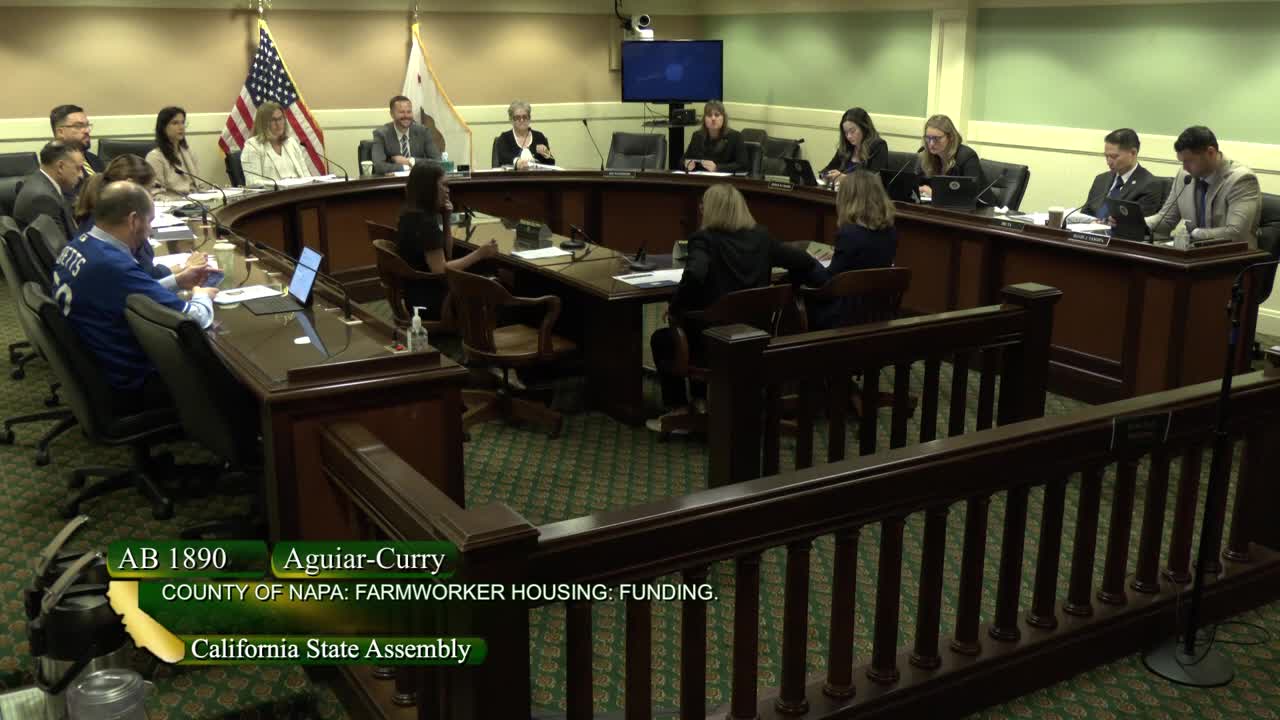 11MIN
Assembly Standing Committee on Housing and Community Development
Bill Author

Bill Co-Author(s):