AB 1896: Public employment: disqualifications.
- Session Year: 2025-2026
- House: Assembly
- Latest Version Date: 2026-09-04
Current Status:
Failed
(2026-09-30: Vetoed by Governor.)
Introduced
In Committee
Awaiting First Chamber Vote
Passed First Chamber
In Committee
Awaiting Second Chamber Vote
Passed Second Chamber
Enacted
Existing law contains numerous provisions governing the qualifications, standards, and training of peace officers. Existing law specifies circumstances that disqualify a person from holding office or being employed as a peace officer, including, among other things, having been convicted of a felony.
This bill, the GTFO Act, would, commencing January 1, 2028, disqualify from being a peace officer a person previously employed as a sworn law enforcement officer or individual contractor and personally engaged in immigration enforcement, as defined, except as specified.
Existing law requires each class of public officers or employees declared by law to be peace officers to meet specified minimum standards, including that they be 18 years of age or older, be fingerprinted for purposes of search of local, state, and national fingerprint files to disclose a criminal record, and be of good moral character, as determined by a thorough background investigation.
This bill would, for purposes of those background investigations, authorize a hiring agency to consider news articles, verified social media posts, filings of civil complaints, and other verified sources.
This bill, for purposes of an applicant who was previously employed as a sworn law enforcement officer or individual contractor and personally engaged in immigration enforcement, would require the hiring agency to complete the background investigation before the candidate participates in a Peace Officer Standards and Training (POST) basic course. The bill would require the hiring agency to review the background investigation and determine if the individual is suitable to enter the POST basic course subject to certain suitability standards adopted by the Commission on Peace Officer Standards and Training.
This bill would require every applicant seeking appointment as a peace officer or enrollment in a POST basic course to submit to the hiring agency a declaration submitted under penalty of perjury that states whether the applicant has, at any time been employed as a sworn law enforcement officer or individual contractor that personally engaged in immigration enforcement, as specified. By requiring this statement to be made under penalty of perjury, the bill would expand the scope of a crime and impose a state-mandated local program.
Existing law, the State Civil Service Act, requires that the employment procedures of the Department of Human Resources (CalHR) and of each state agency conform to the federal and state laws governing employment practices, including the use of employment forms. Existing law requires employment forms used by a state agency to require a person applying for employment to disclose whether the person has entered into an agreement with the state regarding any previous employment with the state that prohibits the person from seeking or accepting any subsequent employment with the state.
This bill would additionally require the above-described employment forms to require a person applying for employment to disclose whether the person has been employed as a sworn law enforcement officer or individual contractor that personally engaged in immigration enforcement, as defined.
Existing law authorizes CalHR or a designated appointing power to refuse to examine or, after examination, to refuse to declare as eligible, or to withhold or withdraw from certification, prior to appointment, anyone who meets certain criteria, such as a person who has misrepresented themselves during the application process.
This bill would add to these criteria a person who was previously employed as a sworn law enforcement officer or individual contractor and personally engaged in immigration enforcement, as defined, except as specified.
Existing law makes a person ineligible to hold office or employment of any kind with the state, or any county, city, district, or other political or governmental unit of the state, if the person has by oath bound themselves to support, maintain, or further the military or political activities or policies of a foreign government, as specified, or to obey the orders or directions of any foreign government or its officials.
This bill, commencing January 1, 2028, would make a person ineligible to hold public employment, including employment with a city, county, district, or any other public agency of the state, because the person was previously employed as a sworn law enforcement officer or individual contractor and personally engaged in immigration enforcement, as defined, except as specified.
Existing law requires the Commission on Peace Officer Standards and Training to establish a certification program for peace officers. Existing law requires, for each applicant for admission to a basic course of training certified by the commission that includes the carrying and use of firearms, who is not sponsored by a local or other law enforcement agency or is not a peace officer employed by a state or local agency, department, or district, to submit written certification from the Department of Justice that the applicant is eligible to possess, receive, own, and purchase a firearm pursuant to state and federal law.
This bill would, for purposes of an applicant for the basic course who was previously employed as a sworn law enforcement officer or individual contractor and personally engaged in immigration enforcement, require the commission to deny suitability for enrollment in the basic course, unless the commission receives notice from the hiring agency granting the applicants suitability, as specified. The bill, by January 1, 2028, would require the commission to adopt, by regulation, a definition of suitability, as specified.
Existing law requires any background investigation of a candidate for a peace officer position to include an inquiry into whether the candidate has engaged or is engaging in membership in a hate group.
This bill would require the background investigation to include an inquiry into whether the candidate has engaged in immigration enforcement.
By increasing the duties of local agencies, this bill would impose a state-mandated local program.
The bill would make the provisions of the act severable.
The bill would include findings that changes proposed by this bill address a matter of statewide concern rather than a municipal affair and, therefore, apply to all cities, including charter cities.
This bill would incorporate additional changes to Section 1029 of the Government Code proposed by AB 1627 to be operative only if this bill and AB 1627 are enacted and this bill is enacted last. The bill would also incorporate additional changes to Section 13510.8 of the Penal Code proposed by AB 2337 to be operative only if this bill and AB 2337 are enacted and this bill is enacted last.
The California Constitution requires the state to reimburse local agencies and school districts for certain costs mandated by the state. Statutory provisions establish procedures for making that reimbursement.
This bill would provide that with regard to certain mandates no reimbursement is required by this act for a specified reason.
With regard to any other mandates, this bill would provide that, if the Commission on State Mandates determines that the bill contains costs so mandated by the state, reimbursement for those costs shall be made pursuant to the statutory provisions noted above.
Existing law contains numerous provisions governing the qualifications, standards, and training of peace officers. Existing law specifies circumstances that disqualify a person from holding office or being employed as a peace officer, including, among other things, having been convicted of a felony.
This bill, the GTFO Act, would would, commencing January 1, 2028, disqualify from being a peace officer a person previously employed as a sworn law enforcement officer or individual contractor and personally engaged with in immigration enforcement, as defined, except as specified.
Existing law requires each class of public officers or employees declared by law to be peace officers to meet specified minimum standards, including that they be 18 years of age or older, be fingerprinted for purposes of search of local, state, and national fingerprint files to disclose a criminal record, and be of good moral character, as determined by a thorough background investigation.
This bill would, for purposes of those background investigations, authorize a hiring agency to consider news articles, verified social media posts, filings of civil complaints, and other verified sources.
This bill, for purposes of an applicant who was previously employed as a sworn law enforcement officer or individual contractor and personally engaged with in immigration enforcement, would require the hiring agency to complete the background investigation before the candidate participates in a Peace Officer Standards and Training (POST) basic course. The bill would require the hiring agency to review the background investigation and determine if the individual is suitable to enter the POST basic course subject to certain suitability standards adopted by the Commission on Peace Officer Standards and Training.
This bill would require every applicant seeking appointment as a peace officer or enrollment in a POST basic course to submit to the Department of Justice hiring agency a declaration submitted under penalty of perjury that states whether the applicant has, at any time been employed as a sworn law enforcement officer or individual contractor that personally assisted with engaged in immigration enforcement, as specified. By requiring this statement to be made under penalty of perjury, the bill would expand the scope of a crime and impose a state-mandated local program.
Existing law, the State Civil Service Act, requires that the employment procedures of the Department of Human Resources (CalHR) and of each state agency conform to the federal and state laws governing employment practices, including the use of employment forms. Existing law requires employment forms used by a state agency to require a person applying for employment to disclose whether the person has entered into an agreement with the state regarding any previous employment with the state that prohibits the person from seeking or accepting any subsequent employment with the state.
This bill would additionally require the above-described employment forms to require a person applying for employment to disclose whether the person has been employed as a sworn law enforcement officer or individual contractor that personally engaged in immigration enforcement, as defined.
Existing law authorizes the Department of Human Resources (CalHR) CalHR or a designated appointing power to refuse to examine or, after examination, to refuse to declare as eligible, or to withhold or withdraw from certification, prior to appointment, anyone who meets certain criteria, such as a person who has misrepresented themselves during the application process.
This bill would add to these criteria a person who was previously employed as a sworn law enforcement officer or individual contractor and personally engaged with in immigration enforcement, as defined, except as specified.
Existing law makes a person ineligible to hold office or employment of any kind with the state, or any county, city, district, or other political or governmental unit of the state, if the person has by oath bound themselves to support, maintain, or further the military or political activities or policies of a foreign government, as specified, or to obey the orders or directions of any foreign government or its officials.
This bill bill, commencing January 1, 2028, would make a person ineligible to hold public employment, including employment with a city, county, district, or any other public agency of the state, because the person was previously employed as a sworn law enforcement officer or individual contractor and personally engaged with in immigration enforcement, as defined, except as specified.
Existing law requires the Commission on Peace Officer Standards and Training to establish a certification program for peace officers. Existing law requires, for each applicant for admission to a basic course of training certified by the commission that includes the carrying and use of firearms, who is not sponsored by a local or other law enforcement agency or is not a peace officer employed by a state or local agency, department, or district, to submit written certification from the Department of Justice that the applicant is eligible to possess, receive, own, and purchase a firearm pursuant to state and federal law.
This bill would, for purposes of an applicant for the basic course who was previously employed as a sworn law enforcement officer or individual contractor and personally engaged in immigration enforcement, require the commission to deny suitability for enrollment in the basic course, unless the commission receives notice from the hiring agency granting the applicants suitability, as specified. The bill, by January 1, 2028, would require the commission to adopt, by regulation, a definition of suitability, as specified.
Existing law requires any background investigation of a candidate for a peace officer position to include an inquiry into whether the candidate has engaged or is engaging in membership in a hate group.
This bill would require the background investigation to include an inquiry into whether the candidate has engaged in immigration enforcement.
By increasing the duties of local agencies, this bill would impose a state-mandated local program.
The bill would make the provisions of the act severable.
The bill would include findings that changes proposed by this bill address a matter of statewide concern rather than a municipal affair and, therefore, apply to all cities, including charter cities.
The California Constitution requires the state to reimburse local agencies and school districts for certain costs mandated by the state. Statutory provisions establish procedures for making that reimbursement.
This bill would provide that with regard to certain mandates no reimbursement is required by this act for a specified reason.
With regard to any other mandates, this bill would provide that, if the Commission on State Mandates determines that the bill contains costs so mandated by the state, reimbursement for those costs shall be made pursuant to the statutory provisions noted above.
Existing law contains numerous provisions governing the qualifications, standards, and training of peace officers. Existing law specifies circumstances that disqualify a person from holding office or being employed as a peace officer, including, among other things, having been convicted of a felony.
This bill, the GTFO Act, would disqualify from being a peace officer a person previously employed by an entity that engaged in immigration enforcement, as defined, during the period beginning January 20, 2025, and ending January 20, 2029, who personally assisted with immigration enforcement, as a sworn law enforcement officer or individual contractor and personally engaged with immigration enforcement, as defined, except as specified.
Existing law requires each class of public officers or employees declared by law to be peace officers to meet specified minimum standards, including that they be 18 years of age or older, be fingerprinted for purposes of search of local, state, and national fingerprint files to disclose a criminal record, and be of good moral character, as determined by a thorough background investigation.
This bill would, for purposes of those background investigations, authorize a hiring agency to consider news articles, verified social media posts, filings of civil complaints, and other verified sources.
This bill, for purposes of an applicant who was previously employed as a sworn law enforcement officer or individual contractor and personally engaged with immigration enforcement, would require the hiring agency to complete the background investigation before the candidate participates in a Peace Officer Standards and Training (POST) basic course. The bill would require the hiring agency to review the background investigation and determine if the individual is suitable to enter the POST basic course subject to certain suitability standards adopted by the Commission on Peace Officer Standards and Training.
This bill would require every applicant seeking appointment as a peace officer or enrollment in a POST basic course to submit to the Department of Justice a declaration submitted under penalty of perjury that states whether the applicant has, at any time been employed as a sworn law enforcement officer or individual contractor that personally assisted with immigration enforcement, as specified. By requiring this statement to be made under penalty of perjury, the bill would expand the scope of a crime and impose a state-mandated local program.
Existing law authorizes the Department of Human Resources (CalHR) or a designated appointing power to refuse to examine or, after examination, to refuse to declare as eligible, or to withhold or withdraw from certification, prior to appointment, anyone who meets certain criteria, such as a person who has misrepresented themselves during the application process.
This bill would add to these criteria a person who was previously employed by an entity that engages in immigration enforcement, as defined, during the period beginning January 20, 2025, and ending January 20, 2029, as a sworn law enforcement officer or individual contractor and personally engaged with immigration enforcement, as defined, except as specified.
Existing law makes a person ineligible to hold office or employment of any kind with the state, or any county, city, district, or other political or governmental unit of the state, if the person has by oath bound themselves to support, maintain, or further the military or political activities or policies of a foreign government, as specified, or to obey the orders or directions of any foreign government or its officials.
This bill would make a person ineligible to hold public employment, including employment with a city, county, district, or any other public agency of the state, because the person was previously employed by an entity that engages in immigration enforcement, as defined, during the period beginning January 20, 2025, and ending January 20, 2029, as a sworn law enforcement officer or individual contractor and personally engaged with immigration enforcement, as defined, except as specified.
Existing law requires the Commission on Peace Officer Standards and Training to establish a certification program for peace officers. Existing law requires, for each applicant for admission to a basic course of training certified by the commission that includes the carrying and use of firearms, who is not sponsored by a local or other law enforcement agency or is not a peace officer employed by a state or local agency, department, or district, to submit written certification from the Department of Justice that the applicant is eligible to possess, receive, own, and purchase a firearm pursuant to state and federal law.
This bill would, for purposes of an applicant for the basic course who was previously employed as a sworn law enforcement officer or individual contractor and personally engaged in immigration enforcement, require the commission to deny suitability for enrollment in the basic course, unless the commission receives notice from the hiring agency granting the applicants suitability, as specified.
Existing law requires any background investigation of a candidate for a peace officer position to include an inquiry into whether the candidate has engaged or is engaging in membership in a hate group.
This bill would require the background investigation to include an inquiry into whether the candidate has engaged in immigration enforcement.
By increasing the duties of local agencies, this bill would impose a state-mandated local program.
The bill would make the provisions of the act severable.
The bill would include findings that changes proposed by this bill address a matter of statewide concern rather than a municipal affair and, therefore, apply to all cities, including charter cities.
The California Constitution requires the state to reimburse local agencies and school districts for certain costs mandated by the state. Statutory provisions establish procedures for making that reimbursement.This bill would provide that, if the Commission on State Mandates determines that the bill contains costs mandated by the state, reimbursement for those costs shall be made pursuant to the statutory provisions noted above.The California Constitution requires the state to reimburse local agencies and school districts for certain costs mandated by the state. Statutory provisions establish procedures for making that reimbursement.
This bill would provide that with regard to certain mandates no reimbursement is required by this act for a specified reason.
With regard to any other mandates, this bill would provide that, if the Commission on State Mandates determines that the bill contains costs so mandated by the state, reimbursement for those costs shall be made pursuant to the statutory provisions noted above.
Existing law contains numerous provisions governing the qualifications, standards, and training of peace officers. Existing law specifies circumstances that disqualify a person from holding office or being employed as a peace officer, including, among other things, having been convicted of a felony.
This bill, the GTFO Act, would disqualify a person from being a peace officer because they were a person previously employed by an entity that engages engaged in immigration enforcement, as defined, during the period beginning January 20, 2025, and ending January 20, 2029, who personally assisted with immigration enforcement, except as specified.
Existing law requires each class of peace officers to meet minimum standards, including good moral character and being free from any physical, emotional, or mental condition, such as bias against race or ethnicity, gender, nationality, religion, disability, or sexual orientation.This bill would add to these minimum standards the requirement that a person has not been previously employed by an entity that engages in immigration enforcement, as defined, during the period beginning January 20, 2025, and ending January 20, 2029, except as specified.Existing law authorizes the Department of Human Resources (CalHR) or a designated appointing power to refuse to examine or, after examination, to refuse to declare as eligible, or to withhold or withdraw from certification, prior to appointment, anyone who meets certain criteria, such as a person who has misrepresented themselves during the application process.
This bill would add to these criteria a person who was previously employed by an entity that engages in immigration enforcement, as defined, during the period beginning January 20, 2025, and ending January 20, 2029, except as specified.
Existing law makes a person ineligible to hold office or employment of any kind with the state, or any county, city, district, or other political or governmental unit of the state, if the person has by oath bound themselves to support, maintain, or further the military or political activities or policies of a foreign government, as specified, or to obey the orders or directions of any foreign government or its officials.
This bill would make a person ineligible to hold public employment, including employment with a city, county, district, or any other public agency of the state, because the person was previously employed by an entity that engages in immigration enforcement, as defined, during the period beginning January 20, 2025, and ending January 20, 2029, except as specified.
By increasing the duties of local agencies, this bill would impose a state-mandated local program.
The bill would make the provisions of the act severable.
The bill would include findings that changes proposed by this bill address a matter of statewide concern rather than a municipal affair and, therefore, apply to all cities, including charter cities.
The California Constitution requires the state to reimburse local agencies and school districts for certain costs mandated by the state. Statutory provisions establish procedures for making that reimbursement.
This bill would provide that, if the Commission on State Mandates determines that the bill contains costs mandated by the state, reimbursement for those costs shall be made pursuant to the statutory provisions noted above.
Existing law contains numerous provisions governing the qualifications, standards, and training of peace officers. Existing law specifies circumstances that disqualify a person from holding office or being employed as a peace officer, including, among other things, having been convicted of a felony.
This bill bill, the GTFO Act, would disqualify a person from being a peace officer if because they were previously employed by an entity that engages in immigration enforcement, as defined, during the period beginning January 20, 2025, and ending January 20, 2029, except as specified.
Existing law requires each class of peace officers to meet minimum standards, including good moral character and being free from any physical, emotional, or mental condition, such as bias against race or ethnicity, gender, nationality, religion, disability, or sexual orientation.
This bill would add to these minimum standards the requirement that a person has not been previously employed by an entity that engages in immigration enforcement, as defined, during the period beginning January 20, 2025, and ending January 20, 2029, except as specified.
Existing law authorizes the Department of Human Resources (CalHR) or a designated appointing power to refuse to examine or, after examination, to refuse to declare as eligible, or to withhold or withdraw from certification, prior to appointment, anyone who meets certain criteria, such as a person who has misrepresented themselves during the application process.
This bill would add to these criteria a person who was previously employed by an entity that engages in immigration enforcement, as defined, during the period beginning January 20, 2025, and ending January 20, 2029, except as specified.
Existing law makes a person ineligible to hold office or employment of any kind with the state, or any county, city, district, or other political or governmental unit of the state, if the person has by oath bound themselves to support, maintain, or further the military or political activities or policies of a foreign government, as specified, or to obey the orders or directions of any foreign government or its officials.
This bill would make a person ineligible to hold public employment, including employment with a city, county, district, or any other public agency of the state, if because the person was previously employed by an entity that engages in immigration enforcement, as defined, during the period beginning January 20, 2025, and ending January 20, 2029, except as specified.
By increasing the duties of local agencies, this bill would impose a state-mandated local program.
The bill would make the provisions of the act severable.
The bill would include findings that changes proposed by this bill address a matter of statewide concern rather than a municipal affair and, therefore, apply to all cities, including charter cities.
The California Constitution requires the state to reimburse local agencies and school districts for certain costs mandated by the state. Statutory provisions establish procedures for making that reimbursement.
This bill would provide that, if the Commission on State Mandates determines that the bill contains costs mandated by the state, reimbursement for those costs shall be made pursuant to the statutory provisions noted above.
Existing law contains numerous provisions governing the qualifications, standards, and training of peace officers. Existing law specifies circumstances that disqualify a person from holding office or being employed as a peace officer, including, among other things, having been convicted of a felony.
This bill would disqualify a person from being a peace officer if they were previously employed by an entity that engages in immigration enforcement, as defined, during the period beginning January 20, 2025, and ending January 20, 2029, except as specified.
Existing law requires each class of peace officers to meet minimum standards, including good moral character and being free from any physical, emotional, or mental condition, such as bias against race or ethnicity, gender, nationality, religion, disability, or sexual orientation.
This bill would add to these minimum standards the requirement that a person has not been previously employed by an entity that engages in immigration enforcement, as defined, during the period beginning January 20, 2025, and ending January 20, 2029, except as specified.
Existing law authorizes the Department of Human Resources (CalHR) or a designated appointing power to refuse to examine or, after examination, to refuse to declare as eligible, or to withhold or withdraw from certification, prior to appointment, anyone who meets certain criteria, such as a person who has misrepresented themselves during the application process.
This bill would add to these criteria a person who was previously employed by an entity that engages in immigration enforcement, as defined, during the period beginning January 20, 2025, and ending January 20, 2029, except as specified.
Existing law makes a person ineligible to hold office or employment of any kind with the state, or any county, city, district, or other political or governmental unit of the state, if the person has by oath bound themselves to support, maintain, or further the military or political activities or policies of a foreign government, as specified, or to obey the orders or directions of any foreign government or its officials.
This bill would make a person ineligible to hold public employment, including employment with a city, county, district, or any other public agency of the state, if the person was previously employed by an entity that engages in immigration enforcement, as defined, during the period beginning January 20, 2025, and ending January 20, 2029, except as specified.
By increasing the duties of local agencies, this bill would impose a state-mandated local program.
The bill would make the provisions of the act severable.
The bill would include findings that changes proposed by this bill address a matter of statewide concern rather than a municipal affair and, therefore, apply to all cities, including charter cities.
The California Constitution requires the state to reimburse local agencies and school districts for certain costs mandated by the state. Statutory provisions establish procedures for making that reimbursement.
This bill would provide that, if the Commission on State Mandates determines that the bill contains costs mandated by the state, reimbursement for those costs shall be made pursuant to the statutory provisions noted above.
The Legislature finds and declares all of the following:
(a)(1)Since the inauguration of President Donald J. Trump on January 20, 2025, immigration enforcement agents have carried out an indiscriminate mass terror campaign against innocent men, women, and children across the nation.
(2)Immigration enforcement agents, under the direction of their leadership, have committed grave, inhumane, and horrific patterns of hate, abuse, violence, and even execution.
(3)These raids take the form of shootings, deaths in custody, and family separations, including:
(A)The wrongful execution of 37-year-old Renee Nicole Good, a mother of three and loving wife, in the City of Minneapolis, Minnesota.
(B)The shooting of Carlitos Ricardo Parias, a popular streamer who was shot by federal agents in the City of Los Angeles after an extreme example of immigration enforcement agent misconduct.
(C)The violent abuse and injuries labor leader and activist David Huerta experienced after an encounter with immigration enforcement agents in the City of Los Angeles.
(D)The 32 lives lost in immigration enforcement custody over the year of 2025, including several elderly persons.
(E)The fatal shooting of Silverio Villegas Gonzalez, who attempted to flee United States Immigration and Customs Enforcement (ICE) officers in the City of Chicago, Illinois.
(F)Countless peaceful protesters have been abused, pepper sprayed, sandbagged, or hit by immigration enforcement agents.
(G)The murder of Alex Pretti, an intensive care nurse at the United States Department of Veterans Affairs hospital in the City of Minneapolis, Minnesota.
(H)Immigration enforcement agents kidnapping five-year-old Liam Conejo Ramos to use him as bait to capture and arrest his father.
(I)The fatal shooting of Keith Porter Jr., father of two, by an off-duty ICE officer on New Years Eve.
(J)The fatal shooting of Lorenzo Salgado Araujo, father and husband, while he was traveling to work in the City of Houston, Texas.
(K)The shooting and killing of Joan Sebastian Guerrero, an immigrant and father, in the City of Biddeford, Maine, when he was not even the target of an ICE operation.
(4)Immigration enforcement agents have reportedly used phrases such as I was just following orders to continue to perpetuate harm, including by agents who fatally shot innocent civilians.
(5)Vice President JD Vance has publicly stated that the immigration enforcement agent involved in the execution of Renee Nicole Good was just doing his job, framing the murder as justified enforcement. Additional reporting indicates that leadership has instructed ICE agents to take decisive action should you be faced with an imminent threat.
(6)ICE announced it has doubled in size to 22,000 employees in less than one year, compared to Border Patrol taking six years to accomplish the same, and has been faced with a wave of corruption, abuse, and misconduct by new hires.
(7)ICE agents have repeatedly abused their position and power to commit illegal actions, including all of the following:
(A)Samuel Saxon, an ICE field office supervisor and 20-year veteran, who has been jailed since December 2025 on charges of attempting to strangle his girlfriend. A judge found he had abused her for years, causing serious injuries, and described him as volatile and violent. ICE says he is absent without leave.
(B)Alexander Back, an ICE employment eligibility auditor, was arrested in a sting operation in Minnesota in November 2025 as he was trying to solicit a 17-year-old prostitute and said Im ICE, boys to police in an attempt to sidestep his actions.
(C)In December 2025, an ICE contractor pleaded guilty to sexually abusing a detainee at a detention facility in Louisiana over a five-month period.
(D)An off-duty ICE agent outside the City of Chicago, Illinois, was charged with misdemeanor battery after throwing a 68-year-old protestor to the ground after being filmed at a gas station.
(8)New ICE agents are receiving only 14 weeks of training compared to the minimum of 40 weeks that a law enforcement officer would undergo in California.
(9)Whistleblower documents from the United States Department of Homeland Security detail cuts to training requirements for new immigration enforcement officers, such as the elimination of practical exams, use of force and legal training courses, and an overall reduction in training time.
(10)Whistleblower complaints include information showing all of the following:
(A)Current ICE recruits receive 250 fewer hours of training than the previous cohort of recruits.
(B)ICE has eliminated a dozen practical exams that ICE officers previously needed to graduate. In July 2021, 25 practical tests were needed to graduate, now 9 practical tests are required.
(C)Eliminated exams include Judgment pistol shooting, Criminal encounters, and Determine removability.
(D)The remaining exams are now open-book, multiple-choice written exams without any graded practical examinations.
(E)ICEs training program syllabus has removed whole courses, such as use of force simulation training, United States government structure, criminal versus removal proceedings, and use of force.
(11)After the shooting and killing of Joan Sebastian Guerrero and Lorenzo Salgado Araujo, ICE agents have been told that the FBI will no longer investigate claims of assault against federal officers, which will lead to even less accountability for immigration agents who have shot and killed people.
(12)Only after more fatal shootings did ICE finally update its dress code for field operations so its officers are clearly identifiable.
(13)Immigration agents have also been found to have used racial and derogatory slurs during the Los Angeles immigration raids, calling potential targets wet or tonks.
(14)In 2017, we, as the State of California, established core values of community safety, inclusivity, and accessible public services and passed groundbreaking legislation to separate our state and local law enforcement personnel from cooperating in federal immigration enforcement unless the suspect has committed a serious or violent crime, and to prohibit public and private employers from engaging with federal immigration enforcement unless authorized by a judicial warrant.
(15)Immigration enforcement agents, by capacity of their employment, have consistently shown they are unwilling to stand up to orders, and therefore do not align with the core values of this states law enforcement or public employee missions.
(b)Therefore, it is the intent of the Legislature to ensure that this act maintains the values of the State of California and protects its residents from immoral individuals from being stewards of public trust.
SEC. 3.Section 1025 is added to the Government Code, to read:1025.(a)Commencing January 1, 2028, except as provided in subdivision (b), a person is disqualified from public employment, including, but not limited to, employment with a city, county, district, or any other public agency of the state, because they were previously employed as a sworn law enforcement officer or individual contractor and personally engaged in immigration enforcement.
(b)A person shall not be disqualified from public employment, as specified in subdivision (a), if they are approved to enter a POST basic course under subdivision (g) of Section 1031.1.
(c)For purposes of this section, immigration enforcement includes any efforts to investigate or enforce any federal civil immigration law, including investigating or enforcing any federal criminal immigration law that penalizes a persons presence in, entry to, or reentry to, or employment in, the United States, but excludes conduct that is permitted pursuant to Chapter 17.1 (commencing with Section 7282), Chapter 17.2 (commencing with Section 7283), or Chapter 17.25 (commencing with Section 7284) of Division 7.
(d)This section does not prohibit or restrict any governmental entity or official from sending to, or receiving from, federal immigration authorities information regarding the citizenship or immigration status, lawful or unlawful, of an individual, or from requesting from federal immigration authorities immigration status information, lawful or unlawful, of any individual, or from maintaining or exchanging that information with any other federal, state, or local governmental entity, pursuant to Sections 1373 and 1644 of Title 8 of the United States Code.
SEC. 4.Section 1029 of the Government Code is amended to read:1029.(a)Except as provided in subparagraph (B) of paragraph (12), or subdivision (b), (c), (d), or (e), each of the following persons is disqualified from holding office as a peace officer or being employed as a peace officer of the state, county, city, city and county, or other political subdivision, whether with or without compensation, and is disqualified from any office or employment by the state, county, city, city and county, or other political subdivision, whether with or without compensation, which confers upon the holder or employee the powers and duties of a peace officer:
(1)Any person who has been convicted of a felony.
(2)Any person who has been convicted of any offense in any other jurisdiction which would have been a felony if committed in this state.
(3)Any person who has been discharged from the military for committing an offense, as adjudicated by a military tribunal, which would have been a felony if committed in this state.
(4)(A)Any person who, after January 1, 2004, has been convicted of a crime based upon a verdict or finding of guilt of a felony by the trier of fact, or upon the entry of a plea of guilty or nolo contendere to a felony. This paragraph applies regardless of whether, pursuant to subdivision (b) of Section 17 of the Penal Code, the court declares the offense to be a misdemeanor, or the offense becomes a misdemeanor by operation of law.
(B)For purposes of this paragraph, a person has been convicted of a crime immediately upon entry of a plea of guilty or nolo contendere to, or upon being found guilty by a trier of fact of, a felony offense, including an offense that may be charged as a misdemeanor or felony and that was charged as a felony at the time of the conviction.
(C)Effective January 1, 2022, any person who has been convicted of a crime in accordance with this paragraph shall not regain eligibility for peace officer employment based upon the nature of any sentence ordered or imposed. In addition, no such person shall regain eligibility for peace officer employment based upon any later order of the court setting aside, vacating, withdrawing, expunging or otherwise dismissing or reversing the conviction, unless the court finds the person to be factually innocent of the crime for which they were convicted at the time of entry of the order.
(5)Any person who has been charged with a felony and adjudged by a superior court to be mentally incompetent under Chapter 6 (commencing with Section 1367) of Title 10 of Part 2 of the Penal Code.
(6)Any person who has been found not guilty by reason of insanity of any felony.
(7)Any person who has been determined to be a mentally disordered sex offender pursuant to Article 1 (commencing with Section 6300) of Chapter 2 of Part 2 of Division 6 of the Welfare and Institutions Code.
(8)Any person adjudged addicted or in danger of becoming addicted to narcotics, convicted, and committed to a state institution as provided in Section 3051 of the Welfare and Institutions Code.
(9)Any person who, following exhaustion of all available appeals, has been convicted of, or adjudicated through an administrative, military, or civil judicial process requiring not less than clear and convincing evidence, including a hearing that meets the requirements of the administrative adjudication provisions of the Administrative Procedure Act (Chapter 3.5 (commencing with Section 11340) of Part 1 of Division 3 of Title 2), as having committed, any act that is a violation of Section 115, 115.3, 116, 116.5, or 117 of, or of any offense described in Chapter 1 (commencing with Section 92), Chapter 5 (commencing with Section 118), Chapter 6 (commencing with Section 132), or Chapter 7 (commencing with Section 142) of Title 7 of Part 1 of the Penal Code, including any act committed in another jurisdiction that would have been a violation of any of those sections if committed in this state.
(10)Any person who has been issued the certification described in Section 13510.1 of the Penal Code, and has had that certification revoked by the Commission on Peace Officer Standards and Training, has voluntarily surrendered that certification pursuant to subdivision (f) of Section 13510.8, or having met the minimum requirement for issuance of certification, has been denied issuance of certification.
(11)Any person previously employed in law enforcement in any state or United States territory or by the federal government, whose name is listed in the National Decertification Index of the International Association of Directors of Law Enforcement Standards and Training or any other database designated by the federal government whose certification as a law enforcement officer in that jurisdiction was revoked for misconduct, or who, while employed as a law enforcement officer, engaged in serious misconduct that would have resulted in their certification being revoked by the commission if employed as a peace officer in this state.
(12)(A)Commencing January 1, 2028, except as provided in subparagraph (B), any person previously employed as a sworn law enforcement officer or individual contractor, and personally engaged in immigration enforcement.
(B)A person shall not be disqualified from holding office as a peace officer or being employed as a peace officer of the state, county, city, city and county, or other political subdivision, whether with or without compensation, and shall not be disqualified from any office or employment by the state, county, city, city and county, or other political subdivision, whether with or without compensation, which confers upon the holder or employee the powers and duties of a peace officer, if they are approved to enter a POST basic course under subdivision (g) of Section 1031.1.
(C)For purposes of this paragraph, immigration enforcement has the same meaning as that term is defined in subdivision (c) of Section 1025.
(D)This paragraph does not prohibit or restrict any governmental entity or official from sending to, or receiving from, federal immigration authorities information regarding the citizenship or immigration status, lawful or unlawful, of an individual, or from requesting from federal immigration authorities immigration status information, lawful or unlawful, of any individual, or from maintaining or exchanging that information with any other federal, state, or local governmental entity, pursuant to Sections 1373 and 1644 of Title 8 of the United States Code.
(b)(1)A plea of guilty to a felony pursuant to a deferred entry of judgment program as set forth in Sections 1000 to 1000.4, inclusive, of the Penal Code shall not alone disqualify a person from being a peace officer unless a judgment of guilty is entered pursuant to Section 1000.3 of the Penal Code.
(2)A person who pleads guilty or nolo contendere to, or who is found guilty by a trier of fact of, an alternate felony-misdemeanor drug possession offense and successfully completes a program of probation pursuant to Section 1210.1 of the Penal Code shall not be disqualified from being a peace officer solely on the basis of the plea or finding if the court deems the offense to be a misdemeanor or reduces the offense to a misdemeanor.
(c)Any person who has been convicted of a felony, other than a felony punishable by death, in this state or any other state, or who has been convicted of any offense in any other state which would have been a felony, other than a felony punishable by death, if committed in this state, and who demonstrates the ability to assist persons in programs of rehabilitation may hold office and be employed as a parole officer of the Department of Corrections and Rehabilitation or the Division of Juvenile Justice, or as a probation officer in a county probation department, if the person has been granted a full and unconditional pardon for the felony or offense of which they were convicted. Notwithstanding any other provision of law, the Department of Corrections and Rehabilitation or the Division of Juvenile Justice, or a county probation department, may refuse to employ that person regardless of their qualifications.
(d)This section does not limit or curtail the power or authority of any board of police commissioners, chief of police, sheriff, mayor, or other appointing authority to appoint, employ, or deputize any person as a peace officer in time of disaster caused by flood, fire, pestilence or similar public calamity, or to exercise any power conferred by law to summon assistance in making arrests or preventing the commission of any criminal offense.
(e)This section does not prohibit any person from holding office or being employed as a superintendent, supervisor, or employee having custodial responsibilities in an institution operated by a probation department, if at the time of the persons hire a prior conviction of a felony was known to the persons employer, and the class of office for which the person was hired was not declared by law to be a class prohibited to persons convicted of a felony, but as a result of a change in classification, as provided by law, the new classification would prohibit employment of a person convicted of a felony.
(f)The Department of Justice shall supply the commission with necessary disqualifying felony and misdemeanor conviction data for all persons known by the department to be current or former peace officers. The commission shall be permitted to use the information for decertification purposes. The data, once received by the commission, shall be made available for public inspection pursuant to the California Public Records Act (Division 10 (commencing with Section 7920.000) of Title 1), including documentation of the persons appointment, promotion, and demotion dates, as well as certification or licensing status and the reason or disposition for the person leaving service.
SEC. 4.5.Section 1029 of the Government Code is amended to read:1029.(a)Except as provided in subparagraph (B) of paragraph (12), or subdivision (b), (c), (d), or (e), each of the following persons is disqualified from holding office as a peace officer or being employed as a peace officer of the state, county, city, city and county, or other political subdivision, whether with or without compensation, and is disqualified from any office or employment by the state, county, city, city and county, or other political subdivision, whether with or without compensation, which confers upon the holder or employee the powers and duties of a peace officer:
(1)Any person who has been convicted of a felony.
(2)Any person who has been convicted of any offense in any other jurisdiction which would have been a felony if committed in this state.
(3)Any person who has been discharged from the military for committing an offense, as adjudicated by a military tribunal, which would have been a felony if committed in this state.
(4)(A)Any person who, after January 1, 2004, has been convicted of a crime based upon a verdict or finding of guilt of a felony by the trier of fact, or upon the entry of a plea of guilty or nolo contendere to a felony. This paragraph applies regardless of whether, pursuant to subdivision (b) of Section 17 of the Penal Code, the court declares the offense to be a misdemeanor, or the offense becomes a misdemeanor by operation of law.
(B)For purposes of this paragraph, a person has been convicted of a crime immediately upon entry of a plea of guilty or nolo contendere to, or upon being found guilty by a trier of fact of, a felony offense, including an offense that may be charged as a misdemeanor or felony and that was charged as a felony at the time of the conviction.
(C)Effective January 1, 2022, any person who has been convicted of a crime in accordance with this paragraph shall not regain eligibility for peace officer employment based upon the nature of any sentence ordered or imposed. In addition, no such person shall regain eligibility for peace officer employment based upon any later order of the court setting aside, vacating, withdrawing, expunging or otherwise dismissing or reversing the conviction, unless the court finds the person to be factually innocent of the crime for which they were convicted at the time of entry of the order.
(5)Any person who has been charged with a felony and adjudged by a superior court to be mentally incompetent under Chapter 6 (commencing with Section 1367) of Title 10 of Part 2 of the Penal Code.
(6)Any person who has been found not guilty by reason of insanity of any felony.
(7)Any person who has been determined to be a mentally disordered sex offender pursuant to Article 1 (commencing with Section 6300) of Chapter 2 of Part 2 of Division 6 of the Welfare and Institutions Code.
(8)Any person adjudged addicted or in danger of becoming addicted to narcotics, convicted, and committed to a state institution as provided in Section 3051 of the Welfare and Institutions Code.
(9)Any person who, following exhaustion of all available appeals, has been convicted of, or adjudicated through an administrative, military, or civil judicial process requiring not less than clear and convincing evidence, including a hearing that meets the requirements of the administrative adjudication provisions of the Administrative Procedure Act (Chapter 3.5 (commencing with Section 11340) of Part 1 of Division 3 of Title 2), as having committed, any act that is a violation of Section 115, 115.3, 116, 116.5, or 117 of, or of any offense described in Chapter 1 (commencing with Section 92), Chapter 5 (commencing with Section 118), Chapter 6 (commencing with Section 132), or Chapter 7 (commencing with Section 142) of Title 7 of Part 1 of the Penal Code, including any act committed in another jurisdiction that would have been a violation of any of those sections if committed in this state.
(10)Any person who has been issued the certification described in Section 13510.1 of the Penal Code and has had that certification revoked by the Commission on Peace Officer Standards and Training has voluntarily surrendered that certification pursuant to subdivision (f) of Section 13510.8, or, having met the minimum requirement for issuance of certification, has been denied issuance of certification.
(11)(A)Any person previously employed in law enforcement in any state or United States territory or by the federal government, whose name is listed in the National Decertification Index of the International Association of Directors of Law Enforcement Standards and Training or any other database designated by the federal government whose certification as a law enforcement officer in that jurisdiction was revoked for misconduct, or who, while employed as a law enforcement officer, engaged in serious misconduct that would have resulted in their certification being revoked by the commission if employed as a peace officer in this state.
(B)For purposes of this paragraph, both of the following apply:
(i)Employed in law enforcement and law enforcement officer include a law enforcement officer employed in any state or United States territory or by the federal government who engages in immigration enforcement.
(ii)Immigration enforcement includes any and all efforts to investigate, enforce, or assist in the investigation or enforcement of any federal civil immigration law, and also includes any and all efforts to investigate, enforce, or assist in the investigation or enforcement of any federal criminal immigration law that penalizes a persons presence in, entry, or reentry to, or employment in, the United States.
(12)(A)Commencing January 1, 2028, except as provided in subparagraph (B), any person previously employed as a sworn law enforcement officer or individual contractor, and personally engaged in immigration enforcement.
(B)A person shall not be disqualified from holding office as a peace officer or being employed as a peace officer of the state, county, city, city and county, or other political subdivision, whether with or without compensation, and shall not be disqualified from any office or employment by the state, county, city, city and county, or other political subdivision, whether with or without compensation, which confers upon the holder or employee the powers and duties of a peace officer, if they are approved to enter a POST basic course under subdivision (g) of Section 1031.1.
(C)For purposes of this paragraph, immigration enforcement has the same meaning as that term is defined in subdivision (c) of Section 1025.
(D)This paragraph does not prohibit or restrict any governmental entity or official from sending to, or receiving from, federal immigration authorities information regarding the citizenship or immigration status, lawful or unlawful, of an individual, or from requesting from federal immigration authorities immigration status information, lawful or unlawful, of any individual, or from maintaining or exchanging that information with any other federal, state, or local governmental entity, pursuant to Sections 1373 and 1644 of Title 8 of the United States Code.
(b)(1)A plea of guilty to a felony pursuant to a deferred entry of judgment program as set forth in Sections 1000 to 1000.4, inclusive, of the Penal Code shall not alone disqualify a person from being a peace officer unless a judgment of guilty is entered pursuant to Section 1000.3 of the Penal Code.
(2)A person who pleads guilty or nolo contendere to, or who is found guilty by a trier of fact of, an alternate felony-misdemeanor drug possession offense and successfully completes a program of probation pursuant to Section 1210.1 of the Penal Code shall not be disqualified from being a peace officer solely on the basis of the plea or finding if the court deems the offense to be a misdemeanor or reduces the offense to a misdemeanor.
(c)Any person who has been convicted of a felony, other than a felony punishable by death, in this state or any other state, or who has been convicted of any offense in any other state which would have been a felony, other than a felony punishable by death, if committed in this state, and who demonstrates the ability to assist persons in programs of rehabilitation may hold office and be employed as a parole officer of the Department of Corrections and Rehabilitation or the Division of Juvenile Justice, or as a probation officer in a county probation department, if the person has been granted a full and unconditional pardon for the felony or offense of which they were convicted. Notwithstanding any other provision of law, the Department of Corrections and Rehabilitation or the Division of Juvenile Justice, or a county probation department, may refuse to employ that person regardless of their qualifications.
(d)This section does not limit or curtail the power or authority of any board of police commissioners, chief of police, sheriff, mayor, or other appointing authority to appoint, employ, or deputize any person as a peace officer in time of disaster caused by flood, fire, pestilence or similar public calamity, or to exercise any power conferred by law to summon assistance in making arrests or preventing the commission of any criminal offense.
(e)This section does not prohibit any person from holding office or being employed as a superintendent, supervisor, or employee having custodial responsibilities in an institution operated by a probation department, if at the time of the persons hire a prior conviction of a felony was known to the persons employer, and the class of office for which the person was hired was not declared by law to be a class prohibited to persons convicted of a felony, but as a result of a change in classification, as provided by law, the new classification would prohibit employment of a person convicted of a felony.
(f)The Department of Justice shall supply the commission with necessary disqualifying felony and misdemeanor conviction data for all persons known by the department to be current or former peace officers. The commission shall be permitted to use the information for decertification purposes. The data, once received by the commission, shall be made available for public inspection pursuant to the California Public Records Act (Division 10 (commencing with Section 7920.000) of Title 1), including documentation of the persons appointment, promotion, and demotion dates, as well as certification or licensing status and the reason or disposition for the person leaving service.
SEC. 5.Section 1031 of the Government Code is amended to read:1031.Each class of public officers or employees declared by law to be peace officers shall meet all of the following minimum standards:
(a)Be legally authorized to work in the United States under federal law.
(b)Be 18 years of age or older.
(c)Be fingerprinted for purposes of search of local, state, and national fingerprint files to disclose a criminal record.
(d)(1)Be of good moral character, as determined by a thorough background investigation.
(2)For purposes of a thorough background investigation, a hiring agency may consider news articles, verified social media posts, filings of civil complaints, and other verified sources.
(e)Be a high school graduate, pass the General Education Development Test or other high school equivalency test approved by the State Department of Education that indicates high school graduation level, pass the California High School Proficiency Examination, or have attained a two-year, four-year, or advanced degree from an accredited college or university. The high school shall be either a United States public school, an accredited United States Department of Defense high school, or an accredited or approved public or nonpublic high school. Any accreditation or approval required by this subdivision shall be from a state or local government educational agency using state or local government approved accreditation, licensing, registration, or other approval standards, a regional accrediting association, an accrediting association recognized by the Secretary of the United States Department of Education, an accrediting association holding full membership in the National Council for Private School Accreditation (NCPSA), an organization holding full membership in AdvancED or Cognia, an organization holding full membership in the Council for American Private Education (CAPE), or an accrediting association recognized by the National Federation of Nonpublic School State Accrediting Associations (NFNSSAA). A foreign college or university degree may be evaluated for equivalency by a credential evaluation service holding membership in the National Association of Credential Evaluation Services (NACES) or the Association of International Credential Evaluators, Inc. (AICE).
(f)Be found to be free from any physical, emotional, or mental condition, including bias against race or ethnicity, gender, nationality, religion, disability, or sexual orientation, that might adversely affect the exercise of the powers of a peace officer.
(1)Physical condition shall be evaluated by a licensed physician and surgeon.
(2)Emotional and mental condition shall be evaluated by either of the following:
(A)A physician and surgeon who holds a valid California license to practice medicine, has successfully completed a postgraduate medical residency education program in psychiatry accredited by the Accreditation Council for Graduate Medical Education, and has at least the equivalent of five full-time years of experience in the diagnosis and treatment of emotional and mental disorders, including the equivalent of three full-time years accrued after completion of the psychiatric residency program.
(B)A psychologist licensed by the California Board of Psychology who has at least the equivalent of five full-time years of experience in the diagnosis and treatment of emotional and mental disorders, including the equivalent of three full-time years accrued postdoctorate.
The physician and surgeon or psychologist shall also have met any applicable education and training procedures set forth by the California Commission on Peace Officer Standards and Training designed for the conduct of preemployment psychological screening of peace officers.
(g)This section shall not be construed to preclude the adoption of additional or higher standards, including age.
(h)This section shall be interpreted and applied consistent with federal law and regulations. This section shall not be construed to permit an employer to override or bypass work authorization requirements stated in Section 274a.2 of Title 8 of the Code of Federal Regulations.
SEC. 6.Section 1031.1 of the Government Code is amended to read:1031.1.(a)For purposes of performing a thorough background investigation for an applicant not currently employed as a peace officer, as required by subdivision (d) of Section 1031, or in the case of an applicant for a position other than a sworn peace officer within a law enforcement agency, an employer shall disclose employment information relating to a current or former employee, upon request of a law enforcement agency, if all of the following conditions are met:
(1)The request is made in writing.
(2)The request is accompanied by a notarized authorization by the applicant releasing the employer of liability.
(3)The request and the authorization are presented to the employer by a sworn officer or other authorized representative of the employing law enforcement agency.
(b)In the absence of fraud or malice, an employer shall not be subject to civil liability for any relevant cause of action by virtue of releasing employment information required pursuant to this section. This section does not in any way or manner abrogate or lessen the existing common law or statutory privileges and immunities of an employer.
(c)For purposes of this section, employment information includes written information in connection with job applications, performance evaluations, attendance records, disciplinary actions, eligibility for rehire, and other information relevant to the performance of a peace officer or other law enforcement agency applicant, except information prohibited from disclosure by any other state or federal law or regulation.
(d)An employers refusal to disclose information to a law enforcement agency in accordance with this section shall constitute grounds for a civil action for injunctive relief requiring disclosure on the part of an employer.
(e)Employment information disclosed by an employer to an initial requesting law enforcement agency shall be deemed confidential. However, the initial requesting law enforcement agency may disclose this information to another authorized law enforcement agency that is also conducting a background investigation into a peace officer or other law enforcement agency applicant. If this information is disclosed to another law enforcement agency, that agency shall utilize the information for investigative leads only and the information shall be independently verified by that agency in order to be used in determining the suitability of a peace officer or other law enforcement agency applicant.
(f)An employer may charge reasonable fees to cover actual costs incurred in copying and furnishing documents to law enforcement agencies as required by this section.
(g)(1)For purposes of an applicant described in subdivision (a) who was previously employed as a sworn law enforcement officer or individual contractor and personally engaged in immigration enforcement, the background investigation shall be completed by the hiring agency prior to the candidates participation in the POST basic course.
(2)The hiring agency shall review the background investigation and determine if the individual is suitable for entering a POST basic course. Suitability shall be based on both of the following:
(A)The standards adopted by the Commission on Peace Officer Standards and Training by regulation on suitability.
(B)The standards established for peace officers under all applicable California laws and regulations, including, but not limited to, those set forth in Section 1031 and in Section 13510.8 of the Penal Code.
(3)Suitability shall be determined on a case-by-case basis based on information contained in the applicants background check and any additional information the hiring agency deems relevant.
SEC. 7.Section 1031.15 is added to the Government Code, to read:1031.15.(a)As part of the fingerprint-based criminal history review conducted pursuant to subdivision (c) of Section 1031, every applicant seeking appointment as a peace officer or enrollment in a POST basic course certified by the Commission on Peace Officer Standards and Training shall submit to the hiring agency a declaration signed under penalty of perjury that states whether the applicant has, at any time, been employed as a sworn law enforcement officer or individual contractor that personally engaged in immigration enforcement, as described in Section 1025.
(b)If the hiring agency determines, based upon the declaration or other information lawfully available to the department, that an applicant has served in a capacity described in subdivision (a), the hiring agency shall conduct a suitability review for the applicant pursuant to standards described in paragraph (2) of subdivision (g) of Section 1031.1. A notification made pursuant to this section shall not, by itself, constitute grounds to deny appointment, certification, or enrollment in a POST basic course.
(c)A knowingly false declaration submitted pursuant to this section shall constitute a false statement made under penalty of perjury and shall be considered by the hiring agency as part of its suitability determination.
(d)Nothing in this section authorizes the hiring agency to disclose confidential criminal history information except as otherwise authorized by law.
SEC. 8.Section 18720.45 of the Government Code is amended to read:18720.45.Employment forms used by a state agency shall require a person applying for employment to disclose both of the following:
(a)Whether the person has entered into an agreement with the state regarding any previous employment with the state that prohibits that person from seeking or accepting any subsequent employment with the state.
(b)Whether the person has been employed as a sworn law enforcement officer or individual contractor that personally engaged in immigration enforcement as the term is defined in subdivision (c) of Section 1025.
SEC. 9.Section 18935 of the Government Code is amended to read:18935.(a)The department or a designated appointing power may refuse to examine, or after examination may refuse to declare as eligible, or may withhold or withdraw from an eligible list, before the appointment, anyone who meets any of the following criteria:
(1)Lacks any of the requirements for the examination or position for which the individual has applied.
(2)Has been dismissed from any position for any cause that would be a cause for dismissal from state service.
(3)Has resigned from any position not in good standing in order to avoid dismissal.
(4)Has misrepresented themselves in the application or examination process, including permitting another person to complete or attempt to complete a portion of the examination on their behalf.
(5)Has been found to be unsuited or not qualified for employment pursuant to rule.
(6)(A)Except as provided in subparagraph (B), has been found to have been previously employed as a sworn law enforcement officer or individual contractor and personally engaged in immigration enforcement.
(B)Notwithstanding subparagraph (A), the department or a designated appointing power shall not refuse to examine, or after examination shall not refuse to declare as eligible, or shall not withhold or withdraw from an eligible list, before the appointment, anyone who was approved to enter a POST basic course under subdivision (g) of Section 1031.1.
(C)For purposes of this paragraph, immigration enforcement has the same meaning as that term is defined in subdivision (c) of Section 1025.
(D)This paragraph does not prohibit or restrict any governmental entity or official from sending to, or receiving from, federal immigration authorities information regarding the citizenship or immigration status, lawful or unlawful, of an individual, or from requesting from federal immigration authorities immigration status information, lawful or unlawful, of any individual, or from maintaining or exchanging that information with any other federal, state, or local governmental entity, pursuant to Sections 1373 and 1644 of Title 8 of the United States Code.
(b)The remedies provided in this section are not exclusive and shall not prevent the board, department, or appointing power from taking additional actions pursuant to Chapter 10 (commencing with Section 19680).
SEC. 10.Section 13510.8 of the Penal Code is amended to read:13510.8.(a)(1)The commission shall revoke the certification of a certified peace officer if the person is or has become ineligible to hold office as a peace officer pursuant to Section 1029 of the Government Code.
(2)The commission may suspend or revoke the certification of a peace officer if the person has been terminated for cause from employment as a peace officer for, or has, while employed as a peace officer, otherwise engaged in, any serious misconduct as described in subdivision (b).
(3)The commission may cancel the certificate or proof of eligibility of a peace officer if the commission determines that there was fraud or misrepresentation made by an applicant at any time during the application process that resulted in the issuance of the certification.
(4)(A)For purposes of an applicant to attend the basic course who was previously employed as a sworn law enforcement officer or individual contractor and personally engaged in immigration enforcement, the commission shall deny suitability for enrollment in the basic course, unless the commission receives notice from a hiring agency granting their suitability.
(B)No applicant described in subparagraph (A) shall enter the basic course without a hiring agency granting their suitability.
(C)By January 1, 2028, the commission shall adopt, by regulation, a definition of suitability that shall serve as the criteria to be considered for the suitability of an applicant to attend the basic course who has personally engaged in immigration enforcement. Suitability shall be based on both of the following:
(i)Whether an applicant personally engaged in immigration enforcement and to what degree, as determined by a working group that the commission shall convene. The working group shall be comprised as follows:
(I)A peace officer or former peace officer with substantial experience at a command rank appointed by the Governor.
(II)A peace officer or former peace officer with substantial experience at a management rank in internal investigations or disciplinary proceedings of peace officers appointed by the Governor.
(III)Two members of the public who shall not be current or former peace officers and who have substantial experience working at a nonprofit or at academic institutions on issues related to immigration. One member shall be appointed by the Governor and one by the Speaker of the Assembly.
(IV)Two members of the public who shall not be current or former peace officers and who have substantial experience working at community-based organizations on issues related to immigration. One member shall be appointed by the Governor and one by the Senate Committee on Rules.
(V)Two members of the public, who shall not be current or former peace officers, with strong consideration given to individuals who have been subject to immigration enforcement or who are family members of a person who has been the subject of immigration enforcement. One member shall be appointed by the Speaker of the Assembly and one by the Senate Committee on Rules.
(VI)One member shall be an attorney, who shall not be a former peace officer, with substantial professional experience involving immigration enforcement, appointed by the Governor.
(ii)The standards established for peace officers under all applicable California laws and regulations, including, but not limited to, those set forth in Section 1031 of the Government Code and this section.
(b)By January 1, 2023, the commission shall adopt by regulation a definition of serious misconduct that shall serve as the criteria to be considered for ineligibility for, or revocation of, certification. This definition shall include all of the following:
(1)Dishonesty relating to the reporting, investigation, or prosecution of a crime, or relating to the reporting of, or investigation of misconduct by, a peace officer or custodial officer, including, but not limited to, false statements, intentionally filing false reports, tampering with, falsifying, destroying, or concealing evidence, perjury, and tampering with data recorded by a body-worn camera or other recording device for purposes of concealing misconduct.
(2)Abuse of power, including, but not limited to, intimidating witnesses, knowingly obtaining a false confession, and knowingly making a false arrest.
(3)Physical abuse, including, but not limited to, the excessive or unreasonable use of force.
(4)Sexual assault, as described in subdivision (b) of Section 832.7.
(5)Demonstrating bias on the basis of race, national origin, religion, gender identity or expression, housing status, sexual orientation, mental or physical disability, or other protected status in violation of law or department policy or inconsistent with a peace officers obligation to carry out their duties in a fair and unbiased manner. This paragraph does not limit an employees rights under the First Amendment to the United States Constitution.
(6)Acts that violate the law and are sufficiently egregious or repeated as to be inconsistent with a peace officers obligation to uphold the law or respect the rights of members of the public, as determined by the commission.
(7)Participation in a law enforcement gang. For the purpose of this paragraph, a law enforcement gang means a group of peace officers within a law enforcement agency who may identify themselves by a name and may be associated with an identifying symbol, including, but not limited to, matching tattoos, and who engage in a pattern of on-duty behavior that intentionally violates the law or fundamental principles of professional policing, including, but not limited to, excluding, harassing, or discriminating against any individual based on a protected category under federal or state antidiscrimination laws, engaging in or promoting conduct that violates the rights of other employees or members of the public, violating agency policy, the persistent practice of unlawful detention or use of excessive force in circumstances where it is known to be unjustified, falsifying police reports, fabricating or destroying evidence, targeting persons for enforcement based solely on protected characteristics of those persons, theft, unauthorized use of alcohol or drugs on duty, unlawful or unauthorized protection of other members from disciplinary actions, and retaliation against other officers who threaten or interfere with the activities of the group.
(8)Failure to cooperate with an investigation into potential police misconduct, including an investigation conducted pursuant to this chapter. For purposes of this paragraph, the lawful exercise of rights granted under the United States Constitution, the California Constitution, or any other law shall not be considered a failure to cooperate.
(9)Failure to intercede when present and observing another officer using force that is clearly beyond that which is necessary, as determined by an objectively reasonable officer under the circumstances, taking into account the possibility that other officers may have additional information regarding the threat posed by a subject.
(c)(1)Beginning no later than January 1, 2023, each law enforcement agency shall be responsible for the completion of investigations of allegations of serious misconduct by a peace officer, regardless of their employment status.
(2)The division shall promptly review any grounds for decertification described in subdivision (a) received from an agency. The division shall have the authority to review any agency or other investigative authority file, as well as to conduct additional investigation, if necessary. The division shall have the authority to inspect or duplicate any criminal history information, criminal offender record information, or criminal justice information, including information contained in or derived from the California Law Enforcement Telecommunications System and any other information that would otherwise be confidential, privileged, or subject to any other restriction on disclosure when that information is included as part of an investigation involving a matter within the commissions jurisdiction. The division shall only have authority to review and investigate allegations for purposes of decertification.
(3)(A)The board, in their discretion, may request that the division review an investigative file or recommend that the commission direct the division to investigate any potential grounds for decertification of a peace officer. Those requests and recommendations from the board to the division or commission must be based upon a decision by a majority vote.
(B)The commission, in its discretion, may direct the division to review an investigative file. The commission, either upon its own motion or in response to a recommendation from the board, may direct the division to investigate any potential grounds for decertification of a peace officer.
(C)The division, in its discretion, may investigate without the request of the commission or board any potential grounds for revocation of certification of a peace officer.
(4)The division, in carrying out any investigation initiated pursuant to this section or any other duty shall have all of the powers of investigation granted pursuant to Article 2 (commencing with Section 11180) of Chapter 2 of Part 1 of Division 3 of Title 2 of the Government Code.
(5)Notwithstanding any other law, the investigation shall be completed within three years after the receipt of the completed report of the disciplinary or internal affairs investigation from the employing agency pursuant to Section 13510.9, however, no time limit shall apply if a report of the conduct was not made to the commission. An investigation shall be considered completed upon a notice of intent to deny, suspend, or revoke certification issued pursuant to paragraph (1) of subdivision (a) of Section 13510.85. The time limit shall be tolled during the appeal of a termination or other disciplinary action through an administrative or judicial proceeding or during any criminal prosecution of the peace officer. The commission shall consider the peace officers prior conduct and service record, and any instances of misconduct, including any incidents occurring beyond the time limitation for investigation in evaluating whether to revoke certification for the incident under investigation.
(6)An action by an agency or decision resulting from an appeal of an agencys action does not preclude action by the commission to investigate, suspend, or revoke a peace officers certification pursuant to this section. Whether a particular factual or legal determination in a prior appeal proceeding shall have preclusive effect in proceedings under this chapter shall be governed by the existing law of collateral estoppel.
(d)Upon arrest or indictment of a peace officer for any crime described in Section 1029 of the Government Code, or discharge from any law enforcement agency for grounds set forth in subdivision (a), or separation from employment of a peace officer during a pending investigation into allegations of serious misconduct, the executive director shall order the immediate temporary suspension of any certificate or proof of eligibility held by that peace officer upon the determination by the executive director that the temporary suspension is in the best interest of the health, safety, or welfare of the public. The order of temporary suspension shall be made in writing and shall specify the basis for the executive directors determination. Following the issuance of a temporary suspension order, proceedings of the commission in the exercise of its authority to discipline any peace officer shall be promptly scheduled as provided for in this section. The temporary suspension shall continue in effect until issuance of the final decision on revocation pursuant to this section or until the order is withdrawn by the executive director.
(e)Records of an investigation of any person by the commission shall be retained for 30 years following the date that the investigation is deemed concluded by the commission. The commission may destroy records prior to the expiration of the 30-year retention period if the subject is deceased and no action upon the complaint was taken by the commission beyond the commissions initial intake of the complaint.
(f)Any peace officer may voluntarily surrender their certification permanently. Voluntary permanent surrender of certification pursuant to this subdivision shall have the same effect as revocation. Voluntary permanent surrender is not the same as placement of a valid certification into inactive status during a period in which a person is not actively employed as a peace officer. A permanently surrendered certification cannot be reactivated.
(g)(1)The commission may initiate proceedings to revoke or suspend a peace officers certification for conduct that occurred before January 1, 2022, only for either of the following:
(A)Serious misconduct pursuant to paragraph (1) or (4) of subdivision (b) or pursuant to paragraph (3) of subdivision (b) for the use of deadly force that results in death or serious bodily injury.
(B)If the employing agency makes a final determination regarding its investigation of the misconduct after January 1, 2022.
(2)Nothing in this subdivision prevents the commission from considering the peace officers prior conduct and service record in determining whether suspension or revocation is appropriate for serious misconduct.
(h)(1)A revocation of certification shall not be undertaken pursuant to this section because of a court finding made in a challenge brought pursuant to Section 745.
(2)This subdivision does not prohibit revocation based on the underlying acts or omissions which formed the basis of the action brought pursuant to Section 745, if the revocation otherwise conforms to all the rules and procedures applicable to those proceedings, and the officer is accorded all due process protections provided in those proceedings.
SEC. 10.5.Section 13510.8 of the Penal Code is amended to read:13510.8.(a)(1)The commission shall revoke the certification of a certified peace officer if the person is or has become ineligible to hold office as a peace officer pursuant to Section 1029 of the Government Code.
(2)The commission may suspend or revoke the certification of a peace officer if the person has been terminated for cause from employment as a peace officer for, or has, while employed as a peace officer, otherwise engaged in, any serious misconduct as described in subdivision (b).
(3)The commission may cancel the certificate or proof of eligibility of a peace officer if the commission determines that there was fraud or misrepresentation made by an applicant at any time during the application process that resulted in the issuance of the certification.
(4)(A)For purposes of an applicant to attend the basic course who was previously employed as a sworn law enforcement officer or individual contractor and personally engaged in immigration enforcement, the commission shall deny suitability for enrollment in the basic course, unless the commission receives notice from a hiring agency granting their suitability.
(B)No applicant described in subparagraph (A) shall enter the basic course without a hiring agency granting their suitability.
(C)By January 1, 2028, the commission shall adopt, by regulation, a definition of suitability that shall serve as the criteria to be considered for the suitability of an applicant to attend the basic course who has personally engaged in immigration enforcement. Suitability shall be based on both of the following:
(i)Whether an applicant personally engaged in immigration enforcement and to what degree, as determined by a working group that the commission shall convene. The working group shall be comprised as follows:
(I)A peace officer or former peace officer with substantial experience at a command rank appointed by the Governor.
(II)A peace officer or former peace officer with substantial experience at a management rank in internal investigations or disciplinary proceedings of peace officers appointed by the Governor.
(III)Two members of the public who shall not be current or former peace officers and who have substantial experience working at a nonprofit or at academic institutions on issues related to immigration. One member shall be appointed by the Governor and one by the Speaker of the Assembly.
(IV)Two members of the public who shall not be current or former peace officers and who have substantial experience working at community-based organizations on issues related to immigration. One member shall be appointed by the Governor and one by the Senate Committee on Rules.
(V)Two members of the public, who shall not be current or former peace officers, with strong consideration given to individuals who have been subject to immigration enforcement or who are family members of a person who has been the subject of immigration enforcement. One member shall be appointed by the Speaker of the Assembly and one by the Senate Committee on Rules.
(VI)One member shall be an attorney, who shall not be a former peace officer, with substantial professional experience involving immigration enforcement, appointed by the Governor.
(ii)The standards established for peace officers under all applicable California laws and regulations, including, but not limited to, those set forth in Section 1031 of the Government Code and this section.
(b)By January 1, 2023, the commission shall adopt by regulation a definition of serious misconduct that shall serve as the criteria to be considered for ineligibility for, or revocation of, certification. This definition shall include all of the following:
(1)Dishonesty relating to the reporting, investigation, or prosecution of a crime, or relating to the reporting of, or investigation of misconduct by, a peace officer or custodial officer, including, but not limited to, false statements, intentionally filing false reports, tampering with, falsifying, destroying, or concealing evidence, perjury, and tampering with data recorded by a body-worn camera or other recording device for purposes of concealing misconduct.
(2)Abuse of power, including, but not limited to, intimidating witnesses, knowingly obtaining a false confession, and knowingly making a false arrest.
(3)Physical abuse, including, but not limited to, the excessive or unreasonable use of force.
(4)Sexual assault, as described in subdivision (b) of Section 832.7.
(5)Demonstrating bias on the basis of race, national origin, religion, gender identity or expression, housing status, sexual orientation, mental or physical disability, or other protected status in violation of law or department policy or inconsistent with a peace officers obligation to carry out their duties in a fair and unbiased manner. This paragraph does not limit an employees rights under the First Amendment to the United States Constitution.
(6)Acts that violate the law and are sufficiently egregious or repeated as to be inconsistent with a peace officers obligation to uphold the law or respect the rights of members of the public, as determined by the commission.
(7)Participation in a law enforcement gang. For the purpose of this paragraph, a law enforcement gang means a group of peace officers within a law enforcement agency who may identify themselves by a name and may be associated with an identifying symbol, including, but not limited to, matching tattoos, and who engage in a pattern of on-duty behavior that intentionally violates the law or fundamental principles of professional policing, including, but not limited to, excluding, harassing, or discriminating against any individual based on a protected category under federal or state antidiscrimination laws, engaging in or promoting conduct that violates the rights of other employees or members of the public, violating agency policy, the persistent practice of unlawful detention or use of excessive force in circumstances where it is known to be unjustified, falsifying police reports, fabricating or destroying evidence, targeting persons for enforcement based solely on protected characteristics of those persons, theft, unauthorized use of alcohol or drugs on duty, unlawful or unauthorized protection of other members from disciplinary actions, and retaliation against other officers who threaten or interfere with the activities of the group.
(8)Failure to cooperate with an investigation into potential police misconduct, including an investigation conducted pursuant to this chapter. For purposes of this paragraph, the lawful exercise of rights granted under the United States Constitution, the California Constitution, or any other law shall not be considered a failure to cooperate.
(9)Failure to intercede when present and observing another officer using force that is clearly beyond that which is necessary, as determined by an objectively reasonable officer under the circumstances, taking into account the possibility that other officers may have additional information regarding the threat posed by a subject.
(10)Theft, pursuant to subdivision (a) of Section 484, committed by a peace officer under color of authority, where the peace officer acted with specific intent to permanently deprive the owner of the property and the conduct was not the result of mere negligence, administrative oversight, or good-faith error in evidence handling.
(c)(1)Beginning no later than January 1, 2023, each law enforcement agency shall be responsible for the completion of investigations of allegations of serious misconduct by a peace officer, regardless of their employment status.
(2)The division shall promptly review any grounds for decertification described in subdivision (a) received from an agency. The division shall have the authority to review any agency or other investigative authority file, as well as to conduct additional investigation, if necessary. The division shall have the authority to inspect or duplicate any criminal history information, criminal offender record information, or criminal justice information, including information contained in or derived from the California Law Enforcement Telecommunications System and any other information that would otherwise be confidential, privileged, or subject to any other restriction on disclosure when that information is included as part of an investigation involving a matter within the commissions jurisdiction. The division shall only have authority to review and investigate allegations for purposes of decertification.
(3)(A)The board, in their discretion, may request that the division review an investigative file or recommend that the commission direct the division to investigate any potential grounds for decertification of a peace officer. Those requests and recommendations from the board to the division or commission must be based upon a decision by a majority vote.
(B)The commission, in its discretion, may direct the division to review an investigative file. The commission, either upon its own motion or in response to a recommendation from the board, may direct the division to investigate any potential grounds for decertification of a peace officer.
(C)The division, in its discretion, may investigate without the request of the commission or board any potential grounds for revocation of certification of a peace officer.
(4)The division, in carrying out any investigation initiated pursuant to this section or any other duty shall have all of the powers of investigation granted pursuant to Article 2 (commencing with Section 11180) of Chapter 2 of Part 1 of Division 3 of Title 2 of the Government Code.
(5)Notwithstanding any other law, the investigation shall be completed within three years after the receipt of the completed report of the disciplinary or internal affairs investigation from the employing agency pursuant to Section 13510.9, however, no time limit shall apply if a report of the conduct was not made to the commission. An investigation shall be considered completed upon a notice of intent to deny, suspend, or revoke certification issued pursuant to paragraph (1) of subdivision (a) of Section 13510.85. The time limit shall be tolled during the appeal of a termination or other disciplinary action through an administrative or judicial proceeding or during any criminal prosecution of the peace officer. The commission shall consider the peace officers prior conduct and service record, and any instances of misconduct, including any incidents occurring beyond the time limitation for investigation in evaluating whether to revoke certification for the incident under investigation.
(6)An action by an agency or decision resulting from an appeal of an agencys action does not preclude action by the commission to investigate, suspend, or revoke a peace officers certification pursuant to this section. Whether a particular factual or legal determination in a prior appeal proceeding shall have preclusive effect in proceedings under this chapter shall be governed by the existing law of collateral estoppel.
(d)Upon arrest or indictment of a peace officer for any crime described in Section 1029 of the Government Code, or discharge from any law enforcement agency for grounds set forth in subdivision (a), or separation from employment of a peace officer during a pending investigation into allegations of serious misconduct, the executive director shall order the immediate temporary suspension of any certificate or proof of eligibility held by that peace officer upon the determination by the executive director that the temporary suspension is in the best interest of the health, safety, or welfare of the public. The order of temporary suspension shall be made in writing and shall specify the basis for the executive directors determination. Following the issuance of a temporary suspension order, proceedings of the commission in the exercise of its authority to discipline any peace officer shall be promptly scheduled as provided for in this section. The temporary suspension shall continue in effect until issuance of the final decision on revocation pursuant to this section or until the order is withdrawn by the executive director.
(e)Records of an investigation of any person by the commission shall be retained for 30 years following the date that the investigation is deemed concluded by the commission. The commission may destroy records prior to the expiration of the 30-year retention period if the subject is deceased and no action upon the complaint was taken by the commission beyond the commissions initial intake of the complaint.
(f)Any peace officer may voluntarily surrender their certification permanently. Voluntary permanent surrender of certification pursuant to this subdivision shall have the same effect as revocation. Voluntary permanent surrender is not the same as placement of a valid certification into inactive status during a period in which a person is not actively employed as a peace officer. A permanently surrendered certification cannot be reactivated.
(g)(1)The commission may initiate proceedings to revoke or suspend a peace officers certification for conduct that occurred before January 1, 2022, only for either of the following:
(A)Serious misconduct pursuant to paragraph (1) or (4) of subdivision (b) or pursuant to paragraph (3) of subdivision (b) for the use of deadly force that results in death or serious bodily injury.
(B)If the employing agency makes a final determination regarding its investigation of the misconduct after January 1, 2022.
(2)Nothing in this subdivision prevents the commission from considering the peace officers prior conduct and service record in determining whether suspension or revocation is appropriate for serious misconduct.
(h)(1)A revocation of certification shall not be undertaken pursuant to this section because of a court finding made in a challenge brought pursuant to Section 745.
(2)This subdivision does not prohibit revocation based on the underlying acts or omissions which formed the basis of the action brought pursuant to Section 745, if the revocation otherwise conforms to all the rules and procedures applicable to those proceedings, and the officer is accorded all due process protections provided in those proceedings.
SEC. 11.Section 13681 of the Penal Code is amended to read:13681.(a)Any background investigation of a candidate for a peace officer position shall include an inquiry into whether the candidate has engaged or is engaging in membership in a hate group, participated in any hate group activity or advocacy of public expressions of hate, or engaged in immigration enforcement, as described in Section 1025 of the Government Code.
(b)The hiring agency shall deny employment to a candidate for a peace officer position if, during a preemployment background it is determined that in the past 7 years and since 18 years of age, the candidate has engaged in membership in a hate group, participation in any hate group activity, or advocacy of public expressions of hate.
(c)A candidate for a peace officer position shall not be ineligible to be hired pursuant to this section if the candidate has ceased all activities described in subdivision (a) and at least 7 years has passed since the last such activity.
SEC. 12.The provisions of this act are severable. If any provision of this act or its application is held invalid, that invalidity shall not affect other provisions or applications that can be given effect without the invalid provision or application.
SEC. 13.The Legislature finds and declares that this act addresses a matter of statewide concern rather than a municipal affair as that term is used in Section 5 of Article XI of the California Constitution. Therefore, this act applies to all cities, including charter cities.
SEC. 14.Section 4.5 of this bill incorporates amendments to Section 1029 of the Government Code proposed by both this bill and Assembly Bill 1627. That section of this bill shall only become operative if (1) both bills are enacted and become effective on or before January 1, 2027, (2) each bill amends Section 1029 of the Government Code, and (3) this bill is enacted after Assembly Bill 1627, in which case Section 4 of this bill shall not become operative.
SEC. 15.Section 10.5 of this bill incorporates amendments to Section 13510.8 of the Penal Code proposed by both this bill and Assembly Bill 2337. That section of this bill shall only become operative if (1) both bills are enacted and become effective on or before January 1, 2027, (2) each bill amends Section 13510.8 of the Penal Code, and (3) this bill is enacted after Assembly Bill 2337, in which case Section 10 of this bill shall not become operative.
SEC. 16.No reimbursement is required by this act pursuant to Section 6 of Article XIIIB of the California Constitution for certain costs that may be incurred by a local agency or school district because, in that regard, this act creates a new crime or infraction, eliminates a crime or infraction, or changes the penalty for a crime or infraction, within the meaning of Section 17556 of the Government Code, or changes the definition of a crime within the meaning of Section 6 of Article XIIIB of the California Constitution.
However, if the Commission on State Mandates determines that this act contains other costs mandated by the state, reimbursement to local agencies and school districts for those costs shall be made pursuant to Part 7 (commencing with Section 17500) of Division 4 of Title 2 of the Government Code.
The Legislature finds and declares all of the following:
(a)(1)Since the inauguration of President Donald J. Trump on January 20, 2025, immigration enforcement agents have carried out an indiscriminate mass terror campaign against innocent men, women, and children across the nation.
(2)Immigration enforcement agents, under the direction of their leadership, have committed grave, inhumane, and horrific patterns of hate, abuse, violence, and even execution.
(3)These raids take the form of shootings, deaths in custody, and family separations, including:
(A)The wrongful execution of 37-year-old Renee Nicole Good, a mother of three and loving wife, in the City of Minneapolis, Minnesota.
(B)The shooting of Carlitos Ricardo Parias, a popular streamer who was shot by federal agents in the City of Los Angeles after an extreme example of immigration enforcement agent misconduct.
(C)The violent abuse and injuries labor leader and activist David Huerta experienced after an encounter with immigration enforcement agents in the City of Los Angeles.
(D)The 32 lives lost in immigration enforcement custody over the year of 2025, including several elderly persons.
(E)The fatal shooting of Silverio Villegas Gonzalez, who attempted to flee United States Immigration and Customs Enforcement (ICE) officers in the City of Chicago, Illinois.
(F)Countless peaceful protesters have been abused, pepper sprayed, sandbagged, or hit by immigration enforcement agents.
(G)The murder of Alex Pretti, an intensive care nurse at the United States Department of Veterans Affairs hospital in the City of Minneapolis, Minnesota.
(H)Immigration enforcement agents kidnapping five-year-old Liam Conejo Ramos to use him as bait to capture and arrest his father.
(I)The fatal shooting of Keith Porter Jr., father of two, by an off-duty ICE officer on New Years Eve.
(J)The fatal shooting of Lorenzo Salgado Araujo, father and husband, while he was traveling to work in the City of Houston, Texas.
(K)The shooting and killing of Joan Sebastian Guerrero, an immigrant and father, in the City of Biddeford, Maine, when he was not even the target of an ICE operation.
(4)Immigration enforcement agents have reportedly used phrases such as I was just following orders to continue to perpetuate harm, including by agents who fatally shot innocent civilians.
(5)Vice President JD Vance has publicly stated that the immigration enforcement agent involved in the execution of Renee Nicole Good was just doing his job, framing the murder as justified enforcement. Additional reporting indicates that leadership has instructed ICE agents to take decisive action should you be faced with an imminent threat.
(6)ICE announced it has doubled in size to 22,000 employees in less than one year, compared to Border Patrol taking six years to accomplish the same, and has been faced with a wave of corruption, abuse, and misconduct by new hires.
(7)ICE agents have repeatedly abused their position and power to commit illegal actions, including all of the following:
(A)Samuel Saxon, an ICE field office supervisor and 20-year veteran, who has been jailed since December 2025 on charges of attempting to strangle his girlfriend. A judge found he had abused her for years, causing serious injuries, and described him as volatile and violent. ICE says he is absent without leave.
(B)Alexander Back, an ICE employment eligibility auditor, was arrested in a sting operation in Minnesota in November 2025 as he was trying to solicit a 17-year-old prostitute and said Im ICE, boys to police in an attempt to sidestep his actions.
(C)In December 2025, an ICE contractor pleaded guilty to sexually abusing a detainee at a detention facility in Louisiana over a five-month period.
(D)An off-duty ICE agent outside the City of Chicago, Illinois, was charged with misdemeanor battery after throwing a 68-year-old protestor to the ground after being filmed at a gas station.
(8)New ICE agents are receiving only 14 weeks of training compared to the minimum of 40 weeks that a law enforcement officer would undergo in California.
(9)Whistleblower documents from the United States Department of Homeland Security detail cuts to training requirements for new immigration enforcement officers, such as the elimination of practical exams, use of force and legal training courses, and an overall reduction in training time.
(10)Whistleblower complaints include information showing all of the following:
(A)Current ICE recruits receive 250 fewer hours of training than the previous cohort of recruits.
(B)ICE has eliminated a dozen practical exams that ICE officers previously needed to graduate. In July 2021, 25 practical tests were needed to graduate, now 9 practical tests are required.
(C)Eliminated exams include Judgment pistol shooting, Criminal encounters, and Determine removability.
(D)The remaining exams are now open-book, multiple-choice written exams without any graded practical examinations.
(E)ICEs training program syllabus has removed whole courses, such as use of force simulation training, United States government structure, criminal versus removal proceedings, and use of force.
(11)After the shooting and killing of Joan Sebastian Guerrero and Lorenzo Salgado Araujo, ICE agents have been told that the FBI will no longer investigate claims of assault against federal officers, which will lead to even less accountability for immigration agents who have shot and killed people.
(12)Only after more fatal shootings did ICE finally update its dress code for field operations so its officers are clearly identifiable.
(13)Immigration agents have also been found to have used racial and derogatory slurs during the Los Angeles immigration raids, calling potential targets wet or tonks.
(14)In 2017, we, as the State of California, established core values of community safety, inclusivity, and accessible public services and passed groundbreaking legislation to separate our state and local law enforcement personnel from cooperating in federal immigration enforcement unless the suspect has committed a serious or violent crime, and to prohibit public and private employers from engaging with federal immigration enforcement unless authorized by a judicial warrant.
(15)Immigration enforcement agents, by capacity of their employment, have consistently shown they are unwilling to stand up to orders, and therefore do not align with the core values of this states law enforcement or public employee missions.
(b)Therefore, it is the intent of the Legislature to ensure that this act maintains the values of the State of California and protects its residents from immoral individuals from being stewards of public trust.
SEC. 3.Section 1025 is added to the Government Code, to read:1025.(a)Commencing January 1, 2028, except as provided in subdivision (b), a person is disqualified from public employment, including, but not limited to, employment with a city, county, district, or any other public agency of the state, because they were previously employed as a sworn law enforcement officer or individual contractor and personally engaged in immigration enforcement.
(b)A person shall not be disqualified from public employment, as specified in subdivision (a), if they are approved to enter a POST basic course under subdivision (g) of Section 1031.1.
(c)For purposes of this section, immigration enforcement includes any efforts to investigate or enforce any federal civil immigration law, including investigating or enforcing any federal criminal immigration law that penalizes a persons presence in, entry to, or reentry to, or employment in, the United States, but excludes conduct that is permitted pursuant to Chapter 17.1 (commencing with Section 7282), Chapter 17.2 (commencing with Section 7283), or Chapter 17.25 (commencing with Section 7284) of Division 7.
(d)This section does not prohibit or restrict any governmental entity or official from sending to, or receiving from, federal immigration authorities information regarding the citizenship or immigration status, lawful or unlawful, of an individual, or from requesting from federal immigration authorities immigration status information, lawful or unlawful, of any individual, or from maintaining or exchanging that information with any other federal, state, or local governmental entity, pursuant to Sections 1373 and 1644 of Title 8 of the United States Code.
SEC. 4.Section 1029 of the Government Code is amended to read:1029.(a)Except as provided in subparagraph (B) of paragraph (12), or subdivision (b), (c), (d), or (e), each of the following persons is disqualified from holding office as a peace officer or being employed as a peace officer of the state, county, city, city and county, or other political subdivision, whether with or without compensation, and is disqualified from any office or employment by the state, county, city, city and county, or other political subdivision, whether with or without compensation, which confers upon the holder or employee the powers and duties of a peace officer:
(1)Any person who has been convicted of a felony.
(2)Any person who has been convicted of any offense in any other jurisdiction which would have been a felony if committed in this state.
(3)Any person who has been discharged from the military for committing an offense, as adjudicated by a military tribunal, which would have been a felony if committed in this state.
(4)(A)Any person who, after January 1, 2004, has been convicted of a crime based upon a verdict or finding of guilt of a felony by the trier of fact, or upon the entry of a plea of guilty or nolo contendere to a felony. This paragraph applies regardless of whether, pursuant to subdivision (b) of Section 17 of the Penal Code, the court declares the offense to be a misdemeanor, or the offense becomes a misdemeanor by operation of law.
(B)For purposes of this paragraph, a person has been convicted of a crime immediately upon entry of a plea of guilty or nolo contendere to, or upon being found guilty by a trier of fact of, a felony offense, including an offense that may be charged as a misdemeanor or felony and that was charged as a felony at the time of the conviction.
(C)Effective January 1, 2022, any person who has been convicted of a crime in accordance with this paragraph shall not regain eligibility for peace officer employment based upon the nature of any sentence ordered or imposed. In addition, no such person shall regain eligibility for peace officer employment based upon any later order of the court setting aside, vacating, withdrawing, expunging or otherwise dismissing or reversing the conviction, unless the court finds the person to be factually innocent of the crime for which they were convicted at the time of entry of the order.
(5)Any person who has been charged with a felony and adjudged by a superior court to be mentally incompetent under Chapter 6 (commencing with Section 1367) of Title 10 of Part 2 of the Penal Code.
(6)Any person who has been found not guilty by reason of insanity of any felony.
(7)Any person who has been determined to be a mentally disordered sex offender pursuant to Article 1 (commencing with Section 6300) of Chapter 2 of Part 2 of Division 6 of the Welfare and Institutions Code.
(8)Any person adjudged addicted or in danger of becoming addicted to narcotics, convicted, and committed to a state institution as provided in Section 3051 of the Welfare and Institutions Code.
(9)Any person who, following exhaustion of all available appeals, has been convicted of, or adjudicated through an administrative, military, or civil judicial process requiring not less than clear and convincing evidence, including a hearing that meets the requirements of the administrative adjudication provisions of the Administrative Procedure Act (Chapter 3.5 (commencing with Section 11340) of Part 1 of Division 3 of Title 2), as having committed, any act that is a violation of Section 115, 115.3, 116, 116.5, or 117 of, or of any offense described in Chapter 1 (commencing with Section 92), Chapter 5 (commencing with Section 118), Chapter 6 (commencing with Section 132), or Chapter 7 (commencing with Section 142) of Title 7 of Part 1 of the Penal Code, including any act committed in another jurisdiction that would have been a violation of any of those sections if committed in this state.
(10)Any person who has been issued the certification described in Section 13510.1 of the Penal Code, and has had that certification revoked by the Commission on Peace Officer Standards and Training, has voluntarily surrendered that certification pursuant to subdivision (f) of Section 13510.8, or having met the minimum requirement for issuance of certification, has been denied issuance of certification.
(11)Any person previously employed in law enforcement in any state or United States territory or by the federal government, whose name is listed in the National Decertification Index of the International Association of Directors of Law Enforcement Standards and Training or any other database designated by the federal government whose certification as a law enforcement officer in that jurisdiction was revoked for misconduct, or who, while employed as a law enforcement officer, engaged in serious misconduct that would have resulted in their certification being revoked by the commission if employed as a peace officer in this state.
(12)(A)Commencing January 1, 2028, except as provided in subparagraph (B), any person previously employed as a sworn law enforcement officer or individual contractor, and personally engaged in immigration enforcement.
(B)A person shall not be disqualified from holding office as a peace officer or being employed as a peace officer of the state, county, city, city and county, or other political subdivision, whether with or without compensation, and shall not be disqualified from any office or employment by the state, county, city, city and county, or other political subdivision, whether with or without compensation, which confers upon the holder or employee the powers and duties of a peace officer, if they are approved to enter a POST basic course under subdivision (g) of Section 1031.1.
(C)For purposes of this paragraph, immigration enforcement has the same meaning as that term is defined in subdivision (c) of Section 1025.
(D)This paragraph does not prohibit or restrict any governmental entity or official from sending to, or receiving from, federal immigration authorities information regarding the citizenship or immigration status, lawful or unlawful, of an individual, or from requesting from federal immigration authorities immigration status information, lawful or unlawful, of any individual, or from maintaining or exchanging that information with any other federal, state, or local governmental entity, pursuant to Sections 1373 and 1644 of Title 8 of the United States Code.
(b)(1)A plea of guilty to a felony pursuant to a deferred entry of judgment program as set forth in Sections 1000 to 1000.4, inclusive, of the Penal Code shall not alone disqualify a person from being a peace officer unless a judgment of guilty is entered pursuant to Section 1000.3 of the Penal Code.
(2)A person who pleads guilty or nolo contendere to, or who is found guilty by a trier of fact of, an alternate felony-misdemeanor drug possession offense and successfully completes a program of probation pursuant to Section 1210.1 of the Penal Code shall not be disqualified from being a peace officer solely on the basis of the plea or finding if the court deems the offense to be a misdemeanor or reduces the offense to a misdemeanor.
(c)Any person who has been convicted of a felony, other than a felony punishable by death, in this state or any other state, or who has been convicted of any offense in any other state which would have been a felony, other than a felony punishable by death, if committed in this state, and who demonstrates the ability to assist persons in programs of rehabilitation may hold office and be employed as a parole officer of the Department of Corrections and Rehabilitation or the Division of Juvenile Justice, or as a probation officer in a county probation department, if the person has been granted a full and unconditional pardon for the felony or offense of which they were convicted. Notwithstanding any other provision of law, the Department of Corrections and Rehabilitation or the Division of Juvenile Justice, or a county probation department, may refuse to employ that person regardless of their qualifications.
(d)This section does not limit or curtail the power or authority of any board of police commissioners, chief of police, sheriff, mayor, or other appointing authority to appoint, employ, or deputize any person as a peace officer in time of disaster caused by flood, fire, pestilence or similar public calamity, or to exercise any power conferred by law to summon assistance in making arrests or preventing the commission of any criminal offense.
(e)This section does not prohibit any person from holding office or being employed as a superintendent, supervisor, or employee having custodial responsibilities in an institution operated by a probation department, if at the time of the persons hire a prior conviction of a felony was known to the persons employer, and the class of office for which the person was hired was not declared by law to be a class prohibited to persons convicted of a felony, but as a result of a change in classification, as provided by law, the new classification would prohibit employment of a person convicted of a felony.
(f)The Department of Justice shall supply the commission with necessary disqualifying felony and misdemeanor conviction data for all persons known by the department to be current or former peace officers. The commission shall be permitted to use the information for decertification purposes. The data, once received by the commission, shall be made available for public inspection pursuant to the California Public Records Act (Division 10 (commencing with Section 7920.000) of Title 1), including documentation of the persons appointment, promotion, and demotion dates, as well as certification or licensing status and the reason or disposition for the person leaving service.
SEC. 4.5.Section 1029 of the Government Code is amended to read:1029.(a)Except as provided in subparagraph (B) of paragraph (12), or subdivision (b), (c), (d), or (e), each of the following persons is disqualified from holding office as a peace officer or being employed as a peace officer of the state, county, city, city and county, or other political subdivision, whether with or without compensation, and is disqualified from any office or employment by the state, county, city, city and county, or other political subdivision, whether with or without compensation, which confers upon the holder or employee the powers and duties of a peace officer:
(1)Any person who has been convicted of a felony.
(2)Any person who has been convicted of any offense in any other jurisdiction which would have been a felony if committed in this state.
(3)Any person who has been discharged from the military for committing an offense, as adjudicated by a military tribunal, which would have been a felony if committed in this state.
(4)(A)Any person who, after January 1, 2004, has been convicted of a crime based upon a verdict or finding of guilt of a felony by the trier of fact, or upon the entry of a plea of guilty or nolo contendere to a felony. This paragraph applies regardless of whether, pursuant to subdivision (b) of Section 17 of the Penal Code, the court declares the offense to be a misdemeanor misdemeanor, or the offense becomes a misdemeanor by operation of law.
(B)For purposes of this paragraph, a person has been convicted of a crime immediately upon entry of a plea of guilty or nolo contendere to, or upon being found guilty by a trier of fact of, a felony offense, including an offense that may be charged as a misdemeanor or felony and that was charged as a felony at the time of the conviction.
(C)Effective January 1, 2022, any person who has been convicted of a crime in accordance with this paragraph shall not regain eligibility for peace officer employment based upon the nature of any sentence ordered or imposed. In addition, no such person shall regain eligibility for peace officer employment based upon any later order of the court setting aside, vacating, withdrawing, expunging or otherwise dismissing or reversing the conviction, unless the court finds the person to be factually innocent of the crime for which they were convicted at the time of entry of the order.
(5)Any person who has been charged with a felony and adjudged by a superior court to be mentally incompetent under Chapter 6 (commencing with Section 1367) of Title 10 of Part 2 of the Penal Code.
(6)Any person who has been found not guilty by reason of insanity of any felony.
(7)Any person who has been determined to be a mentally disordered sex offender pursuant to Article 1 (commencing with Section 6300) of Chapter 2 of Part 2 of Division 6 of the Welfare and Institutions Code.
(8)Any person adjudged addicted or in danger of becoming addicted to narcotics, convicted, and committed to a state institution as provided in Section 3051 of the Welfare and Institutions Code.
(9)Any person who, following exhaustion of all available appeals, has been convicted of, or adjudicated through an administrative, military, or civil judicial process requiring not less than clear and convincing evidence, including a hearing that meets the requirements of the administrative adjudication provisions of the Administrative Procedure Act (Chapter 3.5 (commencing with Section 11340) of Part 1 of Division 3 of Title 2), as having committed, any act that is a violation of Section 115, 115.3, 116, 116.5, or 117 of, or of any offense described in Chapter 1 (commencing with Section 92), Chapter 5 (commencing with Section 118), Chapter 6 (commencing with Section 132), or Chapter 7 (commencing with Section 142) of Title 7 of Part 1 of the Penal Code, including any act committed in another jurisdiction that would have been a violation of any of those sections if committed in this state.
(10)Any person who has been issued the certification described in Section 13510.1 of the Penal Code, Code and has had that certification revoked by the Commission on Peace Officer Standards and Training, Training has voluntarily surrendered that certification pursuant to subdivision (f) of Section 13510.8, or or, having met the minimum requirement for issuance of certification, has been denied issuance of certification.
(11)(A)Any person previously employed in law enforcement in any state or United States territory or by the federal government, whose name is listed in the National Decertification Index of the International Association of Directors of Law Enforcement Standards and Training or any other database designated by the federal government whose certification as a law enforcement officer in that jurisdiction was revoked for misconduct, or who, while employed as a law enforcement officer, engaged in serious misconduct that would have resulted in their certification being revoked by the commission if employed as a peace officer in this state.
(B)For purposes of this paragraph, both of the following apply:
(i)Employed in law enforcement and law enforcement officer include a law enforcement officer employed in any state or United States territory or by the federal government who engages in immigration enforcement.
(ii)Immigration enforcement includes any and all efforts to investigate, enforce, or assist in the investigation or enforcement of any federal civil immigration law, and also includes any and all efforts to investigate, enforce, or assist in the investigation or enforcement of any federal criminal immigration law that penalizes a persons presence in, entry, or reentry to, or employment in, the United States.
(12)(A)Commencing January 1, 2028, except as provided in subparagraph (B), any person previously employed as a sworn law enforcement officer or individual contractor, and personally engaged in immigration enforcement.
(B)A person shall not be disqualified from holding office as a peace officer or being employed as a peace officer of the state, county, city, city and county, or other political subdivision, whether with or without compensation, and shall not be disqualified from any office or employment by the state, county, city, city and county, or other political subdivision, whether with or without compensation, which confers upon the holder or employee the powers and duties of a peace officer, if they are approved to enter a POST basic course under subdivision (g) of Section 1031.1.
(C)For purposes of this paragraph, immigration enforcement has the same meaning as that term is defined in subdivision (c) of Section 1025.
(D)This paragraph does not prohibit or restrict any governmental entity or official from sending to, or receiving from, federal immigration authorities information regarding the citizenship or immigration status, lawful or unlawful, of an individual, or from requesting from federal immigration authorities immigration status information, lawful or unlawful, of any individual, or from maintaining or exchanging that information with any other federal, state, or local governmental entity, pursuant to Sections 1373 and 1644 of Title 8 of the United States Code.
(b)(1)A plea of guilty to a felony pursuant to a deferred entry of judgment program as set forth in Sections 1000 to 1000.4, inclusive, of the Penal Code shall not alone disqualify a person from being a peace officer unless a judgment of guilty is entered pursuant to Section 1000.3 of the Penal Code.
(2)A person who pleads guilty or nolo contendere to, or who is found guilty by a trier of fact of, an alternate felony-misdemeanor drug possession offense and successfully completes a program of probation pursuant to Section 1210.1 of the Penal Code shall not be disqualified from being a peace officer solely on the basis of the plea or finding if the court deems the offense to be a misdemeanor or reduces the offense to a misdemeanor.
(c)Any person who has been convicted of a felony, other than a felony punishable by death, in this state or any other state, or who has been convicted of any offense in any other state which would have been a felony, other than a felony punishable by death, if committed in this state, and who demonstrates the ability to assist persons in programs of rehabilitation may hold office and be employed as a parole officer of the Department of Corrections and Rehabilitation or the Division of Juvenile Justice, or as a probation officer in a county probation department, if the person has been granted a full and unconditional pardon for the felony or offense of which they were convicted. Notwithstanding any other provision of law, the Department of Corrections and Rehabilitation or the Division of Juvenile Justice, or a county probation department, may refuse to employ that person regardless of their qualifications.
(d)This section does not limit or curtail the power or authority of any board of police commissioners, chief of police, sheriff, mayor, or other appointing authority to appoint, employ, or deputize any person as a peace officer in time of disaster caused by flood, fire, pestilence or similar public calamity, or to exercise any power conferred by law to summon assistance in making arrests or preventing the commission of any criminal offense.
(e)This section does not prohibit any person from holding office or being employed as a superintendent, supervisor, or employee having custodial responsibilities in an institution operated by a probation department, if at the time of the persons hire a prior conviction of a felony was known to the persons employer, and the class of office for which the person was hired was not declared by law to be a class prohibited to persons convicted of a felony, but as a result of a change in classification, as provided by law, the new classification would prohibit employment of a person convicted of a felony.
(f)The Department of Justice shall supply the commission with necessary disqualifying felony and misdemeanor conviction data for all persons known by the department to be current or former peace officers. The commission shall be permitted to use the information for decertification purposes. The data, once received by the commission, shall be made available for public inspection pursuant to the California Public Records Act (Division 10 (commencing with Section 7920.000) of Title 1), including documentation of the persons appointment, promotion, and demotion dates, as well as certification or licensing status and the reason or disposition for the person leaving service.
SEC. 5.Section 1031 of the Government Code is amended to read:1031.Each class of public officers or employees declared by law to be peace officers shall meet all of the following minimum standards:
(a)Be legally authorized to work in the United States under federal law.
(b)Be 18 years of age or older.
(c)Be fingerprinted for purposes of search of local, state, and national fingerprint files to disclose a criminal record.
(d)(1)Be of good moral character, as determined by a thorough background investigation.
(2)For purposes of a thorough background investigation, a hiring agency may consider news articles, verified social media posts, filings of civil complaints, and other verified sources.
(e)Be a high school graduate, pass the General Education Development Test or other high school equivalency test approved by the State Department of Education that indicates high school graduation level, pass the California High School Proficiency Examination, or have attained a two-year, four-year, or advanced degree from an accredited college or university. The high school shall be either a United States public school, an accredited United States Department of Defense high school, or an accredited or approved public or nonpublic high school. Any accreditation or approval required by this subdivision shall be from a state or local government educational agency using state or local government approved accreditation, licensing, registration, or other approval standards, a regional accrediting association, an accrediting association recognized by the Secretary of the United States Department of Education, an accrediting association holding full membership in the National Council for Private School Accreditation (NCPSA), an organization holding full membership in AdvancED or Cognia, an organization holding full membership in the Council for American Private Education (CAPE), or an accrediting association recognized by the National Federation of Nonpublic School State Accrediting Associations (NFNSSAA). A foreign college or university degree may be evaluated for equivalency by a credential evaluation service holding membership in the National Association of Credential Evaluation Services (NACES) or the Association of International Credential Evaluators, Inc. (AICE).
(f)Be found to be free from any physical, emotional, or mental condition, including bias against race or ethnicity, gender, nationality, religion, disability, or sexual orientation, that might adversely affect the exercise of the powers of a peace officer.
(1)Physical condition shall be evaluated by a licensed physician and surgeon.
(2)Emotional and mental condition shall be evaluated by either of the following:
(A)A physician and surgeon who holds a valid California license to practice medicine, has successfully completed a postgraduate medical residency education program in psychiatry accredited by the Accreditation Council for Graduate Medical Education, and has at least the equivalent of five full-time years of experience in the diagnosis and treatment of emotional and mental disorders, including the equivalent of three full-time years accrued after completion of the psychiatric residency program.
(B)A psychologist licensed by the California Board of Psychology who has at least the equivalent of five full-time years of experience in the diagnosis and treatment of emotional and mental disorders, including the equivalent of three full-time years accrued postdoctorate.
The physician and surgeon or psychologist shall also have met any applicable education and training procedures set forth by the California Commission on Peace Officer Standards and Training designed for the conduct of preemployment psychological screening of peace officers.
(g)This section shall not be construed to preclude the adoption of additional or higher standards, including age.
(h)This section shall be interpreted and applied consistent with federal law and regulations. This section shall not be construed to permit an employer to override or bypass work authorization requirements stated in Section 274a.2 of Title 8 of the Code of Federal Regulations.
SEC. 6.Section 1031.1 of the Government Code is amended to read:1031.1.(a)For purposes of performing a thorough background investigation for an applicant not currently employed as a peace officer, as required by subdivision (d) of Section 1031, or in the case of an applicant for a position other than a sworn peace officer within a law enforcement agency, an employer shall disclose employment information relating to a current or former employee, upon request of a law enforcement agency, if all of the following conditions are met:
(1)The request is made in writing.
(2)The request is accompanied by a notarized authorization by the applicant releasing the employer of liability.
(3)The request and the authorization are presented to the employer by a sworn officer or other authorized representative of the employing law enforcement agency.
(b)In the absence of fraud or malice, an employer shall not be subject to civil liability for any relevant cause of action by virtue of releasing employment information required pursuant to this section. This section does not in any way or manner abrogate or lessen the existing common law or statutory privileges and immunities of an employer.
(c)For purposes of this section, employment information includes written information in connection with job applications, performance evaluations, attendance records, disciplinary actions, eligibility for rehire, and other information relevant to the performance of a peace officer or other law enforcement agency applicant, except information prohibited from disclosure by any other state or federal law or regulation.
(d)An employers refusal to disclose information to a law enforcement agency in accordance with this section shall constitute grounds for a civil action for injunctive relief requiring disclosure on the part of an employer.
(e)Employment information disclosed by an employer to an initial requesting law enforcement agency shall be deemed confidential. However, the initial requesting law enforcement agency may disclose this information to another authorized law enforcement agency that is also conducting a background investigation into a peace officer or other law enforcement agency applicant. If this information is disclosed to another law enforcement agency, that agency shall utilize the information for investigative leads only and the information shall be independently verified by that agency in order to be used in determining the suitability of a peace officer or other law enforcement agency applicant.
(f)An employer may charge reasonable fees to cover actual costs incurred in copying and furnishing documents to law enforcement agencies as required by this section.
(g)(1)For purposes of an applicant described in subdivision (a) who was previously employed as a sworn law enforcement officer or individual contractor and personally engaged in immigration enforcement, the background investigation shall be completed by the hiring agency prior to the candidates participation in the POST basic course.
(2)The hiring agency shall review the background investigation and determine if the individual is suitable for entering a POST basic course. Suitability shall be based on both of the following:
(A)The standards adopted by the Commission on Peace Officer Standards and Training by regulation on suitability.
(B)The standards established for peace officers under all applicable California laws and regulations, including, but not limited to, those set forth in Section 1031 and in Section 13510.8 of the Penal Code.
(3)Suitability shall be determined on a case-by-case basis based on information contained in the applicants background check and any additional information the hiring agency deems relevant.
SEC. 7.Section 1031.15 is added to the Government Code, to read:1031.15.(a)As part of the fingerprint-based criminal history review conducted pursuant to subdivision (c) of Section 1031, every applicant seeking appointment as a peace officer or enrollment in a POST basic course certified by the Commission on Peace Officer Standards and Training shall submit to the hiring agency a declaration signed under penalty of perjury that states whether the applicant has, at any time, been employed as a sworn law enforcement officer or individual contractor that personally engaged in immigration enforcement, as described in Section 1025.
(b)If the hiring agency determines, based upon the declaration or other information lawfully available to the department, that an applicant has served in a capacity described in subdivision (a), the hiring agency shall conduct a suitability review for the applicant pursuant to standards described in paragraph (2) of subdivision (g) of Section 1031.1. A notification made pursuant to this section shall not, by itself, constitute grounds to deny appointment, certification, or enrollment in a POST basic course.
(c)A knowingly false declaration submitted pursuant to this section shall constitute a false statement made under penalty of perjury and shall be considered by the hiring agency as part of its suitability determination.
(d)Nothing in this section authorizes the hiring agency to disclose confidential criminal history information except as otherwise authorized by law.
SEC. 8.Section 18720.45 of the Government Code is amended to read:18720.45.Employment forms used by a state agency shall require a person applying for employment to disclose both of the following:
(a)Whether the person has entered into an agreement with the state regarding any previous employment with the state that prohibits that person from seeking or accepting any subsequent employment with the state.
(b)Whether the person has been employed as a sworn law enforcement officer or individual contractor that personally engaged in immigration enforcement as the term is defined in subdivision (c) of Section 1025.
SEC. 9.Section 18935 of the Government Code is amended to read:18935.(a)The department or a designated appointing power may refuse to examine, or after examination may refuse to declare as eligible, or may withhold or withdraw from an eligible list, before the appointment, anyone who meets any of the following criteria:
(1)Lacks any of the requirements for the examination or position for which the individual has applied.
(2)Has been dismissed from any position for any cause that would be a cause for dismissal from state service.
(3)Has resigned from any position not in good standing in order to avoid dismissal.
(4)Has misrepresented themselves in the application or examination process, including permitting another person to complete or attempt to complete a portion of the examination on their behalf.
(5)Has been found to be unsuited or not qualified for employment pursuant to rule.
(6)(A)Except as provided in subparagraph (B), has been found to have been previously employed as a sworn law enforcement officer or individual contractor and personally engaged in immigration enforcement.
(B)Notwithstanding subparagraph (A), the department or a designated appointing power shall not refuse to examine, or after examination shall not refuse to declare as eligible, or shall not withhold or withdraw from an eligible list, before the appointment, anyone who was approved to enter a POST basic course under subdivision (g) of Section 1031.1.
(C)For purposes of this paragraph, immigration enforcement has the same meaning as that term is defined in subdivision (c) of Section 1025.
(D)This paragraph does not prohibit or restrict any governmental entity or official from sending to, or receiving from, federal immigration authorities information regarding the citizenship or immigration status, lawful or unlawful, of an individual, or from requesting from federal immigration authorities immigration status information, lawful or unlawful, of any individual, or from maintaining or exchanging that information with any other federal, state, or local governmental entity, pursuant to Sections 1373 and 1644 of Title 8 of the United States Code.
(b)The remedies provided in this section are not exclusive and shall not prevent the board, department, or appointing power from taking additional actions pursuant to Chapter 10 (commencing with Section 19680).
SEC. 10.Section 13510.8 of the Penal Code is amended to read:13510.8.(a)(1)The commission shall revoke the certification of a certified peace officer if the person is or has become ineligible to hold office as a peace officer pursuant to Section 1029 of the Government Code.
(2)The commission may suspend or revoke the certification of a peace officer if the person has been terminated for cause from employment as a peace officer for, or has, while employed as a peace officer, otherwise engaged in, any serious misconduct as described in subdivision (b).
(3)The commission may cancel the certificate or proof of eligibility of a peace officer if the commission determines that there was fraud or misrepresentation made by an applicant at any time during the application process that resulted in the issuance of the certification.
(4)(A)For purposes of an applicant to attend the basic course who was previously employed as a sworn law enforcement officer or individual contractor and personally engaged in immigration enforcement, the commission shall deny suitability for enrollment in the basic course, unless the commission receives notice from a hiring agency granting their suitability.
(B)No applicant described in subparagraph (A) shall enter the basic course without a hiring agency granting their suitability.
(C)By January 1, 2028, the commission shall adopt, by regulation, a definition of suitability that shall serve as the criteria to be considered for the suitability of an applicant to attend the basic course who has personally engaged in immigration enforcement. Suitability shall be based on both of the following:
(i)Whether an applicant personally engaged in immigration enforcement and to what degree, as determined by a working group that the commission shall convene. The working group shall be comprised as follows:
(I)A peace officer or former peace officer with substantial experience at a command rank appointed by the Governor.
(II)A peace officer or former peace officer with substantial experience at a management rank in internal investigations or disciplinary proceedings of peace officers appointed by the Governor.
(III)Two members of the public who shall not be current or former peace officers and who have substantial experience working at a nonprofit or at academic institutions on issues related to immigration. One member shall be appointed by the Governor and one by the Speaker of the Assembly.
(IV)Two members of the public who shall not be current or former peace officers and who have substantial experience working at community-based organizations on issues related to immigration. One member shall be appointed by the Governor and one by the Senate Committee on Rules.
(V)Two members of the public, who shall not be current or former peace officers, with strong consideration given to individuals who have been subject to immigration enforcement or who are family members of a person who has been the subject of immigration enforcement. One member shall be appointed by the Speaker of the Assembly and one by the Senate Committee on Rules.
(VI)One member shall be an attorney, who shall not be a former peace officer, with substantial professional experience involving immigration enforcement, appointed by the Governor.
(ii)The standards established for peace officers under all applicable California laws and regulations, including, but not limited to, those set forth in Section 1031 of the Government Code and this section.
(b)By January 1, 2023, the commission shall adopt by regulation a definition of serious misconduct that shall serve as the criteria to be considered for ineligibility for, or revocation of, certification. This definition shall include all of the following:
(1)Dishonesty relating to the reporting, investigation, or prosecution of a crime, or relating to the reporting of, or investigation of misconduct by, a peace officer or custodial officer, including, but not limited to, false statements, intentionally filing false reports, tampering with, falsifying, destroying, or concealing evidence, perjury, and tampering with data recorded by a body-worn camera or other recording device for purposes of concealing misconduct.
(2)Abuse of power, including, but not limited to, intimidating witnesses, knowingly obtaining a false confession, and knowingly making a false arrest.
(3)Physical abuse, including, but not limited to, the excessive or unreasonable use of force.
(4)Sexual assault, as described in subdivision (b) of Section 832.7.
(5)Demonstrating bias on the basis of race, national origin, religion, gender identity or expression, housing status, sexual orientation, mental or physical disability, or other protected status in violation of law or department policy or inconsistent with a peace officers obligation to carry out their duties in a fair and unbiased manner. This paragraph does not limit an employees rights under the First Amendment to the United States Constitution.
(6)Acts that violate the law and are sufficiently egregious or repeated as to be inconsistent with a peace officers obligation to uphold the law or respect the rights of members of the public, as determined by the commission.
(7)Participation in a law enforcement gang. For the purpose of this paragraph, a law enforcement gang means a group of peace officers within a law enforcement agency who may identify themselves by a name and may be associated with an identifying symbol, including, but not limited to, matching tattoos, and who engage in a pattern of on-duty behavior that intentionally violates the law or fundamental principles of professional policing, including, but not limited to, excluding, harassing, or discriminating against any individual based on a protected category under federal or state antidiscrimination laws, engaging in or promoting conduct that violates the rights of other employees or members of the public, violating agency policy, the persistent practice of unlawful detention or use of excessive force in circumstances where it is known to be unjustified, falsifying police reports, fabricating or destroying evidence, targeting persons for enforcement based solely on protected characteristics of those persons, theft, unauthorized use of alcohol or drugs on duty, unlawful or unauthorized protection of other members from disciplinary actions, and retaliation against other officers who threaten or interfere with the activities of the group.
(8)Failure to cooperate with an investigation into potential police misconduct, including an investigation conducted pursuant to this chapter. For purposes of this paragraph, the lawful exercise of rights granted under the United States Constitution, the California Constitution, or any other law shall not be considered a failure to cooperate.
(9)Failure to intercede when present and observing another officer using force that is clearly beyond that which is necessary, as determined by an objectively reasonable officer under the circumstances, taking into account the possibility that other officers may have additional information regarding the threat posed by a subject.
(c)(1)Beginning no later than January 1, 2023, each law enforcement agency shall be responsible for the completion of investigations of allegations of serious misconduct by a peace officer, regardless of their employment status.
(2)The division shall promptly review any grounds for decertification described in subdivision (a) received from an agency. The division shall have the authority to review any agency or other investigative authority file, as well as to conduct additional investigation, if necessary. The division shall have the authority to inspect or duplicate any criminal history information, criminal offender record information, or criminal justice information, including information contained in or derived from the California Law Enforcement Telecommunications System and any other information that would otherwise be confidential, privileged, or subject to any other restriction on disclosure when that information is included as part of an investigation involving a matter within the commissions jurisdiction. The division shall only have authority to review and investigate allegations for purposes of decertification.
(3)(A)The board, in their discretion, may request that the division review an investigative file or recommend that the commission direct the division to investigate any potential grounds for decertification of a peace officer. Those requests and recommendations from the board to the division or commission must be based upon a decision by a majority vote.
(B)The commission, in its discretion, may direct the division to review an investigative file. The commission, either upon its own motion or in response to a recommendation from the board, may direct the division to investigate any potential grounds for decertification of a peace officer.
(C)The division, in its discretion, may investigate without the request of the commission or board any potential grounds for revocation of certification of a peace officer.
(4)The division, in carrying out any investigation initiated pursuant to this section or any other duty shall have all of the powers of investigation granted pursuant to Article 2 (commencing with Section 11180) of Chapter 2 of Part 1 of Division 3 of Title 2 of the Government Code.
(5)Notwithstanding any other law, the investigation shall be completed within three years after the receipt of the completed report of the disciplinary or internal affairs investigation from the employing agency pursuant to Section 13510.9, however, no time limit shall apply if a report of the conduct was not made to the commission. An investigation shall be considered completed upon a notice of intent to deny, suspend, or revoke certification issued pursuant to paragraph (1) of subdivision (a) of Section 13510.85. The time limit shall be tolled during the appeal of a termination or other disciplinary action through an administrative or judicial proceeding or during any criminal prosecution of the peace officer. The commission shall consider the peace officers prior conduct and service record, and any instances of misconduct, including any incidents occurring beyond the time limitation for investigation in evaluating whether to revoke certification for the incident under investigation.
(6)An action by an agency or decision resulting from an appeal of an agencys action does not preclude action by the commission to investigate, suspend, or revoke a peace officers certification pursuant to this section. Whether a particular factual or legal determination in a prior appeal proceeding shall have preclusive effect in proceedings under this chapter shall be governed by the existing law of collateral estoppel.
(d)Upon arrest or indictment of a peace officer for any crime described in Section 1029 of the Government Code, or discharge from any law enforcement agency for grounds set forth in subdivision (a), or separation from employment of a peace officer during a pending investigation into allegations of serious misconduct, the executive director shall order the immediate temporary suspension of any certificate or proof of eligibility held by that peace officer upon the determination by the executive director that the temporary suspension is in the best interest of the health, safety, or welfare of the public. The order of temporary suspension shall be made in writing and shall specify the basis for the executive directors determination. Following the issuance of a temporary suspension order, proceedings of the commission in the exercise of its authority to discipline any peace officer shall be promptly scheduled as provided for in this section. The temporary suspension shall continue in effect until issuance of the final decision on revocation pursuant to this section or until the order is withdrawn by the executive director.
(e)Records of an investigation of any person by the commission shall be retained for 30 years following the date that the investigation is deemed concluded by the commission. The commission may destroy records prior to the expiration of the 30-year retention period if the subject is deceased and no action upon the complaint was taken by the commission beyond the commissions initial intake of the complaint.
(f)Any peace officer may voluntarily surrender their certification permanently. Voluntary permanent surrender of certification pursuant to this subdivision shall have the same effect as revocation. Voluntary permanent surrender is not the same as placement of a valid certification into inactive status during a period in which a person is not actively employed as a peace officer. A permanently surrendered certification cannot be reactivated.
(g)(1)The commission may initiate proceedings to revoke or suspend a peace officers certification for conduct that occurred before January 1, 2022, only for either of the following:
(A)Serious misconduct pursuant to paragraph (1) or (4) of subdivision (b) or pursuant to paragraph (3) of subdivision (b) for the use of deadly force that results in death or serious bodily injury.
(B)If the employing agency makes a final determination regarding its investigation of the misconduct after January 1, 2022.
(2)Nothing in this subdivision prevents the commission from considering the peace officers prior conduct and service record in determining whether suspension or revocation is appropriate for serious misconduct.
(h)(1)A revocation of certification shall not be undertaken pursuant to this section because of a court finding made in a challenge brought pursuant to Section 745.
(2)This subdivision does not prohibit revocation based on the underlying acts or omissions which formed the basis of the action brought pursuant to Section 745, if the revocation otherwise conforms to all the rules and procedures applicable to those proceedings, and the officer is accorded all due process protections provided in those proceedings.
SEC. 10.5.Section 13510.8 of the Penal Code is amended to read:13510.8.(a)(1)The commission shall revoke the certification of a certified peace officer if the person is or has become ineligible to hold office as a peace officer pursuant to Section 1029 of the Government Code.
(2)The commission may suspend or revoke the certification of a peace officer if the person has been terminated for cause from employment as a peace officer for, or has, while employed as a peace officer, otherwise engaged in, any serious misconduct as described in subdivision (b).
(3)The commission may cancel the certificate or proof of eligibility of a peace officer if the commission determines that there was fraud or misrepresentation made by an applicant at any time during the application process that resulted in the issuance of the certification.
(4)(A)For purposes of an applicant to attend the basic course who was previously employed as a sworn law enforcement officer or individual contractor and personally engaged in immigration enforcement, the commission shall deny suitability for enrollment in the basic course, unless the commission receives notice from a hiring agency granting their suitability.
(B)No applicant described in subparagraph (A) shall enter the basic course without a hiring agency granting their suitability.
(C)By January 1, 2028, the commission shall adopt, by regulation, a definition of suitability that shall serve as the criteria to be considered for the suitability of an applicant to attend the basic course who has personally engaged in immigration enforcement. Suitability shall be based on both of the following:
(i)Whether an applicant personally engaged in immigration enforcement and to what degree, as determined by a working group that the commission shall convene. The working group shall be comprised as follows:
(I)A peace officer or former peace officer with substantial experience at a command rank appointed by the Governor.
(II)A peace officer or former peace officer with substantial experience at a management rank in internal investigations or disciplinary proceedings of peace officers appointed by the Governor.
(III)Two members of the public who shall not be current or former peace officers and who have substantial experience working at a nonprofit or at academic institutions on issues related to immigration. One member shall be appointed by the Governor and one by the Speaker of the Assembly.
(IV)Two members of the public who shall not be current or former peace officers and who have substantial experience working at community-based organizations on issues related to immigration. One member shall be appointed by the Governor and one by the Senate Committee on Rules.
(V)Two members of the public, who shall not be current or former peace officers, with strong consideration given to individuals who have been subject to immigration enforcement or who are family members of a person who has been the subject of immigration enforcement. One member shall be appointed by the Speaker of the Assembly and one by the Senate Committee on Rules.
(VI)One member shall be an attorney, who shall not be a former peace officer, with substantial professional experience involving immigration enforcement, appointed by the Governor.
(ii)The standards established for peace officers under all applicable California laws and regulations, including, but not limited to, those set forth in Section 1031 of the Government Code and this section.
(b)By January 1, 2023, the commission shall adopt by regulation a definition of serious misconduct that shall serve as the criteria to be considered for ineligibility for, or revocation of, certification. This definition shall include all of the following:
(1)Dishonesty relating to the reporting, investigation, or prosecution of a crime, or relating to the reporting of, or investigation of misconduct by, a peace officer or custodial officer, including, but not limited to, false statements, intentionally filing false reports, tampering with, falsifying, destroying, or concealing evidence, perjury, and tampering with data recorded by a body-worn camera or other recording device for purposes of concealing misconduct.
(2)Abuse of power, including, but not limited to, intimidating witnesses, knowingly obtaining a false confession, and knowingly making a false arrest.
(3)Physical abuse, including, but not limited to, the excessive or unreasonable use of force.
(4)Sexual assault, as described in subdivision (b) of Section 832.7.
(5)Demonstrating bias on the basis of race, national origin, religion, gender identity or expression, housing status, sexual orientation, mental or physical disability, or other protected status in violation of law or department policy or inconsistent with a peace officers obligation to carry out their duties in a fair and unbiased manner. This paragraph does not limit an employees rights under the First Amendment to the United States Constitution.
(6)Acts that violate the law and are sufficiently egregious or repeated as to be inconsistent with a peace officers obligation to uphold the law or respect the rights of members of the public, as determined by the commission.
(7)Participation in a law enforcement gang. For the purpose of this paragraph, a law enforcement gang means a group of peace officers within a law enforcement agency who may identify themselves by a name and may be associated with an identifying symbol, including, but not limited to, matching tattoos, and who engage in a pattern of on-duty behavior that intentionally violates the law or fundamental principles of professional policing, including, but not limited to, excluding, harassing, or discriminating against any individual based on a protected category under federal or state antidiscrimination laws, engaging in or promoting conduct that violates the rights of other employees or members of the public, violating agency policy, the persistent practice of unlawful detention or use of excessive force in circumstances where it is known to be unjustified, falsifying police reports, fabricating or destroying evidence, targeting persons for enforcement based solely on protected characteristics of those persons, theft, unauthorized use of alcohol or drugs on duty, unlawful or unauthorized protection of other members from disciplinary actions, and retaliation against other officers who threaten or interfere with the activities of the group.
(8)Failure to cooperate with an investigation into potential police misconduct, including an investigation conducted pursuant to this chapter. For purposes of this paragraph, the lawful exercise of rights granted under the United States Constitution, the California Constitution, or any other law shall not be considered a failure to cooperate.
(9)Failure to intercede when present and observing another officer using force that is clearly beyond that which is necessary, as determined by an objectively reasonable officer under the circumstances, taking into account the possibility that other officers may have additional information regarding the threat posed by a subject.
(10)Theft, pursuant to subdivision (a) of Section 484, committed by a peace officer under color of authority, where the peace officer acted with specific intent to permanently deprive the owner of the property and the conduct was not the result of mere negligence, administrative oversight, or good-faith error in evidence handling.
(c)(1)Beginning no later than January 1, 2023, each law enforcement agency shall be responsible for the completion of investigations of allegations of serious misconduct by a peace officer, regardless of their employment status.
(2)The division shall promptly review any grounds for decertification described in subdivision (a) received from an agency. The division shall have the authority to review any agency or other investigative authority file, as well as to conduct additional investigation, if necessary. The division shall have the authority to inspect or duplicate any criminal history information, criminal offender record information, or criminal justice information, including information contained in or derived from the California Law Enforcement Telecommunications System and any other information that would otherwise be confidential, privileged, or subject to any other restriction on disclosure when that information is included as part of an investigation involving a matter within the commissions jurisdiction. The division shall only have authority to review and investigate allegations for purposes of decertification.
(3)(A)The board, in their discretion, may request that the division review an investigative file or recommend that the commission direct the division to investigate any potential grounds for decertification of a peace officer. Those requests and recommendations from the board to the division or commission must be based upon a decision by a majority vote.
(B)The commission, in its discretion, may direct the division to review an investigative file. The commission, either upon its own motion or in response to a recommendation from the board, may direct the division to investigate any potential grounds for decertification of a peace officer.
(C)The division, in its discretion, may investigate without the request of the commission or board any potential grounds for revocation of certification of a peace officer.
(4)The division, in carrying out any investigation initiated pursuant to this section or any other duty shall have all of the powers of investigation granted pursuant to Article 2 (commencing with Section 11180) of Chapter 2 of Part 1 of Division 3 of Title 2 of the Government Code.
(5)Notwithstanding any other law, the investigation shall be completed within three years after the receipt of the completed report of the disciplinary or internal affairs investigation from the employing agency pursuant to Section 13510.9, however, no time limit shall apply if a report of the conduct was not made to the commission. An investigation shall be considered completed upon a notice of intent to deny, suspend, or revoke certification issued pursuant to paragraph (1) of subdivision (a) of Section 13510.85. The time limit shall be tolled during the appeal of a termination or other disciplinary action through an administrative or judicial proceeding or during any criminal prosecution of the peace officer. The commission shall consider the peace officers prior conduct and service record, and any instances of misconduct, including any incidents occurring beyond the time limitation for investigation in evaluating whether to revoke certification for the incident under investigation.
(6)An action by an agency or decision resulting from an appeal of an agencys action does not preclude action by the commission to investigate, suspend, or revoke a peace officers certification pursuant to this section. Whether a particular factual or legal determination in a prior appeal proceeding shall have preclusive effect in proceedings under this chapter shall be governed by the existing law of collateral estoppel.
(d)Upon arrest or indictment of a peace officer for any crime described in Section 1029 of the Government Code, or discharge from any law enforcement agency for grounds set forth in subdivision (a), or separation from employment of a peace officer during a pending investigation into allegations of serious misconduct, the executive director shall order the immediate temporary suspension of any certificate or proof of eligibility held by that peace officer upon the determination by the executive director that the temporary suspension is in the best interest of the health, safety, or welfare of the public. The order of temporary suspension shall be made in writing and shall specify the basis for the executive directors determination. Following the issuance of a temporary suspension order, proceedings of the commission in the exercise of its authority to discipline any peace officer shall be promptly scheduled as provided for in this section. The temporary suspension shall continue in effect until issuance of the final decision on revocation pursuant to this section or until the order is withdrawn by the executive director.
(e)Records of an investigation of any person by the commission shall be retained for 30 years following the date that the investigation is deemed concluded by the commission. The commission may destroy records prior to the expiration of the 30-year retention period if the subject is deceased and no action upon the complaint was taken by the commission beyond the commissions initial intake of the complaint.
(f)Any peace officer may voluntarily surrender their certification permanently. Voluntary permanent surrender of certification pursuant to this subdivision shall have the same effect as revocation. Voluntary permanent surrender is not the same as placement of a valid certification into inactive status during a period in which a person is not actively employed as a peace officer. A permanently surrendered certification cannot be reactivated.
(g)(1)The commission may initiate proceedings to revoke or suspend a peace officers certification for conduct that occurred before January 1, 2022, only for either of the following:
(A)Serious misconduct pursuant to paragraph (1) or (4) of subdivision (b) or pursuant to paragraph (3) of subdivision (b) for the use of deadly force that results in death or serious bodily injury.
(B)If the employing agency makes a final determination regarding its investigation of the misconduct after January 1, 2022.
(2)Nothing in this subdivision prevents the commission from considering the peace officers prior conduct and service record in determining whether suspension or revocation is appropriate for serious misconduct.
(h)(1)A revocation of certification shall not be undertaken pursuant to this section because of a court finding made in a challenge brought pursuant to Section 745.
(2)This subdivision does not prohibit revocation based on the underlying acts or omissions which formed the basis of the action brought pursuant to Section 745, if the revocation otherwise conforms to all the rules and procedures applicable to those proceedings, and the officer is accorded all due process protections provided in those proceedings.
SEC. 11.Section 13681 of the Penal Code is amended to read:13681.(a)Any background investigation of a candidate for a peace officer position shall include an inquiry into whether the candidate has engaged or is engaging in membership in a hate group, participated in any hate group activity or advocacy of public expressions of hate, or engaged in immigration enforcement, as described in Section 1025 of the Government Code.
(b)The hiring agency shall deny employment to a candidate for a peace officer position if, during a preemployment background it is determined that in the past 7 years and since 18 years of age, the candidate has engaged in membership in a hate group, participation in any hate group activity, or advocacy of public expressions of hate.
(c)A candidate for a peace officer position shall not be ineligible to be hired pursuant to this section if the candidate has ceased all activities described in subdivision (a) and at least 7 years has passed since the last such activity.
SEC. 12.The provisions of this act are severable. If any provision of this act or its application is held invalid, that invalidity shall not affect other provisions or applications that can be given effect without the invalid provision or application.
SEC. 13.The Legislature finds and declares that this act addresses a matter of statewide concern rather than a municipal affair as that term is used in Section 5 of Article XI of the California Constitution. Therefore, this act applies to all cities, including charter cities.
SEC. 14.Section 4.5 of this bill incorporates amendments to Section 1029 of the Government Code proposed by both this bill and Assembly Bill 1627. That section of this bill shall only become operative if (1) both bills are enacted and become effective on or before January 1, 2027, (2) each bill amends Section 1029 of the Government Code, and (3) this bill is enacted after Assembly Bill 1627, in which case Section 4 of this bill shall not become operative.
SEC. 15.Section 10.5 of this bill incorporates amendments to Section 13510.8 of the Penal Code proposed by both this bill and Assembly Bill 2337. That section of this bill shall only become operative if (1) both bills are enacted and become effective on or before January 1, 2027, (2) each bill amends Section 13510.8 of the Penal Code, and (3) this bill is enacted after Assembly Bill 2337, in which case Section 10 of this bill shall not become operative.
SEC. 14.SEC. 16.No reimbursement is required by this act pursuant to Section 6 of Article XIIIB of the California Constitution for certain costs that may be incurred by a local agency or school district because, in that regard, this act creates a new crime or infraction, eliminates a crime or infraction, or changes the penalty for a crime or infraction, within the meaning of Section 17556 of the Government Code, or changes the definition of a crime within the meaning of Section 6 of Article XIIIB of the California Constitution.
However, if the Commission on State Mandates determines that this act contains other costs mandated by the state, reimbursement to local agencies and school districts for those costs shall be made pursuant to Part 7 (commencing with Section 17500) of Division 4 of Title 2 of the Government Code.
The Legislature finds and declares all of the following:
(a)(1)Since the inauguration of President Donald J. Trump on January 20, 2025, immigration enforcement agents have carried out an indiscriminate mass terror campaign against innocent men, women, and children across the nation.
(2)Immigration enforcement agents, under the direction of their leadership, have committed grave, inhumane, and horrific patterns of hate, abuse, violence, and even execution.
(3)These raids take the form of shootings, deaths in custody, and family separations, including:
(A)The wrongful execution of 37-year-old Renee Nicole Good, a mother of three and loving wife, in the City of Minneapolis, Minnesota.
(B)The shooting of Carlitos Ricardo Parias, a popular streamer who was shot by federal agents in the City of Los Angeles after an extreme example of immigration enforcement agent misconduct.
(C)The violent abuse and injuries labor leader and activist David Huerta experienced after an encounter with immigration enforcement agents in the City of Los Angeles.
(D)The 32 lives lost in immigration enforcement custody over the year of 2025, including several elderly persons.
(E)The fatal shooting of Silverio Villegas Gonzalez, who attempted to flee United States Immigration and Customs Enforcement (ICE) officers in the City of Chicago, Illinois.
(F)Countless peaceful protesters have been abused, pepper sprayed, sandbagged, or hit by immigration enforcement agents.
(G)The murder of Alex Pretti, an intensive care nurse at the United States Department of Veterans Affairs hospital in the City of Minneapolis, Minnesota.
(H)Immigration enforcement agents kidnapping five-year-old Liam Conejo Ramos to use him as bait to capture and arrest his father.
(I)The fatal shooting of Keith Porter Jr., father of two, by an off-duty ICE officer on New Years Eve.
(J)The fatal shooting of Lorenzo Salgado Araujo, father and husband, while he was traveling to work in the City of Houston, Texas.
(K)The shooting and killing of Joan Sebastian Guerrero, an immigrant and father, in the City of Biddeford, Maine, when he was not even the target of an ICE operation.
(4)Immigration enforcement agents have reportedly used phrases such as I was just following orders to continue to perpetuate harm, including by agents who fatally shot innocent civilians.
(5)Vice President JD Vance has publicly stated that the immigration enforcement agent involved in the execution of Renee Nicole Good was just doing his job, framing the murder as justified enforcement. Additional reporting indicates that leadership has instructed ICE agents to take decisive action should you be faced with an imminent threat.
(6)ICE announced it has doubled in size to 22,000 employees in less than one year, compared to Border Patrol taking six years to accomplish the same, and has been faced with a wave of corruption, abuse, and misconduct by new hires.
(7)ICE agents have repeatedly abused their position and power to commit illegal actions, including all of the following:
(A)Samuel Saxon, an ICE field office supervisor and 20-year veteran, who has been jailed since December 2025 on charges of attempting to strangle his girlfriend. A judge found he had abused her for years, causing serious injuries, and described him as volatile and violent. ICE says he is absent without leave.
(B)Alexander Back, an ICE employment eligibility auditor, was arrested in a sting operation in Minnesota in November 2025 as he was trying to solicit a 17-year-old prostitute and said Im ICE, boys to police in an attempt to sidestep his actions.
(C)In December 2025, an ICE contractor pleaded guilty to sexually abusing a detainee at a detention facility in Louisiana over a five-month period.
(D)An off-duty ICE agent outside the City of Chicago, Illinois, was charged with misdemeanor battery after throwing a 68-year-old protestor to the ground after being filmed at a gas station.
(8)New ICE agents are receiving only 14 weeks of training compared to the minimum of 40 weeks that a law enforcement officer would undergo in California.
(9)Whistleblower documents from the United States Department of Homeland Security detail cuts to training requirements for new immigration enforcement officers, such as the elimination of practical exams, use of force and legal training courses, and an overall reduction in training time.
(10)Whistleblower complaints include information showing all of the following:
(A)Current ICE recruits receive 250 fewer hours of training than the previous cohort of recruits.
(B)ICE has eliminated a dozen practical exams that ICE officers previously needed to graduate. In July 2021, 25 practical tests were needed to graduate, now 9 practical tests are required.
(C)Eliminated exams include Judgment pistol shooting, Criminal encounters, and Determine removability.
(D)The remaining exams are now open-book, multiple-choice written exams without any graded practical examinations.
(E)ICEs training program syllabus has removed whole courses, such as use of force simulation training, United States government structure, criminal versus removal proceedings, and use of force.
(11)After the shooting and killing of Joan Sebastian Guerrero and Lorenzo Salgado Araujo, ICE agents have been told that the FBI will no longer investigate claims of assault against federal officers, which will lead to even less accountability for immigration agents who have shot and killed people.
(12)Only after more fatal shootings did ICE finally updated update its dress code for field operations so its officers are clearly identifiable.
(13)Immigration agents have also been found to have used racial and derogatory slurs during the Los Angeles immigration raids, calling potential targets wet or tonks.
(14)In 2017, we, as the State of California, established core values of community safety, inclusivity, and accessible public services and passed groundbreaking legislation to separate our state and local law enforcement personnel from cooperating in federal immigration enforcement unless the suspect has committed a serious or violent crime, and to prohibit public and private employers from engaging with federal immigration enforcement unless authorized by a judicial warrant.
(15)Immigration enforcement agents, by capacity of their employment, have consistently shown they are unwilling to stand up to orders, and therefore do not align with the core values of this states law enforcement or public employee missions.
(b)Therefore, it is the intent of the Legislature to ensure that this act maintains the values of the State of California and protects its residents from immoral individuals from being stewards of public trust.
SEC. 3.Section 1025 is added to the Government Code, to read:1025.(a)Except Commencing January 1, 2028, except as provided in subdivision (b), a person is disqualified from public employment, including, but not limited to, employment with a city, county, district, or any other public agency of the state, because they were previously employed as a sworn law enforcement officer or individual contractor and personally engaged with in immigration enforcement.
(b)A person shall not be disqualified from public employment, as specified in subdivision (a), if they are approved to enter a POST basic course under subdivision (g) of Section 1031.1.
(c)For purposes of this section, the following terms apply:(1)California law enforcement agency has the same meaning as that term is defined in subdivision (a) of Section 7284.4. (2)Immigration enforcement includes any efforts to investigate or enforce any federal civil immigration law, including investigating or enforcing any federal criminal immigration law that penalizes a persons presence in, entry to, or reentry to, or employment in, the United States, but excludes conduct that is permitted pursuant to Chapter 17.1 (commencing with Section 7282), Chapter 17.2 (commencing with Section 7283), or Chapter 17.25 (commencing with Section 7284) of Division 7.(3)Local agency has the same meaning as that term is defined in subdivision (e) of Section 7282.(4)Local law enforcement agency has the same meaning as that term is defined in subdivision (e) of Section 7283.(c)For purposes of this section, immigration enforcement includes any efforts to investigate or enforce any federal civil immigration law, including investigating or enforcing any federal criminal immigration law that penalizes a persons presence in, entry to, or reentry to, or employment in, the United States, but excludes conduct that is permitted pursuant to Chapter 17.1 (commencing with Section 7282), Chapter 17.2 (commencing with Section 7283), or Chapter 17.25 (commencing with Section 7284) of Division 7.
(d)This section does not prohibit or restrict any governmental entity or official from sending to, or receiving from, federal immigration authorities information regarding the citizenship or immigration status, lawful or unlawful, of an individual, or from requesting from federal immigration authorities immigration status information, lawful or unlawful, of any individual, or from maintaining or exchanging that information with any other federal, state, or local governmental entity, pursuant to Sections 1373 and 1644 of Title 8 of the United States Code.
SEC. 4.Section 1029 of the Government Code is amended to read:1029.(a)Except as provided in subparagraph (B) of paragraph (12), or subdivision (b), (c), (d), or (e), each of the following persons is disqualified from holding office as a peace officer or being employed as a peace officer of the state, county, city, city and county, or other political subdivision, whether with or without compensation, and is disqualified from any office or employment by the state, county, city, city and county, or other political subdivision, whether with or without compensation, which confers upon the holder or employee the powers and duties of a peace officer:
(1)Any person who has been convicted of a felony.
(2)Any person who has been convicted of any offense in any other jurisdiction which would have been a felony if committed in this state.
(3)Any person who has been discharged from the military for committing an offense, as adjudicated by a military tribunal, which would have been a felony if committed in this state.
(4)(A)Any person who, after January 1, 2004, has been convicted of a crime based upon a verdict or finding of guilt of a felony by the trier of fact, or upon the entry of a plea of guilty or nolo contendere to a felony. This paragraph applies regardless of whether, pursuant to subdivision (b) of Section 17 of the Penal Code, the court declares the offense to be a misdemeanor, or the offense becomes a misdemeanor by operation of law.
(B)For purposes of this paragraph, a person has been convicted of a crime immediately upon entry of a plea of guilty or nolo contendere to, or upon being found guilty by a trier of fact of, a felony offense, including an offense that may be charged as a misdemeanor or felony and that was charged as a felony at the time of the conviction.
(C)Effective January 1, 2022, any person who has been convicted of a crime in accordance with this paragraph shall not regain eligibility for peace officer employment based upon the nature of any sentence ordered or imposed. In addition, no such person shall regain eligibility for peace officer employment based upon any later order of the court setting aside, vacating, withdrawing, expunging or otherwise dismissing or reversing the conviction, unless the court finds the person to be factually innocent of the crime for which they were convicted at the time of entry of the order.
(5)Any person who has been charged with a felony and adjudged by a superior court to be mentally incompetent under Chapter 6 (commencing with Section 1367) of Title 10 of Part 2 of the Penal Code.
(6)Any person who has been found not guilty by reason of insanity of any felony.
(7)Any person who has been determined to be a mentally disordered sex offender pursuant to Article 1 (commencing with Section 6300) of Chapter 2 of Part 2 of Division 6 of the Welfare and Institutions Code.
(8)Any person adjudged addicted or in danger of becoming addicted to narcotics, convicted, and committed to a state institution as provided in Section 3051 of the Welfare and Institutions Code.
(9)Any person who, following exhaustion of all available appeals, has been convicted of, or adjudicated through an administrative, military, or civil judicial process requiring not less than clear and convincing evidence, including a hearing that meets the requirements of the administrative adjudication provisions of the Administrative Procedure Act (Chapter 3.5 (commencing with Section 11340) of Part 1 of Division 3 of Title 2), as having committed, any act that is a violation of Section 115, 115.3, 116, 116.5, or 117 of, or of any offense described in Chapter 1 (commencing with Section 92), Chapter 5 (commencing with Section 118), Chapter 6 (commencing with Section 132), or Chapter 7 (commencing with Section 142) of Title 7 of Part 1 of the Penal Code, including any act committed in another jurisdiction that would have been a violation of any of those sections if committed in this state.
(10)Any person who has been issued the certification described in Section 13510.1 of the Penal Code, and has had that certification revoked by the Commission on Peace Officer Standards and Training, has voluntarily surrendered that certification pursuant to subdivision (f) of Section 13510.8, or having met the minimum requirement for issuance of certification, has been denied issuance of certification.
(11)Any person previously employed in law enforcement in any state or United States territory or by the federal government, whose name is listed in the National Decertification Index of the International Association of Directors of Law Enforcement Standards and Training or any other database designated by the federal government whose certification as a law enforcement officer in that jurisdiction was revoked for misconduct, or who, while employed as a law enforcement officer, engaged in serious misconduct that would have resulted in their certification being revoked by the commission if employed as a peace officer in this state.
(12)(A)Except Commencing January 1, 2028, except as provided in subparagraph (B), any person previously employed as a sworn law enforcement officer or individual contractor, and personally engaged with in immigration enforcement.
(B)A person shall not be disqualified from holding office as a peace officer or being employed as a peace officer of the state, county, city, city and county, or other political subdivision, whether with or without compensation, and shall not be disqualified from any office or employment by the state, county, city, city and county, or other political subdivision, whether with or without compensation, which confers upon the holder or employee the powers and duties of a peace officer, if they are approved to enter a POST basic course under subdivision (g) of Section 1031.1.
(C)For purposes of this paragraph, the following terms apply:(i)California law enforcement agency has the same meaning as that term is defined in subdivision (a) of Section 7284.4.(ii)Immigration enforcement has the same meaning as that term is defined in paragraph (2) of subdivision (c) of Section 1025.(iii)Local agency has the same meaning as that term is defined in subdivision (e) of Section 7282.(iv)Local law enforcement agency has the same meaning as that term is defined in subdivision (e) of Section 7283.(C)For purposes of this paragraph, immigration enforcement has the same meaning as that term is defined in subdivision (c) of Section 1025.
(D)This paragraph does not prohibit or restrict any governmental entity or official from sending to, or receiving from, federal immigration authorities information regarding the citizenship or immigration status, lawful or unlawful, of an individual, or from requesting from federal immigration authorities immigration status information, lawful or unlawful, of any individual, or from maintaining or exchanging that information with any other federal, state, or local governmental entity, pursuant to Sections 1373 and 1644 of Title 8 of the United States Code.
(b)(1)A plea of guilty to a felony pursuant to a deferred entry of judgment program as set forth in Sections 1000 to 1000.4, inclusive, of the Penal Code shall not alone disqualify a person from being a peace officer unless a judgment of guilty is entered pursuant to Section 1000.3 of the Penal Code.
(2)A person who pleads guilty or nolo contendere to, or who is found guilty by a trier of fact of, an alternate felony-misdemeanor drug possession offense and successfully completes a program of probation pursuant to Section 1210.1 of the Penal Code shall not be disqualified from being a peace officer solely on the basis of the plea or finding if the court deems the offense to be a misdemeanor or reduces the offense to a misdemeanor.
(c)Any person who has been convicted of a felony, other than a felony punishable by death, in this state or any other state, or who has been convicted of any offense in any other state which would have been a felony, other than a felony punishable by death, if committed in this state, and who demonstrates the ability to assist persons in programs of rehabilitation may hold office and be employed as a parole officer of the Department of Corrections and Rehabilitation or the Division of Juvenile Justice, or as a probation officer in a county probation department, if the person has been granted a full and unconditional pardon for the felony or offense of which they were convicted. Notwithstanding any other provision of law, the Department of Corrections and Rehabilitation or the Division of Juvenile Justice, or a county probation department, may refuse to employ that person regardless of their qualifications.
(d)This section does not limit or curtail the power or authority of any board of police commissioners, chief of police, sheriff, mayor, or other appointing authority to appoint, employ, or deputize any person as a peace officer in time of disaster caused by flood, fire, pestilence or similar public calamity, or to exercise any power conferred by law to summon assistance in making arrests or preventing the commission of any criminal offense.
(e)This section does not prohibit any person from holding office or being employed as a superintendent, supervisor, or employee having custodial responsibilities in an institution operated by a probation department, if at the time of the persons hire a prior conviction of a felony was known to the persons employer, and the class of office for which the person was hired was not declared by law to be a class prohibited to persons convicted of a felony, but as a result of a change in classification, as provided by law, the new classification would prohibit employment of a person convicted of a felony.
(f)The Department of Justice shall supply the commission with necessary disqualifying felony and misdemeanor conviction data for all persons known by the department to be current or former peace officers. The commission shall be permitted to use the information for decertification purposes. The data, once received by the commission, shall be made available for public inspection pursuant to the California Public Records Act (Division 10 (commencing with Section 7920.000) of Title 1), including documentation of the persons appointment, promotion, and demotion dates, as well as certification or licensing status and the reason or disposition for the person leaving service.
SEC. 5.Section 1031 of the Government Code is amended to read:1031.Each class of public officers or employees declared by law to be peace officers shall meet all of the following minimum standards:
(a)Be legally authorized to work in the United States under federal law.
(b)Be 18 years of age or older.
(c)Be fingerprinted for purposes of search of local, state, and national fingerprint files to disclose a criminal record.
(d)(1)Be of good moral character, as determined by a thorough background investigation.
(2)For purposes of a thorough background investigation, a hiring agency may consider news articles, verified social media posts, filings of civil complaints, and other verified sources.
(e)Be a high school graduate, pass the General Education Development Test or other high school equivalency test approved by the State Department of Education that indicates high school graduation level, pass the California High School Proficiency Examination, or have attained a two-year, four-year, or advanced degree from an accredited college or university. The high school shall be either a United States public school, an accredited United States Department of Defense high school, or an accredited or approved public or nonpublic high school. Any accreditation or approval required by this subdivision shall be from a state or local government educational agency using state or local government approved accreditation, licensing, registration, or other approval standards, a regional accrediting association, an accrediting association recognized by the Secretary of the United States Department of Education, an accrediting association holding full membership in the National Council for Private School Accreditation (NCPSA), an organization holding full membership in AdvancED or Cognia, an organization holding full membership in the Council for American Private Education (CAPE), or an accrediting association recognized by the National Federation of Nonpublic School State Accrediting Associations (NFNSSAA). A foreign college or university degree may be evaluated for equivalency by a credential evaluation service holding membership in the National Association of Credential Evaluation Services (NACES) or the Association of International Credential Evaluators, Inc. (AICE).
(f)Be found to be free from any physical, emotional, or mental condition, including bias against race or ethnicity, gender, nationality, religion, disability, or sexual orientation, that might adversely affect the exercise of the powers of a peace officer.
(1)Physical condition shall be evaluated by a licensed physician and surgeon.
(2)Emotional and mental condition shall be evaluated by either of the following:
(A)A physician and surgeon who holds a valid California license to practice medicine, has successfully completed a postgraduate medical residency education program in psychiatry accredited by the Accreditation Council for Graduate Medical Education, and has at least the equivalent of five full-time years of experience in the diagnosis and treatment of emotional and mental disorders, including the equivalent of three full-time years accrued after completion of the psychiatric residency program.
(B)A psychologist licensed by the California Board of Psychology who has at least the equivalent of five full-time years of experience in the diagnosis and treatment of emotional and mental disorders, including the equivalent of three full-time years accrued postdoctorate.
The physician and surgeon or psychologist shall also have met any applicable education and training procedures set forth by the California Commission on Peace Officer Standards and Training designed for the conduct of preemployment psychological screening of peace officers.
(g)This section shall not be construed to preclude the adoption of additional or higher standards, including age.
(h)This section shall be interpreted and applied consistent with federal law and regulations. This section shall not be construed to permit an employer to override or bypass work authorization requirements stated in Section 274a.2 of Title 8 of the Code of Federal Regulations.
SEC. 6.Section 1031.1 of the Government Code is amended to read:1031.1.(a)For purposes of performing a thorough background investigation for an applicant not currently employed as a peace officer, as required by subdivision (d) of Section 1031, or in the case of an applicant for a position other than a sworn peace officer within a law enforcement agency, an employer shall disclose employment information relating to a current or former employee, upon request of a law enforcement agency, if all of the following conditions are met:
(1)The request is made in writing.
(2)The request is accompanied by a notarized authorization by the applicant releasing the employer of liability.
(3)The request and the authorization are presented to the employer by a sworn officer or other authorized representative of the employing law enforcement agency.
(b)In the absence of fraud or malice, an employer shall not be subject to civil liability for any relevant cause of action by virtue of releasing employment information required pursuant to this section. This section does not in any way or manner abrogate or lessen the existing common law or statutory privileges and immunities of an employer.
(c)For purposes of this section, employment information includes written information in connection with job applications, performance evaluations, attendance records, disciplinary actions, eligibility for rehire, and other information relevant to the performance of a peace officer or other law enforcement agency applicant, except information prohibited from disclosure by any other state or federal law or regulation.
(d)An employers refusal to disclose information to a law enforcement agency in accordance with this section shall constitute grounds for a civil action for injunctive relief requiring disclosure on the part of an employer.
(e)Employment information disclosed by an employer to an initial requesting law enforcement agency shall be deemed confidential. However, the initial requesting law enforcement agency may disclose this information to another authorized law enforcement agency that is also conducting a background investigation into a peace officer or other law enforcement agency applicant. If this information is disclosed to another law enforcement agency, that agency shall utilize the information for investigative leads only and the information shall be independently verified by that agency in order to be used in determining the suitability of a peace officer or other law enforcement agency applicant.
(f)An employer may charge reasonable fees to cover actual costs incurred in copying and furnishing documents to law enforcement agencies as required by this section.
(g)(1)For purposes of an applicant described in subdivision (a) who was previously employed as a sworn law enforcement officer or individual contractor and personally engaged with in immigration enforcement, the background investigation shall be completed by the hiring agency prior to the candidates participation in the POST basic course.
(2)The hiring agency shall review the background investigation and determine if the individual is suitable for entering a POST basic course. Suitability shall be based on both of the following:
(A)The standards adopted by the Commission on Peace Officer Standards and Training by regulation that shall serve as the criteria for suitability that a hiring agency will consider when determining the suitability of an applicant, which shall include whether an applicant personally engaged with immigration enforcement as described in Section 1025 and to what degree. on suitability.
(B)The standards established for peace officers under all applicable California laws and regulations, including, but not limited to, those set forth in Section 1031 and in Section 13510.8 of the Penal Code.
(3)Suitability shall be determined on a case-by-case basis based on information contained in the applicants background check and any additional information the Commission on Peace Officer Standards and Training hiring agency deems relevant.
SEC. 7.Section 1031.15 is added to the Government Code, to read:1031.15.(a)As part of the fingerprint-based criminal history review conducted pursuant to subdivision (c) of Section 1031, every applicant seeking appointment as a peace officer or enrollment in a POST basic course certified by the Commission on Peace Officer Standards and Training shall submit to the Department of Justice hiring agency a declaration signed under penalty of perjury that states whether the applicant has, at any time, been employed as a sworn law enforcement officer or individual contractor that personally assisted with engaged in immigration enforcement, as described in Section 1025.
(b)If the hiring agency determines, based upon the declaration or other information lawfully available to the department, that an applicant has served in a capacity described in subdivision (a), the hiring agency shall conduct a suitability review for the applicant pursuant to standards described in paragraph (2) of subdivision (g) of Section 1031.1. A notification made pursuant to this section shall not, by itself, constitute grounds to deny appointment, certification, or enrollment in a POST basic course.
(c)A knowingly false declaration submitted pursuant to this section shall constitute a false statement made under penalty of perjury and may shall be considered by the hiring agency as part of its suitability determination.
(d)Nothing in this section authorizes the Department of Justice or the hiring agency to disclose confidential criminal history information except as otherwise authorized by law.
SEC. 8.Section 18720.45 of the Government Code is amended to read:18720.45.Employment forms used by a state agency shall require a person applying for employment to disclose whether both of the following:
(a)Whether the person has entered into an agreement with the state regarding any previous employment with the state that prohibits that person from seeking or accepting any subsequent employment with the state.
(b)Whether the person has been employed as a sworn law enforcement officer or individual contractor that personally engaged in immigration enforcement as the term is defined in subdivision (c) of Section 1025.
SEC. 8.SEC. 9.Section 18935 of the Government Code is amended to read:18935.(a)The department or a designated appointing power may refuse to examine, or after examination may refuse to declare as eligible, or may withhold or withdraw from an eligible list, before the appointment, anyone who meets any of the following criteria:
(1)Lacks any of the requirements for the examination or position for which the individual has applied.
(2)Has been dismissed from any position for any cause that would be a cause for dismissal from state service.
(3)Has resigned from any position not in good standing in order to avoid dismissal.
(4)Has misrepresented themselves in the application or examination process, including permitting another person to complete or attempt to complete a portion of the examination on their behalf.
(5)Has been found to be unsuited or not qualified for employment pursuant to rule.
(6)(A)Except as provided in subparagraph (B), has been found to have been previously employed as a sworn law enforcement officer or individual contractor and personally engaged with in immigration enforcement.
(B)Notwithstanding subparagraph (A), the department or a designated appointing power shall not refuse to examine, or after examination shall not refuse to declare as eligible, or shall not withhold or withdraw from an eligible list, before the appointment, anyone who was approved to enter a POST basic course under subdivision (g) of Section 1031.1.
(C)For purposes of this paragraph, the following terms apply: immigration enforcement has the same meaning as that term is defined in subdivision (c) of Section 1025.
(i)California law enforcement agency has the same meaning as that term is defined in subdivision (a) of Section 7284.4.(ii)Immigration enforcement has the same meaning as that term is defined in paragraph (2) of subdivision (c) of Section 1025.(iii)Local agency has the same meaning as that term is defined in subdivision (e) of Section 7282.(iv)Local law enforcement agency has the same meaning as that term is defined in subdivision (e) of Section 7283.(D)This paragraph does not prohibit or restrict any governmental entity or official from sending to, or receiving from, federal immigration authorities information regarding the citizenship or immigration status, lawful or unlawful, of an individual, or from requesting from federal immigration authorities immigration status information, lawful or unlawful, of any individual, or from maintaining or exchanging that information with any other federal, state, or local governmental entity, pursuant to Sections 1373 and 1644 of Title 8 of the United States Code.
(b)The remedies provided in this section are not exclusive and shall not prevent the board, department, or appointing power from taking additional actions pursuant to Chapter 10 (commencing with Section 19680).
SEC. 9.SEC. 10.Section 13510.8 of the Penal Code is amended to read:13510.8.(a)(1)The commission shall revoke the certification of a certified peace officer if the person is or has become ineligible to hold office as a peace officer pursuant to Section 1029 of the Government Code.
(2)The commission may suspend or revoke the certification of a peace officer if the person has been terminated for cause from employment as a peace officer for, or has, while employed as a peace officer, otherwise engaged in, any serious misconduct as described in subdivision (b).
(3)The commission may cancel the certificate or proof of eligibility of a peace officer if the commission determines that there was fraud or misrepresentation made by an applicant at any time during the application process that resulted in the issuance of the certification.
(4)(A)For purposes of an applicant to attend the basic course who was previously employed as a sworn law enforcement officer or individual contractor and personally engaged in immigration enforcement, the commission shall deny suitability for enrollment in the basic course, unless the commission receives notice from a hiring agency granting their suitability.
(B)No applicant described in subparagraph (A) shall enter the basic course without a hiring agency granting their suitability.
(C)Suitability shall be based off of both of the following:(i)The standards the commission shall adopt by regulation that shall serve as the criteria for suitability that a hiring agency will consider when considering suitability of an applicant that shall include whether an applicant personally assisted in immigration enforcement and to what degree.(C)By January 1, 2028, the commission shall adopt, by regulation, a definition of suitability that shall serve as the criteria to be considered for the suitability of an applicant to attend the basic course who has personally engaged in immigration enforcement. Suitability shall be based on both of the following:
(i)Whether an applicant personally engaged in immigration enforcement and to what degree, as determined by a working group that the commission shall convene. The working group shall be comprised as follows:
(I)A peace officer or former peace officer with substantial experience at a command rank appointed by the Governor.
(II)A peace officer or former peace officer with substantial experience at a management rank in internal investigations or disciplinary proceedings of peace officers appointed by the Governor.
(III)Two members of the public who shall not be current or former peace officers and who have substantial experience working at a nonprofit or at academic institutions on issues related to immigration. One member shall be appointed by the Governor and one by the Speaker of the Assembly.
(IV)Two members of the public who shall not be current or former peace officers and who have substantial experience working at community-based organizations on issues related to immigration. One member shall be appointed by the Governor and one by the Senate Committee on Rules.
(V)Two members of the public, who shall not be current or former peace officers, with strong consideration given to individuals who have been subject to immigration enforcement or who are family members of a person who has been the subject of immigration enforcement. One member shall be appointed by the Speaker of the Assembly and one by the Senate Committee on Rules.
(VI)One member shall be an attorney, who shall not be a former peace officer, with substantial professional experience involving immigration enforcement, appointed by the Governor.
(ii)The standards established for peace officers under all applicable California laws and regulations, including, but not limited to, those set forth in Section 1031 of the Government Code and this section.
(D)Suitability shall be determined on a case-by-case basis based off of information contained in the applicants background check and any additional information the commission deems relevant.(b)By January 1, 2023, the commission shall adopt by regulation a definition of serious misconduct that shall serve as the criteria to be considered for ineligibility for, or revocation of, certification. This definition shall include all of the following:
(1)Dishonesty relating to the reporting, investigation, or prosecution of a crime, or relating to the reporting of, or investigation of misconduct by, a peace officer or custodial officer, including, but not limited to, false statements, intentionally filing false reports, tampering with, falsifying, destroying, or concealing evidence, perjury, and tampering with data recorded by a body-worn camera or other recording device for purposes of concealing misconduct.
(2)Abuse of power, including, but not limited to, intimidating witnesses, knowingly obtaining a false confession, and knowingly making a false arrest.
(3)Physical abuse, including, but not limited to, the excessive or unreasonable use of force.
(4)Sexual assault, as described in subdivision (b) of Section 832.7.
(5)Demonstrating bias on the basis of race, national origin, religion, gender identity or expression, housing status, sexual orientation, mental or physical disability, or other protected status in violation of law or department policy or inconsistent with a peace officers obligation to carry out their duties in a fair and unbiased manner. This paragraph does not limit an employees rights under the First Amendment to the United States Constitution.
(6)Acts that violate the law and are sufficiently egregious or repeated as to be inconsistent with a peace officers obligation to uphold the law or respect the rights of members of the public, as determined by the commission.
(7)Participation in a law enforcement gang. For the purpose of this paragraph, a law enforcement gang means a group of peace officers within a law enforcement agency who may identify themselves by a name and may be associated with an identifying symbol, including, but not limited to, matching tattoos, and who engage in a pattern of on-duty behavior that intentionally violates the law or fundamental principles of professional policing, including, but not limited to, excluding, harassing, or discriminating against any individual based on a protected category under federal or state antidiscrimination laws, engaging in or promoting conduct that violates the rights of other employees or members of the public, violating agency policy, the persistent practice of unlawful detention or use of excessive force in circumstances where it is known to be unjustified, falsifying police reports, fabricating or destroying evidence, targeting persons for enforcement based solely on protected characteristics of those persons, theft, unauthorized use of alcohol or drugs on duty, unlawful or unauthorized protection of other members from disciplinary actions, and retaliation against other officers who threaten or interfere with the activities of the group.
(8)Failure to cooperate with an investigation into potential police misconduct, including an investigation conducted pursuant to this chapter. For purposes of this paragraph, the lawful exercise of rights granted under the United States Constitution, the California Constitution, or any other law shall not be considered a failure to cooperate.
(9)Failure to intercede when present and observing another officer using force that is clearly beyond that which is necessary, as determined by an objectively reasonable officer under the circumstances, taking into account the possibility that other officers may have additional information regarding the threat posed by a subject.
(c)(1)Beginning no later than January 1, 2023, each law enforcement agency shall be responsible for the completion of investigations of allegations of serious misconduct by a peace officer, regardless of their employment status.
(2)The division shall promptly review any grounds for decertification described in subdivision (a) received from an agency. The division shall have the authority to review any agency or other investigative authority file, as well as to conduct additional investigation, if necessary. The division shall have the authority to inspect or duplicate any criminal history information, criminal offender record information, or criminal justice information, including information contained in or derived from the California Law Enforcement Telecommunications System and any other information that would otherwise be confidential, privileged, or subject to any other restriction on disclosure when that information is included as part of an investigation involving a matter within the commissions jurisdiction. The division shall only have authority to review and investigate allegations for purposes of decertification.
(3)(A)The board, in their discretion, may request that the division review an investigative file or recommend that the commission direct the division to investigate any potential grounds for decertification of a peace officer. Those requests and recommendations from the board to the division or commission must be based upon a decision by a majority vote.
(B)The commission, in its discretion, may direct the division to review an investigative file. The commission, either upon its own motion or in response to a recommendation from the board, may direct the division to investigate any potential grounds for decertification of a peace officer.
(C)The division, in its discretion, may investigate without the request of the commission or board any potential grounds for revocation of certification of a peace officer.
(4)The division, in carrying out any investigation initiated pursuant to this section or any other duty shall have all of the powers of investigation granted pursuant to Article 2 (commencing with Section 11180) of Chapter 2 of Part 1 of Division 3 of Title 2 of the Government Code.
(5)Notwithstanding any other law, the investigation shall be completed within three years after the receipt of the completed report of the disciplinary or internal affairs investigation from the employing agency pursuant to Section 13510.9, however, no time limit shall apply if a report of the conduct was not made to the commission. An investigation shall be considered completed upon a notice of intent to deny, suspend, or revoke certification issued pursuant to paragraph (1) of subdivision (a) of Section 13510.85. The time limit shall be tolled during the appeal of a termination or other disciplinary action through an administrative or judicial proceeding or during any criminal prosecution of the peace officer. The commission shall consider the peace officers prior conduct and service record, and any instances of misconduct, including any incidents occurring beyond the time limitation for investigation in evaluating whether to revoke certification for the incident under investigation.
(6)An action by an agency or decision resulting from an appeal of an agencys action does not preclude action by the commission to investigate, suspend, or revoke a peace officers certification pursuant to this section. Whether a particular factual or legal determination in a prior appeal proceeding shall have preclusive effect in proceedings under this chapter shall be governed by the existing law of collateral estoppel.
(d)Upon arrest or indictment of a peace officer for any crime described in Section 1029 of the Government Code, or discharge from any law enforcement agency for grounds set forth in subdivision (a), or separation from employment of a peace officer during a pending investigation into allegations of serious misconduct, the executive director shall order the immediate temporary suspension of any certificate or proof of eligibility held by that peace officer upon the determination by the executive director that the temporary suspension is in the best interest of the health, safety, or welfare of the public. The order of temporary suspension shall be made in writing and shall specify the basis for the executive directors determination. Following the issuance of a temporary suspension order, proceedings of the commission in the exercise of its authority to discipline any peace officer shall be promptly scheduled as provided for in this section. The temporary suspension shall continue in effect until issuance of the final decision on revocation pursuant to this section or until the order is withdrawn by the executive director.
(e)Records of an investigation of any person by the commission shall be retained for 30 years following the date that the investigation is deemed concluded by the commission. The commission may destroy records prior to the expiration of the 30-year retention period if the subject is deceased and no action upon the complaint was taken by the commission beyond the commissions initial intake of the complaint.
(f)Any peace officer may voluntarily surrender their certification permanently. Voluntary permanent surrender of certification pursuant to this subdivision shall have the same effect as revocation. Voluntary permanent surrender is not the same as placement of a valid certification into inactive status during a period in which a person is not actively employed as a peace officer. A permanently surrendered certification cannot be reactivated.
(g)(1)The commission may initiate proceedings to revoke or suspend a peace officers certification for conduct that occurred before January 1, 2022, only for either of the following:
(A)Serious misconduct pursuant to paragraph (1) or (4) of subdivision (b) or pursuant to paragraph (3) of subdivision (b) for the use of deadly force that results in death or serious bodily injury.
(B)If the employing agency makes a final determination regarding its investigation of the misconduct after January 1, 2022.
(2)Nothing in this subdivision prevents the commission from considering the peace officers prior conduct and service record in determining whether suspension or revocation is appropriate for serious misconduct.
(h)(1)A revocation of certification shall not be undertaken pursuant to this section because of a court finding made in a challenge brought pursuant to Section 745.
(2)This subdivision does not prohibit revocation based on the underlying acts or omissions which formed the basis of the action brought pursuant to Section 745, if the revocation otherwise conforms to all the rules and procedures applicable to those proceedings, and the officer is accorded all due process protections provided in those proceedings.
SEC. 10.SEC. 11.Section 13681 of the Penal Code is amended to read:13681.(a)Any background investigation of a candidate for a peace officer position shall include an inquiry into whether the candidate has engaged or is engaging in membership in a hate group, participated in any hate group activity or advocacy of public expressions of hate, or engaged in immigration enforcement, as described in Section 1025 of the Government Code.
(b)The hiring agency shall deny employment to a candidate for a peace officer position if, during a preemployment background it is determined that in the past 7 years and since 18 years of age, the candidate has engaged in membership in a hate group, participation in any hate group activity, or advocacy of public expressions of hate.
(c)A candidate for a peace officer position shall not be ineligible to be hired pursuant to this section if the candidate has ceased all activities described in subdivision (a) and at least 7 years has passed since the last such activity.
SEC. 11.SEC. 12.The provisions of this act are severable. If any provision of this act or its application is held invalid, that invalidity shall not affect other provisions or applications that can be given effect without the invalid provision or application.
SEC. 12.SEC. 13.The Legislature finds and declares that this act addresses a matter of statewide concern rather than a municipal affair as that term is used in Section 5 of Article XI of the California Constitution. Therefore, this act applies to all cities, including charter cities.
SEC. 13.SEC. 14.No reimbursement is required by this act pursuant to Section 6 of Article XIIIB of the California Constitution for certain costs that may be incurred by a local agency or school district because, in that regard, this act creates a new crime or infraction, eliminates a crime or infraction, or changes the penalty for a crime or infraction, within the meaning of Section 17556 of the Government Code, or changes the definition of a crime within the meaning of Section 6 of Article XIIIB of the California Constitution.
However, if the Commission on State Mandates determines that this act contains other costs mandated by the state, reimbursement to local agencies and school districts for those costs shall be made pursuant to Part 7 (commencing with Section 17500) of Division 4 of Title 2 of the Government Code.
The Legislature finds and declares all of the following:
(a)(1)Since the inauguration of President Donald J. Trump on January 20, 2025, immigration enforcement agents have carried out an indiscriminate mass terror campaign against innocent men, women, and children across the nation.
(2)Immigration enforcement agents, under the direction of their leadership, have committed grave, inhumane, and horrific patterns of hate, abuse, violence, and even execution.
(3)These raids take the form of shootings, deaths in custody, and family separations, including:
(A)The wrongful execution of 37-year-old Renee Nicole Good, a mother of three and loving wife, in the City of Minneapolis, Minnesota.
(B)The shooting of Carlitos Ricardo Parias, a popular streamer who was shot by federal agents in the City of Los Angeles after an extreme example of immigration enforcement agent misconduct.
(C)The violent abuse and injuries labor leader and activist David Huerta experienced after an encounter with immigration enforcement agents in the City of Los Angeles.
(D)The 32 lives lost in immigration enforcement custody over the year of 2025, including several elderly persons.
(E)The fatal shooting of Silverio Villegas Gonzalez, who attempted to flee United States Immigration and Customs Enforcement (ICE) officers in the City of Chicago, Illinois.
(F)Countless peaceful protesters have been abused, pepper sprayed, sandbagged, or hit by immigration enforcement agents.
(G)The murder of Alex Pretti, an intensive care nurse at the United States Department of Veterans Affairs hospital in the City of Minneapolis, Minnesota.
(H)Immigration enforcement agents kidnapping five-year-old Liam Conejo Ramos to use him as bait to capture and arrest his father.
(I)The fatal shooting of Keith Porter Jr., father of two, by an off-duty ICE officer on New Years Eve.
(J)The fatal shooting of Lorenzo Salgado Araujo, father and husband, while he was traveling to work in the City of Houston, Texas.
(K)The shooting and killing of Joan Sebastian Guerrero, an immigrant and father, in the City of Biddeford, Maine, when he was not even the target of an ICE operation.
(4)Immigration enforcement agents have reportedly used phrases such as I was just following orders to continue to perpetuate harm, including by agents who fatally shot innocent civilians.
(5)Vice President JD Vance has publicly stated that the immigration enforcement agent involved in the execution of Renee Nicole Good was just doing his job, framing the murder as justified enforcement. Additional reporting indicates that leadership has instructed ICE agents to take decisive action should you be faced with an imminent threat.
(6)ICE announced it has doubled in size to 22,000 employees in less than one year, compared to Border Patrol taking six years to accomplish the same, and has been faced with a wave of corruption, abuse, and misconduct by new hires.
(7)ICE agents have repeatedly abused their position and power to commit illegal actions, including all of the following:
(A)Samuel Saxon, an ICE field office supervisor and 20-year veteran, who has been jailed since December 2025 on charges of attempting to strangle his girlfriend. A judge found he had abused her for years, causing serious injuries, and described him as volatile and violent. ICE says he is absent without leave.
(B)Alexander Back, an ICE employment eligibility auditor, was arrested in a sting operation in Minnesota in November 2025 as he was trying to solicit a 17-year-old prostitute and said Im ICE, boys to police in an attempt to sidestep his actions.
(C)In December 2025, an ICE contractor pleaded guilty to sexually abusing a detainee at a detention facility in Louisiana over a five-month period.
(D)An off-duty ICE agent outside Chicago the City of Chicago, Illinois, was charged with misdemeanor battery after throwing a 68-year-old protestor to the ground after being filmed at a gas station.
(8)New ICE agents are receiving only 14 weeks of training compared to the minimum of 40 weeks that a law enforcement officer would undergo in California.
(9)Whistleblower documents from the United States Department of Homeland Security detail cuts to training requirements for new immigration enforcement officers, such as the elimination of practical exams, use of force and legal training courses, and an overall reduction in training time.
(10)Whistleblower complaints include information showing all of the following:
(A)Current ICE recruits receive 250 fewer hours of training than the previous cohort of recruits.
(B)ICE has eliminated a dozen practical exams that ICE officers previously needed to graduate. In July 2021, 25 practical tests were needed to graduate, now 9 practical tests are required.
(C)Eliminated exams include Judgment pistol shooting, Criminal encounters, and Determine removability.
(D)The remaining exams are now open-book, multiple-choice written exams without any graded practical examinations.
(E)ICEs training program syllabus has removed whole courses, such as use of force simulation training, United States government structure, criminal versus removal proceedings, and use of force.
(11)After the shooting and killing of Joan Sebastian Guerrero and Lorenzo Salgado Araujo, ICE agents have been told that the FBI will no longer investigate claims of assault against federal officers, which will lead to even less accountability for immigration agents who have shot and killed people.
(12)Only after more fatal shootings did ICE finally updated its dress code for field operations so its officers are clearly identifiable.
(13)Immigration agents have also been found to have used racial and derogatory slurs during the Los Angeles immigration raids, calling potential targets wet or tonks.
(11)(14)In 2017, we, as the State of California, established core values of community safety, inclusivity, and accessible public services and passed groundbreaking legislation to separate our state and local law enforcement personnel from cooperating in federal immigration enforcement unless the suspect has committed a serious or violent crime, and to prohibit public and private employers from engaging with federal immigration enforcement unless authorized by a judicial warrant.
(12)(15)Immigration enforcement agents, by capacity of their employment, have consistently shown they are unwilling to stand up to orders, and therefore do not align with the core values of this states law enforcement or public employee missions.
(b)Therefore, it is the intent of the Legislature to ensure that this act maintains the values of the State of California and protects its residents from immoral individuals from being stewards of public trust.
SEC. 3.Section 1025 is added to the Government Code, to read:1025.(a)Except as provided in subdivision (b), a person is disqualified from public employment, including, but not limited to, employment with a city, county, district, or any other public agency of the state, because they were previously employed by an entity that engaged in immigration enforcement on or after January 20, 2025, to January 20, 2029, inclusive. as a sworn law enforcement officer or individual contractor and personally engaged with immigration enforcement.
(b)A person shall not be disqualified from public employment, as specified in subdivision (a), if they were engaged in immigration enforcement at any of the following public entities: are approved to enter a POST basic course under subdivision (g) of Section 1031.1.
(1)A local agency pursuant to Chapter 17.1 (commencing with Section 7282) of Division 7.(2)A local law enforcement agency pursuant to Chapter 17.2 (commencing with Section 7283) of Division 7.(3)A California law enforcement agency pursuant to Chapter 17.25 (commencing with Section 7284) of Division 7.(4)The Department of Corrections and Rehabilitation pursuant to Section 7284.10.(c)For purposes of this section, the following terms apply:
(1)California law enforcement agency has the same meaning as that term is defined in subdivision (a) of Section 7284.4.
(2)Immigration enforcement includes any efforts to investigate or enforce any federal civil immigration law, including investigating or enforcing any federal criminal immigration law that penalizes a persons presence in, entry to, or reentry to, or employment in, the United States. States, but excludes conduct that is permitted pursuant to Chapter 17.1 (commencing with Section 7282), Chapter 17.2 (commencing with Section 7283), or Chapter 17.25 (commencing with Section 7284) of Division 7.
(3)Local agency has the same meaning as that term is defined in subdivision (e) of Section 7282.
(4)Local law enforcement agency has the same meaning as that term is defined in subdivision (e) of Section 7283.
(d)This section does not prohibit or restrict any governmental entity or official from sending to, or receiving from, federal immigration authorities information regarding the citizenship or immigration status, lawful or unlawful, of an individual, or from requesting from federal immigration authorities immigration status information, lawful or unlawful, of any individual, or from maintaining or exchanging that information with any other federal, state, or local governmental entity, pursuant to Sections 1373 and 1644 of Title 8 of the United States Code.
SEC. 4.Section 1029 of the Government Code is amended to read:1029.(a)Except as provided in subparagraph (B) of paragraph (12), or subdivision (b), (c), (d), or (e), each of the following persons is disqualified from holding office as a peace officer or being employed as a peace officer of the state, county, city, city and county, or other political subdivision, whether with or without compensation, and is disqualified from any office or employment by the state, county, city, city and county, or other political subdivision, whether with or without compensation, which confers upon the holder or employee the powers and duties of a peace officer:
(1)Any person who has been convicted of a felony.
(2)Any person who has been convicted of any offense in any other jurisdiction which would have been a felony if committed in this state.
(3)Any person who has been discharged from the military for committing an offense, as adjudicated by a military tribunal, which would have been a felony if committed in this state.
(4)(A)Any person who, after January 1, 2004, has been convicted of a crime based upon a verdict or finding of guilt of a felony by the trier of fact, or upon the entry of a plea of guilty or nolo contendere to a felony. This paragraph applies regardless of whether, pursuant to subdivision (b) of Section 17 of the Penal Code, the court declares the offense to be a misdemeanor, or the offense becomes a misdemeanor by operation of law.
(B)For purposes of this paragraph, a person has been convicted of a crime immediately upon entry of a plea of guilty or nolo contendere to, or upon being found guilty by a trier of fact of, a felony offense, including an offense that may be charged as a misdemeanor or felony and that was charged as a felony at the time of the conviction.
(C)Effective January 1, 2022, any person who has been convicted of a crime in accordance with this paragraph shall not regain eligibility for peace officer employment based upon the nature of any sentence ordered or imposed. In addition, no such person shall regain eligibility for peace officer employment based upon any later order of the court setting aside, vacating, withdrawing, expunging or otherwise dismissing or reversing the conviction, unless the court finds the person to be factually innocent of the crime for which they were convicted at the time of entry of the order.
(5)Any person who has been charged with a felony and adjudged by a superior court to be mentally incompetent under Chapter 6 (commencing with Section 1367) of Title 10 of Part 2 of the Penal Code.
(6)Any person who has been found not guilty by reason of insanity of any felony.
(7)Any person who has been determined to be a mentally disordered sex offender pursuant to Article 1 (commencing with Section 6300) of Chapter 2 of Part 2 of Division 6 of the Welfare and Institutions Code.
(8)Any person adjudged addicted or in danger of becoming addicted to narcotics, convicted, and committed to a state institution as provided in Section 3051 of the Welfare and Institutions Code.
(9)Any person who, following exhaustion of all available appeals, has been convicted of, or adjudicated through an administrative, military, or civil judicial process requiring not less than clear and convincing evidence, including a hearing that meets the requirements of the administrative adjudication provisions of the Administrative Procedure Act (Chapter 3.5 (commencing with Section 11340) of Part 1 of Division 3 of Title 2), as having committed, any act that is a violation of Section 115, 115.3, 116, 116.5, or 117 of, or of any offense described in Chapter 1 (commencing with Section 92), Chapter 5 (commencing with Section 118), Chapter 6 (commencing with Section 132), or Chapter 7 (commencing with Section 142) of Title 7 of Part 1 of the Penal Code, including any act committed in another jurisdiction that would have been a violation of any of those sections if committed in this state.
(10)Any person who has been issued the certification described in Section 13510.1 of the Penal Code, and has had that certification revoked by the Commission on Peace Officer Standards and Training, has voluntarily surrendered that certification pursuant to subdivision (f) of Section 13510.8, or having met the minimum requirement for issuance of certification, has been denied issuance of certification.
(11)Any person previously employed in law enforcement in any state or United States territory or by the federal government, whose name is listed in the National Decertification Index of the International Association of Directors of Law Enforcement Standards and Training or any other database designated by the federal government whose certification as a law enforcement officer in that jurisdiction was revoked for misconduct, or who, while employed as a law enforcement officer, engaged in serious misconduct that would have resulted in their certification being revoked by the commission if employed as a peace officer in this state.
(12)(A)Except as provided in subparagraph (B), any person previously employed by an entity that engaged in immigration enforcement on or after January 20, 2025, to January 20, 2029, inclusive, who personally assisted with immigration enforcement. as a sworn law enforcement officer or individual contractor, and personally engaged with immigration enforcement.
(B)A person shall not be disqualified from holding office as a peace officer or being employed as a peace officer of the state, county, city, city and county, or other political subdivision, whether with or without compensation, and shall not be disqualified from any office or employment by the state, county, city, city and county, or other political subdivision, whether with or without compensation, which confers upon the holder or employee the powers and duties of a peace officer, because they were engaged in immigration enforcement at any of the following public entities: if they are approved to enter a POST basic course under subdivision (g) of Section 1031.1.
(i)A local agency pursuant to Chapter 17.1 (commencing with Section 7282) of Division 7.(ii)A local law enforcement agency pursuant to Chapter 17.2 (commencing with Section 7283) of Division 7.(iii)A California law enforcement agency pursuant to Chapter 17.25 (commencing with Section 7284) of Division 7.(iv)The Department of Corrections and Rehabilitation pursuant to Section 7284.10.(C)For purposes of this paragraph, the following terms apply:
(i)California law enforcement agency has the same meaning as that term is defined in subdivision (a) of Section 7284.4.
(ii)Immigration enforcement includes any efforts to investigate or enforce any federal civil immigration law, including investigating or enforcing any federal criminal immigration law that penalizes a persons presence in, entry to, or reentry to, or employment in, the United States.(ii)Immigration enforcement has the same meaning as that term is defined in paragraph (2) of subdivision (c) of Section 1025.
(iii)Local agency has the same meaning as that term is defined in subdivision (e) of Section 7282.
(iv)Local law enforcement agency has the same meaning as that term is defined in subdivision (e) of Section 7283.
(D)This paragraph does not prohibit or restrict any governmental entity or official from sending to, or receiving from, federal immigration authorities information regarding the citizenship or immigration status, lawful or unlawful, of an individual, or from requesting from federal immigration authorities immigration status information, lawful or unlawful, of any individual, or from maintaining or exchanging that information with any other federal, state, or local governmental entity, pursuant to Sections 1373 and 1644 of Title 8 of the United States Code.
(b)(1)A plea of guilty to a felony pursuant to a deferred entry of judgment program as set forth in Sections 1000 to 1000.4, inclusive, of the Penal Code shall not alone disqualify a person from being a peace officer unless a judgment of guilty is entered pursuant to Section 1000.3 of the Penal Code.
(2)A person who pleads guilty or nolo contendere to, or who is found guilty by a trier of fact of, an alternate felony-misdemeanor drug possession offense and successfully completes a program of probation pursuant to Section 1210.1 of the Penal Code shall not be disqualified from being a peace officer solely on the basis of the plea or finding if the court deems the offense to be a misdemeanor or reduces the offense to a misdemeanor.
(c)Any person who has been convicted of a felony, other than a felony punishable by death, in this state or any other state, or who has been convicted of any offense in any other state which would have been a felony, other than a felony punishable by death, if committed in this state, and who demonstrates the ability to assist persons in programs of rehabilitation may hold office and be employed as a parole officer of the Department of Corrections and Rehabilitation or the Division of Juvenile Justice, or as a probation officer in a county probation department, if the person has been granted a full and unconditional pardon for the felony or offense of which they were convicted. Notwithstanding any other provision of law, the Department of Corrections and Rehabilitation or the Division of Juvenile Justice, or a county probation department, may refuse to employ that person regardless of their qualifications.
(d)This section does not limit or curtail the power or authority of any board of police commissioners, chief of police, sheriff, mayor, or other appointing authority to appoint, employ, or deputize any person as a peace officer in time of disaster caused by flood, fire, pestilence or similar public calamity, or to exercise any power conferred by law to summon assistance in making arrests or preventing the commission of any criminal offense.
(e)This section does not prohibit any person from holding office or being employed as a superintendent, supervisor, or employee having custodial responsibilities in an institution operated by a probation department, if at the time of the persons hire a prior conviction of a felony was known to the persons employer, and the class of office for which the person was hired was not declared by law to be a class prohibited to persons convicted of a felony, but as a result of a change in classification, as provided by law, the new classification would prohibit employment of a person convicted of a felony.
(f)The Department of Justice shall supply the commission with necessary disqualifying felony and misdemeanor conviction data for all persons known by the department to be current or former peace officers. The commission shall be permitted to use the information for decertification purposes. The data, once received by the commission, shall be made available for public inspection pursuant to the California Public Records Act (Division 10 (commencing with Section 7920.000) of Title 1), including documentation of the persons appointment, promotion, and demotion dates, as well as certification or licensing status and the reason or disposition for the person leaving service.
SEC. 5.Section 1031 of the Government Code is amended to read:1031.Each class of public officers or employees declared by law to be peace officers shall meet all of the following minimum standards:
(a)Be legally authorized to work in the United States under federal law.
(b)Be 18 years of age or older.
(c)Be fingerprinted for purposes of search of local, state, and national fingerprint files to disclose a criminal record.
(d)(1)Be of good moral character, as determined by a thorough background investigation.
(2)For purposes of a thorough background investigation, a hiring agency may consider news articles, verified social media posts, filings of civil complaints, and other verified sources.
(e)Be a high school graduate, pass the General Education Development Test or other high school equivalency test approved by the State Department of Education that indicates high school graduation level, pass the California High School Proficiency Examination, or have attained a two-year, four-year, or advanced degree from an accredited college or university. The high school shall be either a United States public school, an accredited United States Department of Defense high school, or an accredited or approved public or nonpublic high school. Any accreditation or approval required by this subdivision shall be from a state or local government educational agency using state or local government approved accreditation, licensing, registration, or other approval standards, a regional accrediting association, an accrediting association recognized by the Secretary of the United States Department of Education, an accrediting association holding full membership in the National Council for Private School Accreditation (NCPSA), an organization holding full membership in AdvancED or Cognia, an organization holding full membership in the Council for American Private Education (CAPE), or an accrediting association recognized by the National Federation of Nonpublic School State Accrediting Associations (NFNSSAA). A foreign college or university degree may be evaluated for equivalency by a credential evaluation service holding membership in the National Association of Credential Evaluation Services (NACES) or the Association of International Credential Evaluators, Inc. (AICE).
(f)Be found to be free from any physical, emotional, or mental condition, including bias against race or ethnicity, gender, nationality, religion, disability, or sexual orientation, that might adversely affect the exercise of the powers of a peace officer.
(1)Physical condition shall be evaluated by a licensed physician and surgeon.
(2)Emotional and mental condition shall be evaluated by either of the following:
(A)A physician and surgeon who holds a valid California license to practice medicine, has successfully completed a postgraduate medical residency education program in psychiatry accredited by the Accreditation Council for Graduate Medical Education, and has at least the equivalent of five full-time years of experience in the diagnosis and treatment of emotional and mental disorders, including the equivalent of three full-time years accrued after completion of the psychiatric residency program.
(B)A psychologist licensed by the California Board of Psychology who has at least the equivalent of five full-time years of experience in the diagnosis and treatment of emotional and mental disorders, including the equivalent of three full-time years accrued postdoctorate.
The physician and surgeon or psychologist shall also have met any applicable education and training procedures set forth by the California Commission on Peace Officer Standards and Training designed for the conduct of preemployment psychological screening of peace officers.
(g)This section shall not be construed to preclude the adoption of additional or higher standards, including age.
(h)This section shall be interpreted and applied consistent with federal law and regulations. This section shall not be construed to permit an employer to override or bypass work authorization requirements stated in Section 274a.2 of Title 8 of the Code of Federal Regulations.
SEC. 6.Section 1031.1 of the Government Code is amended to read:1031.1.(a)For purposes of performing a thorough background investigation for applicants an applicant not currently employed as a peace officer, as required by subdivision (d) of Section 1031, or in the case of an applicant for a position other than a sworn peace officer within a law enforcement agency, an employer shall disclose employment information relating to a current or former employee, upon request of a law enforcement agency, if all of the following conditions are met:
(1)The request is made in writing.
(2)The request is accompanied by a notarized authorization by the applicant releasing the employer of liability.
(3)The request and the authorization are presented to the employer by a sworn officer or other authorized representative of the employing law enforcement agency.
(b)In the absence of fraud or malice, an employer shall not be subject to civil liability for any relevant cause of action by virtue of releasing employment information required pursuant to this section. This section does not in any way or manner abrogate or lessen the existing common law or statutory privileges and immunities of an employer.
(c)For purposes of this section, employment information includes written information in connection with job applications, performance evaluations, attendance records, disciplinary actions, eligibility for rehire, and other information relevant to the performance of a peace officer or other law enforcement agency applicant, except information prohibited from disclosure by any other state or federal law or regulation.
(d)An employers refusal to disclose information to a law enforcement agency in accordance with this section shall constitute grounds for a civil action for injunctive relief requiring disclosure on the part of an employer.
(e)Employment information disclosed by an employer to an initial requesting law enforcement agency shall be deemed confidential. However, the initial requesting law enforcement agency may disclose this information to another authorized law enforcement agency that is also conducting a background investigation into a peace officer or other law enforcement agency applicant. If this information is disclosed to another law enforcement agency, that agency shall utilize the information for investigative leads only and the information shall be independently verified by that agency in order to be used in determining the suitability of a peace officer or other law enforcement agency applicant.
(f)An employer may charge reasonable fees to cover actual costs incurred in copying and furnishing documents to law enforcement agencies as required by this section.
(g)(1)For purposes of an applicant described in subdivision (a) who was previously employed as a sworn law enforcement officer or individual contractor and personally engaged with immigration enforcement, the background investigation shall be completed by the hiring agency prior to the candidates participation in the POST basic course.
(2)The hiring agency shall review the background investigation and determine if the individual is suitable for entering a POST basic course. Suitability shall be based on both of the following:
(A)The standards adopted by the Commission on Peace Officer Standards and Training by regulation that shall serve as the criteria for suitability that a hiring agency will consider when determining the suitability of an applicant, which shall include whether an applicant personally engaged with immigration enforcement as described in Section 1025 and to what degree.
(B)The standards established for peace officers under all applicable California laws and regulations, including, but not limited to, those set forth in Section 1031 and in Section 13510.8 of the Penal Code.
(3)Suitability shall be determined on a case-by-case basis based on information contained in the applicants background check and any additional information the Commission on Peace Officer Standards and Training deems relevant.
SEC. 7.Section 1031.15 is added to the Government Code, to read:1031.15.(a)As part of the fingerprint-based criminal history review conducted pursuant to subdivision (c) of Section 1031, every applicant seeking appointment as a peace officer or enrollment in a POST basic course certified by the Commission on Peace Officer Standards and Training shall submit to the Department of Justice a declaration signed under penalty of perjury that states whether the applicant has, at any time, been employed as a sworn law enforcement officer or individual contractor that personally assisted with immigration enforcement, as described in Section 1025.
(b)If the hiring agency determines, based upon the declaration or other information lawfully available to the department, that an applicant has served in a capacity described in subdivision (a), the hiring agency shall conduct a suitability review for the applicant pursuant to standards described in paragraph (2) of subdivision (g) of Section 1031.1. A notification made pursuant to this section shall not, by itself, constitute grounds to deny appointment, certification, or enrollment in a POST basic course.
(c)A knowingly false declaration submitted pursuant to this section shall constitute a false statement made under penalty of perjury and may be considered by the hiring agency as part of its suitability determination.
(d)Nothing in this section authorizes the Department of Justice or the hiring agency to disclose confidential criminal history information except as otherwise authorized by law.
SEC. 5.SEC. 8.Section 18935 of the Government Code is amended to read:18935.(a)The department or a designated appointing power may refuse to examine, or after examination may refuse to declare as eligible, or may withhold or withdraw from an eligible list, before the appointment, anyone who meets any of the following criteria:
(1)Lacks any of the requirements for the examination or position for which the individual has applied.
(2)Has been dismissed from any position for any cause that would be a cause for dismissal from state service.
(3)Has resigned from any position not in good standing in order to avoid dismissal.
(4)Has misrepresented themselves in the application or examination process, including permitting another person to complete or attempt to complete a portion of the examination on their behalf.
(5)Has been found to be unsuited or not qualified for employment pursuant to rule.
(6)(A)Except as provided in subparagraph (B), has been found to have been previously employed by an entity that engaged in immigration enforcement on or after January 20, 2025, to January 20, 2029, inclusive. as a sworn law enforcement officer or individual contractor and personally engaged with immigration enforcement.
(B)Notwithstanding subparagraph (A), the department or a designated appointing power shall not refuse to examine, or after examination shall not refuse to declare as eligible, or shall not withhold or withdraw from an eligible list, before the appointment, anyone who was engaged in immigration enforcement at any of the following public entities: approved to enter a POST basic course under subdivision (g) of Section 1031.1.
(i)A local agency pursuant to Chapter 17.1 (commencing with Section 7282) of Title 1 of Division 7.(ii)A local law enforcement agency pursuant to Chapter 17.2 (commencing with Section 7283) of Title 1 of Division 7.(iii)A California law enforcement agency pursuant to Chapter 17.25 (commencing with Section 7284) of Title 1 of Division 7.(iv)The Department of Corrections and Rehabilitation pursuant to Section 7284.10.(C)For purposes of this paragraph, the following terms apply:
(i)California law enforcement agency has the same meaning as that term is defined in subdivision (a) of Section 7284.4.
(ii)Immigration enforcement includes any efforts to investigate or enforce any federal civil immigration law, including investigating or enforcing any federal criminal immigration law that penalizes a persons presence in, entry to, or reentry to, or employment in, the United States.(ii)Immigration enforcement has the same meaning as that term is defined in paragraph (2) of subdivision (c) of Section 1025.
(iii)Local agency has the same meaning as that term is defined in subdivision (e) of Section 7282.
(iv)Local law enforcement agency has the same meaning as that term is defined in subdivision (e) of Section 7283.
(D)This paragraph does not prohibit or restrict any governmental entity or official from sending to, or receiving from, federal immigration authorities information regarding the citizenship or immigration status, lawful or unlawful, of an individual, or from requesting from federal immigration authorities immigration status information, lawful or unlawful, of any individual, or from maintaining or exchanging that information with any other federal, state, or local governmental entity, pursuant to Sections 1373 and 1644 of Title 8 of the United States Code.
(b)The remedies provided in this section are not exclusive and shall not prevent the board, department, or appointing power from taking additional actions pursuant to Chapter 10 (commencing with Section 19680).
SEC. 9.Section 13510.8 of the Penal Code is amended to read:13510.8.(a)(1)The commission shall revoke the certification of a certified peace officer if the person is or has become ineligible to hold office as a peace officer pursuant to Section 1029 of the Government Code.
(2)The commission may suspend or revoke the certification of a peace officer if the person has been terminated for cause from employment as a peace officer for, or has, while employed as a peace officer, otherwise engaged in, any serious misconduct as described in subdivision (b).
(3)The commission may cancel the certificate or proof of eligibility of a peace officer if the commission determines that there was fraud or misrepresentation made by an applicant at any time during the application process that resulted in the issuance of the certification.
(4)(A)For purposes of an applicant to attend the basic course who was previously employed as a sworn law enforcement officer or individual contractor and personally engaged in immigration enforcement, the commission shall deny suitability for enrollment in the basic course, unless the commission receives notice from a hiring agency granting their suitability.
(B)No applicant described in subparagraph (A) shall enter the basic course without a hiring agency granting their suitability.
(C)Suitability shall be based off of both of the following:
(i)The standards the commission shall adopt by regulation that shall serve as the criteria for suitability that a hiring agency will consider when considering suitability of an applicant that shall include whether an applicant personally assisted in immigration enforcement and to what degree.
(ii)The standards established for peace officers under all applicable California laws and regulations, including, but not limited to, those set forth in Section 1031 of the Government Code and this section.
(D)Suitability shall be determined on a case-by-case basis based off of information contained in the applicants background check and any additional information the commission deems relevant.
(b)By January 1, 2023, the commission shall adopt by regulation a definition of serious misconduct that shall serve as the criteria to be considered for ineligibility for, or revocation of, certification. This definition shall include all of the following:
(1)Dishonesty relating to the reporting, investigation, or prosecution of a crime, or relating to the reporting of, or investigation of misconduct by, a peace officer or custodial officer, including, but not limited to, false statements, intentionally filing false reports, tampering with, falsifying, destroying, or concealing evidence, perjury, and tampering with data recorded by a body-worn camera or other recording device for purposes of concealing misconduct.
(2)Abuse of power, including, but not limited to, intimidating witnesses, knowingly obtaining a false confession, and knowingly making a false arrest.
(3)Physical abuse, including, but not limited to, the excessive or unreasonable use of force.
(4)Sexual assault, as described in subdivision (b) of Section 832.7.
(5)Demonstrating bias on the basis of race, national origin, religion, gender identity or expression, housing status, sexual orientation, mental or physical disability, or other protected status in violation of law or department policy or inconsistent with a peace officers obligation to carry out their duties in a fair and unbiased manner. This paragraph does not limit an employees rights under the First Amendment to the United States Constitution.
(6)Acts that violate the law and are sufficiently egregious or repeated as to be inconsistent with a peace officers obligation to uphold the law or respect the rights of members of the public, as determined by the commission.
(7)Participation in a law enforcement gang. For the purpose of this paragraph, a law enforcement gang means a group of peace officers within a law enforcement agency who may identify themselves by a name and may be associated with an identifying symbol, including, but not limited to, matching tattoos, and who engage in a pattern of on-duty behavior that intentionally violates the law or fundamental principles of professional policing, including, but not limited to, excluding, harassing, or discriminating against any individual based on a protected category under federal or state antidiscrimination laws, engaging in or promoting conduct that violates the rights of other employees or members of the public, violating agency policy, the persistent practice of unlawful detention or use of excessive force in circumstances where it is known to be unjustified, falsifying police reports, fabricating or destroying evidence, targeting persons for enforcement based solely on protected characteristics of those persons, theft, unauthorized use of alcohol or drugs on duty, unlawful or unauthorized protection of other members from disciplinary actions, and retaliation against other officers who threaten or interfere with the activities of the group.
(8)Failure to cooperate with an investigation into potential police misconduct, including an investigation conducted pursuant to this chapter. For purposes of this paragraph, the lawful exercise of rights granted under the United States Constitution, the California Constitution, or any other law shall not be considered a failure to cooperate.
(9)Failure to intercede when present and observing another officer using force that is clearly beyond that which is necessary, as determined by an objectively reasonable officer under the circumstances, taking into account the possibility that other officers may have additional information regarding the threat posed by a subject.
(c)(1)Beginning no later than January 1, 2023, each law enforcement agency shall be responsible for the completion of investigations of allegations of serious misconduct by a peace officer, regardless of their employment status.
(2)The division shall promptly review any grounds for decertification described in subdivision (a) received from an agency. The division shall have the authority to review any agency or other investigative authority file, as well as to conduct additional investigation, if necessary. The division shall have the authority to inspect or duplicate any criminal history information, criminal offender record information, or criminal justice information, including information contained in or derived from the California Law Enforcement Telecommunications System and any other information that would otherwise be confidential, privileged, or subject to any other restriction on disclosure when that information is included as part of an investigation involving a matter within the commissions jurisdiction. The division shall only have authority to review and investigate allegations for purposes of decertification.
(3)(A)The board, in their discretion, may request that the division review an investigative file or recommend that the commission direct the division to investigate any potential grounds for decertification of a peace officer. Those requests and recommendations from the board to the division or commission must be based upon a decision by a majority vote.
(B)The commission, in its discretion, may direct the division to review an investigative file. The commission, either upon its own motion or in response to a recommendation from the board, may direct the division to investigate any potential grounds for decertification of a peace officer.
(C)The division, in its discretion, may investigate without the request of the commission or board any potential grounds for revocation of certification of a peace officer.
(4)The division, in carrying out any investigation initiated pursuant to this section or any other duty shall have all of the powers of investigation granted pursuant to Article 2 (commencing with Section 11180) of Chapter 2 of Part 1 of Division 3 of Title 2 of the Government Code.
(5)Notwithstanding any other law, the investigation shall be completed within three years after the receipt of the completed report of the disciplinary or internal affairs investigation from the employing agency pursuant to Section 13510.9, however, no time limit shall apply if a report of the conduct was not made to the commission. An investigation shall be considered completed upon a notice of intent to deny, suspend, or revoke certification issued pursuant to paragraph (1) of subdivision (a) of Section 13510.85. The time limit shall be tolled during the appeal of a termination or other disciplinary action through an administrative or judicial proceeding or during any criminal prosecution of the peace officer. The commission shall consider the peace officers prior conduct and service record, and any instances of misconduct, including any incidents occurring beyond the time limitation for investigation in evaluating whether to revoke certification for the incident under investigation.
(6)An action by an agency or decision resulting from an appeal of an agencys action does not preclude action by the commission to investigate, suspend, or revoke a peace officers certification pursuant to this section. Whether a particular factual or legal determination in a prior appeal proceeding shall have preclusive effect in proceedings under this chapter shall be governed by the existing law of collateral estoppel.
(d)Upon arrest or indictment of a peace officer for any crime described in Section 1029 of the Government Code, or discharge from any law enforcement agency for grounds set forth in subdivision (a), or separation from employment of a peace officer during a pending investigation into allegations of serious misconduct, the executive director shall order the immediate temporary suspension of any certificate or proof of eligibility held by that peace officer upon the determination by the executive director that the temporary suspension is in the best interest of the health, safety, or welfare of the public. The order of temporary suspension shall be made in writing and shall specify the basis for the executive directors determination. Following the issuance of a temporary suspension order, proceedings of the commission in the exercise of its authority to discipline any peace officer shall be promptly scheduled as provided for in this section. The temporary suspension shall continue in effect until issuance of the final decision on revocation pursuant to this section or until the order is withdrawn by the executive director.
(e)Records of an investigation of any person by the commission shall be retained for 30 years following the date that the investigation is deemed concluded by the commission. The commission may destroy records prior to the expiration of the 30-year retention period if the subject is deceased and no action upon the complaint was taken by the commission beyond the commissions initial intake of the complaint.
(f)Any peace officer may voluntarily surrender their certification permanently. Voluntary permanent surrender of certification pursuant to this subdivision shall have the same effect as revocation. Voluntary permanent surrender is not the same as placement of a valid certification into inactive status during a period in which a person is not actively employed as a peace officer. A permanently surrendered certification cannot be reactivated.
(g)(1)The commission may initiate proceedings to revoke or suspend a peace officers certification for conduct that occurred before January 1, 2022, only for either of the following:
(A)Serious misconduct pursuant to paragraph (1) or (4) of subdivision (b) or pursuant to paragraph (3) of subdivision (b) for the use of deadly force that results in death or serious bodily injury.
(B)If the employing agency makes a final determination regarding its investigation of the misconduct after January 1, 2022.
(2)Nothing in this subdivision prevents the commission from considering the peace officers prior conduct and service record in determining whether suspension or revocation is appropriate for serious misconduct.
(h)(1)A revocation of certification shall not be undertaken pursuant to this section because of a court finding made in a challenge brought pursuant to Section 745.
(2)This subdivision does not prohibit revocation based on the underlying acts or omissions which formed the basis of the action brought pursuant to Section 745, if the revocation otherwise conforms to all the rules and procedures applicable to those proceedings, and the officer is accorded all due process protections provided in those proceedings.
SEC. 10.Section 13681 of the Penal Code is amended to read:13681.(a)Any background investigation of a candidate for a peace officer position shall include an inquiry into whether the candidate has engaged or is engaging in membership in a hate group, participation participated in any hate group activity or advocacy of public expressions of hate. hate, or engaged in immigration enforcement, as described in Section 1025 of the Government Code.
(b)The hiring agency shall deny employment to a candidate for a peace officer position if, during a preemployment background it is determined that in the past 7 years and since 18 years of age, the candidate has engaged in membership in a hate group, participation in any hate group activity, or advocacy of public expressions of hate.
(c)A candidate for a peace officer position shall not be ineligible to be hired pursuant to this section if the candidate has ceased all activities described in subdivision (a) and at least 7 years has passed since the last such activity.
SEC. 6.SEC. 11.The provisions of this act are severable. If any provision of this act or its application is held invalid, that invalidity shall not affect other provisions or applications that can be given effect without the invalid provision or application.
SEC. 7.SEC. 12.The Legislature finds and declares that Sections 3, 4, and 5 of this act amending Sections 1029, 1031, and 18935 of, and adding Section 1025 to, the Government Code address addresses a matter of statewide concern rather than a municipal affair as that term is used in Section 5 of Article XI of the California Constitution. Therefore, Sections 3, 4, 5, and 6 of this act apply applies to all cities, including charter cities.
SEC. 8.If the Commission on State Mandates determines that this act contains costs mandated by the state, reimbursement to local agencies and school districts for those costs shall be made pursuant to Part 7 (commencing with Section 17500) of Division 4 of Title 2 of the Government Code.SEC. 13.No reimbursement is required by this act pursuant to Section 6 of Article XIIIB of the California Constitution for certain costs that may be incurred by a local agency or school district because, in that regard, this act creates a new crime or infraction, eliminates a crime or infraction, or changes the penalty for a crime or infraction, within the meaning of Section 17556 of the Government Code, or changes the definition of a crime within the meaning of Section 6 of Article XIIIB of the California Constitution.
However, if the Commission on State Mandates determines that this act contains other costs mandated by the state, reimbursement to local agencies and school districts for those costs shall be made pursuant to Part 7 (commencing with Section 17500) of Division 4 of Title 2 of the Government Code.
The Legislature finds and declares all of the following:
(a)(1)Since the inauguration of President Donald J. Trump on January 20, 2025, immigration enforcement agents have carried out an indiscriminate mass terror campaign against innocent men, women, and children across the nation.
(2)Immigration enforcement agents, under the direction of their leadership, have committed grave, inhumane, and horrific patterns of hate, abuse, violence, and even execution.
(3)These raids take the form of shootings, deaths in custody, and family separations, including:
(A)The wrongful execution of 37-year-old Renee Nicole Good, a mother of three and loving wife, in the City of Minneapolis, Minnesota.
(B)The shooting of Carlitos Ricardo Parias, a popular streamer who was shot by federal agents in the City of Los Angeles after an extreme example of immigration enforcement agent misconduct.
(C)The violent abuse and injuries labor leader and activist David Huerta experienced after an encounter with immigration enforcement agents in the City of Los Angeles.
(D)The 32 lives lost in immigration enforcement custody over the year of 2025, including several elderly persons.
(E)The fatal shooting of Silverio Villegas Gonzalez, who attempted to flee United States Immigration and Customs Enforcement (ICE) officers in the City of Chicago, Illinois.
(F)Countless peaceful protesters have been abused, pepper sprayed, sandbagged, or hit by immigration enforcement agents.
(G)The murder of Alex Pretti, an intensive care nurse at the United States Department of Veterans Affairs hospital in the City of Minneapolis, Minnesota.
(H)Immigration enforcement agents kidnapping five-year-old Liam Conejo Ramos to use him as bait to capture and arrest his father.
(I)The fatal shooting of Keith Porter Jr., father of two, by an off-duty ICE officer on New Years Eve.
(4)Immigration enforcement agents have reportedly used phrases such as I was just following orders to continue to perpetuate harm, including by agents who fatally shot innocent civilians.
(5)Vice President JD Vance has publicly stated that the immigration enforcement agent involved in the execution of Renee Nicole Good was just doing his job, framing the murder as justified enforcement. Additional reporting indicates that leadership has instructed ICE agents to take decisive action should you be faced with an imminent threat.
(6)ICE announced it has doubled in size to 22,000 employees in less than one year, compared to Border Patrol taking six years to accomplish the same, and has been faced with a wave of corruption, abuse, and misconduct by new hires.
(7)ICE agents have repeatedly abused their position and power to commit illegal actions, including all of the following:
(A)Samuel Saxon, an ICE field office supervisor and 20-year veteran, who has been jailed since December 2025 on charges of attempting to strangle his girlfriend. A judge found he had abused her for years, causing serious injuries, and described him as volatile and violent. ICE says he is absent without leave.
(B)Alexander Back, an ICE employment eligibility auditor, was arrested in a sting operation in Minnesota in November 2025 as he was trying to solicit a 17-year-old prostitute and said Im ICE, boys to police in an attempt to sidestep his actions.
(C)In December 2025, an ICE contractor pleaded guilty to sexually abusing a detainee at a detention facility in Louisiana over a five-month period.
(D)An off-duty ICE agent outside Chicago was charged with misdemeanor battery after throwing a 68-year-old protestor to the ground after being filmed at a gas station.
(8)New ICE agents are receiving only 14 weeks of training compared to the minimum of 40 weeks that a law enforcement officer would undergo in California.
(9)Whistleblower documents from the United States Department of Homeland Security detail cuts to training requirements for new immigration enforcement officers, such as the elimination of practical exams, use of force and legal training courses, and an overall reduction in training time.
(10)Whistleblower complaints include information showing all of the following:
(A)Current ICE recruits receive 250 fewer hours of training than the previous cohort of recruits.
(B)ICE has eliminated one a dozen practical exams that ICE officers previously needed to graduate. In July 2021, 25 practical tests were needed to graduate, now 9 practical tests are required.
(C)Eliminated exams include Judgment pistol shooting, Criminal encounters, and Determine removability.
(D)The remaining exams are now open-book, multiple-choice written exams without any graded practical examinations.
(E)ICEs training program syllabus has removed whole courses, such as use of force simulation training, United States government structure, criminal versus removal proceedings, and use of force.
(11)In 2017, we, as the State of California, established core values of community safety, inclusivity, and accessible public services and passed groundbreaking legislation to separate our state and local law enforcement personnel from cooperating in federal immigration enforcement unless the suspect has committed a serious or violent crime, and to prohibit public and private employers from engaging with federal immigration enforcement unless authorized by a judicial warrant.
(12)Immigration enforcement agents, by capacity of their employment, have consistently shown they are unwilling to stand up to orders, and therefore do not align with the core values of this states law enforcement or public employee missions.
(b)Therefore, it is the intent of the Legislature to ensure that this act maintains the values of the State of California and protects its residents from immoral individuals from being stewards of public trust.
SEC. 3.Section 1025 is added to the Government Code, to read:1025.(a)Except as provided in subdivision (b), a person is disqualified from public employment, including, but not limited to, employment with a city, county, district, or any other public agency of the state, because they were previously employed by an entity that engaged in immigration enforcement on or after January 20, 2025, to January 20, 2029, inclusive.
(b)A person shall not be disqualified from public employment, as specified in subdivision (a), if they were engaged in immigration enforcement at any of the following public entities:
(1)A local agency pursuant to Chapter 17.1 (commencing with Section 7282) of Division 7.
(2)A local law enforcement agency pursuant to Chapter 17.2 (commencing with Section 7283) of Division 7.
(3)A California law enforcement agency pursuant to Chapter 17.25 (commencing with Section 7284) of Division 7.
(4)The Department of Corrections and Rehabilitation pursuant to Section 7284.10.
(c)For purposes of this section, the following terms apply:
(1)California law enforcement agency has the same meaning as that term is defined in subdivision (a) of Section 7284.4.
(2)Immigration enforcement includes any efforts to investigate or enforce any federal civil immigration law, including investigating or enforcing any federal criminal immigration law that penalizes a persons presence in, entry to, or reentry to, or employment in, the United States.
(3)Local agency has the same meaning as that term is defined in subdivision (e) of Section 7282.
(4)Local law enforcement agency has the same meaning as that term is defined in subdivision (e) of Section 7283.
(d)This section does not prohibit or restrict any governmental entity or official from sending to, or receiving from, federal immigration authorities information regarding the citizenship or immigration status, lawful or unlawful, of an individual, or from requesting from federal immigration authorities immigration status information, lawful or unlawful, of any individual, or from maintaining or exchanging that information with any other federal, state, or local governmental entity, pursuant to Sections 1373 and 1644 of Title 8 of the United States Code.
SEC. 4.Section 1029 of the Government Code is amended to read:1029.(a)Except as provided in subparagraph (B) of paragraph (12), or subdivision (b), (c), (d), or (e), each of the following persons is disqualified from holding office as a peace officer or being employed as a peace officer of the state, county, city, city and county, or other political subdivision, whether with or without compensation, and is disqualified from any office or employment by the state, county, city, city and county, or other political subdivision, whether with or without compensation, which confers upon the holder or employee the powers and duties of a peace officer:
(1)Any person who has been convicted of a felony.
(2)Any person who has been convicted of any offense in any other jurisdiction which would have been a felony if committed in this state.
(3)Any person who has been discharged from the military for committing an offense, as adjudicated by a military tribunal, which would have been a felony if committed in this state.
(4)(A)Any person who, after January 1, 2004, has been convicted of a crime based upon a verdict or finding of guilt of a felony by the trier of fact, or upon the entry of a plea of guilty or nolo contendere to a felony. This paragraph applies regardless of whether, pursuant to subdivision (b) of Section 17 of the Penal Code, the court declares the offense to be a misdemeanor, or the offense becomes a misdemeanor by operation of law.
(B)For purposes of this paragraph, a person has been convicted of a crime immediately upon entry of a plea of guilty or nolo contendere to, or upon being found guilty by a trier of fact of, a felony offense, including an offense that may be charged as a misdemeanor or felony and that was charged as a felony at the time of the conviction.
(C)Effective January 1, 2022, any person who has been convicted of a crime in accordance with this paragraph shall not regain eligibility for peace officer employment based upon the nature of any sentence ordered or imposed. In addition, no such person shall regain eligibility for peace officer employment based upon any later order of the court setting aside, vacating, withdrawing, expunging or otherwise dismissing or reversing the conviction, unless the court finds the person to be factually innocent of the crime for which they were convicted at the time of entry of the order.
(5)Any person who has been charged with a felony and adjudged by a superior court to be mentally incompetent under Chapter 6 (commencing with Section 1367) of Title 10 of Part 2 of the Penal Code.
(6)Any person who has been found not guilty by reason of insanity of any felony.
(7)Any person who has been determined to be a mentally disordered sex offender pursuant to Article 1 (commencing with Section 6300) of Chapter 2 of Part 2 of Division 6 of the Welfare and Institutions Code.
(8)Any person adjudged addicted or in danger of becoming addicted to narcotics, convicted, and committed to a state institution as provided in Section 3051 of the Welfare and Institutions Code.
(9)Any person who, following exhaustion of all available appeals, has been convicted of, or adjudicated through an administrative, military, or civil judicial process requiring not less than clear and convincing evidence, including a hearing that meets the requirements of the administrative adjudication provisions of the Administrative Procedure Act (Chapter 3.5 (commencing with Section 11340) of Part 1 of Division 3 of Title 2), as having committed, any act that is a violation of Section 115, 115.3, 116, 116.5, or 117 of, or of any offense described in Chapter 1 (commencing with Section 92), Chapter 5 (commencing with Section 118), Chapter 6 (commencing with Section 132), or Chapter 7 (commencing with Section 142) of Title 7 of Part 1 of the Penal Code, including any act committed in another jurisdiction that would have been a violation of any of those sections if committed in this state.
(10)Any person who has been issued the certification described in Section 13510.1 of the Penal Code, and has had that certification revoked by the Commission on Peace Officer Standards and Training, has voluntarily surrendered that certification pursuant to subdivision (f) of Section 13510.8, or having met the minimum requirement for issuance of certification, has been denied issuance of certification.
(11)Any person previously employed in law enforcement in any state or United States territory or by the federal government, whose name is listed in the National Decertification Index of the International Association of Directors of Law Enforcement Standards and Training or any other database designated by the federal government whose certification as a law enforcement officer in that jurisdiction was revoked for misconduct, or who, while employed as a law enforcement officer, engaged in serious misconduct that would have resulted in their certification being revoked by the commission if employed as a peace officer in this state.
(12)(A)Except as provided in subparagraph (B), any person previously employed by an entity that engaged in immigration enforcement on or after January 20, 2025, to January 20, 2029, inclusive. inclusive, who personally assisted with immigration enforcement.
(B)A person shall not be disqualified from holding office as a peace officer or being employed as a peace officer of the state, county, city, city and county, or other political subdivision, whether with or without compensation, and shall not be disqualified from any office or employment by the state, county, city, city and county, or other political subdivision, whether with or without compensation, which confers upon the holder or employee the powers and duties of a peace officer, because they were engaged in immigration enforcement at any of the following public entities:
(i)A local agency pursuant to Chapter 17.1 (commencing with Section 7282) of Division 7.
(ii)A local law enforcement agency pursuant to Chapter 17.2 (commencing with Section 7283) of Division 7.
(iii)A California law enforcement agency pursuant to Chapter 17.25 (commencing with Section 7284) of Division 7.
(iv)The Department of Corrections and Rehabilitation pursuant to Section 7284.10.
(C)For purposes of this paragraph, the following terms apply:
(i)California law enforcement agency has the same meaning as that term is defined in subdivision (a) of Section 7284.4.
(ii)Immigration enforcement includes any efforts to investigate or enforce any federal civil immigration law, including investigating or enforcing any federal criminal immigration law that penalizes a persons presence in, entry to, or reentry to, or employment in, the United States.
(iii)Local agency has the same meaning as that term is defined in subdivision (e) of Section 7282.
(iv)Local law enforcement agency has the same meaning as that term is defined in subdivision (e) of Section 7283.
(D)This paragraph does not prohibit or restrict any governmental entity or official from sending to, or receiving from, federal immigration authorities information regarding the citizenship or immigration status, lawful or unlawful, of an individual, or from requesting from federal immigration authorities immigration status information, lawful or unlawful, of any individual, or from maintaining or exchanging that information with any other federal, state, or local governmental entity, pursuant to Sections 1373 and 1644 of Title 8 of the United States Code.
(b)(1)A plea of guilty to a felony pursuant to a deferred entry of judgment program as set forth in Sections 1000 to 1000.4, inclusive, of the Penal Code shall not alone disqualify a person from being a peace officer unless a judgment of guilty is entered pursuant to Section 1000.3 of the Penal Code.
(2)A person who pleads guilty or nolo contendere to, or who is found guilty by a trier of fact of, an alternate felony-misdemeanor drug possession offense and successfully completes a program of probation pursuant to Section 1210.1 of the Penal Code shall not be disqualified from being a peace officer solely on the basis of the plea or finding if the court deems the offense to be a misdemeanor or reduces the offense to a misdemeanor.
(c)Any person who has been convicted of a felony, other than a felony punishable by death, in this state or any other state, or who has been convicted of any offense in any other state which would have been a felony, other than a felony punishable by death, if committed in this state, and who demonstrates the ability to assist persons in programs of rehabilitation may hold office and be employed as a parole officer of the Department of Corrections and Rehabilitation or the Division of Juvenile Justice, or as a probation officer in a county probation department, if the person has been granted a full and unconditional pardon for the felony or offense of which they were convicted. Notwithstanding any other provision of law, the Department of Corrections and Rehabilitation or the Division of Juvenile Justice, or a county probation department, may refuse to employ that person regardless of their qualifications.
(d)This section does not limit or curtail the power or authority of any board of police commissioners, chief of police, sheriff, mayor, or other appointing authority to appoint, employ, or deputize any person as a peace officer in time of disaster caused by flood, fire, pestilence or similar public calamity, or to exercise any power conferred by law to summon assistance in making arrests or preventing the commission of any criminal offense.
(e)This section does not prohibit any person from holding office or being employed as a superintendent, supervisor, or employee having custodial responsibilities in an institution operated by a probation department, if at the time of the persons hire a prior conviction of a felony was known to the persons employer, and the class of office for which the person was hired was not declared by law to be a class prohibited to persons convicted of a felony, but as a result of a change in classification, as provided by law, the new classification would prohibit employment of a person convicted of a felony.
(f)The Department of Justice shall supply the commission with necessary disqualifying felony and misdemeanor conviction data for all persons known by the department to be current or former peace officers. The commission shall be permitted to use the information for decertification purposes. The data, once received by the commission, shall be made available for public inspection pursuant to the California Public Records Act (Division 10 (commencing with Section 7920.000) of Title 1), including documentation of the persons appointment, promotion, and demotion dates, as well as certification or licensing status and the reason or disposition for the person leaving service.
SEC. 5.Section 1031 of the Government Code is amended to read:1031.Each class of public officers or employees declared by law to be peace officers shall meet all of the following minimum standards:(a)Be legally authorized to work in the United States under federal law.(b)Be 18 years of age or older.(c)Be fingerprinted for purposes of search of local, state, and national fingerprint files to disclose a criminal record.(d)Be of good moral character, as determined by a thorough background investigation.(e)Be a high school graduate, pass the General Education Development Test or other high school equivalency test approved by the State Department of Education that indicates high school graduation level, pass the California High School Proficiency Examination, or have attained a two-year, four-year, or advanced degree from an accredited college or university. The high school shall be either a United States public school, an accredited United States Department of Defense high school, or an accredited or approved public or nonpublic high school. Any accreditation or approval required by this subdivision shall be from a state or local government educational agency using state or local government approved accreditation, licensing, registration, or other approval standards, a regional accrediting association, an accrediting association recognized by the Secretary of the United States Department of Education, an accrediting association holding full membership in the National Council for Private School Accreditation (NCPSA), an organization holding full membership in AdvancED or Cognia, an organization holding full membership in the Council for American Private Education (CAPE), or an accrediting association recognized by the National Federation of Nonpublic School State Accrediting Associations (NFNSSAA). A foreign college or university degree may be evaluated for equivalency by a credential evaluation service holding membership in the National Association of Credential Evaluation Services (NACES) or the Association of International Credential Evaluators, Inc. (AICE).(f)Be found to be free from any physical, emotional, or mental condition, including bias against race or ethnicity, gender, nationality, religion, disability, or sexual orientation, that might adversely affect the exercise of the powers of a peace officer.(1)Physical condition shall be evaluated by a licensed physician and surgeon.(2)Emotional and mental condition shall be evaluated by either of the following:(A)A physician and surgeon who holds a valid California license to practice medicine, has successfully completed a postgraduate medical residency education program in psychiatry accredited by the Accreditation Council for Graduate Medical Education, and has at least the equivalent of five full-time years of experience in the diagnosis and treatment of emotional and mental disorders, including the equivalent of three full-time years accrued after completion of the psychiatric residency program.(B)A psychologist licensed by the Board of Psychology who has at least the equivalent of five full-time years of experience in the diagnosis and treatment of emotional and mental disorders, including the equivalent of three full-time years accrued postdoctorate.The physician and surgeon or psychologist shall also have met any applicable education and training procedures set forth by the California Commission on Peace Officer Standards and Training designed for the conduct of preemployment psychological screening of peace officers.(g)(1)Except as provided in paragraph (2), be found to be free of previous employment with an entity that engaged in immigration enforcement on or after January 20, 2025, to January 20, 2029, inclusive.(2)A person shall meet the minimum standard to be a peace officer pursuant to this section, and, notwithstanding paragraph (1), if they were engaged in immigration enforcement at any of the following public entities:(A)A local agency pursuant to Chapter 17.1 (commencing with Section 7282) of Division 7.(B)A local law enforcement agency pursuant to Chapter 17.2 (commencing with Section 7283) of Division 7.(C)A California law enforcement agency pursuant to Chapter 17.25 (commencing with Section 7284) of Division 7.(D)The Department of Corrections and Rehabilitation pursuant to Section 7284.10.(3)For purposes of this subdivision, the following terms apply:(A)California law enforcement agency has the same meaning as that term is defined in subdivision (a) of Section 7284.4.(B)Immigration enforcement includes any efforts to investigate or enforce any federal civil immigration law, including investigating or enforcing any federal criminal immigration law that penalizes a persons presence in, entry to, or reentry to, or employment in, the United States.(C)Local agency has the same meaning as that term is defined in subdivision (e) of Section 7282.(D)Local law enforcement agency has the same meaning as that term is defined in subdivision (e) of Section 7283.(4)This subdivision does not prohibit or restrict any governmental entity or official from sending to, or receiving from, federal immigration authorities information regarding the citizenship or immigration status, lawful or unlawful, of an individual, or from requesting from federal immigration authorities immigration status information, lawful or unlawful, of any individual, or from maintaining or exchanging that information with any other federal, state, or local governmental entity, pursuant to Sections 1373 and 1644 of Title 8 of the United States Code.(h)This section shall not be construed to preclude the adoption of additional or higher standards, including age.(i)This section shall be interpreted and applied consistent with federal law and regulations. This section shall not be construed to permit an employer to override or bypass work authorization requirements stated in Section 274a.2 of Title 8 of the Code of Federal Regulations.SEC. 6.SEC. 5.Section 18935 of the Government Code is amended to read:18935.(a)The department or a designated appointing power may refuse to examine, or after examination may refuse to declare as eligible, or may withhold or withdraw from an eligible list, before the appointment, anyone who meets any of the following criteria:
(1)Lacks any of the requirements for the examination or position for which the individual has applied.
(2)Has been dismissed from any position for any cause that would be a cause for dismissal from state service.
(3)Has resigned from any position not in good standing in order to avoid dismissal.
(4)Has misrepresented themselves in the application or examination process, including permitting another person to complete or attempt to complete a portion of the examination on their behalf.
(5)Has been found to be unsuited or not qualified for employment pursuant to rule.
(6)(A)Except as provided in subparagraph (B), has been found to have been previously employed by an entity that engaged in immigration enforcement on or after January 20, 2025, to January 20, 2029, inclusive.
(B)Notwithstanding subparagraph (A), the department or a designated appointing power shall not refuse to examine, or after examination shall not refuse to declare as eligible, or shall not withhold or withdraw from an eligible list, before the appointment, anyone who was engaged in immigration enforcement at any of the following public entities:
(i)A local agency pursuant to Chapter 17.1 (commencing with Section 7282) of Title 1 of Division 7.
(ii)A local law enforcement agency pursuant to Chapter 17.2 (commencing with Section 7283) of Title 1 of Division 7.
(iii)A California law enforcement agency pursuant to Chapter 17.25 (commencing with Section 7284) of Title 1 of Division 7.
(iv)The Department of Corrections and Rehabilitation pursuant to Section 7284.10.
(C)For purposes of this paragraph, the following terms apply:
(i)California law enforcement agency has the same meaning as that term is defined in subdivision (a) of Section 7284.4.
(ii)Immigration enforcement includes any efforts to investigate or enforce any federal civil immigration law, including investigating or enforcing any federal criminal immigration law that penalizes a persons presence in, entry to, or reentry to, or employment in, the United States.
(iii)Local agency has the same meaning as that term is defined in subdivision (e) of Section 7282.
(iv)Local law enforcement agency has the same meaning as that term is defined in subdivision (e) of Section 7283.
(D)This paragraph does not prohibit or restrict any governmental entity or official from sending to, or receiving from, federal immigration authorities information regarding the citizenship or immigration status, lawful or unlawful, of an individual, or from requesting from federal immigration authorities immigration status information, lawful or unlawful, of any individual, or from maintaining or exchanging that information with any other federal, state, or local governmental entity, pursuant to Sections 1373 and 1644 of Title 8 of the United States Code.
(b)The remedies provided in this section are not exclusive and shall not prevent the board, department, or appointing power from taking additional actions pursuant to Chapter 10 (commencing with Section 19680).
SEC. 7.SEC. 6.The provisions of this act are severable. If any provision of this act or its application is held invalid, that invalidity shall not affect other provisions or applications that can be given effect without the invalid provision or application.
SEC. 8.SEC. 7.The Legislature finds and declares that Sections 3, 4, 5, and 6 5 of this act amending Sections 1029, 1031, and 18935 of, and adding Section 1025 to, the Government Code address a matter of statewide concern rather than a municipal affair as that term is used in Section 5 of Article XI of the California Constitution. Therefore, Sections 3, 4, 5, and 6 of this act apply to all cities, including charter cities.
SEC. 9.SEC. 8.If the Commission on State Mandates determines that this act contains costs mandated by the state, reimbursement to local agencies and school districts for those costs shall be made pursuant to Part 7 (commencing with Section 17500) of Division 4 of Title 2 of the Government Code.
The Legislature finds and declares all of the following:
(a)(1)Since the inauguration of President Donald J. Trump on January 20, 2025, immigration enforcement agents have carried out an indiscriminate mass terror campaign against innocent men, women, and children across the nation.
(2)Immigration enforcement agents, under the direction of their leadership, have committed grave, inhumane, and horrific patterns of hate, abuse, violence, and even execution.
(3)These raids take the form of shootings, deaths in custody, and family separations, including:
(A)The wrongful execution of 37-year-old Renee Nicole Good, a mother of three and loving wife, in the City of Minneapolis, Minnesota.
(B)The shooting of Carlitos Ricardo Parias, a popular streamer who was shot by federal agents in the City of Los Angeles after an extreme example of immigration enforcement agent misconduct.
(C)The violent abuse and injuries labor leader and activist David Huerta experienced after an encounter with immigration enforcement agents in the City of Los Angeles.
(D)The 32 lives lost in immigration enforcement custody over the year of 2025, including several elderly persons.
(E)The fatal shooting of Silverio Villegas Gonzalez, who attempted to flee United States Immigration and Customs Enforcement (ICE) officers in the City of Chicago, Illinois.
(F)Countless peaceful protesters have been abused, pepper sprayed, sandbagged, or hit by immigration enforcement agents.
(G)The murder of Alex Pretti, an intensive care nurse at the United States Department of Veterans Affairs hospital in the City of Minneapolis, Minnesota.
(H)Immigration enforcement agents kidnapping five-year-old Liam Conejo Ramos to use him as bait to capture and arrest his father.
(I)The fatal shooting of Keith Porter Jr., father of two, by an off-duty ICE officer on New Years Eve.
(4)Immigration enforcement agents have reportedly used phrases such as I was just following orders to continue to perpetuate harm, including by agents who fatally shot innocent civilians.
(5)Vice President JD Vance has publicly stated that the immigration enforcement agent involved in the execution of Renee Nicole Good was just doing his job, framing the murder as justified enforcement. Additional reporting indicates that leadership has instructed ICE agents to take decisive action should you be faced with an imminent threat.
(6)ICE announced it has doubled in size to 22,000 employees in less than one year, compared to Border Patrol taking six years to accomplish the same, and has been faced with a wave of corruption, abuse, and misconduct by new hires.
(7)ICE agents have repeatedly abused their position and power to commit illegal actions, including all of the following:
(A)Samuel Saxon, an ICE field office supervisor and 20-year veteran, who has been jailed since December 2025 on charges of attempting to strangle his girlfriend. A judge found he had abused her for years, causing serious injuries, and described him as volatile and violent. ICE says he is absent without leave.
(B)Alexander Back, an ICE employment eligibility auditor, was arrested in a sting operation in Minnesota in November 2025 as he was trying to solicit a 17-year-old prostitute and said Im ICE, boys to police in an attempt to sidestep his actions.
(C)In December 2025, an ICE contractor pleaded guilty to sexually abusing a detainee at a detention facility in Louisiana over a five-month period.
(D)An off-duty ICE agent outside Chicago was charged with misdemeanor battery after throwing a 68-year-old protestor to the ground after being filmed at a gas station.
(8)New ICE agents are receiving only 14 weeks of training compared to the minimum of 40 weeks that a law enforcement officer would undergo in California.
(9)Whistleblower documents from the United States Department of Homeland Security detail cuts to training requirements for new immigration enforcement officers, such as the elimination of practical exams, use of force and legal training courses, and an overall reduction in training time.
(10)Whistleblower complaints include information showing all of the following:
(A)Current ICE recruits receive 250 fewer hours of training than the previous cohort of recruits.
(B)ICE has eliminated one dozen practical exams that ICE officers previously needed to graduate. In July 2021, 25 practical tests were needed to graduate, now 9 are required.
(C)Eliminated exams include Judgment pistol shooting, Criminal encounters, and Determine removability.
(D)The remaining exams are now open-book, multiple-choice written exams without any graded practical examinations.
(E)ICEs training program syllabus has removed whole courses, such as use of force simulation training, United States government structure, criminal versus removal proceedings, and use of force.
(6)(11)In 2017, we, as the State of California, established core values of community safety, inclusivity, and accessible public services and passed groundbreaking legislation to separate our state and local law enforcement personnel from cooperating in federal immigration enforcement unless the suspect has committed a serious or violent crime, and to prohibit public and private employers from engaging with federal immigration enforcement unless authorized by a judicial warrant.
(7)(12)Immigration enforcement agents, by capacity of their employment, have consistently shown they are unwilling to stand up to orders, and therefore do not align with the core values of this states law enforcement or public employee missions.
(b)Therefore, it is the intent of the Legislature to ensure that this act maintains the values of the State of California and protects its residents from immoral individuals from being stewards of public trust.
SEC. 2.SEC. 3.Section 1025 is added to the Government Code, to read:1025.(a)Except as provided in subdivision (b), a person is disqualified from public employment, including, but not limited to, employment with a city, county, district, or any other public agency of the state, if because they were previously employed by an entity that engaged in immigration enforcement on or after January 20, 2025, to January 20, 2029, inclusive.
(b)A person shall not be disqualified from public employment, as specified in subdivision (a), if they were engaged in immigration enforcement at any of the following public entities:
(1)A local agency pursuant to Chapter 17.1 (commencing with Section 7282) of Division 7.
(2)A local law enforcement agency pursuant to Chapter 17.2 (commencing with Section 7283) of Division 7.
(3)A California law enforcement agency pursuant to Chapter 17.25 (commencing with Section 7284) of Division 7.
(4)The Department of Corrections and Rehabilitation pursuant to Section 7284.10.
(c)For purposes of this section, the following terms apply:
(1)California law enforcement agency has the same meaning as that term is defined in subdivision (a) of Section 7284.4.
(2)Immigration enforcement includes any efforts to investigate, enforce, or assist in the investigation or enforcement of investigate or enforce any federal civil immigration law, including investigating, enforcing, or assisting in the investigation or enforcement of investigating or enforcing any federal criminal immigration law that penalizes a persons presence in, entry, entry to, or reentry to, or employment in, the United States.
(3)Local agency has the same meaning as that term is defined in subdivision (e) of Section 7282.
(4)Local law enforcement agency has the same meaning as that term is defined in subdivision (e) of Section 7283.
(d)This section does not prohibit or restrict any governmental entity or official from sending to, or receiving from, federal immigration authorities information regarding the citizenship or immigration status, lawful or unlawful, of an individual, or from requesting from federal immigration authorities immigration status information, lawful or unlawful, of any individual, or from maintaining or exchanging that information with any other federal, state, or local governmental entity, pursuant to Section 1373 Sections 1373 and 1644 of Title 8 of the United States Code.
SEC. 3.SEC. 4.Section 1029 of the Government Code is amended to read:1029.(a)Except as provided in subparagraph (B) of paragraph (2), (12), or subdivision (b), (c), (d), or (e), each of the following persons is disqualified from holding office as a peace officer or being employed as a peace officer of the state, county, city, city and county, or other political subdivision, whether with or without compensation, and is disqualified from any office or employment by the state, county, city, city and county, or other political subdivision, whether with or without compensation, which confers upon the holder or employee the powers and duties of a peace officer:
(1)Any person who has been convicted of a felony.
(2)Any person who has been convicted of any offense in any other jurisdiction which would have been a felony if committed in this state.
(3)Any person who has been discharged from the military for committing an offense, as adjudicated by a military tribunal, which would have been a felony if committed in this state.
(4)(A)Any person who, after January 1, 2004, has been convicted of a crime based upon a verdict or finding of guilt of a felony by the trier of fact, or upon the entry of a plea of guilty or nolo contendere to a felony. This paragraph applies regardless of whether, pursuant to subdivision (b) of Section 17 of the Penal Code, the court declares the offense to be a misdemeanor misdemeanor, or the offense becomes a misdemeanor by operation of law.
(B)For purposes of this paragraph, a person has been convicted of a crime immediately upon entry of a plea of guilty or nolo contendere to, or upon being found guilty by a trier of fact of, a felony offense, including an offense that may be charged as a misdemeanor or felony and that was charged as a felony at the time of the conviction.
(C)Effective January 1, 2022, any person who has been convicted of a crime in accordance with this paragraph shall not regain eligibility for peace officer employment based upon the nature of any sentence ordered or imposed. In addition, no such person shall regain eligibility for peace officer employment based upon any later order of the court setting aside, vacating, withdrawing, expunging or otherwise dismissing or reversing the conviction, unless the court finds the person to be factually innocent of the crime for which they were convicted at the time of entry of the order.
(5)Any person who has been charged with a felony and adjudged by a superior court to be mentally incompetent under Chapter 6 (commencing with Section 1367) of Title 10 of Part 2 of the Penal Code.
(6)Any person who has been found not guilty by reason of insanity of any felony.
(7)Any person who has been determined to be a mentally disordered sex offender pursuant to Article 1 (commencing with Section 6300) of Chapter 2 of Part 2 of Division 6 of the Welfare and Institutions Code.
(8)Any person adjudged addicted or in danger of becoming addicted to narcotics, convicted, and committed to a state institution as provided in Section 3051 of the Welfare and Institutions Code.
(9)Any person who, following exhaustion of all available appeals, has been convicted of, or adjudicated through an administrative, military, or civil judicial process requiring not less than clear and convincing evidence, including a hearing that meets the requirements of the administrative adjudication provisions of the Administrative Procedure Act (Chapter 3.5 (commencing with Section 11340) of Part 1 of Division 3 of Title 2), as having committed, any act that is a violation of Section 115, 115.3, 116, 116.5, or 117 of, or of any offense described in Chapter 1 (commencing with Section 92), Chapter 5 (commencing with Section 118), Chapter 6 (commencing with Section 132), or Chapter 7 (commencing with Section 142) of Title 7 of Part 1 of the Penal Code, including any act committed in another jurisdiction that would have been a violation of any of those sections if committed in this state.
(10)Any person who has been issued the certification described in Section 13510.1 of the Penal Code, and has had that certification revoked by the Commission on Peace Officer Standards and Training, has voluntarily surrendered that certification pursuant to subdivision (f) of Section 13510.8, or having met the minimum requirement for issuance of certification, has been denied issuance of certification.
(11)Any person previously employed in law enforcement in any state or United States territory or by the federal government, whose name is listed in the National Decertification Index of the International Association of Directors of Law Enforcement Standards and Training or any other database designated by the federal government whose certification as a law enforcement officer in that jurisdiction was revoked for misconduct, or who, while employed as a law enforcement officer, engaged in serious misconduct that would have resulted in their certification being revoked by the commission if employed as a peace officer in this state.
(12)(A)Except as provided in subparagraph (B), any person previously employed by an entity that engaged in immigration enforcement on or after January 20, 2025, to January 20, 2029, inclusive.
(B)A person shall not be disqualified from holding office as a peace officer or being employed as a peace officer of the state, county, city, city and county, or other political subdivision, whether with or without compensation, and shall not be disqualified from any office or employment by the state, county, city, city and county, or other political subdivision, whether with or without compensation, which confers upon the holder or employee the powers and duties of a peace officer, if because they were engaged in immigration enforcement at any of the following public entities:
(i)A local agency pursuant to Chapter 17.1 (commencing with Section 7282) of Division 7.
(ii)A local law enforcement agency pursuant to Chapter 17.2 (commencing with Section 7283) of Division 7.
(iii)A California law enforcement agency pursuant to Chapter 17.25 (commencing with Section 7284) of Division 7.
(iv)The Department of Corrections and Rehabilitation pursuant to Section 7284.10.
(C)For purposes of this paragraph, the following terms apply:
(i)California law enforcement agency has the same meaning as that term is defined in subdivision (a) of Section 7284.4.
(ii)Immigration enforcement includes any efforts to investigate, enforce, or assist in the investigation or enforcement of investigate or enforce any federal civil immigration law, including investigating, enforcing, or assisting in the investigation or enforcement of investigating or enforcing any federal criminal immigration law that penalizes a persons presence in, entry, entry to, or reentry to, or employment in, the United States.
(iii)Local agency has the same meaning as that term is defined in subdivision (e) of Section 7282.
(iv)Local law enforcement agency has the same meaning as that term is defined in subdivision (e) of Section 7283.
(D)This paragraph does not prohibit or restrict any governmental entity or official from sending to, or receiving from, federal immigration authorities information regarding the citizenship or immigration status, lawful or unlawful, of an individual, or from requesting from federal immigration authorities immigration status information, lawful or unlawful, of any individual, or from maintaining or exchanging that information with any other federal, state, or local governmental entity, pursuant to Section 1373 Sections 1373 and 1644 of Title 8 of the United States Code.
(b)(1)A plea of guilty to a felony pursuant to a deferred entry of judgment program as set forth in Sections 1000 to 1000.4, inclusive, of the Penal Code shall not alone disqualify a person from being a peace officer unless a judgment of guilty is entered pursuant to Section 1000.3 of the Penal Code.
(2)A person who pleads guilty or nolo contendere to, or who is found guilty by a trier of fact of, an alternate felony-misdemeanor drug possession offense and successfully completes a program of probation pursuant to Section 1210.1 of the Penal Code shall not be disqualified from being a peace officer solely on the basis of the plea or finding if the court deems the offense to be a misdemeanor or reduces the offense to a misdemeanor.
(c)Any person who has been convicted of a felony, other than a felony punishable by death, in this state or any other state, or who has been convicted of any offense in any other state which would have been a felony, other than a felony punishable by death, if committed in this state, and who demonstrates the ability to assist persons in programs of rehabilitation may hold office and be employed as a parole officer of the Department of Corrections and Rehabilitation or the Division of Juvenile Justice, or as a probation officer in a county probation department, if the person has been granted a full and unconditional pardon for the felony or offense of which they were convicted. Notwithstanding any other provision of law, the Department of Corrections and Rehabilitation or the Division of Juvenile Justice, or a county probation department, may refuse to employ that person regardless of their qualifications.
(d)This section does not limit or curtail the power or authority of any board of police commissioners, chief of police, sheriff, mayor, or other appointing authority to appoint, employ, or deputize any person as a peace officer in time of disaster caused by flood, fire, pestilence or similar public calamity, or to exercise any power conferred by law to summon assistance in making arrests or preventing the commission of any criminal offense.
(e)This section does not prohibit any person from holding office or being employed as a superintendent, supervisor, or employee having custodial responsibilities in an institution operated by a probation department, if at the time of the persons hire a prior conviction of a felony was known to the persons employer, and the class of office for which the person was hired was not declared by law to be a class prohibited to persons convicted of a felony, but as a result of a change in classification, as provided by law, the new classification would prohibit employment of a person convicted of a felony.
(f)The Department of Justice shall supply the commission with necessary disqualifying felony and misdemeanor conviction data for all persons known by the department to be current or former peace officers. The commission shall be permitted to use the information for decertification purposes. The data, once received by the commission, shall be made available for public inspection pursuant to the California Public Records Act (Division 10 (commencing with Section 7920.000) of Title 1), including documentation of the persons appointment, promotion, and demotion dates, as well as certification or licensing status and the reason or disposition for the person leaving service.
SEC. 4.SEC. 5.Section 1031 of the Government Code is amended to read:1031.Each class of public officers or employees declared by law to be peace officers shall meet all of the following minimum standards:
(a)Be legally authorized to work in the United States under federal law.
(b)Be 18 years of age or older.
(c)Be fingerprinted for purposes of search of local, state, and national fingerprint files to disclose a criminal record.
(d)Be of good moral character, as determined by a thorough background investigation.
(e)Be a high school graduate, pass the General Education Development Test or other high school equivalency test approved by the State Department of Education that indicates high school graduation level, pass the California High School Proficiency Examination, or have attained a two-year, four-year, or advanced degree from an accredited college or university. The high school shall be either a United States public school, an accredited United States Department of Defense high school, or an accredited or approved public or nonpublic high school. Any accreditation or approval required by this subdivision shall be from a state or local government educational agency using state or local government approved accreditation, licensing, registration, or other approval standards, a regional accrediting association, an accrediting association recognized by the Secretary of the United States Department of Education, an accrediting association holding full membership in the National Council for Private School Accreditation (NCPSA), an organization holding full membership in AdvancED or Cognia, an organization holding full membership in the Council for American Private Education (CAPE), or an accrediting association recognized by the National Federation of Nonpublic School State Accrediting Associations (NFNSSAA). A foreign college or university degree may be evaluated for equivalency by a credential evaluation service holding membership in the National Association of Credential Evaluation Services (NACES) or the Association of International Credential Evaluators, Inc. (AICE).
(f)Be found to be free from any physical, emotional, or mental condition, including bias against race or ethnicity, gender, nationality, religion, disability, or sexual orientation, that might adversely affect the exercise of the powers of a peace officer.
(1)Physical condition shall be evaluated by a licensed physician and surgeon.
(2)Emotional and mental condition shall be evaluated by either of the following:
(A)A physician and surgeon who holds a valid California license to practice medicine, has successfully completed a postgraduate medical residency education program in psychiatry accredited by the Accreditation Council for Graduate Medical Education, and has at least the equivalent of five full-time years of experience in the diagnosis and treatment of emotional and mental disorders, including the equivalent of three full-time years accrued after completion of the psychiatric residency program.
(B)A psychologist licensed by the Board of Psychology who has at least the equivalent of five full-time years of experience in the diagnosis and treatment of emotional and mental disorders, including the equivalent of three full-time years accrued postdoctorate.
The physician and surgeon or psychologist shall also have met any applicable education and training procedures set forth by the California Commission on Peace Officer Standards and Training designed for the conduct of preemployment psychological screening of peace officers.
(g)(1)Except as provided in paragraph (2), be found to be free of previous employment with an entity that engaged in immigration enforcement on or after January 20, 2025, to January 20, 2029, inclusive.
(2)A person shall meet the minimum standard to be a peace officer pursuant to this section, and, notwithstanding paragraph (1), if they were engaged in immigration enforcement at any of the following public entities:
(A)A local agency pursuant to Chapter 17.1 (commencing with Section 7282) of Division 7.
(B)A local law enforcement agency pursuant to Chapter 17.2 (commencing with Section 7283) of Division 7.
(C)A California law enforcement agency pursuant to Chapter 17.25 (commencing with Section 7284) of Division 7.
(D)The Department of Corrections and Rehabilitation pursuant to Section 7284.10.
(3)For purposes of this subdivision, the following terms apply:
(A)California law enforcement agency has the same meaning as that term is defined in subdivision (a) of Section 7284.4.
(B)Immigration enforcement includes any efforts to investigate, enforce, or assist in the investigation or enforcement of investigate or enforce any federal civil immigration law, including investigating, enforcing, or assisting in the investigation or enforcement of investigating or enforcing any federal criminal immigration law that penalizes a persons presence in, entry, entry to, or reentry to, or employment in, the United States.
(C)Local agency has the same meaning as that term is defined in subdivision (e) of Section 7282.
(D)Local law enforcement agency has the same meaning as that term is defined in subdivision (e) of Section 7283.
(4)This subdivision does not prohibit or restrict any governmental entity or official from sending to, or receiving from, federal immigration authorities information regarding the citizenship or immigration status, lawful or unlawful, of an individual, or from requesting from federal immigration authorities immigration status information, lawful or unlawful, of any individual, or from maintaining or exchanging that information with any other federal, state, or local governmental entity, pursuant to Section 1373 Sections 1373 and 1644 of Title 8 of the United States Code.
(h)This section shall not be construed to preclude the adoption of additional or higher standards, including age.
(i)This section shall be interpreted and applied consistent with federal law and regulations. This section shall not be construed to permit an employer to override or bypass work authorization requirements stated in Section 274a.2 of Title 8 of the Code of Federal Regulations.
SEC. 5.SEC. 6.Section 18935 of the Government Code is amended to read:18935.(a)The department or a designated appointing power may refuse to examine, or after examination may refuse to declare as eligible, or may withhold or withdraw from an eligible list, before the appointment, anyone who meets any of the following criteria:
(1)Lacks any of the requirements for the examination or position for which the individual has applied.
(2)Has been dismissed from any position for any cause that would be a cause for dismissal from state service.
(3)Has resigned from any position not in good standing in order to avoid dismissal.
(4)Has misrepresented themselves in the application or examination process, including permitting another person to complete or attempt to complete a portion of the examination on their behalf.
(5)Has been found to be unsuited or not qualified for employment pursuant to rule.
(6)(A)Except as provided in subparagraph (B), has been found to have been previously employed by an entity that engaged in immigration enforcement on or after January 20, 2025, to January 20, 2029, inclusive.
(B)Notwithstanding subparagraph (A), the department or a designated appointing power shall not refuse to examine, or after examination shall not refuse to declare as eligible, or shall not withhold or withdraw from an eligible list, before the appointment, anyone who was engaged in immigration enforcement at any of the following public entities:
(i)A local agency pursuant to Chapter 17.1 (commencing with Section 7282) of Title 1 of Division 7.
(ii)A local law enforcement agency pursuant to Chapter 17.2 (commencing with Section 7283) of Title 1 of Division 7.
(iii)A California law enforcement agency pursuant to Chapter 17.25 (commencing with Section 7284) of Title 1 of Division 7.
(iv)The Department of Corrections and Rehabilitation pursuant to Section 7284.10.
(C)For purposes of this paragraph, the following terms apply:
(i)California law enforcement agency has the same meaning as that term is defined in subdivision (a) of Section 7284.4.
(ii)Immigration enforcement includes any efforts to investigate, enforce, or assist in the investigation or enforcement of investigate or enforce any federal civil immigration law, including investigating, enforcing, or assisting in the investigation or enforcement of investigating or enforcing any federal criminal immigration law that penalizes a persons presence in, entry, entry to, or reentry to, or employment in, the United States.
(iii)Local agency has the same meaning as that term is defined in subdivision (e) of Section 7282.
(iv)Local law enforcement agency has the same meaning as that term is defined in subdivision (e) of Section 7283.
(D)This paragraph does not prohibit or restrict any governmental entity or official from sending to, or receiving from, federal immigration authorities information regarding the citizenship or immigration status, lawful or unlawful, of an individual, or from requesting from federal immigration authorities immigration status information, lawful or unlawful, of any individual, or from maintaining or exchanging that information with any other federal, state, or local governmental entity, pursuant to Section 1373 Sections 1373 and 1644 of Title 8 of the United States Code.
(b)The remedies provided in this section are not exclusive and shall not prevent the board, department, or appointing power from taking additional actions pursuant to Chapter 10 (commencing with Section 19680).
SEC. 6.SEC. 7.The provisions of this act are severable. If any provision of this act or its application is held invalid, that invalidity shall not affect other provisions or applications that can be given effect without the invalid provision or application.
SEC. 7.SEC. 8.The Legislature finds and declares that Sections 2, 3, 4, and 5 3, 4, 5, and 6 of this act amending Sections 1029, 1031, and 18935 of, and adding Section 1025 to, the Government Code address a matter of statewide concern rather than a municipal affair as that term is used in Section 5 of Article XI of the California Constitution. Therefore, Sections 2, 3, 4, and 5 3, 4, 5, and 6 of this act apply to all cities, including charter cities.
SEC. 8.SEC. 9.If the Commission on State Mandates determines that this act contains costs mandated by the state, reimbursement to local agencies and school districts for those costs shall be made pursuant to Part 7 (commencing with Section 17500) of Division 4 of Title 2 of the Government Code.
The Legislature finds and declares all of the following:
(a)(1)Since the inauguration of President Donald J. Trump on January 20, 2025, immigration enforcement agents have carried out an indiscriminate mass terror campaign against innocent men, women, and children across the nation.
(2)Immigration enforcement agents, under the direction of their leadership, have committed grave, inhumane, and horrific patterns of hate, abuse, violence, and even execution.
(3)These raids take the form of shootings, deaths in custody, and family separations, including:
(A)The wrongful execution of 37-year-old Renee Nicole Good, a mother of three and loving wife, in the City of Minneapolis, Minnesota.
(B)The shooting of Carlitos Ricardo Parias, a popular streamer who was shot by federal agents in the City of Los Angeles after an extreme example of immigration enforcement agent misconduct.
(C)The violent abuse and injuries labor leader and activist David Huerta experienced after an encounter with immigration enforcement agents in the City of Los Angeles.
(D)The 32 lives lost in immigration enforcement custody over the year of 2025, including several elderly persons.
(E)The fatal shooting of Silverio Villegas Gonzalez, who attempted to flee United States Immigration and Customs Enforcement (ICE) officers in the City of Chicago, Illinois.
(F)Countless peaceful protesters have been abused, pepper sprayed, sandbagged, or hit by immigration enforcement agents.
(G)The murder of Alex Pretti, an intensive care nurse at the United States Department of Veterans Affairs hospital in the City of Minneapolis, Minnesota.
(4)Immigration enforcement agents have reportedly used phrases such as I was just following orders to continue to perpetuate harm, including by agents who fatally shot innocent civilians.
(5)Vice President JD Vance has publicly stated that the immigration enforcement agent involved in the execution of Renee Nicole Good was just doing his job, framing the murder as justified enforcement. Additional reporting indicates that leadership has instructed ICE agents to take decisive action should you be faced with an imminent threat.
(6)In 2017, we, as the State of California, established core values of community safety, inclusivity, and accessible public services and passed groundbreaking legislation to separate our state and local law enforcement personnel from cooperating in federal immigration enforcement unless the suspect has committed a serious or violent crime, and to prohibit public and private employers from engaging with federal immigration enforcement unless authorized by a judicial warrant.
(7)Immigration enforcement agents, by capacity of their employment, have consistently shown they are unwilling to stand up to orders, and therefore do not align with the core values of this states law enforcement or public employee missions.
(b)Therefore, it is the intent of the Legislature to ensure that this act maintains the values of the State of California and protects its residents from immoral individuals from being stewards of public trust.
SEC. 2.Section 1025 is added to the Government Code, to read:1025.(a)Except as provided in subdivision (b), a person is disqualified from public employment, including, but not limited to, employment with a city, county, district, or any other public agency of the state, if they were previously employed by an entity that engaged in immigration enforcement on or after January 20, 2025, to January 20, 2029, inclusive.
(b)A person shall not be disqualified from public employment, as specified in subdivision (a), if they were engaged in immigration enforcement at any of the following public entities:
(1)A local agency pursuant to Chapter 17.1 (commencing with Section 7282) of Division 7.
(2)A local law enforcement agency pursuant to Chapter 17.2 (commencing with Section 7283) of Division 7.
(3)A California law enforcement agency pursuant to Chapter 17.25 (commencing with Section 7284) of Division 7.
(4)The Department of Corrections and Rehabilitation pursuant to Section 7284.10.
(c)For purposes of this section, the following terms apply:
(1)California law enforcement agency has the same meaning as that term is defined in subdivision (a) of Section 7284.4.
(2)Immigration enforcement includes any efforts to investigate, enforce, or assist in the investigation or enforcement of any federal civil immigration law, including investigating, enforcing, or assisting in the investigation or enforcement of any federal criminal immigration law that penalizes a persons presence in, entry, or reentry to, or employment in, the United States.
(3)Local agency has the same meaning as that term is defined in subdivision (e) of Section 7282.
(4)Local law enforcement agency has the same meaning as that term is defined in subdivision (e) of Section 7283.
(d)This section does not prohibit or restrict any governmental entity or official from sending to, or receiving from, federal immigration authorities information regarding the citizenship or immigration status, lawful or unlawful, of an individual, or from requesting from federal immigration authorities immigration status information, lawful or unlawful, of any individual, or from maintaining or exchanging that information with any other federal, state, or local governmental entity, pursuant to Section 1373 of Title 8 of the United States Code.
SEC. 3.Section 1029 of the Government Code is amended to read:1029.(a)Except as provided in subparagraph (B) of paragraph (2), or subdivision (b), (c), (d), or (e), each of the following persons is disqualified from holding office as a peace officer or being employed as a peace officer of the state, county, city, city and county, or other political subdivision, whether with or without compensation, and is disqualified from any office or employment by the state, county, city, city and county, or other political subdivision, whether with or without compensation, which confers upon the holder or employee the powers and duties of a peace officer:
(1)Any person who has been convicted of a felony.
(2)Any person who has been convicted of any offense in any other jurisdiction which would have been a felony if committed in this state.
(3)Any person who has been discharged from the military for committing an offense, as adjudicated by a military tribunal, which would have been a felony if committed in this state.
(4)(A)Any person who, after January 1, 2004, has been convicted of a crime based upon a verdict or finding of guilt of a felony by the trier of fact, or upon the entry of a plea of guilty or nolo contendere to a felony. This paragraph applies regardless of whether, pursuant to subdivision (b) of Section 17 of the Penal Code, the court declares the offense to be a misdemeanor or the offense becomes a misdemeanor by operation of law.
(B)For purposes of this paragraph, a person has been convicted of a crime immediately upon entry of a plea of guilty or nolo contendere to, or upon being found guilty by a trier of fact of, a felony offense, including an offense that may be charged as a misdemeanor or felony and that was charged as a felony at the time of the conviction.
(C)Effective January 1, 2022, any person who has been convicted of a crime in accordance with this paragraph shall not regain eligibility for peace officer employment based upon the nature of any sentence ordered or imposed. In addition, no such person shall regain eligibility for peace officer employment based upon any later order of the court setting aside, vacating, withdrawing, expunging or otherwise dismissing or reversing the conviction, unless the court finds the person to be factually innocent of the crime for which they were convicted at the time of entry of the order.
(5)Any person who has been charged with a felony and adjudged by a superior court to be mentally incompetent under Chapter 6 (commencing with Section 1367) of Title 10 of Part 2 of the Penal Code.
(6)Any person who has been found not guilty by reason of insanity of any felony.
(7)Any person who has been determined to be a mentally disordered sex offender pursuant to Article 1 (commencing with Section 6300) of Chapter 2 of Part 2 of Division 6 of the Welfare and Institutions Code.
(8)Any person adjudged addicted or in danger of becoming addicted to narcotics, convicted, and committed to a state institution as provided in Section 3051 of the Welfare and Institutions Code.
(9)Any person who, following exhaustion of all available appeals, has been convicted of, or adjudicated through an administrative, military, or civil judicial process requiring not less than clear and convincing evidence, including a hearing that meets the requirements of the administrative adjudication provisions of the Administrative Procedure Act (Chapter 3.5 (commencing with Section 11340) of Part 1 of Division 3 of Title 2), as having committed, any act that is a violation of Section 115, 115.3, 116, 116.5, or 117 of, or of any offense described in Chapter 1 (commencing with Section 92), Chapter 5 (commencing with Section 118), Chapter 6 (commencing with Section 132), or Chapter 7 (commencing with Section 142) of Title 7 of Part 1 of the Penal Code, including any act committed in another jurisdiction that would have been a violation of any of those sections if committed in this state.
(10)Any person who has been issued the certification described in Section 13510.1 of the Penal Code, and has had that certification revoked by the Commission on Peace Officer Standards and Training, has voluntarily surrendered that certification pursuant to subdivision (f) of Section 13510.8, or having met the minimum requirement for issuance of certification, has been denied issuance of certification.
(11)Any person previously employed in law enforcement in any state or United States territory or by the federal government, whose name is listed in the National Decertification Index of the International Association of Directors of Law Enforcement Standards and Training or any other database designated by the federal government whose certification as a law enforcement officer in that jurisdiction was revoked for misconduct, or who, while employed as a law enforcement officer, engaged in serious misconduct that would have resulted in their certification being revoked by the commission if employed as a peace officer in this state.
(12)(A)Except as provided in subparagraph (B), any person previously employed by an entity that engaged in immigration enforcement on or after January 20, 2025, to January 20, 2029, inclusive.
(B)A person shall not be disqualified from holding office as a peace officer or being employed as a peace officer of the state, county, city, city and county, or other political subdivision, whether with or without compensation, and shall not be disqualified from any office or employment by the state, county, city, city and county, or other political subdivision, whether with or without compensation, which confers upon the holder or employee the powers and duties of a peace officer, if they were engaged in immigration enforcement at any of the following public entities:
(i)A local agency pursuant to Chapter 17.1 (commencing with Section 7282) of Division 7.
(ii)A local law enforcement agency pursuant to Chapter 17.2 (commencing with Section 7283) of Division 7.
(iii)A California law enforcement agency pursuant to Chapter 17.25 (commencing with Section 7284) of Division 7.
(iv)The Department of Corrections and Rehabilitation pursuant to Section 7284.10.
(C)For purposes of this paragraph, the following terms apply:
(i)California law enforcement agency has the same meaning as that term is defined in subdivision (a) of Section 7284.4.
(ii)Immigration enforcement includes any efforts to investigate, enforce, or assist in the investigation or enforcement of any federal civil immigration law, including investigating, enforcing, or assisting in the investigation or enforcement of any federal criminal immigration law that penalizes a persons presence in, entry, or reentry to, or employment in, the United States.
(iii)Local agency has the same meaning as that term is defined in subdivision (e) of Section 7282.
(iv)Local law enforcement agency has the same meaning as that term is defined in subdivision (e) of Section 7283.
(D)This paragraph does not prohibit or restrict any governmental entity or official from sending to, or receiving from, federal immigration authorities information regarding the citizenship or immigration status, lawful or unlawful, of an individual, or from requesting from federal immigration authorities immigration status information, lawful or unlawful, of any individual, or from maintaining or exchanging that information with any other federal, state, or local governmental entity, pursuant to Section 1373 of Title 8 of the United States Code.
(b)(1)A plea of guilty to a felony pursuant to a deferred entry of judgment program as set forth in Sections 1000 to 1000.4, inclusive, of the Penal Code shall not alone disqualify a person from being a peace officer unless a judgment of guilty is entered pursuant to Section 1000.3 of the Penal Code.
(2)A person who pleads guilty or nolo contendere to, or who is found guilty by a trier of fact of, an alternate felony-misdemeanor drug possession offense and successfully completes a program of probation pursuant to Section 1210.1 of the Penal Code shall not be disqualified from being a peace officer solely on the basis of the plea or finding if the court deems the offense to be a misdemeanor or reduces the offense to a misdemeanor.
(c)Any person who has been convicted of a felony, other than a felony punishable by death, in this state or any other state, or who has been convicted of any offense in any other state which would have been a felony, other than a felony punishable by death, if committed in this state, and who demonstrates the ability to assist persons in programs of rehabilitation may hold office and be employed as a parole officer of the Department of Corrections and Rehabilitation or the Division of Juvenile Justice, or as a probation officer in a county probation department, if the person has been granted a full and unconditional pardon for the felony or offense of which they were convicted. Notwithstanding any other provision of law, the Department of Corrections and Rehabilitation or the Division of Juvenile Justice, or a county probation department, may refuse to employ that person regardless of their qualifications.
(d)This section does not limit or curtail the power or authority of any board of police commissioners, chief of police, sheriff, mayor, or other appointing authority to appoint, employ, or deputize any person as a peace officer in time of disaster caused by flood, fire, pestilence or similar public calamity, or to exercise any power conferred by law to summon assistance in making arrests or preventing the commission of any criminal offense.
(e)This section does not prohibit any person from holding office or being employed as a superintendent, supervisor, or employee having custodial responsibilities in an institution operated by a probation department, if at the time of the persons hire a prior conviction of a felony was known to the persons employer, and the class of office for which the person was hired was not declared by law to be a class prohibited to persons convicted of a felony, but as a result of a change in classification, as provided by law, the new classification would prohibit employment of a person convicted of a felony.
(f)The Department of Justice shall supply the commission with necessary disqualifying felony and misdemeanor conviction data for all persons known by the department to be current or former peace officers. The commission shall be permitted to use the information for decertification purposes. The data, once received by the commission, shall be made available for public inspection pursuant to the California Public Records Act (Division 10 (commencing with Section 7920.000) of Title 1), including documentation of the persons appointment, promotion, and demotion dates, as well as certification or licensing status and the reason or disposition for the person leaving service.
SEC. 4.Section 1031 of the Government Code is amended to read:1031.Each class of public officers or employees declared by law to be peace officers shall meet all of the following minimum standards:
(a)Be legally authorized to work in the United States under federal law.
(b)Be 18 years of age or older.
(c)Be fingerprinted for purposes of search of local, state, and national fingerprint files to disclose a criminal record.
(d)Be of good moral character, as determined by a thorough background investigation.
(e)Be a high school graduate, pass the General Education Development Test or other high school equivalency test approved by the State Department of Education that indicates high school graduation level, pass the California High School Proficiency Examination, or have attained a two-year, four-year, or advanced degree from an accredited college or university. The high school shall be either a United States public school, an accredited United States Department of Defense high school, or an accredited or approved public or nonpublic high school. Any accreditation or approval required by this subdivision shall be from a state or local government educational agency using state or local government approved accreditation, licensing, registration, or other approval standards, a regional accrediting association, an accrediting association recognized by the Secretary of the United States Department of Education, an accrediting association holding full membership in the National Council for Private School Accreditation (NCPSA), an organization holding full membership in AdvancED or Cognia, an organization holding full membership in the Council for American Private Education (CAPE), or an accrediting association recognized by the National Federation of Nonpublic School State Accrediting Associations (NFNSSAA). A foreign college or university degree may be evaluated for equivalency by a credential evaluation service holding membership in the National Association of Credential Evaluation Services (NACES) or the Association of International Credential Evaluators, Inc. (AICE).
(f)Be found to be free from any physical, emotional, or mental condition, including bias against race or ethnicity, gender, nationality, religion, disability, or sexual orientation, that might adversely affect the exercise of the powers of a peace officer.
(1)Physical condition shall be evaluated by a licensed physician and surgeon.
(2)Emotional and mental condition shall be evaluated by either of the following:
(A)A physician and surgeon who holds a valid California license to practice medicine, has successfully completed a postgraduate medical residency education program in psychiatry accredited by the Accreditation Council for Graduate Medical Education, and has at least the equivalent of five full-time years of experience in the diagnosis and treatment of emotional and mental disorders, including the equivalent of three full-time years accrued after completion of the psychiatric residency program.
(B)A psychologist licensed by the California Board of Psychology who has at least the equivalent of five full-time years of experience in the diagnosis and treatment of emotional and mental disorders, including the equivalent of three full-time years accrued postdoctorate.
The physician and surgeon or psychologist shall also have met any applicable education and training procedures set forth by the California Commission on Peace Officer Standards and Training designed for the conduct of preemployment psychological screening of peace officers.
(g)(1)Except as provided in paragraph (2), be found to be free of previous employment with an entity that engaged in immigration enforcement on or after January 20, 2025, to January 20, 2029, inclusive.
(2)A person shall meet the minimum standard to be a peace officer pursuant to this section, and, notwithstanding paragraph (1), if they were engaged in immigration enforcement at any of the following public entities:
(A)A local agency pursuant to Chapter 17.1 (commencing with Section 7282) of Division 7.
(B)A local law enforcement agency pursuant to Chapter 17.2 (commencing with Section 7283) of Division 7.
(C)A California law enforcement agency pursuant to Chapter 17.25 (commencing with Section 7284) of Division 7.
(D)The Department of Corrections and Rehabilitation pursuant to Section 7284.10.
(3)For purposes of this subdivision, the following terms apply:
(A)California law enforcement agency has the same meaning as that term is defined in subdivision (a) of Section 7284.4.
(B)Immigration enforcement includes any efforts to investigate, enforce, or assist in the investigation or enforcement of any federal civil immigration law, including investigating, enforcing, or assisting in the investigation or enforcement of any federal criminal immigration law that penalizes a persons presence in, entry, or reentry to, or employment in, the United States.
(C)Local agency has the same meaning as that term is defined in subdivision (e) of Section 7282.
(D)Local law enforcement agency has the same meaning as that term is defined in subdivision (e) of Section 7283.
(4)This subdivision does not prohibit or restrict any governmental entity or official from sending to, or receiving from, federal immigration authorities information regarding the citizenship or immigration status, lawful or unlawful, of an individual, or from requesting from federal immigration authorities immigration status information, lawful or unlawful, of any individual, or from maintaining or exchanging that information with any other federal, state, or local governmental entity, pursuant to Section 1373 of Title 8 of the United States Code.
(g)(h)This section shall not be construed to preclude the adoption of additional or higher standards, including age.
(h)(i)This section shall be interpreted and applied consistent with federal law and regulations. This section shall not be construed to permit an employer to override or bypass work authorization requirements stated in Section 274a.2 of Title 8 of the Code of Federal Regulations.
SEC. 5.Section 18935 of the Government Code is amended to read:18935.(a)The department or a designated appointing power may refuse to examine, or after examination may refuse to declare as eligible, or may withhold or withdraw from an eligible list, before the appointment, anyone who meets any of the following criteria:
(1)Lacks any of the requirements for the examination or position for which he or she the individual has applied.
(2)Has been dismissed from any position for any cause that would be a cause for dismissal from state service.
(3)Has resigned from any position not in good standing in order to avoid dismissal.
(4)Has misrepresented himself or herself themselves in the application or examination process, including permitting another person to complete or attempt to complete a portion of the examination on his or her their behalf.
(5)Has been found to be unsuited or not qualified for employment pursuant to rule.
(6)(A)Except as provided in subparagraph (B), has been found to have been previously employed by an entity that engaged in immigration enforcement on or after January 20, 2025, to January 20, 2029, inclusive.
(B)Notwithstanding subparagraph (A), the department or a designated appointing power shall not refuse to examine, or after examination shall not refuse to declare as eligible, or shall not withhold or withdraw from an eligible list, before the appointment, anyone who was engaged in immigration enforcement at any of the following public entities:
(i)A local agency pursuant to Chapter 17.1 (commencing with Section 7282) of Title 1 of Division 7.
(ii)A local law enforcement agency pursuant to Chapter 17.2 (commencing with Section 7283) of Title 1 of Division 7.
(iii)A California law enforcement agency pursuant to Chapter 17.25 (commencing with Section 7284) of Title 1 of Division 7.
(iv)The Department of Corrections and Rehabilitation pursuant to Section 7284.10.
(C)For purposes of this paragraph, the following terms apply:
(i)California law enforcement agency has the same meaning as that term is defined in subdivision (a) of Section 7284.4.
(ii)Immigration enforcement includes any efforts to investigate, enforce, or assist in the investigation or enforcement of any federal civil immigration law, including investigating, enforcing, or assisting in the investigation or enforcement of any federal criminal immigration law that penalizes a persons presence in, entry, or reentry to, or employment in, the United States.
(iii)Local agency has the same meaning as that term is defined in subdivision (e) of Section 7282.
(iv)Local law enforcement agency has the same meaning as that term is defined in subdivision (e) of Section 7283.
(D)This paragraph does not prohibit or restrict any governmental entity or official from sending to, or receiving from, federal immigration authorities information regarding the citizenship or immigration status, lawful or unlawful, of an individual, or from requesting from federal immigration authorities immigration status information, lawful or unlawful, of any individual, or from maintaining or exchanging that information with any other federal, state, or local governmental entity, pursuant to Section 1373 of Title 8 of the United States Code.
(b)The remedies provided in this section are not exclusive and shall not prevent the board, department, or appointing power from taking additional actions pursuant to Chapter 10 (commencing with Section 19680).
SEC. 6.The provisions of this act are severable. If any provision of this act or its application is held invalid, that invalidity shall not affect other provisions or applications that can be given effect without the invalid provision or application.
SEC. 7.The Legislature finds and declares that Sections 2, 3, 4, and 5 of this act amending Sections 1029, 1031, and 18935 of, and adding Section 1025 to, the Government Code address a matter of statewide concern rather than a municipal affair as that term is used in Section 5 of Article XI of the California Constitution. Therefore, Sections 2, 3, 4, and 5 of this act apply to all cities, including charter cities.
SEC. 8.If the Commission on State Mandates determines that this act contains costs mandated by the state, reimbursement to local agencies and school districts for those costs shall be made pursuant to Part 7 (commencing with Section 17500) of Division 4 of Title 2 of the Government Code.
|
Date
|
Status
|
|---|---|
| Sep 30, 2026 | Vetoed by Governor. |
| Sep 14, 2026 | Enrolled and presented to the Governor at 1:30 p.m. |
| Aug 31, 2026 | Senate amendments concurred in. To Engrossing and Enrolling. (Ayes 52. Noes 19. Page 7070.). |
| Aug 31, 2026 | Assembly Rule 63 suspended. (Page 7070.) |
| Aug 31, 2026 | Senate amendments concurred in. To Engrossing and Enrolling. (Ayes 52. Noes 19.). |
| Aug 31, 2026 | Senate amendments concurred in. To Engrossing and Enrolling. |
| Aug 31, 2026 | Assembly Rule 63 suspended. |
| Aug 31, 2026 | In Assembly. Concurrence in Senate amendments pending. |
| Aug 30, 2026 | Read third time. Passed. Ordered to the Assembly. (Ayes 29. Noes 10.). |
| Aug 28, 2026 | Read second time. Ordered to third reading. |
| Aug 27, 2026 | Read third time and amended. Ordered to second reading. |
| Aug 24, 2026 | Read second time. Ordered to third reading. |
| Aug 21, 2026 | Read third time and amended. Ordered to second reading. |
| Aug 17, 2026 | Read second time. Ordered to third reading. |
| Aug 13, 2026 | Read second time and amended. Ordered returned to second reading. |
| Aug 13, 2026 | From committee: Amend, and do pass as amended. (Ayes 5. Noes 2.) (August 13). |
| Aug 3, 2026 | In committee: Referred to APPR. suspense file. |
| Jul 1, 2026 | From committee: Do pass and re-refer to Com. on APPR. (Ayes 4. Noes 1.) (July 1). Re-referred to Com. on APPR. |
| Jun 24, 2026 | From committee chair, with author's amendments: Amend, and re-refer to committee. Read second time, amended, and re-referred to Com. on L., P.E. & R. |
| Jun 24, 2026 | From committee: Do pass and re-refer to Com. on L., P.E. & R. (Ayes 5. Noes 1.) (June 23). Re-referred to Com. on L., P.E. & R. |
| Jun 10, 2026 | Referred to Coms. on PUB. S. and L., P.E. & R. |
| May 28, 2026 | In Senate. Read first time. To Com. on RLS. for assignment. |
| May 27, 2026 | Read third time. Passed. Ordered to the Senate. (Ayes 53. Noes 21. Page 5430.) |
| May 27, 2026 | Read third time. Passed. Ordered to the Senate. (Ayes 53. Noes 21.) |
| May 27, 2026 | Read third time. Passed. Ordered to the Senate. |
| May 18, 2026 | Read second time. Ordered to third reading. |
| May 14, 2026 | From committee: Do pass. (Ayes 11. Noes 4.) (May 14). |
| May 6, 2026 | In committee: Set, first hearing. Referred to APPR. suspense file. |
| Apr 22, 2026 | From committee: Do pass and re-refer to Com. on APPR. (Ayes 7. Noes 2.) (April 21). Re-referred to Com. on APPR. |
| Apr 15, 2026 | Re-referred to Com. on PUB. S. |
| Apr 14, 2026 | From committee chair, with author's amendments: Amend, and re-refer to Com. on PUB. S. Read second time and amended. |
| Apr 8, 2026 | From committee: Do pass and re-refer to Com. on PUB. S. (Ayes 5. Noes 1.) (April 8). Re-referred to Com. on PUB. S. |
| Mar 23, 2026 | Referred to Coms. on P. E. & R. and PUB. S. |
| Feb 13, 2026 | From printer. May be heard in committee March 15. |
| Feb 12, 2026 | Read first time. To print. |
|
Date
|
Description
|
Location
|
Votes
|
|
|---|---|---|---|---|
| Aug 31, 2026 | AB 1896 GONZÁLEZ, M. Concurrence in Senate Amendments | Assembly Floor |
Passed |
|
| Aug 30, 2026 | Assembly 3rd Reading AB1896 Mark González et al. By Gonzalez | Senate Floor |
Passed |
|
| Aug 13, 2026 | Do pass as amended | Senate Standing Committee on Appropriations |
Passed |
|
| Aug 3, 2026 | Placed on suspense file | Senate Standing Committee on Appropriations |
Passed |
|
| Jul 1, 2026 | Do pass, but first be re-referred to the Committee on [Appropriations] | Senate Standing Committee on Labor, Public Employment and Retirement |
Passed |
|
| Jun 23, 2026 | Do pass, but first be re-referred to the Committee on [Labor, Public Employment and Retirement ] | Senate Standing Committee on Public Safety |
Passed |
|
| May 27, 2026 | AB 1896 Mark González Assembly Third Reading | Assembly Floor |
Passed |
|
| May 14, 2026 | Do pass. | Assembly Standing Committee on Appropriations |
Passed |
|
| Apr 21, 2026 | Do pass and be re-referred to the Committee on [Appropriations] | Assembly Standing Committee on Public Safety |
Passed |
|
| Apr 8, 2026 | Do pass and be re-referred to the Committee on [Public Safety] | Assembly Standing Committee on Public Employment and Retirement |
Passed |
This list shows positions taken on this bill by organizations on the date displayed, which is linked to the original source.
Positions by individuals are not included.
|
Organization
|
Position
|
Date
|
|---|---|---|
| Arcadia Police Officers' Association | ** Against | |
| Brea Police Association | ** Against | |
| Burbank Police Officers' Association | ** Against | |
| California Association Of Highway Patrolmen | ** Against | |
| California Association of School Police Chiefs | ** Against | |
| California Coalition of School Safety Professionals | ** Against | |
| California Democratic Party | ** Support | |
| California Faculty Association | ** Support | |
| California Latino Legislative Caucus | ** Support | |
| California Narcotic Officers' Association | ** Against | |
| California Police Chiefs Association | ** Against | |
| California Public Defenders Association | ** Support | |
| California Reserve Peace Officers Association | ** Against | |
| California State Sheriffs' Association | ** Against | |
| Central American Resource Center | ** Support | |
| City Of Los Angeles | ** Support | |
| City of Newport Beach | ** Against | |
| City Of Upland | ** Against | |
| CLAREMONT POLICE OFFICERS ASSOCIATION | ** Against | |
| Coalition for Humane Immigrant Rights | ** Support | |
| Corona Police Officers Association | ** Against | |
| Courage California | ** Support | |
| Ella Baker Center For Human Rights | ** Support | |
| Fullerton Police Officers' Association | ** Against | |
| Initiate Justice | ** Support | |
| Inland Coalition for Immigrant Justice | ** Support | |
| Justice2jobs Coalition | ** Support | |
| LA Defensa | ** Support | |
| Los Angeles County Democratic Party | ** Support | |
| Los Angeles School Police Management Association | ** Against | |
| los angeles school police officers association | ** Against | |
| Murrieta Police Officers' Association | ** Against | |
| Newport Beach Police Association | ** Against | |
| NextGen California | ** Support | |
| Palos Verdes Police Officers Association | ** Against | |
| Peace Officers Research Association Of California | ** Against | |
| Placer County Deputy Sheriffs' Association | ** Against | |
| POMONA POLICE OFFICERS ASSOCIATION | ** Against | |
| Public Counsel | ** Support | |
| Riverside County Sheriff's Office | ** Against | |
| RIVERSIDE POLICE OFFICERS ASSOCIATION | ** Against | |
| Riverside Sheriffs' Association | ** Against | |
| Rubicon Programs | ** Support | |
| Rubicon Programs | ** Support | |
| SEIU California | ** Support | |
| SFV Alliance | ** Against | |
| United Domestic Workers/AFSCME Local 3930 | ** Support | |
| Upland; City of | ** Against | |
| Viet Voices | ** Support |
GOVERNOR'S VETO
GV Bill Id:AB 1896
Author:(Mark González and Rivas)
As Enrolled Ver:September 4, 2026
2/3 vote
SUMMARY
Disqualifies, commencing January 1, 2028, persons previously employed as a sworn law enforcement officer or individual contractor and personally engaged in immigration enforcement from being a peace officer, as provided, among other provisions.
Senate Amendments
- Add and clarify statements in the legislative findings and declarations.
- Remove the prescriptive employment period of January 20, 2025, and ending on January 20, 2029, and instead, disqualify a person previously employed as a sworn law enforcement officer from being a peace officer or individual contractor if they personally engaged in immigration enforcement, as defined.
- Redefine ″immigration enforcement″ to, instead, include any efforts to investigate or enforce any federal civil immigration law, including investigation or enforcing any federal criminal immigration law that penalizes a person′s presence in, entry to, or reentry to, or employment in, the United States, but excludes certain conduct, as provided.
- Remove the definitions of ″California law enforcement agency,″ ″local agency,″ and local law enforcement agency.″
- Authorize a hiring agency to include considering news articles, verified social media posts, filings of civil complaints, and other verified sources for relevant background investigation, and the background investigation to include an inquiry into whether the candidate has engaged in immigration enforcement.
- Require, for purposes of an applicant previously employed as a sworn law enforcement officer or individual contractor and personally engaged with immigration enforcement, the hiring agency to complete the background investigation before the candidate participates in a Peace Officer Standards and Training (POST) basic course, and the hiring agency to review the background investigation to determine if the individual is suitable to enter the POST basic course subject to certain suitability standards. The suitability standards include: (i) the Commission on Post (C-POST) adopting a regulation defining that term, and (ii) a workgroup consisting of individuals, as prescribed, to make a determination as to suitability.
- Require every applicant seeking appointment as a peace officer or enrollment in a POST basic course to submit a declaration submitted under penalty of perjury to the hiring agency that states whether the applicant has at any time been employed as a sworn law enforcement officer or individual contractor and personally engaged in immigration enforcement, and establish that a knowingly false declaration submitted must constitute as a false statement made under penalty of perjury which must be considered by the hiring agency as part of its suitability determination. In addition, nothing authorizes the hiring agency to disclose confidential criminal history information, except as otherwise authorized by law.
- Require, for purposes of the aforementioned applicants for the POST basic course, the C-POST to deny suitability for enrollment in the course, unless it receives notice from the hiring agency granting the applicant′s suitability.
- Remove other provisions relating to disqualifications for office or employment and make related changes for the above-described purposes.
- Add by requiring state employment forms to also require a person applying for employment to disclosure whether they have been employed as a sworn law enforcement officer or individual contractor that personally engaged in immigration enforcement, as defined.
- Delay implementation of the disqualification until January 1, 2028; make technical, clarifying or conforming changes relating to the above-described amendments; and, among other similarly related changes, add contingent enactment provisions, as stipulated, to resolve a conflict with Assembly Bill 1627 (Avila Farias) and Assembly Bill 2337 (Lackey).
Governor's Veto Message
This bill would disqualify from state and local government employment any sworn law enforcement officer or contractor who personally engaged in federal immigration enforcement, unless that person is deemed suitable based on criteria to be established by the [C-POST].
This measure recognizes the disturbing role of those who participate in the indiscriminate raids that have rounded up American citizens, people with legal status, and hardworking parents. The horrific tactics deployed by the Trump administration to instill fear and panic in our most vulnerable communities are a stain on our nation, and Congress must act to hold the Trump administration and culpable agents accountable, while also advancing reforms to ensure fair, humane, and lawful immigration enforcement that is transparent and accountable to the public.
However, establishing a default employment prohibition for any individual engaged in enforcing federal civil immigration laws is a step too far. It is a mistake to discourage empathetic and qualified American from working in the federal government, or choosing to leave long-standing employment with the federal government because they find the current administration's policies and tactics reprehensible. Moreover, hiring for state and local government employees already requires specific standards, including evaluations of personal conduct, and any employees who violate these standards would be held accountable.
COMMENTS
During his second campaign for president in 2023-2024, Donald Trump vowed that if re-elected, he would carry out the largest deportation program in American history. Reporting by the New York Times called Trump′s second term plans ″an extreme expansion of his first-term crackdown on immigration […] including preparing to round up undocumented people already in the United States on a vast scale and detain them in sprawling camps while they wait to be expelled.″[1] Throughout the campaign, Donald Trump regularly asserted that he would deport between 15 and 20 million people, far beyond the estimated number of undocumented immigrants, and constituting an action that would cost taxpayers roughly $1 trillion over 10 years.[2]
On the day of his second inauguration, President Trump issued more than a dozen executive actions aimed at realizing his ambitious mass detention and deportation agenda. Among them was a proclamation titled ″Guaranteeing the States Protection Against Invasion,″ in which he cited the flow of migrants across the southern U.S. border as a justification for invoking constitutional authority to protect each of the states against invasion, and thereby expanded the authority and discretion of the Department of Defense and the Department of Homeland Security (DHS) to carry out immigration-related functions.[3] He also signed Executive Order (EO) 14159 with the familiar sounding title ″Protecting the American People Against Invasion,″ which provides that ″[i]t is the policy of the United States to faithfully execute the immigration laws against all inadmissible and removable aliens, particularly those aliens who threaten the safety or security of the American people. Further, it is the policy of the United States to achieve the total and efficient enforcement of those laws, including through lawful incentives and detention capabilities.″[4] Notable provisions of EO 14159 include: 1) directing the DHS to set enforcement priorities, emphasizing criminal histories; 2) establishing Homeland Security Task Forces in each state; 3) requiring all noncitizens to register with DHS, with civil and criminal penalties for failure to register; 4) directing DHS to collect all civil fines and penalties from undocumented individuals, such as for unlawful entry or attempted unlawful entry; 5) expanding the use of expedited removal; 6) building more detention facilities; 7) encouraging federal/state cooperation, as specified; 8) encouraging voluntary departure, as specified; 9) limiting access to humanitarian parole and Temporary Protected Status; 10) directing the U.S. Attorney General G and DHS to ensure that ″sanctuary″ jurisdictions do not receive access to federal funds; 11) reviewing federal grants to non-profits assisting undocumented persons and denying public benefits to undocumented persons; and 12) hiring more U.S. ICE and Customs and Border Patrol (CBP) officers.[5]
On January 25, 2025, ICE field offices were told that each office must detain at least 75 noncitizens every day, or more than 1,800 per day nationwide.[6] To hold more detainees, the Trump Administration opened Guantanamo Bay, set detained individuals there in February, and has also started sending detained individuals to a mega-prison in El Salvador, in many cases before their due process rights can be vindicated.[7] On July 4, 2025, President Trump signed the One Big Beautiful (OBB) Act, a substantial domestic policy bill that, among other provisions, allocated more than $170 billion for immigration enforcement through 2029. The OBB Act increased the annual budget of ICE from $8.7 billion to approximately $27.7 billion, with $75 billion appropriated to the agency over the next four years. With this unprecedented budget increase, ICE is slated to have a higher annual budget than the militaries of Italy, Brazil, Israel, and nearly 20 other countries in the top 40 of military spenders.[8] This funding will go almost exclusively toward immigration enforcement, detention and deportation operations.[9] On June 10, 2026, President Trump signed a bill authorizing another $70 billion in funding for immigration enforcement.[10]
The Trump Administration′s ramp-up of immigration enforcement has been accompanied by aggressive recruitment efforts, including attempts by federal immigration agencies to lure state peace officers.[11] ICE has taken steps to significantly expand hiring, such as giving out $50,000 signing bonuses, offering student loan forgiveness, lowering the age limit for recruits from 21 to 18, and waiving the 37-year-old hiring cap, among others.[12] But amid this hiring surge, evidence has surfaced that ICE had misrepresented the rigor of its training for new officers, including legal training over whether they are permitted to use deadly force. According to a recent whistleblower account, training for new officers has been pared down to the point where it is ″deficient, defective and broken.″[13] Moreover, a recent review by the Associated Press found that at least two dozen ICE employees and contractors have been charged with crimes since 2020, including nine such instances in 2025 alone.[14] According to the report, while most cases happened before the passage of the OBB Act, ″experts say such crimes could accelerate given the volume of new employees and their empowerment to use aggressive tactics to deport people.″[15]
Please refer to the various policy committee analyses for a full discussion of this bill.
According to the Author
"Immigration enforcement agents, by virtue of their employment, have consistently shown they are unwilling to stand up to unlawful orders, and therefore do not align with the core values of this state′s law enforcement or public employee missions. Whistleblower documents and complaints presented to Congress also show alarming changes to ICE training including a shortened training program, the reduction of training exams and the removal of entire courses from their training program including use of force training.″
Arguments in Support
Among other things, the Coalition for Humane Immigrant Rights expresses, ″… [a]nyone who engages in the terrorizing, kidnapping, shooting, or killing of innocent people has shown they are not interested in serving the public interest but are instead agents of harm, hate, and substantive violence. By disqualifying them from public employment, California will continue to ensure its people are served by those with their best interest at heart.″
In part, the California Public Defenders Association states, ″[t]his legislation aligns with California′s longstanding commitment to equity, accountability, and the protection of civil rights. By demanding higher ethical standards from those entrusted with public authority, [this bill] affirms our collective duty to ensure that public power is never again used to terrorize or marginalize our communities.″
Others offer similar statements in support of this bill.
Arguments in Opposition
The Peace Officers Research Association of California states, among other things, that ″[at] a time when law enforcement agencies across California are facing significant recruitment and retention challenges, this bill unnecessarily restricts the pool of qualified candidates. This impact is not theoretical and will directly affect staffing levels and service delivery in communities across the state. Policies that exclude individuals based on prior lawful employment do not enhance public safety and instead risk limiting agencies′ ability to effectively serve their communities. [This bill] also sets a concerning precedent by introducing a disqualifier unrelated to job performance or professional standards, rather than relying on objective, merit-based criteria to evaluate candidates.″
In part, a coalition of peace officer associations express, ″[to] become a peace officer in California, a person is subject to an extensive background check and high statutory and departmental qualifications. Violent misconduct against the public, frequently attributed to ICE agents, is currently considered a disqualifying factor for candidates applying to become a peace officer in our state.″
Others offer similar statements in opposition to this bill.
FISCAL COMMENTS
According to the Senate Committee on Appropriations, this bill would result in minor costs to state law enforcement agencies (special funds, General Fund), and minor to modest costs to local law enforcement. To the extent this bill would impose additional duties on local law enforcement agencies, this bill would impose a state mandated local program. Costs will depend on whether the duties imposed by this bill constitute a reimbursable state mandate, as determined by the Commission on State Mandates. (General Fund)
VOTES
ASM PUBLIC EMPLOYMENT AND RETIREMENT: 5-1-1
YES: McKinnor, Boerner, Garcia, Nguyen, Michelle Rodriguez
NO: Lackey
ABS, ABST OR NV: Alanis
ASM PUBLIC SAFETY: 7-2-0
YES: Schultz, Mark González, Haney, Harabedian, Nguyen, Ramos, Sharp-Collins
NO: Alanis, Lackey
ASM APPROPRIATIONS: 11-4-0
YES: Wicks, Aguiar-Curry, Calderon, Caloza, Fong, Mark González, Krell, Pacheco, Pellerin, Sharp-Collins, Solache
NO: Hoover, Dixon, Ta, Tangipa
ASSEMBLY FLOOR: 53-21-6
YES: Addis, Aguiar-Curry, Ahrens, Alvarez, Arambula, Ávila Farías, Bennett, Berman, Boerner, Bonta, Bryan, Calderon, Caloza, Carrillo, Connolly, Elhawary, Fong, Gabriel, Garcia, Gipson, Mark González, Haney, Harabedian, Hart, Irwin, Jackson, Kalra, Lee, Lowenthal, McKinnor, Muratsuchi, Nguyen, Ortega, Pacheco, Papan, Pellerin, Petrie-Norris, Quirk-Silva, Ramos, Ransom, Michelle Rodriguez, Rogers, Blanca Rubio, Schultz, Sharp-Collins, Solache, Soria, Stefani, Valencia, Ward, Wicks, Zbur, Rivas
NO: Alanis, Bains, Castillo, Chen, Davies, DeMaio, Dixon, Ellis, Flora, Gallagher, Jeff Gonzalez, Hadwick, Hoover, Johnson, Lackey, Macedo, Patterson, Sanchez, Ta, Tangipa, Wallis
ABS, ABST OR NV: Bauer-Kahan, Krell, Patel, Celeste Rodriguez, Schiavo, Wilson
SENATE FLOOR: 29-10-1
YES: Allen, Archuleta, Arreguín, Ashby, Becker, Blakespear, Cabaldon, Caballero, Cervantes, Cortese, Durazo, Gonzalez, Grayson, Laird, Limón, McGuire, McNerney, Menjivar, Padilla, Pérez, Reyes, Richardson, Rubio, Smallwood-Cuevas, Stern, Umberg, Wahab, Weber Pierson, Wiener
NO: Alvarado-Gil, Choi, Dahle, Grove, Jones, Niello, Ochoa Bogh, Seyarto, Strickland, Valladares
ABS, ABST OR NV: Hurtado
ASSEMBLY FLOOR: 52-19-8
YES: Addis, Aguiar-Curry, Ahrens, Alvarez, Arambula, Ávila Farías, Bauer-Kahan, Bennett, Berman, Boerner, Bonta, Bryan, Calderon, Caloza, Carrillo, Connolly, Elhawary, Fong, Gabriel, Garcia, Gipson, Mark González, Haney, Harabedian, Hart, Irwin, Jackson, Kalra, Lee, Lowenthal, McKinnor, Nguyen, Ortega, Pacheco, Papan, Pellerin, Petrie-Norris, Quirk-Silva, Ramos, Celeste Rodriguez, Rogers, Blanca Rubio, Schultz, Sharp-Collins, Solache, Soria, Stefani, Valencia, Ward, Wicks, Zbur, Rivas
NO: Alanis, Castillo, Chen, Davies, DeMaio, Dixon, Ellis, Flora, Jeff Gonzalez, Hadwick, Hoover, Johnson, Lackey, Macedo, Patterson, Sanchez, Ta, Tangipa, Wallis
ABS, ABST OR NV: Bains, Krell, Muratsuchi, Patel, Ransom, Michelle Rodriguez, Schiavo, Wilson
UPDATED
VERSION: September 4, 2026
CONSULTANT: Michael Bolden / P. E. & R. / (916) 319-3957 FN: 0004615
″Sweeping Raids, Giant Camps and Mass Deportations: Inside Trump′s 2025 Immigration Plans.″ New York Times, November 11, 2023. https://www.nytimes.com/2023/11/11/us/politics/trump-2025-immigration-agenda.html ↑
″A Donald Trump mass deportation of immigrants would cost hundreds of billions, report says.″ Sacramento Bee, October 2, 2024. https://www.sacbee.com/news/politics-government/capitol-alert/article293359389.html ↑
Proclamation 10888. 20 January 2025. 90 Fed. Register 8333-8336; Section 4, art. IV, U.S. Const. ↑
Executive Order 14159. 20 January 2025. 90 Fed. Register 8443. https://www.whitehouse.gov/presidential-actions/2025/01/protecting-the-american-people-against-invasion/ ↑
Ibid. ↑
″Trump Officials Issue Quotas to ICE Officers to Ramp up Arrests.″ Washington Post, January 26, 2025. https://www.washingtonpost.com/immigration/2025/01/26/ice-arrests-raids-trump-quota ↑
″Immigration Officials Defend Authority to Hold Migrants at Guantanamo Bay.″ Associated Press, March 10, 2025, https://apnews.com/article/us-immigration-detention-guantanamo-bay-d4fe8f0d051e0cd7e3f04ce02c8e7564; M. Aleman, AP News, Venezuelan Migrants Deported by the US Ended up in a Salvadoran Prison. This is Their Legal Status, March 25, 2025, https://apnews.com/article/el-salvador-trump-tren-de-aragua-venezuela-dde4259e5dcd502101b7b8fbd3c03659 ↑
″ICE Budget Now Bigger Than Most of the World′s Militaries.″ Newsweek. July 2, 2025. https://www.newsweek.com/immigration-ice-bill-trump-2093456 ↑
″Explainer: One Big Beautiful Bill Act: Immigration Provisions.″ Immigration Forum. July 7, 2025. https://forumtogether.org/article/one-big-beautiful-bill-act-immigration-provisions/ ↑
″Trump signs bill giving nearly $70B to his immigration enforcement agenda through end of his term.″ Associated Press, June 10, 2026. https://apnews.com/article/trump-immigration-enforcement-dhs-ice-deportation-9eef2e24fede3e4d593be462cbcf31f2 ↑
″ICE offers big bucks – but California police officers prove tough to poach.″ Los Angeles Times, September 22, 2025. https://www.latimes.com/california/story/2025-09-22/ice-poaching-cops ↑
″ICE expansion has outpaced accountability. What are the remedies?″ Ray and Sanchez. Brookings, January 26, 2026. https://www.brookings.edu/articles/ice-expansion-has-outpaced-accountability-what-are-the-remedies/ ↑
″ICE whistleblower accuses agency of ′deficient, defective and broken′ training amid hiring surge.″ The Hill, February 23, 2026. https://thehill.com/homenews/administration/5751455-ice-officer-training-whistleblower/ ↑
″Takeaways from AP′s review of recent criminal cases against ICE employees and contractors.″ Associated Press, February 10, 2026. https://apnews.com/article/ice-agents-arrested-misconduct-abuse-corruption-charged-d3aeb8c20191fa357f87078fc169cc17 ↑
Ibid. ↑
CONCURRENCE IN SENATE AMENDMENTS
CSA1 Bill Id:AB 1896
Author:(Mark González and Rivas)
As Amended Ver:August 27, 2026
Majority vote
SUMMARY
Disqualifies, commencing January 1, 2028, persons previously employed as a sworn law enforcement officer or individual contractor and personally engaged in immigration enforcement from being a peace officer, as provided, among other provisions.
Senate Amendments
- Add and clarify statements in the legislative findings and declarations.
- Remove the prescriptive employment period of January 20, 2025, and ending on January 20, 2029, and instead, disqualify a person previously employed as a sworn law enforcement officer from being a peace officer or individual contractor if they personally engaged in immigration enforcement, as defined.
- Redefine ″immigration enforcement″ to, instead, include any efforts to investigate or enforce any federal civil immigration law, including investigation or enforcing any federal criminal immigration law that penalizes a person′s presence in, entry to, or reentry to, or employment in, the United States, but excludes certain conduct, as provided.
- Remove the definitions of ″California law enforcement agency,″ ″local agency,″ and local law enforcement agency.″
- Authorize a hiring agency to include considering news articles, verified social media posts, filings of civil complaints, and other verified sources for relevant background investigation, and the background investigation to include an inquiry into whether the candidate has engaged in immigration enforcement.
- Require, for purposes of an applicant previously employed as a sworn law enforcement officer or individual contractor and personally engaged with immigration enforcement, the hiring agency to complete the background investigation before the candidate participates in a Peace Officer Standards and Training (POST) basic course, and the hiring agency to review the background investigation to determine if the individual is suitable to enter the POST basic course subject to certain suitability standards. The suitability standards include: (i) the Commission on Post (C-POST) adopting a regulation defining that term, and (ii) a workgroup consisting of individuals, as prescribed, to make a determination as to suitability.
- Require every applicant seeking appointment as a peace officer or enrollment in a POST basic course to submit a declaration submitted under penalty of perjury to the hiring agency that states whether the applicant has at any time been employed as a sworn law enforcement officer or individual contractor and personally engaged in immigration enforcement, and establish that a knowingly false declaration submitted must constitute as a false statement made under penalty of perjury which must be considered by the hiring agency as part of its suitability determination. In addition, nothing authorizes the hiring agency to disclose confidential criminal history information, except as otherwise authorized by law.
- Require, for purposes of the aforementioned applicants for the POST basic course, the C-POST to deny suitability for enrollment in the course, unless it receives notice from the hiring agency granting the applicant′s suitability.
- Remove other provisions relating to disqualifications for office or employment and make related changes for the above-described purposes.
- Add by requiring state employment forms to also require a person applying for employment to disclosure whether they have been employed as a sworn law enforcement officer or individual contractor that personally engaged in immigration enforcement, as defined.
- Delay implementation of the disqualification until January 1, 2028; make technical, clarifying or conforming changes relating to the above-described amendments; and, among other similarly related changes, add contingent enactment provisions, as stipulated, to resolve a conflict with Assembly Bill 1627 (Avila Farias) and Assembly Bill 2337 (Lackey).
COMMENTS
During his second campaign for president in 2023-2024, Donald Trump vowed that if re-elected, he would carry out the largest deportation program in American history. Reporting by the New York Times called Trump′s second term plans ″an extreme expansion of his first-term crackdown on immigration […] including preparing to round up undocumented people already in the United States on a vast scale and detain them in sprawling camps while they wait to be expelled.″[1] Throughout the campaign, Donald Trump regularly asserted that he would deport between 15 and 20 million people, far beyond the estimated number of undocumented immigrants, and constituting an action that would cost taxpayers roughly $1 trillion over 10 years.[2]
On the day of his second inauguration, President Trump issued more than a dozen executive actions aimed at realizing his ambitious mass detention and deportation agenda. Among them was a proclamation titled ″Guaranteeing the States Protection Against Invasion,″ in which he cited the flow of migrants across the southern U.S. border as a justification for invoking constitutional authority to protect each of the states against invasion, and thereby expanded the authority and discretion of the Department of Defense and the Department of Homeland Security (DHS) to carry out immigration-related functions.[3] He also signed Executive Order (EO) 14159 with the familiar sounding title ″Protecting the American People Against Invasion,″ which provides that ″[i]t is the policy of the United States to faithfully execute the immigration laws against all inadmissible and removable aliens, particularly those aliens who threaten the safety or security of the American people. Further, it is the policy of the United States to achieve the total and efficient enforcement of those laws, including through lawful incentives and detention capabilities.″[4] Notable provisions of EO 14159 include: 1) directing the DHS to set enforcement priorities, emphasizing criminal histories; 2) establishing Homeland Security Task Forces in each state; 3) requiring all noncitizens to register with DHS, with civil and criminal penalties for failure to register; 4) directing DHS to collect all civil fines and penalties from undocumented individuals, such as for unlawful entry or attempted unlawful entry; 5) expanding the use of expedited removal; 6) building more detention facilities; 7) encouraging federal/state cooperation, as specified; 8) encouraging voluntary departure, as specified; 9) limiting access to humanitarian parole and Temporary Protected Status; 10) directing the U.S. Attorney General G and DHS to ensure that ″sanctuary″ jurisdictions do not receive access to federal funds; 11) reviewing federal grants to non-profits assisting undocumented persons and denying public benefits to undocumented persons; and 12) hiring more U.S. ICE and Customs and Border Patrol (CBP) officers.[5]
On January 25, 2025, ICE field offices were told that each office must detain at least 75 noncitizens every day, or more than 1,800 per day nationwide.[6] To hold more detainees, the Trump Administration opened Guantanamo Bay, set detained individuals there in February, and has also started sending detained individuals to a mega-prison in El Salvador, in many cases before their due process rights can be vindicated.[7] On July 4, 2025, President Trump signed the One Big Beautiful (OBB) Act, a substantial domestic policy bill that, among other provisions, allocated more than $170 billion for immigration enforcement through 2029. The OBB Act increased the annual budget of ICE from $8.7 billion to approximately $27.7 billion, with $75 billion appropriated to the agency over the next four years. With this unprecedented budget increase, ICE is slated to have a higher annual budget than the militaries of Italy, Brazil, Israel, and nearly 20 other countries in the top 40 of military spenders.[8] This funding will go almost exclusively toward immigration enforcement, detention and deportation operations.[9] On June 10, 2026, President Trump signed a bill authorizing another $70 billion in funding for immigration enforcement.[10]
The Trump Administration′s ramp-up of immigration enforcement has been accompanied by aggressive recruitment efforts, including attempts by federal immigration agencies to lure state peace officers.[11] ICE has taken steps to significantly expand hiring, such as giving out $50,000 signing bonuses, offering student loan forgiveness, lowering the age limit for recruits from 21 to 18, and waiving the 37-year-old hiring cap, among others.[12] But amid this hiring surge, evidence has surfaced that ICE had misrepresented the rigor of its training for new officers, including legal training over whether they are permitted to use deadly force. According to a recent whistleblower account, training for new officers has been pared down to the point where it is ″deficient, defective and broken.″[13] Moreover, a recent review by the Associated Press found that at least two dozen ICE employees and contractors have been charged with crimes since 2020, including nine such instances in 2025 alone.[14] According to the report, while most cases happened before the passage of the OBB Act, ″experts say such crimes could accelerate given the volume of new employees and their empowerment to use aggressive tactics to deport people.″[15]
Please refer to the various policy committee analyses for a full discussion of this bill.
According to the Author
″Immigration enforcement agents, by virtue of their employment, have consistently shown they are unwilling to stand up to unlawful orders, and therefore do not align with the core values of this state′s law enforcement or public employee missions. Whistleblower documents and complaints presented to Congress also show alarming changes to ICE training including a shortened training program, the reduction of training exams and the removal of entire courses from their training program including use of force training.″
Arguments in Support
Among other things, the Coalition for Humane Immigrant Rights expresses, ″… [a]nyone who engages in the terrorizing, kidnapping, shooting, or killing of innocent people has shown they are not interested in serving the public interest but are instead agents of harm, hate, and substantive violence. By disqualifying them from public employment, California will continue to ensure its people are served by those with their best interest at heart.″
In part, the California Public Defenders Association states, ″[t]his legislation aligns with California′s longstanding commitment to equity, accountability, and the protection of civil rights. By demanding higher ethical standards from those entrusted with public authority, [this bill] affirms our collective duty to ensure that public power is never again used to terrorize or marginalize our communities.″
Others offer similar statements in support of this bill.
Arguments in Opposition
The Peace Officers Research Association of California states, among other things, that ″[at] a time when law enforcement agencies across California are facing significant recruitment and retention challenges, this bill unnecessarily restricts the pool of qualified candidates. This impact is not theoretical and will directly affect staffing levels and service delivery in communities across the state. Policies that exclude individuals based on prior lawful employment do not enhance public safety and instead risk limiting agencies′ ability to effectively serve their communities. [This bill] also sets a concerning precedent by introducing a disqualifier unrelated to job performance or professional standards, rather than relying on objective, merit-based criteria to evaluate candidates.″
In part, a coalition of peace officer associations express, ″[to] become a peace officer in California, a person is subject to an extensive background check and high statutory and departmental qualifications. Violent misconduct against the public, frequently attributed to ICE agents, is currently considered a disqualifying factor for candidates applying to become a peace officer in our state.″
Others offer similar statements in opposition to this bill.
FISCAL COMMENTS
According to the Senate Committee on Appropriations, this bill would result in minor costs to state law enforcement agencies (special funds, General Fund), and minor to modest costs to local law enforcement. To the extent this bill would impose additional duties on local law enforcement agencies, this bill would impose a state mandated local program. Costs will depend on whether the duties imposed by this bill constitute a reimbursable state mandate, as determined by the Commission on State Mandates. (General Fund)
VOTES:
ASM PUBLIC EMPLOYMENT AND RETIREMENT: 5-1-1
YES: McKinnor, Boerner, Garcia, Nguyen, Michelle Rodriguez
NO: Lackey
ABS, ABST OR NV: Alanis
ASM PUBLIC SAFETY: 7-2-0
YES: Schultz, Mark González, Haney, Harabedian, Nguyen, Ramos, Sharp-Collins
NO: Alanis, Lackey
ASM APPROPRIATIONS: 11-4-0
YES: Wicks, Aguiar-Curry, Calderon, Caloza, Fong, Mark González, Krell, Pacheco, Pellerin, Sharp-Collins, Solache
NO: Hoover, Dixon, Ta, Tangipa
ASSEMBLY FLOOR: 53-21-6
YES: Addis, Aguiar-Curry, Ahrens, Alvarez, Arambula, Ávila Farías, Bennett, Berman, Boerner, Bonta, Bryan, Calderon, Caloza, Carrillo, Connolly, Elhawary, Fong, Gabriel, Garcia, Gipson, Mark González, Haney, Harabedian, Hart, Irwin, Jackson, Kalra, Lee, Lowenthal, McKinnor, Muratsuchi, Nguyen, Ortega, Pacheco, Papan, Pellerin, Petrie-Norris, Quirk-Silva, Ramos, Ransom, Michelle Rodriguez, Rogers, Blanca Rubio, Schultz, Sharp-Collins, Solache, Soria, Stefani, Valencia, Ward, Wicks, Zbur, Rivas
NO: Alanis, Bains, Castillo, Chen, Davies, DeMaio, Dixon, Ellis, Flora, Gallagher, Jeff Gonzalez, Hadwick, Hoover, Johnson, Lackey, Macedo, Patterson, Sanchez, Ta, Tangipa, Wallis
ABS, ABST OR NV: Bauer-Kahan, Krell, Patel, Celeste Rodriguez, Schiavo, Wilson
UPDATED
VERSION: August 13, 2026
CONSULTANT: Michael Bolden / P. E. & R. / (916) 319-3957 FN: 0004535
″Sweeping Raids, Giant Camps and Mass Deportations: Inside Trump′s 2025 Immigration Plans.″ New York Times, November 11, 2023. https://www.nytimes.com/2023/11/11/us/politics/trump-2025-immigration-agenda.html ↑
″A Donald Trump mass deportation of immigrants would cost hundreds of billions, report says.″ Sacramento Bee, October 2, 2024. https://www.sacbee.com/news/politics-government/capitol-alert/article293359389.html ↑
Proclamation 10888. 20 January 2025. 90 Fed. Register 8333-8336; Section 4, art. IV, U.S. Const. ↑
Executive Order 14159. 20 January 2025. 90 Fed. Register 8443. https://www.whitehouse.gov/presidential-actions/2025/01/protecting-the-american-people-against-invasion/ ↑
Ibid. ↑
″Trump Officials Issue Quotas to ICE Officers to Ramp up Arrests.″ Washington Post, January 26, 2025. https://www.washingtonpost.com/immigration/2025/01/26/ice-arrests-raids-trump-quota ↑
″Immigration Officials Defend Authority to Hold Migrants at Guantanamo Bay.″ Associated Press, March 10, 2025, https://apnews.com/article/us-immigration-detention-guantanamo-bay-d4fe8f0d051e0cd7e3f04ce02c8e7564; M. Aleman, AP News, Venezuelan Migrants Deported by the US Ended up in a Salvadoran Prison. This is Their Legal Status, March 25, 2025, https://apnews.com/article/el-salvador-trump-tren-de-aragua-venezuela-dde4259e5dcd502101b7b8fbd3c03659 ↑
″ICE Budget Now Bigger Than Most of the World′s Militaries.″ Newsweek. July 2, 2025. https://www.newsweek.com/immigration-ice-bill-trump-2093456 ↑
″Explainer: One Big Beautiful Bill Act: Immigration Provisions.″ Immigration Forum. July 7, 2025. https://forumtogether.org/article/one-big-beautiful-bill-act-immigration-provisions/ ↑
″Trump signs bill giving nearly $70B to his immigration enforcement agenda through end of his term.″ Associated Press, June 10, 2026. https://apnews.com/article/trump-immigration-enforcement-dhs-ice-deportation-9eef2e24fede3e4d593be462cbcf31f2 ↑
″ICE offers big bucks – but California police officers prove tough to poach.″ Los Angeles Times, September 22, 2025. https://www.latimes.com/california/story/2025-09-22/ice-poaching-cops ↑
″ICE expansion has outpaced accountability. What are the remedies?″ Ray and Sanchez. Brookings, January 26, 2026. https://www.brookings.edu/articles/ice-expansion-has-outpaced-accountability-what-are-the-remedies/ ↑
″ICE whistleblower accuses agency of ′deficient, defective and broken′ training amid hiring surge.″ The Hill, February 23, 2026. https://thehill.com/homenews/administration/5751455-ice-officer-training-whistleblower/ ↑
″Takeaways from AP′s review of recent criminal cases against ICE employees and contractors.″ Associated Press, February 10, 2026. https://apnews.com/article/ice-agents-arrested-misconduct-abuse-corruption-charged-d3aeb8c20191fa357f87078fc169cc17 ↑
Ibid. ↑
SENATE RULES COMMITTEE Office of Senate Floor Analyses (916) 651-4171 | AB 1896 |
THIRD READING
Bill No: AB 1896
Author: Mark González (D) and Rivas (D), et al.
Amended: 8/27/26 in Senate
Vote: 21
SENATE PUBLIC SAFETY COMMITTEE: 5-1, 6/23/26
AYES: Arreguín, Caballero, Cortese, Pérez, Wiener
NOES: Seyarto
SENATE LABOR, PUB. EMP. & RET. COMMITTEE: 4-1, 7/1/26
AYES: Smallwood-Cuevas, Cortese, Durazo, Laird
NOES: Strickland
SENATE APPROPRIATIONS COMMITTEE: 5-2, 8/13/26
AYES: Cervantes, Cabaldon, Grayson, Richardson, Wahab
NOES: Seyarto, Dahle
ASSEMBLY FLOOR: 53-21, 5/27/26 - See last page for vote
SUBJECT: Public employment: disqualifications
SOURCE: Author
DIGEST:
This bill (1) disqualifies a person from public employment in California, including employment as a peace officer, if they were previously employed as a sworn law enforcement officer or individual contractor and personally engaged in immigration enforcement; (2) requires a hiring agency considering a peace officer applicant to conduct a suitability review of that candidate based on standards developed by the Commission on Peace Officer Standards and Training (POST), as specified.
Senate Floor Amendments of 08/27/26 address chaptering conflicts.
Senate Floor Amendments of 08/21/26 require POST to adopt a definition of “suitability” based on recommendations from a newly established working group; specify that the signed declaration required to be submitted to the Department of Justice (DOJ) by a peace officer applicant should instead be submitted to the hiring agency; require employment forms used by a state or local agency to require a person applying for employment to disclose whether the person has been employed as a sworn law enforcement officer or individual contractor personally engaged in immigration enforcement; remove definitions and make technical changes.
ANALYSIS:
Existing law:
- The California Values Act, generally prohibits California law enforcement agencies from using agency moneys or personnel to investigate, interrogate, detain, detect, or arrest persons for immigration enforcement purposes, as specified, from placing officers under the supervision of federal agencies for the purpose of immigration enforcement, and from cooperating in other specified ways with federal immigration authorities. (Government (Gov.) Code, § 7284.6, subd. (a).)
- Provides that notwithstanding the above limitations, and in accordance with local laws and agency policies, California law enforcement agencies are not prohibited from conducting enforcement or investigative duties associated with a joint law enforcement task force, including the sharing of confidential information with other law enforcement agencies for purposes of task force investigations, so long as the following conditions are met:
- The primary purpose of the joint law enforcement task force is not immigration enforcement, as defined.
- The enforcement or investigative duties are primarily related to a violation of state or federal law unrelated to immigration enforcement.
- Participation in the task force by a California law enforcement agency does not violate any local law or policy to which it is otherwise subject. (Gov. Code, § 7284.6, subd. (b).)
- Requires POST to establish a certification program for peace officers, as defined, and provides that basic, intermediate, advanced, supervisory, management, and executive certificates shall be established for the purpose of fostering professionalization, education, and experience necessary to adequately accomplish the general police service duties performed by peace officers. (Penal (Pen.) Code § 13510.1, subds. (a)-(b).)
- Authorizes POST to suspend or revoke the certification of a peace officer if the person has been terminated for cause from employment as a peace officer for, or has, while employed as a peace officer, otherwise engaged in, any serious misconduct, as described. (Pen. Code, § 13510.8, subd. (a)(2).)
- Requires POST to adopt by regulation a definition of “serious misconduct” that shall serve as the criteria for consideration for ineligibility for, or revocation of, certification of a peace officer, and which must include specified elements. (Pen. Code, § 13510.8, subd. (b).)
- Provides that if a public employee is convicted of any felony involving accepting or giving, or offering to give, any bribe, conflict of interest, the embezzlement of public money, extortion or theft of public money, perjury, or conspiracy to commit any of those crimes arising directly out of their official duties as a public employee, the public employee shall be disqualified for five years from any public employment, including, but not limited to, employment with a city, county, district, or any other public agency of the state, as specified. (Gov. Code, § 1021.5.)
- Provides that a person is ineligible to hold office or employment of any kind under the State, any county, city, district or other political or governmental unit of the State if he, while either a citizen or resident of the United States, has by oath bound himself to support, maintain or further the military or political activities or policies of any foreign government or of any official thereof or society or association therein or to obey the orders or directions of any foreign government or of any official thereof. (Gov. Code, § 1023.)
- Provides that the California Department of Human Resources (Cal HR) is generally responsible for developing eligibility lists for positions within the civil service comprising California state government, which shall be established as a result of free competitive examinations open to persons who lawfully may be appointed to any position within the class for which these examinations are held and who meet the minimum qualifications requisite to the performance of the duties of that position as prescribed by the specifications for the class or by rule. (Gov. Code, §§ 18900 et. seq.)
- Authorizes Cal HR or a designated appointing power to refuse to examine, or after examination refuse to declare as eligible, or withhold or withdraw from an eligible list, before the appointment, anyone who meets specified criteria. (Gov. Code, § 18935.)
- Requires a law enforcement agency (LEA) to conduct a background check on a peace officer or prospective officer, as provided. (Gov. Code, § 1030, subd. (a).)
- Requires an LEA to submit to the DOJ fingerprint images and related information for a peace officer or prospective officer who is subject to a state and national criminal history background check, as specified, and requires the DOJ to provide a state- or federal-level response, as specified. (Gov. Code, § 1030, subd. (b).)
- Provides that each class of public officers or employees declared by law to be peace officers shall meet specified minimum standards. (Gov. Code, § 1031.)
- Provides that any background investigation of a candidate for a peace officer position shall include an inquiry into whether the candidate has engaged or is engaging in membership in a hate group, participation in any hate group or advocacy of public expressions of hate. (Pen. Code, § 13681.)
- Provides that, for purposes of performing a thorough background investigation for applicants not currently employed as a peace officer or in the case of an applicant for a position other than a sworn peace officer within a law enforcement agency, an employer shall disclose employment information relating to a current or former employee, upon request of a law enforcement agency, if specified conditions are met. (Gov. Code, § 1031.1, subd. (a).)
- Provides that specified persons are disqualified from being a peace officer in California, including specified persons who have been charged or convicted of a felony, persons that have had a POST certificate revoked or application denied, or any person previously employed in law enforcement in any state or United States territory or by the federal government, whose name is listed in the National Decertification Index of the International Association of Directors of Law Enforcement Standards and Training or any other database designated by the federal government whose certification as a law enforcement officer in that jurisdiction was revoked for misconduct, or who, while employed as a law enforcement officer, engaged in serious misconduct that would have resulted in their certification being revoked by the commission if employed as a peace officer in this state. (Gov. Code, § 1029, subd. (a).)
This bill:
- Provides that a person is disqualified from public employment, including, but not limited to, employment with a city, county, district, or any other public agency of the state, because they were previously employed as a sworn law enforcement officer or individual contractor and personally engaged in immigration enforcement.
- Provides that a person shall not be disqualified from public employment per the above if they are approved to enter a POST basic course, as specified.
- Provides that a person is disqualified from being a California peace officer if they were previously employed as a sworn law enforcement officer or individual contractor, and personally engaged in immigration enforcement.
- Provides that a person shall not be disqualified from being employed as a California peace officer per (3) above if they are approved to enter a POST basic course, as specified.
- Provides that, for the purpose of a thorough background investigation, a hiring agency may consider news articles, verified social media posts, filings of civil complaints, and other verified sources.
- Provides that, for peace officer applicants not currently employed as a peace officer or an applicant for a position other than a sworn peace officer within a law enforcement agency, who were previously employed as a sworn law enforcement officer or individual contractor and personally engaged in immigration enforcement, the background investigation shall be completed by the hiring agency prior to the candidates participation in the POST basic course.
- Provides that the hiring agency shall review the background investigation and determine if the individual is suitable for entering a POST basic course, and that suitability shall be based on both of the following:
- The standards adopted by the Commission on Peace Officer Standards and Training by regulation on suitability.
- California laws and regulations, as specified. The standards established for peace officers under all applicable.
- Provides that suitability shall be determined on a case-by-case basis based on information contained in the applicant’s background check and any additional information POST deems relevant.
- Specifies that the hiring agency shall only be responsible for determining suitability for those applicants that affirm they engaged in immigration enforcement and shall not be required or liable under the bill to determine suitability or prior employment history of applicants who did not affirm a declaration of such employment.
- Provides that as part of the fingerprint-based criminal history review conducted for every applicant seeking peace officer employment or enrollment in a POST basic course, each applicant shall submit to the hiring agency a declaration signed under penalty of perjury that states whether the applicant has, at any time, been employed as a sworn law enforcement officer or individual contractor that personally engaged in immigration enforcement.
- Specifies that if the hiring agency determines, based on the declaration above or other information lawfully available to the department, that an applicant has been employed as a sworn law enforcement officer and engaged in immigration enforcement, the hiring agency shall conduct a suitability review for the applicant, as specified.
- Specifies that a knowingly false declaration submitted pursuant to (9) above shall constitute a false statement made under penalty of perjury and shall be considered by the hiring agency as part of its suitability determination.
- Provides that Cal HR may refuse to examine, or after examination may refuse to declare as eligible, or may withhold or withdraw from an eligible list, before the appointment, anyone who has been found to have been previously employed as a sworn law enforcement officer or individual contractor and personally engaged in immigration enforcement.
- Specifies that Cal HR shall not refuse to examine anyone who was approved to enter a POST basic course, as specified.
- Provides that, for the purposes of an applicant to attend the POST basic course who was previously employed as a sworn law enforcement officer or individual contractor and personally engaged in immigration enforcement, POST shall deny suitability for enrollment in the basic course, unless the commission receives notice from a hiring agency granting their suitability.
- Specifies that no applicant shall enter the basic course without a hiring agency granting their suitability.
- Requires POST, by January 1, 2028, to adopt by regulation a definition of “suitability” that shall serve as criteria to be considered for the suitability of an applicant who has engaged in immigration enforcement, and be based, in part, on recommendations from a working group that the commission shall convene which shall consist of 11 members, as specified.
- Provides that any background investigation of a candidate for a peace officer position shall include an inquiry into whether the candidate has engaged in immigration enforcement, as specified.
- Requires employment forms used by a state or local agency to require a person applying for employment to disclose whether the person has been employed as a sworn law enforcement officer or individual contractor personally engaged in immigration enforcement
- Defines “immigration enforcement” as any efforts to investigate or enforce any federal civil immigration law, including investigating or enforcing any federal criminal immigration law that penalizes a person’s presence in, entry to, or reentry to, or employment in, the United States, but excludes conduct permitted under the California Values Act.
- Specifies that its provisions do not prohibit or restrict any governmental entity or official from sending to, or receiving from, federal immigration authorities information regarding the citizenship or immigration status, lawful or unlawful, of an individual, or from requesting from federal immigration authorities immigration status information, lawful or unlawful, of any individual, or from maintaining or exchanging that information with any other federal, state, or local governmental entity, as specified.
- Includes a severability clause.
- Includes language addressing chaptering conflicts.
Comments
For a discussion of relevant existing law, including existing minimum standards for peace officers and the POST certification and decertification processes, see the analysis prepared by the Senate Committee on Public Safety. Recent amendments restructure the central provisions of this bill, and function to disqualify an applicant for public employment, including as a California peace officer, who was previously employed as a sworn law enforcement officer or individual contractor and personally engaged in immigration enforcement, defined as any efforts to investigate or enforce any federal civil immigration law, including investigating or enforcing any federal criminal immigration law that penalizes a person’s presence in, entry to, or reentry to, or employment in, the United States, but excluding conduct permitted under the California Values Act.
This bill also, for purposes of an applicant who was previously employed as a sworn law enforcement officer or individual contractor and personally engaged in immigration enforcement, requires the hiring agency to complete the background investigation before the candidate participates in a POST basic course, and requires the agency to review the background investigation and determine if the individual is suitable to enter the POST basic course subject to a definition of suitability adopted by POST based, in part, on recommendations from a working group, as specified. This bill also requires an applicant to submit a signed declaration under penalty of perjury to the hiring agency as to whether the applicant personally engaged in immigration enforcement. Additionally, this bill, for purposes of an applicant for the basic course who was previously employed as a sworn law enforcement officer or individual contractor and personally engaged in immigration enforcement, requires POST to deny suitability for enrollment in the basic course, unless the commission receives notice from the hiring agency granting the applicant’s suitability.
FISCAL EFFECT: Appropriation: No Fiscal Com.: Yes Local: Yes
According to the Senate Appropriations Committee:
Minor costs to state law enforcement agencies. (special funds, General Fund) Minor to modest costs to local law enforcement. To the extent this bill would impose additional duties on local law enforcement agencies, this bill would impose a state mandated local program. Costs will depend on whether the duties imposed by this bill constitute a reimbursable state mandate, as determined by the Commission on State Mandates. (General Fund)
SUPPORT: (Verified 8/27/26)
California Democratic Party
California Faculty Association
California Latino Legislative Caucus
California Public Defenders Association
Coalition for Humane Immigrant Rights
Ella Baker Center for Human Rights
Justice2jobs Coalition
LA Defensa
Nextgen California
Seiu California
United Domestic Workers/afscme Local 3930
OPPOSITION: (Verified 8/27/26)
Arcadia Police Officers' Association
Brea Police Association
Burbank Police Officers' Association
California Association of Highway Patrolmen
California Association of School Police Chiefs
California Coalition of School Safety Professionals
California Narcotic Officers' Association
California Police Chiefs Association
California Reserve Peace Officers Association
California State Sheriffs' Association
Claremont Police Officers Association
Corona Police Officers Association
Fullerton Police Officers' Association
Los Angeles School Police Management Association
Los Angeles School Police Officers Association
Murrieta Police Officers' Association
Newport Beach Police Association
Palos Verdes Police Officers Association
Peace Officers Research Association of California
Placer County Deputy Sheriffs' Association
Pomona Police Officers' Association
Riverside Police Officers Association
Riverside Sheriffs' Association
SFV Alliance
ASSEMBLY FLOOR: 53-21, 5/27/26
AYES: Addis, Aguiar-Curry, Ahrens, Alvarez, Arambula, Ávila Farías, Bennett, Berman, Boerner, Bonta, Bryan, Calderon, Caloza, Carrillo, Connolly, Elhawary, Fong, Gabriel, Garcia, Gipson, Mark González, Haney, Harabedian, Hart, Irwin, Jackson, Kalra, Lee, Lowenthal, McKinnor, Muratsuchi, Nguyen, Ortega, Pacheco, Papan, Pellerin, Petrie-Norris, Quirk-Silva, Ramos, Ransom, Michelle Rodriguez, Rogers, Blanca Rubio, Schultz, Sharp-Collins, Solache, Soria, Stefani, Valencia, Ward, Wicks, Zbur, Rivas
NOES: Alanis, Bains, Castillo, Chen, Davies, DeMaio, Dixon, Ellis, Flora, Gallagher, Jeff Gonzalez, Hadwick, Hoover, Johnson, Lackey, Macedo, Patterson, Sanchez, Ta, Tangipa, Wallis
NO VOTE RECORDED: Bauer-Kahan, Krell, Patel, Celeste Rodriguez, Schiavo, Wilson
Prepared by: Alex Barnett / PUB. S. /916-651-4118
8/28/26 11:28:44
**** END ****
SENATE RULES COMMITTEE Office of Senate Floor Analyses (916) 651-4171 | AB 1896 |
THIRD READING
Bill No: AB 1896
Author: Mark González (D) and Rivas (D), et al.
Amended: 8/21/26 in Senate
Vote: 21
SENATE PUBLIC SAFETY COMMITTEE: 5-1, 6/23/26
AYES: Arreguín, Caballero, Cortese, Pérez, Wiener
NOES: Seyarto
SENATE LABOR, PUB. EMP. & RET. COMMITTEE: 4-1, 7/1/26
AYES: Smallwood-Cuevas, Cortese, Durazo, Laird
NOES: Strickland
SENATE APPROPRIATIONS COMMITTEE: 5-2, 8/13/26
AYES: Cervantes, Cabaldon, Grayson, Richardson, Wahab
NOES: Seyarto, Dahle
ASSEMBLY FLOOR: 53-21, 5/27/26 - See last page for vote
SUBJECT: Public employment: disqualifications
SOURCE: Author
DIGEST:
This bill (1) disqualifies a person from public employment in California, including employment as a peace officer, if they were previously employed as a sworn law enforcement officer or individual contractor and personally engaged in immigration enforcement; (2) requires a hiring agency considering a peace officer applicant to conduct a suitability review of that candidate based on standards developed by the Commission on Peace Officer Standards and Training (POST), as specified.
Senate Floor Amendments of 08/21/26 require POST to adopt a definition of “suitability” based on recommendations from a newly established working group; specify that the signed declaration required to be submitted to the Department of Justice (DOJ) by a peace officer applicant should instead be submitted to the hiring agency; require employment forms used by a state or local agency to require a person applying for employment to disclose whether the person has been employed as a sworn law enforcement officer or individual contractor personally engaged in immigration enforcement; remove definitions and make technical changes.
ANALYSIS:
Existing law:
- The California Values Act, generally prohibits California law enforcement agencies from using agency moneys or personnel to investigate, interrogate, detain, detect, or arrest persons for immigration enforcement purposes, as specified, from placing officers under the supervision of federal agencies for the purpose of immigration enforcement, and from cooperating in other specified ways with federal immigration authorities. (Government (Gov.) Code, § 7284.6, subd. (a).)
- Provides that notwithstanding the above limitations, and in accordance with local laws and agency policies, California law enforcement agencies are not prohibited from conducting enforcement or investigative duties associated with a joint law enforcement task force, including the sharing of confidential information with other law enforcement agencies for purposes of task force investigations, so long as the following conditions are met:
- The primary purpose of the joint law enforcement task force is not immigration enforcement, as defined.
- The enforcement or investigative duties are primarily related to a violation of state or federal law unrelated to immigration enforcement.
- Participation in the task force by a California law enforcement agency does not violate any local law or policy to which it is otherwise subject. (Gov. Code, § 7284.6, subd. (b).)
- Requires POST to establish a certification program for peace officers, as defined, and provides that basic, intermediate, advanced, supervisory, management, and executive certificates shall be established for the purpose of fostering professionalization, education, and experience necessary to adequately accomplish the general police service duties performed by peace officers. (Penal (Pen.) Code § 13510.1, subds. (a)-(b).)
- Authorizes POST to suspend or revoke the certification of a peace officer if the person has been terminated for cause from employment as a peace officer for, or has, while employed as a peace officer, otherwise engaged in, any serious misconduct, as described. (Pen. Code, § 13510.8, subd. (a)(2).)
- Requires POST to adopt by regulation a definition of “serious misconduct” that shall serve as the criteria for consideration for ineligibility for, or revocation of, certification of a peace officer, and which must include specified elements. (Pen. Code, § 13510.8, subd. (b).)
- Provides that if a public employee is convicted of any felony involving accepting or giving, or offering to give, any bribe, conflict of interest, the embezzlement of public money, extortion or theft of public money, perjury, or conspiracy to commit any of those crimes arising directly out of their official duties as a public employee, the public employee shall be disqualified for five years from any public employment, including, but not limited to, employment with a city, county, district, or any other public agency of the state, as specified. (Gov. Code, § 1021.5.)
- Provides that a person is ineligible to hold office or employment of any kind under the State, any county, city, district or other political or governmental unit of the State if he, while either a citizen or resident of the United States, has by oath bound himself to support, maintain or further the military or political activities or policies of any foreign government or of any official thereof or society or association therein or to obey the orders or directions of any foreign government or of any official thereof. (Gov. Code, § 1023.)
- Provides that the California Department of Human Resources (Cal HR) is generally responsible for developing eligibility lists for positions within the civil service comprising California state government, which shall be established as a result of free competitive examinations open to persons who lawfully may be appointed to any position within the class for which these examinations are held and who meet the minimum qualifications requisite to the performance of the duties of that position as prescribed by the specifications for the class or by rule. (Gov. Code, §§ 18900 et. seq.)
- Authorizes Cal HR or a designated appointing power to refuse to examine, or after examination refuse to declare as eligible, or withhold or withdraw from an eligible list, before the appointment, anyone who meets specified criteria. (Gov. Code, § 18935.)
- Requires a law enforcement agency (LEA) to conduct a background check on a peace officer or prospective officer, as provided. (Gov. Code, § 1030, subd. (a).)
- Requires an LEA to submit to the DOJ fingerprint images and related information for a peace officer or prospective officer who is subject to a state and national criminal history background check, as specified, and requires the DOJ to provide a state- or federal-level response, as specified. (Gov. Code, § 1030, subd. (b).)
- Provides that each class of public officers or employees declared by law to be peace officers shall meet specified minimum standards. (Gov. Code, § 1031.)
- Provides that any background investigation of a candidate for a peace officer position shall include an inquiry into whether the candidate has engaged or is engaging in membership in a hate group, participation in any hate group or advocacy of public expressions of hate. (Pen. Code, § 13681.)
- Provides that, for purposes of performing a thorough background investigation for applicants not currently employed as a peace officer or in the case of an applicant for a position other than a sworn peace officer within a law enforcement agency, an employer shall disclose employment information relating to a current or former employee, upon request of a law enforcement agency, if specified conditions are met. (Gov. Code, § 1031.1, subd. (a).)
- Provides that specified persons are disqualified from being a peace officer in California, including specified persons who have been charged or convicted of a felony, persons that have had a POST certificate revoked or application denied, or any person previously employed in law enforcement in any state or United States territory or by the federal government, whose name is listed in the National Decertification Index of the International Association of Directors of Law Enforcement Standards and Training or any other database designated by the federal government whose certification as a law enforcement officer in that jurisdiction was revoked for misconduct, or who, while employed as a law enforcement officer, engaged in serious misconduct that would have resulted in their certification being revoked by the commission if employed as a peace officer in this state. (Gov. Code, § 1029, subd. (a).)
This bill:
- Provides that a person is disqualified from public employment, including, but not limited to, employment with a city, county, district, or any other public agency of the state, because they were previously employed as a sworn law enforcement officer or individual contractor and personally engaged in immigration enforcement.
- Provides that a person shall not be disqualified from public employment per the above if they are approved to enter a POST basic course, as specified.
- Provides that a person is disqualified from being a California peace officer if they were previously employed as a sworn law enforcement officer or individual contractor, and personally engaged in immigration enforcement.
- Provides that a person shall not be disqualified from being employed as a California peace officer per (3) above if they are approved to enter a POST basic course, as specified.
- Provides that, for the purpose of a thorough background investigation, a hiring agency may consider news articles, verified social media posts, filings of civil complaints, and other verified sources.
- Provides that, for peace officer applicants not currently employed as a peace officer or an applicant for a position other than a sworn peace officer within a law enforcement agency, who were previously employed as a sworn law enforcement officer or individual contractor and personally engaged in immigration enforcement, the background investigation shall be completed by the hiring agency prior to the candidates participation in the POST basic course.
- Provides that the hiring agency shall review the background investigation and determine if the individual is suitable for entering a POST basic course, and that suitability shall be based on both of the following:
- The standards adopted by the Commission on Peace Officer Standards and Training by regulation on suitability.
- California laws and regulations, as specified. The standards established for peace officers under all applicable
- Provides that suitability shall be determined on a case-by-case basis based on information contained in the applicant’s background check and any additional information POST deems relevant.
- Specifies that the hiring agency shall only be responsible for determining suitability for those applicants that affirm they engaged in immigration enforcement and shall not be required or liable under the bill to determine suitability or prior employment history of applicants who did not affirm a declaration of such employment.
- Provides that as part of the fingerprint-based criminal history review conducted for every applicant seeking peace officer employment or enrollment in a POST basic course, each applicant shall submit to the hiring agency a declaration signed under penalty of perjury that states whether the applicant has, at any time, been employed as a sworn law enforcement officer or individual contractor that personally engaged in immigration enforcement.
- Specifies that if the hiring agency determines, based on the declaration above or other information lawfully available to the department, that an applicant has been employed as a sworn law enforcement officer and engaged in immigration enforcement, the hiring agency shall conduct a suitability review for the applicant, as specified.
- Specifies that a knowingly false declaration submitted pursuant to (9) above shall constitute a false statement made under penalty of perjury and shall be considered by the hiring agency as part of its suitability determination.
- Provides that Cal HR may refuse to examine, or after examination may refuse to declare as eligible, or may withhold or withdraw from an eligible list, before the appointment, anyone who has been found to have been previously employed as a sworn law enforcement officer or individual contractor and personally engaged in immigration enforcement.
- Specifies that Cal HR shall not refuse to examine anyone who was approved to enter a POST basic course, as specified.
- Provides that, for the purposes of an applicant to attend the POST basic course who was previously employed as a sworn law enforcement officer or individual contractor and personally engaged in immigration enforcement, POST shall deny suitability for enrollment in the basic course, unless the commission receives notice from a hiring agency granting their suitability.
- Specifies that no applicant shall enter the basic course without a hiring agency granting their suitability.
- Requires POST, by January 1, 2028, to adopt by regulation a definition of “suitability” that shall serve as criteria to be considered for the suitability of an applicant who has engaged in immigration enforcement, and be based, in part, on recommendations from a working group that the commission shall convene which shall consist of 11 members, as specified.
- Provides that any background investigation of a candidate for a peace officer position shall include an inquiry into whether the candidate has engaged in immigration enforcement, as specified.
- Requires employment forms used by a state or local agency to require a person applying for employment to disclose whether the person has been employed as a sworn law enforcement officer or individual contractor personally engaged in immigration enforcement
- Defines “immigration enforcement” as any efforts to investigate or enforce any federal civil immigration law, including investigating or enforcing any federal criminal immigration law that penalizes a person’s presence in, entry to, or reentry to, or employment in, the United States, but excludes conduct permitted under the California Values Act.
- Specifies that its provisions do not prohibit or restrict any governmental entity or official from sending to, or receiving from, federal immigration authorities information regarding the citizenship or immigration status, lawful or unlawful, of an individual, or from requesting from federal immigration authorities immigration status information, lawful or unlawful, of any individual, or from maintaining or exchanging that information with any other federal, state, or local governmental entity, as specified.
- Includes a severability clause.
Comments
For a discussion of relevant existing law, including existing minimum standards for peace officers and the POST certification and decertification processes, see the analysis prepared by the Senate Committee on Public Safety. Recent amendments restructure the central provisions of this bill, and function to disqualify an applicant for public employment, including as a California peace officer, who was previously employed as a sworn law enforcement officer or individual contractor and personally engaged in immigration enforcement, defined as any efforts to investigate or enforce any federal civil immigration law, including investigating or enforcing any federal criminal immigration law that penalizes a person’s presence in, entry to, or reentry to, or employment in, the United States, but excluding conduct permitted under the California Values Act.
This bill also, for purposes of an applicant who was previously employed as a sworn law enforcement officer or individual contractor and personally engaged in immigration enforcement, requires the hiring agency to complete the background investigation before the candidate participates in a POST basic course, and requires the agency to review the background investigation and determine if the individual is suitable to enter the POST basic course subject to a definition of suitability adopted by POST based, in part, on recommendations from a working group, as specified. This bill also requires an applicant to submit a signed declaration under penalty of perjury to the hiring agency as to whether the applicant personally engaged in immigration enforcement. Additionally, this bill, for purposes of an applicant for the basic course who was previously employed as a sworn law enforcement officer or individual contractor and personally engaged in immigration enforcement, requires POST to deny suitability for enrollment in the basic course, unless the commission receives notice from the hiring agency granting the applicant’s suitability.
FISCAL EFFECT: Appropriation: No Fiscal Com.: Yes Local: Yes
According to the Senate Appropriations Committee:
Minor costs to state law enforcement agencies. (special funds, General Fund) Minor to modest costs to local law enforcement. To the extent this bill would impose additional duties on local law enforcement agencies, this bill would impose a state mandated local program. Costs will depend on whether the duties imposed by this bill constitute a reimbursable state mandate, as determined by the Commission on State Mandates. (General Fund)
SUPPORT: (Verified 8/21/26)
California Democratic Party
California Faculty Association
California Latino Legislative Caucus
California Public Defenders Association
Coalition for Humane Immigrant Rights
Ella Baker Center for Human Rights
Justice2jobs Coalition
LA Defensa
Nextgen California
Seiu California
United Domestic Workers/afscme Local 3930
OPPOSITION: (Verified 8/21/26)
Arcadia Police Officers' Association
Brea Police Association
Burbank Police Officers' Association
California Association of Highway Patrolmen
California Association of School Police Chiefs
California Coalition of School Safety Professionals
California Narcotic Officers' Association
California Police Chiefs Association
California Reserve Peace Officers Association
California State Sheriffs' Association
Claremont Police Officers Association
Corona Police Officers Association
Fullerton Police Officers' Association
Los Angeles School Police Management Association
Los Angeles School Police Officers Association
Murrieta Police Officers' Association
Newport Beach Police Association
Palos Verdes Police Officers Association
Peace Officers Research Association of California
Placer County Deputy Sheriffs' Association
Pomona Police Officers' Association
Riverside Police Officers Association
Riverside Sheriffs' Association
SFV Alliance
ASSEMBLY FLOOR: 53-21, 5/27/26
AYES: Addis, Aguiar-Curry, Ahrens, Alvarez, Arambula, Ávila Farías, Bennett, Berman, Boerner, Bonta, Bryan, Calderon, Caloza, Carrillo, Connolly, Elhawary, Fong, Gabriel, Garcia, Gipson, Mark González, Haney, Harabedian, Hart, Irwin, Jackson, Kalra, Lee, Lowenthal, McKinnor, Muratsuchi, Nguyen, Ortega, Pacheco, Papan, Pellerin, Petrie-Norris, Quirk-Silva, Ramos, Ransom, Michelle Rodriguez, Rogers, Blanca Rubio, Schultz, Sharp-Collins, Solache, Soria, Stefani, Valencia, Ward, Wicks, Zbur, Rivas
NOES: Alanis, Bains, Castillo, Chen, Davies, DeMaio, Dixon, Ellis, Flora, Gallagher, Jeff Gonzalez, Hadwick, Hoover, Johnson, Lackey, Macedo, Patterson, Sanchez, Ta, Tangipa, Wallis
NO VOTE RECORDED: Bauer-Kahan, Krell, Patel, Celeste Rodriguez, Schiavo, Wilson
Prepared by: Alex Barnett / PUB. S. /
8/24/26 14:00:34
**** END ****
SENATE RULES COMMITTEE Office of Senate Floor Analyses (916) 651-4171 | AB 1896 |
THIRD READING
Bill No: AB 1896
Author: Mark González (D) and Rivas (D), et al.
Amended: 8/13/26 in Senate
Vote: 21
SENATE PUBLIC SAFETY COMMITTEE: 5-1, 6/23/26
AYES: Arreguín, Caballero, Cortese, Pérez, Wiener
NOES: Seyarto
SENATE LABOR, PUB. EMP. & RET. COMMITTEE: 4-1, 7/1/26
AYES: Smallwood-Cuevas, Cortese, Durazo, Laird
NOES: Strickland
SENATE APPROPRIATIONS COMMITTEE: 5-2, 8/13/26
AYES: Cervantes, Cabaldon, Grayson, Richardson, Wahab
NOES: Seyarto, Dahle
ASSEMBLY FLOOR: 53-21, 5/27/26 - See last page for vote
SUBJECT: Public employment: disqualifications
SOURCE: Author
DIGEST:
This bill (1) disqualifies a person from public employment in California, including employment as a peace officer, if they were previously employed as a sworn law enforcement officer or individual contractor and personally engaged with immigration enforcement; (2) requires a hiring agency considering a peace officer applicant to conduct a suitability review of that candidate based on standards developed by the Commission on Peace Officer Standards and Training (POST), as specified.
ANALYSIS:
Existing law:
- The California Values Act, generally prohibits California law enforcement agencies from using agency moneys or personnel to investigate, interrogate, detain, detect, or arrest persons for immigration enforcement purposes, as specified, from placing officers under the supervision of federal agencies for the purpose of immigration enforcement, and from cooperating in other specified ways with federal immigration authorities. (Government (Gov.) Code, § 7284.6, subd. (a).)
- Provides that notwithstanding the above limitations, and in accordance with local laws and agency policies, California law enforcement agencies are not prohibited from conducting enforcement or investigative duties associated with a joint law enforcement task force, including the sharing of confidential information with other law enforcement agencies for purposes of task force investigations, so long as the following conditions are met:
- The primary purpose of the joint law enforcement task force is not immigration enforcement, as defined.
- The enforcement or investigative duties are primarily related to a violation of state or federal law unrelated to immigration enforcement.
- Participation in the task force by a California law enforcement agency does not violate any local law or policy to which it is otherwise subject. (Gov. Code, § 7284.6, subd. (b).)
- Requires POST to establish a certification program for peace officers, as defined, and provides that basic, intermediate, advanced, supervisory, management, and executive certificates shall be established for the purpose of fostering professionalization, education, and experience necessary to adequately accomplish the general police service duties performed by peace officers. (Penal (Pen.) Code § 13510.1, subds. (a)-(b).)
- Authorizes POST to suspend or revoke the certification of a peace officer if the person has been terminated for cause from employment as a peace officer for, or has, while employed as a peace officer, otherwise engaged in, any serious misconduct, as described. (Pen. Code, § 13510.8, subd. (a)(2).)
- Requires POST to adopt by regulation a definition of “serious misconduct” that shall serve as the criteria for consideration for ineligibility for, or revocation of, certification of a peace officer, and which must include specified elements. (Pen. Code, § 13510.8, subd. (b).)
- Provides that if a public employee is convicted of any felony involving accepting or giving, or offering to give, any bribe, conflict of interest, the embezzlement of public money, extortion or theft of public money, perjury, or conspiracy to commit any of those crimes arising directly out of their official duties as a public employee, the public employee shall be disqualified for five years from any public employment, including, but not limited to, employment with a city, county, district, or any other public agency of the state, as specified. (Gov. Code, § 1021.5.)
- Provides that a person is ineligible to hold office or employment of any kind under the State, any county, city, district or other political or governmental unit of the State if he, while either a citizen or resident of the United States, has by oath bound himself to support, maintain or further the military or political activities or policies of any foreign government or of any official thereof or society or association therein or to obey the orders or directions of any foreign government or of any official thereof. (Gov. Code, § 1023.)
- Provides that the California Department of Human Resources (Cal HR) is generally responsible for developing eligibility lists for positions within the civil service comprising California state government, which shall be established as a result of free competitive examinations open to persons who lawfully may be appointed to any position within the class for which these examinations are held and who meet the minimum qualifications requisite to the performance of the duties of that position as prescribed by the specifications for the class or by rule. (Gov. Code, §§ 18900 et. seq.)
- Authorizes Cal HR or a designated appointing power to refuse to examine, or after examination refuse to declare as eligible, or withhold or withdraw from an eligible list, before the appointment, anyone who meets specified criteria. (Gov. Code, § 18935.)
- Requires a law enforcement agency (LEA) to conduct a background check on a peace officer or prospective officer, as provided. (Gov. Code, § 1030, subd. (a).)
- Requires an LEA to submit to the Department of Justice (DOJ) fingerprint images and related information for a peace officer or prospective officer who is subject to a state and national criminal history background check, as specified, and requires the DOJ to provide a state- or federal-level response, as specified. (Gov. Code, § 1030, subd. (b).)
- Provides that each class of public officers or employees declared by law to be peace officers shall meet specified minimum standards. (Gov. Code, § 1031.)
- Provides that any background investigation of a candidate for a peace officer position shall include an inquiry into whether the candidate has engaged or is engaging in membership in a hate group, participation in any hate group or advocacy of public expressions of hate. (Pen. Code, § 13681.)
- Provides that, for purposes of performing a thorough background investigation for applicants not currently employed as a peace officer or in the case of an applicant for a position other than a sworn peace officer within a law enforcement agency, an employer shall disclose employment information relating to a current or former employee, upon request of a law enforcement agency, if specified conditions are met. (Gov. Code, § 1031.1, subd. (a).)
- Provides that specified persons are disqualified from being a peace officer in California, including specified persons who have been charged or convicted of a felony, persons that have had a POST certificate revoked or application denied, or any person previously employed in law enforcement in any state or United States territory or by the federal government, whose name is listed in the National Decertification Index of the International Association of Directors of Law Enforcement Standards and Training or any other database designated by the federal government whose certification as a law enforcement officer in that jurisdiction was revoked for misconduct, or who, while employed as a law enforcement officer, engaged in serious misconduct that would have resulted in their certification being revoked by the commission if employed as a peace officer in this state. (Gov. Code, § 1029, subd. (a).)
This bill:
- Provides that a person is disqualified from public employment, including, but not limited to, employment with a city, county, district, or any other public agency of the state, because they were previously employed as a sworn law enforcement officer or individual contractor and personally engaged with immigration enforcement.
- Provides that a person shall not be disqualified from public employment per the above if they are approved to enter a POST basic course, as specified.
- Provides that a person is disqualified from being a California peace officer if they were previously employed as a sworn law enforcement officer or individual contractor, and personally engaged in immigration enforcement.
- Provides that a person shall not be disqualified from being employed as a California peace officer per (3) above if they are approved to enter a POST basic course, as specified.
- Provides that, for the purpose of a thorough background investigation, a hiring agency may consider news articles, verified social media posts, filings of civil complaints, and other verified sources.
- Provides that, for peace officer applicants not currently employed as a peace officer or an applicant for a position other than a sworn peace officer within a law enforcement agency, who were previously employed as a sworn law enforcement officer or individual contractor and personally engaged with immigration enforcement, the background investigation shall be completed by the hiring agency prior to the candidates participation in the POST basic course.
- Provides that the hiring agency shall review the background investigation and determine if the individual is suitable for entering a POST basic course, and that suitability shall be based on both of the following:
- The standards adopted by the Commission on Peace Officer Standards and Training by regulation that shall serve as the criteria for suitability that a hiring agency will consider when determining the suitability of an applicant, which shall include whether an applicant personally engaged with immigration enforcement and to what degree.
- California laws and regulations, as specified. The standards established for peace officers under all applicable
- Provides that suitability shall be determined on a case-by-case basis based on information contained in the applicant’s background check and any additional information POST deems relevant.
- Provides that as part of the fingerprint-based criminal history review conducted for every applicant seeking peace officer employment or enrollment in a POST basic course, each applicant shall submit to the DOJ a declaration signed under penalty of perjury that states whether the applicant has, at any time, been employed as a sworn law enforcement officer or individual contractor that personally assisted with immigration enforcement.
- Specifies that if the hiring agency determines, based on the declaration above or other information lawfully available to the department, that an applicant has been employed as a sworn law enforcement officer and engaged with immigration enforcement, the hiring agency shall conduct a suitability review for the applicant, as specified.
- Specifies that a knowingly false declaration submitted pursuant to (9) above shall constitute a false statement made under penalty of perjury and may be considered by the hiring agency as part of its suitability determination.
- Provides that Cal HR may refuse to examine, or after examination may refuse to declare as eligible, or may withhold or withdraw from an eligible list, before the appointment, anyone who has been found to have been previously employed as a sworn law enforcement officer or individual contractor and personally engaged with immigration enforcement.
- Specifies that Cal HR shall not refuse to examine anyone who was approved to enter a POST basic course, as specified.
- Provides that, for the purposes of an applicant to attend the POST basic course who was previously employed as a sworn law enforcement officer or individual contractor and personally engaged in immigration enforcement, POST shall deny suitability for enrollment in the basic course, unless the commission receives notice from a hiring agency granting their suitability.
- Specifies that no applicant shall enter the basic course without a hiring agency granting their suitability.
- Provides that any background investigation of a candidate for a peace officer position shall include an inquiry into whether the candidate has engaged in immigration enforcement, as specified.
- Defines “immigration enforcement” as any efforts to investigate or enforce any federal civil immigration law, including investigating or enforcing any federal criminal immigration law that penalizes a person’s presence in, entry to, or reentry to, or employment in, the United States, but excludes conduct permitted under the California Values Act.
- Specifies that its provisions do not prohibit or restrict any governmental entity or official from sending to, or receiving from, federal immigration authorities information regarding the citizenship or immigration status, lawful or unlawful, of an individual, or from requesting from federal immigration authorities immigration status information, lawful or unlawful, of any individual, or from maintaining or exchanging that information with any other federal, state, or local governmental entity, as specified.
- Includes a severability clause.
Comments
For a discussion of relevant existing law, including existing minimum standards for peace officers and the POST certification and decertification processes, see the analysis prepared by the Senate Committee on Public Safety. Recent amendments restructure the central provisions of the bill, and function to disqualify an applicant for public employment, including as a California peace officer, who was previously employed as a sworn law enforcement officer or individual contractor and personally engaged with immigration enforcement, defined as any efforts to investigate or enforce any federal civil immigration law, including investigating or enforcing any federal criminal immigration law that penalizes a person’s presence in, entry to, or reentry to, or employment in, the United States, but excluding conduct permitted under the California Values Act.
The bill also, for purposes of an applicant who was previously employed as a sworn law enforcement officer or individual contractor and personally engaged with immigration enforcement, requires the hiring agency to complete the background investigation before the candidate participates in a POST basic course, and requires the agency to review the background investigation and determine if the individual is suitable to enter the POST basic course subject to certain suitability standards adopted by POST. Additionally, this bill, for purposes of an applicant for the basic course who was previously employed as a sworn law enforcement officer or individual contractor and personally engaged in immigration enforcement, requires POST to deny suitability for enrollment in the basic course, unless the commission receives notice from the hiring agency granting the applicant’s suitability.
FISCAL EFFECT: Appropriation: No Fiscal Com.: Yes Local: Yes
According to the Senate Appropriations Committee:
Minor costs to state law enforcement agencies. (special funds, General Fund)
Minor to modest costs to local law enforcement. To the extent this bill would impose additional duties on local law enforcement agencies, this bill would impose a state mandated local program. Costs will depend on whether the duties imposed by this bill constitute a reimbursable state mandate, as determined by the Commission on State Mandates. (General Fund)
SUPPORT: (Verified 8/13/26)
California Faculty Association
California Latino Legislative Caucus
California Public Defenders Association
Coalition for Humane Immigrant Rights
Ella Baker Center for Human Rights
Justice2jobs Coalition
LA Defensa
Nextgen California
Seiu California
United Domestic Workers/afscme Local 3930
OPPOSITION: (Verified 8/13/26)
Arcadia Police Officers' Association
Brea Police Association
Burbank Police Officers' Association
California Association of Highway Patrolmen
California Association of School Police Chiefs
California Coalition of School Safety Professionals
California Narcotic Officers' Association
California Police Chiefs Association
California Reserve Peace Officers Association
California State Sheriffs' Association
Claremont Police Officers Association
Corona Police Officers Association
Fullerton Police Officers' Association
Los Angeles School Police Management Association
Los Angeles School Police Officers Association
Murrieta Police Officers' Association
Newport Beach Police Association
Palos Verdes Police Officers Association
Peace Officers Research Association of California
Placer County Deputy Sheriffs' Association
Pomona Police Officers' Association
Riverside Police Officers Association
Riverside Sheriffs' Association
SFV Alliance
ASSEMBLY FLOOR: 53-21, 5/27/26
AYES: Addis, Aguiar-Curry, Ahrens, Alvarez, Arambula, Ávila Farías, Bennett, Berman, Boerner, Bonta, Bryan, Calderon, Caloza, Carrillo, Connolly, Elhawary, Fong, Gabriel, Garcia, Gipson, Mark González, Haney, Harabedian, Hart, Irwin, Jackson, Kalra, Lee, Lowenthal, McKinnor, Muratsuchi, Nguyen, Ortega, Pacheco, Papan, Pellerin, Petrie-Norris, Quirk-Silva, Ramos, Ransom, Michelle Rodriguez, Rogers, Blanca Rubio, Schultz, Sharp-Collins, Solache, Soria, Stefani, Valencia, Ward, Wicks, Zbur, Rivas
NOES: Alanis, Bains, Castillo, Chen, Davies, DeMaio, Dixon, Ellis, Flora, Gallagher, Jeff Gonzalez, Hadwick, Hoover, Johnson, Lackey, Macedo, Patterson, Sanchez, Ta, Tangipa, Wallis
NO VOTE RECORDED: Bauer-Kahan, Krell, Patel, Celeste Rodriguez, Schiavo, Wilson
Prepared by: Alex Barnett / PUB. S. /
8/17/26 10:42:58
**** END ****
SENATE COMMITTEE ON
Senator Sabrina Cervantes, Chair
2025 - 2026 Regular Session
AB 1896 (Mark González) - Public employment: disqualifications
Version: | Policy Vote: |
Urgency: | Mandate: |
Hearing Date: | Consultant: |
Bill Summary:
AB 1896 would disqualify from being a peace officer a person previously employed by an entity that engaged in immigration enforcement during the period beginning January 20, 2025 and ending January 20, 2029 who personally assisted with immigration enforcement.
*********** ANALYSIS ADDENDUM – SUSPENSE FILE ***********
The following information is revised to reflect amendments
adopted by the committee on August 13, 2026
Fiscal Impact:
Minor costs to state law enforcement agencies. (special funds, General Fund)
Minor to modest costs to local law enforcement. To the extent this bill would impose additional duties on local law enforcement agencies, this bill would impose a state mandated local program. Costs will depend on whether the duties imposed by this bill constitute a reimbursable state mandate, as determined by the Commission on State Mandates. (General Fund)
Author Amendments:
- Specify that a person is disqualified from being a peace officer, if they were previously employed as a sworn law enforcement officer or individual contractor and personally engaged with immigration enforcement, as defined.
- Authorize a hiring agency to consider news articles, verified social media posts, filings of civil complaints, and other verified sources for relevant background investigations.
- Require the hiring agency to complete the background investigation before the candidate participates in a Peace Officer Standards and Training (POST) basic course, as specified.
- Require every applicant seeking appointment as a peace officer or enrollment in a POST basic course to submit to the Department of Justice a declaration submitted under penalty of perjury that states whether the applicant has, at any time been employed as a sworn law enforcement officer or individual contractor that personally assisted with immigration enforcement, as specified.
Committee Amendments:
Add Senator Cervantes as a co-author.
-- END --
SENATE COMMITTEE ON
Senator Sabrina Cervantes, Chair
2025 - 2026 Regular Session
AB 1896 (Mark González) - Public employment: disqualifications
Version: | Policy Vote: |
Urgency: | Mandate: |
Hearing Date: | Consultant: |
Bill Summary:
AB 1896 would disqualify from being a peace officer a person previously employed by an entity that engaged in immigration enforcement during the period beginning January 20, 2025 and ending January 20, 2029 who personally assisted with immigration enforcement.
Fiscal Impact:
Minor costs to state law enforcement agencies (special funds, General Fund)
Minor to modest costs to local law enforcement. To the extent this bill would impose additional duties on local law enforcement agencies, this bill would impose a state mandated local program. Costs will depend on whether the duties imposed by this bill constitute a reimbursable state mandate, as determined by the Commission on State Mandates. (General Fund)
Proposed Law:
- This bill disqualifies any person previously employed by an entity that engaged in immigration enforcement and who personally assisted with immigration enforcement on or after January 20, 2025, to January 20, 2029, inclusive, from public employment in California unless they were engaged in immigration enforcement with a qualifying public entity.
Specifies that a person shall not be disqualified from public employment in California for having engaged in immigration enforcement at any of the following public entities:
- Any city, county, city and county, special district, or other political subdivision of the state.
- Any agency of a city, county, city and county, special district, or other political subdivision of the state that is authorized to enforce criminal statutes, regulations, or local ordinances; or to operate jails or to maintain custody of individuals in jails; or to operate juvenile detention facilities or to maintain custody of individuals in juvenile detention facilities; or to monitor compliance with probation or parole conditions.
- A state or local law enforcement agency, including school police or security departments.
- The California Department of Corrections and Rehabilitation.
The bill authorizes CalHR or a designated appointing power to refuse to examine, or after examination to refuse to declare as eligible, or to withhold or withdraw from an eligible list, before the appointment, anyone who has been found to have been previously employed by an entity that engaged in immigration enforcement, as specified.
Related Legislation:
SB 938 would disqualify a person from being a peace officer if they were previously employed as a sworn law enforcement officer by a federal agency engaged in immigration enforcement and personally assisted with immigration enforcement, as defined, after January 20, 2025, except as specified. The bill would authorize a person to apply for eligibility as a peace officer only after a minimum cooling-off period of 10 years from the date of separation from the federal immigration enforcement agency. SB 938 is pending in the Assembly Appropriations Committee.
AB 1627 (Avila Farias) specifies that existing laws disqualifying a person from being a peace officer if they were previously employed as a law enforcement officer and had their certification revoked, or engaged in serious misconduct that would have resulted in decertification in California, include a law enforcement officer employed by the federal government who engages in immigration enforcement. AB 1627 is pending on the Senate Third Reading File.
SENATE COMMITTEE ON LABOR, PUBLIC EMPLOYMENT AND RETIREMENT
Senator Lola Smallwood-Cuevas, Chair
2025 - 2026 Regular
Bill No: AB 1896 Hearing Date: July 1, 2026
Author: | Mark González | ||
Version: | June 24, 2026 | ||
Urgency: | No | Fiscal: | Yes |
Consultant: | Glenn Miles | ||
SUBJECT: Public employment: disqualifications
KEY ISSUE
This bill would disqualify any person previously employed by an entity that engaged in immigration enforcement and who personally assisted with immigration enforcement, from California public employment unless they performed those enforcement activities for a California state or local agency, as specified.
ANALYSIS
Existing law:
- Creates the state civil service that includes every officer and employee of the state except a limited number of specified, exempted officers and employees. Existing law also requires that the state make “permanent appointment and promotion in the civil service under a general system based on merit ascertained by competitive examination.” Case law and custom refer to this provision as the merit principle and it governs the administration of the state’s civil service system. (CA CONST. art. VII, §1 and §4)
- Establishes the State Personnel Board (SPB) to enforce the civil service statutes and prescribe probationary periods and classifications, adopt other rules authorized by statute, and review disciplinary actions. (CA CONST. art. VII, §2 and §3)
- Provides that “every person shall be disqualified from holding any office of profit in this State who shall have been convicted of having given or offered a bribe to procure personal election or appointment”. (CA CONST. art. VII, §)
- Requires that laws be made to exclude persons convicted of bribery, perjury, forgery, malfeasance in office, or other high crimes from office or serving on juries. The privilege of free suffrage shall be supported by laws regulating elections and prohibiting, under adequate penalties, all undue influence thereon from power, bribery, tumult, or other improper practice. (CA CONST. art. VII, §2 and §3)
- Provides that a person is disqualified from holding any office upon conviction of designated crimes as specified in the Constitution and laws of the State. (Government Code § 1021)
- Disqualifies, as specified, persons from holding office as a peace officer or being employed as a peace officer of the state, county, city, city and county, or other political subdivision, whether with or without compensation, and provides that they are disqualified from any office or employment by the state, county, city, city and county, or other political subdivision, whether with or without compensation, which confers upon the holder or employee the powers and duties of a peace officer. ((Government Code § 1029)
This bill:
- This bill disqualifies any person previously employed by an entity that engaged in immigration enforcement and who personally assisted with immigration enforcement on or after January 20, 2025, to January 20, 2029, inclusive, from public employment
in California unless they were engaged in immigration enforcement with a qualifying public entity.
- Specifies that a person shall not be disqualified from public employment in California for having engaged in immigration enforcement at any of the following public entities:
- Any city, county, city and county, special district, or other political subdivision of the state.
- Any agency of a city, county, city and county, special district, or other political subdivision of the state that is authorized to enforce criminal statutes, regulations, or local ordinances; or to operate jails or to maintain custody of individuals in jails; or to operate juvenile detention facilities or to maintain custody of individuals in juvenile detention facilities; or to monitor compliance with probation or parole conditions.
- A California state or local law enforcement agency, including school police or security departments.
- The California Department of Corrections and Rehabilitation.
- Defines the following terms:
- “California law enforcement agency” means a California state or local law enforcement agency, including school police or security departments.
- “Immigration enforcement” includes any efforts to investigate or enforce any federal civil immigration law, including investigating or enforcing any federal criminal immigration law that penalizes a person’s presence in, entry to, or reentry to, or employment in, the United States.
- “Local agency” means any city, county, city and county, special district, or other political subdivision of the state.
- “Local law enforcement agency” means any agency of a city, county, city and county, special district, or other political subdivision of the state that is authorized to enforce criminal statutes, regulations, or local ordinances; or to operate jails or to maintain custody of individuals in jails; or to operate juvenile detention facilities or to maintain custody of individuals in juvenile detention facilities; or to monitor compliance with probation or parole conditions.
- Does not prohibit or restrict any governmental entity or official from sending to, or receiving from, federal immigration authorities information regarding the citizenship or immigration status, lawful or unlawful, of an individual, or from requesting from federal immigration authorities immigration status information, lawful or unlawful, of any individual, or from maintaining or exchanging that information with any other federal, state, or local governmental entity, pursuant to federal law, as specified.
- Authorizes CalHR or a designated appointing power to refuse to examine, or after examination to refuse to declare as eligible, or to withhold or withdraw from an eligible list, before the appointment, anyone who has been found to have been previously employed by an entity that engaged in immigration enforcement, as specified.
- Includes a severability clause to preserve the validity of remaining provisions, if one of the bill’s provision is found invalid, as specified.
- Makes findings and declarations that the matter is a statewide concern and thus, necessary to apply to all cities, including charter cities.
- Provides that if the Commission on State Mandates determines that this act contains costs mandated by the state, reimbursement to local agencies and school districts for those costs shall be made as specified.
- Makes other findings and declarations regarding the current circumstances that form the intent of the Legislature to o ensure that this act maintains the values of the State of California and protects its residents from immoral individuals from being stewards of public trust.
COMMENTS
1. Need for this bill?
According to the author:
“Immigration enforcement agents, by virtue of their employment, have consistently shown they are unwilling to stand up to unlawful orders, and therefore do not align with the core values of this state’s law enforcement or public employee missions.
Whistleblower documents and complaints presented to Congress also show alarming changes to ICE training including a shortened training program, the reduction of training exams and the removal of entire courses from their training program including use of force training.”
2. Proponent Arguments:
According to the Coalition for Humane Immigrant Rights:
“AB 1896 will disqualify anyone who has engaged in immigration enforcement activity from January 1, 2025, to January 20, 2029, from being employed as a state, county, or local public agency employee, including as a peace officer, with exceptions for allowed activities under SB 54, the California Values Act (2017).”
Anyone who engages in the terrorizing, kidnapping, shooting, or killing of innocent people has shown they are not interested in serving the public interest but are instead agents of harm, hate, and substantive violence. By disqualifying them from public employment, California will continue to ensure its people are served by those with their best interest at heart.”
According to the California Latino Legislative Caucus:
“Under the Trump Administration, immigration enforcement has repeatedly targeted vulnerable communities often using illegal tactics to increase the scale of deportation, including but not limited to, targeting individuals based on their employment, language preferences or appearance. The Trump administration has also engaged in a rapid employment and deployment of untrained federal agents. Reports show that recent recruits were trained for less than 14 weeks before being deployed into communities. Immigration enforcement agents have often engaged in increasingly violent modes of enforcement, endangering immigrants and community members alike. AB 1896 would ensure that no individual that has taken part in these violent immigration raids can later become a public employee in California.”
3. Opponent Arguments:
According to the California State Sheriffs’ Association:
“AB 1896 will restrict California law enforcement agencies from hiring otherwise qualified
individuals as peace officers simply because they happened to work for a federal agency that
engaged in federal immigration enforcement. This bill is not limited to persons who worked for federal agencies like Immigration and Customs Enforcement that have a primary responsibility connected to immigration enforcement. Under AB 1896, a person employed as a mail clerk by the Department of Homeland Security during the dates described in the bill would be ineligible to become a California peace officer.
The bill also neglects the fact that any person who is ultimately employed as a California peace officer is subject to extensive background checks and high statutory and departmental
qualifications. Recruiting and retaining qualified peace officer candidates is already hard enough in California and AB 1896 will unnecessarily make that process more difficult.”
According to California Association of Highway Patrolmen:
“Additionally, the bill politicizes law enforcement hiring and sets a concerning precedent by disqualifying individuals based on prior lawful employment with federal agencies. It also raises concerns about workforce shortages, interagency cooperation, and the erosion of a unified law enforcement framework, as it penalizes individuals for carrying out federally authorized duties.”
4. Dual Referral: The Senate Rules Committee referred this bill to the Senate Public Safety Committee and the Senate Committee on Labor, Public Employment and Retirement.
5. Related/ Prior Legislation:
SB 938 (Menjivar, 2026) would make certain United States Immigration and Customs Enforcement (ICE) officers ineligible for specified peace officer training waivers. This bill is currently pending consideration in the Senate Appropriations committee.
SB 1332 (L. Gonzalez, 2026) would make a person is ineligible for appointment to, or employment in, any civil service or exempt position with the state if the person has been employed by United States Immigration and Customs Enforcement during the period beginning January 20, 2025, and ending January 20, 2029. This bill was withdrawn from its first policy hearing at the request of the author.
AB 1627 (Avila-Farias, 2026) would specify existing laws disqualifying a person from being a peace officer if they were previously employed as a law enforcement officer and had their certification revoked, or engaged in serious misconduct that would have resulted in decertification in California, shall also include a law enforcement officer employed by the federal government who engages in immigration enforcement, as specified. The bill is currently pending consideration on the Senate Floor.
AB 1537 (Bryan, 2026) would prohibit specified peace officers from engaging in any form of secondary employment that involves engaging in, arresting, detaining, transporting, or deporting individuals pursuant to federal immigration laws. This bill is currently pending consideration in the Senate Appropriations committee.
SUPPORT
California Faculty Association
California Public Defenders Association
Central American Resource Center
City of Los Angeles
Coalition for Humane Immigrant Rights
Courage California
Ella Baker Center for Human Rights
Inland Coalition for Immigrant Justice
Justice2Jobs Coalition
LA Defensa
Los Angeles County Democratic Party
Public Counsel
SEIU California
Viet Voices
OPPOSITION
California Association of Highway Patrolmen
California Police Chiefs Association
California State Sheriffs' Association
City of Newport Beach
City of Upland
Peace Officers Research Association of California
Riverside County Sheriff's Office
SFV Alliance
-- END --
SENATE COMMITTEE ON PUBLIC SAFETY
Senator Jesse Arreguín, Chair
2025 - 2026 Regular
Bill No: AB 1896 Hearing Date: June 23, 2026
Author: | Mark González | ||
Version: | April 14, 2026 | ||
Urgency: | No | Fiscal: | Yes |
Consultant: | AB | ||
Subject: Public employment: disqualifications
HISTORY
Source: Author
Prior Legislation: AB 992 (Irwin), Ch. 175, Stats. of 2025
AB 2229 (L. Rivas), Ch. 959, Stats. of 2022
SB 2 (Bradford), Ch. 409, Stats. of 2021
AB 17 (Cooper), not heard in Assembly Public Safety, 2021
AB 846 (Burke), Ch. 322, Stats. of 2020
SB 731 (Bradford), not heard on Assembly Floor, 2019
AB 1022 (Holden), held in Senate Appropriations Committee, 2019
SB 221 (Romero), Ch. 297, Stats. of 2003
Support: California Faculty Association; California Public Defenders Association; Coalition for Human Immigrant Rights; Ella Baker Center for Human Rights; Justice2Jobs; La Defensa; SEIU California
Opposition: California Association of Highway Patrolmen; California Police Chiefs Association; California State Sheriffs Association; Peace Officers Research Association of California
Assembly Floor Vote: 53 - 21
PURPOSE
The purpose of this bill is to disqualify a person from becoming a peace officer in California if they were previously employed by an entity that engages in immigration enforcement between January 20, 2025 and January 20, 2029, except as specified.
Existing federal law provides that the Constitution, and the laws of the United States which shall be made in pursuance thereof; and all treaties made, or which shall be made, under the authority of the United States, shall be the supreme law of the land, and the judges in every state shall be bound thereby, anything in the Constitution or laws of any state to the contrary notwithstanding. (U.S. Const., art. VI.)
Existing federal law states that notwithstanding any provision of federal, state, or local law, no state or local government entity may be prohibited, or in any way restricted, from sending to or receiving from the Immigration and Naturalization Service information regarding the immigration status, lawful or unlawful, of an alien in the United States. (8 USC § 1644.)
Existing federal law provides that a federal, state or local government entity or official may not prohibit, or in any way restrict, any government entity or official from sending to, or receiving from, the Immigration and Naturalization Service (INS) information regarding the citizenship or immigration status, lawful or unlawful, of any individual. (8 U.S.C. § 1373.)
Existing law, the California Values Act, generally prohibits California law enforcement agencies from using agency moneys or personnel to investigate, interrogate, detain, detect, or arrest persons for immigration enforcement purposes, as specified, from placing officers under the supervision of federal agencies for the purpose of immigration enforcement, and from cooperating in other specified ways with federal immigration authorities. (Gov. Code, § 7284.6, subd. (a).)
Existing law provides that notwithstanding the above limitations, and in accordance with local laws and agency policies, California law enforcement agencies are not prohibited from conducting enforcement or investigative duties associated with a joint law enforcement task force, including the sharing of confidential information with other law enforcement agencies for purposes of task force investigations, so long as the following conditions are met:
- The primary purpose of the joint law enforcement task force is not immigration enforcement, as defined.
- The enforcement or investigative duties are primarily related to a violation of state or federal law unrelated to immigration enforcement.
- Participation in the task force by a California law enforcement agency does not violate any local law or policy to which it is otherwise subject. (Gov. Code, § 7284.6, subd. (b).)
Existing law authorizes POST to suspend or revoke the certification of a peace officer if the person has been terminated for cause from employment as a peace officer for, or has, while employed as a peace officer, otherwise engaged in, any serious misconduct, as described. (Pen. Code, § 13510.8, subd. (a)(2).)
Existing law requires POST to adopt by regulation a definition of “serious misconduct” that shall serve as the criteria for consideration for ineligibility for, or revocation of, certification of a peace officer. The definition shall include all of the following:
- Dishonesty relating to the reporting, investigation, or prosecution of a crime, or relating to the reporting of, or investigation of misconduct by, a peace officer or custodial officer, including, but not limited to, false statements, intentionally filing false reports, tampering with, falsifying, destroying, or concealing evidence, perjury, and tampering with data recorded by a body-worn camera or other recording device for purposes of concealing misconduct.
- Abuse of power, including, but not limited to, intimidating witnesses, knowingly obtaining a false confession, and knowingly making a false arrest.
- Physical abuse, including, but not limited to, the excessive or unreasonable use of force.
- Sexual assault.
- Demonstrating bias on the basis of race, national origin, religion, gender identity or expression, housing status, sexual orientation, mental or physical disability, or other protected status in violation of law or department policy or inconsistent with a peace officer’s obligation to carry out their duties in a fair and unbiased manner. This paragraph does not limit an employee’s rights under the First Amendment to the United States Constitution.
- Acts that violate the law and are sufficiently egregious or repeated as to be inconsistent with a peace officer’s obligation to uphold the law or respect the rights of members of the public, as determined by POST.
- Participation in a law enforcement gang.
- Failure to cooperate with an investigation into potential police misconduct.
- Failure to intercede when present and observing another officer using force that is clearly beyond what is necessary, as determined by an objectively reasonable officer under the circumstances, taking into account the possibility that other officers may have additional information regarding the threat posed by a subject. (Pen. Code, § 13510.8, subd. (b).)
Existing law provides that if a public employee is convicted of any felony involving accepting or giving, or offering to give, any bribe, conflict of interest, the embezzlement of public money, extortion or theft of public money, perjury, or conspiracy to commit any of those crimes arising directly out of their official duties as a public employee, the public employee shall be disqualified for five years from any public employment, including, but not limited to, employment with a city, county, district, or any other public agency of the state, as specified. (Gov. Code, § 1021.5.)
Existing law provides that a person is ineligible to hold office or employment of any kind under the State, any county, city, district or other political or governmental unit of the State if he, while either a citizen or resident of the United States, has by oath bound himself to support, maintain or further the military or political activities or policies of any foreign government or of any official thereof or society or association therein or to obey the orders or directions of any foreign government or of any official thereof. (Gov. Code, § 1023.)
This bill provides that a person is categorically disqualified from public employment, including, but not limited to, employment with a city, county, district, or any other public agency of the state, because they were previously employed by an entity that engaged in immigration enforcement on or after January 20, 2025, to January 20, 2029, inclusive.
This bill specifies that a person shall not be disqualified as provided above if they were engaged in immigration enforcement at any of the following public entities (hereinafter, “qualifying public entities”):
- A local agency, as specified.
- A local law enforcement agency, as specified.
- A California law enforcement agency, as specified.
- The Department of Corrections and Rehabilitation (CDCR).
Existing law provides that the California Department of Human Resources (Cal HR) is generally responsible for developing eligibility lists for positions within the civil service comprising California state government, which shall be established as a result of free competitive examinations open to persons who lawfully may be appointed to any position within the class for which these examinations are held and who meet the minimum qualifications requisite to the performance of the duties of that position as prescribed by the specifications for the class or by rule. (Gov. Code, §§ 18900 et. seq.)
Existing law authorizes Cal HR or a designated appointing power to refuse to examine, or after examination refuse to declare as eligible, or withhold or withdraw from an eligible list, before the appointment, anyone who meets the following criteria:
- Lacks any of the requirements for the examination or position for which he or she applied.
- Has been dismissed from any position for any cause that would be a cause for dismissal from state service.
- Has resigned from any position not in good standing in order to avoid dismissal.
- Has misrepresented himself or herself in the application or examination process, including permitting another person to complete or attempt to complete a portion of the examination on his or her behalf.
- Has been found to be unsuited or not qualified for employment pursuant to rule.
This bill provides that Cal HR or a designated appointing power may additionally refuse to examine, or after examination may refuse to declare as eligible, or may withhold or withdraw from an eligible list, before the appointment, anyone who has been found to have been previously employed by an entity that engaged in immigration enforcement on or after January 20, 2025, to January 20, 2029, inclusive.
This bill provides that Cal HR or a designated appointing power shall not refuse to examine, or after examination shall not refuse to declare as eligible, or shall not withhold or withdraw from an eligible list, before the appointment, anyone who was engaged in immigration enforcement at any of the qualifying public entities listed above.
Existing law requires a law enforcement agency to conduct a background check on a peace officer or prospective officer, as provided. (Gov. Code, § 1030, subd. (a).)
Existing law requires an LEA to submit to the DOJ fingerprint images and related information for a peace officer or prospective officer who is subject to a state and national criminal history background check, as specified, and requires the DOJ to provide a state- or federal-level response, as specified. (Gov. Code, § 1030, subd. (b).)
Existing law commencing January 1, 2031 requires all peace officers, except as specified, to attain one or more specified degrees or certificates no later than 36 months after receiving their basic certificate by the commission, including an associates degree, a bachelor’s degree, a modern policing degree or a professional policing certificate. (Gov. Code, § 1031.5.)
Existing law provides that each class of public officers or employees declared by law to be peace officers shall meet specified minimum standards, including that:
- They be legally authorized to work in the United States under federal law.
- Be 18 years of age or older.
- Be fingerprinted for purposes of search of local, state, and national fingerprint files to disclose a criminal record.
- Be of good moral character, as determined by a thorough background investigation.
- Be a high school graduate, pass the General Education Development Test or other high school equivalency test, or have attained a two-year, four-year, or advanced degree from an accredited college or university, as specified.
- Be found to be free of any physical, emotional, or mental condition including bias against race or ethnicity, gender, nationality, religion, disability, or sexual orientation, that might adversely affect the exercise of the powers of a peace officer. (Gov. Code, § 1031.)
This bill provides that each class of public officers or employees declared by law to be peace officers shall additionally be found to be free of previous employment with an entity that engaged in immigration enforcement on or after January 20, 2025, to January 20, 2029, inclusive, unless they were involved in immigration enforcement with a qualifying public entity.
Existing law provides that each of the following persons is disqualified from being a peace officer in California:
- Any person who has been convicted of a felony.
- Any person who has been convicted of any offense in any other jurisdiction which would have been a felony if committed in this state.
- Any person who has been discharged from the military for committing an offense, as adjudicated by a military tribunal, which would have been a felony if committed in this state.
- Any person who has been convicted of a crime based upon a verdict or finding of guilt of a felony by the trier of fact, or upon the entry of a plea of guilty or nolo contendere to a felony.
- Any person who has been charged with a felony and adjudged by a superior court to be mentally incompetent
- Any person who has been found not guilty by reason of insanity of any felony.
- Any person who has been determined to be a mentally disordered sex offender.
- Any person adjudged addicted or in danger of becoming addicted to narcotics, convicted, and committed to a state institution.
- Any person convicted or adjudicated to have committed a crime involving moral turpitude, as specified.
- Any person that has been issued a peace officer certificate by POST and had that certification revoked or an application for certification denied.
- Any person previously employed in law enforcement in any state or United States territory or by the federal government, whose name is listed in the National Decertification Index of the International Association of Directors of Law Enforcement Standards and Training or any other database designated by the federal government whose certification as a law enforcement officer in that jurisdiction was revoked for misconduct, or who, while employed as a law enforcement officer, engaged in serious misconduct that would have resulted in their certification being revoked by the commission if employed as a peace officer in this state. (Gov. Code, § 1029, subd. (a).)
Existing law states that none of the above section limits or curtails the power or authority of any board of police commissioners, chief of police, sheriff, mayor, or other appointing authority to appoint, employ, or deputize any person as a peace officer in time of disaster caused by flood, fire, pestilence or similar public calamity, or to exercise any power conferred by law to summon assistance in making arrests or preventing the commission of any criminal offense. (Gov. Code, § 1029, subd. (d).)
Existing law states that none of the above prohibits a person from holding office or being employed as a superintendent, supervisor, or employee having custodial responsibilities in an institution operated by a probation department, if at the time of the person’s hire a prior conviction of a felony was known to the person’s employer, and the class of office for which the person was hired was not declared by law to be a class prohibited to persons convicted of a felony, but as a result of a change in classification, as provided by law, the new classification would prohibit employment of a person convicted of a felony. (Gov. Code, § 1029, subd. (e).)
This bill additionally disqualifies from peace officer employment in California any person previously employed by an entity that engaged in immigration enforcement on or after January 20, 2025, to January 20, 2029, inclusive, unless they were engaged in immigration enforcement with a qualifying public entity.
This bill defines “immigration enforcement” as including any efforts to investigate or enforce any federal civil immigration law, including investigating or enforcing any federal criminal immigration law that penalizes a person’s presence in, entry to, or reentry to, or employment in, the United States.
This bill provides that none of its provisions prohibit or restrict any governmental entity or official from sending to, or receiving from, federal immigration authorities information regarding the citizenship or immigration status, lawful or unlawful, of an individual, or from requesting from federal immigration authorities immigration status information, lawful or unlawful, of any individual, or from maintaining or exchanging that information with any other federal, state, or local governmental entity, pursuant to federal law.
COMMENTS
- Need for This Bill
According to the author:
Since the start of President’s Trump second term in January of 2025, our communities and neighborhoods have lived in fear due to aggressive, unchecked military-style immigration raids. These raids have proven to be increasingly deadly, as agents are beating, shooting, and, in some instances, killing innocent civilians. Renee Good, Alex Pretti, Keith Porter Jr. and so many more have lost their lives due to federal aggression.
The agents who are committing these atrocities have shown their true colors by working for a federal administration that does not care about the law, due process, or basic human rights. AB 1896, the GTFO or Get the Feds Out Act will protect California against these individuals by making sure that anyone who has engaged in immigration enforcement activity from January 20, 2025, to January 20, 2029, will be disqualified from being employed by a state, county, or local public agency. Anyone who participates in the terrorizing, kidnapping, shooting, or killing of innocent people has shown they are not interested in serving the public interest but are instead agents of harm, hate, and substantive violence. By disqualifying them from public employment, California will continue to ensure its people are served by those with their best interest at heart.
- Background on Recent Immigration Enforcement Operations
During his second campaign for president in 2023-2024, Donald Trump vowed that if re-elected, he would carry out the largest deportation program in American history. Reporting by the New York Times called Trump’s second term plans “an extreme expansion of his first-term crackdown on immigration […] including preparing to round up undocumented people already in the United States on a vast scale and detain them in sprawling camps while they wait to be expelled.”[1] Throughout the campaign, Trump regularly asserted that he would deport between 15 and 20 million people, far beyond the estimated number of undocumented immigrants, and constituting an action that would cost taxpayers roughly $1 trillion over 10 years.[2]
On the day of his second inauguration, President Trump issued more than a dozen executive actions aimed at realizing his ambitious mass detention and deportation agenda. Among them was a proclamation titled “Guaranteeing the States Protection Against Invasion,” in which he cited the flow of migrants across the southern border of the United States as a justification for invoking constitutional authority to protect each of the states against invasion, and thereby expanded the authority and discretion of the Department of Defense and the Department of Homeland Security to carry out immigration-related functions.[3] He also signed Executive Order 14159 with the familiar sounding title “Protecting the American People Against Invasion,” which provides that “[i]t is the policy of the United States to faithfully execute the immigration laws against all inadmissible and removable aliens, particularly those aliens who threaten the safety or security of the American people. Further, it is the policy of the United States to achieve the total and efficient enforcement of those laws, including through lawful incentives and detention capabilities.”[4] Notable provisions of EO 14159 include: 1) directing the Department of Homeland Security (DHS) to set enforcement priorities, emphasizing criminal histories; 2) establishing Homeland Security Task Forces in each state; 3) requiring all noncitizens to register with DHS, with civil and criminal penalties for failure to register; 4) directing DHS to collect all civil fines and penalties from undocumented individuals, such as for unlawful entry or attempted unlawful entry; 5) expanding the use of expedited removal; 6) building more detention facilities; 7) encouraging federal/state cooperation, as specified; 8) encouraging voluntary departure, as specified; 9) limiting access to humanitarian parole and Temporary Protected Status; 10) directing the U.S. AG and DHS to ensure that “sanctuary” jurisdictions do not receive access to federal funds; 11) reviewing federal grants to non-profits assisting undocumented persons and denying public benefits to undocumented persons; and 12) hiring more U.S. Immigration and Customs Enforcement (ICE) and Customs and Border Patrol (CBP) officers.[5]
On January 25, 2025, ICE field offices were told that each office must detain at least 75 noncitizens every day, or more than 1,800 per day nationwide.[6] To hold more detainees, the Trump Administration opened Guantanamo Bay and sent detained individuals there in February, and has also started sending detained individuals to a mega-prison in El Salvador, in many cases before their due process rights can be vindicated.[7] On July 4, 2025, President Trump signed the One Big Beautiful (OBB) Act, a gargantuan domestic policy bill that, among other provisions, allocates more than $170 billion for immigration enforcement through 2029. The OBB Act increases the annual budget of Immigration and Customs Enforcement (ICE) from $8.7 billion to approximately $27.7 billion, with $75 billion appropriated to the agency over the next four years. With this unprecedented budget increase, ICE is slated to have a higher annual budget than the militaries of Italy, Brazil, Israel, and nearly 20 other countries in the top 40 of military spenders.[8] This funding will go almost exclusively toward immigration enforcement, detention and deportation operations.[9] On June 10, 2026, President Trump signed a bill authorizing another $70 billion in funding for immigration enforcement.[10]
The Trump Administration’s ramp-up of immigration enforcement has been accompanied by aggressive recruitment efforts, including attempts by federal immigration agencies to lure state peace officers.[11] ICE has taken steps to significantly expand hiring, such as giving out $50,000 signing bonuses, offering student loan forgiveness, lowering the age limit for recruits from 21 to 18, and waiving the 37-year-old hiring cap, among others.[12] But amid this hiring surge, evidence has surfaced that ICE had misrepresented the rigor of its training for new officers, including legal training over whether they are permitted to use deadly force. According to a recent whistleblower account, training for new officers has been pared down to the point where it is “deficient, defective and broken.”[13] Moreover, a recent review by the Associated Press found that at least two dozen ICE employees and contractors have been charged with crimes since 2020, including 9 such instances in 2025 alone.[14] According to the report, while most cases happened before the passage of the OBB Act, “experts say such crimes could accelerate given the volume of new employees and their empowerment to use aggressive tactics to deport people.”[15]
- Existing Peace Officer Prerequisites and Effect of This Bill
Becoming a peace officer in California is a relatively rigorous process, requiring candidates to meet a range of minimum standards. Under existing law, prospective peace officers must be legally authorized to work in the United States under federal law, be 18 years of age or older, pass a background check, and be of good moral character, as determined by a thorough background investigation.[16] Regarding educational requirements, while existing law requires peace officer candidates to have at least a high school diploma, recent legislation (AB 992 (Irwin), Chapter 175, Statutes of 2025) requires most classes of peace officers, commencing January 1, 2031, to obtain either an associate’s degree, a bachelor’s degree, a newly-created “modern policing degree,” or a “professional policing certificate” within 36 months of receiving their basic certificate from POST.[17] Additionally, prospective peace officers must found to be free from any physical, emotional, or mental condition, including bias against race or ethnicity, gender, nationality, religion, disability, or sexual orientation, that might adversely affect the exercise of the powers of a peace officer, as evaluated by a licensed physician for the physical fitness aspect and a specified psychiatric specialist or psychologist for the mental and emotional aspects.[18] Regarding educational requirements, while existing law requires peace officer candidates to have at least a high school diploma, recent legislation (AB 992 (Irwin), Chapter 175, Statutes of 2025) requires most classes of peace officers, commencing January 1, 2031, to obtain either an associate’s degree, a bachelor’s degree, a newly-created “modern policing degree,” or a “professional policing certificate” within 36 months of receiving their basic certificate from POST.[19]
A newer feature of California’s process for vetting prospective and current peace officers is POST’s mandatory certification process, created by SB 2 (Bradford, Ch. 409, Stats. of 2021.) Under SB 2, POST administers an extensive certification program for peace officers, who must receive a proof of eligibility and a basic certificate in order to serve in that capacity.[20] Additionally, SB 2 provides a mechanism by which POST may investigate and review allegations of “serious misconduct” against an officer, where “serious misconduct” is defined to include a host of behaviors unbecoming a peace officer, such as dishonesty, abuse of power, criminal behaviors, demonstration of bias, participation in a law enforcement gang, and others.[21] After a lengthy review and investigation process, POST has the discretion to issue a certificate to a prospective officer, or to suspend or revoke an existing officer’s certification, also known as “decertification.” Under existing law, law enforcement agencies are required to report a range of personnel actions to POST for their review, including the hiring of any officer.[22]
In addition to the minimum standards and required certification described above, certain factors disqualify a person from becoming a peace officer, including a host of outcomes related to the commission of a felony crime, including a felony conviction or the commission of an offense in another jurisdiction which would be a felony if committed in this state; military discharge for an offense which would be a felony if committed in this state; and conviction for a felony even if the court reduces the offense to a misdemeanor or the offense becomes a misdemeanor by operation of law.[23] Also disqualified are individuals who were charged with a felony but found mentally incompetent to stand trial or not guilty by reason of insanity, individuals adjudged to be mentally disordered sex offenders, individuals adjudged to be addicted or in danger of becoming addicted to narcotics, and individual convicted of, or adjudicated through specified administrative, military or civil judicial processes as having committed certain crimes involving moral turpitude and other crimes against public justice.[24]
Finally, existing law disqualifies any person who 1) has received a POST certification and either surrendered the certification or had it revoked, 2) has met the minimum requirements for the issuance of a certification but nonetheless was denied certification by POST, and 3) any person previously employed in law enforcement in any state or by the federal government, whose name is listed in the National Decertification Index or any other database designated by the federal government whose certification as a law enforcement officer in that jurisdiction was revoked for misconduct, or who, while employed as a law enforcement officer, engaged in serious misconduct that would have resulted in decertification by POST if employed as a peace officer in this state.[25]
This bill amends two of the provisions above to effectively ban an individual from becoming a peace officer if they were previously employed by an entity that engaged in immigration enforcement between January 20, 2025 (when President Trump’s second term began) and January 20, 2029 (when his second term will end). Specifically, the bill adds this prior employment status to the list of crime and decertification-related conditions that disqualify an individual from becoming a peace officer. The bill also provides that, just as prospective peace officers must be found to be free from any condition that might adversely affect the exercise of the powers of a peace officer, such individuals must “be found to be free of previous employment with an entity that engaged with immigration enforcement” during the timeframe specified above. This is a particularly strange statutory construction, and potentially redundant given that the bill already disqualifies an individual for engaging in immigration enforcement during the specified timeframe. Additionally, although this provision requires the prospective officer to “be found to be free of” the disfavored previous employment, there is nothing in the bill requiring a person or entity to make that finding, raising a question as to how such a prerequisite is to be implemented.
More generally, the wording of the bill’s central prohibition raises questions regarding the category of individuals to whom the bill applies. That is, this prohibition applies to “any person previously employed by an entity that engaged in immigration enforcement” during the specified timeframe, which means that a person employed by ICE, for instance, in the early 2000s, or even well into the future, would fall under this prohibition because ICE, the entity, engaged in immigration enforcement between January 20, 2025, and January 20, 2029. Similarly, this bill may function to disqualify individuals employed as peace officers in other states that wish to move to California and seek similar employment, as the bill’s exemptions (discussed below) only apply to California peace officers who assist in immigration enforcement pursuant to state law.
Moreover, this prohibition would apply to individuals who may not have personally been involved in immigration enforcement efforts – such as clerical or IT staff – as long as their employing agency engaged in such efforts. This issue is compounded by the fact that the Trump Administration is employing a “whole of government” approach to immigration, enlisting nearly every major Cabinet-level agency in enforcement efforts.[26] For instance, after a recently lawsuit, the federal Department of Health and Human Services (HHS) was authorized to resume sharing Medicaid data with deportation officers – does this qualify as “immigration enforcement” agency for the purposes of this bill?[27] If so, should an HHS employee that plays only a ministerial role in processing that data be barred from being a peace officer in California? More generally, should the bill’s disqualification provision apply to any employee of a federal agency that is not traditionally involved in immigration enforcement?
California law includes several limitations on how local jurisdictions and law enforcement agencies may assist federal authorities in immigration enforcement efforts, most notably the California Values Act, which generally prohibits law enforcement agencies from using resources to investigate, interrogate, detain, detect, or arrest people for immigration enforcement purposes.[28] However, these provisions also include several exceptions that permit local jurisdictions and law enforcement agencies to cooperate with immigration authorities to the extent such cooperation would not violate federal, state, or local law.[29] Given this authorized cooperation with federal immigration authorities, the bill exempts from its prohibitions California officers who engage in such cooperation and assistance in accordance with California law.
- Constitutional Considerations
State laws that conflict with federal laws or attempt to regulate the federal government may be invalided for several reasons. The Supremacy Clause of the U.S. Constitution provides that federal law “shall be the supreme Law of the Land; and the Judges in every State shall be bound thereby, any Thing in the Constitution or Laws of any State to the Contrary notwithstanding.”[30] The doctrine of intergovernmental immunity is derived from the Supremacy Clause of the Constitution, and demands that “the activities of the Federal Government are free from regulation by any state.”[31] This makes a state regulation invalid if it “regulates the United States directly or discriminates against the Federal Government or those with whom it deals.”[32] Whether a state law “directly regulates” the federal government demands a functional inquiry into whether the regulations at issue “interfere with or control the operations of the federal government.”[33] Moreover, “a state or local law discriminates against the federal government if it treats a state entity more favorably than it treats a comparable federal entity.”[34] There is no de minimis exception to a discriminatory burden – any such burden is impermissible.[35] However, it is well settled that generally applicable state laws can apply to federal entities.[36] It should be noted that “the scope of a federal contractor’s protection from state law under the Supremacy Clause is substantially narrower than that of a federal employee or other federal instrumentality.”[37]
Crucially, the Ninth Circuit Court of Appeals’ recently issued a ruling with regard to Senate Bill 805 (Perez), Chapter 126, Statutes of 2025, which among other changes, required local, state, out-of-state, and federal law enforcement agencies operating in California to adopt policies on the visible identification of sworn personnel, and required officers from such agencies to visibly display identification when performing their enforcement duties.[38] That ruling was based on an appeal of an earlier ruling handed down by the United States District Court for the Central District of California in the case of United States v. California, which enjoined enforcement of a related bill, Senate Bill 627 (Wiener), Chapter 125, Statutes of 2025, because it unlawfully discriminated against the federal government in violation of the intergovernmental immunity doctrine.[39] However, the district court also found that the United States was unlikely to succeed on its claim that the two bills unlawfully directly regulated the federal government, and the United States therefore appealed the ruling to the Ninth Circuit, seeking to enjoin SB 805’s requirements on federal law enforcement.[40]
On April 22, 2026, the Ninth Circuit granted the federal government’s injunction, finding that the United States was likely to succeed on its claim that SB 805’s requirement that federal officers visibly display identification when performing their duties was an unlawful direct regulation of the federal government in violation of the intergovernmental immunity doctrine.[41] While this ruling pertains to a law that is not entirely analogous to the instant bill, the Ninth Circuit’s discussion of what constitutes a direct regulation under intergovernmental immunity is instructive. Specifically, the Ninth Circuit rejected the district court’s reasoning that direct regulation of the federal government demands a functional inquiry into whether the regulation interferes with or controls the operation of the federal government, stating that this particular standard pertains to the regulation of federal contractors and third-party employers, but is not the standard that governs direct regulation of United States governmental activities.[42] Instead, the Ninth Circuit articulated a far more stringent standard for what constitutes a direct regulation under intergovernmental immunity, stating that intergovernmental immunity “forbids States from regulating the federal government qua government and from controlling federal governmental functions in any manner and to any degree.” (Id. at pp. 13-14) As the panel reasoned:
A direct regulation is one that "lays hold of" federal officers "in their specific attempt to obey orders and requires qualifications in addition to those that the [federal] Government has pronounced sufficient." It imposes conditions upon "a function of government," and regulates "the right to carry on the business" of the federal government. […] [I]f a state law directly regulates the conduct of the United States, it is void irrespective of whether the regulated activities are essential to federal functions or operations, and irrespective of the degree to which the state law interferes with federal functions or operations.[43]
In the instant case, the bill is distinct from SB 805 and SB 627 in that it does not impose affirmative requirements on federal law enforcement officers (effectively telling them how to do their job), but rather modifies restrictions related to employment as California peace officer. These restrictions, however, do not appear to be applied uniformly to all prospective peace officers: while applicants previously employed by a state or local entity from another state, or by a federal entity, that engaged in immigration enforcement during the specified timeframe would be barred, applicants coming from a California agency – a lateral applicant, for instance – that engaged in immigration enforcement pursuant to state law discussed above would not. Although an argument could be made that the bill is intended to preclude the hiring of individuals directly engaged in particularly severe enforcement efforts, and California agencies are prohibited from engaging in such efforts, the breadth of the definition of “immigration enforcement” and the application of the bill to “entities” rather than “individuals” seem to cut in the opposite direction. Ultimately, it appears that the bill does include a discriminatory aspect that may be subject to constitutional challenge under the intergovernmental immunity doctrine.
- Related Legislation
This bill is one of four measures introduced this year aimed at restricting the employment of individuals previously employed by federal immigration authorities or engaged in federal immigration enforcement, three of which, including this one, are still active. SB 1332 (Gonzalez) disqualifies any person employed by ICE between January 20, 2025 and January 20, 2029 from state employment, but was not heard in Senate Labor, Public Employment, and Retirement Committee. AB 1627 (Avila Faris) specifies that existing laws disqualifying a person from being a peace officer if they were previously employed as a law enforcement officer and had their certification revoked, or engaged in serious misconduct that would have resulted in decertification in California, include a law enforcement officer employed by the federal government who engages in immigration enforcement. AB 1627 will be heard in this Committee on the same day as this bill. SB 938 (Menjivar) is most similar to this bill and provides that a person is disqualified from employment as a California peace officer if they, on or after January 20, 2025, were employed as a sworn law enforcement officer by a federal agency engaged in immigration enforcement and personally assisted with immigration enforcement, but may be eligible after a 10-year cooling off period. SB 938 is currently awaiting hearing in Assembly Public Safety Committee.
- Double Referral
This bill is double referred to the Senate Committee on Labor, Public Employment and Retirement, where it will be heard if it passes out of this Committee. Many of the bill’s provisions fall either partially or entirely within the jurisdiction of Senate Labor, including the prohibition on employment with a local government or public agency of the state for individuals previously employed by an immigration enforcement entity during the specified timeframe and the provisions regarding employment examinations administered by Cal HR. For an more in-depth discussion of those provisions, see the analysis prepared by that committee.
- Argument in Support
According to SEIU California:
Since the start of President Trump’s second term, immigration enforcement agencies such as the Department of Homeland Security (DHS), Immigration and Customs Enforcement (ICE), and Customs and Border Protection (CBP) have been ordered to carry out aggressive, unchecked, and deadly military-style raids. SEIU’s membership, which reflects the full diversity of California’s workforce, their families, and their neighbors have been adversely impacted by this recent escalation in federal immigration enforcement.
To support these efforts, the administration has passed H.R. 1, allocating over $170 billion for immigration enforcement, with $75 billion going directly to ICE—and allowing them to offer $50,000 signing bonuses and build ranks of under-qualified agents. With ICE field offices giving quotas to detain at least 75 undocumented people per day, masked ICE and CBP agents are forcibly abducting people off the streets with no notice, no due process, and with no regard for human rights or the law.
Without a process to ensure accountability and retraining of ICE agents, and to ensure that those who have violated human, constitutional, and due process rights are prevented from gaining employment at a publicly funded agency in California, administrators could unknowingly put the public at risk and bring an unwanted liability to the state. AB 1896 will prevent this from happening by disqualifying anyone who has engaged in immigration enforcement activity from January 1, 2025, to January 20, 2029, from being employed as a state, county, or local public agency employee, including as a peace officer, with exceptions for allowed activities under SB 54, the California Values Act (2017).
Anyone who engages in the terrorizing, kidnapping, shooting, or killing of innocent people has shown they are not interested in serving the public interest but are instead agents of harm, hate, and substantive violence. By disqualifying them from public employment, California will continue to ensure its people are served by those with their best interest at heart and will protect the public’s support for and the revenues of our public institutions.
- Argument in Opposition
According to the Peace Officers Research Association of California:
AB 1896 would disqualify individuals from serving as peace officers and, in many cases, from holding public employment based solely on prior employment with an entity engaged in immigration enforcement between January 20, 2025, and January 20, 2029. This disqualification is not based on misconduct, training deficiencies, certification status, or lack of qualifications, but rather on prior lawful employment.
California already maintains rigorous, merit-based standards for peace officer hiring, including requirements related to good moral character, background investigations, certification, and training. AB 1896 departs from these established standards by creating a blanket disqualification that applies regardless of an individual's conduct, qualifications, disciplinary history, or fitness for service.
At a time when law enforcement agencies across California are facing significant recruitment and retention challenges, this bill unnecessarily restricts the pool of qualified candidates. This impact is not theoretical and will directly affect staffing levels and service delivery in communities across the state. Policies that exclude individuals based on prior lawful employment do not enhance public safety and instead risk limiting agencies ‘ability to effectively serve their communities.
AB 1896 also sets a concerning precedent by replacing individualized, merit-based hiring decisions with a categorical exclusion unrelated to job performance or professional standards. California's hiring decisions should continue to be based on objective qualifications and demonstrated fitness for public service.
-- END --
“Sweeping Raids, Giant Camps and Mass Deportations: Inside Trump’s 2025 Immigration Plans.” New York Times. 11 November 2023. https://www.nytimes.com/2023/11/11/us/politics/trump-2025-immigration-agenda.html ↑
“A Donald Trump mass deportation of immigrants would cost hundreds of billions, report says.” Sacramento Bee. 2 October 2024. https://www.sacbee.com/news/politics-government/capitol-alert/article293359389.html ↑
Proclamation 10888. 20 January 2025. 90 Fed. Register 8333-8336; U.S. Const., art. IV, § 4. ↑
Executive Order 14159. 20 January 2025. 90 Fed. Register 8443. https://www.whitehouse.gov/presidential-actions/2025/01/protecting-the-american-people-against-invasion/ ↑
Ibid. ↑
Washington Post, Trump Officials Issue Quotas to ICE Officers to Ramp up Arrests, January 26, 2025, https://www.washingtonpost.com/immigration/2025/01/26/ice-arrests-raids-trump-quota ↑
M. Lee, AP News, Immigration Officials Defend Authority to Hold Migrants at Guantanamo Bay, March 10, 2025, https://apnews.com/article/us-immigration-detention-guantanamo-bay-d4fe8f0d051e0cd7e3f04ce02c8e7564; M. Aleman, AP News, Venezuelan Migrants Deported by the US Ended up in a Salvadoran Prison. This is Their Legal Status, March 25, 2025, https://apnews.com/article/el-salvador-trump-tren-de-aragua-venezuela-dde4259e5dcd502101b7b8fbd3c03659 ↑
“ICE Budget Now Bigger Than Most of the World's Militaries.” Newsweek. 2 July 2025. https://www.newsweek.com/immigration-ice-bill-trump-2093456 ↑
“Explainer: One Big Beautiful Bill Act: Immigration Provisions.” Immigration Forum. 7 July 2025. https://forumtogether.org/article/one-big-beautiful-bill-act-immigration-provisions/ ↑
“Trump signs bill giving nearly $70B to his immigration enforcement agenda through end of his term.” 10 June 2026. Associated Press. https://apnews.com/article/trump-immigration-enforcement-dhs-ice-deportation-9eef2e24fede3e4d593be462cbcf31f2 ↑
“ICE offers big bucks – but California police officers prove tough to poach.” Los Angeles Times 22 September 2025, available at: https://www.latimes.com/california/story/2025-09-22/ice-poaching-cops ↑
Ray and Sanchez, “ICE expansion has outpaced accountability. What are the remedies?” Brookings 26 January 2026. Available at: https://www.brookings.edu/articles/ice-expansion-has-outpaced-accountability-what-are-the-remedies/ ↑
“ICE whistleblower accuses agency of ‘deficient, defective and broken’ training amid hiring surge.” The Hill. 23 February 2026. https://thehill.com/homenews/administration/5751455-ice-officer-training-whistleblower/ ↑
“Takeaways from AP’s review of recent criminal cases against ICE employees and contractors.” Associated Press. 10 February 2026. https://apnews.com/article/ice-agents-arrested-misconduct-abuse-corruption-charged-d3aeb8c20191fa357f87078fc169cc17 ↑
Ibid. ↑
Gov. Code, §§ 1030, 1031, subds. (a)-(d). ↑
Gov. Code, § 1031.5; these new educational standards require prospective peace officers to complete at least 16 semester units or 24 quarter units of education beyond the current requirement of a high school diploma. ↑
Gov. Code, § 1031, subd. (f). ↑
Gov. Code, § 1031.5; these new educational standards require prospective peace officers to complete at least 16 semester units or 24 quarter units of education beyond the current requirement of a high school diploma. ↑
Pen. Code § 13510.1; for more information on certification, see https://post.ca.gov/Certification ↑
The full list is codified at Pen. Code, § 13510.8, subd. (b)(1)-(9). ↑
Pen. Code, §§ 13510.1, 13510.7, 13510.8, 13510.85, 13510.9. ↑
Gov. Code, § 1029, subd. (a)(1)-(4). ↑
Gov. Code, § 1029, subd. (a)(5)-(9). ↑
Gov. Code, § 1029, subd. (a)(10)-(11). ↑
“In the Trump administration, nearly every major department is an immigration agency.” Associated Press. 20 February 2025. <https://apnews.com/article/immigration-border-enforcement-trump-rubio-bondi-hegseth-fb0c2a5351334f4615706033b820bf92> ↑
“After judge’s ruling, HHS authorized to resume sharing some Medicaid data with deportation officers.” Associated Press. 5 January 2026. https://apnews.com/article/medicaid-data-hhs-rfk-sharing-immigration-trump-30784ce01a403a16aca504980e4c7bc9 ↑
These restrictions are codified at Government Code, §§ 7282, et. seq., and the Values Act is codified at §§ 7284-7284.12 ↑
See Gov. Code, § 7282.5 ↑
U.S. Const., art. VI, Cl 2. ↑
United States v. California (9th Cir. 2019) 921 F.3d 865, 879. ↑
N.D. v. United States (1990) 495 U.S. 423, 435; Boeing Co. v. Movassaghi (9th Cir. 2014) 768 F.3d 832, 839 ↑
United States v. Washington, (2022) 596 U.S. 832, 838 ↑
Boeing, supra, 768 F.3d at p. 842, quoting United States v. City of Arcata (9th Cir. 2010) 629 F.3d 986, 991. ↑
United States v. California, supra, 921 F.3d at 880 ↑
See United States ex rel. Drury v. Lewis, 200 U.S. 1, 7-8 (1906); Johnson v. Maryland, 254 U.S. 51, 56 (1920). ↑
Geo Grp., Inc. v. Newsom (2022) 50 F.4th 745, 755. ↑
Gov. Code, § 7288, subds. (a) & (c)(2); Pen. Code, § 13654, subds. (a) & (d)(2) ↑
United States v. California (C.D.Cal. 2026) 819 F.Supp. 3d 1109; SB 805 (Pérez), which was substantially similar to SB 627 in its application to the federal government but did not contain such an exemption for state law enforcement officers, was not challenged by the Trump Administration as unlawful discrimination against the federal government, see p. 35, fn. 9. ↑
United States v. California, supra, 819 F.Supp.3d at p. 35; United States v. California (9th Cir. 2026) 173 F.4th 1060, 7-8, fn. 4. ↑
Id. at pp. 3, 16 ↑
Id. at pp. 11-12 ↑
Id. at pp. 10, 12. ↑
ASSEMBLY THIRD READING
ATR Bill Id:AB 1896
Author:(Mark González and Rivas)
As Amended Ver:April 14, 2026
Majority vote
SUMMARY
Amends various existing laws relating to disqualification from public employment, minimum standards relating to peace officers, and adds certain criteria for an individual employed by an entity that engaged in immigration enforcement on or after January 20, 2025, to January 20, 2029, except as provided, among other provisions.
Major Provisions
- With certain exceptions, disqualify a person from public employment if they were previously employed by an entity that engaged in immigration enforcement, as defined, on or after January 20, 2025, to January 20, 2029, inclusive. Persons excepted from the disqualification are those who engaged in those activities at any of the following public entities:
- A local agency pursuant to existing law relating to standards for responding to, and discretionary cooperation with, United States (U.S.) Immigration and Customs Enforcement (ICE) holds.
- A local law enforcement agency pursuant to existing law relating to standards for participation in U.S. ICE enforcement programs.
- A California law enforcement agency, and the Department of Correction and Rehabilitation (CDCR), as provided.
- Amend existing law relating to minimum standards for public officers or employees having peace officer powers by establishing that such individuals must be found to be free of previous employment with an entity that engaged in immigration enforcement during the above-prescribed period with the above-described California entities, and that such individuals must meet minimum standards to be a peace officer.
- Amend existing law relating to an appointing power's discretion relating to the State Civil Service to refuse to examine, declare eligibility, or withhold or withdraw from an eligibility list, anyone who meets certain prescribed criteria by adding individuals who were previously employed by an entity that engaged in immigration enforcement during the above-prescribed periods, except those employed by the above-described public entities.
- Neither prohibit nor restrict any government entity or official from sending to, or receiving from, information regarding an individual's lawful or unlawful citizenship status, or requesting such information from federal immigration authorities, or from maintaining or exchanging that information with any other federal, state, or local government entity, as specified.
- Define "immigration enforcement" as including any efforts to investigate or enforce any federal civil immigration law, including investigating or enforcing any federal criminal immigration law that penalizes a person's presence in entry to, or reentry to, or employment in, the United States, among other terms expressly defined.
- Include a severability clause to shield otherwise valid provisions form becoming invalid.
COMMENTS
Brief Background: Federal Immigration Enforcement Efforts
President Trump vowed to carry out the largest deportation program in U.S. history during his second term. The White House previously set a goal of one million annual deportations.[1] On January 20, 2025, the President issued an order titled "Protecting the American People Against Invasion."[2]
Immigration arrests have significantly increased since President Trump's second term began.[3] ICE removals in California were substantially similar to the numbers from the previous year in the first few months of Trump's second term; however, beginning in the summer, removals significantly ramped up.[4] The increase in federal immigration enforcement under the Trump Administration has also been associated with aggressive federal recruitment efforts, including efforts to recruit California peace officers to join federal immigration agencies.[5] ICE has taken steps to significantly expand hiring, such as giving out $50,000 signing bonuses, offering student loan forgiveness, lowering the age limit for recruits from 21 to 18, and waiving the 37-year-old hiring cap, among others.[6] This has raised concerns that this may lead some California peace officers to leave their roles to pursue employment in federal immigration enforcement.
Governor's Executive Order Regarding, Among Other Things, Federal Employees
Among other interests and directives in the Governor's Executive Order N-22-25, the Executive Order also expressed that, "… recent actions by the federal government to reduce the size of the federal workforce and eliminate jobs for federal civil servants with expertise that would benefit the State create opportunities to fill unmet needs in the State workforce."[7]
Although the rationale and purposes of this bill may appear to conflict with the relevant provision of the Executive Order, they reasonably differ as to "expertise" and specific "unmet skills." Whereas, the Executive Order may be construed as a broad statement expressing an overall interest, vision, and directive to executive agencies for implementation, this bill may represent a narrowed approach with respect to that interest, vision, and directive with respect to "expertise" and "unmet skills," and when considering that some – not all – employees who engaged in immigration enforcement activities, as defined by this bill, have had questionable or a concerning deficiency in immigration law enforcement or associated training and/or demonstrated a deficiency in moral character or behavior sufficient to disqualify them from California's public service workforce.
Constitutional Considerations
State laws that conflict with federal laws or attempt to regulate the federal government may be invalidated for several reasons. The Supremacy Clause of the U.S. Constitution provides that federal law "shall be the supreme Law of the Land; and the Judges in every State shall be bound thereby, any Thing in the Constitution or Laws of any State to the Contrary notwithstanding." (U.S. Const., art. VI, cl. 2.)
The doctrine of intergovernmental immunity is derived from the Supremacy Clause of the Constitution. Intergovernmental immunity demands that "the activities of the Federal Government are free from regulation by any state." (United States v. California (9th Cir. 2019) 921 F.3d 865, 878 (citations omitted).) This makes a state regulation invalid if it "regulates the United States directly or discriminates against the Federal Government or those with whom it deals." (N.D. v. United States (1990) 495 U.S. 423, 435); Boeing Co. v. Movassaghi (9th Cir. 2014) 768 F.3d 832, 839.) This prohibition against directly regulating the federal government prohibits states from "interfering with or controlling the operations of the Federal Government." (United States v. Washington (2022) 596 U.S. 832, 838.) In contrast, "'A state or local law discriminates against the federal government if it treats someone else better than it treats the government.'" (Boeing, supra, 768 F.3d at p. 842, quoting United States v. City of Arcata (9th Cir. 2010) 629 F.3d 986, 991.) Notably, "any discriminatory burden on the federal government" is prohibited. (United States v. California, supra, 921 F.3d at p. 880) (emphasis in original).) However, generally applicable state laws can apply to federal entities. (See Johnson v. Maryland, 254 U.S. 51, 56 (1920); N.D, supra, 495 U.S. at pp. 435-438; United States v. Washington, supra, 596 U.S. at p. 839.)
A related doctrine is conflict preemption, whereby state laws that conflict with federal law are preempted. (U.S. v. California, supra, F.3d at pp. 878-879.) "This includes cases where compliance with both federal and state regulations is a physical impossibility, and those instances where the challenged state law stands as an obstacle to the accomplishment and execution of the full purposes and objectives of Congress." (Arizona v. United States, 567 U.S. 387, 399 (2012).) For example, in United States v. California (2019) 921 F.3d 865, the Ninth Circuit Court of Appeals upheld the provisions of the California Values Act relating to law enforcement cooperation with ICE. The court of appeals had "no doubt that SB 54 makes the jobs of federal immigration authorities more difficult." (Id. at p. 886.) But the court concluded that "this frustration does not constitute obstacle preemption," because federal law "does not require any particular action on the part of California or its political subdivisions." (Id. at p. 889.) "Even if SB 54 obstructs federal immigration enforcement," the court stated, "the United States' position that such obstruction is unlawful runs directly afoul of the Tenth Amendment and the anticommandeering rule." (Id. at p. 888.) "California has the right, pursuant to the anticommandeering rule, to refrain from assisting with federal efforts." (Id. at p. 891.) The court concluded that SB 54 does not violate the United States' intergovernmental immunity for similar reasons. (Ibid.)
This bill may raise constitutional concerns relating to procedural due process. The disqualifying time periods prescribed in this bill apply to periods of employment before it would become effective. Although it is well established that a statute enacted by the Legislature applies and operates prospectively unless it expressly states retrospective application and operation, because of the prescribed timeframes in this bill, it could also disqualify individuals currently employed in California's public sector without sufficient procedural due process to protect their property or liberty interests. (Morrissey v. Brewer (1972) 408 U.S. 471, 481; Bd. of Regents v. Roth (1972) 408 U.S. 564, 576-577, and Skelly v. State Personnel Board (1975) 15 Cal.3d 194, 215–216, inter alia.)
Further, disqualifying employment applicants or employees based on disqualifying employers during a narrow time frame and regardless of the conduct of those employees, could make this bill vulnerable to an Equal Protection claim. The Equal Protection Clause of the Fourteenth Amendment provides that "[n]o state shall… deny to any person within its jurisdiction the equal protection of the laws. (U.S. Const., 14th Amend., Section 1.) The California Constitution contains a substantially similar provision. (Cal. Const., art. I, Section 7.) This establishes the general requirement that similarly situated people should be treated similarly. "[a] classification neither involving fundamental rights nor proceeding along suspect lines . . . cannot run afoul of the Equal Protection Clause if there is a rational relationship between the disparity of treatment and some legitimate governmental purpose." (Armour v. City of Indianapolis (2012) 566 U.S. 673, 680.) This is known as the rational basis test, which is the lowest level of scrutiny that a law subject to an equal protection challenge must meet. Under rational basis, "[a] classification is constitutionally infirm only if 'so unrelated to the achievement of any combination of legitimate purposes that we can only conclude that the legislature's actions were irrational.'" (Conservatorship of Edde (2009) 173 Cal.App.4th 883, 891.)
Please refer to the policy committee analyses for a full discussion of this bill.
According to the Author
"Since the start of President's Trump second term in January of 2025, our communities and neighborhoods have lived in fear due to aggressive, unchecked military-style immigration raids. These raids have proven to be increasingly deadly, as agents are beating, shooting, and, in some instances, killing innocent civilians. Renee Good, Alex Pretti, Keith Porter Jr. and so many more have lost their lives due to federal aggression. The agents who are committing these atrocities have shown their true colors by working for a federal administration that does not care about the law, due process, or basic human rights. [This bill] will protect California against these individuals by making sure that anyone who has engaged in immigration enforcement activity from January 20, 2025, to January 20, 2029, will be disqualified from being employed by a state, county, or local public agency. Anyone who participates in the terrorizing, kidnapping, shooting, or killing of innocent people has shown they are not interested in serving the public interest but are instead agents of harm, hate, and substantive violence. By disqualifying them from public employment, California will continue to ensure its people are served by those with their best interest at heart."
Arguments in Support
Generally, and among other things relating to federal budgetary actions and directives, supporters assert that individuals who engage in terrorizing, kidnapping, shooting, or killing an innocent person has shown that they are not interested in serving the public interest, but are agents of harm, hate, and substantive violence. By disqualifying such individuals from public service, California will continue to ensure that its people are served by those with their best interests at heart.
Arguments in Opposition
Various representatives of peace officers express that this bill creates a new disqualification standard that restricts who can serve as peace officer based on prior employment instead of qualifications; politicizes law enforcement hiring and sets a concerning precedent by disqualifying individuals in advance; does not address workforce shortages in law enforcement and interagency cooperation, and erodes a unified law enforcement framework since it penalizes certain law enforcement individuals. Further, the contend that the broad scope of the bill also captures others besides federal immigration law enforcement and it negates that to become a peace officer in California, a person is subject to an extensive background check and high statutory and departmental qualifications. Among other concerns, they assert that this bill would broadly and categorically disqualify individuals from being employed as clerks, dispatchers, records personnel, evidence/forensic technicians, community service officers, administrative assistants, public administrators, analysts, and from other critical non-sworn positions or roles.
The City of Newport Beach asserts, among several similar arguments, that this bill disqualifies employment with cities, counties, and other public agencies based solely on prior employment during a specified timeframe, and that this blanket approach does not allow consideration for a person's actual conduct, performance, or demonstrated commitment to community and public service. As such, otherwise qualified candidates would be unnecessarily excluded.
FISCAL COMMENTS
According to the Assembly Committee on Appropriations, this bill would result in ongoing General Fund costs of an unknown amount, possibly in the hundreds of thousands to millions dollars annually, for state and local public employers, collectively statewide, to verify employment history of prospective employees. To the extent this is a level of verification public employers were not undertaking previously, these costs could constitute a reimbursable state mandate, subject to a decision by the Commission on State Mandates.
VOTES
ASM PUBLIC EMPLOYMENT AND RETIREMENT: 5-1-1
YES: McKinnor, Boerner, Garcia, Nguyen, Michelle Rodriguez
NO: Lackey
ABS, ABST OR NV: Alanis
ASM PUBLIC SAFETY: 7-2-0
YES: Schultz, Mark González, Haney, Harabedian, Nguyen, Ramos, Sharp-Collins
NO: Alanis, Lackey
ASM APPROPRIATIONS: 11-4-0
YES: Wicks, Aguiar-Curry, Calderon, Caloza, Fong, Mark González, Krell, Pacheco, Pellerin, Sharp-Collins, Solache
NO: Hoover, Dixon, Ta, Tangipa
UPDATED
VERSION: April 14, 2026
CONSULTANT: Michael Bolden / P. E. & R. / (916) 319-3957 FN: 0002838
Politico, Trump got $170 billion for immigration. Now he has to enact it (July 5, 2025), available at: https://www.politico.com/news/2025/07/05/trump-got-170-billion-for-immigration-now-he-has-to-enact-it-00439785 ↑
The White House, Protecting the American People Against Invasion (Jan. 20, 2025), available at: https://www.whitehouse.gov/presidential-actions/2025/01/protecting-the-american-people-against-invasion/ ↑
Albert Sun, Immigration Arrests Are Up Sharply in Every State. Here Are the Numbers, New York Times (June 27, 2025), available at: https://www.nytimes.com/interactive/2025/06/27/us/ice-arrests-trump.html ↑
Mathew Miranda, ICE deportations in California surged in the thousands as 2025 went on, Sacramento Bee (Jan. 12, 2026), available at: https://www.sacbee.com/news/california/article314213552.html ↑
Sharp, et.al., ICE offers big bucks – but California police officers prove tough to poach, Los Angeles Times (Sept. 22, 2025), available at: https://www.latimes.com/california/story/2025-09-22/ice-poaching-cops ↑
Ray and Sanchez, ICE expansion has outpaced accountability. What are the remedies? Brookings (Jan. 26, 2026), available at: https://www.brookings.edu/articles/ice-expansion-has-outpaced-accountability-what-are-the-remedies/ ↑
Also see, "Fired by the federal government? California may have a job for you." The Sacramento Bee, April 6, 2025. ↑
Date of Hearing: May 6, 2026
ASSEMBLY COMMITTEE ON APPROPRIATIONS
Buffy Wicks, Chair
ABPCA Bill Id:AB 1896
Author:(Mark González) – As Amended Ver:April 14, 2026
Policy Committee: | Public Employment and Retirement | Vote: | 5 - 1 |
Public Safety | 7 - 2 | ||
|
|
Urgency: No State Mandated Local Program: Yes Reimbursable: Yes
SUMMARY:
This bill disqualifies a person previously employed by an entity engaged in immigration enforcement, between January 20, 2025, and January 20, 2029, from public employment in California, with specified exceptions for California state and local law enforcement agencies engaged in immigration enforcement.
FISCAL EFFECT:
Ongoing General Fund costs of an unknown amount, possibly in the hundreds of thousands to millions dollars annually, for state and local public employers, collectively statewide, to verify employment history of prospective employees. To the extent this is a level of verification public employers were not undertaking previously, these costs could constitute a reimbursable state mandate, subject to a decision by the Commission on State Mandates.
COMMENTS:
According to the Deportation Data Project, in 2025, “Immigrations and Custom enforcement (ICE) began making more arrests of people without criminal convictions and more arrests at large in communities and at ICE check-ins,” which resulted in significantly increased detainments and deportations of immigrants, including those with lawful status. On July 4, 2025, President Trump signed the One Big Beautiful (OBB) Act, a massive domestic policy bill that, among other provisions, allocates more than $170 billion for immigration enforcement through 2029. The author contends the method of enforcement employed by ICE has become increasingly deadly and argues “anyone who participates in the terrorizing, kidnapping, shooting, or killing of innocent people has shown they are not interested in serving the public interest but are instead agents of harm, hate, and substantive violence.” By prohibiting previous employees of entities engaged in immigration enforcement, the author further claims the bill will ensure California’s “people are served by those with their best interest at heart.”
As discussed in the Assembly Public Safety committee’s analysis, this bill raises constitutional issues, including Supremacy Clause concerns arising from its prohibition on hiring an individual previously employed by federal and out-of-state entities engaged in immigration enforcement, which could lead to a lawsuit alleging discrimination against the federal government in violation of intergovernmental immunity. To the extent the bill is challenged in court, any defense costs would be borne by the Department of Justice.
Analysis Prepared by: Aaron Heredia / APPR. / (916) 319-2081
Date of Hearing:
Counsel: Ilan Zur
ASSEMBLY COMMITTEE ON
Nick Schultz, Chair
ABPCA Bill Id:
Author:() – As Ver:
SUMMARY:
Disqualifies any person previously employed by an entity that engaged in immigration enforcement from January 20, 2025, to January 20, 2029, from being employed as a peace officer, except as specified. Specifically, this bill:
- Provides that any person previously employed by an entity that engaged in immigration enforcement from January 20, 2025, to January 20, 2029, is disqualified from holding office as a peace officer or being employed as a peace officer of the state, county, city, city and county, or other political subdivision, as specified, and is disqualified from any office or employment by any such entity, as specified, which confers upon the holder or employee the powers and duties of a peace officer.
- Exempts the following persons from the above peace officer disqualification requirement, if they were engaged in immigration enforcement at any of the following public entities as permitted under California law, as specified (hereafter, exempt entity):
- A local agency, as specified, which is defined to mean any city, county, city and county, special district, or other political subdivision of the state.
- A local law enforcement agency, as specified, which is defined to mean any agency of a city, county, city and county, special district, or other political subdivision of the state that is authorized to enforce criminal statutes, regulations, or local ordinances; or to operate jails or to maintain custody of individuals in jails; or to operate juvenile detention facilities or to maintain custody of individuals in juvenile detention facilities; or to monitor compliance with probation or parole conditions.
- A California law enforcement agency, as specified, which is defined to mean a state or local law enforcement agency, including school police or security departments, but excluding the Department of Corrections and Rehabilitation (CDCR).
- CDCR, as specified.
- Establishes a new minimum standard for each class of public officers or employees declared by law to be peace officers, which requires that such persons be free of previous employment with an entity that engaged in immigration enforcement from January 20, 2025, to January 20, 2029, inclusive, and except for persons who engaged in immigration enforcement at an exempt entity.
- Disqualifies a person from public employment, including, but not limited to, employment with a city, county, district, or any other public agency of the state, if they were previously employed by an entity that engaged in immigration enforcement from January 20, 2025, to January 20, 2029, inclusive, except for a person who engaged in immigration enforcement at an exempt entity.
- Authorizes the Department of Human Resources or a designated appointing power to refuse to examine, or after examination may refuse to declare as eligible, or may withhold or withdraw from an eligible list, before the appointment, anyone who has been previously employed by an entity that engaged in immigration enforcement from January 20, 2025, to January 20, 2029, except for persons who engaged in immigration enforcement at an exempt entity.
- Defines “immigration enforcement” as including any efforts to investigate or enforce any federal civil immigration law, including investigating or enforcing any federal criminal immigration law that penalizes a person’s presence in entry to, or reentry to, or employment in, the United States.
- Specifies that none of the above prohibits or restrict any governmental entity or official from sending to, or receiving from, federal immigration authorities information regarding the citizenship or immigration status, lawful or unlawful, of an individual, or from requesting from federal immigration authorities immigration status information, lawful or unlawful, of any individual, or from maintaining or exchanging that information with any other federal, state, or local governmental entity, as specified.
- Includes a severability clause.
- Makes legislative findings and declarations.
EXISTING LAW:
- Disqualifies each of the following persons, except as specified below, from holding office as a peace officer or being employed as a peace officer by any state or local agency, as specified:
- Any person who has been convicted of a felony, or of any offense in any other jurisdiction which would be a felony if committed in this state.
- Any person who has been discharged from the military for committing an offense, as adjudicated by a military tribunal, which would be a felony if committed in this state.
- Any person who, after January 1, 2004, has been convicted of a crime based upon a verdict or finding of guilt of a felony by the trier of fact, or upon the entry of a plea of guilty or nolo contendere to a felony, regardless of whether a court declares the offense a misdemeanor or the offense becomes a misdemeanor by operation of law, as specified.
- Any person who has been charged with a felony and adjudged to be mentally incompetent, as specified.
- Any person who has been found not guilty by reason of insanity of any felony.
- Any person who has been determined to be a mentally disordered sex offender, as specified.
- Any person adjudged addicted or in danger of becoming addicted to narcotics, convicted, and committed to a state institution as specified.
- Any person who, following exhaustion of all available appeals, has been convicted of, or adjudicated through an administrative, military, or civil judicial process requiring not less than clear and convincing evidence, as having committed an act that is a violation of a specified forgery offense, alteration of jury-lists, jury tampering, or falsifying jury lists, specified perjury offenses, specified falsifying evidence offenses, specified witness intimidation offenses, and specified offenses against public justice, including any act committed in another jurisdiction that would have been a violation of any of those sections if committed in this state.
- Any person who has been issued a peace officer certification, as specified, and has had that certification revoked by the Commission on Peace Officer Standards and Training (POST), has voluntarily surrendered that certification, as specified, or, having met the minimum requirement for issuance of certification, has been denied issuance of certification.
- Any person previously employed in law enforcement in any state or United States territory or by the federal government, whose name is listed in the National Decertification Index of the International Association of Directors of Law Enforcement Standards and Training or any other database designated by the federal government whose certification as a law enforcement officer in that jurisdiction was revoked for misconduct, or who, while employed as a law enforcement officer, engaged in serious misconduct that would have resulted in their certification being revoked by the commission if employed as a peace officer in this state. (Gov. Code, § 1029, subd. (a) (1)-(11).)
- Specifies that a plea of guilty to a felony pursuant to a deferred entry of judgment program, as specified, shall not alone disqualify a person from being a peace officer unless a judgment of guilty is entered, as specified. (Gov. Code, § 1029, subd. (b)(1).)
- Specifies that a person who pleads guilty or nolo contendere to, or who is found guilty by a trier of fact of, an alternate felony-misdemeanor drug possession offense and successfully completes a program of probation, as specified, shall not be disqualified from being a peace officer solely on the basis of the plea or finding if the court deems the offense to be a misdemeanor or reduces the offense to a misdemeanor. (Gov. Code, § 1029, subd. (b)(2).)
- Specifies that any person who has been convicted of a felony, other than a felony punishable by death, in this state or any other state, or who has been convicted of any offense in any other state which would have been a felony, other than a felony punishable by death, if committed in this state, and who demonstrates the ability to assist persons in programs of rehabilitation may hold office and be employed as a parole officer of CDCR or the Division of Juvenile Justice (DJJ), or as a probation officer in a county probation department, if the person has been granted a full and unconditional pardon for the felony or offense of which they were convicted, although CDCR, DJJ, or the probation department may still refuse to employ that person regardless of their qualifications. (Gov. Code, § 1029, subd. (c).)
- States that none of the above section limits or curtails the power or authority of any board of police commissioners, chief of police, sheriff, mayor, or other appointing authority to appoint, employ, or deputize any person as a peace officer in time of disaster caused by flood, fire, pestilence or similar public calamity, or to exercise any power conferred by law to summon assistance in making arrests or preventing the commission of any criminal offense. (Gov. Code, § 1029, subd. (d).)
- States that none of the above prohibits a person from holding office or being employed as a superintendent, supervisor, or employee having custodial responsibilities in an institution operated by a probation department, if at the time of the person’s hire a prior conviction of a felony was known to the person’s employer, and the class of office for which the person was hired was not declared by law to be a class prohibited to persons convicted of a felony, but as a result of a change in classification, as provided by law, the new classification would prohibit employment of a person convicted of a felony. (Gov. Code, § 1029, subd. (e).)
- Requires the Department of Justice (DOJ) to supply POST with necessary disqualifying felony and misdemeanor conviction data for all persons known by the department to be current or former peace officers, and permits POST to use the information for decertification purposes. (Gov. Code, § 1029, subd. (f).)
- Specifies that this data, once received by the POST, shall be made available for public inspection, including documentation of the person’s appointment, promotion, and demotion dates, as well as certification or licensing status and the reason or disposition for the person leaving service. (Gov. Code, § 1029, subd. (f).)
- Requires CDCR and the Department of the Youth Authority to complete a background investigation, using as guidelines standards defined by POST, of any applicant for employment as a peace officer before the applicant may be employed or begin training as a peace officer, and specifies, to reduce potential duplication of effort by individual institutions, that investigations shall be accomplished by each department on a centralized or regional basis to the extent administratively feasible. (Gov. Code, § 1029.1.)
- Requires every law enforcement agency (LEA) to require a peace officer or prospective peace officer to undergo a fingerprint-based state and national criminal history background check. (Gov. Code, § 1030, subd. (a).)
- Requires an LEA to submit to the DOJ fingerprint images and related information for a peace officer or prospective officer who is subject to a state and national criminal history background check, as specified, and requires the DOJ to provide a state- or federal-level response, as specified. (Gov. Code, § 1030, subd. (b).)
- Establishes minimum standards for peace officers, including that they: 1) are legally authorized to work in the U.S. under federal law; 2) are at least 18 years of age; 3) are fingerprinted for purposes of searching local, state, and national fingerprint files to disclose a criminal record; 4) are of good moral character, as determined by a thorough background investigation; 5) are a high school graduate or have attained other specified educational levels; 6) are free from any physical, emotional, or mental condition, including bias against race, ethnicity, gender, nationality, religion, disability, or sexual orientation, that might adversely affect the exercise of peace officer powers, and specifies that these provisions shall be interpreted and applied consistent with federal law and regulations (Gov. Code, § 1031, subds. (a)-(h).)
- Requires, for purposes of performing a thorough background investigation for applicants not currently employed as a peace officer, as required in the above paragraph, or in the case of an applicant for a position other than a sworn peace officer within an LEA, an employer shall disclose employment information relating to a current or former employee, upon request of an LEA, if all of the following conditions are met:
- The request is made in writing.
- The request is accompanied by a notarized authorization by the applicant releasing the employer of liability.
- The request and the authorization are presented to the employer by a sworn officer or other authorized representative of the employing LEA. (Gov. Code, § 1031.1, subd. (a).)
- Defines employment information, as described above, to include written information in connection with job applications, performance evaluations, attendance records, disciplinary actions, eligibility for rehire, and other information relevant to the performance of a peace officer or other LEA applicant, except information prohibited from disclosure by any other state or federal law or regulation. (Gov. Code, § 1031.1, subd. (c).)
FISCAL EFFECT:
Unknown
COMMENTS:
- Author's Statement: According to the author, “Since the start of President’s Trump second term in January of 2025, our communities and neighborhoods have lived in fear due to aggressive, unchecked military-style immigration raids. These raids have proven to be increasingly deadly, as agents are beating, shooting, and, in some instances, killing innocent civilians. Renee Good, Alex Pretti, Keith Porter Jr. and so many more have lost their lives due to federal aggression.
“The agents who are committing these atrocities have shown their true colors by working for a federal administration that does not care about the law, due process, or basic human rights. AB 1896 will protect California against these individuals by making sure that anyone who has engaged in immigration enforcement activity from January 20, 2025, to January 20, 2029, will be disqualified from being employed by a state, county, or local public agency. Anyone who participates in the terrorizing, kidnapping, shooting, or killing of innocent people has shown they are not interested in serving the public interest but are instead agents of harm, hate, and substantive violence. By disqualifying them from public employment, California will continue to ensure its people are served by those with their best interest at heart.”
- Background: Federal Immigration Enforcement Efforts. President Trump vowed to carry out the largest deportation program in U.S. history during his second term. The White House previously set a goal of 1 million annual deportations.[1] On January 20, 2025, the President issued an order titled “Protecting the American People Against Invasion.” The order states that “[i]t is the policy of the United States to faithfully execute the immigration laws against all inadmissible and removable aliens, particularly those aliens who threaten the safety or security of the American people. Further, it is the policy of the United States to achieve the total and efficient enforcement of those laws, including through lawful incentives and detention capabilities.”[2] Notable provisions of this order include: 1) directing the Department of Homeland Security (DHS) to set enforcement priorities, emphasizing criminal histories; 2) establishing Homeland Security Task Forces in each state; 3) requiring all noncitizens to register with DHS, with civil and criminal penalties for failure to register; 4) directing DHS to collect all civil fines and penalties from undocumented individuals, such as for unlawful entry or attempted unlawful entry; 5) expanding the use of expedited removal; 6) building more detention facilities; 7) encouraging federal/state cooperation, as specified; 8) encouraging voluntary departure, as specified; 9) limiting access to humanitarian parole and Temporary Protected Status; 10) directing the U.S. AG and DHS to ensure that “sanctuary” jurisdictions do not receive access to federal funds; 11) reviewing federal grants to non-profits assisting undocumented persons and denying public benefits to undocumented persons; and 12) hiring more U.S. Immigration and Customs Enforcement (ICE) and Customs and Border Patrol (CBP) officers.[3]
On July 4, 2025, President Trump signed the One Big Beautiful (OBB) Act, a massive domestic policy bill that, among other provisions, allocates more than $170 billion for immigration enforcement through 2029.[4]
Immigration arrests have significantly increased since President Trump’s second term began.[5] ICE removals in California were substantially similar to the numbers from the previous year in the first few months of Trump’s second term; however, beginning in the summer, removals significantly ramped up.[6] Data indicates that ICE deported at least 8,250 people from California in the first nine months of 2025.[7] From June 6 to June 22, 2025, federal immigration enforcement teams arrested 1,618 immigrants for deportation in Los Angeles and the surrounding Southern California regions.[8] In response to the protests, President Trump deployed National Guard troops and Marines to L.A. over the objections of state officials.[9] In September and October of 2025, federal immigration officers arrested more than twice as many people in the region of San Diego as they did in the entirety of 2024.[10]
Such aggressive immigration enforcement efforts have resulted in an uptick in immigration-enforcement-related deaths, including the January 24, 2026, shooting of Alex Pretti by U.S. Customs and Border Protection (CBP) officers.[11] Recent reporting found that it is the deadliest year for those in immigration detention in over two decades.[12] Since October 23rd, 2025, more people have died in ICE custody than in the entire prior fiscal year.[13] The rapid increase in immigration arrests has contributed to overcrowding, unsanitary conditions, and issues related to healthcare and food access in detention centers.[14]
The increase in federal immigration enforcement under the Trump Administration has also been associated with aggressive federal recruitment efforts, including efforts to recruit California peace officers to join federal immigration agencies.[15] ICE has taken steps to significantly expand hiring, such as giving out $50,000 signing bonuses, offering student loan forgiveness, lowering the age limit for recruits from 21 to 18, and waiving the 37-year-old hiring cap, among others.[16] This has raised concerns that this may lead some California peace officers to leave their roles to pursue employment in federal immigration enforcement.
- The California Values Act: The California Values Act, which became effective on January 1, 2018, limits the involvement of state and local LEAs in federal immigration enforcement. It prohibits LEAs from using resources to investigate, interrogate, detain, detect, or arrest people for immigration enforcement purposes. Prohibited cooperative activities include: 1) inquiring into an individual's immigration status; 2) detaining a person based on an ICE hold request; 3) providing information regarding a person’s release date, except for persons convicted of specified crimes; 4) providing personal information about an individual; 5) participating in arrests based on civil immigration warrants; 6) participating in border patrol activities; 7) performing the functions of an immigration agent; 8) placing peace officers under federal agency supervision for purposes of immigration enforcement; 9) using ICE agents as interpreters for law enforcement matters, as specified; 10) transferring an individual to immigration authorities, as specified, unless authorized by a judicial warrant or the person has been convicted of specified crimes; 11) providing office space exclusively for immigration authorities; and 12) contracting with the federal government for use of LEA facilities to detain non-citizens for civil immigration custody purposes. (Gov. Code, § 7284.6, subd. (a).)
The Values Act contains several exceptions that permit LEAs to cooperate with immigration authorities to the extent such cooperation would not violate federal, state, or local law. (Gov. Code, § 7282.5.) Additionally, LEAs have discretion to transfer an individual to immigration authorities or provide ICE with information about an in-custody individual’s release date for individuals arrested or convicted for certain crimes. (Gov. Code, § 7282.5, subds. (a)(1) & (2), (b).) Phrased differently, California state and local LEAs are permitted to engage in certain types of immigration enforcement. As a result, this bill exempts individuals who engage in this type of permissible immigration enforcement at California LEAs.
- Peace Officer Qualifications: To become a peace officer, a person must meet certain minimum standards: 1) they are legally authorized to work in the U.S. under federal law; 2) are at least 18 years of age; 3) are fingerprinted for purposes of searching local, state, and national fingerprint files to disclose a criminal record; 4) are of good moral character, as determined by a thorough background investigation; 5) are a high school graduate or other specified educational achievements; and 6) are free from any physical, emotional, or mental condition, including bias against race, ethnicity, gender, nationality, religion, disability, or sexual orientation, that might adversely affect he exercise of peace officer powers. (Gov. Code, § 1031, subds. (a)-(f).) For purposes of conducting thorough background investigations for peace officer applicants, employers are required to disclose employment information about an employee, upon request of an LEA, if the request is made in writing, is accompanied by a notarized authorization by an applicant releasing the employer of liability, and the request and authorization are presented to the employer by an authorized representative of the employing LEA. (Gov. Code, § 1031.1, subd. (a).) Employment information that must be disclosed includes written information in connection with job applications, performance evaluations, attendance records, disciplinary actions, eligibility for rehire, and other information relevant to the performance of a peace officer or other LEA applicant, except as specified. (Gov. Code, § 1031.1, subd. (c).) For example, if a former ICE officer applied to become a peace officer, and a background investigation, including a review of prior employment information such as disciplinary records, demonstrated a propensity for racial bias, that officer may fail to meet California’s minimum standards to become a peace officer.
In addition to these minimum standards, certain factors, such as a felony conviction and certain misconduct, disqualify a person from becoming a peace officer. More specifically, any of the following disqualifies a person from holding office or being employed as a peace officer: 1) a felony conviction or an offense in another jurisdiction which would be a felony if committed in this state; 2) military discharge for committing an offense which would be a felony if committed in this state; 3) conviction for a felony even if the court reduces the offense to a misdemeanor or the offense becomes a misdemeanor by operation of law; 4) a person charged with a felony who is adjudged to be mentally incompetent; 5) being found not guilty by reason of insanity for any felony; 7) adjudication as a mentally ordered sex offender; 8) adjudication as being addicted to narcotics and commitment to a state institution; 9) conviction of, or adjudication through an administrative, military, or civil judicial process requiring at least clean and convincing evidence that a person committed specified forgery, tampering, witness intimidation, and other offenses against public justice, as specified; 10) POST revocation of peace officer certification, as specified; 11) revocation of certification and being listed in the National Decertification Index for any person previously employed in law enforcement in any state or by the federal government or committing serious misconduct that would have resulted in decertification by POST if employed as a peace officer in this state. (Gov. Code, § 1029, subd. (a) (1)-(11).)
There are certain exemptions to the above disqualification requirements. A guilty plea to a felony pursuant to a deferred entry of judgement program is insufficient, in and of itself, to disqualify a person from becoming a peace officer, unless a guilty plea is entered. (Gov. Code, § 1029, subd. (b)(1).) Further, a person who is found guilty of an alternate-felony misdemeanor or drug possession offense, and who completes a specified probation program, is not disqualified from becoming a peace officer if the court deems the offense to be a misdemeanor or reduces the offense to a misdemeanor. (Gov. Code, § 1029, subd. (b)(2).) Further, a person convicted of a specified felony who receives a full and unconditional pardon and demonstrates the ability to assist in programs of rehabilitation may be employed as a parole officer. (Gov. Code, § 1029, subd. (c).) A chief of police, sheriff, or mayor, among others, may also employ or deputize any person as a peace officer in specified times of disaster. (Gov. Code, § 1029, subd. (d).)
- Disqualification of Federal and Out-of-State Law Enforcement Officers. Currently, a federal law enforcement officer or law enforcement officer of another state can be disqualified from becoming a peace officer in California because of misconduct committed in their prior law enforcement positions. Existing law disqualifies “[a]ny person previously employed in law enforcement in any state or United States territory or by the federal government, whose name is listed in the National Decertification Index of the International Association of Directors of Law Enforcement Standards and Training or any other database designated by the federal government whose certification as a law enforcement officer in that jurisdiction was revoked for misconduct, or who, while employed as a law enforcement officer, engaged in serious misconduct that would have resulted in their certification being revoked by the commission if employed as a peace officer in this state.” (Gov. Code, § 1029, subd. (a)(11).) Serious misconduct includes, among other things, dishonesty related to the reporting, investigation or prosecution of a crime, abuse of power, physical abuse, including excessive or unreasonable force, sexual assault, and demonstrating bias on the basis of race, national origin, gender identity or expression, housing status, sexual orientation, mental or physical disability, or any other protected status. (Pen. Code, § 13510.8, subd. (b).) Thus, a person previously employed in law enforcement by the federal government or another state, who engages in serious misconduct such as racial bias, can already be disqualified from becoming a peace officer in California. This provision applies far more broadly than this bill, in that it is not limited to agencies that engage in immigration enforcement, and is not limited to a particular period of time.
That is, peace officer applicants must already be vetted for moral character, and there is already an avenue to disqualify persons who have committed misconduct who were previously employed in law enforcement in any state or by the federal government. That said, it may be difficult to enforce this basis for disqualification if the previous law enforcement employer does not make efforts to hold their officers accountable for misconduct or maintain records of such misconduct.
- Effect of this Bill: This bill disqualifies any person previously employed by an entity that engaged in immigration enforcement from January 20, 2025, to January 20, 2029, from being employed as a peace officer. Similarly, it establishes a new minimum standard for each class of public officers or employees declared by law to be peace officers, which requires that such persons be free of previous employment with an entity that engaged in immigration enforcement from January 20, 2025, to January 20, 2029. This creates a new disqualifying category that is strictly tied to a person’s prior employment with an employer that engages in immigration enforcement during a specified period of time. This bill would not apply to individuals who engaged in immigration enforcement at state and local LEAs, such as a local law enforcement agency, a California law enforcement agency, and CDCR. The intent of this exemption appears to be to avoid disqualifying California law enforcement officers who only engage in immigration enforcement to the extent permitted by the California Values Act and other provisions of law that permit such agencies to assist with federal immigration enforcement efforts.
This disqualification requirement applies to “any person previously employed by an entity that engaged in immigration enforcement” during a specified period of time. Immigration enforcement means any efforts to investigate or enforce federal civil immigration law, including investigating or enforcing any federal criminal immigration law that penalizes a person’s presence in, entry, or reentry to, or employment in, the U.S. This is largely the same definition utilized in the California Values Act, except it does not include efforts to “assist” in the investigation or enforcement of federal immigration law. (Gov. Code, § 7284.4, subd. (f).) This bill does not require that an employee themself engage in immigration enforcement; disqualification only requires that their employing entity engage in immigration enforcement. This can be expected to broadly disqualify individuals employed by federal agencies that engage in immigration enforcement, such as the ICE and CBP, as well as any other DHS component agencies that engage in immigration enforcement, such as the U.S. Coast Guard.[17]
It is unclear if this bill is intended to disqualify only those persons actually employed by a prohibited entity during the disqualifying time period. As currently drafted, this bill could be interpreted to disqualify a person previously employed by an entity that engaged in immigration enforcement during the disqualifying time period, even if that employee was not themself employed during the disqualifying time period. The language disqualifies “any person previously employed by an entity that engaged in immigration enforcement on or after January 20, 2025, to January 20, 2029” from becoming a peace officer. The disqualifying time period of January 20, 2025, to January 20, 2029, could be interpreted to govern whether the entity engaged in immigration enforcement at that time, not whether the person was employed by the entity during this time. This could be interpreted to disqualify every person employed by an entity that engaged in immigration enforcement during the disqualifying time period, even if that employment occurred long before or after the type of immigration enforcement that has taken place in President Trump’s second term.
This may also disqualify employees of law enforcement agencies in other states. The only law enforcement entities exempt from this bill are California LEAs. As previously noted, California LEAs do engage in certain degrees of immigration enforcement. While California LEAs that engage in immigration enforcement to the extent permitted by California law are exempt from this bill, this bill may disqualify persons employed by LEAs in other states that cooperate with federal immigration enforcement efforts. This would be the case even if those out-of-state law enforcement agencies only engage in the same limited type of immigration enforcement that California LEAs may conduct. For example, a police officer currently employed by a Texas police department, where that department cooperates with federal immigration enforcement in the same manner as California LEAs, who subsequently moves to California, may be disqualified by this bill.
This bill also disqualifies an employee who did not engage in any misconduct or who did not serve in a law enforcement capacity. For example, this bill applies equally to an ICE agent who repeatedly utilizes excessive force during immigration arrests as to a U.S. Coast Guard employee whose responsibilities are purely administrative and do not involve any law enforcement field work. It would similarly disqualify a U.S. Coast Guard employee actively looking to change jobs or an ICE supervisor attempting to hold rank-and-file immigration agents accountable for their misconduct. The employer-dependent nature of this disqualification, irrespective of whether the person engaged in criminal behavior or misconduct, is somewhat inconsistent with the existing basis for peace officer disqualification, which generally requires a felony conviction, felony conduct, a disqualifying mental state, or specified misconduct. (Gov. Code, § 1029, subd. (a) (1)-(11).) To avoid disqualifying individuals who have engaged in no wrongdoing, the author may wish to narrow the bill to law enforcement officers who engage in misconduct.
The disqualifying time period also raises some issues. This bill would disqualify a person previously employed by an entity that engaged in immigration enforcement from January 20, 2025, to January 20, 2029, from being employed as a peace officer. This time period covers the entirety of President Trump’s second term. This includes periods of employment prior to the potential January 1, 2027, effective date of this bill. Establishing such a narrow disqualifying time constraint, irrespective of a given employee’s conduct, may contribute to disparate treatment of potential peace officer applicants. For example, this bill would not disqualify a person who used excessive force at an entity that engaged in immigration enforcement prior to the disqualifying time period, but could disqualify a newly-hired peace officer hired this month by an out-of-state police department that cooperates with federal immigration enforcement efforts. The author may wish to remove these narrowly defined time periods and apply the bill prospectively.
This bill contains similar provisions that disqualify a person previously employed by an entity that engaged in immigration enforcement from January 20, 2025, to January 20, 2029, from public employment more generally, subject to the same exemptions. Because this bill was also referred to the Committee on Public Employment and Retirement, this analysis discusses only the provisions of the bill pertaining to public safety.
- Constitutional Concerns: This bill raises several legal questions. First, this bill disqualifies a person employed by an entity that engaged in immigration enforcement from January 20, 2025, to January 20, 2029, while specifically excluding employees of state and local LEAs that engage in limited immigration enforcement; therefore, it may be subject to a legal challenge under the Supremacy Clause.
State laws that conflict with federal laws or attempt to regulate the federal government may be invalidated for several reasons. The Supremacy Clause of the U.S. Constitution provides that federal law “shall be the supreme Law of the Land; and the Judges in every State shall be bound thereby, any Thing in the Constitution or Laws of any State to the Contrary notwithstanding.” (U.S. Const., art. VI, cl. 2.)
The doctrine of intergovernmental immunity is derived from the Supremacy Clause of the Constitution. Intergovernmental immunity demands that “the activities of the Federal Government are free from regulation by any state.” (United States v. California (9th Cir. 2019) 921 F.3d 865, 878 (citations omitted).) This makes a state regulation invalid if it “regulates the United States directly or discriminates against the Federal Government or those with whom it deals.” (N.D. v. United States (1990) 495 U.S. 423, 435); Boeing Co. v. Movassaghi (9th Cir. 2014) 768 F.3d 832, 839.) This prohibition against directly regulating the federal government prohibits states from “interfering with or controlling the operations of the Federal Government.” (United States v. Washington (2022) 596 U.S. 832, 838.) In contrast, “‘A state or local law discriminates against the federal government if it treats someone else better than it treats the government.’” (Boeing, supra, 768 F.3d at p. 842, quoting United States v. City of Arcata (9th Cir. 2010) 629 F.3d 986, 991.) Notably, “any discriminatory burden on the federal government” is prohibited. (United States v. California, supra, 921 F.3d at p. 880) (emphasis in original).) However, generally applicable state laws can apply to federal entities. (See Johnson v. Maryland, 254 U.S. 51, 56 (1920); N.D, supra, 495 U.S. at pp. 435-438; United States v. Washington, supra, 596 U.S. at p. 839.)
A related doctrine is conflict preemption, whereby state laws that conflict with federal law are preempted. (U.S. v. California, supra, F.3d at pp. 878-879.) “This includes cases where compliance with both federal and state regulations is a physical impossibility, and those instances where the challenged state law stands as an obstacle to the accomplishment and execution of the full purposes and objectives of Congress.” (Arizona v. United States, 567 U.S. 387, 399 (2012).) For example, in United States v. California (2019) 921 F.3d 865, the Ninth Circuit Court of Appeals upheld the provisions of the California Values Act relating to law enforcement cooperation with ICE. The court of appeals had “no doubt that SB 54 makes the jobs of federal immigration authorities more difficult.” (Id. at p. 886.) But the court concluded that “this frustration does not constitute obstacle preemption,” because federal law “does not require any particular action on the part of California or its political subdivisions.” (Id. at p. 889.) “Even if SB 54 obstructs federal immigration enforcement,” the court stated, “the United States’ position that such obstruction is unlawful runs directly afoul of the Tenth Amendment and the anticommandeering rule.” (Id. at p. 888.) “California has the right, pursuant to the anticommandeering rule, to refrain from assisting with federal efforts.” (Id. at p. 891.) The court concluded that SB 54 does not violate the United States’ intergovernmental immunity for similar reasons. (Ibid.)
Here, this bill exempts California state and local LEAs that engage in immigration enforcement, while applying to federal and out-of-state entities that engage in immigration enforcement, which could lead to a lawsuit alleging discrimination against the federal government in violation of intergovernmental immunity. The targeted approach of this bill, and its creation of disqualification based on employment during President Trump’s second term, could lead a court to find this bill is targeted at the federal immigration enforcement efforts.
On the other hand, it could be argued that this bill is intended to generally disqualify individuals based on their association with severe immigration enforcement conduct, and the exemption for California LEAs only exists because such agencies engage in lesser forms of immigration enforcement, such as transferring individuals to immigration authorities or providing ICE with information about an in-custody individual’s release date for individuals convicted for certain crimes. (Gov. Code, § 7282.5, subds. (a) (1) & (2), (b).)
However, confining the scope of the disqualification to the term of a particular U.S. President may undermine an argument that this law is non-discriminatory and generally applicable. While this bill pertains to eligibility to become a California peace officer and may not control or interfere with federal operations, under intergovernmental immunity, “any discriminatory burden on the federal government” is prohibited. (United States v. California, supra, 921 F.3d at p. 880) (emphasis in original). An ICE officer who subsequently seeks and is disqualified from peace officer employment in California could bring a discrimination-based Supremacy Clause challenge against this bill. A claim that this restriction on the future employment prospects of ICE agents rises to the level of directly regulating the federal government or constitutes obstacle preemption is possible, albeit less likely, given that this bill is unlikely to directly impact current federal immigration enforcement operations.
This bill may additionally raise constitutional concerns relating to procedural due process. The disqualifying time periods by this bill apply to periods of employment before this bill would become effective. Specifically, it disqualifies a person previously employed by an entity that engaged in immigration enforcement from January 20, 2025, to January 20, 2029, from being employed as a peace officer. As previously noted, this bill also does not clearly require that the person was themself employed during the disqualifying time period, and therefore could be interpreted to apply to individuals employed by public entities long before this disqualifying time period, as long as their employing entity engaged in immigration enforcement between 2025 and 2029. This may disqualify individuals currently serving as peace officers, without sufficient procedural due process.
For example, a person employed by ICE in February of last year, but who has since moved to California and secured employment as a peace officer, could be subject to disqualification and possible termination of their employment contract. Procedural due process generally requires state actors to provide specific procedural protections before they deprive a person of any protected life, liberty, or property interest. (Morrissey v. Brewer (1972) 408 U.S. 471, 481.) The Due Process Clause of the Fourteenth Amendment protects a public employee’s right to a property interest in employment. (Bd. of Regents v. Roth (1972) 408 U.S. 564, 576-577.) A statutory framework that gives individuals the status of permanent employee gives that employee a property interest in the continuation of their employment, which is protected by due process. (Skelly v. State Personnel Board (1975) 15 Cal.3d 194, pp. 206-208).) In California, public employees generally have a property interest in continued employment, a property interest that cannot be deprived without due process. (Skelly v. State Personnel Board (1975) 15 Cal.3d 194, 215–216; Linney v. Turpen (1996) 42 Cal.App.4th 763, 770; Townsel v. San Diego Metropolitan Transit Development Bd. (1998) 65 Cal.App.4th 940, 947; Titus v. Civil Service Com. (1982) 130 Cal.App.3d 357, 362.) Termination of employment is an action that can trigger due process requirements. (Skelly v. State Personnel Board (1975) 15 Cal. 3d 194.) To the extent this bill disqualifies and terminates the employment of currently employed California peace officers based on their prior employment at a federal agency or a law enforcement agency of another state, this bill may be vulnerable to a procedural due process claim.
Finally, disqualifying peace officer applicants based on disqualifying employers, during a narrow time frame, and regardless of the conduct of those employees, could make this bill vulnerable to an Equal Protection claim. The Equal Protection Clause of the Fourteenth Amendment provides that “[n]o state shall… deny to any person within its jurisdiction the equal protection of the laws. (U.S. Const., 14th Amend., § 1.) The California Constitution contains a substantially similar provision. (Cal. Const., art. I, § 7.) This establishes the general requirement that similarly situated people should be treated similarly. “[a] classification neither involving fundamental rights nor proceeding along suspect lines . . . cannot run afoul of the Equal Protection Clause if there is a rational relationship between the disparity of treatment and some legitimate governmental purpose.” (Armour v. City of Indianapolis (2012) 566 U.S. 673, 680.) This is known as the rational basis test, which is the lowest level of scrutiny that a law subject to an equal protection challenge must meet. Under rational basis, “[a] classification is constitutionally infirm only if ‘so unrelated to the achievement of any combination of legitimate purposes that we can only conclude that the legislature's actions were irrational.’” (Conservatorship of Edde (2009) 173 Cal.App.4th 883, 891.)
As previously noted, this bill establishes a certain degree of disparate treatment among potential peace officer applicants. For example, this bill would not apply to a person who previously used excessive force or engaged in racial profiling at an entity that engaged in immigration enforcement outside of the disqualifying time period, but could disqualify a non-law enforcement employee who was hired last month. Such differential treatment of peace officer applicants, irrespective of their conduct, makes this bill vulnerable to an Equal Protection claim. While the purpose of this bill is well-intentioned, the rational basis of disqualifying a peace officer applicant purely based on their employer, during a narrow period of time, and regardless of whether that applicant committed any wrongdoing, could be questioned in an Equal Protection claim by a disqualified peace officer applicant.
- Argument in Support: According to the Coalition for Humane Immigrant Rights, “Since the start of President Trump’s second term, immigration enforcement agencies such as the Department of Homeland Security (DHS), Immigration and Customs Enforcement (ICE), and Customs and Border Protection (CBP) have been ordered to carry out aggressive, unchecked, and deadly military-style raids.
“To support these efforts, the administration has passed H.R. 1 (One Big Beautiful Bill Act) allocating over $170 billion for immigration enforcement, with $75 billion going directly to ICE – and allowing them to offer $50,000 signing bonuses and build ranks of under-qualified agents. With ICE field offices giving quotas to detain at least 75 undocumented people per day, masked ICE and CBP agents are forcibly abducting people off the streets with no notice, no due process, and with no regard for human rights or the law.
“As the year has progressed, these raids have only intensified, with agents injuring, shooting and even killing those they are detaining and innocent protesters like Renee Good and Alex Pretti. These intentionally reckless actions demonstrate a lack of care for human rights and life. Immigration enforcement agents, by virtue of their employment, have consistently shown they are unwilling to stand up to unlawful orders, and therefore do not align with the core values of this state’s law enforcement or public employee missions.
“AB 1896 will disqualify anyone who has engaged in immigration enforcement activity from January 1, 2025, to January 20, 2029, from being employed as a state, county, or local public agency employee, including as a peace officer, with exceptions for allowed activities under SB 54, the California Values Act (2017).
“Anyone who engages in the terrorizing, kidnapping, shooting, or killing of innocent people has shown they are not interested in serving the public interest but are instead agents of harm, hate, and substantive violence. By disqualifying them from public employment, California will continue to ensure its people are served by those with their best interest at heart.”
- Argument in Opposition: According to the Peace Officers Research Association of California, “AB 1896 would disqualify individuals from serving as peace officers or holding public employment based solely on prior employment with an entity engaged in immigration enforcement between January 20, 2025, and January 20, 2029. This disqualification is not based on misconduct, training deficiencies, or lack of qualifications, but rather on prior lawful employment.
“California already maintains rigorous, merit-based standards for peace officer hiring, including requirements related to good moral character, background investigations, and training. AB 1896 departs from these established standards by imposing a categorical disqualification without regard to an individual’s conduct, qualifications, or fitness for service.
“At a time when law enforcement agencies across California are facing significant recruitment and retention challenges, this bill unnecessarily restricts the pool of qualified candidates. This impact is not theoretical and will directly affect staffing levels and service delivery in communities across the state. Policies that exclude individuals based on prior lawful employment do not enhance public safety and instead risk limiting agencies’ ability to effectively serve their communities.
“AB 1896 also sets a concerning precedent by introducing a disqualifier unrelated to job performance or professional standards, rather than relying on objective, merit-based criteria to evaluate candidates.”
- Related Legislation:
- AB 1627 (Ávila Farías) would disqualify a person previously employed by ICE or specified out-of-state corrections departments, during specified time periods, from being employed as a peace officer. AB 1627 is being heard in this Committee today.
- SB 938 (Menjivar) would disqualify a person from being a peace officer if they were previously employed by an entity that assists in immigration enforcement, as defined, after January 20, 2025, except as specified. SB 938 is being heard in the Senate Public Safety Committee today.
- SB 1332 (Gonzalez) would make a person ineligible for appointment to, or employment in, any civil service or exempt position with the state if the person has been employed by ICE during the period beginning January 20, 2025, and ending January 20, 2029, among other changes. SB 1332 is pending a hearing in the Senate Committee on Labor, Public Employment, and Retirement.
- Prior Legislation:
- AB 17 (Cooper), of the 2021-2022 Legislative Session, would have disqualified a person from being a peace officer if the person has been discharged from the military for committing an offense that would have been a felony if committed in California or if the person has been certified as a peace officer and has had that certification revoked by POST. AB 17 did not receive a hearing in this Committee.
- AB 60 (Salas), of the 2021-2022 Legislative Session, would have required a peace officer’s certificate to be suspended, revoked, or canceled when the person is ineligible to be a peace officer or when the person has been subject to a sustained termination for serious misconduct, as defined, on or after January 1, 2022. AB 60 did not receive a hearing in this Committee.
- SB 2 (Bradford), Chapter 409, Statutes of 2021, granted new powers to POST to investigate and determine peace officer fitness and to decertify officers who engage in “serious misconduct” and made changes to the Bane Civil Rights Act to limit immunity as specified.
- AB 1022 (Holden), of the 2019-2020 Legislative Session, would have, among other things, disqualified a person from being a peace officer for, as a peace officer, using excessive force that results in great bodily injury or death, or for a peace officer’s failure to intercede in another officer’s excessive use of force, as specified. AB 1022 was held in the Senate Appropriations Committee.
- SB 731 (Bradford), of the 2019-2020 Legislative Session, would have, among other things, disqualified a person who has been convicted of certain crimes against public justice, including falsification of records, bribery, or perjury, from obtaining employment as a peace officer. AB 731 was never heard on the Assembly Floor.
- SB 221 (Romero), Chapter 297, Statutes of 2003, among other things, expanded the grounds for disqualification of a person from being a peace officer for the conviction of a felony to include any person who, after January 1, 2004, who has been convicted of a crime based upon a verdict or finding of guilt of a felony by the trier of fact, or upon the entry of a plea of guilty or nolo contendere to a felony.
- AB 882 (Cedillo), of the 2001-2002 Legislative Session, would have required the disqualification of a peace officer after the commission of specified crimes. AB 882 failed passage in the Senate Public Safety Committee.
REGISTERED SUPPORT / OPPOSITION:
Support
California Public Defenders Association
California State Council of Service Employees International Union
Coalition for Humane Immigrant Rights
Courage California
Initiate Justice
Inland Coalition for Immigrant Justice
Justice2jobs Coalition
LA Defensa
Los Angeles County Democratic Party
Viet Voices
Opposition
Arcadia Police Officers' Association
Brea Police Association
Burbank Police Officers' Association
California Association of Highway Patrolmen
California Association of School Police Chiefs
California Coalition of School Safety Professionals
California Narcotic Officers' Association
California Reserve Peace Officers Association
California State Sheriffs' Association
City of Newport Beach
Claremont Police Officers Association
Corona Police Officers Association
Fullerton Police Officers' Association
Los Angeles School Police Management Association
Los Angeles School Police Officers Association
Murrieta Police Officers' Association
Newport Beach Police Association
Palos Verdes Police Officers Association
Peace Officers Research Association of California (PORAC)
Placer County Deputy Sheriffs' Association
Pomona Police Officers' Association
Riverside County Sheriff's Office
Riverside Police Officers Association
Riverside Sheriffs' Association
Upland; City of
Analysis Prepared by:
Politico, Trump got $170 billion for immigration. Now he has to enact it (July 5, 2025), available at: https://www.politico.com/news/2025/07/05/trump-got-170-billion-for-immigration-now-he-has-to-enact-it-00439785 ↑
The White House, Protecting the American People Against Invasion (Jan. 20, 2025), available at: https://www.whitehouse.gov/presidential-actions/2025/01/protecting-the-american-people-against-invasion/ ↑
Ibid. ↑
Explainer, One Big Beautiful Bill Act: Immigration Provisions (July 7, 2025), available at: https://forumtogether.org/article/one-big-beautiful-bill-act-immigration-provisions/ ↑
Albert Sun, Immigration Arrests Are Up Sharply in Every State. Here Are the Numbers, New York Times (June 27, 2025), available at: https://www.nytimes.com/interactive/2025/06/27/us/ice-arrests-trump.html ↑
Mathew Miranda, ICE deportations in California surged in the thousands as 2025 went on, Sacramento Bee (Jan. 12, 2026), available at: https://www.sacbee.com/news/california/article314213552.html ↑
Ibid. ↑
Andrea Castillo, More than 1600 immigrants detained in Southern California this month, DHS says, Los Angeles Times (June 25, 2025), available at: https://www.latimes.com/politics/story/2025-06-25/more-than-1-600-immigrants-detained-in-southern-california-this-month-dhs-says ↑
Bill Hutchinson, LA protests timeline: How ICE raids sparked demonstrations and Trump to send in the military, ABC News (June 11, 2025), available at: https://abcnews.go.com/US/timeline-ice-raids-sparked-la-protests-prompted-trump/story?id=122688437.) ↑
Fry and Uzcategui-Ligget, Immigration Arrests surge by 1,500% in San Diego: ‘I feel the temperature rising’, Cal Matters (Jan. 29, 2026), available at: https://calmatters.org/justice/2026/01/san-diego-immigration-arrest-surge/ ↑
David McSwane, Two CBP Agents Identified in Alex Pretti Shooting, ProPublica (Feb. 1, 2026), available at: https://www.propublica.org/article/alex-pretti-shooting-cbp-agents-identified-jesus-ochoa-raymundo-gutierrez ↑
Bustillo and Mukherjee, Immigration detention on track for deadliest fiscal year since 2004, NPR (March 10, 2026), available at: https://www.npr.org/2026/03/10/g-s1-111238/immigration-detention-deaths-custody ↑
Ibid. ↑
Ibid. ↑
Sharp, et.al., ICE offers big bucks – but California police officers prove tough to poach, Los Angeles Times (Sept. 22, 2025), available at: https://www.latimes.com/california/story/2025-09-22/ice-poaching-cops ↑
Ray and Sanchez, ICE expansion has outpaced accountability. What are the remedies? Brookings (Jan. 26, 2026), available at: https://www.brookings.edu/articles/ice-expansion-has-outpaced-accountability-what-are-the-remedies/ ↑
United States Coast Guard, Maritime Law Enforcement (accessed April 12, 2026), available at: https://www.mycg.uscg.mil/About-Us/Our-Organization/Missions/Maritime_Law_Enforcement/ ↑
Date of Hearing: April 8, 2026
ASSEMBLY COMMITTEE ON PUBLIC EMPLOYMENT AND RETIREMENT
Tina S. McKinnor, Chair
ABPCA Bill Id:AB 1896 (
Author:Mark González) – As Introduced Ver:February 12, 2026
SUBJECT: Public employment: disqualifications
SUMMARY: Amends various existing laws relating to disqualification from public employment, minimum standards relating to peace officers, and adds certain criteria for an individual employed by an entity that engaged in immigration enforcement on or after January 20, 2025, to January 20, 2029, except as provided, among other provisions. Specifically, this bill:
- With certain exceptions, disqualifies a person from public employment if they were previously employed by an entity that engaged in immigration enforcement, as defined, on or after January 20, 2025, to January 20, 2029, inclusive. Persons excepted from the disqualification are those who engaged in those activities at any of the following public entities:
- A local agency pursuant to existing law relating to standards for responding to, and discretionary cooperation with, United States (U.S.) Immigration and Customs Enforcement (ICE) holds, as specified.
- A local law enforcement agency pursuant to existing law relating to standards for participation in U.S. ICE enforcement programs, as specified.
- A California law enforcement agency, and the Department of Correction and Rehabilitation (CDCR), pursuant to the “California Values Act,” as prescribed.
- Amends existing law relating to minimum standards for public officers or employees having peace officer powers by establishing that such individuals must be found to be free of previous employment with an entity that engaged in immigration enforcement during the above-prescribed period with the above-described California entities, and that such individuals must meet minimum standards to be a peace officer, as prescribed under existing law.
- Amends existing law relating to an appointing power’s discretion relating to the State Civil Service to refuse to examine, declare eligibility, or withhold or withdraw from an eligibility list, anyone who meets certain prescribed criteria by adding individuals who were previously employed by an entity that engaged in immigration enforcement during the above-prescribed periods, except those employed by the above-described public entities.
- Neither prohibits or restricts any government entity or official from sending to, or receiving from, information regarding an individual’s lawful or unlawful citizenship status, or requesting such information from federal immigration authorities, or from maintaining or exchanging that information with any other federal, state, or local government entity, as specified.
- Defines the following terms for these purposes:
a) “Local agency.”
b) “Local law enforcement agency.”
c) “Department of Corrections and Rehabilitation.”
d) “Immigration enforcement” to include efforts to investigate, enforce, or assist any federal civil or criminal immigration law that penalizes a person’s entry, reentry, or employment in the U.S.
- Includes a severability clause to shield otherwise valid provisions from becoming invalid in the event of a legal challenge and subsequent judicial decision.
- Includes provisions relating to the matter that this bill seeks to address is one of statewide concern, and that its provisions apply to all cities, including charter cities.
- Includes pro forma provisions relating to reimbursement of costs to local agencies and school districts, if the Commission on State Mandates determines that this bill contains costs mandated by the State.
EXISTING LAW:
- Establishes certain prohibitions against holding office, including prohibitions against those who advocate the overthrow of the federal or state governments by force, violence, or other unlawful means, or advocates the support of a foreign government against the United States in the event of hostilities, among other provisions. Sections 7 through 9, art. VII, Cal. Const.)
- Provides for disqualifications from office or employment within this state, including for conviction of designated crimes; certain specified felonies; foreign military or political activities by oath of support; renouncement of all promises or obligations assumed under oath, as specified; ineligibility; exercise of duties in violation of law, as provided; membership and participation in the Communist Party and its activities or other organization advocating the forceful and violent overthrow of the federal or any state government; and, individuals who have been convicted, as prescribed, from being peace officers. (Sections 1021 through 1029, Gov. Code.)
- Creates the state civil service that includes every officer and employee of the State except a limited number of specified, exempted officers and employees, and requires that the state make “permanent appointment and promotion in the civil service under a general system based on merit ascertained by competitive examination.” Case law and custom refer to this provision as the “merit principle” and it governs the administration of the state’s civil service system. (Sections 1 and 4, art. VII, Cal. Const.)
- Establishes the State Civil Service Act to facilitate the operation of the Constitution’s merit principle for the state civil service; requires the State Personnel Board (SPB) to prescribe rules consistent with a merit based civil service system to govern appointments classifications, examinations, probationary periods, disciplinary actions, and other matters related to the SPB’s authority under Article VII of the California Constitution; authorizes the SPB to conduct audits and investigations of the personnel practices of CalHR and appointing authorities to ensure compliance with civil service policies, procedures, and statutes, and permits the CalHR and the SPB to delegate, share, or transfer between them responsibilities for programs within their respective jurisdictions pursuant to an agreement. (Sections 18500 et seq., Gov. Code.)
- Establishes, pursuant to Sections 2 and 3 of Article VII of the California Constitution, the SPB which must enforce civil service statutes, and by majority vote of all its members, prescribe probationary periods and classifications, adopt other rules authorized by statute, and review disciplinary actions. In addition, the Executive Officer of the SPB is required to administer civil service statutes under the rules of the SPB.
- Creates the California Department of Human Resources (CalHR) and vests it with the powers, duties, and authorities necessary to operate the state civil service system pursuant to Article VII of the California Constitution, the Government Code, the merit principle, and applicable rules duly adopted by the SPB. (Sections 18500 et seq., Gov. Code.)
- Requires the SPB to establish minimum qualifications for determining the fitness and qualifications of employees for each class of position, among other things, and authorizes the CalHR to require applicants for examination or appointment to provide documentation as it deems necessary to establish the applicants’ qualifications. (Section 18931(a), Gov. Code.)
- Authorizes the CalHR to designate an appointing power to design, announce, or administer examinations for the establishment of employment lists as specified. Existing law also permits a designated appointing power to contract with the CalHR or another designated appointing power for the purpose of designing, publicizing, or administering an examination. (Section 18930.5, Gov. Code.)
- Permits an appointing power, or its authorized representative, to take adverse action against an employee for one or more of causes for discipline, as specified, and permits an appointing power, or its authorized representative, to take adverse action against an employee for one or more of causes for discipline, as specified. (Section 19574, Gov. Code.)
- Defines “adverse action” to mean dismissal, demotion, suspension, or other disciplinary action, but excludes such action from affecting managerial employees, as specified. (Section 19570, Gov. Code.) Further, authorizes action to be taken against any employee or person whose name appears on any employment list for any cause of action in conformity with existing law and SPB rule. (Section 19571, Gov. Code.)
- Expressly enumerates what constitutes a cause for discipline of an employee or a person whose name appears on an employment list as follows (Section 19572, Gov. Code.):
- Fraud in securing employment.
- Incompetency.
- Inefficiency.
- Inexcusable neglect of duty.
- Insubordination.
- Dishonesty.
- Drunkenness on duty.
- Intemperance.
- Addition to the use of controlled substances.
- Inexcusable absence without leave.
- Conviction of a felony or misdemeanor involving moral turpitude where a plea or guilty verdict, or a conviction following a plea of no contest, to a felony charge or offense involving moral turpitude is deemed to be a conviction with the meaning of existing law, as prescribed.
- Immorality.
- Discourteous treatment of the public or other employees.
- Improper political activity.
- Willful disobedience.
- Misuse of state property.
- Violation of existing law, as specified, or SPB rule.
- Refusal to take and subscribe any oath or affirmation required by law in connection with employment.
- Other failure of good behavior either during or outside of duty hours, which causes discredit to the appointing authority or the person’s employment.
- Any negligence, recklessness, or intentional act that results in the death of a patient of a state hospital serving the mentally or developmentally disabled.
- The use during duty hours, for training or target practice, of any material not authorized for use by the appointing power.
- Unlawful discrimination, including harassment, on any basis, as specifically provided and defined under existing law, against the public or other employees while acting in the capacity of a state employee.
- Unlawful retaliation against any other state officer, employee, or member of the public who in good faith reports, discloses, divulges, or brings to the attention of the Attorney General or any other appropriate authority, facts or information relative to actual or suspected violation of any state or federal law occurring on job or directly related to the job.
- Authorizes the CalHR to establish disciplinary criteria applicable to adverse actions taken by appointing bodies pursuant to the above-described causes. (Section 19573, Gov. Code.)
- Authorizes the appointing authority or authorized representative to take adverse action against an employee for one or more of the causes for discipline, which is valid only if a written notice is served on the employee prior to the effective date of the action, among other provisions relating to procedural due process. (Section 19574, Gov. Code.)
- Provides for additional procedural due process rights and obligations of an employee. (Sections 19574.1 et seq., Gov. Code.)
- Governs collective bargaining in the private sector under the federal National Labor Relations Act (NLRA), but leaves it to the states to regulate collective bargaining in their respective public sectors. (Sections 151 et seq., Title 29, United States Code.) While the NLRA and the decisions of its National Labor Relations Board (NLRB) often provide persuasive precedent in interpreting state collective bargaining law, public employees have no collective bargaining rights absent specific statutory authority establishing those rights.
- Provides several statutory frameworks under California law to provide public employees collective bargaining rights, govern public employer-employee relations, and limit labor strife and economic disruption in the public sector through a reasonable method of resolving disputes regarding wages, hours and other terms and conditions of employment between public employers and recognized public employee organizations or their exclusive representatives. These include the various acts governing employment relations for public employers and their employees in local, K-12 public schools and community colleges, higher education, state (certain executive branch employees), trial court, court interpreter, judicial council, and various public transit districts.
- Establishes the PERB, a quasi-judicial administrative agency charged with administering certain statutory frameworks governing employer-employee relations, resolving disputes, and enforcing the statutory duties and rights of public agency employers, employees, and employee organizations, but provides the City and County of Los Angeles a local alternative to PERB oversight. (Sections 3541 et seq., Gov. Code.)
FISCAL EFFECT: Unknown. This bill is flagged as fiscal by Legislative Counsel.
COMMENTS: The committee is informed that this bill is also referred to the Assembly Committee on Public Safety. As such, this writing only discusses matters that are germane to the jurisdiction of this committee and defers to the Assembly Committee on Public Safety to discuss matters that are specifically germane to its jurisdiction.
Among other things, information provided by the author states, “[s]ince the start of President Trump’s second term, immigration enforcement agencies such as the Department of Homeland Security (DHS), [ICE], and Customs and Border Protection have been ordered to carry out aggressive, unchecked, and deadly military-style raids.
“To support these efforts, the administration has passed H.R. 1 (One Big Beautiful Bill Act) allocating over $170 billion for immigration enforcement, with $75 billion going directly to ICE – and allowing them to offer $50,000 signing bonuses and build ranks of under-qualified agents.
With ICE field offices giving quotas to detain at least 75 undocumented people per day, masked ICE and CBP agents are forcibly abducting people off the streets [without notice, due process], and with no regard for human rights or the law. As the year has progressed, these raids have only intensified, with agents injuring, shooting and even killing those they are detaining and innocent protesters like Renee Good and Alex Pretti. These intentionally reckless actions demonstrate a lack of care for human rights and life. Whistleblower documents and complaints presented to Congress also show alarming changes to ICE training including a shortened training program, the reduction of training exams and the removal of entire courses from their training program including use of force training.
“[This bill] is needed as immigration enforcement agents, by virtue of their employment, have consistently shown they are unwilling to stand up to unlawful orders, and therefore do not align with the core values of this state’s law enforcement or public employee missions. [This bill] will disqualify anyone who has engaged in immigration enforcement activity from January 20, 2025, to January 20, 2029, from being employed as a state, county, or local public agency employee, including as a peace officer, with exceptions for allowed activities under [Chapter 495, Statutes of 2017 (Senate Bill 54, De Leon)] – the California Values Act…. Anyone who engages in the terrorizing, kidnapping, shooting, or killing of innocent people has shown they are not interested in serving the public interest but are instead agents of harm, hate, and substantive violence. By disqualifying them from public employment, California will continue to ensure its people are served by those with their best interest at heart. [This bill will also] have a positive impact on underserved and marginalized communities as they are primarily made up of communities of color and can be heavily immigrant. These are the same communities that have been targeted and the most heavily impacted by immigration enforcement. By ensuring that those who terrorize, kidnap, shoot, or kill in California’s communities will never get a public job here, [this] will protect them and future generations from those who do not share in California’s values.”
State and Local Civil Service or Merit System
Civil service systems, commonly referred to as “merit systems,” covering various public employees, including state or local, are typically found in statutes, local government ordinances or charters, or personnel rules of a public agency. These statutes or local provisions establish specific guidelines on whether and how discipline should be imposed in the form of an adverse action against an employee.
What are “merit systems?” To combat the “spoils system” that permeated most California civil service jobs prior to 1913 when most state jobs awarded were based on the applicant’s political allegiance or personal relationships, in 1913, the Legislature enacted the Civil Service Act to address this activity. However, that act was not operating as the Legislature intended, i.e., jobs were being filled based on factors other than the individual’s qualifications and, in 1934, voters approved the State Civil Service Act to replace the original 1913 version. The basic provisions of that initiative remain in effect today.[1]
The CalHR administers the merit system for the state civil service, and also is responsible for establishing merit standards and administering personnel systems for local agencies that administer federal grant-in-aid programs. For state civil service employees, the merit system is established in the Cal. Const. and codified in the Gov. Code.[2] Statutes or local rules also may provide for administrative procedures for employee appeals. In the capacity regarding local agencies, the CalHR’s primary responsibility is to ensure compliance with applicable federal merit system requirements. Often, cities, counties, and other local agencies have merit or civil service systems that mirror the state’s system and principle; however, some procedures may vary. Personnel rules and regulations may be adopted by the employer, or negotiated and established in a collective bargaining agreement. For certain local merit systems that are administered by the CalHR and not locally, (e.g., where such systems of employment are required by statute or regulation as a condition of a state-funded or federal grant program, i.e., Social Security Act, Public Health Service Act, or Federal Civil Defense Act), candidates for local civil service employment also may appeal departmental actions and decisions regarding disqualification. (Sections 19800 et seq. Gov. Code, and Section 17036, Title 2, Cal. Code of Regs.)
In sum, the merit system and principle is essential for maintaining fair and effective civil service in California. It ensures that hiring and promotion decisions are based on merit, which enhances the integrity of the civil service, fosters trust in government operations, and effectively serves the public interest.
Due Process Rights of Public Employees
Due process is a constitutional construct that consists of substantive rights, i.e., legal and procedural, afforded to individuals (and businesses), and provides rights to make and defend against legal claims, receive notice of claims, and have an opportunity to be heard in a competent court of law or other appropriate adjudicative forum regarding those claims.[3]
In public employment, due process also applies to permanent public employees to protect their employment, i.e., property rights and liberty interests, including those relating to discipline. Here, these employees have a fundamental right to fairness and must receive a notice of disciplinary action, a copy of the materials on which the action is based, and an opportunity to respond to those charges to an impartial reviewer prior to discipline or termination being imposed. This pre-disciplinary hearing process for public employees, commonly referred to as a “Skelly hearing” in which the court held that permanent public employee status is a constitutionally protected property interest, exists because the employee has a protected property right to their job and cannot be deprived of it without due process. (Skelly v. State Personnel Bd. (1975) 15 Cal.3d 194.) Thus, a preliminary hearing must take place prior to the imposition of discipline upon, or termination of, the employee. In most cases, additional procedural protections also are afforded after the fact.[4] (Skelly, id.)
What is a “property” interest in this context? Most – not all – public employees have a property interest in their continued employment, position, and/or compensation, which is protected by due process under the federal and state constitutions.[5] Upon a proposed deprivation of that interest, the employee has a legally enforceable right to defend their interest to receive a government benefit – their employment. (Skelly, id.) “To have a property interest in a benefit, a person clearly must have more than an abstract need or desire for it. [They] must have more than a unilateral expectation of it. [They] must, instead, have a legitimate claim of entitlement to it. It is the purpose of the ancient institution of property to protect those claims upon which people rely in their daily lives, reliance that must not be arbitrarily undermined. It is a purpose of the constitutional right to a hearing to provide an opportunity for a person to vindicate those claims. Property rights, of course, are not created by the Constitution. Rather, they are created, and their dimensions are defined, by existing rules or understandings that stem from an independent source such as state law – rules or understandings that secure certain benefits and that support claims of entitlement to those benefits.” (Board of Regents v. Roth (1972) 408 U.S. 564, and Goldberg v. Kelly (1970) 397 U.S. 254.)
Even if a public employee does not have a property interest in continued employment, they have a liberty interest protected by the state and federal constitutions.[6] Unlike a property interest, the liberty interest does not depend on employment status. This interest protects an employee’s reputation and opportunity to earn a living without the burden of an unjustified and stigmatizing charge of misconduct.[7] The right to a “name-clearing hearing” to protect their liberty interest may be triggered if the employee is disciplined based on a charge of misconduct that stigmatizes their reputation or seriously impairs their opportunity to earn a living, or damages their standing or association in the community.
The expressly enumerated statutory list of causes for discipline applicable to state civil service employees cover a range of acts or behavior that may result in discredit to the public employer. As to these employees, the SPB has sole jurisdiction to review discipline. (Sections 2 and 3, art. VII, Cal. Const.) Appeals are heard by an Administrative Law Judge (ALJ) who determines whether the employee engaged in conduct that constitutes one or more of the causes for discipline and if the action is just and proper for the proven misconduct. The SPB reviews the proposed ALJ decision. To ensure consistency in determining the cause for discipline, the SPB has defined many of the causes in precedential decisions.[8] Court cases also provide definitions for some of the listed causes for discipline. (Ex: Wilson v. State Personnel Bd. (1976) 58 Cal.App.3d 65 (re: inefficiency); Anderson v. State Personnel Bd. (1987) 194 Cal. App.3d 761 (re: failure of good behavior causing discredit to the agency), and Vielehr v. State Personnel Bd. (1973) 32 Cal.App.3d 187 (finding “failure of good behavior… that causes discredit” to the employer as unconstitutionally vague).)
Generally, factors that are used to determine proof of misconduct by an adjudicator or arbitrator include: (i) reasonableness of the rule or standard of conduct; (ii) notice to the employee of the rule; (iii) notice to the employee of disciplinary consequences; (iv) notice to the employee of the charge; (v) timely action on the charge (by the employer); (vi) adequate and fair investigation; (vii) employee’s opportunity to respond; (viii) proof of the charged misconduct; (ix) equal treatment for similar misconduct, and (x) double jeopardy. Along with these, generally, other factors used may include: (i) progressive discipline (whether the discipline is sufficient to correct behavior, but not be unduly harsh or punitive); (ii) seriousness of the misconduct (level of discipline should be commensurate with the seriousness of the misconduct); (iii) similar penalty for similar misconduct (fairness and congruity between the seriousness of the offense and the severity of the penalty); (iv) length of service; (v) prior disciplinary record; (vi) employer’s degree of fault; (vii) other mitigating or aggravating circumstances, and (xiii) post-discharge misconduct.
For public safety officers, including city police officers, county deputy sheriffs, state police or highway patrol officers, due process rights are specified in the Public Safety Officers Procedural Bill of Rights Act (PSOPBRA). (Sections 3300 et seq., Gov. Code.)[9]
Governor’s Executive Order Regarding, Among Other Things, Federal Employees
Among other interests and directives in the Governor’s Executive Order N-22-25, the Executive Order also expressed that, “… recent actions by the federal government to reduce the size of the federal workforce and eliminate jobs for federal civil servants with expertise that would benefit the State create opportunities to fill unmet needs in the State workforce.”[10]
Although the rationale and purposes of this bill may appear to conflict with the relevant provision of the Executive Order, they reasonably differ as to “expertise” and specific “unmet skills.” Whereas, the Executive Order may be construed as a broad statement expressing an overall interest, vision, and directive to executive agencies for implementation, this bill may represent a narrowed approach with respect to that interest, vision, and directive with respect to “expertise” and “unmet skills,” and when considering that some – not all – employees who engaged in immigration enforcement activities, as defined by this bill, have had questionable or a concerning deficiency in immigration law enforcement or associated training and/or demonstrated a deficiency in moral character or behavior sufficient to disqualify them from California’s public service workforce.
This Bill
Colloquially titled the “Get the Feds Out (GTFO) Act” by the author, consistent with the rationale and intent stated in the several unambiguous and uncodified legislative findings and declarations in furtherance of the operative provisions of this bill, and when considering the “California Values Act,”[11] this bill proposes a narrow expansion of the state’s existing laws relating to civil service disqualification, minimum standards for employment of peace officers, and discretionary cooperation with immigration enforcement entities.
In operational effect, this bill would bar public employment, with certain exceptions, by disqualifying the current employment of individuals who were employed by an entity and engaged in the defined “immigration enforcement” activities during the prescribed period, and prospectively bar individuals who engaged in those activities that may be interested and act upon that interest to join California’s public sector service. Notwithstanding these, there also may exist conflicting constitutional or other statutory considerations, briefly discussed in general, below.
Potential Conflicting Constitutional or Other Statutory Considerations, In General
Although the legislative findings and declarations of this bill can be construed to condemn the actions of the federal government, the operative provisions of this bill do not specifically target the federal government, itself. Rather, they propose to address ongoing federal policies and directives that continue to be executed by some of its employees in a manner that is directly related to, and has resulted in, widespread public concern. In this regard, many of the actions by immigration law enforcement employees resulting from federal policies and directives are well documented. However, the approach of this bill may raise constitutional or statutory concerns that questions whether it may withstand judicial scrutiny. Not exhaustive, several of these may include:
Equal Protection: Fourteenth Amendment, U.S. Const., and Sections 7(a), art. I, Cal. Const.
A cornerstone of civil rights laws, federal and state constitutional equal protection provisions requires the state(s) to treat individuals in similar situations equally under the law. To the extent that this bill proposes to apply a disqualification to some individuals for the prescribed employment activities while not equally applying that standard to others who are similarly situated, this may raise questions as to whether it could withstand judicial scrutiny.
Bill of Attainder: Clause 3 of Section 9, art. I, U.S. Const., and Section 9, art. I, Cal. Const
Impermissible under both the state and federal constitutions, a bill of attainder is a legislative act that imposes guilt and inflicts punishment on a person or group of persons without a trial.
Historically and currently, the establishment of employment qualifications is deeply imbedded as a standard custom, practice, and metric used throughout the U.S. by both public and private employers when considering job applicants to fill a vacancy. Indeed, a plethora of job openings in both sectors often explicitly state required qualifications and in some instances, may go further by utilizing a phrase to amplify a preference such as “…(desirable) candidates should (or must) possess a specific skill set; a specific number of years performing the same or similar work; or, have successfully completed a certain level of educational attainment, for the employer to determine whether the applicant is qualified for additional consideration beyond application review. Along these lines, some may consider that what this bill proposes is not entirely different merely because it prescribes who is not qualified.
Arguably, this bill may discourage or disincentivize public employment by individuals who engaged in the defined “immigration enforcement” activities during the prescribed period. Simultaneously, it could arguably be construed to effect a punishment of sorts on those individuals who have the prescribed prior employment history, and in a manner that could impair their current public sector employment or prospective employment opportunities. To the extent that this bill could be construed to operate as a de facto form of punishment by barring in advance, certain individuals who have the specified employment history, this may raise questions as to whether it could withstand judicial scrutiny.
Disqualification: Section 8, art. I, Cal. Cont.
This state constitutional provision expressly provides that a person may not be disqualified from entering or pursuing a... profession, […] or employment because of sex, race, creed, color, or national or ethnic origin. It is noted here, however, that a potential reliance or argument based on this constitutional provision as a means to raise substantive or material questions regarding the potential legality of this bill might not be fruitful, as that constitutional provision necessitates that disqualification be predicated on any of the stated suspect classifications.
Impairing the Exercise of Constitutional Liberty Interests
Both the state and federal constitutional prescribe a person’s right to liberty. (First Amendment, U.S. Const., and Sections 1 through 2, inclusive, art. I, Cal. Const.) Commonly, many refer to “liberty” as freedoms of speech, religion, press, peaceful assembly, association, movement, choice, and from incarceration until otherwise adjudged by a jury of their peers, etc. However, recall the discussion earlier under “Due Process Rights of Civil Service Employees” that liberty interests in public employment and to earn a living also exist, as previously discussed. To the extent that this bill may be construed to impair such interests, this may raise questions as to whether it may withstand judicial scrutiny.
Merit Principle Conflict
Recall the history and purposes for which the merit system and its principle exist, as previously discussed under “State and Local Civil Service or Merit System.” To the extent that this bill proposes to, in advance, bar or disqualify individuals from public employment due to prior employment history and actions associated with that employment, this bill may conflict with the state’s constitutional and statutory (including local rules, ordinances, or public agency policy) provisions relating to the merit principle.
State Fair Employment and Housing Laws Conflict
Broadly, the California Fair Employment and Housing Act (FEHA) is a comprehensive law that protects individuals from discrimination in both the workplace and housing market that is applicable to housing providers, and both public and private employers who employ a minimum number of employees. Although the FEHA covers a wide range of personal traits and conditions, i.e., e.g., race, color, national origin, religion, sex, sexual orientation, marital status, medical condition, and disability, discrimination is prohibited at all stages of employment, to the extent that this bill may be construed as potentially having a discriminatory effect against current, and also, prospective employees who either were or currently are employed and engaged in “immigration enforcement” activities, as defined, this bill may conflict with the FEHA.
The Severability Clause in this Bill
Although questions may exist regarding the above-described potential constitutional or statutory conflicts of this bill, as enumerated under “Summary,” this bill includes a severability clause to shield otherwise valid provisions from becoming invalid in the event of a legal challenge and subsequent judicial decision.[12]
California’s Various Statutes Regarding Civil Service Disqualification Following the History of the “Red Scare” and “McCarthyism”
Towards the end and after World War I, from 1917-1920, then again between 1947 to 1954 after World War II, coupled with the beginning of the Cold War and thawing of the precarious wartime alliance and relations between the U.S. and the Soviet Union, periods of public fear and anxiety over the rise of communism or socialist ideologies in a noncommunist state existed.
Throughout these periods, the increase in organized labor movements, immigration, urbanization and industrialization followed by the Palmer Raids, installation of communist governments in Eastern European countries that increased the Soviet Union’s “sphere of influence,” the rise of the Communist Party in China, and the Soviet Union’s detonated of its first atomic bomb led to widespread paranoia in the U.S. among federal officials and the public. Federal officials became concerned of the alarming rate and reach at which these changes were occurring and there was strong interest to “contain” the influence to a limited regional basis to prevent further spread of communism, and that would help to secure U.S. regional interests and advance the country’s global hegemony (political, economic, and military) interests. Through often colorful public claims and accusations lead by a U.S. Senator and other public officials that some U.S. State Department and other federal employees were loyal to the Soviets, calls for investigations of various federal agencies and individuals fostered widespread paranoia. These accusations resulted in many workers, including those in government and mass media, to be driven out of their jobs, albeit, with very few convictions based on those accusations.
California was not immune. In response to, and a result of, these periods of actions, various statutes were enacted by the Legislature prohibiting individuals who engage in certain activities, as specified, from public employment and these statutes still exist today. In many respects, some may view the current tenor of federal political and public policy discourse, along with constant opinion news media coverage, and the approach of accusations from, and actions led by, the federal government and some federal officials targeting against specific states, citizens and noncitizens, that the totality of these emanating from and advanced by the federal government may be reminiscent – or a repeat – of that history.
Given that history, it is noted that when considering the impetus for, and enactment of, the California Values Act, as well as the uncodified legislative findings and declarations in this bill, the statements in this bill are not entirely dissimilar in ultimate reason or purpose as to those used in the enactment of Sections 1024 (re: renunciation of foreign obligations), 1027.5 (re: world communism movement), 1028 (re: advocating overthrow of government) of the Gov. Code, for example. Notwithstanding variations among the specific reasons and purposes relating to the ultimate concerns expressed by those statutes and the statements in this bill, each directly relate to public concern of individuals potentially serving in California’s public service who subscribe to and act upon values that are incongruent with the values of this state.
Similarly, this bill proposes to address a matter of statewide concern that, arguably, may be consistent with, and that relate to, the state’s federal constitutional power to regulate matters not delegated to the federal government, nor prohibited by it to the states, and that are reserved to the state or its people.[13]
Conflict Notice to the Author
The author is informed that the Office of Legislative Counsel has issued a conflict notice regarding this bill, Assembly Bill 1627 (Avila Farias, 2026) and Senate Bill 1332 (Gonzalez).
A conflict exists when two or more bills and/or constitutional amendments amend, add, repeal, or amend and renumber the same section, article, chapter, division, title, or heading. The enactment of these measures in their present form could give rise to a serious legal problem that may be avoided by appropriate amendments.
Author’s Statement
“Since the start of [President Trump’s] second term in January of 2025, our communities and neighborhoods have lived in fear due to aggressive, unchecked military-style immigration raids. These raids have proven to be increasingly deadly, as agents are beating, shooting, and, in some instances, killing innocent civilians. Renee Good, Alex Pretti, Keith Porter Jr., and so many more have lost their lives due to federal aggression. The agents who are committing these atrocities have shown their true colors by working for a federal administration that does not care about the law, due process, or basic human rights. [This bill] will protect California against these individuals by making sure that anyone who has engaged in immigration enforcement activity from January 20, 2025, to January 20, 2029, will be disqualified from being employed by a state, county, or local public agency. Anyone who participates in the terrorizing, kidnapping, shooting, or killing of innocent people has shown they are not interested in serving the public interest but are instead agents of harm, hate, and substantive violence. By disqualifying them from public employment, California will continue to ensure its people are served by those with their best interest at heart.”
Comments by Supporters
Generally, and among other things relating to federal budgetary actions and directives, supporters assert that individuals who engage in terrorizing, kidnapping, shooting, or killing an innocent person has shown that they are not interested in serving the public interest, but are agents of harm, hate, and substantive violence. By disqualifying such individuals from public service, California will continue to ensure that its people are served by those with their best interests at heart.
Comments by Opponents
Broadly, representatives of peace officers express that this bill creates a new disqualification standard that restricts who can serve as peace officer based on prior employment instead of qualifications; politicizes law enforcement hiring and sets a concerning precedent by disqualifying individuals in advance; does not address workforce shortages in law enforcement and interagency cooperation, and erodes a unified law enforcement framework since it penalizes certain law enforcement individuals. Further, the contend that the broad scope of the bill also captures others besides federal immigration law enforcement and it negates that to become a peace officer in California, a person is subject to an extensive background check and high statutory and departmental qualifications. Among other concerns, they assert that this bill would broadly and categorically disqualify individuals from being employed as clerks, dispatchers, records personnel, evidence/forensic technicians, community service officers, administrative assistants, public administrators, analysts, and from other critical non-sworn positions or roles.
The City of Newport Beach asserts, among several similar arguments, that this bill disqualifies employment with cities, counties, and other public agencies based solely on prior employment during a specified timeframe, and that this blanket approach does not allow consideration for a person’s actual conduct, performance, or demonstrated commitment to community and public service. As such, otherwise qualified candidates would be unnecessarily excluded.
Prior or Related Legislation
Assembly Bill 1627 (Avila Farias, 2026) proposes to disqualify a person from certain positions in public employment if they were employed by the United States (U.S.) Immigration and Customs Enforcement (ICE) or Department of Corrections (DOC) of Alabama or Georgia, respectively, during specified periods, and requires background checks to be performed by certain agencies for specific classifications, among other provisions. This bill is currently pending in Assembly Committee on Public Safety.
Assembly Bill 1537 (Bryan, 2026) proposes to prohibit peace officers from engaging in part-time or any other form of secondary employment for the United States (U.S.) Department of Homeland Security (DHS) or any other entity that engages in immigration enforcement. This bill is currently pending in the Assembly Committee on Appropriations.
Chapter Senate Bill 1332 (Gonzalez, 2026) proposes to disqualify a person from state employment if they employed by the U.S. ICE during specified periods, and requires state employment forms to require applicants to disclose whether they were employed by the U.S. Department of Homeland Security, among other provisions. This bill is currently pending in the Senate Committee on Labor, Public Employment and Retirement.
Chapter 495, Statutes of 2017 (Senate Bill 54, De Leon) limits the involvement of state and local law enforcement agencies in federal immigration enforcement and establishes the California Values Act, among other provisions.
REGISTERED SUPPORT / OPPOSITION:
Support
California State Council of Service Employees International Union
Central American Resource Center
Coalition for Humane Immigrant Rights
Courage California
Justice2jobs Coalition
LA Defensa
Rubicon Programs
Viet Voices
Oppose
California Association of Highway Patrolmen
California State Sheriffs' Association
City of Newport Beach
Riverside County Sheriff's Office
Analysis Prepared by: Michael Bolden / P. E. & R. / (916) 319-3957
Ref. “Existing Law, No. “3).” ↑
Art. VII ibid., and Sections 19570 et seq. Gov. Code. ↑
Fifth Amendment (Due Process) and Fourteenth Amendment (Equal Protection), U.S. Const. Also see Section 7(a), art. I, Cal. Const. ↑
Also see Townsend v. San Diego Metropolitan Transit Development Bd. (1998) 65 Cal.App.4th 940, 947, as an example. ↑
At-will public employees who serve at the pleasure of the appointing agency do not have a justified expectation in continued employment. As an example, see Williams v. Los Angeles City Department of Water and Power (1982) 130 Cal.App.3d 677. Also see Section 2922, Labor Code. Generally, nonpermanent public employees also do not have such protections. (Lubey v. City and County of San Francisco (1979) 98 Cal.App.3d 340), for example. However, there are some exceptions not discussed as they are beyond the scope of this bill. ↑
First Amendment, U.S. Const., and Sections 1 through 2, inclusive, art. I, Cal. Const. ↑
Ex. Lubey v. City and County of San Francisco, id. ↑
See “Precedential Decisions,” SPB website. Visit https://spb.ca.gov/precedentialdecisions/precedentialdecisions.aspx. ↑
This specific matter is deferred to the Assembly Committee on Public Safety for further discussion as it deems necessary or appropriate. ↑
Also see, “Fired by the federal government? California may have a job for you.” The Sacramento Bee, April 6, 2025. ↑
Sections 7284 et seq., Gov. Code. ↑
See. SEC. 6. In this bill. ↑
Ref. SEC. 7. of this bill, and Tenth Amendment, U.S. Const. ↑
Discussed in Hearing
 2MIN
Assembly Floor
 14MIN
Senate Floor
 16MIN
Senate Standing Committee on Labor, Public Employment and Retirement
 19MIN
Senate Standing Committee on Public Safety
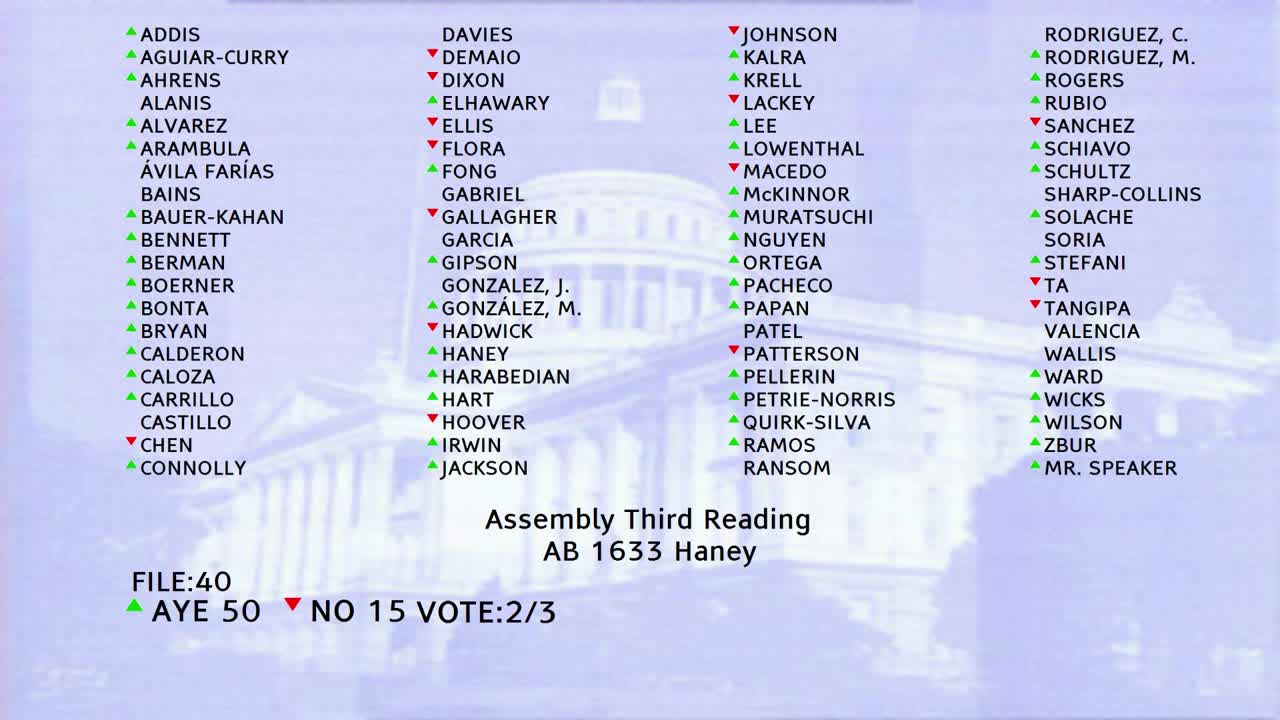 15MIN
Assembly Floor
 17MIN
Assembly Standing Committee on Public Safety
 16MIN