AB 1901: Children’s diapers: intentionally added ingredients: disclosure.
- Session Year: 2025-2026
- House: Assembly
- Latest Version Date: 2026-09-28
Current Status:
Passed
(2026-09-28: Chaptered by Secretary of State - Chapter 719, Statutes of 2026.)
Introduced
In Committee
Awaiting First Chamber Vote
Passed First Chamber
In Committee
Awaiting Second Chamber Vote
Passed Second Chamber
Enacted
Existing law prohibits juvenile products, textile articles, and food packaging that contain specified levels of perfluoroalkyl and polyfluoroalkyl substances (PFAS) from being distributed, sold, or offered for sale in the state, as provided. Existing law establishes the Toxic Substances Control Account in the General Fund to be administered by the Director of Toxic Substances Control.
This bill would require, on or before January 1, 2029, the manufacturer of childrens diapers sold, distributed, or manufactured in the state to display on a dedicated web page on the manufacturers internet website, and would authorize display on the product details page where the childrens diapers are sold, a list of all of the childrens diapers intentionally added ingredients, as defined, in order of chemical or raw material weight, including the chemical or raw material name, the Chemical Abstract Service (CAS) number, and all specific functions or purposes for use in the childrens diapers. The bill would require, on or before January 1, 2029, all childrens diapers distributed or manufactured in the state, and, on or before July 1, 2029, all childrens diapers sold in the state, to include on the outermost package an internet website address for a dedicated web page on the manufacturers internet website that provides all of that information and a list of all of the intentionally added ingredients in order of chemical or raw material weight in the childrens diapers. The bill would authorize the Department of Toxic Substances Control to enforce these requirements. The bill would require a person who violates these requirements to be liable for an administrative penalty not to exceed $5,000 for the first violation and not to exceed $10,000 for each subsequent violation, as provided. The bill would authorize the department to adopt regulations to implement, enforce, interpret, or make specific these requirements. The bill would authorize, upon appropriation by the Legislature, funds in the Toxic Substances Control Account to be used by the department to implement these requirements. The bill would require penalties collected to be deposited in the Toxic Substances Control Account. The bill would prohibit the sale, distribution, or manufacture of childrens diapers in the state that do not comply with these requirements. The bill would make these provisions severable.
Existing law prohibits juvenile products, textile articles, and food packaging that contain specified levels of perfluoroalkyl and polyfluoroalkyl substances (PFAS) from being distributed, sold, or offered for sale in the state, as provided. Existing law establishes the Toxic Substances Control Account in the General Fund to be administered by the Director of Toxic Substances Control.
This bill would require, on or before January 1, 2029, the manufacturer of any childrens diapers sold, distributed, or manufactured in the state to display on a dedicated web page on its the manufacturers internet website, and would authorize display on the product details page on any internet website where the childrens diapers are sold, a list of all of the childrens diapers intentionally added ingredients, as defined, in order of chemical or raw material weight, including the chemical or raw material name, the Chemical Abstract Service (CAS) number, and all specific functions or purposes for use in the childrens diapers. The bill would require, on or before January 1, 2029, all childrens diapers distributed or manufactured in the state, and, on or before July 1, 2029, all childrens diapers sold in the state, to include on the outermost package an internet website address for a dedicated web page on the manufacturers internet website that provides all of that information and a list of all of the intentionally added ingredients in order of chemical or raw material weight in the childrens diapers. The bill would authorize the department Department of Toxic Substances Control to enforce these requirements. The bill would require a person who violates these requirements to be liable for an administrative penalty not to exceed $5,000 for the first violation and not to exceed $10,000 for each subsequent violation, as provided. The bill would authorize the department to adopt regulations to implement, enforce, interpret, or make specific these requirements. The bill would authorize, upon appropriation by the Legislature, funds in the Toxic Substances Control Account to be used by the department to implement these requirements. The bill would require penalties collected to be deposited in the Toxic Substances Control Account. The bill would prohibit the sale, distribution, or manufacture of childrens diapers in the state that do not comply with these requirements. The bill would make these provisions severable.
Existing law prohibits juvenile products, textile articles, and food packaging that contain specified levels of perfluoroalkyl and polyfluoroalkyl substances (PFAS) from being distributed, sold, or offered for sale in the state, as provided. Existing law establishes the Toxic Substances Control Account in the General Fund to be administered by the Director of Toxic Substances Control.
This bill would require, on or before January 1, 2029, the manufacturer of any childrens diapers sold, distributed, or manufactured in the state to display on a web page on its internet website, and on the product details page on any internet website where the childrens diapers are sold, a list of all of the childrens diapers intentionally added ingredients, as defined, in order of chemical or raw material weight, including the chemical or raw material name, the Chemical Abstract Service (CAS) number, and all specific functions or purposes for use in the childrens diapers. The bill would require, on or before January 1, 2029, all childrens diapers distributed or manufactured in the state, and, on or before July 1, 2029, all childrens diapers sold in the state, to include on the outermost package an internet website address for a web page that provides all of that information and a list of all of the intentionally added ingredients in order of chemical or raw material weight in the childrens diapers. The bill would authorize the department, the Attorney General, a city attorney, county counsel, or district attorney department to enforce these requirements. The bill would require a person who violates these requirements to be liable for an administrative or civil penalty not to exceed $5,000 for the first violation and not to exceed $10,000 for each subsequent violation, as provided. The bill would authorize the department to adopt regulations to implement, enforce, interpret, or make specific these requirements. The bill would authorize, upon appropriation by the Legislature, funds in the Toxic Substances Control Account to be used by the department to implement these requirements. The bill would require penalties collected to be deposited in the Toxic Substances Control Account. The bill would prohibit the sale, distribution, or manufacture of childrens diapers in the state that do not comply with these requirements. The bill would make these provisions severable.
Existing law prohibits juvenile products, textile articles, and food packaging that contain specified levels of perfluoroalkyl and polyfluoroalkyl substances (PFAS) from being distributed, sold, or offered for sale in the state, as provided. Existing law establishes the Toxic Substances Control Account in the General Fund to be administered by the Director of Toxic Substances Control.
This bill would require, on or before January 1, 2029, the manufacturer of any childrens diapers sold, distributed, or manufactured in the state to display on a web page on its internet website, and on the product details page on any internet website where the childrens diapers are sold, a list of all of the childrens diapers intentionally added ingredients, as defined, in order of chemical or raw material weight, including the chemical or raw material name, the Chemical Abstract Service (CAS) number, and all specific functions or purposes for use in the childrens diapers. The bill would require, on or before January 1, 2029, all childrens diapers sold, distributed, distributed or manufactured in the state state, and, on or before July 1, 2029, all childrens diapers sold in the state, to include on the outermost package an internet website address for a web page that provides all of that information and a list of all of the intentionally added ingredients in order of chemical or raw material weight in the childrens diapers. The bill would authorize the department, the Attorney General, a city attorney, county counsel, or district attorney to enforce these requirements. The bill would require a person who violates these requirements to be liable for an administrative or civil penalty not to exceed $5,000 for the first violation and not to exceed $10,000 for each subsequent violation, as provided. The bill would authorize the department to adopt regulations to implement, enforce, interpret, or make specific these requirements. The bill would authorize, upon appropriation by the Legislature, funds in the Toxic Substances Control Account to be used by the department to implement these requirements. The bill would require penalties collected to be deposited in the Toxic Substances Control Account. The bill would prohibit the sale, distribution, or manufacture of childrens diapers in the state that do not comply with these requirements. The bill would make these provisions severable.
Existing law prohibits juvenile products, textile articles, and food packaging that contain specified levels of perfluoroalkyl and polyfluoroalkyl substances (PFAS) from being distributed, sold, or offered for sale in the state, as provided. Existing law establishes the Toxic Substances Control Account in the General Fund to be administered by the Director of Toxic Substances Control.
This bill would require, on or before January 1, 2028, 2029, the manufacturer of any childrens diapers sold, distributed, or manufactured in the state to display on a web page on its internet website, and on the product details page on any internet website where the childrens diapers are sold, a list of all of the childrens diapers intentionally added ingredients, as defined, in order of chemical or raw material weight, including the chemical or raw material name, the Chemical Abstract Service (CAS) number, and all specific functions or purposes for use in the childrens diapers. The bill would require, on or before January 1, 2029, all childrens diapers sold, distributed, or manufactured in the state to include on the outermost package an internet website address for a web page that provides all of that information and a list of all of the intentionally added ingredients in order of chemical or raw material weight in the childrens diapers. The bill would authorize the department, the Attorney General, a city attorney, county counsel, or district attorney to enforce these requirements. The bill would require a person who violates these requirements to be liable for an administrative or civil penalty not to exceed $5,000 for the first violation and not to exceed $10,000 for each subsequent violation, as provided. The bill would authorize the department to adopt regulations to implement, enforce, interpret, or make specific these requirements. The bill would authorize, upon appropriation by the Legislature, funds in the Toxic Substances Control Account to be used by the department to implement these requirements. The bill would require penalties collected to be deposited in the Toxic Substances Control Account. The bill would prohibit the sale, distribution, or manufacture of childrens diapers in the state that do not comply with these requirements. The bill would make these provisions severable.
Existing law prohibits juvenile products, textile articles, and food packaging that contain specified levels of perfluoroalkyl and polyfluoroalkyl substances (PFAS) from being distributed, sold, or offered for sale in the state, as provided. Existing law establishes the Toxic Substances Control Account in the General Fund to be administered by the Director of Toxic Substances Control.
This bill would require, on or before January 1, 2028, the manufacturer of any childrens diapers sold, distributed, or manufactured in the state to display on a web page on its internet website, and on the product details page on any internet website where the childrens diapers are sold, a list of all of the childrens diapers intentionally added ingredients, as defined, in the childrens diapers, including the chemical or raw material name, the Chemical Abstract Service (CAS) number for each intentionally added ingredient, number, and all specific functions or purposes for use of the intentionally added ingredients in the childrens diapers. The bill would require, on or before January 1, 2029, all childrens diapers sold, distributed, or manufactured in the state to include on the outermost package an internet website address for a web page that provides all of that information and a list of all of the intentionally added ingredients in the childrens diapers. The bill would authorize the department, the Attorney General, a city attorney, county counsel, or district attorney to enforce these requirements. The bill would require a person who violates these requirements to be liable for an administrative or civil penalty not to exceed $5,000 for the first violation and not to exceed $10,000 for each subsequent violation, as provided. The bill would authorize the department to adopt regulations to implement, enforce, interpret, or make specific these requirements. The bill would authorize, upon appropriation by the Legislature, funds in the Toxic Substances Control Account to be used by the department to implement these requirements. The bill would require penalties collected to be deposited in the Toxic Substances Control Account. The bill would prohibit the sale, distribution, or manufacture of childrens diapers in the state that do not comply with these requirements.
Existing law prohibits juvenile products, textile articles, and food packaging that contain specified levels of perfluoroalkyl and polyfluoroalkyl substances (PFAS) from being distributed, sold, or offered for sale in the state, as provided.
This bill would require, on or before January 1, 2028, the manufacturer of any childrens diapers sold, distributed, or manufactured in the state to display on a web page on its internet website, and on the product details page on any internet website where the childrens diapers are sold, a list of all of the intentionally added ingredients, as defined, in the childrens diapers, the Chemical Abstract Service (CAS) number for each intentionally added ingredient, and all specific functions or purposes for use of the intentionally added ingredients in the childrens diapers. The bill would require, on or before January 1, 2029, all childrens diapers sold, distributed, or manufactured in the state to include on the outermost package an internet website address for a web page that provides all of that information and a list of all of the intentionally added ingredients in the childrens diapers. The bill would prohibit the sale, distribution, or manufacture of childrens diapers in the state that do not comply with these requirements.
Existing law, the Consumers Legal Remedies Act, permits a consumer who suffers damage because of the use or employment by any person of a method, act, or practice declared to be unlawful, as specified, to bring an action against that person to recover, among other things, actual damages and punitive damages.This bill would state the intent of the Legislature to subsequently enact legislating relating to consumer protection.Existing law, the Consumers Legal Remedies Act, permits a consumer who suffers damage because of the use or employment by any person of a method, act, or practice declared to be unlawful, as specified, to bring an action against that person to recover, among other things, actual damages and punitive damages.
This bill would state the intent of the Legislature to subsequently enact legislating relating to consumer protection.
(a)For purposes of this section, the following definitions apply:
(1)Childrens diaper means an absorbent garment or product that is designed, manufactured, processed, fabricated, packaged, or marketed to be worn by children, including infants and toddlers, and to absorb or contain urine and fecal waste, including, but not limited to, a disposable brief, protective underwear, liner, booster, insert, or underpad. Childrens diaper includes any of a diapers components, including, but not limited to, wetness indicators, absorbent linings or fillings, outer shells, adhesive tabs, dyes, or fragrance.
(2)Intentionally added ingredients means a chemical, or chemicals, that a manufacturer has intentionally added to childrens diapers and that has a functional or technical effect in the product, including a component of an intentionally added chemical or an intentional breakdown product of an added chemical that also has a functional or technical effect in childrens diapers.
(3)Package has the same meaning as Section 1459(b) of Title 15 of the United States Code.
(b)(1)On or before January 1, 2029, the manufacturer of childrens diapers sold, distributed, or manufactured in the state shall display on a dedicated web page on the manufacturers internet website a list of all of the childrens diapers intentionally added ingredients for each specific childrens diaper product.
(2)Any product details page where the diapers are sold may display a list, or a link to the dedicated web page on the manufacturers internet website with a list, of all of the childrens diapers intentionally added ingredients.
(3)The dedicated web page and the list of all of the childrens diapers intentionally added ingredients shall be displayed and organized in an easily and publicly identifiable manner.
(4)The list of all of the childrens diapers intentionally added ingredients shall include all of the following information for each intentionally added ingredient in the childrens diaper:
(A)Chemical or raw material name.
(B)The Chemical Abstract Service (CAS) number.
(C)All specific functions or purposes for use in the childrens diapers.
(c)All required information in subdivisions (b) and (d) shall be clearly grouped and displayed in order of chemical or raw material weight for each intentionally added ingredient. Each intentionally added ingredients chemical or raw material name, CAS number, and function or purpose shall be listed alongside each other.
(d)On or before January 1, 2029, all childrens diapers distributed or manufactured in the state shall include on the outermost package all of the following in an easily and publicly identifiable manner:
(1)A list of all of the intentionally added ingredients in the childrens diapers.
(2)An internet website address for a dedicated web page on the manufacturers internet website that provides all of the information required by subdivision (b).
(e)On or before July 1, 2029, all childrens diapers sold in the state shall include on the outermost package, in an easily and publicly identifiable manner, the information required by paragraphs (1) and (2) of subdivision (d).
(f)(1)The Department of Toxic Substances Control may enforce this chapter.
(2)A person in violation of this chapter shall be liable for an administrative penalty not to exceed five thousand dollars ($5,000) for the first violation and not to exceed ten thousand dollars ($10,000) for each subsequent violation.
(3)Penalties may be assessed for each violation or, for continuing violations, for each day that a violation continues.
(4)A prevailing party shall be entitled to an award of reasonable attorneys fees and costs.
(5)This subdivision does not impair or impede any other rights, causes of action, claims, or defenses available under any other law. The remedies provided in this subdivision are cumulative with any other remedies available under any other law.
(g)The Department of Toxic Substances Control may adopt regulations to implement, enforce, interpret, or make specific this chapter.
(h)Upon appropriation by the Legislature, funds in the Toxic Substances Control Account, established pursuant to Section 25173.6, may be used by the department to implement this chapter.
(i)Moneys from penalties collected pursuant to this section shall be deposited in the Toxic Substances Control Account, established pursuant to Section 25173.6.
(j)A person shall not sell, distribute, or manufacture childrens diapers in the state that do not comply with the requirements of this section.
(k)The provisions of this section are severable. If any provision of this section or its application is held invalid, that invalidity shall not affect other provisions or applications that can be given effect without the invalid provision or application.
(a)For purposes of this section, the following definitions apply:
(1)Childrens diaper means an absorbent garment or product that is designed, manufactured, processed, fabricated, packaged, or marketed to be worn by children, including infants and toddlers, and to absorb or contain urine and fecal waste, including, but not limited to, a disposable brief, protective underwear, liner, booster, insert, or underpad. Childrens diaper includes any of a diapers components, including, but not limited to, wetness indicators, absorbent linings or fillings, outer shells, adhesive tabs, dyes, or fragrance.
(2)Intentionally added ingredients means a chemical, or chemicals, that a manufacturer has intentionally added to childrens diapers and that has a functional or technical effect in the product, including a component of an intentionally added chemical, chemical or an intentional breakdown product of an added chemical, chemical that also has a functional or technical effect in childrens diapers.
(3)Package has the same meaning as Section 1459(b) of Title 15 of the United States Code.
(b)(1)On or before January 1, 2029, the manufacturer of any childrens diapers sold, distributed, or manufactured in the state shall display on a dedicated web page on its the manufacturers internet website, and on the product details page on the internet website where the childrens diapers are sold, website a list of all of the childrens diapers intentionally added ingredients. The ingredients for each specific childrens diaper product.
(2)Any product details page where the diapers are sold may display a list, or a link to the dedicated web page on the manufacturers internet website with a list, of all of the childrens diapers intentionally added ingredients.
(3)The dedicated web page and the list of all of the childrens diapers intentionally added ingredients shall be displayed and organized in an easily and publicly identifiable manner. The
(4)The list of all of the childrens diapers intentionally added ingredients shall include all of the following information for each intentionally added ingredient in the childrens diaper:
(1)(A)Chemical or raw material name.
(2)(B)The Chemical Abstract Service (CAS) number.
(3)(C)All specific functions or purposes for use in the childrens diapers.
(c)All required information in subdivisions (b) and (d) shall be clearly grouped and displayed in order of chemical or raw material weight for each intentionally added ingredient. Each intentionally added ingredients chemical or raw material name, CAS number, and function or purpose shall be listed alongside each other.
(d)On or before January 1, 2029, all childrens diapers distributed or manufactured in the state shall include on the outermost package all of the following in an easily and publicly identifiable manner:
(1)A list of all of the intentionally added ingredients in the childrens diapers.
(2)An internet website address for a dedicated web page on the manufacturers internet website that provides all of the information required by subdivision (b).
(e)On or before July 1, 2029, all childrens diapers sold in the state shall include on the outermost package, in an easily and publicly identifiable manner, the information required by paragraphs (1) and (2) of subdivision (d).
(f)(1)The Department of Toxic Substances Control may enforce this chapter.
(2)A person in violation of this chapter shall be liable for an administrative penalty not to exceed five thousand dollars ($5,000) for the first violation and not to exceed ten thousand dollars ($10,000) for each subsequent violation.
(3)Penalties may be assessed for each violation or, for continuing violations, for each day that a violation continues.
(4)A prevailing party shall be entitled to an award of reasonable attorneys fees and costs.
(5)This subdivision does not impair or impede any other rights, causes of action, claims, or defenses available under any other law. The remedies provided in this subdivision are cumulative with any other remedies available under any other law.
(g)The Department of Toxic Substances Control may adopt regulations to implement, enforce, interpret, or make specific this chapter.
(h)Upon appropriation by the Legislature, funds in the Toxic Substances Control Account, established pursuant to Section 25173.6, may be used by the department to implement this chapter.
(i)Moneys from penalties collected pursuant to this section shall be deposited in the Toxic Substances Control Account, established pursuant to Section 25173.6.
(j)A person shall not sell, distribute, or manufacture childrens diapers in the state that do not comply with the requirements of this section.
(k)The provisions of this section are severable. If any provision of this section or its application is held invalid, that invalidity shall not affect other provisions or applications that can be given effect without the invalid provision or application.
(a)For purposes of this section, the following definitions apply:
(1)Childrens diaper means an absorbent garment or product that is designed, manufactured, processed, fabricated, packaged, or marketed to be worn by children, including infants and toddlers, and to absorb or contain urine and fecal waste, including, but not limited to, a disposable brief, protective underwear, liner, booster, insert, or underpad. Childrens diaper includes any of a diapers components, including, but not limited to, wetness indicators, absorbent linings or fillings, outer shells, adhesive tabs, dyes, or fragrance.
(2)Intentionally added ingredients means a chemical, or chemicals, that a manufacturer has intentionally added to childrens diapers and that has a functional or technical effect in the product, including a component of an intentionally added chemical, or an intentional breakdown product of an added chemical, that also has a functional or technical effect in childrens diapers.
(3)Package has the same meaning as Section 1459(b) of Title 15 of the United States Code.
(b)On or before January 1, 2029, the manufacturer of any childrens diapers sold, distributed, or manufactured in the state shall display on a web page on its internet website, and on the product details page on the internet website where the childrens diapers are sold, a list of all of the childrens diapers intentionally added ingredients. The web page and the list shall be displayed and organized in an easily and publicly identifiable manner. The list shall include all of the following information for each intentionally added ingredient in the childrens diaper:
(1)Chemical or raw material name.
(2)The Chemical Abstract Service (CAS) number.
(3)All specific functions or purposes for use in the childrens diapers.
(c)All required information in subdivisions (b) and (d) shall be clearly grouped and displayed in order of chemical or raw material weight for each intentionally added ingredient. Each intentionally added ingredients chemical or raw material name, CAS number, and function or purpose shall be listed alongside each other.
(d)On or before January 1, 2029, all childrens diapers distributed or manufactured in the state shall include on the outermost package all of the following in an easily and publicly identifiable manner:
(1)A list of all of the intentionally added ingredients in the childrens diapers.
(2)An internet website address for a web page that provides all of the information required by subdivision (b).
(e)On or before July 1, 2029, all childrens diapers sold in the state shall include on the outermost package, in an easily and publicly identifiable manner, the information required by paragraphs (1) and (2) of subdivision (d).
(f)(1)The Department of Toxic Substances Control, the Attorney General, a city attorney, county counsel, or district attorney Control may enforce this chapter.
(2)A person in violation of this chapter shall be liable for an administrative or civil penalty not to exceed five thousand dollars ($5,000) for the first violation and not to exceed ten thousand dollars ($10,000) for each subsequent violation.
(3)Penalties may be assessed for each violation or, for continuing violations, for each day that a violation continues.
(4)A prevailing party shall be entitled to an award of reasonable attorneys fees and costs.
(5)This subdivision does not impair or impede any other rights, causes of action, claims, or defenses available under any other law. The remedies provided in this subdivision are cumulative with any other remedies available under any other law.
(g)The Department of Toxic Substances Control may adopt regulations to implement, enforce, interpret, or make specific this chapter.
(h)Upon appropriation by the Legislature, funds in the Toxic Substances Control Account, established pursuant to Section 25173.6, may be used by the department to implement this chapter.
(i)Moneys from penalties collected pursuant to this section shall be deposited in the Toxic Substances Control Account, established pursuant to Section 25173.6.
(j)A person shall not sell, distribute, or manufacture childrens diapers in the state that do not comply with the requirements of this section.
(k)The provisions of this section are severable. If any provision of this section or its application is held invalid, that invalidity shall not affect other provisions or applications that can be given effect without the invalid provision or application.
(a)For purposes of this section, the following definitions apply:
(1)Childrens diaper means an absorbent garment or product that is designed, manufactured, processed, fabricated, packaged, or marketed to be worn by children, including infants and toddlers, and to absorb or contain urine and fecal waste, including, but not limited to, a disposable brief, protective underwear, liner, booster, insert, or underpad. Childrens diaper includes any of a diapers components, including, but not limited to, wetness indicators, absorbent linings or fillings, outer shells, adhesive tabs, dyes, or fragrance.
(2)Intentionally added ingredients means a chemical, or chemicals, that a manufacturer has intentionally added to childrens diapers and that has a functional or technical effect in the product, including a component of an intentionally added chemical, or an intentional breakdown product of an added chemical, that also has a functional or technical effect in childrens diapers.
(3)Package has the same meaning as Section 1459(b) of Title 15 of the United States Code.
(b)On or before January 1, 2029, the manufacturer of any childrens diapers sold, distributed, or manufactured in the state shall display on a web page on its internet website, and on the product details page on the internet website where the childrens diapers are sold, a list of all of the childrens diapers intentionally added ingredients. The web page and the list shall be displayed and organized in an easily and publicly identifiable manner. The list shall include all of the following information for each intentionally added ingredient in the childrens diaper:
(1)Chemical or raw material name.
(2)The Chemical Abstract Service (CAS) number.
(3)All specific functions or purposes for use in the childrens diapers.
(c)All required information in subdivisions (b) and (d) shall be clearly grouped and displayed in order of chemical or raw material weight for each intentionally added ingredient. Each intentionally added ingredients chemical or raw material name, CAS number, and function or purpose shall be listed alongside each other.
(d)On or before January 1, 2029, all childrens diapers sold, distributed, distributed or manufactured in the state shall include on the outermost package all of the following in an easily and publicly identifiable manner:
(1)A list of all of the intentionally added ingredients in the childrens diapers.
(2)An internet website address for a web page that provides all of the information required by subdivision (b).
(e)On or before July 1, 2029, all childrens diapers sold in the state shall include on the outermost package, in an easily and publicly identifiable manner, the information required by paragraphs (1) and (2) of subdivision (d).
(e)(f)(1)The Department of Toxic Substances Control, the Attorney General, a city attorney, county counsel, or district attorney may enforce this chapter.
(2)A person in violation of this chapter shall be liable for an administrative or civil penalty not to exceed five thousand dollars ($5,000) for the first violation and not to exceed ten thousand dollars ($10,000) for each subsequent violation.
(3)Penalties may be assessed for each violation or, for continuing violations, for each day that a violation continues.
(4)A prevailing party shall be entitled to an award of reasonable attorneys fees and costs.
(5)This subdivision does not impair or impede any other rights, causes of action, claims, or defenses available under any other law. The remedies provided in this subdivision are cumulative with any other remedies available under any other law.
(f)(g)The Department of Toxic Substances Control may adopt regulations to implement, enforce, interpret, or make specific this chapter.
(g)(h)Upon appropriation by the Legislature, funds in the Toxic Substances Control Account, established pursuant to Section 25173.6, may be used by the department to implement this chapter.
(h)(i)Moneys from penalties collected pursuant to this section shall be deposited in the Toxic Substances Control Account, established pursuant to Section 25173.6.
(i)(j)A person shall not sell, distribute, or manufacture childrens diapers in the state that do not comply with the requirements of this section.
(j)(k)The provisions of this section are severable. If any provision of this section or its application is held invalid, that invalidity shall not affect other provisions or applications that can be given effect without the invalid provision or application.
(a)For purposes of this section, the following definitions apply:
(1)Childrens diaper means an absorbent garment or product that is designed, manufactured, processed, fabricated, packaged, or marketed to be worn by children, including infants and toddlers, and to absorb or contain urine and fecal waste, including, but not limited to, a disposable brief, protective underwear, liner, booster, insert, or underpad. Childrens diaper includes any of a diapers components, including, but not limited to, wetness indicators, absorbent linings or fillings, outer shells, adhesive tabs, dyes, or fragrance.
(2)Intentionally added ingredients means a chemical, or chemicals, that a manufacturer has intentionally added to childrens diapers and that has a functional or technical effect in the product, including a component of an intentionally added chemical, or an intentional breakdown product of an added chemical, that also has a functional or technical effect in childrens diapers.
(3)Package has the same meaning as Section 1459(b) of Title 15 of the United States Code.
(b)On or before January 1, 2028, 2029, the manufacturer of any childrens diapers sold, distributed, or manufactured in the state shall display on a web page on its internet website, and on the product details page on the internet website where the childrens diapers are sold, a list of all of the childrens diapers intentionally added ingredients. The web page and the list shall be displayed and organized in an easily and publicly identifiable manner. The list shall include all of the following information for each intentionally added ingredient in the childrens diaper:
(1)Chemical or raw material name.
(2)The Chemical Abstract Service (CAS) number.
(3)All specific functions or purposes for use in the childrens diapers.
(c)All required information in subdivisions (b) and (d) shall be clearly grouped and displayed in order of chemical or raw material weight for each intentionally added ingredient. Each intentionally added ingredients chemical or raw material name, CAS number, and function or purpose shall be listed alongside each other.
(d)On or before January 1, 2029, all childrens diapers sold, distributed, or manufactured in the state shall include on the outermost package all of the following in an easily and publicly identifiable manner:
(1)A list of all of the intentionally added ingredients in the childrens diapers.
(2)An internet website address for a web page that provides all of the information required by subdivision (b).
(e)(1)The Department of Toxic Substances Control, the Attorney General, a city attorney, county counsel, or district attorney may enforce this chapter.
(2)A person in violation of this chapter shall be liable for an administrative or civil penalty not to exceed five thousand dollars ($5,000) for the first violation and not to exceed ten thousand dollars ($10,000) for each subsequent violation.
(3)Penalties may be assessed for each violation or, for continuing violations, for each day that a violation continues.
(4)A prevailing party shall be entitled to an award of reasonable attorneys fees and costs.
(5)This subdivision does not impair or impede any other rights, causes of action, claims, or defenses available under any other law. The remedies provided in this subdivision are cumulative with any other remedies available under any other law.
(f)The Department of Toxic Substances Control may adopt regulations to implement, enforce, interpret, or make specific this chapter.
(g)Upon appropriation by the Legislature, funds in the Toxic Substances Control Account, established pursuant to Section 25173.6, may be used by the department to implement this chapter.
(h)Moneys from penalties collected pursuant to this section shall be deposited in the Toxic Substances Control Account, established pursuant to Section 25173.6.
(i)A person shall not sell, distribute, or manufacture childrens diapers in the state that do not comply with the requirements of this section.
(j)The provisions of this section are severable. If any provision of this section or its application is held invalid, that invalidity shall not affect other provisions or applications that can be given effect without the invalid provision or application.
(a)For purposes of this section, the following definitions apply:
(1)Childrens diaper means an absorbent garment or product that is designed, manufactured, processed, fabricated, packaged, or marketed to be worn by children, including infants and toddlers, and to absorb or contain urine and fecal waste, including, but not limited to, a disposable brief, protective underwear, liner, booster, insert, or underpad. Childrens diaper includes any of a diapers components, including, but not limited to, wetness indicators, absorbent linings or fillings, outer shells, adhesive tabs, dyes, or fragrance.
(1)(2)Intentionally added ingredients means a chemical, or chemicals, that a manufacturer has intentionally added to childrens diapers and that has a functional or technical effect in the product, including a component of an intentionally added chemical, or an intentional breakdown product of an added chemical, that also has a functional or technical effect in childrens diapers.
(2)(3)Package has the same meaning as Section 1459 (b) 1459(b) of Title 15 of the United States Code.
(b)On or before January 1, 2028, the manufacturer of any childrens diapers sold, distributed, or manufactured in the state shall display on a web page on its internet website, and on the product details page on the internet website where the childrens diapers are sold, all of the following in an easily and publicly identifiable manner: a list of all of the childrens diapers intentionally added ingredients. The web page and the list shall be displayed and organized in an easily and publicly identifiable manner. The list shall include all of the following information for each intentionally added ingredient in the childrens diaper:
(1)A list of all of the intentionally added ingredients in the childrens diapers. Chemical or raw material name.
(2)The Chemical Abstract Service (CAS) number for each intentionally added ingredient. number.
(3)All specific functions or purposes for use of the intentionally added ingredients in the childrens diapers.
(c)All required information in subdivisions (b) and (d) shall be clearly grouped and displayed for each intentionally added ingredient. Each intentionally added ingredients chemical or raw material name, CAS number, and function or purpose shall be listed alongside each other.
(c)(d)On or before January 1, 2029, all childrens diapers sold, distributed, or manufactured in the state shall include on the outermost package all of the following in an easily and publicly identifiable manner:
(1)A list of all of the intentionally added ingredients in the childrens diapers.
(2)An internet website address for a web page that provides all of the information required by subdivision (b).
(e)(1)The Department of Toxic Substances Control, the Attorney General, a city attorney, county counsel, or district attorney may enforce this chapter.
(2)A person in violation of this chapter shall be liable for an administrative or civil penalty not to exceed five thousand dollars ($5,000) for the first violation and not to exceed ten thousand dollars ($10,000) for each subsequent violation.
(3)Penalties may be assessed for each violation or, for continuing violations, for each day that a violation continues.
(4)A prevailing party shall be entitled to an award of reasonable attorneys fees and costs.
(5)This subdivision does not impair or impede any other rights, causes of action, claims, or defenses available under any other law. The remedies provided in this subdivision are cumulative with any other remedies available under any other law.
(f)The Department of Toxic Substances Control may adopt regulations to implement, enforce, interpret, or make specific this chapter.
(g)Upon appropriation by the Legislature, funds in the Toxic Substances Control Account, established pursuant to Section 25173.6, may be used by the department to implement this chapter.
(h)Moneys from penalties collected pursuant to this section shall be deposited in the Toxic Substances Control Account, established pursuant to Section 25173.6.
(d)(i)A person shall not sell, distribute, or manufacture childrens diapers in the state that do not comply with the requirements of this section.
(a)For purposes of this section, the following definitions apply:
(1)Intentionally added ingredients means a chemical, or chemicals, that a manufacturer has intentionally added to childrens diapers and that has a functional or technical effect in the product, including a component of an intentionally added chemical, or an intentional breakdown product of an added chemical, that also has a functional or technical effect in childrens diapers.
(2)Package has the same meaning as Section 1459 (b) of Title 15 of the United States Code.
(b)On or before January 1, 2028, the manufacturer of any childrens diapers sold, distributed, or manufactured in the state shall display on a web page on its internet website, and on the product details page on the internet website where the childrens diapers are sold, all of the following in an easily and publicly identifiable manner:
(1)A list of all of the intentionally added ingredients in the childrens diapers.
(2)The Chemical Abstract Service (CAS) number for each intentionally added ingredient.
(3)All specific functions or purposes for use of the intentionally added ingredients in the childrens diapers.
(c)On or before January 1, 2029, all childrens diapers sold, distributed, or manufactured in the state shall include on the outermost package all of the following in an easily and publicly identifiable manner:
(1)A list of all of the intentionally added ingredients in the childrens diapers.
(2)An internet website address for a web page that provides all of the information required by subdivision (b).
(d)A person shall not sell, distribute, or manufacture childrens diapers in the state that do not comply with the requirements of this section.
SECTION 1.It is the intent of the Legislature to subsequently enact legislation relating to consumer protection.It is the intent of the Legislature to subsequently enact legislation relating to consumer protection.
|
Date
|
Status
|
|---|---|
| Sep 28, 2026 | Chaptered by Secretary of State - Chapter 719, Statutes of 2026. |
| Sep 28, 2026 | Approved by the Governor. |
| Sep 4, 2026 | Enrolled and presented to the Governor at 4 p.m. |
| Aug 27, 2026 | Senate amendments concurred in. To Engrossing and Enrolling. (Ayes 71. Noes 1. Page 6711.). |
| Aug 27, 2026 | Senate amendments concurred in. To Engrossing and Enrolling. (Ayes 71. Noes 1.). |
| Aug 27, 2026 | In Assembly. Concurrence in Senate amendments pending. |
| Aug 26, 2026 | Read third time. Passed. Ordered to the Assembly. (Ayes 38. Noes 0. Page 5898.). |
| Aug 26, 2026 | Read third time. Passed. Ordered to the Assembly. (Ayes 37. Noes 0.). |
| Aug 24, 2026 | Read second time. Ordered to third reading. |
| Aug 21, 2026 | Read third time and amended. Ordered to second reading. |
| Aug 13, 2026 | Read second time. Ordered to third reading. |
| Aug 13, 2026 | From committee: Do pass. (Ayes 7. Noes 0.) (August 13). |
| Aug 3, 2026 | In committee: Referred to APPR. suspense file. |
| Jun 29, 2026 | Re-referred to Com. on APPR. |
| Jun 29, 2026 | Withdrawn from committee. |
| Jun 25, 2026 | From committee chair, with author's amendments: Amend, and re-refer to committee. Read second time, amended, and re-referred to Com. on JUD. |
| Jun 22, 2026 | Read second time and amended. Re-referred to Com. on JUD. |
| Jun 18, 2026 | From committee: Amend, and do pass as amended and re-refer to Com. on JUD. (Ayes 7. Noes 0.) (June 17). |
| Jun 3, 2026 | Referred to Coms. on E.Q. and JUD. |
| May 27, 2026 | In Senate. Read first time. To Com. on RLS. for assignment. |
| May 26, 2026 | Read third time. Passed. Ordered to the Senate. (Ayes 68. Noes 1. Page 5366.) |
| May 26, 2026 | Read third time. Passed. Ordered to the Senate. (Ayes 68. Noes 1.) |
| May 26, 2026 | Read third time. Passed. Ordered to the Senate. |
| May 19, 2026 | Read second time. Ordered to third reading. |
| May 18, 2026 | Read second time and amended. Ordered returned to second reading. |
| May 14, 2026 | From committee: Amend, and do pass as amended. (Ayes 11. Noes 0.) (May 14). |
| Apr 8, 2026 | In committee: Set, first hearing. Referred to APPR. suspense file. |
| Mar 25, 2026 | From committee: Do pass and re-refer to Com. on APPR. (Ayes 5. Noes 0.) (March 24). Re-referred to Com. on APPR. |
| Mar 17, 2026 | Re-referred to Com. on E.S & T.M. |
| Mar 16, 2026 | From committee chair, with author's amendments: Amend, and re-refer to Com. on E.S & T.M. Read second time and amended. |
| Mar 10, 2026 | Re-referred to Com. on E.S & T.M. |
| Mar 9, 2026 | From committee chair, with author's amendments: Amend, and re-refer to Com. on E.S & T.M. Read second time and amended. |
| Mar 9, 2026 | Referred to Com. on E.S & T.M. |
| Feb 13, 2026 | From printer. May be heard in committee March 15. |
| Feb 12, 2026 | Read first time. To print. |
|
Date
|
Description
|
Location
|
Votes
|
|
|---|---|---|---|---|
| Aug 27, 2026 | AB 1901 Berman Concurrence in Senate Amendments | Assembly Floor |
Passed |
|
| Aug 26, 2026 | Assembly 3rd Reading AB1901 Berman By McGuire | Senate Floor |
Passed |
|
| Aug 13, 2026 | Do pass | Senate Standing Committee on Appropriations |
Passed |
|
| Aug 3, 2026 | Placed on suspense file | Senate Standing Committee on Appropriations |
Passed |
|
| Jun 17, 2026 | Do pass as amended, but first amend, and re-refer to the Committee on [Judiciary] | Senate Standing Committee on Environmental Quality |
Passed |
|
| May 26, 2026 | AB 1901 Berman Assembly Third Reading | Assembly Floor |
Passed |
|
| May 14, 2026 | Do pass as amended. | Assembly Standing Committee on Appropriations |
Passed |
|
| Mar 24, 2026 | Do pass and be re-referred to the Committee on [Appropriations] | Assembly Standing Committee on Environmental Safety and Toxic Materials |
Passed |
This list shows positions taken on this bill by organizations on the date displayed, which is linked to the original source.
Positions by individuals are not included.
|
Organization
|
Position
|
Date
|
|---|---|---|
| Alliance of Nurses for Healthy Environments | ** Support | |
| American Chemistry Council | ** Against | |
| American Forest & Paper Association | ** Against | |
| American Nurses Association/California | ** Support | |
| A Voice for Choice Advocacy | ** Support | |
| Breast Cancer Prevention Partners | ** Support | |
| California Chamber Of Commerce | ** Against | |
| California Environmental Voters | ** Support | |
| California Manufacturers And Technology Association | ** Against | |
| California Nurses for Environmental Health & Justice | ** Support | |
| California Product Stewardship Council | ** Support | |
| California Safe Schools | ** Support | |
| CALPIRG, California Public Interest Research Group | ** Support | |
| Center for Baby and Adult Hygiene Products | ** Against | |
| Center for Community Action and Environmental Justice | ** Support | |
| Center For Environmental Health | ** Support | |
| Children Now | ** Support | |
| cleanearth4kids.org | ** Support | |
| Clean Water Action | ** Support | |
| Consumer Brands Association | ** Against | |
| Consumer Federation of America | ** Support | |
| Consumer Federation Of California | ** Support | |
| Consumer Reports | ** Support | |
| Environmental Health Sciences | ** Support | |
| Environmental Health Trust | ** Support | |
| Environmental Working Group | ** Support | |
| Facts: Families Advocating for Chemical & Toxics Safety | ** Support | |
| Fragrance Creators Association | ** Against | |
| Friends Committee On Legislation Of California | ** Support | |
| GMO Science | ** Support | |
| Green Media Group | ** Support | |
| Healthy Baby | ** Support | |
| Jonas Philanthropies | ** Support | |
| Jonas Philanthropies At Impact Assets | ** Support | |
| Mothers Out Front Silicon Valley | ** Support | |
| North County Equity and Justice Coalition | ** Support | |
| O.w.l. Foundation | ** Support | |
| Physicians for Social Responsibility, Los Angeles | ** Support | |
| recolte energy | ** Support | |
| Safe Passages | ** Support | |
| San Francisco Bay Physicians for Social Responsibility | ** Support | |
| Sonoma County Conservation Action | ** Support | |
| Sonoma County Youth Environmental Action Committee | ** Support | |
| Story of Stuff | ** Support | |
| SupplyBank.org | ** Support | |
| Toxic Substances Control Account (TSCA) | ** Support | |
| Yard Smart Martin | ** Support |
CONCURRENCE IN SENATE AMENDMENTS
CSA1 Bill Id:AB 1901
Author:(Berman)
As Amended Ver:August 21, 2026
Majority vote
SUMMARY
Requires manufacturers of children's diapers sold, distributed, or manufactured in the state to display on their website and on the packages of children's diapers a list of all intentionally added ingredients in the children's diapers.
Senate Amendments
- Authorize, instead of require, the product details page where the diapers are sold to display a list, or a link to the dedicated web page on the manufacturer’s internet website with a list, of all of the children's diaper's intentionally added ingredients.
- Extend the date, from January 1, 2029 to July 1, 2029, by which all children's diapers sold in the state must include on the outermost package, in an easily and publicly identifiable manner, a list of all of the intentionally added ingredients in the children's diapers and an internet website address for a dedicated web page on the manufacturer's internet website that provides specified information on the children's diaper's intentionally added ingredients.
- Delete provisions that would have conferred express authority upon the Attorney General, a district attorney, a county counsel, or a city attorney to enforce the provisions of this bill.
- Delete provisions that would have required that a person in violation of provisions of this bill be liable for a civil penalty, as specified.
COMMENTS
Diaper use in the United States: According to the 2025 Environmental Science & Technology article, "Volatile Organic Compounds in Disposable Diapers and Baby Wipes in the US: A Survey of Products and Health Risks," in the United States, people use 27.4 billion disposable diapers each year at a cost that exceeds $9 billion annually. The article states that the average child will use approximately 7,000 disposable diapers before they are toilet trained. Diapers are used by young children before they are toilet trained, by a subset of children who continue to use them after being toilet trained, and by seniors and others suffering from incontinence, which includes over 20 million women in the United States alone.
Exposure due to chemicals in diapers: The 2025 Environmental Science & Technology article describes that diapers are in constant and immediate contact with skin. Young children and older adults, both of whom have thin and sensitive skin that is highly vulnerable to chemical exposure, wear the vast majority of diapers. For healthy individuals, the skin forms a strong protective barrier; however, repeated exposure to urine, feces, and excessive moisture may weaken the skin barrier. Additionally, some diaper users have growing, damaged, or deteriorated skin, conditions that can increase the risk of dermal complications such as diaper dermatitis. Diapers also contact external genitalia and tissues, such as the vulva, that have high chemical permeability. Many components of diapers may include concerning ingredients, including plastics, wetness indicators, inks, pigments, adhesives, and fragrances.
This bill: This bill requires, by January 1, 2029, manufacturers to list on their web page all intentionally added ingredients in children’s diapers; and, by July b1, 2029, packages of children's diapers to include a list of all intentionally added ingredients of the diapers.
Manufacturers are already disclosing ingredients: According to the Environmental Working Group (EWG), some diaper manufacturers are already choosing to provide consumers with complete transparency regarding their diapers. They point out that, to date, 23 diaper products produced by 3 manufacturers have been "verified" by the EWG Verified program, which means that the product meets EWG's strictest criteria for transparency and health. In order to become EWG Verified, products must avoid EWG's ingredients of concern and provide full transparency through a program whose standards and criteria are created by EWG’s team of scientists, formulators, and toxicologists.
This bill-- enforcement: To ensure compliance with the disclosure requirements delineated in this bill, AB 1901 authorizes DTSC to adopt regulations to implement, enforce, interpret, or make specific the provisions of this bill. It also authorizes DTSC to enforce the disclosure requirements in the bill, and makes a person who violates the provisions of this bill liable for an administrative penalty not to exceed $5,000 for the first violation and $10,000 for each subsequent violation.
Consumer right to know: This bill does not prohibit the use of any ingredients in diapers, but does require that manufacturers disclose diaper ingredients on the package of diapers and online. In order to make informed decisions, especially about purchasing and using products that are in direct contact with their children's bodies for years, consumers need to know product ingredients. As the Centers for Disease Control (CDC) states, "Because their bodies are still growing, children are at greater risk if they are exposed to environmental contaminants." Consumer right to know policies help ensure consumer safety, health, and value while fostering market transparency and accountability.
Intentionally added chemicals in products: This bill focuses on intentionally added ingredients in children's diapers. Similarly, to protect human health and the environment, several provisions of state law prohibit, limit, or require disclosure of certain substances in specific products. Some of these provisions restrict or require disclosure of intentionally added substances, but establish different, potentially less stringent, requirements for unintentionally added substances. These statutes include limitations on, prohibitions of, or disclosure of specified chemicals in cosmetics and cleaning products; PFAS in textiles, juvenile products, and plant-based food packaging; and, Di(2-ethylhexyl) phthalate (DEHP) in intravenous tubing. To a large extent, legislators treated intentionally added and non-intentionally added substances differently to account for unavoidable environmental contamination of products, such as PFAS contamination from municipal water. However, recent discussions about this differential treatment of intentionally added versus non-intentionally added substances have raised critical policy questions, including whether these provisions are enforceable and truly capture the Legislature′s intent to protect public health and the environment from harmful substances in products. Discussions should continue about how to ensure that concerning substances in products are restricted, prohibited, or disclosed, regardless of when in the manufacturing and distribution process the substances become present in the product.
According to the Author
"As a new dad, I have a new appreciation for how important it is for parents to make informed decisions when it comes to the health and wellness of their children. We all want the best for our children, but the lack of transparency around diaper ingredients prevents us from knowing what 'the best' is when buying the one thing that is touching our baby's skin every minute of their lives for years.
Recent testing shows many diapers are made with ingredients linked to health and environmental concerns. These include phthalates, which are linked to hormone disruption, and bleaching agents, which can cause skin and respiratory irritation. Volatile organic compounds are often used in diapers and can include hazardous air pollutants, which are associated with respiratory and other health harms. In addition, certain wetness indicators and colorful designs may contain harmful compounds, heavy metals, or dyes that can cause allergic contact dermatitis.
AB 1901 would require manufacturers of children's diapers sold, distributed, or manufactured in California to clearly label all ingredients on both the product's packaging and online. This will give parents greater transparency into what chemicals are in their children's diapers so that they can make informed decisions that are the right choice for their family."
Arguments in Support
A coalition of dozens of children's, community, public health, environmental and other public-interest organizations write in support of the bill,
"The Food and Drug Administration doesn't regulate diapers as medical devices, although it regulates adult incontinence products as such. Instead, baby diapers fall under the purview of the Consumer Product Safety Commission. The Commission requires baby diapers to be tested for lead but does not require manufacturers to test for a variety of other harmful chemicals or disclose their ingredients. As such, many diaper companies do not disclose all their products’ ingredients, leaving caregivers unable to make informed decisions about products that continuously touch their baby's skin.
Babies and toddlers are especially vulnerable to harmful chemicals because their bodies and skin are still developing, making exposure risks more concerning. Additionally, the skin around their genitals is very thin, exacerbating the risks from constant exposure to harmful substances in diapers.
Recent testing shows that many diapers are made with ingredients linked to health concerns, like hormone disrupting phthalates, volatile organic compounds (VOCs), and even formaldehyde. By requiring ingredient transparency, this legislation will empower parents and caregivers to make informed choices about the diapers they choose to keep their babies clean and dry."
Arguments in Opposition
A coalition of industry organizations, including the Center for Baby and Adult Hygiene Products, the American Chemistry Council, and California Manufacturers and Technology Association, writes in an "oppose unless amended" position on a previous version of the bill,
"There are currently no protections for confidential business information (CBI) in AB 1901, which plays a critical role in a company's ability to innovate and succeed... Absent inclusion of a provision protecting CBI, companies may be required to publicly disclose legitimate CBI, compromising proprietary information and negatively impacting the health of those businesses. Further, in some instances, product manufacturers are legally bound through nondisclosure agreements with their material suppliers, creating tension between compliance with this law and existing contractual obligations… We are seeking the same [CBI] requirements [ as AB 1989, 2020, C. Garcia) for children’s diapers, ensuring there is alignment across the industry as it relates to the requirements of disclosing intentionally added ingredients while protecting proprietary information.
…. AB 1901 includes a provision to disclose the Chemical Abstract Service (CAS) number, the chemical or raw material name, and the function or purpose for each intentionally added ingredient. The CAS number and chemical names are not commonly understood by consumers which may lead to misinterpretation and can cause consumers to conclude that an ingredient is unsafe when it has been determined to be safe for its intended use… We urge removing the requirement to disclose CAS numbers and chemical or raw material names, and instead include a list of intentionally added ingredients using standardized nomenclature that consumers can understand and align with existing ingredient disclosure laws.
… We are requesting amendments to add an 18-month timeline for label changes of ingredient updates or reformulations that are required on the outermost package, and a 6-month timeline for information disclosed online."
FISCAL COMMENTS
According to the Senate Appropriations Committee analysis, DTSC estimates ongoing costs, for full implementation of the bill, of at least $535,000 in fiscal year 2027-2028, $750,000 in 2028-29, and $685,000 annually thereafter to adopt regulations to implement, enforce, interpret, or make specific the provisions of this bill and to enforce the bill’s requirements. The analysis also notes that enactment of this bill would result in possible costs of an unknown amount to the trial courts due to increased workload.
VOTES:
ASM ENVIRONMENTAL SAFETY AND TOXIC MATERIALS: 5-0-2
YES: Connolly, Bauer-Kahan, Lee, McKinnor, Papan
ABS, ABST OR NV: Ellis, Castillo
ASM APPROPRIATIONS: 11-0-4
YES: Wicks, Aguiar-Curry, Calderon, Caloza, Fong, Mark González, Krell, Pacheco, Pellerin, Sharp-Collins, Solache
ABS, ABST OR NV: Hoover, Dixon, Ta, Tangipa
ASSEMBLY FLOOR: 68-1-11
YES: Addis, Aguiar-Curry, Ahrens, Alanis, Alvarez, Arambula, Ávila Farías, Bains, Bauer-Kahan, Bennett, Berman, Boerner, Bonta, Bryan, Calderon, Caloza, Chen, Connolly, Davies, Elhawary, Ellis, Fong, Gabriel, Gallagher, Garcia, Gipson, Jeff Gonzalez, Mark González, Haney, Harabedian, Hart, Hoover, Irwin, Jackson, Kalra, Krell, Lee, Lowenthal, Macedo, McKinnor, Nguyen, Ortega, Pacheco, Papan, Patel, Patterson, Pellerin, Petrie-Norris, Quirk-Silva, Ramos, Ransom, Michelle Rodriguez, Rogers, Blanca Rubio, Sanchez, Schiavo, Schultz, Sharp-Collins, Solache, Soria, Stefani, Valencia, Wallis, Ward, Wicks, Wilson, Zbur, Rivas
NO: DeMaio
ABS, ABST OR NV: Carrillo, Castillo, Dixon, Flora, Hadwick, Johnson, Lackey, Muratsuchi, Celeste Rodriguez, Ta, Tangipa
UPDATED
VERSION: August 21, 2026
CONSULTANT: Shannon McKinney / E.S. & T.M. / (916) 319-3965 FN: 0004254
SENATE RULES COMMITTEE Office of Senate Floor Analyses (916) 651-4171 | AB 1901 |
THIRD READING
Bill No: AB 1901
Author: Berman (D)
Amended: 8/21/26 in Senate
Vote: 21
SENATE ENVIRONMENTAL QUALITY COMMITTEE: 7-0, 6/17/26
AYES: Blakespear, Valladares, Allen, Dahle, Gonzalez, Hurtado, Menjivar
SENATE APPROPRIATIONS COMMITTEE: 7-0, 8/13/26
AYES: Cervantes, Seyarto, Cabaldon, Dahle, Grayson, Richardson, Wahab
ASSEMBLY FLOOR: 68-1, 5/26/26 - See last page for vote
SUBJECT: Children’s diapers: intentionally added ingredients: disclosure
SOURCE: Environmental Working Group
DIGEST:
This bill 1) requires, by January 1, 2028, manufacturers of children's diapers to list on their web page all intentionally added ingredients in children’s diapers; and 2) requires, by July 1, 2029, packages of children’s diapers to include a list of all intentionally added ingredients in the diapers.
Senate Floor Amendments of 8/21/26 clarify the information that must be included on the manufacturer’s website and make the requirement for retailers’ website a “may” instead of a “shall”.
Senate Floor Amendments of 8/20/26 relax requirements for retailers to post ingredient information on their website.
ANALYSIS:
Existing law:
- Under the Cleaning Product Right to Know Act of 2017:
- Defines "confidential business information" (CBI) as any intentionally added ingredient or combination of ingredients for which a claim has been approved by the federal Environmental Protection Agency (U.S. EPA) for inclusion on the Toxic Substances Control Act (TSCA) Confidential Inventory, or for which the manufacturer or its supplier claim protection under the Uniform Trade Secrets Act. Prohibits CBI from including ingredients on specified lists.
- Requires a manufacturer of specified cleaning products (i.e. air care product, automotive product, general cleaning product, or a polish or floor maintenance product used primarily for janitorial, domestic, or institutional cleaning purposes) sold in the state to disclose specified information on the product label.
- Requires the manufacturer of specified cleaning products sold in the state to post on its internet website, in an electronically readable format, a list of each intentionally added ingredients contained in the product, as specified. (HSC § 108954.5)
- Under the Sherman Food, Drug and Cosmetic Laws, relating to cosmetics ingredients disclosure:
- Requires a manufacturer of a cosmetic product sold in the state to disclose the following information to the Division of Environmental and Occupational Disease Control within the State Department of Public Health:
- A list of each fragrance ingredient or flavor ingredient that is included on a designated list, as defined, and present in the cosmetic product.
- A list of each fragrance allergen included in EU Cosmetics Regulation, as specified, that is present in a rinse-off cosmetic product at a concentration at or above 100 ppm or in a leave-on cosmetic product at a concentration at or above 10 parts per million. (Health and Safety Code [HSC] § 111792.6 (b)(1))
- Under the Sherman Food, Drug and Cosmetic Laws, relating to menstrual products ingredients disclosure:
- Requires a package or box containing menstrual products to have printed on the label a plain and conspicuous list, as specified, of all ingredients, as defined, in the product. (HSC § 111822.2(a))
- Requires a manufacturer of a menstrual product to post, as specified, on an internet website, in an electronically readable format, the ingredient information that is required to be disclosed on a package or box containing menstrual products. (HSC § 111822.2(b))
This bill:
- Defines “children’s diaper”, “intentionally added ingredients”, and “package”.
- Requires manufacturers’ websites, on or before January 1, 2029, to display the following information, as specified:
- Chemical or raw material name;
- The Chemical Abstract Service (CAS) number; and
- All specific functions or purposes for use in the children’s diapers.
- Requires, children’s diapers’ packaging, distributed or manufactured on or before January 1, 2029, to display the following information, as specified:
- A list of all the intentionally added ingredients; and
- The website address of the information required above.
- Prohibits the sale, of children’s diapers in the state that do not comply with these requirements after July 1, 2029.
- Permits DTSC to enforce this chapter, specifically stipulating:
- Violators will be liable for an administrative or civil penalty not to exceed $5,000 for the first violation and not to exceed $10,000 for subsequent violations;
- Violations may be assessed for each violation or for each day a violation continues;
- A prevailing party will be entitled to reasonable attorney’s fees and costs; and
- That this does not impair or impede any other rights, causes of action, claims, or defenses available under any other law.
- Authorizes DTSC to adopt regulations to implement, enforce, interpret, or make specific this chapter.
Background
Diaper use in the United States. According to the 2025 Environmental Science & Technology article, "Volatile Organic Compounds in Disposable Diapers and Baby Wipes in the US: A Survey of Products and Health Risks," in the United States, people use 27.4 billion disposable diapers each year at a cost that exceeds $9 billion annually. The article states that the average child will use approximately 7,000 disposable diapers before they are toilet trained. Diapers are used by young children before they are toilet trained, by a subset of children who continue to use them after being toilet trained, and by seniors and others suffering from incontinence, which includes over 20 million women in the United States alone.
Components of diapers. In its March 13, 2026, article, "Does an ‘Eco-Friendly’ Diaper Really Exist?," Consumer Reports explains that a typical disposable child's diaper is comprised of many components, including the following: Top sheet; acquisition layer; core absorbent layer; back sheet; waist closure system; leg cuffs; adhesives; inks or pigments; wetness indicators; fragrances; and lotions or ointments.
Exposure due to chemicals in diapers. The 2025 Environmental Science & Technology article describes that diapers are in constant and immediate contact with skin. Young children and older adults, both of whom have thin and sensitive skin that is highly vulnerable to chemical exposure, wear the vast majority of diapers. For healthy individuals, the skin forms a strong protective barrier; however, repeated exposure to urine, feces, and excessive moisture may weaken the skin barrier. Additionally, some diaper users have growing, damaged, or deteriorated skin, conditions that can increase the risk of dermal complications such as diaper dermatitis. Diapers also contact external genitalia and tissues, such as the vulva, that have high chemical permeability.
Comments
Purpose of Bill. According to the author, “As a new dad, I have a new appreciation for how important it is for parents to make informed decisions when it comes to the health and wellness of their children. We all want the best for our children, but the lack of transparency around diaper ingredients prevents us from knowing what ‘the best’ is when buying the one thing that is touching our baby’s skin every minute of their lives for years.
“Recent testing shows many diapers are made with ingredients linked to health and environmental concerns. These include phthalates, which are linked to hormone disruption, and bleaching agents, which can cause skin and respiratory irritation. Volatile organic compounds are often used in diapers and can include hazardous air pollutants, which are associated with respiratory and other health harms. In addition, certain wetness indicators and colorful designs may contain harmful compounds, heavy metals, or dyes that can cause allergic contact dermatitis.
“AB 1901 would require manufacturers of children’s diapers sold, distributed, or manufactured in California to clearly label all ingredients on both the product’s packaging and online. This will give parents greater transparency into what chemicals are in their children’s diapers so that they can make informed decisions that are the right choice for their family”
How much transparency are we talking here? As written, AB 1901 requires “a list of all of the children’s diaper’s intentionally added ingredients” on the packaging and manufacturer’s website. Intentionally added ingredients is itself defined as “a chemical, or chemicals, that a manufacturer has intentionally added to children’s diapers and that has a functional or technical effect in the product, including a component of an intentionally added chemical, or an intentional breakdown product of an added chemical, that also has a functional or technical effect in children’s diapers.” In other words, if manufacturers put it in the diapers, it has to be listed.
This approach differs from prior “right to know” laws passed by this Legislature—an issue the opposition to this measure takes issue with. The Menstrual-, Cosmetics-, and Cleaning Products Right to Know Acts (passed in 2020, 2020, and 2017, respectively) made use of an approach to CBI where CBI was defined as any intentionally added ingredient that was both accepted as secret under federal law (i.e. either had been approved by the U.S. EPA for inclusion on the Toxic Substances Control Act’s confidential inventory or for which there is protection under the Uniform Trade Secrets Act) and which was not on a designated list or a known fragrance allergen. In other words, even if an ingredient was permitted to be kept as secret under a federal law, if it appeared on a list (such as known carcinogens or neurotoxins) it still had to be disclosed.
The regulated industry believes that the previous approach to CBI protections struck an appropriate balance between consumer protection (by ensuring reporting of most chemicals known to be a significant health risk) and corporate interests (by still permitting trade secret protections for ingredients not on those lists). However, the author and sponsors posit that the implementation of those past laws has led to unhelpful information disclosed on labels. Specifically, they state that because of the labeling provisions in, for example, the Menstrual Products Right to Know Act, a number of specific chemicals (that may be of interest to consumers) are collectively together described only by their function, such as “adhesive”. The author and sponsors further argue that a higher standard of disclosure has been applied to other recent bills affecting products used by infants (such as baby food), and that the California Legislature should continue to push for greater disclosure of ingredients, especially in products used by such vulnerable populations. Given this tradeoff and history, maintaining the highest possible degree of disclosure may be warranted for children’s diapers.
FISCAL EFFECT: Appropriation: No Fiscal Com.: Yes Local: No
According to the Senate Appropriations Committee:
- Costs for the Department of Toxic Substances Control (DTSC) could vary depending on the level of implementation because this bill would authorize—but not require--DTSC--to implement its provisions. However, if DTSC were to fully implement the bill, the department estimates ongoing costs of at least $535,000 in fiscal year 2027-2028, $750,000 in 2028-29, and $685,000 annually thereafter (Toxic Substances Control Account [TSCA]) to adopt regulations to implement, enforce, interpret, or make specific the provisions of this bill and to enforce the bill’s requirements. Some of these costs may be offset by penalty revenue resulting from enforcement actions.
- Possible cost pressures (Trial Court Trust Fund [TCTF], General Fund) of an unknown amount to the trial courts in increased workload. Actual costs would depend on the number of cases filed and the amount of court time needed to resolve each case. It generally costs approximately $1,000 to operate a courtroom for one hour. Although courts are not funded on the basis of workload, increased pressure on the TCTF may create a demand for increased funding for courts from the General Fund. The Governor’s January budget for FY 2026-27 provides $70 million ongoing General Fund to the TCTF for court operations.
- The Department of Justice anticipates minor and absorbable costs.
SUPPORT: (Verified 8/20/26)
Environmental Working Group (source)
A Voice for Choice Advocacy
Alliance of Nurses for Healthy Environments
American Nurses Association/california
Breast Cancer Prevention Partners
California Environmental Voters
California Nurses for Environmental Health & Justice
California Product Stewardship Council
California Safe Schools
Calpirg, California Public Interest Research Group
Center for Community Action and Environmental Justice
Center for Environmental Health
Children Now
Clean Water Action
Cleanearth4kids.org
Consumer Federation of America
Consumer Federation of California
Consumer Reports
Environmental Health Sciences
Environmental Health Trust
Facts: Families Advocating for Chemical & Toxics Safety
Friends Committee on Legislation of California
Gmo Science
Green Media Group
Healthy Baby
Jonas Philanthropies At Impact Assets
Mothers Out Front Silicon Valley
North County Equity and Justice Coalition
O.w.l. Foundation
Physicians for Social Responsibility, Los Angeles
Recolte Energy
Safe Passages
San Francisco Bay Physicians for Social Responsibility
Sonoma County Conservation Action
Sonoma County Youth Environmental Action Committee
Story of Stuff
Supplybank.org
Yard Smart Martin
OPPOSITION: (Verified 8/20/26)
American Chemistry Council
American Forest & Paper Association
California Chamber of Commerce
California Manufacturers & Technology Association
Center for Baby and Adult Hygiene Products
Consumer Brands Association
Fragrance Creators Association
ASSEMBLY FLOOR: 68-1, 5/26/26
AYES: Addis, Aguiar-Curry, Ahrens, Alanis, Alvarez, Arambula, Ávila Farías, Bains, Bauer-Kahan, Bennett, Berman, Boerner, Bonta, Bryan, Calderon, Caloza, Chen, Connolly, Davies, Elhawary, Ellis, Fong, Gabriel, Gallagher, Garcia, Gipson, Jeff Gonzalez, Mark González, Haney, Harabedian, Hart, Hoover, Irwin, Jackson, Kalra, Krell, Lee, Lowenthal, Macedo, McKinnor, Nguyen, Ortega, Pacheco, Papan, Patel, Patterson, Pellerin, Petrie-Norris, Quirk-Silva, Ramos, Ransom, Michelle Rodriguez, Rogers, Blanca Rubio, Sanchez, Schiavo, Schultz, Sharp-Collins, Solache, Soria, Stefani, Valencia, Wallis, Ward, Wicks, Wilson, Zbur, Rivas
NOES: DeMaio
NO VOTE RECORDED: Carrillo, Castillo, Dixon, Flora, Hadwick, Johnson, Lackey, Muratsuchi, Celeste Rodriguez, Ta, Tangipa
Prepared by: Heather Walters / E.Q. / (916) 651-4108
8/24/26 11:02:44
**** END ****
SENATE RULES COMMITTEE Office of Senate Floor Analyses (916) 651-4171 | AB 1901 |
THIRD READING
Bill No: AB 1901
Author: Berman (D)
Amended: 6/25/26 in Senate
Vote: 21
SENATE ENVIRONMENTAL QUALITY COMMITTEE: 7-0, 6/17/26
AYES: Blakespear, Valladares, Allen, Dahle, Gonzalez, Hurtado, Menjivar
SENATE APPROPRIATIONS COMMITTEE: 7-0, 8/13/26
AYES: Cervantes, Seyarto, Cabaldon, Dahle, Grayson, Richardson, Wahab
ASSEMBLY FLOOR: 68-1, 5/26/26 - See last page for vote
SUBJECT: Children’s diapers: intentionally added ingredients: disclosure
SOURCE: Environmental Working Group
DIGEST:
This bill requires, by January 1, 2028, manufacturers of children's diapers to list on their web page all intentionally added ingredients in children’s diapers; and requires, by July 1, 2029, packages of children’s diapers to include a list of all intentionally added ingredients in the diapers.
ANALYSIS:
Existing law:
- Under the Cleaning Product Right to Know Act of 2017:
- Defines "confidential business information" (CBI) as any intentionally added ingredient or combination of ingredients for which a claim has been approved by the federal Environmental Protection Agency (U.S. EPA) for inclusion on the Toxic Substances Control Act (TSCA) Confidential Inventory, or for which the manufacturer or its supplier claim protection under the Uniform Trade Secrets Act. Prohibits CBI from including ingredients on specified lists.
- Requires a manufacturer of specified cleaning products (i.e. air care product, automotive product, general cleaning product, or a polish or floor maintenance product used primarily for janitorial, domestic, or institutional cleaning purposes) sold in the state to disclose specified information on the product label.
- Requires the manufacturer of specified cleaning products sold in the state to post on its internet website, in an electronically readable format, a list of each intentionally added ingredients contained in the product, as specified. (HSC § 108954.5)
- Under the Sherman Food, Drug and Cosmetic Laws, relating to cosmetics ingredients disclosure:
- Requires a manufacturer of a cosmetic product sold in the state to disclose the following information to the Division of Environmental and Occupational Disease Control within the State Department of Public Health:
- A list of each fragrance ingredient or flavor ingredient that is included on a designated list, as defined, and present in the cosmetic product.
- A list of each fragrance allergen included in EU Cosmetics Regulation, as specified, that is present in a rinse-off cosmetic product at a concentration at or above 100 ppm or in a leave-on cosmetic product at a concentration at or above 10 parts per million. (Health and Safety Code [HSC] § 111792.6 (b)(1))
- Under the Sherman Food, Drug and Cosmetic Laws, relating to menstrual products ingredients disclosure:
- Requires a package or box containing menstrual products to have printed on the label a plain and conspicuous list, as specified, of all ingredients, as defined, in the product. (HSC § 111822.2(a))
- Requires a manufacturer of a menstrual product to post, as specified, on an internet website, in an electronically readable format, the ingredient information that is required to be disclosed on a package or box containing menstrual products. (HSC § 111822.2(b))
This bill:
- Defines “children’s diaper”, “intentionally added ingredients”, and “package”.
- Requires manufacturers’ websites, on or before January 1, 2029, to display the following information, as specified:
- Chemical or raw material name;
- The Chemical Abstract Service (CAS) number; and
- All specific functions or purposes for use in the children’s diapers.
- Requires, children’s diapers’ packaging, distributed or manufactured on or before January 1, 2029, to display the following information, as specified:
- A list of all the intentionally added ingredients; and
- The website address of the information required above.
- Prohibits the sale, of children’s diapers in the state that do not comply with these requirements after July 1, 2029.
- Permits DTSC to enforce this chapter, specifically stipulating:
- Violators will be liable for an administrative or civil penalty not to exceed $5,000 for the first violation and not to exceed $10,000 for subsequent violations;
- Violations may be assessed for each violation or for each day a violation continues;
- A prevailing party will be entitled to reasonable attorney’s fees and costs; and
- That this does not impair or impede any other rights, causes of action, claims, or defenses available under any other law.
- Authorizes DTSC to adopt regulations to implement, enforce, interpret, or make specific this chapter.
Background
Diaper use in the United States. According to the 2025 Environmental Science & Technology article, "Volatile Organic Compounds in Disposable Diapers and Baby Wipes in the US: A Survey of Products and Health Risks," in the United States, people use 27.4 billion disposable diapers each year at a cost that exceeds $9 billion annually. The article states that the average child will use approximately 7,000 disposable diapers before they are toilet trained. Diapers are used by young children before they are toilet trained, by a subset of children who continue to use them after being toilet trained, and by seniors and others suffering from incontinence, which includes over 20 million women in the United States alone.
Components of diapers. In its March 13, 2026, article, "Does an ‘Eco-Friendly’ Diaper Really Exist?," Consumer Reports explains that a typical disposable child's diaper is comprised of many components, including the following: Top sheet; acquisition layer; core absorbent layer; back sheet; waist closure system; leg cuffs; adhesives; inks or pigments; wetness indicators; fragrances; and lotions or ointments.
Exposure due to chemicals in diapers. The 2025 Environmental Science & Technology article describes that diapers are in constant and immediate contact with skin. Young children and older adults, both of whom have thin and sensitive skin that is highly vulnerable to chemical exposure, wear the vast majority of diapers. For healthy individuals, the skin forms a strong protective barrier; however, repeated exposure to urine, feces, and excessive moisture may weaken the skin barrier. Additionally, some diaper users have growing, damaged, or deteriorated skin, conditions that can increase the risk of dermal complications such as diaper dermatitis. Diapers also contact external genitalia and tissues, such as the vulva, that have high chemical permeability.
Comments
Purpose of Bill. According to the author, “As a new dad, I have a new appreciation for how important it is for parents to make informed decisions when it comes to the health and wellness of their children. We all want the best for our children, but the lack of transparency around diaper ingredients prevents us from knowing what ‘the best’ is when buying the one thing that is touching our baby’s skin every minute of their lives for years.
“Recent testing shows many diapers are made with ingredients linked to health and environmental concerns. These include phthalates, which are linked to hormone disruption, and bleaching agents, which can cause skin and respiratory irritation. Volatile organic compounds are often used in diapers and can include hazardous air pollutants, which are associated with respiratory and other health harms. In addition, certain wetness indicators and colorful designs may contain harmful compounds, heavy metals, or dyes that can cause allergic contact dermatitis.
“AB 1901 would require manufacturers of children’s diapers sold, distributed, or manufactured in California to clearly label all ingredients on both the product’s packaging and online. This will give parents greater transparency into what chemicals are in their children’s diapers so that they can make informed decisions that are the right choice for their family”
How much transparency are we talking here? As written, AB 1901 requires “a list of all of the children’s diaper’s intentionally added ingredients” on the packaging and manufacturer’s website. Intentionally added ingredients is itself defined as “a chemical, or chemicals, that a manufacturer has intentionally added to children’s diapers and that has a functional or technical effect in the product, including a component of an intentionally added chemical, or an intentional breakdown product of an added chemical, that also has a functional or technical effect in children’s diapers.” In other words, if manufacturers put it in the diapers, it has to be listed.
This approach differs from prior “right to know” laws passed by this Legislature—an issue the opposition to this measure takes issue with. The Menstrual-, Cosmetics-, and Cleaning Products Right to Know Acts (passed in 2020, 2020, and 2017, respectively) made use of an approach to CBI where CBI was defined as any intentionally added ingredient that was both accepted as secret under federal law (i.e. either had been approved by the U.S. EPA for inclusion on the Toxic Substances Control Act’s confidential inventory or for which there is protection under the Uniform Trade Secrets Act) and which was not on a designated list or a known fragrance allergen. In other words, even if an ingredient was permitted to be kept as secret under a federal law, if it appeared on a list (such as known carcinogens or neurotoxins) it still had to be disclosed.
The regulated industry believes that the previous approach to CBI protections struck an appropriate balance between consumer protection (by ensuring reporting of most chemicals known to be a significant health risk) and corporate interests (by still permitting trade secret protections for ingredients not on those lists). However, the author and sponsors posit that the implementation of those past laws has led to unhelpful information disclosed on labels. Specifically, they state that because of the labeling provisions in, for example, the Menstrual Products Right to Know Act, a number of specific chemicals (that may be of interest to consumers) are collectively together described only by their function, such as “adhesive”. The author and sponsors further argue that a higher standard of disclosure has been applied to other recent bills affecting products used by infants (such as baby food), and that the California Legislature should continue to push for greater disclosure of ingredients, especially in products used by such vulnerable populations. Given this tradeoff and history, maintaining the highest possible degree of disclosure may be warranted for children’s diapers.
FISCAL EFFECT: Appropriation: No Fiscal Com.: Yes Local: No
According to the Senate Appropriations Committee:
- Costs for the Department of Toxic Substances Control (DTSC) could vary depending on the level of implementation because this bill would authorize—but not require--DTSC--to implement its provisions. However, if DTSC were to fully implement the bill, the department estimates ongoing costs of at least $535,000 in fiscal year 2027-2028, $750,000 in 2028-29, and $685,000 annually thereafter (Toxic Substances Control Account [TSCA]) to adopt regulations to implement, enforce, interpret, or make specific the provisions of this bill and to enforce the bill’s requirements. Some of these costs may be offset by penalty revenue resulting from enforcement actions.
- Possible cost pressures (Trial Court Trust Fund [TCTF], General Fund) of an unknown amount to the trial courts in increased workload. Actual costs would depend on the number of cases filed and the amount of court time needed to resolve each case. It generally costs approximately $1,000 to operate a courtroom for one hour. Although courts are not funded on the basis of workload, increased pressure on the TCTF may create a demand for increased funding for courts from the General Fund. The Governor’s January budget for FY 2026-27 provides $70 million ongoing General Fund to the TCTF for court operations.
- The Department of Justice anticipates minor and absorbable costs.
SUPPORT: (Verified 8/13/26)
Environmental Working Group (source)
A Voice for Choice Advocacy
Alliance of Nurses for Healthy Environments
American Nurses Association/california
Breast Cancer Prevention Partners
California Environmental Voters
California Nurses for Environmental Health & Justice
California Product Stewardship Council
California Safe Schools
Calpirg, California Public Interest Research Group
Center for Community Action and Environmental Justice (CCAEJ)
Center for Environmental Health
Children Now
Clean Water Action
Cleanearth4kids.org
Consumer Federation of America
Consumer Federation of California
Consumer Reports
Environmental Health Sciences
Environmental Health Trust
Facts: Families Advocating for Chemical & Toxics Safety
Friends Committee on Legislation of California
Gmo Science
Green Media Group
Healthy Baby
Jonas Philanthropies At Impact Assets
Mothers Out Front Silicon Valley
North County Equity and Justice Coalition
O.w.l. Foundation
Physicians for Social Responsibility, Los Angeles
Recolte Energy
Safe Passages
San Francisco Bay Physicians for Social Responsibility
Sonoma County Conservation Action
Sonoma County Youth Environmental Action Committee
Story of Stuff
Supplybank.org
Yard Smart Martin
OPPOSITION: (Verified 8/13/26)
American Chemistry Council
American Forest & Paper Association
California Chamber of Commerce
California Manufacturers & Technology Association
Center for Baby and Adult Hygiene Products
Consumer Brands Association
Fragrance Creators Association
ASSEMBLY FLOOR: 68-1, 5/26/26
AYES: Addis, Aguiar-Curry, Ahrens, Alanis, Alvarez, Arambula, Ávila Farías, Bains, Bauer-Kahan, Bennett, Berman, Boerner, Bonta, Bryan, Calderon, Caloza, Chen, Connolly, Davies, Elhawary, Ellis, Fong, Gabriel, Gallagher, Garcia, Gipson, Jeff Gonzalez, Mark González, Haney, Harabedian, Hart, Hoover, Irwin, Jackson, Kalra, Krell, Lee, Lowenthal, Macedo, McKinnor, Nguyen, Ortega, Pacheco, Papan, Patel, Patterson, Pellerin, Petrie-Norris, Quirk-Silva, Ramos, Ransom, Michelle Rodriguez, Rogers, Blanca Rubio, Sanchez, Schiavo, Schultz, Sharp-Collins, Solache, Soria, Stefani, Valencia, Wallis, Ward, Wicks, Wilson, Zbur, Rivas
NOES: DeMaio
NO VOTE RECORDED: Carrillo, Castillo, Dixon, Flora, Hadwick, Johnson, Lackey, Muratsuchi, Celeste Rodriguez, Ta, Tangipa
Prepared by: Heather Walters / E.Q. / (916) 651-4108
8/15/26 13:37:39
**** END ****
SENATE COMMITTEE ON
Senator Sabrina Cervantes, Chair
2025 - 2026 Regular Session
AB 1901 (Berman) - Children’s diapers: intentionally added ingredients: disclosure
Version: | Policy Vote: |
Urgency: | Mandate: |
Hearing Date: | Consultant: |
Bill Summary:
This bill would require manufacturers of children's diapers to list all intentionally added ingredients in the diapers.
Fiscal Impact:
- Costs for the Department of Toxic Substances Control (DTSC) could vary depending on the level of implementation because this bill would authorize—but not require--DTSC--to implement its provisions. However, if DTSC were to fully implement the bill, the department estimates ongoing costs of at least $535,000 in fiscal year 2027-2028, $750,000 in 2028-29, and $685,000 annually thereafter (Toxic Substances Control Account [TSCA]) to adopt regulations to implement, enforce, interpret, or make specific the provisions of this bill and to enforce the bill’s requirements. Some of these costs may be offset by penalty revenue resulting from enforcement actions.
- Possible cost pressures (Trial Court Trust Fund [TCTF], General Fund) of an unknown amount to the trial courts in increased workload. Actual costs would depend on the number of cases filed and the amount of court time needed to resolve each case. It generally costs approximately $1,000 to operate a courtroom for one hour. Although courts are not funded on the basis of workload, increased pressure on the TCTF may create a demand for increased funding for courts from the General Fund. The Governor’s January budget for FY 2026-27 provides $70 million ongoing General Fund to the TCTF for court operations.
- The Department of Justice anticipates minor and absorbable costs.
Background:
Diaper use in the United States. A 2025 Environmental Science & Technology article reports that Americans use 27.4 billion disposable diapers annually at a cost exceeding $9 billion, with the average child using roughly 7,000 before toilet training. Users include young children, some children past toilet training, and seniors and others with incontinence — a group that includes over 20 million women in the United States alone.
Components of diapers. A March 13, 2026 Consumer Reports article describes a typical disposable child's diaper as an assembly of many layers and parts: a top sheet against the skin, usually cotton and plastics like polyethylene and polypropylene; an acquisition layer holding waste until it disperses, typically polyester, polypropylene, and polyethylene; a core absorbent layer of superabsorbent polymers, cellulose, wood pulp, and fluff pulp; a waterproof back sheet of polypropylene, polyethylene, polyurethane, and calcium carbonate; and waist closure systems and leg cuffs made of elastics and similar plastics. Several components are routinely undisclosed. Manufacturers typically do not identify their adhesives, though some list polyolefin-based adhesives, hydrocarbon resins, synthetic rubber, or styrene-based adhesives; nor their inks and pigments, though some list Pigment Blue 15, Pigment Red 57, Pigment Violet 23, titanium dioxide, or D&C Black No. 2; nor the composition of wetness indicators, though two companies Consumer Reports evaluated list bromocresol green, a pH-sensitive dye. Fragrances used to mask odors are generally withheld on trade secret grounds. Lotions and ointments, where used, typically include petrolatum, mineral oil, stearyl alcohol, and aloe or other plant extracts.
Exposure concerns. Diapers sit in constant, direct contact with skin, and the vast majority are worn by young children and older adults — populations whose thin, sensitive skin is especially vulnerable to chemical exposure. Repeated contact with urine, feces, and excessive moisture can weaken the skin barrier that otherwise offers protection, and some wearers have growing, damaged, or deteriorated skin that raises the risk of complications such as diaper dermatitis. Diapers also contact external genitalia and tissues such as the vulva, which have high chemical permeability.
Proposed Law:
This bill would require, by January 1, 2029, manufacturers of children's diapers to list on their web page all intentionally added ingredients in children's diapers, and would require, by that same date, packages of children's diapers distributed or manufactured in the state to include a list of all intentionally added ingredients in the diapers.
This bill would:
- Define "children's diaper," "intentionally added ingredients," and "package."
- Require the manufacturer of any children's diapers sold, distributed, or manufactured in the state, on or before January 1, 2029, to display on a web page on its internet website, and on the product details page on the website where the diapers are sold, a list of all intentionally added ingredients, organized in an easily and publicly identifiable manner and including for each ingredient:
a. Chemical or raw material name.
b. The Chemical Abstract Service (CAS) number.
c. All specific functions or purposes for use in the children's diapers. - Require that all information on the website and package be clearly grouped and displayed in order of chemical or raw material weight, with each ingredient's name, CAS number, and function or purpose listed alongside each other.
- Require all children's diapers distributed or manufactured in the state, on or before January 1, 2029, to include on the outermost package, in an easily and publicly identifiable manner:
- A list of all the intentionally added ingredients in the children's diapers.
- An internet website address for a web page providing the information required above.
- Require all children's diapers sold in the state, on or before July 1, 2029, to include that same package information.
- Prohibit a person from selling, distributing, or manufacturing children's diapers in the state that do not comply with these requirements.
- Permit DTSC to enforce this chapter, specifically stipulating:
- A person in violation would be liable for an administrative or civil penalty not to exceed $5,000 for the first violation and not to exceed $10,000 for each subsequent violation.
- Penalties could be assessed for each violation or, for continuing violations, for each day a violation continues.
- A prevailing party would be entitled to an award of reasonable attorney's fees and costs.
- That this would not impair or impede any other rights, causes of action, claims, or defenses available under any other law, and that the remedies provided would be cumulative with any other remedies available under any other law.
- Authorize DTSC to adopt regulations to implement, enforce, interpret, or make specific this chapter.
- Authorize the use of funds in TSCA, upon appropriation by the Legislature, for DTSC to implement this chapter, and require penalties collected under this section to be deposited into that account.
- Provide that the section's provisions would be severable.
Related Legislation:
AB 1989 (Cristina Garcia, Chapter 272, Statutes of 2020) requires a package containing menstrual products that was manufactured on or after January 1, 2023, to have printed on the label a plain and conspicuous list of all ingredients, as defined and specified, in the product, by weight; requires the same information to be posted on an internet website, as specified; prohibits the sale of a menstrual product unless the menstrual product and the manufacturer of the menstrual product comply with the specified labeling requirements of the bill.
SB 312 (Leyva, Chapter 315, Statutes of 2020) requires, commencing January 1, 2022, a manufacturer of a cosmetic product sold in the state to disclose to the Division of Environmental and Occupational Disease Control within the State Department of Public Health a list of each fragrance or flavor ingredient that is included on a designated list, as defined, and a list of each fragrance allergen that is present in the cosmetic product in specified concentrations. It also requires, commencing January 1, 2022, the Division of Environmental and Occupational Disease Control to post on its existing database of cosmetic product information a list of those fragrance and flavor ingredients and their associated health hazards.
SB 258 (Lara, Chapter 258, Statutes of 2017) requires a manufacturer of a specified cleaning product to disclose, as specified, on the product label and on the product’s internet website information related to chemicals contained in the designated product. It also prohibits the sale in the state of a designated product that does not satisfy these requirements.
Staff Comments:
For context, as part of the Governor’s fiscal year (FY) 2026-27 budget, DTSC requested $3.1 million (various funds) and nine permanent positions in FY 2026-27 and $2.5 million in FY 2027-28 and ongoing to implement and enforce various product ban bills, including SB 1266 (Limón), Chapter 790, Statutes of 2024, which prohibits the manufacture, sale, or distribution of any juvenile feeding, sucking, or teething product that contains bisphenol, and requires DTSC to enforce and establish specified standards for juvenile products.
TSCA is supported by the Environmental Fee, an annual fee paid by California businesses and organizations that use, generate, store, or conduct activities related to, hazardous materials. “Hazardous material” is defined in Health and Safety Code (HSC) section 25501 and in Title 22 of the California Code of Regulations (CCR) section 66269.40(a)(3). The amount of the Environmental Fee is based on the number of employees employed in California by an organization. DTSC notes that the costs imposed by this bill could result in a fee increase of up to 1 percent.
-- END --
SENATE COMMITTEE ON ENVIRONMENTAL QUALITY
Senator Blakespear, Chair
2025 - 2026 Regular
Bill No: AB 1901
Author: | Berman | ||
Version: | 5/18/2026 | Hearing Date: | 6/17/2026 |
Urgency: | No | Fiscal: | Yes |
Consultant: | Heather Walters | ||
SUBJECT: Children’s diapers: intentionally added ingredients: disclosure
DIGEST: This bill requires, by January 1, 2028, manufacturers of children's diapers to list on their web page all intentionally added ingredients in children’s diapers; and requires, by January 1, 2029, packages of children’s diapers to include a list of all intentionally added ingredients in the diapers
ANALYSIS:
Existing law:
- Under the Cleaning Product Right to Know Act of 2017:
- Defines "confidential business information" (CBI) as any intentionally added ingredient or combination of ingredients for which a claim has been approved by the federal Environmental Protection Agency (U.S. EPA) for inclusion on the Toxic Substances Control Act (TSCA) Confidential Inventory, or for which the manufacturer or its supplier claim protection under the Uniform Trade Secrets Act. Prohibits confidential business information from including any of the following:
- An intentionally added ingredient or combination of ingredients that is on a designated list, as specified and defined;
- A nonfunctional constituent, as defined; or,
- A fragrance allergen included in European Union Cosmetics Regulation, as specified, when present in the product at a concentration at or above 100 parts per million (ppm). (Health and Safety Code (HSC) § 108952 (e))
- Requires a manufacturer of specified cleaning products (ie. air care product, automotive product, general cleaning product, or a polish or floor maintenance product used primarily for janitorial, domestic, or institutional cleaning purposes) sold in the state to disclose on the product label specified information, including:
- A list of each intentionally added ingredient contained in the product that is included on a designated list, as specified, and a list of specified fragrance allergens when present in the product at a concentration at or above 100 ppm; or,
- A list of all intentionally added ingredients contained in the designated product, unless it is confidential business information, as defined and specified. (HSC § 108954(a))
- Requires the manufacturer of specified cleaning products sold in the state to post on its internet website, in an electronically readable format, a list of each intentionally added ingredients contained in the product, as specified. (HSC § 108954.5)
- Defines "confidential business information" (CBI) as any intentionally added ingredient or combination of ingredients for which a claim has been approved by the federal Environmental Protection Agency (U.S. EPA) for inclusion on the Toxic Substances Control Act (TSCA) Confidential Inventory, or for which the manufacturer or its supplier claim protection under the Uniform Trade Secrets Act. Prohibits confidential business information from including any of the following:
- Under the Sherman Food, Drug and Cosmetic Laws, relating to cosmetics ingredients disclosure:
- Requires a manufacturer of a cosmetic product sold in the state to disclose the following information to the Division of Environmental and Occupational Disease Control within the State Department of Public Health:
- A list of each fragrance ingredient or flavor ingredient that is included on a designated list, as defined, and present in the cosmetic product.
- A list of each fragrance allergen included in EU Cosmetics Regulation, as specified, that is present in a rinse-off cosmetic product at a concentration at or above 100 ppm or in a leave-on cosmetic product at a concentration at or above 10 parts per million. (HSC § 111792.6 (b)(1))
- Under the Sherman Food, Drug and Cosmetic Laws, relating to menstrual products ingredients disclosure:
- Defines "ingredient" as a fragrance ingredient or other intentionally added substance or combination of substances present in the menstrual product, unless the intentionally added substance or combination of substances is confidential business information, as defined, in which case the manufacturer may identify the ingredient by its common name to protect its confidential identity. (HSC § 111822(d))
- Requires a package or box containing menstrual products to have printed on the label a plain and conspicuous list, as specified, of all ingredients, as defined, in the product. (HSC § 111822.2(a))
- Requires a manufacturer of a menstrual product to post, as specified, on an internet website, in an electronically readable format, the ingredient information that is required to be disclosed on a package or box containing menstrual products. (HSC § 111822.2(b))
This bill:
- Defines “children’s diaper”, “intentionally added ingredients”, and “package”.
- Requires manufacturers’ websites, on or before January 1, 2029, to display the following information, as specified:
- Chemical or raw material name;
- The Chemical Abstract Service (CAS) number; and
- All specific functions or purposes for use in the children’s diapers.
- Requires, children’s diapers’ packaging, on or before January 1, 2029, to display the following information, as specified:
- A list of all the intentionally added ingredients; and
- The website address of the information required above.
- Prohibits the sale, distribution, or manufacture of children’s diapers in the state that do not comply with these requirements.
- Permits DTSC, the Attorney General, a city attorney, county counsel, or district attorney to enforce this chapter, specifically stipulating:
- Violators will be liable for an administrative or civil penalty not to exceed $5,000 for the first violation and not to exceed $10,000 for subsequent violations;
- Violations may be assessed for each violation or for each day a violation continues;
- A prevailing party will be entitled to reasonable attorney’s fees and costs; and
- That this does not impair or impede any other rights, causes of action, claims, or defenses available under any other law.
- Authorizes DTSC to adopt regulations to implement, enforce, interpret, or make specific this chapter.
Background
- Diaper use in the United States. According to the 2025 Environmental Science & Technology article, "Volatile Organic Compounds in Disposable Diapers and Baby Wipes in the US: A Survey of Products and Health Risks," in the United States, people use 27.4 billion disposable diapers each year at a cost that exceeds $9 billion annually. The article states that the average child will use approximately 7,000 disposable diapers before they are toilet trained. Diapers are used by young children before they are toilet trained, by a subset of children who continue to use them after being toilet trained, and by seniors and others suffering from incontinence, which includes over 20 million women in the United States alone.
- Components of diapers. In its March 13, 2026, article, "Does an ‘Eco-Friendly’ Diaper Really Exist?," Consumer Reports explains that a typical disposable child's diaper is comprised of many components, including the following:
- Top sheet: This innermost layer lies directly against a wearer's skin. Typical materials in the top sheet include cotton and plastic materials such as polyethylene and polypropylene.
- Acquisition layer: Moving inward from the top sheet, the acquisition layer temporarily holds waste until it can be dispersed into the core absorbent layer. Typical materials in the acquisition layer include plastic materials such as polyester, polypropylene, and polyethylene.
- Core absorbent layer: The diaper core holds and generally locks in liquid, keeping the surface and wearer’s skin dry. Typical materials in the core absorbent layer include super absorbent polymers, cellulose, wood pulp, and fluff pulp.
- Back sheet: The outermost layer of the diaper, also called the outer cover, provides a waterproof barrier to help prevent leaks. Typical materials of back sheets include plastic materials such as polypropylene, polyethylene, and polyurethane, and calcium carbonate.
- Waist closure system: Waist closure systems provide structure to keep the diaper securely fastened. Typical materials include elastics and plastic materials such as polypropylene, polyethylene, and polyurethane.
- Leg cuffs: Leg cuffs prevent leakage and keep the diaper secure. Typical materials include elastics and plastic materials such as polypropylene, polyethylene, and polyurethane.
- Adhesives: Adhesives bind the layers and components of diapers together. Manufacturers typically do not disclose information on adhesives used in diapers; however, some companies list materials such as polyolefin-based adhesives, hydrocarbon resins, synthetic rubber, or styrene-based adhesives.
- Inks or pigments: Inks and pigments enhance the whiteness of diaper materials or create designs on diapers. Manufacturers typically do not disclose information on inks and pigments used in diapers; however, some companies list ingredients such as Pigment Blue 15, Pigment Red 57, Pigment Violet 23, titanium dioxide, or D&C Black No. 2.
- Wetness indicators: Some diapers have wetness indicators that alert caregivers to moisture in the diaper by changing colors. Manufacturers typically do not disclose information on wetness indicators in diapers; however, two diaper companies evaluated by Consumer Reports list bromocresol green, a pH-sensitive dye.
- Fragrances: Fragrances are used to mask odors in diapers. Manufacturers typically do not disclose information on fragrances in diapers due to trade secret interests.
- Lotions or ointments: Lotions or ointments are used in some diapers to condition wearer’s skin. Typical materials include petrolatum, mineral oil, stearyl alcohol, aloe extract, and other plant extracts.
- Exposure due to chemicals in diapers. The 2025 Environmental Science & Technology article describes that diapers are in constant and immediate contact with skin. Young children and older adults, both of whom have thin and sensitive skin that is highly vulnerable to chemical exposure, wear the vast majority of diapers. For healthy individuals, the skin forms a strong protective barrier; however, repeated exposure to urine, feces, and excessive moisture may weaken the skin barrier. Additionally, some diaper users have growing, damaged, or deteriorated skin, conditions that can increase the risk of dermal complications such as diaper dermatitis. Diapers also contact external genitalia and tissues, such as the vulva, that have high chemical permeability.
Comments
- Purpose of Bill. According to the author, “As a new dad, I have a new appreciation for how important it is for parents to make informed decisions when it comes to the health and wellness of their children. We all want the best for our children, but the lack of transparency around diaper ingredients prevents us from knowing what ‘the best’ is when buying the one thing that is touching our baby’s skin every minute of their lives for years.
“Recent testing shows many diapers are made with ingredients linked to health and environmental concerns. These include phthalates, which are linked to hormone disruption, and bleaching agents, which can cause skin and respiratory irritation. Volatile organic compounds are often used in diapers and can include hazardous air pollutants, which are associated with respiratory and other health harms. In addition, certain wetness indicators and colorful designs may contain harmful compounds, heavy metals, or dyes that can cause allergic contact dermatitis.
“AB 1901 would require manufacturers of children’s diapers sold, distributed, or manufactured in California to clearly label all ingredients on both the product’s packaging and online. This will give parents greater transparency into what chemicals are in their children’s diapers so that they can make informed decisions that are the right choice for their family” - How much transparency are we talking here? As written, AB 1901 would require “a list of all of the children’s diaper’s intentionally added ingredients” on the packaging and manufacturer’s website. Intentionally added ingredients is itself defined as “a chemical, or chemicals, that a manufacturer has intentionally added to children’s diapers and that has a functional or technical effect in the product, including a component of an intentionally added chemical, or an intentional breakdown product of an added chemical, that also has a functional or technical effect in children’s diapers.” In other words, if manufacturers put it in the diapers, it has to be listed.
This approach differs from prior “right to know” laws passed by this Legislature—an issue the opposition to this measure takes issue with. The Menstrual-, Cosmetics-, and Cleaning Products Right to Know Acts (passed in 2020, 2020, and 2017, respectively) made use of an approach to confidential business information (CBI) where CBI was defined as any intentionally added ingredient that was both accepted as secret under federal law (i.e. either had been approved by the U.S. EPA for inclusion on the Toxic Substances Control Act’s confidential inventory or for which there is protection under the Uniform Trade Secrets Act) and which was not on a designated list or a known fragrance allergen. In other words, even if an ingredient was permitted to be kept as secret under a federal law, if it appeared on a list (such as known carcinogens or neurotoxins) it still had to be disclosed.
The regulated industry believes that the previous approach to CBI protections struck an appropriate balance between consumer protection (by ensuring reporting of most chemicals known to be a significant health risk) and corporate interests (by still permitting trade secret protections for ingredients not on those lists). However, the author and sponsors posit that the implementation of those past laws has led to unhelpful information disclosed on labels. Specifically, they state that because of the labeling provisions in, for example, the Menstrual Products Right to Know Act, a number of specific chemicals (that may be of interest to consumers) are collectively together described only by their function, such as “adhesive”. The author and sponsors further argue that a higher standard of disclosure has been applied to other recent bills affecting products used by infants (such as baby food), and that the California Legislature should continue to push for greater disclosure of ingredients, especially in products used by such vulnerable populations. Given this tradeoff and history, maintaining the highest possible degree of disclosure may be warranted for children’s diapers. - Change takes time. Diapers available for purchase on store shelves are the end result of a complex and distributed supply chain. The trade association representing diaper manufacturers have argued that complying with updated labeling requirements would require roughly 18 months of lead time, presumably to update the labels, distribute the product, and deplete existing stocks.
Although DTSC (and others) would have discretion in how to enforce these requirements, there could be value in adding certainty to manufacturers and retailers in ensuring that they will have a grace period to switch over their stocks. If this makes it easier for the law to ultimately be enacted and upheld, such a relatively short-term delay in full compliance may indeed be worth it.
The committee may wish to consider including a sell-through provision providing an additional 6-month window for the requirements to be enforceable on packaging sold in stores. - An ingredient by any other name. Labeling chemicals in products is easier said than done; for example, the aroma of an apple is primarily the result of a complex mix of over 300 compounds, primarily a variety of esters, alcohols, aldehydes, ketones and ethers.[1] Where does one draw the line as to what is useful and helpful to consumers?
As written, AB 1901 takes the approach of requiring the Chemical Abstract Service (CAS) number of any intentionally added ingredient on the manufacturer’s website (as well as a list of the ingredients on the diapers’ box). According to the CAS website, a CAS number is, “a unique and unambiguous identifier for a specific substance that allows clear communication and, with the help of CAS scientists, links together all available data and research about that substance. Governmental agencies rely on CAS Registry Numbers for substance identification in regulatory applications because they are unique, easily validated, and internationally recognized.”
Although there are other conventions used for labeling chemicals in products, such as the Personal Care Product Council’s “International Nomenclature Cosmetic Ingredient” (or INCI) system.[2] According to that website, an advantage of INCI is that, “Dermatologists and others in the medical community are ensured an orderly dissemination of scientific information, which helps to identify agents responsible for adverse reactions. Scientists are ensured that information from scientific and other technical publications will be referenced by a uniform name; and that multiple names for the same material will not lead to confusion, misidentification, or the loss of essential information. It also enables the cosmetic industry to track the safety and the regulatory status of ingredients efficiently on a global basis, enhancing its ability to market safe products in compliance with various national regulations. And finally, transparency is provided to consumers as ingredients are identified by a single labeling name regardless of the national origin of the product.”
At the end of the day, the value of these disclosure bills is in consumers’ ability to make informed decisions about the products they buy. Although systems like INCI may make certain comparisons and interpretations slightly simpler, that does not change the fact that CAS is the international standard for chemical identification. This is reflected in the fact that a number of other recent labeling laws make use of CAS, such as the Right to Know laws covering cleaning products and cosmetics. To err on the side of ensuring consumers get the most complete and accurate information, CAS may indeed be the best system of nomenclature to use for children’s diapers. - Committee amendments. Staff recommends the committee adopt the bolded amendments in comment 3 above.
Related/Prior Legislation
AB 1989 (Cristina Garcia, Chapter 272, Statutes of 2020). Requires a package containing menstrual products that was manufactured on or after January 1, 2023, to have printed on the label a plain and conspicuous list of all ingredients, as defined and specified, in the product, by weight. Requires the same information to be posted on an internet website, as specified. Prohibits the sale of a menstrual product unless the menstrual product and the manufacturer of the menstrual product comply with the specified labeling requirements of the bill.
SB 312 (Leyva, Chapter 315, Statutes of 2020). Requires, commencing January 1, 2022, a manufacturer of a cosmetic product sold in the state to disclose to the Division of Environmental and Occupational Disease Control within the State Department of Public Health a list of each fragrance or flavor ingredient that is included on a designated list, as defined, and a list of each fragrance allergen that is present in the cosmetic product in specified concentrations. Requires, commencing January 1, 2022, the Division of Environmental and Occupational Disease Control to post on its existing database of cosmetic product information a list of those fragrance and flavor ingredients and their associated health hazards.
SB 258 (Lara, Chapter 258, Statutes of 2017). Requires a manufacturer of a specified cleaning product to disclose, as specified, on the product label and on the product’s internet website information related to chemicals contained in the designated product. Prohibits the sale in the state of a designated product that does not satisfy these requirements.
SOURCE:
Environmental Working Group
SUPPORT:
A Voice for Choice Advocacy
Alliance of Nurses for Healthy Environments
Breast Cancer Prevention Partners
California Environmental Voters
California Nurses for Environmental Health & Justice
California Product Stewardship Council
California Safe Schools
Center for Community Action and Environmental Justice (CCAEJ)
Center for Environmental Health
Children Now
Clean Water Action
Cleanearth4kids.org
Consumer Federation of America
Consumer Federation of California
Consumer Reports
Environmental Health Sciences
Environmental Working Group
Facts: Families Advocating for Chemical & Toxics Safety
Friends Committee on Legislation of California
Gmo Science
Healthy Baby
Jonas Philanthropies At Impact Assets
Mothers Out Front Silicon Valley
North County Equity and Justice Coalition
Physicians for Social Responsibility, Los Angeles
Recolte Energy
Safe Passages
San Francisco Bay Physicians for Social Responsibility
Sonoma County Conservation Action
Sonoma County Youth Environmental Action Committee
Story of Stuff
Supplybank.org
Yard Smart Martin
OPPOSITION:
American Chemistry Council
American Forest & Paper Association
California Chamber of Commerce
California Manufacturers & Technology Association
Center for Baby and Adult Hygiene Products
Consumer Brands Association
Fragrance Creators Association
-- END --
Espino-Díaz M, Sepúlveda DR, González-Aguilar G, Olivas GI. Biochemistry of Apple Aroma: A Review. Food Technol Biotechnol. 2016 Dec;54(4):375-397. doi: 10.17113/ftb.54.04.16.4248. PMID: 28115895; PMCID: PMC5253989. ↑
Personal Care Products Council – INCI. https://www.personalcarecouncil.org/resources/inci/ ↑
ASSEMBLY THIRD READING
ATR Bill Id:AB 1901
Author:(Berman)
As Amended Ver:May 18, 2026
Majority vote
SUMMARY
Requires, by January 1, 2029, manufacturers of children's diapers to list on their website and on the packages of children's diapers a list of all intentionally added ingredients in the children's diapers.
Major Provisions
- Requires a manufacturer of any children's diapers sold, distributed, or manufactured in the state to, on or before January 1, 2029, display on a web page on its internet website, and on the product details page on the internet website where the children's diapers are sold, a list of all of the children's diaper's intentionally added ingredients.
- Requires the list to include all of the following information for each intentionally added ingredient in the children's diaper:
- Chemical or raw material name;
- The Chemical Abstract Service (CAS) number; and,
- All specific functions or purposes for use in the children's diapers.
- Requires that all children's diapers sold, distributed, or manufactured in the state to, on or before January 1, 2029, include on the outermost package in an easily and publicly identifiable manner a list of all of the intentionally added ingredients in the children's diaper, and an internet website address for a web page that provides all of the information required above.
- Authorizes the Department of Toxic Substances Control (DTSC), the Attorney General, a city attorney, county counsel, or district attorney to enforce the provisions of this bill.
- Provides that a person who violates the provisions of this bill shall be liable for an administrative or civil penalty not to exceed $5,000 for the first violation and $10,000 for each subsequent violation.
- Prohibits a person from selling, distributing, or manufacturing children's diapers in the state that do not comply with the requirements of this bill.
COMMENTS
Diaper use in the United States: According to the 2025 Environmental Science & Technology article, "Volatile Organic Compounds in Disposable Diapers and Baby Wipes in the US: A Survey of Products and Health Risks," in the United States, people use 27.4 billion disposable diapers each year at a cost that exceeds $9 billion annually. The article states that the average child will use approximately 7,000 disposable diapers before they are toilet trained. Diapers are used by young children before they are toilet trained, by a subset of children who continue to use them after being toilet trained, and by seniors and others suffering from incontinence, which includes over 20 million women in the United States alone.
Exposure due to chemicals in diapers: The 2025 Environmental Science & Technology article describes that diapers are in constant and immediate contact with skin. Young children and older adults, both of whom have thin and sensitive skin that is highly vulnerable to chemical exposure, wear the vast majority of diapers. For healthy individuals, the skin forms a strong protective barrier; however, repeated exposure to urine, feces, and excessive moisture may weaken the skin barrier. Additionally, some diaper users have growing, damaged, or deteriorated skin, conditions that can increase the risk of dermal complications such as diaper dermatitis. Diapers also contact external genitalia and tissues, such as the vulva, that have high chemical permeability. Many components of diapers may include concerning ingredients, including plastics, wetness indicators, inks, pigments, adhesives, and fragrances.
This bill: This bill requires, by January 1, 2029, manufacturers to list on their web page all intentionally added ingredients in children's diapers; and packages of children's diapers to include a list of all intentionally added ingredients of the diapers.
Manufacturers are already disclosing ingredients: According to the Environmental Working Group (EWG), some diaper manufacturers are already choosing to provide consumers with complete transparency regarding their diapers. They point out that, to date, 23 diaper products produced by three manufacturers have been "verified" by the EWG Verified program, which means that the product meets EWG's strictest criteria for transparency and health. In order to become EWG Verified, products must avoid EWG's ingredients of concern and provide full transparency through a program whose standards and criteria are created by EWG's team of scientists, formulators, and toxicologists. EWG states that EWG Verified diapers are free from chemicals, materials and byproducts linked to health harms; low-emitting in volatile organic compounds; free from added fragrances and lotions; and, made with transparency, with all ingredients and materials publicly disclosed.
This bill-- enforcement: To ensure compliance with the disclosure requirements delineated in this bill, AB 1901 authorizes DTSC to adopt regulations to implement, enforce, interpret, or make specific the provisions of this bill. It also authorizes DTSC, the Attorney General, a city attorney, county counsel, or district attorney to enforce the disclosure requirements in the bill, and makes a person who violates the provisions of this bill liable for an administrative or civil penalty not to exceed $5,000 for the first violation and $10,000 for each subsequent violation.
The enforcement provisions in AB 1901 are similar to those found in HSC Section 108940, which were established by SB 1266 (Limon, Chapter 790, Statues of 2024) for violations of statute prohibiting the use of bisphenol chemicals in children's feeding and teething products.
Consumer right to know: This bill does not prohibit the use of any ingredients in diapers, but does require that manufacturers disclose diaper ingredients on the package of diapers and online. In order to make informed decisions, especially about purchasing and using products that are in direct contact with their children's bodies for years, consumers need to know product ingredients. As the Centers for Disease Control (CDC) states, "Because their bodies are still growing, children are at greater risk if they are exposed to environmental contaminants." Consumer right to know policies help ensure consumer safety, health, and value while fostering market transparency and accountability.
According to the Author
"As a new dad, I have a new appreciation for how important it is for parents to make informed decisions when it comes to the health and wellness of their children. We all want the best for our children, but the lack of transparency around diaper ingredients prevents us from knowing what 'the best' is when buying the one thing that is touching our baby's skin every minute of their lives for years.
Recent testing shows many diapers are made with ingredients linked to health and environmental concerns. These include phthalates, which are linked to hormone disruption, and bleaching agents, which can cause skin and respiratory irritation. Volatile organic compounds are often used in diapers and can include hazardous air pollutants, which are associated with respiratory and other health harms. In addition, certain wetness indicators and colorful designs may contain harmful compounds, heavy metals, or dyes that can cause allergic contact dermatitis.
AB 1901 would require manufacturers of children's diapers sold, distributed, or manufactured in California to clearly label all ingredients on both the product's packaging and online. This will give parents greater transparency into what chemicals are in their children's diapers so that they can make informed decisions that are the right choice for their family."
Arguments in Support
A coalition of environmental, children's health, and consumer protection organizations write in support,
"…With our collective expertise in children's health, environmental health, and consumer safety, we urge the California Legislature to support this proposal. In so doing, California will address the lack of transparency in the children's diaper marketplace and empower parents and caregivers to make informed choices for their children's health."
"…Many diaper companies do not disclose all their products' ingredients, leaving caregivers unable to make informed decisions about products that continuously touch their baby's skin. This lack of information is a problem because mounting research suggests that children's diapers can contain harmful substances, like hormone-disrupting phthalates and volatile organic compounds (VOCs). Despite these risks, children's diaper manufacturers are not required to disclose which ingredients they use."
"…Babies and toddlers are especially vulnerable to harmful chemicals because their bodies and skin are still developing, and their smaller size can result in proportionately higher exposures relative to body weight, making the risks more concerning. Additionally, the skin around their genitals is very thin, exacerbating the risks from constant exposure to harmful substances in diapers. Recent testing shows that many diapers are made with ingredients linked to health and environmental concerns. For example, one recent study found toxic VOCs in all tested disposable diapers and wipes at trace levels. Another study identified the risks to babies exposed to phthalates in disposable diapers."
"…The Food and Drug Administration doesn't regulate children's diapers as medical devices, although it regulates adult incontinence products as such. Instead, baby diapers fall under the purview of the Consumer Product Safety Commission. The Commission requires baby diapers to be tested for lead but does not require manufacturers to test for a variety of other harmful chemicals or disclose their ingredients."
"AB 1901 would fill this information gap by requiring full disclosure of all intentionally added ingredients by manufacturers of children's diapers sold, distributed, or manufactured in California. Manufacturers would be required to clearly label all ingredients on both the product's packaging and online. By requiring ingredient transparency, this legislation would give parents the information they need to compare products and make informed choices about which diapers are safest for their baby."
Arguments in Opposition
The Fragrance Creators Association (FCA) writes in opposition,
"FCA respectfully requests amendments to align the bill with existing California laws governing ingredient disclosure, including the Menstrual Products Right to Know Act of 2020 and the Cleaning Product Right to Know Act of 2017. Aligning AB 1901 with these established frameworks would promote regulatory consistency, provide meaningful transparency for consumers, and avoid the creation of duplicative or conflicting disclosure standards for manufacturers operating in California."
"The fragrance disclosure requirements in the Cleaning Product Right to Know Act of 2017 were meticulously negotiated by FCA and other stakeholders, including the Environmental Working Group. This framework was used three years later in the Menstrual Products Right to Know Act of 2020, in recognition of the careful balance the law achieved to provide transparency and ingredient information to consumers, while providing a narrow avenue for manufacturers to protect crucial confidential business information (CBI). What is clear in both laws is that no fragrance allergens or ingredients contained on one of the twenty-two designated lists can be claimed CBI and must be included on the product labels and websites."
"Hygiene products often contain scent-based technologies that can capture or alter underlying malodors. In turn, this has direct positive benefits, reducing the negative impact on well-being that malodors can produce, increasing productivity and performance, improving the use of public facilities and therefore hygiene, and more."
"While FCA supports efforts to increase consumer transparency, it is important that new disclosure requirements remain consistent with existing California law. Aligning AB 1901 with the fragrance ingredient and allergen disclosure provisions and confidential business information protections contained in the Menstrual Products Right to Know Act of 2020 and the Cleaning Product Right to Know Act of 2017 would provide clear and accessible information to consumers while also ensuring that manufacturers can comply with a consistent regulatory framework."
"Without such alignment, AB 1901 risks creating a patchwork of differing ingredient disclosure requirements across product categories. This type of fragmentation can create unnecessary complexity for manufacturers, regulators, and consumers alike, potentially reducing clarity rather than improving it. Consistent disclosure frameworks across similar consumer products help ensure that consumers receive reliable, comparable information while allowing regulators to implement and enforce requirements effectively."
FISCAL COMMENTS
According to the Assembly Appropriations Committee, while DTSC's authority in the bill is discretionary, if the department elected to use this authority, it would incur both near-term and ongoing costs of an unknown but potentially significant amount, possibly in the hundreds of thousands to low millions of dollars, to adopt regulations to implement, enforce, interpret, or make specific the provisions of this bill and to enforce the bill's requirements. Some of these costs may be offset by penalty revenue resulting from enforcement actions.
The Assembly Appropriations Committee says that enactment of this bill would result in possible cost pressures of an unknown amount to the trial courts in increased workload. Actual costs will depend on the number of cases filed and the amount of court time needed to resolve each case.
VOTES
ASM ENVIRONMENTAL SAFETY AND TOXIC MATERIALS: 5-0-2
YES: Connolly, Bauer-Kahan, Lee, McKinnor, Papan
ABS, ABST OR NV: Ellis, Castillo
ASM APPROPRIATIONS: 11-0-4
YES: Wicks, Aguiar-Curry, Calderon, Caloza, Fong, Mark González, Krell, Pacheco, Pellerin, Sharp-Collins, Solache
ABS, ABST OR NV: Hoover, Dixon, Ta, Tangipa
UPDATED
VERSION: May 18, 2026
CONSULTANT: Shannon McKinney / E.S. & T.M. / (916) 319-3965 FN: 0002851
Date of Hearing: April 8, 2026
ASSEMBLY COMMITTEE ON APPROPRIATIONS
Buffy Wicks, Chair
ABPCA Bill Id:AB 1901
Author:(Berman) – As Amended Ver:March 16, 2026
Policy Committee: | Environmental Safety and Toxic Materials | Vote: | 5 - 0 |
|
| ||
|
|
Urgency: No State Mandated Local Program: No Reimbursable: No
SUMMARY:
This bill requires manufacturers of children's diapers to list all intentionally added ingredients in the diapers.
Specifically, this bill, among other things:
- Requires a manufacturer of any children’s diapers sold, distributed, or manufactured in the state to, on or before January 1, 2028, display on a web page on its website, and on the product details page on the website where the diapers are sold, a list of all the intentionally added ingredients in the diapers, as specified.
- Requires that all children’s diapers sold, distributed, or manufactured in the state to, on or before January 1, 2029, include on the outermost package in an easily and publicly identifiable manner a list of all the intentionally added ingredients in the diapers, and a website address for a web page that provides specified information.
- Authorizes the Department of Toxic Substances Control (DTSC), the Attorney General (AG), a city attorney, county counsel, or district attorney to enforce the provisions of this bill.
- Provides that (a) person who violates the provisions of this bill shall be liable for an administrative or civil penalty not to exceed $5,000 for the first violation and not to exceed $10,000 for each subsequent violation, as specified, and (b) a prevailing party shall be entitled to an award of reasonable attorney’s fees and costs.
- Authorizes DTSC to adopt regulations to implement, enforce, interpret, or make specific the provisions of this bill.
- Provides that, upon appropriation by the Legislature, funds in the Toxic Substances Control Account (TSCA) may be used by DTSC to implement the provisions of this bill and requires that moneys from penalties collected pursuant to the provisions of this bill be deposited into TSCA.
- Prohibits a person from selling, distributing, or manufacturing children’s diapers in the state that do not comply with the requirements of this bill.
FISCAL EFFECT:
1) While DTSC’s authority in the bill is discretionary, if the department elected to use this authority, it would incur both near-term and ongoing costs of an unknown but potentially significant amount, possibly in the hundreds of thousands to low millions of dollars (TSCA), to adopt regulations to implement, enforce, interpret, or make specific the provisions of this bill and to enforce the bill’s requirements. Some of these costs may be offset by penalty revenue resulting from enforcement actions.
For context, as part of the Governor’s fiscal year (FY) 2026-27 budget, DTSC is requesting $3.1 million (various funds) and nine permanent positions in FY 2026-27 and $2.5 million in FY 2027-28 and ongoing to implement and enforce various product ban bills, including SB 1266 (Limón), Chapter 790, Statutes of 2024, which prohibits the manufacture, sale, or distribution of any juvenile feeding, sucking, or teething product that contains bisphenol, and requires DTSC to enforce and establish specified standards for juvenile products.
2) Possible cost pressures (Trial Court Trust Fund (TCTF), General Fund) of an unknown amount to the trial courts in increased workload. Actual costs will depend on the number of cases filed and the amount of court time needed to resolve each case. It generally costs approximately $1,000 to operate a courtroom for one hour. Although courts are not funded on the basis of workload, increased pressure on the TCTF may create a demand for increased funding for courts from the General Fund. The Governor’s January budget for FY 2026-27 provides $70 million ongoing General Fund to the TCTF for court operations.
The Legislative Analyst’s Office recently warned of General Fund structural deficits of around $35 billion per year in the 2027-28 fiscal year and ongoing.
3) The Department of Justice anticipates minor and absorbable costs.
COMMENTS:
1) Purpose. According to the author:
Recent testing shows many diapers are made with ingredients linked to health and environmental concerns…AB 1901 would require manufacturers of children’s diapers sold, distributed, or manufactured in California to clearly label all ingredients on both the product’s packaging and online. This will give parents greater transparency into what chemicals are in their children’s diapers so that they can make informed decisions that are the right choice for their family.
2) Background. According to research cited in the Assembly Environmental Safety and Toxic Materials Committee’s analysis of this bill, the average child uses approximately 7,000 disposable diapers before they are toilet-trained. Many components of diapers (plastics, wetness indicators, and fragrances) may contain concerning chemicals. Supporters of this bill point to mounting research suggesting that children's diapers may contain hormone-disrupting phthalates and volatile organic compounds (VOCs). Supporters note that babies and toddlers are especially vulnerable to harmful chemicals “because their bodies and skin are still developing, and their smaller size can result in proportionately higher exposures relative to body weight, making the risks more concerning.” The Consumer Product Safety Commission requires baby diapers to be tested for lead but does not require manufacturers to test for a variety of other harmful chemicals or disclose their ingredients – although some manufacturers are doing so voluntarily.
This bill does not prohibit the use of any ingredients in diapers but instead requires manufacturers to disclose diaper ingredients on the packaging and online. The enforcement provisions in this bill are similar to those established by SB 1266 for violations of existing law prohibiting the use of bisphenol chemicals in children's feeding and teething products.
Writing in an oppose-unless-amended position, the Center for Baby and Adult Hygiene Products and other organizations are requesting amendments to protect confidential business information (CBI), similar to the CBI provisions in the Menstrual Products Right to Know Act (AB 1989 (C. Garcia), Chapter 272, Statutes of 2020); remove the requirement to disclose Chemical Abstract Service numbers and chemical or raw material names, and instead include a list of ingredients using standardized nomenclature; add an 18-month timeline for label changes of ingredient updates or reformulations required on the outermost package and a six-month timeline for information disclosed online; and remove language allowing the AG and civil courts to pursue legal action on manufacturers but maintain the authority to impose administrative penalties for noncompliance.
Writing in an oppose-unless amended position, the Fragrance Creators Association (FCA) is requesting amendments to align this bill with existing ingredient disclosure laws, including the aforementioned Menstrual Products Right to Know Act and the Cleaning Product Right to Know Act (SB 258 (Lara), Chapter 830, Statutes of 2017). FCA argues this alignment will “promote regulatory consistency, provide meaningful transparency for consumers, and avoid the creation of duplicative or conflicting disclosure standards for manufacturers operating in California.”
Analysis Prepared by: Nikita Koraddi / APPR. / (916) 319-2081
Date of Hearing: March 24, 2026
ASSEMBLY COMMITTEE ON ENVIRONMENTAL SAFETY AND TOXIC MATERIALS
Damon Connolly, Chair
ABPCA Bill Id:AB 1901 (
Author:Berman) – As Amended Ver:March 16, 2026
SUBJECT: Children’s diapers: intentionally added ingredients: disclosure
SUMMARY: Requires, by January 1, 2028, manufacturers of children's diapers to list on their web page all intentionally added ingredients in children’s diapers; and requires, by January 1, 2029, packages of children’s diapers to include a list of all intentionally added ingredients in the diapers. Specifically, this bill:
Definitions:
- Defines "children’s diaper" as an absorbent garment or product that is designed, manufactured, processed, fabricated, packaged, or marketed to be worn by children, including infants and toddlers, and to absorb or contain urine and fecal waste, including, but not limited to, a disposable brief, protective underwear, liner, booster, insert, or underpad.
- Clarifies that "children’s diaper" includes any of a diaper’s components, including, but not limited to, wetness indicators, absorbent linings or fillings, outer shells, adhesive tabs, dyes, or fragrance.
- Defines "intentionally added ingredients" as a chemical, or chemicals, that a manufacturer has intentionally added to children’s diapers and that have a functional or technical effect in the product, including a component of an intentionally added chemical, or an intentional breakdown product of an added chemical, that also has a functional or technical effect in children’s diapers.
Online disclosure:
- Requires a manufacturer of any children’s diapers sold, distributed, or manufactured in the state to, on or before January 1, 2028, display on a web page on its internet website, and on the product details page on the internet website where the children’s diapers are sold, a list of all of the children’s diaper’s intentionally added ingredients.
- Requires the web page and the list to be displayed and organized in an easily and publicly identifiable manner.
- Requires the list to include all of the following information for each intentionally added ingredient in the children’s diaper:
- Chemical or raw material name;
- The Chemical Abstract Service (CAS) number; and,
- All specific functions or purposes for use in the children’s diapers.
Disclosure on packaging:
- Requires that all children’s diapers sold, distributed, or manufactured in the state to, on or before January 1, 2029, include on the outermost package in an easily and publicly identifiable manner a list of all of the intentionally added ingredients in the children’s diaper, and an internet website address for a web page that provides all of the information required above.
Enforcement:
- Authorizes the Department of Toxic Substances Control (DTSC), the Attorney General, a city attorney, county counsel, or district attorney to enforce the provisions of this bill.
- Provides that a person who violates the provisions of this bill shall be liable for an administrative or civil penalty not to exceed $5,000 for the first violation and not to exceed $10,000 for each subsequent violation.
- Provides that penalties may be assessed for each violation or, for continuing violations, for each day that a violation continues.
- Provides that a prevailing party shall be entitled to an award of reasonable attorney’s fees and costs.
- Provides that the provisions of this bill do not impair or impede any other rights, causes of action, claims, or defenses available under any other law, and that the remedies provided in this subdivision are cumulative with any other remedies available under any other law.
- Authorizes DTSC to adopt regulations to implement, enforce, interpret, or make specific the provisions of this bill.
- Provides that, upon appropriation by the Legislature, funds in the Toxic Substances Control Account may be used by DTSC to implement the provisions of this bill and requires that moneys from penalties collected pursuant to the provisions of this bill be deposited in the Toxic Substances Control Account.
Prohibition on sales:
- Prohibits a person from selling, distributing, or manufacturing children’s diapers in the state that do not comply with the requirements of this bill.
EXISTING LAW:
Under the Cleaning Product Right to Know Act of 2017:
- Defines "confidential business information" as any intentionally added ingredient or combination of ingredients for which a claim has been approved by the federal Environmental Protection Agency (US EPA) for inclusion on the Toxic Substances Control Act (TSCA) Confidential Inventory, or for which the manufacturer or its supplier claim protection under the Uniform Trade Secrets Act. Prohibits confidential business information from including any of the following:
- An intentionally added ingredient or combination of ingredients that is on a designated list, as specified and defined;
- A nonfunctional constituent, as defined; or,
- A fragrance allergen included in European Union Cosmetics Regulation, as specified, when present in the product at a concentration at or above 100 parts per million (ppm). (Health and Safety Code (HSC) § 108952 (e))
- Requires a manufacturer of specified cleaning products (ie. air care product, automotive product, general cleaning product, or a polish or floor maintenance product used primarily for janitorial, domestic, or institutional cleaning purposes) sold in the state to disclose on the product label specified information, including:
- A list of each intentionally added ingredient contained in the product that is included on a designated list, as specified, and a list of specified fragrance allergens when present in the product at a concentration at or above 100 ppm; or,
- A list of all intentionally added ingredients contained in the designated product, unless it is confidential business information, as defined and specified. (HSC § 108954(a))
- Requires the manufacturer of specified cleaning products sold in the state to post on its internet website, in an electronically readable format, a list of each intentionally added ingredients contained in the product, as specified. (HSC § 108954.5)
Under the Sherman Food, Drug and Cosmetic Laws, relating to cosmetics ingredients disclosure:
- Requires a manufacturer of a cosmetic product sold in the state to disclose the following information to the Division of Environmental and Occupational Disease Control within the State Department of Public Health:
- A list of each fragrance ingredient or flavor ingredient that is included on a designated list, as defined, and present in the cosmetic product.
- A list of each fragrance allergen included in EU Cosmetics Regulation, as specified, that is present in a rinse-off cosmetic product at a concentration at or above 100 ppm or in a leave-on cosmetic product at a concentration at or above 10 parts per million. (HSC § 111792.6 (b)(1))
Under the Sherman Food, Drug and Cosmetic Laws, relating to menstrual products ingredients disclosure:
- Defines "ingredient" as a fragrance ingredient or other intentionally added substance or combination of substances present in the menstrual product, unless the intentionally added substance or combination of substances is confidential business information, as defined, in which case the manufacturer may identify the ingredient by its common name to protect its confidential identity. (HSC § 111822(d))
- Requires a package or box containing menstrual products to have printed on the label a plain and conspicuous list, as specified, of all ingredients, as defined, in the product. (HSC § 111822.2(a))
- Requires a manufacturer of a menstrual product to post, as specified, on an internet website, in an electronically readable format, the ingredient information that is required to be disclosed on a package or box containing menstrual products. (HSC § 111822.2(b))
FISCAL EFFECT: Unknown.
COMMENTS:
Need for the bill: According to the author, "As a new dad, I have a new appreciation for how important it is for parents to make informed decisions when it comes to the health and wellness of their children. We all want the best for our children, but the lack of transparency around diaper ingredients prevents us from knowing what ‘the best’ is when buying the one thing that is touching our baby’s skin every minute of their lives for years.
Recent testing shows many diapers are made with ingredients linked to health and environmental concerns. These include phthalates, which are linked to hormone disruption, and bleaching agents, which can cause skin and respiratory irritation. Volatile organic compounds are often used in diapers and can include hazardous air pollutants, which are associated with respiratory and other health harms. In addition, certain wetness indicators and colorful designs may contain harmful compounds, heavy metals, or dyes that can cause allergic contact dermatitis.
AB 1901 would require manufacturers of children’s diapers sold, distributed, or manufactured in California to clearly label all ingredients on both the product’s packaging and online. This will give parents greater transparency into what chemicals are in their children’s diapers so that they can make informed decisions that are the right choice for their family."
Diaper use in the United States: According to the 2025 Environmental Science & Technology article, "Volatile Organic Compounds in Disposable Diapers and Baby Wipes in the US: A Survey of Products and Health Risks," in the United States, people use 27.4 billion disposable diapers each year at a cost that exceeds $9 billion annually. The article states that the average child will use approximately 7,000 disposable diapers before they are toilet trained. Diapers are used by young children before they are toilet trained, by a subset of children who continue to use them after being toilet trained, and by seniors and others suffering from incontinence, which includes over 20 million women in the United States alone.
Components of diapers: In its March 13, 2026, article, "Does an ‘Eco-Friendly’ Diaper Really Exist?," Consumer Reports explains that a typical disposable child's diaper is comprised of many components, including the following:
- Top sheet: This innermost layer lies directly against a wearer's skin. Typical materials in the top sheet include cotton and plastic materials such as polyethylene and polypropylene.
- Acquisition layer: Moving inward from the top sheet, the acquisition layer temporarily holds waste until it can be dispersed into the core absorbent layer. Typical materials in the acquisition layer include plastic materials such as polyester, polypropylene, and polyethylene.
- Core absorbent layer: The diaper core holds and generally locks in liquid, keeping the surface and wearer’s skin dry. Typical materials in the core absorbent layer include super absorbent polymers, cellulose, wood pulp, and fluff pulp.
- Back sheet: The outermost layer of the diaper, also called the outer cover, provides a waterproof barrier to help prevent leaks. Typical materials of back sheets include plastic materials such as polypropylene, polyethylene, and polyurethane, and calcium carbonate.
- Waist closure system: Waist closure systems provide structure to keep the diaper securely fastened. Typical materials include elastics and plastic materials such as polypropylene, polyethylene, and polyurethane.
- Leg cuffs: Leg cuffs prevent leakage and keep the diaper secure. Typical materials include elastics and plastic materials such as polypropylene, polyethylene, and polyurethane.
- Adhesives: Adhesives bind the layers and components of diapers together. Manufacturers typically do not disclose information on adhesives used in diapers; however, some companies list materials such as polyolefin-based adhesives, hydrocarbon resins, synthetic rubber, or styrene-based adhesives.
- Inks or pigments: Inks and pigments enhance the whiteness of diaper materials or create designs on diapers. Manufacturers typically do not disclose information on inks and pigments used in diapers; however, some companies list ingredients such as Pigment Blue 15, Pigment Red 57, Pigment Violet 23, titanium dioxide, or D&C Black No. 2.
- Wetness indicators: Some diapers have wetness indicators that alert caregivers to moisture in the diaper by changing colors. Manufacturers typically do not disclose information on wetness indicators in diapers; however, two diaper companies evaluated by Consumer Reports list bromocresol green, a pH-sensitive dye.
- Fragrances: Fragrances are used to mask odors in diapers. Manufacturers typically do not disclose information on fragrances in diapers due to trade secret interests.
- Lotions or ointments: Lotions or ointments are used in some diapers to condition wearer’s skin. Typical materials include petrolatum, mineral oil, stearyl alcohol, aloe extract, and other plant extracts.
Exposure due to chemicals in diapers: The 2025 Environmental Science & Technology article describes that diapers are in constant and immediate contact with skin. Young children and older adults, both of whom have thin and sensitive skin that is highly vulnerable to chemical exposure, wear the vast majority of diapers. For healthy individuals, the skin forms a strong protective barrier; however, repeated exposure to urine, feces, and excessive moisture may weaken the skin barrier. Additionally, some diaper users have growing, damaged, or deteriorated skin, conditions that can increase the risk of dermal complications such as diaper dermatitis. Diapers also contact external genitalia and tissues, such as the vulva, that have high chemical permeability.
Materials commonly found in diapers and their related health concerns: Many components of diapers may include concerning chemicals. A few of these are plastics, wetness indicators, and fragrances.
1) Plastics: The 2026 Consumer Reports article notes that the bulk of the material in most disposable diapers is simply plastic that goes by different names. Plastic materials commonly listed on diaper labels include: polypropylene; polyethylene; polyester/polyethylene terephthalate ; polylactic acid; elastane; spandex; polyolefin; sodium polyacrylate; sodium acrylate; polyacrylic acid; and, super absorbent polymers. All of these plastics, except polylactic acid, are petroleum-derived, nonrenewable materials. Consumer Reports notes that, "There are also potential health considerations from some plastics. Chemicals called phthalates are used in the manufacturing of many plastics to make them more flexible. They’ve been detected in diapers and may be absorbed through the skin via diapers. Exposure to phthalates has been associated with endocrine disruption, which can result in an increased risk of numerous serious health problems."
The article, "Infants’ Dermal Exposure to Phthalates from Disposable Baby Diapers and Its Association with DNA Oxidative Damage," published in the journal Toxics in 2025, states that "Phthalates are widely used plasticizers that can leach from consumer products and pose potential health risks, particularly to infants whose developing systems are vulnerable to environmental toxicants." Researchers that conducted the study on phthalate exposure from diapers presented in the article said, "These findings suggest that dermal absorption from diapers is a significant exposure pathway for infants. Given that both the amount of exposure and the contribution of dermal uptake are higher in younger infants, further attention is warranted to understand the potential effects of transdermal phthalate exposure on infant growth and development."
The Consumer Reports article states that plastics are also a source of volatile organic compounds (VOCs), which are linked to many health concerns. The article notes that in some diapers, researchers have measured toluene and xylene, which are associated with skin and health problems, as well as other VOCs.
The study profiled in the 2025 Environmental Science & Technology article additionally found VOCs in diapers. In this study, researchers analyzed 31 disposable hygiene products in the US market and found that, "Baby diapers contained several known or suspected carcinogens, including benzene and 1,4-dioxane, and the lifetime cancer risk from some diapers approached 1 per million under a worst-case scenario. Store-brand products had higher levels of VOCs than generic brands, and products labeled "organic" or "for sensitive skin" did not necessarily have lower levels. Our results show that toxic VOCs were found in all tested disposable diapers and wipes at trace levels, and risks from using some diapers in high use exposure scenarios are high enough to warrant additional attention and possibly corrective measures. We recommend eliminating and monitoring toxic ingredients and disclosing all chemicals that may be in these products."
2) Wetness indicators: According to the Environmental Working Group (EWG), "Most wetness indicators include dye or a pH indicator within a carrier matrix. When urine contacts the dye or pH strip, the color is either intensified or altered, indicating that it is time for a diaper change. Although the exact composition may vary, many of the carrier matrixes used in wetness indicators are composed of harmful chemicals, including quaternary ammonium compounds, or quats, and halogenated organic compounds.
Quats have been associated with several health concerns, including reproductive and developmental problems, dermal irritation and respiratory effects, including asthma. Halogenated organic compounds are persistent and pose a risk to environmental health."
3) Fragrances: According to an article in the journal Environmental Health Perspectives, "Scented Products Emit a Bouquet of VOCs," which was published in 2011, "a single fragrance in a product can contain a mixture of hundreds of chemicals, some of which (e.g., limonene, a citrus scent) react with ozone in ambient air to form dangerous secondary pollutants, including formaldehyde." EWG posits that fragrances can contain phthalates and synthetic musks, which are classes of endocrine-disrupting chemicals; essential oils, some of which are potent sensitizing chemicals; and, a number of other ingredients that haven’t been adequately assessed for safety.
Current disclosure requirements: According to EWG, the Consumer Product Safety Commission, the agency that regulates the diaper industry, does not require diaper manufacturers to test their products or materials for a variety of chemicals to ensure safety. It also does not require manufacturers to disclose their products’ ingredients, making it increasingly difficult for consumers to find safer options. EWG notes that the agency requires that baby diapers be tested for lead.
This bill: This bill requires, by January 1, 2028, manufacturers to list on their web page all intentionally added ingredients in children’s diapers; and requires, by January 1, 2029, packages of children’s diapers to include a list of all intentionally added ingredients of the diapers.
Manufacturers are already disclosing ingredients: According to EWG, some diaper manufacturers are already choosing to provide consumers with complete transparency regarding their diapers. They point out that, to date, 23 diaper products produced by 3 manufacturers have been "verified" by the EWG Verified program, which means that the product meets EWG's strictest criteria for transparency and health. In order to become EWG Verified, products must avoid EWG's ingredients of concern and provide full transparency through a program whose standards and criteria are created by EWG’s team of scientists, formulators, and toxicologists. EWG states that EWG Verified diapers are free from chemicals, materials and byproducts linked to health harms; low-emitting in volatile organic compounds; free from added fragrances and lotions; and, made with transparency, with all ingredients and materials publicly disclosed.
Recent similar legislative action in other states: In the 2023- 2024 legislative session, New York state enacted legislation (New York Senate Bill S.2279C) to require a plain and conspicuous printed list of all ingredients listed in order of predominance on diapers sold in the state and to impose a civil penalty of one percent of the manufacturer's total annual in-state sales, not to exceed one thousand dollars per package or box, on the manufacturer for violations of the requirements of the bill. This bill went into effect in December 2025.
This bill-- enforcement: To ensure compliance with the disclosure requirements delineated in this bill, AB 1901 authorizes DTSC to adopt regulations to implement, enforce, interpret, or make specific the provisions of this bill. It also authorizes DTSC, the Attorney General, a city attorney, county counsel, or district attorney to enforce the disclosure requirements in the bill, and makes a person who violates the provisions of this bill liable for an administrative or civil penalty not to exceed $5,000 for the first violation and not to exceed $10,000 for each subsequent violation.
The enforcement provisions in AB 1901 are similar to those found in HSC § 108940, which were established by SB 1266 (Limon, Chapter 790, Statues of 2024) for violations of statute prohibiting the use of bisphenol chemicals in children's feeding and teething products.
Consumer right to know: This bill does not prohibit the use of any ingredients in diapers, but does require that manufacturers disclose diaper ingredients on the package of diapers and online. In order to make informed decisions, especially about purchasing and using products that are in direct contact with their children's bodies for years, consumers need to know product ingredients. As the Centers for Disease Control (CDC) states, "Because their bodies are still growing, children are at greater risk if they are exposed to environmental contaminants." Consumer right to know policies help ensure consumer safety, health, and value while fostering market transparency and accountability.
Arguments in support: A coalition of environmental, children's health, and consumer protection organizations write in support,
"…With our collective expertise in children’s health, environmental health, and consumer safety, we urge the California Legislature to support this proposal. In so doing, California will address the lack of transparency in the children’s diaper marketplace and empower parents and caregivers to make informed choices for their children’s health.
…Many diaper companies do not disclose all their products’ ingredients, leaving caregivers unable to make informed decisions about products that continuously touch their baby’s skin. This lack of information is a problem because mounting research suggests that children's diapers can contain harmful substances, like hormone-disrupting phthalates and volatile organic compounds (VOCs). Despite these risks, children’s diaper manufacturers are not required to disclose which ingredients they use.
…Babies and toddlers are especially vulnerable to harmful chemicals because their bodies and skin are still developing, and their smaller size can result in proportionately higher exposures relative to body weight, making the risks more concerning. Additionally, the skin around their genitals is very thin, exacerbating the risks from constant exposure to harmful substances in diapers. Recent testing shows that many diapers are made with ingredients linked to health and environmental concerns. For example, one recent study found toxic VOCs in all tested disposable diapers and wipes at trace levels. Another study identified the risks to babies exposed to phthalates in disposable diapers.
…The Food and Drug Administration doesn’t regulate children’s diapers as medical devices, although it regulates adult incontinence products as such. Instead, baby diapers fall under the purview of the Consumer Product Safety Commission. The Commission requires baby diapers to be tested for lead but does not require manufacturers to test for a variety of other harmful chemicals or disclose their ingredients.
AB 1901 would fill this information gap by requiring full disclosure of all intentionally added ingredients by manufacturers of children’s diapers sold, distributed, or manufactured in California. Manufacturers would be required to clearly label all ingredients on both the product’s packaging and online. By requiring ingredient transparency, this legislation would give parents the information they need to compare products and make informed choices about which diapers are safest for their baby."
Arguments in opposition: The Fragrance Creators Association (FCA) writes in opposition,
"FCA respectfully requests amendments to align the bill with existing California laws governing ingredient disclosure, including the Menstrual Products Right to Know Act of 2020 and the Cleaning Product Right to Know Act of 2017. Aligning AB 1901 with these established frameworks would promote regulatory consistency, provide meaningful transparency for consumers, and avoid the creation of duplicative or conflicting disclosure standards for manufacturers operating in California.
The fragrance disclosure requirements in the Cleaning Product Right to Know Act of 2017 were meticulously negotiated by FCA and other stakeholders, including the Environmental Working Group. This framework was used three years later in the Menstrual Products Right to Know Act of 2020, in recognition of the careful balance the law achieved to provide transparency and ingredient information to consumers, while providing a narrow avenue for manufacturers to protect crucial confidential business information (CBI). What is clear in both laws is that no fragrance allergens or ingredients contained on one of the twenty-two designated lists can be claimed CBI and must be included on the product labels and websites.
Hygiene products often contain scent-based technologies that can capture or alter underlying malodors. In turn, this has direct positive benefits, reducing the negative impact on well-being that malodors can produce, increasing productivity and performance, improving the use of public facilities and therefore hygiene, and more.
While FCA supports efforts to increase consumer transparency, it is important that new disclosure requirements remain consistent with existing California law. Aligning AB 1901 with the fragrance ingredient and allergen disclosure provisions and confidential business information protections contained in the Menstrual Products Right to Know Act of 2020 and the Cleaning Product Right to Know Act of 2017 would provide clear and accessible information to consumers while also ensuring that manufacturers can comply with a consistent regulatory framework.
Without such alignment, AB 1901 risks creating a patchwork of differing ingredient disclosure requirements across product categories. This type of fragmentation can create unnecessary complexity for manufacturers, regulators, and consumers alike, potentially reducing clarity rather than improving it. Consistent disclosure frameworks across similar consumer products help ensure that consumers receive reliable, comparable information while allowing regulators to implement and enforce requirements effectively."
Related legislation:
- AB 1989 (Cristina Garcia, Chapter 272, Statutes of 2020). Requires a package containing menstrual products that was manufactured on or after January 1, 2023, to have printed on the label a plain and conspicuous list of all ingredients, as defined and specified, in the product, by weight. Requires the same information to be posted on an internet website, as specified. Prohibits the sale of a menstrual product unless the menstrual product and the manufacturer of the menstrual product comply with the specified labeling requirements of the bill.
- SB 312 (Leyva, Chapter 315, Statutes of 2020). Requires, commencing January 1, 2022, a manufacturer of a cosmetic product sold in the state to disclose to the Division of Environmental and Occupational Disease Control within the State Department of Public Health a list of each fragrance or flavor ingredient that is included on a designated list, as defined, and a list of each fragrance allergen that is present in the cosmetic product in specified concentrations. Requires, commencing January 1, 2022, the Division of Environmental and Occupational Disease Control to post on its existing database of cosmetic product information a list of those fragrance and flavor ingredients and their associated health hazards.
- SB 258 (Lara, Chapter 258, Statutes of 2017). Requires a manufacturer of a specified cleaning product to disclose, as specified, on the product label and on the product’s internet website information related to chemicals contained in the designated product. Prohibits the sale in the state of a designated product that does not satisfy these requirements.
REGISTERED SUPPORT / OPPOSITION:
Support
Center for Environmental Health (Co-Sponsor)
Consumer Reports (Co-Sponsor)
Children Now (Co-Sponsor)
Environmental Working Group (Co-Sponsor)
A Voice for Choice Advocacy
Alliance of Nurses for Healthy Environments
Breast Cancer Prevention Partners
California Nurses for Environmental Health and Justice
California Product Stewardship Council
California Safe Schools
CALPIRG
Center for Community Action and Environmental Justice
Clean Earth 4 Kids
Clean Water Action
Consumer Federation of America
Environmental Health Trust
Facts: Families Advocating for Chemical & Toxics Safety
Friends Committee on Legislation of California
GMOScience
Healthy Baby
Jonas Philanthropies
Mothers Out Front Silicon Valley
North County Equity and Justice Coalition
Physicians for Social Responsibility, Los Angeles
Recolte Energy
S.F. Bay Physicians for Social Responsibility
Safe Passages
Sonoma County Conservation Action
Sonoma County Youth Environmental Action Committee
The Story of Stuff Project
Yard Smart Martin
Opposition
California Chamber of Commerce
California Manufacturers and Technology Association
Center for Baby and Adult Hygiene Products
Consumer Brands Association
Fragrance Creators Association
Analysis Prepared by: Shannon McKinney / E.S. & T.M. / (916) 319-3965
Discussed in Hearing
 1MIN
Assembly Floor
 13MIN
Senate Standing Committee on Environmental Quality
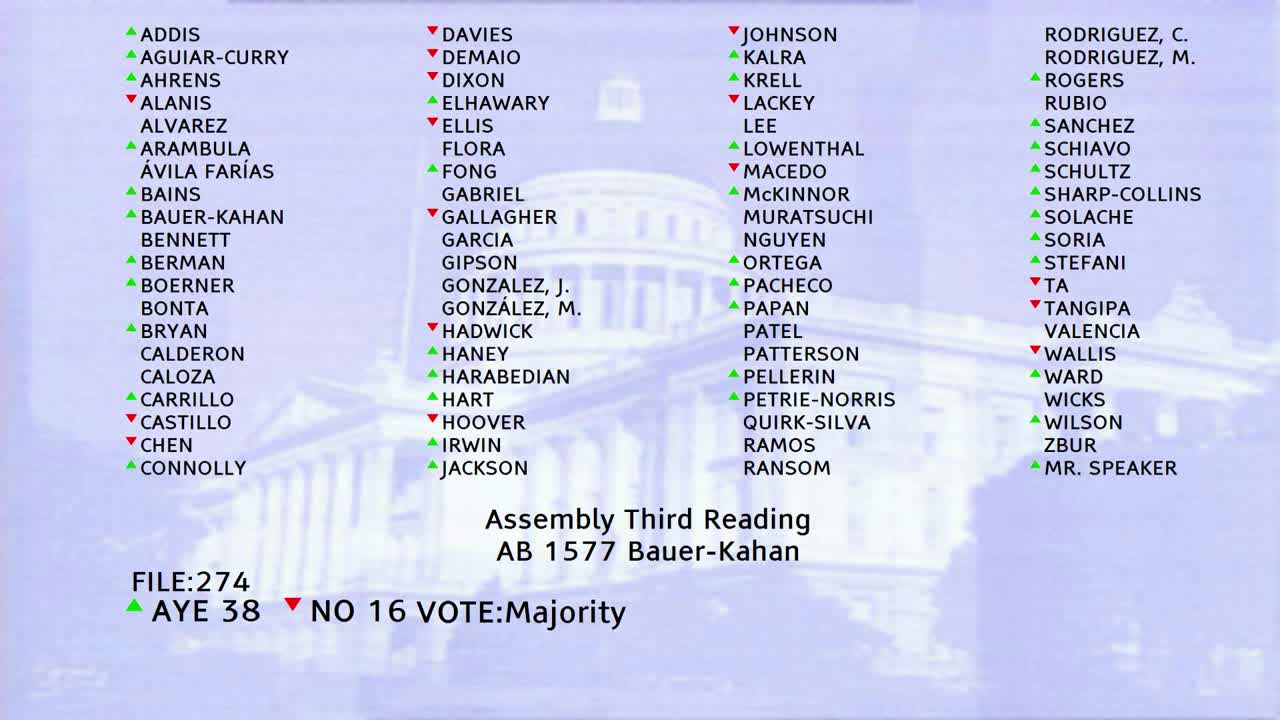 2MIN
Assembly Floor
 19MIN
Assembly Standing Committee on Environmental Safety and Toxic Materials
Bill Author

Bill Co-Author(s):