AB 1907: California Health Benefit Exchange.
- Session Year: 2025-2026
- House: Assembly
- Latest Version Date: 2026-09-14
Current Status:
Passed
(2026-09-15: Chaptered by Secretary of State - Chapter 204, Statutes of 2026.)
Introduced
In Committee
Awaiting First Chamber Vote
Passed First Chamber
In Committee
Awaiting Second Chamber Vote
Passed Second Chamber
Enacted
Existing law creates the California Health Benefit Exchange (Exchange), also known as Covered California, to facilitate the enrollment of qualified individuals and qualified small employers in qualified health plans as required under the federal Patient Protection and Affordable Care Act. Existing law requires the Exchange to enroll an individual in the lowest cost silver plan or another plan, as specified, upon receiving the individuals electronic account from an insurance affordability program. Existing law requires enrollment to occur before coverage through the insurance affordability program is terminated and prohibits the premium due date from being sooner than the last day of the first month of enrollment.
This bill would, commencing July 1, 2027, additionally authorize the Exchange to enroll an individual in the plan in which other members of the individuals household are enrolled, as specified, or the lowest cost plan available to an Indian who is eligible for specified reduced cost sharing, as determined by the Exchange, and would require the Exchange to enroll an individual in any of the plans described above upon receipt of a complete application for an insurance affordability program submitted through the Statewide Automated Welfare System. The bill would require the Exchange to enroll the individual either before coverage through the insurance affordability program is terminated as described above or upon the receipt of a complete application for an insurance affordability program through the Statewide Automated Welfare System as described above.
Existing law requires the Exchange to provide an individual who is enrolled in a plan described above with a notice that includes specified information, including a statement that services received during the first month of enrollment will only be covered by the plan if the premium is paid by the due date.
This bill would require the Exchange to provide the notice described above prior to the individuals effective date of coverage, and to provide, instead of the statement described above, instructions on how to effectuate coverage in the selected plan, including by paying the premium on or before the due date, or, if there is no premium due, instructions on how to opt into the selected plan.
Existing law, the Knox-Keene Health Care Service Plan Act of 1975, provides for the licensure and regulation of health care service plans by the Department of Managed Health Care, and makes a willful violation of the act a crime. Existing law provides for the regulation of health insurers by the Department of Insurance. Existing law requires a health care service plan or health insurer to provide an annual enrollment period for individual health benefit plans offered through the Exchange from November 1 of the preceding calendar year to January 31 of the benefit year, inclusive. Existing law specifies that the effective date of coverage for individual health benefit plans offered outside and through the Exchange be no later than January 1 of the benefit year for plan selection made from November 1 to December 31 of the preceding calendar year, inclusive, and be no later than February 1 of the benefit year for plan selection made from January 1 to January 31 of the benefit year, inclusive.
This bill would require a health care service plan or health insurer to provide the annual enrollment period and effective dates of coverage described above, except to the extent that those provisions are inconsistent with federal law, as specified. If inconsistent, the bill would require the plan or insurer to provide the annual enrollment period and effective dates of coverage required by federal law. Because a willful violation of these provisions by a health care service plan would be a crime, the bill would impose a state-mandated local program.
The California Constitution requires the state to reimburse local agencies and school districts for certain costs mandated by the state. Statutory provisions establish procedures for making that reimbursement.
This bill would provide that no reimbursement is required by this act for a specified reason.
Existing law creates the California Health Benefit Exchange (Exchange), also known as Covered California, to facilitate the enrollment of qualified individuals and qualified small employers in qualified health plans as required under the federal Patient Protection and Affordable Care Act. Existing law requires the Exchange to enroll an individual in the lowest cost silver plan or another plan, as specified, upon receiving the individuals electronic account from an insurance affordability program. Existing law requires enrollment to occur before coverage through the insurance affordability program is terminated, terminated and prohibits the premium due date from being sooner than the last day of the first month of enrollment.
This bill would, commencing July 1, 2027, additionally authorize the Exchange to enroll an individual in the plan in which other members of the individuals household are enrolled, as specified, or the lowest cost plan available to an Indian who is eligible for specified reduced cost sharing, as determined by the Exchange, and would require the Exchange to enroll an individual in any of the plans described above upon receipt of a complete application for an insurance affordability program submitted through the Statewide Automated Welfare System. The bill would require the Exchange to enroll the individual either before coverage through the insurance affordability program is terminated as described above or upon the receipt of a complete application for an insurance affordability program through the Statewide Automated Welfare System as described above.
Existing law requires the Exchange to provide an individual who is enrolled in a plan described above with a notice that includes specified information, including a statement that services received during the first month of enrollment will only be covered by the plan if the premium is paid by the due date.
This bill would require the Exchange to provide the notice described above prior to the individuals effective date of coverage, and to provide, instead of the statement described above, instructions on how to effectuate coverage in the selected plan, including by paying the premium on or before the due date, or, if there is no premium due, instructions on how to opt into the selected plan.
Existing law, the Knox-Keene Health Care Service Plan Act of 1975, provides for the licensure and regulation of health care service plans by the Department of Managed Health Care, and makes a willful violation of the act a crime. Existing law provides for the regulation of health insurers by the Department of Insurance. Existing law requires a health care service plan or health insurer to provide an annual enrollment period for individual health benefit plans offered through the Exchange from November 1 of the preceding calendar year to January 31 of the benefit year, inclusive. Existing law specifies that the effective date of coverage for individual health benefit plans offered outside and through the Exchange be no later than January 1 of the benefit year for plan selection made from November 1 to December 31 of the preceding calendar year, inclusive, and be no later than February 1 of the benefit year for plan selection made from January 1 to January 31 of the benefit year, inclusive.
This bill would require a health care service plan or health insurer to provide the annual enrollment period and effective dates of coverage described above, except to the extent that those provisions are inconsistent with federal law, as specified. If inconsistent, the bill would require the plan or insurer to provide the annual enrollment period and effective dates of coverage required by federal law. Because a willful violation of these provisions by a health care service plan would be a crime, the bill would impose a state-mandated local program.
The California Constitution requires the state to reimburse local agencies and school districts for certain costs mandated by the state. Statutory provisions establish procedures for making that reimbursement.
This bill would provide that no reimbursement is required by this act for a specified reason.
Existing law creates the California Health Benefit Exchange (Exchange), also known as Covered California, to facilitate the enrollment of qualified individuals and qualified small employers in qualified health plans as required under the federal Patient Protection and Affordable Care Act. Existing law requires the Exchange to enroll an individual in the lowest cost silver plan or another plan, as specified, upon receiving the individuals electronic account from an insurance affordability program. Existing law requires enrollment to occur before coverage through the insurance affordability program is terminated, and prohibits the premium due date from being sooner than the last day of the first month of enrollment.
This bill would, commencing July 1, 2027, additionally authorize the Exchange to enroll an individual in the plan in which other members of the individuals household are enrolled, as specified, or the lowest cost plan available to an Indian who is eligible for specified reduced cost sharing, as determined by the Exchange, and would require the Exchange to enroll an individual in any of the plans described above upon receipt of a complete application for an insurance affordability program submitted through the Statewide Automated Welfare System. The bill would require the Exchange to enroll the individual either before coverage through the insurance affordability program is terminated as described above or upon the receipt of a complete application for an insurance affordability program through the Statewide Automated Welfare System as described above.
Existing law requires the Exchange to provide an individual who is enrolled in a plan described above with a notice that includes specified information, including a statement that services received during the first month of enrollment will only be covered by the plan if the premium is paid by the due date.
This bill would require the Exchange to provide the notice described above prior to the individuals effective date of coverage, and to provide, instead of the statement described above, instructions on how to effectuate coverage in the selected plan, including by paying the premium on or before the due date, or, if there is no premium due, instructions on how to opt into the selected plan.
(a)Upon receipt of an individuals electronic account pursuant to subdivision (h) of Section 15926 of the Welfare and Institutions Code from the insurance affordability program coverage, as specified in subparagraphs (A) and (B) of paragraph (3) of subdivision (a) of Section 15926 of the Welfare and Institutions Code, the Exchange shall use the available information to enroll the individual or individuals in the lowest cost silver plan available, unless the Exchange has information from the county, State Department of Health Care Services, managed care plan, or another plan as determined by the Exchange that enables the Exchange to enroll the individual with the individuals previous managed care plan within the timeframe required by subdivision (b).
(b)Plan enrollment shall occur before the termination date of coverage through the insurance affordability program.
(c)The plans premium due date shall not be sooner than the last day of the first month of enrollment.
(d)The Exchange shall provide an individual who is enrolled in a plan pursuant to this section with a notice prior to the individuals effective date of coverage that includes all of the following information:
(1)The plan in which the individual is enrolled.
(2)The individuals right to select another available plan and any relevant deadlines for that selection.
(3)How to receive assistance to select a plan.
(4)The individuals right not to enroll in the plan.
(5)Information for an individual appealing their previous coverage through an insurance affordability program.
(6)Instructions on how to effectuate coverage in the selected plan, including, but not limited to, by paying the premium on or before the due date, or, if there is no premium due, instructions on how to opt into the selected plan.
(e)This section shall become inoperative on July 1, 2027, and, as of January 1, 2028, is repealed.
SEC. 2.Section 100503.4 is added to the Government Code, to read:100503.4.(a)Upon receipt of an individuals electronic account pursuant to subdivision (h) of Section 15926 of the Welfare and Institutions Code from the insurance affordability program coverage, as specified in subparagraphs (A) and (B) of paragraph (3) of subdivision (a) of Section 15926 of the Welfare and Institutions Code, or upon receipt of a complete application for an insurance affordability program submitted through the Statewide Automated Welfare System, the Exchange shall use the available information to enroll the individual or individuals who are determined eligible for financial assistance through the Exchange within the timeframe required by subdivision (b) in one of the following plans as determined by the Exchange:
(1)The lowest cost silver plan available.
(2)The plan in which other members of the modified adjusted gross income household, as defined in subdivision (k) of Section 100501, are enrolled.
(3)The lowest cost plan available to an Indian, as defined in Section 5304(d) of Title 25 of the United States Code, eligible for the reduced cost-sharing specified in Section 18071(d)(1) of Title 42 of the United States Code.
(4)If the Exchange has information from the county, the State Department of Health Care Services, the managed health plan, or another plan as determined by the Exchange that enables the Exchange to enroll the individual in a plan offered by the individuals previous managed care plan.
(b)Plan enrollment shall occur before the termination date of coverage through the insurance affordability program or upon the receipt of a complete application for an insurance affordability program through the Statewide Automated Welfare System.
(c)The plans premium due date shall not be sooner than the last day of the first month of enrollment.
(d)The Exchange shall provide an individual who is enrolled in a plan pursuant to this section with a notice prior to the individuals effective date of coverage that includes the following information:
(1)The plan in which the individual is enrolled.
(2)The individuals right to select another available plan and any relevant deadlines for that selection.
(3)How to receive assistance to select a plan.
(4)The individuals right not to enroll in the plan.
(5)Information for an individual appealing their previous coverage through an insurance affordability program.
(6)Instructions on how to effectuate coverage in the selected plan, including, but not limited to, by paying the premium on or before the due date, or, if there is no premium due, instructions on how to opt into the selected plan.
(e)This section shall become operative on July 1, 2027.
SEC. 3.Section 1399.848 of the Health and Safety Code is amended to read:1399.848.(a)Notwithstanding paragraph (1) of subdivision (c) of Section 1399.849, with respect to individual health benefit plans offered outside of the Exchange, a plan shall provide an annual enrollment period for policy years beginning on or after January 1, 2020, from November 1 of the preceding calendar year, to January 31 of the benefit year, inclusive.
(b)Notwithstanding paragraphs (2) and (3) of subdivision (c) of Section 1399.849, with respect to individual health benefit plans offered through the Exchange, for policy years beginning on or after January 1, 2023, a plan shall provide an annual enrollment period from November 1 of the preceding calendar year to January 31 of the benefit year, inclusive.
(c)Notwithstanding paragraph (3) of subdivision (c) of Section 1399.849, with respect to individual health benefit plans offered outside and through the Exchange, the effective date of coverage shall be as follows:
(1)No later than January 1 of the benefit year for plan selection made from November 1 to December 31 of the preceding calendar year, inclusive.
(2)No later than February 1 of the benefit year for plan selection made from January 1 to January 31 of the benefit year, inclusive.
(d)Notwithstanding subdivisions (a), (b), and (c), for policy years beginning on or after January 1, 2027, with respect to individual health benefit plans offered through or outside the Exchange, a plan shall provide the annual enrollment period and effective dates of coverage described in subdivisions (b) and (c), except to the extent that those provisions are inconsistent with Section 155.410 of Title 45 of the Code of Federal Regulations, in which case the plan shall provide the annual enrollment period and effective dates of coverage required by Section 155.410 of Title 45 of the Code of Federal Regulations.
SEC. 4.Section 10965.4 of the Insurance Code is amended to read:10965.4.(a)Notwithstanding paragraph (1) of subdivision (c) of Section 10965.3, with respect to individual health benefit plans offered outside of the Exchange, a health insurer shall provide an annual enrollment period for policy years beginning on or after January 1, 2020, from November 1 of the preceding calendar year, to January 31 of the benefit year, inclusive.
(b)Notwithstanding paragraphs (2) and (3) of subdivision (c) of Section 10965.3, with respect to individual health benefit plans offered through the Exchange, for policy years beginning on or after January 1, 2023, a health insurer shall provide an annual enrollment period from November 1 of the preceding calendar year to January 31 of the benefit year, inclusive.
(c)Notwithstanding paragraph (3) of subdivision (c) of Section 10965.3, with respect to individual health benefit plans offered outside and through the Exchange, the effective date of coverage shall be as follows:
(1)No later than January 1 of the benefit year for plan selection made from November 1 to December 31 of the preceding calendar year, inclusive.
(2)No later than February 1 of the benefit year for plan selection made from January 1 to January 31 of the benefit year, inclusive.
(d)Notwithstanding subdivisions (a), (b), and (c), for policy years beginning on or after January 1, 2027, with respect to individual health benefit plans offered through or outside the Exchange, a health insurer shall provide the annual enrollment period and effective dates of coverage described in subdivisions (b) and (c), except to the extent that those provisions are inconsistent with Section 155.410 of Title 45 of the Code of Federal Regulations, in which case the health insurer shall provide the annual enrollment period and effective dates of coverage required by Section 155.410 of Title 45 of the Code of Federal Regulations.
SEC. 5.No reimbursement is required by this act pursuant to Section 6 of Article XIIIB of the California Constitution because the only costs that may be incurred by a local agency or school district will be incurred because this act creates a new crime or infraction, eliminates a crime or infraction, or changes the penalty for a crime or infraction, within the meaning of Section 17556 of the Government Code, or changes the definition of a crime within the meaning of Section 6 of Article XIIIB of the California Constitution.
(a)Upon receipt of an individuals electronic account pursuant to subdivision (h) of Section 15926 of the Welfare and Institutions Code from the insurance affordability program coverage, as specified in subparagraphs (A) and (B) of paragraph (3) of subdivision (a) of Section 15926 of the Welfare and Institutions Code, the Exchange shall use the available information to enroll the individual or individuals in the lowest cost silver plan available, unless the Exchange has information from the county, State Department of Health Care Services, managed care plan, or another plan as determined by the Exchange that enables the Exchange to enroll the individual with the individuals previous managed care plan within the timeframe required by subdivision (b).
(b)Plan enrollment shall occur before the termination date of coverage through the insurance affordability program.
(c)The plans premium due date shall not be sooner than the last day of the first month of enrollment.
(d)The Exchange shall provide an individual who is enrolled in a plan pursuant to this section with a notice prior to the individuals effective date of coverage that includes the following information:
(1)The plan in which the individual is enrolled.
(2)The individuals right to select another available plan and any relevant deadlines for that selection.
(3)How to receive assistance to select a plan.
(4)The individuals right not to enroll in the plan.
(5)Information for an individual appealing their previous coverage through an insurance affordability program.
(6)Instructions on how to effectuate coverage in the selected plan, including, but not limited to, by paying the premium on or before the due date, or, if there is no premium due, instructions on how to opt into the selected plan.
(e)This section shall become inoperative on July 1, 2027, and, as of January 1, 2028, is repealed.
SEC. 2.Section 100503.4 is added to the Government Code, to read:100503.4.(a)Upon receipt of an individuals electronic account pursuant to subdivision (h) of Section 15926 of the Welfare and Institutions Code from the insurance affordability program coverage, as specified in subparagraphs (A) and (B) of paragraph (3) of subdivision (a) of Section 15926 of the Welfare and Institutions Code, or upon receipt of a complete application for an insurance affordability program submitted through the Statewide Automated Welfare System, the Exchange shall use the available information to enroll the individual or individuals who are determined eligible for financial assistance through the Exchange within the timeframe required by subdivision (b) in one of the following plans as determined by the Exchange:
(1)The lowest cost silver plan available.
(2)The plan in which other members of the modified adjusted gross income household, as defined in subdivision (k) of Section 100501, are enrolled.
(3)The lowest cost plan available to an Indian, as defined in Section 5304(d) of Title 25 of the United States Code, eligible for the reduced cost-sharing specified in Section 18071(d)(1) of Title 42 of the United States Code.
(4)If the Exchange has information from the county, the State Department of Health Care Services, the managed health plan, or another plan as determined by the Exchange that enables the Exchange to enroll the individual in a plan offered by the individuals previous managed care plan.
(b)Plan enrollment shall occur before the termination date of coverage through the insurance affordability program or upon the receipt of a complete application for an insurance affordability program through the Statewide Automated Welfare System.
(c)The plans premium due date shall not be sooner than the last day of the first month of enrollment.
(d)The Exchange shall provide an individual who is enrolled in a plan pursuant to this section with a notice prior to the individuals effective date of coverage that includes the following information:
(1)The plan in which the individual is enrolled.
(2)The individuals right to select another available plan and any relevant deadlines for that selection.
(3)How to receive assistance to select a plan.
(4)The individuals right not to enroll in the plan.
(5)Information for an individual appealing their previous coverage through an insurance affordability program.
(6)Instructions on how to effectuate coverage in the selected plan, including, but not limited to, by paying the premium on or before the due date, or, if there is no premium due, instructions on how to opt into the selected plan.
(e)This section shall become operative on July 1, 2027.
SEC. 3.Section 1399.848 of the Health and Safety Code is amended to read:1399.848.(a)Notwithstanding paragraph (1) of subdivision (c) of Section 1399.849, with respect to individual health benefit plans offered outside of the Exchange, a plan shall provide an annual enrollment period for policy years beginning on or after January 1, 2020, from November 1 of the preceding calendar year, to January 31 of the benefit year, inclusive.
(b)Notwithstanding paragraphs (2) and (3) of subdivision (c) of Section 1399.849, with respect to individual health benefit plans offered through the Exchange, for policy years beginning on or after January 1, 2023, a plan shall provide an annual enrollment period from November 1 of the preceding calendar year to January 31 of the benefit year, inclusive.
(c)Notwithstanding paragraph (3) of subdivision (c) of Section 1399.849, with respect to individual health benefit plans offered outside and through the Exchange, the effective date of coverage shall be as follows:
(1)No later than January 1 of the benefit year for plan selection made from November 1 to December 31 of the preceding calendar year, inclusive.
(2)No later than February 1 of the benefit year for plan selection made from January 1 to January 31 of the benefit year, inclusive.
(d)Notwithstanding subdivisions (a), (b), and (c), for policy years beginning on or after January 1, 2027, with respect to individual health benefit plans offered through or outside the Exchange, a plan shall provide the annual enrollment period and effective dates of coverage described in subdivisions (b) and (c), except to the extent that those provisions are inconsistent with Section 155.410 of Title 45 of the Code of Federal Regulations, in which case the plan shall provide the annual enrollment period and effective dates of coverage required by Section 155.410 of Title 45 of the Code of Federal Regulations.
SEC. 4.Section 10965.4 of the Insurance Code is amended to read:10965.4.(a)Notwithstanding paragraph (1) of subdivision (c) of Section 10965.3, with respect to individual health benefit plans offered outside of the Exchange, a health insurer shall provide an annual enrollment period for policy years beginning on or after January 1, 2020, from November 1 of the preceding calendar year, to January 31 of the benefit year, inclusive.
(b)Notwithstanding paragraphs (2) and (3) of subdivision (c) of Section 10965.3, with respect to individual health benefit plans offered through the Exchange, for policy years beginning on or after January 1, 2023, a health insurer shall provide an annual enrollment period from November 1 of the preceding calendar year to January 31 of the benefit year, inclusive.
(c)Notwithstanding paragraph (3) of subdivision (c) of Section 10965.3, with respect to individual health benefit plans offered outside and through the Exchange, the effective date of coverage shall be as follows:
(1)No later than January 1 of the benefit year for plan selection made from November 1 to December 31 of the preceding calendar year, inclusive.
(2)No later than February 1 of the benefit year for plan selection made from January 1 to January 31 of the benefit year, inclusive.
(d)Notwithstanding subdivisions (a), (b), and (c), for policy years beginning on or after January 1, 2027, with respect to individual health benefit plans offered through or outside the Exchange, a health insurer shall provide the annual enrollment period and effective dates of coverage described in subdivisions (b) and (c), except to the extent that those provisions are inconsistent with Section 155.410 of Title 45 of the Code of Federal Regulations, in which case the health insurer shall provide the annual enrollment period and effective dates of coverage required by Section 155.410 of Title 45 of the Code of Federal Regulations.
SEC. 5.No reimbursement is required by this act pursuant to Section 6 of Article XIIIB of the California Constitution because the only costs that may be incurred by a local agency or school district will be incurred because this act creates a new crime or infraction, eliminates a crime or infraction, or changes the penalty for a crime or infraction, within the meaning of Section 17556 of the Government Code, or changes the definition of a crime within the meaning of Section 6 of Article XIIIB of the California Constitution.
(a)Upon receipt of an individuals electronic account pursuant to subdivision (h) of Section 15926 of the Welfare and Institutions Code from the insurance affordability program coverage, as specified in subparagraphs (A) and (B) of paragraph (3) of subdivision (a) of Section 15926 of the Welfare and Institutions Code, the Exchange shall use the available information to enroll the individual or individuals in the lowest cost silver plan available, unless the Exchange has information from the county, State Department of Health Care Services, managed care plan, or another plan as determined by the Exchange that enables the Exchange to enroll the individual with the individuals previous managed care plan within the timeframe required by subdivision (b).
(b)Plan enrollment shall occur before the termination date of coverage through the insurance affordability program.
(c)The plans premium due date shall be no not be sooner than the last day of the first month of enrollment.
(d)The Exchange shall provide an individual who is enrolled in a plan pursuant to this section with a notice prior to the individuals effective date of coverage that includes the following information:
(1)The plan in which the individual is enrolled.
(2)The individuals right to select another available plan and any relevant deadlines for that selection.
(3)How to receive assistance to select a plan.
(4)The individuals right not to enroll in the plan.
(5)Information for an individual appealing their previous coverage through an insurance affordability program.
(6)A statement that services received during the first month of enrollment will only be covered by the plan if the premium is paid by the due date. Instructions on how to effectuate coverage in the selected plan, including, but not limited to, by paying the premium on or before the due date, or, if there is no premium due, instructions on how to opt into the selected plan.
(e)This section shall be implemented no later than July 1, 2021. become inoperative on July 1, 2027, and, as of January 1, 2028, is repealed.
SEC. 2.Section 100503.4 is added to the Government Code, to read:100503.4.(a)Upon receipt of an individuals electronic account pursuant to subdivision (h) of Section 15926 of the Welfare and Institutions Code from the insurance affordability program coverage, as specified in subparagraphs (A) and (B) of paragraph (3) of subdivision (a) of Section 15926 of the Welfare and Institutions Code, or upon receipt of a complete application for an insurance affordability program submitted through the Statewide Automated Welfare System, the Exchange shall use the available information to enroll the individual or individuals who are determined eligible for financial assistance through the Exchange within the timeframe required by subdivision (b) in one of the following plans as determined by the Exchange:
(1)The lowest cost silver plan available.
(2)The plan in which other members of the modified adjusted gross income household, as defined in subdivision (k) of Section 100501, are enrolled.
(3)The lowest cost plan available to an Indian, as defined in Section 5304(d) of Title 25 of the United States Code, eligible for the reduced cost-sharing specified in Section 18071(d)(1) of Title 42 of the United States Code.
(4)If the Exchange has information from the county, the State Department of Health Care Services, the managed health plan, or another plan as determined by the Exchange that enables the Exchange to enroll the individual in a plan offered by the individuals previous managed care plan.
(b)Plan enrollment shall occur before the termination date of coverage through the insurance affordability program or upon the receipt of a complete application for an insurance affordability program through the Statewide Automated Welfare System.
(c)The plans premium due date shall not be sooner than the last day of the first month of enrollment.
(d)The Exchange shall provide an individual who is enrolled in a plan pursuant to this section with a notice prior to the individuals effective date of coverage that includes the following information:
(1)The plan in which the individual is enrolled.
(2)The individuals right to select another available plan and any relevant deadlines for that selection.
(3)How to receive assistance to select a plan.
(4)The individuals right not to enroll in the plan.
(5)Information for an individual appealing their previous coverage through an insurance affordability program.
(6)Instructions on how to effectuate coverage in the selected plan, including, but not limited to, by paying the premium on or before the due date, or, if there is no premium due, instructions on how to opt into the selected plan.
(e)This section shall become operative on July 1, 2027.
|
Date
|
Status
|
|---|---|
| Sep 15, 2026 | Chaptered by Secretary of State - Chapter 204, Statutes of 2026. |
| Sep 15, 2026 | Approved by the Governor. |
| Sep 14, 2026 | Chaptered by Secretary of State - Chapter 204, Statutes of 2026. |
| Sep 14, 2026 | Approved by the Governor. |
| Sep 8, 2026 | Enrolled and presented to the Governor at 3:30 p.m. |
| Aug 28, 2026 | Senate amendments concurred in. To Engrossing and Enrolling. (Ayes 78. Noes 0. Page 6800.). |
| Aug 28, 2026 | Senate amendments concurred in. To Engrossing and Enrolling. (Ayes 78. Noes 0.). |
| Aug 27, 2026 | In Assembly. Concurrence in Senate amendments pending. |
| Aug 27, 2026 | Read third time. Passed. Ordered to the Assembly. (Ayes 39. Noes 0. Page 5984.). |
| Aug 27, 2026 | Read third time. Passed. Ordered to the Assembly. (Ayes 39. Noes 0.). |
| Aug 25, 2026 | Ordered to special consent calendar. |
| Aug 17, 2026 | Read second time. Ordered to third reading. |
| Aug 13, 2026 | Read second time and amended. Ordered returned to second reading. |
| Aug 13, 2026 | From committee: Amend, and do pass as amended. (Ayes 7. Noes 0.) (August 13). |
| Jun 29, 2026 | In committee: Referred to APPR. suspense file. |
| Jun 18, 2026 | From committee: Do pass and re-refer to Com. on APPR. with recommendation: To Consent Calendar. (Ayes 11. Noes 0.) (June 17). Re-referred to Com. on APPR. |
| Jun 9, 2026 | From committee chair, with author's amendments: Amend, and re-refer to committee. Read second time, amended, and re-referred to Com. on HEALTH. |
| Jun 3, 2026 | Referred to Com. on HEALTH. |
| May 21, 2026 | In Senate. Read first time. To Com. on RLS. for assignment. |
| May 21, 2026 | Read third time. Passed. Ordered to the Senate. (Ayes 74. Noes 0. Page 5203.) |
| May 21, 2026 | Read third time. Passed. Ordered to the Senate. (Ayes 74. Noes 0.) |
| May 18, 2026 | Read second time. Ordered to third reading. |
| May 14, 2026 | From committee: Do pass. (Ayes 15. Noes 0.) (May 14). |
| Apr 8, 2026 | In committee: Set, first hearing. Referred to APPR. suspense file. |
| Mar 18, 2026 | From committee: Do pass and re-refer to Com. on APPR. with recommendation: To Consent Calendar. (Ayes 16. Noes 0.) (March 17). Re-referred to Com. on APPR. |
| Mar 2, 2026 | Referred to Com. on HEALTH. |
| Feb 13, 2026 | From printer. May be heard in committee March 15. |
| Feb 12, 2026 | Read first time. To print. |
|
Date
|
Description
|
Location
|
Votes
|
|
|---|---|---|---|---|
| Aug 28, 2026 | AB 1907 Addis Concurrence in Senate Amendments | Assembly Floor |
Passed |
|
| Aug 27, 2026 | Special Consent AB1907 Addis et al. By Durazo | Senate Floor |
Passed |
|
| Aug 13, 2026 | Do pass as amended | Senate Standing Committee on Appropriations |
Passed |
|
| Jun 29, 2026 | Placed on suspense file | Senate Standing Committee on Appropriations |
Passed |
|
| Jun 17, 2026 | Do pass, but first be re-referred to the Committee on [Appropriations] with the recommendation: To Consent Calendar | Senate Standing Committee on Health |
Passed |
|
| May 21, 2026 | AB 1907 Addis Assembly Third Reading | Assembly Floor |
Passed |
|
| May 14, 2026 | Do pass. | Assembly Standing Committee on Appropriations |
Passed |
|
| Mar 17, 2026 | Do pass and be re-referred to the Committee on [Appropriations] with recommendation: To Consent Calendar | Assembly Standing Committee on Health |
Passed |
This list shows positions taken on this bill by organizations on the date displayed, which is linked to the original source.
Positions by individuals are not included.
|
Organization
|
Position
|
Date
|
|---|---|---|
| California Academy Of Family Physicians | ** Support | |
| California Association Of Medical Product Suppliers | ** Support | |
| California Behavioral Health Association | ** Support | |
| California Pan - Ethnic Health Network | ** Support | |
| CALIFORNIA PRIMARY CARE ASSOCIATION ADVOCATES | ** Support | |
| Health Access California | ** Support | |
| Local Health Plans Of California | ** Support | |
| Los Angeles Care Health Plan | ** Support | |
| Los Angeles LGBT Center | ** Support | |
| Sharp Healthcare | ** Support | |
| western center on law and poverty | ** Support |
CONCURRENCE IN SENATE AMENDMENTS
CSA1 Bill Id:AB 1907
Author:(Addis)
As Amended Ver:August 13, 2026
Majority vote
SUMMARY
Expands an existing streamlined Covered California enrollment process from Medi-Cal to allow a complete application for an insurance affordability program submitted through the Statewide Automated Welfare System (SAWS) to be used to enroll individuals who are determined eligible for financial assistance through Covered California into specified health insurance plans.
Senate Amendments
Change the annual open enrollment period and effective dates for policy years beginning January 1, 2027 to conform with new federal rules, to the extent those federal rules are inconsistent with California′s statutory annual open enrollment and effective dates.
COMMENTS
Medi-Cal and Covered California. Medi-Cal provides free or low-cost health coverage to adults with incomes up to 138% of the federal poverty level (FPL), and to children with family incomes up to 266% of the FPL. People with certain legal immigration status and incomes above those limits can get financial help to buy health insurance through Covered California. Under the Patient Protection and Affordable Care Act (ACA), people earning up to 400% of the FPL can receive help paying for their health insurance premiums. Those earning up to 250% of the FPL can also get help with out-of-pocket costs.
Every month, thousands of Californians are found eligible for either Medi-Cal or subsidized coverage through Covered California, typically through one of two on-line enrollment systems. The California Healthcare Eligibility, Enrollment, and Retention System (CalHEERS) is the state′s centralized, automated system used to determine eligibility for and enroll Californians in insurance affordability programs (Medi-Cal and Covered California). SAWS is the county system for determining and managing eligibility and benefits for various public assistance programs at the county level, including Medi-Cal, CalFresh and CalWORKS.
Redeterminations & enrollment. People applying for insurance affordability programs must have their eligibility determined upon application and once every year, a process known as ″redetermination.″ When people have a change in income or family size, they may move from Medi-Cal to Covered California (for example, if they had an increase in income above the Medi-Cal income eligibility threshold) or from Covered California to Medi-Cal (if they had a decrease in income to below the Medi-Cal income thresholds).
California created a streamlined automated system to help people move from one insurance affordability program to another through SB 260 (Hurtado), Chapter 845, Statutes of 2019. SB 260 set up automatic enrollment for people who lose Medi-Cal eligibility and instead qualify for Covered California. These individuals are placed into the lowest-cost silver plan available, or into a Covered California plan that matches their previous Medi-Cal plan.
As part of this process, consumers receive a notice when they are disenrolled from Medi-Cal and auto-enrolled in a Covered California plan. This eligibility notice is provided before the effective date of their new coverage, and provides information for consumers on why they are receiving the notice, what options they have, and how to get help. Since this program started in 2023, over 200,000 people have been automatically enrolled into Covered California coverage.
This bill would extend the provisions of SB 260 to include new applicants found eligible through SAWS, the county eligibility system. Currently, people who apply for health coverage through SAWS and are found income eligible for Covered California receive a notice from SAWS and another from Covered California telling them of their eligibility for coverage through Covered California, the amount of their premium tax credit and the date by which the person needs to pick a plan. This can result in consumer confusion because this group of people did not apply to Covered California, and they may be unaware of what Covered California is or does. In addition, these individuals must take an extra step of using CalHEERS to choose a health plan, because SAWS does not have a health plan selection option for plans offered through Covered California. This bill would simplify the Covered California plan selection process, reduce confusion, and help more Californians get insured faster. Covered California estimates that more than 100,000 people each year could benefit from this change to make it easier for eligible individuals to access affordable, quality health care.
According to the Author
In recent years the introduction of auto-enrollment greatly boosted California′s mission to ensure total health coverage for its residents. The author continues that despite this progress, changes in healthcare at the federal level will cause up to 3.4 million Californians to lose coverage. The author argues that this bill will help connect people with affordable coverage plans based on the information they have already submitted, thus streamlining the process and reducing gaps in coverage. The author concludes that this bill is the next step towards ensuring that no Californian falls through the cracks when it comes to obtaining and maintaining not just the health care they can afford, but the health care they deserve.
Arguments in Support
The Western Center on Law and Poverty (Western Center) supports this bill, writing that since the implementation of the ACA in California, advocates and policymakers have envisioned a unified eligibility system across different insurance affordability programs, including Medi-Cal and Covered California. This system was based on a ″no-wrong door″ principle: no matter where a consumer applied, their eligibility should be determined for the most advantageous program available to that consumer. Western Center continues that while this vision has largely been realized for consumers applying for health coverage, this bill would streamline the process for consumers who newly apply for coverage through counties but are determined ineligible for Medi-Cal. Western Center states that rather than going through the existing SB 260 auto-enrollment process, these consumers must navigate a variety of discrete steps to enroll. They receive a notice informing them of their Covered California eligibility along with a deadline to pick a Covered California plan. They must then engage with our enrollment portal to create or log into an account and then enter the plan selection process. Western Center concludes that this bill would minimize the steps a consumer must take to obtain health coverage, by following the existing SB 260 auto-enrollment process that requires consumers to take affirmative action to effectuate health coverage.
Arguments in Opposition
None on file.
FISCAL COMMENTS
According to the Senate Appropriations Committee, Covered California estimates costs of approximately $500,000 (California Health Trust Fund) in CalHEERS-related costs for the system modifications necessary to support the expansion of the auto-enrollment program. In addition, Covered California anticipates minimal expenditures associated with marketing and communications efforts to educate newly auto enrolled consumers.
VOTES:
ASM HEALTH: 16-0-0
YES: Bonta, Chen, Addis, Aguiar-Curry, Ahrens, Caloza, Carrillo, Mark González, Johnson, Patel, Patterson, Rogers, Sanchez, Schiavo, Sharp-Collins, Stefani
ASM APPROPRIATIONS: 15-0-0
YES: Wicks, Hoover, Aguiar-Curry, Calderon, Caloza, Dixon, Fong, Mark González, Krell, Pacheco, Pellerin, Sharp-Collins, Solache, Ta, Tangipa
ASSEMBLY FLOOR: 74-0-6
YES: Addis, Aguiar-Curry, Ahrens, Alanis, Alvarez, Ávila Farías, Bains, Bauer-Kahan, Bennett, Berman, Boerner, Bonta, Bryan, Calderon, Caloza, Carrillo, Castillo, Connolly, Davies, DeMaio, Dixon, Elhawary, Ellis, Flora, Fong, Gabriel, Gallagher, Gipson, Jeff Gonzalez, Mark González, Hadwick, Haney, Harabedian, Hart, Hoover, Irwin, Jackson, Johnson, Kalra, Krell, Lee, Lowenthal, Macedo, McKinnor, Muratsuchi, Nguyen, Ortega, Pacheco, Papan, Patel, Patterson, Pellerin, Petrie-Norris, Quirk-Silva, Ransom, Michelle Rodriguez, Rogers, Blanca Rubio, Sanchez, Schiavo, Schultz, Sharp-Collins, Solache, Soria, Stefani, Ta, Tangipa, Valencia, Wallis, Ward, Wicks, Wilson, Zbur, Rivas
ABS, ABST OR NV: Arambula, Chen, Garcia, Lackey, Ramos, Celeste Rodriguez
UPDATED
VERSION: August 13, 2026
CONSULTANT: Riana King / HEALTH / (916) 319-2097 FN: 0004113
SENATE RULES COMMITTEE Office of Senate Floor Analyses (916) 651-4171 | AB 1907 |
THIRD READING
Bill No: AB 1907
Author: Addis (D), et al.
Amended: 8/13/26 in Senate
Vote: 21
SENATE HEALTH COMMITTEE: 11-0, 6/17/26
AYES: Weber Pierson, Valladares, Caballero, Durazo, Gonzalez, Grove, Menjivar, Padilla, Pérez, Rubio, Smallwood-Cuevas
SENATE APPROPRIATIONS COMMITTEE: 7-0, 8/13/26
AYES: Cervantes, Seyarto, Cabaldon, Dahle, Grayson, Richardson, Wahab
ASSEMBLY FLOOR: 74-0, 5/21/26 - See last page for vote
SUBJECT: California Health Benefit Exchange
SOURCE: Author
DIGEST:
This bill expands automatic enrollment from Medi-Cal to Covered California by also allowing people who apply for insurance affordability programs through the Statewide Automated Welfare System and who are eligible for financial assistance to be notified of requirements and be enrolled in specified low-cost health insurance plans as determined by Covered California. Revises open enrollment and effective dates if inconsistent with federal law.
ANALYSIS:
Existing law:
- Establishes the Medi-Cal program, administered by the Department of Health Care Services (DHCS), under which qualified low-income individuals are eligible for medical coverage. [Welfare & Institutions Code (WIC) §14000, et seq.]
- Establishes Covered California as an independent entity in state government, not affiliated with any state agency or department, governed by a five-member board. Requires Covered California to establish and use a competitive process to select qualified health plans (QHPs) and other contractors. [Government Code (GOV) §100500 -100522]
- Requires, for individuals determined ineligible for Medi-Cal, a county to determine eligibility for other insurance affordability programs and if the individual is found to be eligible, transfer the individual’s electronic account to other insurance affordability programs via a secure electronic interface. This electronic interface is known as the California Healthcare Eligibility, Enrollment and Retention System (CalHEERS). [WIC §14005.37]
- Requires an entity making eligibility determinations for an insurance affordability program, during the processing of an application, renewal, or a transition due to a change in circumstances, to ensure that an eligible applicant, who meets all program eligibility requirements and complies with all necessary requests for information, moves between programs without any breaks in coverage and without being required to provide duplicative information or verification. Requires the individual to be informed about how to obtain information about the status of their application, renewal, or transfer to another program at any time, and that the information must be provided promptly when requested. [WIC §15926]
- Requires Covered California, upon receipt of an individual’s information from the insurance affordability program, to use the available information to enroll the individual or individuals in the lowest cost silver plan available, unless it has information from the county, DHCS, managed care plan, or another plan, that enables it to enroll the individual with their previous managed care plan before the termination date of coverage through the insurance affordability program. [GOV §100503.4]
- Requires Covered California to provide an individual, who is enrolled pursuant to 6) above, a notice that includes the plan information, the individual’s right to select another plan and deadlines for that selection, how to receive assistance to select a plan, the individual’s right not to enroll, information on appealing their previous coverage through an insurance affordability program, and, a statement that services during the first month of enrollment will only be covered if the premium is paid by the due date. [GOV §100503.4]
This bill:
- Makes existing law, which requires Covered California to enroll people no longer eligible for Medi-Cal into the lowest cost silver plan, inoperative on July 1, 2027, and replaces it with 2) through 4) below.
- Requires, commencing July 1, 2027, Covered California, upon receipt of an individual’s electronic account, as specified, or upon receipt of a complete application for an insurance affordability program submitted through the Statewide Automated Welfare System (SAWS), to use the available information to enroll the individual or individuals determined eligible for financial assistance within required timelines in one of the following:
- The lowest silver plan available;
- The plan in which other members of the modified adjusted gross income household are enrolled;
- The lowest cost plan available to an Indian, as defined, eligible for the reduced cost-sharing specified in federal law; or,
- If Covered California has information from the County, DHCS, the managed care plan, or another plan as determined by Covered California, Covered California to enroll the individual in a plan offered by the individual’s previous managed care plan.
- Requires plan enrollment to occur before the termination date of coverage through the insurance affordability program or upon receipt of the complete application for an insurance affordability program through SAWS.
- Requires Covered California to provide an individual who is enrolled in a plan pursuant to this bill with a notice prior to the individual’s effective date of coverage that includes specified information, such as: the plan in which the individual is enrolled; the right to select another available plan and relevant deadlines; how to receive assistance selecting a plan; the right not enroll in a plan; information about appealing their previous coverage; and, instructions on how to effectuate coverage and premium payment deadlines.
- Changes the annual open enrollment period and effective dates for policy years beginning January 1, 2027; to be consistent with specified federal rules to the extent those federal rules are inconsistent with California annual open enrollment and effective dates.
Comments
According to the author of this bill: “In recent years, the introduction of auto-enrollment greatly boosted California’s mission to ensure total health coverage for its residents. Despite this progress, changes in healthcare at the federal level will cause up to 3.4 million Californians to lose coverage. This bill will help connect people with affordable coverage plans based on the information they have already submitted, thus streamlining the process and reducing gaps in coverage. This bill is the next step towards ensuring that no Californian falls through the cracks when it comes to obtaining and maintaining not just the health care they can afford, but the health care they deserve.”
Background
Auto enrollment. California’s insurance affordability programs have implemented several automated enrollment systems to assist a consumer to streamline the process of moving from one program to another. SB 260 (Hurtado, Chapter 845, Statutes of 2019) created automatic plan selection for subsidized Covered California coverage. Through SB 260, Covered California automatically assigns a health plan to a consumer who loses Medi-Cal coverage and gains eligibility for subsidized Covered California coverage. The consumer is then enrolled in the lowest cost silver plan available. When possible, a consumer may be automatically enrolled in the same health insurance plan as their previous Medi-Cal managed care plan to maintain continuity of coverage and care. Records indicate that since this program was implemented in 2023, more than 200,000 consumers have been successfully auto enrolled into Covered California health coverage. Covered California reports that among those who enrolled, 70% kept the default plan and close to 90% remained in the silver coverage tier. More than three-quarters of consumers who transitioned to Covered California did so without a gap in coverage. More than two-thirds of those who transitioned were from communities of color and close to 20% were Spanish-speakers. Lastly, 80% found the sign-up process easy.
Federal policy changes. Recently approved federal marketplace integrity regulations and budget reconciliation legislation will have an impact on Covered California enrollment for eligible individuals with the imposition of onerous eligibility verification processes and the elimination of annual automatic renewal processes. Covered California indicates for the 2025 coverage year, about 73% of enrollees (1.2 million people) automatically renewed coverage. Covered California indicates the 2025 Marketplace Integrity and Affordability Final Rule does not affect the SB 260 auto-enrollment process nor would it impact the process proposed in this bill. Covered California is reviewing the budget reconciliation bill to evaluate its potential effects on existing programs but does not foresee any immediate impact on this bill.
Open enrollment and effective dates. The open enrollment period for the individual market, including coverage offered both through and outside the Affordable Care Act exchanges, is governed by federal regulations. Previously, the federal regulations required the annual open enrollment period to begin on November 1 of the calendar year preceding the benefit year and extend through January 15 of the benefit year, although a state exchange could adopt a later end date after January 15. The federal final Marketplace Integrity and Affordability Rule, issued on June 25, 2025, changed the open enrollment period dates for benefit years beginning on or after January 1, 2027. Under the amended federal regulations, all exchanges must begin the annual open enrollment period no later than November 1 and end it no later than December 31 of the calendar year preceding the benefit year, and the period may not exceed nine weeks in duration. For those same benefit years, coverage must be effective January 1 for plan selections received on or before December 31 of the preceding calendar year. However, this policy is currently the subject of two federal lawsuits, including one brought by a multistate coalition that includes California. On June 12th in the City of Columbus v. Kennedy, a U.S. District Court vacated the shortened annual open enrollment period for the 2027 plan year. With this ruling, Covered California will maintain a full three-month open enrollment period starting November 1 through January 31.
FISCAL EFFECT: Appropriation: No Fiscal Com.: Yes Local: Yes
According to the Senate Appropriations Committee, Covered California estimates costs of approximately $500,000 (California Health Trust Fund) in CalHEERS-related costs for the system modifications necessary to support the expansion of the auto-enrollment program. In addition, Covered California anticipates minimal expenditures associated with marketing and communications efforts to educate newly auto enrolled consumers.
Unknown costs, likely minor, for DMHC for state administration (Managed Care Fund).
CDI indicates no fiscal impact for state administration.
SUPPORT: (Verified 8/14/26)
California Academy of Family Physicians
California Association of Medical Product Suppliers
California Behavioral Health Association
California Pan - Ethnic Health Network
California Primary Care Association Advocates
Health Access California
Local Health Plans of California
Los Angeles Care Health Plan
Los Angeles LGBT Center
SHARP Healthcare
Western Center on Law & Poverty, Inc.
OPPOSITION: (Verified 8/14/26)
None received
ARGUMENTS IN SUPPORT: Health Access California writes this bill will help enroll more people into affordable Covered California plans by expanding the auto enrollment process to include not only people who are losing Medi-Cal coverage but also those who apply but do not qualify for Medi-Cal. Health Access indicates Covered California is the only place where Californians who qualify can get financial assistance on a sliding scale to reduce premium costs. The Local Health Plans of California (LHPC) write that this bill allows for enrollment not only in the lowest cost silver plan but also into plans that better reflect family alignment or enhanced cost-sharing options. Additionally, LHPC writes this bill also strengthens notice requirements by ensuring enrollees receive clear, actionable instructions prior to coverage taking effect, including how to activate coverage through premium payment or opt-in steps. The California Pan-Ethnic Health Network writes that extra steps can create confusion and uncertainty which can be a barrier for some consumers and believes this bill will help enroll more people into affordable health coverage.
ASSEMBLY FLOOR: 74-0, 5/21/26
AYES: Addis, Aguiar-Curry, Ahrens, Alanis, Alvarez, Ávila Farías, Bains, Bauer-Kahan, Bennett, Berman, Boerner, Bonta, Bryan, Calderon, Caloza, Carrillo, Castillo, Connolly, Davies, DeMaio, Dixon, Elhawary, Ellis, Flora, Fong, Gabriel, Gallagher, Gipson, Jeff Gonzalez, Mark González, Hadwick, Haney, Harabedian, Hart, Hoover, Irwin, Jackson, Johnson, Kalra, Krell, Lee, Lowenthal, Macedo, McKinnor, Muratsuchi, Nguyen, Ortega, Pacheco, Papan, Patel, Patterson, Pellerin, Petrie-Norris, Quirk-Silva, Ransom, Michelle Rodriguez, Rogers, Blanca Rubio, Sanchez, Schiavo, Schultz, Sharp-Collins, Solache, Soria, Stefani, Ta, Tangipa, Valencia, Wallis, Ward, Wicks, Wilson, Zbur, Rivas
NO VOTE RECORDED: Arambula, Chen, Garcia, Lackey, Ramos, Celeste Rodriguez
Prepared by: Teri Boughton / HEALTH / (916) 651-4111
8/17/26 10:43:01
**** END ****
SENATE COMMITTEE ON
Senator Sabrina Cervantes, Chair
2025 - 2026 Regular Session
AB 1907 (Addis) - California Health Benefit Exchange
Version: | Policy Vote: |
Urgency: | Mandate: |
Hearing Date: | Consultant: |
Bill Summary:
AB 1907 would expand an existing Covered California auto-enrollment process, as specified.
*********** ANALYSIS ADDENDUM – SUSPENSE FILE ***********
The following information is revised to reflect amendments
adopted by the committee on August 13, 2026
Fiscal Impact:
- Covered California estimates costs of approximately $500,000 (California Health Trust Fund) in CalHEERS-related costs for the system modifications necessary to support the expansion of the auto-enrollment program. In addition, Covered California anticipates minimal expenditures associated with marketing and communications efforts to educate newly auto enrolled consumers.
- Unknown costs, likely minor, for the Department of Managed Health Care (DMHC) for state administration (Managed Care Fund).
- The California Department of Insurance (CDI) indicates no fiscal impact for state administration.
Committee Amendments:
Add a co-author.
-- END --
SENATE COMMITTEE ON
Senator Sabrina Cervantes, Chair
2025 - 2026 Regular Session
AB 1907 (Addis) - California Health Benefit Exchange
Version: | Policy Vote: |
Urgency: | Mandate: |
Hearing Date: | Consultant: |
Bill Summary:
AB 1907 would expand an existing Covered California auto-enrollment process, as specified.
Fiscal Impact:
- Covered California estimates costs of approximately $500,000 (California Health Trust Fund) in CalHEERS-related costs for the system modifications necessary to support the expansion of the auto-enrollment program. In addition, Covered California anticipates minimal expenditures associated with marketing and communications efforts to educate newly auto enrolled consumers.
- Unknown costs, likely minor, for the Department of Managed Health Care (DMHC) for state administration (Managed Care Fund).
- The California Department of Insurance (CDI) indicates no fiscal impact for state administration.
Background:
Covered California Automatic Enrollment. Current law establishes Covered California which uses a competitive process to select participating carriers and other contractors, to make health insurance available to individuals and small businesses through qualified health plans as authorized under the federal Affordable Care Act (ACA). The Medi-Cal program provides health coverage to low-income Californians.
CalHEERS is the state’s centralized, automated system used to determine eligibility for and enroll Californians in Medi-Cal or Covered California. The Statewide Automated Welfare System (CalSAWS) is the county system for determining and managing eligibility and benefits for various public assistance programs at the county level, including Medi-Cal, CalFresh and CalWORKs.
A change in income or family size may change eligibility and trigger a move from Medi-Cal to Covered California. Current law establishes an automatic enrollment process for a person who loses Medi-Cal eligibility and instead qualifies for Covered California. Such an individual receives a notice when they are disenrolled from Medi-Cal and is auto-enrolled in Covered California in the lowest-cost silver plan available, or a plan that matches their previous Medi-Cal plan.
Open Enrollment in the Individual Market. Federal regulations govern the open enrollment period for the individual market. Under federal regulations updated in 2025, Covered California must begin the annual open enrollment period no later than November 1 and end no later than December 31 of the calendar year preceding the benefit year. However, this policy is currently the subject of two federal lawsuits, including one brought by a multistate coalition that includes California. State law requires health plans and insurers to provide an annual enrollment period for individual market health coverage from November 1 of the preceding calendar year to January 31 of the benefit year.
Proposed Law:
Specific provisions of the bill would:
- Expand the existing Covered California auto-enrollment process for individuals to include individuals who have submitted health coverage applications through CalSAWS but are found ineligible for Medi-Cal.
- Require health plans and insurers to provide, to the extent that existing state law provisions are inconsistent with federal regulations, the annual enrollment period in the individual market and effective dates of coverage required by federal regulations.
Related Legislation:
AB 1419 (Addis, 2025) included similar provisions related to the Covered California auto-enrollment process. The bill was held on the suspense file in this committee.
-- END --
SENATE COMMITTEE ON HEALTH
Senator Akilah Weber Pierson, Chair
BILL NO: AB 1907
AUTHOR: | Addis | ||
VERSION: | June 9, 2026 | ||
HEARING DATE: | June 17, 2026 | ||
CONSULTANT: | Teri Boughton | ||
SUBJECT: California Health Benefit Exchange
SUMMARY:
Expands automatic enrollment from Medi-Cal to Covered California by also allowing people who apply for insurance affordability programs through the Statewide Automated Welfare System and who are eligible for financial assistance to be notified of requirements and be enrolled in specified low-cost health insurance plans as determined by Covered California. Revises open enrollment and effective dates if inconsistent with federal law.
Existing law:
- Establishes the Medi-Cal program, administered by the Department of Health Care Services (DHCS), under which qualified low-income individuals are eligible for medical coverage. [WIC §14000, et seq.]
- Establishes Covered California as an independent entity in state government, not affiliated with any state agency or department, governed by a five-member board. Requires Covered California to establish and use a competitive process to select qualified health plans (QHPs) and other contractors. [GOV §100500 -100522]
- Requires, for individuals determined ineligible for Medi-Cal, a county to determine eligibility for other insurance affordability programs and if the individual is found to be eligible, transfer the individual’s electronic account to other insurance affordability programs via a secure electronic interface. This electronic interface is known as the California Healthcare Eligibility, Enrollment and Retention System (CalHEERS). [WIC §14005.37]
- Defines “insurance affordability programs” as one of the following:
- The Medi-Cal program;
- The state’s children’s health insurance program; or,
- A program that makes available to qualified individuals, coverage in a QHP through Covered California. [WIC §15926]
- Requires an entity making eligibility determinations for an insurance affordability program, during the processing of an application, renewal, or a transition due to a change in circumstances, to ensure that an eligible applicant, who meets all program eligibility requirements and complies with all necessary requests for information, moves between programs without any breaks in coverage and without being required to provide duplicative information or verification. Requires the individual to be informed about how to obtain information about the status of their application, renewal, or transfer to another program at any time, and that the information must be provided promptly when requested. [WIC §15926]
- Requires Covered California to determine the criteria and process for eligibility, enrollment, and disenrollment of enrollees and potential enrollees and coordinate that process with the state and local government entities administering other health care coverage programs, including DHCS and California counties, to ensure consistent eligibility and enrollment processes and seamless transitions between coverage. [GOV §100503]
- Authorizes Covered California, with respect to individual coverage it makes available, to collect premiums and assist in administration of federally funded advanced premium tax credits and cost-sharing reductions. Establishes, pursuant to regulations, the premium due date in which coverage becomes effective. [GOV §100504 and CCR Title 10, §6410]
- Requires Covered California, upon receipt of an individual’s information from the insurance affordability program, to use the available information to enroll the individual or individuals in the lowest cost silver plan available, unless it has information from the county, DHCS, managed care plan, or another plan, that enables it to enroll the individual with their previous managed care plan before the termination date of coverage through the insurance affordability program. [GOV §100503.4]
- Requires Covered California to provide an individual, who is enrolled pursuant to 8) above,
a notice that includes the plan information, the individual’s right to select another plan and deadlines for that selection, how to receive assistance to select a plan, the individual’s right not to enroll, information on appealing their previous coverage through an insurance affordability program, and, a statement that services during the first month of enrollment will only be covered if the premium is paid by the due date. [GOV §100503.4]
- Establishes annual open enrollment periods and effective dates for individual market plans available through Covered California and outside of Covered California as follows:
- An effective date of no later than January 1 for selections made from November 1 to December 31 of the preceding calendar year, inclusive; and,
- An effective date of no later than February 1 for selections made from January 1 to January 31 of the benefit year, inclusive. [HSC §1399.848 and INS §10965.4]
This bill:
- Makes existing law, which requires Covered California to enroll people no longer eligible for Medi-Cal into the lowest cost silver plan, inoperative on July 1, 2027, and replaces it with 2) through 4) below.
- Requires, commencing July 1, 2027, Covered California, upon receipt of an individual’s electronic account, as specified, or upon receipt of a complete application for an insurance affordability program submitted through the Statewide Automated Welfare System (SAWS), to use the available information to enroll the individual or individuals determined eligible for financial assistance within required timelines in one of the following:
- The lowest silver plan available;
- The plan in which other members of the modified adjusted gross income household are enrolled;
- The lowest cost plan available to an Indian, as defined, eligible for the reduced cost-sharing specified in federal law; or,
- If Covered California has information from the County, DHCS, the managed care plan, or another plan as determined by Covered California, Covered California to enroll the individual in a plan offered by the individual’s previous managed care plan.
- Requires plan enrollment to occur before the termination date of coverage through the insurance affordability program or upon receipt of the complete application for an insurance affordability program through SAWS.
- Requires Covered California to provide an individual who is enrolled in a plan pursuant to this bill with a notice prior to the individual’s effective date of coverage that includes specified information, such as: the plan in which the individual is enrolled; the right to select another available plan and relevant deadlines; how to receive assistance selecting a plan; the right not enroll in a plan; information about appealing their previous coverage; and, instructions on how to effectuate coverage and premium payment deadlines.
- Changes the annual open enrollment period and effective dates for policy years beginning January 1, 2027; to be consistent with specified federal rules to the extent those federal rules are inconsistent with California annual open enrollment and effective dates.
FISCAL EFFECT:
According to the Assembly Appropriations Committee, Covered California estimates the system modifications necessary to support the expansion of the auto-enrollment program is projected to incur approximately $500,000 in costs related to CalHEERS. In addition, there will be minimal expenditures associated with marketing and communications efforts to educate newly auto enrolled consumers.
PRIOR VOTES:
Assembly Floor: | 74 - 0 |
Assembly Appropriations Committee: | 15 - 0 |
Assembly Health Committee: | 16 - 0 |
COMMENTS:
- Author’s statement. According to the author, in recent years, the introduction of auto-enrollment greatly boosted California’s mission to ensure total health coverage for its residents. Despite this progress, changes in healthcare at the federal level will cause up to 3.4 million Californians to lose coverage. This bill will help connect people with affordable coverage plans based on the information they have already submitted, thus streamlining the process and reducing gaps in coverage. This bill is the next step towards ensuring that no Californian falls through the cracks when it comes to obtaining and maintaining not just the health care they can afford, but the health care they deserve.
- Auto enrollment. California’s insurance affordability programs have implemented several automated enrollment systems to assist a consumer to streamline the process of moving from one program to another. SB 260 (Hurtado, Chapter 845, Statutes of 2019) created automatic plan selection for subsidized Covered California coverage. Through SB 260, Covered California automatically assigns a health plan to a consumer who loses Medi-Cal coverage and gains eligibility for subsidized Covered California coverage. The consumer is then enrolled in the lowest cost silver plan available. When possible, a consumer may be automatically enrolled in the same health insurance plan as their previous Medi-Cal managed care plan to maintain continuity of coverage and care. Records indicate that since this program was implemented in 2023, more than 200,000 consumers have been successfully auto enrolled into Covered California health coverage. Covered California reports that among those who enrolled, 70% kept the default plan and close to 90% remained in the silver coverage tier. More than three-quarters of consumers who transitioned to Covered California did so without a gap in coverage. More than two-thirds of those who transitioned were from communities of color and close to 20% were Spanish-speakers. Lastly, 80% found the sign-up process easy.
- Federal policy changes. Recently approved federal marketplace integrity regulations and budget reconciliation legislation will have an impact on Covered California enrollment for eligible individuals with the imposition of onerous eligibility verification processes and the elimination of annual automatic renewal processes. Covered California indicates for the 2025 coverage year, about 73% of enrollees (1.2 million people) automatically renewed coverage. Covered California indicates the 2025 Marketplace Integrity and Affordability Final Rule does not affect the SB 260 auto-enrollment process nor would it impact the process proposed in this bill. Covered California is reviewing the budget reconciliation bill to evaluate its potential effects on existing programs but does not foresee any immediate impact on this bill.
- Open enrollment and effective dates. The open enrollment period for the individual market, including coverage offered both through and outside the Affordable Care Act exchanges, is governed by federal regulations. Previously, the federal regulations required the annual open enrollment period to begin on November 1 of the calendar year preceding the benefit year and extend through January 15 of the benefit year, although a state exchange could adopt a later end date after January 15. The federal final Marketplace Integrity and Affordability Rule, issued on June 25, 2025, changed the open enrollment period dates for benefit years beginning on or after January 1, 2027. Under the amended federal regulations, all exchanges must begin the annual open enrollment period no later than November 1 and end it no later than December 31 of the calendar year preceding the benefit year, and the period may not exceed nine weeks in duration. For those same benefit years, coverage must be effective January 1 for plan selections received on or before December 31 of the preceding calendar year. However, this policy is currently the subject of two federal lawsuits, including one brought by a multistate coalition that includes California, and no court has yet issued a substantive ruling on the merits.
- Prior legislation. AB 1419 (Addis of 2025) would have allowed a complete application for an insurance affordability program submitted through SAWS to be used to enroll individuals who are determined eligible for financial assistance through Covered California into specified health insurance plans, such as the lowest cost silver plan available or the individual’s previous managed care plan. AB 1419 was held on the Senate Appropriations Committee suspense file.
SB 260 (Hurtado, Chapter 845, Statutes of 2019) requires Covered California to enroll individuals using electronic information from Medi-Cal or the Children’s Health Insurance Program in the lowest cost silver Covered California plan. SB 260 requires a health plan or insurer to annually notify an individual that when they cease to be enrolled in coverage, their contact information will be provided to Covered California to assist in obtaining other coverage, or that they may opt out of this transfer of information.
- Support. Health Access California writes this bill will help enroll more people into affordable Covered California plans by expanding the auto enrollment process to include not only people who are losing Medi-Cal coverage but also those who apply but do not qualify for Medi-Cal. Health Access indicates Covered California is the only place where Californians who qualify can get financial assistance on a sliding scale to reduce premium costs. The Local Health Plans of California (LHPC) write that this bill allows for enrollment not only in the lowest cost silver plan but also into plans that better reflect family alignment or enhanced cost-sharing options. Additionally, LHPC writes this bill also strengthens notice requirements by ensuring enrollees receive clear, actionable instructions prior to coverage taking effect, including how to activate coverage through premium payment or opt-in steps. The California Pan-Ethnic Health Network writes that extra steps can create confusion and uncertainty which can be a barrier for some consumers and believes this bill will help enroll more people into affordable health coverage.
- Amendments. A technical clarifying amendment may be needed regarding the open enrollment and effective dates reference to federal regulations.
SUPPORT AND OPPOSITION:
Support: California Academy of Family Physicians
California Association of Medical Product Suppliers
California Behavioral Health Association
California Pan - Ethnic Health Network
Health Access California
Local Health Plans of California
Los Angeles Care Health Plan
Los Angeles LGBT Center
SHARP Healthcare
Western Center on Law & Poverty, Inc.
Oppose: None received
-- END --
ASSEMBLY THIRD READING
ATR Bill Id:AB 1907
Author:(Addis)
As Introduced Ver:February 12, 2026
Majority vote
SUMMARY
Expands an existing streamlined Covered California enrollment process from Medi-Cal to allow a complete application for an insurance affordability program submitted through the Statewide Automated Welfare System (SAWS) to be used to enroll individuals who are determined eligible for financial assistance through Covered California into specified health insurance plans.
Major Provisions
COMMENTS
Medi-Cal and Covered California. Medi-Cal provides free or low-cost health coverage to adults with incomes up to 138% of the federal poverty level (FPL), and to children with family incomes up to 266% of the FPL. People with certain legal immigration status and incomes above those limits can get financial help to buy health insurance through Covered California. Under the Patient Protection and Affordable Care Act (ACA), people earning up to 400% of the FPL can receive help paying for their health insurance premiums. Those earning up to 250% of the FPL can also get help with out-of-pocket costs.
Every month, thousands of Californians are found eligible for either Medi-Cal or subsidized coverage through Covered California, typically through one of two on-line enrollment systems. The California Healthcare Eligibility, Enrollment, and Retention System (CalHEERS) is the state's centralized, automated system used to determine eligibility for and enroll Californians in insurance affordability programs (Medi-Cal and Covered California). SAWS is the county system for determining and managing eligibility and benefits for various public assistance programs at the county level, including Medi-Cal, CalFresh and CalWORKS.
Redeterminations & enrollment. People applying for insurance affordability programs must have their eligibility determined upon application and once every year, a process known as "redetermination." When people have a change in income or family size, they may move from Medi-Cal to Covered California (for example, if they had an increase in income above the Medi-Cal income eligibility threshold) or from Covered California to Medi-Cal (if they had a decrease in income to below the Medi-Cal income thresholds).
California created a streamlined automated system to help people move from one insurance affordability program to another through SB 260 (Hurtado), Chapter 845, Statutes of 2019. SB 260 set up automatic enrollment for people who lose Medi-Cal eligibility and instead qualify for Covered California. These individuals are placed into the lowest-cost silver plan available, or into a Covered California plan that matches their previous Medi-Cal plan.
As part of this process, consumers receive a notice when they are disenrolled from Medi-Cal and auto-enrolled in a Covered California plan. This eligibility notice is provided before the effective date of their new coverage, and provides information for consumers on why they are receiving the notice, what options they have, and how to get help. Since this program started in 2023, over 200,000 people have been automatically enrolled into Covered California coverage.
This bill would extend the provisions of SB 260 to include new applicants found eligible through SAWS, the county eligibility system. Currently, people who apply for health coverage through SAWS and are found income eligible for Covered California receive a notice from SAWS and another from Covered California telling them of their eligibility for coverage through Covered California, the amount of their premium tax credit and the date by which the person needs to pick a plan. This can result in consumer confusion because this group of people did not apply to Covered California, and they may be unaware of what Covered California is or does. In addition, these individuals must take an extra step of using CalHEERS to choose a health plan, because SAWS does not have a health plan selection option for plans offered through Covered California. This bill would simplify the Covered California plan selection process, reduce confusion, and help more Californians get insured faster. Covered California estimates that more than 100,000 people each year could benefit from this change to make it easier for eligible individuals to access affordable, quality health care.
According to the Author
In recent years the introduction of auto-enrollment greatly boosted California's mission to ensure total health coverage for its residents. The author continues that despite this progress, changes in healthcare at the federal level will cause up to 3.4 million Californians to lose coverage. The author argues that this bill will help connect people with affordable coverage plans based on the information they have already submitted, thus streamlining the process and reducing gaps in coverage. The author concludes that this bill is the next step towards ensuring that no Californian falls through the cracks when it comes to obtaining and maintaining not just the health care they can afford, but the health care they deserve.
Arguments in Support
The Western Center on Law and Poverty (Western Center) supports this bill, writing that since the implementation of the ACA in California, advocates and policymakers have envisioned a unified eligibility system across different insurance affordability programs, including Medi-Cal and Covered California. This system was based on a "no-wrong door" principle: no matter where a consumer applied, their eligibility should be determined for the most advantageous program available to that consumer. Western Center continues that while this vision has largely been realized for consumers applying for health coverage, this bill would streamline the process for consumers who newly apply for coverage through counties but are determined ineligible for Medi-Cal. Western Center states that rather than going through the existing SB 260 auto-enrollment process, these consumers must navigate a variety of discrete steps to enroll. They receive a notice informing them of their Covered California eligibility along with a deadline to pick a Covered California plan. They must then engage with our enrollment portal to create or log into an account and then enter the plan selection process. Western Center concludes that this bill would minimize the steps a consumer must take to obtain health coverage, by following the existing SB 260 auto-enrollment process that requires consumers to take affirmative action to effectuate health coverage.
Arguments in Opposition
None on file.
FISCAL COMMENTS
According to the Assembly Committee on Appropriations, Covered California estimates the system modifications necessary to support the expansion of the auto-enrollment program is projected to incur approximately $500,000 in costs related to CalHEERS. In addition, there will be minimal expenditures associated with marketing and communications efforts to educate newly auto enrolled consumers.
VOTES
ASM HEALTH: 16-0-0
YES: Bonta, Chen, Addis, Aguiar-Curry, Ahrens, Caloza, Carrillo, Mark González, Johnson, Patel, Patterson, Rogers, Sanchez, Schiavo, Sharp-Collins, Stefani
ASM APPROPRIATIONS: 15-0-0
YES: Wicks, Hoover, Aguiar-Curry, Calderon, Caloza, Dixon, Fong, Mark González, Krell, Pacheco, Pellerin, Sharp-Collins, Solache, Ta, Tangipa
UPDATED
VERSION: February 12, 2026
CONSULTANT: Riana King / HEALTH / (916) 319-2097 FN: 0002893
Date of Hearing: April 8, 2026
ASSEMBLY COMMITTEE ON APPROPRIATIONS
Buffy Wicks, Chair
ABPCA Bill Id:AB 1907
Author:(Addis) – As Introduced Ver:February 12, 2026
Policy Committee: | Health | Vote: | 16 - 0 |
|
| ||
|
|
Urgency: No State Mandated Local Program: No Reimbursable: No
SUMMARY:
This bill expands an existing enrollment process to allow a complete application for an insurance affordability program submitted through the Statewide Automated Welfare System (SAWS) to enroll individuals into specified health coverage through Covered California, beginning January 1, 2028.
The bill requires Covered California use the available information to opt a person into one of the following:
- The plan in which other members of their household are enrolled.
- The lowest cost plan available to an eligible Indian, as specified in federal law.
- The lowest cost silver plan available.
- A plan offered by the individual’s previous Medi-Cal managed care plan, if the information is available.
This bill also requires Covered California provide an individual who is enrolled in a plan pursuant to this bill with a notice that includes specified information about the plan in which the individual is enrolled, how to effectuate coverage in the selected plan, the individual’s right to select another available plan or to not enroll in a plan, and how to receive help in selecting a plan, among other things.
FISCAL EFFECT:
Covered California estimates the system modifications necessary to support the expansion of the auto-enrollment program is projected to incur approximately $500,000 in costs related to the California Healthcare Eligibility, Enrollment, and Retention System (CalHEERS). In addition, there will be minimal expenditures associated with marketing and communications efforts to educate newly auto enrolled consumers (California Health Trust Fund).
The Legislative Analyst’s Office recently warned of General Fund structural deficits of around $35 billion per year in the 2027-28 fiscal year and ongoing.
COMMENTS:
- Purpose. According to the author:
In recent years, the introduction of auto-enrollment greatly boosted California’s mission to ensure total health coverage for its residents. Despite this progress, changes in healthcare at the federal level will cause up to 3.4 million Californians to lose coverage. This bill will help connect people with affordable coverage plans based on the information they have already submitted, thus streamlining the process and reducing gaps in coverage. [This bill] is the next step towards ensuring that no Californian falls through the cracks when it comes to obtaining and maintaining not just the health care they can afford, but the health care they deserve.
- Background. Covered California is California’s health benefit exchange for individual and small business purchasers authorized under the federal Patient Protection and Affordable Care Act (ACA). SB 260 (Hurtado), Chapter 845, Statutes of 2019, established automatic enrollment for a person who loses Medi-Cal eligibility and instead qualifies for Covered California. Such an individual receives an eligibility notice when they are disenrolled from Medi-Cal and auto-enrolled in the lowest-cost silver plan available, or a plan offered by the individual’s previous Medi-Cal managed care plan. Since this program started in 2023, over 200,000 people have been automatically enrolled into coverage through Covered California.
This bill extends the provisions of SB 260 to include new applicants found eligible through SAWS, the county eligibility system for determining and managing eligibility and benefits for various public assistance programs at the county level, including Medi-Cal, CalFresh and CalWORKS. Currently, a person who applies for health coverage through SAWS and is found income-eligible for Covered California receives one notice from SAWS and another from Covered California telling them of their eligibility for coverage through Covered California, the amount of their premium tax credit and the date by which the person needs to choose a plan. This person must then use CalHEERS (the state’s centralized, automated system for determining eligibility for, and enrollment in Medi-Cal or Covered California) to choose a health plan, because SAWS does not have a health plan selection option for plans offered through Covered California. This bill simplifies the Covered California plan selection process. Covered California estimates that more than 100,000 people each year could benefit from this change. - Prior Legislation. AB 1419 (Addis), of the current legislative session, was substantially similar to this bill and was held on the Senate Appropriations Committee suspense file.
Analysis Prepared by: Allegra Kim / APPR. / (916) 319-2081
Date of Hearing: March 17, 2026
ASSEMBLY COMMITTEE ON HEALTH
Mia Bonta, Chair
ABPCA Bill Id:AB 1907
Author:(Addis) – As Introduced Ver:February 12, 2026
SUBJECT: California Health Benefit Exchange: automatic health care coverage enrollment.
SUMMARY: Expands an existing streamlined Covered California enrollment process from Medi-Cal to allow a complete application for an insurance affordability program submitted through the Statewide Automated Welfare System (SAWS) to be used to enroll individuals who are determined eligible for financial assistance through Covered California into specified health insurance plans. Specifically, this bill:
- Requires individuals subject to streamlined Covered California enrollment to be enrolled into one of the following plans:
- The lowest cost silver plan available;
- The plan in which other members of the household, as specified, are enrolled;
- The lowest cost plan available to an Indian, as defined in federal law, who is eligible for reduced cost-sharing; or,
- The individual’s previous Medi-Cal managed care (MCMC) plan, if Covered California has that information.
- Requires plan enrollment to occur upon the receipt of a complete application for an insurance affordability program through SAWS.
- Applies existing premium due dates and consumer notification requirements to streamlined enrollees coming from SAWS.
- Requires Covered California to provide individuals with instructions on how to effectuate coverage in the selected plan, including, but not limited to, paying the premium on or before the due date. Requires, if there is no premium due, Covered California to provide instructions on how to opt into the selected plan.
- Delays implementation to January 1, 2028.
EXISTING LAW:
- Establishes Covered California as California’s health benefit exchange for individual and small business purchasers as authorized under the Patient Protection and Affordable Care Act (ACA); and, the Department of Health Care Services (DHCS) to administer the Medi-Cal program. [Government Code (GOV) §§ 100500 - 100522, and Welfare and Institutions Code (WIC) § 14000, et seq.]
- Requires a single, accessible, standardized paper, electronic, and telephone application for insurance affordability programs to be developed by DHCS and the board governing Covered California, and requires the application to be used by all entities authorized to make an eligibility determination for any of the insurance affordability programs and by their agents. [WIC § 15926]
- Requires, during the processing of an application, renewal, or a transition due to a change in circumstances, an entity making an eligibility determination for an insurance affordability program to ensure that an eligible applicant and recipient of insurance affordability programs that meets all program eligibility requirements and complies with all necessary requests for information moves between programs without any breaks in coverage and without being required to provide any forms, documents, or other information or undergo verification that is duplicative or otherwise unnecessary. [WIC § 15926]
- Defines an “insurance affordability program” to mean a program that is one of the following:
- The Medi-Cal program;
- The state’s children’s health insurance program (CHIP); or,
- A program that makes available to qualified individuals coverage in a qualified health plan through the Covered California with advance payment of the premium tax credit established under a specified provision of federal law. [WIC § 15926]
- Requires Covered California, upon receipt of an individual’s electronic application from Medi-Cal, to use the available information to enroll the individual or individuals in the lowest cost silver plan available, unless Covered California has information from the county, DHCS, managed care plan, or another plan as determined by Covered California that enables Covered California to enroll the individual with the individual’s previous managed care plan within the timeframe required by 6) below. [GOV § 100503.4]
- Requires plan enrollment to occur before the termination date of coverage through the insurance affordability program. [GOV § 100503.4]
- Prohibits the plan’s premium due date from being sooner than the last day of the first month of enrollment. [GOV § 100503.4]
- Requires Covered California to provide an individual who is enrolled in a plan pursuant to the above-described provisions with a notice that includes the following information:
- The plan in which the individual is enrolled;
- The individual’s right to select another available plan and any relevant deadlines for that selection;
- How to receive assistance to select a plan;
- The individual’s right not to enroll in the plan;
- Information for an individual appealing their previous coverage through an insurance affordability program; and,
- A statement that services received during the first month of enrollment will only be covered by the plan if the premium is paid by the due date. [GOV § 100503.4]
FISCAL EFFECT: Unknown. This bill has not been analyzed by a fiscal committee.
COMMENTS:
- PURPOSE OF THIS BILL. According to the author, in recent years the introduction of auto-enrollment greatly boosted California’s mission to ensure total health coverage for its residents. The author continues that despite this progress, changes in healthcare at the federal level will cause up to 3.4 million Californians to lose coverage. The author argues that this bill will help connect people with affordable coverage plans based on the information they have already submitted, thus streamlining the process and reducing gaps in coverage. The author concludes that this bill is the next step towards ensuring that no Californian falls through the cracks when it comes to obtaining and maintaining not just the health care they can afford, but the health care they deserve.
- BACKGROUND.
- Medi-Cal and Covered California. Medi-Cal provides free or low-cost health coverage to adults with incomes up to 138% of the federal poverty level (FPL), and to children with family incomes up to 266% of the FPL. People with certain legal immigration status and incomes above those limits can get financial help to buy health insurance through Covered California. Under the ACA, people earning up to 400% of the FPL can receive help paying for their health insurance premiums. Those earning up to 250% of the FPL can also get help with out-of-pocket costs.
Every month, thousands of Californians are found eligible for either Medi-Cal or subsidized coverage through Covered California, typically through one of two on-line enrollment systems. The California Healthcare Eligibility, Enrollment, and Retention System (CalHEERS) is the state’s centralized, automated system used to determine eligibility for and enroll Californians in insurance affordability programs (Medi-Cal and Covered California). SAWS is the county system for determining and managing eligibility and benefits for various public assistance programs at the county level, including Medi-Cal, CalFresh and CalWORKS.
- Redeterminations & enrollment. People applying for insurance affordability programs must have their eligibility determined upon application and once every year, a process known as “redetermination.” When people have a change in income or family size, they may move from Medi-Cal to Covered California (for example, if they had an increase in income above the Medi-Cal income eligibility threshold) or from Covered California to Medi-Cal (if they had a decrease in income to below the Medi-Cal income thresholds).
California created a streamlined automated system to help people move from one insurance affordability program to another through SB 260 (Hurtado), Chapter 845, Statutes of 2019. SB 260 set up automatic enrollment for people who lose Medi-Cal eligibility and instead qualify for Covered California. These individuals are placed into the lowest-cost silver plan available, or into a Covered California plan that matches their previous Medi-Cal plan.
As part of this process, consumers receive a notice when they are disenrolled from Medi-Cal and auto-enrolled in a Covered California plan. This eligibility notice is provided before the effective date of their new coverage, and provides information for consumers on why they are receiving the notice, what options they have, and how to get help. Since this program started in 2023, over 200,000 people have been automatically enrolled into Covered California coverage.
This bill would extend the provisions of SB 260 to include new applicants found eligible through SAWS, the county eligibility system. Currently, people who apply for health coverage through SAWS and are found income eligible for Covered California receive a notice from SAWS and another from Covered California telling them of their eligibility for coverage through Covered California, the amount of their premium tax credit and the date by which the person needs to pick a plan. This can result in consumer confusion because this group of people did not apply to Covered California, and they may be unaware of what Covered California is or does. In addition, these individuals must take an extra step of using CalHEERS to choose a health plan, because SAWS does not have a health plan selection option for plans offered through Covered California. This bill would simplify the Covered California plan selection process, reduce confusion, and help more Californians get insured faster. Covered California estimates that more than 100,000 people each year could benefit from this change to make it easier for eligible individuals to access affordable, quality health care.
- SUPPORT. The Western Center on Law and Poverty (Western Center) supports this bill, writing that since the implementation of the ACA in California, advocates and policymakers have envisioned a unified eligibility system across different insurance affordability programs, including Medi-Cal and Covered California. This system was based on a “no-wrong door” principle: no matter where a consumer applied, their eligibility should be determined for the most advantageous program available to that consumer. Western Center continues that while this vision has largely been realized for consumers applying for health coverage, this bill would streamline the process for consumers who newly apply for coverage through counties but are determined ineligible for Medi-Cal. Western Center states that rather than going through the existing SB 260 auto-enrollment process, these consumers must navigate a variety of discrete steps to enroll. They receive a notice informing them of their Covered California eligibility along with a deadline to pick a Covered California plan. They must then engage with our enrollment portal to create or log into an account and then enter the plan selection process. Western Center concludes that this bill would minimize the steps a consumer must take to obtain health coverage, by following the existing SB 260 auto-enrollment process that requires consumers to take affirmative action to effectuate health coverage.
- PREVIOUS LEGISLATION.
- AB 1419 (Addis) of 2025, was substantially similar to this bill. AB 1419 was held on the Senate Appropriations Committee suspense file.
- SB 260 (Hurtado) requires Covered California to enroll individuals using electronic information from Medi-Cal or the Children’s Health Insurance Program in the lowest cost silver Covered California plan. SB 260 requires a health plan or insurer to annually notify an individual that when they cease to be enrolled in coverage, their contact information will be provided to Covered California to assist in obtaining other coverage, or that they may opt out of this transfer of information.
REGISTERED SUPPORT / OPPOSITION:
Support
California Pan-Ethnic Health Network
Health Access
Western Center on Law and Poverty
Opposition
None on file
Analysis Prepared by: Riana King / HEALTH / (916) 319-2097
Discussed in Hearing
View Older Hearings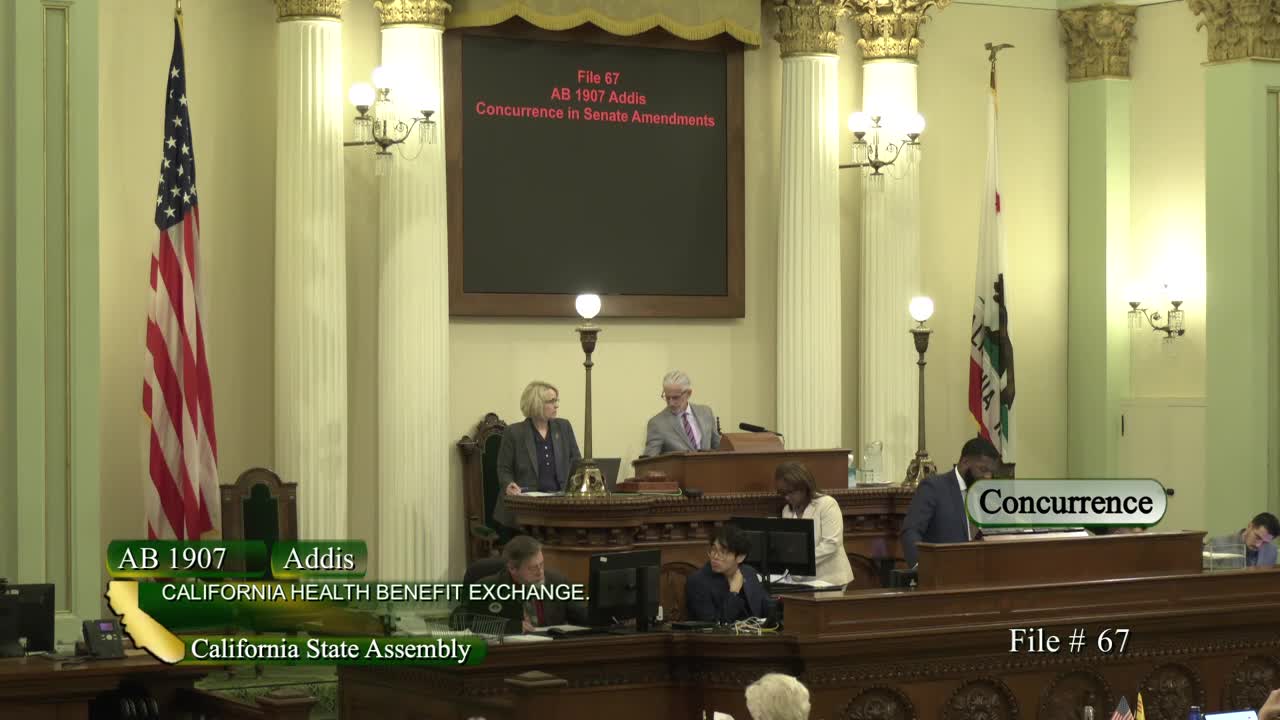
Bill Author