AB 1911: Advertising: environmental marketing claims: carbon credits.
- Session Year: 2025-2026
- House: Assembly
- Latest Version Date: 2026-04-15
Current Status:
In Progress
(2026-05-14: In committee: Held under submission.)
Introduced
In Committee
Awaiting First Chamber Vote
Passed First Chamber
In Committee
Awaiting Second Chamber Vote
Passed Second Chamber
Enacted
Under existing law, it is unlawful for a person to make an untruthful, deceptive, or misleading environmental marketing claim, whether explicit or implied. A violation of this requirement is a misdemeanor.
This bill would would, until January 1, 2032, establish a defense to presumption in any suit or complaint brought under the above-described provision if the persons that a defendants environmental marketing claim is valid if the defendant complies with specified disclosure requirements pertaining to voluntary carbon offsets and net zero emissions claims and the claim is based on the voluntary use of a carbon credit issued by a carbon crediting program that is (1) approved by the State Air Resources Board pursuant to specified regulations, (2) approved by the International Civil Aviation Organization to supply credits for a specified carbon offsetting scheme, or (3) meets other specified criteria. The bill would require the state board, within ____ days of January 1, 2027, to publish and maintain criteria and appears on a list of published by the State Air Resources Board containing carbon crediting programs that satisfy the criteria set forth in the third category. those criteria.
Under existing law, it is unlawful for a person to make an untruthful, deceptive, or misleading environmental marketing claim, whether explicit or implied. A violation of this requirement is a misdemeanor.
This bill would establish a defense to any suit or complaint brought under the above-described provision if the persons environmental marketing claim is based on the voluntary use of a carbon credit issued by a carbon crediting program that is (1) approved by the State Air Resources Board pursuant to specified regulations, (2) approved by the International Civil Aviation Organization to supply credits for a specified carbon offsetting scheme, or (3) meets other specified criteria. The bill would require the state board, within ____ days of January 1, 2027, to publish and maintain a list of carbon crediting programs that satisfy the criteria set forth in the third category.
(a)It shall be a defense to In any suit or complaint brought under Section 17580.5 if the persons 17580.5, a defendants environmental marketing claim is presumed to be valid if the defendant complies with Part 10 (commencing with Section 44475) of Division 26 of the Health and Safety Code and the claim is based on the voluntary use of a carbon credit issued by a carbon crediting program that meets any of the following requirements:
(1)The carbon crediting program is approved by the State Air Resources Board pursuant to Section 95986 of Title 17 of the California Code of Regulations.
(2)The carbon crediting program is approved by the International Civil Aviation Organization to supply credits for use in the Carbon Offsetting Reduction Scheme for International Aviation.
(3)The carbon crediting program satisfies the criteria set forth in subdivision (b). (b) and appears on the list published by the State Air Resources Board pursuant to subdivision (c).
(b)A program shall qualify as a carbon crediting program for purposes of paragraph (3) of subdivision (a) if it does all of the following:
(1)Adopts clear methodologies and protocols with transparent development processes that accommodate public input, and publicly discloses all approved quantification methodologies.
(2)Defines and publicly discloses the level at which activities are allowed, for example example, project based, program of activities, and eligibility criteria for each type of credited activity.
(3)Establishes and publicly discloses procedures for how carbon credits are discounted, issued, retired or canceled, and the length of the crediting period.
(4)Has mechanisms and procedures to do all of the following:
(A)Track units in a publicly accessible registry.
(B)Individually identify units through serial numbers or other unique identifiers.
(C)Provide a secure registry.
(D)Clearly identify unit holders.
(5)Has in place program-level requirements for robust independent third-party validation and verification of mitigation activities, including the establishment and enforcement of oversight standards for validation and verification bodies that comply with the requirements of subdivision (d) and perform an annual examination of a representative sample of project validations and verifications.
(6)Has and discloses an effective program governance structure that ensures transparency, accountability, and continuous improvement and the overall quality of carbon credits, and has a program governance structure that meets all of the following criteria:
(A)It has a board comprising independent board members who assume a fiduciary responsibility for the organization and operate according to robust bylaws and have established processes for addressing conflicts of interest.
(B)It publishes an annual report containing the organizations revenues, expenses, and net assets.
(C)It has robust anti-money laundering processes in place and follows practices consistent with robust antibribery and anticorruption guidance and regulation.
(7)Publicly discloses in an electronic format accessible to nonspecialized audiences all of the following:
(A)What information is captured and made available to different stakeholders.
(B)Local stakeholder consultation requirements.
(C)Public grievance and consultation provisions and requirements, and how they are considered.
(8)Has clear guidance, tools, and compliance procedures to ensure mitigation activities conform with or go beyond widely established industry best practices on social and environmental safeguards while delivering positive sustainable development impacts.
(9)Provides information on how it addresses double counting and double issuance and double claiming in the context of evolving national and international regimes for carbon credit markets and tracking.
(10)Has provisions that ensure the mitigation activity shall be permanent or, where there is a risk of reversal, have has measures in place to address those risks or compensate for reversals.
(c)(1)Within ____ days of On or before January 1, 2027, 2028, the State Air Resources Board shall publish and maintain a list of carbon crediting programs that satisfy the requirements of subdivision (b).
(2)Chapter 3.5 (commencing with Section 11340) of Part 1 of Division 3 of Title 2 of the Government Code does not apply to the publication and maintenance of the list pursuant to paragraph (1).
(d)An entity shall qualify as a third-party credit validation and verification body for purposes of subdivision (b) if it satisfies either of the following:
(1)Any of the accreditation requirements set forth under Sections 95132 and 95978 of Title 17 of the California Code of Regulations.
(2)All of the following requirements:
(A)Be It shall be accredited by an International Accreditation Forum (IAF) Multilateral Recognition Arrangement recognized accreditation body for International Organization for Standardization (ISO) 14065 and ISO 14064-3 in the applicable sectoral scope to conduct validations or verifications, or both, or under an equivalent approved accreditation body covering the scope of that regulation under the most current version of ISO 14065 in the applicable sectoral scope to conduct validations or verifications, or both.
(B)Be It shall be competent to carry out validation and verification under the requirements of the respective carbon crediting body.
(C)Have It shall have policies in place to identify and mitigate financial and all other conflicts of interest and is shall not be a mitigation project developer or proponent, the owner of a mitigation project developer or proponent, or be owned by them.
(D)It shall not buy or sell carbon credits, or otherwise have a position in carbon credit markets.
(D)Have(E)It shall have adequate professional insurance for the geographic market in which it is operating, including a minimum of two million dollars ($2,000,000) of professional liability insurance if operating in the United States.
(e)This section shall remain in effect only until January 1, 2032, and as of that date is repealed.
(a)It shall be a defense to any suit or complaint brought under Section 17580.5 if the persons environmental marketing claim is based on the voluntary use of a carbon credit issued by a carbon crediting program that meets any of the following requirements:
(1)The carbon crediting program is approved by the State Air Resources Board pursuant to Section 95986 of Title 17 of the California Code of Regulations.
(2)The carbon crediting program is approved by the International Civil Aviation Organization to supply credits for use in the Carbon Offsetting Reduction Scheme for International Aviation.
(3)The carbon crediting program satisfies the criteria set forth in subdivision (b).
(b)A program shall qualify as a carbon crediting program for purposes of paragraph (3) of subdivision (a) if it does all of the following:
(1)Adopts clear methodologies and protocols with transparent development processes that accommodate public input, and publicly discloses all approved quantification methodologies.
(2)Defines and publicly discloses the level at which activities are allowed, for example project based, program of activities, and eligibility criteria for each type of credited activity.
(3)Establishes and publicly discloses procedures for how carbon credits are discounted, issued, retired or canceled, and the length of the crediting period.
(4)Has mechanisms and procedures to do all of the following:
(A)Track units in a publicly accessible registry.
(B)Individually identify units through serial numbers or other unique identifiers.
(C)Provide a secure registry.
(D)Clearly identify unit holders.
(5)Has in place program-level requirements for robust independent third-party validation and verification of mitigation activities, including the establishment and enforcement of oversight standards for validation and verification bodies that comply with the requirements of subdivision (d) and perform an annual examination of a representative sample of project validations and verifications.
(6)Has and discloses an effective program governance structure that ensures transparency, accountability, and continuous improvement and the overall quality of carbon credits, and has a program governance structure that meets all of the following criteria:
(A)It has a board comprising independent board members who assume a fiduciary responsibility for the organization and operate according to robust bylaws and have established processes for addressing conflicts of interest.
(B)It publishes an annual report containing the organizations revenues, expenses, and net assets.
(C)It has robust anti-money laundering processes in place and follows practices consistent with robust antibribery and anticorruption guidance and regulation.
(7)Publicly discloses in an electronic format accessible to nonspecialized audiences all of the following:
(A)What information is captured and made available to different stakeholders.
(B)Local stakeholder consultation requirements.
(C)Public grievance and consultation provisions and requirements, and how they are considered.
(8)Has clear guidance, tools, and compliance procedures to ensure mitigation activities conform with or go beyond widely established industry best practices on social and environmental safeguards while delivering positive sustainable development impacts.
(9)Provides information on how it addresses double counting and double issuance and double claiming in the context of evolving national and international regimes for carbon credit markets and tracking.
(10)Has provisions that ensure the mitigation activity shall be permanent or, where there is a risk of reversal, have measures in place to address those risks or compensate for reversals.
(c)(1)Within ____ days of January 1, 2027, the State Air Resources Board shall publish and maintain a list of carbon crediting programs that satisfy the requirements of subdivision (b).
(2)Chapter 3.5 (commencing with Section 11340) of Part 1 of Division 3 of Title 2 of the Government Code does not apply to the publication and maintenance of the list pursuant to paragraph (1).
(d)An entity shall qualify as a third-party credit validation and verification body for purposes of subdivision (b) if it satisfies either of the following:
(1)Any of the accreditation requirements set forth under Sections 95132 and 95978 of Title 17 of the California Code of Regulations.
(2)All of the following requirements:
(A)Be accredited by an International Accreditation Forum (IAF) Multilateral Recognition Arrangement recognized accreditation body for International Organization for Standardization (ISO) 14065 and ISO 14064-3 in the applicable sectoral scope to conduct validations or verifications, or both, or under an equivalent approved accreditation body covering the scope of that regulation under the most current version of ISO 14065 in the applicable sectoral scope to conduct validations or verifications, or both.
(B)Be competent to carry out validation and verification under the requirements of the respective carbon crediting body.
(C)Have policies in place to identify and mitigate financial and all other conflicts of interest and is not a mitigation project developer or proponent, the owner of a mitigation project developer or proponent, or be owned by them.
(D)Have adequate professional insurance for the geographic market in which it is operating, including a minimum of two million dollars ($2,000,000) of professional liability insurance if operating in the United States.
|
Date
|
Status
|
|---|---|
| May 14, 2026 | In committee: Held under submission. |
| May 6, 2026 | In committee: Set, first hearing. Referred to APPR. suspense file. |
| Apr 22, 2026 | From committee: Do pass and re-refer to Com. on APPR. with recommendation: To Consent Calendar. (Ayes 12. Noes 0.) (April 21). Re-referred to Com. on APPR. |
| Apr 16, 2026 | Re-referred to Com. on JUD. |
| Apr 15, 2026 | Read second time and amended. |
| Apr 14, 2026 | From committee: Amend, and do pass as amended and re-refer to Com. on JUD. (Ayes 14. Noes 0.) (April 13). |
| Mar 2, 2026 | Referred to Coms. on NAT. RES. and JUD. |
| Feb 13, 2026 | From printer. May be heard in committee March 15. |
| Feb 12, 2026 | Read first time. To print. |
|
Date
|
Description
|
Location
|
Votes
|
|
|---|---|---|---|---|
| Apr 21, 2026 | Do pass and be re-referred to the Committee on [Appropriations] with recommendation: To Consent Calendar | Assembly Standing Committee on Judiciary |
Passed |
|
| Apr 13, 2026 | Do pass as amended and be re-referred to the Committee on [Judiciary] | Assembly Standing Committee on Natural Resources |
Passed |
This list shows positions taken on this bill by organizations on the date displayed, which is linked to the original source.
Positions by individuals are not included.
|
Organization
|
Position
|
Date
|
|---|---|---|
| American Carbon Registry | ** Support | |
| Anew Climate LLC | ** Support | |
| Business Alliance for Climate Action | ** Support | |
| California Forestry Association | ** Support | |
| California Manufacturers And Technology Association | ** Support | |
| Ceres, Inc. | ** Support | |
| Climate Action Reserve | ** Support | |
| Conservation International | ** Support | |
| Conservation International Foundation | ** Support | |
| Cool Effect | ** Support | |
| Cool Effect, Inc. | ** Support | |
| Environmental Defense Fund | ** Support | |
| International Emissions Trading Association | ** Support | |
| The Climate Trust | ** Support | |
| Weyerhaeuser Company | ** Support |
Date of Hearing: May 6, 2026
ASSEMBLY COMMITTEE ON APPROPRIATIONS
Buffy Wicks, Chair
ABPCA Bill Id:AB 1911
Author:(Rogers) – As Amended Ver:April 15, 2026
Policy Committee: | Natural Resources | Vote: | 14 - 0 |
Judiciary | 12 - 0 | ||
|
|
Urgency: No State Mandated Local Program: No Reimbursable: No
SUMMARY:
This bill, until January 1, 2032, establishes a rebuttable presumption that an environmental marketing claim is valid so long as the claim complies with specified standards.
Specifically, this bill, among other things:
- Provides that, in any suit or complaint brought under Business and Profession Code section 17580.5 (which makes it unlawful for a person to make an untruthful, deceptive, or misleading environmental claim), a defendant’s environmental marketing claim is presumed to be valid if the defendant (a) complies with AB 1305 (Gabriel), Chapter 365, Statutes of 2023 (which requires disclosure of specified information by sellers and buyers of voluntary carbon offsets) and (b) the claim is based on the voluntary use of a carbon credit issued by a carbon crediting program that meets any of the following requirements:
- The carbon crediting program is approved by the Air Resources Board (ARB), as specified.
- The carbon crediting program is approved by the International Civil Aviation Organization to supply credits for use in the Carbon Offsetting Reduction Scheme for International Aviation.
- The carbon crediting program satisfies the criteria set forth in item 2, below, and appears on the list published by ARB as described below.
- Allows a program to qualify as a carbon crediting program for purposes as described above if it does ten specified things; for example, the program must have in place program-level requirements for robust independent third-party validation and verification of mitigation activities, as specified.
- Requires ARB, on or before January 1, 2028, to publish and maintain a list of carbon crediting programs that satisfy the requirements of item 2, above, exempts the publication and maintenance of this list from the Administrative Procedure Act (APA).
- Allows an entity to qualify as a third-party credit validation and verification body if the entity either (a) satisfies any of the accreditation requirements established in specified ARB regulation or (b) meets five specified requirements.
- Sunsets the provisions of this bill on January 1, 2032.
FISCAL EFFECT:
1) Ongoing costs to ARB to publish and maintain a list of carbon crediting programs that satisfy the requirements of this bill (Cost of Implementation Account (COIA).
For its part, ARB estimates costs of approximately $3.4 million in fiscal year (FY) 2026-27 followed by ongoing annual costs of approximately $2.9 million (COIA) for about 13 positions (and contract costs in FY 2026-27) to, among other things, investigate and monitor on an ongoing basis the architecture of and changes to domestic and international carbon credit programs to understand operational features, adherence to the criteria enumerated in this bill, and other mechanisms to ensure the integrity of crediting infrastructure; identify and review approaches to verification standards (including requirements for independence, accreditation, insurance, and competence); and develop ARB’s own integrity standards prior to developing the required list. Although the bill exempts this work from the APA, ARB asserts that to codify requirements, standards, and procedures for approving qualifying carbon crediting programs, it must promulgate a board-approved regulation, including public engagement procedures. Once the list is established, ARB must, on an ongoing basis, maintain and update it and periodically review approved programs.
2) The Department of Justice anticipates any costs to be minor and absorbable.
COMMENTS:
1) Purpose. According to the author:
Voluntary carbon markets help channel private investments toward climate solutions. For these markets to succeed, businesses and consumers must have confidence that credited emissions reductions and removals are real, verifiable, and backed by strong standards. AB 1911 strengthens that trust by establishing clear guardrails that protect companies making good-faith environmental marketing claims when they rely on high-quality carbon credits.
2) Background. Individuals and corporations purchase carbon offsets to compensate for the greenhouse gas (GHG) emissions they create or contribute to. As more people purchase these offsets to compensate for their carbon footprint, some ask what is being done to ensure entities are purchasing genuine carbon offsets. There is growing concern among stakeholders and policymakers about the validity of emission reductions from offset projects and the potential for fraud. As described by the Assembly Natural Resources Committee, despite the growth of the voluntary offset market in supporting advertising claims and even legal requirements, such as mitigation of GHG emissions under the California Environmental Quality Act, the market has remained fairly opaque and is not regulated by ARB or any other state entity.
AB 1305 established new disclosure requirements for voluntary carbon offsets, applicable to both sellers and buyers of offsets, as well as marketing claims, subjecting violators to a civil penalty up to $2,500 per day. In addition, there are ongoing efforts to develop voluntary standards at both the federal and international level to improve the integrity of offsets. Meanwhile, corporations such as Apple and Delta Airlines have been sued in California and other jurisdictions, with plaintiffs alleging, in essence, that the companies’ claims that their products and services are carbon-neutral due to procurement of offsets, are fraudulent.
This bill is sponsored by Conservation International (CI) and Environmental Defense Fund (EDF), who argue that, when done right, voluntary carbon markets can channel new funding into protecting and restoring ecosystems that “store carbon, buffer communities from extreme weather, and sustain biodiversity.” The sponsors argue that “high-integrity” voluntary carbon markets can unlock private capital, “but only with strong guardrails and clear incentives that drive real, additional, and lasting outcomes.” CI and EDF write:
AB 1911 goes on to set out basic professional criteria for validation and verification bodies, the entities responsible for ensuring that credit programs are designed and carried out in compliance with established methodologies. As the boots on the ground and eyes in the field, these entities are critical gatekeepers, but currently lack basic minimum professional standards. AB 1911 strengthens integrity by defining qualification requirements for verification bodies, including recognized accreditation, competency, conflict-of-interest policies, and minimum professional liability insurance.
The bill incentivizes (but does not require) companies to invest in credits from programs that meet these criteria, or have otherwise been approved by CARB or CORSIA, and have been validated and verified by a qualifying VVB. By providing a defense against greenwashing complaints that challenge the validity of credits underlying an environmental marketing claim, the bill reduces litigation risk associated with essential investment in conservation and climate action.
Analysis Prepared by: Nikita Koraddi / APPR. / (916) 319-2081
Date of Hearing: April 21, 2026
ASSEMBLY COMMITTEE ON JUDICIARY
Ash Kalra, Chair
ABPCA Bill Id:AB 1911
Author:(Rogers) – As Amended Ver:April 15, 2026
PROPOSED CONSENT
SUBJECT: Advertising: environmental marketing claims: carbon credits
KEY ISSUE: should a rebuttable presumption be adopted that environmental marketing claims are valid so long as the claim meets specified environmental standards?
SYNOPSIS
Seeking to promote their environmental bona fides to consumers worried about the impacts of climate change, many companies now aim to promote their efforts to offset their carbon footprint by participating in carbon offset programs. As well intentioned as carbon offset programs are, and permitting companies to pay to offset environmental damage appears to be a social good, the industry is poorly regulated and concerns about misleading claims about the effectiveness of an offset program abound. To better regulate this burgeoning carbon offset industry, in 2023, the Legislature enacted AB 1305 (Gabriel), Chap. 365, Stats. 2023, which provided for a robust series of disclosures and good governance standards for carbon offset providers. Despite the best efforts of AB 1305, concerns about the validity of many carbon offset programs continue.
Fearing that the ambiguity of many carbon offset programs may open the door to needless litigation, this bill provides for a modest rebuttable presumption to claims of false environmental marketing if the entity making the carbon offset claim participates in a certified and well managed offset program. Recognizing that simply participating in a valid offset program does not forestall other forms of corporate chicanery to appease environmentally conscious consumers, this bill permits a plaintiff to overcome the presumption by providing other misleading actions. The bill establishes the standards that a carbon offset program must meet to trigger the presumption. Finally, recognizing that the carbon offset market is still growing, the bill is slated to sunset in 2031 to force the Legislature to revisit the issue in several years.
This bill is co-sponsored by the Environmental Defense Fund and Conservation International, and is supported by several environmental advocates and business organizations, including the California Manufacturers and Technology Association. The proponents note that those participating in carbon offset programs need additional legal clarity in order to ensure these promising programs can continue to mature and provide climate benefits to society. This measure has no opposition and was previously heard and approved by the Committee on Natural Resources unanimously.
SUMMARY: Establishes a rebuttable presumption that an environmental marketing claim is valid so long as the claim complies with specified standards. Specifically, this bill:
- Establishes, in any suit or complaint brough pursuant to the existing law prohibiting false environmental marketing claims, a rebuttable presumption that the claim is valid so long as it complies with the following:
- The existing law’s disclosures that all businesses selling voluntary carbon offsets must make prior to selling offsets in the state; and
- The claim is based on the voluntary use of a carbon credit issued by a carbon crediting program that meets the requirements of 2).
- Requires, in order to be eligible for a rebuttable presumption if challenged in court, a marketing claim to meet one of the following:
- The carbon crediting program is approved by the Air Resources Board;
- The carbon crediting program is approved by the International Civil Aviation Organization to supply credits for use in the Carbon Offsetting Reduction Scheme for International Aviation; or
- The carbon crediting program satisfies the criteria set forth in 3).
- Provides that a carbon marketing claim lacking the program certification required in a) or b) of 2) may nonetheless be eligible for a rebuttable presumption if challenged in court if the underlying carbon credit program is on an approved list from the Air Resources Board and meets all of the following criteria:
- Adopts clear methodologies and protocols with transparent development processes that accommodate public input, and publicly discloses all approved quantification methodologies;
- Defines and publicly discloses the level at which activities are allowed, for example project based, program of activities, and eligibility criteria for each type of credited activity;
- Establishes and publicly discloses procedures for how carbon credits are discounted, issued, retired or canceled, and the length of the crediting period;
- Maintains methods and procedures for tracking specified units of carbon offsets;
- Has in place program-level requirements for robust independent third-party validation and verification of mitigation activities, including the establishment and enforcement of oversight standards for validation and verification bodies that comply with the requirements of 5) and perform an annual examination of a representative sample of project validations and verifications;
- Has and discloses an effective program governance structure that ensures transparency, accountability, and continuous improvement and the overall quality of carbon credits, and has a program governance structure, as specified;
- Publicly discloses in an electronic format accessible to nonspecialized audiences specified information about a stakeholder grievance process;
- Has clear guidance, tools, and compliance procedures to ensure mitigation activities conform with or go beyond widely established industry best practices on social and environmental safeguards while delivering positive sustainable development impacts;
- Provides information on how it addresses double counting and double issuance and double claiming in the context of evolving national and international regimes for carbon credit markets and tracking; and
- Has provisions that ensure the mitigation activity shall be permanent or, where there is a risk of reversal, have measures in place to address those risks or compensate for reversals.
- Requires the Air Resources Board, on or before January 1, 2028, to publish a list of carbon crediting programs that satisfy the requirements of 3).
- Provides that an entity qualifies as a third-party credit validation and verification body for purposes of 3) if the entity satisfies either of the following:
- Meets any of the specified criteria for third-party credit validation established in regulations by the Air Resources Board; or
- Meets all of the following requirements:
- Be accredited by an International Accreditation Forum Multilateral Recognition Arrangement recognized accreditation body for International Organization for Standardization in the applicable sectoral scope to conduct validations or verifications, or both, or under an equivalent approved accreditation body covering the scope of that regulation under the most current version of International Organization for Standardization standards in the applicable sectoral scope to conduct validations or verifications, or both;
- Be competent to carry out validation and verification under the requirements of the respective carbon crediting body;
- Have policies in place to identify and mitigate financial and all other conflicts of interest and is not a mitigation project developer or proponent, the owner of a mitigation project developer or proponent, or be owned by them; and
- Have adequate professional insurance for the geographic market in which it is operating, including a minimum of two million dollars ($2,000,000) of professional liability insurance if operating in the United States.
- Adopts a sunset date for the bill of January 1, 2031.
EXISTING LAW:
- Establishes the California Global Warming Solutions Act which requires the Air Resources Board to adopt a statewide greenhouse gas emissions limit equivalent to 1990 levels by 2020, to ensure that statewide greenhouse gas emissions are reduced to at least 40% below the 2020 statewide limit no later than December 31, 2030, and declares the policy of the state to achieve net zero greenhouse gas emissions by 2045. (Health and Safety Code Section 38500 et seq.)
- Requires a business entity that is marketing or selling voluntary carbon offsets within the state to disclose on the business entity’s internet website all of the following information:
- Details regarding the applicable carbon offset project, as specified;
- Details regarding accountability measures if a project is not completed or does not meet the projected emissions reductions or removal benefits, including, but not limited to, details regarding what actions the entity, either directly or by contractual obligation if the project is reversed or if emissions goals are not met; and
- The pertinent data and calculation methods needed to independently reproduce and verify the number of emissions reduction or removal credits issued. (Health and Safety Code Section 44475.)
- Defines a “voluntary carbon offset” as any product sold or marketed in the state that claims to be a “greenhouse gas emissions offset,” a “voluntary emissions reduction,” a “retail offset,” or any like term, that connotes that the product represents or corresponds to a reduction in the amount of greenhouse gases present in the atmosphere or that prevents the emission of greenhouse gases into the atmosphere that would have otherwise been emitted. (Ibid.)
- Establishes the Unfair Competition Law, and defines “unfair competition” to mean and include any unlawful, unfair or fraudulent business act or practice and unfair, deceptive, untrue, or misleading advertising and any act prohibited by the False Advertising Law. (Business and Professions Code Section 17200.)
- Provides that a violation of the Unfair Competition Law renders a person liable for a civil penalty not to exceed two thousand five hundred dollars ($2,500) for each violation, as specified. (Business and Professions Code Section 17206.)
- Prohibits a person from making an untruthful, deceptive, or misleading environmental marketing claim, whether explicit or implied and defines “environmental marketing claim” to include any claim contained in the “Guides for the Use of Environmental Marketing Claims” published by the Federal Trade Commission. (Business and Professions Code Section 17580.5.)
FISCAL EFFECT: As currently in print this bill is keyed fiscal.
COMMENTS: Carbon offsets are a tool for businesses and individuals to, supposedly, mitigate the impact of their own greenhouse gas emissions. However, due to the amorphous nature of carbon offsets, there is growing concern about the validity of emission reductions from projects sold as credits and the potential for fraud. To this end, in 2023, the Legislature adopted AB 1305 (Gabriel), Chap. 365, Stats. 2023 to establish new disclosure requirements for voluntary carbon offsets, applicable to both sellers and buyers of offsets, as well as marketing claims, and subjected violators to a civil penalty of up to $2,500 per day.
This bill recognizes that while it is important to ensure that offset credit programs are legitimate, the ambiguity surrounding the industry may also make it a target of frivolous litigation. This bill would adopt a rebuttable presumption that a carbon offset credit offered by a program meeting strict certifications and complying with Air Resources Board regulations are legitimate and the claims made about the program are not false or misleading in violation of existing consumer protection law. In support of the bill the author states:
Voluntary carbon markets help channel private investments toward climate solutions. For these markets to succeed, businesses and consumers must have confidence that credited emissions reductions and removals are real, verifiable, and backed by strong standards. AB 1911 strengthens that trust by establishing clear guardrails that protect companies making good-faith environmental marketing claims when they rely on high-quality carbon credits.
AB 1911 establishes clear standards for environmental marketing claims about voluntary carbon credits. Through AB 1911, there are three ways a defense can be made to any suit or complaint. First, the carbon crediting program is approved by the California Air Resources Board (CARB). Second, the carbon crediting program is approved by the International Civil Aviation Organization. Lastly, the carbon crediting program has clear methodologies and protocols with transparent, public development processes; defines and publicly discloses credited activity; establishes and publicly discloses procedures for how carbon credits are discounted, issued, retired, or canceled; has tracking and identifying mechanisms; and robust independent third-party validation. To supplement these requirements, the bill also requires CARB to publish and maintain a list of high-integrity carbon crediting programs by 2027 and requires third-party credit validation and verification bodies be accredited by an International Accreditation Forum.
Seeking to attract environmentally conscious customers, many companies seek to highlight their environmentally friendly practices. Recognizing that many Americans are growing increasingly concerned about climate change, many businesses are seeking to generate good will by promoting their efforts to reduce the impact they have on the environment. However, some reports indicate that many of these efforts are more about public perception than a meaningful change in corporate behavior. This marketing tactic is known as “greenwashing.” (Ro, Some of the Favorite Corporate Greenwashing Tactics of Clothing Companies, Forbes (Apr. 12, 2021), https://www.forbes.com/sites/christinero/2021/04/12/some-of-the-favorite-greenwashing-tactics-of-clothing-companies/?sh=60918e647609.) Far too often, the claims made by many companies are more about boosting their bottom line than actually addressing the impacts of climate change.
Due to the largely unregulated world of carbon credits, the United Nations noted that in order to meet the world’s necessary climate goals, “non‑state actors cannot buy cheap credits that often lack integrity instead of immediately cutting their own emissions across their value chain.” (United Nations’ High‑Level Expert Group on the Net Zero Emissions Commitments of Non-State Entities, Integrity Matters: Net Zero Commitments by Businesses, Financial Institutions, Cities and Regions (2022) at p. 6.) The United Nations recommends that regulators increase corporate, “assurance on their net zero pledges and mandatory annual progress reporting.” (Id. at p. 7.) Furthermore, the report continues to note that accurate reporting of offsets helps regulators and industry identify the most promising projects and the most innovative means of deploying carbon offset projects to the market.
Because of the suspect nature of some aspects of the carbon offset market, in 2023, the Legislature adopted AB 1305 to begin regulating the market by enforcing an extensive disclosure regime about the legitimacy of a carbon offset. That bill built on the provisions of SB 343 (Allen) Chap. 507, Stats. 2021, which, although largely focused on recycling, did prohibit “untruthful, deceptive, or misleading environmental marketing claim[s].” That bill adopted the strict fines for making deceptive claims already found in existing law.
As carbon offset markets face valid scrutiny, those offering legitimate offset programs fear legal liability. As the scrutiny on the carbon offset marketplace grows, those offering legitimate credit programs fear they may face unnecessary legal liability. The proponents of the bill argue that those credit programs operating within the confines of a program certified by state government or a valid international accrediting body should be provided with some legal protections. While the market may not be sufficiently mature to fully delineate between good and bad actors, the proponents’ arguments are not without some merit. Furthermore, as this Committee is well aware, once enterprising attorneys find a new cottage industry in which to file lawsuits, the subsequent complaints from the business community can result in significant damage to the underlying statutory scheme which can be difficult to fix. For example, as a result of the legal risks, Proposition 65 warnings are now so common as to have lost any real significance to many Californians.
This bill adopts a rebuttable presumption that certain claims about carbon capture projects are valid. Seeking to avoid abusive lawsuits, this bill adopts a modest rebuttable presumption that carbon credit programs meeting specified certification requirements do not violate the existing law’s prohibition on untruthful, deceptive, or misleading environmental marketing claims. The certification requirements, generally, require a carbon offset program to be frequently reviewed by accrediting bodies and to be highly transparent. A more thorough review of the adequacy of the certification requirements of this bill can be found in the Committee on Natural Resource’s analysis of this bill as that aspect of the measure is largely in that Committee’s jurisdiction. (Assem. Com. on Nat. Res., Analysis of Assem. Bill No. 1911 (2025-26 Reg. Session) as introduced Feb. 12, 2026.)
As it pertains to this Committee, the adoption of a rebuttable presumption appears reasonable. When this bill was initially introduced it provided a complete defense to all claims. However, in consultation with this Committee, the bill was recently amended in the Committee on Natural Resources to adopt the presumption instead. By replacing the complete bar to all claims with a presumption, this bill now ensures that while the legitimacy of a carbon capture program may not be litigated, the underlying nature of the carbon offset claims can be subject to court review. For example, should a company claim to offset their emissions using a credit program, they would be presumed to be in compliance with the law. However, if a plaintiff could demonstrate the company was not funding as many credits as claimed or otherwise misleading consumers about their involvement with a legitimate carbon offset program, they would still face liability.
While this bill appears to strike the appropriate legal balance, as noted above, the carbon offset industry is still growing and evolving. Accordingly, this bill rightfully adopts a January 1, 2031sunset date to ensure the Legislature must revisit the issue in the near term. Nonetheless, in order to properly police this fast-growing industry the author may wish to consider an amendment to exempt the Attorney General and local public prosecutors from having to overcome the presumption provided in the bill.
ARGUMENTS IN SUPPORT: This bill is co-sponsored by the Environmental Defense Fund and Conservation International. The bill is also supported by several environmental advocates and business organizations. In support of the bill, the co-sponsors jointly write:
The global biodiversity and climate crises demand conservation, resilience and restoration investments at a scale that far exceed current public budgets. United Nations Environment Programme’s 2026 “State of Finance for Nature” finds that while trillions of dollars flow into activities that degrade nature, investments in conservation and restoration — particularly private finance for nature-based solutions — remains especially limited. Closing this gap requires policies that elevate and incentivize credible private capital and sustain long-term stewardship.
That is why high-integrity voluntary carbon markets matter. When done right, voluntary carbon markets can channel new funding into protecting and restoring ecosystems that store carbon, buffer communities from extreme weather, and sustain biodiversity. Market credibility is also essential to ensuring these investments remain durable and scalable.
U.S. financial and climate policymakers have underscored2 that high-integrity voluntary carbon markets can unlock private capital—but only with strong guardrails and clear incentives that drive real, additional, and lasting outcomes.
AB 1911 would act on this guidance and box out the bad actors that undermine market integrity by articulating benchmarks for the entities most able to control credit integrity – carbon credit issuers (sometimes called “standards” or “registries”) and validation and verification bodies (VVBs).
The California Manufacturers and Technology Association adds:
As California continues to lead on climate policy, manufacturers are making significant investments in emissions reductions, sustainability, and innovative climate solutions. A critical component of these efforts includes the responsible use of voluntary carbon credits to complement internal reductions, particularly for complex industrial processes and supply chains. However, the absence of clear and consistent standards has created uncertainty for businesses and consumers alike.
AB 1911 addresses this challenge by establishing rigorous, transparent, and enforceable standards for carbon crediting programs and the entities that verify them. By requiring robust methodologies, public registries, safeguards against double counting, and independent third-party validation, the bill ensures that only high-integrity carbon credits can be used to support environmental marketing claims.
REGISTERED SUPPORT / OPPOSITION:
Support
Conservation International Foundation (co-sponsor)
Environmental Defense Fund (co-sponsor)
American Carbon Registry
Anew Climate LLC
Business Alliance for Climate Action
California Forestry Association
California Manufacturers and Technology Association
Ceres, Inc.
Climate Action Reserve
Conservation International Foundation
Cool Effect, Inc.
International Emissions Trading Association
The Climate Trust
Weyerhaeuser Company
Opposition
None on file
Analysis Prepared by: Nicholas Liedtke / JUD. / (916) 319-2334
Date of Hearing: April 13, 2026
ASSEMBLY COMMITTEE ON NATURAL RESOURCES
Isaac G. Bryan, Chair
ABPCA Bill Id:AB 1911 (
Author:Rogers) – As Introduced Ver:February 12, 2026
SUBJECT: Advertising: environmental marketing claims: carbon credits
SUMMARY: Establishes an affirmative defense against claims brought under the Environmental Advertising Law if the environmental marketing claim in question is based on the voluntary use of a carbon credit issued by a carbon crediting program meeting specified standards.
EXISTING LAW:
- The California Global Warming Solutions Act requires the Air Resources Board (ARB) to adopt a statewide greenhouse gas (GHG) emissions limit equivalent to 1990 levels by 2020, to ensure that statewide GHG emissions are reduced to at least 40% below the 2020 statewide limit no later than December 31, 2030, and declares the policy of the state to achieve net zero greenhouse gas emissions by 2045. Requires ARB, among other things, to:
- Adopt rules and regulations to achieve maximum technologically feasible and cost-effective GHG emission reductions;
- Ensure any direct regulation or market-based compliance mechanism achieves GHG reductions that are real, permanent, quantifiable, verifiable, and enforceable by ARB;
- Limit offsets used in the cap and invest regulation; and,
- Adopt methodologies for the quantification of voluntary GHG emission reductions.
(Health and Safety Code (HSC) 38500 et seq.)
- Requires disclosure of specified information by sellers and buyers of voluntary carbon offsets, as well as by entities making claims regarding the achievement of net zero emissions, carbon neutrality, or GHG reductions based on carbon offsets, and subjects violators to a civil penalty up to $2,500 per day for each violation. (HSC 44475 et seq.)
- Establishes the Unfair Competition Law, which defines “unfair competition” to mean and include any unlawful, unfair or fraudulent business act or practice and unfair, deceptive, untrue, or misleading advertising and any act prohibited by the False Advertising Law. Provides for a civil penalty up to $2,500 for each violation. (Business and Professions Code (BPC) 17200 et seq.)
- Prohibits a person from making an untruthful, deceptive, or misleading environmental marketing claim, whether explicit or implied. Defines “environmental marketing claim” to include any claim contained in the “Guides for the Use of Environmental Marketing Claims” published by the Federal Trade Commission (FTC), and provides that it is a defense to any suit or complaint brought under this section that the person’s environmental marketing claims conform to the standards or are consistent with the examples contained in the FTC Guides, with specified exceptions for recycling claims. (BPC 17580.5)
THIS BILL:
- Establishes an affirmative defense against claims brought under the BPC 17580.5 if the environmental marketing claim in question is based on the voluntary use of a carbon credit issued by a carbon crediting program meeting one of the following standards:
- An offset project registry approved by ARB pursuant to its cap and invest regulation.
- A program approved by the International Civil Aviation Organization to supply credits for use in the Carbon Offsetting Reduction Scheme for International Aviation (CORSIA).
- A program that meets criteria intended to fit the Integrity Council for Voluntary Carbon Markets (ICVCM), including:
- Adopts clear methodologies and protocols with transparent development processes that accommodate public input, and publicly discloses all approved quantification methodologies.
- Defines and publicly discloses the level at which activities are allowed, for example project based, program of activities, and eligibility criteria for each type of credited activity.
- Establishes and publicly discloses procedures for how carbon credits are discounted, issued, retired or canceled, and the length of the crediting period.
- Has mechanisms and procedures to do all of the following:
- Track units in a publicly accessible registry.
- Individually identify units through serial numbers or other unique identifiers.
- Provide a secure registry.
- Clearly identify unit holders.
- Has in place program-level requirements for robust independent third-party validation and verification of mitigation activities.
- Has and discloses an effective program governance structure that ensures transparency, accountability, and continuous improvement and the overall quality of carbon credits, and has a program governance structure that meets all of the following criteria:
- It has a board comprising independent board members who assume a fiduciary responsibility for the organization and operate according to robust bylaws and have established processes for addressing conflicts of interest.
- It publishes an annual report containing the organization’s revenues, expenses, and net assets.
- It has robust anti-money laundering processes in place and follows practices consistent with robust antibribery and anticorruption guidance and regulation.
- Publicly discloses in an electronic format accessible to nonspecialized audiences all of the following:
- What information is captured and made available to different stakeholders.
- Local stakeholder consultation requirements.
- Public grievance and consultation provisions and requirements, and how they are considered.
- Has clear guidance, tools, and compliance procedures to ensure mitigation activities conform with or go beyond widely established industry best practices on social and environmental safeguards while delivering positive sustainable development impacts.
- Provides information on how it addresses double counting and double issuance and double claiming in the context of evolving national and international regimes for carbon credit markets and tracking.
- Has provisions that ensure the mitigation activity shall be permanent or, where there is a risk of reversal, have measures in place to address those risks or compensate for reversals.
- Requires ARB to publish and maintain a list of carbon crediting programs that satisfy the requirements above.
FISCAL EFFECT: Unknown
COMMENTS:
- Background. Individuals and corporations purchase carbon offsets to compensate for the GHG emissions they create or contribute to. As more people purchase these reductions to compensate for their carbon footprint, questions arise as to what is being done to ensure that they are purchasing genuine carbon offsets. There is growing concern about the validity of emission reductions from projects sold and the potential for fraud. Despite the growth of the voluntary offset market in supporting advertising claims and even legal requirements, such as mitigation of GHG emissions under the California Environmental Quality Act, the market has remained fairly opaque, and is not regulated by ARB or any other state entity.
AB 1305 (Gabriel), Chapter 365, Statutes of 2023, established new disclosure requirements for voluntary carbon offsets, applicable to both sellers and buyers of offsets, as well as marketing claims, subjecting violators to a civil penalty up to $2,500 per day.
In addition, there are ongoing efforts to develop voluntary standards at both the federal and international level to improve integrity of offsets. This includes updating the FTC guidelines, which is likely going nowhere good under the current administration, as well the ICVCM, which seeks to establish a recognized global standard for offset integrity.
Meanwhile, corporations such as Apple and Delta Airlines have been sued in California and other jurisdictions, with plaintiffs alleging, in essence, that the companies’ claims that their products and services are carbon neutral due to procurement of offsets, are fraudulent.
- Author’s statement:
Voluntary carbon markets help channel private investments toward climate solutions. For these markets to succeed, businesses and consumers must have confidence that credited emissions reductions and removals are real, verifiable, and backed by strong standards. AB 1911 strengthens that trust by establishing clear guardrails that protect companies making good-faith environmental marketing claims when they rely on high-quality carbon credits.
- Cart before horse? This bill validates marketing claims without also addressing the well-documented infirmities in voluntary carbon markets. A key difference between this bill and SB 1036 (Limon) is that SB 1036 put improving the integrity of voluntary offsets first, which provoked opponents of the bill to request the addition of an affirmative defense they could claim if they followed specified standards. In contrast, this bill puts the affirmative defense first, based on following existing standards, which are largely outside of the control of the state, and that have yet to prove to solve the problems with integrity of voluntary offsets.
Indeed, some of the integrity problems, such as accounting for additionality, seem endemic to the voluntary offset enterprise because both sides of a voluntary offset transaction may have an incentive to cheat. This incentive is coupled with verification challenges, particularly for the vast majority of projects outside of California. A primary effect of this bill is to shield corporations making environmental marketing claims premised on offsets from greenwashing claims. Another potential effect will be to lessen the incentive to improve the integrity of voluntary offsets.
- Proposed amendments. The author and the committee may wish to consider amending this bill to create a rebuttable presumption, rather than an affirmative defense, require compliance with the offset disclosure requirements established by AB 1305, sunset the bill in 2032, and make other technical amendments.
- Prior legislation:
SB 1036 (Limon) prohibits specified actions related to voluntary carbon offsets, including verifying, registering, marketing and selling, if the person knows or should know that the GHG reductions or GHG removal enhancements of the offset are unlikely to be quantifiable, real, and additional, as defined. SB 1036 was left in this committee in 2024.
SB 390 () sought to establish standards and civil enforcement for offsets similar to SB 1036. SB 390 passed this committee in 2023, and passed the Legislature with no opposition and not a single no vote, but was ultimately vetoed by the governor, with the following message:
This bill makes certain actions related to voluntary carbon offsets subject to the False Advertising Law, including with respect to offsets that a person knows, or should have known, do not durably reduce greenhouse gases in an amount equal to the "atmospheric lifetime" of carbon dioxide emissions.
I support the author's intent to bring greater transparency to the verification, issuance, and sale of voluntary carbon offsets, and to address the problem of so-called “junk offsets.” However, by imposing civil liability for even unintentional mistakes about offset quality, this bill could inadvertently capture well-intentioned sellers and verifiers of voluntary offsets, and risks creating significant turmoil in the market for carbon offsets, potentially even beyond California. I encourage the author to consider an alternative approach to ensuring voluntary carbon offset quality that avoids these unintended consequences.
AB 1305 (Gabriel), Chapter 365, Statutes of 2023, requires disclosure of specified information by sellers and buyers of voluntary carbon offsets, including entities making marketing claims, and subjects violators to a civil penalty up to $2,500 per day for each violation.
AB 2331 (Gabriel) was a “clean up” measure for AB 1305, clarifying that that a voluntary carbon offset does not include a renewable energy certificate (REC) or a low carbon fuel standard (LCFS) credit, and specifying that required disclosures must be posted by January 1, 2025. AB 2331 passed this committee in April 2024, and eventually passed the Assembly and Senate, but was parked by the author on concurrence due to unresolved issues.
- Double referral. This bill has been double-referred to the Judiciary Committee.
REGISTERED SUPPORT / OPPOSITION:
Support
Conservation International Foundation (co-sponsor)
Environmental Defense Fund (co-sponsor)
American Carbon Registry
Anew Climate
Climate Action Reserve
Cool Effect
The Climate Trust
Opposition
None on file
Analysis Prepared by: Lawrence Lingbloom / NAT. RES. /
Discussed in Hearing
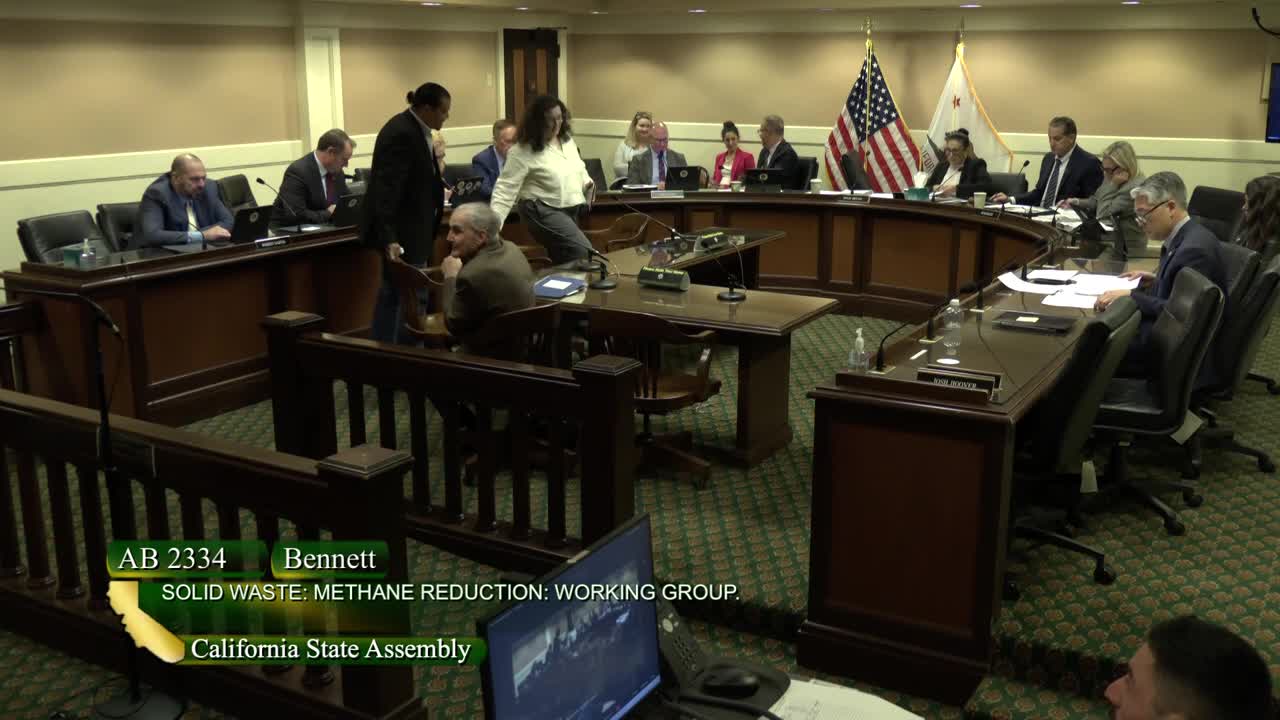 7MIN
Assembly Standing Committee on Natural Resources
Bill Author

Bill Co-Author(s):