AB 1918: Human trafficking: body art practitioners.
- Session Year: 2025-2026
- House: Assembly
- Latest Version Date: 2026-09-30
Current Status:
Passed
(2026-09-30: Chaptered by Secretary of State - Chapter 837, Statutes of 2026.)
Introduced
In Committee
Awaiting First Chamber Vote
Passed First Chamber
In Committee
Awaiting Second Chamber Vote
Passed Second Chamber
Enacted
Existing law requires certain businesses or establishments to post a notice relating to slavery and human trafficking, including hotlines and available services and support information. Existing law requires certain businesses or establishments to provide certain employees at least 20 minutes of training on human trafficking, as specified. Under existing law, the training must cover certain subjects, including how to recognize human trafficking. The training may also include information and material utilized by private nonprofit organizations that represent the interests of human trafficking victims and the Department of Justice, among other things.
This bill would additionally require body art facilities, by July 1, 2027, to post the above-described notice and to provide the human trafficking training to their employees and registered practitioners, as specified. The bill would instead authorize the training to include evidence-based, trauma-informed curriculum developed by the above-described nonprofit organizations and information and material available on the Department of Justices internet website.
Existing law requires certain businesses or establishments to post a notice relating to slavery and human trafficking, including hotlines and available services and support information. Existing law requires certain businesses or establishments to provide certain employees at least 20 minutes of training on human trafficking, as specified. Under existing law, the training must cover certain subjects, including how to recognize human trafficking. The training may also include information and material utilized by private nonprofit organizations that represent the interests of human trafficking victims and the Department of Justice, among other things.
This bill would additionally require body art facilities facilities, by July 1, 2027, to post the above-described notice and to provide the human trafficking training to their employees and registered practitioners, as specified. The bill would instead authorize the training to include evidence-based, trauma-informed curriculum developed by the above-described nonprofit organizations and information and material available on the Department of Justices internet website.
Existing law requires certain businesses or establishments to post a notice relating to slavery and human trafficking, including hotlines and available services and support information. Existing law requires certain businesses or establishments to provide certain employees at least 20 minutes of training on human trafficking, as specified. Under existing law, the training must cover certain subjects, including how to recognize human trafficking, and trafficking. The training may also include information and material utilized by private nonprofit organizations that represent the interests of human trafficking victims, victims and the Department of Justice, among other things.
This bill would additionally require body art facilities to post the above-described notice and to provide the human trafficking training to their employees and registered practitioners, as specified. The bill would instead authorize the training to include evidence-based, trauma-informed curriculum developed by the above-described nonprofit organizations. organizations and information and material available on the Department of Justices internet website.
Existing law requires certain businesses or establishments to post a notice relating to slavery and human trafficking, including hotlines and available services and support information. Existing law requires certain businesses or establishments to provide certain employees at least 20 minutes of training on human trafficking, as specified. Under existing law, the training must cover certain subjects, including how to recognize human trafficking, and may also include private nonprofit organizations that represent the interests of human trafficking victims, among other things.
This bill would additionally require body art facilities to post the above-described notice and to provide the human trafficking training to their employees and registered practitioners, as specified. The bill would instead authorize the training to include evidence-based, trauma-informed curriculum developed by the above-described nonprofit organizations.
Existing law establishes the Department of Justice, under the direction and control of the Attorney General. Under existing law, the department is responsible for gathering, analyzing, and storing intelligence pertaining to certain crimes, among other things.Existing law, the California Emergency Services Act, creates, within the office of the Governor, the Office of Emergency Services (Cal OES) under the supervision of the Director of Emergency Services. Existing law declares that Cal OES is responsible for addressing natural, technological, or human-caused disasters and emergencies, including responsibility for activities necessary to prevent, respond to, recover from, and mitigate the effects of emergencies and disasters on people and property. Existing law establishes, within Cal OES, the Curriculum Development Advisory Committee to provide advice on the development of specified course curricula.This bill would require the Department of Justice, in consultation with Cal OES and the Civil Rights Department, to develop and administer a training program regarding human trafficking awareness, as provided, as a condition of registration to perform body art. The bill would require the training to be conducted by an approved nonprofit organization and to include information on how to recognize and respond to signs of human trafficking, how to refer a person to resources for victims of human trafficking, and how to report suspected instances of human trafficking, among other things. The bill would require that the training program be provided at no cost to the individual.Existing law, the Safe Body Art Act, regulates the performance of body art, as defined, and requires the permitting of body art facilities and the registration of body art practitioners. Existing law prohibits a person from performing body art without registering with the local enforcement agency, as defined, and prohibits a body art facility from conducting business without a valid health permit. Existing law requires an applicant, as a condition of registration, to provide evidence demonstrating that the applicant has completed a federal Occupational Safety and Health Administration Bloodborne Pathogen Training, among other things. Existing law makes performing body art without being registered and performing body art at an unpermitted location a misdemeanor and provides administrative penalties for other violations.This bill would require an applicant for registration to perform body art to provide evidence that they have completed the human trafficking awareness training program described above. The bill would require a body art provider who is registered before January 1, 2027, and who is renewing their registration to complete the above-described training by January 1, 2030, and would make their registration inactive if that deadline is not met until the training is completed.This bill would prohibit a body art practitioner or the owner of a body art facility from publicly disclosing personal identifying information about a client suspected to be a victim of human trafficking, except as provided. The bill would limit the civil and criminal liability of a practitioner and owner under these provisions, in certain circumstances.By increasing the duties of local enforcement agencies, this bill would impose a state-mandated local program.The California Constitution requires the state to reimburse local agencies and school districts for certain costs mandated by the state. Statutory provisions establish procedures for making that reimbursement.This bill would provide that, if the Commission on State Mandates determines that the bill contains costs mandated by the state, reimbursement for those costs shall be made pursuant to the statutory provisions noted above.Existing law establishes the Department of Justice, under the direction and control of the Attorney General. Under existing law, the department is responsible for gathering, analyzing, and storing intelligence pertaining to certain crimes, among other things.
Existing law, the California Emergency Services Act, creates, within the office of the Governor, the Office of Emergency Services (Cal OES) under the supervision of the Director of Emergency Services. Existing law declares that Cal OES is responsible for addressing natural, technological, or human-caused disasters and emergencies, including responsibility for activities necessary to prevent, respond to, recover from, and mitigate the effects of emergencies and disasters on people and property. Existing law establishes, within Cal OES, the Curriculum Development Advisory Committee to provide advice on the development of specified course curricula.
This bill would require the Department of Justice, in consultation with Cal OES and the Civil Rights Department, to develop and administer a training program regarding human trafficking awareness, as provided, as a condition of registration to perform body art. The bill would require the training to be conducted by an approved nonprofit organization and to include information on how to recognize and respond to signs of human trafficking, how to refer a person to resources for victims of human trafficking, and how to report suspected instances of human trafficking, among other things. The bill would require that the training program be provided at no cost to the individual.
Existing law, the Safe Body Art Act, regulates the performance of body art, as defined, and requires the permitting of body art facilities and the registration of body art practitioners. Existing law prohibits a person from performing body art without registering with the local enforcement agency, as defined, and prohibits a body art facility from conducting business without a valid health permit. Existing law requires an applicant, as a condition of registration, to provide evidence demonstrating that the applicant has completed a federal Occupational Safety and Health Administration Bloodborne Pathogen Training, among other things. Existing law makes performing body art without being registered and performing body art at an unpermitted location a misdemeanor and provides administrative penalties for other violations.
This bill would require an applicant for registration to perform body art to provide evidence that they have completed the human trafficking awareness training program described above. The bill would require a body art provider who is registered before January 1, 2027, and who is renewing their registration to complete the above-described training by January 1, 2030, and would make their registration inactive if that deadline is not met until the training is completed.
This bill would prohibit a body art practitioner or the owner of a body art facility from publicly disclosing personal identifying information about a client suspected to be a victim of human trafficking, except as provided. The bill would limit the civil and criminal liability of a practitioner and owner under these provisions, in certain circumstances.
By increasing the duties of local enforcement agencies, this bill would impose a state-mandated local program.
The California Constitution requires the state to reimburse local agencies and school districts for certain costs mandated by the state. Statutory provisions establish procedures for making that reimbursement.
This bill would provide that, if the Commission on State Mandates determines that the bill contains costs mandated by the state, reimbursement for those costs shall be made pursuant to the statutory provisions noted above.
(a)Each of the following businesses and other establishments shall, upon the availability of the model notice described in subdivision (d), post a notice that complies with the requirements of this section in a conspicuous place near the public entrance of the establishment or in another conspicuous location in clear view of the public and employees where similar notices are customarily posted:
(1)On-sale general public premises licensees under the Alcoholic Beverage Control Act (Division 9 (commencing with Section 23000) of the Business and Professions Code).
(2)Adult or sexually oriented businesses, as defined in subdivision (a) of Section 318.5 of the Penal Code.
(3)Primary airports, as defined in Section 47102(16) of Title 49 of the United States Code.
(4)Intercity passenger rail or light rail stations.
(5)Bus stations.
(6)Truck stops. For purposes of this section, truck stop means a privately owned and operated facility that provides food, fuel, shower or other sanitary facilities, and lawful overnight truck parking.
(7)Emergency rooms within general acute care hospitals.
(8)Urgent care centers.
(9)Facilities that provide pediatric care. For purposes of this section, facilities that provide pediatric care means a medical facility that provides pediatric services, as that term is defined in Section 16907.5 of the Welfare and Institutions Code.
(10)Farm labor contractors, as defined in subdivision (b) of Section 1682 of the Labor Code.
(11)Privately operated job recruitment centers.
(12)Roadside rest areas.
(13)Businesses or establishments that offer massage or bodywork services for compensation and are not described in paragraph (1) of subdivision (b) of Section 4612 of the Business and Professions Code.
(14)Hotels, motels, and bed and breakfast inns, as defined in subdivision (b) of Section 24045.12 of the Business and Professions Code, not including personal residences.
(15)Hair, nail, electrolysis, and skin care, and other related businesses or establishments subject to regulation under Chapter 10 (commencing with Section 7301) of Division 3 of the Business and Professions Code.
(16)Body art facilities subject to regulation under Chapter 7 (commencing with Section 119300) of Part 15 of Division 104 of the Health and Safety Code.
(b)The notice to be posted pursuant to subdivision (a) shall be at least 81/2 inches by 11 inches in size, written in a 16-point font, and shall state the following:
If you or someone you know is being forced to engage in any activity and cannot leavewhether it is commercial sex, housework, farm work, construction, factory, retail, or restaurant work, or any other activitytext 233-733 (Be Free) or call the National Human Trafficking Hotline at 1-888-373-7888 or the California Coalition to Abolish Slavery and Trafficking (CAST) at 1-888-KEY-2-FRE(EDOM) or 1-888-539-2373 to access help and services. | ||
Victims of slavery and human trafficking are protected under United States and California law. | ||
| ||
Available 24 hours a day, 7 days a week. | ||
Toll-free. | ||
Operated by nonprofit, nongovernmental organizations. | ||
Anonymous and confidential. | ||
Accessible in more than 160 languages. | ||
Able to provide help, referral to services, training, and general information. | ||
(c)The notice to be posted pursuant to subdivision (a) shall be printed in English, Spanish, and in one other language that is the most widely spoken language in the county where the establishment is located and for which translation is mandated by the federal Voting Rights Act of 1965 (52 U.S.C. Sec. 10301 et seq.), as applicable. This section does not require a business or other establishment in a county where a language other than English or Spanish is the most widely spoken language to print the notice in more than one language in addition to English and Spanish.
(d)(1)On or before April 1, 2013, the Department of Justice shall develop a model notice that complies with the requirements of this section and make the model notice available for download on the departments internet website.
(2)On or before January 1, 2019, the Department of Justice shall revise and update the model notice to comply with the requirements of this section and make the updated model notice available for download on the departments internet website. A business or establishment required to post the model notice shall not be required to post the updated model notice until on and after January 1, 2019.
(e)(1)On or before January 1, 2021, a business or other establishment that operates a facility described in paragraph (4) or (5) of subdivision (a) shall provide at least 20 minutes of training to its new and existing employees who may interact with, or come into contact with, a victim of human trafficking or who are likely to receive, in the course of their employment, a report from another employee about suspected human trafficking, in recognizing the signs of human trafficking and how to report those signs to the appropriate law enforcement agency.
(2)On or before July 1, 2027, a business or other establishment that operates a facility described in paragraph (16) of subdivision (a) shall provide at least 20 minutes of training in recognizing the signs of human trafficking and how to report those signs to the appropriate law enforcement agency to both of the following:
(A)New and existing employees who may interact with, or come into contact with, a victim of human trafficking or who are likely to receive, in the course of their employment, a report from another employee about suspected human trafficking.
(B)Registered practitioners who practice in the body art facility and who may interact with, or come into contact with, a victim of human trafficking or who are likely to receive a report from an employee of the business or establishment about suspected human trafficking.
(3)For purposes of this section, registered practitioner means a person registered pursuant to Article 3 (commencing with Section 119306) of Chapter 7 of Part 15 of Division 104 of the Health and Safety Code.
(f)The training pursuant to subdivision (e) shall include, but not be limited to, all of the following:
(1)The definition of human trafficking, including sex trafficking and labor trafficking.
(2)Myths and misconceptions about human trafficking.
(3)Physical and mental signs to be aware of that may indicate that human trafficking is occurring.
(4)Guidance on how to identify individuals who are most at risk for human trafficking.
(5)Guidance on how to report human trafficking, including, but not limited to, national hotlines (1-888-373-7888 and text line 233733) and contact information for local law enforcement agencies that an employee or registered practitioners may use to make a confidential report.
(6)Protocols for reporting human trafficking when on the job.
(g)(1)The human trafficking training pursuant to subdivision (e) may include, but shall not be limited to, any of the following:
(A)Information and material utilized in training Santa Clara County Valley Transportation Authority employees.
(B)Evidence-based, trauma-informed curriculum developed by private, nonprofit organizations that represent the interests of human trafficking victims.
(C)Information and material available on the Department of Justices internet website.
(2)The failure to report human trafficking by an employee or registered practitioner shall not, by itself, result in the liability of the business or other establishment that operates a facility described in paragraph (4), (5), or (16) of subdivision (a) or of any other person or entity.
(h)A business or establishment that fails to comply with the requirements of this section is liable for a civil penalty of one thousand dollars ($1,000) for a first offense and two thousand dollars ($2,000) for each subsequent offense. A government entity identified in Section 17204 of the Business and Professions Code may bring an action to impose a civil penalty pursuant to this subdivision against a business or establishment if a local or state agency with authority to regulate that business or establishment has satisfied both of the following:
(1)Provided the business or establishment with reasonable notice of noncompliance, which informs the business or establishment that it is subject to a civil penalty if it does not correct the violation within 30 days from the date the notice is sent to the business or establishment.
(2)Verified that the violation was not corrected within the 30-day period described in paragraph (1).
(i)This section does not prevent a local governing body from adopting and enforcing a local ordinance, rule, or regulation to prevent slavery or human trafficking. If a local ordinance, rule, or regulation duplicates or supplements the requirements that this section imposes upon businesses and other establishments, this section does not supersede or preempt that local ordinance, rule, or regulation.
(j)The Attorney General may enforce this section.
(k)Fines collected pursuant to this section shall be deposited in the Survivor Support Fund.
(a)Each of the following businesses and other establishments shall, upon the availability of the model notice described in subdivision (d), post a notice that complies with the requirements of this section in a conspicuous place near the public entrance of the establishment or in another conspicuous location in clear view of the public and employees where similar notices are customarily posted:
(1)On-sale general public premises licensees under the Alcoholic Beverage Control Act (Division 9 (commencing with Section 23000) of the Business and Professions Code).
(2)Adult or sexually oriented businesses, as defined in subdivision (a) of Section 318.5 of the Penal Code.
(3)Primary airports, as defined in Section 47102(16) of Title 49 of the United States Code.
(4)Intercity passenger rail or light rail stations.
(5)Bus stations.
(6)Truck stops. For purposes of this section, truck stop means a privately owned and operated facility that provides food, fuel, shower or other sanitary facilities, and lawful overnight truck parking.
(7)Emergency rooms within general acute care hospitals.
(8)Urgent care centers.
(9)Facilities that provide pediatric care. For purposes of this section, facilities that provide pediatric care means a medical facility that provides pediatric services, as that term is defined in Section 16907.5 of the Welfare and Institutions Code.
(10)Farm labor contractors, as defined in subdivision (b) of Section 1682 of the Labor Code.
(11)Privately operated job recruitment centers.
(12)Roadside rest areas.
(13)Businesses or establishments that offer massage or bodywork services for compensation and are not described in paragraph (1) of subdivision (b) of Section 4612 of the Business and Professions Code.
(14)Hotels, motels, and bed and breakfast inns, as defined in subdivision (b) of Section 24045.12 of the Business and Professions Code, not including personal residences.
(15)Hair, nail, electrolysis, and skin care, and other related businesses or establishments subject to regulation under Chapter 10 (commencing with Section 7301) of Division 3 of the Business and Professions Code.
(16)Body art facilities subject to regulation under Chapter 7 (commencing with Section 119300) of Part 15 of Division 104 of the Health and Safety Code.
(b)The notice to be posted pursuant to subdivision (a) shall be at least 81/2 inches by 11 inches in size, written in a 16-point font, and shall state the following:
If you or someone you know is being forced to engage in any activity and cannot leavewhether it is commercial sex, housework, farm work, construction, factory, retail, or restaurant work, or any other activitytext 233-733 (Be Free) or call the National Human Trafficking Hotline at 1-888-373-7888 or the California Coalition to Abolish Slavery and Trafficking (CAST) at 1-888-KEY-2-FRE(EDOM) or 1-888-539-2373 to access help and services. | ||
Victims of slavery and human trafficking are protected under United States and California law. | ||
| ||
Available 24 hours a day, 7 days a week. | ||
Toll-free. | ||
Operated by nonprofit, nongovernmental organizations. | ||
Anonymous and confidential. | ||
Accessible in more than 160 languages. | ||
Able to provide help, referral to services, training, and general information. | ||
(c)The notice to be posted pursuant to subdivision (a) shall be printed in English, Spanish, and in one other language that is the most widely spoken language in the county where the establishment is located and for which translation is mandated by the federal Voting Rights Act of 1965 (52 U.S.C. Sec. 10301 et seq.), as applicable. This section does not require a business or other establishment in a county where a language other than English or Spanish is the most widely spoken language to print the notice in more than one language in addition to English and Spanish.
(d)(1)On or before April 1, 2013, the Department of Justice shall develop a model notice that complies with the requirements of this section and make the model notice available for download on the departments internet website.
(2)On or before January 1, 2019, the Department of Justice shall revise and update the model notice to comply with the requirements of this section and make the updated model notice available for download on the departments internet website. A business or establishment required to post the model notice shall not be required to post the updated model notice until on and after January 1, 2019.
(e)On or before January 1, 2027, a business or other establishment that operates a facility described in paragraph (4), (5), or (16) of subdivision (a) shall provide to both of the following at least 20 minutes of training in recognizing the signs of human trafficking and how to report those signs to the appropriate law enforcement agency:(e)(1)On or before January 1, 2021, a business or other establishment that operates a facility described in paragraph (4) or (5) of subdivision (a) shall provide at least 20 minutes of training to its new and existing employees who may interact with, or come into contact with, a victim of human trafficking or who are likely to receive, in the course of their employment, a report from another employee about suspected human trafficking, in recognizing the signs of human trafficking and how to report those signs to the appropriate law enforcement agency.
(2)On or before July 1, 2027, a business or other establishment that operates a facility described in paragraph (16) of subdivision (a) shall provide at least 20 minutes of training in recognizing the signs of human trafficking and how to report those signs to the appropriate law enforcement agency to both of the following:
(1)(A)New and existing employees who may interact with, or come into contact with, a victim of human trafficking or who are likely to receive, in the course of their employment, a report from another employee about suspected human trafficking.
(2)(B)Registered practitioners who practice in the body art facility and who may interact with, or come into contact with, a victim of human trafficking or who are likely to receive a report from an employee of the business or establishment about suspected human trafficking. For
(3)For purposes of this section, registered practitioner means a person registered pursuant to Article 3 (commencing with Section 119306) of Chapter 7 of Part 15 of Division 104 of the Health and Safety Code.
(f)The training pursuant to subdivision (e) shall include, but not be limited to, all of the following:
(1)The definition of human trafficking, including sex trafficking and labor trafficking.
(2)Myths and misconceptions about human trafficking.
(3)Physical and mental signs to be aware of that may indicate that human trafficking is occurring.
(4)Guidance on how to identify individuals who are most at risk for human trafficking.
(5)Guidance on how to report human trafficking, including, but not limited to, national hotlines (1-888-373-7888 and text line 233733) and contact information for local law enforcement agencies that an employee or registered practitioners may use to make a confidential report.
(6)Protocols for reporting human trafficking when on the job.
(g)(1)The human trafficking training pursuant to subdivision (e) may include, but shall not be limited to, any of the following:
(A)Information and material utilized in training Santa Clara County Valley Transportation Authority employees.
(B)Evidence-based, trauma-informed curriculum developed by private, nonprofit organizations that represent the interests of human trafficking victims.
(C)Information and material available on the Department of Justices internet website.
(2)The failure to report human trafficking by an employee or registered practitioner shall not, by itself, result in the liability of the business or other establishment that operates a facility described in paragraph (4), (5), or (16) of subdivision (a) or of any other person or entity.
(h)A business or establishment that fails to comply with the requirements of this section is liable for a civil penalty of one thousand dollars ($1,000) for a first offense and two thousand dollars ($2,000) for each subsequent offense. A government entity identified in Section 17204 of the Business and Professions Code may bring an action to impose a civil penalty pursuant to this subdivision against a business or establishment if a local or state agency with authority to regulate that business or establishment has satisfied both of the following:
(1)Provided the business or establishment with reasonable notice of noncompliance, which informs the business or establishment that it is subject to a civil penalty if it does not correct the violation within 30 days from the date the notice is sent to the business or establishment.
(2)Verified that the violation was not corrected within the 30-day period described in paragraph (1).
(i)This section does not prevent a local governing body from adopting and enforcing a local ordinance, rule, or regulation to prevent slavery or human trafficking. If a local ordinance, rule, or regulation duplicates or supplements the requirements that this section imposes upon businesses and other establishments, this section does not supersede or preempt that local ordinance, rule, or regulation.
(j)The Attorney General may enforce this section.
(k)Fines collected pursuant to this section shall be deposited in the Survivor Support Fund.
(a)Each of the following businesses and other establishments shall, upon the availability of the model notice described in subdivision (d), post a notice that complies with the requirements of this section in a conspicuous place near the public entrance of the establishment or in another conspicuous location in clear view of the public and employees where similar notices are customarily posted:
(1)On-sale general public premises licensees under the Alcoholic Beverage Control Act (Division 9 (commencing with Section 23000) of the Business and Professions Code).
(2)Adult or sexually oriented businesses, as defined in subdivision (a) of Section 318.5 of the Penal Code.
(3)Primary airports, as defined in Section 47102(16) of Title 49 of the United States Code.
(4)Intercity passenger rail or light rail stations.
(5)Bus stations.
(6)Truck stops. For purposes of this section, truck stop means a privately owned and operated facility that provides food, fuel, shower or other sanitary facilities, and lawful overnight truck parking.
(7)Emergency rooms within general acute care hospitals.
(8)Urgent care centers.
(9)Facilities that provide pediatric care. For purposes of this section, facilities that provide pediatric care means a medical facility that provides pediatric services, as that term is defined in Section 16907.5 of the Welfare and Institutions Code.
(10)Farm labor contractors, as defined in subdivision (b) of Section 1682 of the Labor Code.
(11)Privately operated job recruitment centers.
(12)Roadside rest areas.
(13)Businesses or establishments that offer massage or bodywork services for compensation and are not described in paragraph (1) of subdivision (b) of Section 4612 of the Business and Professions Code.
(14)Hotels, motels, and bed and breakfast inns, as defined in subdivision (b) of Section 24045.12 of the Business and Professions Code, not including personal residences.
(15)Hair, nail, electrolysis, and skin care, and other related businesses or establishments subject to regulation under Chapter 10 (commencing with Section 7301) of Division 3 of the Business and Professions Code.
(16)Body art facilities subject to regulation under Chapter 7 (commencing with Section 119300) of Part 15 of Division 104 of the Health and Safety Code.
(b)The notice to be posted pursuant to subdivision (a) shall be at least 81/2 inches by 11 inches in size, written in a 16-point font, and shall state the following:
If you or someone you know is being forced to engage in any activity and cannot leavewhether it is commercial sex, housework, farm work, construction, factory, retail, or restaurant work, or any other activitytext 233-733 (Be Free) or call the National Human Trafficking Hotline at 1-888-373-7888 or the California Coalition to Abolish Slavery and Trafficking (CAST) at 1-888-KEY-2-FRE(EDOM) or 1-888-539-2373 to access help and services. | ||
Victims of slavery and human trafficking are protected under United States and California law. | ||
| ||
Available 24 hours a day, 7 days a week. | ||
Toll-free. | ||
Operated by nonprofit, nongovernmental organizations. | ||
Anonymous and confidential. | ||
Accessible in more than 160 languages. | ||
Able to provide help, referral to services, training, and general information. | ||
(c)The notice to be posted pursuant to subdivision (a) shall be printed in English, Spanish, and in one other language that is the most widely spoken language in the county where the establishment is located and for which translation is mandated by the federal Voting Rights Act of 1965 (52 U.S.C. Sec. 10301 et seq.), as applicable. This section does not require a business or other establishment in a county where a language other than English or Spanish is the most widely spoken language to print the notice in more than one language in addition to English and Spanish.
(d)(1)On or before April 1, 2013, the Department of Justice shall develop a model notice that complies with the requirements of this section and make the model notice available for download on the departments internet website.
(2)On or before January 1, 2019, the Department of Justice shall revise and update the model notice to comply with the requirements of this section and make the updated model notice available for download on the departments internet website. A business or establishment required to post the model notice shall not be required to post the updated model notice until on and after January 1, 2019.
(e)On or before January 1, 2027, a business or other establishment that operates a facility described in paragraph (4), (5), or (16) of subdivision (a) shall provide to both of the following at least 20 minutes of training in recognizing the signs of human trafficking and how to report those signs to the appropriate law enforcement agency:
(1)New and existing employees who may interact with, or come into contact with, a victim of human trafficking or who are likely to receive, in the course of their employment, a report from another employee about suspected human trafficking.
(2)Registered practitioners who practice in the body art facility and who may interact with, or come into contact with, a victim of human trafficking or who are likely to receive a report from an employee of the business or establishment about suspected human trafficking. For purposes of this section, registered practitioner means a person registered pursuant to Article 3 (commencing with Section 119306) of Chapter 7 of Part 15 of Division 104 of the Health and Safety Code.
(f)The training pursuant to subdivision (e) shall include, but not be limited to, all of the following:
(1)The definition of human trafficking, including sex trafficking and labor trafficking.
(2)Myths and misconceptions about human trafficking.
(3)Physical and mental signs to be aware of that may indicate that human trafficking is occurring.
(4)Guidance on how to identify individuals who are most at risk for human trafficking.
(5)Guidance on how to report human trafficking, including, but not limited to, national hotlines (1-888-373-7888 and text line 233733) and contact information for local law enforcement agencies that an employee or registered practitioners may use to make a confidential report.
(6)Protocols for reporting human trafficking when on the job.
(g)(1)The human trafficking training pursuant to subdivision (e) may include, but shall not be limited to, any of the following:
(A)Information and material utilized in training Santa Clara County Valley Transportation Authority employees.
(B)Evidence-based, trauma-informed curriculum developed by private, nonprofit organizations that represent the interests of human trafficking victims.
(C)The Information and material available on the Department of Justice. Justices internet website.
(2)The failure to report human trafficking by an employee or registered practitioner shall not, by itself, result in the liability of the business or other establishment that operates a facility described in paragraph (4), (5), or (16) of subdivision (a) or of any other person or entity.
(h)A business or establishment that fails to comply with the requirements of this section is liable for a civil penalty of one thousand dollars ($1,000) for a first offense and two thousand dollars ($2,000) for each subsequent offense. A government entity identified in Section 17204 of the Business and Professions Code may bring an action to impose a civil penalty pursuant to this subdivision against a business or establishment if a local or state agency with authority to regulate that business or establishment has satisfied both of the following:
(1)Provided the business or establishment with reasonable notice of noncompliance, which informs the business or establishment that it is subject to a civil penalty if it does not correct the violation within 30 days from the date the notice is sent to the business or establishment.
(2)Verified that the violation was not corrected within the 30-day period described in paragraph (1).
(i)This section does not prevent a local governing body from adopting and enforcing a local ordinance, rule, or regulation to prevent slavery or human trafficking. If a local ordinance, rule, or regulation duplicates or supplements the requirements that this section imposes upon businesses and other establishments, this section does not supersede or preempt that local ordinance, rule, or regulation.
(j)The Attorney General may enforce this section.
(k)Fines collected pursuant to this section shall be deposited in the Survivor Support Fund.
(a)Each of the following businesses and other establishments shall, upon the availability of the model notice described in subdivision (d), post a notice that complies with the requirements of this section in a conspicuous place near the public entrance of the establishment or in another conspicuous location in clear view of the public and employees where similar notices are customarily posted:
(1)On-sale general public premises licensees under the Alcoholic Beverage Control Act (Division 9 (commencing with Section 23000) of the Business and Professions Code).
(2)Adult or sexually oriented businesses, as defined in subdivision (a) of Section 318.5 of the Penal Code.
(3)Primary airports, as defined in Section 47102(16) of Title 49 of the United States Code.
(4)Intercity passenger rail or light rail stations.
(5)Bus stations.
(6)Truck stops. For purposes of this section, truck stop means a privately owned and operated facility that provides food, fuel, shower or other sanitary facilities, and lawful overnight truck parking.
(7)Emergency rooms within general acute care hospitals.
(8)Urgent care centers.
(9)Facilities that provide pediatric care. For purposes of this section, facilities that provide pediatric care means a medical facility that provides pediatric services, as that term is defined in Section 16907.5 of the Welfare and Institutions Code.
(10)Farm labor contractors, as defined in subdivision (b) of Section 1682 of the Labor Code.
(11)Privately operated job recruitment centers.
(12)Roadside rest areas.
(13)Businesses or establishments that offer massage or bodywork services for compensation and are not described in paragraph (1) of subdivision (b) of Section 4612 of the Business and Professions Code.
(14)Hotels, motels, and bed and breakfast inns, as defined in subdivision (b) of Section 24045.12 of the Business and Professions Code, not including personal residences.
(15)Hair, nail, electrolysis, and skin care, and other related businesses or establishments subject to regulation under Chapter 10 (commencing with Section 7301) of Division 3 of the Business and Professions Code.
(16)Body art facilities subject to regulation under Chapter 7 (commencing with Section 119300) of Part 15 of Division 104 of the Health and Safety Code.
(b)The notice to be posted pursuant to subdivision (a) shall be at least 81/2 inches by 11 inches in size, written in a 16-point font, and shall state the following:
If you or someone you know is being forced to engage in any activity and cannot leavewhether it is commercial sex, housework, farm work, construction, factory, retail, or restaurant work, or any other activitytext 233-733 (Be Free) or call the National Human Trafficking Hotline at 1-888-373-7888 or the California Coalition to Abolish Slavery and Trafficking (CAST) at 1-888-KEY-2-FRE(EDOM) or 1-888-539-2373 to access help and services. | ||
Victims of slavery and human trafficking are protected under United States and California law. | ||
| ||
Available 24 hours a day, 7 days a week. | ||
Toll-free. | ||
Operated by nonprofit, nongovernmental organizations. | ||
Anonymous and confidential. | ||
Accessible in more than 160 languages. | ||
Able to provide help, referral to services, training, and general information. | ||
(c)The notice to be posted pursuant to subdivision (a) shall be printed in English, Spanish, and in one other language that is the most widely spoken language in the county where the establishment is located and for which translation is mandated by the federal Voting Rights Act of 1965 (52 U.S.C. Sec. 10301 et seq.), as applicable. This section does not require a business or other establishment in a county where a language other than English or Spanish is the most widely spoken language to print the notice in more than one language in addition to English and Spanish.
(d)(1)On or before April 1, 2013, the Department of Justice shall develop a model notice that complies with the requirements of this section and make the model notice available for download on the departments internet website.
(2)On or before January 1, 2019, the Department of Justice shall revise and update the model notice to comply with the requirements of this section and make the updated model notice available for download on the departments internet website. A business or establishment required to post the model notice shall not be required to post the updated model notice until on and after January 1, 2019.
(e)On or before January 1, 2021, January 1, 2027, a business or other establishment that operates a facility described in paragraph (4) or (5) (4), (5), or (16) of subdivision (a) shall provide to both of the following at least 20 minutes of training to its new in recognizing the signs of human trafficking and how to report those signs to the appropriate law enforcement agency:
(1)New and existing employees who may interact with, or come into contact with, a victim of human trafficking or who are likely to receive, in the course of their employment, a report from another employee about suspected human trafficking, in recognizing the signs of human trafficking and how to report those signs to the appropriate law enforcement agency. trafficking.
(2)Registered practitioners who practice in the body art facility and who may interact with, or come into contact with, a victim of human trafficking or who are likely to receive a report from an employee of the business or establishment about suspected human trafficking. For purposes of this section, registered practitioner means a person registered pursuant to Article 3 (commencing with Section 119306) of Chapter 7 of Part 15 of Division 104 of the Health and Safety Code.
(f)The employee training pursuant to subdivision (e) shall include, but not be limited to, all of the following:
(1)The definition of human trafficking, including sex trafficking and labor trafficking.
(2)Myths and misconceptions about human trafficking.
(3)Physical and mental signs to be aware of that may indicate that human trafficking is occurring.
(4)Guidance on how to identify individuals who are most at risk for human trafficking.
(5)Guidance on how to report human trafficking, including, but not limited to, national hotlines (1-888-373-7888 and text line 233733) and contact information for local law enforcement agencies that an employee or registered practitioners may use to make a confidential report.
(6)Protocols for reporting human trafficking when on the job.
(g)(1)The human trafficking employee training pursuant to subdivision (e) may include, but shall not be limited to, information and material utilized in training Santa Clara County Valley Transportation Authority employees, private nonprofit organizations that represent the interests of human trafficking victims, and the Department of Justice. any of the following:
(A)Information and material utilized in training Santa Clara County Valley Transportation Authority employees.
(B)Evidence-based, trauma-informed curriculum developed by private, nonprofit organizations that represent the interests of human trafficking victims.
(C)The Department of Justice.
(2)The failure to report human trafficking by an employee or registered practitioner shall not, by itself, result in the liability of the business or other establishment that operates a facility described in paragraph (4) or (5) (4), (5), or (16) of subdivision (a) or of any other person or entity.
(h)A business or establishment that fails to comply with the requirements of this section is liable for a civil penalty of one thousand dollars ($1,000) for a first offense and two thousand dollars ($2,000) for each subsequent offense. A government entity identified in Section 17204 of the Business and Professions Code may bring an action to impose a civil penalty pursuant to this subdivision against a business or establishment if a local or state agency with authority to regulate that business or establishment has satisfied both of the following:
(1)Provided the business or establishment with reasonable notice of noncompliance, which informs the business or establishment that it is subject to a civil penalty if it does not correct the violation within 30 days from the date the notice is sent to the business or establishment.
(2)Verified that the violation was not corrected within the 30-day period described in paragraph (1).
(i)This section does not prevent a local governing body from adopting and enforcing a local ordinance, rule, or regulation to prevent slavery or human trafficking. If a local ordinance, rule, or regulation duplicates or supplements the requirements that this section imposes upon businesses and other establishments, this section does not supersede or preempt that local ordinance, rule, or regulation.
(j)The Attorney General may enforce this section.
(k)Fines collected pursuant to this section shall be deposited in the Survivors Survivor Support Fund.
SECTION 1.Section 8588.13 is added to the Government Code, to read:8588.13.(a)The Department of Justice, in consultation with the Office of Emergency Services and the Civil Rights Department, shall develop, and administer to all persons applying for registration to perform body art pursuant to Section 119306 of the Health and Safety Code, a human trafficking awareness training program, not to exceed one hour. The training shall meet all of the following requirements:(1)The training shall be conducted by a nonprofit organization that is approved by the Department of Justice, in consultation with the Office of Emergency Services and the Civil Rights Department.(2)The training shall include information on how to recognize the signs of human trafficking, how to respond to those signs, how to refer a person to resources for victims of human trafficking, and how to report signs of human trafficking to the National Human Trafficking Hotline.(3)The training shall incorporate evidence-based, trauma-informed curriculum modeled after the 3Strands Global Foundation PROTECT program or other comparable nationally recognized prevention program.(4)The training shall include safety protocols for interactions with minors and adults who may be experiencing coercion, including strategies for nonconfrontational engagement, private conversations, and safe referral pathways.(5)The training shall be made available both in person and online, and shall be provided at no cost to the applicant.(b)The Department of Justice, in consultation with the Office of Emergency Services, shall publish an annual report regarding the training program established by this section that includes, but is not limited to, all of the following:(1)The number of trainings completed pursuant to paragraph (7) of subdivision (c) of Section 119306 of the Health and Safety Code.(2)The number of referrals to the National Human Trafficking Hotline that originated from permitted body art facilities, as described in Chapter 7 (commencing with Section 119300) of Part 15 of Division 104 of the Health and Safety Code.(3)Trends, gaps, and recommendations for improving the training program described by this section or the administration of the training program.SEC. 2.Section 119306 of the Health and Safety Code is amended to read:119306.(a)A person shall not perform body art at any location other than a permitted permanent or temporary body art facility.(b)A person shall not perform body art if not registered with the local enforcement agency.(c)As a condition of registration, the applicant shall provide all of the following:(1)Evidence of current hepatitis B vaccination, including applicable boosters, unless the practitioner can demonstrate hepatitis B immunity or has complied with current federal Occupational Safety and Health Administration (OSHA) hepatitis B vaccination declination requirements.(2)Evidence of completion of OSHA Bloodborne Pathogen Training consistent with Section 119307 and pursuant to paragraph (2) of subdivision (g) of Section 5193 of Title 8 of the California Code of Regulations or its successor.(3)Proof that the applicant is 18 years of age or older.(4)Self-certification of, knowledge of, and commitment to meet state law and relevant local regulations pertaining to body art safety.(5)The applicants business address and the address at which they will perform any activity regulated by this chapter.(6)Payment of a registration fee directly to the local enforcement agency. The local enforcement agency shall set the fee at an amount not to exceed the amount necessary but that is sufficient to cover the actual costs of administering the program.(7)Evidence of completion of the human trafficking awareness training described in Section 8588.13 of the Government Code.(d)A practitioner shall display, in a place readily visible to the public at the body art facility where the practitioner is performing body art, the certificate confirming registration with the local enforcement agency in the jurisdiction in which that practice is conducted.(e)A valid and current registration issued by a local enforcement agency shall be valid in any other jurisdiction for no more than five consecutive days, or 15 days total, in any one calendar year.(f)(1)Practitioner registration shall be renewed annually by a process to be determined by the local enforcement agency.(2)A practitioner who was registered before January 1, 2027, and who is renewing their registration pursuant to this subdivision, shall complete the human trafficking awareness training required by paragraph (7) of subdivision (c) by January 1, 2030. Failure to complete the training by that date shall result in the practitioners registration being inactive until they complete the training.(g)A practitioner shall obtain all necessary permits to conduct business, including, but not limited to, being registered with the local enforcement agency. In addition to the penalties available pursuant to Article 6 (commencing with Section 119320), a practitioner who violates this subdivision shall be subject to suspension and a penalty not to exceed three times the cost of registration.SEC. 3.Section 119306.1 is added to the Health and Safety Code, to read:119306.1.(a)A practitioner or owner shall keep confidential and shall not publicly disclose personal identifying information about a client suspected to be a victim of trafficking, except that personal identifying information may be disclosed when making a good faith report of suspected human trafficking to the National Human Trafficking Hotline or to an appropriate law enforcement agency, as provided by law.(b)A practitioner or owner who, in good faith, responds to, refers, or makes a report of a suspected human trafficking situation shall not incur civil or criminal liability as a result of taking that action.(c)This section does not require a practitioner or owner to make a report of suspected human trafficking as described in subdivision (a). A practitioner or owner not reporting suspected human trafficking shall not, by itself, result in liability to a human trafficking victim or to any other party.SEC. 4.If the Commission on State Mandates determines that this act contains costs mandated by the state, reimbursement to local agencies and school districts for those costs shall be made pursuant to Part 7 (commencing with Section 17500) of Division 4 of Title 2 of the Government Code.(a)The Department of Justice, in consultation with the Office of Emergency Services and the Civil Rights Department, shall develop, and administer to all persons applying for registration to perform body art pursuant to Section 119306 of the Health and Safety Code, a human trafficking awareness training program, not to exceed one hour. The training shall meet all of the following requirements:
(1)The training shall be conducted by a nonprofit organization that is approved by the Department of Justice, in consultation with the Office of Emergency Services and the Civil Rights Department.
(2)The training shall include information on how to recognize the signs of human trafficking, how to respond to those signs, how to refer a person to resources for victims of human trafficking, and how to report signs of human trafficking to the National Human Trafficking Hotline.
(3)The training shall incorporate evidence-based, trauma-informed curriculum modeled after the 3Strands Global Foundation PROTECT program or other comparable nationally recognized prevention program.
(4)The training shall include safety protocols for interactions with minors and adults who may be experiencing coercion, including strategies for nonconfrontational engagement, private conversations, and safe referral pathways.
(5)The training shall be made available both in person and online, and shall be provided at no cost to the applicant.
(b)The Department of Justice, in consultation with the Office of Emergency Services, shall publish an annual report regarding the training program established by this section that includes, but is not limited to, all of the following:
(1)The number of trainings completed pursuant to paragraph (7) of subdivision (c) of Section 119306 of the Health and Safety Code.
(2)The number of referrals to the National Human Trafficking Hotline that originated from permitted body art facilities, as described in Chapter 7 (commencing with Section 119300) of Part 15 of Division 104 of the Health and Safety Code.
(3)Trends, gaps, and recommendations for improving the training program described by this section or the administration of the training program.
SEC. 2.Section 119306 of the Health and Safety Code is amended to read:119306.(a)A person shall not perform body art at any location other than a permitted permanent or temporary body art facility.
(b)A person shall not perform body art if he or she is not registered with the local enforcement agency.
(c)As a condition of registration, the applicant shall provide all of the following:
(1)Evidence of current hepatitis B vaccination, including applicable boosters, unless the practitioner can demonstrate hepatitis B immunity or has complied with current federal OSHA Occupational Safety and Health Administration (OSHA) hepatitis B vaccination declination requirements.
(2)Evidence of completion of OSHA Bloodborne Pathogen Training consistent with Section 119307 and pursuant to paragraph (2) of subdivision (g) of Section 5193 of Title 8 of the California Code of Regulations or its successor.
(3)Proof that he or she the applicant is 18 years of age or older.
(4)Self-certification of, knowledge of, and commitment to meet state law and relevant local regulations pertaining to body art safety.
(5)His or her The applicants business address and the address at which he or she they will perform any activity regulated by this chapter.
(6)Payment of a registration fee directly to the local enforcement agency. The local enforcement agency shall set the fee at an amount not to exceed the amount necessary but that is sufficient to cover the actual costs of administering the program.
(7)Evidence of completion of the human trafficking awareness training described in Section 8588.13 of the Government Code.
(d)A practitioner shall display, in a place readily visible to the public at the body art facility where the practitioner is performing body art, the certificate confirming registration with the local enforcement agency in the jurisdiction in which that practice is conducted.
(e)A valid and current registration issued by a local enforcement agency shall be valid in any other jurisdiction for no more than five consecutive days, or 15 days total, in any one calendar year.
(f)(1)Practitioner registration shall be renewed annually by a process to be determined by the local enforcement agency.
(2)A practitioner who was registered before January 1, 2027, and who is renewing their registration pursuant to this subdivision, shall complete the human trafficking awareness training required by paragraph (7) of subdivision (c) by January 1, 2030. Failure to complete the training by that date shall result in the practitioners registration being inactive until they complete the training.
(g)A practitioner shall obtain all necessary permits to conduct business, including, but not limited to, being registered with the local enforcement agency. In addition to the penalties available pursuant to Article 6 (commencing with Section 119320), a practitioner who violates this subdivision shall be subject to suspension and a penalty not to exceed three times the cost of registration.
SEC. 3.Section 119306.1 is added to the Health and Safety Code, to read:119306.1.(a)A practitioner or owner shall keep confidential and shall not publicly disclose personal identifying information about a client suspected to be a victim of trafficking, except that personal identifying information may be disclosed when making a good faith report of suspected human trafficking to the National Human Trafficking Hotline or to an appropriate law enforcement agency, as provided by law.
(b)A practitioner or owner who, in good faith, responds to, refers, or makes a report of a suspected human trafficking situation shall not incur civil or criminal liability as a result of taking that action.
(c)This section does not require a practitioner or owner to make a report of suspected human trafficking as described in subdivision (a). A practitioner or owner not reporting suspected human trafficking shall not, by itself, result in liability to a human trafficking victim or to any other party.
SEC. 4.If the Commission on State Mandates determines that this act contains costs mandated by the state, reimbursement to local agencies and school districts for those costs shall be made pursuant to Part 7 (commencing with Section 17500) of Division 4 of Title 2 of the Government Code.
|
Date
|
Status
|
|---|---|
| Sep 30, 2026 | Chaptered by Secretary of State - Chapter 837, Statutes of 2026. |
| Sep 30, 2026 | Approved by the Governor. |
| Sep 4, 2026 | Enrolled and presented to the Governor at 4 p.m. |
| Aug 27, 2026 | Senate amendments concurred in. To Engrossing and Enrolling. (Ayes 77. Noes 0. Page 6715.). |
| Aug 27, 2026 | Senate amendments concurred in. To Engrossing and Enrolling. (Ayes 77. Noes 0.). |
| Aug 25, 2026 | In Assembly. Concurrence in Senate amendments pending. |
| Aug 25, 2026 | Read third time. Passed. Ordered to the Assembly. (Ayes 40. Noes 0. Page 5789.). |
| Aug 25, 2026 | Read third time. Passed. Ordered to the Assembly. (Ayes 38. Noes 0.). |
| Aug 24, 2026 | Read second time. Ordered to third reading. |
| Aug 21, 2026 | Read third time and amended. Ordered to second reading. |
| Jul 2, 2026 | Ordered to third reading. |
| Jul 2, 2026 | From Consent Calendar. |
| Jun 30, 2026 | Read second time. Ordered to Consent Calendar. |
| Jun 29, 2026 | From committee: Be ordered to second reading file pursuant to Senate Rule 28.8 and ordered to Consent Calendar. |
| Jun 17, 2026 | From committee: Do pass and re-refer to Com. on APPR. with recommendation: To Consent Calendar. (Ayes 11. Noes 0.) (June 16). Re-referred to Com. on APPR. |
| Jun 4, 2026 | From committee chair, with author's amendments: Amend, and re-refer to committee. Read second time, amended, and re-referred to Com. on JUD. |
| May 13, 2026 | Referred to Com. on JUD. |
| May 5, 2026 | In Senate. Read first time. To Com. on RLS. for assignment. |
| May 4, 2026 | Read third time. Passed. Ordered to the Senate. (Ayes 73. Noes 0. Page 4917.) |
| May 4, 2026 | Read third time. Passed. Ordered to the Senate. (Ayes 73. Noes 0.) |
| May 4, 2026 | Read third time. Passed. Ordered to the Senate. |
| Apr 23, 2026 | Read second time. Ordered to Consent Calendar. |
| Apr 22, 2026 | From committee: Do pass. To Consent Calendar. (Ayes 13. Noes 0.) (April 22). |
| Apr 9, 2026 | Re-referred to Com. on APPR. pursuant to Assembly Rule 96. |
| Apr 8, 2026 | From committee: Do pass and re-refer to Com. on PUB. S. with recommendation: To Consent Calendar. (Ayes 12. Noes 0.) (April 7). Re-referred to Com. on PUB. S. |
| Mar 25, 2026 | Re-referred to Com. on JUD. |
| Mar 24, 2026 | From committee chair, with author's amendments: Amend, and re-refer to Com. on JUD. Read second time and amended. |
| Mar 19, 2026 | In committee: Hearing postponed by committee. |
| Mar 9, 2026 | Referred to Coms. on JUD. and PUB. S. |
| Feb 13, 2026 | From printer. May be heard in committee March 15. |
| Feb 12, 2026 | Read first time. To print. |
|
Date
|
Description
|
Location
|
Votes
|
|
|---|---|---|---|---|
| Aug 27, 2026 | AB 1918 Dixon Concurrence in Senate Amendments | Assembly Floor |
Passed |
|
| Aug 25, 2026 | Assembly 3rd Reading AB1918 Dixon et al. By Grove | Senate Floor |
Passed |
|
| Jun 16, 2026 | Do pass, but first be re-referred to the Committee on [Appropriations] with the recommendation: To Consent Calendar | Senate Standing Committee on Judiciary |
Passed |
|
| May 4, 2026 | AB 1918 Dixon Consent Calendar Second Day Regular Session | Assembly Floor |
Passed |
|
| Apr 22, 2026 | Do pass. To Consent Calendar. | Assembly Standing Committee on Appropriations |
Passed |
|
| Apr 7, 2026 | Do pass and be re-referred to the Committee on [Public Safety] with recommendation: To Consent Calendar | Assembly Standing Committee on Judiciary |
Passed |
This list shows positions taken on this bill by organizations on the date displayed, which is linked to the original source.
Positions by individuals are not included.
|
Organization
|
Position
|
Date
|
|---|---|---|
| 3strands global foundation | ** Support | |
| Little Hoover Commission | ** Support | |
| Sunita Jain Anti-Human Trafficking Initiative | ** Support |
CONCURRENCE IN SENATE AMENDMENTS
CSA1 Bill Id:AB 1918
Author:(Dixon)
As Amended Ver:August 21, 2026
Majority vote
SUMMARY
Requires body art facilities to post a specified notice regarding signs of human trafficking and how to report it, and requires body artists to complete a 20-minute training on the same.
Major Provisions
- Adds body art facilities subject to regulation under Division 104 of the Health and Safety Code to the list of business establishments that must post a notice on human trafficking and how to spot and report suspected instances of human trafficking.
- Adds body art practitioners to the businesses that must provide at least 20 minutes of training regarding human trafficking to registered practitioners who practice in the facility and who may interact with, or come into contact with, a victim of human trafficking or who are likely to receive a report from an employee of the business about suspected human trafficking.
- Defines "registered practitioner" as a person registered pursuant to the relevant provisions of the Health and Safety Code.
- Expands examples of the types of trainings to include evidence-based, trauma-informed curriculum developed by private, nonprofit organizations that represent the interests of human trafficking victims.
- Makes various conforming changes.
Senate Amendments
Make minor technical changes
COMMENTS
In an era of bipartisan bickering, one of the issues that the entire Legislature can rally around is the campaign against human trafficking. The Penal Code defines human trafficking as the act of depriving or violating the personal liberty of another with the intent to obtain forced labor or services. Someone convicted of human trafficking in California can face up to life in prison, depending on the alleged type of trafficking. The impacts of human trafficking on victims cannot be overstated. Victims, largely women and children, can suffer immense physical and psychological trauma as a result of being trafficked. One practice that is apparently commonplace among human trafficking victims who have been sex trafficked is the act of tattooing, or branding.
Existing law provides extensive notices regarding human trafficking. Civil Code Section 52.6 requires numerous businesses and workplaces to post a notice in their establishments informing the employees and the general public of the risk of human trafficking and the hotlines one may call to report suspected instances of trafficking. The full list currently captures fifteen different types of businesses, including hotels and short-term stay establishments; hair, nail, electrolysis, and other similar beauty treatment facilities; emergency rooms and urgent care centers; bus stations; adult or sexually oriented businesses; pediatric facilities; and airports. Additionally, existing law requires two of those existing businesses (bus stations and intercity passenger rail or light rail stations) to ensure their employees who may interact with a victim of human trafficking or who are likely to receive a report from another employee about suspected human trafficking complete a 20-minute training about how to recognize the signs of human trafficking and how to appropriately report those signs. (Civil Code Section 52.6(e).)
A business' failure to comply with either the notice provision or the training requirements exposes the business to a civil penalty of $1,000 for the first violation and $2,000 for each subsequent violation. Public prosecutors are authorized to bring a claim in court against the misbehaving business but must give the business notice that they are out of compliance and give them a 30-day window to come into compliance before initiating an action.
Importantly, Section 52.6 explicitly states that no liability attaches simply because an employee did not make a report to law enforcement about suspected human trafficking. This provision acknowledges the complexity of human trafficking, and the potential risk to both the victim and the employee that may result from engaging with potential human traffickers.
This bill proposes to attack the issue of human trafficking and its apparent nexus to the body art industry by incorporating body art practitioners and establishments into Civil Code 52.6. The bill would require tattoo and piercing shops to both post the statutory notice and to ensure that practitioners complete the training requirement identified in statute.
It is unclear what percentage of human trafficking victims that are tattooed are tattooed by a registered body artist in a licensed establishment. It seems entirely possible that human traffickers, rather than risk bringing a victim of human trafficking into a licensed tattoo shop would, instead, tattoo their victim in a private location. In these circumstances it seems unlikely that the requirements proposed by this bill will have the intended effect. However, it is also completely possible that a licensed tattoo artist would see at least one, if not more, victims of human trafficking come through their shop. Without appropriate training in how to identify these would-be clients as victims of human trafficking, even the most well-meaning tattoo artist may not be able to respond appropriately. Their lack of knowledge may lose the victim a possibility of escape. In these cases it seems perfectly reasonable, in the name of increased education and empowerment, to require an additional establishment that may very well host victims of human trafficking to post the already-developed notice and comply with existing training requirements.
According to the Author
Human trafficking is a horrific crime that persists in California. We must take every step possible to help victims and their families bring a swift end to this abhorrent practice. According to 2024 statistics from the National Human Trafficking Hotline, in California alone there were 1,733 cases identified. In some cases, human traffickers will "trick, defraud or physically force victims". In other cases, "victims are lied to, assaulted, threatened or manipulated into working under inhumane, illegal or otherwise unacceptable conditions". (Link: https://humantraffickinghotline.org/en/human-trafficking)
AB 1918 would require body art facilities (including tattoo shops) to post a human trafficking notice in a clearly visible location to both the public and employees that includes information on the signs of human trafficking as well as how to contact the National Human Trafficking Hotline. Additionally, registered practitioners would also be required to complete at least 20 minutes of training to recognize the signs of human trafficking and how to report those signs to the appropriate law enforcement agency.
Human traffickers will often tattoo, burn or scar their victims as a way to denote ownership. Tattoos can have multiple purposes for the trafficker. From a study done by the University of North Carolina at Chapel Hill—"It is a strategy to dehumanize victims, demonstrating who controls their bodies and communicating "ownership" to other traffickers."
AB 1918 would empower tattoo artists to become a critical point of intervention. By recognizing signs of human trafficking, tattoo artists can actively identify victims and significantly contribute to the documentation and gathering of intelligence for law enforcement or other investigators. Not only is it possible that tattoos can be linked back to specific traffickers and communities, but also connections can be made among multiple victims of one trafficker.
Arguments in Support
This bill is supported by 3Strands Global Foundation. In support of the bill they submit:
Human trafficking continues to impact communities across California, often operating in plain sight within legitimate industries. Body art facilities, including tattoo and piercing establishments—are uniquely positioned as environments where practitioners may encounter individuals who are being controlled, coerced, or exploited. AB 1918 takes a critical and practical step forward by expanding existing posting and training requirements to include these establishments, ensuring that more professionals are equipped to recognize and respond to trafficking.
We are particularly encouraged by the bill's inclusion of evidence-based, trauma-informed training developed by nonprofit organizations representing the interests of survivors. This provision is essential. Survivors often face significant barriers to disclosure, and without proper training, opportunities for safe identification and intervention can be missed. Trauma-informed approaches not only improve recognition of trafficking indicators but also reduce the risk of re-traumatization and increase the likelihood that victims will be connected to appropriate support services.
Prevention education is at the core of 3Strands Global Foundation's mission. We have seen firsthand that equipping professionals across sectors with the tools to identify trafficking can lead to earlier intervention and better outcomes for survivors. By requiring training for both employees and registered practitioners in body art facilities, AB 1918 strengthens California's comprehensive approach to prevention and expands the network of informed community members who can act as a first line of defense.
AB 1918 reflects a thoughtful, survivor-informed approach to addressing human trafficking—one that prioritizes awareness, accessibility, and prevention without imposing undue burden on businesses.
Arguments in Opposition
None on file
FISCAL COMMENTS
According to the Senate Appropriations Committee, pursuant to Senate Rule 28.8, negligible state costs.
VOTES:
ASM JUDICIARY: 12-0-0
YES: Kalra, Macedo, Lee, Bryan, Connolly, Dixon, Harabedian, Pacheco, Papan, Sanchez, Stefani, Zbur
ASM APPROPRIATIONS: 13-0-2
YES: Wicks, Hoover, Arambula, Caloza, Dixon, Fong, Mark González, Krell, Pacheco, Pellerin, Solache, Ta, Tangipa
ABS, ABST OR NV: Calderon, Muratsuchi
ASSEMBLY FLOOR: 73-0-7
YES: Addis, Aguiar-Curry, Ahrens, Alanis, Alvarez, Ávila Farías, Bains, Bauer-Kahan, Berman, Boerner, Bonta, Bryan, Calderon, Carrillo, Castillo, Connolly, Davies, DeMaio, Dixon, Elhawary, Ellis, Fong, Gabriel, Gallagher, Garcia, Gipson, Jeff Gonzalez, Mark González, Hadwick, Haney, Harabedian, Hart, Hoover, Irwin, Jackson, Johnson, Kalra, Krell, Lackey, Lee, Lowenthal, Macedo, McKinnor, Muratsuchi, Nguyen, Ortega, Pacheco, Papan, Patel, Patterson, Pellerin, Petrie-Norris, Quirk-Silva, Ramos, Ransom, Celeste Rodriguez, Michelle Rodriguez, Rogers, Blanca Rubio, Sanchez, Schiavo, Schultz, Sharp-Collins, Solache, Soria, Stefani, Ta, Tangipa, Valencia, Ward, Wicks, Zbur, Rivas
ABS, ABST OR NV: Arambula, Bennett, Caloza, Chen, Flora, Wallis, Wilson
UPDATED
VERSION: August 21, 2026
CONSULTANT: Manuela Boucher / JUD. / (916) 319-2334 FN: 0004088
SENATE RULES COMMITTEE Office of Senate Floor Analyses (916) 651-4171 | AB 1918 |
THIRD READING
Bill No: AB 1918
Author: Dixon (R), et al.
Amended: 8/21/26 in Senate
Vote: 21
SENATE JUDICIARY COMMITTEE: 11-0, 6/16/26
AYES: Umberg, Niello, Allen, Caballero, Durazo, Laird, Reyes, Stern, Valladares, Wahab, Wiener
NO VOTE RECORDED: Ashby, Weber Pierson
SENATE APPROPRIATIONS COMMITTEE: Senate Rule 28.8
ASSEMBLY FLOOR: 73-0, 5/4/26 (Consent) - See last page for vote
SUBJECT: Human trafficking: body art practitioners
SOURCE: Author
DIGEST:
This bill requires body art facilities to post a specified notice regarding human trafficking and to provide specified human trafficking training to their employees and registered practitioners.
Senate Floor Amendments of 8/21/26 make clarifying changes to the training requirement under the bill and extend the compliance date for tattoo artists to July 1, 2027, from January 1, 2027.
ANALYSIS:
Existing law:
- Provides that any person who deprives or violates the personal liberty of another with the intent to obtain forced labor or services is guilty of the crime of human trafficking. (Penal (Pen.) Code § 236.1 (a).)
- Requires specified businesses and establishments to post notices in a conspicuous place near the public entrance of the establishment or in another conspicuous location in clear view of the public and employees where similar notices are customarily posted. (Civil (Civ.) Code § 52.6 (a).)
- Requires the notices to include specific language regarding a textline and various hotlines to contact if one is aware of or is a victim of human trafficking. The Department of Justice is required to create a model notice that may be used by these businesses. (Civ. Code § 52.6 (b)-(d).)
- Provides that a business or other establishment that operates intercity passenger rail or light rail stations, or bus stations shall provide at least 20 minutes of training to employees who may interact with, or come into contact with, a victim of human trafficking or who are likely to receive, in the course of their employment, a report from another employee about suspected human trafficking, in recognizing the signs of human trafficking and how to report those signs to the appropriate law enforcement agency. A list of topics that must be covered in such training is further provided. (Civ. Code § 52.6 (e)-(g).)
- Subjects businesses that fail to comply with the notice and training requirements of Section 52.6 of the Civil Code to specified civil penalties. (Civ. Code § 52.6 (h).)
- Provides that nothing in Civil Code Section 52.6 prevents local governing bodies from adopting and enforcing a local ordinance, rule, or regulation to prevent slavery or human trafficking. (Civ. Code § 52.6 (i).)
- Provides minimum statewide standards for the regulation of persons engaged in the business or performance of tattooing, body piercing, branding, and the application of permanent cosmetics. (Health & Safety Code §§ 119300 et. seq.)
This bill:
- Requires body art facilities that are subject to regulation under 7), above, to post the notice regarding slavery and human trafficking.
- Requires a business or other establishment that operates a body art facility to provide at least 20 minutes of training in recognizing the signs of human trafficking and how to report those signs to the appropriate law enforcement agency to registered practitioners who practice in the body art facility and who may interact with, or come into contact with, a victim of human trafficking or who are likely to receive a report from an employee of the business or establishment about suspected human trafficking.
- Defines “registered practitioner” as a person registered pursuant to Health and Safety Code, commencing with Section 1119306.
- Requires trainings developed by nonprofit organizations for use in the required trainings to include evidence-based, trauma-informed curriculum.
Comments
Section 52.6 of the Civil Code (Section 52.6) requires certain establishments to post notices regarding resources for witnesses to, and victims of, human trafficking and slavery. That section also requires rail and bus stations to train their employees in identifying and reporting incidents of human trafficking. The Fair Employment and Housing Act (FEHA) also requires hotel and motel employers to provide at least 20 minutes of training and education regarding human trafficking awareness to their employees, as provided. Both federal and state law authorize actions by victims of human trafficking, and sex trafficking in particular.
In response to reports that traffickers oftentimes brand or tattoo their victims, the author brings this bill to expand the reach of Section 52.6 to include body art facilities on the list of establishments that must post the specified notice regarding forced commercial sex, housework, farm work, construction, factory, retail, or restaurant work, or any other activity.
This bill takes another step forward by requiring body art facilities to post the notice regarding slavery and human trafficking. Additionally, the bill requires a business or other establishment that operates a body art facility to provide at least 20 minutes of training in recognizing the signs of human trafficking and how to report those signs to the appropriate law enforcement agency to registered practitioners who practice in the body art facility and who may interact with, or come into contact with, a victim of human trafficking or who are likely to receive a report from an employee of the business or establishment about suspected human trafficking.
According to the author:
Human trafficking is a horrific crime that persists in California. We must take every step possible to help victims and their families bring a swift end to this abhorrent practice. According to 2024 statistics from the National Human Trafficking Hotline, in California alone there were 1,733 cases identified. In some cases, human traffickers will “trick, defraud or physically force victims”. In other cases, “victims are lied to, assaulted, threatened or manipulated into working under inhumane, illegal or otherwise unacceptable conditions”. (Link: https://humantraffickinghotline.org/en/human-trafficking)
AB 1918 would require tattoo shops to post a human trafficking notice with information on the signs of human trafficking and how to contact the National Human Trafficking Hotline. Additionally, tattoo artists would also be required to complete at least 20 minutes of training to recognize the signs of human trafficking and how to report those signs to the appropriate law enforcement agency.
Human traffickers will often tattoo, burn or scar their victims as a way to denote ownership. Tattoos can have multiple purposes for the trafficker. From a study done by the University of North Carolina at Chapel Hill—"It is a strategy to dehumanize victims, demonstrating who controls their bodies and communicating “ownership” to other traffickers.”
AB 1918 would empower tattoo artists to become a critical point of intervention. By recognizing signs of human trafficking, tattoo artists can actively identify victims and significantly contribute to the documentation and gathering of intelligence for law enforcement or other investigators. Not only is it possible that tattoos can be linked back to specific traffickers and communities, but also connections can be made among multiple victims of one trafficker.
Writing in support, the Sunita Jain Anti-Human Trafficking Initiative explains:
Human trafficking remains a pervasive form of exploitation in California. As prior practitioners in our direct service work, SJI has repeatedly seen traffickers use tattoos, burns, and scars to brand victims—markings intending to denote ownership, control, and dehumanization. We have assisted survivors who required tattoo removal as part of their healing and recovery. These markings are not merely cosmetic; they are evidence of coercion and control and can be a critical point of contact for intervention.
FISCAL EFFECT: Appropriation: No Fiscal Com.: Yes Local: No
SUPPORT: (Verified 8/21/26)
3Strands Global Foundation
Little Hoover Commission
Sunita Jain Anti-Human Trafficking Initiative
OPPOSITION: (Verified 8/21/26)
None received
ASSEMBLY FLOOR: 73-0, 5/4/26
AYES: Addis, Aguiar-Curry, Ahrens, Alanis, Alvarez, Ávila Farías, Bains, Bauer-Kahan, Berman, Boerner, Bonta, Bryan, Calderon, Carrillo, Castillo, Connolly, Davies, DeMaio, Dixon, Elhawary, Ellis, Fong, Gabriel, Gallagher, Garcia, Gipson, Jeff Gonzalez, Mark González, Hadwick, Haney, Harabedian, Hart, Hoover, Irwin, Jackson, Johnson, Kalra, Krell, Lackey, Lee, Lowenthal, Macedo, McKinnor, Muratsuchi, Nguyen, Ortega, Pacheco, Papan, Patel, Patterson, Pellerin, Petrie-Norris, Quirk-Silva, Ramos, Ransom, Celeste Rodriguez, Michelle Rodriguez, Rogers, Blanca Rubio, Sanchez, Schiavo, Schultz, Sharp-Collins, Solache, Soria, Stefani, Ta, Tangipa, Valencia, Ward, Wicks, Zbur, Rivas
NO VOTE RECORDED: Arambula, Bennett, Caloza, Chen, Flora, Wallis, Wilson
Prepared by: Margie Estrada / JUD. / (916) 651-4113
8/24/26 11:11:22
**** END ****
SENATE RULES COMMITTEE Office of Senate Floor Analyses (916) 651-4171 | AB 1918 |
THIRD READING
Bill No: AB 1918
Author: Dixon (R), et al.
Amended: 6/4/26 in Senate
Vote: 21
SENATE JUDICIARY COMMITTEE: 11-0, 6/16/26
AYES: Umberg, Niello, Allen, Caballero, Durazo, Laird, Reyes, Stern, Valladares, Wahab, Wiener
NO VOTE RECORDED: Ashby, Weber Pierson
SENATE APPROPRIATIONS COMMITTEE: Senate Rule 28.8
ASSEMBLY FLOOR: 73-0, 5/4/26 (Consent) - See last page for vote
SUBJECT: Human trafficking: body art practitioners
SOURCE: Author
DIGEST:
This bill requires body art facilities to post a specified notice regarding human trafficking and to provide specified human trafficking training to their employees and registered practitioners.
ANALYSIS:
Existing law:
- Provides that any person who deprives or violates the personal liberty of another with the intent to obtain forced labor or services is guilty of the crime of human trafficking. (Penal (Pen.) Code § 236.1 (a).)
- Requires specified businesses and establishments to post notices in a conspicuous place near the public entrance of the establishment or in another conspicuous location in clear view of the public and employees where similar notices are customarily posted. (Civil (Civ.) Code § 52.6 (a).)
- Requires the notices to include specific language regarding a textline and various hotlines to contact if one is aware of or is a victim of human trafficking. The Department of Justice is required to create a model notice that may be used by these businesses. (Civ. Code § 52.6 (b)-(d).)
- Provides that a business or other establishment that operates intercity passenger rail or light rail stations, or bus stations shall provide at least 20 minutes of training to employees who may interact with, or come into contact with, a victim of human trafficking or who are likely to receive, in the course of their employment, a report from another employee about suspected human trafficking, in recognizing the signs of human trafficking and how to report those signs to the appropriate law enforcement agency. A list of topics that must be covered in such training is further provided. (Civ. Code § 52.6 (e)-(g).)
- Subjects businesses that fail to comply with the notice and training requirements of Section 52.6 of the Civil Code to specified civil penalties. (Civ. Code § 52.6 (h).)
- Provides that nothing in Civil Code Section 52.6 prevents local governing bodies from adopting and enforcing a local ordinance, rule, or regulation to prevent slavery or human trafficking. (Civ. Code § 52.6 (i).)
- Provides minimum statewide standards for the regulation of persons engaged in the business or performance of tattooing, body piercing, branding, and the application of permanent cosmetics. (Health & Safety Code §§ 119300 et. seq.)
This bill:
- Requires body art facilities that are subject to regulation under 7), above, to post the notice regarding slavery and human trafficking.
- Requires a business or other establishment that operates a body art facility to provide at least 20 minutes of training in recognizing the signs of human trafficking and how to report those signs to the appropriate law enforcement agency to registered practitioners who practice in the body art facility and who may interact with, or come into contact with, a victim of human trafficking or who are likely to receive a report from an employee of the business or establishment about suspected human trafficking.
- Defines “registered practitioner” as a person registered pursuant to Health and Safety Code, commencing with Section 1119306.
- Requires trainings developed by nonprofit organizations for use in the required trainings to include evidence-based, trauma-informed curriculum.
Comments
Section 52.6 of the Civil Code (Section 52.6) requires certain establishments to post notices regarding resources for witnesses to, and victims of, human trafficking and slavery. That section also requires rail and bus stations to train their employees in identifying and reporting incidents of human trafficking. The Fair Employment and Housing Act (FEHA) also requires hotel and motel employers to provide at least 20 minutes of training and education regarding human trafficking awareness to their employees, as provided. Both federal and state law authorize actions by victims of human trafficking, and sex trafficking in particular.
In response to reports that traffickers oftentimes brand or tattoo their victims, the author brings this bill to expand the reach of Section 52.6 to include body art facilities on the list of establishments that must post the specified notice regarding forced commercial sex, housework, farm work, construction, factory, retail, or restaurant work, or any other activity.
This bill takes another step forward by requiring body art facilities to post the notice regarding slavery and human trafficking. Additionally, the bill requires a business or other establishment that operates a body art facility to provide at least 20 minutes of training in recognizing the signs of human trafficking and how to report those signs to the appropriate law enforcement agency to registered practitioners who practice in the body art facility and who may interact with, or come into contact with, a victim of human trafficking or who are likely to receive a report from an employee of the business or establishment about suspected human trafficking.
According to the author:
Human trafficking is a horrific crime that persists in California. We must take every step possible to help victims and their families bring a swift end to this abhorrent practice. According to 2024 statistics from the National Human Trafficking Hotline, in California alone there were 1,733 cases identified. In some cases, human traffickers will “trick, defraud or physically force victims”. In other cases, “victims are lied to, assaulted, threatened or manipulated into working under inhumane, illegal or otherwise unacceptable conditions”. (Link: https://humantraffickinghotline.org/en/human-trafficking)
AB 1918 would require tattoo shops to post a human trafficking notice with information on the signs of human trafficking and how to contact the National Human Trafficking Hotline. Additionally, tattoo artists would also be required to complete at least 20 minutes of training to recognize the signs of human trafficking and how to report those signs to the appropriate law enforcement agency.
Human traffickers will often tattoo, burn or scar their victims as a way to denote ownership. Tattoos can have multiple purposes for the trafficker. From a study done by the University of North Carolina at Chapel Hill—"It is a strategy to dehumanize victims, demonstrating who controls their bodies and communicating “ownership” to other traffickers.”
AB 1918 would empower tattoo artists to become a critical point of intervention. By recognizing signs of human trafficking, tattoo artists can actively identify victims and significantly contribute to the documentation and gathering of intelligence for law enforcement or other investigators. Not only is it possible that tattoos can be linked back to specific traffickers and communities, but also connections can be made among multiple victims of one trafficker.
Writing in support, the Sunita Jain Anti-Human Trafficking Initiative explains:
Human trafficking remains a pervasive form of exploitation in California. As prior practitioners in our direct service work, SJI has repeatedly seen traffickers use tattoos, burns, and scars to brand victims—markings intending to denote ownership, control, and dehumanization. We have assisted survivors who required tattoo removal as part of their healing and recovery. These markings are not merely cosmetic; they are evidence of coercion and control and can be a critical point of contact for intervention.
FISCAL EFFECT: Appropriation: No Fiscal Com.: Yes Local: No
SUPPORT: (Verified 7/1/26)
3Strands Global Foundation
Little Hoover Commission
Sunita Jain Anti-Human Trafficking Initiative
OPPOSITION: (Verified 7/1/26)
None received
ASSEMBLY FLOOR: 73-0, 5/4/26
AYES: Addis, Aguiar-Curry, Ahrens, Alanis, Alvarez, Ávila Farías, Bains, Bauer-Kahan, Berman, Boerner, Bonta, Bryan, Calderon, Carrillo, Castillo, Connolly, Davies, DeMaio, Dixon, Elhawary, Ellis, Fong, Gabriel, Gallagher, Garcia, Gipson, Jeff Gonzalez, Mark González, Hadwick, Haney, Harabedian, Hart, Hoover, Irwin, Jackson, Johnson, Kalra, Krell, Lackey, Lee, Lowenthal, Macedo, McKinnor, Muratsuchi, Nguyen, Ortega, Pacheco, Papan, Patel, Patterson, Pellerin, Petrie-Norris, Quirk-Silva, Ramos, Ransom, Celeste Rodriguez, Michelle Rodriguez, Rogers, Blanca Rubio, Sanchez, Schiavo, Schultz, Sharp-Collins, Solache, Soria, Stefani, Ta, Tangipa, Valencia, Ward, Wicks, Zbur, Rivas
NO VOTE RECORDED: Arambula, Bennett, Caloza, Chen, Flora, Wallis, Wilson
Prepared by: Margie Estrada / JUD. / (916) 651-4113
7/2/26 11:46:03
**** END ****
SENATE RULES COMMITTEE Office of Senate Floor Analyses (916) 651-4171 | AB 1918 |
CONSENT
Bill No: AB 1918
Author: Dixon (R), et al.
Amended: 6/4/26 in Senate
Vote: 21
SENATE JUDICIARY COMMITTEE: 11-0, 6/16/26
AYES: Umberg, Niello, Allen, Caballero, Durazo, Laird, Reyes, Stern, Valladares, Wahab, Wiener
NO VOTE RECORDED: Ashby, Weber Pierson
SENATE APPROPRIATIONS COMMITTEE: Senate Rule 28.8
ASSEMBLY FLOOR: 73-0, 5/4/26 (Consent) - See last page for vote
SUBJECT: Human trafficking: body art practitioners
SOURCE: Author
DIGEST:
This bill requires body art facilities to post a specified notice regarding human trafficking and to provide specified human trafficking training to their employees and registered practitioners.
ANALYSIS:
Existing law:
- Provides that any person who deprives or violates the personal liberty of another with the intent to obtain forced labor or services is guilty of the crime of human trafficking. (Penal (Pen.) Code § 236.1 (a).)
- Requires specified businesses and establishments to post notices in a conspicuous place near the public entrance of the establishment or in another conspicuous location in clear view of the public and employees where similar notices are customarily posted. (Civil (Civ.) Code § 52.6 (a).)
- Requires the notices to include specific language regarding a textline and various hotlines to contact if one is aware of or is a victim of human trafficking. The Department of Justice is required to create a model notice that may be used by these businesses. (Civ. Code § 52.6 (b)-(d).)
- Provides that a business or other establishment that operates intercity passenger rail or light rail stations, or bus stations shall provide at least 20 minutes of training to employees who may interact with, or come into contact with, a victim of human trafficking or who are likely to receive, in the course of their employment, a report from another employee about suspected human trafficking, in recognizing the signs of human trafficking and how to report those signs to the appropriate law enforcement agency. A list of topics that must be covered in such training is further provided. (Civ. Code § 52.6 (e)-(g).)
- Subjects businesses that fail to comply with the notice and training requirements of Section 52.6 of the Civil Code to specified civil penalties. (Civ. Code § 52.6 (h).)
- Provides that nothing in Civil Code Section 52.6 prevents local governing bodies from adopting and enforcing a local ordinance, rule, or regulation to prevent slavery or human trafficking. (Civ. Code § 52.6 (i).)
- Provides minimum statewide standards for the regulation of persons engaged in the business or performance of tattooing, body piercing, branding, and the application of permanent cosmetics. (Health & Safety Code §§ 119300 et. seq.)
This bill:
- Requires body art facilities that are subject to regulation under 7), above, to post the notice regarding slavery and human trafficking.
- Requires a business or other establishment that operates a body art facility to provide at least 20 minutes of training in recognizing the signs of human trafficking and how to report those signs to the appropriate law enforcement agency to registered practitioners who practice in the body art facility and who may interact with, or come into contact with, a victim of human trafficking or who are likely to receive a report from an employee of the business or establishment about suspected human trafficking.
- Defines “registered practitioner” as a person registered pursuant to Health and Safety Code, commencing with Section 1119306.
- Requires trainings developed by nonprofit organizations for use in the required trainings to include evidence-based, trauma-informed curriculum.
Comments
Section 52.6 of the Civil Code (Section 52.6) requires certain establishments to post notices regarding resources for witnesses to, and victims of, human trafficking and slavery. That section also requires rail and bus stations to train their employees in identifying and reporting incidents of human trafficking. The Fair Employment and Housing Act (FEHA) also requires hotel and motel employers to provide at least 20 minutes of training and education regarding human trafficking awareness to their employees, as provided. Both federal and state law authorize actions by victims of human trafficking, and sex trafficking in particular.
In response to reports that traffickers oftentimes brand or tattoo their victims, the author brings this bill to expand the reach of Section 52.6 to include body art facilities on the list of establishments that must post the specified notice regarding forced commercial sex, housework, farm work, construction, factory, retail, or restaurant work, or any other activity.
This bill takes another step forward by requiring body art facilities to post the notice regarding slavery and human trafficking. Additionally, the bill requires a business or other establishment that operates a body art facility to provide at least 20 minutes of training in recognizing the signs of human trafficking and how to report those signs to the appropriate law enforcement agency to registered practitioners who practice in the body art facility and who may interact with, or come into contact with, a victim of human trafficking or who are likely to receive a report from an employee of the business or establishment about suspected human trafficking.
According to the author:
Human trafficking is a horrific crime that persists in California. We must take every step possible to help victims and their families bring a swift end to this abhorrent practice. According to 2024 statistics from the National Human Trafficking Hotline, in California alone there were 1,733 cases identified. In some cases, human traffickers will “trick, defraud or physically force victims”. In other cases, “victims are lied to, assaulted, threatened or manipulated into working under inhumane, illegal or otherwise unacceptable conditions”. (Link: https://humantraffickinghotline.org/en/human-trafficking)
AB 1918 would require tattoo shops to post a human trafficking notice with information on the signs of human trafficking and how to contact the National Human Trafficking Hotline. Additionally, tattoo artists would also be required to complete at least 20 minutes of training to recognize the signs of human trafficking and how to report those signs to the appropriate law enforcement agency.
Human traffickers will often tattoo, burn or scar their victims as a way to denote ownership. Tattoos can have multiple purposes for the trafficker. From a study done by the University of North Carolina at Chapel Hill—"It is a strategy to dehumanize victims, demonstrating who controls their bodies and communicating “ownership” to other traffickers.”
AB 1918 would empower tattoo artists to become a critical point of intervention. By recognizing signs of human trafficking, tattoo artists can actively identify victims and significantly contribute to the documentation and gathering of intelligence for law enforcement or other investigators. Not only is it possible that tattoos can be linked back to specific traffickers and communities, but also connections can be made among multiple victims of one trafficker.
Writing in support, the Sunita Jain Anti-Human Trafficking Initiative explains:
Human trafficking remains a pervasive form of exploitation in California. As prior practitioners in our direct service work, SJI has repeatedly seen traffickers use tattoos, burns, and scars to brand victims—markings intending to denote ownership, control, and dehumanization. We have assisted survivors who required tattoo removal as part of their healing and recovery. These markings are not merely cosmetic; they are evidence of coercion and control and can be a critical point of contact for intervention.
FISCAL EFFECT: Appropriation: No Fiscal Com.: Yes Local: No
SUPPORT: (Verified 7/1/26)
3Strands Global Foundation
Little Hoover Commission
Sunita Jain Anti-Human Trafficking Initiative
OPPOSITION: (Verified 7/1/26)
None received
ASSEMBLY FLOOR: 73-0, 5/4/26
AYES: Addis, Aguiar-Curry, Ahrens, Alanis, Alvarez, Ávila Farías, Bains, Bauer-Kahan, Berman, Boerner, Bonta, Bryan, Calderon, Carrillo, Castillo, Connolly, Davies, DeMaio, Dixon, Elhawary, Ellis, Fong, Gabriel, Gallagher, Garcia, Gipson, Jeff Gonzalez, Mark González, Hadwick, Haney, Harabedian, Hart, Hoover, Irwin, Jackson, Johnson, Kalra, Krell, Lackey, Lee, Lowenthal, Macedo, McKinnor, Muratsuchi, Nguyen, Ortega, Pacheco, Papan, Patel, Patterson, Pellerin, Petrie-Norris, Quirk-Silva, Ramos, Ransom, Celeste Rodriguez, Michelle Rodriguez, Rogers, Blanca Rubio, Sanchez, Schiavo, Schultz, Sharp-Collins, Solache, Soria, Stefani, Ta, Tangipa, Valencia, Ward, Wicks, Zbur, Rivas
NO VOTE RECORDED: Arambula, Bennett, Caloza, Chen, Flora, Wallis, Wilson
Prepared by: Margie Estrada / JUD. / (916) 651-4113
7/1/26 16:55:03
**** END ****
Senator Thomas Umberg, Chair
2025-2026 Regular Session
Bill No: AB 1918 (Author:Dixon)
Version: June 4, 2026
Hearing Date: June 16, 2026
Fiscal: Yes
Urgency: No
Consultant: ME
SUBJECT
Human trafficking: body art practitioners
DIGEST
This bill requires body art facilities to post a specified notice regarding human trafficking and to provide specified human trafficking training to their employees and registered practitioners.
EXECUTIVE SUMMARY
Section 52.6 of the Civil Code (Section 52.6) requires certain establishments to post notices regarding resources for witnesses to, and victims of, human trafficking and slavery. That section also requires rail and bus stations to train their employees in identifying and reporting incidents of human trafficking. The Fair Employment and Housing Act (FEHA) also requires hotel and motel employers to provide at least 20 minutes of training and education regarding human trafficking awareness to their employees, as provided. Both federal and state law authorize actions by victims of human trafficking, and sex trafficking in particular.
In response to reports that traffickers oftentimes brand or tattoo their victims, the author brings this bill to expand the reach of Section 52.6 to include body art facilities on the list of establishments that must post the specified notice regarding forced commercial sex, housework, farm work, construction, factory, retail, or restaurant work, or any other activity.
The bill is author sponsored and supported by 3Strands Global Foundation and the Sunita Jain Anti-Human Trafficking Initiative. The Committee received no timely opposition.
PROPOSED CHANGES TO THE LAW
Existing law:
- Provides that any person who deprives or violates the personal liberty of another with the intent to obtain forced labor or services is guilty of the crime of human trafficking. (Pen. Code § 236.1 (a).)
- Requires specified businesses and establishments to post notices in a conspicuous place near the public entrance of the establishment or in another conspicuous location in clear view of the public and employees where similar notices are customarily posted. (Civ. Code § 52.6 (a).)
- Requires the notices to include specific language regarding a textline and various hotlines to contact if one is aware of or is a victim of human trafficking. The Department of Justice is required to create a model notice that may be used by these businesses. (Civ. Code § 52.6 (b)-(d).)
- Provides that a business or other establishment that operates intercity passenger rail or light rail stations, or bus stations shall provide at least 20 minutes of training to employees who may interact with, or come into contact with, a victim of human trafficking or who are likely to receive, in the course of their employment, a report from another employee about suspected human trafficking, in recognizing the signs of human trafficking and how to report those signs to the appropriate law enforcement agency. A list of topics that must be covered in such training is further provided. (Civ. Code § 52.6 (e)-(g).)
- Subjects businesses that fail to comply with the notice and training requirements of Section 52.6 of the Civil Code to specified civil penalties. (Civ. Code § 52.6 (h).)
- Provides that nothing in Civil Code Section 52.6 prevents local governing bodies from adopting and enforcing a local ordinance, rule, or regulation to prevent slavery or human trafficking. (Civ. Code § 52.6 (i).)
- Provides minimum statewide standards for the regulation of persons engaged in the business or performance of tattooing, body piercing, branding, and the application of permanent cosmetics. (Health & Saf. Code §§ 119300 et. seq.)
This bill:
- Requires body art facilities that are subject to regulation under 7), above, to post the notice regarding slavery and human trafficking.
- Requires a business or other establishment that operates a body art facility to provide at least 20 minutes of training in recognizing the signs of human trafficking and how to report those signs to the appropriate law enforcement agency to registered practitioners who practice in the body art facility and who may interact with, or come into contact with, a victim of human trafficking or who are likely to receive a report from an employee of the business or establishment about suspected human trafficking.
- Defines “registered practitioner” as a person registered pursuant to Health and Safety Code, commencing with Section 1119306.
- Requires trainings developed by nonprofit organizations for use in the required trainings to include evidence-based, trauma-informed curriculum.
COMMENTS
The troubling prevalence of human trafficking
Human trafficking is the world’s fastest growing criminal enterprise, bringing in annual profits in the tens of billions of dollars. Human trafficking is generally defined as the use of force, coercion, or fraud to obtain coerced labor or personal services. Existing law provides that any person who deprives or violates the personal liberty of another with the intent to obtain forced labor or services is guilty of the crime of human trafficking.
The International Labour Organization estimates that approximately 40 million people were victims of some form of human slavery worldwide in 2016.[1] This includes 24.9 million people in forced labor, meaning they were being “forced to work under threat or coercion as domestic workers, on construction sites, in clandestine factories, on farms and fishing boats, in other sectors, and in the sex industry.” Over 70 percent of these victims were women and girls and one in four victims were children. In their 2019 Data Report, the U.S. National Human Trafficking Hotline identified over 22,000 victims and survivors and over 4,300 traffickers.[2]
Traffickers look for people who are susceptible for a variety of reasons, including psychological or emotional vulnerability, economic hardship, lack of a social safety net, membership in a marginalized group, natural disasters, or political instability. Human trafficking is often described as a hidden crime as victims rarely come forward to seek help due to a variety of factors, including language barriers, the severe trauma resulting from these crimes, fear of the traffickers, and fear of law enforcement.
California’s human trafficking awareness and training law
To increase awareness of human trafficking and provide support to victims, Civil Code Section 52.6 requires certain businesses and establishments, including truck stops, health facilities, massage parlors, and transit centers, to post notices encouraging victims of human trafficking and those who suspect human trafficking to contact a textline or one of several hotlines to access help and services. The law requires the notice to state specified content and requires the Department of Justice to post a model notice.
In addition, several laws, SB 970 (Atkins, Ch. 842, Stats. 2018) and AB 2034 (Kalra, Ch. 812, Stats. 2018), established training requirements for specified employees. AB 2034 amended Section 52.6, requiring businesses that operate intercity passenger rail or light rail stations or bus stations to train certain employees in recognizing the signs of human trafficking and how to report those signs.
SB 970 added Section 12950.3 to the Government Code, which required such employee trainings at hotels and motels. SB 970 also explicitly stated that it was the intent of the Legislature in enacting the bill “to establish a minimum threshold for human trafficking awareness training and education.”
SB 630 (Stern, Ch. 57, Stats. 2019) made clear that Section 52.6, and the requirements set out therein, do not prevent local governing bodies from adopting and enforcing a local ordinance, rule, or regulation to prevent slavery or human trafficking. It further provides that Section 52.6 does not supersede or preempt a local ordinance, rule, or regulation that duplicates or supplements the requirements Section 52.6 imposes upon businesses and other establishments. The addition of this clause paves the way for local jurisdictions to take more aggressive approaches to combatting the scourge of human trafficking in California.
AB 1661 (Davies, Ch. 106, Stats. 2022) required businesses that provide hair, nail, electrolysis, and skin care services, and other related businesses or establishments subject to regulation under the Barbering and Cosmetology Act to post the required notice above in a conspicuous place near the public entrance of the establishment or in another conspicuous location in clear view of the public and employees where similar notices are customarily posted. AB 1740 (Sanchez, Ch. 104, Stats. 2023) added pediatric care to the list of establishments that must post the human trafficking notice.
Another expansion of Section 52.6
This bill takes another step forward by requiring body art facilities to post the notice regarding slavery and human trafficking. Additionally, the bill requires a business or other establishment that operates a body art facility to provide at least 20 minutes of training in recognizing the signs of human trafficking and how to report those signs to the appropriate law enforcement agency to registered practitioners who practice in the body art facility and who may interact with, or come into contact with, a victim of human trafficking or who are likely to receive a report from an employee of the business or establishment about suspected human trafficking.
According to the author:
Human trafficking is a horrific crime that persists in California. We must take every step possible to help victims and their families bring a swift end to this abhorrent practice. According to 2024 statistics from the National Human Trafficking Hotline, in California alone there were 1,733 cases identified. In some cases, human traffickers will “trick, defraud or physically force victims”. In other cases, “victims are lied to, assaulted, threatened or manipulated into working under inhumane, illegal or otherwise unacceptable conditions”. (Link: https://humantraffickinghotline.org/en/human-trafficking)
AB 1918 would require tattoo shops to post a human trafficking notice with information on the signs of human trafficking and how to contact the National Human Trafficking Hotline. Additionally, tattoo artists would also be required to complete at least 20 minutes of training to recognize the signs of human trafficking and how to report those signs to the appropriate law enforcement agency.
Human traffickers will often tattoo, burn or scar their victims as a way to denote ownership. Tattoos can have multiple purposes for the trafficker. From a study done by the University of North Carolina at Chapel Hill—"It is a strategy to dehumanize victims, demonstrating who controls their bodies and communicating “ownership” to other traffickers.”
AB 1918 would empower tattoo artists to become a critical point of intervention. By recognizing signs of human trafficking, tattoo artists can actively identify victims and significantly contribute to the documentation and gathering of intelligence for law enforcement or other investigators. Not only is it possible that tattoos can be linked back to specific traffickers and communities, but also connections can be made among multiple victims of one trafficker.
Writing in support, the Sunita Jain Anti-Human Trafficking Initiative explains:
Human trafficking remains a pervasive form of exploitation in California. As prior practitioners in our direct service work, SJI has repeatedly seen traffickers use tattoos, burns, and scars to brand victims—markings intending to denote ownership, control, and dehumanization. We have assisted survivors who required tattoo removal as part of their healing and recovery. These markings are not merely cosmetic; they are evidence of coercion and control and can be a critical point of contact for intervention.
SUPPORT
3Strands Global Foundation
Little Hoover Commission
Sunita Jain Anti-Human Trafficking Initiative
OPPOSITION
None known
RELATED LEGISLATION
Pending Legislation: AB 1845 (Krell, 2026) requires postsecondary education institutions to offer as part of the institution’s sexual harassment training specified training regarding human trafficking. AB 1845 is in the Senate Rules Committee.
Prior Legislation:
AB 1740 (Sanchez, Ch. 104, Stats. 2023) See Comment 2.
AB 1661 (Davies, Ch. 106, Stats. 2022) See Comment 2.
AB 1788 (Cunningham, Ch. 760, Stats. 2022) established a cause of action against hotels for failing to report known sexual trafficking within the hotel, as specified, or where an employee benefits from sexual trafficking activity within the hotel, as specified.
SB 630 (Stern, Ch. 57, Stats. 2019) See Comment 2.
SB 970 (Atkins, Ch. 842, Stats. 2018) See Comment 2.
AB 2034 (Kalra, Ch. 812, Stats. 2018) See Comment 2.
SB 225 (Stern, Ch. 565, Stats. 2017) updated language that is required to be included in notices certain businesses must post. It included a special textline that can be texted for services and support.
SB 597 (Leyva, Ch. 570, Stats. 2017) allowed victims of human trafficking to participate in the Secretary of State’s Safe at Home program.
AB 260 (Santiago, Ch. 547, Stats. 2017) included hotels, motels, and other lodging establishments among the businesses that must post signage regarding reporting human trafficking.
AB 1227 (Bonta, Ch. 558, Stats. 2017) required human trafficking prevention education in schools.
SB 1193 (Steinberg, Ch. 515, Stats. 2012) added Section 52.6 to the Civil Code.
PRIOR VOTES:
Assembly Floor (Ayes 73, Noes 0)
Assembly Appropriations Committee (Ayes 13, Noes 0)
Assembly Judiciary Committee (Ayes 12, Noes 0)
**************
Global Estimates of Modern Slavery (2017) International Labour Organization, http://www.ilo.org/wcmsp5/groups/public/---dgreports/---dcomm/documents/publication/wcms_575479.pdf. All internet citations are current as of May 30, 2026. ↑
2019 Data Report, U.S. National Human Trafficking Hotline, https://humantraffickinghotline.org/sites/default/files/Polaris-2019-US-National-Human-Trafficking-Hotline-Data-Report.pdf. ↑
Date of Hearing: April 22, 2026
ASSEMBLY COMMITTEE ON APPROPRIATIONS
Buffy Wicks, Chair
ABPCA Bill Id:AB 1918
Author:(Dixon) – As Amended Ver:March 24, 2026
Policy Committee: | Judiciary | Vote: | 12 - 0 |
|
| ||
|
|
Urgency: No State Mandated Local Program: No Reimbursable: No
SUMMARY:
This bill adds body art facilities to the list of business establishments that must post a notice on human trafficking and provide at least 20 minutes of training regarding human trafficking to their employees.
FISCAL EFFECT:
No significant state costs. The bill does not create a new cause of action—it adds a category of business (body art facilities) to an existing list of businesses already required to comply with notice and training requirements and subject to civil penalties for noncompliance. To the extent public prosecutors bring new claims against body art facilities, there would be minor and likely absorbable court workload costs (Trial Court Trust Fund). Prosecutors can bring a claim for penalties only after a 30-day notice-and-cure period, limiting the number of claims that are filed in court.
COMMENTS:
Civil Code Section 52.6 requires numerous businesses and workplaces to post a notice in their establishments informing the employees and the general public of the risk of human trafficking and the hotlines one may call to report suspected instances of trafficking. Existing law also requires certain businesses to complete a 20-minute training about how to recognize the signs of human trafficking and how to appropriately report those signs. According to the author, human traffickers will often tattoo, burn or scar their victims as a way to denote ownership. This bill targets the apparent nexus between human trafficking and the body art industry by incorporating body art practitioners and establishments into Civil Code 52.6. The bill would require tattoo and piercing shops to both post the statutory notice and to ensure that practitioners complete the training requirement identified in statute.
Analysis Prepared by: Shiran Zohar / APPR. / (916) 319-2081
Date of Hearing: April 7, 2026
ASSEMBLY COMMITTEE ON JUDICIARY
Ash Kalra, Chair
ABPCA Bill Id:AB 1918
Author:(Dixon) – As Amended Ver:March 24, 2026
proposed consent
SUBJECT: Human trafficking: body art practitioners
KEY ISSUE: SHOULD BODY ARTISTS AND LICENSED FACILITIES BE REQUIRED TO POST NOTICES RELATING TO IDENTIFYING AND RESPONDING TO SIGNS OF HUMAN TRAFFICKING AND COMPLETE A TRAINING ON THE SAME TOPIC?
SYNOPSIS
The impacts of human trafficking on victims cannot be overstated. Victims, largely women and children, can suffer immense physical and psychological trauma as a result of being trafficked. One practice that is apparently commonplace among human trafficking victims who have been sex trafficked is the act of tattooing, or branding. In an effort to give body artists the tools to identify and respond to potential victims of human trafficking in their tattoo and body art establishments, this author-sponsored bill would incorporate body art facilities and licensees into the existing statutory framework that already requires certain businesses to post a specified notice in their establishments and to complete a 20-minute training on how to identify and respond to signs of human trafficking.
This bill is supported by 3Strands Global Foundation. There is currently no opposition on file.
SUMMARY: Requires body art facilities to post a specified notice regarding signs of human trafficking and how to report it, and requires body artists to complete a 20-minute training on the same. Specifically, this bill:
- Adds body art facilities subject to regulation under Division 104 of the Health and Safety Code to the list of business establishments that must post a notice on human trafficking and how to spot and report suspected instances of human trafficking.
- Adds body art practitioners to the businesses that must provide at least 20 minutes of training regarding human trafficking to registered practitioners who practice in the facility and who may interact with, or come into contact with, a victim of human trafficking or who are likely to receive a report from an employee of the business about suspected human trafficking.
- Defines “registered practitioner” as a person registered pursuant to the relevant provisions of the Health and Safety Code.
- Expands examples of the types of trainings to include evidence-based, trauma-informed curriculum developed by private, nonprofit organizations that represent the interests of human trafficking victims.
- Makes various conforming changes.
EXISTING LAW:
- Prohibits a person from performing body art at any location other than a permitted permanent or temporary body art facility. (Health and Safety Code (HSC) Section 119306 (a).)
- Prohibits a person from performing body art if not registered with the local enforcement agency. (HSC Section 119306 (b).)
- Requires an applicant to provide the following as conditions of registration:
- Evidence of current hepatitis B vaccination, including applicable boosters, unless the practitioner can demonstrate hepatitis B immunity or has complied with current OSHA hepatitis B vaccination declination requirements;
- Evidence of completion of OSHA Bloodborne Pathogen Training consistent with specified provisions of existing law;
- Proof that the applicant is 18 years of age or older;
- Self-certification of, knowledge of, and commitment to meet state law and relevant local regulations pertaining to body art safety;
- The applicant’s business address and the address at which they will perform any activity regulated by the HSC;
- Payment of a registration fee directly to the local enforcement agency. Requires the local enforcement agency to set the fee at an amount not to exceed the amount necessary but that is sufficient to cover the actual costs of administering the program.
- Defines all of the following:
- “Body art” means body piercing, tattooing, branding, or application of permanent cosmetics;
- “Body art facility” means the specified building, section of a building, or vehicle in which a practitioner performs, or demonstrates for the purpose of instruction, body art, including reception areas, the procedure area, and the decontamination and sterilization area. “Body art facility” does not include a facility that only pierces the ear with a disposable, single-use, presterilized clasp or stud or solid needle that is applied using a mechanical device to force the needle or stud through the ear;
- “Local enforcement agency” means the local health agency of the county, city, or city and county. (HSC Section 119301 (c), (d), and (o), respectively.)
- Requires certain businesses and other establishments to post a notice that complies with specified requirements in a conspicuous place near the public entrance of the establishment or in another conspicuous location in clear view of the public and employees where similar notices are customarily posted. (Civil Code Section 52.6 (a).)
- Requires a business or other establishment that operates an intercity passenger rail or light rail stations, or bus stations to provide at least 20 minutes of training to its new and existing employees who may interact with, or come into contact with, a victim of human trafficking or who are likely to receive, in the course of their employment, a report from another employee about suspected human trafficking, in recognizing the signs of human trafficking and how to report those signs to the appropriate law enforcement agency. (Civil Code Section 52.6 (e).)
- Requires the training to include, but not be limited to, all of the following:
- The definition of human trafficking, including sex trafficking and labor trafficking;
- Myths and misconceptions about human trafficking;
- Physical and mental signs to be aware of that may indicate that human trafficking is occurring. (Civil Code Section 52.6 (f).)
- Authorizes the training to include, but does not limit it, to information and material utilized in training Santa Clara County Valley Transportation Authority employees, private nonprofit organizations that represent the interest of human trafficking victims, and the Department of Justice. (Civil Code Section 52.6 (g)(1).)
- Establishes that the failure to report human trafficking by an employee shall not, by itself, result in the liability of the business or other establishment that operates a facility that is required to provide the training or of any other entity. (Civil Code Section 52.6 (h).)
- Imposes liability for a civil penalty of one thousand dollars ($1,000) for a first offense and two thousand dollars ($2,000) for each subsequent offense on a business entity or establishment that fails to comply with the notice and training requirements of Civil Code Section 52.6, and authorizes a public prosecutor to bring an action to impose the civil penalty if a local or state agency with authority to regulate the business or establishment has 1) provided the business with reasonable notice of noncompliance and informed them that it is subject to a civil penalty if it does not correct the violation within 30 days from the date of notice and 2) verifies that the violation was not corrected within the 30-day period. (Civil Code Section 52.6 (h).)
FISCAL EFFECT: As currently in print this bill is keyed fiscal.
COMMENTS: In an era of bipartisan bickering, one of the issues that the entire Legislature can rally around is the campaign against human trafficking. The Penal Code defines human trafficking as the act of depriving or violating the personal liberty of another with the intent to obtain forced labor or services. Someone convicted of human trafficking in California can face up to life in prison, depending on the alleged type of trafficking. The impacts of human trafficking on victims cannot be overstated. Victims, largely women and children, can suffer immense physical and psychological trauma as a result of being trafficked. One practice that is apparently commonplace among human trafficking victims who have been sex trafficked is the act of tattooing, or branding. According to the author:
Human trafficking is a horrific crime that persists in California. We must take every step possible to help victims and their families bring a swift end to this abhorrent practice. According to 2024 statistics from the National Human Trafficking Hotline, in California alone there were 1,733 cases identified. In some cases, human traffickers will “trick, defraud or physically force victims”. In other cases, “victims are lied to, assaulted, threatened or manipulated into working under inhumane, illegal or otherwise unacceptable conditions”. (Link: https://humantraffickinghotline.org/en/human-trafficking)
AB 1918 would require body art facilities (including tattoo shops) to post a human trafficking notice in a clearly visible location to both the public and employees that includes information on the signs of human trafficking as well as how to contact the National Human Trafficking Hotline. Additionally, registered practitioners would also be required to complete at least 20 minutes of training to recognize the signs of human trafficking and how to report those signs to the appropriate law enforcement agency.
Human traffickers will often tattoo, burn or scar their victims as a way to denote ownership. Tattoos can have multiple purposes for the trafficker. From a study done by the University of North Carolina at Chapel Hill—"It is a strategy to dehumanize victims, demonstrating who controls their bodies and communicating “ownership” to other traffickers.”
AB 1918 would empower tattoo artists to become a critical point of intervention. By recognizing signs of human trafficking, tattoo artists can actively identify victims and significantly contribute to the documentation and gathering of intelligence for law enforcement or other investigators. Not only is it possible that tattoos can be linked back to specific traffickers and communities, but also connections can be made among multiple victims of one trafficker.
Existing law provides extensive notices regarding human trafficking. Civil Code Section 52.6 requires numerous businesses and workplaces to post a notice in their establishments informing the employees and the general public of the risk of human trafficking and the hotlines one may call to report suspected instances of trafficking. The full list currently captures fifteen different types of businesses, including hotels and short-term stay establishments; hair, nail, electrolysis, and other similar beauty treatment facilities; emergency rooms and urgent care centers; bus stations; adult or sexually oriented businesses; pediatric facilities; and airports. Additionally, existing law requires two of those existing businesses (bus stations and intercity passenger rail or light rail stations) to ensure their employees who may interact with a victim of human trafficking or who are likely to receive a report from another employee about suspected human trafficking complete a 20-minute training about how to recognize the signs of human trafficking and how to appropriately report those signs. (Civil Code Section 52.6 (e).)
A business’ failure to comply with either the notice provision or the training requirements exposes the business to a civil penalty of $1,000 for the first violation and $2,000 for each subsequent violation. Public prosecutors are authorized to bring a claim in court against the misbehaving business but must give the business notice that they are out of compliance and give them a 30-day window to come into compliance before initiating an action.
Importantly, Section 52.6 explicitly states that no liability attaches simply because an employee did not make a report to law enforcement about suspected human trafficking. This provision acknowledges the complexity of human trafficking, and the potential risk to both the victim and the employee that may result from engaging with potential human traffickers.
This bill proposes to attack the issue of human trafficking and its apparent nexus to the body art industry by incorporating body art practitioners and establishments into Civil Code 52.6. The bill would require tattoo and piercing shops to both post the statutory notice and to ensure that practitioners complete the training requirement identified in statute.
One question committee staff could not find data to answer is what percentage of human trafficking victims that are tattooed are tattooed by a registered body artist in a licensed establishment. It seems entirely possible that human traffickers, rather than risk bringing a victim of human trafficking into a licensed tattoo shop would, instead, tattoo their victim in a private location. In these circumstances it seems unlikely that the requirements proposed by this bill will have the intended effect. However, it is also completely possible that a licensed tattoo artist would see at least one, if not more, victims of human trafficking come through their shop. Without appropriate training in how to identify these would-be clients as victims of human trafficking, even the most well-meaning tattoo artist may not be able to respond appropriately. Their lack of knowledge may lose the victims a possibility of escape. In these cases it seems perfectly reasonable, in the name of increased education and empowerment, to require an additional establishment that may very well host victims of human trafficking to post the already-developed notice and comply with existing training requirements.
ARGUMENTS IN SUPPORT: This bill is supported by 3Strands Global Foundation. In support of the bill they submit:
Human trafficking continues to impact communities across California, often operating in plain sight within legitimate industries. Body art facilities, including tattoo and piercing establishments—are uniquely positioned as environments where practitioners may encounter individuals who are being controlled, coerced, or exploited. AB 1918 takes a critical and practical step forward by expanding existing posting and training requirements to include these establishments, ensuring that more professionals are equipped to recognize and respond to trafficking.
We are particularly encouraged by the bill’s inclusion of evidence-based, trauma-informed training developed by nonprofit organizations representing the interests of survivors. This provision is essential. Survivors often face significant barriers to disclosure, and without proper training, opportunities for safe identification and intervention can be missed. Trauma-informed approaches not only improve recognition of trafficking indicators but also reduce the risk of re-traumatization and increase the likelihood that victims will be connected to appropriate support services.
Prevention education is at the core of 3Strands Global Foundation’s mission. We have seen firsthand that equipping professionals across sectors with the tools to identify trafficking can lead to earlier intervention and better outcomes for survivors. By requiring training for both employees and registered practitioners in body art facilities, AB 1918 strengthens California’s comprehensive approach to prevention and expands the network of informed community members who can act as a first line of defense.
AB 1918 reflects a thoughtful, survivor-informed approach to addressing human trafficking—one that prioritizes awareness, accessibility, and prevention without imposing undue burden on businesses.
REGISTERED SUPPORT / OPPOSITION:
Support
3Strands Global Foundation
Opposition
None on file
Analysis Prepared by: Manuela Boucher-de la Cadena / JUD. / (916) 319-2334
Discussed in Hearing
 4MIN
Assembly Floor
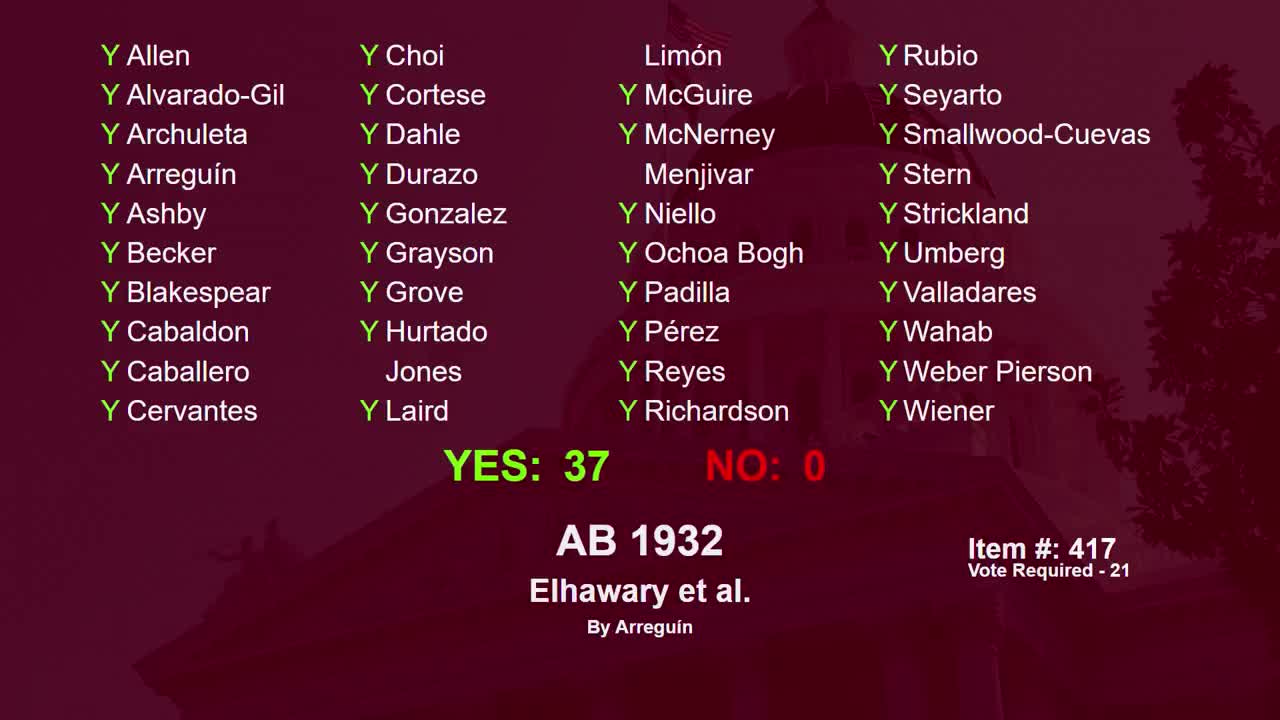 2MIN
Senate Floor
 32MIN
Assembly Standing Committee on Appropriations
Bill Author