AB 1929: Health care coverage: investments: disclosure.
- Session Year: 2025-2026
- House: Assembly
- Latest Version Date: 2026-08-13
Current Status:
In Progress
(2026-08-19: Ordered to inactive file at the request of Senator Reyes.)
Introduced
In Committee
Awaiting First Chamber Vote
Passed First Chamber
In Committee
Awaiting Second Chamber Vote
Passed Second Chamber
Enacted
Existing federal law, the Patient Protection and Affordable Care Act (PPACA), requires each state to establish an American Health Benefit Exchange to facilitate the purchase of qualified health benefit plans by qualified individuals and qualified small employers. Existing state law creates the California Health Benefit Exchange, also known as Covered California, to facilitate the enrollment of qualified individuals and qualified small employers in qualified health plans offered by participating carriers as required under PPACA.
This bill would require a carrier nonprofit health care service plan participating in the Exchange to annually disclose its material investment holdings to the Exchange on or before July 1 of each year, unless otherwise specified by regulation, beginning on July 1, 2027. The bill would require the Exchange to prominently display, and make accessible to the public, those disclosures on its internet website. If a carrier plan fails to comply with the disclosure requirements, the bill would require the Exchange Department of Managed Health Care to assess an administrative penalty against the carrier, plan, as specified. The bill would require the Exchange to prominently post the carriers plans noncompliance status on its internet website until compliance is achieved.
Existing federal law, the Patient Protection and Affordable Care Act (PPACA), requires each state to establish an American Health Benefit Exchange to facilitate the purchase of qualified health benefit plans by qualified individuals and qualified small employers. Existing state law creates the California Health Benefit Exchange, also known as Covered California, to facilitate the enrollment of qualified individuals and qualified small employers in qualified health plans offered by participating carriers as required under PPACA.
This bill would require a carrier participating in the Exchange to annually disclose its material investment holdings to the Exchange on or before July 1 of each year, unless otherwise specified by regulation, beginning on July 1, 2027. The bill would require the Exchange to prominently display, and make accessible to the public, those disclosures on its internet website. If a carrier fails to comply with the disclosure requirements, the bill would require the Exchange to assess an administrative penalty against the carrier, as specified. The bill would require the Exchange to prominently post the carriers noncompliance status on its internet website until compliance is achieved.
Existing law, the Knox-Keene Health Care Service Plan Act of 1975, provides for the licensure and regulation of health care service plans by the Department of Managed Health Care, and makes a willful violation of the act a crime. Existing law requires a health care service plans assets to be invested in a prudent manner and requires the Director of the Department of Managed Health Care to determine the acceptability of a health care service plans investments, as specified. Existing law provides for the regulation of health insurers by the Department of Insurance. Existing law regulates the types and amounts of investments that insurers are authorized to make, as specified.This bill would require a health care service plan or health insurer to annually disclose its material investment holdings to the Department of Managed Health Care or Department of Insurance, as applicable, on or before July 1 of each year, unless otherwise specified by regulation, beginning on July 1, 2027. The bill would require the departments to prominently display, and make accessible to the public, those disclosures on their internet websites. If a health care service plan or health insurer fails to comply with the disclosure requirements, the bill would require the applicable department to assess a civil penalty against the plan or insurer, as specified. The bill would require the applicable department and Covered California to prominently post the plans or insurers noncompliance status on their internet websites until compliance is achieved. Because a violation of these requirements by a health care service plan would be a crime, this bill would impose a state-mandated local program.The California Constitution requires the state to reimburse local agencies and school districts for certain costs mandated by the state. Statutory provisions establish procedures for making that reimbursement.This bill would provide that no reimbursement is required by this act for a specified reason.Existing law, the Knox-Keene Health Care Service Plan Act of 1975, provides for the licensure and regulation of health care service plans by the Department of Managed Health Care, and makes a willful violation of the act a crime. Existing law requires a health care service plans assets to be invested in a prudent manner and requires the director of the department Director of the Department of Managed Health Care to determine the acceptability of a health care service plans investments, as specified.
Existing law provides for the regulation of health insurers by the Department of Insurance. Existing law regulates the types and amounts of investments that insurers are authorized to make, as specified.
This bill would require a nonprofit integrated health care service plan regulated by the department health care service plan or health insurer to annually disclose its material investment holdings to the department Department of Managed Health Care or Department of Insurance, as applicable, on or before July 1 of each year, unless otherwise specified by regulation, beginning on July 1, 2027. The bill would require the department departments to prominently display, and make accessible to the public, those disclosures on the departments internet website. If a nonprofit integrated health care service plan their internet websites. If a health care service plan or health insurer fails to comply with the disclosure requirements, the bill would require the applicable department to assess a civil penalty against the plan, plan or insurer, as specified. The bill would require the applicable department and Covered California to prominently post the plans or insurers noncompliance status on their internet websites until compliance is achieved. Because a violation of these requirements by a health care service plan would be a crime, this bill would impose a state-mandated local program.
The California Constitution requires the state to reimburse local agencies and school districts for certain costs mandated by the state. Statutory provisions establish procedures for making that reimbursement.
This bill would provide that no reimbursement is required by this act for a specified reason.
Existing law, the Knox-Keene Health Care Service Plan Act of 1975, provides for the licensure and regulation of health care service plans by the Department of Managed Health Care, and makes a willful violation of the act a crime. Existing law requires a health care service plans assets to be invested in a prudent manner and requires the director of the department to determine the acceptability of a health care service plans investments, as specified.
This bill would require a nonprofit integrated health care service plan regulated by the department to annually disclose its material investment holdings to the department on or before July 1 of each year, unless otherwise specified by regulation, beginning on July 1, 2027. The bill would require the department to prominently display, and make accessible to the public, those disclosures on the departments internet website. If a nonprofit integrated health care service plan fails to comply with the disclosure requirements, the bill would require the department to assess a civil penalty against the plan, as specified. The bill would require the department and Covered California to prominently post the plans noncompliance status on their internet websites until compliance is achieved. Because a violation of these requirements by a health care service plan would be a crime, this bill would impose a state-mandated local program.
The California Constitution requires the state to reimburse local agencies and school districts for certain costs mandated by the state. Statutory provisions establish procedures for making that reimbursement.
This bill would provide that no reimbursement is required by this act for a specified reason.
Existing law establishes certain protections for individuals who predominately work as a janitor, as specified, and requires an employer of a janitor to annually register with the Labor Commissioner. Existing law requires these employers to keep specific employment records for 3 years, including the names and address of employees and other covered workers.This bill would additionally require an employer to keep the email addresses of employees and all other covered workers for 3 years.Existing law establishes certain protections for individuals who predominately work as a janitor, as specified, and requires an employer of a janitor to annually register with the Labor Commissioner. Existing law requires these employers to keep specific employment records for 3 years, including the names and address of employees and other covered workers.
This bill would additionally require an employer to keep the email addresses of employees and all other covered workers for 3 years.
The Legislature finds and declares all of the following:
(a)Many health care service plans and health insurers in California receive significant public benefits through tax credits, regulatory privileges, and participation in publicly supported programs such as Covered California.
(b)Californians pay billions of dollars annually in health insurance premiums to health care service plans and health insurers with the expectation that those funds will be used primarily to support patient care and the delivery of health services.
(c)Consumers, policymakers, and the public currently have limited visibility into how health care service plans and health insurers invest their financial reserves and surplus funds.
(d)Greater transparency regarding investment holdings will help ensure accountability, inform public policy discussions, and strengthen public trust in Californias health care system.
(e)Providing public access to investment disclosures will allow consumers and policymakers to better understand how health care entities manage significant financial assets derived from patient premiums.
SEC. 2.Section 100524 is added to the Government Code, immediately following Section 100523, to read:100524.(a)A carrier nonprofit health care service plan participating in the Exchange shall annually disclose its material investment holdings to the Exchange. The disclosure shall include both of the following:
(1)The 25 largest investment holdings of the carrier, plan, regardless of whether or not those holdings are reported through a Form 5500 filed with the United States Department of Labor, other regulatory filing, subsidiary, affiliate, pooled investment vehicle, or other investment structure.
(2)A copy of the carriers plans Form 5500 filed with the United States Department of Labor.
(b)(1)The initial disclosure required by subdivision (a) shall include material investment holdings covering the five calendar years before January 1, 2027.
(2)Following the initial disclosure, a carrier plan shall update its disclosure annually to include material investment holdings for the immediately preceding calendar year.
(3)Annual disclosures shall be submitted to the Exchange on or before July 1 of each year, unless otherwise specified by regulation, beginning on July 1, 2027.
(c)The Exchange shall prominently display, and make accessible to the public, the disclosures required by this section and the carriers plans Form 5500 on the Exchanges internet website.
(d)(1)If a carrier plan fails to comply with the disclosure requirements of this section within 30 days of the reporting deadline, the Exchange Department of Managed Health Care shall assess an administrative penalty against the carrier. plan.
(2)The administrative penalty shall be one thousand dollars ($1,000) per day for each day the carrier plan remains out of compliance following the 30-day grace period.
(3)A carrier plan that fails to comply with the disclosure requirements of this section shall prominently post a notice on its public internet website stating that the carrier plan is not in compliance with California law requiring disclosure of investment holdings.
(4)The Exchange shall prominently post the carriers plans noncompliance status on its internet website until compliance is achieved.
(e)For purposes of this section, material investment holdings means investments the carrier plan has made in a calendar year that are a direct or indirect ownership interest, financial stake, or beneficial interest in an entity, fund, asset, or investment vehicle.
The Legislature finds and declares all of the following:
(a)Many health care service plans and health insurers in California receive significant public benefits through tax credits, regulatory privileges, and participation in publicly supported programs such as Covered California.
(b)Californians pay billions of dollars annually in health insurance premiums to health care service plans and health insurers with the expectation that those funds will be used primarily to support patient care and the delivery of health services.
(c)Consumers, policymakers, and the public currently have limited visibility into how health care service plans and health insurers invest their financial reserves and surplus funds.
(d)Greater transparency regarding investment holdings will help ensure accountability, inform public policy discussions, and strengthen public trust in Californias health care system.
(e)Providing public access to investment disclosures will allow consumers and policymakers to better understand how health care entities manage significant financial assets derived from patient premiums.
SEC. 2.Article 10.9 (commencing with Section 1399.67) is added to Chapter 2.2 of Division 2 of the Health and Safety Code, to read:10.9.Health Care Service Plan Investment Transparency1399.67.(a)A health care service plan regulated by the department shall annually disclose its material investment holdings to the department.(b)(1)The initial disclosure required by this section shall include material investment holdings covering the five calendar years prior to January 1, 2027.(2)Following the initial disclosure, each health care service plan shall update its disclosure annually to include material investment holdings for the immediately preceding calendar year.(3)Annual disclosures shall be submitted to the department on or before July 1 of each year, unless otherwise specified by regulation, beginning on July 1, 2027.(c)The department shall prominently display, and make accessible to the public, the disclosures required by this section on the departments internet website.(d)For purposes of this section, material investment holding means a direct or indirect ownership interest, financial stake, or beneficial interest in an entity, fund, asset, or investment vehicle that, individually or in the aggregate, is of such significance that a reasonable person would consider it important in evaluating the financial position, priorities, or potential conflicts of interest of the reporting health care service plan.1399.68.(a)If a health care service plan fails to comply with the disclosure requirements of Section 1399.67 within 30 days of the reporting deadline, the department shall assess a civil penalty against the plan.(b)The civil penalty in subdivision (a) shall be one thousand dollars ($1,000) per day for each day the health care service plan remains out of compliance following the 30-day grace period.(c)(1)A health care service plan that fails to comply with Section 1399.67 shall prominently post a notice on its public internet website stating that the plan is not in compliance with California law requiring disclosure of investment holdings.(2)The department and Covered California shall prominently post the plans noncompliance status on their internet websites until compliance is achieved.SEC. 3.Chapter 7.5 (commencing with Section 10609.1) is added to Part 2 of Division 2 of the Insurance Code, to read:7.5.Health Insurer Investment Transparency10609.1.(a)A health insurer regulated by the department shall annually disclose its material investment holdings to the department.(b)(1)The initial disclosure required by this section shall include material investment holdings covering the five calendar years prior to January 1, 2027.(2)Following the initial disclosure, each health insurer shall update its disclosure annually to include material investment holdings for the immediately preceding calendar year.(3)Annual disclosures shall be submitted to the department on or before July 1 of each year, unless otherwise specified by regulation, beginning on July 1, 2027.(c)The department shall prominently display, and make accessible to the public, the disclosures required by this section on the departments internet website.(d)For purposes of this section, material investment holding means a direct or indirect ownership interest, financial stake, or beneficial interest in an entity, fund, asset, or investment vehicle that, individually or in the aggregate, is of such significance that a reasonable person would consider it important in evaluating the financial position, priorities, or potential conflicts of interest of the reporting health insurer.10609.2.(a)If a health insurer fails to comply with the disclosure requirements of Section 10609.1 within 30 days of the reporting deadline, the department shall assess a civil penalty against the insurer.(b)The civil penalty in subdivision (a) shall be one thousand dollars ($1,000) per day for each day the health insurer remains out of compliance following the 30-day grace period.(c)(1)A health insurer that fails to comply with Section 10609.1 shall prominently post a notice on its public internet website stating that the insurer is not in compliance with California law requiring disclosure of investment holdings.(2)The department and Covered California shall prominently post the insurers noncompliance status on their internet websites until compliance is achieved.SEC. 4.No reimbursement is required by this act pursuant to Section 6 of Article XIIIB of the California Constitution because the only costs that may be incurred by a local agency or school district will be incurred because this act creates a new crime or infraction, eliminates a crime or infraction, or changes the penalty for a crime or infraction, within the meaning of Section 17556 of the Government Code, or changes the definition of a crime within the meaning of Section 6 of Article XIIIB of the California Constitution.SEC. 2.Section 100524 is added to the Government Code, immediately following Section 100523, to read:100524.(a)A carrier participating in the Exchange shall annually disclose its material investment holdings to the Exchange. The disclosure shall include both of the following:
(1)The 25 largest investment holdings of the carrier, regardless of whether or not those holdings are reported through a Form 5500 filed with the United States Department of Labor, other regulatory filing, subsidiary, affiliate, pooled investment vehicle, or other investment structure.
(2)A copy of the carriers Form 5500 filed with the United States Department of Labor.
(b)(1)The initial disclosure required by subdivision (a) shall include material investment holdings covering the five calendar years before January 1, 2027.
(2)Following the initial disclosure, a carrier shall update its disclosure annually to include material investment holdings for the immediately preceding calendar year.
(3)Annual disclosures shall be submitted to the Exchange on or before July 1 of each year, unless otherwise specified by regulation, beginning on July 1, 2027.
(c)The Exchange shall prominently display, and make accessible to the public, the disclosures required by this section and the carriers Form 5500 on the Exchanges internet website.
(d)(1)If a carrier fails to comply with the disclosure requirements of this section within 30 days of the reporting deadline, the Exchange shall assess an administrative penalty against the carrier.
(2)The administrative penalty shall be one thousand dollars ($1,000) per day for each day the carrier remains out of compliance following the 30-day grace period.
(3)A carrier that fails to comply with the disclosure requirements of this section shall prominently post a notice on its public internet website stating that the carrier is not in compliance with California law requiring disclosure of investment holdings.
(4)The Exchange shall prominently post the carriers noncompliance status on its internet website until compliance is achieved.
(e)For purposes of this section, material investment holdings means investments the carrier has made in a calendar year that are a direct or indirect ownership interest, financial stake, or beneficial interest in an entity, fund, asset, or investment vehicle.
The Legislature finds and declares all of the following:
(a)Nonprofit integrated health care service plans Many health care service plans and health insurers in California receive significant public benefits through tax credits, regulatory privileges, and participation in publicly supported programs such as Covered California.
(b)Californians pay billions of dollars annually in health insurance premiums to nonprofit integrated health care service plans and health insurers with the expectation that those funds will be used primarily to support patient care and the delivery of health services.
(c)Consumers, policymakers, and the public currently have limited visibility into how nonprofit integrated health care service plans and health insurers invest their financial reserves and surplus funds.
(d)Greater transparency regarding investment holdings will help ensure accountability, inform public policy discussions, and strengthen public trust in Californias health care system.
(e)Providing public access to investment disclosures will allow consumers and policymakers to better understand how nonprofit health care entities manage significant financial assets derived from patient premiums.
SEC. 2.Article 10.9 (commencing with Section 1399.67) is added to Chapter 2.2 of Division 2 of the Health and Safety Code, to read:10.9.Nonprofit Integrated Health Care Service Plan Investment Transparency1399.67.(a)A nonprofit integrated health care service plan regulated by the department shall annually disclose its material investment holdings to the department.
(b)(1)The initial disclosure required by this section shall include material investment holdings covering the five calendar years prior to January 1, 2027.
(2)Following the initial disclosure, each nonprofit integrated health care service plan shall update its disclosure annually to include material investment holdings for the immediately preceding calendar year.
(3)Annual disclosures shall be submitted to the department on or before July 1 of each year, unless otherwise specified by regulation, beginning on July 1, 2027.
(c)The department shall prominently display, and make accessible to the public, the disclosures required by this section on the departments internet website.
(d)For purposes of this section, material investment holding means a direct or indirect ownership interest, financial stake, or beneficial interest in an entity, fund, asset, or investment vehicle that, individually or in the aggregate, is of such significance that a reasonable person would consider it important in evaluating the financial position, priorities, or potential conflicts of interest of the reporting health care service plan.
1399.68.(a)If a nonprofit integrated health care service plan fails to comply with the disclosure requirements of Section 1399.67 within 30 days of the reporting deadline, the department shall assess a civil penalty against the plan.
(b)The civil penalty in subdivision (a) shall be one thousand dollars ($1,000) per day for each day the nonprofit integrated health care service plan remains out of compliance following the 30-day grace period.
(c)(1)A nonprofit integrated health care service plan that fails to comply with Section 1399.67 shall prominently post a notice on its public internet website stating that the plan is not in compliance with California law requiring disclosure of investment holdings.
(2)The department and Covered California shall prominently post the plans noncompliance status on their internet websites until compliance is achieved.
SEC. 3.Chapter 7.5 (commencing with Section 10609.1) is added to Part 2 of Division 2 of the Insurance Code, to read:7.5.Health Insurer Investment Transparency10609.1.(a)A health insurer regulated by the department shall annually disclose its material investment holdings to the department.
(b)(1)The initial disclosure required by this section shall include material investment holdings covering the five calendar years prior to January 1, 2027.
(2)Following the initial disclosure, each health insurer shall update its disclosure annually to include material investment holdings for the immediately preceding calendar year.
(3)Annual disclosures shall be submitted to the department on or before July 1 of each year, unless otherwise specified by regulation, beginning on July 1, 2027.
(c)The department shall prominently display, and make accessible to the public, the disclosures required by this section on the departments internet website.
(d)For purposes of this section, material investment holding means a direct or indirect ownership interest, financial stake, or beneficial interest in an entity, fund, asset, or investment vehicle that, individually or in the aggregate, is of such significance that a reasonable person would consider it important in evaluating the financial position, priorities, or potential conflicts of interest of the reporting health insurer.
10609.2.(a)If a health insurer fails to comply with the disclosure requirements of Section 10609.1 within 30 days of the reporting deadline, the department shall assess a civil penalty against the insurer.
(b)The civil penalty in subdivision (a) shall be one thousand dollars ($1,000) per day for each day the health insurer remains out of compliance following the 30-day grace period.
(c)(1)A health insurer that fails to comply with Section 10609.1 shall prominently post a notice on its public internet website stating that the insurer is not in compliance with California law requiring disclosure of investment holdings.
(2)The department and Covered California shall prominently post the insurers noncompliance status on their internet websites until compliance is achieved.
SEC. 3.SEC. 4.No reimbursement is required by this act pursuant to Section 6 of Article XIIIB of the California Constitution because the only costs that may be incurred by a local agency or school district will be incurred because this act creates a new crime or infraction, eliminates a crime or infraction, or changes the penalty for a crime or infraction, within the meaning of Section 17556 of the Government Code, or changes the definition of a crime within the meaning of Section 6 of Article XIIIB of the California Constitution.
The Legislature finds and declares all of the following:
(a)Nonprofit integrated health care service plans in California receive significant public benefits through tax credits, regulatory privileges, and participation in publicly supported programs such as Covered California.
(b)Californians pay billions of dollars annually in health insurance premiums to nonprofit integrated health care service plans with the expectation that those funds will be used primarily to support patient care and the delivery of health services.
(c)Consumers, policymakers, and the public currently have limited visibility into how nonprofit integrated health care service plans invest their financial reserves and surplus funds.
(d)Greater transparency regarding investment holdings will help ensure accountability, inform public policy discussions, and strengthen public trust in Californias health care system.
(e)Providing public access to investment disclosures will allow consumers and policymakers to better understand how nonprofit health care entities manage significant financial assets derived from patient premiums.
SEC. 2.Article 10.9 (commencing with Section 1399.67) is added to Chapter 2.2 of Division 2 of the Health and Safety Code, to read:10.9.Nonprofit Integrated Health Care Service Plan Investment Transparency1399.67.(a)A nonprofit integrated health care service plan regulated by the department shall annually disclose its material investment holdings to the department.
(b)(1)The initial disclosure required by this section shall include material investment holdings covering the five calendar years prior to January 1, 2027.
(2)Following the initial disclosure, each nonprofit integrated health care service plan shall update its disclosure annually to include material investment holdings for the immediately preceding calendar year.
(3)Annual disclosures shall be submitted to the department on or before July 1 of each year, unless otherwise specified by regulation, beginning on July 1, 2027.
(c)The department shall prominently display, and make accessible to the public, the disclosures required by this section on the departments internet website.
1399.68.(a)If a nonprofit integrated health care service plan fails to comply with the disclosure requirements of Section 1399.67 within 30 days of the reporting deadline, the department shall assess a civil penalty against the plan.
(b)The civil penalty in subdivision (a) shall be one thousand dollars ($1,000) per day for each day the nonprofit integrated health care service plan remains out of compliance following the 30-day grace period.
(c)(1)A nonprofit integrated health care service plan that fails to comply with Section 1399.67 shall prominently post a notice on its public internet website stating that the plan is not in compliance with California law requiring disclosure of investment holdings.
(2)The department and Covered California shall prominently post the plans noncompliance status on their internet websites until compliance is achieved.
SEC. 3.No reimbursement is required by this act pursuant to Section 6 of Article XIIIB of the California Constitution because the only costs that may be incurred by a local agency or school district will be incurred because this act creates a new crime or infraction, eliminates a crime or infraction, or changes the penalty for a crime or infraction, within the meaning of Section 17556 of the Government Code, or changes the definition of a crime within the meaning of Section 6 of Article XIIIB of the California Constitution.
SECTION 1.Section 1421 of the Labor Code is amended to read:1421.Every employer shall keep accurate records for three years, showing all of the following:(a)The names, addresses, and email addresses of all employees engaged in rendering actual services for any business of the employer.(b)The hours worked daily by each employee, including the times the employee begins and ends each work period.(c)The wage and wage rate paid each payroll period.(d)The age of all minor employees.(e)Any other conditions of employment.(f)The names, addresses, email addresses, periods of work, and compensation paid to all other covered workers.Every employer shall keep accurate records for three years, showing all of the following:
(a)The names and addresses names, addresses, and email addresses of all employees engaged in rendering actual services for any business of the employer.
(b)The hours worked daily by each employee, including the times the employee begins and ends each work period.
(c)The wage and wage rate paid each payroll period.
(d)The age of all minor employees.
(e)Any other conditions of employment.
(f)The names, addresses, email addresses, periods of work, and compensation paid to all other covered workers.
|
Date
|
Status
|
|---|---|
| Aug 19, 2026 | Ordered to inactive file at the request of Senator Reyes. |
| Aug 17, 2026 | Read second time. Ordered to third reading. |
| Aug 13, 2026 | Read second time and amended. Ordered returned to second reading. |
| Aug 13, 2026 | From committee: Amend, and do pass as amended. (Ayes 5. Noes 2.) (August 13). |
| Aug 3, 2026 | In committee: Referred to APPR. suspense file. |
| Jun 29, 2026 | Withdrawn from committee. |
| Jun 29, 2026 | Re-referred to Com. on APPR. |
| Jun 26, 2026 | In committee: Hearing postponed by committee. |
| Jun 25, 2026 | From committee: Do pass and re-refer to Com. on JUD. (Ayes 6. Noes 2.) (June 24). Re-referred to Com. on JUD. |
| Jun 15, 2026 | From committee chair, with author's amendments: Amend, and re-refer to committee. Read second time, amended, and re-referred to Com. on HEALTH. |
| Jun 10, 2026 | Referred to Coms. on HEALTH and JUD. |
| May 28, 2026 | In Senate. Read first time. To Com. on RLS. for assignment. |
| May 27, 2026 | Read third time. Passed. Ordered to the Senate. (Ayes 56. Noes 20. Page 5427.) |
| May 27, 2026 | Read third time. Passed. Ordered to the Senate. (Ayes 56. Noes 20.) |
| May 27, 2026 | Read third time. Passed. Ordered to the Senate. |
| May 14, 2026 | Read second time. Ordered to third reading. |
| May 13, 2026 | From committee: Do pass. (Ayes 11. Noes 4.) (May 13). |
| Apr 20, 2026 | Re-referred to Com. on APPR. |
| Apr 16, 2026 | Read second time and amended. |
| Apr 15, 2026 | From committee: Amend, and do pass as amended and re-refer to Com. on APPR. (Ayes 12. Noes 3.) (April 14). |
| Mar 26, 2026 | Re-referred to Com. on HEALTH. pursuant to Assembly Rule 96. |
| Mar 25, 2026 | Re-referred to Com. on L. & E. |
| Mar 24, 2026 | From committee chair, with author's amendments: Amend, and re-refer to Com. on L. & E. Read second time and amended. |
| Mar 2, 2026 | Referred to Com. on L. & E. |
| Feb 14, 2026 | From printer. May be heard in committee March 16. |
| Feb 13, 2026 | Read first time. To print. |
|
Date
|
Description
|
Location
|
Votes
|
|
|---|---|---|---|---|
| Aug 13, 2026 | Do pass as amended | Senate Standing Committee on Appropriations |
Passed |
|
| Aug 3, 2026 | Placed on suspense file | Senate Standing Committee on Appropriations |
Passed |
|
| Jun 24, 2026 | Do pass, but first be re-referred to the Committee on [Judiciary] | Senate Standing Committee on Health |
Passed |
|
| May 27, 2026 | AB 1929 Ortega Assembly Third Reading | Assembly Floor |
Passed |
|
| May 13, 2026 | Do pass. | Assembly Standing Committee on Appropriations |
Passed |
|
| Apr 14, 2026 | Do pass as amended and be re-referred to the Committee on [Appropriations] | Assembly Standing Committee on Health |
Passed |
This list shows positions taken on this bill by organizations on the date displayed, which is linked to the original source.
Positions by individuals are not included.
|
Organization
|
Position
|
Date
|
|---|---|---|
| American Federation of State, County and Municipal Employees | ** Support | |
| Association Of California Life And Health Insurance Companies | ** Against | |
| California Association Of Health Plans | ** Against | |
| California Chamber Of Commerce | ** Against | |
| California Latino Legislative Caucus | ** Support | |
| Central American Resource Center of California | ** Support | |
| Central City Association Of Los Angeles | ** Against | |
| Glendale Chamber of Commerce | ** Against | |
| LAX Coastal Chamber of Commerce | ** Against | |
| Los Angeles Area Chamber Of Commerce | ** Against | |
| Oceanside Chamber of Commerce | ** Against | |
| Southwest California Legislative Council | ** Against | |
| the greater coachella valley chamber of commerce | ** Against | |
| Tri County Chamber Alliance | ** Against | |
| United Nurses Associations Of California/Union Of Health Care Professionals | ** Support | |
| Valley Industry & Commerce Association | ** Against |
SENATE RULES COMMITTEE Office of Senate Floor Analyses (916) 651-4171 | AB 1929 |
THIRD READING
Bill No: AB 1929
Author: Ortega (D), et al.
Amended: 8/13/26 in Senate
Vote: 21
SENATE HEALTH COMMITTEE: 6-2, 6/24/26
AYES: Caballero, Durazo, Gonzalez, Padilla, Pérez, Smallwood-Cuevas
NOES: Valladares, Grove
NO VOTE RECORDED: Weber Pierson, Menjivar, Rubio
SENATE APPROPRIATIONS COMMITTEE: 5-2, 8/13/26
AYES: Cervantes, Cabaldon, Grayson, Richardson, Wahab
NOES: Seyarto, Dahle
ASSEMBLY FLOOR: 56-20, 5/27/26 - See last page for vote
SUBJECT: Health care coverage: investments: disclosure
SOURCE: American Federation of State, County and Municipal Employees
Central American Resource Center of California
United Nurses Associations of California/Union of Health Care
Professionals
DIGEST:
This bill requires nonprofit health insurance carriers participating in Covered California to annually disclose specified investment information and requires Covered California to prominently display the information on its website and administer administrative penalties of $1,000 a day after a 30-day grace period for a carrier’s failure to comply, and post noncompliance status on the Covered California website.
ANALYSIS:
Existing law:
- Establishes the Department of Managed Health Care (DMHC) to regulate health plans under the Knox-Keene Health Care Service Plan Act of 1975 (Knox-Keene Act) and the California Department of Insurance (CDI) to regulate health insurance. [Health and Safety Code (HSC) §1340, et seq. and INS §106, et seq.]
- Gives the director of DMHC the power to determine that investments of a plan’s assets are acceptable to meet specified financial requirements. Requires all other assets to be invested in a prudent manner. [HSC §1363]
- Permits any domestic incorporated insurer, which maintains cash on hand or on deposit in a national or state bank, or in securities, as specified, an amount equal to its required minimum paid-in capital, to invest the remainder of its assets in the purchase of or loans upon the securities, as specified. The investments are known as excess funds investments and are subject to specified restrictions. [Insurance (INS) §1170 and §1190]
- Requires, by the first day of March of each year (or the first business day after), every insurer doing business in this state to make and file with the Insurance Commissioner and the National Association of Insurance Commissioners annual and quarterly statements exhibiting its condition and affairs as of the previous December 31. [INS §900 and §931]
- Makes all public records of CDI subject to disclosure and available for inspection and copying at locations, as specified. [INS §12921.2]
- Establishes Covered California as an independent entity in state government, not affiliated with any state agency or department, governed by a five-member board. Requires Covered California to establish and use a competitive process to select qualified health plans and other contractors. [Government Code (GOV) §100500-100522]
- Requires Covered California to determine the criteria and process for eligibility, enrollment, and disenrollment of enrollees and potential enrollees and coordinate that process with the state and local government entities administering other health care coverage programs to ensure consistent eligibility and enrollment processes and seamless transitions between coverage. [GOV §100503]
- Authorizes Covered California, with respect to individual coverage it makes available, to collect premiums and assist in administration of federally funded advanced premium tax credits and cost-sharing reductions. Establishes, pursuant to regulations, the premium due date in which coverage becomes effective. [GOV §100504 and California Code of Regulations (CCR) Title 10, §6410]
This bill:
- Requires a nonprofit health plan participating in Covered California to annually disclose its material investment holdings to Covered California, and requires the disclosure to include:
- The 25 largest investment holdings of the carrier, regardless of whether or not those holdings are reported through a Form 5500 filed with the U.S. Department of Labor (DOL), other regulatory filing, subsidiary, affiliate, pooled investment vehicle, or other investment structure; and,
- A copy of the carrier’s Form 5500 filed with DOL.
- Requires the initial disclosure to include material investment holdings covering the five calendar years before January 1, 2027. Requires following the initial disclosure, a carrier to update its disclosure annually to include material investment holdings for the immediately preceding calendar year.
- Requires annual disclosures to be submitted to Covered California before July 1 of each year, unless otherwise specified by regulation, beginning on July 1, 2027. Requires Covered California to prominently display, and make accessible to the public, the disclosures and the carrier’s Form 5500 on its website.
- Requires DMHC, if a nonprofit health plan fails to comply with the disclosure requirements within 30 days of the reporting deadline, to assess an administrative penalty of $1,000 per day for each day the carrier remains out of compliance following the 30-day grace period.
- Requires a nonprofit health plan that fails to comply with the disclosure requirements to prominently post a notice on its website stating that it is not in compliance with California law requiring disclosure of investment holdings.
- Requires Covered California to prominently post the nonprofit health plan’s noncompliance status on its website until compliance is achieved.
- Defines “material investment holdings” as investments the nonprofit health plan has made in a calendar year that are a direct or indirect ownership interest, financial stake, or beneficial interest in an entity, fund, asset, or investment vehicle.
Background
Background. Information provided by the author indicates an investigation by one of this bill’s cosponsors, who reports that a large California-based health plan, Kaiser, has an investment portfolio of between $5 and $6 billion, and has significant investments in CoreCivic and the GEO Group—the two largest private prison corporations in the country.
The federal government contracts with private detention facilities across the country to house federal inmates and immigration detainees. There are currently seven private detention facilities operating in California:
- Adelanto ICE Processing Center in San Bernardino County (capacity 1,940);
- Desert View Annex in San Bernardino County (capacity 750);
- California City in Kern County (capacity 2,560);
- Golden State Annex in Kern County (700 capacity);
- Mesa Verde ICE Processing Center in Kern County (capacity 400);
- Otay Mesa Detention Center in San Diego County (1,994 capacity); and,
- Imperial Regional Detention Facility in Imperial County (704 capacity).
CoreCivic operates the Otay Mesa and California City facilities, Management & Training Corporation operates the Imperial Regional Detention Facility, while the remainder are operated by the GEO Group. According to a February 6, 2026, article in the Sacramento Bee, at that time roughly 6,400 people were being held on a given day in these private facilities, which was more than double the figure from the prior year. Part of this growth was the opening of the California City Immigration Processing Center in 2025, which is now the largest immigration detention center in the state.
According to a report by KFF, as of March 25, 2026, U.S. Immigration and Customs Enforcement (ICE) reported that 46 people died while in their custody or in detention facilities since the start of the second Trump administration in January 2025. The number of deaths of people in detention during 2025 exceeded the highest seen in over two decades, and deaths in 2026 are on track to meet or exceed that number. On March 30, 2026, the Los Angeles Times reported that a detainee at Adelanto ICE Processing Center died on March 25, which was the fourth fatality at Adelanto since September of last year. Nationwide, the death toll in ICE custody in just the last three months was 14 people.
CDI Public Access. CDI has annual and quarterly insurer financial statements, which are required to be submitted to CDI pursuant to law available for public view on their website. CDI indicates that the information is furnished to the CDI by California admitted insurers and is provided to the public "AS IS" pursuant to law, and CDI does not guarantee the data contained in the insurers' annual and quarterly financial statements and expressly disclaims any liability for any errors in the data. Kaiser is an admitted insurer and complies with this requirement.
Covered California Technical Assistance. Covered California indicates it is not equipped to determine what constitutes material investments or to evaluate the Form 5500 and would not be able to respond to consumer questions. Covered California is concerned that adding information regarding nonhealthcare-related investment holdings and non-compliance warnings could cause additional consumer confusion and frustration at a time when consumers need insurance, which could further confuse or discourage people from enrolling in coverage. Covered California also writes it has only 11 carriers participating for plan year 2026 with over 1.8 million enrollees in March compared to the over 100 carriers in California covering 36.5 million enrollees, according to the California Health Care Almanac for 2024.
Comments
According to the author of this bill:
Detention centers are run by for-profit companies that profit from cutting corners everywhere they can. These for-profit detention centers are rife with human rights abuses and unsanitary conditions; from detaining pregnant women, children as young as two months old, and people with disabilities—to depriving detainees of healthcare and sleep and providing rotten food and contaminated drinking water. The death toll in these facilities keeps rising, tripling from 11 people in 2024 to 33 in 2025. The public deserves to know where their healthcare dollars are being spent and if they are being used to subsidize these for-profit centers of human suffering. This bill is a sunshine law, requiring nonprofit health plan investments to be made public so Californians know where their state healthcare subsidies and patient premiums are being invested.
FISCAL EFFECT: Appropriation: No Fiscal Com.: Yes Local: No
According to the Senate Appropriations Committee, unknown, likely minor, ongoing costs for Covered California to post information on the website (California Health Trust Fund). Unknown ongoing costs, potentially low hundreds of thousands (Managed Care Fund), for DMHC for state administration and unknown collections related to penalties for noncompliant plans.
SUPPORT: (Verified 8/14/26)
American Federation of State, County and Municipal Employees (co-source)
Central American Resource Center of California (co-source)
United Nurses Associations of California/Union of Health Care Professionals (co-source)
California Latino Legislative Caucus
OPPOSITION: (Verified 8/14/26)
Association of California Life and Health Insurance Companies
California Association of Health Plans
California Chamber of Commerce
Central City Association of Los Angeles
Glendale Chamber of Commerce
LAX Coastal Chamber of Commerce
Los Angeles Area Chamber of Commerce
Oceanside Chamber of Commerce
Southwest California Legislative Council
The Greater Coachella Valley Chamber of Commerce
Tri County Chamber Alliance
Valley Industry & Commerce Association
ARGUMENTS IN SUPPORT: This bill’s cosponsor, the United Nurses Association of California/Union of Health Care Professionals, writes, “This bill is grounded in a fundamental principle: nonprofit health plans should put patients over profits. Nonprofit integrated health care service plans are entrusted with significant public resources and tax-exempt status in exchange for a commitment to serve patients and communities. With that trust comes a responsibility to ensure that all aspects of their operations, including financial and investment decisions, are aligned with their mission to improve health outcomes. Yet under current law, there is no meaningful transparency into how these plans invest their substantial financial reserves. This lack of disclosure leaves patients, purchasers, and policymakers in the dark about whether investment practices support the delivery of care, or whether they may contradict the very mission these organizations claim to uphold. At a time when Californians face rising health care costs and barriers to access, it is critical that health care dollars are used in ways that reflect patient needs and community well-being. This concern is not limited to any one health plan. This bill establishes a consistent transparency standard that applies health care service plans or health insurers operating in California. Consumers should be able to choose a health plan with confidence that their premiums are not only funding care but also supporting investments that reflect and uphold their health, dignity, and humanity.” Another cosponsor, the Central American Resource Center of California, writes, “This measure brings much-needed accountability by requiring clear, accessible, and ongoing disclosure of material investment holdings. By making this information publicly available, this bill empowers consumers and policymakers to better understand how health care dollars are being used. Transparency is not only a matter of good governance; it is essential to rebuilding trust and ensuring that patient care, not profit maximization, remains the top priority.” The American Federation of State, County and Municipal Employees, another cosponsor, writes, “Healthcare workers see firsthand the consequences when resources are not aligned with patient care needs. Chronic understaffing, burnout, and resource constraints continue to strain the healthcare workforce, even as some nonprofit health plans accumulate substantial reserves and make significant investment decisions that are largely shielded from public view. This bill provides a critical tool for policymakers, consumer, and stakeholders to better understand how these funds are being utilized.”
ARGUMENTS IN OPPOSITION: The California Association of Health Plans (CAHP) and the Association of California Life and Health Insurance Companies (ACLHIC) write, “this bill layers on a new public reporting mandate without identifying a clear gap and creates competitive and legal risk.” CAHP and ACLHIC write that public disclosure of detailed investment positions may implicate confidentiality obligations and proprietary strategies, particularly for pooled or indirect investments and because this applies only to Covered California participants, it puts those carriers at a disadvantage. CAHP and ACLHIC indicate this could discourage participation, reduce competition and increase costs and the penalties are disproportionate given the complexity of the requirements. The California Chamber of Commerce writes, “Health care service plans and insurers are already subject to extensive financial reporting and transparency requirements. These include the various filing mechanisms such as IRS Forms 990 and 1120, respectively, which are publicly available and contain comprehensive financial and investment-related information. Plans also file quarterly financial statements with rigorous disclosure standards. In addition, Employee Retirement Income Security Act-regulated trusts must disclose detailed investment information through Form 5500 filings with the U.S. Department of Labor. Together, these existing requirements already provide regulators and the public with significant insight into plan finances and investments. By layering on a duplicative and selective disclosure mandate – coupled with a requirement to publicly post investment holdings - the bill creates an uneven regulatory landscape. Certain investments are subject to confidentiality agreements or competitive sensitivities, and forcing public disclosure in this manner exposes plans to competitive harm. Applying these requirements to health care organizations serves no meaningful public policy purpose and imposes burdens not borne by similarly situated entities.”
ASSEMBLY FLOOR: 56-20, 5/27/26
AYES: Addis, Aguiar-Curry, Ahrens, Alvarez, Arambula, Ávila Farías, Bains, Bauer-Kahan, Bennett, Berman, Boerner, Bonta, Bryan, Calderon, Caloza, Carrillo, Connolly, Elhawary, Fong, Gabriel, Garcia, Gipson, Mark González, Haney, Harabedian, Hart, Irwin, Jackson, Kalra, Lee, Lowenthal, McKinnor, Muratsuchi, Nguyen, Ortega, Pacheco, Papan, Patel, Pellerin, Petrie-Norris, Quirk-Silva, Ramos, Ransom, Rogers, Schiavo, Schultz, Sharp-Collins, Solache, Soria, Stefani, Valencia, Ward, Wicks, Wilson, Zbur, Rivas
NOES: Alanis, Castillo, Chen, Davies, DeMaio, Dixon, Ellis, Flora, Gallagher, Jeff Gonzalez, Hadwick, Hoover, Johnson, Lackey, Macedo, Patterson, Sanchez, Ta, Tangipa, Wallis
NO VOTE RECORDED: Krell, Celeste Rodriguez, Michelle Rodriguez, Blanca Rubio
Prepared by: Teri Boughton / HEALTH / (916) 651-4111
8/17/26 10:54:43
**** END ****
SENATE COMMITTEE ON
Senator Sabrina Cervantes, Chair
2025 - 2026 Regular Session
AB 1929 (Ortega) - Health care coverage: investments: disclosure
Version: | Policy Vote: |
Urgency: | Mandate: |
Hearing Date: | Consultant: |
Bill Summary:
AB 1929 would require a carrier participating in Covered California to annually disclose its material investment holdings to Covered California.
*********** ANALYSIS ADDENDUM – SUSPENSE FILE ***********
The following information is revised to reflect amendments
adopted by the committee on August 13, 2026
Fiscal Impact:
- Unknown, likely minor, ongoing costs for Covered California to post information on the website (California Health Trust Fund).
- Unknown ongoing costs, potentially low hundreds of thousands (Managed Care Fund), for the Department of Managed Health Care (DMHC) for state administration and unknown collections related to penalties for noncompliant plans.
Author Amendments:
Replace the term “carrier” with “nonprofit health care service plan;” and require the DMHC, rather than Covered California, to enforce administrative penalties.
-- END --
SENATE COMMITTEE ON
Senator Sabrina Cervantes, Chair
2025 - 2026 Regular Session
AB 1929 (Ortega) - Health care coverage: investments: disclosure
Version: | Policy Vote: |
Urgency: | Mandate: |
Hearing Date: | Consultant: |
Bill Summary:
AB 1929 would require a carrier participating in Covered California to annually disclose its material investment holdings to Covered California.
Fiscal Impact:
Covered California estimates annual ongoing costs in the low hundreds of thousands for state administration (California Health Trust Fund) and unknown collections related to penalties for noncompliant plans.
Background:
The Department of Managed Health Care (DMHC) regulates health plans under the Knox-Keene Act. Current law gives the Director of the DMHC the power to determine that investments of a plan’s assets are acceptable to meet specified financial requirements and requires all other assets to be invested in a prudent manner.
The California Department of Insurance (CDI) regulates health insurance. Current law requires every domestic incorporated insurer to file a report with the Insurance Commissioner disclosing material acquisitions and dispositions of assets or material nonrenewals, cancellations, or revisions of ceded reinsurance agreements, as specified.
State law establishes Covered California which selects participating carriers to make health insurance available to individuals and small businesses, as authorized under the federal Affordable Care Act. The Covered California board is responsible for implementing procedures for the certification of qualified health plans. Certified qualified health plans participating in Covered California must make available to the Covered California board and to the public, accurate and timely disclosure of specified information, including periodic financial disclosures.
Proposed Law:
Specific provisions of the bill would:
- Require a carrier participating in Covered California to annually disclose its material investment holdings, as defined, to Covered California.
- Require the disclosure to include both of the following:
- The 25 largest investment holdings of the carrier, regardless of whether or not those holdings are reported through a Form 5500 filed with the United States Department of Labor, other regulatory filing, subsidiary, affiliate, pooled investment vehicle, or other investment structure.
- A copy of the carrier’s Form 5500 filed with the United States Department of Labor.
- Require Covered California to prominently display, and make accessible to the public, the disclosures and the carrier’s Form 5500 on the Exchange’s internet website.
- Require that if a carrier fails to comply with the disclosure requirements within 30 days of the reporting deadline, the Covered California must assess an administrative penalty against the carrier; specify the administrative penalty to be $1,000 per day for each day the carrier remains out of compliance following the 30-day grace period; require a carrier that fails to comply with the disclosure requirements to prominently post a notice on its public internet website stating that the carrier is not in compliance with California law requiring disclosure of investment holdings; and require Covered California to prominently post the carrier’s noncompliance status on its internet website until compliance is achieved.
-- END --
SENATE COMMITTEE ON HEALTH
Senator Akilah Weber Pierson, Chair
BILL NO: AB 1929
AUTHOR: | Ortega | ||
VERSION: | June 15, 2026 | ||
HEARING DATE: | June 24, 2026 | ||
CONSULTANT: | Teri Boughton | ||
SUBJECT: Health care coverage: investments: disclosure
SUMMARY:
Requires health insurance carriers participating in Covered California to annually disclose specified investment information and requires Covered California to prominently display the information on its website and administer administrative penalties of $1,000 a day after a 30-day grace period for a carrier’s failure to comply and post noncompliance status on the Covered California website.
Existing law:
- Establishes the Department of Managed Health Care (DMHC) to regulate health plans under the Knox-Keene Health Care Service Plan Act of 1975 (Knox-Keene Act) and the California Department of Insurance (CDI) to regulate health insurance. [HSC §1340, et seq. and INS §106, et seq.]
- Gives the director of DMHC the power to determine that investments of a plan’s assets are acceptable to meet specified financial requirements. Requires all other assets to be invested in a prudent manner. [HSC §1363]
- Permits any domestic incorporated insurer, which maintains cash on hand or on deposit in a national or state bank, or in securities, as specified, an amount equal to its required minimum paid-in capital, to invest the remainder of its assets in the purchase of or loans upon the securities, as specified. The investments are known as excess funds investments and are subject to specified restrictions. [INS §1170 and §1190]
- Requires, by the first day of March of each year (or the first business day after), every insurer doing business in this state to make and file with the Insurance Commissioner and the National Association of Insurance Commissioners annual and quarterly statements exhibiting its condition and affairs as of the previous December 31. [INS §900 and §931]
- Makes all public records of CDI subject to disclosure and available for inspection and copying at locations, as specified. [INS §12921.2]
- Establishes Covered California as an independent entity in state government, not affiliated with any state agency or department, governed by a five-member board. Requires Covered California to establish and use a competitive process to select qualified health plans and other contractors. [GOV §100500-100522]
- Requires Covered California to determine the criteria and process for eligibility, enrollment, and disenrollment of enrollees and potential enrollees and coordinate that process with the state and local government entities administering other health care coverage programs to ensure consistent eligibility and enrollment processes and seamless transitions between coverage. [GOV §100503]
- Authorizes Covered California, with respect to individual coverage it makes available, to collect premiums and assist in administration of federally funded advanced premium tax credits and cost-sharing reductions. Establishes, pursuant to regulations, the premium due date in which coverage becomes effective. [GOV §100504 and CCR Title 10, §6410]
This bill:
- Requires a carrier participating in Covered California to annually disclose its material investment holdings to Covered California, and requires the disclosure to include:
- The 25 largest investment holdings of the carrier, regardless of whether or not those holdings are reported through a Form 5500 filed with the U.S. Department of Labor (DOL), other regulatory filing, subsidiary, affiliate, pooled investment vehicle, or other investment structure; and,
- A copy of the carrier’s Form 5500 filed with DOL.
- Requires the initial disclosure to include material investment holdings covering the five calendar years before January 1, 2027. Requires following the initial disclosure, a carrier to update its disclosure annually to include material investment holdings for the immediately preceding calendar year.
- Requires annual disclosures to be submitted to Covered California before July 1 of each year, unless otherwise specified by regulation, beginning on July 1, 2027. Requires Covered California to prominently display, and make accessible to the public, the disclosures and the carrier’s Form 5500 on its website.
- Requires Covered California, if a carrier fails to comply with the disclosure requirements within 30 days of the reporting deadline, to assess an administrative penalty of $1,000 per day for each day the carrier remains out of compliance following the 30-day grace period.
- Requires a carrier that fails to comply with the disclosure requirements to prominently post a notice on its website stating that it is not in compliance with California law requiring disclosure of investment holdings.
- Requires Covered California to prominently post the carrier’s noncompliance status on its website until compliance is achieved.
- Defines “material investment holdings” as investments the carrier has made in a calendar year that are a direct or indirect ownership interest, financial stake, or beneficial interest in an entity, fund, asset, or investment vehicle.
FISCAL EFFECT:
As amended, this bill has not been analyzed by a fiscal committee.
PRIOR VOTES:
Not relevant |
COMMENTS:
- Author’s statement. According to the author, detention centers are run by for-profit companies that profit from cutting corners everywhere they can. These for-profit detention centers are rife with human rights abuses and unsanitary conditions; from detaining pregnant women, children as young as two months old, and people with disabilities—to depriving detainees of healthcare and sleep and providing rotten food and contaminated drinking water. The death toll in these facilities keeps rising, tripling from 11 people in 2024 to 33 in 2025. The public deserves to know where their healthcare dollars are being spent and if they are being used to subsidize these for-profit centers of human suffering. This bill is a sunshine law, requiring nonprofit health plan investments to be made public so Californians know where their state healthcare subsidies and patient premiums are being invested.
- Background. Information provided by the author indicates an investigation by one of this bill’s cosponsors, who reports that a large California-based health plan, Kaiser, has an investment portfolio of between $5 and $6 billion, and has significant investments in CoreCivic and the GEO Group—the two largest private prison corporations in the country.
The federal government contracts with private detention facilities across the country to house federal inmates and immigration detainees. There are currently seven private detention facilities operating in California:
- Adelanto ICE Processing Center in San Bernardino County (capacity 1,940);
- Desert View Annex in San Bernardino County (capacity 750);
- California City in Kern County (capacity 2,560);
- Golden State Annex in Kern County (700 capacity);
- Mesa Verde ICE Processing Center in Kern County (capacity 400);
- Otay Mesa Detention Center in San Diego County (1,994 capacity); and,
- Imperial Regional Detention Facility in Imperial County (704 capacity).
CoreCivic operates the Otay Mesa and California City facilities, Management & Training Corporation operates the Imperial Regional Detention Facility, while the remainder are operated by the GEO Group. According to a February 6, 2026, article in the Sacramento Bee, at that time roughly 6,400 people were being held on a given day in these private facilities, which was more than double the figure from the prior year. Part of this growth was the opening of the California City Immigration Processing Center in 2025, which is now the largest immigration detention center in the state.
According to a report by KFF, as of March 25, 2026, U.S. Immigration and Customs Enforcement (ICE) reported that 46 people died while in their custody or in detention facilities since the start of the second Trump administration in January 2025. The number of deaths of people in detention during 2025 exceeded the highest seen in over two decades, and deaths in 2026 are on track to meet or exceed that number. On March 30, 2026, the Los Angeles Times reported that a detainee at Adelanto ICE Processing Center died on March 25, which was the fourth fatality at Adelanto since September of last year. Nationwide, the death toll in ICE custody in just the last three months was 14 people.
- CDI Public Access. CDI has annual and quarterly insurer financial statements, which are required to be submitted to CDI pursuant to law available for public view on their website. CDI indicates that the information is furnished to the CDI by California admitted insurers and is provided to the public "AS IS" pursuant to law, and CDI does not guarantee the data contained in the insurers' annual and quarterly financial statements and expressly disclaims any liability for any errors in the data. Kaiser is an admitted insurer and complies with this requirement.
- Covered California Technical Assistance. Covered California indicates it is not equipped to determine what constitutes material investments or to evaluate the Form 5500, would not be able to respond to consumer questions, would be challenged to adjudicate compliance and ensure due process. Covered California is concerned that adding information regarding nonhealthcare-related investment holdings and non-compliance warnings could cause additional consumer confusion and frustration at a time when consumers need insurance, which could further confuse or discourage people from enrolling in coverage. Covered California also writes it has only 11 carriers participating for plan year 2026 with over 1.8 million enrollees in March compared to the over 100 carriers in California covering 36.5 million enrollees, according to the California Health Care Almanac for 2024.
- Double referral. This bill is double referred. Should this bill pass out of this committee it will be re-referred to the Senate Committee on Judiciary.
- Related legislation. SB 915 (Menjivar) would have imposed requirements at health care provider entity facilities when a patient is accompanied by an immigration enforcement officer while receiving treatment or care. SB 915 was held on the Senate Appropriations suspense file.
SB 995 (Pérez) would enact the Masuma Khan Justice Act, which would authorize the California Department of Public Health (CDPH) to inspect an involuntary residential facility; authorize unnoticed inspections under certain conditions, and require CDPH, within 30 days of completing an inspection, to submit a report to the Legislature; require the operator of a facility to provide access to CDPH for an inspection, to maintain all records necessary to demonstrate compliance, and to correct a violation; and, authorize CDPH to refer violations to the Attorney General (AG) and authorize the AG to bring a civil action for declaratory or injunctive relief. SB 995 is set for hearing on June 30, 2026, in the Assembly Judiciary Committee.
SB 1323 (Rubio) would require health care providers to inform staff and relevant volunteers on how to respond to requests by a person who is in lawful custody by immigration enforcement to notify a family member or designated support person about their current location. SB 1323 would restrict access to nonpublic areas of the facility for immigration enforcement purposes by removing “to the extent possible,” and by requiring, rather than encouraging, providers to post a notice to authorities at facility entrances regarding the visitation and access policy. SB 1323 is set for hearing on June 23, 2026, in the Assembly Judiciary Committee.
SB 1399 (Durazo) would repeal the January 1, 2028, sunset date on provisions of law requiring the AG to review and report on county, local, or private locked detention facilities in which noncitizens are being housed or detained for purposes of civil immigration proceedings in California, thereby making this law permanent. SB 1399 is pending a hearing in the Assembly Appropriations Committee.
- Prior legislation. SB 1132 (Durazo, Chapter 183, Statutes of 2024) clarifies that “private detention facilities,” are subject to inspection by local health officers.
AB 263 (Arambula, Chapter 294, Statutes of 2021) requires a private detention facility operator to comply with, and adhere to, all local and state public health orders and occupational safety and health regulations.
AB 103 (Committee on Budget, Chapter 17, Statutes of 2017) was the public safety omnibus bill, and among other provisions, required the AG to review and report on private detention facilities in which noncitizens are being housed or detained for purposes of civil immigration proceedings in California.
- Support. This bill’s cosponsor, the United Nurses Association of California/Union of Health Care Professionals, writes, “This bill is grounded in a fundamental principle: nonprofit health plans should put patients over profits. Nonprofit integrated health care service plans are entrusted with significant public resources and tax-exempt status in exchange for a commitment to serve patients and communities. With that trust comes a responsibility to ensure that all aspects of their operations, including financial and investment decisions, are aligned with their mission to improve health outcomes. Yet under current law, there is no meaningful transparency into how these plans invest their substantial financial reserves. This lack of disclosure leaves patients, purchasers, and policymakers in the dark about whether investment practices support the delivery of care, or whether they may contradict the very mission these organizations claim to uphold. At a time when Californians face rising health care costs and barriers to access, it is critical that health care dollars are used in ways that reflect patient needs and community well-being. This concern is not limited to any one health plan. This bill establishes a consistent transparency standard that applies health care service plans or health insurers operating in California. Consumers should be able to choose a health plan with confidence that their premiums are not only funding care but also supporting investments that reflect and uphold their health, dignity, and humanity.” Another cosponsor, the Central American Resource Center of California, writes, “This measure brings much-needed accountability by requiring clear, accessible, and ongoing disclosure of material investment holdings. By making this information publicly available, this bill empowers consumers and policymakers to better understand how health care dollars are being used. Transparency is not only a matter of good governance; it is essential to rebuilding trust and ensuring that patient care, not profit maximization, remains the top priority.” The American Federation of State, County and Municipal Employees, another cosponsor, writes, “Healthcare workers see firsthand the consequences when resources are not aligned with patient care needs. Chronic understaffing, burnout, and resource constraints continue to strain the healthcare workforce, even as some nonprofit health plans accumulate substantial reserves and make significant investment decisions that are largely shielded from public view. This bill provides a critical tool for policymakers, consumer, and stakeholders to better understand how these funds are being utilized.”
- Opposition. The California Association of Health Plans (CAHP) and the Association of California Life and Health Insurance Companies (ACLHIC) write, “this bill layers on a new public reporting mandate without identifying a clear gap and creates competitive and legal risk.” CAHP and ACLHIC write that public disclosure of detailed investment positions may implicate confidentiality obligations and proprietary strategies, particularly for pooled or indirect investments and because this applies only to Covered California participants, it puts those carriers at a disadvantage. CAHP and ACLHIC indicate this could discourage participation, reduce competition and increase costs and the penalties are disproportionate given the complexity of the requirements. The California Chamber of Commerce writes, “Health care service plans and insurers are already subject to extensive financial reporting and transparency requirements. These include the various filing mechanisms such as IRS Forms 990 and 1120, respectively, which are publicly available and contain comprehensive financial and investment-related information. Plans also file quarterly financial statements with rigorous disclosure standards. In addition, Employee Retirement Income Security Act-regulated trusts must disclose detailed investment information through Form 5500 filings with the U.S. Department of Labor. Together, these existing requirements already provide regulators and the public with significant insight into plan finances and investments. By layering on a duplicative and selective disclosure mandate – coupled with a requirement to publicly post investment holdings - the bill creates an uneven regulatory landscape. Certain investments are subject to confidentiality agreements or competitive sensitivities, and forcing public disclosure in this manner exposes plans to competitive harm. Applying these requirements to health care organizations serves no meaningful public policy purpose and imposes burdens not borne by similarly situated entities.”
- Policy comment. It is not clear if this bill is necessary as financial information is already required to be reported and publicly disclosed on CDI’s website for admitted insurers. The requirements of this bill are beyond the scope and role of Covered California, which is not a regulator. The information requested seems to be public information that may be obtained through other means today. It is not clear why Covered California should be tasked with this added responsibility at a time when the organization is implementing federal rules and federal subsidy cutbacks which pose significant challenges to keeping Californians covered.
SUPPORT AND OPPOSITION:
Support: American Federation of State, County and Municipal Employees (cosponsor)
Central American Resource Center of California (cosponsor)
United Nurses Associations of California/Union of Health Care Professionals (cosponsor)
Oppose: California Association of Health Plans
California Chamber of Commerce
Central City Association of Los Angeles
Glendale Chamber of Commerce
LAX Coastal Chamber of Commerce
Los Angeles Area Chamber of Commerce
Oceanside Chamber of Commerce
Southwest California Legislative Council
The Greater Coachella Valley Chamber of Commerce
Tri County Chamber Alliance
-- END --
ASSEMBLY THIRD READING
ATR Bill Id:AB 1929
Author:(Ortega)
As Amended Ver:April 16, 2026
Majority vote
SUMMARY
Requires health plans and health insurers to annually disclose material investment holdings to the Department of Managed Health Care (DMHC) or California Department of Insurance (CDI). Requires DMHC and CDI to make those disclosures available on their websites
Major Provisions
COMMENTS
A 2026 report titled ′″Profit over Patients: Kaiser Permanente's Shift in Institutional Priorities and the Dire Consequences to Health Care′″ was released by the United Nurses Association of California/Union of Health Care Professionals (UNAC/UHCP), who are the sponsors of this bill. The report claims that Kaiser Permanente, the largest health plan in California with 9.4 million members across the state, maintains a growing global investment footprint which supports companies with practices that are often directly opposed to its stated mission. The report details that Kaiser Permanente's IRS Form 990-T and Group Trust Form 5500 for 2020 show that the organizations investment portfolio included investments in: over 20 foreign countries; private prisons; immigration-detention centers; predatory credit lenders; and fossil fuels and fracking, among others.
According to the Author
Detention centers are run by for-profit companies that profit from cutting corners everywhere they can. The author notes that these for-profit detention centers are rife with human rights abuses and unsanitary conditions; from detaining pregnant women, children as young as two months old, and people with disabilities—to depriving detainees of healthcare and sleep and providing rotten food and contaminated drinking water. The author continues that the death toll in these facilities keeps rising, tripling from 11 people in 2024 to 33 in 2025. The author argues that the public deserves to know where their healthcare dollars are being spent and if they are being used to subsidize these for-profit centers of human suffering. The author concludes that this bill is a sunshine law, requiring nonprofit health plan investments to be made public so Californians know where their state healthcare subsidies and patient premiums are being invested.
Arguments in Support
UNAC/UHCP are sponsoring this bill, claiming that it will ensure transparency, accountability, and alignment with the public mission of nonprofit health care service plans. UNAC/UHCP state that this bill is grounded in a fundamental principle: nonprofit health plans should put patients over profits. UNAC/UHCP continue that nonprofit integrated health care service plans are entrusted with significant public resources and tax-exempt status in exchange for a commitment to serve patients and communities. UNAC/UHCP argues that with that trust comes a responsibility to ensure that all aspects of their operations, including financial and investment decisions, are aligned with their mission to improve health outcomes. UNAC/UHCP continue that there is no meaningful transparency into how these plans invest their substantial financial reserves. UNAC/UHCP believe this lack of disclosure leaves patients, purchasers, and policymakers in the dark about whether investment practices support the delivery of care, or whether they may contradict the very mission these organizations claim to uphold. UNAC/UHCP conclude that at a time when Californians face rising health care costs and barriers to access, it is critical that health care dollars are used in ways that reflect patient needs and community well-being.
Arguments in Opposition
The California Association of Health Plans (CAHP) is opposed to this bill, stating that it is narrowly targeted; its structure captures a small subset of organizations in a manner that is inherently anti-competitive and could ultimately drive up the cost of delivering health care. CAHP continues that nonprofit integrated health care service plans are already subject to extensive financial reporting and transparency requirements, including the filing of IRS Form 990, which is publicly available and contains comprehensive financial and investment-related information. CAHP notes that plans also file quarterly financial statements with rigorous disclosure standards. CAHP adds that federally regulated trusts must disclose detailed investment information through Form 5500 filings with the U.S. Department of Labor. Together, CAHP argues that these existing requirements already provide regulators and the public with significant insight into plan finances and investments. CAHP continues that certain investments are subject to confidentiality agreements or competitive sensitivities, and forcing public disclosure in this manner exposes plans to legal risk and competitive harm. CAHP concludes that applying these requirements to only one type of health care organization serves no meaningful public policy purpose and imposes burdens not borne by similarly situated entities.
FISCAL COMMENTS
According to the Assembly Committee on Appropriations:
- CDI estimates costs of $4,000 in fiscal year (FY) 2026-27, $16,000 in FY 2027-28, and $9,000 in FY 2028-29 and ongoing (Insurance Fund).
- Minor and absorbable costs to DMHC.
- Minor and absorbable costs to Covered California.
VOTES
ASM HEALTH: 12-3-1
YES: Bonta, Addis, Aguiar-Curry, Ahrens, Caloza, Carrillo, Mark González, Patel, Rogers, Schiavo, Sharp-Collins, Stefani
NO: Johnson, Patterson, Sanchez
ABS, ABST OR NV: Chen
ASM APPROPRIATIONS: 11-4-0
YES: Wicks, Bauer-Kahan, Calderon, Caloza, Fong, Mark González, Krell, Pacheco, Pellerin, Sharp-Collins, Solache
NO: Hoover, Ellis, Ta, Tangipa
UPDATED
VERSION: April 16, 2026
CONSULTANT: Riana King / HEALTH / (916) 319-2097 FN: 0002544
Date of Hearing: May 13, 2026
ASSEMBLY COMMITTEE ON APPROPRIATIONS
Buffy Wicks, Chair
ABPCA Bill Id:AB 1929
Author:(Ortega) – As Amended Ver:April 16, 2026
Policy Committee: | Health | Vote: | 12 - 3 |
|
| ||
|
|
Urgency: No State Mandated Local Program: Yes Reimbursable: No
SUMMARY:
This bill requires a health plan or health insurer (collectively, health plan) to annually disclose its material investment holdings to the Department of Managed Health Care (DMHC) or Department of Insurance (CDI), as applicable, and requires DMHC and CDI to make those disclosures available on their websites.
Specifically, this bill:
- Requires a health plan to provide to DMHC or CDI, as applicable, an initial disclosure of its material investment holdings covering the five calendar years prior to January 1, 2027.
- Requires, following the initial disclosure, each health plan to update its disclosure annually to include material investment holdings for the preceding calendar year.
- Requires annual disclosures to be submitted to DMHC on or before July 1 of each year, unless otherwise specified by regulation, beginning on July 1, 2027.
- Requires DMHC and CDI to prominently and publicly display the disclosures required by this bill on their websites.
- Defines, for the purposes of this bill, “material investment holding” to mean a direct or indirect ownership interest, financial stake, or beneficial interest in an entity, fund, asset, or investment vehicle that, individually or in the aggregate, is of such significance that a reasonable person would consider it important in evaluating the financial position, priorities, or potential conflicts of interest of the reporting health plan.
- Requires DMHC and CDI to assess civil penalties against a health plan that fails to comply with the disclosure requirements within 30 days of the reporting deadline.
- Requires the civil penalty to be $1,000 for each day the health plan remains out of compliance following the 30-day grace period and requires the health plan to prominently post a notice on its website stating the health plan is not in compliance, as specified.
- Requires DMHC, CDI, and Covered California to prominently post the plan’s noncompliance status on their websites until compliance is achieved.
FISCAL EFFECT:
- CDI estimates costs of $4,000 in fiscal year (FY) 2026-27, $16,000 in FY 2027-28, and $9,000 in FY 2028-29 and ongoing (Insurance Fund).
- Minor and absorbable costs to DMHC.
- Minor and absorbable costs to Covered California.
COMMENTS:
Purpose. This bill is sponsored by United Nurses Association of California, AFSCME, and Central American Resource Center. According to the author:
Detention centers are run by for-profit companies that profit from cutting corners everywhere they can. These for-profit detention centers are rife with human rights abuses and unsanitary conditions; from detaining pregnant women, children as young as two months old, and people with disabilities—to depriving detainees of healthcare and sleep and providing rotten food and contaminated drinking water. The death toll in these facilities keeps rising, tripling from 11 people in 2024 to 33 in 2025. The public deserves to know where their healthcare dollars are being spent and if they are being used to subsidize these for-profit centers of human suffering. [This bill] is a sunshine law, requiring…health plan investments to be made public so Californians know where their state healthcare subsidies and patient premiums are being invested.
Analysis Prepared by: Allegra Kim / APPR. / (916) 319-2081
Date of Hearing: April 14, 2026
ASSEMBLY COMMITTEE ON HEALTH
Mia Bonta, Chair
ABPCA Bill Id:AB 1929
Author:(Ortega) – As Amended Ver:March 24, 2026
SUBJECT: Nonprofit integrated health care service plans: investments: disclosure.
SUMMARY: Requires a nonprofit integrated health plan regulated by the Department of Managed Health Care (DMHC) to annually disclose its material investment holdings to DMHC. Specifically, this bill:
- Requires a nonprofit integrated health plan to make an initial disclosure including material investment holdings covering the five calendar years prior to January 1, 2027.
- Requires, following the initial disclosure, each nonprofit integrated health plan to update its disclosure annually to include material investment holdings for the immediately preceding calendar year.
- Requires annual disclosures to be submitted to DMHC on or before July 1 of each year, unless otherwise specified by regulation, beginning on July 1, 2027.
- Requires DMHC to prominently display, and make accessible to the public, the disclosures required by this bill on their website.
- Requires DMHC to assess civil penalties against a nonprofit integrated health plan if they fail to comply with the disclosure requirements within 30 days of the reporting deadline.
- Requires the civil penalty to be one thousand dollars ($1,000) per day for each day the nonprofit integrated health plan remains out of compliance following the 30-day grace period.
- Requires a nonprofit integrated health plan to prominently post a notice on its public internet website stating they are not in compliance with California law requiring disclosure of investment holdings.
- Requires DMHC and Covered California to prominently post the plan’s noncompliance status on their internet websites until compliance is achieved.
- Makes legislative findings and declarations nonprofit integrated health plans receiving public benefits, billions of dollars of income from Californians, and the importance of transparency in investment disclosures.
EXISTING LAW:
- Establishes DMHC to regulate health plans under the Knox-Keene Health Care Service Plan Act of 1975 and the California Department of Insurance (CDI) to regulate health insurers. [Health and Safety Code (HSC) § 1340, et seq., and Insurance Code (INS) § 106, et seq.]
- Requires a health plan’s assets to be invested in a prudent manner and requires DMHC to determine the acceptability of a health plan’s investments, as specified. [HSC § 1346]
FISCAL EFFECT: Unknown. This bill has not been analyzed by a fiscal committee.
COMMENTS:
- PURPOSE OF THIS BILL. According to the author, detention centers are run by for-profit companies that profit from cutting corners everywhere they can. The author notes that these for-profit detention centers are rife with human rights abuses and unsanitary conditions; from detaining pregnant women, children as young as two months old, and people with disabilities—to depriving detainees of healthcare and sleep and providing rotten food and contaminated drinking water. The author continues that the death toll in these facilities keeps rising, tripling from 11 people in 2024 to 33 in 2025. The author argues that the public deserves to know where their healthcare dollars are being spent and if they are being used to subsidize these for-profit centers of human suffering. The author concludes that this bill is a sunshine law, requiring nonprofit health plan investments to be made public so Californians know where their state healthcare subsidies and patient premiums are being invested.
- BACKGROUND. Kaiser is the largest health plan in California with 9.4 million members across the state. Kaiser operates under an integrated care model, meaning their members primarily receive care at Kaiser Foundation Hospitals and through providers with two exclusively contracted medical groups, The Permanente Medical Group and Southern California Permanente Medical Group. Collectively the health plan, hospitals, and medical groups are referred to as “Kaiser Permanente.”
- 2026 Report. A 2026 report titled “Profit over Patients: Kaiser Permanente’s Shift in Institutional Priorities and the Dire Consequences to Health Care” was released by the United Nurses Association of California/Union of Health Care Professionals (UNAC/UHCP), who are the sponsors of this bill. The report claims that Kaiser Permanente maintains a growing global investment footprint which supports companies with practices that are often directly opposed to its stated mission. The report details that Kaiser Permanente’s IRS Form 990-T and Group Trust Form 5500 for 2020 show that the organizations investment portfolio included investments in: over 20 foreign countries; private prisons; immigration-detention centers; predatory credit lenders; and fossil fuels and fracking, among others.
- SUPPORT. UNAC/UHCP are sponsoring this bill, claiming that it will ensure transparency, accountability, and alignment with the public mission of nonprofit health care service plans. UNAC/UHCP state that this bill is grounded in a fundamental principle: nonprofit health plans should put patients over profits. UNAC/UHCP continue that nonprofit integrated health care service plans are entrusted with significant public resources and tax-exempt status in exchange for a commitment to serve patients and communities. UNAC/UHCP argues that with that trust comes a responsibility to ensure that all aspects of their operations, including financial and investment decisions, are aligned with their mission to improve health outcomes. UNAC/UHCP continue that there is no meaningful transparency into how these plans invest their substantial financial reserves. UNAC/UHCP believe this lack of disclosure leaves patients, purchasers, and policymakers in the dark about whether investment practices support the delivery of care, or whether they may contradict the very mission these organizations claim to uphold. UNAC/UHCP conclude that at a time when Californians face rising health care costs and barriers to access, it is critical that health care dollars are used in ways that reflect patient needs and community well-being.
- OPPOSITION. The California Association of Health Plans (CAHP) is opposed to this bill, stating that it is narrowly targeted; its structure captures a small subset of organizations in a manner that is inherently anti-competitive and could ultimately drive up the cost of delivering health care. CAHP continues that nonprofit integrated health care service plans are already subject to extensive financial reporting and transparency requirements, including the filing of IRS Form 990, which is publicly available and contains comprehensive financial and investment-related information. CAHP notes that plans also file quarterly financial statements with rigorous disclosure standards. CAHP adds that federally regulated trusts must disclose detailed investment information through Form 5500 filings with the U.S. Department of Labor. Together, CAHP argues that these existing requirements already provide regulators and the public with significant insight into plan finances and investments. CAHP continues that certain investments are subject to confidentiality agreements or competitive sensitivities, and forcing public disclosure in this manner exposes plans to legal risk and competitive harm. CAHP concludes that applying these requirements to only one type of health care organization serves no meaningful public policy purpose and imposes burdens not borne by similarly situated entities.
- COMMITTEE AMENDMENTS. Background submitted by the author indicates that the goal of this bill is to ensure that there is transparency on material investments for all consumers enrolled in nonprofit health plans. However, as drafted, this bill only applies to nonprofit integrated health plans regulated by DMHC – intended to solely capture Kaiser Permanente. The opposition raises the valid point that this narrow application creates an unequal playing field for nonprofit integrated health plans vs. other plans operating in California. To ensure that consumers have equal access to the information sought in this bill when considering the values of the health plan they are enrolled in, or considering enrolling in, the committee is proposing amendments to apply the provisions of the bill to all health plans and insurers regulated by DMHC and CDI.
- AUTHOR AMENDMENTS. The author and sponsor have proposed an amendment to define “material investment holdings” as:
Any direct or indirect ownership interest, financial stake, or beneficial interest in an entity, fund, asset, or investment vehicle that, individually or in the aggregate, is of such significance that a reasonable person would consider it important in evaluating the financial position, priorities, or potential conflicts of interest of the reporting entity.
REGISTERED SUPPORT / OPPOSITION:
Support
United Nurses Associations of California/Union of Health Care Professionals (sponsor)
American Federation of State, County and Municipal Employees, AFL-CIO
Opposition
California Association of Health Plans
Analysis Prepared by: Riana King / HEALTH / (916) 319-2097
Discussed in Hearing
 19MIN
Senate Standing Committee on Health
 3MIN
Assembly Floor
 1MIN
Assembly Standing Committee on Appropriations
2MIN
Assembly Standing Committee on Appropriations
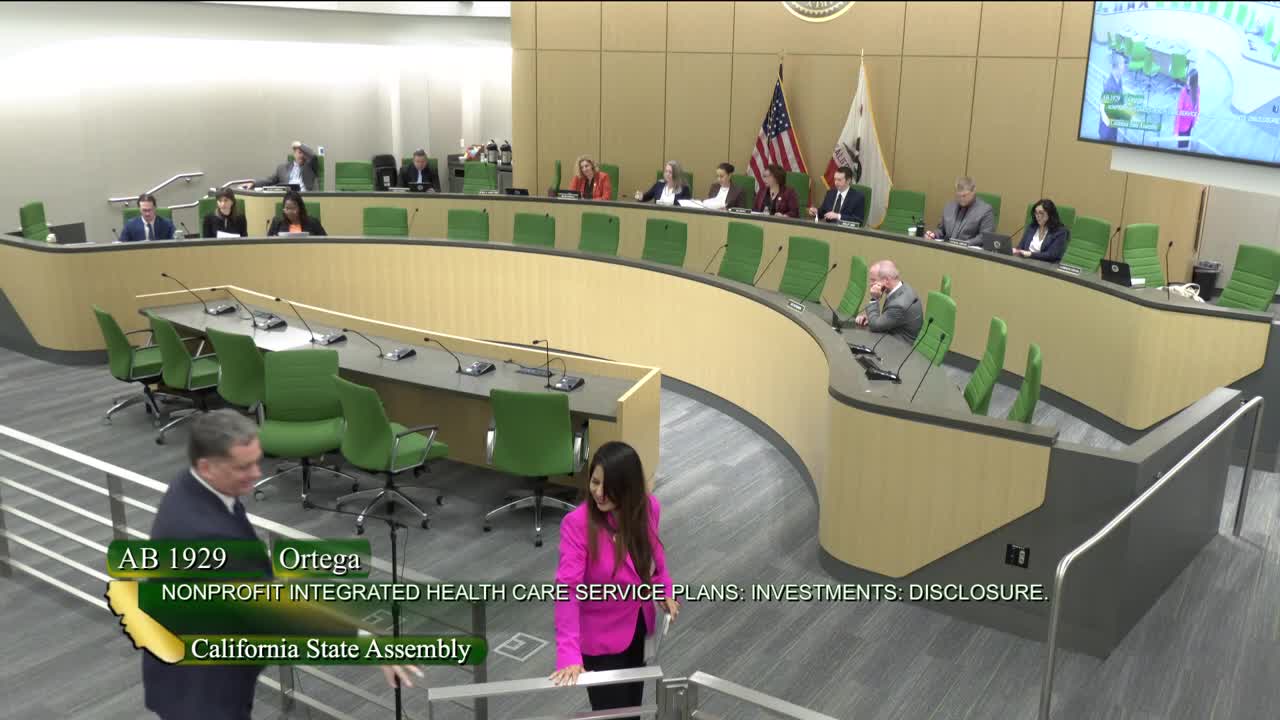 15MIN
Assembly Standing Committee on Health
Bill Author

Bill Co-Author(s):
