AB 1952: Dentistry: dental hygienists: licensure.
- Session Year: 2025-2026
- House: Assembly
- Latest Version Date: 2026-04-22
Current Status:
In Progress
(2026-05-14: In committee: Held under submission.)
Introduced
In Committee
Awaiting First Chamber Vote
Passed First Chamber
In Committee
Awaiting Second Chamber Vote
Passed Second Chamber
Enacted
Existing law, the Dental Practice Act, provides for the licensure and regulation of dental hygienists by the Dental Hygiene Board of California. Existing law requires the board to license as a registered dental hygienist a person who satisfies specified requirements, including completion of a prescribed education program, satisfactory completion of an examination in California law and ethics, and satisfactory performance, within the preceding 3 years, of the dental hygiene examination given by the Western Regional Examining Board or any other clinical or dental hygiene examination approved by the board.
This bill would require the board to license as a registered dental hygienist an applicant who has successfully completed the dental hygiene examination given by the American Board of Dental Examiners and submitted an application and appropriate fees. The bill would require the board to certify an individual as eligible to take that dental hygiene examination if they have earned a degree from a nonaccredited dental school equivalent to a doctor of dental surgery or doctor of dental medicine degree and they meet certain other requirements. Among those requirements, the bill would include submission of verification of their degrees equivalence, as specified, satisfactory completion of specified examinations within the 5 years preceding application, and satisfactory completion of certain coursework, including, among other things, a board-approved course in soft-tissue curettage, local anesthesia, and nitrous oxide-oxygen analgesia, within the 2 years preceding application. The bill would deem an individual eligible to enroll in a board-approved course in soft-tissue curettage, local anesthesia, and nitrous oxide-oxygen analgesia if they have otherwise satisfied certain verification, examination, and coursework requirements, as specified.
Existing law, the Dental Practice Act, provides for the licensure and regulation of dental hygienists by the Dental Hygiene Board of California. Existing law requires the board to license as a registered dental hygienist a person who satisfies specified requirements, including completion of a prescribed education program, satisfactory completion of an examination in California law and ethics, and satisfactory performance, within the preceding 3 years, of the dental hygiene examination given by the Western Regional Examining Board or any other clinical or dental hygiene examination approved by the board.
This bill would authorize require the board to license as a registered dental hygienist an applicant who has successfully completed the dental hygiene examination given by the American Board of Dental Examiners and submitted an application and appropriate fees. The bill would require the board to certify an individual as eligible to take that dental hygiene examination if they have earned a degree from a nonaccredited dental school if that degree is equivalent to a doctor of dental surgery or doctor of dental medicine degree, as specified. The bill would require, as a condition of licensure, an applicant to meet certain requirements, including, among other things, degree and they meet certain other requirements. Among those requirements, the bill would include submission of verification of the above-described their degrees equivalence, as specified, satisfactory completion of specified examinations, examinations within the 5 years preceding application, and satisfactory completion of certain coursework, including, among other things, a 2-unit Dental Practice Act course approved by the Dental Board of California, board-approved course in soft-tissue curettage, local anesthesia, and nitrous oxide-oxygen analgesia, within the 3 2 years preceding application. The bill would deem an individual eligible to enroll in a board-approved course in soft-tissue curettage, local anesthesia, and nitrous oxide-oxygen analgesia if they have otherwise satisfied certain verification, examination, and coursework requirements, as specified.
Existing law, the Dental Practice Act, provides for the licensure and regulation of dental hygienists by the Dental Hygiene Board of California. Existing law requires the board to license as a registered dental hygienist a person who satisfies specified requirements, including completion of a prescribed education program, satisfactory completion of an examination in California law and ethics, and satisfactory performance, within the preceding 3 years, of the dental hygiene examination given by the Western Regional Examining Board or any other clinical or dental hygiene examination approved by the board.
This bill would authorize the board to license as a registered dental hygienist an applicant who has earned a degree from a nonaccredited dental school if that degree is equivalent to a doctor of dental surgery or doctor of dental medicine degree, as specified. The bill would require, as a condition of licensure, an applicant to meet certain requirements, including, among other things, submission of verification of the above-described equivalence, as specified, satisfactory completion of specified examinations, and satisfactory completion of certain coursework, including, among other things, a 2-unit Dental Practice Act course approved by the Dental Board of California, within the 3 years preceding application.
(a)The dental hygiene board shall certify an individual as eligible to take the dental hygiene examination given by the American Board of Dental Examiners if they have earned a degree from a nonaccredited dental school equivalent to a doctor of dental surgery or doctor of dental medicine and they meet the following requirements:
(1)Submission of verification from Educational Credential Evaluators confirming the academic equivalence of the applicants dental degree to a United States dental hygiene degree.
(2)Satisfactory completion of the following examinations within the preceding five years:
(A)The National Board Dental Hygiene Examination.
(B)The examination in California law and ethics as prescribed by the dental hygiene board.
(3)Satisfactory completion of all of the following within the preceding two years:
(A)A two-unit Dental Practice Act course approved by the dental board.
(B)An eight-unit infection control course approved by the dental board.
(C)A soft-tissue curettage, local anesthesia, and nitrous oxide-oxygen analgesia course approved by the dental hygiene board.
(D)Current, valid certification in basic life support offered by a course consistent with Section 1017 of Title 16 of the California Code of Regulations.
(b)An individual who provides documentation to a course instructor demonstrating compliance with paragraphs (1) and (2) and subparagraphs (A), (B), and (D) of paragraph (3) of subdivision (a) shall be deemed eligible to enroll in a board-approved course of instruction required by subparagraph (C) of paragraph (3) of subdivision (a).
(c)The dental hygiene board shall, pursuant to this section, grant a license as a registered dental hygienist to an applicant upon successful completion of the dental hygiene examination given by the American Board of Dental Examiners, and submission of a completed application form and all fees required by the dental hygiene board.
(a)The dental hygiene board may grant a license as a registered dental hygienist to an applicant who has shall certify an individual as eligible to take the dental hygiene examination given by the American Board of Dental Examiners if they have earned a degree from a nonaccredited dental school equivalent to a doctor of dental surgery or doctor of dental medicine if medicine and they meet the following requirements within the preceding three years: requirements:
(a)(1)Submission of verification from Educational Credential Evaluators confirming the academic equivalence of the applicants dental degree to a doctor of dental surgery or doctor of dental medicine degree from a program accredited by the Commission on Dental Accreditation. United States dental hygiene degree.
(b)(2)Satisfactory completion of the following examinations: examinations within the preceding five years:
(1)A dental hygiene examination or dental examination, either of which are given by the Western Regional Examining Board or the American Board of Dental Examiners, or any other clinical or dental hygiene examination approved by the dental board.(2)(A)The National Board Dental Hygiene Examination or the Integrated National Board Dental Examination. Examination.
(3)(B)The examination in California law and ethics as prescribed by the dental hygiene board.
(c)(3)Satisfactory completion of all of the following coursework: within the preceding two years:
(1)(A)A two-unit Dental Practice Act course approved by the dental board.
(2)(B)An eight-unit infection control course approved by the dental board.
(3)Instruction in the following, approved by the dental hygiene board:(A)Gingival soft-tissue curettage.(B)Nitrous oxide-oxygen analgesia.(C)Local anesthesia.(C)A soft-tissue curettage, local anesthesia, and nitrous oxide-oxygen analgesia course approved by the dental hygiene board.
(4)(D)Current, valid certification in basic life support offered by a course consistent with Section 1016, 1016.2, or 1017 of Title 16 of the California Code of Regulations.
(b)An individual who provides documentation to a course instructor demonstrating compliance with paragraphs (1) and (2) and subparagraphs (A), (B), and (D) of paragraph (3) of subdivision (a) shall be deemed eligible to enroll in a board-approved course of instruction required by subparagraph (C) of paragraph (3) of subdivision (a).
(d)Submission(c)The dental hygiene board shall, pursuant to this section, grant a license as a registered dental hygienist to an applicant upon successful completion of the dental hygiene examination given by the American Board of Dental Examiners, and submission of a completed application form and all fees required by the dental hygiene board.
The dental hygiene board may grant a license as a registered dental hygienist to an applicant who has earned a degree from a nonaccredited dental school equivalent to a doctor of dental surgery or doctor of dental medicine if they meet the following requirements within the preceding three years:
(a)Submission of verification from Educational Credential Evaluators confirming the academic equivalence of the applicants dental degree to a doctor of dental surgery or doctor of dental medicine degree from a program accredited by the Commission on Dental Accreditation.
(b)Satisfactory completion of the following examinations:
(1)A dental hygiene examination or dental examination, either of which are given by the Western Regional Examining Board or the American Board of Dental Examiners, or any other clinical or dental hygiene examination approved by the dental board.
(2)The National Board Dental Hygiene Examination or the Integrated National Board Dental Examination.
(3)The examination in California law and ethics as prescribed by the dental hygiene board.
(c)Satisfactory completion of the following coursework:
(1)A two-unit Dental Practice Act course approved by the dental board.
(2)An eight-unit infection control course approved by the dental board.
(3)Instruction in the following, approved by the dental hygiene board:
(A)Gingival soft-tissue curettage.
(B)Nitrous oxide-oxygen analgesia.
(C)Local anesthesia.
(4)Current, valid certification in basic life support offered by a course consistent with Section 1016, 1016.2, or 1017 of Title 16 of the California Code of Regulations.
(d)Submission of a completed application form and all fees required by the dental hygiene board.
|
Date
|
Status
|
|---|---|
| May 14, 2026 | In committee: Held under submission. |
| May 6, 2026 | In committee: Set, first hearing. Referred to APPR. suspense file. |
| Apr 23, 2026 | Re-referred to Com. on APPR. |
| Apr 22, 2026 | Read second time and amended. |
| Apr 21, 2026 | From committee: Amend, and do pass as amended and re-refer to Com. on APPR. (Ayes 17. Noes 0.) (April 21). |
| Apr 14, 2026 | Re-referred to Com. on B. & P. |
| Apr 13, 2026 | From committee chair, with author's amendments: Amend, and re-refer to Com. on B. & P. Read second time and amended. |
| Mar 2, 2026 | Referred to Com. on B. & P. |
| Feb 14, 2026 | From printer. May be heard in committee March 16. |
| Feb 13, 2026 | Read first time. To print. |
|
Date
|
Description
|
Location
|
Votes
|
|
|---|---|---|---|---|
| Apr 21, 2026 | Do pass as amended and be re-referred to the Committee on [Appropriations] | Assembly Standing Committee on Business and Professions |
Passed |
This list shows positions taken on this bill by organizations on the date displayed, which is linked to the original source.
Positions by individuals are not included.
|
Organization
|
Position
|
Date
|
|---|---|---|
| American Dental Hygienists’ Association | ** Against | |
| California Academy of General Dentistry | ** Support | |
| California Association Of Oral And Maxillofacial Surgeons | ** Support | |
| California Dental Association | ** Support | |
| California Dental Hygienists’ Association | ** Against | |
| California Primary Care Association | ** Support | |
| CPCA Advocates | ** Support | |
| Dental Hygiene Board of California | ** Against |
Date of Hearing: May 6, 2026
ASSEMBLY COMMITTEE ON APPROPRIATIONS
Buffy Wicks, Chair
ABPCA Bill Id:AB 1952
Author:(Berman) – As Amended Ver:April 22, 2026
Policy Committee: | Business and Professions | Vote: | 17 - 0 |
|
| ||
|
|
Urgency: No State Mandated Local Program: No Reimbursable: No
SUMMARY:
This bill establishes a pathway for an internationally trained dentist (ITD) to apply for licensure as a registered dental hygienist (RDH) after completing additional examination and training requirements.
Specifically, this bill:
- Requires the Dental Hygiene Board of California (Board) certify an individual as eligible to take the American Board of Dental Examiners dental hygiene examination if they have earned a degree from a nonaccredited dental school and meet the following requirements:
- Satisfactory completion of the National Board Dental Hygiene Examination and the examination in California law and ethics as prescribed by the Board, within the preceding five years.
- Satisfactory completion of coursework in the Dental Practice Act and infection control approved by the Dental Board of California (DBC).
- Satisfactory completion of coursework in soft-tissue curettage, local anesthesia, and nitrous oxide-oxygen analgesia approved by the Board.
- Certification in basic life support.
- Deems an individual who provides documentation to a course instructor demonstrating compliance with items (a) and (b), under item (1) above, eligible to enroll in a Board-approved course of instruction required in item (c), under item (1), above.
- Requires the Board to grant a license as an RDH to an applicant upon successful completion of the American Board of Dental Examiners dental hygiene examination and submission of a completed application form and all fees required by the Board.
FISCAL EFFECT:
Costs to the Board of $572,000 for four positions in 2026-27 and ongoing (State Dental Hygiene Fund). The Board will need to develop a fully separate review and approval process; create new procedures, regulations, and training; and substantially expand applicant communication and processing activities. The Board anticipates the need for three staff positions to address the increased licensing workload and an additional analyst to address a proportional rise in investigative complaints.
The Board estimates approximately 4,000 ITDs will apply for licensure in the first year, and between 3,600 and 3,800 ITDs will apply annually thereafter. The existing $200 application and licensure fee will increase revenue by $800,000 in the first year and $720,000 to $760,000 in subsequent years, which will be sufficient to support the new licensure pathway and investigations.
The Department of Consumer Affairs’ Office of Information Services estimates absorbable costs of $7,000 related to new questions and new pathway requirements in the online licensing and enforcement system.
COMMENTS:
- Purpose. This bill is sponsored by the California Dental Association. According to the author:
California is facing a dental care workforce crisis that only continues to worsen, with millions of residents across the state living with inadequate access to oral health care. Meanwhile, many talented dentists trained in other countries are eager to move to California and provide care, but must first go through an additional multi-year residency program to practice dentistry. AB 1952 creates an opportunity for these foreign trained dentists to provide patients with much-needed dental hygiene services, as a licensed dental hygienist, on a much faster timeline.
- Background. The Board regulates three categories of mid-level dental professionals: RDHs, RDHs in alternative practice, and RDHs in extended functions. There are an estimated 19,000 actively licensed RDHs in California, including 800 RDHs in alternative practice and 15 RDHs in extended functions. The Board is also responsible for approving the state’s dental hygiene educational programs. As of 2023, there were 29 dental hygiene educational programs in California.
Dental hygiene practice includes dental hygiene assessment and development, planning, implementation of a dental hygiene care plan, health education, counseling, and health screenings. Dental hygiene does not include diagnosis or comprehensive treatment planning, placing or removal of permanent restorations, surgery, prescribing medication, or administering anesthesia or conscious sedation. Only dental hygienists licensed by the Board and dentists licensed by the Dental Board of California (DBC) are authorized to engage in the practice of dental hygiene or perform dental hygiene procedures on patients. - Opposition. The California Dental Hygienists’ Association writes in opposition to this bill:
Internationally trained dentists come to California with the objective of practicing dentistry. The solution is to create a restricted dental license for internationally trained dentists while they work to become licensed dentists in California. A restricted dental license would allow dental hygiene duties, which are included in a dental license, along with limited restorative duties.
The American Dental Hygienists’ Association and two individuals also wrote in opposition, arguing dental hygiene training is distinct from dental training, with different tools and depth, rigor, and clinical experience that this bill does not require.
- Oppose Unless Amended. The Board writes that the DBC is the appropriate entity to oversee ITDs, arguing that ITDs are dentists, not dental hygienists.
Analysis Prepared by: Allegra Kim / APPR. / (916) 319-2081
Date of Hearing:
ASSEMBLY COMMITTEE ON BUSINESS AND PROFESSIONS
Marc Berman, Chair
ABPCA Bill Id:AB 1952
Author:(Berman) – As Amended Ver:April 13, 2026
SUBJECT: Dentistry: dental hygienists: licensure.
SUMMARY: Establishes a pathway for an internationally trained dentist to apply for licensure as a registered dental hygienist (RDH) after completing additional examination and training requirements.
EXISTING LAW:
- Establishes the Dental Practice Act. (Business and Professions Code (BPC) §§ 1600 et seq.)
- Establishes the Dental Board of California (DBC) within the Department of Consumer Affairs (DCA) to administer and enforce the Dental Practice Act. (BPC § 1601.1)
- Defines “dentistry” as the diagnosis or treatment, by surgery or other method, of diseases and lesions and the correction of malpositions of the human teeth, alveolar process, gums, jaws, or associated structures; diagnosis or treatment may include all necessary related procedures as well as the use of drugs, anesthetic agents, and physical evaluation. (BPC § 1625)
- Authorizes the DBC to grant a license to practice dentistry to an applicant who satisfies certain requirements, including a requirement that satisfactory evidence be provided that the applicant has graduated from a dental school approved either by a national accrediting body approved by the DBC or by the Commission on Dental Accreditation (CODA), a national accreditor established within the American Dental Association. (BPC § 1634.1)
- Beginning January 1, 2024, requires a school seeking approval as a foreign dental school to have successfully completed the international consultative and accreditation process with the CODA or a comparable accrediting body approved by the DBC. (BPC § 1636.4)
- Allows an individual who has not graduated from a dental school approved by the DBC or CODA to apply for licensure if they meet certain other requirements, including possession of a current license to practice dentistry from another state and either 5,000 hours of clinical practice or a two-year pending contract to work in an underserved California clinic or accredited dental education program. (BPC § 1635.5)
- Establishes the Licensed Dentists from Mexico Pilot Program, previously established as a component of the Licensed Physicians and Dentists Pilot Program, which requires the DBC to issue a three-year nonrenewable permit to practice dentistry to no more than 30 dentists from Mexico who meet specified criteria. (BPC § 1645.4)
- Establishes the Dental Hygiene Board of California (DHBC) within the DCA to administer and enforce the provisions of the Dental Practice Act relating to dental hygienists. (BPC § 1903)
- Authorizes an RDH to perform all functions that may be performed by a registered dental assistant. (BPC § 1907)
- Defines the practice of dental hygiene as inclusive of dental hygiene assessment and development, planning, and implementation of a dental hygiene care plan, as well as oral health education, counseling, and health screenings. (BPC § 1908(a))
- Specifies that the practice of dental hygiene does not include the following procedures:
- Diagnosis and comprehensive treatment planning.
- Placing, condensing, carving, or removal of permanent restorations.
- Surgery or cutting on hard and soft tissue including, but not limited to, the removal of teeth and the cutting and suturing of soft tissue.
- Prescribing medication.
- Administering local or general anesthesia or oral or parenteral conscious sedation, except for the administration of nitrous oxide and oxygen, whether administered alone or in combination with each other, or local anesthesia.
(BPC § 1908(b))
- Authorizes RDHs to perform additional procedures and services under specified levels of dentist supervision. (BPC §§ 1909–1914)
- Provides that no person other than an RDH, an RDH in alternative practice, an RDH in extended functions, or a licensed dentist may engage in the practice of dental hygiene or perform dental hygiene procedures on patients. (BPC § 1915)
- Requires an applicant for licensure as an RDH to satisfy specified requirements, including completion of an educational program for RDHs that is approved by the DHBC, accredited by CODA, and conducted by a degree-granting, postsecondary institution. (BPC § 1917)
THIS BILL:
- Provides that the DHBC shall certify an individual as eligible to take the dental hygiene examination given by the American Board of Dental Examiners if they have earned a degree from a nonaccredited dental school equivalent to a doctor of dental surgery or doctor of dental medicine and they meet the following requirements:
- Satisfactory completion of the National Board Dental Hygiene Examination and the examination in California law and ethics as prescribed by the DHBC, within the preceding five years.
- Satisfactory completion of coursework in the Dental Practice Act, infection control, and soft-tissue curettage, local anesthesia, and nitrous oxide-oxygen analgesia.
- Certification in basic life support.
- Requires the DHBC to grant a license as an RDH to an applicant upon successful completion of the dental hygiene examination given by the American Board of Dental Examiners, and submission of a completed application form and all fees required by the DHBC.
FISCAL EFFECT: Unknown; this bill is keyed fiscal by the Legislative Counsel.
COMMENTS:
Purpose. This bill is sponsored by the California Dental Association. According to the author:
California is facing a dental care workforce crisis that only continues to worsen, with millions of residents across the state living with inadequate access to oral health care. Meanwhile, many talented dentists trained in other countries are eager to move to California and provide care, but must first go through an additional multi-year residency program to practice dentistry. AB 1952 creates an opportunity for these foreign trained dentists to provide patients with much-needed dental hygiene services, as a licensed dental hygienist, on a much faster timeline.
Background.
Dental Board of California. The DBC is responsible for licensing and regulating dental professionals in California. The DBC was originally created as the Board of Dental Examiners in 1885. As of the DBC’s most recent sunset review in 2024, the DBC licenses an estimated 112,000 dental professionals, of which approximately 43,500 are licensed dentists. The DBC is also responsible for licensing registered dental assistants and setting the duties and functions of unlicensed dental assistants.
Statute defines dentistry as “the diagnosis or treatment, by surgery or other method, of diseases and lesions and the correction of malpositions of the human teeth, alveolar process, gums, jaws, or associated structures; and such diagnosis or treatment may include all necessary related procedures as well as the use of drugs, anesthetic agents, and physical evaluation.” Dentists are health care practitioners authorized to write and issue prescriptions for controlled substances. Oral and maxillofacial surgeons are a surgically trained specialty of dentistry that have completed additional residency requirements.
Dental Hygiene Board of California. The DHBC regulates three categories of mid-level dental professionals: RDHs, RDHs in alternative practice, and RDHs in extended functions. There are currently an estimated 19,000 actively licensed RDHs in California, including 800 RDHs in alternative practice and 15 RDHs in extended functions. The DHBC is also responsible for approving the state’s dental hygiene educational programs. As of the DHBC’s most recent sunset review in 2023, there were 29 dental hygiene educational programs in California.
The DHBC maintains authority over all aspects of licensure, enforcement, and investigation of dental hygiene professionals in California. Previously, dental hygienists were regulated alongside other dental assisting professions under the DBC’s Committee on Dental Auxiliaries. In 2002, the Joint Legislative Sunset Review Committee determined that the dental hygiene profession’s roles and responsibilities justified an independent regulatory body distinct from the DBC. In 2008, legislation was enacted to establish the Dental Hygiene Committee of California (DHCC), nominally still within the jurisdiction of the DBC. In 2018, legislation was enacted to rename the DHCC as the DHBC. This name change is regarded as recognizing the DHBC as an independent, semiautonomous state agency and not a subdivision of another entity, and operating within the DCA. Today, California remains the only state in the country to regulate dental hygienists under a fully separate, stand-alone board.
Dental hygiene practice includes dental hygiene assessment and development, planning, implementation of a dental hygiene care plan, health education, counseling, and health screenings. Dental hygiene does not include diagnosis or comprehensive treatment planning, placing or removal of permanent restorations, surgery, prescribing medication, or administering anesthesia or conscious sedation. Only dental hygienists licensed by the DHBC and dentists licensed by the DBC are authorized to engage in the practice of dental hygiene or perform dental hygiene procedures on patients.
Oral Health Care Provider Access Gaps and Inequities. California continues to face an urgent crisis in regards to its dental health professional workforce. While historically California has been home to the highest number of dentists per capita in the United States, the state nevertheless has struggled with dental care accessibility. Approximately 2.2 million Californians reside in areas designated as dental health professional shortage areas.[1] According to the California Future Health Workforce Commission, the state is projected to face challenges in ensuring adequate access to dental care by 2030, not due to a lack of dentists overall, but because of a maldistribution of the dental workforce.[2]
This access gap is exacerbated by the underrepresentation of linguistically and culturally competent dentists; while 40 percent of California’s population is Latino/x, research has found that only 8% of the state’s dentists are identified as Latino/x or Black.[3] The lack of Spanish-speaking dental professionals contributes to persistent access failures for vulnerable communities in California such as farmworkers. The Farmworker Health Survey conducted by researchers at the University of California, Merced found that only 35 percent of farmworkers had visited the dentist in the past year.[4]
Approval of Foreign Dental Education. Applicants for licensure as dentists in California are required to submit proof to the DBC that they have met specified requirements based on the pathway to licensure for which they are applying. With the exception of the Licensure by Credential pathway, all applicants must demonstrate that they have “completed at dental school or schools the full number of academic years of undergraduate courses required for graduation.” For schools located within the United States and Canada, the DBC has long accepted the findings of CODA, an accrediting body within the American Dental Association, when they approve or reapprove a dental school located within the United States. These schools are accredited and re-evaluated by CODA every seven years.
Prior to 2015, CODA did not offer an accreditation process for foreign dental schools located outside the United States and Canada. Education programs offered outside those countries could therefore not become approved through the same CODA process. As a result, foreign-trained dental students could not present their degrees to the DBC for purposes of applying for licensure as dentists through the typical pathways.
In 1997, Assembly Bill 1116 (Keeley) was enacted to create a new accreditation process for foreign dental schools through the DBC. Under the bill, schools seeking approval would apply to the DBC for a determination as to whether its educational program is “equivalent to that of similar accredited institutions in the United States and adequately prepares its students for the practice of dentistry.” The DBC would perform an evaluation of the school in consultation with a technical advisory group and could subsequently issue a provisional and then full approval. Once a foreign dental school was approved by the DBC, its graduates would immediately be eligible for licensure in California and would no longer be required to complete two additional years of dental education prior to taking the examination.
Between 1997 and 2019, only two foreign dental schools were ever approved by the DBC. The first, La Universidad De La Salle Bajío (“De La Salle”) was first approved in 2004 and is located in Leon, Guanajuato, Mexico. The second, the State of Medicine and Pharmacy “Nicolae Testemintanu” of the Republic of Moldova, received a two-year provisional approval in December 2016 and full approval in May 2018. While the DBC conducted site visits for one other applicant, no other schools were ever approved.
In November 2015, the American Dental Association House of Delegates officially established the CODA Standing Committee on International Accreditation (SCIA) to replace the prior Joint Advisory Committee on International Accreditation. Through the SCIA, CODA began to receive requests for fee-based requests for consultation from international dental education programs. This meant CODA had established a review and approval process for foreign dental schools from the same accrediting entity that had long approved schools located within the United States and Canada.
Following the establishment of the CODA accreditation program for international dental schools, the DBC formally recommended that the Legislature require foreign dental schools to successfully complete the CODA international consultation and accreditation process. The DBC’s 2019 sunset bill was subsequently amended by to transition the responsibility for approving foreign dental schools from the DBC to CODA. The DBC’s sunset bill required that the board cease accepting new applications from foreign dental schools beginning January 1, 2020, and that the board instead direct schools to CODA to apply for their accreditation. Both foreign dental schools previously approved by the DBC were scheduled to remain approved until January 1, 2024, by which time they would have to have received CODA accreditation. The provisions transitioning foreign dental schools to CODA accreditation included specific language to ensure graduates of schools whose programs were approved at the time of graduation remained eligible for licensure by the DBC.
Pathways to Licensure for Internationally Trained Dentists. If an internationally trained dentist obtained their degree from a foreign dental school that has not been approved by CODA, there are currently several pathways they can take to obtain a license from the DBC. The most common route is completion of an International Dentist Program (IDP), also known as an advanced standing program, at a dental school located within the United States. These programs are designed to allow foreign-trained dentists to enter the second or third year of a Doctor of Dental Surgery (DDS) or Doctor of Dental Medicine (DMD) program, culminating in a CODA-accredited degree. Graduates must then satisfy specified examination requirements. While this pathway is widely recognized and provides a comprehensive integration into the American dental education system, it is also highly competitive, costly, and time-intensive.
Another pathway is the DBC’s Licensure by Residency process allows internationally trained dentists to obtain a license without completing a full DDS or DMD program in the United States. Under this route, candidates must complete at least two years in a DBC-approved postgraduate residency program—most commonly a General Practice Residency (GPR) or Advanced Education in General Dentistry (AEGD)—at an accredited institution. In addition to residency training, applicants must meet examination requirements similar to those in the IDP pathway. This pathway can be shorter and less expensive than an IDP, but positions in qualifying residencies are limited and often highly competitive, particularly for internationally trained applicants.
Both of these pathways are very competitive and often cost-prohibitive for many internationally trained dentists. For internationally trained dentists who are able to participate in an IDP or residency program, completion often takes multiple years, during which time the participant is not able to practice within the dental profession. The author contends that this both creates a hardship for the internationally trained dentist and deprives California communities of potential contributions to the oral health care workforce.
This bill would establish a process by which an internationally trained dentist can apply for licensure as an RDH through the DHBC. While dental hygienists are a critical component of the oral health workforce, working as part of a dental team to deliver essential preventive care and patient education, there is purported to be a significant dental hygienist shortage in California. According to professional surveys, approximately 95 percent of dentists have reported difficulty hiring dental hygienists. This gap is expected to worsen as the number of dentists is believed to be growing at nearly triple the rate of dental hygienists.
An applicant for RDH licensure under this bill would be required to submit verification from Educational Credential Evaluators confirming the academic equivalence of the applicant’s dental degree to a United States dental hygiene degree. The applicant would be required to complete both the National Board Dental Hygiene Examination and the examination in California law and ethics as prescribed by the DHBC. Additionally, applicants would be required to complete the following within the preceding two years:
- A two-unit Dental Practice Act course approved by the DBC.
- An eight-unit infection control course approved by the DBC.
- A soft-tissue curettage, local anesthesia, and nitrous oxide-oxygen analgesia course approved by the dental hygiene board.
- Current, valid certification in basic life support.
The author believes that by allowing skilled dentists trained in other countries to provide dental hygiene services in California, this bill would meaningfully address the dental care gap, increase cultural and linguistic competency within the oral health workforce, and provide a pathway to economic opportunity to immigrant professionals.
Current Related Legislation. AB 1307 (Ávila Farías) would reestablish the Licensed Dentists from Mexico Pilot Program and revise various requirements contained within the existing pilot program relating to the temporary state licensure of dental professionals from Mexico. This bill is pending in the Senate Committee on Business, Professions, and Economic Development.
ARGUMENTS IN SUPPORT:
The California Dental Association (CDA) is the sponsor of this bill. According to the CDA: “California has a substantial pool of internationally trained dentists (ITDs) whose clinical training, experience, and cultural and linguistic competencies remain underutilized. While six California dental schools have programs allowing ITDs to earn their dental license, these costly and competitive programs receive thousands of applicants each ear for a small fraction of seats available. Despite meeting or exceeding the educational level of hygiene curriculum, ITDs currently have no pathway into the dental hygiene profession. As a result, highly trained clinicians are forced to restart their careers or exit the dental field entirely, even as dental practices report ongoing difficulty hiring hygienists across the state. AB 1952 aims to resolve these issues by establishing a competency-based licensure track into dental hygiene.”
CPCA Advocates, the advocacy affiliate of the California Primary Care Association, writes in support of this bill: “California continues to experience significant gaps in access to dental services, particularly in low-income and rural communities. Workforce shortages—especially in preventive oral health roles—remain a key driver of these disparities. AB 1952 offers a thoughtful approach to expanding the dental workforce by leveraging the skills and training of internationally educated dental professionals already residing in California.” CPCA Advocates further writes: “For community health centers, this bill has the potential to significantly improve access to care.”
ARGUMENTS IN OPPOSITION:
The California Dental Hygienists’ Association (CDHA) opposes this bill. The CDHA writes: “The proponents are attempting to address two issues with this bill. Dental hygienist staffing and creating a new pathway for internationally trained dentists to work in California. Internationally trained dentists come to California with the objective of practicing dentistry. The solution is to create a restricted dental license for internationally trained dentists while they work to become licensed dentists in California. A restricted dental license would allow dental hygiene duties, which are included in a dental license, along with limited restorative duties. The dentist operating under the restricted dental license would practice under the supervision of a licensed dentist, who would then receive dental hygiene support from the dentist working under the restricted license if desired. The Dental Board of California is the ideal regulator for a restricted dental license and a pathway for internationally trained dentists.”
The Dental Hygiene Board of California also opposes this bill, writing: “The Dental Hygiene Board of California (DHBC) recently conducted a public meeting where our members voted on AB 1952 (as introduced on February 13, 2026) to take an Oppose, unless Amended position. The reason for this position is because the proposed provisions in the bill require the DHBC to license internationally trained dentists (ITD) as dental hygienists once the stated licensure requirements are fulfilled. The DHBC believes the bill should be amended to have the Dental Board of California (DBC) oversee the ITDs and not the DHBC because they are dentists in their respective countries, not dental hygienists.”
AMENDMENTS:
At the request of the author, amend subdivision (a) of the bill to strike the words “equivalent to a doctor of dental surgery or doctor of dental medicine.”
REGISTERED SUPPORT:
California Dental Association (Sponsor)
California Academy of General Dentistry
California Association of Oral and Maxillofacial Surgeons
California Primary Care Association
Three individuals
REGISTERED OPPOSITION:
American Dental Hygienists’ Association
California Dental Hygienists’ Association
Dental Hygiene Board of California
One individual
Analysis Prepared by: Robert Sumner / B. & P. / (916) 319-3301
University of California Office of the President. Dentistry in California: Workforce and Access to Care. https://www.ucop.edu/uc-health/reports-resources/profession-specific-reports/dentistry1.pdf ↑
Meeting the Demand for Health: Final Report of the California Future Health Workforce Commission. University of California, San Francisco, 2019. ↑
UCLA Center for Health Policy Research. Barriers to Accessing Dental Care for Low-Income Californians. https://healthpolicy.ucla.edu/newsroom/blog/report-identifies-barriers-accessing-dental-care-low-income-californians ↑
UC Merced, Farmworker Health Study: Assessing the Health and Well-Being of California’s Farmworkers. February 2023. https://clc.ucmerced.edu/sites/clc.ucmerced.edu/files/page/documents/fwhs_report_2.2.2383.pdf ↑
Date of Hearing:
ASSEMBLY COMMITTEE ON BUSINESS AND PROFESSIONS
Marc Berman, Chair
ABPCA Bill Id:AB 1952
Author:(Berman) – As Amended Ver:April 13, 2026
SUBJECT: Dentistry: dental hygienists: licensure.
SUMMARY: Establishes a pathway for an internationally trained dentist to apply for licensure as a registered dental hygienist (RDH) after completing additional examination and training requirements.
EXISTING LAW:
- Establishes the Dental Practice Act. (Business and Professions Code (BPC) §§ 1600 et seq.)
- Establishes the Dental Board of California (DBC) within the Department of Consumer Affairs (DCA) to administer and enforce the Dental Practice Act. (BPC § 1601.1)
- Defines “dentistry” as the diagnosis or treatment, by surgery or other method, of diseases and lesions and the correction of malpositions of the human teeth, alveolar process, gums, jaws, or associated structures; diagnosis or treatment may include all necessary related procedures as well as the use of drugs, anesthetic agents, and physical evaluation. (BPC § 1625)
- Authorizes the DBC to grant a license to practice dentistry to an applicant who satisfies certain requirements, including a requirement that satisfactory evidence be provided that the applicant has graduated from a dental school approved either by a national accrediting body approved by the DBC or by the Commission on Dental Accreditation (CODA), a national accreditor established within the American Dental Association. (BPC § 1634.1)
- Beginning January 1, 2024, requires a school seeking approval as a foreign dental school to have successfully completed the international consultative and accreditation process with the CODA or a comparable accrediting body approved by the DBC. (BPC § 1636.4)
- Allows an individual who has not graduated from a dental school approved by the DBC or CODA to apply for licensure if they meet certain other requirements, including possession of a current license to practice dentistry from another state and either 5,000 hours of clinical practice or a two-year pending contract to work in an underserved California clinic or accredited dental education program. (BPC § 1635.5)
- Establishes the Licensed Dentists from Mexico Pilot Program, previously established as a component of the Licensed Physicians and Dentists Pilot Program, which requires the DBC to issue a three-year nonrenewable permit to practice dentistry to no more than 30 dentists from Mexico who meet specified criteria. (BPC § 1645.4)
- Establishes the Dental Hygiene Board of California (DHBC) within the DCA to administer and enforce the provisions of the Dental Practice Act relating to dental hygienists. (BPC § 1903)
- Authorizes an RDH to perform all functions that may be performed by a registered dental assistant. (BPC § 1907)
- Defines the practice of dental hygiene as inclusive of dental hygiene assessment and development, planning, and implementation of a dental hygiene care plan, as well as oral health education, counseling, and health screenings. (BPC § 1908(a))
- Specifies that the practice of dental hygiene does not include the following procedures:
- Diagnosis and comprehensive treatment planning.
- Placing, condensing, carving, or removal of permanent restorations.
- Surgery or cutting on hard and soft tissue including, but not limited to, the removal of teeth and the cutting and suturing of soft tissue.
- Prescribing medication.
- Administering local or general anesthesia or oral or parenteral conscious sedation, except for the administration of nitrous oxide and oxygen, whether administered alone or in combination with each other, or local anesthesia.
(BPC § 1908(b))
- Authorizes RDHs to perform additional procedures and services under specified levels of dentist supervision. (BPC §§ 1909–1914)
- Provides that no person other than an RDH, an RDH in alternative practice, an RDH in extended functions, or a licensed dentist may engage in the practice of dental hygiene or perform dental hygiene procedures on patients. (BPC § 1915)
- Requires an applicant for licensure as an RDH to satisfy specified requirements, including completion of an educational program for RDHs that is approved by the DHBC, accredited by CODA, and conducted by a degree-granting, postsecondary institution. (BPC § 1917)
THIS BILL:
- Provides that the DHBC shall certify an individual as eligible to take the dental hygiene examination given by the American Board of Dental Examiners if they have earned a degree from a nonaccredited dental school equivalent to a doctor of dental surgery or doctor of dental medicine and they meet the following requirements:
- Satisfactory completion of the National Board Dental Hygiene Examination and the examination in California law and ethics as prescribed by the DHBC, within the preceding five years.
- Satisfactory completion of coursework in the Dental Practice Act, infection control, and soft-tissue curettage, local anesthesia, and nitrous oxide-oxygen analgesia.
- Certification in basic life support.
- Requires the DHBC to grant a license as an RDH to an applicant upon successful completion of the dental hygiene examination given by the American Board of Dental Examiners, and submission of a completed application form and all fees required by the DHBC.
FISCAL EFFECT: Unknown; this bill is keyed fiscal by the Legislative Counsel.
COMMENTS:
Purpose. This bill is sponsored by the California Dental Association. According to the author:
California is facing a dental care workforce crisis that only continues to worsen, with millions of residents across the state living with inadequate access to oral health care. Meanwhile, many talented dentists trained in other countries are eager to move to California and provide care, but must first go through an additional multi-year residency program to practice dentistry. AB 1952 creates an opportunity for these foreign trained dentists to provide patients with much-needed dental hygiene services, as a licensed dental hygienist, on a much faster timeline.
Background.
Dental Board of California. The DBC is responsible for licensing and regulating dental professionals in California. The DBC was originally created as the Board of Dental Examiners in 1885. As of the DBC’s most recent sunset review in 2024, the DBC licenses an estimated 112,000 dental professionals, of which approximately 43,500 are licensed dentists. The DBC is also responsible for licensing registered dental assistants and setting the duties and functions of unlicensed dental assistants.
Statute defines dentistry as “the diagnosis or treatment, by surgery or other method, of diseases and lesions and the correction of malpositions of the human teeth, alveolar process, gums, jaws, or associated structures; and such diagnosis or treatment may include all necessary related procedures as well as the use of drugs, anesthetic agents, and physical evaluation.” Dentists are health care practitioners authorized to write and issue prescriptions for controlled substances. Oral and maxillofacial surgeons are a surgically trained specialty of dentistry that have completed additional residency requirements.
Dental Hygiene Board of California. The DHBC regulates three categories of mid-level dental professionals: RDHs, RDHs in alternative practice, and RDHs in extended functions. There are currently an estimated 19,000 actively licensed RDHs in California, including 800 RDHs in alternative practice and 15 RDHs in extended functions. The DHBC is also responsible for approving the state’s dental hygiene educational programs. As of the DHBC’s most recent sunset review in 2023, there were 29 dental hygiene educational programs in California.
The DHBC maintains authority over all aspects of licensure, enforcement, and investigation of dental hygiene professionals in California. Previously, dental hygienists were regulated alongside other dental assisting professions under the DBC’s Committee on Dental Auxiliaries. In 2002, the Joint Legislative Sunset Review Committee determined that the dental hygiene profession’s roles and responsibilities justified an independent regulatory body distinct from the DBC. In 2008, legislation was enacted to establish the Dental Hygiene Committee of California (DHCC), nominally still within the jurisdiction of the DBC. In 2018, legislation was enacted to rename the DHCC as the DHBC. This name change is regarded as recognizing the DHBC as an independent, semiautonomous state agency and not a subdivision of another entity, and operating within the DCA. Today, California remains the only state in the country to regulate dental hygienists under a fully separate, stand-alone board.
Dental hygiene practice includes dental hygiene assessment and development, planning, implementation of a dental hygiene care plan, health education, counseling, and health screenings. Dental hygiene does not include diagnosis or comprehensive treatment planning, placing or removal of permanent restorations, surgery, prescribing medication, or administering anesthesia or conscious sedation. Only dental hygienists licensed by the DHBC and dentists licensed by the DBC are authorized to engage in the practice of dental hygiene or perform dental hygiene procedures on patients.
Oral Health Care Provider Access Gaps and Inequities. California continues to face an urgent crisis in regards to its dental health professional workforce. While historically California has been home to the highest number of dentists per capita in the United States, the state nevertheless has struggled with dental care accessibility. Approximately 2.2 million Californians reside in areas designated as dental health professional shortage areas.[1] According to the California Future Health Workforce Commission, the state is projected to face challenges in ensuring adequate access to dental care by 2030, not due to a lack of dentists overall, but because of a maldistribution of the dental workforce.[2]
This access gap is exacerbated by the underrepresentation of linguistically and culturally competent dentists; while 40 percent of California’s population is Latino/x, research has found that only 8% of the state’s dentists are identified as Latino/x or Black.[3] The lack of Spanish-speaking dental professionals contributes to persistent access failures for vulnerable communities in California such as farmworkers. The Farmworker Health Survey conducted by researchers at the University of California, Merced found that only 35 percent of farmworkers had visited the dentist in the past year.[4]
Approval of Foreign Dental Education. Applicants for licensure as dentists in California are required to submit proof to the DBC that they have met specified requirements based on the pathway to licensure for which they are applying. With the exception of the Licensure by Credential pathway, all applicants must demonstrate that they have “completed at dental school or schools the full number of academic years of undergraduate courses required for graduation.” For schools located within the United States and Canada, the DBC has long accepted the findings of CODA, an accrediting body within the American Dental Association, when they approve or reapprove a dental school located within the United States. These schools are accredited and re-evaluated by CODA every seven years.
Prior to 2015, CODA did not offer an accreditation process for foreign dental schools located outside the United States and Canada. Education programs offered outside those countries could therefore not become approved through the same CODA process. As a result, foreign-trained dental students could not present their degrees to the DBC for purposes of applying for licensure as dentists through the typical pathways.
In 1997, Assembly Bill 1116 (Keeley) was enacted to create a new accreditation process for foreign dental schools through the DBC. Under the bill, schools seeking approval would apply to the DBC for a determination as to whether its educational program is “equivalent to that of similar accredited institutions in the United States and adequately prepares its students for the practice of dentistry.” The DBC would perform an evaluation of the school in consultation with a technical advisory group and could subsequently issue a provisional and then full approval. Once a foreign dental school was approved by the DBC, its graduates would immediately be eligible for licensure in California and would no longer be required to complete two additional years of dental education prior to taking the examination.
Between 1997 and 2019, only two foreign dental schools were ever approved by the DBC. The first, La Universidad De La Salle Bajío (“De La Salle”) was first approved in 2004 and is located in Leon, Guanajuato, Mexico. The second, the State of Medicine and Pharmacy “Nicolae Testemintanu” of the Republic of Moldova, received a two-year provisional approval in December 2016 and full approval in May 2018. While the DBC conducted site visits for one other applicant, no other schools were ever approved.
In November 2015, the American Dental Association House of Delegates officially established the CODA Standing Committee on International Accreditation (SCIA) to replace the prior Joint Advisory Committee on International Accreditation. Through the SCIA, CODA began to receive requests for fee-based requests for consultation from international dental education programs. This meant CODA had established a review and approval process for foreign dental schools from the same accrediting entity that had long approved schools located within the United States and Canada.
Following the establishment of the CODA accreditation program for international dental schools, the DBC formally recommended that the Legislature require foreign dental schools to successfully complete the CODA international consultation and accreditation process. The DBC’s 2019 sunset bill was subsequently amended by to transition the responsibility for approving foreign dental schools from the DBC to CODA. The DBC’s sunset bill required that the board cease accepting new applications from foreign dental schools beginning January 1, 2020, and that the board instead direct schools to CODA to apply for their accreditation. Both foreign dental schools previously approved by the DBC were scheduled to remain approved until January 1, 2024, by which time they would have to have received CODA accreditation. The provisions transitioning foreign dental schools to CODA accreditation included specific language to ensure graduates of schools whose programs were approved at the time of graduation remained eligible for licensure by the DBC.
Pathways to Licensure for Internationally Trained Dentists. If an internationally trained dentist obtained their degree from a foreign dental school that has not been approved by CODA, there are currently several pathways they can take to obtain a license from the DBC. The most common route is completion of an International Dentist Program (IDP), also known as an advanced standing program, at a dental school located within the United States. These programs are designed to allow foreign-trained dentists to enter the second or third year of a Doctor of Dental Surgery (DDS) or Doctor of Dental Medicine (DMD) program, culminating in a CODA-accredited degree. Graduates must then satisfy specified examination requirements. While this pathway is widely recognized and provides a comprehensive integration into the American dental education system, it is also highly competitive, costly, and time-intensive.
Another pathway is the DBC’s Licensure by Residency process allows internationally trained dentists to obtain a license without completing a full DDS or DMD program in the United States. Under this route, candidates must complete at least two years in a DBC-approved postgraduate residency program—most commonly a General Practice Residency (GPR) or Advanced Education in General Dentistry (AEGD)—at an accredited institution. In addition to residency training, applicants must meet examination requirements similar to those in the IDP pathway. This pathway can be shorter and less expensive than an IDP, but positions in qualifying residencies are limited and often highly competitive, particularly for internationally trained applicants.
Both of these pathways are very competitive and often cost-prohibitive for many internationally trained dentists. For internationally trained dentists who are able to participate in an IDP or residency program, completion often takes multiple years, during which time the participant is not able to practice within the dental profession. The author contends that this both creates a hardship for the internationally trained dentist and deprives California communities of potential contributions to the oral health care workforce.
This bill would establish a process by which an internationally trained dentist can apply for licensure as an RDH through the DHBC. While dental hygienists are a critical component of the oral health workforce, working as part of a dental team to deliver essential preventive care and patient education, there is purported to be a significant dental hygienist shortage in California. According to professional surveys, approximately 95 percent of dentists have reported difficulty hiring dental hygienists. This gap is expected to worsen as the number of dentists is believed to be growing at nearly triple the rate of dental hygienists.
An applicant for RDH licensure under this bill would be required to submit verification from Educational Credential Evaluators confirming the academic equivalence of the applicant’s dental degree to a United States dental hygiene degree. The applicant would be required to complete both the National Board Dental Hygiene Examination and the examination in California law and ethics as prescribed by the DHBC. Additionally, applicants would be required to complete the following within the preceding two years:
- A two-unit Dental Practice Act course approved by the DBC.
- An eight-unit infection control course approved by the DBC.
- A soft-tissue curettage, local anesthesia, and nitrous oxide-oxygen analgesia course approved by the dental hygiene board.
- Current, valid certification in basic life support.
The author believes that by allowing skilled dentists trained in other countries to provide dental hygiene services in California, this bill would meaningfully address the dental care gap, increase cultural and linguistic competency within the oral health workforce, and provide a pathway to economic opportunity to immigrant professionals.
Current Related Legislation. AB 1307 (Ávila Farías) would reestablish the Licensed Dentists from Mexico Pilot Program and revise various requirements contained within the existing pilot program relating to the temporary state licensure of dental professionals from Mexico. This bill is pending in the Senate Committee on Business, Professions, and Economic Development.
ARGUMENTS IN SUPPORT:
The California Dental Association (CDA) is the sponsor of this bill. According to the CDA: “California has a substantial pool of internationally trained dentists (ITDs) whose clinical training, experience, and cultural and linguistic competencies remain underutilized. While six California dental schools have programs allowing ITDs to earn their dental license, these costly and competitive programs receive thousands of applicants each ear for a small fraction of seats available. Despite meeting or exceeding the educational level of hygiene curriculum, ITDs currently have no pathway into the dental hygiene profession. As a result, highly trained clinicians are forced to restart their careers or exit the dental field entirely, even as dental practices report ongoing difficulty hiring hygienists across the state. AB 1952 aims to resolve these issues by establishing a competency-based licensure track into dental hygiene.”
CPCA Advocates, the advocacy affiliate of the California Primary Care Association, writes in support of this bill: “California continues to experience significant gaps in access to dental services, particularly in low-income and rural communities. Workforce shortages—especially in preventive oral health roles—remain a key driver of these disparities. AB 1952 offers a thoughtful approach to expanding the dental workforce by leveraging the skills and training of internationally educated dental professionals already residing in California.” CPCA Advocates further writes: “For community health centers, this bill has the potential to significantly improve access to care.”
ARGUMENTS IN OPPOSITION:
The California Dental Hygienists’ Association (CDHA) opposes this bill. The CDHA writes: “The proponents are attempting to address two issues with this bill. Dental hygienist staffing and creating a new pathway for internationally trained dentists to work in California. Internationally trained dentists come to California with the objective of practicing dentistry. The solution is to create a restricted dental license for internationally trained dentists while they work to become licensed dentists in California. A restricted dental license would allow dental hygiene duties, which are included in a dental license, along with limited restorative duties. The dentist operating under the restricted dental license would practice under the supervision of a licensed dentist, who would then receive dental hygiene support from the dentist working under the restricted license if desired. The Dental Board of California is the ideal regulator for a restricted dental license and a pathway for internationally trained dentists.”
The Dental Hygiene Board of California also opposes this bill, writing: “The Dental Hygiene Board of California (DHBC) recently conducted a public meeting where our members voted on AB 1952 (as introduced on February 13, 2026) to take an Oppose, unless Amended position. The reason for this position is because the proposed provisions in the bill require the DHBC to license internationally trained dentists (ITD) as dental hygienists once the stated licensure requirements are fulfilled. The DHBC believes the bill should be amended to have the Dental Board of California (DBC) oversee the ITDs and not the DHBC because they are dentists in their respective countries, not dental hygienists.”
AMENDMENTS:
At the request of the author, amend subdivision (a) of the bill to strike the words “equivalent to a doctor of dental surgery or doctor of dental medicine.”
REGISTERED SUPPORT:
California Dental Association (Sponsor)
California Association of Oral and Maxillofacial Surgeons
California Primary Care Association
Three individuals
REGISTERED OPPOSITION:
American Dental Hygienists’ Association
California Dental Hygienists’ Association
Dental Hygiene Board of California
One individual
Analysis Prepared by: Robert Sumner / B. & P. / (916) 319-3301
University of California Office of the President. Dentistry in California: Workforce and Access to Care. https://www.ucop.edu/uc-health/reports-resources/profession-specific-reports/dentistry1.pdf ↑
Meeting the Demand for Health: Final Report of the California Future Health Workforce Commission. University of California, San Francisco, 2019. ↑
UCLA Center for Health Policy Research. Barriers to Accessing Dental Care for Low-Income Californians. https://healthpolicy.ucla.edu/newsroom/blog/report-identifies-barriers-accessing-dental-care-low-income-californians ↑
UC Merced, Farmworker Health Study: Assessing the Health and Well-Being of California’s Farmworkers. February 2023. https://clc.ucmerced.edu/sites/clc.ucmerced.edu/files/page/documents/fwhs_report_2.2.2383.pdf ↑
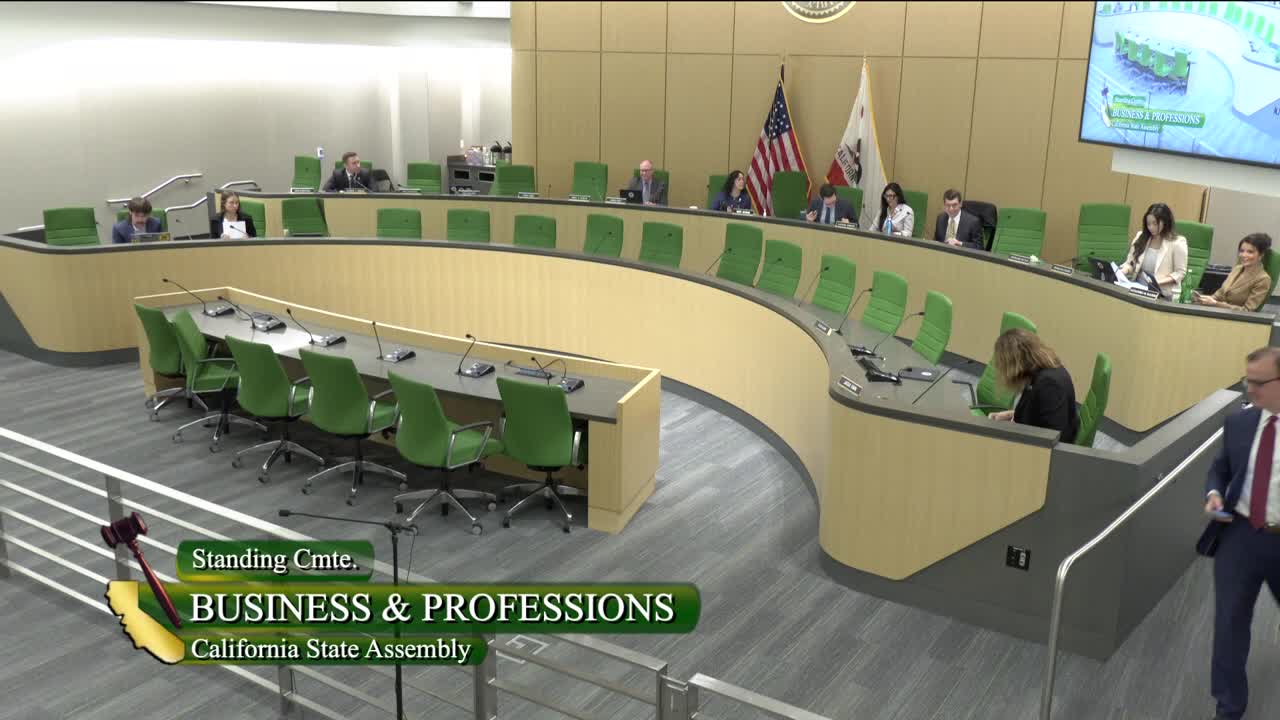
Discussed in Hearing
 14MIN
Assembly Standing Committee on Business and Professions
Bill Author

Bill Co-Author(s):