AB 1968: Juveniles: transfer to court of criminal jurisdiction: offense.
- Session Year: 2025-2026
- House: Assembly
- Latest Version Date: 2026-04-06
Current Status:
Failed
(2026-04-21: From committee: Without further action pursuant to Joint Rule 62(a).)
Introduced
In Committee
Awaiting First Chamber Vote
Passed First Chamber
In Committee
Awaiting Second Chamber Vote
Passed Second Chamber
Enacted
Existing law, as amended by the Public Safety and Rehabilitation Act of 2016, enacted by Proposition 57 at the November 8, 2016, statewide general election, authorizes the district attorney or other prosecuting officer to make a motion to transfer a minor from juvenile court to a court of criminal jurisdiction in a case in which a minor is alleged to have committed a felony when the minor was 16 years of age or older, or in a case in which a specified serious offense is alleged to have been committed by a minor when the minor was 14 or 15 years of age, but the minor was not apprehended prior to the end of juvenile court jurisdiction.
This bill would add the crime of conspiracy to commit murder whereby the conspiracy involves premeditated planning of an attack that is intended to cause multiple deaths or target a school, place of worship, or other public location to the list of offenses for which a juvenile may be transferred to a court of criminal jurisdiction pursuant to the above-described provisions.
Existing law, as amended by the Public Safety and Rehabilitation Act of 2016, enacted by Proposition 57 at the November 8, 2016, statewide general election, authorizes the district attorney or other prosecuting officer to make a motion to transfer a minor from juvenile court to a court of criminal jurisdiction in a case in which a minor is alleged to have committed a felony when the minor was 16 years of age or older, or in a case in which a specified serious offense is alleged to have been committed by a minor when the minor was 14 or 15 years of age, but the minor was not apprehended prior to the end of juvenile court jurisdiction.
This bill would add the crime of conspiracy to commit murder to the list of offenses for which a juvenile may be transferred to a court of criminal jurisdiction pursuant to the above-described provisions.
(a)(1)In any case in which a minor is alleged to be a person described in Section 602 by reason of the violation, when the minor was 16 years of age or older, of any offense listed in subdivision (b) or any other felony criminal statute, the district attorney or other appropriate prosecuting officer may make a motion to transfer the minor from juvenile court to a court of criminal jurisdiction. The motion shall be made prior to the attachment of jeopardy. Upon the motion, the juvenile court shall order the probation officer to submit a report on the behavioral patterns and social history of the minor. The report shall include any written or oral statement offered by the victim pursuant to Section 656.2.
(2)In any case in which an individual is alleged to be a person described in Section 602 by reason of the violation, when the individual was 14 or 15 years of age, of any offense listed in subdivision (b), but was not apprehended prior to the end of juvenile court jurisdiction, the district attorney or other appropriate prosecuting officer may make a motion to transfer the individual from juvenile court to a court of criminal jurisdiction. The motion shall be made prior to the attachment of jeopardy. Upon the motion, the juvenile court shall order the probation officer to submit a report on the behavioral patterns and social history of the individual. The report shall include any written or oral statement offered by the victim pursuant to Section 656.2.
(3)Following submission and consideration of the report, and of any other relevant evidence that the petitioner or the minor may wish to submit, the juvenile court shall decide whether the minor should be transferred to a court of criminal jurisdiction. In order to find that the minor should be transferred to a court of criminal jurisdiction, the court shall find by clear and convincing evidence that the minor is not amenable to rehabilitation while under the jurisdiction of the juvenile court. In making its decision, the court shall consider the criteria specified in subparagraphs (A) to (E), inclusive. If the court orders a transfer of jurisdiction, the court shall recite the basis for its decision in an order entered upon the minutes, which shall include the reasons supporting the courts finding that the minor is not amenable to rehabilitation while under the jurisdiction of the juvenile court. In any case in which a hearing has been noticed pursuant to this section, the court shall postpone the taking of a plea to the petition until the conclusion of the transfer hearing, and a plea that has been entered already shall not constitute evidence at the hearing.
(A)(i)The degree of criminal sophistication exhibited by the minor.
(ii)When evaluating the criterion specified in clause (i), the juvenile court shall give weight to any relevant factor, including, but not limited to, the minors age, maturity, intellectual capacity, and physical, mental, and emotional health at the time of the alleged offense; the minors impetuosity or failure to appreciate risks and consequences of criminal behavior; the effect of familial, adult, or peer pressure on the minors actions; the effect of the minors family and community environment; the existence of childhood trauma; the minors involvement in the child welfare or foster care system; and the status of the minor as a victim of human trafficking, sexual abuse, or sexual battery on the minors criminal sophistication.
(B)(i)Whether the minor can be rehabilitated prior to the expiration of the juvenile courts jurisdiction.
(ii)When evaluating the criterion specified in clause (i), the juvenile court shall give weight to any relevant factor, including, but not limited to, the minors potential to grow and mature.
(C)(i)The minors previous delinquent history.
(ii)When evaluating the criterion specified in clause (i), the juvenile court shall give weight to any relevant factor, including, but not limited to, the seriousness of the minors previous delinquent history and the effect of the minors family and community environment and childhood trauma on the minors previous delinquent behavior.
(D)(i)Success of previous attempts by the juvenile court to rehabilitate the minor.
(ii)When evaluating the criterion specified in clause (i), the juvenile court shall give weight to any relevant factor, including, but not limited to, the adequacy of the services previously provided to address the minors needs.
(E)(i)The circumstances and gravity of the offense alleged in the petition to have been committed by the minor.
(ii)When evaluating the criterion specified in clause (i), the juvenile court shall give weight to any relevant factor, including, but not limited to, the actual behavior of the person, the mental state of the person, the persons degree of involvement in the crime, the level of harm actually caused by the person, and the persons mental and emotional development.
(iii)When evaluating the criterion specified in clause (i), the court shall consider evidence offered that indicates that the person against whom the minor is accused of committing an offense trafficked, sexually abused, or sexually battered the minor.
(b)This subdivision is applicable to any case in which a minor is alleged to be a person described in Section 602 by reason of the violation of one of the following offenses:
(1)Murder.
(2)Arson, as provided in subdivision (a) or (b) of Section 451 of the Penal Code.
(3)Robbery.
(4)Rape with force, violence, or threat of great bodily harm.
(5)Sodomy by force, violence, duress, menace, or threat of great bodily harm.
(6)A lewd or lascivious act as provided in subdivision (b) of Section 288 of the Penal Code.
(7)Oral copulation by force, violence, duress, menace, or threat of great bodily harm.
(8)An offense specified in subdivision (a) of Section 289 of the Penal Code.
(9)Kidnapping for ransom.
(10)Kidnapping for purposes of robbery.
(11)Kidnapping with bodily harm.
(12)Attempted murder.
(13)Assault with a firearm or destructive device.
(14)Assault by any means of force likely to produce great bodily injury.
(15)Discharge of a firearm into an inhabited or occupied building.
(16)An offense described in Section 1203.09 of the Penal Code.
(17)An offense described in Section 12022.5 or 12022.53 of the Penal Code.
(18)A felony offense in which the minor personally used a weapon described in any provision listed in Section 16590 of the Penal Code.
(19)A felony offense described in Section 136.1 or 137 of the Penal Code.
(20)Manufacturing, compounding, or selling one-half ounce or more of a salt or solution of a controlled substance specified in subdivision (e) of Section 11055 of the Health and Safety Code.
(21)A violent felony, as defined in subdivision (c) of Section 667.5 of the Penal Code, which also would constitute a felony violation of subdivision (b) of Section 186.22 of the Penal Code.
(22)Escape, by the use of force or violence, from a county juvenile hall, home, ranch, camp, or forestry camp in violation of subdivision (b) of Section 871 if great bodily injury is intentionally inflicted upon an employee of the juvenile facility during the commission of the escape.
(23)Torture as described in Sections 206 and 206.1 of the Penal Code.
(24)Aggravated mayhem, as described in Section 205 of the Penal Code.
(25)Carjacking, as described in Section 215 of the Penal Code, while armed with a dangerous or deadly weapon.
(26)Kidnapping for purposes of sexual assault, as punishable in subdivision (b) of Section 209 of the Penal Code.
(27)Kidnapping as punishable in Section 209.5 of the Penal Code.
(28)The offense described in subdivision (c) of Section 26100 of the Penal Code.
(29)The offense described in Section 18745 of the Penal Code.
(30)Voluntary manslaughter, as described in subdivision (a) of Section 192 of the Penal Code.
(31)Conspiracy to commit murder. murder whereby the conspiracy involves premeditated planning of an attack that is intended to cause multiple deaths or target a school, place of worship, or other public location.
(a)(1)In any case in which a minor is alleged to be a person described in Section 602 by reason of the violation, when the minor was 16 years of age or older, of any offense listed in subdivision (b) or any other felony criminal statute, the district attorney or other appropriate prosecuting officer may make a motion to transfer the minor from juvenile court to a court of criminal jurisdiction. The motion shall be made prior to the attachment of jeopardy. Upon the motion, the juvenile court shall order the probation officer to submit a report on the behavioral patterns and social history of the minor. The report shall include any written or oral statement offered by the victim pursuant to Section 656.2.
(2)In any case in which an individual is alleged to be a person described in Section 602 by reason of the violation, when the individual was 14 or 15 years of age, of any offense listed in subdivision (b), but was not apprehended prior to the end of juvenile court jurisdiction, the district attorney or other appropriate prosecuting officer may make a motion to transfer the individual from juvenile court to a court of criminal jurisdiction. The motion shall be made prior to the attachment of jeopardy. Upon the motion, the juvenile court shall order the probation officer to submit a report on the behavioral patterns and social history of the individual. The report shall include any written or oral statement offered by the victim pursuant to Section 656.2.
(3)Following submission and consideration of the report, and of any other relevant evidence that the petitioner or the minor may wish to submit, the juvenile court shall decide whether the minor should be transferred to a court of criminal jurisdiction. In order to find that the minor should be transferred to a court of criminal jurisdiction, the court shall find by clear and convincing evidence that the minor is not amenable to rehabilitation while under the jurisdiction of the juvenile court. In making its decision, the court shall consider the criteria specified in subparagraphs (A) to (E), inclusive. If the court orders a transfer of jurisdiction, the court shall recite the basis for its decision in an order entered upon the minutes, which shall include the reasons supporting the courts finding that the minor is not amenable to rehabilitation while under the jurisdiction of the juvenile court. In any case in which a hearing has been noticed pursuant to this section, the court shall postpone the taking of a plea to the petition until the conclusion of the transfer hearing, and a plea that has been entered already shall not constitute evidence at the hearing.
(A)(i)The degree of criminal sophistication exhibited by the minor.
(ii)When evaluating the criterion specified in clause (i), the juvenile court shall give weight to any relevant factor, including, but not limited to, the minors age, maturity, intellectual capacity, and physical, mental, and emotional health at the time of the alleged offense; the minors impetuosity or failure to appreciate risks and consequences of criminal behavior; the effect of familial, adult, or peer pressure on the minors actions; the effect of the minors family and community environment; the existence of childhood trauma; the minors involvement in the child welfare or foster care system; and the status of the minor as a victim of human trafficking, sexual abuse, or sexual battery on the minors criminal sophistication.
(B)(i)Whether the minor can be rehabilitated prior to the expiration of the juvenile courts jurisdiction.
(ii)When evaluating the criterion specified in clause (i), the juvenile court shall give weight to any relevant factor, including, but not limited to, the minors potential to grow and mature.
(C)(i)The minors previous delinquent history.
(ii)When evaluating the criterion specified in clause (i), the juvenile court shall give weight to any relevant factor, including, but not limited to, the seriousness of the minors previous delinquent history and the effect of the minors family and community environment and childhood trauma on the minors previous delinquent behavior.
(D)(i)Success of previous attempts by the juvenile court to rehabilitate the minor.
(ii)When evaluating the criterion specified in clause (i), the juvenile court shall give weight to any relevant factor, including, but not limited to, the adequacy of the services previously provided to address the minors needs.
(E)(i)The circumstances and gravity of the offense alleged in the petition to have been committed by the minor.
(ii)When evaluating the criterion specified in clause (i), the juvenile court shall give weight to any relevant factor, including, but not limited to, the actual behavior of the person, the mental state of the person, the persons degree of involvement in the crime, the level of harm actually caused by the person, and the persons mental and emotional development.
(iii)When evaluating the criterion specified in clause (i), the court shall consider evidence offered that indicates that the person against whom the minor is accused of committing an offense trafficked, sexually abused, or sexually battered the minor.
(b)This subdivision is applicable to any case in which a minor is alleged to be a person described in Section 602 by reason of the violation of one of the following offenses:
(1)Murder.
(2)Arson, as provided in subdivision (a) or (b) of Section 451 of the Penal Code.
(3)Robbery.
(4)Rape with force, violence, or threat of great bodily harm.
(5)Sodomy by force, violence, duress, menace, or threat of great bodily harm.
(6)A lewd or lascivious act as provided in subdivision (b) of Section 288 of the Penal Code.
(7)Oral copulation by force, violence, duress, menace, or threat of great bodily harm.
(8)An offense specified in subdivision (a) of Section 289 of the Penal Code.
(9)Kidnapping for ransom.
(10)Kidnapping for purposes of robbery.
(11)Kidnapping with bodily harm.
(12)Attempted murder.
(13)Assault with a firearm or destructive device.
(14)Assault by any means of force likely to produce great bodily injury.
(15)Discharge of a firearm into an inhabited or occupied building.
(16)An offense described in Section 1203.09 of the Penal Code.
(17)An offense described in Section 12022.5 or 12022.53 of the Penal Code.
(18)A felony offense in which the minor personally used a weapon described in any provision listed in Section 16590 of the Penal Code.
(19)A felony offense described in Section 136.1 or 137 of the Penal Code.
(20)Manufacturing, compounding, or selling one-half ounce or more of a salt or solution of a controlled substance specified in subdivision (e) of Section 11055 of the Health and Safety Code.
(21)A violent felony, as defined in subdivision (c) of Section 667.5 of the Penal Code, which also would constitute a felony violation of subdivision (b) of Section 186.22 of the Penal Code.
(22)Escape, by the use of force or violence, from a county juvenile hall, home, ranch, camp, or forestry camp in violation of subdivision (b) of Section 871 if great bodily injury is intentionally inflicted upon an employee of the juvenile facility during the commission of the escape.
(23)Torture as described in Sections 206 and 206.1 of the Penal Code.
(24)Aggravated mayhem, as described in Section 205 of the Penal Code.
(25)Carjacking, as described in Section 215 of the Penal Code, while armed with a dangerous or deadly weapon.
(26)Kidnapping for purposes of sexual assault, as punishable in subdivision (b) of Section 209 of the Penal Code.
(27)Kidnapping as punishable in Section 209.5 of the Penal Code.
(28)The offense described in subdivision (c) of Section 26100 of the Penal Code.
(29)The offense described in Section 18745 of the Penal Code.
(30)Voluntary manslaughter, as described in subdivision (a) of Section 192 of the Penal Code.
(31)Conspiracy to commit murder.
|
Date
|
Status
|
|---|---|
| Apr 21, 2026 | From committee: Without further action pursuant to Joint Rule 62(a). |
| Apr 21, 2026 | In committee: Set, second hearing. Failed passage. |
| Apr 7, 2026 | Re-referred to Com. on PUB. S. |
| Apr 6, 2026 | From committee chair, with author's amendments: Amend, and re-refer to Com. on PUB. S. Read second time and amended. |
| Mar 24, 2026 | In committee: Reconsideration granted. |
| Mar 17, 2026 | In committee: Set, first hearing. Failed passage. |
| Mar 2, 2026 | Referred to Com. on PUB. S. |
| Feb 14, 2026 | From printer. May be heard in committee March 16. |
| Feb 13, 2026 | Read first time. To print. |
|
Date
|
Description
|
Location
|
Votes
|
|
|---|---|---|---|---|
| Apr 21, 2026 | Do pass and be re-referred to the Committee on [Appropriations] | Assembly Standing Committee on Public Safety |
Failed |
|
| Mar 24, 2026 | Reconsideration. | Assembly Standing Committee on Public Safety |
Passed |
|
| Mar 17, 2026 | Do pass and be re-referred to the Committee on [Appropriations] | Assembly Standing Committee on Public Safety |
Failed |
This list shows positions taken on this bill by organizations on the date displayed, which is linked to the original source.
Positions by individuals are not included.
|
Organization
|
Position
|
Date
|
|---|---|---|
| 1 Private Individual | ** Support | |
| Aclu California Action | ** Against | |
| All of US or None (HQ) | ** Against | |
| Anti-Recidivism Coalition | ** Against | |
| California Alliance for Youth and Community Justice | ** Against | |
| California Attorneys For Criminal Justice | ** Against | |
| California District Attorneys Association | ** Support | |
| California for Safety and Justice | ** Against | |
| Californians United for a Responsible Budget | ** Against | |
| California Police Chiefs Association | ** Support | |
| California Public Defenders Association | ** Against | |
| California State Sheriffs' Association | ** Support | |
| California Youth Defender Center | ** Against | |
| Center on Juvenile and Criminal Justice | ** Against | |
| Community Interventions | ** Against | |
| Community Works West | ** Against | |
| Congregations Organized for Prophetic Engagement (COPE) | ** Against | |
| Ella Baker Center For Human Rights | ** Against | |
| Fair Chance Project | ** Against | |
| Felony Murder Elimination Project | ** Against | |
| Fresh Lifelines for Youth | ** Against | |
| Fresh Lifelines for Youth (FLY) | ** Against | |
| Friends Committee On Legislation Of California | ** Against | |
| Human Rights Watch | ** Against | |
| Initiate Justice | ** Against | |
| Justice2jobs Coalition | ** Against | |
| LA Defensa | ** Against | |
| Legal Services for Prisoners with Children | ** Against | |
| Local 148 Los Angeles County Public Defender's Union | ** Against | |
| National Center for Youth Law | ** Against | |
| Peace Officers Research Association of California (PORAC) | ** Support | |
| San Francisco Public Defender | ** Against | |
| Silicon Valley De-Bug | ** Against | |
| Sister Warriors Freedom Coalition | ** Against | |
| Smart Justice California, a Project of Beyond Impact | ** Against | |
| Tehama County District Attorney's Office | ** Support | |
| Tehama County Sheriff's Office | ** Support | |
| The W. Haywood Burns Institute | ** Against | |
| Viet Voices | ** Against |
Date of Hearing:
Deputy Chief Counsel: Stella Choe
ASSEMBLY COMMITTEE ON PUBLIC SAFETY
Nick Schultz, Chair
ABPCA Bill Id:AB 1968
Author:(Gallagher) – As Amended Ver:April 6, 2026
VOTE ONLY
SUMMARY:
Adds the crime of conspiracy to commit murder, whereby the conspiracy involves premeditated planning of an attack that is intended to cause multiple deaths or target a school, place of worship, or other public location, to the list of specified offenses for which a person may be committed to a secure youth treatment facility (SYTF) for an offense committed at the age of 14 or older, or transferred to adult criminal court for a crime committed at the age of 14 or 15 if they were not apprehended prior to the end of juvenile court jurisdiction.
EXISTING LAW:
- Provides, generally, that a minor who is between 12 years of age and 17 years of age, inclusive, when the minor violates any law defining a crime, is subject to the jurisdiction of the juvenile court and to adjudication as a ward. (Welf. & Inst. Code, § 602, subd. (a).)
- Establishes criteria to determine whether to transfer a minor from juvenile court to adult criminal court. (Welf. & Inst. Code, § 707.)
- States that in a case in which a minor is alleged to have committed any felony or any of the enumerated felonies, when the minor was 16 years of age or older, the prosecutor may make a motion to transfer the minor from juvenile court to a court of criminal jurisdiction. (Welf. & Inst. Code, § 707, subd. (a)(1), emphasis added.)
- States that in a case in which a minor is alleged to have committed any of the enumerated felonies, when the minor was 14 or 15 years of age, but was not apprehended prior to the end of juvenile court jurisdiction, the prosecutor may make a motion to transfer the minor from juvenile court to a court of criminal jurisdiction. (Welf. & Inst. Code, § 707, subd. (a)(2).)
- States that in order to find that the minor should be transferred to a court of criminal jurisdiction, the court shall find by clear and convincing evidence that the minor is not amenable to rehabilitation while under the jurisdiction of the juvenile court. In making its decision, the court shall consider the following criteria, inclusive:
- The degree of criminal sophistication exhibited by the minor. The juvenile court shall give weight to any relevant factor, including, but not limited to, the minor’s age, maturity, intellectual capacity, and physical, mental, and emotional health at the time of the alleged offense; the minor’s impetuosity or failure to appreciate risks and consequences of criminal behavior; the effect of familial, adult, or peer pressure on the minor’s actions; the effect of the minor’s family and community environment; the existence of childhood trauma; the minor’s involvement in the child welfare or foster care system; and the status of the minor as a victim of human trafficking, sexual abuse, or sexual battery on the minor’s criminal sophistication;
- Whether the minor can be rehabilitated prior to the expiration of the juvenile court’s jurisdiction. The juvenile court shall give weight to any relevant factor, including, but not limited to, the minor’s potential to grow and mature;
- The minor’s previous delinquent history. The juvenile court shall give weight to any relevant factor, including, but not limited to, the seriousness of the minor’s previous delinquent history and the effect of the minor’s family and community environment and childhood trauma on the minor’s previous delinquent behavior;
- Success of previous attempts by the juvenile court to rehabilitate the minor. The juvenile court shall give weight to any relevant factor, including, but not limited to, the adequacy of the services previously provided to address the minor’s needs; and,
- The circumstances and gravity of the offense alleged in the petition to have been committed by the minor. The juvenile court shall give weight to any relevant factor, including, but not limited to, the actual behavior of the person, the mental state of the person, the person’s degree of involvement in the crime, the level of harm actually caused by the person, and the person’s mental and emotional development. The court shall consider evidence offered that indicates that the person against whom the minor is accused of committing an offense trafficked, sexually abused, or sexually battered the minor. (Welf. & Inst. Code, § 707, subd. (a)(3).)
- The degree of criminal sophistication exhibited by the minor. The juvenile court shall give weight to any relevant factor, including, but not limited to, the minor’s age, maturity, intellectual capacity, and physical, mental, and emotional health at the time of the alleged offense; the minor’s impetuosity or failure to appreciate risks and consequences of criminal behavior; the effect of familial, adult, or peer pressure on the minor’s actions; the effect of the minor’s family and community environment; the existence of childhood trauma; the minor’s involvement in the child welfare or foster care system; and the status of the minor as a victim of human trafficking, sexual abuse, or sexual battery on the minor’s criminal sophistication;
- Enumerates the following offenses for which a minor may be transferred to adult criminal court for committing an offense at age 14 or 15 for which they were not apprehended until the end of juvenile court jurisdiction, and for which a minor adjudicated in juvenile court may be committed to an SYTF:
- Murder;
- Arson;
- Robbery;
- Rape with force, violence, or threat of great bodily harm;
- Sodomy by force, violence, or threat of great bodily harm;
- A lewd or lascivious act on a minor under 14 years of age by force, violence, or threat of great bodily harm;
- Oral copulation by force, violence, duress, menace, or threat of great bodily harm;
- Sexual penetration by force, violence, duress, menace, or threat of great bodily harm;
- Kidnapping for ransom;
- Kidnapping for purposes of robbery;
- Kidnapping with bodily harm;
- Attempted murder;
- Assault with a firearm or destructive device;
- Assault by means of force likely to produce great bodily injury;
- Discharge of a firearm into an inhabited or occupied building;
- Causing great bodily injury in the commission of specified offenses against a person who is 60 years of age or older; or against a person who is blind, a paraplegic, a quadriplegic, or a person confined to a wheelchair;
- Personal use of a firearm during the commission of a felony;
- Personal use of a weapon;
- Dissuading a witness or influencing testimony;
- Manufacturing, compounding, or selling one-half ounce or more of a salt or solution of a specified controlled substance;
- A “violent” felony committed for the benefit of a criminal street gang;
- Escape, by use of force or violence, from a county juvenile hall, home, ranch, camp or forestry camp if great bodily injury is intentionally inflicted upon an employee of the juvenile facility during the escape;
- Torture;
- Aggravated mayhem;
- Carjacking while armed with a dangerous and deadly weapon;
- Kidnapping for purposes of sexual assault;
- Kidnapping in the course of a carjacking;
- Drive by shooting;
- Exploding a destructive device with intent to commit murder; and,
- Voluntary manslaughter. (Welf. & Inst. Code, § 707, subd. (b).)
- Allows counties, commencing July 1, 2021, to establish SYTFs for wards who are 14 years of age or older who have been adjudicated and found to be a ward of the court based on an offense listed in subdivision (b) of Welfare and Institutions Code section 707. (Welf. & Inst. Code, § 875.)
- Provides that in determining whether to order a ward to be committed to an SYTF, the court must make a finding on the record that a less restrictive, alternative disposition for the ward is unsuitable. The court shall consider all relevant and material evidence, including the recommendations of counsel, the probation department, and any other agency or individual designated by the court to advise on the appropriate disposition of the case. (Welf. & Inst. Code, § 875, subd. (a)(3).)
- States that the court shall additionally make its determination whether a ward should be committed to a SYTF based on the following:
- The severity of the offense or offenses for which the ward has been most recently adjudicated, including the ward’s role in the offense, the ward’s behavior, and harm done to the victim;
- The ward’s previous delinquent history, including the adequacy and success of previous attempts by the juvenile court to rehabilitate the ward;
- Whether the programming, treatment, and education offered and provided in a SYTF is appropriate to meet the treatment and security needs of the ward;
- Whether the goals of rehabilitation and community safety can be met by assigning the ward to an alternative, less restrictive disposition that is available to the court; and,
- The ward’s age, developmental maturity, mental and emotional health, sexual orientation, gender identity and expression, and any disabilities or special needs affecting the safety or suitability of committing the ward to a term of confinement in a secure youth treatment facility. (Welf. & Inst. Code, § 875, subd. (a)(3)(A)-(E).)
- Requires the court, in making its order of commitment for a ward, to set a baseline term of confinement for the ward that is based on the most serious recent offense for which the ward has been adjudicated. Requires the baseline term of confinement to represent the time in custody necessary to meet the developmental and treatment needs of the ward and to prepare the ward for discharge to a period of probation supervision in the community. Requires the baseline term of confinement for the ward to be determined according to offense-based classifications. Provides that the baseline term is subject to modification in progress review hearings. (Welf. & Inst. Code, § 875, subd. (b)(1).)
- Requires the court, in making its order of commitment, to additionally set a maximum term of confinement for the ward based upon the facts and circumstances of the matter or matters that brought or continued the ward under the jurisdiction of the court and as deemed appropriate to achieve rehabilitation. (Welf. & Inst. Code, § 875, subd. (c)(1).)
- Provides that the maximum term of confinement is the longest term of confinement in a facility that the ward may serve subject to the following:
- Prohibits a ward committed to an SYTF from being held in secure confinement beyond 23 years of age, or two years from the date of the commitment, whichever occurs later. Allows a ward who has been committed to an SYTF based on adjudication for an offense or offenses for which the ward, if convicted in adult criminal court, would face an aggregate sentence of seven or more years, to be held in secure confinement until 25 years of age, or two years from the date of commitment, whichever occurs later.
- Prohibits the maximum term of confinement from exceeding the middle term of imprisonment that can be imposed upon an adult convicted of the same offense or offenses. Requires, if the court elects to aggregate the period of physical confinement on multiple counts or multiple petitions, the maximum term of confinement to be the aggregate term of imprisonment specified in Section 1170.1 of the Penal Code.
- Requires precommitment credits for time served to be applied against the maximum term of confinement. (Welf. & Inst. Code, § 875, subd. (c)(1)(A)-(C).)
- States that a prior juvenile adjudication constitutes a “strike” for Three Strikes sentencing if it meets all of the following:
- The juvenile was 16 years of age or older at the time the juvenile committed the prior offense;
- The prior offense is listed in subdivision (b) of Section 707 of the Welfare and Institutions Code or described as a “serious” or “violent” felony;
- The juvenile was found to be a fit and proper subject to be dealt with under the juvenile court law; and,
- The juvenile was adjudged a ward of the court under Section 602 of the Welfare and Institutions Code because the person committed an offense listed in subdivision (b) of Section 707 of the Welfare and Institutions Code. (Pen. Code, § 667, subd. (d)(3) and 1170.12, subd. (b)(3).)
- States that conspiracy to commit a crime requires two or more persons to conspire to commit any crime. (Pen. Code, § 182, subd. (a)(1).)
FISCAL EFFECT:
Unknown
COMMENTS:
- Author's Statement: According to the author, “AB 1968 bill closes a clear gap in our juvenile justice system to better protect children and communities from premeditated acts of extreme violence. The Evergreen Middle School case in Tehama County, where two juveniles planned a mass-casualty attack, exposed the problem. The 15-year-old was convicted of attempted murder and related charges and received a four-year Secure Youth Treatment Facility commitment; the 14-year-old, convicted primarily of conspiracy to commit murder despite equivalent culpability and planning, received only 364 days in juvenile hall.
“AB 1968 makes a narrow fix: it adds ‘conspiracy to commit murder’ to the WIC § 707(b) list of qualifying offenses. This enables heightened juvenile court handling and potential Secure Youth Treatment Facility commitment for youth aged 14 or older in cases involving documented premeditation and grave risk—especially school or mass-threat plots. This will help ensure proportionate dispositions within juvenile jurisdiction, unlocking access to intensive rehabilitation programs such as individualized rehabilitation plans, trauma-informed therapy, and structured reentry support, designed for serious cases and proven to drive long-term change and community safety.
“Rehabilitation is the foundation of California’s juvenile justice approach, and Secure Youth Treatment Facilities deliver it effectively for high-risk youth. By treating conspiracy to commit murder with the same seriousness as attempted murder or assault with a destructive device, AB 1968 balances meaningful accountability with the intensive support young people need to change course and reintegrate safely.”
- Juvenile Court Jurisdiction: As a general rule, any person between the age of 12 and 17 who commits a crime falls within the jurisdiction of the juvenile court. (Welf. & Inst. Code, § 602.) This extends to a youth alleged to have committed a crime before their 18th birthday, even if they were an adult at the time of arrest or commencement of proceedings. (Welf. & Inst. Code, § 603.) For example, if someone commits a crime at age 17, but it is not discovered or tried until the person is 20, the person can still be tried in juvenile court. The jurisdiction of the juvenile court generally continues until the youth is 21 years old, unless the youth committed a 707(b) offense, then the court may retain jurisdiction until the person attains 23 years of age. Additionally, if the youth would have, in criminal court, faced an aggregate sentence of 7 years or more, the juvenile court’s jurisdiction continues until the youth turns 25. (Welf. & Inst. Code, § 607.)
The creation of the juvenile court, now over 100 years old, was rooted in the idea that adolescents, who are not fully developed or mature, are less culpable than adults. Accordingly, the focus of the juvenile court was rehabilitation, not punishment. (See, e.g., In re Gault (1967) 387 U.S. 1, 15-16.) The purpose of the juvenile law is to provide for the protection and safety of the public and each minor under the jurisdiction of the court and to preserve and strengthen family ties when possible. (Welf. & Inst. Code, § 202, subd. (a).) Minors under the jurisdiction of the juvenile court as a consequence of delinquent conduct receive care, treatment, and guidance that is consistent with their best interest, that holds them accountable for their behavior, and that is appropriate for their circumstances. This may include punishment that is consistent with rehabilitative objectives. (Welf. & Inst. Code, § 202, subd. (b).) The juvenile court has a wide range of options available for placing its wards, including probation, placement in a relative's home, foster home, licensed community care facility, or group home, and commitment to “a juvenile home, ranch, camp, or forestry camp” or “the county juvenile hall.” (Welf. & Inst. Code, §§ 727, subd. (a); 730, subd. (a)(1).)
Existing law provides that any person whose case originated in juvenile court shall remain, if the person is held in secure detention, in a county juvenile facility until the person attains 25 years of age, unless the probation department petitions the court to house a person who is 19 years of age or older in an adult facility, including a jail or other facility established for the purpose of confinement of adults. (Welf. & Inst. Code, § 208.5.)
- History of Juvenile Transfer Policies: In 1961, the Legislature set 16 years old as the minimum age that a minor could be transferred to adult criminal court. (O.G. v. Superior Court (2021) 11 Cal.5th 82, 88.) In 1995, the state began to move away from this rule by permitting some 14- and 15-year-olds to be transferred to criminal court. (Ibid.) In 2000, the voters passed Proposition 21 which required minors 14 years or older to be charged as adults for specified murder and sex crimes. Additionally, the Proposition gave prosecutors discretion to charge minors 14 or older directly in adult criminal court for other serious specified offenses. (Ibid.) The proposition also designated additional crimes as “violent” and “serious” and added to 707(b) the crime of voluntary manslaughter. 707(b) has not been expanded since. (Prop. 21, as approved by voters, Gen. Elec. (Mar. 7, 2000).)
In the years following the passage of Proposition 21, the United State Supreme Court issued several opinions regarding the need to treat juveniles differently from adults in the criminal justice system. Developments in scientific research on adolescent brain development confirmed that children are different from adults in their relative culpability and rehabilitation possibilities and that such differences are critical to identifying age-appropriate sentences. (See, e.g., Roper v. Simmons (2005) 543 U.S. 551, 569–571 [prohibited capital punishment for juveniles]; Graham v. Florida (2010) 560 U.S. 48, 68–75 [prohibited life without the possibility of parole (LWOP) for juveniles in non-homicide cases]; Miller v. Alabama (2012) 567 U.S. 460, 469–470 [prohibited mandatory LWOP sentences for juveniles].)
Following this body of case law and research, several measures were adopted to reflect the scientific evidence and constitutional mandate to treat juveniles differently than adults. In 2016, Proposition 57 eliminated direct filing in adult court by amending Welfare and Institutions Code section 707 to require a transfer hearing to be held before a minor can be prosecuted in adult court. In 2018, the Legislature raised the youngest age a minor could be tried as an adult from 14 back to 16. (SB 1391 (Lara), Ch. 1012, Stats. 2018.) The age change was challenged as an invalid amendment to Proposition 57 but the California Supreme Court ultimately ruled that SB 1391 furthered the ameliorative purposes of Proposition 57 and the proposition authorized such amendments by a majority vote of the Legislature. (People v. Superior Court (O.G.) (2021) 11 Cal.5th 82.)
As discussed above, a juvenile may be transferred to adult criminal court for any felony, or for a specified offense listed in Welfare and Institutions Code section 707, subdivision (b). (Welf. & Inst. Code, § 707, subd. (a)(1).) This bill would add conspiracy to commit murder, whereby the conspiracy involves premeditated planning of an attack that is intended to cause multiple deaths or target a school, place of worship, or other public location, to the specified list of offenses. Under existing law, it appears prosecutors may already file a transfer motion for this offense for juveniles aged 16 and 17. Whether this will increase filing of motions to transfer filed by prosecutors for this particular crime is unclear.
- Juvenile Justice Realignment: In 2020, the Legislature passed Senate Bill 823 (Committee on Budget and Fiscal Review) which established a process for realigning California’s juvenile system by phasing out the state’s youth prison system, the Division of Juvenile Justice (DJJ), and transferring the responsibility for managing all youthful offenders to local jurisdictions.[1] SB 823 established the Office of Youth and Community Restoration (OYCR) within the California Health and Human Services Agency to guide the transition from state-run youth incarceration to the counties by providing support and technical assistance.
SB 823 also stated the intent of the Legislature to establish a separate dispositional track for higher-need youth by March 1, 2021. In order to implement Senate Bill 823, in 2021, the Legislature passed Senate Bill 92 (Committee on Budget and Fiscal Review) which authorized counties to establish SYTFs for the placement of wards who were adjudicated for specified serious offenses, listed in Welfare and Institutions Code section 707, subdivision (b), when the juvenile was age 14 or older, and after the court has determined a less restrictive alternative disposition is unsuitable. (Welf. & Inst. Code, § 875, subd. (a).) If a juvenile is committed to an SYTF, the court must set a baseline term of commitment that represents the time in custody necessary to meet the developmental and treatment needs of the ward and to prepare the ward for discharge to a period of probation supervision in the community. (Welf. Inst. Code, § 875, subd. (b)(1).)
The California Rules of Court outline how the baseline term of commitment is determined. In selecting the baseline term, the court must considering the following: the circumstances and gravity of the commitment offense; the youth’s prior history in the juvenile justice system; the confinement time considered reasonable and necessary to achieve the rehabilitation of the youth; and the youth’s developmental history. (Cal. Rules of Court, rule 5.806(a).) Each of these criteria include additional factors for the court to consider, but the rule specifies that “[e]numerated factors listed … that are outside the youth’s control must not result in a longer baseline term than otherwise needed to meet [the objective that the baseline term is no longer than necessary to meet the developmental needs of the youth and to prepare the youth for discharge to a period of probation supervision in the community].” (Ibid.)
The rule includes the offense-based matrix that establishes terms with a range of years for various offenses. For example, the matrix specifies a term of 4-7 years for murder, kidnapping with bodily harm involving death or substantial bodily injury, and torture. (Cal. Rules of Court, rule 5.806(d).) Attempted murder, voluntary manslaughter, specified kidnapping offenses, and specified sex offenses, including rape with force, violence, or threat of great bodily harm, have a term of 3-5 years. (Ibid.) A variety of offenses, including arson, robbery, carjacking, specified weapons-related offenses, specified types of assault, and specified gang-related offenses have a term of 2-4 years. (Ibid.) Finally, witness or victim intimidation, bribery of a witness, and specified offenses related to manufacturing or selling drugs, such as PCP, have a term of 1-2 years. (Ibid.)
The court must also set the maximum term of confinement for the youth. In general, a youth committed to an SYTF cannot be held in secure confinement beyond 23 years of age or two years from the date of the commitment, whichever occurs later, unless the youth has been committed to an SYTF based on adjudication for an offense or offenses for which the youth would have faced an aggregate sentence of seven or more years if convicted in adult criminal court. (Welf. & Inst. Code, § 875, subd. (c)(1)(A).) In that case, the youth can be held until 25 years of age or two years from the date of commitment, whichever occurs later. (Welf. & Inst. Code, § 875, subd. (c)(1)(A).) Additionally, the maximum term of confinement cannot exceed the middle term of imprisonment that can be imposed upon an adult convicted of the same offense or offenses, except as specified. (Welf. & Inst. Code, § 875, subd. (c)(1)(B).)
At the conclusion of a baseline confinement term, a ward could be discharged to a period of probation supervision in the community under conditions approved by the court, unless the court finds that the ward constitutes a substantial risk of imminent harm to others in the community if released from custody. (Welf. & Inst. Code, § 875, subd. (e)(3).)
The court may, upon the motion of the probation department or ward, order that the ward be transferred from a SYTF to a less restrictive program, such as such as a halfway house, a camp or ranch, or a community residential or nonresidential service program. The purpose of a less restrictive program is to facilitate the safe and successful reintegration of the ward into the community. (Welf. & Inst. Code, § 875, subd. (f)(1).) The court shall consider the recommendations of the probation department on the proposed change in placement. Approval of the request for a less restrictive program shall be made only upon the court’s determination that the ward has made substantial progress toward the goals of the individual rehabilitation plan and that placement is consistent with the goals of youth rehabilitation and community safety. (Ibid.) In transferring a ward to a less restrictive program, the court may require the ward to observe reasonable conditions and shall set the length of time the ward is to remain in the less restrictive program, not to exceed the remainder of the baseline or modified baseline term. (Welf. & Inst. Code, § 875, subd. (f)(2).) If, after placement in a less restrictive program, the court determines that the ward has materially failed to comply with the court-ordered conditions of placement in the program, the court may modify the terms and conditions of placement in the program or may order the ward to be returned to a secure youth treatment facility for the remainder of the baseline term, or modified baseline term, and subject to further periodic reviews and to the maximum confinement set by the court. (Ibid.)
This bill adds the offense of conspiracy to commit murder to subdivision (b) of Welfare and Institutions Code section 707 which would expand the offenses for which a juvenile is eligible for SYTF commitment.
- SYTF Data: AB 102 (Ting), Chapter 38, Statutes of 2023, requires county probation departments to provide OYCR with data regarding: the number of youth and their commitment offense or offenses committed to an SYTF; the number of individual youth in the county who were adjudicated for a Section 707(b) or a registerable sex offense; the number of youth and their commitment offense or offenses transferred from an SYTF to an less restrictive program; and the number of youth who had a transfer hearing as well as the number of youth whose jurisdiction was transferred to adult criminal court. The data requirements are designed to provide a better understanding of the impacts of the state’s juvenile justice realignment.
According to data reported by OYCR, for fiscal year 2023-2024, 386 youth were committed to an SYTF and a total of 3,216 youth were adjudicated for a 707(b) offense.[2] Comparatively, for fiscal year 2022-2023, 427 youth were committed to an SYTF and a total number of 1,730 youth were adjudicated for a 707(b) offense.[3] The most common adjudicated offenses among youth committed to an SYTF are homicide, assault, robbery, and attempted homicide.[4]
The data also indicates that both Black and Latino youth were overrepresented in the SYTF population compared to state population rates.[5] Additionally, comparing only the population of youth adjudicated for 707(b) offenses, Black and Hispanic/Latino youth were nearly twice as likely than White youth to be committed to SYTFs.[6]
- Attempted Murder and Conspiracy to Commit Murder Compared: Existing law includes attempted murder in the 707(b) list. The author of this bill argues that a minor who conspires to commit murder should be treated the same as a minor who commits attempted murder due to both crimes involving intent to kill. The elements of each offense would indicate that while they may both require intent to kill, the level of required action is much lower in conspiracy to commit murder.
The elements of attempted murder require 1) the defendant took at least one direct but ineffective step toward killing another person; and 2) the defendant intended to kill that person. (CALCRIM No. 600.) A “direct step” “requires more than merely planning or preparing to commit murder or obtaining or arranging for something needed to commit murder. A direct step is one that goes beyond planning or preparation and shows that a person is putting his or her plan into action. A direct step indicates a definite and unambiguous intent to kill. It is a direct movement toward the commission of the crime after preparations are made. It is an immediate step that puts the plan in motion so that the plan would have been completed if some circumstance outside the plan had not interrupted the attempt.” (Ibid., emphasis added.)
By contrast, the elements of the offense of conspiracy to commit murder require 1) the defendant intended to agree and did agree with one or more persons to intentionally and unlawfully kill; 2) at the time of the agreement, the defendant and the other member of the conspiracy intended that one or more of them would intentionally and unlawfully kill; 3) the defendant committed at least one overt act alleged to accomplish the killing; and 4) and at least one of the overt acts was committed in California. (CALCRIM No. 563.) An “overt act” means “an act by one or more of the members of the conspiracy that is done to help accomplish the agreed upon crime. The overt act must happen after the defendant has agreed to commit the crime. The overt act must be more than the act of agreeing or planning to commit the crime, but it does not have to be a criminal act itself.” (Ibid., emphasis added.)
When a person attempts to commit murder, that person is doing more than just planning or preparing; they are taking a action, albeit ineffectual, to complete the crime. On the other hand, a person who conspires to commit murder need only commit an outward act which may amount to “planning or preparing to commit murder or obtaining or arranging for something needed to commit murder,” which falls short of what is required for attempted murder.
This bill was amended with authors amendments to specifically apply to attempted murder whereby the conspiracy involves premeditated planning of an attack that is intended to cause multiple deaths or target a school, place of worship, or other public location. It is unclear whether these circumstances would be required to be pled and proved beyond a reasonable doubt which is generally required whenever factual circumstances are used to enhance punishment. (See Pen. Code, §§ 1170, subd. (b), 12022.1, subd. (b).)
- Juvenile Adjudications and Three Strikes: In 1994, California voters passed Proposition 184, known as the “Three Strikes and You’re Out” law that defined qualifying “strikes” as those felonies listed as “serious” or “violent” on June 30, 1993. That same year, the California Legislature passed similar legislation that was signed into law. (AB 971 (Jones), Ch. 12, Stats. 1994.) Collectively, Proposition 184 and AB 971 became known as California’s Three Strikes law which imposes longer prison sentences for certain repeat offenders. Proposition 21 of the March 2000 primary election added to the lists of serious and violent felonies and defined qualifying prior strikes as a felony listed as “serious” or “violent” felonies as of March 8, 2000, the date that the Proposition 21 took effect.
The Three Strikes law requires a person who is convicted of a felony and who previously has been convicted of one or more “violent” or “serious” felonies, known as strikes, to be subject to enhanced penalties. Specifically, if the person has one prior strike, the sentence on any new felony conviction must be double what is specified by statute. If the person has two prior strikes, the sentence on any new felony conviction was 25 years to life, although this provision was amended by Proposition 36, approved by voters in 2012, to require that the third strike must be a “serious” or “violent” felony in order to impose the life term.
The Three Strikes law also applies to crimes committed by juveniles. Specifically, the law states that a prior adjudication shall constitute a serious or violent felony conviction for purposes of Three Strikes sentencing enhancement if:
- The juvenile was 16 years of age or older at the time the prior offense was committed;
- The prior offense is listed in subdivision (b) of Section 707 of the Welfare and Institutions Code or described in statute as a “serious” or “violent felony;”
- The juvenile was found to be a fit and proper subject to be dealt with under the juvenile court law; and,
- The juvenile was adjudged a ward of the juvenile court because the person committed an offense listed in subdivision (b) of Section 707 of the Welfare and Institutions Code. (Pen. Code, §§ 667, subd. (d)(3) and 1170.12, subd. (b)(3).
Proponents of the original Three Strikes law argued that the law would “reduce crime by incapacitating and deterring people who committed repeat offenses by dramatically increasing punishment for people previously convicted of a “serious” or “violent” offense.”[7] However, research shows that a decline in crime rates already began prior to the passage of the law. According to a 2005 report by the Legislative Analyst’s Office[8]:
The overall crime rate in California, as measured by the Department of Justice’s California Crime Index, began declining before the passage of the Three Strikes law. In fact, the overall crime rate declined by 10 percent between 1991 and 1994. The crime rate continued to decline after Three Strikes, falling by 43 percent statewide between 1994 and 1999, though it has risen by about 11 percent since 1999. Similarly, the violent crime rate declined by 8 percent between 1991 and 1994 and then fell an additional 43 percent between 1994 and 2003. It is important to note that these reductions appear to be part of a national trend of falling crime rates. National crime rates-as reported by the Federal Bureau of Investigation’s Uniform Crime Report-declined 31 percent between 1991 and 2003, with violent crime declining 37 percent over that period. Researchers have identified a variety of factors that likely contributed to these reductions in national crime rates during much of the 1990s including a strong economy, more effective law enforcement practices, demographic changes, and a decline in handgun use.
By adding to the list of offenses listed in subdivision (b) of Welfare and Institutions Code section 707, this bill would arguably expand the types of offenses that would qualify a prior adjudication as a strike. However, existing law also provides that any offense listed as a “serious” or “violent” felony could qualify as a prior strike. The “serious” felony list includes “any conspiracy to commit an offense described in this subdivision,” which includes murder. (Pen. Code, § 1192.7, subd. (c)(1) & (43).)
- Argument in Support: According to California District Attorneys Association, “Currently, a juvenile court judge cannot sentence a youth to the Secured Youth Treatment Facility (SYTF) for conspiracy to commit a murder. In 2021, the legislature closed the Department of Juvenile Justice and created the SYTF. Only crimes listed in WIC 707(b) qualify for a SYTF commitment. This bill would add the crime of conspiracy to commit murder to WIC 707(b) and give the court discretion to commit a minor to the SYTF.
“In 2025, several juveniles conspired to commit a mass shooting at Evergreen Middle School in Tehama County. One juvenile was committed to the SYTF for the qualifying crime of attempted murder. A second youth was unable to be committed to the SYTF because the crime of conspiracy to commit a murder is not a qualifying crime under WIC 707b). This bill would allow a juvenile court discretion to impose a stricter sentence to the STYF for a youth who was at least 14 years of age at the time of the crime and planned a mass school shooting.
“The law already provides that a juvenile may be transferred to a court of criminal jurisdiction where the minor was 16 years of age or older, and it is alleged they committed an offense listed in WIC 707(b) or any other felony criminal statute. If a minor is at least 16 years of age and is alleged to have conspired to commit a murder, a court may order the case transferred to adult court.
“AB 1968 would add the crime of conspiracy to commit murder to the list of 707(b) crimes. This will give the court discretion to sentence a youth to a higher level of programming in SYTF in cases where a mass shooting has been planned.”
- Argument in Opposition: According to California Youth Defender Center, “As amended, AB 1968 adds a new crime to the list of offenses that make a youth eligible for commitment to a Secure Youth Treatment Facility (SYTF). While we appreciate the author’s intent to increase access to supportive services for youth, existing law already provides ample mechanisms to achieve this goal, and AB 1968’s expansion of Welfare and Institutions Code Section 707(b) (“WIC 707(b)”) does nothing to improve access to rehabilitative services for youth. In addition, the amended language muddies the definition of conspiracy, making it difficult, if not impossible, to apply in an actual juvenile case.
“There is no question that youth should be provided developmentally appropriate and effective treatment while confined. Under existing law, judges already have the authority to choose from varied detention dispositions and lengths of confinement commensurate with the offense of an adjudicated youth. Even in a non-SYTF setting like juvenile hall, youth are required to have access to behavioral health treatment, educational and rehabilitative programming, and other supportive services designed to address their needs and support positive development. Judges, who will have had the benefit of hearing the case evidence, input of experts, and arguments of the parties, are well-suited to determine an appropriate disposition. AB 1968 would do nothing to improve the provision of rehabilitative services to a youth.
“What AB 1968 does do is restate and then alter the statutory language of “conspiracy,” muddying the definition and adding an additional element to a crime that is already governed by its underlying charge. In essence, AB 1968’s language would require a ‘premeditated-premeditation,’ a concept not found anywhere in law and likely impossible for a judge to apply.”
- Related Legislation:
- AB 1647 (Bryan) would codify existing case law to prohibit the use of the minor’s statements made during a transfer hearing or to the minor’s probation officer from being used against the minor during subsequent juvenile proceedings or subsequent criminal proceedings, as specified. AB 1647 is scheduled to be heard today by this Committee.
- AB 1902 (Pellerin) would make various changes to the process that authorizes a court to order extended detention of a person confined in an SYTF. AB 1902 is pending hearing by the Assembly Appropriations Committee.
- AB 1959 (Patel), relevant to this bill, would authorize juveniles who committed specified offenses when they were 14 or 15 years old to be transferred to adult criminal court. AB 1959 is pending hearing by the Assembly Appropriations Committee.
- AB 2040 (Macedo) would lower the burden of proof, from clear and convincing evidence to preponderance of the evidence, required to find a minor is not amenable to rehabilitation while under the jurisdiction of the juvenile court for purposes of transfer to adult criminal court. AB 2024 failed passage in this Committee.
- Prior Legislation:
- AB 22 (DeMaio), of the 2025-2026 Legislative Session, among other things, would have removed from the juvenile court’s jurisdiction over specified crimes committed by minors, requiring those crimes to be tried in a court of criminal jurisdiction. AB 22 was held in this Committee.
- SB 824 (Menjivar), of the 2025-2026 Legislative Session, would have required Individualized Rehabilitation Plans (IRP) for youth committed to an SYTF to contain a roadmap for their successful return to their community and requires judges to assess the juvenile’s progress at each six-month review hearing. SB 824 was held in the Senate Appropriations Committee suspense file.
- AB 102 (Ting), Chapter 38, Statutes of 2023, relevant to this bill, required county probation departments to provide the OYCR with specific juvenile justice data related to the realignment of DJJ.
- SB 92 (Committee on Budget and Fiscal Review), Chapter 18, Statutes of 2021, allowed counties, commencing July 1, 2021, to establish SYTFs for wards who are 14 years of age or older who have been adjudicated and found to be a ward of the court based on an offense that would have resulted in a commitment to the DJJ, as provided.
- SB 823 (Committee on Budget and Fiscal Review), Chapter 337, Statutes of 2020, established a process for realigning California’s juvenile system by phasing out the state’s youth prison system, DJJ, and transferring the responsibility for managing all youthful offenders to local jurisdictions.
- AB 624 (Bauer-Kahan), Chapter 195, Statutes of 2021, made an order transferring a minor from a juvenile court to a court of criminal jurisdiction subject to appeal, as specified.
- AB 1423 (Wicks), Chapter 583, Statutes of 2019, created a mechanism for the return of a case back to the juvenile court from the criminal court under certain circumstances.
- AB 2865 (Wicks), of the 2019-2020 Legislative Session, would have required a court to find that a minor is not amenable to rehabilitation while under the jurisdiction of the juvenile court in order to find that the minor should be transferred to a court of criminal jurisdiction. AB 2865 was held in this Committee without a hearing.
- SB 439 (Mitchell), Chapter 1006, Statutes of 2018, established a minimum age of 12 years old for a minor to come within the jurisdiction of the juvenile court, except the court would continue to have jurisdiction over a minor under 12 who committed murder or specified forcible sex crimes.
- SB 1391 (Lara), Chapter 1012, Statutes of 2018, repealed the authority of a district attorney to make a motion to transfer a minor from juvenile court to a court of criminal jurisdiction in a case in which a minor is alleged to have committed a specified serious offense when he or she was 14 or 15 years of age, unless the individual was not apprehended prior to the end of juvenile court jurisdiction.
- SB 382 (Lara), Chapter 382, Statutes of 2015, enumerated certain factors that may be given weight within each of the criteria to be determined by a court in order to find that the minor should be transferred to a court of criminal jurisdiction.
- SB 1151 (Kuehl), of the 2003-2004 Legislative Session, would have clarified the definition of the “circumstances and gravity of the offense” for purposes of evaluating the fitness of a minor for juvenile court jurisdiction. SB 1151 was vetoed.
- AB 560 (Peace), Chapter 453, Statutes of 1994, lowered the age from 16 to 14 at which a juvenile could be transferred to adult criminal court and be tried as an adult for committing certain crimes.
REGISTERED SUPPORT / OPPOSITION:
Support
California District Attorneys Association
California Police Chiefs Association
California State Sheriffs' Association
Peace Officers Research Association of California (PORAC)
Tehama County District Attorney's Office
Tehama County Sheriff's Office
1 Private Individual
Opposition
ACLU California Action
All of US or None (HQ)
Anti-recidivism Coalition
California Alliance for Youth and Community Justice
California Attorneys for Criminal Justice
California for Safety and Justice
California Public Defenders Association
California Youth Defender Center
Californians United for a Responsible Budget
Center on Juvenile and Criminal Justice
Community Interventions
Community Works West
Congregations Organized for Prophetic Engagement (COPE)
Ella Baker Center for Human Rights
Fair Chance Project
Felony Murder Elimination Project
Fresh Lifelines for Youth
Fresh Lifelines for Youth (FLY)
Friends Committee on Legislation of California
Human Rights Watch
Initiate Justice
Justice2jobs Coalition
LA Defensa
Legal Services for Prisoners With Children
Local 148 Los Angeles County Public Defender's Union
National Center for Youth Law
San Francisco Public Defender
Silicon Valley De-bug
Sister Warriors Freedom Coalition
Smart Justice California, a Project of Beyond Impact
The W. Haywood Burns Institute
Viet Voices
Analysis Prepared by:
Stella Choe / PUB. S. / (916) 319-3744
See Sen. Comm. on Budget and Fiscal Review. Floor Analysis of Sen. Bill No. 823 (2019-2020 Reg. Sess.) as amended August 28, 2020, p. 1. ↑
AB 102 Report, OYCR (2025) p. 19.) ↑
Ibid. ↑
Id. at p. 32. ↑
Id. at pp. 23-24. ↑
Id. at pp. 53-54. ↑
Proposition 184, Voter Information Guide, 1994 General Election. ↑
LAO, A Primer: Three Strikes - The Impact After More Than a Decade (Oct. 2005) https://www.lao.ca.gov/2005/3_strikes/3_strikes_102005.htm (accessed Mar. 5, 2026].) ↑
Date of Hearing:
Consultant: Stella Choe
ASSEMBLY COMMITTEE ON PUBLIC SAFETY
Nick Schultz, Chair
ABPCA Bill Id:AB 1968
Author:(Gallagher) – As Introduced Ver:February 13, 2026
RECONSIDERATION VOTE ONLY
SUMMARY:
Adds the crime of conspiracy to commit murder to the list of specified offenses for which a person may be committed to a secure youth treatment facility (SYTF) for an offense committed at the age of 14 or older, or transferred to adult criminal court for a crime committed at the age of 14 or 15 if they were not apprehended prior to the end of juvenile court jurisdiction.
EXISTING LAW:
- Provides, generally, that a minor who is between 12 years of age and 17 years of age, inclusive, when the minor violates any law defining a crime, is subject to the jurisdiction of the juvenile court and to adjudication as a ward. (Welf. & Inst. Code, § 602, subd. (a).)
- Establishes criteria to determine whether to transfer a minor from juvenile court to adult criminal court. (Welf. & Inst. Code, § 707.)
- States that in a case in which a minor is alleged to have committed any felony or any of the enumerated felonies, when the minor was 16 years of age or older, the prosecutor may make a motion to transfer the minor from juvenile court to a court of criminal jurisdiction. (Welf. & Inst. Code, § 707, subd. (a)(1), emphasis added.)
- States that in a case in which a minor is alleged to have committed any of the enumerated felonies, when the minor was 14 or 15 years of age, but was not apprehended prior to the end of juvenile court jurisdiction, the prosecutor may make a motion to transfer the minor from juvenile court to a court of criminal jurisdiction. (Welf. & Inst. Code, § 707, subd. (a)(2).)
- States that in order to find that the minor should be transferred to a court of criminal jurisdiction, the court shall find by clear and convincing evidence that the minor is not amenable to rehabilitation while under the jurisdiction of the juvenile court. In making its decision, the court shall consider the following criteria, inclusive:
- The degree of criminal sophistication exhibited by the minor. The juvenile court shall give weight to any relevant factor, including, but not limited to, the minor’s age, maturity, intellectual capacity, and physical, mental, and emotional health at the time of the alleged offense; the minor’s impetuosity or failure to appreciate risks and consequences of criminal behavior; the effect of familial, adult, or peer pressure on the minor’s actions; the effect of the minor’s family and community environment; the existence of childhood trauma; the minor’s involvement in the child welfare or foster care system; and the status of the minor as a victim of human trafficking, sexual abuse, or sexual battery on the minor’s criminal sophistication;
- Whether the minor can be rehabilitated prior to the expiration of the juvenile court’s jurisdiction. The juvenile court shall give weight to any relevant factor, including, but not limited to, the minor’s potential to grow and mature;
- The minor’s previous delinquent history. The juvenile court shall give weight to any relevant factor, including, but not limited to, the seriousness of the minor’s previous delinquent history and the effect of the minor’s family and community environment and childhood trauma on the minor’s previous delinquent behavior;
- Success of previous attempts by the juvenile court to rehabilitate the minor. The juvenile court shall give weight to any relevant factor, including, but not limited to, the adequacy of the services previously provided to address the minor’s needs; and,
- The circumstances and gravity of the offense alleged in the petition to have been committed by the minor. The juvenile court shall give weight to any relevant factor, including, but not limited to, the actual behavior of the person, the mental state of the person, the person’s degree of involvement in the crime, the level of harm actually caused by the person, and the person’s mental and emotional development. The court shall consider evidence offered that indicates that the person against whom the minor is accused of committing an offense trafficked, sexually abused, or sexually battered the minor. (Welf. & Inst. Code, § 707, subd. (a)(3).)
- The degree of criminal sophistication exhibited by the minor. The juvenile court shall give weight to any relevant factor, including, but not limited to, the minor’s age, maturity, intellectual capacity, and physical, mental, and emotional health at the time of the alleged offense; the minor’s impetuosity or failure to appreciate risks and consequences of criminal behavior; the effect of familial, adult, or peer pressure on the minor’s actions; the effect of the minor’s family and community environment; the existence of childhood trauma; the minor’s involvement in the child welfare or foster care system; and the status of the minor as a victim of human trafficking, sexual abuse, or sexual battery on the minor’s criminal sophistication;
- Enumerates the following offenses for which a minor may be transferred to adult criminal court for committing an offense at age 14 or 15 for which they were not apprehended until the end of juvenile court jurisdiction, and for which a minor adjudicated in juvenile court may be committed to an SYTF:
- Murder;
- Arson;
- Robbery;
- Rape with force, violence, or threat of great bodily harm;
- Sodomy by force, violence, or threat of great bodily harm;
- A lewd or lascivious act on a minor under 14 years of age by force, violence, or threat of great bodily harm;
- Oral copulation by force, violence, duress, menace, or threat of great bodily harm;
- Sexual penetration by force, violence, duress, menace, or threat of great bodily harm;
- Kidnapping for ransom;
- Kidnapping for purposes of robbery;
- Kidnapping with bodily harm;
- Attempted murder;
- Assault with a firearm or destructive device;
- Assault by means of force likely to produce great bodily injury;
- Discharge of a firearm into an inhabited or occupied building;
- Causing great bodily injury in the commission of specified offenses against a person who is 60 years of age or older; or against a person who is blind, a paraplegic, a quadriplegic, or a person confined to a wheelchair;
- Personal use of a firearm during the commission of a felony;
- Personal use of a weapon;
- Dissuading a witness or influencing testimony;
- Manufacturing, compounding, or selling one-half ounce or more of a salt or solution of a specified controlled substance;
- A “violent” felony committed for the benefit of a criminal street gang;
- Escape, by use of force or violence, from a county juvenile hall, home, ranch, camp or forestry camp if great bodily injury is intentionally inflicted upon an employee of the juvenile facility during the escape;
- Torture;
- Aggravated mayhem;
- Carjacking while armed with a dangerous and deadly weapon;
- Kidnapping for purposes of sexual assault;
- Kidnapping in the course of a carjacking;
- Drive by shooting;
- Exploding a destructive device with intent to commit murder; and,
- Voluntary manslaughter. (Welf. & Inst. Code, § 707, subd. (b).)
- Allows counties, commencing July 1, 2021, to establish SYTFs for wards who are 14 years of age or older who have been adjudicated and found to be a ward of the court based on an offense listed in subdivision (b) of Welfare and Institutions Code section 707. (Welf. & Inst. Code, § 875.)
- Provides that in determining whether to order a ward to be committed to an SYTF, the court must make a finding on the record that a less restrictive, alternative disposition for the ward is unsuitable. The court shall consider all relevant and material evidence, including the recommendations of counsel, the probation department, and any other agency or individual designated by the court to advise on the appropriate disposition of the case. (Welf. & Inst. Code, § 875, subd. (a)(3).)
- States that the court shall additionally make its determination whether a ward should be committed to a SYTF based on the following:
- The severity of the offense or offenses for which the ward has been most recently adjudicated, including the ward’s role in the offense, the ward’s behavior, and harm done to the victim;
- The ward’s previous delinquent history, including the adequacy and success of previous attempts by the juvenile court to rehabilitate the ward;
- Whether the programming, treatment, and education offered and provided in a SYTF is appropriate to meet the treatment and security needs of the ward;
- Whether the goals of rehabilitation and community safety can be met by assigning the ward to an alternative, less restrictive disposition that is available to the court; and,
- The ward’s age, developmental maturity, mental and emotional health, sexual orientation, gender identity and expression, and any disabilities or special needs affecting the safety or suitability of committing the ward to a term of confinement in a secure youth treatment facility. (Welf. & Inst. Code, § 875, subd. (a)(3)(A)-(E).)
- Requires the court, in making its order of commitment for a ward, to set a baseline term of confinement for the ward that is based on the most serious recent offense for which the ward has been adjudicated. Requires the baseline term of confinement to represent the time in custody necessary to meet the developmental and treatment needs of the ward and to prepare the ward for discharge to a period of probation supervision in the community. Requires the baseline term of confinement for the ward to be determined according to offense-based classifications. Provides that the baseline term is subject to modification in progress review hearings. (Welf. & Inst. Code, § 875, subd. (b)(1).)
- Requires the court, in making its order of commitment, to additionally set a maximum term of confinement for the ward based upon the facts and circumstances of the matter or matters that brought or continued the ward under the jurisdiction of the court and as deemed appropriate to achieve rehabilitation. (Welf. & Inst. Code, § 875, subd. (c)(1).)
- Provides that the maximum term of confinement is the longest term of confinement in a facility that the ward may serve subject to the following:
- Prohibits a ward committed to an SYTF from being held in secure confinement beyond 23 years of age, or two years from the date of the commitment, whichever occurs later. Allows a ward who has been committed to an SYTF based on adjudication for an offense or offenses for which the ward, if convicted in adult criminal court, would face an aggregate sentence of seven or more years, to be held in secure confinement until 25 years of age, or two years from the date of commitment, whichever occurs later.
- Prohibits the maximum term of confinement from exceeding the middle term of imprisonment that can be imposed upon an adult convicted of the same offense or offenses. Requires, if the court elects to aggregate the period of physical confinement on multiple counts or multiple petitions, the maximum term of confinement to be the aggregate term of imprisonment specified in Section 1170.1 of the Penal Code.
- Requires precommitment credits for time served to be applied against the maximum term of confinement. (Welf. & Inst. Code, § 875, subd. (c)(1)(A)-(C).)
- States that a prior juvenile adjudication constitutes a “strike” for Three Strikes sentencing if it meets all of the following:
- The juvenile was 16 years of age or older at the time the juvenile committed the prior offense;
- The prior offense is listed in subdivision (b) of Section 707 of the Welfare and Institutions Code or described as a “serious” or “violent” felony;
- The juvenile was found to be a fit and proper subject to be dealt with under the juvenile court law; and,
- The juvenile was adjudged a ward of the court under Section 602 of the Welfare and Institutions Code because the person committed an offense listed in subdivision (b) of Section 707 of the Welfare and Institutions Code. (Pen. Code, § 667, subd. (d)(3) and 1170.12, subd. (b)(3).)
- States that conspiracy to commit a crime requires two or more persons to conspire to commit any crime. (Pen. Code, § 182, subd. (a)(1).)
FISCAL EFFECT:
Unknown
COMMENTS:
- Author's Statement: According to the author, “AB 1968 bill closes a clear gap in our juvenile justice system to better protect children and communities from premeditated acts of extreme violence. The Evergreen Middle School case in Tehama County, where two juveniles planned a mass-casualty attack, exposed the problem. The 15-year-old was convicted of attempted murder and related charges and received a four-year Secure Youth Treatment Facility commitment; the 14-year-old, convicted primarily of conspiracy to commit murder despite equivalent culpability and planning, received only 364 days in juvenile hall.
“AB 1968 makes a narrow fix: it adds ‘conspiracy to commit murder’ to the WIC § 707(b) list of qualifying offenses. This enables heightened juvenile court handling and potential Secure Youth Treatment Facility commitment for youth aged 14 or older in cases involving documented premeditation and grave risk—especially school or mass-threat plots. This will help ensure proportionate dispositions within juvenile jurisdiction, unlocking access to intensive rehabilitation programs such as individualized rehabilitation plans, trauma-informed therapy, and structured reentry support, designed for serious cases and proven to drive long-term change and community safety.
“Rehabilitation is the foundation of California’s juvenile justice approach, and Secure Youth Treatment Facilities deliver it effectively for high-risk youth. By treating conspiracy to commit murder with the same seriousness as attempted murder or assault with a destructive device, AB 1968 balances meaningful accountability with the intensive support young people need to change course and reintegrate safely.”
- Juvenile Court Jurisdiction: As a general rule, any person between the age of 12 and 17 who commits a crime falls within the jurisdiction of the juvenile court. (Welf. & Inst. Code, § 602.) This extends to a youth alleged to have committed a crime before their 18th birthday, even if they were an adult at the time of arrest or commencement of proceedings. (Welf. & Inst. Code, § 603.) For example, if someone commits a crime at age 17, but it is not discovered or tried until the person is 20, the person can still be tried in juvenile court. The jurisdiction of the juvenile court generally continues until the youth is 21 years old, unless the youth committed a 707(b) offense, then the court may retain jurisdiction until the person attains 23 years of age. Additionally, if the youth would have, in criminal court, faced an aggregate sentence of 7 years or more, the juvenile court’s jurisdiction continues until the youth turns 25. (Welf. & Inst. Code, § 607.)
The creation of the juvenile court, now over 100 years old, was rooted in the idea that adolescents, who are not fully developed or mature, are less culpable than adults. Accordingly, the focus of the juvenile court was rehabilitation, not punishment. (See, e.g., In re Gault (1967) 387 U.S. 1, 15-16.) The purpose of the juvenile law is to provide for the protection and safety of the public and each minor under the jurisdiction of the court and to preserve and strengthen family ties when possible. (Welf. & Inst. Code, § 202, subd. (a).) Minors under the jurisdiction of the juvenile court as a consequence of delinquent conduct receive care, treatment, and guidance that is consistent with their best interest, that holds them accountable for their behavior, and that is appropriate for their circumstances. This may include punishment that is consistent with rehabilitative objectives. (Welf. & Inst. Code, § 202, subd. (b).) The juvenile court has a wide range of options available for placing its wards, including probation, placement in a relative's home, foster home, licensed community care facility, or group home, and commitment to “a juvenile home, ranch, camp, or forestry camp” or “the county juvenile hall.” (Welf. & Inst. Code, §§ 727, subd. (a); 730, subd. (a)(1).)
Existing law provides that any person whose case originated in juvenile court shall remain, if the person is held in secure detention, in a county juvenile facility until the person attains 25 years of age, unless the probation department petitions the court to house a person who is 19 years of age or older in an adult facility, including a jail or other facility established for the purpose of confinement of adults. (Welf. & Inst. Code, § 208.5.)
- History of Juvenile Transfer Policies: In 1961, the Legislature set 16 years old as the minimum age that a minor could be transferred to adult criminal court. (O.G. v. Superior Court (2021) 11 Cal.5th 82, 88.) In 1995, the state began to move away from this rule by permitting some 14- and 15-year-olds to be transferred to criminal court. (Ibid.) In 2000, the voters passed Proposition 21 which required minors 14 years or older to be charged as adults for specified murder and sex crimes. Additionally, the Proposition gave prosecutors discretion to charge minors 14 or older directly in adult criminal court for other serious specified offenses. (Ibid.) The proposition also designated additional crimes as “violent” and “serious” and added to 707(b) the crime of voluntary manslaughter. 707(b) has not been expanded since. (Prop. 21, as approved by voters, Gen. Elec. (Mar. 7, 2000).)
In the years following the passage of Proposition 21, the United State Supreme Court issued several opinions regarding the need to treat juveniles differently from adults in the criminal justice system. Developments in scientific research on adolescent brain development confirmed that children are different from adults in their relative culpability and rehabilitation possibilities and that such differences are critical to identifying age-appropriate sentences. (See, e.g., Roper v. Simmons (2005) 543 U.S. 551, 569–571 [prohibited capital punishment for juveniles]; Graham v. Florida (2010) 560 U.S. 48, 68–75 [prohibited life without the possibility of parole (LWOP) for juveniles in non-homicide cases]; Miller v. Alabama (2012) 567 U.S. 460, 469–470 [prohibited mandatory LWOP sentences for juveniles].)
Following this body of case law and research, several measures were adopted to reflect the scientific evidence and constitutional mandate to treat juveniles differently than adults. In 2016, Proposition 57 eliminated direct filing in adult court by amending Welfare and Institutions Code section 707 to require a transfer hearing to be held before a minor can be prosecuted in adult court. In 2018, the Legislature raised the youngest age a minor could be tried as an adult from 14 back to 16. (SB 1391 (Lara), Ch. 1012, Stats. 2018.) The age change was challenged as an invalid amendment to Proposition 57 but the California Supreme Court ultimately ruled that SB 1391 furthered the ameliorative purposes of Proposition 57 and the proposition authorized such amendments by a majority vote of the Legislature. (People v. Superior Court (O.G.) (2021) 11 Cal.5th 82.)
As discussed above, a juvenile may be transferred to adult criminal court for any felony, or for a specified offense listed in Welfare and Institutions Code section 707, subdivision (b). (Welf. & Inst. Code, § 707, subd. (a)(1).) This bill would add conspiracy to commit murder to the specified list of offenses. Under existing law, it appears prosecutors may already file a transfer motion for this offense. Whether this will increase filing of motions to transfer filed by prosecutors for this particular crime is unclear.
- Juvenile Justice Realignment: In 2020, the Legislature passed Senate Bill 823 (Committee on Budget and Fiscal Review) which established a process for realigning California’s juvenile system by phasing out the state’s youth prison system, the Division of Juvenile Justice (DJJ), and transferring the responsibility for managing all youthful offenders to local jurisdictions.[1] SB 823 established the Office of Youth and Community Restoration (OYCR) within the California Health and Human Services Agency to guide the transition from state-run youth incarceration to the counties by providing support and technical assistance.
SB 823 also stated the intent of the Legislature to establish a separate dispositional track for higher-need youth by March 1, 2021. In order to implement Senate Bill 823, in 2021, the Legislature passed Senate Bill 92 (Committee on Budget and Fiscal Review) which authorized counties to establish SYTFs for the placement of wards who were adjudicated for specified serious offenses, listed in Welfare and Institutions Code section 707, subdivision (b), when the juvenile was age 14 or older, and after the court has determined a less restrictive alternative disposition is unsuitable. (Welf. & Inst. Code, § 875, subd. (a).) If a juvenile is committed to an SYTF, the court must set a baseline term of commitment that represents the time in custody necessary to meet the developmental and treatment needs of the ward and to prepare the ward for discharge to a period of probation supervision in the community. (Welf. Inst. Code, § 875, subd. (b)(1).)
The California Rules of Court outline how the baseline term of commitment is determined. In selecting the baseline term, the court must considering the following: the circumstances and gravity of the commitment offense; the youth’s prior history in the juvenile justice system; the confinement time considered reasonable and necessary to achieve the rehabilitation of the youth; and the youth’s developmental history. (Cal. Rules of Court, rule 5.806(a).) Each of these criteria include additional factors for the court to consider, but the rule specifies that “[e]numerated factors listed … that are outside the youth’s control must not result in a longer baseline term than otherwise needed to meet [the objective that the baseline term is no longer than necessary to meet the developmental needs of the youth and to prepare the youth for discharge to a period of probation supervision in the community].” (Ibid.)
The rule includes the offense-based matrix that establishes terms with a range of years for various offenses. For example, the matrix specifies a term of 4-7 years for murder, kidnapping with bodily harm involving death or substantial bodily injury, and torture. (Cal. Rules of Court, rule 5.806(d).) Attempted murder, voluntary manslaughter, specified kidnapping offenses, and specified sex offenses, including rape with force, violence, or threat of great bodily harm, have a term of 3-5 years. (Ibid.) A variety of offenses, including arson, robbery, carjacking, specified weapons-related offenses, specified types of assault, and specified gang-related offenses have a term of 2-4 years. (Ibid.) Finally, witness or victim intimidation, bribery of a witness, and specified offenses related to manufacturing or selling drugs, such as PCP, have a term of 1-2 years. (Ibid.)
The court must also set the maximum term of confinement for the youth. In general, a youth committed to an SYTF cannot be held in secure confinement beyond 23 years of age or two years from the date of the commitment, whichever occurs later, unless the youth has been committed to an SYTF based on adjudication for an offense or offenses for which the youth would have faced an aggregate sentence of seven or more years if convicted in adult criminal court. (Welf. & Inst. Code, § 875, subd. (c)(1)(A).) In that case, the youth can be held until 25 years of age or two years from the date of commitment, whichever occurs later. (Welf. & Inst. Code, § 875, subd. (c)(1)(A).) Additionally, the maximum term of confinement cannot exceed the middle term of imprisonment that can be imposed upon an adult convicted of the same offense or offenses, except as specified. (Welf. & Inst. Code, § 875, subd. (c)(1)(B).)
At the conclusion of a baseline confinement term, a ward could be discharged to a period of probation supervision in the community under conditions approved by the court, unless the court finds that the ward constitutes a substantial risk of imminent harm to others in the community if released from custody. (Welf. & Inst. Code, § 875, subd. (e)(3).)
The court may, upon the motion of the probation department or ward, order that the ward be transferred from a SYTF to a less restrictive program, such as such as a halfway house, a camp or ranch, or a community residential or nonresidential service program. The purpose of a less restrictive program is to facilitate the safe and successful reintegration of the ward into the community. (Welf. & Inst. Code, § 875, subd. (f)(1).) The court shall consider the recommendations of the probation department on the proposed change in placement. Approval of the request for a less restrictive program shall be made only upon the court’s determination that the ward has made substantial progress toward the goals of the individual rehabilitation plan and that placement is consistent with the goals of youth rehabilitation and community safety. (Ibid.) In transferring a ward to a less restrictive program, the court may require the ward to observe reasonable conditions and shall set the length of time the ward is to remain in the less restrictive program, not to exceed the remainder of the baseline or modified baseline term. (Welf. & Inst. Code, § 875, subd. (f)(2).) If, after placement in a less restrictive program, the court determines that the ward has materially failed to comply with the court-ordered conditions of placement in the program, the court may modify the terms and conditions of placement in the program or may order the ward to be returned to a secure youth treatment facility for the remainder of the baseline term, or modified baseline term, and subject to further periodic reviews and to the maximum confinement set by the court. (Ibid.)
This bill adds the offense of conspiracy to commit murder to subdivision (b) of Welfare and Institutions Code section 707 which would expand the offenses for which a juvenile is eligible for SYTF commitment.
- SYTF Data: AB 102 (Ting), Chapter 38, Statutes of 2023, requires county probation departments to provide OYCR with data regarding: the number of youth and their commitment offense or offenses committed to an SYTF; the number of individual youth in the county who were adjudicated for a Section 707(b) or a registerable sex offense; the number of youth and their commitment offense or offenses transferred from an SYTF to an less restrictive program; and the number of youth who had a transfer hearing as well as the number of youth whose jurisdiction was transferred to adult criminal court. The data requirements are designed to provide a better understanding of the impacts of the state’s juvenile justice realignment.
According to data reported by OYCR, for fiscal year 2023-2024, 386 youth were committed to an SYTF and a total of 3,216 youth were adjudicated for a 707(b) offense.[2] Comparatively, for fiscal year 2022-2023, 427 youth were committed to an SYTF and a total number of 1,730 youth were adjudicated for a 707(b) offense.[3] The most common adjudicated offenses among youth committed to an SYTF are homicide, assault, robbery, and attempted homicide.[4]
The data also indicates that both Black and Latino youth were overrepresented in the SYTF population compared to state population rates.[5] Additionally, comparing only the population of youth adjudicated for 707(b) offenses, Black and Hispanic/Latino youth were nearly twice as likely than White youth to be committed to SYTFs.[6]
- Attempted Murder and Conspiracy to Commit Murder Compared: Existing law includes attempted murder in the 707(b) list. The author of this bill argues that a minor who conspires to commit murder should be treated the same as a minor who commits attempted murder due to both crimes involving intent to kill. The elements of each offense would indicate that while they may both require intent to kill, the level of required action is much lower in conspiracy to commit murder.
The elements of attempted murder require 1) the defendant took at least one direct but ineffective step toward killing another person; and 2) the defendant intended to kill that person. (CALCRIM No. 600.) A “direct step” “requires more than merely planning or preparing to commit murder or obtaining or arranging for something needed to commit murder. A direct step is one that goes beyond planning or preparation and shows that a person is putting his or her plan into action. A direct step indicates a definite and unambiguous intent to kill. It is a direct movement toward the commission of the crime after preparations are made. It is an immediate step that puts the plan in motion so that the plan would have been completed if some circumstance outside the plan had not interrupted the attempt.” (Ibid., emphasis added.)
By contrast, the elements of the offense of conspiracy to commit murder require 1) the defendant intended to agree and did agree with one or more persons to intentionally and unlawfully kill; 2) at the time of the agreement, the defendant and the other member of the conspiracy intended that one or more of them would intentionally and unlawfully kill; 3) the defendant committed at least one overt act alleged to accomplish the killing; and 4) and at least one of the overt acts was committed in California. (CALCRIM No. 563.) An “overt act” means “an act by one or more of the members of the conspiracy that is done to help accomplish the agreed upon crime. The overt act must happen after the defendant has agreed to commit the crime. The overt act must be more than the act of agreeing or planning to commit the crime, but it does not have to be a criminal act itself.” (Ibid., emphasis added.)
When a person attempts to commit murder, that person is doing more than just planning or preparing; they are taking a action, albeit ineffectual, to complete the crime. On the other hand, a person who conspires to commit murder need only commit an outward act which may amount to “planning or preparing to commit murder or obtaining or arranging for something needed to commit murder,” which falls short of what is required for attempted murder.
- Juvenile Adjudications and Three Strikes: In 1994, California voters passed Proposition 184, known as the “Three Strikes and You’re Out” law that defined qualifying “strikes” as those felonies listed as “serious” or “violent” on June 30, 1993. That same year, the California Legislature passed similar legislation that was signed into law. (AB 971 (Jones), Ch. 12, Stats. 1994.) Collectively, Proposition 184 and AB 971 became known as California’s Three Strikes law which imposes longer prison sentences for certain repeat offenders. Proposition 21 of the March 2000 primary election added to the lists of serious and violent felonies and defined qualifying prior strikes as a felony listed as “serious” or “violent” felonies as of March 8, 2000, the date that the Proposition 21 took effect.
The Three Strikes law requires a person who is convicted of a felony and who previously has been convicted of one or more “violent” or “serious” felonies, known as strikes, to be subject to enhanced penalties. Specifically, if the person has one prior strike, the sentence on any new felony conviction must be double what is specified by statute. If the person has two prior strikes, the sentence on any new felony conviction was 25 years to life, although this provision was amended by Proposition 36, approved by voters in 2012, to require that the third strike must be a “serious” or “violent” felony in order to impose the life term.
The Three Strikes law also applies to crimes committed by juveniles. Specifically, the law states that a prior adjudication shall constitute a serious or violent felony conviction for purposes of Three Strikes sentencing enhancement if:
- The juvenile was 16 years of age or older at the time the prior offense was committed;
- The prior offense is listed in subdivision (b) of Section 707 of the Welfare and Institutions Code or described in statute as a “serious” or “violent felony;”
- The juvenile was found to be a fit and proper subject to be dealt with under the juvenile court law; and,
- The juvenile was adjudged a ward of the juvenile court because the person committed an offense listed in subdivision (b) of Section 707 of the Welfare and Institutions Code. (Pen. Code, §§ 667, subd. (d)(3) and 1170.12, subd. (b)(3).
Proponents of the original Three Strikes law argued that the law would “reduce crime by incapacitating and deterring people who committed repeat offenses by dramatically increasing punishment for people previously convicted of a “serious” or “violent” offense.”[7] However, research shows that a decline in crime rates already began prior to the passage of the law. According to a 2005 report by the Legislative Analyst’s Office[8]:
The overall crime rate in California, as measured by the Department of Justice’s California Crime Index, began declining before the passage of the Three Strikes law. In fact, the overall crime rate declined by 10 percent between 1991 and 1994. The crime rate continued to decline after Three Strikes, falling by 43 percent statewide between 1994 and 1999, though it has risen by about 11 percent since 1999. Similarly, the violent crime rate declined by 8 percent between 1991 and 1994 and then fell an additional 43 percent between 1994 and 2003. It is important to note that these reductions appear to be part of a national trend of falling crime rates. National crime rates-as reported by the Federal Bureau of Investigation’s Uniform Crime Report-declined 31 percent between 1991 and 2003, with violent crime declining 37 percent over that period. Researchers have identified a variety of factors that likely contributed to these reductions in national crime rates during much of the 1990s including a strong economy, more effective law enforcement practices, demographic changes, and a decline in handgun use.
By adding to the list of offenses listed in subdivision (b) of Welfare and Institutions Code section 707, this bill would arguably expand the types of offenses that would qualify a prior adjudication as a strike. However, existing law also provides that any offense listed as a “serious” or “violent” felony could qualify as a prior strike. The “serious” felony list includes “any conspiracy to commit an offense described in this subdivision,” which includes murder. (Pen. Code, § 1192.7, subd. (c)(1) & (43).)
- Argument in Support: According to California District Attorneys Association, “Currently, a juvenile court judge cannot sentence a youth to the Secured Youth Treatment Facility (SYTF) for conspiracy to commit a murder. In 2021, the legislature closed the Department of Juvenile Justice and created the SYTF. Only crimes listed in WIC 707(b) qualify for a SYTF commitment. This bill would add the crime of conspiracy to commit murder to WIC 707(b) and give the court discretion to commit a minor to the SYTF.
“In 2025, several juveniles conspired to commit a mass shooting at Evergreen Middle School in Tehama County. One juvenile was committed to the SYTF for the qualifying crime of attempted murder. A second youth was unable to be committed to the SYTF because the crime of conspiracy to commit a murder is not a qualifying crime under WIC 707b). This bill would allow a juvenile court discretion to impose a stricter sentence to the STYF for a youth who was at least 14 years of age at the time of the crime and planned a mass school shooting.
“The law already provides that a juvenile may be transferred to a court of criminal jurisdiction where the minor was 16 years of age or older, and it is alleged they committed an offense listed in WIC 707(b) or any other felony criminal statute. If a minor is at least 16 years of age and is alleged to have conspired to commit a murder, a court may order the case transferred to adult court.
“AB 1968 would add the crime of conspiracy to commit murder to the list of 707(b) crimes. This will give the court discretion to sentence a youth to a higher level of programming in SYTF in cases where a mass shooting has been planned.”
- Argument in Opposition: According to California Youth Defender Center, “Welfare & Institutions code 707 as it exists today is a very crucial statute for how youth are handled in the delinquency system and beyond. The list of offenses referenced in subdivision (b) are not only offenses specifically specified as ones the district attorney may try to transfer to adult court, they are also the offenses that can qualify as a strike under the three strikes law, and are also the offenses eligible to send a child to a Secure Track commitment under 875 of the Welfare and Institutions code. Adding an offense alters the playing field for all youth in an unintended way as the plain language of 707 already permits the district attorney to try to transfer a youth to adult court for any felony.
“WIC 707 was enacted January 1, 1990 as AB 1456.1 In the years after it was enacted the list was adjusted a few times. However, the last significant change to the list of offenses in 707 occurred in 2000 when the voters passed Proposition 21 when the list grew slightly. This was only 10 years after the list of 707(b) offenses was created. Only that slight change was made at the time and no other additions have been made in the 25 years since, though other portions of the statute have been amended multiple times.
“Further the suggested change is to add the crime of Conspiracy to commit murder to the 707(b) list. Conspiracy is an inchoate crime, completed when an agreement and any slight action occurs. Conspiracy to commit murder is differentiated from the remainder of the 707(b) offenses which all require the minor to personally inflict or commit a harmful act. Because of this, Conspiracy, unlike the offenses currently listed under 707(b), takes place mostly in the mind.
“Advances in adolescent brain science began to transform understanding of youth behavior, decision-making, and development, showing that the adolescent brain is fundamentally different from that of an adult.2 Brain science confirms that adolescents differ significantly from adults in their capacity for impulse control, risk assessment, and long-term planning. These developmental characteristics explain why young people may make impulsive decisions.3 The deep field of knowledge on youth brain development strongly goes against increasing the severity of how the system treats an offense that occurs mostly in the mind. It is settled science that youth are not as capable of thinking about consequences of their actions and their brains are not fully developed in the crucial area of decision making. So youth are unable to comprehend the severity of a mostly mental crime.”
- Related Legislation:
- AB 1647 (Bryan) would require the court to find beyond a reasonable doubt, instead of by clear and convincing evidence, that a minor is not amenable to rehabilitation while under the jurisdiction of the juvenile court for purposes of transfer to adult criminal court. The hearing on AB 1647 was canceled at the request of the author.
- AB 1902 (Pellerin) would make various changes to the process that authorizes a court to order extended detention of a person confined in an SYTF. AB 1902 is pending hearing by this Committee.
- AB 1959 (Patel), relevant to this bill, would authorize juveniles who committed specified offenses when they were 14 or 15 years old to be transferred to adult criminal court. AB 1959 is pending hearing by this Committee.
- AB 2040 (Macedo) would lower the burden of proof, from clear and convincing evidence to preponderance of the evidence, required to find a minor is not amenable to rehabilitation while under the jurisdiction of the juvenile court for purposes of transfer to adult criminal court. AB 2024 is pending hearing in this Committee.
- Prior Legislation:
- AB 22 (DeMaio), of the 2025-2026 Legislative Session, among other things, would have removed from the juvenile court’s jurisdiction over specified crimes committed by minors, requiring those crimes to be tried in a court of criminal jurisdiction. AB 22 was held in this Committee.
- SB 824 (Menjivar), of the 2025-2026 Legislative Session, would have required Individualized Rehabilitation Plans (IRP) for youth committed to an SYTF to contain a roadmap for their successful return to their community and requires judges to assess the juvenile’s progress at each six-month review hearing. SB 824 was held in the Senate Appropriations Committee suspense file.
- AB 102 (Ting), Chapter 38, Statutes of 2023, relevant to this bill, required county probation departments to provide the OYCR with specific juvenile justice data related to the realignment of DJJ.
- SB 92 (Committee on Budget and Fiscal Review), Chapter 18, Statutes of 2021, allowed counties, commencing July 1, 2021, to establish SYTFs for wards who are 14 years of age or older who have been adjudicated and found to be a ward of the court based on an offense that would have resulted in a commitment to the DJJ, as provided.
- SB 823 (Committee on Budget and Fiscal Review), Chapter 337, Statutes of 2020, established a process for realigning California’s juvenile system by phasing out the state’s youth prison system, DJJ, and transferring the responsibility for managing all youthful offenders to local jurisdictions.
- AB 624 (Bauer-Kahan), Chapter 195, Statutes of 2021, made an order transferring a minor from a juvenile court to a court of criminal jurisdiction subject to appeal, as specified.
- AB 1423 (Wicks), Chapter 583, Statutes of 2019, created a mechanism for the return of a case back to the juvenile court from the criminal court under certain circumstances.
- AB 2865 (Wicks), of the 2019-2020 Legislative Session, would have required a court to find that a minor is not amenable to rehabilitation while under the jurisdiction of the juvenile court in order to find that the minor should be transferred to a court of criminal jurisdiction. AB 2865 was held in this Committee without a hearing.
- SB 439 (Mitchell), Chapter 1006, Statutes of 2018, established a minimum age of 12 years old for a minor to come within the jurisdiction of the juvenile court, except the court would continue to have jurisdiction over a minor under 12 who committed murder or specified forcible sex crimes.
- SB 1391 (Lara), Chapter 1012, Statutes of 2018, repealed the authority of a district attorney to make a motion to transfer a minor from juvenile court to a court of criminal jurisdiction in a case in which a minor is alleged to have committed a specified serious offense when he or she was 14 or 15 years of age, unless the individual was not apprehended prior to the end of juvenile court jurisdiction.
- SB 382 (Lara), Chapter 382, Statutes of 2015, enumerated certain factors that may be given weight within each of the criteria to be determined by a court in order to find that the minor should be transferred to a court of criminal jurisdiction.
- SB 1151 (Kuehl), of the 2003-2004 Legislative Session, would have clarified the definition of the “circumstances and gravity of the offense” for purposes of evaluating the fitness of a minor for juvenile court jurisdiction. SB 1151 was vetoed.
- AB 560 (Peace), Chapter 453, Statutes of 1994, lowered the age from 16 to 14 at which a juvenile could be transferred to adult criminal court and be tried as an adult for committing certain crimes.
REGISTERED SUPPORT / OPPOSITION:
Support
California District Attorneys Association
California Police Chiefs Association
California State Sheriffs' Association
Peace Officers Research Association of California (PORAC)
Tehama County District Attorney's Office
Tehama County Sheriff's Office
1 Private Individual
Oppose
ACLU California Action
California Attorneys for Criminal Justice
California for Safety and Justice
California Public Defenders Association
California Youth Defender Center
Center on Juvenile and Criminal Justice
Community Interventions
Community Works West
Congregations Organized for Prophetic Engagement (COPE)
Ella Baker Center for Human Rights
Fair Chance Project
Felony Murder Elimination Project
Fresh Lifelines for Youth
Friends Committee on Legislation of California
Human Rights Watch
Initiate Justice
Justice2jobs Coalition
LA Defensa
Local 148 Los Angeles County Public Defender's Union
Silicon Valley De-bug
Sister Warriors Freedom Coalition
Smart Justice California, a Project of Beyond Impact
The W. Haywood Burns Institute
Viet Voices
Analysis Prepared by:
Stella Choe / PUB. S. / (916) 319-3744
See Sen. Comm. on Budget and Fiscal Review. Floor Analysis of Sen. Bill No. 823 (2019-2020 Reg. Sess.) as amended August 28, 2020, p. 1. ↑
AB 102 Report, OYCR (2025) p. 19.) ↑
Ibid. ↑
Id. at p. 32. ↑
Id. at pp. 23-24. ↑
Id. at pp. 53-54. ↑
Proposition 184, Voter Information Guide, 1994 General Election. ↑
LAO, A Primer: Three Strikes - The Impact After More Than a Decade (Oct. 2005) https://www.lao.ca.gov/2005/3_strikes/3_strikes_102005.htm (accessed Mar. 5, 2026].) ↑
Date of Hearing:
Consultant: Stella Choe
ASSEMBLY COMMITTEE ON PUBLIC SAFETY
Nick Schultz, Chair
ABPCA Bill Id:AB 1968
Author:(Gallagher) – As Introduced Ver:February 13, 2026
SUMMARY:
Adds the crime of conspiracy to commit murder to the list of specified offenses for which a person may be committed to a secure youth treatment facility (SYTF) for an offense committed at the age of 14 or older, or transferred to adult criminal court for a crime committed at the age of 14 or 15 if they were not apprehended prior to the end of juvenile court jurisdiction.
EXISTING LAW:
- Provides, generally, that a minor who is between 12 years of age and 17 years of age, inclusive, when the minor violates any law defining a crime, is subject to the jurisdiction of the juvenile court and to adjudication as a ward. (Welf. & Inst. Code, § 602, subd. (a).)
- Establishes criteria to determine whether to transfer a minor from juvenile court to adult criminal court. (Welf. & Inst. Code, § 707.)
- States that in a case in which a minor is alleged to have committed any felony or any of the enumerated felonies, when the minor was 16 years of age or older, the prosecutor may make a motion to transfer the minor from juvenile court to a court of criminal jurisdiction. (Welf. & Inst. Code, § 707, subd. (a)(1), emphasis added.)
- States that in a case in which a minor is alleged to have committed any of the enumerated felonies, when the minor was 14 or 15 years of age, but was not apprehended prior to the end of juvenile court jurisdiction, the prosecutor may make a motion to transfer the minor from juvenile court to a court of criminal jurisdiction. (Welf. & Inst. Code, § 707, subd. (a)(2).)
- States that in order to find that the minor should be transferred to a court of criminal jurisdiction, the court shall find by clear and convincing evidence that the minor is not amenable to rehabilitation while under the jurisdiction of the juvenile court. In making its decision, the court shall consider the following criteria, inclusive:
- The degree of criminal sophistication exhibited by the minor. The juvenile court shall give weight to any relevant factor, including, but not limited to, the minor’s age, maturity, intellectual capacity, and physical, mental, and emotional health at the time of the alleged offense; the minor’s impetuosity or failure to appreciate risks and consequences of criminal behavior; the effect of familial, adult, or peer pressure on the minor’s actions; the effect of the minor’s family and community environment; the existence of childhood trauma; the minor’s involvement in the child welfare or foster care system; and the status of the minor as a victim of human trafficking, sexual abuse, or sexual battery on the minor’s criminal sophistication;
- Whether the minor can be rehabilitated prior to the expiration of the juvenile court’s jurisdiction. The juvenile court shall give weight to any relevant factor, including, but not limited to, the minor’s potential to grow and mature;
- The minor’s previous delinquent history. The juvenile court shall give weight to any relevant factor, including, but not limited to, the seriousness of the minor’s previous delinquent history and the effect of the minor’s family and community environment and childhood trauma on the minor’s previous delinquent behavior;
- Success of previous attempts by the juvenile court to rehabilitate the minor. The juvenile court shall give weight to any relevant factor, including, but not limited to, the adequacy of the services previously provided to address the minor’s needs; and,
- The circumstances and gravity of the offense alleged in the petition to have been committed by the minor. The juvenile court shall give weight to any relevant factor, including, but not limited to, the actual behavior of the person, the mental state of the person, the person’s degree of involvement in the crime, the level of harm actually caused by the person, and the person’s mental and emotional development. The court shall consider evidence offered that indicates that the person against whom the minor is accused of committing an offense trafficked, sexually abused, or sexually battered the minor. (Welf. & Inst. Code, § 707, subd. (a)(3).)
- The degree of criminal sophistication exhibited by the minor. The juvenile court shall give weight to any relevant factor, including, but not limited to, the minor’s age, maturity, intellectual capacity, and physical, mental, and emotional health at the time of the alleged offense; the minor’s impetuosity or failure to appreciate risks and consequences of criminal behavior; the effect of familial, adult, or peer pressure on the minor’s actions; the effect of the minor’s family and community environment; the existence of childhood trauma; the minor’s involvement in the child welfare or foster care system; and the status of the minor as a victim of human trafficking, sexual abuse, or sexual battery on the minor’s criminal sophistication;
- Enumerates the following offenses for which a minor may be transferred to adult criminal court for committing an offense at age 14 or 15 for which they were not apprehended until the end of juvenile court jurisdiction, and for which a minor adjudicated in juvenile court may be committed to an SYTF:
- Murder;
- Arson;
- Robbery;
- Rape with force, violence, or threat of great bodily harm;
- Sodomy by force, violence, or threat of great bodily harm;
- A lewd or lascivious act on a minor under 14 years of age by force, violence, or threat of great bodily harm;
- Oral copulation by force, violence, duress, menace, or threat of great bodily harm;
- Sexual penetration by force, violence, duress, menace, or threat of great bodily harm;
- Kidnapping for ransom;
- Kidnapping for purposes of robbery;
- Kidnapping with bodily harm;
- Attempted murder;
- Assault with a firearm or destructive device;
- Assault by means of force likely to produce great bodily injury;
- Discharge of a firearm into an inhabited or occupied building;
- Causing great bodily injury in the commission of specified offenses against a person who is 60 years of age or older; or against a person who is blind, a paraplegic, a quadriplegic, or a person confined to a wheelchair;
- Personal use of a firearm during the commission of a felony;
- Personal use of a weapon;
- Dissuading a witness or influencing testimony;
- Manufacturing, compounding, or selling one-half ounce or more of a salt or solution of a specified controlled substance;
- A “violent” felony committed for the benefit of a criminal street gang;
- Escape, by use of force or violence, from a county juvenile hall, home, ranch, camp or forestry camp if great bodily injury is intentionally inflicted upon an employee of the juvenile facility during the escape;
- Torture;
- Aggravated mayhem;
- Carjacking while armed with a dangerous and deadly weapon;
- Kidnapping for purposes of sexual assault;
- Kidnapping in the course of a carjacking;
- Drive by shooting;
- Exploding a destructive device with intent to commit murder; and,
- Voluntary manslaughter. (Welf. & Inst. Code, § 707, subd. (b).)
- Allows counties, commencing July 1, 2021, to establish SYTFs for wards who are 14 years of age or older who have been adjudicated and found to be a ward of the court based on an offense listed in subdivision (b) of Welfare and Institutions Code section 707. (Welf. & Inst. Code, § 875.)
- Provides that in determining whether to order a ward to be committed to an SYTF, the court must make a finding on the record that a less restrictive, alternative disposition for the ward is unsuitable. The court shall consider all relevant and material evidence, including the recommendations of counsel, the probation department, and any other agency or individual designated by the court to advise on the appropriate disposition of the case. (Welf. & Inst. Code, § 875, subd. (a)(3).)
- States that the court shall additionally make its determination whether a ward should be committed to a SYTF based on the following:
- The severity of the offense or offenses for which the ward has been most recently adjudicated, including the ward’s role in the offense, the ward’s behavior, and harm done to the victim;
- The ward’s previous delinquent history, including the adequacy and success of previous attempts by the juvenile court to rehabilitate the ward;
- Whether the programming, treatment, and education offered and provided in a SYTF is appropriate to meet the treatment and security needs of the ward;
- Whether the goals of rehabilitation and community safety can be met by assigning the ward to an alternative, less restrictive disposition that is available to the court; and,
- The ward’s age, developmental maturity, mental and emotional health, sexual orientation, gender identity and expression, and any disabilities or special needs affecting the safety or suitability of committing the ward to a term of confinement in a secure youth treatment facility. (Welf. & Inst. Code, § 875, subd. (a)(3)(A)-(E).)
- Requires the court, in making its order of commitment for a ward, to set a baseline term of confinement for the ward that is based on the most serious recent offense for which the ward has been adjudicated. Requires the baseline term of confinement to represent the time in custody necessary to meet the developmental and treatment needs of the ward and to prepare the ward for discharge to a period of probation supervision in the community. Requires the baseline term of confinement for the ward to be determined according to offense-based classifications. Provides that the baseline term is subject to modification in progress review hearings. (Welf. & Inst. Code, § 875, subd. (b)(1).)
- Requires the court, in making its order of commitment, to additionally set a maximum term of confinement for the ward based upon the facts and circumstances of the matter or matters that brought or continued the ward under the jurisdiction of the court and as deemed appropriate to achieve rehabilitation. (Welf. & Inst. Code, § 875, subd. (c)(1).)
- Provides that the maximum term of confinement is the longest term of confinement in a facility that the ward may serve subject to the following:
- Prohibits a ward committed to an SYTF from being held in secure confinement beyond 23 years of age, or two years from the date of the commitment, whichever occurs later. Allows a ward who has been committed to an SYTF based on adjudication for an offense or offenses for which the ward, if convicted in adult criminal court, would face an aggregate sentence of seven or more years, to be held in secure confinement until 25 years of age, or two years from the date of commitment, whichever occurs later.
- Prohibits the maximum term of confinement from exceeding the middle term of imprisonment that can be imposed upon an adult convicted of the same offense or offenses. Requires, if the court elects to aggregate the period of physical confinement on multiple counts or multiple petitions, the maximum term of confinement to be the aggregate term of imprisonment specified in Section 1170.1 of the Penal Code.
- Requires precommitment credits for time served to be applied against the maximum term of confinement. (Welf. & Inst. Code, § 875, subd. (c)(1)(A)-(C).)
- States that a prior juvenile adjudication constitutes a “strike” for Three Strikes sentencing if it meets all of the following:
- The juvenile was 16 years of age or older at the time the juvenile committed the prior offense;
- The prior offense is listed in subdivision (b) of Section 707 of the Welfare and Institutions Code or described as a “serious” or “violent” felony;
- The juvenile was found to be a fit and proper subject to be dealt with under the juvenile court law; and,
- The juvenile was adjudged a ward of the court under Section 602 of the Welfare and Institutions Code because the person committed an offense listed in subdivision (b) of Section 707 of the Welfare and Institutions Code. (Pen. Code, § 667, subd. (d)(3) and 1170.12, subd. (b)(3).)
- States that conspiracy to commit a crime requires two or more persons to conspire to commit any crime. (Pen. Code, § 182, subd. (a)(1).)
FISCAL EFFECT:
Unknown
COMMENTS:
- Author's Statement: According to the author, “AB 1968 bill closes a clear gap in our juvenile justice system to better protect children and communities from premeditated acts of extreme violence. The Evergreen Middle School case in Tehama County, where two juveniles planned a mass-casualty attack, exposed the problem. The 15-year-old was convicted of attempted murder and related charges and received a four-year Secure Youth Treatment Facility commitment; the 14-year-old, convicted primarily of conspiracy to commit murder despite equivalent culpability and planning, received only 364 days in juvenile hall.
“AB 1968 makes a narrow fix: it adds ‘conspiracy to commit murder’ to the WIC § 707(b) list of qualifying offenses. This enables heightened juvenile court handling and potential Secure Youth Treatment Facility commitment for youth aged 14 or older in cases involving documented premeditation and grave risk—especially school or mass-threat plots. This will help ensure proportionate dispositions within juvenile jurisdiction, unlocking access to intensive rehabilitation programs such as individualized rehabilitation plans, trauma-informed therapy, and structured reentry support, designed for serious cases and proven to drive long-term change and community safety.
“Rehabilitation is the foundation of California’s juvenile justice approach, and Secure Youth Treatment Facilities deliver it effectively for high-risk youth. By treating conspiracy to commit murder with the same seriousness as attempted murder or assault with a destructive device, AB 1968 balances meaningful accountability with the intensive support young people need to change course and reintegrate safely.”
- Juvenile Court Jurisdiction: As a general rule, any person between the age of 12 and 17 who commits a crime falls within the jurisdiction of the juvenile court. (Welf. & Inst. Code, § 602.) This extends to a youth alleged to have committed a crime before their 18th birthday, even if they were an adult at the time of arrest or commencement of proceedings. (Welf. & Inst. Code, § 603.) For example, if someone commits a crime at age 17, but it is not discovered or tried until the person is 20, the person can still be tried in juvenile court. The jurisdiction of the juvenile court generally continues until the youth is 21 years old, unless the youth committed a 707(b) offense, then the court may retain jurisdiction until the person attains 23 years of age. Additionally, if the youth would have, in criminal court, faced an aggregate sentence of 7 years or more, the juvenile court’s jurisdiction continues until the youth turns 25. (Welf. & Inst. Code, § 607.)
The creation of the juvenile court, now over 100 years old, was rooted in the idea that adolescents, who are not fully developed or mature, are less culpable than adults. Accordingly, the focus of the juvenile court was rehabilitation, not punishment. (See, e.g., In re Gault (1967) 387 U.S. 1, 15-16.) The purpose of the juvenile law is to provide for the protection and safety of the public and each minor under the jurisdiction of the court and to preserve and strengthen family ties when possible. (Welf. & Inst. Code, § 202, subd. (a).) Minors under the jurisdiction of the juvenile court as a consequence of delinquent conduct receive care, treatment, and guidance that is consistent with their best interest, that holds them accountable for their behavior, and that is appropriate for their circumstances. This may include punishment that is consistent with rehabilitative objectives. (Welf. & Inst. Code, § 202, subd. (b).) The juvenile court has a wide range of options available for placing its wards, including probation, placement in a relative's home, foster home, licensed community care facility, or group home, and commitment to “a juvenile home, ranch, camp, or forestry camp” or “the county juvenile hall.” (Welf. & Inst. Code, §§ 727, subd. (a); 730, subd. (a)(1).)
Existing law provides that any person whose case originated in juvenile court shall remain, if the person is held in secure detention, in a county juvenile facility until the person attains 25 years of age, unless the probation department petitions the court to house a person who is 19 years of age or older in an adult facility, including a jail or other facility established for the purpose of confinement of adults. (Welf. & Inst. Code, § 208.5.)
- History of Juvenile Transfer Policies: In 1961, the Legislature set 16 years old as the minimum age that a minor could be transferred to adult criminal court. (O.G. v. Superior Court (2021) 11 Cal.5th 82, 88.) In 1995, the state began to move away from this rule by permitting some 14- and 15-year-olds to be transferred to criminal court. (Ibid.) In 2000, the voters passed Proposition 21 which required minors 14 years or older to be charged as adults for specified murder and sex crimes. Additionally, the Proposition gave prosecutors discretion to charge minors 14 or older directly in adult criminal court for other serious specified offenses. (Ibid.) The proposition also designated additional crimes as “violent” and “serious” and added to 707(b) the crime of voluntary manslaughter. 707(b) has not been expanded since. (Prop. 21, as approved by voters, Gen. Elec. (Mar. 7, 2000).)
In the years following the passage of Proposition 21, the United State Supreme Court issued several opinions regarding the need to treat juveniles differently from adults in the criminal justice system. Developments in scientific research on adolescent brain development confirmed that children are different from adults in their relative culpability and rehabilitation possibilities and that such differences are critical to identifying age-appropriate sentences. (See, e.g., Roper v. Simmons (2005) 543 U.S. 551, 569–571 [prohibited capital punishment for juveniles]; Graham v. Florida (2010) 560 U.S. 48, 68–75 [prohibited life without the possibility of parole (LWOP) for juveniles in non-homicide cases]; Miller v. Alabama (2012) 567 U.S. 460, 469–470 [prohibited mandatory LWOP sentences for juveniles].)
Following this body of case law and research, several measures were adopted to reflect the scientific evidence and constitutional mandate to treat juveniles differently than adults. In 2016, Proposition 57 eliminated direct filing in adult court by amending Welfare and Institutions Code section 707 to require a transfer hearing to be held before a minor can be prosecuted in adult court. In 2018, the Legislature raised the youngest age a minor could be tried as an adult from 14 back to 16. (SB 1391 (Lara), Ch. 1012, Stats. 2018.) The age change was challenged as an invalid amendment to Proposition 57 but the California Supreme Court ultimately ruled that SB 1391 furthered the ameliorative purposes of Proposition 57 and the proposition authorized such amendments by a majority vote of the Legislature. (People v. Superior Court (O.G.) (2021) 11 Cal.5th 82.)
As discussed above, a juvenile may be transferred to adult criminal court for any felony, or for a specified offense listed in Welfare and Institutions Code section 707, subdivision (b). (Welf. & Inst. Code, § 707, subd. (a)(1).) This bill would add conspiracy to commit murder to the specified list of offenses. Under existing law, it appears prosecutors may already file a transfer motion for this offense. Whether this will increase filing of motions to transfer filed by prosecutors for this particular crime is unclear.
- Juvenile Justice Realignment: In 2020, the Legislature passed Senate Bill 823 (Committee on Budget and Fiscal Review) which established a process for realigning California’s juvenile system by phasing out the state’s youth prison system, the Division of Juvenile Justice (DJJ), and transferring the responsibility for managing all youthful offenders to local jurisdictions.[1] SB 823 established the Office of Youth and Community Restoration (OYCR) within the California Health and Human Services Agency to guide the transition from state-run youth incarceration to the counties by providing support and technical assistance.
SB 823 also stated the intent of the Legislature to establish a separate dispositional track for higher-need youth by March 1, 2021. In order to implement Senate Bill 823, in 2021, the Legislature passed Senate Bill 92 (Committee on Budget and Fiscal Review) which authorized counties to establish SYTFs for the placement of wards who were adjudicated for specified serious offenses, listed in Welfare and Institutions Code section 707, subdivision (b), when the juvenile was age 14 or older, and after the court has determined a less restrictive alternative disposition is unsuitable. (Welf. & Inst. Code, § 875, subd. (a).) If a juvenile is committed to an SYTF, the court must set a baseline term of commitment that represents the time in custody necessary to meet the developmental and treatment needs of the ward and to prepare the ward for discharge to a period of probation supervision in the community. (Welf. Inst. Code, § 875, subd. (b)(1).)
The California Rules of Court outline how the baseline term of commitment is determined. In selecting the baseline term, the court must considering the following: the circumstances and gravity of the commitment offense; the youth’s prior history in the juvenile justice system; the confinement time considered reasonable and necessary to achieve the rehabilitation of the youth; and the youth’s developmental history. (Cal. Rules of Court, rule 5.806(a).) Each of these criteria include additional factors for the court to consider, but the rule specifies that “[e]numerated factors listed … that are outside the youth’s control must not result in a longer baseline term than otherwise needed to meet [the objective that the baseline term is no longer than necessary to meet the developmental needs of the youth and to prepare the youth for discharge to a period of probation supervision in the community].” (Ibid.)
The rule includes the offense-based matrix that establishes terms with a range of years for various offenses. For example, the matrix specifies a term of 4-7 years for murder, kidnapping with bodily harm involving death or substantial bodily injury, and torture. (Cal. Rules of Court, rule 5.806(d).) Attempted murder, voluntary manslaughter, specified kidnapping offenses, and specified sex offenses, including rape with force, violence, or threat of great bodily harm, have a term of 3-5 years. (Ibid.) A variety of offenses, including arson, robbery, carjacking, specified weapons-related offenses, specified types of assault, and specified gang-related offenses have a term of 2-4 years. (Ibid.) Finally, witness or victim intimidation, bribery of a witness, and specified offenses related to manufacturing or selling drugs, such as PCP, have a term of 1-2 years. (Ibid.)
The court must also set the maximum term of confinement for the youth. In general, a youth committed to an SYTF cannot be held in secure confinement beyond 23 years of age or two years from the date of the commitment, whichever occurs later, unless the youth has been committed to an SYTF based on adjudication for an offense or offenses for which the youth would have faced an aggregate sentence of seven or more years if convicted in adult criminal court. (Welf. & Inst. Code, § 875, subd. (c)(1)(A).) In that case, the youth can be held until 25 years of age or two years from the date of commitment, whichever occurs later. (Welf. & Inst. Code, § 875, subd. (c)(1)(A).) Additionally, the maximum term of confinement cannot exceed the middle term of imprisonment that can be imposed upon an adult convicted of the same offense or offenses, except as specified. (Welf. & Inst. Code, § 875, subd. (c)(1)(B).)
At the conclusion of a baseline confinement term, a ward could be discharged to a period of probation supervision in the community under conditions approved by the court, unless the court finds that the ward constitutes a substantial risk of imminent harm to others in the community if released from custody. (Welf. & Inst. Code, § 875, subd. (e)(3).)
The court may, upon the motion of the probation department or ward, order that the ward be transferred from a SYTF to a less restrictive program, such as such as a halfway house, a camp or ranch, or a community residential or nonresidential service program. The purpose of a less restrictive program is to facilitate the safe and successful reintegration of the ward into the community. (Welf. & Inst. Code, § 875, subd. (f)(1).) The court shall consider the recommendations of the probation department on the proposed change in placement. Approval of the request for a less restrictive program shall be made only upon the court’s determination that the ward has made substantial progress toward the goals of the individual rehabilitation plan and that placement is consistent with the goals of youth rehabilitation and community safety. (Ibid.) In transferring a ward to a less restrictive program, the court may require the ward to observe reasonable conditions and shall set the length of time the ward is to remain in the less restrictive program, not to exceed the remainder of the baseline or modified baseline term. (Welf. & Inst. Code, § 875, subd. (f)(2).) If, after placement in a less restrictive program, the court determines that the ward has materially failed to comply with the court-ordered conditions of placement in the program, the court may modify the terms and conditions of placement in the program or may order the ward to be returned to a secure youth treatment facility for the remainder of the baseline term, or modified baseline term, and subject to further periodic reviews and to the maximum confinement set by the court. (Ibid.)
This bill adds the offense of conspiracy to commit murder to subdivision (b) of Welfare and Institutions Code section 707 which would expand the offenses for which a juvenile is eligible for SYTF commitment.
- SYTF Data: AB 102 (Ting), Chapter 38, Statutes of 2023, requires county probation departments to provide OYCR with data regarding: the number of youth and their commitment offense or offenses committed to an SYTF; the number of individual youth in the county who were adjudicated for a Section 707(b) or a registerable sex offense; the number of youth and their commitment offense or offenses transferred from an SYTF to an less restrictive program; and the number of youth who had a transfer hearing as well as the number of youth whose jurisdiction was transferred to adult criminal court. The data requirements are designed to provide a better understanding of the impacts of the state’s juvenile justice realignment.
According to data reported by OYCR, for fiscal year 2023-2024, 386 youth were committed to an SYTF and a total of 3,216 youth were adjudicated for a 707(b) offense.[2] Comparatively, for fiscal year 2022-2023, 427 youth were committed to an SYTF and a total number of 1,730 youth were adjudicated for a 707(b) offense.[3] The most common adjudicated offenses among youth committed to an SYTF are homicide, assault, robbery, and attempted homicide.[4]
The data also indicates that both Black and Latino youth were overrepresented in the SYTF population compared to state population rates.[5] Additionally, comparing only the population of youth adjudicated for 707(b) offenses, Black and Hispanic/Latino youth were nearly twice as likely than White youth to be committed to SYTFs.[6]
- Attempted Murder and Conspiracy to Commit Murder Compared: Existing law includes attempted murder in the 707(b) list. The author of this bill argues that a minor who conspires to commit murder should be treated the same as a minor who commits attempted murder due to both crimes involving intent to kill. The elements of each offense would indicate that while they may both require intent to kill, the level of required action is much lower in conspiracy to commit murder.
The elements of attempted murder require 1) the defendant took at least one direct but ineffective step toward killing another person; and 2) the defendant intended to kill that person. (CALCRIM No. 600.) A “direct step” “requires more than merely planning or preparing to commit murder or obtaining or arranging for something needed to commit murder. A direct step is one that goes beyond planning or preparation and shows that a person is putting his or her plan into action. A direct step indicates a definite and unambiguous intent to kill. It is a direct movement toward the commission of the crime after preparations are made. It is an immediate step that puts the plan in motion so that the plan would have been completed if some circumstance outside the plan had not interrupted the attempt.” (Ibid., emphasis added.)
By contrast, the elements of the offense of conspiracy to commit murder require 1) the defendant intended to agree and did agree with one or more persons to intentionally and unlawfully kill; 2) at the time of the agreement, the defendant and the other member of the conspiracy intended that one or more of them would intentionally and unlawfully kill; 3) the defendant committed at least one overt act alleged to accomplish the killing; and 4) and at least one of the overt acts was committed in California. (CALCRIM No. 563.) An “overt act” means “an act by one or more of the members of the conspiracy that is done to help accomplish the agreed upon crime. The overt act must happen after the defendant has agreed to commit the crime. The overt act must be more than the act of agreeing or planning to commit the crime, but it does not have to be a criminal act itself.” (Ibid., emphasis added.)
When a person attempts to commit murder, that person is doing more than just planning or preparing; they are taking a action, albeit ineffectual, to complete the crime. On the other hand, a person who conspires to commit murder need only commit an outward act which may amount to “planning or preparing to commit murder or obtaining or arranging for something needed to commit murder,” which falls short of what is required for attempted murder.
- Juvenile Adjudications and Three Strikes: In 1994, California voters passed Proposition 184, known as the “Three Strikes and You’re Out” law that defined qualifying “strikes” as those felonies listed as “serious” or “violent” on June 30, 1993. That same year, the California Legislature passed similar legislation that was signed into law. (AB 971 (Jones), Ch. 12, Stats. 1994.) Collectively, Proposition 184 and AB 971 became known as California’s Three Strikes law which imposes longer prison sentences for certain repeat offenders. Proposition 21 of the March 2000 primary election added to the lists of serious and violent felonies and defined qualifying prior strikes as a felony listed as “serious” or “violent” felonies as of March 8, 2000, the date that the Proposition 21 took effect.
The Three Strikes law requires a person who is convicted of a felony and who previously has been convicted of one or more “violent” or “serious” felonies, known as strikes, to be subject to enhanced penalties. Specifically, if the person has one prior strike, the sentence on any new felony conviction must be double what is specified by statute. If the person has two prior strikes, the sentence on any new felony conviction was 25 years to life, although this provision was amended by Proposition 36, approved by voters in 2012, to require that the third strike must be a “serious” or “violent” felony in order to impose the life term.
The Three Strikes law also applies to crimes committed by juveniles. Specifically, the law states that a prior adjudication shall constitute a serious or violent felony conviction for purposes of Three Strikes sentencing enhancement if:
- The juvenile was 16 years of age or older at the time the prior offense was committed;
- The prior offense is listed in subdivision (b) of Section 707 of the Welfare and Institutions Code or described in statute as a “serious” or “violent felony;”
- The juvenile was found to be a fit and proper subject to be dealt with under the juvenile court law; and,
- The juvenile was adjudged a ward of the juvenile court because the person committed an offense listed in subdivision (b) of Section 707 of the Welfare and Institutions Code. (Pen. Code, §§ 667, subd. (d)(3) and 1170.12, subd. (b)(3).
Proponents of the original Three Strikes law argued that the law would “reduce crime by incapacitating and deterring people who committed repeat offenses by dramatically increasing punishment for people previously convicted of a “serious” or “violent” offense.”[7] However, research shows that a decline in crime rates already began prior to the passage of the law. According to a 2005 report by the Legislative Analyst’s Office[8]:
The overall crime rate in California, as measured by the Department of Justice’s California Crime Index, began declining before the passage of the Three Strikes law. In fact, the overall crime rate declined by 10 percent between 1991 and 1994. The crime rate continued to decline after Three Strikes, falling by 43 percent statewide between 1994 and 1999, though it has risen by about 11 percent since 1999. Similarly, the violent crime rate declined by 8 percent between 1991 and 1994 and then fell an additional 43 percent between 1994 and 2003. It is important to note that these reductions appear to be part of a national trend of falling crime rates. National crime rates-as reported by the Federal Bureau of Investigation’s Uniform Crime Report-declined 31 percent between 1991 and 2003, with violent crime declining 37 percent over that period. Researchers have identified a variety of factors that likely contributed to these reductions in national crime rates during much of the 1990s including a strong economy, more effective law enforcement practices, demographic changes, and a decline in handgun use.
By adding to the list of offenses listed in subdivision (b) of Welfare and Institutions Code section 707, this bill would arguably expand the types of offenses that would qualify a prior adjudication as a strike. However, existing law also provides that any offense listed as a “serious” or “violent” felony could qualify as a prior strike. The “serious” felony list includes “any conspiracy to commit an offense described in this subdivision,” which includes murder. (Pen. Code, § 1192.7, subd. (c)(1) & (43).)
- Argument in Support: According to California District Attorneys Association, “Currently, a juvenile court judge cannot sentence a youth to the Secured Youth Treatment Facility (SYTF) for conspiracy to commit a murder. In 2021, the legislature closed the Department of Juvenile Justice and created the SYTF. Only crimes listed in WIC 707(b) qualify for a SYTF commitment. This bill would add the crime of conspiracy to commit murder to WIC 707(b) and give the court discretion to commit a minor to the SYTF.
“In 2025, several juveniles conspired to commit a mass shooting at Evergreen Middle School in Tehama County. One juvenile was committed to the SYTF for the qualifying crime of attempted murder. A second youth was unable to be committed to the SYTF because the crime of conspiracy to commit a murder is not a qualifying crime under WIC 707b). This bill would allow a juvenile court discretion to impose a stricter sentence to the STYF for a youth who was at least 14 years of age at the time of the crime and planned a mass school shooting.
“The law already provides that a juvenile may be transferred to a court of criminal jurisdiction where the minor was 16 years of age or older, and it is alleged they committed an offense listed in WIC 707(b) or any other felony criminal statute. If a minor is at least 16 years of age and is alleged to have conspired to commit a murder, a court may order the case transferred to adult court.
“AB 1968 would add the crime of conspiracy to commit murder to the list of 707(b) crimes. This will give the court discretion to sentence a youth to a higher level of programming in SYTF in cases where a mass shooting has been planned.”
- Argument in Opposition: According to California Youth Defender Center, “Welfare & Institutions code 707 as it exists today is a very crucial statute for how youth are handled in the delinquency system and beyond. The list of offenses referenced in subdivision (b) are not only offenses specifically specified as ones the district attorney may try to transfer to adult court, they are also the offenses that can qualify as a strike under the three strikes law, and are also the offenses eligible to send a child to a Secure Track commitment under 875 of the Welfare and Institutions code. Adding an offense alters the playing field for all youth in an unintended way as the plain language of 707 already permits the district attorney to try to transfer a youth to adult court for any felony.
“WIC 707 was enacted January 1, 1990 as AB 1456.1 In the years after it was enacted the list was adjusted a few times. However, the last significant change to the list of offenses in 707 occurred in 2000 when the voters passed Proposition 21 when the list grew slightly. This was only 10 years after the list of 707(b) offenses was created. Only that slight change was made at the time and no other additions have been made in the 25 years since, though other portions of the statute have been amended multiple times.
“Further the suggested change is to add the crime of Conspiracy to commit murder to the 707(b) list. Conspiracy is an inchoate crime, completed when an agreement and any slight action occurs. Conspiracy to commit murder is differentiated from the remainder of the 707(b) offenses which all require the minor to personally inflict or commit a harmful act. Because of this, Conspiracy, unlike the offenses currently listed under 707(b), takes place mostly in the mind.
“Advances in adolescent brain science began to transform understanding of youth behavior, decision-making, and development, showing that the adolescent brain is fundamentally different from that of an adult.2 Brain science confirms that adolescents differ significantly from adults in their capacity for impulse control, risk assessment, and long-term planning. These developmental characteristics explain why young people may make impulsive decisions.3 The deep field of knowledge on youth brain development strongly goes against increasing the severity of how the system treats an offense that occurs mostly in the mind. It is settled science that youth are not as capable of thinking about consequences of their actions and their brains are not fully developed in the crucial area of decision making. So youth are unable to comprehend the severity of a mostly mental crime.”
- Related Legislation:
- AB 1647 (Bryan) would require the court to find beyond a reasonable doubt, instead of by clear and convincing evidence, that a minor is not amenable to rehabilitation while under the jurisdiction of the juvenile court for purposes of transfer to adult criminal court. The hearing on AB 1647 was canceled at the request of the author.
- AB 1902 (Pellerin) would make various changes to the process that authorizes a court to order extended detention of a person confined in an SYTF. AB 1902 is pending hearing by this Committee.
- AB 1959 (Patel), relevant to this bill, would authorize juveniles who committed specified offenses when they were 14 or 15 years old to be transferred to adult criminal court. AB 1959 is pending hearing by this Committee.
- AB 2040 (Macedo) would lower the burden of proof, from clear and convincing evidence to preponderance of the evidence, required to find a minor is not amenable to rehabilitation while under the jurisdiction of the juvenile court for purposes of transfer to adult criminal court. AB 2024 is pending hearing in this Committee.
- Prior Legislation:
- AB 22 (DeMaio), of the 2025-2026 Legislative Session, among other things, would have removed from the juvenile court’s jurisdiction over specified crimes committed by minors, requiring those crimes to be tried in a court of criminal jurisdiction. AB 22 was held in this Committee.
- SB 824 (Menjivar), of the 2025-2026 Legislative Session, would have required Individualized Rehabilitation Plans (IRP) for youth committed to an SYTF to contain a roadmap for their successful return to their community and requires judges to assess the juvenile’s progress at each six-month review hearing. SB 824 was held in the Senate Appropriations Committee suspense file.
- AB 102 (Ting), Chapter 38, Statutes of 2023, relevant to this bill, required county probation departments to provide the OYCR with specific juvenile justice data related to the realignment of DJJ.
- SB 92 (Committee on Budget and Fiscal Review), Chapter 18, Statutes of 2021, allowed counties, commencing July 1, 2021, to establish SYTFs for wards who are 14 years of age or older who have been adjudicated and found to be a ward of the court based on an offense that would have resulted in a commitment to the DJJ, as provided.
- SB 823 (Committee on Budget and Fiscal Review), Chapter 337, Statutes of 2020, established a process for realigning California’s juvenile system by phasing out the state’s youth prison system, DJJ, and transferring the responsibility for managing all youthful offenders to local jurisdictions.
- AB 624 (Bauer-Kahan), Chapter 195, Statutes of 2021, made an order transferring a minor from a juvenile court to a court of criminal jurisdiction subject to appeal, as specified.
- AB 1423 (Wicks), Chapter 583, Statutes of 2019, created a mechanism for the return of a case back to the juvenile court from the criminal court under certain circumstances.
- AB 2865 (Wicks), of the 2019-2020 Legislative Session, would have required a court to find that a minor is not amenable to rehabilitation while under the jurisdiction of the juvenile court in order to find that the minor should be transferred to a court of criminal jurisdiction. AB 2865 was held in this Committee without a hearing.
- SB 439 (Mitchell), Chapter 1006, Statutes of 2018, established a minimum age of 12 years old for a minor to come within the jurisdiction of the juvenile court, except the court would continue to have jurisdiction over a minor under 12 who committed murder or specified forcible sex crimes.
- SB 1391 (Lara), Chapter 1012, Statutes of 2018, repealed the authority of a district attorney to make a motion to transfer a minor from juvenile court to a court of criminal jurisdiction in a case in which a minor is alleged to have committed a specified serious offense when he or she was 14 or 15 years of age, unless the individual was not apprehended prior to the end of juvenile court jurisdiction.
- SB 382 (Lara), Chapter 382, Statutes of 2015, enumerated certain factors that may be given weight within each of the criteria to be determined by a court in order to find that the minor should be transferred to a court of criminal jurisdiction.
- SB 1151 (Kuehl), of the 2003-2004 Legislative Session, would have clarified the definition of the “circumstances and gravity of the offense” for purposes of evaluating the fitness of a minor for juvenile court jurisdiction. SB 1151 was vetoed.
- AB 560 (Peace), Chapter 453, Statutes of 1994, lowered the age from 16 to 14 at which a juvenile could be transferred to adult criminal court and be tried as an adult for committing certain crimes.
REGISTERED SUPPORT / OPPOSITION:
Support
California District Attorneys Association
California Police Chiefs Association
California State Sheriffs' Association
Peace Officers Research Association of California (PORAC)
Tehama County District Attorney's Office
Tehama County Sheriff's Office
Opposition
ACLU California Action
California Attorneys for Criminal Justice
California Public Defenders Association
California Youth Defender Center
Center on Juvenile and Criminal Justice
Community Interventions
Congregations Organized for Prophetic Engagement (COPE)
Ella Baker Center for Human Rights
Felony Murder Elimination Project
Fresh Lifelines for Youth
Friends Committee on Legislation of California
Initiate Justice
Justice2jobs Coalition
LA Defensa
Local 148 Los Angeles County Public Defender's Union
Silicon Valley De-bug
Sister Warriors Freedom Coalition
Smart Justice California, a Project of Beyond Impact
The W. Haywood Burns Institute
Viet Voices
Analysis Prepared by:
Stella Choe / PUB. S. / (916) 319-3744
See Sen. Comm. on Budget and Fiscal Review. Floor Analysis of Sen. Bill No. 823 (2019-2020 Reg. Sess.) as amended August 28, 2020, p. 1. ↑
AB 102 Report, OYCR (2025) p. 19.) ↑
Ibid. ↑
Id. at p. 32. ↑
Id. at pp. 23-24. ↑
Id. at pp. 53-54. ↑
Proposition 184, Voter Information Guide, 1994 General Election. ↑
LAO, A Primer: Three Strikes - The Impact After More Than a Decade (Oct. 2005) https://www.lao.ca.gov/2005/3_strikes/3_strikes_102005.htm (accessed Mar. 5, 2026].) ↑
Discussed in Hearing
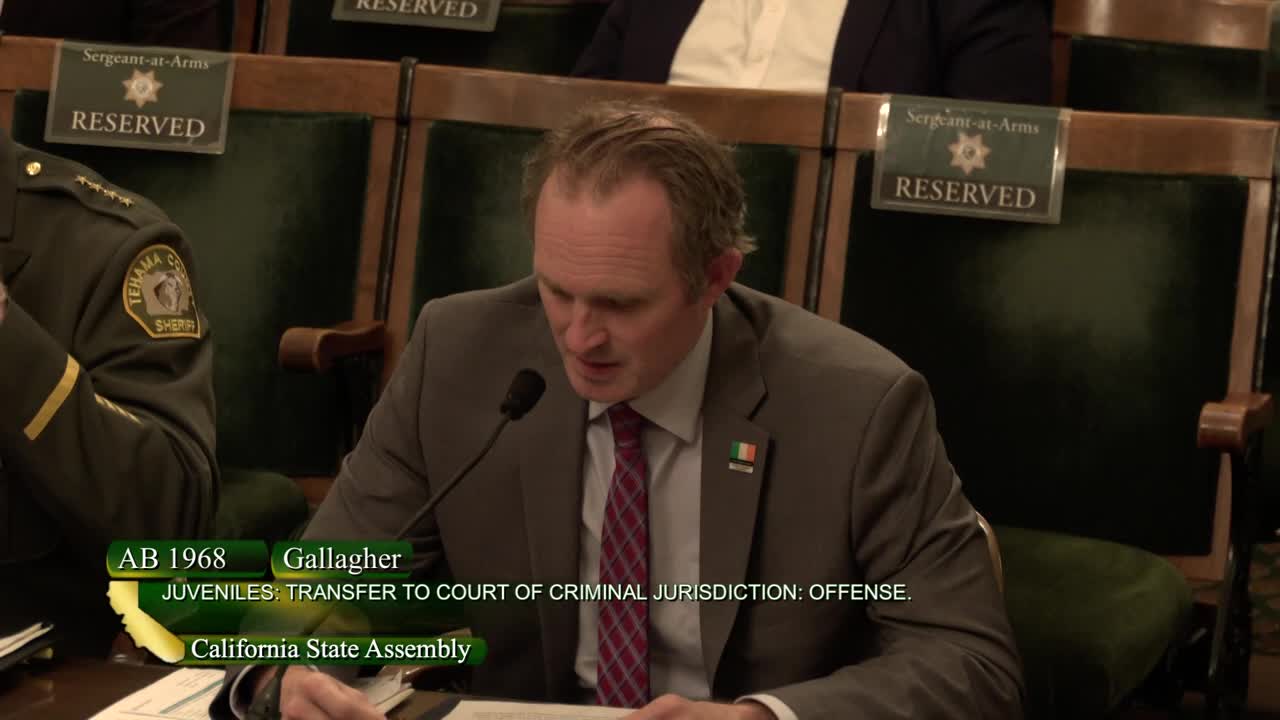 34MIN
Assembly Standing Committee on Public Safety
Bill Author

Bill Co-Author(s):