AB 1971: Property tax: exclusion from reassessment: home hardening retrofitting improvements.
- Session Year: 2025-2026
- House: Assembly
- Latest Version Date: 2026-04-22
Current Status:
In Progress
(2026-05-14: Joint Rule 62(a), file notice suspended. (Page 5030.))
Introduced
In Committee
Awaiting First Chamber Vote
Passed First Chamber
In Committee
Awaiting Second Chamber Vote
Passed Second Chamber
Enacted
The California Constitution generally limits ad valorem taxes on real property to 1% of the full cash value of that property. For purposes of this limitation, full cash value is defined as the assessors valuation of real property as shown on the 197576 tax bill under full cash value or, thereafter, the appraised value of that real property when purchased, newly constructed, or a change in ownership has occurred. The California Constitution specifies that newly constructed does not include the construction or reconstruction of seismic retrofitting components, as defined by the Legislature. Existing law, pursuant to that constitutional authorization, defines seismic retrofitting components to mean seismic retrofitting improvements and improvements utilizing earthquake hazard mitigation technologies. Existing law, pursuant to constitutional authorization, also excludes from the definition of newly constructed the construction or installation of certain fire sprinkler systems, or other fire extinguishing systems, fire detection systems, or fire-related egress improvements.
This bill would require the State Board of Equalization to adopt rules and regulations, as described, clarifying clarify that a home hardening retrofitting improvements, improvement, as defined, that do to an existing structure is considered nonassessable repair and maintenance, provided that the improvement does not add square footage, do not change the propertys use, do not include structural reconfigurations, and do not or include substantial rehabilitation do not trigger reassessment as new construction. rehabilitation.
The California Constitution generally limits ad valorem taxes on real property to 1% of the full cash value of that property. For purposes of this limitation, full cash value is defined as the assessors valuation of real property as shown on the 197576 tax bill under full cash value or, thereafter, the appraised value of that real property when purchased, newly constructed, or a change in ownership has occurred. The California Constitution specifies that newly constructed does not include the construction or reconstruction of seismic retrofitting components, as defined by the Legislature. Existing law, pursuant to that constitutional authorization, defines seismic retrofitting components to mean seismic retrofitting improvements and improvements utilizing earthquake hazard mitigation technologies. Existing law, pursuant to constitutional authorization, also excludes from the definition of newly constructed the construction or installation of certain fire sprinkler systems, or other fire extinguishing systems, fire detection systems, or fire-related egress improvements.
This bill would exclude from the definition of newly constructed and new construction the construction or reconstruction of home hardening retrofitting improvements, which the bill would define as the installation of Class A roofs and multiplane windows, vent screening, the establishment of defensible space, and the use of noncombustible materials for the construction or reconstruction of fences, decks, sidings, eaves, and doors. The bill would except from the definition of home hardening retrofitting improvements, among other things, any portion of a construction or reconstruction which would bring the aggregate full cash value of the home hardening retrofitting improvements excluded from reassessment above $100,000. The bill would require the property owner, as a condition of eligibility for the exclusion, to receive a home hardening certification from certain certification programs, as specified, and to notify the assessor prior to, or within 30 days of, the completion of a project for which the property owner intends to claim the exclusion. The bill would require the property owner to file all documents necessary to support the exclusion with the county assessor within one year of the completion of the project and would authorize the State Board of Equalization to prescribe the manner and form of claiming the exemption. By imposing additional duties on local tax officials, the bill would impose a state-mandated local program.The California Constitution requires the state to reimburse local agencies and school districts for certain costs mandated by the state. Statutory provisions establish procedures for making that reimbursement.This bill would provide that, if the Commission on State Mandates determines that the bill contains costs mandated by the state, reimbursement for those costs shall be made pursuant to the statutory provisions noted above.Existing law requires the state to reimburse local agencies annually for certain property tax revenues lost as a result of any exemption or classification of property for purposes of ad valorem property taxation.This bill would provide that, notwithstanding those provisions, no appropriation is made and the state shall not reimburse local agencies for property tax revenues lost by them pursuant to the bill.This bill would take effect immediately as a tax levy.This bill would require the State Board of Equalization to adopt rules and regulations, as described, clarifying that home hardening retrofitting improvements, as defined, that do not add square footage, do not change the propertys use, do not include structural reconfigurations, and do not include substantial rehabilitation do not trigger reassessment as new construction.
The California Constitution generally limits ad valorem taxes on real property to 1% of the full cash value of that property. For purposes of this limitation, full cash value is defined as the assessors valuation of real property as shown on the 197576 tax bill under full cash value or, thereafter, the appraised value of that real property when purchased, newly constructed, or a change in ownership has occurred. The California Constitution specifies that newly constructed does not include the construction or reconstruction of seismic retrofitting components, as defined by the Legislature. Existing law, pursuant to that constitutional authorization, defines seismic retrofitting components to mean seismic retrofitting improvements and improvements utilizing earthquake hazard mitigation technologies. Existing law, pursuant to constitutional authorization, also excludes from the definition of newly constructed the construction or installation of certain fire sprinkler systems, or other fire extinguishing systems, fire detection systems, or fire-related egress improvements.
This bill would exclude from the definition of newly constructed and new construction the construction or reconstruction of home hardening retrofitting improvements, which the bill would define as the installation of Class A roofs and multiplane windows, vent screening, the establishment of defensible space, and the use of noncombustible materials for the construction or reconstruction of fences, decks, sidings, eaves, and doors. The bill would except from the definition of home hardening retrofitting improvements, among other things, any portion of a construction or reconstruction which would bring the aggregate full cash value of the home hardening retrofitting improvements excluded from reassessment above $100,000. The bill would require the property owner, as a condition of eligibility for the exclusion, to receive a home hardening certification from certain certification programs, as specified, and to notify the assessor prior to, or within 30 days of, the completion of a project for which the property owner intends to claim the exclusion. The bill would require the property owner to file all documents necessary to support the exclusion with the county assessor within one year of the completion of the project and would authorize the State Board of Equalization to prescribe the manner and form of claiming the exemption. By imposing additional duties on local tax officials, the bill would impose a state-mandated local program.
The California Constitution requires the state to reimburse local agencies and school districts for certain costs mandated by the state. Statutory provisions establish procedures for making that reimbursement.
This bill would provide that, if the Commission on State Mandates determines that the bill contains costs mandated by the state, reimbursement for those costs shall be made pursuant to the statutory provisions noted above.
Existing law requires the state to reimburse local agencies annually for certain property tax revenues lost as a result of any exemption or classification of property for purposes of ad valorem property taxation.
This bill would provide that, notwithstanding those provisions, no appropriation is made and the state shall not reimburse local agencies for property tax revenues lost by them pursuant to the bill.
This bill would take effect immediately as a tax levy.
(a)For the purposes of this section, home hardening retrofitting improvement means an improvement that complies with the provisions of the most recent edition of Chapters 5 and 6 of the California Wildland-Urban Interface Code (Part 7 of Title 24 of the California Code of Regulations), or any successor chapter.
(b)The State Board of Equalization shall clarify that a home hardening retrofitting improvement to an existing structure is considered nonassessable repair and maintenance, provided that the home hardening retrofitting improvement does not add square footage, change the propertys use, include structural reconfiguration, or include substantial rehabilitation.
SECTION 1.Section 74.1 is added to the Revenue and Taxation Code, to read:74.1.(a)For purposes of this section, all of the following apply:(1)(A)Home hardening retrofitting improvements includes, but is not limited to, the installation of Class A roofs and multiplane windows, vent screening, the establishment of defensible space, and the use of fire-resistant materials for the construction or reconstruction of fences, decks, sidings, eaves, and doors pursuant to Chapter 7A of Title 24 of the California Code of Regulations.(B)Home hardening retrofitting improvements does not include modifications that expand the square footage of the property.(2)Class A roof means roof assemblies that are effective against severe fire test exposure and which are identified as class A by an approved testing agency.(3)Defensible space means the area adjacent to a structure or dwelling where wildfire prevention or protection practices are implemented to provide defense from an approaching wildfire or to minimize the spread of a structure fire to wildlands or surrounding areas.(4)Fire-resistant materials means a type of building material that complies with Section 704A of Chapter 7 of Title 24 of the California Code of Regulations.(5)Multiplane windows means windows constructed of multiplane glazing with a minimum of one tempered plane meeting the requirements of Section 2406 of Title 24 of the California Code of Regulations or that have a fire-resistance rating of not less than 20 minutes when tested.(b)The State Board of Equalization shall adopt rules and regulations, as a part of Property Tax Rule 463 relating to newly constructed property, clarifying that home hardening retrofitting improvements that do not add square footage, do not change the propertys use, do not include structural reconfigurations, and do not include substantial rehabilitation shall not trigger reassessment as new construction.(a)For purposes of this section, all of the following apply:
(1)(A)Home hardening retrofitting improvements means includes, but is not limited to, the installation of Class A roofs and multiplane windows, vent screening, the establishment of defensible space, and the use of noncombustible fire-resistant materials for the construction or reconstruction of fences, decks, sidings, eaves, and doors. doors pursuant to Chapter 7A of Title 24 of the California Code of Regulations.
(B)Home hardening retrofitting improvements does not include any portion of a construction or reconstruction which would bring the aggregate full cash value of the home hardening retrofitting improvements excluded from reassessment pursuant to this section above one hundred thousand dollars ($100,000).(C)(B)Home hardening retrofitting improvements does not include modifications that expand the square footage of the property.
(2)Class A roof means roof assemblies that are effective against severe fire test exposure and which are identified as class A by an approved testing agency.
(3)Defensible space means the area adjacent to a structure or dwelling where wildfire prevention or protection practices are implemented to provide defense from an approaching wildfire or to minimize the spread of a structure fire to wildlands or surrounding areas.
(4)Fire-resistant materials means a type of building material that complies with Section 704A of Chapter 7 of Title 24 of the California Code of Regulations.
(4)(5)Multiplane windows means windows constructed of multiplane glazing with a minimum of one tempered plane meeting the requirements of Section 2406 of Title 24 of the California Code of Regulations or that have a fire-resistance rating of not less than 20 minutes when tested.
(5)Noncombustible materials means material of which no part will ignite and burn when subjected to a fire.(c)A property owner, in order to claim the exclusion from reassessment, shall receive a home hardening certification for the portions of the building that are home hardening retrofitting improvements from either a program established by the Office of the State Fire Marshal or from the Insurance Institute for Business and Home Safety.(d)In order to claim the exclusion from reassessment, the property owner shall notify the assessor prior to, or within 30 days of, the completion of a project for which the property owner intends to claim the exclusion. The State Board of Equalization shall prescribe the manner and form for claiming the exclusion. All documents necessary to support the exclusion shall be filed by the property owner with the county assessor no later than one year after the completion of the project.(b)The State Board of Equalization shall adopt rules and regulations, as a part of Property Tax Rule 463 relating to newly constructed property, clarifying that home hardening retrofitting improvements that do not add square footage, do not change the propertys use, do not include structural reconfigurations, and do not include substantial rehabilitation shall not trigger reassessment as new construction.
SEC. 2.If the Commission on State Mandates determines that this act contains costs mandated by the state, reimbursement to local agencies and school districts for those costs shall be made pursuant to Part 7 (commencing with Section 17500) of Division 4 of Title 2 of the Government Code.SEC. 3.Notwithstanding Section 2229 of the Revenue and Taxation Code, no appropriation is made by this act and the state shall not reimburse any local agency for any property tax revenues lost by it pursuant to this act.SEC. 4.This act provides for a tax levy within the meaning of Article IV of the California Constitution and shall go into immediate effect.(a)For purposes of subdivision (a) of Section 2 of Article XIII A of the California Constitution, newly constructed and new construction does not include that portion of an existing structure that consists of the construction or reconstruction of home hardening retrofitting improvements, as defined in this section.
(b)For purposes of this section, all of the following apply:
(1)(A)Home hardening retrofitting improvements means the installation of Class A roofs and multiplane windows, vent screening, the establishment of defensible space, and the use of noncombustible materials for the construction or reconstruction of fences, decks, sidings, eaves, and doors.
(B)Home hardening retrofitting improvements does not include any portion of a construction or reconstruction which would bring the aggregate full cash value of the home hardening retrofitting improvements excluded from reassessment pursuant to this section above one hundred thousand dollars ($100,000).
(C)Home hardening retrofitting improvements does not include modifications that expand the square footage of the property.
(2)Class A roof means roof assemblies that are effective against severe fire test exposure and which are identified as class A by an approved testing agency.
(3)Defensible space means the area adjacent to a structure or dwelling where wildfire prevention or protection practices are implemented to provide defense from an approaching wildfire or to minimize the spread of a structure fire to wildlands or surrounding areas.
(4)Multiplane windows means windows constructed of multiplane glazing with a minimum of one tempered plane meeting the requirements of Section 2406 of Title 24 of the California Code of Regulations or that have a fire-resistance rating of not less than 20 minutes when tested.
(5)Noncombustible materials means material of which no part will ignite and burn when subjected to a fire.
(c)A property owner, in order to claim the exclusion from reassessment, shall receive a home hardening certification for the portions of the building that are home hardening retrofitting improvements from either a program established by the Office of the State Fire Marshal or from the Insurance Institute for Business and Home Safety.
(d)In order to claim the exclusion from reassessment, the property owner shall notify the assessor prior to, or within 30 days of, the completion of a project for which the property owner intends to claim the exclusion. The State Board of Equalization shall prescribe the manner and form for claiming the exclusion. All documents necessary to support the exclusion shall be filed by the property owner with the county assessor no later than one year after the completion of the project.
SEC. 2.If the Commission on State Mandates determines that this act contains costs mandated by the state, reimbursement to local agencies and school districts for those costs shall be made pursuant to Part 7 (commencing with Section 17500) of Division 4 of Title 2 of the Government Code.
SEC. 3.Notwithstanding Section 2229 of the Revenue and Taxation Code, no appropriation is made by this act and the state shall not reimburse any local agency for any property tax revenues lost by it pursuant to this act.
SEC. 4.This act provides for a tax levy within the meaning of Article IV of the California Constitution and shall go into immediate effect.
|
Date
|
Status
|
|---|---|
| May 14, 2026 | Joint Rule 62(a), file notice suspended. (Page 5030.) |
| May 14, 2026 | In committee: Held under submission. |
| May 14, 2026 | Joint Rule 62(a), file notice suspended. |
| May 13, 2026 | In committee: Set, first hearing. Referred to APPR. suspense file. |
| Apr 23, 2026 | Re-referred to Com. on APPR. |
| Apr 22, 2026 | Read second time and amended. |
| Apr 21, 2026 | From committee: Amend, and do pass as amended and re-refer to Com. on APPR. (Ayes 7. Noes 0.) (April 20). |
| Apr 6, 2026 | In committee: Set, first hearing. Referred to REV. & TAX. suspense file. |
| Mar 26, 2026 | Re-referred to Com. on REV. & TAX. |
| Mar 25, 2026 | From committee chair, with author's amendments: Amend, and re-refer to Com. on REV. & TAX. Read second time and amended. |
| Mar 2, 2026 | Referred to Com. on REV. & TAX. |
| Feb 14, 2026 | From printer. May be heard in committee March 16. |
| Feb 13, 2026 | Read first time. To print. |
|
Date
|
Description
|
Location
|
Votes
|
|
|---|---|---|---|---|
| Apr 20, 2026 | Do pass as amended and be re-referred to the Committee on [Appropriations] | Assembly Standing Committee on Revenue and Taxation |
Passed |
This list shows positions taken on this bill by organizations on the date displayed, which is linked to the original source.
Positions by individuals are not included.
|
Organization
|
Position
|
Date
|
|---|---|---|
| California Apartment Association | ** Support | |
| California Building Industry Association | ** Support | |
| California Teachers Association | ** Against | |
| James Hardie | ** Support | |
| The Nature Conservancy | ** Support | |
| Tri County Chamber Alliance | ** Support | |
| Western Wood Preservers Institute | ** Against |
Date of Hearing: May 13, 2026
ASSEMBLY COMMITTEE ON APPROPRIATIONS
Buffy Wicks, Chair
ABPCA Bill Id:AB 1971
Author:(Bennett) – As Amended Ver:April 22, 2026
Policy Committee: | Revenue and Taxation | Vote: | 7 - 0 |
|
| ||
|
|
Urgency: No State Mandated Local Program: No Reimbursable: No
SUMMARY:
This bill requires the State Board of Equalization (BOE) to clarify that a home hardening retrofitting improvement to an existing structure is considered non-assessable repair and maintenance under certain conditions.
Those conditions are that the home hardening retrofitting improvement does not add square footage, change the property’s use, include structural reconfiguration, or include substantial rehabilitation.
This bill defines “home hardening retrofitting improvement” as an improvement that complies with the provisions of the most recent edition of Chapters 5 and 6 of the California Wildland-Urban Interface (WUI) Code or a successor chapter.
FISCAL EFFECT:
- Potential property tax revenue loss of an unknown amount, potentially in excess of $300,000, to the extent this bill results in certain improvements being considered non-assessable repair and maintenance that are otherwise assessable. While the conditions specified in this bill are generally non-assessable events, ultimately, the county assessor is responsible for determining what is an assessable improvement and what is non-assessable repair or maintenance. Although property tax is a local government revenue source, reductions in property tax revenues, in turn, increase General Fund (GF) Proposition 98 spending by up to roughly 50% (the exact amount depends on the operative test of the annual Proposition 98 guarantee).
- Costs of an unknown amount to the BOE, as it is not clear how the BOE must “clarify” this consideration of non-assessable repair and maintenance. For its part, the BOE anticipates minor and absorbable costs related to assessor notifications and other updates. However, to the extent providing clarification requires the BOE to undertake a more direct and intensive role in communicating to the public how home hardening retrofitting improvements are assessed, such costs could be potentially significant, in excess of $150,000 (GF).
The Legislative Analyst’s Office recently warned of GF structural deficits of around $35 billion per year in the 2027-28 fiscal year and ongoing.
COMMENTS:
- Purpose. According to the author:
As climate change intensifies the frequency of destructive wildfires across California, the necessity to hardening homes against ember storms has become critical. AB 1971 incentivizes home hardening by ensuring that these essential retrofits do not trigger property tax reassessment. By removing the uncertainty of how a homeowner’s taxes will be reassessed, the state encourages homeowners to take meaningful steps to protect their property.
This bill is supported by building associations, wildfire management companies, and The Nature Conservancy.
- Background. Home Hardening. Home hardening includes vegetation management compliance and building materials used to resist the intrusion of flames or embers projected by a wildland fire. California Building Standards Code Chapter 7A provides for ignition resistant construction standards, such as fire-resistant siding, tempered glass, and ignition-resistant roofs, that must be applied to new construction or when retrofitting an older home in the WUI. There are numerous other state programs related to home hardening, such as the Safer from Wildfires framework and California Safe Homes Grant Program administered by the Insurance Commissioner, and the California Wildfire Mitigation Program administered jointly by the Office of Emergency Services and Department of Forestry and Fire Protection (CAL FIRE).
BOE Guidance. Existing law provides that new construction to real property is generally considered assessable, unless the construction is specifically excluded from the definition of “new construction” in the state constitution. The BOE promulgates regulations regarding the statutory definition of new construction in Property Tax Rule 463. Under the rule, one type of new construction not considered assessable is the repair and maintenance of existing features of the property. Alterations are assessable if the alteration rehabilitates the property to a like-new condition or converts the property to a different use.
The BOE’s Assessors’ Handbook also provides direction to county assessors on how to administer property tax law. According to Section 410 of the Assessors’ Handbook, the “installation of a new shake roof that replaces an existing composition shingle roof” or “replacements or repairs that are periodically required during the life of the improvement, such as replacement of rain gutters” are all improvements considered normal maintenance that do not constitute assessable new construction. As noted in the Assembly Revenue and Taxation Committee’s analysis of this bill:
An important caveat is that property purchased in a poor condition and rapidly improved is considered assessable. Section 410 notes the “timing and scope of work must be considered to determine when maintenance and repair becomes rehabilitation and renovation that brings an improvement (or a portion) to the substantial equivalent of new.” Ultimately, however, the assessor is responsible for determining what is an assessable improvement and what is non-assessable repair or maintenance.
This bill requires the BOE to clarify that a home hardening retrofitting improvement to an existing structure is considered non-assessable repair and maintenance provided that the improvement does not add square footage, change the property’s use, include structural reconfiguration, or include substantial rehabilitation. However, there may be certain home hardening retrofitting improvements undertaken by a property owner that meet the conditions specified in this bill, but would still qualify as assessable new construction due to other factors, potentially leading to further taxpayer confusion and frustration.
- Related Legislation. AB 1143 (Bennett) requires the State Fire Marshal’s (SFM’s) Wildfire Mitigation Advisory Committee (WMAC) to develop a home hardening certification program. AB 1143 was vetoed by Governor Newsom, who stated the Legislature sent the governor “multiple bills” with the intention of building upon the state’s ongoing “efforts to expedite proven and cost-effective home-hardening practices,” but:
Unfortunately, rather than providing a coordinated approach, these measures are in conflict with one another, tasking different state entities with similar objectives. The lack of harmony between these efforts will not only result in conflicting outcomes but also confusion for consumers, insurance companies, local governments, and emergency responders.
I encourage the Legislature to revisit this important issue next year and work collaboratively to navigate the different approaches to setting hardening standards, including determining the responsible state entity.
AB 1934 (Bennett) is similar to AB 1143, except AB 1934 requires the WMAC to develop an implementation plan for a home hardening certification program. AB 1934 is pending on this committee’s suspense file.
AB 1960 (Bennett) authorizes CAL FIRE to disburse Wildfire Prevention Grants Program funds to “identified cohesive fire communities,” defined as a community in which a certain percentage of homes is certified as hardened. AB 1960 is pending on this committee’s suspense file.
AB 1964 requires the SFM to compile a report to determine whether homes in moderate, high, and very high fire hazard severity zones meet certain home hardening standards. AB 1965 is pending on this committee’s suspense file.
Analysis Prepared by: Irene Ho / APPR. / (916) 319-2081
Date of Hearing: April 20, 2026
ASSEMBLY COMMITTEE ON REVENUE AND TAXATION
Mike Gipson, Chair
ABPCA Bill Id:AB 1971 (
Author:Bennett) – As Amended Ver:March 25, 2026
SUSPENSE
Majority vote. Fiscal committee.
SUBJECT: Property tax: exclusion from reassessment: home hardening retrofitting improvements
SUMMARY: Requires the State Board of Equalization (BOE) to update rules and regulations to clarify that "home hardening retrofitting improvements" meeting certain conditions do not trigger reassessment as new construction. Specifically, this bill:
- Requires the BOE to adopt rules and regulations, as a part of property Tax Rule 463 relating to newly constructed property, clarifying that "home hardening retrofitting improvements" that do not add square footage, do not change the property's use, do not include structural reconfigurations, and do not include substantial rehabilitation are not reassessed as new construction.
- Defines "home hardening retrofitting improvements" as including, but not being limited to, the installation of "Class A roofs" and "multiplane windows," vent screening, the establishment of "defensible space," and the use of "fire-resistant materials" for the construction or reconstruction of fences, decks, sidings, eaves, and doors pursuant to Chapter 7A of Title 24 of the California Code of Regulations.
- Excludes from the definition of "home hardening retrofitting improvements" modifications that expand the square footage of the property.
- Defines a "Class A roof" as a roof assembly that is effective against severe fire test exposure and which is identified as Class A by an approved testing agency.
- Defines "defensible space" as the area adjacent to a structure or dwelling where wildfire prevention or protection practices are implemented to provide defense from an approaching wildfire or to minimize the spread of a structure fire to wildlands or surrounding areas.
- Defines "fire-resistant materials" as a type of building material that complies with Section 704A of Chapter 7 of Title 24 of the California Code of Regulations.
- Defines "multiplane windows" as windows constructed of multiplane glazing with a minimum of one tempered plane meeting the requirements of Section 2406 of Title 24 of the California Code of Regulations or that have a fire-resistance rating at least 20 minutes when tested.
EXISTING LAW:
- Provides that all property is taxable, unless otherwise stipulated by the California Constitution or laws of the United States. (California Constitution, Article XIII, Section 1.)
- Limits the maximum amount of ad valorem property taxation to 1% of the full cash value of the property. Generally, the Constitution restricts the full cash value of a property to the assessed value upon a change of ownership in, or new construction on, the property. Certain new construction is exempt from assessment, including the construction or installation of any fire sprinkler system, other fire extinguishing system, fire detection system, or fire-related egress improvement, as specified. (California Constitution, Article XIIIA, Sections 1 and 2 and Revenue and Taxation Code Section 74(c).)
- Establishes the State Housing Law which requires new buildings proposed for construction meet certain standards established under the California Building Standards (CBS) Law. (Health and Safety Code (HS&C) Section 17910 et. seq.)
- Establishes the California Building Standards Commission (Commission) under the CBS Law. The CBS Law requires the Commission to approve and adopt building standards and to codify those standards in the California Building Standards Code. (H&SC Section 18901 et. seq.)
FISCAL EFFECT: Pending an estimate by the BOE, but likely in excess of this Committee's Suspense File threshold.
COMMENTS:
- The author has submitted the following statement in support of this bill:
As climate change intensifies the frequency of destructive wildfires across California, the necessity to hardening homes against ember storms has become critical. AB 1971 incentivizes home hardening by ensuring that these essential retrofits do not trigger property tax reassessment. By removing the uncertainty of how a homeowner's taxes will be reassessed, the state encourages homeowners to take meaningful steps to protect their property. This bill provides a vital tool to mitigate property loss in the wake of climate change.
- The California Building Industries Association, writing in support of this bill, states, in part:
[The] Headwater Economics research group has estimated that hardening a two-story, 2,000-square-foot single-family home could cost anywhere from $2,000 to "more than $100,000." Wildfire-prepared communities aid in protecting against catastrophic loss, thereby incentivizing property owners to take appropriate steps to mitigate their risk to their community and property is crucial. Mitigation efforts will prove immensely helpful and will be more accessible through the implementation of AB 1971.
- The Western Wood Preservers Institute (WWPI), writing in opposition to this bill, states, in part:
The definition for home hardening in AB 1971 is not consistent with established standards, potentially confusing homeowners, contractors, and local agencies while diverting resources from proven wildfire risk reduction.
Rather than creating a new, overlapping program, AB 1971 should support, incentivize, and enforce existing Chapter 7A standards assuring that homeowners who already comply are recognized and rewarded for measurable wildfire preparedness. This approach maintains safety, respects existing investments, and avoids unintended consequences.
- Committee Staff Comments:
- California fires: According to the California Department of Forestry and Fire Protection (CalFire), 14 of the 20 most destructive California wildfires have occurred in the last decade. These fires represent a combined millions of acres burned and tens of thousands of structures damaged or destroyed[1].
- Building code standards: California's building code standards governing the construction of new buildings are housed in Title 24 of the California Code of Regulations. Under this title, Chapter 7A stipulates the type of eligible construction materials and methods that must be used for hardening against fire when constructing structures in wildland-urban interface fire areas after the date of the adoption of the regulation. The chapter specifies the type of improvement and the standard which it must meet to comply. For instance, exterior improvements must withstand certain exposures to flame at certain intensities for specified durations.
- Property Tax Rule 463: Under existing law, new construction to real property is generally considered assessable, unless the construction is specifically excluded from the definition of "new construction" in the state constitution. The BOE, in their promulgation of regulations, clarifies the statutory definition of new construction in Property Tax Rule 463. Under that rule, one type of new construction that is not considered assessable is the repair and maintenance of existing features of the property. Improvements are generally considered assessable new construction, regardless of whether that improvement is an addition or an alteration. Alterations are assessable if the alteration rehabilitates the property to a like new condition, or converts the property to a different use. Thus, the action of carrying on, preserving, or retaining real property fixtures in property condition constitutes normal maintenance that is not assessable.
The BOE publishes direction to county assessors on how to administer property tax law in the Assessors' Handbook. According to Section 410 of the Assessors' Handbook, the "installation of a new shake roof that replaces an existing composition shingle roof", routine painting, or "replacements or repairs that are periodically required during the life of the improvement, such as replacement of rain gutters" are all improvements considered normal maintenance that do not constitute assessable new construction. An important caveat is that property purchased in a poor condition and rapidly improved is considered assessable. Section 410 notes the "timing and scope of work must be considered to determine when maintenance and repair becomes rehabilitation and renovation that brings an improvement (or a portion) to the substantial equivalent of new." Ultimately, however, the assessor is responsible for determining what is an assessable improvement and what is non-assessable repair or maintenance.
- Installation of fire-suppression systems: The California Constitution authorizes the Legislature to exclude from the definition of new construction the construction or installation of any fire sprinkler system, other extinguishing system, fire detection system, and fire-related egress improvement. The Legislature provides that only the construction or installation of such system or improvement to an existing building qualifies for the constitutionally authorized new construction exclusion. The author points to the treatment of fire-suppression systems as a portion of the basis for this bill. Fire-suppression systems differ from fire-resistant hardening improvements in that fire-suppression systems have an explicit constitutional exclusion from the definition of new construction.
- Treatment of fire-resistant hardening improvements: As noted above, assessors have the authority to determine what is non-assessable repair or maintenance, within certain bounds. Additionally, the installation of a new roof to replace a deteriorated roof generally qualifies as a nonassessable repair or improvement. If, however, that same replacement were undertaken as a broader set of improvements to the property that significantly improve the property, the replacement of that roof along with the other improvements may constitute assessable improvements. Thus, by extension, the same unclear treatment regarding improvements to harden a structure against fires appears to have arisen as assessors determine on a case-by-case basis whether an improvement is assessable.
- This bill: The author has stated that the intent of this bill is to clarify what constitutes assessable improvements when property owners are hardening their properties against fire. As currently drafted, this bill would direct the BOE to update Property Tax Rule 463 to clarify that certain types of home hardening retrofitting improvements do not trigger reassessment as new construction if the improvements meet certain criteria.
- Clearing the smoke: This bill currently stipulates that certain types of improvements pursuant to Chapter 7A of the Building Standards Code should be considered as non-assessable new construction, but then provides that these improvements are not limited to those stipulated in the bill. Thus, as currently drafted, it is not clear whether this bill would authorize any home hardening improvement as a non-assessable improvement if it does not expand the property's use, change the square footage, structurally reconfigure, or substantially rehabilitate the property. The author may wish to consider amending this bill such that a "home hardening retrofitting improvement" is an improvement that complies with the requirements for the relevant improvement under the most recent version of Chapter 7A of the California Building Standards Code.
- One change to rule them all: As currently drafted, this bill requires the BOE to adopt rules and regulations as a part of Property Tax Rule 463 relating to newly constructed property, clarifying that home hardening retrofitting improvements meeting certain conditions do not trigger reassessment as new construction. The construction of this requirement does not appear to align with terminology under existing property tax law. The author may wish to consider amending this bill to direct the BOE to update Property Tax Rule 463 to provide that home hardening retrofitting improvements are considered nonassessable repair and maintenance.
- Clarity or subsidy: The Building Standards Code requires certain features be included in all newly built structures. Among these requirements are the fire-resistant hardening improvements stipulated under Chapter 7A for buildings constructed in wildland-urban interface fire areas. As currently drafted, this bill would direct the BOE to update Property Tax Rule 463 relating to newly constructed property, clarifying that home hardening retrofitting improvements subject to certain conditions do not trigger reassessment as new construction. Under existing property tax law, the definition of new construction includes assessable improvements and the construction of a wholly new building. Given the author has stated that this bill's intent is to clarify that fire-resistant hardening is considered a nonassessable improvement, the author may wish to consider amending this bill to clarify that home hardening retrofitting improvements to existing buildings only are considered nonassessable repair and maintenance.
REGISTERED SUPPORT / OPPOSITION:
Support
California Apartment Association
California Building Industry Association
James Hardie
The Nature Conservancy
Tri County Chamber Alliance
Opposition
California Teachers Association
Western Wood Preservers Institute
Analysis Prepared by: Harrison Bowlby / REV. & TAX. / (916) 319-2098
CalFire, Top 20 Most Destructive California Wildfires. https://34c031f8-c9fd-4018-8c5a-4159cdff6b0d-cdn-endpoint.azureedge.net/-/media/calfire-website/our-impact/fire-statistics/top-20-destructive-ca-wildfires.pdf?rev=737a1073f76947b4a3bfb960b19f44c7&hash=
7CA02D30D9BF46A32D5D98BD108BA26A, accessed March 2026. ↑
Date of Hearing: April 6, 2026
ASSEMBLY COMMITTEE ON REVENUE AND TAXATION
Mike Gipson, Chair
ABPCA Bill Id:AB 1971 (
Author:Bennett) – As Amended Ver:March 25, 2026
Majority vote. Fiscal committee.
SUBJECT: Property tax: exclusion from reassessment: home hardening retrofitting improvements
SUMMARY: Requires the State Board of Equalization (BOE) to update rules and regulations to clarify that "home hardening retrofitting improvements" meeting certain conditions do not trigger reassessment as new construction. Specifically, this bill:
- Requires the BOE to adopt rules and regulations, as a part of property Tax Rule 463 relating to newly constructed property, clarifying that "home hardening retrofitting improvements" that do not add square footage, do not change the property's use, do not include structural reconfigurations, and do not include substantial rehabilitation are not reassessed as new construction.
- Defines "home hardening retrofitting improvements" as including, but not being limited to, the installation of "Class A roofs" and "multiplane windows," vent screening, the establishment of "defensible space," and the use of "fire-resistant materials" for the construction or reconstruction of fences, decks, sidings, eaves, and doors pursuant to Chapter 7A of Title 24 of the California Code of Regulations.
- Excludes from the definition of "home hardening retrofitting improvements" modifications that expand the square footage of the property.
- Defines a "Class A roof" as a roof assembly that is effective against severe fire test exposure and which is identified as Class A by an approved testing agency.
- Defines "defensible space" as the area adjacent to a structure or dwelling where wildfire prevention or protection practices are implemented to provide defense from an approaching wildfire or to minimize the spread of a structure fire to wildlands or surrounding areas.
- Defines "fire-resistant materials" as a type of building material that complies with Section 704A of Chapter 7 of Title 24 of the California Code of Regulations.
- Defines "multiplane windows" as windows constructed of multiplane glazing with a minimum of one tempered plane meeting the requirements of Section 2406 of Title 24 of the California Code of Regulations or that have a fire-resistance rating at least 20 minutes when tested.
EXISTING LAW:
- Provides that all property is taxable, unless otherwise stipulated by the California Constitution or laws of the United States. (California Constitution, Article XIII, Section 1.)
- Limits the maximum amount of ad valorem property taxation to 1% of the full cash value of the property. Generally, the Constitution restricts the full cash value of a property to the assessed value upon a change of ownership in, or new construction on, the property. Certain new construction is exempt from assessment, including the construction or installation of any fire sprinkler system, other fire extinguishing system, fire detection system, or fire-related egress improvement, as specified. (California Constitution, Article XIIIA, Sections 1 and 2 and Revenue and Taxation Code Section 74(c).)
- Establishes the State Housing Law which requires new buildings proposed for construction meet certain standards established under the California Building Standards (CBS) Law. (Health and Safety Code (HS&C) Section 17910 et. seq.)
- Establishes the California Building Standards Commission (Commission) under the CBS Law. The CBS Law requires the Commission to approve and adopt building standards and to codify those standards in the California Building Standards Code. (H&SC Section 18901 et. seq.)
FISCAL EFFECT: Pending an estimate by the BOE, but likely in excess of this Committee's Suspense File threshold.
COMMENTS:
- The author has submitted the following statement in support of this bill:
As climate change intensifies the frequency of destructive wildfires across California, the necessity to hardening homes against ember storms has become critical. AB 1971 incentivizes home hardening by ensuring that these essential retrofits do not trigger property tax reassessment. By removing the uncertainty of how a homeowner's taxes will be reassessed, the state encourages homeowners to take meaningful steps to protect their property. This bill provides a vital tool to mitigate property loss in the wake of climate change.
- The California Building Industries Association, writing in support of this bill, states, in part:
[The] Headwater Economics research group has estimated that hardening a two-story, 2,000-square-foot single-family home could cost anywhere from $2,000 to "more than $100,000." Wildfire-prepared communities aid in protecting against catastrophic loss, thereby incentivizing property owners to take appropriate steps to mitigate their risk to their community and property is crucial. Mitigation efforts will prove immensely helpful and will be more accessible through the implementation of AB 1971.
- Committee Staff Comments:
- California fires: According to the California Department of Forestry and Fire Protection (CalFire), 14 of the 20 most destructive California wildfires have occurred in the last decade. These fires represent a combined millions of acres burned and tens of thousands of structures damaged or destroyed[1].
- Building code standards: California's building code standards governing the construction of new buildings are housed in Title 24 of the California Code of Regulations. Under this title, Chapter 7A stipulates the type of eligible construction materials and methods that must be used for hardening against fire when constructing structures in wildland-urban interface fire areas after the date of the adoption of the regulation. The chapter specifies the type of improvement and the standard which it must meet to comply. For instance, exterior improvements must withstand certain exposures to flame at certain intensities for specified durations.
- Property Tax Rule 463: Under existing law, new construction to real property is generally considered assessable, unless the construction is specifically excluded from the definition of "new construction" in the state constitution. The BOE, in their promulgation of regulations, clarifies the statutory definition of new construction in Property Tax Rule 463. Under that rule, one type of new construction that is not considered assessable is the repair and maintenance of existing features of the property. Improvements are generally considered assessable new construction, regardless of whether that improvement is an addition or an alteration. Alterations are assessable if the alteration rehabilitates the property to a like new condition, or converts the property to a different use. Thus, the action of carrying on, preserving, or retaining real property fixtures in property condition constitutes normal maintenance that is not assessable.
The BOE publishes direction to county assessors on how to administer property tax law in the Assessors' Handbook. According to Section 410 of the Assessors' Handbook, the "installation of a new shake roof that replaces an existing composition shingle roof", routine painting, or "replacements or repairs that are periodically required during the life of the improvement, such as replacement of rain gutters" are all improvements considered normal maintenance that do not constitute assessable new construction. An important caveat is that property purchased in a poor condition and rapidly improved is considered assessable. Section 410 notes the "timing and scope of work must be considered to determine when maintenance and repair becomes rehabilitation and renovation that brings an improvement (or a portion) to the substantial equivalent of new." Ultimately, however, the assessor is responsible for determining what is an assessable improvement and what is non-assessable repair or maintenance.
- Installation of fire-suppression systems: The California Constitution authorizes the Legislature to exclude from the definition of new construction the construction or installation of any fire sprinkler system, other extinguishing system, fire detection system, and fire-related egress improvement. The Legislature provides that only the construction or installation of such system or improvement to an existing building qualifies for the constitutionally authorized new construction exclusion. The author points to the treatment of fire-suppression systems as a portion of the basis for this bill. Fire-suppression systems differ from fire-resistant hardening improvements in that fire-suppression systems have an explicit constitutional exclusion from the definition of new construction.
- Treatment of fire-resistant hardening improvements: As noted above, assessors have the authority to determine what is non-assessable repair or maintenance, within certain bounds. Additionally, the installation of a new roof to replace a deteriorated roof generally qualifies as a nonassessable repair or improvement. If, however, that same replacement were undertaken as a broader set of improvements to the property that significantly improve the property, the replacement of that roof along with the other improvements may constitute assessable improvements. Thus, by extension, the same unclear treatment regarding improvements to harden a structure against fires appears to have arisen as assessors determine on a case-by-case basis whether an improvement is assessable.
- This bill: The author has stated that the intent of this bill is to clarify what constitutes assessable improvements when property owners are hardening their properties against fire. As currently drafted, this bill would direct the BOE to update Property Tax Rule 463 to clarify that certain types of home hardening retrofitting improvements do not trigger reassessment as new construction if the improvements meet certain criteria.
- Clearing the smoke: This bill currently stipulates that certain types of improvements pursuant to Chapter 7A of the Building Standards Code should be considered as non-assessable new construction, but then provides that these improvements are not limited to those stipulated in the bill. Thus, as currently drafted, it is not clear whether this bill would authorize any home hardening improvement as a non-assessable improvement if it does not expand the property's use, change the square footage, structurally reconfigure, or substantially rehabilitate the property. The author may wish to consider amending this bill such that a "home hardening retrofitting improvement" is an improvement that complies with the requirements for the relevant improvement under the most recent version of Chapter 7A of the California Building Standards Code.
- One change to rule them all: As currently drafted, this bill requires the BOE to adopt rules and regulations as a part of Property Tax Rule 463 relating to newly constructed property, clarifying that home hardening retrofitting improvements meeting certain conditions do not trigger reassessment as new construction. The construction of this requirement does not appear to align with terminology under existing property tax law. The author may wish to consider amending this bill to direct the BOE to update Property Tax Rule 463 to provide that home hardening retrofitting improvements are considered nonassessable repair and maintenance.
- Clarity or subsidy: The Building Standards Code requires certain features be included in all newly built structures. Among these requirements are the fire-resistant hardening improvements stipulated under Chapter 7A for buildings constructed in wildland-urban interface fire areas. As currently drafted, this bill would direct the BOE to update Property Tax Rule 463 relating to newly constructed property, clarifying that home hardening retrofitting improvements subject to certain conditions do not trigger reassessment as new construction. Under existing property tax law, the definition of new construction includes assessable improvements and the construction of a wholly new building. Given the author has stated that this bill's intent is to clarify that fire-resistant hardening is considered a nonassessable improvement, the author may wish to consider amending this bill to clarify that home hardening retrofitting improvements to existing buildings only are considered nonassessable repair and maintenance.
REGISTERED SUPPORT / OPPOSITION:
Support
California Apartment Association
California Building Industry Association
James Hardie
The Nature Conservancy
Tri County Chamber Alliance
Opposition
None on file
Analysis Prepared by: Harrison Bowlby / REV. & TAX. / (916) 319-2098
CalFire, Top 20 Most Destructive California Wildfires. https://34c031f8-c9fd-4018-8c5a-4159cdff6b0d-cdn-endpoint.azureedge.net/-/media/calfire-website/our-impact/fire-statistics/top-20-destructive-ca-wildfires.pdf?rev=737a1073f76947b4a3bfb960b19f44c7&hash=
7CA02D30D9BF46A32D5D98BD108BA26A, accessed March 2026. ↑
Discussed in Hearing
 2MIN
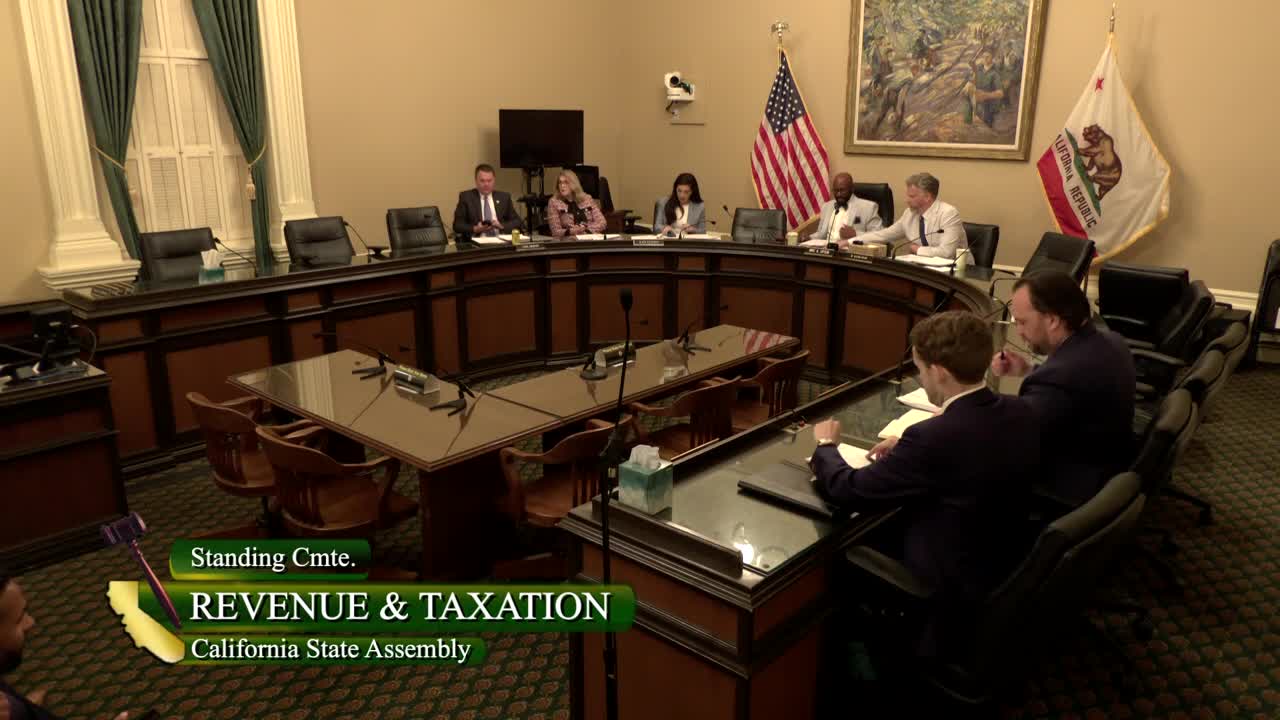
Assembly Standing Committee on Revenue and Taxation
Bill Author

Bill Co-Author(s):