AB 1976: Streets and highways: pedestrian and bicycle facilities.
- Session Year: 2025-2026
- House: Assembly
- Latest Version Date: 2026-09-27
Current Status:
Passed
(2026-09-27: Chaptered by Secretary of State - Chapter 565, Statutes of 2026.)
Introduced
In Committee
Awaiting First Chamber Vote
Passed First Chamber
In Committee
Awaiting Second Chamber Vote
Passed Second Chamber
Enacted
(1)Existing law grants the legislative body of a city certain powers with respect to city streets and highways, including the power to construct and maintain those streets and highways. Existing law grants the board of supervisors of a county general supervision, management, and control of county highways and authorizes the board of supervisors to lay out, construct, improve, and maintain county highways.
This bill would prohibit a city or county from holding a community input meeting to reconsider, delay, or prevent implementation of a proposed pedestrian or bicycle safety project after that project has passed 90% design, as specified. After or upon the award of a contract for, or when county or city staff, as applicable, are directed to begin, the construction of a pedestrian or bicycle safety project, the bill would prohibit the city or county from terminating the project unless the city or county makes at least one specified finding at a public meeting. If a city or county establishes a process for residents of the city or county to submit a petition to request the installation of a traffic-calming measure, the bill would prohibit the city or county from requiring the petition to contain the signatures of more than a majority of the total number of persons whose residences are located, in whole or in part, within 1,000 feet of the proposed traffic-calming measure, as specified. To the extent that the bill increases the duties of local officials, the bill would impose a state-mandated local program.
(2)Existing law, the Pedestrian Mall Law of 1960, authorizes the legislative body of a city or county to establish a pedestrian mall, as defined, and prohibit vehicular traffic on the mall, upon adoption of an ordinance establishing the mall.
The California Environmental Quality Act (CEQA) requires a lead agency, as defined, to prepare, or cause to be prepared, and certify the completion of, an environmental impact report on a project that it proposes to carry out or approve that may have a significant effect on the environment or to adopt a negative declaration if it finds that the project will not have that effect. CEQA also requires a lead agency to prepare a mitigated negative declaration for a project that may have a significant effect on the environment if revisions in the project would avoid or mitigate that effect and there is no substantial evidence that the project, as revised, would have a significant effect on the environment.
CEQA, until January 1, 2040, exempts from its requirements certain transportation-related projects, including, among others, pedestrian and bicycle facilities, as specified. CEQA requires, except as provided, those exempted projects to be carried out by a local agency and meet certain requirements, including certain labor requirements.
This bill would exempt from the requirements of CEQA the establishment or expansion of a pedestrian mall and would require those projects to comply with the above-described requirements applicable to those exempted CEQA projects.
(3)The bill would include findings that changes proposed by this bill address a matter of statewide concern rather than a municipal affair and, therefore, apply to all cities, including charter cities.
(4)The California Constitution requires the state to reimburse local agencies and school districts for certain costs mandated by the state. Statutory provisions establish procedures for making that reimbursement.
This bill would provide that, if the Commission on State Mandates determines that the bill contains costs mandated by the state, reimbursement for those costs shall be made pursuant to the statutory provisions noted above.
(1)Existing law grants the legislative body of a city certain powers with respect to city streets and highways, including the power to construct and maintain those streets and highways. Existing law grants the board of supervisors of a county general supervision, management, and control of county highways and authorizes the board of supervisors to lay out, construct, improve, and maintain county highways.
This bill would prohibit a city or county from holding a community input meeting to reconsider, delay, or prevent implementation of a proposed pedestrian or bicycle safety project if that project is included in an approved plan that will be implemented as part of the circulation element of the city or countys general plan, after that project has passed 90% design, as specified. At a public meeting where After or upon the award of a contract is awarded for, or when county or city staff, as applicable, are directed to begin, the construction of a pedestrian or bicycle safety project, or anytime thereafter, the bill would prohibit the city or county from terminating the project unless the city or county makes at least one specified finding at a public meeting. If a city or county establishes a process for residents of the city or county to submit a petition to request the installation of a traffic-calming measure, the bill would prohibit the city or county from requiring the petition to contain the signatures of more than a majority of the total number of persons whose residences are located, in whole or in part, within 1,000 feet of the proposed traffic-calming measure, as specified. To the extent that the bill increases the duties of local officials, the bill would impose a state-mandated local program.
(2)Existing law, the Pedestrian Mall Law of 1960, authorizes the legislative body of a city or county to establish a pedestrian mall, as defined, and prohibit vehicular traffic on the mall, upon adoption of an ordinance establishing the mall. Before adopting the ordinance, existing law requires the legislative body to provide notice and a hearing relating to its intention to establish the mall and, in its resolution of intention, authorizes the legislative body to propose to pay damages, if any, allowed or awarded to any property owner by reason of the establishment of the pedestrian mall from the proceeds of assessments levied upon lands benefited by the establishment of the pedestrian mall. Existing law authorizes any interested person to file a written objection to the establishment of the mall and authorizes a person owning real property that might suffer legal damage by reason of establishment of the mall to file a written claim of damages. At the hearing, existing law requires the legislative body to hear and consider all claims for damages, and all objections and protests to the establishment of the pedestrian mall, and to terminate the proceedings if the owners of lands abutting on the proposed pedestrian mall representing a majority of the frontage on the proposed pedestrian mall make a written objection to the establishment of the mall. Existing law establishes a process to determine disputed claims for damages. Existing law authorizes, under certain circumstances, the legislative body to levy and collect a special ad valorem assessment for the maintenance, operation, repair, or improvement of the pedestrian mall, as specified.
This bill would enact the Pedestrian Mall Law of 2026 to establish an alternative process for authorizing the legislative body of a city or county, following a public hearing held in accordance with specified procedures, to adopt a resolution or ordinance to establish a pedestrian mall, as defined, and prohibit vehicular traffic on the mall, as specified. The bill would authorize the legislative body to make improvements to a pedestrian mall, to allow private businesses use of the pedestrian mall, and to allow those private businesses to make improvements to the pedestrian mall. The bill would prohibit improvements under the Pedestrian Mall Law of 2026 from including vehicular parking facilities. The bill would declare that establishment of a pedestrian mall is consistent with the public access requirements of the California Coastal Act of 1976.This bill would authorize the legislative body of a city or county to establish a pedestrian mall on a state highway, or portion of a state highway, that functions as a main street, subject to approval by the Department of Transportation and compliance with the other requirements of the Pedestrian Mall Law of 2026.(3)The
The California Environmental Quality Act (CEQA) requires a lead agency, as defined, to prepare, or cause to be prepared, and certify the completion of, an environmental impact report on a project that it proposes to carry out or approve that may have a significant effect on the environment or to adopt a negative declaration if it finds that the project will not have that effect. CEQA also requires a lead agency to prepare a mitigated negative declaration for a project that may have a significant effect on the environment if revisions in the project would avoid or mitigate that effect and there is no substantial evidence that the project, as revised, would have a significant effect on the environment.
CEQA, until January 1, 2040, exempts from its requirements certain transportation-related projects, including, among others, pedestrian and bicycle facilities, as specified. CEQA requires, except as provided, those exempted projects to be carried out by a local agency and meet certain requirements, including certain labor requirements.
This bill would exempt from the requirements of CEQA the establishment or expansion of a pedestrian mall and would require those projects to comply with the above-described requirements applicable to those exempted CEQA projects.
(4)(3)The bill would include findings that changes proposed by this bill address a matter of statewide concern rather than a municipal affair and, therefore, apply to all cities, including charter cities.
(5)(4)The California Constitution requires the state to reimburse local agencies and school districts for certain costs mandated by the state. Statutory provisions establish procedures for making that reimbursement.
This bill would provide that, if the Commission on State Mandates determines that the bill contains costs mandated by the state, reimbursement for those costs shall be made pursuant to the statutory provisions noted above.
(1)Existing law grants the legislative body of a city certain powers with respect to city streets and highways, including the power to construct and maintain those streets and highways. Existing law grants the board of supervisors of a county general supervision, management, and control of county highways and authorizes the board of supervisors to lay out, construct, improve, and maintain county highways.
This bill would prohibit a city or county from holding a community input meeting to gather input from the general public on reconsider, delay, or prevent implementation of a proposed pedestrian or bicycle safety project after the if that project is included in an approved plan that will be implemented as part of the circulation element of the city or countys general plan. plan, as specified. At a public meeting where a contract is awarded for, or when county or city staff, as applicable, are directed to begin, the construction of a pedestrian or bicycle safety project, or anytime thereafter, the bill would prohibit the city or county from terminating the project unless the city or county makes at least one specified findings finding at a public meeting. If a city or county establishes a process for residents of the city or county to submit a petition to request the installation of a traffic calming traffic-calming measure, the bill would prohibit the city or county from requiring the petition to contain the signatures of more than a majority of the total number of persons whose residences are located, in whole or in part, within 1,000 feet of the proposed traffic calming traffic-calming measure, as specified. To the extent that the bill increases the duties of local officials, the bill would impose a state-mandated local program.
(2)Existing law, the Pedestrian Mall Law of 1960, authorizes the legislative body of a city or county to establish a pedestrian mall, as defined, and prohibit vehicular traffic on the mall, upon adoption of an ordinance establishing the mall. Before adopting the ordinance, existing law requires the legislative body to provide notice and a hearing relating to its intention to establish the mall and, in its resolution of intention, authorizes the legislative body to propose to pay damages, if any, allowed or awarded to any property owner by reason of the establishment of the pedestrian mall from the proceeds of assessments levied upon lands benefited by the establishment of the pedestrian mall. Existing law authorizes any interested person to file a written objection to the establishment of the mall and authorizes a person owning real property that might suffer legal damage by reason of establishment of the mall to file a written claim of damages. At the hearing, existing law requires the legislative body to hear and consider all claims for damages, and all objections and protests to the establishment of the pedestrian mall, and to terminate the proceedings if the owners of lands abutting on the proposed pedestrian mall representing a majority of the frontage on the proposed pedestrian mall make a written objection to the establishment of the mall. Existing law establishes a process to determine disputed claims for damages. Existing law authorizes, under certain circumstances, the legislative body to levy and collect a special ad valorem assessment for the maintenance, operation, repair, or improvement of the pedestrian mall, as specified.
This bill would enact the Pedestrian Mall Law of 2026 to establish an alternative process for authorizing the legislative body of a city or county, following a public hearing held in accordance with specified procedures, to adopt a resolution or ordinance to establish a pedestrian mall, as defined, and prohibit vehicular traffic on the mall, as specified. The bill would authorize the legislative body to make improvements to a pedestrian mall, to allow private businesses use of the pedestrian mall, and to allow those private businesses to make improvements to the pedestrian mall. The bill would prohibit improvements under the Pedestrian Mall Law of 2026 from including vehicular parking facilities. The bill would declare that establishment of a pedestrian mall is consistent with the public access requirements of the California Coastal Act of 1976.
This bill would authorize the legislative body of a city or county to establish a pedestrian mall on a state highway, or portion of a state highway, that functions as a main street, subject to approval by the Department of Transportation and compliance with the other requirements of the Pedestrian Mall Law of 2026.
(3)The California Environmental Quality Act (CEQA) requires a lead agency, as defined, to prepare, or cause to be prepared, and certify the completion of, an environmental impact report on a project that it proposes to carry out or approve that may have a significant effect on the environment or to adopt a negative declaration if it finds that the project will not have that effect. CEQA also requires a lead agency to prepare a mitigated negative declaration for a project that may have a significant effect on the environment if revisions in the project would avoid or mitigate that effect and there is no substantial evidence that the project, as revised, would have a significant effect on the environment.
CEQA, until January 1, 2040, exempts from its requirements certain transportation-related projects, including, among others, pedestrian and bicycle facilities, as specified. CEQA requires, except as provided, those exempted projects to be carried out by a local agency and meet certain requirements, including certain labor requirements.
This bill would exempt from the requirements of CEQA the establishment or expansion of a pedestrian mall and would require those projects to comply with the above-described requirements applicable to those exempted CEQA projects.
(4)The bill would include findings that changes proposed by this bill address a matter of statewide concern rather than a municipal affair and, therefore, apply to all cities, including charter cities.
(5)The California Constitution requires the state to reimburse local agencies and school districts for certain costs mandated by the state. Statutory provisions establish procedures for making that reimbursement.
This bill would provide that, if the Commission on State Mandates determines that the bill contains costs mandated by the state, reimbursement for those costs shall be made pursuant to the statutory provisions noted above.
(1)Existing law grants the legislative body of a city certain powers with respect to city streets and highways, including the power to construct and maintain those streets and highways. Existing law grants the board of supervisors of a county general supervision, management, and control of county highways and authorizes the board of supervisors to lay out, construct, improve, and maintain county highways.
This bill would prohibit a city or county from holding a community input meeting to gather input from the general public on a proposed pedestrian or bicycle safety project after the project is included in an approved plan that will be implemented as part of the circulation element of the city or countys general plan. At a public meeting where a contract is awarded for, or when county or city staff, as applicable, are directed to begin, the construction of a pedestrian or bicycle safety project, or anytime thereafter, the bill would prohibit the city or county from terminating the project unless the city or county makes specified findings at a public meeting. If a city or county establishes a process for residents of the city or county to submit a petition to request the installation of a traffic calming measure, the bill would prohibit the city or county from requiring the petition to contain the signatures of more than a majority of the total number of persons whose residences are located, in whole or in part, within 1,000 feet of the proposed traffic calming measure, as specified. To the extent that the bill increases the duties of local officials, the bill would impose a state-mandated local program.
(2)Existing law, the Pedestrian Mall Law of 1960, authorizes the legislative body of a city or county to establish a pedestrian mall, as defined, and prohibit vehicular traffic on the mall, upon adoption of an ordinance establishing the mall. Before adopting the ordinance, existing law requires the legislative body to provide notice and a hearing relating to its intention to establish the mall and, in its resolution of intention, authorizes the legislative body to propose to pay damages, if any, allowed or awarded to any property owner by reason of the establishment of the pedestrian mall from the proceeds of assessments levied upon lands benefited by the establishment of the pedestrian mall. Existing law authorizes any interested person to file a written objection to the establishment of the mall and authorizes a person owning real property that might suffer legal damage by reason of establishment of the mall to file a written claim of damages. At the hearing, existing law requires the legislative body to hear and consider all claims for damages, and all objections and protests to the establishment of the pedestrian mall, and to terminate the proceedings if the owners of lands abutting on the proposed pedestrian mall representing a majority of the frontage on the proposed pedestrian mall make a written objection to the establishment of the mall. Existing law establishes a process to determine disputed claims for damages. Existing law authorizes, under certain circumstances, the legislative body to levy and collect a special ad valorem assessment for the maintenance, operation, repair, or improvement of the pedestrian mall, as specified.
The
This bill would revise and recast the provisions of the Pedestrian Mall Law of 1960 to enact the Pedestrian Mall Law of 2026. The bill would eliminate the above-described notice and hearing procedures set forth in the Pedestrian Mall Law of 1960 for the establishment of a pedestrian mall, including the requirement to terminate the proceedings under the above-described circumstances, and would instead authorize 2026 to establish an alternative process for authorizing the legislative body of a city or county, following a public hearing held in accordance with other specified procedures, to adopt a resolution or ordinance to establish a pedestrian mall, as defined, and prohibit vehicular traffic on the mall, as specified. The bill would eliminate the authority granted under the Pedestrian Mall Law of 1960 to impose assessments and the provisions establishing a process to pay damages to owners of real property that might suffer legal damage by reason of establishment of the mall. The bill would authorize the legislative body to make improvements to a pedestrian mall, to allow private businesses use of the pedestrian mall, and to allow those private businesses to make improvements to the pedestrian mall. The bill would prohibit improvements under the Pedestrian Mall Law of 2026 from including vehicular parking facilities. The bill would declare that establishment of a pedestrian mall is consistent with the public access requirements of the California Coastal Act of 1976.
(3)The California Environmental Quality Act (CEQA) requires a lead agency, as defined, to prepare, or cause to be prepared, and certify the completion of, an environmental impact report on a project that it proposes to carry out or approve that may have a significant effect on the environment or to adopt a negative declaration if it finds that the project will not have that effect. CEQA also requires a lead agency to prepare a mitigated negative declaration for a project that may have a significant effect on the environment if revisions in the project would avoid or mitigate that effect and there is no substantial evidence that the project, as revised, would have a significant effect on the environment.
CEQA, until January 1, 2040, exempts from its requirements certain transportation-related projects, including, among others, pedestrian and bicycle facilities, as specified. CEQA requires, except as provided, those exempted projects to be carried out by a local agency and meet certain requirements, including certain labor requirements.
This bill would exempt from the requirements of CEQA the establishment or expansion of a pedestrian mall and would require those projects to comply with the above-described requirements applicable to those exempted CEQA projects. Because a lead agency would be required to determine whether a project qualifies for this exemption, the bill would impose a state-mandated local program.
(4)The bill would include findings that changes proposed by this bill address a matter of statewide concern rather than a municipal affair and, therefore, apply to all cities, including charter cities.
(5)The California Constitution requires the state to reimburse local agencies and school districts for certain costs mandated by the state. Statutory provisions establish procedures for making that reimbursement.This bill would provide that with regard to certain mandates no reimbursement is required by this act for a specified reason.With regard to any other mandates, this bill would provide that, if the Commission on State Mandates determines that the bill contains costs so mandated by the state, reimbursement for those costs shall be made pursuant to the statutory provisions noted above.(5)The California Constitution requires the state to reimburse local agencies and school districts for certain costs mandated by the state. Statutory provisions establish procedures for making that reimbursement.
This bill would provide that, if the Commission on State Mandates determines that the bill contains costs mandated by the state, reimbursement for those costs shall be made pursuant to the statutory provisions noted above.
(1)Existing law grants the legislative body of a city certain powers with respect to city streets and highways, including the power to construct and maintain those streets and highways. Existing law grants the board of supervisors of a county general supervision, management, and control of county highways and authorizes the board of supervisors to lay out, construct, improve, and maintain county highways.
This bill would prohibit a city or county from holding a community input meeting to gather input from the general public on a proposed pedestrian or bicycle safety project after the project is included in an approved plan that will be implemented as part of the circulation element of the city or countys general plan. At a public meeting where a contract is awarded for, or when county or city staff, as applicable, are directed to begin, the construction of a pedestrian or bicycle safety project, or anytime thereafter, the bill would prohibit the city or county from terminating the project unless the city or county makes specified findings at a public meeting. If a city or county establishes a process for residents of the city or county to submit a petition to request the installation of a traffic calming measure, the bill would prohibit the city or county from requiring the petition to contain the signatures of more than a majority of the total number of persons whose residences are located, in whole or in part, within 1,000 feet of the proposed traffic calming measure, as specified. To the extent that the bill increases the duties of local officials, the bill would impose a state-mandated local program.
(2)Existing law, the Pedestrian Mall Law of 1960, authorizes the legislative body of a city or county to establish a pedestrian mall, as defined, and prohibit vehicular traffic on the mall, upon adoption of an ordinance establishing the mall. Before adopting the ordinance, existing law requires the legislative body to provide notice and a hearing relating to its intention to establish the mall and, in its resolution of intention, authorizes the legislative body to propose to pay damages, if any, allowed or awarded to any property owner by reason of the establishment of the pedestrian mall from the proceeds of assessments levied upon lands benefited by the establishment of the pedestrian mall. Existing law authorizes any interested person to file a written objection to the establishment of the mall and authorizes a person owning real property that might suffer legal damage by reason of establishment of the mall to file a written claim of damages. At the hearing, existing law requires the legislative body to hear and consider all claims for damages, and all objections and protests to the establishment of the pedestrian mall, and to terminate the proceedings if the owners of lands abutting on the proposed pedestrian mall representing a majority of the frontage on the proposed pedestrian mall make a written objection to the establishment of the mall. Existing law establishes a process to determine disputed claims for damages. Existing law authorizes, under certain circumstances, the legislative body to levy and collect a special ad valorem assessment for the maintenance, operation, repair, or improvement of the pedestrian mall, as specified.
The bill would revise and recast the provisions of the Pedestrian Mall Law of 1960 to enact the Pedestrian Mall Law of 2026. The bill would eliminate the above-described notice and hearing procedures set forth in the Pedestrian Mall Law of 1960 for the establishment of a pedestrian mall, including the requirement to terminate the proceedings under the above-described circumstances, and would instead authorize the legislative body of a city or county, following a public hearing held in accordance with other specified procedures, to adopt a resolution or ordinance to establish a pedestrian mall, as defined, and prohibit vehicular traffic on the mall, as specified. The bill would eliminate the authority granted under the Pedestrian Mall Law of 1960 to impose assessments and the provisions establishing a process to pay damages to owners of real property that might suffer legal damage by reason of establishment of the mall. The bill would authorize the legislative body to make improvements to a pedestrian mall, to allow private businesses use of the pedestrian mall, and to allow those private businesses to make improvements to the pedestrian mall. The bill would prohibit improvements under the Pedestrian Mall Law of 2026 from including vehicular parking facilities. The bill would declare that establishment of a pedestrian mall is consistent with the public access requirements of the California Coastal Act of 1976.
(3)The California Environmental Quality Act (CEQA) requires a lead agency, as defined, to prepare, or cause to be prepared, and certify the completion of, an environmental impact report on a project that it proposes to carry out or approve that may have a significant effect on the environment or to adopt a negative declaration if it finds that the project will not have that effect. CEQA also requires a lead agency to prepare a mitigated negative declaration for a project that may have a significant effect on the environment if revisions in the project would avoid or mitigate that effect and there is no substantial evidence that the project, as revised, would have a significant effect on the environment.
CEQA, until January 1, 2040, exempts from its requirements certain transportation-related projects, including, among others, pedestrian and bicycle facilities, as specified. CEQA requires, except as provided, those exempted projects to be carried out by a local agency and meet certain requirements, including certain labor requirements.
This bill would exempt from the requirements of CEQA the establishment or expansion of a pedestrian mall and would require those projects to comply with the above-described requirements applicable to those exempted CEQA projects. Because a lead agency would be required to determine whether a project qualifies for this exemption, the bill would impose a state-mandated local program.
(4)Existing law establishes various prima facie speed limits for vehicles upon highways, as specified. Existing law, in various specified situations under which a local authority determines upon the basis of an engineering and traffic survey that a prima facie speed limit is more than is reasonable or safe, authorizes the local authority to, by ordinance or resolution, determine and declare a lower prima facie speed limit, as prescribed.Existing law authorizes a local authority to adopt an ordinance to implement a slow streets program, which may include closures to vehicular traffic or through vehicular traffic of neighborhood local streets with connections to citywide bicycle networks, destinations that are within walking distance, or green space, and that may provide for the closing of streets to vehicular traffic or the limiting of access and speed on a street using roadway design features, including, but not limited to, islands, curbs, or traffic barriers. Existing law requires a local authority to meet specified conditions to implement a slow streets program, including determining that closure or traffic restriction is necessary for the safety and protection of persons using the closed or restricted portion of the street, conducting an outreach and engagement process, and clearly designating the closure or traffic restriction with specific signage.This bill would authorize a local authority that has adopted an ordinance to implement a slow streets program to, by ordinance or resolution, determine and declare a prima facie speed limit for a street included in the slow streets program without conducting an engineering and traffic survey. (5)(4)The bill would include findings that changes proposed by this bill address a matter of statewide concern rather than a municipal affair and, therefore, apply to all cities, including charter cities.
(6)(5)The California Constitution requires the state to reimburse local agencies and school districts for certain costs mandated by the state. Statutory provisions establish procedures for making that reimbursement.
This bill would provide that with regard to certain mandates no reimbursement is required by this act for a specified reason.
With regard to any other mandates, this bill would provide that, if the Commission on State Mandates determines that the bill contains costs so mandated by the state, reimbursement for those costs shall be made pursuant to the statutory provisions noted above.
(1)Existing law grants the legislative body of a city certain powers with respect to city streets and highways, including the power to construct and maintain those streets and highways. Existing law grants the board of supervisors of a county general supervision, management, and control of county highways and authorizes the board of supervisors to lay out, construct, improve, and maintain county highways.
This bill would prohibit a city or county from holding a community input meeting to gather input from the general public on a proposed pedestrian or bicycle safety project after the project is included in an approved plan that will be implemented as part of the circulation element of the city or countys general plan. At a public meeting where a contract is awarded for, or when county or city staff, as applicable, are directed to begin, the construction of a pedestrian or bicycle safety project, or anytime thereafter, the bill would prohibit the city or county from terminating the project unless the city or county makes specified findings at a public meeting. If a city or county establishes a process for residents of the city or county to submit a petition to request the installation of a traffic calming measure, the bill would prohibit the city or county from requiring the petition to contain the signatures of more than a majority of the total number of persons whose residences are located, in whole or in part, within 1,000 feet of the proposed traffic calming measure, as specified. To the extent that the bill increases the duties of local officials, the bill would impose a state-mandated local program.
(2)Existing law, the Pedestrian Mall Law of 1960, authorizes the legislative body of a city or county to establish a pedestrian mall, as defined, and prohibit vehicular traffic on the mall, upon adoption of an ordinance establishing the mall. Before adopting the ordinance, existing law requires the legislative body to provide notice and a hearing relating to its intention to establish the mall and, in its resolution of intention, authorizes the legislative body to propose to pay damages, if any, allowed or awarded to any property owner by reason of the establishment of the pedestrian mall from the proceeds of assessments levied upon lands benefited by the establishment of the pedestrian mall. Existing law authorizes any interested person to file a written objection to the establishment of the mall and authorizes a person owning real property that might suffer legal damage by reason of establishment of the mall to file a written claim of damages. At the hearing, existing law requires the legislative body to hear and consider all claims for damages, and all objections and protests to the establishment of the pedestrian mall, and to terminate the proceedings if the owners of lands abutting on the proposed pedestrian mall representing a majority of the frontage on the proposed pedestrian mall make a written objection to the establishment of the mall. Existing law establishes a process to determine disputed claims for damages. Existing law authorizes, under certain circumstances, the legislative body to levy and collect a special ad valorem assessment for the maintenance, operation, repair, or improvement of the pedestrian mall, as specified.
The bill would revise and recast the provisions of the Pedestrian Mall Law of 1960 to enact the Pedestrian Mall Law of 2026. The bill would eliminate the above-described notice and hearing procedures set forth in the Pedestrian Mall Law of 1960 for the establishment of a pedestrian mall, including the requirement to terminate the proceedings under the above-described circumstances, and would instead authorize the legislative body of a city or county, following a public hearing held in accordance with other specified procedures, to adopt a resolution or ordinance to establish a pedestrian mall, as defined, and prohibit vehicular traffic on the mall, as specified. The bill would eliminate the authority granted under the Pedestrian Mall Law of 1960 to impose assessments and the provisions establishing a process to pay damages to owners of real property that might suffer legal damage by reason of establishment of the mall. The bill would authorize the legislative body to make improvements to a pedestrian mall, to allow private businesses use of the pedestrian mall, and to allow those private businesses to make improvements to the pedestrian mall. The bill would prohibit improvements under the Pedestrian Mall Law of 2026 from including vehicular parking facilities. The bill would declare that establishment of a pedestrian mall is consistent with the public access requirements of the California Coastal Act of 1976.
(3)The California Environmental Quality Act (CEQA) requires a lead agency, as defined, to prepare, or cause to be prepared, and certify the completion of, an environmental impact report on a project that it proposes to carry out or approve that may have a significant effect on the environment or to adopt a negative declaration if it finds that the project will not have that effect. CEQA also requires a lead agency to prepare a mitigated negative declaration for a project that may have a significant effect on the environment if revisions in the project would avoid or mitigate that effect and there is no substantial evidence that the project, as revised, would have a significant effect on the environment.
CEQA, until January 1, 2040, exempts from its requirements certain transportation-related projects, including, among others, pedestrian and bicycle facilities, as specified. CEQA requires, except as provided, those exempted projects to be carried out by a local agency and meet certain requirements, including certain labor requirements.
This bill would exempt from the requirements of CEQA the establishment or expansion of a pedestrian mall and would require those projects to comply with the above-described requirements applicable to those exempted CEQA projects. Because a lead agency would be required to determine whether a project qualifies for this exemption, the bill would impose a state-mandated local program.
(4)Existing law establishes various prima facie speed limits for vehicles upon highways, as specified. Existing law, in various specified situations under which a local authority determines upon the basis of an engineering and traffic survey that a prima facie speed limit is more than is reasonable or safe, authorizes the local authority to, by ordinance or resolution, determine and declare a lower prima facie speed limit, as prescribed.
Existing law authorizes a local authority to adopt an ordinance to implement a slow streets program, which may include closures to vehicular traffic or through vehicular traffic of neighborhood local streets with connections to citywide bicycle networks, destinations that are within walking distance, or green space, and that may provide for the closing of streets to vehicular traffic or the limiting of access and speed on a street using roadway design features, including, but not limited to, islands, curbs, or traffic barriers. Existing law requires a local authority to meet specified conditions to implement a slow streets program, including determining that closure or traffic restriction is necessary for the safety and protection of persons using the closed or restricted portion of the street, conducting an outreach and engagement process, and clearly designating the closure or traffic restriction with specific signage.
This bill would authorize a local authority that has adopted an ordinance to implement a slow streets program to, by ordinance or resolution, determine and declare a prima facie speed limit for a street included in the slow streets program without conducting an engineering and traffic survey.
(5)The bill would include findings that changes proposed by this bill address a matter of statewide concern rather than a municipal affair and, therefore, apply to all cities, including charter cities.
(6)The California Constitution requires the state to reimburse local agencies and school districts for certain costs mandated by the state. Statutory provisions establish procedures for making that reimbursement.
This bill would provide that with regard to certain mandates no reimbursement is required by this act for a specified reason.
With regard to any other mandates, this bill would provide that, if the Commission on State Mandates determines that the bill contains costs so mandated by the state, reimbursement for those costs shall be made pursuant to the statutory provisions noted above.
Existing law authorizes local authorities to adopt rules and regulations by ordinance or resolution closing to vehicular traffic that portion of any street or highway crossing or dividing any school ground or grounds when necessary for the protection of persons attending the school or school grounds. Under existing law, an ordinance or resolution pursuant to this authority is not effective until after appropriate notice signs are posted along the street or highway affected, or, in the case of state highways, after the ordinance or resolution is approved by the Department of Transportation, as specified.This bill would make nonsubstantive changes to this authorization.Existing law authorizes local authorities to adopt rules and regulations by ordinance or resolution closing to vehicular traffic that portion of any street or highway crossing or dividing any school ground or grounds when necessary for the protection of persons attending the school or school grounds. Under existing law, an ordinance or resolution pursuant to this authority is not effective until after appropriate notice signs are posted along the street or highway affected, or, in the case of state highways, after the ordinance or resolution is approved by the Department of Transportation, as specified.
This bill would make nonsubstantive changes to this authorization.
(a)The Legislature finds and declares all of the following:
(1)Californias laws and policies underscore the importance of reducing automobile dependence, and increasing walking, bicycling, and transit use, to create more sustainable, healthy, and affordable communities. However, this mode shift is not yet consistently expressed across, and aligned with, state policies.
(2)People who are walking or bicycling are killed or seriously injured in California at much higher rates than drivers and passengers of cars based on their percentage of trips and relative miles traveled, and these disproportionate rates are increasing each year.
(3)Underserved communities, including low-income communities and communities of color, lack safe streets, bicycle lanes, and sidewalks. In many cases, underserved communities also lack access to private vehicles, are dependent on shared rides or public transit, or simply lack any reliable transportation options. As a result, these communities experience higher rates of traffic fatalities and serious injuries, chronic disease related to air pollution, and the lack of safe physical activity.
(4)Timely delivery of improvements for bicycle, pedestrian, federal Americans with Disabilities Act of 1990 (42 U.S.C. Sec. 12101 et seq.), and transit-priority facilities is essential to achieving state safety, climate, equity, and mobility goals. However, duplicative or overly burdensome procedural requirements can unnecessarily delay projects that are designed primarily to enhance safety and accessibility within the existing public right-of-way.
(5)State law governing transportation has evolved incrementally over decades, resulting in a patchwork of procedures, enforcement authorities, liability standards, and eligibility requirements that are often inconsistent, outdated, or misaligned with current safety, climate, and equity objectives.
(6)Outdated or unnecessarily rigid procedural requirements can delay or prevent the implementation of safety improvements, multimodal infrastructure, pedestrian-oriented public spaces, and community-based transportation programs that are supported by established engineering practice and public policy.
(b)It is therefore the intent of the Legislature to align state law with Californias adopted safety, climate, equity, and mobility goals by modernizing statutes governing enforcement, project delivery, public engagement processes, and establishment and management of pedestrian- and bicycle-priority public spaces.
SEC. 2.Section 21080.25 of the Public Resources Code is amended to read:21080.25.(a)For purposes of this section, the following definitions apply:
(1)Affordable housing means any of the following:
(A)Housing that is subject to a recorded covenant, ordinance, or law that restricts rents or sales prices to levels affordable, as defined in Section 50052.5 or 50053 of the Health and Safety Code, to persons and families of moderate, lower, or very low income, as defined in Section 50079.5, 50093, or 50105 of the Health and Safety Code, respectively.
(B)Housing that is subject to any form of rent or price control through a public entitys valid exercise of its police power.
(C)Housing that had been occupied by tenants within five years from the date of approval of the development agreement by a primary tenant who was low income and did not leave voluntarily.
(2)Bicycle facilities includes, but is not limited to, bicycle parking, bicycle sharing facilities, and bikeways as defined in Section 890.4 of the Streets and Highways Code.
(3)High-occupancy vehicle means a vehicle with three or more occupants.
(4)Highway means a way or place of whatever nature, publicly maintained and open to the use of the public for purposes of vehicular travel. Highway includes a street.
(5)Local agency means a public transit operator, city, county, city and county, special district, joint powers authority, local or regional transportation agency, or congestion management agency.
(6)Part-time transit lanes means designated highway shoulders that support the operation of transit vehicles during specified times and are not open to nonpublic transit vehicles at any time.
(7)Pedestrian mall means a pedestrian mall, as defined in Section 11006 of the Streets and Highways Code.
(8)Project labor agreement has the same meaning as defined in paragraph (1) of subdivision (b) of Section 2500 of the Public Contract Code.
(9)Public transit operator has the same meaning as operator in Section 99210 of the Public Utilities Code, or means a public entity that provides contracted paratransit services.
(10)Skilled and trained workforce has the same meaning as provided in Chapter 2.9 (commencing with Section 2600) of Part 1 of Division 2 of the Public Contract Code.
(11)Transit lanes means street design elements that delineate space within the roadbed as exclusive to transit use, either full or part time.
(12)Transit prioritization projects means any of the following transit project types on highways or in the public right-of-way:
(A)Signal and sign changes, such as signal coordination, signal timing modifications, signal modifications, or the installation of traffic signs or new signals.
(B)The installation of wayside technology and onboard technology.
(C)The installation of ramp meters.
(D)The conversion to dedicated transit lanes, including transit queue jump or bypass lanes, shared turning lanes and turn restrictions, the narrowing of lanes to allow for dedicated transit lanes or transit reliability improvements, or the widening of existing transit travel lanes by removing or restricting street parking.
(E)Transit stop access and safety improvements, including, but not limited to, the installation of bus shelters, lighting, transit bulbs, and the installation of transit boarding landings and islands.
(13)Transportation demand management program means a specific program of strategies, incentives, and tools to be implemented, including, with specified annual status reporting obligations, to reduce vehicle trips by providing opportunities for the public to choose sustainable travel options, such as transit, bicycle riding, or walking. A specific program of strategies, incentives, and tools includes, but is not limited to, any of the following:
(A)Provision of onsite electric vehicle charging stations in excess of applicable requirements.
(B)Provision of dedicated parking for car share or zero-emission vehicles, or both types of vehicles, in excess of applicable requirements.
(C)Provision of bicycle parking in excess of applicable requirements.
(b)This division does not apply to any of the following projects:
(1)Pedestrian and bicycle facilities that improve safety, access, or mobility, including new facilities, within the public right-of-way.
(2)Projects that improve customer information and wayfinding for transit riders, bicyclists, or pedestrians within the public right-of-way.
(3)Transit prioritization projects.
(4)A project for the designation and conversion of general purpose lanes to high-occupancy vehicle lanes or bus-only lanes, or highway shoulders to part-time transit lanes, for use either during peak congestion hours or all day on highways with existing public transit service or where a public transit agency will be implementing public transit service as identified in a short-range transit plan.
(5)(A)A public project for the protection, improvement, institution, or increase of microtransit, paratransit, shuttle, bus, ferry, bus rapid transit, or light rail service, including the protection, maintenance, construction, operation, or rehabilitation of stops, stations, terminals, or existing operations facilities, which will be exclusively used by zero-emission, near-zero-emission, low oxide of nitrogen engine, compressed natural gas fuel, fuel cell, or hybrid powertrain vehicles, rail or cable cars, rolling stock, or vessels. The project shall be located entirely within an existing public right-of-way or existing highway right-of-way, whether or not the right-of-way is in use for rail or public mass transit and is wholly within the boundaries of an urbanized area or urban cluster, as designated by the United States Census Bureau.
(B)A public project otherwise identified in subparagraph (A) shall not apply to the exemption pursuant to this paragraph after January 1, 2032, if used primarily by near-zero-emission, low oxide of nitrogen engine, compressed natural gas fuel, or hybrid powertrain vehicles. This subparagraph shall not apply to a public project otherwise identified in subparagraph (A) used by articulated buses.
(C)A public project for the construction or rehabilitation of a ferry terminal that a lead agency has submitted a notice of preparation for an environmental impact report pursuant to Section 21092 before January 1, 2026, shall not apply to the exemption pursuant to this paragraph.
(D)A public project for transit services operated by a transportation network company, as defined in Section 5431 of the Public Utilities Code, shall not apply to the exemption pursuant to this paragraph, unless the services are operated by a microtransit provider contracted by the lead agency that uses a managed fleet of multipassenger vehicles dedicated to that service.
(6)(A)A public project for the improvement, institution, or increase of passenger rail service, other than light rail service eligible under paragraph (5), including the maintenance, construction, or rehabilitation of stations, terminals, or existing operations facilities, that will be exclusively used by zero-emission trains or certified Tier 4 or cleaner rolling stock or locomotives, as provided in Section 1033.101 of Title 40 of the Code of Federal Regulations. The project shall be located entirely within an existing rail right-of-way or existing highway right-of-way, whether or not the right-of-way is in use for passenger rail transit.
(B)A public project otherwise identified in subparagraph (A) shall not be eligible for the exemption pursuant to this paragraph if used by certified Tier 4 or cleaner rolling stock or locomotives that are not zero-emission rolling stock or locomotives and the project is located in an air basin designated as a serious, severe, or extreme nonattainment area for particulate matter and ozone.
(7)(A)A public project to construct or maintain infrastructure or facilities to charge, refuel, power, or maintain zero-emission public transit buses, trains, or ferries, provided the project is carried out by a public transit agency and the project is any of the following:
(i)Located on property owned, leased, or operated by the local agency.
(ii)Located within an existing public right-of-way.
(iii)Located on property owned by a public or private utility within an urbanized area.
(B)A lead agency applying an exemption pursuant to this paragraph for hydrogen refueling infrastructure or facilities necessary to refuel or maintain zero-emission public transit buses, trains, or ferries shall comply with clauses (i), (iii), and (iv) of subparagraph (D) of, and with subparagraph (E) of, paragraph (1) of subdivision (d).
(8)The maintenance, repair, relocation, replacement, or removal of any utility infrastructure associated with a project identified in paragraphs (1) to (7), inclusive.
(9)A project that consists exclusively of a combination of any of the components of a project identified in paragraphs (1) to (8), inclusive.
(10)(A)A project that combines a project identified in paragraphs (1) to (8), inclusive, and a housing development project that is either subject to nondiscretionary approval or is exempt from this division.
(B)This paragraph does not exempt the housing development project described in subparagraph (A) from any other applicable requirements under any other law.
(11)A planning decision carried out by a local agency to reduce or eliminate minimum parking requirements or institute parking maximums, remove or restrict parking, or implement transportation demand management requirements or programs.
(12)The establishment or expansion of a pedestrian mall.
(c)Except as provided in subdivision (g), a project exempt from this division under this section shall meet all of the following criteria:
(1)(A)A local agency is carrying out the project and is the lead agency for the project.
(B)The lead agency shall take an action to approve a project as follows:
(i)The lead agencys governing board shall take an action at a public meeting.
(ii)Notwithstanding clause (i), if a lead agency has an alternative project approval process for a project subject to subdivision (b), it may instead follow that alternative process.
(2)The project does not induce single-occupancy vehicle trips, add additional highway lanes, widen highways, or add physical infrastructure or striping to highways except for minor modifications needed for the efficient and safe movement of transit vehicles, bicycles, or high-occupancy vehicles, such as extended merging lanes, shoulder improvements, or improvements to the roadway within the existing right-of-way. The project shall not include the addition of any auxiliary lanes.
(3)The construction of the project shall not require the demolition of affordable housing units.
(d)(1)A project that is exempt from this division under this section that is, based on the project engineers cost estimate at the time the local agency takes an action pursuant to subparagraph (B) of paragraph (1) of subdivision (c), anticipated to exceed one hundred million dollars ($100,000,000) shall also meet all of the following criteria:
(A)The project is incorporated in a regional transportation plan, sustainable communities strategy, general plan, or other plan that has undergone a programmatic-level environmental review pursuant to this division within 10 years of the approval of the project.
(B)The projects construction impacts are fully mitigated consistent with applicable law.
(C)(i)The lead agency shall complete and consider the results of a project business case and a racial equity analysis. The Office of Land Use and Climate Innovation may set guidelines for the project business case and the racial equity analysis or delegate that authority to metropolitan planning organizations.
(ii)The racial equity analysis required under this subparagraph shall identify the racial equity impacts of the project, identify who will benefit from and be burdened by the project, and, where significant or disproportionate impacts exist, suggest strategies, designs, or actions to mitigate those impacts.
(D)The lead agency shall hold noticed public meetings as follows:
(i)Before determining that a project is exempt pursuant to this section, the lead agency shall hold at least three noticed public meetings in the project area to hear and respond to public comments.
(ii)At least one of the three public meetings shall review the project business case and the racial equity analysis. The review of these documents does not inhibit or preclude application of this section.
(iii)The lead agency shall conduct at least two noticed public meetings annually during project construction for the public to provide comments.
(iv)The public meetings held pursuant to clauses (i) to (iii), inclusive, shall be in the form of either a public community planning meeting held in the project area or in the form of a regularly scheduled meeting of the governing body of the lead agency.
(E)The lead agency shall give public notice of the meetings in subparagraph (D) to the last known name and address of all the organizations and individuals that have previously requested notice and shall also give the general public notice using at least one of the following procedures:
(i)Publication of the notice in a newspaper of general circulation in the area affected by the project. If more than one area will be affected, the notice shall be published in the newspaper of largest circulation from among the newspapers of general circulation in those areas.
(ii)Posting of the notice onsite and offsite in the area where the project is located.
(iii)Posting of the notice on the lead agencys internet website and social media accounts.
(2)In addition to the requirements of paragraph (1), for a project described in that paragraph for which at least 50 percent of the project or projects stops and stations are located in an area that is at risk of residential displacement and that will have a maximum of 15-minute peak headways, the local agency shall complete an analysis of residential displacement and suggest antidisplacement strategies, designs, or actions. For a project subject to this paragraph, the lead agency shall define or identify areas at risk of residential displacement.
(3)The amount in paragraph (1) shall be adjusted pursuant to subdivision (j).
(e)(1)A project that is exempt from this division under this section that is, based on the project engineers cost estimate at the time the local agency takes an action pursuant to subparagraph (B) of paragraph (1) of subdivision (c), anticipated to exceed fifty million dollars ($50,000,000) shall also comply with clauses (i), (iii), and (iv) of subparagraph (D) of, and with subparagraph (E) of, paragraph (1) of subdivision (d).
(2)The amount in paragraph (1) shall be adjusted pursuant to subdivision (j).
(f)(1)(A)Except as provided in subdivision (g), as part of the lead agencys governing board action pursuant to subparagraph (B) of paragraph (1) of subdivision (c), the lead agency shall certify that the project will be completed by a skilled and trained workforce.
(B)Subparagraph (A) does not apply if the lead agency has an existing policy or certification approved by its governing board that requires the use of a skilled and trained workforce to complete the project if the lead agency is a signatory to a project labor agreement that will require the use of a skilled and trained workforce on the project.
(2)(A)Except as provided in subparagraph (B), for a project that is exempted under this section, the lead agency shall not enter into a construction contract with any entity unless the entity provides to the lead agency an enforceable commitment that the entity and its subcontractors at every tier will use a skilled and trained workforce to perform all work on the project or a contract that falls within an apprenticeship occupation in the building and construction trades in accordance with Chapter 2.9 (commencing with Section 2600) of Part 1 of Division 2 of the Public Contract Code.
(B)Subparagraph (A) does not apply if any of the following requirements are met:
(i)The lead agency has entered into a project labor agreement that will bind all contractors and subcontractors performing work on the project to use a skilled and trained workforce and the entity has agreed to be bound by that project labor agreement.
(ii)The project or contract is being performed under the extension or renewal of a project labor agreement that was entered into by the lead agency before January 1, 2021.
(iii)The entity contracted to perform the project entered into a project labor agreement that will bind the entity and all its subcontractors at every tier performing the project to use a skilled and trained workforce.
(g)Subdivisions (c) and (f) do not apply to a project described in paragraph (11) of subdivision (b).
(h)If the lead agency determines that a project is not subject to this division pursuant to this section, and the lead agency determines to carry out that project, the lead agency shall file a notice of exemption with the Office of Land Use and Climate Innovation and the county clerk of the county in which the project is located in the manner specified in subdivisions (b) and (c) of Section 21152.
(i)(1)The amendments made to paragraph (5) of subdivision (b) by Chapter 987 of the Statutes of 2022 (Senate Bill 922 of the 202122 Regular Session) may apply to projects for which a lead agency has filed a notice of exemption under this section before January 1, 2023.
(2)For projects for which a lead agency has filed a notice of exemption under this section before January 1, 2023, notwithstanding subdivision (d), as it read on December 31, 2022, the lead agency may certify that the project will be completed by a skilled and trained workforce after the granting of the exemption under this section or the lead agency may demonstrate compliance with subparagraph (B) of paragraph (1) of subdivision (f).
(j)(1)Beginning January 1, 2026, and every two years thereafter, the Office of Land Use and Climate Innovation shall adjust the amounts reflected in paragraph (1) of subdivision (c) and paragraph (1) of subdivision (e) to reflect changes in the Consumer Price Index, as indicated in the Consumer Price Index for All Urban Consumers, as calculated by the Department of Finance based on the United States Bureau of Labor Statistics data for the most recent odd-numbered year, and publish the updated amounts on its internet website.
(2)Notwithstanding the rulemaking provisions of the Administrative Procedure Act (Chapter 3.5 (commencing with Section 11340) of Part 1 of Division 3 of Title 2 of the Government Code), the Office of Land Use and Climate Innovation may implement, interpret, or make specific this subdivision without taking any regulatory action.
(k)This section shall remain in effect only until January 1, 2040, and as of that date is repealed.
SEC. 3.Section 992 is added to the Streets and Highways Code, to read:992.(a)A county shall not hold a community input meeting to reconsider, delay, or prevent implementation of a proposed pedestrian or bicycle safety project for a county highway after the proposed pedestrian or bicycle safety project has passed 90 percent design, as determined by the county based on applicable engineering standards.
(b)(1)Subdivision (a) does not prohibit a county from holding a community input meeting on the design features, aesthetics, and implementation details that do not materially alter the purpose of the proposed pedestrian or bicycle safety project.
(2)Subdivision (a) shall not be construed to limit public participation otherwise required by law, including, but not limited to, a federal regulation or federal funding requirement.
(c)For purposes of this section, the following definitions apply:
(1)Community input meeting means any publicly noticed meeting, workshop, or forum for the sole purpose of receiving input from the general public on a pedestrian or bicycle safety project. Community input meeting does not include a meeting of the board of supervisors or other legislative body of the county subject to the Ralph M. Brown Act (Chapter 9 (commencing with Section 54950) of Part 1 of Division 2 of Title 5 of the Government Code).
(2)Pedestrian or bicycle safety project means a project intended to improve safety, access, or mobility for pedestrians or bicyclists, including, but not limited to, traffic-calming measures, bicycle facilities, pedestrian facilities, street reconfigurations, signal modifications, and quick-build or pilot projects.
(3)Traffic-calming measure has the same meaning as that term is used in paragraph (3) of subdivision (i) of Section 21455.9 of the Vehicle Code.
SEC. 4.Section 993 is added to the Streets and Highways Code, to read:993.(a)After or upon the board of supervisors awarding a contract for, or when it directs county staff to begin, the construction of a pedestrian or bicycle safety project for a county highway, the board of supervisors shall not terminate the project unless the board of supervisors makes at least one of the following findings at a public meeting:
(1)Substantial evidence in the record shows that the specific, identifiable public benefits, including, but not limited to, fiscal constraints, public health impacts, or conflicts with other adopted plans, of not delivering the project outweigh the safety benefit to the community.
(2)Substantial evidence in the record shows that the cost of the project cannot be funded given the budget of the county or the budget for the project.
(b)For purposes of this section, the following definitions apply:
(1)Pedestrian or bicycle safety project means a project intended to improve safety, access, or mobility for pedestrians or bicyclists, including, but not limited to, traffic-calming measures, bicycle facilities, pedestrian facilities, street reconfigurations, signal modifications, and quick-build or pilot projects.
(2)Terminate means canceling or materially delaying a project before construction or ordering the removal of an already constructed project. Terminate does not include the temporary removal of a pedestrian or bicycle safety project for construction, removal of quick-builds or pilot programs, removal of a bikeway to upgrade the facility, reconstruction or restriping of a bikeway that maintains its current class, or removal of a pedestrian or bicycle safety project under emergency conditions.
(3)Traffic-calming measure has the same meaning as that term is used in paragraph (3) of subdivision (i) of Section 21455.9 of the Vehicle Code.
SEC. 5.Section 994 is added to the Streets and Highways Code, to read:994.(a)If a board of supervisors establishes a process for residents of the county to submit a petition to request the installation of a traffic-calming measure on a county highway, the board of supervisors shall not require the petition to contain the signatures of more than a majority of the total number of persons whose residences are located, in whole or in part, within 1,000 feet of the proposed traffic-calming measure, as measured along the centerline of a highway or combination of highways.
(b)For purposes of this section, traffic-calming measure has the same meaning as that term is used in paragraph (3) of subdivision (i) of Section 21455.9 of the Vehicle Code.
SEC. 6.Section 1814 is added to the Streets and Highways Code, to read:1814.(a)A city shall not hold a community input meeting to reconsider, delay, or prevent implementation of a proposed pedestrian or bicycle safety project for a street or highway after the proposed pedestrian or bicycle safety project has passed 90 percent design, as determined by the city based on applicable engineering standards.
(b)(1)Subdivision (a) does not prohibit a city from holding a community input meeting on the design features, aesthetics, and implementation details that do not materially alter the purpose of the proposed pedestrian or bicycle safety project.
(2)Subdivision (a) shall not be construed to limit public participation otherwise required by law, including, but not limited to, a federal regulation or federal funding requirement.
(c)For purposes of this section, the following definitions apply:
(1)Community input meeting means any publicly noticed meeting, workshop, or forum for the sole purpose of receiving input from the general public on a pedestrian or bicycle safety project. Community input meeting does not include a meeting of the city council or other legislative body of the city subject to the Ralph M. Brown Act (Chapter 9 (commencing with Section 54950) of Part 1 of Division 2 of Title 5 of the Government Code).
(2)Pedestrian or bicycle safety project means a project intended to improve safety, access, or mobility for pedestrians or bicyclists, including, but not limited to, traffic-calming measures, bicycle facilities, pedestrian facilities, street reconfigurations, signal modifications, and quick-build or pilot projects.
(3)Traffic-calming measure has the same meaning as that term is used in paragraph (3) of subdivision (i) of Section 21455.9 of the Vehicle Code.
SEC. 7.Section 1815 is added to the Streets and Highways Code, to read:1815.(a)After or upon the legislative body of a city awarding a contract for, or when the legislative body directs city staff to begin, the construction of a pedestrian or bicycle safety project for a street or highway, the legislative body shall not terminate the project unless the legislative body makes at least one of the following findings at a public meeting:
(1)Substantial evidence in the record shows that the specific, identifiable public benefits, including, but not limited to, fiscal constraints, public health impacts, or conflicts with other adopted plans, of not delivering the project outweigh the safety benefit to the community.
(2)Substantial evidence in the record shows that the cost of the project cannot be funded given the budget of the city or the budget for the project.
(b)For purposes of this section, the following definitions apply:
(1)Pedestrian or bicycle safety project means a project intended to improve safety, access, or mobility for pedestrians or bicyclists, including, but not limited to, traffic-calming measures, bicycle facilities, pedestrian facilities, street reconfigurations, signal modifications, and quick-build or pilot projects.
(2)Terminate means canceling or materially delaying a project before construction or ordering the removal of an already constructed project. Terminate does not include the temporary removal of a pedestrian or bicycle safety project for construction, removal of quick-builds or pilot programs, removal of a bikeway to upgrade the facility, reconstruction or restriping of a bikeway that maintains its current class, or removal of a pedestrian or bicycle safety project under emergency conditions.
(3)Traffic-calming measure has the same meaning as that term is used in paragraph (3) of subdivision (i) of Section 21455.9 of the Vehicle Code.
SEC. 8.Section 1816 is added to the Streets and Highways Code, to read:1816.(a)If the legislative body of a city establishes a process for residents of the city to submit a petition to request the installation of a traffic-calming measure on a street or highway, the legislative body shall not require the petition to contain the signatures of more than a majority of the total number of persons whose residences are located, in whole or in part, within 1,000 feet of the proposed traffic-calming measure, as measured along the centerline of a street or highway or combination of streets and highways.
(b)For purposes of this section, traffic-calming measure has the same meaning as that term is used in paragraph (3) of subdivision (i) of Section 21455.9 of the Vehicle Code.
SEC. 9.The Legislature finds and declares that providing a standardized process for approving pedestrian or bicycle safety projects is a matter of statewide concern and is not a municipal affair as that term is used in Section 5 of Article XI of the California Constitution. Therefore, Sections 6 to 8, inclusive, of this act adding Sections 1814, 1815, and 1816 to the Streets and Highways Code apply to all cities, including charter cities.
SEC. 10.If the Commission on State Mandates determines that this act contains costs mandated by the state, reimbursement to local agencies and school districts for those costs shall be made pursuant to Part 7 (commencing with Section 17500) of Division 4 of Title 2 of the Government Code.
(a)The Legislature finds and declares all of the following:
(1)Californias laws and policies underscore the importance of reducing automobile dependence, and increasing walking, bicycling, and transit use, to create more sustainable, healthy, and affordable communities. However, this mode shift is not yet consistently expressed across, and aligned with, state policies.
(2)People who are walking or bicycling are killed or seriously injured in California at much higher rates than drivers and passengers of cars based on their percentage of trips and relative miles traveled, and these disproportionate rates are increasing each year.
(3)Underserved communities, including low-income communities and communities of color, lack safe streets, bicycle lanes, and sidewalks. In many cases, underserved communities also lack access to private vehicles, are dependent on shared rides or public transit, or simply lack any reliable transportation options. As a result, these communities experience higher rates of traffic fatalities and serious injuries, chronic disease related to air pollution, and the lack of safe physical activity.
(4)Timely delivery of improvements for bicycle, pedestrian, federal Americans with Disabilities Act of 1990 (42 U.S.C. Sec. 12101 et seq.), and transit-priority facilities is essential to achieving state safety, climate, equity, and mobility goals. However, duplicative or overly burdensome procedural requirements can unnecessarily delay projects that are designed primarily to enhance safety and accessibility within the existing public right-of-way.
(5)State law governing transportation has evolved incrementally over decades, resulting in a patchwork of procedures, enforcement authorities, liability standards, and eligibility requirements that are often inconsistent, outdated, or misaligned with current safety, climate, and equity objectives.
(6)Outdated or unnecessarily rigid procedural requirements can delay or prevent the implementation of safety improvements, multimodal infrastructure, pedestrian-oriented public spaces, and community-based transportation programs that are supported by established engineering practice and public policy.
(b)It is therefore the intent of the Legislature to align state law with Californias adopted safety, climate, equity, and mobility goals by modernizing statutes governing enforcement, project delivery, public engagement processes, and establishment and management of pedestrian- and bicycle-priority public spaces.
SEC. 2.Section 21080.25 of the Public Resources Code is amended to read:21080.25.(a)For purposes of this section, the following definitions apply:
(1)Affordable housing means any of the following:
(A)Housing that is subject to a recorded covenant, ordinance, or law that restricts rents or sales prices to levels affordable, as defined in Section 50052.5 or 50053 of the Health and Safety Code, to persons and families of moderate, lower, or very low income, as defined in Section 50079.5, 50093, or 50105 of the Health and Safety Code, respectively.
(B)Housing that is subject to any form of rent or price control through a public entitys valid exercise of its police power.
(C)Housing that had been occupied by tenants within five years from the date of approval of the development agreement by a primary tenant who was low income and did not leave voluntarily.
(2)Bicycle facilities includes, but is not limited to, bicycle parking, bicycle sharing facilities, and bikeways as defined in Section 890.4 of the Streets and Highways Code.
(3)High-occupancy vehicle means a vehicle with three or more occupants.
(4)Highway means a way or place of whatever nature, publicly maintained and open to the use of the public for purposes of vehicular travel. Highway includes a street.
(5)Local agency means a public transit operator, city, county, city and county, special district, joint powers authority, local or regional transportation agency, or congestion management agency.
(6)Part-time transit lanes means designated highway shoulders that support the operation of transit vehicles during specified times and are not open to nonpublic transit vehicles at any time.
(7)Pedestrian mall means a pedestrian mall, as defined in Section 11006 of the Streets and Highways Code.
(8)Project labor agreement has the same meaning as defined in paragraph (1) of subdivision (b) of Section 2500 of the Public Contract Code.
(9)Public transit operator has the same meaning as operator in Section 99210 of the Public Utilities Code, or means a public entity that provides contracted paratransit services.
(10)Skilled and trained workforce has the same meaning as provided in Chapter 2.9 (commencing with Section 2600) of Part 1 of Division 2 of the Public Contract Code.
(11)Transit lanes means street design elements that delineate space within the roadbed as exclusive to transit use, either full or part time.
(12)Transit prioritization projects means any of the following transit project types on highways or in the public right-of-way:
(A)Signal and sign changes, such as signal coordination, signal timing modifications, signal modifications, or the installation of traffic signs or new signals.
(B)The installation of wayside technology and onboard technology.
(C)The installation of ramp meters.
(D)The conversion to dedicated transit lanes, including transit queue jump or bypass lanes, shared turning lanes and turn restrictions, the narrowing of lanes to allow for dedicated transit lanes or transit reliability improvements, or the widening of existing transit travel lanes by removing or restricting street parking.
(E)Transit stop access and safety improvements, including, but not limited to, the installation of bus shelters, lighting, transit bulbs, and the installation of transit boarding landings and islands.
(13)Transportation demand management program means a specific program of strategies, incentives, and tools to be implemented, including, with specified annual status reporting obligations, to reduce vehicle trips by providing opportunities for the public to choose sustainable travel options, such as transit, bicycle riding, or walking. A specific program of strategies, incentives, and tools includes, but is not limited to, any of the following:
(A)Provision of onsite electric vehicle charging stations in excess of applicable requirements.
(B)Provision of dedicated parking for car share or zero-emission vehicles, or both types of vehicles, in excess of applicable requirements.
(C)Provision of bicycle parking in excess of applicable requirements.
(b)This division does not apply to any of the following projects:
(1)Pedestrian and bicycle facilities that improve safety, access, or mobility, including new facilities, within the public right-of-way.
(2)Projects that improve customer information and wayfinding for transit riders, bicyclists, or pedestrians within the public right-of-way.
(3)Transit prioritization projects.
(4)A project for the designation and conversion of general purpose lanes to high-occupancy vehicle lanes or bus-only lanes, or highway shoulders to part-time transit lanes, for use either during peak congestion hours or all day on highways with existing public transit service or where a public transit agency will be implementing public transit service as identified in a short-range transit plan.
(5)(A)A public project for the protection, improvement, institution, or increase of microtransit, paratransit, shuttle, bus, ferry, bus rapid transit, or light rail service, including the protection, maintenance, construction, operation, or rehabilitation of stops, stations, terminals, or existing operations facilities, which will be exclusively used by zero-emission, near-zero-emission, low oxide of nitrogen engine, compressed natural gas fuel, fuel cell, or hybrid powertrain vehicles, rail or cable cars, rolling stock, or vessels. The project shall be located entirely within an existing public right-of-way or existing highway right-of-way, whether or not the right-of-way is in use for rail or public mass transit and is wholly within the boundaries of an urbanized area or urban cluster, as designated by the United States Census Bureau.
(B)A public project otherwise identified in subparagraph (A) shall not apply to the exemption pursuant to this paragraph after January 1, 2032, if used primarily by near-zero-emission, low oxide of nitrogen engine, compressed natural gas fuel, or hybrid powertrain vehicles. This subparagraph shall not apply to a public project otherwise identified in subparagraph (A) used by articulated buses.
(C)A public project for the construction or rehabilitation of a ferry terminal that a lead agency has submitted a notice of preparation for an environmental impact report pursuant to Section 21092 before January 1, 2026, shall not apply to the exemption pursuant to this paragraph.
(D)A public project for transit services operated by a transportation network company, as defined in Section 5431 of the Public Utilities Code, shall not apply to the exemption pursuant to this paragraph, unless the services are operated by a microtransit provider contracted by the lead agency that uses a managed fleet of multipassenger vehicles dedicated to that service.
(6)(A)A public project for the improvement, institution, or increase of passenger rail service, other than light rail service eligible under paragraph (5), including the maintenance, construction, or rehabilitation of stations, terminals, or existing operations facilities, that will be exclusively used by zero-emission trains or certified Tier 4 or cleaner rolling stock or locomotives, as provided in Section 1033.101 of Title 40 of the Code of Federal Regulations. The project shall be located entirely within an existing rail right-of-way or existing highway right-of-way, whether or not the right-of-way is in use for passenger rail transit.
(B)A public project otherwise identified in subparagraph (A) shall not be eligible for the exemption pursuant to this paragraph if used by certified Tier 4 or cleaner rolling stock or locomotives that are not zero-emission rolling stock or locomotives and the project is located in an air basin designated as a serious, severe, or extreme nonattainment area for particulate matter and ozone.
(7)(A)A public project to construct or maintain infrastructure or facilities to charge, refuel, power, or maintain zero-emission public transit buses, trains, or ferries, provided the project is carried out by a public transit agency and the project is any of the following:
(i)Located on property owned, leased, or operated by the local agency.
(ii)Located within an existing public right-of-way.
(iii)Located on property owned by a public or private utility within an urbanized area.
(B)A lead agency applying an exemption pursuant to this paragraph for hydrogen refueling infrastructure or facilities necessary to refuel or maintain zero-emission public transit buses, trains, or ferries shall comply with clauses (i), (iii), and (iv) of subparagraph (D) of, and with subparagraph (E) of, paragraph (1) of subdivision (d).
(8)The maintenance, repair, relocation, replacement, or removal of any utility infrastructure associated with a project identified in paragraphs (1) to (7), inclusive.
(9)A project that consists exclusively of a combination of any of the components of a project identified in paragraphs (1) to (8), inclusive.
(10)(A)A project that combines a project identified in paragraphs (1) to (8), inclusive, and a housing development project that is either subject to nondiscretionary approval or is exempt from this division.
(B)This paragraph does not exempt the housing development project described in subparagraph (A) from any other applicable requirements under any other law.
(11)A planning decision carried out by a local agency to reduce or eliminate minimum parking requirements or institute parking maximums, remove or restrict parking, or implement transportation demand management requirements or programs.
(12)The establishment or expansion of a pedestrian mall.
(c)Except as provided in subdivision (g), a project exempt from this division under this section shall meet all of the following criteria:
(1)(A)A local agency is carrying out the project and is the lead agency for the project.
(B)The lead agency shall take an action to approve a project as follows:
(i)The lead agencys governing board shall take an action at a public meeting.
(ii)Notwithstanding clause (i), if a lead agency has an alternative project approval process for a project subject to subdivision (b), it may instead follow that alternative process.
(2)The project does not induce single-occupancy vehicle trips, add additional highway lanes, widen highways, or add physical infrastructure or striping to highways except for minor modifications needed for the efficient and safe movement of transit vehicles, bicycles, or high-occupancy vehicles, such as extended merging lanes, shoulder improvements, or improvements to the roadway within the existing right-of-way. The project shall not include the addition of any auxiliary lanes.
(3)The construction of the project shall not require the demolition of affordable housing units.
(d)(1)A project that is exempt from this division under this section that is, based on the project engineers cost estimate at the time the local agency takes an action pursuant to subparagraph (B) of paragraph (1) of subdivision (c), anticipated to exceed one hundred million dollars ($100,000,000) shall also meet all of the following criteria:
(A)The project is incorporated in a regional transportation plan, sustainable communities strategy, general plan, or other plan that has undergone a programmatic-level environmental review pursuant to this division within 10 years of the approval of the project.
(B)The projects construction impacts are fully mitigated consistent with applicable law.
(C)(i)The lead agency shall complete and consider the results of a project business case and a racial equity analysis. The Office of Land Use and Climate Innovation may set guidelines for the project business case and the racial equity analysis or delegate that authority to metropolitan planning organizations.
(ii)The racial equity analysis required under this subparagraph shall identify the racial equity impacts of the project, identify who will benefit from and be burdened by the project, and, where significant or disproportionate impacts exist, suggest strategies, designs, or actions to mitigate those impacts.
(D)The lead agency shall hold noticed public meetings as follows:
(i)Before determining that a project is exempt pursuant to this section, the lead agency shall hold at least three noticed public meetings in the project area to hear and respond to public comments.
(ii)At least one of the three public meetings shall review the project business case and the racial equity analysis. The review of these documents does not inhibit or preclude application of this section.
(iii)The lead agency shall conduct at least two noticed public meetings annually during project construction for the public to provide comments.
(iv)The public meetings held pursuant to clauses (i) to (iii), inclusive, shall be in the form of either a public community planning meeting held in the project area or in the form of a regularly scheduled meeting of the governing body of the lead agency.
(E)The lead agency shall give public notice of the meetings in subparagraph (D) to the last known name and address of all the organizations and individuals that have previously requested notice and shall also give the general public notice using at least one of the following procedures:
(i)Publication of the notice in a newspaper of general circulation in the area affected by the project. If more than one area will be affected, the notice shall be published in the newspaper of largest circulation from among the newspapers of general circulation in those areas.
(ii)Posting of the notice onsite and offsite in the area where the project is located.
(iii)Posting of the notice on the lead agencys internet website and social media accounts.
(2)In addition to the requirements of paragraph (1), for a project described in that paragraph for which at least 50 percent of the project or projects stops and stations are located in an area that is at risk of residential displacement and that will have a maximum of 15-minute peak headways, the local agency shall complete an analysis of residential displacement and suggest antidisplacement strategies, designs, or actions. For a project subject to this paragraph, the lead agency shall define or identify areas at risk of residential displacement.
(3)The amount in paragraph (1) shall be adjusted pursuant to subdivision (j).
(e)(1)A project that is exempt from this division under this section that is, based on the project engineers cost estimate at the time the local agency takes an action pursuant to subparagraph (B) of paragraph (1) of subdivision (c), anticipated to exceed fifty million dollars ($50,000,000) shall also comply with clauses (i), (iii), and (iv) of subparagraph (D) of, and with subparagraph (E) of, paragraph (1) of subdivision (d).
(2)The amount in paragraph (1) shall be adjusted pursuant to subdivision (j).
(f)(1)(A)Except as provided in subdivision (g), as part of the lead agencys governing board action pursuant to subparagraph (B) of paragraph (1) of subdivision (c), the lead agency shall certify that the project will be completed by a skilled and trained workforce.
(B)Subparagraph (A) does not apply if the lead agency has an existing policy or certification approved by its governing board that requires the use of a skilled and trained workforce to complete the project if the lead agency is a signatory to a project labor agreement that will require the use of a skilled and trained workforce on the project.
(2)(A)Except as provided in subparagraph (B), for a project that is exempted under this section, the lead agency shall not enter into a construction contract with any entity unless the entity provides to the lead agency an enforceable commitment that the entity and its subcontractors at every tier will use a skilled and trained workforce to perform all work on the project or a contract that falls within an apprenticeship occupation in the building and construction trades in accordance with Chapter 2.9 (commencing with Section 2600) of Part 1 of Division 2 of the Public Contract Code.
(B)Subparagraph (A) does not apply if any of the following requirements are met:
(i)The lead agency has entered into a project labor agreement that will bind all contractors and subcontractors performing work on the project to use a skilled and trained workforce and the entity has agreed to be bound by that project labor agreement.
(ii)The project or contract is being performed under the extension or renewal of a project labor agreement that was entered into by the lead agency before January 1, 2021.
(iii)The entity contracted to perform the project entered into a project labor agreement that will bind the entity and all its subcontractors at every tier performing the project to use a skilled and trained workforce.
(g)Subdivisions (c) and (f) do not apply to a project described in paragraph (11) of subdivision (b).
(h)If the lead agency determines that a project is not subject to this division pursuant to this section, and the lead agency determines to carry out that project, the lead agency shall file a notice of exemption with the Office of Land Use and Climate Innovation and the county clerk of the county in which the project is located in the manner specified in subdivisions (b) and (c) of Section 21152.
(i)(1)The amendments made to paragraph (5) of subdivision (b) by Chapter 987 of the Statutes of 2022 (Senate Bill 922 of the 202122 Regular Session) may apply to projects for which a lead agency has filed a notice of exemption under this section before January 1, 2023.
(2)For projects for which a lead agency has filed a notice of exemption under this section before January 1, 2023, notwithstanding subdivision (d), as it read on December 31, 2022, the lead agency may certify that the project will be completed by a skilled and trained workforce after the granting of the exemption under this section or the lead agency may demonstrate compliance with subparagraph (B) of paragraph (1) of subdivision (f).
(j)(1)Beginning January 1, 2026, and every two years thereafter, the Office of Land Use and Climate Innovation shall adjust the amounts reflected in paragraph (1) of subdivision (c) and paragraph (1) of subdivision (e) to reflect changes in the Consumer Price Index, as indicated in the Consumer Price Index for All Urban Consumers, as calculated by the Department of Finance based on the United States Bureau of Labor Statistics data for the most recent odd-numbered year, and publish the updated amounts on its internet website.
(2)Notwithstanding the rulemaking provisions of the Administrative Procedure Act (Chapter 3.5 (commencing with Section 11340) of Part 1 of Division 3 of Title 2 of the Government Code), the Office of Land Use and Climate Innovation may implement, interpret, or make specific this subdivision without taking any regulatory action.
(k)This section shall remain in effect only until January 1, 2040, and as of that date is repealed.
SEC. 3.Section 992 is added to the Streets and Highways Code, to read:992.(a)A county shall not hold a community input meeting to reconsider, delay, or prevent implementation of a proposed pedestrian or bicycle safety project for a county highway after the proposed pedestrian or bicycle safety project has passed 90 percent design, as determined by the county based on applicable engineering standards.
(b)(1)Subdivision (a) does not prohibit a county from holding a community input meeting on the design features, aesthetics, and implementation details that do not materially alter the purpose of the proposed pedestrian or bicycle safety project.
(2)Subdivision (a) shall not be construed to limit public participation otherwise required by law. law, including, but not limited to, a federal regulation or federal funding requirement.
(c)For purposes of this section, the following definitions apply:
(1)Community input meeting means any publicly noticed meeting, workshop, or forum for the sole purpose of receiving input from the general public on a pedestrian or bicycle safety project. Community input meeting does not include a meeting of the board of supervisors or other legislative body of the county subject to the Ralph M. Brown Act (Chapter 9 (commencing with Section 54950) of Part 1 of Division 2 of Title 5 of the Government Code).
(2)Pedestrian or bicycle safety project means a project intended to improve safety, access, or mobility for pedestrians or bicyclists, including, but not limited to, traffic-calming measures, bicycle facilities, pedestrian facilities, street reconfigurations, signal modifications, and quick-build or pilot projects.
(3)Traffic-calming measure has the same meaning as that term is used in paragraph (3) of subdivision (i) of Section 21455.9 of the Vehicle Code.
SEC. 4.Section 993 is added to the Streets and Highways Code, to read:993.(a)After or upon the board of supervisors awarding a contract for, or when it directs county staff to begin, the construction of a pedestrian or bicycle safety project for a county highway, the board of supervisors shall not terminate the project unless the board of supervisors makes at least one of the following findings at a public meeting:
(1)Substantial evidence in the record shows that the specific, identifiable public benefits, including, but not limited to, fiscal constraints, public health impacts, or conflicts with other adopted plans, of not delivering the project outweigh the safety benefit to the community.
(2)Substantial evidence in the record shows that the cost of the project cannot be funded given the budget of the county or the budget for the project.
(b)For purposes of this section, the following definitions apply:
(1)Pedestrian or bicycle safety project means a project intended to improve safety, access, or mobility for pedestrians or bicyclists, including, but not limited to, traffic-calming measures, bicycle facilities, pedestrian facilities, street reconfigurations, signal modifications, and quick-build or pilot projects.
(2)Terminate means canceling or materially delaying a project before construction or ordering the removal of an already constructed project. Terminate does not include the temporary removal of a pedestrian or bicycle safety project for construction, removal of quick-builds or pilot programs, removal of a bikeway to upgrade the facility, reconstruction or restriping of a bikeway that maintains its current class, or removal of a pedestrian or bicycle safety project under emergency conditions.
(3)Traffic-calming measure has the same meaning as that term is used in paragraph (3) of subdivision (i) of Section 21455.9 of the Vehicle Code.
SEC. 5.Section 994 is added to the Streets and Highways Code, to read:994.(a)If a board of supervisors establishes a process for residents of the county to submit a petition to request the installation of a traffic-calming measure on a county highway, the board of supervisors shall not require the petition to contain the signatures of more than a majority of the total number of persons whose residences are located, in whole or in part, within 1,000 feet of the proposed traffic-calming measure, as measured along the centerline of a highway or combination of highways.
(b)For purposes of this section, traffic-calming measure has the same meaning as that term is used in paragraph (3) of subdivision (i) of Section 21455.9 of the Vehicle Code.
SEC. 6.Section 1814 is added to the Streets and Highways Code, to read:1814.(a)A city shall not hold a community input meeting to reconsider, delay, or prevent implementation of a proposed pedestrian or bicycle safety project for a street or highway after the proposed pedestrian or bicycle safety project has passed 90 percent design, as determined by the city based on applicable engineering standards.
(b)(1)Subdivision (a) does not prohibit a city from holding a community input meeting on the design features, aesthetics, and implementation details that do not materially alter the purpose of the proposed pedestrian or bicycle safety project.
(2)Subdivision (a) shall not be construed to limit public participation otherwise required by law. law, including, but not limited to, a federal regulation or federal funding requirement.
(c)For purposes of this section, the following definitions apply:
(1)Community input meeting means any publicly noticed meeting, workshop, or forum for the sole purpose of receiving input from the general public on a pedestrian or bicycle safety project. Community input meeting does not include a meeting of the city council or other legislative body of the city subject to the Ralph M. Brown Act (Chapter 9 (commencing with Section 54950) of Part 1 of Division 2 of Title 5 of the Government Code).
(2)Pedestrian or bicycle safety project means a project intended to improve safety, access, or mobility for pedestrians or bicyclists, including, but not limited to, traffic-calming measures, bicycle facilities, pedestrian facilities, street reconfigurations, signal modifications, and quick-build or pilot projects.
(3)Traffic-calming measure has the same meaning as that term is used in paragraph (3) of subdivision (i) of Section 21455.9 of the Vehicle Code.
SEC. 7.Section 1815 is added to the Streets and Highways Code, to read:1815.(a)After or upon the legislative body of a city awarding a contract for, or when the legislative body directs city staff to begin, the construction of a pedestrian or bicycle safety project for a street or highway, the legislative body shall not terminate the project unless the legislative body makes at least one of the following findings at a public meeting:
(1)Substantial evidence in the record shows that the specific, identifiable public benefits, including, but not limited to, fiscal constraints, public health impacts, or conflicts with other adopted plans, of not delivering the project outweigh the safety benefit to the community.
(2)Substantial evidence in the record shows that the cost of the project cannot be funded given the budget of the city or the budget for the project.
(b)For purposes of this section, the following definitions apply:
(1)Pedestrian or bicycle safety project means a project intended to improve safety, access, or mobility for pedestrians or bicyclists, including, but not limited to, traffic-calming measures, bicycle facilities, pedestrian facilities, street reconfigurations, signal modifications, and quick-build or pilot projects.
(2)Terminate means canceling or materially delaying a project before construction or ordering the removal of an already constructed project. Terminate does not include the temporary removal of a pedestrian or bicycle safety project for construction, removal of quick-builds or pilot programs, removal of a bikeway to upgrade the facility, reconstruction or restriping of a bikeway that maintains its current class, or removal of a pedestrian or bicycle safety project under emergency conditions.
(3)Traffic-calming measure has the same meaning as that term is used in paragraph (3) of subdivision (i) of Section 21455.9 of the Vehicle Code.
SEC. 8.Section 1816 is added to the Streets and Highways Code, to read:1816.(a)If the legislative body of a city establishes a process for residents of the city to submit a petition to request the installation of a traffic-calming measure on a street or highway, the legislative body shall not require the petition to contain the signatures of more than a majority of the total number of persons whose residences are located, in whole or in part, within 1,000 feet of the proposed traffic-calming measure, as measured along the centerline of a street or highway or combination of streets and highways.
(b)For purposes of this section, traffic-calming measure has the same meaning as that term is used in paragraph (3) of subdivision (i) of Section 21455.9 of the Vehicle Code.
SEC. 9.The Legislature finds and declares that providing a standardized process for approving pedestrian or bicycle safety projects is a matter of statewide concern and is not a municipal affair as that term is used in Section 5 of Article XI of the California Constitution. Therefore, Sections 6 to 8, inclusive, of this act adding Sections 1814, 1815, and 1816 to the Streets and Highways Code apply to all cities, including charter cities.
SEC. 10.If the Commission on State Mandates determines that this act contains costs mandated by the state, reimbursement to local agencies and school districts for those costs shall be made pursuant to Part 7 (commencing with Section 17500) of Division 4 of Title 2 of the Government Code.
(a)The Legislature finds and declares all of the following:
(1)Californias laws and policies underscore the importance of reducing automobile dependence, and increasing walking, bicycling, and transit use, to create more sustainable, healthy, and affordable communities. However, this mode shift is not yet consistently expressed across, and aligned with, state policies.
(2)People who are walking or bicycling are killed or seriously injured in California at much higher rates than drivers and passengers of cars based on their percentage of trips and relative miles traveled, and these disproportionate rates are increasing each year.
(3)Underserved communities, including low-income communities and communities of color, lack safe streets, bicycle lanes, and sidewalks. In many cases, underserved communities also lack access to private vehicles, are dependent on shared rides or public transit, or simply lack any reliable transportation options. As a result, these communities experience higher rates of traffic fatalities and serious injuries, chronic disease related to air pollution, and the lack of safe physical activity.
(4)Timely delivery of improvements for bicycle, pedestrian, federal Americans with Disabilities Act of 1990 (42 U.S.C. Sec. 12101 et seq.), and transit-priority facilities is essential to achieving state safety, climate, equity, and mobility goals. However, duplicative or overly burdensome procedural requirements can unnecessarily delay projects that are designed primarily to enhance safety and accessibility within the existing public right-of-way.
(5)State law governing transportation has evolved incrementally over decades, resulting in a patchwork of procedures, enforcement authorities, liability standards, and eligibility requirements that are often inconsistent, outdated, or misaligned with current safety, climate, and equity objectives.
(6)Outdated or unnecessarily rigid procedural requirements can delay or prevent the implementation of safety improvements, multimodal infrastructure, pedestrian-oriented public spaces, and community-based transportation programs that are supported by established engineering practice and public policy.
(b)It is therefore the intent of the Legislature to align state law with Californias adopted safety, climate, equity, and mobility goals by modernizing statutes governing enforcement, project delivery, public engagement processes, and establishment and management of pedestrian- and bicycle-priority public spaces.
SEC. 2.Section 21080.25 of the Public Resources Code is amended to read:21080.25.(a)For purposes of this section, the following definitions apply:
(1)Affordable housing means any of the following:
(A)Housing that is subject to a recorded covenant, ordinance, or law that restricts rents or sales prices to levels affordable, as defined in Section 50052.5 or 50053 of the Health and Safety Code, to persons and families of moderate, lower, or very low income, as defined in Section 50079.5, 50093, or 50105 of the Health and Safety Code, respectively.
(B)Housing that is subject to any form of rent or price control through a public entitys valid exercise of its police power.
(C)Housing that had been occupied by tenants within five years from the date of approval of the development agreement by a primary tenant who was low income and did not leave voluntarily.
(2)Bicycle facilities includes, but is not limited to, bicycle parking, bicycle sharing facilities, and bikeways as defined in Section 890.4 of the Streets and Highways Code.
(3)High-occupancy vehicle means a vehicle with three or more occupants.
(4)Highway means a way or place of whatever nature, publicly maintained and open to the use of the public for purposes of vehicular travel. Highway includes a street.
(5)Local agency means a public transit operator, city, county, city and county, special district, joint powers authority, local or regional transportation agency, or congestion management agency.
(6)Part-time transit lanes means designated highway shoulders that support the operation of transit vehicles during specified times and are not open to nonpublic transit vehicles at any time.
(7)Pedestrian mall means a pedestrian mall, as defined in Section 11006 of the Streets and Highways Code, or a pedestrian mall, as defined in Section 12006 of the Streets and Highways Code.
(8)Project labor agreement has the same meaning as defined in paragraph (1) of subdivision (b) of Section 2500 of the Public Contract Code.
(9)Public transit operator has the same meaning as operator in Section 99210 of the Public Utilities Code, or means a public entity that provides contracted paratransit services.
(10)Skilled and trained workforce has the same meaning as provided in Chapter 2.9 (commencing with Section 2600) of Part 1 of Division 2 of the Public Contract Code.
(11)Transit lanes means street design elements that delineate space within the roadbed as exclusive to transit use, either full or part time.
(12)Transit prioritization projects means any of the following transit project types on highways or in the public right-of-way:
(A)Signal and sign changes, such as signal coordination, signal timing modifications, signal modifications, or the installation of traffic signs or new signals.
(B)The installation of wayside technology and onboard technology.
(C)The installation of ramp meters.
(D)The conversion to dedicated transit lanes, including transit queue jump or bypass lanes, shared turning lanes and turn restrictions, the narrowing of lanes to allow for dedicated transit lanes or transit reliability improvements, or the widening of existing transit travel lanes by removing or restricting street parking.
(E)Transit stop access and safety improvements, including, but not limited to, the installation of bus shelters, lighting, transit bulbs, and the installation of transit boarding landings and islands.
(13)Transportation demand management program means a specific program of strategies, incentives, and tools to be implemented, including, with specified annual status reporting obligations, to reduce vehicle trips by providing opportunities for the public to choose sustainable travel options, such as transit, bicycle riding, or walking. A specific program of strategies, incentives, and tools includes, but is not limited to, any of the following:
(A)Provision of onsite electric vehicle charging stations in excess of applicable requirements.
(B)Provision of dedicated parking for car share or zero-emission vehicles, or both types of vehicles, in excess of applicable requirements.
(C)Provision of bicycle parking in excess of applicable requirements.
(b)This division does not apply to any of the following projects:
(1)Pedestrian and bicycle facilities that improve safety, access, or mobility, including new facilities, within the public right-of-way.
(2)Projects that improve customer information and wayfinding for transit riders, bicyclists, or pedestrians within the public right-of-way.
(3)Transit prioritization projects.
(4)A project for the designation and conversion of general purpose lanes to high-occupancy vehicle lanes or bus-only lanes, or highway shoulders to part-time transit lanes, for use either during peak congestion hours or all day on highways with existing public transit service or where a public transit agency will be implementing public transit service as identified in a short-range transit plan.
(5)(A)A public project for the protection, improvement, institution, or increase of microtransit, paratransit, shuttle, bus, ferry, bus rapid transit, or light rail service, including the protection, maintenance, construction, operation, or rehabilitation of stops, stations, terminals, or existing operations facilities, which will be exclusively used by zero-emission, near-zero-emission, low oxide of nitrogen engine, compressed natural gas fuel, fuel cell, or hybrid powertrain vehicles, rail or cable cars, rolling stock, or vessels. The project shall be located entirely within an existing public right-of-way or existing highway right-of-way, whether or not the right-of-way is in use for rail or public mass transit and is wholly within the boundaries of an urbanized area or urban cluster, as designated by the United States Census Bureau.
(B)A public project otherwise identified in subparagraph (A) shall not apply to the exemption pursuant to this paragraph after January 1, 2032, if used primarily by near-zero-emission, low oxide of nitrogen engine, compressed natural gas fuel, or hybrid powertrain vehicles. This subparagraph shall not apply to a public project otherwise identified in subparagraph (A) used by articulated buses.
(C)A public project for the construction or rehabilitation of a ferry terminal that a lead agency has submitted a notice of preparation for an environmental impact report pursuant to Section 21092 before January 1, 2026, shall not apply to the exemption pursuant to this paragraph.
(D)A public project for transit services operated by a transportation network company, as defined in Section 5431 of the Public Utilities Code, shall not apply to the exemption pursuant to this paragraph, unless the services are operated by a microtransit provider contracted by the lead agency that uses a managed fleet of multipassenger vehicles dedicated to that service.
(6)(A)A public project for the improvement, institution, or increase of passenger rail service, other than light rail service eligible under paragraph (5), including the maintenance, construction, or rehabilitation of stations, terminals, or existing operations facilities, that will be exclusively used by zero-emission trains or certified Tier 4 or cleaner rolling stock or locomotives, as provided in Section 1033.101 of Title 40 of the Code of Federal Regulations. The project shall be located entirely within an existing rail right-of-way or existing highway right-of-way, whether or not the right-of-way is in use for passenger rail transit.
(B)A public project otherwise identified in subparagraph (A) shall not be eligible for the exemption pursuant to this paragraph if used by certified Tier 4 or cleaner rolling stock or locomotives that are not zero-emission rolling stock or locomotives and the project is located in an air basin designated as a serious, severe, or extreme nonattainment area for particulate matter and ozone.
(7)(A)A public project to construct or maintain infrastructure or facilities to charge, refuel, power, or maintain zero-emission public transit buses, trains, or ferries, provided the project is carried out by a public transit agency and the project is any of the following:
(i)Located on property owned, leased, or operated by the local agency.
(ii)Located within an existing public right-of-way.
(iii)Located on property owned by a public or private utility within an urbanized area.
(B)A lead agency applying an exemption pursuant to this paragraph for hydrogen refueling infrastructure or facilities necessary to refuel or maintain zero-emission public transit buses, trains, or ferries shall comply with clauses (i), (iii), and (iv) of subparagraph (D) of, and with subparagraph (E) of, paragraph (1) of subdivision (d).
(8)The maintenance, repair, relocation, replacement, or removal of any utility infrastructure associated with a project identified in paragraphs (1) to (7), inclusive.
(9)A project that consists exclusively of a combination of any of the components of a project identified in paragraphs (1) to (8), inclusive.
(10)(A)A project that combines a project identified in paragraphs (1) to (8), inclusive, and a housing development project that is either subject to nondiscretionary approval or is exempt from this division.
(B)This paragraph does not exempt the housing development project described in subparagraph (A) from any other applicable requirements under any other law.
(11)A planning decision carried out by a local agency to reduce or eliminate minimum parking requirements or institute parking maximums, remove or restrict parking, or implement transportation demand management requirements or programs.
(12)The establishment or expansion of a pedestrian mall.
(c)Except as provided in subdivision (g), a project exempt from this division under this section shall meet all of the following criteria:
(1)(A)A local agency is carrying out the project and is the lead agency for the project.
(B)The lead agency shall take an action to approve a project as follows:
(i)The lead agencys governing board shall take an action at a public meeting.
(ii)Notwithstanding clause (i), if a lead agency has an alternative project approval process for a project subject to subdivision (b), it may instead follow that alternative process.
(2)The project does not induce single-occupancy vehicle trips, add additional highway lanes, widen highways, or add physical infrastructure or striping to highways except for minor modifications needed for the efficient and safe movement of transit vehicles, bicycles, or high-occupancy vehicles, such as extended merging lanes, shoulder improvements, or improvements to the roadway within the existing right-of-way. The project shall not include the addition of any auxiliary lanes.
(3)The construction of the project shall not require the demolition of affordable housing units.
(d)(1)A project that is exempt from this division under this section that is, based on the project engineers cost estimate at the time the local agency takes an action pursuant to subparagraph (B) of paragraph (1) of subdivision (c), anticipated to exceed one hundred million dollars ($100,000,000) shall also meet all of the following criteria:
(A)The project is incorporated in a regional transportation plan, sustainable communities strategy, general plan, or other plan that has undergone a programmatic-level environmental review pursuant to this division within 10 years of the approval of the project.
(B)The projects construction impacts are fully mitigated consistent with applicable law.
(C)(i)The lead agency shall complete and consider the results of a project business case and a racial equity analysis. The Office of Land Use and Climate Innovation may set guidelines for the project business case and the racial equity analysis or delegate that authority to metropolitan planning organizations.
(ii)The racial equity analysis required under this subparagraph shall identify the racial equity impacts of the project, identify who will benefit from and be burdened by the project, and, where significant or disproportionate impacts exist, suggest strategies, designs, or actions to mitigate those impacts.
(D)The lead agency shall hold noticed public meetings as follows:
(i)Before determining that a project is exempt pursuant to this section, the lead agency shall hold at least three noticed public meetings in the project area to hear and respond to public comments.
(ii)At least one of the three public meetings shall review the project business case and the racial equity analysis. The review of these documents does not inhibit or preclude application of this section.
(iii)The lead agency shall conduct at least two noticed public meetings annually during project construction for the public to provide comments.
(iv)The public meetings held pursuant to clauses (i) to (iii), inclusive, shall be in the form of either a public community planning meeting held in the project area or in the form of a regularly scheduled meeting of the governing body of the lead agency.
(E)The lead agency shall give public notice of the meetings in subparagraph (D) to the last known name and address of all the organizations and individuals that have previously requested notice and shall also give the general public notice using at least one of the following procedures:
(i)Publication of the notice in a newspaper of general circulation in the area affected by the project. If more than one area will be affected, the notice shall be published in the newspaper of largest circulation from among the newspapers of general circulation in those areas.
(ii)Posting of the notice onsite and offsite in the area where the project is located.
(iii)Posting of the notice on the lead agencys internet website and social media accounts.
(2)In addition to the requirements of paragraph (1), for a project described in that paragraph for which at least 50 percent of the project or projects stops and stations are located in an area that is at risk of residential displacement and that will have a maximum of 15-minute peak headways, the local agency shall complete an analysis of residential displacement and suggest antidisplacement strategies, designs, or actions. For a project subject to this paragraph, the lead agency shall define or identify areas at risk of residential displacement.
(3)The amount in paragraph (1) shall be adjusted pursuant to subdivision (j).
(e)(1)A project that is exempt from this division under this section that is, based on the project engineers cost estimate at the time the local agency takes an action pursuant to subparagraph (B) of paragraph (1) of subdivision (c), anticipated to exceed fifty million dollars ($50,000,000) shall also comply with clauses (i), (iii), and (iv) of subparagraph (D) of, and with subparagraph (E) of, paragraph (1) of subdivision (d).
(2)The amount in paragraph (1) shall be adjusted pursuant to subdivision (j).
(f)(1)(A)Except as provided in subdivision (g), as part of the lead agencys governing board action pursuant to subparagraph (B) of paragraph (1) of subdivision (c), the lead agency shall certify that the project will be completed by a skilled and trained workforce.
(B)Subparagraph (A) does not apply if the lead agency has an existing policy or certification approved by its governing board that requires the use of a skilled and trained workforce to complete the project if the lead agency is a signatory to a project labor agreement that will require the use of a skilled and trained workforce on the project.
(2)(A)Except as provided in subparagraph (B), for a project that is exempted under this section, the lead agency shall not enter into a construction contract with any entity unless the entity provides to the lead agency an enforceable commitment that the entity and its subcontractors at every tier will use a skilled and trained workforce to perform all work on the project or a contract that falls within an apprenticeship occupation in the building and construction trades in accordance with Chapter 2.9 (commencing with Section 2600) of Part 1 of Division 2 of the Public Contract Code.
(B)Subparagraph (A) does not apply if any of the following requirements are met:
(i)The lead agency has entered into a project labor agreement that will bind all contractors and subcontractors performing work on the project to use a skilled and trained workforce and the entity has agreed to be bound by that project labor agreement.
(ii)The project or contract is being performed under the extension or renewal of a project labor agreement that was entered into by the lead agency before January 1, 2021.
(iii)The entity contracted to perform the project entered into a project labor agreement that will bind the entity and all its subcontractors at every tier performing the project to use a skilled and trained workforce.
(g)Subdivisions (c) and (f) do not apply to a project described in paragraph (11) of subdivision (b).
(h)If the lead agency determines that a project is not subject to this division pursuant to this section, and the lead agency determines to carry out that project, the lead agency shall file a notice of exemption with the Office of Land Use and Climate Innovation and the county clerk of the county in which the project is located in the manner specified in subdivisions (b) and (c) of Section 21152.
(i)(1)The amendments made to paragraph (5) of subdivision (b) by Chapter 987 of the Statutes of 2022 (Senate Bill 922 of the 202122 Regular Session) may apply to projects for which a lead agency has filed a notice of exemption under this section before January 1, 2023.
(2)For projects for which a lead agency has filed a notice of exemption under this section before January 1, 2023, notwithstanding subdivision (d), as it read on December 31, 2022, the lead agency may certify that the project will be completed by a skilled and trained workforce after the granting of the exemption under this section or the lead agency may demonstrate compliance with subparagraph (B) of paragraph (1) of subdivision (f).
(j)(1)Beginning January 1, 2026, and every two years thereafter, the Office of Land Use and Climate Innovation shall adjust the amounts reflected in paragraph (1) of subdivision (c) and paragraph (1) of subdivision (e) to reflect changes in the Consumer Price Index, as indicated in the Consumer Price Index for All Urban Consumers, as calculated by the Department of Finance based on the United States Bureau of Labor Statistics data for the most recent odd-numbered year, and publish the updated amounts on its internet website.
(2)Notwithstanding the rulemaking provisions of the Administrative Procedure Act (Chapter 3.5 (commencing with Section 11340) of Part 1 of Division 3 of Title 2 of the Government Code), the Office of Land Use and Climate Innovation may implement, interpret, or make specific this subdivision without taking any regulatory action.
(k)This section shall remain in effect only until January 1, 2040, and as of that date is repealed.
SEC. 3.Section 992 is added to the Streets and Highways Code, to read:992.(a)(1)A county shall not hold a community input meeting to reconsider, delay, or prevent implementation of a proposed pedestrian or bicycle safety project for a county highway if that project is included in an approved plan that will be implemented as part of the circulation element of the countys general plan. after the proposed pedestrian or bicycle safety project has passed 90 percent design, as determined by the county based on applicable engineering standards.
(2)A county shall not hold a community input meeting after the proposed pedestrian or bicycle safety project has passed 90 percent design, as determined by the county based on applicable engineering standards.(b)(1)Subdivision (a) does not prohibit a county from holding a community input meeting on the design features, aesthetics, and implementation details that do not materially alter the purpose of the proposed pedestrian or bicycle safety project.
(2)Subdivision (a) shall not be construed to limit public participation otherwise required by law.
(c)For purposes of this section, the following definitions apply:
(1)Community input meeting means any publicly noticed meeting, workshop, or forum for the sole purpose of receiving input from the general public on a pedestrian or bicycle safety project. Community input meeting does not include a meeting of the board of supervisors or other legislative body of the county subject to the Ralph M. Brown Act (Chapter 9 (commencing with Section 54950) of Part 1 of Division 2 of Title 5 of the Government Code).
(2)Pedestrian or bicycle safety project means a project intended to improve safety, access, or mobility for pedestrians or bicyclists, including, but not limited to, traffic-calming measures, bicycle facilities, pedestrian facilities, street reconfigurations, signal modifications, and quick-build or pilot projects.
(3)Traffic-calming measure has the same meaning as that term is used in paragraph (3) of subdivision (i) of Section 21455.9 of the Vehicle Code.
SEC. 4.Section 993 is added to the Streets and Highways Code, to read:993.(a)At a public meeting where a contract is awarded After or upon the board of supervisors awarding a contract for, or when it directs county staff are directed to begin, the construction of a pedestrian or bicycle safety project for a county highway, or anytime thereafter, the board of supervisors shall not terminate the project unless the board of supervisors makes at least one of the following findings at a public meeting:
(1)The preponderance of the Substantial evidence in the record shows that the specific, identifiable public benefits, including, but not limited to, fiscal constraints, public health impacts, or conflicts with other adopted plans, of not delivering the project outweigh the safety benefit to the community.
(2)The preponderance of the Substantial evidence in the record shows that the cost of the safety project cannot be funded given the budget of the county or the budget for the project.
(b)For purposes of this section, the following definitions apply:
(1)Pedestrian or bicycle safety project means a project intended to improve safety, access, or mobility for pedestrians or bicyclists, including, but not limited to, traffic-calming measures, bicycle facilities, pedestrian facilities, street reconfigurations, signal modifications, and quick-build or pilot projects.
(2)Terminate means canceling or materially delaying a project before construction or ordering the removal of an already constructed project. Terminate does not include the temporary removal of a pedestrian or bicycle safety project for construction, for upgrades from removal of quick-builds or pilot programs to permanent infrastructure, or programs, removal of a bikeway to upgrade the facility, reconstruction or restriping of a bikeway that maintains its current class, or removal of a pedestrian or bicycle safety project under emergency conditions.
(3)Traffic-calming measure has the same meaning as that term is used in paragraph (3) of subdivision (i) of Section 21455.9 of the Vehicle Code.
SEC. 5.Section 994 is added to the Streets and Highways Code, to read:994.(a)If a board of supervisors establishes a process for residents of the county to submit a petition to request the installation of a traffic-calming measure on a county highway, the board of supervisors shall not require the petition to contain the signatures of more than a majority of the total number of persons whose residences are located, in whole or in part, within 1,000 feet of the proposed traffic-calming measure, as measured along the centerline of a highway or combination of highways.
(b)For purposes of this section, traffic-calming measure has the same meaning as that term is used in paragraph (3) of subdivision (i) of Section 21455.9 of the Vehicle Code.
SEC. 6.Section 1814 is added to the Streets and Highways Code, to read:1814.(a)(1)A city shall not hold a community input meeting to reconsider, delay, or prevent implementation of a proposed pedestrian or bicycle safety project for a street or highway if that project is included in an approved plan that will be implemented as part of the circulation element of the citys general plan. after the proposed pedestrian or bicycle safety project has passed 90 percent design, as determined by the city based on applicable engineering standards.
(2)A city shall not hold a community input meeting after the proposed pedestrian or bicycle safety project has passed 90 percent design, as determined by the city based on applicable engineering standards.(b)(1)Subdivision (a) does not prohibit a city from holding a community input meeting on the design features, aesthetics, and implementation details that do not materially alter the purpose of the proposed pedestrian or bicycle safety project.
(2)Subdivision (a) shall not be construed to limit public participation otherwise required by law.
(c)For purposes of this section, the following definitions apply:
(1)Community input meeting means any publicly noticed meeting, workshop, or forum for the sole purpose of receiving input from the general public on a pedestrian or bicycle safety project. Community input meeting does not include a meeting of the city council or other legislative body of the city subject to the Ralph M. Brown Act (Chapter 9 (commencing with Section 54950) of Part 1 of Division 2 of Title 5 of the Government Code).
(2)Pedestrian or bicycle safety project means a project intended to improve safety, access, or mobility for pedestrians or bicyclists, including, but not limited to, traffic-calming measures, bicycle facilities, pedestrian facilities, street reconfigurations, signal modifications, and quick-build or pilot projects.
(3)Traffic-calming measure has the same meaning as that term is used in paragraph (3) of subdivision (i) of Section 21455.9 of the Vehicle Code.
SEC. 7.Section 1815 is added to the Streets and Highways Code, to read:1815.(a)At a public meeting where a contract is awarded After or upon the legislative body of a city awarding a contract for, or when the legislative body directs city staff are directed to begin, the construction of a pedestrian or bicycle safety project for a street or highway, or anytime thereafter, the legislative body of a city shall not terminate the project unless the legislative body makes at least one of the following findings at a public meeting:
(1)The preponderance of the Substantial evidence in the record shows that the specific, identifiable public benefits, including, but not limited to, fiscal constraints, public health impacts, or conflicts with other adopted plans, of not delivering the project outweigh the safety benefit to the community.
(2)The preponderance of the Substantial evidence in the record shows that the cost of the safety project cannot be funded given the budget of the city or the budget for the project.
(b)For purposes of this section, the following definitions apply:
(1)Pedestrian or bicycle safety project means a project intended to improve safety, access, or mobility for pedestrians or bicyclists, including, but not limited to, traffic-calming measures, bicycle facilities, pedestrian facilities, street reconfigurations, signal modifications, and quick-build or pilot projects.
(2)Terminate means canceling or materially delaying a project before construction or ordering the removal of an already constructed project. Terminate does not include the temporary removal of a pedestrian or bicycle safety project for construction, for upgrades from removal of quick-builds or pilot programs to permanent infrastructure, or programs, removal of a bikeway to upgrade the facility, reconstruction or restriping of a bikeway that maintains its current class, or removal of a pedestrian or bicycle safety project under emergency conditions.
(3)Traffic-calming measure has the same meaning as that term is used in paragraph (3) of subdivision (i) of Section 21455.9 of the Vehicle Code.
SEC. 8.Section 1816 is added to the Streets and Highways Code, to read:1816.(a)If the legislative body of a city establishes a process for residents of the city to submit a petition to request the installation of a traffic-calming measure on a street or highway, the legislative body shall not require the petition to contain the signatures of more than a majority of the total number of persons whose residences are located, in whole or in part, within 1,000 feet of the proposed traffic-calming measure, as measured along the centerline of a street or highway or combination of streets and highways.
(b)For purposes of this section, traffic-calming measure has the same meaning as that term is used in paragraph (3) of subdivision (i) of Section 21455.9 of the Vehicle Code.
SEC. 9.Part 2 (commencing with Section 12000) is added to Division 13 of the Streets and Highways Code, to read:2.Pedestrian Mall Law of 20261.General Provisions and Definitions12000.This part shall be known, and may be cited, as the Pedestrian Mall Law of 2026.12001.Unless the context otherwise requires, the definitions contained in this chapter shall govern the construction of this part.12002.City includes every county, city, and city and county within this state. The city means the particular county, city, or city and county, acting pursuant to this part.12003.City street, as used with regard to streets located within a city or city and county, means a street located within the city or city and county, except a freeway or county highway, as defined in Sections 23.5 and 25. City street, as used with regard to streets located within a county, means a street located within the county, except a freeway, as defined in Section 23.5.12004.Improvements include, but are not limited to, paving, sidewalks, curbs, gutters, sewers, drainage works, street lighting facilities, fire protection facilities, flood protection facilities, water distribution facilities, retaining walls, landscaping, tree planting, statuary, fountains, decorative structures, benches, restrooms, childcare facilities, display facilities, information booths, public assembly facilities, improvements necessary or convenient for a covered air-conditioned mall, and other structures, works, or improvements necessary or convenient to serve members of the public using the applicable pedestrian mall, including the reconstruction or relocation of existing city-owned works and improvements or facilities on the city streets. Improvement does not include vehicular parking facilities.12005.Legislative body means the legislative body of the city.12006.Pedestrian mall means one or more city streets, or portions thereof, on which vehicular traffic is or is to be restricted in whole or in part and which is or is to be used exclusively or primarily for pedestrian travel.12007.Street means any public street, road, highway, alley, lane, court, way, or place of any nature open to the use of the public.2.Purposes and Powers12100.The Legislature hereby finds and declares all of the following:(a)In certain areas of cities in the state, there is a need to separate pedestrian travel from vehicular travel.(b)That separation is necessary to support local commerce, promote civic gatherings, encourage cultural activities, protect the public safety, or otherwise serve the public interest and convenience.(c)That objective can, in part, be accomplished by the establishment of pedestrian malls pursuant to this part.12101.A legislative body may do all of the following:(a)Establish pedestrian malls.(b)Prohibit, in whole or in part, vehicular traffic on a pedestrian mall.(c)Construct on city streets that have been or will be established as a pedestrian mall improvements of any kind or nature necessary or convenient to the operation of the city streets as a pedestrian mall.(d)Pay, from general funds of the city or any other available moneys, the whole or any portion of the cost of improvements constructed pursuant to subdivision (c).(e)To do any and all other acts or things necessary or convenient for the accomplishment of the purposes of this part.12102.A city may not establish a pedestrian mall on a state highway pursuant to Section 12200 until the city receives approval from the department pursuant to Chapter 4 (commencing with Section 12300).12103.(a)(1)A legislative body may acquire, by gift, purchase, eminent domain, or otherwise, land, real property, or rights-of-way that will become part of a city street established as a pedestrian mall or that will otherwise be used by the city as part of, or for purposes connected with, a pedestrian mall.(2)Land, real property, or rights-of-way acquired pursuant to paragraph (1) may be improved in the same manner as city streets may be improved pursuant to subdivision (c) of Section 12101.(b)A legislative body may make improvements on city streets adjacent to the pedestrian mall where those improvements are necessary or convenient to the operation of the mall.12104.The powers granted pursuant to this part to prohibit, in whole or in part, vehicular traffic on a city street shall be in addition to, and not limited by, the powers granted by Section 21101 of the Vehicle Code or by any other law.12105.(a)This part shall be liberally construed to the end that its purpose may be effective.(b)This part does not affect any other law relating to the same or similar subject, but provides an alternative procedure for the subject to which it relates. When proceedings are taken under this part, its provisions only shall apply. The Special Assessment Investigation, Limitation and Majority Protest Act of 1931 (Division 4 (commencing with Section 2800)) shall not apply to any proceedings taken under any other law for the improvement of a pedestrian mall.3.Establishment and Improvement of a Pedestrian Mall12200.A legislative body may adopt, following a public hearing, a resolution or ordinance to establish a pedestrian mall if it determines that the public interest and convenience requires the establishment of the pedestrian mall. The resolution or ordinance shall contain all of the following:(a)The following findings:(1)A determination that the closure or traffic restriction leaves a sufficient portion of the streets in the surrounding area for other public uses, including vehicular, pedestrian, and bicycle traffic.(2)A determination that the closure will create a public benefit to local commerce, civic gatherings, cultural activities, public safety, or otherwise serve the public interest and convenience.(b)A general description of the pedestrian mall, including the city streets, or portions of city streets, that are to be established as a pedestrian mall.(c)Rules and regulations prohibiting vehicular traffic, in whole or in part, on the pedestrian mall. If vehicular traffic is proposed to be prohibited only in part, the resolution or ordinance shall also contain a general statement of the exceptions proposed to be made. The resolution or ordinance may include any of the following exceptions:(1)Exceptions in favor of public, emergency, utility, and other classes of vehicles.(2)Exceptions in favor of all or certain classes of vehicles during certain days or during portions of days.(3)Exceptions of any other kind or nature.(d)Any additional rules and regulations pertaining to the interpretation, operation, and enforcement of the rules and regulations described in subdivision (c), and otherwise pertaining to the use, operation, maintenance, and control of the pedestrian mall.12201.The city shall provide notice of the public hearing described in Section 12200 in accordance with Chapter 2.7 (commencing with Section 65090) of Division 1 of Title 7 of the Government Code.12202.(a)A city may initiate the process to establish a pedestrian mall or may initiate the process following an application by a business, educational institution, or other entity.(b)Receipt of an application pursuant to subdivision (a) shall not obligate a city to initiate the process to establish a pedestrian mall.12203.(a)If, in connection with the initial establishment of a pedestrian mall, a legislative body proposes to make any improvements, the resolution or ordinance described in Section 12200 shall also contain all of the following:(1)A general description of the improvements proposed to be made. The description may be made in any manner permitted or provided in any law under which the improvements are to be made or financed.(2)A general statement of the source or sources of moneys proposed to be used to pay the costs and expenses of the improvements.(3)If all or any part of the improvements are proposed to be made or financed under the Improvement Act of 1911 (Division 7 (commencing with Section 5000)), the Municipal Improvement Act of 1913 (Division 12 (commencing with Section 10000)), or similar special assessment law, a statement as to what law is proposed to be used.(b)A legislative body may allow private businesses use of the pedestrian mall and may allow those private businesses to make improvements to the pedestrian mall.12204.A legislative body shall install and maintain signage that clearly designates the boundaries of the pedestrian mall and related improvements and that clearly states the applicable restriction on the use of vehicles within the pedestrian mall.12205.(a)Before the adoption of the resolution or ordinance pursuant to Section 12200, a legislative body may allow a pilot or phased pedestrian mall project pursuant to any other law that permits temporary street closures, including, but not limited to, Section 21101 of the Vehicle Code.(b)If a pilot or phased pedestrian mall project is proposed pursuant to subdivision (a) for establishment on a state highway, the legislative body shall obtain approval from the department before allowing the project.12206.(a)A legislative body may only expand, reduce, or rescind a pedestrian mall upon adoption of a resolution or ordinance, after a public meeting, on the matter, and, if the pedestrian mall is located on a state highway, upon approval by the department.(b)(1)The act of rescinding a pedestrian mall does not require a city to return the street to its prior condition unless the pedestrian mall is located on a state highway and the department requires otherwise pursuant to an agreement entered into pursuant to Chapter 4 (commencing with Section 12300).(2)If the pedestrian mall is located on a state highway, the department may require periodic review of the pedestrian mall to evaluate its impacts on safety, mobility, and local access.12207.The establishment of a pedestrian mall is consistent with the public access requirements of the California Coastal Act of 1976 (Division 20 (commencing with Section 30000) of the Public Resources Code).4.Pedestrian Malls on State Highways12300.(a)A city in which a state highway is located may initiate a request to establish a pedestrian mall on that state highway, or a portion of that state highway, pursuant to this chapter.(b)A request pursuant to subdivision (a) shall be initiated by adoption of a resolution of the legislative body of the city.(c)A request may be initiated by the legislative body of the city on its own motion or following receipt of an application by a business, business improvement district, educational institution, or other entity.(d)Receipt of an application shall not obligate the legislative body to initiate a request.12301.(a)A state highway, or portion of a state highway, shall not be established as a pedestrian mall pursuant to this chapter unless the legislative body finds, and the department concurs, that the state highway functions as a main street.(b)For purposes of this section, main street means a segment of a state highway that primarily serves local access, commerce, or community activity.12302.(a)Upon adoption of a resolution pursuant to Section 12300, the legislative body may submit a formal request to the department to approve the establishment of the pedestrian mall.(b)The request shall include all of the following information:(1)A general description of the proposed pedestrian mall, including the affected segment of the state highway.(2)The findings required pursuant to Section 12200.(3)A traffic analysis demonstrating that the proposed closure or restriction will not unreasonably impede regional or intercity travel and that sufficient alternative routes exist.(4)A description of proposed improvements, if any.(5)A description of how emergency access, transit operations, and goods movement will be maintained or accommodated.(6)Any other information required by the department.12303.(a)The department may approve, approve with conditions, or deny a request submitted pursuant to Section 12302.(b)The department may adopt guidelines to determine the process for approving or denying a request to establish a pedestrian mall on a state highway.(c)The department may impose reasonable conditions on an approval, including conditions related to design, operations, maintenance, and ongoing performance monitoring.12304.(a)Following approval by the department, the legislative body may adopt a resolution or ordinance pursuant to Section 12200 to establish the pedestrian mall.(b)The resolution or ordinance shall be consistent with any conditions imposed by the department pursuant to this chapter.12305.(a)The city shall be responsible for the design, construction, operation, and maintenance of the pedestrian mall and any related improvements, unless otherwise agreed to by the department.(b)The department may enter into an agreement with the city to define roles and responsibilities, including maintenance, liability, and costs.12306.This chapter shall not be construed to limit or supersede the authority of the department over the state highway system.SEC. 10.The Legislature finds and declares that Sections 6 to 8, inclusive, of this act adding Sections 1814, 1815, and 1816 to the Streets and Highways Code address a matter of statewide concern rather than a municipal affair as that term is used in Section 5 of Article XI of the California Constitution. Therefore, Sections 6 to 8, inclusive, of this act apply to all cities, including charter cities.SEC. 9.The Legislature finds and declares that providing a standardized process for approving pedestrian or bicycle safety projects is a matter of statewide concern and is not a municipal affair as that term is used in Section 5 of Article XI of the California Constitution. Therefore, Sections 6 to 8, inclusive, of this act adding Sections 1814, 1815, and 1816 to the Streets and Highways Code apply to all cities, including charter cities.
SEC. 11.SEC. 10.If the Commission on State Mandates determines that this act contains costs mandated by the state, reimbursement to local agencies and school districts for those costs shall be made pursuant to Part 7 (commencing with Section 17500) of Division 4 of Title 2 of the Government Code.
(a)The Legislature finds and declares all of the following:
(1)Californias laws and policies underscore the importance of reducing automobile dependence, and increasing walking, bicycling, and transit use, to create more sustainable, healthy, and affordable communities. However, this mode shift is not yet consistently expressed across, and aligned with, state policies.
(2)People who are walking or bicycling are killed or seriously injured in California at much higher rates than drivers and passengers of cars based on their percentage of trips and relative miles traveled, and these disproportionate rates are increasing each year.
(3)Underserved communities, including low-income communities and communities of color, lack safe streets, bicycle lanes, and sidewalks. In many cases, underserved communities also lack access to private vehicles, are dependent on shared rides or public transit, or simply lack any reliable transportation options. As a result, these communities experience higher rates of traffic fatalities and serious injuries, chronic disease related to air pollution, and the lack of safe physical activity.
(4)Timely delivery of improvements for bicycle, pedestrian, federal Americans with Disabilities Act of 1990 (42 U.S.C. Sec. 12101 et seq.), and transit-priority facilities is essential to achieving state safety, climate, equity, and mobility goals. However, duplicative or overly burdensome procedural requirements can unnecessarily delay projects that are designed primarily to enhance safety and accessibility within the existing public right-of-way.
(5)State law governing transportation has evolved incrementally over decades, resulting in a patchwork of procedures, enforcement authorities, liability standards, and eligibility requirements that are often inconsistent, outdated, or misaligned with current safety, climate, and equity objectives.
(6)Outdated or unnecessarily rigid procedural requirements can delay or prevent the implementation of safety improvements, multimodal infrastructure, pedestrian-oriented public spaces, and community-based transportation programs that are supported by established engineering practice and public policy.
(b)It is therefore the intent of the Legislature to align state law with Californias adopted safety, climate, equity, and mobility goals by modernizing statutes governing enforcement, project delivery, public engagement processes, and establishment and management of pedestrian- and bicycle-priority public spaces.
SEC. 2.Section 21080.25 of the Public Resources Code is amended to read:21080.25.(a)For purposes of this section, the following definitions apply:
(1)Affordable housing means any of the following:
(A)Housing that is subject to a recorded covenant, ordinance, or law that restricts rents or sales prices to levels affordable, as defined in Section 50052.5 or 50053 of the Health and Safety Code, to persons and families of moderate, lower, or very low income, as defined in Section 50079.5, 50093, or 50105 of the Health and Safety Code, respectively.
(B)Housing that is subject to any form of rent or price control through a public entitys valid exercise of its police power.
(C)Housing that had been occupied by tenants within five years from the date of approval of the development agreement by a primary tenant who was low income and did not leave voluntarily.
(2)Bicycle facilities includes, but is not limited to, bicycle parking, bicycle sharing facilities, and bikeways as defined in Section 890.4 of the Streets and Highways Code.
(3)High-occupancy vehicle means a vehicle with three or more occupants.
(4)Highway means a way or place of whatever nature, publicly maintained and open to the use of the public for purposes of vehicular travel. Highway includes a street.
(5)Local agency means a public transit operator, city, county, city and county, special district, joint powers authority, local or regional transportation agency, or congestion management agency.
(6)Part-time transit lanes means designated highway shoulders that support the operation of transit vehicles during specified times and are not open to nonpublic transit vehicles at any time.
(7)Pedestrian mall means a pedestrian mall, as defined in Section 11006 of the Streets and Highways Code, or a pedestrian mall, as defined in Section 12006 of the Streets and Highways Code.
(8)Project labor agreement has the same meaning as defined in paragraph (1) of subdivision (b) of Section 2500 of the Public Contract Code.
(9)Public transit operator has the same meaning as operator in Section 99210 of the Public Utilities Code, or means a public entity that provides contracted paratransit services.
(10)Skilled and trained workforce has the same meaning as provided in Chapter 2.9 (commencing with Section 2600) of Part 1 of Division 2 of the Public Contract Code.
(11)Transit lanes means street design elements that delineate space within the roadbed as exclusive to transit use, either full or part time.
(12)Transit prioritization projects means any of the following transit project types on highways or in the public right-of-way:
(A)Signal and sign changes, such as signal coordination, signal timing modifications, signal modifications, or the installation of traffic signs or new signals.
(B)The installation of wayside technology and onboard technology.
(C)The installation of ramp meters.
(D)The conversion to dedicated transit lanes, including transit queue jump or bypass lanes, shared turning lanes and turn restrictions, the narrowing of lanes to allow for dedicated transit lanes or transit reliability improvements, or the widening of existing transit travel lanes by removing or restricting street parking.
(E)Transit stop access and safety improvements, including, but not limited to, the installation of bus shelters, lighting, transit bulbs, and the installation of transit boarding landings and islands.
(13)Transportation demand management program means a specific program of strategies, incentives, and tools to be implemented, including, with specified annual status reporting obligations, to reduce vehicle trips by providing opportunities for the public to choose sustainable travel options, such as transit, bicycle riding, or walking. A specific program of strategies, incentives, and tools includes, but is not limited to, any of the following:
(A)Provision of onsite electric vehicle charging stations in excess of applicable requirements.
(B)Provision of dedicated parking for car share or zero-emission vehicles, or both types of vehicles, in excess of applicable requirements.
(C)Provision of bicycle parking in excess of applicable requirements.
(b)This division does not apply to any of the following projects:
(1)Pedestrian and bicycle facilities that improve safety, access, or mobility, including new facilities, within the public right-of-way.
(2)Projects that improve customer information and wayfinding for transit riders, bicyclists, or pedestrians within the public right-of-way.
(3)Transit prioritization projects.
(4)A project for the designation and conversion of general purpose lanes to high-occupancy vehicle lanes or bus-only lanes, or highway shoulders to part-time transit lanes, for use either during peak congestion hours or all day on highways with existing public transit service or where a public transit agency will be implementing public transit service as identified in a short-range transit plan.
(5)(A)A public project for the protection, improvement, institution, or increase of microtransit, paratransit, shuttle, bus, ferry, bus rapid transit, or light rail service, including the protection, maintenance, construction, operation, or rehabilitation of stops, stations, terminals, or existing operations facilities, which will be exclusively used by zero-emission, near-zero-emission, low oxide of nitrogen engine, compressed natural gas fuel, fuel cell, or hybrid powertrain vehicles, rail or cable cars, rolling stock, or vessels. The project shall be located entirely within an existing public right-of-way or existing highway right-of-way, whether or not the right-of-way is in use for rail or public mass transit and is wholly within the boundaries of an urbanized area or urban cluster, as designated by the United States Census Bureau.
(B)A public project otherwise identified in subparagraph (A) shall not apply to the exemption pursuant to this paragraph after January 1, 2032, if used primarily by near-zero-emission, low oxide of nitrogen engine, compressed natural gas fuel, or hybrid powertrain vehicles. This subparagraph shall not apply to a public project otherwise identified in subparagraph (A) used by articulated buses.
(C)A public project for the construction or rehabilitation of a ferry terminal that a lead agency has submitted a notice of preparation for an environmental impact report pursuant to Section 21092 before January 1, 2026, shall not apply to the exemption pursuant to this paragraph.
(D)A public project for transit services operated by a transportation network company, as defined in Section 5431 of the Public Utilities Code, shall not apply to the exemption pursuant to this paragraph, unless the services are operated by a microtransit provider contracted by the lead agency that uses a managed fleet of multipassenger vehicles dedicated to that service.
(6)(A)A public project for the improvement, institution, or increase of passenger rail service, other than light rail service eligible under paragraph (5), including the maintenance, construction, or rehabilitation of stations, terminals, or existing operations facilities, that will be exclusively used by zero-emission trains or certified Tier 4 or cleaner rolling stock or locomotives, as provided in Section 1033.101 of Title 40 of the Code of Federal Regulations. The project shall be located entirely within an existing rail right-of-way or existing highway right-of-way, whether or not the right-of-way is in use for passenger rail transit.
(B)A public project otherwise identified in subparagraph (A) shall not be eligible for the exemption pursuant to this paragraph if used by certified Tier 4 or cleaner rolling stock or locomotives that are not zero-emission rolling stock or locomotives and the project is located in an air basin designated as a serious, severe, or extreme nonattainment area for particulate matter and ozone.
(7)(A)A public project to construct or maintain infrastructure or facilities to charge, refuel, power, or maintain zero-emission public transit buses, trains, or ferries, provided the project is carried out by a public transit agency and the project is any of the following:
(i)Located on property owned, leased, or operated by the local agency.
(ii)Located within an existing public right-of-way.
(iii)Located on property owned by a public or private utility within an urbanized area.
(B)A lead agency applying an exemption pursuant to this paragraph for hydrogen refueling infrastructure or facilities necessary to refuel or maintain zero-emission public transit buses, trains, or ferries shall comply with clauses (i), (iii), and (iv) of subparagraph (D) of, and with subparagraph (E) of, paragraph (1) of subdivision (d).
(8)The maintenance, repair, relocation, replacement, or removal of any utility infrastructure associated with a project identified in paragraphs (1) to (7), inclusive.
(9)A project that consists exclusively of a combination of any of the components of a project identified in paragraphs (1) to (8), inclusive.
(10)(A)A project that combines a project identified in paragraphs (1) to (8), inclusive, and a housing development project that is either subject to nondiscretionary approval or is exempt from this division.
(B)This paragraph does not exempt the housing development project described in subparagraph (A) from any other applicable requirements under any other law.
(11)A planning decision carried out by a local agency to reduce or eliminate minimum parking requirements or institute parking maximums, remove or restrict parking, or implement transportation demand management requirements or programs.
(12)The establishment or expansion of a pedestrian mall.
(c)Except as provided in subdivision (g), a project exempt from this division under this section shall meet all of the following criteria:
(1)(A)A local agency is carrying out the project and is the lead agency for the project.
(B)The lead agency shall take an action to approve a project as follows:
(i)The lead agencys governing board shall take an action at a public meeting.
(ii)Notwithstanding clause (i), if a lead agency has an alternative project approval process for a project subject to subdivision (b), it may instead follow that alternative process.
(2)The project does not induce single-occupancy vehicle trips, add additional highway lanes, widen highways, or add physical infrastructure or striping to highways except for minor modifications needed for the efficient and safe movement of transit vehicles, bicycles, or high-occupancy vehicles, such as extended merging lanes, shoulder improvements, or improvements to the roadway within the existing right-of-way. The project shall not include the addition of any auxiliary lanes.
(3)The construction of the project shall not require the demolition of affordable housing units.
(d)(1)A project that is exempt from this division under this section that is, based on the project engineers cost estimate at the time the local agency takes an action pursuant to subparagraph (B) of paragraph (1) of subdivision (c), anticipated to exceed one hundred million dollars ($100,000,000) shall also meet all of the following criteria:
(A)The project is incorporated in a regional transportation plan, sustainable communities strategy, general plan, or other plan that has undergone a programmatic-level environmental review pursuant to this division within 10 years of the approval of the project.
(B)The projects construction impacts are fully mitigated consistent with applicable law.
(C)(i)The lead agency shall complete and consider the results of a project business case and a racial equity analysis. The Office of Land Use and Climate Innovation may set guidelines for the project business case and the racial equity analysis or delegate that authority to metropolitan planning organizations.
(ii)The racial equity analysis required under this subparagraph shall identify the racial equity impacts of the project, identify who will benefit from and be burdened by the project, and, where significant or disproportionate impacts exist, suggest strategies, designs, or actions to mitigate those impacts.
(D)The lead agency shall hold noticed public meetings as follows:
(i)Before determining that a project is exempt pursuant to this section, the lead agency shall hold at least three noticed public meetings in the project area to hear and respond to public comments.
(ii)At least one of the three public meetings shall review the project business case and the racial equity analysis. The review of these documents does not inhibit or preclude application of this section.
(iii)The lead agency shall conduct at least two noticed public meetings annually during project construction for the public to provide comments.
(iv)The public meetings held pursuant to clauses (i) to (iii), inclusive, shall be in the form of either a public community planning meeting held in the project area or in the form of a regularly scheduled meeting of the governing body of the lead agency.
(E)The lead agency shall give public notice of the meetings in subparagraph (D) to the last known name and address of all the organizations and individuals that have previously requested notice and shall also give the general public notice using at least one of the following procedures:
(i)Publication of the notice in a newspaper of general circulation in the area affected by the project. If more than one area will be affected, the notice shall be published in the newspaper of largest circulation from among the newspapers of general circulation in those areas.
(ii)Posting of the notice onsite and offsite in the area where the project is located.
(iii)Posting of the notice on the lead agencys internet website and social media accounts.
(2)In addition to the requirements of paragraph (1), for a project described in that paragraph for which at least 50 percent of the project or projects stops and stations are located in an area that is at risk of residential displacement and that will have a maximum of 15-minute peak headways, the local agency shall complete an analysis of residential displacement and suggest antidisplacement strategies, designs, or actions. For a project subject to this paragraph, the lead agency shall define or identify areas at risk of residential displacement.
(3)The amount in paragraph (1) shall be adjusted pursuant to subdivision (j).
(e)(1)A project that is exempt from this division under this section that is, based on the project engineers cost estimate at the time the local agency takes an action pursuant to subparagraph (B) of paragraph (1) of subdivision (c), anticipated to exceed fifty million dollars ($50,000,000) shall also comply with clauses (i), (iii), and (iv) of subparagraph (D) of, and with subparagraph (E) of, paragraph (1) of subdivision (d).
(2)The amount in paragraph (1) shall be adjusted pursuant to subdivision (j).
(f)(1)(A)Except as provided in subdivision (g), as part of the lead agencys governing board action pursuant to subparagraph (B) of paragraph (1) of subdivision (c), the lead agency shall certify that the project will be completed by a skilled and trained workforce.
(B)Subparagraph (A) does not apply if the lead agency has an existing policy or certification approved by its governing board that requires the use of a skilled and trained workforce to complete the project if the lead agency is a signatory to a project labor agreement that will require the use of a skilled and trained workforce on the project.
(2)(A)Except as provided in subparagraph (B), for a project that is exempted under this section, the lead agency shall not enter into a construction contract with any entity unless the entity provides to the lead agency an enforceable commitment that the entity and its subcontractors at every tier will use a skilled and trained workforce to perform all work on the project or a contract that falls within an apprenticeship occupation in the building and construction trades in accordance with Chapter 2.9 (commencing with Section 2600) of Part 1 of Division 2 of the Public Contract Code.
(B)Subparagraph (A) does not apply if any of the following requirements are met:
(i)The lead agency has entered into a project labor agreement that will bind all contractors and subcontractors performing work on the project to use a skilled and trained workforce and the entity has agreed to be bound by that project labor agreement.
(ii)The project or contract is being performed under the extension or renewal of a project labor agreement that was entered into by the lead agency before January 1, 2021.
(iii)The entity contracted to perform the project entered into a project labor agreement that will bind the entity and all its subcontractors at every tier performing the project to use a skilled and trained workforce.
(g)Subdivisions (c) and (f) do not apply to a project described in paragraph (11) of subdivision (b).
(h)If the lead agency determines that a project is not subject to this division pursuant to this section, and the lead agency determines to carry out that project, the lead agency shall file a notice of exemption with the Office of Land Use and Climate Innovation and the county clerk of the county in which the project is located in the manner specified in subdivisions (b) and (c) of Section 21152.
(i)(1)The amendments made to paragraph (5) of subdivision (b) by Chapter 987 of the Statutes of 2022 (Senate Bill 922 of the 202122 Regular Session) may apply to projects for which a lead agency has filed a notice of exemption under this section before January 1, 2023.
(2)For projects for which a lead agency has filed a notice of exemption under this section before January 1, 2023, notwithstanding subdivision (d), as it read on December 31, 2022, the lead agency may certify that the project will be completed by a skilled and trained workforce after the granting of the exemption under this section or the lead agency may demonstrate compliance with subparagraph (B) of paragraph (1) of subdivision (f).
(j)(1)Beginning January 1, 2026, and every two years thereafter, the Office of Land Use and Climate Innovation shall adjust the amounts reflected in paragraph (1) of subdivision (c) and paragraph (1) of subdivision (e) to reflect changes in the Consumer Price Index, as indicated in the Consumer Price Index for All Urban Consumers, as calculated by the Department of Finance based on the United States Bureau of Labor Statistics data for the most recent odd-numbered year, and publish the updated amounts on its internet website.
(2)Notwithstanding the rulemaking provisions of the Administrative Procedure Act (Chapter 3.5 (commencing with Section 11340) of Part 1 of Division 3 of Title 2 of the Government Code), the Office of Land Use and Climate Innovation may implement, interpret, or make specific this subdivision without taking any regulatory action.
(k)This section shall remain in effect only until January 1, 2040, and as of that date is repealed.
SEC. 3.Section 992 is added to the Streets and Highways Code, to read:992.(a)(1)A board of supervisors county shall not hold a community input meeting to gather input from the general public on reconsider, delay, or prevent implementation of a proposed pedestrian or bicycle safety project for a county highway after the if that project is included in an approved plan that will be implemented as part of the circulation element of the countys general plan.
(2)A county shall not hold a community input meeting after the proposed pedestrian or bicycle safety project has passed 90 percent design, as determined by the county based on applicable engineering standards.
(b)(1)Subdivision (a) does not prohibit a county from holding a community input meeting on the design features, aesthetics, and implementation details that do not materially alter the purpose of the proposed pedestrian or bicycle safety project.
(2)Subdivision (a) shall not be construed to limit public participation otherwise required by law.
(c)For purposes of this section, the following definitions apply:
(1)Community input meeting means any publicly noticed meeting, workshop, or forum for the sole purpose of receiving input from the general public on a pedestrian or bicycle safety project. Community input meeting does not include a meeting of the board of supervisors or other legislative body of the county subject to the Ralph M. Brown Act (Chapter 9 (commencing with Section 54950) of Part 1 of Division 2 of Title 5 of the Government Code).
(2)Pedestrian or bicycle safety project means a project intended to improve safety, access, or mobility for pedestrians or bicyclists, including, but not limited to, traffic-calming measures, bicycle facilities, pedestrian facilities, street reconfigurations, signal modifications, and quick-build or pilot projects.
(3)Traffic-calming measure has the same meaning as that term is used in paragraph (3) of subdivision (i) of Section 21455.9 of the Vehicle Code.
SEC. 4.Section 993 is added to the Streets and Highways Code, to read:993.(a)At a public meeting where a contract is awarded for, or when county staff are directed to begin, the construction of a pedestrian or bicycle safety project for a county highway, or anytime thereafter, the board of supervisors shall not terminate the project unless the board of supervisors makes both at least one of the following findings at a public meeting:
(a)(1)The preponderance of the evidence in the record shows that the public benefit specific, identifiable public benefits, including, but not limited to, fiscal constraints, public health impacts, or conflicts with other adopted plans, of not delivering the project outweighs outweigh the safety benefit to the community.
(b)(2)The preponderance of the evidence in the record shows that the cost of the safety project cannot be funded given the budget of the county or the budget for the project.
(b)For purposes of this section, the following definitions apply:
(1)Pedestrian or bicycle safety project means a project intended to improve safety, access, or mobility for pedestrians or bicyclists, including, but not limited to, traffic-calming measures, bicycle facilities, pedestrian facilities, street reconfigurations, signal modifications, and quick-build or pilot projects.
(2)Terminate means canceling or materially delaying a project before construction or ordering the removal of an already constructed project. Terminate does not include the temporary removal of a pedestrian or bicycle safety project for construction, for upgrades from quick-builds or pilot programs to permanent infrastructure, or under emergency conditions.
(3)Traffic-calming measure has the same meaning as that term is used in paragraph (3) of subdivision (i) of Section 21455.9 of the Vehicle Code.
SEC. 5.Section 994 is added to the Streets and Highways Code, to read:994.(a)If a board of supervisors establishes a process for residents of the county to submit a petition to request the installation of a traffic calming traffic-calming measure on a county highway, the board of supervisors shall not require the petition to contain the signatures of more than a majority of the total number of persons whose residences are located, in whole or in part, within 1,000 feet of the proposed traffic calming traffic-calming measure, as measured along the centerline of a highway or combination of highways.
(b)For purposes of this section, traffic-calming measure has the same meaning as that term is used in paragraph (3) of subdivision (i) of Section 21455.9 of the Vehicle Code.
SEC. 6.Section 1814 is added to the Streets and Highways Code, to read:1814.The legislative body of a (a)(1)A city shall not hold a community input meeting to gather input from the general public on reconsider, delay, or prevent implementation of a proposed pedestrian or bicycle safety project for a street or highway after the if that project is included in an approved plan that will be implemented as part of the circulation element of the citys general plan.
(2)A city shall not hold a community input meeting after the proposed pedestrian or bicycle safety project has passed 90 percent design, as determined by the city based on applicable engineering standards.
(b)(1)Subdivision (a) does not prohibit a city from holding a community input meeting on the design features, aesthetics, and implementation details that do not materially alter the purpose of the proposed pedestrian or bicycle safety project.
(2)Subdivision (a) shall not be construed to limit public participation otherwise required by law.
(c)For purposes of this section, the following definitions apply:
(1)Community input meeting means any publicly noticed meeting, workshop, or forum for the sole purpose of receiving input from the general public on a pedestrian or bicycle safety project. Community input meeting does not include a meeting of the city council or other legislative body of the city subject to the Ralph M. Brown Act (Chapter 9 (commencing with Section 54950) of Part 1 of Division 2 of Title 5 of the Government Code).
(2)Pedestrian or bicycle safety project means a project intended to improve safety, access, or mobility for pedestrians or bicyclists, including, but not limited to, traffic-calming measures, bicycle facilities, pedestrian facilities, street reconfigurations, signal modifications, and quick-build or pilot projects.
(3)Traffic-calming measure has the same meaning as that term is used in paragraph (3) of subdivision (i) of Section 21455.9 of the Vehicle Code.
SEC. 7.Section 1815 is added to the Streets and Highways Code, to read:1815.(a)At a public meeting where a contract is awarded for, or when city staff are directed to begin, the construction of a pedestrian or bicycle safety project for a street or highway, or anytime thereafter, the legislative body of a city shall not terminate the project unless the legislative body makes both at least one of the following findings at a public meeting:
(a)(1)The preponderance of the evidence in the record shows that the public benefit specific, identifiable public benefits, including, but not limited to, fiscal constraints, public health impacts, or conflicts with other adopted plans, of not delivering the project outweighs outweigh the safety benefit to the community.
(b)(2)The preponderance of the evidence in the record shows that the cost of the safety project cannot be funded given the budget of the city or the budget for the project.
(b)For purposes of this section, the following definitions apply:
(1)Pedestrian or bicycle safety project means a project intended to improve safety, access, or mobility for pedestrians or bicyclists, including, but not limited to, traffic-calming measures, bicycle facilities, pedestrian facilities, street reconfigurations, signal modifications, and quick-build or pilot projects.
(2)Terminate means canceling or materially delaying a project before construction or ordering the removal of an already constructed project. Terminate does not include the temporary removal of a pedestrian or bicycle safety project for construction, for upgrades from quick-builds or pilot programs to permanent infrastructure, or under emergency conditions.
(3)Traffic-calming measure has the same meaning as that term is used in paragraph (3) of subdivision (i) of Section 21455.9 of the Vehicle Code.
SEC. 8.Section 1816 is added to the Streets and Highways Code, to read:1816.(a)If the legislative body of a city establishes a process for residents of the city to submit a petition to request the installation of a traffic calming traffic-calming measure on a street or highway, the legislative body shall not require the petition to contain the signatures of more than a majority of the total number of persons whose residences are located, in whole or in part, within 1,000 feet of the proposed traffic calming traffic-calming measure, as measured along the centerline of a street or highway or combination of streets and highways.
(b)For purposes of this section, traffic-calming measure has the same meaning as that term is used in paragraph (3) of subdivision (i) of Section 21455.9 of the Vehicle Code.
SEC. 9.Part 2 (commencing with Section 12000) is added to Division 13 of the Streets and Highways Code, to read:2.Pedestrian Mall Law of 20261.General Provisions and Definitions12000.This part shall be known, and may be cited, as the Pedestrian Mall Law of 2026.
12001.Unless the context otherwise requires, the definitions contained in this chapter shall govern the construction of this part.
12002.City includes every county, city, and city and county within this state. The city means the particular county, city, or city and county, acting pursuant to this part.
12003.City street, as used with regard to streets located within a city or city and county, means a street located within the city or city and county, except a freeway, state highway, or county highway freeway or county highway, as defined in Sections 23.5, 24, 23.5 and 25. City street, as used with regard to streets located within a county, means a street located within the county, except a freeway or state highway, freeway, as defined in Sections 23.5 and 24. Section 23.5.
12004.Improvements include, but are not limited to, paving, sidewalks, curbs, gutters, sewers, drainage works, street lighting facilities, fire protection facilities, flood protection facilities, water distribution facilities, retaining walls, landscaping, tree planting, statuary, fountains, decorative structures, benches, restrooms, childcare facilities, display facilities, information booths, public assembly facilities, improvements necessary or convenient for a covered air-conditioned mall, and other structures, works, or improvements necessary or convenient to serve members of the public using the applicable pedestrian mall, including the reconstruction or relocation of existing city-owned works and improvements or facilities on the city streets. Improvement does not include vehicular parking facilities.
12005.Legislative body means the legislative body of the city.
12006.Pedestrian mall means one or more city streets, or portions thereof, on which vehicular traffic is or is to be restricted in whole or in part and which is or is to be used exclusively or primarily for pedestrian travel.
12007.Street means any public street, road, highway, alley, lane, court, way, or place of any nature open to the use of the public.
2.Purposes and Powers12100.The Legislature hereby finds and declares all of the following:
(a)In certain areas of cities in the state, there is a need to separate pedestrian travel from vehicular travel.
(b)That separation is necessary to support local commerce, promote civic gatherings, encourage cultural activities, protect the public safety, or otherwise serve the public interest and convenience.
(c)That objective can, in part, be accomplished by the establishment of pedestrian malls pursuant to this part.
12101.A legislative body may do all of the following:
(a)Establish pedestrian malls.
(b)Prohibit, in whole or in part, vehicular traffic on a pedestrian mall.
(c)Construct on city streets that have been or will be established as a pedestrian mall improvements of any kind or nature necessary or convenient to the operation of the city streets as a pedestrian mall.
(d)Pay, from general funds of the city or any other available moneys, the whole or any portion of the cost of improvements constructed pursuant to subdivision (c).
(e)To do any and all other acts or things necessary or convenient for the accomplishment of the purposes of this part.
12102.A city may not establish a pedestrian mall on a state highway pursuant to Section 12200 until the city receives approval from the department pursuant to Chapter 4 (commencing with Section 12300).
12102.12103.(a)(1)A legislative body may acquire, by gift, purchase, eminent domain, or otherwise, land, real property, or rights-of-way that will become part of a city street established as a pedestrian mall or that will otherwise be used by the city as part of, or for purposes connected with, a pedestrian mall.
(2)Land, real property, or rights-of-way acquired pursuant to paragraph (1) may be improved in the same manner as city streets may be improved pursuant to subdivision (c) of Section 12101.
(b)A legislative body may make improvements on city streets adjacent to the pedestrian mall where those improvements are necessary or convenient to the operation of the mall.
12103.12104.The powers granted pursuant to this part to prohibit, in whole or in part, vehicular traffic on a city street shall be in addition to, and not limited by, the powers granted by Section 21101 of the Vehicle Code or by any other law.
12104.12105.(a)This part shall be liberally construed to the end that its purpose may be effective.
(b)This part does not affect any other law relating to the same or similar subject, but provides an alternative procedure for the subject to which it relates. When proceedings are taken under this part, its provisions only shall apply. The Special Assessment Investigation, Limitation and Majority Protest Act of 1931 (Division 4 (commencing with Section 2800)) shall not apply to any proceedings taken under any other law for the improvement of a pedestrian mall.
3.Establishment and Improvement of a Pedestrian Mall12200.A legislative body may adopt, following a public hearing, a resolution or ordinance to establish a pedestrian mall if it determines that the public interest and convenience requires the establishment of the pedestrian mall. The resolution or ordinance shall contain all of the following:
(a)The following findings:
(1)A determination that the closure or traffic restriction leaves a sufficient portion of the streets in the surrounding area for other public uses, including vehicular, pedestrian, and bicycle traffic.
(2)A determination that the closure will create a public benefit to local commerce, civic gatherings, cultural activities, public safety, or otherwise serve the public interest and convenience.
(b)A general description of the pedestrian mall, including the city streets, or portions of city streets, that are to be established as a pedestrian mall.
(c)Rules and regulations prohibiting vehicular traffic, in whole or in part, on the pedestrian mall. If vehicular traffic is proposed to be prohibited only in part, the resolution or ordinance shall also contain a general statement of the exceptions proposed to be made. The resolution or ordinance may include any of the following exceptions:
(1)Exceptions in favor of public, emergency, utility, and other classes of vehicles.
(2)Exceptions in favor of all or certain classes of vehicles during certain days or during portions of days.
(3)Exceptions of any other kind or nature.
(d)Any additional rules and regulations pertaining to the interpretation, operation, and enforcement of the rules and regulations described in subdivision (c), and otherwise pertaining to the use, operation, maintenance, and control of the pedestrian mall.
12201.The city shall provide notice of the public hearing described in Section 12200 in accordance with Chapter 2.7 (commencing with Section 65090) of Division 1 of Title 7 of the Government Code.
12202.(a)A city may initiate the process to establish a pedestrian mall or may initiate the process following an application by a business, educational institution, or other entity.
(b)Receipt of an application pursuant to subdivision (a) shall not obligate a city to initiate the process to establish a pedestrian mall.
12203.(a)If, in connection with the initial establishment of a pedestrian mall, a legislative body proposes to make any improvements, the resolution or ordinance described in Section 12200 shall also contain all of the following:
(1)A general description of the improvements proposed to be made. The description may be made in any manner permitted or provided in any law under which the improvements are to be made or financed.
(2)A general statement of the source or sources of moneys proposed to be used to pay the costs and expenses of the improvements.
(3)If all or any part of the improvements are proposed to be made or financed under the Improvement Act of 1911 (Division 7 (commencing with Section 5000)), the Municipal Improvement Act of 1913 (Division 12 (commencing with Section 10000)), or similar special assessment law, a statement as to what law is proposed to be used.
(b)A legislative body may allow private businesses use of the pedestrian mall and may allow those private businesses to make improvements to the pedestrian mall.
12204.A legislative body shall install and maintain signage that clearly designates the boundaries of the pedestrian mall and related improvements and that clearly states the applicable restriction on the use of vehicles within the pedestrian mall.
12205.(a)Before the adoption of the resolution or ordinance pursuant to Section 12200, a legislative body may allow a pilot or phased pedestrian mall project pursuant to any other law that permits temporary street closures, including, but not limited to, Section 21101 of the Vehicle Code.
(b)If a pilot or phased pedestrian mall project is proposed pursuant to subdivision (a) for establishment on a state highway, the legislative body shall obtain approval from the department before allowing the project.
12206.(a)A legislative body may only expand, reduce, or rescind a pedestrian mall by adopting upon adoption of a resolution or ordinance, after a public meeting, on the matter. matter, and, if the pedestrian mall is located on a state highway, upon approval by the department.
(b)(1)The act of rescinding a pedestrian mall does not require a city to return the street to its prior condition. condition unless the pedestrian mall is located on a state highway and the department requires otherwise pursuant to an agreement entered into pursuant to Chapter 4 (commencing with Section 12300).
(2)If the pedestrian mall is located on a state highway, the department may require periodic review of the pedestrian mall to evaluate its impacts on safety, mobility, and local access.
12207.The establishment of a pedestrian mall is consistent with the public access requirements of the California Coastal Act of 1976 (Division 20 (commencing with Section 30000) of the Public Resources Code).
4.Pedestrian Malls on State Highways12300.(a)A city in which a state highway is located may initiate a request to establish a pedestrian mall on that state highway, or a portion of that state highway, pursuant to this chapter.
(b)A request pursuant to subdivision (a) shall be initiated by adoption of a resolution of the legislative body of the city.
(c)A request may be initiated by the legislative body of the city on its own motion or following receipt of an application by a business, business improvement district, educational institution, or other entity.
(d)Receipt of an application shall not obligate the legislative body to initiate a request.
12301.(a)A state highway, or portion of a state highway, shall not be established as a pedestrian mall pursuant to this chapter unless the legislative body finds, and the department concurs, that the state highway functions as a main street.
(b)For purposes of this section, main street means a segment of a state highway that primarily serves local access, commerce, or community activity.
12302.(a)Upon adoption of a resolution pursuant to Section 12300, the legislative body may submit a formal request to the department to approve the establishment of the pedestrian mall.
(b)The request shall include all of the following information:
(1)A general description of the proposed pedestrian mall, including the affected segment of the state highway.
(2)The findings required pursuant to Section 12200.
(3)A traffic analysis demonstrating that the proposed closure or restriction will not unreasonably impede regional or intercity travel and that sufficient alternative routes exist.
(4)A description of proposed improvements, if any.
(5)A description of how emergency access, transit operations, and goods movement will be maintained or accommodated.
(6)Any other information required by the department.
12303.(a)The department may approve, approve with conditions, or deny a request submitted pursuant to Section 12302.
(b)The department may adopt guidelines to determine the process for approving or denying a request to establish a pedestrian mall on a state highway.
(c)The department may impose reasonable conditions on an approval, including conditions related to design, operations, maintenance, and ongoing performance monitoring.
12304.(a)Following approval by the department, the legislative body may adopt a resolution or ordinance pursuant to Section 12200 to establish the pedestrian mall.
(b)The resolution or ordinance shall be consistent with any conditions imposed by the department pursuant to this chapter.
12305.(a)The city shall be responsible for the design, construction, operation, and maintenance of the pedestrian mall and any related improvements, unless otherwise agreed to by the department.
(b)The department may enter into an agreement with the city to define roles and responsibilities, including maintenance, liability, and costs.
12306.This chapter shall not be construed to limit or supersede the authority of the department over the state highway system.
SEC. 10.The Legislature finds and declares that Sections 6 to 8, inclusive, of this act adding Sections 1814, 1815, and 1816 to the Streets and Highways Code address a matter of statewide concern rather than a municipal affair as that term is used in Section 5 of Article XI of the California Constitution. Therefore, Sections 6 to 8, inclusive, of this act apply to all cities, including charter cities.
SEC. 11.If the Commission on State Mandates determines that this act contains costs mandated by the state, reimbursement to local agencies and school districts for those costs shall be made pursuant to Part 7 (commencing with Section 17500) of Division 4 of Title 2 of the Government Code.
(a)The Legislature finds and declares all of the following:
(1)Californias laws and policies underscore the importance of reducing automobile dependence, and increasing walking, bicycling, and transit use, to create more sustainable, healthy, and affordable communities. However, this mode shift is not yet consistently expressed across, and aligned with, state policies.
(2)People who are walking or bicycling are killed or seriously injured in California at much higher rates than drivers and passengers of cars based on their percentage of trips and relative miles traveled, and these disproportionate rates are increasing each year.
(3)Underserved communities, including low-income communities and communities of color, lack safe streets, bicycle lanes, and sidewalks. In many cases, underserved communities also lack access to private vehicles, are dependent on shared rides or public transit, or simply lack any reliable transportation options. As a result, these communities experience higher rates of traffic fatalities and serious injuries, chronic disease related to air pollution, and the lack of safe physical activity.
(4)Timely delivery of improvements for bicycle, pedestrian, federal Americans with Disabilities Act of 1990 (42 U.S.C. Sec. 12101 et seq.), and transit-priority facilities is essential to achieving state safety, climate, equity, and mobility goals. However, duplicative or overly burdensome procedural requirements can unnecessarily delay projects that are designed primarily to enhance safety and accessibility within the existing public right-of-way.
(5)State law governing transportation has evolved incrementally over decades, resulting in a patchwork of procedures, enforcement authorities, liability standards, and eligibility requirements that are often inconsistent, outdated, or misaligned with current safety, climate, and equity objectives.
(6)Outdated or unnecessarily rigid procedural requirements can delay or prevent the implementation of safety improvements, multimodal infrastructure, pedestrian-oriented public spaces, and community-based transportation programs that are supported by established engineering practice and public policy.
(b)It is therefore the intent of the Legislature to align state law with Californias adopted safety, climate, equity, and mobility goals by modernizing statutes governing enforcement, project delivery, public engagement processes, and establishment and management of pedestrian- and bicycle-priority public spaces.
SEC. 2.Section 905 of the Government Code is amended to read:905.There shall be presented in accordance with Chapter 1 (commencing with Section 900) and Chapter 2 (commencing with Section 910) all claims for money or damages against local public entities except any of the following:(a)Claims under the Revenue and Taxation Code or other statute prescribing procedures for the refund, rebate, exemption, cancellation, amendment, modification, or adjustment of any tax, assessment, fee, or charge or any portion of the charge, or of any penalties, costs, or related charges.(b)Claims in connection with which the filing of a notice of lien, statement of claim, or stop notice is required under any law relating to liens of mechanics, laborers, or materialmen.(c)Claims by public employees for fees, salaries, wages, mileage, or other expenses and allowances.(d)Claims for which the workers compensation authorized by Division 4 (commencing with Section 3200) of the Labor Code is the exclusive remedy.(e)Applications or claims for any form of public assistance under the Welfare and Institutions Code or other law relating to public assistance programs, and claims for goods, services, provisions, or other assistance rendered for or on behalf of any recipient of any form of public assistance.(f)Applications or claims for money or benefits under any public retirement or pension system.(g)Claims for principal or interest upon any bonds, notes, warrants, or other evidences of indebtedness.(h)Claims that relate to a special assessment constituting a specific lien against the property assessed and that are payable from the proceeds of the assessment, by offset of a claim for damages against it or by delivery of any warrant or bonds representing it.(i)Claims by the state or by a state department or agency or by another local public entity or by a judicial branch entity.(j)Claims arising under the Unemployment Insurance Code, including, but not limited to, claims for money or benefits, or for refunds or credits of employer or worker contributions, penalties, or interest, or for refunds to workers of deductions from wages in excess of the amount prescribed.(k)Claims for the recovery of penalties or forfeitures made pursuant to Article 1 (commencing with Section 1720) of Chapter 1 of Part 7 of Division 2 of the Labor Code.(l)Claims made pursuant to Section 340.1 of the Code of Civil Procedure for the recovery of damages suffered as a result of childhood sexual assault.(m)Claims made pursuant to Section 701.820 of the Code of Civil Procedure for the recovery of money pursuant to Section 26680.(n)Claims made pursuant to Section 49013 of the Education Code for reimbursement of pupil fees for participation in educational activities.(o)The changes made to this section by Chapter 861 of the Statutes of 2019 are retroactive and apply to any action commenced on or after October 13, 2019, and to any action filed before October 13, 2019, and still pending on October 13, 2019, including any action or causes of action that would have been barred by the laws in effect before October 13, 2019.SEC. 3.Section 935 of the Government Code is amended to read:935.(a)Claims against a local public entity for money or damages that are excepted by Section 905 from Chapter 1 (commencing with Section 900) and Chapter 2 (commencing with Section 910) of this part, and that are not governed by any other statutes or regulations expressly relating thereto, shall be governed by the procedure prescribed in any charter, ordinance, or regulation adopted by the local public entity.(b)The procedure so prescribed may include a requirement that a claim be presented and acted upon as a prerequisite to suit thereon. If such a requirement is included, any action brought against the public entity on the claim shall be subject to Sections 945.6 and 946.(c)The procedure so prescribed shall not require a shorter time for presentation of any claim than the time provided in Section 911.2.(d)The procedure so prescribed shall not provide a longer time for the board to take action upon any claim than the time provided in Section 912.4.(e)When a claim required by the procedure to be presented within a period of less than one year after the accrual of the cause of action is not presented within the required time, an application may be made to the public entity for leave to present such claim. Subdivision (b) of Section 911.4, Sections 911.6 to 912.2, inclusive, and Sections 946.4 and 946.6 apply to all such claims, and the time specified in the charter, ordinance, or regulation shall be deemed the time specified in Section 911.2 within the meaning of Sections 911.6 and 946.6.(f)Any procedure authorized to be prescribed by this section does not apply to claims of childhood sexual abuse made as described in subdivision (l) of Section 905. This subdivision is declaratory of existing law.SEC. 4.SEC. 2.Section 21080.25 of the Public Resources Code is amended to read:21080.25.(a)For purposes of this section, the following definitions apply:
(1)Affordable housing means any of the following:
(A)Housing that is subject to a recorded covenant, ordinance, or law that restricts rents or sales prices to levels affordable, as defined in Section 50052.5 or 50053 of the Health and Safety Code, to persons and families of moderate, lower, or very low income, as defined in Section 50079.5, 50093, or 50105 of the Health and Safety Code, respectively.
(B)Housing that is subject to any form of rent or price control through a public entitys valid exercise of its police power.
(C)Housing that had been occupied by tenants within five years from the date of approval of the development agreement by a primary tenant who was low income and did not leave voluntarily.
(2)Bicycle facilities includes, but is not limited to, bicycle parking, bicycle sharing facilities, and bikeways as defined in Section 890.4 of the Streets and Highways Code.
(3)High-occupancy vehicle means a vehicle with three or more occupants.
(4)Highway means a way or place of whatever nature, publicly maintained and open to the use of the public for purposes of vehicular travel. Highway includes a street.
(5)Local agency means a public transit operator, city, county, city and county, special district, joint powers authority, local or regional transportation agency, or congestion management agency.
(6)Part-time transit lanes means designated highway shoulders that support the operation of transit vehicles during specified times and are not open to nonpublic transit vehicles at any time.
(7)Pedestrian mall has the same meaning means a pedestrian mall, as defined in Section 11006 of the Streets and Highways Code. Code, or a pedestrian mall, as defined in Section 12006 of the Streets and Highways Code.
(8)Project labor agreement has the same meaning as defined in paragraph (1) of subdivision (b) of Section 2500 of the Public Contract Code.
(9)Public transit operator has the same meaning as operator in Section 99210 of the Public Utilities Code, or means a public entity that provides contracted paratransit services.
(10)Skilled and trained workforce has the same meaning as provided in Chapter 2.9 (commencing with Section 2600) of Part 1 of Division 2 of the Public Contract Code.
(11)Transit lanes means street design elements that delineate space within the roadbed as exclusive to transit use, either full or part time.
(12)Transit prioritization projects means any of the following transit project types on highways or in the public right-of-way:
(A)Signal and sign changes, such as signal coordination, signal timing modifications, signal modifications, or the installation of traffic signs or new signals.
(B)The installation of wayside technology and onboard technology.
(C)The installation of ramp meters.
(D)The conversion to dedicated transit lanes, including transit queue jump or bypass lanes, shared turning lanes and turn restrictions, the narrowing of lanes to allow for dedicated transit lanes or transit reliability improvements, or the widening of existing transit travel lanes by removing or restricting street parking.
(E)Transit stop access and safety improvements, including, but not limited to, the installation of bus shelters, lighting, transit bulbs, and the installation of transit boarding landings and islands.
(13)Transportation demand management program means a specific program of strategies, incentives, and tools to be implemented, including, with specified annual status reporting obligations, to reduce vehicle trips by providing opportunities for the public to choose sustainable travel options, such as transit, bicycle riding, or walking. A specific program of strategies, incentives, and tools includes, but is not limited to, any of the following:
(A)Provision of onsite electric vehicle charging stations in excess of applicable requirements.
(B)Provision of dedicated parking for car share or zero-emission vehicles, or both types of vehicles, in excess of applicable requirements.
(C)Provision of bicycle parking in excess of applicable requirements.
(b)This division does not apply to any of the following projects:
(1)Pedestrian and bicycle facilities that improve safety, access, or mobility, including new facilities, within the public right-of-way.
(2)Projects that improve customer information and wayfinding for transit riders, bicyclists, or pedestrians within the public right-of-way.
(3)Transit prioritization projects.
(4)A project for the designation and conversion of general purpose lanes to high-occupancy vehicle lanes or bus-only lanes, or highway shoulders to part-time transit lanes, for use either during peak congestion hours or all day on highways with existing public transit service or where a public transit agency will be implementing public transit service as identified in a short-range transit plan.
(5)(A)A public project for the protection, improvement, institution, or increase of microtransit, paratransit, shuttle, bus, ferry, bus rapid transit, or light rail service, including the protection, maintenance, construction, operation, or rehabilitation of stops, stations, terminals, or existing operations facilities, which will be exclusively used by zero-emission, near-zero-emission, low oxide of nitrogen engine, compressed natural gas fuel, fuel cell, or hybrid powertrain vehicles, rail or cable cars, rolling stock, or vessels. The project shall be located entirely within an existing public right-of-way or existing highway right-of-way, whether or not the right-of-way is in use for rail or public mass transit and is wholly within the boundaries of an urbanized area or urban cluster, as designated by the United States Census Bureau.
(B)A public project otherwise identified in subparagraph (A) shall not apply to the exemption pursuant to this paragraph after January 1, 2032, if used primarily by near-zero-emission, low oxide of nitrogen engine, compressed natural gas fuel, or hybrid powertrain vehicles. This subparagraph shall not apply to a public project otherwise identified in subparagraph (A) used by articulated buses.
(C)A public project for the construction or rehabilitation of a ferry terminal that a lead agency has submitted a notice of preparation for an environmental impact report pursuant to Section 21092 before January 1, 2026, shall not apply to the exemption pursuant to this paragraph.
(D)A public project for transit services operated by a transportation network company, as defined in Section 5431 of the Public Utilities Code, shall not apply to the exemption pursuant to this paragraph, unless the services are operated by a microtransit provider contracted by the lead agency that uses a managed fleet of multipassenger vehicles dedicated to that service.
(6)(A)A public project for the improvement, institution, or increase of passenger rail service, other than light rail service eligible under paragraph (5), including the maintenance, construction, or rehabilitation of stations, terminals, or existing operations facilities, that will be exclusively used by zero-emission trains or certified Tier 4 or cleaner rolling stock or locomotives, as provided in Section 1033.101 of Title 40 of the Code of Federal Regulations. The project shall be located entirely within an existing rail right-of-way or existing highway right-of-way, whether or not the right-of-way is in use for passenger rail transit.
(B)A public project otherwise identified in subparagraph (A) shall not be eligible for the exemption pursuant to this paragraph if used by certified Tier 4 or cleaner rolling stock or locomotives that are not zero-emission rolling stock or locomotives and the project is located in an air basin designated as a serious, severe, or extreme nonattainment area for particulate matter and ozone.
(7)(A)A public project to construct or maintain infrastructure or facilities to charge, refuel, power, or maintain zero-emission public transit buses, trains, or ferries, provided the project is carried out by a public transit agency and the project is any of the following:
(i)Located on property owned, leased, or operated by the local agency.
(ii)Located within an existing public right-of-way.
(iii)Located on property owned by a public or private utility within an urbanized area.
(B)A lead agency applying an exemption pursuant to this paragraph for hydrogen refueling infrastructure or facilities necessary to refuel or maintain zero-emission public transit buses, trains, or ferries shall comply with clauses (i), (iii), and (iv) of subparagraph (D) of, and with subparagraph (E) of, paragraph (1) of subdivision (d).
(8)The maintenance, repair, relocation, replacement, or removal of any utility infrastructure associated with a project identified in paragraphs (1) to (7), inclusive.
(9)A project that consists exclusively of a combination of any of the components of a project identified in paragraphs (1) to (8), inclusive.
(10)(A)A project that combines a project identified in paragraphs (1) to (8), inclusive, and a housing development project that is either subject to nondiscretionary approval or is exempt from this division.
(B)This paragraph does not exempt the housing development project described in subparagraph (A) from any other applicable requirements under any other law.
(11)A planning decision carried out by a local agency to reduce or eliminate minimum parking requirements or institute parking maximums, remove or restrict parking, or implement transportation demand management requirements or programs.
(12)The establishment or expansion of a pedestrian mall.
(c)Except as provided in subdivision (g), a project exempt from this division under this section shall meet all of the following criteria:
(1)(A)A local agency is carrying out the project and is the lead agency for the project.
(B)The lead agency shall take an action to approve a project as follows:
(i)The lead agencys governing board shall take an action at a public meeting.
(ii)Notwithstanding clause (i), if a lead agency has an alternative project approval process for a project subject to subdivision (b), it may instead follow that alternative process.
(2)The project does not induce single-occupancy vehicle trips, add additional highway lanes, widen highways, or add physical infrastructure or striping to highways except for minor modifications needed for the efficient and safe movement of transit vehicles, bicycles, or high-occupancy vehicles, such as extended merging lanes, shoulder improvements, or improvements to the roadway within the existing right-of-way. The project shall not include the addition of any auxiliary lanes.
(3)The construction of the project shall not require the demolition of affordable housing units.
(d)(1)A project that is exempt from this division under this section that is, based on the project engineers cost estimate at the time the local agency takes an action pursuant to subparagraph (B) of paragraph (1) of subdivision (c), anticipated to exceed one hundred million dollars ($100,000,000) shall also meet all of the following criteria:
(A)The project is incorporated in a regional transportation plan, sustainable communities strategy, general plan, or other plan that has undergone a programmatic-level environmental review pursuant to this division within 10 years of the approval of the project.
(B)The projects construction impacts are fully mitigated consistent with applicable law.
(C)(i)The lead agency shall complete and consider the results of a project business case and a racial equity analysis. The Office of Land Use and Climate Innovation may set guidelines for the project business case and the racial equity analysis or delegate that authority to metropolitan planning organizations.
(ii)The racial equity analysis required under this subparagraph shall identify the racial equity impacts of the project, identify who will benefit from and be burdened by the project, and, where significant or disproportionate impacts exist, suggest strategies, designs, or actions to mitigate those impacts.
(D)The lead agency shall hold noticed public meetings as follows:
(i)Before determining that a project is exempt pursuant to this section, the lead agency shall hold at least three noticed public meetings in the project area to hear and respond to public comments.
(ii)At least one of the three public meetings shall review the project business case and the racial equity analysis. The review of these documents does not inhibit or preclude application of this section.
(iii)The lead agency shall conduct at least two noticed public meetings annually during project construction for the public to provide comments.
(iv)The public meetings held pursuant to clauses (i) to (iii), inclusive, shall be in the form of either a public community planning meeting held in the project area or in the form of a regularly scheduled meeting of the governing body of the lead agency.
(E)The lead agency shall give public notice of the meetings in subparagraph (D) to the last known name and address of all the organizations and individuals that have previously requested notice and shall also give the general public notice using at least one of the following procedures:
(i)Publication of the notice in a newspaper of general circulation in the area affected by the project. If more than one area will be affected, the notice shall be published in the newspaper of largest circulation from among the newspapers of general circulation in those areas.
(ii)Posting of the notice onsite and offsite in the area where the project is located.
(iii)Posting of the notice on the lead agencys internet website and social media accounts.
(2)In addition to the requirements of paragraph (1), for a project described in that paragraph for which at least 50 percent of the project or projects stops and stations are located in an area that is at risk of residential displacement and that will have a maximum of 15-minute peak headways, the local agency shall complete an analysis of residential displacement and suggest antidisplacement strategies, designs, or actions. For a project subject to this paragraph, the lead agency shall define or identify areas at risk of residential displacement.
(3)The amount in paragraph (1) shall be adjusted pursuant to subdivision (j).
(e)(1)A project that is exempt from this division under this section that is, based on the project engineers cost estimate at the time the local agency takes an action pursuant to subparagraph (B) of paragraph (1) of subdivision (c), anticipated to exceed fifty million dollars ($50,000,000) shall also comply with clauses (i), (iii), and (iv) of subparagraph (D) of, and with subparagraph (E) of, paragraph (1) of subdivision (d).
(2)The amount in paragraph (1) shall be adjusted pursuant to subdivision (j).
(f)(1)(A)Except as provided in subdivision (g), as part of the lead agencys governing board action pursuant to subparagraph (B) of paragraph (1) of subdivision (c), the lead agency shall certify that the project will be completed by a skilled and trained workforce.
(B)Subparagraph (A) does not apply if the lead agency has an existing policy or certification approved by its governing board that requires the use of a skilled and trained workforce to complete the project if the lead agency is a signatory to a project labor agreement that will require the use of a skilled and trained workforce on the project.
(2)(A)Except as provided in subparagraph (B), for a project that is exempted under this section, the lead agency shall not enter into a construction contract with any entity unless the entity provides to the lead agency an enforceable commitment that the entity and its subcontractors at every tier will use a skilled and trained workforce to perform all work on the project or a contract that falls within an apprenticeship occupation in the building and construction trades in accordance with Chapter 2.9 (commencing with Section 2600) of Part 1 of Division 2 of the Public Contract Code.
(B)Subparagraph (A) does not apply if any of the following requirements are met:
(i)The lead agency has entered into a project labor agreement that will bind all contractors and subcontractors performing work on the project to use a skilled and trained workforce and the entity has agreed to be bound by that project labor agreement.
(ii)The project or contract is being performed under the extension or renewal of a project labor agreement that was entered into by the lead agency before January 1, 2021.
(iii)The entity contracted to perform the project entered into a project labor agreement that will bind the entity and all its subcontractors at every tier performing the project to use a skilled and trained workforce.
(g)Subdivisions (c) and (f) do not apply to a project described in paragraph (11) of subdivision (b).
(h)If the lead agency determines that a project is not subject to this division pursuant to this section, and the lead agency determines to carry out that project, the lead agency shall file a notice of exemption with the Office of Land Use and Climate Innovation and the county clerk of the county in which the project is located in the manner specified in subdivisions (b) and (c) of Section 21152.
(i)(1)The amendments made to paragraph (5) of subdivision (b) by Chapter 987 of the Statutes of 2022 (Senate Bill 922 of the 202122 Regular Session) may apply to projects for which a lead agency has filed a notice of exemption under this section before January 1, 2023.
(2)For projects for which a lead agency has filed a notice of exemption under this section before January 1, 2023, notwithstanding subdivision (d), as it read on December 31, 2022, the lead agency may certify that the project will be completed by a skilled and trained workforce after the granting of the exemption under this section or the lead agency may demonstrate compliance with subparagraph (B) of paragraph (1) of subdivision (f).
(j)(1)Beginning January 1, 2026, and every two years thereafter, the Office of Land Use and Climate Innovation shall adjust the amounts reflected in paragraph (1) of subdivision (c) and paragraph (1) of subdivision (e) to reflect changes in the Consumer Price Index, as indicated in the Consumer Price Index for All Urban Consumers, as calculated by the Department of Finance based on the United States Bureau of Labor Statistics data for the most recent odd-numbered year, and publish the updated amounts on its internet website.
(2)Notwithstanding the rulemaking provisions of the Administrative Procedure Act (Chapter 3.5 (commencing with Section 11340) of Part 1 of Division 3 of Title 2 of the Government Code), the Office of Land Use and Climate Innovation may implement, interpret, or make specific this subdivision without taking any regulatory action.
(k)This section shall remain in effect only until January 1, 2040, and as of that date is repealed.
SEC. 5.SEC. 3.Section 992 is added to the Streets and Highways Code, to read:992.A board of supervisors shall not hold a community input meeting to gather input from the general public on a proposed pedestrian or bicycle safety project for a county highway after the project is included in an approved plan that will be implemented as part of the circulation element of the countys general plan.
SEC. 6.SEC. 4.Section 993 is added to the Streets and Highways Code, to read:993.At a public meeting where a contract is awarded for, or when county staff are directed to begin, the construction of a pedestrian or bicycle safety project for a county highway, or anytime thereafter, the board of supervisors shall not terminate the project unless the board of supervisors makes both of the following findings at a public meeting:
(a)The preponderance of the evidence shows that the public benefit of not delivering the project outweighs the safety benefit to the community.
(b)The preponderance of the evidence shows that the cost of the safety project cannot be funded given the budget of the county or the budget for the project.
SEC. 7.SEC. 5.Section 994 is added to the Streets and Highways Code, to read:994.If a board of supervisors establishes a process for residents of the county to submit a petition to request the installation of a traffic calming measure on a county highway, the board of supervisors shall not require the petition to contain the signatures of more than a simple majority of the total number of persons whose residences are located, in whole or in part, within 1,000 feet of the proposed traffic calming measure, as measured along the centerline of a highway or combination of highways.
SEC. 8.SEC. 6.Section 1814 is added to the Streets and Highways Code, to read:1814.The legislative body of a city shall not hold a community input meeting to gather input from the general public on a proposed pedestrian or bicycle safety project for a street or highway after the project is included in an approved plan that will be implemented as part of the circulation element of the citys general plan.
SEC. 9.SEC. 7.Section 1815 is added to the Streets and Highways Code, to read:1815.At a public meeting where a contract is awarded for, or when city staff are directed to begin, the construction of a pedestrian or bicycle safety project for a street or highway, or anytime thereafter, the legislative body of a city shall not terminate the project unless the legislative body makes both of the following findings at a public meeting:
(a)The preponderance of the evidence shows that the public benefit of not delivering the project outweighs the safety benefit to the community.
(b)The preponderance of the evidence shows that the cost of the safety project cannot be funded given the budget of the city or the budget for the project.
SEC. 10.SEC. 8.Section 1816 is added to the Streets and Highways Code, to read:1816.If the legislative body of a city establishes a process for residents of the city to submit a petition to request the installation of a traffic calming measure on a street or highway, the legislative body shall not require the petition to contain the signatures of more than a majority of the total number of persons whose residences are located, in whole or in part, within 1,000 feet of the proposed traffic calming measure, as measured along the centerline of a street or highway or combination of streets and highways.
SEC. 11.Part 1 (commencing with Section 11000) of Division 13 of the Streets and Highways Code is repealed.SEC. 12.Part 1 (commencing with Section 11000) is added to Division 13 of the Streets and Highways Code, to read:SEC. 9.Part 2 (commencing with Section 12000) is added to Division 13 of the Streets and Highways Code, to read:1.2.Pedestrian Mall Law of 20261.General Provisions and Definitions11000.12000.This part shall be known, and may be cited, as the Pedestrian Mall Law of 2026.
11001.12001.Unless the context otherwise requires, the definitions contained in this chapter shall govern the construction of this part.
11002.12002.City includes every county, city, and city and county within this state. The city means the particular county, city, or city and county, acting pursuant to this part.
11003.12003.City street, as used with regard to streets located within a city or city and county, means a street located within the city or city and county, except a freeway, state highway, or county highway as defined in Sections 23.5, 24, and 25. City street, as used with regard to streets located within a county, means a street located within the county, except a freeway or state highway, as defined in Sections 23.5 and 24.
11004.12004.Improvements include, but are not limited to, paving, sidewalks, curbs, gutters, sewers, drainage works, street lighting facilities, fire protection facilities, flood protection facilities, water distribution facilities, retaining walls, landscaping, tree planting, statuary, fountains, decorative structures, benches, restrooms, childcare facilities, display facilities, information booths, public assembly facilities, improvements necessary or convenient for a covered air-conditioned mall, and other structures, works, or improvements necessary or convenient to serve members of the public using the applicable pedestrian mall, including the reconstruction or relocation of existing city-owned works and improvements or facilities on the city streets. Improvement does not include vehicular parking facilities.
11005.12005.Legislative body means the legislative body of the city.
11006.12006.Pedestrian mall means one or more city streets, or portions thereof, on which vehicular traffic is or is to be restricted in whole or in part and which is or is to be used exclusively or primarily for pedestrian travel.
11007.12007.Street means any public street, road, highway, alley, lane, court, way, or place of any nature open to the use of the public.
2.Purposes and Powers11100.12100.The Legislature hereby finds and declares all of the following:
(a)In certain areas of cities in the state, there is a need to separate pedestrian travel from vehicular travel.
(b)That separation is necessary to support local commerce, promote civic gatherings, encourage cultural activities, protect the public safety, or otherwise serve the public interest and convenience.
(c)That objective can, in part, be accomplished by the establishment of pedestrian malls pursuant to this part.
11101.12101.A legislative body may do all of the following:
(a)Establish pedestrian malls.
(b)Prohibit, in whole or in part, vehicular traffic on a pedestrian mall.
(c)Construct on city streets that have been or will be established as a pedestrian mall improvements of any kind or nature necessary or convenient to the operation of the city streets as a pedestrian mall.
(d)Pay, from general funds of the city or any other available moneys, the whole or any portion of the cost of improvements constructed pursuant to subdivision (c).
(e)To do any and all other acts or things necessary or convenient for the accomplishment of the purposes of this part.
11102.12102.(a)(1)A legislative body may acquire, by gift, purchase, eminent domain, or otherwise, land, real property, or rights-of-way that will become part of a city street established as a pedestrian mall or that will otherwise be used by the city as part of, or for purposes connected with, a pedestrian mall.
(2)Land, real property, or rights-of-way acquired pursuant to paragraph (1) may be improved in the same manner as city streets may be improved pursuant to subdivision (c) of Section 11101. 12101.
(b)A legislative body may make improvements on city streets adjacent to the pedestrian mall where those improvements are necessary or convenient to the operation of the mall.
11103.12103.The powers granted pursuant to this part to prohibit, in whole or in part, vehicular traffic on a city street shall be in addition to, and not limited by, the powers granted by Section 21101 of the Vehicle Code or by any other law.
11104.12104.(a)This part shall be liberally construed to the end that its purpose may be effective.
(b)This part does not affect any other law relating to the same or similar subject, but provides an alternative procedure for the subject to which it relates. When proceedings are taken under this part, its provisions only shall apply. The Special Assessment Investigation, Limitation and Majority Protest Act of 1931 (Division 4 (commencing with Section 2800)) shall not apply to any proceedings taken under any other law for the improvement of a pedestrian mall.
3.Establishment and Improvement of a Pedestrian Mall11200.12200.A legislative body may adopt, following a public hearing, a resolution or ordinance to establish a pedestrian mall if it determines that the public interest and convenience requires the establishment of the pedestrian mall. The resolution or ordinance shall contain all of the following:
(a)The following findings:
(1)A determination that the closure or traffic restriction leaves a sufficient portion of the streets in the surrounding area for other public uses, including vehicular, pedestrian, and bicycle traffic.
(2)A determination that the closure will create a public benefit to local commerce, civic gatherings, cultural activities, public safety, or otherwise serve the public interest and convenience.
(b)A general description of the pedestrian mall, including the city streets, or portions of city streets, that are to be established as a pedestrian mall.
(c)Rules and regulations prohibiting vehicular traffic, in whole or in part, on the pedestrian mall. If vehicular traffic is proposed to be prohibited only in part, the resolution or ordinance shall also contain a general statement of the exceptions proposed to be made. The resolution or ordinance may include any of the following exceptions:
(1)Exceptions in favor of public, emergency, utility, and other classes of vehicles.
(2)Exceptions in favor of all or certain classes of vehicles during certain days or during portions of days.
(3)Exceptions of any other kind or nature.
(d)Any additional rules and regulations pertaining to the interpretation, operation, and enforcement of the rules and regulations described in subdivision (c), and otherwise pertaining to the use, operation, maintenance, and control of the pedestrian mall.
11201.12201.The city shall provide notice of the public hearing described in Section 11200 12200 in accordance with Chapter 2.7 (commencing with Section 65090) of Division 1 of Title 7 of the Government Code.
11202.12202.(a)A city may initiate the process to establish a pedestrian mall or may initiate the process following an application by a business, educational institution, or other entity.
(b)Receipt of an application pursuant to subdivision (a) shall not obligate a city to initiate the process to establish a pedestrian mall.
11203.12203.(a)If, in connection with the initial establishment of a pedestrian mall, a legislative body proposes to make any improvements, the resolution or ordinance described in Section 11200 12200 shall also contain all of the following:
(1)A general description of the improvements proposed to be made. The description may be made in any manner permitted or provided in any law under which the improvements are to be made or financed.
(2)A general statement of the source or sources of moneys proposed to be used to pay the costs and expenses of the improvements.
(3)If all or any part of the improvements are proposed to be made or financed under the Improvement Act of 1911 (Division 7 (commencing with Section 5000)), the Municipal Improvement Act of 1913 (Division 12 (commencing with Section 10000)), or similar special assessment law, a statement as to what law is proposed to be used.
(b)A legislative body may allow private businesses use of the pedestrian mall and may allow those private businesses to make improvements to the pedestrian mall.
11204.12204.A legislative body shall install and maintain signage that clearly designates the boundaries of the pedestrian mall and related improvements and that clearly states the applicable restriction on the use of vehicles within the pedestrian mall.
11205.12205.Before the adoption of the resolution or ordinance pursuant to Section 11200, 12200, a legislative body may allow a pilot or phased pedestrian mall project pursuant to any other law that permits temporary street closures, including, but not limited to, Section 21101 of the Vehicle Code.
11206.12206.(a)A legislative body may only expand, reduce, or rescind a pedestrian mall by adopting a resolution or ordinance, after a public meeting, on the matter.
(b)The act of rescinding a pedestrian mall does not require a city to return the street to its prior condition.
11207.12207.The establishment of a pedestrian mall is consistent with the public access requirements of the California Coastal Act of 1976 (Division 20 (commencing with Section 30000) of the Public Resources Code).
SEC. 13.SEC. 10.The Legislature finds and declares that Sections 8 to 10, 6 to 8, inclusive, of this act adding Sections 1814, 1815, and 1816 to the Streets and Highways Code address a matter of statewide concern rather than a municipal affair as that term is used in Section 5 of Article XI of the California Constitution. Therefore, Sections 8 to 10, 6 to 8, inclusive, of this act apply to all cities, including charter cities.
SEC. 14.No reimbursement is required by this act pursuant to Section 6 of Article XIIIB of the California Constitution because a local agency or school district has the authority to levy service charges, fees, or assessments sufficient to pay for the program or level of service mandated by this act, within the meaning of Section 17556 of the Government Code.However, if the Commission on State Mandates determines that this act contains other costs mandated by the state, reimbursement to local agencies and school districts for those costs shall be made pursuant to Part 7 (commencing with Section 17500) of Division 4 of Title 2 of the Government Code.SEC. 11.If the Commission on State Mandates determines that this act contains costs mandated by the state, reimbursement to local agencies and school districts for those costs shall be made pursuant to Part 7 (commencing with Section 17500) of Division 4 of Title 2 of the Government Code.
(a)The Legislature finds and declares all of the following:
(1)Californias laws and policies underscore the importance of reducing automobile dependence, and increasing walking, bicycling, and transit use, to create more sustainable, healthy, and affordable communities. However, this mode shift is not yet consistently expressed across, and aligned with, state policies.
(2)People who are walking or bicycling are killed or seriously injured in California at much higher rates than drivers and passengers of cars based on their percentage of trips and relative miles traveled, and these disproportionate rates are increasing each year.
(3)Underserved communities, including low-income communities and communities of color, lack safe streets, bicycle lanes, and sidewalks. In many cases, underserved communities also lack access to private vehicles, are dependent on shared rides or public transit, or simply lack any reliable transportation options. As a result, these communities experience higher rates of traffic fatalities and serious injuries, chronic disease related to air pollution, and the lack of safe physical activity.
(4)Timely delivery of improvements for bicycle, pedestrian, federal Americans with Disabilities Act of 1990 (42 U.S.C. Sec. 12101 et seq.), and transit-priority facilities is essential to achieving state safety, climate, equity, and mobility goals. However, duplicative or overly burdensome procedural requirements can unnecessarily delay projects that are designed primarily to enhance safety and accessibility within the existing public right-of-way.
(5)State law governing transportation has evolved incrementally over decades, resulting in a patchwork of procedures, enforcement authorities, liability standards, and eligibility requirements that are often inconsistent, outdated, or misaligned with current safety, climate, and equity objectives.
(6)Outdated or unnecessarily rigid procedural requirements can delay or prevent the implementation of safety improvements, multimodal infrastructure, pedestrian-oriented public spaces, and community-based transportation programs that are supported by established engineering practice and public policy.
(b)It is therefore the intent of the Legislature to align state law with Californias adopted safety, climate, equity, and mobility goals by modernizing statutes governing enforcement, project delivery, public engagement processes, and establishment and management of pedestrian- and bicycle-priority public spaces.
SEC. 2.Section 905 of the Government Code is amended to read:905.There shall be presented in accordance with Chapter 1 (commencing with Section 900) and Chapter 2 (commencing with Section 910) all claims for money or damages against local public entities except any of the following:
(a)Claims under the Revenue and Taxation Code or other statute prescribing procedures for the refund, rebate, exemption, cancellation, amendment, modification, or adjustment of any tax, assessment, fee, or charge or any portion of the charge, or of any penalties, costs, or related charges.
(b)Claims in connection with which the filing of a notice of lien, statement of claim, or stop notice is required under any law relating to liens of mechanics, laborers, or materialmen.
(c)Claims by public employees for fees, salaries, wages, mileage, or other expenses and allowances.
(d)Claims for which the workers compensation authorized by Division 4 (commencing with Section 3200) of the Labor Code is the exclusive remedy.
(e)Applications or claims for any form of public assistance under the Welfare and Institutions Code or other law relating to public assistance programs, and claims for goods, services, provisions, or other assistance rendered for or on behalf of any recipient of any form of public assistance.
(f)Applications or claims for money or benefits under any public retirement or pension system.
(g)Claims for principal or interest upon any bonds, notes, warrants, or other evidences of indebtedness.
(h)Claims that relate to a special assessment constituting a specific lien against the property assessed and that are payable from the proceeds of the assessment, by offset of a claim for damages against it or by delivery of any warrant or bonds representing it.
(i)Claims by the state or by a state department or agency or by another local public entity or by a judicial branch entity.
(j)Claims arising under the Unemployment Insurance Code, including, but not limited to, claims for money or benefits, or for refunds or credits of employer or worker contributions, penalties, or interest, or for refunds to workers of deductions from wages in excess of the amount prescribed.
(k)Claims for the recovery of penalties or forfeitures made pursuant to Article 1 (commencing with Section 1720) of Chapter 1 of Part 7 of Division 2 of the Labor Code.
(l)(l)Claims made pursuant to Section 340.1 of the Code of Civil Procedure for the recovery of damages suffered as a result of childhood sexual assault.
(m)Claims made pursuant to Section 701.820 of the Code of Civil Procedure for the recovery of money pursuant to Section 26680.
(n)Claims made pursuant to Section 49013 of the Education Code for reimbursement of pupil fees for participation in educational activities.
(o)The changes made to this section by Chapter 861 of the Statutes of 2019 are retroactive and apply to any action commenced on or after October 13, 2019, and to any action filed before October 13, 2019, and still pending on October 13, 2019, including any action or causes of action that would have been barred by the laws in effect before October 13, 2019.
SEC. 3.Section 935 of the Government Code is amended to read:935.(a)Claims against a local public entity for money or damages that are excepted by Section 905 from Chapter 1 (commencing with Section 900) and Chapter 2 (commencing with Section 910) of this part, and that are not governed by any other statutes or regulations expressly relating thereto, shall be governed by the procedure prescribed in any charter, ordinance, or regulation adopted by the local public entity.
(b)The procedure so prescribed may include a requirement that a claim be presented and acted upon as a prerequisite to suit thereon. If such a requirement is included, any action brought against the public entity on the claim shall be subject to Sections 945.6 and 946.
(c)The procedure so prescribed shall not require a shorter time for presentation of any claim than the time provided in Section 911.2.
(d)The procedure so prescribed shall not provide a longer time for the board to take action upon any claim than the time provided in Section 912.4.
(e)When a claim required by the procedure to be presented within a period of less than one year after the accrual of the cause of action is not presented within the required time, an application may be made to the public entity for leave to present such claim. Subdivision (b) of Section 911.4, Sections 911.6 to 912.2, inclusive, and Sections 946.4 and 946.6 apply to all such claims, and the time specified in the charter, ordinance, or regulation shall be deemed the time specified in Section 911.2 within the meaning of Sections 911.6 and 946.6.
(f)Any procedure authorized to be prescribed by this section does not apply to claims of childhood sexual abuse made as described in subdivision (l) (l) of Section 905. This subdivision is declaratory of existing law.
SEC. 4.Section 21080.25 of the Public Resources Code is amended to read:21080.25.(a)For purposes of this section, the following definitions apply:
(1)Affordable housing means any of the following:
(A)Housing that is subject to a recorded covenant, ordinance, or law that restricts rents or sales prices to levels affordable, as defined in Section 50052.5 or 50053 of the Health and Safety Code, to persons and families of moderate, lower, or very low income, as defined in Section 50079.5, 50093, or 50105 of the Health and Safety Code, respectively.
(B)Housing that is subject to any form of rent or price control through a public entitys valid exercise of its police power.
(C)Housing that had been occupied by tenants within five years from the date of approval of the development agreement by a primary tenant who was low income and did not leave voluntarily.
(2)Bicycle facilities includes, but is not limited to, bicycle parking, bicycle sharing facilities, and bikeways as defined in Section 890.4 of the Streets and Highways Code.
(3)High-occupancy vehicle means a vehicle with three or more occupants.
(4)Highway means a way or place of whatever nature, publicly maintained and open to the use of the public for purposes of vehicular travel. Highway includes a street.
(5)Local agency means a public transit operator, city, county, city and county, special district, joint powers authority, local or regional transportation agency, or congestion management agency.
(6)Part-time transit lanes means designated highway shoulders that support the operation of transit vehicles during specified times and are not open to nonpublic transit vehicles at any time.
(7)Pedestrian mall has the same meaning as defined in Section 11006 of the Streets and Highways Code.
(8)Project labor agreement has the same meaning as defined in paragraph (1) of subdivision (b) of Section 2500 of the Public Contract Code.
(9)Public transit operator has the same meaning as operator in Section 99210 of the Public Utilities Code, or means a public entity that provides contracted paratransit services.
(10)Skilled and trained workforce has the same meaning as provided in Chapter 2.9 (commencing with Section 2600) of Part 1 of Division 2 of the Public Contract Code.
(11)Transit lanes means street design elements that delineate space within the roadbed as exclusive to transit use, either full or part time.
(12)Transit prioritization projects means any of the following transit project types on highways or in the public right-of-way:
(A)Signal and sign changes, such as signal coordination, signal timing modifications, signal modifications, or the installation of traffic signs or new signals.
(B)The installation of wayside technology and onboard technology.
(C)The installation of ramp meters.
(D)The conversion to dedicated transit lanes, including transit queue jump or bypass lanes, shared turning lanes and turn restrictions, the narrowing of lanes to allow for dedicated transit lanes or transit reliability improvements, or the widening of existing transit travel lanes by removing or restricting street parking.
(E)Transit stop access and safety improvements, including, but not limited to, the installation of bus shelters, lighting, transit bulbs, and the installation of transit boarding landings and islands.
(13)Transportation demand management program means a specific program of strategies, incentives, and tools to be implemented, including, with specified annual status reporting obligations, to reduce vehicle trips by providing opportunities for the public to choose sustainable travel options, such as transit, bicycle riding, or walking. A specific program of strategies, incentives, and tools includes, but is not limited to, any of the following:
(A)Provision of onsite electric vehicle charging stations in excess of applicable requirements.
(B)Provision of dedicated parking for car share or zero-emission vehicles, or both types of vehicles, in excess of applicable requirements.
(C)Provision of bicycle parking in excess of applicable requirements.
(b)This division does not apply to any of the following projects:
(1)Pedestrian and bicycle facilities that improve safety, access, or mobility, including new facilities, within the public right-of-way.
(2)Projects that improve customer information and wayfinding for transit riders, bicyclists, or pedestrians within the public right-of-way.
(3)Transit prioritization projects.
(4)A project for the designation and conversion of general purpose lanes to high-occupancy vehicle lanes or bus-only lanes, or highway shoulders to part-time transit lanes, for use either during peak congestion hours or all day on highways with existing public transit service or where a public transit agency will be implementing public transit service as identified in a short-range transit plan.
(5)(A)A public project for the protection, improvement, institution, or increase of microtransit, paratransit, shuttle, bus, ferry, bus rapid transit, or light rail service, including the protection, maintenance, construction, operation, or rehabilitation of stops, stations, terminals, or existing operations facilities, which will be exclusively used by zero-emission, near-zero-emission, low oxide of nitrogen engine, compressed natural gas fuel, fuel cell, or hybrid powertrain vehicles, rail or cable cars, rolling stock, or vessels. The project shall be located entirely within an existing public right-of-way or existing highway right-of-way, whether or not the right-of-way is in use for rail or public mass transit and is wholly within the boundaries of an urbanized area or urban cluster, as designated by the United States Census Bureau.
(B)A public project otherwise identified in subparagraph (A) shall not apply to the exemption pursuant to this paragraph after January 1, 2032, if used primarily by near-zero-emission, low oxide of nitrogen engine, compressed natural gas fuel, or hybrid powertrain vehicles. This subparagraph shall not apply to a public project otherwise identified in subparagraph (A) used by articulated buses.
(C)A public project for the construction or rehabilitation of a ferry terminal that a lead agency has submitted a notice of preparation for an environmental impact report pursuant to Section 21092 before January 1, 2026, shall not apply to the exemption pursuant to this paragraph.
(D)A public project for transit services operated by a transportation network company, as defined in Section 5431 of the Public Utilities Code, shall not apply to the exemption pursuant to this paragraph, unless the services are operated by a microtransit provider contracted by the lead agency that uses a managed fleet of multipassenger vehicles dedicated to that service.
(6)(A)A public project for the improvement, institution, or increase of passenger rail service, other than light rail service eligible under paragraph (5), including the maintenance, construction, or rehabilitation of stations, terminals, or existing operations facilities, that will be exclusively used by zero-emission trains or certified Tier 4 or cleaner rolling stock or locomotives, as provided in Section 1033.101 of Title 40 of the Code of Federal Regulations. The project shall be located entirely within an existing rail right-of-way or existing highway right-of-way, whether or not the right-of-way is in use for passenger rail transit.
(B)A public project otherwise identified in subparagraph (A) shall not be eligible for the exemption pursuant to this paragraph if used by certified Tier 4 or cleaner rolling stock or locomotives that are not zero-emission rolling stock or locomotives and the project is located in an air basin designated as a serious, severe, or extreme nonattainment area for particulate matter and ozone.
(7)(A)A public project to construct or maintain infrastructure or facilities to charge, refuel, power, or maintain zero-emission public transit buses, trains, or ferries, provided the project is carried out by a public transit agency and the project is any of the following:
(i)Located on property owned, leased, or operated by the local agency.
(ii)Located within an existing public right-of-way.
(iii)Located on property owned by a public or private utility within an urbanized area.
(B)A lead agency applying an exemption pursuant to this paragraph for hydrogen refueling infrastructure or facilities necessary to refuel or maintain zero-emission public transit buses, trains, or ferries shall comply with clauses (i), (iii), and (iv) of subparagraph (D) of, and with subparagraph (E) of, paragraph (1) of subdivision (d).
(8)The maintenance, repair, relocation, replacement, or removal of any utility infrastructure associated with a project identified in paragraphs (1) to (7), inclusive.
(9)A project that consists exclusively of a combination of any of the components of a project identified in paragraphs (1) to (8), inclusive.
(10)(A)A project that combines a project identified in paragraphs (1) to (8), inclusive, and a housing development project that is either subject to a nondiscretionary approval or is exempt from this division.
(B)This paragraph does not exempt the housing development project described in subparagraph (A) from any other applicable requirements under any other law.
(11)A planning decision carried out by a local agency to reduce or eliminate minimum parking requirements or institute parking maximums, remove or restrict parking, or implement transportation demand management requirements or programs.
(12)The establishment or expansion of a pedestrian mall.
(c)Except as provided in subdivision (g), a project exempt from this division under this section shall meet all of the following criteria:
(1)(A)A local agency is carrying out the project and is the lead agency for the project.
(B)The lead agency shall take an action to approve a project as follows:
(i)The lead agencys governing board shall take an action at a public meeting.
(ii)Notwithstanding clause (i), if a lead agency has an alternative project approval process for a project subject to subdivision (b), it may instead follow that alternative process.
(2)The project does not induce single-occupancy vehicle trips, add additional highway lanes, widen highways, or add physical infrastructure or striping to highways except for minor modifications needed for the efficient and safe movement of transit vehicles, bicycles, or high-occupancy vehicles, such as extended merging lanes, shoulder improvements, or improvements to the roadway within the existing right-of-way. The project shall not include the addition of any auxiliary lanes.
(3)The construction of the project shall not require the demolition of affordable housing units.
(d)(1)A project that is exempt from this division under this section that is, based on the project engineers cost estimate at the time the local agency takes an action pursuant to subparagraph (B) of paragraph (1) of subdivision (c), anticipated to exceed one hundred million dollars ($100,000,000) shall also meet all of the following criteria:
(A)The project is incorporated in a regional transportation plan, sustainable communities strategy, general plan, or other plan that has undergone a programmatic-level environmental review pursuant to this division within 10 years of the approval of the project.
(B)The projects construction impacts are fully mitigated consistent with applicable law.
(C)(i)The lead agency shall complete and consider the results of a project business case and a racial equity analysis. The Office of Land Use and Climate Innovation may set guidelines for the project business case and the racial equity analysis or delegate that authority to metropolitan planning organizations.
(ii)The racial equity analysis required under this subparagraph shall identify the racial equity impacts of the project, identify who will benefit from and be burdened by the project, and, where significant or disproportionate impacts exist, suggest strategies, designs, or actions to mitigate those impacts.
(D)The lead agency shall hold noticed public meetings as follows:
(i)Before determining that a project is exempt pursuant to this section, the lead agency shall hold at least three noticed public meetings in the project area to hear and respond to public comments.
(ii)At least one of the three public meetings shall review the project business case and the racial equity analysis. The review of these documents does not inhibit or preclude application of this section.
(iii)The lead agency shall conduct at least two noticed public meetings annually during project construction for the public to provide comments.
(iv)The public meetings held pursuant to clauses (i) to (iii), inclusive, shall be in the form of either a public community planning meeting held in the project area or in the form of a regularly scheduled meeting of the governing body of the lead agency.
(E)The lead agency shall give public notice of the meetings in subparagraph (D) to the last known name and address of all the organizations and individuals that have previously requested notice and shall also give the general public notice using at least one of the following procedures:
(i)Publication of the notice in a newspaper of general circulation in the area affected by the project. If more than one area will be affected, the notice shall be published in the newspaper of largest circulation from among the newspapers of general circulation in those areas.
(ii)Posting of the notice onsite and offsite in the area where the project is located.
(iii)Posting of the notice on the lead agencys internet website and social media accounts.
(2)In addition to the requirements of paragraph (1), for a project described in that paragraph for which at least 50 percent of the project or projects stops and stations are located in an area that is at risk of residential displacement and that will have a maximum of 15-minute peak headways, the local agency shall complete an analysis of residential displacement and suggest antidisplacement strategies, designs, or actions. For a project subject to this paragraph, the lead agency shall define or identify areas at risk of residential displacement.
(3)The amount in paragraph (1) shall be adjusted pursuant to subdivision (j).
(e)(1)A project that is exempt from this division under this section that is, based on the project engineers cost estimate at the time the local agency takes an action pursuant to subparagraph (B) of paragraph (1) of subdivision (c), anticipated to exceed fifty million dollars ($50,000,000) shall also comply with clauses (i), (iii), and (iv) of subparagraph (D) of, and with subparagraph (E) of, paragraph (1) of subdivision (d).
(2)The amount in paragraph (1) shall be adjusted pursuant to subdivision (j).
(f)(1)(A)Except as provided in subdivision (g), as part of the lead agencys governing board action pursuant to subparagraph (B) of paragraph (1) of subdivision (c), the lead agency shall certify that the project will be completed by a skilled and trained workforce.
(B)Subparagraph (A) does not apply if the lead agency has an existing policy or certification approved by its governing board that requires the use of a skilled and trained workforce to complete the project if the lead agency is a signatory to a project labor agreement that will require the use of a skilled and trained workforce on the project.
(2)(A)Except as provided in subparagraph (B), for a project that is exempted under this section, the lead agency shall not enter into a construction contract with any entity unless the entity provides to the lead agency an enforceable commitment that the entity and its subcontractors at every tier will use a skilled and trained workforce to perform all work on the project or a contract that falls within an apprenticeship occupation in the building and construction trades in accordance with Chapter 2.9 (commencing with Section 2600) of Part 1 of Division 2 of the Public Contract Code.
(B)Subparagraph (A) does not apply if any of the following requirements are met:
(i)The lead agency has entered into a project labor agreement that will bind all contractors and subcontractors performing work on the project to use a skilled and trained workforce and the entity has agreed to be bound by that project labor agreement.
(ii)The project or contract is being performed under the extension or renewal of a project labor agreement that was entered into by the lead agency before January 1, 2021.
(iii)The entity contracted to perform the project entered into a project labor agreement that will bind the entity and all its subcontractors at every tier performing the project to use a skilled and trained workforce.
(g)Subdivisions (c) and (f) do not apply to a project described in paragraph (11) of subdivision (b).
(h)If the lead agency determines that a project is not subject to this division pursuant to this section, and the lead agency determines to carry out that project, the lead agency shall file a notice of exemption with the Office of Land Use and Climate Innovation and the county clerk of the county in which the project is located in the manner specified in subdivisions (b) and (c) of Section 21152.
(i)(1)The amendments made to paragraph (5) of subdivision (b) by Chapter 987 of the Statutes of 2022 (Senate Bill 922 of the 202122 Regular Session) may apply to projects for which a lead agency has filed a notice of exemption under this section before January 1, 2023.
(2)For projects for which a lead agency has filed a notice of exemption under this section before January 1, 2023, notwithstanding subdivision (d), as it read on December 31, 2022, the lead agency may certify that the project will be completed by a skilled and trained workforce after the granting of the exemption under this section or the lead agency may demonstrate compliance with subparagraph (B) of paragraph (1) of subdivision (f).
(j)(1)Beginning January 1, 2026, and every two years thereafter, the Office of Land Use and Climate Innovation shall adjust the amounts reflected in paragraph (1) of subdivision (c) and paragraph (1) of subdivision (e) to reflect changes in the Consumer Price Index, as indicated in the Consumer Price Index for All Urban Consumers, as calculated by the Department of Finance based on the United States Bureau of Labor Statistics data for the most recent odd-numbered year, and publish the updated amounts on its internet website.
(2)Notwithstanding the rulemaking provisions of the Administrative Procedure Act (Chapter 3.5 (commencing with Section 11340) of Part 1 of Division 3 of Title 2 of the Government Code), the Office of Land Use and Climate Innovation may implement, interpret, or make specific this subdivision without taking any regulatory action.
(k)This section shall remain in effect only until January 1, 2040, and as of that date is repealed.
SEC. 5.Section 992 is added to the Streets and Highways Code, to read:992.A board of supervisors shall not hold a community input meeting to gather input from the general public on a proposed pedestrian or bicycle safety project for a county highway after the project is included in an approved plan that will be implemented as part of the circulation element of the countys general plan.
SEC. 6.Section 993 is added to the Streets and Highways Code, to read:993.At a public meeting where a contract is awarded for, or when county staff are directed to begin, the construction of a pedestrian or bicycle safety project for a county highway, or anytime thereafter, the board of supervisors shall not terminate the project unless the board of supervisors makes both of the following findings at a public meeting:
(a)The preponderance of the evidence shows that the public benefit of not delivering the project outweighs the safety benefit to the community.
(b)The preponderance of the evidence shows that the cost of the safety project cannot be funded given the budget of the county or the budget for the project.
SEC. 7.Section 994 is added to the Streets and Highways Code, to read:994.If a board of supervisors establishes a process for residents of the county to submit a petition to request the installation of a traffic calming measure on a county highway, the board of supervisors shall not require the petition to contain the signatures of more than a simple majority of the total number of persons whose residences are located, in whole or in part, within 1,000 feet of the proposed traffic calming measure, as measured along the centerline of a highway or combination of highways.
SEC. 8.Section 1814 is added to the Streets and Highways Code, to read:1814.The legislative body of a city shall not hold a community input meeting to gather input from the general public on a proposed pedestrian or bicycle safety project for a street or highway after the project is included in an approved plan that will be implemented as part of the circulation element of the citys general plan.
SEC. 9.Section 1815 is added to the Streets and Highways Code, to read:1815.At a public meeting where a contract is awarded for, or when city staff are directed to begin, the construction of a pedestrian or bicycle safety project for a street or highway, or anytime thereafter, the legislative body of a city shall not terminate the project unless the legislative body makes both of the following findings at a public meeting:
(a)The preponderance of the evidence shows that the public benefit of not delivering the project outweighs the safety benefit to the community.
(b)The preponderance of the evidence shows that the cost of the safety project cannot be funded given the budget of the city or the budget for the project.
SEC. 10.Section 1816 is added to the Streets and Highways Code, to read:1816.If the legislative body of a city establishes a process for residents of the city to submit a petition to request the installation of a traffic calming measure on a street or highway, the legislative body shall not require the petition to contain the signatures of more than a majority of the total number of persons whose residences are located, in whole or in part, within 1,000 feet of the proposed traffic calming measure, as measured along the centerline of a street or highway or combination of streets and highways.
SEC. 11.Part 1 (commencing with Section 11000) of Division 13 of the Streets and Highways Code is repealed.SEC. 12.Part 1 (commencing with Section 11000) is added to Division 13 of the Streets and Highways Code, to read:1.Pedestrian Mall Law of 20261.General Provisions and Definitions11000.This part shall be known, and may be cited, as the Pedestrian Mall Law of 2026.
11001.Unless the context otherwise requires, the definitions contained in this chapter shall govern the construction of this part.
11002.City includes every county, city, and city and county within this state. The city means the particular county, city, or city and county, acting pursuant to this part.
11003.City street, as used with regard to streets located within a city or city and county, means a street located within the city or city and county, except a freeway, state highway, or county highway as defined in Sections 23.5, 24, and 25. City street, as used with regard to streets located within a county, means a street located within the county, except a freeway or state highway, as defined in Sections 23.5 and 24.
11004.Improvements include, but are not limited to, paving, sidewalks, curbs, gutters, sewers, drainage works, street lighting facilities, fire protection facilities, flood protection facilities, water distribution facilities, retaining walls, landscaping, tree planting, statuary, fountains, decorative structures, benches, restrooms, childcare facilities, display facilities, information booths, public assembly facilities, improvements necessary or convenient for a covered air-conditioned mall, and other structures, works, or improvements necessary or convenient to serve members of the public using the applicable pedestrian mall, including the reconstruction or relocation of existing city-owned works and improvements or facilities on the city streets. Improvement does not include vehicular parking facilities.
11005.Legislative body means the legislative body of the city.
11006.Pedestrian mall means one or more city streets, or portions thereof, on which vehicular traffic is or is to be restricted in whole or in part and which is or is to be used exclusively or primarily for pedestrian travel.
11007.Street means any public street, road, highway, alley, lane, court, way, or place of any nature open to the use of the public.
2.Purposes and Powers11100.The Legislature hereby finds and declares all of the following:
(a)In certain areas of cities in the state, there is a need to separate pedestrian travel from vehicular travel.
(b)That separation is necessary to support local commerce, promote civic gatherings, encourage cultural activities, protect the public safety, or otherwise serve the public interest and convenience.
(c)That objective can, in part, be accomplished by the establishment of pedestrian malls pursuant to this part.
11101.A legislative body may do all of the following:
(a)Establish pedestrian malls.
(b)Prohibit, in whole or in part, vehicular traffic on a pedestrian mall.
(c)Construct on city streets that have been or will be established as a pedestrian mall improvements of any kind or nature necessary or convenient to the operation of the city streets as a pedestrian mall.
(d)Pay, from general funds of the city or any other available moneys, the whole or any portion of the cost of improvements constructed pursuant to subdivision (c).
(e)To do any and all other acts or things necessary or convenient for the accomplishment of the purposes of this part.
11102.(a)(1)A legislative body may acquire, by gift, purchase, eminent domain, or otherwise, land, real property, or rights-of-way that will become part of a city street established as a pedestrian mall or that will otherwise be used by the city as part of, or for purposes connected with, a pedestrian mall.
(2)Land, real property, or rights-of-way acquired pursuant to paragraph (1) may be improved in the same manner as city streets may be improved pursuant to subdivision (c) of Section 11101.
(b)A legislative body may make improvements on city streets adjacent to the pedestrian mall where those improvements are necessary or convenient to the operation of the mall.
11103.The powers granted pursuant to this part to prohibit, in whole or in part, vehicular traffic on a city street shall be in addition to, and not limited by, the powers granted by Section 21101 of the Vehicle Code or by any other law.
11104.(a)This part shall be liberally construed to the end that its purpose may be effective.
(b)This part does not affect any other law relating to the same or similar subject, but provides an alternative procedure for the subject to which it relates. When proceedings are taken under this part, its provisions only shall apply. The Special Assessment Investigation, Limitation and Majority Protest Act of 1931 (Division 4 (commencing with Section 2800)) shall not apply to any proceedings taken under any other law for the improvement of a pedestrian mall.
3.Establishment and Improvement of a Pedestrian Mall11200.A legislative body may adopt, following a public hearing, a resolution or ordinance to establish a pedestrian mall if it determines that the public interest and convenience requires the establishment of the pedestrian mall. The resolution or ordinance shall contain all of the following:
(a)The following findings:
(1)A determination that the closure or traffic restriction leaves a sufficient portion of the streets in the surrounding area for other public uses, including vehicular, pedestrian, and bicycle traffic.
(2)A determination that the closure will create a public benefit to local commerce, civic gatherings, cultural activities, public safety, or otherwise serve the public interest and convenience.
(b)A general description of the pedestrian mall, including the city streets, or portions of city streets, that are to be established as a pedestrian mall.
(c)Rules and regulations prohibiting vehicular traffic, in whole or in part, on the pedestrian mall. If vehicular traffic is proposed to be prohibited only in part, the resolution or ordinance shall also contain a general statement of the exceptions proposed to be made. The resolution or ordinance may include any of the following exceptions:
(1)Exceptions in favor of public, emergency, utility, and other classes of vehicles.
(2)Exceptions in favor of all or certain classes of vehicles during certain days or during portions of days.
(3)Exceptions of any other kind or nature.
(d)Any additional rules and regulations pertaining to the interpretation, operation, and enforcement of the rules and regulations described in subdivision (c), and otherwise pertaining to the use, operation, maintenance, and control of the pedestrian mall.
11201.The city shall provide notice of the public hearing described in Section 11200 in accordance with Chapter 2.7 (commencing with Section 65090) of Division 1 of Title 7 of the Government Code.
11202.(a)A city may initiate the process to establish a pedestrian mall or may initiate the process following an application by a business, educational institution, or other entity.
(b)Receipt of an application pursuant to subdivision (a) shall not obligate a city to initiate the process to establish a pedestrian mall.
11203.(a)If, in connection with the initial establishment of a pedestrian mall, a legislative body proposes to make any improvements, the resolution or ordinance described in Section 11200 shall also contain all of the following:
(1)A general description of the improvements proposed to be made. The description may be made in any manner permitted or provided in any law under which the improvements are to be made or financed.
(2)A general statement of the source or sources of moneys proposed to be used to pay the costs and expenses of the improvements.
(3)If all or any part of the improvements are proposed to be made or financed under the Improvement Act of 1911 (Division 7 (commencing with Section 5000)), the Municipal Improvement Act of 1913 (Division 12 (commencing with Section 10000)), or similar special assessment law, a statement as to what law is proposed to be used.
(b)A legislative body may allow private businesses use of the pedestrian mall, mall and may allow those private businesses to make improvements to the pedestrian mall.
11204.A legislative body shall install and maintain signage that clearly designates the boundaries of the pedestrian mall and related improvements and that clearly states the applicable restriction on the use of vehicles within the pedestrian mall.
11205.Before the adoption of the resolution or ordinance pursuant to Section 11200, a legislative body may allow a pilot or phased pedestrian mall project pursuant to any other law that permits temporary street closures, including, but not limited to, Section 21101 of the Vehicle Code.
11206.(a)A legislative body may only expand, reduce, or rescind a pedestrian mall by adopting a resolution or ordinance, after a public meeting, on the matter.
(b)The act of rescinding a pedestrian mall does not require a city to return the street to its prior condition.
11207.The establishment of a pedestrian mall is consistent with the public access requirements of the California Coastal Act of 1976 (Division 20 (commencing with Section 30000) of the Public Resources Code).
SEC. 13.Section 22358.2 is added to the Vehicle Code, to read:22358.2.Notwithstanding any other law, a local authority that has adopted an ordinance to implement a slow streets program pursuant to Section 21101 may, by ordinance or resolution, determine and declare a prima facie speed limit for a street included in the slow streets program without conducting an engineering and traffic survey.SEC. 14.SEC. 13.The Legislature finds and declares that Sections 8 to 10, inclusive, of this act adding Sections 1814, 1815, and 1816 to the Streets and Highways Code address a matter of statewide concern rather than a municipal affair as that term is used in Section 5 of Article XI of the California Constitution. Therefore, Sections 8 to 10, inclusive, of this act apply to all cities, including charter cities.
SEC. 15.SEC. 14.No reimbursement is required by this act pursuant to Section 6 of Article XIIIB of the California Constitution because a local agency or school district has the authority to levy service charges, fees, or assessments sufficient to pay for the program or level of service mandated by this act, within the meaning of Section 17556 of the Government Code.
However, if the Commission on State Mandates determines that this act contains other costs mandated by the state, reimbursement to local agencies and school districts for those costs shall be made pursuant to Part 7 (commencing with Section 17500) of Division 4 of Title 2 of the Government Code.
(a)The Legislature finds and declares all of the following:
(1)Californias laws and policies underscore the importance of reducing automobile dependence, and increasing walking, bicycling, and transit use, to create more sustainable, healthy, and affordable communities. However, this mode shift is not yet consistently expressed across, and aligned with, state policies.
(2)People who are walking or bicycling are killed or seriously injured in California at much higher rates than drivers and passengers of cars based on their percentage of trips and relative miles traveled, and these disproportionate rates are increasing each year.
(3)Underserved communities, including low-income communities and communities of color, lack safe streets, bicycle lanes, and sidewalks. In many cases, underserved communities also lack access to private vehicles, are dependent on shared rides or public transit, or simply lack any reliable transportation options. As a result, these communities experience higher rates of traffic fatalities and serious injuries, chronic disease related to air pollution, and the lack of safe physical activity.
(4)Timely delivery of improvements for bicycle, pedestrian, federal Americans with Disabilities Act of 1990 (42 U.S.C. Sec. 12101 et seq.), and transit-priority facilities is essential to achieving state safety, climate, equity, and mobility goals. However, duplicative or overly burdensome procedural requirements can unnecessarily delay projects that are designed primarily to enhance safety and accessibility within the existing public right-of-way.
(5)State law governing transportation has evolved incrementally over decades, resulting in a patchwork of procedures, enforcement authorities, liability standards, and eligibility requirements that are often inconsistent, outdated, or misaligned with current safety, climate, and equity objectives.
(6)Outdated or unnecessarily rigid procedural requirements can delay or prevent the implementation of safety improvements, multimodal infrastructure, pedestrian-oriented public spaces, and community-based transportation programs that are supported by established engineering practice and public policy.
(b)It is therefore the intent of the Legislature to align state law with Californias adopted safety, climate, equity, and mobility goals by modernizing statutes governing enforcement, project delivery, public engagement processes, and establishment and management of pedestrian- and bicycle-priority public spaces.
SEC. 2.Section 905 of the Government Code is amended to read:905.There shall be presented in accordance with Chapter 1 (commencing with Section 900) and Chapter 2 (commencing with Section 910) all claims for money or damages against local public entities except any of the following:
(a)Claims under the Revenue and Taxation Code or other statute prescribing procedures for the refund, rebate, exemption, cancellation, amendment, modification, or adjustment of any tax, assessment, fee, or charge or any portion of the charge, or of any penalties, costs, or related charges.
(b)Claims in connection with which the filing of a notice of lien, statement of claim, or stop notice is required under any law relating to liens of mechanics, laborers, or materialmen.
(c)Claims by public employees for fees, salaries, wages, mileage, or other expenses and allowances.
(d)Claims for which the workers compensation authorized by Division 4 (commencing with Section 3200) of the Labor Code is the exclusive remedy.
(e)Applications or claims for any form of public assistance under the Welfare and Institutions Code or other provisions of law relating to public assistance programs, and claims for goods, services, provisions, or other assistance rendered for or on behalf of any recipient of any form of public assistance.
(f)Applications or claims for money or benefits under any public retirement or pension system.
(g)Claims for principal or interest upon any bonds, notes, warrants, or other evidences of indebtedness.
(h)Claims that relate to a special assessment constituting a specific lien against the property assessed and that are payable from the proceeds of the assessment, by offset of a claim for damages against it or by delivery of any warrant or bonds representing it.
(i)Claims by the state or by a state department or agency or by another local public entity or by a judicial branch entity.
(j)Claims arising under any provision of the Unemployment Insurance Code, including, but not limited to, claims for money or benefits, or for refunds or credits of employer or worker contributions, penalties, or interest, or for refunds to workers of deductions from wages in excess of the amount prescribed.
(k)Claims for the recovery of penalties or forfeitures made pursuant to Article 1 (commencing with Section 1720) of Chapter 1 of Part 7 of Division 2 of the Labor Code.
(l)Claims governed by the Pedestrian Mall Law of 1960 (Part 1 (commencing with Section 11000) of Division 13 of the Streets and Highways Code).(m)(l)Claims made pursuant to Section 340.1 of the Code of Civil Procedure for the recovery of damages suffered as a result of childhood sexual assault.
(n)(m)Claims made pursuant to Section 701.820 of the Code of Civil Procedure for the recovery of money pursuant to Section 26680.
(o)(n)Claims made pursuant to Section 49013 of the Education Code for reimbursement of pupil fees for participation in educational activities.
(p)(o)The changes made to this section by the act that added this subdivision Chapter 861 of the Statutes of 2019 are retroactive and apply to any action commenced on or after the date of enactment of that act, October 13, 2019, and to any action filed before the date of enactment October 13, 2019, and still pending on that date, October 13, 2019, including any action or causes of action that would have been barred by the laws in effect before the date of enactment. October 13, 2019.
SEC. 3.Section 935 of the Government Code is amended to read:935.(a)Claims against a local public entity for money or damages which that are excepted by Section 905 from Chapter 1 (commencing with Section 900) and Chapter 2 (commencing with Section 910) of this part, and which that are not governed by any other statutes or regulations expressly relating thereto, shall be governed by the procedure prescribed in any charter, ordinance, or regulation adopted by the local public entity.
(b)The procedure so prescribed may include a requirement that a claim be presented and acted upon as a prerequisite to suit thereon. If such a requirement is included, any action brought against the public entity on the claim shall be subject to Sections 945.6 and 946.
(c)The procedure so prescribed shall not require a shorter time for presentation of any claim than the time provided in Section 911.2.
(d)The procedure so prescribed shall not provide a longer time for the board to take action upon any claim than the time provided in Section 912.4.
(e)When a claim required by the procedure to be presented within a period of less than one year after the accrual of the cause of action is not presented within the required time, an application may be made to the public entity for leave to present such claim. Subdivision (b) of Section 911.4, Sections 911.6 to 912.2, inclusive, and Sections 946.4 and 946.6 are applicable apply to all such claims, and the time specified in the charter, ordinance, or regulation shall be deemed the time specified in Section 911.2 within the meaning of Sections 911.6 and 946.6.
(f)Any procedure authorized to be prescribed by this section does not apply to claims of childhood sexual abuse made as described in subdivision (m) (l) of Section 905. This subdivision is declaratory of existing law.
SEC. 4.Section 21080.25 of the Public Resources Code is amended to read:21080.25.(a)For purposes of this section, the following definitions apply:
(1)Affordable housing means any of the following:
(A)Housing that is subject to a recorded covenant, ordinance, or law that restricts rents or sales prices to levels affordable, as defined in Section 50052.5 or 50053 of the Health and Safety Code, to persons and families of moderate, lower, or very low income, as defined in Section 50079.5, 50093, or 50105 of the Health and Safety Code, respectively.
(B)Housing that is subject to any form of rent or price control through a public entitys valid exercise of its police power.
(C)Housing that had been occupied by tenants within five years from the date of approval of the development agreement by a primary tenant who was low income and did not leave voluntarily.
(2)Bicycle facilities includes, but is not limited to, bicycle parking, bicycle sharing facilities, and bikeways as defined in Section 890.4 of the Streets and Highways Code.
(3)High-occupancy vehicle means a vehicle with three or more occupants.
(4)Highway means a way or place of whatever nature, publicly maintained and open to the use of the public for purposes of vehicular travel. Highway includes a street.
(5)Local agency means a public transit operator, city, county, city and county, special district, joint powers authority, local or regional transportation agency, or congestion management agency.
(6)Part-time transit lanes means designated highway shoulders that support the operation of transit vehicles during specified times and are not open to nonpublic transit vehicles at any time.
(7)Pedestrian mall has the same meaning as defined in Section 11006 of the Streets and Highways Code.
(7)(8)Project labor agreement has the same meaning as defined in paragraph (1) of subdivision (b) of Section 2500 of the Public Contract Code.
(8)(9)Public transit operator has the same meaning as operator in Section 99210 of the Public Utilities Code, or means a public entity that provides contracted paratransit services.
(9)(10)Skilled and trained workforce has the same meaning as provided in Chapter 2.9 (commencing with Section 2600) of Part 1 of Division 2 of the Public Contract Code.
(10)(11)Transit lanes means street design elements that delineate space within the roadbed as exclusive to transit use, either full or part time.
(11)(12)Transit prioritization projects means any of the following transit project types on highways or in the public right-of-way:
(A)Signal and sign changes, such as signal coordination, signal timing modifications, signal modifications, or the installation of traffic signs or new signals.
(B)The installation of wayside technology and onboard technology.
(C)The installation of ramp meters.
(D)The conversion to dedicated transit lanes, including transit queue jump or bypass lanes, shared turning lanes and turn restrictions, the narrowing of lanes to allow for dedicated transit lanes or transit reliability improvements, or the widening of existing transit travel lanes by removing or restricting street parking.
(E)Transit stop access and safety improvements, including, but not limited to, the installation of bus shelters, lighting, transit bulbs, and the installation of transit boarding landings and islands.
(12)(13)Transportation demand management program means a specific program of strategies, incentives, and tools to be implemented, including, with specified annual status reporting obligations, to reduce vehicle trips by providing opportunities for the public to choose sustainable travel options, such as transit, bicycle riding, or walking. A specific program of strategies, incentives, and tools includes, but is not limited to, any of the following:
(A)Provision of onsite electric vehicle charging stations in excess of applicable requirements.
(B)Provision of dedicated parking for car share or zero-emission vehicles, or both types of vehicles, in excess of applicable requirements.
(C)Provision of bicycle parking in excess of applicable requirements.
(b)This division does not apply to any of the following projects:
(1)Pedestrian and bicycle facilities that improve safety, access, or mobility, including new facilities, within the public right-of-way.
(2)Projects that improve customer information and wayfinding for transit riders, bicyclists, or pedestrians within the public right-of-way.
(3)Transit prioritization projects.
(4)A project for the designation and conversion of general purpose lanes to high-occupancy vehicle lanes or bus-only lanes, or highway shoulders to part-time transit lanes, for use either during peak congestion hours or all day on highways with existing public transit service or where a public transit agency will be implementing public transit service as identified in a short-range transit plan.
(5)(A)A public project for the protection, improvement, institution, or increase of microtransit, paratransit, shuttle, bus, ferry, bus rapid transit, or light rail service, including the protection, maintenance, construction, operation, or rehabilitation of stops, stations, terminals, or existing operations facilities, which will be exclusively used by zero-emission, near-zero-emission, low oxide of nitrogen engine, compressed natural gas fuel, fuel cell, or hybrid powertrain vehicles, rail or cable cars, rolling stock, or vessels. The project shall be located entirely within an existing public right-of-way or existing highway right-of-way, whether or not the right-of-way is in use for rail or public mass transit and is wholly within the boundaries of an urbanized area or urban cluster, as designated by the United States Census Bureau.
(B)A public project otherwise identified in subparagraph (A) shall not apply to the exemption pursuant to this paragraph after January 1, 2032, if used primarily by near-zero-emission, low oxide of nitrogen engine, compressed natural gas fuel, or hybrid powertrain vehicles. This subparagraph shall not apply to a public project otherwise identified in subparagraph (A) used by articulated buses.
(C)A public project for the construction or rehabilitation of a ferry terminal that a lead agency has submitted a notice of preparation for an environmental impact report pursuant to Section 21092 before January 1, 2026, shall not apply to the exemption pursuant to this paragraph.
(D)A public project for transit services operated by a transportation network company, as defined in Section 5431 of the Public Utilities Code, shall not apply to the exemption pursuant to this paragraph, unless the services are operated by a microtransit provider contracted by the lead agency that uses a managed fleet of multipassenger vehicles dedicated to that service.
(6)(A)A public project for the improvement, institution, or increase of passenger rail service, other than light rail service eligible under paragraph (5), including the maintenance, construction, or rehabilitation of stations, terminals, or existing operations facilities, which that will be exclusively used by zero-emission trains or certified Tier 4 or cleaner rolling stock or locomotives, as provided in Section 1033.101 of Title 40 of the Code of Federal Regulations. The project shall be located entirely within an existing rail right-of-way or existing highway right-of-way, whether or not the right-of-way is in use for passenger rail transit.
(B)A public project otherwise identified in subparagraph (A) shall not be eligible for the exemption pursuant to this paragraph if used by certified Tier 4 or cleaner rolling stock or locomotives that are not zero-emission rolling stock or locomotives and the project is located in an air basin designated as a serious, severe, or extreme nonattainment area for particulate matter and ozone.
(7)(A)A public project to construct or maintain infrastructure or facilities to charge, refuel, power, or maintain zero-emission public transit buses, trains, or ferries, provided the project is carried out by a public transit agency and the project is any of the following:
(i)Located on property owned, leased, or operated by the local agency.
(ii)Located within an existing public right-of-way.
(iii)Located on property owned by a public or private utility within an urbanized area.
(B)A lead agency applying an exemption pursuant to this paragraph for hydrogen refueling infrastructure or facilities necessary to refuel or maintain zero-emission public transit buses, trains, or ferries shall comply with clauses (i), (iii), and (iv) of subparagraph (D) of, and with subparagraph (E) of, paragraph (1) of subdivision (d).
(8)The maintenance, repair, relocation, replacement, or removal of any utility infrastructure associated with a project identified in paragraphs (1) to (7), inclusive.
(9)A project that consists exclusively of a combination of any of the components of a project identified in paragraphs (1) to (8), inclusive.
(10)(A)A project that combines a project identified in paragraphs (1) to (8), inclusive, and a housing development project that is either subject to a nondiscretionary approval or is exempt from this division.
(B)This paragraph does not exempt the housing development project described in subparagraph (A) from any other applicable requirements under any other law.
(11)A planning decision carried out by a local agency to reduce or eliminate minimum parking requirements or institute parking maximums, remove or restrict parking, or implement transportation demand management requirements or programs.
(12)The establishment or expansion of a pedestrian mall.
(c)Except as provided in subdivision (g), a project exempt from this division under this section shall meet all of the following criteria:
(1)(A)A local agency is carrying out the project and is the lead agency for the project.
(B)The lead agency shall take an action to approve a project as follows:
(i)The lead agencys governing board shall take an action at a public meeting.
(ii)Notwithstanding clause (i), if a lead agency has an alternative project approval process for a project subject to subdivision (b), it may instead follow that alternative process.
(2)The project does not induce single-occupancy vehicle trips, add additional highway lanes, widen highways, or add physical infrastructure or striping to highways except for minor modifications needed for the efficient and safe movement of transit vehicles, bicycles, or high-occupancy vehicles, such as extended merging lanes, shoulder improvements, or improvements to the roadway within the existing right-of-way. The project shall not include the addition of any auxiliary lanes.
(3)The construction of the project shall not require the demolition of affordable housing units.
(d)(1)A project that is exempt from this division under this section that is, based on the project engineers cost estimate at the time the local agency takes an action pursuant to subparagraph (B) of paragraph (1) of subdivision (c), anticipated to exceed one hundred million dollars ($100,000,000) shall also meet all of the following criteria:
(A)The project is incorporated in a regional transportation plan, sustainable communities strategy, general plan, or other plan that has undergone a programmatic-level environmental review pursuant to this division within 10 years of the approval of the project.
(B)The projects construction impacts are fully mitigated consistent with applicable law.
(C)(i)The lead agency shall complete and consider the results of a project business case and a racial equity analysis. The Office of Land Use and Climate Innovation may set guidelines for the project business case and the racial equity analysis or delegate that authority to metropolitan planning organizations.
(ii)The racial equity analysis required under this subparagraph shall identify the racial equity impacts of the project, identify who will benefit from and be burdened by the project, and, where significant or disproportionate impacts exist, suggest strategies, designs, or actions to mitigate those impacts.
(D)The lead agency shall hold noticed public meetings as follows:
(i)Before determining that a project is exempt pursuant to this section, the lead agency shall hold at least three noticed public meetings in the project area to hear and respond to public comments.
(ii)At least one of the three public meetings shall review the project business case and the racial equity analysis. The review of these documents does not inhibit or preclude application of this section.
(iii)The lead agency shall conduct at least two noticed public meetings annually during project construction for the public to provide comments.
(iv)The public meetings held pursuant to clauses (i) to (iii), inclusive, shall be in the form of either a public community planning meeting held in the project area or in the form of a regularly scheduled meeting of the governing body of the lead agency.
(E)The lead agency shall give public notice of the meetings in subparagraph (D) to the last known name and address of all the organizations and individuals that have previously requested notice and shall also give the general public notice using at least one of the following procedures:
(i)Publication of the notice in a newspaper of general circulation in the area affected by the project. If more than one area will be affected, the notice shall be published in the newspaper of largest circulation from among the newspapers of general circulation in those areas.
(ii)Posting of the notice onsite and offsite in the area where the project is located.
(iii)Posting of the notice on the lead agencys internet website and social media accounts.
(2)In addition to the requirements of paragraph (1), for a project described in that paragraph for which at least 50 percent of the project or projects stops and stations are located in an area that is at risk of residential displacement and that will have a maximum of 15-minute peak headways, the local agency shall complete an analysis of residential displacement and suggest antidisplacement strategies, designs, or actions. For a project subject to this paragraph, the lead agency shall define or identify areas at risk of residential displacement.
(3)The amount in paragraph (1) shall be adjusted pursuant to subdivision (j).
(e)(1)A project that is exempt from this division under this section that is, based on the project engineers cost estimate at the time the local agency takes an action pursuant to subparagraph (B) of paragraph (1) of subdivision (c), anticipated to exceed fifty million dollars ($50,000,000) shall also comply with clauses (i), (iii), and (iv) of subparagraph (D) of, and with subparagraph (E) of, paragraph (1) of subdivision (d).
(2)The amount in paragraph (1) shall be adjusted pursuant to subdivision (j).
(f)(1)(A)Except as provided in subdivision (g), as part of the lead agencys governing board action pursuant to subparagraph (B) of paragraph (1) of subdivision (c), the lead agency shall certify that the project will be completed by a skilled and trained workforce.
(B)Subparagraph (A) does not apply if the lead agency has an existing policy or certification approved by its governing board that requires the use of a skilled and trained workforce to complete the project if the lead agency is a signatory to a project labor agreement that will require the use of a skilled and trained workforce on the project.
(2)(A)Except as provided in subparagraph (B), for a project that is exempted under this section, the lead agency shall not enter into a construction contract with any entity unless the entity provides to the lead agency an enforceable commitment that the entity and its subcontractors at every tier will use a skilled and trained workforce to perform all work on the project or a contract that falls within an apprenticeship occupation in the building and construction trades in accordance with Chapter 2.9 (commencing with Section 2600) of Part 1 of Division 2 of the Public Contract Code.
(B)Subparagraph (A) does not apply if any of the following requirements are met:
(i)The lead agency has entered into a project labor agreement that will bind all contractors and subcontractors performing work on the project to use a skilled and trained workforce and the entity has agreed to be bound by that project labor agreement.
(ii)The project or contract is being performed under the extension or renewal of a project labor agreement that was entered into by the lead agency before January 1, 2021.
(iii)The entity contracted to perform the project entered into a project labor agreement that will bind the entity and all its subcontractors at every tier performing the project to use a skilled and trained workforce.
(g)Subdivisions (c) and (f) do not apply to a project described in paragraph (11) of subdivision (b).
(h)If the lead agency determines that a project is not subject to this division pursuant to this section, and the lead agency determines to carry out that project, the lead agency shall file a notice of exemption with the Office of Land Use and Climate Innovation and the county clerk of the county in which the project is located in the manner specified in subdivisions (b) and (c) of Section 21152.
(i)(1)The amendments made to paragraph (5) of subdivision (b) by Chapter 987 of the Statutes of 2022 (Senate Bill 922 of the 202122 Regular Session) may apply to projects for which a lead agency has filed a notice of exemption under this section before January 1, 2023.
(2)For projects for which a lead agency has filed a notice of exemption under this section before January 1, 2023, notwithstanding subdivision (d), as it read on December 31, 2022, the lead agency may certify that the project will be completed by a skilled and trained workforce after the granting of the exemption under this section or the lead agency may demonstrate compliance with subparagraph (B) of paragraph (1) of subdivision (f).
(j)(1)Beginning January 1, 2026, and every two years thereafter, the Office of Land Use and Climate Innovation shall adjust the amounts reflected in paragraph (1) of subdivision (c) and paragraph (1) of subdivision (e) to reflect changes in the Consumer Price Index, as indicated in the Consumer Price Index for All Urban Consumers, as calculated by the Department of Finance based on the United States Bureau of Labor Statistics data for the most recent odd-numbered year, and publish the updated amounts on its internet website.
(2)Notwithstanding the rulemaking provisions of the Administrative Procedure Act (Chapter 3.5 (commencing with Section 11340) of Part 1 of Division 3 of Title 2 of the Government Code), the Office of Land Use and Climate Innovation may implement, interpret, or make specific this subdivision without taking any regulatory action.
(k)This section shall remain in effect only until January 1, 2040, and as of that date is repealed.
SEC. 5.Section 992 is added to the Streets and Highways Code, to read:992.A board of supervisors shall not hold a community input meeting to gather input from the general public on a proposed pedestrian or bicycle safety project for a county highway after the project is included in an approved plan that will be implemented as part of the circulation element of the countys general plan.
SEC. 6.Section 993 is added to the Streets and Highways Code, to read:993.At a public meeting where a contract is awarded for, or when county staff are directed to begin, the construction of a pedestrian or bicycle safety project for a county highway, or anytime thereafter, the board of supervisors shall not terminate the project unless the board of supervisors makes both of the following findings at a public meeting:
(a)The preponderance of the evidence shows that the public benefit of not delivering the project outweighs the safety benefit to the community.
(b)The preponderance of the evidence shows that the cost of the safety project cannot be funded given the budget of the county or the budget for the project.
SEC. 7.Section 994 is added to the Streets and Highways Code, to read:994.If a board of supervisors establishes a process for residents of the county to submit a petition to request the installation of a traffic calming measure on a county highway, the board of supervisors shall not require the petition to contain the signatures of more than a simple majority of the total number of persons whose residences are located, in whole or in part, within 1,000 feet of the proposed traffic calming measure, as measured along the centerline of a highway or combination of highways.
SEC. 8.Section 1814 is added to the Streets and Highways Code, to read:1814.The legislative body of a city shall not hold a community input meeting to gather input from the general public on a proposed pedestrian or bicycle safety project for a street or highway after the project is included in an approved plan that will be implemented as part of the circulation element of the citys general plan.
SEC. 9.Section 1815 is added to the Streets and Highways Code, to read:1815.At a public meeting where a contract is awarded for, or when city staff are directed to begin, the construction of a pedestrian or bicycle safety project for a street or highway, or anytime thereafter, the legislative body of a city shall not terminate the project unless the legislative body makes both of the following findings at a public meeting:
(a)The preponderance of the evidence shows that the public benefit of not delivering the project outweighs the safety benefit to the community.
(b)The preponderance of the evidence shows that the cost of the safety project cannot be funded given the budget of the city or the budget for the project.
SEC. 10.Section 1816 is added to the Streets and Highways Code, to read:1816.If the legislative body of a city establishes a process for residents of the city to submit a petition to request the installation of a traffic calming measure on a street or highway, the legislative body shall not require the petition to contain the signatures of more than a majority of the total number of persons whose residences are located, in whole or in part, within 1,000 feet of the proposed traffic calming measure, as measured along the centerline of a street or highway or combination of streets and highways.
SEC. 11.Part 1 (commencing with Section 11000) of Division 13 of the Streets and Highways Code is repealed.SEC. 12.Part 1 (commencing with Section 11000) is added to Division 13 of the Streets and Highways Code, to read:1.Pedestrian Mall Law of 20261.General Provisions and Definitions11000.This part shall be known, and may be cited, as the Pedestrian Mall Law of 2026.
11001.Unless the context otherwise requires, the definitions contained in this chapter shall govern the construction of this part.
11002.City includes every county, city, and city and county within this state. The city means the particular county, city, or city and county, acting pursuant to this part.
11003.City street, as used with regard to streets located within a city or city and county, means a street located within the city or city and county, except a freeway, state highway, or county highway as defined in Sections 23.5, 24, and 25. City street, as used with regard to streets located within a county, means a street located within the county, except a freeway or state highway, as defined in Sections 23.5 and 24.
11004.Improvements include, but are not limited to, paving, sidewalks, curbs, gutters, sewers, drainage works, street lighting facilities, fire protection facilities, flood protection facilities, water distribution facilities, retaining walls, landscaping, tree planting, statuary, fountains, decorative structures, benches, restrooms, childcare facilities, display facilities, information booths, public assembly facilities, improvements necessary or convenient for a covered air-conditioned mall, and other structures, works, or improvements necessary or convenient to serve members of the public using the applicable pedestrian mall, including the reconstruction or relocation of existing city-owned works and improvements or facilities on the city streets. Improvement does not include vehicular parking facilities.
11005.Legislative body means the legislative body of the city.
11006.Pedestrian mall means one or more city streets, or portions thereof, on which vehicular traffic is or is to be restricted in whole or in part and which is or is to be used exclusively or primarily for pedestrian travel.
11007.Street means any public street, road, highway, alley, lane, court, way, or place of any nature open to the use of the public.
2.Purposes and Powers11100.The Legislature hereby finds and declares all of the following:
(a)In certain areas of cities in the state, there is a need to separate pedestrian travel from vehicular travel.
(b)That separation is necessary to support local commerce, promote civic gatherings, encourage cultural activities, protect the public safety, or otherwise serve the public interest and convenience.
(c)That objective can, in part, be accomplished by the establishment of pedestrian malls pursuant to this part.
11101.A legislative body may do all of the following:
(a)Establish pedestrian malls.
(b)Prohibit, in whole or in part, vehicular traffic on a pedestrian mall.
(c)Construct on city streets that have been or will be established as a pedestrian mall improvements of any kind or nature necessary or convenient to the operation of the city streets as a pedestrian mall.
(d)Pay, from general funds of the city or any other available moneys, the whole or any portion of the cost of improvements constructed pursuant to subdivision (c).
(e)To do any and all other acts or things necessary or convenient for the accomplishment of the purposes of this part.
11102.(a)(1)A legislative body may acquire, by gift, purchase, eminent domain, or otherwise, land, real property, or rights-of-way that will become part of a city street established as a pedestrian mall or that will otherwise be used by the city as part of, or for purposes connected with, a pedestrian mall.
(2)Land, real property, or rights-of-way acquired pursuant to paragraph (1) may be improved in the same manner as city streets may be improved pursuant to subdivision (c) of Section 11101.
(b)A legislative body may make improvements on city streets adjacent to the pedestrian mall where those improvements are necessary or convenient to the operation of the mall.
11103.The powers granted pursuant to this part to prohibit, in whole or in part, vehicular traffic on a city street shall be in addition to, and not limited by, the powers granted by Section 21101 of the Vehicle Code or by any other law.
11104.(a)This part shall be liberally construed to the end that its purpose may be effective.
(b)This part does not affect any other law relating to the same or similar subject, but provides an alternative procedure for the subject to which it relates. When proceedings are taken under this part, its provisions only shall apply. The Special Assessment Investigation, Limitation and Majority Protest Act of 1931 (Division 4 (commencing with Section 2800)) shall not apply to any proceedings taken under any other law for the improvement of a pedestrian mall.
3.Establishment and Improvement of a Pedestrian Mall11200.A legislative body may adopt, following a public hearing, a resolution or ordinance to establish a pedestrian mall if it determines that the public interest and convenience requires the establishment of the pedestrian mall. The resolution or ordinance shall contain all of the following:
(a)The following findings:
(1)A determination that the closure or traffic restriction leaves a sufficient portion of the streets in the surrounding area for other public uses, including vehicular, pedestrian, and bicycle traffic.
(2)A determination that the closure will create a public benefit to local commerce, civic gatherings, cultural activities, public safety, or otherwise serve the public interest and convenience.
(b)A general description of the pedestrian mall, including the city streets, or portions of city streets, that are to be established as a pedestrian mall.
(c)Rules and regulations prohibiting vehicular traffic, in whole or in part, on the pedestrian mall. If vehicular traffic is proposed to be prohibited only in part, the resolution or ordinance shall also contain a general statement of the exceptions proposed to be made. The resolution or ordinance may include any of the following exceptions:
(1)Exceptions in favor of public, emergency, utility, and other classes of vehicles.
(2)Exceptions in favor of all or certain classes of vehicles during certain days or during portions of days.
(3)Exceptions of any other kind or nature.
(d)Any additional rules and regulations pertaining to the interpretation, operation, and enforcement of the rules and regulations described in subdivision (c), and otherwise pertaining to the use, operation, maintenance, and control of the pedestrian mall.
11201.The city shall provide notice of the public hearing described in Section 11200 in accordance with Chapter 2.7 (commencing with Section 65090) of Division 1 of Title 7 of the Government Code.
11202.(a)A city may initiate the process to establish a pedestrian mall or may initiate the process following an application by a business, educational institution, or other entity.
(b)Receipt of an application pursuant to subdivision (a) shall not obligate a city to initiate the process to establish a pedestrian mall.
11203.(a)If, in connection with the initial establishment of a pedestrian mall, a legislative body proposes to make any improvements, the resolution or ordinance described in Section 11200 shall also contain all of the following:
(1)A general description of the improvements proposed to be made. The description may be made in any manner permitted or provided in any law under which the improvements are to be made or financed.
(2)A general statement of the source or sources of moneys proposed to be used to pay the costs and expenses of the improvements.
(3)If all or any part of the improvements are proposed to be made or financed under the Improvement Act of 1911 (Division 7 (commencing with Section 5000)), the Municipal Improvement Act of 1913 (Division 12 (commencing with Section 10000)), or similar special assessment law, a statement as to what law is proposed to be used.
(b)A legislative body may allow private businesses use of the pedestrian mall, and may allow those private businesses to make improvements to the pedestrian mall.
11204.A legislative body shall install and maintain signage that clearly designates the boundaries of the pedestrian mall and related improvements and that clearly states the applicable restriction on the use of vehicles within the pedestrian mall.
11205.Before the adoption of the resolution or ordinance pursuant to Section 11200, a legislative body may allow a pilot or phased pedestrian mall project pursuant to any other law that permits temporary street closures, including, but not limited to, Section 21101 of the Vehicle Code.
11206.(a)A legislative body may only expand, reduce, or rescind a pedestrian mall by adopting a resolution or ordinance, after a public meeting, on the matter.
(b)The act of rescinding a pedestrian mall does not require a city to return the street to its prior condition.
11207.The establishment of a pedestrian mall is consistent with the public access requirements of the California Coastal Act of 1976 (Division 20 (commencing with Section 30000) of the Public Resources Code).
SEC. 13.Section 22358.2 is added to the Vehicle Code, to read:22358.2.Notwithstanding any other law, a local authority that has adopted an ordinance to implement a slow streets program pursuant to Section 21101 may, by ordinance or resolution, determine and declare a prima facie speed limit for a street included in the slow streets program without conducting an engineering and traffic survey.
SEC. 14.The Legislature finds and declares that Sections 8 to 10, inclusive, of this act adding Sections 1814, 1815, and 1816 to the Streets and Highways Code address a matter of statewide concern rather than a municipal affair as that term is used in Section 5 of Article XI of the California Constitution. Therefore, Sections 8 to 10, inclusive, of this act apply to all cities, including charter cities.
SEC. 15.No reimbursement is required by this act pursuant to Section 6 of Article XIIIB of the California Constitution because a local agency or school district has the authority to levy service charges, fees, or assessments sufficient to pay for the program or level of service mandated by this act, within the meaning of Section 17556 of the Government Code.
However, if the Commission on State Mandates determines that this act contains other costs mandated by the state, reimbursement to local agencies and school districts for those costs shall be made pursuant to Part 7 (commencing with Section 17500) of Division 4 of Title 2 of the Government Code.
SECTION 1.Section 21102 of the Vehicle Code is amended to read:21102.A local authority may adopt rules and regulations by ordinance or resolution closing to vehicular traffic that portion of any street or highway crossing or dividing any school ground or grounds when in the opinion of the legislative body having jurisdiction that the closing is necessary for the protection of persons attending the school or school grounds. The closing to vehicular traffic may be limited to the hours and days as the legislative body may specify. No ordinance or resolution pursuant to this section shall be effective until appropriate signs giving notice thereof are posted along the street or highway affected, nor, in the case of state highways, until the ordinance or resolution is approved by the Department of Transportation.Local authorities A local authority may adopt rules and regulations by ordinance or resolution closing to vehicular traffic that portion of any street or highway crossing or dividing any school ground or grounds when in the opinion of the legislative body having jurisdiction such that the closing is necessary for the protection of persons attending such the school or school grounds. The closing to vehicular traffic may be limited to such the hours and days as the legislative body may specify. No such ordinance or resolution pursuant to this section shall be effective until appropriate signs giving notice thereof are posted along the street or highway affected, nor nor, in the case of state highways, until such the ordinance or resolution is approved by the Department of Transportation.
|
Date
|
Status
|
|---|---|
| Sep 27, 2026 | Chaptered by Secretary of State - Chapter 565, Statutes of 2026. |
| Sep 27, 2026 | Approved by the Governor. |
| Sep 14, 2026 | Enrolled and presented to the Governor at 1:30 p.m. |
| Aug 31, 2026 | Senate amendments concurred in. To Engrossing and Enrolling. (Ayes 53. Noes 19. Page 7047.). |
| Aug 31, 2026 | Senate amendments concurred in. To Engrossing and Enrolling. (Ayes 53. Noes 19.). |
| Aug 31, 2026 | Senate amendments concurred in. To Engrossing and Enrolling. |
| Aug 31, 2026 | In Assembly. Concurrence in Senate amendments pending. |
| Aug 30, 2026 | Read third time. Passed. Ordered to the Assembly. (Ayes 29. Noes 10.). |
| Aug 24, 2026 | Read second time. Ordered to third reading. |
| Aug 21, 2026 | Read third time and amended. Ordered to second reading. |
| Aug 4, 2026 | Read second time. Ordered to third reading. |
| Aug 3, 2026 | From committee: Be ordered to second reading pursuant to Senate Rule 28.8. |
| Jul 2, 2026 | From committee: Do pass and re-refer to Com. on APPR. (Ayes 5. Noes 2.) (July 1). Re-referred to Com. on APPR. |
| Jun 24, 2026 | Referred to Com. on E.Q. |
| Jun 24, 2026 | Withdrawn from committee. |
| Jun 23, 2026 | From committee: Do pass and re-refer to Com. on TRANS. (Ayes 5. Noes 1.) (June 23). Re-referred to Com. on TRANS. |
| Jun 17, 2026 | From committee chair, with author's amendments: Amend, and re-refer to committee. Read second time, amended, and re-referred to Com. on L. GOV. |
| Jun 10, 2026 | Referred to Coms. on L. GOV., TRANS. and E.Q. |
| Jun 1, 2026 | In Senate. Read first time. To Com. on RLS. for assignment. |
| May 28, 2026 | Read third time. Passed. Ordered to the Senate. (Ayes 49. Noes 19. Page 5521.) |
| May 28, 2026 | Read third time. Passed. Ordered to the Senate. (Ayes 49. Noes 19.) |
| May 21, 2026 | Read third time and amended. Ordered to third reading. (Page 5242.) |
| May 21, 2026 | Read third time and amended. Ordered to third reading. |
| May 14, 2026 | Read second time. Ordered to third reading. |
| May 13, 2026 | From committee: Do pass. (Ayes 11. Noes 4.) (May 13). |
| Apr 28, 2026 | Re-referred to Com. on APPR. |
| Apr 27, 2026 | Read second time and amended. |
| Apr 23, 2026 | From committee: Amend, and do pass as amended and re-refer to Com. on APPR. (Ayes 8. Noes 2.) (April 22). |
| Apr 21, 2026 | From committee: Do pass and re-refer to Com. on L. GOV. (Ayes 12. Noes 4.) (April 20). Re-referred to Com. on L. GOV. |
| Apr 13, 2026 | Assembly Rule 56 suspended. (Page 4580.) |
| Apr 13, 2026 | (Pending re-refer to Com. on L. GOV.) |
| Apr 13, 2026 | Assembly Rule 56 suspended. |
| Apr 13, 2026 | Re-referred to Com. on TRANS. |
| Apr 9, 2026 | From committee chair, with author's amendments: Amend, and re-refer to Com. on TRANS. Read second time and amended. |
| Apr 6, 2026 | In committee: Hearing postponed by committee. |
| Mar 23, 2026 | Re-referred to Com. on TRANS. |
| Mar 19, 2026 | From committee chair, with author's amendments: Amend, and re-refer to Com. on TRANS. Read second time and amended. |
| Mar 19, 2026 | Referred to Coms. on TRANS. and L. GOV. |
| Feb 14, 2026 | From printer. May be heard in committee March 16. |
| Feb 13, 2026 | Read first time. To print. |
|
Date
|
Description
|
Location
|
Votes
|
|
|---|---|---|---|---|
| Aug 31, 2026 | AB 1976 Wicks Concurrence in Senate Amendments | Assembly Floor |
Passed |
|
| Aug 30, 2026 | Assembly 3rd Reading AB1976 Wicks By Blakespear | Senate Floor |
Passed |
|
| Jul 1, 2026 | Do pass, but first be re-referred to the Committee on [Appropriations] | Senate Standing Committee on Environmental Quality |
Passed |
|
| Jun 23, 2026 | Do pass, but first be re-referred to the Committee on [Transportation] | Senate Standing Committee on Local Government |
Passed |
|
| May 28, 2026 | AB 1976 Wicks Assembly Third Reading | Assembly Floor |
Passed |
|
| May 13, 2026 | Do pass. | Assembly Standing Committee on Appropriations |
Passed |
|
| Apr 22, 2026 | Do pass as amended and be re-referred to the Committee on [Appropriations] | Assembly Standing Committee on Local Government |
Passed |
|
| Apr 20, 2026 | Do pass and be re-referred to the Committee on [Local Government] | Assembly Standing Committee on Transportation |
Passed |
This list shows positions taken on this bill by organizations on the date displayed, which is linked to the original source.
Positions by individuals are not included.
|
Organization
|
Position
|
Date
|
|---|---|---|
| 17 Individuals | ** Against | |
| AARP | ** Support | |
| Active San Gabriel Valley | ** Support | |
| California Contract Cities Association | ** Against | |
| California State Association Of Counties | ** Against | |
| California YIMBY | ** Support | |
| County of Fresno | ** Against | |
| League Of California Cities | ** Against | |
| Pacific Merchant Shipping Association | ** Against | |
| Rural County Representatives of California | ** Against | |
| Sacramento Area Bicycle Advocates | ** Support | |
| San Diego County Bicycle Coalition | ** Support | |
| South Pas Active Streets | ** Support | |
| SPUR | ** Support | |
| Streets for All | ** Support | |
| Sustainable Claremont | ** Support | |
| Transform | ** Support | |
| Twenty-One Individuals | ** Against | |
| Urban Counties of California | ** Against | |
| Walk San Francisco | ** Support | |
| Western Electrical Contractors Association (if amended) | ** Support |
CONCURRENCE IN SENATE AMENDMENTS
CSA1 Bill Id:AB 1976
Author:(Wicks)
As Amended Ver:August 21, 2026
Majority vote
SUMMARY
Exempts the development of pedestrian malls from the California Environmental Quality Act (CEQA) and limits cities' and counties' ability to deny or delay pedestrian and bicycle safety improvements, among other provisions.
Senate Amendments
Clarify that limits on community input meetings do not limit public participation required by federal regulation or funding requirements.
COMMENTS
This bill appears to be designed to streamline or expedite the development of pedestrian or bike safety projects in the face of potential community opposition or, in the case of traffic calming measures like speedbumps, challenges associated with securing 2/3 support from nearby residents before a locality will consider installing a speedbump or other calming measures.
Pedestrian and bike safety projects. Unless required by law, this bill prohibits a city or county from holding a "community input meeting" to reconsider, delay or prevent implementation of a proposed "pedestrian or bicycle safety project" if the project is included in an approved plan that will be implemented as part of the circulation element of a general plan. This bill also prohibits a city or county from holding such a meeting if a project has passed 90% design, as determined by applicable engineering standards. These prohibitions do not apply to a legislative body of a city or county or to public participation required by federal regulation or funding requirements. A "pedestrian or bicycle safety project" is defined as a project intended to improve safety, access, or mobility for pedestrians or bicyclists.
Examples exist of local jurisdictions removing or considering removing bike lanes or portions of lanes in response to community concerns about parking or vehicular congestion impacts (e.g., Los Angeles, San Mateo and Berkeley). In the latter two examples, both cities previously approved bike lanes in planning documents (in 2020 and 2017, respectively) subject to public input.
In February 2025, the San Mateo City Council (City) voted to replace a recently developed bike lane, included in its 2020 Bike Master Plan (Master Plan), on Humboldt Street with 100 parking spots. As described in the Master Plan (which was incorporated into the City's circulation element): "This Plan is an update of the City's 2011 Bicycle Master Plan and serves as a blueprint for expanding and improving the San Mateo bicycle and mobility network in the coming years." It is a high-level document detailing the Master Plan's goals and objectives, existing bike conditions, proposed bike network, proposed implementation and funding. Other than listing the Humboldt Street project in a table of 69 other project priorities and graphically depicting its location on a map representing the city's Proposed Bicycle Network, the Master Plan provides no further project details.
This is not unusual for planning level documents. In fact, the Master Plan states: "As a next step, planning level concept designs will be developed for certain high, or medium-high, priority projects in areas where construction of the facility may be complicated due to limited available street right-of-way, complex lane or roadway geometries, the junction of multiple bikeway recommendations, and/or other factors. The community will be invited to provide input on the designs prior to implementation of each project through the standard project outreach effort. The conceptual engineering designs will provide detail for projects that will help the city be more competitive for grant funding and in developing partnerships to implement these projects."
Soliciting public input as described above is a routine and integral part of the development of public infrastructure. For conceptual plans like the Master Plan, this opportunity likely happens before a planning level body, which is probably the more appropriate body to consider rights-of-way, roadway geometries, and similar issues. This bill's prohibitions on holding a "community input meeting" do not apply to a city council or board of supervisors, which presumably may still deny or reconsider previous approval of a bicycle safety project. In fact, legislative bodies should appropriately be informed of or provide feedback on complex project design, implementation challenges, partnerships and other issues potentially not considered by a planning body and, more importantly, should invite public input about them, particularly if they require difficult tradeoffs like the removal of parking or downsizing of a roadway to accommodate a bike lane.
51% for speedbumps. With respect to traffic calming measures, this bill prevents a legislative body from requiring more than a simple majority of nearby residents to sign a petition in support of such measures. The author cited several press articles or editorials critical of a two-thirds threshold requirement in the Cities of Los Angeles, Sacramento, and Oakland.
In other parts of the state a two-thirds voting threshold for the installation of traffic calming measures is not uncommon. In addition to the above cities, the City of Oxnard and San Joaquin County also impose this requirement, and Fresno and Bakersfield go even further by requiring 3/4 resident approval. But it is not clear to what extent this requirement is shared more broadly statewide and, more importantly, whether such thresholds are, in fact, frustrating the development of critical traffic calming measures to a degree that requires state intervention. Assuming they are, it is unclear if the presumed safety benefits of traffic calming measures outweigh any state interest in ensuring broad neighborhood support for such measures. These are some questions the Legislature may want to consider.
According to the Author
"While many of California's transportation laws are well-intentioned, there are a number of laws and regulations that have become overly burdensome and unnecessarily delay much-needed safety measures and improvements in transportation and pedestrian-related projects. Safety and pedestrian-related transportation projects have run into outdated regulations that discourage action, raise costs, and lead to delays. AB 1976 would update existing laws and regulations that delay projects in order to provide more streamlined processes for projects that provide additional safety measures for local communities and align with the state's climate and equity goals".
Arguments in Support
Streets for All, sponsor of the bill states: "California communities are facing a persistent safety crisis on their streets, yet the delivery of proven solutions is often slowed or blocked by outdated statutes, duplicative processes, and unreasonable administrative hurdles. Projects that have already gone through extensive planning and public engagement can be delayed or canceled late in the process. Residents seeking basic traffic calming improvements are sometimes required to gather excessive levels of support, creating inequitable barriers to safer streets. In addition, current law limits the ability of cities to respond quickly to safety needs on slow streets, and the existing Pedestrian Mall Law reflects an outdated framework that does not match today's goals for vibrant, people-first public spaces."
Arguments in Opposition
The League of California Cities, California State Association of Counties, the Urban Counties of California, and the Rural County Representatives of California state: "While we support thoughtful investments that improve pedestrian and bicycle safety, AB 1976 raises serious concerns for local governments by restricting meaningful public input, expanding exemptions from environmental review, eroding local control, and eliminating important fiscal and legal protections currently available to cities under existing law.
"A central concern with AB 1976 is its clear effort to limit public participation in local transportation and street design decisions. The bill would prohibit cities or counties from holding a community input meeting on a proposed pedestrian or bicycle safety project once that project has been included in an approved plan to be implemented through the circulation element of the general plan. That restriction is deeply troubling. Inclusion of a concept in a planning document should not be treated as a substitute for meaningful, project-specific public engagement."
FISCAL COMMENTS
According to the Assembly Appropriations Committee: No state costs. The bill makes authorizations and restrictions of local government but does not mandate any activity; therefore, the bill should not result in costs to local government that the state would then need to reimburse.
VOTES:
ASM TRANSPORTATION: 12-4-0
YES: Wilson, Aguiar-Curry, Ahrens, Ávila Farías, Carrillo, Harabedian, Hart, Jackson, Papan, Ransom, Rogers, Sharp-Collins
NO: Davies, Hoover, Lackey, Macedo
ASM LOCAL GOVERNMENT: 8-2-0
YES: Carrillo, Pacheco, Ramos, Ransom, Blanca Rubio, Stefani, Ward, Wilson
NO: Ta, Johnson
ASM APPROPRIATIONS: 11-4-0
YES: Wicks, Bauer-Kahan, Calderon, Caloza, Fong, Mark González, Krell, Pacheco, Pellerin, Sharp-Collins, Solache
NO: Hoover, Ellis, Ta, Tangipa
ASSEMBLY FLOOR: 49-19-12
YES: Aguiar-Curry, Ahrens, Alvarez, Ávila Farías, Bauer-Kahan, Bennett, Berman, Bonta, Bryan, Calderon, Caloza, Carrillo, Connolly, Elhawary, Fong, Garcia, Gipson, Mark González, Haney, Harabedian, Hart, Jackson, Kalra, Krell, Lee, Lowenthal, Nguyen, Ortega, Pacheco, Papan, Patel, Pellerin, Ramos, Ransom, Michelle Rodriguez, Rogers, Blanca Rubio, Schiavo, Schultz, Sharp-Collins, Solache, Soria, Stefani, Valencia, Ward, Wicks, Wilson, Zbur, Rivas
NO: Alanis, Castillo, Chen, Davies, DeMaio, Dixon, Ellis, Gallagher, Jeff Gonzalez, Hadwick, Hoover, Johnson, Lackey, Macedo, Patterson, Sanchez, Ta, Tangipa, Wallis
ABS, ABST OR NV: Addis, Arambula, Bains, Boerner, Flora, Gabriel, Irwin, McKinnor, Muratsuchi, Petrie-Norris, Quirk-Silva, Celeste Rodriguez
UPDATED
VERSION: August 21, 2026
CONSULTANT: Dan Chia / TRANS. / (916) 319-2093 FN: 0004293
SENATE RULES COMMITTEE Office of Senate Floor Analyses (916) 651-4171 | AB 1976 |
THIRD READING
Bill No: AB 1976
Author: Wicks (D)
Amended: 8/21/26 in Senate
Vote: 21
SENATE LOCAL GOVERNMENT COMMITTEE: 5-1, 6/23/26
AYES: Durazo, Arreguín, Ashby, Cervantes, Laird
NOES: Seyarto
NO VOTE RECORDED: Choi
SENATE ENVIRONMENTAL QUALITY COMMITTEE: 5-2, 7/1/26
AYES: Blakespear, Allen, Gonzalez, Hurtado, Menjivar
NOES: Valladares, Dahle
SENATE APPROPRIATIONS COMMITTEE: Senate Rule 28.8
ASSEMBLY FLOOR: 49-19, 5/28/26 - See last page for vote
SUBJECT: Streets and highways: pedestrian and bicycle facilities
SOURCE: Streets for All
DIGEST:
This bill exempts the development of pedestrian malls from the California Environmental Quality Act (CEQA) and limits cities’ and counties’ ability to deny or delay pedestrian and bicycle safety improvements, among other provisions.
Senate Floor Amendments of 8/21/26 clarify that limits on community input meetings do not limit public participation required by federal regulation or funding requirements.
ANALYSIS:
Existing law:
- Allows a city to “make and enforce within its limits, all local, police, sanitary and other ordinances and regulations not in conflict with general laws.” It is from this fundamental power (commonly called the police power) that local governments derive their authority to regulate behavior to preserve the health, safety, and welfare of the public.
- Allows local agencies to adopt rules and regulations prohibiting entry to or exit from any street if it is necessary to implement the circulation element of its General Plan.
- Enacts the Pedestrian Mall Law (PML) of 1960 to create a statewide process to build pedestrian malls in recognition that in certain areas in cities, and particularly in retail shopping areas, there is a need to separate pedestrian travel from vehicular travel, and that the separation is necessary to protect the public safety or otherwise to serve the public interest and convenience. Under PML, a city or county can establish a pedestrian mall to prohibit vehicular traffic on a pedestrian mall, and pay property owners for damages resulting from establishing a pedestrian mall from the general fund or via assessment.
- Provides that, to establish a pedestrian mall, the city or county must adopt a resolution declaring its intent describing the pedestrian mall, notifying the public of the opportunity to protest the mall’s establishment at a public hearing, and describing how the city or county will pay for damages to property owners. Not less than 90 days before the public hearing, the city or county must post the resolution on all affected streets and intersections and record the resolution with the county recorder. No later than 45 days before the public hearing, the city or county must mail the resolution to affected property owners. At the public hearing, the city or county must hear all objections, protests, and claims. If at least a majority of affected property owners protest the mall’s establishment, the city or county cannot establish the mall, and must wait a year before it brings it up again.
- Provides that property owners that might suffer damage due to the pedestrian mall can file a claim of damages to the city or county’s clerk. At the public hearing, the city or county can allow for any damage claims. If there are unsettled claims, the city or county must direct that action to the relevant superior court in the nature of an eminent domain claim.
- Provides that, under the California Environmental Quality Act (CEQA), a lead agency determines whether a project is exempt from CEQA, or if it must do an initial study to determine if a project will have significant effects on the environment. If a project has no effect on the environment or effects that can be mitigated, the lead agency prepares a negative declaration (ND) or mitigated ND (MND). If the project will have significant impacts, the lead agency prepares an environmental impact report (EIR) to evaluate and propose mitigation measures for any effects on the environment, including impacts or likely impacts to land, air, water, minerals, flora, fauna, ambient noise, and historic or aesthetic significance.
This bill:
- Prohibits a city or county from holding a community input meeting to reconsider, delay, or prevent implementation of a proposed pedestrian or bicycle safety project if that project is included in an approved plan that will be implemented as part of the circulation element of the city or county’s general plan, after that project has passed 90% design, as specified.
- Provides that the limits to community input meetings shall not be construed to limit public participation otherwise required by law, including, but not limited to, a federal regulation or federal funding requirement.
- Prohibits, at a public meeting when a contract is awarded or when county or city staff are directed to begin the construction of a pedestrian or bicycle safety project, or anytime thereafter, the bill would prohibit the city or county from terminating the project unless the city or county makes at least one specified finding at a public meeting.
- Prohibits a city or county from requiring a petition to request the installation of a traffic-calming measure to contain the signatures of more than a majority of the total number of persons whose residences are located within 1,000 feet of the proposed traffic-calming measure, as specified.
- Establishes a CEQA exemption for pedestrian malls meeting existing CEQA criteria for location, labor standards, and public transparency.
Comments
Purpose of Bill. According to the author, “While many of California’s transportation laws are well-intentioned, there are a number of laws and regulations that have become overly burdensome when implementing much-needed bicycle and pedestrian-related safety measures and projects. Bicycle and pedestrian-related transportation projects have run into outdated regulations that discourage action, raise costs, and lead to delays. AB 1976 would update existing laws and regulations in order to provide more streamlined processes for projects that provide additional safety measures and accessibility for local communities to walk and live safely.”
Not so fast. The state empowers local officials to make decisions that principally affect only their residents. This ensures that local governments can be responsive to the needs and concerns of their residents. Rather than leave decisions about how best to engage with the local community when it comes to bicycle and pedestrian safety improvements, this bill imposes a statewide limitation to the steps local agencies can take when considering bicycle and pedestrian improvements. Specifically, the bill limits the types of public input meetings that local agencies can hold to gather community feedback once design is 90% complete. Additionally, if a local agency wants to ensure that a bicycle or pedestrian safety improvement shares broad community input, it can no longer institute a protest process that requires more than majority approval of affected residents. Finally, it limits when local agencies can stop pedestrian improvements already underway unless they make findings on the public benefits or fiscal constraints that justify terminating the project. This bill does this to limit the ways a local agency can try to misuse public input to interfere with bicycle and pedestrian safety improvements. However, it may also limit legitimate opportunities for the public to express their concerns with the proposed project. It is unclear whether the potential misuse of public input justifies state-imposed limitations to the public’s ability to provide input on bicycle and pedestrian safety improvements. Local officials may be better suited to make determinations regarding the amount of public input on bicycle and pedestrian safety improvements in their jurisdictions.
FISCAL EFFECT: Appropriation: No Fiscal Com.: Yes Local: Yes
SUPPORT: (Verified 8/21/26)
Streets for All (Source)
AARP
Active San Gabriel Valley
California Yimby
Sacramento Area Bicycle Advocates
San Diego County Bicycle Coalition
South Pas Active Streets
Spur
Sustainable Claremont
Transform
Walk San Francisco
One individual
OPPOSITION: (Verified 8/21/26)
California Contract Cities Association
California State Association of Counties
County of Fresno
League of California Cities
Rural County Representatives of California
Urban Counties of California (UCC)
ASSEMBLY FLOOR: 49-19, 5/28/26
AYES: Aguiar-Curry, Ahrens, Alvarez, Ávila Farías, Bauer-Kahan, Bennett, Berman, Bonta, Bryan, Calderon, Caloza, Carrillo, Connolly, Elhawary, Fong, Garcia, Gipson, Mark González, Haney, Harabedian, Hart, Jackson, Kalra, Krell, Lee, Lowenthal, Nguyen, Ortega, Pacheco, Papan, Patel, Pellerin, Ramos, Ransom, Michelle Rodriguez, Rogers, Blanca Rubio, Schiavo, Schultz, Sharp-Collins, Solache, Soria, Stefani, Valencia, Ward, Wicks, Wilson, Zbur, Rivas
NOES: Alanis, Castillo, Chen, Davies, DeMaio, Dixon, Ellis, Gallagher, Jeff Gonzalez, Hadwick, Hoover, Johnson, Lackey, Macedo, Patterson, Sanchez, Ta, Tangipa, Wallis
NO VOTE RECORDED: Addis, Arambula, Bains, Boerner, Flora, Gabriel, Irwin, McKinnor, Muratsuchi, Petrie-Norris, Quirk-Silva, Celeste Rodriguez
Prepared by: Jonathan Peterson / L. GOV. / (916) 651-4119
8/24/26 11:09:06
**** END ****
SENATE RULES COMMITTEE Office of Senate Floor Analyses (916) 651-4171 | AB 1976 |
THIRD READING
Bill No: AB 1976
Author: Wicks (D)
Amended: 6/17/26 in Senate
Vote: 21
SENATE LOCAL GOVERNMENT COMMITTEE: 5-1, 6/23/26
AYES: Durazo, Arreguín, Ashby, Cervantes, Laird
NOES: Seyarto
NO VOTE RECORDED: Choi
SENATE ENVIRONMENTAL QUALITY COMMITTEE: 5-2, 7/1/26
AYES: Blakespear, Allen, Gonzalez, Hurtado, Menjivar
NOES: Valladares, Dahle
SENATE APPROPRIATIONS COMMITTEE: Senate Rule 28.8
ASSEMBLY FLOOR: 49-19, 5/28/26 - See last page for vote
SUBJECT: Streets and highways: pedestrian and bicycle facilities
SOURCE: Streets for All
DIGEST:
This bill exempts the development of pedestrian malls from the California Environmental Quality Act (CEQA) and limits cities’ and counties’ ability to deny or delay pedestrian and bicycle safety improvements, among other provisions.
ANALYSIS:
Existing law:
- Allows a city to “make and enforce within its limits, all local, police, sanitary and other ordinances and regulations not in conflict with general laws.” It is from this fundamental power (commonly called the police power) that local governments derive their authority to regulate behavior to preserve the health, safety, and welfare of the public.
- Allows local agencies to adopt rules and regulations prohibiting entry to or exit from any street if it is necessary to implement the circulation element of its General Plan.
- Enacts the Pedestrian Mall Law (PML) of 1960 to create a statewide process to build pedestrian malls in recognition that in certain areas in cities, and particularly in retail shopping areas, there is a need to separate pedestrian travel from vehicular travel, and that the separation is necessary to protect the public safety or otherwise to serve the public interest and convenience. Under PML, a city or county can establish a pedestrian mall to prohibit vehicular traffic on a pedestrian mall, and pay property owners for damages resulting from establishing a pedestrian mall from the general fund or via assessment.
- Provides that, to establish a pedestrian mall, the city or county must adopt a resolution declaring its intent describing the pedestrian mall, notifying the public of the opportunity to protest the mall’s establishment at a public hearing, and describing how the city or county will pay for damages to property owners. Not less than 90 days before the public hearing, the city or county must post the resolution on all affected streets and intersections and record the resolution with the county recorder. No later than 45 days before the public hearing, the city or county must mail the resolution to affected property owners. At the public hearing, the city or county must hear all objections, protests, and claims. If at least a majority of affected property owners protest the mall’s establishment, the city or county cannot establish the mall, and must wait a year before it brings it up again.
- Provides that property owners that might suffer damage due to the pedestrian mall can file a claim of damages to the city or county’s clerk. At the public hearing, the city or county can allow for any damage claims. If there are unsettled claims, the city or county must direct that action to the relevant superior court in the nature of an eminent domain claim.
- Provides that, under the California Environmental Quality Act (CEQA), a lead agency determines whether a project is exempt from CEQA, or if it must do an initial study to determine if a project will have significant effects on the environment. If a project has no effect on the environment or effects that can be mitigated, the lead agency prepares a negative declaration (ND) or mitigated ND (MND). If the project will have significant impacts, the lead agency prepares an environmental impact report (EIR) to evaluate and propose mitigation measures for any effects on the environment, including impacts or likely impacts to land, air, water, minerals, flora, fauna, ambient noise, and historic or aesthetic significance.
This bill:
- Prohibits a city or county from holding a community input meeting to reconsider, delay, or prevent implementation of a proposed pedestrian or bicycle safety project if that project is included in an approved plan that will be implemented as part of the circulation element of the city or county’s general plan, after that project has passed 90% design, as specified.
- Prohibits, at a public meeting when a contract is awarded or when county or city staff are directed to begin the construction of a pedestrian or bicycle safety project, or anytime thereafter, the bill would prohibit the city or county from terminating the project unless the city or county makes at least one specified finding at a public meeting.
- Prohibits a city or county from requiring a petition to request the installation of a traffic-calming measure to contain the signatures of more than a majority of the total number of persons whose residences are located within 1,000 feet of the proposed traffic-calming measure, as specified.
- Establishes a CEQA exemption for pedestrian malls meeting existing CEQA criteria for location, labor standards, and public transparency.
Comments
- Purpose of Bill. According to the author, “While many of California’s transportation laws are well-intentioned, there are a number of laws and regulations that have become overly burdensome when implementing much-needed bicycle and pedestrian-related safety measures and projects. Bicycle and pedestrian-related transportation projects have run into outdated regulations that discourage action, raise costs, and lead to delays. AB 1976 would update existing laws and regulations in order to provide more streamlined processes for projects that provide additional safety measures and accessibility for local communities to walk and live safely.”
- Not so fast. The state empowers local officials to make decisions that principally affect only their residents. This ensures that local governments can be responsive to the needs and concerns of their residents. Rather than leave decisions about how best to engage with the local community when it comes to bicycle and pedestrian safety improvements, this bill imposes a statewide limitation to the steps local agencies can take when considering bicycle and pedestrian improvements. Specifically, the bill limits the types of public input meetings that local agencies can hold to gather community feedback once design is 90% complete. Additionally, if a local agency wants to ensure that a bicycle or pedestrian safety improvement shares broad community input, it can no longer institute a protest process that requires more than majority approval of affected residents. Finally, it limits when local agencies can stop pedestrian improvements already underway unless they make findings on the public benefits or fiscal constraints that justify terminating the project. This bill does this to limit the ways a local agency can try to misuse public input to interfere with bicycle and pedestrian safety improvements. However, it may also limit legitimate opportunities for the public to express their concerns with the proposed project. It is unclear whether the potential misuse of public input justifies state-imposed limitations to the public’s ability to provide input on bicycle and pedestrian safety improvements. Local officials may be better suited to make determinations regarding the amount of public input on bicycle and pedestrian safety improvements in their jurisdictions.
FISCAL EFFECT: Appropriation: No Fiscal Com.: Yes Local: Yes
SUPPORT: (Verified 8/3/26)
Streets for All (Source)
AARP
Active San Gabriel Valley
California Yimby
Sacramento Area Bicycle Advocates
San Diego County Bicycle Coalition
South Pas Active Streets
Spur
Sustainable Claremont
Transform
Walk San Francisco
One individual
OPPOSITION: (Verified 8/3/26)
California Contract Cities Association
California State Association of Counties
County of Fresno
League of California Cities
Rural County Representatives of California
Urban Counties of California (UCC)
ASSEMBLY FLOOR: 49-19, 5/28/26
AYES: Aguiar-Curry, Ahrens, Alvarez, Ávila Farías, Bauer-Kahan, Bennett, Berman, Bonta, Bryan, Calderon, Caloza, Carrillo, Connolly, Elhawary, Fong, Garcia, Gipson, Mark González, Haney, Harabedian, Hart, Jackson, Kalra, Krell, Lee, Lowenthal, Nguyen, Ortega, Pacheco, Papan, Patel, Pellerin, Ramos, Ransom, Michelle Rodriguez, Rogers, Blanca Rubio, Schiavo, Schultz, Sharp-Collins, Solache, Soria, Stefani, Valencia, Ward, Wicks, Wilson, Zbur, Rivas
NOES: Alanis, Castillo, Chen, Davies, DeMaio, Dixon, Ellis, Gallagher, Jeff Gonzalez, Hadwick, Hoover, Johnson, Lackey, Macedo, Patterson, Sanchez, Ta, Tangipa, Wallis
NO VOTE RECORDED: Addis, Arambula, Bains, Boerner, Flora, Gabriel, Irwin, McKinnor, Muratsuchi, Petrie-Norris, Quirk-Silva, Celeste Rodriguez
Prepared by: Jonathan Peterson / L. GOV. / (916) 651-4119
8/5/26 15:04:12
**** END ****
SENATE COMMITTEE ON ENVIRONMENTAL QUALITY
Senator Blakespear, Chair
2025 - 2026 Regular
Bill No: AB 1976
Author: | Wicks | ||
Version: | 5/21/2026 | Hearing Date: | 7/1/2026 |
Urgency: | No | Fiscal: | Yes |
Consultant: | Brynn Cook | ||
SUBJECT: Streets and highways: pedestrian and bicycle facilities
DIGEST: Exempts the development of pedestrian malls from the California Environmental Quality Act (CEQA) and limits cities’ and counties’ ability to deny or delay pedestrian and bicycle safety improvements, among other provisions.
ANALYSIS:
Existing law:
- Under the California Environmental Quality Act (CEQA), a lead agency determines whether a project is exempt from CEQA, or if it must do an initial study to determine if a project will have significant effects on the environment. If a project has no effect on the environment or effects that can be mitigated, the lead agency prepares a negative declaration (ND) or mitigated ND (MND). If the project will have significant impacts, the lead agency prepares an environmental impact report (EIR) to evaluate and propose mitigation measures for any effects on the environment, including impacts or likely impacts to land, air, water, minerals, flora, fauna, ambient noise, and historic or aesthetic significance. (Public Resources Code (PRC) §§21000 et seq.)
- Establishes a CEQA exemption for active transportation plans, pedestrian plans, or bicycle transportation plans for the restriping of streets and highways, bicycle parking and storage, signal timing to improve street and highway intersection operations, and the related signage for bicycles, pedestrians, and vehicles. (PRC § 21080.20)
- Establishes a CEQA exemption until January 1, 2040, for certain transportation-related projects, including pedestrian and bicycle facilities, transit prioritization projects, public projects for the institution or increase of bus rapid transit, bus, or light rail service, including the construction or rehabilitation of stations, terminals, or existing operations facilities, and public projects for the construction or maintenance of infrastructure of facilities to charge, refuel, or maintain zero-emission public transit buses, trains, or ferries, as provided. CEQA requires, except as provided, those exempted projects to be carried out by a local agency and meet certain requirements, including certain labor requirements (PRC § 21080.25).
- Requires that these exemptions, not including a project to reduce minimum parking requirements, meet the following criteria:
- Be carried out by a public agency and the public agency is the lead agency.
- Be located in an urbanized area.
- Be located on or within an existing public right-of-way.
- Does not add physical infrastructure that increases new automobile capacity on existing rights-of-way, except as provided.
- Does not require demolition of affordable housing units.
- Has a certification from the lead agency that the project will be completed by a skilled and trained workforce, except as provided.
- Requires that projects using this exemption and that exceed $100 million also meet the following criteria (PRC § 21080.25):
- Be incorporated in a regional transportation plan, sustainable communities’ strategy, general plan, or other plan that has undergone a programmatic-level environmental review within 10 years of the approval of the project.
- Fully mitigate construction impacts consistent with applicable law.
- Require the lead agency to complete and consider results of a racial equity analysis, as specified.
- Require lead agency to hold noticed public hearings, as prescribed.
- Requires that projects using this exemption and that exceed $50 million also meet prescribed public notice and hearing requirements (PRC § 21080.25).
- Requires that these exemptions, not including a project to reduce minimum parking requirements, meet the following criteria:
- Defines Pedestrian Mall as “one or more “city streets,” or portions thereof, on which vehicular traffic is or is to be restricted in whole or in part and which is or is to be used exclusively or primarily for pedestrian travel (SHC 11006)
This bill:
- Establishes a CEQA exemption for pedestrian malls, meeting the criteria, including location criteria, labor standards, and public transparency requirements established in PRC § 21080.25
- Prohibits a city or county from holding a community input meeting to reconsider, delay, or prevent implementation of a proposed pedestrian or bicycle safety project if that project is included in an approved plan that will be implemented as part of the circulation element of the city or county’s general plan, after that project has passed 90% design, as specified.
- Prohibits, at a public meeting when a contract is awarded or when county or city staff are directed to begin the construction of a pedestrian or bicycle safety project, or anytime thereafter, the bill would prohibit the city or county from terminating the project unless the city or county makes at least one specified finding at a public meeting.
- Prohibits a city or county from requiring a petition to request the installation of a traffic-calming measure to contain the signatures of more than a majority of the total number of persons whose residences are located within 1,000 feet of the proposed traffic-calming measure, as specified.
Background
- Pedestrian Mall Law of 1960. A pedestrian mall is a designated street or downtown commercial district that is closed to cars and reserved exclusively for pedestrians. The Pedestrian Mall Law of 1960 (California Streets and Highways Code §§ 11000–11806) provides California cities and counties with a statutory process for closing streets to vehicle traffic and converting them into pedestrian-only malls. The process begins when the city or county adopts a Resolution of Intention under §11200, which provides formal notice of the city's intent and sets a public hearing date. The city or county must follow detailed notice requirements, including posting notices no more than 300 feet apart along affected and intersecting streets, mailing notice to impacted property owners at least 45 days before the hearing. If, after the hearing, the legislative body decides to establish the mall and any written damage claims from affected property owners remain unresolved, the law requires those claims to be litigated in superior court through a proceeding treated as akin to eminent domain. The law allows the legislative body to fund the project with general fund money, or by establishing an assessment. A number of cities have established pedestrian malls using the 1960 PML, including the cities of Stockton and Riverside as just two examples.
- The A, B, C’s of CEQA. CEQA is designed to (a) make government agencies and the public aware of the environmental impacts of a proposed project, (b) ensure the public can take part in the review process, and (c) identify and implement measures to mitigate or eliminate any negative impact the project may have on the environment. CEQA is enforced by civil lawsuits that can challenge any project’s environmental review.
Under CEQA, projects (unless they have a specific exemption) must undergo environmental analysis. This process starts with an initial study which determines what level of further environmental review is needed for a given project. If a project has no significant effects on the environment, or if those effects can be fully mitigated, the project can move forward with a negative declaration (ND) or mitigated negative declaration (MND). If the initial study finds that the project has potential significant effects on the environment, then a full EIR is conducted. An EIR provides thorough environmental review of a proposed project, analyzing the significant direct and indirect environmental impacts of a proposed project. The EIR also includes proposed mitigation measures for any significant effects that it identifies and considers alternatives to the proposed project.
- CEQA exemptions. A project is exempt from CEQA if it is ministerial (i.e., it does not involve discretionary decisions), or if there is a specific statutory or categorical exemption that applies to the project. Statutory exemptions are created by the Legislature and typically apply even if a project has the potential to significantly affect the environment. In contrast, categorical exemptions, which are listed in the CEQA guidelines, generally do not apply if there are significant environmental impacts associated with the project, including if (1) there is a reasonable possibility of a significant effect on the environment due to unusual circumstances; (2) significant cumulative impacts from projects of the same type will result; or (3) the project will have impacts on a uniquely sensitive environment.
- Active and Clean Transportation Exemptions in CEQA. Three Senate bills (SB 288, Wiener Chapter 200, Statutes of 202, and SB 922 Wiener, Chapter 987, Statutes of 2022; SB 71 Wiener, Chapter Statutes of 2025) have expanded and created a large number of CEQA exemptions for clean and active transportation projects. Under the provision of these three bills, the following transportation projects are exempt from CEQA until January 1, 2040.
- Pedestrian and bicycle facilities, including new facilities.
- Projects that improve customer information and wayfinding for transit riders, bicyclists, or pedestrians.
- Transit prioritization projects.
- Projects for the designation and conversion of general purpose lanes or highway shoulders to bus-only lanes.
- A public project for the institution or increase of new bus rapid transit (BRT), bus, or light rail service, including the construction of stations, as specified.
- A public project to construct or increase passenger rail service used for zero-emission trains.
- A public project to construct or maintain infrastructure to charge or refuel zero-emission transit buses, trains, or ferries, as specified.
- The maintenance, repair, relocation, replacement, or removal of any utility infrastructure associated with one of these projects.
- A project carried out by a city or county to reduce minimum parking requirements.
Comments
- Purpose of Bill. According to the author, “While many of California’s transportation laws are well-intentioned, there are a number of laws and regulations that have become overly burdensome when implementing much-needed bicycle and pedestrian-related safety measures and projects. Bicycle and pedestrian-related transportation projects have run into outdated regulations that discourage action, raise costs, and lead to delays. AB 1976 would update existing laws and regulations in order to provide more streamlined processes for projects that provide additional safety measures and accessibility for local communities to walk and live safely.”
- How significant of a project is a pedestrian mall? A search of CEQAnet, the state’s database of CEQA documents, for the terms “pedestrian mall” “pedestrian zone” and “pedestrian plaza” returned approximately two dozen examples of projects across the state. The scale of these projects varied greatly, and as a result, the environmental review documents under CEQA ranged from exemptions to full EIRs. Below are four examples:
- Notice of exemption. California State University Board of Trustees. Via Carta Pedestrian Paver. The project consists of a pedestrian mall over a section of (existing) Via Carta Road. With an exemption, no initial study to look at the characteristics of the site and no environmental review are required.
- Negative Declaration. City of Escondido. Maple Street Pedestrian Plaza Project. The project will reconstruct Maple Street as a pedestrian plaza while maintaining a one-way travel lane with vehicular access from W. Grand Avenue north to West Valley Parkway and signalize the intersection of Maple Street and West Valley Parkway. Under a negative declaration, the project undergoes an initial study, but no environmental impacts are significant and need to be mitigated.
- Mitigated Negative Declaration. Alviso and Franklin Streets Partial Vacation Project. The project proposes to convert (2) roadway segments to a landscaped pedestrian mall to link the main university campus to existing university operations on the north side of campus, the project would remove the existing roadway bed and install grass and pavers between the existing sidewalks.
- Environmental Impact Report. City of Santa Barbara De La Guerra Plaza Revitalization Project. The Project would include improvements to the existing De La Guerra Plaza making it a primarily pedestrian Plaza which would function as a civic center and serve the community’s arts and cultural events throughout the year. The project would involve raising the road around the grass area of the Plaza, as well as raising De La Guerra Street between Anacapa Street and State Street, to be level with the existing sidewalk from building to building. Proposed improvements include new landscaping, new surface materials throughout, an interactive water feature, restrooms, a new multi-use building/pavilion, multiple public art locations, new lighting, new water mains and improvements to existing utility connections, a vehicular parking lot and consolidated underground trash/ recycling. Amenities for the revitalized Plaza would include bike racks located throughout the Plaza, free Wi-Fi, public restrooms, and trash/recycling receptacles” Under an EIR, the project will have its environmental impacts analyzed and significant impacts will have to be mitigated. An EIR involves a public comment process, and the lead agency has to address all the comments (within categories) in its final EIR.
By having different environmental review requirements for projects based on their impacts on the environment, CEQA today considers how to right-size environmental review to a given project and not require excessive environmental review.
- What does CEQA add to PML? CEQA provides information, requiring initial studies to understand the environment on which the project is located (e.g. is it a hazardous waste site? Are there protected species on the site?) CEQA also requires disclosure and public involvement through public comments for projects that have significant impacts on the environment. Finally, CEQA can require that projects take mitigation measures so that their impact on the environment is not significant.
PML does not require environmental analyses, but it does require public transparency on the city or counties decision to develop a pedestrian mall. In AB 1976, guardrails act to address the siting considerations and minimize (though not entirely mitigate) significant environmental impacts. AB 1976 builds off the work granting existing transportation projects CEQA exemptions, by including guardrails such as limiting the exemption to only apply to pedestrian malls in urbanized areas in existing rights of ways, requiring that the projects do not demolish affordable housing, and requiring public hearings for projects that cost over $50 million.
These guardrails ensure that CEQA exemptions are not granted to projects because those projects are intrinsically valuable (it is difficult to think of a project that is not intrinsically valuable to someone), but because the project’s likely impact on the environment is constrained to a degree that is acceptable to the Legislature.
Related/Prior Legislation
SB 71 (Wiener, Chapter 742, Statutes of 2025) expanded the sunset for CEQA exemption for many transportation projects, including bike and pedestrian projects, and expanded the list of transportation projects eligible for a CEQA exemption.
SOURCE:
Streets for All
SUPPORT:
AARP
Active San Gabriel Valley
California Yimby
Sacramento Area Bicycle Advocates
San Diego County Bicycle Coalition
South Pas Active Streets
Spur
Streets for All
Sustainable Claremont
Transform
Walk San Francisco
OPPOSITION:
County of Fresno
-- END –
was reviewed through an MND[1], and the remaining three
https://ceqanet.lci.ca.gov/2016022054 ↑
SENATE COMMITTEE ON LOCAL GOVERNMENT
Senator María Elena Durazo, Chair
2025 - 2026 Regular
Bill No: | AB 1976 | Hearing Date: | 6/23/26 |
Author: | Wicks | Fiscal: | Yes |
Version: | 6/17/26 | Consultant: | Peterson |
Streets and highways: pedestrian and bicycle facilities
Limits cities’ and counties’ ability to deny or delay pedestrian and bicycle safety improvements and exempts establishment of a pedestrian mall from the California Environmental Quality Act.
Background
Police power. The California Constitution allows a city to “make and enforce within its limits, all local, police, sanitary and other ordinances and regulations not in conflict with general laws.” It is from this fundamental power (commonly called the police power) that local governments derive their authority to regulate behavior to preserve the health, safety, and welfare of the public.
Access to public roads. While cities generally have the ability to control their own municipal affairs, state law provides some limitations when it comes to public road access. For example, local agencies can adopt rules and regulations prohibiting entry to or exit from any street if it is necessary to implement the circulation element of its General Plan. However, state law prohibits local agencies from imposing a tax or fee to use streets or highways unless that fee was in place prior to June 1, 1989. Local agencies also cannot place gates or other devices which deny access to certain members of the public, while allowing others unrestricted access. If a local agency does erect traffic control devices, it has to comply with standards and specifications set by the California Department of Transportation.
Eminent domain. The California Constitution grants local governments the ability to take or damage private land through eminent domain only for “public use” and as long as “just compensation” is provided to the property owner for the land acquired. Cities and counties have eminent domain authority that is broadly applicable to their activities, while many other local governments only have authorization to use eminent domain for specific purposes, if at all. Local governments can only use their eminent domain authority for a project if:
- The public interest and necessity require the project;
- The project is planned or located in the manner that will be most compatible with the greatest public good and the least private injury; and
- The property sought to be acquired is necessary for the project.
Local governments must adopt a resolution of necessity that includes these findings, as well as:
- A statement of the public use for which the property will be taken;
- A description of the property to be taken; and
- A declaration that an offer of just compensation was made to the owner or that an owner could not be found with reasonable diligence.
Public use has been broadly construed by courts. Examples of public use by local governments can include needs to acquire private land for infrastructure improvements or new infrastructure for providing essential services including water, utilities, and housing.
A local agency does not have to take ownership of a property for it to be considered a taking requiring just compensation to a property owner. A local government that impairs a property owner’s right to enjoy their property can be a taking requiring just compensation. In the case of public roads, courts have found that property owners abutting a street have a property right or interest including a right of ingress and egress to and from the streets. The right of access, and related rights of light, air, and view are property rights, or easements which a property owner abutting a street enjoys in addition to the rights which the public has in general to use the street. This does not mean that every interference with the property owner's access to the street upon which their property abuts constitutes a taking which entitles a property owner to compensation. Local agencies can continue to exercise their police power if it is reasonably necessary to protect public health and safety without providing just compensation to the property owner.[1] Local agencies have to factor in potential damages to property owners when they change access to public roads.
Pedestrian Mall Law of 1960 (PML). In 1960, the Legislature enacted the PML to create a statewide process to build pedestrian malls in recognition that in certain areas in cities, and particularly in retail shopping areas, there is a need to separate pedestrian travel from vehicular travel, and that the separation is necessary to protect the public safety or otherwise to serve the public interest and convenience (AB X1 14, Geddes). Under PML, a city or county can establish a pedestrian mall to prohibit vehicular traffic on a pedestrian mall, and pay property owners for damages resulting from establishing a pedestrian mall from the general fund or via assessment.
To establish a pedestrian mall, the city or county must adopt a resolution declaring its intent describing the pedestrian mall, notifying the public of the opportunity to protest the mall’s establishment at a public hearing, and describing how the city or county will pay for damages to property owners. Not less than 90 days before the public hearing, the city or county must post the resolution on all affected streets and intersections and record the resolution with the county recorder. No later than 45 days before the public hearing, the city or county must mail the resolution to affected property owners. At the public hearing, the city or county must hear all objections, protests, and claims. If at least a majority of affected property owners protest the mall’s establishment, the city or county cannot establish the mall, and must wait a year before it brings it up again.
Under PML, property owners that might suffer damage due to the pedestrian mall can file a claim of damages to the city or county’s clerk. At the public hearing, the city or county can allow for any damage claims. If there are unsettled claims, the city or county must direct that action to the relevant superior court in the nature of an eminent domain claim.
Following the resolution and payment of any damage claims, the city or county must adopt an ordinance to establish the mall.
The PML allows a city or county to adopt an assessment to pay for any necessary improvements and any damage claims up front without going to court. An agency that wants to use assessments to finance improvements and damages must follow the procedures for doing so in Proposition 218 (1996). Proposition 218 imposes constitutional limits on local officials’ ability to impose, increase, and extend fees, including property-related fees. Proposition 218 defines a property-related fee as any levy other than an ad valorem tax, a special tax, or an assessment imposed by an agency on a parcel or on a person as an incident of property ownership, including a user fee for a property-related service. The Legislature enacted the Proposition 218 Omnibus Implementation Act to translate many of Proposition 218’s requirements into statutory definitions and procedures (SB 919, Rainey, 1997).
Before a local government can charge a new property-related fee, or increase an existing one, Proposition 218 requires local officials to:
- Identify the parcels to be charged;
- Calculate the fee for each parcel;
- Notify the parcels’ owners in writing about the fee, the reason for imposing or increasing it, the basis for calculating the fee, and the date of a public hearing on the proposed fee;
- Hold a public hearing to consider and count protests at least 45 days after mailing the notice; and
- Abandon the fees if a majority of the parcels’ owners protest.
Recent issues with bicycle and pedestrian safety improvements. Bicycle and pedestrian safety improvements ensure that cyclists, pedestrians, and cars can safely coexist. However, they are not without controversy. For example, in June 2026, Oaklandside, an Oakland-based nonprofit news source, published an article regarding controversial bicycle and pedestrian safety improvements in Oakland. The controversy surrounds the installation of traffic-slowing infrastructure to install in a portion of the Rockridge neighborhood, where some residents pushed for the installation of diverters, or structures that force traffic off of those streets and onto more circuitous routes, arguing that “…installing structures that force traffic off of those streets and onto more circuitous routes will make those streets safer for children, elders, pedestrians, and bicyclists.” Other residents protested, concerned that, “the diverters will do little to slow speeding and will instead force traffic onto other streets, making them less safe.” According to the article, the debate over these improvements resulted in what was “likely the most extensive community participation process for a traffic-calming plan in recent Oakland history, a city official told us at the time. It ended in a polarizing stalemate.”[2] The debate remains ongoing.
The author wants to expedite bicycle and pedestrian safety improvements by limiting public input and the ability for local agencies to stop these projects when they are already under review.
Proposed Law
Assembly Bill 1976 limits cities’ and counties’ ability to deny or delay pedestrian and bicycle safety improvements, and exempts the establishment of pedestrian malls from the California Environmental Quality Act (CEQA).
Pedestrian and bicycle safety improvements. AB 1976 prohibits a city or county from holding a community input meeting to reconsider, delay, or prevent implementation of a proposed bicycle or pedestrian safety project if the design is at least 90% complete, except if the community input meeting covers design features, aesthetics, and implementation details that do not materially alter the purpose of the proposed project. For the purposes of the measure, a community input meeting is any publicly noticed meeting, workshop, or forum for the sole purpose of receiving input from the general public on a pedestrian or bicycle safety project, but does not include a meeting of the city council, board of supervisors, or other legislative body subject to state laws on public meetings.
After the city council or board of supervisors awards a contract for, or when it directs staff to begin, the construction of a pedestrian or bicycle safety project, it must not terminate the project unless it makes at least one of the following findings at a public meeting:
- Substantial evidence shows that the specific, identifiable public benefits, including, but not limited to, fiscal constraints, public health impacts, or conflicts with other adopted plans, of not delivering the project outweigh the safety benefit to the community; or
- Substantial evidence shows that the cost of the safety project cannot be funded given the budget of the county or the budget for the project.
Termination does not include the temporary removal of a pedestrian or bicycle safety project for construction, for upgrades from removal of quick-builds or pilot programs to permanent infrastructure, removal of a bikeway to upgrade the facility, reconstruction or restriping of a bikeway that maintains its current class, or under emergency conditions.
If a city council or board of supervisors establishes a process for residents to submit a petition to request the installation of a traffic-calming measure, they must not require the petition to contain the signatures of more than a majority of the total number of persons whose residences are located, in whole or in part, within 1,000 feet of the proposed traffic-calming measure.
The measure defines its terms and makes findings and declarations to further its intent.
Comments
1. Purpose of the bill. According to the author, “While many of California’s transportation laws are well-intentioned, there are a number of laws and regulations that have become overly burdensome when implementing much-needed bicycle and pedestrian-related safety measures and projects. Bicycle and pedestrian-related transportation projects have run into processes and regulations that discourage action, raise costs, and lead to delays. AB 1976 would update provide more streamlined processes for projects that provide additional safety measures and accessibility for local communities to walk and live safely.”
2. Not so fast. The state empowers local officials to make decisions that principally affect only their residents. This ensures that local governments can be responsive to the needs and concerns of their residents. Rather than leave decisions about how best to engage with the local community when it comes to bicycle and pedestrian safety improvements, AB 1976 imposes a statewide limitation to the steps local agencies can take when considering bicycle and pedestrian improvements. Specifically, the bill limits the types of public input meetings that local agencies can hold to gather community feedback once design is 90% complete. Additionally, if a local agency wants to ensure that a bicycle or pedestrian safety improvement shares broad community input, it can no longer institute a protest process that requires more than majority approval of affected residents. Finally, it limits when local agencies can stop pedestrian improvements already underway unless they make findings on the public benefits or fiscal constraints that justify terminating the project. AB 1976 does this to limit the ways a local agency can try to misuse public input to interfere with bicycle and pedestrian safety improvements. However, it may also limit legitimate opportunities for the public to express their concerns with the proposed project. It is unclear whether the potential misuse of public input justifies state-imposed limitations to the public’s ability to provide input on bicycle and pedestrian safety improvements. Local officials may be better suited to make determinations regarding the amount of public input on bicycle and pedestrian safety improvements in their jurisdictions.
3. Charter city. The California Constitution allows cities that adopt charters to control their own “municipal affairs.” In all other matters, charter cities must follow the general, statewide laws. Because the Constitution does not define municipal affairs, the courts determine whether a topic is a municipal affair or whether it is an issue of statewide concern. AB 1976 says that its statutory provisions apply to charter cities but does not specify why they are a matter of statewide concern. The Committee may wish to consider amending the bill to specify why AB 1976’s provisions constitute a matter of statewide concern.
4. Mandate. The California Constitution requires the state to reimburse local governments for the costs of new or expanded state mandated local programs. Because AB 1976 imposes new duties on local governments, Legislative Counsel says it imposes a new state mandate. The measure states that if the Commission on State Mandates determines that the bill imposes a reimbursable mandate, then reimbursement must be made pursuant to existing statutory provisions.
5. Triple play. The Senate Committee on Rules has ordered a triple-referral of AB 1976: first to the Senate Committee on Local Government, which has jurisdiction over bills relating to local government powers; second to the Senate Committee on Transportation; and third to the Senate Committee on Environmental Quality.
Assembly Actions
Assembly Transportation Committee: 12-4
Assembly Local Government Committee: 8-2
Assembly Appropriations Committee: 11-4
Assembly Floor: 49-19
Support and Opposition
(6/19/2026)
Support: Streets for All (Sponsor)
AARP
One individual
Opposition: County of Fresno
Pacific Merchant Shipping Association
-- END --
ASSEMBLY THIRD READING
ATR Bill Id:AB 1976
Author:(Wicks)
As Amended Ver:May 21, 2026
Majority vote
SUMMARY
Limits public input on "pedestrian and bicycle safety projects", restricts a local government from terminating a contract to construct such projects unless certain findings are made, and sets the threshold for any petition to request installation of a traffic calming measure to a majority of neighbors; establishes an alternative process, in addition to the Pedestrian Mall Act of 1960, for a local government to establish a pedestrian mall, including on a state highway; exempts the development of pedestrian malls from the California Environmental Quality Act (CEQA) and provides that a pedestrian mall is consistent with the California Coastal Act of 1976.
Major Provisions
- Unless required by law, prohibits a city or county, but not the legislative body of a city or county, from holding a community input meeting to reconsider, delay, or prevent implementation of a proposed pedestrian or bicycle safety project for a street or highway if the project is included in an approved plan that will be implemented as part of the circulation element of a general plan.
- Unless required by law, prohibits a city of county from holding a community input meeting after the proposed pedestrian or bicycle safety project has passed 90% design, as determined by a city of county based on applicable engineering standards.
- Notwithstanding the above, does not prohibit a city or county from holding a meeting on design features, aesthetics, and implementation details that do not materially alter the purpose of a pedestrian or bicycle safety project.
- Prohibits a legislative body of a city or county, at a public meeting where a contract is awarded for, or when staff are directed to begin, the construction of a pedestrian or bicycle safety project for a street or highway or anytime thereafter, from terminating the project unless the legislative body makes one of the following findings at a public meeting: a) the preponderance of the evidence in the record shows that the specific, identifiable public benefits, including not limited to fiscal constraints, public health impacts, or conflicts with adopted plans, of not delivering the project outweigh the safety benefit to the community; b) The preponderance of the evidence in the record shows that the cost of the safety project cannot be funded given the budget of the county or the budget for the project.
- Prohibits a legislative body of a city or county, if the body establishes a process for residents to submit a petition to request the installation of a traffic calming measure on a street or highway, from requiring the petition to contain the signatures of more than a majority of the total number of persons whose residences are located, in whole or in part, within 1,000 feet of the proposed traffic calming measure.
- Exempts from CEQA the establishment or expansion of a pedestrian mall.
- Establishes the Pedestrian Mall Law of 2026 as an alternative process, instead of the Pedestrian Mall Law of 1960, for a local government to establish a pedestrian mall, including:
- Authorizes a jurisdiction to establish a pedestrian mall, prohibit vehicular traffic on a pedestrian mall, make improvements to develop malls, and use general funds to finance the cost of improvements.
- Requires a jurisdiction to follow notice, due process, public hearing, and signage requirements regarding the establishment of pedestrian malls.
- Authorizes a legislative body to acquire, by gift, purchase, eminent domain, or otherwise, land, real property, or rights-of-way that will become part of a city street established as a pedestrian mall or that will otherwise be used by the city as a part of, or for purposes connected with, a pedestrian mall.
- Authorizes a legislative body to adopt, following a public hearing, a resolution or ordinance to establish a pedestrian mall if it determines that the public interest and convenience requires the establishment of the pedestrian mall. The resolution or ordinance must contain specified information and findings.
- Authorizes a legislative body to allow private businesses use of the pedestrian mall, and may allow those private businesses to make improvements to the pedestrian mall.
- Requires a legislative body to install and maintain signage that clearly designates the boundaries of the pedestrian mall and related improvements and that clear state the applicable restriction on the use of vehicles within the pedestrian mall.
- Provides that a legislative body may only expand, reduce, or rescind a pedestrian mall by adopting a resolution or ordinance, after a public meeting, on the matter.
- Provides that the establishment of a pedestrian mall is consistent with the public access requirements of the California Coastal Act of 1976.
- Finds and declares that certain provisions of this bill address a matter of statewide concern rather than a municipal affair. Therefor these provisions apply to all cities, including charter cities.
- Authorizes a city to establish a pedestrian mall on a state highway by resolution only if the highway functions as a main street, as defined, if approved or conditionally approved by the California Department of Transportation (Caltrans).
- Authorizes Caltrans to approve, conditional approve or deny a city's application to establish a pedestrian mall and authorizes Caltrans to adopt guidelines governing an application process.
COMMENTS
This analysis is limited to sections 3-8 of this bill. Refer to the Assembly Local Government Committee's analysis for the provisions pertaining to pedestrian malls.
This bill appears to be designed to streamline or expedite the development of pedestrian or bike safety projects in the face of potential community opposition or, in the case of traffic calming measures like speedbumps, challenges associated with securing 2/3 support from nearby residents before a locality will consider installing a speedbump or other calming measures.
Pedestrian and bike safety projects. Unless required by law, this bill prohibits a city or county from holding a "community input meeting" to reconsider, delay or prevent implementation of a proposed "pedestrian or bicycle safety project" if the project is included in an approved plan that will be implemented as part of the circulation element of a general plan. This bill also prohibits a city or county from holding such a meeting if a project has passed 90% design, as determined by applicable engineering standards. These prohibitions do not apply to a legislative body of a city or county. A "pedestrian or bicycle safety project" is defined as a project intended to improve safety, access, or mobility for pedestrians or bicyclists.
An internet search reveals many examples of local jurisdictions removing or considering removing bike lanes or portions of which in response to community concerns about parking or vehicular congestion impacts (e.g., Los Angeles, San Mateo and Berkeley). In the latter two examples, both cities previously approved bike lanes in planning documents (in 2020 and 2017, respectively) subject to public input.
In February 2025, the San Mateo City Council (City) voted to replace a recently developed bike lane, included in its 2020 Bike Master Plan (Master Plan), on Humboldt Street with 100 parking spots. As described in the Master Plan (which was incorporated into the City's circulation element): "This Plan is an update of the City's 2011 Bicycle Master Plan and serves as a blueprint for expanding and improving the San Mateo bicycle and mobility network in the coming years." It is a high-level document detailing the Master Plan's goals and objectives, existing bike conditions, proposed bike network, proposed implementation and funding. Other than listing the Humboldt Street project in a table of 69 other project priorities and graphically depicting its location on a map representing the city's Proposed Bicycle Network, the Master Plan provides no further project details.
This is not unusual for planning level documents. In fact, the Master Plan states: "As a next step, planning level concept designs will be developed for certain high, or medium-high, priority projects in areas where construction of the facility may be complicated due to limited available street right-of-way, complex lane or roadway geometries, the junction of multiple bikeway recommendations, and/or other factors. The community will be invited to provide input on the designs prior to implementation of each project through the standard project outreach effort. The conceptual engineering designs will provide detail for projects that will help the city be more competitive for grant funding and in developing partnerships to implement these projects."
Soliciting public input as described above is a routine and integral part of the development of public infrastructure. For conceptual plans like the Master Plan, this opportunity likely happens before a planning level body, which is probably the more appropriate body to consider rights-of-way, roadway geometries, and similar issues. This bill's prohibitions on holding a "community input meeting" do not apply to a city council or board of supervisors, which presumably may still deny or reconsider previous approval of a bicycle safety project. In fact, legislative bodies should appropriately be informed of or provide feedback on complex project design, implementation challenges, partnerships and other issues potentially not considered by a planning body and, more importantly, should invite public input about them, particularly if they require difficult tradeoffs like the removal of parking or downsizing of a roadway to accommodate a bike lane.
51% for speedbumps. With respect to traffic calming measures, this bill prevents a legislative body from requiring more than a simple majority of nearby residents to sign a petition in support of such measures. The author cited several press articles or editorials critical of a two-thirds threshold requirement in the Cities of Los Angeles, Sacramento, and Oakland.
In other parts of the state a two-thirds voting threshold for the installation of traffic calming measures is not uncommon. In addition to the above cities, the City of Oxnard and San Joaquin County also impose this requirement, and Fresno and Bakersfield go even further by requiring 3/4 resident approval. But it is not clear to what extent this requirement is shared more broadly statewide and, more importantly, whether such thresholds are, in fact, frustrating the development of critical traffic calming measures to a degree that requires state intervention. Assuming they are, it is unclear if the presumed safety benefits of traffic calming measures outweigh any state interest in ensuring broad neighborhood support for such measures. These are some questions the Legislature may want to consider.
According to the Author
"While many of California's transportation laws are well-intentioned, there are a number of laws and regulations that have become overly burdensome and unnecessarily delay much-needed safety measures and improvements in transportation and pedestrian-related projects. Safety and pedestrian-related transportation projects have run into outdated regulations that discourage action, raise costs, and lead to delays. AB 1976 would update existing laws and regulations that delay projects in order to provide more streamlined processes for projects that provide additional safety measures for local communities and align with the state's climate and equity goals".
Arguments in Support
Streets for All, sponsor of the bill states: "California communities are facing a persistent safety crisis on their streets, yet the delivery of proven solutions is often slowed or blocked by outdated statutes, duplicative processes, and unreasonable administrative hurdles. Projects that have already gone through extensive planning and public engagement can be delayed or canceled late in the process. Residents seeking basic traffic calming improvements are sometimes required to gather excessive levels of support, creating inequitable barriers to safer streets. In addition, current law limits the ability of cities to respond quickly to safety needs on slow streets, and the existing Pedestrian Mall Law reflects an outdated framework that does not match today's goals for vibrant, people-first public spaces."
Arguments in Opposition
The League of California Cities, California State Association of Counties, and the Urban Counties of California state: "The bill would prohibit cities or counties from holding a community input meeting on a proposed pedestrian or bicycle safety project once that project has been included in an approved plan to be implemented through the circulation element of the general plan. That restriction is deeply troubling. Inclusion of a concept in a planning document should not be treated as a substitute for meaningful, project-specific public engagement. Projects often evolve considerably between conceptual planning and actual implementation, and local residents, businesses…and other stakeholders deserve the opportunity to comment on how a specific proposal will function on the ground. By cutting off public engagement at a late but still critical stage of decision-making, the bill reduces transparency, weakens public trust, and limits a city's ability to respond to legitimate neighborhood concerns.
AB 1976 also unduly limits the authority of city councils and county board of supervisors to reassess projects after implementation begins. That is an inflexible and unnecessary constraint on local legislative discretion. Local governments must retain the ability to pause, revise, or terminate projects when conditions change, costs escalate, community impacts become clearer, or funding becomes unavailable."
FISCAL COMMENTS
According to the Assembly Appropriations Committee: No state costs. The bill makes authorizations and restrictions of local government but does not mandate any activity; therefore, the bill should not result in costs to local government that the state would then need to reimburse.
VOTES
ASM TRANSPORTATION: 12-4-0
YES: Wilson, Aguiar-Curry, Ahrens, Ávila Farías, Carrillo, Harabedian, Hart, Jackson, Papan, Ransom, Rogers, Sharp-Collins
NO: Davies, Hoover, Lackey, Macedo
ASM LOCAL GOVERNMENT: 8-2-0
YES: Carrillo, Pacheco, Ramos, Ransom, Blanca Rubio, Stefani, Ward, Wilson
NO: Ta, Johnson
ASM APPROPRIATIONS: 11-4-0
YES: Wicks, Bauer-Kahan, Calderon, Caloza, Fong, Mark González, Krell, Pacheco, Pellerin, Sharp-Collins, Solache
NO: Hoover, Ellis, Ta, Tangipa
UPDATED
VERSION: May 21, 2026
CONSULTANT: Dan Chia / TRANS. / (916) 319-2093 FN: 0003105
ASSEMBLY THIRD READING
ATR Bill Id:AB 1976
Author:(Wicks)
As Amended Ver:April 27, 2026
Majority vote
SUMMARY
Limits public input for certain pedestrian and bicycle safety projects, restricts a local government from terminating a contract to construct such projects, and sets the threshold for any petition to request installation of a traffic calming measure to a majority; establishes an alternative process, in addition to the Pedestrian Mall Act of 1960, for a local government to establish a pedestrian mall; exempts the development of pedestrian malls from the California Environmental Quality Act (CEQA).
Major Provisions
- Prohibits a legislative body of a city or county from holding a "community input meeting" on a proposed pedestrian or bicycle safety project for a street or highway after the project is included in an approved plan that will be implemented as part of the circulation element of a general plan.
- Prohibits a legislative body of a city or county, at a public meeting where a contract is awarded for, or when staff are directed to begin, the construction of a pedestrian or bicycle safety project for a street or highway or anytime thereafter, from terminating the project unless the legislative body makes the following findings at a public meeting: a) the preponderance of the evidence shows that the public benefit of not delivering the project outweighs the safety benefit to the community; b) The preponderance of the evidence shows that the cost of the safety project cannot be funded given the budget of the county or the budget for the project.
- Prohibits a legislative body of a city or county, if the body establishes a process for residents to submit a petition to request the installation of a traffic calming measure on a street or highway, from requiring the petition to contain the signatures of more than a majority of the total number of persons whose residences are located, in whole or in part, within 1,000 feet of the proposed traffic calming measure.
- Exempts from CEQA the establishment or expansion of a pedestrian mall.
- Establishes the Pedestrian Mall Law of 2026 as an alternative process, instead of the Pedestrian Mall Law of 1960, for a local government to establish a pedestrian mall, including:
- Authorizes a jurisdiction to establish a pedestrian mall, prohibit vehicular traffic on a pedestrian mall, make improvements to develop malls, and use general funds to finance the cost of improvements.
- Requires a jurisdiction to follow notice, due process, public hearing, and signage requirements regarding the establishment of pedestrian malls.
- Authorizes a legislative body to acquire, by gift, purchase, eminent domain, or otherwise, land, real property, or rights-of-way that will become part of a city street established as a pedestrian mall or that will otherwise be used by the city as a part of, or for purposes connected with, a pedestrian mall.
- Authorizes a legislative body to adopt, following a public hearing, a resolution or ordinance to establish a pedestrian mall if it determines that the public interest and convenience requires the establishment of the pedestrian mall. The resolution or ordinance must contain specified information and findings.
- Authorizes a legislative body to allow private businesses use of the pedestrian mall, and may allow those private businesses to make improvements to the pedestrian mall.
- Requires a legislative body to install and maintain signage that clearly designates the boundaries of the pedestrian mall and related improvements and that clear state the applicable restriction on the use of vehicles within the pedestrian mall.
- Provides that a legislative body may only expand, reduce, or rescind a pedestrian mall by adopting a resolution or ordinance, after a public meeting, on the matter.
- Provides that the establishment of a pedestrian mall is consistent with the public access requirements of the California Coastal Act of 1976.
- Finds and declares that certain provisions of this bill address a matter of statewide concern rather than a municipal affair. Therefor these provisions apply to all cities, including charter cities.
COMMENTS
This analysis is limited to sections 3-8 of this bill. Refer to the Assembly Local Government Committee's analysis for the provisions pertaining to pedestrian malls.
This bill appears to be designed to streamline or expedite the development of pedestrian or bike safety projects in the face of potential community opposition or, in the case of traffic calming measures like speedbumps, challenges associated with securing 2/3 support from nearby residents before a locality will consider installing a speedbump or other calming measures.
Pedestrian and bike safety projects. This bill prohibits a local legislative body from holding a "community input meeting" on a proposed pedestrian or bicycle safety project after the project is included in an approved plan that will be implemented as part of the circulation element of a general plan. This bill does not define "pedestrian or bicycle safety project" but for guidance we can refer to the California Transportation Commission's (CTC) Active Transportation Program and safety-related projects eligible for funding. Among other criteria, the CTC assesses a project's potential to reduce the number, rate, or risk of pedestrian and bicyclist fatalities and injuries. Pedestrian and bike infrastructure eligible for funding include protected and separated bike lanes, sidewalks, crosswalks, signage, and curb ramps.
An internet search reveals many examples of local jurisdictions removing or considering removing bike lanes in response to community concerns about parking or vehicular congestion impacts (e.g., Los Angeles, San Mateo and Berkeley). In the latter two examples, both cities previously approved bike lanes in planning documents (in 2020 and 2017, respectively) subject to public input.
In February 2025, the San Mateo City Council (City) voted to replace a recently developed bike lane, included in its 2020 Bike Master Plan (Master Plan), on Humboldt Street with 100 parking spots. As described in the Master Plan (which was incorporated into the City's circulation element): "This Plan is an update of the City's 2011 Bicycle Master Plan and serves as a blueprint for expanding and improving the San Mateo bicycle and mobility network in the coming years." It is a high-level document detailing the Master Plan's goals and objectives, existing bike conditions, proposed bike network, proposed implementation and funding. Other than listing the Humboldt Street project in a table of 69 other project priorities and graphically depicting its location on a map representing the city's Proposed Bicycle Network, the Master Plan provides no further project details.
This is not unusual for planning level documents. In fact, the Master Plan states: "As a next step, planning level concept designs will be developed for certain high, or medium-high, priority projects in areas where construction of the facility may be complicated due to limited available street right-of-way, complex lane or roadway geometries, the junction of multiple bikeway recommendations, and/or other factors. The community will be invited to provide input on the designs prior to implementation of each project through the standard project outreach effort. The conceptual engineering designs will provide detail for projects that will help the city be more competitive for grant funding and in developing partnerships to implement these projects."
Soliciting public input as described above is a routine and integral part of the development of public infrastructure. For conceptual plans like the Master Plan, this opportunity likely happens before a planning level body, which is probably the more appropriate body to consider rights-of-way, roadway geometries, and similar issues. But this bill presumes that a legislative body should not be informed of nor provide feedback on complex designs, implementation challenges, partnerships and other issues potentially not considered by a planning body and, more importantly, should not invite public input about them. Moreover, the removal of parking or downsizing of a roadway to accommodate a bike lane could involve difficult tradeoffs that a legislative body arguably should consider and be held accountable for.
51% for speedbumps. With respect to traffic calming measures, this bill prevents a legislative body from requiring more than a simple majority of nearby residents to sign a petition in support of such measures. The author cited several press articles or editorials critical of a two-thirds threshold requirement in the Cities of Los Angeles, Sacramento, and Oakland.
In other parts of the state a two-thirds voting threshold for the installation of traffic calming measures is not uncommon. In addition to the above cities, the City of Oxnard and San Joaquin County also impose this requirement, and Fresno and Bakersfield go even further by requiring 3/4 resident approval. But it is not clear to what extent this requirement is shared more broadly statewide and, more importantly, whether such thresholds are, in fact, frustrating the development of critical traffic calming measures to a degree that requires state intervention. Assuming they are, it is unclear if the presumed safety benefits of traffic calming measures outweigh any state interest in ensuring broad neighborhood support for such measures. These are some questions the Legislature may want to consider.
According to the Author
According to the author, "While many of California's transportation laws are well-intentioned, there are a number of laws and regulations that have become overly burdensome and unnecessarily delay much-needed safety measures and improvements in transportation and pedestrian-related projects. Safety and pedestrian-related transportation projects have run into outdated regulations that discourage action, raise costs, and lead to delays. AB 1976 would update existing laws and regulations that delay projects in order to provide more streamlined processes for projects that provide additional safety measures for local communities and align with the state's climate and equity goals"
Arguments in Support
Streets for All, sponsor of the bill states: "California communities are facing a persistent safety crisis on their streets, yet the delivery of proven solutions is often slowed or blocked by outdated statutes, duplicative processes, and unreasonable administrative hurdles. Projects that have already gone through extensive planning and public engagement can be delayed or canceled late in the process. Residents seeking basic traffic calming improvements are sometimes required to gather excessive levels of support, creating inequitable barriers to safer streets. In addition, current law limits the ability of cities to respond quickly to safety needs on slow streets, and the existing Pedestrian Mall Law reflects an outdated framework that does not match today's goals for vibrant, people-first public spaces."
Arguments in Opposition
The League of California Cities, California State Association of Counties, and the Urban Counties of California state: "The bill would prohibit cities or counties from holding a community input meeting on a proposed pedestrian or bicycle safety project once that project has been included in an approved plan to be implemented through the circulation element of the general plan. That restriction is deeply troubling. Inclusion of a concept in a planning document should not be treated as a substitute for meaningful, project-specific public engagement. Projects often evolve considerably between conceptual planning and actual implementation, and local residents, businesses…and other stakeholders deserve the opportunity to comment on how a specific proposal will function on the ground. By cutting off public engagement at a late but still critical stage of decision-making, the bill reduces transparency, weakens public trust, and limits a city's ability to respond to legitimate neighborhood concerns.
AB 1976 also unduly limits the authority of city councils and county board of supervisors to reassess projects after implementation begins. That is an inflexible and unnecessary constraint on local legislative discretion. Local governments must retain the ability to pause, revise, or terminate projects when conditions change, costs escalate, community impacts become clearer, or funding becomes unavailable."
FISCAL COMMENTS
According to the Assembly Appropriations Committee: No state costs. The bill makes authorizations and restrictions of local government but does not mandate any activity; therefore, the bill should not result in costs to local government that the state would then need to reimburse.
VOTES
ASM TRANSPORTATION: 12-4-0
YES: Wilson, Aguiar-Curry, Ahrens, Ávila Farías, Carrillo, Harabedian, Hart, Jackson, Papan, Ransom, Rogers, Sharp-Collins
NO: Davies, Hoover, Lackey, Macedo
ASM LOCAL GOVERNMENT: 8-2-0
YES: Carrillo, Pacheco, Ramos, Ransom, Blanca Rubio, Stefani, Ward, Wilson
NO: Ta, Johnson
ASM APPROPRIATIONS: 11-4-0
YES: Wicks, Bauer-Kahan, Calderon, Caloza, Fong, Mark González, Krell, Pacheco, Pellerin, Sharp-Collins, Solache
NO: Hoover, Ellis, Ta, Tangipa
UPDATED
VERSION: April 27, 2026
CONSULTANT: Dan Chia / TRANS. / (916) 319-2093 FN: 0002574
Date of Hearing: May 13, 2026
ASSEMBLY COMMITTEE ON APPROPRIATIONS
Buffy Wicks, Chair
ABPCA Bill Id:AB 1976
Author:(Wicks) – As Amended Ver:April 27, 2026
Policy Committee: | Transportation | Vote: | 12 - 4 |
Local Government | 8 - 2 | ||
|
|
Urgency: No State Mandated Local Program: Yes Reimbursable: Yes
SUMMARY:
This bill makes it easier to approve and build pedestrian malls and traffic safety measures, largely by modifying requirements around public input.
Specifically, this bill:
- Authorizes a legislative body of a city, among other things, to establish a pedestrian mall, prohibit vehicle traffic on a pedestrian mall and pay for related improvements with any available monies, including city general funds and prescribes procedures by which the legislative body may do so.
- Prohibits a county board of supervisors or a city council (local governing body) from holding a community input meeting on a proposed pedestrian or bicycle safety project for county or city highway, as applicable, after the project is included in an approved plan that will be implemented as part of the circulation element of the local jurisdiction’s general plan.
- Conditions the ability of a local governing body to terminate construction of a pedestrian or bicycle project, at a public meeting where (a) a contract is awarded for the project or (b) staff are directed to begin the project, or anytime thereafter, upon the local governing body making both the following findings, based the preponderance of the evidence: (a) the public benefit of not delivering the project outweighs the safety benefit to the community and (b) the cost of the safety project cannot be funded given the budget of the county or the budget for the project.
- Prohibits a local governing body, when establishing a process for local residents to submit a petition to request installation of a traffic calming measure, from requiring more than a majority of the number of persons whose residences are located within 1,000 feet of a proposed traffic calming measure.
FISCAL EFFECT:
No state costs. The bill makes authorizations and restrictions of local government but does not mandate any activity; therefore, the bill should not result in costs to local government that the state would then need to reimburse.
COMMENTS:
Pursuant to existing laws, local authorities can make it difficult to install traffic-calming measures and pedestrian- and cyclist-friendly infrastructure improvements. For example, a local government may require a supermajority of impacted residents to approve a proposed traffic-calming measure, such as a speed bump. Or, a local government may convene the public for input on a proposed bike lane or similar road feature, or even cancel installation of the feature, even though the local government previously approved such features in the circulation element of its general plan.
Many see these local actions as reflective of outdated practices, inefficient or simply unreasonable. For example, a coalition of organizations that advocate making streets more usable by and safer for everyone on those streets, not just those in automobiles, describes the situation thusly:
California communities are facing a persistent safety crisis on their streets, yet the delivery of proven solutions is often slowed or blocked by outdated statutes, duplicative processes, and unreasonable administrative hurdles. Projects that have already gone through extensive planning and public engagement can be delayed or canceled late in the process. Residents seeking basic traffic calming improvements are sometimes required to gather excessive levels of support, creating inequitable barriers to safer streets. In addition, current law limits the ability of cities to respond quickly to safety needs on slow streets, and the existing Pedestrian Mall Law reflects an outdated framework that does not match today’s goals for vibrant, people-first public spaces.
These bill proponents see this bill as “a comprehensive bill that advances safe, people-centered streets by modernizing outdated laws, streamlining project delivery, and removing unnecessary barriers to implementing pedestrian and bicycle improvements.” Similarly, the author describes the bill as a “more streamlined processes for projects that provide additional safety measures for local communities and align with the state’s climate and equity goals.”
In contrast, organizations representing local governments object to the bill, describing it, as the League of California Cities puts it, “restricting meaningful public input, expanding exemptions from environmental review, eroding local control, and eliminating important fiscal and legal protections currently available to cities under existing law,” with the league noting as a “central concern” the bill’s “clear effort to limit public participation in local transportation and street design decisions.”
Analysis Prepared by: Jay Dickenson / APPR. / (916) 319-2081
Date of Hearing: April 22, 2026
ASSEMBLY COMMITTEE ON LOCAL GOVERNMENT
Juan Carrillo, Chair
ABPCA Bill Id:AB 1976 (
Author:Wicks) – As Amended Ver:April 9, 2026
SUBJECT: Streets and highways: pedestrian and bicycle facilities.
SUMMARY: Establishes the Pedestrian Mall Law of 2026 (2026 PML). Specifically, this bill:
- Repeals and recasts the Pedestrian Mall Law of 1960 (1960 PML) as the 2026 PML.
- Defines the following terms:
- “City” to include every county, city, and city and county within this state. “The city” means the particular county, city, or city and county, acting pursuant to the PML.
- “City street,” as used with regard to streets located within a city or city and county, to mean a street located within the city or city and county, except a “freeway,” “state highway,” or “county highway”, as defined. “City street,” as used with regard to streets located within a county, to mean a street located within the county, except a “freeway” or “state highway,” as defined.
- “Improvements” to include, but are not limited to, paving, sidewalks, curbs, gutters, sewers, drainage works, street lighting facilities, fire protection facilities, flood protection facilities, water distribution facilities, retaining walls, landscaping, tree planting, statuary, fountains, decorative structures, benches, restrooms, childcare facilities, display facilities, information booths, public assembly facilities, improvements necessary or convenient for a covered air-conditioned mall, and other structures, works, or improvements necessary or convenient to serve members of the public using the applicable pedestrian mall, including the reconstruction or relocation of existing city-owned works and improvements or facilities on the city streets. “Improvement” does not include vehicular parking facilities.
- “Legislative body” to mean the legislative body of the city.
- “Pedestrian mall” to mean one or more “city streets,” or portions thereof, on which vehicular traffic is or is to be restricted in whole or in part and which is or is to be used exclusively or primarily for pedestrian travel.
- “Street” to mean any public street, road, highway, alley, lane, court, way, or place of any nature open to the use of the public.
- Authorizes a legislative body to do all of the following:
- Establish pedestrian malls.
- Prohibit, in whole or in part, vehicular traffic on a pedestrian mall.
- Construct on city streets that have been or will be established as a pedestrian mall improvements of any kind or nature necessary or convenient to the operation of the city streets as a pedestrian mall.
- Pay, from general funds of the city or any other available moneys, the whole or any portion of the cost of improvements constructed pursuant to c), above.
- To do any and all other acts necessary or convenient for the accomplishment of the purposes of the PML.
- Authorizes a legislative body to acquire, by gift, purchase, eminent domain, or otherwise, land, real property, or rights-of-way that will become part of a city street established as a pedestrian mall or that will otherwise be used by the city as a part of, or for purposes connected with, a pedestrian mall.
- Specifies that land, real property, or rights-of-way acquired pursuant to 4), above, may be improved in the same manner as city streets may be improved pursuant to c) of 3), above.
- Provides that a legislative body may make improvements on city streets adjacent to the pedestrian mall where those improvements are necessary or convenient to the operation of the mall.
- Specifies that the powers granted pursuant to the PML to prohibit, in whole or in part, vehicular traffic on a city street shall be in addition to, and not limited by, the powers granted by any other law.
- Provides that the PML shall be liberally construed to the end that its purpose may be effective.
- Specifies that the PML does not affect any other law relating to the same or similar subject, but provides an alternative procedure for the subject to which it relates. When proceedings are taken under this part, its provisions only shall apply. The Special Assessment Investigation, Limitation and Majority Protest Act of 1931 shall not apply to any proceedings taken under any other law for the improvement of a pedestrian mall.
- Authorizes a legislative body to adopt, following a public hearing, a resolution or ordinance to establish a pedestrian mall if it determines that the public interest and convenience requires the establishment of the pedestrian mall. The resolution or ordinance shall contain the following:
- The following findings:
- A determination that the closure or traffic restriction leaves a sufficient portion of the streets in the surrounding area for other public uses, including vehicular, pedestrian, and bicycle traffic.
- A determination that the closure will create a public benefit to local commerce, civic gatherings, cultural activities, public safety, or otherwise serve the public interest and convenience.
- A general description of the pedestrian mall, including the city street, or portions of city streets, that are to be established as a pedestrian mall.
- Rules and regulations prohibiting vehicular traffic, in whole or in part on the pedestrian mall. If vehicular traffic is proposed to be prohibited only in part, the resolution or ordinance shall also contain a general statement of the exceptions proposed to be made. The resolution or ordinance may include any of the following exceptions:
- Exceptions in favor of public, emergency, utility, and other classes of vehicle.
- Exceptions in favor of all or certain classes of vehicle during certain days or during portions of days.
- Exceptions of any other kind or nature.
- Any additional rules and regulations pertaining to the interpretation, operation, and enforcement of the rules and regulations described in c), above, and otherwise pertaining to the use, operation, maintenance, and control of the pedestrian mall.
- The following findings:
- Provides that the city shall provide notice of the public hearing in accordance with existing Planning and Zoning Law.
- Authorizes a city to initiate the process to establish a pedestrian mall or to initiate the process following an application by a business, educational institution, or other entity.
- Provides that receipt of an application pursuant to 12), above, shall not obligate a city to initiate the process to establish a pedestrian mall.
- Specifies that if, in connection with the initial establishment of a pedestrian mall, a legislative body proposes to make any improvements, the resolution or ordinance described in 10), above, shall also contain the following:
- A general description of the improvements proposed to be made. The description may be made in any manner permitted or provided in any law under which the improvements are to be made or financed.
- A general statement of the source or sources of money proposed to be used to pay the costs and expenses of the improvements.
- If all or any part of the improvements are proposed to be made or financed under the Improvement Act of 1911, the Municipal Improvement Act of 1913, or similar special assessment law, a statement as to what law is proposed to be used.
- Authorizes a legislative body to allow private businesses use of the pedestrian mall, and may allow those private businesses to make improvements to the pedestrian mall.
- Requires a legislative body to install and maintain signage that clearly designates the boundaries of the pedestrian mall and related improvements and that clear state the applicable restriction on the use of vehicles within the pedestrian mall.
- Specifies that, before the adoption of the resolution or ordinance pursuant to 10), above, a legislative body may allow a pilot or phased pedestrian mall project pursuant to any other law that permits temporary street closures.
- Provides that a legislative body may only expand, reduce, or rescind a pedestrian mall by adopting a resolution or ordinance, after a public meeting, on the matter.
- Specifies that the act of rescinding a pedestrian mall does not require a city to return the street to its prior condition.
- Provides that the establishment of a pedestrian mall is consistent with the public access requirements of the California Coastal Act of 1976.
- Provides that a board of supervisors shall not hold a community input meeting to gather input from the general public on a proposed pedestrian or bicycle safety project for a county highway after the project is included in an approved plan that will be implemented as part of the circulation element of the county’s general plan.
- Specifies that, at a public meeting where a contract is awarded for, or when county staff are directed to begin, the construction of a pedestrian or bicycle safety project for a county highway, or anytime thereafter, the board of supervisors shall not terminate the project unless the board of supervisors makes both of the following findings at a public meeting:
- The preponderance of the evidence shows that the public benefit of not delivering the project outweighs the safety benefit to the community.
- The preponderance of the evidence shows that the cost of the safety project cannot be funded given the budget of the county or the budget for the project.
- The preponderance of the evidence shows that the public benefit of not delivering the project outweighs the safety benefit to the community.
- Provides that, if a board of supervisors establishes a process for residents of the county to submit a petition to request the installation of a traffic calming measure on a county highway, the board of supervisors shall not require the petition to contain the signatures of more than a simple majority of the total number of persons whose residences are located, in whole or in part, within 1,000 feet of the proposed traffic calming measure, as measured along the centerline of a highway or combination of highways.
- Specifies that the legislative body of a city shall not hold a community input meeting to gather input from the general public on a proposed pedestrian or bicycle safety project for a street or highway after the project is included in an approved plan that will be implemented as part of the circulation element of the city’s general plan.
- Provides that, at a public meeting where a contract is awarded for, or when city staff are directed to begin, the construction of a pedestrian or bicycle safety project for a street or highway, or anytime thereafter, the legislative body of a city shall not terminate the project unless the legislative body makes both of the following findings at a public meeting:
- The preponderance of the evidence shows that the public benefit of not delivering the project outweighs the safety benefit to the community.
- The preponderance of the evidence shows that the cost of the safety project cannot be funded given the budget of the city or the budget for the project.
- The preponderance of the evidence shows that the public benefit of not delivering the project outweighs the safety benefit to the community.
- Specifies that, if the legislative body of a city establishes a process for residents of the city to submit a petition to request the installation of a traffic calming measure on a street or highway, the legislative body shall not require the petition to contain the signatures of more than a majority of the total number of persons whose residences are located, in whole or in part, within 1,000 feet of the proposed traffic calming measure, as measured along the centerline of a street or highway or combination of streets and highways.
- Finds and declares that certain provisions of this bill address a matter of statewide concern rather than a municipal affair. Therefor these provisions apply to all cities, including charter cities.
- Provides that no reimbursement is required by this bill because a local agency or school district has the authority to levy service charges, fees, or assessments sufficient to pay for the program or level of service mandated by this bill. However, if the Commission on State Mandates determines that this act contains other costs mandated by the state, reimbursement to local agencies and school districts for those costs shall be made.
- Removes reference to the 1960 PML from the Government Claims Act.
- Exempts from the requirements of California Environmental Quality Act (CEQA) the establishment or expansion of a pedestrian mall
- Contains additional findings and declarations to support its purposes.
EXISTING LAW:
Establishes the 1960 PML (Streets and Highways Code § 11000 et. Seq.)
FISCAL EFFECT: This bill is keyed fiscal and contains a state-mandated local program.
COMMENTS:
For a thorough discussion of sections 5-10 in this bill, see the Assembly Transportation Committee’s analysis.
- Bill Summary. This bill repeals the 1960 PML and establishes the 2026 PML to authorize a legislative body to establish pedestrian malls, prohibit, in whole or in part, vehicular traffic on a pedestrian mall, construct improvements on pedestrian malls, and pay the cost of any improvements. This bill allows a legislative body to adopt, following a public hearing, a resolution or ordinance to establish a pedestrian mall which must contain specified information. Additionally, this bill authorizes a legislative body to allow private businesses to make improvements to the pedestrian mall and requires the legislative body to install signage that clearly designates the boundaries of the pedestrian mall.
This bill prohibits a city or county from holding a community input meeting to gather input on a proposed pedestrian or bicycle safety project after the project is included in an approved plan that is part of the city’s or county’s circulation element. This bill also prohibits a city or county from terminating a pedestrian or bicycle safety project, where a contract has been awarded, unless the city or county makes certain findings. Additionally, this bill would make changes to the petition process, if the city or county establishes such a process, for proposed traffic calming measures.
Lastly, this bill removes a reference to the 1960 PML from Government Claims Act. Streets for All is the sponsor of this bill.
- Author’s Statement. According to the author, “While many of California’s transportation laws are well-intentioned, there are a number of laws and regulations that have become overly burdensome and unnecessarily delay much-needed safety measures and improvements in transportation and pedestrian-related projects. Safety and pedestrian-related transportation projects have run into outdated regulations that discourage action, raise costs, and lead to delays. AB 1976 would update existing laws and regulations that delay projects in order to provide more streamlined processes for projects that provide additional safety measures for local communities and align with the state’s climate and equity goals.”
- Assessment Districts and Proposition 218. Post-Proposition 13, assessments gained momentum as a new source of funding. Most assessments are levied against real property, and are generally collected on the property tax roll, secured by a lien against the assessed property, and subject to Proposition 218. Proposition 218 (Article XIII D of the California Constitution) distinguishes among taxes, assessments, and fees for property-related revenues, and requires certain actions before such revenues may be collected.
Proposition 218 includes requirements to determine which properties are included in a benefit assessment district and the apportionment of each assessment. Local agencies must determine the special benefit for each identified parcel and separate the general benefits because only special benefits are assessable. The cost of the assessment cannot exceed the reasonable cost of the proportional special benefit that parcel receives.
Property-based assessment districts' notice, protest, and hearing requirements for new, extended, or increase assessments are governed by Proposition 218, which involves mailed protest ballots to all assessed property owners, a 45-day protest period, and a public hearing at which protests are counted and the presence or absence of a majority protest is determined. After complying with notice, protest, and hearing requirements, if a majority protest is not received from property owners, the legislative body may adopt a resolution to establish the assessment district and levy the assessment.
Proposition 218 requires a professional engineer’s report to estimate the amount of special benefit to landowners and the amount of general benefit. The Constitution defines a “special benefit” as a particular and distinct benefit over and above general benefits conferred on real property located in the district or to the public at large. General enhancement of property value does not constitute “special benefit.”
- Circulation Element. The circulation element identifies the general location and extent of existing and proposed major thoroughfares, transportation routes, terminals, and other local public utilities and facilities. Generally, this element contains detailed maps, standards for operation, policies, and financing plans. It serves as an infrastructure plan and must correlate with the land use element.
- Pedestrian Mall Law of 1960. A number of cities have established pedestrian malls using the 1960 PML, including the cities of Stockton and Riverside as just two examples. The Legislature adopted the 1960 PML [AB X1 14 (Ernest R. Geddes), Chapter 33, Statutes of 1960] in recognition that in certain areas in cities, and particularly in retail shopping areas, there is a need to separate pedestrian travel from vehicular travel, and that the separation is necessary to protect the public safety or otherwise to serve the public interest and convenience. The 1960 PML allows a city or county to establish a pedestrian mall, to prohibit vehicular traffic on a pedestrian mall, and to pay, from its general funds or from the proceeds of assessments, for damages resulting from the establishment of a pedestrian mall to property owners and the subsequent public improvements.
The city or county must adopt a resolution declaring its intent to establish a pedestrian mall. The resolution must contain: (a) the determination and declaration to establish a pedestrian mall, (b) a general description of the street, (c) a general description of the mall intersections, (d) a general description of the intersecting streets, (e) a statement that it proposes to adopt an ordinance prohibiting, in whole or in part, vehicular traffic on the pedestrian mall, (f) a general statement of the source(s) of moneys proposed to be used to pay damages, if any, allowed or awarded to a property owner complainant, (g) the day, hour, and place for a hearing on the pedestrian mall to hear protests and objections to the mall, and a statement that anyone may file a written protest with the city or county clerk before the end of said hearing, and (h) a statement that any owner of property or person with an interest in property who might suffer legal damage by reason of the establishment of the mall may file a written claim of damages with the city or county clerk before the end of said hearing, and the failure to file such a claim within the time provided shall be a waiver of any claim for damages.
No less than 90 days prior to the public hearing, copies of the resolution of intention are required to be posted on all streets proposed to be established as a pedestrian mall and all intersecting streets, as applicable, and a copy of the resolution must be recorded with the county recorder. No less than 45 days prior to the public hearing, a copy of the resolution must be mailed to any owner of property or person with an interest in property that abuts any portion of the mall or intersecting street.
At a public hearing noticed for the time specified in the resolution of intention and held to establish the proposed pedestrian mall, all objections, protests, and claims must be heard and considered. If the owners of property abutting the proposed pedestrian mall, representing a majority of the frontage on the proposed pedestrian mall, submit written objections to the establishment of the proposed pedestrian mall, the city or county must terminate the proceedings and no proceeding for the establishment of a pedestrian mall may be commenced within one year after such termination. Following the public hearing, the city or county must, by resolution, either abandon the proceeding or determine that a pedestrian mall shall be established.
Following the adoption of the resolution determining that a pedestrian mall should be established and upon payment of any claims, the city or county must adopt an ordinance establishing the pedestrian mall.
- 1960 PML Claims Process. The 1960 PML authorizes any person owning, or having any legal or equitable interest in, any real property that might suffer legal damage because of the establishment of a pedestrian mall to file with the clerk of the legislative body a written claim of damages. At the hearing on the resolution of intention, the legislative body may allow any claim for damages. Any such allowance must be for the full amount of damages claimed.
If following the hearing that establishes the pedestrian mall there are any written claims for damages which have not been settled, the legislative body is required to direct that an action be brought in the superior court for a determination for damages, if any. The court action must be in the nature of a proceeding in eminent domain for the condemnation of the right in real property. Only after all claims have been settled, the legislative body may adopt an ordinance establishing the pedestrian mall. 1960 PML expressly permits a city or county to pay for any claims for damages from: a) general funds, b) other available moneys, or c) the proceeds of assessments levied on lands benefited by the establishment of a pedestrian mall.
- Government Claims Act. Unlike traditional civil actions, in which a plaintiff directly files suit against an alleged defendant, claims against government entities are subject to unique timelines and processes. These processes are enumerated in the Government Claims Act. (Government Code Section 810 et seq.) Most claims against government entities must be presented to the government entity within one year of the claim’s accrual. However, since the 1950s, claims related to death or for injury to person or to personal property or growing crops must be presented within six months of accrual. A critical aspect of the Government Claims Act, when compared to traditional tort claims, is the claims against government entities must first be “presented” to the government. Only once the government rejects or ignores a claim for 45-days may a plaintiff file suit in court. The failure to “present” the claim to the government prior to filing suit will bar the ultimate ability for the plaintiff to pursue the claim in court.
- Policy Considerations. The 1960 PML contains many provisions to ensure that the property owners that will be most affected by the establishment of a pedestrian mall are able to participate in the establishment process. First, not more than 45 days before the public hearing, a copy of the resolution must be mailed to any owner of property or person with an interest in property that abuts any portion of the mall or intersecting street. Second, if the owners of land that abut the proposed pedestrian mall representing a majority of the frontage on the proposed pedestrian mall have made written objection to the establishment of the proposed pedestrian mall, the legislative body must terminate the proceedings for such establishment. Third, any owner of any real property that might suffer legal damage by reason of the establishment of the proposed pedestrian mall may file with the clerk of the legislative body a written claim of damages. These claims for damages must be settled prior to the establishment of the pedestrian mall. This bill would repeal the provisions of the 1960 PML and recast it as the 2026 PML without the above protections for property owners.
Additionally, the 1960 PML allows a city or county to propose and adopt an assessment in conjunction with the establishment of the pedestrian mall in order to pay for any necessary improvements and any claims up front without going to court. A coalition of local government associations states that, “In addition to limiting public input, AB 1976 removes important fiscal and legal protections currently available under the Pedestrian Mall Law of 1960. Existing law authorizes local municipalities to levy and collect assessments to help cover the maintenance, operation, repair, or improvement of a pedestrian mall. AB 1976 eliminates that authority. This change would deprive local governments of an important funding tool and shift more of the cost of these projects onto general local revenues, even where specific properties or businesses may directly benefit from the improvement. At a time when cities and counties face significant budgetary pressures, the Legislature should not remove flexible local financing mechanisms that can help support the long-term success and upkeep of these public facilities.”
Given the concerns raised by the local government associations, the Committee may wish to consider if the 1960 PML should remain as a tool for cities and counties to establish pedestrian malls.
- Committee Amendments. In order to address the policy consideration above, the Committee may wish to amend this bill as follows:
- Remove the repeal of the provisions related to the 1960 PML.
- Make other technical and conforming changes.
- Arguments in Support. According to Streets for All, the sponsors of this bill, “AB 1976 is a comprehensive bill that advances safe, people-centered streets by modernizing outdated laws, streamlining project delivery, and removing unnecessary barriers to implementing pedestrian and bicycle improvements. The bill updates the Pedestrian Mall Law of 1960, streamlines the implementation of previously approved safety projects, improves access to traffic calming measures, and provides local governments with greater flexibility to manage slow streets.
“California communities are facing a persistent safety crisis on their streets, yet the delivery of proven solutions is often slowed or blocked by outdated statutes, duplicative processes, and unreasonable administrative hurdles. Projects that have already gone through extensive planning and public engagement can be delayed or canceled late in the process. Residents seeking basic traffic calming improvements are sometimes required to gather excessive levels of support, creating inequitable barriers to safer streets. In addition, current law limits the ability of cities to respond quickly to safety needs on slow streets, and the existing Pedestrian Mall Law reflects an outdated framework that does not match today’s goals for vibrant, people-first public spaces.
“AB 1976 addresses these challenges through several key reforms. The bill modernizes the Pedestrian Mall Law by replacing outdated procedures with a more practical framework that allows cities and counties to establish and improve pedestrian malls while supporting local businesses and public use. It also ensures that pedestrian and bicycle safety projects that are already included in adopted plans can move forward without being subjected to redundant public processes or late-stage cancellation without clear findings. The bill additionally aims to improve access to neighborhood traffic calming by prohibiting jurisdictions from requiring more than a simple majority of nearby residents to support a petition. Lastly, it allows cities to set lower speed limits on designated slow streets without conducting a full engineering and traffic survey, enabling faster and more responsive safety improvements.
“These reforms are closely aligned with Streets For All’s mission to create safer, more accessible, and more sustainable transportation systems. AB 1976 will help communities deliver critical safety projects more efficiently, expand opportunities for active transportation, and support the creation of public spaces that prioritize people over cars. By removing unnecessary barriers and updating outdated laws, this bill represents an important step toward reducing traffic injuries and fatalities while improving quality of life across California.”
- Arguments in Opposition. According to the California State Association of Counties, the League of California Cities and the Urban Counties of California, “While we support thoughtful investments that improve pedestrian and bicycle safety, AB 1976 raises serious concerns for local governments by restricting meaningful public input, expanding exemptions from environmental review, eroding local control, and eliminating important fiscal and legal protections currently available to cities under existing law.
“A central concern with AB 1976 is its clear effort to limit public participation in local transportation and street design decisions. The bill would prohibit cities or counties from holding a community input meeting on a proposed pedestrian or bicycle safety project once that project has been included in an approved plan to be implemented through the circulation element of the general plan. That restriction is deeply troubling. Inclusion of a concept in a planning document should not be treated as a substitute for meaningful, project-specific public engagement. Projects often evolve considerably between conceptual planning and actual implementation, and local residents, businesses, property owners, emergency service providers, and other stakeholders deserve the opportunity to comment on how a specific proposal will function on the ground. By cutting off public engagement at a late but still critical stage of decision-making, the bill reduces transparency, weakens public trust, and limits a city’s ability to respond to legitimate neighborhood concerns.
“…AB 1976 also unduly limits the authority of city councils and county board of supervisors to reassess projects after implementation begins. Under the bill, once a project has reached the point of contract award or direction to begin construction, cities and counties may not terminate the project unless it makes specified findings under a preponderance-of-the-evidence standard. That is an inflexible and unnecessary constraint on local legislative discretion. Local governments must retain the ability to pause, revise, or terminate projects when conditions change, costs escalate, community impacts become clearer, or funding becomes unavailable. Local elected officials should not be placed in the position of having to satisfy a state-imposed evidentiary test simply to exercise sound judgment over local infrastructure investments.
“Finally, the bill’s declaration that these provisions address a matter of statewide concern and therefore apply to charter cities raises additional concerns about overreach into matters traditionally governed at the local level. Decisions regarding local streets, pedestrian access, neighborhood traffic patterns, public process, and the management of city rights-of-way are core municipal functions. AB 1976 would substitute a one-size-fits-all state mandate for the informed discretion of local governments that are closest to the communities affected.”
- Double-referral. This bill is double-referred to the Transportation Committee, where it passed on a 12-4 vote on April 20, 2026.
REGISTERED SUPPORT / OPPOSITION:
Support
Streets for All [SPONSOR]
Sacramento Area Bicycle Advocates
San Diego County Bicycle Coalition
San Francisco Bay Area Planning & Urban Research Association (SPUR)
South Pas Active Streets
Sustainable Claremont
Transform
Western Electrical Contractors Association (if amended)
Opposition
California State Association of Counties
League of California Cities
Urban Counties of California
17 Individuals
Analysis Prepared by: Jimmy MacDonald / L. GOV. / (916) 319-3958
Date of Hearing: April 20, 2026
ASSEMBLY COMMITTEE ON TRANSPORTATION
Lori D. Wilson, Chair
ABPCA Bill Id:AB 1976 (
Author:Wicks) – As Amended Ver:April 9, 2026
SUBJECT: Streets and highways: pedestrian and bicycle facilities
SUMMARY: Limits public input for certain pedestrian and bicycle safety projects, and repeals and recasts the Pedestrian Mall Act of 1960 and exempts the development of pedestrian malls from CEQA. Specifically, this bill:
- Prohibits a legislative body of a city or county from holding a “community input meeting” on a proposed pedestrian or bicycle safety project for a street or highway after the project is included in an approved plan that will be implemented as part of the circulation element of a general plan.
- Prohibits a legislative body of a city or county, at a public meeting where a contract is awarded for, or when staff are directed to begin, the construction of a pedestrian or bicycle safety project for a street or highway or anytime thereafter, from terminating the project unless the legislative body makes both of the following findings at a public meeting:
- The preponderance of the evidence shows that the public benefit of not delivering the project outweighs the safety benefit to the community.
- The preponderance of the evidence shows that the cost of the safety project cannot be funded given the budget of the county or the budget for the project.
- Prohibits a legislative body of a city or county, if the body establishes a process for residents to submit a petition to request the installation of a traffic calming measure on a street or highway, from requiring the petition to contain the signatures of more than a simple majority of the total number of persons whose residences are located, in whole or in part, within 1,000 feet of the proposed traffic calming measure.
- Exempts from the California Environmental Quality Act, the establishment or expansion of a pedestrian mall.
- Repeals and replaces the Pedestrian Mall Law of 1960 with the Pedestrian Mall Law of 2026, defines terms and:
- Authorizes a jurisdiction to establish a pedestrian mall, prohibit vehicular traffic on a pedestrian mall, make improvements to develop malls, and use general funds to finance the cost of improvements.
- Requires a jurisdiction to follow notice, due process, public hearing, and signage requirements regarding the establishment of pedestrian malls.
- Provides that the establishment of a pedestrian mall is consistent with the public access requirements of the California Coastal Act of 1976.
EXISTING LAW:
- Creates the Pedestrian Mall Act of 1960:
- Defines a “street” to mean any public street, road, highway, alley, lane, court, way or place of any nature open to the use of the public (Streets and Highways (STH) Code §11004).
- Defines a “pedestrian mall” to mean one or more city streets, or portions thereof, on which vehicular traffic is restricted and is to be used exclusively or primarily for pedestrian travel (STH §11006).
- Defines “city” to include every county, city, and city and county within the state (STH §11005).
- Authorizes the legislative body of a city to:
- Establish pedestrian malls and to prohibit, in whole or in part, vehicular traffic on a pedestrian mall.
- Pay, from general funds of the city or from the proceeds of assessments levied on property benefiting by the establishment of a pedestrian mall, damages, if any, allowed or awarded to any property owner due to the establishment of a pedestrian mall.
- Construct on city streets of a pedestrian mall improvements of any kind or nature necessary or convenient to the operation a pedestrian mall, including but not limited to, paving, sidewalks, curbs, gutters, sewers, drainage works, street lighting facilities, parking areas, retaining walls, landscaping, tree planting, statuary, and fountains.
- Acquire, by gift, purchase, eminent domain or otherwise, land, real property, or rights-of-way which will become part of a city street established as a pedestrian mall (STH §§11101-11101.5).
- Authorizes the legislative body of a city to adopt a resolution declaring its intent to establish a pedestrian mall and requires the resolution to contain:
- A determination that the public interest and convenience require the establishment of a pedestrian mall and that vehicular traffic will not be unduly inconvenienced.
- A description of the city streets, or portions thereof, which are proposed to be established as a pedestrian mall, including the mall intersections and intersecting streets.
- A statement that the legislative body proposes to adopt an ordinance prohibiting, in whole or in part, vehicular traffic on such pedestrian mall.
- The source of funding used to pay damages, if any, to a property owner.
- Notice to any person owning or having any legal or equitable interest in any real property which might suffer legal damages that they file a written claim of damages.
- Information about a public hearing to consider objections to the establishment of a pedestrian mall and related due process requirements (STH §11200).
- Authorizes the legislative body of a city to adopt an ordinance establishing a pedestrian mall and containing, in part, rules and regulations prohibiting vehicular traffic after the above resolution has been adopted and as soon as all relevant claims and damages have been paid (STH §11600).
- Requires a legislative body, if the owners of lands abutting the proposed pedestrian mall representing a majority of the frontage on the proposed pedestrian mall have objected in writing to the establishment of the proposed pedestrian mall, to terminate the proceedings for such establishment for at least one year (STH §11306).
FISCAL EFFECT: Unknown
COMMENTS: Only sections 5-10 of this bill pertaining to public participation requirements involving a bike or pedestrian pathway are germane to this committee’s jurisdiction. This bill is dual referred to the Assembly Local Government Committee.
According to the author, “While many of California’s transportation laws are well-intentioned, there are a number of laws and regulations that have become overly burdensome and unnecessarily delay much-needed safety measures and improvements in transportation and pedestrian-related projects. Safety and pedestrian-related transportation projects have run into outdated regulations that discourage action, raise costs, and lead to delays. AB 1976 would update existing laws and regulations that delay projects in order to provide more streamlined processes for projects that provide additional safety measures for local communities and align with the state’s climate and equity goals’
Sections 5-10 of this bill constrains a local legislative body from soliciting public input on or terminating a contract to construct a pedestrian or bicycle safety project. The bill also prohibits a local legislative body from requiring more than a simple majority of signatories from nearby residents on a petition to install a traffic calming measure. Taken together, it appears the intent is to streamline or expedite the development of these projects in the face of potential community opposition or, in the case of traffic calming measures like speedbumps, challenges associated with securing 2/3 support from nearby residents before a locality will consider installing a speedbump.
Pedestrian and bike safety projects. This bill prohibits a local legislative body from holding a “community input meeting” on a proposed pedestrian or bicycle safety project after the project is included in an approved plan that will be implemented as part of the circulation element of a general plan. This bill does not define “pedestrian or bicycle safety project” but for guidance we can refer to the California Transportation Commission’s (CTC) Active Transportation Program (ATP) and safety-related projects eligible for funding. Among other criteria, the CTC assesses a project’s potential to reduce the number, rate, or risk of pedestrian and bicyclist fatalities and injuries. Pedestrian and bike infrastructure eligible for funding include protected and separated bike lanes, sidewalks, crosswalks, signage, and curb ramps.
An internet search reveals many examples of local jurisdictions removing or considering removing bike lanes in response to community concerns about parking or vehicular congestion impacts (e.g., Culver City, Los Angeles, City of Vista, San Mateo and Berkeley considering removing bike lanes). In these latter two examples the committee examined, both cities previously approved bike lanes in planning documents (2020 San Mateo Bike Master Plan and 2017 Berkeley Bicycle Plan) subject to public input.
In February 2025, the San Mateo City Council voted to replace a recently developed bike lane, included in its 2020 Bike Master Plan (Master Plan), on Humboldt Street with 100 parking spots. As described in the Master Plan (incorporated into the City’s circulation element): “This Plan is an update of the City’s 2011 Bicycle Master Plan and serves as a blueprint for expanding and improving the San Mateo bicycle and mobility network in the coming years.” It is a high-level document detailing the Master Plan’s goals and objectives, existing bike conditions, proposed bike network, proposed implementation and funding. Other than listing the Humboldt Street project in a table of 69 other project priorities and graphically depicting its location on a map representing the city’s Proposed Bicycle Network, the Master Plan provides no further project details.
This is not unusual for planning level documents. In fact, the Master Plan states: “As a next step, planning level concept designs will be developed for certain high, or medium-high, priority projects in areas where construction of the facility may be complicated due to limited available street right-of-way, complex lane or roadway geometries, the junction of multiple bikeway recommendations, and/or other factors. The community will be invited to provide input on the designs prior to implementation of each project through the standard project outreach effort. The conceptual engineering designs will provide detail for projects that will help the city be more competitive for grant funding and in developing partnerships to implement these projects.”
Inviting public input as described above is a routine and integral part of the development of public infrastructure. For conceptual plans like the San Mateo Bike Master Plan, this opportunity likely happens before a planning level body (and not the city council), which is probably the more appropriate body to consider rights-of-way, roadway geometries, and similar issues. But this bill presumes that a legislative body should not be informed of nor provide feedback on complex designs, implementation challenges, partnerships and other issues potentially not considered by a planning body and, more importantly, should not invite public input about them. Moreover, the removal of parking or downsizing of a roadway to accommodate a bike lane could involve difficult tradeoffs that a legislative body, and not just a planning body or a subcommittee of a legislative body, arguably should consider and be held accountable for. In this instance, the committee may wish to consider whether it is the proper role of the Legislature to prohibit a legislative body from considering public input during a “community input meeting”.
51% for speedbumps. With respect to traffic calming measures, this bill prevents a legislative body from requiring more than a simple majority of nearby residents to sign a petition in support of such measures. The author cited several press articles or editorials critical of a two-thirds threshold requirement in the Cities of Los Angeles, Sacramento, and Oakland.
In Sacramento, the process of installing a speedbump (or speed lump) is more complicated. First, a resident-petitioner must first convince 10 neighbors to sign an initial petition, after which the city measures vehicle speeds. Assuming at least 15% of drivers exceed the 85th percentile measured speed by more than 5 mph, the street is eligible for a speedbump and assigned a priority ranking. If sufficiently ranked, the speedbump will be installed but only with two-thirds of residents supporting the speedbump via a mail-in election with at least 25% turnout. The City of Oakland’s process is far simpler—nine physical criteria must be met—but two-thirds of residents on a block must sign a petition.
In other parts of the state a two-thirds voting threshold for the installation of traffic calming measures is not uncommon. In addition to the above cities, the City of Oxnard and San Joaquin County also impose this requirement, and Fresno and Bakersfield go even further by requiring 3/4 resident approval. But it is not clear to what extent this requirement is shared more broadly statewide and, more importantly, whether such thresholds are, in fact, frustrating the development of critical traffic calming measures to a degree that requires state intervention. Assuming they are, do the presumed safety benefits of traffic calming measures outweigh any state interest in ensuring broad neighborhood support for such measures? These are some questions the committee may want to consider.
Writing in support, Streets for All, sponsor of the bill states: “California communities are facing a persistent safety crisis on their streets, yet the delivery of proven solutions is often slowed or blocked by outdated statutes, duplicative processes, and unreasonable administrative hurdles. Projects that have already gone through extensive planning and public engagement can be delayed or canceled late in the process. Residents seeking basic traffic calming improvements are sometimes required to gather excessive levels of support, creating inequitable barriers to safer streets. In addition, current law limits the ability of cities to respond quickly to safety needs on slow streets, and the existing Pedestrian Mall Law reflects an outdated framework that does not match today’s goals for vibrant, people-first public spaces.”
Writing in opposition, the League of California Cities, California State Association of Counties, and the Urban Counties of California state: “A central concern with AB 1976 is its clear effort to limit public participation in local transportation and street design decisions. The bill would prohibit cities or counties from holding a community input meeting on a proposed pedestrian or bicycle safety project once that project has been included in an approved plan to be implemented through the circulation element of the general plan. That restriction is deeply troubling. Inclusion of a concept in a planning document should not be treated as a substitute for meaningful, project-specific public engagement. Projects often evolve considerably between conceptual planning and actual implementation, and local residents, businesses, property owners, emergency service providers, and other stakeholders deserve the opportunity to comment on how a specific proposal will function on the ground. By cutting off public engagement at a late but still critical stage of decision-making, the bill reduces transparency, weakens public trust, and limits a city’s ability to respond to legitimate neighborhood concerns.”
REGISTERED SUPPORT / OPPOSITION:
Support
Streets For All (sponsor)
Sacramento Area Bicycle Advocates
San Diego County Bicycle Coalition
San Francisco Bay Area Planning & Urban Research Association
South Pas Active Streets
Sustainable Claremont
Transform
Western Electrical Contractors Association (if amended)
Opposition
California State Association of Counties
League of California Cities
Urban Counties of California
Twenty-One Individuals
Analysis Prepared by: Dan Chia / TRANS. / (916) 319-2093
Discussed in Hearing
 2MIN
Assembly Floor
 2MIN
Senate Floor
 5MIN
Senate Standing Committee on Environmental Quality
 13MIN
Senate Standing Committee on Local Government
 1MIN
Assembly Floor
 1MIN
Assembly Standing Committee on Appropriations
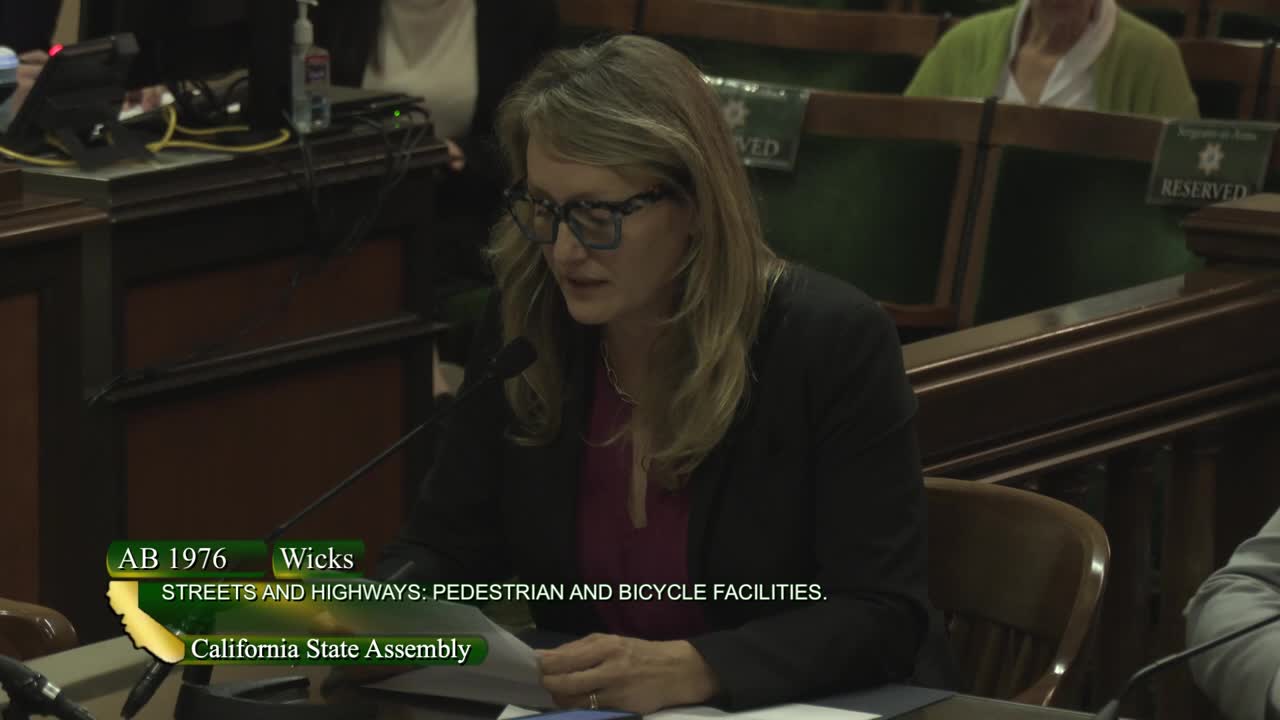 11MIN
Assembly Standing Committee on Local Government
 20MIN
Assembly Standing Committee on Transportation
Bill Author

Bill Co-Author(s):