AB 1983: Continuing care retirement communities: repayable contracts.
- Session Year: 2025-2026
- House: Assembly
- Latest Version Date: 2026-09-18
Current Status:
Passed
(2026-09-18: Chaptered by Secretary of State - Chapter 281, Statutes of 2026.)
Introduced
In Committee
Awaiting First Chamber Vote
Passed First Chamber
In Committee
Awaiting Second Chamber Vote
Passed Second Chamber
Enacted
Existing law establishes the State Department of Social Services and sets forth its powers and duties, including the certification and regulation of continuing care retirement communities. Existing law regulates different types of continuing care contracts, including, among others, a repayable contract. A repayable contract is a continuing care contract that includes a promise to repay all or a portion of an entrance fee that is conditioned upon reoccupancy or resale of the unit previously occupied by the resident.
This bill would instead refer to the contract described above as a repayable conditioned on resale contract, define a repayable contract to include both a repayable conditioned on resale contract and a repayable in sequential order contract, and would define a repayable in sequential order contract to mean a continuing care contract that includes a promise to repay all or a portion of an entrance fee based on the sequential order in which repayable contracts are terminated. The bill would require a provider that offers or maintains repayable in sequential order contracts to establish a repayment account for these purposes, to assign each terminated contract a sequential repayment number, and to repay those contracts in sequential order from the proceeds of future repayable in sequential order contracts, as specified.
Existing law requires all continuing care contracts to include specified provisions, including, among others, that if its a repayable contract, the average and longest amount of time that it has taken to resell or reoccupy a unit within the last 5 calendar years.
This bill would make that provision applicable only to repayable conditioned on resale contracts and would require certain additional disclosures relating to repayable in sequential order contracts to be made, including, among others, the average and longest duration of time elapsed between contract termination and repayment during the last 5 calendar years.
Existing law requires a lump sum owed to a resident or a residents estate, including any interest accrued, to be paid within 14 calendar days after resale of the unit.
This bill would make that provision applicable only to repayable conditioned on resale contracts and would make it 14 days after resale or reoccupancy. For repayable conditioned on sequential order contracts, the bill would require the full lump sum to be paid within 14 calendar days after sufficient funds exist in the sequential repayment account to satisfy the contracts assigned sequential repayment number.
Existing law establishes the State Department of Social Services and sets forth its powers and duties, including the certification and regulation of continuing care retirement communities. Existing law regulates different types of continuing care contracts, including, among others, a repayable contract. A repayable contract is a continuing care contract that includes a promise to repay all or a portion of an entrance fee that is conditioned upon reoccupancy or resale of the unit previously occupied by the resident.
This bill would additionally instead refer to the contract described above as a repayable conditioned on resale contract, define a repayable contract to include both a repayable conditioned on resale contract and a repayable in sequential order contract, and would define a repayable in sequential order contract to include mean a continuing care contract that includes a promise to repay all or a portion of an entrance fee based on the sequential order in which repayable contracts are terminated. To repay entrance fees using the sequential order method, the The bill would require a provider that offers or maintains repayable in sequential order contracts to establish a repayment account for these purposes, to assign each terminated contract a sequential repayment number, and each time entrance fees are paid for a reoccupied unit, a repayment account would be credited until funds are sufficient to repay the next terminated contract in sequential order. The bill would require a provider to issue this repayment within 14 days. and to repay those contracts in sequential order from the proceeds of future repayable in sequential order contracts, as specified.
Existing law requires all continuing care contracts to include specified provisions, including, among others, that if its a repayable contract, the average and longest amount of time that it has taken to resell or reoccupy a unit within the last 5 calendar years.
This bill would make that provision applicable only to repayable conditioned on resale contracts and would require certain additional disclosures relating to repayable in sequential order contracts to be made, including, among others, the average and longest duration of time elapsed between contract termination and repayment during the last 5 calendar years.
Existing law requires a lump sum owed to a resident or a residents estate, including any interest accrued, to be paid within 14 calendar days after resale of the unit.
This bill would make that provision applicable only to repayable conditioned on resale contracts and would make it 14 days after resale or reoccupancy. For repayable conditioned on sequential order contracts, the bill would require the full lump sum to be paid within 14 calendar days after sufficient funds exist in the sequential repayment account to satisfy the contracts assigned sequential repayment number.
Existing law establishes the State Department of Social Services and sets forth its powers and duties, including the certification and regulation of continuing care retirement communities. Existing law regulates different types of continuing care contracts, including, among others, a repayable contract. A repayable contract is a continuing care contract that includes a promise to repay all or a portion of an entrance fee that is conditioned upon reoccupancy or resale of the unit previously occupied by the resident.
This bill would additionally define a repayable contract to include a continuing care contract that includes a promise to repay all or a portion of an entrance fee based on the sequential order in which repayable contracts are terminated. To repay entrance fees using the sequential order method, the bill would require a provider to assign each terminated contract a sequential repayment number, and each time entrance fees are paid for a reoccupied unit, a repayment account would be credited until funds are sufficient to repay the next terminated contract in sequential order. The bill would require a provider to issue this repayment within 14 days.
Unless the context otherwise requires, the definitions in this section govern the interpretation of this chapter.
(a)(1)Affiliate means any person, corporation, limited liability company, business trust, trust, partnership, unincorporated association, or other legal entity that directly or indirectly controls, is controlled by, or is under common control with, a provider or applicant.
(2)Affinity group means a grouping of entities sharing a common interest, philosophy, or connection (e.g., military officers, religion).
(3)Annual report means the report each provider is required to file annually with the department, as described in Section 1790.
(4)Applicant means any entity, or combination of entities, that submits and has pending an application to the department for a permit to accept deposits and a certificate of authority.
(5)Assisted living services includes, but is not limited to, assistance with personal activities of daily living, including dressing, feeding, toileting, bathing, grooming, mobility, and associated tasks, to help provide for and maintain physical and psychosocial comfort.
(6)Assisted living unit means the living area or unit within a continuing care retirement community that is specifically designed to provide ongoing assisted living services.
(7)Audited financial statement means financial statements prepared in accordance with generally accepted accounting principles, including the opinion of an independent certified public accountant, and notes to the financial statements considered customary or necessary to provide full disclosure and complete information regarding the providers financial statements, financial condition, and operation.
(b)(reserved)
(c)(1)Cancel means to destroy the force and effect of an agreement or continuing care contract.
(2)Cancellation period means the 90-day period, beginning when the resident physically moves into the continuing care retirement community, during which the resident may cancel the continuing care contract, as provided in Section 1788.2.
(3)Care means nursing, medical, or other health-related services, protection or supervision, assistance with the personal activities of daily living, or any combination of those services.
(4)Cash equivalent means certificates of deposit and United States Treasury securities with a maturity of five years or less.
(5)Certificate or certificate of authority means the certificate issued by the department, properly executed and bearing the State Seal, authorizing a specified provider to enter into one or more continuing care contracts at a single specified continuing care retirement community.
(6)Condition means a restriction, specific action, or other requirement imposed by the department for the initial or continuing validity of a permit to accept deposits, a provisional certificate of authority, or a certificate of authority. A condition may limit the circumstances under which the provider may enter into any new deposit agreement or contract, or may be imposed as a condition precedent to the issuance of a permit to accept deposits, a provisional certificate of authority, or a certificate of authority.
(7)Consideration means some right, interest, profit, or benefit paid, transferred, promised, or provided by one party to another as an inducement to contract. Consideration includes some forbearance, detriment, loss, or responsibility, that is given, suffered, or undertaken by a party as an inducement to another party to contract.
(8)Continuing care contract means a contract that includes a continuing care promise made, in exchange for an entrance fee, the payment of periodic charges, or both types of payments. A continuing care contract may consist of one agreement or a series of agreements and other writings incorporated by reference.
(9)Continuing care promise means a promise, expressed or implied, by a provider to provide one or more elements of care to an elderly resident for the duration of their life or for a term in excess of one year. Any such promise or representation, whether part of a continuing care contract, other agreement, or series of agreements, or contained in any advertisement, brochure, or other material, either written or oral, is a continuing care promise.
(10)Continuing care retirement community means a facility located within the State of California where services promised in a continuing care contract are provided. A distinct phase of development approved by the department may be considered to be the continuing care retirement community when a project is being developed in successive distinct phases over a period of time. When the services are provided in residents own homes, the homes into which the provider takes those services are considered part of the continuing care retirement community.
(11)Control means directing or causing the direction of the financial management or the policies of another entity, including an operator of a continuing care retirement community, whether by means of the controlling entitys ownership interest, contract, or any other involvement. A parent entity or sole member of an entity controls a subsidiary entity provider for a continuing care retirement community if its officers, directors, or agents directly participate in the management of the subsidiary entity or in the initiation or approval of policies that affect the continuing care retirement communitys operations, including, but not limited to, approving budgets or the administrator for a continuing care retirement community.
(d)(1)Department means the State Department of Social Services.
(2)Deposit means any transfer of consideration, including a promise to transfer money or property, made by a depositor to any entity that promises or proposes to promise to provide continuing care, but is not authorized to enter into a continuing care contract with the potential depositor.
(3)Deposit agreement means any agreement made between any entity accepting a deposit and a depositor. Deposit agreements for deposits received by an applicant prior to the departments release of funds from the deposit escrow account shall be subject to the requirements described in Section 1780.4.
(4)Depository means a bank or institution that is a member of the Federal Deposit Insurance Corporation or a comparable deposit insurance program.
(5)Depositor means any prospective resident who pays a deposit. Where any portion of the consideration transferred to an applicant as a deposit or to a provider as consideration for a continuing care contract is transferred by a person other than the prospective resident or a resident, that third-party transferor shall have the same cancellation or refund rights as the prospective resident or resident for whose benefit the consideration was transferred.
(6)Director means the Director of Social Services.
(e)(1)Elderly means an individual who is 60 years of age or older.
(2)Entity means an individual, partnership, corporation, limited liability company, and any other form for doing business. Entity includes a person, sole proprietorship, estate, trust, association, and joint venture.
(3)Entrance fee means the sum of any initial, amortized, or deferred transfer of consideration made or promised to be made by, or on behalf of, a person entering into a continuing care contract for the purpose of ensuring care or related services pursuant to that continuing care contract or as full or partial payment for the promise to provide care for the term of the continuing care contract. Entrance fee includes the purchase price of a condominium, cooperative, or other interest sold in connection with a promise of continuing care. An initial, amortized, or deferred transfer of consideration that is greater in value than 12 times the monthly care fee shall be presumed to be an entrance fee.
(4)Entrance fee refund means the return of all or a portion of the initial entrance fee paid by a resident to a provider, which is required to be paid back to the resident or the residents estate upon the termination or cancellation of a refundable contract.
(5)Equity means the value of real property in excess of the aggregate amount of all liabilities secured by the property.
(6)Equity interest means an interest held by a resident in a continuing care retirement community that consists of either an ownership interest in any part of the continuing care retirement community property or a transferable membership that entitles the holder to reside at the continuing care retirement community.
(7)Equity project means a continuing care retirement community where residents receive an equity interest in the continuing care retirement community property.
(8)Equity securities shall refer generally to large and midcapitalization corporate stocks that are publicly traded and readily liquidated for cash, and shall include shares in mutual funds that hold portfolios consisting predominantly of these stocks and other qualifying assets, as defined by Section 1792.2. Equity securities shall also include other similar securities that are specifically approved by the department.
(9)Escrow agent means a bank or institution, including, but not limited to, a title insurance company, approved by the department to hold and render accountings for deposits of cash or cash equivalents.
(f)Facility means any place or accommodation where a provider provides or will provide a resident with care or related services, whether or not the place or accommodation is constructed, owned, leased, rented, or otherwise contracted for by the provider.
(g)(reserved)
(h)(reserved)
(i)(1)Inactive certificate of authority means a certificate that has been terminated under Section 1793.8.
(2)Investment securities means any of the following:
(A)Direct obligations of the United States, including obligations issued or held in book-entry form on the books of the United States Department of the Treasury or obligations the timely payment of the principal of, and the interest on, which are fully guaranteed by the United States.
(B)Obligations, debentures, notes, or other evidences of indebtedness issued or guaranteed by any of the following:
(i)The Federal Home Loan Bank System.
(ii)The Export-Import Bank of the United States.
(iii)The Federal Financing Bank.
(iv)The Government National Mortgage Association.
(v)The Farmers Home Administration.
(vi)The Federal Home Loan Mortgage Corporation of the Federal Housing Administration.
(vii)Any agency, department, or other instrumentality of the United States if the obligations are rated in one of the two highest rating categories of each rating agency rating those obligations.
(C)Bonds of the State of California or of any county, city and county, or city in this state, if rated in one of the two highest rating categories of each rating agency rating those bonds.
(D)Commercial paper of finance companies and banking institutions rated in one of the two highest categories of each rating agency rating those instruments.
(E)Repurchase agreements fully secured by collateral security described in subparagraph (A) or (B), as evidenced by an opinion of counsel, if the collateral is held by the provider or a third party during the term of the repurchase agreement, pursuant to the terms of the agreement, subject to liens or claims of third parties, and has a market value, which is determined at least every 14 days, at least equal to the amount so invested.
(F)Long-term investment agreements, which have maturity dates in excess of one year, with financial institutions, including, but not limited to, banks and insurance companies or their affiliates, if the financial institutions paying ability for debt obligations or long-term claims or the paying ability of a related guarantor of the financial institution for these obligations or claims, is rated in one of the two highest rating categories of each rating agency rating those instruments, or if the short-term investment agreements are with the financial institution or the related guarantor of the financial institution, the long-term or short-term debt obligations, whichever is applicable, of which are rated in one of the two highest long-term or short-term rating categories, of each rating agency rating the bonds of the financial institution or the related guarantor, provided that if the rating falls below the two highest rating categories, the investment agreement shall allow the provider the option to replace the financial institution or the related guarantor of the financial institution or shall provide for the investment securities to be fully collateralized by investments described in subparagraph (A), and, provided further, if so collateralized, that the provider has a perfected first security lien on the collateral, as evidenced by an opinion of counsel and the collateral is held by the provider.
(G)Bankers acceptances or certificates of deposit of, or time deposits in, any savings and loan association that meets any of the following criteria:
(i)The debt obligations of the savings and loan association, or in the case of a principal bank, of the bank holding company, are rated in one of the two highest rating categories of each rating agency rating those instruments.
(ii)The certificates of deposit or time deposits are fully insured by the Federal Deposit Insurance Corporation.
(iii)The certificates of deposit or time deposits are secured at all times, in the manner and to the extent provided by law, by collateral security described in subparagraph (A) or (B) with a market value, valued at least quarterly, of no less than the original amount of moneys so invested.
(H)Taxable money market government portfolios restricted to obligations issued or guaranteed as to payment of principal and interest by the full faith and credit of the United States.
(I)Obligations the interest on which is excluded from gross income for federal income tax purposes and money market mutual funds whose portfolios are restricted to these obligations, if the obligations or mutual funds are rated in one of the two highest rating categories by each rating agency rating those obligations.
(J)Bonds that are not issued by the United States or any federal agency, but that are listed on a national exchange and that are rated at least A by Moodys Investors Service, or the equivalent rating by Standard and Poors Corporation or Fitch Investors Service.
(K)Bonds not listed on a national exchange that are traded on an over-the-counter basis, and that are rated at least Aa by Moodys Investors Service or AA by Standard and Poors Corporation or Fitch Investors Service.
(j)(reserved)
(k)(reserved)
(l)(1)Life care contract means a continuing care contract that includes a promise, expressed or implied, by a provider to provide or pay for routine services at all levels of care, including acute care and the services of physicians and surgeons, to the extent not covered by other public or private insurance benefits, to a resident for the duration of their life. Care shall be provided under a life care contract in a continuing care retirement community having a comprehensive continuum of care, including a skilled nursing facility, under the ownership and supervision of the provider on or adjacent to the premises. A change shall not be made in the monthly fee based on level of care. A life care contract shall also include provisions to subsidize residents who become financially unable to pay their monthly care fees.
(2)Lump sum payment means a one-time reimbursement of all or a portion of an entrance fee owed by a provider to a resident or the residents estate in the event of cancellation, termination, or death.
(m)(1)Monthly care fee means the fee charged to a resident in a continuing care contract on a monthly or other periodic basis for current accommodations and services, including care, board, or lodging. Periodic entrance fee payments or other prepayments shall not be monthly care fees.
(2)Monthly fee contract means a continuing care contract that requires residents to pay monthly care fees.
(n)Nonambulatory person means a person who is unable to leave a building unassisted under emergency conditions in the manner described by Section 13131.
(o)(reserved)
(p)(1)Per capita cost means a continuing care retirement communitys operating expenses, excluding depreciation, divided by the average number of residents.
(2)Periodic charges means fees paid by a resident on a periodic basis.
(3)Permanent closure means the voluntary or involuntary termination or forfeiture, as specified in subdivisions (a), (b), (g), (h), and (i) of Section 1793.7, of a providers certificate of authority or license, or another action that results in the permanent relocation of residents. Permanent closure does not apply in the case of a natural disaster or other event out of the providers control.
(4)Permit to accept deposits means a written authorization by the department permitting an applicant to enter into deposit agreements regarding a single specified continuing care retirement community.
(5)Prepaid contract means a continuing care contract in which the monthly care fee, if any, may not be adjusted to cover the actual cost of care and services.
(6)Preferred access means that residents who have previously occupied a residential living unit have a right over other persons to any assisted living or skilled nursing beds that are available at the community.
(7)Processing fee means a payment to cover administrative costs of processing the application of a depositor or prospective resident.
(8)Promise to provide one or more elements of care means any expressed or implied representation that one or more elements of care will be provided or will be available, such as by preferred access.
(9)Proposes means a representation that an applicant or provider will or intends to make a future promise to provide care, including a promise that is subject to a condition, such as the construction of a continuing care retirement community or the acquisition of a certificate of authority.
(10)Provider means an entity that provides continuing care, makes a continuing care promise, or proposes to promise to provide continuing care. Provider also includes any entity that controls an entity that provides continuing care, makes a continuing care promise, or proposes to promise to provide continuing care. The department shall determine whether an entity controls another entity for purposes of this article. No homeowners association, cooperative, or condominium association may be a provider.
(11)Provisional certificate of authority means the certificate issued by the department, properly executed and bearing the State Seal, under Section 1786. A provisional certificate of authority shall be limited to the specific continuing care retirement community and number of units identified in the applicants application.
(q)(reserved)
(r)(1)Refund reserve means the reserve a provider is required to maintain, as provided in Section 1792.6.
(2)Refundable contract means a continuing care contract that includes a promise, expressed or implied, by the provider to pay an entrance fee refund or to repurchase the transferors unit, membership, stock, or other interest in the continuing care retirement community when the promise to refund some or all of the initial entrance fee extends beyond the residents sixth year of residency. Providers that enter into refundable contracts shall be subject to the refund reserve requirements of Section 1792.6.
(3)Repayable conditioned on resale contract means a continuing care contract that includes a promise to repay all or a portion of an entrance fee that is conditioned upon resale or reoccupancy of the unit previously occupied by the resident. A repayable conditioned on resale contract shall not be considered a refundable contract for purposes of the refund reserve requirements of Section 1792.6, provided that this conditional promise of repayment is not referred to by the applicant or provider as a refund. A provider may repay all or a portion of an entrance fee that is conditioned upon resale or reoccupancy of the unit before the resale or reoccupancy of the unit. The repayment of an entrance fee before the resale or reoccupancy of the unit shall not cause any other entrance fee to be subject to the refund reserve requirements of Section 1792.6, provided that the provider does not promise, at the time of contracting or thereafter, to make this type of early repayment, represent that the provider intends to make this type of early repayment, or indicate that the provider has a practice of making this type of early repayment.
(4)Repayable contract means either a repayable conditioned on resale contract or a repayable in sequential order contract.
(5)Repayable in sequential order contract means a continuing care contract that includes a promise to repay all or a portion of an entrance fee based strictly on the sequential order in which repayable contracts are terminated. A repayable in sequential order contract shall not be considered a refundable contract for purposes of the refund reserve requirements of Section 1792.6, provided that this conditional promise of repayment is not referred to by the applicant or provider as a refund. A provider shall repay entrance fees solely in the sequential order in which the contracts were terminated and shall not repay all or a portion of an entrance fee before the residents sequential number is reached. At the time a contract is terminated and all conditions for repayment under the contract have been met, the provider shall provide the resident, the residents estate, or other appropriate party with written notice of their sequential number on the repayment log. If the resident, their estate, or other appropriate party is unable to receive the repayment when their sequential number is reached, the provider shall ensure the full repayment amount and any applicable interest is kept in the sequential repayment account until the payment can be made to the resident, their estate, or other appropriate party. The provider shall keep records adequate to show which moneys have been designated for each resident and the moneys shall be held in the account until the resident, their estate, or other appropriate party can receive the payment.
(6)Resale fee means a levy by the provider against the proceeds from the sale of a transferors equity interest.
(7)Reservation fee refers to consideration collected by an entity that has made a continuing care promise or is proposing to make this promise and has complied with Section 1771.4.
(8)Resident means a person who enters into a continuing care contract with a provider, or who is designated in a continuing care contract to be a person being provided or to be provided services, including care, board, or lodging.
(9)Residential care facility for the elderly means a housing arrangement as defined by Section 1569.2.
(10)Residential living unit means a living unit in a continuing care retirement community that is not used exclusively for assisted living services or nursing services.
(11)Residential temporary relocation means the relocation of one or more residents, except in the case of a natural disaster that is out of the providers control, from one or more residential living units, assisted living units, skilled nursing units, or a wing, floor, or entire continuing care retirement community building, due to a change of use or major repairs or renovations. A residential temporary relocation shall mean a relocation pursuant to this subdivision that lasts for a period of at least 9 months but that does not exceed 18 months without the written agreement of the resident.
(s)(1)Sequential order method or sequential order means the repayment of entrance fees in the order in which repayable contracts are terminated. To use the sequential order method, the provider shall assign each terminated contract a sequential repayment number, to be paid from a sequential repayment account funded by entrance fees received from any reoccupied residential living units with sequential order contracts. Each time a unit is reoccupied, the repayment account shall be credited with an amount equal to the repayment owed to a units prior resident. When the funds in the repayment account are sufficient to repay the next terminated contract in sequential order, the provider shall issue the repayment within 14 days.
(2)Sequential repayment account means a separately accounted for financial bank account established and maintained by a provider for the exclusive purpose of funding repayments of entrance fees under repayable in sequential order contracts. The account shall indicate that the moneys in it are held for the exclusive benefit of the residents or their estates. The money shall remain separate, intact, and free from any liability the provider incurs. The sequential repayment account shall not be deemed a refund reserve and shall not be subject to the refund reserve requirements of Section 1792.6.
(t)(1)Termination means the ending of a continuing care contract as provided for in the terms of the continuing care contract.
(2)Transfer trauma means death, depression, or regressive behavior, that is caused by the abrupt and involuntary transfer of an elderly resident from one home to another and results from a loss of familiar physical environment, loss of well-known neighbors, attendants, nurses and medical personnel, the stress of an abrupt break in the small routines of daily life, or the loss of visits from friends and relatives who may be unable to reach the new facility.
(3)Transferor means a person who transfers, or promises to transfer, consideration in exchange for care and related services under a continuing care contract or proposed continuing care contract, for the benefit of another. A transferor shall have the same rights to cancel and obtain a refund as the depositor under the deposit agreement or the resident under a continuing care contract.
SEC. 2.Section 1788 of the Health and Safety Code is amended to read:1788.(a)A continuing care contract shall contain all of the following:
(1)The legal name and address of each provider.
(2)The name and address of the continuing care retirement community.
(3)The residents name and the identity of the unit the resident will occupy.
(4)If there is a transferor other than the resident, the transferor shall be a party to the contract and the transferors name and address shall be specified.
(5)If the provider has used the name of any charitable or religious or nonprofit organization in its title before January 1, 1979, and continues to use that name, and that organization is not responsible for the financial and contractual obligations of the provider or the obligations specified in the continuing care contract, the provider shall include in every continuing care contract a conspicuous statement that clearly informs the resident that the organization is not financially responsible.
(6)The date the continuing care contract is signed by the resident and, where applicable, any other transferor.
(7)The duration of the continuing care contract.
(8)A list of the services that will be made available to the resident as required to provide the appropriate level of care. The list of services shall include the services required as a condition for licensure as a residential care facility for the elderly, including all of the following:
(A)Regular observation of the residents health status to ensure that their dietary needs, social needs, and needs for special services are satisfied.
(B)Safe and healthful living accommodations, including housekeeping services and utilities.
(C)Maintenance of house rules for the protection of residents.
(D)A planned activities program, which includes social and recreational activities appropriate to the interests and capabilities of the resident.
(E)Three balanced, nutritious meals and snacks made available daily, including special diets prescribed by a physician as a medical necessity.
(F)Assisted living services.
(G)Assistance with taking medications.
(H)Central storing and distribution of medications.
(I)Arrangements to meet health needs, including arranging transportation.
(9)An itemization of the services that are included in the monthly fee and the services that are available at an extra charge. The provider shall attach a current fee schedule to the continuing care contract. The schedule shall state that a provider is prohibited from charging the resident or their estate a monthly fee once a unit has been permanently vacated by the resident, unless the fee is part of an equity interest contract.
(10)The procedures and conditions under which a resident may be voluntarily and involuntarily transferred from a designated living unit. The transfer procedures, at a minimum, shall include provisions addressing all of the following circumstances under which a transfer may be authorized:
(A)A continuing care retirement community may transfer a resident under the following conditions, taking into account the appropriateness and necessity of the transfer and the goal of promoting resident independence:
(i)The resident is nonambulatory. The definition of nonambulatory, as provided in Section 13131, shall either be stated in full in the continuing care contract or be cited. If Section 13131 is cited, a copy of the statute shall be made available to the resident, either as an attachment to the continuing care contract or by specifying that it will be provided upon request. If a nonambulatory resident occupies a room that has a fire clearance for nonambulatory residents, transfer shall not be necessary.
(ii)The resident develops a physical or mental condition that is detrimental to or endangers the health, safety, or well-being of the resident or another person.
(iii)The residents condition or needs require the residents transfer to an assisted living care unit or skilled nursing facility, because the level of care required by the resident exceeds that which may be appropriately provided in the living unit.
(iv)The residents condition or needs require the residents transfer to a nursing facility, hospital, or other facility, and the provider has no facilities available to provide that level of care.
(B)Before the continuing care retirement community transfers a resident under any of the conditions set forth in subparagraph (A), the community shall satisfy all of the following requirements:
(i)Involve the resident and the residents responsible person, as defined in paragraph (6) of subdivision (r) of Section 87101 of Title 22 of the California Code of Regulations, and upon the residents or responsible persons request, family members, or the residents physician or other appropriate health professional, in the assessment process that forms the basis for the level of care transfer decision by the provider. The provider shall offer an explanation of the assessment process, which shall include, but not be limited to, an evaluation of the physical and cognitive capacities of the resident. An assessment tool or tools, including scoring and evaluating criteria, shall be used in the determination of the appropriateness of the transfer. The provider shall make copies of the completed assessment to share with the resident or the residents responsible person.
(ii)Prior to sending a formal notification of transfer, the provider shall conduct a care conference with the resident and the residents responsible person, and, upon the residents or responsible persons request, family members, and the residents health care professionals, to explain the reasons for transfer.
(iii)Notify the resident and the residents responsible person of the reasons for the transfer in writing.
(iv)Notwithstanding any other provision of this subparagraph, if the resident does not have impairment of cognitive abilities, the resident may request that their responsible person not be involved in the transfer process.
(v)The notice of transfer shall be made at least 30 days before the transfer is expected to occur, except when the health or safety of the resident or other residents is in danger, or the transfer is required by the residents urgent medical needs. Under those circumstances, the written notice shall be made as soon as practicable before the transfer.
(vi)The written notice shall contain the reasons for the transfer, the effective date, the designated level of care or location to which the resident will be transferred, a statement of the residents right to a review of the transfer decision at a care conference, as provided for in subparagraph (C), and for disputed transfer decisions, the right to review by the Continuing Care Contracts Branch of the State Department of Social Services, as provided for in subparagraph (D). The notice shall also contain the name, address, and telephone number of the departments Continuing Care Contracts Branch.
(vii)The continuing care retirement community shall provide sufficient preparation and orientation to the resident to ensure a safe and orderly transfer and to minimize trauma.
(viii)For disputed transfer decisions, the provider shall provide documentation of the residents medical reports, other documents showing the residents current mental and physical function, the prognosis, and the expected duration of relevant conditions, if applicable. The documentation shall include an explanation of how the criteria set out in subparagraph (A) are met. The provider shall make copies of the completed report to share with the resident or the residents responsible person.
(C)The resident has the right to review and dispute the transfer decision at a subsequent care conference that shall include the resident, the residents responsible person, and, upon the residents or responsible persons request, family members, the residents physician or other appropriate health care professional, and members of the providers interdisciplinary team. The local ombudsperson may also be included in the care conference, upon the request of the resident, the residents responsible person, or the provider.
(D)For disputed transfer decisions, the resident or the residents responsible person has the right to a prompt and timely review of the transfer process by the Continuing Care Contracts Branch of the State Department of Social Services. The branch of the department shall provide a description of the steps a provider took and the factors a provider considered in deciding to transfer a resident, including the assessment tool or tools and the scoring and evaluating criteria used by the provider to justify the transfer.
(E)The decision of the departments Continuing Care Contracts Branch shall be in writing and shall determine whether the provider failed to comply with the transfer process pursuant to subparagraphs (A) to (C), inclusive, and whether the transfer is appropriate and necessary. Pending the decision of the Continuing Care Contracts Branch, the provider shall specify any additional care the provider believes is necessary in order for the resident to remain in their unit. The resident may be required to pay for the extra care, as provided in the contract.
(F)Transfer of a second resident when a shared accommodation arrangement is terminated.
(11)Provisions describing any changes in the residents monthly fee and any changes in the entrance fee refund payable to the resident that will occur if the resident transfers from any unit, including, but not limited to, terminating their contract after 18 months of residential temporary relocation, as defined in paragraph (9) of subdivision (r) of Section 1771. Unless the fee is part of an equity interest contract, a provider is prohibited from charging the resident or their estate a monthly fee once a unit has been permanently vacated by the resident.
(12)The providers continuing obligations, if any, in the event a resident is transferred from the continuing care retirement community to another facility.
(13)The providers obligations, if any, to resume care upon the residents return after a transfer from the continuing care retirement community.
(14)The providers obligations to provide services to the resident while the resident is absent from the continuing care retirement community.
(15)The conditions under which the resident must permanently release their living unit.
(16)If real or personal properties are transferred in lieu of cash, a statement specifying each items value at the time of transfer, and how the value was ascertained.
(A)An itemized receipt that includes the information described above is acceptable if incorporated as a part of the continuing care contract.
(B)When real property is or will be transferred, the continuing care contract shall include a statement that the deed or other instrument of conveyance shall specify that the real property is conveyed pursuant to a continuing care contract and may be subject to rescission by the transferor within 90 days from the date that the resident first occupies the residential unit.
(C)The failure to comply with this paragraph shall not affect the validity of title to real property transferred pursuant to this chapter.
(17)The amount of the entrance fee.
(18)In the event two parties have jointly paid the entrance fee or other payment that allows them to occupy the unit, the continuing care contract shall describe how any refund of entrance fees is allocated.
(19)The amount of any processing fee.
(20)The amount of any monthly care fee.
(21)For continuing care contracts that require a monthly care fee or other periodic payment, the continuing care contract shall include the following:
(A)A statement that the occupancy and use of the accommodations by the resident is contingent upon the regular payment of the fee.
(B)The regular rate of payment agreed upon (per day, week, or month).
(C)A provision specifying whether payment will be made in advance or after services have been provided.
(D)A provision specifying the provider will adjust monthly care fees for the residents support, maintenance, board, or lodging, when a resident requires medical attention while away from the continuing care retirement community.
(E)A provision specifying whether a credit or allowance will be given to a resident who is absent from the continuing care retirement community or from meals. This provision shall also state, when applicable, that the credit may be permitted at the discretion or by special permission of the provider.
(F)A statement of billing practices, procedures, and timelines. A provider shall allow a minimum of 14 days between the date a bill is sent and the date payment is due. A charge for a late payment may only be assessed if the amount and any condition for the penalty is stated on the bill.
(G)A statement that the provider is prohibited from charging the resident or their estate a monthly fee once a unit has been permanently vacated by the resident, unless the fee is part of an equity interest contract.
(22)All continuing care contracts that include monthly care fees shall address changes in monthly care fees by including either of the following provisions:
(A)For prepaid continuing care contracts, which include monthly care fees, one of the following methods:
(i)Fees shall not be subject to change during the lifetime of the agreement.
(ii)Fees shall not be increased by more than a specified number of dollars in any one year and not more than a specified number of dollars during the lifetime of the agreement.
(iii)Fees shall not be increased in excess of a specified percentage over the preceding year and not more than a specified percentage during the lifetime of the agreement.
(B)For monthly fee continuing care contracts, except prepaid contracts, changes in monthly care fees shall be based on projected costs, prior year per capita costs, and economic indicators.
(23)A provision requiring that the provider give written notice to the resident at least 30 days in advance of any change in the residents monthly care fees or in the price or scope of any component of care or other services.
(24)A provision indicating whether the residents rights under the continuing care contract include any proprietary interests in the assets of the provider or in the continuing care retirement community, or both. Any statement in a contract concerning an ownership interest shall appear in a large-sized font or print.
(25)If the continuing care retirement community property is encumbered by a security interest that is senior to any claims the residents may have to enforce continuing care contracts, a provision shall advise the residents that any claims they may have under the continuing care contract are subordinate to the rights of the secured lender. For equity projects, the continuing care contract shall specify the type and extent of the equity interest and whether any entity holds a security interest.
(26)Notice that the living units are part of a continuing care retirement community that is licensed as a residential care facility for the elderly and, as a result, any duly authorized agent of the department may, upon proper identification and upon stating the purpose of their visit, enter and inspect the entire premises at any time, without advance notice.
(27)A conspicuous statement, in at least 10-point boldface type in immediate proximity to the space reserved for the signatures of the resident and, if applicable, the transferor, that provides as follows: You, the resident or transferor, may cancel the transaction without cause at any time within 90 days from the date you first occupy your living unit. See the attached notice of cancellation form for an explanation of this right.
(28)Notice that during the cancellation period, the continuing care contract may be canceled upon 30 days written notice by the provider without cause, or that the provider waives this right.
(29)The terms and conditions under which the continuing care contract may be terminated after the cancellation period by either party, including any health or financial conditions.
(30)A statement that, after the cancellation period, a provider may unilaterally terminate the continuing care contract only if the provider has good and sufficient cause.
(A)Any continuing care contract containing a clause that provides for a continuing care contract to be terminated for just cause, good cause, or other similar provision, shall also include a provision that none of the following activities by the resident, or on behalf of the resident, constitutes just cause, good cause, or otherwise activates the termination provision:
(i)Filing or lodging a formal complaint with the department or other appropriate authority.
(ii)Participation in an organization or affiliation of residents, or other similar lawful activity.
(B)The provision required by this paragraph shall also state that the provider shall not discriminate or retaliate in any manner against any resident of a continuing care retirement community for contacting the department, or any other state, county, or city agency, or any elected or appointed government official to file a complaint or for any other reason, or for participation in a residents organization or association.
(C)This paragraph does not diminish the providers ability to terminate the continuing care contract for good and sufficient cause.
(31)A statement that at least 90 days written notice to the resident is required for a unilateral termination of the continuing care contract by the provider.
(32)A statement concerning the length of notice that a resident is required to give the provider to voluntarily terminate the continuing care contract after the cancellation period.
(33)The policy or terms for refunding or repaying a lump sum of any portion of the entrance fee, in the event of cancellation, termination, or death. Every continuing care contract that provides for a refund or repaying a lump sum of all or a part of the entrance fee shall also do all of the following:
(A)Specify the amount, if any, the resident has paid or will pay for upgrades, special features, or modifications to the residents unit.
(B)State that if the continuing care contract is canceled or terminated by the provider, the provider shall do both of the following:
(i)Amortize the specified amount at the same rate as the residents entrance fee.
(ii)Refund or repay the unamortized balance to the resident at the same time the provider pays the residents entrance fee refund or repayable lump sum, as applicable under the contracts refund or repayment policies.
(C)State that the resident has a right to terminate their contract after 18 months of residential temporary relocation, as defined in paragraph (9) of subdivision (r) of Section 1771. Provisions for refunds or repayments due to cancellation pursuant to this subparagraph shall be set forth in the contract and shall specify whether repayment is condition upon resale of the unit or subject to the sequential order method.
(D)State the provider shall make a good-faith effort to reoccupy or resell a unit for which a lump-sum payment is conditioned upon resale of the unit. No later than July 1, 2017, a provider shall provide notice to all current residents with contracts applicable to this subparagraph regarding the statement required by this subparagraph as a clarification of the residents existing contract.
(E)For repayable in sequential order contracts, state that repayment shall be made in the order in which repayable contracts are terminated and shall be paid from a sequential repayment account funded by entrance fees received from the sale of residential living units with repayable in sequential order contracts.
(F)For all repayable conditioned on resale contracts, the provider shall state the average and longest amount of time that it has taken to resell a unit within the last five calendar years.
(G)For all repayable in sequential order contracts, the provider shall include a disclosure stating all of the following:
(i)The average and longest duration of time elapsed between contract termination and repayment during the last 5 calendar years.
(ii)The total number of repayable in sequential order contracts deposited into the sequential repayment account, and the total number of contracts repaid from the sequential repayment account during the last 5 calendar years.
(iii)A clear statement explaining that the timing of repayment is dependent upon the chronological order of contract terminations and the availability of funds in the sequential repayment account.
(34)The following notice at the bottom of the signatory page:
NOTICE | (date) |
This is a continuing care contract as defined by paragraph (8) of subdivision (c) or subdivision (l) of Section 1771 of the California Health and Safety Code. This continuing care contract form has been approved by the State Department of Social Services as required by subdivision (b) of Section 1787 of the California Health and Safety Code. The basis for this approval was a determination that (provider name) has submitted a contract that complies with the minimum statutory requirements applicable to continuing care contracts. The department does not approve or disapprove any of the financial or health care coverage provisions in this contract. Approval by the department is NOT a guaranty of performance or an endorsement of any continuing care contract provisions. Prospective transferors and residents are strongly encouraged to carefully consider the benefits and risks of this continuing care contract and to seek financial and legal advice before signing.
(35)The provider shall not attempt to absolve itself in the continuing care contract from liability for its negligence by any statement to that effect, and shall include the following statement in the contract: Nothing in this continuing care contract limits either the providers obligation to provide adequate care and supervision for the resident or any liability on the part of the provider which may result from the providers failure to provide this care and supervision.
(36)Provisions describing how the provider will proceed in the event of a closure, including an explanation of how the provider will comply with Sections 1793.80, 1793.81, 1793.82, and 1793.83.
(b)A life care contract shall also provide that:
(1)All levels of care, including acute care and physicians and surgeons services, will be provided to a resident.
(2)Care will be provided for the duration of the residents life unless the life care contract is canceled or terminated by the provider during the cancellation period or after the cancellation period for good cause.
(3)A comprehensive continuum of care will be provided to the resident, including skilled nursing, in a facility under the ownership and supervision of the provider on, or adjacent to, the continuing care retirement community premises.
(4)Monthly care fees will not be changed based on the residents level of care or service.
(5)A resident who becomes financially unable to pay their monthly care fees shall be subsidized provided the residents financial need does not arise from action by the resident to divest the resident of their assets.
(c)Continuing care contracts may include provisions that do any of the following:
(1)Subsidize a resident who becomes financially unable to pay for their monthly care fees at some future date. If a continuing care contract provides for subsidizing a resident, it may also provide for any of the following:
(A)The resident shall apply for any public assistance or other aid for which the resident is eligible and that the provider may apply for assistance on behalf of the resident.
(B)The providers decision shall be final and conclusive regarding any adjustments to be made or any action to be taken regarding any charitable consideration extended to any of its residents.
(C)The provider is entitled to payment for the actual costs of care out of any property acquired by the resident subsequent to any adjustment extended to the resident under this paragraph, or from any other property of the resident that the resident failed to disclose.
(D)The provider may pay the monthly premium of the residents health insurance coverage under Medicare to ensure that those payments will be made.
(E)The provider may receive an assignment from the resident of the right to apply for and to receive the benefits, for and on behalf of the resident.
(F)The provider is not responsible for the costs of furnishing the resident with any services, supplies, and medication, when reimbursement is reasonably available from any governmental agency, or any private insurance.
(G)Any refund due to the resident at the termination of the continuing care contract may be offset by any prior subsidy to the resident by the provider.
(2)Limit responsibility for costs associated with the treatment or medication of an ailment or illness existing before the date of admission. In these cases, the medical or surgical exceptions, as disclosed by the medical entrance examination, shall be listed in the continuing care contract or in a medical report attached to and made a part of the continuing care contract.
(3)Identify legal remedies that may be available to the provider if the resident makes any material misrepresentation or omission pertaining to the residents assets or health.
(4)Restrict transfer or assignments of the residents rights and privileges under a continuing care contract due to the personal nature of the continuing care contract.
(5)Protect the providers ability to waive a residents breach of the terms or provisions of the continuing care contract in specific instances without relinquishing its right to insist upon full compliance by the resident with all terms or provisions in the contract.
(6)Provide that the resident shall reimburse the provider for any uninsured loss or damage to the residents unit, beyond normal wear and tear, resulting from the residents carelessness or negligence.
(7)Provide that the resident agrees to observe the off-limit areas of the continuing care retirement community designated by the provider for safety reasons. The provider shall not include any provision in a continuing care contract that absolves the provider from liability for its negligence.
(8)Provide for the subrogation to the provider of the residents rights in the case of injury to a resident caused by the acts or omissions of a third party, or for the assignment of the residents recovery or benefits in this case to the provider, to the extent of the value of the goods and services furnished by the provider to or on behalf of the resident as a result of the injury.
(9)Provide for a lien on any judgment, settlement, or recovery for any additional expense incurred by the provider in caring for the resident as a result of injury.
(10)Require the residents cooperation and assistance in the diligent prosecution of any claim or action against any third party.
(11)Provide for the appointment of a conservator or guardian by a court with jurisdiction in the event a resident becomes unable to handle their personal or financial affairs.
(12)Allow a provider, whose property is tax exempt, to charge the resident, on a pro rata basis, property taxes, or in-lieu taxes, that the provider is required to pay.
(13)Make any other provision approved by the department.
(d)A copy of the residents rights as described in Section 1771.7 shall be attached to every continuing care contract.
(e)A copy of the current audited financial statement of the provider shall be attached to every continuing care contract. For a provider whose current audited financial statement does not accurately reflect the financial ability of the provider to fulfill the continuing care contract obligations, the financial statement attached to the continuing care contract shall include all of the following:
(1)A disclosure that the reserve requirement has not yet been determined or met, and that entrance fees will not be held in escrow.
(2)A disclosure that the ability to provide the services promised in the continuing care contract will depend on successful compliance with the approved financial plan.
(3)A copy of the approved financial plan for meeting the reserve requirements.
(4)Any other supplemental statements or attachments necessary to accurately represent the providers financial ability to fulfill its continuing care contract obligations.
(f)A schedule of the average monthly care fees charged to residents for each type of residential living unit for each of the five years preceding execution of the continuing care contract shall be attached to every continuing care contract. The provider shall update this schedule annually at the end of each fiscal year. If the continuing care retirement community has not been in existence for five years, the information shall be provided for each of the years the continuing care retirement community has been in existence.
(g)If any continuing care contract provides for a health insurance policy for the benefit of the resident, the provider shall attach to the continuing care contract a binder complying with Sections 382 and 382.5 of the Insurance Code.
(h)The provider shall attach to every continuing care contract a completed form in duplicate, captioned Notice of Cancellation. The notice shall be easily detachable, and shall contain, in at least 10-point boldface type, the following statement:
NOTICE OF
CANCELLATION | (date) |
Your first date of occupancy under this contract | |
is: _____________________________________________ | |
You may cancel this transaction, without any penalty within 90 calendar days from the above date.
If you cancel, any property transferred, any payments made by you under the contract, and any negotiable instrument executed by you will be returned within 14 calendar days after making possession of the living unit available to the provider. Any security interest arising out of the transaction will be canceled.
If you cancel, you are obligated to pay a reasonable processing fee to cover costs and to pay for the reasonable value of the services received by you from the provider up to the date you canceled or made available to the provider the possession of any living unit delivered to you under this contract, whichever is later.
If you cancel, you must return possession of any living unit delivered to you under this contract to the provider in substantially the same condition as when you took possession.
Possession of the living unit must be made available to the provider within 20 calendar days of your notice of cancellation. If you fail to make the possession of any living unit available to the provider, then you remain liable for performance of all obligations under the contract.
To cancel this transaction, mail or deliver a signed and dated copy of this cancellation notice, or any other written notice, or send a telegram
to | |
(Name of provider) | |
|---|---|
at | |
(Address of providers place of business) | |
not later than
midnight of_____________(date). | |
I hereby cancel this | |
(Residentsor | |
(a)During the cancellation period, the provider shall pay all refunds owed to a resident within 14 calendar days after a resident makes possession of the living unit available to the provider.
(b)After the cancellation period, any refunds due to a resident under a continuing care contract shall be paid within 14 calendar days after a resident makes possession of the living unit available to the provider or 90 calendar days after death or receipt of notice of termination, whichever is later.
(c)In nonequity projects, if the continuing care contract is canceled by either party during the cancellation period or terminated by the provider after the cancellation period, the resident shall be refunded the difference between the total amount of entrance, monthly, and optional fees paid and the amount used for care of the resident.
(d)If a resident has paid additional amounts for upgrades, special features, or modifications to the living unit and the provider terminates the residents continuing care contract, the provider shall amortize those additional amounts at the same rate as the entrance fee and shall refund the unamortized balance to the resident.
(e)A lump-sum payment after termination of a repayable contract shall not be considered to be a refund and may not be characterized or advertised as a refund.
(1)For repayable conditioned on resale contracts, the full lump sum owed, including any interest accrued, shall be paid to the resident or the residents estate within 14 calendar days after resale or reoccupancy of the unit.
(2)For repayable in sequential order contracts, the full lump sum owed, including any interest accrued pursuant to subdivision (f), shall be paid within 14 calendar days after sufficient funds exist in the sequential repayment account to satisfy the contracts assigned sequential repayment number. A provider that offers or maintains any repayable in sequential order contracts shall establish and maintain a sequential repayment account for the exclusive purpose of funding repayments owed under those contracts.
(f)(1)Any balance of the lump sum owed that has not been paid to the resident or the residents estate within 180 days after termination of a repayable contract shall accrue interest at a rate calculated pursuant to paragraph (2). Any balance of the lump sum owed that has not been paid to the resident or the residents estate within 240 days after termination of a repayable contract shall accrue interest at a rate calculated pursuant to paragraph (3). Interest shall continue to accrue annually pursuant to paragraph (4) until the date the full lump sum owed is paid to the resident or the residents estate. The provider shall be responsible for funding all accrued interest under this subdivision. This subdivision shall apply only to repayable contracts entered into on or after January 1, 2017.
(2)Any amount owed that is not paid to the resident or the residents estate within the 180-day period pursuant to paragraph (1) shall accrue simple interest at a rate of 4 percent of the amount owed.
(3)Any amount owed that is not paid to the resident or the residents estate within the 240-day period pursuant to paragraph (1) shall accrue simple interest at a rate of 6 percent of the amount owed.
(4)Any amount owed that is not paid to the resident or the residents estate within one year after the 240-day period pursuant to paragraph (3) shall accrue interest at a rate of 6 percent, compounded annually.
(5)Until January 1, 2018, this subdivision shall not apply to a project that is in development prior to January 1, 2017, including current repayable agreements, current deposit agreements that contemplate repayable entrance fees, and other projects that have received department approval to market units pursuant to Section 1771.4, or have received issuer, lender, or bond insurer approval to obtain bond financing, or other governmental approval based on a repayable entrance fee option, if the initial contract for the project is entered into on or before January 1, 2018.
(6)For repayable in sequential order contracts, the accrual of interest pursuant to this subdivision shall not alter the assigned sequential repayment number or priority of payment. Interest shall accrue beginning 180 days after termination of the contract, regardless of whether sufficient funds exist in the sequential repayment account. Payment of both principal and accrued interest shall occur only in accordance with the sequential order method. This paragraph shall apply only to repayable in sequential order contracts entered into on or after January 1, 2027.
(7)For repayable in sequential order contracts, accrued interest shall be repayable from the sequential repayment account at the time the terminated contract reaches its assigned repayment number. The provider shall ensure that the sequential repayment account is funded in an amount sufficient to satisfy both principal and accrued interest prior to issuing repayment. This paragraph shall apply only to repayable in sequential order contracts entered into on or after January 1, 2027.
(8)Providers offering repayable in sequential order contracts shall disclose all of the following in the continuing care contract:
(A)That repayment is contingent upon sufficient funding of the sequential repayment account.
(B)That interest may accrue pursuant to this subdivision (f).
(C)That accrued interest does not alter the contracts assigned sequential repayment number.
(g)Except as otherwise obligated by an equity interest contract, once the unit has been vacated and made available to the provider, the provider shall not make any further charges to the resident or their estate or charges against the lump sum owed to the resident or the residents estate for purposes of continued monthly payments to the provider or for maintenance or housekeeping on the vacated unit.
(h)Nothing in this section shall be construed to limit or alter any legal remedies otherwise available to a resident or their estate.
Unless the context otherwise requires, the definitions in this section govern the interpretation of this chapter.
(a)(1)Affiliate means any person, corporation, limited liability company, business trust, trust, partnership, unincorporated association, or other legal entity that directly or indirectly controls, is controlled by, or is under common control with, a provider or applicant.
(2)Affinity group means a grouping of entities sharing a common interest, philosophy, or connection (e.g., military officers, religion).
(3)Annual report means the report each provider is required to file annually with the department, as described in Section 1790.
(4)Applicant means any entity, or combination of entities, that submits and has pending an application to the department for a permit to accept deposits and a certificate of authority.
(5)Assisted living services includes, but is not limited to, assistance with personal activities of daily living, including dressing, feeding, toileting, bathing, grooming, mobility, and associated tasks, to help provide for and maintain physical and psychosocial comfort.
(6)Assisted living unit means the living area or unit within a continuing care retirement community that is specifically designed to provide ongoing assisted living services.
(7)Audited financial statement means financial statements prepared in accordance with generally accepted accounting principles, including the opinion of an independent certified public accountant, and notes to the financial statements considered customary or necessary to provide full disclosure and complete information regarding the providers financial statements, financial condition, and operation.
(b)(reserved)
(c)(1)Cancel means to destroy the force and effect of an agreement or continuing care contract.
(2)Cancellation period means the 90-day period, beginning when the resident physically moves into the continuing care retirement community, during which the resident may cancel the continuing care contract, as provided in Section 1788.2.
(3)Care means nursing, medical, or other health-related services, protection or supervision, assistance with the personal activities of daily living, or any combination of those services.
(4)Cash equivalent means certificates of deposit and United States treasury Treasury securities with a maturity of five years or less.
(5)Certificate or certificate of authority means the certificate issued by the department, properly executed and bearing the State Seal, authorizing a specified provider to enter into one or more continuing care contracts at a single specified continuing care retirement community.
(6)Condition means a restriction, specific action, or other requirement imposed by the department for the initial or continuing validity of a permit to accept deposits, a provisional certificate of authority, or a certificate of authority. A condition may limit the circumstances under which the provider may enter into any new deposit agreement or contract, or may be imposed as a condition precedent to the issuance of a permit to accept deposits, a provisional certificate of authority, or a certificate of authority.
(7)Consideration means some right, interest, profit, or benefit paid, transferred, promised, or provided by one party to another as an inducement to contract. Consideration includes some forbearance, detriment, loss, or responsibility, that is given, suffered, or undertaken by a party as an inducement to another party to contract.
(8)Continuing care contract means a contract that includes a continuing care promise made, in exchange for an entrance fee, the payment of periodic charges, or both types of payments. A continuing care contract may consist of one agreement or a series of agreements and other writings incorporated by reference.
(9)Continuing care promise means a promise, expressed or implied, by a provider to provide one or more elements of care to an elderly resident for the duration of their life or for a term in excess of one year. Any such promise or representation, whether part of a continuing care contract, other agreement, or series of agreements, or contained in any advertisement, brochure, or other material, either written or oral, is a continuing care promise.
(10)Continuing care retirement community means a facility located within the State of California where services promised in a continuing care contract are provided. A distinct phase of development approved by the department may be considered to be the continuing care retirement community when a project is being developed in successive distinct phases over a period of time. When the services are provided in residents own homes, the homes into which the provider takes those services are considered part of the continuing care retirement community.
(11)Control means directing or causing the direction of the financial management or the policies of another entity, including an operator of a continuing care retirement community, whether by means of the controlling entitys ownership interest, contract, or any other involvement. A parent entity or sole member of an entity controls a subsidiary entity provider for a continuing care retirement community if its officers, directors, or agents directly participate in the management of the subsidiary entity or in the initiation or approval of policies that affect the continuing care retirement communitys operations, including, but not limited to, approving budgets or the administrator for a continuing care retirement community.
(d)(1)Department means the State Department of Social Services.
(2)Deposit means any transfer of consideration, including a promise to transfer money or property, made by a depositor to any entity that promises or proposes to promise to provide continuing care, but is not authorized to enter into a continuing care contract with the potential depositor.
(3)Deposit agreement means any agreement made between any entity accepting a deposit and a depositor. Deposit agreements for deposits received by an applicant prior to the departments release of funds from the deposit escrow account shall be subject to the requirements described in Section 1780.4.
(4)Depository means a bank or institution that is a member of the Federal Deposit Insurance Corporation or a comparable deposit insurance program.
(5)Depositor means any prospective resident who pays a deposit. Where any portion of the consideration transferred to an applicant as a deposit or to a provider as consideration for a continuing care contract is transferred by a person other than the prospective resident or a resident, that third-party transferor shall have the same cancellation or refund rights as the prospective resident or resident for whose benefit the consideration was transferred.
(6)Director means the Director of Social Services.
(e)(1)Elderly means an individual who is 60 years of age or older.
(2)Entity means an individual, partnership, corporation, limited liability company, and any other form for doing business. Entity includes a person, sole proprietorship, estate, trust, association, and joint venture.
(3)Entrance fee means the sum of any initial, amortized, or deferred transfer of consideration made or promised to be made by, or on behalf of, a person entering into a continuing care contract for the purpose of ensuring care or related services pursuant to that continuing care contract or as full or partial payment for the promise to provide care for the term of the continuing care contract. Entrance fee includes the purchase price of a condominium, cooperative, or other interest sold in connection with a promise of continuing care. An initial, amortized, or deferred transfer of consideration that is greater in value than 12 times the monthly care fee shall be presumed to be an entrance fee.
(4)Entrance fee refund means the return of all or a portion of the initial entrance fee paid by a resident to a provider, which is required to be paid back to the resident or the residents estate upon the termination or cancellation of a refundable contract.
(4)(5)Equity means the value of real property in excess of the aggregate amount of all liabilities secured by the property.
(5)(6)Equity interest means an interest held by a resident in a continuing care retirement community that consists of either an ownership interest in any part of the continuing care retirement community property or a transferable membership that entitles the holder to reside at the continuing care retirement community.
(6)(7)Equity project means a continuing care retirement community where residents receive an equity interest in the continuing care retirement community property.
(7)(8)Equity securities shall refer generally to large and midcapitalization corporate stocks that are publicly traded and readily liquidated for cash, and shall include shares in mutual funds that hold portfolios consisting predominantly of these stocks and other qualifying assets, as defined by Section 1792.2. Equity securities shall also include other similar securities that are specifically approved by the department.
(8)(9)Escrow agent means a bank or institution, including, but not limited to, a title insurance company, approved by the department to hold and render accountings for deposits of cash or cash equivalents.
(f)Facility means any place or accommodation where a provider provides or will provide a resident with care or related services, whether or not the place or accommodation is constructed, owned, leased, rented, or otherwise contracted for by the provider.
(g)(reserved)
(h)(reserved)
(i)(1)Inactive certificate of authority means a certificate that has been terminated under Section 1793.8.
(2)Investment securities means any of the following:
(A)Direct obligations of the United States, including obligations issued or held in book-entry form on the books of the United States Department of the Treasury or obligations the timely payment of the principal of, and the interest on, which are fully guaranteed by the United States.
(B)Obligations, debentures, notes, or other evidences of indebtedness issued or guaranteed by any of the following:
(i)The Federal Home Loan Bank System.
(ii)The Export-Import Bank of the United States.
(iii)The Federal Financing Bank.
(iv)The Government National Mortgage Association.
(v)The Farmers Home Administration.
(vi)The Federal Home Loan Mortgage Corporation of the Federal Housing Administration.
(vii)Any agency, department, or other instrumentality of the United States if the obligations are rated in one of the two highest rating categories of each rating agency rating those obligations.
(C)Bonds of the State of California or of any county, city and county, or city in this state, if rated in one of the two highest rating categories of each rating agency rating those bonds.
(D)Commercial paper of finance companies and banking institutions rated in one of the two highest categories of each rating agency rating those instruments.
(E)Repurchase agreements fully secured by collateral security described in subparagraph (A) or (B), as evidenced by an opinion of counsel, if the collateral is held by the provider or a third party during the term of the repurchase agreement, pursuant to the terms of the agreement, subject to liens or claims of third parties, and has a market value, which is determined at least every 14 days, at least equal to the amount so invested.
(F)Long-term investment agreements, which have maturity dates in excess of one year, with financial institutions, including, but not limited to, banks and insurance companies or their affiliates, if the financial institutions paying ability for debt obligations or long-term claims or the paying ability of a related guarantor of the financial institution for these obligations or claims, is rated in one of the two highest rating categories of each rating agency rating those instruments, or if the short-term investment agreements are with the financial institution or the related guarantor of the financial institution, the long-term or short-term debt obligations, whichever is applicable, of which are rated in one of the two highest long-term or short-term rating categories, of each rating agency rating the bonds of the financial institution or the related guarantor, provided that if the rating falls below the two highest rating categories, the investment agreement shall allow the provider the option to replace the financial institution or the related guarantor of the financial institution or shall provide for the investment securities to be fully collateralized by investments described in subparagraph (A), and, provided further, if so collateralized, that the provider has a perfected first security lien on the collateral, as evidenced by an opinion of counsel and the collateral is held by the provider.
(G)Bankers acceptances or certificates of deposit of, or time deposits in, any savings and loan association that meets any of the following criteria:
(i)The debt obligations of the savings and loan association, or in the case of a principal bank, of the bank holding company, are rated in one of the two highest rating categories of each rating agency rating those instruments.
(ii)The certificates of deposit or time deposits are fully insured by the Federal Deposit Insurance Corporation.
(iii)The certificates of deposit or time deposits are secured at all times, in the manner and to the extent provided by law, by collateral security described in subparagraph (A) or (B) with a market value, valued at least quarterly, of no less than the original amount of moneys so invested.
(H)Taxable money market government portfolios restricted to obligations issued or guaranteed as to payment of principal and interest by the full faith and credit of the United States.
(I)Obligations the interest on which is excluded from gross income for federal income tax purposes and money market mutual funds whose portfolios are restricted to these obligations, if the obligations or mutual funds are rated in one of the two highest rating categories by each rating agency rating those obligations.
(J)Bonds that are not issued by the United States or any federal agency, but that are listed on a national exchange and that are rated at least A by Moodys Investors Service, or the equivalent rating by Standard and Poors Corporation or Fitch Investors Service.
(K)Bonds not listed on a national exchange that are traded on an over-the-counter basis, and that are rated at least Aa by Moodys Investors Service or AA by Standard and Poors Corporation or Fitch Investors Service.
(j)(reserved)
(k)(reserved)
(l)(1)Life care contract means a continuing care contract that includes a promise, expressed or implied, by a provider to provide or pay for routine services at all levels of care, including acute care and the services of physicians and surgeons, to the extent not covered by other public or private insurance benefits, to a resident for the duration of their life. Care shall be provided under a life care contract in a continuing care retirement community having a comprehensive continuum of care, including a skilled nursing facility, under the ownership and supervision of the provider on or adjacent to the premises. A change shall not be made in the monthly fee based on level of care. A life care contract shall also include provisions to subsidize residents who become financially unable to pay their monthly care fees.
(2)Lump sum payment means a one-time reimbursement of all or a portion of an entrance fee owed by a provider to a resident or the residents estate in the event of cancellation, termination, or death.
(m)(1)Monthly care fee means the fee charged to a resident in a continuing care contract on a monthly or other periodic basis for current accommodations and services, including care, board, or lodging. Periodic entrance fee payments or other prepayments shall not be monthly care fees.
(2)Monthly fee contract means a continuing care contract that requires residents to pay monthly care fees.
(n)Nonambulatory person means a person who is unable to leave a building unassisted under emergency conditions in the manner described by Section 13131.
(o)(reserved)
(p)(1)Per capita cost means a continuing care retirement communitys operating expenses, excluding depreciation, divided by the average number of residents.
(2)Periodic charges means fees paid by a resident on a periodic basis.
(3)Permanent closure means the voluntary or involuntary termination or forfeiture, as specified in subdivisions (a), (b), (g), (h), and (i) of Section 1793.7, of a providers certificate of authority or license, or another action that results in the permanent relocation of residents. Permanent closure does not apply in the case of a natural disaster or other event out of the providers control.
(4)Permit to accept deposits means a written authorization by the department permitting an applicant to enter into deposit agreements regarding a single specified continuing care retirement community.
(5)Prepaid contract means a continuing care contract in which the monthly care fee, if any, may not be adjusted to cover the actual cost of care and services.
(6)Preferred access means that residents who have previously occupied a residential living unit have a right over other persons to any assisted living or skilled nursing beds that are available at the community.
(7)Processing fee means a payment to cover administrative costs of processing the application of a depositor or prospective resident.
(8)Promise to provide one or more elements of care means any expressed or implied representation that one or more elements of care will be provided or will be available, such as by preferred access.
(9)Proposes means a representation that an applicant or provider will or intends to make a future promise to provide care, including a promise that is subject to a condition, such as the construction of a continuing care retirement community or the acquisition of a certificate of authority.
(10)Provider means an entity that provides continuing care, makes a continuing care promise, or proposes to promise to provide continuing care. Provider also includes any entity that controls an entity that provides continuing care, makes a continuing care promise, or proposes to promise to provide continuing care. The department shall determine whether an entity controls another entity for purposes of this article. No homeowners association, cooperative, or condominium association may be a provider.
(11)Provisional certificate of authority means the certificate issued by the department, properly executed and bearing the State Seal, under Section 1786. A provisional certificate of authority shall be limited to the specific continuing care retirement community and number of units identified in the applicants application.
(q)(reserved)
(r)(1)Refund reserve means the reserve a provider is required to maintain, as provided in Section 1792.6.
(2)Refundable contract means a continuing care contract that includes a promise, expressed or implied, by the provider to pay an entrance fee refund or to repurchase the transferors unit, membership, stock, or other interest in the continuing care retirement community when the promise to refund some or all of the initial entrance fee extends beyond the residents sixth year of residency. Providers that enter into refundable contracts shall be subject to the refund reserve requirements of Section 1792.6.
(3)Repayable conditioned on resale contract means a continuing care contract that includes a promise to repay all or a portion of an entrance fee that is (A) conditioned upon reoccupancy or resale or reoccupancy of the unit previously occupied by the resident or (B) based on the sequential order in which repayable contracts are terminated. resident. A repayable conditioned on resale contract shall not be considered a refundable contract for purposes of the refund reserve requirements of Section 1792.6, provided that this conditional promise of repayment is not referred to by the applicant or provider as a refund. A provider may repay all or a portion of an entrance fee that is conditioned upon resale or reoccupancy of the unit before the resale or reoccupancy of the unit or before the residents sequential number is reached. unit. The repayment of an entrance fee before the resale or reoccupancy of the unit or before the residents sequential number is reached shall not cause any other entrance fee to be subject to the refund reserve requirements of Section 1792.6, provided that the provider does not promise, at the time of contracting or thereafter, to make this type of early repayment, represent that the provider intends to make this type of early repayment, or indicate that the provider has a practice of making this type of early repayment.
(4)Repayable contract means either a repayable conditioned on resale contract or a repayable in sequential order contract.
(5)Repayable in sequential order contract means a continuing care contract that includes a promise to repay all or a portion of an entrance fee based strictly on the sequential order in which repayable contracts are terminated. A repayable in sequential order contract shall not be considered a refundable contract for purposes of the refund reserve requirements of Section 1792.6, provided that this conditional promise of repayment is not referred to by the applicant or provider as a refund. A provider shall repay entrance fees solely in the sequential order in which the contracts were terminated and shall not repay all or a portion of an entrance fee before the residents sequential number is reached. At the time a contract is terminated and all conditions for repayment under the contract have been met, the provider shall provide the resident, the residents estate, or other appropriate party with written notice of their sequential number on the repayment log. If the resident, their estate, or other appropriate party is unable to receive the repayment when their sequential number is reached, the provider shall ensure the full repayment amount and any applicable interest is kept in the sequential repayment account until the payment can be made to the resident, their estate, or other appropriate party. The provider shall keep records adequate to show which moneys have been designated for each resident and the moneys shall be held in the account until the resident, their estate, or other appropriate party can receive the payment.
(4)(6)Resale fee means a levy by the provider against the proceeds from the sale of a transferors equity interest.
(5)(7)Reservation fee refers to consideration collected by an entity that has made a continuing care promise or is proposing to make this promise and has complied with Section 1771.4.
(6)(8)Resident means a person who enters into a continuing care contract with a provider, or who is designated in a continuing care contract to be a person being provided or to be provided services, including care, board, or lodging.
(7)(9)Residential care facility for the elderly means a housing arrangement as defined by Section 1569.2.
(8)(10)Residential living unit means a living unit in a continuing care retirement community that is not used exclusively for assisted living services or nursing services.
(9)(11)Residential temporary relocation means the relocation of one or more residents, except in the case of a natural disaster that is out of the providers control, from one or more residential living units, assisted living units, skilled nursing units, or a wing, floor, or entire continuing care retirement community building, due to a change of use or major repairs or renovations. A residential temporary relocation shall mean a relocation pursuant to this subdivision that lasts for a period of at least 9 months but that does not exceed 18 months without the written agreement of the resident.
(s)(1)Sequential order method or sequential order means the repayment of entrance fees in the order in which repayable contracts are terminated. To use the sequential order method, the provider shall assign each terminated contract a sequential repayment number, to be paid from a sequential repayment account funded by entrance fees received from any reoccupied residential living units with sequential order contracts. Each time a unit is reoccupied, the repayment account shall be credited with an amount equal to the repayment owed to a units prior resident. When the funds in the repayment account are sufficient to repay the next terminated contract in sequential order, the provider shall issue the repayment within 14 days.
(2)Sequential repayment account means a separately accounted for financial bank account established and maintained by a provider for the exclusive purpose of funding repayments of entrance fees under repayable in sequential order contracts. The account shall indicate that the moneys in it are held for the exclusive benefit of the residents or their estates. The money shall remain separate, intact, and free from any liability the provider incurs. The sequential repayment account shall not be deemed a refund reserve and shall not be subject to the refund reserve requirements of Section 1792.6.
(t)(1)Termination means the ending of a continuing care contract as provided for in the terms of the continuing care contract.
(2)Transfer trauma means death, depression, or regressive behavior, that is caused by the abrupt and involuntary transfer of an elderly resident from one home to another and results from a loss of familiar physical environment, loss of well-known neighbors, attendants, nurses and medical personnel, the stress of an abrupt break in the small routines of daily life, or the loss of visits from friends and relatives who may be unable to reach the new facility.
(3)Transferor means a person who transfers, or promises to transfer, consideration in exchange for care and related services under a continuing care contract or proposed continuing care contract, for the benefit of another. A transferor shall have the same rights to cancel and obtain a refund as the depositor under the deposit agreement or the resident under a continuing care contract.
SEC. 2.Section 1788 of the Health and Safety Code is amended to read:1788.(a)A continuing care contract shall contain all of the following:
(1)The legal name and address of each provider.
(2)The name and address of the continuing care retirement community.
(3)The residents name and the identity of the unit the resident will occupy.
(4)If there is a transferor other than the resident, the transferor shall be a party to the contract and the transferors name and address shall be specified.
(5)If the provider has used the name of any charitable or religious or nonprofit organization in its title before January 1, 1979, and continues to use that name, and that organization is not responsible for the financial and contractual obligations of the provider or the obligations specified in the continuing care contract, the provider shall include in every continuing care contract a conspicuous statement that clearly informs the resident that the organization is not financially responsible.
(6)The date the continuing care contract is signed by the resident and, where applicable, any other transferor.
(7)The duration of the continuing care contract.
(8)A list of the services that will be made available to the resident as required to provide the appropriate level of care. The list of services shall include the services required as a condition for licensure as a residential care facility for the elderly, including all of the following:
(A)Regular observation of the residents health status to ensure that his or her their dietary needs, social needs, and needs for special services are satisfied.
(B)Safe and healthful living accommodations, including housekeeping services and utilities.
(C)Maintenance of house rules for the protection of residents.
(D)A planned activities program, which includes social and recreational activities appropriate to the interests and capabilities of the resident.
(E)Three balanced, nutritious meals and snacks made available daily, including special diets prescribed by a physician as a medical necessity.
(F)Assisted living services.
(G)Assistance with taking medications.
(H)Central storing and distribution of medications.
(I)Arrangements to meet health needs, including arranging transportation.
(9)An itemization of the services that are included in the monthly fee and the services that are available at an extra charge. The provider shall attach a current fee schedule to the continuing care contract. The schedule shall state that a provider is prohibited from charging the resident or his or her their estate a monthly fee once a unit has been permanently vacated by the resident, unless the fee is part of an equity interest contract.
(10)The procedures and conditions under which a resident may be voluntarily and involuntarily transferred from a designated living unit. The transfer procedures, at a minimum, shall include provisions addressing all of the following circumstances under which a transfer may be authorized:
(A)A continuing care retirement community may transfer a resident under the following conditions, taking into account the appropriateness and necessity of the transfer and the goal of promoting resident independence:
(i)The resident is nonambulatory. The definition of nonambulatory, as provided in Section 13131, shall either be stated in full in the continuing care contract or be cited. If Section 13131 is cited, a copy of the statute shall be made available to the resident, either as an attachment to the continuing care contract or by specifying that it will be provided upon request. If a nonambulatory resident occupies a room that has a fire clearance for nonambulatory residents, transfer shall not be necessary.
(ii)The resident develops a physical or mental condition that is detrimental to or endangers the health, safety, or well-being of the resident or another person.
(iii)The residents condition or needs require the residents transfer to an assisted living care unit or skilled nursing facility, because the level of care required by the resident exceeds that which may be appropriately provided in the living unit.
(iv)The residents condition or needs require the residents transfer to a nursing facility, hospital, or other facility, and the provider has no facilities available to provide that level of care.
(B)Before the continuing care retirement community transfers a resident under any of the conditions set forth in subparagraph (A), the community shall satisfy all of the following requirements:
(i)Involve the resident and the residents responsible person, as defined in paragraph (6) of subdivision (r) of Section 87101 of Title 22 of the California Code of Regulations, and upon the residents or responsible persons request, family members, or the residents physician or other appropriate health professional, in the assessment process that forms the basis for the level of care transfer decision by the provider. The provider shall offer an explanation of the assessment process, which shall include, but not be limited to, an evaluation of the physical and cognitive capacities of the resident. An assessment tool or tools, including scoring and evaluating criteria, shall be used in the determination of the appropriateness of the transfer. The provider shall make copies of the completed assessment to share with the resident or the residents responsible person.
(ii)Prior to sending a formal notification of transfer, the provider shall conduct a care conference with the resident and the residents responsible person, and, upon the residents or responsible persons request, family members, and the residents health care professionals, to explain the reasons for transfer.
(iii)Notify the resident and the residents responsible person of the reasons for the transfer in writing.
(iv)Notwithstanding any other provision of this subparagraph, if the resident does not have impairment of cognitive abilities, the resident may request that his or her their responsible person not be involved in the transfer process.
(v)The notice of transfer shall be made at least 30 days before the transfer is expected to occur, except when the health or safety of the resident or other residents is in danger, or the transfer is required by the residents urgent medical needs. Under those circumstances, the written notice shall be made as soon as practicable before the transfer.
(vi)The written notice shall contain the reasons for the transfer, the effective date, the designated level of care or location to which the resident will be transferred, a statement of the residents right to a review of the transfer decision at a care conference, as provided for in subparagraph (C), and for disputed transfer decisions, the right to review by the Continuing Care Contracts Branch of the State Department of Social Services, as provided for in subparagraph (D). The notice shall also contain the name, address, and telephone number of the departments Continuing Care Contracts Branch.
(vii)The continuing care retirement community shall provide sufficient preparation and orientation to the resident to ensure a safe and orderly transfer and to minimize trauma.
(viii)For disputed transfer decisions, the provider shall provide documentation of the residents medical reports, other documents showing the residents current mental and physical function, the prognosis, and the expected duration of relevant conditions, if applicable. The documentation shall include an explanation of how the criteria set out in subparagraph (A) are met. The provider shall make copies of the completed report to share with the resident or the residents responsible person.
(C)The resident has the right to review and dispute the transfer decision at a subsequent care conference that shall include the resident, the residents responsible person, and, upon the residents or responsible persons request, family members, the residents physician or other appropriate health care professional, and members of the providers interdisciplinary team. The local ombudsperson may also be included in the care conference, upon the request of the resident, the residents responsible person, or the provider.
(D)For disputed transfer decisions, the resident or the residents responsible person has the right to a prompt and timely review of the transfer process by the Continuing Care Contracts Branch of the State Department of Social Services. The branch of the department shall provide a description of the steps a provider took and the factors a provider considered in deciding to transfer a resident, including the assessment tool or tools and the scoring and evaluating criteria used by the provider to justify the transfer.
(E)The decision of the departments Continuing Care Contracts Branch shall be in writing and shall determine whether the provider failed to comply with the transfer process pursuant to subparagraphs (A) to (C), inclusive, and whether the transfer is appropriate and necessary. Pending the decision of the Continuing Care Contracts Branch, the provider shall specify any additional care the provider believes is necessary in order for the resident to remain in his or her their unit. The resident may be required to pay for the extra care, as provided in the contract.
(F)Transfer of a second resident when a shared accommodation arrangement is terminated.
(11)Provisions describing any changes in the residents monthly fee and any changes in the entrance fee refund payable to the resident that will occur if the resident transfers from any unit, including, but not limited to, terminating his or her their contract after 18 months of residential temporary relocation, as defined in paragraph (9) of subdivision (r) of Section 1771. Unless the fee is part of an equity interest contract, a provider is prohibited from charging the resident or his or her their estate a monthly fee once a unit has been permanently vacated by the resident.
(12)The providers continuing obligations, if any, in the event a resident is transferred from the continuing care retirement community to another facility.
(13)The providers obligations, if any, to resume care upon the residents return after a transfer from the continuing care retirement community.
(14)The providers obligations to provide services to the resident while the resident is absent from the continuing care retirement community.
(15)The conditions under which the resident must permanently release his or her their living unit.
(16)If real or personal properties are transferred in lieu of cash, a statement specifying each items value at the time of transfer, and how the value was ascertained.
(A)An itemized receipt that includes the information described above is acceptable if incorporated as a part of the continuing care contract.
(B)When real property is or will be transferred, the continuing care contract shall include a statement that the deed or other instrument of conveyance shall specify that the real property is conveyed pursuant to a continuing care contract and may be subject to rescission by the transferor within 90 days from the date that the resident first occupies the residential unit.
(C)The failure to comply with this paragraph shall not affect the validity of title to real property transferred pursuant to this chapter.
(17)The amount of the entrance fee.
(18)In the event two parties have jointly paid the entrance fee or other payment that allows them to occupy the unit, the continuing care contract shall describe how any refund of entrance fees is allocated.
(19)The amount of any processing fee.
(20)The amount of any monthly care fee.
(21)For continuing care contracts that require a monthly care fee or other periodic payment, the continuing care contract shall include the following:
(A)A statement that the occupancy and use of the accommodations by the resident is contingent upon the regular payment of the fee.
(B)The regular rate of payment agreed upon (per day, week, or month).
(C)A provision specifying whether payment will be made in advance or after services have been provided.
(D)A provision specifying the provider will adjust monthly care fees for the residents support, maintenance, board, or lodging, when a resident requires medical attention while away from the continuing care retirement community.
(E)A provision specifying whether a credit or allowance will be given to a resident who is absent from the continuing care retirement community or from meals. This provision shall also state, when applicable, that the credit may be permitted at the discretion or by special permission of the provider.
(F)A statement of billing practices, procedures, and timelines. A provider shall allow a minimum of 14 days between the date a bill is sent and the date payment is due. A charge for a late payment may only be assessed if the amount and any condition for the penalty is stated on the bill.
(G)A statement that the provider is prohibited from charging the resident or his or her their estate a monthly fee once a unit has been permanently vacated by the resident, unless the fee is part of an equity interest contract.
(22)All continuing care contracts that include monthly care fees shall address changes in monthly care fees by including either of the following provisions:
(A)For prepaid continuing care contracts, which include monthly care fees, one of the following methods:
(i)Fees shall not be subject to change during the lifetime of the agreement.
(ii)Fees shall not be increased by more than a specified number of dollars in any one year and not more than a specified number of dollars during the lifetime of the agreement.
(iii)Fees shall not be increased in excess of a specified percentage over the preceding year and not more than a specified percentage during the lifetime of the agreement.
(B)For monthly fee continuing care contracts, except prepaid contracts, changes in monthly care fees shall be based on projected costs, prior year per capita costs, and economic indicators.
(23)A provision requiring that the provider give written notice to the resident at least 30 days in advance of any change in the residents monthly care fees or in the price or scope of any component of care or other services.
(24)A provision indicating whether the residents rights under the continuing care contract include any proprietary interests in the assets of the provider or in the continuing care retirement community, or both. Any statement in a contract concerning an ownership interest shall appear in a large-sized font or print.
(25)If the continuing care retirement community property is encumbered by a security interest that is senior to any claims the residents may have to enforce continuing care contracts, a provision shall advise the residents that any claims they may have under the continuing care contract are subordinate to the rights of the secured lender. For equity projects, the continuing care contract shall specify the type and extent of the equity interest and whether any entity holds a security interest.
(26)Notice that the living units are part of a continuing care retirement community that is licensed as a residential care facility for the elderly and, as a result, any duly authorized agent of the department may, upon proper identification and upon stating the purpose of his or her their visit, enter and inspect the entire premises at any time, without advance notice.
(27)A conspicuous statement, in at least 10-point boldface type in immediate proximity to the space reserved for the signatures of the resident and, if applicable, the transferor, that provides as follows: You, the resident or transferor, may cancel the transaction without cause at any time within 90 days from the date you first occupy your living unit. See the attached notice of cancellation form for an explanation of this right.
(28)Notice that during the cancellation period, the continuing care contract may be canceled upon 30 days written notice by the provider without cause, or that the provider waives this right.
(29)The terms and conditions under which the continuing care contract may be terminated after the cancellation period by either party, including any health or financial conditions.
(30)A statement that, after the cancellation period, a provider may unilaterally terminate the continuing care contract only if the provider has good and sufficient cause.
(A)Any continuing care contract containing a clause that provides for a continuing care contract to be terminated for just cause, good cause, or other similar provision, shall also include a provision that none of the following activities by the resident, or on behalf of the resident, constitutes just cause, good cause, or otherwise activates the termination provision:
(i)Filing or lodging a formal complaint with the department or other appropriate authority.
(ii)Participation in an organization or affiliation of residents, or other similar lawful activity.
(B)The provision required by this paragraph shall also state that the provider shall not discriminate or retaliate in any manner against any resident of a continuing care retirement community for contacting the department, or any other state, county, or city agency, or any elected or appointed government official to file a complaint or for any other reason, or for participation in a residents organization or association.
(C)This paragraph does not diminish the providers ability to terminate the continuing care contract for good and sufficient cause.
(31)A statement that at least 90 days written notice to the resident is required for a unilateral termination of the continuing care contract by the provider.
(32)A statement concerning the length of notice that a resident is required to give the provider to voluntarily terminate the continuing care contract after the cancellation period.
(33)The policy or terms for refunding or repaying a lump sum of any portion of the entrance fee, in the event of cancellation, termination, or death. Every continuing care contract that provides for a refund or repaying a lump sum of all or a part of the entrance fee shall also do all of the following:
(A)Specify the amount, if any, the resident has paid or will pay for upgrades, special features, or modifications to the residents unit.
(B)State that if the continuing care contract is canceled or terminated by the provider, the provider shall do both of the following:
(i)Amortize the specified amount at the same rate as the residents entrance fee.
(ii)Refund or repay the unamortized balance to the resident at the same time the provider pays the residents entrance fee refund. refund or repayable lump sum, as applicable under the contracts refund or repayment policies.
(C)State that the resident has a right to terminate his or her their contract after 18 months of residential temporary relocation, as defined in paragraph (9) of subdivision (r) of Section 1771. Provisions for refunds or repayments due to cancellation pursuant to this subparagraph shall be set forth in the contract. contract and shall specify whether repayment is condition upon resale of the unit or subject to the sequential order method.
(D)State the provider shall make a good-faith effort to reoccupy or resell a unit for which a lump-sum payment is conditioned upon resale of the unit. No later than July 1, 2017, a provider shall provide notice to all current residents with contracts applicable to this subparagraph regarding the statement required by this subparagraph as a clarification of the residents existing contract.
(E)For repayable in sequential order contracts, state that repayment shall be made in the order in which repayable contracts are terminated and shall be paid from a sequential repayment account funded by entrance fees received from the sale of residential living units with repayable in sequential order contracts.
(E)(F)For all contracts with a repayment of all or a portion of the entrance fee conditioned upon the resale of the unit, repayable conditioned on resale contracts, the provider shall state the average and longest amount of time that it has taken to resell a unit within the last five calendar years.
(G)For all repayable in sequential order contracts, the provider shall include a disclosure stating all of the following:
(i)The average and longest duration of time elapsed between contract termination and repayment during the last 5 calendar years.
(ii)The total number of repayable in sequential order contracts deposited into the sequential repayment account, and the total number of contracts repaid from the sequential repayment account during the last 5 calendar years.
(iii)A clear statement explaining that the timing of repayment is dependent upon the chronological order of contract terminations and the availability of funds in the sequential repayment account.
(34)The following notice at the bottom of the signatory page:
NOTICE | (date) |
This is a continuing care contract as defined by paragraph (8) of subdivision (c) or subdivision (l) of Section 1771 of the California Health and Safety Code. This continuing care contract form has been approved by the State Department of Social Services as required by subdivision (b) of Section 1787 of the California Health and Safety Code. The basis for this approval was a determination that (provider name) has submitted a contract that complies with the minimum statutory requirements applicable to continuing care contracts. The department does not approve or disapprove any of the financial or health care coverage provisions in this contract. Approval by the department is NOT a guaranty of performance or an endorsement of any continuing care contract provisions. Prospective transferors and residents are strongly encouraged to carefully consider the benefits and risks of this continuing care contract and to seek financial and legal advice before signing.
(35)The provider shall not attempt to absolve itself in the continuing care contract from liability for its negligence by any statement to that effect, and shall include the following statement in the contract: Nothing in this continuing care contract limits either the providers obligation to provide adequate care and supervision for the resident or any liability on the part of the provider which may result from the providers failure to provide this care and supervision.
(36)Provisions describing how the provider will proceed in the event of a closure, including an explanation of how the provider will comply with Sections 1793.80, 1793.81, 1793.82, and 1793.83.
(b)A life care contract shall also provide that:
(1)All levels of care, including acute care and physicians and surgeons services, will be provided to a resident.
(2)Care will be provided for the duration of the residents life unless the life care contract is canceled or terminated by the provider during the cancellation period or after the cancellation period for good cause.
(3)A comprehensive continuum of care will be provided to the resident, including skilled nursing, in a facility under the ownership and supervision of the provider on, or adjacent to, the continuing care retirement community premises.
(4)Monthly care fees will not be changed based on the residents level of care or service.
(5)A resident who becomes financially unable to pay his or her their monthly care fees shall be subsidized provided the residents financial need does not arise from action by the resident to divest the resident of his or her their assets.
(c)Continuing care contracts may include provisions that do any of the following:
(1)Subsidize a resident who becomes financially unable to pay for his or her their monthly care fees at some future date. If a continuing care contract provides for subsidizing a resident, it may also provide for any of the following:
(A)The resident shall apply for any public assistance or other aid for which he or she the resident is eligible and that the provider may apply for assistance on behalf of the resident.
(B)The providers decision shall be final and conclusive regarding any adjustments to be made or any action to be taken regarding any charitable consideration extended to any of its residents.
(C)The provider is entitled to payment for the actual costs of care out of any property acquired by the resident subsequent to any adjustment extended to the resident under this paragraph, or from any other property of the resident that the resident failed to disclose.
(D)The provider may pay the monthly premium of the residents health insurance coverage under Medicare to ensure that those payments will be made.
(E)The provider may receive an assignment from the resident of the right to apply for and to receive the benefits, for and on behalf of the resident.
(F)The provider is not responsible for the costs of furnishing the resident with any services, supplies, and medication, when reimbursement is reasonably available from any governmental agency, or any private insurance.
(G)Any refund due to the resident at the termination of the continuing care contract may be offset by any prior subsidy to the resident by the provider.
(2)Limit responsibility for costs associated with the treatment or medication of an ailment or illness existing before the date of admission. In these cases, the medical or surgical exceptions, as disclosed by the medical entrance examination, shall be listed in the continuing care contract or in a medical report attached to and made a part of the continuing care contract.
(3)Identify legal remedies that may be available to the provider if the resident makes any material misrepresentation or omission pertaining to the residents assets or health.
(4)Restrict transfer or assignments of the residents rights and privileges under a continuing care contract due to the personal nature of the continuing care contract.
(5)Protect the providers ability to waive a residents breach of the terms or provisions of the continuing care contract in specific instances without relinquishing its right to insist upon full compliance by the resident with all terms or provisions in the contract.
(6)Provide that the resident shall reimburse the provider for any uninsured loss or damage to the residents unit, beyond normal wear and tear, resulting from the residents carelessness or negligence.
(7)Provide that the resident agrees to observe the off-limit areas of the continuing care retirement community designated by the provider for safety reasons. The provider shall not include any provision in a continuing care contract that absolves the provider from liability for its negligence.
(8)Provide for the subrogation to the provider of the residents rights in the case of injury to a resident caused by the acts or omissions of a third party, or for the assignment of the residents recovery or benefits in this case to the provider, to the extent of the value of the goods and services furnished by the provider to or on behalf of the resident as a result of the injury.
(9)Provide for a lien on any judgment, settlement, or recovery for any additional expense incurred by the provider in caring for the resident as a result of injury.
(10)Require the residents cooperation and assistance in the diligent prosecution of any claim or action against any third party.
(11)Provide for the appointment of a conservator or guardian by a court with jurisdiction in the event a resident becomes unable to handle his or her their personal or financial affairs.
(12)Allow a provider, whose property is tax exempt, to charge the resident, on a pro rata basis, property taxes, or in-lieu taxes, that the provider is required to pay.
(13)Make any other provision approved by the department.
(d)A copy of the residents rights as described in Section 1771.7 shall be attached to every continuing care contract.
(e)A copy of the current audited financial statement of the provider shall be attached to every continuing care contract. For a provider whose current audited financial statement does not accurately reflect the financial ability of the provider to fulfill the continuing care contract obligations, the financial statement attached to the continuing care contract shall include all of the following:
(1)A disclosure that the reserve requirement has not yet been determined or met, and that entrance fees will not be held in escrow.
(2)A disclosure that the ability to provide the services promised in the continuing care contract will depend on successful compliance with the approved financial plan.
(3)A copy of the approved financial plan for meeting the reserve requirements.
(4)Any other supplemental statements or attachments necessary to accurately represent the providers financial ability to fulfill its continuing care contract obligations.
(f)A schedule of the average monthly care fees charged to residents for each type of residential living unit for each of the five years preceding execution of the continuing care contract shall be attached to every continuing care contract. The provider shall update this schedule annually at the end of each fiscal year. If the continuing care retirement community has not been in existence for five years, the information shall be provided for each of the years the continuing care retirement community has been in existence.
(g)If any continuing care contract provides for a health insurance policy for the benefit of the resident, the provider shall attach to the continuing care contract a binder complying with Sections 382 and 382.5 of the Insurance Code.
(h)The provider shall attach to every continuing care contract a completed form in duplicate, captioned Notice of Cancellation. The notice shall be easily detachable, and shall contain, in at least 10-point boldface type, the following statement:
NOTICE OF
CANCELLATION | (date) |
Your first date of occupancy under this contract | |
is: _____________________________________________ | |
You may cancel this transaction, without any penalty within 90 calendar days from the above date.
If you cancel, any property transferred, any payments made by you under the contract, and any negotiable instrument executed by you will be returned within 14 calendar days after making possession of the living unit available to the provider. Any security interest arising out of the transaction will be canceled.
If you cancel, you are obligated to pay a reasonable processing fee to cover costs and to pay for the reasonable value of the services received by you from the provider up to the date you canceled or made available to the provider the possession of any living unit delivered to you under this contract, whichever is later.
If you cancel, you must return possession of any living unit delivered to you under this contract to the provider in substantially the same condition as when you took possession.
Possession of the living unit must be made available to the provider within 20 calendar days of your notice of cancellation. If you fail to make the possession of any living unit available to the provider, then you remain liable for performance of all obligations under the contract.
To cancel this transaction, mail or deliver a signed and dated copy of this cancellation notice, or any other written notice, or send a telegram
to | |
(Name of provider) | |
|---|---|
at | |
(Address of providers place of business) | |
not later than
midnight of_____________(date). | |
I hereby cancel this | |
(Residentsor | |
(a)During the cancellation period, the provider shall pay all refunds owed to a resident within 14 calendar days after a resident makes possession of the living unit available to the provider.
(b)After the cancellation period, any refunds due to a resident under a continuing care contract shall be paid within 14 calendar days after a resident makes possession of the living unit available to the provider or 90 calendar days after death or receipt of notice of termination, whichever is later.
(c)In nonequity projects, if the continuing care contract is canceled by either party during the cancellation period or terminated by the provider after the cancellation period, the resident shall be refunded the difference between the total amount of entrance, monthly, and optional fees paid and the amount used for care of the resident.
(d)If a resident has paid additional amounts for upgrades, special features, or modifications to the living unit and the provider terminates the residents continuing care contract, the provider shall amortize those additional amounts at the same rate as the entrance fee and shall refund the unamortized balance to the resident.
(e)A lump-sum payment after termination of a repayable contract, as defined in paragraph (3) of subdivision (r) of Section 1771, contract shall not be considered to be a refund and may not be characterized or advertised as a refund. The
(1)For repayable conditioned on resale contracts, the full lump sum owed, including any interest accrued, shall be paid to the resident or the residents estate within 14 calendar days after resale or reoccupancy of the unit.
(2)For repayable in sequential order contracts, the full lump sum owed, including any interest accrued pursuant to subdivision (f), shall be paid within 14 calendar days after sufficient funds exist in the sequential repayment account to satisfy the contracts assigned sequential repayment number. A provider that offers or maintains any repayable in sequential order contracts shall establish and maintain a sequential repayment account for the exclusive purpose of funding repayments owed under those contracts.
(f)(1)Any balance of the lump sum owed that has not been paid to the resident or the residents estate within 180 days after termination of a repayable contract shall accrue interest at a rate calculated pursuant to paragraph (2). Any balance of the lump sum owed that has not been paid to the resident or the residents estate within 240 days after termination of a repayable contract shall accrue interest at a rate calculated pursuant to paragraph (3). Interest shall continue to accrue annually pursuant to paragraph (4) until the date the full lump sum owed is paid to the resident or the residents estate. The provider shall be responsible for funding all accrued interest under this subdivision. This subdivision shall apply only to repayable contracts entered into on or after January 1, 2017.
(2)Any amount owed that is not paid to the resident or the residents estate within the 180-day period pursuant to paragraph (1) shall accrue simple interest at a rate of 4 percent of the amount owed.
(3)Any amount owed that is not paid to the resident or the residents estate within the 240-day period pursuant to paragraph (1) shall accrue simple interest at a rate of 6 percent of the amount owed.
(4)Any amount owed that is not paid to the resident or the residents estate within one year after the 240-day period pursuant to paragraph (3) shall accrue interest at a rate of 6 percent, compounded annually.
(5)Until January 1, 2018, this subdivision shall not apply to a project that is in development prior to January 1, 2017, including current repayable agreements, current deposit agreements that contemplate repayable entrance fees, and other projects that have received department approval to market units pursuant to Section 1771.4, or have received issuer, lender, or bond insurer approval to obtain bond financing, or other governmental approval based on a repayable entrance fee option, if the initial contract for the project is entered into on or before January 1, 2018.
(6)For repayable in sequential order contracts, the accrual of interest pursuant to this subdivision shall not alter the assigned sequential repayment number or priority of payment. Interest shall accrue beginning 180 days after termination of the contract, regardless of whether sufficient funds exist in the sequential repayment account. Payment of both principal and accrued interest shall occur only in accordance with the sequential order method. This paragraph shall apply only to repayable in sequential order contracts entered into on or after January 1, 2027.
(7)For repayable in sequential order contracts, accrued interest shall be repayable from the sequential repayment account at the time the terminated contract reaches its assigned repayment number. The provider shall ensure that the sequential repayment account is funded in an amount sufficient to satisfy both principal and accrued interest prior to issuing repayment. This paragraph shall apply only to repayable in sequential order contracts entered into on or after January 1, 2027.
(8)Providers offering repayable in sequential order contracts shall disclose all of the following in the continuing care contract:
(A)That repayment is contingent upon sufficient funding of the sequential repayment account.
(B)That interest may accrue pursuant to this subdivision (f).
(C)That accrued interest does not alter the contracts assigned sequential repayment number.
(g)Except as otherwise obligated by an equity interest contract, once the unit has been vacated and made available to the provider, the provider shall not make any further charges to the resident or his or her their estate or charges against the lump sum owed to the resident or the residents estate for purposes of continued monthly payments to the provider or for maintenance or housekeeping on the vacated unit.
(h)Nothing in this section shall be construed to limit or alter any legal remedies otherwise available to a resident or his or her their estate.
Unless the context otherwise requires, the definitions in this section govern the interpretation of this chapter.
(a)(1)Affiliate means any person, corporation, limited liability company, business trust, trust, partnership, unincorporated association, or other legal entity that directly or indirectly controls, is controlled by, or is under common control with, a provider or applicant.
(2)Affinity group means a grouping of entities sharing a common interest, philosophy, or connection (e.g., military officers, religion).
(3)Annual report means the report each provider is required to file annually with the department, as described in Section 1790.
(4)Applicant means any entity, or combination of entities, that submits and has pending an application to the department for a permit to accept deposits and a certificate of authority.
(5)Assisted living services includes, but is not limited to, assistance with personal activities of daily living, including dressing, feeding, toileting, bathing, grooming, mobility, and associated tasks, to help provide for and maintain physical and psychosocial comfort.
(6)Assisted living unit means the living area or unit within a continuing care retirement community that is specifically designed to provide ongoing assisted living services.
(7)Audited financial statement means financial statements prepared in accordance with generally accepted accounting principles, including the opinion of an independent certified public accountant, and notes to the financial statements considered customary or necessary to provide full disclosure and complete information regarding the providers financial statements, financial condition, and operation.
(b)(reserved)
(c)(1)Cancel means to destroy the force and effect of an agreement or continuing care contract.
(2)Cancellation period means the 90-day period, beginning when the resident physically moves into the continuing care retirement community, during which the resident may cancel the continuing care contract, as provided in Section 1788.2.
(3)Care means nursing, medical, or other health-related services, protection or supervision, assistance with the personal activities of daily living, or any combination of those services.
(4)Cash equivalent means certificates of deposit and United States treasury securities with a maturity of five years or less.
(5)Certificate or certificate of authority means the certificate issued by the department, properly executed and bearing the State Seal, authorizing a specified provider to enter into one or more continuing care contracts at a single specified continuing care retirement community.
(6)Condition means a restriction, specific action, or other requirement imposed by the department for the initial or continuing validity of a permit to accept deposits, a provisional certificate of authority, or a certificate of authority. A condition may limit the circumstances under which the provider may enter into any new deposit agreement or contract, or may be imposed as a condition precedent to the issuance of a permit to accept deposits, a provisional certificate of authority, or a certificate of authority.
(7)Consideration means some right, interest, profit, or benefit paid, transferred, promised, or provided by one party to another as an inducement to contract. Consideration includes some forbearance, detriment, loss, or responsibility, that is given, suffered, or undertaken by a party as an inducement to another party to contract.
(8)Continuing care contract means a contract that includes a continuing care promise made, in exchange for an entrance fee, the payment of periodic charges, or both types of payments. A continuing care contract may consist of one agreement or a series of agreements and other writings incorporated by reference.
(9)Continuing care promise means a promise, expressed or implied, by a provider to provide one or more elements of care to an elderly resident for the duration of his or her their life or for a term in excess of one year. Any such promise or representation, whether part of a continuing care contract, other agreement, or series of agreements, or contained in any advertisement, brochure, or other material, either written or oral, is a continuing care promise.
(10)Continuing care retirement community means a facility located within the State of California where services promised in a continuing care contract are provided. A distinct phase of development approved by the department may be considered to be the continuing care retirement community when a project is being developed in successive distinct phases over a period of time. When the services are provided in residents own homes, the homes into which the provider takes those services are considered part of the continuing care retirement community.
(11)Control means directing or causing the direction of the financial management or the policies of another entity, including an operator of a continuing care retirement community, whether by means of the controlling entitys ownership interest, contract, or any other involvement. A parent entity or sole member of an entity controls a subsidiary entity provider for a continuing care retirement community if its officers, directors, or agents directly participate in the management of the subsidiary entity or in the initiation or approval of policies that affect the continuing care retirement communitys operations, including, but not limited to, approving budgets or the administrator for a continuing care retirement community.
(d)(1)Department means the State Department of Social Services.
(2)Deposit means any transfer of consideration, including a promise to transfer money or property, made by a depositor to any entity that promises or proposes to promise to provide continuing care, but is not authorized to enter into a continuing care contract with the potential depositor.
(3)Deposit agreement means any agreement made between any entity accepting a deposit and a depositor. Deposit agreements for deposits received by an applicant prior to the departments release of funds from the deposit escrow account shall be subject to the requirements described in Section 1780.4.
(4)Depository means a bank or institution that is a member of the Federal Deposit Insurance Corporation or a comparable deposit insurance program.
(5)Depositor means any prospective resident who pays a deposit. Where any portion of the consideration transferred to an applicant as a deposit or to a provider as consideration for a continuing care contract is transferred by a person other than the prospective resident or a resident, that third-party transferor shall have the same cancellation or refund rights as the prospective resident or resident for whose benefit the consideration was transferred.
(6)Director means the Director of Social Services.
(e)(1)Elderly means an individual who is 60 years of age or older.
(2)Entity means an individual, partnership, corporation, limited liability company, and any other form for doing business. Entity includes a person, sole proprietorship, estate, trust, association, and joint venture.
(3)Entrance fee means the sum of any initial, amortized, or deferred transfer of consideration made or promised to be made by, or on behalf of, a person entering into a continuing care contract for the purpose of ensuring care or related services pursuant to that continuing care contract or as full or partial payment for the promise to provide care for the term of the continuing care contract. Entrance fee includes the purchase price of a condominium, cooperative, or other interest sold in connection with a promise of continuing care. An initial, amortized, or deferred transfer of consideration that is greater in value than 12 times the monthly care fee shall be presumed to be an entrance fee.
(4)Equity means the value of real property in excess of the aggregate amount of all liabilities secured by the property.
(5)Equity interest means an interest held by a resident in a continuing care retirement community that consists of either an ownership interest in any part of the continuing care retirement community property or a transferable membership that entitles the holder to reside at the continuing care retirement community.
(6)Equity project means a continuing care retirement community where residents receive an equity interest in the continuing care retirement community property.
(7)Equity securities shall refer generally to large and midcapitalization corporate stocks that are publicly traded and readily liquidated for cash, and shall include shares in mutual funds that hold portfolios consisting predominantly of these stocks and other qualifying assets, as defined by Section 1792.2. Equity securities shall also include other similar securities that are specifically approved by the department.
(8)Escrow agent means a bank or institution, including, but not limited to, a title insurance company, approved by the department to hold and render accountings for deposits of cash or cash equivalents.
(f)Facility means any place or accommodation where a provider provides or will provide a resident with care or related services, whether or not the place or accommodation is constructed, owned, leased, rented, or otherwise contracted for by the provider.
(g)(reserved)
(h)(reserved)
(i)(1)Inactive certificate of authority means a certificate that has been terminated under Section 1793.8.
(2)Investment securities means any of the following:
(A)Direct obligations of the United States, including obligations issued or held in book-entry form on the books of the United States Department of the Treasury or obligations the timely payment of the principal of, and the interest on, which are fully guaranteed by the United States.
(B)Obligations, debentures, notes, or other evidences of indebtedness issued or guaranteed by any of the following:
(i)The Federal Home Loan Bank System.
(ii)The Export-Import Bank of the United States.
(iii)The Federal Financing Bank.
(iv)The Government National Mortgage Association.
(v)The Farmers Home Administration.
(vi)The Federal Home Loan Mortgage Corporation of the Federal Housing Administration.
(vii)Any agency, department, or other instrumentality of the United States if the obligations are rated in one of the two highest rating categories of each rating agency rating those obligations.
(C)Bonds of the State of California or of any county, city and county, or city in this state, if rated in one of the two highest rating categories of each rating agency rating those bonds.
(D)Commercial paper of finance companies and banking institutions rated in one of the two highest categories of each rating agency rating those instruments.
(E)Repurchase agreements fully secured by collateral security described in subparagraph (A) or (B), as evidenced by an opinion of counsel, if the collateral is held by the provider or a third party during the term of the repurchase agreement, pursuant to the terms of the agreement, subject to liens or claims of third parties, and has a market value, which is determined at least every 14 days, at least equal to the amount so invested.
(F)Long-term investment agreements, which have maturity dates in excess of one year, with financial institutions, including, but not limited to, banks and insurance companies or their affiliates, if the financial institutions paying ability for debt obligations or long-term claims or the paying ability of a related guarantor of the financial institution for these obligations or claims, is rated in one of the two highest rating categories of each rating agency rating those instruments, or if the short-term investment agreements are with the financial institution or the related guarantor of the financial institution, the long-term or short-term debt obligations, whichever is applicable, of which are rated in one of the two highest long-term or short-term rating categories, of each rating agency rating the bonds of the financial institution or the related guarantor, provided that if the rating falls below the two highest rating categories, the investment agreement shall allow the provider the option to replace the financial institution or the related guarantor of the financial institution or shall provide for the investment securities to be fully collateralized by investments described in subparagraph (A), and, provided further, if so collateralized, that the provider has a perfected first security lien on the collateral, as evidenced by an opinion of counsel and the collateral is held by the provider.
(G)Bankers acceptances or certificates of deposit of, or time deposits in, any savings and loan association that meets any of the following criteria:
(i)The debt obligations of the savings and loan association, or in the case of a principal bank, of the bank holding company, are rated in one of the two highest rating categories of each rating agency rating those instruments.
(ii)The certificates of deposit or time deposits are fully insured by the Federal Deposit Insurance Corporation.
(iii)The certificates of deposit or time deposits are secured at all times, in the manner and to the extent provided by law, by collateral security described in subparagraph (A) or (B) with a market value, valued at least quarterly, of no less than the original amount of moneys so invested.
(H)Taxable money market government portfolios restricted to obligations issued or guaranteed as to payment of principal and interest by the full faith and credit of the United States.
(I)Obligations the interest on which is excluded from gross income for federal income tax purposes and money market mutual funds whose portfolios are restricted to these obligations, if the obligations or mutual funds are rated in one of the two highest rating categories by each rating agency rating those obligations.
(J)Bonds that are not issued by the United States or any federal agency, but that are listed on a national exchange and that are rated at least A by Moodys Investors Service, or the equivalent rating by Standard and Poors Corporation or Fitch Investors Service.
(K)Bonds not listed on a national exchange that are traded on an over-the-counter basis, and that are rated at least Aa by Moodys Investors Service or AA by Standard and Poors Corporation or Fitch Investors Service.
(j)(reserved)
(k)(reserved)
(l)Life care contract means a continuing care contract that includes a promise, expressed or implied, by a provider to provide or pay for routine services at all levels of care, including acute care and the services of physicians and surgeons, to the extent not covered by other public or private insurance benefits, to a resident for the duration of his or her their life. Care shall be provided under a life care contract in a continuing care retirement community having a comprehensive continuum of care, including a skilled nursing facility, under the ownership and supervision of the provider on or adjacent to the premises. A change shall not be made in the monthly fee based on level of care. A life care contract shall also include provisions to subsidize residents who become financially unable to pay their monthly care fees.
(m)(1)Monthly care fee means the fee charged to a resident in a continuing care contract on a monthly or other periodic basis for current accommodations and services, including care, board, or lodging. Periodic entrance fee payments or other prepayments shall not be monthly care fees.
(2)Monthly fee contract means a continuing care contract that requires residents to pay monthly care fees.
(n)Nonambulatory person means a person who is unable to leave a building unassisted under emergency conditions in the manner described by Section 13131.
(o)(reserved)
(p)(1)Per capita cost means a continuing care retirement communitys operating expenses, excluding depreciation, divided by the average number of residents.
(2)Periodic charges means fees paid by a resident on a periodic basis.
(3)Permanent closure means the voluntary or involuntary termination or forfeiture, as specified in subdivisions (a), (b), (g), (h), and (i) of Section 1793.7, of a providers certificate of authority or license, or another action that results in the permanent relocation of residents. Permanent closure does not apply in the case of a natural disaster or other event out of the providers control.
(4)Permit to accept deposits means a written authorization by the department permitting an applicant to enter into deposit agreements regarding a single specified continuing care retirement community.
(5)Prepaid contract means a continuing care contract in which the monthly care fee, if any, may not be adjusted to cover the actual cost of care and services.
(6)Preferred access means that residents who have previously occupied a residential living unit have a right over other persons to any assisted living or skilled nursing beds that are available at the community.
(7)Processing fee means a payment to cover administrative costs of processing the application of a depositor or prospective resident.
(8)Promise to provide one or more elements of care means any expressed or implied representation that one or more elements of care will be provided or will be available, such as by preferred access.
(9)Proposes means a representation that an applicant or provider will or intends to make a future promise to provide care, including a promise that is subject to a condition, such as the construction of a continuing care retirement community or the acquisition of a certificate of authority.
(10)Provider means an entity that provides continuing care, makes a continuing care promise, or proposes to promise to provide continuing care. Provider also includes any entity that controls an entity that provides continuing care, makes a continuing care promise, or proposes to promise to provide continuing care. The department shall determine whether an entity controls another entity for purposes of this article. No homeowners association, cooperative, or condominium association may be a provider.
(11)Provisional certificate of authority means the certificate issued by the department, properly executed and bearing the State Seal, under Section 1786. A provisional certificate of authority shall be limited to the specific continuing care retirement community and number of units identified in the applicants application.
(q)(reserved)
(r)(1)Refund reserve means the reserve a provider is required to maintain, as provided in Section 1792.6.
(2)Refundable contract means a continuing care contract that includes a promise, expressed or implied, by the provider to pay an entrance fee refund or to repurchase the transferors unit, membership, stock, or other interest in the continuing care retirement community when the promise to refund some or all of the initial entrance fee extends beyond the residents sixth year of residency. Providers that enter into refundable contracts shall be subject to the refund reserve requirements of Section 1792.6.
(3)Repayable contract means a continuing care contract that includes a promise to repay all or a portion of an entrance fee that is (A) conditioned upon reoccupancy or resale of the unit previously occupied by the resident. resident or (B) based on the sequential order in which repayable contracts are terminated. A repayable contract shall not be considered a refundable contract for purposes of the refund reserve requirements of Section 1792.6, provided that this conditional promise of repayment is not referred to by the applicant or provider as a refund. A provider may repay all or a portion of an entrance fee that is conditioned upon resale of the unit before the resale of the unit. unit or before the residents sequential number is reached. The repayment of an entrance fee before the resale of the unit or before the residents sequential number is reached shall not cause any other entrance fee to be subject to the refund reserve requirements of Section 1792.6, provided that the provider does not promise, at the time of contracting or thereafter, to make this type of early repayment, represent that the provider intends to make this type of early repayment, or indicate that the provider has a practice of making this type of early repayment.
(4)Resale fee means a levy by the provider against the proceeds from the sale of a transferors equity interest.
(5)Reservation fee refers to consideration collected by an entity that has made a continuing care promise or is proposing to make this promise and has complied with Section 1771.4.
(6)Resident means a person who enters into a continuing care contract with a provider, or who is designated in a continuing care contract to be a person being provided or to be provided services, including care, board, or lodging.
(7)Residential care facility for the elderly means a housing arrangement as defined by Section 1569.2.
(8)Residential living unit means a living unit in a continuing care retirement community that is not used exclusively for assisted living services or nursing services.
(9)Residential temporary relocation means the relocation of one or more residents, except in the case of a natural disaster that is out of the providers control, from one or more residential living units, assisted living units, skilled nursing units, or a wing, floor, or entire continuing care retirement community building, due to a change of use or major repairs or renovations. A residential temporary relocation shall mean a relocation pursuant to this subdivision that lasts for a period of at least 9 months but that does not exceed 18 months without the written agreement of the resident.
(s)(reserved)(s)Sequential order method or sequential order means the repayment of entrance fees in the order in which repayable contracts are terminated. To use the sequential order method, the provider shall assign each terminated contract a sequential repayment number, to be paid from a sequential repayment account funded by entrance fees received from any reoccupied residential living units with sequential order contracts. Each time a unit is reoccupied, the repayment account shall be credited with an amount equal to the repayment owed to units prior resident. When the funds in the repayment account are sufficient to repay the next terminated contract in sequential order, the provider shall issue the repayment within 14 days.
(t)(1)Termination means the ending of a continuing care contract as provided for in the terms of the continuing care contract.
(2)Transfer trauma means death, depression, or regressive behavior, that is caused by the abrupt and involuntary transfer of an elderly resident from one home to another and results from a loss of familiar physical environment, loss of well-known neighbors, attendants, nurses and medical personnel, the stress of an abrupt break in the small routines of daily life, or the loss of visits from friends and relatives who may be unable to reach the new facility.
(3)Transferor means a person who transfers, or promises to transfer, consideration in exchange for care and related services under a continuing care contract or proposed continuing care contract, for the benefit of another. A transferor shall have the same rights to cancel and obtain a refund as the depositor under the deposit agreement or the resident under a continuing care contract.
|
Date
|
Status
|
|---|---|
| Sep 18, 2026 | Chaptered by Secretary of State - Chapter 281, Statutes of 2026. |
| Sep 18, 2026 | Approved by the Governor. |
| Sep 10, 2026 | Enrolled and presented to the Governor at 3 p.m. |
| Aug 30, 2026 | Senate amendments concurred in. To Engrossing and Enrolling. (Ayes 79. Noes 0. Page 6867.). |
| Aug 30, 2026 | Senate amendments concurred in. To Engrossing and Enrolling. (Ayes 79. Noes 0.). |
| Aug 30, 2026 | Senate amendments concurred in. To Engrossing and Enrolling. |
| Aug 28, 2026 | In Assembly. Concurrence in Senate amendments pending. |
| Aug 28, 2026 | Read third time. Passed. Ordered to the Assembly. (Ayes 40. Noes 0. Page 6072.). |
| Aug 28, 2026 | Read third time. Passed. Ordered to the Assembly. (Ayes 40. Noes 0.). |
| Aug 24, 2026 | Read second time. Ordered to third reading. |
| Aug 21, 2026 | Read third time and amended. Ordered to second reading. |
| Aug 20, 2026 | Ordered to third reading. |
| Aug 20, 2026 | From special consent calendar. |
| Aug 18, 2026 | Ordered to special consent calendar. |
| Aug 13, 2026 | Read second time. Ordered to third reading. |
| Aug 13, 2026 | From committee: Do pass. (Ayes 7. Noes 0.) (August 13). |
| Jun 29, 2026 | In committee: Referred to APPR. suspense file. |
| Jun 16, 2026 | From committee: Do pass and re-refer to Com. on APPR. with recommendation: To Consent Calendar. (Ayes 5. Noes 0.) (June 15). Re-referred to Com. on APPR. |
| Jun 3, 2026 | Referred to Com. on HUMAN S. |
| May 21, 2026 | In Senate. Read first time. To Com. on RLS. for assignment. |
| May 21, 2026 | Read third time. Passed. Ordered to the Senate. (Ayes 72. Noes 0. Page 5213.) |
| May 21, 2026 | Read third time. Passed. Ordered to the Senate. (Ayes 72. Noes 0.) |
| May 18, 2026 | Read second time. Ordered to third reading. |
| May 14, 2026 | Joint Rule 62(a), file notice suspended. (Page 5030.) |
| May 14, 2026 | From committee: Do pass. (Ayes 15. Noes 0.) (May 14). |
| May 14, 2026 | Joint Rule 62(a), file notice suspended. |
| May 13, 2026 | In committee: Set, first hearing. Referred to APPR. suspense file. |
| Apr 23, 2026 | From committee: Do pass and re-refer to Com. on APPR. with recommendation: To Consent Calendar. (Ayes 6. Noes 0.) (April 23). Re-referred to Com. on APPR. |
| Apr 22, 2026 | From committee: Do pass and re-refer to Com. on HUM. S. (Ayes 6. Noes 0.) (April 21). Re-referred to Com. on HUM. S. |
| Apr 13, 2026 | Assembly Rule 56 suspended. (Page 4580.) |
| Apr 13, 2026 | (Pending re-refer to Com. on HUM. S.) |
| Apr 13, 2026 | Assembly Rule 56 suspended. |
| Mar 16, 2026 | Referred to Coms. on AGING & L.T.C and HUM. S. |
| Feb 14, 2026 | From printer. May be heard in committee March 16. |
| Feb 13, 2026 | Read first time. To print. |
|
Date
|
Description
|
Location
|
Votes
|
|
|---|---|---|---|---|
| Aug 30, 2026 | AB 1983 Blanca Rubio Concurrence in Senate Amendments | Assembly Floor |
Passed |
|
| Aug 28, 2026 | Assembly 3rd Reading AB1983 Blanca Rubio By Laird | Senate Floor |
Passed |
|
| Aug 13, 2026 | Do pass | Senate Standing Committee on Appropriations |
Passed |
|
| Jun 29, 2026 | Placed on suspense file | Senate Standing Committee on Appropriations |
Passed |
|
| Jun 15, 2026 | Do pass, but first be re-referred to the Committee on [Appropriations] with the recommendation: To Consent Calendar | Senate Standing Committee on Human Services |
Passed |
|
| May 21, 2026 | AB 1983 Blanca Rubio Assembly Third Reading | Assembly Floor |
Passed |
|
| May 14, 2026 | Do pass. | Assembly Standing Committee on Appropriations |
Passed |
|
| Apr 23, 2026 | Do pass and be re-referred to the Committee on [Appropriations] with recommendation: To Consent Calendar | Assembly Standing Committee on Human Services |
Passed |
|
| Apr 21, 2026 | Do pass and be re-referred to the Committee on [Human Services] | Assembly Standing Committee on Aging and Long-Term Care |
Passed |
This list shows positions taken on this bill by organizations on the date displayed, which is linked to the original source.
Positions by individuals are not included.
|
Organization
|
Position
|
Date
|
|---|---|---|
| California Assisted Living Association | ** Support | |
| Erickson Senior Living | ** Support | |
| Erickson Senior Living (Sponsor) | ** Support | |
| LeadingAge California | ** Support |
CONCURRENCE IN SENATE AMENDMENTS
CSA1 Bill Id:AB 1983
Author:(Blanca Rubio)
As Amended Ver:August 21, 2026
Majority vote
SUMMARY
Allows for Continuing Care Retirement Communities (CCRC) to add sequential order method as a type of repayable contract to a person entering a residential care for the elderly (RCFE).
Senate Amendments
- Defines "entrance fee refund" as the return of all or a portion of the initial entrance fee paid by a resident to a provider, which is required to be paid back to the resident or the resident’s estate upon the termination or cancellation of a refundable contract.
- Defines "lump sum payment" as a one-time reimbursement of all or a portion of an entrance fee owed by a provider to a resident or the resident’s estate in the event of cancellation, termination, or death.
- Amends the definition of "repayable contract" to mean either a repayable conditioned on resale contract or a repayable in sequential order contract.
- Defines "repayable conditioned on resale contract" to mean a continuing care contract that includes a promise to repay all or a portion of an entrance fee that is conditioned upon resale or reoccupancy of the unit previously occupied by the resident.
- Defines "repayable in sequential order contract" as a continuing care contract that includes a promise to repay all or a portion of an entrance fee based strictly on the sequential order in which repayable contracts are terminated. Requires a provider to repay entrance fees solely in the sequential order in which the contracts were terminated, and prohibits a provider from repaying all or a portion of an entrance fee before the resident's sequential number is reached. Requires a provider to provide the resident, their estate, or other appropriate party with written notice of their sequential number on the repayment log at the time a contract is terminated, as specified. Requires the provider to ensure the full repayment amount and any applicable interest is kept in the sequential repayment account until the payment can be made if the resident, their estate, or other appropriate party is unable to receive the repayment when their sequential number is reached. Requires the provider to keep records adequate to show which moneys have been designated for each resident and the moneys to be held in the account until the resident, their estate, or other appropriate party can receive the payment.
- Defines the following terms related to repayable in sequential order contracts:
- Defines "sequential order method" or "sequential order" to mean the repayment of entrance fees in the order in which repayable contracts are terminated. Provides that the provider shall assign each terminated contract a sequential repayment number, to be paid from a sequential repayment account funded by entrance fees received from any reoccupied residential living units with sequential order contracts. Provides that, each time a unit is reoccupied, the repayment account shall be credited with an amount equal to the repayment owed to the unit’s prior resident. Provides that, when the funds in the repayment account are sufficient to repay the next terminated contract in sequential order, the provider shall issue the repayment within 14 days.
- Defines "sequential repayment account" as a separately accounted for financial bank account established and maintained by a provider for the exclusive purpose of funding repayments of entrance fees under repayable in sequential order contracts. Requires the account to indicate that the moneys are held for the exclusive benefit of the residents or their estates. Requires the money to remain separate, intact, and free from any liability the provider incurs. Prohibits the sequential repayment account from being deemed a refund reserve or subject to refund reserve requirements.
- Adds repayable contract language to the list of requirements a continuing care contract must contain, where only refundable contract language exists in current law.
- Requires the policy or terms of a continuing care contract for refunds or repayments due to cancellations to specify whether repayment is conditioned upon resale of the unit or subject to the sequential order method.
- Requires the policy or terms of a repayable in sequential order contract to state that repayment of sequential order contracts shall be paid from a sequential repayment account funded by entrance fees received from the sale of residential living units with repayable in sequential order contracts.
- Requires the policy or terms of a repayable in sequential order contract to include a disclosure with specified information.
- Requires, for repayable in sequential order contracts, the full lump sum owed, including any interest accrued, to be paid within 14 calendar days after sufficient funds exist in the sequential repayment account to satisfy the contract’s assigned sequential repayment number. Requires a provider that offers or maintains any repayable in sequential order contracts to establish and maintain a sequential repayment account for the exclusive purpose of funding repayments owed under those contracts.
- Clarifies the provider shall be responsible for funding all accrued interest.
- Provides that, for repayable in sequential order contracts, the accrual of interest, as specified, shall not alter the assigned sequential repayment number or priority of payment. Requires interest to accrue beginning 180 days after termination of the contract, regardless of whether sufficient funds exist in the sequential repayment account. Requires payment of both principal and accrued interest to occur only in accordance with the sequential order method. Makes this provision apply only to repayable in sequential order contracts entered into on or after January 1, 2027.
- Provides that the accrued interest for repayable in sequential order contracts shall be repayable from the sequential repayment account at the time the terminated contract reaches its assigned repayment number. Requires the provider to ensure that the sequential repayment account is funded in an amount sufficient to satisfy both principal and accrued interest prior to issuing repayment. Makes this provision apply only to repayable in sequential order contracts entered into on or after January 1, 2027.
- Requires providers offering repayable in sequential order contracts to disclose specified information in the continuing care contract.
COMMENTS
- Aging in California: A recent compiled data report by the Public Policy Institute of California titled "California's Aging Population" states:
- By 2040, California's older adult population (aged 65 and over) is projected to increase by a remarkable 59%, from 5.7 million to just over 9 million. This growth stands in stark contrast to the projected changes in other age groups. The working-age population (20–64 years old) is expected to increase only 3%, while the population under age 20 is anticipated to decrease by 23%. California is projected to have 3.4 million more older adults aged 65 and over, and 1.7 million fewer residents less than 65 years old.
- This disproportionate growth in the older population will lead to a significant shift in the state's age structure. Almost one-quarter of Californians (22%) will be age 65 or older by 2040, a substantial increase from 14% in 2020. The old-age dependency ratio (the number of older adults per 100 adults of working ages) is projected to grow from 24 to 38. In other words, there will be 38 older adults for every 100 working adults in the state.
- The most dramatic growth is projected among the oldest age groups—or the oldest old. The population aged 80 and over is expected to more than double, increasing by nearly 1.8 million in 2040. This rapid growth in the oldest age groups, driven by both the aging of the baby boomers and increases in longevity, is especially significant because of this group's relatively high personal care and health care needs. [1]
- Life expectancy continues to rise,[2] however during 2019-2021 overall life expectancy for Californians fell from 81.4 years to 78.4 years. For Hispanics, life expectancy declined by nearly six years, a difference three times greater than their white counterparts. And the difference between those in California’s highest and lowest income brackets increased by three-and-a-half years to greater than 15 years (11.5 years before the pandemic to more than 15 years in 2021).[3]
- It is important to note that the COVID-19 pandemic caused a brief (and traumatic) deviation from the long-term pattern of increases in life expectancy. The latest estimates suggest that life expectancy has resumed its pre-pandemic trend of gradually increasing longevity. The Department of Finance projects moderate increases in life expectancies through 2060. [4]
- Continuing Care Retirement Communities. CCRCs offer people age 60 and older a full range of long-term care options that includes independent living, assisted living, and skilled nursing care. This model allows senior residents to move from independence to high levels of care without leaving the community in which they reside. Typically, this is provided in a campus-like community setting, usually for a resident’s lifetime, and always for at least one year. CCRCs require residents to sign a contract that sets forth the range of services, sometimes at an additional cost, depending on the type of contract, to be provided by the CCRC to the resident. CCRCs offer a broad range of contract options so that they have the flexibility to offer a range of services that meet their consumers' varying needs.
- Each CCRC offers different options on costs of service, payment methods, services provided, and other elements, including lifestyle choices. All CCRCs must obtain a RCFE license and if they offered skilled nursing services, must hold a Skilled Nursing Facility License issued by the California Department of Public Health.
- CDSS, is responsible for the oversight of continuing care providers. The Department's Community Care Licensing Division has two branches that participate in the regulation. The Senior Care Program monitors continuing care providers for compliance with the Community Care licensing laws and regulations regarding buildings and grounds, accommodations, care and supervision of residents, and quality of service.[5]
- CCRC Repayable and Refundable Contracts. CCRCs often offer contracts that enable a resident, or their estate in the event of the resident’s death, to receive some or all of the initial entrance fee when the contract is terminated. In California, these contracts are classified as either "repayable" or "refundable." Repayable contracts include a promise to repay all or a portion of an entrance fee, conditioned upon the reoccupancy or resale of the unit that was previously occupied by the resident to whom the entrance fee is owed. Refundable contracts include a promise by the provider to refund the entrance fee within a specified time frame that is not conditioned upon re-occupancy or resale of the unit. The key difference between repayable and refundable contracts is the source of the funds; repayable contracts generate the required funds as a result of reselling the resident’s unit, while refundable contracts appropriate funds from a reserve account. Current law requires that residents be made aware of whether their contract is refundable or repayable at the time the resident signs the contract.
- AB 1983 pertains to repayable contracts. This bill adds a new type of repayable contract based on the sequential order in which repayable contracts are terminated. Under the sequential order method, a provider would assign each terminated contract with a sequential payment number and establish a designated sequential repayment account from which the owner of a unit with a sequential order contract will be repaid. This bill gives Continuing Care Retirement Communities the option to offer sequential order repayable contracts while retaining the option to offer "exact unit" repayable contracts or refundable contracts already permitted by law, which would be renamed as "repayable conditioned on resale" contracts.
- In the California Advocates for Nursing Home Reform (CANHR) Guide to CCRCs the following information details the types of CCRC contracts.[6] Continuing care contracts are sometimes referred to by three "types": Type A contracts (also known as life care contracts), are the most expensive and are all-inclusive agreements wherein all housing, services and healthcare are covered by the entrance fee and monthly fees; Type B contracts typically offer discounted healthcare services for limited amounts of time, after which services can be purchased; and, Type C contracts can offer the lowest entrance and monthly fees, but may require residents to be responsible for paying for healthcare services at market rates.
- Yvonne Troya is a Clinical Professor of Law and Legal Director of the Medical-Legal Partnership for Seniors at UC Law San Francisco, in a presentation to the Massachusetts Special Commission on Continuing Care Retirement Communities highlighted ongoing concerns with entrance fee repayment practices, including that fees are typically, not escrowed and are often repaid only upon re-occupancy of a unit. This structure can result in significant delays and uncertainty for residents and their families, particularly when occupancy is low or units are less marketable. The presentation also notes that residents generally lack ownership interests or secured claims to their entrance fees, exposing them to financial risk.[7]
- Residential Care Facilities for the Elderly. The California Residential Care Facilities for the Elderly Act requires RCFEs to be licensed as a separate category within the existing structure of CDSS. RCFEs are defined as a housing arrangement chosen voluntarily by persons 60 years of age or over, or their authorized representative, where varying levels and intensities of care and supervision, protective supervision, personal care, or health-related services are provided, based upon their varying needs, as determined in order to be admitted and to remain in the facility. Within RCFEs, "health-related services" are services that shall be directly provided by an appropriate skilled professional, including a registered nurse, licensed vocational nurse, physical therapist, or occupational therapist.
- California law provides for a RCFE Resident's Bill of Rights. The rights enumerated in that bill of rights includes, among other things that "A licensed RCFE shall not discriminate against a person seeking admission or a resident based on sex, race, color, religion, national origin, marital status, registered domestic partner status, ancestry, actual or perceived sexual orientation, or actual or perceived gender identity." Since CCRCs must obtain a RCFE license, the Residents Bill of Rights for RCFEs would appear to equally apply to CCRC residents.
According to the Author
"AB 1983 addresses delays and uncertainty in the repayment of entrance fees to residents of Continuing Care Retirement Communities (CCRCs). Under current law, refunds are tied to the re-occupancy of a specific unit, which can leave residents and their families waiting months or even years for repayment. The bill authorizes a sequential repayment method, in which refunds are issued based on when residents vacate rather than when a unit is resold. This approach creates a more predictable, transparent, and equitable system, increasing fairness for residents and their families while giving providers flexibility to adopt a system that meets the needs of a growing older adult population."
Arguments in Support
- Erickson Senior Living, a sponsor of the bill, writes in support "For California's senior residents and their families, AB 1983 offers meaningful benefits. Residents can better anticipate repayment timelines, enabling more informed financial planning. All former residents stand in the same queue, regardless of their unit. Providers can communicate a clear, objective repayment process rather than one dependent on the re-occupancy of a single unit. Under the sequential method, both providers and families share a common goal — reoccupying any unit in the community — removing any potential conflict between a pending repayment and sales incentives. Residents are granted the same California laws and consumer protections as existing repayable contracts.
- AB 1983 also offers benefits to CCRC providers. The trigger for repayment is not tied to the vacating or reoccupancy of any specified unit. Instead, repayment only occurs when the repayment account has accumulated sufficient funds from reoccupancies in the community to repay the next vacated unit's beneficiary in the queue. Providers can focus on matching prospective residents with the unit that best meets their unique needs, rather than creating unintended incentives to prioritize a specific unit tied to a pending repayment. Providers may adopt the sequential method on a go-forward basis, phasing out existing same-unit contracts over time. All existing California consumer protections remain unchanged. If providers determine the exact-unit method works best for their facility, such as smaller providers with less inventory, they do not have to switch to the sequential method. It draws on successful models from other states and addresses a gap in California's current law."
Arguments in Opposition
None.
FISCAL COMMENTS
According to the Senate Appropriations Committee, "The California Department of Social Services (CDSS) estimates General Fund costs of $185,000 in 2026-27 and $181,000 ongoing thereafter to review contracts and create an additional repayment method to review within contracts, as well as to provide training to staff on these contract types."
VOTES:
ASM AGING AND LONG-TERM CARE: 6-0-1
YES: Bains, Ellis, Arambula, Patterson, Blanca Rubio, Sharp-Collins
ABS, ABST OR NV: Ávila Farías
ASM HUMAN SERVICES: 6-0-1
YES: Lee, Calderon, Elhawary, Blanca Rubio, Ahrens, Tangipa
ABS, ABST OR NV: Castillo
ASM APPROPRIATIONS: 15-0-0
YES: Wicks, Hoover, Aguiar-Curry, Calderon, Caloza, Dixon, Fong, Mark González, Krell, Pacheco, Pellerin, Sharp-Collins, Solache, Ta, Tangipa
ASSEMBLY FLOOR: 72-0-8
YES: Addis, Aguiar-Curry, Ahrens, Alanis, Alvarez, Ávila Farías, Bains, Bauer-Kahan, Bennett, Berman, Boerner, Bonta, Bryan, Calderon, Caloza, Carrillo, Castillo, Connolly, Davies, DeMaio, Dixon, Elhawary, Ellis, Flora, Fong, Gabriel, Gallagher, Gipson, Jeff Gonzalez, Mark González, Hadwick, Haney, Harabedian, Hart, Irwin, Jackson, Johnson, Kalra, Krell, Lee, Lowenthal, Macedo, McKinnor, Nguyen, Ortega, Pacheco, Papan, Patel, Patterson, Pellerin, Petrie-Norris, Quirk-Silva, Ransom, Michelle Rodriguez, Rogers, Blanca Rubio, Sanchez, Schiavo, Schultz, Sharp-Collins, Solache, Soria, Stefani, Ta, Tangipa, Valencia, Wallis, Ward, Wicks, Wilson, Zbur, Rivas
ABS, ABST OR NV: Arambula, Chen, Garcia, Hoover, Lackey, Muratsuchi, Ramos, Celeste Rodriguez
UPDATED
VERSION: August 21, 2026
CONSULTANT: Elizabeth Fuller / AGING & L.T.C. / (916) 319-3990 FN: 0004435
https://www.ppic.org/publication/californias-aging-population/ ↑
https://longevity.stanford.edu/the-new-map-of-life-initiative/ ↑
https://newsroom.ucla.edu/releases/covid-life-expectancy-drops-by-race-and-income ↑
www.cdc.gov/nchs/data/databriefs/db492.pdf ↑
https://www.cdss.ca.gov/continuing-care-communities#:~:text=The%20California%20Department%20of%20Social,residents%2C%20and%20quality%20of%20service. ↑
canhr.org/wp-content/uploads/2021/08/CCRCGuide.pdf ↑
https://malegislature.gov/Commissions/Detail/674/Documents ↑
SENATE RULES COMMITTEE Office of Senate Floor Analyses (916) 651-4171 | AB 1983 |
THIRD READING
Bill No: AB 1983
Author: Blanca Rubio (D)
Amended: 8/21/26 in Senate
Vote: 21
SENATE HUMAN SERVICES COMMITTEE: 5-0, 6/15/26
AYES: Becker, Ochoa Bogh, Laird, Pérez, Weber Pierson
SENATE APPROPRIATIONS COMMITTEE: 7-0, 8/13/26
AYES: Cervantes, Seyarto, Cabaldon, Dahle, Grayson, Richardson, Wahab
ASSEMBLY FLOOR: 72-0, 5/21/26 - See last page for vote
SUBJECT: Continuing care retirement communities: repayable contracts
SOURCE: Erickson Senior Living
DIGEST:
This bill adds sequential order method as a type of repayable contract that may be entered into between a Continuing Care Retirement Community and a person entering residential care.
Senate floor amendments of 8/21/26 make technical and substantive changes.
ANALYSIS:
Existing Law:
- Establishes the California Residential Care Facilities for the Elderly Act to provide for the licensure and regulation of residential care facilities for the elderly as a separate category within the existing licensing structure of the California Department of Social Services (CDSS). (Health and Safety Code [HSC] § 1569 et seq.)
- Provides for the certification and regulation of Continuing Care Retirement Communities by CDSS. (HSC §1770 et seq.)
- Requires an applicant for a certificate of authority to operate a Continuing Care Retirement Community to obtain appropriate licenses for the entire facility, including residential care facility for the elderly and/or skilled nursing facility licenses. (HSC §1771.5)
- Defines the following terms related to Continuing Care Retirement Communities:
- “Continuing care contract” means a contract that includes a continuing care promise made in exchange for an entrance fee, the payment of periodic charges, or both types of payments. A continuing care contract may consist of one agreement or a series of agreements, as specified.
- “Entrance fee” means the sum of any initial, amortized, or deferred transfer of consideration made or promised to be made by, or on behalf of, a person entering into a continuing care contract for the purpose of ensuring care or related services pursuant to that continuing care contract or as full or partial payment for the promise to provide care for the term of the continuing care contract.
- “Repayable contract” means a continuing care contract that includes a promise to repay all or a portion of an entrance fee that is conditioned upon reoccupancy or resale of the unit previously occupied by the resident. A repayable contract shall not be considered subject to refund reserve requirements, provided that this conditional promise of repayment is not referred to by the applicant or provider as a “refund”. A provider may repay all or a portion of an entrance fee that is conditioned upon resale of the unit before the resale of the unit. The repayment of an entrance fee before the resale of the unit shall not cause any other entrance fee to be subject to refund reserve requirements, provided that the provider does not promise or represent intent to make this type of early repayment, or indicate that the provider has a practice of making this type of early repayment. (HSC § 1771)
- Requires a continuing care contract to contain numerous specified elements, including, but not limited to, the duration of the contract, the list of services that will be made available to the resident as required to provide the appropriate level of care, an itemization of the services included in the monthly fee and services available for an extra charge, and others. Further requires additional information and disclosures to be attached to the continuing care contract. (HSC §1788)
- Establishes requirements regarding the cancellation of a continuing care contract. (HSC §1788.2)
- Requires a lump-sum payment that is conditioned upon resale of a unit to be paid to the resident within 14 calendar days after resale of the unit. Requires that this payment not be considered, characterized, or advertised as a refund. Requires any balance of the lump sum owed that has not been paid to the resident or their estate within 180 days after termination of a repayable contract to accrue interest, as specified. (HSC §1788.4)
- Establishes reporting and reserve requirements for any provider offering a refundable contract. (HSC §1792.6)
This bill:
- Defines “entrance fee refund” as the return of all or a portion of the initial entrance fee paid by a resident to a provider, which is required to be paid back to the resident or the resident’s estate upon the termination or cancellation of a refundable contract.
- Defines “lump sum payment” as a one-time reimbursement of all or a portion of an entrance fee owed by a provider to a resident or the resident’s estate in the event of cancellation, termination, or death.
- Amends the definition of “repayable contract” to mean either a repayable conditioned on resale contract or a repayable in sequential order contract.
- Defines “repayable conditioned on resale contract” to mean a continuing care contract that includes a promise to repay all or a portion of an entrance fee that is conditioned upon resale or reoccupancy of the unit previously occupied by the resident.
- Defines “repayable in sequential order contract” as a continuing care contract that includes a promise to repay all or a portion of an entrance fee based strictly on the sequential order in which repayable contracts are terminated. Requires a provider to repay entrance fees solely in the sequential order in which the contracts were terminated, and prohibits a provider from repaying all or a portion of an entrance fee before the resident’s sequential number is reached. Requires a provider to provide the resident, their estate, or other appropriate party with written notice of their sequential number on the repayment log at the time a contract is terminated, as specified. Requires the provider to ensure the full repayment amount and any applicable interest is kept in the sequential repayment account until the payment can be made if the resident, their estate, or other appropriate party is unable to receive the repayment when their sequential number is reached. Requires the provider to keep records adequate to show which moneys have been designated for each resident and the moneys to be held in the account until the resident, their estate, or other appropriate party can receive the payment.
- Defines the following terms related to repayable in sequential order contracts:
- Defines “sequential order method” or “sequential order” to mean the repayment of entrance fees in the order in which repayable contracts are terminated. Provides that the provider shall assign each terminated contract a sequential repayment number, to be paid from a sequential repayment account funded by entrance fees received from any reoccupied residential living units with sequential order contracts. Provides that, each time a unit is reoccupied, the repayment account shall be credited with an amount equal to the repayment owed to the unit’s prior resident. Provides that, when the funds in the repayment account are sufficient to repay the next terminated contract in sequential order, the provider shall issue the repayment within 14 days.
- Defines “sequential repayment account” as a separately accounted for financial bank account established and maintained by a provider for the exclusive purpose of funding repayments of entrance fees under repayable in sequential order contracts. Requires the account to indicate that the moneys are held for the exclusive benefit of the residents or their estates. Requires the money to remain separate, intact, and free from any liability the provider incurs. Prohibits the sequential repayment account from being deemed a refund reserve or subject to refund reserve requirements.
- Adds repayable contract language to the list of requirements a continuing care contract must contain, where only refundable contract language exists in current law.
- Requires the policy or terms of a continuing care contract for refunds or repayments due to cancellations to specify whether repayment is conditioned upon resale of the unit or subject to the sequential order method.
- Requires the policy or terms of a repayable in sequential order contract to state that repayment of sequential order contracts shall be paid from a sequential repayment account funded by entrance fees received from the sale of residential living units with repayable in sequential order contracts.
- Requires the policy or terms of a repayable in sequential order contract to include a disclosure with specified information.
- Requires, for repayable in sequential order contracts, the full lump sum owed, including any interest accrued, to be paid within 14 calendar days after sufficient funds exist in the sequential repayment account to satisfy the contract’s assigned sequential repayment number. Requires a provider that offers or maintains any repayable in sequential order contracts to establish and maintain a sequential repayment account for the exclusive purpose of funding repayments owed under those contracts.
- Clarifies the provider shall be responsible for funding all accrued interest.
- Provides that, for repayable in sequential order contracts, the accrual of interest, as specified, shall not alter the assigned sequential repayment number or priority of payment. Requires interest to accrue beginning 180 days after termination of the contract, regardless of whether sufficient funds exist in the sequential repayment account. Requires payment of both principal and accrued interest to occur only in accordance with the sequential order method. Makes this provision apply only to repayable in sequential order contracts entered into on or after January 1, 2027.
- Provides that the accrued interest for repayable in sequential order contracts shall be repayable from the sequential repayment account at the time the terminated contract reaches its assigned repayment number. Requires the provider to ensure that the sequential repayment account is funded in an amount sufficient to satisfy both principal and accrued interest prior to issuing repayment. Makes this provision apply only to repayable in sequential order contracts entered into on or after January 1, 2027.
- Requires providers offering repayable in sequential order contracts to disclose specified information in the continuing care contract.
Background
Purpose of this Bill. According to the author, “AB 1983 addresses delays and uncertainty in the repayment of entrance fees to residents of Continuing Care Retirement Communities (CCRCs). Under current law, refunds are tied to the re-occupancy of a specific unit, which can leave residents and their families waiting months or even years for repayment. The bill authorizes a sequential repayment method, in which refunds are issued based on when residents vacate rather than when a unit is resold. This approach creates a more predictable, transparent, and equitable system, increasing fairness for residents and their families while giving providers flexibility to adopt a system that meets the needs of a growing older adult population.”
Continuing Care Retirement Communities. Continuing Care Retirement Communities offer people 60 years of age and older a full range of long-term care options that include independent living, assisted living, and skilled nursing care. This model allows senior residents to move from independence to high levels of care without leaving the community in which they reside. Typically, this is provided in a campus-like community setting, usually for a resident’s lifetime, and always for at least one year. Continuing Care Retirement Communities must be licensed with CDSS as a residential care facility for the elderly, and must be licensed by the California Department of Public Health if the campus includes a skilled nursing facility. As of June 2025, there were 109 licensed Continuing Care Retirement Communities in California with a total capacity of 34,867.
Continuing Care Retirement Communities require residents to sign a contract that sets forth the range of services, sometimes at an additional cost, depending on the type of contract, to be provided by the Continuing Care Retirement Communities to the resident. Services include housing, residential services, and nursing care. Most Continuing Care Retirement Communities require substantial entrance fees, along with monthly fees. These fees can vary significantly and depend on the level of services included in the contract and other factors associated with location, exclusivity, business plan variations, and more. Entrance fees can range from $40,000 to more than $2 million depending on the community, size and type of residence, location, and contract structure. According to AARP, the average entrance fee was about $402,000 in 2021. Residents also pay monthly fees, which were an average of $3,555 in 2021 and rise about 2% per year.
Repayable and Refundable Contracts. Continuing Care Retirement Communities often offer contracts that enable a resident, or their estate in the event of the resident’s death, to receive some or all of the initial entrance fee when the contract is terminated. In California, these contracts are classified as either “repayable” or “refundable.” Repayable contracts include a promise to repay all or a portion of an entrance fee, conditioned upon the reoccupancy or resale of the unit that was previously occupied by the resident to whom the entrance fee is owed. Refundable contracts include a promise by the provider to refund the entrance fee within a specified time frame that is not conditioned upon re-occupancy or resale of the unit. The key difference between repayable and refundable contracts is the source of the funds; repayable contracts generate the required funds as a result of reselling the resident’s unit, while refundable contracts appropriate funds from a reserve account. Current law requires that residents be made aware of whether their contract is refundable or repayable at the time the resident signs the contract.
This bill pertains to repayable contracts. This bill adds a new type of repayable contract based on the sequential order in which repayable contracts are terminated. Under the sequential order method, a provider would assign each terminated contract with a sequential payment number and establish a designated sequential repayment account from which the owner of a unit with a sequential order contract will be repaid. This bill gives Continuing Care Retirement Communities the option to offer sequential order repayable contracts while retaining the option to offer “exact unit” repayable contracts or refundable contracts already permitted by law, which would be renamed as “repayable conditioned on resale” contracts.
Related/Prior Legislation
AB 2033 (Choi, 2018) would have revised the definition of a repayable contract to include a contract that includes a promise to repay all or a portion of an entrance fee on a sequential basis from an entrance fee repayment pool that is funded by the resale of units in the pool at the facility, as they become available. AB 2033 was referred to the Assembly Aging and Long-Term Care Committee but never heard.
AB 853 (Choi, 2017) would have expanded the definition of a repayable contract to include a promise to repay all or a portion of an entrance fee based on the sequential order of termination of all repayable contracts at the facility previously occupied by the resident. AB 853 was referred to the Assembly Aging and Long-Term Care Committee but never heard.
SB 939 (Monning, Chapter 112, Statutes of 2016) required that continuing care contracts that contain lump sum contract termination payments conditioned on resale of the unit must meet a series of requirements and timelines, must pay interest after a specified period of vacancy, and must meet other requirements.
SB 475 (Monning, 2015) would have required continuing care contracts which condition lump sum contract termination payments on resale of the unit to meet a series of requirements and timelines, to pay interest after a specified period of vacancy, and to meet other requirements. The bill would also have created a complaint process for residents if the repayment had not been made within 12 months. SB 475 was vetoed by the Governor.
Comments
This bill seeks to create a new type of repayable contract based on sequential order for Continuing Care Retirement Communities. According to the sponsor, allowing the sequential order method would be in the best interest of the provider and the resident or their family, as the sequential order method allows for more transparency and certainty of repayment timelines. Under the sequential order method, repayment would be issued in order of who has been waiting the longest rather than based on the sale of a specific unit. This bill would make the sequential order method optional for providers.
FISCAL EFFECT: Appropriation: No Fiscal Com.: Yes Local: No
According to the Senate Appropriations Committee, “The California Department of Social Services (CDSS) estimates General Fund costs of $185,000 in 2026-27 and $181,000 ongoing thereafter to review contracts and create an additional repayment method to review within contracts, as well as to provide training to staff on these contract types.”
SUPPORT: (Verified 8/21/26)
Erickson Senior Living (sponsor)
California Assisted Living Association
Leadingage California
OPPOSITION: (Verified 8/21/26)
None received
ASSEMBLY FLOOR: 72-0, 5/21/26
AYES: Addis, Aguiar-Curry, Ahrens, Alanis, Alvarez, Ávila Farías, Bains, Bauer-Kahan, Bennett, Berman, Boerner, Bonta, Bryan, Calderon, Caloza, Carrillo, Castillo, Connolly, Davies, DeMaio, Dixon, Elhawary, Ellis, Flora, Fong, Gabriel, Gallagher, Gipson, Jeff Gonzalez, Mark González, Hadwick, Haney, Harabedian, Hart, Irwin, Jackson, Johnson, Kalra, Krell, Lee, Lowenthal, Macedo, McKinnor, Nguyen, Ortega, Pacheco, Papan, Patel, Patterson, Pellerin, Petrie-Norris, Quirk-Silva, Ransom, Michelle Rodriguez, Rogers, Blanca Rubio, Sanchez, Schiavo, Schultz, Sharp-Collins, Solache, Soria, Stefani, Ta, Tangipa, Valencia, Wallis, Ward, Wicks, Wilson, Zbur, Rivas
NO VOTE RECORDED: Arambula, Chen, Garcia, Hoover, Lackey, Muratsuchi, Ramos, Celeste Rodriguez
Prepared by: Diana Dominguez / HUMAN S. / (916) 651-1524
8/24/26 11:57:10
**** END ****
SENATE RULES COMMITTEE Office of Senate Floor Analyses (916) 651-4171 | AB 1983 |
THIRD READING
Bill No: AB 1983
Author: Blanca Rubio (D)
Introduced: 2/13/26
Vote: 21
SENATE HUMAN SERVICES COMMITTEE: 5-0, 6/15/26
AYES: Becker, Ochoa Bogh, Laird, Pérez, Weber Pierson
SENATE APPROPRIATIONS COMMITTEE: 7-0, 8/13/26
AYES: Cervantes, Seyarto, Cabaldon, Dahle, Grayson, Richardson, Wahab
ASSEMBLY FLOOR: 72-0, 5/21/26 - See last page for vote
SUBJECT: Continuing care retirement communities: repayable contracts
SOURCE: Erickson Senior Living
DIGEST:
This bill adds sequential order method as a type of repayable contract that may be entered into between a Continuing Care Retirement Community and a person entering residential care.
ANALYSIS:
Existing Law:
- Establishes the California Residential Care Facilities for the Elderly Act to provide for the licensure and regulation of residential care facilities for the elderly as a separate category within the existing licensing structure of the California Department of Social Services (CDSS). (Health and Safety Code [HSC] § 1569 et seq.)
- Provides for the certification and regulation of Continuing Care Retirement Communities by CDSS. (HSC §1770 et seq.)
- Requires an applicant for a certificate of authority to operate a Continuing Care Retirement Community to obtain appropriate licenses for the entire facility, including residential care facility for the elderly and/or skilled nursing facility licenses. (HSC §1771.5)
- Defines the following terms related to Continuing Care Retirement Communities:
- “Continuing care contract” means a contract that includes a continuing care promise made in exchange for an entrance fee, the payment of periodic charges, or both types of payments. A continuing care contract may consist of one agreement or a series of agreements, as specified.
- “Entrance fee” means the sum of any initial, amortized, or deferred transfer of consideration made or promised to be made by, or on behalf of, a person entering into a continuing care contract for the purpose of ensuring care or related services pursuant to that continuing care contract or as full or partial payment for the promise to provide care for the term of the continuing care contract.
- “Repayable contract” means a continuing care contract that includes a promise to repay all or a portion of an entrance fee that is conditioned upon reoccupancy or resale of the unit previously occupied by the resident. A repayable contract shall not be considered subject to refund reserve requirements, provided that this conditional promise of repayment is not referred to by the applicant or provider as a “refund”. A provider may repay all or a portion of an entrance fee that is conditioned upon resale of the unit before the resale of the unit. The repayment of an entrance fee before the resale of the unit shall not cause any other entrance fee to be subject to refund reserve requirements, provided that the provider does not promise or represent intent to make this type of early repayment, or indicate that the provider has a practice of making this type of early repayment. (HSC 1771)
- Requires a continuing care contract to contain numerous specified elements, including, but not limited to, the duration of the contract, the list of services that will be made available to the resident as required to provide the appropriate level of care, an itemization of the services included in the monthly fee and services available for an extra charge, and others. Further requires additional information and disclosures to be attached to the continuing care contract. (HSC §1788)
- Establishes requirements regarding the cancellation of a continuing care contract. (HSC §1788.2)
- Requires a lump-sum payment that is conditioned upon resale of a unit to be paid to the resident within 14 calendar days after resale of the unit. Requires that this payment not be considered, characterized, or advertised as a refund. (HSC §1788.4)
- Establishes reporting and reserve requirements for any provider offering a refundable contract. (HSC §1792.6)
This bill:
- Adds to the definition of “repayable contract” a subtype of contract that includes a promise to repay all or a portion of an entrance fee that is based on the sequential order in which repayable contracts are terminated. Specifies that a provider may repay all or a portion of an entrance fee that is conditioned upon resale of the unit before the resident’s sequential number is reached, and that this shall not cause any other entrance fee to be subject to refund reserve requirements, as specified.
- Defines “sequential order method” or “sequential order” to mean the repayment of entrance fees in the order in which repayable contracts are terminated. Provides that, to use the sequential order method, the provider shall assign each terminated contract a sequential repayment number, to be paid from a sequential repayment account funded by entrance fees received from any reoccupied residential living units with sequential order contracts. Provides that, each time a unit is reoccupied, the repayment account shall be credited with an amount equal to the repayment owed to the unit’s prior resident. Provides that, when the funds in the repayment account are sufficient to repay the next terminated contract in sequential order, the provider shall issue the repayment within 14 days.
Background
Purpose of this Bill. According to the author, “AB 1983 addresses delays and uncertainty in the repayment of entrance fees to residents of Continuing Care Retirement Communities (CCRCs). Under current law, refunds are tied to the re-occupancy of a specific unit, which can leave residents and their families waiting months or even years for repayment. The bill authorizes a sequential repayment method, in which refunds are issued based on when residents vacate rather than when a unit is resold. This approach creates a more predictable, transparent, and equitable system, increasing fairness for residents and their families while giving providers flexibility to adopt a system that meets the needs of a growing older adult population.”
Continuing Care Retirement Communities. Continuing Care Retirement Communities offer people 60 years of age and older a full range of long-term care options that include independent living, assisted living, and skilled nursing care. This model allows senior residents to move from independence to high levels of care without leaving the community in which they reside. Typically, this is provided in a campus-like community setting, usually for a resident’s lifetime, and always for at least one year. Continuing Care Retirement Communities must be licensed with CDSS as a residential care facility for the elderly, and must be licensed by the California Department of Public Health if the campus includes a skilled nursing facility. As of June 2025, there were 109 licensed Continuing Care Retirement Communities in California with a total capacity of 34,867.
Continuing Care Retirement Communities require residents to sign a contract that sets forth the range of services, sometimes at an additional cost, depending on the type of contract, to be provided by the Continuing Care Retirement Communities to the resident. Services include housing, residential services, and nursing care. Most Continuing Care Retirement Communities require substantial entrance fees, along with monthly fees. These fees can vary significantly and depend on the level of services included in the contract and other factors associated with location, exclusivity, business plan variations, and more. Entrance fees can range from $40,000 to more than $2 million depending on the community, size and type of residence, location, and contract structure. According to AARP, the average entrance fee was about $402,000 in 2021. Residents also pay monthly fees, which were an average of $3,555 in 2021 and rise about 2% per year.
Repayable and Refundable Contracts. Continuing Care Retirement Communities often offer contracts that enable a resident, or their estate in the event of the resident’s death, to receive some or all of the initial entrance fee when the contract is terminated. In California, these contracts are classified as either “repayable” or “refundable.” Repayable contracts include a promise to repay all or a portion of an entrance fee, conditioned upon the reoccupancy or resale of the unit that was previously occupied by the resident to whom the entrance fee is owed. Refundable contracts include a promise by the provider to refund the entrance fee within a specified time frame that is not conditioned upon re-occupancy or resale of the unit. The key difference between repayable and refundable contracts is the source of the funds; repayable contracts generate the required funds as a result of reselling the resident’s unit, while refundable contracts appropriate funds from a reserve account. Current law requires that residents be made aware of whether their contract is refundable or repayable at the time the resident signs the contract.
This bill pertains to repayable contracts. This bill expands the definition of a repayable contract to add a contract that includes a promise to repay all or a portion of an entrance fee that is based on the sequential order in which repayable contracts are terminated. Under the sequential order method, a provider would assign each terminated contract with a sequential payment number and establish a designated sequential repayment account from which the owner of a unit with a sequential order contract will be repaid. This bill gives Continuing Care Retirement Communities the option to offer sequential order repayable contracts while retaining the option to offer “exact unit” repayable contracts or refundable contracts already permitted by law.
Related/Prior Legislation
AB 2033 (Choi, 2018) would have revised the definition of a repayable contract to include a contract that includes a promise to repay all or a portion of an entrance fee on a sequential basis from an entrance fee repayment pool that is funded by the resale of units in the pool at the facility, as they become available. AB 2033 was referred to the Assembly Aging and Long-Term Care Committee but never heard.
AB 853 (Choi, 2017) would have expanded the definition of a repayable contract to include a promise to repay all or a portion of an entrance fee based on the sequential order of termination of all repayable contracts at the facility previously occupied by the resident. AB 853 was referred to the Assembly Aging and Long-Term Care Committee but never heard.
SB 939 (Monning, Chapter 112, Statutes of 2016) required that continuing care contracts that contain lump sum contract termination payments conditioned on resale of the unit must meet a series of requirements and timelines, must pay interest after a specified period of vacancy, and must meet other requirements.
SB 475 (Monning, 2015) would have required continuing care contracts which condition lump sum contract termination payments on resale of the unit to meet a series of requirements and timelines, to pay interest after a specified period of vacancy, and to meet other requirements. The bill would also have created a complaint process for residents if the repayment had not been made within 12 months. SB 475 was vetoed by the Governor.
Comments
This bill seeks to create a new type of repayable contract based on sequential order for Continuing Care Retirement Communities. According to the sponsor, allowing the sequential order method would be in the best interest of the provider and the resident or their family, as the sequential order method allows for more transparency and certainty of repayment timelines. Under the sequential order method, repayment would be issued in order of who has been waiting the longest rather than based on the sale of a specific unit. This bill would make the sequential order method optional for providers.
FISCAL EFFECT: Appropriation: No Fiscal Com.: Yes Local: No
According to the Senate Appropriations Committee, “The California Department of Social Services (CDSS) estimates General Fund costs of $185,000 in 2026-27 and $181,000 ongoing thereafter to review contracts and create an additional repayment method to review within contracts, as well as to provide training to staff on these contract types.”
SUPPORT: (Verified 8/13/26)
Erickson Senior Living (Sponsor)
California Assisted Living Association
Leadingage California
OPPOSITION: (Verified 8/13/26)
None received
ASSEMBLY FLOOR: 72-0, 5/21/26
AYES: Addis, Aguiar-Curry, Ahrens, Alanis, Alvarez, Ávila Farías, Bains, Bauer-Kahan, Bennett, Berman, Boerner, Bonta, Bryan, Calderon, Caloza, Carrillo, Castillo, Connolly, Davies, DeMaio, Dixon, Elhawary, Ellis, Flora, Fong, Gabriel, Gallagher, Gipson, Jeff Gonzalez, Mark González, Hadwick, Haney, Harabedian, Hart, Irwin, Jackson, Johnson, Kalra, Krell, Lee, Lowenthal, Macedo, McKinnor, Nguyen, Ortega, Pacheco, Papan, Patel, Patterson, Pellerin, Petrie-Norris, Quirk-Silva, Ransom, Michelle Rodriguez, Rogers, Blanca Rubio, Sanchez, Schiavo, Schultz, Sharp-Collins, Solache, Soria, Stefani, Ta, Tangipa, Valencia, Wallis, Ward, Wicks, Wilson, Zbur, Rivas
NO VOTE RECORDED: Arambula, Chen, Garcia, Hoover, Lackey, Muratsuchi, Ramos, Celeste Rodriguez
Prepared by: Diana Dominguez / HUMAN S. / (916) 651-1524
8/14/26 13:46:12
**** END ****
SENATE COMMITTEE ON
Senator Sabrina Cervantes, Chair
2025 - 2026 Regular Session
AB 1983 (Blanca Rubio) - Continuing care retirement communities: repayable contracts
Version: | Policy Vote: |
Urgency: | Mandate: |
Hearing Date: | Consultant: |
Bill Summary:
AB 1983 would make changes to the definition of a Continuing Care Retirement Communities (CCRC) “repayable contract.”
Fiscal Impact:
The California Department of Social Services (CDSS) estimates General Fund costs of $185,000 in 2026-27 and $181,000 ongoing thereafter to review contracts and create an additional repayment method to review within contracts, as well as to provide training to staff on these contract types.
Background:
CCRCs offer people 60 years of age and older a full range of long-term care options that include independent living, assisted living, and skilled nursing care. This model allows senior residents to move from independence to high levels of care without leaving the community in which they reside. Typically, this is provided in a campus-like community setting, usually for a resident’s lifetime, and always for at least one year. CCRCs must be licensed with CDSS as a residential care facility for the elderly, and must be licensed by the California Department of Public Health if the campus includes a skilled nursing facility.
CCRCs require residents to sign a contract that sets forth the range of services, sometimes at an additional cost, depending on the type of contract, to be provided to the resident. Services include housing, residential services, and nursing care. Most CCRCs require substantial entrance fees, along with monthly fees. These fees can vary significantly and depend on the level of services included in the contract and other factors. Current law defines a “repayable contract” to mean a continuing care contract that includes a promise to repay all or a portion of an entrance fee that is conditioned upon reoccupancy or resale of the unit previously occupied by the resident.
Proposed Law:
Specific provisions of the bill would:
- Define a CCRC “repayable contract” to also mean a continuing care contract that includes a promise to repay all or a portion of an entrance fee that is based on the “sequential order” in which repayable contracts are terminated.
- Define “sequential order method” or “sequential order” to mean the repayment of entrance fees in the order in which repayable contracts are terminated; provide that to use the sequential order method, the provider must assign each terminated contract a sequential repayment number, to be paid from a sequential repayment account funded by entrance fees received from any reoccupied residential living units with sequential order contracts; provide that each time a unit is reoccupied, the repayment account must be credited with an amount equal to the repayment owed to unit’s prior resident; and provide that when the funds in the repayment account are sufficient to repay the next terminated contract in sequential order, the provider must issue the repayment within 14 days.
-- END --
SENATE COMMITTEE ON HUMAN SERVICES
Senator Becker, Chair
2025 - 2026 Regular
Bill No: | AB 1983 | ||
Author: | Blanca Rubio | ||
Version: | February 13, 2026 | Hearing Date: | June 15, 2026 |
Urgency: | No | Fiscal: | Yes |
Consultant: | Diana Dominguez | ||
Subject: Continuing Care Retirement Communities: repayable contracts
SUMMARY
This bill would add sequential order method as a type of repayable contract that may be entered into between a Continuing Care Retirement Community and a person entering residential care.
ABSTRACT
Existing Law:
- Establishes the California Residential Care Facilities for the Elderly Act to provide for the licensure and regulation of residential care facilities for the elderly as a separate category within the existing licensing structure of the California Department of Social Services (CDSS). (Health and Safety Code [HSC] 1569 et seq.)
- Provides for the certification and regulation of Continuing Care Retirement Communities by CDSS. (HSC 1770 et seq.)
- Requires an applicant for a certificate of authority to operate a Continuing Care Retirement Community to obtain appropriate licenses for the entire facility, including residential care facility for the elderly and/or skilled nursing facility licenses. (HSC 1771.5)
- Defines the following terms related to Continuing Care Retirement Communities:
- “Continuing care contract” means a contract that includes a continuing care promise made in exchange for an entrance fee, the payment of periodic charges, or both types of payments. A continuing care contract may consist of one agreement or a series of agreements, as specified.
- “Entrance fee” means the sum of any initial, amortized, or deferred transfer of consideration made or promised to be made by, or on behalf of, a person entering into a continuing care contract for the purpose of ensuring care or related services pursuant to that continuing care contract or as full or partial payment for the promise to provide care for the term of the continuing care contract.
- “Refundable contract” means a continuing care contract that includes a promise, expressed or implied, by the provider to pay an entrance fee refund or to repurchase the transferor’s unit, membership, stock, or other interest in the Continuing Care Retirement Community when the promise to refund some or all of the initial entrance fee extends beyond the resident’s sixth year of residency. Providers that enter into refundable contracts shall be subject to refund reserve requirements.
- “Repayable contract” means a continuing care contract that includes a promise to repay all or a portion of an entrance fee that is conditioned upon reoccupancy or resale of the unit previously occupied by the resident. A repayable contract shall not be considered subject to refund reserve requirements, provided that this conditional promise of repayment is not referred to by the applicant or provider as a “refund”. A provider may repay all or a portion of an entrance fee that is conditioned upon resale of the unit before the resale of the unit. The repayment of an entrance fee before the resale of the unit shall not cause any other entrance fee to be subject to refund reserve requirements, provided that the provider does not promise or represent intent to make this type of early repayment, or indicate that the provider has a practice of making this type of early repayment. (HSC 1771)
- Requires a continuing care contract to contain numerous specified elements, including, but not limited to, the duration of the contract, the list of services that will be made available to the resident as required to provide the appropriate level of care, an itemization of the services included in the monthly fee and services available for an extra charge, and others. Further requires additional information and disclosures to be attached to the continuing care contract. (HSC 1788)
- Establishes requirements regarding the cancellation of a continuing care contract. (HSC 1788.2)
- Requires a lump-sum payment that is conditioned upon resale of a unit to be paid to the resident within 14 calendar days after resale of the unit. Requires that this payment not be considered, characterized, or advertised as a refund. (HSC 1788.4)
- Establishes reporting and reserve requirements for any provider offering a refundable contract. (HSC 1792.6)
This Bill:
- Adds to the definition of “repayable contract” a subtype of contract that includes a promise to repay all or a portion of an entrance fee that is based on the sequential order in which repayable contracts are terminated. Specifies that a provider may repay all or a portion of an entrance fee that is conditioned upon resale of the unit before the resident’s sequential number is reached, and that this shall not cause any other entrance fee to be subject to refund reserve requirements, as specified.
- Defines “sequential order method” or “sequential order” to mean the repayment of entrance fees in the order in which repayable contracts are terminated. Provides that, to use the sequential order method, the provider shall assign each terminated contract a sequential repayment number, to be paid from a sequential repayment account funded by entrance fees received from any reoccupied residential living units with sequential order contracts. Provides that, each time a unit is reoccupied, the repayment account shall be credited with an amount equal to the repayment owed to the unit’s prior resident. Provides that, when the funds in the repayment account are sufficient to repay the next terminated contract in sequential order, the provider shall issue the repayment within 14 days.
FISCAL IMPACT
According to the Assembly Appropriations Committee,
The California Department of Housing and Community Development estimates ongoing General Fund costs of $185,000 in the first year and $181,000 annually ongoing for one permanent position to review the new contract types.
The Legislative Analyst’s Office recently warned of General Fund structural deficits of around $35 billion per year in the 2027-28 fiscal year and ongoing.
BACKGROUND AND DISCUSSION
Purpose of the Bill:
According to the author, “AB 1983 addresses delays and uncertainty in the repayment of entrance fees to residents of Continuing Care Retirement Communities (CCRCs). Under current law, refunds are tied to the re-occupancy of a specific unit, which can leave residents and their families waiting months or even years for repayment. The bill authorizes a sequential repayment method, in which refunds are issued based on when residents vacate rather than when a unit is resold. This approach creates a more predictable, transparent, and equitable system, increasing fairness for residents and their families while giving providers flexibility to adopt a system that meets the needs of a growing older adult population.”
Continuing Care Retirement Communities
Continuing Care Retirement Communities offer people 60 years of age and older a full range of long-term care options that include independent living, assisted living, and skilled nursing care. This model allows senior residents to move from independence to high levels of care without leaving the community in which they reside. Typically, this is provided in a campus-like community setting, usually for a resident’s lifetime, and always for at least one year. Continuing Care Retirement Communities must be licensed with CDSS as a residential care facility for the elderly, and must be licensed by the California Department of Public Health if the campus includes a skilled nursing facility. As of June 2025, there were 109 licensed Continuing Care Retirement Communities in California with a total capacity of 34,867.[1]
Continuing Care Retirement Communities require residents to sign a contract that sets forth the range of services, sometimes at an additional cost, depending on the type of contract, to be provided by the Continuing Care Retirement Communities to the resident. Services include housing, residential services, and nursing care. Most Continuing Care Retirement Communities require substantial entrance fees, along with monthly fees. These fees can vary significantly and depend on the level of services included in the contract and other factors associated with location, exclusivity, business plan variations, and more. Entrance fees can range from $40,000 to more than $2 million depending on the community, size and type of residence, location, and contract structure.[2] According to AARP, the average entrance fee was about $402,000 in 2021.[3] Residents also pay monthly fees, which were an average of $3,555 in 2021 and rise about 2% per year.[4]
Repayable and Refundable Contracts
Continuing Care Retirement Communities often offer contracts that enable a resident, or their estate in the event of the resident’s death, to receive some or all of the initial entrance fee when the contract is terminated. In California, these contracts are classified as either “repayable” or “refundable.” Repayable contracts include a promise to repay all or a portion of an entrance fee, conditioned upon the reoccupancy or resale of the unit that was previously occupied by the resident to whom the entrance fee is owed. Refundable contracts include a promise by the provider to refund the entrance fee within a specified time frame that is not conditioned upon re-occupancy or resale of the unit. The key difference between repayable and refundable contracts is the source of the funds; repayable contracts generate the required funds as a result of reselling the resident’s unit, while refundable contracts appropriate funds from a reserve account. Current law requires that residents be made aware of whether their contract is refundable or repayable at the time the resident signs the contract.
This bill pertains to repayable contracts. This bill would expand the definition of a repayable contract to add a contract that includes a promise to repay all or a portion of an entrance fee that is based on the sequential order in which repayable contracts are terminated. Under the sequential order method, a provider would assign each terminated contract with a sequential payment number and establish a designated sequential repayment account from which the owner of a unit with a sequential order contract will be repaid. This bill would give Continuing Care Retirement Communities the option to offer sequential order repayable contracts while retaining the option to offer “exact unit” repayable contracts or refundable contracts already permitted by law.
Related/Prior Legislation:
AB 2033 (Choi, 2018) would have revised the definition of a repayable contract to include a contract that includes a promise to repay all or a portion of an entrance fee on a sequential basis from an entrance fee repayment pool that is funded by the resale of units in the pool at the facility, as they become available. AB 2033 was referred to the Assembly Aging and Long-Term Care Committee but never heard.
AB 853 (Choi, 2017) would have expanded the definition of a repayable contract to include a promise to repay all or a portion of an entrance fee based on the sequential order of termination of all repayable contracts at the facility previously occupied by the resident. AB 853 was referred to the Assembly Aging and Long-Term Care Committee but never heard.
SB 939 (Monning, Chapter 112, Statutes of 2016) required that continuing care contracts that contain lump sum contract termination payments conditioned on resale of the unit must meet a series of requirements and timelines, must pay interest after a specified period of vacancy, and must meet other requirements.
SB 475 (Monning, 2015) would have required continuing care contracts which condition lump sum contract termination payments on resale of the unit to meet a series of requirements and timelines, to pay interest after a specified period of vacancy, and to meet other requirements. The bill would also have created a complaint process for residents if the repayment had not been made within 12 months. SB 475 was vetoed by the Governor.
COMMENTS
This bill seeks to create a new type of repayable contract based on sequential order for Continuing Care Retirement Communities. According to the sponsor, allowing the sequential order method would be in the best interest of the provider and the resident or their family, as the sequential order method allows for more transparency and certainty of repayment timelines. Under the sequential order method, repayment would be issued in order of who has been waiting the longest rather than based on the sale of a specific unit. This bill would make the sequential order method optional for providers.
The author may wish to consider specifying that entrance fee funds for sequential order repayable contracts should be kept separate from entrance fee funds for repayable contracts. According to the sponsor, providers that have chosen to adopt the sequential order method have ways to keep track of accounting and contract types. The author may also wish to consider further differentiating between the types of repayable contracts by giving the current method in law its own name, such as “same unit” or “exact unit” method.
PRIOR VOTES
Assembly Floor: | 72 - 0 |
Assembly Appropriations Committee: | 15 - 0 |
Assembly Aging and Long Term Care Committee: | 6 - 0 |
POSITIONS
Support:
Erickson Senior Living (Sponsor)
California Assisted Living Association
LeadingAge California
Oppose:
None received
-- END --
ASSEMBLY THIRD READING
ATR Bill Id:AB 1983
Author:(Blanca Rubio)
As Introduced Ver:February 13, 2026
Majority vote
SUMMARY
Additionally defines a Continuing Care Retirement Community (CCRC) repayable contract to include a promise to repay all or a portion of an entrance fee based on the sequential order in which a repayable contract is terminated.
Major Provisions
- A provider, if using the sequential order method, to assign each terminated contract a sequential repayment number.
- Each time entrance fees are paid for a reoccupied unit, a repayment account would be credited until funds are sufficient to repay the next terminated contract in sequential order.
- The provider to issue repayment within 14 days.
COMMENTS
Continuing Care Retirement Communities. CCRCs offer people aged 60 and older a full range of long-term care options that includes independent living, assisted living, and skilled nursing care. This model allows senior residents to move from independence to high levels of care without leaving the community in which they reside. Typically, this is provided in a campus-like community setting, usually for a resident's lifetime, and always for at least one year. CCRCs require residents to sign a contract that sets forth the range of services, sometimes at an additional cost, depending on the type of contract, to be provided by the CCRC to the resident. CCRCs offer a broad range of contract options so that they have the flexibility to offer a range of services that meet their consumers' varying needs.
Each CCRC offers different options on costs of service, payment methods, services provided, and other elements, including lifestyle choices. All CCRCs must obtain a Residential Care for the Elderly license and if they offered skilled nursing services, must hold a Skilled Nursing Facility License issued by the California Department of Public Health.
The Department of Social Services (DSS), is responsible for the oversight of continuing care providers. The Department's Community Care Licensing Division has two branches that participate in the regulation. The Senior Care Program monitors continuing care providers for compliance with the Community Care licensing laws and regulations regarding buildings and grounds, accommodations, care and supervision of residents, and quality of service.[1]
In the California Advocates for Nursing Home Reform (CANHR) Guide to CCRCs the following information details the types of CCRC contracts.[2] Continuing care contracts are sometimes referred to by three "types": Type A contracts (also known as life care contracts), are the most expensive and are all-inclusive agreements wherein all housing, services and healthcare are covered by the entrance fee and monthly fees; Type B contracts typically offer discounted healthcare services for limited amounts of time, after which services can be purchased; and, Type C contracts can offer the lowest entrance and monthly fees, but may require residents to be responsible for paying for healthcare services at market rates.
Yvonne Troya is a Clinical Professor of Law and Legal Director of the Medical-Legal Partnership for Seniors at UC Law San Francisco, in a presentation to the Massachusetts Special Commission on Continuing Care Retirement Communities highlighted ongoing concerns with entrance fee repayment practices, including that fees are typically, not escrowed and are often repaid only upon re-occupancy of a unit. This structure can result in significant delays and uncertainty for residents and their families, particularly when occupancy is low or units are less marketable. The presentation also notes that residents generally lack ownership interests or secured claims to their entrance fees, exposing them to financial risk.[3]
According to the Author
"AB 1983 addresses delays and uncertainty in the repayment of entrance fees to residents of Continuing Care Retirement Communities (CCRCs). Under current law, refunds are tied to the re-occupancy of a specific unit, which can leave residents and their families waiting months or even years for repayment. The bill authorizes a sequential repayment method, in which refunds are issued based on when residents vacate rather than when a unit is resold. This approach creates a more predictable, transparent, and equitable system, increasing fairness for residents and their families while giving providers flexibility to adopt a system that meets the needs of a growing older adult population."
Arguments in Support
Erickson Senior Living, a sponsor of the bill, writes in support " For California's senior residents and their families, AB 1983 offers meaningful benefits. Residents can better anticipate repayment timelines, enabling more informed financial planning. All former residents stand in the same queue, regardless of their unit. Providers can communicate a clear, objective repayment process rather than one dependent on the re-occupancy of a single unit. Under the sequential method, both providers and families share a common goal — reoccupying any unit in the community — removing any potential conflict between a pending repayment and sales incentives. Residents are granted the same California laws and consumer protections as existing repayable contracts.
Arguments in Opposition
None.
FISCAL COMMENTS
According to the Assembly Committee on Appropriations, the California Department of Housing and Community Development (HCD) estimates ongoing General Fund costs of $185,000 in the first year and $181,000 annually ongoing for one permanent position to review the new contract types.
VOTES
ASM AGING AND LONG-TERM CARE: 6-0-1
YES: Bains, Ellis, Arambula, Patterson, Blanca Rubio, Sharp-Collins
ABS, ABST OR NV: Ávila Farías
ASM HUMAN SERVICES: 6-0-1
YES: Lee, Calderon, Elhawary, Blanca Rubio, Ahrens, Tangipa
ABS, ABST OR NV: Castillo
ASM APPROPRIATIONS: 15-0-0
YES: Wicks, Hoover, Aguiar-Curry, Calderon, Caloza, Dixon, Fong, Mark González, Krell, Pacheco, Pellerin, Sharp-Collins, Solache, Ta, Tangipa
UPDATED
VERSION: February 13, 2026
CONSULTANT: Elizabeth Fuller / AGING & L.T.C. / (916) 319-3990 FN: 0002624
Date of Hearing: May 13, 2026
ASSEMBLY COMMITTEE ON APPROPRIATIONS
Buffy Wicks, Chair
ABPCA Bill Id:AB 1983
Author:(Blanca Rubio) – As Introduced Ver:February 13, 2026
Policy Committee: | Aging and Long Term Care | Vote: | 6 - 0 |
Human Services | 6 - 0 | ||
|
|
Urgency: No State Mandated Local Program: No Reimbursable: No
SUMMARY:
This bill, for a continuing care retirement community (CCRC), additionally defines a CCRC repayable contract to include a contract containing a promise to repay all or a portion of an entrance fee based on the sequential order in which repayable contracts are terminated.
Specifically, this bill:
- Requires a CCRC provider to assign each terminated contract a sequential repayment number.
- Requires, each time entrance fees are paid for a reoccupied unit, a CCRC provider to credit a repayment account until funds are sufficient to repay the next terminated contract in sequential order.
- Requires, when the funds in the repayment account are sufficient to repay the next terminated contract in sequential order, the CCRC provider to issue the repayment within 14 days.
- Defines “sequential order method” or “sequential order” to mean the repayment of entrance fees in the order in which repayable contracts are terminated.
FISCAL EFFECT:
The California Department of Housing and Community Development (HCD) estimates ongoing General Fund costs of $185,000 in the first year and $181,000 annually ongoing for one permanent position to review the new contract types.
The Legislative Analyst’s Office recently warned of General Fund structural deficits of around $35 billion per year in the 2027-28 fiscal year and ongoing.
COMMENTS:
- Purpose. According to the author:
[This bill] addresses delays and uncertainty in the repayment of entrance fees to residents of CCRCs. Under current law, refunds are tied to the re-occupancy of a specific unit, which can leave residents and their families waiting months or even years for repayment. The bill authorizes a sequential repayment method, in which refunds are issued based on when residents vacate rather than when a unit is resold. This approach creates a more predictable, transparent, and equitable system, increasing fairness for residents and their families while giving providers flexibility to adopt a system that meets the needs of a growing older adult population.
- Background. A CCRC is designed to allow adults aged 60 years or older a full range of long-term care options that includes independent living, assisted living, and skilled nursing care. This model allows seniors to “age in place” by residing in one facility or campus as their care needs increase overtime. Most CCRCs have designated assisted living units, known as residential care facilities for the elderly (RCFEs), and a skilled nursing facility either on or near the facility. CCRCs require a resident to sign a contract that sets forth the range of services to be provided by the CCRC to the resident, usually for the duration of the resident’s life. All CCRCs must obtain an RCFE license and, if a CCRC offers skilled nursing services, it must hold a Skilled Nursing Facility License issued by the California Department of Public Health. The California Department of Social Services (CDSS) regulates continuing care contracts that govern care provided to residents in CCRCs.
A CCRC continuing care contract may be refundable or non-refundable. A refundable contract refunds a portion of the entrance fees, sometimes on a scale that decreases over time the percentage of the entrance fee that is refunded. These types of contracts require a CCRC to maintain a reserve for refunds (in addition to reserves required for the operation of a CCRC).
In addition, a CCRC provider may instead offer a “repayable contract,” which includes a promise to repay all or a portion of an entrance fee, conditioned upon reoccupancy or resale of the unit previously occupied by the resident. Existing law prohibits a repayable contract from being considered a refundable contract for purposes of the refund reserve requirements, provided the conditional promise of repayment is not referred to by the applicant or provider as a “refund.” The timeline for reselling each individual unit varies, which means former residents’ beneficiaries may wait significant and varied amounts of time for repayment.
This bill allows CCRCs to update their contracts to allow for a sequential order repayable contract rather than a promise to repay. Under this scenario, entrance fees are repaid in the order in which the repayable contracts are terminated, rather than when a particular unit is sold. CDSS must still review and approve the contract.
According to the sponsor, Erickson Senior Living:
[Under this bill], residents can better anticipate repayment timelines, enabling more informed financial planning. All former residents stand in the same queue, regardless of their unit. Providers can communicate a clear, objective repayment process rather than one dependent on the re-occupancy of a single unit. Under the sequential method, both providers and families share a common goal — reoccupying any unit in the community — removing any potential conflict between a pending repayment and sales incentives.
Analysis Prepared by: Jennifer Swenson / APPR. / (916) 319-2081
Date of Hearing: April 23, 2026
ASSEMBLY COMMITTEE ON HUMAN SERVICES
Alex Lee, Chair
ABPCA Bill Id:AB 1983 (
Author:Blanca Rubio) – As Introduced Ver:February 13, 2026
SUBJECT: Continuing care retirement communities: repayable contracts
SUMMARY: For a continuing care retirement community (CCRC), redefines a repayable contract to include a continuing care contract that includes a promise to repay all or a portion of an entrance fee based on the sequential order in which repayable contracts are terminated; requires a CCRC provider to assign each terminated contract a sequential repayment number, and each time entrance fees are paid for a reoccupied unit, a repayment account would be credited until funds are sufficient to repay the next terminated contract in sequential order; and, requires, when the funds in the repayment account are sufficient to repay the next terminated contract in sequential order, the provider to issue the repayment within 14 days.
EXISTING LAW:
- Specifies that nothing in the Residential Care Facilities for the Elderly (RCFE) Act authorizes the imposition of rent regulations or controls for licensed RCFEs, and that licensed RCFEs are not subject to controls on rent imposed by any state or local agency or other local government entity. (Health and Safety Code [HSC] § 1569.147)
- Defines RCFE as a housing arrangement chosen voluntarily by persons 60 years of age or over, or their authorized representative, where varying levels and intensities of care and supervision, protective supervision, or personal care are provided, based upon their varying needs, as determined in order to be admitted or remain in the facility. Allows persons under 60 years of age with compatible needs to be admitted or retained if a licensee determines that person is compatible, as defined. (HSC § 1569.2(o))
- Makes the following findings and declarations, among others:
- CCRCs are an alternative for the long-term residential, social, and health care needs of California’s elderly residents and seek to provide a continuum of care, minimize transfer trauma, and allow services to be provided in an appropriately licensed setting;
- Because elderly residents often both expend a significant portion of their savings in order to purchase care in a CCRC and expect to receive care at their CCRC for the rest of their lives, tragic consequences can result if a continuing care provider becomes insolvent or unable to provide responsible care;
- There is a need for disclosure concerning the terms of agreements made between prospective residents and the continuing care provider, and concerning the operations of the CCRC; and,
- Providers of continuing care should be required to obtain a certificate of authority to enter into continuing care contracts and should be monitored and regulated by the California Department of Social Services (CDSS). (HSC § 1770)
- Defines “continuing care retirement community” as a facility located within the State of California where services promised in a continuing care contract are provided. A distinct phase of development approved by CDSS may be considered to be the CCRC when a project is being developed in successive distinct phases over a period of time. When the services are provided in residents’ own homes, the homes into which the provider takes those services are considered part of the CCRC. (HSC § 1771(c)(10))
- Defines “continuing care contract” as a contract that includes a continuing care promise made, in exchange for an entrance fee, the payment of periodic charges, or both types of payments. A continuing care contract may consist of one agreement or a series of agreements and other writings incorporated by reference. (HSC § 1771(c)(8))
- Defines a “repayable contract” as a continuing care contract that includes a promise to repay all or a portion of an entrance fee that is conditioned upon reoccupancy or resale of the unit previously occupied by the resident. Further, prohibits a repayable contract from being considered a refundable contract for purposes of the refund reserve requirements, provided that this conditional promise of repayment is not referred to by the applicant or provider as a “refund.” Authorizes a provider to repay all or a portion of an entrance fee that is conditioned upon resale of the unit before the resale of the unit. Specifies that the repayment of an entrance fee before the resale of the unit shall not cause any other entrance fee to be subject to the refund reserve requirements, provided that the provider does not promise, at the time of contracting or thereafter, to make this type of early repayment, represent that the provider intends to make this type of early repayment, or indicate that the provider has a practice of making this type of early repayment. (HSC § 1771(r)(3))
- Requires CDSS to approve all CCRC contract forms, including all addenda, exhibits, and any other related documents, incorporated therein, as well as any modification to these items, prior to use. (HSC § 1787(b))
FISCAL EFFECT: Unknown, this bill has not been analyzed by a fiscal committee.
COMMENTS:
Background: Continuing Care Retirement Communities, also referred to as life plan communities, are residential communities designed to provide a continuum of care for older adults as they age. CCRCs allow older adults to age in place, which offers the advantage of a smooth transition as the needs of an individual increase over time. These communities offer a range of housing, from independent living apartments to RCFE units to skilled nursing facilities (SNF), all within one campus. To be able to obtain a certificate of authority, CCRCs must have a license from CDSS for an RCFE and a license from the California Department of Public Health for a SNF. CDSS is responsible for the oversight of CCRCs which includes licensing to ensure the community is following licensing requirements regarding buildings and grounds, accommodations, care and supervision of residents, and quality of services.
CDSS’ oversight also includes reviewing and approving applications to operate a CCRC and monitoring the ongoing financial condition of all CCRC providers and their ability to fulfill the long-term contractual obligations to residents. Under this authority, CDSS reviews every contract prior to a CCRC being able to use them to ensure consumer protection. A contract includes a promise to provide a range of services at a CCRC for a period longer than one year in exchange for payment. CCRCs typically utilize the following types of contracts:[1]
- Type A contracts, also called extensive contracts or life care contracts, require a high entry fee and a relatively stable monthly service fee that typically includes residential services, amenities, and health care. This is considered an all-inclusive option with predictable future expenses, regardless of healthcare needs that may arise. Monthly fees may adjust slightly over time, based on inflation and ancillary expenses. CDSS requires that this type of contract include all of the following promises by the provider to a resident:
- To provide all levels of care, including acute care and physicians' and surgeons' services;
- To provide that care for the resident's life;
- To provide a comprehensive continuum of care, including skilled nursing, under the ownership and supervision of the provider on, or adjacent to, the premises;
- That no change will be made in the monthly fee based on level of care or service; and,
- To subsidize residents who become financially unable to pay their monthly care fees.[2]
- Type B contracts, also known as Modified Fee-for-Service contracts, include most of the residential services and amenities offered through a Type-A contract, but there may be an additional cost if assisted living or skilled nursing care is required. These services are typically available at a discounted rate.
- Type C contracts, also known as fee-for-service contracts, offer a lower entry fee compared to the other entry fee contracts, and cover some or all of the residential services and amenities available through Type A and B contracts. However, if assisted living or skilled nursing care is required, the resident’s monthly fee will increase to cover the full market rate for the cost of care.
- Rental contracts do not require an entry fee, although there may be a nominal “community fee.” The level of residential services and amenities varies and is reflected in the monthly service fee, which may be higher than comparable entry fee communities. Rental residents often have priority access to the health care facility but are not necessarily guaranteed access, as is the case with entry fee contracts. The residents pay the full market rate for health care.
Aside from the rental option, continuing care contracts may be refundable or non-refundable. Refundable contracts refund a portion of the entrance fees, sometimes on a scale that decreases over time the percentage of the entrance fee that is refunded. These types of contracts require a CCRC to maintain a reserve for refunds (in addition to other reserves required for the operation of a CCRC). However, many CCRC providers choose instead to offer a repayment of a designated portion of the entrance fee – a “lump-sum payment” – that is conditioned upon resale of the unit; these contracts are sometimes referred to as “repayable” versus refundable. The timeline for reselling each unit varies, which means that the former resident’s beneficiary may wait a significant time for repayment. When a resident’s beneficiaries are not repaid in a timely manner, interests accrue as follows:
- Any amount owed a resident or resident's estate that is not paid within 180 days after the termination of the repayable contract shall accrue simple interest at a rate of 4% of the amount owed;
- Any amount owed a resident or resident's estate that is not paid within 240 days after the termination of the repayable contract shall accrue simple interest at a rate of 6% of the amount owed; and,
- Any amount owed a resident or resident's estate that is not paid within one year after the initial 240-day period after the termination of the repayable contract shall accrue interest at a rate of 6%, compounded annually.
This bill allows CCRCs to update their contracts to allow for a sequential order repayable contract rather than a promise to repay. If a CCRC elects to include this in their contracts, CDSS would be required to review and approve it prior to the updated contract being used.
Author’s Statement: According to the Author, “[This bill] addresses delays and uncertainty in the repayment of entrance fees to residents of Continuing Care Retirement Communities (CCRCs). Under current law, refunds are tied to the re-occupancy of a specific unit, which can leave residents and their families waiting months or even years for repayment. The bill authorizes a sequential repayment method, in which refunds are issued based on when residents vacate rather than when a unit is resold. This approach creates a more predictable, transparent, and equitable system, increasing fairness for residents and their families while giving providers flexibility to adopt a system that meets the needs of a growing older adult population.”
Equity Implications: This bill aims to reduce the wait time for repayment of a unit. This policy may be mutually beneficial for the residents’ beneficiaries by allowing a quicker repayment and simultaneously reducing the interest that is required to be paid when a unit takes longer than 180 days to be sold.
Double referral: This bill was previously heard in the Assembly Committee on Aging and Long-term Care on April 21, 2026, and was approved on a (6-0) vote.
RELATED AND PRIOR LEGISLATION:
AB 2033 (Choi) of 2018, would have required CCRCs to utilize sequential order repayment for repayable contracts. AB 2033 was double-referred to the Assembly Committee on Aging & Long-term Care and the Assembly Committee on Human Services, but was never set for hearing.
AB 853 (Choi) of 2017, would have required CCRCs to utilize sequential order repayment for repayable contracts. AB 2033 was double-referred to the Assembly Committee on Aging & Long-term Care and the Assembly Committee on Human Services, but was never set for hearing.
REGISTERED SUPPORT / OPPOSITION:
Support
Erickson Senior Living
Opposition
None on file.
Analysis Prepared by: Alexandria Smith / HUM. S. / (916) 319-2089
Date of Hearing: April 21, 2026
ASSEMBLY COMMITTEE ON AGING AND LONG-TERM CARE
Jasmeet Bains, Chair
ABPCA Bill Id:AB 1983 (
Author:Blanca Rubio) – As Introduced Ver:February 13, 2026
SUBJECT: Continuing care retirement communities (CCRC): repayable contracts
SUMMARY: Additionally defines a CCRC repayable contract to include a promise to repay all or a portion of an entrance fee based on the sequential order in which a repayable contract is terminated. Specifically, this bill requires:
- A provider, if using the sequential order method, to assign each terminated contract a sequential repayment number.
- Each time entrance fees are paid for a reoccupied unit, a repayment account would be credited until funds are sufficient to repay the next terminated contract in sequential order.
- The provider to issue repayment within 14 days.
EXISTING LAW: Regulates different types of CCRC contracts including among others a repayable contract. A repayable contract is a CCRC contract that includes a promise to repay all or a portion of an entrance fee that is conditioned upon reoccupancy or resale of the unit previously occupied by the resident.
- Provides that residents of CCRCs shall not be deprived of any civil or legal right, benefit, or privilege guaranteed by law, by the California Constitution, or the United States Constitution, solely by reason of status as a resident of a community. ( Health and Safety Code (HSC) § 1771.7(a))
- Provides that all residents in residential living units in CCRCs shall have various rights, including:
- To live in an attractive, safe, and well maintained physical environment;
- To live in an environment that enhances personal dignity, maintains independence, and encourages self-determination;
- To participate in activities that meet individual physical, intellectual, social, and spiritual needs;
- To expect effective channels of communication between residents and staff, and between residents and the administration or provider’s governing body;
- To receive a clear and complete written contract that establishes the mutual rights and obligations of the resident and the CCRC;
- To manage his or her financial affairs;
- To be assured that all donations, contributions, gifts, or purchases of provider-sponsored financial products shall be voluntary, and may not be a condition of acceptance or of ongoing eligibility for services;
- To maintain and establish ties to the local community; and,
- To organize and participate freely in the operation of independent resident organizations and associations. (HSC § 1771.7(c)).
- Establishes the “California Residential Care Facilities for the Elderly (RCFE) Act” to provide for the licensure and regulation of RCFEs as a separate category within the existing licensing structure of California Department of Social Services (DSS). (HSC § 1569 et seq.)
- Provides for the certification and regulation of CCRCs by DSS. (HSC §1770 et seq.)
- Requires an applicant for a certificate of authority to operate a CCRC to obtain appropriate licenses for the entire CCRC as otherwise required by law, including RCFE and/or skilled nursing facility (SNF) licenses. (HSC §1771.5)
- Defines a “continuing care contract” to mean a contract that includes a promise by a provider to provide one or more elements of care to an elderly resident, as specified, in exchange for an entrance fee and/or the payment of periodic charges. (HSC § 1771(c)(8) and (9))
- Requires a continuing care contract to contain numerous specified elements including, but not limited to, the duration of the contract, the list of services that will be made available to the resident as required to provide the appropriate level of care, an itemization of the services included in the monthly fee and services available for an extra charge, and others. Further requires additional information and disclosures to be attached to the continuing care contract. (HSC § 1788)
- Establishes requirements regarding the cancellation of a continuing care contract. (HSC § 1788.2)
- Requires a lump-sum payment that is conditioned upon resale of a unit to be paid to the resident within 14 calendar days after resale of the unit. Further requires that this payment not be considered, characterized, or advertised as a refund. (HSC 1788.4)
- Requires the CCRC provide a copy of the bill of rights at any time when the resident is proposed to be moved to a different level of care. (HSC § 1771.7(e))
- Requires DSS to consolidate and develop one comprehensive Patients’ Bill of Rights for SNFs and shall be a mandatory attachment to all SNFs, intermediate care facility, and nursing facility contracts as specified. (HSC § 1599.61et seq.)
- Allows DSS to impose and collect a civil penalty upon a CCRC for a violation (HSC § 1569.49)
FISCAL EFFECT: This bill has not yet been analyzed by a fiscal committee.
COMMENTS:
Author’s Statement: “AB 1983 addresses delays and uncertainty in the repayment of entrance fees to residents of Continuing Care Retirement Communities (CCRCs). Under current law, refunds are tied to the re-occupancy of a specific unit, which can leave residents and their families waiting months or even years for repayment. The bill authorizes a sequential repayment method, in which refunds are issued based on when residents vacate rather than when a unit is resold. This approach creates a more predictable, transparent, and equitable system, increasing fairness for residents and their families while giving providers flexibility to adopt a system that meets the needs of a growing older adult population.
BACKGROUND
Aging in California: A recent compiled data report by the Public Policy Institute of California titled “California’s Aging Population” states:
By 2040, California’s older adult population (aged 65 and over) is projected to increase by a remarkable 59 percent, from 5.7 million to just over 9 million. This growth stands in stark contrast to the projected changes in other age groups. The working-age population (20–64 years old) is expected to increase only 3 percent, while the population under age 20 is anticipated to decrease by 23 percent. California is projected to have 3.4 million more older adults aged 65 and over, and 1.7 million fewer residents less than 65 years old.
This disproportionate growth in the older population will lead to a significant shift in the state’s age structure. Almost one-quarter of Californians (22%) will be age 65 or older by 2040, a substantial increase from 14 percent in 2020. The old-age dependency ratio (the number of older adults per 100 adults of working ages) is projected to grow from 24 to 38. In other words, there will be 38 older adults for every 100 working adults in the state.
The most dramatic growth is projected among the oldest age groups—or the oldest old. The population aged 80 and over is expected to more than double, increasing by nearly 1.8 million in 2040. This rapid growth in the oldest age groups, driven by both the aging of the baby boomers and increases in longevity, is especially significant because of this group’s relatively high personal care and health care needs. [1]
Life expectancy continues to rise,[2] however during 2019-2021 overall life expectancy for Californians fell from 81.4 years to 78.4 years. For Hispanics, life expectancy declined by nearly 6 years, a difference three times greater than their white counterparts. And the difference between those in California’s highest and lowest income brackets increased by three-and-a-half years to greater than 15 years (11.5 years before the pandemic to more than 15 years in 2021).[3]
It is important to note that the COVID-19 pandemic caused a brief (and traumatic) deviation from the long-term pattern of increases in life expectancy. The latest estimates suggest that life expectancy has resumed its pre-pandemic trend of gradually increasing longevity. The Department of Finance projects moderate increases in life expectancies through 2060. [4]
Continuing Care Retirement Communities. CCRCs offer people age 60 and older a full range of long-term care options that includes independent living, assisted living, and skilled nursing care. This model allows senior residents to move from independence to high levels of care without leaving the community in which they reside. Typically, this is provided in a campus-like community setting, usually for a resident’s lifetime, and always for at least one year. CCRCs require residents to sign a contract that sets forth the range of services, sometimes at an additional cost, depending on the type of contract, to be provided by the CCRC to the resident. CCRCs offer a broad range of contract options so that they have the flexibility to offer a range of services that meet their consumers’ varying needs.
Each CCRC offers different options on costs of service, payment methods, services provided, and other elements, including lifestyle choices. All CCRCs must obtain a RCFE license and if they offered skilled nursing services, must hold a Skilled Nursing Facility License issued by the California Department of Public Health.
DSS, is responsible for the oversight of continuing care providers. The Department's Community Care Licensing Division has two branches that participate in the regulation. The Senior Care Program monitors continuing care providers for compliance with the Community Care licensing laws and regulations regarding buildings and grounds, accommodations, care and supervision of residents, and quality of service.[5]
In the California Advocates for Nursing Home Reform (CANHR) Guide to CCRCs the following information details the types of CCRC contracts.[6] Continuing care contracts are sometimes referred to by three “types”: Type A contracts (also known as life care contracts), are the most expensive and are all-inclusive agreements wherein all housing, services and healthcare are covered by the entrance fee and monthly fees; Type B contracts typically offer discounted healthcare services for limited amounts of time, after which services can be purchased; and, Type C contracts can offer the lowest entrance and monthly fees, but may require residents to be responsible for paying for healthcare services at market rates.
Yvonne Troya is a Clinical Professor of Law and Legal Director of the Medical-Legal Partnership for Seniors at UC Law San Francisco, in a presentation to the Massachusetts Special Commission on Continuing Care Retirement Communities highlighted ongoing concerns with entrance fee repayment practices, including that fees are typically, not escrowed and are often repaid only upon re-occupancy of a unit. This structure can result in significant delays and uncertainty for residents and their families, particularly when occupancy is low or units are less marketable. The presentation also notes that residents generally lack ownership interests or secured claims to their entrance fees, exposing them to financial risk.[7]
Residential Care Facilities for the Elderly. The California Residential Care Facilities for the Elderly Act requires RCFEs to be licensed as a separate category within the existing structure of CDSS. RCFEs are defined as a housing arrangement chosen voluntarily by persons 60 years of age or over, or their authorized representative, where varying levels and intensities of care and supervision, protective supervision, personal care, or health-related services are provided, based upon their varying needs, as determined in order to be admitted and to remain in the facility. Within RCFEs, “health-related services” are services that shall be directly provided by an appropriate skilled professional, including a registered nurse, licensed vocational nurse, physical therapist, or occupational therapist.
California law provides for a RCFE Resident’s Bill of Rights. The rights enumerated in that bill of rights includes, among other things that “A licensed RCFE shall not discriminate against a person seeking admission or a resident based on sex, race, color, religion, national origin, marital status, registered domestic partner status, ancestry, actual or perceived sexual orientation, or actual or perceived gender identity.” Since CCRCs must obtain a RCFE license, the Residents Bill of Rights for RCFEs would appear to equally apply to CCRC residents.
Master Plan for Aging: In January of 2021, the Governor released his Master Plan for Aging (MPA). The MPA prioritizes the health and well-being of older Californians and the need for policies that promote healthy aging. The MPA serves as a blueprint for state government, local government, the private sector, and philanthropy to prepare the state for the coming demographic changes and continue California’s leadership in aging, disability, and equity.
The work plan laid out in the MPA mid-way through its ten year timeline continues to highlight the urgent needs facing California’s older adults, people with disabilities, their families, caregivers, advocates and the workforce supporting these populations..
The MPA for 2025-26 outlines five bold goals and currently seeks to advance 81 initiatives to build a California for All Ages by 2030. Each initiative features a designated area of focus; to deliver, to analyze and to communicate. It also includes a Data Dashboard on Aging to measure progress.[8]
- Goal One: Housing for All Ages and Stages
- Goal Two: Health Reimagined
- Goal Three: Inclusion and Equity, Not Isolation
- Goal Four: Caregiving That Works
- Goal Five: Affording Aging
Argument in Support: Erickson Senior Living, a sponsor of the bill, writes in support “ For California’s senior residents and their families, AB 1983 offers meaningful benefits. Residents can better anticipate repayment timelines, enabling more informed financial planning. All former residents stand in the same queue, regardless of their unit. Providers can communicate a clear, objective repayment process rather than one dependent on the re-occupancy of a single unit. Under the sequential method, both providers and families share a common goal — reoccupying any unit in the community — removing any potential conflict between a pending repayment and sales incentives. Residents are granted the same California laws and consumer protections as existing repayable contracts.
- AB 1983 also offers benefits to CCRC providers. The trigger for repayment is not tied to the vacating or reoccupancy of any specified unit. Instead, repayment only occurs when the repayment account has accumulated sufficient funds from reoccupancies in the community to repay the next vacated unit’s beneficiary in the queue. Providers can focus on matching prospective residents with the unit that best meets their unique needs, rather than creating unintended incentives to prioritize a specific unit tied to a pending repayment. Providers may adopt the sequential method on a go-forward basis, phasing out existing same-unit contracts over time. All existing California consumer protections remain unchanged. If providers determine the exact-unit method works best for their facility, such as smaller providers with less inventory, they do not have to switch to the sequential method. It draws on successful models from other states and addresses a gap in California's current law.”
Argument in Opposition: None.
Related/Prior Legislation:
AB 2171 (Wieckowski, Chapter 2171, Statutes of 2014) established a bill of rights for residents of RCFEs and provided that a RCFE shall not discriminate against a person seeking admission or a resident based on sex, race, color, religion, national origin, marital status, registered domestic partner status, ancestry, actual or perceived sexual orientation, or actual or perceived gender identity.
AB 853 (Choi, 2017) required CCRCs to utilize sequential order repayment for repayable contracts. - Never heard in committee
AB 2033 (Choi, 2018) required CCRCs to utilize sequential order repayment for repayable contracts- Never heard in committee
SB 475 (Monning, 2015) Forbids assessing a resident or his or her estate a monthly fee once a unit has been permanently vacated by the resident under certain conditions, and alters refund or repayment requirements of a lump sum entrance fee, under certain conditions.-Vetoed
SB 939 (Monning, Chapter 112, Statutes of 2016) Required that continuing care contracts that contain lump sum contract termination payments conditioned on resale of the unit must meet a series of requirements and timelines, must pay interest after a specified period of vacancy, and must meet other requirements.
SB 1352 (Wahab Chapter 338, Statutes of 2024) required a resident who is signing a continuing care contract, or anytime they are proposed to be moved to a different level of care, be provided copies of their rights and a copy of the rights for RCFE. This bill provides that if they are moving into the continuing care retirement community’s skilled nursing unit, requires they be provided the rights for skilled nursing facility patients.
Dual referral: This bill is dual-referred and will be sent to the Assembly Committee on Human Services pending passage out of this committee.
REGISTERED SUPPORT / OPPOSITION:
Support
Erickson Senior Living (sponsor)
Opposition
None on file.
Analysis Prepared by: Elizabeth Fuller / AGING & L.T.C. / (916) 319-3990
https://www.ppic.org/publication/californias-aging-population/ ↑
https://longevity.stanford.edu/the-new-map-of-life-initiative/ ↑
https://newsroom.ucla.edu/releases/covid-life-expectancy-drops-by-race-and-income ↑
www.cdc.gov/nchs/data/databriefs/db492.pdf ↑
https://www.cdss.ca.gov/continuing-care-communities#:~:text=The%20California%20Department%20of%20Social,residents%2C%20and%20quality%20of%20service. ↑
canhr.org/wp-content/uploads/2021/08/CCRCGuide.pdf ↑
https://malegislature.gov/Commissions/Detail/674/Documents ↑
https://mpa.aging.ca.gov/DashBoard/ ↑
Discussed in Hearing
 52SEC
Assembly Floor
 1MIN
Senate Floor
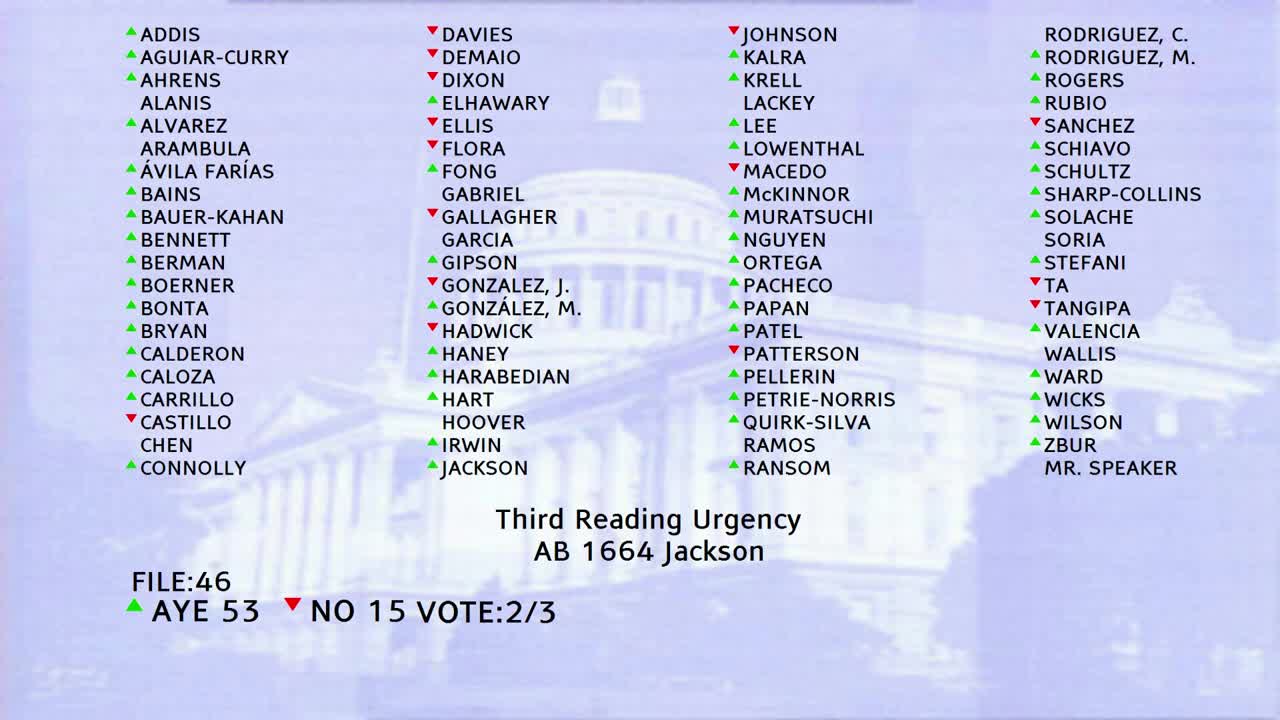 1MIN
Assembly Floor
 5MIN
Assembly Standing Committee on Aging and Long-Term Care
Bill Author

Bill Co-Author(s):