AB 1984: Corporate powers: political spending power.
- Session Year: 2025-2026
- House: Assembly
- Latest Version Date: 2026-04-16
Current Status:
In Progress
(2026-04-20: Re-referred to Com. on B. & F.)
Introduced
In Committee
Awaiting First Chamber Vote
Passed First Chamber
In Committee
Awaiting Second Chamber Vote
Passed Second Chamber
Enacted
Existing constitutional law establishes the First Amendment right of freedom of speech. Existing case law, including Citizens United v. Federal Election Commission (2010) 558 U.S. 310 and other judicial precedents, establishes that corporate entities have First Amendment rights to engage in political speech and places limits on the suppression of political speech.
Existing law regulates the formation and operation of various types of business and nonprofit entities, including corporations, nonprofit corporations, limited liability corporations, limited partnerships, limited liability partnerships, and unincorporated associations. associations and sets forth their powers and duties. Existing law requires the Secretary of State to receive and process corporate and nonprofit entity filings, maintain records of those filings, and perform related duties.
This bill would establish redefine the powers of corporations, as defined, artificial persons, as defined, organized under the Corporations Code. Code to specify that those powers do not include political spending power, as defined. The bill would revoke all powers, privileges, and capacities previously granted to corporations under state law and provide that a corporation operating under the jurisdiction of this state possesses only those powers, privileges, and capacities specifically granted in the Corporations Code. The bill would grant a corporation perpetual duration and succession in its name and every power held by an individual to do all things necessary or convenient to carry out its business and affairs, except as specified. The bill would specify that these provisions do not grant any power to a corporation to engage in ballot issue activity or election activity. The bill would declare void any act undertaken by a corporation beyond the scope of its granted powers.
The bill would declare void any act undertaken by a corporation beyond the scope of its granted powers, and would require that corporation to forfeit all granted powers. The bill would authorize reinstatement of granted powers after, among other things, disgorgement of all money used in the exercise of political spending power. The bill would authorize the Secretary of State to adopt rules regarding, among other things, reinstatement of forfeited powers. The bill would authorize the Attorney General with authority to enforce its provisions.
This bill would make its provisions severable and would further specify the intent and preference of the Legislature that corporations hold no powers at all, rather than be vested with powers for election activity or ballot issue activity. political spending power. The bill would make related findings and declarations.
Existing constitutional law establishes the First Amendment right of freedom of speech. Existing case law, including Citizens United v. Federal Election Commission (2010) 558 U.S. 310 and other judicial precedents, establishes that corporate entities have First Amendment rights to engage in political speech and places limits on the suppression of political speech.
Existing law regulates the formation and operation of various types of business and nonprofit entities, including corporations, nonprofit corporations, limited liability corporations, limited partnerships, limited liability partnerships, and unincorporated associations. Existing law requires the Secretary of State to receive and process corporate and nonprofit entity filings, maintain records of those filings, and perform related duties.
This bill would establish the powers of corporations, as defined, organized under the Corporations Code. The bill would revoke all powers, privileges, and capacities previously granted to corporations under state law and provide that a corporation operating under the jurisdiction of this state possesses only those powers, privileges, and capacities specifically granted in the Corporations Code. The bill would grant a corporation perpetual duration and succession in its name and every power held by an individual to do all things necessary or convenient to carry out its business and affairs, except as specified. The bill would specify that these provisions do not grant any power to a corporation to engage in ballot issue activity or election activity. The bill would declare void any act undertaken by a corporation beyond the scope of its granted powers.
This bill would make its provisions severable and would further specify the intent and preference of the Legislature that corporations hold no powers at all, rather than be vested with powers for election activity or ballot issue activity.
The Legislature finds and declares the following:
(a)All political power is inherent in the people. Corporations and other artificial persons are creations of statute that exist only by virtue of powers affirmatively extended by this state.
(b)The creation, continued existence, and enjoyment of charter privileges by an artificial person are not natural rights. These are conditional grants of legal status made by this state and accepted subject to the states reserved authority to define, limit, revise, or withdraw the powers and privileges it confers.
(c)State law has historically included broad grants of powers to artificial persons, including powers described as necessary or convenient to lawful purposes. These broad formulations have more recently been construed to include the legal capacity to engage in political spending, including both monetary expenditures and expenditures of anything of value, to support or oppose the outcome of a vote of the electorate.
(d)Because general grants of powers to artificial persons have been construed to include political spending power in a manner that does not reflect the will of the people, it is necessary to enact this title to redefine those grants and make their contents explicit. This ensures that the legal privileges conferred on artificial persons by the people through the state are not used to compromise the integrity of the political process.
(e)An artificial person formed under the laws of this state, or authorized to transact business or hold property in this state, accepts its legal status and any charter privileges subject to the continuing authority of the state to define the scope of the entitys powers. An artificial person does not acquire a vested right to the continuation of a particular statutory grant of power.
(f)The purpose of this title is to do all of the following:
(1)Establish that state-conferred legal status and charter privileges are granted to an artificial person only on the condition that the artificial person operates within the powers extended by the state.
(2)Make explicit that political spending power is not among the powers extended to artificial persons, except as expressly provided by law for political committees.
(3)Establish a single, uniform definition of the powers extended to artificial persons.
(4)Provide clear and enforceable consequences for the exercise of political spending power not extended by the state.
(5)Leave wholly undisturbed the constitutional rights of natural persons.
SECTION 1.SEC. 2.Title 1.5 (commencing with Section 14800) is added to the Corporations Code, to read:1.5.Corporate Powers14800.This title applies to all entities organized under this code and the laws of this state, unless expressly identified in statute. This title does not apply to any agency or instrumentality of the state or its political subdivisions.14801.(a)For purposes of this title, the following definitions apply:(1)Ballot issue activity means paying or contributing in order to directly or indirectly aid, promote, or prevent the passage of a ballot question or initiative.(2)Corporation means an entity whose existence or limited liability shield is conferred by the laws of this state and includes, but is not limited to, all of the following:(A)A corporation.(B)A nonprofit corporation.(C)A limited liability company.(D)A limited partnership.(E)A limited liability partnership.(3)Election activity means paying or contributing in order to directly or indirectly aid, promote, or prevent the nomination or election of any person, or to directly or indirectly aid or promote the interests, success, or defeat of any political party or organization.(b)The definitions in this title apply throughout this code, and unless otherwise provided by law, to all entities formed, organized, or authorized under this code or under any other general law of this state conferring corporate or entity powers.14802.(a)Upon the effective date of this title, all powers, privileges, and capacities previously granted to corporations under the laws of this state are revoked in their entirety and a corporation operating under the jurisdiction of this state shall possess only those powers, privileges, and capacities specifically granted by this code.(b)(1)(A)A corporation has perpetual duration and succession in its name.(B)A corporation possesses every power held by an individual to do all things necessary or convenient to carry out its business and affairs, except to the extent that its articles of incorporation expressly restrict the exercise of such powers.(C)The powers granted in this paragraph do not grant any power to engage in ballot issue activity or election activity.(2)A corporation organized under this code has no powers beyond those expressly granted.(3)This title does not grant or recognize any power to engage in election activity or ballot issue activity.(c)Any act undertaken by a corporation that lies outside the powers granted in this code is ultra vires and void. A corporation that exercises a power not granted under this code forfeits all corporate privileges, including limited liability and perpetual duration.(d)A foreign or out-of-state corporation that directly or indirectly undertakes, finances, or directs election activity or ballot issue activity in this state is conclusively deemed to be transacting business in this state for purposes of jurisdiction and enforcement.(e)Notwithstanding any other law, this title does not invalidate or impair any existing contract, debt instrument, security, or other legal obligation entered into before the effective date of this title.14803.(a)The provisions of this title are severable. If any provision of this title or its application is held invalid, that invalidity shall not affect other provisions or applications that can be given effect without the invalid provision or application.(b)If a provision of this title is deemed invalid or unconstitutional by a court of law, no earlier enacted law or code granting corporate powers shall be revived or reinstated without enactment by the Legislature. It is the intent and preference of the Legislature that corporations hold no powers at all, rather than be vested with powers for election activity or ballot issue activity.14800.(a)This title applies to all entities organized under this code and the laws of this state, and to any entity organized under the laws of another jurisdiction that is authorized to transact business, is otherwise transacting business, or holds property in this state.
(b)This title does not apply to any of the following:
(1)A natural person acting solely in an individual capacity.
(2)The state or any agency, authority, or political subdivision of the state.
(3)A public body, corporate and politic, expressly identified as such by statute.
(c)This act does not restrict the lawful activities of political committees organized and regulated under the election laws of this state or under federal law.
14801.(a)Artificial person means an entity whose existence, legal status, or limited liability shield is conferred by the laws of this state, including an entity organized or existing under the laws of another jurisdiction as described in subdivision (a) of Section 14800.
(b)Artificial person powers means the powers necessary or convenient for an artificial person to carry out lawful business, charitable, cooperative, or organizational purposes, excluding any political spending power.
(c)Charter privilege means any legal benefit that exists only because the state confers it on an artificial person, including, but not limited to, limited liability, perpetual duration, succession in the entitys name, or any statutory limitation on personal liability.
(d)(1)Political spending power means the legal capacity to pay, contribute, expend, transfer, or disburse money or anything of value to support or oppose either of the following:
(A)A candidate, political party, or political committee in an election held in this state.
(B)An initiative, referendum, recall, constitutional amendment, charter amendment, or any other question formally certified or submitted to the electors of this state or any political subdivision of this state.
(2)Political spending power does not include the distribution of any bona fide news story, commentary, or editorial distributed through the facilities of a broadcasting station or of any print, online, or digital newspaper, magazine, blog, or other periodical publication, unless the facility is owned or controlled by a political party, political committee, or candidate.
(3)Political spending power does not include the activities of a political committee organized and regulated under the election laws of this state or under federal law, provided that those activities are conducted in accordance with those laws.
14802.(a)The definitions in this title apply throughout this code, and to all entities formed, organized, or authorized under this code or any other general law of this state conferring corporate or entity powers.
(b)No provision of the laws of this state governing corporations or other entities shall be construed to extend political spending power to an artificial person except as expressly provided by law for political committees.
(c)Any grant of power, authority, or capacity to an artificial person that could otherwise be construed to include political spending power is superseded by this title and shall be given no effect.
14803.(a)The creation and continued existence of an artificial person is not a right, but a conditional grant of legal status by the state and remains subject to complete withdrawal at any time. Any powers previously granted to an artificial person under the laws of this state are revoked in their entirety, and an artificial person operating under the jurisdiction of this state shall possess no power unless power is specifically granted by this section.
(b)Each artificial person is hereby granted the artificial person powers defined in Section 14801 and elsewhere in this title and no other powers.
(c)Any act undertaken by an artificial person that constitutes an exercise of political spending power not extended by the state is ultra vires and void from the beginning.
(d)Any act undertaken by an artificial person that constitutes an exercise of political spending power not extended by the state shall not be ratified, validated, or given effect by consent, waiver, estoppel, reliance, course of dealing, or any other equitable doctrine, and creates no enforceable rights, obligations, or defenses.
(e)An out-of-state artificial person that directly or indirectly undertakes, finances, or directs acts constituting political spending power in California is conclusively deemed to be transacting business in this state for purposes of jurisdiction and enforcement.
(f)(1)An artificial person that exercises political spending power not extended by the state forfeits all charter privileges as a matter of law.
(2)An artificial person whose charter privileges are forfeited may be reinstated only pursuant to procedures administered by the Secretary of State and only upon full disgorgement of all money or things of value expended or disbursed in the exercise of political spending power and certification of future compliance with this title.
(g)The Secretary of State shall administer this title and may adopt rules necessary to implement the forfeiture, reinstatement, disgorgement, and certification processes described in this section.
(h)The Attorney General may bring an action to enforce this title, including, but not limited to, actions for declaratory relief, injunctive relief, disgorgement, and the revocation of an artificial persons charter or authority to transact business in this state.
14804.(a)This title does not invalidate or impair any existing contract, debt instrument, security, or other legal obligation lawfully entered into before the effective date of this title. This title does not authorize the exercise of political spending power on or after the effective date of this title.
(b)A power, privilege, or capacity withdrawn or not extended by this title shall not be revived, reinstated, or implied by operation of law or judicial construction.
(c)If any portion of this title is held invalid, it is the intent of the Legislature that an artificial person shall possess no powers at all rather than acquire political spending power.
14805.The provisions of this title are severable. If any provision of this title or its application is held invalid, that invalidity shall not affect other provisions or applications that can be given effect without the invalid provision or application.
This title applies to all entities organized under this code and the laws of this state, unless expressly identified in statute. This title does not apply to any agency or instrumentality of the state or its political subdivisions.
14801.(a)For purposes of this title, the following definitions apply:
(1)Ballot issue activity means paying or contributing in order to directly or indirectly aid, promote, or prevent the passage of a ballot question or initiative.
(2)Corporation means an entity whose existence or limited liability shield is conferred by the laws of this state and includes, but is not limited to, all of the following:
(A)A corporation.
(B)A nonprofit corporation.
(C)A limited liability company.
(D)A limited partnership.
(E)A limited liability partnership.
(3)Election activity means paying or contributing in order to directly or indirectly aid, promote, or prevent the nomination or election of any person, or to directly or indirectly aid or promote the interests, success, or defeat of any political party or organization.
(b)The definitions in this title apply throughout this code, and unless otherwise provided by law, to all entities formed, organized, or authorized under this code or under any other general law of this state conferring corporate or entity powers.
14802.(a)Upon the effective date of this title, all powers, privileges, and capacities previously granted to corporations under the laws of this state are revoked in their entirety and a corporation operating under the jurisdiction of this state shall possess only those powers, privileges, and capacities specifically granted by this code.
(b)(1)(A)A corporation has perpetual duration and succession in its name.
(B)A corporation possesses every power held by an individual to do all things necessary or convenient to carry out its business and affairs, except to the extent that its articles of incorporation expressly restrict the exercise of such powers.
(C)The powers granted in this paragraph do not grant any power to engage in ballot issue activity or election activity.
(2)A corporation organized under this code has no powers beyond those expressly granted.
(3)This title does not grant or recognize any power to engage in election activity or ballot issue activity.
(c)Any act undertaken by a corporation that lies outside the powers granted in this code is ultra vires and void. A corporation that exercises a power not granted under this code forfeits all corporate privileges, including limited liability and perpetual duration.
(d)A foreign or out-of-state corporation that directly or indirectly undertakes, finances, or directs election activity or ballot issue activity in this state is conclusively deemed to be transacting business in this state for purposes of jurisdiction and enforcement.
(e)Notwithstanding any other law, this title does not invalidate or impair any existing contract, debt instrument, security, or other legal obligation entered into before the effective date of this title.
14803.(a)The provisions of this title are severable. If any provision of this title or its application is held invalid, that invalidity shall not affect other provisions or applications that can be given effect without the invalid provision or application.
(b)If a provision of this title is deemed invalid or unconstitutional by a court of law, no earlier enacted law or code granting corporate powers shall be revived or reinstated without enactment by the Legislature. It is the intent and preference of the Legislature that corporations hold no powers at all, rather than be vested with powers for election activity or ballot issue activity.
|
Date
|
Status
|
|---|---|
| Apr 20, 2026 | Re-referred to Com. on B. & F. |
| Apr 16, 2026 | From committee chair, with author's amendments: Amend, and re-refer to Com. on B. & F. Read second time and amended. |
| Apr 6, 2026 | In committee: Hearing for testimony only. |
| Mar 2, 2026 | Referred to Coms. on B. & F. and JUD. |
| Feb 14, 2026 | From printer. May be heard in committee March 16. |
| Feb 13, 2026 | Read first time. To print. |
This list shows positions taken on this bill by organizations on the date displayed, which is linked to the original source.
Positions by individuals are not included.
|
Organization
|
Position
|
Date
|
|---|---|---|
| Acclamation Insurance Management Services | ** Against | |
| Allied Managed Care | ** Against | |
| Associated General Contractors, California | ** Against | |
| Associated General Contractors-San Diego Chapter | ** Against | |
| California Apartment Association | ** Against | |
| CALIFORNIA ASSOCIATION OF SHEET METAL & AIR CONDITIONING CONTRACTORS NATIONAL ASSOCIATION | ** Against | |
| California Building Industry Association (CBIA) | ** Against | |
| California Chamber Of Commerce | ** Against | |
| California Distributors Association | ** Against | |
| California Fuels And Convenience Alliance | ** Against | |
| California Grocers Association | ** Against | |
| California Hospital Association | ** Against | |
| California Hotel & Lodging Association | ** Against | |
| California League of Food Producers | ** Against | |
| California Manufacturers And Technology Association | ** Against | |
| California Retailers Association | ** Against | |
| California's Credit Unions | ** Against | |
| California Taxpayers Association (CALTAX) | ** Against | |
| California Trucking Association | ** Against | |
| Center for American Progress | ** Support | |
| City of Eureka | ** Support | |
| Del Norte County Democratic Central Committee | ** Support | |
| East Valley Indivisibles | ** Support | |
| Flasher Barricade Association | ** Against | |
| Humboldt County Chapter Physicians for a National Health Program and Health Care for All | ** Support | |
| Indivisible Ca Statestrong | ** Support | |
| Indivisible Sonoma County | ** Support | |
| Indivisible Ukiah | ** Support | |
| Leading Age California | ** Against | |
| Livermore Advocates for Public Education | ** Support | |
| Livermore Indivisible | ** Support | |
| Los Angeles Area Chamber Of Commerce | ** Against | |
| Mendocino County Democratic Central Committee | ** Support | |
| NATIONAL FEDERATION OF INDEPENDENT BUSINESS (NFIB) | ** Against | |
| Peace and Freedom Party of California | ** Support | |
| Prodemocracy Workgroup, Grassroots Institute | ** Support | |
| Santa Clara County-move to Amend | ** Support | |
| Sonoma County Democratic Party | ** Support |
Date of Hearing: April 6, 2026
ASSEMBLY COMMITTEE ON BANKING AND FINANCE
Avelino Valencia, Chair
ABPCA Bill Id:AB 1984 (
Author:Rogers) – As Introduced Ver:February 13, 2026
SUBJECT: Corporate powers
SUMMARY: Specifically, this bill:
- Applies to all entities organized under the laws of this state and to any entities organized under the laws of another jurisdiction that is authorized to conduct or is otherwise conducting business or holds property in this state.
- Does not apply to: A) a natural person acting solely in an individual capacity, B) the state or any agency, authority, or political subdivision of the state, C) a public body, corporate and politic, expressly identified as such by statute.
- Defines “artificial person” as an entity whose existence, legal status, or limited liability shield is conferred by the laws of this state, including and including an entity organized or existing under the laws of another jurisdiction.
- Defines “artificial person powers” as the powers necessary or convenient for an artificial person to carry out lawful business, charitable, cooperative, or organizational purposes, excluding any political spending power.
- Defines “political spending power” as the legal capacity to pay, contribute, expend, transfer, or disburse money or anything of value to support or oppose either:
- A candidate, political party, or political committee in an election held in this state,
- An initiative, referendum, recall, constitutional amendment, charter amendments, or any other question formally certified or submitted to the electors of this state or any political subdivision of this state
- Excludes the following from “political spending power”:
- The distribution of any bona fide news story, commentary or editorial distributed through facilities of broadcasting stations or similar information distribution unless the facility is owned or controlled by a political party, committee, or candidate.
- The activities of a political committee are organized and regulated under and conducted in accordance with the election laws of this state or under federal law.
- Revokes all existing powers, rights, privileges, and capabilities of existing business entities and limits business activities those expressly granted in the bill.
- Declares that the creation and continued existence of an artificial person is not a right, but a conditional grant of legal status imparted by the state and remains subject to complete withdrawal at any time.
- Simultaneously grants each artificial person the “artificial person powers” as defined, and no other powers.
- Expressly does not grant or recognize any power to engage in election activity or ballot issue activity.
- Void acts made by an entity that are outside the granted powers within the bill.
- Nullifies all corporation privileges including limited liabilities and operation in perpetuity upon exercise of a corporate power that is not granted in the bill.
- Authorizes reinstatement of granted powers after disgorgement of all money used in the exercise of political spending power and certification of future compliance with this title.
- Revokes and nullifies any grant of power authority, or capacity to an artificial person that could be construed to include political spending power presumably in sections outside of the Corporations code.
- Requires the Secretary of State to develop and administer rules necessary to implement the processes described in the statute,
- Empowers the Attorney General to enforce the title by bringing an action for declaratory relief, injunctive relief, disgorgement, and revocation of charter or authority to conduct business in this state.
- The title does not invalidate or impair any existing contract or debt instrument or other legal obligation lawfully entered into prior to enactment, except those constituting political spending power on or after the date of enactment.
- Provides that if any part of this title is invalid, it is the intent of the legislature that an artificial person shall possess no powers at all rather than acquire political spending power.
EXISTING LAW:
California:
- Provides the existence of corporations formed or existing on the date of enactment or reenactment of this division shall not be affected by the enactment or reenactment of this division nor by any change in the requirements for the formation of corporations nor by the amendment or repeal of the laws under which they were formed or created. Corporations Code section 102(b).
- Provides regulations through the Corporations Code over the following entity types:
- Corporations,
- Limited partnerships (LP),
- Limited liability partnerships (LLP),
- Limited liability companies (LLC),
- Cooperative corporations (Co-Ops),
- Non-profits
- Non-profit religious corporations,
- Corporations for specific purpose,
- Non-profit associations. See Corp Code 100 et seq.
- Requires entity formation and upkeep registration[1] with the Secretary of State.
- Corporations, Corp Code section 200
- Limited partnerships (LP), Corp Code section 15902.01
- Limited liability partnerships (LLP), Corp Code section 16953
- Limited liability companies (LLC), Corp Code section 17702.01
- Cooperative corporations (Co-Ops), Corp Code section 12300
- Non-profits, Corp Code section 5120
- Non-profit religious corporations, Corp Code Section 9120
- Corporations for specific purpose, Corp Code Section 12000
- Non-profit associations. Corp Code 200
- Limits personal liability for owners[2] of the entity.
- Corporations, Corp Code Section 204 (a)(10)
- Limited partnerships (LP), Corp Code Section 15903.03
- Limited liability partnerships (LLP), Corp Code Section 16306(c)
- Limited liability companies (LLC), Corp Code Section 17703.04
- Cooperative corporations (Co-Ops), Corp Code Section 12377
- Non-profits, Corp Code Section 5047.5
- Non-profit religious corporations, Corp Code Section 9247
- Non-profit associations. Corp Code Section 5047.5
Federal:
Corporations are generally formed under state law with minimal federal reporting requirements:
- Domestic and foreign entities conducting business in the United States of America are required to file information related to the identity and personal address of beneficial owners of the entity for the purposes of corporate transparency and anti-money laundering enforcement. 31 U.S.C.A. section 5336.
- Any person required under the federal tax authority to make a return, statement, or other similar document must do so with a proper identifying number as may be prescribed by the Internal Revenue Service (IRS). 26 U.S.C.A. section 6109 (a)(1).
- Every political committee shall have a treasurer. No contribution or expenditure shall be accepted or made by or on behalf of a political committee during any period in which the office of treasurer is vacant. No expenditure shall be made for or on behalf of a political committee without the authorization of the treasurer or his or her designated agent. 52 U.S.C.A. section 30102(a).
- The principal campaign committee of a candidate shall notify the Secretary or the Federal Election Commission, and the Secretary of State, as appropriate, in writing, of any contribution of $1,000 or more received by any authorized committee of such candidate after the 20th day, but more than 48 hours before any election. 52 U.S.C.A. section 30104(a)(6)(A).
FISCAL EFFECT: This bill is keyed Fiscal by Legislative Counsel.
COMMENTS:
Statement from the Author
AB 1984 is designed to end the disastrous legacy the Citizens United ruling has had on elections in California. At the heart of the Citizens United ruling lied an egregious assumption – that unlimited corporate campaign spending would not lead to corruption because it assumed this spending would be transparent and independent. The Court was wrong. Today, more than 15 years later, just under 80% of Americans agree that large independent expenditures by wealthy donors and corporations in elections give rise to corruption or the appearance of corruption. This cuts across all political parties, with 84% of Democrats, 74% of Republicans, and 79% of independents believing this to be the case. Simply put, corporations are a function of law and they do not exist without the explicit approval of the government. And while its passage will not overturn Citizens United, AB 1984 will have a sizable impact on returning electoral power to the average citizen.
Arguments in Support
A.B. 1984 amends the Corporations Code — not the Elections Code. This is a deliberate
and legally significant choice. The bill does not regulate political speech or impose
campaign finance restrictions. Instead, it exercises a power that California and every other
state have held since the founding: the authority to define what capacities artificial
persons receive when the state grants them legal existence.
Every corporation is a creature of state law. The state creates it, defines its powers, and
may revise those powers through the reserved power to amend or repeal corporate
charters — a power California has always retained. No federal court has ever held that a
state must grant political spending power to the artificial persons it creates. A.B. 1984
simply provides that California will no longer do so.
This framework has generated significant national momentum. Legislation based on the
Corporate Power Reset has been introduced in eleven states. In Montana, a ballot initiative
applying this approach cleared legal sufficiency review and is in active signature collection
for the November 2026 ballot.—Center for American Progress (Sponsor)
Arguments in Opposition
As written, this bill would prohibit business entities and nonprofits, including corporations, nonprofits corporations, limited liability companies, limited partnerships and limited liability partnerships, from engaging in any form of political activity. While general concerns about the influence of money in politics deserve thoughtful attention, a blanket prohibition on political participation by those entities explicitly violates protections under the First Amendment. AB 1984 not only would create unintended consequences that could undermine both the democratic process and economic stability of California but also risk the freedom of speech for all individuals, organizations and groups.
Businesses of all sizes are composed of individuals – employees, managers, etc. – whose collective interests often intersect with public policy. AB 1984 would prevent businesses from participating in political processes where they have legitimate perspectives to share, particularly on issues such as manufacturing operations, the development of new technologies, taxation, domestic and international trade, and labor. Either via the statewide ballot or through the legislative process, modifications to public policy frequently have direct and substantial impacts on the business community, and it is reasonable that the employer community have the ability to communicate our position to voters.—California Chamber of Commerce.
Background
- The Court Rulings at Issue
In 1972, the Supreme Court issued an opinion in Buckley v. Valeo[3] (“Buckley”), the landmark case involving the constitutionality of the Federal Election Campaign Act of 1971 (FECA), as amended in 1974, and the Presidential Election Campaign Fund Act.
In that case, the Court upheld the constitutionality of certain provisions of the election law, including:
- The limitations on contributions to candidates for federal office;
- The disclosure and recordkeeping provisions of the FECA; and
- The public financing of Presidential elections.
The Court declared other provisions of the FECA to be unconstitutional, in particular:
- The limitations on expenditures by candidates and their committees, except for Presidential candidates who accept public funding;
- The $1,000 limitation on independent expenditures;
- The limitations on expenditures by candidates from their personal funds; and
- The method of appointing members of the Federal Election Commission.
In Buckley, the Court found the anti-corruption interest to be sufficiently important to allow limits on contributions, but did not extend that reasoning to overall expenditure limits because there was less of a danger that expenditures would be given as a quid pro quo for commitments from that candidate. The findings of the unconstitutional provisions, particularly, the first three, cemented the concept that political spending is protected free speech. This case paved the way for Citizens United v. Federal Election Commission.
On January 21, 2010, the Supreme Court issued a ruling in Citizens United v. Federal Election Commission (FEC) (“United Citizens”) overruling an earlier decision, Austin v. Michigan State Chamber of Commerce, that allowed prohibitions on independent expenditures by corporations. The Court also overruled the part of McConnell v. Federal Election Commission that held that corporations could be banned from making electioneering communications.
General summary of United Citizens: The Federal Election Campaign Act ("the Act") prohibits corporations and labor unions from using their general treasury funds to make electioneering communications or for speech that expressly advocates the election or defeat of a federal candidate.[4] An electioneering communication is generally defined as "any broadcast, cable or satellite communication" that is "publicly distributed" and refers to a clearly identified federal candidate and is made within 30 days of a primary or 60 days of a general election.[5] During the 2008 primary presidential elections, Citizens United, a non-profit corporation, released a film about Democratic Party candidate, Hillary Clinton. Citizens United planned to make the film available for free through video-on-demand, which allows digital cable subscribers to select programming from various menus, within 30 days of the 2008 primary elections, but feared that the film would be covered by the Act’s ban on corporate-funded electioneering communications that are the functional equivalent of express advocacy, thus subjecting the corporation to civil and criminal penalties.
Preemptively, Citizens United sought declaratory and injunctive relief against the FEC arguing 1) that the ban on corporate electioneering communications under the Act was unconstitutional as applied to the film and 2) that disclosure and disclaimer requirements were unconstitutional as applied to the film and the three ads for the movie.
As to the first argument, the Supreme Court determined that addressing whether the Act’s ban applied to the film using Citizens United's narrow arguments would ultimately suppress political discourse protected by the First Amendment. Consequently, the Court concluded that its judicial duty required a broader evaluation of the ban's facial validity regarding corporate expenditures. This involved re-examining the legitimacy of speech prohibitions previously sustained by the Court in Austin. The Court in Austin identified a compelling governmental interest in limiting political speech by corporations by preventing "the corrosive and distorting effects of immense aggregations of wealth that are accumulated with the help of the corporate form and that have little or no correlation to the public’s support for the corporation’s political ideas."[6] However, upon examination in Citizens United, the Court found that Austin’s "antidistortion" rationale "interferes with the 'open marketplace of ideas' protected by the First Amendment."[7] The Court cited Buckley in finding that “prohibition on corporate independent expenditures is thus a ban on speech. As a ‘restriction on the amount of money a person or group can spend on political communication during a campaign,” that statute “necessarily reduces the quantity of expression by restricting the number of issues discussed, the depth of their exploration, and the size of the audience reached.’”[8] (emphasis added).
The Court noted that Act’s prohibition on corporate independent expenditures and electioneering communications is a ban on speech and "political speech must prevail against laws that would suppress it, whether by design or inadvertence."[9] Accordingly, laws that burden political speech are subject to "strict scrutiny," which requires the government to prove that the restriction furthers a compelling interest and is narrowly tailored to achieve that interest. According to the Court, "[a]ll speakers, including individuals and the media, use money amassed from the economic marketplace to fund their speech, and the First Amendment protects the resulting speech”.[10] The Court held that the First Amendment "prohibits Congress from fining or jailing citizens, or associations of citizens, for simply engaging in political speech."[11] (emphasis added).
As to the second argument regarding disclosure and disclaimer requirements, the Court upheld the constitutionality as to the film and the advertisements stating “disclaimer and disclosure requirements may burden the ability to speak, but they ‘impose no ceiling on campaign related activities,’...and ‘do not prevent anyone from speaking.’”[12] (internal citations omitted)
- Impact of Citizens United
 According to Open Secrets, an independent, non-partisan research group focused on tracking money in U.S. politics and its effects on public policy, in 2010, super PACs[13] spent $62.6 million. Two years later, in the first presidential election cycle following Citizens United, super PACs and hybrid PACs spent $622.7 million. Spending by those organizations surpassed $4.1 billion in 2024. Prior to the Citizens United ruling, the top 100 individual donors never accounted for more than 5.4% of the total cost of federal elections. (That peak came in 2004.) In 2010, the top 100 were responsible for 2.1%, but that share immediately began climbing, reaching 15.8% in 2022 and 14.8% in 2024 (as of Nov. 25).
- Dark Money and the Rise of Fake News
“Dark money” refers to spending meant to influence political outcomes where the source of the money is not disclosed. Here’s how dark money makes its way into elections:
- Politically active nonprofits such as 501(c)(4)s are generally under no legal obligation to disclose their donors even if they spend to influence elections. When they choose not to reveal their sources of funding, they are considered dark money groups.
- Opaque nonprofits and shell companies may give unlimited amounts of money to super PACs. While super PACs are legally required to disclose their donors, some of these groups are effectively dark money outlets when the bulk of their funding cannot be traced back to the original donor.
This lack of disclosure makes it harder for journalists, regulators and opponents to detect violations of campaign finance law, such as illegal contributions from foreign donors or government contractors and contributions over the legal limit. It also denies voters information they may find useful in determining the credibility of campaign advertisements materials. According to Brennan Center for Justice, “[d]uring the 2024 election cycle, shell companies and 501(c) nonprofits that did not disclose their funding sources gave $1.3 billion to super PACs — more than in the prior two election cycles combined.”[14]
 Following the Citizens United decision, dark money used to fund advertisements and fake news intended to influence the elections increased. In 2020, Open Secrets dug into this issue while investigating ACRONYM, a liberal dark money group with an affiliated super PAC called PACRONYM.[15] It found that ACRONYM is behind Courier Newsroom, a network of websites emulating progressive local news outlets and “most of the websites that make up Courier Newsroom received failing grades from NewsGuard, a group launched in 2018 by Steven Brill and Louis Gordon Crovitz that rates the reliability of online news sources. The low scores are due largely to an “undisclosed partisan Democratic perspective” and lack of financial transparency.”
- Implementation feasibility
This bill seeks to rebalance political spending persuasion caused by corporate political activity by creating a closed world of permitted business activity. This framework specifically excludes election or ballot issue activity. It also voids acts made by an entity[16] that are outside the permitted business activity while deeming the entity to have forfeited its charter privileges as a matter of law when it commits acts outside of the granted powers. To accomplish this, the bill revokes all existing entity rights, powers and privileges provided to domestic and foreign entities in this state and reinstates “artificial personhood” under the new terms. Finally, to further drive the significance of the issue, the bill also adds a "poison pill” or “failsafe”, depending on viewpoints, stating “that if any part of this title is invalid, it is the intent of the legislature that an artificial person shall possess no powers at all rather than acquire political spending power.”
State laws govern how a corporation is formed, structured, and managed, covering areas like shareholder rights, board responsibilities, and internal governance. The approach provided in this bill is responsive to the issue of First Amendment rights, raised in the prior landmark cases. Were one to rescind entity protections upon the act of election or ballot activity, which is considered speech under the Buckley and Citizens United cases, this regulatory enforcement becomes subject to First Amendment protected speech scrutiny. Instead, defining the legal powers of entities before any speech occurs, rather than imposing consequences after speech occurs refocuses the issues to only corporate powers. According to the sponsors, in this framework, regulation is based on the “legal capacities of entities whose existence and privileges—like limited liability and perpetual duration—exist only because the State created them. If an artificial entity nevertheless attempts to engage in activity outside those granted powers, the act is simply ultra vires under ordinary corporate law. The statute is therefore defining the boundaries of corporate capacity ex ante, not imposing consequences based on political activity.”
While this framework may[17] be responsive to First Amendment concerns, it is wholly contradictory to current existing law, specifically section 102 (b) of the Corporations code which provides “the existence of corporations formed or existing on the date of enactment or reenactment of this division shall not be affected by the enactment or reenactment of this division nor by any change in the requirements for the formation of corporations nor by the amendment or repeal of the laws under which they were formed or created.” (emphasis added).
Additionally, some outstanding concerns remain. It is unclear how this bill interacts with the detailed requirements under other sections of the Corporations Code. Additionally, does the closed framework leave open the possibility of unintentional violation by committing acts not expressly granted, but unrelated to political or ballot activity?[18] Will automatic forfeiture, if applied broadly to all actions not expressly granted, result in higher liability risks and insurance for entities including small businesses and businesses that have never engaged in political or ballot activity?
- Does this bill help return electoral power to the average citizen?
The author of this bill does try to reverse Citizens United, but believes that it will have a sizable impact on returning electoral power to the average citizen. It aims to curb dark money spending by removing a conduit by which it is achieved, the politically active non-profit.

However, eliminating this avenue, does not address the issue of unlimited PAC contributions by wealthy individuals, or the ability to donate via non-profit out of state with no, or de minimis ties to California, which would not be impacted by this bill. The figures below compare the top 10 donors by election cycle for 2010 and 2024 based on FEC disclosure data analyzed by Open Secrets. These donors, undeterred by disclosure requirements, have donated in sums far eclipsing those prior to Citizens United decision. Note that the second highest donor in 2024 was an individual. According to Forbes, the U.S. has the most billionaires, with a record 989, including 15 of the top 20.[19] The shear imbalance of wealth between the nearly 1,000 billionaires in this country and the average citizen for whom the average annual income is $62,608 in 2025[20] is enormous.


REGISTERED SUPPORT / OPPOSITION:
Support: Verified 4/3/2026
Center for American Progress
City of Eureka
Del Norte County Democratic Central Committee
East Valley Indivisibles
Humboldt County Chapter Physicians for a National Health Program and Health Care for All
Indivisible CA Statestrong
Indivisible Sonoma County
Indivisible Ukiah
Livermore Advocates for Public Education
Livermore Indivisible
Mendocino County Democratic Central Committee
Peace and Freedom Party of California
Prodemocracy Workgroup, Grassroots Institute
Santa Clara County-move to Amend
Sonoma County Democratic Party
19 Individuals
Opposition: Verified 4/3/2026
Acclamation Insurance Management Services
Allied Managed Care
Associated General Contractors, California
Associated General Contractors-San Diego Chapter
California Apartment Association
California Association of Sheet Metal & Air Conditioning Contractors National Association
California Building Industry Association (CBIA)
California Chamber of Commerce
California Distributors Association
California Fuels and Convenience Alliance
California Grocers Association
California Hospital Association
California Hotel & Lodging Association
California League of Food Producers
California Manufacturers and Technology Association
California Retailers Association
California Taxpayers Association (CALTAX)
California Trucking Association
California's Credit Unions
Flasher Barricade Association
Leading Age California
Los Angeles Area Chamber of Commerce
National Federation of Independent Business (NFIB)
Analysis Prepared by: Desiree Nguyen Orth / B. & F. / (916) 319-3081
Corp Code. Section 1502. ↑
For purposes of this analysis, verbiage specific to the entity type will not be used because of the expansive application of the bill. Descriptive terms will be used to represent concepts and positions where needed. ↑
Buckley v. Valeo, 424 U.S. 1 (1976) ↑
2 U.S.C. §441b ↑
2 U.S.C. §434(f)(3)(A) and 11 CFR 100.29(a)(2). ↑
Austin v. Michigan Chamber of Commerce, 494 U.S. 652 (1990) at 660. ↑
Citizens United v. FEC, 558 U.S. 310 (2010) at 38. ↑
Id. at 22. ↑
Id. at 23 ↑
Id. at 35. ↑
Id. at 33. ↑
d. at 51. ↑
PAC (Political Action Committee) is an organization established by a corporation or other special interest to raise money from individuals for a political campaign or other political cause. PACs include separate segregated funds (SSFs), nonconnected committees and Super PACs.
Super PACs (independent expenditure only political committees) are committees that may receive unlimited contributions from individuals, corporations, labor unions and other PACs for the purpose of financing independent expenditures and other independent political activity.
Hybrid PACs (political committees with non-contribution accounts) solicit and accept unlimited contributions from individuals, corporations, labor organizations and other political committees to a segregated bank account for the purpose of financing independent expenditures, other ads that refer to a federal candidate, and generic voter drives in federal elections, while maintaining a separate bank account, subject to all the statutory amount limitations and source prohibitions, that is permitted to make contributions to federal candidates. ↑
Massoglia, A. (2025, May 7)”Dark Money Hit a Record High of $1.9 Billion in 2024 Federal Races” Brennen Center for Justice ↑
Massoglia, A. (2020, May 22) “‘Dark money’ networks hide political agendas behind fake news sites” Open Secrets https://www.opensecrets.org/news/2020/05/dark-money-networks-fake-news-sites/ ↑
The term “artificial person” is used to refer to legal entities in this bill. The term “entity” is used in this analysis in place of the proposed “artificial person”. ↑
A prior version of the bill contained the following language relative to the forfeiture provision: “Any act undertaken by a corporation that lies outside the powers granted in this code is ultra vires and void. A corporation that exercises a power not granted under this code forfeits all corporate privileges, including limited liability and perpetual duration.” (emphasis added). This language is more representative of the rationale behind the corporate powers approach to the corporate campaign spending issue. It states that any act, indiscriminately, that is outside of the powers granted by the state is ultra vires.
The current relevant language states: “Any act undertaken by an artificial person that constitutes an exercise of political spending power not extended by the state is ultra vires and void from the beginning.” and “An artificial person that exercises political spending power not extended by the state forfeits all charter privileges as a matter of law.” In this amended language, despite maintaining that entities have no powers beyond what is granted, it specifies that acts that constitute “political spending power” are subject to forfeiture. This appears to undo the original mechanical intention since political spending power, which is considered free speech, would trigger forfeiture. ↑
See FN 17. Does the narrowing of the amended language result in non-forfeiture for exercises of power not granted in the bill if the act is not political spending power? ↑
“World’s Billionaires List; The Richest In 2026” Forbes https://www.forbes.com/billionaires/ Last accessed 4/2/2026. ↑
“Median weekly earnings of full-time wage and salary workers by detailed occupation and sex, 2025" US Bureau of Labor Statistics. ↑
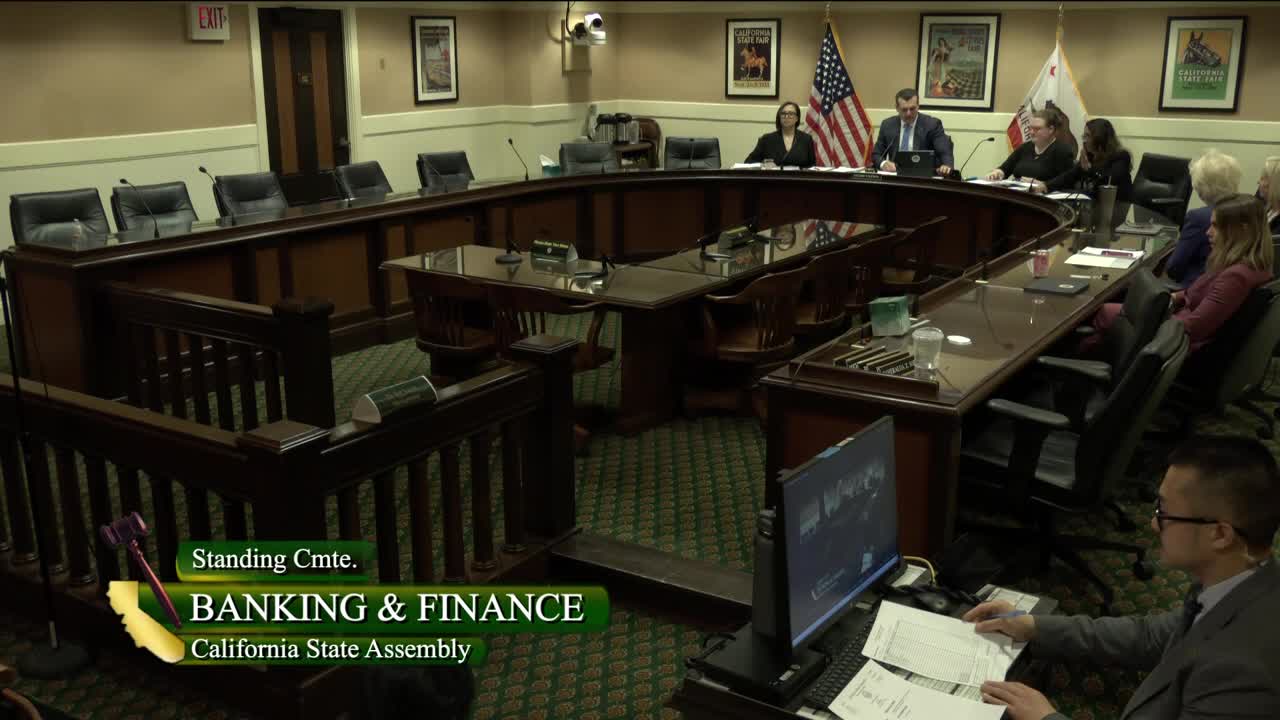
Discussed in Hearing
 53MIN
Assembly Standing Committee on Banking and Finance
Bill Author