AB 1987: Department-managed lands: wildlife areas: hunting.
- Session Year: 2025-2026
- House: Assembly
- Latest Version Date: 2026-09-30
Current Status:
Passed
(2026-09-30: Chaptered by Secretary of State - Chapter 913, Statutes of 2026.)
Introduced
In Committee
Awaiting First Chamber Vote
Passed First Chamber
In Committee
Awaiting Second Chamber Vote
Passed Second Chamber
Enacted
Existing law requires the Department of Fish and Wildlife to require the purchase of an entry permit for nonconsumptive uses of department-managed lands if the department finds that it is practical and would be cost effective for the state to collect entry permit fees, and imposes specified requirements if the department does so, including requiring the department to use the Automated License Data System to sell that entry permit. Existing law authorizes the department to lease department-managed lands for agricultural activities if certain conditions are met and requires money collected from the lease of these lands to be deposited by the department into the Wildlife Restoration Fund or the Fish and Game Preservation Fund, and authorizes the department, upon appropriation by the Legislature, to use the funds to support the management, maintenance, restoration, and operations of department-managed lands.
This bill would require the department to use the Automated License Data System to sell an entry permit for consumptive use and would authorize the department to use the Automated License Data System to sell an entry permit for nonconsumptive use if the department requires the purchase of an entry permit for nonconsumptive uses of department-managed lands, as described above. The bill would require, upon appropriation by the Legislature, the above-described agricultural lease funds to be used by the department to support the management, maintenance, restoration, and operations of department-managed lands.
Existing law requires the department to annually provide an opportunity for licensed hunters to comment and make recommendations on public hunting programs, including anticipated habitat conditions in hunting areas on Type A and Type B Wildlife Areas, as provided.
This bill would add wetland floodup to the topics that the department is required to provide an opportunity for comment and recommendation on as described above.
This bill would create the Waterfowl Management Areas Operations and Maintenance Fund in the State Treasury and would require all revenues generated from the sale of waterfowl hunting reservation applications and daily and season long entry passes from Type A and Type B Wildlife Areas to be deposited into the fund. The bill would require the department to, upon appropriation by the Legislature, expend those revenues for the operation and maintenance of, and the reasonable administrative costs directly related to, the public hunting programs for Type A and Type B Wildlife Areas. The bill would require the department to, on or before October 1, 2033, prepare and submit a report to the appropriate policy and budget committees of the Legislature, as specified.
Existing law requires the Department of Fish and Wildlife to operate department-managed lands on a nonprofit basis and authorizes the department to enter into contracts or other agreements for the management and operation of the department-managed lands with a nonprofit conservation group, as defined. require the purchase of an entry permit for nonconsumptive uses of department-managed lands if the department finds that it is practical and would be cost effective for the state to collect entry permit fees and imposes specified requirements if the department does so, including requiring the department to use the Automated License Data System to sell that entry permit. Existing law authorizes the department to lease department-managed lands for agricultural activities if certain conditions are met and requires money collected from the lease of these lands to be deposited by the department in the Wildlife Restoration Fund or the Fish and Game Preservation Fund, and authorizes the department, upon appropriation by the Legislature, to use the funds to support the management, maintenance, restoration, and operations of department-managed lands.
This bill would authorize the department to enter into contracts or other agreements for the management and operation of the department-managed lands for the purposes of administrating hunting or other public use programs. require the department to use the Automated License Data System to sell an entry permit for consumptive use and would authorize the department to use the Automated License Data System to sell an entry permit for nonconsumptive use if the department requires the purchase of an entry permit for nonconsumptive uses of department-managed lands, as described above. The bill would also require, upon appropriation by the Legislature, the above-described agricultural lease funds to be used by the department to support the management, maintenance, restoration, and operations of department-managed lands.
Existing law requires the department to annually provide an opportunity for licensed hunters to comment and make recommendations on public hunting programs, including anticipated habitat conditions in hunting areas on Type A and Type B wildlife areas, as provided.
This bill would add wetland floodup to the topics that the department is required to provide an opportunity for comment and recommendation on as described above.
This bill would create the Waterfowl Management Areas Operations and Maintenance Account Fund in the Fish and Game Preservation Fund State Treasury and would require all revenues generated from the sale of waterfowl hunting reservation applications and daily and season long entry passes from Type A and Type B Wildlife Areas to be deposited into the account. fund. The bill would require the department to, upon appropriation by the Legislature, expend those revenues for the operation and maintenance of, and the reasonable administrative costs directly related to, the public hunting programs for Type A and Type B Wildlife Areas. The bill would require the department to, on or before October 1, 2033, prepare and submit a report to the appropriate policy and budget committees of the Legislature, as specified.
Existing law requires the Department of Fish and Wildlife to operate department-managed lands on a nonprofit basis and authorizes the department to enter into contracts or other agreements for the management and operation of the department-managed lands with a nonprofit conservation group, as defined. Existing law authorizes the department to lease department-managed lands for agricultural activities if certain conditions are met and requires money collected from the lease of these lands to be deposited by the department in the Wildlife Restoration Fund or the Fish and Game Preservation Fund, and authorizes the department, upon appropriation by the Legislature, to use the funds to support the management, maintenance, restoration, and operations of department-managed lands.
This bill would authorize the department to enter into contracts or other agreements for the management and operation of the department-managed lands for the purposes of administrating hunting or other public use programs. The bill would also require, upon appropriation by the Legislature, the above-described agricultural lease funds to be used by the department to support the management, maintenance, restoration, and operations of department-managed lands.
Existing law requires the department to annually provide an opportunity for licensed hunters to comment and make recommendations on public hunting programs, including anticipated habitat conditions in hunting areas on Type A and Type B wildlife areas, as provided.
This bill would add wetland floodup to the topics that the department is required to provide an opportunity for comment and recommendation on as described above.
This bill would create the Waterfowl Management Areas Operations and Maintenance Account in the Fish and Game Preservation Fund and would require all revenues generated from the sale of waterfowl hunting reservation applications and daily and season long entry passes from Type A and Type B Wildlife Areas to be deposited into the account. The bill would continuously appropriate require the department to, upon appropriation by the Legislature, expend those revenues for the operation and maintenance of, and the reasonable administrative costs directly related to to, the public hunting programs for, for Type A and Type B Wildlife Areas. The bill would require the department to, on or before October 1, 2033, prepare and submit a report to the appropriate policy and budget committees of the Legislature, as specified.
Existing law requires the Department of Fish and Wildlife to operate department-managed lands on a nonprofit basis and authorizes the department to enter into contracts or other agreements for the management and operation of the department-managed lands with a nonprofit conservation group, as defined. Existing law authorizes the department to lease department-managed lands for agricultural activities if certain conditions are met and requires money collected from the lease of these lands to be deposited by the department in the Wildlife Restoration Fund or the Fish and Game Preservation Fund, and authorizes the department, upon appropriation by the Legislature, to use the funds to support the management, maintenance, restoration, and operations of department-managed lands.
This bill would authorize the department to enter into contracts or other agreements for the management and operation of the department-managed lands for the purposes of administrating hunting or other public use programs. The bill would also require, upon appropriation by the Legislature, the above-described funds to be used by the department to support the management, maintenance, restoration, and operations of department-managed lands.
Existing law requires the department to annually provide an opportunity for licensed hunters to comment and make recommendations on public hunting programs, including anticipated habitat conditions in hunting areas on Type A and Type B wildlife areas, as provided.
This bill would add wetland floodup to the topics that the department is required to provide an opportunity for comment and recommendation on as described above. The
This bill would create the Waterfowl Management Areas Operations and Maintenance Account in the Fish and Game Preservation Fund and would require all revenues generated from the sale of waterfowl hunting reservation applications and daily and season long entry passes from Type A and Type B Wildlife Areas to be deposited into the account. The bill would continuously appropriate those revenues for the operation and maintenance of, and the reasonable administrative costs directly related to the public hunting programs for, Type A and Type B Wildlife Areas.
Existing law requires the Department of Fish and Wildlife to operate department-managed lands on a nonprofit basis and authorizes the department to enter into contracts or other agreements for the management and operation of the department-managed lands with a nonprofit conservation group, as defined. Existing law authorizes the department to lease department-managed lands for agricultural activities if certain conditions are met and requires money collected from the lease of these lands to be deposited by the department in the Wildlife Restoration Fund or the Fish and Game Preservation Fund, and authorizes the department, upon appropriation by the Legislature, to use the funds to support the management, maintenance, restoration, and operations of department-managed lands.
This bill would authorize the department to enter into contracts or other agreements for the management and operation of the department-managed lands for the purposes of administrating hunting or other public use programs. The bill would also require, upon appropriation by the Legislature, the above-described funds to be used by the department to support the management, maintenance, restoration, and operations of department-managed lands.
Existing law requires the department to annually provide an opportunity for licensed hunters to comment and make recommendations on public hunting programs, including anticipated habitat conditions in hunting areas on Type A and Type B wildlife areas, as provided.
This bill would add wetland floodup to the topics that the department is required to provide an opportunity for comment and recommendation on as described above. The bill would create the Waterfowl Management Areas Operations and Maintenance Account in the Fish and Game Preservation Fund and would require all revenues generated from the sale of waterfowl hunting reservation applications and daily and season long entry passes from Type A and Type B Wildlife Areas to be deposited into the account. The bill would continuously appropriate those revenues for the operation and maintenance of, and the reasonable administrative costs directly related to the public hunting programs for, Type A and Type B Wildlife Areas.
Existing law establishes general laws that apply to the use of water in the state and provides definitions and interpretations that apply to those laws.This bill would make a nonsubstantive change to the definition of water for purposes of those provisions.Existing law establishes general laws that apply to the use of water in the state and provides definitions and interpretations that apply to those laws.
This bill would make a nonsubstantive change to the definition of water for purposes of those provisions.
(a)All revenues generated from the sale of waterfowl hunting reservation applications and daily and season-long entry passes from Type A and Type B Wildlife Areas, as defined under the commissions regulations, shall be deposited into the Waterfowl Management Areas Operations and Maintenance Fund that is hereby created in the State Treasury to permit separate accountability. Upon appropriation by the Legislature, moneys in the fund shall be expended by the department for both of the following purposes:
(1)Operation and maintenance of Type A and Type B Wildlife Areas.
(2)Reasonable administrative costs directly related to the public hunting programs for Type A and Type B Wildlife Areas.
(b)The funds in the Waterfowl Management Areas Operations and Maintenance Fund shall augment, and shall not replace, current spending levels for the operation and maintenance of Type A and Type B Wildlife Areas.
(c)(1)On or before October 1, 2033, the department shall prepare and submit a report to the appropriate policy and budget committees of the Legislature. The report shall include, but is not limited to, detailed information on annual department expenditure on the operations and maintenance and administration of, and other hunting or public use program-related activities on, department-managed lands for fiscal years 202627 to 203132, inclusive, including detailed revenue sources for and expenditures from the Waterfowl Management Areas Operations and Maintenance Fund, as applicable, and any other revenue sources, including agricultural leases. Expenditures shall be provided by location.
(2)For purposes of the report described in paragraph (1), data collection efforts shall avoid duplication and data collected for other purposes shall be used to the extent feasible.
(3)A report submitted pursuant to paragraph (1) shall be submitted in compliance with Section 9795 of the Government Code.
SEC. 2.Section 1745 of the Fish and Game Code is amended to read:1745.(a)For purposes of this section, the following terms have the following meanings:
(1)Department-managed lands includes lands, or lands and water, acquired for public shooting grounds, state marine (estuarine) recreational management areas, ecological reserves, and wildlife management areas.
(2)Nonconsumptive uses means compatible uses other than hunting and fishing.
(b)(1)Department-managed lands shall be operated on a nonprofit basis by the department.
(2)The department may enter into contracts or other agreements for the management and operation of department-managed lands with nonprofit conservation groups, recognized under Section 501(c) of the Internal Revenue Code, or resource conservation districts, as described in Chapter 3 (commencing with Section 9151) of Division 9 of the Public Resources Code.
(A)The contracts or other agreements authorized pursuant to this paragraph are not subject to Part 2 (commencing with Section 10100) of Division 2 of the Public Contract Code or Article 6 (commencing with Section 999) of Chapter 6 of Division 4 of the Military and Veterans Code.
(B)The contracts or other agreements authorized pursuant to this paragraph shall adhere to the goals and objectives included in an approved management plan and shall be consistent with the purpose for which the lands were acquired and managed by the department. Any changes to the management plan shall be subject to public review and comment.
(c)Multiple recreational use of department-managed lands is desirable and that use shall be encouraged by the commission. Except for hunting and fishing purposes, only minimum facilities to permit other forms of multiple recreational use, such as camping, picnicking, boating, or swimming, shall be provided.
(d)(1)Hunting, fishing, wildlife viewing, wildlife photography, conservation education, and fish and wildlife research are priority uses compatible with department-managed lands, except for ecological reserves where uses shall be considered on an individual basis.
(2)Public uses of department-managed lands not described in paragraph (1), or subdivision (c) or (f), shall be authorized by regulations adopted by the commission. The commission may require the purchase of a special use permit for these other uses.
(e)Except as provided in Section 1765 and subdivision (h), and to defray the costs associated with multiple use, the commission may determine and fix the amount of, and the department shall collect, fees for any use privileges. Only persons holding valid hunting licenses may apply for or obtain shooting permits for department-managed lands.
(f) Commencing January 1, 2015, the department shall require the purchase of an entry permit for nonconsumptive uses of department-managed lands if the department finds that it is practical and would be cost effective for the state to collect entry permit fees.
(g)The following shall apply if the department requires the purchase of an entry permit pursuant to subdivision (f):
(1)The department shall require the purchase of an entry permit for nonconsumptive uses of a department-managed land only if a sign providing notice of the requirement has been posted at the department-managed land.
(2)To the extent feasible, the department shall allow nonconsumptive users to purchase an entry permit onsite.
(3)The department shall use the Automated License Data System to sell an entry permit for consumptive use, and may use the Automated License Data System to sell an entry permit for nonconsumptive use.
(4)A nonconsumptive user shall have an entry permit in their immediate possession while on department-managed lands.
(h)Failure to obtain a permit as required pursuant to this section shall be an infraction as described in Section 12002.2.1. A person in possession of a valid hunting license, sport fishing license, or trapping license shall be exempt from a requirement to obtain a permit.
(i)The moneys generated pursuant to this section shall be deposited in the Native Species Conservation and Enhancement Account within the Fish and Game Preservation Fund, and shall be available, upon appropriation by the Legislature, to the department for the management and operation of its lands. To the extent that the department is able to identify the source of the fee revenue collected, the department shall provide no less than 35 percent of the funds generated pursuant to this section to the department-managed lands from which the fee revenues were collected.
(j)The commission and department may continue to allow free access to a department-managed land if the commission or department finds the best interests of that area would be served by not fixing a fee for use privileges.
SEC. 3.Section 1745.1 of the Fish and Game Code is amended to read:1745.1.(a)Notwithstanding any other provision of this code, the department may lease department-managed lands for agricultural activities, including, but not limited to, grazing, where consistent with the purpose for which the lands were acquired and compatible with the departments approved management plan for the area, if available.
(b)The moneys collected from agricultural leases entered into pursuant to subdivision (a) shall be deposited by the department into the Wildlife Restoration Fund or the Fish and Game Preservation Fund and, upon appropriation by the Legislature, shall be used to support the management, maintenance, restoration, and operations of department-managed lands.
SEC. 4.Section 1758 of the Fish and Game Code is amended to read:1758.The department shall annually provide an opportunity for licensed hunters to comment and make recommendations on the public hunting programs, including anticipated wetland floodup and habitat conditions in the hunting areas on Type A and Type B Wildlife Areas, as defined under the commissions regulations, through public meetings or other public outreach. In complying with this section, the department may hold regional meetings on its hunting programs for several different wildlife areas.
SEC. 5.Nothing in this act shall be construed to invalidate, impair, or require the rebidding of any memorandum of understanding, cooperative agreements, or partnership agreements entered into before January 1, 2027, between the Department of Fish and Wildlife and a nonprofit organization or other qualified entity for the provision of interpretive, educational, restoration, or public access programing on department-managed lands.
(a)All revenues generated from the sale of waterfowl hunting reservation applications and daily and season-long entry passes from Type A and Type B Wildlife Areas, as defined under the commissions regulations, shall be deposited into the Waterfowl Management Areas Operations and Maintenance Account Fund that is hereby created in the Fish and Game Preservation Fund State Treasury to permit separate accountability. Upon appropriation by the Legislature, moneys in the account fund shall be expended by the department for both of the following purposes:
(1)Operation and maintenance of Type A and Type B Wildlife Areas.
(2)Reasonable administrative costs directly related to the public hunting programs for Type A and Type B Wildlife Areas.
(b)The funds in the Waterfowl Management Areas Operations and Maintenance Account Fund shall augment, and shall not replace, current spending levels for the operation and maintenance of Type A and Type B Wildlife Areas.
(c)(1)On or before October 1, 2033, the department shall prepare and submit a report to the appropriate policy and budget committees of the Legislature. The report shall include, but is not limited to, detailed information on annual department expenditure on the operations and maintenance and administration of, and other hunting or public use program-related activities on, department-managed lands for fiscal years 202627 to 203132, inclusive, including detailed revenue sources for and expenditures from the Waterfowl Management Areas Operations and Maintenance Account, Fund, as applicable, and any other revenue sources, including agricultural leases. Expenditures shall be provided by location.
(2)For purposes of the report described in paragraph (1), data collection efforts shall avoid duplication and data collected for other purposes shall be used to the extent feasible.
(3)A report submitted pursuant to paragraph (1) shall be submitted in compliance with Section 9795 of the Government Code.
SEC. 2.Section 1745 of the Fish and Game Code is amended to read:1745.(a)For purposes of this section, the following terms have the following meanings:
(1)Department-managed lands includes lands, or lands and water, acquired for public shooting grounds, state marine (estuarine) recreational management areas, ecological reserves, and wildlife management areas.
(2)Nonconsumptive uses means compatible uses other than hunting and fishing.
(b)(1)Department-managed lands shall be operated on a nonprofit basis by the department.
(2)The department may enter into contracts or other agreements for the management and operation of department-managed lands with nonprofit conservation groups, recognized under Section 501(c) of the Internal Revenue Code, or resource conservation districts, as described in Chapter 3 (commencing with Section 9151) of Division 9 of the Public Resources Code, including for purposes of administrating hunting or other public use programs. Code.
(A)The contracts or other agreements authorized pursuant to this paragraph are not subject to Part 2 (commencing with Section 10100) of Division 2 of the Public Contract Code or Article 6 (commencing with Section 999) of Chapter 6 of Division 4 of the Military and Veterans Code.
(B)The contracts or other agreements authorized pursuant to this paragraph shall adhere to the goals and objectives included in an approved management plan and shall be consistent with the purpose for which the lands were acquired and managed by the department. Any changes to the management plan shall be subject to public review and comment.
(c)Multiple recreational use of department-managed lands is desirable and that use shall be encouraged by the commission. Except for hunting and fishing purposes, only minimum facilities to permit other forms of multiple recreational use, such as camping, picnicking, boating, or swimming, shall be provided.
(d)(1)Hunting, fishing, wildlife viewing, wildlife photography, conservation education, and fish and wildlife research are priority uses compatible with department-managed lands, except for ecological reserves where uses shall be considered on an individual basis.
(2)Public uses of department-managed lands not described in paragraph (1), or subdivision (c) or (f), shall be authorized by regulations adopted by the commission. The commission may require the purchase of a special use permit for these other uses.
(e)Except as provided in Section 1765 and subdivision (h), and to defray the costs associated with multiple use, the commission may determine and fix the amount of, and the department shall collect, fees for any use privileges. Only persons holding valid hunting licenses may apply for or obtain shooting permits for department-managed lands.
(f) Commencing January 1, 2015, the department shall require the purchase of an entry permit for nonconsumptive uses of department-managed lands if the department finds that it is practical and would be cost effective for the state to collect entry permit fees.
(g)The following shall apply if the department requires the purchase of an entry permit pursuant to subdivision (f):
(1)The department shall require the purchase of an entry permit for nonconsumptive uses of a department-managed land only if a sign providing notice of the requirement has been posted at the department-managed land.
(2)To the extent feasible, the department shall allow nonconsumptive users to purchase an entry permit onsite.
(3)The department shall use the Automated License Data System to sell an entry permit. permit for consumptive use, and may use the Automated License Data System to sell an entry permit for nonconsumptive use.
(4)A nonconsumptive user shall have an entry permit in their immediate possession while on department-managed lands.
(h)Failure to obtain a permit as required pursuant to this section shall be an infraction as described in Section 12002.2.1. A person in possession of a valid hunting license, sport fishing license, or trapping license shall be exempt from a requirement to obtain a permit.
(i)The moneys generated pursuant to this section shall be deposited in the Native Species Conservation and Enhancement Account within the Fish and Game Preservation Fund, and shall be available, upon appropriation by the Legislature, to the department for the management and operation of its lands. To the extent that the department is able to identify the source of the fee revenue collected, the department shall provide no less than 35 percent of the funds generated pursuant to this section to the department-managed lands from which the fee revenues were collected.
(j)The commission and department may continue to allow free access to a department-managed land if the commission or department finds the best interests of that area would be served by not fixing a fee for use privileges.
SEC. 3.Section 1745.1 of the Fish and Game Code is amended to read:1745.1.(a)Notwithstanding any other provision of this code, the department may lease department-managed lands for agricultural activities, including, but not limited to, grazing, where consistent with the purpose for which the lands were acquired and compatible with the departments approved management plan for the area, if available.
(b)The moneys collected from agricultural leases entered into pursuant to subdivision (a) shall be deposited by the department into the Wildlife Restoration Fund or the Fish and Game Preservation Fund and, upon appropriation by the Legislature, shall be used to support the management, maintenance, restoration, and operations of department-managed lands.
SEC. 4.Section 1758 of the Fish and Game Code is amended to read:1758.The department shall annually provide an opportunity for licensed hunters to comment and make recommendations on the public hunting programs, including anticipated wetland floodup and habitat conditions in the hunting areas on Type A and Type B Wildlife Areas, as defined under the commissions regulations, through public meetings or other public outreach. In complying with this section, the department may hold regional meetings on its hunting programs for several different wildlife areas.
SEC. 5.Nothing in this act shall be construed to invalidate, impair, or require the rebidding of any memorandum of understanding, cooperative agreements, or partnership agreements entered into before January 1, 2027, between the Department of Fish and Wildlife and a nonprofit organization or other qualified entity for the provision of interpretive, educational, restoration, or public access programing on department-managed lands.
(a)All revenues generated from the sale of waterfowl hunting reservation applications and daily and season-long entry passes from Type A and Type B Wildlife Areas, as defined under the commissions regulations, shall be deposited into the Waterfowl Management Areas Operations and Maintenance Account that is hereby created in the Fish and Game Preservation Fund to permit separate accountability. Notwithstanding Section 13340 of the Government Code, Upon appropriation by the Legislature, moneys in the account shall be continuously appropriated without regard to fiscal year to expended by the department for both of the following purposes:
(1)Operation and maintenance of Type A and Type B Wildlife Areas.
(2)Reasonable administrative costs directly related to the public hunting programs for Type A and Type B Wildlife Areas.
(b)The funds in the Waterfowl Management Areas Operations and Maintenance Account shall augment, and shall not replace, current spending levels for the operation and maintenance of Type A and Type B Wildlife Areas.
(c)(1)On or before October 1, 2033, the department shall prepare and submit a report to the appropriate policy and budget committees of the Legislature. The report shall include, but is not limited to, detailed information on annual department expenditure on the operations and maintenance and administration of, and other hunting or public use program-related activities on, department-managed lands for fiscal years 202627 to 203132, inclusive, including detailed revenue sources for and expenditures from the Waterfowl Management Areas Operations and Maintenance Account, as applicable, and any other revenue sources, including agricultural leases. Expenditures shall be provided by location.
(2)For purposes of the report described in paragraph (1), data collection efforts shall avoid duplication and data collected for other purposes shall be used to the extent feasible.
(3)A report submitted pursuant to paragraph (1) shall be submitted in compliance with Section 9795 of the Government Code.
SEC. 2.Section 1745 of the Fish and Game Code is amended to read:1745.(a)For purposes of this section, the following terms have the following meanings:
(1)Department-managed lands includes lands, or lands and water, acquired for public shooting grounds, state marine (estuarine) recreational management areas, ecological reserves, and wildlife management areas.
(2)Nonconsumptive uses means compatible uses other than hunting and fishing.
(b)(1)Department-managed lands shall be operated on a nonprofit basis by the department.
(2)The department may enter into contracts or other agreements for the management and operation of department-managed lands with nonprofit conservation groups, recognized under Section 501(c) of the Internal Revenue Code, or resource conservation districts, as described in Chapter 3 (commencing with Section 9151) of Division 9 of the Public Resources Code, including for purposes of administrating hunting or other public use programs.
(A)The contracts or other agreements authorized pursuant to this paragraph are not subject to Part 2 (commencing with Section 10100) of Division 2 of the Public Contract Code or Article 6 (commencing with Section 999) of Chapter 6 of Division 4 of the Military and Veterans Code.
(B)The contracts or other agreements authorized pursuant to this paragraph shall adhere to the goals and objectives included in an approved management plan and shall be consistent with the purpose for which the lands were acquired and managed by the department. Any changes to the management plan shall be subject to public review and comment.
(c)Multiple recreational use of department-managed lands is desirable and that use shall be encouraged by the commission. Except for hunting and fishing purposes, only minimum facilities to permit other forms of multiple recreational use, such as camping, picnicking, boating, or swimming, shall be provided.
(d)(1)Hunting, fishing, wildlife viewing, wildlife photography, conservation education, and fish and wildlife research are priority uses compatible with department-managed lands, except for ecological reserves where uses shall be considered on an individual basis.
(2)Public uses of department-managed lands not described in paragraph (1), or subdivision (c) or (f), shall be authorized by regulations adopted by the commission. The commission may require the purchase of a special use permit for these other uses.
(e)Except as provided in Section 1765 and subdivision (h), and to defray the costs associated with multiple use, the commission may determine and fix the amount of, and the department shall collect, fees for any use privileges. Only persons holding valid hunting licenses may apply for or obtain shooting permits for department-managed lands.
(f) Commencing January 1, 2015, the department shall require the purchase of an entry permit for nonconsumptive uses of department-managed lands if the department finds that it is practical and would be cost effective for the state to collect entry permit fees.
(g)The following shall apply if the department requires the purchase of an entry permit pursuant to subdivision (f):
(1)The department shall require the purchase of an entry permit for nonconsumptive uses of a department-managed land only if a sign providing notice of the requirement has been posted at the department-managed land.
(2)To the extent feasible, the department shall allow nonconsumptive users to purchase an entry permit onsite.
(3)The department shall use the Automated License Data System to sell an entry permit.
(4)A nonconsumptive user shall have an entry permit in their immediate possession while on department-managed lands.
(h)Failure to obtain a permit as required pursuant to this section shall be an infraction as described in Section 12002.2.1. A person in possession of a valid hunting license, sport fishing license, or trapping license shall be exempt from a requirement to obtain a permit.
(i)The moneys generated pursuant to this section shall be deposited in the Native Species Conservation and Enhancement Account within the Fish and Game Preservation Fund, and shall be available, upon appropriation by the Legislature, to the department for the management and operation of its lands. To the extent that the department is able to identify the source of the fee revenue collected, the department shall provide no less than 35 percent of the funds generated pursuant to this section to the department-managed lands from which the fee revenues were collected.
(j)The commission and department may continue to allow free access to a department-managed land if the commission or department finds the best interests of that area would be served by not fixing a fee for use privileges.
SEC. 3.Section 1745.1 of the Fish and Game Code is amended to read:1745.1.(a)Notwithstanding any other provision of this code, the department may lease department-managed lands for agricultural activities, including, but not limited to, grazing, where consistent with the purpose for which the lands were acquired and compatible with the departments approved management plan for the area, if available.
(b)The moneys collected from agricultural leases entered into pursuant to subdivision (a) shall be deposited by the department into the Wildlife Restoration Fund or the Fish and Game Preservation Fund and, upon appropriation by the Legislature, shall be used to support the management, maintenance, restoration, and operations of department-managed lands.
SEC. 4.Section 1758 of the Fish and Game Code is amended to read:1758.The department shall annually provide an opportunity for licensed hunters to comment and make recommendations on the public hunting programs, including anticipated wetland floodup and habitat conditions in the hunting areas on Type A and Type B Wildlife Areas, as defined under the commissions regulations, through public meetings or other public outreach. In complying with this section, the department may hold regional meetings on its hunting programs for several different wildlife areas.
SEC. 5.Nothing in this act shall be construed to invalidate, impair, or require the rebidding of any memorandum of understanding, cooperative agreements, or partnership agreements entered into before January 1, 2027, between the Department of Fish and Wildlife and a nonprofit organization or other qualified entity for the provision of interpretive, educational, restoration, or public access programing on department-managed lands.
(a)All revenues generated from the sale of waterfowl hunting reservation applications and daily and season-long entry passes from Type A and Type B Wildlife Areas, as defined under the commissions regulations, shall be deposited into the Waterfowl Management Areas Operations and Maintenance Account that is hereby created in the Fish and Game Preservation Fund to permit separate accountability. Notwithstanding Section 13340 of the Government Code, moneys in the account shall be continuously appropriated without regard to fiscal year to the department for both of the following purposes:
(1)Operation and maintenance of Type A and Type B Wildlife Areas.
(2)Reasonable administrative costs directly related to the public hunting programs for Type A and Type B Wildlife Areas.
(b)The funds in the Waterfowl Management Areas Operations and Maintenance Account shall augment, and shall not replace, current spending levels for the operation and maintenance of Type A and Type B Wildlife Areas.
SECTION 1.SEC. 2.Section 1745 of the Fish and Game Code is amended to read:1745.(a)For purposes of this section, the following terms have the following meanings:
(1)Department-managed lands includes lands, or lands and water, acquired for public shooting grounds, state marine (estuarine) recreational management areas, ecological reserves, and wildlife management areas.
(2)Nonconsumptive uses means compatible uses other than hunting and fishing.
(b)(1)Department-managed lands shall be operated on a nonprofit basis by the department.
(2)The department may enter into contracts or other agreements for the management and operation of department-managed lands with nonprofit conservation groups, recognized under Section 501(c) of the Internal Revenue Code, or resource conservation districts, as described in Chapter 3 (commencing with Section 9151) of Division 9 of the Public Resources Code, including for purposes of administrating hunting or other public use programs.
(A)The contracts or other agreements authorized pursuant to this paragraph are not subject to Part 2 (commencing with Section 10100) of Division 2 of the Public Contract Code or Article 6 (commencing with Section 999) of Chapter 6 of Division 4 of the Military and Veterans Code.
(B)The contracts or other agreements authorized pursuant to this paragraph shall adhere to the goals and objectives included in an approved management plan and shall be consistent with the purpose for which the lands were acquired and managed by the department. Any changes to the management plan shall be subject to public review and comment.
(c)Multiple recreational use of department-managed lands is desirable and that use shall be encouraged by the commission. Except for hunting and fishing purposes, only minimum facilities to permit other forms of multiple recreational use, such as camping, picnicking, boating, or swimming, shall be provided.
(d)(1)Hunting, fishing, wildlife viewing, wildlife photography, conservation education, and fish and wildlife research are priority uses compatible with department-managed lands, except for ecological reserves where uses shall be considered on an individual basis.
(2)Public uses of department-managed lands not described in paragraph (1), or subdivision (c) or (f), shall be authorized by regulations adopted by the commission. The commission may require the purchase of a special use permit for these other uses.
(e)Except as provided in Section 1765 and subdivision (h), and to defray the costs associated with multiple use, the commission may determine and fix the amount of, and the department shall collect, fees for any use privileges. Only persons holding valid hunting licenses may apply for or obtain shooting permits for department-managed lands.
(f) Commencing January 1, 2015, the department shall require the purchase of an entry permit for nonconsumptive uses of department-managed lands if the department finds that it is practical and would be cost effective for the state to collect entry permit fees.
(g)The following shall apply if the department requires the purchase of an entry permit pursuant to subdivision (f):
(1)The department shall require the purchase of an entry permit for nonconsumptive uses of a department-managed land only if a sign providing notice of the requirement has been posted at the department-managed land.
(2)To the extent feasible, the department shall allow nonconsumptive users to purchase an entry permit onsite.
(3)The department shall use the Automated License Data System to sell an entry permit.
(4)A nonconsumptive user shall have an entry permit in their immediate possession while on department-managed lands.
(h)Failure to obtain a permit as required pursuant to this section shall be an infraction as described in Section 12002.2.1. A person in possession of a valid hunting license, sport fishing license, or trapping license shall be exempt from a requirement to obtain a permit.
(i)The moneys generated pursuant to this section shall be deposited in the Native Species Conservation and Enhancement Account within the Fish and Game Preservation Fund, and shall be available, upon appropriation by the Legislature, to the department for the management and operation of its lands. To the extent that the department is able to identify the source of the fee revenue collected, the department shall provide no less than 35 percent of the funds generated pursuant to this section to the department-managed lands from which the fee revenues were collected.
(j)The commission and department may continue to allow free access to a department-managed land if the commission or department finds the best interests of that area would be served by not fixing a fee for use privileges.
SEC. 2.SEC. 3.Section 1745.1 of the Fish and Game Code is amended to read:1745.1.(a)Notwithstanding any other provision of this code, the department may lease department-managed lands for agricultural activities, including, but not limited to, grazing, where consistent with the purpose for which the lands were acquired and compatible with the departments approved management plan for the area, if available.
(b)The moneys collected from agricultural leases entered into pursuant to subdivision (a) shall be deposited by the department into the Wildlife Restoration Fund or the Fish and Game Preservation Fund and, upon appropriation by the Legislature, shall be used to support the management, maintenance, restoration, and operations of department-managed lands.
SEC. 3.SEC. 4.Section 1758 of the Fish and Game Code is amended to read:1758.(a)The department shall annually provide an opportunity for licensed hunters to comment and make recommendations on the public hunting programs, including anticipated wetland floodup and habitat conditions in the hunting areas on Type A and Type B Wildlife Areas, as defined under the commissions regulations, through public meetings or other public outreach. In complying with this section, the department may hold regional meetings on its hunting programs for several different wildlife areas.
(b)(1)All revenues generated from the sale of waterfowl hunting reservation applications and daily and season long entry passes from Type A and Type B Wildlife Areas shall be deposited into the Waterfowl Management Areas Operations and Maintenance Account that is hereby created in the Fish and Game Preservation Fund to permit separate accountability. Notwithstanding Section 13340 of the Government Code, moneys in the account shall be continuously appropriated without regard to fiscal year to the department for both of the following purposes:(A)Operation and maintenance of Type A and Type B Wildlife Areas.(B)Reasonable administrative costs directly related to the public hunting programs for Type A and Type B Wildlife Areas.(2)The funds in the Waterfowl Management Areas Operations and Maintenance Account shall augment, and shall not replace, current spending levels for the operation and maintenance of Type A and Type B Wildlife Areas.(a)For purposes of this section, the following terms have the following meanings:
(1)Department-managed lands includes lands, or lands and water, acquired for public shooting grounds, state marine (estuarine) recreational management areas, ecological reserves, and wildlife management areas.
(2)Nonconsumptive uses means compatible uses other than hunting and fishing.
(b)(1)Department-managed lands shall be operated on a nonprofit basis by the department.
(2)The department may enter into contracts or other agreements for the management and operation of department-managed lands with nonprofit conservation groups, recognized under Section 501(c) of the Internal Revenue Code, or resource conservation districts, as described in Chapter 3 (commencing with Section 9151) of Division 9 of the Public Resources Code. Code, including for purposes of administrating hunting or other public use programs.
(A)The contracts or other agreements authorized pursuant to this paragraph are not subject to Part 2 (commencing with Section 10100) of Division 2 of the Public Contract Code or Article 6 (commencing with Section 999) of Chapter 6 of Division 4 of the Military and Veterans Code.
(B)The contracts or other agreements authorized pursuant to this paragraph shall adhere to the goals and objectives included in an approved management plan and shall be consistent with the purpose for which the lands were acquired and managed by the department. Any changes to the management plan shall be subject to public review and comment.
(c)Multiple recreational use of department-managed lands is desirable and that use shall be encouraged by the commission. Except for hunting and fishing purposes, only minimum facilities to permit other forms of multiple recreational use, such as camping, picnicking, boating, or swimming, shall be provided.
(d)(1)Hunting, fishing, wildlife viewing, wildlife photography, conservation education, and fish and wildlife research are priority uses compatible with department-managed lands, except for ecological reserves where uses shall be considered on an individual basis.
(2)Public uses of department-managed lands not described in paragraph (1), or subdivision (c) or (f), shall be authorized by regulations adopted by the commission. The commission may require the purchase of a special use permit for these other uses.
(e)Except as provided in Section 1765 and subdivision (h), and to defray the costs associated with multiple use, the commission may determine and fix the amount of, and the department shall collect, fees for any use privileges. Only persons holding valid hunting licenses may apply for or obtain shooting permits for department-managed lands.
(f) Commencing January 1, 2015, the department shall require the purchase of an entry permit for nonconsumptive uses of department-managed lands if the department finds that it is practical and would be cost effective for the state to collect entry permit fees.
(g)The following shall apply if the department requires the purchase of an entry permit pursuant to subdivision (f):
(1)The department shall require the purchase of an entry permit for nonconsumptive uses of a department-managed land only if a sign providing notice of the requirement has been posted at the department-managed land.
(2)To the extent feasible, the department shall allow nonconsumptive users to purchase an entry permit onsite.
(3)The department shall use the Automated License Data System to sell an entry permit.
(4)A nonconsumptive user shall have an entry permit in his or her their immediate possession while on department-managed lands.
(h)Failure to obtain a permit as required pursuant to this section shall be an infraction as described in Section 12002.2.1. A person in possession of a valid hunting license, sport fishing license, or trapping license shall be exempt from a requirement to obtain a permit.
(i)The moneys generated pursuant to this section shall be deposited in the Native Species Conservation and Enhancement Account within the Fish and Game Preservation Fund, and shall be available, upon appropriation by the Legislature, to the department for the management and operation of its lands. To the extent that the department is able to identify the source of the fee revenue collected, the department shall provide no less than 35 percent of the funds generated pursuant to this section to the department-managed lands from which the fee revenues were collected.
(j)The commission and department may continue to allow free access to a department-managed land if the commission or department finds the best interests of that area would be served by not fixing a fee for use privileges.
SEC. 2.Section 1745.1 of the Fish and Game Code is amended to read:1745.1.(a)Notwithstanding any other provision of this code, the department may lease department-managed lands for agricultural activities, including, but not limited to, grazing, where consistent with the purpose for which the lands were acquired and compatible with the departments approved management plan for the area, if available.
(b)The moneys collected from agricultural leases entered into pursuant to subdivision (a) shall be deposited by the department into the Wildlife Restoration Fund or the Fish and Game Preservation Fund and, upon appropriation by the Legislature, may shall be used to support the management, maintenance, restoration, and operations of department-managed lands.
SEC. 3.Section 1758 of the Fish and Game Code is amended to read:1758.(a)The department shall annually provide an opportunity for licensed hunters to comment and make recommendations on the public hunting programs, including anticipated wetland floodup and habitat conditions in the hunting areas on Type A and Type B Wildlife Areas, as defined under the commissions regulations, through public meetings or other public outreach. In complying with this section, the department may hold regional meetings on its hunting programs for several different wildlife areas.
(b)(1)All revenues generated from the sale of waterfowl hunting reservation applications and daily and season long entry passes from Type A and Type B Wildlife Areas shall be deposited into the Waterfowl Management Areas Operations and Maintenance Account that is hereby created in the Fish and Game Preservation Fund to permit separate accountability. Notwithstanding Section 13340 of the Government Code, moneys in the account shall be continuously appropriated without regard to fiscal year to the department for both of the following purposes:
(A)Operation and maintenance of Type A and Type B Wildlife Areas.
(B)Reasonable administrative costs directly related to the public hunting programs for Type A and Type B Wildlife Areas.
(2)The funds in the Waterfowl Management Areas Operations and Maintenance Account shall augment, and shall not replace, current spending levels for the operation and maintenance of Type A and Type B Wildlife Areas.
SECTION 1.Section 1000 of the Water Code is amended to read:1000.When used in this division, water includes the term use of water.As When used in this division, water includes the term use of water.
|
Date
|
Status
|
|---|---|
| Sep 30, 2026 | Chaptered by Secretary of State - Chapter 913, Statutes of 2026. |
| Sep 30, 2026 | Approved by the Governor. |
| Sep 3, 2026 | Enrolled and presented to the Governor at 4 p.m. |
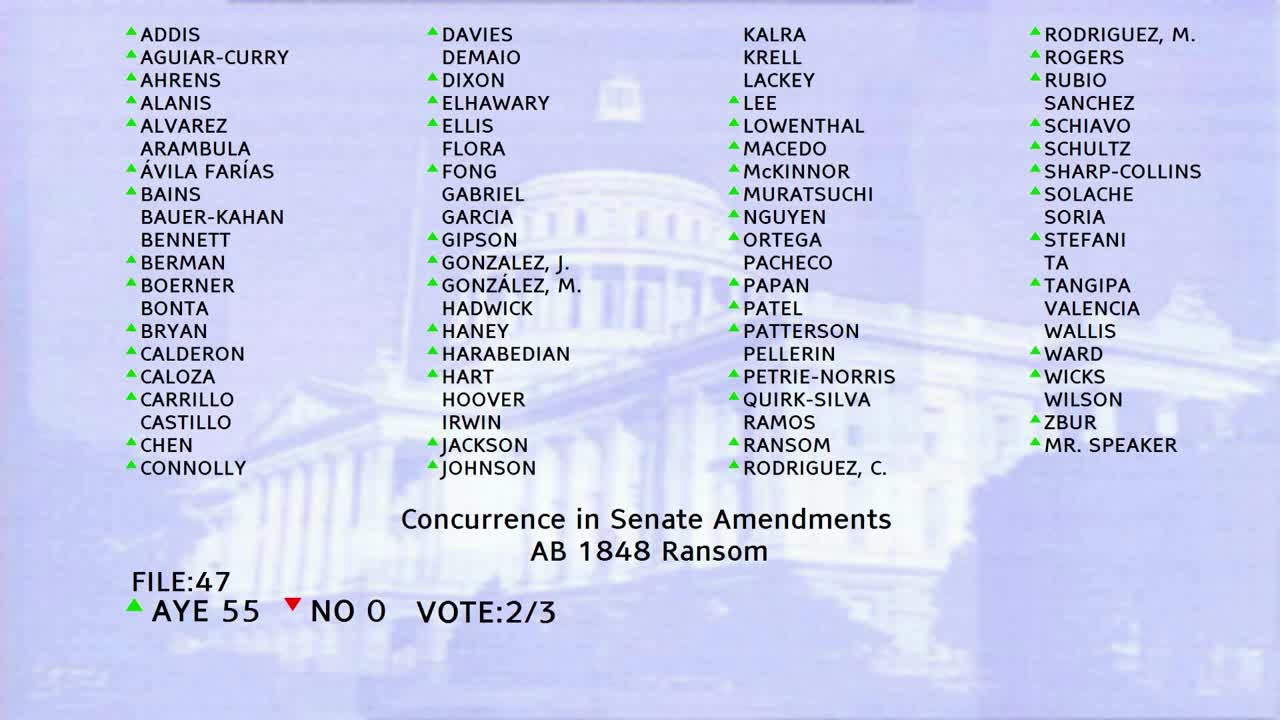
| Aug 26, 2026 | Senate amendments concurred in. To Engrossing and Enrolling. (Ayes 79. Noes 0. Page 6575.). |
| Aug 26, 2026 | Senate amendments concurred in. To Engrossing and Enrolling. (Ayes 79. Noes 0.). |
| Aug 25, 2026 | In Assembly. Concurrence in Senate amendments pending. |
| Aug 25, 2026 | Read third time. Passed. Ordered to the Assembly. (Ayes 40. Noes 0. Page 5782.). |
| Aug 25, 2026 | Read third time. Passed. Ordered to the Assembly. (Ayes 38. Noes 0.). |
| Aug 24, 2026 | Read second time. Ordered to third reading. |
| Aug 21, 2026 | Read third time and amended. Ordered to second reading. |
| Aug 19, 2026 | Ordered to third reading. |
| Aug 19, 2026 | From special consent calendar. |
| Aug 18, 2026 | Ordered to special consent calendar. |
| Aug 13, 2026 | Read second time. Ordered to third reading. |
| Aug 13, 2026 | From committee: Do pass. (Ayes 7. Noes 0.) (August 13). |
| Jun 22, 2026 | In committee: Referred to APPR. suspense file. |
| Jun 11, 2026 | Read second time and amended. Re-referred to Com. on APPR. |
| Jun 10, 2026 | From committee: Amend, and do pass as amended and re-refer to Com. on APPR. (Ayes 7. Noes 0.) (June 9). |
| May 6, 2026 | Referred to Com. on N.R. & W. |
| Apr 13, 2026 | In Senate. Read first time. To Com. on RLS. for assignment. |
| Apr 13, 2026 | Read third time. Passed. Ordered to the Senate. (Ayes 76. Noes 0. Page 4589.) |
| Apr 13, 2026 | Read third time. Passed. Ordered to the Senate. (Ayes 76. Noes 0.) |
| Apr 9, 2026 | Read second time. Ordered to third reading. |
| Apr 8, 2026 | From committee: Do pass. (Ayes 14. Noes 0.) (April 8). |
| Mar 26, 2026 | Re-referred to Com. on APPR. |
| Mar 25, 2026 | Read second time and amended. |
| Mar 24, 2026 | From committee: Amend, and do pass as amended and re-refer to Com. on APPR. (Ayes 12. Noes 0.) (March 24). |
| Mar 3, 2026 | Re-referred to Com. on W., P., & W. |
| Mar 2, 2026 | From committee chair, with author's amendments: Amend, and re-refer to Com. on W., P., & W. Read second time and amended. |
| Mar 2, 2026 | Referred to Com. on W., P., & W. |
| Feb 14, 2026 | From printer. May be heard in committee March 16. |
| Feb 13, 2026 | Read first time. To print. |
|
Date
|
Description
|
Location
|
Votes
|
|
|---|---|---|---|---|
| Aug 26, 2026 | AB 1987 Aguiar-Curry Concurrence in Senate Amendments | Assembly Floor |
Passed |
|
| Aug 25, 2026 | Assembly 3rd Reading AB1987 Aguiar-Curry et al. By Cortese | Senate Floor |
Passed |
|
| Aug 13, 2026 | Do pass | Senate Standing Committee on Appropriations |
Passed |
|
| Jun 22, 2026 | Placed on suspense file | Senate Standing Committee on Appropriations |
Passed |
|
| Jun 9, 2026 | Do pass as amended, but first amend, and re-refer to the Committee on [Appropriations] | Senate Standing Committee on Natural Resources and Water |
Passed |
|
| Apr 13, 2026 | AB 1987 Aguiar-Curry Assembly Third Reading | Assembly Floor |
Passed |
|
| Apr 8, 2026 | Do pass. | Assembly Standing Committee on Appropriations |
Passed |
|
| Mar 24, 2026 | Do pass as amended and be re-referred to the Committee on [Appropriations] | Assembly Standing Committee on Water, Parks, and Wildlife |
Passed |
This list shows positions taken on this bill by organizations on the date displayed, which is linked to the original source.
Positions by individuals are not included.
|
Organization
|
Position
|
Date
|
|---|---|---|
| Audubon California | ** Support | |
| Backcountry Hunters & Anglers | ** Support | |
| California Rice Commission | ** Support | |
| California Rifle and Pistol Association | ** Support | |
| California Waterfowl Association | ** Support | |
| Cal-Ore Wetlands and Waterfowl Council | ** Support | |
| Delta Waterfowl | ** Support | |
| Ducks Unlimited | ** Support | |
| Grassland Water District | ** Support | |
| Northern California Water Association | ** Support | |
| Suisun Resource Conservation District | ** Support | |
| The Black Brant Group | ** Support | |
| The Nature Conservancy | ** Support | |
| Tulare Basin Wetlands Association | ** Support |
CONCURRENCE IN SENATE AMENDMENTS
CSA1 Bill Id:AB 1987
Author:(Aguiar-Curry and Hadwick)
As Amended Ver:August 21, 2026
Majority vote
SUMMARY
Requires that revenues from Type A and Type B wildlife areas be used for the operation, maintenance, and reasonable administrative costs of Type A and Type B wildlife areas and authorizes the sale of nonconsumptive use entry permits through methods other than the Automated License Data System (ALDS).
Senate Amendments
- Create the Waterfowl Management Areas Operations and Maintenance Fund (Fund) in the State Treasury instead of an account within the Fish and Game Preservation Fund.
- Provide that moneys in the Fund are available for expenditure upon appropriation by the Legislature, rather than continuously appropriated.
- Require the Department of Fish and Wildlife (CDFW) to submit a report to the Legislature on revenues and expenditures on CDFW-managed lands by October 1, 2033.
- Authorize CDFW to sell nonconsumptive use entry permits through methods other than ALDS.
- Delete the specification that CDFW may enter into contracts with nonprofit conservation groups for administrating hunting or other public use programs on CDFW-managed lands.
- Provide that nothing in this bill shall be construed to invalidate, impair, or require the rebidding of any memorandum of understanding, cooperative agreement, or partnership agreement that currently exists.
COMMENTS
Type A and Type B wildlife areas are primarily for waterfowl hunting, while Type C wildlife areas are open for all legal species and are primarily for upland game. Type A and Type B areas are similar to one another and are distinguished by differences in reservation requirements and opening dates. Management expenses are also varied across wildlife area types, with Type A and Type B wildlife areas, which are generally on managed wetlands, requiring more active management than Type C wildlife areas. Wetland areas may require water pumping, mosquito abatement, and other costly operations and maintenance activities.
CDFW receives funding for wildlife areas from a variety of sources. The largest single funding source is grants issued by the U.S. Fish and Wildlife Service under the federal Pittman-Robertson Wildlife Restoration Act. Pittman-Robertson grants may be used for up to 75% of the cost of eligible projects. Other sources of funds for wildlife areas include program income (reservation application fees, hunter pass sales, and agricultural lease agreements), Proposition 99 (1988) funding, upland game bird validations, California duck stamps, and environmental license plate funds. Federal Pittman-Robertson funding (collected from an excise tax on firearms, ammunition, and archery equipment) has declined from a peak of nearly $39 million in fiscal year (FY) 2022–23 to just over $29 million in FY 2024–25. Proposition 99 funding, from a surtax on tobacco products, is also decreasing, with cigarette tax revenues declining from approximately $152 million in FY 2023–24 to a projected $138 million in FY 2025–26. These revenue declines compound ongoing budget issues for CDFW, which estimates that only 35% of funding needs for lands and facilities are met within the FY 2024–25 budget.
Fees for the different classes of wildlife areas are significantly different. Type A wildlife areas require both reservations and hunting passes, while Type B wildlife areas require hunting passes (and reservations on opening weekend only). Type C wildlife areas do not require the purchase of a hunting pass for entry. Where reservations are required, hunters may need to enter many drawings (at a cost of $1.34 per entry) in order to win a reservation, as 2024–2025 regular season waterfowl application success rates ranged from 0.74% to 57.8%, depending on choice of hunt. In addition to reservations, hunting passes are required: season passes for Type A and Type B wildlife areas are $213.84 and $71.85, respectively.
In addition to fees required for consumptive uses (i.e., hunting), some wildlife areas require fees for nonconsumptive uses (e.g., hiking, wildlife viewing, etc.). An annual Lands Pass for nonconsumptive uses costs $33.48. Where these fees are collected (and where practical for CDFW), 35% of the revenue from these fees must be provided to the department-managed lands where the use occurred. Additionally, unlike hunting revenue which is deposited into the Fish and Game Preservation Fund generally, nonconsumptive user fees are deposited into the Native Species Conservation and Enhancement Account within the Fish and Game Preservation Fund, which is designated for the support of nongame and native plant species conservation and enhancement programs. Currently, these fees can only be collected through ALDS, a system primarily designed to sell and track hunting and fishing licenses.
An additional source of revenue on department-managed lands is agricultural leases. CDFW enters into agricultural leases on some department-managed lands for grazing and wildlife-friendly agriculture. There are currently approximately $3 million in agricultural leases on CDFW lands. This money is available for the operation and maintenance of wildlife areas and ecological reserves, generally in the CDFW region in which it is generated, though statute does not place any controls on expenditure.
Hunters are a key constituency for CDFW wildlife areas, and consultation is required by law with hunters on public hunting programs and habitat conditions in the hunting areas on Type A and Type B wildlife areas. This outreach and consultation includes proposed wetland flood-up schedules. The primary consideration for CDFW in making wetland flood-up decisions is the wellbeing of the wildlife that the areas were acquired for, and in addition to hunter input, CDFW considers nonconsumptive uses and mosquito abatement requirements.
According to the Author
"State Wildlife Areas play a vital role in protecting California's wetlands and waterfowl while also providing opportunities for outdoor recreation such as hunting, fishing, and wildlife viewing. However, many of these lands face growing maintenance challenges due to limited staff and declining traditional funding sources…[This bill] will ensure that revenues generated by these areas are reinvested directly into their operation and management so they can continue to serve both conservation and public access for years to come."
Arguments in Support
The California Waterfowl Association writes: "Currently, Type A and B State Wildlife Areas are facing major challenges related to reduced staff and often insufficient [operations and maintenance] budgets. . . . Water pumping, mosquito abatement, noxious weed control and other annual wetland maintenance expenses continue to become more costly every year." The California Waterfowl Association continues: "[this] bill would ensure that hunter-generated user fee revenues (about $3 million annually) from Type A and Type B Wildlife Areas (a.k.a. Waterfowl Management Areas) are used solely for the operations and maintenance of those lands."
Arguments in Opposition
None on file.
FISCAL COMMENTS
According to the Senate Appropriations Committee, there are "unknown but potentially significant costs, likely over $150,000 (General Fund or Fish and Game Preservation Fund) for [CDFW] to prepare and submit a report to the appropriate policy and budget committees of the Legislature, as specified, among other things."
VOTES:
ASM WATER, PARKS, AND WILDLIFE: 12-0-1
YES: Papan, Jeff Gonzalez, Alanis, Alvarez, Bains, Bennett, Boerner, Caloza, Gallagher, Hart, Ward, Rogers
ABS, ABST OR NV: Ávila Farías
ASM APPROPRIATIONS: 14-0-1
YES: Wicks, Hoover, Arambula, Caloza, Dixon, Fong, Mark González, Krell, Muratsuchi, Pacheco, Pellerin, Solache, Ta, Tangipa
ABS, ABST OR NV: Calderon
ASSEMBLY FLOOR: 76-0-4
YES: Addis, Aguiar-Curry, Ahrens, Alanis, Alvarez, Arambula, Ávila Farías, Bains, Bauer-Kahan, Bennett, Berman, Boerner, Bonta, Bryan, Calderon, Caloza, Carrillo, Castillo, Chen, Connolly, Davies, DeMaio, Dixon, Elhawary, Ellis, Fong, Gabriel, Gallagher, Garcia, Gipson, Jeff Gonzalez, Mark González, Hadwick, Haney, Harabedian, Hart, Hoover, Irwin, Jackson, Johnson, Kalra, Krell, Lackey, Lowenthal, Macedo, McKinnor, Muratsuchi, Nguyen, Ortega, Pacheco, Papan, Patel, Patterson, Pellerin, Petrie-Norris, Quirk-Silva, Ramos, Ransom, Michelle Rodriguez, Rogers, Blanca Rubio, Sanchez, Schiavo, Schultz, Sharp-Collins, Solache, Soria, Stefani, Ta, Tangipa, Wallis, Ward, Wicks, Wilson, Zbur, Rivas
ABS, ABST OR NV: Flora, Lee, Celeste Rodriguez, Valencia
UPDATED
VERSION: August 21, 2026
CONSULTANT: Sean Clair / W., P., & W. / (916) 319-2096 FN: 0004188
SENATE RULES COMMITTEE Office of Senate Floor Analyses (916) 651-4171 | AB 1987 |
THIRD READING
Bill No: AB 1987
Author: Aguiar-Curry (D) and Hadwick (R), et al.
Amended: 8/20/26 in Senate
Vote: 21
SENATE NATURAL RES. & WATER COMMITTEE: 7-0, 6/9/26
AYES: Becker, Seyarto, Allen, Cabaldon, Grove, Laird, Reyes
SENATE APPROPRIATIONS COMMITTEE: 7-0, 8/13/26
AYES: Cervantes, Seyarto, Cabaldon, Dahle, Grayson, Richardson, Wahab
ASSEMBLY FLOOR: 76-0, 4/13/26 - See last page for vote
SUBJECT: Department-managed lands: wildlife areas: hunting
SOURCE: California Waterfowl Association
DIGEST:
This bill 1) creates the Waterfowl Management Areas Operations and Management Fund (fund) and requires moneys in the fund, upon appropriation, to be expended by the California Department of Fish and Wildlife (department) for the operation and maintenance of certain wildlife areas; 2) requires all revenues generated from the sale of waterfowl hunting reservation applications and certain wildlife area entry passes to be deposited in the created fund; and 3) requires account funds to be used to augment and not replace current spending levels for the operation and maintenance of Type A and Type B wildlife areas, among other provisions, as provided.
Senate Floor Amendments of 8/20/26 create the fund as a stand-alone fund instead of an account within an established fund; authorize the department to use the existing online license system to sell entry permits for non-consumptive uses on department-managed lands; and make other minor and conforming changes.
ANALYSIS:
Existing law:
- Establishes the department in the California Natural Resources Agency. States that the department’s mission “is to manage California’s diverse fish, wildlife, and plant resources, and the habitats upon which they depend, for their ecological value and for their use and enjoyment by the public,” and provides that its core programs include biodiversity conservation, enforcement, and hunting, fishing, and public use, among others. (Fish and Game Code (FGC) §712.1)
- States legislative intent that the costs of hunting and sportfishing programs be provided out of hunting and sportfishing revenues and reimbursements and federal funds received for hunting and sportfishing programs, and other funds appropriated by the Legislature, and that these funds not be used to support commercial fishing programs, free hunting and fishing license programs, or nongame fish and wildlife programs, as provided. (FGC §711)
- Establishes the Fish and Game Preservation Fund (FGPF) in the State Treasury for all money collected relating to the protection and preservation of birds, mammals, fish, reptiles, or amphibia, and creates various accounts and subaccounts within the FGPF. (FGC §§13000 et seq.)
- Makes the money in the FGPF available, upon appropriation by the Legislature, to the department for expenditure for the protection and preservation of birds, mammals, reptiles, amphibians, and fish, as specified. (FGC §13220)
- Defines “department-managed lands” to include lands, or lands and water, acquired for public shooting grounds, state marine (estuarine) recreational management areas, ecological reserves, and wildlife management areas.
- Requires that department-managed lands be operated on a nonprofit basis by the department.
- Authorizes the department to enter into contracts or other agreements for the management and operation of department-managed lands with nonprofit conservation groups or resource conservation districts.
- Requires the department to require the purchase of an entry permit for nonconsumptive use on department-managed lands if the department finds that it is practical and cost effective to require entry permit fees.
- Provides that multiple recreational use of department-managed lands is desirable and that use shall be encouraged by the commission.
- Requires that revenue from entry permit fees be deposited in the Native Species Conservation and Enhancement Account within the FGPF.
- Requires that, to the extent that the department is able to identify the source of revenue, the department provides no less than 35% of the funds generated from nonconsumptive entry permits to department-managed lands from which the fee revenues were collected. (FGC §1745)
- Authorizes the department to lease department-managed lands for agricultural activities and provides that the revenue from agricultural leases be deposited into the Wildlife Restoration Fund or the FGPF and authorizes its use to support the management, maintenance, restoration, and operations of department-managed lands. (FGC §1745.1)
- Provides that, except in accordance with California Fish and Game Commission regulations, it is unlawful to enter any department-managed wildlife area or public shooting ground. (FGC §1530)
- Requires the department to provide an annual opportunity for licensed hunters to comment and make recommendations on public hunting programs, including anticipated habitat conditions, in the hunting areas on Type A and Type B wildlife areas. (FGC §1758)
Existing regulation:
- Defines the following types of wildlife areas:
- “Type A” Wildlife Areas are wildlife areas which have restricted hunter access during waterfowl season and require a hunting pass to be purchased in advance and exchanged for an entry permit at the wildlife areas. Makes available reservations. Species open for hunting are waterfowl, coots, moorhens, snipe, pheasant, and dove, unless otherwise specified, and shoot days are Saturdays, Sundays, and Wednesdays during waterfowl season, youth waterfowl hunt days, and daily during the September dove season. Type A wildlife areas are closed to hunting on Christmas Day.
- “Type B” wildlife areas are wildlife areas which have restricted hunted access during waterfowl season and require a Type A or Type B season hunting pass to be purchased in advance and presented for an entry permit at the wildlife area. Requires reservations for opening weekend. Species open for hunting include waterfowl, coots, moorhens, snipe, pheasant, and dove, unless otherwise specified, and shoot days are Saturdays, Sundays, and Wednesdays during waterfowl season and daily during the September dove season. Some Type B wildlife areas are open to hunting on Christmas Day.
- “Type C” wildlife areas are wildlife areas that are open daily for hunting all legal species and do not require the purchase of a hunting pass for entry. (Title 14, California Code of Regulations, Section 551)
This bill:
- Creates the Waterfowl Management Areas Operations and Management Fund (fund) within the State Treasury, as provided.
- Upon appropriation by the Legislature, requires moneys in the fund to be expended by the department for:
- Operation and maintenance of Type A and Type B Wildlife Areas.
- Reasonable administration costs directly related to public hunting programs for Type A and Type B Wildlife Areas.
- Upon appropriation by the Legislature, requires moneys in the fund to be expended by the department for:
- Requires all revenues generated from the sale of waterfowl hunting reservation applications and daily and season-long entry passes from Type A and Type B Wildlife areas to be deposited in the fund.
- Requires funds in the fund to augment and not replace current spending levels for the operation and maintenance of Type A and Type B Wildlife Areas.
- Requires, rather than authorizes, moneys in the Wildlife Restoration Fund or the FGPF from agricultural leases on department-managed lands to be used to support the management, maintenance, restoration, and operations of department-managed lands.
- Requires the department, on or before October 1, 2033, to prepare and submit a legislative report including, but not limited to, detailed information on annual department expenditures on the operations and maintenance and administration of, and other hunting or public use program-related activities on, department-management lands; and revenues to and expenditures from the fund, as provided.
- Adds anticipated wetland floodup to conditions in the hunting areas on Type A and Tube B Wildlife Areas that licensed hunters are provided an annual opportunity to comment on to the department, as provided.
- Provides that nothing in this act shall be construed to invalidate, impair, or require the rebidding or any memorandum of understanding, cooperative agreements, or partnership agreements entered into before January 1, 2027 between the department and a nonprofit organization or other qualified entity for the provision of certain programming on department-managed lands.
- Makes additional minor and technical changes.
[NOTE: For additional information regarding this bill, see the Senate Natural Resources and Water Committee analysis.]
FISCAL EFFECT: Appropriation: No Fiscal Com.: Yes Local: No
According to the Senate Appropriations Committee:
- Unknown but potentially significant costs, likely over $150,000 (General Fund or Fish and Game Preservation Fund [FGPF]) for the California Department of Fish and Wildlife (CDFW) to prepare and submit a report to the appropriate policy and budget committees of the Legislature, as specified, among other things.
SUPPORT: (Verified 8/20/26)
California Waterfowl Association (source)
Audubon California
Backcountry Hunters & Anglers
Cal-Ore Wetlands and Waterfowl Council
California Rice Commission
California Rifle and Pistol Association
Delta Waterfowl
Ducks Unlimited
Grassland Water District
Northern California Water Association
Suisun Resource Conservation District
The Black Brant Group
The Nature Conservancy
Tulare Basin Wetlands Association
OPPOSITION: (Verified 8/20/26)
None received
ARGUMENTS IN SUPPORT: According to the author, “State Wildlife Areas play a vital role in protecting California’s wetlands and waterfowl while also providing opportunities for outdoor recreation such as hunting, fishing, and wildlife viewing. However, many of these lands face growing maintenance challenges due to limited staff and declining traditional funding sources. Yolo, Lake, Colusa, and Napa Counties all include several wildlife areas, making their long-term stewardship especially important to communities and wildlife in my district. AB 1987 will ensure that revenues generated by these areas are reinvested directly into their operation and management so they can continue to service both conservation and public access for years to come.”
ASSEMBLY FLOOR: 76-0, 4/13/26
AYES: Addis, Aguiar-Curry, Ahrens, Alanis, Alvarez, Arambula, Ávila Farías, Bains, Bauer-Kahan, Bennett, Berman, Boerner, Bonta, Bryan, Calderon, Caloza, Carrillo, Castillo, Chen, Connolly, Davies, DeMaio, Dixon, Elhawary, Ellis, Fong, Gabriel, Gallagher, Garcia, Gipson, Jeff Gonzalez, Mark González, Hadwick, Haney, Harabedian, Hart, Hoover, Irwin, Jackson, Johnson, Kalra, Krell, Lackey, Lowenthal, Macedo, McKinnor, Muratsuchi, Nguyen, Ortega, Pacheco, Papan, Patel, Patterson, Pellerin, Petrie-Norris, Quirk-Silva, Ramos, Ransom, Michelle Rodriguez, Rogers, Blanca Rubio, Sanchez, Schiavo, Schultz, Sharp-Collins, Solache, Soria, Stefani, Ta, Tangipa, Wallis, Ward, Wicks, Wilson, Zbur, Rivas
NO VOTE RECORDED: Flora, Lee, Celeste Rodriguez, Valencia
Prepared by: Katharine Moore / N.R. & W. / (916) 651-4116
8/24/26 17:54:53
**** END ****
SENATE RULES COMMITTEE Office of Senate Floor Analyses (916) 651-4171 | AB 1987 |
THIRD READING
Bill No: AB 1987
Author: Aguiar-Curry (D) and Hadwick (R), et al.
Amended: 6/11/26 in Senate
Vote: 21
SENATE NATURAL RES. & WATER COMMITTEE: 7-0, 6/9/26
AYES: Becker, Seyarto, Allen, Cabaldon, Grove, Laird, Reyes
SENATE APPROPRIATIONS COMMITTEE: 7-0, 8/13/26
AYES: Cervantes, Seyarto, Cabaldon, Dahle, Grayson, Richardson, Wahab
ASSEMBLY FLOOR: 76-0, 4/13/26 - See last page for vote
SUBJECT: Department-managed lands: wildlife areas: hunting
SOURCE: California Waterfowl Association
DIGEST:
This bill 1) creates the Waterfowl Management Areas Operations and Management Account in the Fish and Game Preservation Fund (FGPF) and requires moneys in the account, upon appropriation, to be expended by the California Department of Fish and Wildlife (department) for the operation and maintenance of certain wildlife areas; 2) requires all revenues generated from the sale of waterfowl hunting reservation applications and certain wildlife area entry passes to be deposited in the created account; and 3) requires account funds to be used to augment and not replace current spending levels for the operation and maintenance of Type A and Type B wildlife areas, among other provisions, as provided.
ANALYSIS:
Existing law:
- Establishes the department in the California Natural Resources Agency. States that the department’s mission “is to manage California’s diverse fish, wildlife, and plant resources, and the habitats upon which they depend, for their ecological value and for their use and enjoyment by the public,” and provides that its core programs include biodiversity conservation, enforcement, and hunting, fishing, and public use, among others. (Fish and Game Code (FGC) §712.1)
- States legislative intent that the costs of hunting and sportfishing programs be provided out of hunting and sportfishing revenues and reimbursements and federal funds received for hunting and sportfishing programs, and other funds appropriated by the Legislature, and that these funds not be used to support commercial fishing programs, free hunting and fishing license programs, or nongame fish and wildlife programs, as provided. (FGC §711)
- Establishes the Fish and Game Preservation Fund (FGPF) in the State Treasury for all money collected relating to the protection and preservation of birds, mammals, fish, reptiles, or amphibia, and creates various accounts and subaccounts within the FGPF. (FGC §§13000 et seq.)
- Makes the money in the FGPF available, upon appropriation by the Legislature, to the department for expenditure for the protection and preservation of birds, mammals, reptiles, amphibians, and fish, as specified. (FGC §13220)
- Defines “department-managed lands” to include lands, or lands and water, acquired for public shooting grounds, state marine (estuarine) recreational management areas, ecological reserves, and wildlife management areas.
- Requires that department-managed lands be operated on a nonprofit basis by the department.
- Authorizes the department to enter into contracts or other agreements for the management and operation of department-managed lands with nonprofit conservation groups or resource conservation districts.
- Requires the department to require the purchase of an entry permit for nonconsumptive use on department-managed lands if the department finds that it is practical and cost effective to require entry permit fees.
- Provides that multiple recreational use of department-managed lands is desirable and that use shall be encouraged by the commission.
- Requires that revenue from entry permit fees be deposited in the Native Species Conservation and Enhancement Account within the FGPF.
- Requires that, to the extent that the department is able to identify the source of revenue, the department provides no less than 35% of the funds generated from nonconsumptive entry permits to department-managed lands from which the fee revenues were collected. (FGC §1745)
- Authorizes the department to lease department-managed lands for agricultural activities and provides that the revenue from agricultural leases be deposited into the Wildlife Restoration Fund or the FGPF and authorizes its use to support the management, maintenance, restoration, and operations of department-managed lands. (FGC §1745.1)
- Provides that, except in accordance with California Fish and Game Commission regulations, it is unlawful to enter any department-managed wildlife area or public shooting ground. (FGC §1530)
- Requires the department to provide an annual opportunity for licensed hunters to comment and make recommendations on public hunting programs, including anticipated habitat conditions, in the hunting areas on Type A and Type B wildlife areas. (FGC §1758)
Existing regulation:
- Defines the following types of wildlife areas:
- “Type A” Wildlife Areas are wildlife areas which have restricted hunter access during waterfowl season and require a hunting pass to be purchased in advance and exchanged for an entry permit at the wildlife areas. Makes available reservations. Species open for hunting are waterfowl, coots, moorhens, snipe, pheasant, and dove, unless otherwise specified, and shoot days are Saturdays, Sundays, and Wednesdays during waterfowl season, youth waterfowl hunt days, and daily during the September dove season. Type A wildlife areas are closed to hunting on Christmas Day.
- “Type B” wildlife areas are wildlife areas which have restricted hunted access during waterfowl season and require a Type A or Type B season hunting pass to be purchased in advance and presented for an entry permit at the wildlife area. Requires reservations for opening weekend. Species open for hunting include waterfowl, coots, moorhens, snipe, pheasant, and dove, unless otherwise specified, and shoot days are Saturdays, Sundays, and Wednesdays during waterfowl season and daily during the September dove season. Some Type B wildlife areas are open to hunting on Christmas Day.
- “Type C” wildlife areas are wildlife areas that are open daily for hunting all legal species and do not require the purchase of a hunting pass for entry. (Title 14, California Code of Regulations, Section 551)
This bill:
- Creates the Waterfowl Management Areas Operations and Management Account (account) within the FGPF, as provided.
- Upon appropriation by the Legislature, requires moneys in the account to be expended by the department for:
- Operation and maintenance of Type A and Type B Wildlife Areas.
- Reasonable administration costs directly related to public hunting programs for Type A and Type B Wildlife Areas.
- Upon appropriation by the Legislature, requires moneys in the account to be expended by the department for:
- Requires all revenues generated from the sale of waterfowl hunting reservation applications and daily and season-long entry passes from Type A and Type B Wildlife areas to be deposited in the account.
- Requires funds in the account to augment and not replace current spending levels for the operation and maintenance of Type A and Type B Wildlife Areas.
- Specifies that the contracts or other agreements for the management and operation of department-managed lands with nonprofit conservation groups includes for purposes of administering hunting or other public use programs.
- Requires, rather than authorizes, moneys in the Wildlife Restoration Fund or the FGPF from agricultural leases on department-managed lands to be used to support the management, maintenance, restoration, and operations of department-managed lands.
- Requires the department, on or before October 1, 2033, to prepare and submit a legislative report including, but not limited to, detailed information on annual department expenditures on the operations and maintenance and administration of, and other hunting or public use program-related activities on, department-management lands; and revenues to and expenditures from the account, as provided.
- Adds anticipated wetland floodup to conditions in the hunting areas on Type A and Tube B Wildlife Areas that licensed hunters are provided an annual opportunity to comment on to the department, as provided.
- Provides that nothing in this act shall be construed to invalidate, impair, or require the rebidding or any memorandum of understanding, cooperative agreements, or partnership agreements entered into before January 1, 2027 between the department and a nonprofit organization or other qualified entity for the provision of certain programming on department-managed lands.
- Makes additional minor and technical changes.
[NOTE: For additional information regarding this bill, see the Senate Natural Resources and Water Committee analysis.]
FISCAL EFFECT: Appropriation: No Fiscal Com.: Yes Local: No
According to the Senate Appropriations Committee:
- Unknown but potentially significant costs, likely over $150,000 (General Fund or Fish and Game Preservation Fund [FGPF]) for the California Department of Fish and Wildlife (CDFW) to prepare and submit a report to the appropriate policy and budget committees of the Legislature, as specified, among other things.
SUPPORT: (Verified 8/13/26)
California Waterfowl Association (source)
Audubon California
Backcountry Hunters & Anglers
Cal-Ore Wetlands and Waterfowl Council
California Rice Commission
California Rifle and Pistol Association
Delta Waterfowl
Ducks Unlimited
Grassland Water District
Northern California Water Association
Suisun Resource Conservation District
The Black Brant Group
The Nature Conservancy
Tulare Basin Wetlands Association
OPPOSITION: (Verified 8/13/26)
None received
ARGUMENTS IN SUPPORT: According to the author, “State Wildlife Areas play a vital role in protecting California’s wetlands and waterfowl while also providing opportunities for outdoor recreation such as hunting, fishing, and wildlife viewing. However, many of these lands face growing maintenance challenges due to limited staff and declining traditional funding sources. Yolo, Lake, Colusa, and Napa Counties all include several wildlife areas, making their long-term stewardship especially important to communities and wildlife in my district. AB 1987 will ensure that revenues generated by these areas are reinvested directly into their operation and management so they can continue to service both conservation and public access for years to come.”
ASSEMBLY FLOOR: 76-0, 4/13/26
AYES: Addis, Aguiar-Curry, Ahrens, Alanis, Alvarez, Arambula, Ávila Farías, Bains, Bauer-Kahan, Bennett, Berman, Boerner, Bonta, Bryan, Calderon, Caloza, Carrillo, Castillo, Chen, Connolly, Davies, DeMaio, Dixon, Elhawary, Ellis, Fong, Gabriel, Gallagher, Garcia, Gipson, Jeff Gonzalez, Mark González, Hadwick, Haney, Harabedian, Hart, Hoover, Irwin, Jackson, Johnson, Kalra, Krell, Lackey, Lowenthal, Macedo, McKinnor, Muratsuchi, Nguyen, Ortega, Pacheco, Papan, Patel, Patterson, Pellerin, Petrie-Norris, Quirk-Silva, Ramos, Ransom, Michelle Rodriguez, Rogers, Blanca Rubio, Sanchez, Schiavo, Schultz, Sharp-Collins, Solache, Soria, Stefani, Ta, Tangipa, Wallis, Ward, Wicks, Wilson, Zbur, Rivas
NO VOTE RECORDED: Flora, Lee, Celeste Rodriguez, Valencia
Prepared by: Katharine Moore / N.R. & W. / (916) 651-4116
8/15/26 14:20:51
**** END ****
SENATE COMMITTEE ON
Senator Sabrina Cervantes, Chair
2025 - 2026 Regular Session
AB 1987 (Aguiar-Curry) - Department-managed lands: wildlife areas: hunting
Version: | Policy Vote: |
Urgency: | Mandate: |
Hearing Date: | Consultant: |
Bill Summary:
This bill would create the Waterfowl Management Areas Operations and Management Account in the Fish and Game Preservation Fund and require moneys in the account to be appropriated by the Legislature to the California Department of Fish and Wildlife for the operation and maintenance of certain wildlife areas, require all revenues generated from the sale of waterfowl hunting reservation applications and certain wildlife area entry passes to be deposited in the created account, and require account funds to be used to augment and not replace current spending levels for the operation and maintenance of Type A and Type B wildlife areas.
Fiscal Impact:
- Unknown but potentially significant costs, likely over $150,000 (General Fund or Fish and Game Preservation Fund [FGPF]) for the California Department of Fish and Wildlife (CDFW) to prepare and submit a report to the appropriate policy and budget committees of the Legislature, as specified, among other things.
Background:
Department-managed lands. According to the department, it is responsible for management of over 1.1 million acres of fish and wildlife habitat spanning over 700 properties statewide. These properties provide habitat for a rich diversity of fish, wildlife, and plant species and comprise habitats from every major ecosystem in the state. Most of these properties may be used by the public for consumptive (i.e. hunting) and/or nonconsumptive (e.g. wildlife viewing) recreational purposes. The department is required to annually provide an opportunity for licensed hunters to comment on public hunting programs and habitat conditions on certain department-managed lands. The habitat conditions may include wetland “floodup” plans determined by the department to support the wellbeing of the wildlife.
There are three types of wildlife areas defined in regulation by the commission. Type A and Type B wildlife areas are used by hunters primarily for waterfowl hunting, while Type C wildlife areas are used by hunters to hunt all legal species, with upland game a particular focus. Type A and Type B wildlife areas – which are typically on managed wetlands, require more active management than Type C wildlife areas. Wetland areas may require water pumping, mosquito abatement, and other operations and maintenance activities. Wetlands in the Central Valley are part of the Pacific Flyway for migratory birds and provide critical habitat for those and other species. Estimates are 90% of the state’s historic inland wetlands have been lost. State policy provides that there be no net loss and long-term gain in the quantity, quality, and permanence of wetlands acreage and values in California (AB 2875 (Friedman, Chapter 579, Statutes of 2024)).
Funding for wildlife area management. The department receives funding for wildlife areas from multiple sources. The largest single funding source is grants from the US Fish and Wildlife Service under the federal Pittman-Robertson Wildlife Restoration Act. Pittman-Robertson grants may be used for up to 75% of the cost of eligible projects. Additional sources of funds for wildlife areas include program income (such as reservation applications, fees, hunter pass sales, and agricultural lease agreements), Proposition 99 (1988, tobacco products surtax) funding, upland game bird validations, California duck stamps, and environmental license plate funds. Available moneys from these sources vary from year-to-year. For example, recently, Pittman-Robertson funding has declined from a peak of nearly $39 million in fiscal year (FY) 2022 – 23 to just over $29 million in FY 2024 – 25. Proposition 99 funding is also decreasing, with tobacco products tax revenues declining from approximately $152 million in FY 2023-24 to a projected $138 million in FY 2025-26. Data obtained from the department for a recent fiscal year show a mix of these sources of revenue as well as General Fund to support department-managed lands. As discussed in greater detail below, the department does not receive the resources, including financial resources, necessary to achieve its mission.
User fee income for wildlife areas varies. Type A wildlife areas require both reservations and hunting passes (@ $27.00, $43.25, and $203.00 for 1 day, 2 day, and the season, respectively), while Type B wildlife areas require hunting passes (@ $68.25 each per season) and reservations only for the opening weekend. No hunting pass purchase is required for Type C wildlife areas. Reservations can be difficult to obtain when they are required. A hunter seeking a reservation may need to enter multiple drawings (@ $1.25 each) in order to win a reservation. Success rates for reservations vary from less than 1% to almost 60% depending upon the hunt.
Fifteen wildlife areas and four ecological areas require user fees for nonconsumptive uses, such as hiking, and wildlife viewing, among others. A one-day and annual Lands Pass for nonconsumptive use are $5.50 and $31.00, respectively. Where these fees are collected, thirty-five percent of the revenue must be provided to the department-managed lands where the use occurred. Nonconsumptive user fees are deposited in the Native Species Conservation and Enhancement Account within the Fish and Game Preservation Fund (FGPF), which is designated for the support of nongame and native plant species conservation and enhancement programs.
Agricultural leases on certain department-managed lands provide an additional source of revenue. The department enters into leases for grazing and wildlife-friendly agriculture. The moneys raised are available for the operation and maintenance of wildlife areas and ecological reserves in the department region where the lease is located.
For context, about 1 million reservation applications, about 11,000 each of 1-day and 2-day Type A wildlife area passes, 4817 seasonal Type A wildlife area passes, and 817 Type B seasonal wildlife area passes yielded almost $3 million during the 2025 hunting season. Lands pass purchases raised about $77,000, and upland game validations yielded about $2.9 million.
Information obtained from the department indicates that revenues from agricultural leases were used to support management, maintenance, restoration, and operations of department-managed lands, as required. Revenues from Type A or B wildlife area passes also were used were spent on the wildlife areas they were generated from.
Proposed Law:
This bill would:
- Create the Waterfowl Management Areas Operations and Management Account (account) within the FGPF, as provided.
- Require moneys in the account to be appropriated by the Legislature to the department for:
- Operation and maintenance of Type A and Type B Wildlife Areas.
- Reasonable administration costs directly related to public hunting programs for Type A and Type B Wildlife Areas.
- Require moneys in the account to be appropriated by the Legislature to the department for:
- Require all revenues generated from the sale of waterfowl hunting reservation applications and daily and season-long entry passes from Type A and Type B Wildlife areas to be deposited in the account.
- Require funds in the account to augment and not replace current spending levels for the operation and maintenance of Type A and Type B Wildlife Areas.
- Specifies that the contracts or other agreements for the management and operation of department-managed lands with nonprofit conservation groups includes for purposes of administering hunting or other public use programs.
- Require, rather than authorize, moneys in the Wildlife Restoration Fund or the FGPF from agricultural leases on department-managed lands to be used to support the management, maintenance, restoration, and operations of department-managed lands.
- Add anticipated wetland floodup to conditions in the hunting areas on Type A and Tube B Wildlife Areas that licensed hunters are provided an annual opportunity to comment on to the department, as provided.
- Require CDFW to, on or before October 1, 2033, prepare and submit a report to the appropriate policy and budget committees of the Legislature, as specified.
- Make additional minor and technical changes.
Related Legislation:
AB 2787 (Assembly Water, Parks, and Wildlife Committee), the AWPW omnibus bill, would remove the requirement to pay prevailing wage for contracts to manage department-managed lands, among other provisions.
SB 749 (Wolk, Chapter 387, Statutes of 2013) authorized the department to lease department-managed lands for agricultural activities, and required the department to annually provide an opportunity for licensed hunters to comment and make recommendations on public hunting programs, as provided.
SB 1249 (Wolk, Chapter 597, Statutes of 2012) required the department to require the purchase of an entry permit for nonconsumptive uses of department-managed lands if the department finds it practical and cost-effective.
Staff Comments:
The department has longstanding budget concerns which have persisted despite repeated efforts over multiple decades to address them. When the state has significant fiscal concerns – as it does now – ensuring consistent and sustained funding for the department is particularly challenging. Recently, at legislative direction, the department undertook a “service-based” budgeting effort to identify the personnel needed to perform the services required by its mandates. The department’s services were separated into eight general programs for analysis. In 2021, the initial results of this effort were released and revealed that the department’s funding was inadequate to meet its “mission” service level. Overall, the department receives roughly 1/3 of the resources needed to fulfill its mandate. In response, the Newsom Administration proposed, and the Legislature approved, significant one-time General Fund moneys to support the department’s activities in the near-term. Some progress in addressing the gaps in service was subsequently made, although this was offset, at least in part, by new mandates.
Unfortunately, a recent update (for fiscal year 2024/2025) shows that the Public Use & Enjoyment program resources remain at about 34% overall, with a 5-year average of about 32%. This does not show significant improvement. Hunting continues to receive significant General Fund and non-dedicated FGPF support (in other words – these activities are not self-supporting from fees). In addition, Hunting and Fishing Enforcement is by far the largest category under the General Fund and non-dedicated FGPF expenditures by the department.
It is unclear to what extent the dedication of moneys required by this bill will impact the long-standing and continuing fiscal challenges at the department. As noted in one of the support letters, however, having resources to maintain the wetlands that are part of the Pacific Flyway is critically important, and consistent with multiple state policies.
-- END --
SENATE COMMITTEE ON NATURAL RESOURCES AND WATER
Senator Josh Becker, Chair
2025 - 2026 Regular
Bill No: AB Hearing Date: June 9, 2026
Author: | |||
Version: | Amended | ||
Urgency: | Fiscal: | ||
Consultant: | |||
Subject: Department-managed lands: wildlife areas: hunting
SUMMARY
This bill would create the Waterfowl Management Areas Operations and Management Account in the Fish and Game Preservation Fund and require moneys in the account to be continuously appropriated to the California Department of Fish and Wildlife for the operation and maintenance of certain wildlife areas, require all revenues generated from the sale of waterfowl hunting reservation applications and certain wildlife area entry passes to be deposited in the created account, and require account funds to be used to augment and not replace current spending levels for the operation and maintenance of Type A and Type B wildlife areas.
BACKGROUND AND EXISTING LAW
The California Department of Fish and Wildlife (department). The department is the state’s trustee agency for the state’s fish and wildlife. The department’s mission statement is “to manage California’s diverse fish, wildlife, and plant resources, and the habitats upon which they depend, for their ecological values and for their use and enjoyment by the public.” In general, the department implements and enforces the regulations set by the California Fish and Game Commission (commission), as well as providing biological data and expertise to inform the commission’s decision-making process.
Department-managed lands. According to the department, it is responsible for management of over 1.1 million acres of fish and wildlife habitat spanning over 700 properties statewide. These properties provide habitat for a rich diversity of fish, wildlife, and plant species and comprise habitats from every major ecosystem in the state. Most of these properties may be used by the public for consumptive (i.e. hunting) and/or nonconsumptive (e.g. wildlife viewing) recreational purposes. The department is required to annually provide an opportunity for licensed hunters to comment on public hunting programs and habitat conditions on certain department-managed lands. The habitat conditions may include wetland “floodup” plans determined by the department to support the wellbeing of the wildlife.
There are three types of wildlife areas defined in regulation by the commission. Type A and Type B wildlife areas are used by hunters primarily for waterfowl hunting, while Type C wildlife areas are used by hunters to hunt all legal species, with upland game a particular focus. Type A and Type B wildlife areas – which are typically on managed wetlands, require more active management than Type C wildlife areas. Wetland areas may require water pumping, mosquito abatement, and other operations and maintenance activities. Wetlands in the Central Valley are part of the Pacific Flyway for migratory birds and provide critical habitat for those and other species. Estimates are 90% of the state’s historic inland wetlands have been lost. State policy provides that there be no net loss and long-term gain in the quantity, quality, and permanence of wetlands acreage and values in California (AB 2875 (Friedman, Chapter 579, Statutes of 2024)).
Funding for wildlife area management. The department receives funding for wildlife areas from multiple sources. The largest single funding source is grants from the US Fish and Wildlife Service under the federal Pittman-Robertson Wildlife Restoration Act.[1] Pittman-Robertson grants may be used for up to 75% of the cost of eligible projects. Additional sources of funds for wildlife areas include program income (such as reservation applications, fees, hunter pass sales, and agricultural lease agreements), Proposition 99 (1988, tobacco products surtax) funding, upland game bird validations, California duck stamps, and environmental license plate funds. Available moneys from these sources vary from year-to-year. For example, recently, Pittman-Robertson funding has declined from a peak of nearly $39 million in fiscal year (FY) 2022 – 23 to just over $29 million in FY 2024 – 25. Proposition 99 funding is also decreasing, with tobacco products tax revenues declining from approximately $152 million in FY 2023-24 to a projected $138 million in FY 2025-26. Data obtained from the department for a recent fiscal year show a mix of these sources of revenue as well as General Fund to support department-managed lands. As discussed in greater detail below, the department does not receive the resources, including financial resources, necessary to achieve its mission.
User fee income for wildlife areas varies. Type A wildlife areas require both reservations and hunting passes (@ $27.00, $43.25, and $203.00[2] for 1 day, 2 day, and the season, respectively), while Type B wildlife areas require hunting passes (@ $68.25 each per season) and reservations only for the opening weekend. No hunting pass purchase is required for Type C wildlife areas. Reservations can be difficult to obtain when they are required. A hunter seeking a reservation may need to enter multiple drawings (@ $1.25 each) in order to win a reservation. Success rates for reservations vary from less than 1% to almost 60% depending upon the hunt.
Fifteen wildlife areas and four ecological areas require user fees for nonconsumptive uses, such as hiking, and wildlife viewing, among others. A one-day and annual Lands Pass for nonconsumptive use are $5.50 and $31.00, respectively.[3] Where these fees are collected, thirty-five percent of the revenue must be provided to the department-managed lands where the use occurred. Nonconsumptive user fees are deposited in the Native Species Conservation and Enhancement Account within the Fish and Game Preservation Fund (FGPF), which is designated for the support of nongame and native plant species conservation and enhancement programs.
Agricultural leases on certain department-managed lands provide an additional source of revenue. The department enters into leases for grazing and wildlife-friendly agriculture. The moneys raised are available for the operation and maintenance of wildlife areas and ecological reserves in the department region where the lease is located.
For context, about 1 million reservation applications, about 11,000 each of 1-day and 2-day Type A wildlife area passes, 4817 seasonal Type A wildlife area passes, and 817 Type B seasonal wildlife area passes yielded almost $3 million during the 2025 hunting season. Lands pass purchases raised about $77,000, and upland game validations[4] yielded about $2.9 million.
Information obtained from the department indicates that revenues from agricultural leases were used to support management, maintenance, restoration, and operations of department-managed lands, as required. Revenues from Type A or B wildlife area passes also were used were spent on the wildlife areas they were generated from.
Existing law:
- Establishes the department in the California Natural Resources Agency. States that the department’s mission “is to manage California’s diverse fish, wildlife, and plant resources, and the habitats upon which they depend, for their ecological value and for their use and enjoyment by the public,” and provides that its core programs include biodiversity conservation, enforcement, and hunting, fishing, and public use, among others. (Fish and Game Code (FGC) §712.1)
- States legislative intent that the costs of hunting and sportfishing programs be provided out of hunting and sportfishing revenues and reimbursements and federal fund received for hunting and sportfishing programs, and other funds appropriated by the Legislature, and that these funds not be used to support commercial fishing programs, free hunting and fishing license programs, or nongame fish and wildlife programs, as provided. (FGC §711)
- Establishes the FGPF in the State Treasury for all money collected relating to the protection and preservation of birds, mammals, fish, reptiles, or amphibia, and creates various accounts and subaccounts within the FGPF. (FGC §§13000 et seq.)
- Makes the money in the FGPF available, upon appropriation by the Legislature, to the department for expenditure for the protection and preservation of birds, mammals, reptiles, amphibians, and fish, as specified. (FGC §13220)
- Defines “department-managed lands” to include lands, or lands and water, acquitted for public shooting grounds, state marine (estuarine) recreational management areas, ecological reserves, and wildlife management areas.
- Requires that department-managed lands be operated on a nonprofit basis by the department.
- Authorizes the department to enter into contracts or other agreements for the management and operation of department-managed lands with nonprofit conservation groups or resource conservation districts.
- Requires the department to require the purchase of an entry permit for nonconsumptive use on department-managed lands if the department finds that it is practical and cost effective to require entry permit fees.
- Provides that multiple recreational use of department-managed lands is desirable and that use shall be encouraged by the commission.
- Requires that revenue from entry permit fees be deposited in the Native Species Conservation and Enhancement Account within the FGPF.
- Requires that, to the extent that the department is able to identify the source of revenue, the department provides no less than 35% of the funds generated from nonconsumptive entry permits to department-managed lands from which the fee revenues were collected. (FGC §1745)
- Authorizes the department to lease department-managed lands for agricultural activities and provides that the revenue from agricultural leases be deposited into the Wildlife Restoration Fund or the FGPF and authorizes its use to support the management, maintenance, restoration, and operations of department-managed lands. (FGC §1745.1)
- Provides that, except in accordance with commission regulations, it is unlawful to enter any department-managed wildlife area or public shooting ground. (FGC §1530)
- Requires the department to provide an annual opportunity for licensed hunters to comment and make recommendations on public hunting programs, including anticipated habitat conditions, in the hunting areas on Type A and Type B wildlife areas. (FGC §1758)
Existing regulation:
- Defines the following types of wildlife areas:
- “Type A” Wildlife Areas are wildlife areas which have restricted hunter access during waterfowl season and require a hunting pass to be purchased in advance and exchanged for an entry permit at the wildlife areas. Makes available reservations. Species open for hunting are waterfowl, coots, moorhens, snipe, pheasant, and dove, unless otherwise specified, and shoot days are Saturdays, Sundays, and Wednesdays during waterfowl season, youth waterfowl hunt days, and daily during the September dove season. Type A wildlife areas are closed to hunting on Christmas Day.
- “Type B” wildlife areas are wildlife areas which have restricted hunted access during waterfowl season and require a Type A or Type B season hunting pass to be purchased in advanced and presented for an entry permit at the wildlife area. Requires reservations for opening weekend. Species open for hunting include waterfowl, coots, moorhens, snipe, pheasant, and dove, unless otherwise specified, and shoot days are Saturdays, Sundays, and Wednesdays during waterfowl season and daily during the September dove season. Some Type B wildlife areas are open to hunting on Christmas Day.
- “Type C” wildlife areas are wildlife areas that are open daily for hunting all legal species and do not require the purchase of a hunting pass for entry. (Title 14, California Code of Regulations, 551)
PROPOSED LAW
This bill would:
- Create the Waterfowl Management Areas Operations and Management Account (account) within the FGPF, as provided.
- Require moneys in the account to be continuously appropriated to the department for:
- Operation and maintenance of Type A and Type B Wildlife Areas.
- Reasonable administration costs directly related to public hunting programs for Type A and Type B Wildlife Areas.
- Require moneys in the account to be continuously appropriated to the department for:
- Require all revenues generated from the sale of waterfowl hunting reservation applications and daily and season-long entry passes from Type A and Type B Wildlife areas to be deposited in the account.
- Require funds in the account to augment and not replace current spending levels for the operation and maintenance of Type A and Type B Wildlife Areas.
- Specifies that the contracts or other agreements for the management and operation of department-managed lands with nonprofit conservation groups includes for purposes of administering hunting or other public use programs.
- Require, rather than authorize, moneys in the Wildlife Restoration Fund or the FGPF from agricultural leases on department-managed lands to be used to support the management, maintenance, restoration, and operations of department-managed lands.
- Add anticipated wetland floodup to conditions in the hunting areas on Type A and Tube B Wildlife Areas that licensed hunters are provided an annual opportunity to comment on to the department, as provided.
- Make additional minor and technical changes.
ARGUMENTS IN SUPPORT
According to the author, “State Wildlife Areas play a vital role in protecting California’s wetlands and waterfowl while also providing opportunities for outdoor recreation such as hunting, fishing, and wildlife viewing. However, many of these lands face growing maintenance challenges due to limited staff and declining traditional funding sources. Yolo, Lake, Colusa, and Napa Counties all include several wildlife areas, making their long-term stewardship especially important to communities and wildlife in my district. AB 1987 will ensure that revenues generated by these areas are reinvested directly into their operation and management so they can continue to service both conservation and public access for years to come.”
ARGUMENTS IN OPPOSITION
None received
COMMENTS
Legislative oversight through the budget process. One of the more effective ways the Legislature exercises oversight over executive agencies is through annual appropriations in the budget process. Providing for a continuous appropriation undermines the ability of the Legislature to provide oversight through the budget process.
In view of this, the Committee may wish to remove the continuous appropriation language. [Amendment #1]
Proof of required augmentation. This bill explicitly requires that the dedicated moneys generated by the bill be used to augment – rather than replace – existing expenditures. The bill does not provide a mechanism to help ensure augmentation in fact occurs. It is unclear how readily-available this information is to the public. Particularly in view of the long-standing funding shortfalls at the department (described below), a public accounting to provide information on expenditures at applicable locations both before and after this bill goes into effect appears warranted.
In view of this, the Committee may wish to provide for a one-time legislative report containing relevant information on department spending, including from the account, for operations and maintenance of department-managed lands for FY 2026-2027 through FY 2031-2032. [Amendment #2]
The impact of the dedication of the generated revenues by this bill is unclear, as the department reports that said revenues are already being used for the required activities.
Author-proposed amendment. After the Committee’s amendment submission deadline, the author provided an amendment to the Committee containing language explicitly stating that this bill does not affect existing memorandums of understanding, contracts, or similar between the department and nonprofit organizations or related entities for various purposes on department-managed lands. This bill would apply prospectively should the bill be signed into law.
In view of the author’s request, the Committee may wish to accept the author’s proposed amendment. [Amendment #3]
Underfunded and overmandated. The department has longstanding budget concerns which have persisted despite repeated efforts over multiple decades to address them. When the state has significant fiscal concerns – as it does now – ensuring consistent and sustained funding for the department is particularly challenging. Recently, at legislative direction, the department undertook a “service-based” budgeting effort to identify the personnel needed to perform the services required by its mandates. The department’s services were separated into eight general programs for analysis. In 2021, the initial results of this effort were released and revealed that the department’s funding was inadequate to meet its “mission” service level. Overall, the department receives roughly 1/3 of the resources needed to fulfill its mandate. In response, the Newsom Administration proposed, and the Legislature approved, significant one-time General Fund moneys to support the department’s activities in the near-term. Some progress in addressing the gaps in service was subsequently made, although this was offset, at least in part, by new mandates.
Unfortunately, a recent update (for fiscal year 2024/2025) shows that the Public Use & Enjoyment program resources remain at about 34% overall, with a 5-year average of about 32%. This does not show significant improvement. Hunting continues to receive significant General Fund and non-dedicated FGPF support (in other words – these activities are not self-supporting from fees). In addition, Hunting and Fishing Enforcement is by far the largest category under the General Fund and non-dedicated FGPF expenditures by the department.
It is unclear to what extent the dedication of moneys required by this bill will impact the long-standing and continuing fiscal challenges at the department. As noted in one of the support letters, however, having resources to maintain the wetlands that are part of the Pacific Flyway is critically important, and consistent with multiple state policies.
Recent related legislation
AB 2787 (Assembly Water, Parks, and Wildlife Committee), the AWPW omnibus bill, would remove the requirement to pay prevailing wage for contracts to manage department-managed lands, among other provisions. (This bill is pending before this Committee.)
SB 749 (Wolk, Chapter 387, Statutes of 2013) authorized the department to lease department-managed lands for agricultural activities, and required the department to annually provide an opportunity for licensed hunters to comment and make recommendations on public hunting programs, as provided.
SB 1249 (Wolk, Chapter 597, Statutes of 2012) required the department to require the purchase of an entry permit for nonconsumptive uses of department-managed lands if the department finds it practical and cost-effective.
SUGGESTED AMENDMENTS
AMENDMENT 1
In proposed FGC §1528.5(a): replace the last sentence with:
“Upon appropriation, moneys in the account shall be used by the department for both of the following purposes:”
AMENDMENT 2
Add FGC §1528.5(c), as follows:
“(c) (1) On or before October 1, 2033, the department shall prepare and submit a report to the relevant legislative policy and budget committees in both houses of the Legislature. The report shall include, but is not limited to, detailed information on annual department expenditure on the operations and maintenance and administration of or other hunting or public use program related activities on department-managed lands for fiscal year 2026 – 2027 through fiscal year 2031 2032, including detailed revenue sources for and expenditures from the Waterfowl Areas Operations and Management Account, as applicable, and any other sources, including agricultural leases. Expenditures shall be provided by location.
(2) For purposes of the report described in paragraph (1), data collection efforts shall avoid duplication and data collected for other purposes shall be used to the extent feasible.
(3) A report submitted pursuant to paragraph (1) shall be submitted in compliance with Section 9795 of the Government Code.”
AMENDMENT 3
Add Section 5 as follows:
SEC. 5. Nothing in this act shall be construed to invalidate, impair, or require the rebidding of any memorandum of understanding, cooperative agreements, or partnership agreements entered into before January 1, 2027 between the Department of Fish and Wildlife and a nonprofit organization or other qualified entity for the provision of interpretive, educational, restoration, or public access programming on department-managed lands.
SUPPORT
California Waterfowl Association (sponsor)
Audubon California
Backcountry Hunters & Anglers
Cal-Ore Wetlands and Waterfowl Council
California Rice Commission
California Rifle and Pistol Association
Delta Waterfowl
Ducks Unlimited
Grassland Water District
Northern California Water Association
Suisun Resource Conservation District
The Black Brant Group
The Nature Conservancy
Tulare Basin Wetlands Association
OPPOSITION
None received
-- END --
ASSEMBLY THIRD READING
ATR Bill Id:AB 1987
Author:(Aguiar-Curry and Hadwick)
As Amended Ver:March 25, 2026
Majority vote
SUMMARY
Requires that revenues from Type A and Type B wildlife areas be used for the operation, maintenance, and reasonable administrative costs of Type A and Type B wildlife areas.
Major Provisions
- Specifies that the Department of Fish and Wildlife (CDFW) may enter into contracts for the management and operation of department-managed lands with nonprofit conservation groups and resource conservation districts for purposes that include administrating hunting or other public use programs.
- Requires that revenues from agricultural leases of department-managed lands be used to support the management, maintenance, restoration, and operations of department-managed lands.
- Requires that the required annual opportunity for hunters to consult with CDFW regarding habitat conditions in Type A and Type B wildlife areas also include anticipated wetland floodup.
- Establishes the Waterfowl Management Areas Operations and Maintenance Account (Account) within the Fish and Game Preservation Fund.
- Requires that all revenues from the sale of waterfowl hunting reservation applications and entry passes for Type A and Type B wildlife areas be deposited into the Account.
- Requires that moneys in the Account be continuously appropriated for the purposes of operation and maintenance of Type A and Type B wildlife areas and reasonable administrative costs directly related to the public hunting programs for Type A and Type B wildlife areas.
- Requires that the funds in the Account augment and not replace current spending levels for the operation and maintenance of Type A and Type B wildlife areas.
- Makes technical and conforming changes.
COMMENTS
In 2024, the Legislature passed AB 2875 (Friedman), Chapter 579, Statutes of 2024, finding that over 90% of California's wetlands have been lost and setting the policy of the state to ensure no net loss and long-term gain in the quantity, quality, and permanence of wetlands acreage and values in California. The state has also set a 30x30 goal to conserve 30% of California's lands and coastal waters by 2030, codified at Public Resources Code § 71450 et seq. Conserving and improving habitat and access to wetlands on CDFW wildlife areas serves these goals while increasing access to outdoor recreation.
Types of Wildlife Areas. The Fish and Game Code (FGC) does not provide much statutory guidance on wildlife areas, except to provide the Fish and Game Commission (Commission) with the authority to make regulations for hunting and entry. These regulations are found in Title 14 of the California Code of Regulations, where the Commission has defined three classes of wildlife areas. Type A and Type B wildlife areas are primarily for waterfowl hunting, while Type C wildlife areas are open for all legal species and are primarily for upland game. Type A and Type B areas are similar to one another and are distinguished by differences in reservation requirements and opening dates.
Management expenses are also varied across wildlife area types, with Type A and Type B wildlife areas, which are generally on managed wetlands, requiring more active management than Type C wildlife areas. Wetland areas may require water pumping, mosquito abatement, and other costly operations and maintenance activities.
Wildlife area funding. CDFW receives funding for wildlife areas from a variety of sources. The largest single funding source is grants issued by the U.S. Fish and Wildlife Service under the federal Pittman-Robertson Wildlife Restoration Act (16 United States Code § 669 et seq.). Pittman-Robertson grants may be used for up to 75% of the cost of eligible projects. Other sources of funds for wildlife areas include program income (reservation application fees, hunter pass sales, and agricultural lease agreements), Proposition 99 (1988) funding, upland game bird validations, California duck stamps, and environmental license plate funds. Federal Pittman-Robertson funding (collected from an excise tax on firearms, ammunition, and archery equipment) has declined from a peak of nearly $39 million in fiscal year (FY) 2022–23 to just over $29 million in FY 2024–25. Proposition 99 funding, from a surtax on tobacco products, is also decreasing, with cigarette tax revenues declining from approximately $152 million in FY 2023–24 to a projected $138 million in FY 2025–26. These revenue declines compound ongoing budget issues for CDFW, which estimates that only 35% of funding needs for lands and facilities are met within the FY 2024–25 budget.
User fees in wildlife areas. Fees for the different classes of wildlife areas are significantly different. Type A wildlife areas require both reservations and hunting passes, while Type B wildlife areas require hunting passes (and reservations on opening weekend only). Type C wildlife areas do not require the purchase of a hunting pass for entry. Where reservations are required, hunters may need to enter many drawings (at a cost of $1.34 per entry) in order to win a reservation, as 2024–2025 regular season waterfowl application success rates ranged from 0.74% to 57.8%, depending on choice of hunt. In addition to reservations, hunting passes are required: season passes for Type A and Type B wildlife areas are $213.84 and $71.85, respectively.
In addition to fees required for consumptive uses (i.e., hunting), some wildlife areas require fees for nonconsumptive uses (e.g., hiking, wildlife viewing, etc.). An annual Lands Pass for nonconsumptive uses costs $33.48. Where these fees are collected (and where practical for CDFW), 35% of the revenue from these fees must be provided to the department-managed lands where the use occurred. Additionally, unlike hunting revenue which is deposited into the Fish and Game Preservation Fund generally, nonconsumptive user fees are deposited into the Native Species Conservation and Enhancement Account within the Fish and Game Preservation Fund, which is designated for the support of nongame and native plant species conservation and enhancement programs.
Agricultural leases on department-managed lands. An additional source of revenue on department-managed lands is agricultural leases. CDFW enters into agricultural leases on some department-managed lands for grazing and wildlife-friendly agriculture. There are currently approximately $3 million in agricultural leases on CDFW lands. This money is available for the operation and maintenance of wildlife areas and ecological reserves, generally in the CDFW region in which it is generated, though statute does not place any controls on expenditure.
Hunter consultation on wetland operations. Hunters are a key constituency for CDFW wildlife areas, and consultation is required by law with hunters on public hunting programs and habitat conditions in the hunting areas on Type A and Type B wildlife areas (FGC § 1745.1). This outreach and consultation includes proposed wetland flood-up schedules. The primary consideration for CDFW in making wetland flood-up decisions is the wellbeing of the wildlife that the areas were acquired for, and in addition to hunter input, CDFW considers nonconsumptive uses and mosquito abatement requirements.
According to the Author
"State Wildlife Areas play a vital role in protecting California's wetlands and waterfowl while also providing opportunities for outdoor recreation such as hunting, fishing, and wildlife viewing. However, many of these lands face growing maintenance challenges due to limited staff and declining traditional funding sources…[This bill] will ensure that revenues generated by these areas are reinvested directly into their operation and management so they can continue to serve both conservation and public access for years to come."
Arguments in Support
The California Waterfowl Association writes: "Currently, Type A and B State Wildlife Areas are facing major challenges related to reduced staff and often insufficient [operations and maintenance] budgets. . . . Water pumping, mosquito abatement, noxious weed control and other annual wetland maintenance expenses continue to become more costly every year." The California Waterfowl Association continues: "[this] bill would ensure that hunter-generated user fee revenues (about $3 million annually) from Type A and Type B Wildlife Areas (a.k.a. Waterfowl Management Areas) are used solely for the operations and maintenance of those lands."
Arguments in Opposition
None on file.
FISCAL COMMENTS
According to the Assembly Appropriations Committee:
Costs to CDFW are likely minor and absorbable.
This bill requires all revenues from the sale of waterfowl hunting reservation applications and daily and season-long entry passes be used solely for operation and maintenance (O&M) of Type A and B wildlife areas. According to CDFW, in fiscal year 2024-25, Type A and B waterfowl reservation applications and daily and season long entry passes generated just under $3 million. CDFW reports that, for the most part, this funding goes back to the areas where it was generated and is frequently used as a cost-share or match for Wildlife Restoration Act grants that fund the majority of O&M activities on these properties. While the language in this bill explicitly requires that all of these funds be used on Type A or B wildlife areas, CDFW notes this change is not a significant deviation from the department's existing practice.
The bill also requires revenues from agricultural leases of department-managed lands to be used to support those same lands. CDFW reports it currently has just under $3 million in agricultural and grazing lease agreements on department-managed lands and that the revenue generated from these agreements is already going back to support the management of department-managed lands. Therefore, in CDFW's view, the bill does not create a significant policy or funding shift from how these funds are currently used.
VOTES
ASM WATER, PARKS, AND WILDLIFE: 12-0-1
YES: Papan, Jeff Gonzalez, Alanis, Alvarez, Bains, Bennett, Boerner, Caloza, Gallagher, Hart, Ward, Rogers
ABS, ABST OR NV: Ávila Farías
ASM APPROPRIATIONS: 14-0-1
YES: Wicks, Hoover, Arambula, Caloza, Dixon, Fong, Mark González, Krell, Muratsuchi, Pacheco, Pellerin, Solache, Ta, Tangipa
ABS, ABST OR NV: Calderon
UPDATED
VERSION: March 25, 2026
CONSULTANT: Sean Clair / W., P., & W. / (916) 319-2096 FN: 0002347
Date of Hearing: April 8, 2026
ASSEMBLY COMMITTEE ON APPROPRIATIONS
Buffy Wicks, Chair
ABPCA Bill Id:AB 1987
Author:(Aguiar-Curry) – As Amended Ver:March 25, 2026
Policy Committee: | Water, Parks and Wildlife | Vote: | 12 - 0 |
|
| ||
|
|
Urgency: No State Mandated Local Program: No Reimbursable: No
SUMMARY:
This bill requires that revenues from Type A and Type B wildlife areas be used for the operation, maintenance, and reasonable administrative costs of Type A and Type B wildlife areas.
Specifically, this bill, among other things:
- Establishes the Waterfowl Management Areas Operations and Maintenance Account (Account) within the Fish and Game Preservation Fund to permit separate accountability.
- Requires that all revenues from the sale of waterfowl hunting reservation applications and daily and season-long entry passes from Type A and Type B wildlife areas be deposited into the Account.
- Requires that moneys in the Account be continuously appropriated for the purposes of operation and maintenance (O&M) of Type A and Type B wildlife areas and reasonable administrative costs directly related to the public hunting programs for Type A and Type B wildlife areas.
- Requires that the funds in the Account augment and not replace current spending levels for the O&M of Type A and Type B wildlife areas.
- Specifies that CDFW may enter into contracts for the management and operation of department-managed lands with nonprofit conservation groups and resource conservation districts for purposes that include administrating hunting or other public use programs.
- Amends existing law to require, rather than to authorize, that revenues from agricultural leases of department-managed lands to be used to support the management, maintenance, restoration, and operations of department-managed lands.
- Adds anticipated “wetland floodup” to the topics CDFW is currently required to provide an annual opportunity for comment and recommendation by licensed hunters.
FISCAL EFFECT:
Costs to CDFW are likely minor and absorbable.
This bill requires all revenues from the sale of waterfowl hunting reservation applications and daily and season-long entry passes be used solely for O&M of Type A and B wildlife areas. According to CDFW, in fiscal year 2024-25, Type A and B waterfowl reservation applications and daily and season long entry passes generated just under $3 million. The department reports that, for the most part, this funding goes back to the areas where it was generated and is frequently used as a cost-share or match for Wildlife Restoration Act grants that fund the majority of O&M activities on these properties. While the language in this bill explicitly requires that all of these funds be used on Type A or B wildlife areas, CDFW notes this change is not a significant deviation from the department’s existing practice.
The bill also requires revenues from agricultural leases of department-managed lands to be used to support those same lands. CDFW reports it currently has just under $3 million in agricultural and grazing lease agreements on department-managed lands and that the revenue generated from these agreements is already going back to support the management of department-managed lands. Therefore, in the department’s view, the bill does not create a significant policy or funding shift from how these funds are currently used.
COMMENTS:
1) Purpose. According to the author:
State Wildlife Areas play a vital role in protecting California’s wetlands and waterfowl while also providing opportunities for outdoor recreation such as hunting, fishing, and wildlife viewing. However, many of these lands face growing maintenance challenges due to limited staff and declining traditional funding sources…[This bill] will ensure that revenues generated by these areas are reinvested directly into their operation and management so they can continue to serve both conservation and public access for years to come.
2) Background. As detailed in the Assembly Water, Parks, and Wildlife Committee’s analysis of this bill, Type A and Type B wildlife areas are primarily for waterfowl hunting, while Type C wildlife areas are open for all legal species and are primarily for upland game. Type A and Type B areas are similar and are distinguished by differences in reservation requirements and opening dates. Management expenses also vary across wildlife area types, with Type A and Type B wildlife areas, which are generally on managed wetlands, requiring more active management than Type C wildlife areas.
Based on preliminary data provided by CDFW, current funding going to Type A and B wildlife areas for staffing and O&M is just under $20 million. The primary source is federal Wildlife Restoration Act funding, followed by program income (reservation application fees, hunter pass sales, and agricultural lease agreements), Fish and Game Preservation Fund, U.S. Bureau of Reclamation reimbursable agreements, Proposition 99, Environmental License Plate Fund, and mitigation funds. Both federal funding and funding from Proposition 99 are declining.
Fees for the different classes of wildlife areas are significantly different. Type A wildlife areas require both reservations and hunting passes, while Type B wildlife areas require hunting passes (and reservations on opening weekend only). Type C wildlife areas do not require the purchase of a hunting pass for entry. Where reservations are required, hunters may need to enter many drawings (at a cost of $1.34 per entry) to win a reservation. In addition to reservations, hunters must purchase passes: season passes for Type A and Type B wildlife areas are $213.84 and $71.85, respectively. In addition to fees required for consumptive uses (like hunting), some wildlife areas require fees for nonconsumptive uses (like hiking and wildlife viewing). An annual Lands Pass for nonconsumptive uses costs $33.48. Where these fees are collected (and where practical for CDFW), current law requires 35% of the revenue from these fees to be provided to the department-managed lands where the use occurred.
A recent service-based budgeting analysis shows that CDFW’s Lands Program is currently funded at approximately one-third of what is needed to manage wildlife areas and ecological reserves as intended at the time of acquisition.
Writing in support of this bill, a coalition of organizations notes that Type A and Type B state wildlife areas are facing major challenges related to reduced staff and often insufficient O&M budgets. For example, some wildlife areas in Northeast California have only one or two full-time staff to manage thousands of acres of lands: “Because of this, wildlife habitat can be degraded, flooding of wetlands delayed and public use negatively impacted.” The coalition further contends that water pumping, mosquito abatement, noxious weed control and other annual wetland maintenance expenses continue to become more costly every year. Supporters note this bill helps ensure a more stable, reliable source of funding for the management of Type A and Type B state wildlife areas.
Analysis Prepared by: Nikita Koraddi / APPR. / (916) 319-2081
Date of Hearing: March 24, 2026
ASSEMBLY COMMITTEE ON WATER, PARKS, AND WILDLIFE
Diane Papan, Chair
ABPCA Bill Id:AB 1987 (
Author:Aguiar-Curry) – As Amended Ver:March 2, 2026
SUBJECT: Department-managed lands: wildlife areas: hunting
SUMMARY: Requires that revenues from Type A and Type B wildlife areas be used for the operation, maintenance, and reasonable administrative costs of Type A and Type B wildlife areas. Specifically, this bill:
- Specifies that Department of Fish and Wildlife (CDFW) may enter into contracts for the management and operation of department-managed lands with nonprofit conservation groups and resource conservation districts for purposes that include administrating hunting or other public use programs.
- Requires that revenues from agricultural leases of department-managed lands be used to support the management, maintenance, restoration, and operations of department-managed lands.
- Requires that the required annual opportunity for hunters to consult with CDFW regarding habitat conditions in Type A and Type B wildlife areas (see Existing Law #7) also include anticipated wetland floodup.
- Establishes the Waterfowl Management Areas Operations and Maintenance Account (Account) within the Fish and Game Preservation Fund.
- Requires that all revenues from the sale of waterfowl hunting reservation applications and entry passes for Type A and Type B wildlife areas be deposited into the Account;
- Requires that moneys in the Account be continuously appropriated for the purposes of operation and maintenance of Type A and Type B wildlife areas and reasonable administrative costs directly related to the public hunting programs for Type A and Type B wildlife areas; and
- Requires that the funds in the Account augment and not replace current spending levels for the operation and maintenance of Type A and Type B wildlife areas.
- Makes technical and conforming changes.
EXISTING LAW:
- Establishes CDFW to manage California’s diverse fish, wildlife, and plant resources, and the habitats upon which they depend, for their ecological values and for their use and enjoyment of the public [Fish and Game Code (FGC) § 712.1].
- Establishes the Fish and Game Preservation Fund in the State Treasury for all money collected relating to the protection and preservation of birds, mammals, fish, reptiles, or amphibia, and creates various accounts and subaccounts within the fund (FGC § 13000 et seq.).
- Makes the money in the Fish and Game Preservation Fund available, upon appropriation by the Legislature, to CDFW for expenditure related to the FGC or other laws for the protection and preservation of birds, mammals, reptiles, amphibians, and fish (FGC § 13220).
- Provides that it is the intent of the Legislature that the costs of hunting and sportfishing programs shall be provided out of hunting and sportfishing revenues and reimbursements and federal funds received for hunting and sportfishing programs, and other funds appropriated by the Legislature, and that these funds shall not be used to support commercial fishing programs, free hunting and fishing license programs, or nongame fish and wildlife programs (FGC § 711).
- Defines “department-managed lands” to include lands, or lands and water, acquired for public shooting grounds, state marine (estuarine) recreational management areas, ecological reserves, and wildlife management areas.
- Requires that department-managed lands be operated on a nonprofit basis;
- Authorizes CDFW to enter into contracts or other agreements for the management and operation of department-managed lands with nonprofit conservation groups or resource conservation districts;
- Requires CDFW to require the purchase of an entry permit for nonconsumptive use on department-managed lands if CDFW finds that it is practical and cost effective to require entry permit fees;
- Requires that revenue from entry permit fees be deposited in the Native Species Conservation and Enhancement Account within the Fish and Game Preservation Fund; and
- Requires that, to the extent that CDFW is able to identify the source of the revenue, CDFW provide no less than 35% of the funds generated from nonconsumptive entry permits to the department-managed lands from which the fee revenues were collected (FGC § 1745).
- Authorizes CDFW to lease department-managed lands for agricultural activities and provides that the revenue from agricultural leases be deposited into the Wildlife Restoration Fund or the Fish and Game Preservation Fund and may be used to support the management, maintenance, restoration, and operations of department-managed lands (FGC § 1745.1).
- Defines the following types of wildlife areas:
- “Type A” wildlife areas as wildlife areas which have restricted hunter access during waterfowl season and require a hunting pass to be purchased in advance and exchanged for an entry permit at the wildlife area. Reservations are available. Species open for hunting are waterfowl, coots, moorhens, snipe, pheasant, and dove, unless otherwise specified, and shoot days are Saturdays, Sundays, and Wednesdays during waterfowl season, youth waterfowl hunt days, and daily during the September dove season. Type A wildlife areas are closed to hunting on Christmas Day.
- “Type B” wildlife areas as wildlife areas which have restricted hunter access during waterfowl season and require a Type A or Type B season hunting pass to be purchased in advance and presented for an entry permit at the wildlife area. Reservations are required for opening weekend. Species open for hunting include waterfowl, coots, moorhens, snipe, pheasant, and dove, unless otherwise specified, and shoot days are Saturdays, Sundays, and Wednesdays during waterfowl season and daily during the September dove season. Some Type B wildlife areas are open to hunting on Christmas Day.
- “Type C” wildlife areas as wildlife areas that are open daily for hunting all legal species and do not require the purchase of a hunting pass for entry [14 California Code of Regulations (CCR) § 551].
- Provides that except in accordance with the regulations of the Fish and Game Commission (Commission), it is unlawful to enter any department-managed wildlife area or public shooting ground (FGC § 1530).
- Requires that CDFW provide an annual opportunity for licensed hunters to comment and make recommendations on public hunting programs, including anticipated habitat conditions in the hunting areas on Type A and Type B wildlife areas (FGC § 1758).
FISCAL EFFECT: Unknown. This bill is keyed fiscal.
COMMENTS:
- Purpose of this bill. According to the author, “State Wildlife Areas play a vital role in protecting California’s wetlands and waterfowl while also providing opportunities for outdoor recreation such as hunting, fishing, and wildlife viewing. However, many of these lands face growing maintenance challenges due to limited staff and declining traditional funding sources…[This bill] will ensure that revenues generated by these areas are reinvested directly into their operation and management so they can continue to serve both conservation and public access for years to come.”
- Background. In 2024, the Legislature passed AB 2875 (Friedman), Chapter 579, Statutes of 2024, finding that over 90% of California’s wetlands have been lost and setting the policy of the state to ensure no net loss and long-term gain in the quantity, quality, and permanence of wetlands acreage and values in California. The state has also set a 30x30 goal to conserve 30% of California’s lands and coastal waters by 2030, codified at Public Resources Code §§ 71450 et seq. Conserving and improving habitat and access to wetlands on CDFW wildlife areas serves these goals while increasing access to outdoor recreation.
Types of Wildlife Areas. The FGC does not provide much statutory guidance on wildlife areas, except to provide the Commission with the authority to make regulations for hunting and entry. These regulations are found in Title 14 of the CCR, where the Commission has defined three classes of wildlife areas (see Existing Law #7). Type A and Type B wildlife areas are primarily for waterfowl hunting, while Type C wildlife areas are open for all legal species and are primarily for upland game. Type A and Type B areas are similar to one another and are distinguished by differences in reservation requirements and opening dates.
Management expenses are also varied across wildlife area types, with Type A and Type B wildlife areas, which are generally on managed wetlands, requiring more active management than Type C wildlife areas. Wetland areas may require water pumping, mosquito abatement, and other costly operations and maintenance activities.
Wildlife area funding. CDFW receives funding for wildlife areas from a variety of sources. The largest single funding source is grants issued by the U.S. Fish and Wildlife Service under the federal Pittman-Robertson Wildlife Restoration Act (16 United States Code § 669 et seq.). Pittman-Robertson grants may be used for up to 75% of the cost of eligible projects. Other sources of funds for wildlife areas include program income (reservation application fees, hunter pass sales, and agricultural lease agreements), Proposition 99 (1988) funding, upland game bird validations, California duck stamps, and environmental license plate funds. Federal Pittman-Robertson funding (collected from an excise tax on firearms, ammunition, and archery equipment) has declined from a peak of nearly $39 million in fiscal year (FY) 2022–23 to just over $29 million in FY 2024–25. Proposition 99 funding, from a surtax on tobacco products, is also decreasing, with cigarette tax revenues declining from approximately $152 million in FY 2023–24 to a projected $138 million in FY 2025–26. These revenue declines compound ongoing budget issues for CDFW, which estimates that only 35% of funding needs for lands and facilities are met within the FY 2024–25 budget.
User fees in wildlife areas. Fees for the different classes of wildlife areas are significantly different. Type A wildlife areas require both reservations and hunting passes, while Type B wildlife areas require hunting passes (and reservations on opening weekend only). Type C wildlife areas do not require the purchase of a hunting pass for entry. Where reservations are required, hunters may need to enter many drawings (at a cost of $1.34 per entry) in order to win a reservation, as 2024–2025 regular season waterfowl application success rates ranged from 0.74% to 57.8%, depending on choice of hunt. In addition to reservations, hunting passes are required: season passes for Type A and Type B wildlife areas are $213.84 and $71.85, respectively.
In addition to fees required for consumptive uses (i.e., hunting), some wildlife areas require fees for nonconsumptive uses (e.g., hiking, wildlife viewing, etc.). An annual Lands Pass for nonconsumptive uses costs $33.48. Where these fees are collected (and where practical for CDFW), 35% of the revenue from these fees must be provided to the department-managed lands where the use occurred. Additionally, unlike hunting revenue which is deposited into the Fish and Game Preservation Fund generally, nonconsumptive user fees are deposited into the Native Species Conservation and Enhancement Account within the Fish and Game Preservation Fund, which is designated for the support of nongame and native plant species conservation and enhancement programs.
Agricultural leases on department-managed lands. An additional source of revenue on department-managed lands is agricultural leases. CDFW enters into agricultural leases on some department-managed lands for grazing and wildlife-friendly agriculture. There are currently approximately $3 million in agricultural leases on CDFW lands. This money is available for the operation and maintenance of wildlife areas and ecological reserves, generally in the CDFW region in which it is generated, though statute does not place any controls on expenditure.
Hunter consultation on wetland operations. Hunters are a key constituency for CDFW wildlife areas, and consultation is required by law with hunters on public hunting programs and habitat conditions in the hunting areas on Type A and Type B wildlife areas (FGC § 1745.1). This outreach and consultation includes proposed wetland flood-up schedules. The primary consideration for CDFW in making wetland flood-up decisions is the wellbeing of the wildlife that the areas were acquired for, and in addition to hunter input, CDFW considers nonconsumptive uses and mosquito abatement requirements.
- Proposed technical amendment. This bill impacts state wildlife management areas and creates a new account within the Fish and Game Preservation Fund. The language creating the new account is located in a code section dealing with a different account within the Fish and Game Preservation Fund. The committee may wish to consider the following amendments that move the proposed FGC § 1758(b) to a new FGC § 1528.5:
1758. (a) The department shall annually provide an opportunity for licensed hunters to comment and make recommendations on the public hunting programs, including anticipated wetland floodup and habitat conditions in the hunting areas on Type A and Type B Wildlife Areas, as defined under the commission’s regulations, through public meetings or other public outreach. In complying with this section, the department may hold regional meetings on its hunting programs for several different wildlife areas.
(b) (1) All revenues generated from the sale of waterfowl hunting reservation applications and daily and season long entry passes from Type A and Type B Wildlife Areas shall be deposited into the Waterfowl Management Areas Operations and Maintenance Account that is hereby created in the Fish and Game Preservation Fund to permit separate accountability. Notwithstanding Section 13340 of the Government Code, moneys in the account shall be continuously appropriated without regard to fiscal year to the department for both of the following purposes:
(A) Operation and maintenance of Type A and Type B Wildlife Areas.
(B) Reasonable administrative costs directly related to the public hunting programs for Type A and Type B Wildlife Areas.
(2) The funds in the Waterfowl Management Areas Operations and Maintenance Account shall augment, and shall not replace, current spending levels for the operation and maintenance of Type A and Type B Wildlife Areas.
1528.5. (a) All revenues generated from the sale of waterfowl hunting reservation applications and daily and season long entry passes from Type A and Type B Wildlife Areas, as defined under the commission’s regulations, shall be deposited into the Waterfowl Management Areas Operations and Maintenance Account that is hereby created in the Fish and Game Preservation Fund to permit separate accountability. Notwithstanding Section 13340 of the Government Code, moneys in the account shall be continuously appropriated without regard to fiscal year to the department for both of the following purposes:
(1) Operation and maintenance of Type A and Type B Wildlife Areas.
(2) Reasonable administrative costs directly related to the public hunting programs for Type A and Type B Wildlife Areas.
(b) The funds in the Waterfowl Management Areas Operations and Maintenance Account shall augment, and shall not replace, current spending levels for the operation and maintenance of Type A and Type B Wildlife Areas.
- Arguments in support. The California Waterfowl Association writes: “Currently, Type A and B State Wildlife Areas are facing major challenges related to reduced staff and often insufficient [operations and maintenance] budgets. . . . Water pumping, mosquito abatement, noxious weed control and other annual wetland maintenance expenses continue to become more costly every year.” The California Waterfowl Association continues: “[this] bill would ensure that hunter-generated user fee revenues (about $3 million annually) from Type A and Type B Wildlife Areas (a.k.a. Waterfowl Management Areas) are used solely for the operations and maintenance of those lands.”
- Related legislation. SB 1249 (Wolk), Chapter 597, Statutes of 2012, requires CDFW to require the purchase of an entry permit for nonconsumptive uses of department-managed lands if CDFW finds it practical and cost effective.
SB 749 (Wolk), Chapter 387, Statutes of 2013, authorizes CDFW to lease department-managed lands for agricultural activities and requires CDFW to annually provide an opportunity for licensed hunters to comment and make recommendations on public hunting programs.
REGISTERED SUPPORT / OPPOSITION:
Support
California Waterfowl Association (sponsor)
Black Brant Group
California Rice Commission
Cal-Ore Wetlands and Waterfowl Council
Delta Waterfowl
Northern California Water Association
Suisun Resource Conservation District
Tulare Basin Wetlands Association
Opposition
None on file
Analysis Prepared by: Sean Clair / W., P., & W. / (916) 319-2096