AB 2019: Community colleges: deported or detained faculty.
- Session Year: 2025-2026
- House: Assembly
- Latest Version Date: 2026-02-17
Current Status:
In Progress
(2026-05-14: In committee: Held under submission.)
Introduced
In Committee
Awaiting First Chamber Vote
Passed First Chamber
In Committee
Awaiting Second Chamber Vote
Passed Second Chamber
Enacted
Existing law establishes the California Community Colleges, under the administration of the Board of Governors of the California Community Colleges, as one of the segments of public postsecondary education in this state. Existing law establishes community college districts throughout the state and authorizes them to provide instruction at the campuses they operate. Existing law requires the governing boards of community college districts, among other postsecondary educational entities, to the fullest extent consistent with state and federal law, to implement various precautionary measures when federal immigration enforcement activities are undertaken on campuses of those entities, as specified.
This bill would require a community college district to allow its faculty who departed the United States on or after January 1, 2027, for a specified reason, including, among others, due to immigration enforcement actions by the Department of Homeland Security, and who was teaching for the community college district at the time of departure to perform their instruction and professional duties through distance education or other remote modalities offered by the community college district, as provided. By imposing new duties on community college districts, the bill would impose a state-mandated local program.
The California Constitution requires the state to reimburse local agencies and school districts for certain costs mandated by the state. Statutory provisions establish procedures for making that reimbursement.
This bill would provide that, if the Commission on State Mandates determines that the bill contains costs mandated by the state, reimbursement for those costs shall be made pursuant to the statutory provisions noted above.
(a)For purposes of this section, the following definitions shall apply:
(1)Deported or detained faculty member means a faculty member who departed the United States on or after January 1, 2027, who was teaching in a California community college at the time of departure or detention, and their departure occurred for any of the following reasons:
(A)Due to immigration enforcement actions by the United States Department of Homeland Security.
(B)Voluntarily due to the threat of immigration enforcement by the United States Department of Homeland Security.
(C)Due to being denied reentry to the United States after voluntarily departing with the intention of making a brief trip abroad.
(2)Remote teaching arrangement means an arrangement that allows a deported or detained faculty member to perform, to the extent possible, their instruction and professional duties through distance education or other remote modalities offered by the community college district.
(b)A community college district shall allow a deported or detained faculty member of the community college district who meets subdivision (c) to perform, to the extent possible, their contracted instruction and professional duties through a remote teaching arrangement.
(c)A deported or detained faculty member shall provide an attestation verifying that their departure occurred for one of the reasons described in subparagraph (A), (B), or (C) of paragraph (1) of subdivision (a) to the human resources department of the community college district.
(d)This section shall apply in scenarios where the rule of law is suspended, and standard detention or deportation scenarios.
(e)This section shall be implemented to the greatest extent consistent with federal law.
SEC. 2.If the Commission on State Mandates determines that this act contains costs mandated by the state, reimbursement to local agencies and school districts for those costs shall be made pursuant to Part 7 (commencing with Section 17500) of Division 4 of Title 2 of the Government Code.
|
Date
|
Status
|
|---|---|
| May 14, 2026 | In committee: Held under submission. |
| May 6, 2026 | In committee: Set, first hearing. Referred to APPR. suspense file. |
| Apr 22, 2026 | From committee: Do pass and re-refer to Com. on APPR. (Ayes 7. Noes 3.) (April 21). Re-referred to Com. on APPR. |
| Mar 9, 2026 | Referred to Com. on HIGHER ED. |
| Feb 18, 2026 | From printer. May be heard in committee March 20. |
| Feb 17, 2026 | Read first time. To print. |
|
Date
|
Description
|
Location
|
Votes
|
|
|---|---|---|---|---|
| Apr 21, 2026 | Do pass and be re-referred to the Committee on [Appropriations] | Assembly Standing Committee on Higher Education |
Passed |
This list shows positions taken on this bill by organizations on the date displayed, which is linked to the original source.
Positions by individuals are not included.
|
Organization
|
Position
|
Date
|
|---|---|---|
| California Association for Bilingual Education (CABE) | ** Support | |
| Faculty Association Of California Community Colleges | ** Support |
Date of Hearing: May 6, 2026
ASSEMBLY COMMITTEE ON APPROPRIATIONS
Buffy Wicks, Chair
ABPCA Bill Id:AB 2019
Author:(Gipson) – As Introduced Ver:February 17, 2026
Policy Committee: | Higher Education | Vote: | 7 - 3 |
|
| ||
|
|
Urgency: No State Mandated Local Program: Yes Reimbursable: Yes
SUMMARY:
This bill requires a community college district (CCD) to allow a deported or detained faculty member to perform, to the extent possible, their instruction and professional duties remotely.
The bill requires a deported or detained faculty member provide verification their departure occurred due to immigration enforcement actions, voluntary removal due to the threat of immigration enforcement, or denial of reentry to the US while briefly traveling abroad.
FISCAL EFFECT:
Potential ongoing Proposition 98 General Fund costs to CCDs, of an unknown amount, but likely minor and absorbable for impacted CCDs to provide for remote instruction by deported or detained faculty, to the extent possible. As of the publishing of this analysis, the committee is unaware of any documented cases of a CCD faculty member having been detained or deported as part of an immigration enforcement action.
COMMENTS:
Community colleges must abide by federal and state employment laws, meaning employees must have legal work authorization for employment at a CCD. Therefore, some faculty members may be lawfully employed at a CCD by virtue of a permanent resident card (green card), a J-1 Exchange Visitor Visa, H-1B Specialty Occupation Visa, or Deferred Action for Childhood Arrivals (DACA) eligibility. However, according to the Deportation Data Project, in 2025 “Immigrations and Custom enforcement began making more arrests of people without criminal convictions and more arrests at large in communities and at ICE check-ins,” which resulted in significantly increased detainments and deportations of immigrants, including those with lawful status. The bill’s author contends that by allowing a deported or detained faculty member to continue instruction remotely, the “bill ensures that when unexpected circumstances arise, our community colleges can respond with clarity, consistency, and a continued commitment to student success.”
Analysis Prepared by: Aaron Heredia / APPR. / (916) 319-2081
Date of Hearing: April 21, 2026
ASSEMBLY COMMITTEE ON HIGHER EDUCATION
Mike Fong, Chair
ABPCA Bill Id:AB 2019 (
Author:Gipson) – As Introduced Ver:February 17, 2026
SUBJECT: Community colleges: deported or detained faculty
SUMMARY: Establishes continuity of employment for community college faculty who are deported from the United States of America due to immigration enforcement, as defined. Specifically, this bill:
- Requires a community college district to permit a qualifying deported or detained faculty member to perform their instructional and professional duties, as assigned in the faculty’s contract and to the extent possible, through a remote teaching assignment.
- Requires a deported or detained faculty member to provide an attestation to the human resources department of the community college district verifying that their departure from the United States was due to one of the following circumstances:
- Immigration enforcement actions by the United States Department of Homeland Security (homeland security);
- Voluntarily departure due to threat of immigration enforcement by the Homeland Security; and,
- Denial of re-entry to the United States after a brief trip abroad.
- Requires the provision of the measure to apply in scenarios where the rule of law is suspended and standard detention or deportation scenarios.
- Requires the provisions of the measure to be implemented in accordance with federal laws.
- Defines the following:
- “Deported or detained faculty members” as a faculty member who departed the United States beginning on January 1, 2027, who at the time of the departure was employed to teach community college classes in the California. To qualify a faculty’s departure must have occurred for the following reasons:
- Immigration enforcement actions by the United States Department of Homeland Security (homeland security);
- Voluntarily departure due to threat of immigration enforcement by the Homeland Security; and,
- Denial of re-entry to the United States after a brief trip abroad.
- “Remote teaching assignment” as an arrangement that allows a deported or detained faculty member perform, to the extent possible, their instruction and professional duties through distant learning or other remote modalities offered by the community college district.
- “Deported or detained faculty members” as a faculty member who departed the United States beginning on January 1, 2027, who at the time of the departure was employed to teach community college classes in the California. To qualify a faculty’s departure must have occurred for the following reasons:
- States if the Commission on State Mandates determines there is a cost associated with the implementation of the measure, the State will reimburse local agencies and school districts for the determined cost.
EXISTING LAW:
- Establishes the California Community Colleges (CCC) under the administration of the Board of Governors of the CCC, as one of the segments of public postsecondary education in this state. The CCC shall be comprised of community college districts (Education Code (EDC) Section 70900).
- Establishes that CCC districts are under the control of a board of trustees, known as the governing board, who has the authority to establish, maintain, operate, and govern one or more community colleges, within its district as specified (EDC Section 70902).
- The governing board of a community college shall employ each academic employee as a contract, regular, or temporary employee. A contract employee is an academic employee who is a probationary employee on tenure track and a regular or tenured employee is a permanent employee. Temporary is considered a part-time academic employee (EDC Sections 87601, 87602, and 87604).
- Authorizes a community college district to establish a catastrophic leave program to permit employees of that district to donate eligible leave credits to an employee who is or has a family member experiencing a catastrophic illness or injury, as defined. Permits the catastrophic leave program to be part of the collective bargaining negotiations of a community college district and the union representing the employees for both faculty and classified employees at a community college district (EDC Section 87045).
FISCAL EFFECT: Unknown
COMMENTS: Author’s intent. As conveyed by the author, “California’s community colleges are built on the promise of access, stability, and opportunity. For many students who depend on our community colleges – particularly those who are first-generation, economically disadvantaged, or balancing work and family responsibilities—these disruptions can derail their academic progress and delay their path to a degree or transfer to an institution that grants four-year degrees. AB 2019 addresses this gap by providing limited faculty protections designed to maintain instructional continuity for students. This bill ensures that when unexpected circumstances arise, our community colleges can respond with clarity, consistency, and a continued commitment to student success.”
Faculty at the California Community Colleges (CCC). The CCC system is the largest two-year university system in the United States and provided educational services to more than two million students in the 2024-2025 academic year.[1] The CCC system has 116 community colleges divided into geographical areas known as community college districts. The system is mirrored after the K-12 system in that each community college district has a locally-elected governing board overseeing the operations of the colleges within the district. Therefore the 73 governing boards have operational control, including hiring and contract authority, for the 116 community colleges in the State.
In the fall of 2025, the 73 community colleges districts employed 18,444 tenured academic employees and 40,952 temporary academic employees.[2] Pursuant to the Education Code, community college faculty are categorized as: contract, regular or tenured, and temporary. A contract academic employee is a full-time faculty member at a community college who has not achieved tenure. According to the California State Auditor in the 2023 audit, Increasing Full-Time Faculty and Diversity Remains a Challenge, “part-time faculty members are classified as temporary employees and generally receive fewer employee benefits. Full-time faculty members are typically hired with the expectation that they will work to achieve tenure, which makes them permanent employees.”[3] Essentially, a tenured, regular, or permanent faculty member receives year over year continuity of employment whereas temporary faculty are “let go” and rehired each year to fulfill the terms of a specific contract. There are limitations on the ability for a community college district to release a tenure faculty member from employment.
AB 2019 (Gipson) states all detained or deported faculty will be afforded the ability to complete their contracted academic or professional services to a community college through remote education. Due to the location of the provision of the measure in the Education Code, the term faculty as used by the measure applies to all academic employees: temporary, contracted, and regular/tenure. The measure is not clear on the terms and conditions of the “contract” that the faculty are to fulfill through remote modalities. If the deported or detained faculty member has tenure with the community college district, does this mean the district must maintain the faculty’s employment until the faculty member retires or is let go due to a reduction in coursework available as specified in the Education Code?
The term contract is not defined by the measure, the Committee and the author may wish to amend the language to place a time limit on the remote education, such as the end of the academic year.
California law requires each community college district to complete a background check for academic employee prior to employment.[4] The background check is limited to certain sex and drug convictions and does not include other forms of criminal convictions.[5] Community colleges are bound by federal and state employment laws; however, it is possible for a faculty member to have a permanent resident card (green card), a J-1 Exchange Visitor Visa, H-1B Specialty Occupation Visa, or to a the Deferred Action for Childhood Arrivals recipient.[6] Reports from the Deportation Data Project, found in the first year of the current Federal Administration, “Immigrations and Custom enforcement began making more arrests of people without criminal convictions and more arrests at large in communities and at ICE check-ins.”[7] Data from the Deportation Data Project would suggests detainments include those without criminal conviction history; however, while detainments are common, deportations for noncitizens who were awfully detained are not as common.[8]
AB 2019 (Gipson) only pertains to faculty who have been deported by the United States, not those who have been detained and are awaiting deportation. With the knowledge that individuals are being detained prior to deportation, this measure does address the action a community college district is to take while the faculty member is detained. Despite the professor’s detainment, their assigned courses would continue, and the community college district would be forced to find a replacement as the detained faculty member would not have access to technology to conduct remote education. Therefore, this measure would require the community college district to reinstitute the deported faculty member once they have officially been deported; which means the district would either fire the replacement or find alternative work for the replacement at the district.
Given the transitory and unclear nature of deportation proceedings by the Federal Government, the Committee and author may wish to consider whether the implementation of this measure has unintended legal and employment consequences for community college districts.
Catastrophic leave at the CCC. As mentioned in the existing law section of this analysis, a community college district is permitted by state law to have a catastrophic leave policy for employees of the district. Catastrophic leave allows employees to transfer vacation or sick leave to another employee who has exhausted their vacation and sick leave and either (1) has an ongoing illness or injury; or (2) has a family member with an ongoing illness or injury. The terms and conditions for the implementation of the catastrophic leave program are subject to collective bargaining.
In preparation for this analysis, Committee staff examined a sampling of collective bargaining agreements for faculty at community college districts throughout the State. At every community college district examined from all regions of the state, each offered a catastrophic leave program. Some community college districts offered additional leave options for faculty including:
- Exchange Leave – allows tenure faculty member to work at another higher education institution for up to one year either in or outside of the United States and retain re-hiring rights at the community college district;[9] and,
- Grant Leave – allows tenure faculty to accept a grant to teach, lecture, or do research on behalf of a public or private higher education institution or a city, county, state, federal, for up to one year and retain re-hiring rights at the community college district.[10]
Given that community college districts have successfully negotiated leaves beyond medical – based leaves, the author and the Committee may wish to examine providing an option for departed or detained faculty to have a leave that maintains their re-hiring rights upon their return to the United States.
Impact on student success. As stated by the California State Auditor, “full-time tenured or tenure-track faculty members provide additional support to students beyond classroom instruction. Full-time faculty members typically hold office hours, giving them additional opportunities to interact with students.”[11] AB 2019 (Gipson) provides a pathway for a continuity of services provided by the departed or detained faculty to the educational environment they were serving prior to their departure from the United States. However, the measure does not contemplate whether these services can be maintained thought remote or online modalities. The measure does state the faculty will continue their services only “to the extent possible.” The recent Coronavirus disease 2019 (COVID – 19) pandemic demonstrated to the world the ability for education services and operations to continue on digital platforms.
A study published by the SN Computer Science Journal collected qualitative data from 336 university students and found that “students preferred in-person teaching and reported higher engagement, learning, and understanding during classroom teaching.”[12] CCC data shows that student’s completion rates of coursework and retention rates for continual matriculation to degree increase when the coursework is offered in-person versus through remote education.[13] AB 2019 (Gipson) does not contemplate student choice in how their education is delivered to them if their professor is deported. A student may have selected an in-person course because they do not perform well with online learning modalities. The students’ agency is not provided if the coursework switches from in-person to online, especially if due to the limitations of the academic calendar the student has no choice but remain enrolled in the now-online course.
The Committee may wish to consider student choice in the selection of coursework. This measure does not contemplate what transpires to the academic progress of the student if the modality of the course is changed from in-person to online.
Implementation concerns. If a faculty member is deported, the individual is no longer considered a United States citizen and therefore a community college would have to hire them as a foreign national. This raises the questions as to whether the existing employment “contract” between the community college district and the faculty member is voided by their deportation and residency in a foreign country. None of the collective bargaining agreements examined by Committee staff have provision pertaining to the hiring of a foreign national who does not reside in the United States. A question must be postulated as to whether this measure provides any protections to faculty as it is possible none of the faculty’s existing employment contracts would remain intact upon being deported.
Given the measure requires the community colleges to maintain the employment of a faculty member under an existing contract, there are questions as to how this can be done in a manner that complies with state, federal, and international labor laws.
According to several law firms specializing in international employment law, in order for a community college to hire a foreign national who is not residing in the United States, the following questions would need to be answered:
- Who has control over the work performance?
- How will benefits be provided to the faculty member?
- Would the provision of a collective bargaining agreement apply if the individual is no longer in California or in the United States?
- What are the federal, state, and international tax implications of hiring a foreign national who remains in another country?
- How will the community college compensate the employee?
- What labor or employment laws would apply? Would it be California laws, the United States laws, or the foreign country’s laws?
- If the faculty member retains employment with the community college, will this require a work visa since the country the faculty member was deported to may not recognize the faculty member as a citizen?[14]
While there are avenues a community college district may explore to maintain the employment of the faculty member; each of the avenues creates significant legal and financial burdens the community college must overcome to maintain the employment of the faculty member.
The Committee may wish to weigh the fiscal and legal risk this measure could pose for community college districts and the CCC system. The Committee may wish to explore alternative pathways to supporting faculty who are at risk for detention and/or deportation; such as:
- Providing additional legal support assistance to community colleges for faculty who are detained and/or deported;
- Guaranteeing a right of return to employment for faculty and classified employees of a community college district who are detained and/or deported; and,
- Amending catastrophic leave to include incidents of detainment and/or deportation.
Arguments in support. As the sponsors of the measure, the Faculty Association of the California Community Colleges states, “California’s community colleges serve more than 1.8 million students who depend on consistent instruction to remain on track toward certificates, degrees, and transfer. Currently, districts lack a consistent framework to maintain instructional continuity when a faculty member is suddenly unable to be physically present due to immigration enforcement, creating uncertainty and potential disruption to students' academic progress. AB 2019 requires districts to permit affected faculty to continue performing their contracted instructional and professional duties through remote modalities, to the extent possible. By establishing a uniform statewide approach, the bill minimizes disruption to students and promotes consistency across the California Community College system. This bill does not alter immigration law or enforcement practices.”
REGISTERED SUPPORT / OPPOSITION:
Support
California Association for Bilingual Education (CABE)
Faculty Association of California Community Colleges
Opposition
None on file.
Analysis Prepared by: Ellen Cesaretti-Monroy / HIGHER ED. / (916) 319-3960
CCC Chancellor’s Office Management Information System Data Mart – Students – Headcount – Annual Term 2024-2025 ↑
CCC Chancellor’s Office Management Information System Data Mart – Faculty and Staff – Annual statewide staffing reports – Headcount by district – 2025 ↑
https://information.auditor.ca.gov/reports/2022-113/index.html ↑
Education Code Section 87405. ↑
https://www.cccco.edu/-/media/CCCCO-Website/Files/General-Counsel/2018-04-advisory-using-criminal-history-records-in-hiring-a11y.pdf?la=en&hash=BC2B6AC30A56D288309398299CD86A2481EA80ED ↑
https://siss.ucdavis.edu/scholar-visa-types ↑
https://deportationdata.org/analysis/immigration-enforcement-first-year.html ↑
https://deportationdata.org/analysis/immigration-enforcement-first-year.html ↑
https://www.laccd.edu/sites/laccd.edu/files/2024-06/Faculty%20Guild%20CBA.pdf ↑
https://www.scccd.edu/_uploaded-files/documents/scccd-scft-agreement-ft-2022-2025.pdf ↑
https://information.auditor.ca.gov/reports/2022-113/index.html#section3 ↑
Photopoulos P, Tsonos C, Stavrakas I, Triantis D. Remote and In-Person Learning: Utility Versus Social Experience. SN Comput Sci. 2023;4(2):116. doi: 10.1007/s42979-022-01539-6. Epub 2022 Dec 21. PMID: 36573208; PMCID: PMC9769479. ↑CCC Chancellor’s Office Management Information Systems Data Mart – Outcomes – Retention/Success Rate – Fall 2025. ↑
https://www.mcmahonberger.com/news/the-legal-challenges-of-hiring-employees-abroad-and-allowing-remote-work-for-american-workers-living-abroad/ and https://www.harrisbeachmurtha.com/insights/important-considerations-for-u-s-companies-employing-workers-abroad/ ↑
Discussed in Hearing
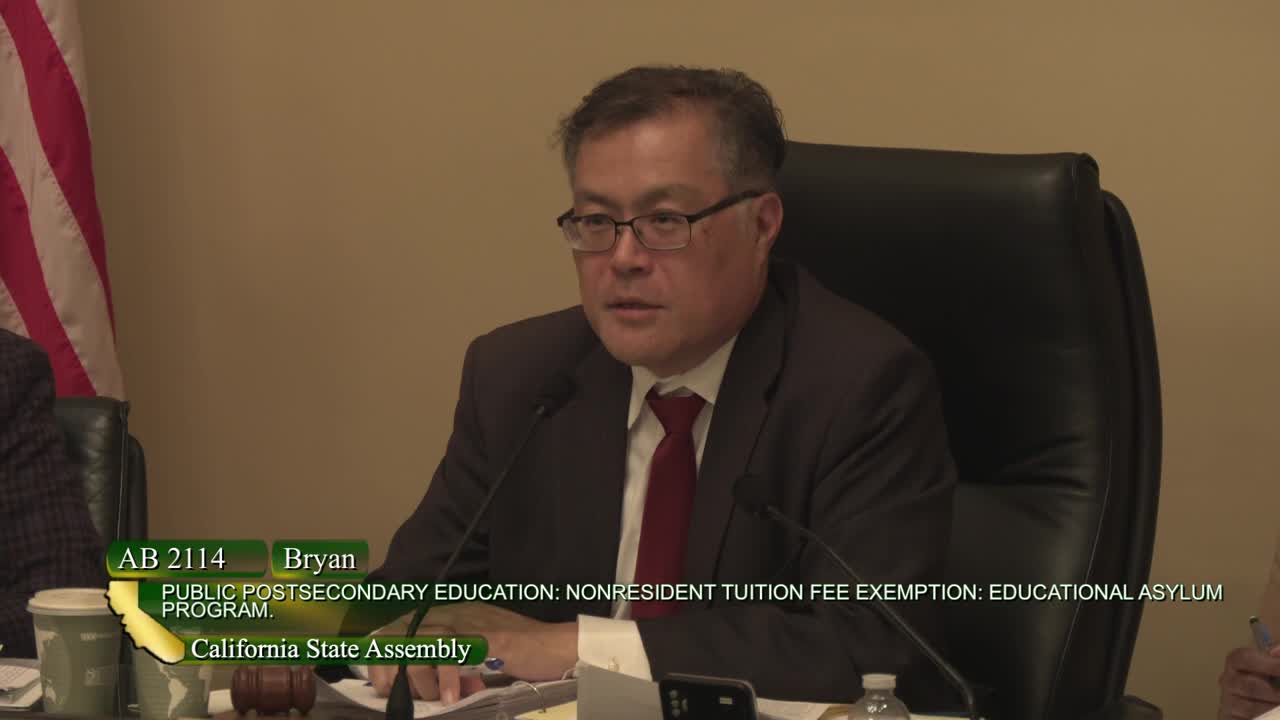 23MIN
Assembly Standing Committee on Higher Education
Bill Author

Bill Co-Author(s):