AB 2022: Property taxation: exemption: disabled veteran homeowners.
- Session Year: 2025-2026
- House: Assembly
- Latest Version Date: 2026-06-04
Current Status:
In Progress
(2026-08-13: In committee: Held under submission.)
Introduced
In Committee
Awaiting First Chamber Vote
Passed First Chamber
In Committee
Awaiting Second Chamber Vote
Passed Second Chamber
Enacted
The California Constitution provides that all property is taxable and requires that it be assessed at the same percentage of fair market value, unless otherwise provided by the California Constitution or federal law. The California Constitution and existing property tax law provide various exemptions from taxation, including, among others, a disabled veterans exemption and a veterans organization exemption.
This bill would exempt from taxation, as provided, 50% of the full value of the property owned by, and that constitutes the principal place of residence of, a veteran, the veterans spouse, or the veteran and the veterans spouse jointly, if the veteran is 100% disabled. The bill would provide an unmarried surviving spouse a property exemption in the same amount that they would have been entitled to if the veteran were alive and if certain conditions are met. In the case of a disabled veteran or unmarried surviving spouse whose household income does not exceed $40,000 a specified amount for the relevant assessment year, as prescribed, the bill would exempt 100% of the full value of the property from taxation. The bill would require certain documentation to be provided to the county assessor to receive the exemption and would prohibit any other real property tax exemption from being granted to the claimant if receiving the exemption provided by the provisions of this bill. The bill would make these exemptions applicable for property tax lien dates occurring on or after January 1, 2027, but occurring before January 1, 2032. By imposing additional duties on local tax officials, the bill would impose a state-mandated local program.
Existing law requires any bill authorizing a new tax expenditure to contain, among other things, specific goals, purposes, and objectives that the tax expenditure will achieve, detailed performance indicators, and data collection requirements.
This bill also would include additional information required for any bill authorizing a new tax expenditure.
The California Constitution requires the state to reimburse local agencies and school districts for certain costs mandated by the state. Statutory provisions establish procedures for making that reimbursement.
This bill would provide that, if the Commission on State Mandates determines that the bill contains costs mandated by the state, reimbursement for those costs shall be made pursuant to the statutory provisions noted above.
Existing law requires the state to reimburse local agencies annually for certain property tax revenues lost as a result of any exemption or classification of property for purposes of ad valorem property taxation.
This bill would provide that, notwithstanding those provisions, no appropriation is made and the state shall not reimburse local agencies for property tax revenues lost by them pursuant to the bill.
This bill would take effect immediately as a tax levy.
The California Constitution provides that all property is taxable and requires that it be assessed at the same percentage of fair market value, unless otherwise provided by the California Constitution or federal law. The California Constitution and existing property tax law provide various exemptions from taxation, including, among others, a disabled veterans exemption and a veterans organization exemption.
This bill would exempt from taxation, as provided, 50% of property owned by, and that constitutes the principal place of residence of, a veteran, the veterans spouse, or the veteran and the veterans spouse jointly, if the veteran is 100% disabled. The bill would provide an unmarried surviving spouse a property exemption in the same amount that they would have been entitled to if the veteran were alive and if certain conditions are met. In the case of a disabled veteran or unmarried surviving spouse whose household income does not exceed $40,000 for the relevant assessment year, as prescribed, the bill would exempt 100% of the property from taxation. The bill would require certain documentation to be provided to the county assessor to receive the exemption and would prohibit any other real property tax exemption from being granted to the claimant if receiving the exemption provided by the provisions of this bill. The bill would make these exemptions applicable for property tax lien dates occurring on or after January 1, 2027, but occurring before January 1, 2032. By imposing additional duties on local tax officials, the bill would impose a state-mandated local program.
Existing law requires any bill authorizing a new tax expenditure to contain, among other things, specific goals, purposes, and objectives that the tax expenditure will achieve, detailed performance indicators, and data collection requirements.
This bill also would include additional information required for any bill authorizing a new tax expenditure.
The California Constitution requires the state to reimburse local agencies and school districts for certain costs mandated by the state. Statutory provisions establish procedures for making that reimbursement.
This bill would provide that, if the Commission on State Mandates determines that the bill contains costs mandated by the state, reimbursement for those costs shall be made pursuant to the statutory provisions noted above.
Existing law requires the state to reimburse local agencies annually for certain property tax revenues lost as a result of any exemption or classification of property for purposes of ad valorem property taxation.
This bill would provide that, notwithstanding those provisions, no appropriation is made and the state shall not reimburse local agencies for property tax revenues lost by them pursuant to the bill.
This bill would take effect immediately as a tax levy.
The California Constitution provides that all property is taxable, taxable and requires that it be assessed at the same percentage of fair market value, unless otherwise provided by the California Constitution or federal law. The California Constitution and existing property tax law provide various exemptions from taxation, including, among others, a disabled veterans exemption and a veterans organization exemption.
This bill would exempt from taxation, as provided, property owned by, and that constitutes the principal place of residence of, a veteran, the veterans spouse, or the veteran and the veterans spouse jointly, if the veteran is 100% disabled. The bill would provide an unmarried surviving spouse a property exemption in the same amount that they would have been entitled to if the veteran was were alive and if certain conditions are met. The bill would require certain documentation to be provided to the county assessor to receive the exemption and would prohibit any other real property tax exemption from being granted to the claimant if receiving the exemption provided by the provisions of this bill. The bill would make these exemptions applicable for property tax lien dates occurring on or after January 1, 2027, but occurring before January 1, 2032. By imposing additional duties on local tax officials, the bill would impose a state-mandated local program.
Existing law requires any bill authorizing a new tax expenditure to contain, among other things, specific goals, purposes, and objectives that the tax expenditure will achieve, detailed performance indicators, and data collection requirements.
This bill also would include additional information required for any bill authorizing a new tax expenditure.
The California Constitution requires the state to reimburse local agencies and school districts for certain costs mandated by the state. Statutory provisions establish procedures for making that reimbursement.
This bill would provide that, if the Commission on State Mandates determines that the bill contains costs mandated by the state, reimbursement for those costs shall be made pursuant to the statutory provisions noted above.
Existing law requires the state to reimburse local agencies annually for certain property tax revenues lost as a result of any exemption or classification of property for purposes of ad valorem property taxation.
This bill would provide that, notwithstanding those provisions, no appropriation is made and the state shall not reimburse local agencies for property tax revenues lost by them pursuant to the bill.
This bill would take effect immediately as a tax levy.
The California Constitution provides that all property is taxable, and requires that it be assessed at the same percentage of fair market value, unless otherwise provided by the California Constitution or federal law. The California Constitution and existing property tax law provide various exemptions from taxation, including, among others, a disabled veterans exemption and a veterans organization exemption.
This bill would exempt from taxation, as provided, property owned by, and that constitutes the principal place of residence of, a veteran, the veterans spouse, or the veteran and the veterans spouse jointly, if the veteran is 100% disabled. The bill would provide an unmarried surviving spouse a property exemption in the same amount that they would have been entitled to if the veteran was alive and if certain conditions are met. The bill would require certain documentation to be provided to the county assessor to receive the exemption and would prohibit any other real property tax exemption from being granted to the claimant if receiving the exemption provided by the provisions of this bill. The bill would make these exemptions applicable for property tax lien dates occurring on or after January 1, 2027, but occurring before January 1, 2032. By imposing additional duties on local tax officials, the bill would impose a state-mandated local program.
Existing law requires any bill authorizing a new tax expenditure to contain, among other things, specific goals, purposes, and objectives that the tax expenditure will achieve, detailed performance indicators, and data collection requirements.
This bill also would include additional information required for any bill authorizing a new tax expenditure.
The California Constitution requires the state to reimburse local agencies and school districts for certain costs mandated by the state. Statutory provisions establish procedures for making that reimbursement.
This bill would provide that, if the Commission on State Mandates determines that the bill contains costs mandated by the state, reimbursement for those costs shall be made pursuant to the statutory provisions noted above.
Existing law requires the state to reimburse local agencies annually for certain property tax revenues lost as a result of any exemption or classification of property for purposes of ad valorem property taxation.
This bill would provide that, notwithstanding those provisions, no appropriation is made and the state shall not reimburse local agencies for property tax revenues lost by them pursuant to the bill.
This bill would take effect immediately as a tax levy.
(a)(1)(A)In lieu of the property exemption in Section 205.5, except as provided in subparagraph (C), for property tax lien dates occurring on or after January 1, 2027, but occurring before January 1, 2032, 50 percent of the full value of the property shall be exempt from taxation if both of the following conditions are met:
(i)The property is owned by and constitutes the principal place of residence of a veteran, the veterans spouse, or the veteran and the veterans spouse jointly.
(ii)The veteran is blind in both eyes or has lost the use of two or more limbs as a result of injury or disease incurred in military service, or the veteran is totally disabled as a result of injury or disease incurred in military service.
(B)In the case of an eligible veteran whose household income does not exceed the amount of forty eighty-three thousand four hundred seventy-four dollars ($40,000), ($83,474), as adjusted for the relevant assessment year as provided in subdivision (h) of Section 205.5, the exemption under subparagraph (A) shall be on 100 percent of the full value of the property.
(C)The property shall instead be eligible for the property exemption pursuant to Section 205.5 if both of the following conditions are satisfied:
(i)The property does not exceed two three hundred seventy-one thousand seven hundred seventy-eight dollars ($200,000) ($371,778) of assessed value. the full value, as adjusted for the relevant assessment year as provided in subdivision (i) of Section 205.5.
(ii)The household income of the eligible veteran exceeds forty eighty-three thousand four hundred seventy-four dollars ($40,000), ($83,474), as adjusted for the relevant assessment year as provided in subdivision (h) of Section 205.5.
(2)For purposes of this subdivision, property is deemed to be the principal place of residence of a veteran, disabled as described in paragraph (1), who is confined to a hospital or other care facility, if that property would be that veterans principal place of residence were it not for their confinement to a hospital or other care facility, provided that the residence is not rented or leased to a third party. For purposes of this paragraph, a family member who resides at the residence is not a third party.
(b)(1)(A)Property that is owned by, and that constitutes the principal place of residence of, the unmarried surviving spouse of a deceased veteran is exempt from taxation in the same amount that the veteran or veterans spouse would have been entitled to in subparagraph (A) of paragraph (1) of subdivision (a) if the veteran had been alive, in the case of a veteran who was blind in both eyes, had lost the use of two or more limbs, or was totally disabled, provided that either of the following conditions is met:
(i)The deceased veteran, during their lifetime, qualified for the exemption pursuant to subdivision (a), or would have qualified for the exemption under the laws effective on January 1, 2024, except that the veteran died prior to January 1, 2024. The veteran must have been a resident of this state on January 1 of the year in which they died.
(ii)The veteran died from an injury or disease that was service connected as determined by the United States Department of Veterans Affairs, and the veteran was a resident of this state on January 1 of the year in which they died.
(B)In the case of an eligible unmarried surviving spouse whose household income does not exceed the amount of forty eighty-three thousand four hundred seventy-four dollars ($40,000), ($83,474), as adjusted for the relevant assessment year as provided in subdivision (h) of Section 205.5, the exemption under subparagraph (A) shall be on 100 percent of the full value of the property.
(C)The property shall instead be eligible for the property exemption pursuant to Section 205.5 if both of the following conditions are satisfied:
(i)The property does not exceed two three hundred seventy-one thousand seven hundred seventy-eight dollars ($200,000) ($371,778), of assessed value. the full value, as adjusted for the relevant assessment year as provided in subdivision (i) of Section 205.5.
(ii)The household income of the unmarried surviving spouse exceeds forty eighty-three thousand four hundred seventy-four dollars ($40,000), ($83,474), as adjusted for the relevant assessment year as provided in subdivision (h) of Section 205.5.
(2)(A)Property is deemed to be the principal place of residence of the unmarried surviving spouse of a deceased veteran, who is confined to a hospital or other care facility, if that property would be the unmarried surviving spouses principal place of residence were it not for their confinement to a hospital or other care facility, provided that the residence is not rented or leased to a third party. For purposes of this paragraph, a family member who resides at the residence is not a third party.
(B)Property is deemed to be the principal place of residence of the unmarried surviving spouse of a deceased veteran only if the property was the principal place of residence of the veteran when they died.
(c)For purposes of this section, all of the following definitions apply:
(1)Blind in both eyes means having a visual acuity of 5/200 or less, or concentric contraction of the visual field to 5 degrees or less.
(2)Loss of the use of a limb means that the limb has been amputated or its use has been lost by reason of ankylosis, progressive muscular dystrophies, or paralysis.
(3)Totally disabled means the United States Department of Veterans Affairs or the military service from which the veteran was discharged has rated the disability at 100 percent or has rated the disability compensation at 100 percent by reason of being unable to secure or follow a substantially gainful occupation.
(4)Veteran means either of the following:
(A)A person who is serving in or has served in and has been discharged under other than dishonorable conditions from service in the United States Army, Navy, Air Force, Marine Corps, Coast Guard, or Space Force and served either in time of war or in time of peace in a campaign or expedition for which a medal has been issued by Congress, or in time of peace and because of a service-connected disability was released from active duty, and who has been determined by the United States Department of Veterans Affairs to be eligible for federal veterans health and medical benefits.
(B)Any person who would qualify as a veteran pursuant to subparagraph (A) except that they have, as a result of a service-connected injury or disease, died while on active duty in military service. The United States Department of Veterans Affairs shall determine whether an injury or disease is service connected.
(5)Property that is owned by a veteran or property that is owned by the veterans unmarried surviving spouse includes all of the following:
(A)Property owned by the veteran with the veterans spouse as a joint tenancy, tenancy in common, or as community property.
(B)Property owned by the veteran or the veterans spouse as separate property.
(C)Property owned with one or more other persons to the extent of the interest owned by the veteran, the veterans spouse, or both the veteran and the veterans spouse.
(D)Property owned by the veterans unmarried surviving spouse with one or more other persons to the extent of the interest owned by the veterans unmarried surviving spouse.
(E)So much of the property of a corporation as constitutes the principal place of residence of a veteran or a veterans unmarried surviving spouse when the veteran, or the veterans spouse, or the veterans unmarried surviving spouse is a shareholder of the corporation and the rights of shareholding entitle one to the possession of property, legal title to which is owned by the corporation. The exemption provided by this paragraph shall be shown on the local roll and shall reduce the full value of the corporate property. Notwithstanding any law or articles of incorporation or bylaws of a corporation described in this paragraph, any reduction of property taxes paid by the corporation shall reflect an equal reduction in any charges by the corporation to the person who, by reason of qualifying for the exemption, made possible the reduction for the corporation.
(d)In order to receive the exemption provided in this section, the claimant shall provide the county assessor documentation, including a letter from the United States Department of Veterans Affairs or the military service from which the veteran was discharged demonstrating the veterans disability rating, sufficient to demonstrate the claimants eligibility for the exemption.
(e)An exemption granted to a claimant pursuant to this section shall be in lieu of the veterans exemption provided by subdivisions (o), (p), (q), and (r) of Section 3 of Article XIII of the California Constitution, Section 205.5 of this code, and any other real property tax exemption to which the claimant may be entitled. Any other real property tax exemption shall not be granted to any other person with respect to the same residence for which an exemption has been granted pursuant to this section. However, if two or more veterans qualified pursuant to this section coown a property in which they reside, each is entitled to the exemption to the extent of their interest.
(f)This section shall remain in effect only until January 1, 2032, and as of that date is repealed.
SEC. 2.(a)It is the intent of the Legislature to apply the requirements of Section 41 of the Revenue and Taxation Code with respect to the exemption under Section 205.5.1 of the Revenue and Taxation Code, as added by this act.
(b)The goal, purpose, and objective of the exemption is to reduce homelessness by providing a tax exemption to 100 percent disabled veteran homeowners.
(c)(1)To assist the Legislature in determining whether the exemption allowed by this act fulfills the goal, purpose, and objective as described in subdivision (b), the State Board of Equalization shall, to the extent data is available from county assessors, annually collect and report to the Legislature, pursuant to paragraph (2), data from county assessors to quantify the amount of assessed value exempted and the number and type of taxpayers granted this exemption.
(2)By June 1, 2027, and every June 1 thereafter until June 1, 2031, the State Board of Equalization shall report this information to the Legislature in accordance with Section 9795 of the Government Code.
SEC. 3.If the Commission on State Mandates determines that this act contains costs mandated by the state, reimbursement to local agencies and school districts for those costs shall be made pursuant to Part 7 (commencing with Section 17500) of Division 4 of Title 2 of the Government Code.
SEC. 4.Notwithstanding Section 2229 of the Revenue and Taxation Code, no appropriation is made by this act and the state shall not reimburse any local agency for any property tax revenues lost by it pursuant to this act.
SEC. 5.This act provides for a tax levy within the meaning of Article IV of the California Constitution and shall go into immediate effect.
(a)(1)(A)In lieu of the property exemption in Section 205.5, except as provided in subparagraph (C), for property tax lien dates occurring on or after January 1, 2027, but occurring before January 1, 2032, 50 percent of property shall be exempt from taxation if both of the following conditions are met:
(A)(i)The property is owned by and constitutes the principal place of residence of a veteran, the veterans spouse, or the veteran and the veterans spouse jointly.
(B)(ii)The veteran is blind in both eyes or has lost the use of two or more limbs as a result of injury or disease incurred in military service service, or the veteran is totally disabled as a result of injury or disease incurred in military service.
(B)In the case of an eligible veteran whose household income does not exceed the amount of forty thousand dollars ($40,000), as adjusted for the relevant assessment year as provided in subdivision (h) of Section 205.5, the exemption under subparagraph (A) shall be on 100 percent of the property.
(C)The property shall instead be eligible for the property exemption pursuant to Section 205.5 if both of the following conditions are satisfied:
(i)The property does not exceed two hundred thousand dollars ($200,000) of assessed value.
(ii)The household income of the eligible veteran exceeds forty thousand dollars ($40,000), as adjusted for the relevant assessment year as provided in subdivision (h) of Section 205.5.
(2)For purposes of this subdivision, property is deemed to be the principal place of residence of a veteran, disabled as described in paragraph (1), who is confined to a hospital or other care facility, if that property would be that veterans principal place of residence were it not for their confinement to a hospital or other care facility, provided that the residence is not rented or leased to a third party. For purposes of this paragraph, a family member who resides at the residence is not a third party.
(b)(1)(A)Property that is owned by, and that constitutes the principal place of residence of, the unmarried surviving spouse of a deceased veteran is exempt from taxation in the same amount that the veteran or veterans spouse would have been entitled to in subparagraph (A) of paragraph (1) of subdivision (a) if the veteran had been alive, in the case of a veteran who was blind in both eyes, had lost the use of two or more limbs, or was totally disabled, provided that either of the following conditions is met:
(A)(i)The deceased veteran, during their lifetime, qualified for the exemption pursuant to subdivision (a), or would have qualified for the exemption under the laws effective on January 1, 2024, except that the veteran died prior to January 1, 2024. The veteran must have been a resident of this state on January 1 of the year in which they died.
(B)(ii)The veteran died from an injury or disease that was service connected as determined by the United States Department of Veterans Affairs, and the veteran was a resident of this state on January 1 of the year in which they died.
(B)In the case of an eligible unmarried surviving spouse whose household income does not exceed the amount of forty thousand dollars ($40,000), as adjusted for the relevant assessment year as provided in subdivision (h) of Section 205.5, the exemption under subparagraph (A) shall be on 100 percent of the property.
(C)The property shall instead be eligible for the property exemption pursuant to Section 205.5 if both of the following conditions are satisfied:
(i)The property does not exceed two hundred thousand dollars ($200,000) of assessed value.
(ii)The household income of the unmarried surviving spouse exceeds forty thousand dollars ($40,000), as adjusted for the relevant assessment year as provided in subdivision (h) of Section 205.5.
(2)(A)Property is deemed to be the principal place of residence of the unmarried surviving spouse of a deceased veteran, who is confined to a hospital or other care facility, if that property would be the unmarried surviving spouses principal place of residence were it not for their confinement to a hospital or other care facility, provided that the residence is not rented or leased to a person other than a member of the deceased veterans family, as defined by paragraph (4) of subsection (c) of Section 267 of the Internal Revenue Code. third party. For purposes of this paragraph, a family member who resides at the residence is not a third party.
(B)Property is deemed to be the principal place of residence of the unmarried surviving spouse of a deceased veteran only if the property was the principal place of residence of the veteran when they died.
(c)For purposes of this section, all of the following definitions apply:
(1)Blind in both eyes means having a visual acuity of 5/200 or less, or concentric contraction of the visual field to 5 degrees or less.
(2)Loss of the use of a limb means that the limb has been amputated or its use has been lost by reason of ankylosis, progressive muscular dystrophies, or paralysis.
(3)Totally disabled means the United States Department of Veterans Affairs or the military service from which the veteran was discharged has rated the disability at 100 percent or has rated the disability compensation at 100 percent by reason of being unable to secure or follow a substantially gainful occupation.
(4)Veteran means either of the following:
(A)A person who is serving in or has served in and has been discharged under other than dishonorable conditions from service in the United States Army, Navy, Air Force, Marine Corps, Coast Guard, or Space Force and served either in time of war or in time of peace in a campaign or expedition for which a medal has been issued by Congress, or in time of peace and because of a service-connected disability was released from active duty, and who has been determined by the United States Department of Veterans Affairs to be eligible for federal veterans health and medical benefits.
(B)Any person who would qualify as a veteran pursuant to subparagraph (A) except that they have, as a result of a service-connected injury or disease, died while on active duty in military service. The United States Department of Veterans Affairs shall determine whether an injury or disease is service connected.
(5)Property that is owned by a veteran or property that is owned by the veterans unmarried surviving spouse includes all of the following:
(A)Property owned by the veteran with the veterans spouse as a joint tenancy, tenancy in common, or as community property.
(B)Property owned by the veteran or the veterans spouse as separate property.
(C)Property owned with one or more other persons to the extent of the interest owned by the veteran, the veterans spouse, or both the veteran and the veterans spouse.
(D)Property owned by the veterans unmarried surviving spouse with one or more other persons to the extent of the interest owned by the veterans unmarried surviving spouse.
(E)So much of the property of a corporation as constitutes the principal place of residence of a veteran or a veterans unmarried surviving spouse when the veteran, or the veterans spouse, or the veterans unmarried surviving spouse is a shareholder of the corporation and the rights of shareholding entitle one to the possession of property, legal title to which is owned by the corporation. The exemption provided by this paragraph shall be shown on the local roll and shall reduce the full value of the corporate property. Notwithstanding any law or articles of incorporation or bylaws of a corporation described in this paragraph, any reduction of property taxes paid by the corporation shall reflect an equal reduction in any charges by the corporation to the person who, by reason of qualifying for the exemption, made possible the reduction for the corporation.
(d)In order to receive the exemption provided in this section, the claimant shall provide the county assessor documentation, including a letter from the United States Department of Veterans Affairs or the military service from which the veteran was discharged demonstrating the veterans disability rating, sufficient to demonstrate the claimants eligibility for the exemption.
(e)An exemption granted to a claimant pursuant to this section shall be in lieu of the veterans exemption provided by subdivisions (o), (p), (q), and (r) of Section 3 of Article XIII of the California Constitution, Section 205.5 of this code, and any other real property tax exemption to which the claimant may be entitled. Any other real property tax exemption shall not be granted to any other person with respect to the same residence for which an exemption has been granted pursuant to this section. However, if two or more veterans qualified pursuant to this section coown a property in which they reside, each is entitled to the exemption to the extent of their interest.
(f)This section shall remain in effect only until January 1, 2032, and as of that date is repealed.
SEC. 2.(a)It is the intent of the Legislature to apply the requirements of Section 41 of the Revenue and Taxation Code with respect to the exemption under Section 205.5.1 of the Revenue and Taxation Code, as added by this act.
(b)The goal, purpose, and objective of the exemption is to reduce homelessness by providing a tax exemption to 100 percent disabled veteran homeowners.
(c)(1)To assist the Legislature in determining whether the exemption allowed by this act fulfills the goal, purpose, and objective as described in subdivision (b), the State Board of Equalization shall, to the extent data is available from county assessors, annually collect and report to the Legislature, pursuant to paragraph (2), data from county assessors to quantify the amount of assessed value exempted and the number and type of taxpayers granted this exemption.
(2)By June 1, 2027, and every June 1 thereafter until June 1, 2031, the State Board of Equalization shall report this information to the Legislature in accordance with Section 9795 of the Government Code.
SEC. 3.If the Commission on State Mandates determines that this act contains costs mandated by the state, reimbursement to local agencies and school districts for those costs shall be made pursuant to Part 7 (commencing with Section 17500) of Division 4 of Title 2 of the Government Code.
SEC. 4.Notwithstanding Section 2229 of the Revenue and Taxation Code, no appropriation is made by this act and the state shall not reimburse any local agency for any property tax revenues lost by it pursuant to this act.
SEC. 5.This act provides for a tax levy within the meaning of Article IV of the California Constitution and shall go into immediate effect.
(a)(1)In lieu of the property exemption in Section 205.5, for property tax lien dates occurring on or after January 1, 2027, but occurring before January 1, 2032, property shall be exempt from taxation if all both of the following conditions are met:
(A)The property is owned by and constitutes the principal place of residence of a veteran, the veterans spouse, or the veteran and the veterans spouse jointly.
(B)The veteran is blind in both eyes or has lost the use of two or more limbs as a result of injury or disease incurred in military service and the disability rating by the United States Department of Veterans Affairs or the military service from which the veteran was discharged is 100 percent.
(C)The or the veteran is totally disabled as a result of injury or disease incurred in military service.
(2)For purposes of this subdivision, property is deemed to be the principal place of residence of a veteran, disabled as described in paragraph (1), who is confined to a hospital or other care facility, if that property would be that veterans principal place of residence were it not for their confinement to a hospital or other care facility, provided that the residence is not rented or leased to a third party. For purposes of this paragraph, a family member who resides at the residence is not a third party.
(b)(1)Property that is owned by, and that constitutes the principal place of residence of, the unmarried surviving spouse of a deceased veteran is exempt from taxation in the same amount that the veteran or veterans spouse would have been entitled to in subdivision (a) if the veteran had been alive, in the case of a veteran who was blind in both eyes, had lost the use of two or more limbs, or was totally disabled, provided that either of the following conditions is met:
(A)The deceased veteran, during their lifetime, qualified for the exemption pursuant to subdivision (a), or would have qualified for the exemption under the laws effective on January 1, 2024, except that the veteran died prior to January 1, 2024. The veteran must have been a resident of this state on January 1 of the year in which they died.
(B)The veteran died from an injury or disease that was service connected as determined by the United States Department of Veterans Affairs, and the veteran was a resident of this state on January 1 of the year in which they died.
(2)(A)Property is deemed to be the principal place of residence of the unmarried surviving spouse of a deceased veteran, who is confined to a hospital or other care facility, if that property would be the unmarried surviving spouses principal place of residence were it not for their confinement to a hospital or other care facility, provided that the residence is not rented or leased to a person other than a member of the deceased veterans family, as defined by paragraph (4) of subsection (c) of Section 267 of the Internal Revenue Code.
(B)Property is deemed to be the principal place of residence of the unmarried surviving spouse of a deceased veteran only if the property was the principal place of residence of the veteran when they died.
(c)For purposes of this section, all of the following definitions apply:
(1)Blind in both eyes means having a visual acuity of 5/200 or less, or concentric contraction of the visual field to 5 degrees or less.
(2)Loss of the use of a limb means that the limb has been amputated or its use has been lost by reason of ankylosis, progressive muscular dystrophies, or paralysis.
(3)Totally disabled means the United States Department of Veterans Affairs or the military service from which the veteran was discharged has rated the disability at 100 percent or has rated the disability compensation at 100 percent by reason of being unable to secure or follow a substantially gainful occupation.
(4)Veteran means either of the following:
(A)A person who is serving in or has served in and has been discharged under other than dishonorable conditions from service in the United States Army, Navy, Air Force, Marine Corps, Coast Guard, or Space Force and served either in time of war or in time of peace in a campaign or expedition for which a medal has been issued by Congress, or in time of peace and because of a service-connected disability was released from active duty, and who has been determined by the United States Department of Veterans Affairs to be eligible for federal veterans health and medical benefits.
(B)Any person who would qualify as a veteran pursuant to subparagraph (A) except that they have, as a result of a service-connected injury or disease, died while on active duty in military service. The United States Department of Veterans Affairs shall determine whether an injury or disease is service connected.
(5)Property that is owned by a veteran or property that is owned by the veterans unmarried surviving spouse includes all of the following:
(A)Property owned by the veteran with the veterans spouse as a joint tenancy, tenancy in common, or as community property.
(B)Property owned by the veteran or the veterans spouse as separate property.
(C)Property owned with one or more other persons to the extent of the interest owned by the veteran, the veterans spouse, or both the veteran and the veterans spouse.
(D)Property owned by the veterans unmarried surviving spouse with one or more other persons to the extent of the interest owned by the veterans unmarried surviving spouse.
(E)So much of the property of a corporation as constitutes the principal place of residence of a veteran or a veterans unmarried surviving spouse when the veteran, or the veterans spouse, or the veterans unmarried surviving spouse is a shareholder of the corporation and the rights of shareholding entitle one to the possession of property, legal title to which is owned by the corporation. The exemption provided by this paragraph shall be shown on the local roll and shall reduce the full value of the corporate property. Notwithstanding any law or articles of incorporation or bylaws of a corporation described in this paragraph, any reduction of property taxes paid by the corporation shall reflect an equal reduction in any charges by the corporation to the person who, by reason of qualifying for the exemption, made possible the reduction for the corporation.
(d)In order to receive the exemption provided in this section, the claimant shall provide the county assessor documentation, including a letter from the United States Department of Veterans Affairs or the military service from which the veteran was discharged demonstrating the veterans disability rating, sufficient to demonstrate the claimants eligibility for the exemption.
(e)An exemption granted to a claimant pursuant to this section shall be in lieu of the veterans exemption provided by subdivisions (o), (p), (q), and (r) of Section 3 of Article XIII of the California Constitution, Section 205.5 of this code, and any other real property tax exemption to which the claimant may be entitled. Any other real property tax exemption shall not be granted to any other person with respect to the same residence for which an exemption has been granted pursuant to this section. However, if two or more veterans qualified pursuant to this section coown a property in which they reside, each is entitled to the exemption to the extent of their interest.
(f)This section shall remain in effect only until January 1, 2032, and as of that date is repealed.
SEC. 2.(a)It is the intent of the Legislature to apply the requirements of Section 41 of the Revenue and Taxation Code with respect to the exemption under Section 205.5.1 of the Revenue and Taxation Code, as added by this act.
(b)The goal, purpose, and objective of the exemption is to reduce homelessness by providing a tax exemption to 100 percent disabled veteran homeowners.
(c)(1)To assist the Legislature in determining whether the exemption allowed by this act fulfills the goal, purpose, and objective as described in subdivision (b), the State Board of Equalization shall, to the extent data is available from county assessors, annually collect and report to the Legislature, pursuant to paragraph (2), data from county assessors to quantify the amount of assessed value exempted and the number and type of taxpayers granted this exemption.
(2)By June 1, 2027, and every June 1 thereafter until June 1, 2031, the State Board of Equalization shall report this information to the Legislature in accordance with Section 9795 of the Government Code.
SEC. 3.If the Commission on State Mandates determines that this act contains costs mandated by the state, reimbursement to local agencies and school districts for those costs shall be made pursuant to Part 7 (commencing with Section 17500) of Division 4 of Title 2 of the Government Code.
SEC. 4.Notwithstanding Section 2229 of the Revenue and Taxation Code, no appropriation is made by this act and the state shall not reimburse any local agency for any property tax revenues lost by it pursuant to this act.
SEC. 5.This act provides for a tax levy within the meaning of Article IV of the California Constitution and shall go into immediate effect.
(a)(1)In lieu of the property exemption in Section 205.5, for property tax lien dates occurring on or after January 1, 2027, but occurring before January 1, 2032, property shall be exempt from taxation if all of the following conditions are met:
(A)The property is owned by and constitutes the principal place of residence of a veteran, the veterans spouse, or the veteran and the veterans spouse jointly.
(B)The veteran is blind in both eyes or has lost the use of two or more limbs as a result of injury or disease incurred in military service and the disability rating by the United States Department of Veterans Affairs or the military service from which the veteran was discharged is 100 percent.
(C)The veteran is totally disabled as a result of injury or disease incurred in military service.
(2)For purposes of this subdivision, property is deemed to be the principal place of residence of a veteran, disabled as described in paragraph (1), who is confined to a hospital or other care facility, if that property would be that veterans principal place of residence were it not for their confinement to a hospital or other care facility, provided that the residence is not rented or leased to a third party. For purposes of this paragraph, a family member who resides at the residence is not a third party.
(b)(1)Property that is owned by, and that constitutes the principal place of residence of, the unmarried surviving spouse of a deceased veteran is exempt from taxation in the same amount that the veteran or veterans spouse would have been entitled to in subdivision (a) if the veteran had been alive, in the case of a veteran who was blind in both eyes, had lost the use of two or more limbs, or was totally disabled, provided that either of the following conditions is met:
(A)The deceased veteran, during their lifetime, qualified for the exemption pursuant to subdivision (a), or would have qualified for the exemption under the laws effective on January 1, 2024, except that the veteran died prior to January 1, 2024. The veteran must have been a resident of this state on January 1 of the year in which they died.
(B)The veteran died from an injury or disease that was service connected as determined by the United States Department of Veterans Affairs, and the veteran was a resident of this state on January 1 of the year in which they died.
(2)(A)Property is deemed to be the principal place of residence of the unmarried surviving spouse of a deceased veteran, who is confined to a hospital or other care facility, if that property would be the unmarried surviving spouses principal place of residence were it not for their confinement to a hospital or other care facility, provided that the residence is not rented or leased to a person other than a member of the deceased veterans family, as defined by paragraph (4) of subsection (c) of Section 267 of the Internal Revenue Code.
(B)Property is deemed to be the principal place of residence of the unmarried surviving spouse of a deceased veteran only if the property was the principal place of residence of the veteran when they died.
(c)For purposes of this section, all of the following definitions apply:
(1)Blind in both eyes means having a visual acuity of 5/200 or less, or concentric contraction of the visual field to 5 degrees or less.
(2)Loss of the use of a limb means that the limb has been amputated or its use has been lost by reason of ankylosis, progressive muscular dystrophies, or paralysis.
(3)Totally disabled means the United States Department of Veterans Affairs or the military service from which the veteran was discharged has rated the disability at 100 percent or has rated the disability compensation at 100 percent by reason of being unable to secure or follow a substantially gainful occupation.
(4)Veteran means either of the following:
(A)A person who is serving in or has served in and has been discharged under other than dishonorable conditions from service in the United States Army, Navy, Air Force, Marine Corps, Coast Guard, or Space Force and served either in time of war or in time of peace in a campaign or expedition for which a medal has been issued by Congress, or in time of peace and because of a service-connected disability was released from active duty, and who has been determined by the United States Department of Veterans Affairs to be eligible for federal veterans health and medical benefits.
(B)Any person who would qualify as a veteran pursuant to subparagraph (A) except that they have, as a result of a service-connected injury or disease, died while on active duty in military service. The United States Department of Veterans Affairs shall determine whether an injury or disease is service connected.
(5)Property that is owned by a veteran or property that is owned by the veterans unmarried surviving spouse includes all of the following:
(A)Property owned by the veteran with the veterans spouse as a joint tenancy, tenancy in common, or as community property.
(B)Property owned by the veteran or the veterans spouse as separate property.
(C)Property owned with one or more other persons to the extent of the interest owned by the veteran, the veterans spouse, or both the veteran and the veterans spouse.
(D)Property owned by the veterans unmarried surviving spouse with one or more other persons to the extent of the interest owned by the veterans unmarried surviving spouse.
(E)So much of the property of a corporation as constitutes the principal place of residence of a veteran or a veterans unmarried surviving spouse when the veteran, or the veterans spouse, or the veterans unmarried surviving spouse is a shareholder of the corporation and the rights of shareholding entitle one to the possession of property, legal title to which is owned by the corporation. The exemption provided by this paragraph shall be shown on the local roll and shall reduce the full value of the corporate property. Notwithstanding any law or articles of incorporation or bylaws of a corporation described in this paragraph, any reduction of property taxes paid by the corporation shall reflect an equal reduction in any charges by the corporation to the person who, by reason of qualifying for the exemption, made possible the reduction for the corporation.
(d)In order to receive the exemption provided in this section, the claimant shall provide the county assessor documentation, including a letter from the United States Department of Veterans Affairs or the military service from which the veteran was discharged demonstrating the veterans disability rating, sufficient to demonstrate the claimants eligibility for the exemption.
(e)An exemption granted to a claimant pursuant to this section shall be in lieu of the veterans exemption provided by subdivisions (o), (p), (q), and (r) of Section 3 of Article XIII of the California Constitution, Section 205.5 of this code, and any other real property tax exemption to which the claimant may be entitled. Any other real property tax exemption shall not be granted to any other person with respect to the same residence for which an exemption has been granted pursuant to this section. However, if two or more veterans qualified pursuant to this section coown a property in which they reside, each is entitled to the exemption to the extent of their interest.
(f)This section shall remain in effect only until January 1, 2032, and as of that date is repealed.
SEC. 2.(a)It is the intent of the Legislature to apply the requirements of Section 41 of the Revenue and Taxation Code with respect to the exemption under Section 205.5.1 of the Revenue and Taxation Code, as added by this act.
(b)The goal, purpose, and objective of the exemption is to reduce homelessness by providing a tax exemption to 100 percent disabled veteran homeowners.
(c)(1)To assist the Legislature in determining whether the exemption allowed by this act fulfills the goal, purpose, and objective as described in subdivision (b), the State Board of Equalization shall, to the extent data is available from county assessors, annually collect and report to the Legislature, pursuant to paragraph (2), data from county assessors to quantify the amount of assessed value exempted and the number and type of taxpayers granted this exemption.
(2)By June 1, 2027, and every June 1 thereafter until June 1, 2031, the State Board of Equalization shall report this information to the Legislature in accordance with Section 9795 of the Government Code.
SEC. 3.If the Commission on State Mandates determines that this act contains costs mandated by the state, reimbursement to local agencies and school districts for those costs shall be made pursuant to Part 7 (commencing with Section 17500) of Division 4 of Title 2 of the Government Code.
SEC. 4.Notwithstanding Section 2229 of the Revenue and Taxation Code, no appropriation is made by this act and the state shall not reimburse any local agency for any property tax revenues lost by it pursuant to this act.
SEC. 5.This act provides for a tax levy within the meaning of Article IV of the California Constitution and shall go into immediate effect.
|
Date
|
Status
|
|---|---|
| Aug 13, 2026 | In committee: Held under submission. |
| Aug 3, 2026 | In committee: Referred to APPR. suspense file. |
| Jun 23, 2026 | From committee: Do pass and re-refer to Com. on APPR. (Ayes 4. Noes 0.) (June 22). Re-referred to Com. on APPR. |
| Jun 10, 2026 | From committee: Do pass and re-refer to Com. on M. & V.A. (Ayes 5. Noes 0.) (June 10). Re-referred to Com. on M. & V.A. |
| Jun 4, 2026 | From committee chair, with author's amendments: Amend, and re-refer to committee. Read second time, amended, and re-referred to Com. on REV. & TAX. |
| Jun 3, 2026 | Referred to Coms. on REV. & TAX. and M. & V.A. |
| May 21, 2026 | In Senate. Read first time. To Com. on RLS. for assignment. |
| May 21, 2026 | Read third time. Passed. Ordered to the Senate. (Ayes 70. Noes 0. Page 5217.) |
| May 21, 2026 | Read third time. Passed. Ordered to the Senate. (Ayes 70. Noes 0.) |
| May 18, 2026 | Read second time. Ordered to third reading. |
| May 14, 2026 | Joint Rule 62(a), file notice suspended. (Page 5030.) |
| May 14, 2026 | From committee: Do pass. (Ayes 15. Noes 0.) (May 14). |
| May 14, 2026 | Joint Rule 62(a), file notice suspended. |
| May 13, 2026 | In committee: Set, first hearing. Referred to APPR. suspense file. |
| Apr 30, 2026 | Re-referred to Com. on APPR. |
| Apr 29, 2026 | Read second time and amended. |
| Apr 28, 2026 | From committee: Amend, and do pass as amended and re-refer to Com. on APPR. (Ayes 7. Noes 0.) (April 27). |
| Apr 27, 2026 | In committee: Set, first hearing. Referred to REV. & TAX. suspense file. |
| Apr 6, 2026 | Re-referred to Com. on REV. & TAX. |
| Mar 26, 2026 | Read second time and amended. |
| Mar 25, 2026 | From committee: Amend, and do pass as amended and re-refer to Com. on REV. & TAX. (Ayes 8. Noes 0.) (March 24). |
| Mar 5, 2026 | Re-referred to Coms. on M. & V.A. and REV. & TAX. pursuant to Assembly Rule 96. |
| Mar 2, 2026 | Referred to Coms. on REV. & TAX. and M. & V.A. |
| Feb 18, 2026 | From printer. May be heard in committee March 20. |
| Feb 17, 2026 | Read first time. To print. |
|
Date
|
Description
|
Location
|
Votes
|
|
|---|---|---|---|---|
| Aug 3, 2026 | Placed on suspense file | Senate Standing Committee on Appropriations |
Passed |
|
| Jun 22, 2026 | Do pass, but first be re-referred to the Committee on [Appropriations] | Senate Standing Committee on Military and Veterans Affairs |
Passed |
|
| Jun 10, 2026 | Do pass, but first be re-referred to the Committee on [Military and Veterans Affairs] | Senate Standing Committee on Revenue and Taxation |
Passed |
|
| May 21, 2026 | AB 2022 Jeff Gonzalez Assembly Third Reading | Assembly Floor |
Passed |
|
| May 14, 2026 | Do pass. | Assembly Standing Committee on Appropriations |
Passed |
|
| Apr 27, 2026 | Do pass as amended and be re-referred to the Committee on [Appropriations] | Assembly Standing Committee on Revenue and Taxation |
Passed |
|
| Mar 24, 2026 | Do pass as amended and be re-referred to the Committee on [Revenue and Taxation] | Assembly Standing Committee on Military and Veterans Affairs |
Passed |
This list shows positions taken on this bill by organizations on the date displayed, which is linked to the original source.
Positions by individuals are not included.
|
Organization
|
Position
|
Date
|
|---|---|---|
| American Legion, Department Of California | ** Support | |
| Amvets, Department Of California | ** Support | |
| California Association Of Realtors | ** Support | |
| California Baptist Capitol Ministry | ** Support | |
| California Commanders Council | ** Support | |
| California Federation Of Teachers | ** Against | |
| California State Board of Equalization | ** Support | |
| California Teachers Association | ** Against | |
| Military Officers Association of America | ** Support | |
| Vietnam Veterans Of America, California State Council | ** Support |
SENATE COMMITTEE ON
Senator Sabrina Cervantes, Chair
2025 - 2026 Regular Session
AB 2022 (Jeff Gonzalez) - Property taxation: exemption: disabled veteran homeowners
Version: | Policy Vote: |
Urgency: | Mandate: |
Hearing Date: | Consultant: |
Bill Summary:
AB 2022 would enact a substitute disabled veterans’ exemption, equal to either a full exemption for those currently qualifying for the “low-income” exemption, or 50 percent of the value for those currently qualifying for the “basic” exemption.
Fiscal Impact:
- The Board of Equalization (BOE) estimates that this bill would result in annual property tax revenue losses of $197 million. Reductions in local property tax revenues, in turn, can increase General Fund Proposition 98 spending by up to roughly 50 percent (the exact amount depends on the specific amount of the annual Proposition 98 guarantee, which in turns depends upon a variety of economic, demographic and budgetary factors). BOE would incur minor and absorbable administrative costs.
- By changing the manner in which assessors value real property, this bill creates a state-mandated local program. To the extent the Commission on State Mandates determines that the provisions of this bill create a new program or impose a higher level of service on local agencies, local agencies could claim reimbursement of those costs. The magnitude of these costs is unknown (General Fund).
Background:
Under the California Constitution, all property is subject to taxation unless specifically exempted by the Constitution or federal law. Property taxes are generally limited to 1 percent of a property's assessed value, plus any voter-approved indebtedness. Pursuant to Proposition 13, real property is generally reassessed only upon a change in ownership or completion of new construction.
The Constitution authorizes the Legislature to provide a property tax exemption for the principal residence of certain disabled veterans. Eligible claimants include veterans who are totally disabled due to a service-connected injury, have lost two or more limbs, or are totally blind, as well as the unmarried surviving spouses of qualifying veterans whose deaths have been determined by the U.S. Department of Veterans Affairs (USDVA) to be service connected. To qualify, the veteran must have served in the United States Armed Forces and received a discharge under conditions other than dishonorable.
State law defines "totally disabled" primarily based on a USDVA or military determination that the veteran has a 100% service-connected disability rating or is deemed unemployable due to a service-connected disability. Statute also establishes specific eligibility criteria for blindness and the loss of multiple limbs.
Although commonly referred to as the disabled veterans' exemption, current law provides a partial, rather than full, exemption from property taxation. The exemption is available at two benefit levels based on household income, with both the income thresholds and exemption amounts adjusted annually for inflation using the California Consumer Price Index. For the 2026 lien date, the exemption equals $180,671 for eligible veterans with annual household income exceeding $81,131 and $271,009 for those with income at or below that threshold. For the 2027 lien date, BOE has increased these amounts to $185,889 and $278,836, respectively, with the applicable income threshold rising to $83,474.
Proposed Law:
This bill would, among other things, enact a substitute disabled veterans’ exemption, which applies commencing on the January 1, 2027, lien date and ending before the January 1, 2032, lien date. Under AB 2022’s exemption:
- Disabled veterans eligible for the current “low-income exemption” (those with income below $83,474 in 2027) are instead exempt from property tax on their principal residence.
- Those disabled veterans eligible for the basic exemption are instead exempt on 50 percent of the full value of their principal residence, unless the value of their residence is less than $371,738, in which case the exemption amount would return to $185,889 (the exemption amount for 2027 under current law).
Related Legislation:
- SCA 4 (Archuleta) would amend the California Constitution to update and expand property tax benefits for veterans and disabled veterans, including allowing the Legislature to increase the veterans’ and disabled veterans’ property tax exemptions and permitting eligible taxpayers to receive the homeowners’ exemption in addition to a veterans’ or disabled veterans’ exemption. The measure was held under submission on the Suspense File of this Committee.
- SB 296 (Archuleta) would have created a full property tax exemption for the principal residence of an eligible disabled veteran or qualifying unmarried surviving spouse. The bill was held under submission on the Suspense File of the Assembly Revenue and Taxation Committee.
- SB 23 (Valladares, 2025) would have created a full property tax exemption for the principal residence of an eligible disabled veteran or qualifying unmarried surviving spouse. The bill was held under submission on the Suspense File of the Assembly Revenue and Taxation Committee.
- SB 726 (Archuleta, 2023) would have increased the disabled veterans’ property tax exemption amount and required the increased amount to be adjusted annually for inflation. The bill died in the Assembly Revenue and Taxation Committee.
Staff Comments: Based on BOE data, approximately 97,000 disabled veterans currently receive the disabled veterans' property tax exemption, representing roughly $16.6 billion in exempt assessed value statewide. Using available assessment data and reasonable assumptions regarding the distribution of qualifying properties, BOE staff estimates that the bill's expanded exemption would increase exempt assessed value by approximately $19.7 billion, resulting in an estimated annual property tax revenue loss of approximately $197 million.
Because statewide data are not available identifying the number of qualifying properties within the bill's proposed assessed value thresholds, the estimate relies on county-level averages and assumptions regarding the geographic distribution of disabled veteran homeowners. Consequently, the fiscal estimate should be viewed as an order-of-magnitude estimate rather than a precise projection.
-- END --
SENATE COMMITTEE ON MILITARY AND VETERANS AFFAIRS
Senator Bob Archuleta, Chair
2025 - 2026 Regular
Bill No: AB 2022 Hearing Date: 6/22/26
Author: | Jeff Gonzalez | ||
Version: | 6/4/26 | ||
Urgency: | No | Fiscal: | Yes |
Consultant: | Diego Nelson | ||
Subject: Property taxation: exemption: disabled veteran homeowners
DESCRIPTION
Summary:
Creates a temporary substitute disabled veterans’ property tax exemption from January 1, 2027, through January 1, 2032. The bill provides a full property tax exemption for eligible low-income disabled veterans and qualifying unmarried surviving spouses, and a 50% exemption for other eligible claimants. It also allows certain lower-value properties to continue receiving the existing exemption if it provides a greater benefit.
Existing law:
- Provides that all property is taxable unless explicitly exempted by the California Constitution or federal law. (Cal. Const., art. XIII, § 1.)
- Authorizes the Legislature to exempt, in whole or in part, the home of a veteran or veteran’s spouse if the veteran, because of injury incurred in military service, is blind in both eyes, has lost the use of two or more limbs, or is totally disabled. (Cal. Const., art. XIII, § 4, subd. (a).)
- Provides a disabled veterans’ property tax exemption for the principal residence of an eligible disabled veteran, the veteran’s spouse, or the veteran and spouse jointly. (Rev. & Tax. Code, § 205.5)
- Provides that an unmarried surviving spouse may qualify for the disabled veterans’ exemption under specified circumstances. (Rev. & Tax. Code, § 205.5)
- Establishes two levels of disabled veterans’ property tax exemptions. (Rev. & Tax. Code, § 205.5)
- Provides a basic exemption for qualifying claimants. (Rev. & Tax. Code, § 205.5)
- Provides a low-income exemption for qualifying claimants whose household income does not exceed the statutory income limit. (Rev. & Tax. Code, § 205.5)
- Adjusts the exemption amounts and income threshold annually for inflation. (Rev. & Tax. Code, § 205.5)
- Requires a claimant to file a claim with the county assessor to receive the disabled veterans’ exemption. (Rev. & Tax. Code, § 277)
This bill:
- Provides that, for lien dates occurring on or after January 1, 2027, and before January 1, 2032, 50% of the full value of a qualifying property is exempt from taxation if:
- The property is owned by and constitutes the principal place of residence of a veteran, the veteran’s spouse, or the veteran and spouse jointly; and
- The veteran is blind in both eyes, has lost the use of two or more limbs as a result of injury or disease incurred in military service, or is totally disabled as a result of injury or disease incurred in military service.
- Provides that if an eligible veteran’s household income does not exceed the low-income threshold for the relevant assessment year, 100% of the full value of the property is exempt from taxation.
- Provides that a property shall instead remain eligible for the existing disabled veterans’ exemption if:
- The property does not exceed $371,778 in full value, as adjusted for the relevant assessment year; and
- The claimant’s household income exceeds the low-income threshold.
- Provides the same exemption structure for qualifying unmarried surviving spouses.
- Provides that a property may continue to be treated as the principal place of residence of an eligible veteran or surviving spouse who is confined to a hospital or other care facility, if the property would otherwise be that person’s principal place of residence and is not rented or leased to a third party. A family member residing at the residence is not considered a third party.
- Requires a claimant to provide documentation to the county assessor, including a letter from the United States Department of Veterans Affairs or the military service from which the veteran was discharged, demonstrating the veteran’s disability rating and eligibility.
- Provides that the exemption under this bill is in lieu of the existing disabled veterans’ exemption, veterans’ exemption, and any other real property tax exemption to which the claimant may otherwise be entitled.
- Allows two or more qualifying veterans who co-own and reside in the same property to each receive the exemption to the extent of their ownership interest.
- Requires the State Board of Equalization, to the extent data is available from county assessors, to annually collect and report data to the Legislature on the amount of assessed value exempted and the number and type of taxpayers granted the exemption.
- Provides that if the Commission on State Mandates determines the bill imposes state-mandated costs, reimbursement shall be made pursuant to existing law.
- Provides that the state shall not reimburse local agencies for property tax revenues lost as a result of the bill.
- Repeals the new exemption on January 1, 2032.
BACKGROUND
California has long recognized the sacrifices of disabled veterans through a property tax exemption for their principal residence. The California Constitution authorizes the Legislature to partially or fully exempt the home of a veteran, or the veteran’s spouse, if the veteran is blind in both eyes, has lost the use of two or more limbs, or is totally disabled as a result of a service-connected injury or disease. This constitutional authority reflects a longstanding policy choice to provide targeted property tax relief to veterans whose service-connected disabilities may limit their earning capacity and increase their need for housing stability.
Current law implements that authority through a partial disabled veterans’ exemption for eligible veterans and qualifying unmarried surviving spouses. The exemption applies to the veteran’s principal residence and reduces, but does not fully eliminate, the property’s taxable value. The existing exemption has two tiers: a basic exemption available to all qualifying claimants and a larger low-income exemption for claimants whose household income falls below the statutory threshold. In this way, current law provides a baseline level of relief while directing additional assistance to disabled veterans and surviving spouses with more limited financial resources.
The Legislature has maintained this income-based structure for decades. The higher exemption for lower-income disabled veterans was first tied to income eligibility in 1978, and inflation adjustments were added in 2000 so the exemption amounts and income threshold increase over time. For 2027, the basic exemption amount is $185,889, the low-income exemption amount is $278,836, and the household income threshold for the low-income exemption is $83,474.
Although the existing exemption provides meaningful relief, it remains capped and may not fully offset property tax liability in California’s high-cost housing markets. For veterans with severe service-connected disabilities, many of whom rely on fixed incomes or face significant barriers to employment, rising property values, insurance costs, and other housing-related expenses can place additional financial strain on their ability to remain in their homes. As a result, the current exemption may provide less practical relief over time, particularly in communities where assessed values and the overall cost of homeownership continue to rise.
COMMENT
According to the author: “As a disabled veteran, I know firsthand the lifelong challenges that service-connected injuries can create, not only physically, but financially as well. Veterans who are rated 100% disabled often rely on fixed incomes and face significant barriers to employment, yet many still struggle to keep up with rising housing costs and property taxes in California. AB 2022 recognizes the sacrifices these veterans have made by expanding the existing property tax exemption for their primary residence, helping ensure they can remain safely housed in the communities they call home. This bill also extends that stability to the unmarried surviving spouses of qualifying veterans, honoring their families’ sacrifice as well. By reducing this financial burden, AB 2022 helps deliver the dignity, security, and support that our most severely disabled veterans have earned through their service to our nation.”
This bill does not create a new class of eligible disabled veterans. Instead, it changes the amount of property tax relief available to veterans and surviving spouses who already fall within the disabled veterans’ exemption framework. The bill creates three practical outcomes:
- Low-income eligible disabled veterans and surviving spouses would receive a full property tax exemption on their principal residence.
- Other eligible disabled veterans and surviving spouses would receive a 50% exemption on the full value of their principal residence.
- Certain claimants with lower-value homes would continue to receive the existing exemption if it provides a larger benefit than the new 50% exemption.
This structure is intended to provide the greatest relief to low-income disabled veterans while still expanding the exemption for other severely disabled veterans.
Because the existing exemption is a fixed-dollar exemption, some lower-value properties may receive a benefit greater than 50% of the home’s value under current law. AB 2022 includes a safeguard to ensure those claimants do not receive a smaller exemption as a result of the bill.
For eligible veterans or surviving spouses whose household income exceeds the low-income threshold, the bill allows the existing disabled veterans’ exemption to continue applying if the property does not exceed $371,778 in full value, as adjusted for the relevant assessment year.
County assessors would administer the exemption. Claimants would still be required to provide documentation demonstrating eligibility, including documentation of the veteran’s disability rating. Assessors would also continue to verify ownership, principal residence, surviving spouse eligibility, and income qualification where applicable. Because the bill maintains an income-based distinction between the full exemption and 50% exemption, assessors would still need to verify household income for claimants seeking the full exemption.
By expanding the amount of assessed value exempt from taxation, the bill would reduce property tax revenues, with the State Board of Equalization estimating an annual property tax revenue loss of approximately $181 million. Because the bill does not require the state to reimburse local agencies for these losses, the fiscal impact would be borne by affected local entities. The bill applies only to lien dates on or after January 1, 2027, and before January 1, 2032, and sunsets on January 1, 2032, giving the Legislature an opportunity to evaluate the exemption’s fiscal impact and policy outcomes before deciding whether to extend, modify, or allow it to expire.
ARGUMENTS IN SUPPORT
According to The California Commanders Council: “California has approximately 380,000 veterans living with service-connected disabilities. The structure of the existing disabled veterans' exemption has not been meaningfully updated since 1989 -- over 35 years. While inflation adjustments have kept the dollar amounts from eroding entirely, the underlying framework has not kept pace with the sacrifice these veterans made. AB 2022 is a long overdue step in the right direction. California's disabled veterans bring over $12.4 billion in federal benefits annually into this state. Those dollars flow back into California's economy and follow the veteran, should they choose to leave. Keeping our most severely disabled veterans in their homes is not just the right thing to do -- it is sound economic policy.”
ARGUMENTS IN OPPOSITION
According to the California Teacher Association: “In fiscal year 2025-26, the Department of Finance estimated a $94 billion dollar loss in general fund revenue due to existing tax expenditures. This is revenue that would have otherwise gone to the General Fund, of which approximately 40% would have gone toward the Proposition 98 minimum guarantee. Once tax credits are passed with a simple majority, it takes a two-thirds vote of the Legislature to repeal them. While we understand that some of these bills are well intended, CTA does not support this approach, as it would reduce overall funding for education. CTA believes Proposition 98 should be protected from reductions through the creation of new or expanding existing tax expenditures.”
Prior legislation:
SCA 4 (Archuleta, 2025-2026) would amend the California Constitution to update and expand property tax benefits for veterans and disabled veterans, including allowing the Legislature to increase the veterans’ and disabled veterans’ property tax exemptions and permitting eligible taxpayers to receive the homeowners’ exemption in addition to a veterans’ or disabled veterans’ exemption.
SB 296 (Archuleta and Valladares, 2025-2026) would have created a full property tax exemption for the principal residence of an eligible disabled veteran or qualifying unmarried surviving spouse.
SB 23 (Valladares and Grove, 2025-2026) would have created a full property tax exemption for the principal residence of an eligible disabled veteran or qualifying unmarried surviving spouse.
SB 726 (Archuleta and Grove, 2023-2024) would have increased the disabled veterans’ property tax exemption amount and required the increased amount to be adjusted annually for inflation.
SB 1357 (Archuleta, 2021-2022) would have expanded the disabled veterans’ property tax exemption for eligible disabled veteran homeowners.
POSITIONS
Sponsor: Author.
Support: American Legion, Department of California
AMVETS, Department of California
California Association of Realtors
California Baptist Capitol Ministry
California Commanders Council
California State Board of Equalization
Military Officers Association of America
Vietnam Veterans of America, California State Council
Oppose: California Federation of Teachers
California Teachers Association
-- END --
SENATE COMMITTEE ON REVENUE AND TAXATION
Senator Jerry McNerney, Chair
2025 - 2026 Regular
Bill No: | AB 2022 | Hearing Date: | 6/10/26 |
Author: | Jeff Gonzalez | Tax Levy: | Yes |
Version: | 4/29/26 Amended | Fiscal: | Yes |
Consultant: | Grinnell | ||
Property taxation: exemption: disabled veteran homeowners
Enacts a substitute disabled veterans’ exemption, equal to either a full exemption for those currently qualifying for the “low-income” exemption, or 50% of the value for those currently qualifying for the “basic” exemption.
Background
The California Constitution provides that all property is taxable unless explicitly exempted by the Constitution or federal law. The Constitution limits the maximum amount of any ad valorem tax on real property at 1% of full cash value, plus any locally-authorized bonded indebtedness. Assessors reappraise property whenever it is purchased, newly constructed, or when ownership changes.
The Constitution allows the Legislature to partially or wholly exempt from property tax the value of a disabled veteran’s principal place of residence if the veteran has lost two or more limbs, is totally blind, or is totally disabled as a result of a service-connected injury. The taxpayer must have served in the United States Army, Navy, Air Force, Space Force, Coast Guard, or Marine Corps and been discharged under conditions other than dishonorable. This disabled veterans’ exemption is available to disabled veteran taxpayers or their unmarried surviving spouses, so long as the surviving spouse receives a U.S. Department of Veterans Affairs (USDVA) determination that the spouse’s death was service connected. The exemption applies instead of other real property exemptions, like the homeowners’ exemption.
Current law defines “totally disabled” to mean that either the USDVA or the military service from which the veteran was discharged has rated the disability at 100% or has rated the disability compensation at 100% by reason of being unable to secure or follow a substantially gainful occupation. State law also contains specific definitions for blindness and the loss of two or more limbs.
State law implementing the exemption does not fully exclude the value of a disabled veteran’s property. Instead, state law authorizes a partial exemption of $100,000 for disabled veteran taxpayers with an annual household income of more than $40,000, or a partial exemption of $150,000 for income lower than the $40,000. Each of these threshold amounts are adjusted for inflation by the Department of Industrial Relations using the California Consumer Price Index for all items. The current inflation-adjusted value of the “basic” exemption for 2026 is $180,671 for disabled veterans with income above $81,131, and a “low-income” exemption amount of $271,009 for those with income below $81,131. The Board of Equalization (BOE) recently announced that for 2027, the above amounts increased to $185,889 for disabled veterans with income above $83,474, and $278,836 for those with income below that amount.
Seeking to reduce property taxes for those who have incurred service-connected disabilities, the author wants to increase the amount of the disabled veterans’ exemption.
Proposed Law
Assembly Bill 2022 enacts a substitute disabled veterans’ exemption, which applies commencing on the January 1, 2027, lien date and ending before the January 1, 2032, lien date. Under AB 2022’s exemption:
- Disabled veterans eligible for the current “low-income exemption” (those with income below $83,474 in 2027) are instead exempt from property tax on their principal residence.
- Those disabled veterans eligible for the basic exemption are instead exempt on 50% of the full value of their principal residence, unless the value of their residence is less than $371,738, in which case the exemption amount defaults back to $185,889 (the exemption amount for 2027 under current law).
The bill incorporates nearly identical provisions from the current disabled veterans’ exemption to guide implementation, including definitions, qualification criteria, applying its revised exemption amounts to qualified unmarried surviving spouses continuing to occupy the disabled veteran’s residence, and ensuring that disabled veterans continue to qualify for the exemption if confined to a hospital or other care facility. The measure also makes legislative findings and declarations to comply with Section 41 of the Revenue & Taxation Code.
State Revenue Impact
According to BOE, “suspending the current basic and low-income exemptions and replacing them with a full and 50% property tax exemption would result in an estimated $181 million annual property tax revenue loss.”
Comments
1. Purpose of the bill. According to the author, “As a disabled veteran, I know firsthand the lifelong challenges that service-connected injuries can create, not only physically, but financially as well. Veterans who are rated 100% disabled often rely on fixed incomes and face significant barriers to employment, yet many still struggle to keep up with rising housing costs and property taxes in California. AB 2022 recognizes the sacrifices these veterans have made by expanding the existing property tax exemption for their primary residence, helping ensure they can remain safely housed in the communities they call home. This bill also extends that stability to the unmarried surviving spouses of qualifying veterans, honoring their families’ sacrifice as well. By reducing this financial burden, AB 2022 helps deliver the dignity, security, and support that our most severely disabled veterans have earned through their service to our nation.”
2. Who benefits? Generally, property tax exemption amounts do not depend on the taxpayer’s income. However, the current bifurcated disabled veterans’ income-based exemption amounts were enacted by the Legislature when it allowed a greater exemption ($15,000 at the time) for disabled veterans with income sufficiently low to qualify for the Property Tax Postponement program (AB 955, Mangers, 1978). The Legislature maintained the distinction when it fixed the current exemption amounts (SB 320, Royce, 1989) and later applied inflation adjustment (SB 1362, Poochigian, 2000). AB 2022 maintains this distinction while increasing the exemption amount for many disabled veteran taxpayers. For taxpayers currently qualifying for the low-income exemption, AB 2022 would fully exempt their principal residences from property tax. For those with income exceeding the threshold for the low-income exemption, AB 2022 would provide a 50% exemption, unless their assessed value is less than $371,138, in which case they would continue to receive the greater benefit afforded by the current exemption. As a result, the bill eliminates property taxes entirely for lower-income disabled veterans who have sacrificed greatly for their country. However, it also enhances the benefit received by those disabled veterans who have sufficient income to meet current tax obligations despite their disability by substituting the current fixed exemption amount to one equal to 50% of value. Additionally, those disabled veterans with higher-value homes would benefit most; for a home with an assessed value of $2 million, AB 2022 would increase the exemption from $371,138 to $1 million. Lastly, assessors would still have to verify the taxpayer’s income, so it’s not likely to ease administration of the exemption.
3. Coming home. According to BOE, disabled veteran taxpayers claimed 85,920 exemptions worth almost $13 billion in 2024-25, of which 6,039 qualified for the low-income exemption. Across California, the counties of San Diego (17,778), Riverside (12,394), San Bernardino (5,897), Los Angeles (5,634), and Sacramento (4,133) have the most disabled veterans’ exemptions claimed in 2025. The number of exemptions has increased significantly in recent years: in 2018, San Diego had only 6,490, Riverside only 4,895, Los Angeles 3,332, San Bernardino 2,817, and Sacramento 2,660.
4. Related legislation. Last year, the Committee and the Senate unanimously approved SB 296 (Archuleta), which converted the current partial disabled veterans’ exemption to a full exemption regardless of income. The Assembly Revenue & Taxation Committee heard the measure but retained it on its suspense file.
Additionally, Governor Newsom’s 2025-26 Proposed Budget excludes up to $20,000 of military retirement pay and survivor benefit pay for taxpayers with an adjusted gross income (AGI) of $250,000 or less, in the case of a surviving spouse or spouses filing a joint return, and $125,000 or less, for any other individual. The Legislature subsequently enacted the proposal as the Military Services Retirement and Surviving Spouse Benefit Payment Act as part of the 2025 Budget Act (SB 132, Committee on Budget & Fiscal Review, 2025). The exclusion commenced in the 2025 taxable year and is set to end after the 2029 taxable year.
5. Section 41. Section 41 of the Revenue and Taxation Code requires any bill enacting a new tax expenditure to contain, among other things, specific goals, purposes, and objectives that the tax expenditure will achieve and detailed performance indicators, along with data collection and reporting requirements (SB 1335, Leno, 2014). To comply with Section 41, AB 2022:
- States that its goal, purpose, and objective is to reduce homelessness by providing a tax exemption to 100 percent disabled veteran homeowners.
- Directs BOE, to the extent data is available from county assessors, to annually collect and report to the Legislature data to quantify the amount of assessed value exempted and the number and type of taxpayers granted this exemption.
6. Mandate. The California Constitution requires the state to reimburse local governments for the costs of new or expanded state mandated local programs. Because AB 2022 expands the disabled veterans’ exemption, Legislative Counsel says that this bill imposes a new state mandate. The measure provides that the state shall not reimburse local agencies for property tax revenue losses, instead stating that, should the Commission on State Mandates determine that the bill imposes a reimbursable mandate, reimbursement must be made pursuant to existing statutory provisions. Unlike the homeowners’ exemption, the state does not backfill local agencies for revenue losses attributable to the disabled veterans’ exemption.
7. Coming and going. The Senate Rules Committee ordered a double referral of AB 2022: first to the Revenue and Taxation Committee to consider its tax implications, and second to the Military and Veterans Affairs Committee.
Assembly Actions
Assembly Military & Veterans Affairs Committee: 8-0
Assembly Revenue & Taxation Committee: 7-0
Assembly Appropriations Committee: 15-0
Assembly Floor: 70-0
Support and Opposition
(6/5/26)
Support: California State Board of Equalization
California Association of Realtors
California Baptist Capitol Ministry
Opposition: California Federation of Teachers
California Teachers Association
-- END --
ASSEMBLY THIRD READING
ATR Bill Id:AB 2022
Author:(Jeff Gonzalez)
As Amended Ver:April 29, 2026
Majority vote
SUMMARY
Replaces the existing disabled veterans' property tax exemption with an expanded exemption for a five-year period.
Major Provisions
- Provides that, in lieu of the disabled veterans' exemption under existing law, 50% of the assessed value of the principal place of residence of a disabled veteran, as defined, the veteran's spouse, or the veteran and their spouse jointly, is exempt from taxation.
- Provides that the entire value of the principal place of residence of a low-income disabled veteran, as defined, the veteran's spouse, or the veteran and their spouse jointly, is exempt from taxation.
- Requires that the existing disabled veterans' exemption remains operative if the property does not exceed $200,000 in assessed value, in the case of a disabled veteran that does not qualify as low-income.
- Extends this bill's modifications to the principal place of residence of a deceased disabled veterans' unmarried surviving spouse, only if the property for which the exemption is sought was the principal place of residence of the veteran when they died. The property of an otherwise eligible disabled veteran who died prior to January 1, 2024 is eligible for this bill's expansion.
- Provides that this bill's provisions apply to property tax lien dates occurring on or after January 1, 2027, and before January 1, 2032.
- Provides that it is the intent of the Legislature to apply the requirements of Revenue and Taxation Code Section 41 to this bill's provisions. The goal, purpose, and objective of this bill is to reduce homelessness by providing a tax exemption to 100% disabled veteran homeowners.
- Requires the State Board of Equalization (BOE) to report to the Legislature, to the extent data is available from county assessors, the amount of assessed value exempt and the number and type of taxpayers granted this exemption. The BOE must report this information beginning June 1, 2027, for five years.
- Takes immediate effect as a tax levy.
- Repeals this bill's provisions as of January 1, 2032.
COMMENTS
Proposition 98 (Prop. 98): In 1988, California voters approved Prop. 98, which guarantees a certain level of educational funding for schools and community colleges based on certain calculations that vary with General Fund revenues and changes in per capita personal income. Three types of calculations, or tests, are stipulated in the law, and these tests impact the overall amount of revenue reserved for schools in any given year. In Test 1 years, "changes in property tax revenue have dollar-for-dollar effects on the guarantee." According to the Legislative Analyst's Office (LAO), Test 1 remains operative for the 2026-27 fiscal year (FY)[1]. Thus, expanding the disabled veterans' exemption would reduce the Prop. 98 minimum guarantee as property tax revenues decrease from this bill's expansion, creating backfill pressure.
This bill: As currently drafted, this bill would provide an expanded disabled veterans' exemption, in lieu of the existing exemption. This expansion would provide a total exemption from property taxation on the principal place of residence of qualifying low-income disabled veterans, and exempt half the value of such property for all other qualifying disabled veterans.
According to the Author
As a disabled veteran, I know firsthand the lifelong challenges that service-connected injuries can create, not only physically, but financially as well. Veterans who are rated 100% disabled often rely on fixed incomes and face significant barriers to employment, yet many still struggle to keep up with rising housing costs and property taxes in California. AB 2022 recognizes the sacrifices these veterans have made by providing a full property tax exemption for their primary residence, helping ensure they can remain safely housed in the communities they call home. This bill also extends that stability to the unmarried surviving spouses of qualifying veterans, honoring their families' sacrifice as well. By reducing this financial burden, AB 2022 helps deliver the dignity, security, and support that our most severely disabled veterans have earned through their service to our nation.
Arguments in Support
None on file
Arguments in Opposition
The California Teachers Association (CTA), writing in opposition to a series of bills causing reductions in revenues, states, in part:
In [FY] 2025-26, the Department of Finance estimated a $94 billion dollar loss in general fund revenue due to existing tax expenditures. This is revenue that would have otherwise gone to the General Fund [(GF)], of which approximately 40% would have gone toward the Proposition 98 minimum guarantee. Once tax credits are passed with a simple majority, it takes a two-thirds vote of the Legislature to repeal them.
While we understand that some of these bills are well intended, CTA does not support this approach, as it would reduce overall funding for education. CTA believes [Prop.] 98 should be protected from reductions through the creation of new or expanding existing tax expenditures.
FISCAL COMMENTS
The Assembly Committee on Appropriations, in its analysis of this bill, estimates the following fiscal impact:
- Property tax revenue loss of an unknown amount, potentially in the high tens of millions of dollars, by expanding the disabled veterans' exemption. Although property tax is a local government revenue source and this bill prohibits the state from reimbursing local agencies for lost property tax revenues, reductions in property tax revenues, in turn, increase GF [Prop.] 98 spending by up to roughly 50% (the exact amount depends on the operative test of the annual [Prop.] 98 guarantee).
- Likely minor and absorbable costs to the BOE to update related guidance and materials and report specified data to the Legislature.
- Expanding the disabled veterans' exemption also requires county assessors to update claims forms and informational materials. Additionally, this bill's annual reporting requirement relies on information provided by county assessors to the BOE. By adding to the duties of county assessors in administering the exemption, this bill likely imposes a state-mandated local program with costs of an unknown amount to the state. Although assessors could potentially charge fees to cover costs, to the extent the Commission on State Mandates determines the provisions of this bill create a new program or impose a higher level of service on counties, a county could claim reimbursement of those costs.
The [LAO] recently warned of GF structural deficits of around $35 billion per year in the 2027-28 [FY] and ongoing.
VOTES
ASM MILITARY AND VETERANS AFFAIRS: 8-0-0
YES: Schiavo, Jeff Gonzalez, Ávila Farías, Carrillo, Davies, Irwin, Quirk-Silva, Valencia
ASM REVENUE AND TAXATION: 7-0-0
YES: Gipson, Sanchez, Carrillo, DeMaio, McKinnor, Quirk-Silva, Michelle Rodriguez
ASM APPROPRIATIONS: 15-0-0
YES: Wicks, Hoover, Aguiar-Curry, Calderon, Caloza, Dixon, Fong, Mark González, Krell, Pacheco, Pellerin, Sharp-Collins, Solache, Ta, Tangipa
UPDATED
VERSION: April 29, 2026
CONSULTANT: Harrison Bowlby / REV. & TAX. / (916) 319-2098 FN: 0002768
Proposition 98 and K-12 Education, The 2026-27 Budget, Legislative Analyst’s Office (February 4, 2026). https://lao.ca.gov/Publications/Report/5110 (accessed March 2026). ↑
Date of Hearing: May 13, 2026
ASSEMBLY COMMITTEE ON APPROPRIATIONS
Buffy Wicks, Chair
ABPCA Bill Id:AB 2022
Author:(Jeff Gonzalez) – As Amended Ver:April 29, 2026
Policy Committee: | Military and Veterans Affairs | Vote: | 8 - 0 |
Revenue and Taxation | 7 - 0 | ||
|
|
Urgency: No State Mandated Local Program: Yes Reimbursable: Yes
SUMMARY:
This bill expands the disabled veterans’ property tax exemption for a veteran who is 100% disabled.
Specifically, this bill:
- Exempts from property tax 50% of property owned by, and that constitutes the principal place of residence of, a veteran, the veteran’s spouse, or jointly held property, if the veteran is 100% disabled.
- Provides a 100% exemption for such property in the case of a 100% disabled veteran or unmarried surviving spouse whose household income does not exceed $40,000, as adjusted for the relevant assessment year.
- Applies the exemptions for property tax lien dates occurring on or after January 1, 2027, but before January 1, 2032; provides that the existing disabled veterans’ exemption applies instead of the expanded exemptions if the property does not exceed $200,000 of assessed value and the veteran’s household income exceeds $40,000, as adjusted; and extends the exemptions to a veteran’s unmarried surviving spouse under certain conditions.
- Requires the claimant to provide the county assessor with military documentation of the veteran’s disability rating to receive the exemption.
- Declares the goal of the expanded exemption and requires, by June 1, 2027, and annually thereafter, the State Board of Equalization (BOE) to annually collect certain performance data from county assessors and report the data to the Legislature.
FISCAL EFFECT:
- Property tax revenue loss of an unknown amount, potentially in the high tens of millions of dollars, by expanding the disabled veterans’ exemption. Although property tax is a local government revenue source and this bill prohibits the state from reimbursing local agencies for lost property tax revenues, reductions in property tax revenues, in turn, increase General Fund (GF) Proposition 98 spending by up to roughly 50% (the exact amount depends on the operative test of the annual Proposition 98 guarantee).
- Likely minor and absorbable costs to the BOE to update related guidance and materials and report specified data to the Legislature.
- Expanding the disabled veteran’s exemption also requires county assessors to update claims forms and informational materials. Additionally, this bill’s annual reporting requirement relies on information provided by county assessors to the BOE. By adding to the duties of county assessors in administering the exemption, this bill likely imposes a state-mandated local program with costs of an unknown amount to the state. Although assessors could potentially charge fees to cover costs, to the extent the Commission on State Mandates determines the provisions of this bill create a new program or impose a higher level of service on counties, a county could claim reimbursement of those costs.
The Legislative Analyst’s Office recently warned of GF structural deficits of around $35 billion per year in the 2027-28 fiscal year and ongoing.
COMMENTS:
- Purpose. According to the author:
As a disabled veteran, I know firsthand the lifelong challenges that service-connected injuries can create, not only physically, but financially as well. Veterans who are rated 100% disabled often rely on fixed incomes and face significant barriers to employment, yet many still struggle to keep up with rising housing costs and property taxes in California. AB 2022 recognizes the sacrifices these veterans have made…helping ensure they can remain safely housed in the communities they call home.
- Disabled Veterans’ Exemption. Existing law authorizes a property tax exemption for the principal residence of a disabled veteran or for the unmarried surviving spouse of a deceased disabled veteran. For purposes of the exemption, the veteran must have been discharged under honorable conditions and the disability rating must be 100%, generally occurring for a veteran who is blind in both eyes, has lost the use of two or more limbs, or is totally disabled. This exemption is commonly referred to as the “disabled veterans’ exemption.”
The property tax exemption amount is equal to the assessed value of the property, up to $100,000 (the “basic” exemption). If household income does not exceed $40,000, the maximum property tax exemption is increased to $150,000 (the “low-income” exemption). The exemption amounts and income limitation are adjusted annually for changes to the California Consumer Price Index. For example, the adjusted income limitation for the 2026 lien date is $81,131. This bill replaces the existing partial exemption with a 50% exemption for a 100% disabled veteran who qualifies for the basic exemption and a full exemption for a 100% disabled veteran who qualifies for the low-income exemption. This bill also provides that a veteran who qualifies for the basic exemption and would receive a greater exemption under the existing disabled veterans’ exemption due to the value of their home continue to benefit from the existing exemption.
- Support and Opposition. This bill is supported by the California Association of Realtors, which argues, “In an environment of increasing homeownership costs, this bill provides veterans who have served and sacrificed to the point of 100% disability, a measure of much-needed property tax relief and housing stability for themselves and their families.”
This bill is opposed by education groups, with the California Teachers Association (CTA) arguing that while the policy may be well intended, “CTA does not support this approach, as it would reduce overall funding for education. CTA believes Proposition 98 should be protected from reductions through the creation of new or expanding existing tax expenditures.”
- Related Legislation. SB 296 (Archuleta) provides a full property tax exemption for a 100% disabled veteran. SB 296 is pending on the Assembly Revenue and Taxation Committee’s suspense file.
- Prior Legislation. SB 1357 (Archuleta), of the 2021-2022 Legislative Session, was similar to SB 296. SB 1357 was held on this committee’s suspense file.
Analysis Prepared by: Irene Ho / APPR. / (916) 319-2081
Date of Hearing: April 27, 2026
ASSEMBLY COMMITTEE ON REVENUE AND TAXATION
Mike Gipson, Chair
ABPCA Bill Id:AB 2022 (
Author:Jeff Gonzalez) – As Amended Ver:March 26, 2026
Majority vote. Tax levy. Fiscal committee.
SUBJECT: Property taxation: exemption: disabled veteran homeowners
SUMMARY: Expands the disabled veterans' welfare exemption by exempting the entire value of a qualifying property. Specifically, this bill:
- Provides that, in lieu of the disabled veterans' exemption under existing law, the entire value of the principal place of residence of a disabled veteran, as defined, the veteran's spouse, or the veteran and their spouse jointly, is exempt from taxation.
- Extends this bill's modifications to the principal place of residence of a deceased disabled veterans' unmarried surviving spouse, only if the property for which the exemption is sought was the principal place of residence of the veteran when they died. The property of an otherwise eligible disabled veteran who died prior to January 1, 2024 is eligible for this bill's expansion.
- Provides that, when deeming the principal place of residence in the case of an eligible unmarried surviving spouse confined to a hospital or other care facility, the disqualifying rental or lease to a third party does not include renting or leasing to a member of the deceased veteran's family, as defined under existing federal law.
- Provides that this bill's provisions apply to property tax lien dates occurring on or after January 1, 2027, and before January 1, 2032.
- Provides that it is the intent of the Legislature to apply the requirements of Revenue and Taxation Code (R&TC) Section 41 to this bill's provisions. The goal, purpose, and objective of this bill is to reduce homelessness by providing a tax exemption to 100% disabled veteran homeowners.
- Requires the State Board of Equalization (BOE) to report to the Legislature, to the extent data is available from county assessors, the amount of assessed value exempt and the number and type of taxpayers granted this exemption. The BOE must report this information beginning June 1, 2027, for five years.
- Takes immediate effect as a tax levy.
- Repeals this bill's provisions as of January 1, 2032.
EXISTING FEDERAL LAW provides that, for certain purposes, the family of an individual shall include only the individual's siblings, spouse, ancestors, and lineal descendants.
EXISTING STATE LAW:
- Provides that all property is taxable unless otherwise provided by the California Constitution or the laws of the United States. (California Constitution, Article XIII, Section 1.)
- Limits the maximum amount of ad valorem property taxation to 1% of the full cash value of the property. Generally, the Constitution restricts the full cash value of a property to the assessed value upon a change of ownership in, or new construction on, the property. This is referred to as the base year value, which may be adjusted upwards for inflation at no more than 2% annually. (California Constitution, Article XIIIA, Sections 1 and 2.)
- Authorizes the Legislature to exempt, in whole or in part, the principal place of residence of a disabled veteran, or their eligible surviving spouse, from property taxation. (California Constitution, Article XIII, Section 4.) In implementing this authorization, the Legislature exempts $100,000 of the value of an eligible disabled veteran's principal residence from property taxation, or $150,000 if the disabled veteran has a household income of $40,000 or less. These amounts are adjusted for inflation beginning on specified dates and this exemption is also known as the "disabled veteran's exemption". An eligible surviving spouse is the unmarried spouse of a disabled veteran who would have qualified for the exemption if they died before January 1, 1977. The disabled veterans' exemption applies to otherwise eligible property if the disabled veteran, or their unmarried surviving spouse, is confined to a hospital or other care facility, and if that property is not rented or leased to a third party. A family member is not considered a third party for these purposes. (R&TC Section 205.5.)
FISCAL EFFECT: Pending an estimate by the BOE, but Committee Staff notes that a substantively similar bill, SB 296 (Archuleta), would result in an estimated $192 million in revenue losses attributable to the disabled veterans' exemption.
COMMENTS:
- The author has provided the following statement in support of this bill:
As a disabled veteran, I know firsthand the lifelong challenges that service-connected injuries can create, not only physically, but financially as well. Veterans who are rated 100% disabled often rely on fixed incomes and face significant barriers to employment, yet many still struggle to keep up with rising housing costs and property taxes in California. AB 2022 recognizes the sacrifices these veterans have made by providing a full property tax exemption for their primary residence, helping ensure they can remain safely housed in the communities they call home. This bill also extends that stability to the unmarried surviving spouses of qualifying veterans, honoring their families' sacrifice as well. By reducing this financial burden, AB 2022 helps deliver the dignity, security, and support that our most severely disabled veterans have earned through their service to our nation.
- The California Association of Realtors, writing in support of this bill, states, in part:
Current law allows partial property tax exemptions for disabled veterans, based on specific income limits. Instead, AB 2022 would provide a full property tax exemption regardless of income, from January 1, 2027, to January 1, 2032, for veterans who are disabled as a result of their service and limits them from receiving additional property tax exemptions if they receive this. The exemption would extend to the principal residence of a disabled veteran's widowed, unmarried spouse in the same amount they would have been entitled to if the veteran were alive.
In an environment of increasing homeownership costs, this bill provides veterans who have served and sacrificed to the point of 100% disability, a measure of much-needed property tax relief and housing stability for themselves and their families.
- The California Teachers Association (CTA), writing in opposition to a host of tax expenditures referred to this Committee, states, in part:
In fiscal year 2025-26, the Department of Finance estimated a $94 billion dollar loss in general fund revenue due to existing tax expenditures. This is revenue that would have otherwise gone to the General Fund, of which approximately 40% would have gone toward the Proposition 98 minimum guarantee. Once tax credits are passed with a simple majority, it takes a two-thirds vote of the Legislature to repeal them.
While we understand that some of these bills are well intended, CTA does not support this approach, as it would reduce overall funding for education. CTA believes Proposition 98 should be protected from reductions through the creation of new or expanding existing tax expenditures.
- Committee Staff Comments:
- This bill: As currently drafted, this bill would provide a total exemption on the assessed value of the principal place of residence of a disabled veteran or their unmarried surviving spouse. This bill generally mirrors the other provisions of the existing disabled veterans' exemption, but with certain changes.
Existing law provides for a low-income exemption that exempts a greater value for low-income disabled veterans. This bill would remove that distinction by exempting the total value of an eligible veteran's principal place of residence.
Existing law provides that the qualifying property of an eligible disabled veteran who died before January 1, 1977 remains qualified. This bill would provide similar treatment for this bill's proposed expansion of the exemption if the eligible disabled veteran died before January 1, 2024.
Existing law provides that a disabled veteran's principal place of residence, or that of their unmarried surviving spouse, is eligible for the exemption if that property would be the principal place of residence if not for confinement of the disabled veteran, or their unmarried surviving spouse, in a hospital or other care facility. A property no longer qualifies if it is rented or leased to a third party during this confinement. A family member is not considered a third party. This bill would provide that, for the purposes of deeming the principal place of residence of the unmarried surviving spouse during an eligible confinement, a family member is defined as a member of the deceased veteran's family, as defined in existing federal income tax law.
- Bifurcation of the exemption: As noted previously, the existing disabled veterans' exemption is distinguished based on income. This two-tiered system provides a greater exempt amount for disabled veterans with $40,000 of income or below. This income limitation is adjusted for inflation and equals $81,131 for the 2026 lien date. This bill would exempt all value from taxation on the principal place of residence of an eligible disabled veteran, regardless of income. The author's stated intent is to alleviate veteran homelessness by expanding this exemption. Given this intent, one might reasonably question whether wealthier disabled veterans who are not under threat of homelessness should pay no property tax on their home regardless of prior sacrifice in service to the nation. The Committee may wish to consider amending this bill to exempt 50% of the value of the principal place of residence of a disabled veteran who exceeds the existing low-income limitation threshold.
- Renting or leasing to a family member: Existing law provides that the principal place of residence of a disabled veteran, or their unmarried surviving spouse, remains eligible for the exemption if the eligible owner is confined to a hospital or other care facility, and makes ineligible property that is rented or leased to a third party. A family member is not considered a third party for these purposes. This bill would, in the case of the unmarried surviving spouse, provide that renting or leasing to a family member of the deceased veteran, as defined under existing federal income tax law, does not make the property ineligible for the exemption. Committee staff is unclear as to the necessity of this change, and the Committee may wish to consider retaining provisions under existing law for this bill's expansion.
- Proposition 98 (Prop. 98): In 1988, California voters approved Prop. 98, which guarantees a certain level of educational funding for schools and community colleges based on certain calculations that vary with General Fund revenues and changes in per capita personal income. Three types of calculations, or tests, are stipulated in the law, and these tests impact the overall amount of revenue reserved for schools in any given year. In Test 1 years, "changes in property tax revenue have dollar-for-dollar effects on the guarantee." According to the Legislative Analyst's Office (LAO), Test 1 remains operative for the 2026-27 FY[1]. Thus, expanding the disabled veterans' exemption would reduce the Prop. 98 minimum guarantee as property tax revenues decrease from this bill's expansion, creating backfill pressure.
- What is a "tax expenditure"? Existing law provides various credits, deductions, exclusions, and exemptions for particular taxpayer groups. In the late 1960s, United States Treasury officials began arguing that these features of the tax law should be referred to as "expenditures" since they are generally enacted to accomplish some governmental purpose and there is a determinable cost associated with each of them (in the form of forgone revenues). This bill would expand an existing property tax expenditure, thereby constituting a tax expenditure.
- Committee's tax expenditure policy: SB 1335 (Leno), Chapter 845, Statutes of 2014, added R&TC Section 41, which recognized that the Legislature should apply the same level of review used for government spending programs to tax credits introduced on or after January 1, 2015. AB 263 (Burke), Chapter 743, Statutes of 2019, extended the requirements in R&TC Section 41 to all tax expenditure measures under the Personal Income Tax Law, the Corporation Tax Law, and the Sales and Use Tax Law introduced on or after January 1, 2020. This Committee's policy is to treat all tax expenditures similarly, and requires that all proposed property tax expenditures likewise comply with R&TC Section 41.
A tax expenditure proposal must outline specific goals, purposes, and objectives that the tax expenditure will achieve, along with detailed performance indicators for the Legislature to use when measuring whether the tax expenditure meets those stated goals, purposes, and objectives. In addition to the R&TC Section 41 requirements, this Committee's policy also requires that all tax expenditure proposals contain an appropriate sunset provision to be eligible for a vote[2]. Sunsets are required because eliminating a tax expenditure generally requires a 2/3rd vote. These requirements must be satisfied before a bill can receive a vote in this Committee. This bill contains a five-year sunset and complies with the requirements of R&TC Section 41.
- Related legislation: SB 296 (Archuleta) is substantively similar to this bill, but authorizes the expanded exemption for 10, rather than five years. SB 296 (Archuleta) is pending as a two-year bill in this Committee.
REGISTERED SUPPORT / OPPOSITION:
Support
California Association of Realtors
Opposition
California Teachers Association
Analysis Prepared by: Harrison Bowlby / REV. & TAX. / (916) 319-2098
Proposition 98 and K-12 Education, The 2026-27 Budget, Legislative Analyst’s Offive (February 4, 2026). https://lao.ca.gov/Publications/Report/5110 (accessed March 2026). ↑
An "appropriate sunset provision" shall mean five years, except in the case of a tax expenditure measure providing relief to California veterans, in which case "appropriate sunset provision" shall mean 10 years. ↑
Date of Hearing: March 24, 2026
ASSEMBLY COMMITTEE ON MILITARY AND VETERANS AFFAIRS
Pilar Schiavo, Chair
ABPCA Bill Id:AB 2022 (
Author:Jeff Gonzalez) – As Introduced Ver:February 17, 2026
SUBJECT: Property taxation: exemption: disabled veteran homeowners.
SUMMARY: Creates a new property tax exemption in lieu of the existing exemption for qualified disabled veterans. Specifically, this bill:
- Exempts from taxation, for property tax lien dates occurring on or after January 1, 2027, but before January 1, 2032, property that meets all of the following conditions: the property is owned by a veteran and is the primary residence of the veteran, their spouse, or both together; the veteran is blind in both eyes or has lost the use of two or more limbs as a result of injury or disease incurred in military service and the disability rating by the United States Department of Veterans Affairs (VA) or the military service from which the veteran was discharged is at 100%; and, the veteran is totally disabled as a result of injury or disease incurred in military service.
- Provides an unmarried surviving spouse with property exemption in the same amount that they would have been entitled to if the veteran were alive if the following conditions are met:
- The deceased veteran, during their lifetime, qualified for the exemption under this bill if the veteran had been alive, in the case of a veteran who was blind in both eyes, had lost the use of two or more limbs, or was totally disabled or would have qualified for the exemption under the laws effective on January 1, 2024, except that the veteran died before January 1, 2024. The veteran was a resident of California on January 1 of the year in which they died; and,
- The veteran died from an injury or disease that was service connected as determined by the VA, and the veteran was a resident of California on January 1 of the year in which they died.
- Provides that the property is deemed to be the principal place of residence of the unmarried surviving spouse of a deceased veteran only if the property was the principal place of residence of the veteran when they died.
- Provides that regardless of confinement to a hospital or other care facility, if the veteran were not confined, that property would be their principal place of residence. Provides that a family member who resides at the residence is not considered a third party.
- Requires certain documentation to be provided to the County Assessor to receive the exemption and prohibits any other real property tax exemption from being granted to the claimant if receiving the exemption provided by the provisions of this bill.
- Defines or explains the following terms used in this bill: "blind in both eyes," "loss of the use of a limb," "totally disabled," "veteran," "property that is owned by a veteran," and "property that is owned by the veteran's unmarried surviving spouse."
- Provides that the Legislature intends to apply the requirements of Revenue and Taxation Code (R&TC) Section 41 to this bill:
- The goal, purpose, and objective of the exemption is to reduce homelessness by providing a tax exemption to 100% disabled veteran homeowners.
- To assist the Legislature in determining whether the exemption allowed by this act fulfills the goal, purpose, and objective as described in this bill, requires the State Board of Equalization, to the extent data is available from county assessors, annually collect and report to the to the Legislature, pursuant to this bill, data from County Assessors to quantify the amount of assessed value exempted and the number and type of taxpayers granted this exemption.
- Requires that if the Commission on State Mandates determines this bill contains costs mandated by the state, reimbursement for those costs is to be made under existing law.
- Provides that, notwithstanding existing law, no appropriation is made, and the state shall not reimburse local agencies for property tax revenues lost by them pursuant to this bill.
- Provides that this bill's provisions shall remain in effect only until January 1, 2032, and as of that date is repealed.
- Takes effect immediately as a tax levy.
EXISTING LAW:
- Provides that all property is taxable unless explicitly exempted by the California Constitution or federal law. (California Constitution, Article XIII, Section 1.)
- Allows the Legislature to exempt from property taxation in whole or in part the home of a veteran or veteran's spouse if the veteran, because of injury incurred in military service, is blind in both eyes, has lost the use of 2 or more limbs, or is totally disabled, or if the veteran has, as a result of a service-connected injury or disease, died while on active duty in military service, unless the home is receiving another real property exemption. (California Constitution, Article XIII, § 4, Subdivision (a).)
- Exempts from property taxes the principal place of residence of a veteran, that is owned by the veteran, the veteran's spouse, or the veteran and the veteran's spouse jointly, if the veteran is disabled as a result of injury or disease incurred in military service, or if the veteran has, as a result of a service-connected injury or disease, died while on active duty in military service. The property tax exemption is on that part of the full value of the residence that does not exceed $100,000, or $150,000 if the household income of the claimant does not exceed $40,000, as adjusted for inflation, as specified. (Revenue and Taxation Code (R&TC) § 205.5.)
- Requires that anyone claiming the disabled veterans' exemption file a claim with the County Assessor. (R&TC § 227.)
FISCAL EFFECT: This bill has not been analyzed by a fiscal committee.
COMMENTS:
- PURPOSE OF THIS BILL. According to the author, “as a disabled veteran, I know firsthand the lifelong challenges that service-connected injuries can create—not only physically, but financially as well. Veterans who are rated 100 percent disabled often rely on fixed incomes and face significant barriers to employment, yet many still struggle to keep up with rising housing costs and property taxes in California. AB 2022 recognizes the sacrifices these veterans have made by providing a full property tax exemption for their primary residence, helping ensure they can remain safely housed in the communities they call home. This bill also extends that stability to the unmarried surviving spouses of qualifying veterans, honoring their families’ sacrifice as well. By reducing this financial burden, AB 2022 helps deliver the dignity, security, and support that our most severely disabled veterans have earned through their service to our nation.”
- BACKGROUND. California provides a partial property tax exemption for disabled veterans, known as the California Disabled Veterans’ Exemption, intended for those who are totally disabled, blind in both eyes, or have lost the use of two or more limbs as a result of injury or disease incurred in military service. An unmarried surviving spouse of a qualified veteran may also qualify. The amount of exemption varies depending on the tax year and other factors.
This bill would allow a full property tax exemption as an alternative to the existing partial exemption for disabled veterans. This bill would allow any totally disabled veteran claim a full exemption from property tax without any limitation on the property's value. This bill aims to enhance the benefits for disabled veterans by offering a more substantial property tax exemption compared to the current provisions under existing law. Currently, the property tax exemption serves to reduce the tax burden on the primary residence of eligible veterans who have been classified as 100% disabled due to a service-related injury or illness or who receive compensation at the 100% rate due to their unemployability. Additionally, existing law provides two levels of exemption for disabled veterans:- The basic exemption, also known as the “$100,000 exemption”, is available to all qualifying claimants. The exemption amount is compounded annually by an inflation factor. For example, for 2026, the basic exemption amount was $180,671; and,
- The low-income exemption, also referred to as the “$150,000 exemption”, is available to qualifying claimants whose annual household income does not exceed a specified income limit. The amounts for the low-income exemption and the annual income limit are compounded annually by an inflation factor. For example, for 2026, the low-income exemption amount was approximately $271,009, and the annual household income limit was $81,131.[1]
- The basic exemption, also known as the “$100,000 exemption”, is available to all qualifying claimants. The exemption amount is compounded annually by an inflation factor. For example, for 2026, the basic exemption amount was $180,671; and,
- OTHER STATES. There are currently 20 to 25 states that offer full property tax exemptions on primary residences for veterans with a 100% service-connected or permanent and total disability rating from the VA. Other states offer at least partial exemption. For example, Alabama offers full property tax exemption up to 160 acres, Arizona varies by county, and New Hampshire offers a full exemption for specific circumstances, such as service-connected blindness, paralysis, or double amputation. [2]
- DOUBLE REFERRAL. This bill is double referred, upon passage in this Committee, this bill will be referred to the Assembly Committee on Revenue and Taxation.
- COMMITTEE AMENDMENTS. The Committee has recommended and the author has agreed to the following amendments to make this bill more consistent with current law:
205.5.1. (a) (1) In lieu of the property exemption in Section 205.5, for property tax lien dates occurring on or after January 1, 2027, but occurring before January 1, 2032, property shall be exempt from taxation if all both of the following conditions are met:
(A) The property is owned by and constitutes the principal place of residence of a veteran, the veteran’s spouse, or the veteran and the veteran’s spouse jointly.
(B) The veteran is blind in both eyes or has lost the use of two or more limbs as a result of injury or disease incurred in military service or the veteran is totally disabled as a result of injury or disease incurred in military service. and the disability rating by the United States Department of Veterans Affairs or the military service from which the veteran was discharged is 100 percent.
(C) The veteran is totally disabled as a result of injury or disease incurred in military service.
- RELATED LEGISLATION.
- AB 2016 (Jeff Gonzalez) would exclude retirement pay received from the federal government for service in the uniformed services and income from annuity payments received pursuant to a United States Department of Defense Survivor Benefit Plan from gross income under the Personal Income Tax Law for tax years beginning on or after January 1, 2025, and before January 1, 2030. AB 2016 is pending hearing in the Assembly Revenue and Taxation Committee.
- SB 888 (Seyarto) would exclude service-connected disability payments from the definition of “household income” for purposes of the disabled veterans’ exemption until January 1, 2037. SB 888 is pending hearing in the Senate Revenue and Taxation Committee.
- SB 1407 (Archuleta) would exclude retirement pay received from the federal government for service in the uniformed services and income from annuity payments received pursuant to a United States Department of Defense Survivor Benefit Plan from gross income under the Personal Income Tax Law for tax years beginning on or after January 1, 2025 and before January 1, 2037. SB 1407 is pending hearing in the Senate Revenue and Taxation Committee.
- SCA 4 (Archuleta) / SB 623 (Archuleta) amends the California Constitution to allow additional property tax benefits for taxpayers eligible for the disabled veterans’ or veterans’ exemptions from property tax. SCA 4 is pending in the Senate Elections and Constitutional Amendments Committee, and SB 623 passed the Senate and is pending in the Assembly.
- ACA 5 (Schiavo) amends the California Constitution to allow additional property tax benefits for taxpayers eligible for the disabled veterans’ or veterans’ exemptions from property tax. ACA 5 is pending referral in the Assembly.
- PREVIOUS LEGISLATION.
- AB 535 (Schiavo), Chapter 918, Statutes of 2024, prohibits a determination of whether a potential tenant is eligible for supportive, affordable, or transitional housing under the Veterans Housing and Homeless Prevention Act from considering a potential tenant's service-connected disability benefits, and modifies definitions of "secondary tenant" to conform to this exclusion.
- SB 1 (Seyarto) of 2025 would have enacted the Military Services Retirement and Surviving Spouse Benefit Payment Act, which excludes two forms of military retirement income from state income tax. SB 1 is identical to the Governor’s Budget proposal but was held on the Senate Appropriations Suspense File.
- SB 23 (Valladares) of 2025 would have enacted a full exemption from property tax for disabled veterans, using the same definitions that apply to the existing partial exemption. SB 23 was set for hearing in the Senate Military and Veterans Affairs Committee, but the hearing was cancelled at the request of the author.
- SB 56 (Archuleta) of 2025 would have excluded service-connected disability income as household income when determining if the low-income veterans’ property tax exemption applies. SB 56 was held under submission in the Assembly Revenue and Taxation Committee.
- SB 726 (Archuleta and Grove) of 2023 would have increased the disabled veterans’ exemption from property taxation to $863,790, and indexes the increased amount for inflation, for lien dates between January 1, 2024, and January 1, 2034. SB 726 was set for hearing in the Assembly Revenue and Taxation Committee, but the hearing was cancelled at the request of the author.
- SCA 6 (Archuleta) / SB 871 (Archuleta) were substantially similar to SCA 4 and SB 623. SCA 6 passed the Senate but was never referred or heard in the Assembly. SB 871 was set for hearing in the Assembly Revenue and Taxation Committee, but the Committee cancelled the hearing.
- SB 726 of 2023 would have increased the disabled veterans’ exemption from property taxation to $863,790, and indexes the increased amount for inflation, for lien dates between January 1, 2024, and January 1, 2034. SB 726 was set for hearing in the Assembly Revenue and Taxation Committee, but the hearing was cancelled at the request of the author.
- SCA 6 (Archuleta) / SB 871 (Archuleta) were substantially similar to SCA 4 and SB 623. SCA 6 passed the Senate but was never referred or heard in the Assembly. SB 871 was set for hearing in the Assembly Revenue and Taxation Committee, but the Committee cancelled the hearing.
REGISTERED SUPPORT / OPPOSITION:
Support
None on file.
Opposition
None on file.
Analysis Prepared by: Patty Patten / M. & V.A. / (916) 319-3550
California State Board of Equalization. (n.d.). Disabled Veterans' Exemption. Retrieved March 16, 2026, from https://www.boe.ca.gov/proptaxes/dv_exemption.htm#Description ↑
VA Unlocking Veteran tax exemptions across states and U.S. territories: Your roadmap to Veteran tax benefits by state and territory. April 22, 2025. https://news.va.gov/139592/unlocking-veteran-tax-exemptions-across-states-and-u-s-territories/ ↑
Discussed in Hearing
 1MIN
Senate Standing Committee on Appropriations
 13MIN
Senate Standing Committee on Military and Veterans Affairs
 11MIN
Senate Standing Committee on Revenue and Taxation
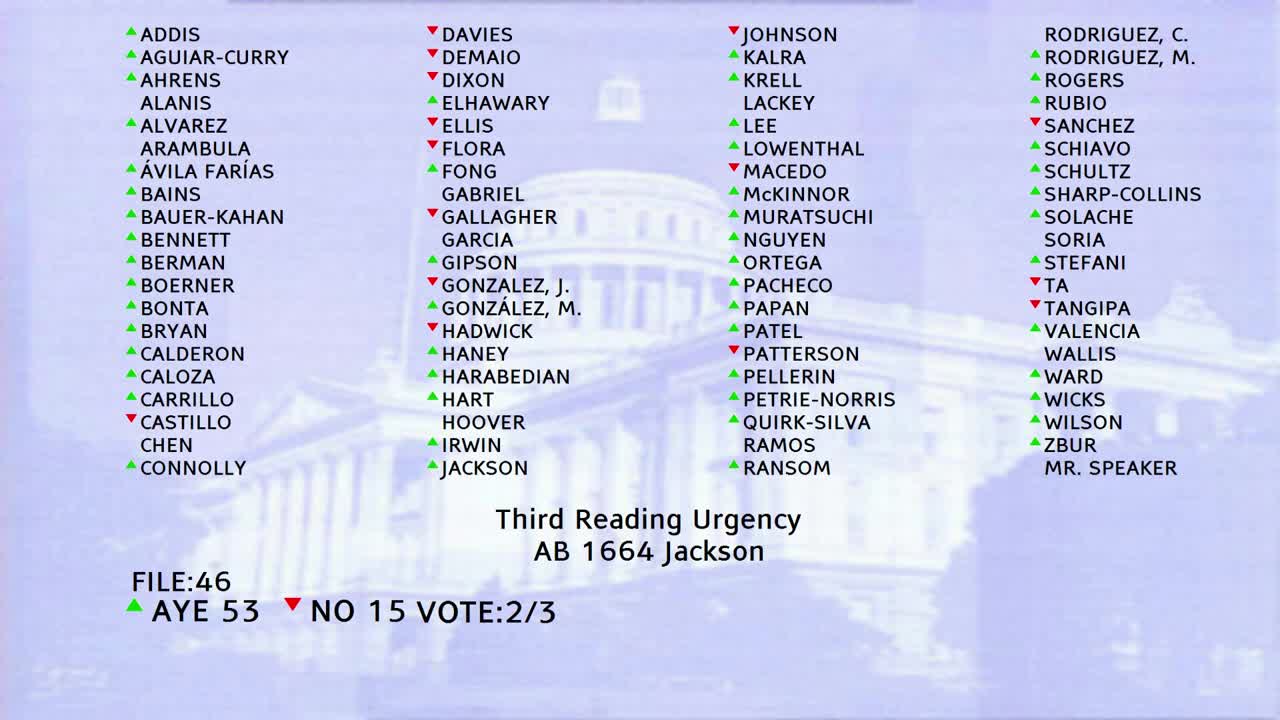 2MIN
Assembly Floor
 9MIN
Assembly Standing Committee on Revenue and Taxation
 15MIN
Assembly Standing Committee on Military and Veterans Affairs
Bill Author

Bill Co-Author(s):