AB 2039: Attorneys.
- Session Year: 2025-2026
- House: Assembly
- Latest Version Date: 2026-09-27
Current Status:
Passed
(2026-09-27: Chaptered by Secretary of State - Chapter 574, Statutes of 2026.)
Introduced
In Committee
Awaiting First Chamber Vote
Passed First Chamber
In Committee
Awaiting Second Chamber Vote
Passed Second Chamber
Enacted
The State Bar Act provides for the licensure and regulation of attorneys by the State Bar of California (State Bar), a public corporation governed by a board of trustees. Existing law authorizes the board of trustees, with the approval of the Supreme Court, to formulate and enforce rules of professional conduct for all licensees of the State Bar.
Existing provisions of the Labor Code prohibit an employer from making, adopting, or enforcing any rule, regulation or policy preventing an employee from disclosing information to a government or law enforcement agency, to a person with authority over the employee, or to another employee who has authority to investigate, discover, or correct the violation or noncompliance, if the employee has reasonable cause to believe that the information discloses a violation of state or federal statute, or a violation of or noncompliance with a local, state, or federal rule or regulation.
This bill would add provisions to the State Bar Act that would prohibit an employer, law firm, attorney, or any person acting on their behalf from retaliating against an individual for disclosing information in good faith, or because the employer, law firm, or attorney believes the individual disclosed or may disclose information in good faith, where the individual has reasonable cause to believe that the information reveals a violation of the State Bar Act, the California Rules of Professional Conduct, or any other state or federal statute, rule, or regulation governing the conduct of attorneys.
Existing law requires certain contracts between an attorney and client to comply with specified requirements, including requiring contracts to represent a client on a contingency fee basis to be in writing and include the contingency fee rate and specified other information.
This bill would require an attorney entering into a loan or financial assistance arrangement with a client to have a separate written contract that contains the total amount financed, repayment terms and contingencies, and all fees, costs, and charges. The bill would prohibit an attorney from charging the client interest on any loan or funds. The bill would make a violation of those requirements subject to a civil penalty of $15,000 per offense or injunctive relief, and subject to discipline by the State Bar.
Existing law makes it unlawful for any person to act as a runner or capper for any attorneys or to solicit any business for attorneys, as specified. Existing law makes a violation of those provisions a misdemeanor or a felony, as specified, and also authorizes a person to bring a civil action for specified remedies for a violation of those provisions. Existing law authorizes the Supreme Court to disbar, including to summarily disbar, or suspend an attorney for specified acts, including conviction of a felony or misdemeanor involving moral turpitude.
This bill would also make a violation of the provisions prohibiting capping or running subject to a civil penalty of $25,000 for each violation. The bill would require the State Bar to enact summarily disbarment procedures for any licensee for a felony conviction of the provisions prohibiting capping or running or a misdemeanor conviction under those provisions where the court finds, or the record establishes, that the licensee acted knowingly and for financial gain.
The State Bar Act provides for the licensure and regulation of attorneys by the State Bar of California (State Bar), a public corporation governed by a board of trustees. Existing law authorizes the board of trustees, with the approval of the Supreme Court, to formulate and enforce rules of professional conduct for all licensees of the State Bar.
Existing provisions of the Labor Code prohibit an employer from making, adopting, or enforcing any rule, regulation or policy preventing an employee from disclosing information to a government or law enforcement agency, to a person with authority over the employee, or to another employee who has authority to investigate, discover, or correct the violation or noncompliance, if the employee has reasonable cause to believe that the information discloses a violation of state or federal statute, or a violation of or noncompliance with a local, state, or federal rule or regulation.
This bill would add provisions to the State Bar Act that would prohibit an employer, law firm, attorney, or any person acting on their behalf from retaliating against an individual for disclosing information in good faith, or because the employer employer, law firm, or attorney believes the individual disclosed or may disclose information in good faith, where the individual has reasonable cause to believe that the information reveals a violation of the State Bar Act, the California Rules of Professional Conduct, or any other state or federal statute, rule, or regulation. regulation governing the conduct of attorneys.
Existing law requires certain contracts between an attorney and client to comply with specified requirements, including requiring contracts to represent a client on a contingency fee basis to be in writing and include the contingency fee rate and specified other information.
This bill would require an attorney entering into a loan or financial assistance arrangement with a client to have a separate written contract that contains the total amount financed, repayment terms and contingencies, and all fees, costs, and charges. The bill would prohibit an attorney from charging the client interest on any loan or funds. The bill would make a violation of those requirements subject to a civil penalty of $15,000 per offense or injunctive relief, and subject to discipline by the State Bar.
Existing law makes it unlawful for any person to act as a runner or capper for any attorneys or to solicit any business for attorneys, as specified. Existing law makes a violation of those provisions a misdemeanor or a felony, as specified, and also authorizes a person to bring a civil action for specified remedies for a violation of those provisions. Existing law authorizes the Supreme Court to disbar, including to summarily disbar, or suspend an attorney for specified acts, including conviction of a felony or misdemeanor involving moral turpitude.
This bill would also make a violation of the provisions prohibiting capping or running subject to a civil penalty of $25,000 for each violation. The bill would require the State Bar to enact summarily disbarment procedures for any licensee for a felony conviction of the provisions prohibiting capping or running or a misdemeanor conviction under those provisions where the court finds, or the record establishes, that the licensee acted knowingly and for financial gain.
The State Bar Act provides for the licensure and regulation of attorneys by the State Bar of California (State Bar), a public corporation governed by a board of trustees. Existing law authorizes the board of trustees, with the approval of the Supreme Court, to formulate and enforce rules of professional conduct for all licensees of the State Bar.
Existing provisions of the Labor Code prohibit an employer from making, adopting, or enforcing any rule, regulation or policy preventing an employee from disclosing information to a government or law enforcement agency, to a person with authority over the employee, or to another employee who has authority to investigate, discover, or correct the violation or noncompliance, if the employee has reasonable cause to believe that the information discloses a violation of state or federal statute, or a violation of or noncompliance with a local, state, or federal rule or regulation.
This bill would add provisions to the State Bar Act that would prohibit an employer, law firm, attorney, or any person acting on their behalf from retaliating against an individual for disclosing information in good faith, or because the employer believes the individual disclosed or may disclose information in good faith, where the individual has reasonable cause to believe that the information reveals a violation of the State Bar Act, the California Rules of Professional Conduct, or any other state or federal statute, rule, or regulation.
Existing law requires certain contracts between an attorney and client to comply with specified requirements, including requiring contracts to represent a client on a contingency fee basis to be in writing and include the contingency fee rate and specified other information.
This bill would require an attorney entering into a loan or financial assistance arrangement with a client to have a separate written contract that contains the total amount financed, repayment terms and contingencies, and all fees, costs, and charges. The bill would prohibit an attorney from charging the client interest on any loan or funds. The bill would make a violation of those requirements subject to a civil penalty of $15,000 per offense or injunctive relief, and subject to discipline by the State Bar.
Existing law makes it unlawful for any person to act as a runner or capper for any attorneys or to solicit any business for attorneys, as specified. Existing law authorizes the Supreme Court to disbar, including to summarily disbar, or suspend an attorney for specified acts, including conviction of a felony or misdemeanor involving moral turpitude.
This bill would require the State Bar to enact summarily disbarment procedures for any licensee for a felony conviction of the provisions prohibiting capping or running or a misdemeanor conviction under those provisions where the court finds, or the record establishes, that the licensee acted knowingly and for financial gain.
Existing law prohibits a contract or proposed contract for the provision of a consumer service by a licensee regulated by a licensing board from containing a provision limiting the consumers ability to file a complaint with that board or to participate in the boards investigation into that licensee.This bill would expand the above restriction to instead prohibit a contract or proposed contract from containing a provision limiting the consumers ability to file a complaint with that board or to participate in the boards investigation into any licensee.Existing law prohibits a contract or proposed contract for the provision of a consumer service by a licensee regulated by a licensing board from containing a provision limiting the consumers ability to file a complaint with that board or to participate in the boards investigation into that licensee.
This bill would expand the above restriction to instead prohibit a contract or proposed contract from containing a provision limiting the consumers ability to file a complaint with that board or to participate in the boards investigation into any licensee.
The Legislature finds and declares:
(a)Capping undermines the integrity of the legal profession and harms consumers by incentivizing unlawful solicitation practices.
(b)Existing law grants disciplinary discretion that may result in inconsistent outcomes following criminal prosecution for illegal capping.
(c)It is the intent of the Legislature to strengthen existing summarily disbarment procedures upon specified convictions to promote uniform enforcement and public protection.
SEC. 2.Section 6090.9 is added to the Business and Professions Code, to read:6090.9.(a)The Legislature intends that this section be interpreted consistently with, and provide protections at least as strong as, those provided under Section 1102.5 of the Labor Code, while addressing misconduct within the legal profession. The Legislature further intends that this section operate in harmony with Rule 1.6 of the California Rules of Professional Conduct and shall not be construed to expand or limit an attorneys duties of confidentiality except as expressly provided.
(b)Consistent with Section 1102.5 of the Labor Code, an employer, law firm, attorney, or any person acting on their behalf shall not retaliate against an individual for disclosing information in good faith, or because the employer, law firm, or attorney believes the individual disclosed or may disclose information in good faith, where the individual has reasonable cause to believe that the information reveals a violation of this chapter, the California Rules of Professional Conduct, or any state or federal statute, rule, or regulation governing the conduct of attorneys.
(c)Protected disclosures include reports made to the State Bar of California, a court, a public prosecutor, or a person with authority to investigate or correct the violation. Nothing in this section shall modify Rule 1.6 of the California Rules of Professional Conduct or relieve any attorney of their duty to maintain client confidentiality under the laws of the state.
(d)When the reporting individual is an attorney, a disclosure constitutes protected activity under this section only to the extent the disclosure is permitted by Rule 1.6 of the California Rules of Professional Conduct or other applicable law. A disclosure made in violation of Rule 1.6 of the California Rules of Professional Conduct shall not constitute protected activity under this section.
(e)Nothing in this section authorizes an attorney to disclose information the disclosure of which is otherwise prohibited by Rule 1.6 of the California Rules of Professional Conduct.
(f)The limitations set forth in subdivisions (d) and (e) apply only to attorneys. Nothing in this section limits or alters the ability of clients to report attorney misconduct through existing mechanisms provided by law.
(g)The protections provided in this section are in addition to, and shall not diminish, any rights or remedies available under Section 1102.5 of the Labor Code. Courts shall construe this section consistently with judicial interpretations of Section 1102.5 of the Labor Code to promote uniform application of the California Whistleblower Protection Act. Nothing in this section limits broader protections otherwise provided by law.
(h)The protection provided in this section extends to employees, former employees, applicants, independent contractors, vendors, clients, and any person with a professional relationship to an attorney or law firm provided that the information is disclosed in good faith.
(i)Retaliation includes termination, demotion, discipline, threats, harassment, blacklisting, adverse contract actions, or any conduct that would deter a reasonable person from reporting misconduct. Retaliation in violation of this section by an attorney or any person acting on their behalf shall constitute grounds for discipline by the State Bar of California, in addition to any civil liability provided herein.
(j)Reporting mechanisms administered by the State Bar of California or authorized agencies shall, where feasible, permit confidential or anonymous submissions consistent with existing whistleblower statutes.
(k)A prevailing plaintiff may recover restatement or restoration of contractual status, backpay and benefits, compensatory damages, reasonable attorneys fees and costs, and injunctive or other equitable relief. Remedies shall be interpreted in harmony with remedies available under Section 1102.5 of the Labor Code and related provisions.
(l)Any agreement that waives the protections of this section is unenforceable. The remedies provided are cumulative of those available under other statutes, including Section 1102.5 of the Labor Code.
SEC. 3.Section 6149.6 is added to the Business and Professions Code, to read:6149.6.(a)For purposes of this section, the following definitions apply:
(1)Attorney-client loan or advance means any extension of credit, loan, or financial assistance provided by an attorney or law firm to a client, other than payment of ordinary litigation costs expressly permitted by law.
(2)Client includes a prospective client where legal representation is reasonably anticipated.
(b)An attorney shall not enter into a loan or financial assistance arrangement with a client unless all of the agreement is in a separate written contract distinct from the retainer agreement and it contains all of the following:
(1)The total amount financed.
(2)Repayment terms and contingencies.
(3)All fees, costs, and charges.
(4)Potential conflicts of interest arising from the arrangement.
(c)An attorney shall not charge the client interest on any loan or any funds that are advanced for any purpose, whether for case expenses or any other purpose. An attorney shall not charge hidden fees or compounding structures designed to evade disclosure. Terms that materially impair a clients autonomy or litigation decisions are prohibited.
(d)Before execution of any agreement, an attorney shall advise the client in writing that the client may seek independent legal or financial advice. The client shall be provided a cooling-off period of not less than five business days unless waived in writing after disclosure. The client must provide informed written consent acknowledging understanding of risks and alternatives.
(e)An attorney shall not do any of the following:
(1)Condition legal strategy, settlement decisions, or continued representation on acceptance or repayment of a loan.
(2)Use a loan to acquire ownership, control, or leverage over the clients cause of action beyond lawful attorney liens.
(3)Structure financial assistance in a manner that interferes with independent professional judgment.
(f)A violation of this section constitutes unlawful conduct. Remedies may include restitution, rescission or reformation of the agreement, civil penalties in the amount of fifteen thousand dollars ($15,000) per offense, or injunctive relief. This section does not limit disciplinary authority of the State Bar of California or any other remedies provided by law.
(g)Any contractual provision that waives the protections of this section is void as contrary to public policy.
(h)This section supplements, and does not replace, existing ethical obligations governing business transactions with clients and shall be interpreted consistently with guidance from the American Bar Association and the California Rules of Professional Conduct.
(i)The duties and obligations imposed by this section are cumulative with any other duties or obligations imposed under other law and shall not be construed to relieve any party from any duties or obligations imposed under other law, and do not limit any rights or remedies under existing law.
(j)An attorneys failure to comply with any requirement of this section shall constitute grounds for discipline by the State Bar of California.
(k)Discipline under this section is in addition to any other civil, equitable, or statutory remedies.
SEC. 4.Section 6152.5 is added to the Business and Professions Code, to read:6152.5.(a)Notwithstanding any other law, the State Bar of California shall enact summarily disbarment procedures under subdivision (c) of Section 6102 of any licensee upon either of the following:
(1)A felony conviction under Section 6152 or any successor provision prohibiting capping or running.
(2)A misdemeanor conviction under Section 6152 where the court finds, or the record establishes, that the licensee acted knowingly and for financial gain.
(b)Upon receipt of a certified record of conviction described in subdivision (a), the Supreme Court of California shall order disbarment. The State Bar of California shall not negotiate, recommend, or impose an alternative form of discipline, including, but not limited to, reproval, suspension, diversion, or probation, in lieu of revocation.
(c)The pendency of an appeal shall not prevent interim suspension pursuant to existing Rules of Procedure of the State Bar of California.
(d)Nothing in this section shall be construed to limit criminal penalties otherwise provided by law.
(e)For purposes of this section, capping has the same meaning as set forth in Section 6152.
SEC. 5.Section 6153 of the Business and Professions Code is amended to read:6153.(a)A person, firm, partnership, association, or corporation violating subdivision (a) of Section 6152 is punishable, upon a first conviction, by imprisonment in a county jail for not more than one year or by a fine not exceeding fifteen thousand dollars ($15,000), or by both that imprisonment and fine. Upon a second or subsequent conviction, a person, firm, partnership, association, or corporation is punishable by imprisonment in a county jail for not more than one year, or by imprisonment pursuant to subdivision (h) of Section 1170 of the Penal Code for two, three, or four years, or by a fine not exceeding fifteen thousand dollars ($15,000), or by both that imprisonment and fine.
(b)A person employed either as an officer, director, trustee, clerk, servant or agent of this state or of any county or other municipal corporation or subdivision thereof, who is found guilty of violating any of the provisions of this article, shall forfeit the right to their office and employment in addition to any other penalty provided in this article.
(c)Any person may bring a civil action for a violation of subdivision (a) of Section 6152 for the following remedies:
(1)Statutory damages of a minimum of five thousand dollars ($5,000) up to a maximum of one hundred thousand dollars ($100,000) per violation, or three times the amount of actual damages, whichever is larger. The amount of statutory damages in this subdivision shall be determined pursuant to subdivision (d).
(2)Attorneys fees.
(3)Injunctive or declaratory relief.
(4)Any other relief the court deems proper.
(d)In assessing the amount of statutory damages, the court shall consider any one or more of the relevant circumstances presented by the case, including, but not limited to, the nature and seriousness of the misconduct, the number of violations, the persistence of the misconduct, the length of time over which the misconduct occurred, the willfulness of the defendants misconduct, and the defendants assets, liabilities, and net worth.
(e)(1)In addition to subdivisions (a) and (c), a person, firm, partnership, association, or corporation violating subdivision (a) of Section 6152 is liable for a civil penalty of twenty-five thousand dollars ($25,000) per violation.
(2)Every client retained and claim filed engaging in the conduct prohibited by subdivision (a) of Section 6152 shall constitute an individual violation for the purpose of this subdivision.
(3)An action to enforce paragraph (1) may be brought by the Attorney General, a city attorney or county counsel.
(4)A prevailing plaintiff in an action brought pursuant to paragraph (1) shall be entitled to an award of reasonable attorneys fees and costs.
(f)The right of action under this section exists independently of any enforcement action or inaction by any governmental agency or official.
The Legislature finds and declares:
(a)Capping undermines the integrity of the legal profession and harms consumers by incentivizing unlawful solicitation practices.
(b)Existing law grants disciplinary discretion that may result in inconsistent outcomes following criminal prosecution for illegal capping.
(c)It is the intent of the Legislature to strengthen existing summarily disbarment procedures upon specified convictions to promote uniform enforcement and public protection.
SEC. 2.Section 6090.9 is added to the Business and Professions Code, to read:6090.9.(a)The Legislature intends that this section be interpreted consistently with, and provide protections at least as strong as, those provided under Section 1102.5 of the Labor Code, while addressing misconduct within the legal profession. The Legislature further intends that this section operate in harmony with Rule 1.6 of the California Rules of Professional Conduct and shall not be construed to expand or limit an attorneys duties of confidentiality except as expressly provided.
(b)Consistent with Section 1102.5 of the Labor Code, an employer, law firm, attorney, or any person acting on their behalf shall not retaliate against an individual for disclosing information in good faith, or because the employer, law firm, or attorney believes the individual disclosed or may disclose information in good faith, where the individual has reasonable cause to believe that the information reveals a violation of this chapter, the California Rules of Professional Conduct, or any state or federal statute, rule, or regulation governing the conduct of attorneys.
(c)Protected disclosures include reports made to the State Bar of California, a court, a public prosecutor, or a person with authority to investigate or correct the violation. Nothing in this section shall modify Rule 1.6 of the California Rules of Professional Conduct or relieve any attorney of their duty to maintain client confidentiality under the laws of the state.
(d)When the reporting individual is an attorney, a disclosure constitutes protected activity under this section only to the extent the disclosure is permitted by Rule 1.6 of the California Rules of Professional Conduct or other applicable law. A disclosure made in violation of Rule 1.6 of the California Rules of Professional Conduct shall not constitute protected activity under this section.
(e)Nothing in this section authorizes an attorney to disclose information the disclosure of which is otherwise prohibited by Rule 1.6 of the California Rules of Professional Conduct.
(f)The limitations set forth in subdivisions (d) and (e) apply only to attorneys. Nothing in this section limits or alters the ability of clients to report attorney misconduct through existing mechanisms provided by law.
(g)The protections provided in this section are in addition to, and shall not diminish, any rights or remedies available under Section 1102.5 of the Labor Code. Courts shall construe this section consistently with judicial interpretations of Section 1102.5 of the Labor Code to promote uniform application of the California Whistleblower Protection Act. Nothing in this section limits broader protections otherwise provided by law.
(h)The protection provided in this section extends to employees, former employees, applicants, independent contractors, vendors, clients, and any person with a professional relationship to an attorney or law firm provided that the information is disclosed in good faith.
(i)Retaliation includes termination, demotion, discipline, threats, harassment, blacklisting, adverse contract actions, or any conduct that would deter a reasonable person from reporting misconduct, consistent with standards applied under Section 1102.5 of the Labor Code. misconduct. Retaliation in violation of this section by an attorney or any person acting on their behalf shall constitute grounds for discipline by the State Bar of California, in addition to any civil liability provided herein.
(j)Reporting mechanisms administered by the State Bar of California or authorized agencies shall, where feasible, permit confidential or anonymous submissions consistent with existing whistleblower statutes.
(k)A prevailing plaintiff may recover restatement or restoration of contractual status, backpay and benefits, compensatory damages, reasonable attorneys fees and costs, and injunctive or other equitable relief. Remedies shall be interpreted in harmony with remedies available under Section 1102.5 of the Labor Code and related provisions.
(l)Any agreement that waives the protections of this section is unenforceable. The remedies provided are cumulative of those available under other statutes, including Section 1102.5 of the Labor Code.
SEC. 3.Section 6149.6 is added to the Business and Professions Code, to read:6149.6.(a)For purposes of this section, the following definitions apply:
(1)Attorney-client loan or advance means any extension of credit, loan, or financial assistance provided by an attorney or law firm to a client, other than payment of ordinary litigation costs expressly permitted by law.
(2)Client includes a prospective client where legal representation is reasonably anticipated.
(b)An attorney shall not enter into a loan or financial assistance arrangement with a client unless all of the agreement is in a separate written contract distinct from the retainer agreement and it contains all of the following:
(1)The total amount financed.
(2)Repayment terms and contingencies.
(3)All fees, costs, and charges.
(4)Potential conflicts of interest arising from the arrangement.
(c)An attorney shall not charge the client interest on any loan or any funds that are advanced for any purpose, whether for case expenses or any other purpose. An attorney shall not charge hidden fees or compounding structures designed to evade disclosure. Terms that materially impair a clients autonomy or litigation decisions are prohibited.
(d)Before execution of any agreement, an attorney shall advise the client in writing that the client may seek independent legal or financial advice. The client shall be provided a cooling-off period of not less than five business days unless waived in writing after disclosure. The client must provide informed written consent acknowledging understanding of risks and alternatives.
(e)An attorney shall not do any of the following:
(1)Condition legal strategy, settlement decisions, or continued representation on acceptance or repayment of a loan.
(2)Use a loan to acquire ownership, control, or leverage over the clients cause of action beyond lawful attorney liens.
(3)Structure financial assistance in a manner that interferes with independent professional judgment.
(f)A violation of this section constitutes unlawful conduct. Remedies may include restitution, rescission or reformation of the agreement, civil penalties in the amount of fifteen thousand dollars ($15,000) per offense, or injunctive relief. This section does not limit disciplinary authority of the State Bar of California or any other remedies provided by law.
(g)Any contractual provision that waives the protections of this section is void as contrary to public policy.
(h)This section supplements, and does not replace, existing ethical obligations governing business transactions with clients and shall be interpreted consistently with guidance from the American Bar Association and the California Rules of Professional Conduct.
(i)The duties and obligations imposed by this section are cumulative with any other duties or obligations imposed under other law and shall not be construed to relieve any party from any duties or obligations imposed under other law, and do not limit any rights or remedies under existing law.
(j)An attorneys failure to comply with any requirement of this section shall constitute grounds for discipline by the State Bar of California.
(k)Discipline under this section is in addition to any other civil, equitable, or statutory remedies.
SEC. 4.Section 6152.5 is added to the Business and Professions Code, to read:6152.5.(a)Notwithstanding any other law, the State Bar of California shall enact summarily disbarment procedures under subdivision (c) of Section 6102 of any licensee upon either of the following:
(1)A felony conviction under Section 6152 or any successor provision prohibiting capping or running.
(2)A misdemeanor conviction under Section 6152 where the court finds, or the record establishes, that the licensee acted knowingly and for financial gain.
(b)Upon receipt of a certified record of conviction described in subdivision (a), the Supreme Court of California shall order disbarment. The State Bar of California shall not negotiate, recommend, or impose an alternative form of discipline, including, but not limited to, reproval, suspension, diversion, or probation, in lieu of revocation.
(c)The pendency of an appeal shall not prevent interim suspension pursuant to existing Rules of Procedure of the State Bar of California.
(d)Nothing in this section shall be construed to limit criminal penalties otherwise provided by law.
(e)For purposes of this section, capping has the same meaning as set forth in Section 6152.
SEC. 5.Section 6153 of the Business and Professions Code is amended to read:6153.(a)A person, firm, partnership, association, or corporation violating subdivision (a) of Section 6152 is punishable, upon a first conviction, by imprisonment in a county jail for not more than one year or by a fine not exceeding fifteen thousand dollars ($15,000), or by both that imprisonment and fine. Upon a second or subsequent conviction, a person, firm, partnership, association, or corporation is punishable by imprisonment in a county jail for not more than one year, or by imprisonment pursuant to subdivision (h) of Section 1170 of the Penal Code for two, three, or four years, or by a fine not exceeding fifteen thousand dollars ($15,000), or by both that imprisonment and fine.
(b)A person employed either as an officer, director, trustee, clerk, servant or agent of this state or of any county or other municipal corporation or subdivision thereof, who is found guilty of violating any of the provisions of this article, shall forfeit the right to their office and employment in addition to any other penalty provided in this article.
(c)Any person may bring a civil action for a violation of subdivision (a) of Section 6152 for the following remedies:
(1)Statutory damages of a minimum of five thousand dollars ($5,000) up to a maximum of one hundred thousand dollars ($100,000) per violation, or three times the amount of actual damages, whichever is larger. The amount of statutory damages in this subdivision shall be determined pursuant to subdivision (d).
(2)Attorneys fees.
(3)Injunctive or declaratory relief.
(4)Any other relief the court deems proper.
(d)In assessing the amount of statutory damages, the court shall consider any one or more of the relevant circumstances presented by the case, including, but not limited to, the nature and seriousness of the misconduct, the number of violations, the persistence of the misconduct, the length of time over which the misconduct occurred, the willfulness of the defendants misconduct, and the defendants assets, liabilities, and net worth.
(e)(1)In addition to subdivisions (a) and (c), a person, firm, partnership, association, or corporation violating subdivision (a) of Section 6152 is liable for a civil penalty of twenty-five thousand dollars ($25,000) per violation.
(2)Every client retained and claim filed engaging in the conduct prohibited by subdivision (a) of Section 6152 shall constitute an individual violation for the purpose of this subdivision.
(3)An action to enforce paragraph (1) may be brought by the Attorney General, a city attorney or county counsel.
(4)A prevailing plaintiff in an action brought pursuant to paragraph (1) shall be entitled to an award of reasonable attorneys fees and costs.
(f)The right of action under this section exists independently of any enforcement action or inaction by any governmental agency or official.
The Legislature finds and declares:
(a)Capping undermines the integrity of the legal profession and harms consumers by incentivizing unlawful solicitation practices.
(b)Existing law grants disciplinary discretion that may result in inconsistent outcomes following criminal prosecution for illegal capping.
(c)It is the intent of the Legislature to strengthen existing summarily disbarment procedures upon specified convictions to promote uniform enforcement and public protection.
SEC. 2.Section 6090.9 is added to the Business and Professions Code, to read:6090.9.(a)The Legislature intends that this section be interpreted consistently with, and provide protections at least as strong as, those provided under Section 1102.5 of the Labor Code, while addressing misconduct within the legal profession. The Legislature further intends that this section operate in harmony with Rule 1.6 of the California Rules of Professional Conduct and shall not be construed to expand or limit an attorneys duties of confidentiality except as expressly provided.
(b)Consistent with Section 1102.5 of the Labor Code, an employer, law firm, attorney, or any person acting on their behalf shall not retaliate against an individual for disclosing information in good faith, or because the employer, law firm, or attorney believes the individual disclosed or may disclose information in good faith, where the individual has reasonable cause to believe that the information reveals a violation of this chapter, the California Rules of Professional Conduct, or any state or federal statute, rule, or regulation governing the conduct of attorneys.
(c)Protected disclosures include reports made to the State Bar of California, a court, a public prosecutor, or a person with authority to investigate or correct the violation. Nothing in this section shall modify Rule 1.6 of the California Rules of Professional Conduct or relieve any attorney of their duty to maintain client confidentiality under the laws of the state.
(d)When the reporting individual is an attorney, a disclosure constitutes protected activity under this section only to the extent the disclosure is permitted by Rule 1.6 of the California Rules of Professional Conduct or other applicable law. A disclosure made in violation of Rule 1.6 of the California Rules of Professional Conduct shall not constitute protected activity under this section.
(e)Nothing in this section authorizes an attorney to disclose information the disclosure of which is otherwise prohibited by Rule 1.6 of the California Rules of Professional Conduct.
(f)The limitations set forth in subdivisions (d) and (e) apply only to attorneys. Nothing in this section limits or alters the ability of clients to report attorney misconduct through existing mechanisms provided by law.
(g)The protections provided in this section are in addition to, and shall not diminish, any rights or remedies available under Section 1102.5 of the Labor Code. Courts shall construe this section consistently with judicial interpretations of Section 1102.5 of the Labor Code to promote uniform application of the California Whistleblower Protection Act. Nothing in this section limits broader protections otherwise provided by law.
(h)The protection provided in this section to employees, former employees, applicants, independent contractors, vendors, clients, and any person with a professional relationship to an attorney or law firm provided that the information is disclosed in good faith.
(i)Retaliation includes termination, demotion, discipline, threats, harassment, blacklisting, adverse contract actions, or any conduct that would deter a reasonable person from reporting misconduct, consistent with standards applied under Section 1102.5 of the Labor Code. Retaliation in violation of this section by an attorney or any person acting on their behalf shall constitute grounds for discipline by the State Bar of California, in addition to any civil liability provided herein.
(j)Reporting mechanisms administered by the State Bar of California or authorized agencies shall, where feasible, permit confidential or anonymous submissions consistent with existing whistleblower statutes.
(k)A prevailing plaintiff may recover restatement or restoration of contractual status, backpay and benefits, compensatory damages, reasonable attorneys fees and costs, and injunctive or other equitable relief. Remedies shall be interpreted in harmony with remedies available under Section 1102.5 of the Labor Code and related provisions.
(l)Any agreement that waives the protections of this section is unenforceable. The remedies provided are cumulative of those available under other statutes, including Section 1102.5 of the Labor Code.
SEC. 3.Section 6149.6 is added to the Business and Professions Code, to read:6149.6.(a)For purposes of this section, the following definitions apply:
(1)Attorney-client loan or advance means any extension of credit, loan, or financial assistance provided by an attorney or law firm to a client, other than payment of ordinary litigation costs expressly permitted by law.
(2)Client includes a prospective client where legal representation is reasonably anticipated.
(b)An attorney shall not enter into a loan or financial assistance arrangement with a client unless all of the agreement is in a separate written contract distinct from the retainer agreement and it contains all of the following:
(1)The total amount financed.
(2)Repayment terms and contingencies.
(3)All fees, costs, and charges.
(4)Potential conflicts of interest arising from the arrangement.
(c)An attorney shall not charge the client interest on any loan or any funds that are advanced for any purpose, whether for case expenses or any other purpose. An attorney shall not charge hidden fees or compounding structures designed to evade disclosure. Terms that materially impair a clients autonomy or litigation decisions are prohibited.
(d)Before execution of any agreement, an attorney shall advise the client in writing that the client may seek independent legal or financial advice. The client shall be provided a cooling-off period of not less than five business days unless waived in writing after disclosure. The client must provide informed written consent acknowledging understanding of risks and alternatives.
(e)An attorney shall not do any of the following:
(1)Condition legal strategy, settlement decisions, or continued representation on acceptance or repayment of a loan.
(2)Use a loan to acquire ownership, control, or leverage over the clients cause of action beyond lawful attorney liens.
(3)Structure financial assistance in a manner that interferes with independent professional judgment.
(f)A violation of this section constitutes unlawful conduct. Remedies may include restitution, rescission or reformation of the agreement, civil penalties in the amount of fifteen thousand dollars ($15,000) per offense, or injunctive relief. This section does not limit disciplinary authority of the State Bar of California or any other remedies provided by law.
(g)Any contractual provision that waives the protections of this section is void as contrary to public policy.
(h)This section supplements, and does not replace, existing ethical obligations governing business transactions with clients and shall be interpreted consistently with guidance from the American Bar Association and the California Rules of Professional Conduct.
(i)The duties and obligations imposed by this section are cumulative with any other duties or obligations imposed under other law and shall not be construed to relieve any party from any duties or obligations imposed under other law, and do not limit any rights or remedies under existing law.
(j)An attorneys failure to comply with any requirement of this section shall constitute grounds for discipline by the State Bar of California.
(k)Discipline under this section is in addition to any other civil, equitable, or statutory remedies.
SEC. 4.Section 6152.5 is added to the Business and Professions Code, to read:6152.5.(a)Notwithstanding any other law, the State Bar of California shall enact summarily disbarment procedures under subdivision (c) of Section 6102 of any licensee upon either of the following:
(1)A felony conviction under Section 6152 or any successor provision prohibiting capping or running.
(2)A misdemeanor conviction under Section 6152 where the court finds, or the record establishes, that the licensee acted knowingly and for financial gain.
(b)Upon receipt of a certified record of conviction described in subdivision (a), the Supreme Court of California shall order disbarment. The State Bar of California shall not negotiate, recommend, or impose an alternative form of discipline, including, but not limited to, reproval, suspension, diversion, or probation, in lieu of revocation.
(c)The pendency of an appeal shall not prevent interim suspension pursuant to existing Rules of Procedure of the State Bar of California.
(d)Nothing in this section shall be construed to limit criminal penalties otherwise provided by law.
(e)For purposes of this section, capping has the same meaning as set forth in Section 6152.
SEC. 5.Section 6153 of the Business and Professions Code is amended to read:6153.(a)A person, firm, partnership, association, or corporation violating subdivision (a) of Section 6152 is punishable, upon a first conviction, by imprisonment in a county jail for not more than one year or by a fine not exceeding fifteen thousand dollars ($15,000), or by both that imprisonment and fine. Upon a second or subsequent conviction, a person, firm, partnership, association, or corporation is punishable by imprisonment in a county jail for not more than one year, or by imprisonment pursuant to subdivision (h) of Section 1170 of the Penal Code for two, three, or four years, or by a fine not exceeding fifteen thousand dollars ($15,000), or by both that imprisonment and fine.
(b)A person employed either as an officer, director, trustee, clerk, servant or agent of this state or of any county or other municipal corporation or subdivision thereof, who is found guilty of violating any of the provisions of this article, shall forfeit the right to their office and employment in addition to any other penalty provided in this article.
(c)Any person may bring a civil action for a violation of subdivision (a) of Section 6152 for the following remedies:
(1)Statutory damages of a minimum of five thousand dollars ($5,000) up to a maximum of one hundred thousand dollars ($100,000) per violation, or three times the amount of actual damages, whichever is larger. The amount of statutory damages in this subdivision shall be determined pursuant to subdivision (d).
(2)Attorneys fees.
(3)Injunctive or declaratory relief.
(4)Any other relief the court deems proper.
(d)In assessing the amount of statutory damages, the court shall consider any one or more of the relevant circumstances presented by the case, including, but not limited to, the nature and seriousness of the misconduct, the number of violations, the persistence of the misconduct, the length of time over which the misconduct occurred, the willfulness of the defendants misconduct, and the defendants assets, liabilities, and net worth.
(e)(1)Notwithstanding In addition to subdivisions (a) and (c), a person, firm, partnership, association, or corporation violating subdivision (a) of Section 6152 is liable for a civil penalty of twenty-five thousand dollars ($25,000) per violation.
(2)Every client retained and claim filed engaging in the conduct prohibited by subdivision (a) of Section 6152 shall constitute an individual violation for the purpose of this subdivision.
(3)An action to enforce paragraph (1) may be brought by the Attorney General, a city attorney or county counsel.
(4)A prevailing plaintiff in an action brought pursuant to paragraph (1) shall be entitled to an award of reasonable attorneys fees and costs.
(f)The right of action under this section exists independently of any enforcement action or inaction by any governmental agency or official.
The Legislature finds and declares:
(a)Capping undermines the integrity of the legal profession and harms consumers by incentivizing unlawful solicitation practices.
(b)Existing law grants disciplinary discretion that may result in inconsistent outcomes following criminal prosecution for illegal capping.
(c)It is the intent of the Legislature to strengthen existing summarily disbarment procedures upon specified convictions to promote uniform enforcement and public protection.
SEC. 2.Section 6090.9 is added to the Business and Professions Code, to read:6090.9.(a)The Legislature intends that this section be interpreted consistently with, and provide protections at least as strong as, those provided under Section 1102.5 of the Labor Code, while addressing misconduct within the legal profession. The Legislature further intends that this section operate in harmony with Rule 1.6 of the California Rules of Professional Conduct and shall not be construed to expand or limit an attorneys duties of confidentiality except as expressly provided.
(b)Consistent with Section 1102.5 of the Labor Code, an employer, law firm, attorney, or any person acting on their behalf shall not retaliate against an individual for disclosing information in good faith, or because the employer employer, law firm, or attorney believes the individual disclosed or may disclose information in good faith, where the individual has reasonable cause to believe that the information reveals a violation of this chapter, the California Rules of Professional Conduct, or any state or federal statute, rule, or regulation. regulation governing the conduct of attorneys.
(c)Protected disclosures include reports made to the State Bar of California, a court, a public prosecutor, or a person with authority to investigate or correct the violation. Nothing in this section shall modify Rule 1.6 of the California Rules of Professional Conduct or relieve any attorney of their duty to maintain client confidentiality under the laws of the state.
(d)When the reporting individual is an attorney, a disclosure constitutes protected activity under this section only to the extent the disclosure is permitted by Rule 1.6 of the California Rules of Professional Conduct or other applicable law. A disclosure made in violation of Rule 1.6 of the California Rules of Professional Conduct shall not constitute protected activity under this section.
(e)Nothing in this section authorizes an attorney to disclose information that the disclosure of which is otherwise prohibited by Rule 1.6 of the California Rules of Professional Conduct.
(f)The limitations set forth in subdivisions (d) and (e) apply only to attorneys. Nothing in this section limits or alters the ability of clients to report attorney misconduct through existing mechanisms provided by law.
(g)The protections provided in this section are in addition to, and shall not diminish, any rights or remedies available under Section 1102.5 of the Labor Code. Courts shall construe this section consistently with judicial interpretations of Section 1102.5 of the Labor Code to promote uniform application of the California Whistleblower Protection Act. Nothing in this section limits broader protections otherwise provided by law.
(h)Protection extends The protection provided in this section to employees, former employees, applicants, independent contractors, vendors, clients, and any person with a professional relationship to an attorney or law firm provided that the information is disclosed in good faith.
(i)Retaliation includes termination, demotion, discipline, threats, harassment, blacklisting, adverse contract actions, or any conduct that would deter a reasonable person from reporting misconduct, consistent with standards applied under Section 1102.5 of the Labor Code. Retaliation in violation of this section by an attorney or any person acting on their behalf shall constitute grounds for discipline by the State Bar of California, in addition to any civil liability provided herein.
(j)Reporting mechanisms administered by the State Bar of California or authorized agencies shall, where feasible, permit confidential or anonymous submissions consistent with existing whistleblower statutes.
(k)A prevailing plaintiff may recover restatement or restoration of contractual status, backpay and benefits, compensatory damages, reasonable attorneys fees and costs, and injunctive or other equitable relief. Remedies shall be interpreted in harmony with remedies available under Section 1102.5 of the Labor Code and related provisions.
(l)Any agreement that waives the protections of this section is unenforceable. The remedies provided are cumulative of those available under other statutes, including Section 1102.5 of the Labor Code.
SEC. 3.Section 6149.6 is added to the Business and Professions Code, to read:6149.6.(a)For purposes of this section, the following definitions apply:
(1)Attorney-client loan or advance means any extension of credit, loan, or financial assistance provided by an attorney or law firm to a client, other than payment of ordinary litigation costs expressly permitted by law.
(2)Client includes a prospective client where legal representation is reasonably anticipated.
(b)An attorney shall not enter into a loan or financial assistance arrangement with a client unless all of the agreement is in a separate written contract distinct from the retainer agreement and it contains all of the following:
(1)The total amount financed.
(2)Repayment terms and contingencies.
(3)All fees, costs, and charges.
(4)Potential conflicts of interest arising from the arrangement.
(c)An attorney shall not charge the client interest on any loan or any funds that are advanced for any purpose, whether for case expenses or any other purpose. An attorney shall not charge hidden fees or compounding structures designed to evade disclosure. Terms that materially impair a clients autonomy or litigation decisions are prohibited.
(d)Before execution of any agreement, an attorney shall advise the client in writing that the client may seek independent legal or financial advice. The client shall be provided a cooling-off period of not less than five business days unless waived in writing after disclosure. The client must provide informed written consent acknowledging understanding of risks and alternatives.
(e)An attorney shall not do any of the following:
(1)Condition legal strategy, settlement decisions, or continued representation on acceptance or repayment of a loan.
(2)Use a loan to acquire ownership, control, or leverage over the clients cause of action beyond lawful attorney liens.
(3)Structure financial assistance in a manner that interferes with independent professional judgment.
(f)A violation of this section constitutes unlawful conduct. Remedies may include restitution, rescission or reformation of the agreement, civil penalties in the amount of fifteen thousand dollars ($15,000) per offense, or injunctive relief. This section does not limit disciplinary authority of the State Bar of California or any other remedies provided by law.
(g)Any contractual provision that waives the protections of this section is void as contrary to public policy.
(h)This section supplements, and does not replace, existing ethical obligations governing business transactions with clients and shall be interpreted consistently with guidance from the American Bar Association and the California Rules of Professional Conduct.
(i)The duties and obligations imposed by this section are cumulative with any other duties or obligations imposed under other law and shall not be construed to relieve any party from any duties or obligations imposed under other law, and do not limit any rights or remedies under existing law.
(j)An attorneys failure to comply with any requirement of this section shall constitute grounds for discipline by the State Bar of California.
(k)Discipline under this section is in addition to any other civil, equitable, or statutory remedies.
SEC. 4.Section 6152.5 is added to the Business and Professions Code, to read:6152.5.(a)Notwithstanding any other law, the State Bar of California shall enact summarily disbarment procedures under subdivision (c) of Section 6102 of any licensee upon either of the following:
(1)A felony conviction under Section 6152 or any successor provision prohibiting capping or running.
(2)A misdemeanor conviction under Section 6152 where the court finds, or the record establishes, that the licensee acted knowingly and for financial gain.
(b)Upon receipt of a certified record of conviction described in subdivision (a), the Supreme Court of California shall order disbarment. The State Bar of California shall not negotiate, recommend, or impose an alternative form of discipline, including including, but not limited to to, reproval, suspension, diversion, or probation, in lieu of revocation.
(c)The pendency of an appeal shall not prevent interim suspension pursuant to existing Rules of Procedure of the State Bar of California.
(d)Nothing in this section shall be construed to limit criminal penalties otherwise provided by law.
(e)For purposes of this section, capping has the same meaning as set forth in Section 6152.
SEC. 5.Section 6153 of the Business and Professions Code is amended to read:6153.(a)A person, firm, partnership, association, or corporation violating subdivision (a) of Section 6152 is punishable, upon a first conviction, by imprisonment in a county jail for not more than one year or by a fine not exceeding fifteen thousand dollars ($15,000), or by both that imprisonment and fine. Upon a second or subsequent conviction, a person, firm, partnership, association, or corporation is punishable by imprisonment in a county jail for not more than one year, or by imprisonment pursuant to subdivision (h) of Section 1170 of the Penal Code for two, three, or four years, or by a fine not exceeding fifteen thousand dollars ($15,000), or by both that imprisonment and fine.
(b)A person employed either as an officer, director, trustee, clerk, servant or agent of this state or of any county or other municipal corporation or subdivision thereof, who is found guilty of violating any of the provisions of this article, shall forfeit the right to their office and employment in addition to any other penalty provided in this article.
(c)Any person may bring a civil action for a violation of subdivision (a) of Section 6152 for the following remedies:
(1)Statutory damages of a minimum of five thousand dollars ($5,000) up to a maximum of one hundred thousand dollars ($100,000) per violation, or three times the amount of actual damages, whichever is larger. The amount of statutory damages in this subdivision shall be determined pursuant to subdivision (d).
(2)Attorneys fees.
(3)Injunctive or declaratory relief.
(4)Any other relief the court deems proper.
(d)In assessing the amount of statutory damages, the court shall consider any one or more of the relevant circumstances presented by the case, including, but not limited to, the nature and seriousness of the misconduct, the number of violations, the persistence of the misconduct, the length of time over which the misconduct occurred, the willfulness of the defendants misconduct, and the defendants assets, liabilities, and net worth.
(e)(1)Notwithstanding subdivisions (a) and (c), a person, firm, partnership, association, or corporation violating subdivision (a) of Section 6152 is liable for a civil penalty of twenty-five thousand dollars ($25,000) per violation.
(2)Every client retained and claim filed engaging in the conduct prohibited by subdivision (a) of Section 6152 shall constitute an individual violation for the purpose of this subdivision.
(3)An action to enforce paragraph (1) may be brought by the Attorney General, a city attorney or county counsel.
(4)A prevailing plaintiff in an action brought pursuant to paragraph (1) shall be entitled to an award of reasonable attorneys fees and costs.
(e)(f)The right of action under this section exists independently of any enforcement action or inaction by any governmental agency or official.
The Legislature finds and declares:
(a)Capping undermines the integrity of the legal profession and harms consumers by incentivizing unlawful solicitation practices.
(b)Existing law grants disciplinary discretion that may result in inconsistent outcomes following criminal prosecution for illegal capping.
(c)It is the intent of the Legislature to strengthen existing summarily disbarment procedures upon specified convictions to promote uniform enforcement and public protection.
SEC. 2.Section 6090.9 is added to the Business and Professions Code, to read:6090.9.(a)The Legislature intends that this section be interpreted consistently with, and provide protections at least as strong as, those provided under Section 1102.5 of the Labor Code, while addressing misconduct within the legal profession. The Legislature further intends that this section operate in harmony with Rule 1.6 of the California Rules of Professional Conduct and shall not be construed to expand or limit an attorneys duties of confidentiality except as expressly provided.
(b)Consistent with Section 1102.5 of the Labor Code, an employer, law firm, attorney, or any person acting on their behalf shall not retaliate against an individual for disclosing information in good faith, or because the employer believes the individual disclosed or may disclose information in good faith, where the individual has reasonable cause to believe that the information reveals a violation of this chapter, the California Rules of Professional Conduct, or any state or federal statute, rule, or regulation.
(c)Protected disclosures include reports made to the State Bar of California, a court, a public prosecutor, or a person with authority to investigate or correct the violation. Nothing in this section shall modify Rule 1.6 of the California Rules of Professional Conduct or relieve any attorney of their duty to maintain client confidentiality under the laws of the state.
(d)When the reporting individual is an attorney, a disclosure constitutes protected activity under this section only to the extent the disclosure is permitted by Rule 1.6 of the California Rules of Professional Conduct or other applicable law. A disclosure made in violation of Rule 1.6 of the California Rules of Professional Conduct shall not constitute protected activity under this section.
(e)Nothing in this section authorizes an attorney to disclose information that is otherwise prohibited by Rule 1.6 of the California Rules of Professional Conduct.
(f)The limitations set forth in subdivisions (d) and (e) apply only to attorneys. Nothing in this section limits or alters the ability of clients to report attorney misconduct through existing mechanisms provided by law.
(g)The protections provided in this section are in addition to, and shall not diminish, any rights or remedies available under Section 1102.5 of the Labor Code. Courts shall construe this section consistently with judicial interpretations of Section 1102.5 of the Labor Code to promote uniform application of the California Whistleblower Protection Act. Nothing in this section limits broader protections otherwise provided by law.
(h)Protection extends to employees, former employees, applicants, independent contractors, vendors, clients, and any person with a professional relationship to an attorney or law firm provided that the information is disclosed in good faith.
(i)Retaliation includes termination, demotion, discipline, threats, harassment, blacklisting, adverse contract actions, or any conduct that would deter a reasonable person from reporting misconduct, consistent with standards applied under Section 1102.5 of the Labor Code. Retaliation in violation of this section by an attorney shall constitute grounds for discipline by the State Bar of California, in addition to any civil liability provided herein.
(j)Reporting mechanisms administered by the State Bar of California or authorized agencies shall, where feasible, permit confidential or anonymous submissions consistent with existing whistleblower statutes.
(k)A prevailing plaintiff may recover restatement or restoration of contractual status, backpay and benefits, compensatory damages, reasonable attorneys fees and costs, and injunctive or other equitable relief. Remedies shall be interpreted in harmony with remedies available under Section 1102.5 of the Labor Code and related provisions.
(l)Any agreement that waives the protections of this section is unenforceable. The remedies provided are cumulative of those available under other statutes, including Section 1102.5 of the Labor Code.
SEC. 3.Section 6149.6 is added to the Business and Professions Code, to read:6149.6.(a)For purposes of this section, the following definitions apply:
(1)Attorney-client loan or advance means any extension of credit, loan, or financial assistance provided by an attorney or law firm to a client, other than payment of ordinary litigation costs expressly permitted by law.
(2)Client includes a prospective client where legal representation is reasonably anticipated.
(b)An attorney shall not enter into a loan or financial assistance arrangement with a client unless all the agreement is in a separate written contract distinct from the retainer agreement and it contains all of the following:
(1)The total amount financed.
(2)Repayment terms and contingencies.
(3)All fees, costs, and charges.
(4)Potential conflicts of interest arising from the arrangement.
(c)An attorney shall not charge the client interest on any loan or any funds that are advanced for any purpose, whether for case expenses or any other purpose. An attorney shall not charge hidden fees or compounding structures designed to evade disclosure. Terms that materially impair a clients autonomy or litigation decisions are prohibited.
(d)Before execution of any agreement, an attorney shall advise the client in writing that the client may seek independent legal or financial advice. The client shall be provided a cooling-off period of not less than five business days unless waived in writing after disclosure. The client must provide informed written consent acknowledging understanding of risks and alternatives.
(e)An attorney shall not do any of the following:
(1)Condition legal strategy, settlement decisions, or continued representation on acceptance or repayment of a loan.
(2)Use a loan to acquire ownership, control, or leverage over the clients cause of action beyond lawful attorney liens.
(3)Structure financial assistance in a manner that interferes with independent professional judgment.
(f)A violation of this section constitutes unlawful conduct. Remedies may include restitution, rescission or reformation of the agreement, civil penalties in the amount of fifteen thousand dollars ($15,000) per offense, or injunctive relief. This section does not limit disciplinary authority of the State Bar of California or any other remedies provided by law.
(g)Any contractual provision that waives the protections of this section is void as contrary to public policy.
(h)This section supplements, and does not replace, existing ethical obligations governing business transactions with clients and shall be interpreted consistently with guidance from the American Bar Association and the California Rules of Professional Conduct.
(i)The duties and obligations imposed by this section are cumulative with any other duties or obligations imposed under other law and shall not be construed to relieve any party from any duties or obligations imposed under other law, and do not limit any rights or remedies under existing law.
(j)An attorneys failure to comply with any requirement of this section shall constitute grounds for discipline by the State Bar of California.
(k)Discipline under this section is in addition to any other civil, equitable, or statutory remedies.
SEC. 4.Section 6152.5 is added to the Business and Professions Code, to read:6152.5.(a)Notwithstanding any other law, the State Bar of California shall enact summarily disbarment procedures under subdivision (c) of Section 6102 of any licensee upon either of the following:
(1)A felony conviction under Section 6152 or any successor provision prohibiting capping or running.
(2)A misdemeanor conviction under Section 6152 where the court finds, or the record establishes, that the licensee acted knowingly and for financial gain.
(b)Upon receipt of a certified record of conviction described in subdivision (a), the Supreme Court shall order disbarment. The State Bar of California shall not negotiate, recommend, or impose an alternative form of discipline, including but not limited to reproval, suspension, diversion, or probation, in lieu of revocation.
(c)The pendency of an appeal shall not prevent interim suspension pursuant to existing Rules of Procedure of the State Bar of California.
(d)Nothing in this section shall be construed to limit criminal penalties otherwise provided by law.
(e)For purposes of this section, capping has the same meaning as set forth in Section 6152.
SECTION 1.Section 1670.8.5 of the Civil Code is amended to read:1670.8.5.(a)A contract or proposed contract for the provision of a consumer service by a licensee regulated by a licensing board shall not include a provision limiting the consumers ability to file a complaint with that board or to participate in the boards investigation into any licensee.(b)Any waiver of the provisions of this section is contrary to public policy, and is void and unenforceable.(c)For purposes of this section, the following terms apply:(1)Consumer service means any service that is obtained for use primarily for personal, family, or household purposes.(2)Licensing board means any entity described in Section 101 of the Business and Professions Code, the State Bar of California, the Department of Real Estate, or any other state agency that issues a license, certificate, or registration authorizing a person to engage in a business or profession.(d)Violation of this section by a licensee shall constitute unprofessional conduct subject to discipline by the licensees licensing board.(a)A contract or proposed contract for the provision of a consumer service by a licensee regulated by a licensing board shall not include a provision limiting the consumers ability to file a complaint with that board or to participate in the boards investigation into the any licensee.
(b)Any waiver of the provisions of this section is contrary to public policy, and is void and unenforceable.
(c)For purposes of this section, the following terms apply:
(1)Consumer service means any service that is obtained for use primarily for personal, family, or household purposes.
(2)Licensing board means any entity described in Section 101 of the Business and Professions Code, the State Bar of California, the Department of Real Estate, or any other state agency that issues a license, certificate, or registration authorizing a person to engage in a business or profession.
(d)Violation of this section by a licensee shall constitute unprofessional conduct subject to discipline by the licensees licensing board.
|
Date
|
Status
|
|---|---|
| Sep 27, 2026 | Chaptered by Secretary of State - Chapter 574, Statutes of 2026. |
| Sep 27, 2026 | Approved by the Governor. |
| Sep 3, 2026 | Enrolled and presented to the Governor at 4 p.m. |
| Aug 26, 2026 | Senate amendments concurred in. To Engrossing and Enrolling. (Ayes 79. Noes 0. Page 6576.). |
| Aug 26, 2026 | Senate amendments concurred in. To Engrossing and Enrolling. (Ayes 79. Noes 0.). |
| Aug 25, 2026 | In Assembly. Concurrence in Senate amendments pending. |
| Aug 25, 2026 | Read third time. Passed. Ordered to the Assembly. (Ayes 40. Noes 0. Page 5764.). |
| Aug 25, 2026 | Read third time. Passed. Ordered to the Assembly. (Ayes 39. Noes 0.). |
| Aug 17, 2026 | Read second time. Ordered to third reading. |
| Aug 13, 2026 | Read second time and amended. Ordered returned to second reading. |
| Aug 13, 2026 | From committee: Amend, and do pass as amended. (Ayes 7. Noes 0.) (August 13). |
| Aug 3, 2026 | In committee: Referred to APPR. suspense file. |
| Jun 25, 2026 | Read second time and amended. Re-referred to Com. on APPR. |
| Jun 24, 2026 | From committee: Amend, and do pass as amended and re-refer to Com. on APPR. (Ayes 13. Noes 0.) (June 23). |
| Jun 3, 2026 | Referred to Com. on JUD. |
| May 21, 2026 | In Senate. Read first time. To Com. on RLS. for assignment. |
| May 21, 2026 | Read third time. Passed. Ordered to the Senate. (Ayes 73. Noes 0. Page 5217.) |
| May 21, 2026 | Read third time. Passed. Ordered to the Senate. (Ayes 73. Noes 0.) |
| May 18, 2026 | Read second time. Ordered to third reading. |
| May 14, 2026 | From committee: Do pass. (Ayes 15. Noes 0.) (May 14). |
| Apr 22, 2026 | In committee: Set, first hearing. Referred to APPR. suspense file. |
| Mar 26, 2026 | Re-referred to Com. on APPR. pursuant to Joint Rule 10.5. |
| Mar 26, 2026 | Read second time. Ordered to third reading. |
| Mar 25, 2026 | Read second time and amended. Ordered returned to second reading. |
| Mar 24, 2026 | From committee: Amend, and do pass as amended. (Ayes 12. Noes 0.) (March 24). |
| Mar 17, 2026 | Re-referred to Com. on JUD. |
| Mar 16, 2026 | From committee chair, with author's amendments: Amend, and re-refer to Com. on JUD. Read second time and amended. |
| Mar 9, 2026 | Referred to Com. on JUD. |
| Feb 18, 2026 | From printer. May be heard in committee March 20. |
| Feb 17, 2026 | Read first time. To print. |
|
Date
|
Description
|
Location
|
Votes
|
|
|---|---|---|---|---|
| Aug 26, 2026 | AB 2039 Zbur Concurrence in Senate Amendments | Assembly Floor |
Passed |
|
| Aug 25, 2026 | Assembly 3rd Reading AB2039 Zbur et al. By Reyes | Senate Floor |
Passed |
|
| Aug 13, 2026 | Do pass as amended | Senate Standing Committee on Appropriations |
Passed |
|
| Aug 3, 2026 | Placed on suspense file | Senate Standing Committee on Appropriations |
Passed |
|
| Jun 23, 2026 | Do pass as amended, but first amend, and re-refer to the Committee on [Appropriations] | Senate Standing Committee on Judiciary |
Passed |
|
| May 21, 2026 | AB 2039 Zbur Assembly Third Reading | Assembly Floor |
Passed |
|
| May 14, 2026 | Do pass. | Assembly Standing Committee on Appropriations |
Passed |
|
| Mar 24, 2026 | Do pass as amended. | Assembly Standing Committee on Judiciary |
Passed |
This list shows positions taken on this bill by organizations on the date displayed, which is linked to the original source.
Positions by individuals are not included.
|
Organization
|
Position
|
Date
|
|---|---|---|
| Alameda Contra-costa Trial Lawyers Association | ** Support | |
| California Defense Counsel | ** Support | |
| California Employment Lawyers Association | ** Support | |
| Capitol City Trial Lawyers Association | ** Support | |
| Central Valley Trial Lawyers Association | ** Support | |
| Civil Justice Association of California (CJAC) | ** Support | |
| Consumer Attorneys Of California | ** Support | |
| Consumer Watchdog | ** Support | |
| Orange County Trial Lawyers Association | ** Support | |
| San Mateo County Trial Lawyers Association | ** Support | |
| United Policyholders | ** Support |
CONCURRENCE IN SENATE AMENDMENTS
CSA1 Bill Id:AB 2039
Author:(Zbur)
As Amended Ver:August 13, 2026
Majority vote
SUMMARY
Enhances ethical standards for attorneys to prevent unlawful loans to clients, further deter ″capping,″ and ensure that specified retaliation provisions of the Labor Code apply to law firms.
Major Provisions
- Prohibits an attorney from entering into a loan or financial assistance arrangement with a client unless all the agreement is in a separate written contract distinct from the retainer agreement and it contains all of the following:
- The total amount financed;
- Repayment terms and contingencies;
- All fees, costs, and charges; and
- Potential conflicts of interest arising from the arrangement.
- Prohibits an attorney from charging the client interest on any loan or any funds that are advanced for any purpose, whether for case expenses or any other purpose, and prohibits all loan terms that materially impair a client′s autonomy or litigation decisions.
- Requires an attorney loaning a client funds, before the execution of such agreement, to advise the client in writing that the client may seek independent legal or financial advice, and to provide the client with a cooling-off period of not less than five business days unless waived in writing after disclosure, as specified.
- Prohibits an attorney from doing any of the following:
- Conditioning legal strategy, settlement decisions, or continued representation on acceptance or repayment of a loan.
- Using a loan to acquire ownership, control, or leverage over the client′s cause of action beyond lawful attorney liens; and
- Structuring financial assistance in a manner that interferes with independent professional judgment.
- Provides that a violation of 1) through 4) may result in an attorney being liable for any of the following:
- Restitution, rescission or reformation of the agreement.
- Civil penalties in the amount of fifteen thousand dollars ($15,000) per offense.
- Injunctive relief; and
- Disciplinary action by the State Bar of California, as specified.
- Provides that any contractual term that violates 1) through 4) is void as contrary to public policy.
- Provides that the provisions of 1) through 4) supplement and do not supersede existing ethical obligations governing business transactions with clients and shall be interpreted consistently with guidance from the American Bar Association and the California Rules of Professional Conduct.
- Requires the State Bar of California to utilize summary disbarment procedures for any licensee upon the occurrence of either of the following:
- A felony conviction for violating the existing law′s provision prohibiting capping or running; or
- A misdemeanor conviction for capping or running where the court finds, or the record establishes, that the licensee acted knowingly and for financial gain.
- Prohibits, in any action commenced pursuant to 8), the State Bar of California from negotiating, recommending, or imposing an alternative form of discipline, including but not limited to reproval, suspension, diversion, or probation, in lieu of revocation.
- Provides that the pendency of an appeal of a conviction of an offense specified in 8) does not prevent interim suspension pursuant to existing Rules of Procedure of the State Bar of California.
- Provides that, in addition to existing civil and criminal sanctions for capping, a person, firm, partnership, association, or corporation violating the state′s anti-capping statute is liable for a civil penalty of twenty-five thousand dollars ($25,000) per violation.
- Provides that, for the purpose of assessing penalties pursuant to 11), every client retained and claim filed while engaging in the conduct of unlawful capping constitutes an individual violation.
- Authorizes the Attorney General, a city attorney, or a county counsel to file an action seeking the penalties specified in 11), and if the public prosecutor prevails the awarding of reasonable attorney′s fees and costs.
- Prohibits an employer, law firm, attorney, or any person acting on their behalf from retaliating against an individual for disclosing information in good faith, or because the employer law firm or attorney believes the individual disclosed or may disclose information in good faith, where the individual has reasonable cause to believe that the information reveals a violation of the State Bar Act, the California Rules of Professional Conduct, or any state or federal statute, rule, or regulation governing the conduct of attorneys.
- Specifies, for the purpose of 14), a protected disclosure includes reports made to the State Bar of California, a court, a public prosecutor, or a person with authority to investigate or correct the violation, but that nothing in 14) relieves any attorney of their duty to maintain attorney-client privilege, as specified.
- Clarifies that the attorney-client privilege does not prohibit any disclosure made pursuant to 14) if made by the client.
- Provides that the protections of 14) applies to employees, former employees, applicants, independent contractors, vendors, clients, and any person with a professional relationship to an attorney or law firm provided that the information is disclosed in good faith.
- Provides that for the purpose of 14) retaliation includes termination, demotion, discipline, threats, harassment, blacklisting, adverse contract actions, or any conduct that would deter a reasonable person from reporting misconduct, and that retaliation committed by an attorney or any person acting on their behalf shall constitute grounds for discipline by the State Bar of California.
- Requires, when feasible, reporting mechanisms administered by the State Bar of California or authorized agencies to permit confidential or anonymous submissions consistent with existing whistleblower statutes.
- Makes various findings and declarations.
Senate Amendments
Adopt minor technical and clarifying changes to several provisions of the bill.
COMMENTS
Due to the competitive nature of the personal injury legal market, attorney advertising can be quite quicky in order to break through to potential clients. In fact, some attorneys are even famous, not because of their legal acumen, but because of their iconic advertising. As amusing as some advertisements for legal services may be, they are highly regulated to protect consumers from being misled into obtaining legal services through unethical or fraudulent solicitation tactics and to preserve the integrity of the attorney-client relationship. Attorneys cannot promise results, pay clients to sign up with their firm, or explicitly offer loans for retaining clients.
Unfortunately, troubling allegations are emerging in Los Angeles Couty that, in order to obtain part of a massive $4 billion dollar settlement regarding rampant childhood sexual assault that went on unchecked for decades in the County′s juvenile detention facilities, some attorneys are resorting to illegal and unethical tactics to obtain clients. This bill builds on several legislative efforts in 2025 to further regulate the attorneys and stop the growing prevalence of fraud in certain sectors of the legal profession.
Existing law seeks to protect consumers from high-pressure tactics utilized by attorneys seeking business. The existing law regulating attorney′s ability to solicit business stems from the unfortunate reality that some attorneys have resorted to highly unethical practices to obtain business. One of the most notorious practices historically used by some attorneys and law firms involves the practice of ″capping″ or using non-attorneys to retain clients when they are at their most vulnerable. Many people are familiar with the term ″ambulance chasing,″ which refers to soliciting legal business from persons recently detained, injured in an accident, or involved in other mishaps that may require future legal representation. Recognizing that people are highly vulnerable to solicitations in these circumstances, the existing law prohibits soliciting would-be clients at hospitals, law enforcement detention facilities, and other public places in which vulnerable parties may not be able to resist the high-pressure tactics of cappers seeking to sign up clients. In recognition of how unethical capping is, the existing law provides severe sanctions for the practice. In addition to the long-standing criminal penalties seeking to further deter capping, last year′s SB 37 (Umberg) Chapter. 345, Statutes. 2025, adopted private civil enforcement provisions.
Because of the truly unethical nature of capping it is one of the first topics taught in virtually every law school ethics class. Coupled with the extensive training for attorneys and severe legal sanctions imposed on those committing capping, it seemed as if the practice was left to a bygone era of history. Unfortunately, troubling recent allegations demonstrate the practice may be reemerging.
This bill seeks to address potential fraud in the civil justice system in three critical ways. This bill seeks to reduce the occurrence of fraud in the civil justice system in three ways. First, the bill adopts new civil penalties of $25,000 per violation for those found to be capping. Recognizing that the current practice is specifically targeting local governments, this bill would vest the authority to seek these penalties in the very city attorneys and county counsels that are defending municipalities against sexual assault claims. The bill also prohibits the State Bar from offering settlements to an attorney accused of capping and mandates that the Bar seek disbarment when a capping conviction is reached. These provisions should both deter fraudulent filings and serve as a means of permitting local agencies to fight back against fraud. The second critical aspect of this bill adopts standards for attorneys to follow when loaning money to clients. While last year′s AB 931 (Kalra) Chapter. 565, Statutes. 2025, established rules for loans from outside entities, the existing law is silent on loans to clients from attorneys. Unlike private loans, loans from an attorney to a client typically help the client receive medical tests and other services necessary to bolster their legal claims. However, there are few limitations on these loans and few consumer protections or disclosures to clients. This bill would require significant loan disclosures to clients, provide clients a ″cooling off″ to revoke a loan agreement, and ensure that the loan′s existence cannot drive legal strategy and that the attorney must always put the client′s wishes and interests before financial considerations. Finally, seeking to ensure that these vital protections cannot be undermined by an overly broad claim of attorney-client privilege the bill establishes whistleblower and anti-retaliation protections for law firm employees and clients that disclose unlawful conduct by attorneys. The bill makes specific provisions for handling privileged communications to ensure the protection of the client, the employees of a law firm, and the public.
According to the Author
Attorneys are expected to meet the highest standards of ethics and professional conduct. Their role is to advocate for their clients and ensure they receive due process, but unfortunately some attorneys have chosen to instead use their position for personal gain. Recent reporting has highlighted a wave of inappropriate attorney conduct including allegations that attorneys paid recruiters to find them clients, paid individuals to be their clients, and then instructed clients not to speak with members of the press about their representation. Unethical conduct results in claims being brought that are false or fraudulent which not only undermines our justice system, it also denies real victims their day in court by wasting the time and resources that should go to real cases.
AB 2039 will increase accountability within the legal profession and ensure consistent enforcement of existing laws governing attorney misconduct. The bill does three key things: strengthens mandatory disbarment proceedings for attorneys who are guilty of paying or receiving compensation for client referrals, creates whistleblower protections for those who report attorney misconduct, and regulates attorney-client loans and financial advances. Together, these reforms will make sure attorneys are held accountable for misconduct and will reduce the number of fraudulent cases that take up time and resources in California courts.
Arguments in Support
This bill is supported by the Consumer Attorneys of California, the California Employment Lawyers Association and several regional attorney associations. A coalition letter in support of the bill states:
AB 2039 establishes clear and consistent disciplinary consequences for attorneys convicted of illegal client solicitation practices, commonly known as ″capping.″ While California law already prohibits the payment or receipt of compensation in exchange for soliciting legal clients, such arrangements compromise the integrity of the attorney-client relationship and stronger consequences are needed. AB 2039 corrects this problem by establishing mandatory disbarment for attorneys convicted of felony illegal capping and for misdemeanor capping violations involving knowledge and done for financial gain. The bill also prohibits alternative discipline—such as probation, suspension, or diversion—in place of disbarment.
Second, AB 2039 provides meaningful protections for individuals who report attorney misconduct. Employees, colleagues, and others who expose unethical practices often face retaliation, including termination, harassment, or professional blacklisting. The bill prohibits these retaliatory actions and provides legal protections for individuals who report misconduct in good faith. These safeguards are essential to encouraging transparency and ensuring that unethical conduct can be identified and addressed.
Third, the bill protects consumers by regulating attorney-client loans and financial advances. Clients seeking legal representation are frequently in financially vulnerable situations, particularly in cases involving injuries, lost income, or other hardships. While financial advances can provide short-term support, allowing attorneys to charge interest or fees on those advances creates the potential for exploitation and conflicts of interest. AB 2039 addresses this concern by prohibiting attorneys from charging interest or fees on loans or advances made to their clients. The measure also establishes a cooling-off period, prohibits conditioning legal strategy on repayment of a loan, and authorizes restitution, civil penalties of up to $15,000 per violation, and State Bar discipline for violations.
Arguments in Opposition
None on file
FISCAL COMMENTS
According to the Senate Appropriations Committee, potentially significant costs to the courts to adjudicate new penalties depending on many unknowns, including the numbers of attorneys engaged in fraudulent activities and the factors unique to each case. An eight-hour court day costs approximately $10,500 based on the hourly rate of court personnel including at minimum the judge, clerk, bailiff, court reporter, jury administrator, administrative staff, and jury per-diems. While the courts are not funded on a workload basis, an increase in workload could result in delayed court services and would increase pressure to fund additional staff and resources. The FY 2026-27 Budget appropriated $70 million General Fund for this purpose (Trial Court Trust Fund, General Fund).
Minor costs to the Department of Justice (DOJ) for enforcement of the $25,000 per-violation civil penalty against attorneys engaged in capping. The AG is authorized but not required to bring these actions. To the extent DOJ pursues enforcement, costs would be partially offset by penalty recoveries and attorney's fees awards.
Likely minor costs to the State Bar of California for processing and administering confidential or anonymous reporting mechanisms for attorney misconduct. (Special fund)
VOTES:
ASM JUDICIARY: 12-0-0
YES: Kalra, Macedo, Bauer-Kahan, Bryan, Connolly, Dixon, Harabedian, Pacheco, Papan, Sanchez, Stefani, Zbur
ASM APPROPRIATIONS: 15-0-0
YES: Wicks, Hoover, Aguiar-Curry, Calderon, Caloza, Dixon, Fong, Mark González, Krell, Pacheco, Pellerin, Sharp-Collins, Solache, Ta, Tangipa
ASSEMBLY FLOOR: 73-0-7
YES: Addis, Aguiar-Curry, Ahrens, Alanis, Alvarez, Ávila Farías, Bains, Bauer-Kahan, Bennett, Berman, Boerner, Bonta, Bryan, Calderon, Caloza, Carrillo, Castillo, Connolly, Davies, DeMaio, Dixon, Elhawary, Ellis, Flora, Fong, Gabriel, Gallagher, Gipson, Jeff Gonzalez, Mark González, Hadwick, Haney, Harabedian, Hart, Irwin, Jackson, Johnson, Kalra, Krell, Lee, Lowenthal, Macedo, McKinnor, Muratsuchi, Nguyen, Ortega, Pacheco, Papan, Patel, Patterson, Pellerin, Petrie-Norris, Quirk-Silva, Ransom, Michelle Rodriguez, Rogers, Blanca Rubio, Sanchez, Schiavo, Schultz, Sharp-Collins, Solache, Soria, Stefani, Ta, Tangipa, Valencia, Wallis, Ward, Wicks, Wilson, Zbur, Rivas
ABS, ABST OR NV: Arambula, Chen, Garcia, Hoover, Lackey, Ramos, Celeste Rodriguez
UPDATED
VERSION: August 13, 2026
CONSULTANT: Nicholas Liedtke / JUD. / (916) 319-2334 FN: 0004055
SENATE RULES COMMITTEE Office of Senate Floor Analyses (916) 651-4171 | AB 2039 |
THIRD READING
Bill No: AB 2039
Author: Zbur (D), et al.
Amended: 8/13/26 in Senate
Vote: 21
SENATE JUDICIARY COMMITTEE: 13-0, 6/23/26
AYES: Umberg, Niello, Allen, Ashby, Caballero, Durazo, Laird, Reyes, Stern, Valladares, Wahab, Weber Pierson, Wiener
SENATE APPROPRIATIONS COMMITTEE: 7-0, 8/13/26
AYES: Cervantes, Seyarto, Cabaldon, Dahle, Grayson, Richardson, Wahab
ASSEMBLY FLOOR: 73-0, 5/21/26 - See last page for vote
SUBJECT: Attorneys
SOURCE: Consumer Attorneys of California
DIGEST:
This bill seeks to enact several protections against fraud in the legal profession, including enhanced civil penalties for making unlawful solicitations of clients, regulating loans offered to clients by their attorneys, and whistleblower protections and anti-retaliation provisions for clients and employees of attorneys and law firms.
ANALYSIS: Existing law:
- Establishes the State Bar Act and requires all attorneys who practice law in California to be licensed by the State Bar of California (State Bar). (Business and Professions Code [Bus. & Prof. Code] §§ 6000 et seq.)
- Makes it unlawful for any person, in an individual capacity or in a capacity as a public or private employee, or for any firm, corporation, partnership or association to act as a runner or capper for any attorneys or to solicit any business for any attorneys in and about the state prisons, county jails, city jails, city prisons, or other places of detention of persons, city receiving hospitals, city and county receiving hospitals, county hospitals, superior courts, or in any public institution or in any public place or upon any public street or highway or in and about private hospitals, sanitariums or in and about any private institution or upon private property of any character whatsoever. Makes it unlawful for any person to solicit another person to commit or join in the commission of a violation of any of these aforementioned things. (Bus. & Prof. Code § 6152(a).)
- Prohibits an individual, partnership, corporation, association, or any other nongovernmental entity from operating for the direct or indirect purpose, in whole or in part, of referring potential clients to attorneys, and no attorney can accept a referral of such potential clients, unless certain requirements are met.
- Provides that a written fee agreement is subject to the attorney-client privilege. (Bus. & Prof. Code § 6149.)
- Requires all contracts for a consumer legal funding transaction to disclose material terms to the consumer. (Bus. & Prof. Code § 6252(a).)
- Prohibits an employer, or any person acting on behalf of the employer, from making, adopting, or enforcing any rule, regulation, or policy preventing an employee from disclosing information to a government or law enforcement agency, to a person with authority over the employee, or to another employee who has authority to investigate, discover, or correct the violation or noncompliance, or from providing information to, or testifying before, any public body conducting an investigation, hearing, or inquiry, if the employee has reasonable cause to believe that the information discloses a violation of state or federal statute, or a violation of or noncompliance with a local, state, or federal rule or regulation, regardless of whether disclosing the information is part of the employee’s job duties. (Labor [Lab.] Code § 1102.5(a).)
- Prohibits an employer, or any person acting on behalf of the employer, from retaliating against an employee for disclosing information, or because the employer believes that the employee disclosed or may disclose information, to a government or law enforcement agency, to a person with authority over the employee or another employee who has the authority to investigate, discover, or correct the violation or noncompliance, or for providing information to, or testifying before, any public body conducting an investigation, hearing, or inquiry, if the employee has reasonable cause to believe that the information discloses a violation of state or federal statute, or a violation of or noncompliance with a local, state, or federal rule or regulation, regardless of whether disclosing the information is part of the employee’s job duties. (Lab. Code § 1102.5(b).)
This bill:
- Prohibits an attorney from entering into a loan or financial assistance arrangement with a client unless all the agreement is in a separate written contract distinct from the retainer agreement and it contains specified disclosures and information.
- Prohibits an attorney from charging the client interest on any loan or any funds that are advanced for any purpose, whether for case expenses or any other purpose, and prohibits all loan terms that materially impair a client’s autonomy or litigation decisions.
- Requires an attorney loaning a client funds, before the execution of such agreement, to advise the client in writing that the client may seek independent legal or financial advice, and to provide the client a cooling-off period of not less than five business days unless waived in writing after disclosure, as specified.
- Prohibits an attorney from doing any of the following:
- conditioning legal strategy, settlement decisions, or continued representation on acceptance or repayment of a loan;
- using a loan to acquire ownership, control, or leverage over the client’s cause of action beyond lawful attorney liens; and
- structuring financial assistance in a manner that interferes with independent professional judgment.
- Provides that a violation of 1) through 4) may result in an attorney being liable for any of the following:
- restitution, rescission or reformation of the agreement;
- civil penalties in the amount of $15,000 per offense;
- injunctive relief; and
- disciplinary action by the State Bar of California, as specified.
- Provides that any contractual term that violates 1) through 4) is void as contrary to public policy.
- Provides that the provisions of 1) through 4) supplement and do not supersede existing ethical obligations governing business transactions with clients and shall be interpreted consistently with guidance from the American Bar Association and the California Rules of Professional Conduct.
- Requires the State Bar of California to utilize summary disbarment procedures for any licensee upon the occurrence of either of the following:
- a felony conviction for violating the prohibition on capping or running; or
- a misdemeanor conviction for capping or running where the court finds, or the record establishes, that the licensee acted knowingly and for financial gain.
- Prohibits, in any action commenced pursuant to 8), the State Bar of California from negotiating, recommending, or imposing an alternative form of discipline, including but not limited to reproval, suspension, diversion, or probation, in lieu of revocation.
- Provides that the pendency of an appeal of a conviction of an offense specified in 8) does not prevent interim suspension pursuant to existing Rules of Procedure of the State Bar of California.
- Provides that, notwithstanding existing civil and criminal sanctions for capping, a person, firm, partnership, association, or corporation violating the state’s anti-capping statute is liable for a civil penalty of $25,00) per violation.
- Provides that, for the purpose of assessing penalties pursuant to 11), every client retained and claim filed while engaging in the conduct of unlawful capping constitutes an individual violation.
- Authorizes the Attorney General, a city attorney, or a county counsel to file an action for 11).
- Prohibits an employer, law firm, attorney, or any person acting on their behalf from retaliating against an individual for disclosing information in good faith, or because the employer law firm or attorney believes the individual disclosed or may disclose information in good faith, where the individual has reasonable cause to believe that the information reveals a violation of the State Bar Act, the California Rules of Professional Conduct, or any state or federal statute, rule, or regulation governing the conduct of attorneys.
- Specifies, for the purpose of 14), a protected disclosure includes reports made to the State Bar of California, a court, a public prosecutor, or a person with authority to investigate or correct the violation, but that nothing in 14) relieves any attorney of their duty to maintain attorney-client privilege, as specified.
- Clarifies that the attorney-client privilege does not prohibit any disclosure made pursuant to 14) if made by the client.
- Provides that the protections of 14) extend to employees, former employees, applicants, independent contractors, vendors, clients, and any person with a professional relationship to an attorney or law firm provided that the information is disclosed in good faith.
- Provides that for the purpose of 14) retaliation includes termination, demotion, discipline, threats, harassment, blacklisting, adverse contract actions, or any conduct that would deter a reasonable person from reporting misconduct, and that retaliation committed by an attorney or any person acting on their behalf shall constitute grounds for discipline by the State Bar of California.
- Requires, when feasible, reporting mechanisms administered by the State Bar of California or authorized agencies to permit confidential or anonymous submissions consistent with existing whistleblower statutes.
Comments
Recent allegations against Downtown LA Law Group of illegal solicitation of clients in the $4 billion Los Angeles County childhood sexual abuse settlement have placed a spotlight on the legal profession. This bill seeks to strengthen consumer protection and bolster ethical accountability within California’s legal profession. Following a year-long investigation, a Los Angeles Times article exposed claims that at least one Los Angeles-area law firm engaged in capping in an attempt to seek clients to sue Los Angeles County. The article presented evidence that a law firm representing almost 25% of plaintiffs in the Los Angeles County sex abuse settlement paid persons outside of a county social services office to sign up as clients alleging sexual abuse at the hands of county employees. (Ibid.) The firm denied the allegations to the Los Angeles Times. However, the State Bar of California recently charged one of the first founding partners with the unlicensed practice of law for recruiting out-of-state clients, with the promise of apparently unrealistic case valuations, in jurisdictions for which they did not hold a valid license.
In light if the above allegations, this bill seeks to add an additional enforcement mechanism to combat the issue of capping and running by providing a person, firm, partnership, association, or corporation violating the state’s anti-capping statute is liable for a civil penalty $25,000 per violation. Every client retained and claim filed while engaging in capping would constitute an individual violation. The Attorney General, a city attorney or county counsel is authorized to bring an action to enforce this civil penalty. A prevailing plaintiff in an is entitled to an award of reasonable attorney’s fees and costs.
This bill enacts whistleblower and anti-retaliation protections for law firm employees and clients that disclose unlawful conduct by attorneys. This provision seeks to ensure that consumer protections and antifraud statutes cannot be undermined by an overly broad claim of attorney-client privilege. This bill enacts specific provisions for handling privileged communications to ensure the protection of the client, the employees of a law firm, and the public. The whistleblower protections in this bill are intended to be as at least as strong as those under existing Section 1102.5 of the Labor Code and are in addition to those Labor Code protections.
This bill requires the State Bar of California to enact summarily disbarment procedures for any licensee convicted of a felony for capping or a misdemeanor conviction for capping where the court finds, or the record establishes, that the licensee acted knowingly and for financial gain. This bill requires the California Supreme Court to order disbarment upon receipt of a certified record of conviction. Under the bill, the State Bar is prohibited from offering settlements to such a licensee or imposing an alternative form of discipline.
This bill seeks to regulate loans offered to clients by their attorneys. Under existing law, there are few limitations on these loans and few consumer protections or disclosures to clients. This bill requires specific disclosures to clients before a loan agreement can be entered. The client is required to be provided a “cooling off” period to revoke a loan agreement and no interest can be charged on the loan or any funds advanced to the client or use a loan to acquire ownership, control, or leverage over the client’s cause of action beyond lawful attorney liens. Under the bill, a violation of these provisions constitutes unlawful conduct. Remedies may include restitution, rescission or reformation of the agreement, civil penalties in the amount of $15,000 per offense, or injunctive relief. These provisions do not limit the disciplinary authority of the State Bar or any other remedies provided by law. Any contractual provision that waives these protections is void as contrary to public policy. Failure by an attorney to comply with these provisions constitutes grounds for discipline by the State Bar of California.
FISCAL EFFECT: Appropriation: No Fiscal Com.: Yes Local: No
According to the Senate Appropriations Committee:
Potentially significant costs to the courts to adjudicate new penalties depending on many unknowns, including the numbers of attorneys engaged in fraudulent activities and the factors unique to each case. An eight-hour court day costs approximately $10,500 based on the hourly rate of court personnel including at minimum the judge, clerk, bailiff, court reporter, jury administrator, administrative staff, and jury per-diems. While the courts are not funded on a workload basis, an increase in workload could result in delayed court services and would increase pressure to fund additional staff and resources. The FY 2026-27 Budget appropriated $70 million General Fund for this purpose (Trial Court Trust Fund, General Fund).
Minor costs to the Department of Justice (DOJ) for enforcement of the $25,000 per-violation civil penalty against attorneys engaged in capping. The AG is authorized but not required to bring these actions. To the extent DOJ pursues enforcement, costs would be partially offset by penalty recoveries and attorney’s fees awards.
Likely minor costs to the State Bar of California for processing and administering confidential or anonymous reporting mechanisms for attorney misconduct. (Special fund)
SUPPORT: (Verified 8/13/26)
Consumer Attorneys of California (source)
Alameda Contra-costa Trial Lawyers Association
California Defense Counsel
California Employment Lawyers Association
Capitol City Trial Lawyers Association
Central Valley Trial Lawyers Association
Civil Justice Association of California (CJAC)
Consumer Attorneys of San Diego
Consumer Watchdog
Orange County Trial Lawyers Association
San Mateo County Trial Lawyers Association
United Policyholders
OPPOSITION: (Verified 8/13/26)
None received
ARGUMENTS IN SUPPORT: The author writes:
Attorneys are expected to meet the highest standards of ethics and professional conduct. Their role is to advocate for their clients and ensure they receive due process, but unfortunately some attorneys have chosen to instead use their position for personal gain. Recent reporting has highlighted a wave of inappropriate attorney conduct including allegations that attorneys paid recruiters to find them clients, paid individuals to be their clients, and then instructed clients not to speak with members of the press about their representation. Unethical conduct results in claims being brought that are false or fraudulent which not only undermines our justice system, it also denies real victims their day in court by wasting the time and resources that should go to real cases.
AB 2039 will increase accountability within the legal profession and ensure consistent enforcement of existing laws governing attorney misconduct. The bill does three key things: strengthens mandatory disbarment proceedings for attorneys who are guilty of paying or receiving compensation for client referrals, creates whistleblower protections for those who report attorney misconduct, and regulates attorney-client loans and financial advances. Together, these reforms will make sure attorneys are held accountable for misconduct and will reduce the number of fraudulent cases that take up time and resources in California courts.
The Consumer Attorneys of California, the sponsor of the bill, write in support stating:
[…] First, AB 2039 establishes clear and consistent disciplinary consequences for attorneys convicted of illegal client solicitation practices, commonly known as “capping.” California law already prohibits the payment or receipt of compensation in exchange for soliciting legal clients because such arrangements compromise the integrity of the attorney-client relationship. When client solicitations are driven by financial incentives rather than the needs and interests of the client, consumers may be directed to attorneys based on payment arrangements instead of the quality or suitability of legal representation.
Although capping is already a criminal offense under California law, disciplinary outcomes following criminal convictions have been inconsistent. AB 2039 corrects this problem by establishing mandatory disbarment for attorneys convicted of felony illegal capping and for misdemeanor capping violations committed knowingly for financial gain. The bill also prohibits alternative discipline—such as probation, suspension, or diversion—in place of disbarment. These provisions ensure that attorneys who engage in such illegal schemes cannot continue practicing law and eroding public trust.
Second, AB 2039 provides meaningful protections for individuals who report attorney misconduct. Employees, colleagues, and others who expose unethical practices often face retaliation, including termination, harassment, or professional blacklisting. The bill prohibits these retaliatory actions and provides legal protections for individuals who report misconduct in good faith. These safeguards are essential to encouraging transparency and ensuring that unethical conduct can be identified and addressed.
Third, the bill protects consumers by regulating attorney-client loans and financial advances. Clients seeking legal representation are frequently in financially vulnerable situations, particularly in cases involving injuries, lost income, or other hardships. While financial advances can provide short-term support, allowing attorneys to charge interest or fees on those advances creates the potential for exploitation and conflicts of interest.[…]
ASSEMBLY FLOOR: 73-0, 5/21/26
AYES: Addis, Aguiar-Curry, Ahrens, Alanis, Alvarez, Ávila Farías, Bains, Bauer-Kahan, Bennett, Berman, Boerner, Bonta, Bryan, Calderon, Caloza, Carrillo, Castillo, Connolly, Davies, DeMaio, Dixon, Elhawary, Ellis, Flora, Fong, Gabriel, Gallagher, Gipson, Jeff Gonzalez, Mark González, Hadwick, Haney, Harabedian, Hart, Irwin, Jackson, Johnson, Kalra, Krell, Lee, Lowenthal, Macedo, McKinnor, Muratsuchi, Nguyen, Ortega, Pacheco, Papan, Patel, Patterson, Pellerin, Petrie-Norris, Quirk-Silva, Ransom, Michelle Rodriguez, Rogers, Blanca Rubio, Sanchez, Schiavo, Schultz, Sharp-Collins, Solache, Soria, Stefani, Ta, Tangipa, Valencia, Wallis, Ward, Wicks, Wilson, Zbur, Rivas
NO VOTE RECORDED: Arambula, Chen, Garcia, Hoover, Lackey, Ramos, Celeste Rodriguez
Prepared by: Amanda Mattson / JUD. / (916) 651-4113
8/17/26 10:47:38
**** END ****
SENATE COMMITTEE ON
Senator Sabrina Cervantes, Chair
2025 - 2026 Regular Session
AB 2039 (Zbur) - Attorneys
Version: | Policy Vote: |
Urgency: | Mandate: |
Hearing Date: | Consultant: |
Bill Summary:
AB 2039 would increase ethical standards for attorneys to prevent unlawful loans to clients, further deter “capping,” and ensure that specified retaliation provisions of the Labor Code apply to law firms.
*********** ANALYSIS ADDENDUM – SUSPENSE FILE ***********
The following information is revised to reflect amendments
adopted by the committee on August 13, 2026
Fiscal Impact:
Potentially significant costs to the courts to adjudicate new penalties depending on many unknowns, including the numbers of attorneys engaged in fraudulent activities and the factors unique to each case. An eight-hour court day costs approximately $10,500 based on the hourly rate of court personnel including at minimum the judge, clerk, bailiff, court reporter, jury administrator, administrative staff, and jury per-diems. While the courts are not funded on a workload basis, an increase in workload could result in delayed court services and would increase pressure to fund additional staff and resources. The FY 2026-27 Budget appropriated $70 million General Fund for this purpose (Trial Court Trust Fund, General Fund).
Minor costs to the Department of Justice (DOJ) for enforcement of the $25,000 per-violation civil penalty against attorneys engaged in capping. The AG is authorized but not required to bring these actions. To the extent DOJ pursues enforcement, costs would be partially offset by penalty recoveries and attorney’s fees awards.
Likely minor costs to the State Bar of California for processing and administering confidential or anonymous reporting mechanisms for attorney misconduct. (Special fund)
Author Amendments:
- Make technical clarifying changes.
- Delete references to Section 1102.5 of the Labor Code as it relates to retaliation that would deter a person from reporting misconduct.
-- END --
SENATE COMMITTEE ON
Senator Sabrina Cervantes, Chair
2025 - 2026 Regular Session
AB 2039 (Zbur) - Attorneys
Version: | Policy Vote: |
Urgency: | Mandate: |
Hearing Date: | Consultant: |
Bill Summary:
AB 2039 would increase ethical standards for attorneys to prevent unlawful loans to clients, further deter “capping,” and ensure that specified retaliation provisions of the Labor Code apply to law firms.
Fiscal Impact:
Potentially significant costs to the courts to adjudicate new penalties depending on many unknowns, including the numbers of attorneys engaged in fraudulent activities and the factors unique to each case. An eight-hour court day costs approximately $10,500 based on the hourly rate of court personnel including at minimum the judge, clerk, bailiff, court reporter, jury administrator, administrative staff, and jury per-diems. While the courts are not funded on a workload basis, an increase in workload could result in delayed court services and would increase pressure to fund additional staff and resources. The FY 2026-27 Budget appropriated $70 million General Fund for this purpose (Trial Court Trust Fund, General Fund).
Minor costs to the Department of Justice (DOJ) for enforcement of the $25,000 per-violation civil penalty against attorneys engaged in capping. The AG is authorized but not required to bring these actions. To the extent DOJ pursues enforcement, costs would be partially offset by penalty recoveries and attorney’s fees awards.
Likely minor costs to the State Bar of California for processing and administering confidential or anonymous reporting mechanisms for attorney misconduct. (Special fund)
Background:
Business and Professions Code 6151 defines a capper as any person, firm, association or corporation acting for consideration in any manner or in any capacity as an agent for an attorney at law or law firm, in the solicitation or procurement of business for the attorney at law or law firm
Proposed Law:
Prohibits an attorney from entering into a loan or financial assistance arrangement with a client unless all the agreement is in a separate written contract distinct from the retainer agreement
Prohibits an attorney from charging the client interest on any loan or any funds that are advanced for any purpose, whether for case expenses or any other purpose, and prohibits all loan terms that materially impair a client’s autonomy or litigation decisions
Requires an attorney loaning a client funds, before the execution of such agreement, to advise the client in writing that the client may seek independent legal or financial advice, and to provide the client a cooling-off period of not less than five business days unless waived in writing after disclosure, as specified
- Prohibits an attorney from doing any of the following:
- Conditioning legal strategy, settlement decisions, or continued representation on acceptance or repayment of a loan;
- Using a loan to acquire ownership, control, or leverage over the client’s cause of action beyond lawful attorney liens; and
- Structuring financial assistance in a manner that interferes with independent professional judgment.
- Provides that a violation of 1) through 4) may result in an attorney being liable for any of the following:
- Restitution, rescission or reformation of the agreement;
- Civil penalties in the amount of fifteen thousand dollars ($15,000) per offense;
- Injunctive relief; and
Disciplinary action by the State Bar of California, as specified
Senator Thomas Umberg, Chair
2025-2026 Regular Session
Bill No: AB 2039 (Author:Zbur)
Version: March 25, 2026
Hearing Date: June 23, 2026
Fiscal: Yes
Urgency: No
Consultant: AM
SUBJECT
Attorneys
DIGEST
This bill seeks to enact several protections against fraud in the legal profession, including enhanced civil penalties for making unlawful solicitations of clients, regulating loans offered to clients by their attorneys, and whistleblower protections and anti-retaliation provisions for clients and employees of attorneys and law firms.
EXECUTIVE SUMMARY
Recent allegations against Downtown LA Law Group of illegal solicitation of clients in the $4 billion Los Angeles County childhood sexual abuse settlement have placed a spotlight on the legal profession. This bill seeks to strengthen consumer protection and bolster ethical accountability within California’s legal profession. The bill strengthens disciplinary consequences by the State Bar for unlawful solicitations of clients, protect whistleblowers seeking to report attorney misconduct, and safeguards clients from financial exploitation be regulating loan agreements between clients and attorneys. The author and sponsor argue the bill promotes transparency, accountability, and fairness in the legal system.
The bill is sponsored by the Consumer Attorneys of California and is supported by the Civil Justice Association of California. No timely opposition was received by the Committee.
PROPOSED CHANGES TO THE LAW
Existing law:
- Establishes the State Bar Act and requires all attorneys who practice law in California to be licensed by the State Bar of California (State Bar). (Bus. & Prof. Code §§ 6000 et seq.)
- The State Bar is established within the judicial branch of state government for the purpose of regulating the legal profession. (Cal. const., art. VI.)
- Makes it unlawful for any person, in an individual capacity or in a capacity as a public or private employee, or for any firm, corporation, partnership or association to act as a runner or capper for any attorneys or to solicit any business for any attorneys in and about the state prisons, county jails, city jails, city prisons, or other places of detention of persons, city receiving hospitals, city and county receiving hospitals, county hospitals, superior courts, or in any public institution or in any public place or upon any public street or highway or in and about private hospitals, sanitariums or in and about any private institution or upon private property of any character whatsoever. Makes it unlawful for any person to solicit another person to commit or join in the commission of a violation of any of these aforementioned things. (Bus. & Prof. Code § 6152(a).)
- Any person, firm, partnership, association, or corporation violating 4), above, is punishable, upon a first conviction, by imprisonment in a county jail for not more than one year or by a fine not exceeding $15,000, or by both that imprisonment and fine. Upon a second or subsequent conviction, a person, firm, partnership, association, or corporation is punishable by imprisonment in a county jail for not more than one year, or by imprisonment pursuant to subdivision (h) of Section 1170 of the Penal Code for two, three, or four years, or by a fine not exceeding $15,000, or by both that imprisonment and fine. (Bus. & Prof. Code § 6153.)
- Any person employed as an officer, director, trustee, clerk, servant or agent of this state or of any county or other municipal corporation or subdivision thereof, who is found guilty of violating any of these provisions must forfeit the right to their office and employment in addition to any other penalty provided. (Ibid.)
- Prohibits an individual, partnership, corporation, association, or any other nongovernmental entity from operating for the direct or indirect purpose, in whole or in part, of referring potential clients to attorneys, and no attorney can accept a referral of such potential clients, unless all of the following requirements are met:
- The service is certified by the State Bar of California and is operated in conformity with minimum standards for a lawyer referral service established by the State Bar and approved by the Supreme Court; and
- The combined charges to the potential client by the referral service and the attorney to whom the potential client is referred do not exceed the total cost that the client would normally pay if no referral service were involved. (Bus. & Prof. Code § 6155.)
- Provides that a written fee agreement is subject to the attorney-client privilege. (Bus. & Prof. Code § 6149.)
- Requires all contracts for a consumer legal funding transaction to disclose material terms to the consumer, including, but not limited to, all of the following:
- The funded amount to be paid to the consumer by the consumer legal funding company upon the completion of litigation;
- An itemization of any one-time charges;
- The maximum total amount to be assigned by the consumer to the consumer litigation funding company, including the funded amount and all charges;
- A repayment schedule, including the dates in which all payments are due to the consumer litigation funding company;
- A disclosure stating, “Consumer’s right to cancellation: You may cancel this contract without penalty or further obligation within five business days after the funding date if you return to the consumer legal funding company the full amount of the disbursed funds;” and
- A disclosure stating that the consumer legal funding company shall have no role in deciding whether, when, or for what dollar amount a legal claim may be settled. (Bus. & Prof. Code § 6252(a).)
- Prohibits an employer, or any person acting on behalf of the employer, from making, adopting, or enforcing any rule, regulation, or policy preventing an employee from disclosing information to a government or law enforcement agency, to a person with authority over the employee, or to another employee who has authority to investigate, discover, or correct the violation or noncompliance, or from providing information to, or testifying before, any public body conducting an investigation, hearing, or inquiry, if the employee has reasonable cause to believe that the information discloses a violation of state or federal statute, or a violation of or noncompliance with a local, state, or federal rule or regulation, regardless of whether disclosing the information is part of the employee’s job duties. (Lab. Code § 1102.5(a).)
- Prohibits an employer, or any person acting on behalf of the employer, from retaliating against an employee for disclosing information, or because the employer believes that the employee disclosed or may disclose information, to a government or law enforcement agency, to a person with authority over the employee or another employee who has the authority to investigate, discover, or correct the violation or noncompliance, or for providing information to, or testifying before, any public body conducting an investigation, hearing, or inquiry, if the employee has reasonable cause to believe that the information discloses a violation of state or federal statute, or a violation of or noncompliance with a local, state, or federal rule or regulation, regardless of whether disclosing the information is part of the employee’s job duties. (Lab. Code § 1102.5(b).)
This bill:
- Prohibits an attorney from entering into a loan or financial assistance arrangement with a client unless all the agreement is in a separate written contract distinct from the retainer agreement and it contains all of the following:
- the total amount financed;
- repayment terms and contingencies;
- all fees, costs, and charges; and
- potential conflicts of interest arising from the arrangement.
- Prohibits an attorney from charging the client interest on any loan or any funds that are advanced for any purpose, whether for case expenses or any other purpose, and prohibits all loan terms that materially impair a client’s autonomy or litigation decisions.
- Requires an attorney loaning a client funds, before the execution of such agreement, to advise the client in writing that the client may seek independent legal or financial advice, and to provide the client a cooling-off period of not less than five business days unless waived in writing after disclosure, as specified.
- Prohibits an attorney from doing any of the following:
- conditioning legal strategy, settlement decisions, or continued representation on acceptance or repayment of a loan;
- using a loan to acquire ownership, control, or leverage over the client’s cause of action beyond lawful attorney liens; and
- structuring financial assistance in a manner that interferes with independent professional judgment.
- Provides that a violation of 1) through 4) may result in an attorney being liable for any of the following:
- restitution, rescission or reformation of the agreement;
- civil penalties in the amount of $15,000 per offense;
- injunctive relief; and
- disciplinary action by the State Bar of California, as specified.
- Provides that any contractual term that violates 1) through 4) is void as contrary to public policy.
- Provides that the provisions of 1) through 4) supplement and do not supersede existing ethical obligations governing business transactions with clients and shall be interpreted consistently with guidance from the American Bar Association and the California Rules of Professional Conduct.
- Requires the State Bar of California to utilize summary disbarment procedures for any licensee upon the occurrence of either of the following:
- a felony conviction for violating the prohibition on capping or running; or
- a misdemeanor conviction for capping or running where the court finds, or the record establishes, that the licensee acted knowingly and for financial gain.
- Prohibits, in any action commenced pursuant to 8), the State Bar of California from negotiating, recommending, or imposing an alternative form of discipline, including but not limited to reproval, suspension, diversion, or probation, in lieu of revocation.
- Provides that the pendency of an appeal of a conviction of an offense specified in 8) does not prevent interim suspension pursuant to existing Rules of Procedure of the State Bar of California.
- Provides that, notwithstanding existing civil and criminal sanctions for capping, a person, firm, partnership, association, or corporation violating the state’s anti-capping statute is liable for a civil penalty of $25,00) per violation.
- Provides that, for the purpose of assessing penalties pursuant to 11), every client retained and claim filed while engaging in the conduct of unlawful capping constitutes an individual violation.
- Authorizes the Attorney General, a city attorney, or a county counsel to file an action for 11).
- Prohibits an employer, law firm, attorney, or any person acting on their behalf from retaliating against an individual for disclosing information in good faith, or because the employer law firm or attorney believes the individual disclosed or may disclose information in good faith, where the individual has reasonable cause to believe that the information reveals a violation of the State Bar Act, the California Rules of Professional Conduct, or any state or federal statute, rule, or regulation governing the conduct of attorneys.
- Specifies, for the purpose of 14), a protected disclosure includes reports made to the State Bar of California, a court, a public prosecutor, or a person with authority to investigate or correct the violation, but that nothing in 14) relieves any attorney of their duty to maintain attorney-client privilege, as specified.
- Clarifies that the attorney-client privilege does not prohibit any disclosure made pursuant to 14) if made by the client.
- Provides that the protections of 14) applies to employees, former employees, applicants, independent contractors, vendors, clients, and any person with a professional relationship to an attorney or law firm provided that the information is disclosed in good faith.
- Provides that for the purpose of 14) retaliation includes termination, demotion, discipline, threats, harassment, blacklisting, adverse contract actions, or any conduct that would deter a reasonable person from reporting misconduct, consistent with standards applied under the Labor Code, and that retaliation committed by an attorney or any person acting on their behalf shall constitute grounds for discipline by the State Bar of California.
- Requires, when feasible, reporting mechanisms administered by the State Bar of California or authorized agencies to permit confidential or anonymous submissions consistent with existing whistleblower statutes.
- Makes various findings and declarations.
COMMENTS
- Author statement
The author writes:
Attorneys are expected to meet the highest standards of ethics and professional conduct. Their role is to advocate for their clients and ensure they receive due process, but unfortunately some attorneys have chosen to instead use their position for personal gain. Recent reporting has highlighted a wave of inappropriate attorney conduct including allegations that attorneys paid recruiters to find them clients, paid individuals to be their clients, and then instructed clients not to speak with members of the press about their representation. Unethical conduct results in claims being brought that are false or fraudulent which not only undermines our justice system, it also denies real victims their day in court by wasting the time and resources that should go to real cases.
AB 2039 will increase accountability within the legal profession and ensure consistent enforcement of existing laws governing attorney misconduct. The bill does three key things: strengthens mandatory disbarment proceedings for attorneys who are guilty of paying or receiving compensation for client referrals, creates whistleblower protections for those who report attorney misconduct, and regulates attorney-client loans and financial advances. Together, these reforms will make sure attorneys are held accountable for misconduct and will reduce the number of fraudulent cases that take up time and resources in California courts.
- Allegations against Downtown LA Law Group of illegal solicitation of clients
The practice known as capping or running, using nonattorneys to solicit business for an attorney, is unlawful and subject to punishment by imprisonment in a county jail for not more than one year or by a fine not exceeding $15,000, or by both that imprisonment and fine for a first conviction. Upon any subsequent convictions, a person, firm, partnership, association, or corporation is punishable by imprisonment in a county jail for not more than one year, or by imprisonment pursuant to subdivision (h) of Section 1170 of the Penal Code for two, three, or four years, or by a fine not exceeding $15,000, or by both that imprisonment and fine. (Bus. & Prof. Code § 6152 & 6153.) Any contract for professional services secured by any licensee or law firm in this state through the services of a runner or capper is void and any judgement for a violation of these statutes is to include an order divesting the attorney or law firm of any fees and other compensation received pursuant to any such void contract. (Bus. & Prof. Code § 6154.)
Last year, the Legislature enacted SB 37 (Umberg, Ch. 645, Stats. 2025), which among other things enacted a private right of action to enforce the existing prohibition on capping and running.
AB 218 (Gonzalez, Ch. 861, Stats. 2020) was enacted by the Legislature in 2020 to extend the time for commencement of actions for childhood sexual assault to 40 years of age or five years from discovery of the injury, provided enhanced damages for a cover up of the assault, and provides a three-year window in which expired claims are revived. In 2025, Los Angeles County entered a $4 billion settlement with more than 6,800 of plaintiffs for childhood sexual abuse claims the majority of which were alleged to have happened at juvenile detention facilities across the county.[1] Similar allegations of sexual abuse by government employees or volunteers have been levied against cities and school districts across the state.
Following a year-long investigation, a Los Angeles Times article exposed claims that a least one Los Angeles-area law firm engaged in capping in an attempt to seek clients to sue Los Angeles County.[2] The article presented evidence that a law firm representing almost 25 percent of plaintiffs in the Los Angeles County sex abuse settlement paid persons outside of a county social services office to sign up as clients alleging sexual abuse at the hands of county employees. (Ibid.) The firm denied the allegations to the Los Angeles Times. However, the State Bar of California recently charged one of the first founding partners with the unlicensed practice of law for recruiting out-of-state clients, with the promise of apparently unrealistic case valuations, in jurisdictions for which they did not hold a valid license.[3]
In light if the above allegations, this bill seeks to add an additional enforcement mechanism to combat the issue of capping and running by providing a person, firm, partnership, association, or corporation violating the state’s anti-capping statute is liable for a civil penalty $25,000 per violation. Every client retained and claim filed while engaging in capping would constitute an individual violation. The Attorney General, a city attorney or county counsel is authorized to bring an action to enforce this civil penalty. A prevailing plaintiff in an is entitled to an award of reasonable attorney’s fees and costs.
- Whistleblower protections
This bill enacts whistleblower and anti-retaliation protections for law firm employees and clients that disclose unlawful conduct by attorneys. This provision seeks to ensure that consumer protections and antifraud statutes cannot be undermined by an overly broad claim of attorney-client privilege. The bill enacts specific provisions for handling privileged communications to ensure the protection of the client, the employees of a law firm, and the public.
The whistleblower protections in the bill are intended to be as at least as strong as those under existing Section 1102.5 of the Labor Code and are in addition to those Labor Code protections. Specifically the bill prohibits an employer, law firm, attorney, or any person acting on their behalf from retaliating against an individual for disclosing information in good faith, or because the employer, law firm, or attorney believes the individual disclosed or may disclose information in good faith, where the individual has reasonable cause to believe that the information reveals a violation of the State Bar Act, the California Rules of Professional Conduct, or any state or federal statute, rule, or regulation governing the conduct of attorneys.
Under the bill, a violation of these provisions constitutes unlawful conduct. Remedies may include restitution, rescission or reformation of the agreement, civil penalties in the amount of $15,000 per offense, or injunctive relief. These provisions do not limit the disciplinary authority of the State Bar or any other remedies provided by law. Any contractual provision that waives these protections is void as contrary to public policy. Failure by an attorney to comply with these provisions constitutes grounds for discipline by the State Bar of California.
- State Bar Discipline
This bill requires the State Bar of California to enact summarily disbarment procedures for any licensee convicted of a felony for capping or a misdemeanor conviction for capping where the court finds, or the record establishes, that the licensee acted knowingly and for financial gain. The bill requires the California Supreme Court to order disbarment upon receipt of a certified record of conviction. Under the bill, the State Bar is prohibited from offering settlements to such a licensee or imposing an alternative form of discipline.
- Regulating loans offered to clients by attorneys
Last year, the Legislature enacted AB 931(Kalra, Ch. 565, Stats. 2025) to prohibit attorneys from directly or indirectly sharing legal fees with an out-of-state alternative business structure (ABS) based on the concerns that an out-of-state ABS may have owners who are not licensed attorneys. This bill seeks to regulate loans offered to clients by their attorneys. Under existing law, there are few limitations on these loans and few consumer protections or disclosures to clients. The bill requires specific disclosures to clients before a loan agreement can be entered. The client is required to be provided a “cooling off” period to revoke a loan agreement and no interest can be charged on the loan or any funds advanced to the client or use a loan to acquire ownership, control, or leverage over the client’s cause of action beyond lawful attorney liens.
Under the bill, a violation of these provisions constitutes unlawful conduct. Remedies may include restitution, rescission or reformation of the agreement, civil penalties in the amount of $15,000 per offense, or injunctive relief. These provisions do not limit the disciplinary authority of the State Bar or any other remedies provided by law. Any contractual provision that waives these protections is void as contrary to public policy. Failure by an attorney to comply with these provisions constitutes grounds for discipline by the State Bar of California.
- Amendment
The civil penalty enforcement for capping and running that is authorized to be enforced by the AG and other public prosecutors is intended to be in addition to other existing remedies. The author has agreed to make a clarifying amendment to ensure that the intent is clear.
The specific amendment is:
On page 8, in line 8, strike out “Notwithstanding” and insert:
In addition to
- Stakeholder Statements
The Consumer Attorneys of California, the sponsor of the bill, write in support stating:
[…] First, AB 2039 establishes clear and consistent disciplinary consequences for attorneys convicted of illegal client solicitation practices, commonly known as “capping.” California law already prohibits the payment or receipt of compensation in exchange for soliciting legal clients because such arrangements compromise the integrity of the attorney-client relationship. When client solicitations are driven by financial incentives rather than the needs and interests of the client, consumers may be directed to attorneys based on payment arrangements instead of the quality or suitability of legal representation.
Although capping is already a criminal offense under California law, disciplinary outcomes following criminal convictions have been inconsistent. AB 2039 corrects this problem by establishing mandatory disbarment for attorneys convicted of felony illegal capping and for misdemeanor capping violations committed knowingly for financial gain. The bill also prohibits alternative discipline—such as probation, suspension, or diversion—in place of disbarment. These provisions ensure that attorneys who engage in such illegal schemes cannot continue practicing law and eroding public trust.
Second, AB 2039 provides meaningful protections for individuals who report attorney misconduct. Employees, colleagues, and others who expose unethical practices often face retaliation, including termination, harassment, or professional blacklisting. The bill prohibits these retaliatory actions and provides legal protections for individuals who report misconduct in good faith. These safeguards are essential to encouraging transparency and ensuring that unethical conduct can be identified and addressed.
Third, the bill protects consumers by regulating attorney-client loans and financial advances. Clients seeking legal representation are frequently in financially vulnerable situations, particularly in cases involving injuries, lost income, or other hardships. While financial advances can provide short-term support, allowing attorneys to charge interest or fees on those advances creates the potential for exploitation and conflicts of interest.[…]
SUPPORT
Consumer Attorneys of California (sponsor)
Civil Justice Association of California
OPPOSITION
None received
RELATED LEGISLATION
Pending Legislation: AB 2305 (Kalra) prohibits a corporate lender, or an entity it controls, from entering into any contract, agreement, or arrangement with a litigation practice if the contract would constitute the unauthorized practice of law; specifies what types of actions by a corporate lender constitute the unauthorized practice of law; and provides that these provisions are not to be construed to prohibit the practice of nonrecourse litigation finance and that the practice of nonrecourse litigation finance is not considered impermissible fee sharing if certain conditions are met. AB 2305 is pending on the Senate Floor.
Prior Legislation:
SB 37 (Umberg, Ch. 645, Stats. 2025) among other things, enacted a private right of action to enforce violations of the capping prohibitions under the State Bar Act.
AB 931 (Kalra, Ch. 565, Stats. 2025) creates a regulatory framework for the litigation financing industry, and prohibited attorneys from directly or indirectly sharing legal fees with an out-of-state alternative business structure, except as specified.
PRIOR VOTES
Assembly Floor (Ayes 73, Noes 0)
Assembly Appropriations Committee (Ayes 15, Noes 0)
Assembly Judiciary Committee (Ayes 12, Noes 0)
**************
Los Angeles County, LA County Reaches $4 Billion Tentative Settlement in Thousands of Sexual Abuse Cases, (Apr. 4, 2025), available at https://lacounty.gov/2025/04/04/la-county-reaches-4-billion-tentative-settlement-in-thousands-of-sexual-abuse-cases/. ↑
Rebecca Ellis, Los Angeles Times, In the biggest sex abuse settlement in U.S. history, some claim they were paid to sue, (Oct. 2, 2025), available at: https://www.latimes.com/california/story/2025-10-02/settlement-story-ab218-sex-abuse. ↑
The Daily Journal, DTLA Law Group founder charged with multistate unauthorized practice, (Mar. 10, 2026), available at: https://www.dailyjournal.com/article/390220-dtla-law-group-founder-charged-with-multistate-unauthorized-practice. ↑
ASSEMBLY THIRD READING
ATR Bill Id:AB 2039
Author:(Zbur)
As Amended Ver:March 25, 2026
Majority vote
SUMMARY
Enhances ethical standards for attorneys to prevent unlawful loans to clients, further deter ″capping,″ and ensure that specified retaliation provisions of the Labor Code apply to law firms.
Major Provisions
- Prohibits an attorney from entering into a loan or financial assistance arrangement with a client unless all the agreement is in a separate written contract distinct from the retainer agreement and it contains all of the following:
- The total amount financed;
- Repayment terms and contingencies;
- All fees, costs, and charges; and
- Potential conflicts of interest arising from the arrangement.
- Prohibits an attorney from charging the client interest on any loan or any funds that are advanced for any purpose, whether for case expenses or any other purpose, and prohibits all loan terms that materially impair a client′s autonomy or litigation decisions.
- Requires an attorney loaning a client funds, before the execution of such agreement, to advise the client in writing that the client may seek independent legal or financial advice, and to provide the client with a cooling-off period of not less than five business days unless waived in writing after disclosure, as specified.
- Prohibits an attorney from doing any of the following:
- Conditioning legal strategy, settlement decisions, or continued representation on acceptance or repayment of a loan.
- Using a loan to acquire ownership, control, or leverage over the client′s cause of action beyond lawful attorney liens; and
- Structuring financial assistance in a manner that interferes with independent professional judgment.
- Provides that a violation of 1) through 4) may result in an attorney being liable for any of the following:
- Restitution, rescission or reformation of the agreement.
- Civil penalties in the amount of fifteen thousand dollars ($15,000) per offense.
- Injunctive relief; and
- Disciplinary action by the State Bar of California, as specified.
- Provides that any contractual term that violates 1) through 4) is void as contrary to public policy.
- Provides that the provisions of 1) through 4) supplement and do not supersede existing ethical obligations governing business transactions with clients and shall be interpreted consistently with guidance from the American Bar Association and the California Rules of Professional Conduct.
- Requires the State Bar of California to utilize summary disbarment procedures for any licensee upon the occurrence of either of the following:
- A felony conviction for violating the existing law′s provision prohibiting capping or running; or
- A misdemeanor conviction for capping or running where the court finds, or the record establishes, that the licensee acted knowingly and for financial gain.
- Prohibits, in any action commenced pursuant to 8), the State Bar of California from negotiating, recommending, or imposing an alternative form of discipline, including but not limited to reproval, suspension, diversion, or probation, in lieu of revocation.
- Provides that the pendency of an appeal of a conviction of an offense specified in 8) does not prevent interim suspension pursuant to existing Rules of Procedure of the State Bar of California.
- Provides that, notwithstanding existing civil and criminal sanctions for capping, a person, firm, partnership, association, or corporation violating the state′s anti-capping statute is liable for a civil penalty of twenty-five thousand dollars ($25,000) per violation.
- Provides that, for the purpose of assessing penalties pursuant to 11), every client retained and claim filed while engaging in the conduct of unlawful capping constitutes an individual violation.
- Authorizes the Attorney General, a city attorney, or a county counsel to file an action seeking the penalties specified in 11), and if the public prosecutor prevails the awarding of reasonable attorney′s fees and costs.
- Prohibits an employer, law firm, attorney, or any person acting on their behalf from retaliating against an individual for disclosing information in good faith, or because the employer law firm or attorney believes the individual disclosed or may disclose information in good faith, where the individual has reasonable cause to believe that the information reveals a violation of the State Bar Act, the California Rules of Professional Conduct, or any state or federal statute, rule, or regulation governing the conduct of attorneys.
- Specifies, for the purpose of 14), a protected disclosure includes reports made to the State Bar of California, a court, a public prosecutor, or a person with authority to investigate or correct the violation, but that nothing in 14) relieves any attorney of their duty to maintain attorney-client privilege, as specified.
- Clarifies that the attorney-client privilege does not prohibit any disclosure made pursuant to 14) if made by the client.
- Provides that the protections of 14) applies to employees, former employees, applicants, independent contractors, vendors, clients, and any person with a professional relationship to an attorney or law firm provided that the information is disclosed in good faith.
- Provides that for the purpose of 14) retaliation includes termination, demotion, discipline, threats, harassment, blacklisting, adverse contract actions, or any conduct that would deter a reasonable person from reporting misconduct, consistent with standards applied under the Labor Code, and that retaliation committed by an attorney or any person acting on their behalf shall constitute grounds for discipline by the State Bar of California.
- Requires, when feasible, reporting mechanisms administered by the State Bar of California or authorized agencies to permit confidential or anonymous submissions consistent with existing whistleblower statutes.
- Makes various findings and declarations.
COMMENTS
Due to the competitive nature of the personal injury legal market, attorney advertising can be quite quicky in order to break through to potential clients. In fact, some attorneys are even famous, not because of their legal acumen, but because of their iconic advertising. As amusing as some advertisements for legal services may be, they are highly regulated to protect consumers from being misled into obtaining legal services through unethical or fraudulent solicitation tactics and to preserve the integrity of the attorney-client relationship. Attorneys cannot promise results, pay clients to sign up with their firm, or explicitly offer loans for retaining clients.
Unfortunately, troubling allegations are emerging in Los Angeles Couty that, in order to obtain part of a massive $4 billion dollar settlement regarding rampant childhood sexual assault that went on unchecked for decades in the County′s juvenile detention facilities, some attorneys are resorting to illegal and unethical tactics to obtain clients. This bill builds on several legislative efforts in 2025 to further regulate the attorneys and stop the growing prevalence of fraud in certain sectors of the legal profession.
Existing law seeks to protect consumers from high-pressure tactics utilized by attorneys seeking business. The existing law regulating attorney′s ability to solicit business stems from the unfortunate reality that some attorneys have resorted to highly unethical practices to obtain business. One of the most notorious practices historically used by some attorneys and law firms involves the practice of ″capping″ or using non-attorneys to retain clients when they are at their most vulnerable. Many people are familiar with the term ″ambulance chasing,″ which refers to soliciting legal business from persons recently detained, injured in an accident, or involved in other mishaps that may require future legal representation. Recognizing that people are highly vulnerable to solicitations in these circumstances, the existing law prohibits soliciting would-be clients at hospitals, law enforcement detention facilities, and other public places in which vulnerable parties may not be able to resist the high-pressure tactics of cappers seeking to sign up clients. In recognition of how unethical capping is, the existing law provides severe sanctions for the practice. In addition to the long-standing criminal penalties seeking to further deter capping, last year′s SB 37 (Umberg) Chapter. 345, Statutes. 2025, adopted private civil enforcement provisions.
Because of the truly unethical nature of capping it is one of the first topics taught in virtually every law school ethics class. Coupled with the extensive training for attorneys and severe legal sanctions imposed on those committing capping, it seemed as if the practice was left to a bygone era of history. Unfortunately, troubling recent allegations demonstrate the practice may be reemerging.
This bill seeks to address potential fraud in the civil justice system in three critical ways. This bill seeks to reduce the occurrence of fraud in the civil justice system in three ways. First, the bill adopts new civil penalties of $25,000 per violation for those found to be capping. Recognizing that the current practice is specifically targeting local governments, this bill would vest the authority to seek these penalties in the very city attorneys and county counsels that are defending municipalities against sexual assault claims. The bill also prohibits the State Bar from offering settlements to an attorney accused of capping and mandates that the Bar seek disbarment when a capping conviction is reached. These provisions should both deter fraudulent filings and serve as a means of permitting local agencies to fight back against fraud. The second critical aspect of this bill adopts standards for attorneys to follow when loaning money to clients. While last year′s AB 931 (Kalra) Chapter. 565, Statutes. 2025, established rules for loans from outside entities, the existing law is silent on loans to clients from attorneys. Unlike private loans, loans from an attorney to a client typically help the client receive medical tests and other services necessary to bolster their legal claims. However, there are few limitations on these loans and few consumer protections or disclosures to clients. This bill would require significant loan disclosures to clients, provide clients a ″cooling off″ to revoke a loan agreement, and ensure that the loan′s existence cannot drive legal strategy and that the attorney must always put the client′s wishes and interests before financial considerations. Finally, seeking to ensure that these vital protections cannot be undermined by an overly broad claim of attorney-client privilege the bill establishes whistleblower and anti-retaliation protections for law firm employees and clients that disclose unlawful conduct by attorneys. The bill makes specific provisions for handling privileged communications to ensure the protection of the client, the employees of a law firm, and the public.
According to the Author
Attorneys are expected to meet the highest standards of ethics and professional conduct. Their role is to advocate for their clients and ensure they receive due process, but unfortunately some attorneys have chosen to instead use their position for personal gain. Recent reporting has highlighted a wave of inappropriate attorney conduct including allegations that attorneys paid recruiters to find them clients, paid individuals to be their clients, and then instructed clients not to speak with members of the press about their representation. Unethical conduct results in claims being brought that are false or fraudulent which not only undermines our justice system, it also denies real victims their day in court by wasting the time and resources that should go to real cases.
AB 2039 will increase accountability within the legal profession and ensure consistent enforcement of existing laws governing attorney misconduct. The bill does three key things: strengthens mandatory disbarment proceedings for attorneys who are guilty of paying or receiving compensation for client referrals, creates whistleblower protections for those who report attorney misconduct, and regulates attorney-client loans and financial advances. Together, these reforms will make sure attorneys are held accountable for misconduct and will reduce the number of fraudulent cases that take up time and resources in California courts.
Arguments in Support
This bill is supported by the Consumer Attorneys of California, the California Employment Lawyers Association and several regional attorney associations. A coalition letter in support of the bill states:
AB 2039 establishes clear and consistent disciplinary consequences for attorneys convicted of illegal client solicitation practices, commonly known as ″capping.″ While California law already prohibits the payment or receipt of compensation in exchange for soliciting legal clients, such arrangements compromise the integrity of the attorney-client relationship and stronger consequences are needed. AB 2039 corrects this problem by establishing mandatory disbarment for attorneys convicted of felony illegal capping and for misdemeanor capping violations involving knowledge and done for financial gain. The bill also prohibits alternative discipline—such as probation, suspension, or diversion—in place of disbarment.
Second, AB 2039 provides meaningful protections for individuals who report attorney misconduct. Employees, colleagues, and others who expose unethical practices often face retaliation, including termination, harassment, or professional blacklisting. The bill prohibits these retaliatory actions and provides legal protections for individuals who report misconduct in good faith. These safeguards are essential to encouraging transparency and ensuring that unethical conduct can be identified and addressed.
Third, the bill protects consumers by regulating attorney-client loans and financial advances. Clients seeking legal representation are frequently in financially vulnerable situations, particularly in cases involving injuries, lost income, or other hardships. While financial advances can provide short-term support, allowing attorneys to charge interest or fees on those advances creates the potential for exploitation and conflicts of interest. AB 2039 addresses this concern by prohibiting attorneys from charging interest or fees on loans or advances made to their clients. The measure also establishes a cooling-off period, prohibits conditioning legal strategy on repayment of a loan, and authorizes restitution, civil penalties of up to $15,000 per violation, and State Bar discipline for violations.
Arguments in Opposition
None on file
FISCAL COMMENTS
According to the Assembly Appropriations Committee:
- Unknown, but likely minor costs to the Department of Justice (General Fund) for enforcement of the new $25,000 per-violation civil penalty against attorneys engaged in capping. The AG is authorized but not required to bring these actions. To the extent DOJ pursues enforcement, costs would be partially offset by penalty recoveries and attorney′s fees awards.
- Cost pressures (Trial Court Trust Fund, General Fund) of an unknown but potentially significant amount to the courts to adjudicate civil actions authorized by this bill, possibly in the hundreds of thousands of dollars annually. Actual costs will depend on the number of cases filed and the amount of court time needed to resolve each case. It generally costs approximately $1,000 to operate a courtroom for one hour. Although courts are not funded on the basis of workload, increased pressure on the Trial Court Trust Fund may create a demand for increased funding for courts from the General Fund. The state budget provides annual General Fund backfills to the Trial Court Trust Fund to offset revenue reductions, totaling approximately $117.3 million in 2025-26. The Legislative Analyst′s Office recently warned of General Fund structural deficits of around $35 billion per year beginning in the 2027-28 fiscal year.
- Unknown, minor costs to the State Bar of California for processing mandatory disbarment proceedings and administering confidential or anonymous reporting mechanisms for attorney misconduct. The State Bar is funded by attorney licensing fees, not the General Fund.
- No significant state costs from the whistleblower and anti-retaliation provisions, which extend existing Labor Code 1102.5 protections to the law firm context and do not create new state enforcement obligations.
VOTES
ASM JUDICIARY: 12-0-0
YES: Kalra, Macedo, Bauer-Kahan, Bryan, Connolly, Dixon, Harabedian, Pacheco, Papan, Sanchez, Stefani, Zbur
ASM APPROPRIATIONS: 15-0-0
YES: Wicks, Hoover, Aguiar-Curry, Calderon, Caloza, Dixon, Fong, Mark González, Krell, Pacheco, Pellerin, Sharp-Collins, Solache, Ta, Tangipa
UPDATED
VERSION: March 25, 2026
CONSULTANT: Nicholas Liedtke / JUD. / (916) 319-2334 FN: 0002658
ASSEMBLY THIRD READING
ATR Bill Id:AB 2039
Author:(Zbur)
As Amended Ver:March 16, 2026
Majority vote
SUMMARY
Enhances ethical standards for attorneys to prevent unlawful loans to clients, further deter ″capping,″ and ensure that specified retaliation provisions of the Labor Code apply to law firms.
Major Provisions
- Prohibits an attorney from entering into a loan or financial assistance arrangement with a client unless all the agreement is in a separate written contract distinct from the retainer agreement and it contains all of the following:
- The total amount financed;
- Repayment terms and contingencies;
- All fees, costs, and charges; and
- Potential conflicts of interest arising from the arrangement.
- Prohibits an attorney from charging the client interest on any loan or any funds that are advanced for any purpose, whether for case expenses or any other purpose, and prohibits all loan terms that materially impair a client′s autonomy or litigation decisions.
- Requires an attorney loaning a client funds, before the execution of such agreement, to advise the client in writing that the client may seek independent legal or financial advice, and to provide the client with a cooling-off period of not less than five business days unless waived in writing after disclosure, as specified.
- Prohibits an attorney from doing any of the following:
- Conditioning legal strategy, settlement decisions, or continued representation on acceptance or repayment of a loan.
- Using a loan to acquire ownership, control, or leverage over the client′s cause of action beyond lawful attorney liens; and
- Structuring financial assistance in a manner that interferes with independent professional judgment.
- Provides that a violation of 1) through 4) may result in an attorney being liable for any of the following:
- Restitution, rescission or reformation of the agreement.
- Civil penalties in the amount of fifteen thousand dollars ($15,000) per offense.
- Injunctive relief; and
- Disciplinary action by the State Bar of California, as specified.
- Provides that any contractual term that violates 1) through 4) is void as contrary to public policy.
- Provides that the provisions of 1) through 4) supplement and do not supersede existing ethical obligations governing business transactions with clients and shall be interpreted consistently with guidance from the American Bar Association and the California Rules of Professional Conduct.
- Requires the State Bar of California to utilize summary disbarment procedures for any licensee upon the occurrence of either of the following:
- A felony conviction for violating the existing law′s provision prohibiting capping or running; or
- A misdemeanor conviction for capping or running where the court finds, or the record establishes, that the licensee acted knowingly and for financial gain.
- Prohibits, in any action commenced pursuant to 8), the State Bar of California from negotiating, recommending, or imposing an alternative form of discipline, including but not limited to reproval, suspension, diversion, or probation, in lieu of revocation.
- Provides that the pendency of an appeal of a conviction of an offense specified in 8) does not prevent interim suspension pursuant to existing Rules of Procedure of the State Bar of California.
- Provides that, notwithstanding existing civil and criminal sanctions for capping, a person, firm, partnership, association, or corporation violating the state′s anti-capping statute is liable for a civil penalty of twenty-five thousand dollars ($25,000) per violation.
- Provides that, for the purpose of assessing penalties pursuant to 11), every client retained and claim filed while engaging in the conduct of unlawful capping constitutes an individual violation.
- Authorizes the Attorney General, a city attorney, or a county counsel to file an action seeking the penalties specified in 11), and if the public prosecutor prevails the awarding of reasonable attorney′s fees and costs.
- Prohibits an employer, law firm, attorney, or any person acting on their behalf from retaliating against an individual for disclosing information in good faith, or because the employer law firm or attorney believes the individual disclosed or may disclose information in good faith, where the individual has reasonable cause to believe that the information reveals a violation of the State Bar Act, the California Rules of Professional Conduct, or any state or federal statute, rule, or regulation governing the conduct of attorneys.
- Specifies, for the purpose of 14), a protected disclosure includes reports made to the State Bar of California, a court, a public prosecutor, or a person with authority to investigate or correct the violation, but that nothing in 14) relieves any attorney of their duty to maintain attorney-client privilege, as specified.
- Clarifies that the attorney-client privilege does not prohibit any disclosure made pursuant to 14) if made by the client.
- Provides that the protections of 14) applies to employees, former employees, applicants, independent contractors, vendors, clients, and any person with a professional relationship to an attorney or law firm provided that the information is disclosed in good faith.
- Provides that for the purpose of 14) retaliation includes termination, demotion, discipline, threats, harassment, blacklisting, adverse contract actions, or any conduct that would deter a reasonable person from reporting misconduct, consistent with standards applied under the Labor Code, and that retaliation committed by an attorney or any person acting on their behalf shall constitute grounds for discipline by the State Bar of California.
- Requires, when feasible, reporting mechanisms administered by the State Bar of California or authorized agencies to permit confidential or anonymous submissions consistent with existing whistleblower statutes.
- Makes various findings and declarations.
COMMENTS
Due to the competitive nature of the personal injury legal market, attorney advertising can be quite quicky in order to break through to potential clients. In fact, some attorneys are even famous, not because of their legal acumen, but because of their iconic advertising. As amusing as some advertisements for legal services may be, they are highly regulated to protect consumers from being misled into obtaining legal services through unethical or fraudulent solicitation tactics and to preserve the integrity of the attorney-client relationship. Attorneys cannot promise results, pay clients to sign up with their firm, or explicitly offer loans for retaining clients.
Unfortunately, troubling allegations are emerging in Los Angeles Couty that, in order to obtain part of a massive $4 billion dollar settlement regarding rampant childhood sexual assault that went on unchecked for decades in the County′s juvenile detention facilities, some attorneys are resorting to illegal and unethical tactics to obtain clients. This bill builds on several legislative efforts in 2025 to further regulate the attorneys and stop the growing prevalence of fraud in certain sectors of the legal profession.
Existing law seeks to protect consumers from high-pressure tactics utilized by attorneys seeking business. The existing law regulating attorney′s ability to solicit business stems from the unfortunate reality that some attorneys have resorted to highly unethical practices to obtain business. One of the most notorious practices historically used by some attorneys and law firms involves the practice of ″capping″ or using non-attorneys to retain clients when they are at their most vulnerable. Many people are familiar with the term ″ambulance chasing,″ which refers to soliciting legal business from persons recently detained, injured in an accident, or involved in other mishaps that may require future legal representation. Recognizing that people are highly vulnerable to solicitations in these circumstances, the existing law prohibits soliciting would-be clients at hospitals, law enforcement detention facilities, and other public places in which vulnerable parties may not be able to resist the high-pressure tactics of cappers seeking to sign up clients. In recognition of how unethical capping is, the existing law provides severe sanctions for the practice. In addition to the long-standing criminal penalties seeking to further deter capping, last year′s SB 37 (Umberg) Chapter. 345, Statutes. 2025, adopted private civil enforcement provisions.
Because of the truly unethical nature of capping it is one of the first topics taught in virtually every law school ethics class. Coupled with the extensive training for attorneys and severe legal sanctions imposed on those committing capping, it seemed as if the practice was left to a bygone era of history. Unfortunately, troubling recent allegations demonstrate the practice may be reemerging.
This bill seeks to address potential fraud in the civil justice system in three critical ways. This bill seeks to reduce the occurrence of fraud in the civil justice system in three ways. First, the bill adopts new civil penalties of $25,000 per violation for those found to be capping. Recognizing that the current practice is specifically targeting local governments, this bill would vest the authority to seek these penalties in the very city attorneys and county counsels that are defending municipalities against sexual assault claims. The bill also prohibits the State Bar from offering settlements to an attorney accused of capping and mandates that the Bar seek disbarment when a capping conviction is reached. These provisions should both deter fraudulent filings and serve as a means of permitting local agencies to fight back against fraud. The second critical aspect of this bill adopts standards for attorneys to follow when loaning money to clients. While last year′s AB 931 (Kalra) Chapter. 565, Statutes. 2025, established rules for loans from outside entities, the existing law is silent on loans to clients from attorneys. Unlike private loans, loans from an attorney to a client typically help the client receive medical tests and other services necessary to bolster their legal claims. However, there are few limitations on these loans and few consumer protections or disclosures to clients. This bill would require significant loan disclosures to clients, provide clients a ″cooling off″ to revoke a loan agreement, and ensure that the loan′s existence cannot drive legal strategy and that the attorney must always put the client′s wishes and interests before financial considerations. Finally, seeking to ensure that these vital protections cannot be undermined by an overly broad claim of attorney-client privilege the bill establishes whistleblower and anti-retaliation protections for law firm employees and clients that disclose unlawful conduct by attorneys. The bill makes specific provisions for handling privileged communications to ensure the protection of the client, the employees of a law firm, and the public.
According to the Author
Attorneys are expected to meet the highest standards of ethics and professional conduct. Their role is to advocate for their clients and ensure they receive due process, but unfortunately some attorneys have chosen to instead use their position for personal gain. Recent reporting has highlighted a wave of inappropriate attorney conduct including allegations that attorneys paid recruiters to find them clients, paid individuals to be their clients, and then instructed clients not to speak with members of the press about their representation. Unethical conduct results in claims being brought that are false or fraudulent which not only undermines our justice system, it also denies real victims their day in court by wasting the time and resources that should go to real cases.
AB 2039 will increase accountability within the legal profession and ensure consistent enforcement of existing laws governing attorney misconduct. The bill does three key things: strengthens mandatory disbarment proceedings for attorneys who are guilty of paying or receiving compensation for client referrals, creates whistleblower protections for those who report attorney misconduct, and regulates attorney-client loans and financial advances. Together, these reforms will make sure attorneys are held accountable for misconduct and will reduce the number of fraudulent cases that take up time and resources in California courts.
Arguments in Support
This bill is supported by the Consumer Attorneys of California, the California Employment Lawyers Association and several regional attorney associations. A coalition letter in support of the bill states:
AB 2039 establishes clear and consistent disciplinary consequences for attorneys convicted of illegal client solicitation practices, commonly known as ″capping.″ While California law already prohibits the payment or receipt of compensation in exchange for soliciting legal clients, such arrangements compromise the integrity of the attorney-client relationship and stronger consequences are needed. AB 2039 corrects this problem by establishing mandatory disbarment for attorneys convicted of felony illegal capping and for misdemeanor capping violations involving knowledge and done for financial gain. The bill also prohibits alternative discipline—such as probation, suspension, or diversion—in place of disbarment.
Second, AB 2039 provides meaningful protections for individuals who report attorney misconduct. Employees, colleagues, and others who expose unethical practices often face retaliation, including termination, harassment, or professional blacklisting. The bill prohibits these retaliatory actions and provides legal protections for individuals who report misconduct in good faith. These safeguards are essential to encouraging transparency and ensuring that unethical conduct can be identified and addressed.
Third, the bill protects consumers by regulating attorney-client loans and financial advances. Clients seeking legal representation are frequently in financially vulnerable situations, particularly in cases involving injuries, lost income, or other hardships. While financial advances can provide short-term support, allowing attorneys to charge interest or fees on those advances creates the potential for exploitation and conflicts of interest. AB 2039 addresses this concern by prohibiting attorneys from charging interest or fees on loans or advances made to their clients. The measure also establishes a cooling-off period, prohibits conditioning legal strategy on repayment of a loan, and authorizes restitution, civil penalties of up to $15,000 per violation, and State Bar discipline for violations.
Arguments in Opposition
None on file
FISCAL COMMENTS
Unknown
VOTES
ASM JUDICIARY: 12-0-0
YES: Kalra, Macedo, Bauer-Kahan, Bryan, Connolly, Dixon, Harabedian, Pacheco, Papan, Sanchez, Stefani, Zbur
UPDATED
VERSION: March 16, 2026
CONSULTANT: Nicholas Liedtke / JUD. / (916) 319-2334 FN: 0002318
Date of Hearing: April 22, 2026
ASSEMBLY COMMITTEE ON APPROPRIATIONS
Buffy Wicks, Chair
ABPCA Bill Id:AB 2039
Author:(Zbur) – As Amended Ver:March 25, 2026
Policy Committee: | Judiciary | Vote: | 12 - 0 |
|
| ||
|
|
Urgency: No State Mandated Local Program: No Reimbursable: No
SUMMARY:
This bill strengthens enforcement against attorney misconduct in three areas: it regulates attorney-client loans and financial advances, enhances penalties for illegal client solicitation (“capping”), and establishes whistleblower protections for persons who report attorney misconduct.
Specifically, this bill:
- Prohibits attorneys from charging interest on loans or advances to clients, requires detailed written disclosures in a contract separate from the retainer agreement, provides clients a five-business-day cooling-off period, and prohibits conditioning legal strategy or settlement decisions on loan repayment and makes violations subject to restitution, $15,000 civil penalties per offense, and State Bar discipline.
- Requires mandatory summary disbarment upon a felony conviction for capping, or a misdemeanor conviction where the attorney acted knowingly and for financial gain and prohibits the State Bar from negotiating alternative discipline in lieu of disbarment.
- Authorizes the Attorney General, city attorneys, and county counsel to seek civil penalties of $25,000 per violation for capping, with each client retained and each claim filed constituting a separate violation.
- Establishes anti-retaliation protections, modeled on Labor Code Section 1102.5, for employees, contractors, clients, and others who report attorney misconduct in good faith to the State Bar, courts, or prosecutors.
FISCAL EFFECT:
- Unknown, but likely minor costs to the Department of Justice (General Fund) for enforcement of the new $25,000 per-violation civil penalty against attorneys engaged in capping. The AG is authorized but not required to bring these actions. To the extent DOJ pursues enforcement, costs would be partially offset by penalty recoveries and attorney’s fees awards.
- Cost pressures (Trial Court Trust Fund, General Fund) of an unknown but potentially significant amount to the courts to adjudicate civil actions authorized by this bill, possibly in the hundreds of thousands of dollars annually. Actual costs will depend on the number of cases filed and the amount of court time needed to resolve each case. It generally costs approximately $1,000 to operate a courtroom for one hour. Although courts are not funded on the basis of workload, increased pressure on the Trial Court Trust Fund may create a demand for increased funding for courts from the General Fund. The state budget provides annual General Fund backfills to the Trial Court Trust Fund to offset revenue reductions, totaling approximately $117.3 million in 2025-26. The Legislative Analyst’s Office recently warned of General Fund structural deficits of around $35 billion per year beginning in the 2027-28 fiscal year.
- Unknown, minor costs to the State Bar of California for processing mandatory disbarment proceedings and administering confidential or anonymous reporting mechanisms for attorney misconduct. The State Bar is funded by attorney licensing fees, not the General Fund.
- No significant state costs from the whistleblower and anti-retaliation provisions, which extend existing Labor Code 1102.5 protections to the law firm context and do not create new state enforcement obligations.
COMMENTS:
- Purpose. According to the author, recent reporting has uncovered evidence that some attorneys are engaged in illegal client solicitation in connection with large government settlement funds, including a $4 billion settlement with Los Angeles County arising from childhood sexual abuse at juvenile detention facilities. The bill increases accountability for attorney misconduct and ensures consistent enforcement of capping prohibitions.
- Background. Existing law prohibits attorneys from using runners or cappers to solicit clients and imposes criminal penalties of up to one year in county jail and $15,000 in fines for a first offense, escalating to two to four years in state prison for subsequent offenses. SB 37 (Umberg), Chapter 345, Statutes of 2025, added private civil enforcement provisions including statutory damages of $5,000 to $100,000 per violation. This bill adds a $25,000 per-violation civil penalty enforceable by public prosecutors — a provision specifically designed to empower the city attorneys and county counsel who are defending municipalities against potentially fraudulent claims. The bill also requires mandatory disbarment for convicted cappers, addressing concerns that the State Bar’s discretionary disciplinary process has resulted in inconsistent outcomes, with some attorneys receiving suspensions rather than disbarment. The attorney-client loan provisions respond to a gap in existing law: while AB 931 (Kalra), Chapter 565, Statutes of 2025, established rules for loans from outside entities, existing law is largely silent on loans from attorneys directly to their clients.
Analysis Prepared by: Shiran Zohar / APPR. / (916) 319-2081
Date of Hearing: March 24, 2026
ASSEMBLY COMMITTEE ON JUDICIARY
Ash Kalra, Chair
ABPCA Bill Id:AB 2039
Author:(Zbur) – As Amended Ver:March 16, 2026
As Proposed to be Amended
SUBJECT: Attorneys
KEY ISSUES:
- should new ethical obligations be placed on attorneys loaning funds to clients?
- Should the state’s anti-capping statutes be enhanced to deter fraud?
- Should whistleblower protections be provided to persons who disclose fraudulent conduct by attorneys to legal authorities?
SYNOPSIS
While the overwhelming majority of those licensed to practice law in California are ethical and competent professionals seeking justice for their clients, thanks to some over-the-top advertising by some attorneys the entire industry is painted as corrupt and money hungry. Seeking to enhance public trust in the legal profession, California law and the Rules of Professional Conduct are replete with ethical standards for attorneys, including prohibitions on paying for clients, standards governing honestly in attorney advertising, and the duty of honesty and candor when filing documents or addressing the court. Despite these regulations, troubling allegations are arising in Los Angeles County about attorneys paying for clients to fraudulently sue local governments in the wake of several settlements reached by local governments to compensate victims of rampant childhood sexual assault occurring within government facilities.
Seeking to restore public trust in the legal profession and to crack down on fraudulent behavior by attorneys this bill makes several reforms to the existing law. First, the bill adopts significant limitations and regulations on attorneys loaning money to clients. Secondly, the bill authorizes local public prosecutors to seek civil penalties of $25,000 against attorneys found to be capping and filing fraudulent legal actions. Finally, the bill adopts whistleblower protections for people who report attorney misconduct.
This bill is supported by the Consumer Attorneys of California, the California Employment Lawyers Association, and several regional attorney organizations. The Civil Justice Association of California supports the measure, if amended, to strengthen oversight of the enforcement arm of the State Bar. This bill has no registered opposition.
SUMMARY: Enhances ethical standards for attorneys to prevent unlawful loans to clients, further deter “capping,” and ensure that specified retaliation provisions of the Labor Code apply to law firms. Specifically, this bill:
- Prohibits an attorney from entering into a loan or financial assistance arrangement with a client unless all the agreement is in a separate written contract distinct from the retainer agreement and it contains all of the following:
- The total amount financed;
- Repayment terms and contingencies;
- All fees, costs, and charges; and
- Potential conflicts of interest arising from the arrangement.
- Prohibits an attorney from charging the client interest on any loan or any funds that are advanced for any purpose, whether for case expenses or any other purpose, and prohibits all loan terms that materially impair a client’s autonomy or litigation decisions.
- Requires an attorney loaning a client funds, before the execution of such agreement, to advise the client in writing that the client may seek independent legal or financial advice, and to provide the client a cooling-off period of not less than five business days unless waived in writing after disclosure, as specified.
- Prohibits an attorney from doing any of the following:
- Conditioning legal strategy, settlement decisions, or continued representation on acceptance or repayment of a loan;
- Using a loan to acquire ownership, control, or leverage over the client’s cause of action beyond lawful attorney liens; and
- Structuring financial assistance in a manner that interferes with independent professional judgment.
- Provides that a violation of 1) through 4) may result in an attorney being liable for any of the following:
- Restitution, rescission or reformation of the agreement;
- Civil penalties in the amount of fifteen thousand dollars ($15,000) per offense;
- Injunctive relief; and
- Disciplinary action by the State Bar of California, as specified.
- Provides that any contractual term that violates 1) through 4) is void as contrary to public policy.
- Provides that the provisions of 1) through 4) supplement and do not supersede existing ethical obligations governing business transactions with clients and shall be interpreted consistently with guidance from the American Bar Association and the California Rules of Professional Conduct.
- Requires the State Bar of California to utilize summary disbarment procedures for any licensee upon the occurrence of either of the following:
- A felony conviction for violating the existing law’s provision prohibiting capping or running; or
- A misdemeanor conviction for capping or running where the court finds, or the record establishes, that the licensee acted knowingly and for financial gain.
- Prohibits, in any action commenced pursuant to 8), the State Bar of California from negotiating, recommending, or imposing an alternative form of discipline, including but not limited to reproval, suspension, diversion, or probation, in lieu of revocation.
- Provides that the pendency of an appeal of a conviction of an offense specified in 8) does not prevent interim suspension pursuant to existing Rules of Procedure of the State Bar of California.
- Provides that, notwithstanding existing civil and criminal sanctions for capping, a person, firm, partnership, association, or corporation violating the state’s anti-capping statute is liable for a civil penalty of twenty-five thousand dollars ($25,000) per violation.
- Provides that, for the purpose of assessing penalties pursuant to 11), every client retained and claim filed while engaging in the conduct of unlawful capping constitutes an individual violation.
- Authorizes the Attorney General, a city attorney, or a county counsel to file an action seeking the penalties specified in 11), and if the public prosecutor prevails the awarding of reasonable attorney’s fees and costs.
- Prohibits an employer, law firm, attorney, or any person acting on their behalf from retaliating against an individual for disclosing information in good faith, or because the employer law firm or attorney believes the individual disclosed or may disclose information in good faith, where the individual has reasonable cause to believe that the information reveals a violation of the State Bar Act, the California Rules of Professional Conduct, or any state or federal statute, rule, or regulation governing the conduct of attorneys.
- Specifies, for the purpose of 14), a protected disclosure includes reports made to the State Bar of California, a court, a public prosecutor, or a person with authority to investigate or correct the violation, but that nothing in 14) relieves any attorney of their duty to maintain attorney-client privilege, as specified.
- Clarifies that the attorney-client privilege does not prohibit any disclosure made pursuant to 14) if made by the client.
- Provides that the protections of 14) applies to employees, former employees, applicants, independent contractors, vendors, clients, and any person with a professional relationship to an attorney or law firm provided that the information is disclosed in good faith.
- Provides that for the purpose of 14) retaliation includes termination, demotion, discipline, threats, harassment, blacklisting, adverse contract actions, or any conduct that would deter a reasonable person from reporting misconduct, consistent with standards applied under the Labor Code, and that retaliation committed by an attorney or any person acting on their behalf shall constitute grounds for discipline by the State Bar of California.
- Requires, when feasible, reporting mechanisms administered by the State Bar of California or authorized agencies to permit confidential or anonymous submissions consistent with existing whistleblower statutes.
- Makes various findings and declarations.
EXISTING LAW:
- Establishes the State Bar Act and provides for the licensure and regulations of attorneys practicing in California. (Business and Professions Code Section 6000 et seq.)
- Provides that a written fee agreement is subject to the attorney-client privilege. (Business and Professions Code Section 6149.)
- Requires all contracts for a consumer legal funding transaction to disclose material terms to the consumer, including, but not limited to, all of the following:
- The funded amount to be paid to the consumer by the consumer legal funding company upon the completion of litigation;
- An itemization of any one-time charges;
- The maximum total amount to be assigned by the consumer to the consumer litigation funding company, including the funded amount and all charges;
- A repayment schedule, including the dates in which all payments are due to the consumer litigation funding company;
- A disclosure stating, “Consumer’s right to cancellation: You may cancel this contract without penalty or further obligation within five business days after the funding date if you return to the consumer legal funding company the full amount of the disbursed funds;” and
- A disclosure stating that the consumer legal funding company shall have no role in deciding whether, when, or for what dollar amount a legal claim may be settled. (Business and Professions Code Section 6252 (a).)
- Prohibits any person, in an individual capacity or in a capacity as a public or private employee, or for any firm, corporation, partnership or association to act as a runner or capper for any attorneys or to solicit any business for any attorneys in and about the state prisons, county jails, city jails, city prisons, or other places of detention of persons, city receiving hospitals, city and county receiving hospitals, county hospitals, superior courts, or in any public institution or in any public place or upon any public street or highway or in and about private hospitals, sanitariums or in and about any private institution or upon private property of any character whatsoever. (Business and Professions Code Section 6152 (a).)
- Prohibits an individual, partnership, corporation, association, or any other nongovernmental entity from operating for the direct or indirect purpose, in whole or in part, of referring potential clients to attorneys, and no attorney can accept a referral of such potential clients, unless all of the following requirements are met:
- The service is certified by the State Bar of California and is operated in conformity with minimum standards for a lawyer referral service established by the State Bar and approved by the Supreme Court; and
- The combined charges to the potential client by the referral service and the attorney to whom the potential client is referred do not exceed the total cost that the client would normally pay if no referral service were involved. (Business and Professions Code Section 6155.)
- Prohibits an employer, or any person acting on behalf of the employer, from making, adopting, or enforcing any rule, regulation, or policy preventing an employee from disclosing information to a government or law enforcement agency, to a person with authority over the employee, or to another employee who has authority to investigate, discover, or correct the violation or noncompliance, or from providing information to, or testifying before, any public body conducting an investigation, hearing, or inquiry, if the employee has reasonable cause to believe that the information discloses a violation of state or federal statute, or a violation of or noncompliance with a local, state, or federal rule or regulation, regardless of whether disclosing the information is part of the employee’s job duties. (Labor Code Section 1102.5 (a).)
- Prohibits an employer, or any person acting on behalf of the employer, from retaliating against an employee for disclosing information, or because the employer believes that the employee disclosed or may disclose information, to a government or law enforcement agency, to a person with authority over the employee or another employee who has the authority to investigate, discover, or correct the violation or noncompliance, or for providing information to, or testifying before, any public body conducting an investigation, hearing, or inquiry, if the employee has reasonable cause to believe that the information discloses a violation of state or federal statute, or a violation of or noncompliance with a local, state, or federal rule or regulation, regardless of whether disclosing the information is part of the employee’s job duties. (Labor Code Section 1102.5 (b).)
FISCAL EFFECT: As currently in print this bill is keyed non-fiscal.
COMMENTS: Due to the competitive nature of the personal injury legal market, attorney advertising can be quite quicky in order to break through to potential clients. In fact, some attorneys are even famous, not because of their legal acumen, but because of their iconic advertising. As amusing as some advertisements for legal services may be, they are highly regulated to protect consumers from being misled into obtaining legal services through unethical or fraudulent solicitation tactics and to preserve the integrity of the attorney-client relationship. Attorneys cannot promise results, pay clients to sign up with their firm, or explicitly offer loans for retaining clients.
Unfortunately, troubling allegations are emerging in Los Angeles Couty that, in order to obtain part of a massive $4 billion dollar settlement regarding rampant childhood sexual assault that went on unchecked for decades in the County’s juvenile detention facilities, some attorneys are resorting to illegal and unethical tactics to obtain clients. This bill builds on several legislative efforts in 2025 to further regulate the attorneys and stop the growing prevalence of fraud in certain sectors of the legal profession. In support of the measure the author states:
Attorneys are expected to meet the highest standards of ethics and professional conduct. Their role is to advocate for their clients and ensure they receive due process, but unfortunately some attorneys have chosen to instead use their position for personal gain. Recent reporting has highlighted a wave of inappropriate attorney conduct including allegations that attorneys paid recruiters to find them clients, paid individuals to be their clients, and then instructed clients not to speak with members of the press about their representation. Unethical conduct results in claims being brought that are false or fraudulent which not only undermines our justice system, it also denies real victims their day in court by wasting the time and resources that should go to real cases.
AB 2039 will increase accountability within the legal profession and ensure consistent enforcement of existing laws governing attorney misconduct. The bill does three key things: strengthens mandatory disbarment proceedings for attorneys who are guilty of paying or receiving compensation for client referrals, creates whistleblower protections for those who report attorney misconduct, and regulates attorney-client loans and financial advances. Together, these reforms will make sure attorneys are held accountable for misconduct and will reduce the number of fraudulent cases that take up time and resources in California courts.
Existing law seeks to protect consumers from high-pressure tactics utilized by attorneys seeking business. The existing law regulating attorney’s ability to solicit business stems from the unfortunate reality that some attorneys have resorted to highly unethical practices to obtain business. One of the most notorious practices historically used by some attorneys and law firms involves the practice of “capping” or using non-attorneys to retain clients when they are at their most vulnerable. Many people are familiar with the term “ambulance chasing,” which refers to soliciting legal business from persons recently detained, injured in an accident, or involved in other mishaps that may require future legal representation. Recognizing that people are highly vulnerable to solicitations in these circumstances, the existing law prohibits soliciting would-be clients at hospitals, law enforcement detention facilities, and other public places in which vulnerable parties may not be able to resist the high-pressure tactics of cappers seeking to sign up clients. In recognition of how unethical capping is, the existing law provides severe sanctions for the practice. In addition to the long-standing criminal penalties seeking to further deter capping, last year’s SB 37 (Umberg) Chap. 345, Stats. 2025, adopted private civil enforcement provisions.
Because of the truly unethical nature of capping it is one of the first topics taught in virtually every law school ethics class. Coupled with the extensive training for attorneys and severe legal sanctions imposed on those committing capping, it seemed as if the practice was left to a bygone era of history. Unfortunately, troubling recent allegations demonstrate the practice may be reemerging.
A $4 billion dollar settlement gives rise to renewed allegations of capping by attorneys. As this Committee is well aware, in 2025 Los Angeles County reached a settlement with thousands of plaintiffs resulting from the county’s abject failure to protect children from sexual assault at juvenile detention facilities across the county. Similar allegations of unchecked sexual abuse by government employees or volunteers have been levied against cities and school districts across the state. Due to the nature of California’s civil justice system many of these victims have to hire attorneys on contingency fee agreements, essentially an agreement where the victim pays no costs upfront and the attorney is only paid when the case is successfully adjudicated. Typically, the contingency fee system involves significant risk to the attorney, as they front the legal fees, and should the attorney lose the case, they are responsible for the costs. However, with access to a $4 billion settlement, the risk to attorneys greatly diminishes. Unfortunately, it appears that some attorneys have taken advantage of this tragic situation for a quick payday.
Following a year-long investigation, the Los Angeles Times uncovered evidence that at least one Los Angeles-area law firm was engaged in capping in an attempt to seek clients to sue Los Angeles County. (Rebecca Ellis, In the biggest sex abuse settlement in U.S. history, some claim they were paid to sue, Los Angeles Times (Oct. 2, 2025) available at: https://www.latimes.com/california/story/2025-10-02/settlement-story-ab218-sex-abuse.) The Los Angeles Time found evidence that a law firm that represents up to 25 percent of the plaintiffs in the Los Angeles County sex abuse settlement paid persons outside of a county social services office to sign up as clients alleging sexual abuse at the hands of county employees. (Ibid.) One man alleged that representatives of the law firm, the Downtown LA Legal Group, paid him $200, $100 at the county services office and another $100 at the firm’s offices, to sue the county. (Ibid.) Although the firm denied the allegations to the Los Angeles Times, the State Bar of California recently charged one of the first founding partners with the unlicensed practice of law for recruiting out-of-state clients, with the promise of apparently unrealistic case valuations, in jurisdictions for which they did not hold a valid license. (DTLA Law Group founder charged with multistate unauthorized practice, The Daily Journal (Mar. 10, 2026) available at: https://www.dailyjournal.com/article/390220-dtla-law-group-founder-charged-with-multistate-unauthorized-practice.)
Even more troubling, the DTLA Law Group may not be the only firm engaged in unlawful capping and promising clients exceedingly optimistic case outcomes. In one instance, the City of Santa Monica is facing liability stemming from the decades-long sexual misconduct of a volunteer with a youth Police Activity League. While the City has settled 200 of these claims, once the settlement was announced a rush of new filings arose. The City contends that many of the new claims involve plaintiffs who lived far away from the jurisdiction at the time the known abuse was occurring, and that upward of half the claims may be fraudulent. While the City is now testing the veracity of “14 bellwether” cases, the fraud concerns remain. (Matthew Hall, Uller cases now moving to trial as City Hall cites a lack of evidence and fear of fraud in new claims, Santa Monica Daily Press (Dec. 12, 2025) available at: https://www.smdp.com/uller-cases-now-moving-to-trial-as-city-hall-cites-a-lack-of-evidence-and-fear-of-fraud-in-new-claims/.)
Not only do these fraud claims undermine public faith in the legal profession they deny legitimate victims access to damages they so desperately deserve. In the case of fraud being perpetrated against a local government, these claims represent fraud against the taxpayers who must not only foot the bill for the negligence of their government but a payday to bad acting attorneys.
This bill seeks to address potential fraud in the civil justice system in three critical ways. This bill seeks to reduce the occurrence of fraud in the civil justice system in three ways. First, the bill adopts new civil penalties of $25,000 per violation for those found to be capping. Recognizing that the current practice is specifically targeting local governments, this bill would vest the authority to seek these penalties in the very city attorneys and county counsels that are defending municipalities against sexual assault claims. The bill also prohibits the State Bar from offering settlements to an attorney accused of capping and mandates that the Bar seek disbarment when a capping conviction is reached. These provisions should both deter fraudulent filings and serve as a means of permitting local agencies to fight back against fraud. The second critical aspect of this bill adopts standards for attorneys to follow when loaning money to clients. While last year’s AB 931 (Kalra) Chap. 565, Stats. 2025, established rules for loans from outside entities, the existing law is silent on loans to clients from attorneys. Unlike private loans, loans from an attorney to a client typically help the client receive medical tests and other services necessary to bolster their legal claims. However, there are few limitations on these loans and few consumer protections or disclosures to clients. This bill would require significant loan disclosures to clients, provide clients a “cooling off” to revoke a loan agreement, and ensure that the loan’s existence cannot drive legal strategy and that the attorney must always put the client’s wishes and interests before financial considerations. Finally, seeking to ensure that these vital protections cannot be undermined by an overly broad claim of attorney-client privilege the bill establishes whistleblower and anti-retaliation protections for law firm employees and clients that disclose unlawful conduct by attorneys. The bill makes specific provisions for handling privileged communications to ensure the protection of the client, the employees of a law firm, and the public.
Proposed authors’ amendments seek to empower local public prosecutors to crack down on fraud. As discussed above the bill seeks to empower the very local government attorneys who are on the receiving end of potentially fraudulent filings to defend themselves. Under existing law, should a city attorney or county counsel believe a claim is fraudulent they would still be forced to litigate the case to completion then seek sanctions from the judge. This process involves risk, considerable cost, and does not deter the initial filing. Indeed, most fraudulent filing attorneys presume the locality will not want to spend the time and money to defend themselves, especially for a claim as egregious as childhood sexual assault, and therefore hope for a quick settlement.
Seeking to both deter the initial filing of fraudulent claims, and to provide an expedited tool to permit local agencies to attack these claims, proposed amendments will authorize civil penalties of $25,000 for every client obtained via capping and every fraudulent claim filed as a result. These penalties are designed to accrue quickly and thus serve to deter the fraud from the onset. Accordingly, amendments to the state’s anti-capping statute, Business and Professions Code Section 6153 will read:
6153. (a) A person, firm, partnership, association, or corporation violating subdivision (a) of Section 6152 is punishable, upon a first conviction, by imprisonment in a county jail for not more than one year or by a fine not exceeding fifteen thousand dollars ($15,000), or by both that imprisonment and fine. Upon a second or subsequent conviction, a person, firm, partnership, association, or corporation is punishable by imprisonment in a county jail for not more than one year, or by imprisonment pursuant to subdivision (h) of Section 1170 of the Penal Code for two, three, or four years, or by a fine not exceeding fifteen thousand dollars ($15,000), or by both that imprisonment and fine.
(b) A person employed either as an officer, director, trustee, clerk, servant or agent of this state or of any county or other municipal corporation or subdivision thereof, who is found guilty of violating any of the provisions of this article, shall forfeit the right to their office and employment in addition to any other penalty provided in this article.
(c) Any person may bring a civil action for a violation of subdivision (a) of Section 6152 for the following remedies:
(1) Statutory damages of a minimum of five thousand dollars ($5,000) up to a maximum of one hundred thousand dollars ($100,000) per violation, or three times the amount of actual damages, whichever is larger. The amount of statutory damages in this subdivision shall be determined pursuant to subdivision (d).
(2) Attorney’s fees.
(3) Injunctive or declaratory relief.
(4) Any other relief the court deems proper.
(d) In assessing the amount of statutory damages, the court shall consider any one or more of the relevant circumstances presented by the case, including, but not limited to, the nature and seriousness of the misconduct, the number of violations, the persistence of the misconduct, the length of time over which the misconduct occurred, the willfulness of the defendant’s misconduct, and the defendant’s assets, liabilities, and net worth.
(e) (1) Notwithstanding subdivisions (a) and (c) a person, firm, partnership, association, or corporation violating subdivision (a) of Section 6152 is liable for a civil penalty of twenty-five thousand dollars ($25,000) per violation.
(2) Every client retained and claim filed engaging in the conduct prohibited by subdivision (a) of section 6152 shall constitute an individual violation for the purpose of this subdivision.
(3) An action to enforce paragraph (1) may be brought by the Attorney General, a city attorney or county counsel.
(4) A prevailing plaintiff in an action brought pursuant to paragraph (1) shall be entitled to an award of reasonable attorney’s fees and costs.
(f) (e) The right of action under this section exists independently of any enforcement action or inaction by any governmental agency or official.
Proposed amendments contain technical modifications suggested by the State Bar. The anti-retaliation provisions of the bill have been developed by the author and sponsor in consultation with the State Bar. The State Bar proposed several technical changes to portions of the new Business and Professions Code 6090.9 as follows:
(b) Consistent with Section 1102.5 of the Labor Code, an employer, law firm, attorney, or any person acting on their behalf shall not retaliate against an individual for disclosing information in good faith, or because the employer law firm or attorney believes the individual disclosed or may disclose information in good faith, where the individual has reasonable cause to believe that the information reveals a violation of this chapter, the California Rules of Professional Conduct, or any state or federal statute, rule, or regulation governing the conduct of attorneys.
…
(e) Nothing in this section authorizes an attorney to disclose information the disclosure of which that is otherwise prohibited by Rule 1.6 of the California Rules of Professional Conduct.
…
(h) The protection provided in this section Protection extends to employees, former employees, applicants, independent contractors, vendors, clients, and any person with a professional relationship to an attorney or law firm provided that the information is disclosed in good faith.
(i) Retaliation includes termination, demotion, discipline, threats, harassment, blacklisting, adverse contract actions, or any conduct that would deter a reasonable person from reporting misconduct, consistent with standards applied under Section 1102.5 of the Labor Code. Retaliation in violation of this section by an attorney or any person acting on their behalf shall constitute grounds for discipline by the State Bar of California, in addition to any civil liability provided herein.
On the topic of the State Bar’s involvement with the bill and supervision of attorneys, it should be noted that the bill is supported, if amended, by the Civil Justice Association of California. They highlight the State Bar’s past-missteps in regulating attorney misconduct and call for independent oversight of the Office of the State Trial Counsel. It is unclear what these amendments may look like and given that the State Bar is a subordinate agency of the Supreme Court, such oversight might violate the separation of powers. Nonetheless, beyond concerns about the upward pressure such an amendment may place on the annual licensing fee paid to the State Bar, such amendments are worthy of discussion as the bill advances.
ARGUMENTS IN SUPPORT: This bill is supported by the Consumer Attorneys of California, the California Employment Lawyers Association and several regional attorney associations. A coalition letter in support of the bill states:
AB 2039 establishes clear and consistent disciplinary consequences for attorneys convicted of illegal client solicitation practices, commonly known as “capping.” While California law already prohibits the payment or receipt of compensation in exchange for soliciting legal clients, such arrangements compromise the integrity of the attorney-client relationship and stronger consequences are needed. AB 2039 corrects this problem by establishing mandatory disbarment for attorneys convicted of felony illegal capping and for misdemeanor capping violations involving knowledge and done for financial gain. The bill also prohibits alternative discipline—such as probation, suspension, or diversion—in place of disbarment.
Second, AB 2039 provides meaningful protections for individuals who report attorney misconduct. Employees, colleagues, and others who expose unethical practices often face retaliation, including termination, harassment, or professional blacklisting. The bill prohibits these retaliatory actions and provides legal protections for individuals who report misconduct in good faith. These safeguards are essential to encouraging transparency and ensuring that unethical conduct can be identified and addressed.
Third, the bill protects consumers by regulating attorney-client loans and financial advances. Clients seeking legal representation are frequently in financially vulnerable situations, particularly in cases involving injuries, lost income, or other hardships. While financial advances can provide short-term support, allowing attorneys to charge interest or fees on those advances creates the potential for exploitation and conflicts of interest. AB 2039 addresses this concern by prohibiting attorneys from charging interest or fees on loans or advances made to their clients. The measure also establishes a cooling-off period, prohibits conditioning legal strategy on repayment of a loan, and authorizes restitution, civil penalties of up to $15,000 per violation, and State Bar discipline for violations.
REGISTERED SUPPORT / OPPOSITION:
Support
Alameda Contra-Costa Trial Lawyers Association
California Defense Counsel
California Employment Lawyers Association
Capitol City Trial Lawyers Association
Central Valley Trial Lawyers Association
Civil Justice Association of California (if amended)
Consumer Attorneys of California
Consumer Attorneys of San Diego
Consumer Watchdog
Orange County Trial Lawyers Association
San Mateo County Trial Lawyers Association
United Policyholders
Opposition
None on file
Analysis Prepared by: Nicholas Liedtke / JUD. / (916) 319-2334
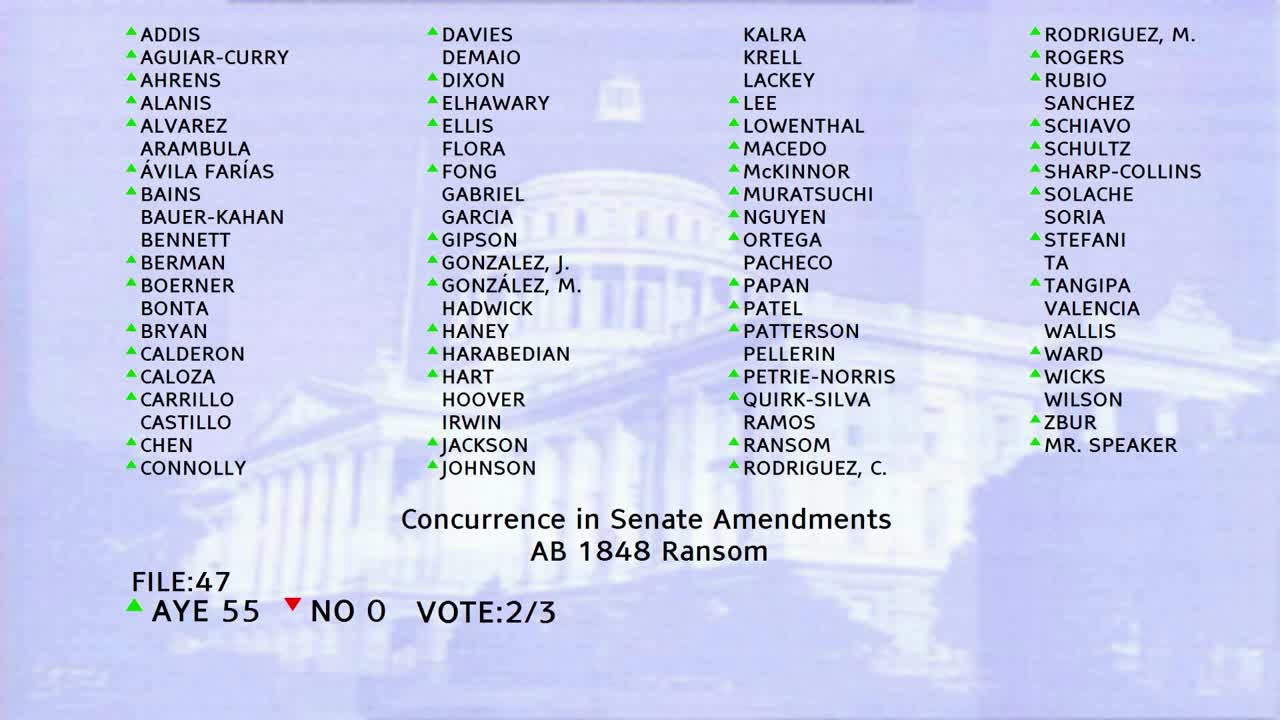

Bill Author


